Search Results: "ed"

28 September 2017

Dirk Eddelbuettel: RcppZiggurat 0.1.4

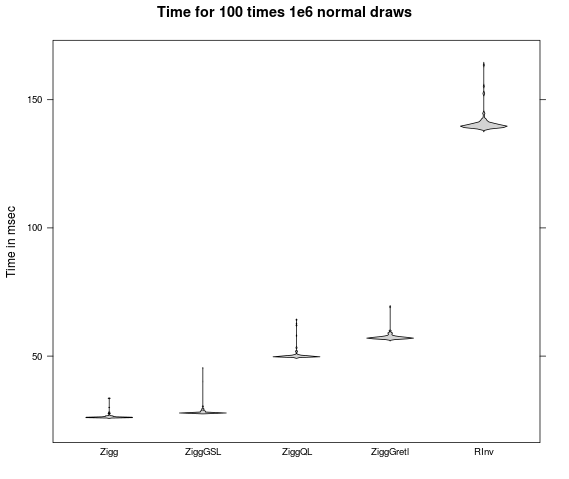
ziggurats A maintenance release of RcppZiggurat is now on the CRAN network for R. It switched the vignette to the our new pinp package and its two-column pdf default. The RcppZiggurat package updates the code for the Ziggurat generator which provides very fast draws from a Normal distribution. The package provides a simple C++ wrapper class for the generator improving on the very basic macros, and permits comparison among several existing Ziggurat implementations. This can be seen in the figure where Ziggurat from this package dominates accessing the implementations from the GSL, QuantLib and Gretl---all of which are still way faster than the default Normal generator in R (which is of course of higher code complexity). The NEWS file entry below lists all changes.

Changes in version 0.1.4 (2017-07-27)
  • The vignette now uses the pinp package in two-column mode.
  • Dynamic symbol registration is now enabled.

Courtesy of CRANberries, there is also a diffstat report for the most recent release. More information is on the RcppZiggurat page.

This post by Dirk Eddelbuettel originated on his Thinking inside the box blog. Please report excessive re-aggregation in third-party for-profit settings.

27 September 2017

Enrico Zini: Systemd device units

These are the notes of a training course on systemd I gave as part of my work with Truelite. .device units Several devices are automatically represented inside systemd by .device units, which can be used to activate services when a given device exists in the file system. See systemctl --all --full -t device to see a list of all decives for which systemd has a unit in your system. For example, this .service unit plays a sound as long as a specific USB key is plugged in my system:
[Unit]
Description=Beeps while a USB key is plugged
DefaultDependencies=false
StopWhenUnneeded=true
[Install]
WantedBy=dev-disk-by\x2dlabel-ERLUG.device
[Service]
Type=simple
ExecStart=/bin/sh -ec 'while true; do /usr/bin/aplay -q /tmp/beep.wav; sleep 2; done'
If you need to work with a device not seen by default by systemd, you can add a udev rule that makes it available, by adding the systemd tag to the device with TAG+="systemd". It is also possible to give the device an extra alias using ENV SYSTEMD_ALIAS ="/dev/my-alias-name". To figure out all you can use for matching a device:
  1. Run udevadm monitor --environment and plug the device
  2. Look at the DEVNAME= values and pick one that addresses your device the way you prefer
  3. udevadm info --attribute-walk --name=*the value of devname* will give you all you can use for matching in the udev rule.
See:

Enrico Zini: Qt cross-architecture development in Debian

Use case: use Debian Stable as an environment to run amd64 development machines to develop Qt applications for Raspberry Pi or other smallish armhf devices. Qt Creator is used as Integrated Development Environment, and it supports cross-compiling, running the built source on the target system, and remote debugging. Debian Stable (vanilla or Raspbian) runs on both the host and the target systems, so libraries can be kept in sync, and both systems have access to a vast amount of libraries, with security support. On top of that, armhf libraries can be installed with multiarch also in the host machine, so cross-builders have access to the exact same libraries as the target system. This sounds like a dream system. But. We're not quite there yet. cross-compile attempts I tried cross compiling a few packages:
$ sudo debootstrap stretch cross
$ echo "strech_cross"   sudo tee cross/etc/debian_chroot
$ sudo systemd-nspawn -D cross
# dpkg --add-architecture armhf
# echo "deb-src http://deb.debian.org/debian stretch main" >> /etc/apt/sources.list
# apt update
# apt install --no-install-recommends build-essential crossbuild-essential-armhf
Some packages work:
# apt source bc
# cd bc-1.06.95/
# apt-get build-dep -a armhf .
# dpkg-buildpackage -aarmhf -j2 -b
 
dh_auto_configure -- --prefix=/usr --with-readline
        ./configure --build=x86_64-linux-gnu --prefix=/usr --includedir=\$ prefix /include --mandir=\$ prefix /share/man --infodir=\$ prefix /share/info --sysconfdir=/etc --localstatedir=/var --disable-silent-rules --libdir=\$ prefix /lib/arm-linux-gnueabihf --libexecdir=\$ prefix /lib/arm-linux-gnueabihf --disable-maintainer-mode --disable-dependency-tracking --host=arm-linux-gnueabihf --prefix=/usr --with-readline
 
dpkg-deb: building package 'dc-dbgsym' in '../dc-dbgsym_1.06.95-9_armhf.deb'.
dpkg-deb: building package 'bc-dbgsym' in '../bc-dbgsym_1.06.95-9_armhf.deb'.
dpkg-deb: building package 'dc' in '../dc_1.06.95-9_armhf.deb'.
dpkg-deb: building package 'bc' in '../bc_1.06.95-9_armhf.deb'.
 dpkg-genbuildinfo --build=binary
 dpkg-genchanges --build=binary >../bc_1.06.95-9_armhf.changes
dpkg-genchanges: info: binary-only upload (no source code included)
 dpkg-source --after-build bc-1.06.95
dpkg-buildpackage: info: binary-only upload (no source included)
With qmake based Qt packages, qmake is not configured for cross-building, probably because it is not currently supported:
# apt source pumpa
# cd pumpa-0.9.3/
# apt-get build-dep -a armhf .
# dpkg-buildpackage -aarmhf -j2 -b
 
        qmake -makefile -nocache "QMAKE_CFLAGS_RELEASE=-g -O2 -fdebug-prefix-map=/root/pumpa-0.9.3=.
          -fstack-protector-strong -Wformat -Werror=format-security -Wdate-time -D_FORTIFY_SOURCE=2"
          "QMAKE_CFLAGS_DEBUG=-g -O2 -fdebug-prefix-map=/root/pumpa-0.9.3=. -fstack-protector-strong
          -Wformat -Werror=format-security -Wdate-time -D_FORTIFY_SOURCE=2"
          "QMAKE_CXXFLAGS_RELEASE=-g -O2 -fdebug-prefix-map=/root/pumpa-0.9.3=. -fstack-protector-strong
          -Wformat -Werror=format-security -Wdate-time -D_FORTIFY_SOURCE=2"
          "QMAKE_CXXFLAGS_DEBUG=-g -O2 -fdebug-prefix-map=/root/pumpa-0.9.3=. -fstack-protector-strong
          -Wformat -Werror=format-security -Wdate-time -D_FORTIFY_SOURCE=2"
          "QMAKE_LFLAGS_RELEASE=-Wl,-z,relro -Wl,-z,now"
          "QMAKE_LFLAGS_DEBUG=-Wl,-z,relro -Wl,-z,now" QMAKE_STRIP=: PREFIX=/usr
qmake: could not exec '/usr/lib/x86_64-linux-gnu/qt5/bin/qmake': No such file or directory
 
debian/rules:19: recipe for target 'build' failed
make: *** [build] Error 2
dpkg-buildpackage: error: debian/rules build gave error exit status 2
With cmake based Qt packages it goes a little better in that it finds the cross compiler, pkg-config and some multiarch paths, but then it tries to run armhf moc, which fails:
# apt source caneda
# cd caneda-0.3.0/
# apt-get build-dep -a armhf .
# dpkg-buildpackage -aarmhf -j2 -b
 
        cmake .. -DCMAKE_INSTALL_PREFIX=/usr -DCMAKE_VERBOSE_MAKEFILE=ON -DCMAKE_BUILD_TYPE=None
          -DCMAKE_INSTALL_SYSCONFDIR=/etc -DCMAKE_INSTALL_LOCALSTATEDIR=/var -DCMAKE_SYSTEM_NAME=Linux
          -DCMAKE_SYSTEM_PROCESSOR=arm -DCMAKE_C_COMPILER=arm-linux-gnueabihf-gcc
          -DCMAKE_CXX_COMPILER=arm-linux-gnueabihf-g\+\+
          -DPKG_CONFIG_EXECUTABLE=/usr/bin/arm-linux-gnueabihf-pkg-config
          -DCMAKE_INSTALL_LIBDIR=lib/arm-linux-gnueabihf
 
CMake Error at /usr/lib/arm-linux-gnueabihf/cmake/Qt5Core/Qt5CoreConfig.cmake:27 (message):
  The imported target "Qt5::Core" references the file
     "/usr/lib/arm-linux-gnueabihf/qt5/bin/moc"
  but this file does not exist.  Possible reasons include:
  * The file was deleted, renamed, or moved to another location.
  * An install or uninstall procedure did not complete successfully.
  * The installation package was faulty and contained
     "/usr/lib/arm-linux-gnueabihf/cmake/Qt5Core/Qt5CoreConfigExtras.cmake"
  but not all the files it references.
Note: Although I improvised a chroot to be able to fool around with it, I would use pbuilder or sbuild to do the actual builds. Helmut suggests pbuilder --host-arch or sbuild --host. Doing it the non-Debian way This guide in the meantime explains how to set up a cross-compiling Qt toolchain in a rather dirty way, by recompiling Qt pointing it at pieces of the Qt deployed on the Raspberry Pi. Following that guide, replacing the CROSS_COMPILE value with /usr/bin/arm-linux-gnueabihf- gave me a working qtbase, for which it is easy to create a Kit for Qt Creator that works, and supports linking applications with Debian development packages that do not use Qt. However, at that point I need to recompile all dependencies that use Qt myself, and I quickly got stuck at that monster of QtWebEngine, whose sources embed the whole of Chromium. Having a Qt based development environment in which I need to become the maintainer for the whole Qt toolchain is not a product I can offer to a customer. Cross compiling qmake based packages on stretch is not currently supported, so at the moment I had to suggest to postpone all plans for total world domination for at least two years. Cross-building Debian In the meantime, Helmut Grohne has been putting a lot of effort into making Debian packages cross-buildable:
helmut> enrico: yes, cross building is painful. we have ~26000 source packages. of those, ~13000 build arch-dep packages. of those, ~6000 have cross-satisfiable build-depends. of those, I tried cross building ~2300. of those 1300 cross built. so we are at about 10% working. helmut> enrico: plus there are some 607 source packages affected by some 326 bugs with patches. helmut> enrico: gogo nmu them helmut> enrico: I've filed some 1000 bugs (most of them with patches) now. around 600 are fixed :)
He is doing it mostly alone, and I would like people not to be alone when they do a lot of work in Debian, so Join Helmut in the effort of making Debian cross-buildable! Build any Debian package for any device right from the comfort of your own work computer! Have a single development environment seamlessly spanning architecture boundaries, with the power of all that there is in Debian! Join Helmut in the effort of making Debian cross-buildable! Apply here, or join #debian-bootstrap on OFTC! Cross-building Qt in Debian mitya57 summarised the situation on the KDE team side:
mitya57> we have cross-building stuff on our TODO list, but it will likely require a lot of time and neither Lisandro nor I have it currently. mitya57> see https://gobby.debian.org/export/Teams/KDE/qt-cross for a summary of what needs to be done. mitya57> Any help or patches are always welcome :))
qemu-user-static Helmut also suggested to use qemu-user-static to make the host system able to run binaries compiled for the target system, so that even if a non-cross-compiling Qt build tries to run moc and friends in their target architecture version, they would transparently succeed. At that point, it would just be a matter of replacing compiler paths to point to the native cross-compiling gcc, and the build would not be slowed down by much. Fixing bug #781226 would help in making it possible to configure a multiarch version of qmake as the qmake used for cross compiling. I have not had a chance of trying to cross-build in this way yet. In the meantime... Having qtcreator able to work on an amd64 devel machine and deploy/test/debug remotely on an arm target machine, where both machine run debian stable and have libraries in sync, would be a great thing to have even though packages do not cross-build yet. Helmut summarised the situation on IRC:
svuorela and others repeat that Qt upstream is not compatible with Debian's multiarch thinking, in that Qt upstream insists on having one toolchain for each pair of architectures, whereas the Debian way tends to be to make packages generic and split stuff such that it can be mixed and matched. An example being that you need to run qmake (thus you need qmake for the build architecture), but qmake also embeds the relevant paths and you need to query it for them (so you need qmake for the host architecture) Either you run it through qemu, or you have a particular cross qmake for your build/host pair, or you fix qt upstream to stop this madness
Building qmake in Debian for each host-target pair, even just limited to released architectures, would mean building Qt 100 times, and that's not going to scale. I wonder:

Dirk Eddelbuettel: RcppAnnoy 0.0.10

A few short weeks after the more substantial 0.0.9 release of RcppAnnoy, we have a quick bug-fix update. RcppAnnoy is our Rcpp-based R integration of the nifty Annoy library by Erik. Annoy is a small and lightweight C++ template header library for very fast approximate nearest neighbours. Micha l Benesty noticed that our getItemsVector() function didn't, ahem, do much besides crashing. Simple bug, they happen--now fixed, and a unit test added. Changes in this version are summarized here:

Changes in version 0.0.10 (2017-09-25)
  • The getItemsVector() function no longer crashes (#24)

Courtesy of CRANberries, there is also a diffstat report for this release.

This post by Dirk Eddelbuettel originated on his Thinking inside the box blog. Please report excessive re-aggregation in third-party for-profit settings.

26 September 2017

Enrico Zini: Systemd timer units

These are the notes of a training course on systemd I gave as part of my work with Truelite. .timer units Configure activation of other units (usually a .service unit) at some given time. The functionality is similar to cron, with more features and a finer time granularity. For example, in Debian Stretch apt has a timer for running apt update which runs at a random time to distribute load on servers:
# /lib/systemd/system/apt-daily.timer
[Unit]
Description=Daily apt download activities
After=network-online.target
Wants=network-online.target
[Timer]
OnCalendar=*-*-* 6,18:00
RandomizedDelaySec=12h
Persistent=true
[Install]
WantedBy=timers.target
The corresponding apt-daily.service file then only runs when the system is on mains power, to avoid unexpected batter drains for systems like laptops:
# /lib/systemd/system/apt-daily.service
[Unit]
Description=Daily apt download activities
Documentation=man:apt(8)
ConditionACPower=true
[Service]
Type=oneshot
ExecStart=/usr/lib/apt/apt.systemd.daily update
Note that if you want to schedule tasks with an accuracy under a minute (for example to play a beep every 5 seconds when running on battery), you need to also configure AccuracySec= for the timer to a delay shorter than the default 1 minute. This is how to make your computer beep when on battery:
# /etc/systemd/system/beep-on-battery.timer
[Unit]
Description=Beeps every 10 seconds
[Install]
WantedBy=timers.target
[Timer]
AccuracySec=1s
OnUnitActiveSec=10s
# /etc/systemd/system/beep-on-battery.service
[Unit]
Description=Beeps when on battery
ConditionACPower=false
[Service]
Type=oneshot
ExecStart=/usr/bin/aplay /tmp/beep.wav
See:

Colin Watson: A mysterious bug with Twisted plugins

I fixed a bug in Launchpad recently that led me deeper than I expected. Launchpad uses Buildout as its build system for Python packages, and it s served us well for many years. However, we re using 1.7.1, which doesn t support ensuring that packages required using setuptools setup_requires keyword only ever come from the local index URL when one is specified; that s an essential constraint we need to be able to impose so that our build system isn t immediately sensitive to downtime or changes in PyPI. There are various issues/PRs about this in Buildout (e.g. #238), but even if those are fixed it ll almost certainly only be in Buildout v2, and upgrading to that is its own kettle of fish for other reasons. All this is a serious problem for us because newer versions of many of our vital dependencies (Twisted and testtools, to name but two) use setup_requires to pull in pbr, and so we ve been stuck on old versions for some time; this is part of why Launchpad doesn t yet support newer SSH key types, for instance. This situation obviously isn t sustainable. To deal with this, I ve been working for some time on switching to virtualenv and pip. This is harder than you might think: Launchpad is a long-lived and complicated project, and it had quite a number of explicit and implicit dependencies on Buildout s configuration and behaviour. Upgrading our infrastructure from Ubuntu 12.04 to 16.04 has helped a lot (12.04 s baseline virtualenv and pip have some deficiencies that would have required a more complicated bootstrapping procedure). I ve dealt with most of these: for example, I had to reorganise a lot of our helper scripts (1, 2, 3), but there are still a few more things to go. One remaining problem was that our Buildout configuration relied on building several different environments with different Python paths for various things. While this would technically be possible by way of building multiple virtualenvs, this would inflate our build time even further (we re already going to have to cope with some slowdown as a result of using virtualenv, because the build system now has to do a lot more than constructing a glorified link farm to a bunch of cached eggs), and it seems like unnecessary complexity. The obvious thing to do seemed to be to collapse these into a single environment, since there was no obvious reason why it should actually matter if txpkgupload and txlongpoll were carefully kept off the path when running most of Launchpad: so I did that. Then our build system got very sad. Hmm, I thought. To keep our test times somewhat manageable, we run them in parallel across 20 containers, and we randomise the order in which they run to try to shake out test isolation bugs. It s not completely unknown for there to be some oddities resulting from that. So I ran it again. Nope, but slightly differently sad this time. Furthermore, I couldn t reproduce these failures locally no matter how hard I tried. Oh dear. This was obviously not going to be a good day. In fact I spent a while on various different guesswork-based approaches. I found bug 571334 in Ampoule, an AMP-based process pool implementation that we use for some job runners, and proposed a fix for that, but cherry-picking that fix into Launchpad didn t help matters. I tried backing out subsets of my changes and determined that if both txlongpoll and txpkgupload were absent from the Python module path in the context of the tests in question then everything was fine. I tried running strace locally and staring at the output for some time in the hope of enlightenment: that reminded me that the two packages in question install modules under twisted.plugins, which did at least establish a reason they might affect the environment that was more plausible than magic, but nothing much more specific than that. On Friday I was fiddling about with this again and trying to insert some more debugging when I noticed some interesting behaviour around plugin caching. If I caused the txpkgupload plugin to raise an exception when loaded, the Twisted plugin system would remove its dropin.cache (because it was stale) and not create a new one (because there was now no content to put in it). After that, running the relevant tests would fail as I d seen in our buildbot. Aha! This meant that I could also reproduce it by doing an even cleaner build than I d previously tried to do, by removing the cached txpkgupload and txlongpoll eggs and allowing the build system to recreate them. When they were recreated, they didn t contain dropin.cache, instead allowing that to be created on first use. Based on this clue I was able to get to the answer relatively quickly. Ampoule has a specialised bootstrapping sequence for its worker processes that starts by doing this:
from twisted.application import reactors
reactors.installReactor(reactor)
Now, twisted.application.reactors.installReactor calls twisted.plugin.getPlugins, so the very start of this bootstrapping sequence is going to involve loading all plugins found on the module path (I assume it s possible to write a plugin that adds an alternative reactor implementation). If dropin.cache is up to date, then it will just get the information it needs from that; but if it isn t, it will go ahead and import the plugin. If the plugin happens (as Twisted code often does) to run from twisted.internet import reactor at some point while being imported, then that will install the platform s default reactor, and then twisted.application.reactors.installReactor will raise ReactorAlreadyInstalledError. Since Ampoule turns this into an info-level log message for some reason, and the tests in question only passed through error-level messages or higher, this meant that all we could see was that a worker process had exited non-zero but not why. The Twisted documentation recommends generating the plugin cache at build time for other reasons, but we weren t doing that. Fixing that makes everything work again. There are still a few more things needed to get us onto pip, but we re now pretty close. After that we can finally start bringing our dependencies up to date.

Norbert Preining: Debian/TeX Live 2017.20170926-1

A full month or more has past since the last upload of TeX Live, so it was high time to prepare a new package. Nothing spectacular here I have to say, two small bugs fixed and the usual long list of updates and new packages. From the new packages I found fontloader-luaotfload and interesting project. Loading fonts via lua code in luatex is by now standard, and this package allows for experiments with newer/alternative font loaders. Another very interesting new-comer is pdfreview which lets you set pages of another PDF on a lined background and add notes to it, good for reviewing. Enjoy. New packages abnt, algobox, beilstein, bib2gls, cheatsheet, coelacanth, dijkstra, dynkin-diagrams, endofproofwd, fetchcls, fixjfm, fontloader-luaotfload, forms16be, hithesis, ifxptex, komacv-rg, ku-template, latex-refsheet, limecv, mensa-tex, multilang, na-box, notes-tex, octave, pdfreview, pst-poker, theatre, upzhkinsoku, witharrows. Updated packages 2up, acmart, acro, amsmath, animate, babel, babel-french, babel-hungarian, bangorcsthesis, beamer, beebe, biblatex-gost, biblatex-philosophy, biblatex-source-division, bibletext, bidi, bpchem, bxjaprnind, bxjscls, bytefield, checkcites, chemmacros, chet, chickenize, complexity, curves, cweb, datetime2-german, e-french, epstopdf, eqparbox, esami, etoc, fbb, fithesis, fmtcount, fnspe, fontspec, genealogytree, glossaries, glossaries-extra, hvfloat, ifptex, invoice2, jfmutil, jlreq, jsclasses, koma-script, l3build, l3experimental, l3kernel, l3packages, latexindent, libertinust1math, luatexja, lwarp, markdown, mcf2graph, media9, nddiss, newpx, newtx, novel, numspell, ocgx2, philokalia, phfqit, placeat, platex, poemscol, powerdot, pst-barcode, pst-cie, pst-exa, pst-fit, pst-func, pst-geometrictools, pst-ode, pst-plot, pst-pulley, pst-solarsystem, pst-solides3d, pst-tools, pst-vehicle, pst2pdf, pstricks, pstricks-add, ptex-base, ptex-fonts, pxchfon, quran, randomlist, reledmac, robustindex, scratch, skrapport, spectralsequences, tcolorbox, tetex, tex4ht, texcount, texdef, texinfo, texlive-docindex, texlive-scripts, tikzducks, tikzsymbols, tocloft, translations, updmap-map, uplatex, widetable, xepersian, xetexref, xint, xsim, zhlipsum.

Iain R. Learmonth: SMS Verification

I ve received an email today from Barclaycard with the following:
From time to time, to make sure it s you who s using your Barclaycard online, we ll send you a text with a verification code for you to use on the Verified by Visa screen that ll pop up on your payment page.
The proprietary nature of mobile phones with the hardware specifications and the software being closed off from inspection or audit and considered to be trade secrets make my phone and my tablet the least trusted devices I own and use. Due to this lack of trust, I ve often held back from using my phone or tablet for certain tasks where I can still get away with not doing so. I have experimented with having read-only access to my calendars and contacts to ensure that if my phone is compromised they can t just be wiped out, though in the end I had to give in as my calendar was becoming too difficult to manage using a paper system as part of entry for new events. I wanted to try to reduce the attractiveness of compromising my phone. Anyone that really wants to have a go at my phone could probably get in. It s an older Samsung Android phone on a UK network and software updates rarely come through in a timely manner. Anything that I give my phone access to is at risk and that risk needs to be balanced by some real world benefits. These are just the problems with the phone itself. When you re using SMS authentication, even with the most secure phone ever, you re still going to be using the phone network. SMS authentication is about equivalent, in terms of the security it really offers, to your mobile phone number being your password when it comes to an even mildly motivated attacker. You probably don t treat your mobile phone number as a password, nor does the provider or anyone you ve given it to, so you can assume that it s compromised. Why are mobile phones so popular for two factor (on in increasing numbers of cases, single factor) authentication? Not because they improve security but because they re convenient and everyone has one. This seems like a bad plan.

Iain R. Learmonth: SMS Verification

I ve received an email today from Barclaycard with the following: From time to time, to make sure it s you who s using your Barclaycard online, we ll send you a text with a verification code for you to use on the Verified by Visa screen that ll pop up on your payment page. The proprietary nature of mobile phones with the hardware specifications and the software being closed off from inspection or audit and considered to be trade secrets make my phone and my tablet the least trusted devices I own and use.

Reproducible builds folks: Reproducible Builds: Weekly report #126

Here's what happened in the Reproducible Builds effort between Sunday September 17th and Saturday September 23rd 2017: Media coverage Reproducible work in other packages Packages reviewed and fixed, and bugs filed Reviews of unreproducible packages 1 package reviews was added, 49 have been updated and 54 have been removed in this week, adding to our knowledge about identified issues. One issue type was updated: Weekly QA work During our reproducibility testing, FTBFS bugs have been detected and reported by: diffoscope development Version 87 was uploaded to unstable by Mattia Rizzolo. It included contributions from: strip-nondeterminism development reprotest development Version 0.7 was uploaded to unstable by Ximin Luo: tests.reproducible-builds.org Vagrant Cascadian and Holger Levsen: Holger Levsen: Misc. This week's edition was written by Bernhard M. Wiedemann, Chris Lamb, Vagrant Cascadian & reviewed by a bunch of Reproducible Builds folks on IRC & the mailing lists.

Russ Allbery: Review: Artemis Fowl

Review: Artemis Fowl, by Eoin Colfer
Series: Artemis Fowl #1
Publisher: Disney-Hyperion
Copyright: 2001
ISBN: 1-4231-2452-9
Format: Kindle
Pages: 281
Artemis Fowl is the heir to the Fowl criminal empire and a child prodigy. He's also one of the few humans to know of the existence of fairies, who are still present in the world, hiding from humans and living by their own rules. As the book opens, he's in search of those rules: a copy of the book that governs the lives of fairies. With that knowledge, he should be able to pull off a heist worthy of his family's legacy. Captain Holly Short is a leprechaun... or, more correctly, a LEPrecon. She's one of the fairy police officers that investigate threats to the fairies who are hiding in a vast underground civilization. The fairies have magic, but they also have advanced (and miniaturized) technology, maintained in large part by a grumpy and egotistical centaur (named Foaly, because it's that sort of book). She's also the fairy unlucky enough to be captured by Artemis's formidable personal bodyguard their first attempt to kidnap a hostage for their ransom demands. This is the first book of a long series of young adult novels that has also spawned graphic novels and a movie currently in production. It has that lean and clear feeling of the younger side of young adult writing: larger-than-life characters who are distinctive and easy to remember, a short introductory setup that dives directly into the main plot, and a story that neatly pulls together every element raised in the story. The world-building is its strongest point, particularly the mix of tongue-in-cheek technology ships that ride magma plumes, mechanical wings, and helmet-mounted lights to blind trolls and science-tinged magic that the fairies build their police and army on. Fairies are far beyond humans in capability, and can be deadly and ruthless, but they have to follow a tightly constrained set of rules that are often not convenient. Sadly, the characters don't live up to the world-building. I did enjoy a few of them, particularly Artemis's loyal bodyguards and the dwarf Mulch Diggums. But Holly, despite being likable, is a bit of a blank slate: the empathetic, overworked trooper who is mostly indistinguishable from other characters in similar stories. The gruff captain, the sarcastic technician Foaly, and the various other LEP agents all felt like they were taken straight from central casting. And then there's Artemis himself. Artemis is the protagonist of the story, in that he's the one who initiates all of the action and the one who has the most interesting motivations. The story is about him, as the third-person narrator in the introduction makes clear. He's trying very hard to be a criminal genius with the deductive abilities of Sherlock Holmes and the speaking style of a Bond villain, but he's also twelve, his father has disappeared, and his mother is going slowly insane. I picked this book up on the recommendation of another reader who found that contrast compelling. Unfortunately, I thought Artemis was just an abusive jerk. Yes, yes, family tragedy, yes, he's trapped in his conception of himself, but he's arrogant, utterly uncaring about how his actions affect other people, and dismissive and cruel even to his bodyguards (who are much better friends than he deserves). I think liking this book requires liking Artemis at least well enough to consider him an anti-hero, and I can squint and see that appeal if you have that reaction. But I just wanted him to lose. Not in the "you will be slowly redeemed over the course of a long series" way, but in the "you are a horrible person and I hope you get what's coming to you" way. The humor of the fairy parts of the book was undermined too much by the fact that many of them would like to kill Artemis for real, and I mostly wanted them to succeed. This may or may not have to do with my low tolerance for egotistical smart-asses who order other people to do things that they refuse to explain. Without some appreciation for Artemis, this is a story with some neat world-building, a fairly generic protagonist in Holly, and a plot in which the bad guys win. To make matters worse, I thought the supposedly bright note at the end of the story was just creepy, as was everything else involving Artemis's mother. The review I read was of the first three books, so it's entirely possible that this series gets better as it goes along, but there wasn't enough I enjoyed in the first book for me to keep reading. Followed by Artemis Fowl: The Arctic Incident. Rating: 5 out of 10

25 September 2017

Enrico Zini: Systemd mount and swap units

These are the notes of a training course on systemd I gave as part of my work with Truelite. .mount and .swap units Describe mount points similarly as what /etc/fstab, but with more functionality and integration with the dependency system. It is possible to define, for example, a filesystem that should be mounted only when the network is available and a given service has successfully started, and a service that should be started only after a given filesystem has been successfully mounted. At boot, systemd uses systemd-fstab-generator to generate mount and swap units from /etc/fstab, so that the usual fstab configuration file can still be used to configure the file system layout. See man systemd.mount, and man systemd.swap. See systemctl --all -t mount and systemctl --all -t swap for examples.

Steve Kemp: Started work on an internet-of-things Radio

So recently I was in York at the Bytemark office, and I read a piece about building a radio in a Raspberry Pi magazine. It got me curious, so when I got home to sunny Helsinki I figured I'd have a stab at it. I don't have fixed goal in mind, but what I do have is: The initial goal is simple wire the receiver/decoder to the board, and listen to the radio. After that there are obvious extenstions, such as adding an LCD display to show the frequency (What's the frequency Kenneth), and later to show the station details, via RDS. Finally I could add some buttons/switches/tweaks for selecting next/previous stations, and adjusting the volume. Initially that'll be handled by pointing a browser at the IP-address of the device. The first attempt at using the RDA5807M chip was a failure, as the thing was too damn small and non-standardly sized. Adding header-pins to the chips was almost impossible, and when I did get them soldered on the thing just gave me static-hisses. However I later read the details of the chip more carefully and realized that it isn't powerfull enough to drive (even) headphones. It requires an amp of some kind. With that extra knowledge I was able to send the output to the powered-speakers I have sat beside my PC. My code is basic, it sets up the FM-receiver/decoder, and scans the spectrum. When it finds a station it outputs the name over the serial console, via RDS, and then just plays it. I've got an PAM8403-based amplifier board on-order, when that arrives I'll get back to the project, and hookup WiFi and a simple web-page to store stations, tuning, etc. My "token goal" at the moment is a radio that switches on at 7AM and switches off at 8AM. In addition to that it'll serve a web-page allowing interactive control, regardless of any buttons that are wired in. I also have another project in the wings. I've ordered a software-defined radio (USB-toy) which I'm planning to use to plot aircraft in real-time, as they arrive/depart/fly over Helsinki. No doubt I'll write that up too.

Chris Lamb: Lintian: We are all Perl developers now

Lintian is a static analysis tool for Debian packages, reporting on various errors, omissions and general quality-assurance issues to maintainers. I've previously written about my exploits with Lintian as well as authoring a short tutorial on how to write your own Lintian check. Anyway, I recently uploaded version 2.5.53 about two months since previous release. The biggest changes you may notice are supporting the latest version of the Debian Policy as well the addition of checks to encourage the migration to Python 3. Thanks to all who contributed patches, code review and bug reports to this release. The full changelog is as follows:
lintian (2.5.53) unstable; urgency=medium
  The "we are all Perl developers now" release.
  * Summary of tag changes:
    + Added:
      - alternatively-build-depends-on-python-sphinx-and-python3-sphinx
      - build-depends-on-python-sphinx-only
      - dependency-on-python-version-marked-for-end-of-life
      - maintainer-script-interpreter
      - missing-call-to-dpkg-maintscript-helper
      - node-package-install-in-nodejs-rootdir
      - override-file-in-wrong-package
      - package-installs-java-bytecode
      - python-foo-but-no-python3-foo
      - script-needs-depends-on-sensible-utils
      - script-uses-deprecated-nodejs-location
      - transitional-package-should-be-oldlibs-optional
      - unnecessary-testsuite-autopkgtest-header
      - vcs-browser-links-to-empty-view
    + Removed:
      - debug-package-should-be-priority-extra
      - missing-classpath
      - transitional-package-should-be-oldlibs-extra
  * checks/apache2.pm:
    + [CL] Fix an apache2-unparsable-dependency false positive by allowing
      periods (".") in dependency names.  (Closes: #873701)
  * checks/binaries.pm:
    + [CL] Apply patches from Guillem Jover & Boud Roukema to improve the
      description of the binary-file-built-without-LFS-support tag.
      (Closes: #874078)
  * checks/changes. pm,desc :
    + [CL] Ignore DFSG-repacked packages when checking for upstream
      source tarball signatures as they will never match by definition.
      (Closes: #871957)
    + [CL] Downgrade severity of orig-tarball-missing-upstream-signature
      from "E:" to "W:" as many common tools do not make including the
      signatures easy enough right now.  (Closes: #870722, #870069)
    + [CL] Expand the explanation of the
      orig-tarball-missing-upstream-signature tag to include the location
      of where dpkg-source will look. Thanks to Theodore Ts'o for the
      suggestion.
  * checks/copyright-file.pm:
    + [CL] Address a number of issues in copyright-year-in-future:
      - Prevent false positives in port numbers, email addresses, ISO
        standard numbers and matching specific and general street
        addresses.  (Closes: #869788)
      - Match all violating years in a line, not just the first (eg.
        "2000-2107").
      - Ignore meta copyright statements such as "Original Author". Thanks
        to Thorsten Alteholz for the bug report.  (Closes: #873323)
      - Expand testsuite.
  * checks/cruft. pm,desc :
    + [CL] Downgrade severity of file-contains-fixme-placeholder
      tag from "important" (ie. "E:") to "wishlist" (ie. "I:").
      Thanks to Gregor Herrmann for the suggestion.
    + [CL] Apply patch from Alex Muntada (alexm) to use "substr" instead
      of "substring" in mentions-deprecated-usr-lib-perl5-directory's
      description.  (Closes: #871767)
    + [CL] Don't check copyright_hints file for FIXME placeholders.
      (Closes: #872843)
    + [CL] Don't match quoted "FIXME" variants as they are almost always
      deliberate. Thanks to Adrian Bunk for the report.  (Closes: #870199)
    + [CL] Avoid false positives in missing source checks for "CSS Browser
      Selector".  (Closes: #874381)
  * checks/debhelper.pm:
    + [CL] Prevent a false positive of
      missing-build-dependency-for-dh_-command that can be exposed by
      following the advice for the recently added
      useless-autoreconf-build-depends tag.  (Closes: #869541)
  * checks/debian-readme. pm,desc :
    + [CL] Ensure readme-debian-contains-debmake-template also checks
      for templates "Automatically generated by debmake".
  * checks/description. desc,pm :
    + [CL] Clarify explanation of description-starts-with-leading-spaces
      tag. Thanks to Taylor Kline  for the report
      and patch.  (Closes: #849622)
    + [NT] Skip capitalization-error-in-description-synopsis for
      auto-generated packages (such as dbgsym packages).
  * checks/fields. desc,pm :
    + [CL] Ensure that python3-foo packages have "Section: python", not
      just python2-foo.  (Closes: #870272)
    + [RG] Do no longer require debug packages to be priority extra.
    + [BR] Use Lintian::Data for name/section mapping
    + [CL] Check for packages including "?rev=0&sc=0" in Vcs-Browser.
      (Closes: #681713)
    + [NT] Transitional packages should now be "oldlibs/optional" rather
      than "oldlibs/extra".  The related tag has been renamed accordingly.
  * checks/filename-length.pm:
    + [NT] Skip the check on auto-generated binary packages (such as
      dbgsym packages).
  * checks/files. pm,desc :
    + [BR] Avoid privacy-breach-generic false positives for legal.xml.
    + [BR] Detect install of node package under /usr/lib/nodejs/[^/]*$
    + [CL] Check for packages shipping compiled Java class files. Thanks
      Carn  Draug .  (Closes: #873211)
    + [BR] Privacy breach is no longer experimental.
  * checks/init.d.desc:
    + [RG] Do not recommend a versioned dependency on lsb-base in
      init.d-script-needs-depends-on-lsb-base.  (Closes: #847144)
  * checks/java.pm:
    + [CL] Additionally consider .cljc files as code to avoid false-
      positive codeless-jar warnings.  (Closes: #870649)
    + [CL] Drop problematic missing-classpath check.  (Closes: #857123)
  * checks/menu-format.desc:
    + [CL] Prevent false positives in desktop-entry-lacks-keywords-entry
      for "Link" and "Directory" .desktop files.  (Closes: #873702)
  * checks/python. pm,desc :
    + [CL] Split out Python checks from "scripts" check to a new, source
      check of type "source".
    + [CL] Check for python-foo without corresponding python3-foo packages
      to assist in Python 2.x deprecation.  (Closes: #870681)
    + [CL] Check for packages that Build-Depend on python-sphinx only.
      (Closes: #870730)
    + [CL] Check for packages that alternatively Build-Depend on the
      Python 2 and Python 3 versions of Sphinx.  (Closes: #870758)
    + [CL] Check for binary packages that depend on Python 2.x.
      (Closes: #870822)
  * checks/scripts.pm:
    + [CL] Correct false positives in
      unconditional-use-of-dpkg-statoverride by detecting "if !" as a
      valid shell prefix.  (Closes: #869587)
    + [CL] Check for missing calls to dpkg-maintscript-helper(1) in
      maintainer scripts.  (Closes: #872042)
    + [CL] Check for packages using sensible-utils without declaring a
      dependency after its split from debianutils.  (Closes: #872611)
    + [CL] Warn about scripts using "nodejs" as an interpreter now that
      nodejs provides /usr/bin/node.  (Closes: #873096)
    + [BR] Add a statistic tag giving interpreter.
  * checks/testsuite. desc,pm :
    + [CL] Remove recommendations to add a "Testsuite: autopkgtest" field
      to debian/control as it is added when needed by dpkg-source(1)
      since dpkg 1.17.1.  (Closes: #865531)
    + [CL] Warn if we see an unnecessary "Testsuite: autopkgtest" header
      in debian/control.
    + [NT] Recognise "autopkgtest-pkg-go" as a valid test suite.
    + [CL] Recognise "autopkgtest-pkg-elpa" as a valid test suite.
      (Closes: #873458)
    + [CL] Recognise "autopkgtest-pkg-octave" as a valid test suite.
      (Closes: #875985)
    + [CL] Update the description of unknown-testsuite to reflect that
      "autopkgtest" is not the only valid value; the referenced URL
      is out-of-date (filed as #876008).  (Closes: #876003)
  * data/binaries/embedded-libs:
    + [RG] Detect embedded copies of heimdal, libgxps, libquicktime,
      libsass, libytnef, and taglib.
    + [RG] Use an additional string to detect embedded copies of
      openjpeg2.  (Closes: #762956)
  * data/fields/name_section_mappings:
    + [BR] node- package section is javascript.
    + [CL] Apply patch from Guillem Jover to add more section mappings.
      (Closes: #874121)
  * data/fields/obsolete-packages:
    + [MR] Add dh-systemd.  (Closes: #872076)
  * data/fields/perl-provides:
    + [CL] Refresh perl provides.
  * data/fields/virtual-packages:
    + [CL] Update data file from archive. This fixes a false positive for
      "bacula-director".  (Closes: #835120)
  * data/files/obsolete-paths:
    + [CL] Add note to /etc/bash_completion.d entry regarding stricter
      filename requirements.  (Closes: #814599)
  * data/files/privacy-breaker-websites:
    + [BR] Detect custom donation logos like apache.
    + [BR] Detect generic counter website.
  * data/standards-version/release-dates:
    + [CL] Add 4.0.1 and 4.1.0 as known standards versions.
      (Closes: #875509)
  * debian/control:
    + [CL] Mention Debian Policy v4.1.0 in the description.
    + [CL] Add myself to Uploaders.
    + [CL] Drop unnecessary "Testsuite: autopkgtest"; this is implied from
      debian/tests/control existing.
  * commands/info.pm:
    + [CL] Add a --list-tags option to print all tags Lintian knows about.
      Thanks to Rajendra Gokhale for the suggestion.  (Closes: #779675)
  * commands/lintian.pm:
    + [CL] Apply patch from Maia Everett to avoid British spelling when
      using en_US locale.  (Closes: #868897)
  * lib/Lintian/Check.pm:
    + [CL] Stop emitting  maintainer,uploader -address-causes-mail-loops
      for @packages.debian.org addresses.  (Closes: #871575)
  * lib/Lintian/Collect/Binary.pm:
    + [NT] Introduce an "auto-generated" argument for "is_pkg_class".
  * lib/Lintian/Data.pm:
    + [CL] Modify Lintian::Data's "all" to always return keys in insertion
      order, dropping dependency on libtie-ixhash-perl.
  * helpers/coll/objdump-info-helper:
    + [CL] Apply patch from Steve Langasek to accommodate binutils 2.29
      outputting symbols in a different format on ppc64el.
      (Closes: #869750)
  * t/tests/fields-perl-provides/tags:
    + [CL] Update expected output to match new Perl provides.
  * t/tests/files-privacybreach/*:
    + [CL] Add explicit test for packages including external fonts via
      the Google Font API. Thanks to Ian Jackson for the report.
      (Closes: #873434)
    + [CL] Add explicit test for packages including external fonts via
      the Typekit API via <script/> HTML tags.
  * t/tests/*/desc:
    + [CL] Add missing entries in "Test-For" fields to make
      development/testing workflow less error-prone.
  * private/generate-tag-summary:
    + [CL] git-describe(1) will usually emit 7 hexadecimal digits as the
      abbreviated object name,  However, as this can be user-dependent,
      pass --abbrev=0 to ensure it does not vary between systems.  This
      also means we do not need to strip it ourselves.
  * private/refresh-*:
    + [CL] Use deb.debian.org as the default mirror.
    + [CL] Update locations of Contents-<arch> files; they are now
      namespaced by distribution (eg. "main").
 -- Chris Lamb <lamby@debian.org>  Wed, 20 Sep 2017 09:25:06 +0100

Lior Kaplan: Recruiting for Open Source jobs

Part of services of Kaplan open source consulting is recruiting services to help companies find good open source people. In addition, we also try to help the community to find open source friendly businesses to work at. Expect the Usual Suspects (e.g. RedHat), I encounter job descriptions which convince me these companies know the advantages of using open source projects and hiring open source people. A few recent examples I found in Israel: From the applicant side, the possibility to know which code base he or she is going to work on could help do a better and more educated choice about the offered position. While from the company side, getting hard evidence of what are the applicant capabilities and code looks like instead of just describing them or trying to demonstrate them on short tests. Not to mention the applicant s ability to work as part of a team or community. For the Israeli readers, you can see the full list at https://kaplanopensource.co.il/jobs/
Filed under: Israeli Community, Open source businesses

24 September 2017

Enrico Zini: Systemd service units

These are the notes of a training course on systemd I gave as part of my work with Truelite. .service units Describe how to start and stop system services, like daemons. Services are described in a [Service] section. The Type= configuration describes how the service wants to be brought up: There are a lot more configuration options to fine-tune how the program should be managed, to limit its resource access or capabilities to harden the system security, to run setup/cleanup scripts before or after it started, and after it gets stopped, to control what signals to send to ask for reload or quit, and quite a lot more. See: man systemd.service, man systemd.exec, man systemd.resource-control, and man systemd.kill. See systemctl --all -t service for examples.

Julian Andres Klode: APT 1.5 is out

APT 1.5 is out, after almost 3 months the release of 1.5 alpha 1, and almost six months since the release of 1.4 on April 1st. This release cycle was unusually short, as 1.4 was the stretch release series and the zesty release series, and we waited for the latter of these releases before we started 1.5. In related news, 1.4.8 hit stretch-proposed-updates today, and is waiting in the unapproved queue for zesty. This release series moves https support from apt-transport-https into apt proper, bringing with it support for https:// proxies, and support for autodetectproxy scripts that return http, https, and socks5h proxies for both http and https. Unattended updates and upgrades now work better: The dependency on network-online was removed and we introduced a meta wait-online helper with support for NetworkManager, systemd-networkd, and connman that allows us to wait for network even if we want to run updates directly after a resume (which might or might not have worked before, depending on whether update ran before or after network was back up again). This also improves a boot performance regression for systems with rc.local files: The rc.local.service unit specified After=network-online.target, and login stuff was After=rc.local.service, and apt-daily.timer was Wants=network-online.target, causing network-online.target to be pulled into the boot and the rc.local.service ordering dependency to take effect, significantly slowing down the boot. An earlier less intrusive variant of that fix is in 1.4.8: It just moves the network-online.target Want/After from apt-daily.timer to apt-daily.service so most boots are uncoupled now. I hope we get the full solution into stretch in a later point release, but we should gather some experience first before discussing this with the release time. Balint Reczey also provided a patch to increase the time out before killing the daily upgrade service to 15 minutes, to actually give unattended-upgrades some time to finish an in-progress update. Honestly, I d have though the machine hung up and force rebooted it after 5 seconds already. (this patch is also in 1.4.8) We also made sure that unreadable config files no longer cause an error, but only a warning, as that was sort of a regression from previous releases; and we added documentation for /etc/apt/auth.conf, so people actually know the preferred way to place sensitive data like passwords (and can make their sources.list files world-readable again). We also fixed apt-cdrom to support discs without MD5 hashes for Sources (the Files field), and re-enabled support for udev-based detection of cdrom devices which was accidentally broken for 4 years, as it was trying to load libudev.so.0 at runtime, but that library had an SONAME change to libudev.so.1 we now link against it normally. Furthermore, if certain information in Release files change, like the codename, apt will now request confirmation from the user, avoiding a scenario where a user has stable in their sources.list and accidentally upgrades to the next release when it becomes stable. Paul Wise contributed patches to allow configuring the apt-daily intervals more easily apt-daily is invoked twice a day by systemd but has more fine-grained internal timestamp files. You can now specify the intervals in seconds, minutes, hours, and day units, or specify always to always run (that is, up to twice a day on systemd, once per day on non-systemd platforms). Development for the 1.6 series has started, and I intent to upload a first alpha to unstable in about a week, removing the apt-transport-https package and enabling compressed index files by default (save space, a lot of space, at not much performance cost thanks to lz4). There will also be some small clean ups in there, but I don t expect any life-changing changes for now. I think our new approach of uploading development releases directly to unstable instead of parking them in experimental is working out well. Some people are confused why alpha releases appear in unstable, but let me just say one thing: These labels basically just indicate feature-completeness, and not stability. An alpha is just very likely to get a lot more features, a beta is less likely (all the big stuff is in), and the release candidates just fix bugs. Also, we now have 3 active stable series: The 1.2 LTS series, 1.4 medium LTS, and 1.5. 1.2 receives updates as part of Ubuntu 16.04 (xenial), 1.4 as part of Debian 9.0 (stretch) and Ubuntu 17.04 (zesty); whereas 1.5 will only be supported for 9 months (as part of Ubuntu 17.10). I think the stable release series are working well, although 1.4 is a bit tricky being shared by stretch and zesty right now (but zesty is history soon, so ).
Filed under: Debian, Ubuntu

Dirk Eddelbuettel: RcppGSL 0.3.3

A maintenance update RcppGSL 0.3.3 is now on CRAN. It switched the vignette to the our new pinp package and its two-column pdf default. The RcppGSL package provides an interface from R to the GNU GSL using the Rcpp package. No user-facing new code or features were added. The NEWS file entries follow below:

Changes in version 0.3.3 (2017-09-24)
  • We also check for gsl-config at package load.
  • The vignette now uses the pinp package in two-column mode.
  • Minor other fixes to package and testing infrastructure.

Courtesy of CRANberries, a summary of changes to the most recent release is available. More information is on the RcppGSL page. Questions, comments etc should go to the issue tickets at the GitHub repo.

This post by Dirk Eddelbuettel originated on his Thinking inside the box blog. Please report excessive re-aggregation in third-party for-profit settings.

Iain R. Learmonth: Free Software Efforts (2017W38)

Here s my weekly report for week 38 of 2017. This week has not been a great week as I saw my primary development machine die in a spectacular reboot loop. Thanks to the wonderful community around Debian and free software (that if you re reading this, you re probably part of), I should be back up to speed soon. A replacement workstation is currently moving towards me and I ve received a number of smaller donations that will go towards video converters and upgrades to get me back to full productivity.

Debian I ve prepared and tested backports for 3 packages in the tasktools packaging team: tasksh, bugwarrior and powerline-taskwarrior. Unfortunately I am not currently in the backports ACLs and so I can t upload these but I m hoping this to be resolved soon. Once these are uploaded, the latest upstream release for all packages in the tasktools team will be available either in the stable suite or in the stable backports suite. In preparation for the shutdown of Alioth mailing lists, I ve set up a new mailing list for the tasktools team and have already updated the maintainer fields for all the team s packages in git. I ve subscribed the old mailing list s user to the new mailing list in DDPO so there will still be a comprehensive view there during the migration. I am currently in the process of reaching out to the admins of git.tasktools.org with a view to moving our git repositories there. I ve also continued to review the scapy package and have closed a couple more bugs that were already fixed in the latest upstream release but had been missed in the changelog. Bugs closed (fixed/wontfix): #774962, #850570

Tor Project I ve deployed a small fix to an update from last week where the platform field on Atlas had been pulled across to the left column. It has now been returned to the right hand column and is not pushed down the page by long family lists. I ve been thinking about the merge of Compass functionality into a future Atlas and this is being tracked in #23517. Tor Project has approved expenses (flights and hotel) for me to attend an in-person meeting of the Metrics Team. This meeting will occur in Berlin on the 28th September and I will write up a report detailing outcomes relevant to my work after the meeting. I have spent some time this week preparing for this meeting. Bugs closed (fixed/wontfix): #22146, #22297, #23511

Sustainability I believe it is important to be clear not only about the work I have already completed but also about the sustainability of this work into the future. I plan to include a short report on the current sustainability of my work in each weekly report. The loss of my primary development machine was a setback, however, I have been donated a new workstation which should hopefully arrive soon. The hard drives in my NAS can now also be replaced as I have budget available for this now. I do not see any hardware failures being imminent at this time, however should they occur I would not have budget to replace hardware, I only have funds to replace the hardware that has already failed.

Iain R. Learmonth: Free Software Efforts (2017W38)

Here s my weekly report for week 38 of 2017. This week has not been a great week as I saw my primary development machine die in a spectacular reboot loop. Thanks to the wonderful community around Debian and free software (that if you re reading this, you re probably part of), I should be back up to speed soon. A replacement workstation is currently moving towards me and I ve received a number of smaller donations that will go towards video converters and upgrades to get me back to full productivity.

Next.

Previous.