Search Results: "sto"

21 March 2013

Jonas Smedegaard: What is FreedomBox? And when can I have one?

On wednesday 7. of November I gave a talk at EPFSUG in Brussels about FreedomBox. EPFSUG is an interest group of Free Software users working inside the European Parliament. The FreedomBox is a project to help non-geeks care about their personal privacy when online, same ways as geeks have practiced for a decade or more. The goal is a small, cheap physical box looking like and operating like an internet gateway or wifi router many are accustomed to nowadays - but with three additions: "Privacy" is commonly mistaken as "secrecy": Privacy is to keep you in control of your information - you can then use that control to keep secrets from others or to share with others as you like. Talking about personal privacy in the European Parliament can seem a bit of a stretch. It is not a home but a (huge) office space, where it is perhaps less obvious that you should treat some information as personal, or that you are even allowed to do so. Try watch the videos, and if you have questions then please don't hesitate to get in touch with me about them. At the EPFSUG meeting was also a presentation by an emplyee who had succesfully installed and used Free Software at the internal network of the Parliament, but then later told that it wasn't allowed - because the IT staff need to be in control of your computer activities at the place! The head of IT services at the Parliament attended the meeting and gave a short improvised talk at the end, expressing positive interest in behalf of the established IT services at the place towards our grassroots activities - and even praising explicitly EPFSUG as being the ideal place for all EU citizens to ask questions about Free Software in relation to the European Parliament. See for yourself in the video of Giancarlo! Thanks a lot especially to Erik Josefsson for making this event reality! Slides, sources and videos from the event.

Daniel Pocock: Migrating to Xen Cloud Platform (XCP Xen-API) on Debian wheezy

I recently decided to upgrade my server and host it in a new location (turns out that leaving the UK hosting was a smart move too, as new UK laws to rein in the press are more likely to punish and censor private web sites and bloggers) As part of the upgrade, starting off with Debian 7 (wheezy) seemed to make a lot of sense. I've been using Xen as a standard server virtualization platform since Debian 5 (lenny), and upgrading through Debian 6 (squeeze) without any major problems. I had been managing it with the traditional xm toolstack without any major concerns. Wheezy benefits from supporting Xen Cloud Platform with a standard set of packages, and it has been promoted heavily as a key technology in wheezy. XCP appealed to me for various reasons: The gotchas Reading through that list, it seems like there is no reason not to use XCP. In fact, there are major differences between the way xl/xm tools manage a host and the way XCP manages a host. While xl/xm offer the flexibility to manually configure networking and storage any way you like, XCP is more like a cookie-cutter virtualization system. It needs to be: without having low level control over networking and storage on the physical host, it could not offer things like hot-migration. Some people might get a shock, however, when moving to such a locked-down platform, as it takes away some of the things you would normally control manually on a Debian server:
  • XCP takes over networking. Your /etc/network/interfaces file must be almost empty - you can still set up firewall rules from a separate script, but don't plan on having any customised IP address configuration or routing.
  • XCP still has some bugs, such as requiring a quick config hack to use any subnet size other than /24, or another hack to make HVM networking function for any non-Linux VM. Hopefully these will be fixed before the official wheezy release.
  • XCP management tools don't support IPv6 - although this doesn't prevent using IPv6 in a VM. If you were planning to use dom0 as an IPv6 gateway for the domUs, it won't work: however, you can set up a domU bridged to the physical ethernet so it can act as an IPv6 gateway for the other VMs.
  • XCP takes over your storage and creates it's own PV, VG and LVs. This can inadvertently lead to the creation of a nested volume group if you are not aware of the exact way this works.
Making it work Despite these gotchas, I have managed to get it working, doing all the things that were possible on regular Xen + Debian squeeze. I would suggest that anybody attempting this read through all the bugs of severity important or serious and the updated README.Debian file (patch in bug 702337) to get off to a quick start without repeating some of the problems faced by early adopters like myself.

19 March 2013

Daniel Pocock: My low-tech investment strategy

People often ask me why I invest in low-tech, old-school investments like gold and silver bullion. Surely for somebody working with technology every day, I would have some advantage in the world of investment? The events of Cyprus this week should provide a clear answer: we've all been told that there is nothing safer than cash in the bank, protected by a Government deposit insurance scheme. Yet it appears that in a pattern reminiscent of the real life Ocean's 11 bank robbery, the culprits waited for a long weekend and set about doing the unthinkable after the lights went out on a Friday night. Three days wasn't enough for them to complete their plan (or getaway?), and so Cypriot banks are closed for a further two days. Just like in the type of bank robbery seen in the movies, the money was put there by people who worked for it, and it is taken away by people who didn't. Sadly, this is also a reflection on a society as a whole. As a result of apathy, contentedness, obsession with non-issues such as immigration, or excuses about how we don't care about politics, nobody has bothered to watch the politicians. The 2008 British film The Bank Job showed real robbers sent into a bank in the traditional manner (it is based on the true story of the 1971 Baker Street robbery). Although not substantiated, conjecture in the press suggests that British authorities were involved and got real crooks to make it look authentic. Today's press suggests that Cypriot authorities are in a similar way trying to make it look like Germany is the bad guy. Back to the gold and silver. A recent report in Science Magazine suggests it takes 100,000 years for natural processes such as earthquakes to create even small deposits of precious metals. Most politicians are taking their pension in less than 10 years and wouldn't have the time or power to interfere with or manipulate such an inherently natural physical phenomenon, and this is why bullion has remained a consistent and respected investment for thousands of years. Does anyone imagine that fresh reserves of gold are forming in the cavities under Cyprus during this week's tremors? Or will those cavities be somewhat more sparse?

Matthew Garrett: Using pstore to debug awkward kernel crashes

The problem with Samsung laptops bricking themselves turned out to be down to the UEFI variable store becoming more than 50% full and Samsung's firmware being dreadful, but the trigger was us writing a crash dump to the nvram. I ended up using this feature to help someone get a backtrace from a kernel oops during suspend today, and realised that it's not been terribly well publicised, so.

First, make sure pstore is mounted. If you're on 3.9 then do:

mount -t pstore /sys/fs/pstore /sys/fs/pstore

For earlier kernels you'll need to find somewhere else to stick it. If there's anything in there, delete it - we want to make sure there's enough space to save future dumps. Now reboot twice[1]. Next time you get a system crash that doesn't make it to system logs, mount pstore again and (with luck) there'll be a bunch of files there. For tedious reasons these need to be assembled in reverse order (part 12 comes before part 11, and so on) but you should have a crash log. Report that, delete the files again and marvel at the benefits that technology has brought to your life.

[1] UEFI implementations generally handle variable deletion by flagging the space as reclaimable rather than immediately making it available again. You need to reboot in order for the firmware to garbage collect it. Some firmware seems to require two reboot cycles to do this properly. Thanks, firmware.

comment count unavailable comments

Gergely Nagy: Rebuttals, or the lack of thereof

It is customary during Debian Project Leader elections to write a rebuttal of the other candidate's platform. However, this is very hard to do this year, as there are a lot of overlaps between platforms, goals and ideas this time around. It is hard to rebute another platform, without also rebuting one's own. So instead of trying to highlight where I disagree (there's very little of that, if at all), I'd like to point out where I found each platform lacking.Mind you, these notes are primarily based off of the platforms, because I'm sadly still behind on my debian-vote@ reading list. Furthermore, due to the high level of similarity between platforms, I will not always single out one or the other, but mention what I found lacking, or troublesome in general instead. So unless stated otherwise, my thoughts below apply to both Moray's and Lucas' platforms.The thing I miss most from both platforms is the curious lack of plans about non-packaging project members (something which I strongly emphasize in my own platform). Similarly, even though Moray does mention encouraging more local events, I find those few paragraphs a little bit lacking; and Lucas does not even mention local teams in his platform, even though they are a very, very important part of the wider Debian community, and a terrific tool in our asset. They can further our reach by long miles! Considering their importance, little's said about either local teams or local events, even when the candidate does explicitly recognise their importance.On the other hand, Lucas writes about innovation within Debian (which I found lacking in Moray's platform) - but while he does bring up the topic, I sadly found that section of his platform vague, a mistake I made last year myself, and which I tried to avoid this time, by explicitly listing a few of my ideas on how I'd imagine inspiring & motivating people (which, in turn, would foster innovation within the project).From what I see - and I may be wrong here, and I am obviously biased - both platforms are reasonably explicit when it comes to easier topics, things that we know to work, and which we'd all continue doing in the very same spirit as our predecessor. But when it comes to experimenting, to new ideas, I found both platforms too vague. There are exceptions, of course, Moray's intern idea for example is sufficiently well explained, as far as it is possible within the limits of a platform. I found no similar thing in Lucas' platform, however, most of the ideas he explained were technical things, and those are the areas where we're fairly good at, where we already have a reasonably chance of improving - and thus, an easier topic. I was suprised by Lucas' platform, because even though he lists the need for experimentation important, the lack of truly experimental ideas was lacking - I found more in Moray's platform.All in all, I found the discussions on debian-vote@ much more useful so far, than the platforms, a lot of things were asked and answered there that the platforms did not touch.

18 March 2013

Daniel Pocock: Switzerland Glacier Express

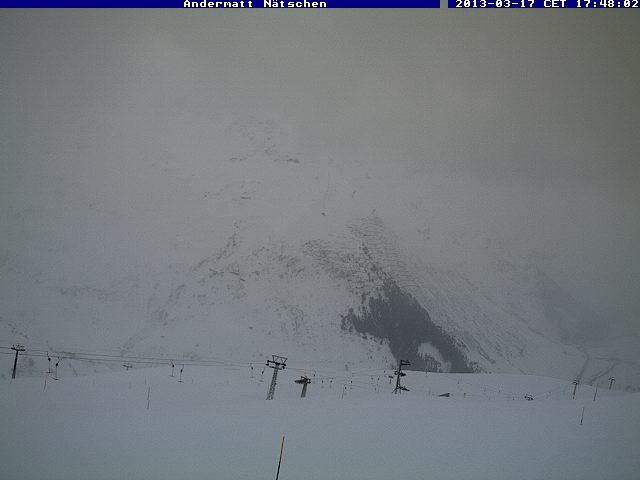
With many people coming to visit this year, both for DebConf13 and holidays, I'm going to start sharing some Swiss travel tips here in the blog. One of Switzerland's most popular tourist promotions is the Glacier Express railway. Here are the facts and a cool video. Avoid tickets/itineraries with fixed dates for visiting the mountains. The full Glacier Express journey is about 6 hours, and if it is cloudy or foggy, it is 6 hours in a train just like any other train. Some days really are cloudy and you won't see a single mountain. Try and make sure you have several flexible days in Switzerland so you can go up the mountains when the weather is optimal. Check the weather using the live webcam service Below is a typical webcam image for a bad day (I was up there Saturday skiing and it was perfect, Sunday was every tourist's nightmare). Compare this picture with the video further down: You can find a live feed like this for most Swiss mountain destinations with a web search Regular passenger trains run on the same route You don't need to buy an expensive Glacier Express' ticket. A regular passenger train does the same route every hour. No fixed reservation is necessary either and you can hop off and back on again along the way at many little stops. Oberalp Pass, at 2000 meters, is a good place to stop and hike (up to the peaks if you are keen, down to Andermatt if you want an easy walk with breathtaking views) What's more, the expensive trains are fully sealed and you can't open the windows. The regular trains do let you open the windows, so you can fully immerse yourself in the experience like this riding down from Natschen to Andermatt (1,500m): <video controls="" height="340" poster="http://danielpocock.com/sites/danielpocock.com/files/train-poster.png" width="560">
<source src="http://danielpocock.com/sites/danielpocock.com/files/DSC_1776.mp4" type="video/mp4"></source>
<source src="http://danielpocock.com/sites/danielpocock.com/files/DSC_1776.webm" type="video/webm"></source>
</video> To plan an itinerary, you can check Swiss train timetables at the official web site http://www.sbb.ch/en

Michal &#268;iha&#345;: phpMyAdmin translations status

Next round of phpMyAdmin 4.0 translation status report is coming. So let's look at which translations are at 100% right now: Almost complete: As you can see, there is still lot of languages missing, this might be your opportunity to contribute to phpMyAdmin. Also you are welcome to translate phpMyAdmin 4.0 using translation server. If your language is already fully translated and you want to help as well, you can translate our documentation as well.

Filed under: English Phpmyadmin 0 comments Flattr this!

17 March 2013

Daniel Pocock: Spotting Cypriots with Bitcoin

For anybody in Cyrpus right now, it should be relatively easy to spot those residents who keep their wealth in physical gold, silver or Bitcoin. Why? They will be the only people smiling this week, as everybody else has just had 6-10% of their bank account gouged by a once-off tax. What is really scary is that Cyprus is a Eurozone country. Will we now see the panic spread to Italy and Spain as citizens fear a copy-cat raid on their funds in the coming days or at some uncertain moment in the future? This latest development should not be seen as a small country' issue. The US did similar things with gold confiscation in the 1930s. Australia has decided to prop up the stock market by raising forced pension contributions on 1 July. What is different in Cyprus is that people will feel the pain immediately, and that modern technology will let the shockwaves spread. It might be worth refreshing my earlier blog will 2013 be the year of BitCoin?

Benjamin Mako Hill: Conversation on Freedom and Openness in Learning

On Monday, I was a visitor and guest speaker in a session on Open Learning in a class on Learning Creative Learning which aims to offer a course for designers, technologists, and educators. The class is being offered publicly by the combination surprising but very close to my heart of Peer 2 Peer University and the MIT Media Lab. The hour-long session was facilitated by Philipp Schmidt and was mostly structured around a conversation with Audrey Watters and myself. The rest of the course materials and other video lectures are on the course website. You can watch the video on YouTube or below. I thought it was a thought-provoking conversation! <iframe allowfullscreen="" frameborder="0" height="315" src="http://www.youtube.com/embed/l9HM80cv160" width="560"></iframe> If you re interested in alternative approaches to learning and free software philosophy, I would also urge you to check out an essay I wrote in 2002: The Geek Shall Inherit the Earth: My Story of Unlearning. Keep in mind that the essay is probably the most personal thing I have ever published and I wrote it more than a decade ago it as a twenty-one year old undergraduate at Hampshire College. Although I ve grown and learned enormously in the last ten years, and although I would not write the same document today, I am still proud of it.

16 March 2013

Lars Wirzenius: Obnam 1.4 (backup software) release

I've just pushed out the release files for Obnam version 1.4, my backup application, and Larch, my B-tree library, which Obnam uses. They are available via my home page (http://liw.fi/). Since Debian is frozen, I am not uploading packages to Debian, but .deb files are available from my personal apt repository for intrepid explorers. (I will be uploading to Debian again after the freeze. I am afraid I'm too lazy to upload to experimental, or do backports. Help is welcome!) From the Obnam NEWS file: Bug fixes:

Steve Kemp: Handling bookmarks?

I've a collection of about 500 bookmarks which I've barely touched for a few years. I started organizing them late the other night, because I'd been off work sick for two days and that was about the most I felt up for doing with a computer. The intention was to "tidy" them, and then setup some way of syncing them across browsers/computers. In the end I didn't like any of the syncing plugins I could find - xmarks, etc - so I decided to take a step backwards. I'd exported my bookmarks to HTML page, via firefox, before I started, and then later in a fit of pique I deleted the whole damn lot of them. So now a few years worth of bookmarks are stored in a single HTML file. But wait, we can use revision control can't we? We can host that file on github/similar. We can rely upon merges to deal with conflicts - simple if we just add lines to the end, or delete lines. Maybe that's the best way to store bookmarks? I updated the bookmark file to read:
<ul>
<li tags="debian, personal"><a href="http://www.debian-administration.org/">Debian Admin</a></li>
..
</ul>
Adding "tags" to the LI-container and then some simple jQuery code gave me the ability to search/filter the bookmarks and auto-populate tags. A small example placed online here: The obvious comment is that this makes adding new bookmarks a bit harder, but we'll see.. The javascript works in the browsers I tested, and for those that have none the bookmarks will just be a simple unordered list which should be universal. I expect the javascript could be improved by a real developer.

15 March 2013

Eddy Petri&#537;or: Appdirs from pypi is retarded

The XDG standard says user-specific data files should be written [in] $XDG_DATA_HOME which defaults to $HOME/.local/share.

Appdirs explicitly breaks XDG_DATA_HOME specification and returns a path based on $XDG_CONFIG_HOME, ~/.config/<appname> instead of ~/.local/share/<appname> for user_data_dir. Although the spec is as clear as day, the authors of appdirs say this is 'subject to some interpretation'.

No, it's not, read the damn spec!

http://standards.freedesktop.org/basedir-spec/basedir-spec-latest.html


The irony is that initially they got it right, but decided to break the standard some two years ago.

Thank you appdirs authors for ignoring a perfectly clear standard just because you *think* 'in practice, Linux apps tend to store their data in ~/.config/<appname>'.


Dear appdirs authors, if some people break the law it doesn't mean the law is broken. And if *you*think* some apps do not conform to a standard, it does mean *at*all* that you should not, either. More than that, if some applications decide on their own they consider some things config data and you'd classify those as 'application data', that's their business, and is not your place to decide to break the standard for everybody. Standards exist for a reason.

BTW, your software is worthless to me now and I decided NOT to use it because of this idiotic decision of yours.

14 March 2013

Richard Hartmann: The day the Reader died

...we stopped the singing. This may be irony:
No More Google Reader
from Google Operating System by Alex Chitu
via What's Hot in Google Reader

but the topic at hand remains serious. This is a stark reminder of why it's important to be able to get your data out of cloud services at a moment's notice and why you should always keep local backups of important data. Thankfully, Google is quite fair about this, as opposed to a lot of other large players. (As a side note, export of full data should be doable, but come with another layer of security like a grace period, password confirmation, verification email, or other means. Imagine someone gains temporary access to your account and exports all your digital life at once. And yes, I know how that relates to IMAP.) Google Reader has felt like a second class citizen for quite some time now, the removal of features to push Google+ and the slow updates for Android were two signs that didn't forebode well (Vim's spelling correction does not know "forbode", how weird is that)(turns out I'm simply stupid, see comments; thanks Jim). I can see how this move may make sense from Google's POV even though I am sad to see an old companion go. Anyway, the stats page of two of my accounts show how sadly I will miss Google Reader in two simple lines:
Since January 24, 2010 you have read a total of 59,253 items.
Since February 20, 2011 you have read a total of 215,285 items.

Farewell, my friend. PS: Maybe those petitions will sway them, but I won't get my hopes up. PS: Speaking of Google, I found this gem today; TMI.

Matthias Klumpp: Tanglu

Hi everyone! Today I make an announcement I thought I would never ever make. But things changed. Discussion about this has a long history, starting as a non-serious suggestion at DesktopSummit 2011, continued with people on IRC, but it was decided back then that it wouldn t be worth the effort. This has changed too, and a small team has formed to work on it. We hereby announce Tanglu, a new Debian-based-Linux distribution. A new logo?Why do we need another one? Let me explain the concepts of that distro: Tanglu will be based on Debian Testing and follow the Debian development closely. It will have a 6-months release-cycle and it s target audience are Linux desktop users. We will make installing and setting up the distro as easy as possible. Tanglu will be usable for both developers of upstream software and the average Linux user and Linux newbie. This is possible because in our opinion developers and users don t have different needs for a desktop system. Both kinds of users like a polished desktop which just works . We will, hwever, not apply any kind of fancy modification on upstream software, we will basically just distribute what upstream created, so users can get an almost pure GNOME and KDE experience. Tanglu is designed to be able to solve the issue that Debian is frozen for a long time and Debian Developers can t make new upstream versions available for testing easily. During a Debian freeze, DDs can upload their software to the current Tanglu development version and later start the new Debian cycle with already tested packages from Tanglu. The delta between Tanglu and Debian should be kept as minimal as possible. However, Tanglu is not meant as experimental distribution for Debian, so please upload experimental stuff to Experimental. Only packages good enough for a release should go into Tanglu. Ideally, Tanglu and Debian should be working well together in mixed environments, where you for example have Debian servers and multiple Tanglu desktops with the new software, targeted at desktop user. Since the differences between Tanglu and Debian should not be very high, administering both systems should be very easy (if you know Debian). Tanglu will be an open project, driven by community. At the beginning of each cycle, people can make suggestions for release goals they want to implement (similar to Fedora, but without FESCo). These proposals are discussed in public and are rejected if there are major technical concerns. If consensus about a certain proposal is lacking, a vote is done for it. The proposal can be accepted with absolute majority. If this does not happen, the proposal is postponed for the next release, where people can vote for it again. If nobody wants that function, it is rejected. In general, decisions made by Debian are superior and have to be followed. We don t think we know every package and every software better than the original upstream. That s why it makes much sense to rely on feedback from others and to have a community-based and peer-reviewed distribution, instead of secretly developing stuff and dumping it on the community. Tanglu will have a highly predictable set of features, defined at the beginning of a cycle, so you will know what you can expect from the next release as soon as possible and plan for it. Tanglu will make it easy to deploy applications for it. It will contain a software-center, similar to what Ubuntu has. We will also try to establish a solution for a Linux-AppCenter , a place for Linux applications, which will be open not only for Tanglu, but can be implemented in any other distribution too. Possible income will flow back into development of the platform. Now, let s answer the FQA (Future Questions Asked): Why don t you contribute to Debian directly and create yet another distribution? First of all, we contribute to Debian ;-) And for me, I can say that I will contribute to Debian even more. The point is that Debian can not cover all possible use-cases, and with Tanglu we want to make a distro which solves this. You might ask why we have to create a new distro for that, instead of creating improvements inside Debian? Creating a new distro allows us to do stuff we can never do in Debian. For example, we will include proprietary firmware in that distro, we will make installations of proprietary stuff possible easily (but don t ship with it by default) and we will have a time-based release cycle. These are already things which are a no-go for Debian, and that s fine. We don t want Debian to support these cases, as it is already a great distribution. We want to offer a distro as close to Debian as possible, but with a few modifications for use-cases which are not covered by Debian itself. Of course we will participate in DEX. If Debian Developers contribute to Tanglu, freezes will take even longer! This is an often-heard concern, it comes up on every mailinglist discussion about continuing development while freeze. I would disagree here, packaging new upstream stuff is not slowing down testing and improving of packages in Testing. Also, Tanglu is an offer for Debian developers to participate (we will sync privileges for their packages) we don t expect anyone to work on it, but as we think DDs know their packages best, we will make it possible for them to participate without extra barriers. We hope that Tanglu can add value to Debian and that Debian cycles can start with better-tested packages. You said you are a small team you cannot develop a whole distribution with it! Let s put that to the test! ;-) All people working on this are well aware of the issue that the project can not survive without much community-involvement on the long run. But we see a chance that many people are interested in it and that there is a high demand for it. At the beginning, we will just start with a small set of packages. We will also sync many packages from Ubuntu, to reduce workload. For example, it is planned to use the Ubuntu-Kernel and KDE packaging. By doing this, we keep the workload at the beginning low. We also reduce duplicate work with that. We even have some possible sponsors for the new distribution. But nothing is set in stone yet, so just wait for it to happen. :) Why not participate in Arch, OpenSUSE $other_distro? These are not Debian ;-) . I know, it sounds odd, but if you like the Debian way of doing things, you want to use a Debian-based distribution. There is nothing wrong with OpenSUSE. And Debian has issues too. But we want to be close to Debian and use it s tools and way of doing things. I hate you!!! You are doing it wrong!! The project is useless!

Well, that s fine. But there is no reason for hating us. If you dislike our idea, there are basically two options: First, you hate us but the project is successful. In that case, you have been wrong with hate, as there are definitely people who liked the project and contributed to it. Second, you hate us and we fail. In this case, there is no reason for hate, as the project will just vanish and you don t have to worry about it. So hating it would ve been just a big waste of energy. Also keep in mind that forking is a way to keep development healthy and to adapt software to new use-cases which it didn t target before. And we are not introducing incompatibilities here (like e.g. writing our own display server could). Instead, we want to stay close to Debian and reuse as much code as possible. Which desktop will you use? Everyone can add a new desktop to Tanglu, as long as the desktop-environment is present in Debian. Long term, we will have to offer Linux-newbies a default flavour, probably by setting a default download on the website. But as long as there is a community for a given desktop-environment, the desktop is considered as supported. At the beginning, we will focus on KDE, as many people have experience with it. But adding vanilla GNOME is planned too. Can you say something about the software used in Tanglu? Yes, but this is still in flow, so I can t promise final decisions here. On the server, side, we will try to use the Dak for repository management, as soon as we have enough server capacity. We will also use the standard Debian repository GUI and basically reuse most of the software there, to diverge less from Debian. The distribution itself will use a Linux Kernel from Ubuntu and systemd as the primary init system, as well as the login manager logind. It will be based on current Debian Testing with some fresh packages from Unstable and Experimental. We might also use the Ubuntu driver packages and KDE packaging. We expect to have a very rough start with the first release, but there will be enough time to polish Tanglu. Nice idea! How can I help? Well, you can help with basically anything at time from writing manuals, over designing logos and pages to administering a webserver and create packages. We are at an early stage of development at the moment, but we wanted to go public with it as soon as possible, to include the community and receive feedback so we can make that distro community-centric from the beginning. Most of the infrastructure is currently in progress too. So, if you want to get started with Tanglu, subscribe to our mailinglist tanglu-devel and write a mail to it, intruducing yourself. We can then include you in the loop. Generally, if you want to get access to our machines, a trusted GPG-signature will help a lot. If you want to talk to us, join #tanglu-devel or Freenode! Most discussions are currently happening there. And that s it! Tanglu will be awesome!

Some other projects of mine will develop a bit slower because I am now involved in Tanglu. But nothing will stop, and there is some pretty cool stuff coming for both GNOME and KDE (and I still have to implement DEP-11 for Debian). :)

Joerg Jaspert: zsh config - and prompt

As most people that are using that funny grey on black thing with the blinking white box AKA a commandline, I do have a heavily configured shell. zsh in my case. Some while ago my old configuration for it started to annoy me and so I set out to redo it. With the basic requirement to be flexible and able to adjust to various zsh versions (back as far as Lenny). I ve set out and looked how others do it and took the (I hope) best bits and put them together in a way I like it. Maybe others want to pick from me, so here I describe a little, maybe someone is interested First - the config is completly inside .zsh. The only thing directly in my $HOME is a symlink from $HOME/.zshenv to $HOME/.zsh/zshenv.home. All in one place, nicer this way. The zshenv just sets ZDOTDIR, so zsh then uses the .zsh itself. Next I am using modules . Well, actually everything is splitted out in small(er) files, so its way easier to maintain. And to overwrite stuff wherever I need to. So my .zshrc just loads those module files - and then goes and checks if it finds the same file inside a series of subdirectories. Those subdirectories are based on the hostname, the kernel name, the username, the domain name and the name of the distribution of the system. And a number of combinations of those. That system allows me, for example, to have a set of aliases defined only on Debian systems (like those to do with apt-get & co). Or define some extra variables if I login to the host franck, domain debian.org. Or whatever more. I m also on the way of doing something similar for all my dotfiles. While I was working at that I finally got fed up with the fact that my prompt, which is based on Phil! s wasn t doing what I wanted it on various of the hosts I access. Thankfully someone pointed me at a change to the grml zsh config: Frank Terbeck rewrote their prompt to make use of the zstyle system. Now that got me going, I like the idea of having the whole prompt easily configurable and changeable. My prompt always has shown slight differences depending on where the shell runs, which meant I had to carefully craft PS1 for every such change, and when one changes something one had to check all the places to adjust them too. No longer. I took Franks work and extended it for me. I wanted to still have a design matching my old prompt (minus colors, I changed color themes anyways), but with full flexibility the zstyle system can offer here. Now I am at a point where As an example, on the ftp-master host my prompt, while otherwise being the same as everywhere else, contains one extra item - displaying the current status of the archive (dinstall). If you want to try it, the setup file is available, but note that I don t give any warranty. :) Works for me . I load it in my Prompts module, while having the prompt setup file in my function path. The 4 commented lines, my testcase, are a nice example of a custom token, though a real life one, the setup for the ftp-master prompt with the one extra item can be found over here. Comments? Bugfixes? Enhancements? Update: Got asked for an example how to use my prompt to fake another. So here is what you need to do to use my prompt setup to imitate the prompt clint, as delivered with zsh:
autoload promptinit && promptinit
zstyle ':prompt:ganneff' vcs_info true
# Alternatively you can set whatever you like it to be.
zstyle ':prompt:ganneff' set_vcs_info_defaults true
zstyle ':prompt:ganneff' colors true
## no right prompt
zstyle ':prompt:ganneff:right:setup' use-rprompt false
## color of brackets depending on variable
zstyle ':prompt:ganneff:*:items:openbracket' pre '$ $ SSH_CLIENT+"$ PR_YELLOW " :-"$ PR_RED " '
zstyle ':prompt:ganneff:*:items:openbracket' post '$ PR_NO_COLOR '
zstyle ':prompt:ganneff:*:items:closebracket' pre '$ $ SSH_CLIENT+"$ PR_YELLOW " :-"$ PR_RED " '
zstyle ':prompt:ganneff:*:items:closebracket' post '$ PR_NO_COLOR '
zstyle ':prompt:ganneff:*:items:openanglebracket' pre '$ $ SSH_CLIENT+"$ PR_YELLOW " :-"$ PR_RED " '
zstyle ':prompt:ganneff:*:items:openanglebracket' post '$ PR_NO_COLOR '
zstyle ':prompt:ganneff:*:items:closeanglebracket' pre '$ $ SSH_CLIENT+"$ PR_YELLOW " :-"$ PR_RED " '
zstyle ':prompt:ganneff:*:items:closeanglebracket' post '$ PR_NO_COLOR '
## extra date format, and its color
zstyle ':prompt:ganneff:*:items:date' token '%D %a %y/%m/%d %R %Z '
zstyle ':prompt:ganneff:*:items:date' pre '$ PR_CYAN '
## pts. %l instead of %y, also color again
zstyle ':prompt:ganneff:*:items:pts' token '%l'
zstyle ':prompt:ganneff:*:items:pts' pre '$ PR_GREEN '
zstyle ':prompt:ganneff:*:items:pts' post '$ PR_NO_COLOR '
## host ends with :
zstyle ':prompt:ganneff:*:items:host' token '%m:'
## and a different style for the rc level
zstyle ':prompt:ganneff:*:items:rc' token '%(?..[%?%1v] )'
zstyle ':prompt:ganneff:*:items:rc' pre ''
## change color for other parts that differ to my default
zstyle ':prompt:ganneff:*:items:user' pre '$ PR_GREEN '
zstyle ':prompt:ganneff:*:items:host' pre '$ PR_GREEN '
zstyle ':prompt:ganneff:*:items:at' pre '$ PR_GREEN '
zstyle ':prompt:ganneff:*:items:path' pre '$ PR_GREEN '
zstyle ':prompt:ganneff:*:items:history' pre ''
## Show the shell level in a different way
zstyle ':prompt:ganneff:*:items:shell-level' pre ''
zstyle ':prompt:ganneff:*:items:shell-level' token 'zsh%(2L./$SHLVL.) '
## And history is just a bold number. Lazy here, not using pre and post
zstyle ':prompt:ganneff:*:items:history' token '%B%h%b '
## And the last part in prompt, a # or % depending on privileges
## Using standard zsh tokens for bold
zstyle ':prompt:ganneff:*:items:privileges' pre '%B'
zstyle ':prompt:ganneff:*:items:privileges' post '%b'
## Now there are two parts not defined by default, so lets create them
## Both are simple existing variables, no need for extra precmd functions
## system info
zstyle ':prompt:ganneff:extra:ostype' pre '$ PR_CYAN '
zstyle ':prompt:ganneff:extra:ostype' post '$ PR_NO_COLOR '
zstyle ':prompt:ganneff:extra:ostype' token "$ MACHTYPE /$ OSTYPE /$(uname -r)"
## zsh version
zstyle ':prompt:ganneff:extra:zshvers' pre '$ PR_CYAN '
zstyle ':prompt:ganneff:extra:zshvers' post '$ PR_NO_COLOR '
zstyle ':prompt:ganneff:extra:zshvers' token "$ ZSH_VERSION "
zstyle ':prompt:ganneff:left:full:setup' items \
    openbracket date closebracket openbracket pts closebracket openbracket ostype closebracket \
    openbracket zshvers closebracket newline openanglebracket user at host \
    path closeanglebracket newline \
    shell-level space history rc space vcs privileges space
prompt ganneff
And if you now tell me Uh, thats so much more than just saying /prompt clint/ , then you are right. But then: This way is flexible. As I wrote above, my prompt on the ftpmaster host is different. Actually, my prompt on all machines inside the domain debian.org differs, by having
zstyle ':prompt:ganneff:*:items:host' pre '$ PR_YELLOW '
in the Prompts definition for domain:debian.org. And thats enough to show me im on a .debian.org machine by a yellow hostname, instead of my default red. On the ftpmaster host I have the additional few lines: # Want one more piece in my prompt here, dinstall status zstyle :prompt:ganneff:left:full:setup items \ ulcorner line openparentheses user at host pts closeparentheses line history \ line dinstall line shell-level line flexline openparentheses path closeparentheses line urcorner newline \ llcorner line rc openparentheses time closeparentheses line vcs line change-root pipe space
zstyle ':prompt:ganneff:extra:dinstall' pre '$ PR_CYAN '
zstyle ':prompt:ganneff:extra:dinstall' post '$ PR_NO_COLOR '
zstyle ':prompt:ganneff:extra:dinstall' token '$DINSTALL'
zstyle ':prompt:ganneff:extra:dinstall' precmd jj_update_dinstall
zmodload zsh/mapfile
jj_update_dinstall ()  
    DINSTALL="$ $ (z)$ (f)mapfile[/srv/ftp.debian.org/web/dinstall.status] [2] [3,99] "
 
And woo, thats simple. I think. (There ought to be a way to just easily add the item at a defined place in the items zstyle, but meh, too lazy to look).

Rudy Godoy: Subversion auth using SSH external key-pair

Normally when using Subversion s SSH authentication facility you ll use your own SSH generated key-pair that svn will read from the proper location, usually $HOME/.ssh. However, there could be situations when you ll need to use a different key-pair. In such case you can use a nice trick to make svn+ssh authentication work smoothly. Let s say you have an external key-pair and the public key it s already set on the svn server. You store the private key somewhere in your home directory. Now when doing a svn checkout you ll find that you have to use SSH s -i parameter. However, when used together with svn it won t work as expected as you ll normally do when using ssh with an external key-pair. Subversion makes your life easier by using the $SVN_SSH environment variable, so you can put the ssh command and modifiers that fit your needs. In the external key case you can do something like:
export SVN_SSH="ssh -i </path/to/external-key>"
Next time you use svn s ssh auth it will read $SVN_SSH then use it. So now you can use svn commands such checkout, etc in the same fashion you normally do.
svn co svn+ssh://rudy@somesvnserver.at.somwhere.org/repo/for/software
Update: Jeff Epler offered great advice for using .ssh/config and key-pairs based on hostname. See the comments below.

Mike Hommey: Google Reader death, or how the cloud model can fail you

If you re a Google Reader user, you probably read in one of your subscriptions that Google is pulling the plug on Google Reader. It is yet another demonstration of why putting data in the cloud isn t so much of a nice idea: the service you rely on may well disappear some day, with all the data it contains. Sure Google, in its extreme goodness, allows you to take out the Google Reader data. Or does it?
These are what you ll get from Google Takeout for Reader: Interestingly, while looking into shared-by-followers.json, I found urls that would correspond to friend streams. For instance, Tim Bray s is http://www.google.com/reader/public/atom/user/05198174665841271019/state/com.google/broadcast. But it s useless: all it displays is permission denied . As for subscriptions, one of the strengths of Google Reader is that it allowed to search though past items, which means a big part of the interesting data is the archived items. But that s not part of the take out . Sure, you have the feed urls, but most RSS feeds contain a limited amount of items, not the entire history of items for the given feed. So, history is more or less lost. Except if I star, like or share all items in all my subscriptions and take out again. So much goodness. It could have been worse, though.

13 March 2013

Steve Kemp: So I'm a year older

Last week I had another birthday, which was nice. I'm now all mature, and everything. Honest. I received a few surprise gifts from friends and strangers alike, which was pretty good. Other than that I didn't do too much. This weekend I'm going to be using "airbnb" to spend the weekend in Dundee with my partner who is regularly commuting between Edinburgh and Perth/Dundee, to work in various hospitals. With all the commuting time she's not had too much time to explore the actual city, and I've only been there once before so I'm sure it will be a fun weekend. The templer static site generator got a little bit of pimping on LWN.net the other day, thanks to Martin Michlmayr, although embarassingly I seem to have read the article and repeated the content in the conclusion, and duplicated that in my own comment. Ooops. Beyond that I've done little coding recently, although I suspect now that nodejs has had a stable release I might do something interesting soon. I don't want to dwell on the failure of Sim City - because I don't run windows and couldn't have tried it even if I wanted to - but I'm pondering the idea of a persistant grid-space where different items can be placed. I've not tried anything browser-based before, but the popularity of things like minecraft make me wonder if you had an "infinite grid" where folk could store "stuff", and scroll around in a browser you might be able to do interesting things. Starting small, with a 100x100 grid, and some kind of updated play-by-mail turfwars/drug-war like experience should be simple. But then again enthusiasm is easy to generate until you start working out how you'd interface with the server and what kind of client you'd need. Now to enjoy some 21 year old whisky and call it a night..

Rapha&#235;l Hertzog: Kali Linux 1.0, a new Debian derivative

Today, during Blackhat Europe, Offensive Security announced the availability of Kali Linux 1.0, which aims to be the most advanced, robust, and stable penetration testing distribution to date. It is the successor of Backtrack Linux. kali Kali s choice of Debian Kali s release is a significant event in the security auditing and penetration testing field, and I m proud to see that Debian was retained as the best distribution to create this new product. Here s what Mati Aharoni of Offensive Security told me:
Debian provides a reliable base to build a new distribution and yet can easily be customized to add bleeding edge features, thanks to the unstable and experimental distributions.
Kali s development policies Even though Kali was prepared in secret, from now on Kali s development happens in the open in public git repositories. There are repositories for all the packages that have been created (or forked) as well as for the ISO images creation script. Debian packages are maintained with git-buildpackage, pristine-tar and the associated helper tools, making it easy to integrate the latest changes of Debian. Kali packaged several hundreds tools that relate to their field and they intend to contribute those which are DFSG-free back to Debian. Kali s technical infrastructure In the last year, I have been working within the Kali team to setup large parts of their infrastructure as a proper Debian derivative. Kali s main ISO images are built with live-build. All the bugfixes that I contributed to Debian Live were the direct result of my work for Kali. The git repositories are managed with gitolite. The package repositories are built with reprepro. The build daemons use rebuildd and sbuild. The (push) mirrors are synchronized with the same tools than Debian (based on rsync), but there s also a central server which redirects to a mirror close to you (and which is used by default everywhere). This one runs mirrorbrain (and not Rapha l Geissert s redirector). The ARM build daemons (armel/armhf) run on machines powered by Calxeda s Highbank (4 cores, 4 GB RAM) that work pretty well. Even better, Offensive Security is willing to dedicate one node of this cluster for Debian s own usage. The future This first release is not an end. It s only the start of a journey. Not all applications have been packaged yet and there s lot of work left to integrate everything in Debian. I m really looking forward to continue my collaboration with the Kali team as this has been one of the most interesting project I ever had as a Debian consultant. And also one of the few where I could really contribute something back to Debian.

9 comments Liked this article? Click here. My blog is Flattr-enabled.

Dirk Eddelbuettel: Rcpp master class in New York last weekend

On Saturday I had the opportunity to teach another one-day master class on Rcpp. The class had been organized by Jared Lander, and organized very well I might add. The weekend started with a slight disappointment. I had taken Friday off, and hoped to reach NY by early afternoon to join JJ there, and to spend the afternoon with the RStan team. However, the tail end of last week's snowstorm made it such that we both got to Columbia's stats department closer to 6pm rather than 1pm, and half the team had left. Dang. Very frustrating travel experience. We salvaged the evening by gabbing over a cold beverage or two, before sharing some sacred New York pizza with Wes McKinney and Jared. The class itself on Saturday went quite well. With JJ on deck, we were able to have every participant log into an EC2-hosted instance of RStudio Server, which worked very well for usage examples of Rcpp. It has been almost a year since I last taught the class, and many exciting things--such as Rcpp attributes, added by JJ himself--have appeared, which made it extra fun. Participants were rather kind with praise. Either they really liked it, or they really are hard-nosed New Yorkers who manage to lie to my face without me noticing. We ended the day with some hard-earned cold beverages, followed by some dinner at Sylvia's (as tweeted by Jared) followed by more drinks. Ended up a little past my usual bedtime, but I managed to get out and enjoy a lovely 6.5 miles run across Central Park the next morning before leaving town. All in all, a very nice weekend, the travel horror of Friday notwithstanding. And who know, maybe we'll just do it again another time...

Next.

Previous.