Search Results: "will"

1 April 2014

Gergely Nagy: Motif on Wayland

Earlier this year, on the fourth of February, Matthew Garrett posted an interesting tweet. The idea of porting Motif to Wayland sounded quite insane, which is right up my alley, so I've been pondering and preparing since. The result of that preparation is a fundraiser campaign, which, if successful, I'll dive deeper into the porting effort, to deliver a library that brings the Motif we used to love back in the days to a modern platform.The aim of the project is to create a library, available under the GNU Lesser General Public License (version 2.1 or later, the same license original Motif is under), ported to Wayland, with full API compatibility if at all possible. In the end, we want the result to feel like Motif, to look like Motif, so that any program that can be compiled against Motif, will also work with the ported library. I will start fresh, using modern tools and modern methodologies (including, but not limited to autotools and test-driven development, on GitHub) to develop the new library, instead of changing the existing code base. Whether the goal is fully achievable remains to be seen, but the API - and the look of the widgets, of course - will feel like Motif, even if in a Wayland context, and we will do our best to either make the API 100% compatible with Motif, or provide a compatibility library.Since I have a day job, in order to be able to spend enough time on the library, I will need funding that more or less matches my salary. The more raised, the more time will be allocated to the porting project. Would we exceed the funding goal, there are a few stretch goal ideas that can be added later (such as porting the Motif Window Manager, and turning it into a Wayland compositor, with a few modern bells and whistles).For further information, such as perks, updates and all, please see the campaign, or the project website!

Bits from Debian: Debian Project elects Javier Merino Cacho as Project Leader

This post was an April Fools' Day joke. Alt Red Nose DPL In accordance with its constitution, the Debian Project has just elected Javier Merino Cacho as Debian Project Leader. More than 80% of voters put him as their first choice (or equal first) on their ballot papers. Javier's large majority over his opponents shows how his inspiring vision for the future of the Debian project is largely shared by the other developers. Lucas Nussbaum and Neil McGovern also gained a lot of support from Debian project members, both coming many votes ahead of the None of the above ballot choice. Javier has been a Debian Developer since February 2012 and, among other packages, works on keeping the mercurial package under control, as mercury is very poisonous for trouts. After it was announced that he had won this year's election, Javier said: I'm flattered by the trust that Debian members have put in me. One of the main points in my platform is to remove the "Debian is old and boring" image. In order to change that, my first action as DPL is to encourage all Debian Project Members to wear a clown red nose in public. Among others, the main points from his platform are mainly related to improve the communication style in mailing lists through an innovative filter called aponygisator, to make Debian less "old and boring", as well as solve technical issues among developers with barehanded fights. Betting on the fights will be not only allowed but encouraged for fundraising reasons. Javier also contemplated the use of misleading talk titles such as The use of cannabis in contemporary ages: a practical approach and Real Madrid vs Barcelona to lure new users and contributors to Debian events. Javier's platform was collaboratively written by a team of communication experts and high profile Debian contributors during the last DebConf. It has since evolved thanks to the help of many other contributors.

Petter Reinholdtsen: ReactOS Windows clone - nice free software

Microsoft have announced that Windows XP reaches its end of life 2014-04-08, in 7 days. But there are heaps of machines still running Windows XP, and depending on Windows XP to run their applications, and upgrading will be expensive, both when it comes to money and when it comes to the amount of effort needed to migrate from Windows XP to a new operating system. Some obvious options (buy new a Windows machine, buy a MacOSX machine, install Linux on the existing machine) are already well known and covered elsewhere. Most of them involve leaving the user applications installed on Windows XP behind and trying out replacements or updated versions. In this blog post I want to mention one strange bird that allow people to keep the hardware and the existing Windows XP applications and run them on a free software operating system that is Windows XP compatible. ReactOS is a free software operating system (GNU GPL licensed) working on providing a operating system that is binary compatible with Windows, able to run windows programs directly and to use Windows drivers for hardware directly. The project goal is for Windows user to keep their existing machines, drivers and software, and gain the advantages from user a operating system without usage limitations caused by non-free licensing. It is a Windows clone running directly on the hardware, so quite different from the approach taken by the Wine project, which make it possible to run Windows binaries on Linux. The ReactOS project share code with the Wine project, so most shared libraries available on Windows are already implemented already. There is also a software manager like the one we are used to on Linux, allowing the user to install free software applications with a simple click directly from the Internet. Check out the screen shots on the project web site for an idea what it look like (it looks just like Windows before metro). I do not use ReactOS myself, preferring Linux and Unix like operating systems. I've tested it, and it work fine in a virt-manager virtual machine. The browser, minesweeper, notepad etc is working fine as far as I can tell. Unfortunately, my main test application is the software included on a CD with the Lego Mindstorms NXT, which seem to install just fine from CD but fail to leave any binaries on the disk after the installation. So no luck with that test software. No idea why, but hope someone else figure out and fix the problem. I've tried the ReactOS Live ISO on a physical machine, and it seemed to work just fine. If you like Windows and want to keep running your old Windows binaries, check it out by downloading the installation CD, the live CD or the preinstalled virtual machine image.

Joey Hess: adding docker support to propellor

Propellor development is churning away! (And leaving no few puns in its wake..) Now it supports secure handling of private data like passwords (only the host that owns it can see it), and fully end-to-end secured deployment via gpg signed and verified commits. And, I've just gotten support for Docker to build. Probably not quite work, but it should only be a few bugs away at this point. Here's how to deploy a dockerized webserver with propellor:
host hostname@"clam.kitenet.net" = Just
    [ Docker.configured
    , File.dirExists "/var/www"
    , Docker.hasContainer hostname "webserver" container
    ]
container _ "webserver" = Just $ Docker.containerFromImage "joeyh/debian-unstable"
        [ Docker.publish "80:80"
        , Docker.volume "/var/www:/var/www"
        , Docker.inside
            [ serviceRunning "apache2"
                 requires  Apt.installed ["apache2"]
            ]
        ]
Docker containers are set up using Properties too, just like regular hosts, but their Properties are run inside the container. That means that, if I change the web server port above, Propellor will notice the container config is out of date, and stop the container, commit an image based on it, and quickly use that to bring up a new container with the new configuration. If I change the web server to say, lighttpd, Propellor will run inside the container, and notice that it needs to install lighttpd to satisfy the new property, and so will update the container without needing to take it down. Adding all this behavior took only 253 lines of code, and none of it impacts the core of Propellor at all; it's all in Propellor.Property.Docker. (Well, I did need another hundred lines to write a daemon that runs inside the container and reads commands to run over a named pipe... Docker makes running ad-hoc commands inside a container a PITA.) So, I think that this vindicates the approach of making the configuration of Propellor be a list of Properties, which can be constructed by abitrarily interesting Haskell code. I didn't design Propellor to support containers, but it was easy to find a way to express them as shown above. Compare that with how Puppet supports Docker: http://docs.docker.io/en/latest/use/puppet/
docker::run   'helloworld':
  image        => 'ubuntu',
  command      => '/bin/sh -c "while true; do echo hello world; sleep 1; done"',
  ports        => ['4444', '4555'],
...
All puppet manages is running the image and a simple static command inside it. All the complexities that puppet provides for configuring servers cannot easily be brought to bear inside the container, and a large reason for that is, I think, that its configuration file is just not expressive enough.

Russ Allbery: Review: Asimov's, September 2011

Review: Asimov's Science Fiction, September 2011
Editor: Sheila Williams
Issue: Volume 35, No. 9
ISSN: 1065-2698
Pages: 112
Due to various other life priorities, it's been quite a while since I read this magazine. Let's see if I can remember the contents well enough to review it properly. The editorial this issue was about the Readers' Awards. Vaguely interesting, but Williams didn't have much to add beyond announcing the winners. I'm very happy to see Rusch's "Becoming One with the Ghosts" win best novella, though. The Silverberg column was more interesting: some musings and pop history about the Japanese convention of a retired emperor and how that fit into national politics. Di Filippo's book review column is all about short story collections, continuing the trend of Di Filippo mostly being interested in things I don't care about. "The Observation Post" by Allen M. Steele: A bit of alternate history set during the Cuban Missile Crisis, but with airships. The protagonist was a radioman aboard a blimp that was patrolling the ocean for Russian vessels sailing to Cuba. A storm forces them down on an island, resulting in an encounter with some claimed tourists who may be Russian spies. The SFnal twist is unlikely to come as much surprise to an experienced reader, and the barb at the end of the story suffers from the same problem. I appreciate the ethical dilemma, but I've also seen it in lots of stories and have a hard time getting fully invested in another version of it. But the story is otherwise competently written. (6) "D.O.C.S." by Neal Barrett, Jr.: Everyone has an author or two that they just don't get. Barrett is one of mine, although this story is a bit less surreal than most of his. I'm fairly sure it's an odd twist on the "death panel" conspiracy theory given a fantastic twist, but it's not entirely forthright about what's going on. Possibly of more interest to those who like Barrett better. (5) "Danilo" by Carol Emshwiller: Emshwiller's stories are always distinctive and not quite like anyone else's, involving odd outsiders and their attempts to make sense of their world. This one involves, as is common, an out-of-the-way village. Lewella claims that she's going to be married to a stranger from the north. No one believes her, although they give her bridal gifts anyway, and then one day she takes her gifts and leaves. The protagonist follows her, to look after her. The rest of the story walks the boundary that Emshwiller often walks, leaving the reader unsure whether the characters are in touch with some deeper reality or insane and suffering, but the ending is even more ambiguous than normal and, at least for me, entirely unsatisfying. (4) "Shadow Angel" by Erick Melton: This is another retread of an old SF idea. This time, it's that piloting through hyperspace involves alternate modes of consciousness and has profound effects on the pilot. The risk of this sort of story is that it turns hallucinatory and a bit incoherent, and I think that happened here. I like the world-building; the glimmers of future politics and trade and the way he weaves alternate timelines into the story caught my interest. But the story wasn't quite coherent enough (although part of this may be reviewing it quite some time after I originally read it). Promising, but not clear, and without quite enough agency for the protagonist. (6) "The Odor of Sanctity" by Ian Creasey: I found this story more memorable. The conceit is that a future society has developed technology that allows the capture and replay of scents, which has created a huge market for special scent experiences and the triggering of memories. The story is set in the Philippines and revolves around a Catholic priest who takes the mission to the poor seriously. He's dying, and several people wonder if it is possible to capture the mythical odor of scantity: the sweet scent said to follow the death of a saint rather than the normal odor of human death. Creasey handles this idea well, blending postulated future technology, the practical and cynical world of the poor streets, and a balance between mystical belief and practical skepticism. Nothing in the story is that surprising, but I was happy with the eventual resolution. (7) "Grandma Said" by R. Neube: This story's protagonist is a cleanser on a frontier planet made extremely dangerous by a virulent alien fungus. It is almost always fatal and very difficult to eradicate. Vic's job is to completely sanitize anything that had been in contact with a victim and maintain the other rules of strict quarantine required to keep the fungal infection from spreading uncontrolled. Nuebe weaves world-building together with Vic's background and adds a twist in the form of deeply unhealthy responses to the constant stress of living near death. Well told, if a bit disturbing. (7) "Stalker" by Robert Reed: Reed has a knack for fascinating and disturbing stories, and this is an excellent example of the type. The protagonist is a manufactured companion who is completely devoted to its owner. Their commercial name is Adorers, but everyone calls them Stalkers. In this case, the protagonist's owner is a serial rapist and murderer; given that, and given how good Reed is at writing these sorts of stories, you can probably imagine how chilling it is. As usual, there is a sharp barb in the ending, and not the one I was expecting. Good if you can handle the graphic violence and disturbing subject material. (7) "Burning Bibles" by Alan Wall: This is an interesting twist on the spy thriller. A three-letter agency in charge of investigating possible terrorist plots becomes suspicious after a warehouse of Bibles burns in mysterious circumstances. The agent they send in is a deaf-mute with special powers of intuition. This prompted some eye-rolling, and there's a lot of magic disability powers here to annoy, but it's played mostly straight after that introduction. The rest is a fairly conventional spy story, despite special empathic powers, but it's one I enjoyed and thought was fairly well-written. (7) Rating: 6 out of 10

Andrew Pollock: [life] Day 63: Productive procrastination, pizza dough, podiatrist, positive

parenting and a haircut with a spot of painting How's that for some alliteration? Today was a really good day. And that's before I started drinking red wine. I got up this morning and successfully banged out a 10km run. It wasn't pretty, but I did it in under an hour, so I was happy. I got home, and after breakfast I pretty much flopped on the couch with my laptop and procrastinated instead of doing my taxes. But it was productive procrastination. I: I also (finally) got my taxes to a point where I'm ready to send them off to my US accountant and deal with the rest of it incrementally. So it was a productive day! I had a follow up appointment with my podiatrist in the afternoon to see how my orthotics were going. I biked to Kindergarten early, ditched the bike trailer, and then biked over to the podiatrist, and made it back to Kindergarten about 10 minutes before pick up time. Zoe was, unsurprisingly, fast asleep. I decided to try applying sunscreen to her while she was asleep as a way of killing two birds with one stone. I got as far as getting her legs done before she woke up and had a massive meltdown. Poor kid really doesn't deal well with being woken up. One of the teachers took pity on us and distracted Zoe by letting her cuddle one of the baby chicks, which snapped her out of it for the duration, but she had another meltdown once it was over. Another teacher gave her a cuddle for a bit, and she eventually calmed down enough for me to get sunscreen on her arms. I'd foolishly left the bike trailer separated from the bike, so I had to drag the trailer back to the bike, whilst carrying Zoe. Fortunately another teacher took sympathy on us and helped me with the trailer. Turns out trying to drag a single-wheeled trailer single-handed whilst carrying a toddler and having excess sunscreen on my hands is extremely difficult. We finally got the trailer on the bike, and Zoe in the trailer, and headed towards home. Zoe's ballerina pumps aren't great on the bike because the straps on the pedals cross the tops of her exposed feet and irritate her, so there were multiple meltdowns on the way home, culminating in needing to go to the toilet "right now" before we got home. I stopped at the health food shop on the way home, to see if they had a toilet we could use. Luckily I'm a customer and the naturopath let us use the toilet in the clinic. Zoe had another meltdown in there, announcing she "didn't like being woken up". Poor kid. It wasn't a good afternoon for her. I'm just glad I was in a sufficiently good mood to be able to deal with it all in a satisfactorily positive parenting way. We finally made it home, and I'd promised her we could have a big cuddle on the couch once we got home, so we did that and read a library book, and then it was time to head to the hairdressers for our haircuts. We started out on foot, and had made it one block from home, and she saw another kid on a scooter and announced she wanted to ride her scooter too. Initially tried saying we couldn't do it this time, because we'd be late, but she was on the verge of having another meltdown, so I capitulated, and we went back and grabbed it. I'm actually really glad I did, because she was as happy as Larry from that point on, and we were only a couple of minutes late at the hairdresser. We did her fringe trim first, and then she had a great play in the kid's corner while I got my haircut. She even cleaned up the corner better than she found it without argument. We then had plenty of time to scooter back home, so I decided to check out the 'OO'niverse Family Cafe, which is next door to the Hawthorne Cinemas. It's this thing I've never gotten around to checking out, and it was the second thing I was glad I did this afternoon. It's not a big place, and it was super quiet. There was just us and two twin Kindergarten-aged girls being babysat. Zoe had a banana milkshake and got a dolphin painted on her arm and a balloon dog made, and I had a coffee and we just chilled out for a bit while I chatted with the owner (who was babysitting the twins). By this stage Anshu was already at my place, and Sarah wasn't far off leaving work to pick up Zoe, so we made our way back home. Zoe had a great time playing with Anshu until Sarah arrived. So I was basically really happy that I managed to turn around a massively molten afternoon and give Zoe a really good afternoon instead. Anshu and I then proceeded to made a couple of really fantastic pizzas. I really love my Thermomix. I made the pizza dough earlier today, and tonight I made some pizza sauce, some pesto sauce and caramelized some onions in it, and we were still done with dinner by 8pm.

31 March 2014

John Goerzen: Springtime in the Mountains

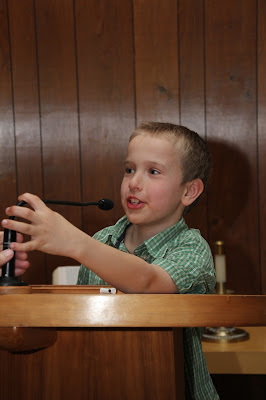
The scene: early one morning as the sun has just started to rise. Jacob and Oliver, ages 7 and 4, are the first people to wake up in the house their grandparents in California, where the four of us are visiting for the first time as a family. They have a conversation and decide that would be a good to go find a mystery. They decide to take their flashlights pink and blue, matching each boy s favorite color and slowly, but not very quietly, open their bedroom door and creep out. Brother, you forgot your flashlight! says Oliver. Oh, thanks brother! I ll get it! says Jacob. Meanwhile, Laura s mom wakes up, and notices two boys with flashlights creeping through the living room. Pretty soon they reach the kitchen, open the dishwasher, spy a suspicious-looking bowl, and decide that they have found the mystery a clean bowl! Or, at least that s the story that I pieced together based on what a 4-year-old and the grandma he awakened told me. We were on our first family trip to the Fresno, California area, to visit Laura s parents Jacob and Oliver s new grandparents. They ve played together before, but as this was our first visit to their place, there was quite the excitement. The boys had flown before, but it was several years ago and neither of them remember it well, so they were excited about that, too. The night before, Jacob woke up to tell me Dad, I am too excited to sleep. I think I will go downstairs and watch some TV. He didn t get too far with that plan. But he was excited. We went through security at the laid-back Wichita airport (where the TSA agents smile and there are often no security lines at all). We found our gate with enough time to grab lunch, which we did. The boys and I then did what we often do to kill time: explore. We explored the terminal, watching carpet-layers cut out carpet for the jetway, watching the construction of the new Terminal 3 out the window. And, of course, watching airplanes take off and land from the terminal s large windows. Finally it was our turn to board, and we all got on the plane: Jacob and Oliver with their backpacks of on-board activites, Laura and me with the rest of our carryon luggage, for the short trip to Denver. Jacob and Oliver s noses were pressed against the windows. Or, well, Jacob s was. Oliver s window was a little too high for him, but he was thrilled anyhow. They delighted in the airplane snacks, and the fact that they were allowed to drink pop on the plane. We packed books and some new art supplies for them (colored post-its, pages from a train-themed page-a-day calendar, a notebook, and a set of colored pens really seemed to do the trick.) We had a choice of 35 minutes or 4 hours between flights in Denver, and I had chosen 4 hours, thinking that would be a lot less stressful with boys. And it was. We found a nice corner of the mezzanine to sit for awhile they did art projects and played a game with Laura. Then I took them exploring Denver. We rode the moving sidewalks up and down the terminal, took a train ride to another terminal and back, ate supper all together, and flew to Fresno. We had stopped in the Wichita airport to buy them each a souvenir airplane, and these came out often during the rest of the trip. They enjoyed the mockups of the sequoias in Fresno Yosemite International Airport, enjoyed their beds and their room at the house, and did actually manage to fall asleep eventually. We had a few days there, where they played in a park, with bubbles on the patio, or croquet in the yard (I even discovered Jacob happily using the cast his broken arm is in as a hammer to pound the hoops into the ground!) There are a lot of miniatures in the house, and the boys enjoyed exploring the dollhouses and especially the N-gauge model train. Jacob enjoyed it so much he asked me to record a video of him playing with the trains. Evenings often brought book-reading, from the many children s books in the house. At home, Laura and I and both boys often scrunch onto an oversized chair and read a book and sing a song (one I make up on whatever topic they choose). Over there, we often had Laura, Jacob, Oliver, Laura s mom, and me scrunched up somewhere while the boys heard a story read to them by their grandma. That happened plenty of times other than bedtime, too. (Or Jacob would take his favorite books and read them to himself.) Laura s parents organized a reception Sunday for us, for the people from that area that couldn t make it to our wedding. Jacob and Oliver, predictably, had fun playing and even talked to some of the adults. The adults that didn t ask Jacob about his cast, anyhow (he dislikes talking about it). The boys discovered a live mic at the church where the reception was, and do I detect two future pastors in our midst? We had a great time at Laura s uncle and aunt s place. The boys were happy to discover an orange tree in their backyard, a tetherball post not far away, and an uncle ready to give them a demonstration of a swimming pool vacuum cleaner or sit at the piano with them. Jacob s favorite part, though, was when the hamburger buns his great uncle were toasting were left on the grill during the prayer before the meal, got a bit scorched, and the uncle remarked with a chuckle that I guess the Lord was tired of listening to me drone on! Jacob loved his meal, and cackled at the thought of a prayer causing buns to get scorched. But their highlight was the visit to the sequoias at Kings Canyon National Park the next day. The excitement had been building for that day all weekend. On the way out, we stopped at a fruit stand and bought some delicious strawberries the fresh, juicy, sweet and tasty kind that are red all the way through. We continued up through the foothills, stopping periodically to get out and stretch, look at the sights, take some photos, or borrow grandpa s binoculars. I knew we d be traveling in two cars, so I had the thought to pack some 2-way radios before we left. I gave one to the boys and one to the grandparents. All weekend long, whenever the six of us went somewhere, the boys (and especially Jacob) would give directions to the car that was following. Turn right! The light is green! Catch up, you re going too slow! So all the way into the mountains, Jacob would send back instructions on what to do. We saw Grant Grove, home to the worlds third-largest tree (267ft/81m tall and 3000 years old). It s quite the impressive tree the trunk s diameter near the ground is 29ft or almost 9m. As we walked the trails, their speed kept increasing as they were hunting for the tree tunnel I had told them about a tree that fell centuries ago and had been hollowed out to make a home. That trunk was easily 8ft or more in diameter, and I could stand up completely in places. We found it, to much delight from the boys So this is what it s like to be inside a tree! Our trip home brought a delay in Denver and a missed flight, which excited the boys when I told them now we get to eat supper in the airport! I wonder how long that tactic will work But Jacob was also excited because the plane we were put on in the end was bigger than the one we were scheduled on, so that was another piece of excitement. We got home, and I carried two sleeping boys in from the car, upstairs, tucked them in, pulled off their shoes, and put their favorite stuffed animals in their arms. They were happy to be home, and with memories to treasure for a long time.


Holger Levsen: 20140331-hello-world

Hello world Ten years ago today, I filed #241228, so I thought today would be a good day to restart pushing bits to planet Debian! In future they hopefully will be more relevant, today I'm just happy to have an easily updatable ikiwiki instance. Git push FTW. chown holger thinking was joyful to type too :)

Laura Arjona: MiniDebConf Barcelona 2014

Wow, I cannot believe it has already been 2 weeks from MiniDebConf Barcelona.
It has been the first Debian event (and free software conference) that I have attended in person, and I took the opportunity to get more involved, giving a talk about translations together with Francesca Ciceri, and two lightning talks about two free software projects that I use and love and I d like to see them packaged for Debian: Pump.io and GNU MediaGoblin (videos coming soon). I also somehow-promoted Keysigning during the conference (well, in fact, I just sent some two emails to the mailing list before, and printed stickers with May I sign your key? slogan so we could keysign easily in the freetime between talks). The people I ve met some people in person, who I was following in the Debian mailing lists and identi.ca for long time (years, in some cases \o/). It has been amazing to meet Francesca Ciceri and Enrico Zini, since their blogposts and vision about Debian diversity skills have influenced very much in my involvement in Debian. It has been very important to me to be able to say THANK YOU to Tiago from the Debian video team (sorry Holger, I couldn t manage to meet you face to face), because I have learned so many things watching videos from Debconfs! Videos helped me to feel that I m part of the community, even when I cannot attend to the events, by following the streaming and being able to recognize the faces of the people and the work they do in Debian. I ve met many Debian Women, of course. I m so fan of all of them! I m enjoying a welcoming and diverse community thanks to many of them that worked since many years ago to make Debian what it is now, and faced bitter moments too. I cannot say that I engaged in many deep conversations (well, maybe some 2 or 3, and me mostly listening), but the most important thing that I keep from them was simply being there , watching and listening, enjoying the voices of the experience like Ana and Miriam, and the freshness and joy of Tassia, Solveig and Elena, for example. I ve tried to be welcoming too, I m not a newbie anymore as new people come to the group :) New projects (and renewing forces for other) Debian contributors I wanted to get more involved in the Debian contributors project and it has been a perfect opportunity to understand better all what I had read and watched about it before going to Barcelona. My plan is, apart of doing promotion as with all the projects that I use and love, to try to get translator work credited via Debian Contributors. That means to hack the l10n bot that now gathers info from the mailing lists to build the coordination pages for translators. It shouldn t be difficult to make it send that info to contributors.debian.org site, but I ll try to understand how it works and propose an elegant patch. No idea about Perl, btw, but anyway, it s a good excuse to start learning. Mediagoblin and pump.io packaging I m not sure I can help on this, but I ll keep an eye in the evolution of the Debian packaging of GNU MediaGoblin and the Pumpiverse software. I ll give moral support, at least, to the people actually working on that :) Website and Publicity team After Solveig s talk about bug triaging I ve been thinking about some bugs that I reviewed in the Website and Publicity team, and I think I should make a new round on the pending bugs to close them if they don t apply anymore, or to try to push a bit more towards a solution, if I can. Tails website translation Tails is a Debian derivative preconfigured to work out-of-the-box with privacy and anonymity features, since uses the Tor network for all the outgoing and ingoing connections.
Solveig proposed me to join the Spanish translators team at Tails. I just joined the translators mailing list, in order to help translating the Tails website into Spanish (the software is already translated, under the Tor Project). This is a new challenge from the translation point of view, since they work with PO files. And now, what? Well, first, I ll try to clean a bit my TODO list, mainly about translations, and other things not related to Debian. From now on until summer, I ll keep an eye and a hand on all the projects in which I am involved, and also I ll try to keep on engaging with the community via pump.io, the mailing lists, and IRC channels. Next summer, if I can put in order my GPG keys (long story), I ll try to join the Debian New Member process. If not, I ll try to get new keys and some signs, and then I ll apply. OTOH, thanks to the end of Windows XP support, it seems that some people are willing to migrate to any GNU/Linux distribution, and of course I m recommending Debian. Expect some blog posts about these migrations (wow, I should migrate some servers that still run Squeeze too ) and my new role of Debian help desk at job, if finally some people decide to migrate. I have gathered Debian stickers to proudly give to anyone that installs Debian in their computer!
Filed under: Events, My experiences and opinion, Videos Tagged: Communities, Contributing to libre software, Debian, English, Free Software, libre software, MediaGoblin, Moving into free software, pump.io, translations

Russell Coker: Links March 2014

Typing Animal wrote an interesting article about the dangers of stainless steel in a medical environment [1]. Apparently silver and copper are best due to the oligodynamic effect. Instead of stainless steel drinking bottles they should sell silver plated drinking bottles for kids, I m sure that lots of parents would pay extra for that. Mark Kendall gave an interesting TED talk about a replacement for the hypodermic syringe in vaccinations [2]. His invention can reduce the cost of immunisation while increasing the effectiveness and avoiding problems with people who have a needle phobia. The TED blog has an interesting interview with Will Potter about the use of the war on terror to silence journalists and the invention of the term eco terrorism for non-violent people who are politically active [3]. The TED blog has an interesting article by Kate Torgovnick May about designing products for sustainability [4]. It links to an insightful TED talk by Leyla Acaroglu about some of the complex issues related to sustainability [5]. Manoush Zomorodi wrote an informative article about How one college went from 10% female computer-science majors to 40% [6]. Slate has an interesting article by Jamelle Bouie showing the way that support for capital punishment in the US is linked to racism [7]. The Southern California Public Radio blog has an interesting article by Josie Huang about Suey Park and her success in using twitter to oppose racism [8]. Andrew Solomon wrote an insightful interview with the father of Adam Lanza for the New Yorker [9]. Waleed Aly wrote an insightful article about George Brandis attempt to change the Racial Discrimination Act specifically to allow Andrew Bolt to be racist [10]. He describes it as the whitest piece of proposed legislation I ve encountered which is significant in a country with as much racism as Australia. Really we need stronger laws against racism, there should be no right to be bigoted. A German Court has ruled that non commercial licenses don t permit non-commercial organisations to re-publish material [11]. This seems bogus to me, I d be happy to have my non-commercial licensed work published by a non-commercial publishing organisation just as long as they don t run adverts on the page. Professors Woolley and Malone wrote an interesting article about their research into group performance, apparently having more women in a group improves the collective intelligence of a group, but having smarter men in the group doesn t [12]. Susie Hill wrote an article about the SPARX computer game that is designed to treat adolescent depression [13]. They are working on a rainbow edition for GLBT kids and a version for Maoris. Unfortunately their web site is down right now and the version at archive.org says that it s currently only available to participants in a clinical trial. Tim Chevalier wrote an insightful article explaining why people who campaign against equality shouldn t be given senior positions in corporations [14]. Zeynep Tufekci wrote an insightful article about how French High Theory and Dr. Seuss can help explain gender problems in geek communities [15]. Hannah Levintova wrote an informative article for Mother Jones about how the US based hate group the World Congress of Families incites homophobic violence in Russia [16]. Josh Sanburn wrote an article for Time about people in the Deep South who claim to be Christian giving away guns to encourage people to attend church [17]. This is the same part of the world where people who claimed to be Christian used their religion as an excuse for supporting slavery. I m quitting bourbon, too much evil comes from that part of the world and I m not buying anything that comes from there.

Francesca Ciceri: Random notes from MiniDebconf Barcelona 2014

First of all, let me say this: Barcelona MiniDebconf was awesome. So the most important part of this post is a very big thank you to the organizers, volunteers, speakers, sponsors and attendees. Now, down to business. Day 0 Day 0 was a day of travelling, more or less: the Italian Cabal (me, Enrico, Elena and Diego) left in the early morning from Varese (where we had an epic Munchkin Apocalypse game the night before), and we travelled by car across Liguria and France and finally reached Barcelona in the evening. (Boring! Even more if you don't drive. I hate long trips by car) We reached Barcelona in time for the pre-registration event at Falstaff Bar, eat a great Falafel and hugged lots of people. Day 1 To me the highlight of Day 1 was to finally meet in person Laura Arjona, Spanish translator, publicity volunteer, pump.io and mediagoblin contributor. We had decided to have a workshop together about translations and we spent the morning more or less tweaking our presentation and chatting :). So, save for Elena's talk on 3d printing in Debian ("The Universal OS: now making tabletop games and cookie cutters!" -- which was great!) I missed all the talks in the morning. But thanks to the always amazing videoteam, I'll be able to watch them later, when the recordings will be published :). For me, the best talk of the day - well, no, actually of the conference! - was that afternoon: Ana Isabel Carvalho told us about the Libre Graphics Magazine project. Libre Graphics Magazine is a well written and designed magazine at the crossroad between Free Software tools and ideals and graphic arts and design. A crossroad not very much frequented, I'd say. But then, maybe I'm wrong: it's not that graphic artists don't use Free Software tools, it's more like the one who do are invisible.
This is one purpose of a Libre Graphics Magazine: to serve as a catalyst for discussion, to build a home for the users of Libre Graphics software, standards and methods. In such a magazine, we may unite all our previously disparate successes, all the successes which have, until now, stood alone as small examples, disjointed from the larger community. We have the opportunity to elevate the discourse around Libre Graphics as a professionally viable option, to raise previously unmentioned issues and to push forward the conception of just what Libre Graphics can produce.
If you are even only vagued interested in typefaces, fonts, design and graphic art take a look at the magazine: it's CC-BY-SA licensed and you can download it for free, or buy a paper copy (which is amazing, really!). And it's not just about graphic arts: if you skim over the titles of the issues, you can find that they've talked about things like "Localisation/Internationalization", "Use Cases and Affordances" and, my favourite, "Gendering F/LOSS". On a similar topic, Siri's talk about "Why aren't more designers using Debian or working for Debian?" tried to shed a light on the difficult relationship between Free Software tools and graphic artists. These are the voices we need to listen to if we want to bring more graphic artists to Debian, and $deity knows that Debian needs them a lot :). After Solveig's talk about bug triaging and Miriam's one on packaging, it was time for the l10n workshop. I think it went well: we tried to briefly explain the translation workflow in Debian, and to translate together with the audience a po-debconf message. It wasn't maybe enough to complete and submit a translation, but hopefully it gave the audience an idea about how to do it. The day ended with a party for Debian Women 10th anniversary. And the cake wasn't a lie, beside being very good. Day 2 This, I'll remember as "the day I exited my comfort zone". Ok, I'm making a bit of fuss about it, but it was my first talk in English all alone. I spoke about the non-uploading DD process and how to keep your (and others') sanity in a big community project (slides here). I think it's very important to remind people that not all DDs are coding persons. And you don't need to be a developer to love Debian, contribute to it and become an official member of the project. But writing this presentation was for me also the occasion to take stock of my experience in Debian so far: in that talk slipped many of my demons, as impostor syndrome or overcommitment. But all the things I said are more or less, common sense - nothing new! - and lesson learned on the road: it's been now 2 years as DD and 4 as contributor. I'm pretty sure it's thanks to the special conditions of this conference (only speakers identifying themselves as female, a safe and very friendly environment) that I had the courage to give a talk. So the conference was a complete success on that regard, too. In the afternoon I was able to do one of the things I love: videoteam duty. Though I convinced Riccio to switch roles and to give me the camera: my experience in directing during last DebConf left me a bit scarred. Special mention for Laura speaking of pump.io and MediaGoblin and Solveig of Tails during the "Lightning Talks" and the people from LelaCoders during the "Bits from Local Communities" session. The Day(s) after: a Debian Contributors hackathon In my experience a measure of a conference's success is the burst of activity in pet projects just afterwards. In this, also, Barcelona MiniConf was a success: during the weekend, Enrico, Laura and I had the chance to talk together about Debian Contributors and make some plans.
So, as soon as we got in Italy again, I took possession of Enrico's couch for a couple of days and we did a little bit of hacking on Contributors. For my part, I mostly worked in trying to add more data sources to the site: my (not so) secret agenda is to map most of the non-coding contributions. That basically means: translators, publicity editors, event organizers and volunteers, etc. Being in the same room as Enrico, gave me the chance to ask him how to add data sources and to test the existing code (we spot a little problem in the prototype for svn repository mining he made a while ago). At the end of the hackathon, I had managed to: Please note that if you have contributed to one of the repo above and you are not listed there, it means that the automatic recognition of your email address didn't work. We still need to implement a manual interface for the recognition of email addresses: patches are very much welcome! Meanwhile Enrico: If you care about recognition of diverse contributions in Debian, help us: read the project todo list and subscribe to the low traffic mailing list or browse the project Git repository.

Martín Ferrari: Fun with Linux telephony

Continuing with my tendency to vent about stuff, today I want to talk about telephony. Since a few years ago, I need to use different VoIP providers to keep in touch with friends and family, in different parts of the world. So, I have a DID in Argentina (bought trough the excellent DIDWW), and another one in Ireland (which came for free when I was using BlueFace for call termination). I also have a service to handle outbound calls (FlowRoute), but it is not necessarily the only one I use, as cost and quality of Internet calls vary wildly. I have also used several Betamax providers, the aforementioned BlueFace, tried Netelip, etc. This results in having soft-phones installed in my mobile devices and laptop, and a hardware SIP phone that I carry around; all of them having configurations for at least 3 different providers. This does not lead to hilarity. In light of this, it's been a long time since I want to set up my own SIP router to be able to handle all of this, and be able to register to a single SIP proxy that will handle all the complexity. Last Friday, the Irish DID decided to stop working. It turns out, that since I don't have my own setup, I was using that provider as a kind of hub, with their provided voicemail, and terminating the Argentinian DID there. So the damage was big. This made me spend way too many hours during the weekend trying to set up some SIP solution. And I am not pleased.

Asterisk First, I went with the old and known Asterisk. The default installation in Debian puts 95 configuration files in /etc/asterisk, which you are supposed to review and adjust. Yes, you've read correctly: ninety-five different configuration files. None of them having anything close to a sensible explanation of their syntax or function. Also, not a remote hint of consistency. I could not find any configuration helper in the Debian archive, just hundreds of PHP-based projects scattered around the web. All the started guides I've found only guided you for the most basic tasks, but did not give you a way to have a functioning system. Needless to say, after a short time I grew tired of this, and decided to try something else.

Way too many options After this, I have spent an inordinate amount of hours, just trying to comprehend the difference between the gazillion different VoIP systems out there, I am still struggling to see that. Even if I understand that X is not a PBX, I don't exactly need a PBX, and most products deliver at least some of the features I need. It seems none of them makes a good job of just explaining what you can or can't do with their software. Documentation is awful in all the projects I researched. When it is there at all, it is incomplete, maybe super detailed at points, but in most cases, there is just no big picture view of the system to just start understanding how things work, and how to find your way. Sadly, not even the distros seems to be able to put a list of "recommended VoIP software for different needs".

Yate Finally, I've found YATE (Yet Another Telephony Engine). It seemed promising: not too bloated, fairly extensible, and scriptable in a few languages! Sadly, after many hours, it turned out to be a fiasco. The documentation seems decent, until you realise there are many key details left out. Basic information about how a call is handled cannot be found anywhere. Using the scripting power, I was able to find out at least the variables that were available, but that was not enough. I found a mailing list (with the worst archive reader I've seen in ages), where people made the very same questions I have, and nobody has replied. In years. So here I am, stuck with not being able to tell if a call is coming from a random host on the internet, or one of my DIDs, or one of the authenticated clients. I guess I will have to start from scratch with Yet Another (Another) Telephony Engine.

Russ Allbery: Review: Sundiver

Review: Sundiver, by David Brin
Series: Uplift #1
Publisher: Bantam
Copyright: February 1980
Printing: September 1995
ISBN: 0-553-26982-8
Format: Mass market
Pages: 340
Sundiver is the first book of Brin's Uplift series, which I think it's fair to say are the books that made his reputation as an author. It's less well-known than the later sequels Startide Rising and The Uplift War for reasons that I'll get into in a moment. This was a re-read; I've read the first Uplift series before (and Startide Rising separately before that), but not in many years, and I wanted to re-read them and review them. I haven't finished doing that yet, several months after I re-read Sundiver, largely because this book wasn't as enjoyable as I remembered. The Uplift series is set in a heavily populated galaxy with a multitude of alien races. It follows the SF alien life pattern where the galaxy was well-populated and fully developed long before humans discovered it. The Earth is a relatively obscure backwater, and humans are expected to adopt to and follow the rules and restrictions that the other races had long-since established. This primarily means a complex and very formal system of caste and patronage: species brought to sapience by the technology of their patrons are expected to serve their patron races for millennia, and one's status in the galaxy is determined by the length of those patronage chains and the number of species one has fostered in turn. As is typical for stories of this sort, humans break the rules in unexpected ways. They have no known patrons, having apparently evolved sapience entirely on their own (although the galactic races are quite dubious of this theory). And they have uplifted two species to sapience (chimpanzees and dolphins) before their discovery by the rest of galactic civilization, although in fairly primitive ways and not properly by galactic standards. Set against this background, Sundiver is a science fiction puzzle story of a fairly old style. The protagonist, Jacob Demwa, is a scientific investigator who retired after a tragedy that killed his love. He's recruited out of that retirement and into this plot by an alien who is sympathetic to humans. A human exploration mission into the chromosphere of the Sun, treated as ridiculous by most of the galactics since the shared Library Institute certainly contains more information about stars than human technology could possibly uncover, has found strange and apparently sapient creatures living there: flocks of cattle-like creatures that are apparently being herded. There is no reference to such star-dwellers in the Library, which raises the possibility that humans have discovered something novel. That would be quite a coup against the galactics. But after the destruction of one of the solar exploration ships, it starts looking like these creatures are hostile. Jacob reminded me of a mix between a Larry Niven short story protagonist, working through the practical impact of a physics puzzle, and Isaac Asimov's Elijah Baley. What exactly is going on, both scientifically and politically, remains unclear for nearly the entire book. Both Jacob and the reader are constantly forming and then discarding hypotheses as events overtake them. The stakes are more interesting than a lot of science fiction novels: rather than survival or war, the stakes are prestige, influence, and status, with subtle but possibly vital effects on what position humans will take among the other species of the galaxy. All this sounds promising, and is why I remembered this book fondly. Unfortunately, re-reading it was a disappointing experience on several fronts. First, the characterization varies between trite and stereotyped. The aliens suffer from the standard alien characterization problem: each of them is an exemplar of their species, and all of the aliens feel like archetypes. While there are some twists in the inter-alien politics, one never gets a sense of the aliens as varied and complex societies in their own right. The humans are more varied, but that primarily means varieties of irritating. The worst is Peter LaRoque, a journalist who is set up as a villain of the story, and who is such an unremitting and over-the-top stereotype of everything possibly bad about journalists (and French people) that every scene containing him felt like someone scraping fingernails on a chalkboard. The other characters are a bit better, but not by much. Jacob himself has a bizarre, semi-mystical psychological problem from trauma that seems to give his amoral subconscious a life of its own. Brin appears to be setting this up to have major plot significance, but it never made any sense to me, didn't matter much in the end, and seems to mostly be an excuse for Jacob's hypercompetence. Sundiver's treatment of female characters also annoyed me enough to be worth a mention. The primary female character, Helene, is clearly intended to be a strong character with her own agency (she's both station commander and a starship captain), and Brin makes a lot of the humans switching to different words than male and female as a sign of a more egalitarian future. But this all feels skin-deep. The inevitable romance is all about Helene's attractiveness and ability to listen to Jacob, her logic is described as unscientific, and I got more and more annoyed by her portrayal as the book went along. She's not entirely without agency in the story, but she's much closer to a damsel in distress than the independent character Brin appeared to be trying for. It's hard to shake the feeling that she's being persistently belittled by the story. But this is a scientific puzzle story more than a mystery; characterization would be nice, but isn't strictly required. On re-read, the part of Sundiver that annoyed me the most was how much of a letdown the plot resolution was. I'm going to avoid any specific spoilers here, but I found the ending of both quite disappointing and a sign of the major problem with this series as a whole. The setup over-promises and Brin fails to deliver, a pattern that will repeat itself in this series. We get tantalizing hints of a new solar species, of revelations about the past of humanity, of deep galactic politics, and of vast knowledge contained in the Library that humans don't yet have access to. We get superficial archetypes for characters, politics that seem more like the bickering of children, plot twists that persistently take the story in more mundane and less interesting directions, and a sense of wonder, or lack thereof, that feels more like a Scooby Doo story than what I expect from science fiction. Some of the plot twists are unexpected and almost add some interest to the story, but don't make enough sense in the context of the story to be satisfying. And, of course, there's an climactic action sequence involving physical combat, as is required of all good Star Trek (original series) episodes. (I was waiting for Jacob's shirt to fall off.) The problem I have always had with Brin as a writer is that his ideas are far better than his ability to write characters and plots. In the hands of a better author, the Uplift universe background has so much potential. And I think Brin is a better author a few years later; my recollection is that both Startide Rising and The Uplift War do a better job of delivering on their promises. But Sundiver is deservedly forgettable. The good ideas rarely go anywhere beyond the obvious, the characters are irritating and often don't make sense, and the story is disappointing. I can't say I'm sorry to have read it, since my memory edited it down into a much better story, but I can only recommend it as background for later, better books. Rating: 4 out of 10

30 March 2014

Olivier Berger: Working on a TWiki to MediaWiki converter (targetting FusionForge wikis)

I m currently working on a wiki converter allowing me to transfer old TWiki wikis (hosted on picoforge) to MediaWikis hosted on FusionForge. Unlike existing tools that I ve found that more or less target the same needs, mine will address two peculiarities : The tool is written in Python, and will include my own crappy wiki syntax converter in Python, instead of spawning existing Perl scripts, as others did. It may happen to work for FosWiki too, but I don t intend to use it beyond our old TWiki installations, for a start. Stay tuned for more progress updates. Edit: I ve now released a first version.

Petter Reinholdtsen: Debian Edu interview: Roger Marsal

Debian Edu / Skolelinux keep gaining new users. Some weeks ago, a person showed up on IRC, #debian-edu, with a wish to contribute, and I managed to get a interview with this great contributor Roger Marsal to learn more about his background. Who are you, and how do you spend your days? My name is Roger Marsal, I'm 27 years old (1986 generation) and I live in Barcelona, Spain. I've got a strong business background and I work as a patrimony manager and as a real estate agent. Additionally, I've co-founded a British based tech company that is nowadays on the last development phase of a new social networking concept. I'm a Linux enthusiast that started its journey with Ubuntu four years ago and have recently switched to Debian seeking rock solid stability and as a necessary step to gain expertise. In a nutshell, I spend my days working and learning as much as I can to face both my job, entrepreneur project and feed my Linux hunger. How did you get in contact with the Skolelinux / Debian Edu project? I discovered the LTSP advantages with "Ubuntu 12.04 alternate install" and after a year of use I started looking for an alternative. Even though I highly value and respect the Ubuntu project, I thought it was necessary for me to change to a more robust and stable alternative. As far as I was using Debian on my personal laptop I thought it would be fine to install Debian and configure an LTSP server myself. Surprised, I discovered that the Debian project also supported a kind of Edubuntu equivalent, and after having some pain I obtained a Debian Edu network up and running. I just loved it. What do you see as the advantages of Skolelinux / Debian Edu? I found a main advantage in that, once you know "the tips and tricks", a new installation just works out of the box. It's the most complete alternative I've found to create an LTSP network. All the other distributions seems to be made of plastic, Debian Edu seems to be made of steel. What do you see as the disadvantages of Skolelinux / Debian Edu? I found two main disadvantages. I'm not an expert but I've got notions and I had to spent a considerable amount of time trying to bring up a standard network topology. I'm quite stubborn and I just worked until I did but I'm sure many people with few resources (not big schools, but academies for example) would have switched or dropped. It's amazing how such a complex system like Debian Edu has achieved this out-of-the-box state. Even though tweaking without breaking gets more difficult, as more factors have to be considered. This can discourage many people too. Which free software do you use daily? I use Debian, Firefox, Okular, Inkscape, LibreOffice and Virtualbox. Which strategy do you believe is the right one to use to get schools to use free software? I don't think there is a need for a particular strategy. The free attribute in both "freedom" and "no price" meanings is what will really bring free software to schools. In my experience I can think of the "R" statistical language; a few years a ago was an extremely nerd tool for university people. Today it's being increasingly used to teach statistics at many different level of studies. I believe free and open software will increasingly gain popularity, but I'm sure schools will be one of the first scenarios where this will happen.

Joey Hess: propellor

Whups, I seem to have built a configuration management system this evening! Propellor has similar goals to chef or puppet or ansible, but with an approach much more like slaughter. Except it's configured by writing Haskell code. The name is because propellor ensures that a system is configured with the desired PROPerties, and also because it kind of pulls system configuration along after it. And you may not want to stand too close. Disclaimer: I'm not really a sysadmin, except for on the scale of "diffuse administration of every Debian machine on planet earth or nearby", and so I don't really understand configuration management. (Well, I did write debconf, which claims to be the "Debian Configuration Management system".. But I didn't understand configuration management back then either.) So, propellor makes some perhaps wacky choices. The least of these is that it's built from a git repository that any (theoretical) other users will fork and modify; a cron job can re-make it from time to time and pull down configuration changes, or something can be run to push changes. A really simple configuration for a Tor bridge server using propellor looks something like this:
main = ensureProperties
    [ Apt.stdSourcesList Apt.Stable  onChange  Apt.upgrade
    , Apt.removed ["exim4"]  onChange  Apt.autoRemove
    , Hostname.set "bridget"
    , Ssh.uniqueHostKeys
    , Tor.isBridge
    ]
Since it's just haskell code, it's "easy" to refactor out common configurations for classes of servers, etc. Or perhaps integrate reclass? I don't know. I'm happy with just pure functions and type-safe refactorings of my configs, I think. Properties are also written in Haskell of course. This one ensures that all the packages in a list are installed.
installed :: [Package] -> Property
installed ps = check (isInstallable ps) go
  where
        go = runApt $ [Param "-y", Param "install"] ++ map Param ps
Here's one that ensures the hostname is set to the desired value, which shows how to specify content for a file, and also how to run another action if a change needed to be made to satisfy a property.
set :: HostName -> Property
set hostname = "/etc/hostname"  File.hasContent  [hostname]
         onChange  cmdProperty "hostname" [Param hostname]
Here's part of a custom one that I use to check out a user's home directory from git. Shows how to make a property require that some other property is satisfied first, and how to test if a property has already been satisfied.
installedFor :: UserName -> Property
installedFor user = check (not <$> hasGitDir user) $
        Property ("githome " ++ user) (go =<< homedir user)
                     requires  Apt.installed ["git", "myrepos"]
  where
    go ... -- 12 lines elided
I'm about 37% happy with the overall approach to listing properties and combining properties into larger properties etc. I think that some unifying insight is missing -- perhaps there should be a Property monad? But as long as it yields a list of properties, any smarter thing should be able to be built on top of this. Propellor is 564 lines of code, including 25 or so built-in properties like the examples above. It took around 4 hours to build. I'm pretty sure it was easier to write it than it would have been to look into ansible and salt and slaughter (and also liw's human-readable configuration language whose name I've forgotten) in enough detail to pick one, and learn how its configuration worked, and warp it into something close to how I wanted this to work. I think that's interesting.. It's partly about NIH and I-want-everything-in-Haskell, but it's also about a complicated system that is a lot of things to a lot of people -- of the kind I see when I look at ansible -- vs the tools and experience to build just the thing you want without the cruft. Nice to have the latter!

29 March 2014

Andrew Cater: Debian - last of the 32 bit machines here just given away

Just passed on my only Intel procesor machine - second hand, from my father - and the last of the 32 bit machines (because my daughter's netbook is elsewhere at the moment, running XP unti April 8th)
It's probably about ten years since I first bought a 64 bit machine and I've had and passed on quite a few machines but this does feel like the end of an era.

I still have 32 bit ARM machines - like most of the world - but I'm more than confident that, as soon as I can get hold of a 64 bit ARM, Debian will run from day one.

There is a Compaq 386SX laptop in the garage somewhere - it ran Debian 2.0 and still would if I plugged it in and the disk spun up. 4MB of memory and an 80M disk, It was installed from floppies - that seems so long ago now. We've come a long way in the last 19 years and should be proud of it


Dirk Eddelbuettel: R / Finance 2014 Open for Registration

The annoucement below just went to the R-SIG-Finance list. More information is as usual at the R / Finance page:

Now open for registrations: R / Finance 2014: Applied Finance with R
May 16 and 17, 2014
Chicago, IL, USA
The registration for R/Finance 2014 -- which will take place May 16 and 17 in Chicago -- is now open! Building on the success of the previous conferences in 2009, 2010, 2011, 2012 and 2013, we expect around 300 attendees from around the world. R users from industry, academia, and government will joining 30+ presenters covering all areas of finance with R. We are very excited about the four keynotes by Bill Cleveland, Alexios Ghalanos, Bob McDonald and Luke Tierney. The main agenda (currently) includes sixteen full presentations and twenty-one shorter "lightning talks". We are also excited to offer four optional pre-conference seminars on Friday morning. To celebrate the sixth year of the conference in style, the dinner will be returning to The Terrace of the Trump Hotel. Overlooking the Chicago River and skyline, it is a perfect venue to continue conversations while dining and drinking. More details of the agenda are available at:
http://www.RinFinance.com/agenda/
Registration information is available at
http://www.RinFinance.com/register/
and can also be directly accessed by going to
http://www.regonline.com/RFinance2014
We would to thank our 2014 Sponsors for the continued support enabling us to host such an exciting conference:
International Center for Futures and Derivatives at UIC Revolution Analytics
MS-Computational Finance at University of Washington OneMarketData
RStudio
On behalf of the committee and sponsors, we look forward to seeing you in Chicago!
Gib Bassett, Peter Carl, Dirk Eddelbuettel, Brian Peterson,
Dale Rosenthal, Jeffrey Ryan, Joshua Ulrich
See you in Chicago in May!

This post by Dirk Eddelbuettel originated on his Thinking inside the box blog. Please report excessive re-aggregation in third-party for-profit settings.

Steve Kemp: Some things on DNS and caching

Although there wasn't too many comments on my what would you pay for? post I did get some mails. I was reminded about this via Mario Langs post, which echoed a couple of private mails I received. Despite being something that I take for granted, perhaps because my hosting comes from the Bytemark, people do seem willing to pay money for DNS hosting. Which is odd. I mean you could do it very very very cheaply if you had just four virtual machines. You can get complex and be geo-fancy, and you could use anycast on a small AS, but really? You could just deploy four virtual machines0 to provide a.ns, b.ns, c.ns, d.ns, and be better than 90% of DNS hosters out there. The thing that many people mentioned was Git-backed, or Git-based DNS. Which would be trivial if you used tinydns, and no much harder if you used bind. I suspect I'm "not allowed" to do DNS-things for a while, due to my contract with Dyn, but it might be worth checking... ObRandom: Beat me to it. Register gitdns.io, or similar, and configure hooks from github to compile tinydns records. In other news I started documenting early thoughts about my caching reverse proxy, which has now got a name stockpile. I wrote some stub code using node.js, and although it was functional it soon became callback hell: Expressing the rules neatly is also a challenge. I want the server core to be simple and the configuration to be something like:

is_cachable ( vhost, source, request, backened )
 
    /**
     * If the file is static, then it is cachable.
     */
    if ( request.url.match( /\.(jpg png txt html? gif)$/i ) )  
        return true;
     
    /**
     * If there is a cookie then the answer is false.
     */
    if ( request.has_cookie? )   return false ;  
    /**
     * If the server is alive we'll now pass the remainder through it
     * if not then we'll serve from the cache.
     */
    if ( backend.alive? )  
        return false;
     
    else  
        return true;
     
 
I can see there is value in judging the cachability based on the server response, but I plan to ignore that except for "Expires:", "Etag", etc ,etc) Anyway callback hell does make me want to reexamine the existing C/C++ libraries out there. Because I think I could do better.

28 March 2014

Matthias Klumpp: Appstream: The next step

appstream-logoWith the release of GNOME-Software 3.12, it s also time for another update about what is going on behind the scenes of Appstream, the project providing all the data needed to make software-centers work. So here is the long overdue update :) If you have attended my FOSDEM talk or seen the slides, you know about the concept of component metadata to describe (almost) all software components which make up a Linux system, as well as their public interfaces they provide for users and other software to access. This metadata specification was originally designed as part of the Listaller project for use with the 3rd-party software installer.
But we already have the Appstream specification, which describes applications available on a distribution. And technically, applications are nothing but specialized components.
When I was asked about extending the Appstream spec with fonts and codecs, I decided to give up the Listaller components concept and merge it with the Appstream project, effectively creating a single source of metadata for all software in distributions. Appstream and components were separate, because Appstream was designed just for application metadata shown in software-centers, while component-metadata was more technical and not user-visible. This separation, however, did not reflect reality. Software centers want to show things components were designed for (codecs, fonts, ), and application meta-information also can contain technical items not shown in a software-center, but useful for other functionality (e.g. for mimehandler finding). So, if you like clear naming of things (like I do), you can now think of the upcoming Appstream release 0.6 as Appstream not being a stream of application metadata, but rather metadata provided for use in applications. ;-) Extending Appstream with components has a number of benefits:
First of all, users will soon get systems which are able to automatically install missing firmware, codecs, fonts and even libraries or Python-modules. This happens in a distro-agnostic way, so any application can request installations of missing components through Appstream and PackageKit without having to care about distribution details. For distributors, you will get more information about the software upstream provides: Which public interfaces does it make available? What is the upstream s homepage? Summary? Short release-descriptions? Exposed library symbols? etc. This data was available before, of course, but we made it machine-readable and standardized now. This will also allow us to match software across distributions quickly, allowing efficient exchange of patches between distributions, and answering questions upstream has like in which distribuions is my software available, and in which version? . Tracking upstream software is also easier now. Last but not least, the metadata format gives upstreams a small say in how their software gets packaged (= how it gets split / if there is a metapackage depending on the split parts). For upstream authors, it is much easier to maintain just a few Appstream XML metafiles, instead of adding a Listaller component file as well (which was not XML). Most data for creating the metainfo files is already available, some can even be filled in automatically by the build-system. With all the advantages this new system has comes a small disadvantage: These changes broke the backwards-compatibility of the Appstream spec, so to use Appstream data in version 0.6 or higher, you need to adjust your parsers. But of course you are using a library to access the data anyway, which already does that for you ;-) GNOME-Software 3.12 has almost complete support for the new (but still not released) Appstream 0.6 spec through it s libappstream-glib library. The libappstream library in Appstream s Git branch will get 0.6 support as well very soon. The only thing you need to do is adjust your code for the new library version, which broke it s API as well due to a rewrite in C (I hope that we can provide language bindings again very soon).
Soon, there will also be a Qt library for accessing Appstream, since some people expressed a demand for it (and working with GObject in Qt C++ code always feels a litle bit odd).
The 0.6 specification is still being fine-tuned to iron out some issues which might come up and mainly to improve the documentation and adjust all tools. It will be released in 2-3 weeks, and bring not only components support, but also lots of other small improvements and additions for better description of applications/components. In some cases, tag names have changed to have less ambiguous names. Thanks to Richard Hughes for helping with the spec our discussions about the Appstream spec are highly productive and in the end lead to a better specification. Also, the new 0.6 specification includes many extensions used in GNOME-Software by default now, which makes it easier for other distributions to provide them for GS. The current draft for the Appstream 0.6 specifications can be found here. Some details might still change before the final release. As soon as the spec is final, there will be a ML announcement for distributors as well (watch the XDG distributions list), so there is enough time for distributors to future-proof their Appstream distro-data generators (I will also describe the changes more detailed then). If you are confused now about the whole components stuff: Fear not! ;-) I will do some more detailed posts in a few weeks explaining upstream projects how to provide metadata properly (after the 0.6 release). I will also finish the wiki page for Appstream AppData in KDE projects, where we can then use 0.6-style data in KDE right away.

Next.

Previous.