Search Results: "tin"

12 March 2017

Steve Kemp: How I started programming

I've written parts of this story in the past, but never in one place and never in much detail. So why not now? In 1982 my family moved house, so one morning I went to school and at lunch-time I had to walk home to a completely different house. We moved sometime towards the end of the year, and ended up spending lots of money replacing the windows of the new place. For people in York I was born in Farrar Street, Y010 3BY, and we moved to a place on Thief Lane, YO1 3HS. Being named as it was I "ironically" stole at least two street-signs and hung them on my bedroom wall. I suspect my parents were disappointed. Anyway the net result of this relocation, and the extra repairs meant that my sisters and I had a joint Christmas present that year, a ZX Spectrum 48k. I tried to find pictures of what we received but unfortunately the web doesn't remember the precise bundle. All together though we received: I know we also received Horace and the Spiders, and I have vague memories of some other things being included, including a Space Invaders clone. No doubt my parents bought them separately. Highlights of my Spectrum-gaming memories include R-Type, Strider, and the various "Dizzy" games. Some of the latter I remember very fondly. Unfortunately this Christmas was pretty underwhelming. We unpacked the machine, we cabled it up to the family TV-set - we only had the one, after all - and then proceeded to be very disappointed when nothing we did resulted in a successful game! It turns out our cassette-deck was not good enough. Being back in the 80s the shops were closed over Christmas, and my memory is that it was around January before we received a working tape-player/recorder, such that we could load games. Happily the computer came with manuals. I read one, skipping words and terms I didn't understand. I then read the other, which was the spiral-bound orange book. It contained enough examples and decent wording that I learned to write code in BASIC. Not bad for an 11/12 year old. Later I discovered that my local library contained "computer books". These were colourful books that promised "The Mystery of Silver Mounter", or "Write your own ADVENTURE PROGRAMS". But were largely dry books that contained nothing but multi-page listings of BASIC programs to type in. Often with adjustments that had to be made for your own computer-flavour (BASIC varying between different systems).
If you want to recapture the magic scroll to the foot of this Osbourne page and you can download them!
Later I taught myself Z80 Assembly Language, partly via the Spectrum manual and partly via such books as these two (which I still own 30ish years later): Pretty much the only reason I continued down this path is because I wanted infinite/extra lives in the few games I owned. (Which were largely pirated via the schoolboy network of parents with cassette-copiers.) Eventually I got some of my l33t POKES printed in magazines, and received free badges from the magazines of the day such as Your Sinclair & Sinclair User. For example I was "Hacker of the Month" in the Your Sinclair issue 67 , Page 32, apparently because I "asked so nicely in my letter". Terrible scan is terrible: Anyway that takes me from 1980ish to 1984. The only computer I ever touched was a Spectrum. Friends had other things, and there were Sega consoles, but I have no memories of them. Suffice it to say that later when I first saw a PC (complete with Hercules graphics, hard drives, and similar sourcery, running GEM IIRC) I was pleased that Intel assembly was "similar" to Z80 assembly - and now I know the reason why. Some time in the future I might document how I got my first computer job. It is hillarious. As was my naivete.

11 March 2017

Enrico Zini: On the meaning of "we"

Rather than as a word of endearment, I'm starting to see "we" as a word of entitlement. In some moments of insecurity, I catch myself "wee"-ing over other people, to claim them as mine.

10 March 2017

Reproducible builds folks: Reproducible Builds: week 97 in Stretch cycle

Here's what happened in the Reproducible Builds effort between Sunday February 26 and Saturday March 4 2017: Upcoming Events Ed Maste will present Reproducible Builds in FreeBSD at AsiaBSDCon 2017. Ximin Luo will present Reproducible builds, its uses and the future at Open Source Days in Copenhagen on March 18. Holger Levsen will give a talk at the German Unix User Group's "Fr hjahrsfachgespr ch" in Darmstadt, Germany, about Reproducible Builds everywhere on March 23. Verifying Software Freedom with Reproducible Builds will be presented by Vagrant Cascadian at Libreplanet2017 in Boston, March 25th-26th. Media coverage Aspiration Tech published a very detailed report on our Reproducible Builds World Summit 2016 in Berlin. Reproducible work in other projects Duncan published a very thorough post on the Rust Programming Language Forum about reproducible builds in the Rust compiler and toolchain. In particular, he produced a table recording the reproducibility of different build products under different individual variations, totalling 187 build+variation combinations. Packages reviewed and fixed, and bugs filed Chris Lamb: Dhole: Reviews of unreproducible packages 60 package reviews have been added, 8 have been updated and 13 have been removed in this week, adding to our knowledge about identified issues. 1 issue type has been added: Weekly QA work During our reproducibility testing, FTBFS bugs have been detected and reported by: diffoscope development diffoscope 78 was uploaded to unstable and jessie-backports by Mattia Rizzolo. It included contributions from: In addition, the following changes were made on the experimental branch: reproducible-website development tests.reproducible-builds.org Misc. This week's edition was written by Ximin Luo, Chris Lamb, Holger Levsen & reviewed by a bunch of Reproducible Builds folks on IRC & the mailing lists.

Mart n Ferrari: SunCamp happening again this May!

As I announced in mailing lists a few days ago, the Debian SunCamp (DSC2017) is happening again this May. SunCamp different to most other Debian events. Instead of a busy schedule of talks, SunCamp focuses on the hacking and socialising aspect, without making it just a Debian party/vacation.
DSC2016 - Hacking and discussing
The idea is to have 4 very productive days, staying in a relaxing and comfy environment, working on your own projects, meeting with your team, or presenting to fellow Debianites your most recent pet project.
DSC2016 - Tincho talking about Prometheus
We have tried to make this event the simplest event possible, both for organisers and attendees. There will be no schedule, except for the meal times at the hotel. But these can be ignored too, there is a lovely bar that serves snacks all day long, and plenty of restaurants and caf s around the village. DSC2016 - Hacking and discussing The SunCamp is an event to get work done, but there will be time for relaxing and socialising too.
DSC2016 - Well deserved siesta
DSC2016 - Playing P tanque
Do you fancy a hack-camp in a place like this? Swimming pool Caf Caf  terrace One of the things that makes the event simple, is that we have negotiated a flat price for accommodation that includes usage of all the facilities in the hotel, and optionally food. We will give you a booking code, and then you arrange your accommodation as you please, you can even stay longer if you feel like it! The rooms are simple but pretty, and everything has been renovated very recently. Room Room view We are not preparing a talks programme, but we will provide the space and resources for talks if you feel inclined to prepare one. You will have a huge meeting room, divided in 4 areas to reduce noise, where you can hack, have team discussions, or present talks. Hacklab Hacklab Do you want to see more pictures? Check the full gallery
Debian SunCamp 2017 Hotel Anabel, LLoret de Mar, Province of Girona, Catalonia, Spain May 18-21, 2017

Tempted already? Head to the wikipage and register now, it is only 2 months away! Please try to reserve your room before the end of March. The hotel has reserved a number of rooms for us until that time. You can reserve a room after March, but we can't guarantee the hotel will still have free rooms. Comment

9 March 2017

Petter Reinholdtsen: Detecting NFS hangs on Linux without hanging yourself...

Over the years, administrating thousand of NFS mounting linux computers at the time, I often needed a way to detect if the machine was experiencing NFS hang. If you try to use df or look at a file or directory affected by the hang, the process (and possibly the shell) will hang too. So you want to be able to detect this without risking the detection process getting stuck too. It has not been obvious how to do this. When the hang has lasted a while, it is possible to find messages like these in dmesg:
nfs: server nfsserver not responding, still trying
nfs: server nfsserver OK
It is hard to know if the hang is still going on, and it is hard to be sure looking in dmesg is going to work. If there are lots of other messages in dmesg the lines might have rotated out of site before they are noticed. While reading through the nfs client implementation in linux kernel code, I came across some statistics that seem to give a way to detect it. The om_timeouts sunrpc value in the kernel will increase every time the above log entry is inserted into dmesg. And after digging a bit further, I discovered that this value show up in /proc/self/mountstats on Linux. The mountstats content seem to be shared between files using the same file system context, so it is enough to check one of the mountstats files to get the state of the mount point for the machine. I assume this will not show lazy umounted NFS points, nor NFS mount points in a different process context (ie with a different filesystem view), but that does not worry me. The content for a NFS mount point look similar to this:
[...]
device /dev/mapper/Debian-var mounted on /var with fstype ext3
device nfsserver:/mnt/nfsserver/home0 mounted on /mnt/nfsserver/home0 with fstype nfs statvers=1.1
        opts:   rw,vers=3,rsize=65536,wsize=65536,namlen=255,acregmin=3,acregmax=60,acdirmin=30,acdirmax=60,soft,nolock,proto=tcp,timeo=600,retrans=2,sec=sys,mountaddr=129.240.3.145,mountvers=3,mountport=4048,mountproto=udp,local_lock=all
        age:    7863311
        caps:   caps=0x3fe7,wtmult=4096,dtsize=8192,bsize=0,namlen=255
        sec:    flavor=1,pseudoflavor=1
        events: 61063112 732346265 1028140 35486205 16220064 8162542 761447191 71714012 37189 3891185 45561809 110486139 4850138 420353 15449177 296502 52736725 13523379 0 52182 9016896 1231 0 0 0 0 0 
        bytes:  166253035039 219519120027 0 0 40783504807 185466229638 11677877 45561809 
        RPC iostats version: 1.0  p/v: 100003/3 (nfs)
        xprt:   tcp 925 1 6810 0 0 111505412 111480497 109 2672418560317 0 248 53869103 22481820
        per-op statistics
                NULL: 0 0 0 0 0 0 0 0
             GETATTR: 61063106 61063108 0 9621383060 6839064400 453650 77291321 78926132
             SETATTR: 463469 463470 0 92005440 66739536 63787 603235 687943
              LOOKUP: 17021657 17021657 0 3354097764 4013442928 57216 35125459 35566511
              ACCESS: 14281703 14290009 5 2318400592 1713803640 1709282 4865144 7130140
            READLINK: 125 125 0 20472 18620 0 1112 1118
                READ: 4214236 4214237 0 715608524 41328653212 89884 22622768 22806693
               WRITE: 8479010 8494376 22 187695798568 1356087148 178264904 51506907 231671771
              CREATE: 171708 171708 0 38084748 46702272 873 1041833 1050398
               MKDIR: 3680 3680 0 773980 993920 26 23990 24245
             SYMLINK: 903 903 0 233428 245488 6 5865 5917
               MKNOD: 80 80 0 20148 21760 0 299 304
              REMOVE: 429921 429921 0 79796004 61908192 3313 2710416 2741636
               RMDIR: 3367 3367 0 645112 484848 22 5782 6002
              RENAME: 466201 466201 0 130026184 121212260 7075 5935207 5961288
                LINK: 289155 289155 0 72775556 67083960 2199 2565060 2585579
             READDIR: 2933237 2933237 0 516506204 13973833412 10385 3190199 3297917
         READDIRPLUS: 1652839 1652839 0 298640972 6895997744 84735 14307895 14448937
              FSSTAT: 6144 6144 0 1010516 1032192 51 9654 10022
              FSINFO: 2 2 0 232 328 0 1 1
            PATHCONF: 1 1 0 116 140 0 0 0
              COMMIT: 0 0 0 0 0 0 0 0
device binfmt_misc mounted on /proc/sys/fs/binfmt_misc with fstype binfmt_misc
[...]
The key number to look at is the third number in the per-op list. It is the number of NFS timeouts experiences per file system operation. Here 22 write timeouts and 5 access timeouts. If these numbers are increasing, I believe the machine is experiencing NFS hang. Unfortunately the timeout value do not start to increase right away. The NFS operations need to time out first, and this can take a while. The exact timeout value depend on the setup. For example the defaults for TCP and UDP mount points are quite different, and the timeout value is affected by the soft, hard, timeo and retrans NFS mount options. The only way I have been able to get working on Debian and RedHat Enterprise Linux for getting the timeout count is to peek in /proc/. But according to Solaris 10 System Administration Guide: Network Services, the 'nfsstat -c' command can be used to get these timeout values. But this do not work on Linux, as far as I can tell. I asked Debian about this, but have not seen any replies yet. Is there a better way to figure out if a Linux NFS client is experiencing NFS hangs? Is there a way to detect which processes are affected? Is there a way to get the NFS mount going quickly once the network problem causing the NFS hang has been cleared? I would very much welcome some clues, as we regularly run into NFS hangs.

Arturo Borrero Gonz lez: Netfilter in GSoC 2017

logo Great news! The Netfilter project has been elected by Google to be a mentoring organization in this year Google Summer of Code program. Following the pattern of the last years, Google seems to realise and support the importance of this software project in the Linux ecosystem. I will be proudly mentoring some student this 2017 year, along with Eric Leblond and of course Pablo Neira. The focus of the Netfilter project has been in nftables for the last years, and the students joining our community will likely work on the new framework. For prospective students: there is an ideas document which you must read. The policy in the Netfilter project is to encourage students to send patches before they are elected to join us. Therefore, a good starting point is to subscribe to the mailing lists, download the git code repositories, build by hand the projects (compilation) and look at the bugzilla (registration required). Due to this type of internships and programs, I believe is interesting to note the ascending involvement of women in the last years. I can remember right now: Ana Rey (@AnaRB), Shivani Bhardwaj (@tuxish), Laura Garc a and Elise Lennion (blog). On a side note, Debian is not participating in GSoC this year :-(

8 March 2017

Thorsten Glaser: Updated Debian packaging example: PHP webapp with dbconfig-common

Since I use this as base for other PHP packages like SimKolab, I ve updated my packaging example with: The old features (Apache 2.2 and 2.4 support, dbconfig-common, etc.) are, of course, still there. Support for other webservers could be contributed by you, and I could extend the autoloader to work at runtime (using dpkg triggers) to include dependencies as packaged in other Debian packages. See, nobody needs composer ! Feel free to check it out, play around with it, install it, test it, send me improvement patches and feature requests, etc. it s here with a mirror at GitHub (since I wrote it myself and the licence is permissive enough anyway). This posting and the code behind it are sponsored by my employer tarent.

Antoine Beaupr : An update to GitHub's terms of service

On February 28th, GitHub published a brand new version of its Terms of Service (ToS). While the first draft announced earlier in February didn't generate much reaction, the new ToS raised concerns that they may break at least the spirit, if not the letter, of certain free-software licenses. Digging in further reveals that the situation is probably not as dire as some had feared. The first person to raise the alarm was probably Thorsten Glaser, a Debian developer, who stated that the "new GitHub Terms of Service require removing many Open Source works from it". His concerns are mainly about section D of the document, in particular section D.4 which states:
You grant us and our legal successors the right to store and display your Content and make incidental copies as necessary to render the Website and provide the Service.
Section D.5 then goes on to say:
[...] You grant each User of GitHub a nonexclusive, worldwide license to access your Content through the GitHub Service, and to use, display and perform your Content, and to reproduce your Content solely on GitHub as permitted through GitHub's functionality

ToS versus GPL The concern here is that the ToS bypass the normal provisions of licenses like the GPL. Indeed, copyleft licenses are based on copyright law which forbid users from doing anything with the content unless they comply with the license, which forces, among other things, "share alike" properties. By granting GitHub and its users rights to reproduce content without explicitly respecting the original license, the ToS may allow users to bypass the copyleft nature of the license. Indeed, as Joey Hess, author of git-annex, explained :
The new TOS is potentially very bad for copylefted Free Software. It potentially neuters it entirely, so GPL licensed software hosted on Github has an implicit BSD-like license
Hess has since removed all his content (mostly mirrors) from GitHub. Others disagree. In a well-reasoned blog post, Debian developer Jonathan McDowell explained the rationale behind the changes:
My reading of the GitHub changes is that they are driven by a desire to ensure that GitHub are legally covered for the things they need to do with your code in order to run their service.
This seems like a fair point to make: GitHub needs to protect its own rights to operate the service. McDowell then goes on to do a detailed rebuttal of the arguments made by Glaser, arguing specifically that section D.5 "does not grant [...] additional rights to reproduce outside of GitHub". However, specific problems arise when we consider that GitHub is a private corporation that users have no control over. The "Services" defined in the ToS explicitly "refers to the applications, software, products, and services provided by GitHub". The term "Services" is therefore not limited to the current set of services. This loophole may actually give GitHub the right to bypass certain provisions of licenses used on GitHub. As Hess detailed in a later blog post:
If Github tomorrow starts providing say, an App Store service, that necessarily involves distribution of software to others, and they put my software in it, would that be allowed by this or not? If that hypothetical Github App Store doesn't sell apps, but licenses access to them for money, would that be allowed under this license that they want to my software?
However, when asked on IRC, Bradley M. Kuhn of the Software Freedom Conservancy explained that "ultimately, failure to comply with a copyleft license is a copyright infringement" and that the ToS do outline a process to deal with such infringement. Some lawyers have also publicly expressed their disagreement with Glaser's assessment, with Richard Fontana from Red Hat saying that the analysis is "basically wrong". It all comes down to the intent of the ToS, as Kuhn (who is not a lawyer) explained:
any license can be abused or misused for an intent other than its original intent. It's why it matters to get every little detail right, and I hope Github will do that.
He went even further and said that "we should assume the ambiguity in their ToS as it stands is favorable to Free Software". The ToS are in effect since February 28th; users "can accept them by clicking the broadcast announcement on your dashboard or by continuing to use GitHub". The immediacy of the change is one of the reasons why certain people are rushing to remove content from GitHub: there are concerns that continuing to use the service may be interpreted as consent to bypass those licenses. Hess even hosted a separate copy of the ToS [PDF] for people to be able to read the document without implicitly consenting. It is, however, unclear how a user should remove their content from the GitHub servers without actually agreeing to the new ToS.

CLAs When I read the first draft, I initially thought there would be concerns about the mandatory Contributor License Agreement (CLA) in section D.5 of the draft:
[...] unless there is a Contributor License Agreement to the contrary, whenever you make a contribution to a repository containing notice of a license, you license your contribution under the same terms, and agree that you have the right to license your contribution under those terms.
I was concerned this would establish the controversial practice of forcing CLAs on every GitHub user. I managed to find a post from a lawyer, Kyle E. Mitchell, who commented on the draft and, specifically, on the CLA. He outlined issues with wording and definition problems in that section of the draft. In particular, he noted that "contributor license agreement is not a legal term of art, but an industry term" and "is a bit fuzzy". This was clarified in the final draft, in section D.6, by removing the use of the CLA term and by explicitly mentioning the widely accepted norm for licenses: "inbound=outbound". So it seems that section D.6 is not really a problem: contributors do not need to necessarily delegate copyright ownership (as some CLAs require) when they make a contribution, unless otherwise noted by a repository-specific CLA. An interesting concern he raised, however, was with how GitHub conducted the drafting process. A blog post announced the change on February 7th with a link to a form to provide feedback until the 21st, with a publishing deadline of February 28th. This gave little time for lawyers and developers to review the document and comment on it. Users then had to basically accept whatever came out of the process as-is. Unlike every software project hosted on GitHub, the ToS document is not part of a Git repository people can propose changes to or even collaboratively discuss. While Mitchell acknowledges that "GitHub are within their rights to update their terms, within very broad limits, more or less however they like, whenever they like", he sets higher standards for GitHub than for other corporations, considering the community it serves and the spirit it represents. He described the process as:
[...] consistent with the value of CYA, which is real, but not with the output-improving virtues of open process, which is also real, and a great deal more pleasant.
Mitchell also explained that, because of its position, GitHub can have a major impact on the free-software world.
And as the current forum of preference for a great many developers, the knock-on effects of their decisions throw big weight. While GitHub have the wheel and they ve certainly earned it for now they can do real damage.
In particular, there have been some concerns that the ToS change may be an attempt to further the already diminishing adoption of the GPL for free-software projects; on GitHub, the GPL has been surpassed by the MIT license. But Kuhn believes that attitudes at GitHub have begun changing:
GitHub historically had an anti-copyleft culture, which was created in large part by their former and now ousted CEO, Preston-Warner. However, recently, I've seen people at GitHub truly reach out to me and others in the copyleft community to learn more and open their minds. I thus have a hard time believing that there was some anti-copyleft conspiracy in this ToS change.

GitHub response However, it seems that GitHub has actually been proactive in reaching out to the free software community. Kuhn noted that GitHub contacted the Conservancy to get its advice on the ToS changes. While he still thinks GitHub should fix the ambiguities quickly, he also noted that those issues "impact pretty much any non-trivial Open Source and Free Software license", not just copylefted material. When reached for comments, a GitHub spokesperson said:
While we are confident that these Terms serve the best needs of the community, we take our users' feedback very seriously and we are looking closely at ways to address their concerns.
Regardless, free-software enthusiasts have other concerns than the new ToS if they wish to use GitHub. First and foremost, most of the software running GitHub is proprietary, including the JavaScript served to your web browser. GitHub also created a centralized service out of a decentralized tool (Git). It has become the largest code hosting service in the world after only a few years and may well have become a single point of failure for free software collaboration in a way we have never seen before. Outages and policy changes at GitHub can have a major impact on not only the free-software world, but also the larger computing world that relies on its services for daily operation. There are now free-software alternatives to GitHub. GitLab.com, for example, does not seem to have similar licensing issues in its ToS and GitLab itself is free software, although based on the controversial open core business model. The GitLab hosting service still needs to get better than its grade of "C" in the GNU Ethical Repository Criteria Evaluations (and it is being worked on); other services like GitHub and SourceForge score an "F". In the end, all this controversy might have been avoided if GitHub was generally more open about the ToS development process and gave more time for feedback and reviews by the community. Terms of service are notorious for being confusing and something of a legal gray area, especially for end users who generally click through without reading them. We should probably applaud the efforts made by GitHub to make its own ToS document more readable and hope that, with time, it will address the community's concerns.
Note: this article first appeared in the Linux Weekly News.

Clint Adams: Oh, little boy, pick up the pieces

Chris sat in the window seat in the row behind his parents. Actually he also sat in half of his neighbor s seat. His neighbor was uncomfortable but said nothing and did not attempt to lower the armrest to try to contain his girth. His parents were awful human beings: selfish, self-absorbed and controlling. Chris, his dad would say, look out the window! His dad was the type of officious busybody who would snitch on you at work for not snitching on someone else. What? Chris would reply, after putting down The Handmaid s Tale and removing one of his earbuds. Then his dad would insist that it was very important that he look out the window to see a very important cloud or glacial landform. Chris would comply and then return to his book and music. Chris, his mom would say, you need to review our travel itinerary. His mom cried herself to sleep when she heard that Nigel Stock died, gave up on ever finding True Love, and resolved to achieve a husband and child instead. What? Chris would reply, after putting down The Handmaid s Tale and removing one of his earbuds. Then his mom would insist that it was very important that review photos and prose regarding their managed tour package in Costa Rica, because he wouldn t want to show up there unprepared. Chris would passive-aggressively stare at each page of the packet, then hand it back to his mother. It was already somewhat clear that due to delays in taking off they would be missing their connecting flight to Costa Rica. About of the passengers on the aeroplane were also going to Costa Rica, and were discussing the probable missed connection amongst themselves and with the flight staff. Chris s parents were oblivious to all of this, despite being native speakers of English. Additionally, just as they were unaware of what other people were discussing, they imagined that no one else could hear their private family discussions. Everyone on the plane missed their connecting flights. Chris s parents continued to be terrible human beings.
Posted on 2017-03-08
Tags: etiamdisco

Petter Reinholdtsen: How does it feel to be wiretapped, when you should be doing the wiretapping...

So the new president in the United States of America claim to be surprised to discover that he was wiretapped during the election before he was elected president. He even claim this must be illegal. Well, doh, if it is one thing the confirmations from Snowden documented, it is that the entire population in USA is wiretapped, one way or another. Of course the president candidates were wiretapped, alongside the senators, judges and the rest of the people in USA. Next, the Federal Bureau of Investigation ask the Department of Justice to go public rejecting the claims that Donald Trump was wiretapped illegally. I fail to see the relevance, given that I am sure the surveillance industry in USA believe they have all the legal backing they need to conduct mass surveillance on the entire world. There is even the director of the FBI stating that he never saw an order requesting wiretapping of Donald Trump. That is not very surprising, given how the FISA court work, with all its activity being secret. Perhaps he only heard about it? What I find most sad in this story is how Norwegian journalists present it. In a news reports the other day in the radio from the Norwegian National broadcasting Company (NRK), I heard the journalist claim that 'the FBI denies any wiretapping', while the reality is that 'the FBI denies any illegal wiretapping'. There is a fundamental and important difference, and it make me sad that the journalists are unable to grasp it. Update 2017-03-13: Look like The Intercept report that US Senator Rand Paul confirm what I state above.

Matthew Garrett: The Internet of Microphones

So the CIA has tools to snoop on you via your TV and your Echo is testifying in a murder case and yet people are still buying connected devices with microphones in and why are they doing that the world is on fire surely this is terrible?

You're right that the world is terrible, but this isn't really a contributing factor to it. There's a few reasons why. The first is that there's really not any indication that the CIA and MI5 ever turned this into an actual deployable exploit. The development reports[1] describe a project that still didn't know what would happen to their exploit over firmware updates and a "fake off" mode that left a lit LED which wouldn't be there if the TV were actually off, so there's a potential for failed updates and people noticing that there's something wrong. It's certainly possible that development continued and it was turned into a polished and usable exploit, but it really just comes across as a bunch of nerds wanting to show off a neat demo.

But let's say it did get to the stage of being deployable - there's still not a great deal to worry about. No remote infection mechanism is described, so they'd need to do it locally. If someone is in a position to reflash your TV without you noticing, they're also in a position to, uh, just leave an internet connected microphone of their own. So how would they infect you remotely? TVs don't actually consume a huge amount of untrusted content from arbitrary sources[2], so that's much harder than it sounds and probably not worth it because:

YOU ARE CARRYING AN INTERNET CONNECTED MICROPHONE THAT CONSUMES VAST QUANTITIES OF UNTRUSTED CONTENT FROM ARBITRARY SOURCES

Seriously your phone is like eleven billion times easier to infect than your TV is and you carry it everywhere. If the CIA want to spy on you, they'll do it via your phone. If you're paranoid enough to take the battery out of your phone before certain conversations, don't have those conversations in front of a TV with a microphone in it. But, uh, it's actually worse than that.

These days audio hardware usually consists of a very generic codec containing a bunch of digital analogue converters, some analogue digital converters and a bunch of io pins that can basically be wired up in arbitrary ways. Hardcoding the roles of these pins makes board layout more annoying and some people want more inputs than outputs and some people vice versa, so it's not uncommon for it to be possible to reconfigure an input as an output or vice versa. From software.

Anyone who's ever plugged a microphone into a speaker jack probably knows where I'm going with this. An attacker can "turn off" your TV, reconfigure the internal speaker output as an input and listen to you on your "microphoneless" TV. Have a nice day, and stop telling people that putting glue in their laptop microphone is any use unless you're telling them to disconnect the internal speakers as well.

If you're in a situation where you have to worry about an intelligence agency monitoring you, your TV is the least of your concerns - any device with speakers is just as bad. So what about Alexa? The summary here is, again, it's probably easier and more practical to just break your phone - it's probably near you whenever you're using an Echo anyway, and they also get to record you the rest of the time. The Echo platform is very restricted in terms of where it gets data[3], so it'd be incredibly hard to compromise without Amazon's cooperation. Amazon's not going to give their cooperation unless someone turns up with a warrant, and then we're back to you already being screwed enough that you should have got rid of all your electronics way earlier in this process. There are reasons to be worried about always listening devices, but intelligence agencies monitoring you shouldn't generally be one of them.

tl;dr: The CIA probably isn't listening to you through your TV, and if they are then you're almost certainly going to have a bad time anyway.

[1] Which I have obviously not read
[2] I look forward to the first person demonstrating code execution through malformed MPEG over terrestrial broadcast TV
[3] You'd need a vulnerability in its compressed audio codecs, and you'd need to convince the target to install a skill that played content from your servers

comment count unavailable comments

7 March 2017

Bits from Debian: New Debian Developers and Maintainers (January and February 2017)

The following contributors got their Debian Developer accounts in the last two months: The following contributors were added as Debian Maintainers in the last two months: Congratulations!

Daniel Stender: Remotely deploy a WSGI application (as a Debian package) with Ansible

This is a mini workshop as an introduction into using Ansible for the administration of Debian systems. As an example it s shown how this configuration management tool can be used to remotely set up a simple WSGI application running on an Apache web server on a Debian installation to make it available on the net. The application which is used as an example is httpbin by Runscope. This is an useful HTTP request service for the development of web software or any other purposes which features a number of specific endpoints that can be used for different testing matters. For example, the address http://<address>/user-agent of httpbin returns the user agent identification of the client program which has been used to query it (that s taken from the header of the request). There are official instances of this request server running on the net, like the one at http://httpbin.org/. WSGI is a widespread standard for programming web application in Python, and httpbin is implemented in Python using the Flask web framework. The basis of the workshop is a simple base installation of an up-to-date Debian 8 Jessie on a demonstration host, and the latest official release of that is 8.7. As a first step, the installation has to be switched over to the testing branch of Debian, because the Debian packages of httpbin are comparatively new and are going to be introduced into the stable branch of the archive the first time with the upcoming major release number 9 Stretch . After that, the Apache packages which are needed to make it available (apache2 and libapache2-mod-wsgi other web servers of course could be used instead), and which are not part of a base installation, are installed from the archive. The web server then gets launched remotely, and the httpbin package will be also pulled and the service is going to be integrated into Apache to run on that. To achieve that, two configuration files must be deployed on the target system, and a few additional operations are needed to get everything working together. Every step is preconfigured within Ansible so that the whole process could be launched by a single command on the control node, and could be run on a single or a number of comparable target machines automatically and reproducibly. If a server is needed for trying this workshop out, straightforward cloud server instances are available on the net for example at DigitalOcean, but let me underline this there are other cloud providers which offer the same things, too! If it s needed for experiments or other purposes only for a limited time, low priced droplets are available here which are billed by the hour. After being registered, the machine(s) which is/are wanted could be set up easily over the web interface (choose Debian 8.7 as OS), but there are also command line clients available like doctl (which is not yet available as a Debian package). For the convenient use of a droplet the user should generate a SSH key pair on the local machine, first:
$ ssh-keygen -t rsa -b 4096 -C "john@doe.com" -f ~/.ssh/mykey
The public part of the key ~/.ssh/mykey.pub then can be uploaded into the user account before the droplet is going to be created, it then could be integrated automatically. There is a good introduction on the whole process available in the excellent tutorial series serversforhackers.com, here. Ansible then can use the SSH keypair to login into a droplet without the need to type in the password every time. On a cloud server like this carrying a Debian base system, the examples in this workshop can be tried well. Ansible works client-less and doesn t need to be installed on the remote system but only on the control node, however a Python 2.7 interpreter is needed there (the base system of DigitalOcean includes that). For that Ansible can do anything on them, remote servers which are going to be controlled must be added to /etc/ansible/hosts. This is a configuration file in the INI format for DNS names and IP addresses. For a flexible organisation of the server inventory it s possible to group hosts here, IP ranges could be given, and optional variables can be used among other useful things (the default file contains a couple of examples). One or a couple of servers (in Ansible they are called hosts ) on which something particular is going to be happening (like httpbin is going to be installed) could be added like this (the group name is arbitrary):
[httpbin]
192.0.2.0
Whether Ansible could communicate with the hosts in the group and actually can operate on them can be verified by just pinging them like this:
$ ansible httpbin -m ping -u root --private-key=~/.ssh/mykey
192.0.2.0   SUCCESS =>  
    "changed": false, 
    "ping": "pong"
 
The command succeeded well, so it appears there isn t no significant problem regarding this machine. The return value changed:false indicates that there haven t been any changes on that host as a result of the execution of this command. Next to ping there are several other modules which could be used with the command line tool ansible the same way, and these modules are actually something like the core components of Ansible. The module shell for example can be used to execute shell commands on the remote machine like uname to get some system information returned from the server:
$ ansible httpbin -m shell -a "uname -a" -u root --private-key=~/.ssh/mykey
192.0.2.0   SUCCESS   rc=0 >>
Linux debian-512mb-fra1-01 3.16.0-4-amd64 #1 SMP Debian 3.16.36-1+deb8u2 (2016-10-19) x86_64 GNU/Linux
In the same way, the module apt could be used to remotely install packages. But with that there s no major advantage over other software products that offer a similar functionality, and using those modules on the command line is just the basics of Ansible usage. Playbooks in Ansible are YAML scripts for the manipulation of the registered hosts in /etc/ansible/hosts. Different tasks can be defined here for successive processing, like a simple playbook for changing the package source from stable to testing for example goes like this:
---
 - hosts: httpbin
   tasks:
   - name: remove "jessie" package source
     apt_repository: repo='deb http://mirrors.digitalocean.com/debian jessie main' state=absent
   - name: add "testing" package source
     apt_repository: repo='deb http://httpredir.debian.org/debian testing main contrib non-free' state=present
   - name: upgrade packages
     apt: update_cache=yes upgrade=dist
First, like used with the CLI tool ansible above, the targeted host group httpbin is chosen. The default user root and the SSH key could be fixed here, too, to spare the need to give them on the command line. Then there are three tasks defined to get worked down consecutively: With the module apt_repository the preset package source jessie is removed from /etc/apt/sources.list. Then, a new package source for the testing archive gets added to /etc/apt/sources.list.d/ by using the same module (by the way, mirrors.digitalocean.org also provides testing, though, and that might be faster). After that, the apt module is used to upgrade the package inventory (it performs apt-get dist-upgrade), after an update of the package cache has taken place (by running apt-get update) A playbook like this (the filename is arbitrary, but commonly carries the suffix .yml) can be run by the CLI tool ansible-playbook, like this:
$ ansible-playbook httpbin.yml -u root --private-key=~/.ssh/mykey
Ansible then works down the individual plays of the tasks on the remote server(s) top-down, and due to a high speed net connection and SSD block device hardware the change of the system to being a Debian Testing base installation only takes around a minute to complete in the cloud. While working, Ansible puts out status reports for the individual operations. If certain changes on the base system have been taken place already like when a playbook is run through one more time, the modules of course sense that and return just the information that the system haven t been changed because it s already there what have been wanted to change to. Beyond the basic playbook which is shown here there are more advanced features like register and when available to bind the execution of a play to the error-free result of a previous one. The apt module then can be used in the playbook to install the three needed binary packages one after another:
   - name: install apache2
     apt: pkg=apache2 state=present
   - name: install mod_wsgi
     apt: pkg=libapache2-mod-wsgi state=present
   - name: install httpbin
     apt: pkg=python-httpbin state=present
The Debian packages are configured in a way that the Apache web server is running immediately after installation, and the Apache module mod_wsgi is automatically integrated. If that would be otherwise desired, there are Ansible modules available for operating on Apache which can reverse this if that is wanted. By the way, after the package have been installed the httpbin server can be launched with python -m httpbin.core, but this runs only a mini web server which is not suitable for productive use. To get httpbin running on the Apache web server two configuration files are needed. They could be set up in the project directory on the control node and then uploaded onto the remote machine with another Ansible module. The file httpbin.wsgi (the name is again arbitrary) contains only a single line which is the starter for the WSGI application to run:
from httpbin import app as application
The module copy can be used to deploy that script on the host, while the target folder /var/www/httpbin must be set up before that by the module file. In addition to that, a separate user account like httpbin (the name is also arbitrary but picked up in the other config file) is needed to run it, and the module user can set this up. The demonstrational playbook continues, and the plays which are performing these three operations are going like this:
   - name: mkdir /var/www/httpbin
     file: path=/var/www/httpbin state=directory
   - name: set up user "httpbin"
     user: name=httpbin
   - name: copy WSGI starter
     copy: src=httpbin.wsgi dest=/var/www/httpbin/httpbin.wsgi owner=httpbin group=httpbin mode=0644 
Another configuration script httpbin.conf is needed for Apache on the remote server to include the WSGI application httpbin running as a virtual host. It goes like this:
<VirtualHost *>
 WSGIDaemonProcess httpbin user=httpbin group=httpbin threads=5
 WSGIScriptAlias / /var/www/httpbin/httpbin.wsgi
 <Directory /var/www/httpbin>
  WSGIProcessGroup httpbin
  WSGIApplicationGroup % GLOBAL 
  Order allow,deny
  Allow from all
 </Directory>
</VirtualHost>
This file needs to be copied into the folder /etc/apache2/sites-available on the host, which already exists when the apache2 package is installed. The remaining operations which are missing to get anything running together are: The default welcome screen of Apache blocks anything else and should be disabled by Apache s CLI tool a2dissite. And after that, the new virtual host needs to be activated with the complementary tool a2ensite both could be run remotely by the module command. Then the Apache server on the remote machine must be restarted to read in the new configuration. You ve guessed it already, that s all easy to perform with Ansible:
   - name: deploy configuration script
     copy: src=httpbin.conf dest=/etc/apache2/sites-available owner=root group=root mode=0644
   - name: deactivate default welcome screen
     command: a2dissite 000-default.conf
     
   - name: activate httpbin virtual host
     command: a2ensite httpbin.conf
   - name: restart Apache
     service: name=apache2 state=restarted 
That s it. After this playbook has been performed by Ansible on a (or several) freshly set up remote Debian base installation completely, then the httpbin request server is available running on the Apache web server and could be queried from anywhere by a web browser, or for example by curl:
$ curl http://192.0.2.0/user-agent
 
  "user-agent": "curl/7.50.1"
 
With the broad set of Ansible modules and the playbooks a lot of tasks can be accomplished like the example problem which has been explained here. But the range of functions of Ansible however is still even more comprehensive, but to discuss that would have blown the frame of this blog post. For example the playbooks offer more advanced features like event handler which can be used for recurring operations like the restart of Apache in more extensive projects. And beyond playbooks, templates could be set up in the roles which can behave differently on selected machine groups Ansible uses Jinja2 as template engine for that. And the scope of functions of the basic modules could be expanded by employing external tools. To drop a word on why it could be useful in certain situations to run own instances of the httpbin request server instead of using the official ones which are provided on the net by Runscope: Like some people would prefer to run a private instance for example in the local network instead of querying the one on the internet. Or for some development reasons a couple or even a large number of identical instances might be needed Ansible is ideal for setting them up automatically. Anyway, the Javascript bindings to the tracking services like Google Analytics in httpbin/templates/trackingscripts.html are patched out in the Debian package. That could be another reason to prefer to set up an own instance on a Debian server.

Hideki Yamane: ftp, gone.


kernel.org shutting down FTP services, see https://kernel.org/shutting-down-ftp-services.html. I may be better to consider it as in Debian, as I said.


Dirk Eddelbuettel: RProtoBuf 0.4.9

RProtoBuf provides R bindings for the Google Protocol Buffers ("Protobuf") data encoding and serialization library used and released by Google, and deployed as a language and operating-system agnostic protocol by numerous projects. The RProtoBuf 0.4.9 release is the fourth and final update this weekend following the request by CRAN to not use package= in .Call() when PACKAGE= is really called for. Some of the code in RProtoBuf 0.4.9 had this bug; some other entry points had neither (!!). With the ongoing drive to establish proper registration of entry points, a few more issues were coming up, all of which are now addressed. And we had some other unreleased minor cleanup, so this made for a somewhat longer (compared to the other updates this weekend) NEWS list:

Changes in RProtoBuf version 0.4.9 (2017-03-06)
  • A new file init.c was added with calls to R_registerRoutines() and R_useDynamicSymbols()
  • Symbol registration is enabled in useDynLib
  • Several missing PACKAGE= arguments were added to the corresponding .Call invocations
  • Two (internal) C++ functions were renamed with suffix _cpp to disambiguate them from R functions with the same name
  • All of above were part of #26
  • Some editing corrections were made to the introductory vignette (David Kretch in #25)
  • The 'configure.ac' file was updated, and renamed from the older converntion 'configure.in', along with 'src/Makevars'. (PR #24 fixing #23)

CRANberries also provides a diff to the previous release. The RProtoBuf page has an older package vignette, a 'quick' overview vignette, a unit test summary vignette, and the pre-print for the JSS paper. Questions, comments etc should go to the GitHub issue tracker off the GitHub repo.

This post by Dirk Eddelbuettel originated on his Thinking inside the box blog. Please report excessive re-aggregation in third-party for-profit settings.

Dirk Eddelbuettel: RVowpalWabbit 0.0.9

The RVowpalWabbit package update is the third of four upgrades requested by CRAN, following RcppSMC 0.1.5 and RcppGSL 0.3.2. This package being somewhat raw, the change was simple and just meant converting the single entry point to using Rcpp Attributes -- which addressed the original issue in passing. No new code or features were added. We should mention that is parallel work ongoing in a higher-level package interfacing the vw binary -- rvw -- as well as plan to redo this package via the external libraries. In that sounds interesting to you, please get in touch. More information is on the RVowpalWabbit page. Issues and bugreports should go to the GitHub issue tracker.

This post by Dirk Eddelbuettel originated on his Thinking inside the box blog. Please report excessive re-aggregation in third-party for-profit settings.

5 March 2017

Dirk Eddelbuettel: RcppGSL 0.3.2

The RcppGSL package provides an interface from R to the GNU GSL using the Rcpp package. RcppGSL release 0.3.2 is one of several maintenance releases this weekend to fix an issue flagged by CRAN: calls to .Call() sometimes used package= where PACKAGE= was meant. This came up now while the registration mechanism is being reworked. So RcppGSL was updated too, and we took the opportunity to bring several packaging aspects up to the newest standards, including support for the soon-to-be required registration of routines. No new code or features were added. The NEWS file entries follow below:

Changes in version 0.3.2 (2017-03-04)
  • In the fastLm function, .Call now uses the correct PACKAGE= argument
  • Added file init.c with calls to R_registerRoutines() and R_useDynamicSymbols(); also use .registration=TRUE in useDynLib in NAMESPACE
  • The skeleton configuration for created packages was updated.

Courtesy of CRANberries, a summary of changes to the most recent release is available. More information is on the RcppGSL page. Questions, comments etc should go to the issue tickets at the GitHub repo.

This post by Dirk Eddelbuettel originated on his Thinking inside the box blog. Please report excessive re-aggregation in third-party for-profit settings.

Dirk Eddelbuettel: RcppSMC 0.1.5

RcppSMC provides Rcpp-based bindings to R for them Sequential Monte Carlo Template Classes (SMCTC) by Adam Johansen described in his JSS article. RcppSMC release 0.1.5 is one of several maintenance releases this weekend to fix an issue flagged by CRAN: calls to .Call() sometimes used package= where PACKAGE= was meant. This came up now while the registration mechanism is being reworked. Hence RcppSMC was updated, and we took the opportunity to bring several packaging aspects up to the newest standards, including support for the soon-to-be required registration of routines. No new code or features were added. The NEWS file entries follow below:

Changes in RcppSMC version 0.1.5 (2017-03-03)
  • Correct .Call to use PACKAGE= argument
  • DESCRIPTION, NAMESPACE, README.md changes to comply with current R CMD check levels
  • Added file init.c with calls to R_registerRoutines() and R_useDynamicSymbols()
  • Updated .travis.yml file for continuous integration

Courtesy of CRANberries, there is a diffstat report for this release. More information is on the RcppSMC page. Issues and bugreports should go to the GitHub issue tracker.

This post by Dirk Eddelbuettel originated on his Thinking inside the box blog. Please report excessive re-aggregation in third-party for-profit settings.

Julien Viard de Galbert: Raspberry Pi 3 as desktop computer

For about six months I ve been using a Raspberry Pi 3 as my desktop computer at home. The overall experience is fine, but I had to do a few adjustments.
First was to use KeePass, the second to compile gcc for cross-compilation (ie use buildroot).
KeePass I m using KeePass + KeeFox to maintain my passwords on the various websites (and avoid reusing the same everywhere).
For this to work on the Raspberry Pi, one need to use mono from Xamarin:
sudo apt-key adv --keyserver hkp://keyserver.ubuntu.com:80 --recv-keys 3FA7E0328081BFF6A14DA29AA6A19B38D3D831EF
echo "deb http://download.mono-project.com/repo/debian wheezy main"   sudo tee /etc/apt/sources.list.d/mono-xamarin.list
sudo apt-get update
sudo apt-get upgrade
sudo apt-get install mono-runtime
The install instruction comes from mono-project and the initial pointer was found on raspberrypi forums, stackoverflow and Benny Michielsen s blog.
And for some plugin to work I think I had to apt-get install mono-complete. Compiling gcc Using the Raspberry Pi 3, I recovered an old project based on buildroot for the raspberry pi 2. And just for building the tool-chain I had a few issues. First the compilation would stop during mnp compilation:
 /usr/bin/gcc -std=gnu99 -c -DHAVE_CONFIG_H -I. -I.. -D__GMP_WITHIN_GMP -I.. -DOPERATION_divrem_1 -O2 -Wa,--noexecstack tmp-divrem_1.s -fPIC -DPIC -o .libs/divrem_1.o
tmp-divrem_1.s: Assembler messages:
tmp-divrem_1.s:129: Error: selected processor does not support ARM mode  mls r1,r4,r8,r11'
tmp-divrem_1.s:145: Error: selected processor does not support ARM mode  mls r1,r4,r8,r11'
tmp-divrem_1.s:158: Error: selected processor does not support ARM mode  mls r1,r4,r8,r11'
tmp-divrem_1.s:175: Error: selected processor does not support ARM mode  mls r1,r4,r3,r8'
tmp-divrem_1.s:209: Error: selected processor does not support ARM mode  mls r11,r4,r12,r3'
Makefile:768: recipe for target 'divrem_1.lo' failed
make[]: *** [divrem_1.lo] Error 1
I Googled the error and found this post on the Raspberry Pi forum not really helpful
But I finally found an explanation on Jan Hrach s page on the subject.
The raspbian distribution is still optimized for the first Raspberry Pi so basically the compiler is limited to the old raspberypi instructions. While I was compiling gcc for a Raspberry Pi 2 so needed the extra ones. The proposed solution is to basically update raspbian to debian proper. While this is a neat idea, I still wanted to get some raspbian specific packages (like the kernel) but wanted to be sure that everything else comes from debian. So I did some apt pinning. First I experienced that pinning is not sufficient so when updating source.list with plain debian Jessie, make sure to add theses lines before the raspbian lines:
# add official debian jessie (real armhf gcc)
deb http://ftp.fr.debian.org/debian/ jessie main contrib non-free
deb-src http://ftp.fr.debian.org/debian/ jessie main
deb http://security.debian.org/ jessie/updates main
deb-src http://security.debian.org/ jessie/updates main
deb http://ftp.fr.debian.org/debian/ jessie-updates main
deb-src http://ftp.fr.debian.org/debian/ jessie-updates main
Then run the following to get the debian gpg keys, but don t yet upgrade your system:
apt update
apt install debian-archive-keyring
Now, let s add the pinning.
First if you were using APT::Default-Release "stable"; in your apt.conf (as I did) remove it. It does not mix well with fine grained pinning we will then implement. Then, fill your /etc/apt/preferences file with the following:
# Debian
Package: *
Pin: release o=Debian,a=stable,n=jessie
Pin-Priority: 700
# Raspbian
Package: *
Pin: release o=Raspbian,a=stable,n=jessie
Pin-Priority: 600
Package: *
Pin: release o=Raspberry Pi Foundation,a=stable,n=jessie
Pin-Priority: 600
# Mono
Package: *
Pin: release v=7.0,o=Xamarin,a=stable,n=wheezy,l=Xamarin-Stable,c=main
Pin-Priority: 800
Note: You can use apt-cache policy (no parameter) to debug pinning.
The pinning above is mainly based on the origin field of the repositories (o=)
Finally you can upgrade your system:
apt update 
apt-cache policy gcc 
rm /var/cache/apt/archives/* 
apt upgrade 
apt-cache policy gcc
Note: Removing the cache ensure we download the packages from debian as raspbian is using the exact same naming but we now they are not compiled with a real armhf tool-chain. Second issue with gcc The build stopped on recipe for target 's-attrtab' failed. There are many references on the web, that one was easy, it just need more memory, so I added some swap on the external SSD I was already using to work on buildroot. Conclusion That s it for today, not bad considering my last post was more that 3 years ago

Vincent Bernat: Netops with Emacs and Org mode

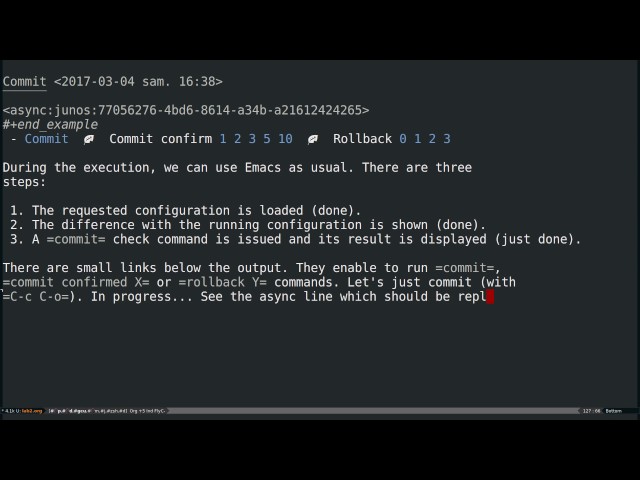
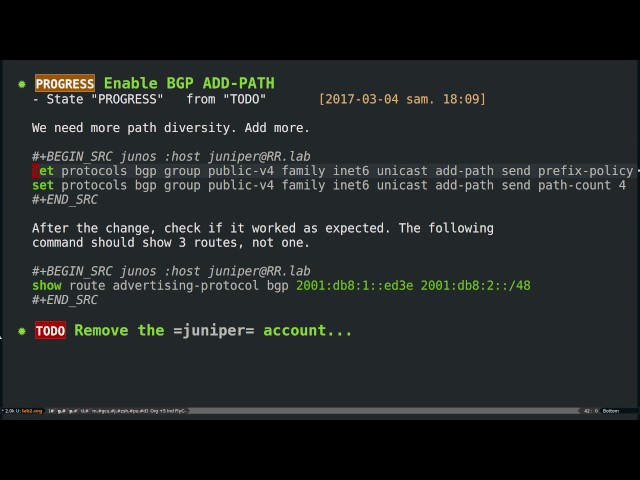
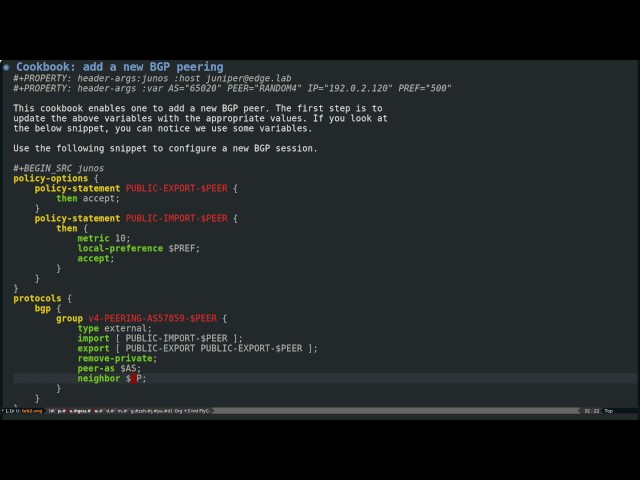
Org mode is a package for Emacs to keep notes, maintain todo lists, planning projects and authoring documents . It can execute embedded snippets of code and capture the output (through Babel). It s an invaluable tool for documenting your infrastructure and your operations. Here are three (relatively) short videos exhibiting Org mode use in the context of network operations. In all of them, I am using my own junos-mode which features the following perks: Since some Junos devices can be quite slow, commits and remote executions are done asynchronously1 with the help of a Python helper. In the first video, I take some notes about configuring BGP add-path feature (RFC 7911). It demonstrates all the available features of junos-mode. In the second video, I execute a planned operation to enable this feature in production. The document is a modus operandi and contains the configuration to apply and the commands to check if it works as expected. At the end, the document becomes a detailed report of the operation. In the third video, a cookbook has been prepared to execute some changes. I set some variables and execute the cookbook to apply the change and check the result.

  1. This is a bit of a hack since Babel doesn t have native support for that. Also have a look at ob-async which is a language-independent implementation of the same idea.

Next.

Previous.