Search Results: "tar"

2 June 2014

Steve Kemp: Reflections on Lua-based email clients

Until recently I was very happy with my console mail client, Lumail, thinking I'd written it in a flexible manner, with lots of Lua-callable primitives. Now I'm beginning to suspect that I might have gone down the wrong path at some point. The user interface, at startup consists of a list of mailboxes. The intention being that you select a mailbox, and open it. That then takes you to a list of messages. (There is a cool and simple to use option to open the union of multiple mailboxes, which is something I use daily.) Now the list of mailboxes is sorted alphabetically, so the user interface looks something like this:
UI
Now the issue that triggered my rethink: Sure you think. It's just a list of strings. You could pass an array to a lua on_sort_maildirs function, and then use the returned array/table as teh display order. Simple. Simple until you realize the user might want to do more than operate solely on the list of strings. Perhaps they wish to put folders with unread messages at the top. At which point you need a "count_unread( maildir )" function. (Which does exist.) Anyway the realisation I had is that the CMaildir object, on the C++ side, isn't exposed to the Lua-side. So the (useful) member functions which should be exported/visible are not. Really what I'm trying to say is that I think I've implemented and exported useful Lua primitives, but actually many more parts of the implementation could be usefully exported - but are not, and that comes from the choice I made to expose "things" not "objects". If I'd exposed objects right from the start I'd have been in a better place. Oh well. I continued to toy with a basic GUI mail-client last week, but I've pretty much written that off as a useful way to spend my time. For the moment I'll leave email alone, I've done enough and despite niggles what I have is absolutely the best mail client for me. (It is a shame that Mutt is so heavyweight and hard to deal with, and that notmuch never really took off.)

Russ Allbery: Review: Debt

Review: Debt, by David Graeber
Publisher: Melville House
Copyright: 2011, 2012
Printing: October 2012
ISBN: 1-61219-129-0
Format: Trade paperback
Pages: 453
You probably remember this story from introductory economics. Originally, people exchanged things through barter. I needed grain but had a cow. You had a farm but needed milk. I gave you milk for your grain. But this was tedious and awkward, and required finding the right combination of people who needed something the other person had on hand. Then, people invented money: small objects with an agreed-upon value that you could keep and use later when you needed something else. In other words, both a medium of exchange and a store of value. And that improved matters for a long time, although war-torn societies or societies that collapsed (the supposed "Dark Ages" often raises its head) would sometimes "revert to barter" for some period of time until things were stable enough for currency to reappear. Following that story was usually some story about the emergence of money based on credit: goldsmith shops that started a side business in storing other people's coins and giving them receipts, leading to the receipts trading like the coins since the shops were trustworthy, and from there into the Bank of England and eventually the fractional reserve banking system, fiat money, and all the modern machinery of finance. All of this was dated from the early Enlightenment and the development of modern finance in Europe. It's a very neat story, and it makes a great deal of intuitive sense. That barter system does feel like what you'd have to do without money, but one can immediately see how obnoxious and limiting it would be. These stories play into our intuitive sense of history: people started with emergent properties of the physical world (different people have different goods and different skills and want to exchange them) and then develop layers of abstraction on top of them, eventually leading to the sophistication of modern societies. However, David Graeber is not an economist. He's an anthropologist: the profession devoted to understanding how people actually do things rather than how we've reconstructed our history based on our modern perspective. And, as he points out, engagingly and comprehensively, in chapter two of Debt, there is no evidence that this story about economic history has anything whatsoever to do with reality. And quite a bit of evidence that it does not. As best as we've been able to determine, not only is there no society in the world that deals with routine, day-to-day needs like grain and milk through barter, there never has been such a society in human history. Instead, history and anthropology shows that credit is, in a sense, older than currency: the earliest recorded economic transactions were built on a rich system of credit, but in the form of purchases from shopkeepers on credit, or credit clearinghouses through the local government or temple. Those credit records were often denominated in some standardized commodity so many cattle or bushels of grain that could create the impression that the economy worked on barter. But the anthropological evidence indicates that this was more an accounting technique than a practical currency. People rarely brought the named commodity to the temple to pay off some debt. Rather, there was an agreed conversion from various other goods to that standardized commodity, and its primary purpose was consistent bookkeeping. Specie minted coins appear to come later, and wax and wane throughout history depending on local circumstance. For example, Europe did not "revert to barter" after the collapse of the Roman Empire, but the inhabitants did stop using specie and returned to a system of credit and record-keeping... records that continued to be denominated in Roman currency, even though few people still used the actual coins. That's one fascinating observation with which Graeber begins this book. The other is the question of why we have such a strong social and moral belief that people must pay their debts. This moral belief is ever-present in discussions about the 2008 financial collapse, and more broadly in discussions about the modern economy, but it's not as obvious of a belief as it might appear on the surface. After all, the banking and investment system is founded on the principle that not everyone will repay their debts, and therefore lenders receive a risk premium based on the likelihood that the debt won't be repaid. But, despite building the possibility of non-repayment into the system, debt forgiveness or intentional default is almost unthinkable and considered a huge moral problem. To this, Graeber brings the perspective of historical anthropology: human societies have struggled with the problems of debt and repayment from the beginning of recorded history, and have attempted a wide variety of solutions to those problems, including massive debt forgiveness. The jubilee described in the Bible was not novel; rather, it reflected a common practice to keep abuses of debt under control in ancient Sumer. The subtitle of Debt is The First 5,000 Years, and this book is a historical survey. But Graeber puts off the history to first lay an intellectual groundwork for our understanding of debt, and I found that preliminary discussion extremely valuable. Most memorable was the way Graeber divides human economic relationships into communism (in the old sense, not the political sense), exchange, and hierarchy. Capitalism has consumed our economic analysis to such a degree that exchange is the only economic basis that gets much discussion, but the other two are both obvious and pervasive once Graeber points them out. Human civilization could not exist without all three. And Graeber also points out one aspect of exchange-based economics that had not previously occurred to me: it's the economic relationship that one creates with strangers. Debt has the unique characteristic that it can be discharged, at which point the relationship ceases. This has far more complex and far-reaching moral and social implications than one might initially realize, and Graeber did a wonderful job opening my eyes to some of the subtleties. Debt is clearly a scholarly work, but Graeber's writing is clear and engaging. I found most of this book to be surprisingly easy reading. The hardest going was Graeber's discussion of societies that use a form of currency to arrange relationships between people (marriages, births, and deaths, primarily), but not day-to-day economic transactions. I suspect this area is closer to Graeber's areas of personal research and field work, which resulted in more technical detail. I'm still not sure I completely grasp the principles that Graeber was trying to communicate. But I was struck by the observation of alienation's role in turning a human being into a commodity, and how that links with debt's role as the economic transaction one has with strangers. Graeber covers slavery only glancingly, but makes some memorable points about the use of violence to rip someone out of their social context, and how that is necessary in human cultures before humans can be reduced to a commodity. There's a lot here, and I've only scratched the surface. I haven't mentioned, for example, the fascinatingly elegant theory that coining money and then requiring taxes be paid in the same money is a simple and highly effective way of funding armies, an explanation for specie that is largely unproven but that I find more compelling than the ones I've previously heard. Approaching debt from an anthropological instead of economic perspective is surprisingly enlightening. Debt is primarily a historical and cultural discussion rather than a set of proposed solutions, but Graeber does effectively show that debt as a moral obligation is not an unquestionable moral stance, but rather has a long history as one side of a two-sided political debate. I also came away from this book more conscious of the social implications and costs of debt-structured interactions, and wanting to push more of the language of debt out of my day-to-day dealings. Graeber is well known as one of the supporters of Occupy Wall Street, and Debt, while a well-defended academic work, certainly does advocate a position. But the academic analysis is more prominent than the advocacy, and I found his positions well-defended and well-argued. I do need to give the caveat that I don't have the anthropological background to distinguish the statements from Graeber that are well-established common knowledge in anthropology from the ones that are more controversial, and I would be a bit leery of taking this book as the final word on the topic. But it fully deserves its popularity and reputation as a thought-provoking and valuable contribution to the conversation. It's another book that I want to re-read someday to digest further, and the sort of book whose observations keep occurring to me in subsequent discussions or news stories. If you're at all interested in the way in which we construct the morality around economics and debt, I think this is a book that you should read. It's thoughtful, challenging, and surprising, and it passes my acid test for books of this sort with flying colors: after reading it, you realize that many things are more complicated, more historical, and less novel than you had originally thought. Highly recommended. Rating: 9 out of 10

1 June 2014

Paul Tagliamonte: Back from TCamp 2014

Great time, super well organized by this year s TCamp staff. Really outstanding. Lots of really amazing discussion, and I feel a lot of effort is finally jelling around Open Civic Data, which is an absolute thrill for me. Can t wait to see what the next few months bring!

Antonio Terceiro: An introduction to the Debian Continuous Integration project

Debian is a big system. At the time of writing, looking at my local package list caches tells me that the unstable suite contains 21306 source packages, and 42867 binary packages on amd64. Between these 42867 binary packages, there is an unthinkable number of inter-package dependencies. For example the dependency graph of the ruby packages contains other 20-something packages. A new version of any of these packages can potentially break some functionality in the ruby package. And that dependency graph is very small. Looking at the dependency graph for, say, the rails package will make your eyes bleed. I tried it here, and GraphViz needed a PNG image with 7653 10003 pixels to draw it. It ain t pretty. Installing rails on a clean Debian system will pull in another 109 packages as part of the dependency chain. Again, as new versions of those packages are uploaded the archive, there is a probability that a backwards-incompatible change, or even a bug fix which was being worked around, might make some funcionality in rails stop working. Even if that probability is low for each package in the dependency chain, with enough packages the probability of any of them causing problems for rails is quite high. And still the rails dependency chain is not that big. libreoffice will pull in another 264 packages. gnome will pull in 1311 dependencies, and kde-full 1320 (!). With a system this big, problems will arrive, and that s a fact of life. As developers, what we can do is try to spot these problems as early as possible, and fixing them in time to make a solid release with the high quality Debian is known for. While automated testing is not the proverbial Silver Bullet of Software Engineering, it is an effective way of finding regressions. Back in 2006, Ian Jackson started the development of autopkgtest as a tool to test Debian packages in their installed form (as opposed to testing packages using their source tree). In 2011, the autopkgtest test suite format was proposed as a standard for the Debian project, in what we now know as the DEP-8 specification. Since then, some maintainers such as myself started experimenting with DEP-8 tests in their packages. There was an expectation in the air that someday, someone would run those tests for the entire archive, and that would be a precious source of QA information. Durign the holiday break last year, I decided to give it a shot. I initially called the codebase dep8. Later I renamed it to debci, since it could potentially also run other other types of test suites in the future. Since early January, ci.debian.net run an instance of debci for the Debian Project. The Debian continuous Integration will trigger tests at most 4 times a day, 3 hours after each dinstall run. It will update a local APT cache and look for packages that declare a DEP-8 test suite. Each package with a test suite will then have its test suite executed if there was any change in its dependency chain since the last test run. Existing test results are published at ci.debian.net every hour, and at the end of each batch a global status is updated. Maintainers can subscribe to a per package Atom feed to keep up with their package test results. People interested in the overall status can subscribe to a global Atom feed of events. Since the introduction of Debian CI in mid-January 2014, we have seen an amazing increase in the number of packages with test suites. We had little less than 200 packages with test suites back then, against around 350 now (early June 2014). The ratio of packages passing passing their test suite has also improved a lot, going from less than 50% to more than 75%. There is documentation available, including a FAQ for package maintainers with further information about how the system works, how to declare test suites in their packages and how to reproduce test runs locally. Also available is development information about debci itself, to those inclined to help improve the system. This is just the beginning. debci is under a good rate of development, and you can expect to see a constant flux of improvements. In special, I would like to mention a few people who are giving amazing contributions to the project:

30 May 2014

Steve Kemp: Sometimes reading code makes you scream.

So I've recently been looking at proxy-server source code, for obvious reasons. The starting point was a simple search of the available options:
~$ apt-cache search proxy filter
...
trafficserver - fast, scalable and extensible HTTP/1.1 compliant caching proxy server
ssh-agent-filter - filtering proxy for ssh-agent
Hrm? trafficserver? That sounds like fun. Lets look at the source.
cd /tmp
apt-get source trafficserver
Lots of code, but scanning it quickly with my favourite tool, grep, we find this "gem":
$ rgrep /tmp .
./mgmt/tools/SysAPI.cc:  tmp = fopen("/tmp/shadow", "w");
./mgmt/tools/SysAPI.cc:    system("/bin/mv -f /tmp/shadow /etc/shadow");
Is that really what it looks like? Really? Sadly yes. There's lots of abuse of /tmpfiles in the code in mgmt/tools/, and although the modular structure took a while to understand the code that is compiled here ultimately ends up being included in /usr/bin/traffic_shell. That means it is a "real" security issue, allowing race-tastic local-attackers to do bad things. Bug reported as #749846. In happier news, the desk I was building is now complete. Pretty.
I feel like I should write about auditing software, but equally I feel unqualified - better people than me have already done so, e.g. David Wheeler. Also I've done it before, and nobody paid attention. (Or rather the poeple that should consider security frequently fail to do so, which is .. frustrating.)

Julien Danjou: OpenStack Design Summit Juno, from a Ceilometer point of view

Last week was the OpenStack Design Summit in Atlanta, GA where we, developers, discussed and designed the new OpenStack release (Juno) coming up. I've been there mainly to discuss Ceilometer upcoming developments. The summit has been great. It was my third OpenStack design summit, and the first one not being a PTL, meaning it was a largely more relaxed summit for me! On Monday, we started by a 2.5 hours meeting with Ceilometer core developers and contributors about the Gnocchi experimental project that I've started a few weeks ago. It was a great and productive afternoon, and allowed me to introduce and cover this topic extensively, something that would not have been possible in the allocated session we had later in the week. Ceilometer had his design sessions running mainly during Wednesday. We noted a lot of things and commented during the sessions in our Etherpads instances. Here is a short summary of the sessions I've attended. Scaling the central agent I was in charge of the first session, and introduced the work that was done so far in the scaling of the central agent. Six months ago, during the Havana summit, I proposed to scale the central agent by distributing the tasks among several node, using a library to handle the group membership aspect of it. That led to the creation of the tooz library that we worked on at eNovance during the last 6 months. Now that we have this foundation available, Cyril Roelandt started to replace the Ceilometer alarming job repartition code by Taskflow and Tooz. Starting with the central agent is simpler and will be a first proof of concept to be used by the central agent then. We plan to get this merged for Juno. For the central agent, the same work needs to be done, but since it's a bit more complicated, it will be done after the alarming evaluators are converted. Test strategy The next session discussed the test strategy and how we could improve Ceilometer unit and functional testing. There is a lot in this area to be done, and this is going to be one of the main focus of the team in the upcoming weeks. Having Tempest tests run was a goal for Havana, and even if we made a lot of progress, we're still no there yet. Complex queries and per-user/project data collection This session, led by Ildik V ncsa, was about adding finer-grained configuration into the pipeline configuration to allow per-user and per-project data retrieval. This was not really controversial, though how to implement this exactly is still to be discussed, but the idea was well received. The other part of the session was about adding more in the complex queries feature provided by the v2 API. Rethinking Ceilometer as a Time-Series-as-a-Service This was my main session, the reason we met on Monday for a few hours, and one of the most promising session I hope of the week. It appears that the way Ceilometer designed its API and storage backends a long time ago is now a problem to scale the data storage. Also, the events API we introduced in the last release partially overlaps some of the functionality provided by the samples API that causes us scaling troubles. Therefore, I've started to rethink the Ceilometer API by building it as a time series read/write service, letting the audit part of our previous sample API to the event subsystem. After a few researches and experiments, I've designed a new project called Gnocchi, which provides exactly that functionality in a hopefully scalable way. Gnocchi is split in two parts: a time series API and its driver, and a resource indexing API with its own driver. Having two distinct driver sets allows it to use different technologies to store each data type in the best storage engine possible. The canonical driver for time series handling is based on Pandas and Swift. The canonical resource indexer driver is based on SQLAlchemy. The idea and project was well received and looked pretty exciting to most people. Our hope is to design a version 3 of the Ceilometer API around Gnocchi at some point during the Juno cycle, and have it ready as some sort of preview for the final release. Revisiting the Ceilometer data model This session led by Alexei Kornienko, kind of echoed the previous session, as it clearly also tried to address the Ceilometer scalability issue, but in a different way. Anyway, the SQL driver limitations have been discussed and Mehdi Abaakouk implemented some of the suggestions during the week, so we should very soon see more performances in Ceilometer with the current default storage driver. Ceilometer devops session We organized this session to get feedbacks from the devops community about deploying Ceilometer. It was very interesting, and the list of things we could improve is long, and I think will help us to drive our future efforts. SNMP inspectors This session, led by Lianhao Lu, discussed various details of the future of SNMP support in Ceilometer. Alarm and logs improvements This mixed session, led by Nejc Saje and Gordon Chung, was about possible improvements on the alarm evaluation system provided by Ceilometer, and making logging in Ceilometer more effective. Both half-sessions were interesting and led to several ideas on how to improve both systems. Conclusion Considering the current QA problems with Ceilometer, Eoghan Glynn, the new Project Technical Leader for Ceilometer, clearly indicated that this will be the main focus of the release cycle. Personally, I will be focused on working on Gnocchi, and will likely be joined by others in the next weeks. Our idea is to develop a complete solution with a high velocity in the next weeks, and then works on its integration with Ceilometer itself.

29 May 2014

Enrico Zini: wheezy-for-industrial-development

Wheezy for industrial software development I'm helping with setting up a wheezy-based toolchain for industrial automation. The basic requirements are: live-build, C++11, Qt 5.3, and a frozen internal wheezy mirror. debmirror A good part of a day's work was lost because of #749734 and possibly #628779. Mirror rebuild is still ongoing, and fingers crossed. This is Italy, and you can't simply download 21Gb of debs just to see how it goes. C++11 Stable toolchains for C++11 now exist and have gained fast adoption. It makes sense, since given what is in C++11 it is unthinkable to start a new C++ project with the old standard nowadays. C++11 is supported by g++ 4.8+ or clang 3.3+. None of them is available on wheezy or wheezy-backports. Backports exist of g++ 4.8 only for Ubuntu 12.04, but they are uninstallable on wheezy due at least to a different libc6. I tried rebuilding g++4.8 on wheezy but quickly gave up. clang 3.3 has a build dependency on g++ 4.8. LOL. However, LLVM provides an APT repository with their most recent compiler, and it works, too. C++11 problem solved! Qt 5.3 Qt 5.3 is needed because of the range of platforms it can target. There is no wheezy backport that I can find. I cannot simply get it from Qt's Download page and install it, since we need it packaged, to build live ISOs with it. I'm attempting to backport the packages from experimental to wheezy. Here are its build dependencies: libxcb-1.10 (needed by qt5) Building this is reasonably straightforward. libxkbcommon 0.4.0 (needed by qt5) The version from jessie builds fine on wheezy, provided you remove --fail-missing from the dh_install invocation. libicu 52.1 (needed by harfbuzz) The jessie packages build on wheezy, provided that mentions of clang are deleted from source/configure.ac, since it fails to build with clang 3.5 (the one currently available for wheezy on llvm.org). libharfbuzz-dev Backporting this is a bloodbath: the Debian packages from jessie depend on a forest of gobject hipsterisms of doom, all unavailable on wheezy. I gave up. qt 5.3 qtbase-opensource-src-5.3.0+dfsg can be made to build with an embedded version of harfbuzz, with just this change:
diff -Naur a/debian/control a/debian/control
--- a/debian/control    2014-05-20 18:48:27.000000000 +0200
+++ b/debian/control    2014-05-29 17:45:31.037215786 +0200
@@ -28,7 +28,6 @@
                libgstreamer-plugins-base0.10-dev,
                libgstreamer0.10-dev,
                libgtk2.0-dev,
-               libharfbuzz-dev,
                libicu-dev,
                libjpeg-dev,
                libmysqlclient-dev,
diff -Naur a/debian/rules b/debian/rules
--- a/debian/rules  2014-05-18 01:56:37.000000000 +0200
+++ b/debian/rules  2014-05-29 17:45:25.738634371 +0200
@@ -108,7 +108,6 @@
                -plugin-sql-tds \
                -system-sqlite \
                -platform $(platform_arg) \
-               -system-harfbuzz \
                -system-zlib \
                -system-libpng \
                -system-libjpeg \
(thanks Lisandro Dami n Nicanor P rez Meyer for helping me there!) There are probably going to be further steps in the Qt5 toolchain. Actually, let's try prebuilt binaries The next day with a fresh mind we realised that it is preferable to reduce our tampering with the original wheezy to a minimum. Our current plan is to use wheezy's original Qt and Qt-using packages, and use Qt's prebuilt binaries in /opt for all our custom software. We run Qt's installer, tarred the result, and wrapped it in a Debian package like this:
$ cat debian/rules
#!/usr/bin/make -f
QT_VERSION = 5.3
%:
    dh $@
override_dh_auto_build:
    dh_auto_build
    sed -re 's/@QT_VERSION@/$(QT_VERSION)/g' debian-rules.inc.in > debian-rules.inc
override_dh_auto_install:
    dh_auto_install
    # Download and untar the prebuild Qt5 binaries
    install -d -o root -g root -m 0755 debian/our-qt5-sdk/opt/Qt
    curl http://localserver/Qt$(QT_VERSION).tar.xz   xz -d   tar -C debian/our-qt5-sdk/opt -xf -
    # Move the runtime part to our-qt5
    install -d -o root -g root -m 0755 debian/our-qt5/opt/Qt
    mv debian/our-qt5-sdk/opt/Qt/$(QT_VERSION) debian/our-qt5/opt/Qt/
    # Makes dpkg-shlibdeps work on packages built with Qt from /opt
    # Hack. Don't try this at home. Don't ever do this unless you
    # know what you are doing. This voids your warranty. If you
    # know what you are doing, you won't do this.
    find debian/our-qt5/opt/Qt/$(QT_VERSION)/gcc_64/lib -maxdepth 1 -type f -name "lib*.so*" \
          sed -re 's,^.+/(lib[^.]+)\.so.+$$,\1 5 our-qt5 (>= $(QT_VERSION)),' > debian/our-qt5.shlibs
$ cat debian-rules.inc.in
export PATH := /opt/Qt/@QT_VERSION@/gcc_64/bin:$(PATH)
export QMAKESPEC=/opt/Qt/@QT_VERSION@/gcc_64/mkspecs/linux-clang/
To build one of our packages using Qt5.3 and clang, we just add this to its debian/rules:
include /usr/share/our-qt5/debian-rules.inc
Wrap up We got the dependencies sorted. Hopefully the mirror will rebuild itself tonight and tomorrow we can resume working on our custom live system.

28 May 2014

John Goerzen: Review: The Wheel of Time

Five years ago, I opened The Eye of the World, the first book in the Wheel of Time series, and read:
Lord of the Morning, he said, I have come for you.

On the island, the air shimmered and coalesced. The black-clad man stood staring at the fiery mountain rising out of the plain. His face twisted in rage and contempt. You cannot escape so easily, Dragon. It is not done between us. It will not be done until the end of time. Then he was gone, and the mountain and the island stood alone. Waiting.
And then, as often, Robert Jordan began books citing some of the prophecy he invented:
And it came to pass in those days, as it had come before and would come again, that the Dark lay heavy on the land and weighed down the hearts of men, and the green things failed, and hope died. And men cried out to the Creator, saying, O Light of the Heavens, Light of the World, let the Promised One be born of the mountain, according to the prophecies, as he was in ages past and will be in ages to come. Let the Prince of the Morning sing to the land that green things will grow and the valleys give forth lambs. Let the arm of the Lord of the Dawn shelter us from the Dark, and the great sword of justice defend us. Let the Dragon ride again on the winds of time. from Charal Drianaan to Calamon,
The Cycle of the Dragon.
Author unknown, the Fourth Age
And then, the grand opening to each of the books in the 11,000-page series, something like this:
The Wheel of Time turns, and Ages come and pass, leaving memories that become legend. Legend fades to myth, and even myth is long forgotten when the Age that gave it birth comes again. In one Age, called the Third Age by some, an Age yet to come, an Age long past, a wind rose in the Mountains of Mist. The wind was not the beginning. There are neither beginnings nor endings to the turning of the Wheel of Time. But it was a beginning. Born below the ever cloud-capped peaks that gave the mountains their name, the wind blew east, out across the Sand Hills, once the shore of a great ocean, before the Breaking of the World. Down it flailed into the Two Rivers, into the tangled forest called the Westwood, and beat at two men walking with a cart and horse down the rock-strewn track called the Quarry Road.
And yesterday, 11,000 pages later, I have completed the series. Really, how could I have put down a book with such a majestic beginning as that? It hinted at the epic that was to come, the amazing literature I was going to read. I didn t read it straight through; I enjoyed books like War and Peace along the way. But what a trip the Wheel of Time series was. The characters were so detailed, so deep, the setting so elaborate, the plots so grand and also so small everyone from servants to queens were well-represented in the books. Not every section was a page-turner; in fact, around the 4th or 5th book, the series started to plod for a thousand pages or two, reading more like a history book than a novel. Sometimes the prejudices and stereotypes of the characters, particularly the sexism that both the men and women displayed, were frustrating to read. I never quite figured out of this was brilliant writing (making the reader feel frustrated at the plodding pace of the book when it was describing characters being frustrated at the plodding pace of events), or if it could have been trimmed down by 2/3 in some places. But really, the number of brilliant endings, laugh-out-loud situations, and page-turning suspense that somehow managed to build over hundreds, and then even thousands of pages, outweighed the flaws.
Politics is a foggy mire full of snakes. - The Eye of the World
Ah. Furlan washed his hands in one direction, then rubbed them in the other. Ah. Forgive me, Master Andra, but Lady Alys is a fierce sounding woman. Only with those who displease her, Lan said blandly. Her bite is far worse than her bark. Ah. Ah. Ah. Your rooms are this way. . . - The Dragon Reborn
One of the marks of truly good writing is that I leave a book or series with a sense of sadness or nostalgia, leaving characters that seem almost like friends. I felt that after finishing the last book in the series, A Memory of Light. The ending was deep, and satisfying, but ultimately left me wanting even more even more than 11,000 pages, somehow.
Elienda and Briain woke from the dream. She might have been speaking of the weather rather than two deaths among women she knew. We all must wake eventually. - Knife of Dreams
I was often touched by the way the Aiel referred to each other. A desert people, their fond farewall was may you always find water and shade. A fitting metaphor for anyone s life, I think. And they referred to their spouse as shade of my heart. Jordan touched on quite a few themes of religion and philosophy. In that quote above, he has the Aiel referring to death as waking from a dream. An intriguing metaphor, isn t it? He even writes conflicts of philosophy, religion, and culture into the series. I was particularly impressed with his treatment of theodicy and the problem of evil (the argument and religious response relating to the presence of evil in the world in the face of a loving God.) It is the most impressive treatment I have seen in fiction, and does a better job of advancing the theodistic argument than many philosophers have, I suspect. It is hard to really go into that one here because of the length and potential for spoilers. I can, however, comment on his treatment of existential nihilism the theory that life and the universe is without meaning, and the sometimes-related comment that what does anything matter then anyway? Here are a couple of quotes:
In Maradon, I saw what had been done to men who followed me. I saw Light in them, Min. Defying the Dark One no matter the length of his shadow. We will live, that defiance said. We will love and we will hope. And I saw him trying so hard to destroy that. He knows that if he could break them, it would mean something. Something much more than Maradon. Breaking the spirit of men he thirsts for that. He struck far harder than he otherwise would have because he wanted to break my spirit. His voice grew softer and he opened his eyes, looking down at her. And so I stood against him. - Towers of Midnight
What if I think it s all meaningless? he demanded with the loud voice of a king. What if I don t want it to keep turning? We live our lives by the blood of others! And those others become forgotten. What good is it if everything we know will fade? Great deeds or great tragedies, neither means anything! They will become legends, then those legends will be forgotten, then it will all start over again!

Why? Rand thought with wonder. Because each time we live, we get to love again.

It felt relaxing to stare out at that distant light, so welcoming and noble. Storms will soon come, it seemed to say. But for now, I am here. I am here. - The Gathering Storm
I unfortunately can t put in in its proper context due to spoilers, but it is a pivotal turning point in the series, relating to the preservation of the world. By giving what we might normally call a characteristic or behavior evil an almost-human voice and character, it can be discussed in interesting ways.
We are always more afraid than we wish to be, but we can always be braver than we expect. Hold on to your heart, and the Aes Sedai cannot harm what is really you, your heart. They are not nearly so far above us as we believed. May you always find water and shade, Egwene. And always remember your heart. - Lord of Chaos
Eben is dead. Would you want to forget your pain if you lost that hulking giant of yours? Have your feelings for him cut away like some spoiled chunk of flesh in an otherwise good roast? - The Gathering Storm
These quotes are examples of characters in the series dealing with difficult situations. In one, a character is yelled at for offering to use her special powers to numb the pain of another person over a death. It brings up a question that those of us that have known pain might find interesting: would we really have wanted our pain erased? And suggests perhaps not. That there is a benefit to it. That we get through it by embracing it by embracing it while still being true to our heart.
He had four rules concerning action and information. Never make a plan without knowing as much as you can of the enemy. Never be afraid to change your plans when you receive new information. Never believe you know everything. And never wait to know everything. - Lord of Chaos
Sometimes the series treats us to logical thinkers, whether they are generals or innkeepers, and gives us little tidbits like this one.
Androl brushed off his hands, smiling. Children were so adaptable. Before them, centuries of tradition, terror and superstition could melt away like butter left too long in the sun. - Towers of Midnight
And sometimes, things to chew over. Isn t that an interesting comment on prejudice? Children aren t born prejudiced; we can see how easily they make friends with anyone. It is sad that we teach them to be, isn t it? Wheel of Time is a fine story, expertly woven. But it is not just a story. It is true, in the sense that it illuminates truths, just like Romeo and Juliet can. In it, I see lessons and echoes of the civil rights era, comments on what makes good leaders, characters wrestling with decisions without adequate data, people putting on a mask of emotions, sacrifice, and the overall theme of the entire series: the power of love and compassion. The inspiration of the series for me well, it is there, but it may take a few more days to figure it out. I think it has something to do with this: The wind rose high and free, to soar in an open sky with no clouds.

C.J. Adams-Collier: Juniper Olive VM XML

For use with http://web.dit.upm.es/vnxwiki/index.php/Vnx-rootfsolive and http://blog.gns3.net/2009/10/olive-juniper/2/
$ cd /var/lib/libvirt/images
$ sudo qemu-img create -f qcow2 vnx_rootfs_olive.qcow2 7G
$ sudo wget ftp://ftp-archive.freebsd.org/pub/FreeBSD-Archive/old-releases/i386/ISO-IMAGES/4.11/4.11-RELEASE-i386-miniinst.iso
$ sudo brctl addbr testnet
$ sudo ip addr add 172.18.36.2/24 dev testnet
$ sudo ip link set up dev testnet
$ wget -O /tmp/olive.xml https://wp.colliertech.org/cj/wp-content/uploads/2014/05/olive.xml
$ sudo virsh define /tmp/olive.xml
$ sudo virsh start olive
/tmp/olive.xml follows:
<domain type='kvm'>
  <name>olive</name>
  <memory unit='KiB'>1048576</memory>
  <currentMemory unit='KiB'>1048576</currentMemory>
  <vcpu placement='static'>2</vcpu>
  <os>
    <type arch='x86_64' machine='pc-1.1'>hvm</type>
    <boot dev='cdrom'/>
  </os>
  <features>
    <acpi/>
    <apic/>
    <pae/>
  </features>
  <clock offset='utc'/>
  <on_poweroff>destroy</on_poweroff>
  <on_reboot>restart</on_reboot>
  <on_crash>restart</on_crash>
  <devices>
    <emulator>/usr/bin/kvm</emulator>
    <disk type='file' device='disk'>
      <driver name='qemu' type='qcow2'/>
      <source file='/var/lib/libvirt/images/vnx_rootfs_olive.qcow2'/>
      <target dev='hda' bus='ide'/>
      <address type='drive' controller='0' bus='0' target='0' unit='0'/>
    </disk>
    <disk type='file' device='cdrom'>
      <driver name='qemu' type='raw'/>
      <source file='/var/lib/libvirt/images/4.11-RELEASE-i386-miniinst.iso'/>
      <target dev='hdc' bus='ide'/>
      <readonly/>
      <address type='drive' controller='0' bus='1' target='0' unit='0'/>
    </disk>
    <controller type='usb' index='0'>
      <address type='pci' domain='0x0000' bus='0x00' slot='0x01' function='0x2'/>
    </controller>
    <controller type='ide' index='0'>
      <address type='pci' domain='0x0000' bus='0x00' slot='0x01' function='0x1'/>
    </controller>
    <controller type='sata' index='0'>
      <address type='pci' domain='0x0000' bus='0x00' slot='0x03' function='0x0'/>
    </controller>
    <interface type='bridge'>
      <mac address='52:54:00:4d:b2:c8'/>
      <source bridge='testnet'/>
      <model type='e1000'/>
      <address type='pci' domain='0x0000' bus='0x00' slot='0x06' function='0x0'/>
    </interface>
    <serial type='pty'>
      <target port='0'/>
    </serial>
    <console type='pty'>
      <target type='serial' port='0'/>
    </console>
    <input type='mouse' bus='ps2'/>
    <graphics type='vnc' port='-1' autoport='yes'/>
    <video>
      <model type='cirrus' vram='9216' heads='1'/>
      <address type='pci' domain='0x0000' bus='0x00' slot='0x02' function='0x0'/>
    </video>
    <memballoon model='virtio'>
      <address type='pci' domain='0x0000' bus='0x00' slot='0x05' function='0x0'/>
    </memballoon>
  </devices>
</domain>

Hideki Yamane: no /run/systemd/private

Setting up dbus (1.8.2-1) ...
Failed to get D-Bus connection: Failed to connect to socket /run/systemd/private: Connection refused
invoke-rc.d: initscript dbus, action "start" failed.
dpkg: error processing package dbus (--configure):
subprocess installed post-installation script returned error exit status 1
Errors were encountered while processing:
dbus
Error: Timeout was reached
E: Sub-process /usr/bin/dpkg returned an error code (1)
and there is no /run/systemd/private file :-(
After reboot it, it has been created and able to upgrade. Hmm... how I can avoid this systemd related error?

Tanguy Ortolo: GNU/Linux graphic sessions: allowing computer suspend and disabling a monitor

Allowing computer suspend Major desktop environments such as Xfce or KDE have a built-in computer suspend feature, but when you use a lighter alternative, things are a bit more complicated, because basically: only root can suspend the computer. Possible solutions include: With recent updates of the related Debian packages no idea of which one exactly the latter solution may not work any more, in which case it will only return the following error:
Error org.freedesktop.UPower.GeneralError: not authorized
It appears that this error is linked to ConsoleKit, a part of all this modern *Kit gizmo pile. If you are in this case, try prefixing your session launcher with the undocumented dark magic call ck-launch-session. For instance, this is what I have in my .xsession to launch my window manager i3:
exec ck-launch-session i3
Note: I do not know what ck-launch-session does exactly, why it is needed, and I do not want to know. To me, all that WhatsitKit pile is just some opaque, under-documented as in: no man page crap, that no one but their author really understand, designed to solve theoretical problems no one really cares about like: how to allow locally connected users to use the sound card while forbidding it to remote users while creating new issues such as this one. This stuff is too complex and under-documented for me to dive into it, so if it does not work out of the box, it is just some crap that gets in my way to using my computer as I wish. Disabling a monitor In some configurations, you have two monitors and want to disable one. For instance, in addition to my LCD monitor, I have a projector which I only use for movies. According to xorg.conf's man page, it can be disabled this way:
Section "Device"
    Identifier  "Internal graphic card"
    Option      "Monitor-DVI"   "LCD Monitor"
    Option      "Monitor-VGA"   "Projector"
EndSection
Section "Monitor"
    Identifier  "LCD Monitor"
EndSection
Section "Monitor"
    Identifier  "Projector"
    Option      "Enable"    "false"
EndSection
Except that does not work, because contrary to what the man page says the real option to use is not Enable but Disable! So here is the correct configuration to disable that monitor at start-up:
Section "Device"
    Identifier  "Internal graphic card"
    Option      "Monitor-DVI"   "LCD Monitor"
    Option      "Monitor-VGA"   "Projector"
EndSection
Section "Monitor"
    Identifier  "LCD Monitor"
EndSection
Section "Monitor"
    Identifier  "Projector"
    Option      "Disable"   "true"
EndSection
Note: yes, I will send a bug report with a patch against xorg.conf's man page.

27 May 2014

Jon Dowland: Nine Inch Nails, Manchester, 2014

I spent the bank holiday weekend mostly in Manchester with my brother and a couple of friends, mostly to see Nine Inch Nails perform, but also to enjoy the pleasures of the city.
the Marble Arch's ceiling the Marble Arch's ceiling
We arrived on the Sunday and after checking in headed out to get some food. I'd booked us a table at the historic Marble Arch - the pub which gives its name to the parent company Marble Beers - and produce my most favourite ales. Whenever a Marble beer ends up as a guest at one of the Newcastle real ale pubs a friend of mine (who is much more on top of this stuff than I am) lets me know and we stop off for a few. Invariably there's a crowd of a dozen or so Manchester expats in bar when we do. I reserved our table over twitter, which is a bit of a novelty for me. My two friends are ale skeptics but - due to lack of choice - we all ended up sampling the Chocolate Marble and the Ginger 5.1, which went down a storm. They are possibly converts now. There was an Earl Grey IPA too, which was nice but a bit on the strong side for sessioning.
copyright   Jonathan Dowland 2014, http://creativecommons.org/licenses/by/4.0/ click for the animated version
The gig was great - I prefer club gigs to arena gigs but the sound techs for NIN know what they are doing and the mix was great. The visuals were stunning too. Highlights for me were "The Great Destroyer" - in particular the extended, improvised 5 minute glitch-meltdown coda; the slow build of "Eraser" and "The Day The World Went Away" - played faithfully to the CD mix rather than the traditional extended live arrangement. I miss the former live arrangement, which includes a drawn out drum-backed finish, but this arrangement had a lot of force, with all four of the band bashing guitars into a pummelling wall of sound. I've heard that at least one person has taped the show and it turns out recordings have just recently surfaced for the two club gigs my brother and I attended back in 2005 and 2007 - meaning there are now widely available, high quality ROIO copies for every NIN gig I've ever been to. Afterwards we tried to find a decent club. Manchester is a lot larger than my native city and there's plenty of places to go, if you know where they are. We had originally planned to visit The Factory on Charles Street, but we didn't believe it was open on the Sunday. The Factory is Peter Hook's (formerly of Joy Division/New Order) club - occupying the former office spaces of Factory records. I've chanced in there once before as it's right across the road from the Lass O' Gowrie pub, which is the haunt of choice for HE/tech people whenever we're in Manchester for conferences.
cheesy cocktail names cheesy cocktail names
Instead we gravitated towards Dry Bar on Oldham street. By coincidence this place also has historic ties to Factory Records. However the doormen wouldn't let us in! Finally we landed at a place which had one name on the door and a different name on the inside (Jack's). Like the aformentioned Lass O' Gowrie and perhaps half of all pubs and clubs in Manchester, the place is decked out as a shrine to the former musical giants of the City, with framed pictures of Mark E Smith, the Ha ienda again, the Stone Roses in their boy-band-looks hay day, John Peel (champion of many of them) and of course Tony Wilson. I can't help but wonder whether people who live here get royally sick of that. This place served some delicious albeit clich -titled Cocktails and played a pretty good set - the obligatory Madchester throwback interlude was followed by a chunk of Northern Soul and a couple of early Rap classics. Setlist wise it was pretty much identical to that of Foundation in Newcastle, 12 years ago, no doubt because Foundation was cribbing heavily from the Ha ienda in the first place.
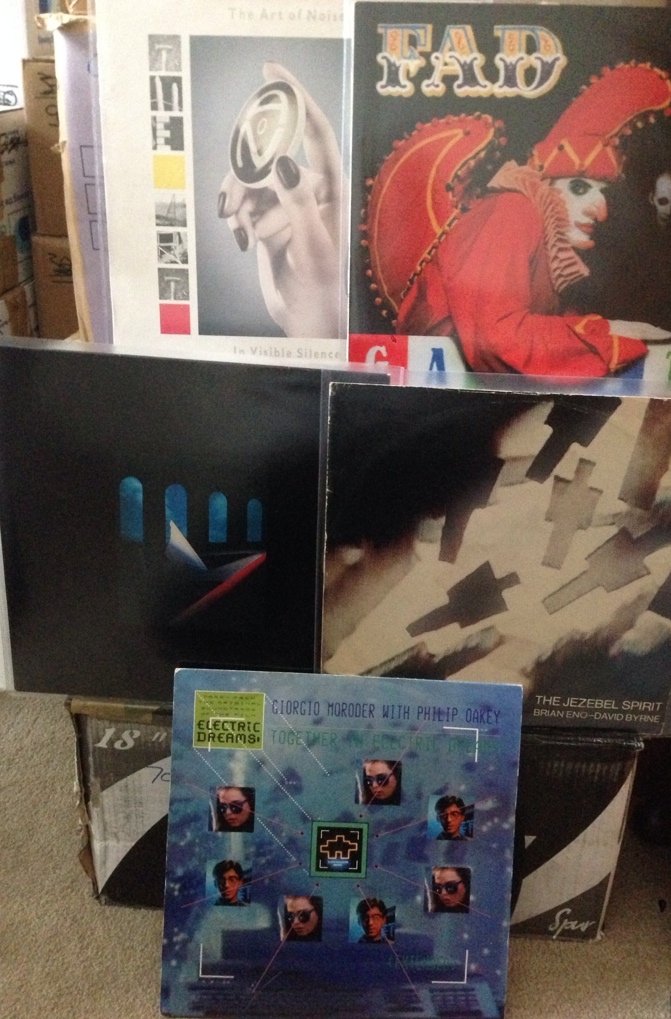
Record haul Record haul
Monday was dedicated to exploring and shopping. Top of my list of places to go was my pilgrimage venue Vinyl Exchange. Whilst waiting for it to open we rolled around in Affleck's Palace, which turned out to have a small record stall within. After Vinyl Exchange we chanced across another record store right across the road - Picadilly Records - which happens to be larger and focuses more on new releases. It didn't take long before we found another small, DIY record shop, then another. We tried out the Fopp branch here - more Vinyl; then Urban Outfitters - more; then an Oxfam branch - even more. I actually got Vinyl snow blind at this point. I've been controlling myself admirably and only picked up a couple of bits and pieces. My best find was Fad Gadget's sophmore album "Incontinent".

Jon Dowland: 2012 In Review

2013 is nearly all finished up and so I thought I'd spend a little time writing up what was noteable in the last twelve months. When I did so I found an unfinished draft from the year before. It would be a shame for it to go to waste, so here it is. 2012 was an interesting year in many respects with personal highs and lows. Every year I see a lots of "round-up"-style blog posts on the web, titled things like "2012 in music", which attempt to summarize the highlights of the year in that particular context. Here's JWZ's effort, for example. Often they are prefixed with statements like "2012 was a strong year for music" or whatever. For me, 2012 was not a particularly great year. I discovered quite a lot of stuff that I love that was new to me, but not new in any other sense. In Music, there were a bunch of come-back albums that made the headlines. I picked up both of Orbital's Wonky and Brian Eno's Lux (debatably a comeback: his first ambient record since 1983, his first solo effort since 2005, but his fourth collaborative effort on Warp in the naughties). I've enjoyed them both, but I've already forgotten Wonky and I still haven't fully embraced Lux (and On Land has not been knocked from the top spot when I want to listen to ambience.) There was also Throbbing Gristle's (or X-TG) final effort, a semi/post-TG, partly posthumous double-album swan song effort which, even more than Lux, I still haven't fully digested. In all honesty I think it was eclipsed by the surprise one-off release of a live recording of a TG side project featuring Nik Void of Factory Floor: Carter Tutti Void's Transverse, which is excellent. Ostensibly a four-track release, there's a studio excerpt V4 studio (Slap 1) which is available from (at least) Amazon. There's also a much more obscure fifth "unreleased" track cruX which I managed to "buy" from one of the web shops for zero cost. The other big musical surprise for me last year was Beth Jeans Houghton and the Hooves of Destiny: Yours Truly, Cellophane Nose. I knew nothing of BJH, although it turns out I've heard some of her singles repeatedly on Radio 6, but her band's guitarist Ed Blazey and his partner lived in the flat below me briefly. In that time I managed to get to the pub with him just once, but he kindly gave me a copy of their album on 12" afterwards. It reminds me a bit of Goldfrapp circa "Seventh Tree": I really like it and I'm looking forward to whatever they do next. Reznor's How To Destroy Angels squeezed out An Omen EP which failed to set my world on fire as a coherent collection, despite a few strong songs individually. In movies, sadly once again I'd say most of the things I recall seeing would be "also rans". Prometheus was a disappointment, although I will probably rewatch it in 2D at least once. The final Batman was fun although not groundbreaking to me and it didn't surpass Ledger's efforts in The Dark Knight. Inception remains my favourite Nolan by a long shot. Looper is perhaps the stand-out, not least because it came from nowhere and I managed to avoid any hype. In games, I moaned about having moaning about too many games, most of which are much older than 2012. I started Borderlands 2 after enjoying Borderlands (disqualified on age grounds) but to this day haven't persued it much further. I mostly played the two similar meta-games: The Playstation Plus download free games in a fixed time period and the more sporadic but bountiful humble bundle whack-a-mole. More on these another time. In reading, as is typical I mostly read stuff that was not written in 2012. Of that which was, Charles Stross's The Apocalypse Codex was an improvement over The Fuller Memorandum which I did not enjoy much, but in general I'm finding I much prefer Stross's older work to his newer; David Byrne's How Music Works was my first (and currently last) Google Books ebook purchase, and I read it entirely on a Nexus 7. I thoroughly enjoyed the book but the experience has not made a convert of me away from paper. He leans heavily on his own experiences which is inevitable but fortunately they are wide and numerous. Iain Banks' Stonemouth was an enjoyable romp around a fictional Scottish town (one which, I am reliably informed, is incredibly realistical rendered). One of his "mainstream" novels, It avoided a particular plot pattern that I've grown to dread with Banks, much to my suprise (and pleasure). Finally, the stand-out pleasant surprise novel of the year was Pratchett and Baxter's The Long Earth. With a plot device not unlike Banks' Transition or Stross's Family Trade series, the pair managed to write a journey-book capturing the sense-of-wonder that these multiverse plots are good for. (Or perhaps I have a weakness for them). It's hard to find the lines between Baxter and Pratchett's writing, but the debatably-reincarnated Tibetan Monk-cum-Artificial Intelligence 'Lobsang' must surely be Pratchett's. Pratchett managed to squeeze out another non-Discworld novel (Dodger) as well as a long-overdue short story collection, although I haven't read either of them yet. On to 2013's write-up...

Elena 'valhalla' Grandi: On using pgp.mit.edu

Dear lazyweb: does anybody know if the suggestion not to use pgp.mit.edu as a keyserver is still valid?

The only source that claims that it should not be used seems to be on OpenPGP Best Practices, but even there there are no explanation on why it shouldn't be used today (it does mention some old problems, but it also admits that they have been solved) or other sites that give that article as their source.

I don't use it as my primary keyserver, and there are others that work, but blacklisting a server without giving actual reasons sounds wrong to me, so I'd like to hear if some of those reasons are actually listed elsewhere.

P.S. if you don't have a friendica account to comment, this post will also appear on my pump.io account, or you can send me an email to the address listed on my homepage.

Edit: direct link to the pump.io post

26 May 2014

Clint Adams: Starring Danny Pudi as someone from Tandaloor

For ages I've been advocating for the dissolution of the tech-ctte, one of the biggest bugs in the Constitution. However, for the longest time I was unable to suggest a suitable replacement; there will always be people whose characters are so flawed that they will appeal to authority as a matter of first recourse, and those people need some sort of forum within which to waste time. Then the circus of #727708 came about, possibly the only useful thing the tech-ctte has ever done. Suddenly it became clear to me what would be a drastic improvement: replace the entire shitshow with a close analog of the Gowachin legal system from Frank Herbert's ConSentiency universe. Sure, it wouldn't fix the structural problems of a self-selecting group, or the related problem of the wider community not understanding such basic concepts as nomocracy, conflicts of interest, separation of duties, separation of powers, accountability, responsibility, independence, oversight, due diligence, corruption, transparency, and egomania, but it would still be better in nearly every aspect. Or maybe term-limit band-aids will magically fix everything.

Clint Adams: Before the tweet in Grand Cayman

Jebediah boarded the airplane. It was a Bombardier CRJ900 with two turbofan jet engines. Run by SPARK, a subset of Ada. He sat down in his assigned seat and listened to the purser inform him that he was free to use his phone door-to-door on all Delta Connection flights. As long as the Airplane Mode was switched on. Jebediah knew that this was why Delta owned 49% of Virgin Atlantic. On the plane ride, a woman in too much makeup asked Jebediah to get the man next to him so she could borrow his copy of the Economist. The man said she could keep it and that it was old. He had stubby little fingers. She was foreign. At Terminal 2, they passed by Kids on the Fly, an exhibit of the Chicago Children's Museum at Chicago O'Hare International Airport. A play area. Jebediah thought of Dennis. The Blue Line of the Chicago Transit Authority was disrupted by weekend construction, so they had to take a small detour through Wicker Park. Wicker Park is a neighborhood. In Chicago. Jebediah looked at Glazed & Infused Doughnuts. He wondered if they made doughnuts there. Because of the meeting, he knocked someone off a Divvy bike and pedaled it to the Loop. The Berghoff was opened in 1898 by Herman Joseph Berghoff. Once he got to the Berghoff, he got a table for seven on the west wall. He eyed the electrical outlet and groaned. He had brought 3 cigarette lighter adapters with him, but nothing to plug into an AC outlet. How would he charge his device? An older gentleman came in. And greeted him. Hello, I'm Detective Chief Inspector Detweiler. Did you bring the evidence? Said the man. Jebediah coughed and said that he had to go downstairs. He went downstairs and looked at the doors. He breathed a sigh of relief. Seeing the word washroom in print reminded him of his home state of Canada. Back at the table he opened a bag, glared angrily at a cigarette lighter adapter, and pulled out a Palm m125. Running Palm OS 4.0. He noticed a third person at the table. It was the ghost of Bob Ross. , said the ghost of Bob Ross. It was good for him to communicate telepathically with Sarah Palin. This has eight megabytes of RAM, Jebediah informed the newcomer. Bob Ross's ghost right-clicked on his face and rated him one star. Jebediah looked angrily at the AC outlet and fidgeted with two of his cigarette lighter adapters. DCI Detweiler said, I had a Handspring Visor Deluxe, and pulled out a Samsung Galaxy Tab 3 8.0 eight-inch Android-based tablet computer running the Android 4.2.2 Jelly Bean operating system by Google. This also has eight megabytes of RAM, he continued. As you requested, I brought the video of your nemesis at the Robie House. Jebediah stared at the tablet. He could see a compressed video file, compressed with NetBSD compression and GNU encryption. It was on the tablet. Some bridges you just don't cross, he hissed. Meanwhile, in Gloucestershire, someone who looked suspiciously like Bobby Rainsbury opened up a MacBook Air and typed in a three-digit passcode. Across the street a wall safe slid out of the wall. And dropped onto someone's head. She closed the laptop. And went to Dumfries. Not far from the fallen safe, a group of men held a discussion. FBI: Why are we here on this junket? CIA: Where are we? DIA: We're here. JIA: This is confusing. NSA: I have to get back to that place in Germany where I don't work. ATF: We're talking about giant robots here, people. EPA: Huh? Part 2 AUD:USD 1.0645 donuts:dozen 12 Gold $1318.60 Giant robot spiders fought each other in a supermarket parking lot. Detective Seabiscuit sucked on a throat lozenge. Who are you again? he asked the toll-booth operator. I said my name is Rogery Sterling, replied the toll-booth operator. Rajry what? I said my name is Rogery Sterling, replied the toll-booth operator. Again. Where am I? Look, I'm telling you that that murder you're investigating was caused by software bugs in the software. Are we on a boat? Look at the diagram. This agency paid money to introduce, quite deliberately, weaknesses in the security of this library, through this company here, and this company here. Library, oh no. I have overdue fees. And they're running a PR campaign to increase use of this library. Saying that the competing options are inferior. But don't worry, they're trying to undermine those too. Detective Seabiscuit wasn't listening. He had just remembered that he needed to stop by the Robie House.

25 May 2014

Luca Falavigna: Adventures in cross-chroot creations

I ve been playing with qemu-user-static a bit to create a set of porterboxes for my Deb-o-Matic build farm. After reading gregoa s post on how to create cross-chroot with qemu-debootstrap, I was immediately able to create armel, armhf and powerpc boxes with very little efforts. I tried to extend the number of porterboxes available by adding mips* and s390x, in order to have all the Linux-based architectures supported in Jessie, but with no luck. Here s a summary of my attempts. MIPS*
Chroot creation fails under both mips and mipsel trying to configure libuuid1. The problem is due to the fact libuuid1 s postinst script calls groupadd and useradd. Those two utilities rely on NETLINK sockets, which apparently are not handled by QEMU at the moment. I raised the question upstream to see whether it is possible to solve this problem. s390x
Chroot creation used to fail with a SIGSEGV. This particular bug has been fixed recently, but it seems it s not enough to have a working chroot. It fails with some gzip errors, probably because some portions of dpkg-deb are not fully covered by qemu-s390x-static. Preparing to unpack .../base-files_7.3_s390x.deb ...
Unpacking base-files (7.3) ...
dpkg-deb (subprocess): decompressing archive member: internal gzip read error: '<fd:5>: incorrect data check'
/bin/tar: Unexpected EOF in archive
/bin/tar: Error is not recoverable: exiting now
dpkg-deb: error: subprocess tar returned error exit status 2
dpkg: error processing archive /var/cache/apt/archives/base-passwd_3.5.33_s390x.deb (--install):
subprocess dpkg-deb --control returned error exit status 2

24 May 2014

Wouter Verhelst: kFreeBSD and ZFS

At one particular customer, increasing storage needs require that we add a large file server which should be as fast as possible. In that context, I'm currently evaluating using Debian GNU/kFreeBSD ("Debian," from now on) on ZFS. Not being hampered by a large degree of knowledge on the subject, here's a blog post with things I've learned so far. For context, the system on which we'll be installing will have 64 gigs of RAM, about two dozen SAS disks connected to a RAID controller of which I'm reasonably sure (though not 100% so) that it supports JBOD mode, and a PCIe-attached solid state storage device of several terabytes. If it turns out the RAID controller doesn't support JBOD mode, I'll probably create as many RAID0 devices as possible and hand those over to ZFS as "hard disks", instead; this wouldn't be an ideal solution, but I don't have much of a choice of hard disk attachment, unfortunately. That being said, the system on which I'm testing right now is the latest incantation of samba, an HP ProLiant ML115 server. A system with far more modest hardware specifications, it has 2G of RAM (which isn't really enough for ZFS), a single 160G SATA hard disk, and a dual-core AMD processor of about half a decade ago. And oh yes, no SSD. So for evaluating ZFS performance it's not ideal, but for evaluating Debian and ZFS features, it will do. Anyway, what I've found so far on samba: We'll see what else I learn.

John Goerzen: End of a year

AAAAHHH! LOOK OUT! A SHARK! Such were the cries a few first graders raised Monday. Laura and I had gone to school to eat lunch with Jacob this was his last week of first grade. We stayed for recess after lunch, and Jacob and his friend told us to pretend to be a shark lurking underneath the bridges and things of the playground. I was told that adults are too old to climb up here. So Laura and I started chasing Jacob and his friend around the playground equipment. And, much to their delight, they were usually able to evade us. And, to their even greater delight, sometimes I could reach up and brush a shoe or leg. Pretty soon Laura had enough of the game, but about then other kids started to notice what was going on. Shark-taunting began ( nana-booboo! ), and pretty soon half a dozen first-graders were running away from the shark! Eventually, it was time to go in, and it had been a great time. Jacob had been proud to have Laura and me there to eat lunch with him. He got to be the first in his class to go to lunch, happily slipping into the tour guide role he loves. Sometimes he would tell us in exacting detail what would happen. Other times, I d ask something like how will we know when lunch is over, and he d get a sly smile and say, You will see! The next day was Jacob s last at school, and Oliver had also recently finished preschool. So Laura and I planned a graduation party . We came up with some ideas of things they might like to do, and let them choose. Thankfully they both agreed on a choice: water slide. My parents gave them water slides one time, and we got one out, hooked it up to the hose, and let them have fun. And boy, did they ever! IMG_3222 And after the better part of an hour running with delight on the water slide, they decided to turn another slide into a water slide. So I helped them rig up a hose on our slide, and they d slide down it, and splash into a giant mud puddle at the bottom. Or, as the case may be, just stand in the mud, enjoying it. IMG_3275 We then went out to eat at one of their favorite restaurants and even had time to play in a park. Yes, a wonderful celebration. All four of us were wearing smiles that day. It reminded me of Jacob s school year, but also of the past year it was about a year ago that Jacob and Oliver first had the chance to really meet Laura. I have many photos and stories from the past year that I ll be sharing in the next little while. What an incredible year it has been!

23 May 2014

Floris Stoica-Marcu: GSoC2014 Debianizing Muon [Week 1]

Hello, My name is Floris (FlowRiser) and during GSoC I will be working at the project Getting Muon ready . I am guided by two awesome mentors: Sune Vuorela (svuorela) and Aleix Pol (apol). Essentially what we are trying to accomplish is not only port Muon to Debian, but also make it part of Debian; making users that use and love Debian confortable with it. Some of our goals are: integrating apt-listbugs into muon, making installing updates easier and contributing to both KDE and Debian at the same time. The exact plan (week by week), subject to change is here: https://wiki.debian.org/SummerOfCode2014/StudentApplications/FlorisAndreiStoicaMarcu. This week, we focused on getting the core functionality of Muon for Debian; Browsing packages, installing/updating, getting update notifications; Today I will also be making some packaging work, so that other people can begin testing Muon. The exact changes so far:
*changes to the .desktop files parsing, so you can browse packages as expected
*changes to the way more than one backend interract
*created a new releasechecker script for future use Plans for next week include:
*fixing kdesudo use
*fixing use of specific backend resources Cheers,
Floris.

Next.

Previous.