Search Results: "nate"

30 June 2007

Norbert Tretkowski: Serendipity

I switched my blog from PyBlosxom to Serendipity, and enabled all these shiny new (at least for me and my blog) comment and trackback things. Importing my old blog entries was easy, Serendipity is able to import blog entries from an RSS feed, but unfortunately the categories of older entries have been lost. Thanks to Apaches mod_rewrite the old RSS/Atom feed URLs still work, but I modified my Planet Debian subscription so in the future you'll only see my Debian related blog entries there.

As a result I'm no longer interested in maintaining the Debian package of PyBlosxom, drop me a mail if you want to take over the package.

29 June 2007

Martin F. Krafft: DebConf7

I am sitting at Frankfurt airport in between flights home from Edinburgh (not anymore, but that's where this post was born). It's been an intense 2.5 weeks of DebConf7, which has been unlike other DebConfs for me in two respects: this was the first time I actually went to DebCamp, the week leading up to the conference, which is designated to teams and individuals with development goals to achieve during the week. And I was also actively involved in the organisation of the conference, which was unexpected, but a very good experience I am not going to miss next year. Well, it wasn't unexpected. When I booked my flights in January, I had decided to arrive a day early and leave a day late to be able to lend a hand. In between then and the conference, my life turned somewhat upside-down and I had forgotten everything about these noble goals of mine. So when I arrived at the conference venue on Saturday morning with thoughts of netconf circling my head, I was surprised to find everyone buzzing about (how na ve of me) and somewhat clueless as to how I should merge in: my wrists didn't really hold up to heavy lifting, and my knee certainly didn't enjoy stairs, of which there were plenty on the way up to the top floor, where DebCamp was taking place. After trying and being mostly ridiculed by the other organisers ("friends"... ha!), I set out to accomplish some other tasks more suited to my bodily condition, such as wiring the hack lab to accomodate 40 geeks for the first week. That took me most of the day, but at least the space was ready for Sunday morning and the official start of the camp. My goal for the week was netconf and I made good progress until I ran into a wall on Tuesday and had to back off and rethink my design. Reinhart Tartler and Enrico Zini dedicated their time to listen to my design and the problems and helped me clear the mess up and helped me reduce complexity and converge on a straight-forward, event-based design. As the newly appointed DebConf press officer and one of the organisation volunteers, I did not get any further for a few days, as I was manning the front desk or preparing and releasing my first press release (with the help of several others), which lead to a lovely story on The Register and doubled the number of attendees that preregistered for DebianDay (which marks the end of DebCamp and the start of DebConf). I blame the geeks in skirts, actually. Silly bunch, but not quite as silly as those attendants who could get a laugh out of the underwear question for two weeks in a row. Up to this point, I had managed to keep a perfect balance between netconf, orga-team, and sleep. So good, apparently, that when the orga-team t-shirts arrived, Uncle Steve made it quite clear that I should be getting one, even though I had spent considerable time on netconf, am sure some of the others must have worked twice the amount, and I was still quite well rested then. But they gave me a shirt and thus I became part of the orga-team. And even though it was rough at times, running around during the day, filling spare minutes with netconf brain-work, and enjoying nights that got longer with every day of the conference, I am glad and proud to be a member of this team now. It took me until after the official start of the conference to return to the netconf code, but with the new design, I got most of the framework to a point where it could obtain static and dynamic addresses from configuration files as well as DHCP servers in time for my presentation on Tuesday (the recording of which shall be linked from the netconf homepage as soon as it's available). Of course, nothing worked on screen in front of the audience, but noone really expected that anyway. and then I took it all apart for further simplification, so by the time night fell, the slides from the talk had already become outdated as I moved to yet another design, which is even simpler and which allowed me to sketch complex scenarios, such as DHCP after WPA. For two days, I made good progress, but the time available for hacking decreased noticeably, as I kept volunteering for more tasks that needed doing, and more and more people turned up. Somewhere in between, Keith Packard took hostage of (and fixed parts of) my broken X40 laptop, but that's the meat of another story. And on some other night, our leader Sam, in his official capacity as DPL, presented me with the instantiation of my innermost desires as consolation for my hosital stay: a pony. Just look at that smile! With 400 attendants, this year's DebConf continued the trend of immense growth of the event, and while it's great to witness this increase in popularity among attendees and sponsors, who make it possible each year to fly more people to the destination, I am also rather sceptical. The problem is less the additional load on the organising team the next 100 people are going to be easier to accomodate than the previous 100 were. It is more that the conference is losing focus. More people make you spend less time with the same folks, and as the number of non-contributors increases, the social element starts to outweigh the technical element. I am not condemning the social element, but to paraphrase the words of my favourite Debian developer, it's painful to come to DebConf or even IRC with a project and questions just to find that the people are generally more interested in being social, even to the point of preventing technical discussions. I realise that this is a sensitive subject as the issue of various cabals keeps coming up frequently and it does not seem right to start limiting the audience to this conference, but unless we consider the matter, DebConf might deteriorate similarly to other conferences, which have enjoyed enormous growth as well before it was too late. I think we must make sure that people understand that we are, after all, a technical project and must not lose touch with out roots. Of course, I may also be overreacting, after a week of intense coding and many other stress factors I continued working hard on netconf and helping with the organisation throughout Friday, briefly taking time off to prepare a presentation on my Ph.D. research, which was very well received, as well as a workshop on Debian packaging with modern (distributed) version control systems, which yielded around a dozen new subscribers to the vcs-pkg mailing list. But now, back to netconf. All things considered, I was making good progress, but not getting netconf into a releasable state just yet. I can parse /etc/network/interfaces files and get data from DHCP servers, even configure interfaces with those, but it's all still work in progress as I have not yet bothered to implement such basics as default gateways or DNS servers. But the framework is in place, and I am very happy with it as everything I keep adding falls into place beautifully. To mark the end of my netconf development sprint at DebConf7, I scheduled a code introduction session on Friday, where around 15 people turned out to get a walkthrough of the code and explanation of some of my design decisions. The session was recorded and will be available on video shortly. I think it turned out to be a very good idea; I found myself intrigued by someone else's code before until that someone took the time to explain what was going on. I sincerely hope that this introduction helps bootstrap a few people's experiences with the code and yields more contributors! Even though we ended almost every single evening of the two weeks in one of the surrounding pubs, the last few nights were definitely the most enjoyable. On Thursday, the local team had organised a Ceilidh with a band teaching us geeks how to dance the Scottish way, and the venue stayed open for two hours longer than before, causing most people to come out for beer or bouncing about. On Friday and Saturday, the folks of InfoSeed let us use their comfy couches (in the basement of the conference night venue) and we chilled to music and massages, while on Sunday, after a very tiresome day of cleaning up, the noticably lesser number of survivors hung out at the Forest Cafe for some so-so live music, few beers, and an early journey to bed, where a Dutch Muppet kept us entertained for at least another hour. The best about Monday, my day of return, must have been that the airline lost my backpack, which saved me from having to lug it around in Zurich, and made for a great moment on the phone with the baggage tracing service, who announced that my bags would be delivered in about 6 hours between 20:00 and 22:00 just as the door bell rang and the courier dropped off my bag. I'll be back in Argentina, unless something goes seriously wrong. And I'll be on the orga-team again. If you guys stop holding your meetings on Monday night. Thanks to everyone who made DebConf7 possible. I am proud to have been able to contribute, but the real work was done by a few others. You know who you are. NP: Solar Project: Five

Joey Hess: google notebook

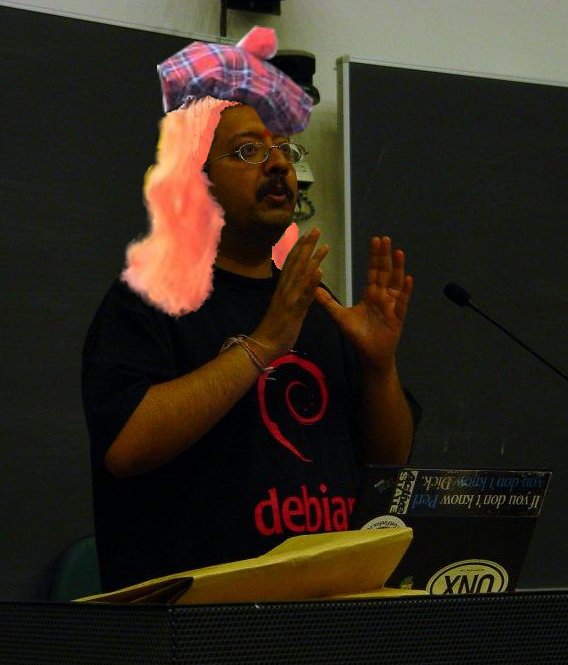
There's a photo of me going around the interwebs with a strange caption that misses what was going on. The real story is, after my notebook's power supply died, I tried out this other weird notebook that Google had obtained, apparently from some alternate universe, and was giving away at the conference. It was very nice and small, and had impressive touch-screen data-entry technology (though I kept losing the stylus), and amazing battery power. Seems the data I put it in might stick around for a good hundred years, without any recharging. I was happy to not have to hook a clunky British power adapter up to it. It was also impressively easy to enter arbitrary unicode character such as BOPOMOFO LETTER EH, RUNIC TVIMADUR SYMBOL, and THING I SCRIBBLED DURING BORING PRESENTATION WITH CEDILLA BELOW. Downsides: No wifi or other network (didn't check GSM), very limited storage space (only a few dozen Kibobytes I think), an atrocious text editor that made moving text around way too hard, and had a really bad font, difficulty deleting things (the obvious way to delete something often accidentially removed nearby files as well -- and didn't actually regain any storage space), and very limited encryption (best I could get out it was rot-13). On the network front, there is apparently some "Postal Mail" app that can be used to send mail, but it can take like, weeks, and charges per message. And yeah, no solitare at all, though there was this hangman app. All in all, I was happy to get my Fujitsu back, though I might hold onto this Google notebook thing for emergencies. Won't be porting d-i to it anytime soon though.

28 June 2007

Biella Coleman: Minimizing Lingusitic Drift for the Sake of Political Clarity and Integrity

I am finally catching up with the remarkably thick goulash of email and blogs entries that comes from traveling for well over a month and today I read one in particular When is Open Source not Open Source? that captivated my interest for it compellingly addresses the dangers that follow from diluting, or one might say hijacking, the term open source. When people learn that I study “free software” one of the most common questions I get asked is: why did I chose free software over open source? The answer is quite simple: given that the bread and butter of my research covers ethics, freedom, and liberalism, free software is the obvious path to follow, yet I also feel like a lot of my work is still relevant to the open source camp because of the affinities between the two. I have long maintained that the ideological gulf between open source and free software is not so great nor impassable, but more modest. As most know, both share a certain strong commitment to access and in a strict technical sense they refer to the same set of licenses. Philosophically there is agreement that openness and, especially, non-discrimination are essential for the quality of software and often by close extension, the vibrancy of community responsible for the software. Of course, when pontificating the ramifications and implications of openness, they do part company and enter into different territories. Free software tends to flag rights and freedoms, while open source meanders into a discussion of markets, business, and competition and in this regard they do craft different visions of the social world and human behavior, etc. But the case that Karl Fogel writes about, where OSI is strongly opposing the use of the term open source for licenses that don’t adhere to the definition demonstrates where the two positions join. As Michael Tiemann from the OSI succinctly put it:
The FSF may have got the orthodoxy wrong, and the OSI may have got the interpretation wrong, but we both agree that prohibition of commercial use without special permission is antithetical to both positions.
There is a unmistakable kernel of agreement and it is great to see the OSI taking such a strong stance in this regard. Now, David Richard’s response, who seeks, I think, to essentially dilute the term open source, is as (or perhaps even more) fascinating for in a nut shell, and using a lot of florid religious imagery, it accuses the OSI of being too rigid! In his own words:
I believe the OSI has a wonderful opportunity to continue being relevant and helping to lead the movement forward. If, however, y’all choose to define your denomination of this religion in a way that we don’t fit in, that’s fine. No hard feelings. It’s your choice. You’ll ultimately be excluding a large congregation and we for one will continue trying to build a church made up of others like ourselves.
In response, I would say that the goal of F/OSS is not to be inclusive of anyone who wants to release bits of source code, but to create the conditions under which software, as it has been defined by the community, can be created. Join the church if you would like to make free/open source software as defined and you can go elsewhere (i.e., create a different term) if you are creating something different, even if it is only slightly different. Integrity matters. And again inclusiveness, if it comes at the expense of the main goal, is not a boon but a danger to F/OSS. The OSI will remain relevant by halting the dilution of the term OSI, not by expanding the definition so that it is left with no substance. And in contradistinction to what David Richard maintains, however, there is a great degree of flexibility within this domain but it does not lie in the strict definition of F/OSS but in the realm of interpretation. You are also free, as Mako and I have argued elsewhere to interpret the significance of F/OSS in multiple ways. And I think this is where the political strength of free software lies. There is interplay between a well-defined goal (in this case for creating free software) and a more flexible realm of interpreting the significance of these technical practice. And we wold lose and I might add, a lot if we became flexible about the strict definition of F/OSS and inflexible about its political significance. I get irked with folks like David Richards who would like to bend open source rules to meet their (often commercial) interests and I find it pretty na ve when folks say the political significance of F/OSS is just x (or worse should be x) for in reality its political significance lies in the fact that it has spawned multiple types of political and economic projects. And there is something almost playfully ironic, (or at least it makes me smile) in this fact. Though there is strict definition contained withing F/OSS, this strictness has, at least to some extent, encouraged by an extreme and very healthy form of political proliferation and promiscuity. More than anyone else I know, Mako has most passionately and thoughtfully argued for the importance of what I would call political clarity and integrity. That is, the importance of having a well articulated definition for social movements, for they act, as he says a rallying point to realize a social movement. Urging the Creative Commons to learn from F/OSS and dare to simultaneously narrow and more clearly define their goals, he states it quite nicely in the following terms:
Free software advocates have been able to use the free software definition as the rallying point for a powerful social movement. Free software, like the concept of freedom in any freedom movement, is something that one can demand, something that one can protest for, and something that one can work toward. Working toward these goals, free and open source software movements have created the GNU/Linux operating system and billions of lines of freely available computer code.
In essence, a definition that people can abide by, respect, and perhaps eventually cherish is the condition of possibility to make working political code. And given how hard it is to make social change happen (at least in comparison to build computer code), we should learn from what F/OSS has to offer. And at the same time there is another lesson embedded in F/OSS. The Free Software Definition is well defined; but it must be emphasized, narrowly so. It does not try to do everything and have everyone pledge allegiance to an inordinately complex set of commitments. Clarity, narrowness, and well-defined goals –> these three attributes have powered it far and wide and I hope it remains so. Now, since the term open source is not trademarked, we are left with the problem of how to challenge the current hijacking of the term. For the solution, I will leave you with Karl Fogel, who I think proposes a good solution:
Note that the OSI s objection is not to the Zimbra license per se. The objection is just to Zimbra s calling that license open source . They can use any license they want, but they shouldn t call it open source unless it actually is. Freedom is freedom, and no amount of spin will change that. So what should we do about this? The term open source isn t trademarked. Years ago, the OSI tried to register it, but it was apparently too generic. …But there is public opinion. What Danese and Michael are proposing doing is organizing a lot of open source developers (and I mean open source according to the traditional definition, the one the OSI and I and most other open source developers I know adhere to) to stand up and, basically, say All of us agree on what the definition of open source is, and we reject as non-open source any license that does not comply with the letter and spirit of the Open Source Definition.

Cameron Dale: Making DebTorrent Work With APT

It's been a while since I've given a status update for my Google Summer of Code project to create a BitTorrent proxy for downloading packages using APT, so here it is. I've been working hard on integrating support for APT into the DebTorrent program. I've almost got it working perfectly, now it's just a matter of testing to make sure all is well. The functionality works like this: There are two things I really like about this. One of the best is the backup HTTP downloader. It insures that if you're an early adopter and there are no peers, or if the package you're requesting is rare and can't be found in any connected peers, the download will still occur in a reasonable amount of time (taking no more, or less, mirror bandwidth than if you had just been using APT directly). The other thing I like is that you get the BitTorrent-style peer-to-peer downloading, with simple HTTP proxying thrown in for free. You can run DebTorrent on a single computer on your network, and have the others connect to it to initiate downloads and request packages. I haven't done any serious time testing, but I estimate it currently only takes twice as long to use as a regular APT update and download from a mirror. Most of that slowdown is because it currently only processes a single request at a time from APT, which is not very efficient for BitTorrent systems where downloading from multiple peers is how the highest download speeds are achieved. I have been talking to the APT maintainer, Michael Vogt, about a better way to do this, probably by adding a new APT transport method for DebTorrent (i.e. debtorrent:// instead of http://). This will not only speed up the downloads, but also hopefully provide better feedback to the APT user, as currently it will seem nothing is happening until the download comes in all at once at the end. My work has unfortunately been slowed by other commitments, and bugs. I have two papers to submit to a conference by Monday, but after that I should be back full time on DebTorrent. I also spent a long time tracking down and fixing a bug in the underlying BitTornado code (which lead to much rejoicing at 3am), only to find it was fixed in upstream's CVS. (Doh!)

27 June 2007

Wouter Verhelst: No more swimming

A while back, if you asked Google Maps for silly driving directions such as between the USA and the United Kingdom, your directions would include stuff like "Swim across the atlantic ocean", as can be seen in this blog post. Unfortunately, they 'fixed' their code, and it no longer does this. Sad. After all, it's not as if it's impossible to swim across the Atlantic.

Bastian Venthur: What does it take to break rng?

Actually just a small change in the html code of our BTS. The problem was easy to fix and the new version is already uploaded, but this shows again how fragile the connection between BTS’ html output and rng is. I’ve heard other tools where affected too — just one reason more to switch to SOAP as soon as possible. An unfortunate side effect of today’s upload: In the last weeks I tried very hard to finally get rng into testing by not uploading as often as I wanted to. The problem aren’t RC bugs, but archs like SPARC or ARM which seem to have problems keeping up with the build queue. Being of priority extra doesn’t help very much, since packages with higher priorities (like: all other packages but rng) always jump the queue. Unfortunately my request to fix the override disparity I filed two weeks ago wasn’t processed yet and the only one who could fix this is currently on vacation. In fact others could fix this too, but it looks like they’re on vacation too. I guess I’ll just exclude both archs in one of the next uploads until things run smoother again. But not everything is dark: with the current upload, a Dutch, a Frech, a Norwegian and a Polish pony found a new home. Update: Looks like the override disparity has been fixed. Whoever fixed this, thank you! Rng should be available on all our archs by tomorrow and in testing in 10 days!

26 June 2007

Martin F. Krafft: 60 efficient minutes of Intel

I arrived at DebConf7 with my X40, which would randomly freeze on any video-related event. I even reinstalled everything without copying /etc from the old installation onto a fresh harddisk without success. I tried various kernels, including Ubuntu kernels which rendered my system unbootable. I swore, I kicked and screamed, I contemplated throwing it out of several windows at once and buying a non-IBM replacement, I think I even had bad dreams about it. I did not cry just yet though. I was unable to work on it, neither locally nor via external monitor. In fact, my solution for the first week was to occupy one of the spare desktop machines, link up the original laptop harddisk by way of a great PATA/SATA to USB converter, which Hanspeter gave me for Christmas, boot off the encrypted filesystems, bring up X, and finally ssh into the laptop, where I did the actual work. Trust me, it was ugly. But at least I was able to make progress on netconf. I called Lenovo and they agreed to send a technician out to the venue. Yay for on-site support. That was Friday though, so I'd have to wait until Monday, which was of course when my talk on netconf was to take place. Suddenly, or not so suddenly, but it happened in real-time: in walks Keith Packard, developer of the Intel graphics chips driver for X, and I swear he had "bring me broken X40s!!!!!!" written on his forehead and BIOS latency timeout values as pupils like a popular comic character's eyes may be made off a dollar sign when excited. Ask Matthew Garrett if you don't believe me. So I approached him and handed over the X40 and had him even more excited when I mentioned i855 and it was all downhill from there. I left him with password for root and the encrypted filesystem (he's a Debian developer after all, so he has root on all my machines anyway ) and wandered off for some organisational stuff. It feels great to be at DebConf without your laptop to come back to. So great even that in a moment of genius I decided to do my laundry, and off I went, back to the hostel. Get stuff from hostel B, convince staff from hostel A that I am in fact allowed to wash there as hostel B has no laundry facilities, buy tokens and detergent, dump stuff, find couch and sleep gosh was I tired, but not anymore, when my phone rings to announce the end of the washing cycle. Retrieve, return to hostel B, hang stuff all over the room (we all know each other and these are clean clothes), return to hostel A to say thank you (I actually did), fetch lunch at Subway, arrive at venue, return to desk to find laptop but no Keith. Look confused. Look around to find Keith smiling at me and that the patch to my problem had already made it to the upstream repository. Sit, relax, think, breathe, wow. 60 damn efficient minutes. Let my next machine have Intel chips, please? (call Lenovo, "suspend" the call. Lucky for them, or imagine the ripples of the on-site technician suggesting to try to reproduce the problem with Windows). PS: Unfortunately, the problems aren't all gone. There still seem to be some DPMS-related crashes, and suspending to RAM from X leaves a black display on resume (some might say it's good that this is happening to me too), but I am definitely a lot more peaceful now. Thanks, Keith. NP: Threshold: Critical Mass

25 June 2007

Michael Schultheiss: Back in Indy

My first trip to DebConf ended yesterday evening (EDT). Fortunately, the trip back to Indy was much smoother than the trip to Edinburgh (my long rant on that harrowing experience will be posted when I finish it ;) ). I had a great time at DebConf and hope to see familiar faces as well as meet new people at future DebConfs. Hope to see you in Argentina.

MJ Ray: Blogging from debconf7: 5. How many rainstorms does it take to kill one audio player?

Partly because of a lack of funding for debconf, partly because of bad organisation (long story, may be told later) and partly to get back to work (got a new contract on Thursday, so it was worth it), I left debconf on Wednesday, the day of the day trip. Those of you who were there may have noticed it rained pretty damn hard. After I checked out, I sat in the lobby and lined all my luggage with plastic, to make really sure it was waterproof. I left a few things which didn't matter, like bottles, in the side pockets, outside the plastic. I headed out with the intention of visiting Teviot one last time, to pick up things from the Front Desk which arrived after I did, but as I waded uphill, I changed my plan and headed straight for Waverley station. There I sat, snacking and drip-drying until my train left. I watched the day trippers leave, but I don't think they looked up to the bridge where I sat. There was a very strange sign fragment on the ground on the far side of the train tracks at Waverley platform 7: it said
"How many assassins does it take to kill one man?"
How debconf-coincidence is that? I tried to get a picture, but my camera wasn't happy about the light levels. Anyone else see it? Is it still there? I met some very nice people on the train to Manchester. Sat at the same table as me were a young web designer and someone who was stationed in London (during World War 2, IIRC). Both had interesting stories and both had connections to France. A fourth person got on in Lancashire and just sat quietly, reading the University of Lancaster Travel Plan 2004. Manchester city centre was fascinating. I travelled through it quite a few times more than 10 years ago, but it has poshed up since then. Most buildings seem relentlessly gothic, like someone took London St Pancras as the inspiration for an entire city, but there's the occasional classical and modernist building punctuating things. I'll put the photos up soon. After a quick walk around, I felt it was about to rain again and I didn't fancy a second soaking in one day, so I headed into a pretty good cafe called "Java" by Oxford Road station and waited for my train. The rest of the journey back was pretty uneventful, as far as I can recall. Unfortunately, once I got home, I discovered that some of my hardware was outside the plastic lining and was soaked by the first rainstorm... these posts have been delayed while I got some of it working again, but it seems that the infernal Samsung YP-U2 audio player is totally dead.

Miriam Ruiz: Classifying games for children

Parents and educators should be aware about what kind of games their children play. In the current state, this means that the parents must be gamers themselves to know about that, because there’s no way of knowing whether a game includes sex, violence, sexism, etc. until you play it. The idea is to provide a way of classifying games so that parents can know in advance whether the game involves certain culture-dependent controversial stuff, and being able to use that when considering what games they want their children to play, or what games they want to play themselves. Not that I’m the proper one to make the classification myself, but it should be done by teachers and educators, who I think are the best suited for this kind of task. In any case I’m willing to lead and coordinate the project, with the support of just some Spanish teachers for the moment. I hope that in the future teachers of other cultures will like to get involved too and the system can evolve to a multicultural one. The result should be as culturally independent as possible, but that would only be possible if members of different cultures help. There’s no way to provide a totally objective classification of moral stuff, so instead of trying to make the classification as aseptic as possible, it might make more sense to make it the other way round: trying to have all the different possible points of view, even when some of them might not even fit my own beliefs. Links:

Lucas Nussbaum: debconf7

DebConf7 finished today. This was my first DebConf, and probably not my last one :-) I had a really interesting time in Edinburgh, despite the weather (but at least we are prepared for DebConf8 now!). The organization team really did a fantastic work, the venue was gorgeous, etc, etc, etc. Again, I was positively surprised by how nice everybody was at DebConf. It’s weird to think that the same people are part of the regular flames on the mailing lists. Which proves that most flames are just caused by people being passionate about Debian, and looking for the best for the project, and not by people trying to be annoying, like one could think :) I gave a talk about the usual QA stuff I’m doing: archive-wide rebuilds, piuparts runs, and how to make all this more efficient by working inside the collab-qa project. So far, it’s not like a lot of people have been joining the project, which is kind of a failure. But at least everybody seem to think that the idea is good. I also gave a lightning talk about Debian Package of the Day, which I didn’t plan to give originally (I think I never prepared slides in such a short time). I think it was well received, and we even got a new submission half an hour after the talk. I even managed to clear some tasks on my TODO list during Debconf, the most visible one being the “automated monthly mails to maintainers of packages with serious problems”. I was quite afraid of being flamed, but I sent 250 mails, and only one person replied aggressively. I also got a lot of positive feedback, so the next batch will probably use slightly less strict criterias. And of course, the most important result of debconf was the numerous discussions, that resulted in a lot of good and interesting ideas.

24 June 2007

Steve Kemp: Unknown, even to its own employees, its massive profits are generated by military technology, genetic experimentation and viral weaponry

The scanning of the Debian source archive for security bugs has begun. I've wrote about this previously and there was some interest in how it worked, so I've put up a simple webpage describing the process. There are a lot of results to go through, but so far I've managed to find one local root exploit and many many many trivial problems. Sample bugs: Unfortunately my usertags seem to be broken. This was working a day or two ago. Not sure if I fucked up or if the BTS is broken ..?

Dirk Eddelbuettel: New OpenMPI packages

Debian had OpenMPI package since early last year when Florian Ragwitz made some initial stabs at packaging. The package has seen a number of NMU and patches since then, but was generally getting cobwebs ... which was too bad because OpenMPI seems to have some wind behind its sails upstream. Unfortunately, little of that got packaged for Debian. After some discussions on and around the debian-science list, a new maintainer group was formed on Alioth under the pkg-openmpi name. Tilman Koschnick (who had already helped Florian with patches), Manuel Prinz, Sylvestre Ledru and myself have gotten things in good enough shape in reasonably short time. And I have just uploaded a lintian-clean package set openmpi_1.2.3-0 to Debian, where it is expected to sit in the NEW queue for a little bit before moving on to the archive proper. The changelog entry (which will appear here eventually) shows twelve bugs closed. Our plan is to provide a stable and well maintained MPI implementation for Debian. OpenMPI is the designated successor to LAM, and apart from MPICH2, everybody seems to have thrown their weight behind OpenMPI. So we will try to work with the other MPI maintainers to come up with sensible setups, alternatives priorities and the likes. If you are interested in MPI and would like to help, come join us at the Alioth project pkg-openmpi. Last but not least, thanks to Florian for the initial packaging, and to Clint Adams, Mark Hymers, Andreas Barth, and Steve Langasek (twice even) for NMUs.

23 June 2007

John Goerzen: Review of Flickr

Those of you that look at photos on my blog may have noticed that I recently switched from a self-hosted Gallery2 installation to the popular photo-sharing site Flickr.

I initially decided to try Flickr for a simple reason: digikam's image upload to Gallery2 has never worked for me, and I hoped that its Flickr upload would work (it did).

I had heard good things about Flickr from friends and colleagues, so I gave it a try.

First Impressions

Almost the first thing I noticed about Flickr was that there are people there that are interested in the same things I'm interested in. I discovered the Anabaptist History group. I've been contacted by a person in North Dakota that is interested German-speaking Russians, as my ancestors were. There are groups about Debian, classic-style black & white photography on digital cameras, and really just about any topic. These groups contain both discussions and a photo "pool" to which any group member can post.

In one sense, Flickr is social networking via photography.

Flickr also seems to be a company with a clue. It has tons of open APIs, permitting everything from flickrfs (mount flickr as a FUSE filesystem) to countless uploaders, mashups, scripts, etc. Despite a couple of recent high-publicity controversies, they seem to be laid back overall and haven't been turned into a corporate drone by Yahoo. There's an RSS feed for just about everything, too.

What is Flickr?

Depends on what you want it to be. It could be that place where you post your cell phone's snapshots, or a place to share photos with family in private, or just a place to find other's work.

I found sharing and talking with others to be infectious. I went from never getting comments on photos on my Gallery2 site to wondering what people will think -- and looking at their photos too.

Let's look at its different aspects in more detail.

Uploading Photos

You can upload photos manually with a HTTP form, or you can use any of the numerous uploading tools. Most of these will let you scale down your images on the fly, should you wish to. Most will also let you assign tags and write descriptions as they're being posted, as well as define who can view the photos. Uploaders are available for every common platform.

Flickr has a AJAX tool called the Organizr that helps you assign tags, add photos to groups, put them in sets, etc. It's fairly nice.

Sharing Photos

Making photos available to the public is easy. You can just them them a link to your photostream. You can also tag photos and give people a link to photos with a specific tag. And you can create sets -- photos around a specific theme.

Security

Each photo can be made visible to: just you, just your contacts marked "family", just your contacts marked "friend", any of your contacts, or anyone at all. This can be defined per photo.

On a global basis, you can define whether you make EXIF information visible on the site, default security for new uploads, who can post comments, who can post photo notes or add tags, and who can use the "all sizes" button.

You can also control how much of your profile to make public. Settings range from making everything public to concealing even your email address.

For sets, you can also send out a "Guest Pass" (GP). A GP lets someone that is not a Flickr member see non-public photos. I use GPs to share family photos, so that family doesn't have to create a Flickr account to see them. GPs can be tied only to sets.

Groups

Flickr groups appear to have been designed for discussions, but I find them most attractive because each group has its own dedicated photo pool. Members of the group can add their photos to the pool. Some groups have tens of thousands of photos, and others a few dozen. It's an interesting way to find images. There are a lot of group management tools as well.

Free vs. Paid Accounts

Free account holders can upload up to 100MB of photos per month. There is no cap on bandwidth consumed by views of photos or management of them. Free users can create up to 3 sets and put photos in up to 10 groups.

The photostream for free account holders will show only their 200 most recent photos. Additionally, the "All Sizes" button will max out at the Large size, which generally will be 1024 pixels along the longest side.

Paid accounts are $25/year and include unlimited upload bandwidth (10MB max per photo though), unlimited photostream size, unlimited sets, and removal of all ads on the site. Additionally, the original upload is made available to you. If you have enabled the All Sizes button, it's also made available to the public. One nice thing is that with a free account, all that data is saved, even if it isn't available. So if you later upgrade to Pro, it's all there.

Prints

Flickr sells prints of your photos for $0.15 each. As with viewing, you can designate who can purchase prints of your photos. I ordered a test batch and they turned out very nice -- approximately the same quality as Shutterfly, which is one of the better consumer-quality labs. They are a bit pricier than Shutterfly when buying in bulk, though the convenience of all the Flickr uploaders may make up for that.

Annoyances

There are a few things that bug me.

One is that the "All Sizes" button is either on or off. Once I upgraded to pro, suddenly my original size images were available. There is no way with a pro account to limit image availability to the 1024xwhatever size like there is with free -- either you give people the medium size only (500xwhatever) or you give them everything. Those that want to have the originals on Flickr generally upload twice: once in original size, kept private; and another resized to 1024xwhatever, made public.

It is also complex for some people to join Flickr. Several of our family and friends had trouble with the signup process, since you first have to create a Yahoo account, then a Flickr one, which can use a different username. It's a nice flexibility, but overly complex for people that just want to sign up quickly. Guest Passes have received rave reviews however -- with the one caveat that the guest pass URLs aren't bookmarkable (they set a cookie and then redirect to the real target).

There is also no built-in way to see all the new photos in the groups you're a member of. However, each group's pool has an RSS feed so I have just subscribed to them with bloglines.

Overall

Overall I am happy with Flickr. I will be migrating my Gallery2 install to it, and will not miss having to maintain Yet Another PHP Script on my server. The best part about Flickr is the community, which has already taught me about mpix.com, which I'll write about tomorrow.

Mario Iseli: tdbackup

I’m just sitting in the night venue of Debconf7 and do several tasks in the same moment, that includes: * Getting kind of a spanish course on IRC in #debian-qt-kde :P * Get some news from friends in .ch via MSN (there were several unweathers and other troubles) * Think about tdbackup which is the topic of this blog entry. So what is tdbackup? It is just another backup implementation but it should work kind of distributed. I manage several servers and in that farm are 3 backup servers with a tape drive, every sunday i mount parts of the other machines via NFS and write them with tar to the tape. Until I did that by hand because there was no implementation which fits my needs unfortunately. This is the point where tdbackup jumps in. I want to create a GUI which edits an ini file in the form of: [backupmachine 1] mount = bla1:/home mount = bla2:/home tdbackup will then distribute a specifically generated configfile to each backuphost and a little python script which is called by cron and mounts the file systems, write some information into mysql and generate warning messages via e-mail if the tape is almost full. So, I will be able to sleep better because the stuff is auto-documented in a way. I’m still thinking about how exactly i want to implement that, if there are any interested people who would like to join that project, please just tell me.

22 June 2007

Alastair McKinstry: Back from Holidays

Chocolate lion Cormac and Caoimhe at a patisserie with Chocolate lion in Concarneau, Brittany
So, I'm back from Holidays, to find we now have a new Government in Ireland. (An unexpected choice of government, of which more later.) We were camping in Fouesnant, in Brittany; Family & Friends might like to see the holiday snaps here). Camping in France went well. With three children aged 7, 4 and 2, there is only so much you can expect from a family holiday. Like it or not, you have to mind the toddler fairly consistently, and the older kids would like your full attention too. This is a holiday ''for'' the kids; plan also a break ''from'' the kids later (a long-weekend, with kids at grandparents, for example). This was our first time camping abroad, and its well recommended. While we went touring with a camper van with the two older children two years ago, this is different in that we were at the campsite for almost two weeks: the kids got to meet and play with others in a way they couldn't before. Also, there were good facilities at the site in Fouesnant, and the swimming pools in particular were appreciated (Caveat emptor though: there were no lifeguards or supervision. We went off-peak, and there were apparently two accidents in the time we were there: a broken kneecap and chin when people came down the slides too soon after others and collided). It was the first time the children (a) had pocket money to spend, and (b) were able to walk to a (campsite) shop to spend it. Lessons were learnt in the finiteness of pocket money, especially by Caoimhe :-(. The weather was fairly good: two wet days (though not overly so, compared to what we're used to in Galway); enough to give the 'authentic camping experience'. And for the children especially, just warm enough. Long drives South were not an option with young kids, and we wanted to see Carnac and Brittany in general. We went touring to two places: Mont St. Michel, on the way down, Carnac, and locally around Quimper and Concarneau. At seven, Cormac is beginning to be old enough to enjoy this, but Sadhbh at 2 is too young, and easily aggravated. Caoimhe can appreciate some of it, such as the well recommended Breton museum in Quimper, seeing the local costumes and clothing is just her style at the moment. We're looking forward to going back when the kids are older, or we can enjoy touring on our own. The camp site is dominated by English / Dutch / Irish. It is still term-time in Britain and Ireland, which meant the children on the site was full of 2-4 year-olds, with a shortage of playmates for Cormac. Next time, synchronise with English school times, etc. We went during Cormacs term-time because it was much cheaper (1000 Euro) than high-season. If Cormac was having difficulty in school things would have been different, as it is, we had no qualms in doing so. Things will probably be different next year with Caoimhe also in school at the same time, and we would go later. Suffice it to say I think synchonisation of school timetables is a bad idea, as it has led to these huge price differentials and parents taking their kids from school. As a friend with experience of the French school system points out, they've spent the last 40 years desynchronising their timetables ... So would we go again, or buy our own tents, etc? possibly. The brochure for next year arrived already, with large discounts for booking early ... Tags , , , , , ,

Jordi Mallach: Delta de l'Ebre

Last December, I went to the Delta de l'Ebre with a good number of friends to spend one of December's three-day weekends. Les Terres de l'Ebre are the southest region of Catalunya, right next to the border with the Valencian Country. The Ebre river forms a big delta as it meets the Mediterranean, and the great amount of wildlife, specially avian, in the Natural Park makes it a fantastic place to visit. We would sleep, more or less, in Cinta's appartment in L'Ampolla. The first night we managed to fit 17 persons for dinner, and about 14 stayed to sleep in any possible corner of the flat. As soon as the Valencian group arrived, we tried to meet the people coming from the North, but apparently they got lost and we stayed on a sightseeing spot admiring how easily the weather changes here. In an hour or so, we went from a sunny day to a quick but heavy shower and back to sunny. When we finally found each other, we decided it was a bit too late to do anything too special, given the short days in December, so we walked South along the beach, on our way to the Salines, the salt processing facility, in the Punta de la Banya.


Agua para todos... During the walk, we witnessed what the people from the Delta have been warning about for decades: the Delta is disappearing. The progressive overuse of the river's flow, excessive irrigation, damm construction and degradation is killing this unique place. The waters are slowly claiming what once was theirs. An electricity line, at the beginning of our trip being at the end of the beach starts approaching the sea, or viceversa, as you move southward, to end up many metres inside the water. The old people in the Delta still remember the 200m tall lighthouse in the Illa de Buda, which the sea managed to devour.


Sunset at the salines del Delta When we reached the Punta we could watch a beautiful sunset over the mountains of Els Ports, and when it got dark and cold we headed to Tortosa, the area's capital, which I had recently visited for the first time for one of Softcatal 's meetings. There, we had dinner at a bar and met Jordi and Anna for a while, before going back to Ampolla, going to bed relatively early due to everyone being very tired.


On Saturday, we decided to have a look at the Delta... from above. So we drove to the top of the Cim del Caro, where we could admire a great view over the flat farmlands of the Delta, and then found a nice trail which took us to a nice forest, where we had lunch. After a visit to Alfara de Carles, we went back to the house, had a great dinner and played fun games at the table. Unfortunately, Sunday morning was dedicated to cleaning up the mess in the appartment and packing, as part of the group, the Jordis from Alcoi and the twins, had to leave early. The remaining four Valencians decided to go to Deltebre to have a local paella. It was quite good, although the bar tender laughed at our request to eat directly from the paella, rejecting dishes. Small cultural clash. ;)

I remember downloading and viewing the pictures of the trip a few days after getting back in Val ncia, and then losing track of them. Last week, while testing an EPIA board with some random hard drive, I suddenly realised there was a big chance the pictures would be on that drive, and after some search, I found them; I had been close to mkfs the disk a few minutes before. I hadn't stopped blaming myself for misplacing these pictures, as they remind me of this wonderful weekend. Luckily, they are back! Going back to the state of the Delta, experts say it will be mostly gone in 200 years. All of the Terres de l'Ebre have fought against the previous government's "PHN" plan to divert part of the river's flow to the North and South, to supply Barcelona, and specially the South of Val ncia, where the developing of the coastal areas is out of control. I fear that whenever PP regains power in Madrid, they will retake this idea. There is a lot of money involved in building a 700 km long scar in our land. The Delta de l'Ebre is a fantastic place which doesn't deserve a terrible fate like this, only for the benefit of the usual suspects. As the good people of this land would say...

Lo riu  s vida. No al trasvassament!
Lo riu s vida. No al transvasament!

21 June 2007

Jordi Mallach: Delta de l'Ebre

Last December, I went to the Delta de l'Ebre with a good number of friends to spend one of December's three-day weekends. Les Terres de l'Ebre are the southest region of Catalunya, right next to the border with the Valencian Country. The Ebre river forms a big delta as it meets the Mediterranean, and the great amount of wildlife, specially avian, in the Natural Park makes it a fantastic place to visit. We would sleep, more or less, in Cinta's appartment in L'Ampolla. The first night we managed to fit 17 persons for dinner, and about 14 stayed to sleep in any possible corner of the flat. As soon as the Valencian group arrived, we tried to meet the people coming from the North, but apparently they got lost and we stayed on a sightseeing spot admiring how easily the weather changes here. In an hour or so, we went from a sunny day to a quick but heavy shower and back to sunny. When we finally found each other, we decided it was a bit too late to do anything too special, given the short days in December, so we walked South along the beach, on our way to the Salines, the salt processing facility, in the Punta de la Banya.


Agua para todos... During the walk, we witnessed what the people from the Delta have been warning about for decades: the Delta is disappearing. The progressive overuse of the river's flow, excessive irrigation, damm construction and degradation is killing this unique place. The waters are slowly claiming what once was theirs. An electricity line, at the beginning of our trip being at the end of the beach starts approaching the sea, or viceversa, as you move southward, to end up many metres inside the water. The old people in the Delta still remember the 200m tall lighthouse in the Illa de Buda, which the sea managed to devour.


Sunset at the salines del Delta When we reached the Punta we could watch a beautiful sunset over the mountains of Els Ports, and when it got dark and cold we headed to Tortosa, the area's capital, which I had recently visited for the first time for one of Softcatal 's meetings. There, we had dinner at a bar and met Jordi and Anna for a while, before going back to Ampolla, going to bed relatively early due to everyone being very tired.

On Saturday, we decided to have a look at the Delta... from above. So we drove to the top of the Cim del Caro, where we could admire a great view over the flat farmlands of the Delta, and then found a nice trail which took us to a nice forest, where we had lunch. After a visit to Alfara de Carles, we went back to the house, had a great dinner and played fun games at the table. Unfortunately, Sunday morning was dedicated to cleaning up the mess in the appartment and packing, as part of the group, the Jordis from Alcoi and the twins, had to leave early. The remaining four Valencians decided to go to Deltebre to have a local paella. It was quite good, although the bar tender laughed at our request to eat directly from the paella, rejecting dishes. Small cultural clash. ;)

I remember downloading and viewing the pictures of the trip a few days after getting back in Val ncia, and then losing track of them. Last week, while testing an EPIA board with some random hard drive, I suddenly realised there was a big chance the pictures would be on that drive, and after some search, I found them; I had been close to mkfs the disk a few minutes before. I hadn't stopped blaming myself for misplacing these pictures, as they remind me of this wonderful weekend. Luckily, they are back! Going back to the state of the Delta, experts say it will be mostly gone in 200 years. All of the Terres de l'Ebre have fought against the previous government's "PHN" plan to divert part of the river's flow to the North and South, to supply Barcelona, and specially the South of Val ncia, where the developing of the coastal areas is out of control. I fear that whenever PP regains power in Madrid, they will retake this idea. There is a lot of money involved in building a 700 km long scar in our land. The Delta de l'Ebre is a fantastic place which doesn't deserve a terrible fate like this, only for the benefit of the usual suspects. As the good people of this land would say...
Lo riu  s vida. No al transvasament!
Lo riu s vida. No al transvasament!

20 June 2007

Jaldhar Vyas: (Won't) See You At Debconf 7 Jimmy!

Once again I am missing out on all the fun. But meanwhile in an alternate
timestream... Debconf 7

Next.

Previous.