Search Results: "ed"

10 October 2017

Lars Wirzenius: Debian and the GDPR

GDPR is a new EU regulation for privacy. The name is short for "General Data Protection Regulation" and it covers all organisations that handle personal data of EU citizens and EU residents. It will become enforceable May 25, 2018 (Towel Day). This will affect Debian. I think it's time for Debian to start working on compliance, mainly because the GDPR requires sensible things. I'm not an expert on GDPR legislation, but here's my understanding of what we in Debian should do: There's more, but let's start with those. I think Debian has at least the following systems that will need to be reviewed with regards to the GDPR: There may be more; these are just off the top of my head. I expect that mostly Debian will be OK, but we can't just assume that.

Reproducible builds folks: Reproducible Builds: Weekly report #128

Here's what happened in the Reproducible Builds effort between Sunday October 1 and Saturday October 7 2017: Media coverage Documentation updates Packages reviewed and fixed, and bugs filed Reviews of unreproducible packages 32 package reviews have been added, 46 have been updated and 62 have been removed in this week, adding to our knowledge about identified issues. Weekly QA work During our reproducibility testing, FTBFS bugs have been detected and reported by: diffoscope development strip-nondeterminism development Rob Browning noticed that strip-nondeterminism was causing serious performance regressions in the Clojure programming language within Debian. After some discussion, Chris Lamb also posted a query to debian-devel in case there were any other programming languages that might be suffering from the same problem. reprotest development Versions 0.7.1 and 0.7.2 were uploaded to unstable by Ximin Luo: It included contributions already covered by posts of the previous weeks, as well as new ones from: tests.reproducible-builds.org Misc. This week's edition was written by Bernhard M. Wiedemann, Chris Lamb, Holger Levsen, Mattia Rizzolo & reviewed by a bunch of Reproducible Builds folks on IRC & the mailing lists.

9 October 2017

Vincent Fourmond: Define a function with inline Ruby code in QSoas

QSoas can read and execute Ruby code directly, while reading command files, or even at the command prompt. For that, just write plain Ruby code inside a ruby...ruby end block. Probably the most useful possibility is to define elaborated functions directly from within QSoas, or, preferable, from within a script; this is an alternative to defining a function in a completely separated Ruby-only file using ruby-run. For instance, you can define a function for plain Michaelis-Menten kinetics with a file containing:

ruby
def my_func(x, vm, km)
  return vm/(1 + km/x)
end
ruby end

This defines the function my_func with three parameters, , (vm) and (km), with the formula:

You can then test that the function has been correctly defined running for instance:

QSoas> eval my_func(1.0,1.0,1.0)
 => 0.5
QSoas> eval my_func(1e4,1.0,1.0)
 => 0.999900009999

This yields the correct answer: the first command evaluates the function with x = 1.0, vm = 1.0 and km = 1.0. For , the result is (here 0.5). For , the result is almost . You can use the newly defined my_func in any place you would use any ruby code, such as in the optional argument to generate-buffer, or for arbitrary fits:

QSoas> generate-buffer 0 10 my_func(x,3.0,0.6)
QSoas> fit-arb my_func(x,vm,km)

To redefine my_func, just run the ruby code again with a new definition, such as:
ruby
def my_func(x, vm, km)
  return vm/(1 + km/x**2)
end
ruby end
The previous version is just erased, and all new uses of my_func will refer to your new definition.


See for yourselfThe code for this example can be found there. Browse the qsoas-goodies github repository for more goodies !

About QSoasQSoas is a powerful open source data analysis program that focuses on flexibility and powerful fitting capacities. It is released under the GNU General Public License. It is described in Fourmond, Anal. Chem., 2016, 88 (10), pp 5050 5052. Current version is 2.1. You can download its source code or buy precompiled versions for MacOS and Windows there.

Markus Koschany: My Free Software Activities in September 2017

Welcome to gambaru.de. Here is my monthly report that covers what I have been doing for Debian. If you re interested in Java, Games and LTS topics, this might be interesting for you. Debian Games Debian Java Debian LTS This was my nineteenth month as a paid contributor and I have been paid to work 15,75 hours on Debian LTS, a project started by Rapha l Hertzog. In that time I did the following: Misc QA upload Thanks for reading and see you next time.

Ben Hutchings: Debian LTS work, September 2017

I was assigned 15 hours of work by Freexian's Debian LTS initiative and carried over 6 hours from August. I only worked 12 hours, so I will carry over 9 hours to the next month. I prepared and released another update on the Linux 3.2 longterm stable branch (3.2.93). I then rebased the Debian linux package onto this version, added further security fixes, and uploaded it (DLA-1099-1).

Michal Čihař: Better acess control in Weblate

Upcoming Weblate 2.17 will bring improved access control settings. Previously this could be controlled only by server admins, but now the project visibility and access presets can be configured. This allows you to better tweak access control for your needs. There is additional choice of making the project public, but restricting translations, what has been requested by several projects. You can see the possible choices on the UI screenshot: Weblate overall experience On Hosted Weblate this feature is currently available only to commercial hosting customers. Projects hosted for free are limited to public visibility only.

Filed under: Debian English SUSE Weblate

Antonio Terceiro: pristine-tar updates

Introduction pristine-tar is a tool that is present in the workflow of a lot of Debian people. I adopted it last year after it has been orphaned by its creator Joey Hess. A little after that Tomasz Buchert joined me and we are now a functional two-person team. pristine-tar goals are to import the content of a pristine upstream tarball into a VCS repository, and being able to later reconstruct that exact same tarball, bit by bit, based on the contents in the VCS, so we don t have to store a full copy of that tarball. This is done by storing a binary delta files which can be used to reconstruct the original tarball from a tarball produced with the contents of the VCS. Ultimately, we want to make sure that the tarball that is uploaded to Debian is exactly the same as the one that has been downloaded from upstream, without having to keep a full copy of it around if all of its contents is already extracted in the VCS anyway. The current state of the art, and perspectives for the future pristine-tar solves a wicked problem, because our ability to reconstruct the original tarball is affected by changes in the behavior of tar and of all of the compression tools (gzip, bzip2, xz) and by what exact options were used when creating the original tarballs. Because of this, pristine-tar currently has a few embedded copies of old versions of compressors to be able to reconstruct tarballs produced by them, and also rely on a ever-evolving patch to tar that is been carried in Debian for a while. So basically keeping pristine-tar working is a game of Whac-A-Mole. Joey provided a good summary of the situation when he orphaned pristine-tar. Going forward, we may need to rely on other ways of ensuring integrity of upstream source code. That could take the form of signed git tags, signed uncompressed tarballs (so that the compression doesn t matter), or maybe even a different system for storing actual tarballs. Debian bug #871806 contains an interesting discussion on this topic. Recent improvements Even if keeping pristine-tar useful in the long term will be hard, too much of Debian work currently relies on it, so we can t just abandon it. Instead, we keep figuring out ways to improve. And I have good news: pristine-tar has recently received updates that improve the situation quite a bit. In order to be able to understand how better we are getting at it, I created a "visualization of the regression test suite results. With the help of data from there, let s look at the improvements made since pristine-tar 1.38, which was the version included in stretch. pristine-tar 1.39: xdelta3 by default. This was the first release made after the stretch release, and made xdelta3 the default delta generator for newly-imported tarballs. Existing tarballs with deltas produced by xdelta are still supported, this only affects new imports. The support for having multiple delta generator was written by Tomasz, and was already there since 1.35, but we decided to only flip the switch after using xdelta3 was supported in a stable release. pristine-tar 1.40: improved compression heuristics pristine-tar uses a few heuristics to produce the smaller delta possible, and this includes trying different compression options. In the release Tomasz included a contribution by Lennart Sorensen to also try the --gnu, which gretly improved the support for rsyncable gzip compressed files. We can see an example of the type of improvement we got in the regression test suite data for delta sizes for faad2_2.6.1.orig.tar.gz: In 1.40, the delta produced from the test tarball faad2_2.6.1.orig.tar.gz went down from 800KB, almost the same size of tarball itself, to 6.8KB pristine-tar 1.41: support for signatures This release saw the addition of support for storage and retrieval of upstream signatures, contributed by Chris Lamb. pristine-tar 1.42: optionally recompressing tarballs I had this idea and wanted to try it out: most of our problems reproducing tarballs come from tarballs produced with old compressors, or from changes in compressor behavior, or from uncommon compression options being used. What if we could just recompress the tarballs before importing then? Yes, this kind of breaks the pristine bit of the whole business, but on the other hand, 1) the contents of the tarball are not affected, and 2) even if the initial tarball is not bit by bit the same that upstream release, at least future uploads of that same upstream version with Debian revisions can be regenerated just fine. In some cases, as the case for the test tarball util-linux_2.30.1.orig.tar.xz, recompressing is what makes it possible to reproduce the tarball (and thus import it with pristine-tar) possible at all: util-linux_2.30.1.orig.tar.xz can only be imported after being recompressed In other cases, if the current heuristics can t produce a reasonably small delta, recompressing makes a huge difference. It s the case for mumble_1.1.8.orig.tar.gz: with recompression, the delta produced from mumble_1.1.8.orig.tar.gz goes from 1.2MB, or 99% of the size to the original tarball, to 14.6KB, 1% of the size of original tarball Recompressing is not enabled by default, and can be enabled by passing the --recompress option. If you are using pristine-tar via a wrapper tool like gbp-buildpackage, you can use the $PRISTINE_TAR environment variable to set options that will affect any pristine-tar invocations. Also, even if you enable recompression, pristine-tar will only try it if the delta generations fails completely, of if the delta produced from the original tarball is too large. You can control what too large means by using the --recompress-threshold-bytes and --recompress-threshold-percent options. See the pristine-tar(1) manual page for details.

Michal Čihař: stardicter 1.1

Stardicter 1.1, the set of scripts to convert some freely available dictionaries to StarDict format, has been released today. The biggest change is that it will also keep source data together with generated dictionaries. This is good for licensing reasons and will also allow to actually build these as packages within Debian. Full list of changes: As usual, you can install from pip, download source or download generated dictionaries from my website. The package should be soon available in Debian as well.

Filed under: Debian English StarDict

Petter Reinholdtsen: Generating 3D prints in Debian using Cura and Slic3r(-prusa)

At my nearby maker space, Sonen, I heard the story that it was easier to generate gcode files for theyr 3D printers (Ultimake 2+) on Windows and MacOS X than Linux, because the software involved had to be manually compiled and set up on Linux while premade packages worked out of the box on Windows and MacOS X. I found this annoying, as the software involved, Cura, is free software and should be trivial to get up and running on Linux if someone took the time to package it for the relevant distributions. I even found a request for adding into Debian from 2013, which had seem some activity over the years but never resulted in the software showing up in Debian. So a few days ago I offered my help to try to improve the situation. Now I am very happy to see that all the packages required by a working Cura in Debian are uploaded into Debian and waiting in the NEW queue for the ftpmasters to have a look. You can track the progress on the status page for the 3D printer team. The uploaded packages are a bit behind upstream, and was uploaded now to get slots in the NEW queue while we work up updating the packages to the latest upstream version. On a related note, two competitors for Cura, which I found harder to use and was unable to configure correctly for Ultimaker 2+ in the short time I spent on it, are already in Debian. If you are looking for 3D printer "slicers" and want something already available in Debian, check out slic3r and slic3r-prusa. The latter is a fork of the former.

Gunnar Wolf: Achievement unlocked - Made with Creative Commons translated to Spanish! (Thanks, @xattack!)

I am very, very, very happy to report this And I cannot believe we have achieved this so fast: Back in June, I announced I'd start working on the translation of the Made with Creative Commons book into Spanish. Over the following few weeks, I worked out the most viable infrastructure, gathered input and commitments for help from a couple of friends, submitted my project for inclusion in the Hosted Weblate translations site (and got it approved!) Then, we quietly and slowly started working. Then, as it usually happens in late August, early September... The rush of the semester caught me in full, and I left this translation project for later For the next semester, perhaps... Today, I received a mail that surprised me. That stunned me. 99% of translated strings! Of course, it does not look as neat as "100%" would, but there are several strings not to be translated. So, yay for collaborative work! Oh, and FWIW Thanks to everybody who helped. And really, really, really, hats off to Luis Enrique Amaya, a friend whom I see way less than I should. A LIDSOL graduate, and a nice guy all around. Why to him specially? Well... This has several wrinkles to iron out, but, by number of translated lines: ...Need I say more? Luis, I hope you enjoyed reading the book :-] There is still a lot of work to do, and I'm asking the rest of the team some days so I can get my act together. From the mail I just sent, I need to:
  1. Review the Pandoc conversion process, to get the strings formatted again into a book; I had got this working somewhere in the process, but last I checked it broke. I expect this not to be too much of a hurdle, and it will help all other translations.
  2. Start the editorial process at my Institute. Once the book builds, I'll have to start again the stylistic correction process so the Institute agrees to print it out under its seal. This time, we have the hurdle that our correctors will probably hate us due to part of the work being done before we had actually agreed on some important Spanish language issues... which are different between Mexico, Argentina and Costa Rica (where translators are from). Anyway This sets the mood for a great start of the week. Yay!
AttachmentSize
Screenshot from 2017-10-08 20-55-30.png103.1 KB

8 October 2017

Iain R. Learmonth: Free Software Efforts (2017W40)

Here s my weekly report for week 40 of 2017. In this week I have looked at censorship in Catalonia and had my deleted Facebook account hacked (which made HN front page). I ve also been thinking about DRM on the web.

Debian I have prepared and uploaded fixes for the measurement-kit and hamradio-maintguide packages. I have also sponsored uploads for gnustep-base (to experimental) and chkservice. I have given DM upload privileges to Eric Heintzmann for the gnustep-base package as he has shown to care for the GNUstep packages well. In the near future, I think we re looking at a transition for gnustep- base,back,gui as these packages all have updates. Bugs filed: #877680 Bugs closed (fixed/wontfix): #872202, #877466, #877468

Tor Project This week I have participated in a discussion around renaming the Operations section of the Metrics website. I have also filed a new ticket on Atlas, which I am planning to implement, to link to the new relay lifecycle post on the Tor Project blog if a relay is less than a week old to help new relay operators understand the bandwidth usage they ll be seeing. Finally, I ve been hacking on a Twitter bot to tweet factoids about the public Tor network. I ve detailed this in a separate blog post. Bugs closed (fixed/wontfix): #23683

Sustainability I believe it is important to be clear not only about the work I have already completed but also about the sustainability of this work into the future. I plan to include a short report on the current sustainability of my work in each weekly report. I have not had any free software related expenses this week. The current funds I have available for equipment, travel and other free software expenses remains 60.52. I do not believe that any hardware I rely on is looking at imminent failure.

Michael Stapelberg: Debian stretch on the Raspberry Pi 3 (update)

I previously wrote about my Debian stretch preview image for the Raspberry Pi 3. Now, I m publishing an updated version, containing the following changes: A couple of issues remain, notably the lack of WiFi and bluetooth support (see wiki:RaspberryPi3 for details. Any help with fixing these issues is very welcome! As a preview version (i.e. unofficial, unsupported, etc.) until all the necessary bits and pieces are in place to build images in a proper place in Debian, I built and uploaded the resulting image. Find it at https://people.debian.org/~stapelberg/raspberrypi3/2017-10-08/. To install the image, insert the SD card into your computer (I m assuming it s available as /dev/sdb) and copy the image onto it:
$ wget https://people.debian.org/~stapelberg/raspberrypi3/2017-10-08/2017-10-08-raspberry-pi-3-buster-PREVIEW.img.bz2
$ bunzip2 2017-10-08-raspberry-pi-3-buster-PREVIEW.img.bz2
$ sudo dd if=2017-10-08-raspberry-pi-3-buster-PREVIEW.img of=/dev/sdb bs=5M
If resolving client-supplied DHCP hostnames works in your network, you should be able to log into the Raspberry Pi 3 using SSH after booting it:
$ ssh root@rpi3
# Password is  raspberry 

Joachim Breitner: e.g. in TeX

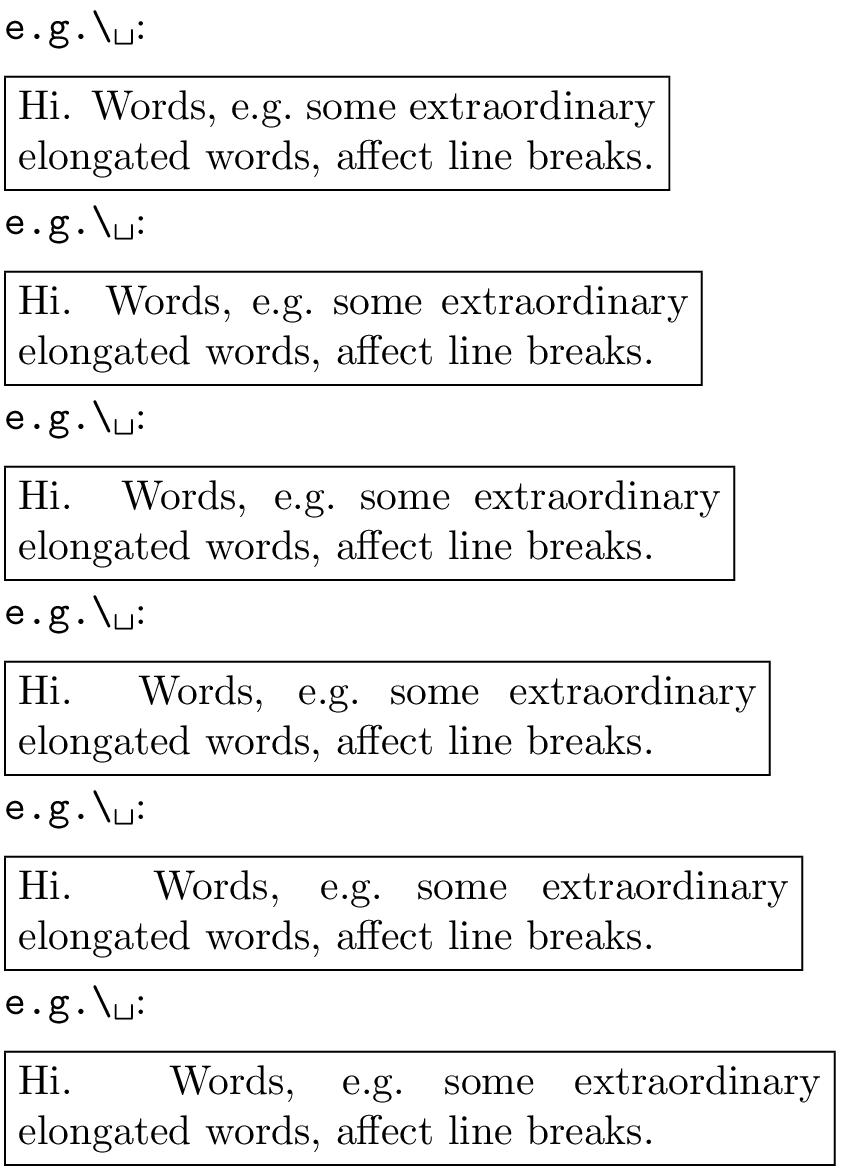
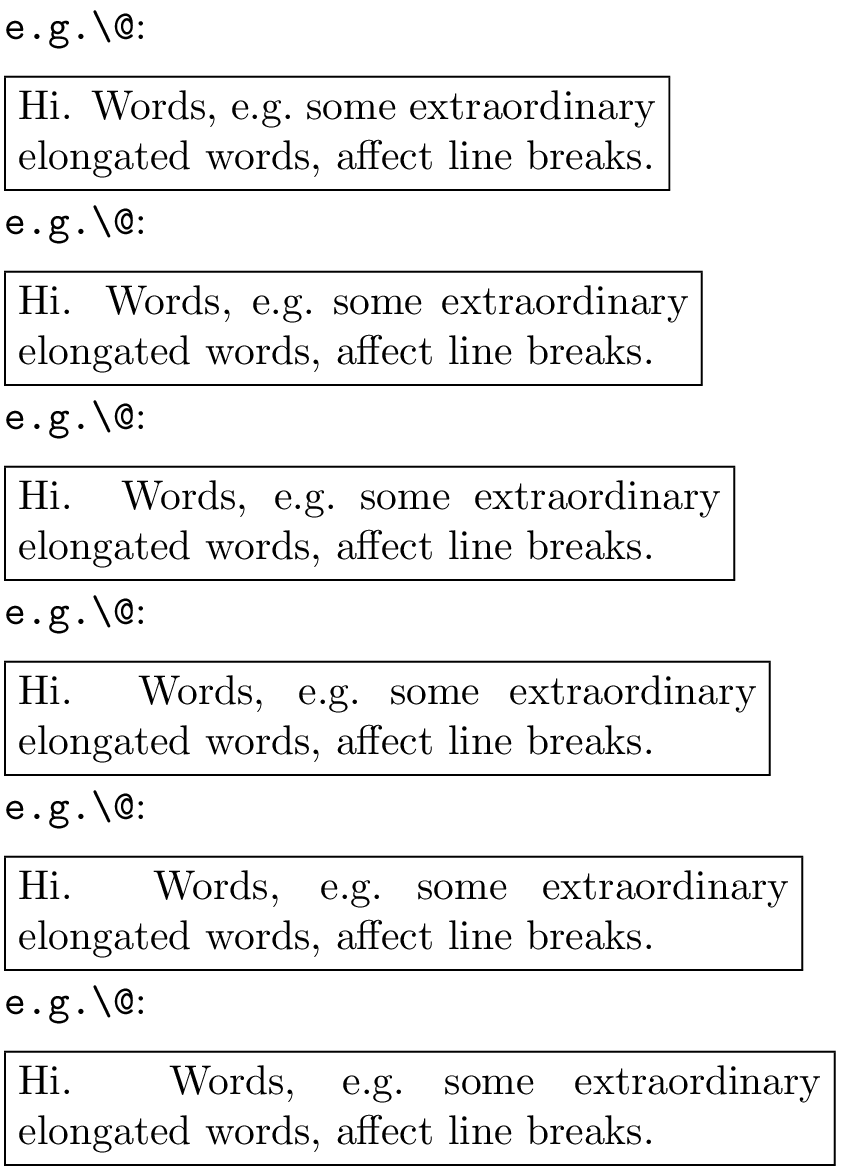
When I learned TeX, I was told to not write e.g. something, because TeX would think the period after the g ends a sentence, and introduce a wider, inter-sentence space. Instead, I was to write e.g.\ . Years later, I learned from a convincing, but since forgotten source, that in fact e.g.\@ is the proper thing to write. I vaguely remembering that e.g.\ supposedly affected the inter-word space in some unwanted way. So I did that for many years. Until I recently was called out for doing it wrong, and that infact e.g.\ is the proper way. This was supported by a StackExchange answer written by a LaTeX authority and backed by a reference to documentation. The same question has, however, another answer by another TeX authority, backed by an analysis of the implementation, which concludes that e.g.\@ is proper. What now? I guess I just have to find it out myself.
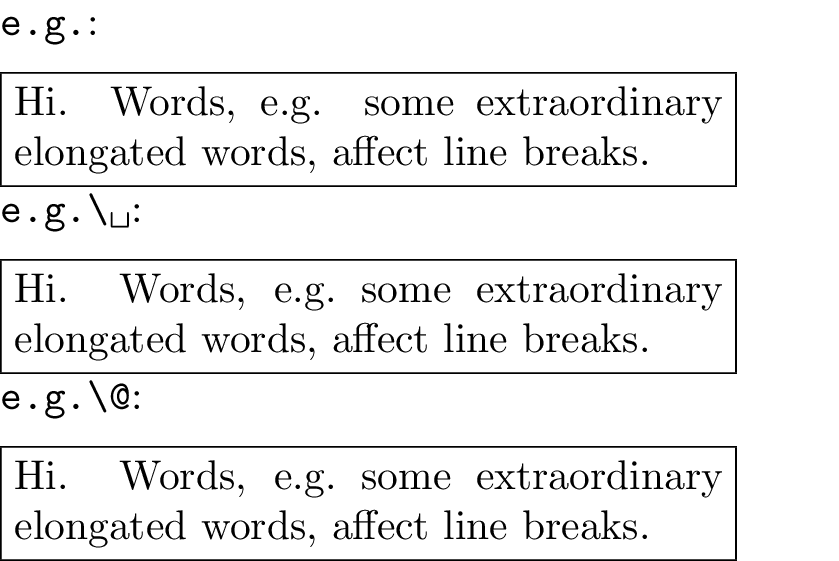
The problem and two solutions

The problem and two solutions

The above image shows three variants: The obviously broken version with e.g., and the two contesting variants to fix it. Looks like they yield equal results! So maybe the difference lies in how \@ and \ react when the line length changes, and the word wrapping require differences in the inter-word spacing. Will there be differences? Let s see;
Expanding whitespace, take 1

Expanding whitespace, take 1

Expanding whitespace, take 2

Expanding whitespace, take 2

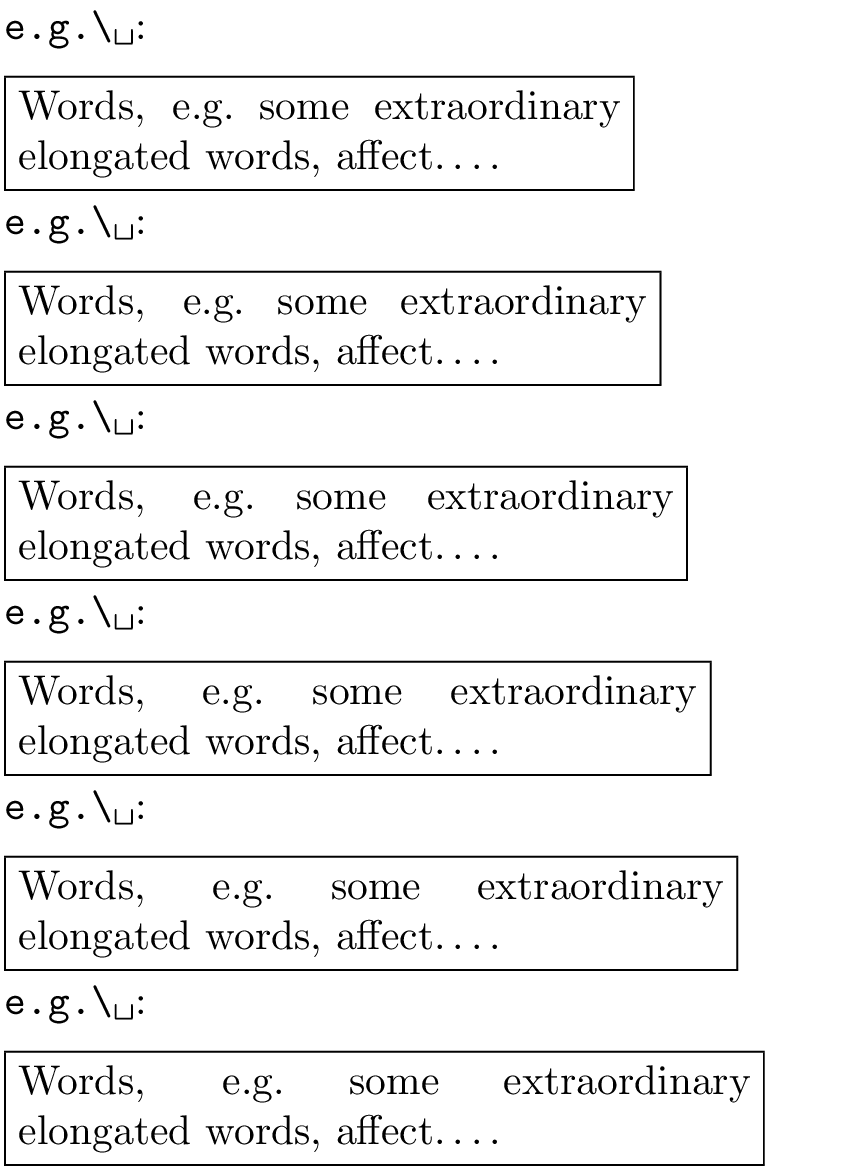
I cannot see any difference. But the inter-sentence whitespace ate most of the expansion. Is there a difference visible if we have only inter-word spacing in the line?
Expanding whitespace, take 3

Expanding whitespace, take 3

Expanding whitespace, take 4

Expanding whitespace, take 4

Again, I see the same behaviour. Conclusion: It does not matter, but e.g.\ is less hassle when using lhs2tex than e.g.\@ (which has to be escaped as e.g.\@@), so the winner is e.g.\ ! (Unless you put it in a macro, then \@ might be preferable, and it is still needed between a captial letter and a sentence period.)

Daniel Pocock: A step change in managing your calendar, without social media

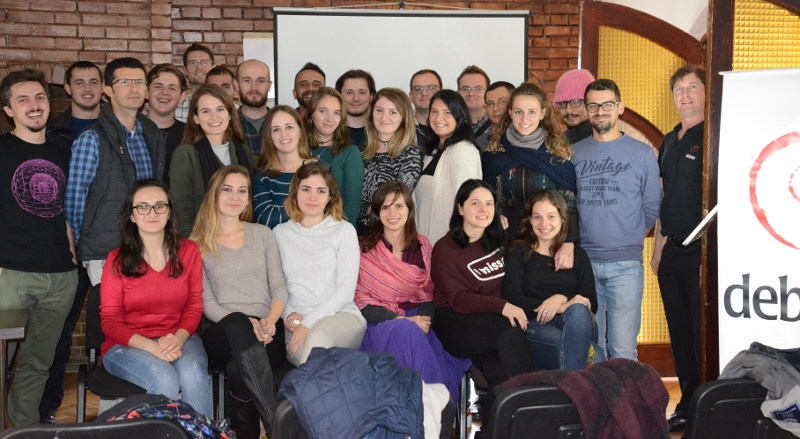
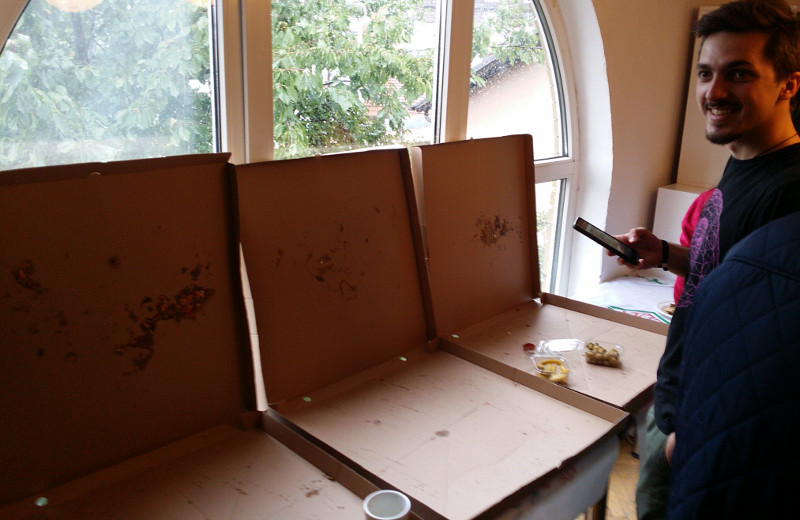
Have you been to an event recently involving free software or a related topic? How did you find it? Are you organizing an event and don't want to fall into the trap of using Facebook or Meetup or other services that compete for a share of your community's attention? Are you keen to find events in foreign destinations related to your interest areas to coincide with other travel intentions? Have you been concerned when your GSoC or Outreachy interns lost a week of their project going through the bureaucracy to get a visa for your community's event? Would you like to make it easier for them to find the best events in the countries that welcome and respect visitors? In many recent discussions about free software activism, people have struggled to break out of the illusion that social media is the way to cultivate new contacts. Wouldn't it be great to make more meaningful contacts by attending more a more diverse range of events rather than losing time on social media? Making it happen There are already a number of tools (for example, Drupal plugins and Wordpress plugins) for promoting your events on the web and in iCalendar format. There are also a number of sites like Agenda du Libre and GriCal who aggregate events from multiple communities where people can browse them. How can we take these concepts further and make a convenient, compelling and global solution? Can we harvest event data from a wide range of sources and compile it into a large database using something like PostgreSQL or a NoSQL solution or even a distributed solution like OpenDHT? Can we use big data techniques to mine these datasources and help match people to events without compromising on privacy? Why not build an automated iCalendar "to-do" list of deadlines for events you want to be reminded about, so you never miss the deadlines for travel sponsorship or submitting a talk proposal? I've started documenting an architecture for this on the Debian wiki and proposed it as an Outreachy project. It will also be offered as part of GSoC in 2018. Ways to get involved If you would like to help this project, please consider introducing yourself on the debian-outreach mailing list and helping to mentor or refer interns for the project. You can also help contribute ideas for the specification through the mailing list or wiki. Mini DebConf Prishtina 2017 This weekend I've been at the MiniDebConf in Prishtina, Kosovo. It has been hosted by the amazing Prishtina hackerspace community. Watch out for future events in Prishtina, the pizzas are huge, but that didn't stop them disappearing before we finished the photos:
Ricardo Mones: Cannot enable. Maybe the USB cable is bad?

One of the reasons which made me switch my old 17" BenQ monitor for a Dell U2413 three years ago was it had an integrated SD card reader. I find very convenient to take camera's card out, plug the card into the monitor and click on KDE device monitor's option Open with digiKam to download the photos or videos.

But last week, when trying to reconnect the USB cable to the new board just didn't work and the kernel log messages were not very hopeful:

[190231.770349] usb 2-2.3.3: new SuperSpeed USB device number 15 using xhci_hcd
[190231.890439] usb 2-2.3.3: New USB device found, idVendor=0bda, idProduct=0307
[190231.890444] usb 2-2.3.3: New USB device strings: Mfr=1, Product=2, SerialNumber=3
[190231.890446] usb 2-2.3.3: Product: USB3.0 Card Reader
[190231.890449] usb 2-2.3.3: Manufacturer: Realtek
[190231.890451] usb 2-2.3.3: SerialNumber: F141000037E1
[190231.896592] usb-storage 2-2.3.3:1.0: USB Mass Storage device detected
[190231.896764] scsi host8: usb-storage 2-2.3.3:1.0
[190232.931861] scsi 8:0:0:0: Direct-Access     Generic- SD/MMC/MS/MSPRO  1.00 PQ: 0 ANSI: 6
[190232.933902] sd 8:0:0:0: Attached scsi generic sg5 type 0
[190232.937989] sd 8:0:0:0: [sde] Attached SCSI removable disk
[190243.069680] hub 2-2.3:1.0: hub_ext_port_status failed (err = -71)
[190243.070037] usb 2-2.3-port3: cannot reset (err = -71)
[190243.070410] usb 2-2.3-port3: cannot reset (err = -71)
[190243.070660] usb 2-2.3-port3: cannot reset (err = -71)
[190243.071035] usb 2-2.3-port3: cannot reset (err = -71)
[190243.071409] usb 2-2.3-port3: cannot reset (err = -71)
[190243.071413] usb 2-2.3-port3: Cannot enable. Maybe the USB cable is bad?
...

I was sure USB 3.0 ports were working, because I've already used them with a USB 3.0 drive, so first thought was the monitor USB hub had failed. It seemed unlikely that a cable which has not been moved in 3 years was suddenly failing, is that even possible?

But a few moments later the same cable plugged into a USB 2.0 worked flawlessly and all photos could be downloaded, just noticeably slower.

A bit confused, and thinking that, since everything else was working maybe the cable had to be replaced, it happened I upgraded the system in the meantime. And luck came into rescue, because now it works again in 4.9.30-2+deb9u5 kernel. Looking at the package changelog it seems the fix was this usb:xhci:Fix regression when ATI chipsets detected . So, not a bad cable but a little kernel bug ;-)

Thanks to all involved, specially Ben for the package update!

Iain R. Learmonth: Tor Relays on Twitter

A while ago I played with a Twitter bot that would track radio amateurs using a packet radio position reporting system, tweet their location and a picture from Flickr that was taken near to their location and a link to their packet radio activity on aprs.fi. It s really not that hard to put these things together and they can be a lot of fun. The tweets looked like this: This isn t about building a system that serves any critical purpose, it s about fun. As the radio stations were chosen essentially at random, there could be some cool things showing up that you wouldn t otherwise have seen. Maybe you d spot a callsign of a station you ve spoken to before on HF or perhaps you d see stations in areas near you or in cool places. On Friday evening I took a go at hacking together a bot for Tor relays. The idea being to have regular snippets of information from the Tor network and perhaps you ll spot something insightful or interesting. Not every tweet is going to be amazing, but it wasn t running for very long before I spotted a relay very close to its 10th birthday: The relays are chosen at random, and tweet templates are chosen at random too. So far, tweets about individual relays can be about age or current bandwidth contribution to the Tor network. There are also tweets about how many relays run in a particular autonomous system (again, chosen at random) and tweets about the total number of relays currently running. The total relays tweets come with a map: The maps are produced using xplanet. The Earth will rotate to show the current side in daylight at the time the tweet is posted. Unfortunately, the bot currently cannot tweet as the account has been suspended. You should still be able to though and tweets will begin appearing again once I ve resolved the suspension. I plan to rewrite the mess of cron-activated Python scripts into a coherent Python (maybe Java) application and publish the sources soon. There are also a number of new templates for tweets I d like to explore, including number of relays and bandwidth contributed per family and statistics on operating system diversity. Update (2017-10-08): The @TorAtlas account should now be unsuspended.

Thomas Lange: FAI 5.4 enters the embedded world

Since DebConf 17 I was working on cross-architecture support for FAI. The new FAI release supports creating cross-architecture disk images, for e.g. you can build an image for Arm64 (aarch64) on a host running 64-bit x86 Linux (amd64) in about 6 minutes. The release announcement has more details, and I also created a video showing the build process for an Arm64 disk image and booting this image using Qemu. I'm happy to join the Debian cloud sprint in a week, where more FAI related work is waiting. FAI embedded ARM

7 October 2017

Chris Lamb: python-gfshare: Secret sharing in Python

I've just released python-gfshare, a Python library that implements Shamir s method for secret sharing, a technique to split a "secret" into multiple parts. An arbitrary number of those parts are then needed to recover the original file but any smaller combination of parts are useless to an attacker. For instance, you might split a GPG key into a 3-of-5 share, putting one share on each of three computers and two shares on a USB memory stick. You can then use the GPG key on any of those three computers using the memory stick. If the memory stick is lost you can ultimately recover the key by bringing the three computers back together again. For example:
$ pip install gfshare
>>> import gfshare
>>> shares = gfshare.split(3, 5, b"secret")
>>> shares
 104: b'1\x9cQ\xd8\xd3\xaf',
 164: b'\x15\xa4\xcf7R\xd2',
 171: b'>\xf5*\xce\xa2\xe2',
 173: b'd\xd1\xaaR\xa5\x1d',
 183: b'\x0c\xb4Y\x8apC' 
>>> gfshare.combine(shares)
b"secret"
After removing two "shares" we can still reconstruct the secret as we have 3 out of the 5 originals:
>>> del shares['104']
>>> del shares['171']
>>> gfshare.combine(shares)
b"secret"
Under the hood it uses Daniel Silverstone s libgfshare library. The source code is available on GitHub as is the documentation. Patches welcome.

6 October 2017

Scarlett Clark: KDE at #UbuntuRally in New York! KDE Applications snaps!

#UbuntuRally New York

KDE at #UbuntuRally New York

I was happy to attend Ubuntu Rally last week in New York with Aleix Pol to represent KDE.
We were able toaccomplish many things during this week, and that is a result of having direct contact with Snap developers.
So a big thank you out to Canonical for sponsoring me. I now have all of KDE core applications,
and many KDE extragear applications in the edge channel looking for testers.
I have also made a huge dent in also making the massive KDE PIM snap!
I hope to have this done by week end.
Most of our issue list made it onto TO-DO lists
So from KDE perspective, this sprint was a huge success!

Raphaël Hertzog: My Free Software Activities in September 2017

My monthly report covers a large part of what I have been doing in the free software world. I write it for my donors (thanks to them!) but also for the wider Debian community because it can give ideas to newcomers and it s one of the best ways to find volunteers to work with me on projects that matter to me. Debian LTS This month I was allocated 12h but I only spent 10.5h. During this time, I continued my work on exiv2. I finished reproducing all the issues and then went on doing code reviews to confirm that vulnerabilities were not present when the issue was not reproducible. I found two CVE where the vulnerability was present in the wheezy version and I posted patches in the upstream bug tracker: #57 and #55. Then another batch of 10 CVE appeared and I started the process over I m currently trying to reproduce the issues. While doing all this work on exiv2, I also uncovered a failure to build on the package in experimental (reported here). Misc Debian/Kali work Debian Live. I merged 3 live-build patches prepared by Matthijs Kooijman and added an armel fix to cope with the the rename of the orion5x image into the marvell one. I also uploaded a new live-config to fix a bug with the keyboard configuration. Finally, I also released a new live-installer udeb to cope with a recent live-build change that broke the locale selection during the installation process. Debian Installer. I prepared a few patches on pkgsel to merge a few features that had been added to Ubuntu, most notably the possibility to enable unattended-upgrades by default. More bug reports. I investigated much further my problem with non-booting qemu images when they are built by vmdebootstrap in a chroot managed by schroot (cf #872999) and while we have much more data, it s not yet clear why it doesn t work. But we have a working work-around While investigating issues seen in Kali, I opened a bunch of reports on the Debian side: Packaging. I sponsored two uploads (dirb and python-elasticsearch). Debian Handbook. My work on updating the book mostly stalled. The only thing I did was to review the patch about wireless configuration in #863496. I must really get back to work on the book! Thanks See you next month for a new summary of my activities.

No comment Liked this article? Click here. My blog is Flattr-enabled.

Next.

Previous.