
Search Results: "ana"

3 December 2010

Jos Parrella: Escenarios de uso de Likewise Open

Hace ya alg n tiempo escrib sobre el uso de libpam-ccreds y libnss-db para conseguir la implementaci n de un servicio de cach de credenciales. Sin embargo, hace casi un a o revisit el producto Likewise Open, en un proyecto grande de autenticaci n de Linux contra un Active Directory de Microsoft, o contra un dominio Windows desarrollado con Samba. En realidad Likewise Open elimina la incertidumbre de un setup artesanal de cach de credenciales, siempre y cuando el equipo se est loggeando contra un dominio Windows. Si usted tiene la necesidad de integrar una distribuci n de Linux moderna (una versi n reciente de Debian, Ubuntu, Fedora, por ejemplo) con un dominio Windows servidor por un Active Directory o por Samba, mi recomendaci n es que use Likewise Open. Likewise es libre, abierto y gratuito, y viene en los repositorios de muchas distribuciones, o se baja de la p gina Web de Likewise. Tiene dos versiones (paquetes), likewise-open-gui y likewise-open; el primero instala el segundo y ofrece una interfaz gr fica sencilla para unir el equipo al dominio. Solo se requiere el nombre del dominio, el nombre del equipo (se toma de hostname) y el usuario y la clave de un usuario que pueda agregar equipos al dominio. Como siempre, la resoluci n del dominio se hace consultando al DNS provisto en la configuraci n de red (u otorgado por el DHCP) por ciertos registros SRV, para obtener la IP de uno de los controladores de dominio, y luego ciertas conexiones a algunos puertos del controlador de dominio. Por lo tanto es importante que, si va a probar este escenario en una m quina virtual, la conexi n est en modo puente con la red en la que se encuentra el controlador de dominio. Una vez que el equipo se une al dominio, se crea la cuenta de m quina en el controlador de dominio, y al cerrar la sesi n, ya pueden ingresar a Linux los usuarios del dominio, usando la sintaxis DOMINIO.AD\usuario o DOMINIO\usuario (formas largas y cortas) y la contrase a del dominio. Las pol ticas de inicio de sesi n y contrase as ser n respetadas. Tambi n se puede usar domainjoin-cli para unirse por CLI. Obviamente, Likewise ya ofrece el servicio de cach de credenciales y de cach de usuarios y grupos (importa los grupos del dominio) y lo hace de forma transparente. Por ello, en muchos casos yo recomendar a que si tienes un OpenLDAP y quieres hacer cach con pam-ccreds y nss-db, haz un upgrade de OpenLDAP a un dominio usando Samba y usa Likewise. Ahorra muchos dolores de cabeza. En Likewise Open no hay soporte para GPOs. En ning n caso funcionar n las GPO que se hacen para Windows, pero en versiones pagadas de Likewise hay una funci n que a ade nuevas GPO para GNOME y otras aplicaciones. No he probado estas funcionalidades.

Clint Adams: How corrupt are the Democrats?

Maybe Facebook knows.

Russell Coker: Aspie Social Skills and the Free Software Community

LWN has an article by Valerie Aurora titled The dark side of open source conferences [1] which is about sexual harassment and sexual assault at Free Software conferences. Apparently some conferences create such a bad environment that some people won t attend, it s a well researched article that everyone in the community should read.The Autism DerailmentThe comments have the usual mix of insight, foolishness, and derailment that you expect from such discussions. One derailment thread that annoyed me is the discussion about men on the Autism Spectrum started by Joe Buck [2]. Joe seems to believe that the 1% of males on the Autism Spectrum (and something greater than 1% but a lot less than 50% in the Free Software community) are a serious part of the problem because they supposedly hit on women who aren t interested in them in spite of the fact that the article in question is about women who are being insulted, harassed, and groped at at open source conferences . The article had no mention of men who try to chat up women presumably this was a deliberate decision to focus on sexual assault and harassment rather than what Joe wanted to talk about.In response Mackenzie made the following insightful point:I don t think any autistic person who is high-functioning enough to A) contribute to open source B) want to be at an event with so many people and C) carry on any sort of conversation is low-functioning enough not to understand stop or no. If you can understand your patch has been rejected, you can likely understand don t do that again. Understanding how Other People FeelBruce Perens claimed What they [Aspies] don t understand is how the other person in the situation feels . Like many (possibly most) people Bruce doesn t seem to get the fact that no-one can really understand how other people feel. The best logical analysis of this seems to be the Changing Emotions article on Less Wrong [3]. While Less Wrong deals with Male to Female conversion as the example (which may be relevant to the discussion about the treatment of women) the same logic also applies to smaller changes. Anyone who even thinks that if they would always be able understand how their identical twin felt (if they had one) probably hasn t considered these issues much. As an aside, having a psychologist diagnose you as being on the Autism Spectrum and therefore by implication thinking differently to 99% of the population really makes you consider the ways in which other people might have different thought processes and experiences.Every time we have a discussion about issues related to sexism in the Free Software community we get a lot of documented evidence that there are many people who are apparently neuro-typical (IE not Autistic) who don t understand how other people think in many cases they go so far as to tell other people what their emotional state should be.What Really HappensNix said However, in that situation our natural reflex is to *get out of there*, not to jump on women like some sort of slobbering caveman which is a really good summary.In more detail, I think that the vast majority of guys who are on the Autism Spectrum and who are able to do things like attend computer conferences (*) realise that chatting up a random girl that they meet is something that just isn t going to work out. Generally people don t attempt things that they expect to fail so I don t think that Autistic guys are going to be hitting on girls at conferences.(*) Having never met any Autistic people who aren t capable of attending such conferences I can t speak for them. I really doubt that the Low Functioning Autistic guys are as much of a problem as some people claim, but lack evidence. In any case the actions of people who don t attend conferences aren t relevant to a discussion about things that happen at conferences.Update: It Keeps GoingDion claims that the misogyny at conferences is due to socially inept people, he also casually switches between discussing people who misunderstand when someone is flirting and people who hire almost-naked booth-babes (two very different classes of action) [4]. Several people asked for supporting evidence, naturally none was provided.In response njs posted a link to Marissa Lingen s blog post Don t blame autism, dammit [5]. Marissa points out that people who offend other people due to lacking social skills will tend to do so in times and places that are likely to get a bad reaction if you don t know that you are doing something wrong then there s no reason to hide it. If someone offends a senior manager at a corporate event then it could be because they are on the Autism Spectrum (I ve apparently done that). If someone offends junior people at a times and places where there are no witnesses but is always nice to managers and other powerful people then it s not related to Autism.One final note, I have little tolerance for anyone who claims to be an Aspie when they do something wrong. You are either on the Autism Spectrum all the time or none of it. Anyone who wants any sympathy for me for an occasion where they stuffed up due to being an Aspie can start by making a clear statement about where they are on the Autism Spectrum.Update2: Yet More from Bruce PerensBruce wrote IMO, the kind of men who go in to software engineering suffer a lack of healthy interaction with women who are their peers, and it may be that the high incidence of empathy disorders in our field is involved (which seems to be part of the inspiration for Joe Buck later in that thread) and now claims Nobody here was trying to connect Asperger s or autism with the touching incidents or violent crime .Matthew Garrett responded to that with If you weren t trying to say that the high incidence of empathy disorders in our field was related to a lack of healthy interaction with women who are their peers, and that that has something to do with incidents of sexual harassment or assault at conferences, what were you trying to say? Because that sounds awfully like We wouldn t have so many problems if it weren t for all the autists .Bruce s latest comment is If you choose to read something that nasty into my writing, that s your problem. Get therapy .Through this discussion I ve been unsure of whether to interpret the statements by Bruce et al the way Matthew does or whether I should consider them as merely a desperate attempt to derail the discussion. I can t imagine any possible way of interpreting such comments in connection with the discussion of sexual assault as anything other than either trivialising violent crimes against women (suggesting that they are no worse than asking out someone who s not interested) or claiming that anyone who lacks social skills should be treated as a violent sexual predator. It s just not reasonable to believe that every single person who wrote such comments referring to Autism was misunderstood and really meant something nice.As a general rule I don t think that it s the responsibility of other people to try and find a non-offensive interpretation of something that one might say. I don t think that all the people who strongly disagree with the most obvious and reasonable interpretations of Bruce s comments should get therapy. I think that Bruce should explain what he means clearly.

Alexander Reichle-Schmehl: Release Critical Bug report for Week 48

The bug webinterface of the Universal Debian Database currently knows about the following release critical bugs:
In Total:702
Affecting Squeeze:256
Squeeze only:79
Remaining to be fixed in Squeeze:177
Of these 177 bugs, the following tags are set:
Pending in Squeeze:8
Patched in Squeeze:47
Duplicates in Squeeze:20
Can be fixed in a security Update:27
Contrib or non-free in Squeeze:8
Otherwise fixed in Squeeze:39
Ignoring all the above (multiple tags possible), 87 bugs need to be fixed by Debian Contributors to get Debian 6.0 Squeeze released. However, with the view of the Release Managers, 128 need to be dealt with for the release to happen. Please see Interpreting the release critical bug statistics for an explanation of the different numbers.

Raphaël Hertzog: Librement: a new way to help people who want to contribute to free software

Find your way in the free software worldI have this project in my head, I want to work on it but I always lack the time. In order to go forward, I thought I could write about it, at least it would let me clarify my ideas and the core goals. So here I am, I will present you Librement (I have registered the alioth project but it s empty). The core goal is to make it easy for every user to contribute to free software in some way. I will now present the main features that I envision. Defining skills and interests In order to propose tasks that the user can do, we must have an idea of his skills. So on the first run (and later through a preferences menu) the user will be invited to define his skills: Maybe we can also ask which skills he would like to learn. Because contributing to free software is a nice opportunity to learn new skills! We should also find out what the user is interested in. What are his favorite free software projects? What kind of contributions would he like to do (documentation, translation, coding, bug fixing, bug triaging, creating artwork, donations, etc.)? Choose activities and pick concrete tasks Based on the user s skills and his interests, the software shows a list of possible activities. The user can then sort that list, from the most interesting one to those that he doesn t want to do. Each activity can generate concrete tasks. For example, the activity Do translation for Debian could generate a task Translate strings in debconf/fr.po or Review translations in partman/fr.po . Work on tasks When the user decides to work on a task, a step-by-step assistant helps him/her. It can automate some steps and provide explanations for the remaining ones, for example in the case of a translation for Debian: If the tasks is not completed in one go, the user can resume it the next time. Each free software project must provide some meta-information describing the various workflows involved for contributing to the different parts of the project. If necessary the project can also provide new plugins to support new operations that are not available in the default library. Setting goals In order to keep the user motivated, the software could track how much time he spent contributing to free software and it could verify if the user reached the goals he picked up for himself. Maybe it can also hook into the OMG Trophy Awarding System. The sky is the limit I hope that you now have a clearer idea of what this desktop application is supposed to be. There are literally hundreds of ways to contribute to free software and I like the idea that we can streamline the process for most users. All the plugins implementing activities can use local information (list of packages installed with their versions, configuration settings, etc.) to propose tasks targetted to the user and highly beneficial for the corresponding free software projects. For example, a bug tagged unreproducible might benefit from a few more users trying to reproduce it. The software could direct the user to this bug report if it detects that he/she runs the same version on the same architecture and that this software is regularly run on the system. Many projects have created operations or events to encourage people to contribute, they could all be implemented as dedicated activities in Librement. I m thinking of stuff like Gnome Love, Ubuntu s 5-a-day, Ubuntu s 100 papercuts, etc. Even for people who have no time to contribute, the application can still be useful by referencing the various ways to donate money (or material) to projects that they are using. Feedback welcome I m excited by the potential of such an application, but it s normal since it s my idea. Do you believe it can be useful and popular? Do you have ideas of exciting activities that such a framework can offer? PS: If you wonder how I came up with the name Librement , here s the explanation. It s a French word which means freely . And users who want to give back are trying to live up to the principles of free software, which I sum up by they are trying to live freely .
Follow me on Identi.ca, Twitter and Facebook. Or subscribe to this blog by RSS or by email.

11 comments Liked this article? Click here. My blog is Flattr-enabled.

2 December 2010

Matt Zimmerman: Breathing information

I ve written previously about my reading habits, online and offline, and the patterns I extrapolate to content consumption in general. I ve been talking with other people about this as well, and am beginning to develop a model to apply to my daily life. There are plenty of unsatisfactory metaphors circulating in this area: we eat the information diet , drink from the fire hose , endure the information explosion , and so on. None of them describe the richness of my experience: the profound variations in style, texture, speed, depth and movement are lost in this kind of dry imagery. Instead, I think of it like respiration. We inhale information, and we also exhale it transformed. We do this, consciously or unconsciously, every moment of our lives. Sometimes we do it quickly, other times slowly, and it can be relaxing or stimulating. We only retain a small amount of what we take in, but it becomes a part of us. We can immerse ourselves deeply, meditatively, in a series of breaths, or fail to notice as we breathe shallowly or pause altogether. One breath may be virtually silent, the next filled with a song or a question or a piercing whistle. We maintain a balance in our breathing, and I aspire to do the same with information: reading and writing, listening and speaking, seeing and being seen. I don t mean this simplistically, that I should do both in equal proportion (imagine trying to write as many words as you read!), but doing both consistently. It is often only when I share an idea that I come to understand it deeply, no matter how much I have read about it. By writing it down, or telling someone about it, I naturally fill in the gaps in my understanding and create mental structures which help me recall and apply what I ve learned. My input and output should be balanced appropriately for my circumstances. Rapid-fire email is like hyperventilation: I can do it for a while, reading and replying in quick succession, and even feel energized by it, but if I go on for too long, I get dizzy. Running might call for a certain breathing ratio, and Yoga quite a different one. Both can be healthy practices, but they are different, and each requires focus and consistency. Another key lesson from breathing is to let go. A friend recently told me about his daily online news routine, which included closing any unread tabs at the end of the session. I will sometimes hang onto an article or a video for days or weeks before I find the opportunity to take it in. I eventually get around to most of them, but meanwhile they are taking up space and causing a continuous low level of anxiety or guilt. This information isn t going anywhere, and if it s truly significant for me, it will most likely turn up again. If it doesn t, that s OK too. Similarly, it s not wise to breathe stale, indoor air for too long. I will try to step outside regularly, and engage with people and media from outside my usual sphere. When the weather is tolerable, I ll open up the house and let plenty of fresh air circulate. This will help me avoid getting stuck in the echo chamber of my own ideas, or in groupthink. Perhaps most significantly, I will try to remember that information exchange, like breathing, is not an end in itself. It is a means to action. This will remind me to get out of my head regularly, and do something significant with what I ve learned. Ready? Breathe.

Robert Collins: justworks-hardware-vendors

Ok, so micro rant time: this is the effect of not taking things upstream: hardware doesn t work Out Of The Box. Very briefly, I purchased a Vodafone prepaid mobile broadband package today, which comes with a modem and SIM. The modem is a K3571-Z, and Ubuntu *thinks* it knows how they work (it doesn t). So it fails to connect in NetworkManager with a rather opaque NO CARRIER message. Thanks to excellent assistance from Matt Trudel, we tracked this down to a theory that perhaps modemmanager is using the wrong serial port and voila, it is. From there, the config file (/lib/udev/rules.d/77-mm-zte-port-types.rules) was an obvious next step and indeed there is no entry in there for the 19d2:1010 the K3571-Z. Google found one immediately though, on a Vodafone research site. The awful shame is this: that was committed to the bcm project in March this year. If Vodafone had shipped off a patch to modemmanager, we could have had that in 10.10, and possibly even in 10.04. There are plenty of users having trouble on Whirlpool etc with this model who would have had a better experience helping Vodafone s users be happier. All it would have taken is an email :( I m sure Vodafone want a great experience for their users, but I think they re failing to separate out platform improvements share and share alike, and branding / custom facilities. The net impact is harmful, not helpful. Anyhow, Natty will support this modem.

1 December 2010

Leo 'costela' Antunes: Screenshots on unrooted Android

A few weeks ago I noticed an image on my Froyo phone which appeared to be a screenshot. This came as a surprise, since I don t have any screenshot applications installed and am generally economic when it comes to the amount of fluff on my phone. I did a few searches and there doesn t seem to be any visible mention of this feature out there, only mentions of how to do it with the SDK or with specific apps. Since today I finally managed to discover how to actually do it again (holding the Back button and pressing Home), I took these screenshots using different launchers to be sure it wasn t some feature of ADW.Laucher. I still haven t beat my laziness to actually reset to factory settings and make sure it s not some other random app (which would be a bit unsettling, actually) and it could also be a Samsung specific feature, implemented as one of those pesky unremovable apps. Can anybody out there confirm this (not particularly useful) feature? Did I miss it being published somewhere? [UPDATE]: I found a couple of hidden apps that probably have something to do with this (through Settings Applications Manage applications All). The first one is an obvious suspect, but since it isn t named after Samsung (which admittedly doesn t mean much) I figured it might be activated by the second one, which in my overly-creative and not-really-investigative mind could be a sort of hotkey-daemon. [UPDATE 2: well, that's ignoring the obvious fact that SEC stands for "Samsung Electronics Corporation". D'oh!]
I don t think the feature is important or interesting enough for me to investigate much further, but still I thought I might leave some pointers if people want to get this on their ROMs.

Gintautas Miliauskas: Windows (II): User Interface

(This is a part of a series of posts on my recent experience with Windows. See Windows (I) for the first post.)

The Windows user interface is definitely acceptable. The charge that it is too colorful or toy-like is completely unfounded. Rather, perhaps geeks should spend less time looking at their gray Motif boxy controls. In terms of speed, the UI is generally more responsive than on Linux, though maybe less so than previous versions of Windows (that could be because my Intel video IGP is a slouch).

An interesting observation is that apps are almost as heterogeneous in terms of interface as in GNU/Linux, even though the standard controls are ubiquitous. Even apps by Microsoft can be separated into different "generations" of UI (e.g., folder windows, Control Panel, Microsoft Office). Also it is clear that generally more attention is paid to UI and usability by app developers, although perhaps not as much as in Apple products.

The greatest asset and the worst offender at the same time, by far, is the overall GUI orientation of the system. Needless to say, it aids discoverability, but reduces scripting capabilities. Problem is, even if you do not need to write scripts per se, command-line actions are useful because they can be repeated and chained very easily, using shell history. In Windows, I occasionally find myself doing much repetitive clicking that would likely be an "Alt-Tab Up Enter" (or sometimes just one key) sequence in Linux. Moreover, the lack of good standartized scripting is a huge pain during app deployments which tend be repetetive. I did not like Windows on servers before, and I do not like it now.

To be fair, my complaints about scripting capabilities may be partly moot because I have only used vanilla Windows batch files, and have not looked at all into Windows PowerShell, which is a new-generation scripting tool. The examples are fairly impressive. The language has a nice look and is clearly powerful, but also looks somewhat complicated which keeps me away until I find a good reason to learn it.

Initially I missed workspaces. The one app I found that was supposed to emulate workspaces would take several seconds to switch the workspace, so it was completely unusable. I learned to do without them rather quickly though. Actually I'm starting to think that using many workspaces is a sign that you are doing too many things at once and also they are an invitation to distraction (how many of you have a "blog reader" workspace right aside your "work" workspace, ready at your fingertips at a moment's notice?). Workspaces do have one killer feature: you can jump directly to a given workspace instead of cycling through windows. This is very useful when working with more than two apps, in which case without workspaces you are forced to think about the morphing Alt-Tab queue when switching windows.

Speaking about UI generations, I much prefer the ribbon toolbars of the new Office. The still-prevalent toolbars with zillions of old-style 32x32 (or 16x16) toolbar icons are really ugly. Typically only a few of the toolbar buttons are actually useful, and they make the user interface unnecessarily cramped and busy. The move to fewer and larger toolbar buttons is definitely on the right track.

The explorer context menus also tend to grow crazy long. Every app wants to get in there, and in the end you have a context menu that takes up half a screen vertically. Needless to say, most of those items are not used much. Sure, you can opt out during app installation, but at that time it is difficult to say how useful the context menu item will be, and there's no easy way (i.e. easier than just ignoring the cruft) to remove the entries afterwards.

In my coming posts I will cover package management and application development on Windows.

Josselin Mouette: Getting user switching to not suck

We ve come a long way since the times when you needed to configure 2 X servers in XDM just to be able to use 2 X sessions at once. However there was still some way to go until recently. A number of bugs that could be wrongly attributed to bugs in the X server or in the desktop environment were actually caused by the display manager doing crap. GDM up to 2.20 Since the introduction of the flexible X servers feature, GDM hadn t evolved much on the matter of user switching. What it used to do was pretty straightforward: It is interesting to note that VT (console) switching is purely handled by the X server. When starting, the new server switches the current VT to where it is. When exiting, it automatically switches back to the VT from which it was launched. While very simple, this idea fails to work correctly every time you try to do something more complicated than starting a temporary session for a guest and exiting it. For example, if you start two of them, there is a chance that, when the X server switches back to the console it was run from, there is nothing left running in this console, leaving you with the funny Control-Alt-Fn shortcuts to find your way back to a X server. You will also meet interesting race conditions when trying to switch back to an existing session from the login window. GDM 2.28 and above In the process of rewriting the code entirely, the GDM developers tried to address a number of those shortcomings, making use of D-Bus and ConsoleKit. The new design is slightly more complicated, however. Not killing the X server in some cases partly addresses the problems caused by letting it switch back to the original VT when exiting. However in several ways the cure is worse than the disease. Getting it to work The modular architecture of GDM makes it possible to improve the situation. (Possible but not easy because of the millefeuille of classes.) However, it is merely a band-aid unless you fix the root issue: the X server knowing better than you which VT it should switch to when exiting. Fortunately Xorg now features an option to avoid that behavior: -novtswitch. So the first step is to enable it, and let the GDM daemon (or slave) handle VT switching through ConsoleKit. With that, the following changes are possible. The result With all these changes the behavior of the display manager is finally completely consistent. Interestingly enough, this is very similar to what user switching looks like on Vista or MacOS X. So what now? These changes are stabilized for Debian squeeze, but of course it has been long overdue to get them accepted upstream, along with the very large number of Debian-specific changes that still lie in our packages.

Gintautas Miliauskas: Windows (I)

I have been helping with an overdue web app project lately, and the project uses ASP.NET MVC, so I have had to use Windows for most of my day. Since I had been using GNU/Linux almost exclusively since 2003, this is quite an adventure (imagine trying out GNU/Linux after a seven year break). It is not nearly as bad as I thought it would be, even though I am using the not-so-well-liked Windows Vista which came pre-installed with my computer.

The first thing that struck me is how much less important the OS is when compared to the situation a few years ago: a lot of the applications I depend on are web-based (GMail, Google Calendar, Google Docs, Springpad), and the ones that are not web-based are multiplatform and installable with a few clicks (GVim comes to mind). In fact, I do not think there is a single piece of software that I really missed in Windows. (An interesting corollary of this observation is that it should be equally easy to migrate to GNU/Linux nowadays.)

The one thing where the operating system matters is hardware support, and I do not think I have to say much here. After years of whack-a-mole GNU/Linux upgrades which would fix support for one component but break another (for things as essential as video and sound), it was absolutely weird having all hardware work properly at the same time (sound after suspend! no video glitches! high quality webcam picture!). There is no point recounting the reasons why hardware support in Linux is as it is, but now I am starting to think that Linux users do tend to suffer from a sort of Stockholm syndrome regarding hardware support; I know I did.

The other important thing that operating systems do is resource management, and I did not have problems here either. In fact, I liked the virtual memory behaviour much better: when Windows ran out of memory (I had filled up the smallish Windows partition and there was no space left for the swap file to grow), it started rejecting malloc calls from applications, but the system was kept alive and responsive, and I could close apps and clean up the mess without much trouble. In Ubuntu, with the default settings, whenever a runaway process ate too much RAM, the system would start thrashing so hard that it would be very difficult to fix. My standard procedure (switch to text console, log in, find and kill app using command line tools) would take minutes and was so annoying that I would sometimes just reset the computer instead. And in the end, even if I did not reset, an important app would possibly be killed anyway. I know there are kernel parameters for tweaking this behaviour (swappiness?), but I never got around to figuring them out as this situation does not arise that frequently, and testing is painful.

I did not like the Windows FS security model. ACLs are much more complicated and thus less transparent that the Unix approach, even though they are more powerful. My main gripe with them is that I do not know a good way to display them easily (as with ls -l in Unix). I have not had to deal with them much though.

I have had no stability issues. It seems that this argument should be put to rest.

Long blog posts are annoying, so I will leave the user interface, the developer experience and my complaints with the system for separate posts (edit: you can now read my next post about the UI).

Pietro Abate: bypassing the apt-get solver

Here at mancoosi we have been working for quite a while to promote and advance solver technology for FOSS distributions. We are almost at the end of the project and it is important to make the mancoosi technology relevant for the community. On goal of the project is to provide a prototype that uses part of the results of mancoosi that can based to install/remove/upgrade packages on a user machine. We certainly don't want to create yet another meta installer. This would be very time consuming and certainly going beyond the scope of the project. The idea is to create a prototype, that can work as an apt-get drop in replacement that will allow everybody to play with different solvers and installation criteria. A very first integration step is a small shell script apt-mancoosi that tries to put together different tools that we have implemented during the project. Roberto wrote extensively about his experience with apt-mancoosi a while ago showing that somehow the mancoosi tools are already usable, as proof of concept, to experiment with all solvers participating to the Misc competition. On notable obstacle we encountered with apt-mancoosi is how to pipe the result of an external solver to apt-get to effectively install the packages proposed as solution. Apt-mancoosi fails to be a drop-in replacement for apt-get exactly for this reason. The "problem" is quite simple : The idea at the beginning was to pass to apt-get, on the command line, a request that effectively represents a complete solution. We expected that, since this was already a locked-down solution, apt-get would have just installed all packages without any further modification to the proposed installation set. Of course, since apt-get is designed to satisfy a user request, and not just to install packages, we quickly realized that our evil plan was doomed to failure. The only option left, was to use libapt directly, but the idea of programming in c++ quickly made me to desist. After a bit of research (not that much after all), I finally found a viable solution to our problems in ''python-apt'' that is a low level and wrapper around libapt. This definitely made my day. Now the juicy details. the problem was to convince apt to completely bypass the solver part and just call the installer. First a small intro. python-apt has an extensive documentation with a couple of tutorials. Using python-apt is actually pretty easy (some snippet from the python-apt doco) :
import apt

# First of all, open the cache
cache = apt.Cache()
# Now, lets update the package list
cache.update()
here we open the cache (apt.Cache is a wrapper around the low level binding in the apt_pkg module), then we update the package list. This is equivalent to apt-get update . Installing a package is equally easy :
import apt
cache = apt.Cache()
pkg = cache['python-apt']

# Mark python-apt for install
pkg.mark_install()

# Now, really install it
cache.commit()
Now, the method mark_install of the module package will effectively run the solver to resolve and mark all the dependencies of the package python-apt. This is the default behavior when apt-get is used on the command line. This method has however three optional arguments that are just what I was looking for, that is autoFix, autoInst and fromUser . The explanation from the python-apt doco is quite clear.
mark_install(*args, **kwds)
Mark a package for install.
If autoFix is True, the resolver will be run, trying to fix broken packages. This is the default.
If autoInst is True, the dependencies of the packages will be installed automatically. This is the default.
If fromUser is True, this package will not be marked as automatically installed. This is the default. Set it to False if you want to be able to automatically remove the package at a later stage when no other package depends on it.
What we want is to set autoFix and autoInst to false to completely bypass the solver. So imagine that an external solver can give use a string of the form : bash+ dash=1.4 baobab- that basically asks to install bash to the newest version, dash at version 1.4 and remove baobab. Suppose also that this is a complete solution, that is, all dependencies are satisfied and there are no conflicts. The work flow of mpm (mancoosi package manager) is as follows : We already have a first prototype on the mancoosi svn. It's not released yet as we are waiting to do more testing, add more options and make it stable enough for testing. Maybe one day, this will be uploaded to debian. This is the trace of a successful installation of a package in a lenny chroot. The solver used here is the p2 solver
dev:~/mpm# ./mpm.py -c apt.conf install baobab
Running p2cudf-paranoid-1.6 solver ...
Validate solution ...
loading CUDF ...
loading solution ...
Summary of proposed changes:
new: 30
removed: 0
replaced: 0
upgraded: 0
downgraded: 0
unsatisfied recommends:: 8
changed: 30
uptodate: 322
notuptodate: 116

New packages: baobab (2.30.0-2) dbus-x11 (1.2.24-3) gconf2 (2.28.1-5)
gconf2-common (2.28.1-5) gnome-utils-common (2.30.0-2)
libatk1.0-0 (1.30.0-1) libcairo2 (1.8.10-6) libdatrie1 (0.2.4-1)
libdbus-glib-1-2 (0.88-2) libgconf2-4 (2.28.1-5) libgtk2.0-0 (2.20.1-2)
libgtk2.0-common (2.20.1-2) libgtop2-7 (2.28.1-1) libgtop2-common (2.28.1-1)
libidl0 (0.8.14-0.1) libjasper1 (1.900.1-7+b1) liborbit2 (1:2.14.18-0.1)
libpango1.0-0 (1.28.3-1) libpango1.0-common (1.28.3-1)
libpixman-1-0 (0.16.4-1) libthai-data (0.1.14-2) libthai0 (0.1.14-2)
libtiff4 (3.9.4-5) libxcb-render-util0 (0.3.6-1) libxcb-render0 (1.6-1)
libxcomposite1 (1:0.4.2-1) libxcursor1 (1:1.1.10-2) libxrandr2 (2:1.3.0-3)
psmisc (22.11-1) shared-mime-info (0.71-3)
Removed packages:
Replaced packages:
Upgraded packages:

Selecting previously deselected package libatk1.0-0.
(Reading database ... 28065 files and directories currently installed.)
Unpacking libatk1.0-0 (from .../libatk1.0-0_1.30.0-1_i386.deb) ...
Selecting previously deselected package libpixman-1-0.
Unpacking libpixman-1-0 (from .../libpixman-1-0_0.16.4-1_i386.deb) ...
Selecting previously deselected package libxcb-render0.
Unpacking libxcb-render0 (from .../libxcb-render0_1.6-1_i386.deb) ...
Selecting previously deselected package libxcb-render-util0.
Unpacking libxcb-render-util0 (from .../libxcb-render-util0_0.3.6-1_i386.deb) ...
Selecting previously deselected package libcairo2.
Unpacking libcairo2 (from .../libcairo2_1.8.10-6_i386.deb) ...
Selecting previously deselected package libdbus-glib-1-2.
Unpacking libdbus-glib-1-2 (from .../libdbus-glib-1-2_0.88-2_i386.deb) ...
Selecting previously deselected package libidl0.
Unpacking libidl0 (from .../libidl0_0.8.14-0.1_i386.deb) ...
Selecting previously deselected package liborbit2.
Unpacking liborbit2 (from .../liborbit2_1%3a2.14.18-0.1_i386.deb) ...
Selecting previously deselected package gconf2-common.
Unpacking gconf2-common (from .../gconf2-common_2.28.1-5_all.deb) ...
Selecting previously deselected package libgconf2-4.
Unpacking libgconf2-4 (from .../libgconf2-4_2.28.1-5_i386.deb) ...
Selecting previously deselected package libgtk2.0-common.
Unpacking libgtk2.0-common (from .../libgtk2.0-common_2.20.1-2_all.deb) ...
Selecting previously deselected package libjasper1.
Unpacking libjasper1 (from .../libjasper1_1.900.1-7+b1_i386.deb) ...
Selecting previously deselected package libpango1.0-common.
Unpacking libpango1.0-common (from .../libpango1.0-common_1.28.3-1_all.deb) ...
Selecting previously deselected package libdatrie1.
Unpacking libdatrie1 (from .../libdatrie1_0.2.4-1_i386.deb) ...
Selecting previously deselected package libthai-data.
Unpacking libthai-data (from .../libthai-data_0.1.14-2_all.deb) ...
Selecting previously deselected package libthai0.
Unpacking libthai0 (from .../libthai0_0.1.14-2_i386.deb) ...
Selecting previously deselected package libpango1.0-0.
Unpacking libpango1.0-0 (from .../libpango1.0-0_1.28.3-1_i386.deb) ...
Selecting previously deselected package libtiff4.
Unpacking libtiff4 (from .../libtiff4_3.9.4-5_i386.deb) ...
Selecting previously deselected package libxcomposite1.
Unpacking libxcomposite1 (from .../libxcomposite1_1%3a0.4.2-1_i386.deb) ...
Selecting previously deselected package libxcursor1.
Selecting previously deselected package libxrandr2.
Unpacking libxrandr2 (from .../libxrandr2_2%3a1.3.0-3_i386.deb) ...
Selecting previously deselected package shared-mime-info.
Unpacking shared-mime-info (from .../shared-mime-info_0.71-3_i386.deb) ...
Selecting previously deselected package libgtk2.0-0.
Unpacking libgtk2.0-0 (from .../libgtk2.0-0_2.20.1-2_i386.deb) ...
Selecting previously deselected package libgtop2-common.
Unpacking libgtop2-common (from .../libgtop2-common_2.28.1-1_all.deb) ...
Selecting previously deselected package libgtop2-7.
Unpacking libgtop2-7 (from .../libgtop2-7_2.28.1-1_i386.deb) ...
Selecting previously deselected package psmisc.
Unpacking psmisc (from .../psmisc_22.11-1_i386.deb) ...
Selecting previously deselected package dbus-x11.
Unpacking dbus-x11 (from .../dbus-x11_1.2.24-3_i386.deb) ...
Selecting previously deselected package gconf2.
Unpacking gconf2 (from .../gconf2_2.28.1-5_i386.deb) ...
Selecting previously deselected package gnome-utils-common.
Unpacking gnome-utils-common (from .../gnome-utils-common_2.30.0-2_all.deb) ...
Selecting previously deselected package baobab.
Unpacking baobab (from .../baobab_2.30.0-2_i386.deb) ...
Processing triggers for man-db ...
Setting up libatk1.0-0 (1.30.0-1) ...
Setting up libpixman-1-0 (0.16.4-1) ...
Setting up libxcb-render0 (1.6-1) ...
Setting up libxcb-render-util0 (0.3.6-1) ...
Setting up libcairo2 (1.8.10-6) ...
Setting up libdbus-glib-1-2 (0.88-2) ...
Setting up libidl0 (0.8.14-0.1) ...
Setting up liborbit2 (1:2.14.18-0.1) ...
Setting up gconf2-common (2.28.1-5) ...

Creating config file /etc/gconf/2/path with new version
Setting up libgconf2-4 (2.28.1-5) ...
Setting up libgtk2.0-common (2.20.1-2) ...
Setting up libjasper1 (1.900.1-7+b1) ...
Setting up libpango1.0-common (1.28.3-1) ...
Cleaning up font configuration of pango...
Updating font configuration of pango...
Cleaning up category xfont..
Updating category xfont..
Setting up libdatrie1 (0.2.4-1) ...
Setting up libthai-data (0.1.14-2) ...
Setting up libthai0 (0.1.14-2) ...
Setting up libpango1.0-0 (1.28.3-1) ...
Setting up libtiff4 (3.9.4-5) ...
Setting up libxcomposite1 (1:0.4.2-1) ...
Setting up libxcursor1 (1:1.1.10-2) ...
Setting up libxrandr2 (2:1.3.0-3) ...
Setting up shared-mime-info (0.71-3) ...
Setting up libgtk2.0-0 (2.20.1-2) ...
Setting up libgtop2-common (2.28.1-1) ...
Setting up libgtop2-7 (2.28.1-1) ...
Setting up psmisc (22.11-1) ...
Setting up dbus-x11 (1.2.24-3) ...
Setting up gconf2 (2.28.1-5) ...
update-alternatives: using /usr/bin/gconftool-2 to provide /usr/bin/gconftool (gconftool) in auto mode.
Setting up gnome-utils-common (2.30.0-2) ...
Setting up baobab (2.30.0-2) ...
Broken: 0
InstCount: 30
DelCount: 0
dev:~/mpm#
I think we'll keep working on this python prototype for a while, but this is not certainly what we want to propose to the community. The mancoosi package manager is probably going to be written in Ocaml and integrated with dose3 and libcudf. This will allow us to gain speed and have a solid language to develop with (nothing against python, but we don't feel that a scripting language is suitable for an essential component as a package manager). Time will tell. For the moment this is just vapor-ware ...

Raphaël Hertzog: Support 5 free software with Flattr

Flattr FOSS LogoA new month means new free software projects to support with Flattr FOSS. I m happy to see that it s gaining traction outside of the Debian world as well. I saw quite a few new entries for free software projects so that I don t have to fear running out of suggestions in the next few months. :-)
Let s go over the 5 projects that I recommend you for December:
  1. Getting Things GNOME (flattr link) is a GNOME task manager. Its name is a play on David Allen s Getting Things Done (GTD) but the software doesn t enforce the GTD methodology. You can implement GTD however since the software is very flexible and lets you organize the tasks with arbitrary tags. It s a promising software and it can be extended with many plugins.
  2. The W3C validator (flattr link) is used by thousands of web developers to verify that their HTML pages are well formed. But did you know that it was free software? Yes you can contribute code, or you can help them with a flattr.
  3. Bitlbee (flattr link) is a gateway between IRC and many other instant messaging protocols. Geeks are known to be IRC addicted (at least I am using it for Debian development) and with bitlbee it s one reason less to watch something else than the IRC client. :-)
  4. Arch Hurd (flattr link) is a port of the ArchLinux distribution to the GNU Hurd kernel.
  5. Paste.debian.net (flattr link) is a simple website where you can share some textual content for a limited amount of time (you usually paste the content from some other applications, hence its name). Very handy when you want to quickly show something to others on IRC. This service is run by Debian developer Alexander Wirt.
That s it for this month. A quick question to finish this issue: I count at least 15 Debian contributors using Flattr currently, would you be interested by a small directory listing them?

One comment Liked this article? Click here. My blog is Flattr-enabled.

Dirk Eddelbuettel: RQuantLib 0.3.5

The new RQuantLib release 0.3.5 is now on CRAN and in Debian. RQuantLib combines (some of) the quantitative analytics of QuantLib with the R statistical computing environment and language. Most of the changes were made two and four weeks ago: first in response to some warnings triggered by R 2.12.0 on the included manual pages which needed a brush-up, and then again is some consolidation of manual pages and some other minor tweaks. The release was then held back at CRAN as we noticed that manual pages, when collated to a single large document, triggered a segmentation fault in the latex compiler. Oddly enough only in Europe (if the a4paper option was used) and not here (where I use uspaper). Long story short, this turns out to be a bug in the latex toolchain (which we reported as Debian bug report 604754) which is apparently is known but has no known fix yet (a sample file was supplied with the bug report if you want to take a look). With that, special thanks go to Kurt Hornik and Brian Ripley on the R Core team who made a change to how R processes the manual which made it resilient to the latex bug so that normal release of the package could proceed (and the shiny manual is available too). Thanks to CRANberries, there is also a diff to the previous release 0.3.4. Full changelog details, examples and more details about this package are at my RQuantLib page.

Jaldhar Vyas: The Anaclepses of Darwin Fenderman

Nanowrimo winner 2010 I've been participating in National Novel Writing Month for several years now but this is the first time I've actually managed to complete writing 50,000 words in one month. My Science Fiction novel "The Anaclepses of Darwin Fenderman" is set in a future where the last individualist must fight for free will against, robots, telepathic dogs, and Phillip K. Dick. It came out fairly well I think considering the haste in which it was written. Of course here's a hell of a lot of clean up that needs to be done before I can dare to show anyone else but in the coming months I want to see if I can get it into a fit state for publishing. Meanwhile, here's a teaser:
"Where is it then?"
"Out there somewhere.", he said gesturing vaguely at the window.
"Beyond the Hudson? But there's nothing but wasteland out there."

30 November 2010

Joey Hess: debugging musings

Debugging a computer program is such an interesting activity because it's not really a matter of fixing a program. It's a matter of fixing your own understanding to the point that the cause of the bug becomes obvious. So debugging means constantly challenging your assumptions, constantly looking for the overlooked insignificant thing that turns out to be crucial. I mostly debug by print statements. I don't like it much, but it works. I add some print statements around the problem area and see if what's going on matches what the model in my head thinks should be going on. If it doesn't, I try to fix the model, and if it does, I focus the print statements in tighter and tighter, deeper and deeper, until I finally reach the bug. It's nasty and ah-hoc, but it works really well, mostly. And I know I'm in good company doing it. But that method can fail; I myself can end up caught in a loop. Like today, tracking down an obscure bug in Branchable's auditing subsystem, when I found myself at what was apparantly the point of a bug: Function A was supposed to call function B, but B never seemed to be called. So surely A was buggy, and I instrumented it to bits with print statements and stuff, and started wondering if the libraries it relied on were somehow breaking it in non-obvious ways before it could call B, or maybe there was a bug in the runtime language that was breaking the call to B. Going deeper and deeper didn't help, because the thing I was overlooking was up at the top level -- one of the first print statements I inserted showed that all this code was running twice. Why? Didn't seem relevant to the bug so I ignored it. Of course what I was ignoring was a symptom of the real problem: The first run was by another subsystem, that happened to redefine function B temporarily.. Actually, one of the nice things about Haskell is that print statements are not very helpful in debugging pure code. Pure code tends to get loaded up in ghci and tested interactively, and the bug is then clear. Or a quickcheck test case gets written with an invariant that the pure code should satisfy. I spent a whole day a few weeks ago writing an inverse form of a buggy function in git-annex just so I could feed them both into quickcheck and automate debugging. (Most of that time was spent wrestling with unicode decomposition .. ugh.) Being used to getting down in the buggy code with print statements, that at the time felt rather like a waste of time unrelated to getting on with making my program work, but it was very much worth it since I got my program working 100% in even crazy edge cases, and got a test suite for free, too. Most of my debugging of Haskell code so far has not involved bugs in pure code. The most memorable bug was actually a bug in ghc's IO manager, which I'd have never tracked down without Josh's help. The problem with finding bugs in the runtime environment or compiler is that after you've found enough over the years, you're more likely to go down false paths distrusting runtime environments, like I did with the bug today. The beginner's assumption is that the runtime environment just works, but I by now may have over-challenged that assumption. :)

Sam Hartman: Implementation Progress

At the end of September, things were quite exciting as we had our first project meeting. At that meeting those in the room saw a demonstration of the Moonshot GSS EAP mechanism and we discussed a number of open issues and began to plan for our test infrastructure. We ve made significant progress on the specification front and on explaining Moonshot to important communities since then. However there has been little public progress on the implementation front. Unfortunately, getting the necessary legal clearance and agreements to release code often takes longer than anyone would like; that is what is happening here. We re all eagerly awaiting final approval from the lawyers and JANET(UK) management. However, things have been moving behind the scenes. Throughout much of October, Luke Howard and Linus Nordberg were working on their respective parts of the code. I ve also been working on putting together the test and build infrastructure. As we discussed at the meeting, we re going to use Debian and Ubuntu as the basis for our testing. For example, we hope to release virtual machine images for these platforms for the major Moonshot components. Thus the primary build environment for our testing and virtualization will be for Debian. I ve been putting together that here. Right now, that branch will pull together packages of the SAML infrastructure that we need. I ve also been looking into virtualized test frameworks and believe I ve found one that meets our needs. I ve also put together some primitive build infrastructure that is independent of packaging available here. I ve set up a buildbot that builds both environments. So, as the code becomes available we ll be in a good position to start making it available.

29 November 2010

Vincent Sanders: Mobile Telecommunication Luddite

Actually I can not really be called a Luddite because I am not really against telecommunication progress nor do I fear it will negatively effect my employment...but the title sounded good? ;-)
Anyhow, I have a strange relationship with mobile phones. My ability to have a functioning device has historically limited their usefulness to me.

Because of my low usage and odd attitude for a techie I have always used PAYG for my personal phone. Work may have provided me with a device with a contract for being on-call etc. but in general its been PAYG all the way. My first phone was a Nokia 1610 back in the late nineties, second user after my employer at the time contract upgraded and had a load of "leftovers". I paid 50quid for it and bought a ten quid SIM and ten pounds credit.

My phones
The standing joke among my friends for the next decade has been that whatever provider I moved to they would go out of business within the year. I went through about eight providers in ten years. And for the first six the same tenner credit went with me! Each time the PAYG provider folded etc. I would be moved on to someone new with a tenners credit and a new SIM and number.

After Easy Mobile closed they did not have an option of a new provider with credit and the "recommended" provider was very poor, so this time I shopped around and went with Tesco mobile but remembered to take my number, which did at least stop my colleagues making fun of me for another move.

During this period my phones were no better than my providers. I bought a Nokia 1100 and used other peoples leftovers. Culminating in Daniel Silverstone taking pity on me and giving me his Sony Ericsson K800 at the end of his contract, despite acquiring an ADP1 and a G1 (both have which have dropped dead) this is the phone I have been using for three years now.

Due to my dreadful relationship I did not get the most from the technology and felt like I was missing out. Over the last few years to try and address this I have set myself a target of having a phone physically with me, turned on and in credit at all times. This I have finally managed for a whole six month stretch and as a reward I have bought myself a nice Android based smartphone on contract with T-Mobile.

I have done all the administrative things to port the number so no-one will need to alter their address books :-)

After only a few days of usage I have already discovered why the combination of smart phone and decent contract are so appealing. The freedom to just call and text and use the internet wherever you are without stopping to worry if you have enough credit is a wonderful thing. And decent hardware with the guarantee that if it breaks all I have to do is go into the store and they give me a new one.

I went for the HTC Wildfire instead of the Desire on cost grounds (100 pounds up front instead of 290) which seems perfectly reasonable hardware performance wise. My one and only niggle is T-mobile have nobbled the media player so it only plays some mp3s and not oggs or flacs. No real challenge, just a bit disappointing that vendurs seem to think they need to fiddle.


Raphaël Hertzog: How to find the right Debian packages: high-level search interface

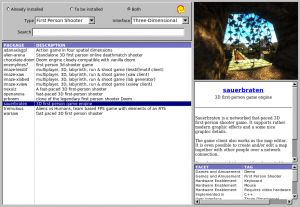
The Debian archive is known to be one of the largest software collections available in the free software world. With more than 16,000 source packages and 30,000 binary packages, users sometimes have trouble finding packages that are relevant to them. Debian developer Enrico Zini has been working on infrastructure to solve this problem. During the recent mini-debconf Paris, Enrico gave a talk presenting what he has been working on in the last few years, which hasn t gotten yet the attention it deserves . Enrico is known in the Debian community for the introduction of debtags, a system used to classify all packages using facets. Each facet describes a specific kind of property: type of user-interface, programming language it s written in, type of document manipulated, purpose of the software, etc. His most recent work builds on that. It is available in Debian and Ubuntu in the apt-xapian-index package. Its purpose is to allow advanced queries over the database of available packages. Users of apt-xapian-index He started by presenting some early users of the infrastructure. The most widely know is Ubuntu s software center. Its search feature provides results almost instantly thanks to apt-xapian-index. But it is a very simple interface that doesn t exploit many of the advanced features provided by the apt-xapian-index. Another early adopter, making use of some more advanced features, is GoPlay!. It s a graphical user interface to find games. It makes use of debtags to classify games so that you can browse, for example, all 3D action/arcade games related to cars. GoPlay has even been extended to be a more generic debtags based package browser and the package now also provides GoLearn!, GoAdmin!, GoNet!, GoOffice!, GoSafe!, and GoWeb!. Fuss-launcher is an application launcher and not a package browser, but by using apt-xapian-index, it s able to reuse information provided at the package level to make it easier to find installed applications. Package descriptions tend to be more verbose than those embedded in .desktop files. Enrico also showed another nice feature to the audience: if you drag a document onto its window, it will show you a list of applications that can open it. Last but not least, apt-xapian-index provides a command line search tool that is vastly superior to the traditional apt-cache search: it s axi-cache search (axi stands for apt-xapian-index). Enrico compared the output of a search on the letter r . While apt-cache spits out an infinite list of packages containing this letter somewhere in the description, axi-cache only listed packages related to GNU R. He also demonstrated the contextual tab completion. It makes it easy to use debtags and to refine your search. Once you have typed a first keyword, the tab-completion for the second one only contains keywords or debtags that are actually able to provide more restrictive results. Advanced queries with logical operations (AND, OR, NOT, XOR) are also supported. Features of the backend Enrico then dived into the internals. Xapian s search engine is at the root of this infrastructure. He likes it because it s a simple library (i.e. no daemon) and it has nice Python bindings. While apt-xapian-index s core work is to index the descriptions of all the packages, it actually stores much more and can be easily extended with plugins (written in Python). For instance, the information stored encompasses: He already has plans to store more: adding popularity contest data (see wishlist bugs #602180 and #602182) will make it possible to sort query results in a useful way. The most widely used applications are good choices when it comes to community support, and they are likely of better quality due to the larger user base. Adding timestamps of the last installation/upgrade/removal, will make it easier to pin-point a regression to a specific package update. The generated index is world-readable and can be used from any application provided it can use the Xapian library which is written in C++ but has bindings for Perl, Python, PHP, Java, Tcl, C#, and Ruby. Call for experimentation Enrico believes that many useful applications have yet to be invented on top of apt-xapian-index s features. He s calling for experimentation and asking for new ideas. The only practical limit that he has encountered is the size of the index: currently it varies between 50 Mb (Debian unstable without translation) and 70 Mb (Debian stable/testing/unstable with one translation). He would like it to not grow over 100 Mb since it s installed by default (due to aptitude recommending it) and he s not comfortable with the idea of using more than 20% of the disk footprint of a basic install just for this service. That s why the index was configured to not store the position of the terms: it s thus not possible to find out packages whose description contains the word statistical immediately followed by the word computing . You can however find those which have both terms somewhere in their description. Enrico wondered if apt-xapian-index offers too much freedom. That could explain why few people experimented with it despite his numerous blog posts with code samples and information on how to get started using it. But it s not difficult to imagine use cases for this data. It could be used to extend tools like rc-alert or wnpp-alert, for example. They provide a long list of Debian packages that are looking for some help and are installed on the machine. With apt-xapian-index, it would be possible to restrict the results to the set of packages written in a specific programming language or for a particular desktop environment. The more likely explanation is that too few people know about the tool. There are many more itches to scratch where apt-xapian-index s features could be very useful, and my guess is that Enrico s wishes will eventually come true.
This article was first published in Linux Weekly News. Click here to subscribe to my newsletter and keep up with the Debian/Ubuntu news thanks to my monthly digest.

No comment Liked this article? Click here. My blog is Flattr-enabled.

27 November 2010

Russell Coker: Open Respect

On the 5th of November Jono Bacon wrote a blog post titled MAKING OUR WORLD MORE RESPECTFUL [1]. He then registered the domain OpenRespect.org for his manifesto [2].Aaron Siego supports the general concept of being more respectful while listing some of the practical problems that occur in a multi-cultural world [3]. If you read nothing else about this issue I recommend reading Aaron s post (which I summarised very poorly, I can t think of a good one-sentence explanation).Sam Varghese wrote an article suggesting that it was an attempt to deflect criticism from Ubuntu [4]. I think that Ubuntu receives a lot of unfair criticism, but don t think it s really relevant to the issue at hand. Sam criticises some of the Open Respect supporters for failing to show respect in the past.Jono wrote a follow-up blog post titled REFLECTIONS ON RESPECT [5], in that post he said Sometimes we were disrespectful, and frankly, sometimes we were also inadvertently assholes. We never set out to be assholes, but we did set out to be edgy in a satirical way, but we sometimes went too far and I apologize for that. But you know what, we all grow and mature in different parts of our lives about his past LugRadio work. Maybe instead of focusing on being respectful of others it would give more benefit to focus on how to apologise, back down, and move on after being disrespectful. It seems that the situations of epic disrespect tend not to be one-off incidents but are instead arguments of greatly expanded scope that arose from someone refusing to admit any error after doing something that is considered to be offensive. [Someone has registered OpenApology.org, just in case you were wondering.]Maybe advocating Rogerian Argument would be another way of reducing some of the problems in the community.Finally Kirrily wrote an insightful post about the ineffectiveness of discussing offensive things [6]. In terms of issues such as Feminism (which Kirrily uses as an example and which is also a matter of significant interest for her) discussions about offense apparently tend to end up being about the person who was offended rather than the person who might be described as acting in an offensive manner. She suggests using terms such as marginalised, belittled, stereotyped, frustrated, humiliated, threatened, patronised, silenced, intimidated, misrepresented, etc instead. It seems to me that there may be a similar issue with respect . Objective claims about people being dismissed, ignored, patronised, etc can be evaluated more easily than a claim about being disrespected.

Next.

Previous.