Search Results: "tin"

24 March 2017

Dirk Eddelbuettel: RApiDatetime 0.0.1

Very happy to announce a new package of mine is now up on the CRAN repository network: RApiDatetime. It provides six entry points for C-level functions of the R API for Date and Datetime calculations: asPOSIXlt and asPOSIXct convert between long and compact datetime representation, formatPOSIXlt and Rstrptime convert to and from character strings, and POSIXlt2D and D2POSIXlt convert between Date and POSIXlt datetime. These six functions are all fairly essential and useful, but not one of them was previously exported by R. Hence the need to put them together in the this package to complete the accessible API somewhat. These should be helpful for fellow package authors as many of us have either our own partial copies of some of this code, or rather farm back out into R to get this done. As a simple (yet real!) illustration, here is an actual Rcpp function which we could now cover at the C level rather than having to go back up to R (via Rcpp::Function()):
    inline Datetime::Datetime(const std::string &s, const std::string &fmt)  
        Rcpp::Function strptime("strptime");    // we cheat and call strptime() from R
        Rcpp::Function asPOSIXct("as.POSIXct"); // and we need to convert to POSIXct
        m_dt = Rcpp::as<double>(asPOSIXct(strptime(s, fmt)));
        update_tm();
     
I had taken a first brief stab at this about two years ago, but never finished. With the recent emphasis on C-level function registration, coupled with a possible use case from anytime I more or less put this together last weekend. It currently builds and tests fine on POSIX-alike operating systems. If someone with some skill and patience in working on Windows would like to help complete the Windows side of things then I would certainly welcome help and pull requests. For questions or comments please use the issue tracker off the GitHub repo.

This post by Dirk Eddelbuettel originated on his Thinking inside the box blog. Please report excessive re-aggregation in third-party for-profit settings.

23 March 2017

Simon McVittie: GTK hackfest 2017: D-Bus communication with containers

At the GTK hackfest in London (which accidentally became mostly a Flatpak hackfest) I've mainly been looking into how to make D-Bus work better for app container technologies like Flatpak and Snap. The initial motivating use cases are: At the moment, Flatpak runs a D-Bus proxy for each app instance that has access to D-Bus, connects to the appropriate bus on the app's behalf, and passes messages through. That proxy is in a container similar to the actual app instance, but not actually the same container; it is trusted to not pass messages through that it shouldn't pass through. The app-identification mechanism works in practice, but is Flatpak-specific, and has a known race condition due to process ID reuse and limitations in the metadata that the Linux kernel maintains for AF_UNIX sockets. In practice the use of X11 rather than Wayland in current systems is a much larger loophole in the container than this race condition, but we want to do better in future. Meanwhile, Snap does its sandboxing with AppArmor, on kernels where it is enabled both at compile-time (Ubuntu, openSUSE, Debian, Debian derivatives like Tails) and at runtime (Ubuntu, openSUSE and Tails, but not Debian by default). Ubuntu's kernel has extra AppArmor features that haven't yet gone upstream, some of which provide reliable app identification via LSM labels, which dbus-daemon can learn by querying its AF_UNIX socket. However, other kernels like the ones in openSUSE and Debian don't have those. The access-control (AppArmor mediation) is implemented in upstream dbus-daemon, but again doesn't work portably, and is not sufficiently fine-grained or flexible to do some of the things we'll likely want to do, particularly in dconf. After a lot of discussion with dconf maintainer Allison Lortie and Flatpak maintainer Alexander Larsson, I think I have a plan for fixing this. This is all subject to change: see fd.o #100344 for the latest ideas. Identity model Each user (uid) has some uncontained processes, plus 0 or more containers. The uncontained processes include dbus-daemon itself, desktop environment components such as gnome-session and gnome-shell, the container managers like Flatpak and Snap, and so on. They have the user's full privileges, and in particular they are allowed to do privileged things on the user's session bus (like running dbus-monitor), and act with the user's full privileges on the system bus. In generic information security jargon, they are the trusted computing base; in AppArmor jargon, they are unconfined. The containers are Flatpak apps, or Snap apps, or other app-container technologies like Firejail and AppImage (if they adopt this mechanism, which I hope they will), or even a mixture (different app-container technologies can coexist on a single system). They are containers (or container instances) and not "apps", because in principle, you could install com.example.MyApp 1.0, run it, and while it's still running, upgrade to com.example.MyApp 2.0 and run that; you'd have two containers for the same app, perhaps with different permissions. Each container has an container type, which is a reversed DNS name like org.flatpak or io.snapcraft representing the container technology, and an app identifier, an arbitrary non-empty string whose meaning is defined by the container technology. For Flatpak, that string would be another reversed DNS name like com.example.MyGreatApp; for Snap, as far as I can tell it would look like example-my-great-app. The container technology can also put arbitrary metadata on the D-Bus representation of a container, again defined and namespaced by the container technology. For instance, Flatpak would use some serialization of the same fields that go in the Flatpak metadata file at the moment. Finally, the container has an opaque container identifier identifying a particular container instance. For example, launching com.example.MyApp twice (maybe different versions or with different command-line options to flatpak run) might result in two containers with different privileges, so they need to have different container identifiers. Contained server sockets App-container managers like Flatpak and Snap would create an AF_UNIX socket inside the container, bind() it to an address that will be made available to the contained processes, and listen(), but not accept() any new connections. Instead, they would fd-pass the new socket to the dbus-daemon by calling a new method, and the dbus-daemon would proceed to accept() connections after the app-container manager has signalled that it has called both bind() and listen(). (See fd.o #100344 for full details.) Processes inside the container must not be allowed to contact the AF_UNIX socket used by the wider, uncontained system - if they could, the dbus-daemon wouldn't be able to distinguish between them and uncontained processes and we'd be back where we started. Instead, they should have the new socket bind-mounted into their container's XDG_RUNTIME_DIR and connect to that, or have the new socket set as their DBUS_SESSION_BUS_ADDRESS and be prevented from connecting to the uncontained socket in some other way. Those familiar with the kdbus proposals a while ago might recognise this as being quite similar to kdbus' concept of endpoints, and I'm considering reusing that name. Along with the socket, the container manager would pass in the container's identity and metadata, and the method would return a unique, opaque identifier for this particular container instance. The basic fields (container technology, technology-specific app ID, container ID) should probably be added to the result of GetConnectionCredentials(), and there should be a new API call to get all of those plus the arbitrary technology-specific metadata. When a process from a container connects to the contained server socket, every message that it sends should also have the container instance ID in a new header field. This is OK even though dbus-daemon does not (in general) forbid sender-specified future header fields, because any dbus-daemon that supported this new feature would guarantee to set that header field correctly, the existing Flatpak D-Bus proxy already filters out unknown header fields, and adding this header field is only ever a reduction in privilege. The reasoning for using the sender's container instance ID (as opposed to the sender's unique name) is for services like dconf to be able to treat multiple unique bus names as belonging to the same equivalence class of contained processes: instead of having to look up the container metadata once per unique name, dconf can look it up once per container instance the first time it sees a new identifier in a header field. For the second and subsequent unique names in the container, dconf can know that the container metadata and permissions are identical to the one it already saw. Access control In principle, we could have the new identification feature without adding any new access control, by keeping Flatpak's proxies. However, in the short term that would mean we'd be adding new API to set up a socket for a container without any access control, and having to keep the proxies anyway, which doesn't seem great; in the longer term, I think we'd find ourselves adding a second new API to set up a socket for a container with new access control. So we might as well bite the bullet and go for the version with access control immediately. In principle, we could also avoid the need for new access control by ensuring that each service that will serve contained clients does its own. However, that makes it really hard to send broadcasts and not have them unintentionally leak information to contained clients - we would need to do something more like kdbus' approach to multicast, where services know who has subscribed to their multicast signals, and that is just not how dbus-daemon works at the moment. If we're going to have access control for broadcasts, it might as well also cover unicast. The plan is that messages from containers to the outside world will be mediated by a new access control mechanism, in parallel with dbus-daemon's current support for firewall-style rules in the XML bus configuration, AppArmor mediation, and SELinux mediation. A message would only be allowed through if the XML configuration, the new container access control mechanism, and the LSM (if any) all agree it should be allowed. By default, processes in a container can send broadcast signals, and send method calls and unicast signals to other processes in the same container. They can also receive method calls from outside the container (so that interfaces like org.freedesktop.Application can work), and send exactly one reply to each of those method calls. They cannot own bus names, communicate with other containers, or send file descriptors (which reduces the scope for denial of service). Obviously, that's not going to be enough for a lot of contained apps, so we need a way to add more access. I'm intending this to be purely additive (start by denying everything except what is always allowed, then add new rules), not a mixture of adding and removing access like the current XML policy language. There are two ways we've identified for rules to be added: Initially, many contained apps would work in the first way (and in particular sockets=session-bus would add a rule that allows almost everything), while over time we'll probably want to head towards recommending more use of the second. Related topics Access control on the system bus We talked about the possibility of using a very similar ruleset to control access to the system bus, as an alternative to the XML rules found in /etc/dbus-1/system.d and /usr/share/dbus-1/system.d. We didn't really come to a conclusion here. Allison had the useful insight that the XML rules are acting like a firewall: they're something that is placed in front of potentially-broken services, and not part of the services themselves (which, as with firewalls like ufw, makes it seem rather odd when the services themselves install rules). D-Bus system services already have total control over what requests they will accept from D-Bus peers, and if they rely on the XML rules to mediate that access, they're essentially rejecting that responsibility and hoping the dbus-daemon will protect them. The D-Bus maintainers would much prefer it if system services took responsibility for their own access control (with or without using polkit), because fundamentally the system service is always going to understand its domain and its intended security model better than the dbus-daemon can. Analogously, when a network service listens on all addresses and accepts requests from elsewhere on the LAN, we sometimes work around that by protecting it with a firewall, but the optimal resolution is to get that network service fixed to do proper authentication and access control instead. For system services, we continue to recommend essentially this "firewall" configuration, filling in the $ variables as appropriate:
<busconfig>
    <policy user="$ the daemon uid under which the service runs ">
        <allow own="$ the service's bus name "/>
    </policy>
    <policy context="default">
        <allow send_destination="$ the service's bus name "/>
    </policy>
</busconfig>
We discussed the possibility of moving towards a model where the daemon uid to be allowed is written in the .service file, together with an opt-in to "modern D-Bus access control" that makes the "firewall" unnecessary; after some flag day when all significant system services follow that pattern, dbus-daemon would even have the option of no longer applying the "firewall" (moving to an allow-by-default model) and just refusing to activate system services that have not opted in to being safe to use without it. However, the "firewall" also protects system bus clients, and services like Avahi that are not bus-activatable, against unintended access, which is harder to solve via that approach; so this is going to take more thought. For system services' clients that follow the "agent" pattern (BlueZ, polkit, NetworkManager, Geoclue), the correct "firewall" configuration is more complicated. At some point I'll try to write up a best-practice for these. New header fields for the system bus At the moment, it's harder than it needs to be to provide non-trivial access control on the system bus, because on receiving a method call, a service has to remember what was in the method call, then call GetConnectionCredentials() to find out who sent it, then only process the actual request when it has the information necessary to do access control. Allison and I had hoped to resolve this by adding new D-Bus message header fields with the user ID, the LSM label, and other interesting facts for access control. These could be "opt-in" to avoid increasing message sizes for no reason: in particular, it is not typically useful for session services to receive the user ID, because only one user ID is allowed to connect to the session bus anyway. Unfortunately, the dbus-daemon currently lets unknown fields through without modification. With hindsight this seems an unwise design choice, because header fields are a finite resource (there are 255 possible header fields) and are defined by the D-Bus Specification. The only field that can currently be trusted is the sender's unique name, because the dbus-daemon sets that field, overwriting the value in the original message (if any). To make it safe to rely on the new fields, we would have to make the dbus-daemon filter out all unknown header fields, and introduce a mechanism for the service to check (during connection to the bus) whether the dbus-daemon is sufficiently new that it does so. If connected to an older dbus-daemon, the service would not be able to rely on the new fields being true, so it would have to ignore the new fields and treat them as unset. The specification is sufficiently vague that making new dbus-daemons filter out unknown header fields is a valid change (it just says that "Header fields with an unknown or unexpected field code must be ignored", without specifying who must ignore them, so having the dbus-daemon delete those fields seems spec-compliant). This all seemed fine when we discussed it in person; but GDBus already has accessors for arbitrary header fields by numeric ID, and I'm concerned that this might mean it's too easy for a system service to be accidentally insecure: It would be natural (but wrong!) for an implementor to assume that if g_message_get_header (message, G_DBUS_MESSAGE_HEADER_FIELD_SENDER_UID) returned non-NULL, then that was guaranteed to be the correct, valid sender uid. As a result, fd.o #100317 might have to be abandoned. I think more thought is needed on that one. Unrelated topics As happens at any good meeting, we took the opportunity of high-bandwidth discussion to cover many useful things and several useless ones. Other discussions that I got into during the hackfest included, in no particular order: More notes are available from the GNOME wiki. Acknowledgements The GTK hackfest was organised by GNOME and hosted by Red Hat and Endless. My attendance was sponsored by Collabora. Thanks to all the sponsors and organisers, and the developers and organisations who attended.

Neil McGovern: GNOME ED Update Week 12

New release! In case you haven t seen it yet, there s a new GNOME release 3.24! The release is the result of 6 months work by the GNOME community. The new release is a major step forward for us, with new features and improvements, and some exciting developments in how we build applications. You can read more about it in the announcement and release notes. As always, this release was made possible partially thanks to the Friends of GNOME project. In particular, it helped us provide a Core apps hackfest in Berlin last November, which had a direct impact on this release. Conferences GTK+ hackfest I ve just come back from the GTK+ hackfest in London thanks to RedHat and Endless for sponsoring the venues! It was great to meet a load of people who are involved with GNOME and GTK, and some great discussions were had about Flatpak and the creation of a FlatHub somewhere that people can get all their latest Flatpaks from. LibrePlanet As I m writing this, I m sitting on a train going to Heathrow, for my flight to LibrePlanet 2017! If you re going to be there, come and say hi. I ve a load of new stickers that have been produced as well so these can brighten up your laptop.
Mike Hommey: Why is the git-cinnabar master branch slower to clone?

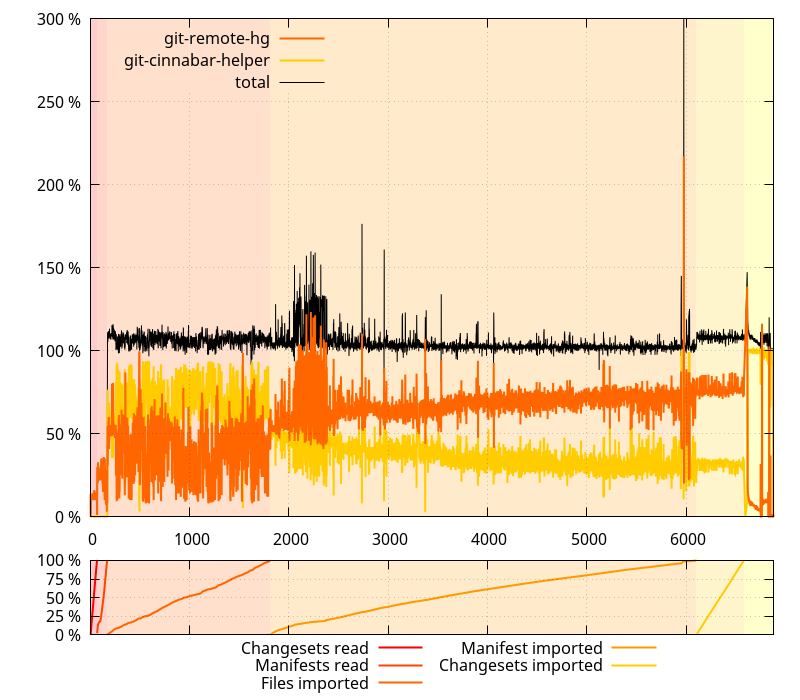
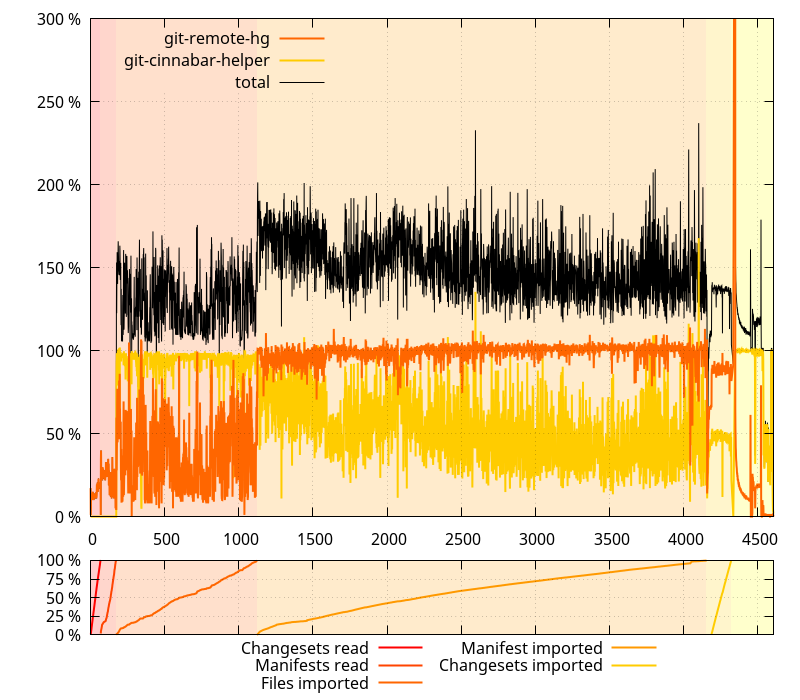
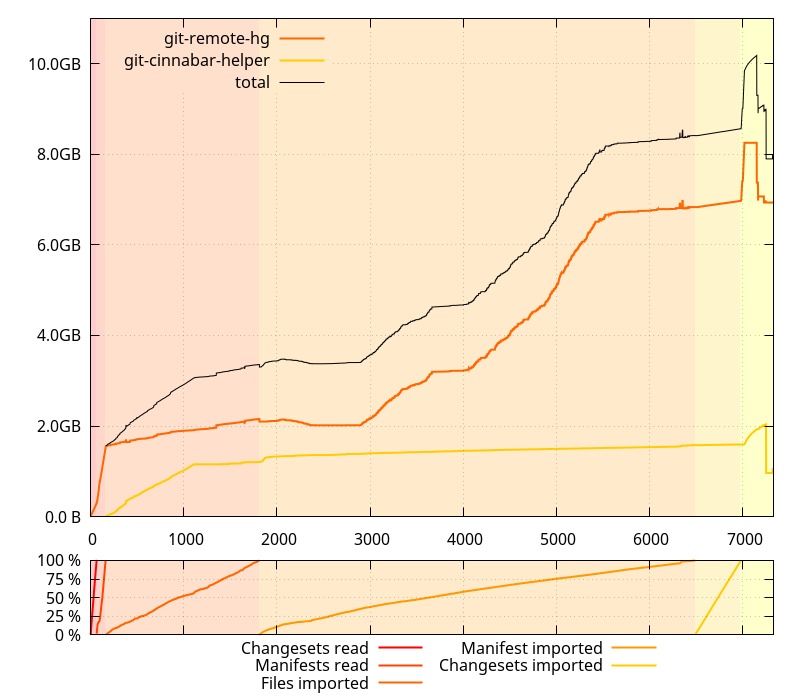
Apart from the memory considerations, one thing that the data presented in the When the memory allocator works against you post that I haven t touched in the followup posts is that there is a large difference in the time it takes to clone mozilla-central with git-cinnabar 0.4.0 vs. the master branch. One thing that was mentioned in the first followup is that reducing the amount of realloc and substring copies made the cloning more than 15 minutes faster on master. But the same code exists in 0.4.0, so this isn t part of the difference. So what s going on? Looking at the CPU usage during the clone is enlightening. On 0.4.0: On master: (Note: the data gathering is flawed in some ways, which explains why the git-remote-hg process goes above 100%, which is not possible for this python process. The data is however good enough for the high level analysis that follows, so I didn t bother to get something more acurate) On 0.4.0, the git-cinnabar-helper process was saturating one CPU core during the File import phase, and the git-remote-hg process was saturating one CPU core during the Manifest import phase. Overall, the sum of both processes usually used more than one and a half core. On master, however, the total of both processes barely uses more than one CPU core. What happened? This and that happened. Essentially, before those changes, git-remote-hg would send instructions to git-fast-import (technically, git-cinnabar-helper, but in this case it s only used as a wrapper for git-fast-import), and use marks to track the git objects that git-fast-import created. After those changes, git-remote-hg asks git-fast-import the git object SHA1 of objects it just asked to be created. In other words, those changes replaced something asynchronous with something synchronous: while it used to be possible for git-remote-hg to work on the next file/manifest/changeset while git-fast-import was working on the previous one, it now waits. The changes helped simplify the python code, but made the overall clone process much slower. If I m not mistaken, the only real use for that information is for the mapping of mercurial to git SHA1s, which is actually rarely used during the clone, except at the end, when storing it. So what I m planning to do is to move that mapping to the git-cinnabar-helper process, which, incidentally, will kill not 2, but 3 birds with 1 stone: So expect git-cinnabar 0.5 to get moar faster, and to use moar less memory.
Mike Hommey: Analyzing git-cinnabar memory use

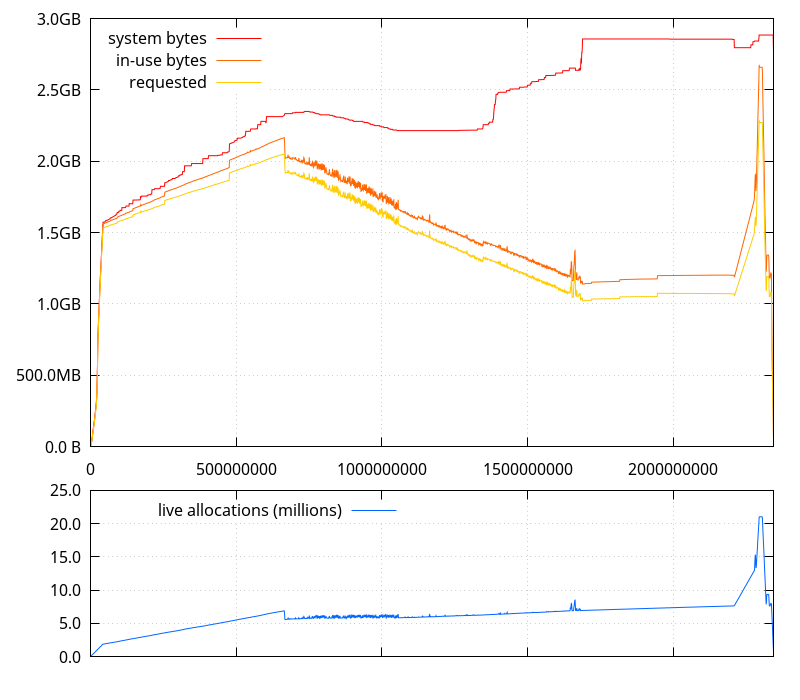
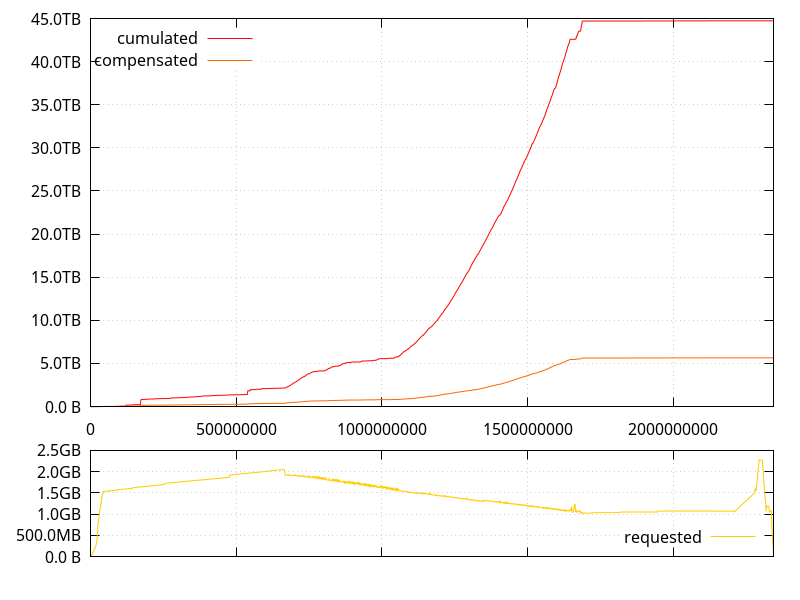
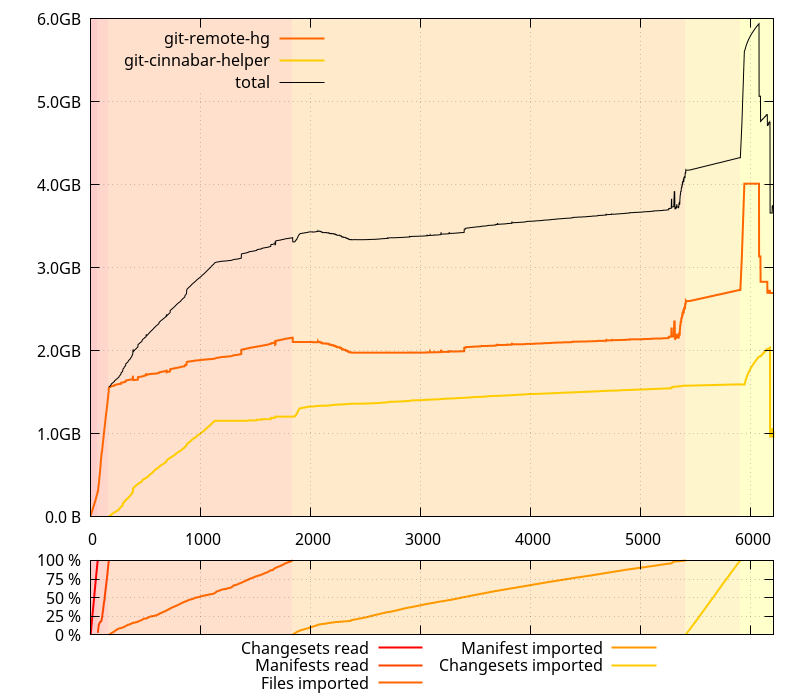
In previous post, I was looking at the allocations git-cinnabar makes. While I had the data, I figured I d also look how the memory use correlates with expectations based on repository data, to put things in perspective. As a reminder, this is what the allocations look like (horizontal axis being the number of allocator function calls): There are 7 different phases happening during a git clone using git-cinnabar, most of which can easily be identified on the graph above: Overall, except for the stupid spike during the final phase, the manifest DAG and the glibc allocator runaway memory use described in previous posts, there is nothing terribly bad with the git-cinnabar memory usage, all things considered. Mozilla-central is just big. The spike is already half addressed, and work is under way for the glibc allocator runaway memory use. The manifest DAG, interestingly, is actually mostly useless. It s only used to track the heads of the DAG, and it s very much possible to track heads of a DAG without actually storing the entire DAG. In fact, that s what git-cinnabar already does for changeset heads so we would only need to do the same for manifest heads. One could argue that the 1.4GB of raw RevChunk data we re keeping in memory for later user could be kept on disk instead. I haven t done this so far because I didn t want to have to handle temporary files (and answer questions like where to put them? , what if there isn t enough disk space there? , what if disk access is slow? , etc.). But the majority of this data is from manifests. I m already planning changes in how git-cinnabar stores manifests data that will actually allow to import them directly, instead of keeping them in memory until files are imported. This would instantly remove 1.18GB of memory usage. The downside, however, is that this would be more CPU intensive: Importing changesets will require creating the corresponding git trees, and getting the stored manifest data. I think it s worth, though. Finally, one thing that isn t obvious here, but that was found while analyzing why RSS would be going up despite memory usage going down, is that git-cinnabar is doing way too many reallocations and substring allocations. So let s look at two metrics that hopefully will highlight the problem: Assuming all the requested memory is filled at some point, the former gives us an upper bound to the amount of memory that is ever filled or copied (the amount that would be filled if no realloc was ever in-place), while the the latter gives us a lower bound (the amount that would be filled or copied if all reallocs were in-place). Ideally, we d want the upper and lower bounds to be close to each other (indicating few realloc calls), and the total amount at the end of the process to be as close as possible to the amount of data we re handling (which we ve seen is around 3TB). and this is clearly bad. Like, really bad. But we already knew that from the previous post, although it s nice to put numbers on it. The lower bound is about twice the amount of data we re handling, and the upper bound is more than 10 times that amount. Clearly, we can do better. We ll see how things evolve after the necessary code changes happen. Stay tuned.

22 March 2017

Arturo Borrero Gonz lez: IPv6 and CGNAT

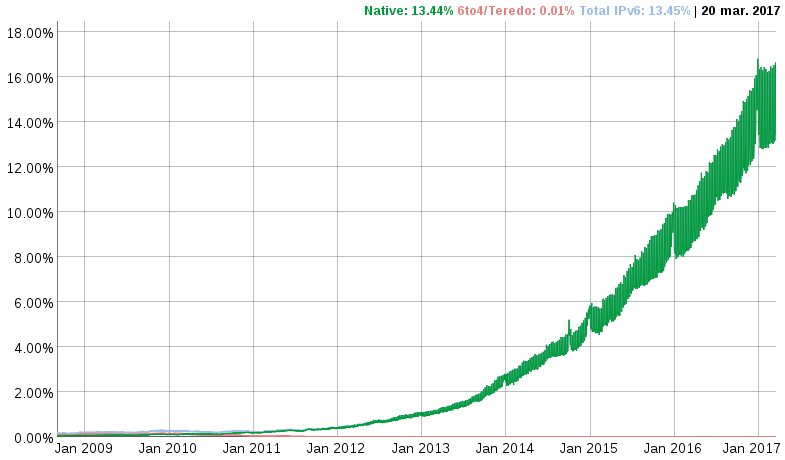
IPv6 Today I ended reading an interesting article by the 4th spanish ISP regarding IPv6 and CGNAT. The article is in spanish, but I will translate the most important statements here. Having a spanish Internet operator to talk about this subject is itself good news. We have been lacking any news regarding IPv6 in our country for years. I mean, no news from private operators. Public networks like the one where I develop my daily job has been offering native IPv6 since almost a decade The title of the article is What is CGNAT and why is it used . They start by admiting that this technique is used to address the issue of IPv4 exhaustion. Good. They move on to say that IPv6 was designed to address IPv4 exhaustion. Great. Then, they state that the internet network is not ready for IPv6 support . Also that IPv6 has the handicap of many websites not supporting it . Sorry? That is not true. If they refer to the core of internet (i.e, RIRs, interexchangers, root DNS servers, core BGP routers, etc) they have been working with IPv6 for ages now. If they refer to something else, for example Google, Wikipedia, Facebook, Twitter, Youtube, Netflix or any random hosting company, they do support IPv6 as well. Hosting companies which don t support IPv6 are only a few, at least here in Europe. The traffic to/from these services is clearly the vast majority of the traffic traveling in the wires nowaday. And they support IPv6. The article continues defending CGNAT. They refer to IPv6 as an alternative to CGNAT. No, sorry, CGNAT is an alternative to you not doing your IPv6 homework. The article ends by insinuing that CGNAT is more secure and useful than IPv6. That s the final joke. They mention some absurd example of IP cams being accessed from the internet by anyone. Sure, by using CGNAT you are indeed making the network practically one-way only. There exists RFC7021 which refers to the big issues of a CGNAT network. So, by using CGNAT you sacrifice a lot of usability in the name of security. This supposed security can be replicated by the most simple possible firewall, which could be deployed in Dual Stack IPv4/IPv6 using any modern firewalling system, like nftables. (Here is a good blogpost of RFC7021 for spanish readers: Midiendo el impacto del Carrier-Grade NAT sobre las aplicaciones en red) By the way, Google kindly provides some statistics regarding their IPv6 traffic. These stats clearly show an exponential growth: Google IPv6 traffic Others ISP operators are giving IPv6 strong precedence over IPv4, that s the case of Verizon in USA: Verizon Static IP Changes IPv4 to Persistent Prefix IPv6. My article seems a bit like a rant, but I couldn t miss the oportunity to claim for native IPv6. None of the major spanish ISP have IPv6.
Michael Stapelberg: Debian stretch on the Raspberry Pi 3 (update)

I previously wrote about my Debian stretch preview image for the Raspberry Pi 3. Now, I m publishing an updated version, containing the following changes: A couple of issues remain, notably the lack of HDMI, WiFi and bluetooth support (see wiki:RaspberryPi3 for details. Any help with fixing these issues is very welcome! As a preview version (i.e. unofficial, unsupported, etc.) until all the necessary bits and pieces are in place to build images in a proper place in Debian, I built and uploaded the resulting image. Find it at https://people.debian.org/~stapelberg/raspberrypi3/2017-03-22/. To install the image, insert the SD card into your computer (I m assuming it s available as /dev/sdb) and copy the image onto it:
$ wget https://people.debian.org/~stapelberg/raspberrypi3/2017-03-22/2017-03-22-raspberry-pi-3-stretch-PREVIEW.img
$ sudo dd if=2017-03-22-raspberry-pi-3-stretch-PREVIEW.img of=/dev/sdb bs=5M
If resolving client-supplied DHCP hostnames works in your network, you should be able to log into the Raspberry Pi 3 using SSH after booting it:
$ ssh root@rpi3
# Password is  raspberry 

Dirk Eddelbuettel: Suggests != Depends

A number of packages on CRAN use Suggests: casually. They list other packages as "not required" in Suggests: -- as opposed to absolutely required via Imports: or the older Depends: -- yet do not test for their use in either examples or, more commonly, unit tests. So e.g. the unit tests are bound to fail because, well, Suggests != Depends. This has been accomodated for many years by all parties involved by treating Suggests as a Depends and installing unconditionally. As I understand it, CRAN appears to flip a switch to automatically install all Suggests from major repositories glossing over what I consider to be a packaging shortcoming. (As an aside, treatment of Additonal_repositories: is indeed optional; Brooke Anderson and I have a fine paper under review on this) I spend a fair amount of time with reverse dependency ("revdep") checks of packages I maintain, and I will no longer accomodate these packages. These revdep checks take long enough as it is, so I will now blacklist these packages that are guaranteed to fail when their "optional" dependencies are not present. Writing R Extensions says in Section 1.1.3
All packages that are needed10 to successfully run R CMD check on the package must be listed in one of Depends or Suggests or Imports . Packages used to run examples or tests conditionally (e.g. via if(require(pkgname))) should be listed in Suggests or Enhances . (This allows checkers to ensure that all the packages needed for a complete check are installed.) In particular, packages providing only data for examples or vignettes should be listed in Suggests rather than Depends in order to make lean installations possible. [...] It used to be common practice to use require calls for packages listed in Suggests in functions which used their functionality, but nowadays it is better to access such functionality via :: calls.
and continues in Section 1.1.3.1
Note that someone wanting to run the examples/tests/vignettes may not have a suggested package available (and it may not even be possible to install it for that platform). The recommendation used to be to make their use conditional via if(require("pkgname"))): this is fine if that conditioning is done in examples/tests/vignettes.
I will now exercise my option to use 'lean installations' as discussed here. If you want your package included in tests I run, please make sure it tests successfully when only its required packages are present.

Mike Hommey: When the memory allocator works against you, part 2

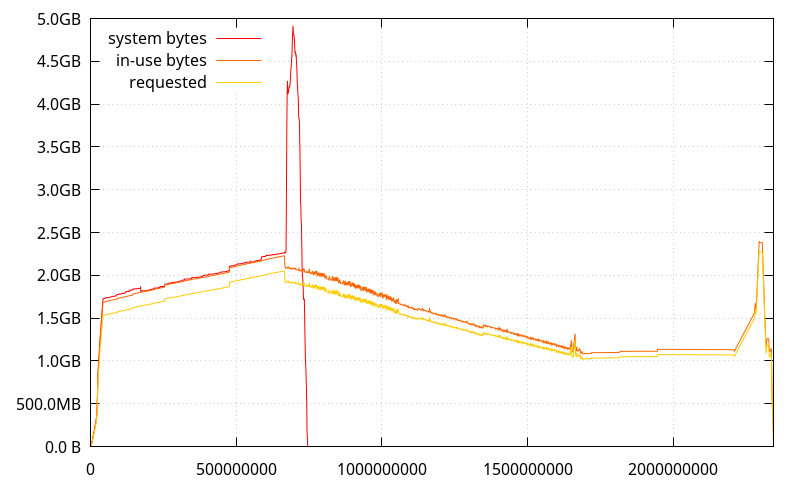
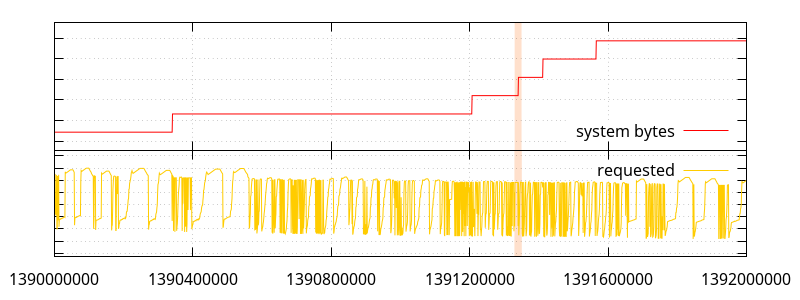
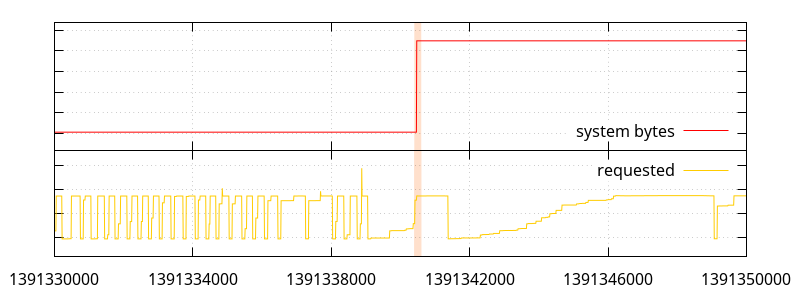
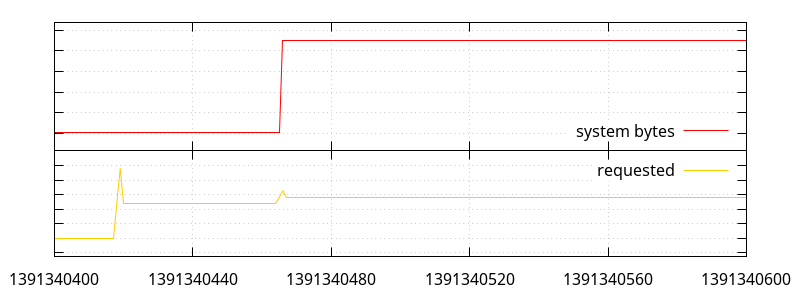
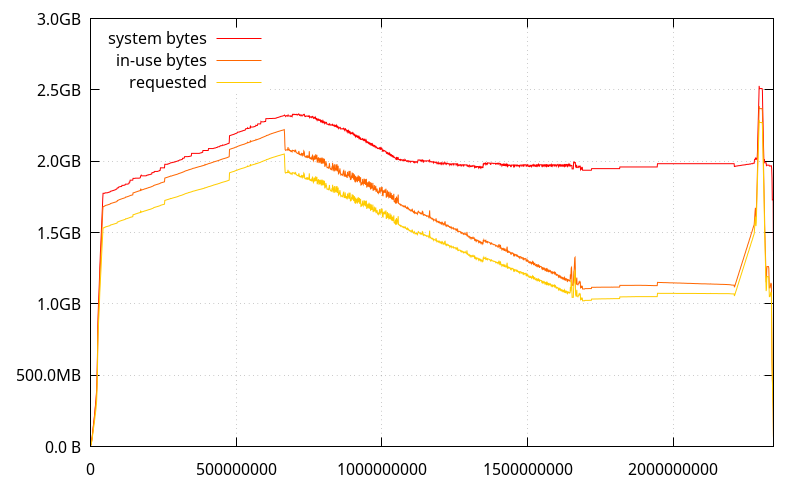
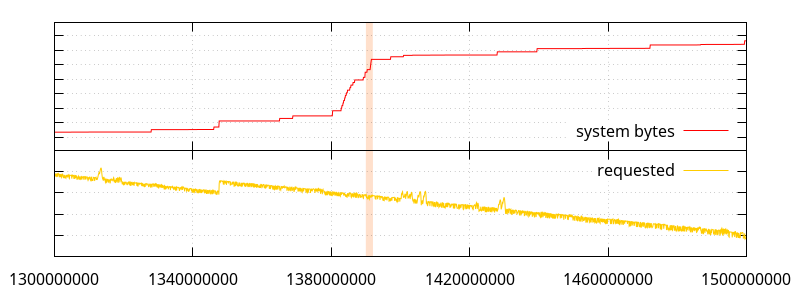
This is a followup to the When the memory allocator works against you post from a few days ago. You may want to read that one first if you haven t, and come back. In case you don t or didn t read it, it was all about memory consumption during a git clone of the mozilla-central mercurial repository using git-cinnabar, and how the glibc memory allocator is using more than one would expect. This post is going to explore how/why it s happening. I happen to have written a basic memory allocation logger for Firefox, so I used it to log all the allocations happening during a git clone exhibiting the runaway memory increase behavior (using a python that doesn t use its own allocator for small allocations). The result was a 6.5 GB log file (compressed with zstd ; 125 GB uncompressed!) with 2.7 billion calls to malloc, calloc, free, and realloc, recorded across (mostly) 2 processes (the python git-remote-hg process and the native git-cinnabar-helper process ; there are other short-lived processes involved, but they do less than 5000 calls in total). The vast majority of those 2.7 billion calls is done by the python git-remote-hg process: 2.34 billion calls. We ll only focus on this process. Replaying those 2.34 billion calls with a program that reads the log allowed to reproduce the runaway memory increase behavior to some extent. I went an extra mile and modified glibc s realloc code in memory so it doesn t call memcpy, to make things faster. I also ran under setarch x86_64 -R to disable ASLR for reproducible results (two consecutive runs return the exact same numbers, which doesn t happen with ASLR enabled). I also modified the program to report the number of live allocations (allocations that haven t been freed yet), and the cumulated size of the actually requested allocations (that is, the sum of all the sizes given to malloc, calloc, and realloc calls for live allocations, as opposed to what the memory allocator really allocated, which can be more, per malloc_usable_size). RSS was not tracked because the allocations are never filled to make things faster, such that pages for large allocations are never dirty, and RSS doesn t grow as much because of that. Full disclosure: it turns out the system bytes and in-use bytes numbers I had been collecting in the previous post were smaller than what they should have been, and were excluding memory that the glibc memory allocator would have mmap()ed. That however doesn t affect the trends that had been witnessed. The data below is corrected. (Note that in the graph above and the graphs that follow, the horizontal axis represents the number of allocator function calls performed) While I was here, I figured I d check how mozjemalloc performs, and it has a better behavior (although it has more overhead). What doesn t appear on this graph, though, is that mozjemalloc also tells the OS to drop some pages even if it keeps them mapped (madvise(MADV_DONTNEED)), so in practice, it is possible the actual RSS decreases too. And jemalloc 4.5: (It looks like it has better memory usage than mozjemalloc for this use case, but its stats are being thrown off at some point, I ll have to investigate) Going back to the first graph, let s get a closer look at what the allocations look like when the system bytes number is increasing a lot. The highlights in the following graphs indicate the range the next graph will be showing. So what we have here is a bunch of small allocations (small enough that they don t seem to move the requested line ; most under 512 bytes, so under normal circumstances, they would be allocated by python, a few between 512 and 2048 bytes), and a few large allocations, one of which triggers a bump in memory use. What can appear weird at first glance is that we have a large allocation not requiring more system memory, later followed by a smaller one that does. What the allocations actually look like is the following:
void *ptr0 = malloc(4850928); // #1391340418
void *ptr1 = realloc(some_old_ptr, 8000835); // #1391340419
free(ptr0); // #1391340420
ptr1 = realloc(ptr1, 8000925); // #1391340421
/* ... */
void *ptrn = malloc(879931); // #1391340465
ptr1 = realloc(ptr1, 8880819); // #1391340466
free(ptrn); // #1391340467
As it turns out, inspecting all the live allocations at that point, while there was a hole large enough to do the first two reallocs (the second actually happens in place), at the point of the third one, there wasn t a large enough hole to fit 8.8MB. What inspecting the live allocations also reveals, is that there is a large number of large holes between all the allocated memory ranges, presumably coming from previous similar patterns. There are, in fact, 91 holes larger than 1MB, 24 of which are larger than 8MB. It s the accumulation of those holes that can t be used to fulfil larger allocations that makes the memory use explode. And there aren t enough small allocations happening to fill those holes. In fact, the global trend is for less and less memory to be allocated, so, smaller holes are also being poked all the time. Really, it s all a straightforward case of memory fragmentation. The reason it tends not to happen with jemalloc is that jemalloc groups allocations by sizes, which the glibc allocator doesn t seem to be doing. The following is how we got a hole that couldn t fit the 8.8MB allocation in the first place:

ptr1 = realloc(ptr1, 8880467); // #1391324989; ptr1 is 0x5555de145600
/* ... */
void *ptrx = malloc(232); // #1391325001; ptrx is 0x5555de9bd760 ; that is 13 bytes after the end of ptr1.
/* ... */
free(ptr1); // #1391325728; this leaves a hole of 8880480 bytes at 0x5555de145600.
All would go well if ptrx was free()d, but it looks like it s long-lived. At least, it s still allocated by the time we reach the allocator call #1391340466. And since the hole is 339 bytes too short for the requested allocation, the allocator has no other choice than request more memory to the system. What s bothering, though, is that the allocator chose to allocate ptrx in the space following ptr1, when it allocated similarly sized buffers after allocating ptr1 and before allocating ptrx in completely different places, and while there are plenty of holes in the allocated memory where it could fit. Interestingly enough, ptrx is a 232 bytes allocation, which means under normal circumstances, python itself would be allocating it. In all likeliness, when the python allocator is enabled, it s allocations larger than 512 bytes that become obstacles to the larger allocations. Another possibility is that the 256KB fragments that the python allocator itself allocates to hold its own allocations become the obstacles (my original hypothesis). I think the former is more likely, though, putting back the blame entirely on glibc s shoulders. Now, it looks like the allocation pattern we have here is suboptimal, so I re-ran a git clone under a debugger to catch when a realloc() for 8880819 bytes happens (the size is peculiar enough that it only happened once in the allocation log). But doing that with a conditional breakpoint is just too slow, so I injected a realloc wrapper with LD_PRELOAD that sends a SIGTRAP signal to the process, so that an attached debugger can catch it. Thanks to the support for python in gdb, it was then posible to pinpoint the exact python instructions that made the realloc() call (it didn t come as a surprise ; in fact, that was one of the places I had in mind, but I wanted definite proof):

new = ''
end = 0
# ...
for diff in RevDiff(rev_patch):
    new += data[end:diff.start]
    new += diff.text_data
    end = diff.end
    # ...
new += data[end:]
What happens here is that we re creating a mercurial manifest we got from the server in patch form against a previous manifest. So data contains the original manifest, and rev_patch the patch. The patch essentially contains instructions of the form replace n bytes at offset o with the content c . The code here just does that in the most straightforward way, implementation-wise, but also, it turns out, possibly the worst way. So let s unroll this loop over a couple iterations:
new = ''
This allocates an empty str object. In fact, this doesn t actually allocate anything, and only creates a pointer to an interned representation of an empty string.
new += data[0:diff.start]
This is where things start to get awful. data is a str, so data[0:diff.start] creates a new, separate, str for the substring. One allocation, one copy. Then appends it to new. Fortunately, CPython is smart enough, and just assigns data[0:diff.start] to new. This can easily be verified with the CPython REPL:
>>> foo = ''
>>> bar = 'bar'
>>> foo += bar
>>> foo is bar
True
(and this is not happening because the example string is small here ; it also happens with larger strings, like 'bar' * 42000) Back to our loop:
new += diff.text_data
Now, new is realloc()ated to have the right size to fit the appended text in it, and the contents of diff.text_data is copied. One realloc, one copy. Let s go for a second iteration:
new += data[diff.end:new_diff.start]
Here again, we re doing an allocation for the substring, and one copy. Then new is realloc()ated again to append the substring, which is an additional copy.
new += new_diff.text_data
new is realloc()ated yet again to append the contents of new_diff.text_data. We now finish with:
new += data[new_diff.end:]
which, again creates a substring from the data, and then proceeds to realloc()ate new one freaking more time. That s a lot of malloc()s and realloc()s to be doing After modifying the code to implement the first and fifth items, memory usage during a git clone of mozilla-central looks like the following (with the python allocator enabled): (Note this hasn t actually landed on the master branch yet) Compared to what it looked like before, this is largely better. But that s not the only difference: the clone was also about 1000 seconds faster. That s more than 15 minutes! But that s not all so surprising when you know the volumes of data handled here. More insight about this coming in an upcoming post. But while the changes outlined above make the glibc allocator behavior less likely to happen, it doesn t totally obliviate it. In fact, it seems it is still happening by the end of the manifest import phase. We re still allocating increasingly large temporary buffers because the size of the imported manifests grows larger and larger, and every one of them is the result of patching a previous one. The only way to avoid those large allocations creating holes would be to avoid doing them in the first place. My first attempt at doing that, keeping manifests as lists of lines instead of raw buffers, worked, but was terribly slow. So slow, in fact, that I had to stop a clone early and estimated the process would likely have taken a couple days. Iterating over multiple generators at the same time, a lot, kills performance, apparently. I ll have to try with significantly less of that.

Elena 'valhalla' Grandi: XMPP VirtualHosts, SRV records and letsencrypt certificates

XMPP VirtualHosts, SRV records and letsencrypt certificates

When I set up my XMPP server, a friend of mine asked if I was willing to have a virtualhost with his domain on my server, using the same address as the email.

Setting up prosody and the SRV record on the DNS was quite easy, but then we stumbled on the issue of certificates: of course we would like to use letsencrypt, but as far as we know that means that we would have to setup something custom so that the certificate gets renewed on his server and then sent to mine, and that looks more of a hassle than just him setting up his own prosody/ejabberd on his server.

So I was wondering: dear lazyweb, did any of you have the same issue and already came up with a solution that is easy to implement and trivial to maintain that we missed?

Clint Adams: Then Moises claimed that T.G.I. Friday's was acceptable

It s really sad listening to a friend talk about how he doesn t care for his wife and doesn t find her attractive anymore, he whined, while at the same time talking about the kid she is pregnant with obviously they haven t had sex in awhile and how though he only wants one kid, she wants multiple so they will probably have more. He said he couldn t afford to have a divorce. He literally said that one morning, watching her get dressed he laughed and told her, Your boobs look weird. She didn t like that. I reminded him that they will continue to age. That didn t make him feel good. He said that he realized before getting married that he thought he was a good person, but now he s realizing he s a bad person. He said he was a misogynist. I said, Worse, you re the type of misogynist who pretends to be a feminist. He agreed. He lived in Park Slope, but he moved once they became pregnant. Good luck finding a kid-friendly restaurant, she said.
Posted on 2017-03-22
Tags: umismu

Dirk Eddelbuettel: anytime 0.2.2

A bugfix release of the anytime package arrived at CRAN earlier today. This is tenth release since the inaugural version late last summer, and the second (bugfix / feature) release this year. anytime is a very focused package aiming to do just one thing really well: to convert anything in integer, numeric, character, factor, ordered, ... format to either POSIXct or Date objects -- and to do so without requiring a format string. See the anytime page, or the GitHub README.md for a few examples. This releases addresses an annoying bug related to British TZ settings and the particular impact of a change in 1971, and generalizes input formats to accept integer or numeric format in two specific ranges. Details follow below:

Changes in anytime version 0.2.2 (2017-03-21)
  • Address corner case of integer-typed (large) values corresponding to POSIXct time (PR #57 closing ##56)
  • Add special case for Europe/London and 31 Oct 1971 BST change to avoid a one-hour offset error (#58 fixing #36 and #51)
  • Address another corner case of numeric values corresponding to Date types which are now returned as Date
  • Added file init.c with calls to R_registerRoutines() and R_useDynamicSymbols(); already used .registration=TRUE in useDynLib in NAMESPACE

Courtesy of CRANberries, there is a comparison to the previous release. More information is on the anytime page. For questions or comments use the issue tracker off the GitHub repo.

This post by Dirk Eddelbuettel originated on his Thinking inside the box blog. Please report excessive re-aggregation in third-party for-profit settings.

21 March 2017

Matthew Garrett: Announcing the Shim review process

Shim has been hugely successful, to the point of being used by the majority of significant Linux distributions and many other third party products (even, apparently, Solaris). The aim was to ensure that it would remain possible to install free operating systems on UEFI Secure Boot platforms while still allowing machine owners to replace their bootloaders and kernels, and it's achieved this goal.

However, a legitimate criticism has been that there's very little transparency in Microsoft's signing process. Some people have waited for significant periods of time before being receiving a response. A large part of this is simply that demand has been greater than expected, and Microsoft aren't in the best position to review code that they didn't write in the first place.

To that end, we're adopting a new model. A mailing list has been created at shim-review@lists.freedesktop.org, and members of this list will review submissions and provide a recommendation to Microsoft on whether these should be signed or not. The current set of expectations around binaries to be signed documented here and the current process here - it is expected that this will evolve slightly as we get used to the process, and we'll provide a more formal set of documentation once things have settled down.

This is a new initiative and one that will probably take a little while to get working smoothly, but we hope it'll make it much easier to get signed releases of Shim out without compromising security in the process.

comment count unavailable comments

Reproducible builds folks: Reproducible Builds: week 99 in Stretch cycle

Here's what happened in the Reproducible Builds effort between Sunday March 12 and Saturday March 18 2017: Upcoming events Reproducible Builds Hackathon Hamburg 2017 The Reproducible Builds Hamburg Hackathon 2017, or RB-HH-2017 for short is a 3 day hacking event taking place May 5th-7th in the CCC Hamburg Hackerspace located inside Frappant, as collective art space located in a historical monument in Hamburg, Germany. The aim of the hackathon is to spent some days working on Reproducible Builds in every distribution and project. The event is open to anybody interested on working on Reproducible Builds issues, with or without prior experience! Accomodation is available and travel sponsorship may be available by agreement. Please register your interest as soon as possible. Reproducible Builds Summit Berlin 2016 This is just a quick note, that all the pads we've written during the Berlin summit in December 2016 are now online (thanks to Holger), nicely complementing the report by Aspiration Tech. Request For Comments for new specification: BUILD_PATH_PREFIX_MAP Ximin Luo posted a draft version of our BUILD_PATH_PREFIX_MAP specification for passing build-time paths between high-level and low-level build tools. This is meant to help eliminate irreproducibility caused by different paths being used at build time. At the time of writing, this affects an estimated 15-20% of 25000 Debian packages. This is a continuation of an older proposal SOURCE_PREFIX_MAP, which has been updated based on feedback on our patches from GCC upstream, attendees of our Berlin 2016 summit, and participants on our mailing list. Thanks to everyone that contributed! The specification also contains runnable source code examples and test cases; see our git repo. Please comment on this draft ASAP - we plan to release version 1.0 of this in a few weeks. Toolchain changes Packages reviewed and fixed, and bugs filed Chris Lamb: Reviews of unreproducible packages 5 package reviews have been added, 274 have been updated and 800 have been removed in this week, adding to our knowledge about identified issues. 1 issue type has been added: Weekly QA work During our reproducibility testing, FTBFS bugs have been detected and reported by: diffoscope development diffoscope 79 and 80 were uploaded to experimental by Chris Lamb. It included contributions from: Chris Lamb: Maria Glukhova: strip-nondeterminism development strip-nondeterminism 0.032-1 was uploaded to unstable by Chris Lamb. It included contributions from: Chris Lamb: tests.reproducible-builds.org Misc. This week's edition was written by Ximin Luo, Holger Levsen and Chris Lamb & reviewed by a bunch of Reproducible Builds folks on IRC & the mailing lists.

Tanguy Ortolo: Bad support of ZIP archives with extra fields

For sharing multiple files, it is often convenient to pack them into an archive, and the most widely supported format to do so is probably ZIP. Under *nix, you can archive a directory with Info-ZIP:
% zip -r something.zip something/
(When you have several files, it is recommended to archive them in a directory, to avoid cluttering the directory where people will extract them.)Unsupported ZIP archive Unfortunately, while we would expect ZIP files to be widely supported, I found out that this is not always the case, and I had many recipients failing to open them under operating systems such as iOS. Avoid extra fields That issue seems to be linked to the usage of extra file attributes, that are enabled by default, in order to store Unix file metadata. The field designed to store such extra attributes was designed from the beginning so each implementation can take into account attributes it supports and ignore any other ones, but some buggy ZIP implementation appear not to function at all with them. Therefore, unless you actually need to preserve Unix file metadata, you should avoid using extra fields. With Info-ZIP, you would have to add the option -X:
% zip -rX something.zip something/

20 March 2017

Shirish Agarwal: Tale of two countries, India and Canada

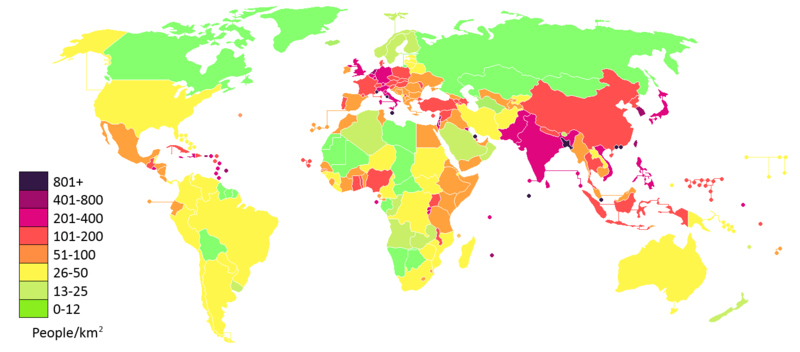
Apologies the first blog post got sent out by mistake. Weather comparisons between the two countries Last year, I had come to know that this year s debconf is happening in Canada, a cold country. Hence, few weeks/month back, I started trying to find information online when I stumbled across few discussion boards where people were discussing about Innerwear and Outerwear and I couldn t understand what that was all about. Then somehow stumbled across this Video, which is of a game called the Long Dark and just seeing couple of episodes it became pretty clear to me why the people there were obsessing with getting the right clothes and everything about it. Couple of Debconf people were talking about the weather in Montreal, and surprise, surprise it was snowing there, in fact supposed to be near the storm of the century. Was amazed to see that they have a website to track how much snow has been lifted. If we compare that to Pune, India weather-wise we are polar opposites. There used to be a time, when I was very young, maybe 5 yrs. old that once the weather went above 30 degree celsius, rains would fall, but now its gonna touch 40 degrees soon. And April and May, the two hottest months are yet to come. China Gate Before I venture further, I was gifted the book China Gate written by an author named William Arnold. When I read the cover and the back cover, it seemed the story was set between China and Taiwan, later when I started reading it, it shares history of Taiwan going back 200 or so odd years. This became relevant as next year s Debconf, Debconf 2018 will be in Taiwan, yes in Asia very much near to India. I am ashamed to say that except for the Tiananmen Square Massacre and the Chinese High-Speed Rail there wasn t much that I knew. According to the book, and I m paraphrasing here the gist I got was that for a long time, the Americans promised Taiwan it will be an Independent country forever, but due to budgetary and other political constraints, the United States took the same stand as China from 1979. Interestingly, now it seems Mr. Trump wants to again recognize Taiwan as a separate entity from China itself but as is with Mr. Trump you can t be sure of why he does, what he does. Is it just a manoeuvrer designed to out-smart the chinese and have a trade war or something else, only time will tell. One thing which hasn t been shared in the book but came to know via web is that Taiwan calls itself Republic of China . If Taiwan wants to be independent then why the name Republic of China ? Doesn t that strengthen China s claim that Taiwan is an integral part of China. I don t understand it. The book does seduce you into thinking that the events are happening in real-time, as in happening now. That s enough OT for now. null Population Density As well in the game and whatever I could find on the web, Canada seems to be on the lower side as far as population is concerned. IIRC, few years back, Canadians invited Indian farmers and gave them large land-holdings for over 100 years on some small pittance. While the link I have shared is from 2006, I read it online and in newspapers even as late as in 2013/2014. The point being there seems to be lot of open spaces in Canada, whereas in India we fight for even one inch literally, due to overpopulation. This sharing reminded me of Mark of Gideon . While I was young, I didn t understand the political meaning of it and still struggle to understand about whom the show was talking about. Was it India, Africa or some other continent they were talking about ? This also becomes obvious when you figure out the surface area of the two countries. When I had started to learn about Canada, I had no idea, nor a clue that Canada is three times the size of India. And this is when I know India is a large country. but seeing that Canada is thrice larger just boggled my mind. As a typical urbanite, would probably become mad if in a rural area in Canada. Montreal, however seems to be something like Gwalior or Bangalore before IT stormed in, seems to be a place where people can work, play and have quite a few gardens as well. Rail This is one thing that is similar in both the great countries. India has Indian Railways and while the Canadians have their own mountain railway called viarail. India chugs on its 68k kilometre network, Canada is at fourth position with 52k network. With thrice the land size, it should have been somewhere where Russia is or even better than them. It would be interesting if a Canadian/s comment about their railway network and why it is so bad in terms of reach. As far as food is concerned, somebody shared this Also, have no idea if Canadian trains are as entertaining as Indian ones, in terms of diverse group of people as well as variety of food to eat as also shared a bit in the video. I am not aware whether Via Rail is the only network operator and there are other network operators unlike Indian Railways which has monopoly on most of the operations. Countries which have first past the post system - Wikipedia Business houses, Political Families This is again something that is similar in both the countries, it seems (from afar) that its only few business houses and more importantly political families which have governed for years. From what little I could understand, both India and Canada have first past the post system which as shared by its critics is unfair to new and small parties. It would be interesting to see if Canada does a re-think. For India, it would need a massive public education outreach policy and implementation. We just had elections in 5 states of India with U.P. (with respect to area-size and population density) and from the last several years, the EVM s (Electronic Voting Machines) tries to make sure that nobody could know which area which party got the most votes. This is to make sure the winning party is not able to take revenge on people or areas which did not vote for them. Instead you have general region counting of votes with probably even the Election Commission not knowing which EVM went to what area and what results are there in sort of double-blind methodology. As far as Business houses are concerned, I am guessing it s the same world-over, only certain people hold the wealth while majority of us are in hard-working, non-wealthy status. Northern Lights - Aurora Borealis Northern Lights, Aurora Borealis Apart from all the social activities that Montreal is famous for, somebody told/shared with me that it is possible to see the Northern Lights, Aurora Borealis can be seen in Canada. I dunno how true or not it is, while probably in Montreal it isn t possible to see due to light pollution, but maybe around 40-50 kms. from the city ? Can people see it from Canada ? IF yes, how far would you have to go ? Are there any companies or people who take people to see the Northern Lights. While I still have to apply for bursary, and if that gets ok, then try getting the visa, but if that goes through, apart from debconf and social activities happening in and around Montreal, Museums, Music etc. , this would be something I would like to experience if it s possible. While I certainly would have to be prepared for the cold that would be, if it s possible, no offence to debconf or anybody else but it probably would be the highlight of the entire trip if its possible. This should be called/labelled as the greatest show on earth TM.
Filed under: Miscellenous Tagged: # Population Density, #Area size, #Aurora Borealis, #Canada, #Trains, DebConf, India, politics

Shirish Agarwal: Canada and India, similarities and differences.

Weather comparisons between the two countries Few days/weeks back, I had come to know that Canada, where this year s debconf is happening is cold country. I started trying to find information online when I stumbled across few boards where people were discussing about innerwear and outerwear and I couldn t understand what that was all about. Then somehow stumbled across this game, it s called the Long Dark and just seeing couple of episodes it became pretty clear to me why the people there were obsessing with getting the right clothes and everything about it. Couple of Debconf people were talking about weather in Montreal, and surprise, surprise it was snowing there, in fact supposed to be near the storm of the century. Was amazed to see that they have a website to track how much snow has been lifted. If we compare that to Pune, India weather-wise we are polar opposites. There used to be a time, when I was very young, maybe 5 yrs. old that once the weather went above 30 degree celcius, rains would fall, but now its gonna touch 40 degrees soon. And April and May, the two hottest months are yet to come. China Gate Before I venture further, I was gifted the book China Gate written by an author named William Arnold. When I read the cover and the backcover, it seemed the story was set between China and Taiwan, later when I started reading it, it shares history of Taiwan going back 200 or so odd years. This became relevant as next year s Debconf, Debconf 2018 will be in Taiwan, yes in Asia very much near to India. I am ashamed to say that except for the Tiananmen Square Massacre and the Chinese High-Speed Rail there wasn t much that I knew. According to the book, and I m paraphrasing here the gist I got was that for a long time, the Americans promised Taiwan it will be an Independent country forever, but due to budgetary and other political constraints, the United States took the same stand as China from 1979 and now it seems Mr. Trump wants to again recognize Taiwan as a separate entity from China itself. One thing which hasn t been shared in the book but came to know via web is that Taiwan calls itself Republic of China . If Taiwan wants to be independent then why the name Republic of China ? Doesn t that strengthen China s claim that Taiwan is an integral part of China. I don t understand it. The book does seduce you into thinking that the events are happening in real-time, as in happening now. That s enough OT for now. null Population Density As well in the game and whatever I could find on the web, Canada seems to be on the lower side as far as population is concerned. IIRC, few years back, Canadians invited Indian farmers and gave them large land-holdings for over 100 years on some small pittance. While the link I have shared is from 2006, I read it online and in newspapers even as late as in 2013/2014. The point being there seems to be lot of open spaces in Canada, whereas in India we fight for even one inch literally, due to overpopulation. This sharing reminded me of Mark of Gideon . While I was young, I didn t understand the political meaning of it and still struggle to understand about whom the show was talking about. Was it India, Africa or some other continent they were talking about ? This also becomes obvious when you figure out the surface area of the two countries. When I had started to learn about Canada, I had no idea, nor a clue that Canada is three times the size of India. And this is when I know India is a large country. but seeing that Canada is thrice larger just boggled my mind. As a typical urbanite, would probably become mad if in a rural area in Canada. Montreal, however seems to be something like Gwalior or Bangalore before IT stormed in, seems to be a place where people can work, play and have quite a few gardens as well. Rail This is one thing that is similar in both the great countries. India has Indian Railways and while the Canadians have their own mountain railway called viarail. India chugs on its 68k kilometre network, Canada is at fourth position with 52k network. With thrice the land size, it should have been somewhere where Russia is or even better than them. It would be interesting if Canadians comment about their railway network and why it is so bad in terms of reach. Business houses, Political Families This is again something that is similar in both the countries, it seems (from afar) that its only few business houses and more importantly political families which have governed for years.
Filed under: Miscellenous

Bits from Debian: DebConf17 welcomes its first eighteen sponsors!

DebConf17 logo DebConf17 will take place in Montreal, Canada in August 2017. We are working hard to provide fuel for hearts and minds, to make this conference once again a fertile soil for the Debian Project flourishing. Please join us and support this landmark in the Free Software calendar. Eighteen companies have already committed to sponsor DebConf17! With a warm welcome, we'd like to introduce them to you. Our first Platinum sponsor is Savoir-faire Linux, a Montreal-based Free/Open-Source Software company which offers Linux and Free Software integration solutions and actively contributes to many free software projects. "We believe that it's an essential piece [Debian], in a social and political way, to the freedom of users using modern technological systems", said Cyrille B raud, president of Savoir-faire Linux. Our first Gold sponsor is Valve, a company developing games, social entertainment platform, and game engine technologies. And our second Gold sponsor is Collabora, which offers a comprehensive range of services to help its clients to navigate the ever-evolving world of Open Source. As Silver sponsors we have credativ (a service-oriented company focusing on open-source software and also a Debian development partner), Mojatatu Networks (a Canadian company developing Software Defined Networking (SDN) solutions), the Bern University of Applied Sciences (with over 6,600 students enrolled, located in the Swiss capital), Microsoft (an American multinational technology company), Evolix (an IT managed services and support company located in Montreal), Ubuntu (the OS supported by Canonical) and Roche (a major international pharmaceutical provider and research company dedicated to personalized healthcare). ISG.EE, IBM, Bluemosh, Univention and Skroutz are our Bronze sponsors so far. And finally, The Linux foundation, R seau Koumbit and adte.ca are our supporter sponsors. Become a sponsor too! Would you like to become a sponsor? Do you know of or work in a company or organization that may consider sponsorship? Please have a look at our sponsorship brochure (or a summarized flyer), in which we outline all the details and describe the sponsor benefits. For further details, feel free to contact us through sponsors@debconf.org, and visit the DebConf17 website at https://debconf17.debconf.org.
19 March 2017

Dirk Eddelbuettel: Rcpp 0.12.10: Some small fixes

The tenth update in the 0.12.* series of Rcpp just made it to the main CRAN repository providing GNU R with by now over 10,000 packages. Windows binaries for Rcpp, as well as updated Debian packages will follow in due course. This 0.12.10 release follows the 0.12.0 release from late July, the 0.12.1 release in September, the 0.12.2 release in November, the 0.12.3 release in January, the 0.12.4 release in March, the 0.12.5 release in May, the 0.12.6 release in July, the 0.12.7 release in September, the 0.12.8 release in November, and the 0.12.9 release in January --- making it the fourteenth release at the steady and predictable bi-montly release frequency. Rcpp has become the most popular way of enhancing GNU R with C or C++ code. As of today, 975 packages on CRAN depend on Rcpp for making analytical code go faster and further. That is up by sixtynine packages over the two months since the last release -- or just over a package a day! The changes in this release are almost exclusively minor bugfixes and enhancements to documentation and features: James "coatless" Balamuta rounded out the API, I aki Ucar fixed a bug concerning one-character output, Jeroen Ooms allowed for finalizers on XPtr objects, Nathan Russell corrected handling of lower (upper) triangular matrices, Dan Dillon and I dealt with Intel compiler quirks for his algorithm.h header, and I added a C++17 plugin along with some (overdue!) documentation regarding the various C++ standards that are supported by Rcpp (which is in essence whatever your compiler supports, i.e., C++98, C++11, C++14 all the way to C++17 but always keep in mind what CRAN and different users may deploy).

Changes in Rcpp version 0.12.10 (2017-03-17)
  • Changes in Rcpp API:
    • Added new size attribute aliases for number of rows and columns in DataFrame (James Balamuta in #638 addressing #630).
    • Fixed single-character handling in Rstreambuf (I aki Ucar in #649 addressing #647).
    • XPtr gains a parameter finalizeOnExit to enable running the finalizer when R quits (Jeroen Ooms in #656 addressing #655).
  • Changes in Rcpp Sugar:
    • Fixed sugar functions upper_tri() and lower_tri() (Nathan Russell in #642 addressing #641).
    • The algorithm.h file now accomodates the Intel compiler (Dirk in #643 and Dan in #645 addressing issue #640).
  • Changes in Rcpp Attributes
    • The C++17 standard is supported with a new plugin (used eg for g++-6.2).
  • Changes in Rcpp Documentation:
    • An overdue explanation of how C++11, C++14, and C++17 can be used was added to the Rcpp FAQ.

Thanks to CRANberries, you can also look at a diff to the previous release. As always, even fuller details are on the Rcpp Changelog page and the Rcpp page which also leads to the downloads page, the browseable doxygen docs and zip files of doxygen output for the standard formats. A local directory has source and documentation too. Questions, comments etc should go to the rcpp-devel mailing list off the R-Forge page.

This post by Dirk Eddelbuettel originated on his Thinking inside the box blog. Please report excessive re-aggregation in third-party for-profit settings.

Petter Reinholdtsen: Free software archive system Nikita now able to store documents

The Nikita Noark 5 core project is implementing the Norwegian standard for keeping an electronic archive of government documents. The Noark 5 standard document the requirement for data systems used by the archives in the Norwegian government, and the Noark 5 web interface specification document a REST web service for storing, searching and retrieving documents and metadata in such archive. I've been involved in the project since a few weeks before Christmas, when the Norwegian Unix User Group announced it supported the project. I believe this is an important project, and hope it can make it possible for the government archives in the future to use free software to keep the archives we citizens depend on. But as I do not hold such archive myself, personally my first use case is to store and analyse public mail journal metadata published from the government. I find it useful to have a clear use case in mind when developing, to make sure the system scratches one of my itches. If you would like to help make sure there is a free software alternatives for the archives, please join our IRC channel (#nikita on irc.freenode.net) and the project mailing list. When I got involved, the web service could store metadata about documents. But a few weeks ago, a new milestone was reached when it became possible to store full text documents too. Yesterday, I completed an implementation of a command line tool archive-pdf to upload a PDF file to the archive using this API. The tool is very simple at the moment, and find existing fonds, series and files while asking the user to select which one to use if more than one exist. Once a file is identified, the PDF is associated with the file and uploaded, using the title extracted from the PDF itself. The process is fairly similar to visiting the archive, opening a cabinet, locating a file and storing a piece of paper in the archive. Here is a test run directly after populating the database with test data using our API tester:
~/src//noark5-tester$ ./archive-pdf mangelmelding/mangler.pdf
using arkiv: Title of the test fonds created 2017-03-18T23:49:32.103446
using arkivdel: Title of the test series created 2017-03-18T23:49:32.103446
 0 - Title of the test case file created 2017-03-18T23:49:32.103446
 1 - Title of the test file created 2017-03-18T23:49:32.103446
Select which mappe you want (or search term): 0
Uploading mangelmelding/mangler.pdf
  PDF title: Mangler i spesifikasjonsdokumentet for NOARK 5 Tjenestegrensesnitt
  File 2017/1: Title of the test case file created 2017-03-18T23:49:32.103446
~/src//noark5-tester$
You can see here how the fonds (arkiv) and serie (arkivdel) only had one option, while the user need to choose which file (mappe) to use among the two created by the API tester. The archive-pdf tool can be found in the git repository for the API tester. In the project, I have been mostly working on the API tester so far, while getting to know the code base. The API tester currently use the HATEOAS links to traverse the entire exposed service API and verify that the exposed operations and objects match the specification, as well as trying to create objects holding metadata and uploading a simple XML file to store. The tester has proved very useful for finding flaws in our implementation, as well as flaws in the reference site and the specification. The test document I uploaded is a summary of all the specification defects we have collected so far while implementing the web service. There are several unclear and conflicting parts of the specification, and we have started writing down the questions we get from implementing it. We use a format inspired by how The Austin Group collect defect reports for the POSIX standard with their instructions for the MANTIS defect tracker system, in lack of an official way to structure defect reports for Noark 5 (our first submitted defect report was a request for a procedure for submitting defect reports :). The Nikita project is implemented using Java and Spring, and is fairly easy to get up and running using Docker containers for those that want to test the current code base. The API tester is implemented in Python.

Next.

Previous.