Search Results: "cas"

2 November 2010

Theodore Ts'o: I have the money shot for my LCA presentation


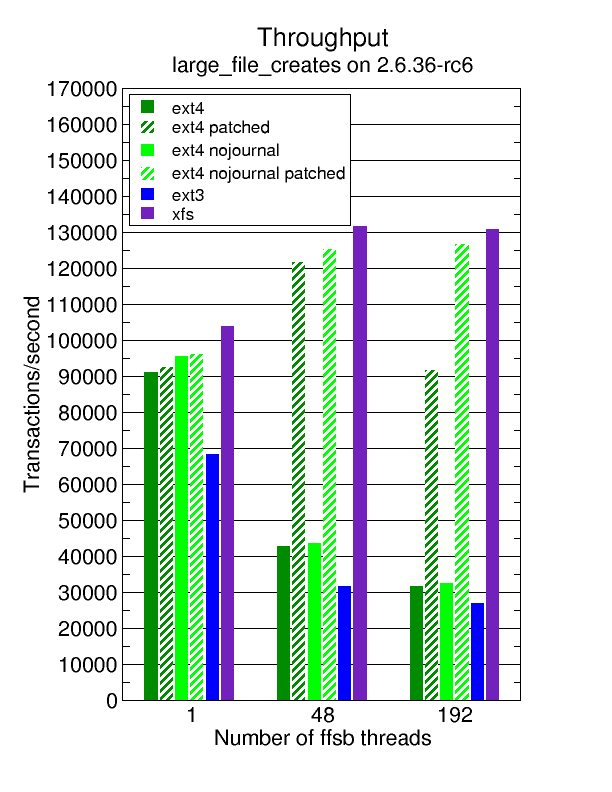
Thanks to Eric Whitney s benchmarking results, I have my money shot for my upcoming 2011 LCA talk in Brisbane, which will be about how to improve scalability in the Linux kernel, using the case study of the work that I did to improve scalability via a series of scalability patches that were developed during 2.6.34, 2.6.35, and 2.6.36 (and went into the kernel during subsequent merge window). These benchmarks were done on a 48-core AMD system (8 sockets, 6 cores/socket) using a 24 SAS-disk hardware RAID array. Which is the sort of system which XFS has traditionally shined on, and for which ext3 has traditionally not scaled very well at. We re now within striking distance of XFS, and there s more improvements to ext4 which I have planned that should help its performance even further. This is the kind of performance improvement that I m totally psyched to see! No related posts.

1 November 2010

Julien Valroff: Mini DebConf Paris 2010

I am now back home after 2 days spent at the first mini DebConf Paris. It was really nice to meet a lot of people, and to be able to discuss various aspects of Debian and Free Software in general. People came from all over Europe (at least from the UK, Spain, Italy, Germany, Switzerland, Austria, Greece, and obviously a majority of French people). All the talks I have been able to attend were really interesting, and some of the slides have already been made available by their author: I have also taken part to the keysigning party, which will now allows me to use my newly generated 4096R key. The group picture is also online, as well as a more comprehensive gallery. Thanks a lot to the organisation team, you guys have made an awesome work! See you all next year!

Michal Čihař: Cleaning up the web

After recent switch of this blog to Django, I've also planned to switch rest of my website to use same engine. Most of the code is already written, however I've found some forgotten parts, which nobody used for really a long time. As most of the things there is free software, I don't like idea removing it completely, however it is quite unlikely that somebody will want to use these ancient things. Especially when it quite lacks documentation and I really forgot about that (most of them being Turbo Pascal things for DOS, Delphi components for Windows and so on). Anyway it will probably live only on dl.cihar.com in case anybody is interested.

Filed under: Django Website 0 comments Flattr this

31 October 2010

Lucas Nussbaum: Mini DebConf Paris 2010

So, I m (almost) back from the first edition of MiniDebConf Paris, which was a success thanks to the great organizing skills in panic mode of Carl Chenet and Mehdi Dogguy. I think that everybody is already looking forward to the next edition. I met lots of people, and it was great to be able to finally put faces on names from the french free software community. I gave two talk there, the first one on Debian and Ubuntu (slides), the second one on Debian Quality Assurance (slides), which both went well (I think). I also hacked a bit: If you want to help me, here are some easy tasks that need takers (it s unlikely that I ll be able to tackle them anytime soon): One of the other things I d like to do is discuss ways to improve the synchronization of UDD (currently, it s synchronized at arbitrary times, while we could sync Sources+Packages just after dinstall, for example).

30 October 2010

Lucas Nussbaum: Debian becoming upstream for ubuntu-dev-tools?

Launchpad bug #643691: Please sync ubuntu-dev-tools 0.103 (universe) from Debian experimental (main) Did development of ubuntu-dev-tools move from Ubuntu to Debian? :-)

Russell Coker: Parkour in Melbourne

When I was walking past Southbank when I saw some Parkour being practiced. I watched for a while and spoke to the instructor after the informal lesson was finished. He s a professional instructor with the Melbourne branch of the Australian Parkour Association [1] and he sometimes gives free advice to newbies that he meets on the street (in this case a group of 6 teenage boys). From the web site it seems that the standard lesson fee is $15 for an indoor lesson or $10 for an outdoor lesson with a $5 discount for members of the Australian Parkour Association [2], which is really cheap for a 2 hour lesson! APA membership costs $10 to join plus a $50 annual membership fee. It s worth reading the ParkourPedia information about the spirit/philosophy that is Parkour [3]. It s interesting to note that there can be no official Parkour shows because if you do it for anyone else then it s not Parkour so much for all the Parkour videos on Youtube. Also another issue with the Youtube videos is that Parkour isn t about doing the most dangerous things you can possibly survive in an urban environment, it can be practiced in country areas and isn t supposed to be unreasonably dangerous. The outdoor Parkour lessons start near the Arts center in the middle of Melbourne and presumably some of them go past Southbank as it has some interesting things to jump over. So it s worth watching out for people jumping over various obstacles instead of walking around them. They may not be doing a Parkour show, but it s in public and anyone can watch.

28 October 2010

Marco Silva: An utility for sshpass

I just discovered sshpass and saw some comments of people complaining that there's no good use case that justifies it. Well, I have a use case. That's in fact what made me search about the theme and found it. I created a user on a machine and I can't remember which password I used, but I know it's probably one of a small list I can think of. The list is composed of variations of the same string, in a way that I could generate with a program. It would take me time to try all the passwords by hand, so using sshpass make things much easier:
$ generate-password > pass-list
$ for i in  cat pass-list ; do sshpass -p $i ssh host; done

John Goerzen: Rudy Schmidt & Time Capsules

This evening, I arrived at church for mens chorus practice. I was surprised to see this sign on the door:
Rudy Schmidt died rather unexpectedly, but peacefully on Wednesday morning at his home .
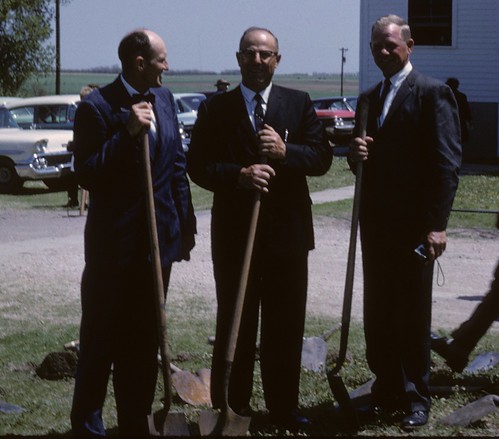
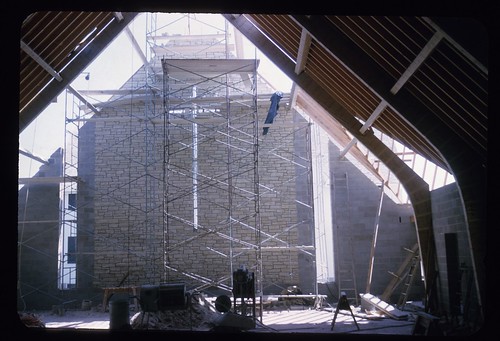
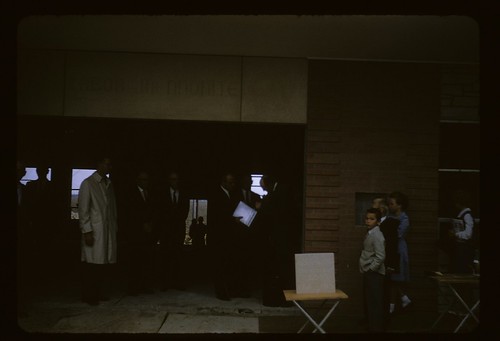
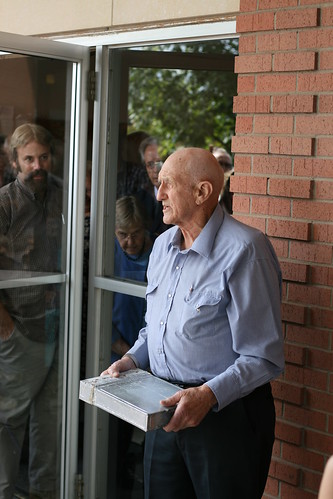
One of the benefits of living in a small community is that I get to know people of all ages around here. Not just people my own age, or coworkers. A few years ago, I worked on a history project for our church s centennial. Back in the 1960s, Rudy was one of the people in charge of building our current church. So he was a person I was interested in visiting with. Here he is, on the left, during the 1964 groundbreaking ceremony for the new building (the old one is visible in the background). 022 stamped may 1964cropped.jpg I and a few others went to his home one time a few years ago and we had a wonderful evening. Rudy shared all sorts of stories with us which I am happy to say I recorded. But moreover, Rudy was an avid photographer. There were some rare and brilliant color slides of the church being built in his collection. He let me borrow and scan some of them. Here are my two favorites: 015 stamped july 1964.jpg 016 stamped oct 1964.jpg Back in 1965, there was a ceremony at the setting of the cornerstone of Tabor Church. The people at the time assembled some papers and memorabilia and put them in a time capsule. Rudy Schmidt sealed the capsule and it was placed in the spot for it behind the cornerstone. Here is a photo of that ceremony. 013 stamped nov 1964.jpg 44 years later, on the occasion of Tabor s centennial, it was time to open the time capsule. The other building committee people, such as Jake Koehn, had passed away, so Rudy was the one to open it. He gave a few words in front of the large crowd, and mentioned that when he sealed it away, he smelled some smoke when he soldered it shut. Jake Koehn told him, Don t worry, nobody will ever see it again anyway and they had a little laugh about it. Now he was going to open it up and see if anything survived. img_6173.jpg It all did just a few minor burn marks. We enjoyed looking at all the items. Then the church placed some new items into the capsule. It was closed up again, to be opened in maybe 50 years. With luck, I ll still be around to see it opened again. Even if I m not, maybe Jacob and Oliver will be able to. And so it seems very fitting that the last hands to touch that box for the next 50 years were Rudy Schmidt s, when he placed it back in its spot on Oct. 12, 2008. img_6243.jpg

27 October 2010

Gerfried Fuchs: Report from openSUSE Conference

Like you most likely know, I've been at the openSUSE Conference last week. I've been representing Debian through a talk about Debian - The Project and its Resources, covering services and resources that are usable and useful for other distributions too. The invitation to submit talks were sent to various projects and distributions because of the set topic on Collaboration across Borders for the conference. My impression was that very few distributions have followed the invitation, I am only aware of some Fedora people that have attended. Vincent Untz from GNOME gave a combined keynote with Cornelius Schumacher from KDE. The abstract of my talk and the slides are available from the conference website. The talk was well received and interested people also asked about some of the services like how our buildd network works, or whether the screenshots service has support for localized images too, or if it would be expandable for more general usage of non-Debian based distributions. One topic raised was with respect to the whohas tool: A mapping layer/tool/database for package names. We divert from upstream naming schemes for consistency reasons, like with our library, Perl and Python naming schemes. Other distributions have similar approaches but a different naming scheme. To make inter-distribution tools really useful it would require to have some layer that is able to map the package name from one distribution to another one. One idea for it that was thrown in was to use upstream homepage, but not all packages do have proper homepages, some only live in some git repository, others would either like to link to sourceforge's project page instead of the project's homepage, and other tricky issues. Something unique is clearly called for here and needed to get stored in the package's metadata. Apart from my talk and the occasional mentioning of openSUSE is on my desktop, but I run Debian on my server I noticed that the beverage of openSUSE is their own beer. Taste is a tough topic, personally I rather prefer our Debian wine. And I missed the chance to seduce them into playing Mao, I forgot to bring playing cards along. I hope to get a second chance at anoter event.

/debian permanent link Comments: 3 Flattr this

26 October 2010

Jos? Parrella: Stumbling with Mono and C# applications in Linux

In the past, I ve helped customers run native Windows applications using emulation (wine) and/or virtualization, and in few cases, native support for C# by open source projects such as Mono. But, as it s been said, there are great benefits of having source code, and I recently worked around an issue in Mono by recompiling a whole .NET project in Debian. So here s a brief guide reviewing the issues that I found and how I solved each one of them leading to a natively-compiled C# application that runs seamlessly in Debian and Windows, and please remember I m not a C#/.NET/Mono developer: That said, I had a great time fiddling with this C# application and Mono on my Debian Sid laptop. I was able to properly compile without errors nor framework-related warnings, using an IDE such as MonoDevelop, and have a full-featured native binary that s interoperable.

Jelmer Vernooij: OpenChange server and SOGo

There's more good news on the OpenChange front. Julien has been working together with Wolfgang and Ludovic from Inverse recently to leverage the server-side support in OpenChange to provide native Exchange server support in SOGo. A couple of days ago we announced that there now is an initial version that allows the use of Outlook against a SOGo server through OpenChange.

<object data="http://www.youtube.com/v/oSZJ95YeXYE?fs=1&amp;hl=en_US&amp;hd=1" height="385" type="application/x-shockwave-flash" width="480"><param name="movie" value="http://www.youtube.com/v/oSZJ95YeXYE?fs=1&amp;hl=en_US&amp;hd=1"><param name="movie" value="http://www.youtube.com/v/oSZJ95YeXYE?fs=1&amp;hl=en_US&amp;hd=1"><param name="allowFullScreen" value="true"><param name="allowscriptaccess" value="always"></object> (alternatively you can find the screencast here) As far as I know, this is the first time it's possible to actually use Outlook clients with a non-Microsoft Exchange-compatible server without the need for plugins on the Outlook side. And it's all Free Software. Of course, this is just a preview, and not something we'd recommend everybody to run in production yet. But it's exciting to finally see this come together. We already have OpenChange packages in Debian and Ubuntu but I hope I can help get SOGo packaged for both distributions as well.

Julian Andres Klode: simple code clang creates 1600x faster executable than gcc

The following program, compiled with clang 1.1, runs 500 times faster than the gcc4.5-compiled code (in both cases with -O2):
#include <stdio.h>
#define len 1000000000L
unsigned long f(unsigned long a, unsigned long b) __attribute__((noinline));
int main()
 
    printf("%lu\n", f(0, 2*len));
    return 0;
 
unsigned long f(unsigned long a, unsigned long b)
 
    unsigned long sum = 0;
    for (; a < b; a++)
        sum += a;
    return sum;
 
Now, I would be interested to see what s happening here. I took a look at the assembler code both compilers create, but the only thing I found out so far is that gcc s assembly is easier to understand 50 lines (gcc) vs 134 lines (clang). If someone knows the answer, please tell me. Also see http://lwn.net/Articles/411776/ for a C++ version that calls f() via boost::thread. Update: I also reported a bug at http://gcc.gnu.org/bugzilla/show_bug.cgi?id=46186.
Filed under: General

David Welton: Kindle?

I'm thinking about getting a Kindle, and I thought I'd write down some thoughts, even if they're a bit jumbled, and invite commentary. Good: One thing I really like, living here in Italy, is that I would be able to get English language books instantaniously, and not pay shipping or import duties on them. Whatever disadvantages there may be, that is a huge advantage. Closely tied to that: if we ever move back to the US, shipping all our books will be very expensive. Having some of them in an electronic format would lighten that load considerably. It's fairly cheap. At $180, it's not something I'd want to treat carelessly, but it's significantly less expensive than various existing tables. Long battery life means it's not something you have to worry much about. E-ink looks like it's easier on the eyes than LCD screens. I'm not sure, but also its slow update speed might be a "feature not a bug" in the sense that you're not so easily distracted by the internet being just one click away. Bad: I love having real, physical books in my house. I grew up in a house full of books, and I want the same thing for my daughter. I like being able ot look through them, pick one up, and read about something. Real books are very convenient, as long as you're not lugging around hundreds of them. I like not having to worry too much about dropping them, about getting a bit of water on one or that sort of thing. You can cart them around in a backpack with little worry, take them to the beach, and so on. As far as I can tell, Knuth's books are not available for, nor would appear like they do on paper. That's the golden standard for me: once "The Art of Computer Programming" looks good on an e-reader, it will be really and truly ready. We're not there yet. It's not general purpose. Like I said above, maybe this is good for reading, but there are also times when it'd be nice to have a general purpose device, with email, maps, applications, and so on. A while back, Amazon announced some sort of beta program for a kindle SDK. I haven't heard much of anything since. So it looks like it's not really possible to code for it, which is a bit disappointing. I like to have that option available, even if I don't always exercise it. Unknown: The pricing: sometimes Kindle versions are cheaper (especially, in my case, considering shipping, and, potentially, import duties), but sometimes they aren't, which seems a bit unfair, given that you cannot sell the book if you don't like it. I'm not sure how it would work out for me in the aggregate. Digital Rights Management, or DRM, means you can't, say, sell someone a "used" ebook. This is, in some ways, understandeable, because it's not like an e-book degrades with time as a physical one might. Were it possible to sell on your old books, that might radically change the market. I could see that having both good consequences (cheaper books), but also negative ones for authors (less money). I suppose this topic merits a post or two, or even an entire book of its own, because it's a complicated subject without, in my opinion, "easy" answers. Suffice it to say, though, that there are some drawbacks, but I suppose it's also nice that Amazon "knows" which books I have, so even if I switch to a different reader, I still have my books. And it's good that authors can get paid to work on a book. Not having actually bought it yet, I have no idea how it actually 'feels' to read a book with one. I love curling up with a good book, something I certainly can't do with my laptop. The Kindle looks light and small enough that it could work, but maybe it's just too high tech and sleek to provide that same comfortable coziness. Or maybe I'm just a luddite where books are concerned?
Do you have one? Do you use it? For all kinds of books or just certain kinds (technical books, cheap 'fun' reads, whatever...)? What's the experience like?
25 October 2010

Axel Beckert: ratpoison and focus follows mouse

I use ratpoison as window manager on my ASUS EeePC netbook nemo for more than two years now. But although I m very happy with ratpoison in the EeePC, there are two feature wishes which have been refused by upstream: One is more flexibel window name matching for the unmanage command. The other one is focus follows mouse between ratpoison frames. Well, I always guessed that it was possible, but it took until now to find outhow to implement focus follows mouse for ratpoison. There s an ancient but still useful tool called Not a Window Manager (nawm) which is a small awk-like interpreter offering mostly window handling functions. The following .nawmrc implements focus follows mouse in nawm:
window newwin;  # stores window to raise
window lastwin; # stores previous window to prevent race conditions
leave  
    lastwin = currentwindow;
 
enter  
    newwin = pointerwindow();
    if (name(newwin) != "" && newwin != lastwin)  
        raise newwin;
        sync;
     
 
The leave hook is necessary to prevent flapping between two windows if switched between them via ratpoison s commands. I also had to add the following hook to my .ratpoisonrc to work around some cases where ratpoison s own window switching didn t work anymore. Only happened with more than one frame with one frame banishing the mouse cursor was annoying, so I filtered that case:
addhook switchwin exec if [  ratpoison -c fdump fgrep -o frame wc -l  -gt 1 ]; then ratpoison -c banish; fi
Unfortunately nawm has been removed from Debian Sid about a year ago due to being buggy and orphaned. There was not upstream development for seven years or so either. So for the moment you can get nawm either from Debian Lenny or from snapshot.debian.org. But I had to fix a segfault in nawm when calling name() on a window without name to be able to use it at all, so you will probably have to rebuild it anyway with the following patch:
diff -u nawm-0.0.20030130/builtins.c nawm-0.0.20030130-patched/builtins.c
--- nawm-0.0.20030130/builtins.c        2010-10-25 06:00:02.000000000 +0200
+++ nawm-0.0.20030130-patched/builtins.c        2010-10-25 04:15:25.000000000 +0200
@@ -546,8 +546,12 @@
     *name = gcstrdup("");
   else
      
-      *name = gcstrdup((char *)nm);
-      XFree(nm);
+      if ((char *)nm)  
+        *name = gcstrdup((char *)nm);
+        XFree(nm);
+        else  
+        *name = gcstrdup("");
+       
      
  
And yes, I m thinking about adopting and reintroducing the nawm package into Debian Sid. But I d prefer if anyone could give me a hint how to do this with more current and still maintained tools (or a patch against ratpoison :-). I looked into suckless-tools, but I haven t found anything in there which provides hooks on X events. And the Perl module Tk seems to be able to set X event hooks, but only within the application being written itself.

Jonathan Wiltshire: Facebook groups: a gift to framers

I didn t quite believe what I was seeing until I searched and found several other people noticing the same behaviour. For background, Facebook recently introduced the concept of groups not in the sense we ve been used to, but more like lists. Groups are supposed to be to lists what databases are to bits of paper. You can add friends to groups to organise them, send them group emails, run a collective mailing list, and so on. Except that in practice, this is another really good way of exploiting lazy users. See, there are some things to know about groups: The second point may be wrong it s very unclear exactly what permission is afforded to a group member and when or where information about the group membership is published. Since my day job is in private education, this immediately makes me think of two terrifying scenarios:
  1. A student inadvertently gets added to a large group and nobody notices because there is so much other traffic. Whatever my other privacy settings, anything I or anyone else posted to the group is now visible to him this is the same as the previous group arrangement. The difference is that he can now go on and add anyone else Mark Zuckerberg himself even without any kind of checks by the group administrator. A membership system like this quickly spirals out of control.
  2. Somebody with a grudge maybe I took too long fixing their PC adds me to a group with, shall we say, inappropriate or unsavoury content while I m away on holiday and tips off the child protection officer. Better yet, he first sends an email to all staff expressing horror and asking them to verify this in case it s his computer lying. Now there are multiple witnesses to the fact that I was a member of this group, and I return from the sea side to find a P45 on the door mat.
Unlike free software, I can t fix this. Fortunately, I have: enabled every email notification under the sun; few and trustworthy friends; according to my profile, no interests or contact details whatsoever; and no care for groups. I m happy with my lists, thanks all the same.
Comments flattr this!

Steve Kemp: Delivering to a Maildir folder, but marking as read

Email. We get a lot of it. We filter out the SPAM. Then if we're well-organized we file it away into folders as it arrives. (To be fair some people use priority settings such that all mail stays in their INBOX until they're "done" with it. I've never had the patience for that kind of behaviour.) One problem which I often encounter is wanting to have email be delivered, archived, and stored, but I don't want to read it. Yet when I see a folder in my mail client which has unread mail in it I cannot unsee. In my case I deliver mail to folders as it arrives via either Exim's filter language, or procmail. Procmail blows goats on the whole, but it is common and available everywhere - I just don't trust my own DSL enough to rely upon it (which is a dangerous sign). So, how do you deliver a new mail to a Maildir folder, and mark it read at the same time? Well you can be na ve and do what I did which is to invoke formail to add "Status: ro" to the header. Unfortunately that's insufficient to mark a mail as read when viewed in mutt. When an email is stored in a Maildir folder its status is encoded in part of its filename - which is why you'll have files like:
new/1288039894.28406_3.steve.org.uk
cur/1283711971.11157_3.skx.xen-hosting.net:2,S
The latter file has been Seen. So to mark a message as not-new you need to do two things: I've seen some horrific shell + procmail code to do the job, but the simpler version is:
:0
*^(To: From:).*root@
*^X-added-header:.*debian-administration.org
  ~/bin/read-to-maildir .machines.debian-administration.org/
Similarly you can use Exim's filter language to do the same job:
# Exim filter
if $h_to: contains "hostmaster@" then
    pipe "/home/skx/bin/read-to-maildir /home/steve/Maildir/.hostmaster/"
finish
Cute. Obvious too? Maybe not to me. ObSubject: Why did you murder someone, Raymond? - In Bruges

Rapha&#235;l Hertzog: Secret figures of a Debian/Ubuntu blogger: what you liked most on raphaelhertzog.com

Chart goes up on screenI launched raphaelhertzog.com this summer (taking over the English content of my former multi-lingual blog), when I decided that I would be more serious about blogging on Debian/Ubuntu related topics. On September, I decided to write 2 articles per week and up to now I managed to keep the schedule. Two of my articles were published by Linux Weekly News, those are much more researched than the average blog article (they are tagged with [LWN] in the list below). The most popular articles Most people read my blog through the RSS feed which happens to be syndicated on Planet Debian and Planet Ubuntu. According to the feedburner s statistics, the top-5 articles are:
  1. 5 reasons why I still contribute to Debian after 12 years (32700 views)
  2. [LWN] Understanding Membership Structures in Debian and Ubuntu (31700 views)
  3. Social Micropayment Can Foster Free Software, Discover Flattr (30100 views)
  4. Everything you need to know about conffiles: configuration files managed by dpkg (29900 views)
  5. How to make 110.28 EUR in one month with free software and Flattr (29400 views)
But I also have occasional readers visiting my blog because my articles are announced on Identi.ca, Twitter and Facebook (and they circulate on social networks, thanks to those who are sharing them!). The top-5 articles according to the statistics of my website are:
  1. 5 reasons why I still contribute to Debian after 12 years (6000 views)
  2. [LWN] Can Debian offer a Constantly Usable Testing distribution? (5000 views)
  3. Understanding Debian s release process (1500 views)
  4. Flattr FOSS (1400 views, not an article but I regularly blog about this project)
  5. Can Debian achieve world domination without being on Facebook? (1100 views)
The most flattered Since I am using Flattr on my blog, it can be interesting to see the articles which generated lots of flattr micro-donations. The top-3 articles are my articles about Flattr (1, 2, 3). Excluding articles related to Flattr, the top-5 is:
  1. 5 reasons why I still contribute to Debian after 12 years (12 flattr)
  2. The secret plan behind the 3.0 (quilt) Debian source package format (10 flattr)
  3. How to use multiple upstream tarballs in Debian source packages? (5 flattr)
  4. [LWN] Understanding Membership Structures in Debian and Ubuntu (4 flattr)
  5. Do You Want a Free Debian Book? Read on. (4 flattr)
Most articles get 2 to 3 flattr clicks. The most commented I usually get 4-5 comments on most articles but some generate much more feedback:
  1. [LWN] Can Debian offer a Constantly Usable Testing distribution? (40 comments)
  2. 5 reasons why I still contribute to Debian after 12 years (22 comments)
  3. Can Debian achieve world domination without being on Facebook? (15 comments)
  4. How to generate different dependencies on Debian and Ubuntu with a common source package (14 comments)
  5. [LWN] Understanding Membership Structures in Debian and Ubuntu (12 comments)
Factoids Here are my conclusions based on the above figures: If you also appreciate the above-linked articles, you should click here to subscribe to my email newsletter.

Flattr this Share/Bookmark 4 comments Support my work

Wouter Verhelst: Bubble maker

I don't believe in bottled water. The reason for that should be obvious to anyone who thinks about it for more than just a second, but in case you can't figure it out:bottled water sucks. Since I moved out on my own, now over two years ago, I haven't bought the slightest amount of water other than through the tap. This wasn't a conscious decision, originally; it's just that I'm not a fan of non-sparkling water, and that buying 1.5L bottles of sparkling water would quickly reduce to non-sparkling ones by the rate I drink it, and I just didn't think it worth buying for that reason. As I came to realize that tap water is a fine beverage, and that for all practical purposes it is free or mostly so, compared to bottled water I stopped even considering the idea to buy bottled water. But I do still like sparkling water every once in a while; and this weekend, I remembered that about a decade ago, an acquaintance who worked for Philips had shown me a prototype apparatus to generate sparkling water out of plain water in approximately 1L quantities. It was a prototype then, so I could imagine it being a product today. Googling around for a while found no Philips product of that type; but then I did find another company that specializes in such devices. Their devices are fairly cheap (or, at the very least, affordable). And the best part: it doesn't even require electricity (contrary to that prototype device I saw so many years ago). One is on its way now. Wonder what it'll be like.

24 October 2010

Gregor Herrmann: RC bugs 2010/41 - 2010/42

it seems I was a bit busy & lazy in the last two weeks. luckily diocles & evgeni were more active than me kudos!

here are my small contributions:

Tim Retout: RC bugs for w/c 2010-10-17

My humble RC bug squashing efforts for this week. I've saved them all up, because I don't want to spam Planet Debian too much... or alternatively, because I've been feeling ill Thursday/Friday and didn't do anything at all. Note that quite a few of these were "cheating" by just closing bugs that someone else had written a patch/comment for, and the mgltools-* ones are in non-free software, so they won't have the same impact on the RC bug stats. Also, I've mentioned the gnucash and sawfish ones before, but they'll definitely be counted in the stats now..

Next.

Previous.