Search Results: "tar"

19 June 2014

Joachim Breitner: Another instance of Haskell Bytes

When I gave my Haskell Bytes talk on the runtime representation of Haskell values the first time, I wrote here It is in German, so [..] if you want me to translate it, then (convince your professor or employer to) invite me to hold the talk again . This has just happened: I got to hold the talk as a Tech Talk at Galois in Portland, so now you can fetch the text also in English. Thanks to Jason for inviting me!
This was on my way to the Oregon Summer School on Programming Languages in Eugene, where I m right now enjoying the shade of a tree next to the campus. We ve got a relatively packed program with lectures on dependent types, categorical logic and other stuff, and more student talks in the evening (which unfortunately always collide with the open board game evenings at the local board game store). So at least we started to have a round of diplomacy, where I am about to be crushed from four sides at once. (And no, I don t think that this has triggered the illegal download warning that the University of Oregon received about our internet use and threatens our internet connectivity.)

Joey Hess: what does docker.io run -it debian sh run?

When you type docker.io run -it debian sh, it goes off and gets "debian" and runs it. But what is in this "debian" image? How was it built? The docker hub does not really say. All it tells us is this is a "(Semi) Official Debian base image" and that its sources.list uses http.debian.net for geolocation. There's a link to https://github.com/dotcloud/stackbrew/blob/master/library/debian which in turn uses a very strange git repository, owned by Debian maintainer Tianon Gravi, that contains compressed tarballs of Debian: http://github.com/tianon/docker-brew-debian "Git is not a fan of what we're doing here." The "source", such as it is, that is used to build this image consists of:
FROM scratch
ADD rootfs.tar.xz /
CMD ["/bin/bash"]
and
mkimage.sh -t tianon/debian:wheezy -d . debootstrap --variant=minbase --components=main --include=inetutils-ping,iproute wheezy http://http.debian.net/debian
I don't know where mkimage.sh is. [Update: Probably /usr/share/docker.io/contrib/mkimage-debootstrap.sh or a modified version] And anyway, I have no reason to trust that this image is built the way it claims to be built. So, the question remains: What is in this image? To find out, I did a debootstap --variant=minbase stable and diffed the entire docker debian image against it. The diff was 6738 lines, from which I found the following interesting differences. added packages The image has iputils-ping and netbase and iproute added. These are not in a minbase debootstrap, but are in a regular debootstrap. It's rather weird that the docker image is based on a minbase debootstrap, since this means they have to add back important stuff like this on an ad-hoc basis.
If the expectation is that an experienced Unix person who found it missing would say "What on earth is going on, where is 'foo'?", it must be an 'important' package. -- Debian Policy
apt hooks
DPkg::Post-Invoke   "rm -f /var/cache/apt/archives/*.deb /var/cache/apt/archives/partial/*.deb /var/cache/apt/*.bin   true";  ;
APT::Update::Post-Invoke   "rm -f /var/cache/apt/archives/*.deb /var/cache/apt/archives/partial/*.deb /var/cache/apt/*.bin   true";  ;
Dir::Cache::pkgcache "";
Dir::Cache::srcpkgcache "";
Acquire::Languages "none";
These are some strange modifications to apt's config. The intent is clearly to avoid wasting disk space, even at the expense of making apt slower (by disabling caches) and losing translations. I am curious if apt might ever invoke the DPkg::Post-Invoke twice in an upgrade in which it runs dpkg twice. I'm also curious whether deleting /var/cache/apt/archives/lock could cause a problem. unsafe-io dpkg is configured to use unsafe-io. motd
Linux viper 3.12.20-gentoo #1 SMP Sun May 18 12:36:24 MDT 2014 x86_64
Yes, that's "gentoo". Presumably this tells us something about the build host. policy-rc.d /usr/sbin/policy-rc.d contains "exit 101", which prevents daemons from being automatically started after they are installed. This may or may not be desirable, depending on what you're doing with docker. It notably also prevents restarting running daemons in this container if they're upgraded for eg, a security fix. It would almost certianly be better if this script allowed restarting running daemons. diversions /sbin/initctl is diverted and replaced with /bin/true. This is a workaround for a bug in sysvinit; when upgraded inside a docker container it hangs while trying to run initctl. missing devices Some versions of the debian image are missing things in /dev. See this bug. (I had listed some device files that I thought were missing, but I was wrong.) some gpg thing is different
Binary files pure-debootstrap/etc/apt/trustdb.gpg and from-docker/etc/apt/trustdb.gpg differ
Oh well, that can't be important.. Or can it? I did not check. conclusions I would hardly consider this to be an "(Semi) Official Debian image". Some of the changes are quite dubious. The build environment is not Debian. There is no guarantee you'll get the same image I examined. Diffing thousands of lines of filesystem changes is not particularly fun or reliable way to spot accidental or malicious changes. I'd recommend only trusting docker images you build yourself. I have some docker images published somewhere that are built with 100% straight debootstrap with no modifications (and even an armel image that can be used on an x86 system thanks to qemu). But I'm not going to link to them, because again, you should only trust docker images you built yourself. To help increase your mistrust of me, I present this IRC snippet:
<joeyh> I'll bet I could publish an image that just did a killall5 as root on startup and get plenty of people to nuke their container hosts
Here are some ideas for things Debian could do to improve this: PS, if this wasn't enough fun, just consider the tweaks made to the "Debian" images on all the VPS hosts out there.

Rapha&#235;l Hertzog: Convince your company to contribute to Debian Long Term Support

The press picked up the recent press release about Debian LTS but mainly to mention the fact that it s up and running. The call for help is almost never mentioned. It s a pity because while it s up, it s not really running satisfactorily yet. As of today (2014-06-19), 36 packages in squeeze need a security update, yet squeeze-lts has only seen 7 updates. debian-lts-periodsAs usual what we lack is contributors doing the required work, but in this specific case, there s a simple solution: pay people to do the required work. This extended support is mainly for the benefit of corporate users and if they see value in Debian LTS, it should not be too difficult to convince companies to support the project. With some other Debian developers, we have gone out of our way to make it super easy for companies to support the Debian LTS project. We have created a service offer for Debian-using companies. Freexian (my company) collects money from all contributing companies (by way of invoices) and then uses the money collected to pay Debian contributors who will prepare security updates. On top of this we added some concrete benefits for contributing companies such as the possibility to indicate which packages should have priority, or even the possibility to provide functional tests to ensure that a security update doesn t introduce a regression in their production setup. To make a good job of maintaining Debian Squeeze, our goal is to fund the equivalent of a full-time position. We re currently far from there with only 13 hours per month funded by 4 companies. That makes a current average of 3.25 hours/month funded by each contributing company, for a price of 276 EUR/month or 3315 EUR/year. This is not much if you compare it with the price those companies would have to pay to upgrade all their Debian 6 machines now instead of keeping them for two supplementary years. Assuming the average contribution level will stay the same, we only need the support of 50 other companies in the world. That s really not much compared to the thousands of companies using Debian. Can you convince your own company? Grab the subscription form and have a chat with your company management. Help us reach that goal, share this article and the link to Freexian s Debian LTS offer. Long Term Support is important if we want Debian to be a good choice for servers and big deployments. We need to make Squeeze LTS a success! Thank you!

5 comments Liked this article? Click here. My blog is Flattr-enabled.

Simon Josefsson: Creating a small JPEG photo for your OpenPGP key

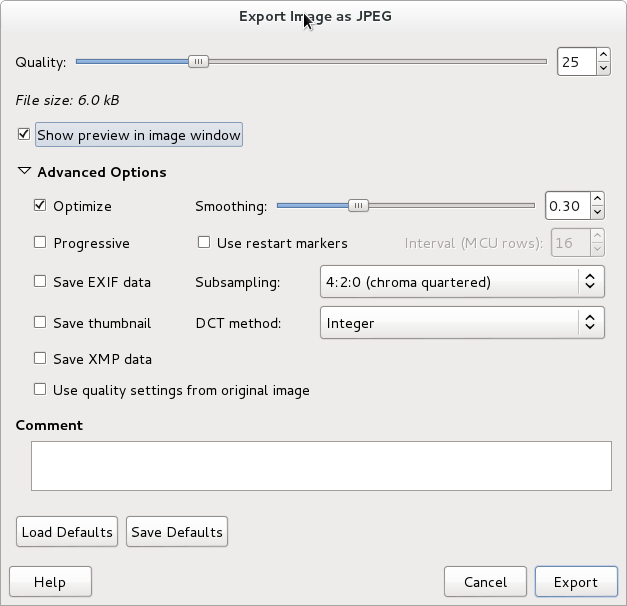
I m in the process of moving to a new OpenPGP key, and I want to include a small JPEG image of myself in it. The OpenPGP specification describes, in section 5.12.1 of RFC 4880, how an OpenPGP packet can contain an JPEG image. Unfortunately the document does not require or suggest any properties of images, nor does it warn about excessively large images. The GnuPG manual helpfully asserts that Note that a very large JPEG will make for a very large key. . Researching this further, it seems that proprietary PGP program suggests 120 144 as the maximum size, although I haven t found an authoritative source of that information. Looking at the GnuPG code, you can see that it suggests around 240 288 in a string saying Keeping the image close to 240 288 is a good size to use . Further, there is a warning displayed if the image is above 6144 bytes saying that This JPEG is really large . I think the 6kb warning point is on the low side today, however without any more researched recommendation of image size, I m inclined to go for a 6kb 240 288 image. Achieving this was not trivial, I ended up using GIMP to crop an image, resize it to 240 288, and then export it to JPEG. Chosing the relevant parameters during export is the tricky part. First, make sure to select Show preview in image window so that you get a file size estimate and a preview of how the photo will look. I found the following settings useful for reducing size: See screenshot below of the settings windows. GnuPG photo GIMP settings window Eventually, I managed to get a photo that I was reasonable happy with. It is 240 288 and is 6048 bytes large. GnuPG photo for Simon If anyone has further information, or opinions, on what image sizes makes sense for OpenPGP photos, let me know. Ideas on how to reduce size of JPEG images further without reducing quality as much would be welcome. flattr this!

B lint R czey: Run Wireshark on Android using Lil Debi!

Running Wireshark for Android has been an dream for a long time. Now it became a reality!
Wireshark running on Android using Lil'Debi

Wireshark running on Android using Lil Debi

You only need a rooted Android device with ~2GB free space, Internet connectivity and some patience to follow the steps below.
  1. Install Lil Debi from Google Play or F-Droid. Lil Debi will install a Debian root file system in a loop device separately from the Android file system allowing us running Debian side-by-side to the Android apps.
  2. Start Lil Debi and create the Debian system with 2000 MB image size. We will need some space for Wireshark, the graphical interface Wireshark depends on and for the capture files.
  3. Start the newly created Debian system and log in to it. You will see the error message bash: [: : integer expression expected , but you can continue.
  4. Now run the following commands at the command line to install all the packages Wireshark will need:
    # some important directories are missing from the PATH by default
    export PATH=/sbin:/usr/sbin/:$PATH
    # we will start an X server later
    export DISPLAY=127.0.0.1:0
    # install wireshark an a few things to make it nicer
    apt-get install openbox gnome-themes-standard tshark wireshark
    # gnome-settings-daemon depends on plenty of packages we don't need now,
    # but we need gnome-settings-daemon for the GNOME theme to be applied
    apt-get install --no-install-recommends gnome-settings-daemon
  5. To run graphical applications from the Debian chroot we need to set up an X server on Android because Android uses a different method for presenting the GUI. XServer XSDL is available from Google Play and from SourceForge. Install and start it. It will show the display it is serving which will most probably end with :0, so the DISPLAY environment variable we set before is correct. (If there is an other number after the : , fix your DISPLAY variable.)
  6. Start the openbox window manager, gnome-settings-daemon and finally wireshark in capturing mode:
    openbox &
    # if you would like to have bigger menu fonts skip starting gnome-settings-daemon
    gnome-settings-daemon &
    wireshark -k -i wlan0
    
  7. Switch to the X server to see wireshark starting up, close the warning dialogs start capturing traffic!
I tested the tests above using a Nexus 7 (Asus 2013 version) running CyanogenMod M7, thus root access was granted by default, Lil Debi 0.4.7, and XServer XSDL 1.11.14.

18 June 2014

Aurelien Jarno: Debian is switching (back) to GLIBC

Five years ago Debian and most derivatives switched from the standard GNU C Library (GLIBC) to the Embedded GLIBC (EGLIBC). Debian is now about to take the reverse way switching back to GLIBC, as EGLIBC is now a dead project, the last release being the 2.19 one. At the time of writing the glibc package has been uploaded to experimental and sits in the NEW queue. EGLIBC is dead for a good reason: the GLIBC development has changed a lot in the recent years, due to two major events: Ulrich Drepper leaving Red Hat and the GLIBC development, and the GLIBC steering committe self-dissolving. This has resulted in a much more friendly development based on team work with good cooperation. The development is now based on peer review, which results in less buggy code (humans do make mistakes). It has also resulted in things that were clearly impossible before, like using the same repository for all architectures, and even getting rid of the ports/ directory. Before we used to have two sets of architectures, the main ones in the glibc repository with architectures like x86, SuperH or SPARC, and the secondary ones in the glibc-ports repository with architectures like ARM or MIPS. As you can see the separation was quite arbitrary, and often leaded to missing changes on the secondary architectures. We also got real stable branches, with regular fixes. The most important EGLIBC features have been merged to GLIBC, including for example the use of non-bash but POSIX shell, or the renaming of reserved keywords. The notable exception is the support for configurable components, which we originally planned to use for Debian-Installer, by building a smaller flavor using -Os and without NIS and RPC support. At the end we never worked on that, and it seems that the hardware targeted by Debian has grown faster than the GLIBC size, so that is not really a big loss. At the end, we ended up with only 5 missing patches from the EGLIBC tree: The package names are unchanged (except the source package and the binary package containing the sources) so the transition is fully transparent for the users. I would like to thank all the CodeSourcery employees who worked on EGLIBC, with a special thank to Joseph Myers who spent countless hours to merge the most important EGLIBC changes back to GLIBC, and sent regular emails about the merge status. I would also like to thanks all the people on the GLIBC side that made the change to happen, and all persons participating in the GLIBC development.

Matthias Klumpp: Tanglu 2 (Bartholomea annulata) status update #1

bartholomea-annulata

Bartholomea annulata (c) Kevin Bryant

It is time for a new Tanglu update, which has been overdue for a long time now! Many things happened in Tanglu development, so here is just a short overview of what was done in the past months. Infrastructure Debile The whole Tanglu distribution is now built with Debile, replacing Jenkins, which was difficult to use for package building purposes (although Jenkins is great for other things). You can see the Tanglu builders in action at buildd.tg.o. The migration to Debile took a lot of time (a lot more than expected), and blocked the Bartholomea development at the beginning, but now it is working smoothly. Many thanks to all people who have been involved with making Debile work for Tanglu, especially Jon Severinsson. And of course many thanks to the Debile developers for helping with the integration, Sylvestre Ledru and of course Paul Tagliamonte. Archive Server Migration Those who read the tanglu-announce mailinglist know this already: We moved the main archive server stuff at archive.tg.o to to a new location, and to a very powerful machine. We also added some additional security measures to it, to prevent attacks. The previous machine is now being used for the bugtracker at bugs.tg.o and for some other things, including an archive mirror and the new Tanglu User Forums. See more about that below :-) Transitions There is huge ongoing work on package transitions. Take a look at our transition tracker and the staging migration log to get a taste of it. Merging with Debian Unstable is also going on right now, and we are working on merging some of the Tanglu changes which are useful for Debian as well (or which just reduce the diff to Tanglu) back to their upstream packages. Installer Work on the Tanglu Live-Installer, although badly needed, has not yet been started (it s a task ready for taking by anyone who likes to do it!) however, some awesome progress has been made in making the Debian-Installer work for Tanglu, which allows us to perform minimal installations of the Tanglu base systems and allows easier support of alternative Tanglu falvours. The work on d-i also uncovered a bug which appeared with the latest version of findutils, which has been reported upstream before Debian could run into it. This awesome progress was possible thanks to the work of Philip Mu kovac and Thomas Funk (in really hard debug sessions).

Tanglu ForumsTanglu Users We finally have the long-awaited Tanglu user forums ready! As discussed in the last meeting, a popular demand on IRC and our mailing lists was a forum or Stackexchange-like service for users to communicate, since many people can work better with that than with mailinglists. Therefore, the new English TangluUsers forum is now ready at TangluUsers.org. The forum software is in an alpha version though, so we might experience some bugs which haven t been uncovered in the testing period. We will watch how the software performs and then decide if we stick to it or maybe switch to another one. But so far, we are really happy with the Misago Forums, and our usage of it already led to the inclusion of some patches against Misago. It also is actively maintained and has an active community. Misc Thingstanglu logo pure KDE We will ship with at least KDE Applications 4.13, maybe some 4.14 things as well (if we are lucky, since Tanglu will likely be in feature-freeze when this stuff is released). The other KDE parts will remain on their latest version from the 4.x series. For Tanglu 3, we might update KDE SC 4.x to KDE Frameworks 5 and use Plasma 5 though. GNOME Due to the lack manpower on the GNOME flavor, GNOME will ship in the same version available in Debian Sid maybe with some stuff pulled from Experimental, where it makes sense. A GNOME flavor is planned to be available. Common infrastructure We currently run with systemd 208, but a switch to 210 is planned. Tanglu 2 also targets the X.org server in version 1.16. For more changes, stay tuned. The kernel release for Bartholomea is also not yet decided. Artwork Work on the default Tanglu 2 design has started as well any artwork submissions are most welcome! Tanglu joins the OIN The Tanglu project is now a proud member (licensee) of the Open Invention Network (OIN), which build a pool of defensive patents to protect the Linux ecosystem from companies who are trying to use patents against Linux. Although the Tanglu community does not fully support the generally positive stance the OIN has about software patents, the OIN effort is very useful and we agree with it s goal. Therefore, Tanglu joined the OIN as licensee.
And that s the stuff for now! If you have further questions, just join us on #tanglu or #tanglu-devel on Freenode, or write to our newly created forum! You can, as always, also subscribe to our mailinglists to get in touch.

Wouter Verhelst: Belgium vs Algeria

Yesterday, the Belgian team played against Algeria, and won 2-1. Before the match, there was some criticism about coach Wilmots' decision not to field a number of top players in the team at the start of the match. Today, some journalists -- including, apparently, some Russian journalists -- seem to think that the team didn't play all that well, and that the Belgian team could be beaten by a better team. I don't think that's the case; I think the strategy of Wilmots was a stroke of genius. The Algerian coach fielded a wall of 5 defenders, and played a pretty good counter game. When the Belgian team had posession -- for about 65% of the time during the entire match -- the Algerians returned every man to their own half of the field. Whenever one of the Belgian strikers came close to the Algerian penalty area, at least two Algerian players would be near and block them off. How does one win from a team that doesn't want to give you a millimeter of room? One way is to wear them out, and that's exactly what the team did: by keeping the pressure on the Algerian defense, the Algerian defense had to run a lot. Running a lot makes you tired, and if you're tired you make mistakes, or you can't follow a fresh substitute player. During half-time, it was reported that Wilmots had relayed the message to his players that "the bench will make the difference". And indeed it did; some time into through the second half, Wilmots substituted three players -- two strikers and one offensive midfielder -- with the top players he'd kept on the bench. Two of these three players made the difference, scoring two goals to end up with 2-1. Reading some articles today, it seems like many analysts think that this was a spur of the moment thing by Wilmots; but I think it's more likely that this was a deliberate strategy. Making the opposing defense run a lot is certainly a good strategy; but the downside of that is that your own offensive players will need to run a lot, too. If you can swap those out for top players on the bench... It'll be interesting to see the next matches.

Keith Packard: TeleGPS-Battery-Life

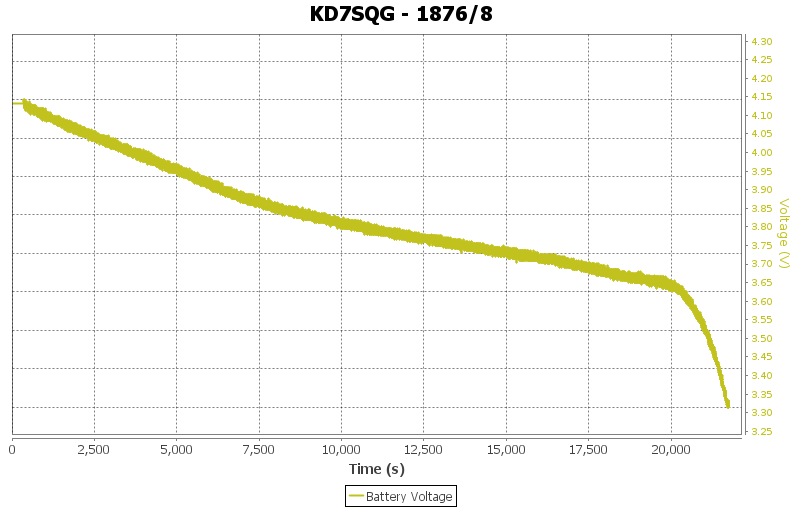
TeleGPS Battery Life I charged up one of the 160mAh batteries that we sell. (The ones we ve got now are labeled 200mAh; the 160mAh rating is something like a minimum that we expect to be able to ever get at that size.) I connected the battery to a TeleGPS board, hooked up a telemetry monitoring setup on my laptop and set the device in the window of my office. This let me watch the battery voltage through the day without interrupting my other work. Of course, because the telemetry was logged to a file, I ve now got a complete plot of the voltage data: It looks like a pretty typical lithium polymer discharge graph; slightly faster drop from the 4.1V full charge voltage down to about 3.9V, then a gradual drop to 3.65 at which point it starts to dive as the battery is nearly discharged. Because we run the electronics at 3.3V, and the LDO has a dropout of about 100mV, it s best if the battery stays above 3.4V. That occurred at around 21500 seconds of run time, or almost exactly six hours. We also have an 850mAh battery in the shop; I d expect that to last a bit more than four times as long, or about a day. Maybe I ll get bored enough at some point to hook one up and verify that guess.
16 June 2014

Wouter Verhelst: /etc/hosts is mine, dammit

I try to use Debian everywhere. Not because I think it's perfect, but it's close. But if I had to point out one misdesign that I hate, it would be the fact that applications care about the contents of /etc/hosts. If I don't put the FQDN on the line containing 127.0.0.1 in /etc/hosts, then one set of (proprietary) applications stops working. If I do put the FQDN on the line containing 127.0.0.1 in /etc/hosts, then another set of (proprietary) applications stops working. I want to kill people. I've been considering writing a custom NSS module which changes the return value of gethostbyname() and friends depending on who's calling the function. That would be ugly, but I suppose it could work. But I really, really, really don't want to start doing this. Grrr.

Simon Kainz: on using crippled installers

Maybe someone else is using iDataPlex HW, so this might come in helpful... TL, DR: Dear Hardware Vendors! Please don't force people to use specific Linux distributions when a simple unzip command would do the same. At work we run (amongst others) an HPC system consisting of 120 IBM System X iDataPlex dx360 M4 Nodes. Recently, after some MCE logs caused by DIMM errors, the IBM guy refused to send me replacement DIMMs if if didn't update IMM firware and tortue test the machine some days more. Well, ok... IBM uses the so called UpdateXpress tool to update IMM and UEFI firmware. The tool is available for rhel4 to rhel7 (both 32 and 64 bit), SLES10 & SLES11 and Microsoft Windows. I tried all of the available UpdateXpress System Pack Installers, with basically the same result everytime:
WARNING! This package doesn't appear to match your system.
         The following information was determined for your system:
           distribution = Unknown
           release = -1
           processor architecture = Unknown
I tried to set up a fake RHEL environment (customized /usr/local/uname, custom /et/RHel-release, etc...) but after some more tries, the installer (yes, it's still the installer I am trying to run) fails with some strange SEGFAULTS. After some closer inspection, (well, the RHEL4 uxspi binary is about 109MB big!) i tried to unzip it, and voila:
~/firmware$ unzip ibm_utl_uxspi_9.60_rhel4_32-64.bin
Archive:  ibm_utl_uxspi_9.60_rhel4_32-64.bin
   creating: rhel6_64/image/
  inflating: rhel6_64/image/libpegasus.nsp.so  
  inflating: rhel6_64/image/libUxliteImmUsbLan.so  
  inflating: rhel6_64/image/eccConnect.properties  
  inflating: rhel6_64/image/libpegslp_client.so  
   creating: rhel6_64/image/esxi_assoc_templates/
  inflating: rhel6_64/image/esxi_assoc_templates/elxFC.uxt  
  inflating: rhel6_64/image/esxi_assoc_templates/elxCNA.uxt  
  inflating: rhel6_64/image/esxi_assoc_templates/ibmc.uxt  
  inflating: rhel6_64/image/esxi_assoc_templates/FPGA-S.uxt  
  inflating: rhel6_64/image/esxi_assoc_templates/degraded.uxt  
  inflating: rhel6_64/image/esxi_assoc_templates/brocadeFC.uxt  
  inflating: rhel6_64/image/esxi_assoc_templates/qlgcFC.uxt  
  inflating: rhel6_64/image/esxi_assoc_templates/broadcom.uxt  
  inflating: rhel6_64/image/esxi_assoc_templates/LSI.uxt  
  inflating: rhel6_64/image/esxi_assoc_templates/brocadeCNA.uxt  
  inflating: rhel6_64/image/esxi_assoc_templates/uefi.uxt  
  inflating: rhel6_64/image/esxi_assoc_templates/diags.uxt  
  inflating: rhel6_64/image/esxi_assoc_templates/qlgcCNA.uxt  
  inflating: rhel6_64/image/esxi_assoc_templates/VMwareESXi.uxt  
  inflating: rhel6_64/image/esxi_assoc_templates/ibmc2.uxt  
  inflating: rhel6_64/image/esxi_assoc_templates/FPGA.uxt  
  inflating: rhel6_64/image/libipmi_client.so  
  inflating: rhel6_64/image/UXLite_UPDATEID.dat  
  inflating: rhel6_64/image/libacpi.so  
  inflating: rhel6_64/image/libibmsp6_openipmi.so  
  ...
I managed to find a iflash64 binary, and after so trial and error, came up with the following workflow:
./iflash64 --host your_host_imm_IP --user your_username --password your_password --package imm2_1aoo56d-3.73.upd --reboot
IBM Command Line IMM Flash Update Utility v2.02.11
Licensed Materials - Property of IBM
(C) Copyright IBM Corp. 2009 - 2014  All Rights Reserved.
Connected to IMM at IP address x.x.x.x.
Update package firmware type: IMM2
Update package build level:   xxxxxx
Target's current build level: xxxxxx
Would you like to continue with the update? y/n: y
Node 0: The IMM is preparing to receive the update.
Node 0: Transferring image: 98%
Node 0: Transfer complete.
Node 0: Validating image.
Node 0: Updating firmware:  0%
Node 0: Updating firmware:  100%
Node 0: Update complete.
Performing activation of the firmware:
Connected to IMM at IP address 10.8.2.4 successfully.
..........
Waiting up to 360 seconds for the activation to complete:
..
..
And so on... Conclusio: Dear Hardware Vendors! Please don't force people to use specific Linux distributions when a simple unzip command would do the same.

Keith Packard: Altos1.4

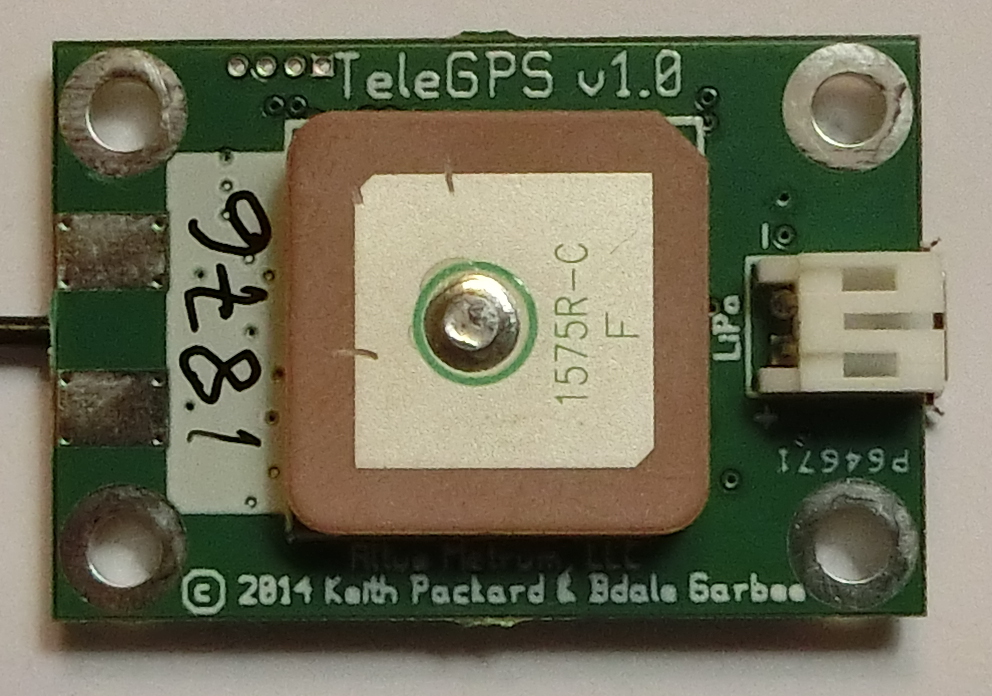
AltOS 1.4 TeleGPS support, features and bug fixes Bdale and I are pleased to announce the release of AltOS version 1.4. AltOS is the core of the software for all of the Altus Metrum products. It consists of firmware for our cc1111, STM32L151, LPC11U14 and ATtiny85 based electronics and Java-based ground station software. This is a major release of AltOS, including support for our new TeleGPS board and a host of new features and bug fixes AltOS Firmware TeleGPS added, new features and fixes Our new tracker, TeleGPS, works quite differently than a flight computer TeleGPS transmits our digital telemetry protocol, APRS and radio direction finding beacons. For TeleMega, we ve made the firing time for the additional pyro channels (A-D) configurable, in case the default (50ms) isn t long enough. AltOS Beeping Changes The three-beep startup tones have been replaced with a report of the current battery voltage. This is nice on all of the board, but particularly useful with EasyMini which doesn t have the benefit of telemetry reporting its state. We also changed the other state tones to Farnsworth spacing. This makes them all faster, and easier to distinguish from the numeric reports of voltage and altitude. Finally, we ve added the ability to change the frequency of the beeper tones. This is nice when you have two Altus Metrum flight computers in the same ebay and want to be able to tell the beeps apart. AltOS Bug Fixes Fixed a bug which prevented you from using TeleMega s extra pyro channel Flight State After configuration value. AltOS 1.3.2 on TeleMetrum v2.0 and TeleMega would reset the flight number to 2 after erasing flights; that s been fixed. AltosUI New Maps, igniter tab and a few fixes With TeleGPS tracks now potentially ranging over a much wider area than a typical rocket flight, the Maps interface has been updated to include zooming and multiple map styles. It also now uses less memory, which should make it work on a wider range of systems. For TeleMega, we ve added an Igniter tab to the flight monitor interface so you can check voltages on the extra pyro channels before pushing the button. We re hoping that the new Maps interface will load and run on machines with limited memory for Java applications; please let us know if this changes anything for you. TeleGPS All new application just for TeleGPS While TeleGPS shares the same telemetry and data logging capabilities as all of the Altus Metrum flight computers, its use as a tracker is expected to be both broader and simpler than the rocketry-specific systems. We ve build a custom TeleGPS application that incorporates the mapping and data visualization aspects of AltosUI, but eliminates all of the rocketry-specific flight state tracking.

14 June 2014

Craig Small: WordPress 3.9.1

The Debian package of WordPress version 3.9.1 was uploaded to the ftp master recently. While the update was pretty simple, the upload took a lot more doing. I m not sure why the Debian ftp-master server didn t like me, but it was so slow. Strangely, even dcut uploads were slow and they are only a few lines of text. Apologies for the delay too, I m not sure why I didn t notice the update from 3.9 to 3.9.1 but there you go. The other change is that the package uses the system CA certificates rather than the ones pre-shipped with wordpress. This is done so that if the administrator makes decisions on what certificates to trust, then the wordpress client http libraries will follow that decision.

13 June 2014

Kees Cook: glibc select weakness fixed

In 2009, I reported this bug to glibc, describing the problem that exists when a program is using select, and has its open file descriptor resource limit raised above 1024 (FD_SETSIZE). If a network daemon starts using the FD_SET/FD_CLR glibc macros on fdset variables for descriptors larger than 1024, glibc will happily write beyond the end of the fdset variable, producing a buffer overflow condition. (This problem had existed since the introduction of the macros, so, for decades? I figured it was long over-due to have a report opened about it.) At the time, I was told this wasn t going to be fixed and every program using [select] must be considered buggy. 2 years later still more people kept asking for this feature and continued to be told no . But, as it turns out, a few months later after the most recent no , it got silently fixed anyway, with the bug left open as Won t Fix ! I m glad Florian did some house-cleaning on the glibc bug tracker, since I d otherwise never have noticed that this protection had been added to the ever-growing list of -D_FORTIFY_SOURCE=2 protections. I ll still recommend everyone use poll instead of select, but now I won t be so worried when I see requests to raise the open descriptor limit above 1024.

2014, Kees Cook. This work is licensed under a Creative Commons Attribution-ShareAlike 3.0 License.
Creative Commons License

11 June 2014

Bits from Debian: Introducing the Debian Continuous Integration project

Debian is a big system. At the time of writing, the unstable distribution has more than 20,000 source packages, building more then 40,000 binary packages on the amd64 architecture. The number of inter-dependencies between binary packages is mind-boggling: the entire dependency graph for the amd64 architecture contains a little more than 375,000 edges. If you want to expand the phrase "package A depends on package B", there are more than 375,000 pairs of packages A and B that can be used. Every one of these dependencies is a potential source of problems. A library changes the semantics of a function call, and then programs using that library that assumed the previous semantics can start to malfunction. A new version of your favorite programming language comes out, and a program written in it no longer works. The number of ways in which things can go wrong goes on and on. With an ecosystem as big as Debian, it is just impossible to stop these problems from happening. What we can do is trying to detect when they happen, and fix them as soon as possible. The Debian Continuous Integration project was created to address exactly this problem. It will continuously run test suites for source packages when any of their dependencies is updated, as well as when a new version of the package itself is uploaded to the unstable distribution. If any problems that can be detected by running an automated test suite arise, package maintainers can be notified in a matter of hours. Antonio Terceiro has posted on his blog an introduction to the project with a more detailed description of the project, its evolution since January 2014 when it was first introduced, an explanation of how the system works, and how maintainers can enable test suites for their packages. You might also want to check the documentation directly.

Yves-Alexis Perez: Debian, Xfce, policykit and permissions

So, it seems that for a lot of people using unstable, hardware-related permissions (shutdown/reboot, suspend/hibernate, devices mount/umount etc.) have been broken since some times. That's usually the case for people using GNOME with lightdm display manager, Xfce with either gdm or lightdm. It seems that recently, policykit (which is used by GNOME and Xfce) switched from consolekit backend to logind backend (yeah, systemd-logind). So applications using policykit needs to handle that correctly, and that means beeing sure a logind session is correctly setup, which is done by installing the package libpam-systemd. For now, it's still possible to not switch to systemd as init system, by installing the systemd-shim package before libpam-systemd. Be aware that (at least with the current state of affairs), this is only true with logind before 204. When systemd maintainers start transitionning to a later version, only systemd-sysv (so, systemd as init system) will work. For people reluctant to switch to systemd, they can use systemd-shim for now. Then when systemd 205+ enters the archive, either lose those hardware permissions, or try to improve systemd-shim to handle that situation. There's not much we (Xfce/LightDM maintainers) can do about that.

Daniel Pocock: Protest or Uber marketing stunt?

London's taxi "strike" today has been so successful that Uber claims to have had an 850% increase in new customer registrations this week. Well, that is a big success if you believe the strike may have been a guerrilla marketing tactic organised by Uber itself. No sympathy Personally, I have no sympathy for the taxi drivers. There is no city I have ever visited where I haven't encountered at least one taxi driver who tried to overcharge me. Honest drivers who give their customers value for money have less to fear from new technology than those who are unscrupulous. When I broke a leg a few years ago and was getting about on crutches for 6 weeks we decided to go out for dinner one night. This was the first time I went anywhere after having a long stint in hospital followed by a period of time I was confined to the house. The taxi driver deliberately skipped two turns leading directly to the restaurant, went another 1km past it and then followed a small street that winds back and forth and eventually demanded I pay him double what the fare should have been. This is exactly the type of abusive and despicable practice that is being eradicated by Uber's live GPS mapping technology. Although not every driver behaves so shamefully, this type of abuse of the weak or vulnerable is replicated in one way or another the world over. For example, in Melbourne, Australia, wheelchair taxis that have worked out they can make more money collecting families with suitcases at the airport leave genuine wheelchair users without a ride. Will Google be targeted next week? Google has just announced a step-change in plans to build their own self driving cars. Will Google offices around the world, including London be targetted by these crude blockades too? Political protest or anti-competitive mischief? Why were taxi drivers not arrested for their protest today? Given that the roads are the place where taxis and their competitors do business, can this blockade really be considered a political protest or is it an anti-competitive practice in blatant disregard of the law? Weapons of mass destruction Before even having breakfast you could probably find 10,000 cyclists in central London willing to sign a petition declaring taxis are a weapon of mass destruction. Once again, while there are honest drivers, there is a more than trivial number of taxi drivers who are a genuine danger to the lives of cyclists, scooters, motorcycles and occasionally pedestrians. I have personally experienced one of these thugs ramming my bicycle from behind (his hard-nosed insurer eventually paid up but without admitting liability). The police who attended the incident even told me they had seen so many accidents like this they wouldn't dare cycle themselves. The web is full of examples that appear to show malicious and criminal behavior by taxi drivers, thanks to Youtube and helmet cams: Will hotels protest about AirBNB? Now the taxi drivers have had their chance to cause mayhem, will hotel operators be next? What could they do though? Will they seek out AirBNB apartments and try to obstruct them somehow? Making mischief outside somebody's home is not a good way to make a point. Chances are, they would be prosecuted or served with restraining orders. So why do the taxi drivers get to jam up whole cities and get away with it? The Uber taxi meter loophole Will the courts decide that the Uber app is a taxi meter? This is actually a tough question. Even if courts rule against apps that perform live metering, Uber could simply remove all metering functions from the app itself and perform the metering calculations in the cloud. The app would just send start and finish locations to the cloud and the cloud would send a message back to the phone confirming the charge. The phone is then nothing more than a communication and positioning device. Remember the elevator man? When the automobile was first invented, laws were made requiring every car to be accompanied through public streets by a man carrying a flag. That job, like many others, no longer exists. elevator attendant In the good old days, every elevator had a man or woman who would sit on a stool and press buttons to operate the doors and motors. Some up-market department stores and hotels still have an elevator man to add a touch of nostalgia. The vast majority, however, have eliminated these jobs thanks to automatic elevators. Now, even aircraft can land automatically on a ship at sea. Look at all those people manning the deck in the video and contemplate how many of them might potentially be out of a job too in 50 years time as Terminator-style automated battleships patrol the seas. Technology, like the Terminator, is not going to stop.

10 June 2014

Steve Kemp: I did get a job

In my previous blog-post I mentioned, briefly, that I'd posted a couple of adverts on Reddit looking for work. To give more detail I did three things: The advertisement was set to be shown in /r/edinburgh (where I live), and /r/sysadmin (where I thought some people might look if they were struggling for help). The advertising on Reddit was painless to setup, and the traffic stats were interesting, but even though this worked out well I'm a little loathe to repeat the process - since the "non-sterling transaction fee" from my bank effectively doubled my budget. I received a few (private) emails and comments, along with the expected grammar corrections. The end result was that I received contact from an American company founder who seemed interested. He allowed me to write some code to solve a fun problem, appeared to enjoy the code I sent (Ruby code for dealing with (exim) email spam, that's as specific as I will be). The end result was a three month contract, which we obviously hope will lead to more permanent work. Anyway I thought this was an atypical route to find a work, and was about a million times nicer than working with recruiters, so .. consider this documentation! In other news it is now 10pm and I need to go to the gym and pub, in that order.

Dimitri John Ledkov: cross-compile go code, including cgo

By all means cross-compiling a new language/stack is not going to be pretty, but it didn't turn out that bad.

A few weeks back, I was told that go code which uses cgo (that is utilising C api calls to shared libraries exporting C interface) cannot be cross-compiled. Well, if it's just calling out a C compiler it should totally be easy to cross compile, since so much of our platform is.

So there we go, first I've picked a moderately small project which only does a couple cgo calls, and check that it compiles correctly:

$ sudo apt-get build-dep ubuntu-push-client
$ go get launchpad.net/ubuntu-push/...
$ cd $GOPATH/src/launchpad.net/ubuntu-push/
$ go build ubuntu-push-client.go
Well, when your gcc is all is easy.

I didn't want to polute my system, so I quickly created a chroot with go, build-dependencies in armhf architectures and cross-compiler:

# Get a chroot with build-dependencies installed, I am basing on top of a click-chroot
# one should be able to use any chroot which is armhf multiarch enabled.
$ sudo click chroot -aarmhf -fubuntu-sdk-14.04 -s utopic create
$ sudo click chroot -aarmhf -fubuntu-sdk-14.04 -s utopic maint apt-get install golang-go golang-go-linux-arm golang-go-dbus-dev golang-go-xdg-dev golang-gocheck-dev golang-gosqlite-dev golang-uuid-dev libgcrypt11-dev:armhf libglib2.0-dev:armhf libwhoopsie-dev:armhf libubuntuoneauth-2.0-dev:armhf libdbus-1-dev:armhf libnih-dbus-dev:armhf libsqlite3-dev:armhf crossbuild-essential-armhf
After that the tricky bit was advising go to cross-compile:

$ click chroot -aarmhf -fubuntu-sdk-14.04 -s utopic run CGO_ENABLED=1 GOARCH=arm GOARM=7 PKG_CONFIG_LIBDIR=/usr/lib/arm-linux-gnueabihf/pkgconfig:/usr/lib/pkgconfig:/usr/share/pkgconfig GOPATH=/usr/share/gocode/:~/go CC=arm-linux-gnueabihf-gcc go build -ldflags '-extld=arm-linux-gnueabihf-gcc' ubuntu-push-client.go
Ignoring the click chroot wrapper:
  • CGO_ENABLED=1 - by default cgo is disabled when cross-compiling, but really shouldn't be as compiler names are standard $(GNU_TRIPPLET) prefixed tools
  • GOARCH=arm - set the target arch
  • GOARM=7 - set ABI level
  • PKG_CONFIG_LIBDIR - the ugly beast to pass where pkg-config should search for .pc files. With autoconf one simply sets PKG_CONFIG environment variable pointing at a cross-pkg-config, $(GNU_TRIPPLET)-pkg-config but go tool doesn't support it. I've raised merge proposal to get that added https://codereview.appspot.com/104960043/
  • Next I just set GOPATH to where my packages are and CC as to which compiler to use
  • The last portion to the puzzle was to pash "-ldflags '-extld=$CC'" because the linker tool (5l) didn't use environmental variable CC and simply defaults to gcc. I'll raise a merge proposal for this.
Overall that's it. Given that all of above can be re-factored into standard variables (e.g. use $GNU_TRIPPLET prefix, and offer to override it), I see no reason why cross-compilation in go with cgo cannot eventually become a simple
GOARCH=arm go build

Russell Coker: Google Hardware Support

Ironically just 5 days after writing about how I choose Android devices for a long service life [1] my wife s Nexus 5 (with 32G of RAM (sorry Flash storage) to give it a long useful life) totally died. It reported itself as being fully charged and then 15 minutes later it was off and could not be revived. No combination of pushing the power button and connecting the power cable caused the screen to light up or any sound to be emitted. Google has a nice interactive support site for nexus devices that describes more ways of turning a phone on than any reasonable person could imagine. After trying to turn the phone on in various ways (plugged and unplugged etc) it gave me a link to get phone support. Clicking on that put me in the queue to RECEIVE a phone call and a minute later a lady who spoke English really well (which is unusual for telephone support) called me to talk me through the various options. Receiving a phone call is a much better experience than making a call. It meant that if the queue for phone support was long then I could do other things until the phone rings. It s impossible to be productive at other tasks while listening for hold music to stop and a person to start talking. The cost of doing this would be very tiny, while there would be some cost in hardware and software to have a web site that tells me how long I can expect to wait for a call a more basic implementation where I just submit my number and wait for a call would be very cheap to implement. The costs of calls from the US to Australia (and most places where people can afford a high end Android phone) are quite cheap for home users and are probably cheaper if you run a call center. If the average support call cost Google $1 and 3% of phones have support calls then that would be an extra cost of $0.03 per phone. I expect that almost everyone who buys a $450 phone would be happy to pay a lot more than $0.03 to avoid the possibility of listening to hold music! I received the phone call about a minute after requesting it, this was nice but I wonder how long I would have waited if I hadn t requested a call at 1AM Australian time (presumably during the day in a US call center). In any case getting a 1 minute response is great for any time of the day or night, lots of call centers can t do that. While the phone support is much better than most phone support, it would be nice if they added some extra options. I think it would be good to have webchat and SMS as options for support for the benefit of people who don t want to speak to strangers. This would be useful to a lot of people on the Autism Spectrum and probably others too. The phone call wasn t particularly productive, it merely confirmed that I had followed all the steps on the support website. Then I received an email telling me about the web site which was a waste of time as I d covered that in the phone call. I have just replied to their second email which asked for the IMEI of the phone to start the warranty return process. We could have saved more than 24 hours delay if this had been requested in the first email or the phone call. Google could have even requested the IMEI through the web site before starting the phone call. It would have been even easier if Google had included the device IMEI in the email they sent me to confirm the purchase as searching for old email is a lot easier than searching through my house for an old box. Another option for Google would be to just ask me for the Gmail account used for the purchase, as I only bought one Nexus 5 on that account they then have all the purchase details needed for a warranty claim. While the first call was a great experience the email support following that has been a waste of time. I m now wondering if they aim to delay the warranty process for a few days in the hope that the phone will just start working again.

Next.

Previous.