Search Results: "ean"

11 May 2011

Julian Andres Klode: underscores and undefined behavior

As everyone should know, underscores in C are not cool, as they cause undefined behavior per 7.1.3:
All identifiers that begin with an underscore and either an uppercase letter or another underscore are always reserved for any use.
[...]
If the program declares or defines an identifier in a context in which it is reserved (other than as allowed by 7.1.4), or defines a reserved identifier as a macro name, the behavior is undefined.
Yet, they are widely used everywhere. Here are some examples: All of this triggers undefined behavior and is thus uncool. Of course in APT, it s most stupid, as we do not have any namespace and could thus
end up redefining things we should not much more likely then the other two. But why were those solutions chosen in the first place, and what is the alternative? I cannot answer the first question, but for the second one, the obvious alternative is to use trailing underscores: Then there is another class of reserved identifiers with underscores:
All identifiers that begin with an underscore are always reserved for use as identifiers
with file scope in both the ordinary and tag name spaces.
Meaning that everything except for parameters, local variables and members of structs/unions that starts with an underscore is reserved. So, if you happen to create a variable _mylibrary_debug_flag, you trigger undefined behavior as well. And while we re at it, do not think you can create a type ending in _t: POSIX reserves all identifiers ending in _t for its own use. In summary, whenever you write C and want to be 100% safe of undefined-behavior-because-of-naming, do not start any identifier with an underscore and do not end any identifier with _t.
Filed under: General

10 May 2011

Steve Kemp: So I put together another picture sharing site

Almost a year ago I put together a simple picture sharing site, which was designed to accept uploaded images via OpenID logins and then share them. It was created because none of the existing image sharing sites allowed OpenID logins - and because frankly I rarely trust sites I don't control. (Especially when they're free sites, with no obvious revenue stream. We can reference recent compromises if we wish to be topical, but even without them it is all about trust.) I opened up the site to allow others to use it, but assumed it would remain Steve-only - After all why would somebody choose to use my site rather than imgur, or similar? Over the year I've spotted several minor problems with the site. The built-in support for comments was never used, primarily because I didn't have any other users, and some of the tagging aspects were hard to use. Since I've started using twitter I again found myself wanting a picture-hosting site, one with "short links". I started using twitpic.com, but wasn't happy with it. So the plan was formed; build another picture sharing site. But this time with short URLS. Sadly my first choice of http://picc.ie was denied to me - I couldn't register it as I don't live in Ireland. But my second choice http://linkti.me was free. As a challenge to myself this site uses Redis for storing all user-details, all image details, and all session data. It hasn't been difficult to implemenet a multi-user site, with logins, file uploads, and tagging. I guess I cheated as a lot of the code is borrowed from the previous site, but this time it looks prettier and there have been many cleanups due to my previous experience. This time round I was more focussed upon short links, so each image is allowed an incrementing number, which is then encoded using base 36 math - which is the alphabet you get if you use [0-9A-Z]. I designed three shareable links for each image to keep it simple: Why "/r" for the thumbnail? Well because it is a random thumbnail. To cope with difference sizes, and allow the recent image display to look regular, I wanted each thumbnail to be 150x150 pixels. My thumbnail generation simply picks a random X,Y co-ordinate from the image and then cuts out a 150x150 square block starting at that offset. The results of a random segment of an uploaded image are sometimes very cool, altough equally often they are misleading. If I upload naked people there is the possability that we'll just get a nipple or a cock - but I'm actually quite smug about the way it turned out. Simpler to code than to resize, scale, or similar and surprisingly random when you see 9x9 random images (as you do on the front page). Anyway that's all for now. I was tempted to talk about implementation or migration, but I've written too much for an early morning already. Some other time? ObQuote: "He's just trying to freak us out. " - 30 Days of Night.

9 May 2011

Christian Perrier: 2011 week 18 Debian work

As usual at the beginning of a month, I gave spam reviewers a GO to review spam on debian-boot as well as french-speaking mailing lists. I triaged bugs in the pytrainer package and forwarded some more with patches (thanks to Matt Kraai and Jukub Wilk). Some have already been fixed upstream. Apparently, pytrainer's upstream is very reactive and opened to such bug reports. I fixed several forgotten commits in D-I packages after the previous week's mass upload. Thanks to Coling Watson for prodding me about this. I launched a debconf templates review for a recently appeared package: slapos.tool.format. I indeed even filed a bug report for debconf abuse for it..:-) However, I dropped the templates review for apparmor as the package maintainer launched a translation update round on his own. I completed the review and translation update round for bastet. I sponsored fonts-hosny-amiri and added Ahmed El-Mahmoudy to DMUA for it. This was, Ahmed should be able to upload the package by himself in a near future. He's doing clean work with that package, so adding him to DMUA was not a big deal.

Gunnar Wolf: A different demonstration. What will it mean?

Today we had a very interesting demonstration. People who know me for some time know I like to be a part of demonstrations, adding my voice to the people. And even though I know most demonstrations, as massive as they might be, have no real and tangible effect... Well, I try to be there. Today we had a large demonstration in Mexico City of people angry with the government's tactics on the war on drugs Have you been to Mexico before 2007? You will remember we have always had our problems, but violence was basically limited to keeping an eye open, not flashing your money/jewels, and not looking too touristy. We were, all in all, a quiet country Known even as "the country where nothing happens, even if it happens". Five years later, a good portion of the country lives really in war-like conditions, and close to 45,000 people have been killed. At some point about a year ago (where the body count was at ~22,000), our oh-so-bright de-facto president said that "only" 10% of them were civilians. If that is still the case, and if proportions are held, we can now talk about ~4,500 people killed just because they were there Oh, but remember the country is not at war, and death penalty has very long been abolished, so we cannot give the other 90% a different status. We have had over 45,000 killed people. That means at least ~200,000 torn lifes. About six weeks ago, the cry from a father who lost his son started getting heard. And no, I do not want to talk about specific names or anything like that It is just the voice-bearer of many people who are fed up. Four days ago, he and a group of people left Cuernavaca city on a caravan and walked to Mexico city. Yesterday evening they arrived to the National University (UNAM), and were greeted by an amazing open-air concert: Mozart's Requiem. Today, our day started very early. My mother wanted to help, as many more anonymous citizens did, so we started making and packing sandwiches and apples at ~5:30AM, delivered them to the camp where they were staying and grouping with other people, and came back home for our breakfast. Later, at around 9AM, as the demonstration started going by our house (we live a block from UNAM), my girlfriend, father and me started walking with them. Why do I say this was a different demonstration than others I have been to?
  1. Much longer. We walked for close to 16Km, for about five hours. Most demonstrations I have been part of are 3-5Km long
  2. A different kind of support. I was surprised, even laughed at first when I saw a lady standing by us with a sign that read, I cannot join you today, but I'm there in spirit . But then I saw more, more people that just went out of their houses to a point close to where we walked on, and just stayed there on the streets. Not walking, yes, but being part of it.
  3. The march was silent And yes, this is the first time I see it for true. At the very beginning we heard some people chanting, cheering, but the cheerers were requested not to be noisy. People wearing political parties' logos were requested not to wear them (as political parties are at an all-time low prestige). No, we were not silent for the whole 5 hours; we were talking with each other, but it felt... just very different from any other times.
  4. Not only were people supporting, but this is the first time I saw this amount of people wanting to materially help. As I said, my mother delivered a little breakfast for 50 people, for those that slept at the camp, for those that had already walked ~70Km. But all along the road we were offered oranges, cookies, water, bread... Whatever people were able to offer, to somehow help. Very nice feeling of solidarity.
  5. Contrary to all other times, we were really spread out, it was a very low density walk, os it was quite pleasant. Of course, I have not even seen an estimation of the number of participants... And I doubt anyboy can be decently close to it
Will this change anything? I doubt it. I am happy that for the first time, the de-facto president (remember a large percentage of Mexicans still believe he lost the presidential election, and it was only due to his lack of legitimacy that he pushed the army to the streets to start this war on drugs) is recognizing that this might not be the best strategy but it is the only one he has... People are still, despite what I saw many felt, very far from organized. And, yes, no short-term concrete proposals are made on how to stop the killing I feel the population agrees that drugs should be legalized and regulated, that would at least shift the problem, reduce the direct violence (and money) related to it... But, of course, it is plainly not feasible with our current reality. Anyway, after a 5hr walk today (and even after a nice nap and shower), I don't want to dig into hypotheses anymore. I just wanted to share about a very interesting and different experience I had the opportunity to be part of.

Jonathan McDowell: A minor keyring-maint rant

This should probably be an official FAQ, but a) I wanted to rant a bit more than is probably acceptable for something "official" and b) the sort of person this information is directed at never bloody reads keyring.debian.org, which is the logical place for it. Who are keyring-maint? Currently Gunnar Wolf (good cop) and Jonathan McDowell (bad cop). Previous keyring maintainers include Igor Grobman & James Troup. I'd like to be a DM/DD. Do I send you my key? No. You go through the DebianMaintainer or NM processes. Then the DM team or DAM tell us to add your key to the appropriate keyring. I'd like to replace my DM/DD key in the Debian keyring. What should I do? Read the instructions at http://keyring.debian.org/replacing_keys.html I have a new key that isn't signed by anyone else, will you accept it? No. Did you read http://keyring.debian.org/replacing_keys.html ? I've got a single DD signature on my new key. That's enough, right? Not unless your old key has been lost and you're getting a different DD to request the replacement for you (and if they're prepared to ask for a key replacement we'll wonder why they're not prepared to sign the new key too). Did you read http://keyring.debian.org/replacing_keys.html ? I'm still really confused about how I should request a key replacement. Help? Try reading https://rt.debian.org/Ticket/Display.html?id=3141 (which just happens to be a recent decent example). Clear subject line (I'd have added a real name too, but it's still fairly clear), full fingerprint of the old and new keys, inline signed so RT doesn't mangle it. New key signed by old key and 3 other DDs. Request signed by old key. That RT link needs a login. I don't have one. Have you tried reading up on the Debian RT system? There's a generic read only login that'll get you access. That's too hard. Can't you just give me the details? Damnit. It appears the read-only login details are currently disabled due to misuse (one wonders how). Try reading http://wiki.debian.org/rt.debian.org Why are you using RT? Isn't bugs.debian.org more appropriate? We need the ability to for people to contact us is in a private fashion, for example if they need to us to remove a key because it's been lost or compromised. We could only use RT for that purpose and use bugs.d.o for things that can be public, but this way all the information is in one place and we get to make the call about when it becomes a publicly viewable ticket. What's with jetring? Should I send you a jetring changeset? jetring is a tool written by Joey Hess that used to be used to manage the Debian Maintainers keyring. keyring-maint borrowed a number of good ideas from jetring but don't use it at all. We ignore jetring changesets. So you just want key fingerprints, not attached keys? Yes. Of course you have to make sure your key is actually on a public keyserver so we can get it. the.earth.li is a good choice (because Jonathan runs it and thus pays more attention to it), but subkeys.pgp.net or pool.sks-keyservers.net are also commonly used. My key has expired and I want to update the key expiry date. I should email RT asking for this to be done, right? No, you should send the updated key via HKP to keyring.debian.org. You can do this with "gpg --keyserver keyring.debian.org --send-key <keyid>" Obviously replace <keyid> with your own key ID. I tried to send an entirely new key via HKP to keyring.debian.org, but I can't see it there. What gives? keyring.debian.org only accepts updates to keys it already knows about. That means you can send updated expiry dates, new uids and new signatures to your existing key, but not an entirely new key. I sent my updated key via HKP to keyring.debian.org and can see it's updated there, but the Debian archive processing tools (eg dak) don't seem to recognize the update. Why not? The updates sent via HKP are folded back into the HKP server automatically every 15 minutes or so. They are folded into the live Debian keyrings on a manual basis, at least once a month. This means if your key has an expiry date then you probably want to update your key at least a month before it expires. Where can I find these live Debian keyrings? They're what's available via rsync from keyring.debian.org::keyrings/keyrings/ This is canonical location for the current Debian Developers and Debian Maintainers keyrings. What about the debian-keyring package? This is a convenience package of the keyrings. It's usually the most out of date. We update it sporadically and try to ensure that the version shipped with a stable Debian release is current at the point of release. It is not used by any of the official Debian infrastructure. Why don't you automatically update my key in the live keyring when I send an update via HKP? We think that automatic updates of keys that allow uploads to Debian are a bad thing and that invoking a human eye at some step of the process is a useful sanity check. Paranoid much? Never enough. How are updates to the keyring tracked? We use bzr to maintain the keyring, with a separate file per key that can then be easily combined into the various keyrings. You can see the repository at: http://bzr.debian.org/scm/loggerhead/keyring/debian-keyring/changes Note that this is only updated when a keyring is pushed to live; the working tree may contain details of compromised keys and thus isn't public. What's with the whole replacement of 1024 bit keys? 2 things. Firstly 1024 bit keys tend to use SHA1 as a hash algorithm, which has been shown to be weaker than expected. While we're not aware of active exploits against this updating all of the keys Debian uses is not a trivial process and it's wiser to get it done /before/ there's a known issue. Secondly computing power has moved on and we feel that upgrading to larger key sizes is prudent. Elliptic curve cryptography (ECC) keys look like the future. Can I use one for Debian? No, not at present. When there are tools that are part of a Debian stable release that support them we'll look into it, after discussion with the major users of the keyring (DSA, ftpmaster, the secretary).

8 May 2011

Christian Perrier: 2011 week 18 Debian work

As usual at the beginning of a month, I gave spam reviewers a GO to review spam on debian-boot as well as french-speaking mailing lists. I triaged bugs in the pytrainer package and forwarded some more with patches (thanks to Matt Kraai and Jukub Wilk). Some have already been fixed upstream. Apparently, pytrainer's upstream is very reactive and opened to such bug reports. I fixed several forgotten commits in D-I packages after the previous week's mass upload. Thanks to Coling Watson for prodding me about this. I launched a debconf templates review for a recently appeared package: slapos.tool.format. I indeed even filed a bug report for debconf abuse for it..:-) However, I dropped the templates review for apparmor as the package maintainer launched a translation update round on his own. I completed the review and translation update round for bastet. I sponsored fonts-hosny-amiri and added Ahmed El-Mahmoudy to DMUA for it. This was, Ahmed should be able to upload the package by himself in a near future. He's doing clean work with that package, so adding him to DMUA was not a big deal.

Dominique Dumont: Checking versioned dependencies in Debian packages Take 2

One of my last blog suggested a way to systematically clean up versioned dependencies in packages. Given the comments posted thereafter, it s clear that the one-size-fits-all strategy is ill-advised. Sorry about that. So, should these versioned dependencies be cleaned up or not ? Well It depends. Cleaning up versioned dependencies will hurt people when the package you re working on may be back-ported to old version of Debian. In corporate world, upgrading a machine may cost a lot, so you can still find production machine running etch. I would not be surprised to hear about older systems still used in production. In consumer world (mostly desktop or multimedia), people will mostly run more recent versions of Debian. All in all, the following elements must be considered before removing old versioned dependencies: Unfortunately, there s no universal strategy. In case you want to clean up old dependencies, the latest version of Dpkg::Control model for Config::Model will be helpful. The last version of this models provides a bunch of meta Dpkg parameters. These parameters are used to customize the behavior of the Dpkg editor tool to suit your needs (For more details, see Config::Model::models::Debian::Dpkg::Meta). The dependency meta parameters will enable you to tune the behavior of config-edit to your needs. There are 3 dependency parameters, from the most global to the most specific ones: Before applying a cleanup, config-edit will check the policies in the above order. The most specific one will be applied. Ie. the group policy will supersede your personal policy and the package specific policy will override the group policy. Here s a screenshot of config-edit GUI invoked on a package: config-edit with a view on dpkg meta parameters From the parameters set in the GUI above, you can see that a warning will be raised for : Last but not least, if you want to use config-edit without any dependency filtering, just make sure that all these filter parameters are empty. You will still benefits from other features, like warning if a package dependency is unknown, which is useful to catch typos. All the best

7 May 2011

Adnan Hodzic: DebConf11 Sponsored registration date has been extended

Date for end of sponsored registrations for this years DebConf11 in Banja Luka was set for May 8th, today that date has officially been extended to May 19th. Now to answer your question on why are you extending sponsored registrations 12 hours before it ends here s the answer. Registrations are going fine, we have more then 300 attendees who registered so far, it is due to change in our monetary resources as sponsorship level has changed from one to another, and we ve be granted to welcome more people. But it is also to give some possible attendees more time and information, as I ve got a feeling a lot of people from this region and elsewhere have been lacking some even general information, and thus I d like to bring everything closer to everybody. Before anything, heading to our website might be a good start as we have immense amount of information up there. Since government of Republika Srpska is our greatest and main financial sponsor, local team has made a document for them in which we tried to explain most basic and crucial things from what DebCamp and DebConf is over logistical/statistical data to what we have planned for Fun and Free time, so checking out that document might be a good idea as well DebConf11 Plan and Program. Since that might be too much for somebody as the documents stretches to some ~30 pages, I ll try to give answers to most common/asked questions. Registrations Who should register? In plain English, everybody. Only people that don t need to register are people who will attend Debian day, please see Plan and Program section 5.3 for more information on Debian Day. If you want to attend any of the DebConf lectures/presentations/whatever you should register. Registrations will play great deal in this years DebConf as if you register you ll get accreditation with your name on it and what you re allowed to do. Whether you have sponsored food/accommodation and thus allowed to eat for free or that you can sleep in certain hotel, or whether you re allowed to the pools for free; also as we re planning to have tight security in our Venue, in order for you to even enter Venue building you ll need to have accreditation on you. So, if you re planning to do anything with DebConf please do register. What is DebCamp/should I attend DebCamp? Please refer to Plan and Program document it s all said at the end of page 15. Sponsorship After registrations this is next thing that is brought up and that is most unclear to most of you. You re able to request travel, accommodation and food sponsorship, what each of those means is pretty self elaborate. But the real question here might be, who is eligible to request sponsorship? Again, everybody. What are is the criterion for getting sponsorship? There really isn t a written rule who gets the sponsorship and who doesn t but if you have ever been involved or contributed in any sort of way to Debian, or even have contributed or have been involved in any open source projects you re more then welcome to apply for sponsorship. Furthermore, due to the funds that we have been granted from Government of Republika Srpska, I even encourage you to ask sponsorship, don t be intimidated and just do it Smile Professional/Corporate This is category for those who are sent by their companies, and whose participation/attendance is sponsored by the same. Professional covers the price of actual costs of their visit, while the corporate is double that price, which is for those who besides paying the actual costs also want to contribute money and help Debian. Organized transport and getting to Banja Luka Now, for those who are flying to Banja Luka I personally told you to come to via Zagreb. Why did I do this, if Banja Luka has its own airport? I told you this because Zagreb is much larger airport and thus has many budget companies, meaning cheaper flights. Once the registrations are closed, based on your arrival/departure dates we ll be able to statistically predict how many of you will be coming to Zagreb on each date and each time as we re planning to have organized transport. This means that we ll send buses/shuttles to pick people up in Zagreb. Of course to have this organized we ll need to set up arrival/departure pages with all the information that s need for us to have this organized. Now, for those who want to come directly to Banja Luka airport this might be bit pricer then going via Zagreb, but not by much. I personally value my time and I even fly from Zagreb to Sarajevo Smile Phil for example booked his flight just this morning from London via Ljubljanja to Banja Luka and it wasn t that much more expensive then Zagreb. Also worth noting is that Banja Luka might be limited for some destinations, but I for a fact know that there are flights coming from Zurich, Ljubljanja, Belgrade and so on. Maybe someone from Banja Luka could follow up on this one with more information. Questions? With this post I hope I have brought some of these topics closer to you and that I made some things clearer. If you have any questions, please feel free to leave your comments or email whatever you re concerned about to our mailing list on: debconf11-localteam@lists.debconf.org Further reading:
Gunnar Wolf Posts explaining DebConf

6 May 2011

Daniel Kahn Gillmor: Please use unambiguous tag names in your DVCS

One of the nice features of a distributed version control system (DVCS) like git is the ability to tag specific states of your project, and to cryptographically sign your tags. Many projects use simple tag names with the version string like "0.35". This is a plea to ensure that the tags you make explicitly reference the project you're working on. For example, if you are releasing version 0.35 of project Foo, please make your tag "foo_0.35" for security and for future disambiguation. There is more than one reason to care about unambiguous tags. I'll give two reasons below, but they come from the same fundamental observation: All git repositories are, in some sense, the same git repository; some just store different commits than others. it's entirely possible to merge two disjoint git repositories, and to have two unassociated threads of development in the same repo. you can also merge threads of developement later if the projects converge.
Avoid tag replay attacks
Let's assume Alice works on two projects, Foo and Bar. She wraps up work on a new version of Foo, and creates and signs a simple tag "0.32". She publishes this tag to the Foo project's public git repo. Bob is trying to attack the Bar project, which is currently at version 0.31. Bob can actually merge Alice's work on Foo into the Bar repository, including Alice's new tag. Now looks like there is a tag for version 0.32 of project Bar, and it has been cryptographically-signed by Alice, a known active developer! If she had named her tag "foo_0.32" (and if all Bar tags were of the form "bar_X.XX"), it would be clear that this tag did not belong to the Bar project.
Be able to merge projects and keep full history
Consider two related projects with separate development histories that later decide to merge (e.g. a library and its most important downstream application). If they merge their git repos, but both projects have a tag "0.1", then one tag must be removed to make room for the other. If all tags were unambiguously named, the two repos could be merged cleanly without discarding or rewriting history.
I noticed this because of a general principle i try to keep in mind: when making a cryptographic signature, ensure that the thing you are signing is context-independent -- that is, that it cannot be easily misinterpreted when placed in a different context. For example, do not sign e-mails that just say "I approve" -- say specifically what you are approving of in the body of the signed mail. Otherwise, someone could re-send your "I approve" e-mail In-Reply-To a topic that you do not really approve of. By extension, signing a simple tag is like saying "the source tree in this specific state (and with this specific history) is version 0.3". A close inspection of the state and the history by a sensitive/intelligent human skilled in the art of looking at source code can probably figure out what the project is from its contents. But it's much less ambiguous to say "the source tree in this specific state (and with this specific history) is version 0.3 of project Foo". Once you start using unambiguous tag names, you make it safe for people to set up simple tools that do automated scans of your repository and can take action when a new signed tag appears. And you respect (and help preserve) the history of any future project that gets merged with yours.Tags: git, security

Rapha&#235;l Hertzog: People behind Debian: Steve Langasek, release wizard

Steve Langasek has been contributing to Debian for more than a decade. He was a release manager for sarge and etch, and like many former release managers, he s still involved in the Debian release team although as a release wizard (i.e. more of an advisory role than a day-to-day contributor). Oh, and he did the same with Ubuntu: on the picture on the left, he just announced the release of Ubuntu 10.04 from his Debian-branded laptop. ;-) He has also been maintaining PAM in Debian for as long as can I remember and does a great job at that. He s very knowledgeable and fully deserves his place within the Debian Technical Committee. I m glad he still has the time to participate on several important Debian mailing lists because his contributions are always very useful. I m sure you ll notice this just by reading his answers below. My questions are in bold, the rest is by Steve. Who are you? I m 32 years old, have been running Linux since my first year in college back in 96, and have been a Debian developer now for ten years. Along the way I ve been involved in maintaining a variety of server packages, worked on the Alpha port for a while, did a stint as a release manager for a couple of years, and serve on the technical committee. This year I m also celebrating my ten year anniversary with my lovely wife Patty, who many know as an erstwhile front-desk volunteer at DebConf. God only knows why she puts up with my late-night hacking! These days in my day job I m a manager on the Ubuntu Platform team at Canonical, working to help make Ubuntu a daughter distribution that the Debian community can be proud of. What s your biggest achievement within Debian or Ubuntu? There s no doubt that my biggest achievement in Debian has been overseeing the release of two Debian releases as release manager. On the other hand, the scope of a release is so huge, and it represents the output of so many developers working together, that it would be arrogant to claim the release itself as an achievement of my own. Also, sarge and etch have long since been rotated off of the mirrors so no one cares about them anymore. ;) For a more personal and lasting contribution in the distro itself, I m very proud of writing pam-auth-update. It s a small piece of code, but one that Debian was missing for a long time it s made a big difference to PAM module integration in packages! What are your plans for Debian Wheezy? My top priority for this cycle is to see multiarch through. We re still not far enough along in Debian for most developers to see any difference and once we are, the first thing people are going to see is a fair bit of breakage when we start breaking a lot of assumptions about paths that have been hard-coded upstream. But I m still excited by the progress that is being made here. We should be able to ship wheezy without any ia32-libs package. We might even be able to get rid of all the biarch library packages, including those used by the toolchain itself. 54 packages in testing build-depend on gcc-multilib right now, in order to build 32-bit code to ship in the amd64 package; a bunch of those should go away with absolutely no reduction in functionality, saving us a bit of space in the archive and saving the maintainers a lot of complexity in their packages, while at the same time giving us much better support for cross-compilation than we ve ever had before. It s a tall order, certainly, but the pieces are falling into place one by one. My second priority is to get a policy in Debian around packages integrating upstart jobs. It would of course benefit Ubuntu to have many packages back in sync with Debian, but if all we wanted was to sync with Debian, we could mostly just make debhelper ignore upstart jobs in Debian, prefer them in Ubuntu, and call it good. I m interested in making sure Debian also gets the benefits of being able to use upstart, because as Linux has become increasingly asynchronous (doing more in parallel at start up), the traditional sysvinit has not been able to keep up. There are all kinds of bugs now related to network startup, for instance, that we don t have a good answer for in a sysvinit model but that we can fix with an event-based system. Upstart has been around for a while now, but we ve been slow to integrate it into Debian because it only works on Linux. It would be a shame if right after the first Debian GNU/kFreeBSD technology preview, packages all stopped working on kFreeBSD because they started to assume the availability of upstart! Unfortunately, having been so cautious we now have systemd on the scene, which not only doesn t support non-Linux but seems to be in the process of trying to gobble up other, non-Linux-specific components of the desktop stack. So I have to wonder what the future holds for the free desktop on non-Linux kernels. If you could spend all your time on Debian, what would you work on? Well, based on my previous experiences when I did spend all my time on Debian, I think the answer here is QA / release work. :) Otherwise, I don t know. My hands are full enough now with multiarch that it s hard for me to see what the Next Thing would be. You re a member of the technical committee. In the interview of Bdale Garbee, I have argued that it s not working well. What s your point of view on this topic? Well, I feel a constant low level guilt about my own poor level of activity in the TC; but that doesn t translate into a belief that the system is broken. This is, after all, the decision making body of last resort for technical disputes in Debian, and as such it should really be used sparingly. And if a reputation for glacial deliberation means more developers work out their disputes on their own rather than asking the TC to step in, I think that s actually a healthy thing! I do still wish we were more effective at resolving those issues that do come our way, but there s no silver bullet for this. Though the funny thing is, I ve noticed that the majority of issues that get referred to the TC nowadays never even need us to make a decision; a short conversation with the disputants is often enough to get them to come to an agreement. What s the biggest problem of Debian? By and large, I think Debian is still doing a great job at what it s best at delivering a rock-solid distribution that users can rely on. If I would highlight one problem in Debian, though, it would be that I think we re becoming less innovative as time goes on. Part of that comes from being such a large project that we re bound to be more conservative as an institution; but even though the three pet Debian projects of mine that I mentioned above are fairly innovative (multiarch, pam-auth-update, upstart), each of these has landed first in Ubuntu rather than in Debian. Always with a clear intent of pushing back up into Debian, of course, but it just wasn t possible to do this work within Debian for the first cut without much longer delays. I worry that if Debian is no longer the place to try new things, that we re going to miss out on attracting contributions from the folks who are inspired to make Free Software better and not simply to make it stable. I m not sure how to address this, though. Maybe improved conversations with derivatives such as (but not limited to) Ubuntu, about what crack of the day is being tried where and how that can be integrated into Debian once it s proven to work? I don t think that team-based maintenance or low-threshold NMUs do anything to address this, though, as the kinds of innovation that matter most are ones that require discussion and consensus-finding not just routing around inactive maintainers. Do you have wishes for Debian Wheezy? Well, I d like to see the armhf port get on its feet and become an official port. Over the lifetime of the arm and armel ports, the state of the art on ARM has changed quite a bit; it would be great to see Debian taking advantage of this richer platform, to let people make better use of their hardware via Debian. As a former release manager, you re now a release wizard . I guess you have seen it on debian-devel, there are proposals to not freeze testing and to use another distribution starting as a snapshot of testing to finalize the new stable release. According to your experience, what needs to happen to make this possible? Frankly, I ve stayed out of that discussion because I don t think what s being asked for is possible. I think proponents of a freezeless release have seriously underestimated the amount of work required on the part of the release team to wrangle testing into a releasable product, and that anything that makes propagation of fixes into the pending release more time consuming will make Debian worse on the whole, not better. If people really want to avoid long freezes for the Debian release, the best way they can help this happen is by making Debian more releasable on an ongoing basis, by helping to hold our packages to our shared standards for quality (i.e., by fixing RC bugs!). The biggest factor in long freezes for Debian is the slow rate at which we bring the RC bug count down during the freeze. Back in the sarge, etch days we used to have really great bug squashing parties that would get people together on weekends to hack through RC bugs by the dozens. I don t see that happening as much anymore. I d really like us to get back to that, but my few attempts at this so far since retiring as release manager have led me to think I m really terrible at organizing parties of any kind. :) On the other side, as seen at http://bugs.debian.org/release-critical/, the RC bug count for testing at the beginning of the release cycle keeps getting higher and higher. I d love to know why that is so we can address it. I know we ve gotten better at detecting some classes of RC bugs; that s part of it, but I don t think it explains the whole trend. Is there someone in Debian that you admire for their contributions? Wow, what kind of arrogant jerk would I be if I didn t admire anyone in Debian for their contributions? Debian is and always has been an amazing community of top-notch developers; there are certainly too many I admire to list them all here. Joey Hess certainly makes the list, for his longstanding example of code speaking louder than words and for his ability to get to the heart of common problems and come up with elegant solutions. So does Russ Allbery, who by all accounts had his ability to feel anger in response to email burned out of him at a young age in a flame-related accident on Usenet. ;-) The list goes on, but here I think I have to follow Joey s example and cut the words short.
Thank you to Steve for the time spent answering my questions. I hope you enjoyed reading his answers as I did. Subscribe to my newsletter to get my monthly summary of the Debian/Ubuntu news and to not miss further interviews. You can also follow along on Identi.ca, Twitter and Facebook.

3 comments Liked this article? Click here. My blog is Flattr-enabled.

5 May 2011

Andrew Pollock: [life] Zoe at 12 months

I got in early this time and started working on this post a day early. Well, we've made it. We've all managed to survive parenting to the 1 year mark. Zoe continues to do fabulously. Today she had her 12 month paediatrician appointment, and weighed in at 19 pounds and 8 ounces (8.8 kg), which has brought her up from the 25th percentile for weight to around the 50th percentile. She's also up from the 25th to the 50th percentile for height. She got four shots today, which she was singularly unimpressed about even before she was jabbed. Somewhat surprisingly (to us) Zoe still isn't walking. She'll stand on her own if you distract her with something, but otherwise she'll fall down and prefers to crawl everywhere. She'll cruise around with the help of furniture, and she'll happily walk while pushing something. Go figure. I really thought she'd be walking into her 12 month appointment at the paediatrician. Developmentally, she's waving and pointing now. I'll usually get a wave goodbye out of her when I head out the door to work in the mornings. She seems to be picking up things pretty quickly now. One of her traits has been she'd always toss her sippy cup on the floor when she was done taking a drink from it. She's been doing this for months. In one sitting, I taught her to hold it out to me and say "ta!" instead, which is great, because now at mealtimes, I'm not picking up the sippy cup off the floor a dozen times. We had another trip back to Australia last month, and this one was purely vacation, so we had a nice couple of weeks of pottering around with family. Zoe again handled the flights very well, although the jet lag upon returning to the US seemed a lot worse than I remembered after our first trip. The pilot was pretty punchy with the seat belt sign on the way to Australia, so we had to keep taking Zoe out of the bassinet while she was asleep. Incredibly we were able to do this about four times before she woke up. She had a bit of a cold before we left for Australia, and that turned into a nasty cough, which was diagnosed as bronchitis the first week we were there. We got some antibiotics for her, and that cleared the cough up. She also had a couple of spontaneous vomiting incidents, which were out of character for her (but Sarah contracted some kind of tummy bug herself, so it wasn't entirely surprising). Despite these health issues, she was still in excellent spirits the whole time, and I think she thoroughly enjoyed herself. We went to Surfers Paradise for a couple of nights in the first week, and rented an apartment on the 23rd floor of the Chevron Renaissance, and pottered around the Gold Coast a little bit. We went down to Palm Beach, where we used to holiday every year when I was a kid, and caught up with my cousin who lives there, and Zoe had fun on the beach. That weekend, we held an early first birthday party for family and friends in a park and had a barbecue lunch. The following week we spent a few days on the Sunshine Coast, with some of Sarah's extended family, and pottered around on the beaches up there. Our flight back ended up being delayed 9 hours, but fortunately we found out before we got to the airport, so we had a nice, unexpected extra day in Brisbane. It also meant that we flew back for Zoe's night time sleeping time, which made for a pretty good flight (but made the jet lag worse for her once we got back). I wonder what the next year will bring us? At a guess, more teeth, talking and walking. Zoe at (almost) 12 months

Russell Coker: Osama bin Laden

After almost 10 years the Americans finally found Osama bin Laden, unfortunately they were unable to take him alive. The Reid Report has a good summary of what happened [1]. Sam Varghese wrote an interesting analysis of the political aspects of this event in Pakistan [2], and he s a lot less positive about it than most people. Later he wrote about the inconsistencies in the reports, it seems that bin Laden was executed while unarmed [3]. When dealing with someone who is no stranger to suicide attacks and who has stated an intention to never be taken alive it s not unreasonable to shoot quickly, it s just a pity that they couldn t have been honest from the start. Dr. Pamela Gerloff wrote an insightful article for Psychology Today titled Why We Should Stop Celebrating Osama Bin Laden s Death [4]. She asks the rhetorical questions What kind of nation and what kind of species do we want to be? Do we want to become a species that honors life? Do we want to become a species that embodies peace? and suggests that we should mourn the series of tragedies that led up to this situation and to feel compassion for anyone who, because of their role in the military or government, American or otherwise, has had to play any role in killing another . Daniel R. Hawes wrote an insightful article for Psychology Today that s quite different from Dr. Gerloff s article [5]. He is quite glad that bin Laden is dead. But he considers how the people who have lost friends and relatives on 9-11 might feel about this and says that the shouts and celebratory chants that rang around America today seemed to me to carry a certain element of irreverence for those affected most deeply by the September 11 attacks and the entire military operations that followed . To represent the people who are partying now there is a post by Jenny Lind Schmitt that is totally unworthy of a site such as Psychology Today [6]. Jenny told her small children about al Quaeda: They hate you because you are American. Their god is destruction, and they would kill you, a little child, if they had the chance, just because you are American. She also describes al Quaeda as lunatics . Describing all your enemies as lunatics is quite common in general conversation, but it s not suitable for a web site that discusses psychology (where some respect for people with mental health issues is expected). Teaching children to be bigoted against Islam is a bad thing too. It seems to me that a factor in the violence that comes from the middle-east is a result of women just like her telling their children similar things but with country names and religions switched. Finally some capacity for empathy is required for someone to have any insight into psychology, someone who can t understand such things can t be competent to discuss psychology. In stark contrast to Jenny (who bears an irrational hatred in spite of apparently not having any close connection to the events in question) there is a TED talk by Phyllis Rodriguez (who s son was killed in the 9-11 attacks) and Aicha el-Wafi (who s son is in jail for being a member of al Quaeda and was accused of being part of the 9-11 plot) [7]. The two women became friends after 9-11 and work together in the cause of peace. From reading some interviews that Google turned up Aicha seems like a very intelligent woman, I think that the TED talk with her section translated from French to English didn t seem to show this. Perhaps people who speak French and English would get more from the TED talk than I did. Also perhaps if she gave a talk to a French audience and it was subtitled then the result would be better. Now of course the less intelligent people on the right-wing are trying to spin this to say that Bush deserves credit for getting bin Laden. The Reid Report has a good analysis of the history of the hunt for bin Laden and it doesn t make Bush look good [8]. Also the Reid Report has an interesting analysis of the operation to get bin Laden and the possibility for peace now that he s gone [9]. LA Times has an article about the use of the name Geronimo as a code-word for bin Laden [10]. But compared to the use of words such as crusade and paladin by the US armed forces this hardly rates a mention.

Anand Kumria: Django and Whiskey.

No, not programming whilst inebriated. Although the effects of the Ballmer Peak are well known. I mean using wsgi and Apache together with Django. But, perhaps, I should explain my (current) layout of projects. I now use:
 /path/to/project/
                 .git
                 .gitignore
                 project_name/
                             urls.py
                             settings.py
                             production_settings.py
                             [...]
                 apache/
                       project_name.conf
                       django.wsgi
                 env/
                    [...]
                 sitestatic/
                 requirements.txt
                 fabfile.py
This allows me to have revision control of things meta to the project and of the project itself. This setup is relatively new, I've only been using it in about 4 projects now. Which meant that my wsgi file had to be slightly modified. This took me a lot longer than I expected to get going. But if you decide to use a layout similar to mine, this might help.
import os
import sys
import site
## Assumptions:
# Assume that the Django project and the environment are at the same level.
# i.e.
# /home/
#      /<project root>/                                     <- *
#                     /<project name>/                      <- *
#                                    /apache/
#                                           django.wsgi
#                                    production_settings
#                     /env/
#                         /lib/
#                             /pythonX.Y/
#                                       /site-packages/     <- *
#                     /sitestatic
#
# Directories marked with '<- *' need to be imported for everything to work
PROJECT_NAME = "control"
PYVER = "%d.%d" % (sys.version_info[0], sys.version_info[1])
APACHE_DIR = os.path.abspath(os.path.dirname(__file__))
PROJECT_ROOT = os.path.abspath(os.path.join(APACHE_DIR, ".."))
site_packages = os.path.join(PROJECT_ROOT, 'env/lib/python%s/site-packages' % PYVER)
site.addsitedir(os.path.abspath(site_packages))
sys.path.insert(0, os.path.join(PROJECT_ROOT, PROJECT_NAME))
sys.path.insert(0, PROJECT_ROOT)
# import from down here to pull in possible virtualenv django install
os.environ['DJANGO_SETTINGS_MODULE'] = 'production_settings'
import django.core.handlers.wsgi
application = django.core.handlers.wsgi.WSGIHandler()
One slight tweak I have also done is to rename the django.wsgi file, to be the environment file. e.g. devel.wsgi. That means the only hardcoded thing in the wsgi file is the PROJECT_NAME. Apply this patch on top of the file above:
--- apache/django.wsgi  2011-05-06 00:38:57.266316530 +0100
+++ apache/devel.wsgi   2011-05-05 14:23:33.708685680 +0100
@@ -24,14 +24,15 @@
 PYVER = "%d.%d" % (sys.version_info[0], sys.version_info[1])
 APACHE_DIR = os.path.abspath(os.path.dirname(__file__))
 PROJECT_ROOT = os.path.abspath(os.path.join(APACHE_DIR, ".."))
+ENVIRON_TYPE = os.path.basename(__file__).rstrip('.wsgi')
-site_packages = os.path.join(os.path.dirname(PROJECT_ROOT), 'env/lib/python%s/site-packages' % PYVER)
+site_packages = os.path.join(PROJECT_ROOT, 'env/lib/python%s/site-packages' % PYVER)
 site.addsitedir(os.path.abspath(site_packages))
 sys.path.insert(0, os.path.join(PROJECT_ROOT, PROJECT_NAME))
 sys.path.insert(0, PROJECT_ROOT)
 # import from down here to pull in possible virtualenv django install
-os.environ['DJANGO_SETTINGS_MODULE'] = 'production_settings'
+os.environ['DJANGO_SETTINGS_MODULE'] = '%s_settings' % ENVIRON_TYPE
 import django.core.handlers.wsgi
 application = django.core.handlers.wsgi.WSGIHandler()
If you have any suggestions for improvements, or thoughts on how to remove the PROJECT_NAME, let me know!

4 May 2011

Daniel Kahn Gillmor: test-driven development: refactoring, difficulties

liw recently wrote about test-driven development:
This all sounds like a lot of bureaucratic nonsense, but what I get out of this is this: once all tests pass, I have a strong confidence that the software works. As soon as I've added all the features I want to have for a release, I can push a button to push it out
To my mind, this is only one of the benefits. He doesn't describe another major benefit, which is the confidence with which you can take on re-factoring in projects with well-developed test infrastructure. If your project has no test infrastructure at all, and you make a deep and/or potentially invasive change, you might well produce something that is heinously broken for users who have a different pattern of using the tool than you do. But if you have a well-developed, reasonable test suite with fairly wide coverage, you can make a deep or invasive change, and be confident that -- if the tests all pass -- the stuff you release isn't going to be too horrific. And if you do break something with a change which the test suite didn't cover, that's an indication that the test suite is lacking. Hopefully, you can factor out a problem report into its own test, so that future changes will ensure that the behavior doesn't regress too. The upshot of more-confident re-factoring is that your development can be much bolder, you can roll out new features more quickly, and you can spend less time agonizing about whether you've got the various abstraction layers exactly right the first time through. These are all good things (though i do think the agony of abstraction perfectionism is well-warranted in some contexts, like API definitions, and wouldn't want test-driven development to make people give up on that necessary task). when testing can't cover everything Some things are just hard to test well. for example, if you have 20 different boolean options to a command-line tool, you can't realistically test them in all combinations and permutations; that would be over a million tests. User experience is also notoriously difficult to test, as are tools that rely heavily on network interaction, which can be flakey and unpredictable. other downsides Test suites themselves require maintenance, as the components they rely on can change over time. More than once, i've had a test suite failure that was really a failure of the test infrastructure, not the code itself. But in those same projects, that's usually followed or preceded by a test suite failure that picks out a particularly nasty or subtle bug in the tested code that might have persisted for quite a while unnoticed. So the test suite does in some sense create more work all around. more and better testing is good for Debian Even when we know that coverage isn't perfect, and even with its additional overhead, well-integrated tests (at the unit level and more generally) are worth the tradeoffs. It's worth doing because of the robustness and guarantees that we can give each other with regularly-tested code. It's a more stable foundation which surprisingly also gives us more flexibility going forward. This is good for free software in general. It also helps us find our bugs before our users do, so it's better for our users. So more and better testing directly supports the two main priorities outlined in the Debian Social Contract.

Gerfried Fuchs: Different Interpretations

Mostly everything in life boils down to the same troublesome issue: people are reading different things into what they read, and interpret them regularly in a way it wasn't meant to. It seems that in certain areas a culture of interpreting things in a bad way instead of good or asking how they were actually meant has established the rules of (not) working together but rather against each other and around each other. At times I would like to account it to language barriers, or cultural differences, but it happens with people from all areas so that reasoning would be too easy. Even artists manage to do that, and in that certain area it creates something extremely creative and thoughtful. This blog entry thus contains three songs and six videos: Two different interpretations of the same lyrics. Maybe this is able to stir some thinking process whether the interpretation that one found for a given situation might be biased or even just looking from the wrong angle. Enjoy! One thing I'd like to mention, and that is two cross references to former blog entries. For the first song, James Iha played as guitarist in The Smashing Pumpkins before he joined A Perfect Circle. The second cross reference is with respect to my former blog entry about the Wise Guys: They did also cover Mad World, in the Gary Jules' interpretation but of course in a capella.

/music permanent link Comments: 6 Flattr this

3 May 2011

Rapha&#235;l Hertzog: My Debian activities in April 2011

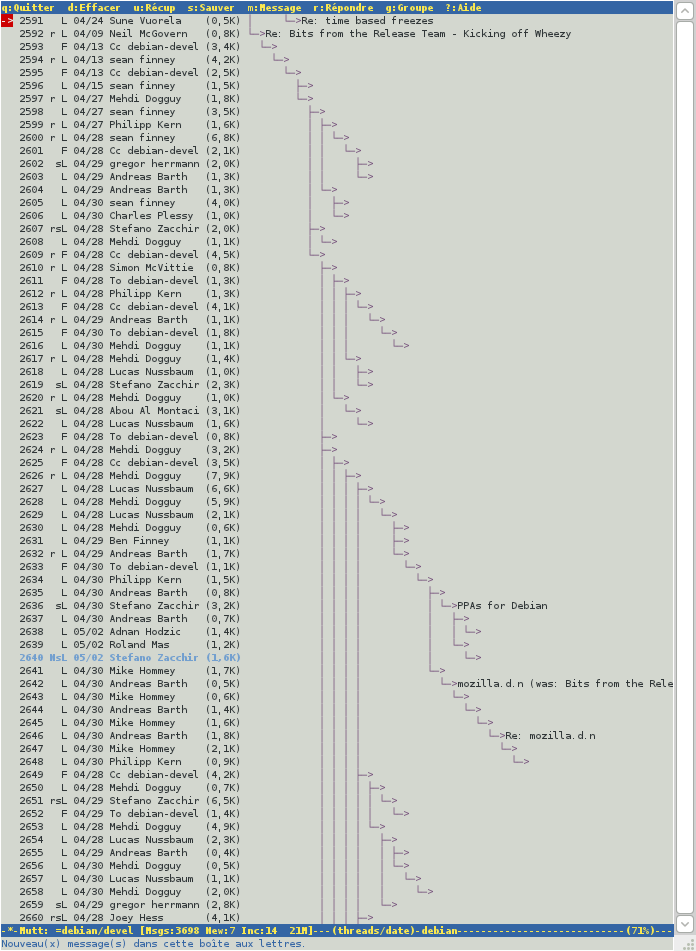
This is my monthly summary of my Debian related activities. If you re among the people who support my work, then you can learn how I spent your money. Otherwise it s just an interesting status update on my various projects. GNOME 3 packaging Right after the GNOME 3 release, I was eager to try it out so I helped the pkg-gnome team to update some of the packages. I did some uploads of totem, totem-pl-parser, gvfs, mutter, gnome-shell, gnome-screensaver. I also kept people informed via my blog and prepared a pinning file for adventurous users who wanted to try it out from experimental (like me). One month later, I m still using GNOME 3. There are rough edges still, but not so many. And I m starting to get used to it. Debian Rolling planning Debian Rolling is a project on my TODO list for quite some time. I decided it was time to do something about it and started a series of articles to help clarify my ideas while getting some early feedback. My goal was to prepare a somewhat polished proposal before posting it to a Debian mailing list. But as usual with Murphy s law, my plan did not work out as expected. Almost immediately after my first post the discussion started on debian-devel:
At this point it s a discussion thread of several hundreds of messages (there are several screens of messages like the one above). Many of the sub-threads have been interesting, but the general discussions mixed too many different things so that there s no clear outcome yet. Lucas Nussbaum tried to make a summary. Obviously I must adjust my plan, there s lots of feedback to process. I accepted to drive a DEP together with Sean Finney to help structure the part of the discussion that focuses on allowing development to continue during freezes. But I m also eager to fix the marketing problem of testing and have the project recognize that testing is a product in itself and that end-users should be encouraged to use it. Package Tracking System maintenance The Package Tracking System is an important tool for Debian developers, and it has been broken by some change on the Bug Tracking System. I worked around it quite quickly so that few people noticed the problem but Cron kept reminding me that I had to properly fix it. I ended up doing it last week-end. While working on the PTS, I took the opportunity to merge a patch from Jan Dittberner to enhance the news RSS feed that the PTS provides. And I also integrated information from backports.debian.org (thanks to Mehdi Dogguy for reminding me #549115). Multiarch update Not much new this month. I fixed two bugs in the multiarch dpkg branch thanks to bug reports from Ubuntu users (LP 767634, LP 756381). I m still waiting on Guillem Jover finishing his review of the multiarch branch. I m pinging him from time to time but it looks like multi-arch is no longer in his short term priority list. :-( I ve been running this code for more than 2 months and it works fine. I want to see it merged. I m ready to update my code should anything need to be changed to please Guillem. But without any feedback we re in a deadlock. Misc dpkg work While fixing a bug in update-alternatives (found in one of the valid reports on launchpad), I noticed that there was room for improvements in the error messages output by update-alternatives. I changed them to reuse the same strings that were already used in other parts of dpkg. The result is that there are a few strings less to translate (always a nice thing for the poor translators who have to deal with the thousands of strings that dpkg contains). I also tried to fix some of the most cryptic error messages in dpkg (see #621763) but that work is stalled at the request of Guillem. Book update We (me and Roland Mas) are almost done with the update of our French book for Debian Squeeze. It will hit the shelves in July or September. I m starting to prepare the fundraising campaign to make an English translation of it. We ll use ulule.com for this. On my blog I have been pleased to interview Meike Reichle, it s the first women that I have interviewed in the series but it s certainly not the last one. I also interviewed Adam D. Barratt, one of our tireless release managers. Thanks Many thanks to the people who gave me 180.35 in March and 235.37 in April. That represents 1.5 and 2 days of work for those months. See you next month for a new summary of my activities.

8 comments Liked this article? Click here. My blog is Flattr-enabled.

2 May 2011

Lucas Nussbaum: Debian rolling discussion on -devel@

Here is my attempt at a summary of the rolling discussion currently happening on debian-devel@. It might not be complete, it s probably a bit biased, but I hope that it s still better than nothing. It was also posted on debian-devel@. If you are involved in Debian development, please discuss it on debian-devel@, rather than in the comments of this blog. If you want to provide feedback about the Debian rolling idea, use this Doodle poll and/or the comments of this blog.
Update : Someone had the good idea to vandalize the poll, and remove all the votes from people in favor of rolling. Before the vadalism (log), the results were:
37 votes: I am a Debian user, I use testing or unstable, and I would like rolling to happen.
6 votes: I am a Debian user, I use testing or unstable, and I DON T want rolling to happen.
17 votes: I am a Debian user, I use stable, and I would like rolling to happen.
3 votes: I am a Debian user, I use stable, and I DON T want rolling to happen.
7 votes: I am NOT a Debian user, but I would probably use it if rolling happened.
1 vote: I am NOT a Debian user, and I don t care about rolling. Motivations There s some user demand for rolling releases. For evidence, one can look at the usage of Debian testing or unstable which clearly goes further than the Debian development community. Or at the quickly growing market share of ArchLinux. Or at the interest in LinuxMint and Aptosid. Or at the DPL s report of his interactions with the press. Debian s only official product is its stable releases. While it s a clearly great and useful product, many users and developers don t recognize themselves in it: it contains software that is too old for their needs. The success of Ubuntu is related to this problem: Ubuntu proposes a different compromise between stability and up-to-date-ness. While concurrencing Ubuntu with more frequent stable releases (released every 6-months, for example) doesn t look like the right thing to do, Debian is in a perfect position to provide a rolling release with marginal additional work, since Debian already has testing (and unstable) to build on. The rolling discussion investigates how we could endorse the concept of a rolling release, provided as a product in addition to stable releases. This rolling release would be based on the current testing branch. Benefits for Debian: Current proposed plan for rolling (Disclaimer: this is mostly my view. It is shared by others, but some details might not be) rolling is mostly about (external) communication. It is not expected to change our development processes fundamentally.
It would be a statement by the project (through a GR, for example). A very preliminary draft was proposed by Raphael Hertzog:
Title: Debian endorses usage of testing by end-users, and renames it to rolling The Debian project recognizes that the Debian testing distribution initially created to make it easier to prepare and test the next stable release has become a useful product of its own. It satisfies the needs of users who are looking for the latest stable versions of software and who can cope (or even appreciate) a system that s constantly evolving. The Debian project decides to endorse this usage and will strive to provide a good experience to users of testing . To better communicate this policy change to our users, testing will be renamed rolling .
Yes, it s mostly PR bullshit , and I don t expect it to significantly change Debian development processes. However, communication is necessary if we want to attract new users. What would change is more attention from developers to what happens in testing/rolling, which is a good thing since a better testing/rolling makes it easier to create stable releases from it. Open questions Most of the discussion is about the influence of the introduction of rolling on Debian development processes, and in particular, on the painful process resulting in stable releases. Many fear that, with rolling , it will be harder to get stable releases out. The root question is: if we do rolling, what do we do during freezes? Several options have been mentioned in the thread:
  1. We could decide not to do anything special: just freeze rolling for ~6 months, as we used to freeze testing. That might bore people who like the constant flux of new upstream releases, but if we decide that it s the only way to ensure high-quality stable releases, so be it.
  2. We could decide to fork a frozen branch when we freeze, and continue to manage rolling using migrations from unstable.
  3. We could mix both solutions: freeze rolling for 3 months, so that most of the stabilization work occurs with a single active branch, and then, for the final release preparation, fork frozen off rolling, and unfreeze rolling.
Two kinds of objections have been raised: Other things that were discussed: Tentative personal conclusion I have the impression that advertising testing as a rolling release usable by end-users is generally considered a good thing.
The renaming of testing to rolling is not as consensual, but most opponents have a whatever ; if you want position. How we deal with freezes is the hard point in this discussion. I m personnally in favor of the freeze rolling for 3 months, then fork frozen and unfreeze rolling plan, though it has some problems too (it is not clear whether the required manpower really decreases at the end of freezes). Where do we go from there? After another round of discussion, we might postpone the how to deal with freezes question to later, and proceed with a GR to measure the support for the testing for end-users + s/testing/rolling/ proposal.

Christian Perrier: 2011 week 17 Debian work

Will I succeed maintaining a weekly log of what I'm doing in Debian? We'll see. At least, let's try. D-I work: After spending most of the end of week 16 uploading D-I components, I completed this during this week. I hunted down the remaining arch:all, arch:i386 and arch:amd64 packages that need an upload because of l10n changes. The main point was bringing published D-I work inline with the work of translators. That was mostly meant to publicly have an image with Uyghur activated (which I blogged about separately). Finally, I ended up doing some changes to the fonts-ukij-uyghur package in order to use the right font to display the language in D-I, as well as improving the readability by increasing the font size just as we're already doing for Arabic and Persian. Samba packaging: I got release managers approval to upload a new release to stable-proposed-updates. It fixes several important bugs in samba 3.5.6, often affecting Win7 clients. I'm always happy to see that we can do that even when issues are ot security or "release critical" issues. I also integrated the newly-published samba 3.6.0-pre3 in the package maintenance SVN. However, we're still having problems with symbols disappearing from libwbclient, that prevent me to upload 3.6.0pre3 in experimental. Steve Langasek's help here will be welcome. Pytrainer and "gant" packaging: I setup a mailing list for the pkg-running maintenance team so that we can move the few packages some of us maintain (pytrainer and garmin-forerunner-tools as of now, and soon "garmin-ant-downloader", the helper tool for 405 watches). I also began looking at pytrainer bugs and forwarding some of them upstream. I also began packaging "gant" (had to rename it as we already have a gant package, totally unrelated). I just got a notice from Klaus Ethgen about improvements he did to the software. We'll try to figure out what to do as this software doesn't really have a clear upstream and published versions. l10n work: a few packages introduced debconf templates and I launched reviews of English for them (while mumbling about uncoordinated work, of course..;-)). I also reviewed about one hundred package description translations in French DDTP (something I recently began to commit to do even though it means onlinen work for me, which I'm not used to). No l10n NMUs this week but a few maintainer uploads after I (gently) kicked their ass..:-)

30 April 2011

Russell Coker: Autism Awareness and the Free Software Community

It s Autism Awareness Month April is Autism Awareness month, there are lots of articles about Autism, most of them are at best misleading if not wrong. The most common error seems to be describing non-verbal Autistic children and then claiming that Autistic people comprise about 1% of the population. The number of non-verbal Autistic children is a lot less than 1% of the population, and at least 1/3 of the people on the Autism Spectrum have good verbal skills and often talk more than average. To be precise, they are describing the symptoms of people who would be diagnosed with Severity 3 according to the American Psychiatric Association s Diagnostic and Statistical Manual (the DSM) as applying to all people who are on the Autism Spectrum even though of the currently diagnosed people probably about 1/3 might be classified as Severity 2 and 1/3 as Severity 1. It seems that severity 1 Autism is going to be the replacement for Asperger Syndrome in the new DSM-5. The problem with misleading information in regard to what comprises Autism is that parents really don t want to have a child who s abnormal and search for evidence to make their wishes come true. At the extreme there are parents who can convince themselves that a 4yo non-verbal child isn t on the Autism Spectrum. When people are given the impression that Autism is only about non-verbal children then they will probably think that a 6yo who can give a half-hour lecture on a topic of interest (regardless of whether the audience is interested) isn t on the Autism Spectrum. There is also a similar issue with undiagnosed adults, I would have probably got assessed at least a decade earlier if I had learned more about Autism instead of believing some of the stories. In a quick Google search for Autism Awareness Month I haven t found any clear and accurate information on what Autism is or what should be done about it, so it seems to me that the awareness project has largely been a failure. The Autism page on Wikipedia [1] and the page for Asperger Syndrome [2] are good places to start reading. By merely pointing to those two Wikipedia pages I ve made this post a lot more useful than every article I ve seen in the mainstream media. To find some useful and insightful posts about Autism awareness you have to add some search terms such as neurodiversity, which turns up posts such as a post by Leah Jane about Autism Acceptance [3]. It seems that the Autism Awareness articles that are most useful at informing people will only be found by people who are already aware of some of the issues. Most People Who Read this are Geeks The majority of the readers for my blog come from aggregators that cater to fairly geeky people. Geek culture is largely Aspie culture. So I think that most people who read my blog have a good general knowledge of what people who might be diagnosed with Asperger Syndrome or High Functioning Autism are like they just think that such people are merely a bit more geeky than is typical for the Free Software community. So it s not as if all Autistic people are hidden away somewhere because they can t live independently. Many of us work in the computer industry and in academia. Probably the majority of people who have a university degree related to science or engineering have had a professor who was on the Autism Spectrum, probably most people who have any significant experience in the computer industry have had colleagues who are on the Spectrum. After having become used to the geek culture I initially found it difficult to believe that I could be on the Autism Spectrum because I knew heaps of people in the Free Software community who are at least as geeky as me but apparently weren t on the Autism Spectrum. I now think that the majority of people who are as geeky as me would get diagnosed with Asperger Syndrome (or High Functioning Autism under DSM-5) if they were assessed. Adult Diagnosis If you are wondering whether you might be on the Autism Spectrum then it s worth reading the pages linked from the DSM 5 draft process have the full diagnostic criteria (both for DSM-4 and DSM-5) [4]. Also Glenn Rowe has a web page with tests designed by Professor Simon Baron-Cohen [5] and Leif Ekblad has a project to do long-term analysis of changes to personality test scores which starts with a quick Aspie quiz [6] (and also has lots of links to other relevant sites). If you think that you might be on the Autism Spectrum (which means Asperger Syndrome in the case of most people who read my blog) then I recommend that you get assessed if possible. As assessment by a psychologist isn t cheap there is the option of self-diagnosis in which case Chaotic Idealism s post about self-diagnosis is worth reading [7].

Thomas Girard: ACE+TAO Debian packaging moved to git

We recently converted Debian ACE+TAO package repository from Subversion to git. This was a long and interesting process; I learned a lot on git in the course. I had been using git for a while for other packages: BOUML, dwarves and GNU Smalltalk. But I did not really get it. A preliminary study led by Pau[1] showed that out of the following three tools: the last one was giving results that look better.
The conversion svn-all-fast-export requires physical access to the repo, so the Alioth SVN repo was copied on my machine svn-pkg-ace/ before running the tool:
svn-all-fast-export --identity-map authors.txt --rules pkg-ace.rules svn-pkg-ace
Here's the content of the pkg-ace.rules configuration file that was used:
create repository pkg-ace
end repository
match /trunk/
  repository pkg-ace
  branch master
end match
match /(branches tags)/([^/]+)/
  repository pkg-ace
  branch \2
end match
The author mapping file authors.txt being:
markos = Konstantinos Margaritis <email-hidden>
mbrudka-guest = Marek Brudka <email-hidden>
pgquiles-guest = Pau Garcia i Quiles <email-hidden>
tgg = Thomas Girard <email-hidden>
tgg-guest = Thomas Girard <email-hidden>
The tool sample configuration file merged-branches-tags.rules recommends to post-process tags, which are just a branch in SVN. That's why the configuration file above treats branches as tags. The conversion was indeed fast: less than 1 minute.
Post-conversion observations Invoking gitk --all in the converted repo revealed different kind of issues:
  • svn tags as branches: http://thomas.g.girard.free.fr/ACE/tags-as-branches.png Branches are marked with green rectangles, and tags with yellow arrows. What we have here (expected given our configuration of the tool) are branches (e.g. 5.4.7-5) corresponding to tags, and tags matching the SVN tagging commit (e.g. backups/5.4.7-5@224). We'll review and fix this.

  • merged code that did not appear as such: http://thomas.g.girard.free.fr/ACE/missing-merge-metadata.png Branches that were not merged using svn merge look like they were not merged at all.

  • commits with wrong author: http://thomas.g.girard.free.fr/ACE/wrong-author.png Before being in SVN, the repository was stored in CVS. When it was imported into SVN, no special attention was given to the commit author. Hence I got credited for changes I did not write.
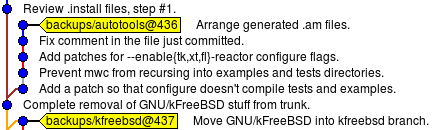
  • obsolete branches: http://thomas.g.girard.free.fr/ACE/obsolete-branches.png The tool leaves all branches, including removed ones (with tag on their end) so that you can decide what to do with them.

  • missing merges: http://thomas.g.girard.free.fr/ACE/missing-merge.png The branch 5.4.7-12 was never merged into the trunk!

Learning git Based on observations above, I realized my limited knowledge won't do to complete the conversion and clean the repository. There are tons of documentation on git out there, and you can find a lot of links from the git documentation page. Here's the one I've used:
The Git Object Model It's described with pictures here. You really need to understand this if you haven't already. Once you do, you understand that git is built bottom-up: the plumbing then the porcelain. If you can't find the tool you need, it's easy to write it.
git fast-import The Migrating to Git chapter explains how you can use the git fast-import tool to manually import anything into git. I've used it to create tags with dates in the past, slightly changing the Custom Importer example in the book:
#!/usr/bin/env ruby
#
# retag.rb
#
# Small script to create an annotated tag, specifying commiter as well as
# date, and tag comment.
#
# Based on Scott Chacon "Custom Importer" example.
#
# Arguments:
#  $1 -- tag name
#  $2 -- sha-1 revision to tag
#  $3 -- committer in the form First Last <email>
#  $4 -- date to use in the form YYYY/MM/DD_HH:MM:SS

def help
  puts "Usage: retag <tag> <sha1sum> <committer> <date> <comment>"
  puts "Creates a annotated tag with name <tag> for commit <sha1sum>, using "
  puts "given <committer>, <date> and <comment>"
  puts "The output should be piped to git fast-import"
end
def to_date(datetime)
  (date, time) = datetime.split('_')
  (year, month, day) = date.split('/')
  (hour, minute, second) = time.split(':')
  return Time.local(year, month, day, hour, minute, second).to_i
end
def generate_tag(tag, sha1hash, committer, date, message)
  puts "tag # tag "
  puts "from # sha1hash "
  puts "tagger # committer  # date  +0000"
  print "data # message.size \n# message "
end
if ARGV.length != 5
  help
  exit 1
else
  (tag, sha1sum, committer, date, message) = ARGV
  generate_tag(tag, sha1sum, committer, to_date(date), message)
end
graft points (graft means greffe in French) Because of missing svn:mergeinfo some changes appear unmerged. To fix this there are graft points: they override git idea of parents of a commit. To create a graft point, assuming 6a6d48814d0746fa4c9f6869bd8d5c3bc3af8242 is the commit you want to change, currently with a single parent 898ad49b61d4d8d5dc4072351037e2c8ade1ab68, but containing changes from commit 11cf74d4aa996ffed7c07157fe0780ec2224c73e:
me@mymachine$ echo 6a6d48814d0746fa4c9f6869bd8d5c3bc3af8242 11cf74d4aa996ffed7c07157fe0780ec2224c73e 898ad49b61d4d8d5dc4072351037e2c8ade1ab68 >> .git/info/grafts
git filter-branch git filter-branch allows you to completely rewrite history of a git branch, changing or dropping commits while traversing the branch. As an additional benefit, this tool use graft points and make them permanent. In other words: after running git filter-branch you can remove .git/info/grafts file. I've used it to rewrite author of a given set of commits, using a hack on top of Chris Johnsen script:
#!/bin/sh

br="HEAD"
TARG_NAME="Raphael Bossek"
TARG_EMAIL="hidden"
export TARG_NAME TARG_EMAIL
filt='
    if test "$GIT_COMMIT" = 546db1966133737930350a098057c4d563b1acdf -o \
            "$GIT_COMMIT" = 23419dde50662852cfbd2edde9468beb29a9ddcc; then
        if test -n "$TARG_EMAIL"; then
            GIT_AUTHOR_EMAIL="$TARG_EMAIL"
            export GIT_AUTHOR_EMAIL
        else
            unset GIT_AUTHOR_EMAIL
        fi
        if test -n "$TARG_NAME"; then
            GIT_AUTHOR_NAME="$TARG_NAME"
            export GIT_AUTHOR_NAME
        else
            unset GIT_AUTHOR_NAME
        fi
    fi
'
git filter-branch $force --tag-name-filter cat --env-filter "$filt" -- $br
(Script edited here; there were much more commits written by Raphael.)

Important

It's important to realize that the whole selected branch history is rewritten, so all objects id will change. You should not do this if you already published your repository.

The --tag-name-filter cat argument ensures our tags are copied during the traversal; otherwise they would be untouched, and hence not available in the new history.

Hint

Once git filter-branch completes you get a new history, as well as a new original ref to ease comparison. It is highly recommended to check the result of the rewrite before removing original. To shrink the repo after this, git clone the rewritten repo with file:// syntax -- git-filter-branch says it all.

Cleaning up the repo To recap, here's how the ACE+TAO git repo was changed after conversion:
  1. Add graft points where needed.

  2. Clean tags and branches. Using git tag -d, git branch -d and the Ruby script above it was possible to recreate tags. During this I was also able to add missing tags, and remove some SVN errors I did -- like committing in a branch created under tags/.

  3. Remove obsolete branches.

  4. Merge missing pieces. There were just two missing debian/changelog entries. I did this before git filter-branch because I did not find a way to use the tool correctly with multiple heads.

  5. Fix commit author where needed. Using the shell script above Raphael is now correctly credited for his work.

That's it. The ACE+TAO git repository for Debian packages is alive at http://git.debian.org/?p=pkg-ace/pkg-ace.git;a=summary.
[1]http://lists.alioth.debian.org/pipermail/pkg-ace-devel/2011-March/002421.html
[2]available in Debian as svn-all-fast-export

Next.

Previous.