Search Results: "reg"

3 February 2010

David Welton: Italy vs Google

I'm starting to notice a pattern here: One way of seeing things is that politicians and businessmen in Italy noticed Google was actually making quite a bit of money, and even if they don't quite understand this internet thing, they want some of the loot. And while Google certainly is becoming big enough to be cause for worry and discussion, the moves against them in Italy do not seem anything like a rational response calculated to offset severe failures in the market. In any case, it will be interesting to see what happens. Maybe, after China, we'll see Google quit Italy as well?

MJ Ray: Welcome to Koha-Community.org

At last night s #koha community hand-over meeting, it was felt that the LL/PTFS transfer could easily delay community control of the previous koha website for 3 months, so HLT should register a fan site for community members to put the latest Koha news and information on the web. So welcome to Koha-community.org which will mainly be about updates about new releases, support listings and the manuals until the previous website reflects the community again. Well done to all involved for getting it online so quickly!

2 February 2010

Russell Coker: 3G Broadband for Home Use

I have just installed an old Three mobile phone with 3G broadband for my parents home network access for the reasons described in my cheap net access in Australia post [1]. The first problem I had was that the pre-paid Three SIM just wouldn t work at all. I ended up phoning the Three support line and had a guy guess at which version of Windows I was running, after guessing every version of Windows from the last 10 years and Mac OS/X he finally asked what OS I use and then told me that Linux isn t supported. I said I HAVE TWO SIMS FROM THREE, ONE WORKS AND THE OTHER DOESN T, IT S ON THE SAME PC WITH THE SAME 3G ACCESS DEVICE, THE PROBLEM IS WITH THE SIM OR THE SERVER NOT MY OS . When the support guy discovered that one sim was pre-paid he said that there is a configuration difference, instead of an APN of 3netaccess for post-paid (contract) you have to use 3services for pre-paid. There are a bunch of web pages describing how to get Three 3G broadband working on Linux in Australia, some say to use 3netaccess and some say 3services. None of the pages I read stated correctly that 3netaccess is for when you are on a contract and 3services is for pre-paid. I ve submitted a suggestion for the Ross Barkman s GPRS Info Page (which seems to be the best reference for such things) [2]. After getting the pre-paid 3G SIM working for net access from the Huawei E1553 USB 3G modem I was unable to get it working from my LG U890 mobile phone. I never figured out how to solve this problem, I left my parents with the SIM that is connected to my $15 per month contract plan for 3G net access and am now using the pre-paid SIM for my own use. Of course this means that as I m using a SIM registered to my mother and she s using one registered to me I ll surely have some problems getting the support center to help me with problems in future. I found that the 3G net access got better reception when the phone was higher than the computer, so I used a USB extension cable to allow it to be placed on a shelf above the computer. The extension cable also allows it to be easily unplugged and plugged in again I ve already seen one situation where Linux got confused about the state of the USB device and replugging it was necessary to solve the problem. I was using Debian/Lenny. Here is my chatscript for connecting to Three with my 3G modem on a pre-paid SIM which also allows roaming to Telstra (I haven t tested whether pre-paid allows roaming, I ve only tested Telstra roaming with a contract SIM): ABORT 'BUSY'
ABORT 'NO CARRIER'
ABORT 'ERROR'
'' AT
OK ATQ0V1E1S0=0&C1&D2+FCLASS=0
OK 'AT+COPS=0,0,"3TELSTRA",2'
OK AT+CGATT=1
#OK AT+CGDCONT=1,"IP","3netaccess"
OK AT+CGDCONT=1,"IP","3services"
OK ATDT*99**3# Here is the ppp configuration for connecting via the USB 3G modem. For use as a permanent connection you want to also include persist and maxfail 0 :
/dev/ttyUSB0
230400
noauth
defaultroute
logfile /var/log/ppp.log
connect "/usr/sbin/chat -v -f /etc/chatscripts/three" For connecting with an LG U890 mobile phone you need to use ATDT*99***1# as the dial command and the device is /dev/ttyACM0 .

Russell Coker: Precision vs Accuracy in Identifying People

Andrew Dowdell and Michael McGuire have an interesting article in the Adelaide Now about censorship in the South Australian election [1]. The South Australian government wants to force everyone who comments on the upcoming SA election to provide their name and postcode. Attorney-General Michael Atkinson said the law was all about honesty . However a law that forces someone to not comment as Anonymous and instead forces them to use a name that sounds like something that might appear on a birth certificate and a postcode is not going to increase honesty at all. I think it s much better to honestly say I m not telling you my name than to lie and claim to be revealing your name. When the government forces people to give precise but totally inaccurate information it seems that it s going to be bad for everyone. It s even bad for the people who want to be identified, if most people who comment on a blog post are anonymous then I d like to be distinguished as the person who uses their real name! In the vast majority of cases the effort of determining who is using their real name will not be worth the effort. If someone comments on my blog under the name John Howard from Bennelong I will be very suspicious that they are using a fake name. But probably the vast majority of the English speaking population of the world wouldn t immediately identify such a name as fake. If someone wants to comment on my blog and they don t have a published phone number then I won t have any good way of identifying their address. If their name and postcode match an entry in a phone book then they still might be faking it they could take a random name from a phone book. If I was to demand that people who enter blog comments provide their phone numbers then I would have to pay the expense of phoning them as well as dealing with cases of people who are away from home, should I delay a blog comment for a month until the author returns from their European vacation? I have had a moderate amount of experience in writing letters to the editors of newspapers, and I have only once had an editor phone me to verify my details. In all other cases I guess I could have fooled them if I wished. I believe that there are already precedents regarding libel, if I approve a blog comment (or fail to unapprove it in a reasonable amount of time if it meats the automatic approval criteria) then I could be sued for libel if the contents of the comment are deemed to be suitably damaging. So if I was to try to get the real names of people who make comments on my blog then it wouldn t make it any easier for an idiot who wants to sue also anyone who wants to sue regarding an Australian political issue will probably find me a better target than most people who comment on my blog (a significant portion of whom are from the US and have much greater legal protections of their freedom of speech). Extending such a law to US based services such as Twitter is just silly. The stockholders and employees of a US based corporation can freely laugh at Australian censorship laws. Also it s pretty stupid to have a global scope on such laws, as a Victorian why should I care about the South Australian state laws? Implementing laws that can be easily broken inadvertently and can never be enforced against anyone who cares is just pitiful and will result in the MPs who vote for such laws being the object of derision. Vote for the small parties and independent candidates. Both Labour and Liberal want to censor us, put them in the second last two spots on your vote card! Now this law doesn t take affect until the writs for the March 20 election are issued. I encourage Australian bloggers to write bad things about the Liberal and Labour parties after the writs are released which are not libelous and which don t include your postcode. If they try to apply the new law then your blog post gets wide attention. If you plan to be a professional blogger then you could consider the $5,000 fine to be an advertising fee. If you don t want to be known then you can use a US based blogging service. I m going to continue to write political blog posts whenever I feel like it and I won t be telling anyone where I live. I will rely on the Streisand effect to save me. Update:
The politicians in SA have surrendered, the law in question won t be enforced and will supposedly be repealed after the election [2]. It will be interesting to see whether they really do repeal that law.

Brett Parker: SeeSaw

So, I just went to register for a SeeSaw invite, I entered my usual e-mail address, which is iDunno@sommitrealweird.co.uk, and got told it was not a valid e-mail address... erm, yes it is, I use it rather a lot, dammit! So, I changed the localpart from iDunno to one of my less used aliases, and that it accepted... this means that they're checking the localpart and rejecting things with a localpart of idunno, I don't know what other localparts they're rejecting, but that seemed a little harsh... Ah well, now I'll wait for the invite then I can test :) Update: Apparently if you put the e-mail address in all lowercase it accepts it fine. sigh.

1 February 2010

Erich Schubert: Maps-Calendar Mashup

Well, I'd not call it a Mashup - it's actually backed by a custom database, a Xapian index for full text search and so on. To me, a true mashup would work without own server side code.Anyway, what it does is this: It's using the Maps V3 API, currently in public testing, which seems to give quite some extra speed compared to earlier versions. I've also added two extra controls, a search box at the top center, and a "Go to" menu on the left, which uses the visitor position from Google.The data is coming from swing dancing calendars, so it's real world data, and you should get different results every day. Most of the data is from Germany, so that is where you can see the marker aggregation and these things in effect.Here's the prototype.There is still lots of things to do, but this is just my free time project, when I'm not at work, dancing or with my friends. I don't know yet if this will remain online, it's more of a toy project for me. Still it's cool to see where there are swing dancing events, and it's cool to be able to just zoom to another city and see where you could "hop by" for a dancing event while you're there. But there are just a lot of UI issues to solve to get this really usable, and I'm not much of an UI guy...P.S. if it doesn't work, that probably means I'm currently working on it. There is no staging, and no "production system".

31 January 2010

Gregor Herrmann: RC bugs 2010/04

again, I focussed on the RC bugs in the perl group. & again, carnil++ was very active both in finding & in fixing them :)

Axel Beckert: abe@debian.org

On Wednesday I got DAM approval and since Saturday late evening I m officially a Debian Developer. Yay! :-) My thanks go to As Bernd cited in his AM report, my earliest activity within the Debian community I can remember was organising the Debian booth at LinuxDay.lu 2003, where I installed Debian 3.0 Woody on my Hamilton Hamstation hy (a Sun SparcStation 4 clone). I wrote my first bugreport in November 2004 (#283365), probably during the Sarge BSP in Frankfurt. And my first Debian package was wikipedia2text, starting to package it August 2005 (ITP #325417). My only earlier documented interest in the Debian community is subscribing to the lists debian-apache@l.d.o and debian-emacsen@l.d.o in June 2002. I though remember that I started playing around with Debian 2.0 Hamm, skipping 2.1 (for whatever reasons, I can t remember), using 2.2 quite regularily and started to dive into with Woody which also ran on my first ThinkPad bijou . I installed it over WLAN with just a boot floppy at the Chemnitzer Linux-Tage. :-) Anyway, this has led to what it had to lead to a new Debian Developer. :-) The first package I uploaded with my newly granted rights was a new conkeror snapshot. This version should work out of the box on Ubuntu again, so that conkeror in Ubuntu should not lag that much behind Debian Sid anymore. In other News Since Wednesday I own a Nokia N900 and use it as my primary mobile phone now. Although it s not as free as the OpenMoko (see two other recent posts by Lucas Nussbaum and by Tollef Fog Heen on Planet Debian) it s definitely what I hoped the OpenMoko will once become. And even if I can t run Debian natively on the N900 (yet), it at least has a Debian chroot on it. :-) I'm going to FOSDEM, the Free and Open Source Software Developers' European Meeting A few weeks ago, I took over the organisation of this year s Debian booth at FOSDEM from Wouter Verhelst who s busy enough with FOSDEM organisation itself. Last Monday the organiser of the BSD DevRoom at FOSDEM asked on #mirbsd for talk suggestions and they somehow talked me into giving a talk about Debian GNU/kFreeBSD. The slides should show up during the next days on my Debian GNU/kFreeBSD talks page. I hope, I ll survive that talk despite giving more or less a talk saying Jehova! . ;-) What a week.

Russell Coker: Choosing an Australian Mobile Telco for use with Android

Since playing with the IBM Seer augmented reality software [1] I ve been lusting after a new mobile phone which can do such things. While the implementation of Seer that I tried was not of great practical use to me (not being a tennis fan I was only there to learn about computers) it was a demonstration of an exciting concept. It will surely be implemented by IBM in other venues that are of more immediate interest, and we can probably expect other vendors to write similar systems to compete with IBM. So the question is how to get a phone that will run such things well. The answer is probably not to rely on a contract plan for this, currently Vodaphone [2] is currently the only Australian telco that sells a phone that can run Seer, it is offering a HTC Magic (which was released in April 2009) on a $29 per month plan. A phone that is 9 months old isn t necessarily a bad thing, but the has been out for more than 6 months and has some significant benefits (such as a 5MP camera). So it seems that Three (my current provider) is probably the best option at this time. Virgin would save my $4 per month, but would only give me 300M of Internet data per month, and the Virgin limit of $60 per month of calls might not be enough for me. Vodaphone offers a deal for $25 that only includes 200MB of data, that might be enough for just phone use, but wouldn t be enough for tethering for laptop net access. I wonder how well tethering works on an Android phone, can you make a phone call while transmitting data from a tethered laptop? I find that with my Viewty when I receive an SMS or phone call it stops the net access. That makes a tethered Viewty impractical for some support tasks as it s fairly common that I need to talk to someone while logging in to their server I m sure that most people who use mobile Internet services regularly need to phone someone while using them. My current Three bill is $29 per month for the phone plan and $15 per month for Internet access. If I m going to buy phones outright instead of getting them with the plan then I want to reduce the overall amount of money I spend on phone plans and using tethering instead of a 3G USB dongle would allow this. I think that I can get something that comes close to my ideal mobile phone [8] (apart from being able to connect a keyboard, mouse, and monitor) if I import it from overseas. We really need more competition in the Australian mobile phone market. We have only two phone companies offering Android phones, Three is sold out of the obsolete model that they offer while Vodaphone has stock of an obsolete model.

Russell Coker: My Ideal Mobile Phone

Based on my experience testing the IBM Seer software on an Android phone [1] I have been considering what type of mobile phone to get when my current contract expires. Here are the features above what is common in current smart phones that I think most people will sorely miss if they don t have them for the 2011-2012 period:
  1. Camera that takes reasonable quality pictures at a 5MP resolution.
  2. High resolution screen (VGA or better).
  3. GPS (for navigation and augmented reality.
  4. Digital compass for augmented reality.
  5. An open market for applications which allows free software to be installed such as OpenSSH.
The first two items shouldn t be a problem, there has been a constant trend towards better cameras and higher resolution screens in phones. The difficult ones are GPS and a Digital compass which require phone software to use them. I get the impression that Android and iPhone are going to share the market for fully functional smart phones (because they have the market of applications). So I predict that by 2012 the phone market will have iPhone and Android fully functional smart phones as well as budget phones that don t support running applications (and will probably lack a compass and GPS). Here are the features that while not essential, will greatly increase the experience of using a phone for serious users:
  1. At least 2G of storage built in installing a 2G micro-SD card is not adequate.
  2. A screen that can be easily read during the day maybe Pixel Qi.
  3. The ability to give a good quality of sound for playing video and audio recordings with a regular headphone jack (so I can use my Bose headset).
For my use a hardware keyboard (such as is used in the Motorolla A855 Droid ) is essential. I want to have a pocket sized ssh client for emergencies, and I want to be able to type notes reasonably quickly. I wonder what portion of the smart-phone user base actually needs a keyboard. I ve seen many people who use a smart-phone as just a regular phone that can exchange photos. Even among people who are moderately serious about smart-phone use there are probably many who only want to take high resolution photos and tag them with GPS data. Currently there are no Android phones on sale in Australia that have a hardware keyboard, I m worried that this may be an ongoing trend which will result in people with my requirements being forced to either pay significantly more or compromise on features due to the market meeting the needs of average people. Finally I would like to have a smart-phone that has a regular USB port for plugging in devices (which would of course require an adapter as the size of a phone doesn t permit a regular USB port). That would permit copying files from USB flash devices, driving a digital SLR camera, and printing photos directly to a USB printer. It would also allow connecting a USB video device, keyboard, and mouse to make a mobile phone work as a desktop workstation. Current smart phones have a lot more compute power than the desktop machines I was using in 1998, so there s no reason that one couldn t be used as a workstation with the appropriate peripherals.

Cyril Brulebois: Saving Private G-I

(Disclaimer: this post is not about G.I.) Graphical installer Josselin posted his thoughts about g-i, and given at least the first parts sound doable, I m tempted to have a look at dealing with the needed udebs. Never touched anything like this before, but oh well, one learns every day. Time to learn a bit more about X11 as well. It looks like generating a new mini.iso (using d-i s trunk) wasn t that difficult, so hopefully once I m done with a few udebs, it should be possible to add them to this image and make sure those are usable, at least when loaded manually. Once that finished, gluing everything together is probably going to be another story, but hopefully that won t be impossible. Unrelated stories

29 January 2010

Joey Hess: xmonad layouts for netbooks

How a window manager with tiling layouts makes a 1024x600 resolution livable. I spend a lot of time in front of a screen, and for the past year I have used only my netbook. No desktops, no laptops. Just a cheap $200 computer that is nearly a kid's toy. The most challenging thing about this is dealing with the 1024x600 screen resolution. When I moved to this screen from something with many more pixels, it at first seemed very cramped. After a year, I think that the most important part of coping with the small screen is the flexability and customizability of layouts provided by the Xmonad window manager. In this post I will explain a few layouts I have developed for fitting specific tasks onto the netbook screen. (I assume that you know maybe 0.1% of Haskell (about what I do), and can read Haskell code without having a brain aneurysm.) web browsing
It's important that the web browser have as few toolbars and other cruft as possible, as horizontal space is especially at a premium. I've configured both Epiphany and Firefox to put everything in one tool bar. But now I use Chromium, which comes pre-configured that way.
What the netbook is designed for. You just want a web browser, taking up the full screen, and with its own tabs. So far, so easy: that's Xmonad's Full layout. But, you sometimes want to see two websites side-by-side. This layout accomplishes that, allowing the sizes to be adjusted as needed. It also uses Xmonad's Magnifier to zoom the smaller window when it's focused, which is useful if you briefly need to see more of a web site.
mySplit = magnifiercz' 1.4 $ Tall nmaster delta ratio
    where
        -- The default number of windows in the master pane
        nmaster = 1
        -- Percent of screen to increment by when resizing panes
        delta   = 3/100
        -- Default proportion of screen occupied by master pane
        ratio   = 60/100
screenshot screenshot web development If you're doing web development, you'll want probably one big web browser window, but also with a nice wide terminal on the same screen, in order to see web server logs. A simple way to do this is to mirror Xmonad's Tall layout by 90 degrees.
myWide = Mirror $ Tall nmaster delta ratio
    where
        -- The default number of windows in the master pane
        nmaster = 1
        -- Percent of screen to increment by when resizing panes
        delta   = 3/100
        -- Default proportion of screen occupied by master pane
        ratio   = 80/100
The myWide layout uses the full screen width for a single terminal, and splits the width when there are more. This is sufficient for viewing logs and doing minor things at the shell prompt, in between testing the result in the web browser. Of course a terminal can be temporarily moved to the master area by pressing mod-return, if you need it to be larger. screenshot screenshot chat
Tips on configuring Pidgin for a netbook: Set it up to use vertical tabs to save horizontal space. Configure the input area to only 1 line tall, and turn off as much other cruft as you can. The menu bars, sadly, cannot be disabled, nor can the excessively large borders. In my screenshots, you can see that stuff wasting space that could be used to show four more lines of text.
For chat, you want to put the buddy list on the side of the screen, and use the rest for conversation windows. Xmonad's IM module takes care of allocating a sidebar on the screen for the buddy window. The rest of the screen can be occupied by any layout you choose. I like to have the conversation windows be as wide as possible, and typically only want to see two conversations at a time. But sometimes I might have a dozen visible. A good layout to cope with those needs is Grid.
myChat' l = withIM size roster l
    where
        -- Ratio of screen roster will occupy
        size = 1%5
        -- Match roster window
        roster = Title "Buddy List"
myChat = myChat' Grid
The withIM layout puts the buddy list on the left; I prefer it on the right for some reason, so I tweaked my layout to do that. All it took was using the reflectHoriz layout modifier to get a mirror image of the layout. Then I reflect the inner layout back to its normal orientation. Being able to throw in a few function calls and mutate a layout like that is where Xmonad shines.
myChat' l = reflectHoriz $ withIM size roster $
            reflectHoriz $ l
screenshot screenshot logs
Ever notice that tail -f wastes the last line of the terminal? On a netbook this matters. shorttail lets the last line be used.
I have a dedidated workspace that I use to tail logs, and as a place to send long-running tasks (such as compiles). The layout for this needs to keep windows wide, to see whole logged lines, but they need only be five or so lines tall. And it's convenient to have one bigger window with the small ones below. Xmonad has a perfect layout for this, called Dishes, because it's sorta like a stack of plates.
myDish = limitWindows 5 $ Dishes nmaster ratio
    where
        -- The default number of windows in the master pane
        nmaster = 1
        -- Default proportion of screen occupied by other panes
        ratio = 1/5
screenshot screenshot
In the second screenshot above, I have 6 windows open, but only 5 are visible. The limitWindows 5 accomplishes this. It's handy mostly because gnome-terminal has a bad habit of crashing when resized to 0x0. (That's gotta be a bug in something!)
Notice that the screenshots above also have Procmeter in a sidebar on the right. I (ab)used the withIM layout to do that:
myLogs' l = reflectHoriz $ withIM procmeterSize procmeter $
              reflectHoriz $ l
    where
        -- Ratio of screen procmeter will occupy
        procmeterSize = 1%7
        -- Match procmeter
        procmeter = ClassName "ProcMeter3"
myLogs = myLogs' myDish
coding Everything above was easy. Doing coding (or writing) on a small screen is where it gets hard. When I'm coding I want to have one window that is exactly 80 columns wide, and as tall as possible, where I do the main development. Then I need a minimum of two other windows also visible: one action window for running tests and the like, and one to view references (emails, man pages, other files, etc). I may need to view any of these windows fullscreen at any time, of course.
As an example of the three window rule: While I'm writing this post, I have a reference window open with my .xmonad/xmonad.hs, and an action window open where I am managing screenshots.
Often, deep into something, I will accumulate many other reference and action windows. But three seems to be the magic, minimum number for me; use of screen or anything else doesn't reduce it; if I can't see all three at once, I will waste time and concentration flipping back and forth. The Xmonad layout I've developed to handle this is based on the handy FixedColumn layout, which automatically keeps the master window 80 columns wide. I modify this by adding the Magnifier, so that my action and reference windows "pop out" over the master window when focused.
myCode = limitWindows 3 $ magnifiercz' 1.4 $ FixedColumn 1 20 80 10
The 1.4 was carefully tuned, to magnify a window to be big enough to be usable for editing, reading, or command-line, while not obscuring too much of the other two windows. And again I use limitWindows, to only show three windows, in order to keep them all as big as possible. Other windows are hidden offscreen, but I can rotate to them with alt-tab as needed. screenshot screenshot reading ebooks When I'm reading an ebook, I want to have the reader in the middle of the screen. But a widescreen netbook like mine is too wide to comfortably read text all the way across, so it's nice to have margins. (In the margins, I put terminals, or notes.) The ThreeColumns module has a layout that does just that.
myBook = ThreeColMid nmaster delta ratio
    where
        nmaster = 1
        -- Percent of screen to increment by when resizing panes
        delta   = 3/100
        -- Default proportion of screen occupied by master pane
        ratio   = 2/3
screenshot putting it all together I join all my layouts together, so Xmonad will allow switching between them. These three combinations all have the same layouts, only ordered differently, so that different workspaces can have different default layouts.
codeFirst  = myCode    myWide    myGrid    myDish
dishFirst  = myDish    myCode    myWide    myGrid
gridFirst  = myGrid    myDish    myCode    myWide
Xmonad layouts can be decorated with things like title bars. To save horizontal space, I leave off the title bars on layouts where they are not needed to disambiguate windows. Two helper functions can be applied to add or remove titles (and also cause the layout to avoid the Gnome panel.)
withTitles l = noFrillsDeco shrinkText myTheme (desktopLayoutModifiers l)
noTitles l = desktopLayoutModifiers l
I have semi-dedicated workspaces; one for each of the above activities. To assign a layout to a workspace, I use the PerWorkspace module.
Notice that the "web" workspace has only two available layouts. Meanwhile, the "book" workspace always uses the specialized myBook layout; I don't use that layout elsewhere.
perWS = onWorkspace "logs" (withTitles $ myLogs' dishFirst) $
        onWorkspace "web"  (noTitles   $ (mySplit   myWide)) $
        onWorkspace "chat" (noTitles   $ myChat' gridFirst) $
        onWorkspace "book" (noTitles   $ myBook) $
                           (withTitles $ codeFirst)
Finally, I allow toggling between the currently selected layout and fullscreen mode, and use smartBorders to avoid displaying borders when there is only one window onscreen.
myLayout = smartBorders $ toggleLayouts Full perWS
Xmonad layout optimised for the small screen of a netbook: Done! (For now...)
screenshots screenshots screenshots screenshots screenshots
PS: Thanks to #xmonad regulars for always having the answer I need up their sleeves.

28 January 2010

John Goerzen: Greek Mythology and the Old Testament

I have lately been reading Homer s epic poems: first The Iliad, and now I am nearly done with The Odyssey. I figure there isn t anyone alive today that believes that Zeus literally caused thunder in answer to a prayer, or that Athene really transformed Ulysses between having a youthful and an aged physical appearance at a whim. Despite our understanding that these poems don t reflect a literal truth, we still find meaning and truth in them. It is for this reason that they are read by high school and college students all over the world. This same reason drives our reading of more modern plays and novels everything from King Lear to Catcher in the Rye. We learn something of the author s world, something about our world, and if we are truly lucky, a deeper understanding of the universal truths of human life. And it is with that preface that I suggest that the Old Testament or parts of it, at least ought to be read in the same manner. Modern Christianity speaks of a loving, caring God, one who is deeply concerned for the wellbeing of all. Under this understanding, forgiveness is more desired than retribution, and helping the week is better than enslaving them. How then can one square that with a literal reading of the Old Testament? This was a key question I asked over a span of perhaps 15 years. I was perplexed that the God of Love ought to turn someone into a pillar of salt for turning her head the right way, that almost all life on earth might be extinguished by a flood, that slavery is condoned and regulated, and all sorts of people being stoned to death, animals killed for no reason. In short, the God of the Torah, at least, didn t seem to me to be even the same person as the God the Church talks about. I raised this question with many people, and there was even a seminar on it at a convention I went to in 2001. The answers I got usually were of one of two types: 1) God is beyond our comprehension, and this is one of the mysteries we will never understand because that s just the way it is; or 2) the arrival of Jesus changed things, and it s impossible for a modern person to fully appreciate the laws as they existed prior to that. These are really two sides of the same stick: they re both saying, Yep, that s odd. But we have to believe that the Bible is inerrant and literally true, so we just have to accept the mystery and move on. Except I m not so good at accepting mysteries and moving on. It strikes me as odd that nobody even mentioned the third option: that some of the stuff in the Old Testament is, to be blunt, made up. This even though I have come to learn later that some of those people probably believed this to be the most correct explanation. Now, that doesn t mean it has no value or that is doesn t show us truth. Romeo & Juliet was made up, but we learn from it. A typical example of this is the creation myth. There are some that are very defensive about it, perhaps thinking that it weakens their religion to admit it might not be literally true. To me, I find that insisting upon its literal truth weakens the religion; can we not see how a piece of literature speaks to us today and leave it at that? Need we say that Shakespeare s Julius Caesar is an inferior play because it is a work of historical fiction? The position I suggest here is not some crazy nutjob position. Wikipedia has a concise overview of some of the scholarship surrounding these ideas. I now count myself as somewhat inspired by Homer to read the Old Testament in the same way that I read Homer: as a story that can speak to us today, one that inspired a nation in captivity and after, and launched perhaps the most amazing religious movement in history. I only wish that more people would admit the possibility of a non-literal reading of the Bible. This return to an earlier era of Christianity is, in my mind, the only way that Christianity can maintain its relevance in this age. Update: A note I received suggests I ought to make a bit of a clarification. I am not bothered by the fact that people have differing opinions about the historicity of Genesis. I m all for putting all the opinions out there for sure. I think that really the concern over whether Genesis is literally true or not is mostly irrelevant. I have no problem with Christians that find Genesis to be literally true. What I m lamenting is the attitude that you re not Christian if you re not sure that Genesis is literally true or saying anything else about Genesis undermines Christianity. I believe neither of those statements, and would really rather that we collectively got past the creationism vs. evolution debate already. Update 2: It appears that my use of a bit of technical language has caused some confusion. A creation myth can be defined as a supernatural story or explanation that describes the beginnings of humanity, earth, life, and the universe (cosmogony), often as a deliberate act by one or more deities. It is a category of explanations. Simply calling the Genesis story a creation myth is an act of categorization only, and doesn t imply anything about its accuracy or value.

Biella Coleman: New Zealand, a photo-round up

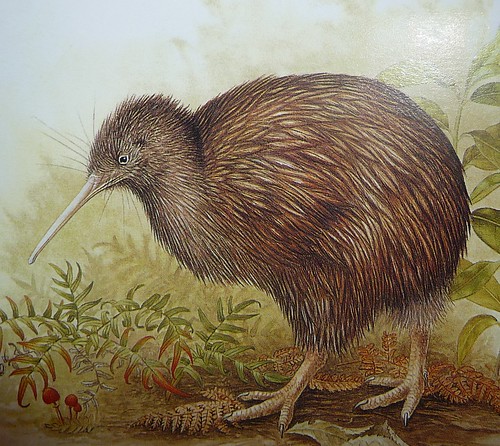
kiwiwiwiwiw Kiwis have to be one of the cutest birds of all time. A bit chubby and clumsy looking, they are (to me, at least), walking, breathing icon of furry cuteness. Truth be told, I did not see one live in action during my recent trip to New Zealand, but I did see a Weka bird which is pretty similar. (Micah and I just consulted the Internets and agreed that we did in fact see cherubic Kiwi not a Weka. In fact, Micah almost ran one over on the west coast of the southern island but his quick reflexes born from years of saving servers while typing saved the bird. So as you can tell by now I finally got to go to New Zealand for a few weeks, even able to travel the south island before attending THE Linux conference of the region, LCA where I gave a talk (video to be posted when available). I jumped at the opportunity and was thrilled to find out that I could actually spend some time traveling around before the intense week long conference. So on January 5th I headed down with Micah to what I have found out is one of the windiest cities on earth ( Windy Wellington ) for a few days before heading to the south island to do a loop on the northern half of the island. I wanted to conquer the mountains made famous by a certain set of movies, but last semester was all about sitting in front of the computer, a sort of agonizing life of the mind, which did not prepare me physically for mountain trekking or as it call it there, tramping. So we decided to stick close to the coast (with one transalpine train that serenaded us through some awesome mountain passes) and hike along the coast, snorkel and swim, and kayak. After Andrew showed us around Wellington, we headed to the sea town of Kaikoura brimming with sea life, such as seals, dolphins, and birds. The two highlights there were our snorkeling trip and a hike along the peninsula. Originally we were going to go diving but I arrived to NZ with a head cold so we opted for the sinus friendlier version and snorkeled in the massive kelp forest, which was strikingly beautiful (I am used to tropical reefs and waters). There happened to be a lot of seals and given their curious nature, they would dart over right next to you and play. One seal I called him the twirler was chubby and mellow and twirled next to me for a long while. The lady seals were sleeker and faster and liked to dive deep down and the zoom up and surprise you. As someone who has spent a lot of time underwater, I found it fun and weird to be with animals that pay attention to you given that most of the sea life ignores you. The hike in Kaikoura was fantastic as well. You go high on a bluff and stare down at this water sparkling with the most beautiful blue hues brought out even more majestically by the white rocks. If I were to go back I would hike along the water and up above on the bluff. After a brief stopover in Christchurch to visit a friend, we took the transalpine train (across Arthur s pass) which was superbly beautiful and arrived on the west coast whose seas are far more rough, rocky, andtemperamental than on the east coast. The vegetation is lush as lush can be and you get the feeling that dinosaurs would have been a happy lot in these parts. The cool part about this area are the many rivers that feed into the ocean (we spent an afternoon swimming and exploring the caves in one) and then what are called the pancake rocks, which are odd geological creatures that really amaze. We then made our way to the Marlborough Sounds area, which includes the city of Nelson (apparently the sunniest in New Zealand) as well as many olive and grape vineyards in outlying areas. We spent some time in the Alpine lakes region hiking but more of the time on the coast. The highlight for me and it is a place I would love to go back to is the Abel Tasman National Park. We spent time hiking and kayaking there and you can even hike down the coast for 5-6 days (there are excellent camping facilities along the way). The coast is simply majestic with alpine like forest conditions (unfortunately a cool old tree whose name I can t remember is no longer common). This forest is situated along the most stunning waters, an electric but totally clear turquoise blue deceivingly inviting because the water was quite cold (but not as cold as the Oregon coast over the summer, which I went swimming in only once after weeks of bike travel). Along with the blue, parts of the coastal waters were a stunning clear green that I have never seen despite my many sea travels. If you ever plan on going to the South Island, I would not miss this area and might even try to spend a few days or more hiking the coastal trails and listening to the cool-as/sweet as birds, one of which has double vocal cords so it sings what sounds to be like totally electronic bird calls. We returned via the same ferry a massive 7 story ship from Picton to Wellington but the conditions were far far worse during our return trip. When we got out of the sounds, we hit the Cook Straight, notorious for being rough and tumble. And indeed, once we hit the waves, I felt like I was no longer in a boat but amusement park ride, the bow of the ship thrown high only to fall hard on upon the waves. It was sort of fun or fun for about 10 minutes until people, most especially kids, started yaking all over the place. It was really the most flagrant yakfest I have ever experienced (I mean it is a 7 story ferry, you can fit a lot of people on that boat) and that made the sail particularly difficult. I have pretty strong sea legs, never once getting sick sick during the year I spent at sea but massive yaking will bring out the sea sick feeling in even the hardiest of sea souls and I was thrilled to arrive in Wellington. Wellington is the only large city I spent any considerable time in and it is a pretty awesome one. The city center area is flat and by the water, with a magnificent area filled with museums, the national library, parks, breweries, and piers where kids like to jump off high things. The botanical gardens were the most beautiful I have been to and since I am a flower nut, I was in high heaven. In this area there are a ridiculous number of great coffee shops (NYC has a thing or two to learn as we don t have enough, I suspect it has something to do with insane real estate prices). The city is surrounded by hills populated by houses, some of the precipitously perched on cliffs that require lifts to get to! It was a wonderful home base for what was a sweet as conference (as they would say down there). And I hope to write about it sometime soon.

27 January 2010

Gunnar Wolf: Packaging PKP OJS (Open Journals System)

New guidelines for periodic publications' websites at my University favor the different journals we have to use a standardized system And it makes quite a bit of sense. It is quite hard to explain to the people I work with that the content is not only meant to be consumed by humans, but also by other systems; the reasons behind rich content tagging and deep hierarchies for what they would just see as a list of words (think list of authors for an article, list of keywords, and so on). After all, aggregator databases such as Latindex and SciELO have achieved getting this understanding through. And I must be quite grateful, as the University's guidelines point to what appears to be a very well-thought and thorough system, the Open Journal Systems by the Public Knowledge Project, co-funded by several well-regarded universities. OJS is a GPL-2-covered PHP bundle. Anyway I am very glad at least one of my Institute's journal accepted the challenge and decided to go OJS. I know I will quite probably be administering this system long-term. And, being as snobbish as I am, I know I loathe anything installed in my machines that is not either developed by myself or comes in a Debian package. So, as it was not packaged, I made the package Note that I am still not filing an ITP (which means, I have not yet decided whether I will upload this to Debian) because I want first to make sure I do have the needed long-term commitment Besides, I am by far not a PHP person, and being responsible for a package Carries a nontrivial weight. Still, you might be interested in getting it. If you are interested, you can either download the .deb package or add it to your apt repositories (and stay updated with any new releases), by adding this to your /etc/apt/sources.list: deb http://www.iiec.unam.mx/apt/ lenny misc
deb-src http://www.iiec.unam.mx/apt/ lenny misc
Note: My packaging has still a small bug: The installer fails to create the PostgreSQL database. The MySQL database works fine. I will look into it soon So far, I am quite impressed with this program's functionality and the depth/quality of its (online) documentation. Besides, its usage statistics speak for themselves: So, it is quite possible I will be uploading this into Debian in a couple of weeks (hopefully in time to be considered for Squeeze). The reasons I am making it available in my personal repository now is:

Patrick Schoenfeld: Debian translations - EPIC LOL

As a german I'm used to strange translations in computer context.
I saw it back when I was using Microsoft products and I regulary stumble upon it on Debian systems. But whats actually kind of funny:Debian is outstanding in that regard.
An example:
Debian has that "wonderful" package manpages-de which provides a german manpage for ps.
It contains a formulation that is so inaccurate and not really funny:

"--cumulative Daten von toten Kindern einbeziehen (als Summe zusammen mit den Eltern)"


For the English only speakers: That can be roughly translated to "Collect data from dead children
(summed with their parents)". For me this somehow sounds like we are a butcher OS and so I reported #495441 but nobody cared about it yet.

Today I had another WTF on german translations because when I wanted to upgrade my system I read the following sentence:

"Sind Sie sich sicher, dass Sie die oben genannten Pakete installieren bzw. aufr sten wollen?"


Cold war, anyone?

Well its a classical case of using a word-by-word translation instead of a meaning-orientied translation. Its a fact that 'upgrade' can be translated to 'aufr sten' (as done above) but in that case its just not appropriate. As a matter of fact most german people I'm aware of would actually confuse the meaning with a meaning such as in a military context (therefore the "Cold war, anyone?" text above). And just btw. if we would rely on computing power to translate it back into English we would get:

Are you sure itself that you want to install and/or rig the packages specified above?


So it seems that Babelfish has a similar pereception.

C.J. Adams-Collier: Font for composing Lushootseed

At the recommendation of David Beck, I have installed a TTF font from http://www.languagegeek.com/. It took a few minutes for me to figure out how to get it going, but it was pretty straightforward after that. Here are some quick instructions for those of you running Debian variants such as Ubuntu.
  1. Fetch the zip files from languagegeek.com and unpack:
    $ sudo mkdir -m777 -p /usr/local/share/fonts/truetype/languagegeek/
    $ cd /usr/local/share/fonts/truetype/languagegeek/
    $ for zip in AboriginalSerif.zip AboriginalSans.zip
    do
      wget http://www.languagegeek.com/font/$zip &&
      unzip $zip &&
      rm $zip
    done
    $ sudo chmod -R 755 .
    
  2. Register these fonts with the system using defoma (the debian font manager):
    $ for font in *.ttf
    do
      sudo defoma-font register truetype $PWD/$font
    done
    
While performing the defoma registration, I was presented with a number of warning-ish-looking messages for each file processed. For better or worse, I am ignoring them:
No CIDSupplement specified for Dotum-Bold, defaulting to 0.
No CIDSupplement specified for Batang-Regular, defaulting to 0.
No CIDSupplement specified for ZenHei-CNS, defaulting to 0.
No CIDSupplement specified for Batang-Bold, defaulting to 0.
No CIDSupplement specified for ZenHei, defaulting to 0.
No CIDSupplement specified for Dotum-Regular, defaulting to 0.
I used gnome-appearance-properties (System Preferences Appearance) to set my document font to Aboriginal Sans:
After telling Chromium that it should use these fonts, it renders all of the Lushootseed characters quite nicely.
<script>//<script language="javascript" src="http://reddit.com/button.js?t=1"></script>

25 January 2010

Lucas Nussbaum: How free is the Nokia N900?

Dear readers, So, I ve been looking into buying a Nokia N900. However, what it provides regarding freedom is still not completely clear to me. And given that it is significantly more expensive than other smartphones, I d like to make sure that it s not a loss of money :-) - Can I download the full source, recompile it, build a firmware from it and re-install my Nokia N900 from scratch? Is the process documented? It seems that you need to accept a EULA to download updated firmwares, and I couldn t find the source for them. What exactly is available from firmware that is not available through normal repositories? (Are normal repositories only for extras apps, or is the base system also installable / upgradable from them? - What s the content of /etc/apt/sources.list? What exactly is http://repository.maemo.org/pool/maemo5.0/nokia-binaries/? What does Nokia need to hide? :-) - Would it be possible to develop a Centos-like distribution, installing the Maemo firmware, but then upgrading everything to rebuilt versions using an unofficial repository? Are there some applications that are not packaged, or that would break if re-installed that way? - Could I install Debian or Ubuntu on the N900? Is the process documented? Is it possible to dual-boot between, say, Maemo5 and Debian? (I m not talking about setting up a chroot, of course) - Besides the non-free telephony stack, are there any other antifeatures I should be aware of? Thanks.

Martin F. Krafft: Vodafone intransparency

Coming to New Zealand for an extended period of time, I figured it would make sense to purchase a prepay mobile plan to make it easier to mix with locals. Not knowing better, I went with Vodafone, which I whole-heartedly regret: their website is a massive pain in the ass, their price plans completely over the top, and their customer service representative incompetent and unfriendly. My latest experience eclipsed all previous encounters, and makes me want to tell you about it: Between all the obscure add-ons Vodafone threw at me when I bought this SIM card, two weeks ago I couldn t figure out how my balance had decreased from $30 to $0 when I rarely ever made calls. I wrote an e-mail to their customer service hotline, and it took them a week to get back to me, with the following text:
Due to being a Prepay Customer, unfortunately usage details are not available as per terms and conditions. I have although checked your usage and can confirm that all charges are correct.
Obviously, I wasn t going to accept this claim of omniscience, so when last weekend, $20 disappeared over the course of a day, that was the catalyst for me to reopen the ticket and reply along the lines of:
Only I know when I used my phone and thus only I can determine whether the charges are correct. Please show the full records to me, or else
This seemed to convince the representative, and 8 messages and 11 days after my initial request, I was told I could request the records at $5/30 records. Yes, you read that right: they wanted to charge me to view the records. I thus replied:
I am NOT willing to pay for that. If you are unable to comply with my desire for transparency, then I shall terminate the contract and make sure to inform the media as well as the consumer institute of this conduct. As stated previously, I shall also consult with a lawyer. Charging consumers to view data that is obviously available is a strong indication that you do not want me to see it. I can t imaging why this would be the case other than the data being inconsistent with reality.
That worked, and I finally got an Excel sheet with my usage data, which allowed me to track down the depletion of my account: to lure customers in, they promise free calls to other Vodafone numbers for the first four weekends. There are three problems with that though:
  1. Having purchased my card on Saturday afternoon, I was annoyed to find out that the remaining 34 hours of that weekend would be counted as a whole weekend.
  2. They don t provide a way by which to find out whether a given number actually belongs to Vodafone or not. The 021 prefix is not enough of an indication.
  3. They don t actually tell you anywhere but the aforementioned horrific website that the addon has expired.
So thanks, Vodafone. You ve lost a customer, who should have gone with 2degrees in the first place, who have much lower rates, even though their data coverage doesn t seem as good. I don t need data anyway. I ll still insist on Vodafone providing the data in a Free format. You can find more information about NZ mobile phone providers on the LCA2010 wiki page. NP: Age Pryor: Shank s Pony

Next.

Previous.