Search Results: "mak"

16 December 2013

Craig Sanders: shopping online whinge of the day

There are numerous benefits to shopping online you can order stuff and pay for it from the comfort of your own home and it ll arrive on your doorstep in just a few days. wonderful, and so many words have been written about the benefits over the years that there s no need to belabour the point, But there are some things about it that really suck and make me NOT want to order stuff online most of the time my distaste for the privacy and delivery problems is enough to dissauade me from buying anything, helped by the fact that I live a fairly non-consumerist lifestyle (and for a geek, I have an almost non-existent gadget-fetish) but occasionally I want or need something that isn t available locally or which my ill-health makes impractical to buy in person (i ve been effectively housebound or in hospital for most of the year) so here are the things that piss me off most about shopping online.
  1. Loss of anonymity and privacy. You can walk into any shop and pay cash for whatever you want, they don t need to know who you are or where you live, and they don t get to accidentally add you to a mailing list against your express wishes oh, we didn t realise that when you said DO NOT SPAM ME, you actually meant DO NOT SPAM ME we ll just keep spamming you for another six months until we get around to processing your removal request . partial solution: use a different email address with each online shop. boycott the shop and destroy the address if they spam. what sucks is that this is actually necessary. it doesn t matter how loudly I say DO NOT SPAM ME. DO NOT ADD ME TO ANY MAILING LISTS. DO NOT ASK ME TO COMPLETE A SURVEY. DO NOT CONTACT ME FOR ANY REASON NOT DIRECTLY RELATED TO DELIVERING MY ORDER. MY PERSONAL INFORMATION IS PROVIDED SOLELY SO THAT YOU CAN SHIP MY ORDER TO ME AND MAY NOT BE USED FOR ANY OTHER PURPOSE. FAILURE TO RESPECT MY PRIVACY WILL RESULT IN IMMEDIATE AND PERMANENT BOYCOTT (yes, that IS the text I use in the comments/instructions field of every order I place), marketing vermin will decide that I really want their spam after all because their spam is super interesting and important and isn t really spam at all.
  2. nosy demands for unneccessary information. OK, they need your addresss to ship your parcel but they don t need your phone number, and they don t need to tie your order to your facebook or other bullshit social-spam account. most online order forms have phone number as a required field. Fortunately, they usually accept 0000000 or some other bogus non-phone number as a valid number .if not, i give them their own phone number.
  3. the thing that really shits me the most about online shopping is that both couriers and australia post suck. the lazy fuckers usually don t even bother attempting to deliver to residential addressess. at best, they just stick a non-delivery card in your letterbox without even attempting to knock on the door ..and sometimes they don t even bother doing that. the delivery driver just files a bogus failed to deliver or recipient refused delivery with their office.

i ve made four online purchases in the last month and a half. only one of them was delivered correctly to my door, even though I was sitting at my desk in the front room of the house, a few feet from my front door, and regularly monitoring the parcel s tracking web page so I knew it was arriving. parcel 1 (Nov 16): DHL from NZ to AU. delivered perfectly. delivered in about two days for $17. order value: around $35. parcel 2 (Nov 20): Aust Post from WA to Vic, Express Post (costs a few bucks more than standard post). order value: around $80. lazy driver didn t bother to attempt delivery. left card in letter box. i had to pick it up 2 days later from a post office the next suburb over (it wasn t there yet on the first attempt to pick up, the next day). Aust Post offered to maybe put me in touch with their re-delivery people who might possibly be able to re-deliver the parcel next week sometime maybe, if they felt like it. knowing that I had another hospital appt the next week, I declined (if i hadn t, it would have been an absolute certainty that they would try to deliver it while i was out). parcel 3 (nov 29): DHL from NZ to AU. order value: around $85. lazy courier didn t even bother to leave a card, just logged it as Recipient refused delivery . This refused delivery lie infuriated me when i saw it on the tracking page so i phoned and yelled at them a lot. DHL delivered it later the same day. if they hadn t I would have had to get myself over to the other side of town during business hours and pick it up from their South Melbourne depot. parcel 4 (today, Dec 16): Aust Post from NSW to Vic, Express Post . order value: around $160. lazy driver didn t even bother to leave a card, just logged it as Attempted delivery being carded to Australia Post outlet . Complete bullshit. There was no delivery attempt, not even a card in the letterbox, let alone a knock on the door with my parcel. Rang Aust Post on 8847 9045 (a phone number curiously absent from their tracking page, but which I had written down after their failure to deliver on Nov 20) and complained. they claim that they will try to deliver it today. i ll believe it when I see it. UPDATE @4.30pm: no, it s not going to be delivered today. they say they might choose to deliver it tomorrow or sometime in the future, if the delivery center manager feels like it. i told them that this is not an option my parcel WILL be delivered, it is what they were paid to do so it is what they ARE going to do. btw, the tracking page says that they attempted delivery at 12.15 today (they didn t not even a card in the letterbox), but the tracking page wasn t updated with that until about 2.30pm. by a complete non-coincidence their delivery center allegedly closes at 2pm, so it s impossible to complain about non-delivery in time for the complaint to do any good. Score so far: DHL 50% delivery rate. Aust Post: 100% failure rate. Annoyance Rate: extremely high. Desire to repeat the experience: non-existent. The Australia Post delivery problems are particularly annoying. I ve always thought of the network of local post offices to be a huge advantage for parcel delivery if i m not home, my parcel will go to a local post office and I can pick it up from there. And this is a great advantage. I used to take advantage of it when I was well enough to work. In fact, I d insist on delivery by Aust. Post rather than by a courier for exactly this reason, a local post office is far more convenient than some courier s depot on the other side of town or out in some far outer-suburban hellhole. But when it s used as an excuse to not even bother attempting delivery, it sucks. I m not well, and I should have been lying in bed reading or sleeping today, not wasting what little energy I have waiting for a parcel that never arrived and I certainly shouldn t have to phone Aust Post or DHL to yell at them for failing to do the job that they have been paid to do. shopping online whinge of the day is a post from: Errata

15 December 2013

Chris Lamb: Developing responsive websites using the Awesome window manager

Responsive web design is a techinique for offering the optimal user experience across different browser devices without the overhead of separate "mobile" sites or native applications. Whilst there are hundreds of browser plugins that can make it easier to test responsive websites by resizing your browser window, this can also be achieved with a scriptable window manager such as Awesome:
resize = function(width, height, text)
  return function(c)
    local w = capi.screen[c.screen].workarea
    local geo = c:geometry()
    awful.client.floating.set(c, true)
    -- Float before raising
    c:raise()
    naughty.notify(  text = text, timeout = 0.5  )
    c:geometry( 
      x = geo.x,
      -- Constrain Y to workspace or it can start too high
      y = (w.y > geo["y"]) and w.y or geo["y"],
      width = width,
      height = height,
     )
  end
end
resize_reset = function (c)
  awful.client.floating.set(c, false)
end
clientkeys = awful.util.table.join(
  -- [..]
  awful.key(  modkey  , "1", resize( 460, 650, "Extra small")),
  awful.key(  modkey  , "2", resize( 780, 750, "Small")),
  awful.key(  modkey  , "3", resize(1024, 800, "Medium")),
  awful.key(  modkey  , "4", resize(1250, 850, "Large")),
  awful.key(  modkey  , "5", resize_reset)
)
Alt+ 1,2,3,4 will then float and resize the current window to various common device sizes (mine are based on the Bootstrap 3 breakpoints) and Alt+5 will reset it. Not being a plugin has many advantages: not only is it a browser-agnostic solution and one can use keyboard shortcuts not available to plugin developers, it also feels more aesthetically pleasing to solve a problem at the correct abstraction layer.

Daniel Pocock: A bias against Bitcoin?

A statement from the European Banking Authority is warning people about the risks of using Bitcoin for payment and investment/speculation. The press notes that the EBA paper stops short of telling people not to use the digital currency. Many of the points made in the warning appear to be well founded on the facts: however, exactly the same points could be made about everything from gift vouchers to bullion. It is not clear why Bitcoin should be singled out for special attention like this. Yes, gold and silver bullion are not issued by any central authority. Bullion values rise and fall many times in each day. When bullion values dipped earlier in 2013, some short term speculators sold at a loss: but for every scared seller, there was also somebody else willing to buy. Has anybody seen any stories of disgruntled investors throwing their gold out with the rubbish when the market moved? A more interesting example is that of the gift vouchers offered by many chains of retail stores. With many stores going through restructuring and liquidation in recent years, customers holding the vouchers have been left high and dry. Unlike temporary dips in bullion or Bitcoin values, the vouchers have often become truly worthless. The story has been repeated again and again around the world, including HMV in the UK and Mothercare in Australia. Community sense When retailers enter bankruptcy, it is usually at the instigation of a single person such as a prominent shareholder or the lender. Bitcoin and bullion, on the other hand, are arguably much harder for any single person or small group to pull the plug on so dramatically. Their value depends on their widespread acceptance around the globe rather than any single point of failure. Bitcoin's future I'm yet to see any evidence that Bitcoin is a long term store of value. Even the most knowledgeable proponents of Bitcoin agree that it is not technically perfect, due to the lack of true anonymity. When a truly anonymous solution is found, it will be interesting to see if the industry migrates away from Bitcoin. On the other hand, the threat of a truly anonymous community cryptocurrency is a scary thing for governments in the surveillance age. It could be argued that governments may become active players in the Bitcoin market in order to keep more anonymous solutions from gaining market share. For example, if a government was to accept remittence of taxes by Bitcoin or if smaller countries were to use Bitcoin to facilitate foreign exchange (bypassing the use of US dollars) this would make the currency far more credible for other mainstream purposes.

14 December 2013

Richard Hartmann: SteamOS

So SteamOS has been released. While that's marginally interesting in and as of itself, there are two observations to be made:
  1. Microsoft, Nintendo, and Sony will feel an impact. More functionality on cheaper hardware which can easily by upgraded; I bet quite a few managers are not happy, at the moment.
  2. While the stand-alone Linux Steam client was initially targeted at Ubuntu, SteamOS is based on Debian Wheezy.
Actual Linux (not Android) for the end user The first one means more Linux installations. In the living room. On a machine that children are really focussed on and will want to play with, quite literally. The next logical step is for people who play games to install SteamOS on their other machines; desktops, laptops, everywhere they want to game. This could really be the tipping point where the average adolescent computer enthusiast does not need to reboot into Linux to fool around with, but the other way round: To need to boot to Windows for a few select legacy applications which don't run on the FLOSS variant of Wine like Office or Photoshop. And once this momentum starts to shift, other software vendors will follow the money trail. Could 2014 finally be.... the year of Linux on the desktop...? Debian vs Debian-based The latter one is also really interesting... Obviously, I don't know why Valve decided to go down this road, but there are several reasons which come to mind: What we are left with is a major player entering the ring of Linux for end-users and choosing Debian over Ubuntu. Hopefully, improvements to the base system will be fed back upstream, enabling all Debian-based distributions to profit easily, not only Ubuntu-based ones. I am willing to bet that two years ago, SteamOS would have been based on Ubuntu, not Debian. Recently, there's been a lot of backlash over various decisions which Canonical forced onto Ubuntu and it will be interesting to see how this plays out in the long run... I will be interesting to see how much pain Linux Mint and Kubuntu will endure. Forecast Users All in all, we are looking at a massive influx of new users into the Debian ecosystem. How massive? 65 million registered users massive. 7 million concurrent users at once, 1.2 million users actively playing the top 100 games at the same time massive. This is huge. Contributors In time, a substantial part of that userbase will switch over one or more of their machines over to SteamOS. The tinkerers among them will realize they can install plain Debian and install Steam as a package. The hackers among those will start to improve upon their systems; and what better way to do that then to go upstream? If even a tiny fraction of users makes it this far, the count of actively involved contributors with Debian will skyrocket if we let them join. Raspbian and some other not-quite-ideal decisions come to mind. Vendors Commercial software vendors need to stay profitable. Thus, they are forced to support distributions which promise enough paying users. In the past, this meant mainly SuSE and Red Hat; they had commercial backers, went through certifications, etc. In the recent past, this also meant Ubuntu. All of a sudden, Debian stable has a potential market of tens of millions of average computer users and computer enthusiasts. A lot of whom will want to continue to use their OS of choice at work, as well. Oh boy...

Charles Plessy: Tired

This morning when preparing the update of a package, and I saw a PNG file in its documentation. Even before opening it, I felt old, tired, distressed and unable to escape the situation. Inspecting the file confirmed that the image was not hand made. The source file is missing. The proof: anther image in the same directory has the same style and a SVG source. To make things worse, there are no instructions on how to generate the PNG from the SVG. More and more in these cases, I give up and abandon the package. I lost time and energy make Upstream some requirements for which I personally have no concrete interest. SVG in addition to PNG is better, but PNG alone for the documentation of a Free software is Free enough for me. However, the points of view expressed on debian-devel give me the impression that it is not good enough for Debian, so I just give up

13 December 2013

Daniel Kahn Gillmor: OpenPGP Key IDs are not useful

Fingerprints and Key IDsOpenPGPv4 fingerprints are made from an SHA-1 digest over the key's public key material, creation date, and some boilerplate. SHA-1 digests are 160 bits in length. The "long key ID" of a key is the last 64 bits of the key's fingerprint. The "short key ID" of a key is the last 32 bits of the key's fingerprint. You can see both of the key IDs as a hash in and of themselves, as "32-bit truncated SHA-1" is a sort of hash (albeit not a cryptographically secure one). I'm arguing here that short Key IDs and long Key IDs are actually useless, and we should stop using them entirely where we can do so. We certainly should not be exposing normal human users to them. (Note that I am not arguing that OpenPGP v4 fingerprints themselves are cryptographically insecure. I do not believe that there are any serious cryptographic risks currently associated with OpenPGP v4 fingerprints. This post is about Key IDs specifically, not fingerprints.)Key IDs have serious problemsAsheesh pointed out two years ago that OpenPGP short key IDs are bad because they are trivial to replicate. This is called a preimage attack against the short key ID (which is just a truncated fingerprint). Today, David Leon Gil demonstrated that a collision attack against the long key ID is also trivial. A collision attack differs from a preimage attack in that the attacker gets to generate two different things that both have the same digest. Collision attacks are easier than preimage attacks because of the birthday paradox. dlg's colliding keys are not a surprise, but hopefully the explicit demonstration can serve as a wakeup call to help us improve our infrastructure. So this is not a way to spoof a specific target's long key ID on its own. But it indicates that it's more of a worry than most people tend to think about or plan for. And remember that for a search space as small as 64-bits (the long key ID), if you want to find a pre-image against any one of 2k keys, your search is actually only in a (64-k)-bit space to find a single pre-image. The particularly bad news: gpg doesn't cope well with the two keys that have the same long key ID:
0 dkg@alice:~$ gpg --import x
gpg: key B8EBE1AF: public key "9E669861368BCA0BE42DAF7DDDA252EBB8EBE1AF" imported
gpg: Total number processed: 1
gpg:               imported: 1  (RSA: 1)
0 dkg@alice:~$ gpg --import y
gpg: key B8EBE1AF: doesn't match our copy
gpg: Total number processed: 1
2 dkg@alice:~$ 
This probably also means that caff (from the signing-party package) will also choke when trying to deal with these two keys. I'm sure there are other OpenPGP-related tools that will fail in the face of two keys with matching 64-bit key IDs. We should not use Key IDs I am more convinced than ever that key IDs (both short and long) are actively problematic to real-world use of OpenPGP. We want two things from a key management framework: unforgability, and human-intelligible handles. Key IDs fail at both. So reasonable tools should not expose either short or long key IDs to users, or use them internally if they can avoid them. They do not have any properties we want, and in the worst case, they actively mislead people or lead them into harm. What reasonable tool should do that? How to replace Key IDs If we're not going to use Key IDs, what should we do instead? For anything human-facing, we should be using human-intelligible things like user IDs and creation dates. These are trivial to forge, but people can relate to them. This is better than offering the user something that is also trivial to forge, but that people cannot relate to. The job of any key management UI should be to interpret the cryptographic assurances provided by the certifications and present that to the user in a comprehensible way. For anything not human-facing (e.g. key management data storage, etc), we should be using the full key itself. We'll also want to store the full fingerprint as an index, since that is used for communication and key exchange (e.g. on calling cards). There remain parts of the spec (e.g. PK-ESK, Issuer subpackets) that make some use of the long key ID in ways that provide some measure of convenience but no real cryptographic security. We should fix the spec to stop using those, and either remove them entirely, or replace them with the full fingerprints. These fixes are not as urgent as the user-facing changes or the critical internal indexing fixes, though. Key IDs are not useful. We should stop using them.Tags: collision, crypto, gpg, openpgp, pgp, security

Tanguy Ortolo: Pure Sensia digital and Internet radio receiver: good idea, bad design

Thanks to a corporate reward program, I just got a Pure Sensia digital and Internet radio receiver: basically, it is a device able to play streams from FM, DAB, HTTP and USB sticks. In overall, it works fine, and it has a remote controller, so it makes a nice addition to my home equipment, but it has what I consider a major flaw, which I suspect to have been designed on purpose.For playing streams from FM or DAB, the process is rather simple: you select a frequency and it plays, nothing else is involved. I did not try USB yet but it should be similar: you select a file or a playlist and it plays it. But for HTTP streams, it is quite different: you select a stream from a the Pure Connect directory which is a list of HTTP streaming services maintained by the manufacturer Pure. This raises three concerns:

  1. If all HTTP stream access is made from that remote directory, it probably means Pure knows, and possibly logs, every stream you listen to. That is not acceptable.
  2. What will happen when that service is shut down? Not if it is shut down, mind you, but when it is, because it will, since I never heard of any company keeping a service forever, or any company lasting forever itself actually. Well, here is what will happen: all these digital and Internet radio receivers will become digital but not Internet radio receiver. That is not acceptable: when you buy a radio receiver, you buy a device, not a service of indefinite term.
  3. What do you do if you want to listen to an HTTP stream which is not listed on Pure's directory? Answer of Pure's support: you can add custom streams by URL to your Pure account's favourites. Well, good try, but that is not enough or rather, that is too much: requiring a Pure account to do that, is an artificial restriction, which suffers from exactly the same flaw as the Pure directory. And letting a single company know every Internet stream you listen to is not acceptable either.
Considering that flaw, here is my overall comment about that radio receiver: it is based on a good idea, and it has a good overall design, but it implements it in a precarious way. If you buy one of these things, you should know that you are not buying a complete digital and Internet radio receiver but only a digital radio receiver with some Internet features with privacy concerns, which will work for a time and one day stop working on Pure's decision.

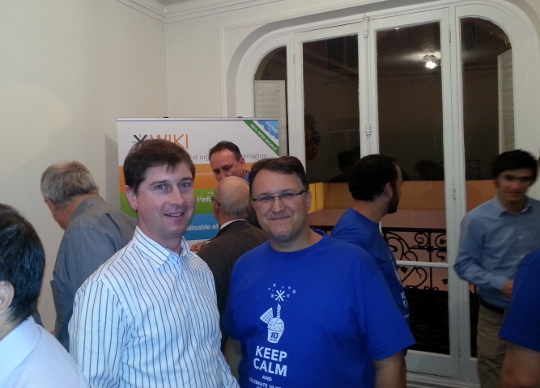
Daniel Pocock: xWiki: 10 years and a WebRTC success story

Six months ago, I wrote to the leaders of several open source web frameworks and asked them about their vision for WebRTC and if they would come to the WebRTC Conference in Paris this week (now finished). The most promising response was from Ludovic Dubost, founder of the xWiki project. Ludovic successfully demonstrated their shiny new WebRTC capabilities today in front of an audience including many far more experienced telephony operators who are still only getting to terms with this technology. What is xWiki? Don't let the wiki name limit your perception of this project. xWiki is a lot more than just another wiki hosting framework. As a bare minimum, you can certainly use it in the same way as other wikis, doing lightweight markup that is easier than HTML. On the other hand, xWiki really shines when it comes to extensibility. The xWiki team are Java developers and so xWiki appeals most to other Java developers who may want to leverage some library code from their web portal from time to time, without even having to compile anything. Here are some examples and here is one of the most trivial ones:
 velocity 
Your username is $xcontext.getUser(), welcome to the site.
 /velocity 
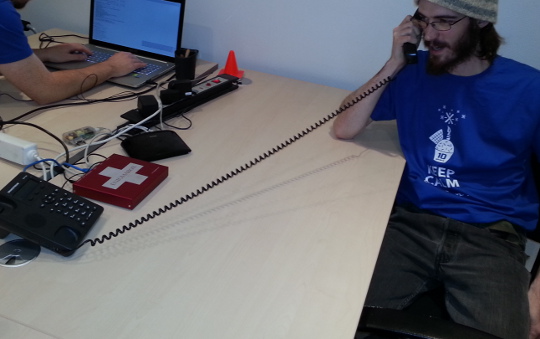
WebRTC capabilities The xWiki team chose XMPP as a chat protocol (using the Candy XMPP JavaScript chat) as the foundation for real-time communication. They have then extended this by creating a custom signalling mechanism and making it convenient for users of a chat session to upgrade the session to voice/video with a mouseclick. The whole experience works within the browser without any plugins. 10 years of xWiki It was also xWiki's 10th birthday today and this provided the perfect opportunity for a party: cjdns and enigmabox While at the xWiki office, it was interesting to see a lot of innovative work taking place, including this VoIP setup where a Grandstream phone is attached to an Enigmabox operated by Caleb from the cjdns project.
11 December 2013

Daniel Pocock: Get WebRTC going faster

On Saturday, Lumicall began offering free calls from browser to mobile using the free and open WebRTC technology. It should be no surprise that the service has been popular. Is it really free and open? The only way to prove this technology is free is to help people implement this for themself. On Monday, I uploaded reSIProcate v1.9.0 beta7 packages to Debian. The reSIProcate SIP proxy, repro, is one of the core components of the solution behind the free Lumicall service. Simply install the repro and resiprocate-turn-server packages using apt-get and make the following changes to the configuration (use your own IP addresses of course). I've taken this diff from my own runtime environment, only hiding my passwords, so that you can see exactly how I got it working:
--- repro.config.orig	2013-12-11 17:36:27.179228324 +0100
+++ repro-ws.sip5060.net.config	2013-12-11 17:48:24.159938649 +0100
@@ -143,6 +143,41 @@
 # Transport6TlsClientVerification = None
 # Transport6RecordRouteUri = sip:h1.sipdomain.com;transport=WS
 
+Transport1Interface = 195.8.117.57:80
+Transport1Type = WS
+Transport1RecordRouteUri = auto
+
+Transport2Interface = 2001:67c:1388:1000::57:80
+Transport2Type = WS
+Transport2RecordRouteUri = auto
+
+Transport3Interface = 195.8.117.57:5060
+Transport3Type = TCP
+Transport3RecordRouteUri = auto
+
+Transport4Interface = 2001:67c:1388:1000::57:5060
+Transport4Type = TCP
+Transport4RecordRouteUri = auto
+
+Transport5Interface = 195.8.117.57:443
+Transport5Type = WSS
+#Transport5RecordRouteUri = auto
+Transport5TlsDomain = ws.sip5060.net
+Transport5TlsClientVerification = None
+Transport5RecordRouteUri = sip:ws.sip5060.net;transport=WSS
+Transport5TlsCertificate = /etc/ssl/ssl.crt/ws.sip5060.net-bundle.crt
+Transport5TlsPrivateKey = /etc/ssl/private/ws.sip5060.net-key.pem
+
+Transport6Interface = 2001:67c:1388:1000::57:443
+Transport6Type = WSS
+#Transport6RecordRouteUri = auto
+Transport6TlsDomain = ws.sip5060.net
+Transport6TlsClientVerification = None
+Transport6RecordRouteUri = sip:ws.sip5060.net;transport=WSS
+Transport6TlsCertificate = /etc/ssl/ssl.crt/ws.sip5060.net-bundle.crt
+Transport6TlsPrivateKey = /etc/ssl/private/ws.sip5060.net-key.pem
+
+
 # Comma separated list of DNS servers, overrides default OS detected list (leave blank 
 # for default)
 DNSServers =
@@ -455,7 +490,7 @@
 ForceRecordRouting = false
 
 # Assume path option
-AssumePath = false
+AssumePath = true
 
 # Disable registrar
 DisableRegistrar = false
@@ -481,7 +516,7 @@
 # WARNING: Before enabling this, ensure you have a RecordRouteUri setup, or are using
 # the alternate transport specification mechanism and defining a RecordRouteUri per
 # transport: TransportXRecordRouteUri
-DisableOutbound = true
+DisableOutbound = false
 
 # Set the draft version of outbound to support (default: RFC5626)
 # Other accepted values are the versions of the IETF drafts, before RFC5626 was issued
@@ -505,7 +540,7 @@
 # WARNING: Before enabling this, ensure you have a RecordRouteUri setup, or are using
 # the alternate transport specification mechanism and defining a RecordRouteUri per
 # transport: TransportXRecordRouteUri
-EnableFlowTokens = false
+EnableFlowTokens = true
 
 # Enable use of flow-tokens in non-outbound cases for clients detected to be behind a NAT.  
 # This a more selective flow token hack mode for clients not supporting RFC5626.  The 

This is a diff against the /etc/repro/repro.config file distributed in the Debian package version 1.9.0~beta7-1. In the example above, I've included WSS transport defintions for WebSockets over TLS. Use the standard procedure for creating webserver SSL certificates to create certificates for repro and make sure you insert the correct filenames in the TLS parameters above. I've also duplicated every transport for IPv6. If you don't want TLS/WSS or IPv6, just comment those entries out (and renumber the remaining transports). Web-based SIP proxy setup Once you have repro running, go to the web admin interface (port 5080, username: admin, password: admin) and finish the setup using the web UI. The following steps are essential:
  • Add your domain (and restart the repro daemon after adding your domain)
  • Add some users
  • Add any routes to external services (optional - in my next blog I'll demonstrate how to route WebRTC calls to Asterisk using the Debian packages and less than 20 lines of configuration)
Set up reTurn, the TURN server Just put your IP addresses in /etc/reTurnServer.config and add the following line to /etc/reTurnServer-users.txt:
test:notasecret:reTurn:authorized
IMPORTANT: the realm in the users file (reTurn in the example and default config) must be identical to the AuthenticationRealm in the /etc/reTurnServer.config file. On your own web site Simply install your own apache server and clone the webrtc.lumicall.org demo site. Modify the file js/custom.js and include the settings for your own server.
# cd /var/www
# mkdir webcall
# cd webcall
# wget -r -nH http://webrtc.lumicall.org
# vi js/custom.js
In the custom.js, make sure you use a ws:// URL if you didn't set up SSL certificates and use a wss:// URL if you did. The IP or domain of your repro server must be in the ws:// or wss:// URL. Now navigate to the URL ending with /webcall on your server. For RHEL, Fedora and other RPM users Can somebody please assist with the review of the cajun-jsonapi dependency package so I can upload this new version of reSIProcate to Fedora? I'm also planning to make v1.9.0 available in EPEL6 when it is released in January. Questions? Please come and ask questions or discuss your experiences on the Free RTC mailing list sponsored by FSF Europe.

Steve Kemp: It's a wonderful life

Today, here in the UK, the date is 11/12/13. Today, here in Edinburgh, I we became married.
I've already promised I will make no more than two jokes, ever, about "owning a wife". I will save them for suitable occasions.

Gustavo Noronha Silva: WebKitGTK+ hackfest 5.0 (2013)!

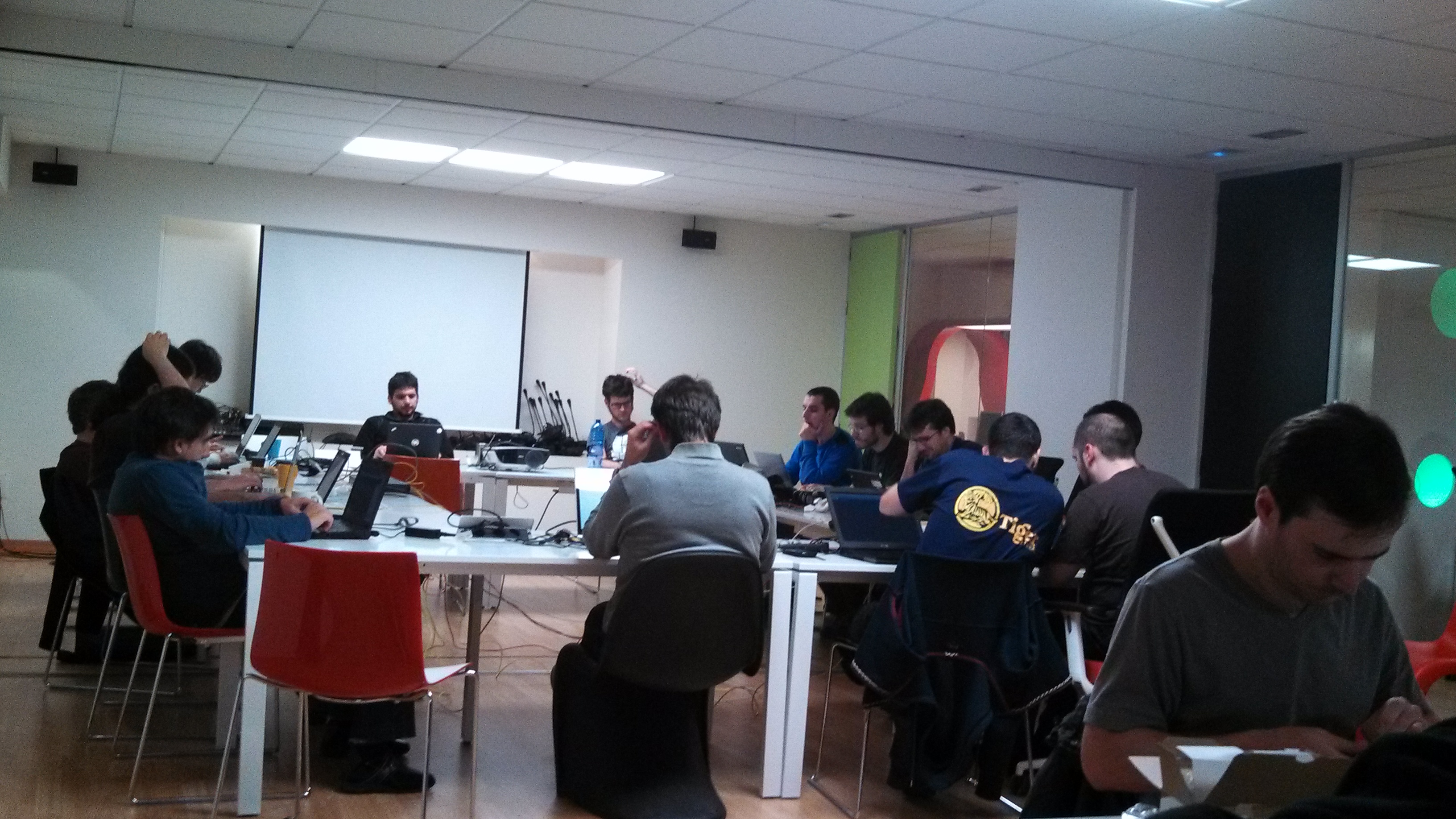
For the fifth year in a row the fearless WebKitGTK+ hackers have gathered in A Coru a to bring GNOME and the web closer. Igalia has organized and hosted it as usual, welcoming a record 30 people to its office. The GNOME foundation has sponsored my trip allowing me to fly the cool 18 seats propeller airplane from Lisbon to A Coru a, which is a nice adventure, and have pulpo a feira for dinner, which I simply love! That in addition to enjoying the company of so many great hackers.
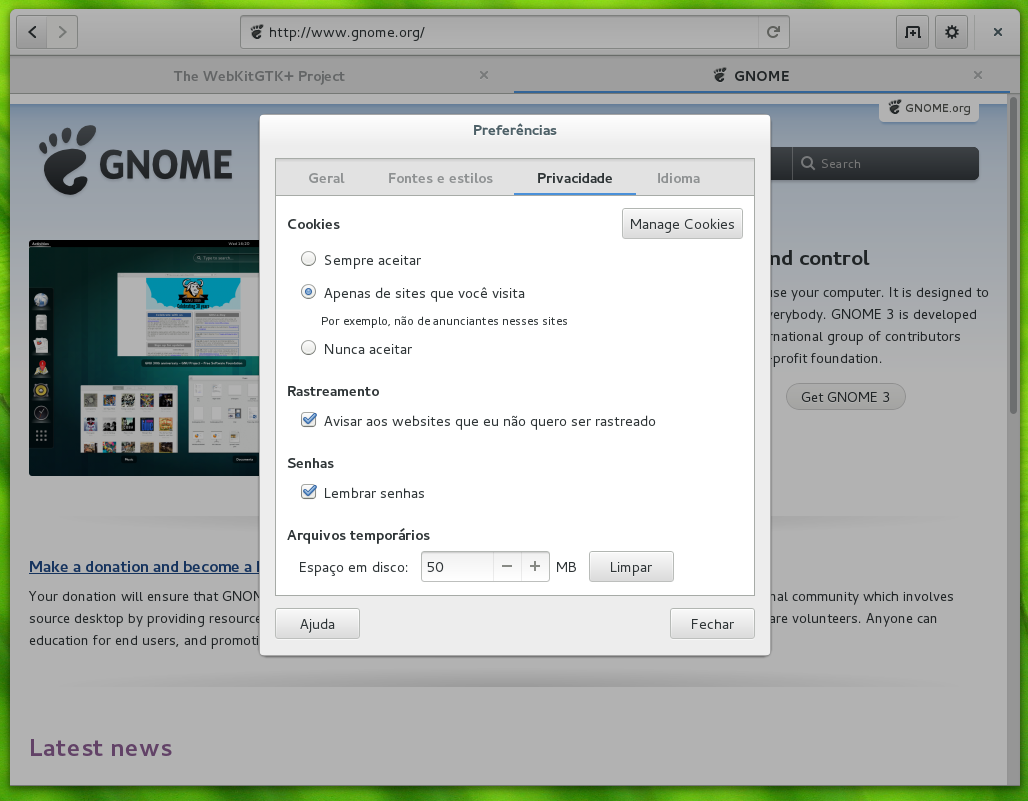
Web with wider tabs and the new prefs dialog

Web with wider tabs and the new prefs dialog

The goals for the hackfest have been ambitious, as usual, but we made good headway on them. Web the browser (AKA Epiphany) has seen a ton of little improvements, with Carlos splitting the shell search provider to a separate binary, which allowed us to remove some hacks from the session management code from the browser. It also makes testing changes to Web more convenient again. Jon McCan has been pounding at Web s UI making it more sleek, with tabs that expand to make better use of available horizontal space in the tab bar, new dialogs for preferences, cookies and password handling. I have made my tiny contribution by making it not keep tabs that were created just for what turned out to be a download around. For this last day of hackfest I plan to also fix an issue with text encoding detection and help track down a hang that happens upon page load.
Martin Robinson and Dan Winship hack

Martin Robinson and Dan Winship hack

Martin Robinson and myself have as usual dived into the more disgusting and wide-reaching maintainership tasks that we have lots of trouble pushing forward on our day-to-day lives. Porting our build system to CMake has been one of these long-term goals, not because we love CMake (we don t) or because we hate autotools (we do), but because it should make people s lives easier when adding new files to the build, and should also make our build less hacky and quicker it is sad to see how slow our build can be when compared to something like Chromium, and we think a big part of the problem lies on how complex and dumb autotools and make can be. We have picked up a few of our old branches, brought them up-to-date and landed, which now lets us build the main WebKit2GTK+ library through cmake in trunk. This is an important first step, but there s plenty to do.
Hackers take advantage of the icecream network for faster builds

Hackers take advantage of the icecream network for faster builds

Under the hood, Dan Winship has been pushing HTTP2 support for libsoup forward, with a dead-tree version of the spec by his side. He is refactoring libsoup internals to accomodate the new code paths. Still on the HTTP front, I have been updating soup s MIME type sniffing support to match the newest living specification, which includes specification for several new types and a new security feature introduced by Internet Explorer and later adopted by other browsers. The huge task of preparing the ground for a one process per tab (or other kinds of process separation, this will still be topic for discussion for a while) has been pushed forward by several hackers, with Carlos Garcia and Andy Wingo leading the charge.
Jon and Guillaume battling code

Jon and Guillaume battling code

Other than that I have been putting in some more work on improving the integration of the new Web Inspector with WebKitGTK+. Carlos has reviewed the patch to allow attaching the inspector to the right side of the window, but we have decided to split it in two, one providing the functionality and one the API that will allow browsers to customize how that is done. There s a lot of work to be done here, I plan to land at least this first patch durign the hackfest. I have also fought one more battle in the never-ending User-Agent sniffing war, in which we cannot win, it looks like.
Hackers chillin' at A Coru a

Hackers chillin at A Coru a

I am very happy to be here for the fifth year in a row, and I hope we will be meeting here for many more years to come! Thanks a lot to Igalia for sponsoring and hosting the hackfest, and to the GNOME foundation for making it possible for me to attend! See you in 2014!

10 December 2013

Kees Cook: live patching the kernel

A nice set of recent posts have done a great job detailing the remaining ways that a root user can get at kernel memory. Part of this is driven by the ideas behind UEFI Secure Boot, but they come from the same goal: making sure that the root user cannot directly subvert the running kernel. My perspective on this is toward making sure that an attacker who has gained access and then gained root privileges can t continue to elevate their access and install invisible kernel rootkits. An outline for possible attack vectors is spelled out by Matthew Gerrett s continuing useful kernel lockdown patch series. The set of attacks was examined by Tyler Borland in Bypassing modules_disabled security . His post describes each vector in detail, and he ultimately chooses MSR writing as the way to write kernel memory (and shows an example of how to re-enable module loading). One thing not mentioned is that many distros have MSR access as a module, and it s rarely loaded. If modules_disabled is already set, an attacker won t be able to load the MSR module to begin with. However, the other general-purpose vector, kexec, is still available. To prove out this method, Matthew wrote a proof-of-concept for changing kernel memory via kexec. Chrome OS is several steps ahead here, since it has hibernation disabled, MSR writing disabled, kexec disabled, modules verified, root filesystem read-only and verified, kernel verified, and firmware verified. But since not all my machines are Chrome OS, I wanted to look at some additional protections against kexec on general-purpose distro kernels that have CONFIG_KEXEC enabled, especially those without UEFI Secure Boot and Matthew s lockdown patch series. My goal was to disable kexec without needing to rebuild my entire kernel. For future kernels, I have proposed adding /proc/sys/kernel/kexec_disabled, a partner to the existing modules_disabled, that will one-way toggle kexec off. For existing kernels, things got more ugly. What options do I have for patching a running kernel? First I looked back at what I d done in the past with fixing vulnerabilities with systemtap. This ends up being a rather heavy-duty way to go about things, since you need all the distro kernel debug symbols, etc. It does work, but has a significant problem: since it uses kprobes, a root user can just turn off the probes, reverting the changes. So that s not going to work. Next I looked at ksplice. The original upstream has gone away, but there is still some work being done by Jiri Slaby. However, even with his updates which fixed various build problems, there were still more, even when building a 3.2 kernel (Ubuntu 12.04 LTS). So that s out too, which is too bad, since ksplice does exactly what I want: modifies the running kernel s functions via a module. So, finally, I decided to just do it by hand, and wrote a friendly kernel rootkit. Instead of dealing with flipping page table permissions on the normally-unwritable kernel code memory, I borrowed from PaX s KERNEXEC feature, and just turn off write protect checking on the CPU briefly to make the changes. The return values for functions on x86_64 are stored in RAX, so I just need to stuff the kexec_load syscall with mov -1, %rax; ret (-1 is EPERM):
#define pr_fmt(fmt) KBUILD_MODNAME ": " fmt
#include <linux/init.h>
#include <linux/module.h>
#include <linux/slab.h>
static unsigned long long_target;
static char *target;
module_param_named(syscall, long_target, ulong, 0644);
MODULE_PARM_DESC(syscall, "Address of syscall");
/* mov $-1, %rax; ret */
unsigned const char bytes[] =   0x48, 0xc7, 0xc0, 0xff, 0xff, 0xff, 0xff,
                                0xc3  ;
unsigned char *orig;
/* Borrowed from PaX KERNEXEC */
static inline void disable_wp(void)
 
        unsigned long cr0;
        preempt_disable();
        barrier();
        cr0 = read_cr0();
        cr0 &= ~X86_CR0_WP;
        write_cr0(cr0);
 
static inline void enable_wp(void)
 
        unsigned long cr0;
        cr0 = read_cr0();
        cr0  = X86_CR0_WP;
        write_cr0(cr0);
        barrier();
        preempt_enable_no_resched();
 
static int __init syscall_eperm_init(void)
 
        int i;
        target = (char *)long_target;
        if (target == NULL)
                return -EINVAL;
        /* save original */
        orig = kmalloc(sizeof(bytes), GFP_KERNEL);
        if (!orig)
                return -ENOMEM;
        for (i = 0; i < sizeof(bytes); i++)  
                orig[i] = target[i];
         
        pr_info("writing %lu bytes at %p\n", sizeof(bytes), target);
        disable_wp();
        for (i = 0; i < sizeof(bytes); i++)  
                target[i] = bytes[i];
         
        enable_wp();
        return 0;
 
module_init(syscall_eperm_init);
static void __exit syscall_eperm_exit(void)
 
        int i;
        pr_info("restoring %lu bytes at %p\n", sizeof(bytes), target);
        disable_wp();
        for (i = 0; i < sizeof(bytes); i++)  
                target[i] = orig[i];
         
        enable_wp();
        kfree(orig);
 
module_exit(syscall_eperm_exit);
MODULE_LICENSE("GPL");
MODULE_AUTHOR("Kees Cook <kees@outflux.net>");
MODULE_DESCRIPTION("makes target syscall always return EPERM");
If I didn t want to leave an obvious indication that the kernel had been manipulated, the module could be changed to: And with this in place, it s just a matter of loading it with the address of sys_kexec_load (found via /proc/kallsyms) before I disable module loading via modprobe. Here s my upstart script:
# modules-disable - disable modules after rc scripts are done
#
description "disable loading modules"
start on stopped module-init-tools and stopped rc
task
script
        cd /root/modules/syscall_eperm
        make clean
        make
        insmod ./syscall_eperm.ko \
                syscall=0x$(egrep ' T sys_kexec_load$' /proc/kallsyms   cut -d" " -f1)
        modprobe disable
end script
And now I m safe from kexec before I have a kernel that contains /proc/sys/kernel/kexec_disabled.

2013, Kees Cook. This work is licensed under a Creative Commons Attribution-ShareAlike 3.0 License.
Creative Commons License

Dimitri John Ledkov: Hi! My name is... (what?) My name is... (who?) My name is... Slim Shady

On the 21st of November I have become a British citizen, and on the 9th of December I have changed my name by signing a statutory declaration with the following clauses:
I absolutely and entirely renounce, relinquish and abandon the use of my former name of Dmitrijs edkovs and assume, adopt and determine to take and use from the date hereof the new name of Dimitri John Ledkov in substitution for my former name of Dmitrijs edkovs.
I shall at all times hereafter, in all records, deeds, documents and other writings and in all actions and proceedings, as well as in all dealings and transactions and on all occasions whatsoever, use and subscribe my new name of Dimitri John Ledkov in substitution for my former name of Dmitrijs edkovs so relinquished to the intent that I may hereafter be called, known and identified by the new name of Dimitri John Ledkov and not by my former name of Dmitrijs edkovs.
I authorise and require all persons, at all times, to identify, describe and address me by my new name of Dimitri John Ledkov. I make this solemn declaration conscientiously, believing the same to be true and by virtue of the provisions of the Statutory Declarations Act 1835.
Now I need to get new passport, IDs and change my name pretty much everywhere. I have started the ball rolling and hopefully I'll be known by my new name everywhere soon enough.

Regards,

Dimitri.

Bartosz Fe&#324;ski: another two days of paid work on Debian

Last year I told you that I spent two full-time days working on Debian as a part of initiative sponsored by my current employer. This year I ve devoted these two days again for Debian. Quick summary of what I was able to do during these two days. 11 bugs, 4 lintian errors and 43 warnings were fixed. In addition 3 packages now use new source format (usually that means repackaging software from scratch). 4 uses new copyright format and the newest Standards-Version. 5 packages were updated to the newest upstream version. Changelog entries:
potrace (1.11-1) unstable; urgency=low
* The Akamai Technologies paid volunteer days release.
* New upstream version.
* Completely repackaged from scratch (funny experience as usual):
- uses new copyright format
- uses debhelper compatibility level 9 w/hardening options
- uses the newest Standards-Version
- fixes 11 lintian warnings and 2 errors
* Fixes typo in manpage. (Closes: #694492) -- Bartosz Fenski Mon, 9 Dec 2013 11:23:32 +0100 makeself (2.2.0-1) unstable; urgency=low * The Akamai Technologies paid volunteer days release.
* New upstream release. (Closes: #690105)
- handles df output in more portable way (Closes: #641804)
* Repackaged from scratch.
- uses new packaging format 3.0 (Closes: #670738)
- uses new copyright format
- uses debhelper compatibility level 9
- uses the newest Standards-Version
- fixes 2 lintian errors and 6 warnings -- Bartosz Fenski Mon, 09 Dec 2013 17:32:45 +0100 dibbler (1.0.0~rc1-1) unstable; urgency=low * The Akamai Technologies paid volunteer days release.
* New upstream release candidate 1 version (Closes: #686539)
- doesn't drop dhcp session during pppd restarts (Closes: #641237)
- doesn't hang indefinitely on 'stop' (Closes: #675272)
* Calls dh --with autotools_dev to prevent build failures (Closes: 727356)
* Includes Japanese debconf translation (Closes: #718921)
* Updated Standards-Version (no changes needed)
* Uses debhelper compatibility level 9 w/hardening options
* init scripts now source init functions
* Fixes 20 lintian warnings. -- Bartosz Fenski Tue, 10 Dec 2013 10:05:56 +0100 calcurse (3.1.4-1) unstable; urgency=low * The Akamai Technologies paid volunteer days release.
* New upstream version.
* ACK previous NMU - thanks!
* Bumped Standards-Version (no changes needed) -- Bartosz Fenski Tue, 10 Dec 2013 12:22:06 +0100 ipcalc (0.41-4) unstable; urgency=low * The Akamai Technologies paid volunteer days release.
* Fixes overzealous input checking (Closes: #332468)
* Martin F Krafft removed as co-maintainer (Closes: #719098)
+ package now uses new copyright format
* Bumped Standards-Version (no changes needed) -- Bartosz Fenski Tue, 10 Dec 2013 13:05:15 +0100 msort (8.53-1) unstable; urgency=low * The Akamai Technologies paid volunteer days release.
* New upstream release.
* ACK previous NMUs, thanks!
* Switched to new source format.
* Switched to new copyright format.
* Moved patches to new quilt format and described them.
* Bumped Standards-Version (no changes needed)
* Has correct tcl/tk dependencies (Closes: #545135)
* Doesn't segfault with certain input (Closes: #630485)
-- Bartosz Fenski Tue, 10 Dec 2013 16:39:44 +0100
Thank you Akamai ;)

Russ Allbery: rra-c-util 4.12

This release of my collection of shared C, Perl, and Autoconf code fixes a bug in all the Autoconf macros that use the lib-helper framework for optional use of libraries. The --with flag without a path would result in yes/include and yes/lib to be added to the compiler and linker paths. It also adds Autoconf probles for Cyrus SASL libraries, contributed by Julien LIE based on the INN macros. This release also adds support for KADM5_MISSING_KRB5_CONF_PARAMS to portable/kadmin.h and the test_tmpdir function to Test::RRA::Automake. The latter works the same as it does in the C and shell TAP libraries. Finally, the shared valgrind suppression file adds a suppression for the memory allocated by dlopen to store error messages for dlerror on Linux, which is apparently never freed. You can get the latest release from the rra-c-util distribution page.

9 December 2013

John Goerzen: Delicious Holiday Recipes

I ve come up with some new favorites this season. The boys and Laura were around for all three, and I am happy to report there were many kitchen smiles over these! From-Scratch Hot Chocolate There s something about hot chocolate made from scratch, with chocolate melted into milk, instead of a powder stirred in. It takes quite a bit more time, and probably has more calories, but it is quite delicious. The key to a delicious result where milk is concerned is to take things slow and keep stirring. You don t want the chocolate to scorch at the bottom of the pan. Heating up the milk before the chocolate should help things mix in more easily as well. The basis for this recipe was here, and it called for 2 cups milk and 2 cups half-and-half. I trust my heavy whipping cream was fine! <grin> There are also some other variations on that site. This nearly made my little cast iron kettle overflow, so next time I made a 3/4 recipe. Hot Spiced Cider We put up a Christmas tree yesterday, so I thought hot spiced cider would be perfect for the occasion. I went searching for recipes, and many of them called for cloves (which have to be sifted out later or put in a spice bag). I wasn t going to have time to delay two boys from setting up a Christmas tree long enough for that, so I found this basic recipe to work well. However, I, as usual, made some modifications ;-) Mmmmm . yum . Turkey or Chicken Noodle Soup The annual what to do with all that leftover turkey quest strikes again. I like chicken noodle soup, so why not a turkey noodle soup done the same way? Here s what I used, roughly, in my large 6-quart cast iron cooking pot (aka Dutch oven ): Start with the broth, onion, basil, oregano, pepper, and bay leaf. Heat up the mixture and add the vegetables. Bring it to boiling, then add the uncooked noodles. Return to boiling, then reduce heat, cover, and simmer for 8 minutes. Add the turkey or chicken and diced tomatoes, and simmer until hot enough to serve. The nice thing about soups is that they freeze well and make great winter leftovers. This recipe makes quite a lot of soup; you may wish to halve it. This recipe was adapted from one in a Better Homes & Gardens cookbook.

8 December 2013

Russell Coker: A Basic Income for Australia

There has been a lot of discussion recently about the concept of a Basic Income (Wikipedia), largely due to the efforts to change the Swiss constitution to provide a Basic Income [1]. The concept of a Basic Income is that residents get a fixed payment without having to be sick, disabled, looking for work, or eligible for other forms of social security. A Basic Income wouldn t replace all other forms of social security, one of the most obvious examples is that sick people will often need money for medical care in additional to living expenses. Also I believe that it shouldn t be means tested in any way. I think that one of the problems with current payment schemes is that there are complex eligibility criteria which require effort for the applicant and for government agencies to prevent accidental or fraudulent over-payment. The tax rates could be raised slightly to make it revenue neutral. Newstart In Australia the main form of social security for unemployed people at the moment is called Newstart [2]. Currently Newstart payments range from a maximum of $501 per fortnight for a single person ($13,026 per annum), to a maximum of $699.90 per fortnight for someone who is a carer. The Newstart payments start to decrease if the recipient earns more than $62 per fortnight. The minimum wage in Australia is $16.37 per hour for permanent work or $20.30 for casual work [3]. So if someone works for more than 3 hours at a casual rate (and I can t imagine 4 hours a fortnight being anything other than casual) then their Newstart payments will decrease. The payment decreases are fairly significant, for every dollar that is earned about 50 cents will be deducted from the payments. That s a great incentive to either avoid opportunities to do part-time work or to do cash-only work that s outside the tax system. The most obvious way of implementing a Basic Income would be to replace Newstart. Then anyone who is in that situation would be free to just not get a job which would be OK IMHO as people who don t want to work probably wouldn t do a good job if the government forced them to get a job. People who are unemployed who want to work could work as much as they want and scale up according to what their employer asks and how much money they need. Currently the full-time minimum wage is $622.20 per week (I m not sure exactly how they get that from $16.37). That s almost 2.5* the Newstart allowance for a single person (but less than twice the Newstart allowance for a carer). While Newstart (and the other forms of social security) don t provide a great income, it seems that the difference between Newstart and the minimum wage isn t that great particularly when you consider that working involves some expenses for travel etc. There doesn t seem to be a great financial incentive for someone to leave Newstart and get a minimum wage job. People Who Want Social Security Some people think it s great to get government payments while others find it embarrassing to need such payments and won t necessarily apply if they are eligible. I think that the current system of forcing people to apply for social security is a way of discouraging people who find themselves unexpectedly in a difficult situation but doesn t discourage people who are happy not to work. This seems to effectively reduce the incidence of payments to the people who most tax-payers would regard as the most worthy recipients. Economics Charles Stross wrote about some ideas related to this [4]. He suggests that as the workforce participation has been steadily reducing due to technology we should move to a social model that isn t based around working to live but working to buy luxuries that aren t covered by the Basic Income. One of the many economic changes related to a Basic Income is that the minimum wage could be smaller than it might otherwise be. For example if the minimum wage was decreased by the same amount that the Basic Income provided then the minimum income would remain the same while employers would pay less, this would affect the viability of certain types of contract work web sites if they were subject to minimum wage laws (currently they just ignore the minimum wage laws by paying based on job completion instead of hours worked). I don t think that the minimum wage should decrease that much though, currently employers are able to run viable businesses with the minimum wage laws and I don t think that a Basic Income should be used as a way of helping corporations avoid paying their employees. If we had a Basic Income then there s many ways that it could be used to stabilise the economy. If people could pay their rent even if they lost their job then a down-turn in one area of the economy wouldn t immediately affect other areas. Also if rent payments were deducted automatically from an account used to receive the Basic Income then landlords would be more likely to rent to poor people as they could be guaranteed to receive rent payments (it would be easy to have a contractual agreement for rent to take priority and have bank computers enforce that). The Implementation Problem I don t think that my idea would have any significant negative effects. It wouldn t decrease government revenues if tax was adjusted accordingly. It wouldn t make people stop working as people who don t want to work already avoid it. It would help people who are out of work to get work by reducing the barriers to entry in terms of paperwork and of unreasonable cuts to Newstart making it bad value to take part time work. I think that the big problem with implementing it is people who want to prevent poor people from having opportunities. They want to reduce social security and minimum wages even though such changes will in the long run only give less tax revenue and greater expense in law enforcement. It seems rather ironic that such hostility often comes from people at the low end of the middle class whos jobs are most likely to be at risk from new technology. As on-going technological development reduces the number of workers that are required to keep things running we need to have some form of payment to the people who aren t doing enough work to survive. A decent Basic Income is a much better option than giving Newstart payments and forcing a significant portion of the population into a degrading search for jobs that don t exist. As that s the inevitable future I think we should make political changes to deal with it sooner rather than later. However a Basic Income might be implemented now it s surely going to be a lot better than what might happen if we wait until the majority of the population are unemployed before doing something about it.

Russell Coker: A Better University

I previously wrote about the financial value of a university degree [1], my general conclusion is that the value is decreasing for most fields of employment that don t have a legal requirement for a degree. In the past I wrote about some ideas for a home university [2], basically extending the home-schooling concept to a university level. I recently read John Scalzi s post about being poor [3], many of the comments address the difficulty of getting to college and how it impacts career possibilities. From reading that it seems that my ideas about a home university are mostly based around what middle-class people can afford. Also getting a job afterwards will probably be a lot easier for someone who was born into the middle classes. It seems to me that a large part of the problem with the university system is the expectation that they will both provide for academic research and train people for jobs. Dr. David Helfand has some great ideas for running a university to give the higher education that a university is supposed to provide rather than the work training that most universities actually provide [4]. His ideas aren t theoretical, they have been implemented and proven to work. Note that Dr Helfand s talk starts slowly, the second half is the best (for those of you with short attention spans). The fact that most people think of a university degree in terms of getting a job seems to be a failure of the university system to fulfill it s original aim. If Dr Helfand s ideas take off then it would really address the problem of universities not educating people. But that still leaves the issue of job training. Is a Degree Mandatory? I think that to some degree people expect that a university degree is necessary job training even when it isn t. I wonder what would happen if it was generally agreed that the right thing to do was to search for a job between the end of high school and the start of university, then anyone who got a suitable offer could defer their university course and see what career success they could achieve without it. When I was at school the general idea was that after completing year 12 everyone just had a holiday until the start of university as the entire point of school was to get into university. While hiring managers prefer candidates who have degrees they also prefer to hire people who will accept a lower salary, so hiring an 18yo with no degree may give better value than a 21yo who has a degree. I believe that making university degrees more accessible has reduced inequality which is a good thing. But making degrees mandatory (which is widely believed by high school students and thus is the situation that they have to deal with) contributes to greater inequality. While university doesn t cost much by middle-class standards it is still expensive for poor people. If a university degree wasn t considered to be mandatory then the number of people employed to teach at a university level would be smaller. This would hopefully mean that the average skill of university lecturers would increase (I hope that the least skillful lecturers would be the ones to find work elsewhere).

John Goerzen: Results with btrfs and zfs

The recent news that openSUSE considers btrfs safe for users prompted me to consider using it. And indeed I did. I was already familiar with zfs, so considered this a good opportunity to experiment with btrfs. btrfs makes an intriguing filesystem for all sorts of workloads. The benefits of btrfs and zfs are well-documented elsewhere. There are a number of features btrfs has that zfs lacks. For instance: The feature set of ZFS that btrfs lacks is well-documented elsewhere, but there are a few odd btrfs missteps: btrfs would be fine if it worked reliably. I should say at the outset that I have never lost any data due to it, but it has caused enough kernel panics that I ve lost count. I several times had a file that produced a panic when I tried to delete it, several times when it took more than 12 hours to unmount a btrfs filesystem, behaviors where hardlink-heavy workloads take days longer to complete than on zfs or ext4, and that s just the ones I wrote about. I tried to use btrfs balance to change the metadata allocation on the filesystem, and never did get it to complete; it seemed to go into an endless I/O pattern after the first 1GB of metadata and never got past that. I didn t bother trying the live migration of data from one disk to another on this filesystem. I wanted btrfs to work. I really, really did. But I just can t see it working. I tried it on my laptop, but had to turn of CoW on my virtual machine s disk because of the rm bug. I tried it on my backup devices, but it was unusable there due to being so slow. (Also, the hardlink behavior is broken by default and requires btrfstune -r. Yipe.) At this point, I don t think it is really all that worth bothering with. I think the SuSE decision is misguided and ill-informed. btrfs will be an awesome filesystem. I am quite sure it will, and will in time probably displace zfs as the most advanced filesystem out there. But that time is not yet here. In the meantime, I m going to build a Debian Live Rescue CD with zfsonlinux on it. Because I don t ever set up a system I can t repair.

7 December 2013

Daniel Pocock: Free calling from browser to mobile with free software

Lumicall is now offering free calls from browser to mobile. The whole service is powered by free software using open standards.
  • The person receiving the call must have the open source Lumicall app on their phone (Android and Cyanogenmod phones supported)
  • The person making the call just goes to http://webrtc.lumicall.org and dials the number in international format. For example, for the UK mobile 07123 45678, you need to dial +44712345678
Credits Various open source projects have made this possible, in particular: The service is enabled by WebRTC which is part of the latest HTML and JavaScript standards. You need to have the latest version of Mozilla Firefox, Google Chrome or another modern web browser supporting WebRTC - so there is no need to install any plugin. Feedback and discussion Please come and join us on the mailing list for any of the third-party projects that are involved. Please also join the Free real-time communications list sponsored by the FSF Europe for any general discussion about the future of free communications with free software. WebRTC Conference this week I'll be presenting some of my own work with WebRTC at the WebRTC Conference and Exhibition 2013 in Paris this week. Various other free software developers are also in the program, including Ludovic Dubost from xWiki and Emil Ivov from Jitsi

Next.

Previous.