Search Results: "he"

24 March 2020

Christoph Berg: Announcing apt-archive.postgresql.org

Users had often asked where they could find older versions of packages from apt.postgresql.org. I had been collecting these since about April 2013, and in July 2016, I made the packages available via an ad-hoc URL on the repository master host, called "the morgue". There was little repository structure, all files belonging to a source package were stuffed into a single directory, no matter what distribution they belonged to. Besides this not being particularly accessible for users, the main problem was the ever-increasing need for more disk space on the repository host. We are now at 175 GB for the archive, of which 152 GB is for the morgue. Our friends from yum.postgresql.org have had a proper archive host (yum-archive.postgresql.org) for some time already, so it was about time to follow suit and implement a proper archive for apt.postgresql.org as well, usable from apt. So here it is: apt-archive.postgresql.org The archive covers all past and current Debian and Ubuntu distributions. The apt sources.lists entries are similar to the main repository, just with "-archive" appended to the host name and the distribution:
deb https://apt-archive.postgresql.org/pub/repos/apt DIST-pgdg-archive main
deb-src https://apt-archive.postgresql.org/pub/repos/apt DIST-pgdg-archive main
The oldest PostgreSQL server versions covered there are 8.2.23, 8.3.23, 8.4.17, 9.0.13, 9.1.9, 9.2.4, 9.3beta1, and everything newer. Some example:
$ apt-cache policy postgresql-12
postgresql-12:
  Installed: 12.2-2.pgdg+1+b1
  Candidate: 12.2-2.pgdg+1+b1
  Version table:
 *** 12.2-2.pgdg+1+b1 900
        500 http://apt.postgresql.org/pub/repos/apt sid-pgdg/main amd64 Packages
        500 https://apt-archive.postgresql.org/pub/repos/apt sid-pgdg-archive/main amd64 Packages
        100 /var/lib/dpkg/status
     12.2-2.pgdg+1 500
        500 https://apt-archive.postgresql.org/pub/repos/apt sid-pgdg-archive/main amd64 Packages
     12.2-1.pgdg+1 500
        500 https://apt-archive.postgresql.org/pub/repos/apt sid-pgdg-archive/main amd64 Packages
     12.1-2.pgdg+1 500
        500 https://apt-archive.postgresql.org/pub/repos/apt sid-pgdg-archive/main amd64 Packages
     12.1-1.pgdg+1 500
        500 https://apt-archive.postgresql.org/pub/repos/apt sid-pgdg-archive/main amd64 Packages
     12.0-2.pgdg+1 500
        500 https://apt-archive.postgresql.org/pub/repos/apt sid-pgdg-archive/main amd64 Packages
     12.0-1.pgdg+1 500
        500 https://apt-archive.postgresql.org/pub/repos/apt sid-pgdg-archive/main amd64 Packages
     12~rc1-1.pgdg+1 500
        500 https://apt-archive.postgresql.org/pub/repos/apt sid-pgdg-archive/main amd64 Packages
     12~beta4-1.pgdg+1 500
        500 https://apt-archive.postgresql.org/pub/repos/apt sid-pgdg-archive/main amd64 Packages
     12~beta3-1.pgdg+1 500
        500 https://apt-archive.postgresql.org/pub/repos/apt sid-pgdg-archive/main amd64 Packages
     12~beta2-1.pgdg+1 500
        500 https://apt-archive.postgresql.org/pub/repos/apt sid-pgdg-archive/main amd64 Packages
     12~beta1-1.pgdg+1 500
        500 https://apt-archive.postgresql.org/pub/repos/apt sid-pgdg-archive/main amd64 Packages
Because this is hosted on S3, browsing directories is only supported indirectly by static index.html files, so if you want to look at some specific URL, append "/index.html" to see it. The archive is powered by a PostgreSQL database and a bunch of python/shell scripts, from which the apt index files are built. Archiving old distributions I'm also using the opportunity to remove some long-retired distributions from the main repository host. The following distributions have been moved over: They are available as "DIST-pgdg" from the archive, e.g. squeeze:
deb https://apt-archive.postgresql.org/pub/repos/apt squeeze-pgdg main
deb-src https://apt-archive.postgresql.org/pub/repos/apt squeeze-pgdg main

Anisa Kuci: Outreachy post 5 - Final report

This is my last Outreachy blogpost, as my internship unfortunately has come to an end. It was a blast! Through the Outreachy internship I gained a lot of valuable knowledge and even though I dont know what the future will bring, I am more confident about myself, my skills in fundraising and my technical abilities now. During the contribution phase I did quite a lot of research so I could come up with relevant information to add on the Debian wiki as part of the contribution phase tasks. This was helpful for me to build a more deep understanding of the Debian project, the DebConf conferences and the general style of working within Debian. During this phase I completed most of the tasks given and got onto the mailing lists and IRC channels which are public. This was quite an intense experience by itself as it was like digging into a new job but in a competitive situation as other applicants, of course, were also putting in their best to get one of the 50 Outreachy internships (two in Debian) that were available. When I got selected I also got access to the sponsors@debconf.org email address and the private git repos as they would be needed for me to work on fundraising. I was also provided with an @debconf.org email address that is the one I use for sponsors communication. I learned what makes communication look professional and how to think of the recipient when formulating emails, sending replies or creating marketing messages. As the internship continued I started to learn how the DebConf organizing structure works, with a particular attention on the fundraising team. I have also quickly been given the responsibility to reach out to 100 potential sponsors and combine learning and working experience very nicely. I was given responsibility of working on the fundraising material (flyer and brochure) for DebConf20, so using LaTeX I updated the files in order to remove the translation system, I added the Israeli currency and the visual design chosen from a public logo proposal contest that is held for each DebConf. My creative side could also be put to good use as the team trusted me with selecting the images for the brochure and making sure that the usage rights granted and attribution are all compliant to Free Software/Creative Commons licences. I have continuously maintained those materials and was very happy that long term team members even asked me to approve changes they proposed on the fundraising material. The MiniDebConf team for Regensburg have taken the files I created and made them into their fundraising material (brochure, flyer) which is great to see. MiniDebConf Regensburg commits I have profited so much from other people s work, so I am very happy if community members can build on mine. Afterall sharing is caring! Through the Outreachy travel stipend I was able to attend FOSDEM 2020 and besides meeting many friends from the community and having a fundraising meeting with a sponsor, I was able to also support distributing the DebConf20 fundraising material both in electronic form and as printed versions. During the Outreachy internship I did two communication waves to potential sponsors and maintained the daily communication with them. I followed the documentation that was already available in the Debian wiki guiding me through the process of invoicing sponsors through the organizations that Debian collaborates with. As I have been in frequent contact with the sponsors, I have continuously updated the DebConf20 website with sponsor logos and links through git files, improving web pages on the wafer system and doing 18 merge requests in total. DebConf20 website merge requests I completed six email templates for the DebConf sponsor communication campaigns. While two of them have already been very useful, I hope my other proposals will be the ones used for the next waves of sponsors contacting. I committed them to the sponsors git repo so they can be easily accessible and well documented for other DebConf teams or can be recycled for smaller Debian events. Unfortunately, due to the insecurity about travel around the Corona virus pandemic, the third wave of communication, originally scheduled for the end of my internship in March, has been held. I have committed to the team to do this once the travel restrictions have been lifted and we know that DebConf20 can proceed as planned for August 2020. So yeah, I am definitely going to stay around and continue to help with DebConf fundraising! DebConf has been held for two decades and it also has a generic website, so I also updated the static sponsors page on the main website as it is the first landing page for everyone especially for people who are not necessarily insiders in Debian or DebConf. I have completed a Python tutorial, got the general understanding of the programming language and made some smaller contributions to improve existing tools in the fundraising team based on the learning. The internship was also focused on documentation, so during the whole internship I have kept notes in order to be able to improve existing documentation and I have also written new material, especially on the tasks that I have been working on more closely: Every DebConf has a new team every year, in a new country, so I hope this documentation I have worked on will be useful as a jump-starter for them to organize and finance their events. I would like to take a moment to thank again my mentors Daniel and Karina for all their support, it has been great working with them. Having them as an example, I have learned a lot. Also warm thanks to the DebConf global and local teams which have been very welcoming and always supportive during my internship. So, as you might already know, if you have read my other Outreachy blog posts, this has been a great experience for me! Outreachy provides an awesome opportunity that would not be available if it was not for the generous sponsors and volunteers making such a program for people from underrepresented groups in the FLOSS community. I really encourage people from these groups to find the confidence within themselves and apply for Outreachy! I love Debian

Russ Allbery: Review: Lost in Math

Review: Lost in Math, by Sabine Hossenfelder
Publisher: Basic
Copyright: June 2018
ISBN: 0-465-09426-0
Format: Kindle
Pages: 248
Listening to experts argue can be one of the better ways to learn about a new field. It does require some basic orientation and grounding or can be confusing or, worse, wildly misleading, so some advance research or Internet searches are warranted. But it provides some interesting advantages over reading multiple popular introductions to a field. First, experts arguing with each other are more precise about their points of agreement and disagreement because they're trying to persuade someone who is well-informed. The points of agreement are often more informative than the points of disagreement, since they can provide a feel for what is uncontroversial among experts in the field. Second, internal arguments tend to be less starry-eyed. One of the purposes of popularizations of a field is to get the reader excited about it, and that can be fun to read. But to generate that excitement, the author has a tendency to smooth over disagreements and play up exciting but unproven ideas. Expert disagreements pull the cover off of the uncertainty and highlight the boundaries of what we know and how we know it. Lost in Math (subtitled How Beauty Leads Physics Astray) is not quite an argument between experts. That's hard to find in book form; most of the arguments in the scientific world happen in academic papers, and I rarely have the energy or attention span to read those. But it comes close. Hossenfelder is questioning the foundations of modern particle physics for the general public, but also for her fellow scientists. High-energy particle physics is facing a tricky challenge. We have a solid theory (the standard model) which explains nearly everything that we have currently observed. The remaining gaps are primarily at very large scales (dark matter and dark energy) or near phenomena that are extremely difficult to study (black holes). For everything else, the standard model predicts our subatomic world to an exceptionally high degree of accuracy. But physicists don't like the theory. The details of why are much of the topic of this book, but the short version is that the theory does not seem either elegant or beautiful. It relies on a large number of measured constants that seem to have no underlying explanation, which is contrary to a core aesthetic principle that physicists use to judge new theories. Accompanying this problem is another: New experiments in particle physics that may be able to confirm or disprove alternate theories that go beyond the standard model are exceptionally expensive. All of the easy experiments have been done. Building equipment that can probe beyond the standard model is incredibly expensive, and thus only a few of those experiments have been done. This leads to two issues: Particle physics has an overgrowth of theories (such as string theory) that are largely untethered from experiments and are not being tested and validated or disproved, and spending on new experiments is guided primarily by a sense of scientific aesthetics that may simply be incorrect. Enter Lost in Math. Hossenfelder's book picks up a thread of skepticism about string theory (and, in Hossenfelder's case, supersymmetry as well) that I previously read in Lee Smolin's The Trouble with Physics. But while Smolin's critique was primarily within the standard aesthetic and epistemological framework of particle physics, Hossenfelder is questioning that framework directly. Why should nature be beautiful? Why should constants be small? What if the universe does have a large number of free constants? And is the dislike of an extremely reliable theory on aesthetic grounds a good basis for guiding which experiments we fund?
Do you recall the temple of science, in which the foundations of physics are the bottommost level, and we try to break through to deeper understanding? As I've come to the end of my travels, I worry that the cracks we're seeing in the floor aren't really cracks at all but merely intricate patterns. We're digging in the wrong places.
Lost in Math will teach you a bit less about physics than Smolin's book, although there is some of that here. Smolin's book was about two-thirds physics and one-third sociology of science. Lost in Math is about two-thirds sociology and one-third physics. But that sociology is engrossing. It's obvious in retrospect, but I hadn't thought before about the practical effects of running out of unexplained data on a theoretical field, or about the transition from more data than we can explain to having to spend billions of dollars to acquire new data. And Hossenfelder takes direct aim at the human tendency to find aesthetically appealing patterns and unified explanations, and scores some palpable hits.
I went into physics because I don't understand human behavior. I went into physics because math tells it how it is. I liked the cleanliness, the unambiguous machinery, the command math has over nature. Two decades later, what prevents me from understanding physics is that I still don't understand human behavior. "We cannot give exact mathematical rules that define if a theory is attractive or not," says Gian Francesco Giudice. "However, it is surprising how the beauty and elegance of a theory are universally recognized by people from different cultures. When I tell you, 'Look, I have a new paper and my theory is beautiful,' I don't have to tell you the details of my theory; you will get why I'm excited. Right?" I don't get it. That's why I am talking to him. Why should the laws of nature care what I find beautiful? Such a connection between me and the universe seems very mystical, very romantic, very not me. But then Gian doesn't think that nature cares what I find beautiful, but what he finds beautiful.
The structure of this book is half tour of how physics judges which theories are worthy of investigation and half personal quest to decide whether physics has lost contact with reality. Hossenfelder approaches this second thread with multiple interviews of famous scientists in the field. She probes at their bases for preferring one theory over another, at how objective those preferences can or should be, and what it means for physics if they're wrong (as increasingly appears to be the case for supersymmetry). In so doing, she humanizes theory development in a way that I found fascinating. The drawback to reading about ongoing arguments is the lack of a conclusion. Lost in Math, unsurprisingly, does not provide an epiphany about the future direction of high-energy particle physics. Its conclusion, to the extent that it has one, is a plea to find a way to put particle physics back on firmer experimental footing and to avoid cognitive biases in theory development. Given the cost of experiments and the nature of humans, this is challenging. But I enjoyed reading this questioning, contrarian take, and I think it's valuable for understanding the limits, biases, and distortions at the edge of new theory development. Rating: 7 out of 10

23 March 2020

Norbert Preining: De-uglify GTk3 tabs of terminals

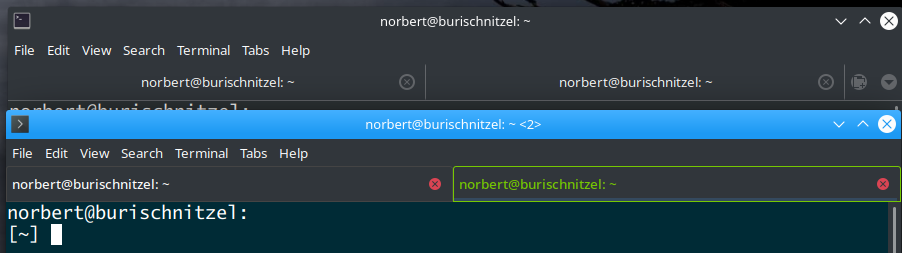
If you are puzzled by the indistinguishability of the active tab from inactive tabs in any of the GTK3 based terminal emulators (mate-terminal, gnome-terminal, terminator, ), you are not alone. I have been plagued by that for far too long, and finally found a working solution.
In the above screen shot you see the tabs in the upper part are hardly distinguishable, and in the lower part the active tab is clearly indicated with different colors. Searching for relevant search terms brings up a variety of suggestions, most of them not working. I finally found this one and adapted the code therein to fit my need. The solution is to edit ~/.config/gtk-3.0/gtk.css, and add the following at the end:
notebook tab  
    /* background-color: #222; */
    padding: 0.4em;
    border: 0;
    border-color: #444;
    border-style: solid;
    border-width: 1px;
 
 
notebook tab:checked  
    /* background-color: #000; */
    background-image: none;
    border-color: #76C802;
 
 
notebook tab:checked label  
    color: #76C802;
    font-weight: 500;
 
 
notebook tab button  
    padding: 0;
    background-color: transparent;
    color: #ccc;
 
 
notebook tab button:hover  
  border: 0;
  background-image: none;
  border-color: #444;
  border-style: solid;
  border-width: 1px;
 
Here I didn t change the background color (commented above), but changed the styling of the tab title and added a frame. The above changes the tab layout for all GTk3 elements that use the notebook widget, if one wants to restrict it to a certain terminal one need to prefix each CSS selector with the correct terminal indicator, as shown in the original post. Hope that helps.

Joey Hess: quarantimer: a coronovirus quarantine timer for your things

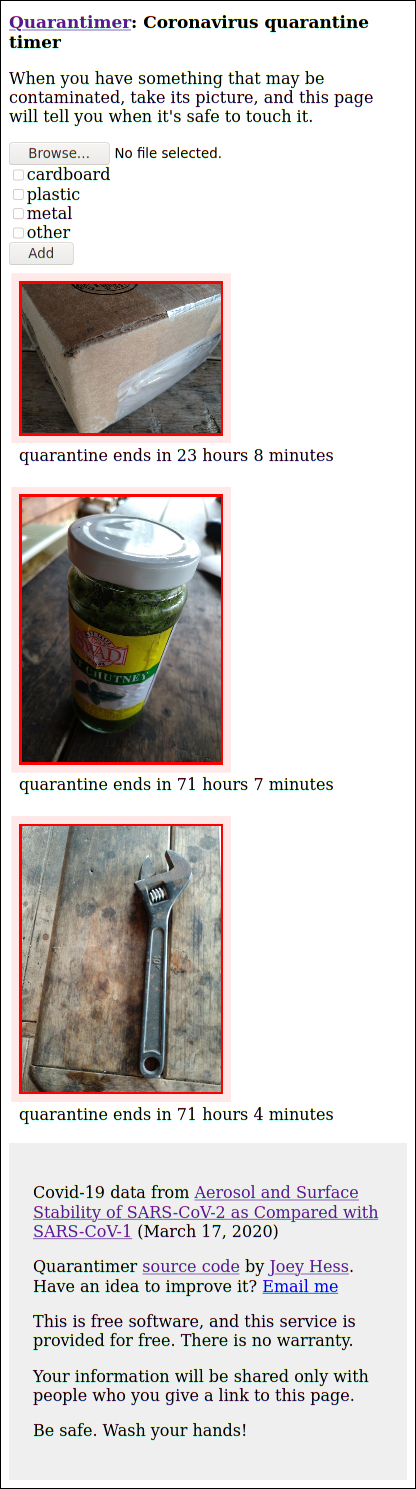
I am trying to avoid bringing coronovirus into my house on anything, and I also don't want to sterilize a lot of stuff. (Tedious and easy to make a mistake.) Currently it seems that the best approach is to leave stuff to sit undisturbed someplace safe for long enough for the virus to degrade away. Following that policy, I've quickly ended up with a porch full of stuff in different stages of quarantine, and I am quickly losing track of how long things have been in quarantine. If you have the same problem, here is a solution: https://quarantimer.app/ Open it on your mobile device, and you can take photos of each thing, select the kind of surfaces it has, and it will track the quarantine time for you. You can share the link to other devices or other people to collaborate. I anticipate the javascript and css will improve, but it's good enough for now. I will provide this website until the crisis is over. Of course, it's free software and you can also host your own. If this seems useful, please tell your friends and family about it. Be well!
This is made possible by my supporters on Patreon, particularly Jake Vosloo.

Emmanuel Kasper: Two Factor Authentification on gitlab with Yubikey

I wanted to have a working Two Factor Authentification (2FA) setup to login on salsa.debian.org, Debians s gitlab instance.
You might already know Two Factor Authentification via a One Time Password (OTP) generating app on your smartphone, like FreeOTP or Google Authenticator. But it is possible to use a physical device, and a keypress on the device is enough to authenticate (speed up things !). Here I am using a Yubikey 4, a popular USB device for Two Factor Authentification which is officially supported by gitlab, and whose tooling is well packaged in Debian.
Get to know the deviceInstall the needed packages to work with the yubikey
# apt install yubikey-manager libu2f-host0
List connected devices on your usb bus:
$ lsusb
Bus 002 Device 109: ID 1050:0407 Yubico.com Yubikey 4 OTP+U2F+CCID
Get info about the device capability
$ ykman info
Device type: YubiKey 4
Serial number: 1234567
Firmware version: 4.3.7
Enabled USB interfaces: OTP+FIDO+CCID
Applications
OTP Enabled
FIDO U2F Enabled
OpenPGP Enabled
PIV Enabled
OATH Enabled
FIDO2 Not available
The capability which interests us here is FIDO U2F. The Yubikey 4 supports Two Factor Authentification via the U2F standard, and this standard is maintained by the FIDO Industry Association, hence the name. As I plan to only use the FIDO U2F capability of the key, I set FIDO to be the single mode of the key.
ykman mode FIDO
Testing web browser interaction with Yubico demo systemNow we need to have to have a browser with support for the U2F standard. Firefox has builtin support since Version 67. Debian 10 Buster has firefox-esr Version 68, so that will work. For testing yubikeys, the manufacturer has a demo website, where you can test U2F. Go to https://demo.yubico.com and follow the Explore the Yubikey link.
Once there you will be asked to register an account on yubicom s demo systems, to which you will add the Yubikey as an Authenticating Device. After that you can add your security key. First step will be to register the device, which will require a light touch on the Yubikey button, and acceptance of this Firefox warning Window, as the demo website wants to know the model of the device.
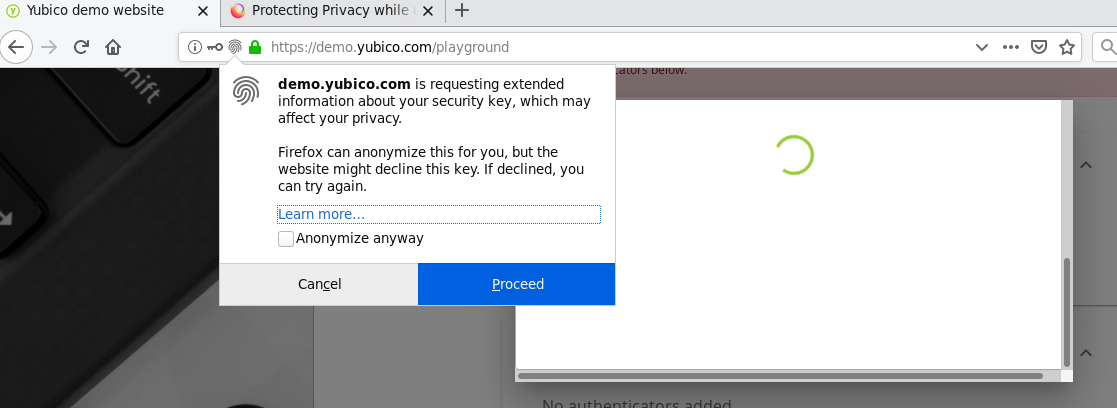

Firefox message on the yubikey demo site. A normal site with U2F would not require the extended information, and have a simpler popup message.
As soon as the device is registered, you can login and logout and you will be prompted again to lightly touch the Yubikey button to authenticate, in addition to the classical login / password.
Using U2F on gitlabWhen you want to register your yubikey for logging on salsa, you need first to register a One Time Password device in Settings -> Account -> Manage two-factor authentication, and Register Universal Two-Factor (U2F) Device. After the usual Firefox Popup, and the light touch on the key button, that'it you have a fast, and reliable Two Factor Authentification !
ConclusionEach time I have to look on anything close to cryptography / authentification, it is a terminology avalanche. Here we had already 2FA, OTP, U2F, FIDO. And now there is FIDO2 too. It is the next version of the U2F standard, but this time it was named after the standardizing organization, FIDO. The web browser part of FIDO2 is called Webauthn. Also sometimes the whole FIDO2 is called Webauthn too. Easy to get, isn t it ?

Bits from Debian: New Debian Developers and Maintainers (January and February 2020)

The following contributors got their Debian Developer accounts in the last two months: The following contributors were added as Debian Maintainers in the last two months: Congratulations!

Gunnar Wolf: Made in what?

Say What? Just bought a 5-pack of 64GB USB keys. Am about to test them to ensure their actual capacity. And the label is Actually true! For basically anything we are likely to encounter, specially in electronics. But still, it demands a photo before opening. How come I ve never come across anything like this before? :-] update Of course, just opening the package yielded this much more traditional (and much more permanent) piece of information:

Dima Kogan: org-babel for documentation

So I just gave a talk at SCaLE 18x about numpysane and gnuplotlib, two libraries I wrote to make using numpy bearable. With these two, it's actually quite nice! Prior to the talk I overhauled the documentation for both these projects. The gnuplotlib docs now have a tutorial/gallery page, which is interesting-enough to write about. Check it out! Mostly it is a sequence of Clearly you want the plots in the documentation to correspond to the code, so you want something to actually run each code snippet to produce each plot. Automatically. I don't want to maintain these manually, and periodically discover that the code doesn't make the plot I claim it does or worse: that the code barfs. This is vaguely what Jupyter notebooks do, but they're ridiculous, so I'm doing something better: That's it. The git repo is hosted by github, which has a rudimentary renderer for .org documents. I'm committing the .svg files, so that's enough to get rendered documentation that looks nice. Note that the usual workflow is to use org to export to html, but here I'm outsourcing that job to github; I just make the .svg files, and that's enough. Look at the link again: gnuplotlib tutorial/gallery. This is just a .org file committed to the git repo. github is doing its normal org->html thing to display this file. This has drawbacks too: github is ignoring the :noexport: tag on the init section at the end of the file, so it's actually showing all the emacs lisp goop that makes this work (described below!). It's at the end, so I guess this is good-enough. Those of us that use org-mode would be completely unsurprised to hear that the talk is also written as .org document. And the slides that show gnuplotlib plots use the same org-babel system to render the plots. It's all oh-so-nice. As with anything as flexible as org-babel, it's easy to get into a situation where you're bending it to serve a not-quite-intended purpose. But since this all lives in emacs, you can make it do whatever you want with a bit of emacs lisp. I ended up advising a few things (mailing list post here). And I stumbled on an (arguable) bug in emacs that needed working around (mailing list post here). I'll summarize both here.

Handling large Local Variables blocks
The advises I ended up with ended up longer than emacs expected, which made emacs not evaluate them when loading the buffer. As I discovered (see the mailing list post) the loading code looks for the string Local Variables in the last 3000 bytes of the buffer only, and I exceeded that. Stefan Monnier suggested a workaround in this post. Instead of the normal Local Variables block at the end:
Local Variables:
eval: (progn ... ...
             ... ...
             LONG chunk of emacs-lisp
      )
End:
I do this:
(progn ;;local-config
   lisp lisp lisp
   as long as I want
)
Local Variables:
eval: (progn (re-search-backward "^(progn ;;local-config") (eval (read (current-buffer))))
End:
So emacs sees a small chunk of code that searches backwards through the buffer (as far back as needed) for the real lisp to evaluate. As an aside, this blog is also an .org document, and the lisp snippets above are org-babel blocks that I'm not evaluating. The exporter knows to respect the emacs-lisp syntax highlighting, however.

Advises
OK, so what was all the stuff I needed to tell org-babel to do specially here? First off, org needed to be able to communicate to the Python session the name of the file to write the plot to. I do this by making the whole plist for this org-babel snippet available to python:
;; THIS advice makes all the org-babel parameters available to python in the
;; _org_babel_params dict. I care about _org_babel_params['_file'] specifically,
;; but everything is available
(defun dima-org-babel-python-var-to-python (var)
  "Convert an elisp value to a python variable.
  Like the original, but supports (a . b) cells and symbols
"
  (if (listp var)
      (if (listp (cdr var))
          (concat "[" (mapconcat #'org-babel-python-var-to-python var ", ") "]")
        (format "\"\"\"%s\"\"\"" var))
    (if (symbolp var)
        (format "\"\"\"%s\"\"\"" var)
      (if (eq var 'hline)
          org-babel-python-hline-to
        (format
         (if (and (stringp var) (string-match "[\n\r]" var)) "\"\"%S\"\"" "%S")
         (if (stringp var) (substring-no-properties var) var))))))
(defun dima-alist-to-python-dict (alist)
  "Generates a string defining a python dict from the given alist"
  (let ((keyvalue-list
         (mapcar (lambda (x)
                   (format "%s = %s, "
                           (replace-regexp-in-string
                            "[^a-zA-Z0-9_]" "_"
                            (symbol-name (car x)))
                           (dima-org-babel-python-var-to-python (cdr x))))
                 alist)))
    (concat
     "dict( "
     (apply 'concat keyvalue-list)
     ")")))
(defun dima-org-babel-python-pass-all-params (f params)
  (cons
   (concat
    "_org_babel_params = "
    (dima-alist-to-python-dict params))
   (funcall f params)))
(unless
    (advice-member-p
     #'dima-org-babel-python-pass-all-params
     #'org-babel-variable-assignments:python)
  (advice-add
   #'org-babel-variable-assignments:python
   :around #'dima-org-babel-python-pass-all-params))
So if there's a :file plist key, the python code can grab that, and write the plot to that filename. But I don't really want to specify an output file for every single org-babel snippet. All I really care about is that each plot gets a unique filename. So I omit the :file key entirely, and use this advice to generate one for me:
;; This sets a default :file tag, set to a unique filename. I want each demo to
;; produce an image, but I don't care what it is called. I omit the :file tag
;; completely, and this advice takes care of it
(defun dima-org-babel-python-unique-plot-filename
    (f &optional arg info params)
  (funcall f arg info
           (cons (cons ':file
                       (format "guide-%d.svg"
                               (condition-case nil
                                   (setq dima-unique-plot-number (1+ dima-unique-plot-number))
                                 (error (setq dima-unique-plot-number 0)))))
                 params)))
(unless
    (advice-member-p
     #'dima-org-babel-python-unique-plot-filename
     #'org-babel-execute-src-block)
  (advice-add
   #'org-babel-execute-src-block
   :around #'dima-org-babel-python-unique-plot-filename))
This uses the dima-unique-plot-number integer to keep track of each plot. I increment this with each plot. Getting closer. It isn't strictly required, but it'd be nice if each plot had the same output filename each time I generated it. So I want to reset the plot number to 0 each time:
;; If I'm regenerating ALL the plots, I start counting the plots from 0
(defun dima-reset-unique-plot-number
    (&rest args)
    (setq dima-unique-plot-number 0))
(unless
    (advice-member-p
     #'dima-reset-unique-plot-number
     #'org-babel-execute-buffer)
  (advice-add
   #'org-babel-execute-buffer
   :after #'dima-reset-unique-plot-number))
Finally, I want to lie to the user a little bit. The code I'm actually executing writes each plot to an .svg. But the code I'd like the user to see should use the default output: an interactive, graphical window. I do that by tweaking the python session to tell the gnuplotlib object to write to .svg files from org by default, instead of using the graphical terminal:
;; I'm using github to display guide.org, so I'm not using the "normal" org
;; exporter. I want the demo text to not contain the hardcopy= tags, but clearly
;; I need the hardcopy tag when generating the plots. I add some python to
;; override gnuplotlib.plot() to add the hardcopy tag somewhere where the reader
;; won't see it. But where to put this python override code? If I put it into an
;; org-babel block, it will be rendered, and the :export tags will be ignored,
;; since github doesn't respect those (probably). So I put the extra stuff into
;; an advice. Whew.
(defun dima-org-babel-python-set-demo-output (f body params)
  (with-temp-buffer
    (insert body)
    (beginning-of-buffer)
    (when (search-forward "import gnuplotlib as gp" nil t)
      (end-of-line)
      (insert
       "\n"
       "if not hasattr(gp.gnuplotlib, 'orig_init'):\n"
       "    gp.gnuplotlib.orig_init = gp.gnuplotlib.__init__\n"
       "gp.gnuplotlib.__init__ = lambda self, *args, **kwargs: gp.gnuplotlib.orig_init(self, *args, hardcopy=_org_babel_params['_file'] if 'file' in _org_babel_params['_result_params'] else None, **kwargs)\n"))
    (setq body (buffer-substring-no-properties (point-min) (point-max))))
  (funcall f body params))
(unless
    (advice-member-p
     #'dima-org-babel-python-set-demo-output
     #'org-babel-execute:python)
  (advice-add
   #'org-babel-execute:python
   :around #'dima-org-babel-python-set-demo-output))
)
And that's it. The advises in the talk are slightly different, in uninteresting ways. Some of this should be upstreamed to org-babel somehow. Now entirely clear which part, but I'll cross that bridge when I get to it.

22 March 2020

Enrico Zini: Notable people

Lotte Reiniger. The Unsung Heroine of Early Animation
history people wikipedia
Lotte Reiniger pioneered early animation, yet her name remains largely unknown. We pay homage to her life and work, and reflect on why she never received the recognition she deserves.
Stephen Wolfram shares what he learned in researching Ada Lovelace's life, writings about the Analytical Engine, and computation of Bernoulli numbers.
Elizabeth Cochran Seaman[1] (May 5, 1864[2] January 27, 1922), better known by her pen name Nellie Bly, was an American journalist who was widely known for her record-breaking trip around the world in 72 days, in emulation of Jules Verne's fictional character Phileas Fogg, and an expos in which she worked undercover to report on a mental institution from within.[3] She was a pioneer in her field, and launched a new kind of investigative journalism.[4] Bly was also a writer, inventor, and industrialist.
Delia Ann Derbyshire (5 May 1937 3 July 2001)[1] was an English musician and composer of electronic music.[2] She carried out pioneering work with the BBC Radiophonic Workshop during the 1960s, including her electronic arrangement of the theme music to the British science-fiction television series Doctor Who.[3][4] She has been referred to as "the unsung heroine of British electronic music,"[3] having influenced musicians including Aphex Twin, the Chemical Brothers and Paul Hartnoll of Orbital.[5]
Charity Adams Earley (5 December 1918 13 January 2002) was the first African-American woman to be an officer in the Women's Army Auxiliary Corps (later WACS) and was the commanding officer of the first battalion of African-American women to serve overseas during World War II. Adams was the highest ranking African-American woman in the army by the completion of the war.

Sylvestre Ledru: Some clang rebuild results (8.0.1, 9.0.1 & 10rc2)

As part of the LLVM release cycle, I am continuing rebuilding the Debian archive with clang instead of gcc to evaluate potential regressions. Processed results are available on the website: https://clang.debian.net/status.php - Now includes some fancy graphs to show the evolution
Raw logs are published on github: https://github.com/opencollab/clang.debian.net/tree/master/logs Since my last blog post on the subject (August 2017), Clang is more and more present in the tech ecosystem. It is now the compiler used to build Firefox and Chrome upstream binaries on all the supported architectures/operating systems. More architectures are supported, it has a new linker (lld), a new hybrid IR (MLIR), a lot of checkers in clang-tidy, cross-language linking with Rust, etc.

Results
Now, about Debian results, we rebuilt using 8.0.1, 9.0.1 and 10.0rc2. Results are pretty similar to what we had with previous versions: between 4 to 5% of packages are failing when gcc is replaced by clang.
Some clang rebuild results (8.0.1, 9.0.1 & 10rc2)

Even if most of the software are still using gcc as compiler, we can see that clang has a positive effect on code quality. With many different kinds of errors and warnings found clang over the years, we noticed a steady decline of the number of errors. For example, the number of incorrect C/C++ main declarations has been decreasing years after years:
Some clang rebuild results (8.0.1, 9.0.1 & 10rc2)

Errors found
The biggest offender is still the qmake changes which doesn't allow the used workaround (replacing /usr/bin/gcc by /usr/bin/clang) - about 250 errors. Most of these packages would probably compile fine with clang. More on the Qt bug tracker. The workaround proposed in the bug isn't applicable for us as we use the dropped-in replacement of the
The second error is still some differences in symbol generation. Unlike gcc, it seems that clang doesn't generate some symbols (or adds some). As a bunch of Debian packages are checking the list of symbols in the library (for ABI management), the build fails on purpose. For example, with libcec, the symbol _ZN10P8PLATFORM14CConditionImplD1Ev@Base 3.1.0 isn't generated anymore. I am not expecting this to be a big deal: the generated libraries probably works most of the time. More on C++ symbol management in Debian.

Current status
As previously said in a blog post, I don't think there is a strong intensive to go away from gcc for most of the Linux distributions. The big reason for BSD was the license (even if the move to the Apache 2 license wasn't received positively by some of them).
While the LLVM/clang ecosystem clearly won the tooling battle, as a C/C++ compiler, gcc is still an excellent compiler which supports more architecture and more languages.
In term of new warnings and checks, as the clang community moved the efforts in clang-tidy (which requires more complex tooling), out of the box, gcc provides a better experience (as example, see the Firefox meta bug to build with -Werror with the default warnings using gcc 9, gcc 10 and clang trunk for example).

Next steps
I see some potential next steps to decrease the number of failure:
  • Workaround the Qt/Qmake issue
  • Fix the objective-c header include issues (echo "#include <objc/objc.h>" > foo.m && clang -c foo.m is currently failing)
  • Identify why clang generates more/less symbols that gcc in the library and try to fix that
  • Rebuild the archive with clang-7 - Seems that I have some data problem

Many thanks to Lucas Nussbaum for the rebuilds.

Sylvestre Ledru: Some clang rebuild results (8.0.1, 9.0.1 & 10rc2)

As part of the LLVM release cycle, I am continuing rebuilding the Debian archive with clang instead of gcc to evaluate potential regressions. Processed results are available on the website: https://clang.debian.net/status.php - Now includes some fancy graphs to show the evolution
Raw logs are published on github: https://github.com/opencollab/clang.debian.net/tree/master/logs Since my last blog post on the subject (August 2017), Clang is more and more present in the tech ecosystem. It is now the compiler used to build Firefox and Chrome upstream binaries on all the supported architectures/operating systems. More architectures are supported, it has a new linker (lld), a new hybrid IR (MLIR), a lot of checkers in clang-tidy, cross-language linking with Rust, etc.

Results
Now, about Debian results, we rebuilt using 8.0.1, 9.0.1 and 10.0rc2. Results are pretty similar to what we had with previous versions: between 4 to 5% of packages are failing when gcc is replaced by clang.
Some clang rebuild results (8.0.1, 9.0.1 &amp; 10rc2)

Even if most of the software are still using gcc as compiler, we can see that clang has a positive effect on code quality. With many different kinds of errors and warnings found clang over the years, we noticed a steady decline of the number of errors. For example, the number of incorrect C/C++ main declarations has been decreasing years after years:
Some clang rebuild results (8.0.1, 9.0.1 &amp; 10rc2)

Errors found
The biggest offender is still the qmake changes which doesn't allow the used workaround (replacing /usr/bin/gcc by /usr/bin/clang) - about 250 errors. Most of these packages would probably compile fine with clang. More on the Qt bug tracker. The workaround proposed in the bug isn't applicable for us as we use the dropped-in replacement of the compiler.
The second error is still some differences in symbol generation. Unlike gcc, it seems that clang doesn't generate some symbols (or adds some). As a bunch of Debian packages are checking the list of symbols in the library (for ABI management), the build fails on purpose. For example, with libcec, the symbol _ZN10P8PLATFORM14CConditionImplD1Ev@Base 3.1.0 isn't generated anymore. I am not expecting this to be a big deal: the generated libraries probably works most of the time. More on C++ symbol management in Debian.
I reported this bug upstream a while back: https://bugs.llvm.org/show_bug.cgi?id=30441

Current status
As previously said in a blog post, I don't think there is a strong intensive to go away from gcc for most of the Linux distributions. The big reason for BSD was the license (even if the move to the Apache 2 license wasn't received positively by some of them).
While the LLVM/clang ecosystem clearly won the tooling battle, as a C/C++ compiler, gcc is still an excellent compiler which supports more architecture and more languages.
In term of new warnings and checks, as the clang community moved the efforts in clang-tidy (which requires more complex tooling), out of the box, gcc provides a better experience (as example, see the Firefox meta bug to build with -Werror with the default warnings using gcc 9, gcc 10 and clang trunk for example).

Next steps
I see some potential next steps to decrease the number of failure:
  • Workaround the Qt/Qmake issue
  • Fix the objective-c header include issues (echo "#include <objc/objc.h>" > foo.m && clang -c foo.m is currently failing)
  • Identify why clang generates more/less symbols that gcc in the library and try to fix that
  • Rebuild the archive with clang-7 - Seems that I have some data problem

Many thanks to Lucas Nussbaum for the rebuilds.

Emmanuel Kasper: Big Iron UNIX emulated on ARM

I have somewhere in the basement a DEC Vax workstation, but in the end it was a bigger fun to run an emulated Vax 11/780 (size of two refrigerators) in Beagle Bone Black (size of a big matchbox). For this I used the Dockerfiles available in this git repo using the simh emulator, and tweaked a bit for ARM.
I recorded the boot sequence with the very nice asciinema, also available in the Debian archive, so here is 4.3 BSD, in all its 1986 glory.

Junichi Uekawa: Tokyo Debian Monthly Meeting.

Tokyo Debian Monthly Meeting. This month's event was held online, and the topic was about online conferencing tools. I gave a talk over Google Hangouts on using OBS and nginx(rtmp). However we had 15 people and exceeded the limit of 10, and tried to switch to a different infrastructure while talking. Set up the OBS broadcasting for livestream, but eventually we switched to an experimental jitsi instance. Our instance worked reasonably well.

20 March 2020

Molly de Blanc: Seven hundred words on Internet access

I wrote this a few months ago, and never published it. Here you go. In the summer of 2017, I biked from Boston, MA to Montreal, QC. I rode across Massachusetts, then up the New York/Vermont border, weaving between the two states over two days. I spent the night in Washington County, NY at a bed and breakfast that generously fed me dinner even though they weren t supposed to. One of the proprietors told me about his history as a physics teacher, and talked about volunteer work he was doing. He somewhat casually mentioned that in his town there isn t really internet access. At the time (at least) Washington County wasn t served by broadband companies. Instead, for $80 a month you could purchase a limited data package from a mobile phone company, and use that. A limited data package means limited access. This could mean no or limited internet in schools or libraries. This was not the first time I heard about failings of Internet penetration in the United States. When I first moved to Boston I was an intern at One Laptop Per Child. I spoke with someone interested in bringing internet access to their rural community in Maine. They had hope for mesh networks, linking computers together into a web of connectivity, bouncing signals from one machine to another in order to bring internet to everyone. Access to the Internet is a necessity. As I write this, 2020 is only weeks away, which brings our decennial, nationwide census. There had been discussions of making the census entirely online, but it was settled that people could fill it out online, by telephone, or via mail and that households can answer the questions on the internet or by phone in English and 12 Non-English languages. [1][2] This is important because a comprehensive census is important. A census provides, if nothing else, population and demographics information, which is used to assist in the disbursement of government funding and grants to geographic communities. Apportionment, or the redistribution of the 435 seats occupied by members of the House of Representatives, is done based on the population of a given state: more people, more seats. Researchers, students, and curious people use census data to carry out their work. Non-profits and activist organizations can better understand the populations they serve. As things like the Census increasingly move online, the availability of access becomes increasingly important. Some things are only available online including job applications, customer service assistance, and even education opportunities like courses, academic resources, and applications for grants, scholarships, and admissions. The Internet is also a necessary point of connection between people, and necessary for building our identities. Being acknowledged with their correct names and pronouns decreases the risk of depression and suicide among trans youths and one assumes adults as well. [3] Online spaces provide acknowledgment and recognition that is not being met in physical spaces and geographic communities. Internet access has been important to me in my own mental health struggles and understanding. My bipolar exhibits itself through long, crushing periods of depression during which I can do little more than wait for it to be over. I fill these quiet spaces by listening to podcasts and talking with my friends using apps like Signal to manage our communications. My story of continuous recovery includes a particularly gnarly episode of bulimia in 2015. I was only able to really acknowledge that I had a problems with food and purging, using both as opportunities to inflict violence onto myself, when reading Tumblr posts by people with eating disorders. This made it possible for me to talk about my purging with my therapist, my psychiatrist, and my doctor in order to modify my treatment plan in order to start getting help I need. All of these things are made possible by having reliable, fast access to the Internet. We can respond to our needs immediately, regardless of where we are. We can find or build the communities we need, and serve the ones we already live in, whether they re physical or exist purely as digital. [1]: https://census.lacounty.gov/census/ Accessed 29.11.2019
[2]: https://www.census.gov/library/stories/2019/03/one-year-out-census-bureau-on-track-for-2020-census.html Accessed 29.11.2019
[3]: https://news.utexas.edu/2018/03/30/name-use-matters-for-transgender-youths-mental-health/ Accessed 29.11.2019

Louis-Philippe V ronneau: Today (March 20th 2020) is the day to buy music on Bandcamp

Hey folks, This is a quick blog post to tell you Bandcamp is waiving all their fees on March 20th 2020 (PST). Spread the word, as every penny spent on the platform that day will go back to the artists. COVID-19 is throwing us all a mean curveball and artists have it especially rough, particularly those who were in the middle of tours and had to cancel them. If you like Metal, Angry Metal Guy posted a very nice list of artists you might know and want to help out. If you are lucky enough to have a little coin around, now is the time to show support for the artists you like. Buy an album you liked and copied from a friend or get some merch to wear to your next virtual beer night with your (remote) friends! Stay safe and don't forget to wash your hands regularly.

19 March 2020

Dirk Eddelbuettel: RProtoBuf 0.4.16: Now with JSON

A new release 0.4.16 of RProtoBuf is now on CRAN. RProtoBuf provides R with bindings for the Google Protocol Buffers ( ProtoBuf ) data encoding and serialization library used and released by Google, and deployed very widely in numerous projects as a language and operating-system agnostic protocol. This release contains a PR contributed by Siddhartha Bagaria which adds JSON support for messages, which had been an open wishlist item. I also appeased a clang deprecation warning that had come up on one of the CRAN test machines.

Changes in RProtoBuf version 0.4.16 (2020-03-19)
  • Added support for parsing and printing JSON (Siddhartha Bagaria in #68 closing wishlist #61).
  • Switched ByteSize() to ByteSizeLong() to appease clang (Dirk).

CRANberries provides the usual diff to the previous release. The RProtoBuf page has copies of the (older) package vignette, the quick overview vignette, and the pre-print of our JSS paper. Questions, comments etc should go to the GitHub issue tracker off the GitHub repo. If you like this or other open-source work I do, you can now sponsor me at GitHub. For the first year, GitHub will match your contributions.

This post by Dirk Eddelbuettel originated on his Thinking inside the box blog. Please report excessive re-aggregation in third-party for-profit settings.

John Goerzen: COVID-19 is serious for all ages. Treat it like WWII

Today I d like to post a few updates about COVID-19 which I have gathered from credible sources, as well as some advice also gathered from credible sources. Summary
  1. Coronavirus causes health impacts requiring hospitalization in a significant percentage of all adult age groups.
  2. Coronavirus also can cause no symptoms at all in many, especially children.
  3. Be serious about social distancing.
COVID-19 is serious for young adults too According to this report based on a CDC analysis, between 14% and 20% of people aged 20 to 44 require hospitalization due to COVID-19. That s enough to be taken seriously. See also this CNN story. Act as if you are a carrier because you may be infected and not even know it, even children Information on this is somewhat preliminary, but it is certainly known that a certain set of cases is asymptomatic. This article discusses manifestations in children, while this summary of a summary (note: not original research) suggests that 17.9% of people may not even know they are infected. How serious is this? Serious. This excellent article by Daniel W. Johnson, MD, is a very good read. Among the points it makes: Advice I m going to just copy Dr. Johnson s advice here:
  1. You and your kids should stay home. This includes not going to church, not going to the gym, not going anywhere.
  2. Do not travel for enjoyment until this is done. Do not travel for work unless your work truly requires it.
  3. Avoid groups of people. Not just crowds, groups. Just be around your immediate family. I think kids should just play with siblings at this point no play dates, etc.
  4. When you must leave your home (to get groceries, to go to work), maintain a distance of six feet from people. REALLY stay away from people with a cough or who look sick.
  5. When you do get groceries, etc., buy twice as much as you normally do so that you can go to the store half as often. Use hand sanitizer immediately after your transaction, and immediately after you unload the groceries.
I m not saying people should not go to work. Just don t leave the house for anything unnecessary, and if you can work from home, do it. Everyone on this email, besides Mom and Dad, are at low risk for severe disease if/when they contract COVID-19. While this is great, that is not the main point. When young, well people fail to do social distancing and hygiene, they pick up the virus and transmit it to older people who are at higher risk for critical illness or death. So everyone needs to stay home. Even young people. Tell every person over 60, and every person with significant medical conditions, to avoid being around people. Please do not have your kids visit their grandparents if you can avoid it. FaceTime them. Our nation is the strongest one in the world. We have been through other extreme challenges and succeeded many times before. We WILL return to normal life. Please take these measures now to flatten the curve, so that we can avoid catastrophe.
I d also add that many supermarkets offer delivery or pickup options that allow you to get your groceries without entering the store. Some are also offering to let older people shop an hour before the store opens to the general public. These could help you minimize your exposure. Other helpful links Here is a Reddit megathread with state-specific unemployment resources. Scammers are already trying to prey on people. Here are some important tips to avoid being a victim. Although there are varying opinions, some are recommending avoiding ibuprofen when treating COVID-19. Bill Gates had some useful advice. Here s a summary emphasizing the need for good testing.

18 March 2020

Dirk Eddelbuettel: RcppCCTZ 0.2.7

A new release 0.2.7 of RcppCCTZ is now at CRAN. RcppCCTZ uses Rcpp to bring CCTZ to R. CCTZ is a C++ library for translating between absolute and civil times using the rules of a time zone. In fact, it is two libraries. One for dealing with civil time: human-readable dates and times, and one for converting between between absolute and civil times via time zones. And while CCTZ is made by Google(rs), it is not an official Google product. The RcppCCTZ page has a few usage examples and details. This package was the first CRAN package to use CCTZ; by now at least three others do using copies in their packages which remains less than ideal. This version adds internal extensions, contributed by Leonardo, which support upcoming changes to the nanotime package we are working on.

Changes in version 0.2.7 (2020-03-18)
  • Added functions _RcppCCTZ_convertToCivilSecond that converts a time point to the number of seconds since epoch, and _RcppCCTZ_convertToTimePoint that converts a number of seconds since epoch into a time point; these functions are only callable from C level (Leonardo in #34 and #35).
  • Added function _RcppCCTZ_getOffset that returns the offset at a speficied time-point for a specified timezone; this function is only callable from C level (Leonardo in #32).

We also have a diff to the previous version thanks to CRANberries. More details are at the RcppCCTZ page; code, issue tickets etc at the GitHub repository. If you like this or other open-source work I do, you can now sponsor me at GitHub. For the first year, GitHub will match your contributions.

This post by Dirk Eddelbuettel originated on his Thinking inside the box blog. Please report excessive re-aggregation in third-party for-profit settings.

Mike Gabriel: #FlattenTheCurve

Today's address to the public by the German chancellor. I am totally chiming in with here. Please all across the world, help to #FlattenTheCurve:
https://www.tagesschau.de/multimedia/video/video-676493.html light+love & sei gesund!
Mike

Next.

Previous.