Search Results: "ana"

7 January 2011

Alexander Reichle-Schmehl: Release Critical Bug report for Week 01

The bug webinterface of the Ultimate Debian Database currently knows about the following release critical bugs:
In Total:613
Affecting Squeeze:93
Squeeze only:33
Remaining to be fixed in Squeeze:60
Of these 60 bugs, the following tags are set:
Pending in Squeeze:3
Patched in Squeeze:13
Duplicates in Squeeze:13
Can be fixed in a security Update:1
Contrib or non-free in Squeeze:2
Claimed in Squeeze:0
Delayed in Squeeze:0
Otherwise fixed in Squeeze:12
Ignoring all the above (multiple tags possible) 25 bugs need to be fixed by Debian Contributors to get Debian 6.0 Squeeze released. However, with the view of the Release Managers, 68 need to be dealt with for the release to happen. Please see Interpreting the release critical bug statistics for an explanation of the different numbers.

Paul Wise: Another year, another log entry

It has been almost a full year since my last log entry. It has been a busy work year, I attended some nice conferences and did minimal FLOSS stuff. On the work side of things I was a third of an Australian VoIP startup that came and went. I setup Debian servers, installed OpenSIPS and associated software, wrote OpenSIPS scripts, wrote peripheral software and did customer support. We had a good thing going there for a while, some fans on the Whirlpool forums but in the end there wasn't enough money for the requisite marketing and local market circumstances were squeezing Australian VoIP providers anyway. On the conference side of things I went to LCA 2010, the Thai Mini-DebCamp 2010, DebConf10 and FOSSASIA 2010. Had a great time at all of them. At LCA 2010 in windy Wellington, New Zealand the distributions summit organised by Martin Krafft was one of the highlights. It was dominated by Debian/Ubuntu talks but there were some other interesting ones, especially the one on GoboLinux's integration of domain-specific package managers. Also excellent were the keynotes given by Gabriella Coleman (Best & worst of times), Mako Hill (Antifeatures) and others, which I felt gave LCA an improved and very welcome focus on software freedom. There were quite a few Debian folks at LCA, it was great to hang out with them during the week and afterwards. Monopedal sumo with mako and others was hilarious fun. At the Thailand Mini-DebCamp 2010 in Khon Kaen, I was glad to see Andrew Lee (Taiwan) and Christian Perrier (France) again and meet Yukiharu YABUKI (Japan) and Daiki Ueno (Japan). In addition to the five international folks, there were quite a few locals, including Thailand's currently sole Debian member, Theppitak Karoonboonyanan. The event was hosted at Khon Kaen University and opened with my talk about the Debian Social Contract and the Debian Free Software Guidelines. This was followed by a number of talks about Debian package building, a 3-day BSP where we touched 57 bugs, a great day of sightseeing and talks about i18n, derivative distros, keysigning, mirrors, contribution and a discussion about DebConf. During the week there was also the usual beersigning, combined with eating of unfamiliar and "interesting" Thai snacks. After the conference Andrew and I roamed some markets in Bangkok and got Thai massages. Beforehand I also visited a friend from my travels on the RV Heraclitus in Chiang Mai, once again experiencing the awesomeness of trains in Asia, unfortunately during the dry season this time. I took a lot of photos during my time in Thailand and ate a lot of great and spicy food. As a vegetarian I especially appreciated the organiser's efforts to accommodate this during the conference. At DebConf10 in New York City, by far the highlight was Eben Moglen's vision of the FreedomBox. Negotiating the hot rickety subways was fun, the party at the NYC Resistor space was most excellent, Coney Island was hot and the water a bit yuck, zack threw a ball, the food and campus was really nice. Really enjoyed the lintian BoF, ARM discussions, shy folks, GPLv3 question time, paulproteus' comments & insights, wiki BoF, puppet BoF, derivatives BoF, Sita, astronomy rooftop, cheese, virt BoF, Libravatar, DebConf11, Brave new Multimedia World, bagels for breakfast, CUT, OpenStreetMap & lightning talks. Having my power supply die was not fun at all. Afterwards I hung out with a couple of the exhausted organisers, ate awesome vegan food and fell asleep watching a movie about dreams. One weird thing about DebConf10 was that relatively few folks used the DebConf gallery to host their photos, months later only myself and Aigars Mahinovs posted any photos there. At FOSSASIA 2010 in H Ch Minh City (HCMC) was a mini-DebConf. I arrived at the HCMC airport and was greeted by Huyen (thanks!!), one of FOSSASIA's numerous volunteers, who bundled me into a taxi bound for the speakers accommodation and pre-event meetup at The Spotted Cow Bar. The next day the conference opened at the Raffles International College and after looking at the schedule I noticed that I was to give a talk about Debian that day. Since I didn't volunteer for such a talk and had nothing prepared, the schedule took me by surprise. So shortly after an awesome lunch of Vietnamese pancakes we gathered some Debian folks and a random Fedora dude and prepared a short intro to Debian. The rest of the day the highlights were the intro, video greetings and the fonts, YaCy and HTML5 talks. The next day the Debian MiniConf began with Arne Goetje and everyone trying to get Debian Live LXDE USB keys booted on as many machines in the classroom as possible (many didn't boot). Once people started showing up we kicked off with Thomas Goirand's introduction to the breadth of Debian. Others talked about Debian pure blends, Gnuk and building community and packages. The second last session was about showing the Vietnamese folks in the room how to do l10n and translation since Debian had only one Vietnamese translator (Clytie Siddall). After manually switching keyboard layouts (seems LXDE doesn't have a GUI for that) on the English LXDE installs, the two Cambodian folks were able to do some Khmer translation too. This was a great session and it resulted in two extra Vietnamese translators joining Debian. It went over time so I didn't end up doing my presentation about package reviewing. We rushed off to a university where the random Fedora ch^Wambassador was hosting a Fedora 14 release party in a huge packed classroom. There were a lot of excited faces, interesting and advanced questions and it was in general a success. Afterwards we had some food, joined up with some other speakers and ended up in a bar in the gross tourist zone. On the final day we hung around in the Debian room, went downstairs for the group photo and final goodbyes. Later we found a place with baked goods, coffee and juices and navigated the crazy traffic to a nice local restaurant. The next morning Arne & I went to the airport, others went on a Mekong Delta tour and Jonas hung out with the organisers. I took less photos than at other events but got a few interesting ones. I avoided doing a lot of FLOSS stuff over the last year, I hope to work on some things in the coming months; I'm also planning some interesting travel and acquiring some new technological goods, more on those in some later posts.

6 January 2011

Christian Perrier: [life] [running] 2010 summary and early 2011 plans

So, 2010 ended and it's now time for me to make a small summary for my running activities. At first, it's more and more obvious that running became an increasing part of my life. Sometimes eating the free time I was using for Debian work....and sometimes just filling holes in my daily activities, where I was just doing nothing..:-) According to my running watch(es) records, I ran for 2172km this year in about 196 hours (8.25 days) at an average speed of 11.1km/h. Indeed, the speed ranges from 10km/h in the hardest trail runs up to 13.5km/h in the fastest (and shortest) asphalt runs. I actually never run at "slow" paces, which is probably not the best for training as all official training plans do include slow runs. But, eh, this is how it works for me..:) I ran 12 official or semi official races, ranging from 5km cross-country races up to marathons. More proeminently speaking, I ran 3 half-marathons, 2 marathons and one long distance trail race (33km) that is worth being counted as a marathon..:). I also broke my personal best times for 10km (48'05", ran alone), half-marathon (1h37') and marathon (3h40'). Quite a good year, indeed..:-) I'm currently busy building my plans for 2011. Some are already decided: In general, I'll probably put more focus on trail and ultra (above martahon) runs. 2012 could then be the year of my first 100km race..:-) What will be fun will be reading this in January 2012 and see what I have completed among all these goals..:-)

Michal Čihař: Finding a GPL violation

As the communication in this case seems to be stuck and the issue is almost one year old, it's time to make bits of it public. The first post will just describe how I've discovered it, later will bring more details. All started innocently with bug report on Gammu that it fails to work with some Sonim phones. We started to dig some information about what extensions does Sonim use and one of obvious ways was to try their software. I picked up software for Sonim XP3.20 Quest and started to look at it (if you are not going to install them, but want to look, you need unrar and unshield to unpack it). At first look the names of DLLs looked familiar to me and running strings on the DLLs just confirmed my suspicion - the phone which is not supported by Gammu bases it's official software on it. I was able to recognize at least seven DLLs derived from (GPL licensed) Gammu (they even use same names as Gammu modules had in that time): To make the thing more interesting they use several other components released under free software licenses, where they also should provide sources for them: There might be more, but I did not want to spend more time on deep analysis, because I already had enough information.

Filed under: English Gammu Gpl 6 comments Flattr this!

4 January 2011

John Goerzen: Looking back at 2010: reading

A year ago, I posted my reading list for 2010. I listed a few highlights, and a link to my Goodreads page, pointing out that this wasn t necessarily a goal, just a list of things that sounded interesting. I started off with Homer s Iliad, which I tremendously enjoyed and found parallels to modern life surprisingly common in that ancient tale. I enjoyed it so much, in fact, that I quickly jumped to a book that wasn t on my 2010 list: The Odyssey. I made a somewhat controversial post suggesting that the Old Testament of the Bible can be read similar to how we read The Odyssey. Homer turned out to be much more exciting than I d expected. Jordan s Fires of Heaven (WoT #5) was a good read, though it is one of those books that sometimes is action-packed and interesting, and other times slow-moving and almost depressing. I do plan to continue with the series but I m not enjoying it as much as I did at first. War and Peace is something I started late last year. I m about 400 pages into it, which means I ve not even read a third of it yet. It has some moving scenes, and is a fun read overall, but the work it takes to keep all the many characters straight can be a bit frustrating at times. Harvey Cox s The Future of Faith was one of the highlights of the year. A thought-provoking read by someone that embraces both science and religion, and shows a vision of religion that returns to its earlier roots, less concerned about what particular truths a person believes in than it is about more fundamental issues. Marcus Borg s Jesus: Uncovering the Life, Teachings, and Relevance of a Religious Revolutionary began with a surprisingly engaging history lesson on how agriculture caused the formation of domination societies. It also described in a lot of detail how historians analyze ancient texts their drafting, copying, etc. It paints a vivid portrait of Jewish society in the time that Jesus would have lived, and follows the same lines of thought as Cox regarding religion finally moving past the importance of intellectual assent to a set of statements. Among books that weren t on my 2010 list, I also read and here I m not listing all of them, just some highlights: The Cricket on the Hearth in something of a Christmastime tradition of reading one of the shorter Dickens works. I enjoyed it, but not as much as I enjoyed A Christmas Carol last year. Perhaps I made up for that by watching Patrick Stewart as Scrooge instead. How to Disappear Completely was a fun short humorous read, with a very well-developed first-person narrative. Paralleling my interest in amateur radio, I read and studied three books in order to prepare myself for the different exams. In something of a surprise, I laughed a lot at Sh*t My Dad Says, which was more interesting and funny than I expected it to be. All I can say is that Justin s got quite the dad and quite the interesting childhood. I even read two other recent releases: The Politician (about John Edwards) and Game Change (about the 2008 presidential race). Both were interesting, vibrant, and mostly unsourced so hard to know exactly how much to take from them. And finally, reflecting on and travel before my first trip to Europe, Travel as a Political Act, which encourages us to find the fun in my cultural furniture rearranged and my ethnocentric self-assuredness walloped. And that was fun. Now to make up the 2011 list

3 January 2011

Ian Wienand: easygeotag.info

I think I've just about finished my Thanksgiving project easygeotag.info. easygeotag.info I'm a little bit obsessive about geotagging my photos and while I know there are many photo management solutions out there that can do it in various ways, I generally find it quicker and easier to use exiv2 and simple shell scripts to embed the location info directly into my files. I've tried a number of things that have never worked out better than simply using Google Maps and panning around to find locations I even bought a GPS tracker which would supposedly automatically tag my photos; assuming of course it could ever get a GPS lock, it hadn't run out of batteries and corrupted its filesystem, you had all times in sync and could figure out the various timezone issues, daylight savings changes, etc etc. I always feel safer having all my metadata embedded in the actual files just incase Yahoo ever does a del.icio.us to Flickr (I use a little Python script with IPTC bindings for comments, which I then backup similarly obsessively locally and to Amazon S3). The site is fairly simple in concept it allows you to search for locations, easily extract the geotag info and provides the ability to save frequently used locations for easy reference. Mostly it was an exercise for me to implement something after reading the excellent Javascript patterns with YUI3, Google App Engine and OpenID all of which of which I managed to cram in. Although the audience may be limited (maybe just to me :) I hope someone else finds it useful for managaing their memories! If you think this might be useful and would like the output in some other format, just let me know.

Michal Čihař: Mastering phpMyAdmin 3.3.x for Effective MySQL Management

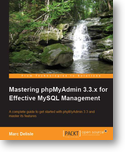
The book Mastering phpMyAdmin 3.3.x for Effective MySQL Management is already available for some time, but I still think I should promote a little bit in my blog so here it is :-). The book covers all you might want to know about using phpMyAdmin. It really does not make sense to copy text from book description, so feel free to find yourself what all it does cover. As every time, this book is written by Marc Delisle, who is for several years project admin, so probably the person who knows most about hidden features. Usually technical review of the book is done by some other developers and this time it was me doing this job (among other reviewers). I hope we did good job and you will like this book. Mastering phpMyAdmin 3.3.x for Effective MySQL Management book cover PS: As a nice bonus, the phpMyAdmin project receives money from every purchased book.

Filed under: English Phpmyadmin 0 comments Flattr this!

2 January 2011

Jelmer Vernooij: On the way to Samba 4: Part 2

It's been more than a month since the last status update on my Samba 4 work - much more than the two weeks I promised. During the holidays I finally managed to release the new alpha of Samba 4, as well as releases of some of our companion libraries (tdb, talloc, tevent and ldb). The release includes a significant amount of bug fixes and a lot of work towards a properly functioning Active Directory DC, too much to list here. This release I've mainly been involved in improving our Python bindings and our handling of internal and external libraries. We now use symbol versioning for our copy of Heimdal Kerberos as well as some of our other libraries. Hopefully this will fix some of the issues users of the evolution-mapi plugin have been seeing where they end up with both MIT Kerberos and Heimdal Kerberos loaded into the same process (with all the consequences of overlapping symbol names). Samba 4 now also has the ability to work with the system Heimdal rather than using the bundled copy. I have packaged alpha14 for Debian and Ubuntu (fixing most of the open bugs against the Samba 4 package in the BTS), but am currently waiting for the new release of ldb to pass through NEW before I can upload. The next release is scheduled for the first week of February. cp: Stream of Passion - Haunted

Lucas Nussbaum: Giving up on Ruby packaging

I have finally reached a decision regarding my involvement in the Debian Ruby packaging efforts. I have decided to stop. This has been a very hard decision to make. I have invested huge amounts of time in that work over the years. I still love the language, and will continue to use it on a daily basis for my own developments. I still hope that it will succeed. I know that some people will be disappointed by that decision (and that others will think your work was useless anyway, people should use RVM and rubygems ). But I also know that I won t be able to push for all the required changes alone. I just don t have the time, nor the motivation. For the record, here are the changes I would have liked to see in the Ruby community. The core Ruby development community should mature.
The core Ruby development community is still dominated by Japanese developers. While not a bad thing in itself, it is easily explained by the fact that the main development mailing list, where most of the important decisions are taken, is in japanese. ruby-dev@ should be closed, and all the technical discussions should happen on the english-speaking ruby-core@ list instead. The release management process should also improve. Currently, it looks like a total mess. The following Ruby development branches are actively maintained:
ruby_1_8 (106 commits over the last six months)
ruby_1_8_6 (4 commits over the last six months)
ruby_1_8_7 (35 commits over the last six months)
ruby_1_9_1 (4 commits over the last six months)
ruby_1_9_2 (227 commits over the last six months)
trunk (1543 commits over the last six months) While the state of the ruby_1_8_6 and ruby_1_9_1 branches is clear (very important bugfixes only), the state of all of the other branches is rather unclear.
What s the stable Ruby branch? 1.8 or 1.9? If it s 1.9, why are people still actively developing in the ruby_1_8 branch? How long will they continue to be maintained in parallel, dividing the manpower? Is a Ruby 1.8.8 release to be expected? Will it be ABI/API compatible with 1.8.7? Is the ruby_1_8_7 branch really bugfixes-only? How much testing of it has been done? If it s bugfixes-only and regression-free, I should push it to Debian squeeze, due to be released in a few weeks. But would you recommend that? Due to past breakages in the ruby_1_8_7 branch, it s unlikely that we will do it.
Is the ruby_1_9_2 a regression-free, bugfix-only branch? If yes, isn t 227 commits over 6 months a lot? What will be the version of the next release of trunk ? When is it expected? Will it be ABI-compatible with the current ruby_1_9_2 branch? API-compatible?
New releases in the 1.8.7 and 1.9.2 branches were done on december 25th. Why were they no betas or RCs allowing wider testing? How much testing has been done behind the scenes? Most of those questions have no clear answer. The Ruby development community should build a common understanding of the status of the various branches, and of their release expectations. Releasing on december 25th of each year sounds fun, but is releasing when everybody is on vacation really a good idea? It would be fantastic to have something similar to Python Enhancement Proposals in the Ruby community. But having open discussions in english about the major issues would already be great. Ruby is not just the interpreter.
The Ruby development community should clearly define what the Ruby platform is. There are some big players, like Rails, and newer interpreter releases should not be done before ensuring that those big players still work. Also, since we have alternative Ruby interpreters, like JRuby, Rubinius and MacRuby, we need a clear process on how they integrate with the rest of the ecosystem. For example, having each of them rely on their own outdated fork of the whole stdlib is ridiculous, since it s not where they compete. The Ruby community should acknowledge that RVM and Rubygems are not for everybody. People who say so should be laughed at. Of course, RVM and Rubygems are nice tools for some people. But it is completely wrong to believe that compiling from source using RVM should be the standard way of installing Ruby, or that all people interested in installing Redmine should know that Ruby has its own specific packaging system. The Ruby community should work with their target platforms to improve how Ruby is distributed instead of reinventing the wheel. That includes Debian, but also RedHat-based distros, for example. It is likely that it won t be possible to reach a one-size-fits-all situation. But that s real life. Some people in the Ruby community should stop behaving like assholes. As one of the Debian Ruby maintainers, I have been routinely accused of creating crippled packages on purpose (FTR, I don t think that the Debian packages are crippled, despite what the rumors says). Debian is not the only target of that. Just yesterday, someone called for abandonning YARV (the new Ruby VM in Ruby 1.9), calling it Yet Another Random Vailure. This kind of comments is really hurting the people who are investing their free time in Ruby, and is turning away people who consider getting involved. In Debian, we have had a lot of problems getting people to help with Ruby maintenance since they are getting shit from the community all the time. So, what s the future for Ruby in Debian? Update: there s also a number of interesting comments about this post on this site.
Update 2: First, thanks a lot for all the interesting comments. I will make some follow-up posts trying to summarize what was said. It seems that this post also triggered some reactions on ruby-core@, with Charles Olivier explaining the JRuby stdlib fork, and Yui Naruse clarifying that all questions are welcomed on ruby-core@. This is great, really.

31 December 2010

Dirk Eddelbuettel: R / Finance 2011 Call for Papers: Updated and expanded

One week ago, I sent the updated announcement below to the r-sig-finance list; this was kindly blogged about by fellow committee member Josh and by our pal Dave @ REvo. By now. I also updated the R / Finance conference website. So to round things off, a quick post here is in order as well. It may even get a few of the esteemed reader to make a New Year's resolution about submitting a paper :) Dear R / Finance community, The preparations for R/Finance 2011 are progressing, and due to favourable responses from the different sponsors we contacted, we are now able to offer

  1. a competition for best paper, which given the focus of the conference will award for both an 'academic' paper and an 'industry' paper
  2. availability of travel grants for up to two graduate students provided suitable papers were accepted for presentations
More details are below in the updated Call for Papers. Please feel free to re-circulate this Call for Papers with collegues, students and other associations. Cheers, and Season's Greeting, Dirk (on behalf of the organizing / program committee) Call for Papers: R/Finance 2011: Applied Finance with R April 29 and 30, 2011 Chicago, IL, USA The third annual R/Finance conference for applied finance using R will be held this spring in Chicago, IL, USA on April 29 and 30, 2011. The two-day conference will cover topics including portfolio management, time series analysis, advanced risk tools, high-performance computing, market microstructure and econometrics. All will be discussed within the context of using R as a primary tool for financial risk management, portfolio construction, and trading. Complete papers or one-page abstracts (in txt or pdf format) are invited to be submitted for consideration. Academic and practitioner proposals related to R are encouraged. We welcome submissions for full talks, abbreviated lightning talks, and for a limited number of pre-conference (longer) seminar sessions. Presenters are strongly encouraged to provide working R code to accompany the presentation/paper. Data sets should also be made public for the purposes of reproducibility (though we realize this may be limited due to contracts with data vendors). Preference may be given to presenters who have released R packages. The conference will award two $1000 prizes for best paper: one for best practitioner-oriented paper and one for best academic-oriented paper. Further, to defray costs for graduate students, two travel and expense grants of up to $500 each will be awarded to graduate students whose papers are accepted. To be eligible, a submission must be a full paper; extended abstracts are not eligible. Please send submissions to: committee at RinFinance.com The submission deadline is February 15th, 2011. Early submissions may receive early acceptance and scheduling. The graduate student grant winners will be notified by February 23rd, 2011. Submissions will be evaluated and submitters notified via email on a rolling basis. Determination of whether a presentation will be a long presentation or a lightning talk will be made once the full list of presenters is known. R/Finance 2009 and 2010 included attendees from around the world and featured keynote presentations from prominent academics and practitioners. 2009-2010 presenters names and presentations are online at the conference website. We anticipate another exciting line-up for 2011---including keynote presentations from John Bollinger, Mebane Faber, Stefano Iacus, and Louis Kates. Additional details will be announced via the conference website as they become available. For the program committee:
Gib Bassett, Peter Carl, Dirk Eddelbuettel, Brian Peterson,
Dale Rosenthal, Jeffrey Ryan, Joshua Ulrich

Russell Coker: Links December 2010

Aaron Huey gave a disturbing TED talk titled America s native prisoners of war [1]. He says the last chapter in any successful genocide is the one in which the oppressor can remove their hands and say my god, what are these people doing to themselves, they re killing each other, they re killing themselves while we watch them die .Peter Haas gave an interesting TED talk about how the poor engineering work in Haiti contributed to the significant death toll from the earthquake [2]. He advocates training for builders to prevent death and property damage from the next earthquake which is a lot cheaper than cleaning up the mess after buildings have fallen down.Wired has an interesting article on Phylo, a new crowd-sourced science game where you can sequence DNA [3]. The article also has links to other crowd-sourced science games.Brendan Scott gives a good summary of some of the most interesting news articles related to Wikileaks [4].Petter Reinholdtsen published a detailed and informative letter that Peruvian Congressman Edgar Villanueva wrote to Microsoft on the topic of a Peruvian bill to compell the government to use free software [5]. This has a lot of great ideas for anyone who wants to lobby their government for free software related legislation.Melissa McEwan wrote an informative blog post about why she doesn t trust men [6]. I can t do justice to this with a summary so just read it if you are male.Diana Laufenberg gave an interesting and inspiring TED talk about ways of teaching children [7]. Her main point was about embracing failure, having children learn from their mistakes. I think that perhaps embracing failure is only going to work with an exceptional teacher such as Diana, and that the majority of teachers would probably fail if they tried to implement it. She does have some really interesting examples of how she teaches so it s worth watching even if you don t agree with the central point.

Alexander Reichle-Schmehl: Release Critical Bug report for Week 52

The bug webinterface of the Ultimate Debian Database currently knows about the following release critical bugs:

In Total:608
Affecting Squeeze:115
Squeeze only:37
Remaining to be fixed in Squeeze:78
Of these 78 bugs, the following tags are set:
Pending in Squeeze:3
Patched in Squeeze:19
Duplicates in Squeeze:12
Can be fixed in a security Update:3
Contrib or non-free in Squeeze:4
Claimed in Squeeze:0
Delayed in Squeeze:3
Otherwise fixed in Squeeze:11
Ignoring all the above (multiple tags possible) 41 bugs need to be fixed by Debian Contributors to get Debian 6.0 Squeeze released. However, with the view of the Release Managers, 85 need to be dealt with for the release to happen. Please see Interpreting the release critical bug statistics for an explanation of the different numbers.

30 December 2010

Petter Reinholdtsen: What standards are Free and Open as defined by Digistan?

After trying to compare Ogg Theora to the Digistan definition of a free and open standard, I concluded that this need to be done for more standards and started on a framework for doing this. As a start, I want to get the status for all the standards in the Norwegian reference directory, which include UTF-8, HTML, PDF, ODF, JPEG, PNG, SVG and others. But to be able to complete this in a reasonable time frame, I will need help. If you want to help out with this work, please visit the wiki pages I have set up for this, and let me know that you want to help out. The IRC channel #nuug on irc.freenode.net is a good place to coordinate this for now, as it is the IRC channel for the NUUG association where I have created the framework (I am the leader of the Norwegian Unix User Group). The framework is still forming, and a lot is left to do. Do not be scared by the sketchy form of the current pages. :)

Jonathan McDowell: Why Linux? (Part 5: Flexibility)

(This is part of a series of posts on Why Linux?) I find Linux more flexible. Maybe that's the familiarity showing, maybe it's about the package management, but it's a powerful reason for me to use it. For example, a couple of years ago I wanted to try out some iSCSI stuff against a SAN. Of course I have test boxes available I can do this on, but this was just to try out a few bits and pieces rather than anything more concrete. So I installed open-iscsi on my desktop and was able to merrily do the tests I wanted with very little additional work. Or I wanted to try out some BitKeeper to git conversion work recently. I wasn't sure how much resource it would take on a build server, and didn't want to tie things up there. So I ran it on my desktop overnight, where I could easily setup the appropriate environment and wouldn't impact on anyone else's resources. Problems talking to dodgy hardware? Linux is much better about giving you some idea what's going on, without needing to install extra software. I had a workmate grappling with an old USB music player recently; hooking it up to her Windows laptop wasn't providing a lot of joy so I attached it to my Linux box and was able to see that it did identify ok, but was disconnecting randomly at times too. Want to script querying an AD server for the current employee list and displaying who's joined and who's left since the last time you did so? I found that easy enough with the common Linux LDAP tools. I'm sure it's doable under Windows too, but I'm not sure it would be quite so simple. For bonus points add graphviz into the mix for automatic organisation charts (modulo accuracy of the AD data). This flexibility is something that helps me do my job. Sure, as I mentioned above I do have access to test boxes that I can use for this, but being able to do it on my desktop can be useful - for example if I'm offline, or on a slow network connection, or just geographically distant from my test machines so network latency is higher than I'd like. (Also, it's something that makes a Linux box a really great test box. I'm lucky in that I have a mix of OSes available to me for testing, but the one that I use most often is the Debian box. Much easier to get and install decent diagnosis tools for it that can give me packet level dumps, or do really odd stuff that turns out to be really useful.)

Bastian Venthur: Canon IXUS 130

Dear Lazyweb, Today I bought me a Canon IXUS 130 and was quite disappointed to see that it couldn t properly connect to my Debian/Sid machine via USB. Apparenty the camera is not recognized as a USB Mass Storage Device but utilizes PTP. I upgraded to libgphoto2 (2.4.10.1-3) from experimental and added a proper udev rule with vendor- and product-id but it did not help. Is there anything more I can try? Update: Accessing the camera actually works, even with ligbphoto2 (2.4.6) from unstable. I can access the camera with gphoto2 and download pictures (but not with KDE s filemanager). My problem was that I had rhythmbox running and the camera was automatically mounted by it as a media device. When KDE s filemanager or gphoto2 tried to access the camera I got an error like: ( Could not lock the device ): Camera is already in use., which is probably also a bug. Closing rhythmbox solved the issue and I was able to download images with gphoto2.

29 December 2010

Lars Wirzenius: Obnam 0.14 and btree 0.14

After several months of leisurely development (I've read through everything on the Internet several times, and notified everyone who was wrong), I have finally gotten obnam, my backup application, into a state where it successfully backs up my laptop's hard disk to a USB disk. I therefore declare it to be perfe... no, wait, I don't. It's slow. It's probably buggy in ways that will make you want to abandon computers forever. It's also slow. And buggy. Did I mention it is slow, making backups at only a few megabytes per second? Disclaimers aside, I am happy to have gotten obnam to this stage. It's not nearly ready, but it's getting along nicely. If you've been curious about obnam ever since I first mentioned it in 2007, now might be a good time to try it out. I would be very interested in hearing any feedback. Obnam is implemented using copy-on-write B-trees, and I've also released my B-tree implementation. See the NEWS file in each source tree for information for what's changed since the previous release. Links: I have made Debian packages of obnam, btree, and some of my other stuff that they need, for all, amd64, and i386 architectures. The repository is at http://code.liw.fi/debian/, so add this to your sources.list if you want to use that:
deb http://code.liw.fi/debian squeeze main
Note, however, that I do not guarantee that this repository will be in any useful state at any given time. I use it, and rely on it, and will fix things when they bother me, but that's all the guarantee I give. (Do you get the impression I've read too many contracts?) Once obnam is ready, and Debian squeeze is released, I'll upload it to Debian, and then you'll get it for any architecture Debian runs one. If anyone wants to help me maintain the packages for Debian, please e-mail me. If, on the other hand, you'd like to help make obnam faster, or better, the bug tracker has some pointers. Right now speed is perhaps the biggest problem. The B-tree library needs optimizing, as does obnam itself. And the LRU cache I use. The worst missing feature is encryption support. I do my backups to a local hard disk, which is full-disk encrypted, which is why I haven't cared about implementing encryption yet. Also, I need to design a good way to manage keys, etc. Help with that would be quite welcome.

Jon Dowland: announcing RDiffFS

It gives me pleasure to announce RDiffFS, a virtual filesystem for browsing backups created by the rdiff-backup tool. Assuming that "/backup" is the location of a series of backups created using rdiff-backup, here is a usage example:
$ rdifffs /backup/dest/ /mnt
$ ls -l /mnt
total 5
drwxr-xr-x 4 jon jon 4096 Feb  7  2010 2010-09-04T16:38:10+01:00
drwxr-xr-x 4 jon jon 4096 Feb  7  2010 2010-12-29T10:51:50Z
drwxr-xr-x 4 jon jon 4096 Feb  7  2010 2010-12-29T10:52:30Z
lr-xr-xr-x 2 jon jon   11 Jan  1  1970 current -> 2010-12-29T10:52:30Z
$ for i in /mnt/*/a; do c=$(cat "$i"); printf "%32s:\t%s\n" "$i" "$c"; done
/mnt/2010-09-04T16:38:10+01:00/a:   foo
     /mnt/2010-12-29T10:51:50Z/a:   bar
     /mnt/2010-12-29T10:52:30Z/a:   baz
                  /mnt/current/a:   baz
I will write more about the creation of rdifffs at a later date: in particular my choice of implementation language, but I don't want to clutter up this announcement with all that. Suffice to say, I started writing a "quick tool" nearly a year ago, and I have become increasingly desperate to announce it. At present, rdifffs should be considered alpha quality software. It can browse my real-world backup, albeit slowly, and with several metadata bugs. This is more than archfs can manage. It can read files from the most recent backup, and most files from incremental backups, but not all.

Christoph Egger: Debian GNU/kFreeBSD

So when I was travveling to my parent's for christmas it looked like I'd have limited computer access. My Netbook is quite OK for reading mail but not really useable for any real hacking. And my trusty Thinkpad (Z61m) was oopsing when X was running so not much useable either. But as some Live CDs placed here were working well I decided that this would be fixed by an reinstall. And as I was reinstalling anyway I decided I could just choose kfreebsd-amd64. Turned out to be a quite entertaining decision with lots of stuff to hack away with wireless Bad news: there's no wireless support on Debian GNU/kFreeBSD at the moment. This problem is tracked as Bug #601803 so for wireless internet you will need a (plain) Freebsd chroot. Haven't tried this myself yet -- busy figuring other stuff out. SBCL Having a FreeBSD chroot I decided to give SBCL on GNU/kFreeBSD another try after having failed to get it working in a VM some time ago. With quite some help on SBCL's IRC channel I managed to build a patch that enables building (you need to force a :os-provides-dlopen to the feature list additionally). There's currently no multi-threading working so I hae a project for the rest of the hoidays (well lots of other stuff to do as well ;)) Audio Some more user-related stuff now. As it is this time of the year I wanted to listen to some 27c3 streams so I needed working audio. However there's no OSS device available. Turned out you just need to kldload the right module (here snd_hda) to get sound working. Volume was rather low although hardware controls of the soundcard where at max. As that's all OSS there's no point looking for alsamixer. Turns out aumix can do that here. IPv6 aiccu stuff Installing aiccu, copying the config in and starting did not work out as well. I already tried to do that from within the FreeBSD chroot already (which doesn't work for some reason) until I discovered just loading the if_tun kernel module solves the aiccu on Debian issue quite well. To get a default route up the last step was finding /lib/freebsd/route again -- /sbin/route is a wrapper around that abstracting differences in BSD route but not supporting IPv6.

27 December 2010

Petter Reinholdtsen: The many definitions of a open standard

One of the reasons I like the Digistan definition of "Free and Open Standard" is that this is a new term, and thus the meaning of the term has been decided by Digistan. The term "Open Standard" has become so misunderstood that it is no longer very useful when talking about standards. One end up discussing which definition is the best one and with such frame the only one gaining are the proponents of de-facto standards and proprietary solutions. But to give us an idea about the diversity of definitions of open standards, here are a few that I know about. This list is not complete, but can be a starting point for those that want to do a complete survey. More definitions are available on the wikipedia page. First off is my favourite, the definition from the European Interoperability Framework version 1.0. Really sad to notice that BSA and others has succeeded in getting it removed from version 2.0 of the framework by stacking the committee drafting the new version with their own people. Anyway, the definition is still available and it include the key properties needed to make sure everyone can use a specification on equal terms.
The following are the minimal characteristics that a specification and its attendant documents must have in order to be considered an open standard:
  • The standard is adopted and will be maintained by a not-for-profit organisation, and its ongoing development occurs on the basis of an open decision-making procedure available to all interested parties (consensus or majority decision etc.).
  • The standard has been published and the standard specification document is available either freely or at a nominal charge. It must be permissible to all to copy, distribute and use it for no fee or at a nominal fee.
  • The intellectual property - i.e. patents possibly present - of (parts of) the standard is made irrevocably available on a royalty- free basis.
  • There are no constraints on the re-use of the standard.
Another one originates from my friends over at DKUUG, who coined and gathered support for this definition in 2004. It even made it into the Danish parlament as their definition of a open standard. Another from a different part of the Danish government is available from the wikipedia page.
En ben standard opfylder f lgende krav:
  1. Veldokumenteret med den fuldst ndige specifikation offentligt tilg ngelig.
  2. Frit implementerbar uden konomiske, politiske eller juridiske begr nsninger p implementation og anvendelse.
  3. Standardiseret og vedligeholdt i et bent forum (en s kaldt "standardiseringsorganisation") via en ben proces.
Then there is the definition from Free Software Foundation Europe.
An Open Standard refers to a format or protocol that is
  1. subject to full public assessment and use without constraints in a manner equally available to all parties;
  2. without any components or extensions that have dependencies on formats or protocols that do not meet the definition of an Open Standard themselves;
  3. free from legal or technical clauses that limit its utilisation by any party or in any business model;
  4. managed and further developed independently of any single vendor in a process open to the equal participation of competitors and third parties;
  5. available in multiple complete implementations by competing vendors, or as a complete implementation equally available to all parties.
A long time ago, SUN Microsystems, now bought by Oracle, created its Open Standards Checklist with a fairly detailed description.
Creation and Management of an Open Standard
  • Its development and management process must be collaborative and democratic:
    • Participation must be accessible to all those who wish to participate and can meet fair and reasonable criteria imposed by the organization under which it is developed and managed.
    • The processes must be documented and, through a known method, can be changed through input from all participants.
    • The process must be based on formal and binding commitments for the disclosure and licensing of intellectual property rights.
    • Development and management should strive for consensus, and an appeals process must be clearly outlined.
    • The standard specification must be open to extensive public review at least once in its life-cycle, with comments duly discussed and acted upon, if required.
Use and Licensing of an Open Standard
  • The standard must describe an interface, not an implementation, and the industry must be capable of creating multiple, competing implementations to the interface described in the standard without undue or restrictive constraints. Interfaces include APIs, protocols, schemas, data formats and their encoding.
  • The standard must not contain any proprietary "hooks" that create a technical or economic barriers
  • Faithful implementations of the standard must interoperate. Interoperability means the ability of a computer program to communicate and exchange information with other computer programs and mutually to use the information which has been exchanged. This includes the ability to use, convert, or exchange file formats, protocols, schemas, interface information or conventions, so as to permit the computer program to work with other computer programs and users in all the ways in which they are intended to function.
  • It must be permissible for anyone to copy, distribute and read the standard for a nominal fee, or even no fee. If there is a fee, it must be low enough to not preclude widespread use.
  • It must be possible for anyone to obtain free (no royalties or fees; also known as "royalty free"), worldwide, non-exclusive and perpetual licenses to all essential patent claims to make, use and sell products based on the standard. The only exceptions are terminations per the reciprocity and defensive suspension terms outlined below. Essential patent claims include pending, unpublished patents, published patents, and patent applications. The license is only for the exact scope of the standard in question.
    • May be conditioned only on reciprocal licenses to any of licensees' patent claims essential to practice that standard (also known as a reciprocity clause)
    • May be terminated as to any licensee who sues the licensor or any other licensee for infringement of patent claims essential to practice that standard (also known as a "defensive suspension" clause)
    • The same licensing terms are available to every potential licensor
  • The licensing terms of an open standards must not preclude implementations of that standard under open source licensing terms or restricted licensing terms
It is said that one of the nice things about standards is that there are so many of them. As you can see, the same holds true for open standard definitions. Most of the definitions have a lot in common, and it is not really controversial what properties a open standard should have, but the diversity of definitions have made it possible for those that want to avoid a level marked field and real competition to downplay the significance of open standards. I hope we can turn this tide by focusing on the advantages of Free and Open Standards.

26 December 2010

Tim Retout: File synchronisation

If anyone mentions Dropbox to me one more time, I will scream. I'm sure it's a wonderful solution, but I have deep misgivings about handing my data over to someone I don't trust. Besides, my synchronisation needs are not that complicated. Here are my high-level requirements:
  1. Two way synchronisation between multiple clients and a central server.
  2. Automatic syncs - no requirement for manual triggering.
  3. Graceful handling of network outages, suspends, etc.
  4. If using ssh, running from within my X session (so that it can access my ssh-agent)
  5. Some assurance that my data will not be passed to other people (e.g. by running everything on servers I control, or encrypting all the data with keys only I hold)
  6. Regular backups of the central data.
I've been playing about with several ideas - I know some people try to do this sort of thing with git, but I don't have a need for version control right at the moment, and merging conflicts could be far too complicated. I did hack together a script involving lsyncd and NetworkManager's dbus signals, but then realised that synchronising in the other direction would need something quite different, and it was getting a bit out of hand by that point. So my current favourite is actually GNOME's Conduit project. It ticks almost all of the boxes (apart from the backups, which should be simple to put together). There are some rough edges - the author has tried to delegate the minor detail that it's accessing an SFTP share entirely to GIO. But GVFS shares are not mounted automatically by Conduit - so I would have to browse to the remote folder in Nautilus before any synching would happen in each session. Bad. But looking at how Conduit is used, I don't agree with hiding the nature of the remote folder from the user. By all means use GIO to perform the mechanics of SSH and so on, but the user surely thinks of the remote server as something different to a local folder? So from a UI perspective, this should be made explicit. After all, the user has to deal with it at some level by switching to Nautilus to set up the connection. And since I cannot find an SFTP plugin for Conduit anywhere, this still leaves me in the unfortunate position of having to write code if I want a nice solution. Bah, humbug.

Next.

Previous.