Search Results: "xam"

29 August 2007

David Welton: "Playing fetch" with DocBook

A while ago I wrote about the idea of "playing fetch" - meaning chasing after programming "sticks" that are basically makework. I am starting to get the feeling that the documentation system that I chose for Hecl is one such stick. I've been trying to document that lcdui commands that Wolfgang created last year. They're really cool, and give you access to pretty much everything you can do from Java, but cranking out these docs is sure time-consuming. Here's an example:
<refentry id="lcdui_date">
  <refnamediv>
<refname>lcdui.date</refname>
<refpurpose>Date/Time widget for lcdui forms</refpurpose>
  </refnamediv>
  <refsynopsisdiv>
<cmdsynopsis>
  <command>lcdui.date</command>
  <arg choice="opt">
    -date
    <replaceable>date/time in seconds</replaceable>
  </arg>
  <arg choice="opt">
    -label
    <replaceable>label</replaceable>
  </arg>
Once you finally slog through and create the documentation, it's very flexible, because you have not created just formatting instructions, but actually described each piece of the text. But... look at how often things get repeated. Aside from the repetitive XML tags, lcdui.date is more or less there three times. Ugh. Emacs + psgml mode helps some, but I still get the feeling I got suckered into doing something that should only be attempted by Big Corporations or at least large, well established projects that can afford to send people off to spend lots of time producing this kind of documentation.

28 August 2007

Kai Hendry: MBP versus X40

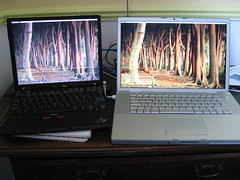
Thinkpad X40 vs MBP I’ve spent a bit of the bank holiday weekend by probably violating the warranty of a new 15” Macbook Pro (MBP) from work. I also was at the Debian bbq 2007 in Cambridge and met some friendly faces. :) More MBP & X40 porn So now I can boot into MacOSX and run Ubuntu or boot straight into Ubuntu from rEFIt. There are a couple of problems. There are some things I quite like about the MBP compared to the X40: Currently I remain not totally convinced about the Apple MBP. I’ll keep my Debian X40 my personal machine and the MBP for work. Now I can compile Webkit on Apple OSX (Debian can too) and see what’s happening in Ubuntu.

26 August 2007

Biella Coleman: The problem with presentism

A few days ago, Joe Reagle was telling me about the rise of (sometimes very arcane) policies and bureaucratic imperatives that now characterize Wikipedia. A few days later I stumbled across a few interesting posts on the topic, posts (especially Nick Carr’s) seeping with almost celebratory gloom and doom:
‘But, given human nature, is it really so “incredible” that Wikipedia has evolved as it has? Although writers like Yochai Benkler have presented Wikipedia as an example of how widescale, volunteer-based “social production” on the Internet can exist outside hierarchical management structures, the reality is very different. As Wikipedia has grown, it has developed a bureaucracy that is remarkable not only for the intricacies of its hierarchy but for the breadth and complexity of its rules. The reason Deletionism has triumphed so decisively over Inclusionism is pretty simple: It’s because Deletionism provides a path toward ever more elaborate schemes of rule-making - with no end - and that’s the path that people prefer, at least when they become members of a large group. The development of Wikipedia’s organization provides a benign case study in the political malignancy of crowds.”
It is without question that a problem has arisen in Wikipedia, a problem composed of a thick web and net of rules that can be helpful as guidelines but often are often confusing and clearly work to ensnarl new users. But can we so quickly put blame on so-called human nature? Or is it not a problem of human organization, which as the anthropological and sociological record shows, can take many forms? And is it not just that: a problem begging for a solution instead of an opportunity to declare the fundamental nature of wikipedia (and that of human nature?). Not only may history prove him wrong, other large scale collaborative projects at least prove that solutions can be found to deal with problems of growth and scale. It is as if Carr just wants to see a project like Wikipedia fail, which somehow, this morning hit a raw nerve. What I find exciting about large scale projects of (at times unwieldy) collaboration are not just the explicit outputs of the projects (an encyclopedia or operating system) but the social worlds they create. And there is no inevitable path they *must* follow. These groups have a choice to react to and respond to these sort of problems and enact solutions that will hopefully solve them and allow these projects to change. Debian, a slightly older project than Wikipedia, has gone through many growing pains and there was even a period when the the whole process of integrating new Debian developers was shut down and if my memory serves me correctly, for 2 years! At the time, it could have been possible to say: “This signals the end of Debian” but eventually a solution was found, the New Maintainer process, which while not perfect (what is?) allowed the project to grow and produce a great operating system for years to come. Debian today faces new problems and is working to find solutions. I hope that Wikipedia can and will do the same. And instead of declaring its death, why not wait and see, and offer something a little more constructive and illuminating, than destructive?

25 August 2007

Andreas Metzler: bad xpdf rendering on etch

I have been wondering why xpdf rendered some pdf files really really bad. (Check out this example screenshot for comparison of xpdf, evince and Adobe reader on etch.) The error message Error: PDF version 1.6 -- xpdf supports version 1.5 (continuing anyway) should have given me a hint. But I just did not think that going from 3.01 to 3.02 would make a big difference. However it does; the sid versions of evince and xpdf render as well as Adobe reader. [Updated 2007-08-25 19:05 CEST] I have uploaded a backport to http://www.backports.org/ and less than two hours later it has already gone through bpo's NEW processing and is available for download. Thanks, ftp-master.

24 August 2007

Simon Richter: componentization tutorial #1: understanding what we are trying to do

This is the first post of a series on componentization, starting with a brief explanation of the problem(s) we are trying to solve. I expect some familiarity with programming in general, but no specific knowledge of any particular system; the terms "DLL" and "shared library" are used interchangeably. When you are writing a DLL, you are essentially committing to support whatever interface you are exporting forever. So it better be good on the first try. DLL hell is what happens if it was not good, and you end up making an incompatible change. The obvious way an interface can be "not good" is when you need to touch the header files that define it in order to implement some new functionality. You can get away with a few things, like the addition of new functions, if you can somehow make sure that users will always have a recent enough version of your DLL around, but in general any change to the interface is going to be incompatible. The traditional Unix way of solving the issue has been renaming the library. When you link a program against a shared library on a system that uses the ELF format, the linker looks inside the library for the SONAME field, which tells it what name the library wants to be known under, and the program will then attempt to load this file at startup (which usually is a symlink to the latest compatible version). This "official" name of the library usually contains a number (sometimes more than one), and when there is an incompatible change, you simply change that number, and the new version of the library can be installed in parallel with the old. There are additional mechanisms, like symbol versioning support, that allow a single library to provide different "versions" of exported functions, and have the program specify the desired version for each symbol. To run a system like this, one generally needs to keep track of programs' dependencies; this generally happens in the package manager with more (Debian) or less (Red Hat) support from package build scripts. If you built your system from scratch, you end up doing this work yourself. That's why you had highly paid system administrators in the old days, and very short shell scripts to replace them (with various degrees of success) in the current age. In the Windows world, things have been a bit different, because except in large installations, you generally do not have a clueful, benevolent system administrator who will take care of these things; rather, you have users that expect your software to work without having an insight into the inner workings. In general, software developers have not been taking chances and simply shipped all the DLLs they needed along with the main program. When they installed these DLLs into the same directory as the program, things were fine, if they installed them into the WINDOWS directory, not so much, because when you had two conflicting versions of the same DLL, you had to decide which one to keep, and a program that would only work with the one that you threw away would simply fail in curious and interesting ways. This is the original definition of DLL hell — you cannot do it right. To make matters worse, this is not the only way an interface could change. When you define a platform, you write up an "Application Binary Interface" (ABI) document that details conventions that should be followed; for example, the ARM processor does not have a dedicated stack pointer register, so the ABI document for Linux on ARM says that R13 is to be used as a stack pointer, functions may thus expect it to point to memory that is readable and writeable, and memory with an address lower than the stack pointer is considered "free". When the function is done, it is supposed to jump to the address in R14, which happens to be the register the ARM's "Branch with Link" instruction sets to the address of the instruction following it. If the function takes arguments, the ABI says where to find them, and if it returns a value, it also tells where to place that. For everything not in the ABI document, the compiler author gets to choose. The ABI document usually attempts to be rather minimal, so it defines how C functions are to be called, and calls it a day. Anything not in the C standard is not guaranteed to work between different compilers (or even different versions of the same compiler). That includes C language extensions such as the "long double" data type, language features in C++ and Java such as namespaces, nested types and exceptions, and the data structures used by the C library's malloc() function. The latter makes life difficult even for pure C programmers, as it disallows releasing memory from a different module than the one it was allocated in, because the different modules may link to different C libraries. In essence, this means you are not supposed to export anything from a DLL that is not a C function, and even then, there are additional requirements. You could in theory export data objects, but that is discouraged, as it exposes an implementation detail. Now, we're in a bit of a dilemma here. There is lots of interesting code out there that is not necessarily written in C, we'd like to reuse it and we don't want stuff to break. The Linux approach so far has been "we simply pretend the problem does not exist", and this has been working to a large extent, simply because everyone uses gcc, and when the ABI extensions the gcc people had made changed, recompiling everything that uses these extensions makes the problem go away. This has several drawbacks. For one, it mandates that the tools used to rebuild everything and keep the installation consistent be written in C or handle the transition gracefully (for the curious who have a Debian system handy: look at libapt-pkg's SONAME), and it also requires that we have the full source code for everything not just available but buildable in an automated way. Within the context of a Linux distribution, both of these are true, so we have survived the last major ABI transitions without too many losses. So we need an extension of the ABI document that specifies how modules written by different people and compiled with different compilers can interact. These are commonly called component models, and, to quote Andrew Tanenbaum, "[t]he good thing about standards is that there are so many to choose from". Next: "componentization tutorial #2: CORBA and COM"

Russell Coker: Water Prices and Scarcity

Due to climate change and population increases we are having increasing problems with the water supply in Australia. Peter Lieverdink suggests that we have more options for water supply including treated sewage similar to the Netherlands here he grew up. However I believe that in Australia we already do what he proposes (put treated sewage in rivers and then use the same rivers for the water supply). It’s just removing the middle step (of having the treated sewage in a river) that is controversial. I recently examined a water bill for my house. Among other things it said that my water use was slightly above the average for houses that use water efficiently and significantly below the average for typical water use. The funny thing was that most of the expenses on the bill were not actually related to the amount of water used. My bill for a quarter was $54 service charges for sewerage and water (of which $39 was sewerage), $30 for sewage disposal, $26 for water, and $14 for drainage. So the cost of disposing of sewage was greater than the cost of getting fresh water and the sewerage service charge was the largest single item on the bill. Australia supposedly has a capitalist economic system in place (except for the communist policies related to farming and the protection of some industries such as car manufacture and coal mining). Surely the right thing to do is to make water expensive enough that people have a financial incentive to conserve it! The first thing that should be done is to make the majority of the value of a water bill received by a typical household be determined by the amount of water used. This could be achieved by reducing the fixed components of the bill to something small (EG $20 per quarter instead of $98 for me) and then increasing the cost per kilo-litre (EG from $0.85 to $2.50). The end result would be that people who use average amounts of water would pay about the same amount as they do now and people who use less than the average amount would get smaller bills, while government revenue would remain the same. The next thing to do is to have different tarriffs for different quantities of water used. The first 50L per day could be free (water for drinking and cooking is a right), between 50 and 450L per day (451L per day being regarded as efficient water use for a house with four occupants and a medium garden) could be at slightly more than current prices, and usage greater than 450L per day could be significantly more expensive. The current situation is that everyone is going to pay through taxes for desalination plants and other expensive methods of producing new fresh water. Having people pay for what they use is the capitalist way.

22 August 2007

Ian Wienand: Fun with <tt>-funroll-loops</tt>

I was playing with loop unrolling, and decided to investigate it a little. The basis is this very simple program which looks like it could do with some loop unrolling.
#include <stdio.h>
#include <stdlib.h>
#include <assert.h>
#define SIZE (1500 * 1024 * 1024)
int fn(int *buf)  
        int i;
	for(i=0; i < (SIZE/sizeof(int)); i+=1)
		buf[i] = i;
	return 0;
 
int main(void)
 
        int *buf = malloc(SIZE);
        assert(buf);
	return fn(buf);
 
Firstly, lets have a look at what happens to the function when -funroll-loops is applied. Below is the de-compilation with some comments on what each line is doing.
Non-optimised
                           nop.m 0x0
r14=0                      mov r14=r0
save the "loop counter"    mov.i r2=ar.lc
                           nop.m 0x0
one less than iterations   movl r15=0x176fffff;;
                           nop.m 0x0
initalise loop counter     mov.i ar.lc=r15
                           nop.i 0x0;;
                           loop:
*buf = i, buf++            st4 [r32]=r14,4
i++                        adds r14=1,r14
dec lc, branch if > 0      br.cloop.sptk.few .loop
                           nop.m 0x0
restore loop counter       mov.i ar.lc=r2
Loop unrolled
                           nop.m 0x0
r26 = 0                    mov r26=r0
save lc                    mov.i r2=ar.lc
                           nop.m 0x0
iter / 32                  movl r14=0x2edffff;;
                           nop.m 0x0
setup loop counter         mov.i ar.lc=r14
                           nop.i 0x0
                           loop:
r3 = buf                   mov r3=r32
r8 = 1                     adds r8=1,r26
r25 = 3                    adds r25=3,r26
r23 = buf[3]               adds r23=12,r32
r24 = 4                    adds r24=4,r26
r22 = buf[4]               adds r22=16,r32;;
buf[0] = 0; r3=buf+1       st4 [r3]=r26,4
r21 = 5                    adds r21=5,r26
r19 = buf[5]               adds r19=20,r32
r20 = 6                    adds r20=6,r26
r18 = buf[6]               adds r18=24,r32
r16 = 7                    adds r16=7,r26;;
                           nop.m 0x0
buf[1] = 1, r3=buf+2       st4 [r3]=r8,4
r15 = buf[7]               adds r15=28,r32
r17 = 2                    adds r17=1,r8
r26 += 8                   adds r26=8,r26
buf += 8 (for next iter)   adds r32=32,r32;;
buf[2] = 2                 st4 [r3]=r17
buf[3] = 3                 st4 [r23]=r25
                           nop.i 0x0
buf[4] = 4                 st4 [r22]=r24
buf[5] = 5                 st4 [r19]=r21
                           nop.i 0x0
buf[6] = 6                 st4 [r18]=r20
buf[7] = 7                 st4 [r15]=r16
loop, dec branch           br.cloop.sptk.few .loop
                           nop.m 0x0
restore lc                 mov.i ar.lc=r2
                           br.ret.sptk.many b0;;
We can see that in the first case the loop counter is setup to run 393216000 times (e.g. 1500*1024*1024/sizeof(int)) and a very simple loop of storing the value and incrementing is undertaken. In the second version, the code becomes more complex. We can see the loop now executes 49152000 times (e.g. 1500*1024*1024/sizeof(int)/8) so we can infer that for each loop iteration, 8 values have been unrolled to be written into our buf array. Indeed, when pulled apart we can see the 8 stores (numbers just reflect the first time through). So, is it faster?
$ time ./loop
real    0m1.209s
user    0m0.388s
sys     0m0.820s
$ timme ./loop-unroll
real    0m1.056s
user    0m0.244s
sys     0m0.812s
Yes! Great. We can suggest a number of reasons why, but it would be interesting to get some hard statistics on why this is so. Thanks to the Itanium performance counters, we can. Firstly, lets start by seeing how cycles are being spent.
$ pfmon -e cpu_cycles,ia64_inst_retired_this,nops_retired,back_end_bubble_all ./loop
 547923609 CPU_CYCLES
1179995250 IA64_INST_RETIRED_THIS
    104431 NOPS_RETIRED
 154285534 BACK_END_BUBBLE_ALL
$ pfmon -e cpu_cycles,ia64_inst_retired_this,nops_retired,back_end_bubble_all ./loop-unroll
 311570590 CPU_CYCLES
1327451286 IA64_INST_RETIRED_THIS
 147560435 NOPS_RETIRED
  16088889 BACK_END_BUBBLE_ALL
Now, the Itanium can issue up to six instructions (IA64_INST_RETIRED_THIS) in two bundles of three instructions per cycle (CPU_CYCLES). However, you can't have dependencies between registers within a 3-instruction bundle (and branches and interruptions play havoc) so sometimes you need to pad with no-ops (this is why you need a good compiler). We can work out some figures from this, namely the useful instructions per cycle (e.g. instructions retired - nop instructions / cycles).
TestUseful instructions/cycle
loop1179995250 - 104431 / 547923609 = 2.15
unroll1327451286 - 147560435 / 311570590 = 3.78
This tells us that for each given cycle, the unrolled-loop version is doing more work (ideally we'd like that to be a the theoretical maximum of 6). So what is the unrolled version doing for all this time? Bubbles are where the CPU is waiting for something; a prime candidate is moving data from caches to registers. Bubbles make up (154285534/547823609) 28% of the cycles on the loop version, but only (16088889/311570590) 5% of the time for the unrolled version. This means the processor is spending a lot less time waiting for things to happen with the unrolled loop version. We can drill down further to see what bubbles are occurring.
$ pfmon -e be_l1d_fpu_bubble_all,be_exe_bubble_all,be_RSE_bubble_all,Back_end_bubble_fe ./loop
 14229581 BE_L1D_FPU_BUBBLE_ALL
    97669 BE_EXE_BUBBLE_ALL
     1260 BE_RSE_BUBBLE_ALL
131354866 BACK_END_BUBBLE_FE
$ pfmon -e be_l1d_fpu_bubble_all,be_exe_bubble_all,be_RSE_bubble_all,Back_end_bubble_fe ./loop-unroll
22676169 BE_L1D_FPU_BUBBLE_ALL
   83064 BE_EXE_BUBBLE_ALL
    1263 BE_RSE_BUBBLE_ALL
  718850 BACK_END_BUBBLE_FE
We are now breaking the stalls down to see where they are occuring. L1D_FPU_BUBBLES are essentially related to micro-architectural issues with the caches; things like the L1D cache being overwhelmend and interactions with the hardware page-table walker. BE_EXE bubbles are more simply described a waiting for data to come from caches (or even main memory) to registers. BE_RSE bubbles are related to the register stack engine, and "front end" bubbles (BACK_END_BUBBLE_FE) are where there are not enough instructions coming from the "front-end" for the "back-end" to issue out to functional units in the processor. In this case, the major cause of problems for the simple loop seems to be not being able to get enough instructions through to keep the processor busy. We can try to pin down what is happening in the front-end:
$ pfmon -e fe_bubble_imiss,fe_bubble_tlbmiss,fe_bubble_branch,fe_bubble_bubble ./loop
   27727 FE_BUBBLE_IMISS
    4910 FE_BUBBLE_TLBMISS
98094189 FE_BUBBLE_BRANCH
52615907 FE_BUBBLE_BUBBLE
$ pfmon -e fe_bubble_imiss,fe_bubble_tlbmiss,fe_bubble_branch,fe_bubble_bubble ./loop-unroll
780729 FE_BUBBLE_IMISS
  4858 FE_BUBBLE_TLBMISS
291620 FE_BUBBLE_BRANCH
111089 FE_BUBBLE_BUBBLE
What we can see here is that the increased code size of the unrolled version causes us a lot more i-cache misses, as expected. However, the problem for the unrolled version seems to be the time spent by the front-end dealing with the branch. This is not surprising since there is a rumor that there is a front-end buffer which fills up after 3 repeated cycles with branch instructions; apparently this is a problem addressed in the new Montecito chips (if anyone has one, I'll update this if you send me the numbers). Since we are doing 393216000 branches all within a single bundle its not surprising we've hit it! Just to confirm, we can break-down the BE_EXE bubbles. Remember, BE_EXE bubbles are caused by stalls in the execution phase primarily due to cache latencies or inter-register dependencies. Looking at our code, we don't re-use the same register over-and-over so we would not expect to spend a long time waiting for registers, and indeed this is what we see.
$ pfmon -e be_exe_bubble_grall,be_exe_bubble_grgr ./loop
79601 BE_EXE_BUBBLE_GRALL
  919 BE_EXE_BUBBLE_GRGR
$ pfmon -e be_exe_bubble_grall,be_exe_bubble_grgr ./loop-unroll
76627 BE_EXE_BUBBLE_GRALL
  918 BE_EXE_BUBBLE_GRGR
Therefore in this case, the speed increase isn't coming from better cache behaviour as we might have expected, but greater ability to keep the processor busy with instructions between branches. We can also examine the major events happening with the unrolled case. Here we see BE_L1D_FPU bubbles being the major overhead. On Itanium floating-point avoids the L1 cache (it is too big, and not re-used enough to make it useful) hence the concatenation of the event acronym. These bubbles can be broken down into the following events (measured in two runs, since you can only do 4 at a time).
$ pfmon -e be_l1d_fpu_bubble_l1d,be_l1d_fpu_bubble_l1d_dcurecir,\
  be_l1d_fpu_bubble_l1d_tlb,be_l1d_fpu_bubble_l1d_stbufrecir ./loop-unroll
 9623193 BE_L1D_FPU_BUBBLE_L1D_DCURECIR
     414 BE_L1D_FPU_BUBBLE_L1D_TLB
     282 BE_L1D_FPU_BUBBLE_L1D_STBUFRECIR
$ pfmon -e be_l1d_fpu_bubble_l1d_fullstbuf,\
    be_l1d_fpu_bubble_l1d_l2bpress,be_l1d_fpu_bubble_l1d_tlb ./loop-unroll
      23 BE_L1D_FPU_BUBBLE_L1D_FULLSTBUF
17220177 BE_L1D_FPU_BUBBLE_L1D_L2BPRESS
     425 BE_L1D_FPU_BUBBLE_L1D_TLB
These events expose micro-architectural details, the full extent of which is only gleaned by reading the processor manuals (a PhD in computer architecture probably helps too!). The store buffers are not an issue here -- the caches are more than able to keep up with our few writes. The TLB is also not involved; we have pretty good TLB coverage thanks to the virtual-linear page table and hardware page-table walker. The two clues are DCURECIR and L2BPRESS. Essentially DCURECIR happens when references have to "re-circulate"; this is a side-effect of the data not being available. The L2BPRESS figure suggests why this is so; this event happens when the L2 cache can not handle any more requests. The L2 cache keeps a queue of outstanding requests; when this queue is full (for example, full of long latency requests to get data from main memory) the L2 cache causes "back-pressure" which stops the L1 cache from issuing new requests. This suggests the program is chewing through a lot of data and not using the cache very effectively, which is exactly what we are doing. Pre-fetching hints can help (but as described in a previous entry on hacking Enigma may not always help), but in this case there probably isn't any spare bandwidth to pre-fetch in because essentially no processing is happening. What does all this mean? I don't know, but playing with performance monitors is fun!

21 August 2007

Rapha&#235;l Hertzog: Deprecating cvs.debian.org in favor of Alioth

It’s very difficult to discuss with DSA and make things evolve if none of the DSA member express an interest in something related to your goal: here comes an example of a story like another in my desperate quest to try to help the DSA team. :-) Last time gluck ran out of space, a few non-DSA people (me, taggart, Ganneff, and others I might have forgotten) contacted people to ask them to clean their home directories. Following that discussion we discussed a bit about the opportunity to move some services from gluck on another host. Among the services on gluck, there’s cvs.debian.org. As an Alioth administrator, it struck me that cvs.debian.org is the only VCS service that’s handled by the DSA team. It seems logical to not duplicate the administrative work and have all the VCS repositories handled by the same team. The logical conclusion is that cvs.debian.org should be deprecated in favor of Alioth. So I made the suggestion in RT ticket #146 (login with guest/readonly). I got exactly zero response from DSA. No support and no opposition. So I went ahead and contacted the last users of cvs.debian.org: All in all, the debian-doc and debian-www folks are rather supportive of the move, but it requires adjustment to the build infrastructure, in particular to keep track of the status of translations. I have no answer from DSA and the buildd guys however. The web team started a wiki page to evaluate the VCS that they would switch to. Volunteers would be welcome to organize the conversion of the repositories and to fix the build infrastructure accordingly. This a nice little project for new contributors that want to learn. :-)

Theodore Ts'o: Thoughts about the Palm Foleo

I looked at the Foleo and played with one while I was at Linux World a few weeks ago, but it is so restrictive in what it can do that I was completely unimpressed. First of all, according to one of the people at the booth, it will only work with a select set of Treo's; mostly the newer ones. A colleague I was with had just gotten a Treo 650, and the person at the booth said that it wouldn't work with that model of Treo. (WTF?) Furthermore, it will only do e-mail (POP or IMAP) by linking with the Treo over bluetooth connection and letting the Treo pull down the e-mail and store it on the Treo. Given that it only has 128 megs of RAM and 256 megs of Flash, it just doesn't have enough storage apparently to run a stand-alone e-mail application, which is a little bit scary. The limited amount of memory is probably why it is using Opera as a web browser, which previous experience on the N800 has largely unimpressed me in terms of compatibility with Web 2.0 sites that aggressively use AJAX or flash. So OK, it's not supposed to be a laptop. But the problem is, for 0.2 pounds more, I can get a laptop. Let's review the critical statistics, shall we? The Foleo costs $499, weighs 2.5 pounds, and has a size of 10.5" by 6.7" by 0.9". As stated before it has 128 megs of RAM and 256 megs of flash, with a SD slot for expansion purposes, and it has a claimed 5-6 hours of battery life. But let's compare that with my IBM X41 which I recently purchased off of eBay for $800. It has 1.5 gigs of memory, and 60 gigs of hard disk. It has two batteries; with the 4 cell battery it weighs 2.7 pounds and delivers 2 hours of battery life, and with the 8 cell battery it weighs 3.2 pounds and delivers 4 hours of battery life. So true, even with the 8 cell battery the X41 is 1.7 pounds heavier and still has slightly less battery life. But you can do a lot more with the X41! Furthermore, the Foleo's weight advantage is somewhat nullified by the fact that you have to bring the Treo around to do certain activities, and the Treo has to be powered on since the Foleo is mostly designed around being a remote large screen for the Treo. At the end of the day it's all about tradeoffs. Perhaps if enough companies created enough killer apps that could fit in 128 meg of ram for the Foleo, it might be useful enough to justifying buying it. I hear for example, that even though the Foleo doesn't have any kind of PIM functionality, a 3rd party ISV is planning on making a product available that will provide calendar and contact functionality that can sync Palm PDA's. No word on how much it will cost or how usable it will be, but with enough applications, maybe Foleo could be useful enough to justify its size/weight. I imagine that these apps will probably be commercial ones, since open source apps like Evolution will probably have difficulty fitting in the Foleo's constrained environment. :-) And, of course, it's a lot cheaper than my used X41 laptop, never mind a brand-new Lenovo X61s, which could run 2 or 3 kilobucks fully outfitted with the 4 gigs of memory and 160 gig/7200 rpm drive. However, as a road warrior, my priorities are not just weight, but functionality. A 2.5 pound solid-state laptop with only 128 megs of memory which massively restricts what I can do is not a good use of the space in my laptop bag. What I'm waiting for is the next generation of the Thinkpad X series which has a solid state disk --- which shouldn't be that far off --- and the elimination of the spinning magnetic media would mean that we should have something with Foleo's battery life without the Foleo's limited usefulness. Sure, maybe I will need to wait another year or two for my perfect laptop (12", 1024x768 LED display, at least 60 gigs solid state disk, at least 2-4 gigs memory, Intel core 2 or follow-on processor, < 3 pounds, > 5 hours useful lifetime) to become available, but the technology to do this exists today; it's just a matter of making it affordable. But given that kind of long-term future, I'm willing to settle for now with either 2 or 4 hour battery life, and a slightly heavier laptop, than to use something today with a desperately slow ARM processor and only 128 megs of memory. The weight/size savings and the increased battery life of the Foleo isn't a fair tradeoff given its very limited capabilities. This is all really too bad, because if Palm is counting on the Foleo to allow it to succeed, I think the concept has some massive shortcomings, much like their claimed LifeDrive product, which didn't last very long. And I really like the Palm company; I still haven't found better PDA functionality on a decade-old Palm design compared to what is available on all of the Nokia phones I've looked at, the WinCE phones/PDA's, the N800, etc. So I want Palm as a company to stick around. But with Treo getting eclipsed by newer smart phones, and the Foleo not getting particularly good buzz by folks reviewing it --- and after I played with it, I have to agree with the majority of the reviewers that this is not the Next Big Thing --- I'm not sure how much longer Palm is going to be around.

Matt Brubeck: 21 Aug 2007

Problems for shared desktop computers. I share a home desktop computer with my wife. Our computer use is probably pretty typical of a home computer shared between a small number of users, where only one user is logged in at a time, and users have some shared files and some private files. I've found many things that don't work as well as they could in this situation. We use Gnome on Debian GNU/Linux, but most other desktops have similar problems. I know fixes or workarounds for most of the problems below, but novice users would probably have a hard time finding them. Some of the problems below are relatively easy to fix. Most already have bugs filed in the appropriate places, and some already have patches available. A few problems may require hard work or fundamental design changes to solve. Here is the complete list of problems: User Switching: Filesystem: Application data: Installing software:

20 August 2007

Russell Coker: Suggestions and Thanks

One problem with the blog space is that there is a lot of negativity. Many people seem to think that if they don’t like a blog post then the thing to do is to write a post complaining about it - or even worse a complaint that lacks specific details to such an extent that the subject of the complaint would be unable to change their writing in response. The absolute worst thing to do is to post a complaint in a forum that the blog author is unlikely to read - which would be a pointless whinge that benefits no-one. Of course an alternate way for the recipient to takeg such complaints as suggested by Paul Graham is “you’re on the right track when people complain that you’re unqualified, or that you’ve done something inappropriate” and “if they’re driven to such empty forms of complaint, that means you’ve probably done something good” (Paul was talking about writing essays not blogs, but I’m pretty sure that he intended it to apply to blogs too). If you want to actually get a blog author (or probably any author) to make a change in their material in response to your comments then trying to avoid empty complaints is a good idea. Another useful point Paul makes in the same essay is ““Inappropriate” is the null criticism. It’s merely the adjective form of “I don’t like it.”” - something that’s worth considering given the common criticism of particular blog content as being “inappropriate” for an aggregation feed that is syndicating it. Before criticising blog posts you should consider that badly written criticism may result in more of whatever it is that you object to. If you find some specific objective problem in the content or presentation of a blog the first thing to do is to determine the correct way of notifying the author. I believe that it’s a good idea for the author to have an about page which either has a mailto URL or a web form for sending feedback, I have a mailto on my about page - (here’s the link). Another possible method of contact is a comment on a blog post, if it’s an issue for multiple posts on the blog then writing a comment on the most recent post will do (unless of course it’s a comment about the comment system being broken). For those who are new to blogging, the blog author has full control over what happens to comments. If they decide that your comment about the blog color scheme doesn’t belong on a post about C programming then they can respond to the comment in the way that they think best (making a change or not and maybe sending you an email about it) and then delete the comment if they wish. If there is an issue that occurs on multiple blogs then a good option is to write a post about the general concept as I did in the case of column width in blogs where I wrote about one blog as an example of a problem that affects many blogs. I also described how I fixed my own blog in this regard (in sufficient detail to allow others to do the same). Note that most blogs have some degree of support for Linkback so any time you link to someone else’s blog post they will usually get notified in some way. On my blog I have a page for future posts where I invite comments from readers as to what I plan to write about next. Someone who prefers that I not write about topic A could write a comment requesting that I write about topic B instead. Wordpress supports pages as a separate type of item to posts. A post is a dated entry while pages are not sorted in date order and in most themes are displayed prominently on the front page (mine are displayed at the top). I suggest that other bloggers consider doing something comparable. One thing I considered is running a wiki page for the future posts. One of the problems with a wiki page is that I would need to maintain my own private list which is separate, while a page with comments allows only me to edit the page in response to comments and then use the page as my own to-do list. I may experiment with such a wiki page at some future time. One possibility that might be worth considering is a wiki for post requests for any blog that is syndicated by a Planet. For example a wiki related to Planet Debian might request a post about running Debian on the latest SPARC systems, the first blogger to write a post on this topic could then remove the entry from the wish-list (maybe adding the URL to a list of satisfied requests). If the person who made the original request wanted a more detailed post covering some specific area they could then add such a request to the wish-list page. If I get positive feedback on this idea I’ll create the wiki pages and add a few requests for articles that would interest me to start it up. Finally to encourage the production of content that you enjoy reading I suggest publicly thanking people who write posts that you consider to be particularly good. One way of thanking people is to cite their posts in articles on your own blog (taking care to include a link to at least one page to increase their Technorati rank) or web site. Another is to include a periodic (I suggest monthly at most) links post that contains URLs of blog posts you like along with brief descriptions of the content. If you really like a post then thank the author by not only giving a links with a description (to encourage other people to read it) but also describe why you think it’s a great post. Also if recommending a blog make sure you give a feed URL so that anyone who wants to subscribe can do it as easily as possible (particularly for the blogs with a bad HTML layout). Here are some recent blog posts that I particularly liked: Here are some blogs that I read regularly:
Finally I don’t read it myself, but CuteOverload.com is a good site to refer people to when they claim that the Internet is too nasty for children - the Internet has lots of pictures of cute animals!

Joey Hess: inbox zero

My inbox is empty. Holger posted a link to this talk which makes some really simple suggestions about how to handle new mail, to avoid letting it rot in the inbox. It turns out that I was already doing most of them pretty well. For example, offlineimap only downloads new mail every 30 minutes, so I don't constantly waste time checking my inbox for new mail. And I'm pretty good at deleting mail I don't want, quickly sending quick replies to easy mails, and adding calendar entries for time-sensative mails. So my inbox was only 90 messages long.. The main thing I need to improve seems to be getting out of the habit of leaving deferred things to sit in my inbox. I went through and about 80% were mails sent from the Debian BTS. All that stuff is in the BTS, so there's no need to keep it in my inbox. Another 10% should have been in a BTS, but was sent directly to me -- so I put it in the BTS, and removed it from my inbox. I know I'm not the only one with this problem, BTW. I recommend watching the talk. Thinking about mail in the inbox as only having one of 5 actions you can perform on it (delete, defer, delegate, respond, do) really helps process it quickly.

Bastian Venthur: Deserializing SOAP replies with ZSI?

Dear Lazyweb, what is the most elegant way to read a SOAP reply containing a complex type into an object using ZSI? I’ve read the documentation several times and I guess there is an elegant way to solve this, but I still don’t get it. I guess it should work like this: What I’m currently doing with soappy in rng is rather crude: I take the SOAP response which is a dictionary holding many interesting facts about a bug report, take those elements I’m interested in and copy them into a bug report object. Not very elegant, but it works. While I’m moving away from soappy to ZSI I’d like to implement the deserializion the ZSI way. Unfortunately I don’t understand their examples. So please Lazyweb, is there any ZSI expert out there who can provide a minimalistic example?

Manoj Srivastava: Mail Filtering with CRM114: Part 4

Training the Discriminators It has been a while since I posted on this category actually, it has been a long while since my last blog. When I last left you, I had mail (mbox format) folders called ham and/or junk, which were ready to be used for training either CRM114 or Spamassassin or both. Setting up Spamassassin This post lays the groundwork for the training, and details how things are set up. The first part is setting up Spamassassin. One of the things that bothered me about the default settings for Spamassassin was how swiftly Bayes information was expired; indeed, it seems really eager to dumb the Bayes information (don t they trust their engine?). I have spent some effort building a large corpus, and keeping ti clean, but Spamassassin would discard most of the information from the DB after training over my corpus, and the decrease in accuracy was palpable. To prevent this information from leeching away, I firstly increased the size of the database, and turned off automatic expiration, by putting the following lines into ~/.spamassassin/user_prefs:
bayes_expiry_max_db_size  4000000
bayes_auto_expire         0

I also have regularly updated spam rules from the spamassassin rules emporium to improve the efficiency of the rules; my current user_prefs is available as an example. Initial training I keep my Spam/Ham corpus under the directory /backup/classify/Done, in the subdirectories Ham and Spam. At the time of writing, I have approximately 20,000 mails in each of these subdirectories, for a total of 41,000+ emails. I have created a couple of scripts to train the discriminators from scratch using the extant Spam corpus; and these scripts are also used for re-learning, for instance, when I moved from a 32-bit machine to a 64-bit one, or when I change CRM114 discrimators. I generally run them from ~/.spamassassin/ and ~/var/lib/crm114 (which contains my CRM114 setup) directories. I have found that training Spamassassin works best if you alternate Spam and Ham message chunks; and this Spamassassin learning script delivers chunks of 50 messages for learning. With CRM114, I have discovered that it is not a good idea to stop learning based on the number of times the corpus has been gone over; since stopping before all messages i the Corpus are correctly handled is also disastrous. So I set the repeat count to a ridiculously high number, and tell mailtrainer to continue training until a streak larger than the sum of Spam and Ham messages has occurred. This CRM114 trainer script does the hob nicely; running it under screen is highly recommend. Routine updates Coming back to where we left off, we had mail (mbox format) folders called ham and/or junk sitting in the local mail delivery directory, which were ready to be used for training either CRM114 or Spamassassin or both. There are two scripts that help me automate the training. The first script, called mail-process, does most of the heavy listing. This processes a bunch of mail folders, which are supposed to contain mail which is either all ham or all spam, indicated by the command line arguments. We go looking though every mail, and any mail where either the CRM114 or the Spamassassin judgement was not what we expected, we strip out mail gathering headers, and then we save the mail, one to a file, and we train the approprite filter. This ensures that we only train on error, and it does not matter if we accidentally try to train on correctly classified mail, since that would be a no-op (apart from increasing the size of the corpus). The second script, called mproc is a convenience front-end; it just calls mail-process with the proper command line arguments, and feeds them the ham and junk in sequence; and takes no arguments. So, after human classification, just calling mproc does the classification. This pretty much finishes the series of posts I had in mind about spam filtering, I hope it has been useful.

Michael Janssen: Things That I Wish Remember The Milk Had

A little bit ago I blogged about how I was using Remember The Milk in order to get some things done around the house and to remind me about stuff that I want to do. Things have been going pretty well on that account, I have been using it to great effect for basically everything that I need to do outside of things that I need to get done at Honeywell (I keep a separate todo list for there). However, when using it these past weeks, I have noticed a few things that I wish it would have or things that could be improved upon, I think in a big way.

I think the twitter interface should have some enhancements. For example, it is impossible currently to mark off an item that repeats through twitter, because you always have more than one of them on your list. I would love to do this with daily tasks so that I can mark them off as soon as I finish them with a few button presses on my cell phone. Also it would be nice to be able to add things to lists and not just the INBOX through twitter. Possibly another command starting with '!' that takes a keyword.

Remember the milk has as a major component the map of locations that items in a list can be placed at. There are a couple improvements that I would like in this area. The first is to have multiple locations that are all just as valid in order to complete the task. Remembering the Milk (the actual task) is a great example. There are literally hundreds of places that I could get milk, and two or three of them that I use regularly, depending on which one I am driving by at the moment. If you could place these three markets in a group of some sort, then they could all be associated with the item and you could see it on your mobile or however you're viewing the map.

The other map improvement is fairly simple - offer to give me directions from one place to another. I don't know how to drive to a random location I've just put in because it is where I need to drop my car or pick someone up or whatever, and a small link to a google maps directions would be nice. Even just a link to google maps (where I could then click on the "directions from..." link) would be a big improvement.

The last improvement that would be nice is to be able to click on the URL or visit the site in the URL field for tasks in some way. Currently the URL field is pretty useless as a URL, because there is no way to click it and actually visit the site. If I click on it, the editing field pops up and I have to do all the hard work myself of cutting and pasting the URL into the location field. It's also a mis-cue because the URL looks like a link before I click it, just like I could click on it as I want to. A keyboard shortcut for visiting the site would be nice as well since I do use the keyboard interface quite a bit.

These improvements I think would make a big difference to RTM users. The map improvements alone would be a big upgrade in my opinion. As for now, I will continue to use RTM whether these are implemented or not - it's a good way to keep an online list in any case. It's kept me writing blog posts at the rate of about once every two days. Not sure if that's a good thing or not yet..

19 August 2007

Russell Coker: Controlling a STONITH and Upgrading a Cluster

One situation that you will occasionally encounter when running a Heartbeat cluster is a need to prevent a STONITH of a node. As documented in my previous post about testing STONITH the ability to STONITH nodes is very important in an operating cluster. However when the sys-admin is performing maintenance on the system or programmers are working on a development or test system it can be rather annoying. One example of where STONITH is undesired is when upgrading packages of software related to the cluster services. If during a package upgrade the data files and programs related to the OCF script are not synchronised (EG you have two programs that interact and upgrading one requires upgrading the other) at the moment that the status operation is run then an error may occur which may trigger a STONITH. Another possibility is that if using small systems for testing or development (EG running a cluster under Xen with minimal RAM assigned to each node) then a package upgrade may cause the system to thrash which might then cause a timeout of the status scripts (a problem I encounter when upgrading my Xen test instances that have 64M of RAM). If a STONITH occurs during the process of a package upgrade then you are likely to have consistency problems with the OS due to RPM and DPKG not correctly calling fsync(), this can cause the OCF scripts to always fail to run the status command which can cause an infinite loop of the cluster nodes in question being STONITHed. Incidentally the best way to test for this (given the problems of a STONITH sometimes losing log data) is to boot the node in question without Heartbeat running and then run the OCF status commands manually (I previously documented three ways of doing this). Of course the ideal (and recommended) way of solving this problem is to migrate all services from a node using the crm_resource program. But in a test or development situation you may forget to migrate all services or simply forget to run the migration before the package upgrade starts. In that case the best thing to do is to be able to remove the ability to call STONITH . For my testing I use Xen and have the nodes ssh to the Dom0 to call STONITH, so all I have to do to remove the STONITH ability is to stop the ssh daemon on the Dom0. For a more serious test network (EG using IPMI or an equivalent technology to perform a hardware STONITH as well as ssh for OS level STONITH on a private network) a viable option might be to shut down the switch port used for such operations - shutting down switch ports is not a nice thing to do, but to allow you to continue work on a development environment without hassle it’s a reasonable hack. When choosing your method of STONITH it’s probably worth considering what the possibilities are for temporarily disabling it - preferably without having to walk to the server room.

Biella Coleman: The Lingering Memories of War

As many readers of this blog know, I tend not to shy away from writing about my mother s struggle with Alzheimers. But in the last 6 months and especially since I paid my last visit to my mother, I have found it much harder to sit and write about her current state of affairs. If we think of Alzheimers as a journey to a new place, she is almost at the point of reaching that place of great loneliness and inhospitality, which is not only new and different both for her and those around her but is a virtual prison, for it rarely allows you to leave and visit the places of your past. More than ever, her memory and understanding of her life as she (as I and many others), once knew it, is fading fast; Of course, this was to be expected but it is quite difficult to imagine what it will be like until the actual experience unmistakably knocks on the door of present time and unfortunately, when it knocks, you can t do anything but open the door and let it in. Unsurprisingly, it is incredibly difficult to witness and interact with a person who is losing most all recollections, the stuff of which, you come to realize, is what defines a person and allows you to more or less have the opportunity to seamlessly interact with him or her. In the last number of months, I have perhaps been more silent than usual because there is only so much I can and want to think about when it comes to my mother s decline. I talk to her nearly every day and I have decided for now, that is enough. But I am retreating out of my silence after reading a refreshingly honest, though still somewhat timid piece on Alzheimer in the NYTimes, entitled Zen and the Art of Coping With Alzheimer s
The piece is striking because it offers a more realistic portrayal of the disease than most mainstream media accounts and it provides some really sound advice about the importance of just letting go and going with the flow when interacting with those with Alzheimers. At the same time, it lacks a certain window into just how disheartening and hard it can be to witness the decline, and how hard it can be to manage those conversations and interactions. On the whole, I try to go with the flow. For example, I recently returned from a visit and soon after I left, my mother forgot I was even there. She started to ask me over and over again when I was coming home for a visit and when I told her I was just there, her semi-humorous reaction was well, why didn t anyone tell me? (and then proceeded to castigate her caretaker for not telling her!!). Perhaps I did not stay long enough, or perhaps her lack of recall would happen no matter what. To hear she forgot shook me hard and deeply. The first time I realized she could not remember I had just visited, I was able to jog her memory by listing off all that we did together. Finally, when I mentioned that I bought a new refrigerator while in PR, something clicked. She is still worried about money, so buying a refrigerator was enough to remind her I had spent a lot of money. But after it was clear that she felt quite bad about not remembering, I knew that was the first and last time I would try to jog her memory. Instead, I will merge and mold my reality to her reality, as much as I can and assure her that I will soon visit.
(more…)

18 August 2007

David Welton: Business Friendly

Growing up in Eugene, Oregon, which like Berkeley or Boulder could have the label "People's Republic of" applied to it, I always thought of "business friendly", as something along the lines of helping huge corporations avoid laws against pollution, or other antisocial behavior. Only after moving to Europe did I begin to get an idea of what the very positive side of "business friendly" is in the US. Truth be told, all countries tend to protect their 'big players' to some degree, be it the US propping up creaking airlines after September 11th, Italy finding various clever ways to get around rules about funding Fiat and Alitalia, or France finding it in their 'national interests' to discourage a potential bid for Danone (yogurt!) by PepsiCo. Some are better or worse (the UK has been pretty good about not interfering), but there is a tendency to want to intervene. Leaving be the discussion over whether those sorts of policies are good, bad, or ugly, the biggest difference between continental Europe and the US is the ease with which new companies - 'startups' can be created and enter a market. As a first hand example, I decided this summer to create DedaSys as a real company in order to better separate my business and personal financial dealings. Were I to do that in Italy or Austria, we would be talking about fees upwards of 3000 Euros (about 4000 dollars at market rates), which is a great deal of money for something that is not making a lot of it at this point in time. Contrast this with what it took to create a Limited Liability Company (LLC) in Oregon, my home state. To have things done up professionally, it's certainly possible to lay down a bit of cash there too, but by trading my time for money, and with the assistance of some nolo.com books about the creation and maintenance of an LLC, I was able to register DedaSys with the state of Oregon for the grand total of 55 dollars, and was actually able to complete the process remotely from Austria prior to going home on vacation, where I did the only thing I needed to do in person: open a bank account. So it costs 1% of what it costs in Italy or Austria to open a company that provides limited liability... a very impressive difference, especially to a small, new company that does not have the connections a Ford or a Fiat will likely have to enable it to deal with all the other paperwork, rules, and regulations to deal with. Add to that a culture of greater risk taking (meaning also more acceptance of failure), better funding opportunities, and... one comes to the conclusion that Paul Graham is right. It's a pity, because the people in Europe are top notch. In Italy alone, I know a bunch of really bright hackers. Granted, some of them aren't interested, and are probably better off not starting a company or otherwise dealing with the business side of the equation, but it's always nice to have that opportunity. In closing, here is another example of bureaucracy in action, from my personal on line journal about life in Italy, and now Austria, which I recently revamped by moving it to the Typo platform: Confronting the bureaucratic beast - registering an Italian domain Two months to accomplish what can be done in ten minutes with a .com!

17 August 2007

John Goerzen: Linux Hardware Support Better Than Windows

Something I often hear from people that talk about Linux on the desktop is this: people want to be able to go to the store, buy hardware, and be confident that it will Just Work.

I would like to point out that things are rarely this simple on Windows. And, in fact, things are often simpler on Linux these days.

Here's the example that prompted this post.

I have a computer that's about 4 years old. It's my main desktop machine at home. It was still fast enough for me, but has been developing all sorts of weird behaviors. Certain USB ports stopped working altogether a few months ago. Then it started hanging during POST whenever I'd try to reboot -- but would still boot OK about 80% of the time after a power cycle. Then it started randomly losing contact with my USB mouse until a reboot. And the last straw was when the display started randomly going out. I've told everyone that my machine has cancer and is slowly dying.

The case is a pretty nice full tower -- solid and sturdy. I have an 160GB IDE drive in it. So I figured I will upgrade the motherboard, CPU, RAM, and add a 500GB SATA drive since they're so cheap these days and I'm running out of space. I'd also have to buy a new video card since my old one was AGP and the new motherboard only has PCI Express for video. So about $700 later from Newegg (I got a Core 2 Duo E6750), the parts arrived.

I spent some time installing it all. The motherboard had only one IDE channel, and I didn't have any IDE cable long enough to connect both the IDE hard disk and the optical drive, so I popped in an old Maxtor/Promise PCI Ultra133 controller I had sitting around to use with the DVD burner.

Now, to recap, the hardware that the OS would see as new/different is: CPU, RAM, IDE controller, SATA controller, Promise IDE controller, integrated NIC, sound, video.

Then the magic smoke test.

I turned on the machine. Grub appeared. Linux started booting.

Even though I had switched from the default Debian "supports everything" kernel to a K7 kernel, it still booted.

And every single piece of hardware was supported immediately. There was no "add new hardware" wizard that popped up, no "I've found new hardware" boxes. It just worked, silently, with no need to tell me anything or have me click on anything.

Only one piece required configuration: the NIC, thanks to some udev design flaws (it got renamed from eth0 to eth1 by udev). That took 20 seconds. Debian saw the IDE HDD, the SATA drive, the Promise controller, the DVD burner, the video card, the sound, and it all worked automatically. And Debian is not even a distro that occurs to a lot of people when they think of great hardware support.

Now let's turn to Windows.

The Windows Nightmare

I have a legal copy of Windows XP Home that was preinstalled on the machine when I got it. I resized its partition down to about 20GB so that I could use 140GB for Linux. I use it rarely, primarily for gaming, and I've bought about 3 games in the last 4 years. I usually disconnect the network when I boot to Windows, though I do keep it current with updates.

I did some research on what Windows was going to do when I replace the hardware. The general consensus from people on the 'net is that you can't just replace a motherboard and expect everything to be happy. There were generally three different approaches suggested: 1) don't even try, just reinstall; 2) do a rescue install after you move over; and 3) use sysprep. The rescue install has to be done by booting from an XP install CD, then picking a rescue install option somewhere. It will overwrite your installed Windows with the version from the CD. That means that I'd have to re-apply SP2, though bits of it that didn't get overwritten would still be on the hard disk, and who knows what would happen to the registry.

Option #3 was to download sysprep (must have the Genuine Disadvantage ActiveX to get the free download from MS). Sysprep is designed to be used just prior to taking an image with ghost for replication. It removes the hardware-specific config (but not the drivers), as well as the product key, from the machine, but otherwise leaves it untouched. On the next boot, you get the "Welcome to XP" wizard.

One other strike against #2 is that Compaq "helpfully" didn't ship any install CDs with the machine. Under Windows, they did have a "create rescue CD" tool, which burned 7 CDs for me. But they are full Compaq-specific CDs, not one of them an XP CD, *AND* they check on boot to see if you're using the same Compaq motherboard, and exit if not. Highly useless.

So I went with sysprep. Before my new hardware even arrived, I downloaded the Windows drivers for all of it. I burned them to a CD, and installed as many as I could on the system in advance. About half of them refused to install since the new hardware wasn't there yet. I then took a raw image of the partition with dd, just in case. Finally, right before I swapped the hardware, I ran sysprep and let it shut down the machine.

So after the new hardware was installed came the adventure.

Windows booted to the "welcome to XP" thingy. The video, keyboard, mouse, and IDE HDD worked. That's about it.

I went through the "welcome to XP wizard". But the network didn't work yet, so I couldn't activate it. So I popped my handy driver CD in the drive. But what's this? Windows doesn't recognize the DVD drive because it doesn't have drivers for this Promise controller that came out in, what, 2001? Sigh. Downloaded the drivers with the imac, copy them to a CF card, plug the USB CF reader into Windows.

While I was doing that, about 6 "found new hardware" dialogs got queued up. Not one of them could actually find a driver for my hardware, but that didn't prevent Windows from making me click through them all.

So, install Promise driver from CF card, reboot. Click through new hardware dialogs again. Install network driver, reboot, click through dialogs. Install sound driver. Install Intel "chipset" driver, click through dialogs. Reboot. Install SATA driver. Reboot.

So the hardware appears to all be working by this point, though I have a Creative volume control (from the old hardware) and a Realtek one in the tray. Minor annoyance to deal with later.

Now I have to re-activate XP. I dutifully key in the magic string from the sticker on my case. Surprise surprise, the Internet-based activation fails because my hardware is different. So I have to call the 800 number. I have to read in 7 blocks of 6 digits, one block at a time. Then I answer some questions: have I activated Windows before, have I changed hardware, was the old hardware defective (yes, yes, and yes). Then I get 7 blocks of 6 digits read to me. Finally Windows is activated. PHEW! Why they couldn't ask those questions with the online tool is beyond me.

Anyhow. Linux took me 20 seconds to get working. Windows, about 2 hours, plus another 2 hours for prep and research.

I did zero prep for Linux. I made one config change (GUI users could have just configured their machine to use eth1).

Other cool Linux HW features

Say you buy a new printer and want to get it set up. On Windows, you insert the CD, let it install 200MB of print drivers plus ads plus crap plus add something to your taskbar plus who knows what else. Probably reboot. Then the printer might actually print.

On Debian, you plug in the printer to the USB port. You type printconf. 5 seconds later, your printer works.

I have been unpleasantly surprised lately by just how difficult hardware support in Windows really is, especially since everyone keeps saying how good it is. It's not good. Debian's is better, in my opinion.
Russell Coker: Controlling a STONITH and Upgrading a Cluster

One situation that you will occasionally encounter when running a Heartbeat cluster is a need to prevent a STONITH of a node. As documented in my previous post about testing STONITH the ability to STONITH nodes is very important in an operating cluster. However when the sys-admin is performing maintenance on the system or programmers are working on a development or test system it can be rather annoying. One example of where STONITH is undesired is when upgrading packages of software related to the cluster services. If during a package upgrade the data files and programs related to the OCF script are not synchronised (EG you have two programs that interact and upgrading one requires upgrading the other) at the moment that the status operation is run then an error may occur which may trigger a STONITH. Another possibility is that if using small systems for testing or development (EG running a cluster under Xen with minimal RAM assigned to each node) then a package upgrade may cause the system to thrash which might then cause a timeout of the status scripts (a problem I encounter when upgrading my Xen test instances that have 64M of RAM). If a STONITH occurs during the process of a package upgrade then you are likely to have consistency problems with the OS due to RPM and DPKG not correctly calling fsync(), this can cause the OCF scripts to always fail to run the status command which can cause an infinite loop of the cluster nodes in question being STONITHed. Incidentally the best way to test for this (given the problems of a STONITH sometimes losing log data) is to boot the node in question without Heartbeat running and then run the OCF status commands manually (I previously documented three ways of doing this). Of course the ideal (and recommended) way of solving this problem is to migrate all services from a node using the crm_resource program. But in a test or development situation you may forget to migrate all services or simply forget to run the migration before the package upgrade starts. In that case the best thing to do is to be able to remove the ability to call STONITH . For my testing I use Xen and have the nodes ssh to the Dom0 to call STONITH, so all I have to do to remove the STONITH ability is to stop the ssh daemon on the Dom0. For a more serious test network (EG using IPMI or an equivalent technology to perform a hardware STONITH as well as ssh for OS level STONITH on a private network) a viable option might be to shut down the switch port used for such operations - shutting down switch ports is not a nice thing to do, but to allow you to continue work on a development environment without hassle it’s a reasonable hack. When choosing your method of STONITH it’s probably worth considering what the possibilities are for temporarily disabling it - preferably without having to walk to the server room.

Next.

Previous.