Search Results: "spa"

16 February 2011

Steve Kemp: Upgrading from Lenny to Squeeze

Rather than waiting for a few months, as I typically do, I decided to be brave and upgrade my main virtual machine from Lenny to Squeeze. That host runs QPSMTPD, Apache, thttpd, and my blogspam server; nothing too complex or atypical. The upgrade was mostly painless; I was interrupted several times by debconf asking me if I wished to replace configuration files I'd modified, but otherwise there were only two significant messages in the process:
crm114
crm114 warned me that its spam database and/or configuration files had changed and would most likely result in brokenness, post-upgrade, and I should do something to stop avoiding lost mail. Happily this was expected.
sysv-rc
It transpired I had a couple of local init scripts which didn't have dependency information succesfully encoded into them; so I couldn't migrate to dependency-based bootup. Given that this server gets a reboot maybe once every six months that wasn't really worth telling me about; but nevermind. No harm done.
That aside there were no major surprises; all services seemed to start normally and my use of locally-compiled backports meant that custom services largely upgraded in a clean fashion. The only exception was my patched copy of mutt which was replaced unexpectedly. That meant my lovely mutt-sidebar was horribly full of mailboxes, rather than showing only new messages. I created a hasty backported mutt package for Squeeze and made it available. (This patch a) enables the side-bar, and b) allows you to toggle between the display of all mailboxes and those with only new mail in them. It is buggy if you're using IMAP; but works for me. I would not choose to live without it.) Now that I've had a quick scan over the machine the only other significant change was an upgrade of the mercurial revision control system, the updated templates broke my custom look & feel and also required some Apache mod_rewrite updates to allow simple clones via HTTP. (e.g. "hg clone http://asql.repository.steve.org.uk/"). So in conclusion: ObQuote - "Hmm, upgrades " - The Matrix Reloaded (shudder).

15 February 2011

Michal Čihař: phpMyAdmin translation status

Another week is over and it's time to look again at state of translations for phpMyAdmin 3.4. There was quite a good progress in last week and hope it will continue this way. We now have eight translations at 100%: There are three which were close last week, but are still not at 100%: Was your language not listed? You can help it being better!

Filed under: English Phpmyadmin 0 comments Flattr this!

Ritesh Raj Sarraf: laptop-mode-tools

I just released laptop-mode-tools version 1.56. This release adds many goodies. We now have a better calling application to rely upon, udev. The linux kernel generates many events based on conditions. udev is a framework that acts on those events and can call-in applications based on conditions. This is something I wanted to do for laptop-mode-tools. Power State read more

Pietro Abate: xen 4 on debian squeeze

It's time to upgrade my xen servers to squeeze. I've already put this off too long and now I've to task to go from etch to squeeze in one long step. In order to avoid problems I just did a first upgrade etch -> lenny and then to squeeze. However, since so much has changed in the meantime, and so much twicking of essential components is needed (such as Xen !), I guess I could have gone directly from etch to squeeze in one go, and fix everthing in the process... Anyway, to late for this kind of considerations.
 
The xen debian wiki is full of invaluable information. Kudos to the xen team for their hard work. To get you started on squeeze you need to install the xen hypervisor. Everything is provided by one package:
aptitude install xen-linux-system-2.6-xen-amd64
This will pull the latest linux kernel and xen-hypervisor to run on dom0 . By default the hypervisor is probably not going to be the default kernel. If you want to change this, you should edit the grub default values :
vi /etc/default/grub
to make sure that the default kernel on dom0 is the xen-hypervisor. This is tricky, because grub let you define a default w.r.t the list of available kernels. so if you install a new kernel, you have to change the default accordingly with the list of kernels in /boot/grub/grub.cfg. It would be nice if I could define the default kernel with a label instead of a number... ( ref #505517 ) Alternatively, as suggested in the wiki, you can just move the xen kernel out of the way ...
mv -i /etc/grub.d/10_linux /etc/grub.d/50_linux
When installing xen related tools, aptitude will also probably install by default rinse and xenwatch. The first one is to boostrap redhat machines and maybe you don't need it. The second one is a GUI and will pull in a lot of X-related dependencies. If we have similar needs, you can just remove what is not needed...
aptitude purge rinse rpm rpm-common
aptitude purge xenwatch
Something that is new, is the new schema for virtual devices. Now all vms will see /dev/xdva1 instead of /dev/sda1 as before. This needs to be changed in the domU as well as in the xen config files (/etc/xen/vm.cfg). One fantastic news is that xen 4 now uses pyGrub. It is not mandatory (so if you want, you can stick with the old configuration file). But if you use pygrub, on the domU you can install whatever kernel you want. Finally, your users will have complete freedom to pick and choose their kernels ! There was a small detail I didn't notice on the debian wiki, that is, if you try to use grub2 in squeeze, it will fail when probing the device#601974 . The workaround described in the wiki is to use xvd a,b,c,... as device names (and not xvd 1,2,3,... ) to make grub happy. Once you have changed then naming schema, grub will be able to see the disks and install the bootloader. Another solution is to install the os-prober from unstable / experimental. It seems a patch is on the works. On newly created images, you can also pass the --scsi parameter to xen-create-image to ignore this problem altogeher... I'm not sure if this will have other implications...
 
The console name is also changes from tty to xhv0 . To get back the console you should add this line in the inittab of all you VMs.
vc:2345:respawn:/sbin/getty 38400 hvc0
A last note is about the merge upstream of the xen patch !! \o/ yeiiii !!

14 February 2011

John Goerzen: Lots of Snow, Being Stuck, and Fun

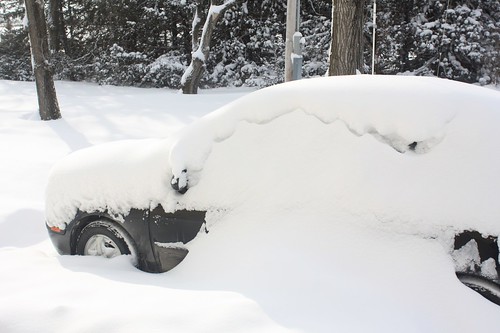
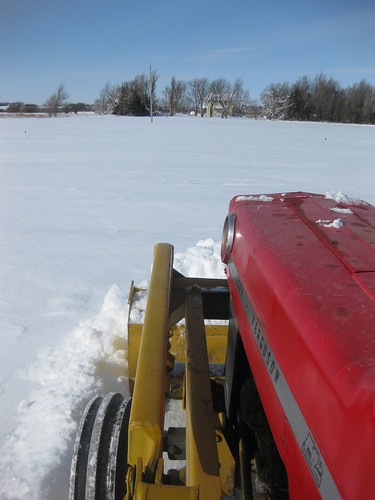
Those of you that watch my twitter know that we got dumped on with snow recently. The final estimate reported by local papers is 17 to 19 inches. IMG_5301.JPG That s my car. You might understand why I went home at 1PM Tuesday and worked from home the rest of the afternoon. The county didn t get the roads opened until 5:30PM Wednesday, so we were stuck. Terah s dad kindly opened the driveway for us though. Without that, we wouldn t have even known where it was. marla-IMG_4180.JPG Jacob and Oliver loved playing in the snow. It was a HUGE hit for them. Both of them hated to go back inside when it was time. Oliver had trouble walking, or even standing up, but that didn t stop him from begging for more every chance he got. IMG_5345.JPG On Saturday, I took Jacob outside to play. We had in mind building a snow tunnel. We went to one of the big piles of snow left by the tractor after our driveway was cleared, and I dug out a space underneath it that Jacob could crawl through. He got a little scoop (he insisted on calling it my shovel ) and helped dig too. He had a great time with it. He was very anxious to go inside, and it probably didn t help his eagerness that the cats could freely walk through it long before he could. They were around and taking a great interest in the proceedings. One of then stretched out on my back while I was stretched out pulling snow out from the pile. Finally Jacob got to go through. He had a little trouble because it wasn t tall enough for him to crawl like he usually does (though still plenty big for him to get through with lots of room to spare), but he came out beaming. I then went and got the camera and got some photos of his second trip through. IMG_5424.JPG You d think that this might be the highlight of a 4-year-old s snow excursion. And given his excitement, you might be very convinced of that. But you d be wrong. What Jacob really wanted was a snow train. So I drew some train track-sized lines in the snow with my shovel. Then I was supposed to draw a train engine. He had been planning this for hours before we even went outside, and I knew very well what was supposed to go on the engine: a snowball for a headlight. We then added passenger cars and a coal car, because apparently that s what you do with snow trains. And the result: IMG_5445.JPG When we went inside, Terah asked Jacob about his snow experience. Jacob was very happy, until she asked him if his snow train was a real train or a drawing of a train. Then he became very sad when he said it was a drawing of a train, and decided it was not what he wanted AT ALL. So today we went out again. This time I built a snow train that stands up, complete with snowballs for wheels. I asked him if it was right, and he kept saying, No, I want a REAL train. Finally I asked him what the difference between a real snow train and this one was. Apparently a real train would be on tracks, move around, make noise, and take us places. Fortunately he didn t dwell too long when I explained I couldn t build one of those. And then today s highlight was writing JACOB in the snow. He had started by drawing larger and larger J letters with his arm, and finally asked me to make one. I made footprints in the shape of a very large J, which he loved. He had me make another one, and then the rest of the letters in his name.

Clint Adams: Itamae, itamae

C: Heyward's - Johnson C. C: Rosedale's - downtown O: Gates - 3205 Main
Servicio mesa (21.00) $8.00
Bebidas (21.00) $8.00
Copa salentein (21.00) $27.00
Provoleta (21.00) $24.00
Asado de tira (21.00) $45.00

13 February 2011

Wouter Verhelst: PMW uploaded

Earlier today (or, well, last night, since it's fairly late alrady) I uploaded pmw (about which I blogged previously). In preparation for that, I've also uploaded aspic, which is required to build pmw's documentation. While I'm quite fond of pmw already, and intend to maintain it inside Debian for quite some time, my interest in aspic is limited to the fact that I need it for pmw. So if anyone seems interested in adopting it... be my guest. But do talk to me, first. In my previous blog post, I've raved about how I like pmw much more than I do lilypond. I had two reasons for that, at the time: Now, I have a third:
wouter@celtic:~$ grep-available --eregex -FPackage -sInstalled-Size -sPackage '(pmw lilypond)'
Installed-Size: 1916
Package: pmw
Installed-Size: 7048
Package: lilypond-data
Installed-Size: 392344
Package: lilypond-doc
Installed-Size: 896
Package: pmw-doc
Installed-Size: 4184
Package: lilypond
Less than two megs for pmw, versus over ten for lilypond and lilypond-data combined; and less than a megabyte for complete documentation plus examples for pmw, versus several hundred megs for lilypond-doc. And it's not because pmw is less flexible, or has less features, or is less well documented, or anything of the sorts. It does have less output options; but then it's not like it's hard to convert PostScript into something else or anything.

12 February 2011

Evgeni Golov: Privacy-over-IP does not exist

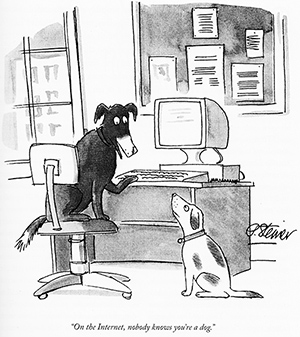
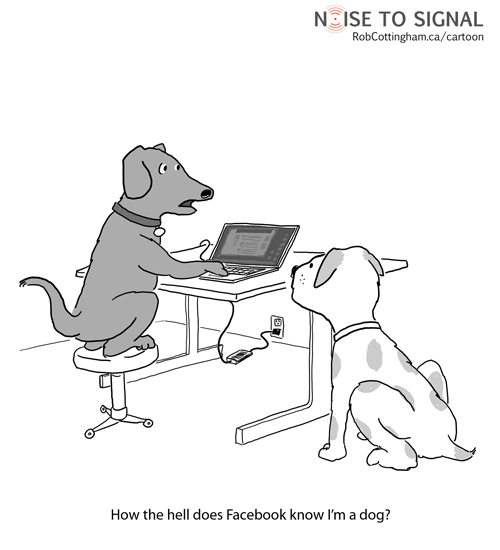
Did not exist.Will never exist.There was quite a lot of buzz about privacy with that new IPv6 thingy. Some say it is bad, as you will have a static address. Some say the privacy extensions will fix everything. I say: lemme rant ;)First of all, that was the internet, when I started using it back in 1999:

 [  New Yorker Magazine, March 1993] On the Internet nobody knows that you are a dog'
[ New Yorker Magazine, March 1993] On the Internet nobody knows that you are a dog And that s the internet today:

robcottingham.ca - How the hell does Facebook know I'm a dog?
[ robcottingham.ca] How the hell does Facebook know I m a dog?

Well, I d say that s not correct. Even in 1999 facebook could know you are a dog (if you ignore the fact, that there was no facebook in 1999), it s just noone really cared about it. But let s start from the beginning :)An IP-address is a 32-bit integer

An IP-address is technically a 32-bit integer, formatted into 4 8-bit parts (you can read more about IPv4 at Wikipedia), which makes a total of 4,294,967,296 possible IP-addresses. Your ISP has a range in this address-space it can give to its customers (you). My ISP (Unitymedia) owns about 300,000 IP-addresses (based on the RIPE database), which is about 0.007% of the whole address-space. If you look at the RIPE page, you see two common netname prefixes (DE-KNRW and DE-IESY-HFC) which match two regions of Germany where my ISP has its customers (Unitymedia is a merge of ish and iesy). What does that mean? It means one can map a Unitymedia customer into one of these regions, even if he would change his IP-address (Unitymedia uses DHCP with high lease-times, so this does not happen actually). It does not map the customer to a dog yet, but I bet real GeoIP databases can map them correctly to a city (I didn t try much, but this site suggests it works: http://www.ip-adress.com/?lc=en at least they map me correctly to Duesseldorf).Dynamic IP-addresses do not improve privacy

Given the above facts, even if Unitymedia would give me a new IP-address every X hours (many DSL-providers have X=24), it is still possible to map me into a set of about 150,000 users (here user means customer, there still may be multiple computers connected via the same line). I would even go further and say the set is much smaller, as I think I am not able to get every free IP-address from DE-KNRW-*, as these should be bound to cities/regions (GeoIP databases exist, you rememember?) and I do not move with my line.Routers and reverse DNS kill privacy

Currently, my IP-address is 62.143.232.104, which has a reverse DNS entry ip-62-143-232-104.unitymediagroup.de and does not say anything about me or my location, besides of the obvious Unitymedia customer . But look at the traceroute:

4  7111A-MX960-01-ae5.frankfurt.unity-media.net (80.81.192.181)
5  13NOC-MX960-01-ae8.kerpen.unity-media.net (80.69.107.26)
6  1411G-MX960-01-ae9.neuss.unity-media.net (80.69.107.2)
7  1411J-MX960-01-ae1.bilk.unity-media.net (80.69.107.70)
8  PH-1411J-uBR10k-06-Te-1-2-0.bilk.unity-media.net (80.69.102.106)
Frankfurt is about 250km from here, Kerpen about 60, Neuss about 10 and Bilk is a part of the city I live in, about 4km away from my home. I guess you get the idea :)Browsers kill privacy tooDo I have to say more than a link to https://panopticlick.eff.org/? My Chromium scores one in 1,400,000. How much IP-addresses did I have to hide in again?We are at the dog level now, dogs use BoneOS with FireBark, not Linux with Chromium :)IPv6 kills cute kittensOh, and privacy, because with IPv6, there are 2^128 IPv6-addresses out there, of which your provider will maybe own a /32 (2^96 addresses) and give you a /48 (2^80 addresses) or (more likely) /64 (2^64 addresses). Then you enable the great IPv6 privacy extensions (RFC4941) and happily hide in your own assigned subnet, still being a customer of your ISP, still living in the same city and using your old browser It s just about mapping subnets instead of individual IP-addresses then. And we can t get lower as the dog levelPeople can annoy meI did not write all this to teach you, you can do yourself with Wikipedia and RFCs. There is a person out there, who thinks using a random name, mail address and twitter account could fool me into thinking that s a new, yet unknown, person to me. Well, I am not stupid, sorry. When you comment on my blog, your IP-address is logged, when I approve the comment, I often look at the reverse DNS and the whois entry of that IP-address (sorry, I AM paranoid). I even might check my webserver logs (or Piwik) where did you come from (Google etc), writing accidentally in your comment does not help :) Also, if you are trying to fool me, don t use your own computer, running Windows 7 and Firefox which I installed. Oh, and probably do not use your home line which I used to login into my admin-area using my unique Chromium ;)Sorry Hanna Lena, the chicken has just eaten her own eggs And yes, one can track down a single person on this big thing called internet, IPv6 will not change this (in any direction).

Julien Blache: forked-daapd: future directions

I ve got a few mails lately enquiring about the lack of visible activity on forked-daapd in recent times. Well, for one, I ve been busy with other things, but there s also been some non-public activity. So, here s what should happen in the next few months, in no particular order: The database overhaul will bring a much-needed speedup on small devices and big libraries. It s being worked on, but it ground to a halt with new year and all. Hopefully it ll resume soon. I m also giving up on ffmpeg for metadata extraction. It doesn t work well at all (as everybody knows by now) and it s actually getting worse and worse. With the ffmpeg takeover/fork (call it whatever you want) it s unclear what s going to happen on this front. So I m giving up and the metadata scanner will probably switch to using TagLib (one more dependency, yay). Last, but definitely not least, the libdispatch codebase should finally see the light at the end of the tunnel in the coming months. I ve been working on this since July last year, moving away from libevent. If you never heard about libdispatch, or Grand Central Dispatch, read my previous post on the subject. I ll talk about it in more details at a later date. Finally, as far as Squeeze is concerned, I plan to provide forked-daapd backports as long as it ll be practical to do so. This is it for now. I don t have a one more thing in my sleeve, sorry. Time is at a premium right now, so big things have to wait.

Wouter Verhelst: Ten years of Debian

My first ever Linux installation was done in the late nineties 1998 or thereabouts but was a RedHat 4.5 installation rather than a Debian one. The reason for that was fairly simple: the Infomagick sixpack CD set that I'd bought contained RedHat, Debian, and Slackware, but the RedHat installation was the only one that could be installed directly from CD the other two required me to write floppies and boot from those to start the installation, and I wasn't very fond of that idea. It was only a few years and a few broken RedHat upgrades later that I saw the light and considered trying out this Debian thing that some of my classmates were talking about. The fact that I'd just bought my own computer (rather than having to compete for time with my siblings on my parents' computer) was a good reason to do a fresh Linux installation. I'd been planning to install Linux From Scratch, but as what was still known as the LFS HOWTO told me you'd need a working Linux installation to do that, I considered my options. Since I'd developed a strong dislike of RedHat, I wasn't interested in doing another RedHat anymore. So, I downloaded the most recent version of Debian at the time (Potato Test Cycle III), wrote it to a CD, and installed. I've probably still got the CD lying around somewhere. A few months later, I found these "Linux Gazette" packages in the archive, with the latest packaged issue being 47, but the latest upstream version being much higher. Trying to figure out what was going on, I mailed the maintainer, Adrian Bridgett, who encouraged me to take over maintenance. Thus began my life of actively contributing to Open Source software. In November 2000, I applied to become a Debian Developer. In January 2001, Martin Michlmayr was assigned to be my AM. And in early February 2001, now just over ten years ago, I'd become a Debian Developer. Yes, that was fast, and no, I probably wasn't really ready yet, at the time. Originally, I only cared much about these Linux Gazette packages. But, as time went on, I started looking around, too. A friend passed me an old Macintosh Centris 610. As I tried to install Debian on it, I found that it didn't actually run very well. This turned out to be due to it having a broken 68LC040 processor, so I bought me another m68k-based mac, one with a full 68040 processor (a Centris 650). Thus I became involved in the m68k port and buildd maintenance. As these old machines came with 80MB or 250MB SCSI hard disks of which I had none laying around, and a then-recent Debian installation had minimum requirements of about 200MB, I was in need of network storage to be able to do anything useful with the mac. NFS didn't work as expected; the RTC implementation on m68k mac hardware was reverse engineered and didn't work too well at the time, which meant that the clock would run slower if the machine was under load, and that in turn would mean that make would get confused about timestamps, since they would suddenly appear to originate from the future (in NFS, it's the server that assigns time stamps, not the client). There was a simple solution, however; Pavel Macheck had written this neat 'Network Block Device', which would let the client do its own filesystem on network storage. Only it wasn't packaged; but then, that was easy to fix. Thus I started maintaining the single piece of software that I've worked the most on, to date. A few years later, Pavel lost interest in maintaining NBD, and handed over upstream maintenance to me and maintenance of the kernel side to Paul Clements. Thus began my life in upstream work. And while I originally joined Debian with the intent of using it as a learning experience and stepping stone on my way to more "important" free software, I found that it wasn't as satisfying as was my work for Debian. Over the years, there's been this duality where I've felt like I was doing too much and not enough at the same time. Too much, because the things I was doing would eat up much of my spare time, leaving little time left for other hobbies. Not enough, because I witnessed other people doing much more for Debian than I did, and I wanted to make a difference. As the years passed by, many things have changed. Not only in Debian, but also besides it. I became an independent contractor, focusing mostly on supporting people in using Debian (although I support them with other distributions, too). The importance of a port went from 'something which these weird porter people are doing, and that we should probably help them with if it doesn't work, but is their problem really' to 'something that I really really really have to make sure works for my packages', and back for the port that I cared about most. After several years of trying, I finally managed to explain to my parents what this Debian thing is, why it matters, and what my role in the whole thing is. We did a few releases, some taking longer than I would've liked. People joined the project, and left again. Some of my friends died. My fame in the project rose, even though I wasn't aware of it initially; and thus I was rather surprised when someone asked me whether I was "the Wouter Verhelst" at a key signing party. Recently, I've started looking back, and considered the things which Debian has meant to me. Ten years ago, I was 22, still in college, and had way too much spare time on my hands. I'd recently gotten my first Internet installation, and all these online communities were very new to me. Yes, that was all probably rather late. Debian has changed my life in many ways; it has allowed me to meet various kinds of people, both online and in meatspace. I've been to Helsinki, Edinburgh, Mar del Plata, C ceres, and New York City, places that I might otherwise not have visited. Each of these trips was an incredible experience that I have fond memories of; and while the most fond ones originate from Helsinki, I cherish the memories of each of these trips as some of the best trips I've ever done. Working on Debian has forced me to learn about the inner workings of a Linux-based system, which is knowledge that has helped me tremendously professionally, too. And finally, working on Debian has given me a unique perspective on this whole FOSS community, which has helped shape my ethics and my view of the world. While I believe that I would've subscribed to most of that ideology at any rate, I'm not sure that the details of my beliefs and understanding would've been exactly the same. And while I don't agree on every position that the project subscribes to as a whole, I do believe that the philosophies that lie at the core of this project contain just the right mix of pragmatism and ideology that makes it possible for our project to thrive in a changing world of not only a growing group of people who subscribe unconditionally to the free software ideals, but also business people who care mostly about money. Over the years, somehow I moved from "one of the recent batch of new Debian Developers" to "someone who's been with the project longer than most". It still feels weird to see people shut up because you've built up a reputation in some area, and you give your gut opinion on some subject without researching it too much. I try not to let that happen too often. Today, ten years and just over a week ago, my life as a Debian Developer started, and it would change the way I looked at the world, the things I would do in my spare time, and the people I would meet. I wouldn't have it any other way. Thanks, Debian, for what's been a blast; may the next ten years be as inspiring to me and everyone as the past ten!

11 February 2011

Michal Čihař: Tightening too much

After recent attack on sf.net servers, some services have been unavailable for some time. Now things are returning to "normal" operations, CVS has been made available yesterday. But this has lead to other (quite unrelated) change, affecting all SCM services:
outbound email is not functional, so any script utilizing this will fail. If you need to send outbound email, a workaround would be to use curl and and external site or Project Web to send the email.
I think this is just wrong. If this is as a measure against spam, it will rather open dozens of other places where to send spam, because every project wanting commit notifications (or using CIA.vc), will need to deploy some script on web to send mail. And I guess it simply won't be much protected. Maybe it's time to consider changing service provider... PS: The bug I've reported on this topic is here.

Filed under: English Phpmyadmin 3 comments Flattr this!

Joachim Breitner: GNUnify started

Yesterday night I arrived in Pune for the GNUnify conference where I m a speaker. I should speak more often at such conferences, they really pamper the speakers: I was picked up with a car from the train station, brought to a posh restaurant where other speakers were already dining and afterwards accommodated in the guest house of the Symbiosis University, which means a spacious room with my own bathroom (with running hot water) and best of all: Internet connectivity after midnight! Tonight I was alone, the next night I ll be sharing it with another speaker.
Today we had breakfast at the conference venue and the first talks started. I attended a talk about Openmoko, but nothing new to me so far. I was happy to see Debian listed as one of the Distributions for the FreeRunner, given that I once co-initiated that port. Nevertheless it could not bring me to try using the FreeRunner again, reliability is just not good enough. I asked for the next best (in terms of freedom and geek-compatibility) phone, but there is no obvious good answer. The n700 seems to be a dead end, given that Nokia might ditch Meego. The Geeksphone sounds like a good candidate, but is out of stock. My Haskell talk will start in 30 minutes. I hope I ll reach my audience and haskell-cafe will see more Indian names soon... The talks are recorded. I guess I should have dressed better.

10 February 2011

Jurij Smakov: My own little Squeeze release

Squeeze installer for sparc is affected by a number of problems, discovered late in the release cycle. In particular: These are documented in Squeeze installation notes, however it would be nice to push available fixes for these bugs into the first point release. In order to test the fixes I've created a couple of unofficial Squeeze installer images for sparc, which can be found here. See the README file for details. If you have a sparc system where install is affected by one of these bugs, it would be great if you could try it out and send a report to debian-sparc or directly to me. There is also #611314 (sym53c8xx module is not loaded automatically), but we don't know what causes it yet. For now just use a simple workaround described in the bug.

9 February 2011

Alexander Reichle-Schmehl: WOW! We are on the front page of the taz!

The taz (short for die tageszeitung) is one of the major German daily newspapers. And they currently feature the Squeeze release on their frontpage! The article is very good (and well investigated), managing to explain some technical details quite well, and...
It's currently the most read article! Wow! Update: The online version of the austrian newspaper der Standard has also an article about the Squeeze release!

Richard Darst: whiteboard.debian.net

A while ago (early 2009), I created whiteboard.debian.net as a way to do real-time editing collaboration. While working for DebConf, I really wanted to be able to collaboratively edit text with people, and all of the web-based solutions I found at the time were non-free. Thus, I took mobwrite and wrote a very thin wrapper around it. Mobwrite is where all the cleverness is (and mobwrite is way beyond my expertise, by the way). Mobwrite is Apache licensed, so you can use it in other places, too.Thus, whiteboard.debian.net was begun. It was never publicized very much. It has no authentication required and no history (the "static link" does provide limited recovery for mistakes, though). Here is a test whiteboard; open it in two tabs and watch the text areas sync. Any whiteboard is created if you go to a valid URL.I just deployed a slightly newer version of whiteboard. You can now see an options page for each whiteboard, and it can render in several lightweight markup languages (good for drafting+previewing things). If you have other options to add there, let me know.If you are interested in collaborative text editing, there are some other options. There is a Debian titanpad, an "open" instance of now-open-sourced Etherpad, and it has history support. Use titanpad.com and you don't have to log in. Here is a test pad. For a non-web application, Gobby exists. Use gobby-0.5 for smart undo history if everyone uses squeeze or above.Is whiteboard still relevant in light of the options above that store history? I'm sure it depends, but for now, whiteboard works well for a low-overhead scratch space and for cases where you don't want to have a history trail. I also tend to use it as a simple pastebin or a personal notepad when I don't want to worry about having traces left behind. In short, it is so minimal you don't have to think about starting one up for something. I have found that collaborative writing really helps to get things done, thus, I hope that whiteboard (or a similar tool) can be useful to you.

8 February 2011

Lars Wirzenius: Growing the Debian development community

In an article about gender issues among American atheists, Sharon Moss and Lyz Liddell give a list of things to consider to be better community, not just for women:
  • Be a leader. Take responsibility for the tone of your group. If potential new members are being made to feel uncomfortable and aren t coming back, you re doing it wrong. As a leader, it is your job to prioritize the comfort of your attendees in programs, group dynamics, and communications. Try to put yourself in other members shoes and also ask for feedback.
  • Promote a sense of community. Take the time to socialize and get to know each other. If you re group isn t primarily a social group, thinking about adding some social time. Go to breakfast before the protest, compose your letters to the editor over coffee, or grab a pizza and beer after that lecture. When you know each other, you have each others backs. Being a jerk isn t tolerated.
  • Moderate discussions. Make sure everyone has the opportunity to participate- new people, quiet people, etc. Don t let conversation be dominated by one or two people who must win.
  • Embrace and accept different ways of communicating. Whether someone is an aggressive debater or not, make sure they re still welcome. The other atheist in the room isn t your enemy.
  • Encourage subgroups. Every event your group hosts doesn t need to appeal to your entire membership. Many women appreciate women-only space to express their nonbelief and to connect with other atheist women. Here at the Humanist Community of Central Ohio, we started a subgroup book club called Reasonable Women. When it grew to have about 25 regular members and was beginning to be a little too large and unwieldy to function as a book club, we created a second group, Heathen Chicks, which is just a social group that meets at a local cafe. It isn t just about creating women only space, for us, this has been a way to draw more women into other events our group hosts.
  • Foster women in leadership. Groups with women in leadership positions tend to have more women. Encourage women in your group to be visible in leadership.
These should work pretty well for Debian as well. I mean for the project in general, for getting all kinds of new people in, and getting them to stay, not just women, even if the gender imbalance is perhaps the biggest glaring problem we have. As a concrete suggestion, maybe it would be a good idea to continue the Debian party line that Joey set up for the squeeze release. We already have IRC, but having an audio chat with your Debian peers might be a nice addition. Specifically a social one, instead of something intended to boost productivity.

7 February 2011

Vincent Sanders: It is a bit breezy

The weather has been a bit odd round here for a while now. The snow storms in December and early January were a mild inconvenience for me but as I work from home the advice not to travel was not too much of a problem.

It seems however that now February is here and the snow is gone we are in for some pretty strong storms. This actually affected me today when my neighbours garden wall was blown over!

As you can see my nice new IP camera captured the event, well OK the frame before and after but you get the idea. Unfortunately for my neighbour the wall collapsed onto his pickup causing extensive damage.

A short time later when my weather station was recording gusts well over 50mph nearby drains started flowing the wrong way and it became a case of water, water everywhere!

It seems that when the new buildings were erected a few years ago that the architect while maximising used space on the building plot may have inadvertently created something of a wind tunnel.

The Gap between our properties is on a parallel (north to south) to the valley below. The wind seems to travel along the crest of the valley and be funnelled through any spaces between the houses. Fortunately the rest of the properties on green lane are pretty old and the spacing between is very generous and the funnelling effect is minimal.

I wonder if we could fit a wind turbine in there? Alas it was too much for my secondary anemometer which is now smashed in three parts.

Also gaining access to the gable end wall of my property has become somewhat perilous (Hence the wonky APT antenna I cannot get fixed). Yes that really is a guy balancing on a ladder 10m high in a strong wind. And indeed the platform the ladder is resting on is built from scaffolding board wedged between the houses.

I guess the hospital emergency room being 300m away means medical assistance is on hand, even so he is braver than I am. So my weather satellite imagery will just have to come from the internet like everyone else's for a while.

Alexander Reichle-Schmehl: What a night! What a day!

Wow, that was a night. I'm still quite tired from the weekend. Someone told me, that ~ 1 000 people subscribed to our live denting via identi.ca, and about 12 000 via twitter. And that does not even include those, who followed us via the respective web interfaces! While it was quite exhausting (we tried to watch about 7 irc channels for the important stuff, I partly had ~80 windows in my irssi (which is especially bad, since I only have keyboard shortcuts for the first 40) and there whas also a constant need to watch for mails and due to translations also our spamfilters), it was also very nice to think that somewhere there are release parties going on with people looking at our dents, maybe even having them running on a big monitor or projector ;) One thing that remains to be done, are the left-over dents we prepared as time killers: Since the release process went quite smoothly (and we didn't have the time to check all our dents for the limit of 140 chars ;) we still have some of them left. Since some of them where requested (and I poked other people to get me the numbers) here are the remaining dents: I especially like the one about debian-curiosa ;) Update 1: The 600 USD where collected during DebConf5, not DebConf3. Update 2: Small clarification about the number of subscriptions on identi.ca and twitter: They didn't followed a live-stream channel, but they do follow our general channel. We are not sure, how many people where subribed before we announced the live denting; some saw 700 subscribers on identi.ca, which would mean ~200 seem to have subscribed for the release dents (still not including the ones just following us the old fashioned way via a browser).

6 February 2011

Alexander Reichle-Schmehl: A plea to all FOSDEM visitors:

Could some please put a picture of one of the new spacefun themed T-Shirts somewhere? I really want to see them... Update: Christoph Kluenter was so nice to upload some pictures.

5 February 2011

Andrew Cater: Debian 6.0 release is happening now

Debian Squeeze 6.0

As predicted - the release is starting this weekend 5/6 February 2011. IRC channels are starting to buzz -- irc.debian.org #debian-release - and there's also a live commentary session at http://identi.ca/debian

For many people, this is yawn-worthy: Debian stable is seen as old, outdated, outmoded. This is the climax of two years work.

Debian 6.0 will be supported for the lifetime of this release + one year if the past few releases are a guide.

A wrap up release 5.0.9 is planned for the previous Debian 5.0 [Etch Lenny] which will be supported for another year.

Debian works on many machine architectures: it's the upstream for Ubuntu and many other Debian derivatives: it works in many languages, has 1034 developers and maintainers maintaining 28693 packages [last number may vary fractionally depending on machine/architecture].

This is big - and I'm pleased and proud to be part of it. Oh, and there's now over 80 parties worldwide to celebrate :)

[UPDATE - Thanks to my colleagues who pointed out my mistake - Debian 4.0 was Etch, 5.0 is Lenny, 6.0 is Squeeze and 7.x will be Wheezy. Developer/maintainer and party numbers also updated]

Next.

Previous.