Search Results: "reg"

20 February 2010

John Goerzen: Is the Roman Emperor Still Your God?

In ancient Rome, the Imperial cult was the worship of the Roman emperor as a god. It came to be at roughly the same time as Christianity. In the cult of the emperor, Caesar was revered as a deity. According to Harvey Cox, This was what we might today call a civil religion it had its holidays, processions, and holy sites throughout the empire. Adherence to it was required of all of the emperor s subjects, wherever they lived and whatever other deities they also worshiped. It was the religious and ideological mucilage that held the far-flung empire together. Perhaps you see where this is going. There was a certain group that found the imperial cult, well, repugnant. They felt their own goals bringing their god s peace and justice to the world were incompatible with this sort of devotion to a human institution, and the very institution that had killed their leader at that. Their reaction went like this:
Regarding worship of the emperor, Christians responded with an unequivocal no. They claimed that Jesus Christ was God s kyrios ( anointed one in Greek), but since kyrios was one of the titles attributed to Caesar, they refused to participate in the imperial cult. They were willing to pray for the emperor and for his health, but they stubbornly refused to pray to him or offer ritual tribute. They recognized that one could not be a follower of Jesus while also honoring a rival to the loyalty their faith in him and his Kingdom required; therefore, not even one pinch of incense on the imperial altar. This defiance of the political religion of the empire, which led their critics to brand them subversive, landed many of them in arenas with salivating lions. Harvey Cox in The Future of Faith
Now, you may be wondering, why am I asking if anyone still worships the emperor of a long-extinct empire? I maintain that this practice is still alive and well, just under a different name. I have been interested in some of the debates about American institutions that choose to perform neither the national anthem nor the pledge of allegiance. Many of these institutions are Mennonite, and their reason for not participating in these two particular acts mirrors that of the early Christians refusing to worship Caesar: namely, their goal is to bring about God s peaceful and just kingdom on earth, and no country, no human institution at all, can ever command greater loyalty than that cause. Moreover, the American national anthem is a particularly violent one, celebrating the taking of life right there at the beginning. Not completely compatible with the ethics of a church trying to bring about a more peaceful world, right? It is from that basis that many Mennonites, and our institutions, do not perform the national anthem or say the pledge of allegiance. For myself, when the national anthem is being performed, I will stand out of respect for those around me for whom the moment is important, but I do not sing. I am deeply appreciative that the United States, like many other countries, makes it legal to do this. I am heartened by the fact that I do not risk a confrontation with the lions over my religious stance today. Goshen College, a Mennonite institution, recently decided to go back on a century of history (which goes back farther than the anthem itself, which was only adopted in 1931) and will now be performing the anthem, followed by a prayer, before select sporting events. And by so doing, they fail both to act in accordance with the way of Christ, and to be a patriot. They fail to act for peace and justice by playing an anthem that supports and glorifies war and violence. And they fail to be patriotic. Patriotism and nationalism are different things. It s easy to be nationalistic to get up there and sing a song that everyone wants you to sing. It is far more difficult to be patriotic. Being patriotic in the United States means using the freedoms we have to improve our country. Goshen ought to use its freedom to not observe the national anthem as a way to try to draw a line in the sand against violence, to suggest that our anthem fails to adequately recognize the character of the American people and who we want to be, and to suggest a better alternative. After all, those people who are venerated today as patriots anyone from Martin Luther to Thomas Jefferson to Martin Luther King stood up to their fallible human governments to seek positive change. Instead of a route both religious and patriotic, Goshen College has chosen one that is neither. I am deeply disappointed that 300 phone calls have apparently cowed their leadership. What have we come to when our ancestors braved the lions, and we give up our principles over the fear of bad publicity? Ah, Goshen, perhaps you are thinking that you could spare a few pinches of incense for Caesar after all?

19 February 2010

Gustavo Noronha Silva: WebKitGTK+ testing

Most times when I blog about WebKitGTK+ it s to talk about new features, and their usage in Epiphany. This time I d like to tell those who care more about our test infrastructure. Like I said in my previous post, testing is something we take very seriously in WebKit land. It would be hard to get such a complex project, with such diversity of platforms moving forward without automated testing. Apple hosts a buildbot master that controls a whole lot of build slaves, for many platforms. Today we added the fourth WebKitGTK+ build slave to the family: 64bits release. This makes up for 4 build slaves in total, 2 release bots sponsored by Collabora, and 2 debug bots sponsored by Igalia. These bots build WebKitGTK+, and then run what we call the layout tests . I use quotes there because the name is a bit misleading. Despite being HTML/JavaScript tests, they cover a whole lot of functionality, and tests for regressions in many areas, including security, crashes, animations, media playing, DOM behaviour, and javascript API behaviour. WebKitGTK+ bots currently run 6397 tests, which represent about half the available tests. Our bots are also, as of today, the first ones to run platform-specific API tests. Almost a year ago we started writing small tests based on glib s GTestSuite, and they have been very valuable in helping us make sure our API expectations aren t breaking (at least unknowingly), and to be able to test things that would be very hard to have Layout Tests for. So, yay! Thanks to everyone involved. Back to layout tests, now: the other half is currently skipped because of one of three main reasons: The first one is the worst of all. It means we have broken functionality, or lack web compatibility. The second one is less bad, we can usually trust layout, and rendering to be good because most of the rendering code is shared (thought there are exceptions, of course). Render dumps are a special way of representing the render tree as text, and we need to generate our own results because of differences in things such as font sizes. The third one is also pretty bad - it means we cannot test some features; DumpRenderTree is an application that uses the port s API to run the tests, and provide additional JavaScript API through JavaScriptCore. If you feel like helping WebKitGTK+, choosing a bunch of these (specially non-render-dump) skipped tests to make them pass could likely be a good first step =).

Matthew Garrett: Pittsburgh

As I mentioned, I headed to Pittsburgh last week to give some talks at CMU and find out something about what they're doing there. Despite the dire weather that had closed the airport the day before, I had no trouble getting into town and was soon safely in a hotel room with a heater that seemed oddly enthusiastic about blasting cold air at me for ten seconds every fifteen minutes. Unfortunately, it seems that life wasn't as easy for everyone - ten minutes after I arrived, I got a phone call telling me that the city had asked CMU to cancel classes the next day.

This turned out to be much less of a problem than I'd expected - whether because of their enthusiasm to learn about ACPI or because they simply hadn't noticed the alert telling them about the cancellation, a decent body of students turned up the next morning. After a brief chat with Mark Stehlik, the assistant dean for undergraduate education, I headed off to the lecture hall. The fact that I can now just plug my laptop into a VGA cable and have my desktop automatically extend itself continues to amaze me, as does OpenOffice's seemingly unerring ability to get confused about which screen should have my content and which should be showing me the next slide. Nevertheless, facts were imparted and knowledge dropped on those assembled. I'm even reasonably sure that the contents were factually accurate, which is a shame because the most attractive part of teaching always struck me as being able to lie to students who will then happily regurgitate whatever you tell them because in case it turns up on the exam. Perhaps this is why I'm safer out of academia.

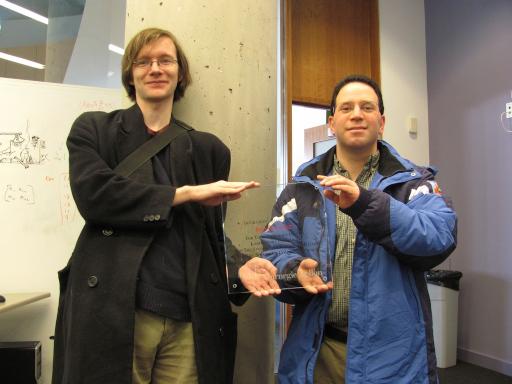
Lunch offered an opportunity to visit the Red Hat sponsored lab, which was pleasingly located somewhere other than a basement. The guy on the right of the picture is Greg Kesden, the director of undergraduate laboratories in CS there - it was wonderful to get an opportunity to see the machines getting used, and students seemed genuinely appreciative of the facility.

After lunch I spent a while talking to Satya about the Internet Suspend and Resume project. This is an impressive combination of virtualisation and migration, using a Fedora-based live image to bring up an OS on arbitrary hardware before downloading a machine image and launching it. The majority of the data is pulled in on demand, meaning that initial performance can be slow but ensuring that data is only downloaded if it's needed. When the user is finished, the delta between the original image and the new one can be pushed back to the server while remaining cached on the local machine in case the image is used again.

It's an interesting approach, combining the flexibility of thin clients with the advantages of having actually useful computing power at the local end. There's a few functional awkwardnesses, such as some VMs being unhappy if images are migrated between machines with different CPU features, and it obviously benefits from having significant bandwidth. But the idea of being able to combine the convenience of a floating session with the knowledge that you can still keep copies of your data on you is an attractive one, and I'd love a future where I can move my session between my laptop and a desktop.

After that there was some time to talk to Bill Scherlis and Philip Lehman about the software engineering courses that CMU run. Part of the minor in software engineering includes a course requirement to make a meaningful contribution to an existing software project, from design through to submission and upstream acceptance. I had the opportunity to talk to a couple of the students about this and the differences they found between working with the Mozilla and Chrome communities, which I'll try to write up at some point.

Finally I gave a presentation on Fedora and some of the issues that we face in providing a useful OS when patents and recalcitrant hardware vendors do their best to thwart us. Despite the ice outside and the significantly-below-freezing temperatures, enough people turned up that sorties had to be sent out to find extra chairs. It was great to see how interested people were in learning about what we do, although it's probably the case that the free pizza did help encourage people.

After that it was an early trip back to the airport, where I found that my plane was delayed and the only "restaurant" still open was McDonalds. Even so, I left with the feeling that it had been an interesting and educational visit. Many thanks to David Eckhardt, who runs the OS course I presented to and who looked after me all day - thanks too to Joshua Wise who picked me up when David was running late due to the ground being covered with blocks of ice.

17 February 2010

Stefano Zacchiroli: RC bugs of the week - issue 21

RCBW - #21 I've accumulated one more day of delay, but here is a full RCBW issue. Still, I've a nice good excuse for the extra delay: I've changed house in Paris, the new one is very small (a chambre de bonne), but also very comfortable. Without any further ado, here are this week's squashes: And here are the usual highlights:

Russell Coker: Can the NBN Ever Break Even?

I previously wrote about how the National Broadband Network (NBN) seems more suited to porn delivery than regular Internet use [1]. It doesn t seem to be of much use really. In a particularly insightful comment John Hughes suggested that the real purpose would be TV delivery. The ABC is currently delivering 640*360 resolution MPEG4 files via iView for it s TV content. To use iView on Linux you need Jeremy Visser s Python-iView program [2] in conjunction with Luke Kenneth Casson Leighton s rtmp program [3]. Note that to get this working on Debian/Lenny you need to install the python-simplejson package as well. For the current ABC service it requires 251652 of data for a 3167.6 second Torchwood episode, that averages to 79.4KB/s of data. In contrast a video of Dan Gilbert from TED.com at high quality was in 640*480 resolution and required 301652KB of data for 1276.5 seconds which averaged out to 236.3KB/s. My ADSL2+ connection is theoretically capable of something over 1MB/s and occasionally gets such speeds for unusual download situations (such as downloading multiple large files at the same time). But generally I can t rely can t rely on sustained transfer rates of more than about 200KB/s. So I could watch streaming TED talks at reasonable quality, but for the best results I have to download them and watch them from disk. Assuming the same ratio of compressed data to raw pixels used for HDTV as used for TED talks a 1920*1080 HDTV resolution MPEG4 with the same quality as a TED talk would take 1600KB/s. It is possible to vary the compression level and possibly the usage of a TV stream would permit better compression than the usage of a TED talk for the number of pixels. But it seems reasonable to assume that something like 1600KB/s is needed for best HDTV, that is more than the vast majority of ADSL2+ installations can be relied on to sustain. But 100Mb/s would allow at least two 1920*1080 HDTV transmissions to be viewed at the same time, and maybe three or four as few homes have only one TV this should be of great interest. Now the question is how much people would pay for this. Currently there are two main pay TV companies in Australia, Foxtel which charges $916 for a 12 month plan [4] and Optus who s web site is so awful that I gave up before discovering what they cost (I will assume that they are competitive with Foxtel). Now I think it s reasonable to assume that $916 is at the high end of what potential customers are prepared to pay, as they are competing with free to air TV, DVD sales, Youtube, and downloads of pirate content. The current bank interest rate on term deposits from the Commonwealth bank is 6.3%, the interest rate on raising the finance would have to be greater than that let s assume 7%. So the $5000 per household will require an interest payment of $350 per annum. If a household signs up to pay TV services at a cost of $1200 per annum that might be enough money to pay slightly more than $350 to the NBN plus make a profit for the pay TV company. So if every household in Australia signed up for pay TV over the NBN it should be profitable. But that seems unlikely. The majority of the Australian population (IE the majority of the city population) is used to paying not much more than $240 per annum for a basic phone service and not much more than $360 per annum for a basic broadband Internet service. A bundled deal of $1600 per annum for phone, Internet and pay TV should allow the pay TV company and the NBN to be barely profitable if everyone accepts the deal (unless of course interest rates rise). If half the population aren t interested then the bundled deal would have to cost $2000 to have the potential for being profitable. If three quarters of the population aren t interested then it would have to cost $2300 or more! The Australian Bureau of Statistics documents that in 2008 the median household disposable income in capital cities was $593 per week [5]. So it seems that the idea of the NBN being profitable is based on plan to have more than three weeks of household disposable income per year being spent on Internet/phone/TV services. But fortunately for the pay TV companies and the content companies there is no requirement for the NBN to be profitable, it s being paid by tax money so if it loses money then we can just pay more tax! It s the ideal public private partnership , the citizens take all the risk and the corporations reap all the profits! James Purser describes how Stephen Conroy gave the TV networks something between $250,000,000 and $500,000,000 a year for the next two years [6]. It was claimed that this huge gift would be conditional on the production of more Australian content but they ended up not putting any conditions on it. In a strange coincidence Stephen Conroy did this a month after having a meeting with Kerry Stokes (head of Channel 7). Based on this I don t believe that there was ever a serious plan to make the NBN profitable. I think that the plan was just to take our tax money and spend it on things that benefit friendly corporations. Really it s better for us if the government just hands out $500,000,000 at a time instead of spending $43,000,000,000 on a project that has the same aim of giving a few hundred million to cronies.

16 February 2010

Russell Coker: Would you Short-Change a Pedophile?

For some time the film industry has been running an anti-piracy campaign with slogans such as you wouldn t steal a car [1] in an attempt to draw a false analogy between downloading a movie and stealing a significant and valuable object the modern equivalent to being a horse thief . One of the many ways that such poor analogies break down is the fact that downloading a movie is not a crime, it s copyright infringement. The best analogy that I can think of for non-commercial copyright infringement is the practice of short-changing. I expect that almost everyone has at some time received less change than they deserved when buying something at a shop, the cashier aims to collect $1 or $2 from each customer and can easily double the amount of money that they take home at the end of the day. When a customer complains they just pretend to have made a mistake and although short-changing is a crime (unlike copyright infringement) it almost never results in police action. The practice is tolerated to such a degree that some people know the shops where they are likely to be short-changed, they count their change more carefully and demand the full amount but don t bother complaining to the manager! The film industry also tries to portray itself as representing struggling artists who deserve the money, it s described as a moral issue good people pay for movies while bad people download movies and steal cars. But then there s the case of Roman Polanski who is a well known movie director and child rapist [2]. I expect that most store employees would gladly palm some of the change if Roman Polanski was a customer that is of course if they weren t too busy arranging a lynch mob. So instead of you wouldn t steal a car a more reasonable statement would be you would short-change a pedophile if you weren t organising a lynch mob . Please note that murdering a criminal as part of a lynch mob is a crime (unlike making an unauthorised copy of a DVD), so I encourage people not to perform lynchings. Many important people in the movie industry have different ideas, the Wall Street Journal has an article about the petition to free Roman Polanski which demonstrates the difference between Hollywood attitudes and those of the rest of the world [3]. For them, violent crime is no big deal if the criminal is famous and the victim isn t but anything which affects their own wealth is regarded as a serious issue. Indiewire has a copy of the petition to free Roman and a list of the names of 100 people who signed it [4] (I heard that the latest count was nearer 150 but couldn t find a reference). I believe that the matter of morals is not whether someone who rapes children deserves jail time (that issue is really clear) but whether it is morally acceptable to give money to such a criminal or their supporters. I suggest that the list of signatories to the pro-rape petition be black-listed, any movie that involves any of them should not be paid for either don t see the movie or download it without paying at your own whim. If anyone knows of a web site that is being regularly updated with a list of all past and current projects involving people who signed the petition for Roman then please let me know it would be good to have a list of movies that I will never pay for. Anyone who feels morally obliged to pay something for a movie and who has a great desire to watch a movie made by Roman Polanski or his supporters could download it and then make a donation to a charity equivalent to the purchase price rumor has it that women s refuges are always short of funds. As an aside I find Wikipedia a good reference for movies that I don t plan to see, I read the plot summary on the wiki page and then have no curiosity about what happens in the movie if that isn t adequate I ask friends for spoilers or do a Google search on the movie name and spoilers .

Martín Ferrari: Facebook chat

I spent a few minutes trying out the new support for using the Facebook chat with Jabber/XMPP, which is a great idea, since I hate to chat using the web interface. Sadly, it doesn't support grouping your contacts (you set a group, but it doesn't keep registered, probably they didn't implement that feature), and that make my empathy client look quite untidy... I'll keep my account setup for a while, but I guess it will not be long until I remove it and continue not chatting with Facebook. Maybe some day they can properly implement the protocol... Update: As Tobias Wich and Clifford Hansen had kindly pointed out to me, you can actually group your contacts, but only from the web interface. I've tried it and it works, but it's not really comfortable. Tags: Planet Debian

15 February 2010

Gustavo Noronha Silva: WebKitGTK+, and the Page Cache

So, one of the things I get to do during work hours for Collabora is to contribute code, and do maintenance tasks for WebKitGTK+, and have been doing so since early last year, working on all kinds of things, from improving the network backend to handle the real-world web, to fixing scrolling problems, while reviewing patches from the many awesome developers who have been joining us (more on that later =D). One of the big features I have worked on this past month or so, along with Xan Lopez is the Page Cache. The page cache is a feature of web browsers that makes going back, and forward between pages in the same view very fast. It s better explained in this post, but to summarize, the idea is that instead of destroying all the work you have done since downloading the resources, and having to reparse/rebuild the structures the view uses to display the page from the cached resources, you hit pause on the page, and store the whole thing as is, and when coming back to it, you just hit play. You can see in the video two instances of Epiphany, one with the page cache enabled, one with it disabled. Easy to see which was has it enabled. Thanks to KiBi for the suggestion regarding a page that shows this easily =D. <video controls="controls" height="302" src="http://kov.eti.br/media/webkit/page-cache.ogv" width="450"></video> We initially thought we had this feature enabled, since our initialization functions (that exists since before the current maintainers were involved) did setup the number of desired pages in the cache, but during the hackfest we held in December we found out we were fooled all this time. Enabling the page cache does make going back faster, but also made lots of things become unstable and crash. Since then, we have been working on figuring out all the problems, and fixing them, using help from adventurous users of in-development software ;D. I believe we re now at a point in which I can happily declare the GTK+ port has a working page cache in trunk! If you re interested in the nasty details, bear with me! Let me go back in time a bit, and show you what problems we had. First, some background: the GTK+ port deviates a lot from the other ports when it comes to scrolling. This is because, when designing this part of the port, Holger Freyther had a very nice idea in mind: that the WebView should be a first-class citizen GTK+ scrollable widget. Meaning it would use GTK+ s adjustments for scrolling, and be able to interact with any parent scrolling widget, be it a GtkScrolledWindow, or a MokoFingerScroll. We cannot just throw away all the rest of the scrolling code in WebCore, though, that deals with all the details related to interacting with the DOM, and JavaScript code. This means our WebView contains adjustments that need to be set, and unset on our port s version of WebKit s own representation of the view, called the FrameView, to interact with it, and to get updates on the bounds of content, and such. For every load, in the non-page-cache case, a new FrameView is created, the previous one is destroyed - this means we need to set the adjustments on every load. The problem starts when you have the page cache enabled, because the code path used to do what is called commit the load of a cached page (that is, start replacing the content that is currently being displayed by the one that should now be displayed) is completely different, and we were not setting the adjustments on this new view, so we started with that. But all was not well. We were still having weird behaviour with scrollbars disappearing, and becoming the wrong size, and worse, crashes when back was hit. We then started investigating in more detail how it is that the page cache does its magic, to try and figure out the source of all evil. It turns out that when you leave a page that can be cached, the existing FrameView is no longer destroyed - it is stored as is in a CachedFrame to be restored if you go back, and a new one is created for the new page. This was having the undesired effect of having the adjustment be set in more than one FrameView at once, causing all kinds of (predictable, after we knew for real what was going on) unwanted effects. Thus, we reworked the code to make sure the adjustments are only ever set in one FrameView at once, making sure they are unset when the FrameView is being frozen, and reset when it s being restored from the page cache. Last, but not least, it was discovered that going back to a page that contained resources with data: URIs (such as Google results pages which contain a small number of image hits) also caused a crash. This was because our network backend was not storing the data: URI in the ResourceResponse objects it fed into WebCore. The page cache relies on those responses to recreate the requests it uses to artificially replay the load when restoring the page from the page cache, so we fixed that as well. What can be taken from all this? Building browsers is a lot of hard work! I can t think how we could deal with this level of complexity without the awesome testing suite of WebKit. The good news is all of those issues I talked about in this post are now covered by the automate tests that run as part of the normal buildbot cycle in our bots, so we re covered for the future, at least for these specific problems =D.

Biella Coleman: Timing Life

The Chronicle recently published a piece that drew a lot of attention on the difficulties that female academics with kids face during the first 4-7 seven years of their job when academics are expected to do nothing but produce, produce, and produce and yet because they have produced children, they can t produce all that much writing. I don t share the author s predicament in that I don t have kids. But I have had to be an (often long-distance) caretaker for the last 8 years, 4 of which I spent considerable time in PR taking over my mom s caretaker s duties. Although when it comes to female academics and kids there is a lot that can (really must) be done to facilitate a career and motherhood, when it comes to taking care of my mom, being an academic has been an odd and mixed blessing, although it did require me to play with the system self-consciously or else it would have been an early academic death. When my mom was first falling pretty ill, I was wrapping up my dissertation. Though I was ready (on paper at least) to go on the market, I did not step foot in it. I knew that if I landed a job it would be the end of seeing my mom and since she only had a few years of capacity left, I decided to 1) apply only for one postdoctoral position (that had no teaching and was in NJ making it very easy to fly home frequently) 2) if I did not land it, I would return home to spend time with her, keep on writing but not graduate. If I had started a job right after my dissertation, I would have killed my chances of churning out articles, and worse, not have seen much of my mom. I was lucky enough to land this postdoctoral fellowship, which was a life savior. I was able to get a heck of a lot of work done that I would never ever would have been able to do my first two years of teaching (kids or no kids) and I spent many months in PR as well. I always encourage graduate students to apply for these positions because the payback is enormous (with the exception of fellowships that require a ton of teaching), even if the applications are really time consuming, more so than applying for jobs. Though rarely stated in such terms, the first few years of an academic position is not unlike medical residency. It takes a brutal amount of time, not only because of the sheer time you have to work but also because there is so much new to learn and so many different responsibilities to juggle. It is exhiliarting but draining, even disorienting. But there is one important difference from our medical school counterparts (aside from the blood and guts and gore :-)): their hell continues throughout the year, while our hell diminishes during the summer when classes end and writing is supposed to dominate your attention. Also since I am not required to be here once classes ended, I am able to leave NYC and spend it back home. I would simply not be able to do this with most any other full time job (unless it involved telecommunting) and for that I am grateful I landed the job I did. Academia, despite its rat race quality, has allowed me to visit my mom throughout the year and summer. Given the importance of summers for writing it seem that departments/universities can do a lot for female faculty simply by sponsoring or helping to pay for summer day care for two years, thus offsetting some of the costs and then providing them with the space needed to write/produce.This can accompany the policy that some, though not enough schools have, which is turning off your tenure clock for the year you are pregnant, and in some cases, even giving you leave. Thankfully at NYU you can stop your clock not just for pregnancy (which they now automatically do because when it was optional some female professors were not taking it!) but also for circumstances like mine. I was given a short tenure extension, which was not easy to ask for but it is important to do so. I am extremely grateful they have this policy. Something else partially unique about caring for a parent is the perspective it affords. Although it would be a lie to say I suffer no anxieties about my job, I find it hard to get embroiled in a lot of the petty politics of academia, a perspective that clings to me, especially after having to take care of someone with Alzheimers, and especially my mom who we nicknamed the Russian Terror for her turbulent (but really fun) personality. Sitting in front of your computer to write and think about some obscure academic topic feels not only easy after those experiences but a scamish sort of privilege. My mom is now in a nursing home and I no longer have to spend time taking care of her. Instead I visit and see her and get overwhelmingly sad when I do. In one month, it will be her 2 year anniversary in a nursing home and I still have not come to grips with the situation. It strikes me as obscene and unreasonably cruel that this illness can afflict a person for years, even a decade or more. Perhaps more than anything it is the sheer massive length and persistence of this illness that makes it so hard to bear. And I am sure my work for better or for worse has acted as an emotional refuge, where I drown myself in work that I love instead of drowning in the sorrow that I often feel, making what is a difficult job far easier.

Debian News: Brief updates: Lenny 5.0.4, updates from the Release Team, Debian Edu release and DebConf registration

Russell Coker: Links February 2010

Popular Mechanics has a good article about 911 [1]. Experts in all the relevant fields were consulted to debunk popular myths. It s an old article but I hadn t read it before and learned a lot. Former CIA analyst Raw McGovern and former FBI attorney/special agent Coleen Rowley, a colleague in Veteran Intelligence Professionals for Sanity wrote an interesting article titled Why Counter-Terrorism Is in Shambles [2]. Such sanity from people who are associated with the intelligence industry is unusual. Gizmodo has an amusing and informative poster about the true risks of airline travel post 911 [3]. Reuters has an interesting article about drug smugglers using Gulfstream and 727 aircraft to smuggle cocaine from South America to Africa [4]. They claim a link to al Quaeda, but such a link seems tenuous from the evidence provided, it does seem reasonable to claim that groups who claim affiliation to al Quaeda are involved in smuggling anyone can claim anything really. An 8yo boy is on the TSA terrorism watch list , he regularly gets frisked when traveling by air [5]. His mother had a security clearance to fly on Air Force 2 when Al Gore was the Vice President, any sane security system would look at the parents rather than an 8yo child children of that age aren t going to independently become terrorists. The Dallas Observer has an interesting article by Kimberly Thorpe about how to beat debt collectors [6]. Apparently most debt collectors break the law in some way and can be sued for damages with a typical settlement of $3,500. Some debtors are suing multiple debt collectors, after one debt collector is successfully sued the debt is passed to another collector who also breaks the law. What I really like about this is that the community of people who sue debt collectors keep the industry honest and protect the majority of the population who don t have the time or interest for engaging in law suits. Read Write Web has an informative article about SourceForge being forced to deny access to people in Cuba, Iran, North Korea, Sudan and Syria [7]. A problem for free software developers is that we often don t know the location of the people we collaborate with so it s best to be as open as possible. This means that the US is not a good place to host servers, probably some part of the EU would be better. Also this sort of thing makes the field of free software development less welcoming to US citizens. Did the congress people learn nothing in high-school? They should know that someone who starts a campaign of ostracism may end up being in the small group. Google is developing a new Native Client (NaCl) system that seems to be like Microsoft ActiveX [8]. I can t imagine this doing anything that couldn t be done with Java, it seems most likely to just marginalise the less popular platforms which isn t in the best interests of Google. Kevin Kelly of the Technium wrote an interesting post about 1000 true fans [9]. The concept is that if you are doing creative work you only need 1000 dedicated fans who buy everything you sell to make a living. If you make $20 per year from each of the 1000 fans and you will earn enough to live. Make $100 per year from each of the 1000 fans and you will be earning more money than most people. The updates show that artists who try this aren t having much success yet, but the Internet population is still increasing dramatically PaxStreamline offers an innovation in commercial air-conditioning, apparently a significant amount of electricity is wasted on heating the air after chilling it excessively to remove moisture [10]. So instead of cooling it they use a liquid dessicant to extract the moisture. Ben Schwartz explains why you should never create files in H.264 or MPEG formats, unless you have a special commercial license then you (and your viewers) will all be liable for patent infringement for any type of commercial use [11]. Note that storing the data on a web site with Google adverts counts as commercial use. I wonder if all those digital cameras and mobile phones that create MPEG videos have appropriate licenses, maybe uploading a file created on your phone breaches the patent. J. K. Rowling (author of Harry Potter) gave an inspiring speech for Harvard graduates [12]. I particularly liked the following reference to her work for Amnesty International Choosing to live in narrow spaces leads to a form of mental agoraphobia, and that brings its own terrors. I think the willfully unimaginative see more monsters. They are often more afraid . Peter Eigen gave an interesting TED talk about the formation of Transparency International and the economic problems that are caused by corruption [13]. The Monthly Review has an interesting article about the failure of the US justice system [14]. The prison industrial complex has captured part of the US government, neo-liberalism is to blame. 59% of Americans agree that homosexuals ought to be able to serve in the U.S. military. But 70 percent believe that gays and lesbians ought to be able to serve in the military [15]. Apparently 11% of Americans think that gays and lesbians are better than homosexuals .

John Goerzen: Review: Linux IM Software

I ve been looking at instant messaging and chat software lately. Briefly stated, I connect to Jabber and IRC networks from at least three different computers. I don t like having to sign in and out on different machines. One of the nice features about Jabber (XMPP) is that I can have clients signing in from all over the place and it will automatically route messages to the active one. If the clients are smart enough, that is. Gajim I have been using Gajim as my primary chat client for some time now. It has a good feature set, but has had a history of being a bit buggy for me. It used to have issues when starting up: sometimes it would try to fire up two copies of itself. It still has a bug when being fired up from a terminal: if you run gajim & exit, it will simply die. You have to wait a few seconds to close the terminal you launched it from. It has also had issues with failing to reconnect properly after a dropped network connection and generating spurious resource already in use errors. Upgrades sometimes fix bugs, and sometimes introduce them. The latest one I ve been dealing with is its auto-idle support. Sometimes it will fail to recognize that I am back at the machine. Even weirder, sometimes it will set one of my accounts to available status, but not the other. So much for my complaints about Gajim; it also has some good sides. It has excellent multi-account support. You can have it present your multiple accounts as separate sections in the roster, or you can have them merged. Then, say, all your contacts in a group called Friends will be listed together, regardless of which account you use to contact them. The Jabber protocol (XMPP) permits you to connect from multiple clients. Each client specifies a numeric priority for its connection. When someone sends you a message, it will be sent to the connection with the highest priority. The obvious feature, then, is to lower your priority when you are away (or auto-away due to being idle), so that you always get IMs at the device you are actively using. Gajim supports this via letting you specify timeouts that get you into different away states, and using the advanced configuration editor, you can also set the priority that each state goes to. So, if Gajim actually recognized your idleness correctly, this would be great. I do also have AIM and MSN accounts which I use rarely. I run Jabber gateways to each of these on my server, so there is no need for me to use a multiprotocol client. That also is nice because then I can use a simple Jabber client on my phone, laptop, whatever and see all my contacts. Gajim does not support voice or video calls. Due to an apparent bug in Facebook, the latest Gajim release won t connect to Facebook servers, but there is a patch that claims to fix it. Psi Psi is another single-protocol Jabber client, and like Gajim, it runs on Linux, Windows, and MacOS. Psi has a nicer GUI than Gajim, and is more stable. It is not quite as featureful, and one huge omission is that it doesn t support dropping priority on auto-away (though it, weirdly, does support a dropped priority when you manually set yourself away). Psi doesn t support account merging, so it always shows my contacts from one account separately from those from another. I like having the option in Gajim. There is a fork of Psi known variously as psi-dev or psi-plus or Psi+. It adds that missing priority feature and some others. Unfortunately, I ve had it crash on me several times. Not only that, but the documentation, wiki, bug tracker, everything is available only in Russian. That is not very helpful to me, unfortunately. Psi+ still doesn t support account merging. Both branches of Psi support media calling. Kopete Kopete is a KDE multiprotocol instant messenger client. I gave it only about 10 minutes of time because it is far from meeting my needs. It doesn t support adjustable priorities that I can tell. It also doesn t support XMPP service discovery, which is used to do things like establish links to other chat networks using a Jabber gateway. It also has no way to access ejabberd s send message to all online users feature (which can be accessed via service discovery), which I need in emergencies at work. It does offer multimedia calls, but that s about it. Update: A comment pointed out that Kopete can do service discovery, though it is in a very non-obvious place. However, it still can t adjust priority when auto-away, so I still can t use it. Pidgin Pidgin is a multiprotocol chat client. I have been avoiding it for years, with the legitimate fear that it was jack of all trades, master of none. Last I looked at it, it had the same limitations that Kopete does. But these days, it is more capable. It supports all those XMPP features. It supports priority dropping by default, and with a plugin, you can even configure all the priority levels just like with Gajim. It also has decent, though not excellent, IRC protocol support. Pidgin supports account merging and in fact, it doesn t support any other mode. You can, for instance, tell it that a given person on IRC is the same as a given Jabber ID. That works, but it s annoying because you have to manually do it on every machine you re running Pidgin on. Worse, they used to support a view without merged accounts, but don t anymore, and they think that s a feature. Pidgin does still miss some nifty features that Gajim and Psi both have. Both of those clients will not only tell you that someone is away, but if you hover over their name, tell you how long someone has been away. (Gajim says away since , while Pidgin shows last status at . Same data either way.) Pidgin has the data to show this, but doesn t. You can manually find it in the system log if you like, but unhelpfully, it s not on the log for an individual person. Also, the Jabber protocol supports notifications while in a chat: The contact is typing , paying attention to a conversation, or closed the chat window. Psi and Gajim have configurable support for these; you can send whatever notifications your privacy preferences say. Pidgin, alas, removed that option, and again they see this as a feature. Pidgin, as a result, makes me rather nervous. They keep removing useful features. What will they remove next? It is difficult to change colors in Pidgin. It follows the Gtk theme, and there is a special plugin that will override some, but not all, Gtk options. Empathy Empathy supports neither priority dropping when away nor service discovery, so it s not usable for me. Its feature set appears sparse in general, although it has a unique desktop sharing option. Update: this section added in response to a comment. On IRC I also use IRC, and have been using Xchat for that for quite some time now. I tried IRC in Pidgin. It has OK IRC support, but not great. It can automatically identify to nickserv, but it is under-documented and doesn t support multiple IRC servers for a given network. I ve started using xchat with the bip IRC proxy, which makes connecting from multiple machines easier.

Russell Coker: Will Aliens be Alien?

The Telegraph has a silly article titled Aliens are likely to look and behave like us [1]. It s based on the ideas of Professor Simon Conway Morris [2] who is a big fan of evolutionary convergence. He seems to believe that humans evolved in a way that is close to optimal and that aliens would have to evolve in a similar manner. The article s claim that aliens will look and behave like us has three flaws, one is assuming that humans are the ideal form for space travel, another is the significant possibilities for vast objective differences between species, and the final one is the human tendency to regard small differences as being really significant. The Arrogance of Assuming that Humans are Ideal. It seems extremely arrogant to assume that humans have the ideal form for performing tasks that we have not yet performed such as traveling to another star system. To assume that it is certain that humans will colonise the stars is also extremely arrogant and foolish as well, I think that a significant amount of money should be devoted to existential risks that we face. People who believe that humans will inevitably colonise the stars (probably because God told them there s no other reason for such certainty) will tend to oppose taking prudent measures to reduce the probability of failure. We should also consider the possibility that a human society that colonises another star system at some future time might be so different from us that we regard them as alien. How Might Aliens be Different? It seems to me that one problem with the theory of convergent evolution (as applied to different planets) is that evolution doesn t seem to work in big steps. It seems to me that for an increasing portion of the jobs in our technological society there would be a benefit in having four arms and two legs, and maybe having more than four fingers on two of the hands. But evolving a bone structure that makes four arms useful is not a minor tweak so it seems unlikely to happen naturally we might be able to genetically modify humans to have four arms and two legs with some future technology. I can t believe that four limbs is the optimal number for every mammal, amphibian and reptile (apart from the legless ones), that two legs plus two wings is the optimal number for every bird, and that six legs is the optimal number for every insect. I also can t believe that two arms and two legs is the optimum number for every primate with the only significant difference in limbs being the primates that possess a prehensile tail. Evolution doesn t produce perfect creatures, what it does is to produce creatures that tend to be slightly fitter than their ancestors. So even if there was an optimal form for a species that develops interstellar-craft, there would be no reason to assume that humans have such a form even if we had developed interstellar travel. I think it s relatively safe to assume that aliens would have two eyes (stereoscopic vision is a significant advantage), but apart from that I don t think we can assume much about their appearance. For example I don t think that there s any inherent reason why creatures as intelligent as current humans could not evolve from octopuses 8 arms would be quite useful for operating machines. Aliens that spread beyond their own home planet don t have to be optimal for such tasks, they only need to become the dominant species on their planet, develop decent technology, and then want to leave their planet. A species that took 100,000 years to achieve what humans have achieved in the past 100 years might not be considered optimal but it might still be able to eventually launch interstellar craft. I don t think it s reasonable to assume that aliens would have to be as intelligent as humans to do that. But it does seem most likely that any aliens who manage to get here would be more intelligent than us. Guns, Germs, and Steel: The Fates of Human Societies by Jared Diamond has a really interesting analysis of how human history was determined by geography and the availability of plants and animals suitable for domestication. Part of the explanation for the apparent lack of intelligent aliens could be planets where the dominant species was stuck in a situation like that of the people of New Guinea, the lack of plants and animals suitable for domestication prevented their society from developing. A stone-age human civilisation could potentially be stable for millions of years. The article says Extra-terrestrials might not only resemble us but have our foibles, such as greed, violence and a tendency to exploit others resources . Well for starters a species that can displace all other contenders to become the dominant species in their planet would have to be capable of greed and violence. So that is probably correct but is not really going out on a limb. Physorg.com has a short article describing the benefits of sexual reproduction in terms of the rate of accumulation of harmful mutations [3]. So it seems that sexual reproduction is most likely among intelligent aliens. But I don t think that there is any reason to assume that aliens couldn t be hermaphrodites. The Telegraph article claims that Star Wars and Star Trek could be more accurate than they ever imagined in depicting alien life , but given that Star Trek has avoided homosexuality even when demanded by the plot it seems that whatever aliens do in the bedroom would be way outside the range of activities alluded to in Star Trek. It seems that almost all sci-fi has aliens that are less alien than a significant portion of the human population. I think it s safe to predict that if we should meet aliens they will not look like humans wearing cheap make-up or rubber suits that has more to do with the budgets assigned to movie studios than any claim to potential realism. It seems most likely that a society capable of developing space travel would need a great deal of training for it s young before they become self-sufficient. Species of animal that abandon their eggs and hope for the best seem unlikely to succeed in doing that. I think that this implies that a pair-bonded species that spends an extended amount of time raising their young is most likely to succeed. Perceptions of Aliens Vulcans are widely regarded as being on the Autism spectrum. So it seems that having some similarities in personality to about 1% of the human population is enough to convince most human viewers that the character in question is an alien. A Google search for such things just turns up many references to people on the Autism spectrum who feel like aliens which incidentally is the source of the alias ETBE [4] that I used for more than 10 years before being diagnosed as an Aspie. Star Trek aliens aren t actually very alien by human standards! Given the repeated demonstrations of the general human inability to recognise the psychological similarities in people from different countries or racial/ethnic/religious backgrounds it seems likely that few people would recognise aliens as being at all similar to us. As so many people are unable to recognise the fundamental similarities in people who happen to have a different skin color I can t imagine many people immediately regarding beings that look like octopuses as having human traits. Could an eusocial organism (such as bees or ants) develop space travel? It seems to me that most people wouldn t regard humans who act in a manner that resembles ants (such as the Borg Collective) as being like us . The possibility of an eusocial race evolved from humans is explored in Coalescent: A Novel (Destiny s Children, Bk. 1) by Stephen Baxter (and more briefly in the sequels). Probability The universe is a large place. Making a specific prediction about the first alien species that we might encounter might make some sense. But given the potentially billions of species that might be out there we should assume that some of the more improbable forms are represented. Claiming that anything in particular is impossible seems very rash. Also anyone who makes claims about what evolution should do seems to have missed the point. What evolution does is to give rise to species that tend to be a better fit for the environment. Different environments result in different creatures. We can try and predict what creatures might evolve, but we don t get to say that things should happen.

Bdale Garbee: TeleMetrum v0.2 First Test Flight

On Saturday, I joined The Albuquerque Rocket Society monthly launch in Rio Rancho, NM. A friend, Mike, who lives in the area joined me for the launch. While the morning started off clear and calm, if a bit cold... the wind came up hard and we had to call it quits before lunch. But before the wind "blew us away", I managed to get one flight in. And it was an absolutely perfect test of one of my brand-new TeleMetrum v0.2 boards! My cut-down Hawk Mountain "Raptor" kit, renamed "G-Spot" last October during my quest to exceed 50 g acceleration, was loaded with TeleMetrum serial number 51... and launched on a Cesaroni 229H255WT-14A motor. The ascent was beautiful! I've put a few photos of the rocket leaving the launch rail up on flickr. However, despite a clear sky, we quickly lost sight of it! I managed to spot a bit of the smoke trail from the delay grain as the rocket approached apogee, but that was it! None of us at the launch saw anything after apogee! After losing sight of the rocket, I turned my attention to my computer, where we were receiving a solid telemetry stream. It quickly became apparent that the rocket was descending normally under chute. As it got closer to the ground, I started calling out elevation, azimuth, and distance numbers, but still nobody could spot the rocket. As expected, we lost the RF link once the rocket reached the ground. As various folks on the flight line wished me luck finding my rocket, I put the last reported GPS position into my hand-held receiver. Staring at the map display, Mike and I realized the rocket was far down range, near one of the roads into the site. We jumped into my vehicle and drove down the road to the point closest to the rocket's reported position. We then walked to where the GPS receiver said the rocket should be... And found the rocket within about 20 feet! That was well within the window of position uncertainty my hand-held GPS was reporting at the time. Things just don't get much better than that! We picked up the rocket, and returned to the flight line only a few minutes after leaving it. After dumping the data from the board's on-board memory, I quickly generated the usual plots, along with a kml file that can be viewed in Google Earth. The rocket reached 1881 meters apogee, or around 6173 feet, and the maximum acceleration was 19.5 g. It touched down nearly 1.3 miles down range from the launch rail, in sage-brush desert. I honestly don't think I would have found the rocket without at least the radio beacon. It was hugely gratifying that the GPS worked and let me walk right up to the rocket! I could not have asked for a better test of the new electronics! Later in the day, Keith flew a successful test of serial number 52 at a launch in Wilsonville, Oregon. We're very happy with these results! Weather permitting, I hope to get more test flights in next weekend at Hudson Ranch. Stay tuned!

Keith Packard: TeleMetrum v0.2 testing

Test Flying TeleMetrum v0.2 Bdale and I got a chance to test fly the new version (0.2) of our TeleMetrum flight computers. Bdale flew with the Albuquerque Rocket Society down in New Mexico while I flew near home with Oregon Rocketry during our February model launch. I flew my Dynastar Grappler which I have modified to create a large payload bay out of a foot of the original body tube: I cut a sled out of plywood and mounted the TeleMetrum on one side, and a small 110mAh battery on the back: The field we use for model launches is surrounded by tall fir trees, so we tend to stick to reasonably small motors. This time, I loaded up an Aerotech 24mm E18 motor and trimmed the delay down to about 5 seconds as this rocket uses simple motor ejection. This flight didn t exercise the new ejection circuitry. In any case, the flight was perfect, telemetry worked all the way down to the ground using just a 1/4 wave whip antenna on the receiver. Here s the data recorded in the on-board eeprom: The maximum reported altitude was 186m, velocity was 49m/s and acceleration was 53m/s . As expected, the GPS loses tracking during boost, but rapidly re-acquires near apogee and tracks the rocket all the way back to the ground. The flight track can be viewed in Google Earth. Needless to say, both Bdale and I are extremely pleased with the performance of the new hardware.

14 February 2010

Gregor Herrmann: RC bugs 2010/05, 2010/06

again a short overview about my RC bug activities: mostly pkg-perl related again, but at least a few other things, too ....

13 February 2010

Martin F. Krafft: ACTA: less knowledge means less resistance

Right now, your government is probably engaged in the discussion of the Anti-Counterfeiting Trade Agreement (ACTA). You are likely not aware of that because your government has been actively keeping these negotiations and details surrounding them secret. Your government does not want you to know about a treaty that has far-reaching negative effects on your freedom, as well as your basic human rights. If you did know, you might speak up and make it difficult for the drivers of ACTA to smoothly push their interests past you. The red light should light up in your head right now! The goals of the trade agreement that is being negotiated are multifarious, but essentially seem to centre around challenges related to intellectual property, and copyright in the digital age, even though it is sometimes claimed that the agreement serves primarily to contain trade of fake Prada bags and Rolex watches. In reality, ACTA is about content producers like movie studios, who try everything to prevent you from copying their work without paying for it even if you cannot actually purchase the work, because of e.g. technical measures designed to prevent certain people from legally obtaining content, or simply because the media companies are greedy and consider it PR-savvy to delay the release of a given work in certain countries until after people have had a chance to pay a lot of money to the cinemas. In theory, a creative work goes out of copyright 50 or 75 years after its author died, depending on whether the creativity can be attributed to a person or a corporation, respectively. Therefore, 50 or 75 years after creation, it gets increasingly hard to monetise a work that has not been reinvented in that period of time. Sounds plausible to you and me, but this sort of stuff frightens companies like Disney, who seem powerful enough to simply have the law changed. That is not how things should work. The media producers are failing to control the Internet, and hence they want to turn it into something more like cable TV, which they do know how to control. ACTA aims to make copyright infringement a criminal offence. ACTA wants to make it possible for a government to cut you off the Internet because someone thinks you did something bad they don t actually have to prove it though, accusation is enough. Similar efforts have already failed all over the world, e.g. in France and New Zealand. That s a sign, not a reason to try again. ACTA wants to set in stone that you have absolutely no rights when you cross borders. This is largely already the case border officials can pretty much do with you whatever they want now it s supposed to be made official, and legally binding. ACTA will create a culture of surveillance and suspicion. ACTA is designed to break the Internet, among other things. But worst of all: I am just speculating because we are not supposed to know the details. The best current source of information on ACTA seems to be Canadian law professor Dr. Michael Geist, who has been collecting content and linking to articles consistently since the ACTA negotiations commenced 2 3 years ago. The Electronic Frontier Foundation also has comprehensive resources available. It s even more important today than before to put an end to this secrecy. Don t let your government enter secret agreements that affect you and your life, refusing to talk to you about it beforehand, and probably refusing all responsibility afterwards. Talk to your politicians and ask questions that cannot be answered with stock replies. If you have specific contact addresses for politicians, please let me know so I can add them. Colin Jackson helped me with this article at Kiwi Foo Camp. He also takes an issue with the secrecy around ACTA.

12 February 2010

Sandro Tosi: Italy has (again) a PHP.net mirror

After a long time of no Italy mirror, now PHP.net has enabled it.php.net, kindly sponsored by Register.it.

Why am I happy? Because I did it! :)

Tim Retout: Facebook and XMPP

So Facebook Chat now uses XMPP. And the Empathy development version has some nice integration. This could mean that I can finally chat to non-Jabber using friends on a regular basis. It's been nearly four years since I switched from MSN to Jabber, and I think I lost contact with a lot of people. Facebook chat via AJAX is unreliable, and my visits to the site are quite irregular, so hopefully this will work around both problems. I for one welcome our social network monopoly overlords

Next.

Previous.