Search Results: "nic"

1 December 2011

Christian Perrier: Between 60 and 64 languages supported in Debian Installer

(including English!) The string freeze of Debian Installer officially ended at 23:59 yesterday (Sept. 20th). Indeed, this was extended a bit to today, with agreement by Otavio Salvador who I thank for this. That allowed Zak to "save" Tagalog and also the Welsh and Latvian translators to polish their work. We now have to decide about some of these languages: those that failed to meet the release criteria but were formerly activated in D-I. There are four such languages: Amharic, Welsh, Estonian and Northern Sami. Please find below the mail I just sent to debian-i18n and debian-boot. I promised that this discussion would happen in public. It will (but it will be short as we can't delay the release of the installer for ages....and I think that my proposals are reasonable!)
First of all, the numbers as of Sunday Sept. 21st 09:32 UTC (date of
the last commit with an l10n update):
Languages meeting the release criteria: 59
------------------------------------------
Already activated and complete for level 1: 51
 Arabic, Belarusian, Bulgarian, Bosnian, Catalan, Czech, Danish,
 German, Dzongkha, Greek, Esperanto, Spanish, Basque, Finnish, French,
 Galician, Gujarati, Hebrew, Hindi, Croatian, Hungarian, Indonesian,
 Italian, Japanese, Georgian, Khmer, Korean, Lithuanian, Latvian,
 Macedonian, Malayalam, Marathi, Norwegian Bokm l, Nepali, Dutch,
 Norwegian Nynorsk, Punjabi, Polish, Portuguese, Brazilian Portuguese,
 Romanian, Russian, Slovak, Albabian, Swedish, Tamil, Thai, Turkish,
 Vietnamese, Simplified Chinese, Traditional Chinese
Already activated and complete for sublevels 1 and 2: 6
Bengali, Kurdish, Slovenian, Tagalog, Ukrainian, Wolof
Not yet activated languages complete for sublevels 1 and 2: 2
 (the mail in -i18n and -boot says 3 but this is an error by me)
Irish, Serbian
Languages failing to meet the release criteria: 15
--------------------------------------------------
Activated languages: 4
Amharic, Welsh, Estonian, Northern Sami
Not yet activated languages: 11
Afrikaans, Persian, Armenian, Icelandic, Kazakh, Kannada,
Malagasy, Malay, Telugu, Urdu, Xhosa
Discussion
----------
(careful people will notice that I moved Welsh down to "failed to meet
the release criteria" as this is what is technically correct)
Nothing to discuss for the 57 already activated languages that meet
the defined criteria. They'll be kept or first activated in the RC1
release of Debian Installer.
Similarly, nothing to discuss for the 11 languages that were not
activated and haven't made it. They will remain unactivated.
Two languages should be activated as they have met the release
criteria for the first time during the string freeze: Irish and Serbian.
This adds more load (and size changes) to D-I but I really don't see
any reason to not follow our own rules there.
The discussion comes for the 4 languages that fail to meet the release
criteria. Here are my proposals with some rationale:
Amharic: 
  I would really dislike deactivating Amharic because it's highly
  symbolic to have the language of Ethiopia activated. We have so few
  African languages. Also, the translation is nearly complete and the
  translator was well coping with updates until July. The missing
  stuff for Amharic in sublevels 1 and 2 are messages about loading
  drivers or firmware from removable media, the rescue mode stuff for
  the graphical installer and some messages that briefly appear during
  finish-install. A little bit more important is the message warning
  that the boot partition is not ext2 or ext3, added in August by
  tbm. I think this is not enough to drop out one year of efforts for
  the translator
  As a consequence, I propose to KEEP Amharic.
Welsh:
  Only five strings are missing in sublevels 1 and 2 because of the
  small experience of PO files by the person who completed the
  translation during last week. One will make the regular user login
  name screen to be in English and others will make the GRUB password
  screen to be in English as well, that's all.
  Additionnally, we can safely assume that all potential users of
  Welsh have good skills in English...and will therefore very easily
  cope with these screens.
  As a consequence, I propose to KEEP Welsh.
Estonian:
  The translation had NO update since Etch. The last update is dated
  back to Feb. 17th 2007. I haven't got any sign of life from the
  translator and no Estonian users have volunteered to maintain the
  translation.
  Missing strings are in many places, including several screens that
  appear in default installs. Even though one can assume that the
  skills of the average Linux user in Estonia is fairly good, I think
  this is not enough to throw users in a big mix of English and
  Estonian.
  As a consequence, I propose to DROP Estonian.
Northern Sami:
  The translation is very incomplete. With about any other language,
  that would be a reason to drop the translation.
  However, a few reasons make me suggest keeping it:
   - Northern Sami is mostly used in Norway and D-I will fall back
     to Norwegian Bokm l which is understood by all potentials users
     as it is teached in all Norwegian schools. 
   - Users will be warned, *in Sami*, about this situation
   - The choice of Sami will be kept in localechooser even if the
     translations are dropped. This is on request of Debian Edu
     developers to avoid them to develop a special boot floppy
     to offer the choice of Sami (a requirement for Norwegian
     schools). I personnally think this is a reward to Debian Edu and
     its ancestor Skolelinux for their initial involvement in the
     development of D-I
  As a consequence, I propose to KEEP Northern Sami.
I understand that these choices may be debatable and some may sound
slightly subjective. I however think this is the best way to be fair
with translators' efforts without compromising the quality of D-I.
Please note that the final word on this will be by D-I release
managers...but advices are very much welcomed.

Dirk Eddelbuettel: Wicked Webapps with R, err, Wt

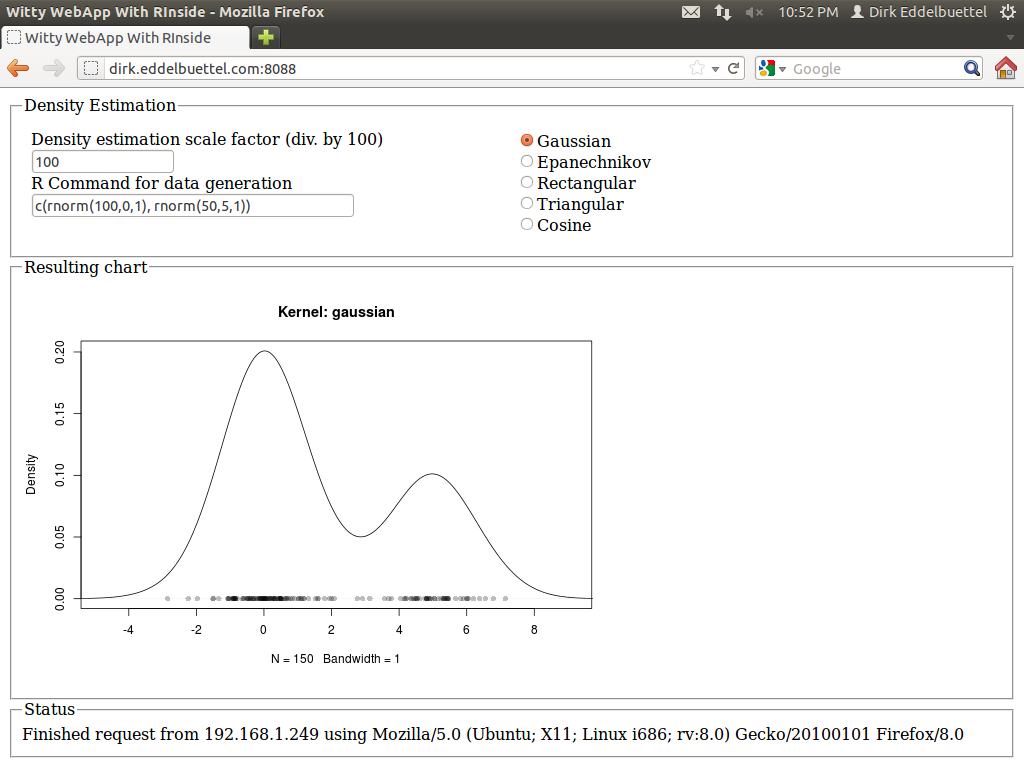
A few months ago, I had blogged about using R inside of Qt. This used our RInside package for embedding the statistical programming environment and language R inside of a C++ application, and further relies on our Rcpp package for R and C++ integration and object mapping. The example was simple yet powerful: a reimplementation of the standard GUI application of a standard density estimate. Here the user can pick a kernel density function from a selection, and also slide a bandwidth parameter. One nice addition was an entry field already populated with a simple expression for a mixture of Normals, allowing for arbitrary random distributions over which to estimate. The example is pretty (thanks to Qt), and was added to RInside with the last CRAN release 0.2.4. The blog post has a nice screenshot. I had long wondered how to do something similar 'on the web'. Web integration and application frameworks are of course a dime a dozen: Just about any language offers this, with more or less ease. But I wanted something simple yet powerful and fast. And I did not like the idea of a multi-tier app, or of a multi-language mix. I remember having seen something about a web-application framework not unlike Qt, and studying the very useful Wikipedia web application framework comparison I re-discovered Wt (pronounced "Witty"). So there it is, using C++ which brings us ample performance, the ability to connect to a number of libraries and applications (which is important in my quantitatively-minded workd) and avoid the whole multi-tier, multi-language combination. The Wt website has a few more good reason why this may be a suitable idea; the toolkit also offers a very decent amount of features and is amply documented with a fair number of examples. And after just a little bit poking around during two weekends, I now have the following webapp committed in the SVN repository of RInside, and it is all implemented in in less than two hundred (generously commented) lines of code. Example of embedding R via RInside into a Wt C++ application: density estimation for a mixture It is currently up and running at the address shown in the screenshot, so give it a go (though I may take it down at another point in time). I quite like it: The application is responsive: changes in the radio buttons (for the density), or the bandwidth, each trigger reestimation of the density, and a new and updated chart is displayed immediately with no noticeable delay---just like the desktop application did. Best of all, the code logic is essentially unchanged from the Qt-based app. Signals and slots related events to actions, the layout is in terms of standard GUI boxen and containers. And best of all, I did not have to write a line of html, javascript, css or ajax: it is all handled by the Wt toolkit. I was able to drive the app from an Android phone, my tablet, various computers around the house, and had a few friends poke a stick at it from afar. There is at one open issue. Wt launches new instances of the application object with each connection, which is a very clean model. That doesn't map perfectly with R (which is single-threaded) and RInside (which runs as a singleton for the same reason). So right now, each action sends its state back to the client. In other words, each clients own its parameters and well as vector of random numbers. Each new action sends these back to the app which passes it to R, launches the re-estimation and gets an updated chart back which is then shown by the the client. That is not perfect, and maybe a forking model as used by Simon's RServe would be better, though it would require a rewrite of RInside. Not sure if we get there anytime soon. And for simple applications not facing legions of concurrent users, the singleton should still work. It's a proof of concept at this point. Feedback welcome, and RInside and Rcpp questions should go to the rcpp-devel list as usual.

30 November 2011

Benjamin Mako Hill: Bootstrapping

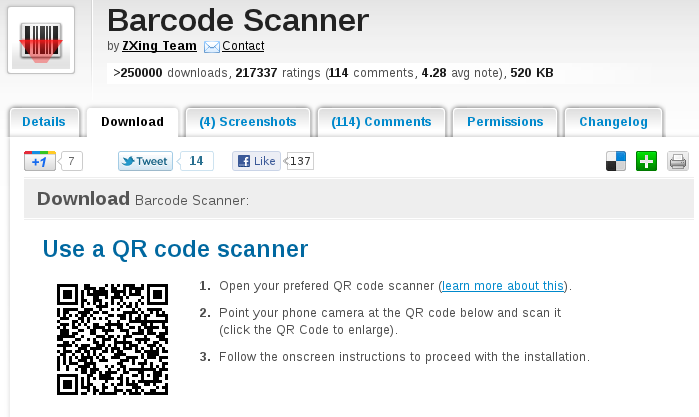
AndroidZoom, along with just about every other third-party interface to the Android Market out there, provides 2D barcodes which aim to make it easy to install Android applications that you find online on a phone. Maybe this would be a nice feature for F-Droid? Unfortunately, I found this feature when I was trying to help a friend install the (free software) ZXing Barcode Scanner because they wanted to read a 2D barcode.

29 November 2011

Gustavo Noronha Silva: Accelerated Compositing in webkit-clutter

For a while now my fellow Collaboran Joone Hur has been working on implementing the Accelerated Compositing infrastructure available in WebKit in webkit-clutter, so that we can use Clutter s powers for compositing separate layers and perform animations. This work is being done by Collabora and is sponsored by BOSCH, whom I d like to thank! What does all this mean, you ask? Let me tell me a bit about it. The way animations usually work in WebKit is by repainting parts of the page every few milliseconds. What that means in technical terms is that an area of the page gets invalidated, and since the whole page is one big image, all of the pieces that are in that part of the page have to be repainted: the background, any divs, images, text that are at that part of the page. What the accelerated compositing code paths allow is the creation of separate pieces to represent some of the layers, allowing the composition to happen on the GPU, removing the need to perform lots of cairo paint operations per second in many cases. So if we have a semi-transparent video moving around the page, we can have that video be a separate texture that is layered on top of the page, made transparent and animated by the GPU. In webkit-clutter s case this is done by having separate actors for each of the layers. I have been looking at this code on and off, and recently joined Joone in the implementation of some of the pieces. The accelerated compositing infrastructure was originally built by Apple and is, for that reason, works in a way that is very similar to Core Animation. The code is still a bit over the place as we work on figuring out how to best translate the concepts into clutter concepts and there are several bugs, but some cool demos are already possible! Bellow you have one of the CSS3 demos that were made by Apple to demo this new functionality running on our MxLauncher test browser. <video controls="controls" src="http://cafe.minaslivre.org/~kov/webkit/ac.webm" width="640"></video> You can also see that the non-Accelerated version is unable to represent the 3D space correctly. Also, can you guess which of the two MxLauncher instances is spending less CPU? ;) In this second video I show the debug borders being painted around the actors that were created to represent layers. <video controls="controls" src="http://cafe.minaslivre.org/~kov/webkit/debug-borders.webm" width="640"></video> The code, should you like to peek or test is available in the ac2 branch of our webkit-clutter repository: http://gitorious.org/webkit-clutter/webkit-clutter/commits/ac2 We still have plenty of work to do, so expect to hear more about it. During our annual hackfest in A Coru a we plan to discuss how this work could be integrated also in the WebKitGTK+ port, perhaps by taking advantage of clutter-gtk, which would benefit both ports, by sharing code and maintenance, and providing this great functionality to Epiphany users. Stay tuned!

Junichi Uekawa: pbuilder release process for this month.

pbuilder release process for this month. I've started the cycle. There are several patches, I'm just going to integrate them and see how things go.

28 November 2011

Vincent Bernat: SSL/TLS & Perfect Forward Secrecy

Once the private key of some HTTPS web site is compromised, an attacker is able to build a man-in-the-middle attack to intercept and decrypt any communication with the web site. The first step against such an attack is the revocation of the associated certificate through a CRL or a protocol like OCSP. Unfortunately, the attacker could also have recorded past communications protected by this private key and therefore decrypt them. Forward secrecy allows today information to be kept secret even if the private key is compromised in the future. Achieving this property is usually costly and therefore, most web servers do not enable it on purpose. Google recently announced support of forward secrecy on their HTTPS sites. Adam Langley wrote a post with more details on what was achieved to increase efficiency of such a mechanism: with a few fellow people, he wrote an efficient implementation of some elliptic curve cryptography for OpenSSL.

Without forward secrecy To understand the problem when forward secrecy is absent, let s look at the classic TLS handshake when using a cipher suite like AES128-SHA. During this handshake, the server will present its certificate and both the client and the server will agree on a master secret. TLS full handshake This secret is built from a 48byte premaster secret generated and encrypted by the client with the public key of the server. It is then sent in a Client Key Exchange message to the server during the third step of the TLS handshake. The master secret is derived from this premaster secret and random values sent in clear-text with Client Hello and Server Hello messages. This scheme is secure as long as only the server is able to decrypt the premaster secret (with its private key) sent by the client. Let s suppose that an attacker records all exchanges between the server and clients during a year. Two years later, the server is decommissioned and sent for recycling. The attacker is able to recover the hard drive with the private key. She can now decrypt any session she recorded: the encrypted premaster secret sent by a client is decrypted with the private key and the master secret is derived from it. The attacker can now recover passwords and other sensitive information that can still be valuable today. The main problem lies in the fact that the private key is used for two purposes: authentication of the server and encryption of a shared secret. Authentication only matters while the communication is established, but encryption is expected to last for years.

Diffie-Hellman with discrete logarithm One way to solve the problem is to keep using the private key for authentication but uses an independent mechanism to agree on a shared secret. Hopefully, there exists a well-known protocol for this: the Diffie-Hellman key exchange. It is a method of exchanging keys without any prior knowledge. Here is how it works in TLS:
  1. The server needs to generate once (for example, with openssl dhparam command):
  2. The server picks a random integer a and compute g^a \mod p . After sending its regular Certificate message, it will also send a Server Key Exchange message (not included in the handshake depicted above) containing, unencrypted but signed with its private key for authentication purpose:
    • random value from the Client Hello message,
    • random value from the Server Hello message,
    • p , g ,
    • g^a\mod p=A .
  3. The client checks that the signature is correct. It also picks a random integer b and sends g^b \mod p=B in a Client Key Exchange message. It will also compute A^b\mod p=g^ ab \mod p which is the premaster secret from which the master secret is derived.
  4. The server will receive B and compute B^a\mod p=g^ ab \mod p which is the same premaster secret known by the client.
Again, the private key is only used for authentication purpose. An eavesdropper will only know p , g , g^a\mod p and g^b\mod p . Computing g^ ab \mod p from those values is the discrete logarithm problem for which there is no known efficient solution. Because the Diffie-Hellman exchange described above always uses new random values a and b , it is called Ephemeral Diffie-Hellman (EDH or DHE). Cipher suites like DHE-RSA-AES128-SHA use this protocol to achieve perfect forward secrecy1. To achieve a good level of security, parameters of the same size as the key are usually used (the security provided by the discrete logarithm problem is about the same as the security provided by factorisation of two large prime numbers) and therefore, the exponentiation operations are pretty slow as we can see in the benchmark below: Graphical comparison of speed with and without DHE

Diffie-Hellman with elliptic curves Fortunately, there exists another way to achieve a Diffie-Hellman key exchange with the help of elliptic curve cryptography which is based on the algebraic structure of elliptic curves over finite fields. To get some background on this, be sure to check first Wikipedia article on elliptic curves. Elliptic curve cryptography allows one to achieve the same level of security than RSA with smaller keys. For example, a 224bit elliptic curve is believed to be as secure as a 2048bit RSA key.

Some theory Diffie-Hellman key exchange described above can easily be translated to elliptic curves. Instead of defining p and g , you get some elliptic curve, y^2=x^3+\alpha x+\beta , a prime p and a base point G . All those parameters are public. In fact, while they can be generated by the server, this is a difficult operation and they are usually chosen among a set of published ones. The use of elliptic curves is an extension of TLS described in RFC 4492. Unlike with the classic Diffie-Hellman key exchange, the client and the server need to agree on the various paremeters. Most of this agreement is done inside Client Hello and Server Hello messages. While it is possible to define some arbitrary parameters, web browsers will only support a handful of predefined curves, usually NIST P-256, P-384 and P-521. From here, the key exchange with elliptic curves is pretty similar to the classic Diffie-Hellman one:
  1. The server picks a random integer a and compute aG which will be sent, unencrypted but signed with its private key for authentication purpose, in a Server Key Exchange message.
  2. The client checks that the signature is correct. It also picks a random integer b and sends bG in a Client Key Exchange message. It will also compute b\cdot aG=abG which is the premaster secret from which the master secret is derived.
  3. The server will receive bG and compute a\cdot bG=abG which is the same premaster secret known by the client.
An eavesdropper will only see aG and bG and won t be able to compute efficiently abG . Using ECDHE-RSA-AES128-SHA cipher suite (with P-256 for example) is already a huge speed improvement over DHE-RSA-AES128-SHA thanks to the reduced size of the various parameters involved. Web browsers only support a handful of well-defined elliptic curves, chosen to ease an efficient implementation. Bodo M ller, Emilia K sper and Adam Langley have provided 64bit optimized versions of NIST P-224, P-256 and P-521 for OpenSSL. To get even more details on the matter, you can read the end of the introduction on elliptic curves from Adam Langley, then a short paper from Emilia K sper which presents a 64bit optimized implementation of the NIST elliptic curve NIST P-224.

In practice First, keep in mind that elliptic curve cryptography is not supported by all browsers. Recent versions of Firefox and Chrome should handle NIST P-256, P-384 and P-521 but for most versions Internet Explorer, you are currently out of luck. Therefore, you need to keep accepting other cipher suites. You need a recent version of OpenSSL. Support for ECDHE cipher suites has been added in OpenSSL 1.0.0. Check with openssl ciphers ECDH that your version supports them. If you want to use the 64bit optimized version, you need to run a snapshot of OpenSSL 1.0.1, configured with enable-ec_nistp_64_gcc_128 option. A recent GCC is also required in this case. Next, you need to choose the appropriate cipher suites. If forward secrecy is an option for you, you can opt for ECDHE-RSA-AES128-SHA:AES128-SHA:RC4-SHA cipher suites which should be compatible with most browsers. If you really need forward secrecy, you may opt for ECDHE-RSA-AES128-SHA:DHE-RSA-AES128-SHA:EDH-DSS-DES-CBC3-SHA instead. Then, you need to ensure the order of cipher suites is respected. On nginx, this is done with ssl_prefer_server_ciphers on. On Apache, this is SSLHonorCipherOrder on. UPDATED: You need to check ECDHE support for your web server. For nginx, the support has been added in 1.0.6 and 1.1.0. The curve selected defaults to NIST P-256. You can specify another one with ssl_ecdh_curve directive. For Apache, it has been added in 2.3.3 and does not exist in the current stable branch. Adding support for ECDHE is quite easy. You can check how I added it in stud. This issue also exists for DHE cipher suites, in which case you also might have to specify DH parameters to use (generated with openssl dhparam) using some special directive or by appending the parameters to the certificate. Check Immerda Techblog article for more background about this point. The implementation of TLS session tickets may be incompatible with forward secrecy, depending on how they are implemented. When they are protected by a random key generated at the start of the server, the same key could be used for months. Some implementations2 may derive the key from the private key. In this case, forward secrecy is broken. If forward secrecy is a requirement for you, you need to either disable tickets or ensure that key rotation happens often. Check with openssl s_client -tls1 -cipher ECDH -connect 127.0.0.1:443 that everything works as expected.

Some benchmarks With the help of the micro-benchmark tool that I developed for my previous article, we can compare the efficiency of cipher suites providing forward secrecy: Speed comparison with/without DHE/ECDHE I have used a snapshot of OpenSSL 1.0.1 (2011/11/25). The optimized version of ECDHE is the one you get by using enable-ec_nistp_64_gcc_128 option when configuring OpenSSL. Let s focus on the server part. Enabling DHE-RSA-AES128-SHA cipher suite hinders the performance of TLS handshakes by a factor of 3. Using ECDHE-RSA-AES128-SHA instead only adds an overhead of 27%. However, if we use the 64bit optimized version, the cost is only 15%. The overhead is only per full TLS handshake. If 3 out of 4 of your handshakes are resumed, you need to adjust the numbers. Your mileage may vary but the computational cost for enabling perfect forward secrecy with an ECDHE cipher suite seems a small sacrifice for better security.

  1. Perfect forward secrecy is an enhanced version of forward secrecy. It assumes each exchanged key are independent and therefore a compromised key cannot be used to compromise another one.
  2. For example, this is the case of the implementation I have proposed for stud to enable sharing of tickets between multiple hosts.

Craig Sanders: one of the reasons i like zfs

I got home from work tonight and zfs had reported that one of the disks in my main pool was dying. no great problem. insert a disk i had spare, and run zpool replace like so:
ganesh:~# zpool replace -f export  scsi-SATA_WDC_WD10EARS-00_WD-WMAV50933036 scsi-SATA_ST31000528AS_9VP16X03
and now it s just a matter of waiting until the data has resilvered and i can remove the old dying drive.
ganesh:~# zpool status export -v
  pool: export
 state: ONLINE
status: One or more devices is currently being resilvered.  The pool will
        continue to function, possibly in a degraded state.
action: Wait for the resilver to complete.
 scan: resilver in progress since Mon Nov 28 19:25:49 2011
    75.1G scanned out of 2.29T at 88.3M/s, 7h17m to go
    18.0G resilvered, 3.21% done
config:
        NAME                                                   STATE     READ WRITE CKSUM
        export                                                 ONLINE       0     0     0
          raidz1-0                                             ONLINE       0     0     0
            scsi-SATA_WDC_WD10EACS-00_WD-WCASJ2114122          ONLINE       0     0     0
            scsi-SATA_WDC_WD10EACS-00_WD-WCASJ2195141          ONLINE       0     0     0
            scsi-SATA_WDC_WD10EARS-00_WD-WMAV50817803          ONLINE       0     0     0
            replacing-3                                        ONLINE       0     0     0
              scsi-SATA_WDC_WD10EARS-00_WD-WMAV50933036        ONLINE       0     0     0
              scsi-SATA_ST31000528AS_9VP16X03                  ONLINE       0     0     0  (resilvering)
        logs
          scsi-SATA_Patriot_Torqx_278BF0715010800025492-part6  ONLINE       0     0     0
        cache
          scsi-SATA_Patriot_Torqx_278BF0715010800025492-part7  ONLINE       0     0     0
errors: No known data errors
(I use /dev/disk/by-id device names so I don t have to care about the kernel detecting the disks and disk controllers in a different order on each reboot also makes it easier to identify which disk is having a problem as I can squint at the front of the drives in my Lian Li 4-in-3 hotswap bays and read the serial number sticker) OK, yeah, sure it s not that much different from replacing a dying drive in an mdadm or hardware raid array but one nice advantage of zfs over raid is that it only resyncs the data in use, not the empty or unused blocks. given that these are 1TB drives in a raidz vdev, and the pool is 63% used that means syncing only about 630GB rather than 1TB. ps: in the time it s taken to write this, it s up to 10.11% done. 88MB/s reading data from the existing raidz drives and writing to a single drive isn t too bad at all. one of the reasons i like zfs is a post from: Errata

Dirk Eddelbuettel: A Story of Life and Death. On CRAN. With Packages.

The Comprehensive R Archive Network, or CRAN for short, has been a major driver in the success and rapid proliferation of the R statistical language and environment. CRAN currently hosts around 3400 packages, and is growing at a rapid rate. Not too long ago, John Fox gave a keynote lecture at the annual R conference and provided a lot of quantitative insight into R and CRAN---including an estimate of an incredible growth rate of 40% as a near-perfect straight line on a log-log chart! So CRAN does in fact grow exponentially. (His talk morphed into this paper in the R Journal, see figure 3 for this chart.) The success of CRAN is due to a lot of hard work by the CRAN maintainers, lead for many years and still today by Kurt Hornik whose dedication is unparalleled. Even at the current growth rate of several packages a day, all submissions are still rigorously quality-controlled using strong testing features available in the R system. And for all its successes, and without trying to sound ungrateful, there have always been some things missing at CRAN. It has always been difficult to keep a handle on the rapidly growing archive. Task Views for particular fields, edited by volunteers with specific domain knowledge (including yours truly) help somewhat, but still cannot keep up with the flow. What is missing are regular updates on packages. What is also missing is a better review and voting system (and while Hadley Wickham mentored a Google Summer of Code student to write CRANtastic, it seems fair to say that this subproject didn't exactly take off either). Following useR! 2007 in Ames, I decided to do something and noodled over a first design on the drive back to Chicago. A weekend of hacking lead to CRANberries. CRANberries uses existing R functions to learn which packages are available right now, and compares that to data stored in a local SQLite database. This is enough to learn two things: First, which new packages were added since the last run. That is very useful information, and it feeds a website with blog subscriptions (for the technically minded: an RSS feed, at this URL). Second, it can also compare current versions numbers with the most recent stored version number, and thereby learns about updated packages. This too is useful, and also feeds a website and RSS stream (at this URL; there is also a combined one for new and updated packages.) CRANberries writes out little summaries for both new packages (essentially copying what the DESCRIPTION file contains), and a quick diffstat summary for updated packages. A static blog compiler munges this into static html pages which I serve from here, and creates the RSS feed data at the same time. All this has been operating since 2007. Google Reader tells me the the RSS feed averages around 137 posts per week, and has about 160 subscribers. It does feed to Planet R which itself redistributes so it is hard to estimate the absolute number of readers. My weblogs also indicate a steady number of visits to the html versions. The most recent innovation was to add tweeting earlier in 2011 under the @CRANberriesFeed Twitter handle. After all, the best way to address information overload and too many posts in our RSS readers surely is to ... just generate more information and add some Twitter noise. So CRANberries now tweets a message for each new package, and a summary message for each set of new packages (or several if the total length exceeds the 140 character limit). As of today, we have sent 1723 tweets to what are currently 171 subscribers. Tweets for updated packages were added a few months later. Which leads us to today's innovation. One feature which has truly been missing from CRAN was updates about withdrawn packages. Packages can be withdrawn for a number of reasons. Back in the day, CRAN carried so-called bundles carrying packages inside. Examples were VR and gregmisc. Both had long been split into their component packages, making VR and gregmisc part of the set of packages no longer on the top page of CRAN, but only its archive section. Other examples are packages such as Design, which its author Frank Harrell renamed to rms to match to title of the book covering its methodology. And then there are of course package for which the maintainer disappeared, or lost interest, or was unable to keep up with quality requirements imposed by CRAN. All these packages are of course still in the Archive section of CRAN. But how many packages did disappear? Well, compared to the information accumulated by CRANberries over the years, as of today a staggering 282 packages have been withdrawn for various reasons. And at least I would like to know more regularly when this happens, if only so I have a chance to see if the retired package is one the 120+ packages I still look after for Debian (as happened recently with two Rmetrics packages). So starting with the next scheduled run, CRANberries will also report removed packages, in its own subtree of the website and its own RSS feed (which should appear at this URL). I made the required code changes (all of about two dozen lines), and did some light testing. To not overwhelm us all with line noise while we catch up to the current steady state of packages, I have (temporarily) lowered the frequency with which CRANberries is called by cron. I also put a cap on the number of removed packages that are reported in each run. As always with new code, there may be a bug or two but I will try to catch up in due course. I hope this is of interest and use to others. If so, please use the RSS feeds in your RSS readers, and subscribe to the @CRANberriesFeed, And keep using CRAN, and let's all say thanks to Kurt, Stefan, Uwe, and everybody who is working on CRAN (or has been in the past).

27 November 2011

Lars Wirzenius: Moving from SD to Ikiwiki for bug tracking

I've moved from using SD for bug tracking to using Ikiwiki. SD is a distributed bug tracker, and I quite like it. However, it seems to be hard to get anyone else to use it. Ikiwiki is a wiki engine, and makes it easier for others to deal with it, since they can just use a web browser. Since I don't really use any metadata for bugs, apart from open/closed, Ikiwiki is a simple solution that suits my needs. It's probably not suitable for a large project with lots of open bugs. I've only just switched, we'll see how this goes. I really hope distributed bug tracking takes off in a big way, however, since it's oh so nice to be able to take full advantage of one's bug tracker even when offline.

Craig Sanders: problems with Linux and Aten CS1784A KVM switch

Dear lazyweb, I bought an Aten CS1784A DVI+USB KVM switch a couple of months ago. I m pretty happy with it except for one annoying problem. It has a Dell multimedia USB keyboard plugged into it (picked it up from a swap meet for $15 nice. it's a pretty good keyboard in its own right but i mostly bought it to match what I use at work), and a Logitech MX518 mouse connected. Also two computers one runs Linux only. The other is switched off most of the time, but is occasionally powered up to boot into either Linux to experiment with stuff i don't want to do on my main system (like gnome 3) or sometimes Win7 to play games. OK, that s the background data. Here s the problem Whenever I reboot either of the Linux installations, the KVM stops recognising the keyboard. I have to unplug the keyboard and plug it back in before any input is recognised. Keyboard input doesn't get through to the currently active system, and I can't even use the KVM's magic key <ScrlLock><ScrlLock>n<Enter> to switch between systems it doesn't even beep after the 2nd ScrlLock as it should, so it seems as if all keyboard input is ignored by the KVM, or the keyboard is totally confused and not sending anything. The mouse continues to work during this. Rebooting Win7 doesn't do this. The keyboard just works as it should. The problem occurs sometime between the time Linux is selected from the Grub2 menu and the gdm login screen is displayed (same result with both gdm on my main system and gdm3 on my secondary system). The keyboard works when plugged directly into either system, without the KVM. I d been using it for several months before I got the KVM, and I ve tested that it still works correctly across a reboot if i plug it in directly. Googling for "+linux +CS1784A" just gives me hundreds of pages from web sites selling the KVM, but no useful info. Anyone seen anything like this before? Can anyone think of anything that linux might be doing in it's console or X initialisation that would confuse the KVM? it's not a huge problem because I really don't reboot all that often more of an annoyance that I'd like to go away. problems with Linux and Aten CS1784A KVM switch is a post from: Errata

26 November 2011

Andrew McMillan: CeBIT 2011 in (overdue) review

The German Linux Magazine runs a sponsored an "Open Source Lounge" at CeBIT each year. Last year I put in a proposal for DAViCal and it got accepted! With some airfare support from InternetNZ I got to showcase my Free Software project at the largest IT trade fair in the world.If you have an open source project to promote I can't recommend this highly enough. Below is a review of my experience at CeBIT early this year. This is long overdue for posting, and I'm prompted now because submissions are now open for the Open Source Project Lounge at CeBIT in 2012. Apply now.The German Linux Magazine runs a sponsored an "Open Source Lounge" at CeBIT each year. Last year I put in a proposal for DAViCal and it got accepted! With some airfare support from InternetNZ I got to showcase my Free Software project at the largest IT trade fair in the world. If you have an open source project to promote I can't recommend this highly enough. Below is a review of my experience at CeBIT early this year. This is long overdue for posting, and I'm prompted now because submissions are now open for the Open Source Project Lounge at CeBIT in 2012. Apply now.

CeBIT Hall 2 is an enormous space

DAViCal at CeBIT 2011 CeBIT in Hannover is said to be the largest trade fair in the world, attracting over 300,000 visitors during it's five days. Late last year a DAViCal user in Germany suggested that I apply for a free booth for DAViCal in the Linux New Media Open Source Project Lounge . When DAViCal was accepted, I realised I needed some funding to help me travel around the world to attend, so I applied for a grant from InternetNZ who were kind enough to agree to cover part of my travel costs, and I was on my way. Germany in March is cold, especially for me coming from Summer! My travel allowed for a couple of days in Germany before CeBIT because that was when I could get the cheapest flights, and I wanted to have a little time to recover from the journey. Everyone had warned me to pack my winter woollies, and they were definitely needed! I stayed with a friend in Hamburg for two days and on the the second day we walked through the frozen park, past the frozen lake and over the frozen streams to see the Attraktor Hackerspace in Hamburg Nord where the CCC also hold their meetings a very impressive hackerspace in a repurposed bank (including the vault :-) with several separated areas for talks, meetings and workplaces. The day before CeBIT I travelled to Hannover to take a look at my booth space, fetch exhibitor passes for myself and volunteers and generally prepare to do battle with the crowds. The following day the fair started and it was up at 6:30 to get ready and catch the 7:38 train out to the fairgrounds. Although the fair opens at 9:00 there was always something to do between eight o'clock or so when I arrived at my booth and when the attendees started wandering past.
I was fortunate to have two volunteers for my booth who were there all week, as well as a couple more who turned up on the first two days. Not only did this mean that I got to spend a few hours during the week actually wandering the fairgrounds, but that I had some knowledgeable native german speakers for the occasional visitor who could not speak English. DAViCal has been translated into a dozen languages, and there had been some extra work put in to update the German translation before CeBIT also. As well as showing DAViCal, I was also able to demonstrate a new project at the fair which was aCal - a CalDAV Calendar Client for Android which I had released into the market just a few days beforehand for a token sum (it is licensed GPL v3 or later and the source code is available on gitorious.org). Having the smartphone devices available was great for giving live demonstrations, and I used the timetable for events at the Open Source Forum across the aisle from the Open Source Lounge to populate a calendar that we shared among a variety of devices. The first day was really the calm before the storm, and we saw lots of people asking what we were about, and had some good conversations with people wanting to know more, or telling us they used the software and were very happy with it.
CeBIT closes the gates at 18:00 with the visitor supply drying up pretty quickly around then and the secret lives of the exhibitors are revealed with people starting to relax and joke, and beer or wine starting to come out and some booth parties kicking off... if you have the stamina! I didn't, so it was off back to the train, to Hildesheim, to dinner and to bed. That first day blurred into the next, and the next and by Friday I was starting to lose my voice with all the talking I had been doing. I was visited by a chap from Posnan University who are a DAViCal user and he invited me down to the Polish stand to tell me about what they do there, and he agreed that they would love to help get the Polish translation improved. Another DAViCal user turned up with some bavarian wheat beer and a special beer glass for it by way of thanks. In some spare moments I fixed a bug in aCal's handling of character sets and uploaded a new version, so that we could use umlauts in events. Many people came past to talk to us, some of whom want to help with them project or have ideas for interesting things to do with DAViCal, some were already users of DAViCal and some went away thinking that they would be in the future. The last day of CeBIT is a little different: it's a Saturday and the doors are opened to the public and the minimum age is lowered to allow children to attend the event. I had been warned that this day is a madhouse, and it did indeed seem to be so for many booths. For DAViCal it was probably quieter than the day before, I think perhaps because calendar server software is inherently less sexy than many of the other things on display. We still had plenty of great discussions with interested people nonetheless and to be honest I was fairly happy to be spared the further exhaustion that had been threatened. Sunday was spent recuperating: discovering that Hildesheim has a great little restaurant that does traditional german pancakes for breakfast and then wandering around the small city soaking in the sunshine that I'd seen through the windows outside all week. On Monday I caught the train to M nchengladbach to meet with an organisation that might provide support for DAViCal in Germany, but who hadn't been able to come to the fair to see me due to illness. I was encouraged to spend the night in Aachen a beautiful little city , which I did, arriving around sunset and I spent a couple more days before flying home being intensely antisocial to recover from the furious week beforehand. Is CeBIT worth it? CeBIT seemed to me to be quite a different business model, or perhaps on a different scale. I've seen trade fairs in New Zealand for other purposes, but not to showcase software and services in quite this way. To give an idea of it's scale, consider that I had a tiny booth in a hall that was probably four times the size of the TSB Arena, and CeBIT included around 20 such buildings , packed with exhibitors, with free buses to get around the campus, acres of multi-storey parking buildings, two train stations, and so on. The scale of the event is incredible.

Polish people are huge too, like these friendly DAViCal
users from Pozna University of Technology who
showed me all the cool toys they brought to CeBIT.

As a result of this scale, CeBIT boasts impressive visitor numbers, and while a visitor will usually attend with a specific area of interest in relation to their business they will also wander the fair to see other areas of more personal interest, or just to see what is around. Open Source is a specific area of interest to a significant percentage of business in Germany, and Deutsche Messe, the fair operators, recognise the value of having an open source area as a draw for visitors, with the primary open source area placed in Hall 2, directly off the main north entrance. Within the open source area, the Open Source Project Lounge , where DAViCal was located, is a series of booths sponsored by Linux New Media AG. Projects in the Open Source Lounge are selected by a jury of Linux New Media, Deutsche Messe and several community advisors, so as such there is a range of interesting projects on show and the draw of any given project has a flow-on effect to the others. As an example, at one point while briefly minding the adjacent stand for the OpenEmbedded project I was unable to help an inquiring visitor, but I was able to talk about DAViCal with him until the exhibitor returned to answer his question. His interest in DAViCal was definitely increased in this process, and I'm sure that many people came into our area of the lounge attracted by a specific exhibitor and moving on to see some of the others. Outside of this association with open source, however, CeBIT offers something which general free software events cannot: an association with mainstream software and services. This presentation of Open Source alongside IBM, SAP, HP, Oracle, Software AG, Apple, Microsoft and so forth makes inclusion at this event particularly valuable. Free software solutions can have good brand recognition within the open ecosystem itself and yet be practically unheard of outside it. Most traditional methods of communication with suppliers don't work well with Open Source projects: a request for proposal will sail silently by, unless noted by a related commercial entity. In general there is no sales department, and marketing is frequently a desultory hit or miss affair. The fair is different. The fair is about talking with people. While there is still plenty of collateral marketing with brochures, signs, presentations and giveaway knick-knacks those things are just there to bring people into range: the real action happens when you engage a person in conversation, and at that point a humble free software project can be on an equal footing with a larger booth staffed with eager young salesmen. Of course there are a number of places where free software can get a booth. Linuxtag is a German example where there are many booths for free software projects, linux.conf.au also offers booths to free software projects during it's more outreach Open Day and software freedom day events happen all around the world where booths are available, but the audience arriving at these events are all largely pre-sold on openness and free software. So in presenting this broad blend of people, in a way in which free software projects can present on a roughly equal footing with their commercial brethren, CeBIT is an opportunity not to be missed. The numbers speak for themselves, too: traffic to the DAViCal websites has increased by about 50% around CeBIT with 25% coming from Germany, but significant increases also from France, Netherlands, Italy, Switzerland and Poland. Traffic to the DAViCal wiki has doubled over the last 12 months in a steady increase to around 200,000 page views each month. This sudden increase to around 10000/day in March, with some days during CeBIT peaking at over 20000/day The Future I won't be returning to CeBIT to represent DAViCal in Hannover next year as the sponsored booth is pretty much a one-time thing and the costs involved in purchasing a booth for attendance at the fair are significant (around NZD$15000 for a small 3m x 2m stall). It's possible that I will return next year in a different capacity, as one of the larger stand organisers has confidentially indicated he will invite me to attend as part of an Open Source Apps area that he is considering running on his stand, somewhat along the lines of the Open Source Lounge . Time will tell, I guess, but if invited I think I would definitely go for that. I will definitely be suggesting to a few specific free software projects that they should apply for the Linux New Media opportunity when it comes around again. Koha is one project that immediately springs to mind, but of course there are many, many worthy free software projects and this opportunity seems to be little-understood outside of Germany.

Britta was unfailingly helpful and charming

If I do convince a project to apply, and they are successful, I will also try and give them some assistance and background knowledge to understand the fair, and how best they can take advantage of the opportunity it offers. Some basic tips would be: and finally... I would like to express my appreciation to InternetNZ for the grant to partially cover my travel costs to Hannover, making my attendance at this outstanding event much more achievable. My thanks also to Britta Wulfling who supported all of the projects in the Open Source Lounge. My friends Alexander & Meike in Hildesheim who supplied somewhere for me to recuperate, and accompanied me to the fair every day to run the Debian booth. Thanks also, of course, to the German Linux Magazine for selecting DAViCal for a free booth, and to Benny who pointed the opportunity out, encouraged me to apply, and came along and helped out for the whole week.

24 November 2011

Michael Banck: 24 Nov 2011

Tomorrow (25th November) evening, I will be giving a short talk about PostgreSQL at the monthly Munich Open-Source-Treffen event.

The meetings start around 6PM and are always in Cafe Netzwerk in Luisenstr. 11, a nice and cosy hangout and hackerspace for young Munich students near Hauptbahnhof.

Andrew McMillan: The Obligation to Vote

Could you not trust this man?Max and Fraser are very interested in this year's election. I guess political awareness starts at the first election after you turn 10, or so. They're both very curious about how mum and dad are voting, and while their mother will not tell (though we all have our suspicions :-) I don't see any reason not to discuss my political leanings with them.I've been what is commonly termed a 'floating' voter for most of my voting life. I imagine the politicians themselves might term people like me 'floaters', with an eye to the scatalogical implications. After all, their livelihoods are on the line!So, after reading this blog post I thought I might as well also share my personal voting plans with the world.

Could you not trust this man?

Max and Fraser are very interested in this year's election. I guess political awareness starts at the first election after you turn 10, or so. They're both very curious about how mum and dad are voting, and while their mother will not tell (though we all have our suspicions :-) I don't see any reason not to discuss my political leanings with them. I've been what is commonly termed a 'floating' voter for most of my voting life. I imagine the politicians themselves might term people like me 'floaters', with an eye to the scatalogical implications. After all, their livelihoods are on the line! So, after reading this blog post I thought I might as well also share my personal voting plans with the world. In the referendum I will be voting to retain MMP MMP is a straightforward system which gives a representation in parliament almost directly proportional to the proportion of votes for each party. It seems like a no-brainer to anyone aged five to twenty-five, and I figure it's important for their future that I vote this way. Some older folk seem shocked at the idea that a government might have to negotiate with representatives of large minorities in order to actually get legislation passed which would annoy one person in twenty. In voting for an alternative to MMP, should an insufficiency of fairness-loving voters visit the polls, I will be voting for STV. STV is a stupid alternative, because it's complicated and confusing, and so if we really end up going down to the wire against some less fair system than MMP it will be much easier to argue against STV, but I'm really hoping that doesn't happen. MMP has been a great enabler to produce a much more inclusive government for New Zealand since it's introduction. In the Mana Electorate I will be voting for Hekia Parata I've been disappointed with Kris Fa'afoi who seems to think that "communicating with the electorate" means "standing on street corners shouting into a megaphone", and I believe Hekia is much more aware of the issues, and a much more capable and experienced politician. My party vote will go to the Green Party It's pretty obvious that National don't need my party vote, and I've been disappointed with their performance on important environmental and economic issues in any case. In an ideal world they'd have to form a coalition with the Green Party in order to govern, but that seems unlikely unless every Labour and Green voter who can still draw breath turns up at the polling places while the National voters all sleep in and forget to vote. Unlikely. What I see from John Key seems increasingly like patronising gloss, and I can only imagine he has his hand behind his back with his fingers crossed. We're getting little real information in between the sound bites, for example the National Party has refused to answer the questions from Radio NZ. That can't be good. And what do the kids think? They tell me that they believe that these are good choices for the future. Fraser's fairly easily swayed by the opinions of those around him, but he's only 10 after all. Max does look at all the options, thinks about them and has interesting things to say. I don't think they're saying it just to please dad! Oh, and Max drew the politician for this post. I'll let you guess who he definitely doesn't trust...

23 November 2011

Joey Hess: roundtrip latency from a cabin with dialup in 2011

alt="imagine an xkcd-style infographic here" 0 seconds 0.5 seconds 5 seconds 10 seconds 20 seconds 2 minutes 5 minutes 10 minutes 22 minutes 30 minutes 32 minutes 70 minutes 180 minutes 300 minutes

Russell Coker: Receiving Death Threats

On occasion I receive death threats in comments on my blog. This doesn t bother me, I had more than a few pathetic losers say similar things to me in high school but the difference is that a pathetic loser on the other side of the world can t do much about it. The latest one is on my post Is Asperger Syndrome a Good Thing? [1]. At 11:04AM my time (00:04 UTC) on the 23rd of November someone using IP address 82.14.50.190 (registered to NTL Infrastructure for Tesco Guildford ) and with the claimed email address of sharkbait @ tesco.net told me that I m on his to kill list . He was angry because my post apparently didn t satisfy his need to prove to people that they don t want AS . As it s not possible to choose your DNA there is really no point in trying to prove that one set of genes is better than another, unless of course you want to harass people who have different genes to you. Naturally he didn t read my post, in fact the differences between his comment and what I wrote made me suspect that it s something he was pasting in to lots of blogs, but it seems unlikely that he would use an iPhone for such a copy/paste job so he must just not read. For example he rhetorically asks did you even mention it was a form of autism in your negative points when I gave a link to the proposed DSM changes where Asperger Syndrome is being merged with Autistic Disorder and the word Autism appears 5 times in the post. He has one specific complaint about people he knows who are on the Autism Spectrum, he says Every time someone speaks to them they get angry and tell said person to back the fuck off. I ve been on the receiving end. Generally there are two possible reasons for being told to fuck off , one is that the person telling you is an asshole and the other is that you are being an asshole. If you are the type of person who sends death threats to bloggers then you really should consider the latter explanation. He also suggests that I watch Boston Legal presumably because that show has one character who is an Aspie. Now I have actually watched that show and it s the worst legal show I ve ever seen, when a legal show has such unrealistic portrayal of court scenes I don t think it should be relied on for information on any other topic. I watched a couple of episodes of Boston Legal and only saw one scene with the Aspie guy, so I can t even determine whether it s a realistic portrayal he s a minor character. In any case there are plenty of Aspie guys in the Free Software community who I interact with regularly, I read forums such as AspiesForFreedom.com, and I ve read some text books on the topic. So even if a TV show had a very accurate portrayal of an Aspie character I still doubt that I would learn anything by watching it. As a general tip for flamers, if you want to accuse someone of being a member of a NAZI or KKK type organisation then the word you are after is Aryan not ayrien . If you don t know a word then don t use it. Please note the conditions of sending me email [2], I reserve the right to publish all threats in any way that I wish. A Final Note Thanks sharkbait for adding me to your to kill list , I m sure that there are lots of nice people on it and I ve got good company. If I didn t get the occasional death threat I would worry that I m not writing well enough or failing to address important issues. I will write more about Autism in the future.

22 November 2011

Steve Kemp: Goodbye mysql ..

Yesterday evening I updated my server to remove MySQL:
steve:~# dpkg --purge mysql-client-5.1 \
                      mysql-common     \
                      mysql-server-5.1 \
                      mysql-server-core-5.1 \
                      python-mysqldb        \
                      libdbd-mysql-perl     \
                      libdatetime-format-mysql-perl
Until last month I had two database in use, one each for a pair of web-applications. As of now one is using redis - which I'm already using for my image hosting - and the other application is using SQLite. Until recently I had a high opinion of SQLite, although that has now been downgraded a little, it is still a thoroughly excellent piece of software. I was just surprised at little things it was missing, to the extent I had to rewrite my applications SQL. Still one less service is a good thing, and the migration wasn't so painful.. In more productive news I recently acquired a nice external flash - the Yongnuo YN-460 II is (very) cheap and cheerful, it can be fired remotely with my triggers so I've had a lot of fun with opportunistically taking pictures and experimenting with lighting. Most of the results are NSFW, but there are some other examples lurking around including the first time I managed to successfully capture a falling water-drop. (Not the best picture, not the most explicit effect, but fun regardless. I both can and will do better next time!)
Somebody recently asked me to write about "camera stuff under linux" and happily I declined. Why decline? Because there are so many good tools, applications, and utilities. (I use local tools for organisation and duplicate detection, rawtherapee for RAW conversion and GIMP for touchups). Having many available options is fantastic though, and something hard to appreciate for "newcomers" to Linux. (Yeah I waited 90 seconds - if I remembered to add -nojava - for Netscape Navigator to start, under X10, with 8Mb of RAM. Happier days are here. Sure DRM is bad, secure boot .. an open question, but damn we have it good compared to almost any previous point in time!)
ObQuote: "Yeah, obviously it is only a tactical party. I'm only having a party to eventually get sex." - Peep Show

Thorsten Glaser: Those small nice tools we all write

This is both a release announcement for the next installment of The MirBSD Korn Shell, mksh R40b, and a follow-up to Sune s article about small tools of various degrees of usefulness. I hope I don t need to say too much about the first part; mksh(1) is packaged in a gazillion of operating environments (dear Planet readers, that of course includes Debian, which occasionally gets a development snapshot; I ll wait uploading R40c until that two month fixed gcc bug will finally find its way into the packages for armel and armhf. Ah, we re getting Arch Linux (after years) to include mksh now. (Probably because they couldn t stand the teasing that Arch Hurd included it one day after having been told about its existence, wondering why it built without needing patches on Hurd ) MSYS is a supposedly supported target now, people are working on WinAPI and DJGPP in their spare time, and Cygwin and Debian packagers have deprecated pdksh in favour of mksh (thanks!). So, everything looking well on that front. I ve started a collection of shell snippets some time ago, where most of those small things of mine ends up. Even stuff I write at work we re an Open Source company and can generally publish under (currently) AGPLv3 or (if extending existing code) that code s licence. I chose git as SCM in that FusionForge instance so that people would hopefully use it and contribute to it without fear, as it s hosted on my current money source s servers. (Can just clone it.) Feel free to register and ask for membership, to extend it (only if your shell-fu is up to the task, KNOPPIX-style scripts would be a bad style(9) example as the primary goal of the project is to give good examples to people who learn shell coding by looking at other peoples code). Maybe you like my editor, too? At OpenRheinRuhr, the Atari people sure liked it as it uses WordStar like key combinations, standardised across a lot of platforms and vendors (DR DOS Editor, Turbo Pascal, Borland C++ for Windows, ) ObPromise: a posting to raise the level of ferrophility on the Planet aggregators this wlog reaches (got pix)

Rapha&#235;l Hertzog: People behind Debian: Stefano Zacchiroli, Debian Project Leader

picture by Tiago Bortoletto Vaz, CC BY-NC-SA 2.0


It s been one year since the first People behind Debian interview. For this special occasion, I wanted a special guest and I m happy that our Debian Project Leader (DPL) Stefano Zacchiroli accepted my invitation. He has a difficult role in the community, but he s doing a really great job of it. He s a great mediator in difficult situations, but he s also opinionated and can push a discussion towards a conclusion. Read on to learn how he became a Debian developer and later DPL, what he s excited about in the next Debian release, and much more. Raphael: Who are you? Stefano: I m Stefano Zacchiroli, but I prefer to be called Zack, both on the Internet and in real life. I m 32, Italian, emigrated to France about 4 years ago. I live in Paris, and I find it to be one of the most gorgeous and exciting cities in the world. As my day job I m a Computer Science researcher and teacher at University Paris Diderot and IRILL. In my copious free time I contribute to Debian, and I m firmly convinced that doing so is an effective way to help the cause of Free Software. Besides, I find it to be a lot of fun! Raphael: How did you start contributing to Debian? Stefano: Flash back to 1999, when I was a 2nd year student in Computer Science at the University of Bologna. Back then in Italy it was uncommon for young geeks to get exposed to Free Software: Internet was way less pervasive than today and most computer magazines didn t pay much attention to GNU/Linux. Luckily for me, the professor in charge of the student lab was a Free Software enthusiast and all students machines there were running Debian. Not only that, but there was also a student program that allowed volunteers to become sysadmins after having shown their skills and convinced the director they were trustworthy. Becoming one of those volunteer Debian admins quickly became one of my top objectives for the year, and that is were I ve learned using Debian. The year after that, I got in touch with a research group that was to become the happy bunch of hackers with whom I would have done both my master and PhD theses. They were designing a new proof assistant. Most of the development was in OCaml and happened on Debian. OCaml was available in Debian, but many of the libraries we needed were not. So I approached the Debian OCaml Team offering to help. Before I realize what was going on I was (co-)maintainer of tens of OCaml-related packages. At some point I got told I think you should apply as a Debian Developer . So I did and in a couple of months I went through the New Member (NM) process, that was back then in its infancy. I still remember my happiness while reading the account created mail, the day after my 22nd birthday. I know the NM process went through some bad publicity in the past, but I m happy to see that nowadays the process can be as swift as it has been for me 10 years ago. Raphael: It s your second year as Debian Project Leader (DPL). Are you feeling more productive in the role? Do you fear to burn out? Stefano: I m feeling way more productive, no doubts. The task of the Debian Project Leader is not necessarily difficult, but it is a complex and scarcely documented one. It is also profoundly different from any other task that Debian people usually work on, so that experience doesn t help much in getting started. Before becoming effective as DPL one needs to get to know many people and mechanisms he is not familiar with. More importantly, one needs to set up a personal work-flow that allows to keep up with day-to-day DPL tasks (which are aplenty) as well as with urgencies (that tend to pop-up in the leader@debian.org INBOX at the least convenient time). Finally, one also needs to do proper traffic shaping and always retain enough motivation bandwidth to keep the Project informed about what is going on in DPL-land. Finding the right balance among all these ingredients can take some time. Once one is past it, everything goes way more smoothly. The above is why I m constantly encouraging people interested in running for DPL in the future to reach out to me and work on some tasks of the current DPL s TODO list. I swear it is not just a cheap attempt at slavery!. It is rather an attempt at DPL mentoring that could be beneficial: both to give future candidates more awareness of the task, and to reduce the potential downtime when handing over from one DPL to the next. Regarding burn out, I don t feel prone to its risk these days. If I look back, I can say that my contributions as DPL have been pretty constant in volume over time; my enthusiasm for the task, if anything, is on the rise. The effectiveness of my contributions as DPL are, on the other hand, not mine to judge. Raphael: If you had to single out two achievements where you were involved as DPL, what would they be? Stefano: I d go for the following two, in no particular order: OK, let me cheat and add a third one I m also proud of having been able to report to the Project my whereabouts as DPL, thoroughly and periodically, since the very beginning is first term. People annoyed by my reporting logorrhea now have all my sympathies. Raphael: Among the possible new features of Debian Wheezy, which one gets you excited most? Stefano: It s multi-arch, no doubt. Even though it is not a directly user visible change, it s a very far reaching one. It is also one of those changes that make me feel that moment of truth of coders, when you realize you are finally doing the right thing and ditching piles of ugly hacks.
It s multi-arch [ ] you realize you are finally doing the right thing and ditching piles of ugly hacks.
Raphael: If you were not DPL and could spend all your time on Debian, what project would you do? Stefano: I would sit down and do software development for Debian. It s impressive how many important and beneficial changes for Debian could be delivered by specific software improvements in various parts of our infrastructure. We tend to attract many packagers, but not so many people willing to maintain Debian infrastructure softwares like dak, britney, debbugs, the PTS, etc. Their maintenance burden then falls on the shoulders of the respective teams which are generally very busy with other important tasks. As a project, we seem to be more appealing to packagers than to software developers. That is a pity given the amount of exciting coding tasks that are everywhere in Debian. Part of the reason we are not appealing to developers is that we are not particularly good at collecting coding tasks in a place where interested developers could easily pick them up. It also takes quite a bit of inside knowledge to spot infrastructure bugs and understand how to fix them. I long for some spare hacking time to check if I m still good enough of a coder to hunt down longstanding bugs in our infrastructure, which have ended up being my pet peeves. I d also love to dive again into RCBW. It s less committing than package maintenance, more diverse and challenging, and also an immensely useful activity to get Debian releases done. Raphael: Martin Michlmayr is worried that there is so few paid opportunities around Debian. Do you agree with his sentiment, and if yes do you have ideas on how to improve this situation? Stefano: The idealistic me wishes Debian to be a community made only of volunteers that devote their free time to the Project. Oh, and that me also wishes Debian to be competitive with similar projects, no matter how many full-time employees others have! That is coherent with a view of society where everyone has a day job, but also engages in volunteering activities ensuring that public interest is pursued by people motivated by interests other than profit. But I do realize that for Free Software to succeed companies, employees, and salaries should all have a role. I admire projects that strike a good balance between volunteer and paid work. The Linux kernel is emblematic in that respect: many developers are paid by companies that have a commercial or strategic interest in Linux. Nevertheless volunteers contributions are aplenty and the Linux community gives a convincing impression that choices are driven by the community itself (or by its benevolent dictator) without money-driven impositions.
I do realize that for Free Software to succeed companies, employees, and salaries should all have a role.
Such an ecosystem does not exist around Debian. We do have a partner program that allows for it to happen, but we have very few partners with an interest in doing distribution development work. Like Martin, I m worried by this state of affairs, because it de facto means we lag behind in terms of available people power. In a community of volunteers, that might frustrate people and that is not good. To improve over the status quo the first step is to federate together small and medium companies that have a strategic interest in Debian and listen to their needs. I m already in touch with representatives of such companies that, in many cases, already employ Debian Developers to do some distribution work in Debian. We will be soon sending out a call to reach out to more such companies, but since we are discussing this, why waiting? If some of our readers here are representative of such companies, I encourage them to get in touch with me about this. Raphael: You know that the fundraising campaign for the Debian Administrator s Handbook is on good track but the liberation of the book is not yet assured. What do you think of this project? Stefano: I m happy about the project, to the point that I ve accepted writing a testimonial for it :-) . I m sad about the scarce availability of up to date and high quality (DFSG-)Free books about Debian and I welcome any initiative that might help closing that gap.
I m sad about the scarce availability of up to date and high quality (DFSG-)Free books about Debian.
Free Culture is a great offspring of Free Software and I m convinced we need to stand up against double standards in the two camps. Letting aside software-specific licensing details, the basic freedoms to be defended are the same. They are those freedoms that ensure that a reader is in full control of his book, pretty much as they ensure that a computer user is in full control of the software that runs on it. I m therefore proud that Debian has long resolved that the Debian Free Software Guidelines (DFSG) apply not only to software but also to books and other pieces of documentation. But the status quo implies that not only we have very few up to date, high quality books about Debian. It also implies that, at present, we have no such book that we can distribute in the Debian archive, showing off the Free Software (and Free Culture!) values we stand for.
Crowdfunding is considered to be a good mate for Free Culture, where the services model that applies to Free Software is more difficult to exploit. I so wish any luck to yours and Roland s initiative. A different matter is whether Debian, as a project, should endorse the initiative and actively campaign for it. As you know, I think it should not. While we do advertise general project donations, we don t do mission-specific fundraising campaign for Debian itself. Coherently with that, I don t think we should relay crowdfunding campaigns for 3rd parties, even when the result would be beneficial to Debian. Raphael: Is there someone in Debian that you admire for their contributions? Stefano: There are two classes of people that I particularly admire in Debian:
Thank you to Zack for the time spent answering my questions. I hope you enjoyed reading his answers as I did.

Subscribe to my newsletter to get my monthly summary of the Debian/Ubuntu news and to not miss further interviews. You can also follow along on Identi.ca, Google+, Twitter and Facebook .

7 comments Liked this article? Click here. My blog is Flattr-enabled.

Dirk Eddelbuettel: RPostgreSQL 0.2-0, 0.2-1 and an unsung Open Source hero

RPostgreSQL goes back to a topic suggestion I had made for the Google Summer of Code 2008, and specifically for the R Project participation that year. And Sameer Kumar Prayaga (whom I then mentored for the project) did a fine job that summer putting together a working framework of package connecting R and the excellent PostgreSQL database system. Unfortunately, Sameer vanished once the summer was up; I heard he got himself a job a another db company. Fast-forward a few years. A caretaker group had maintained the package in the meantime, but without really writing any new code. But thanks to the tireless efforts of Tomoaki Nishiyama, who not only wrote a lot of new code addressing some of issues logged at the Google Code project page, but also stepped forward and became the new lead maintainer, things are much, much better now. The first 0.2-0 release a few weeks ago already addressed a rather large number of issues, bringing the feature set much closer to what one would expect from a feature-complete package. But one big thorn remained: builds on Windows still required a local PostgreSQL library installation as well as local compilation. And as we can tell from the mailing list(s), this is a little daunting for many potential users. But what did release 0.2-1 bring: a complete set of libpq sources so that builds on Windows no longer require presence of local PostgreSQL sources! We tested this using Uwe Ligges' excellent win-builder service for R, and after I reminded Uwe on the weekend to no longer blacklist build attempts of RPostgreSQL, we now have Windows binaries for direct installation. Just call install.packages(), and you're good to go -- much nicer! Tomoaki achieved this pretty much single-handedly, and for that reason he greatly deserves some extra praise as an unsung Open Source hero!

21 November 2011

Sune Vuorela: Those small nice tools we all write

Many of us out there writes small tools to just solve a simple task that you need. Here, I will present a tool I needed last night. I have a small job doing a wordpress site for some people, and I needed a image with the site title in a font matching some specific criteria (like a double story lowercase A and a small serif on lowercase L, while in general being a Sans Serif type). So what I needed was a application that let me write a word or a phrase, and see it written with all available fonts on the system. So, it took a little more than a effective hour and 120 lines of code to come up with this: Click to see image And if anyone cares, I have pushed the sources to git.kde.org. I m sure many of you also have various such small apps. Let s see them. That s also you Eike and your svgtoy app :) Another thing I learned from this app is that the ukij fonts targetted the Uyghyr language actually is very interesting also for western europeans.

Next.

Previous.