Search Results: "xam"

26 September 2007

Russell Coker: Is the Server Dead?

I often get reports such as “the server was dead so I rebooted it“. This really doesn’t help me fix the problem, so if the person who uses the server wants reliability (and doesn’t want to be rebooting it and losing data all the time) then more information needs to be provided. Here is a quick list of tests to perform before a reboot if you would like your server not to crash in future:

  1. Does pressing the CAPS-LOCK key on the keyboard make the CAPS LED light up? If so then the OS isn’t entirely dead.

  2. What is on the screen of the server (you may have to press a key to get the screen to un-blank)? If it’s a strange set of numbers then please photograph them if possible, I might understand what they mean. If you don’t have a camera with high enough resolution to capture them then please make a note of some of the messages. Don’t write down numbers - they are not useful enough to be worth the effort. Write down words, including special words such as OOM and pairs of words seperated by a “_” character.

    If the “server” is a Xen virtual machine then save the contents of the console (as described in my previous post [1]).

  3. Can you ping the machine (usually by ping servername)? If so then networking is basically operational.

  4. Are the hard drive access lights indicating heavy use? If so then it might be thrashing due to excessive memory use (maybe a DOS attack).

  5. Can you login at the console? If so please capture the output of free, ps auxf, and netstat -tn.

  6. If the machine offers TCP services (almost all servers do) then use the telnet command to connect to the service port and make a note of what happens. For example to test a mail server type “telnet server 25” and if all goes well you expect to see “220 some message from the mail server“, note how long it takes for such a message to be displayed. Some protocols don’t send a message on a connect, for example with HTTP (the protocol used by web servers) you have to enter a few characters and press ENTER to get a response (usually some sort of HTTP error message).

Finally please don’t tell me that the server is too important and that the users couldn’t wait for you to perform any tests before rebooting it. If the server is important then it is important that it doesn’t crash repeatedly. A crash may even be caused by something that could cause data loss (EG hardware that is failing) or something that could incur extra expense if not fixed quickly (EG failing hardware that will be out of warranty soon). You have to tell users that the choice is to wait for an extra few minutes or risk having another crash tomorrow with further data loss. If the server is important enough for it to be worth my time to try and fix it then it’s important enough to have these tests performed before the reboot.

Scott James Remnant: Why I choose Bazaar (a history of revision control)

Like any sensible software developer, I have a close relationship with revision control systems. In my previous job, I was an SCM Engineer (see Software configuration management) which meant I had an even closer relationship than most, since we were running the CVS servers and actively using them to track changes and deployments. We all know, deep down, that revision control systems shouldn’t exist. This kind of thing should be inherent in the design of the operating system, through standard file and filesystem formats. The OLPC interface is making some headway towards that, but for the rest of us, it means using a revision control tool throughout the development process. Unfortunately, even though the tool is expected to be the most-used command on your system, very few of them are particularly easy to use. Thus there’s a large learning curve, and people become religious about their choice since they have invested significant time in using it. Just to spice the mix up, not only will people religiously defend their choice of revision control system, but they’ll do so while actively hating it. In the beginning there was CVS and we all thought that it was pretty good. It was based on the simpler RCS and shared a file-format with it, but introduced control of directory trees and remote operation. Actually, in reality, CVS wasn’t that good. Its command set could be a little strange and inconsistent (e.g. it’s not possible to diff between two dates on a branch); the support for branching assumed that all branches would be merged into the mainline, and only once; and nobody ever really knew how to create a new project in a repository (tip. cvs import is wrong). But we all used it anyway, and we muddled through. It did have some good features; it was simple, fast and pretty reliable–when it did break, you could usually fix the repository yourself. And most importantly of all, we understood how to drive it. And so it was for many years, until Subversion (SVN) came along. Subversion intended to be “a better CVS”, perhaps this goal should have made us suspicious at the time since CVS was already being a pretty good CVS by itself; unfortunately we hated CVS so much we flocked to the new system in hope. In hindsight, Subversion didn’t really improve on CVS much at all. In fact, arguably, the only real improvement was the addition of atomic commits (in CVS, each commit is per-file, so it’s manual labour to work out which change was made to two files at the same time). (Its support for branching, tagging, copying, renaming, etc. were no better than CVS’s when done in the repository by hand.) The cost of this single new feature was a much more complicated interface (with two separate commands), a backend that tended to break down weekly and a lethargic slowness to its operation. Most people I know now justify their use of Subversion instead of CVS by “Subversion is maintained, CVS isn’t” which is a somewhat self-fulfilling justification. While the mass conversion to Subversion, and ensuing disappointment and frustration, was going on; something new appeared on the horizon: Arch. Arch was different, it broke one of the core assumptions of revision control, that of the repository as a cathedral. In CVS, and Subversion like it, if somebody wants to modify your code (even if on a branch) you need to give them access to your own repository. In some cases (especially with CVS), vast access control and permission structures would be in place to ensure proper behaviour. With Arch, you don’t; all you need to give to anyone is read access. Anybody can make their own branch by copying yours and committing to their own copy. This model also necessitated fixing a long standing problem that CVS had; Arch has repeatable (smart) merging. If you merge from a branch, you can merge again later, and again, and again. Arch made this possible through each commit (changeset) having a globally unique identifier; made from the branch’s own globally unique identifier and the changeset number in the branch. Unfortunately while this was a massive step in a new direction, Arch had an absolutely terrible user interface. Its command list was terrifying with over 100 commands, many of which had multiple word names (tla set-tree-version). It exposed too many of its own innards, and expected you to learn them. It also forced baroque file naming semantics on its users and strange policy (though shalt not commit without first running “make clean”). Efforts were made to improve Arch’s user interface through projects such as baz, but they were always to be doomed from the start. We’ve since seen an explosion of new revision control systems; Monotone, Darcs, Git and Bazaar. What’s especially interesting is the commonality between these systems. They are all “distributed” like Arch, though they also all discard the strange “unique branch identifier” convention and instead simply assign a unique identifier to each file or commit. This means that they all support personal branches, and by necessity all support repeatable (smart) merging. So how do they differ, what are their killer features and killer problems? Monotone is all about repository integrity, ensuring that every commit is both authorised and intact. It pays for this with a severe lack of speed. Darcs is based around a “theory of patches”, a branch is not made up of its history but by the collection of patches in it. Unfortunately this often breaks down, and darcs frequently gets stuck calculating even trial and commonplace branch models. Git is very strange to me; its killer feature appears to be the speed at which it can handle very large trees, but the interface is as insane as Arch’s was. It is heavily optimised for the “I only apply patches” development model, at the expense of ordinary development models (it shares an issue with Arch where calculating annotations on an individual file is an expensive operation). What about Bazaar? Its killer feature is that it is designed to work the way you do. The command set is relatively small, and each of them works in the most obvious manner. It also supports plugins so that you can always implement your own workflow. Of all the revision control systems, it’s the only one (that I’m aware of) that supports both distributed and centralised workflows (and lets you go distributed when you need to, e.g. when you’re on a plane). Here’s a few examples of how Bazaar’s command set works the way you do. To start managing some code in bzr:
$ cd myproject
$ bzr init
To add the files, copy in your usual .bzrignore file and just add everything:
$ cp ~/bzrignore .bzrignore
$ bzr add
added foo.c
added bar.c
Check the output for mistakenly added files, adjust .bzrignore and remove the file with bzr rm. A common operation is realising that the commit you’re about to make should really go on a new branch for now:
$ cd ..
$ cp -a myproject myproject-foo
$ cd myproject-foo
$ bzr commit
A copy of a Bazaar branch is a different branch, you can commit to it separately. There’s a bzr branch command for it too (which deals with issues such as bound branches, checkouts, etc.) but it’s nice to demonstrate that Bazaar does what you’d expect even when you don’t use its own commands. Pulling changes from another branch (where you haven’t made any modifications yet) is easy:
$ bzr pull ../myproject
As is merging (when your branches have diverged):
$ bzr merge ../myproject
One particularly nice feature is that after a merge, you see the merge as a single commit and it can be treated as such; but it also has the set of merged commits indented under it–you can examine these as individual commits as well! What’s the downside of Bazaar? Well, it’s not the fastest system (but by no means the slowest), for small to medium sized projects this is never an issue but may be for extremely large projects–fortunately the developers are improving its performance all the time! But that doesn’t matter; it is, honestly, the first revision control system that I don’t hate.

Raphaël Hertzog: DSA needs a leader

Seriously. Now that we have been using the request tracker for quite some time, it’s even more obvious that the DSA team is not up to its task. Use login “guest” and password “readonly” if you want to check the RT tickets linked in this article. The facts Note that myself and Matt do not have the needed rights to fix most of the tickets, so we provided help on a best-effort basis. Otherwise we would have done more. The communication problem It’s a multi-level problem. Each of the members has some problems with one or more other members. Joey’s behavior has been part of the recurring problems mentioned: he doesn’t use the RT, doesn’t read the DSA email alias and doesn’t follow the DSA IRC channel but he still does stuff very regularly without reporting anything and obviously problems happen. Ryan and James tried to impose him a rule to document what he does, without success apparently. On the other side, as far as I know, Ryan and James also don’t impose themselves to document everything in a central changelog. Joey has refused to provide me an explanation for his behavior. He just reminded me that he holds grudges against James and Ryan because as ftpmasters they didn’t cooperate well with him while he was stable release manager. In general, outside of all personal griefs that they might have, the DSA members do not communicate very much (at least not on their own official channels). Some examples have already been given concerning the request tracker, but it’s not much more effective on IRC. Most of the traffic on the channel is made up by local admins fixing the problems themselves without any intervention by any DSA. I also use the channel to regularly ping some DSA about simple issues and/or stuff that they usually handle. It used to work somewhat but lately fil has been busy (with the kernel summit and other conferences) and I simply got no answer at all… for example I pinged elmo, neuro and fil several times in the last weeks in the hope that they handle the tickets of the security team (#150, #157, #164) without results. There’s room for improvement. The leadership problem The team has no designated leader and every time that there’s a decision to take, they are blocked. Joey wouldn’t communicate and give his opinion, Ryan is extremely requiring and perfectionist, there’s not much room for compromise… A long time ago in a galaxy far, far away, Joey and elmo were friends. It’s even Joey who gave root rights to elmo. Nowadays, it’s rather James that is sort-of leading the team but he’s fed up of the situation and hasn’t managed to get out of this mess. He refuses to take drastic measures by himself because he’s not clearly the leader and doesn’t solicit a decision of the Debian leader (or the project) because he believes that the DSA team is not under the scope of the constitution! This can’t last any further. We’ll have to do something about it. Stay tuned.

25 September 2007

MJ Ray: What is needed to start Open Social Networking?

Since the closure of SoFlow and adding myself to LinkedIn, I've been thinking a bit about Professional Associations and using Social Networks (SNs) for business. I've not worked out my answers, so this is a "dear lazyweb, what pieces of this jigsaw am I missing?" post. Much of the recent mainstream news has been about the legal problems of SNs - for example, see BBC: Web networkers 'at risk of fraud' (which was also in items on a recent Click show on BBC World and News24) and BBC: Facebook site faces fraud claim - or about how they could Save The World, like BBC: Social net offers new perspective I think there's a bigger problem which will stop SNs making a deep-change to online activity. Each time a SN like SoFlow closes, it wastes some resources of its members. I'm starting to side with other developers in being tired of seeing my input turn to bitrot, through buggy software or buggy business models. I'm not alone: see Gunnar Wolf: On social networks for example. A good idea seems to be on Slashdot: It's Time for Social Networks to Open Up but how? Each SN seems to guard its dark corners as vital elements of its business model. Should we look to our Professional Associations to create new Open Social Networks (OSNs)? After all, SNs aren't the core money-makers for professional associations. But, the biggest problem with Professional Associations is picking a trustworthy one - one which will do what it says on the tin, instead of taking your subscription, then undermining you. Consider the British Computer Society and its OSSG License: how many of its members really wanted another software copyright licence? Fortunately, it was spotted - Volunteer brickbat thrower needed in London (Tuesday 24th 6pm) - and the Report from BCS OSSG meeting on a new FS license suggests the negative feedback was loud and clear, so hopefully we won't see that again. If I was a BCS member, I'd probably not renew after helping to fund that harmful activity. librarian.net: choosing your battles and choosing your professional associations talks a little about some library associations as a sort of case study which many will recognise as familiar, but there's an interesting comment from Blake there:
"I think there's an association out there for everyone."
Is there? What association is out there for liberal hackers and webmasters? I don't think I've found it yet. So, should we be looking at ourselves, rather than existing professional associations? Can we do Open Social Networks peer-to-peer in a meaningful way? Are we already doing it with blog feeds? How should we expand on that? Although I disagree with the conclusion that using another Social Network site with an uncertain business model is How to succeed with social networking, the article also mentions that
"social networking is in its infancy and that it will not really get underway until we have portable profiles and interconnectivity"
In other words, it's our revolution - let's steal it back. (Update: 2007-09-27: 1 comment)

24 September 2007

Russell Coker: Blogger is Not for Serious Blogging

When I started blogging I used Blogger [1]. After some time I decided that it did not offer me the freedom I desired. I could not easily make changes (I could have created new themes, but it would have taken an unreasonable amount of work). I currently use Wordpress, it’s still a lot of work to change themes, but at least it’s CSS and PHP coding which can be used for other things. Blogger offers no statistics on web use (I tried adding support for Google Analytics but couldn’t get it to work properly), what I want is Webalizer or something similar (which is easy to do when running your own server). Blogger is a reasonable way of starting blogging, but if you use it then you want to make it easy to change to something that you own. Blogger has a feature of using a DNS name in a domain that you own for the name of your blog (which is much less obvious than it once was), I regret not using that feature as I still have my old posts on blogger and don’t want to break the links. Blogger has in the past had problems with time-stamps on posts, when I used blogger I had some complaints that my posts were staying at the top of Planet listings for unreasonable amounts of time (I never tracked this down before switching to my own platform). Hosting your own blog is not as difficult as you might expect (initially at least). It becomes difficult when you want to install lots of plug-ins, but then any blogging solution would be difficult if you want to do that. The Wordpress [2] package in Debian works well and has good support for multiple Wordpress blogs. There is a separate product named Wordpress-MU [3] which is designed for people who want to run a service in competition with Blogger, some people recommend that you use Wordpress-MU if you want to set up blogs for several people. I disagree. If you are setting up blogs for a small number of people then you can use the standard Wordpress package and create a file named /etc/wordpress/config-whatever.example.com.php which contains the configuration for whatever.example.com and then create a new Wordpress blog by using the web-based interface to do the rest. It would not be difficult to create the configuration file in question with an M4 script if you have a moderate number of blogs to host (maybe a hundred or so). I think that it’s only if you want to host thousands of blogs that you need the features of Wordpress-MU. Note that MU is not as well packaged as the base Wordpress and has some rough edges. Last time I tried to set up MU I was not successful. This is not to say that Wordpress is inherently the best program, there are many other free software blogging platforms out there. Wordpress is the one that I use and am happy to recommend but if your requirements differ from mine then another platform may be better for you. I also suggest that Wordpress be used as the base-line for comparing blogging software. Blogger does not require significant resources. A virtual host with 256M of RAM should be more than adequate to run Wordpress plus MySQL. Such virtual hosts are getting quite cheap nowadays, and one such host could easily be shared by a number of bloggers. My blog uses about 1.2G of data transfer per month. vpsland.com offers virtual hosts starting at 150G per month data transfer with 192M of RAM being the minimum. Prices start at $US15 per month. While I can’t compare vpsland.com to other virtual hosting providers (having never used any other such service) I can say that they work reasonably well and I have a client who is happy with them. So it seems that a minimal plan with vpsland.com would host 20 blogs with the same traffic as mine (with RAM being the limiting factor) and a slightly larger plan (with more RAM and more bandwidth) that costs $US30 or $US40 per month could handle 100 or more blogs that are similar to mine. If you get together with some friends and share a virtual server then blogging would not be expensive. Incidentally I had previously read a blog comment about people being hesitant to share servers with their friends (as they apparently would rather grant some unknown people at a faceless corporation the ability to snoop on them than people that they know). The advantage of a blog server in this regard is that everything is public anyway! If you have good technical skills then I recommend using Wordpress as your first blogging platform. If you find that you don’t like it for some reason then you can convert to another platform if you own the domain. If you are setting up a blog for a less technical user then Wordpress is also a good choice. My sister uses Wordpress, not that she made much of a choice (I had set up a Blogger account for her some time ago which she never used - I guess that could be considered as a choice to not use Blogger) but that I set up a Wordpress blog for her and she seemed to like using it.

Simon Richter: Some status bits

Progress on most fronts. Life is mostly good thus. Reading email only once a day also helps a lot in remaining sane. If it can be urgent, I have given you my phone number. It seems that Planet Debian has a new meme, namely unveilling replacements for the ion window manager. I'm late to the party as I'm using mine as the example code in the componentisation tutorial to introduce the concepts and language bindings one by one -- obviously I have to make that work with a few languages first. And at the same time, work for a living.

23 September 2007

Russell Coker: DMCA and Sci-Fi

My previous post about the SFWA falsely issuing DMCA take-down notices [1] has got some reactions, many of which indicate a lack of clear reading of my post. I am not advocating boycotting sci-fi. I am merely changing the priorities for my reading list. There must be at least 10 sci-fi books on my shelf of books to read, so refraining from buying more for a while isn’t going to impact my reading much either. In regard to whether boycots are good or bad, it should be considered that the enjoyment of a work of art is highly subjective. If you don’t like the artist then you probably won’t enjoy the art. Boycots on products for which there are objective criteria of quality are often unsuccessful because the buyers have to make a conscious decision to buy a product of a lower quality or a higher price. I can’t make any objective claim about the relative merits of the work of Cory Doctorow and Jerry Pournelle. But it is impossible for me to enjoy reading Jerry’s work as much as I enjoy reading Cory’s work due to my opinion of the two authors. I have just read a post by Eva Whitley [2] (the widow of Jack L. Chalker - one of my favourite authors when I was younger). She starts by describing Jack’s attitude towards electronic publishing, which sounds quite enlightened. She then notes that Del Rey has the rights to some of his books which are officially still in-print but in practice impossible to get, Baen is still paying royalties but had paid him a large advance so he won’t receive money until the royalties exceed the advance, and some books are out of print but no publisher wants to buy the rights to do a re-print. So it seems that she is not receiving money from her late husbands work partly due to book companies being uncooperative (not printing the books and not permitting others to print them without payment) and partly due to being paid in advance. Eva states that she is happy that the SFWA issued take-down requests for copies of the work of her late husband. That is good and in fact it’s a legal requirement. No-one can legally get copyright laws enforced unless they own the copyright or they are acting on behalf of the copyright owner. She is entitled to authorise the SFWA (or any other group) to act on her behalf in regard to her copyright violations. Neither the SFWA nor anyone else can take action against copyright violations without such permission. Jerry Pournelle has written about the situation [3]. He complains that the site owners wanted the items listed individually. The Wikipedia page about the DMCA [4] makes it quite clear that you must provide such detailed information to get something taken offline, and that the DMCA take-down request MUST include a statement claiming ownership of the material UNDER PENALTY OF PERJURY. If you make a false DMCA claim then you are committing perjury, according to Wikipedia the penalty for perjury in the US is up to five years in prison [5]. Sure any idiot can write up DMCA take-down requests for random stuff on the net and get them acted on (here’s an example of a 15yo idiot who did just that [6]). But if you want to stay out of jail you have to avoid making such false claims. Jerry expresses a total lack of sympathy for Cory Doctorow and other people who have been victims of slander of title [7]. I wonder how he would react if someone started making public statements under penalty of perjury claiming that he didn’t own the title to some of his work. I suspect that he would desire something similar to what he desires to be done to people associated with 9-11 [8]. Finally one thing that I suggest doing to make some additional money from writing sci-fi is to release T-shirts. A basic T from cafepress.com was $7 last time I checked. $11 for a shirt based on a sci-fi book is not overly expensive and gives $4 profit for the author (more than twice what most authors make from a book sale). Shirt sales are unlikely to make as much money as book sales due to lower volumes, but the effort involved in creating a shirt design is not so great. A publishing company may deny an author (or their estate) future revenue by refraining from printing further copies, but unless they also own the trademarks related to the book and deny the author (or their estate) the right to use them then it should still be possible to make money from merchandise. Making money from merchandise is not as glamourous as making money from book royalties, but it can be effective as demonstrated by xkcd.com.

22 September 2007

Theodore Ts'o: How to properly support writers/artists?

Russell Coker, commenting on my last blog, and apparently after exploring some of the links stemming from the SFWA kerfuflle, apparently stumbled on a post from former SFWA VP Howard V. Hendrix, where he took the amazing position (for a SF writer) that he hated the using the internet, and that people who posted their stories on the web for free download were web-scabs, has taken the position that since such comments were an attack on our (Open Source Developer’s) community, that he would resolve “to not buy any more Sci-Fi books until I have read all the freely available books that I want to read”. Obviously, that’s his choice, but while I don’t have much respect for SFWA the organization, and certainly not for their choice in past and current vice presidents, there’s another side of the story here. First of all, Dr. Hendrix comments are not the official position of the SFWA, and there are many others who are SFWA members who would very strongly disagree with both the attitudes of Dr. Hendrix as well as the ham-handed DMCA pseudo-invocation by Dr. Burt. In addition, to quote Rick Cook:
The first thing you ve got to understand about the Science Fiction and Fantasy Writers of America is that it isn t. Like the Holy Roman Empire, which in Voltaire s phrase was neither holy, Roman nor an empire, SFWA is not an organization of science fiction and fantasy writers. While some of the leading SF and Fantasy writers belong, the vast majority of the members are people who barely meet SFWA s extremely lax publication requirements. They are not professional SF or Fantasy writers in any meaningful sense of the term and many of them haven t published a word of either science fiction or fantasy in years.
Secondly, there are plenty of Science Fiction writers that do really understand this issue quite well. In addition Rick Cook, whom I recommended in my last post, another example of a Science Function writer who has penned a very cogent series of articles about copyright, science fiction, and the business issues of being a SFF writer is Eric Flint. I strongly recommend his series, “Salvos Against Big Brother”,which includes a back-to-the basics examination of copyright quoting and reprinting two speeches by British Parliamentarian Thomas McCauley in 1841. Definitely worth a read, and again a demonstration that there exists Science Fiction authors that aren’t stuck in the dark ages; few (at least it is to be hoped) are like Dr. Hendrix. Eric Flint is also a senior editor for Baen Books (read more about the founder, Jim Baen here). Baen makes all of its titles available in e-book form without DRM, and many of its authors have agreed to make their books available completely free of charge. Eric Flint does so for all or most of his books shortly after they are published in mass-market paperback form; others only make a few of their books available, typically the first or second books in a series (in the hopes you will buy the rest of their books) — a wise strategy, as he explains in one of his Salvos Against Big Brother columns. More importantly, I strongly believe that if we enjoy an artist’s works, we should support the artist. That’s why I’ve directly reached out and given money to musicians, authors, and Debian release engineers. (Yes, that last was controversial, but to me and personal ethics, it’s all of the same piece.) Is patronage the right way to support musicians? Well, it’s one way, and I’ve always been fond of the “distributed patronage” model where we use the Internet to allow a large number of people to each contribute to support an artist’s work. The Big Meow is a good example how it might work. (By the way, to people who are wondering what is happening with The Big Meow — I have very recently pinged Diane, and she’s working on it. Between health and family emergencies, the last 12 months have thrown a lot of delays into her writing schedule.) Are there other models other than patronage that might work? Well, there is the traditional one — just buying the author’s books. But what if we don’t want a dead-tree copy and just want to be able to read it on our Irex Iliad, and the book wasn’t published by Baen Books, or one of the few enlightened publishers who make non-DRM’d eBooks available? That’s a harder question. Personally, I don’t find “Copyright Theft” immoral per se. Illegal, yes, but immoral only if I haven’t done something to materially support the author. If I’ve purchased a new copy of a book, and the eBook version isn’t available via legal means, I don’t believe it is immoral to download it from a site like scribd so I can read it on my laptop. Of course, that brings up other questions, such as what if the book is out of print (because the publisher don’t think it’s commercially viable to reissue the books), the author is dead, and the widow needs money? Lots of hard questions, and no good answers…. But in any case, I think it is the right thing to do to support those authors we care about as we can, and boyotting all SFF books isn’t necessarily appropriate or helpful.

21 September 2007

Russell Coker: Multiple DNS Names

There are many situations where multiple DNS names for a single IP address that runs a single service are useful. One common example is with business web servers that have both www.example.com and example.com being active, so whichever a customer hits they will get the right content (the last thing you want is for a potential customer to make some trivial mistake and then give up). Having both DNS names be equal and separate is common. One example of this is the way http://planet.ubuntulinux.org/ and http://planet.ubuntu.com/ both have the same content, it seems to me that planet.ubuntu.com is the more official name as the wiki for adding yourself to the Planet is wiki.ubuntu.com. Another example of this is the way http://planet.debian.org/ and http://planet.debian.net/ both have the same content. So far this month I have had 337 referrals to my blog from planet.debian.org and 147 from planet.debian.net. So even though I can’t find any official reason for preferring one over another the fact that more than 2/3 of the referrals from that planet come from the planet.debian.org address indicates that most people regard it as the canonical one. In times past there was no problem with such things, it was quite routine to have web servers with multiple names and no-one cared about this (until of course one name went away and a portion of the user-base had broken links). Now there are three main problems with having two names visible:

  1. Confusion for users. When a post on thedebianuser.org referred to my post about Planet Ubuntu it used a different URL to the one I had used. I was briefly worried that I had missed half (or more) of the content by getting my links from the wrong blog - but it turned out that the same content was on both addresses.

  2. More confusing web stats for the people who run sites that are referenced (primarily the bloggers in the case of a Planet installation). This also means a lower ranking as the counts are split. In my Webalizer logs planet.debian.org is in position #5 and planet.debian.net is in position #14. If they were combined they would get position #3. One thing to keep in mind is that the number of hits that you get has some impact on the content. If someone sees repeated large amounts of traffic coming from planet.debian.org then they are likely to write more content that appeals to those users.

  3. Problems with sites that have strange security policies. Some bloggers configure their servers to only serve images if the referrer field in the HTTP protocol has an acceptable value (to prevent bandwidth theft by unethical people who link to their pictures). My approach to this problem is reactive (I rename the picture to break the links when it happens) because I have not had it happen often enough to do anything else. But I can understand why some people want to do more. If we assume that an increasing number of bloggers do this, it would be good to not make things difficult for them by having the smallest possible number of referrer URLs. It would suck for the readers to find that planet.debian.org has the pictures but planet.debian.net doesn’t.

The solution to this is simple, one name should redirect to the other. Having something like the following in the Apache virtual host configuration (or the .htaccess) file for the least preferred name should redirect all access to the other name. RewriteCond % REQUEST_URI ^(.*$) [NC]
RewriteRule . http://planet.example.com/%1 [R=301,L] In my posts last night I omitted the URLs for the Planet Searches from the email version (by not making them human readable). Here they are:

Michael Prokop: grml-live - framework for building a live system

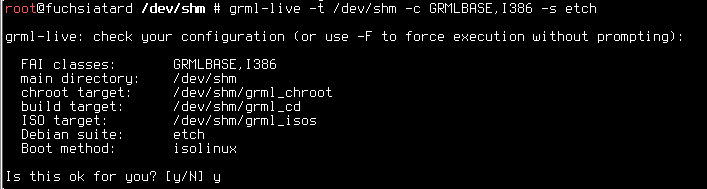
[Gnaaaaa, sorry Planet Debian for sending a german article to you a few hours ago. I just chose the wrong category for the article. I removed the tag already and the article disappeared from Planet Debian right now; so if you don’t know what I’m talking about just don’t care. ;-) To the german readers: it’s just the same article as my previous one, but this time in english. :-)] grml-live is a framework which lets you build a grml/Debian based Linux Live-CD with one single command. grml-live is based on FAI (Fully Automatic Installation) and uses its class based concept: Screenshot: grml-live In this example I built a full grml-ISO. All I did was setting the Debian-Mirror in /etc/grml/grml-live.conf to my local one (to save traffic and time) and invoking the following command:
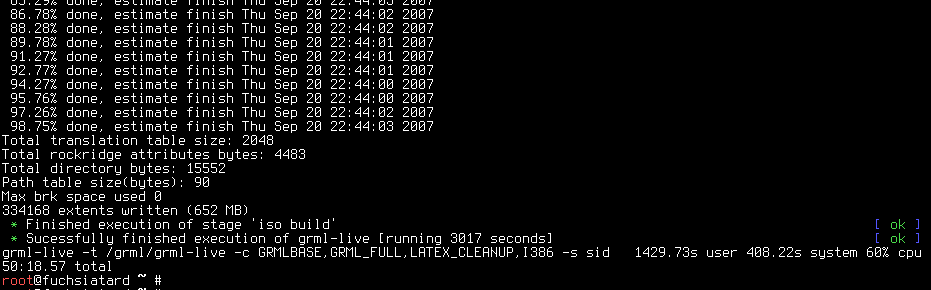
# grml-live -t /grml/grml-live -c GRMLBASE,GRML_FULL,LATEX_CLEANUP,I386 -s sid
About 50 minutes later I have a grml-ISO inside grml_isos at directory /grml/grml-live/ (-t …). It was built using the classes (-c …) GRMLBASE (all the core, essential stuff), GRML_FULL (software selection like official grml provides), LATEX_CLEANUP (clean up some very big LaTeX directories) and I386 (x86-specific packages like kernel). Debian unstable/sid was used as the suite (-s). And that’s it. You want a smaller grml-version using Debian/stable? No problem, let’s do it in shared memory (being very fast, and with enough RAM and mountoptions rw,suid,dev no problem at all): Screenshot grml-live: the beginning A ‘grml-live -t /dev/shm -c GRMLBASE,I386 -s etch’ and not even 5(!) minutes later I’ve my 135MB small grml: Screenshot grml-live: done So using grml-live you can build your own, customized Linux Live-CD without having to deal with remastering in detail. Via creating a new class (or just editing an existing one) its easy to include the software you would like to get. So, will the official grml-ISOs become obsolet? No, definitely not. The goal of grml-live is to give the grml-team a buildsystem providing exactly what we need. It should give us the possibility to concentrate on the important and interesting tasks, like: testing, bugfixing, implementing new features, working on the kernel, quality assurance, documentation,… grml-live should work on every Debian based system. If you want to give it a try just grab the Debian package from grml’s repository. The source is available (as usual) via mercurial. Find more details on the grml-live-webpage. If you have any further questions that aren’t answered by the docs yet, have feature requests, bugreports or patches: please let me know.

19 September 2007

MJ Ray: Media-sponsored Forums - How to Kill a Community

I was asked for a story on good or bad media sponsored online conversations. I'd not really had much to do with them until this summer. itv is the UK's biggest commercial broadcaster and it had rights to show the Tour de France here this year. Its coverage was pretty good, with daily highlights and live coverage at weekends, mostly on the itv4 satellite/DTT channel. The end of every show plugged their web homepage, which had a prominent link to their forums. I've been on a couple of cycling forums for a while, so I signed up and tried to help explain things that I knew. After a while, I noticed that when I answered a question properly, with links to other authoritative sites like the race teams' own sites, my message was silently removed. This happened a few times. Then I found out that the forum terms of use prohibit linking to any other web sites! This is a big problem, because itv's cycling pages are pretty limited. As a result, the forum was full of hearsay and it's hard to verify anything anyone posts. To cap it all, itv closed the forums for a weekend for an upgrade. Then a weekend became a week, which became a month, which became six weeks. When they finally reopened it, at least they sent me an email, so I tried to login. My login doesn't work and I can't view the forum as a guest any more. I've emailed their support address and had no reply. I don't know if this is a general problem - I can't contact other forum members because I don't have their details. I only saw them on the web forum and members couldn't link their homepages. So, it'll be a long time before I spend much time participating on any media-sponsored sites again, except in a casual throw-away way. Now most of my sports messages will be posted to Cycling Fans and BuzzinFootball like my local news posts go to the community-run WSM Forum. The trouble with media-sponsored forums is that they just don't have the interest in any particular community to want to sustain it. Somewhere, there's a bean-counter saying "so what if we kill this community? We started it from scratch and we'll just do it again." Any messages you post to those forums are usually gone, out of your control, lost to you. Is it worth posting to them? I think Andrew Savory is also spot-on about the problems with forums for technical communities in Bagel Belly Blog: How Open is your Open Source project? He certainly seems in fine form so far this week. I know not all forums are that bad. I'm on a couple of phpbb-powered ones which work well, with added XML feeds and so on. Are any "old media" companies brave enough to run a liberal phpbb? Are there other examples of particularly good or bad forums that you'd like to tell me about?

Russell Coker: Categories for Best and Most Popular Posts

I have just added two new categories to my blog, one is for the most popular posts [1] (as indicated by the number of hits on the permalink pages). The other is for the best posts [2]. My criteria for adding a post to the best-posts list is that it provides some information that is new or some analysis that others do not appear to have performed, that it doesn’t get refuted by someone else (sometimes an idea seems good but someone points out a flaw), and that there is some level of interest in it from readers (based on page hits, comments, and links from other blogs). Both of these categories may be added to posts some days or weeks after they are published. So adding the feeds for them to a syndication configuration might not be a good idea as they will always include posts that are old. I expect that a typical Planet configuration would never display posts from those feeds. I suggest that other people consider adding similar categories to their blogs. It will allow readers who quickly browse your blog to see the posts that you regard as your best content and other bloggers in the same space to see what gets the most hits (which is worth-while if you don’t consider blogging to be a zero sum game). I expect that someone will suggest that I only write posts that are eligible for the best-posts category. However this is one example of a post which I don’t consider to be eligible but which will still be useful to some people.

18 September 2007

Sven Mueller: Brane Dump The Thoughts of Matt Palmer

In “Documentation - the chicken and the egg” [1], Matt Palmer wrote about the problem that noone writes documentation because noone reads it and that noone reads documentation because the few documentation in existence usually isn’t very good. So he, like me hs the habit of searching for help on the net instead of in a projects documentation. However I disagree with him in the consequences a bit. Because I noticed that on several projects with good documentation (subversion is an example that immediately comes to my mind, but postfix isn’t too bad either), the internet search returns a reference to the docs more often than not. Of course, this means that the documentation needs to be searchable for those webcrawlers. So if you have the task to write documentation, I strongly suggest to make it searchable in some way. For company-internal projects, this obviously means that the documentation must be reachable via an internal search engine. In a project a few years back, we implemented an internal search engine which included company internal information (even with user based access rules so that each user only got those results he could actually access) as well as an external search engines results. It was closed source, but a pretty nice idea. It didn’t, however, index any locally (user’s desktop) stored documents, only what was on some company web page (but including .doc, .rtf, .pdf and the like which where retrievable via http). [1] http://www.hezmatt.org/~mpalmer/blog/general/documentation_the_chicken_and_the_egg.html

15 September 2007

Christian Perrier: RWC: South Africa-England

After Argentina-France on the first day, that one was planned to be one of the few big matches of first round. Of course, after the game won by South Africa (36-0), that seems pretty silly to say... The Springboks were definitely better than England, in all parts of the game. What stunned me, particularly after watching South Africa live , is their complete control on the game, which is a great improvement over their match against Samoa. South Africa scored three tries all of them great examples or organized attacks by the rear lines. Two tries for JP Pietersen, after 3 by Habana on first game: the South-African wing players rock. Despite this, the player of the game was definitely Jason Du Preez, the scrum half (hope this is the correct term in English) who organised all attacks from RSA. England was missing too many key players (several injured) to be able to be a menace for South Africa. They never were really dangerous, except maybe when the magic Jason Robinson has the ball in his hands (what a player!). I was particularly disappointed by their center back players, and even more particularly by Farrel. Ditto for Andy Gomarsall as scrum half. So, South Africa is now probably qualified with two quite easy games against USA and Tonga. England will have to fight to qualify and noone can tell if Samoa or Tonga can surprise them. Watching Samoa-Tonga on Sunday will be interesting and Samoa-England or Tonga-England are already key matches. A great rugby week-end is about to begin, again. Today, Wales-Australia is the match of the day, for sure, with wales playing home (some matches are not in France, but in Cardiff and Edinburgh). New Zealand-Portugal will be...interesting, though the only incertainty is the number of scored tries. And finally, Ireland-Georgia is of some interest for the French. Tomorrow, France could have hard times against Namibia. Of course, the challenge here is winning *and* scoring the bonus point. That match is 5 days before a key France-Ireland, so the challenge is also not wasting too much energy. Of course, tomorrow's top match for me is Samoa-Tonga while I whileprobably skip Fidji-Canada (too bad, I haven't seen those playing yet). BTW, if someone has a recording of the most intense match as of now (Japan-Fidji), I'd be delighted. Rugbystiquement v tre,

14 September 2007

Simon Richter: "Free" markets

Over in alt.anarchism rages a discussion on the "efficiency" of markets, mostly circling around the medical sector as an extreme example (lots of government interference). Since this is Usenet, we haven't found consensus on the definition of a free market yet. The definition I learned in school was that free markets are fully transparent, i.e. buyers and sellers both have the necessary knowledge to determine a product's quality and are aware of the other market participants. The proponents of anarcho-capitalism contend that a free market is one that is devoid of regulation. These definitions are pretty much opposites in highly specialised fields (such as medicine), as patients usually lack the expertise to recognise "quality", so market regulations are established to promote transparency and establish a free market. So, which definition were you taught? Update: corrected the name of the group.

Lucas Nussbaum: Idea: creating a Distributions Developers Forum ?

Scientific papers always have a “related works” section, where the authors describe how the work they are presenting compares with what others did. In the Free Software world, this is nearly non-existent: in a way, it seems that many of us are thinking of their projects as competing products, fighting for market share. On a project web page, I would love to read something like:
This project is particularly well suited if you want XX. But if YY is more important to you, you might want to have a look at ZZ.
Or simply links to similar projects for other environments, etc. All in all, I think that the goal is to improve the global satisfaction. Not to win a few users, who won’t be totally happy, because the project doesn’t really suit their needs. While some projects cooperate and share ideas, like I think desktop environments do inside freedesktop.org, most just ignore each other. I am both a Debian and an Ubuntu developer, and I’m sometimes amazed that Ubuntu discusses technical choices that were discussed (and solved) a few weeks earlier in Debian. And it’s even worse with the other big distros out there. Couldn’t we try to improve this ? We could just create a mailing list, where developers from various distributions could present the way they do things. This would allow to discuss future developments (”We are planning to improve this, what are you doing about that ?“) or simply to improve people’s knowledge of the various distributions. Of course, this could easily turn into flamefests, but they are technical ways to avoid that, like moderating posts from trollers… Does something like that already exist ? Do you think that it would be interesting ? Would you like to contribute to such a forum ? Some examples of things that could be discussed:

Cord Beermann: Analysis of subscribed Domains on Debian-Listserver.

From time to time we have the problem that a mail posted to a list triggers an autoresponse (vacation, bounce, tdma) from an unexpected source. Sometimes it isn't possible to identify the subscriber who is causing this. One example for this was 'petsupermarket'.

So i wrote a small tool, which takes Mailadresses as input and resolves the domains until it reaches IP-level, so it is possible to identify 'related' addresses to such an incident.

I now ran this tool for all 38656 domainparts mailadresses that are currently subscribed to some list at our listservers:

Unresolveable Domains                             :   443
Grounded Domains : 3
Domains with A : 1058
Domains with CNAME, A : 59
Domains with CNAME, CNAME, A : 3
Domains with MX, A : 36202
Domains with MX, CNAME, A : 1199
Domains with MX, CNAME, CNAME, A : 22
Domains with MX, CNAME, CNAME, CNAME, A : 5
Domains with MX, PTR : 36
Domains with unresolvable Hosts : 361


(You may have noticed that those lines doesn't sum up to 38656. It is possible to have more than one MX-Host, and it is also possible to have more than one IP in an A-Record. If one of those combinations falls into another category it is counted twice)

so we have 36528 domains that are completely configured correctly according to RfC 2821 with a MX-Record pointing to an A-Record, or without a MX-Record and an A-Record. These are 94.5% of all domains.

but we have 443 domains in our list, that didn't resolve at the moment i ran my script, those have to be investigated.

We also have 3 domains that are configured with 'IN MX 0 .' as decribed in this expired Draft, those also have to be investigated, and thrown out.

We have 1288 domains, which use CNAMEs (or CNAMEs pointing to CNAMEs) in their MX or directly on their domainname. RFC1034 says:

Domain names in RRs which point at another name should always point at the primary name and not the alias. This avoids extra indirections in accessing information.


then there are 36 domains which point their MX directly to an IP-Number. RFC 1035 says:

3.3.9. MX RDATA format

+--+--+--+--+--+--+--+--+--+--+--+--+--+--+--+--+
PREFERENCE
+--+--+--+--+--+--+--+--+--+--+--+--+--+--+--+--+
/ EXCHANGE /
/ /
+--+--+--+--+--+--+--+--+--+--+--+--+--+--+--+--+

where:

PREFERENCE A 16 bit integer which specifies the preference given to
this RR among others at the same owner. Lower values
are preferred.

EXCHANGE A <domain-name> which specifies a host willing to act as
a mail exchange for the owner name.

MX records cause type A additional section processing for the host
specified by EXCHANGE.


So according to that an MX has to point explicitely to a Full Qualified Domain Name, and it has to be an A-Record it points to.

However: Most MTAs (including ours) these days forgive this, and figure out the right thing.

At last: we have 361 Domains which MX and/or CNAME-Records point to Hostnames that are currently unresolvable. A quick check shows that often the problems only appear on one MX-Record, while another is correct, so the service is functional.

So maybe now it is a good idea and check your own DNS-Setup and the Mail-related Data.

13 September 2007

Lucas Nussbaum: Which distribution on Thinkpads: really the good question to ask?

After Dell, Lenovo decided to ask users which Linux distribution they should put on Thinkpads. Seriously, who cares? If I buy a laptop that comes with Linux pre-installed, my first step would be to reinstall it from scratch, exactly like with a laptop with Windows pre-installed. Because the choices that were made wouldn’t match mine (think of partitioning, etc). Or simply because I wouldn’t totally trust the hardware manufacturer. So, what would make me happier about a laptop? I couldn’t care less about which distribution comes preinstalled. If Lenovo wants to make me happy, there are two ways: It’s not _that_ hard: some manufacturers got it right, at least for some of their products. There are many manufacturers contributing code directly to the Linux kernel, for network drivers for example. But maybe this is just about marketing and communication, not about results? Because after all, Dell and Lenovo will look nice to the random user. While playing-by-the-rules manufacturers are hidden deep in the Linux changelog.

12 September 2007

Russell Coker: Some Good and Bad Ideas for Recruiting

Eweek has an interesting article about Microsoft’s latest bad hiring idea [1] (their previous one was hiring a model to try and give the idea that IT work is cool [2]). They have created a web site hey-genius.com to try and get people who consider themselves to be geniuses to work for them. One significant problem with this idea is that the amount of ego required to claim the title of genius is significantly greater than the amount of ego that makes it impossible for two people to work in the same office. Google’s methods of trying to attract candidates are much more sensible, for example setting mathematical and logical problems and inviting people who can solve them to apply for work. People who can solve maths and logic puzzles tend to be good programmers because essentially programming is about solving such puzzles while also relying on having memorised a huge number of facts and numbers. If you can solve the logic puzzles then you are probably half-way to becoming a decent programmer. The next problem is that the web site doesn’t work very well. In fact it works so badly that some people have suggested that the aim of the exercise is to make job offers to the people who give the best suggestions as to how to improve the web site. It gave a black window with Konqueror and with Firefox it didn’t appear to offer full functionality (and required a pop-up for no good reason too). But one useful thing about it is that it links to the Microsoft Jobs Blog [3] which is a really good recruiting idea. There are posts about various benefits that MS offers it’s employees, about visits by MS representatives to schools, and other things that will surely be of interest to people who like MS. I recommend that everyone who works in HR reads that blog and considers whether something similar would work for them (I think it would work for all large companies). Another interesting thing to note is that there are glamour photos of recruiting agents. I suggested in my previous post that they should “find some cute female MS employees and get them to do the promotion”, well it seems that MS was already doing similar things before I suggested it! One significant thing that they could do to improve their jobs blogging is to have a blog with job adverts with category based feeds for all the different categories. This would permit someone who is interested in XML work to get a feed of the XML jobs category and wait for something suitable to come up. I believe that every company that advertises more than two positions per year should have a RSS feed of the job adverts. It allows syndication feeds of adverts from multiple companies which job seekers can poll for positions that match their skills.

11 September 2007

Michael Prokop: git-server for the poor: git-update-server-info, rsync and remote repository

I was working on the integration of live-initramfs for grml in the last few days. As the Debian maintainers of live-initramfs switched from svn to git and I contributed several patches I had to deal with git as well. Thanks to my personal VCS hero gebi I learned some cute tricks for working with git. One very nice tip is the ‘git-server for the poor’, which is pretty simple to use and set up as soon as you know what to do. ;-) As there isn’t that much documentation regarding this issue on the net yet I’ll provide the necessary steps here: On the server side (where you are running a webserver) you just need a directory for serving via HTTP:
% mkdir -p /var/www/grml/git/live-initramfs.git
On the client side check out the original repository, create a branch, edit what you want to and finally put it on the server so upstream can grab it:
% git clone git://git.debian.org/git/users/daniel/live-initramfs.git
% cd live-initramfs
% git checkout -b cool_new_feature
Switched to a new branch "cool_new_feature"
% $EDITOR $FILE(S)_YOU_WANT_TO_CHANGE
% git commit -a
% git-update-server-info
% rsync -az .git/* server:/var/www/grml/git/live-initramfs.git/
Now upstream (or you) can work with the remote git repository in the local repository and can refer to it through a name:
% git remote add prokop http://grml.org/git/live-initramfs.git
% git remote update
Let’s checkout what we have on the remote repository available:
% git remote show prokop
* remote prokop
  URL: http://grml.org/git/live-initramfs.git
  Tracked remote branches
    cool_new_feature master
% git diff master..prokop/cool_new_feature
Finally do with it whatever you like, for example:
% git merge master prokop/cool_new_feature
... or ...
% git merge $COMMIT_ID
... or ...
% git co master
% git merge prokop/cool_new_feature
... or ...
% git checkout -b my_test_branch prokop/cool_new_feature
... or ...
% git-merge
... or ...
% git-cherry-pick
... or ...
This process might be very handy for working together with upstream (hi, panthera :-)) JFTR: I’m tracking useful ressources for working with git at my del.icio.us page.

Next.

Previous.