Search Results: "spa"

25 February 2011

Evgeni Golov: Desktop in a shell: mutt

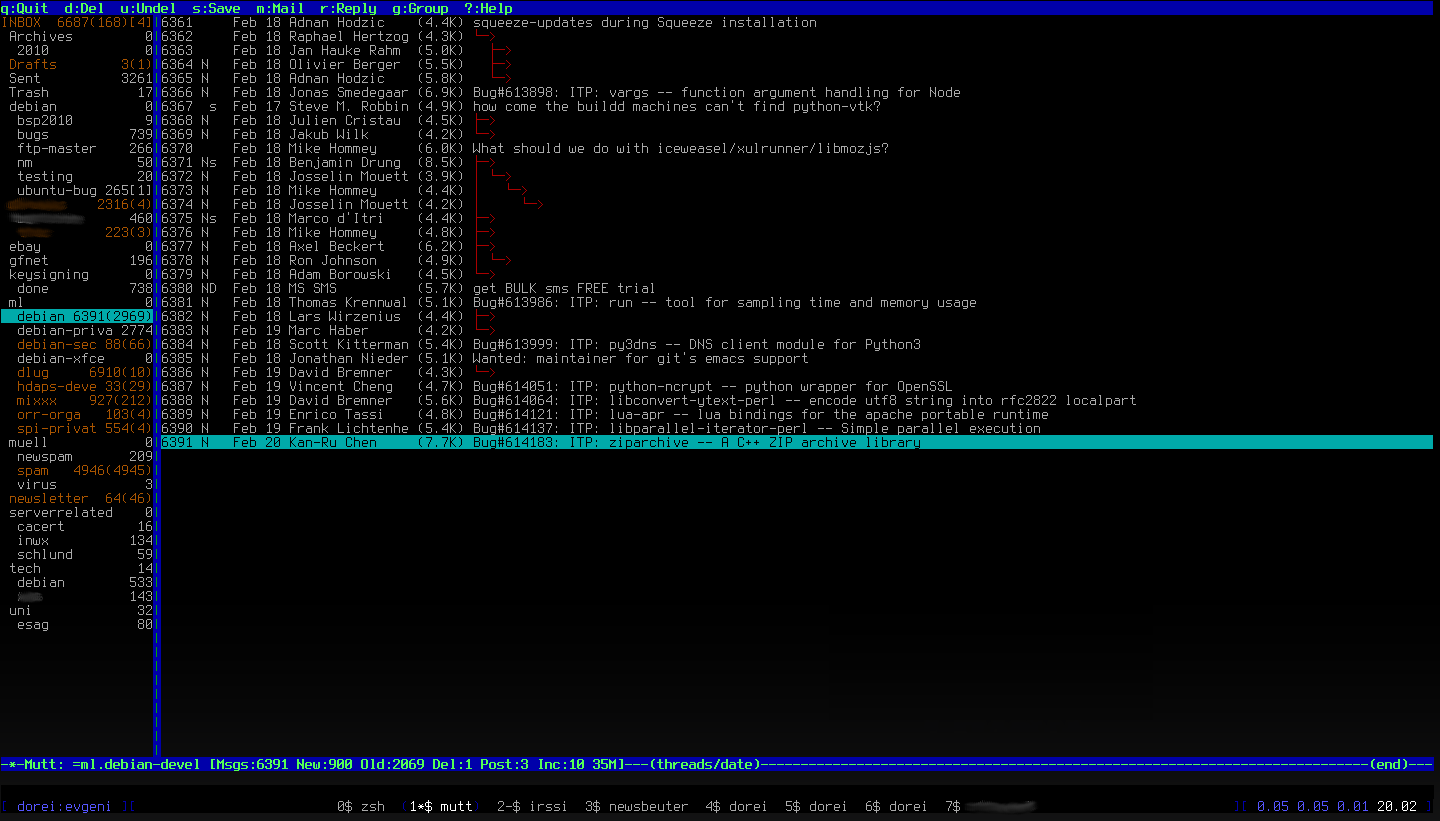
Continuing my series about a desktop in a shell, today I will present you my mutt setup. I use mutt because it has no bugs and is a really good MUA for people loving consoles ;)First of all you have to know, that all my mail is forwarded to my server and sorted into Maildirs via maildrop, so I do not care about sorting on my desktop , which just fetches the mail via IMAP from the server ;)I m running mutt-patched from Debian Squeeze, so not all options may be available for you if you do not have the same patchset as I do.First, tell mutt to fetch mail from imap.die-welt.net via IMAP:
set imap_user=username
set imap_pass=password
set folder="imaps://imap.die-welt.net/INBOX"
set spoolfile="imaps://imap.die-welt.net/INBOX"
Now, enable IMAP-IDLE, list subscribed folders, reconnect to the server if needed and mark mail as read when you open it:
set imap_idle
set imap_check_subscribed
unset imap_passive
unset imap_peek
Let mutt save sent mail to the Sent directory on the IMAP server, and postponed mail to Drafts:
set record=+Sent
set postponed=+Drafts
Read mail should stay where it is:
set mbox="!"
We use IMAP-IDLE, thus check for new mail manually only every 90 seconds:
set mail_check=90
Instead timeout after 15 seconds if no user input is given:
set timeout=15
Set default mail from address to my default mail address:
set from=evgeni@golov.de
And send mail via mstmp (see below for mstmp configuration):
set sendmail="/usr/bin/msmtp"
Tell mutt which addresses I recieve mail to (danger, ugly regex!):
alternates (evgeni@(debian.org golov.(de eu)) sargentd@(die-welt sargentd).net evgeni.golov@uni-duesseldorf.de)
As mutt knows where I receive mail, let it set From accordingly:
set reverse_name
Let mutt cache some stuff and find its certificates:
set header_cache="~/.mutt/cache/headers"
set message_cachedir="~/.mutt/cache/bodies"
set certificate_file=~/.mutt/certificates
set ssl_ca_certificates_file=/etc/ssl/certs/ca-certificates.crt
Show only interesting headers in an useful order:
ignore headers *
unignore headers from to subject date cc
hdr_order from to cc subject date
Fix stupid MUAs behaviour (e.g. filenames like =?iso-8859-1?Q?file=5F=E4=5F991116=2Ezip?=):
set rfc2047_parameters
Beep on new mail, will generate a ! in the window name in screen:
set beep_new
mutt-patched has the great sidebar patch, assign ctrl-n, ctrl-p to select next, prev folder, ctrl-o to open selected folder:
bind index \Cp sidebar-prev
bind index \Cn sidebar-next
bind index \Co sidebar-open
And toggle sidebar visibility with ctrl-b:
macro index \Cb '<enter-command>toggle sidebar_visible<enter><refresh>'
macro pager \Cb '<enter-command>toggle sidebar_visible<enter><redraw-screen>'
Since 1.5.20-2, mutt patched contains my sidebar-dotted and sidebar-sorted patches.
Let mutt shorten the displayed path (e.g. debian-devel instead of INBOX.ml.debian-devel) and sort the folders (the are returned in random order when using imap_check_subscribed):
set sidebar_shortpath
set sidebar_sort
Now let s set some colors (that match the rest of my desktop ):
color sidebar_new yellow default
color normal white default
color hdrdefault brightcyan default
color signature green default
color attachment brightyellow default
color quoted green default
color quoted1 white default
color tilde blue default
And add some useful macros for marking new and old messages as read:
macro index .n "<tag-pattern>~N<enter><tag-prefix><clear-flag>N<clear-flag>*" "Catchup all new messages"
macro index .o "<tag-pattern>~O<enter><tag-prefix><clear-flag>O<clear-flag>*" "Catchup all old messages"
When forwarding mail, I like it to be forwarded as an attachment (YMMV):
set mime_forward=yes
I m using goobook in mutt to fetch my addressbook from Google. As there is no Debian package for goobook (yet), you have to install it yourself (via easy_install):
apt-get install python-argparse python-gdata python-simplejson python-keyring python-nose
easy_install goobook
Configuration is easy via ~/.goobookrc:
[DEFAULT]
# If not given here, email and password is taken from .netrc using
# machine google.com
email: me@gmail.com
password: password
And then add the following to your .muttrc:
set query_command="goobook query '%s'"
bind editor  complete-query
macro index,pager a "<pipe-message>goobook add<return>" "add the sender address to Google contacts"
That s all for mutt, but We are running mutt in a screen, so let s add the following to .screenrc to fix transparency and cut&paste (see http://wiki.mutt.org/?MuttFaq/Appearance):
 defbce on
 term screen-bce
And as mutt uses mstmp (yes, I know, mutt can handle SMTP itself ), this is my .msmtprc:
defaults
domain dorei.kerker.die-welt.net
tls on
account die-welt.net
host smtp.die-welt.net
from sargentd@die-welt.net
auth on
user username
password password
tls_starttls on
tls_certcheck off
# Set a default account
account default : die-welt.net
C est tout! That is my personal mutt configuration, you can download it as one file here: my .muttrc. And as everyone loves screenshots, here is one:the default view of my muttOh, the next chapter will be about irssi, but not before next Sunday (March 6th) as I ll be offline for a week, skiing in Austria :)

24 February 2011

Pau Garcia i Quiles: Applied for Debian Maintainer, FLOSS workflow works

I have been packaging for Debian for a few years now. My first serious package was Wt back in 2007, but I had been backporting for Ubuntu for at least 2 years already, which means I have been doing .deb packaging for about 5 years (!). Last week I decided it was about time stop nagging my sponsors (Vincent Bernat, Thomas Girard and Sune Vuorela) every time I wanted to update the packages I maintain (witty, ace and libmsn), and I finally started the Debian New Maintainer process. The main reason I had not applied for Debian Maintainer yet was it requires some bureaucracy and, well, I d rather spend my time coding or packaging than doing paperwork :-) I sent my Declaration of Intent and soon after, Thomas and Vincent replied and supported my application with very very nice and kind words. Thank you, guys! I m flattered! :roll: Had I known I would be buttered up so much, I would have certainly applied a long time ago! :-D But you know what is the best part of this? It shows how open source projects take advantage of all the tools and communications channels we have (IRC, mailing lists, sprints, conferences, etc), and make distributed development work very well: here we have a 900-developers project in which two French guys are praising an Spanish guy they have never, ever met face-to-face (only e-mail, occasional IRC, and the most important of all: code review). Meritocracy at its full extent. Have you ever seen that in a traditional 100,000 workers company with hundreds of developers working in a single project?

23 February 2011

Gunnar Wolf: Finally presented that long-overdue exam!

Finally presented that long-overdue exam!
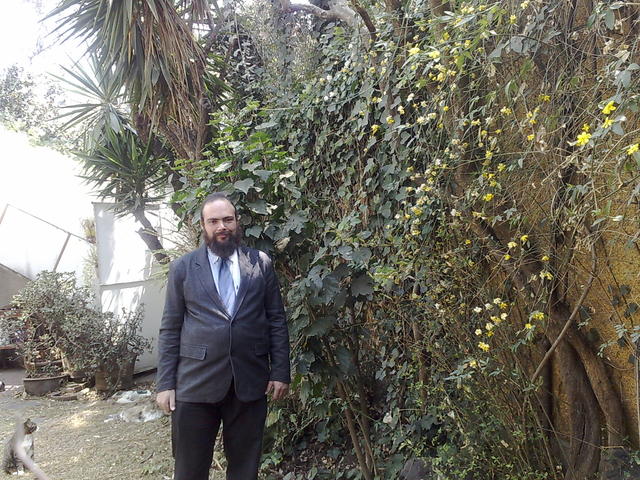
What Yes, I have not used this kind of outfit for over 20 years. And I hope it will be 20 more years before I do it again. But today, I was seen like this in public. Why? Well, I won't explain the whole background yet again I did it a bit over a month ago in this same space. Much much in short, I never attended university, so after many years of working without any formal validation for my knowledge I followed the CENEVAL Acuerdo 286 procedure to get a "Software Engineering" title and the corresponding c dula profesional. Today I did the last portion of this procedure: Presenting an oral exam, defending the work I developed. Not precisely a thesis, but you can see it as an equivalent. One of the requisites was to go on formal attire Of course, I have some beautiful shirts I am very fond of, but I didn't want to risk it to such a detail, so I asked my friend and almost-neighbour Miguel Barajas to lend me the needed bits of clothing, and presented the exam. Was it easy? No, not by a long shot. Did I pass? Yes! Now, back to work!

Pietro Abate: More on Xen 4.0 setup on squeeze

After the upgrade of last week, I didn't have any major problems : xen 4 seems pretty stable and does its job well. One problem I encountered the other day was about the dom0 balloning. By default, xen sets dom0_min_mem to 196Mb and balloning set to true. This is all and good untill you try to use too much memory for your VMs, squeezing dom0 to its minimum amount of memory and causing all sort of problems. On the xen wiki, they reccomend as best practice to reserve a minimum of 512Mb to dom0 for its operations. This is done but setting dom0_mem=512M on the grub command line and the adjusting enable-dom0-ballooning to no and dom0-min-mem accordingly to the amount of memory you choose. On debian, you can set the grub command line once for all just by adding in /etc/default/group the conf variable
GRUB_CMDLINE_XEN="dom0_mem=512M"
Another small problem is related to the reboot sequence. Since I'm using lvm on aoe, the default shutdown sequence (network down first, lvm later) is not going to work for me. As I've few lvm volumes on aoe and others on the physical disk, the proper solution to this problem is to write a custom shutdown script for the aoe lvm volumes and make it run before deconfiguring the network interfaces. In the mean time, to avoid the kernel hanging there forever, I've added these lines to in /etc/syscntl.d/panic.conf
# Reboot 5 seconds after panic
kernel.panic = 5

# Panic if a hung task was found
kernel.hung_task_panic = 1

# Setup timeout for hung task to 300 seconds
kernel.hung_task_timeout_secs = 120
This will instruct the kernel to panic and then reboot if there a task will not respond for more then 120 seconds.

Neil Williams: cross-building, multiarch and binutils

At the Emdebian ARM sprint, cross-building experiments on a Multi-Arch base are going fairly well. It is looking like the hacks in dpkg-cross may finally be avoidable, possibly before Wheezy gets released. Elsewhere, debhelper has been updated to allow dh_strip and other tools to work directly with the binutils package from the cross-building toolchain and not to need binutils-multiarch any more. dpkg-cross has been updated to only Suggest binutils-multiarch, which makes room for more architectures to be covered by binutils-multiarch (which, therefore, will be getting quite a lot bigger quite soon).

Cross-building in Debian is therefore entering a period of transition and the old ways of dpkg-cross - and the tools it has spawned like apt-cross, xapt, pdebuild-cross and others - will be gradually side-lined and finally rendered obsolete. Like all transitions, there will be breakage, there will be pain, there will be things which don't cross-build now and which have no prospect of being fixed until the transition is deeply entrenched. There are packages which used to cross-build and which will stop cross-building and, again, won't be fixable for months. Sadly, Squeeze released with cross-building breakage too, due to changes within apt during the release freeze. A Lenny chroot is possibly the best place to do cross-building for now.

This is a major transition. It WILL break things. Badly and often.
What's more, just because we decide to implement stuff using one method now does not mean that the same method will even exist in a month or two.

In other words, if you've got a working cross-build chroot or installation currently and you absolutely need it to continue working leave it alone.

Don't go changing real packages to use the changes we're trying out!

If you enjoy fixing stuff, don't mind pain and fancy risking your system as I've been doing (unlinking /etc/, deleting /lib64 on amd64 or forcing package installation such that no shared libraries are accessible any longer) then you are:
  1. insane
  2. welcome to join the work

Check out the current state of things via the #emdebian channel on oftc.net and the very risky Emdebian multiarch SVN experiments along with the even more risky Emdebian Multiarch Mirror, courtesy of Steve McIntyre and Phil Hands.

The README in SVN is very clear - DON'T INSTALL THESE OUTSIDE A CHROOT and even if you do, don't come crying to me when it breaks your entire system (even when used inside a chroot).

No warranty, no guarantees, no promises, none of this is fit for any purpose whatsoever and we'll say when we finally have something which might actually be useful.

22 February 2011

Ross Burton: Contributions to libsocialweb

Thanks to those nice people at Novell and Collabora, libsocialweb now supports Facebook, Flickr, Last.fm, Plurk, Sina, SmugMug, Twitter, Vimeo and YouTube. As if that isn't enough, there are patches queued to bring back MySpace. Thanks Novell and Collabora!

Michal &#268;iha&#345;: phpMyAdmin translation status

Another week is over and it's time to look again at state of translations for phpMyAdmin 3.4. Compared to last week, there one new translation at 100% this week, thanks to Dutch translators. We now have nine translations at 100%: There are three which were close last week, but are still not at 100%: Was your language not listed? You can help it being better!

Filed under: English Phpmyadmin 0 comments Flattr this!

21 February 2011

Stefano Zacchiroli: Squeeze, Debian, and the FSF

Short version: Dear FSF, thanks for your appreciation of Debian Squeeze achievements in getting rid of non-free firmware blobs. We still disagree on the overall freeness assessment of Debian, but I'm positive that steps like this one can further future collaboration, in the interest of both projects. Long version follows.
Historically, the relationships among Debian and the FSF have gone through mixed fortune (and that's quite an euphemism). On the one hand, Debian is committed to 100% Free Software, is an open project explicitly inspired by "the spirit of GNU", has been sponsored by FSF in its infancy, and properly calls itself "GNU/Linux" (or even "GNU/kFreeBSD"). On the other hand, Debian is the project who considers the GNU FDL license to be only conditionally free and which is not considered to be an entirely Free system according to FSF.
So much for the history corner. As a long time member of the Debian Project, as well as an FSF(E) fellow, I've always felt a bit sad about this state of affairs. Not because the two projects should have aligned goals; they clearly focus on different aspects of the quest for a Free (Software) world. Not even because they should agree on how to build a Free distribution: history has shown that FSF technical positions do not always get along with Debian's more "pragmatic" style, as embodied by point 5 of the Social Contract. Rather, my sadness is rooted in the belief that not getting along have encouraged duplication of efforts which could have been easily avoided (e.g. multiple distributions concurrently freeing up kernels). Furthermore, I'm more and more convinced that Debian nowadays enjoys a rather privileged position among Free Software vendors. Indeed, even though GNU/Linux distributions have reached a popularity we didn't dare to imagine 15 years ago or so, most distributions are under the direct or indirect control of commercial vendors. Those commercial vendors play a very important role in the promotion of Free Software. For instance, they are structured in ways that enable them to seal OEM deals with hardware manufacturers to sell computers with GNU/Linux pre-installed. Commercial vendors, by their own nature, are also in general better at marketing than non-commercial vendors. On the flip side however, commercial vendors are not yet relevant enough to drive proprietary drivers out of the market and, as a consequence, cannot yet afford not to support hardware which need such proprietary bits to work. Among mainstream GNU/Linux distributions[1] Debian is one of the very few vendors if not the only one that is both very relevant and, thanks to its independence, can afford taking Free Software's side: no commercial urgency can force Debian to negotiate on that. That is quite an asset to be used in the promotion of Free Software, especially to a public that is interested in and willing to understand what Free Software really is about. Such an "aware" public is on the rise as of lately, together with the general awareness increase of risks entailed by living a digital life, when that life is not under our control (think, as an example, at how often the "Facebook privacy debate" has hit mainstream medias in the last year). The "aware" public is the natural target of both Debian and the FSF. Dividing it would not serve well the cause of Free Software. With all that in mind, last August I took the chance of being on the "right" side of the Atlantic Ocean for DebConf10, to discuss possible venues of collaboration among Debian and the FSF. I sat down and discussed at length with John Sullivan, who I happen to know for his Debian involvement, in his capacities of FSF representative and operations manager. We discussed various topics, with the intention of bringing them up to the respective communities[2]. Then, inevitably, we ended up talking about the overall freeness of Debian and his exclusion from FSF listing of Free systems. (FSF is of course entitled to such judgements, pretty much as Debian is entitled to its own judgements on FSF licenses. Nevertheless those judgements contribute to dividing our public and might lead to wasteful duplication of efforts, where Free Software could better be served by collaboration.) The main ground for exclusion from that list used to be the compromises Debian has made in the past about non-free firmware blobs. But, as I pointed out back in August, those compromises would have been gone starting with Squeeze, making that argument moot. Today 6 months later I'm delighted to cheer at FSF's decision to publicly recognize the achievements Debian has delivered with Squeeze.
Thanks! It's a nice gesture that I've very much appreciated. I'm confident steps like this one will help future collaboration if, on both sides, we will be able to spot actual venues for collaboration. Needlessly to say, I still disagree with the overall FSF assessment of Debian non-freeness. Apparently, it still stands on the basis that Debian also provides a repository of nonfree software [ ] [which] is not part of the Debian system. [ ] but users would be hard-pressed to make a distinction and that people can readily learn about software available through it by browsing Debian's online package database. I respect the principle of non advertising non-free software and I even agree that it is a good principle. But unfortunately it's also a very blurry principle on which, in my opinion, Debian actually scores very well. No non-free software is offered to users by Debian; it's just for users that really want to have non-free software (or need to, in order to run a Free OS on their computers), that Debian tries to stay out of their way. For the "aware" public discussed above, I think it's much better to draw the line where software freedom ends and use that line to explain what does crossing it entails, than locking them up pretending non-free software do not exist. But fair enough: for the time being, I guess, we will need to agree to disagree on this one. Getting a little bit closer in the occasion of the Squeeze release is still an important step forward. It's up to each of us now to seek out initiatives which attract the interest of both projects and that can benefit from synergies.
[1] Sorry, I've no decent definition of "mainstream distribution" to offer, besides folklore and well-established distribution review sites. (Heck, I don't even have a decent definition of "well-established distribution review site" to offer!).
[2] which hasn't happened yet, due to the proverbial amount of available spare time.

Sean Finney: Recent debian updates

Packaging updates Help wanted: cacti I've also filed an RFA bug for cacti (and spine), as i'm not really using cacti any more in my day to day work. The packages are in pretty good shape, but it would really be for the best if someone who actually used cacti were able to more thoroughly test new versions before they were uploaded. I'm also open to co-maintaining the package and/or sponsoring uploads; so if you're already using cacti and looking to get involved in debian development, this could be a fun place to start :) Debian patch tracker Finally got around to fixing a couple post-release (and older) issues in the patch-tracker. Hopefully it should be back to updating and following the latest stuff in the archive. Next up I'll see if I can find someone from DSA to upgrade the hosting machine to squeeze and install a few extra dependencies for the next feature update, which contains a pretty substantial rewrite of the guts from some home-rolled wsgi+cheetah goo to a more established and maintainable django-based system. In the meantime, please let me know if you see any problems (via maintenance cat or otherwise), and I will take a look.

Cyril Brulebois: Debian XSF News #6

Enough news to release another Debian XSF News issue, after less than a week. Enough writing for now, I m getting new mails in xorg-announce@.

20 February 2011

Joey Hess: the fate of the orphans

(Non-Debian readers can stop reading now, I'm talking about so-called "orphaned packages" and not anything of real-world importance.) In 2008 I stopped maintaining non-native packages in Debian. At the time I maintained a fair amount of stuff. It's interesting to see what happened to it after I gave it up, partly because some of the results seem so random and partly because some of what has happened seems to point at weaknesses in Debian. First, the success stories. More than half of my packages are now being maintained by others: xaos, longrun, fbreader, liblinebreak, analog, xgalaga, znc, sysnews, metastore, bsdgames, uqm, oneko, kobodeluxe, archivemail, unclutter I still use much of this stuff, some only occasionally, and other daily, and am glad it's being kept alive. (It's surprising that someone still care about longrun.) I was unhappy to have to NMU procmeter3 just before the release of Debian 6.0 to fix a trivial to debug RC bug that almost got it removed from the release. I hope that was just a bump in its road. Also, splitvt is now maintained again after being orphaned a long time. I'm not sure if it makes sense to keep it in Debian, since screen can do the same thing, and it has a security history, but someone wants to, so that's fine. Two packages are left on life support. I'm surprised nobody wants to maintain grepmail, unless we're all using notmuch or mairix now? And dgen is the best Sega emulator I know of. Several games were not picked up by the games team, despite them showing some interest originally, and were removed: xtris, xjewel, xemeraldia, xbl Of those, xemeraldia in particular is a lot of fun, I'm surprised nobody cared to keep it. Also, the nestra Nintendo emulator was shipped with squeeze, but now is removed as it never got a maintainer. I don't know if there is a better NES emulator in Debian. The intercal programming language was removed. Surprising. Debian does at least still have clc-intercal for all our pressing Intercal needs. Finally, sparkline-php was removed today despite never having had any bugs, needing no maintenance, and being a suggests of ikiwiki, which is now more buggy (broken relationships, outdated docs) and less featureful in Debian.

Christoph Egger: CSSH but without X

There are many ways to run some commands simultaneously on multiple hosts like cssh or dsh. They come handy for example when you are installing software updates on a set of hosts. dsh is a rather simple comandline tool allowing to execute a command over ssh on multiple hosts. However it doesn't allow any interactive input -- so you can't look at the potentially upgrading packages and press y to accept and you can't go through debconf promts or similar. This is solved by cssh which opens a XTerm for every host and a input area that is broadcastet to all of them. this is working really well -- you can execute your update on all hosts and still do individual adjustments just as needed: switch focus from the broadcasted input to one of the terminal windows and anything you type just goes there. Now cssh has a big disadvantage: it requires a running X server (and doesn't do too well with a fullscreen windowmanager). Requiring X is quite a blocker if you need to run that ssh multiplexer on a remote host, for example if the firewalling doesn't allow direct connections. Fortunately you can make tmux behave as we want -- in a simple terminal: First you need a script spawning the ssh sessions in separate tmux panes and direct input to all of them -- here called ssh-everywhere.sh (you could also write a tmux config I guess):
#/bin/sh
# ssh-everywhere.sh
for i in $HOSTS
do
  tmux splitw "ssh $i"
  tmux select-layout tiled
done
tmux set-window-option synchronize-panes on
Now start the whole thing:
tmux new 'exec sh ssh-everywhere.sh'
And be done. Update If you want to type in just one pane (on one host) you can do that as well: C-b : set-window-option synchronize-panes off and moving to the right pane (C-b + Arrow keys)

David Paleino: Getting network devices with Python and udev - 2

Thank you Ben for your kind reply :) In my first post, I was trying to distinguish Ethernet-like device types. Here's the final code:
#!/usr/bin/python
import gudev
client = gudev.Client(['rfkill', 'net'])
for dev in client.query_by_subsystem('net'):
    if dev.get_sysfs_attr_as_int("type") != 1:
        continue
    driver = dev.get_driver()
    if not driver:
        parent = dev.get_parent()
        if parent:
            driver = parent.get_driver()
    # available: wlan, wwan, wimax
    if dev.get_devtype() == 'wlan':
        type = 'Wireless'
    else:
        type = 'Wired'
    print type, dev.get_name(), driver, dev.get_sysfs_path()
However, I have a few remarks. First, I don't understand why ethernet devices don't have a "devtype" attribute. How can I be sure that, failing to be "wlan", "wwan" or "wimax", it's a wired one? (not that any other kind of device comes to my mind, heh). Second, I had to look through Linux sources to find the possible values for DEVTYPE; in particular, I grepped for device_type structs inside ./drivers/net/. And the documentation you pointed me to, while being useful for other reasons (the rfkill support), didn't solve my doubts about the sysfs hierarchy. Rather, your comment about DEVTYPE helped quite a lot in this particular problem. Thank you! :)

19 February 2011

Dirk Eddelbuettel: RcppArmadillo 0.2.13

Yesterday Conrad Sanderson released version 1.1.4 of his Armadillo templated C++ library for linear algebra, so hot on the heels our 0.2.12 release from a few days ago comes version 0.2.13 of RcppArmadillo, our Rcpp-based integration into R. This new version 0.2.13 is now on CRAN and its mirrors. The short NEWS file extract follows, also containing Conrad's entry for 1.1.4:

0.2.13  2011-02-18
    o   Upgraded to Armadillo Version 1.1.4   "Manta Lodge"
         * Faster sort()
         * Updated installation to detect recent versions of Intel's MKL
         * Added interpretation of arbitrary "flat" subcubes as matrices
And courtesy of CRANberries, here is the diff to the previous release 0.2.12:
Diff between RcppArmadillo versions 0.2.12 dated 2011-02-16 and 0.2.13 dated 2011-02-19
 ChangeLog                                                    6 
 DESCRIPTION                                                 14 
 inst/NEWS                                                    8 
 inst/doc/RcppArmadillo-unitTests.pdf                     binary
 inst/doc/unitTests-results/RcppArmadillo-unitTests.html      6 
 inst/doc/unitTests-results/RcppArmadillo-unitTests.txt      36 
 inst/include/armadillo_bits/Col_meat.hpp                    64 +
 inst/include/armadillo_bits/Col_proto.hpp                    3 
 inst/include/armadillo_bits/Cube_meat.hpp                  124 ++
 inst/include/armadillo_bits/Cube_proto.hpp                   7 
 inst/include/armadillo_bits/Mat_meat.hpp                   696 +++++++++++---
 inst/include/armadillo_bits/Mat_proto.hpp                   36 
 inst/include/armadillo_bits/Row_meat.hpp                    62 +
 inst/include/armadillo_bits/Row_proto.hpp                    3 
 inst/include/armadillo_bits/arma_version.hpp                 4 
 inst/include/armadillo_bits/arrayops_meat.hpp               76 -
 inst/include/armadillo_bits/debug.hpp                      254 ++++-
 inst/include/armadillo_bits/field_meat.hpp                  44 
 inst/include/armadillo_bits/field_proto.hpp                  2 
 inst/include/armadillo_bits/fn_accu.hpp                     15 
 inst/include/armadillo_bits/fn_prod.hpp                     10 
 inst/include/armadillo_bits/forward_proto.hpp                8 
 inst/include/armadillo_bits/injector_meat.hpp               70 +
 inst/include/armadillo_bits/injector_proto.hpp               4 
 inst/include/armadillo_bits/op_sort_meat.hpp               242 ++---
 inst/include/armadillo_bits/op_sort_proto.hpp               15 
 inst/include/armadillo_bits/span.hpp                        72 +
 inst/include/armadillo_bits/subview_cube_meat.hpp          759 +++++++++++++---
 inst/include/armadillo_bits/subview_cube_proto.hpp          19 
 inst/include/armadillo_bits/subview_field_meat.hpp          83 +
 inst/include/armadillo_bits/subview_field_proto.hpp         11 
 inst/include/armadillo_bits/subview_meat.hpp               118 +-
 inst/include/armadillo_bits/subview_proto.hpp               21 
 33 files changed, 2113 insertions(+), 779 deletions(-)
More information is on the RcppArmadillo page. Questions, comments etc should go to the rcpp-devel mailing list off the R-Forge page.

18 February 2011

Steve Kemp: Why I lose interest in some projects.

Some projects have historically sucked; they've been incomplete, they've been hard to use, they've had poor documentation, or they've had regular security issues. Over time projects that started off a little poorly can, and often do, improve. But their reputation is usually a long time in improving. For me? Personally? PHPMyAdmin is a security nightmare. So while it is nice to read about it gaining the ability to be themed, and even receiving submissiosn from users (a rare thing for projects to receive such external contributions) I just find it hard to care. I see PHPMyAdmin written in a blog, in a news article, or on a users machine and I just think : Harsh. Unfair. Possibly no longer true. But I do tend to stick to such judgements, and I'm sure I'm not alone. Ideally people wouldn't be dogmatic, would be open-minded about re-evaluation situations. In practise I'm probably not such a unique little snowflake, and there are probably a great many people to this day who maintain views which that are based on historical situations than the current-day reality: Anyway. PHPMyAdmin? I'm sorry for singling you out, even with your fancy themes, language translations, and other modern updates. It's just a name that conjours deamons for me. Though I'm sure there are a great number of people who love it to pieces. ObQuote: "You don't want to know my name. I don't want to know your name. " - Spartacus

Russell Coker: Sony Ericsson Xperia X10i First Experience

I have just got a new Xperia X10i for my wife. It s with Virgin who use the Optus network. Optus apparently have better coverage than Three (who we have been using for 6.5 years) and Virgin offers the best deals they have good phones on low monthly rates and do nice things like selling most phones unlocked (the Xperia is one that comes unlocked).I chose the phone for use in system administration work. A large screen should be good for reading email and running a ssh client. Hopefully I will be able to use the phone s Wifi to provide mobile net access to a laptop for any problem that can t be solved on a tiny screen. My wife doesn t do much sysadmin work nowadays, but it ll save some effort if we can both use the same model of phone. Also according to Amobil.no the Xperia X10 is the second best phone for camera-phone functionality [1], and my wife would really like to take some good pictures with her phone (she loves the LG U990 Viewty that she has right now).ScreenOne major reason for choosing this phone is that it has the biggest and highest resolution of any phone that doesn t cost a huge amount of money. It does well in this regard, the screen is very good to look at. However it is apparently not particularly sensitive and we still have the protective cover on the screen which makes the swipe to unlock operation quite difficult. My wife generally likes to keep the protective plastic on such screens for a while to prevent damage, but she may take this off sooner than on other devices.Sony FoolishnessOne reason that this phone is cheaper than any other phone with similar specs is that it s made by Sony. Sony won t provide updates to Android 2.2 or better and they have their own stupid applications installed in an intrusive manner. The main screen of the phone has a large icon for the Sony Timescape program. If you choose a background image of a person s face then the Timescape logo is in the ideal location to obscure the person s eyes. Generally it s not desired to have the person in your phone background look like Zorro. Fortunately you can delete icons from the home screen, you just have to press and hold the icon until a trash-can appears at the bottom of the screen and then drag it to the trash.Phone BookThe core phone functionality is fairly important for a mobile phone. But it seems that every modern phone has some serious failings in this regard. The Xperia comes with a phone book that is reasonably good for managing contacts and partially coalesces multiple entries with the same name which is convenient as I somehow managed to import 3 copies of each entry in my wife s phone book. The down-side is that the multiple entries are still stored, so when it comes time to update someone s phone number my wife will have to separate the entries and then delete all but one of them, adding probably a minute of effort for each one. With 60 phone book entries that s probably an hour of wasted time during the course of her phone use.They really should do a time based analysis of phone use and optimise the UI for efficiently performing common tasks. I think that an ideal design would start off by asking the user to rate the importance of phone functionality, camera, facebook, twitter, etc and then give a UI that matches the important tasks. A device that has 384M of RAM, 1G of built-in Flash storage, and an 8G micro-SD card (which Virgin provided with the phone) should be able to offer a selection of UIs.CameraThe configuration for the camera allows some settings to be changed easily and others have to be changed through the advanced settings which requires one more button press and a few extra taps on the screen. One real stupidity is to have the phone light be in the advanced settings, so if the room happens to be a little darker than expected you suddenly need to go to a lot of extra effort to turn on the light.Finally it would be really good to be able to take a quick picture. I would like to be able to be able to press a combination of buttons and have it immediately take a picture regardless of what had been running before. Not press the main menu button, the camera icon (which I made a link from the home screen), wait a second for it to load, and then press the shutter button. Ideally I would like to press a combination of hardware buttons to have it immediately take a picture even when the screen is locked. I don t want to wait for the screen unlock process, sometimes the perfect shot is only available for a second.WifiIt doesn t support ad-hoc networks. This is really annoying for me as I don t own an access point and I don t plan to buy one just for a phone. My laptop (Thinkpad T61 with Intel Corporation PRO/Wireless 3945ABG [Golan]) doesn t seem to support running as an access point, and my EeePC 701 with an Atheros AR5001 has the same problem, here is the error message:# iwconfig wlan0 mode master essid x
Error for wireless request Set Mode (8B06) :
SET failed on device wlan0 ; Invalid argument.I have a cheap Realtec USB Wifi device that claims to support being an access point but just fails when I try it. So presumably it doesn t really support it but the driver is buggy.It seems that I may need to put a custom Android installation on it to get ad-hoc working.Also it s apparently necessary to root the Xperia to get Wifi tethering to work for providing net access to a laptop. So I guess I ll hacking it soon.Internet AccessThe Virgin web site couldn t help me set up the Internet access because I ported a phone number from another Telco. I had to use the phone number supplied by Virgin to login to their web site and the site then wanted to sent (probably SMS) the settings to my phone, but of course it couldn t SMS to that number as I ve got the Three number active. Presumably they were expecting that customers would setup Internet access before porting their old number.I phoned the Virgin tech support and used the settings they suggested, but it didn t work. Then I took the phone to a Virgin store and it started working after they rebooted it with no changes to settings. Just like Windows used to be. :(Email Access Default AppThe email setup defaults to port 143 IMAP access, so even when a mail server provides access on port 993 for IMAPS and on port 995 for POP3S probably most users will not use any encryption because their phone doesn t default to it. Also one annoying feature is that when I gave it the email address test@coker.com.au it decided to use test as the user-name for IMAP by default. It seems that a very large portion of the active email accounts nowadays are on systems that handle multiple domains and thus require the domain name in authentication, and a large portion of the remainder accept domain names even when they aren t required. Besides it s a lot easier to delete a domain name when it s not needed than to type it in when it is.The default hostname for sending and receiving mail is the domain name, if the MUA configuration program had checked the MX record it would have known that smtp.sws.net.au is a better default choice for the mail server. I ve now started the practice of creating a CNAME entry named m in every domain I run, so when someone is setting up a mobile phone they just have to add m. to the start of the default hostname to use for sending and receiving mail. By doing this I can probably save an average user at least 30 seconds of typing, which is particularly important if I happen to be talking them through the process!The MUA uses IMAP commands to load the text of the message without attachments and then loads attachments on demand, this will be handy for when people attach unreasonably large files. With IMAP caching and partial loads the core functionality seems OK, and some quick tests of standard but not commonly used IMAP functions such as noticing that mail has been deleted by another client seemed to work well. The performance of loading a new mailbox with 369 message was quite poor, I m not sure how much of this is due to the network connection and how much is due to the client implementation. This is a real concern for me as I typically have about 7,000 messages in my IMAP account and 3,000 unread messages most of which are in two folders.Another problem is the fact that there seems to be no way of searching in the list of messages, sorting/grouping by subject or sender, or showing unread messages. This makes the Xperia unsuitable for the task of reading mailing lists when on public transport. I would really like to be able to sort through a folder of mailing-list mail, delete messages that I don t need to keep and flag ones that need attention when I have the resources of a desktop system when I m on a tram or in other situations where a laptop can be inconvenient.One undeniable bug I discovered (as opposed to the missing features I listed) is that when a message has a line with a URL followed by many spaces it won t load correctly in the web browser, the spaces will be treated as part of the URL. I ve changed the default signature in my email to have a description followed by a URL to avoid triggering this bug. Presumably other Android phones are bug for bug compatible. :(Moxier MailThere is a complete set of email and calendaring applications preloaded from Moxier.com. The Moxier mail client uses company.com as an example domain name (they should use example.com does no-one read the RFCs?). It s nice that they verify the SSL certificate and display the details when it s not signed.Unfortunately Moxier doesn t support anything other than Exchange, and I can t delete it either as it s part of the base set of applications from Sony.SMSThe SMS application is supposedly conversation based. This doesn t seem like a benefit to me, it s a pity that there is no option to make it act more like every other SMS implementation I ve used over the last 12 years.BatteryThe battery is described as having a capacity of 1500mAh, for comparison a AA rechargeable batteries have capacities ranging from 1800mAh to 2800mAh. My first mobile phone had a rechargeable battery that took the same space as 4*AA batteries and the phone was designed to run on AA batteries if the main battery wasn t charged. I would like to have an Android phone that had a battery pack of similar size to at least 2*AA batteries, and 4*AA would be OK too.The Xperia battery was reported as being half discharged after playing with the phone for less than an hour. Basically when doing anything with the phone that is remotely intensive I need to have it plugged in. Unless of course I m using one of the star-chart applications LightsThere are two white leds in the gaps between the keys for Settings, Main-Menu, and Back on the front. They are quite bright and annoying to look into at night.SSHSSH was one of the reasons for getting an Android phone, but it was one of the last things I worked on because everything else was so much fun. I m currently using ConnectBot, it supports storing ssh host keys, generating a key-pair from random screen touches, locking and unlocking the key-pair (with a pass-phrase) and pasting the public key to an open window. All the basic functions just work although it s rather inconvenient to enter the CTRL keys.The next thing to investigate is a small and light Bluetooth keyboard. Using an external hardware keyboard will save me from the pain of entering CTRL keys (which is even worse than the pain of entering passwords that contain digits and mixed case). It will also allow me to type a lot faster and use the entire screen for the ssh session.Current Bug SummaryWifi doesn t do ad-hoc mode or tethering.MUA doesn t correctly handle URLs in messages if many spaces follow the URL and is also unsuitable for mailing list mail.Sometimes requires a reboot to make Internet access settings take affect.Camera light can t be easily turned on and off.This isn t too bad.ConclusionMost things do what I want. Once I get a MUA working with all my email, Wifi doing what I want, and a Bluetooth keyboard it ll be a fairly ideal mobile sysadmin terminal. I ll probably order one for myself this weekend.

17 February 2011

Ritesh Raj Sarraf: VirtualBox

I recently ended up acquiring a Windows 7 Professional license. While I rarely have a need for Windows, that one rare instance is important. Many of the bank's web interfaces are tightly dependent on IE. I do have a copy of CrossOver but that doesn't help much. Most times, IE crashes when trying to render pages. Must be having some OLE dependency. So I convinced myself to install Windows7. For my banking needs and also to catch-up on how that platform has been doing. From my limited usage, my current impression has been that Windows 7 is a great revive. [passwordless] sudo is conceptually implemented into Windows 7. I'm not sure how good that would be given that most users would have the tendency to just click on 'Yes' without paying attention to the pop-up. Anyways.....I installed Windows 7 onto one of my spare partitions to get the full experience (than doing it in a VM image). read more

David Paleino: Getting network devices with Python and udev

UPDATE I wrote a new article based on Ben Hutching's response. Just a quick post, mainly as a reminder for when I'll try to implement this in WICD:
#!/usr/bin/python
import gudev
client = gudev.Client(['rfkill', 'net'])
for dev in client.query_by_subsystem('net'):
    if dev.get_sysfs_attr_as_int("type") != 1:
        continue
    driver = dev.get_driver()
    if not driver:
        parent = dev.get_parent()
        if parent:
            driver = parent.get_driver()
    print type, dev.get_name(), driver, dev.get_sysfs_path()
This will print all network devices with ethernet-encapsulated packets (that's what sysfs type "1" is). Here's the output on my system:
eth0 e1000e /sys/devices/pci0000:00/0000:00:19.0/net/eth0
wlan0 b43 /sys/devices/pci0000:00/0000:00:1c.1/0000:10:00.0/ssb0:0/net/wlan0
I'm still missing how to reliably detect if a device is a "wired" or a "wireless" one. I suspect that checking the existence of /phy80211 would be enough, but I can't really tell, and seems like I'm not able to find an exhaustive sysfs reference manual.

Rapha&#235;l Hertzog: People behind Debian: Maximilian Attems, member of the kernel team

Maximilian, along with the other members of the Debian kernel team, has the overwhelming job of maintaining the Linux kernel in Debian. It s one of the largest package and certainly one where dealing with bug reports is really difficult as most of them are hardware-specific, and thus difficult to reproduce. He s very enthusiastic and energetic, and does not fear criticizing when something doesn t please him. You ll see. My questions are in bold, the rest is by Maximilian. Who are you? My name is Maximilian Attems. I am a theoretical physicist in my last year of PhD at the Technical University of Vienna. My main research area is the early phase of a Quark-Gluon Plasma as produced in heavy ion collisions at the LHC at CERN. I am developing simulations that take weeks on the Vienna Scientific Cluster (in the TOP 500 list). The rest of the lab is much less fancy and boils down to straight intel boxes without any binary blobs or external drivers (although lately we add radeon graphics for decent free 3D). Mathematica and Maple are the rare exceptions to the many dev tools of Debian (LaTeX, editors, git, IDE s, Open MPI, ..) found at the institute, as those are unfortunately yet unmatched in Free Software for symbolic computations. The lab mostly runs a combination of Debian stable (testing starting from freeze) for desktops and oldstable/stable for servers. Debian is in use for more than 10 years. So people in the institute know some ups and downs of the project. Newcomers like my room neighbors are always surprised how functional a free Debian Desktop is. :) What s your biggest achievement within Debian? Building lots and lots of kernels together with an growing uptake of the officially released linux images. I joined the Debian kernel team shortly after Herbert Xu departed. I had been upstream Maintainer of the linux-2.6 janitor project for almost a year brewing hundreds of small cleanups with quilt in a tree named kjt for early linux-2.6. In Debian we had lots of fun in sorting out the troubles that the long 2.5 freeze had imposed: Meaning we were sitting on a huge diverging monolithic semi-good patchset. It was great fun to prepare 2.6.8 for Sarge with a huge team enthusiastic in shipping something real close to mainline (You have to imagine that back then you had no stable or longterm release nor any useful free tools like git. This involved passing patches around, hand editing them and seeing what the result does.) From the Sarge install reports a common pattern emerged that the current Debian early userspace was causing lots of boot failures. This motivated me to develop an alternative using the new upstream initramfs features. So I got involved in early userspace. Thanks to large and active development team initramfs-tools got a nice ecosystem. It still tries to be as generic and flexible as possible and thus gains many nice features. Also H. Peter Anvin (hpa) gave me the official co-maintenance of klibc. klibc saw uptake and good patches from Google in the last 2 years. I am proud that the early userspace is working out fairly well these days, meaning you can shuffle discs around and see your box boot. Later on we focused on 2.6.18 for Etch, which turned out to a be good release and picked up by several other distributions. Only very much later we would see such a sync again. With 2.6.26 for Lenny we got somehow unlucky as we just missed the new longterm release by one release. We also pushed for another update very late (during freeze) in the release cycle, which turned out to semi-work as too much things depend on linux-2.6. For Squeeze 2.6.32 got picked thanks to discussions at Portland Linux Plumbers and it turned out to be a good release picked up by many distributions and external patchsets. The long-term support is going very well. Greg KH is doing a great job in collecting various needed fixes for it. Somehow we had hoped that the Squeeze freeze would start sooner and that the freeze duration would be shorter, since we were ready for a release starting from the actual freeze on. The only real big bastard on the cool 2.6.32 sync is Red Hat. Red Hat Enterprise 6.0 is shipping the linux-2.6 2.6.32 in obfuscated form. They released their linux-2.6 as one big tarball clashing with the spirit of the GPL. One can only mildly guess from the changelog which patches get applied. This is in sharp contrast to any previous Red Hat release and has not yet generated the sharp and snide comments in press it deserves. Red Hat should really step back and not make such stupid management moves. Next to them even the semi-maintained Oracle Unbreakable 2.6.32 branch looks better: It is git fetchable. What are your plans and those of the kernel team for Debian Wheezy? Since 2.6.32 many of the used patches landed upstream or are on the way (speakup, Kbuild Debian specific targets, ..). The proper vfs based unionfs is something we d be looking forward. We haven t yet picked the next upstream release we will base Wheezy on, so currently we can happily jump to the most recent ones. There are plans for better interaction with Debian Installer thanks to generating our udebs properly in linux-2.6 source itself. Also we are looking forward to using git as tool of maintenance. We d hope that this will also allow for even better cross distribution collaboration. Concerning early userspace I plan to release an initramfs-tools with more generic userspace for the default case and finally also a klibc only for embedded or tuning cases. What do you like most in Debian? For one thing I do like the 2 year release cycle. It is not too long to have completely outdated software and on the other hand it gives enough time to really see huge progress from release to release. Also at my institute the software is is recent enough without too much admin overhead. For servers the three years support are a bit short, but on the manageable side. I do enjoy a lot the testing distribution. For my personal use it is very stable and thus I mainly run testing on my desktop and work boxes. (Occasionally mixing in things from sid for unbreaking transition or newer security fixes). Debian is independent and not a commercial entity. I think this is its main force and even more important these days. I enjoy using the Debian platform a lot at work thus in return this motivates me to contribute to Debian itself. I also like the fact that we strive for technical correctness. Is there some recurrent problem that hinders the progress of Debian? The New Maintainer process is a strange way to discourage people to contribute to Debian. It is particularly bureaucratic and a huge waste of time both for the applicant and his manager. It should be completely thrown overboard. One needs a more scalable approach for trust and credibility that also enhances the technical knowledge for coding and packaging of the applicant. NM is currently set in stone as any outside critics is automatically rejected. Young and energetic people are crucial for Debian and the long-term viability of the project, this is the reason why I d consider the New Maintainer process as Debian s biggest problem. Note from Rapha l Hertzog: I must say I do not share this point of view on the New Maintainer process, I have witnessed lots of improvements lately thanks to the addition of the Debian Maintainer status, and to the fact that a good history of contribution can easily subsume the annoying Tasks & Skills questionnaire. Another thing I miss is professional graphics input both for the desktop theme and the website. I know that effort has been done there lately and it is good to see movement there, but the end result is still lacking. Another trouble of Debian is its marketing capabilities. It should learn to better sell itself. It is the distribution users want to run and use not the rebranded copies of itself with lock-in sugar . Debian is about choice and it offers plenty of it: it is a great default Desktop. Linus Torvalds doesn t find Debian (and/or Ubuntu) a good platform to hack on the kernel. Do you know why and what can we do about this? The Fedora linux-2.6 receives contributions from several Red Hat employed upstream sub-Maintainers. Thus it typically carries huge patches which are not yet upstream. As a consequence eventual userland troubles get revealed quite quickly and are often seen there first. The cutting edge nature of Fedora rawhide is appealing for many developers. The usual Debian package division of library development files and the library itself is traditionally an entry barrier for dev on Debian. Debian got pretty easily usable these days, although we could and should again improve a lot more in this sector. Personally I think that Linus hasn t tried Debian for years. I have the feeling that the implication of the Debian Kernel team in LKML has been on the rise. Is that true and how do you explain this? Ben Hutchings is the Nr.1 contributor for 2.6.33. He also is top listed as author of patches on stable 2.6.32. Debian is not listed as organization as many send their linux-2.6 patches from their corporate or personal email address and thus it won t be attributed to Debian. There is currently no means to see how many patches get forwarded for the stable tree, but I certainly forwarded more then fifty patches. I was very happy when Greg KH personally thanked me in the 2.6.32.12 release. In the Squeeze kernel, the firmwares have been stripped and moved into separate packages in the non-free section. What should a user do to ensure his system keeps working? There is a debconf warning on linux-2.6 installation. It is quite clear that the free linux-2.6 can t depend on the firmware of the non-free archive (also there is no strict dependency there technically). On the terminal you d also see warnings by update-initramfs on the initramfs generation for drivers included in the initramfs. The debconf warning lists the filename(s) of the missing firmware(s). One can then apt-cache search for the firmware package name and install it via the non-free repository. The check runs against the current loaded modules. The match is not 100% accurate for special cases as the one where the device might be handled well by this driver without firmware, but is accurate enough to warrant the warning. The set of virtualization technologies that the official Debian kernel supports seems to change regularly. Which of the currently available options would you recommend to users who want to build on something that will last? KVM has been a smooth ride from day zero. It almost got included instantly upstream. The uptake it has is great as it sees both dev from Intel and AMD. Together with libvirt it s management is easy. Also the performance of virtio is very good. The linux containers are the thing we are looking forward for enhanced chroots in the Wheezy schedule. They are also manageable by libvirt. Xen being the bad outside boy has an incredible shrinking patchset, thus is fair to expect to see it for Wheezy and beyond. For many it may come a bit late, but for old hardware without relevant CPU it is there. Many tend to overstate the importance of the virtualization tech. I d be much more looking forward to the better Desktop support in newer linux-2.6. The Desktop is important for linux and something that is in heavy use. The much better graphics support of the radeon and nouveau drivers: The performance optimizations thanks to dcache scalability work and the neat automatic task-grouping for the CPU scheduler are very promising features for the usability of the linux desktop. Another nice to have feature is the online defrag of ext4 and its faster mkfs. Even cooler would be better scalability in ext4 (This side seems to have seen not enough effort lately). Is there someone in Debian that you admire for their contributions? Hans Peter Anvin and Ted Tso are a huge source of deep linux-2.6 knowledge and personal wisdom. I do enjoy all sorts of interactions with them. Christoph Hellwig with Matthew Wilcox and also William Irwin for setting up the Debian kernel Team. Several Debian leaders including the previous and the current one for their engagement, which very often happens behind the scene. The Debian Gnome Team work is great, also the interactions have always been always easy and a pleasure. Martin Michlmayr and previously Thiemo Seufer do an incredible job in porting Debian on funny and interesting ARM and MIPS boxes. Debian has a lot of upcoming potential on this area. I m looking forward to other young enthusiastic people in that area. Colin Watson is bridging Debian and Ubuntu, which is an immense task. Michael Prokop bases on Debian an excellent recovery boot CD: http://www.grml.org. I d be happy if any Debian Developer would work as carefully coding and working.
Thank you to Maximilian for the time spent answering my questions. I hope you enjoyed reading his answers as I did. Subscribe to my newsletter to get my monthly summary of the Debian/Ubuntu news and to not miss further interviews. You can also follow along on Identi.ca, Twitter and Facebook.

One comment Liked this article? Click here. My blog is Flattr-enabled.

Cyril Brulebois: Debian XSF News #5

Time for a fifth Debian XSF News issue!

Next.

Previous.