Search Results: "nic"

13 December 2011

Raphaël Hertzog: People behind Debian: Ben Hutchings, member of the kernel team

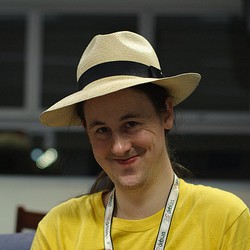
Ben Hutchings, photo by Andrew Mc Millan, license CC-BY-2.0

Ben Hutchings is a rather unassuming guy but hiding behind his hat, there s a real kernel hacker who backports new drivers for the kernel in Debian stable so that our flagship release supports very recent hardware. Read on to learn more about Ben and the kernel team s projects for Debian Wheezy! Raphael: Who are you? Ben: I m a professional programmer, living in Cambridge, England with my long-suffering wife Nattie. In Debian, I mostly work on the Linux kernel and related packages. Raphael: How did you start contributing to Debian? Ben: I started using Debian in 1998 and at some point I subscribed to Debian Weekly News. So in 2003 I heard about the planned Debian 10th birthday party in Cambridge, and thought I would like to go to that. Somehow I persuaded Nattie that we should go, even though it was on the day of our wedding anniversary! We both enjoyed it; we made new friends and met some old ones (small world). From then on we have
both been socially involved in Debian UK. In 2004 there was a bug-squashing party in Cambridge, and we attended that as well. That s where I really started contributing fixing bugs and learning about Debian packaging. Then in 2005 I made my first package (sgt-puzzles), attended DebConf, and was persuaded to enter the New Maintainer process. NM involved a lot of waiting, but by the time I was given questions and tasks to do I had learned enough to get through quite quickly. In April 2006 I was approved as a Debian Developer. Meanwhile, I looked at the videos from DebConf 5 and thought that it would be useful to distribute them on a DVD. That led me to start writing video software and to get involved in the video team for the next year s DebConf. Raphael: You have been one the main driver behind the removal of non-free firmwares from the kernel. Explain us what you did and what s the status nowadays? Ben: That s giving me a bit more credit than I deserve. For a long time the easy way for drivers to load firmware programs was to include them as a blob in their static data, but more recently the kernel has included a simple method for drivers to request a named blob at run-time. These requests are normally handled by udev by reading from files on disk, although there is a build-time option to include blobs in the kernel. Several upstream and distribution developers worked to convert the older drivers to use this method. I converted the last few of these drivers that Debian included in its binary packages. In the upstream Linux source, those blobs have not actually been removed; they have been moved to a firmware subdirectory. The long-term plan is to remove this while still allowing the inclusion of blobs at build-time from the separate linux-firmware repository. For now, the Debian source package excludes this subdirectory from the upstream tarball, so it is all free software. There are still a few drivers that have not been converted, and in Debian we just exclude the firmware from them (so they cannot be built). And from time to time a driver will be added to the staging section of Linux that includes firmware in the old way. But it s understood in the kernel community that it s one of the bugs that will have to be fixed before the driver can move out of staging . Raphael: Do you believe that Debian has done enough to make it easy for users to install the non-free firmwares that they need? Ben: The installer, the Linux binary packages and initramfs-tools will warn about specific files that may be needed but are missing. Users who have enabled the non-free section should then be able to find the necessary package with apt-cache search, because each of the
binaries built from the firmware-nonfree source package includes driver and file names within its description. For the installer, there is a single tarball that provides everything. We could make this easier, but I think we have gone about as far as we can while following the Debian Social Contract and Debian policy. Raphael: At some point in the past, the Debian kernel team was not working very well. Did the situation improve? Ben: Back in 2008 when I started working on the Linux kernel package to sort out the firmware issues, I think there were some problems of communication and coordination, and quite possibly some members were burned-out. Since then, many of the most active kernel team members have been able to meet face-to-face to discuss future plans at LPC 2009 in Portland and the 2010 mini-DebConf in Paris. We generally seem to have productive discussions on the debian-kernel mailing list and elsewhere, and I think the team is working quite well. Several new contributors have joined after me. I would say our biggest problem today is that we just don t have enough time to do all we want to. Certainly, almost all my Debian time is now taken up with integrating upstream kernel releases and handling some fraction of the incoming bug reports. Occasionally I can take the time to work on actual features or the other packages I m neglecting!
Our biggest problem today is that we just don t have enough time to do all we want to.
Raphael: It is widely known that Linux is maintained in a git repository. But the Debian kernel team is using Subversion. I believe a switch is planned. Why was not git used from the start? Ben: The linux-2.6 source package dates from the time when Linus made his first release using git. I wasn t part of the team back then so I don t know for sure why it was imported to Subversion. However, at that time hardly anyone knew how to use git, no-one had experience hosting public git repositories, and Alioth certainly didn t offer that option. Today there are no real blockers: everyone on the kernel team is familiar with using git; Alioth is ready to host it; we don t have per-architecture patches that would require large numbers of branches. But it still takes time to plan such a conversion for what is a relatively complex source package (actually a small set of related source packages). Raphael: What are your plans for Debian Wheezy? Ben: Something I ve already done, in conjunction with the installer team, is to start generating udebs from the linux-2.6 source package. The kernel and modules have to be repacked into lots of little udebs to avoid using too much memory during installation. The configuration for this used to be in a bunch of separate source packages; these could get out of step with the kernel build configuration and this would only be noticed some time later. Now we can update them both at the same time, they are effectively cross-checked on every upload, and the installer can always be built from the latest kernel version in testing or unstable. I think that we should be encouraging PC users to install the 64-bit build (amd64), but many users will still use 32-bit (i386) for backward compatibility or out of habit. On i386, we ve slightly reduced the variety of kernel flavours by getting rid of 686 and making 686-pae the default (previously this was called 686-bigmem ). This means that the NX security feature will be used on all systems that support it. It should also mean that the first i386 CD can have suitable kernel packages for all systems. I have been trying to work on providing a full choice of Linux Security Modules (LSMs). Despite their name, they cannot be built as kernel modules, so every enabled LSM is a waste of memory on the systems that don t use it. This is a significant concern for smaller Debian systems. My intent is to allow all unused LSMs to be freed at boot time so that we can happily enable all of them. I recently proposed to drop support for older x86 systems, starting with 486-class processors in wheezy. In general, this would allow the use of more compiler optimisations throughout userland and the kernel. However it seems that there isn t that much to be gained unless we also drop 586-class processors, and there are still quite a few of those in use. So I think this will have to wait. Uwe Kleine-K nig has been working to include real-time support (also known as PREEMPT_RT). This can provide low and very predictable I/O latency, which is useful for live audio synthesis, for example. It still requires a number of patches and a build configuration change, resulting in a separate binary package. We re currently only building that for 64-bit PCs. (You may notice this is missing for Linux 3.1, because the real-time developers skipped this release.) Raphael: What s the biggest problem of Debian? Ben: I think we try too hard to accommodate every possible option, without regard for the cost to developers and users in general. As an example, we now have sysvinit, file-rc, upstart and systemd all in testing. Daemon maintainers can t rely on any advanced features of upstart or systemd because we refuse to choose between them. And the decision to support the FreeBSD kernel means that we cannot choose upstart or systemd as the only option. So all daemon maintainers will have to maintain those baroque init scripts for the indefinite future. We really should be able to decide as a distribution that when one option is technically good and popular then it can be made the only option. But no-one really has the authority to do that, so we muddle along with the pretence that all the options are equally valid and functional, while none of them is supported as well as they should be.
We try too hard to accommodate every possible option, without regard for the cost to developers and users in general.
We also try to build every package on every architecture, in general. I m quite sure there are many (package, architecture) combinations that have no users, ever. But if at some point that combination FTBFS, developers will waste time investigating and fixing that time that could have been spent working on bugs and features that users actually care about. Yes, sure, portability is good but you can t prove portability just by making a package compile on every architecture. This also applies to the selection of drivers for the kernel, by the way. Raphael: Is there someone in Debian that you admire for their contributions? Well, there are many people, but I will pick out just a few: Steve McIntyre, for his work as DPL to improve communication with the various Debian derivatives and to bring fresh blood into various core teams. Also for being a generous host for countless Debian social and bug-squashing events. Stefano Zacchiroli, for improving further on communications with both downstream and upstream projects, and for regularly exercising his power to lead discussions to the benefit of the project. Julien Cristau, for maintaining good humour while not only fighting against the tide of graphics driver regressions in X and the Linux kernel but also working on release management. Jonathan Nieder, for taking on the unglamorous and frustrating task of kernel bug triage as a non-maintainer and developing it to a fine art.
Thank you to Ben for the time spent answering my questions. I hope you enjoyed reading his answers as I did.

Subscribe to my newsletter to get my monthly summary of the Debian/Ubuntu news and to not miss further interviews. You can also follow along on Identi.ca, Google+, Twitter and Facebook .

4 comments Liked this article? Click here. My blog is Flattr-enabled.

Blars Blarson: new-camera

New Camera A few days after Thanksgiving, I splurged on a new camera. Other than not remembering the date and time when the batteries are removed, the old one was still functioning as well as it ever had, but technology has advanced a bit it the more than a decade I have had it. (I purchased it sometime between 1997 and 1999.) The old camera is a Kodak DC290. 2.1 Megapixels, uses Compact Flash and 4 AA batteries (NiMh preferred, but alkaline work). The new one is a Kodak Easyshare M23, 14 Megapixels, uses SDHC and a small rechargeable lithium battery. The camera recharges the battery over a micro-usb cable. (Cable and AC adapter included.) Besides being smaller and lighter, the new camera is faster (the old one could only take 4 or 5 pictures per minute), can do video, and has some features for interfacing to the windows software they supply that are useless to Linux users as far as I can tell. The automatic lens cover is one feature I like, it would have been nice if it also had one for the LCD display. Unfortunately the camera does not show up as a hard drive when connected via the USB cable, so I have had to remove the SD card to transfer photos. Rather than posting the large files directly from the camera, I have been reducing the size and quality of the images you get when you click on the pictures. I did not feel that was needed with the old camera.

12 December 2011

Joerg Jaspert: KVM-Shell

I recently got myself a new host somewhere in that big thing internet. Pretty big one too and I m moving stuff from other machines over there, to get rid of the other ones. To have things nicely seperated I am using KVM, especially as I also have many different people owning a VM on that machine. In the past I was using Xen, not KVM, and there was the nice Xen-Shell available for it, so that those other people can manage their own VM, but not need direct access to the main box. Or any kind of root beside the limited ability properly put within the xen-shell. There doesn t seem to be anything like this for KVM. Nothing, nada. What? Oh well, with lots of use of search engines I finally found kvm-shell, a Shell Script from Michael Kress. It looked like it was about to do what I want - except that it didn t work. So I set out last weekend and made it work. So here, for those who are looking for a similar tool, grab your copy from here. The way to use is easy: Any bugs you find (I m sure there are) are yours to keep - or you can send me a mail and a patch. Same for new features, I m interested in getting more stuff in. [Update]: Actually one could name this virsh-shell too. Or libvirt-shell It should work with all systems supported by libvirt, it is just calling virsh $whatever for most of the stuff it does.

Cyril Brulebois: Fixing synaptics on powerpc

(It s a new day, it s a new bug ) A regression appeared in the synaptics input driver, between the 1.4.1 and the 1.5.0 release, as reported in Debian #649002 by many users. Basically, no more touchpad on PowerPC (hi, iBook G4 users!). :-( What follows is how I tracked it down. The upstream bug report is fdo#43728. Anyone could have done so, there s no black magic involved. A little hint maybe: git bisect is really easy on X drivers, since one can build and test without the Debian packaging bits. 1st step: Getting started You need sources and build dependencies, nothing fancy. Since packages might be named a bit differently, there s a reference to the relevant upstream repositories in debian/watch for X packages.
# You need git here:
debcheckout xserver-xorg-input-synaptics synaptics.git
cd synaptics.git
# Let s get the upstream tags and branches:
cat debian/watch
git remote add upstream git://anongit.freedesktop.org/xorg/driver/xf86-input-synaptics
git fetch --all
# Let s install build dependencies:
sudo apt-get build-dep xserver-xorg-input-synaptics
2nd step: Reproducing It was said 1.5.0 was the first known buggy version, so let s make sure:
# Get the appropriate tag:
git checkout xf86-input-synaptics-1.5.0
# Prepare the build system:
autoreconf -vfi
# X finds its modules under /usr, not /usr/local:
./configure --prefix=/usr
# Build and install:
make && sudo make install
Now time to restart the display manager, and confirm that the pointer is not moving bug reproduced. Now let s check the 1.4.1 release isn t affected:
# Clean everything:
git clean -xdf
git checkout xf86-input-synaptics-1.4.1
autoreconf -vfi
./configure --prefix=/usr
make && sudo make install
And after a display manager restart, the pointer is moving again, good! For reference, the log has very different lines about appletouch, so it can be used to programmatically learn about the status (good or bad). 3rd step: Narrowing it down So, we have a known good version and a known bad version. Time for a binary search to find the guilty commit which introduced that regression!
git bisect start
git bisect good xf86-input-synaptics-1.4.1
git bisect bad  xf86-input-synaptics-1.5.0
You don t even need to know that 1.4.x and 1.5.x live in different branches, git figures that out for you:
Bisecting: a merge base must be tested
[de0dfb76444ad4160468d00515876c91a9fa20bf] synaptics 1.4.0
It s just a matter of running autoreconf && ./configure && make && sudo make install && sudo /etc/init.d/xdm restart every step of the way, so it s pretty easy. No wonder, 1.4.0 was working OK, so it can be recorded as such through git bisect good, and the binary search goes between that commit and 1.5.0. After a few iterations of git bisect good and git bisect bad, we get to the commit reported on the upstream bug. As an extra bonus, mentioning the upstream bug number/URL in the Debian bug means it can be marked as forwarded there and we ll receive automatic notifications when its status changes, thanks to bts-link. Now, if you want to provide a patch for this bug, you may want to try and revert this commit. 4th step: Providing a patch Let s go back to the affected release and try to revert the guilty commit:
git checkout xf86-input-synaptics-1.5.0
git revert 13543b156d78bc4d01a19844a5ee8f283269621b
Unfortunately, some later commits modified the affected areas so we re running into conflicts:
error: could not revert 13543b1... eventcomm: replace synaptics-custom TEST_BIT with server's BitIsOn.
hint: after resolving the conflicts, mark the corrected paths
hint: with 'git add <paths>' or 'git rm <paths>'
hint: and commit the result with 'git commit'
Let s try to understand what the offending commit did: it replaced a set of macros with a single one, taken from the server. Both the old TEST_BIT() and the new BitIsOn() take 2 arguments, but the order is reversed. Reverting it should only be a matter of introducing the TEST_BIT() macro again (along with the two other ones it needs), and using it. The problem is replacing all BitIsOn(foo,bar) with TEST_BIT(bar,foo): foo and bar might not be trivial, they could be complex C expressions, and a replacement in your favourite editor might not get all occurrences right. Thankfully, there s a nice tool to handle such things, called coccinelle. I won t go into details, just show how it can help here. Basically you just need to craft a tiny patch, called a semantic patch, which describes what I wrote in the previous paragraph. You only need to declare two expressions, say a and b, and declare that all BitIsOn(a,b) must be replaced with TEST_BIT(b,a). Here s the syntax:
@@
expression a,b;
@@
-BitIsOn(a,b)
+TEST_BIT(b,a)
Save it under testbit.cocci and apply it through spatch (from the coccinelle package), asking it to perform in-place replacement (we re in a git checkout copy, remember):
# Apply:
spatch -sp_file testbit.cocci -in_place .
# Profit:
git diff
Then you can run git commit -s, write a nice commit message, send it upstream, and enjoy the rest of the night. Coming soon to a mirror near you: fixing commit. As mentioned on the upstream bug report, I got the Debian reference wrong in the commit message, I really meant #649002.

11 December 2011

Stefano Zacchiroli: bits from the DPL for November 2011

Mako's IronBlogger is a great idea. I often find myself postponing blog posts for a very long time, simply out of laziness. IronBlogger provides a nice community incentive to counter (my) laziness and blogging more often. As a related challenge, we have to face the fact that different subsets of our communities use different media to stay informed: mailing lists, blog (aggregators), social media, IRC, etc. Disparities in how they stay informed are a pity and can be countered using multiple medias at a time. Although I haven't blogged very often as of lately, I managed to keep the Debian (Developer) community informed of what happens in "DPL land" on a monthly basis, by the means of bits from the DPL mails sent to d-d-a. While the target of bits mails perfectly fits d-d-a, there is no reason to exclude a broader public from them. After all, who knows, maybe we'll find the next DPL victim^W candidate among Planet readers! Bonus point: blogging this also helped me realize that my mails are not as markdown-clean as I thought they were. I still have no IronBlogger squad, though. (And sharing beers with folks in the Boston area is not terribly handy for me ). Anyone interested in setting up a BloggeurDeFer in the Paris area? (SCNR)
Dear Project Members,
another month has passed, it's time to bother you again about what has happened in DPL land in November (this time, with even less delay than the last one, ah!). Call for Help: press/publicity team I'd like to highlight the call for help by the press / publicity teams. They are "hiring" and have sent out a call for new members a couple of weeks ago. The work they do is amazing and is very important for Debian, as important as maintaining packages or fixing RC bugs during a freeze. It is only by letting the world know what Debian is and what we do, that we can keep the Project thriving. And letting the world know is exactly what the publicity and press teams do. If you're into writing, blogging, or simply have a crush for social media, please read the call and "apply"! Interviews November has apparently been the "let's interview the DPL" month. I've spent quite some time giving interviews to interested journalists about various topics. For both my embarrassment and transparency on what I've said on behalf of Debian, here are the relevant links: Assets Legal advice (work in progress) Relationships with others Miscellanea Thanks for reading thus far,
and happy hacking.
PS as usual, the boring day-to-day activity log is available at master:/srv/leader/news/bits-from-the-DPL.*

10 December 2011

Patrick Schoenfeld: On Debian discussions

In my article "Last time I've used network-manager" I made a claim for which I've been criticized by some people, including Stefano, our current (and just re-elected) DPL. I said that a certain pattern, which showed up in a certain thread, were a prototype for discussions in the Debian surroundings.

Actually I have to commit, that this was a very generalizing statement, making my own point against the discussion point back directly at myself.
Because as Stefano said correctly there has been some progress in the Debian discussion cult.
Indeed, there are examples of threads, were discussions followed another scheme.
But to my own advocacy I have to say that such changes are like little plants (in the botanical sense). They take their time to grow and as long as they are so very new, they are very vulnerable to all small interruptions. Regardless of how tiny those interruptions may seem.

I've been following Debian discussions for 6 or 7 years. That scheme I was describing was that which had the most visibility of all Debian discussions. Almost every discussion which were important for a broader audience followed that scheme. It has a reason that Debian is famous for flamewars.
In a way its quiet similar to the network-manager perception, some people have. Negative impressions manifest themselves. Especially if they have years of time.
Positive impressions does not have a chance to manifest themselves as long as the progress is not visible enough to survive small interruptions.

I hope that I didn't cause to much damage with my comment, which got cited (context-less) on other sites. Hopefully the Debian discussion cult will improve further to a point where there is no difference between the examples of very good, constructive discussions we already have in some parts of the project and the project-wide decision-making-discussions which affect a broad audience and often led to flamewars.

Patrick Schoenfeld: The caravan is moving on..

I once moved to blogspot with my blog, because I was to lazy to handle all the hard stuff about blogging (finding, setting up and maintaing a blog software) myself. It was a compromise, back then, because blogspot was missing features I'd like to have from a blog software.
Recently the compromise was slowly going to not satisfy me enough anymore and so I planned and executed a migration plan to an own domain and powered by Movable Type.

Because I was always blogging about more technical and Open Source-community related things as well as private stuff, politics and anything else, which I was interested about, and because these subject areas are not really related to each other, I decided to split the blog into two.

So in the future you will find this blog split into two places:

I've tried to migrate everything to this sites, which has been on blogspot, including comments. So if you happen to find your comments there: Do not wonder.

The blogspot blog will stay around, eventually forever, eventually only for a certain time, to let search engine visitors still find stuff. But this is the last entry I'll publish here.

So update your bookmarks and stay tuned :)

9 December 2011

Vincent Sanders: And one man in his time plays many parts

Perhaps the immortal bard was making a more noble and deep reference to the stages of ones life but I feel no compunction lifting the line for my purpose.

And it is about changes in my own life I wish to speak. I have been employed by Simtec for more than a decade now. There have been great changes in the embedded electronics industry in that time, especially for those using open source software.

A decade ago we were considered cutting edge and strange for advocating and using NetBSD and Linux, especially for our committing of our changes back upstream, today that is considered normal behaviour.

Alas the last couple of years have shown that Simtec is not the best place for me to continue, so I have decided to move on to pastures new. From the new year I will be working with a great bunch of people at Collabora.

This should not have any great detrimental impact on my open source activities but as with any big life change, it may take a while to settle down and I apologize in advance if I am not as responsive as usual.

Russell Coker: Cocolo Chocolate

Cocolo Overview I recently wrote about buying a fridge for storing chocolate [1]. Jason Lewis (the co-founder of Organic Trader [2]) read that post and sent me some free samples of Cocolo chocolate [3] (Cocolo is an Organic Trader product that is made in Switzerland). It s interesting to note that Cocolo seem very focussed on a net presence [3], their URL is printed on the back of the packet in an equal size font to the main label on the front (although the front label is in upper case). The main web page has a prominent link to their Twitter page which appears to be updated a couple of times a month. PIcture of Cocolo chocolate packaging Cocolo makes only organic fair-trade chocolate. Every pack lists the percentage of ingredients that are Fairtrade (presumably milk and some other ingredients are sourced locally in Switzerland and Fairtrade doesn t apply to them). Their chocolate packages have the URL www.fairtrade.com.au printed on them and their web site links to an international Fairtrade organisation. The packages also list the organic and Fairtrade certification details and state that they are GMO free. The final geek data on the package is advise to store the chocolate at a temperature between 16C and 18C (I have now set my fridge thermostat to 17C). The above picture shows the front of a pack of Dark Orange chocolate and the back of a pack of Milk chocolate. Reviews One thing that is different about Cocolo is that they use only unrefined evaporated organic cane sugar juice to sweeten their chocolate. This gives it a hint of molasses in the flavor. Children who like white sugar with brown coloring might not appreciate this, but I think that the use of natural cane sugar juice will be appreciated by most people who appreciate products with complex and subtle flavors. The Milk chocolate contains a minimum of 32% cocoa solids, this compares to the EU standard of a minimum of 25% for milk chocolate and the UK standard of a minimum of 20% for Family Milk Chocolate . The EU standard for dark chocolate specifies a minimum of 35% cocoa solids, so it seems that Cocolo milk chocolate is almost as strong as dark chocolate. If you are used to eating dark and bittersweet chocolate then the Cocolo milk chocolate is obviously not that strong, but it is also significantly more concentrated than most milk chocolate that is on the market. The high chocolate content combined with the evaporated cane sugar extract gives a much stronger flavor than any of the milk chocolates that I have eaten in recent times. The Dark Mint Crisp chocolate has a minimum of 61% cocoa mass. The mint crisp is in very small pieces that give a good texture to the chocolate with a faint crunch when you bite it. It has a good balance of mint and chocolate flavors. The Dark Orange chocolate contains 58% cocoa solids and has a subtle orange flavor. The white chocolate tastes quite different from most white chocolate. While most white chocolate is marketed to children the Cocolo white chocolate will probably appeal more to adults than children. This is one of the few white chocolates that I ve wanted to eat since the age of about 14. They also have many other flavors, most common types of chocolate (such as with almonds or hazelnuts) are available. I highly recommend Cocolo products!

8 December 2011

Tanguy Ortolo: Return codes

According to Eric S. Raymond, one rule for Unix programming is the Rule of Silence: When a program has nothing surprising to say, it should say nothing. Since return codes are a form of information, I would like to add: when a program has carried out its task with no surprise, it should exit(0).Take xscreensaver-command -lock, for instance. That command is meant to make a running XScreenSaver to lock the screen. I have never seen it fail in doing so, however I sometimes get a non-zero code:
% xscreensaver -lock
xscreensaver-command: could not frobnicate window 4212
zsh: exit 1   xscreensaver-command -lock
Well, xscreensaver-command, I have the deep regret to announce you that despite of your surprising return code, you successfully succeeded to lock my screen. But that return code is wrong and annoying. Wrong, because as a user, I do not care if xscreensaver-command -lock failed to frobnicate some window he would have loved to as long as it does its job and locks my screen. To the user's point of view, locking the screen is binary: either it is done and it is a success or it is not done and that is a failure. And it is annoying, because it makes the return code meaningless and prevents you from using it to do things like:
% # Lock screen and suspend to RAM (only if locking was successful)
% xscreensaver -lock && sudo pm-suspend
With xscreensaver-command sometimes returning a non-zero code with no apparent reason, you end with a locked screen and your computer still running, and have to unlock it and try again. This looks like this meaningless dialogue: So please, when you write a utility, design your return code for the user, not for you. If your utility has done the job, it should exit(0). What happened inside does may interest you as the developer but it does not matter to the user as long as the job is done, so it should not be reported to him, especially not with a misleading failure code.

7 December 2011

Gustavo Noronha Silva: WebKitGTK+ hackfest \o/

It s been a couple days since I returned from this year s WebKitGTK+ hackfest in A Coru a, Spain. The weather was very nice, not too cold and not too rainy, we had great food, great drinks and I got to meet new people, and hang out with old friends, which is always great!
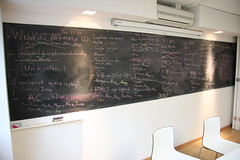
Hackfest black board, photo by Mario

I think this was a very productive hackfest, and as usual a very well organized one! Thanks to the GNOME Foundation for the travel sponsorship, to our friends at Igalia for doing an awesome job at making it happen, and to Collabora for sponsoring it and granting me the time to go there! We got a lot done, and although, as usual, our goals list had many items not crossed, we did cross a few very important ones. I took part in discussions about the new WebKit2 APIs, got to know the new design for GNOME s Web application, which looks great, discussed about Accelerated Compositing along with Joone, Alex, Nayan and Martin Robinson, hacked libsoup a bit to port the multipart/x-mixed-replace patch I wrote to the awesome gio-based infrastructure Dan Winship is building, and some random misc. The biggest chunk of time, though, ended up being devoted to a very uninteresting (to outsiders, at least), but very important task: making it possible to more easily reproduce our test results. TL;DR? We made our bots and development builds use jhbuild to automatically install dependencies; if you re using tarballs, don t worry, your usual autogen/configure/make/make install have not been touched. Now to the more verbose version! The need

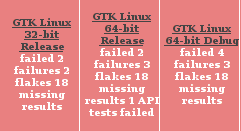
Our three build slaves reporting a few failures

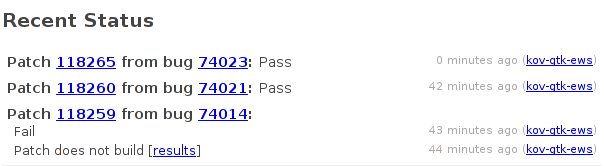
For a couple years now we have supported an increasingly complex and very demanding automated testing infrastructure. We have three buildbot slaves, one provided by Collabora (which I maintain), and two provided by Igalia (maintained by their WebKitGTK+ folks). Those bots build as many check ins as possible with 3 different configurations: 32 bits release, 64 bits release, and 64 bits debug. In addition to those, we have another bot called the EWS, or Early Warning System. There are two of those at this moment: one VM provided by Collabora and my desktop, provided by myself. These bots build every patch uploaded to the bugzilla, and report build failures or passes (you can see the green bubbles). They are very important to our development process because if the patch causes a build failure for our port people can often know that before landing, and try fixes by uploading them to bugzilla instead of doing additional commits. And people are usually very receptive to waiting for EWS output and acting on it, except when they take way too long. You can have an idea of what the life of an EWS bot looks like by looking at the recent status for the WebKitGTK+ bots. Maintaining all of those bots is at times a rather daunting task. The tests require a very specific set of packages, fonts, themes and icons to always report the same size for objects in a render. Upgrades, for instance, had to be synchronized, and usually involve generating new baselines for a large number of tests. You can see in these instructions, for instance, how strict the environment requirements are yes, we need specific versions of fonts, because they often cause layouts to change in size! At one point we had tests fail after a compiler upgrade, which made rounding act a bit different! So stability was a very important aspect of maintaining these bots. All of them have the same version of Debian, and most of the packages are pinned to the same version. On the other hand, and in direct contradition to the stability requirement, we often require bleeding edge versions of some libraries we rely on, such as libsoup. Since we started pushing WebKitGTK+ to be libsoup-only, its own progress has been pretty much driven by WebKitGTK+ s requirements, and Dan Winship has made it possible to make our soup backend much, much simpler and way more featureful. That meant, though, requiring very recent versions of soup. To top it off, for anyone not running Debian testing and tracking the exact same versions of packages as the bots it was virtually impossible to get the tests to pass, which made it very difficult for even ourselves to make sure all patches were still passing before committing something. Wow, what a mess. The explosion^Wsolution So a few weeks back Martin Robinson came up with a proposed solution, which, as he says, is the nuclear bomb solution. We would have a jhbuild environment which would build and install all of the dependencies necessary for reproducing the test expectations the bots have. So over the first three days of the hackfest Martin and myself hacked away in building scripts, buildmaster integration, a jhbuild configuration, a jhbuild modules file, setting up tarballs, and wiring it all in a way that makes it convenient for the contributors to get along with. You ll notice that our buildslaves now have a step just before compiling called updated gtk dependencies (gtk is the name we use for our port in the context of WebKit), which runs jhbuild to install any new dependencies or version bumps we added. You can also see that those instructions I mentioned above became a tad simpler. It took us way more time than we thought for the dust to settle, but it eventually began to. The great thing of doing it during the hackfest was that we could find and fix issues with weird configurations on the spot! Oh, you build with AR_FLAGS=cruT and something doesn t like it? OK, we fix it so that the jhbuild modules are not affected by that variable. Oh, turns out we missed a dependency, no problem, we add it to the modules file or install them on the bots, and then document the dependency. I set up a very clean chroot which we could use for trying out changes so as to not disrupt the tree too much for the other hackfest participants, and I think overall we did good. The aftermath By the time we were done our colleagues who ran other distributions such as Fedora were already being able to get a substantial improvements to the number of tests passing, and so did we! Also, the ability to seamlessly upgrade all the bots with a simple commit made it possible for us to very easily land a change that required a very recent (as in unreleased) version of soup which made our networking backend way simpler. All that red looks great, doesn t it? And we aren t done yet, we ll certainly be making more tweaks to this infrastructure to make it more transparent and more helpful to the users (contributors and other people interested in running the tests). If you ve been hit by the instability we caused, sorry about that, poke mrobinson or myself in the #webkitgtk+ IRC channel on FreeNode, and we ll help you out or fix any issues. If you haven t, we hope you enjoy all the goodness that a reproducible testing suite has to offer! That s it for now, folks, I ll have more to report on follow-up work started at the hackfest soon enough, hopefully =).

6 December 2011

Sam Hartman: Moonshot Introduction

I recently put together a reading list on Project Moonshot for a friend. If you have seen discussions of Moonshot but not known where to get started understanding the technology, here is a fairly good initial list. It s long, but take a look starting at the beginning and let us know what you think.Take a look at http://www.project-moonshot.org/. Specifically, http://www.project-moonshot.org/sites/default/files/moonshot-feasibility-analysis.pdf and http://www.project-moonshot.org/sites/default/files/moonshot-briefing-ietf-78.pdf That briefing paper contains outdated versions of the technical
specifications.
Please see http://tools.ietf.org/html/draft-ietf-abfab-arch-00 http://tools.ietf.org/html/draft-ietf-abfab-gss-eap and http://tools.ietf.org/html/draft-ietf-abfab-gss-eap-naming
and http://tools.ietf.org/html/draft-ietf-abfab-aaa-saml O, yeah, and for the totally cool stuff that is still being designed
please see http://tools.ietf.org/html/draft-mrw-abfab-multihop-fed and http://tools.ietf.org/html/draft-mrw-abfab-trust-router

5 December 2011

Kees Cook: PGP key photo viewing

Handy command line arguments for gpg:
gpg --list-options show-photos --fingerprint 0xdc6dc026
This is nice to examine someone s PGP photo. You can also include it in --verify-options, depending on how/when you want to see the photo (for example, when doing key signings). If gpg doesn t pick the right photo viewer, you can override it with --photo-viewer 'eog %I' or similar.

2011, Kees Cook. This work is licensed under a Creative Commons Attribution-ShareAlike 3.0 License.
Creative Commons License

Ana Beatriz Guerrero Lopez: RCBSaturday

On Saturday evening I started talking with M nica about Bug Squashing Parties and how they work. I am not sure how it happened, we started doing one. Then it was too fun to stop :P NMUs by M nica: Funny, there were a couple of NMUs by others uploading patchs by M nica. NMUs by Ana: I also closed #646449 (libosip2) that has been fixed in a new release upload, sponsored a NMU to Sven Joachim who had a patch sitting in the BTS for a month NMU-fixing #646147 (lie), sponsored dbus-c++ and reviewed for sponsoring a new version inspircd.

Axel Beckert: automounter vs procmail

At work we use .procmailrc files generated by CGIpaf to let non-technical users create forwards, out-of-office mails, etc. and any combination thereof. This also has the advantage that we can filter out double bounces and spam (which also prevents us from being listed in spammer blacklists). Unfortunately autofs (seems independent if autofs4 or autofs5 is used) seems to be unreliable if there are bursts of mount or umount requests, resulting either in File or directory not found error message while trying to access the home directory of a user, or Directory not empty error messages if the automounter tries to remove the mount point after unmounting. In that case a not mounted directory owned by root is left over. In the end both cases lead to procmail behaving as if that user does not have a .procmailrc which looks like sporadically lost mails to those who forward all mails. (The mails then can be found in the local default INBOX for that user.) Additionally there are similar issues when the NFS servers are not available. The most effective countermeasure we found so far was adding tests to the global /etc/procmailrc to check if the user s home directory exists and belongs to the correct user:
# -----------------
# Global procmailrc
# -----------------
# For debugging, turn off if everything works well
VERBOSE=1
LOGFILE=/var/log/procmail.log
# This only works with bourne shells, $SHELL defaults to the user's
# login shell. And by experience dash seems not work, so we use bash.
OLDSHELL=$SHELL
SHELL=/bin/bash
# temporary failure (see EX_TEMPFAIL in /usr/include/sysexits.h) if
# $LOGNAME is not set for some reason. (Just to be sure our paths
# later on are not senseless.
:0
* ? test -z "$LOGNAME"
 
    LOG="Expected variable LOGNAME not set. "
    EXITCODE=75
    :0
    /dev/null
 
# temporary failure (see EX_TEMPFAIL in /usr/include/sysexits.h) if
# $HOME is not readable. ~$LOGNAME does not seem to work, so this uses
# a hard wired /home/.
:0
* ? test ! -r /home/$LOGNAME
 
    LOG="Home of user $LOGNAME not readable: /home/$LOGNAME "
    EXITCODE=75
    :0
    /dev/null
 
# temporary failure (see EX_TEMPFAIL in /usr/include/sysexits.h) if
# $HOME has wrong owner. ~$LOGNAME does not seem to work, so this uses
# a hard wired /home/.
:0
* ? test ! -O /home/$LOGNAME
 
    LOG="Home of user $LOGNAME has wrong owner: /home/$LOGNAME "
    EXITCODE=75
    :0
    /dev/null
 
[ ]
If you want to store a copy of these mails for debugging purposes on every delivery attempt, replace /dev/null with some Maildir or mbox only accessible for root. One small but important part was to explicitly declare bash as shell for executing the tests, otherwise mails for users with tcsh or zsh as login shell filled up the mail queue and never get delivered (if the SHELL variable never gets fixed). Only drawback so far: This leads to more lagging e-mail on e-mail bursts also for those users who have no .procmailrc because procmail can t check if there s really no .procmailrc. Extensive procmail documentation can be found online at the Procmail Documentation Project as well as in the man pages procmail(1), procmailrc(5) and procmailex(5).

Russell Coker: CyanogenMod and the Galaxy S

Thanks to some advice from Philipp Kern I have now got my Galaxy S running CyanogenMod 7.1.0 which is based on Android 2.3.7 [1]. CyanogenMod has lots of configuration options that seem to be lacking in the stock releases and also supports some advanced features such as OpenVPN and a command-line. I can t properly compare CyanogenMod to the stock Android as I ve only used versions 2.1 and 2.2 of the stock Android. Presumably some of the things that I like about CyanogenMod are in the stock Android 2.3.7 release. The process of updating a phone is difficult and has some risk. Fortunately Samsung provided Download mode in the BIOS to allow recovery. If you mess up the process of updating a Galaxy S and you can get Download mode by holding down volume-down, home, and then power buttons then you can almost certainly recover (so don t panic). The CyanogenMod people don t provide any documentation on upgrading from Android 2.2 (which is what Optus is still shipping AFAIK). So you will probably have some difficulty when upgrading a Galaxy S that you get in Australia (it seems that Optus is the only company shipping them in volume). As an aside if you want to buy a Gel Case for a Galaxy S in Australia then visit an Optus store. It seems that Optus is the only phone store that hasn t run out their Galaxy S accessories in favor of the Galaxy S2. I have previously written about the Galaxy S and Three Networking [2]. Now that I have the Galaxy S as my primary phone on the Virgin network all my data corruption problems are solved, the problem is entirely related to Three. With CyanogenMod there is an option to be able to toggle the LED Flash as a torch from the drop-down menu, this makes the lack of such a LED on the Galaxy S even more of an annoyance. I have also discovered that the Galaxy S apparently doesn t have a status LED! This makes it the only phone that I ve ever owned that has no clear way of informing me when the battery is charged! It s also really useful to have a flashing LED to indicate low battery when running a full screen app, and to have a flashing LED to indicate that email has been received. Someone should design a phone with multiple LEDs to indicate different things. I d like to have one LED to indicate charging status and another to indicate whether there is unread email or SMS. Whatever the cost of including a LED during manufacture it would have to be almost nothing compared to the ~$500 sale price of a phone. Wikipedia says The Samsung Galaxy S features a PowerVR graphics processor, yielding 20 million triangles per second, making it the fastest graphics processing unit in any smartphone at the time of release. Also, upon release, the Galaxy S was both the first Android phone to be certified for DivX HD, and at 9.9 mm was the thinnest smartphone available . I don t care about any of that, I want a phone with decent battery life, a LED Flash , and a status LED. The main benefit I get from the Galaxy S over the Xperia X10 is the greater storage. The Xperia X10 has a total of 1G of storage and only 465M of that is available for application install. My Galaxy S has 16G of internal storage of which 1.8G is available for phone apps and 13G is available for pictures and other mass storage. Having 1.8G for phone apps and internal phone storage used by such apps (which includes the offline IMAP cache) is a massive benefit, enough to outweigh the lack of a staus LED and a Flash LED. What I Really Want I d rather have a Samsung Galaxy Note. The Note has a LED flash, a 5.3 screen with 1280*800 resolution which is much better for running as a SSH client and also good for web browsing. I m not inclined to spend money on a phone now, so I ll probably use the Galaxy S until Virgin offers me a new phone or someone just gives me a new phone (I can always hope). One of the many nice features in the Galaxy Note is a built in stylus. When using my current phones for web browsing I sometimes find it difficult to have a touch registered to the desired part of the screen, this is a real problem with the Opera web browser which requires a long press to open a URL in a new tab.

4 December 2011

Gregor Herrmann: RC bugs 2011/48

here's my report about RC bug related activities for the last week. besides working on the bugs mentioned below I've also documented my RCBW work flow for the NMUs, just in case it's interesting for others.

3 December 2011

Joachim Breitner: Some late recognition of metainit

Four years ago, during DebConf 7 in Edinburgh, I had the idea of creating init scripts not by hand, but rather describe them in a declarative way that handles most common cases and generate the real init scripts from them. Back than, this was partly motivated by the varying quality of init scripts and the advent of an alternative init system, upstart, for which proper service files could be generated as well. I implemented the idea and uploaded it as metainit to Debian, but it did not take off. Only one package uses it, and this package is not used much either. The project basically fell dormant. Yesterday, I got this mail:
Hi Joachim, I'm not very familiar with Debian ecosystem, however our company has recently switched to exclusively using Debian based servers, please forgive me if there exists a better channel for sending patches. We need (in house) to create a lot of trivial services and the sysv init system seems an ideal way to manage them, and metainit an great way to keep the config simple. However all our scripts require a heartbeat, the way we normally do this is with a bunch of checkers launched from cron. Metainit was ideal, but lacked the simple 'status' task found in most init scripts. This small patch adds that task, I hope you and others find it usefull. Regards,
together with the mentioned patch. So it turned out that the idea was a useful one after all, although it found its use on our user s machines, and not within the Debian packages, as I originally anticipated. Nice! During the recent discussions about the latest init system, systemd, there were more thoughts about generating init scripts/upstart service descriptions/systemd units from a declarative description, and if metainit had taken off back then, things would be easier now. So if anyone feels like reviving the project: Please do.

Flattr this post

Patrick Schoenfeld: Let me introduce DPKG::Log and dpkg-report

We have customers, which require a report about what we've done during maintenance windows. Usually this includes a report about upgrades, newly installed packages etc. and obviously everything we've done apart from that.
Till now we've prepared them manually. For a greater bunch of systems this is a big PITA, because to be somehow useful you have to collect the data for all systems and after that, prepare a report where you have:

Its also error-prone because humans make mistakes.

Perl to the rescue!
At least the part about generating a report about installed/upgraded/removed packages could be automated, because dpkg writes a well-formed logfile in /var/log/dpkg.log. But I noticed that there appearently is no library specialised at parsing that file. Its not a big deal, because the format of that file is really simple, but a proper library would be nice anyway.
And so I wrote such a library.
It basically takes a logfile, reads it line by line and stores each line parameterized into a generic object.

Its features include:

Based on that, I wrote another library DPKG::Log::Analyse, which takes a log, parses it with DPKG::Log and then extracts the more relevant information such as installed packages, upgraded packages, removed packages etc.

This, in turn, features:
- Info about newly installed packages
- Info about removed packages
- Info about upgraded packages
- Info about packages which got installed and removed again
- Info about packages which stayed halfinstalled or halfconfigured at the end of the logfile (or defined reporting period)


These libraries are already uploaded to CPAN and packaged for Debian.
They passed the NEW queue very quickly and are therefore available for Sid:

http://packages.debian.org/sid/libdpkg-log-perl

As an example use (and for my own use case, as stated above), I wrote dpkg-report, which uses the module and a Template::Toolkit based template to generate a report about what happened in the given logfile.
It currently misses some documentation, but it works somehow like this:

Report for a single host over the full log:
dpkg-report

Report for a single host for the last two days:
dpkg-report --last-two-days

Report for multiple hosts (and logfiles):
The script expects that each log file has the name <systemname>.dpkg.log so that it can guess the hostname from the system and can grab all such log files from a directory if a directory is specified as log-file arguments:</systemname>

dpkg-report --log-file /path/to/logs

This will generate a report about all systems without any merging.

Report for multiple hosts with merging:
dpkg-report --log-file /path/to/logs --merge

This will do the following:
A (fictive) report could look some what like this:

dpkg-Report for all:
------------------------
Newly Installed:
abc
Removed:
foo
Upgraded:
bar (0.99-12 - 1.00-1)
dpkg-Report for test*:
------------------------
Newly Installed:
blub
dpkg-Report for test1:
------------------------
Upgraded:
baz (1.0.0-1 -> 1.0.0-2)
dpkg-Report for test2:
------------------------
Upgraded:
zab (0.9.7 -> 0.9.8)

Currently this report generator is only included in the source package or in the git(hub) repository of the library. I wonder if it makes sense to let the source package build another binary package for it.
But its only a 238 lines perl script with a dependency on the perl library so I'm unsure if it warrants a new binary package. What do others think?

Lars Wirzenius: #backuphackers and plea for help

The other day I was talking with someone else who is making backup software (bup, to be precise). That was nice, so I thought I'd create an IRC channel for our kind of weirdos. If you like making backup software, please join #backuphackers on irc.oftc.net. Also, I think there's a need for neutral third parties to run validation tests and benchmarks on backup software. Anyone interested in doing that?

Next.

Previous.