There s a lot of responsibility on the shoulders of system administrators. Unless you re one, it s probably hard to grasp the full weight of it. This week has been full of reminders for me.
This afternoon, shortly after lunch, I got word that people were having trouble with phones. A few minutes of testing showed that calls within our city were working fine, but it was completely impossible to place or receive long-distance calls. A little while later, a local newspaper s website indicated that numerous cities over a multi-county region, all served by the CenturyLink local telephone company, were out of service in this manner. I figure that represents hundreds of square miles, or a patch of rural Kansas roughly the size of Los Angeles.
Adding to the problem was the fact that emergency 911 services are accessed via these long-distance lines that were down. For roughly three hours, 911 was completely down across this entire area. What s more, many cellphone towers and Internet access options were also taken down, since they feed from these same lines.
This adds up to a situation that could very easily cost lives due to delayed response of emergency medical, fire, or police services.
In the end, the problem was traced to a bad controller card on a Titan 5500 owned by AT&T.
Now, here s the system administration angle: If you worked for the phone company and had to troubleshoot a problem that you knew had taken down emergency services for thousands of people, what kind of pressure would you be feeling? Would you be able to keep your cool? I m glad that I don t have that kind of job.
I also wouldn t like to be the engineer (or, more likely, accountant) that decided that they didn t need any more redundancy to provide good service to the area. Especially considering this is the second time in the last year or two this has happened.
But, ironically, yesterday I signed a purchase order for a new Asterisk PBX (corporate phone) server. When selecting a machine for that task, I am always completely conscious of the responsibility on my shoulders: several hundred employees rely on the machine that is ultimately my responsibility to select. Our own access to 911 would be cut if the machine were to go down. I never forget that the correct operation of the systems that our team sets up and deploys could help save someone s life, and that a malfunction could cost the company dearly in terms of revenue, productivity, image or worse.
Nearly four years ago, we switched from an analog PBX, with outsourced support, to a digital VOIP system running Asterisk. Note that we use VOIP in-house, but do not use it externally. Anyhow, I can not say that the Asterisk PBX has been 100% perfect; I doubt that this could be honestly said of any PBX of any complexity.
I can say, though, that it saved us well over $100,000 AND has proven far more reliable than the system it replaced. Outages are exceptionally rare and brief now. Plus we have internal expertise to fix it, rather than having to wait for a technician to be dispatched from a city 2 hours away to fix anything. I know I don t have the resources to build a perfect PBX that will never go down (if such a thing is even possible), but I take my responsibility regarding a reliable PBX extremely seriously.
We used to have a frequent problem: someone would call 911, then hang up. We suspected this was often on accident maybe people hit 9 for an outside line, then misdialed their number. In any case, 911 dispatch would then call our main office, saying they got a hangup. A person or team would then go across our entire campus making sure nobody was in distress that nobody had managed to dial, then passed out, for instance.
With Asterisk, I was able to help this situation. Whenever somebody calls 911 now, two emails are generated: the first contains details about the call, such as the extension number that called and the duration of the call. This goes to all people that are likely to receive a callback from 911. It may not always pinpoint the source (as with somebody using a wireless phone), but almost every time will give us a very good idea where the call came from. The second email is a recording of the call, and serves as an additional clue, but goes to fewer people.
I am aware that email isn t a perfect medium, but: it let us make a dramatic (albeit imperfect) solution to a problem that very few institutions our size are able to address nearly so well.
There s a lot of weight on our shoulders: keeping the accounting system up, the Internet links up, the web store or the sales phone lines, the shipping systems or the document archives up. These things going down can spell deep trouble in many ways.
And sometimes the systems we maintain might save a life. Such as this morning, when someone was feeling symptoms of a heart attack, used our phones to call a colleague for help, that person called 911, and an ambulance was dispatched. I know the system worked exactly as it should, because I had two familiar emails from Asterisk in my mailbox this morning when I got to work.
Magnus Larsson gave an interesting TED talk about using bacteria to transform dunes into architecture [1]. The concept of making a wall across Africa to stop sand dunes from overtaking farm land is obviously a good one, the idea of using bacteria to convert sand into sandstone to do so cheaply is also good. But making that into houses seems a little risky. I wouldn t want to live under shifting sand with only bacteria generated sandstone to protect me.
Cory Doctorow gave an interesting speech titled How to Destroy the Book , here is the transcript [2]. He talks about how much he loves books and described his opposition to the DRM people who want to destroy the book culture.
Sendmail has a DKIM Wizard for generating ADSP (Domain Signing Policy) records [3]. If I knew that ADSP records were so easy to implement then I would have used them a year ago!
Loretta Napoleoni gave an insightful TED talk about the economics of terrorism [4]. Apparently the US dollar used to be THE currency for international crime, when the PATRIOT act was passed it s anti-money-laundering provisions encouraged many shady people to invest in Euros instead and thus led to the devaluation of the US currency. It s also interesting to note that terrorist organisations are driven by economics, if only we could prevent them from making money
Ryan Lobo gave an interesting TED talk about his photographic work [5]. The effectiveness of the all-women peace-keeping force is noteworthy. The part about the Liberian war criminal who has become an evangelical Christian and who now tours Liberia begging forgiveness from his victims (and their relatives in the case of the people he murdered). Should someone like that be permitted to remain free if his victims forgive him?
Charles Stross has an appealing vision for how Apple and Google can destroy the current mobile telephony market [6]. I can t wait for the mobile phone market to be entirely replaced by mobile VOIP devices!
James Geary gave an interesting TED talk about metaphors [7]. The benefits of metaphors in poetry are well known (particularly in lyrics), but the impact of metaphors in influencing stock market predictions surprised me.
Shaffi Mather gave an interesting TED talk about his company that makes money from fighting corruption [8]. Instead of paying a bribe you can pay his company to force the official(s) in question to do the right thing. Apparently the cost of doing so tends to be less than 10% the cost of the bribe if you know what you are doing. His previous company was an ambulance service that charges what the patient can afford is also interesting.
John Robb wrote an interesting article about lottery winners and griefers [9]. He suggests that publishing the names, addresses, etc of rich people will be a new trend in
Griefing. One thing I ve been wondering about is the value of the HR database at a typical corporation. A single database typically contains the home addresses, phone numbers, and salaries of all the employees. It would be very easy to do an SQL dump and store it on a USB flash device to carry out of the office. Then it could be sold to the highest bidder. They could probably make a market in the private data about rich people in the same way that there is currently a market for credit card data maybe they have already done this but it s kept quiet to stop others from implementing the same idea.
Michael Smith wrote an interesting article for the Washington Times about home schooling and socialisation [10]. It seems that people who were home schooled as children tend to be more academically successful and involved in civic life as well as being happier and having career success.
Richard Seager wrote an interesting article for American Scientist about ocean currents and heat transfer from the tropics [11]. It seems that when the ocean currents shut down the UK and other parts of northern Europe won t be getting a mini ice-age.
Ian Lance Taylor (most known for the gold linker) has written a good summary of the situation in regard to climate change and what must be done about it [12].
The Wrath of the Killdozer article about how one angry man converted a bulldozer into a tank [13]. This wasn t a big bulldozer (every mining company has bigger ones) and he didn t have any serious weapons (only rifles). Imagine what terrorists could do if they started with a mining vehicle and serious weapons
Simon Singh has written about being sued for libel by the British Chiropractic Association [14]. The BCA didn t like his article criticising chiropractors for claiming to be able to treat many conditions unrelated to the spine. Remember, chiropractors are not doctors all they can do is alleviate some back problems. See a GP if you have any medical condition that doesn t involve a sore back or neck. Avoid uppity chiropracters who claim to be able to cure all ills.
Nicholas D. Kristof wrote an interesting article for the New York times about how happy the people in Costa Rica are [15]. He claims that the Costa Rican government s decision in 1949 to dissolve it s armed forces and invest the money in education is the root cause of the happy population. Maybe if the US government would scale back military spending the US population could be as happy as the Costa Ricans. While there are good arguments for having some sort of military, there are no good arguments for spending more money on the military than the rest of the world combined (as the US does).
I have direct knowledge (through observation or first-hand reports) of the following use cases for Netbooks:
- System administrator s emergency workstation something light to carry when you might get an SMS about a problem.
- A really small laptop for a serious technical user, can be used for programming and other serious tasks. Only someone who is really dedicated to the hobby of computing would choose a system with a tiny screen for their main computer so that they can take it everywhere.
- A computer for a child. Children are less demanding about some aspects of their computer experience, no-one wants to buy a really expensive toy for a young child, and children find it difficult to carry full size laptops.
1 and 2 are the options that interest me. But it would be good if the extensive children s toy market could drive economies of scale and reduce the expenses of my hobby and profession. I have found my EeePC 701 to provide adequate CPU performance (Celeron-M 630MHz) for light compiling tasks and I have used it for some Debian development work. The SSD that is built in is very fast and OpenOffice load times compare well to my Thinkpad T41p because of it.
The main problems I have with my EeePC for sysadmin and coding tasks are the small keyboard (which can t be fixed the overall size of the machine needs to remain small), the small screen (which could be expanded without changing the case size), the low resolution screen (which has been fixed in newer netbooks), and the fact that my 3G dongle sticks out and is likely to get broken. More recent Netbooks address these issues while having the trade-off of being heavier and larger.
There are also some tasks which are generally not performed on a Netbook but that could be if it was properly designed. Here are some examples of things that I think should be done on a Netbook:
- Basic image editing and blogging something that a lot of people do on smart-phones nowadays. It can be done more effectively and with less effort on a general purpose computer I can t imagine the GIMP or Inkscape running on a smart-phone.
- Reading electronic books. The number of people who want a Netbook but don t want to read electronic books would be quite small as would the number of people who only want to read electronic books and never want to use a general purpose computer while travelling. No-one really wants to carry both a Netbook and an ebook reader at the same time.
- Watching movies.
- Everything that you might want to do on a terminal in an Internet cafe those machines are always 0wned, just say no for security reasons.
- Games. The Nintendo DS has two ARM CPUs running at 66MHz and 33MHz and a combined screen resolution of 256*384*18bpp [1] and the Sony PSP has a 333MHz MIPS R4000 CPU and a screen resolution of 480*272*24bpp [2]. The original EeePC had more CPU power and more screen resolution than the DS and the PSP so it IS suitable for games even though it won t run the latest 3D games. There are lots of great games like Wesnoth that don t require much video performance.
- Educational Software. Portable educational devices include the awful V.smile system for young children [3] and the educational software for the DS (I ve seen a demonstration of a training program in rapid completion of basic maths problems for elderly people and presume it s not the only educational software on that platform).
Image editing requires a color screen of high resolution. Effective blogging requires a platform with a resolution that compares to the typical web user
according to Hitslink 1024*768 is the most popular resolution of web browsing systems at 28.34% and the most popular resolution that is less than 1024*768 is 800*600 at 3.28% [4]. So even the most casual blogger will have an incentive to get a screen that is of higher resolution than all but the latest Netbooks.
The recently released EeePC 1201 has a screen resolution of 1366*768 which should be barely adequate for those tasks.
Reading electronic books requires a reasonable resolution. Based on my experience with the 1400*1050 display in my Thinkpad it seems that a resolution of 1366*768 would be barely adequate for reading an academic paper that has two columns in a small font. But as the original Kindle had a resolution of 600*800 and the latest Kindle has a resolution of 824*1200 [5] it seems that perhaps the epaper displays are good enough to allow reading the text at a lower resolution. A display that can draw little or no power when idling (as epaper does) is simply required for an ebook.
The Pixel-Qi hybrid displays are claimed to offer the best features of TFT and epaper displays [6] but they haven t been released yet. I think it s reasonable to assume that someone will achieve that Pixel-Qi is attempting and that it will become the standard display for a Netbook.
Watching movies and playing games (even games like Wesnoth) requires better video performance than epaper can deliver, we just have to hope that Pixel-Qi release something soon.
Watching movies and reading ebooks are both things that are best done without a keyboard in the way.
The Always Innovating Touch Book [7] seems like a good solution to this problem. It s a tablet PC that can be connected to a keyboard base if/when you desire. It should also be good for web browsing and reading email while on the move, I find that my EeePC is unreasonably heavy and awkward for typing email while walking.
Intel CPUs are not particularly energy efficient. As there are ARM CPUs with clock speeds as high as 2GHz and with as many as four CPU cores it seems that the ARM architecture can provide as much CPU power as is required. Debian currently supports two versions of the ARM CPU, if another one became commonly used it wouldn t be that difficult to run Debian build servers for it.
Given a screen resolution equal to the latest Kindle, CPU power greater than the early Netbooks, and the ability to run a free software OS the range of educational and gaming software should be adequate.
So it seems that the ideal netbook would have a detachable keyboard and base and a touch-screen in the computer part. It would have a Pixel-Qi display (or equivalent) with a resolution of 1400*1050 or better. It would have USB, Gig-E, Wifi, and Bluetooth connectivity and the ability to have an internally mounted USB dongle (as the Always Innovating Touch Book does). I think that this is not overly difficult to achieve it is basically an Always Innovating system with a better display.
Update: Another criteria is the ability to start operating quickly when requested. Even mobile phones are often limited in their utility by the time that is taken to activate them (I can t get my mobile phone to take a photo in much less than 7 seconds after removing it from my pocket). The Always Innovating system is apparently always in suspend to RAM mode when it s not being used so that it can start quickly. That combined with fast application load times and a good menu system could allow turning the system on and launching an application in less than 2 seconds.
If I was buying a Netbook right now the only thing that would stop me from buying an Always Innovating device is the shipping delay. But as my EeePC is working quite well I m not going to buy another system unless I am going to get significant benefits such as a high resolution PixelQi display.
Thanks to Joey Hess for the request to
set up tor bridges. I wholeheartedly agree,
and recommend the
video he points to.
I've installed a Tor bridge at home, and recommend others to do so.
For the most part, I'm not politically active at the moment - I'm doing a PhD Part-time, and thats
consuming all my "spare" time, other than work and family. Just given a blog site, however, one
subject strikes me as very important - free speech. Hence the side links to
Amnesty International, etc.
In Ireland this campaign has a particular focus at the moment - the
Repeal of the Blasphemy Law.
This law came into effect in Ireland this January. While the government
claims that this law will 'never be used', its bad in several ways.
Firstly, it promotes the ideas of censorship as a method of hiding social issues,
and secondly it may actually be used, as pointed out in :
<object height="300" width="400"><param name="allowfullscreen" value="true"><param name="allowscriptaccess" value="always"><param name="movie" value="http://vimeo.com/moogaloop.swf?clip_id=5196379&server=vimeo.com&show_title=1&show_byline=1&show_portrait=0&color=&fullscreen=1"><embed allowfullscreen="true" allowscriptaccess="always" height="300" src="http://vimeo.com/moogaloop.swf?clip_id=5196379&server=vimeo.com&show_title=1&show_byline=1&show_portrait=0&color=&fullscreen=1" type="application/x-shockwave-flash" width="400"></embed></object>
Blasphemy is a Victimless Crime from
Limerick Blogger on
Vimeo.
Basically, with Europe-wide arrest warrants, if two European countries have criminal blasphemy laws, then
someone may be extradited to face prosecution in another country. While the Irish government says they
will never prosecute, they open the possibility of say, Irish citizens being extradited to Greece to safe
prosecution for blasphemy.
On a wider level, I recommend Index on Censorship. It keeps documenting the cost of censorship around the world, and
has been instrumental in campaigning for
Libel reform in the UK,
which is ncreasingly important for
open scientific discussion.
Tags censorhip, free-speech, politics

Looking over some articles in the March 2009 issue of the
Communications of the ACM magazine, I found a very good piece column (Is software engineering engineering?, Denning, Peter J., and Riehle Richard D. , Communications of the ACM, 03/2009, Volume 52, Number 3, p.24-26, (2009) ). Quoting from it:
The search for an alternative to the programmer image is already a generation old. In 1989 we asked: Are we mathematicians? Scientists? Engineers? We concluded that we are all three. We adopted the term "computing", an analogue to the European "informatics", to avoid bias towards any one label or description.
(...)
Predictable outcomes (principle of least surprise)
Engineers believe that unexpected behaviors can be not only costly, but dangerous; consequently, they work hard to build systems whose behaviorthey can predict. In software engineering, we try to eliminate surprises by deriving rigurous specifications from well-researched requirements, then using tools from program verification and process management to assure that the specifications are met. The ACM Risks Forum documents a seemingly unending series of surprises from systems on which such attengion has been lavished. Writing in ACM SIGSOFT in 2005, Riehle suggested a cultural side of this: where researchers and artists have a high tolerance, if not love, for surprises, engineers do everything in their power to eliminate surprises. Many of our software developers have been raised in a research tradition, not an engineering tradition.
It would be an interesting excercise to find how people rate themselves in this regard in a large group of developers, and find the differences in their coding styles, or how varied (in developer profiles) are each of the sub-groups.
Git-dpm can now be found at
http://git-dpm.alioth.debian.org/
and the source at
git://git.debian.org/git/git-dpm/git-dpm.git
Functionality should now be mostly complete, so testers really needed now.

There s been a fair deal of talk on the intertubes lately about prettifying the boot process. The first I saw was a post from
Lasse Havelund regarding a proposal for Ubuntu Lucid, and the second was regarding a forked version of GRUB2 called
BURG, which adds some theming abilities. A tiny bit of research revealed that despite the existence of BURG, the regular upstream GRUB2 project already has graphical theme support, courtesy of a Google Summer of Code project by
Colin Bennett (albeit with a few less features at time of writing). Since Lasse had gone to the hard work of actual design, I decided to try my hand at chopping his design up into a usable GRUB2 theme, and the result can be seen
here.
I ended up speaking with the upstream
GRUB2 team (which has certainly lead to a strange alliance in one case) about Colin s GSOC themes, and as it turns out, the main reason there s no theme supplied with GRUB2 is that Colin s themes use non-Free elements (proprietary fonts like Helvetica are used heavily). Since I had learnt the theme format to a basic degree in doing my Ubuntu theme, I proposed making a genuinely Free theme starting with a Debian theme, and moving on to a generic GRUB2 theme afterwards.
As I went along, I found a handful of bugs and feature oddities, which have almost all been fixed with incredible turnaround by Vladimir Serbinenko, the current maintainer of the gfxmenu code (there remain some questions regarding RTL support in themes, and how to gracefully deal with different aspect ratios) and I want to extend my thanks to him for his help. However, at this point in time, I m pleased to announce a theme I d consider ready for public consumption.

It s obviously not perfect, and it uses the old visual style from Debian Lenny, but it s a fully Free starting point, which hopefully can be deconstructed by others seeking to make their own themes. It ought to scale fully to any 4:3 resolution. And it may explode and eat your disk on any version of GRUB2 Experimental other than r1499. Generally, the README is a good starting point.
Oh yes, an URL. Try
http://retro.apebox.org/grubthemes/
I ve been speaking with some folks on deviantART regarding using their Debian-themed wallpaper in future releases of my themes package, but for now, this should be enough for gfxmenu to get a little more exposure and a little more testing. And, hopefully, shift artist focus back from the theme-incompatible BURG fork to the real GRUB2 project.

In a comment to
my previous blog post, I linked to the DebConf photo gallery page with the
DebConf8 mugshots.
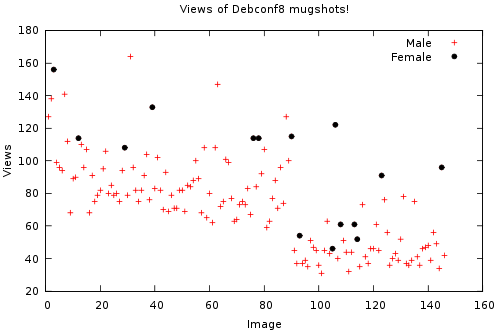
Felix Brandt, a friend of mine, noticed the per-picture view statistics there and plotted them, differentiating between male and female. He finds that the number of views on an image gives a fairly good indication of the sex (or gender?) of the person in question:
The most notable exception is the
image of bubulle. He does not even look feminine. Maybe it s because he s like a mother to us Debianers, always kind and always helpful? :-)
This observation fits my experience when I created a top-100-statistic of individual picture page views of
my personal gallery: I got a collection of pretty much all pictures of girls in bikinis, lying at some beach, across the various pages and years, and hardly any other picture. I won t post these top-100 here, as I don t want to additionally increase the effect...
Just had to spend some time with my 11 year old daughter to explain why her homework had disappeared - MS Office had saved her word document to a temporary file - which had,, of course, vanished.
A little lesson in how to save (and a lecture from others in how I should take more interest in what she's doing).
Watching the snow - which is also temporary - and enjoying catching up with the rest of my emails and reading.

Since I released forked-daapd, I ve got a couple of emails about porting it to FreeBSD. Apart from isolating and reimplementing the parts of the code using signalfd and inotify, there isn t much work to do beside taking care of the usual libc/platform issues. However, when you don t know the codebase and don t know the APIs you re replacing, it makes it a bigger job.
So, I ve just spent a day going through FreeBSD documentation, installing FreeBSD 8.0 in qemu (because it wouldn t install on my spare machine due to a bootloader issue that s at least 5 years old ), and started porting the codebase.
A dozen or so commits later, forked-daapd builds and runs on FreeBSD.
With one caveat: the filescanner doesn t update the database on the fly when the library directory is modified. While I ve put in support for kqueue/kevent to replace inotify, it s only a stub for now. Someone will have to write the code to actually act on the events and trigger the rescans/database updates.
kqueue/kevent delivers a lot less information compared to inotify, which means there s a lot of work needed to track renames and moves. And I didn t feel like doing it.
So, FreeBSD users: send patches! :)

- renovate
-
v 1: restore to a previous or better condition
  2: make brighter and prettier
- remodel
-
v 1: do over, as of (part of) a house
  2: cast or model anew
I much prefer the term renovate to remodel. Remodelling to me feels more
like tearing down internal walls and changing the actual layout of the
place. But we're in America, so remodelling it is.
We've had a bit of (mostly self-inflicted) scope creep. It started with just
wanting to get some Ethernet cabling installed, then we decided to get
recessed canned lighting (the whole lamp thing over here drives us nuts),
and then we discovered that acoustic ("popcorn") ceilings are a haven for
dust mites (we're both allergic) so it made sense to get the ceilings redone
while they were putting the lights in. We're also getting the light switches
replaced, and new childproof power outlets. We also got the electrical panel
upgraded.
Removing popcorn ceilings is somewhat hilarious. They put down plastic
everywhere, then have at it with a garden hose, and then it just scrapes
off. The ceilings they've completely finished already look a million bucks,
so we're very happy with the decision to do that. The Ethernet cabling
installation caused a lot of wall carnage, so we're going to get the walls
repainted as well.
Then we can get the carpets cleaned and stain proofed, and then we
can start thinking about trying to move some non-essential stuff in.
Hopefully it'll all be done by next weekend.
The kitchen cabinets have a six week lead time, so the kitchen remodelling
will have to be done while we're living there.
Unfortunately some unexpectedly time demanding stuff has come up at work,
right in the middle of this, so Sarah's had to do the bulk of the running
around to sort out contractors for all of the work, and I've been stuck at
work until all hours, 7 days a week. To cap it off, I've managed to come
down with a cold, and feel quite crappy. NyQuil consumption is ensuing.
For a long time it has been obvious that in all cases anti-piracy technologies discourage purchases and in many cases encourage piracy. I first discovered the significance of this in about 1991 when I attended a public lecture by a senior employee of Borland and a member of the audience claimed that the Borland product he bought didn t function correctly due to anti-piracy measures. The Borland employee firmly stated that Borland did not use anti-copying technology on any of it s products, didn t have any plans to do so, and the problem in question must have been caused by something else. Of all the hostile questions that were asked, this was the only one that caused the speaker to appear agitated so it was obviously an issue that was considered to be important within Borland.
In the late 80 s anti-piracy measures were mostly based around creating floppy disks that couldn t be easily copied (violations of various aspects of the disk formatting standards). This meant that you couldn t make a backup copy of the data, so it wasn t uncommon for people to seek pirate copies of their commercial software for daily use to avoid wearing out their valuable original floppy disks. Then the dongle was invented and people who bought software sometimes sought pirate copies so that they could use their printer and their commercial software without having to change plugs on their PC. But in those cases the benefits to uncrippled software to the users were small.
Now a large part of the battle on copy protection concerns DVDs. If you had a DVD of a recent movie and an MP4 which would you rather watch? Would you prefer to be forced to watch some anti-piracy rubbish for a couple of minutes at the start of the movie (with fast-forward disabled) or would you prefer to just start watching it? Would you prefer to be able to pre-program the sections of the movie that you watch (as some parents desire to skip the sex and/or violence in movies for their teenagers) or would you prefer to be forced to watch the movie straight-through with only a manual fast-forward to skip sections? Would you prefer to have a DVD that can t be played properly on many (most?) computers because of the CSS encoding or an MP4 that plays on everything from PCs to mobile phones without an issue? Would you rather have 100 movies in the spare space on your laptop hard drive when you travel and 1000 movies on your desktop system or the much smaller number of boxed DVDs that you can store? I think that in most cases a pirate MP4 will give a better experience than a DVD.
So the question is, why pay for a DVD when in most cases you get a lesser experience than you will get from a MP4 file downloaded by bittorrent?
One reason for buying the DVD is to support the film industry. But I doubt that such a profitable industry will get much sympathy in today s economy. Another reason is the morality, some people consider piracy to be theft (it isn t by definition theft requires that for at least a moment the property be completely in the possession of the thief) and therefore avoid it.
One technical reason for buying a DVD is the fact that it may have multiple languages supported, it will have subtitles, it may have an audio track with the creators giving a commentary, and it may have extra scenes that were cut from the main release. I believe that work on adding subtitles to the video file formats is a work in progress, so it s only a matter of time before the DVD rips include all this extra data.
Really the content creators should focus on making a product that meets the needs of users and that they want to pay for. Pirating books is technically possible, but almost no-one does it. Some successful authors such as Charles Stross freely publish significant parts of their work and Cory Doctorow freely publishes all his work in electronic form. Books just work well, they meet the needs of users and people want to buy them. Sure they can sell them second hand, lend them to other people, and it s technically possible to pirate them, but they remain profitable. On my documents blog I have
a page of links to free short stories that I liked [1] and
a page of links to free books [2]. It seems to me that creators of other copyright content should consider how they can be of service to their customers.
We are all familiar with corporations and misguided individuals who get whiny about the supposed losses due to piracy.
Bruce Everiss has unfortunately joined this trend and demanded the disconnection of Internet users based on unproven accusations of game piracy [3]. I don t know whether the game buying experience sucks as badly as the DVD buying experience, but based on the reports of locked-down consoles that have to be cracked before they run Linux I expect that the modern game industry is doing at least as badly as the movie industry. They need to provide things that users want!
One thing to note is that a Windows or console game player who uses pirate games will probably buy some games at some future time, while someone like me who uses free software both by principle and because it gives a better user experience will probably never pay for a game (I haven t got time to play all the free games so I probably wouldn t even buy a Linux game).
BidRivals.com is an interesting new auction site, their business model is that you buy bids for $0.80 each. If you want to bid on an item it costs you $0.80, then if you win the auction you pay for it. Every bid increases the price by 2 cents. So if you see an auction with a current price of $2.00 that apparently means 100 bids have been placed IE $80 have been spent.
Currently a Canon EOS 50D Digital SLR camera + a lens is on auction, it has a buy it now price of $2,499 (the same price that Harvey Norman advertises) and the bidding is at $163 and climbing so the auction site has apparently made almost $6,500 in revenue and the product has not been sold yet! The auction also has no fixed end time, it seems that about 10 or 15 seconds are added to the clock every time someone bids, and the autobidder will kick in when 4 seconds remain. So there will probably be an autobid every 6-11 seconds somewhere between 300 and 600 bids per hour at a cost of $0.80 each every item that is running with autobids will generate something between $240 and $480 in revenue without being sold!
Now if you don t win the auction (or give up trying to win) then you can buy it for the difference between the cost of your bids and the product price. In the case of the camera in question if you had made 500 bids (which would be quite easy with the autobid feature) then that would be $400 worth of bids, and given a choice between losing that $400 and using it as a down-payment on the regular retail price I think that most people would choose to buy the product. Of course if you buy it from Harvey Norman you save the delivery fee and probably get more options if you want to return it I ve never had to return something to Harvey Norman but I m assuming that it would be a lot easier than returning an item to an online store!
I don t consider this to be a real auction site. I believe that a real auction has genuine bids of a value that is determined by the bidder, the auctioneer (or auction software) may decline bids that are too low in value or which have too small an increment. Bidding in an auction generally costs the bidder nothing the only exception I ve personally seen is auctions which have a printed catalogue in which case you pay for the catelogue, a fixed fee which is small when compared to the auction prices. It seems to me that a significant portion of the revenue (possibly the majority of the revenue) of BidRivals is from the bidding fees, and the other significant portion of the revenue would be comprised of profits made from auction customers who opt to buy the item at it s list price to avoid wasting the money that they have put in to bids. The actual prices of the items are small by comparison.
Note that I am not accusing BidRivals of doing anything illegal (such as running a gambling system), I am merely stating that I don t believe that they offer a good deal for customers. While they aren t strictly a gambling site, it seems that one could get lucky and make a single bid (costing $0.80) at the right time and get a $2,499 camera for $170 (or whatever it ends up selling for) while others may spend hundreds of dollars in bids and get nothing other than a potential down-payment on the full $2,499 price. That s a lot more luck than I want in any of my purchases!
I recommend not doing business with them or anyone like them.
Fall semester I did not teach any classes that covered digital media (in part because I was swimming in the stuff writing a review essay on the topic, which I am sending today to the journal, ending about 4 months of hell).
On the other hand, spring semester will be all about digital media: hackers, free software, privacy, piracy, phone phreaking and more. I am excited. Here is my
graduate syllabus on the commons and piracy and here is my
undergraduate class on hacking. Both are still under development but pretty far along.

If you ever tried to determine what patches other distributions apply to
some package you are interested in,
you might have come to the same conclusion as I:
It is quite an impudence how those are presented.
If you don't give up, you end up with programs or scripts to extract many
propietary source package formats, more
VCS systems installed than you think there should exist.
Thats when you start to love the concept that every Debian mirror has next
to each binary package the source in a format that you can extract the changes
easily with only tools you find on every unixoid.
And that's why I love the new (though in my eyes quite misnamed) "3.0 (quilt)"
format, because that makes it even clearer and easier.
Sadly one problem remained: How to generate and store those patches?
While you can just use patches manually or use quilt to handle those
patches and store the result in a vcs of your choice, the newfangled
VCSes (especially git) became quite good at managing,
moving and merging changes around,
so it seems quite a waste to not be able to use this also to handle
those patches easily.
While one can either use git to handle a patchset, by storing it
as a chain of commits and using the interactive rebase, or using git
to store the history of your package, doing both at the same time
is tricky and not resonably doable with git provided porcelain.
Thus I wrote my own tool to faciliate git for both tasks at the same
time. The idea is to have three branches: a branch storing the history
of the your package, a branch storing your patches in a way suitable
to submit them upstream or to create a
debian/patches/ directory
from, and an branch with the upstream contents.
I've an implemenation which seems to already work, though I am sure
there is still much to improve and many errors and pitfalls still to find.
Thus if you also like to experiment with handling patches of a debian
package in git, take a look at the
manpage or the program at
git://git.debian.org/~brlink/git-dpm.git
(WARNING: as stated above: alpha quality; also places are temporary and are likely to change in the future).
RCBW - #17
Given that my "most blogged" Debian activity since last summer
has been RCBW, what else could be my first post of 2010 if not a
RCBW update? With further ado, here are this week
squashes by yours truly:
- bug #559898 - flowcanvas
- fixed in unstable, tag as needed
- bug #562503 - man-db -
downgrading severity (RC-ness was in zlib, which is now fixed)
- bug #541610 -
docbook2odf - switch dep away from (now gone)
libxml-sablot-perl
- bug #528088 -
ttf-aenigma - fonts are actually free, as detailed in
debian/copyright
- bug #544113 - tiger -
remove dep on essential package (bonus: misc deps/debhelper
fixes)
- bug #561466 -
ttf-beteckna - rebuild against fixed defoma (thanks Julien Cristau
who spotted a wrong fix of mine)
- bug #561470, bug #549987 - halevt -
add missing dep on policykit (bonus: QA upload with misc
fixes)
No particular remarks, but a long overdue tip of the
week: the
turmzimmer BTS
interface is a great tool for bug squashing. Still, it has a issue
with comments which can slow down some activities, but which you
can help getting better! First of all you should know that
comments are per-package and not per-bug (which might not
be obvious, especially since often packages listed on the page have
just one bug per-package). That means that you should
generally mention the bug you are referring to when you post
comments, unless the comments are really
package-specific.
Additionally, old comments are persistent, so
you might get baffled by old comments that "invalidate" current
issues. So, if you notice a comment that predates the actual bug
numbers, please remove the comment by editing it
and stating "no comment" in the form.
Ah, happy new year (in case you care about sharp, calendar-based
time partitions).
 It s nice to see that Emacs isn t being outdone since