Search Results: "sto"

30 June 2025

Otto Kek l inen: Corporate best practices for upstream open source contributions

Featured image of post Corporate best practices for upstream open source contributions
This post is based on presentation given at the Validos annual members meeting on June 25th, 2025.
When I started getting into Linux and open source over 25 years ago, the majority of the software development in this area was done by academics and hobbyists. The number of companies participating in open source has since exploded in parallel with the growth of mobile and cloud software, the majority of which is built on top of open source. For example, Android powers most mobile phones today and is based on Linux. Almost all software used to operate large cloud provider data centers, such as AWS or Google, is either open source or made in-house by the cloud provider. Pretty much all companies, regardless of the industry, have been using open source software at least to some extent for years. However, the degree to which they collaborate with the upstream origins of the software varies. I encourage all companies in a technical industry to start contributing upstream. There are many benefits to having a good relationship with your upstream open source software vendors, both for the short term and especially for the long term. Moreover, with the rollout of CRA in EU in 2025-2027, the law will require software companies to contribute security fixes upstream to the open source projects their products use. To ensure the process is well managed, business-aligned and legally compliant, there are a few do s and don t do s that are important to be aware of.

Maintain your SBOMs For every piece of software, regardless of whether the code was done in-house, from an open source project, or a combination of these, every company needs to produce a Software Bill of Materials (SBOM). The SBOMs provide a standardized and interoperable way to track what software and which versions are used where, what software licenses apply, who holds the copyright of which component, which security fixes have been applied and so forth. A catalog of SBOMs, or equivalent, forms the backbone of software supply-chain management in corporations.

Identify your strategic upstream vendors The SBOMs are likely to reveal that for any piece of non-trivial software, there are hundreds or thousands of upstream open source projects in use. Few organizations have resources to contribute to all of their upstreams. If your organization is just starting to organize upstream contribution activities, identify the key projects that have the largest impact on your business and prioritize forming a relationship with them first. Organizations with a mature contribution process will be collaborating with tens or hundreds of upstreams.

Appoint an internal coordinator and champions Having a written policy on how to contribute upstream will help ensure a consistent process and avoid common pitfalls. However, a written policy alone does not automatically translate into a well-running process. It is highly recommended to appoint at least one internal coordinator who is knowledgeable about how open source communities work, how software licensing and patents work, and is senior enough to have a good sense of what business priorities to optimize for. In small organizations it can be a single person, while larger organizations typically have a full Open Source Programs Office. This coordinator should oversee the contribution process, track all contributions made across the organization, and further optimize the process by working with stakeholders across the business, including legal experts, business owners and CTOs. The marketing and recruiting folks should also be involved, as upstream contributions will have a reputation-building aspect as well, which can be enhanced with systematic tracking and publishing of activities. Additionally, at least in the beginning, the organization should also appoint key staff members as open source champions. Implementing a new process always includes some obstacles and occasional setbacks, which may discourage employees from putting in the extra effort to reap the full long-term benefits for the company. Having named champions will empower them to make the first few contributions themselves, setting a good example and encouraging and mentoring others to contribute upstream as well.

Avoid excessive approvals To maintain a high quality bar, it is always good to have all outgoing submissions reviewed by at least one or two people. Two or three pairs of eyeballs are significantly more likely to catch issues that might slip by someone working alone. The review also slows down the process by a day or two, which gives the author time to sleep on it , which usually helps to ensure the final submission is well-thought-out by the author. Do not require more than one or two reviewers. The marginal utility goes quickly to zero beyond a few reviewers, and at around four or five people the effect becomes negative, as the weight of each approval decreases and the reviewers begin to take less personal responsibility. Having too many people in the loop also makes each feedback round slow and expensive, to the extent that the author will hesitate to make updates and ask for re-reviews due to the costs involved. If the organization experiences setbacks due to mistakes slipping through the review process, do not respond by adding more reviewers, as it will just grind the contribution process to a halt. If there are quality concerns, invest in training for engineers, CI systems and perhaps an internal certification program for those making public upstream code submissions. A typical software engineer is more likely to seriously try to become proficient at their job and put effort into a one-off certification exam and then make multiple high-quality contributions, than it is for a low-skilled engineer to improve and even want to continue doing more upstream contributions if they are burdened by heavy review processes every time they try to submit an upstream contribution.

Don t expect upstream to accept all code contributions Sure, identifying the root cause of and fixing a tricky bug or writing a new feature requires significant effort. While an open source project will certainly appreciate the effort invested, it doesn t mean it will always welcome all contributions with open arms. Occasionally, the project won t agree that the code is correct or the feature is useful, and some contributions are bound to be rejected. You can minimize the chance of experiencing rejections by having a solid internal review process that includes assessing how the upstream community is likely to understand the proposal. Sometimes how things are communicated is more important than how they are coded. Polishing inline comments and git commit messages help ensure high-quality communication, along with a commitment to respond quickly to review feedback and conducting regular follow-ups until a contribution is finalized and accepted.

Start small to grow expertise and reputation In addition to keeping the open source contribution policy lean and nimble, it is also good to start practical contributions with small issues. Don t aim to contribute massive features until you have a track record of being able to make multiple small contributions. Keep in mind that not all open source projects are equal. Each has its own culture, written and unwritten rules, development process, documented requirements (which may be outdated) and more. Starting with a tiny contribution, even just a typo fix, is a good way to validate how code submissions, reviews and approvals work in a particular project. Once you have staff who have successfully landed smaller contributions, you can start planning larger proposals. The exact same proposal might be unsuccessful when proposed by a new person, and successful when proposed by a person who already has a reputation for prior high-quality work.

Embrace all and any publicity you get Some companies have concerns about their employees working in the open. Indeed, every email and code patch an employee submits, and all related discussions become public. This may initially sound scary, but is actually a potential source of good publicity. Employees need to be trained on how to conduct themselves publicly, and the discussions about code should contain only information strictly related to the code, without any references to actual production environments or other sensitive information. In the long run most employees contributing have a positive impact and the company should reap the benefits of positive publicity. If there are quality issues or employee judgment issues, hiding the activity or forcing employees to contribute with pseudonyms is not a proper solution. Instead, the problems should be addressed at the root, and bad behavior addressed rather than tolerated. When people are working publicly, there tends to also be some degree of additional pride involved, which motivates people to try their best. Contributions need to be public for the sponsoring corporation to later be able to claim copyright or licenses. Considering that thousands of companies participate in open source every day, the prevalence of bad publicity is quite low, and the benefits far exceed the risks.

Scratch your own itch When choosing what to contribute, select things that benefit your own company. This is not purely about being selfish - often people working on resolving a problem they suffer from are the same people with the best expertise of what the problem is and what kind of solution is optimal. Also, the issues that are most pressing to your company are more likely to be universally useful to solve than any random bug or feature request in the upstream project s issue tracker.

Remember there are many ways to help upstream While submitting code is often considered the primary way to contribute, please keep in mind there are also other highly impactful ways to contribute. Submitting high-quality bug reports will help developers quickly identify and prioritize issues to fix. Providing good research, benchmarks, statistics or feedback helps guide development and the project make better design decisions. Documentation, translations, organizing events and providing marketing support can help increase adoption and strengthen long-term viability for the project. In some of the largest open source projects there are already far more pending contributions than the core maintainers can process. Therefore, developers who contribute code should also get into the habit of contributing reviews. As Linus law states, given enough eyeballs, all bugs are shallow. Reviewing other contributors submissions will help improve quality, and also alleviate the pressure on core maintainers who are the only ones providing feedback. Reviewing code submitted by others is also a great learning opportunity for the reviewer. The reviewer does not need to be better than the submitter - any feedback is useful; merely posting review feedback is not the same thing as making an approval decision. Many projects are also happy to accept monetary support and sponsorships. Some offer specific perks in return. By human nature, the largest sponsors always get their voice heard in important decisions, as no open source project wants to take actions that scare away major financial contributors.

Starting is the hardest part Long-term success in open source comes from a positive feedback loop of an ever-increasing number of users and collaborators. As seen in the examples of countless corporations contributing open source, the benefits are concrete, and the process usually runs well after the initial ramp-up and organizational learning phase has passed. In open source ecosystems, contributing upstream should be as natural as paying vendors in any business. If you are using open source and not contributing at all, you likely have latent business risks without realizing it. You don t want to wake up one morning to learn that your top talent left because they were forbidden from participating in open source for the company s benefit, or that you were fined due to CRA violations and mismanagement in sharing security fixes with the correct parties. The faster you start with the process, the less likely those risks will materialize.

25 June 2025

Tollef Fog Heen: Pronoun support in userdir-ldap

Debian uses LDAP for storing information about users, hosts and other objects. The wrapping around this is called userdir-ldap, or ud-ldap for short. It provides a mail gateway, web UI and a couple of schemas for different object types. Back in late 2018 and early 2019, we (DSA) removed support for ISO5218 in userdir-ldap, and removed the corresponding data. This made some people upset, since they were using that information, as imprecise as it was, to infer people s pronouns. ISO5218 has four values for sex, unknown, male, female and N/A. This might have been acceptable when the standard was new (in 1976), but it wasn t acceptable any longer in 2018. A couple of days ago, I finally got around to adding support to userdir-ldap to let people specify their pronouns. As it should be, it s a free-form text field. (We don t have localised fields in LDAP, so it probably makes sense for people to put the English version of their pronouns there, but the software does not try to control that.) So far, it s only exposed through the LDAP gateway, not in the web UI. If you re a Debian developer, you can set your pronouns using
echo "pronouns: he/him"   gpg --clearsign   mail changes@db.debian.org
I see that four people have already done so in the time I ve taken to write this post.

24 June 2025

Evgeni Golov: Using LXCFS together with Podman

JP was puzzled that using podman run --memory=2G would not result in the 2G limit being visible inside the container. While we were able to identify this as a visualization problem tools like free(1) only look at /proc/meminfo and that is not virtualized inside a container, you'd have to look at /sys/fs/cgroup/memory.max and friends instead I couldn't leave it at that. And then I remembered there is actually something that can provide a virtual (cgroup-aware) /proc for containers: LXCFS! But does it work with Podman?! I always used it with LXC, but there is technically no reason why it wouldn't work with a different container solution cgroups are cgroups after all. As we all know: there is only one way to find out! Take a fresh Debian 12 VM, install podman and verify things behave as expected:
user@debian12:~$ podman run -ti --rm --memory=2G centos:stream9
bash-5.1# grep MemTotal /proc/meminfo
MemTotal:        6067396 kB
bash-5.1# cat /sys/fs/cgroup/memory.max
2147483648
And after installing (and starting) lxcfs, we can use the virtual /proc/meminfo it generates by bind-mounting it into the container (LXC does that part automatically for us):
user@debian12:~$ podman run -ti --rm --memory=2G --mount=type=bind,source=/var/lib/lxcfs/proc/meminfo,destination=/proc/meminfo centos:stream9
bash-5.1# grep MemTotal /proc/meminfo
MemTotal:        2097152 kB
bash-5.1# cat /sys/fs/cgroup/memory.max
2147483648
The same of course works with all the other proc entries lxcfs provides (cpuinfo, diskstats, loadavg, meminfo, slabinfo, stat, swaps, and uptime here), just bind-mount them. And yes, free(1) now works too!
bash-5.1# free -m
               total        used        free      shared  buff/cache   available
Mem:            2048           3        1976           0          67        2044
Swap:              0           0           0
Just don't blindly mount the whole /var/lib/lxcfs/proc over the container's /proc. It did work (as in: "bash and free didn't crash") for me, but with /proc/$PID etc missing, I bet things will go south pretty quickly.

Dirk Eddelbuettel: RcppRedis 0.2.6 on CRAN: Extensions

A new minor release 0.2.6 of our RcppRedis package arrived on CRAN today. RcppRedis is one of several packages connecting R to the fabulous Redis in-memory datastructure store (and much more). It works equally well with the newer fork Valkey. RcppRedis does not pretend to be feature complete, but it may do some things faster than the other interfaces, and also offers an optional coupling with MessagePack binary (de)serialization via RcppMsgPack. The package has been deployed in production as a risk / monitoring tool on a trading floor for several years. It also supports pub/sub dissemination of streaming market data as per this earlier example. This update brings new functions del, lrem, and lmove (for the matching Redis / Valkey commands) which may be helpful in using Redis (or Valkey) as a job queue. We also extended the publish accessor by supporting text (i.e. string) mode along with raw or rds (the prior default which always serialized R objects) just how listen already worked with these three cases. The change makes it possible to publish from R to subscribers not running R as they cannot rely on the R deserealizer. An example is provided by almm, a live market monitor, which we introduced in this blog post. Apart from that the continuous integration script received another mechanical update. The detailed changes list follows.

Changes in version 0.2.6 (2025-06-24)
  • The commands DEL, LREM and LMOVE have been added
  • The continuous integration setup was updated once more
  • The pub/sub publisher now supports a type argument similar to the listener, this allows string message publishing for non-R subscribers

Courtesy of my CRANberries, there is also a diffstat report for this this release. More information is on the RcppRedis page and at the repository and its issue tracker.

This post by Dirk Eddelbuettel originated on his Thinking inside the box blog. If you like this or other open-source work I do, you can sponsor me at GitHub.

Matthew Garrett: Why is there no consistent single signon API flow?

Single signon is a pretty vital part of modern enterprise security. You have users who need access to a bewildering array of services, and you want to be able to avoid the fallout of one of those services being compromised and your users having to change their passwords everywhere (because they're clearly going to be using the same password everywhere), or you want to be able to enforce some reasonable MFA policy without needing to configure it in 300 different places, or you want to be able to disable all user access in one place when someone leaves the company, or, well, all of the above. There's any number of providers for this, ranging from it being integrated with a more general app service platform (eg, Microsoft or Google) or a third party vendor (Okta, Ping, any number of bizarre companies). And, in general, they'll offer a straightforward mechanism to either issue OIDC tokens or manage SAML login flows, requiring users present whatever set of authentication mechanisms you've configured.

This is largely optimised for web authentication, which doesn't seem like a huge deal - if I'm logging into Workday then being bounced to another site for auth seems entirely reasonable. The problem is when you're trying to gate access to a non-web app, at which point consistency in login flow is usually achieved by spawning a browser and somehow managing submitting the result back to the remote server. And this makes some degree of sense - browsers are where webauthn token support tends to live, and it also ensures the user always has the same experience.

But it works poorly for CLI-based setups. There's basically two options - you can use the device code authorisation flow, where you perform authentication on what is nominally a separate machine to the one requesting it (but in this case is actually the same) and as a result end up with a straightforward mechanism to have your users socially engineered into giving Johnny Badman a valid auth token despite webauthn nominally being unphisable (as described years ago), or you reduce that risk somewhat by spawning a local server and POSTing the token back to it - which works locally but doesn't work well if you're dealing with trying to auth on a remote device. The user experience for both scenarios sucks, and it reduces a bunch of the worthwhile security properties that modern MFA supposedly gives us.

There's a third approach, which is in some ways the obviously good approach and in other ways is obviously a screaming nightmare. All the browser is doing is sending a bunch of requests to a remote service and handling the response locally. Why don't we just do the same? Okta, for instance, has an API for auth. We just need to submit the username and password to that and see what answer comes back. This is great until you enable any kind of MFA, at which point the additional authz step is something that's only supported via the browser. And basically everyone else is the same.

Of course, when we say "That's only supported via the browser", the browser is still just running some code of some form and we can figure out what it's doing and do the same. Which is how you end up scraping constants out of Javascript embedded in the API response in order to submit that data back in the appropriate way. This is all possible but it's incredibly annoying and fragile - the contract with the identity provider is that a browser is pointed at a URL, not that any of the internal implementation remains consistent.

I've done this. I've implemented code to scrape an identity provider's auth responses to extract the webauthn challenges and feed those to a local security token without using a browser. I've also written support for forwarding those challenges over the SSH agent protocol to make this work with remote systems that aren't running a GUI. This week I'm working on doing the same again, because every identity provider does all of this differently.

There's no fundamental reason all of this needs to be custom. It could be a straightforward "POST username and password, receive list of UUIDs describing MFA mechanisms, define how those MFA mechanisms work". That even gives space for custom auth factors (I'm looking at you, Okta Fastpass). But instead I'm left scraping JSON blobs out of Javascript and hoping nobody renames a field, even though I only care about extremely standard MFA mechanisms that shouldn't differ across different identity providers.

Someone, please, write a spec for this. Please don't make it be me.

comment count unavailable comments

23 June 2025

Gunnar Wolf: Private key management Oh, the humanity...

If we ever thought a couple of years or decades of constant use would get humankind to understand how an asymetric key pair is to be handled It s time we moved back to square one. I had to do an online tramit with the Mexican federal government to get a statement certifying I successfully finished my studies, and I found this jewel of user interface: E.firma So I have to:
  1. Submit the asymetric key I use for tax purposes, as that s the ID the government has registered for me. OK, I didn t expect it to be used for this purpose as well, but I ll accept it. Of course, in our tax system many people don t require having a public key generated ( easier regimes are authenticated by password only), but all professionals with a c dula profesional (everybody getting a unviersitary title) is now compelled to do this step.
  2. Not only I have to submit my certificate (public key) But also the private part (and, of course, the password that secures it). I understand I m interacting with a Javascript thingie that runs only client-side, and I trust it is not shipping my private key to their servers. But given it is an opaque script, I have no assurance about it. And, of course, this irks me because I am who I am and because I ve spent several years thinking about cryptography. But for regular people, it just looks as a stupid inconvenience: they have to upload two weird files with odd names and provide a password. What for?
This is beyond stupid. I m baffled. (of course, I did it, because I need the fsckin document. Oh, and of course, I paid my MX$1770, 80, for it which does not make me too happy for a tramit that s not even shuffling papers, only storing the right bits in the right corner of the right datacenter, but anyhow )

20 June 2025

Sven Hoexter: Terraform: Validation Condition Cycles

Terraform 1.9 introduced some time ago the capability to reference in an input variable validation condition other variables, not only the one you're validating. What does not work is having two variables which validate each other, e.g.
variable "nat_min_ports"  
  description = "Minimal amount of ports to allocate for 'min_ports_per_vm'"
  default     = 32
  type        = number
  validation  
    condition = (
      var.nat_min_ports >= 32 &&
      var.nat_min_ports <= 32768 &&
      var.nat_min_ports < var.nat_max_ports
    )
    error_message = "Must be between 32 and 32768 and less than 'nat_max_ports'"
   
 
variable "nat_max_ports"  
  description = "Maximal amount of ports to allocate for 'max_ports_per_vm'"
  default     = 16384
  type        = number
  validation  
    condition = (
      var.nat_max_ports >= 64 &&
      var.nat_max_ports <= 65536 &&
      var.nat_max_ports > var.nat_min_ports
    )
    error_message = "Must be between 64 and 65536 and above 'nat_min_ports'"
   
 
That let directly to the following rather opaque error message: Received an error Error: Cycle: module.gcp_project_network.var.nat_max_ports (validation), module.gcp_project_network.var.nat_min_ports (validation) Removed the sort of duplicate check var.nat_max_ports > var.nat_min_ports on nat_max_ports to break the cycle.

Matthew Garrett: My a11y journey

23 years ago I was in a bad place. I'd quit my first attempt at a PhD for various reasons that were, with hindsight, bad, and I was suddenly entirely aimless. I lucked into picking up a sysadmin role back at TCM where I'd spent a summer a year before, but that's not really what I wanted in my life. And then Hanna mentioned that her PhD supervisor was looking for someone familiar with Linux to work on making Dasher, one of the group's research projects, more usable on Linux. I jumped.

The timing was fortuitous. Sun were pumping money and developer effort into accessibility support, and the Inference Group had just received a grant from the Gatsy Foundation that involved working with the ACE Centre to provide additional accessibility support. And I was suddenly hacking on code that was largely ignored by most developers, supporting use cases that were irrelevant to most developers. Being in a relatively green field space sounds refreshing, until you realise that you're catering to actual humans who are potentially going to rely on your software to be able to communicate. That's somewhat focusing.

This was, uh, something of an on the job learning experience. I had to catch up with a lot of new technologies very quickly, but that wasn't the hard bit - what was difficult was realising I had to cater to people who were dealing with use cases that I had no experience of whatsoever. Dasher was extended to allow text entry into applications without needing to cut and paste. We added support for introspection of the current applications UI so menus could be exposed via the Dasher interface, allowing people to fly through menu hierarchies and pop open file dialogs. Text-to-speech was incorporated so people could rapidly enter sentences and have them spoke out loud.

But what sticks with me isn't the tech, or even the opportunities it gave me to meet other people working on the Linux desktop and forge friendships that still exist. It was the cases where I had the opportunity to work with people who could use Dasher as a tool to increase their ability to communicate with the outside world, whose lives were transformed for the better because of what we'd produced. Watching someone use your code and realising that you could write a three line patch that had a significant impact on the speed they could talk to other people is an incomparable experience. It's been decades and in many ways that was the most impact I've ever had as a developer.

I left after a year to work on fruitflies and get my PhD, and my career since then hasn't involved a lot of accessibility work. But it's stuck with me - every improvement in that space is something that has a direct impact on the quality of life of more people than you expect, but is also something that goes almost unrecognised. The people working on accessibility are heroes. They're making all the technology everyone else produces available to people who would otherwise be blocked from it. They deserve recognition, and they deserve a lot more support than they have.

But when we deal with technology, we deal with transitions. A lot of the Linux accessibility support depended on X11 behaviour that is now widely regarded as a set of misfeatures. It's not actually good to be able to inject arbitrary input into an arbitrary window, and it's not good to be able to arbitrarily scrape out its contents. X11 never had a model to permit this for accessibility tooling while blocking it for other code. Wayland does, but suffers from the surrounding infrastructure not being well developed yet. We're seeing that happen now, though - Gnome has been performing a great deal of work in this respect, and KDE is picking that up as well. There isn't a full correspondence between X11-based Linux accessibility support and Wayland, but for many users the Wayland accessibility infrastructure is already better than with X11.

That's going to continue improving, and it'll improve faster with broader support. We've somehow ended up with the bizarre politicisation of Wayland as being some sort of woke thing while X11 represents the Roman Empire or some such bullshit, but the reality is that there is no story for improving accessibility support under X11 and sticking to X11 is going to end up reducing the accessibility of a platform.

When you read anything about Linux accessibility, ask yourself whether you're reading something written by either a user of the accessibility features, or a developer of them. If they're neither, ask yourself why they actually care and what they're doing to make the future better.

comment count unavailable comments

19 June 2025

Jonathan Carter: My first tag2upload upload

Tag2upload? The tag2upload service has finally gone live for Debian Developers in an open beta. If you ve never heard of tag2upload before, here is a great primer presented by Ian Jackson and prepared by Ian Jackson and Sean Whitton. In short, the world has moved on to hosting and working with source code in Git repositories. In Debian, we work with source packages that are used to generated the binary artifacts that users know as .deb files. In Debian, there is so much tooling and culture built around this. For example, our workflow passes what we call the island test you could take every source package in Debian along with you to an island with no Internet, and you ll still be able to rebuild or modify every package. When changing the workflows, you risk losing benefits like this, and over the years there has been a number of different ideas on how to move to a purely or partially git flow for Debian, none that really managed to gain enough momentum or project-wide support. Tag2upload makes a lot of sense. It doesn t take away any of the benefits of the current way of working (whether technical or social), but it does make some aspects of Debian packages significantly simpler and faster. Even so, if you re a Debian Developer and more familiar with how the sausage have made, you ll have noticed that this has been a very long road for the tag2upload maintainers, they ve hit multiple speed bumps since 2019, but with a lot of patience and communication and persistence from all involved (and almost even a GR), it is finally materializing.

Performing my first tag2upload So, first, I needed to choose which package I want to upload. We re currently in hard freeze for the trixie release, so I ll look for something simple that I can upload to experimental.
I chose bundlewrap, it s quote a straightforward python package, and updates are usually just as straightforward, so it s probably a good package to work on without having to deal with extra complexities in learning how to use tag2upload. So, I do the usual uscan and dch -i to update my package
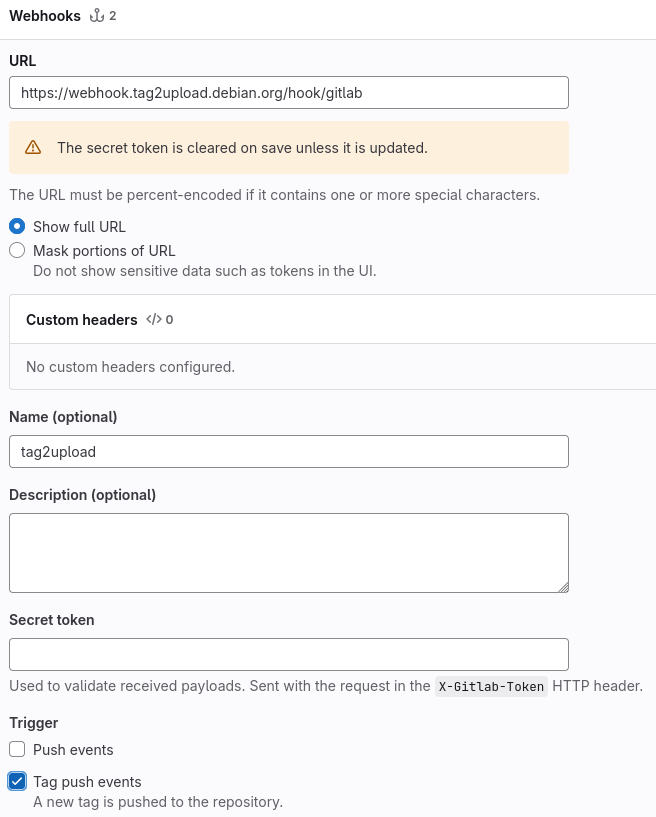
And then I realise that I still want to build a source package to test it in cowbuilder. Hmm, I remember that Helmut showed me that building a source package isn t necessary in sbuild, but I have a habit of breaking my sbuild configs somehow, but I guess I should revisit that. So, I do a dpkg-buildpackage -S -sa and test it out with cowbuilder, because that s just how I roll (at least for now, fixing my local sbuild setup is yak shaving for another day, let s focus!). I end up with a binary that looks good, so I m satisfied that I can upload this package to the Debian archives. So, time to configure tag2upload. The first step is to set up the webhook in Salsa. I was surprised two find two webhooks already configured:
I know of KGB that posts to IRC, didn t know that this was the mechanism it does that by before. Nice! Also don t know what the tagpending one does, I ll go look into that some other time. Configuring a tag2upload webhook is quite simple, add a URL, call the name tag2upload, and select only tag push events:
I run the test webhook, and it returned a code 400 message about a missing message header, which the documentation says is normal. Next, I install git-debpush from experimental. The wiki page simply states that you can use the git-debpush command to upload, but doesn t give any examples on how to use it, and its manpage doesn t either. And when I run just git-debpush I get:
jonathan@lapcloud:~/devel/debian/python-team/bundlewrap/bundlewrap-4.23.1$ git-debpush
git-debpush: check failed: upstream tag upstream/4.22.0 is not an ancestor of refs/heads/debian/master; probably a mistake ('upstream-nonancestor' check)
pristine-tar is /usr/bin/pristine-tar
git-debpush: some check(s) failed; you can pass --force to ignore them
I have no idea what that s supposed to mean. I was also not sure whether I should tag anything to begin with, or if some part of the tag2upload machinery automatically does it. I think I might have tagged debian/4.23-1 before tagging upstream/4.23 and perhaps it didn t like it, I reverted and did it the other way around and got a new error message. Progress!
jonathan@lapcloud:~/devel/debian/python-team/bundlewrap/bundlewrap-4.23.1$ git-debpush
git-debpush: could not determine the git branch layout
git-debpush: please supply a --quilt= argument
Looking at the manpage, it looks like quilt=baredebian matches my package the best, so I try that:
jonathan@lapcloud:~/devel/debian/python-team/bundlewrap/bundlewrap-4.23.1$ git-debpush --quilt=baredebian
Enumerating objects: 70, done.
Counting objects: 100% (70/70), done.
Delta compression using up to 12 threads
Compressing objects: 100% (37/37), done.
Writing objects: 100% (37/37), 8.97 KiB   2.99 MiB/s, done.
Total 37 (delta 30), reused 0 (delta 0), pack-reused 0 (from 0)
To salsa.debian.org:python-team/packages/bundlewrap.git
6f55d99..3d5498f debian/master -> debian/master
 * [new tag] upstream/4.23.1 -> upstream/4.23.1
 * [new tag] debian/4.23.1-1_exp1 -> debian/4.23.1-1_exp1
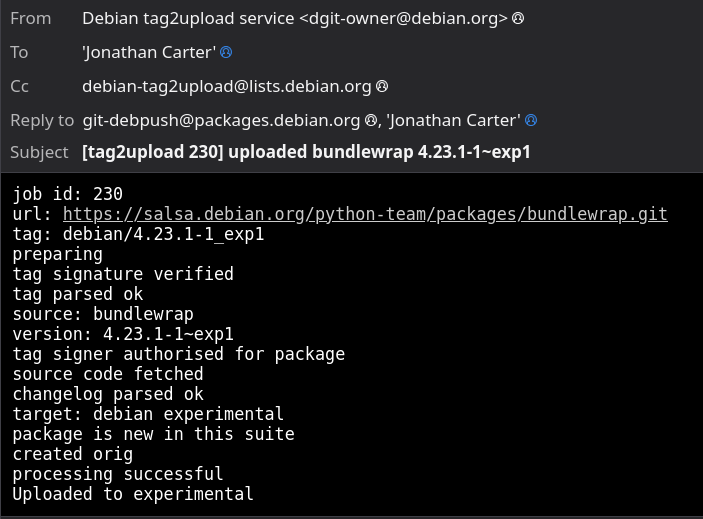
Ooh! That looked like it did something! And a minute later I received the notification of the upload in my inbox:
So, I m not 100% sure that this makes things much easier for me than doing a dput, but, it s not any more difficult or more work either (once you know how it works), so I ll be using git-debpush from now on, and I m sure as I get more used to the git workflow of doing things I ll understand more of the benefits. And at last, my one last use case for using FTP is now properly dead. RIP FTP :)

Debian Outreach Team: GSoC 2025 Introduction: Make Debian for Raspberry Pi Build Again

Hello everyone! I am Kurva Prashanth, Interested in the lower level working of system software, CPUs/SoCs and Hardware design. I was introduced to Open Hardware and Embedded Linux while studying electronics and embedded systems as part of robotics coursework. Initially, I did not pay much attention to it and quickly moved on. However, a short talk on Liberating SBCs using Debian by Yuvraj at MiniDebConf India, 2021 caught my interest. The talk focused on Open Hardware platforms such as Olimex and BeagleBone Black, as well as the Debian distributions tailored for these ARM-based single-board computers has intrigued me to delve deeper into the realm of Open Hardware and Embedded Linux. These days I m trying to improve my abilities to contribute to Debian and Linux Kernel development. Before finding out about the Google Summer of Code project, I had already started my journey with Debian. I extensively used Debian system build tools(debootstrap, sbuild, deb-build-pkg, qemu-debootstrap) for Building Debian Image for Bela Cape a real-time OS for music making to achieve extremely fast audio and sensor processing times. In 2023, I had the opportunity to attend DebConf23 in Kochi, India - thanks to Nilesh Patra (@nilesh) and I met Hector Oron (@zumbi) over dinner at DebConf23 and It was nice talking about his contributions/work at Debian on armhf port and Debian System Administration that conversation got me interested in knowing more about Debian ARM, Installer and I found it fascinating that EmDebian was once a external project bringing Debian to embedded systems and now, Debian itself can be run on many embedded systems. And, also during DebCamp I got Introduced to PGP/GPG keys and the web of trust by Carlos Henrique Lima Melara (@charles) I learned how to use and generate GPG keys. After DebConf23 I tried debian packaging and I miserably failed to get sponsorship for a python library I packaged. I came across the Debian project for this year s Google Summer of Code and found the project titled Make Debian for Raspberry Pi Build Again quite interesting to me and applied. Gladly, on May 8th, I received an acceptance e-mail from GSoC. I got excited that I ll spend the summer working on something that I like doing. I am thrilled to be part of this project and I am super excited for the summer of 25. I m looking forward to work on what I most like, new connections and learning opportunities. So, let me talk a bit more about my project. I will be working on to Make Debian for Raspberry Pi SBC s under the guidance of Gunnar Wolf (@gwolf). In this post, I will describe the project I will be working on.

Why make Debian for Raspberry Pi build again? There is an available set of images for running Debian in Raspberry Pi computers (all models below the 5 series)! However, the maintainer severely lacking time to take care for them; called for help for somebody to adopt them, but have not been successful. The image generation scripts might have bitrotted a bit, but it is mostly all done. And there is a lot of interest and use still in having the images freshly generated and decently tested! This GSoC project is about getting the [https://raspi.debian.net/ Raspberry Pi Debian images] site working reliably, daily-built images become automatic again and ideally making it easily deployable to be run in project machines and migrating exsisting hosting infrastructure to Debian.

How much it differ from Debian build process? While the goal is to stay as close as possible to the Debian build process, Raspberry Pi boards require some necessary platform-specific changes primarily in the early boot sequence and firmware handling. Unlike typical Debian systems, Raspberry Pi boards depend on a non-standard bootloader and use non-free firmware (raspi-firmware), Introducing some hardware-specific differences in the initialization process. These differences are largely confined to the early boot and hardware initialization stages. Once the system boots, the userspace remains closely aligned with a typical Debian install, using Debian packages. The current modifications are required due to non-free firmware. However, several areas merit review: but there are a few parts that might be worth changing.
  1. Boot flow: Transitioning to a U-Boot based boot process (as used in Debian installer images for many other SBCs) would reduce divergence and better align with Debian Installer.
  2. Current scripts/workarounds: Some existing hacks may now be redundant with recent upstream support and could be removed.
  3. Board-specific images: Shift to architecture-specific base images with runtime detection could simplify builds and reduce duplication.
Debian already already building SD card images for a wide range of SBCs (e.g., BeagleBone, BananaPi, OLinuXino, Cubieboard, etc.) installer-arm64/images/u-boot and installer-armhf/images/u-boot, a similar approach for Raspberry Pi could improve maintainability and consistency with Debian s broader SBC support.

Quoted from Mail Discussion Thread with Mentor (Gunnar Wolf)
"One direction we wanted to explore was whether we should still be building one image per family, or whether we could instead switch to one image per architecture (armel, armhf, arm64). There were some details to iron out as RPi3 and RPi4 were quite different, but I think it will be similar to the differences between the RPi 0 and 1, which are handled at first-boot time. To understand what differs between families, take a look at Cyril Brulebois generate-recipe (in the repo), which is a great improvement over the ugly mess I had before he contributed it"
In this project, I intend to to build one image per architecture (armel, armhf, arm64) rather than continuing with the current model of building one image per board. This change simplifies image management, reduces redundancy, and leverages dynamic configuration at boot time to support all supported boards within each architecture. By using U-Boot and flash-kernel, we can detect the board type and configure kernel parameters, DTBs, and firmware during the first boot, reducing duplication across images and simplifying the maintenance burden and we can also generalize image creation while still supporting board-specific behavior at runtime. This method aligns with existing practices in the DebianInstaller team and aligns with Debian s long-term maintainability goals and better leverages upstream capabilities, ensuring a consistent and scalable boot experience. To streamline and standardize the process of building bootable Debian images for Raspberry Pi devices, I proposed a new workflow that leverages U-Boot and flash-kernel Debian packages. This provides a clean, maintainable, and reproducible way to generate images for armel, armhf and arm64 boards. The workflow is vmdb2, a lightweight, declarative tool designed to automate the creation of disk images. A typical vmdb2 recipe defines the disk layout, base system installation (via debootstrap), architecture-specific packages, and any custom post-install hooks and the image should includes U-Boot (the u-boot-rpi package), flash-kernel, and a suitable Debian kernel package like linux-image-arm64 or linux-image-armmp. U-Boot serves as the platform s bootloader and is responsible for loading the kernel and initramfs. Unlike Raspberry Pi s non-free firmware/proprietary bootloader, U-Boot provides an open and scriptable interface, allowing us to follow a more standard Debian boot process. It can be configured to boot using either an extlinux.conf or a boot.scr script generated automatically by flash-kernel. The role of flash-kernel is to bridge Debian s kernel installation system with the specifics of embedded bootloaders like U-Boot. When installed, it automatically copies the kernel image, initrd, and device tree blobs (DTBs) to the /boot partition. It also generates the necessary boot.scr script if the board configuration demands it. To work correctly, flash-kernel requires that the target machine be identified via /etc/flash-kernel/machine, which must correspond to an entry in its internal machine database.\ Once the vmdb2 build is complete, the resulting image will contain a fully configured bootable system with all necessary boot components correctly installed. The image can be flashed to an SD card and used to boot on the intended device without additional manual configuration. Because all key packages (U-Boot, kernel, flash-kernel) are managed through Debian s package system, kernel updates and boot script regeneration are handled automatically during system upgrades.

Current Workflow: Builds one Image per family The current vmdb2 recipe uses the Raspberry Pi GPU bootloader provided via the raspi-firmware package. This is the traditional boot process followed by Raspberry Pi OS, and it s tightly coupled with firmware files like bootcode.bin, start.elf, and fixup.dat. These files are installed to /boot/firmware, which is mounted from a FAT32 partition labeled RASPIFIRM. The device tree files (*.dtb) are manually copied from /usr/lib/linux-image-*-arm64/broadcom/ into this partition. The kernel is installed via the linux-image-arm64 package, and the boot arguments are injected by modifying /boot/firmware/cmdline.txt using sed commands. Booting depends on the root partition being labeled RASPIROOT, referenced through that file. There is no bootloader like UEFI-based or U-Boot involved the Raspberry Pi firmware directly loads the kernel, which is standard for Raspberry Pi boards.
- apt: install
  packages:
    ...
    - raspi-firmware  
The boot partition contents and kernel boot setup are tightly controlled via scripting in the recipe. Limitations of Current Workflow: While this setup works, it is
  1. Proprietary and Raspberry Pi specific It relies on the closed-source GPU bootloader the raspi-firmware package, which is tightly coupled to specific Raspberry Pi models.
  2. Manual DTB handling Device tree files are manually copied and hardcoded, making upgrades or board-specific changes error-prone.
  3. Not easily extendable to future Raspberry Pi boards Any change in bootloader behavior (as seen in the Raspberry Pi 5, which introduces a more flexible firmware boot process) would require significant rework.
  4. No UEFI-based/U-Boot The current method bypasses the standard bootloader layers, making it inconsistent with other Debian ARM platforms and harder to maintain long-term.
As Raspberry Pi firmware and boot processes evolve, especially with the introduction of Pi 5 and potentially Pi 6, maintaining compatibility will require more flexibility - something best delivered by adopting U-Boot and flash-kernel.

New Workflow: Building Architecture-Specific Images with vmdb2, U-Boot, flash-kernel, and Debian Kernel This workflow outlines an improved approach to generating bootable Debian images architecture specific, using vmdb2, U-Boot, flash-kernel, and Debian kernels and also to move away from Raspberry Pi s proprietary bootloader to a fully open-source boot process which improves maintainability, consistency, and cross-board support.

New Method: Shift to U-Boot + flash-kernel U-Boot (via Debian su-boot-rpi package) and flash-kernel bring the image building process closer to how Debian officially boots ARM devices. flash-kernel integrates with the system s initramfs and kernel packages to install bootloaders, prepare boot.scr or extlinux.conf, and copy kernel/initrd/DTBs to /boot in a format that U-Boot expects. U-Boot will be used as a second-stage bootloader, loaded by the Raspberry Pi s built-in firmware. Once U-Boot is in place, it will read standard boot scripts ( boot.scr) generated by flash-kernel, providing a Debian-compatible and board-flexible solution. Extending YAML spec for vmdb2 build with U-Boot and flash-kernel To improve an existing vmdb2 YAML spec(https://salsa.debian.org/raspi-team/image-specs/raspi_master.yaml), to integrate U-Boot, flash-kernel, and the architecture-specific Debian kernel into the image build process. By incorporating u-boot-rpi and flash-kernel from Debian packages, alongside the standard initramfs-tools, we align the image closer to Debian best practices while supporting both armhf and arm64 architectures. Below are key additions and adjustments needed in a vmdb2 YAML spec to support the workflow: Install U-Boot, flash-kernel, initramfs-tools and the architecture-specific Debian kernel.
- apt: install
  packages:
    - u-boot-rpi
    - flash-kernel
    - initramfs-tools
    - linux-image-arm64 # or linux-image-armmp for armhf 
  tag: tag-root
Replace linux-image-arm64 with the correct kernel package for specific target architecture. These packages should be added under the tag-root section in YAML spec for vmdb2 build recipe. This ensures that the necessary bootloader, kernel, and initramfs tools are included and properly configured in the image. Configure Raspberry Pi firmware to Load U-Boot Install the U-Boot binary as kernel.img in /boot/firmware we can also download and build U-Boot from source, but Debian provides tested binaries.
- shell:  
    cp /usr/lib/u-boot/rpi_4/u-boot.bin $ ROOT? /boot/firmware/kernel.img
    echo "enable_uart=1" >> $ ROOT? /boot/firmware/config.txt
  root-fs: tag-root
This makes the RPi firmware load u-boot.bin instead of the Linux kernel directly. Set Up flash-kernel for Debian-style Boot flash-kernel integrates with initramfs-tools and writes boot config suitable for U-Boot. We need to make sure /etc/flash-kernel/db contains an entry for board (most Raspberry Pi boards already supported in Bookworm). Set up /etc/flash-kernel.conf with:
- create-file: /etc/flash-kernel.conf
  contents:  
    MACHINE="Raspberry Pi 4"
    BOOTPART="/dev/disk/by-label/RASPIFIRM"
    ROOTPART="/dev/disk/by-label/RASPIROOT"
  unless: rootfs_unpacked
This allows flash-kernel to write an extlinux.conf or boot.scr into /boot/firmware. Clean up Proprietary/Non-Free Firmware Bootflow Remove the direct kernel loading flow:
- shell:  
    rm -f $ ROOT? /boot/firmware/vmlinuz*
    rm -f $ ROOT? /boot/firmware/initrd.img*
    rm -f $ ROOT? /boot/firmware/cmdline.txt
  root-fs: tag-root
Let U-Boot and flash-kernel manage kernel/initrd and boot parameters instead. Boot Flow After This Change
[SoC ROM] -> [start.elf] -> [U-Boot] -> [boot.scr] -> [Linux Kernel]
  1. This still depends on the Raspberry Pi firmware to start, but it only loads U-Boot, not Linux kernel.
  2. U-Boot gives you more flexibility (e.g., networking, boot menus, signed boot).
  3. Using flash-kernel ensures kernel updates are handled the Debian Installer way.
  4. Test with a serial console (enable_uart=1) in case HDMI doesn t show early boot logs.
Advantage of New Workflow
  1. Replaces the proprietary Raspberry Pi bootloader with upstream U-Boot.
  2. Debian-native tooling Uses flash-kernel and initramfs-tools to manage boot configuration.
  3. Consistent across boards Works for both armhf and arm64, unifying the image build process.
  4. Easier to support new boards Like the Raspberry Pi 5 and future models.
This transition will standardize a bit image-building process, making it aligned with upstream Debian Installer workflows.

vmdb2 configuration for arm64 using u-boot and flash-kernel NOTE: This is a baseline example and may require tuning.
# Raspberry Pi arm64 image using U-Boot and flash-kernel
steps:
  # ... (existing mkimg, partitions, mount, debootstrap, etc.) ...
  # Install U-Boot, flash-kernel, initramfs-tools and architecture specific kernel
  - apt: install
    packages:
      - u-boot-rpi
      - flash-kernel
      - initramfs-tools
      - linux - image - arm64 # or linux - image - armmp for armhf
    tag: tag-root
  # Install U-Boot binary as kernel.img in firmware partition
  - shell:  
      cp /usr/lib/u-boot/rpi_arm64 /u-boot.bin $ ROOT? /boot/firmware/kernel.img
      echo "enable_uart=1" >> $ ROOT? /boot/firmware/config.txt
    root-fs: tag-root
  # Configure flash-kernel for Raspberry Pi
  - create-file: /etc/flash-kernel.conf
    contents:  
      MACHINE="Generic Raspberry Pi ARM64"
      BOOTPART="/dev/disk/by-label/RASPIFIRM"
      ROOTPART="/dev/disk/by-label/RASPIROOT"
    unless: rootfs_unpacked
  # Remove direct kernel boot files from Raspberry Pi firmware
  - shell:  
      rm -f $ ROOT? /boot/firmware/vmlinuz*
      rm -f $ ROOT? /boot/firmware/initrd.img*
      rm -f $ ROOT? /boot/firmware/cmdline.txt
    root-fs: tag-root
  # flash-kernel will manage boot scripts and extlinux.conf
  # Rest of image build continues...

Required Changes to Support Raspberry Pi Boards in Debian (flash-kernel + U-Boot)

Overview of Required Changes
Component Required Task
Debian U-Boot Package Add build target for rpi_arm64 in u-boot-rpi. Optionally deprecate legacy 32-bit targets.
Debian flash-kernel Package Add or verify entries in db/all.db for Pi 4, Pi 5, Zero 2W, CM4. Ensure boot script generation works via bootscr.uboot-generic.
Debian Kernel Ensure DTBs are installed at /usr/lib/linux-image-<version>/ and available for flash-kernel to reference.

flash-kernel

Already Supported Boards in flash-kernel Debian Package https://sources.debian.org/src/flash-kernel/3.109/db/all.db/#L1700
Model Arch DTB-Id
Raspberry Pi 1 A/B/B+, Rev2 armel bcm2835-*
Raspberry Pi CM1 armel bcm2835-rpi-cm1-io1.dtb
Raspberry Pi Zero/Zero W armel bcm2835-rpi-zero*.dtb
Raspberry Pi 2B armhf bcm2836-rpi-2-b.dtb
Raspberry Pi 3B/3B+ arm64 bcm2837-*
Raspberry Pi CM3 arm64 bcm2837-rpi-cm3-io3.dtb
Raspberry Pi 400 arm64 bcm2711-rpi-400.dtb

uboot

Already Supported Boards in Debian U-Boot Package https://salsa.debian.org/installer-team/flash-kernel/-/blob/master/db/all.db

arm64 Model Arch Upstream Defconfig Debian Target - - - Raspberry Pi 3B arm64 rpi_3_defconfig rpi_3 Raspberry Pi 4B arm64 rpi_4_defconfig rpi_4 Raspberry Pi 3B/3B+/CM3/CM3+/4B/CM4/400/5B/Zero 2W arm64 rpi_arm64_defconfig rpi_arm64
armhf Model Arch Upstream Defconfig Debian Target - - - Raspberry Pi 2 armhf rpi_2_defconfig rpi_2 Raspberry Pi 3B (32-bit) armhf rpi_3_32b_defconfig rpi_3_32b Raspberry Pi 4B (32-bit) armhf rpi_4_32b_defconfig rpi_4_32b
armel Model Arch Upstream Defconfig Debian Target - - - Raspberry Pi armel rpi_defconfig rpi Raspberry Pi 1/Zero armel rpi_0_w rpi_0_w These boards are already defined in debian/rules under the u-boot-rpi source package and generates usable U-Boot binaries for corresponding Raspberry Pi models.

To-Do: Add Missing Board Support to U-Boot and flash-kernel in Debian Several Raspberry Pi models are missing from the Debian U-Boot and flash-kernel packages, even though upstream support and DTBs exist in the Debian kernel but are missing entries in the flash-kernel database to enable support for bootloader installation and initrd handling.

Boards Not Yet Supported in flash-kernel Debian Package
Model Arch DTB-Id
Raspberry Pi 3A+ (32 & 64 bit) armhf, arm64 bcm2837-rpi-3-a-plus.dtb
Raspberry Pi 4B (32 & 64 bit) armhf, arm64 bcm2711-rpi-4-b.dtb
Raspberry Pi CM4 arm64 bcm2711-rpi-cm4-io.dtb
Raspberry Pi CM 4S arm64 -
Raspberry Zero 2 W arm64 bcm2710-rpi-zero-2-w.dtb
Raspberry Pi 5 arm64 bcm2712-rpi-5-b.dtb
Raspberry Pi CM5 arm64 -
Raspberry Pi 500 arm64 -

Boards Not Yet Supported in Debian U-Boot Package
Model Arch Upstream defconfig(s)
Raspberry Pi 3A+/3B+ arm64 -, rpi_3_b_plus_defconfig
Raspberry Pi CM 4S arm64 -
Raspberry Pi 5 arm64 -
Raspberry Pi CM5 arm64 -
Raspberry Pi 500 arm64 -

So, what next? During the Community Bonding Period, I got hands-on with workflow improvements, set up test environments, and began reviewing Raspberry Pi support in Debian s U-Boot and flash-kernel and these are the logs of the project, where I provide weekly reports on the work done. You can check here: Community Bonding Period logs. My next steps include submitting patches to the u-boot and flash-kernel packages to ensure all missing Raspberry Pi entries are built and shipped. And, also to confirm the kernel DTB installation paths and make sure the necessary files are included for all Raspberry Pi variants. Finally, plan to validate changes with test builds on Raspberry Pi hardware. In parallel, I m organizing my tasks and setting up my environment to contribute more effectively. It s been exciting to explore how things work under the hood and to prepare for a summer of learning and contributing to this great community.

18 June 2025

Sergio Durigan Junior: GCC, glibc, stack unwinding and relocations A war story

I ve been meaning to write a post about this bug for a while, so here it is (before I forget the details!). First, I d like to thank a few people: I ll probably forget some details because it s been more than a week (and life at $DAYJOB moves fast), but we ll see.

The background story Wolfi OS takes security seriously, and one of the things we have is a package which sets the hardening compiler flags for C/C++ according to the best practices recommended by OpenSSF. At the time of this writing, these flags are (in GCC s spec file parlance):
*self_spec:
+ % !O:% !O1:% !O2:% !O3:% !O0:% !Os:% !0fast:% !0g:% !0z:-O2  -fhardened -Wno-error=hardened -Wno-hardened % !fdelete-null-pointer-checks:-fno-delete-null-pointer-checks  -fno-strict-overflow -fno-strict-aliasing % !fomit-frame-pointer:-fno-omit-frame-pointer  -mno-omit-leaf-frame-pointer
*link:
+ --as-needed -O1 --sort-common -z noexecstack -z relro -z now
The important part for our bug is the usage of -z now and -fno-strict-aliasing. As I was saying, these flags are set for almost every build, but sometimes things don t work as they should and we need to disable them. Unfortunately, one of these problematic cases has been glibc. There was an attempt to enable hardening while building glibc, but that introduced a strange breakage to several of our packages and had to be reverted. Things stayed pretty much the same until a few weeks ago, when I started working on one of my roadmap items: figure out why hardening glibc wasn t working, and get it to work as much as possible.

Reproducing the bug I started off by trying to reproduce the problem. It s important to mention this because I often see young engineers forgetting to check if the problem is even valid anymore. I don t blame them; the anxiety to get the bug fixed can be really blinding. Fortunately, I already had one simple test to trigger the failure. All I had to do was install the py3-matplotlib package and then invoke:
$ python3 -c 'import matplotlib'
This would result in an abortion with a coredump. I followed the steps above, and readily saw the problem manifesting again. OK, first step is done; I wasn t getting out easily from this one.

Initial debug The next step is to actually try to debug the failure. In an ideal world you get lucky and are able to spot what s wrong after just a few minutes. Or even better: you also can devise a patch to fix the bug and contribute it to upstream. I installed GDB, and then ran the py3-matplotlib command inside it. When the abortion happened, I issued a backtrace command inside GDB to see where exactly things had gone wrong. I got a stack trace similar to the following:
#0  0x00007c43afe9972c in __pthread_kill_implementation () from /lib/libc.so.6
#1  0x00007c43afe3d8be in raise () from /lib/libc.so.6
#2  0x00007c43afe2531f in abort () from /lib/libc.so.6
#3  0x00007c43af84f79d in uw_init_context_1[cold] () from /usr/lib/libgcc_s.so.1
#4  0x00007c43af86d4d8 in _Unwind_RaiseException () from /usr/lib/libgcc_s.so.1
#5  0x00007c43acac9014 in __cxxabiv1::__cxa_throw (obj=0x5b7d7f52fab0, tinfo=0x7c429b6fd218 <typeinfo for pybind11::attribute_error>, dest=0x7c429b5f7f70 <pybind11::reference_cast_error::~reference_cast_error() [clone .lto_priv.0]>)
    at ../../../../libstdc++-v3/libsupc++/eh_throw.cc:93
#6  0x00007c429b5ec3a7 in ft2font__getattr__(std::__cxx11::basic_string<char, std::char_traits<char>, std::allocator<char> >) [clone .lto_priv.0] [clone .cold] () from /usr/lib/python3.13/site-packages/matplotlib/ft2font.cpython-313-x86_64-linux-gnu.so
#7  0x00007c429b62f086 in pybind11::cpp_function::initialize<pybind11::object (*&)(std::__cxx11::basic_string<char, std::char_traits<char>, std::allocator<char> >), pybind11::object, std::__cxx11::basic_string<char, std::char_traits<char>, std::allocator<char> >, pybind11::name, pybind11::scope, pybind11::sibling>(pybind11::object (*&)(std::__cxx11::basic_string<char, std::char_traits<char>, std::allocator<char> >), pybind11::object (*)(std::__cxx11::basic_string<char, std::char_traits<char>, std::allocator<char> >), pybind11::name const&, pybind11::scope const&, pybind11::sibling const&):: lambda(pybind11::detail::function_call&)#1 ::_FUN(pybind11::detail::function_call&) [clone .lto_priv.0] ()
   from /usr/lib/python3.13/site-packages/matplotlib/ft2font.cpython-313-x86_64-linux-gnu.so
#8  0x00007c429b603886 in pybind11::cpp_function::dispatcher(_object*, _object*, _object*) () from /usr/lib/python3.13/site-packages/matplotlib/ft2font.cpython-313-x86_64-linux-gnu.so
...
Huh. Initially this didn t provide me with much information. There was something strange seeing the abort function being called right after _Unwind_RaiseException, but at the time I didn t pay much attention to it. OK, time to expand our horizons a little. Remember when I said that several of our packages would crash with a hardened glibc? I decided to look for another problematic package so that I could make it crash and get its stack trace. My thinking here is that maybe if I can compare both traces, something will come up. I happened to find an old discussion where Dann Frazier mentioned that Emacs was also crashing for him. He and I share the Emacs passion, and I totally agreed with him when he said that Emacs crashing is priority -1! (I m paraphrasing). I installed Emacs, ran it, and voil : the crash happened again. OK, that was good. When I ran Emacs inside GDB and asked for a backtrace, here s what I got:
#0  0x00007eede329972c in __pthread_kill_implementation () from /lib/libc.so.6
#1  0x00007eede323d8be in raise () from /lib/libc.so.6
#2  0x00007eede322531f in abort () from /lib/libc.so.6
#3  0x00007eede262879d in uw_init_context_1[cold] () from /usr/lib/libgcc_s.so.1
#4  0x00007eede2646e7c in _Unwind_Backtrace () from /usr/lib/libgcc_s.so.1
#5  0x00007eede3327b11 in backtrace () from /lib/libc.so.6
#6  0x000059535963a8a1 in emacs_backtrace ()
#7  0x000059535956499a in main ()
Ah, this backtrace is much simpler to follow. Nice. Hmmm. Now the crash is happening inside _Unwind_Backtrace. A pattern emerges! This must have something to do with stack unwinding (or so I thought keep reading to discover the whole truth). You see, the backtrace function (yes, it s a function) and C++ s exception handling mechanism use similar techniques to do their jobs, and it pretty much boils down to unwinding frames from the stack. I looked into Emacs source code, specifically the emacs_backtrace function, but could not find anything strange over there. This bug was probably not going to be an easy fix

The quest for a minimal reproducer Being able to easily reproduce the bug is awesome and really helps with debugging, but even better is being able to have a minimal reproducer for the problem. You see, py3-matplotlib is a huge package and pulls in a bunch of extra dependencies, so it s not easy to ask other people to just install this big package plus these other dependencies, and then run this command , especially if we have to file an upstream bug and talk to people who may not even run the distribution we re using. So I set up to try and come up with a smaller recipe to reproduce the issue, ideally something that s not tied to a specific package from the distribution. Having all the information gathered from the initial debug session, especially the Emacs backtrace, I thought that I could write a very simple program that just invoked the backtrace function from glibc in order to trigger the code path that leads to _Unwind_Backtrace. Here s what I wrote:
#include <execinfo.h>

int
main(int argc, char *argv[])
 
  void *a[4096];
  backtrace (a, 100);
  return 0;
 
After compiling it, I determined that yes, the problem did happen with this small program as well. There was only a small nuisance: the manifestation of the bug was not deterministic, so I had to execute the program a few times until it crashed. But that s much better than what I had before, and a small price to pay. Having a minimal reproducer pretty much allows us to switch our focus to what really matters. I wouldn t need to dive into Emacs or Python s source code anymore. At the time, I was sure this was a glibc bug. But then something else happened.

GCC 15 I had to stop my investigation efforts because something more important came up: it was time to upload GCC 15 to Wolfi. I spent a couple of weeks working on this (it involved rebuilding the whole archive, filing hundreds of FTBFS bugs, patching some programs, etc.), and by the end of it the transition went smooth. When the GCC 15 upload was finally done, I switched my focus back to the glibc hardening problem. The first thing I did was to yes, reproduce the bug again. It had been a few weeks since I had touched the package, after all. So I built a hardened glibc with the latest GCC and the bug did not happen anymore! Fortunately, the very first thing I thought was this must be GCC , so I rebuilt the hardened glibc with GCC 14, and the bug was there again. Huh, unexpected but very interesting.

Diving into glibc and libgcc At this point, I was ready to start some serious debugging. And then I got a message on Signal. It was one of those moments where two minds think alike: Gabriel decided to check how I was doing, and I was thinking about him because this involved glibc, and Gabriel contributed to the project for many years. I explained what I was doing, and he promptly offered to help. Yes, there are more people who love low level debugging! We spent several hours going through disassembles of certain functions (because we didn t have any debug information in the beginning), trying to make sense of what we were seeing. There was some heavy GDB involved; unfortunately I completely lost the session s history because it was done inside a container running inside an ephemeral VM. But we learned a lot. For example:
  • It was hard to actually understand the full stack trace leading to uw_init_context_1[cold]. _Unwind_Backtrace obviously didn t call it (it called uw_init_context_1, but what was that [cold] doing?). We had to investigate the disassemble of uw_init_context_1 in order to determined where uw_init_context_1[cold] was being called.
  • The [cold] suffix is a GCC function attribute that can be used to tell the compiler that the function is unlikely to be reached. When I read that, my mind immediately jumped to this must be an assertion , so I went to the source code and found the spot.
  • We were able to determine that the return code of uw_frame_state_for was 5, which means _URC_END_OF_STACK. That s why the assertion was triggering.
After finding these facts without debug information, I decided to bite the bullet and recompiled GCC 14 with -O0 -g3, so that we could debug what uw_frame_state_for was doing. After banging our heads a bit more, we found that fde is NULL at this excerpt:
// ...
  fde = _Unwind_Find_FDE (context->ra + _Unwind_IsSignalFrame (context) - 1,
                          &context->bases);
  if (fde == NULL)
     
#ifdef MD_FALLBACK_FRAME_STATE_FOR
      /* Couldn't find frame unwind info for this function.  Try a
         target-specific fallback mechanism.  This will necessarily
         not provide a personality routine or LSDA.  */
      return MD_FALLBACK_FRAME_STATE_FOR (context, fs);
#else
      return _URC_END_OF_STACK;
#endif
     
// ...
We re debugging on amd64, which means that MD_FALLBACK_FRAME_STATE_FOR is defined and therefore is called. But that s not really important for our case here, because we had established before that _Unwind_Find_FDE would never return NULL when using a non-hardened glibc (or a glibc compiled with GCC 15). So we decided to look into what _Unwind_Find_FDE did. The function is complex because it deals with .eh_frame , but we were able to pinpoint the exact location where find_fde_tail (one of the functions called by _Unwind_Find_FDE) is returning NULL:
if (pc < table[0].initial_loc + data_base)
  return NULL;
We looked at the addresses of pc and table[0].initial_loc + data_base, and found that the former fell within libgcc s text section, which the latter fell within /lib/ld-linux-x86-64.so.2 text. At this point, we were already too tired to continue. I decided to keep looking at the problem later and see if I could get any further.

Bisecting GCC The next day, I woke up determined to find what changed in GCC 15 that caused the bug to disappear. Unless you know GCC s internals like they are your own home (which I definitely don t), the best way to do that is to git bisect the commits between GCC 14 and 15. I spent a few days running the bisect. It took me more time than I d have liked to find the right range of commits to pass git bisect (because of how branches and tags are done in GCC s repository), and I also had to write some helper scripts that:
  • Modified the gcc.yaml package definition to make it build with the commit being bisected.
  • Built glibc using the GCC that was just built.
  • Ran tests inside a docker container (with the recently built glibc installed) to determine whether the bug was present.
At the end, I had a commit to point to:
commit 99b1daae18c095d6c94d32efb77442838e11cbfb
Author: Richard Biener <rguenther@suse.de>
Date:   Fri May 3 14:04:41 2024 +0200
    tree-optimization/114589 - remove profile based sink heuristics
Makes sense, right?! No? Well, it didn t for me either. Even after reading what was changed in the code and the upstream bug fixed by the commit, I was still clueless as to why this change fixed the problem (I say fixed because it may very well be an unintended consequence of the change, and some other problem might have been introduced).

Upstream takes over After obtaining the commit that possibly fixed the bug, while talking to Dann and explaining what I did, he suggested that I should file an upstream bug and check with them. Great idea, of course. I filed the following upstream bug: https://gcc.gnu.org/bugzilla/show_bug.cgi?id=120653 It s a bit long, very dense and complex, but ultimately upstream was able to find the real problem and have a patch accepted in just two days. Nothing like knowing the code base. The initial bug became: https://sourceware.org/bugzilla/show_bug.cgi?id=33088 In the end, the problem was indeed in how the linker defines __ehdr_start, which, according to the code (from elf/dl-support.c):
if (_dl_phdr == NULL)
   
    /* Starting from binutils-2.23, the linker will define the
       magic symbol __ehdr_start to point to our own ELF header
       if it is visible in a segment that also includes the phdrs.
       So we can set up _dl_phdr and _dl_phnum even without any
       information from auxv.  */


    extern const ElfW(Ehdr) __ehdr_start attribute_hidden;
    assert (__ehdr_start.e_phentsize == sizeof *GL(dl_phdr));
    _dl_phdr = (const void *) &__ehdr_start + __ehdr_start.e_phoff;
    _dl_phnum = __ehdr_start.e_phnum;
   
But the following definition is the problematic one (from elf/rtld.c):
extern const ElfW(Ehdr) __ehdr_start attribute_hidden;
This symbol (along with its counterpart, __ehdr_end) was being run-time relocated when it shouldn t be. The fix that was pushed added optimization barriers to prevent the compiler from doing the relocations. I don t claim to fully understand what was done here, and Jakub s analysis is a thing to behold, but in the end I was able to confirm that the patch fixed the bug. And in the end, it was indeed a glibc bug.

Conclusion This was an awesome bug to investigate. It s one of those that deserve a blog post, even though some of the final details of the fix flew over my head. I d like to start blogging more about these sort of bugs, because I ve encountered my fair share of them throughout my career. And it was great being able to do some debugging with another person, exchange ideas, learn things together, and ultimately share that deep satisfaction when we find why a crash is happening. I have at least one more bug in my TODO list to write about (another one with glibc, but this time I was able to get to the end of it and come up with a patch). Stay tunned. P.S.: After having published the post I realized that I forgot to explain why the -z now and -fno-strict-aliasing flags were important. -z now is the flag that I determined to be the root cause of the breakage. If I compiled glibc with every hardening flag except -z now, everything worked. So initially I thought that the problem had to do with how ld.so was resolving symbols at runtime. As it turns out, this ended up being more a symptom than the real cause of the bug. As for -fno-strict-aliasing, a Gentoo developer who commented on the GCC bug above mentioned that this OpenSSF bug had a good point against using this flag for hardening. I still have to do a deep dive on what was discussed in the issue, but this is certainly something to take into consideration. There s this very good write-up about strict aliasing in general if you re interested in understanding it better.

17 June 2025

Matthew Garrett: Locally hosting an internet-connected server

I'm lucky enough to have a weird niche ISP available to me, so I'm paying $35 a month for around 600MBit symmetric data. Unfortunately they don't offer static IP addresses to residential customers, and nor do they allow multiple IP addresses per connection, and I'm the sort of person who'd like to run a bunch of stuff myself, so I've been looking for ways to manage this.

What I've ended up doing is renting a cheap VPS from a vendor that lets me add multiple IP addresses for minimal extra cost. The precise nature of the VPS isn't relevant - you just want a machine (it doesn't need much CPU, RAM, or storage) that has multiple world routeable IPv4 addresses associated with it and has no port blocks on incoming traffic. Ideally it's geographically local and peers with your ISP in order to reduce additional latency, but that's a nice to have rather than a requirement.

By setting that up you now have multiple real-world IP addresses that people can get to. How do we get them to the machine in your house you want to be accessible? First we need a connection between that machine and your VPS, and the easiest approach here is Wireguard. We only need a point-to-point link, nothing routable, and none of the IP addresses involved need to have anything to do with any of the rest of your network. So, on your local machine you want something like:

[Interface]
PrivateKey = privkeyhere
ListenPort = 51820
Address = localaddr/32

[Peer]
Endpoint = VPS:51820
PublicKey = pubkeyhere
AllowedIPs = VPS/0


And on your VPS, something like:

[Interface]
Address = vpswgaddr/32
SaveConfig = true
ListenPort = 51820
PrivateKey = privkeyhere

[Peer]
PublicKey = pubkeyhere
AllowedIPs = localaddr/32


The addresses here are (other than the VPS address) arbitrary - but they do need to be consistent, otherwise Wireguard is going to be unhappy and your packets will not have a fun time. Bring that interface up with wg-quick and make sure the devices can ping each other. Hurrah! That's the easy bit.

Now you want packets from the outside world to get to your internal machine. Let's say the external IP address you're going to use for that machine is 321.985.520.309 and the wireguard address of your local system is 867.420.696.005. On the VPS, you're going to want to do:

iptables -t nat -A PREROUTING -p tcp -d 321.985.520.309 -j DNAT --to-destination 867.420.696.005

Now, all incoming packets for 321.985.520.309 will be rewritten to head towards 867.420.696.005 instead (make sure you've set net.ipv4.ip_forward to 1 via sysctl!). Victory! Or is it? Well, no.

What we're doing here is rewriting the destination address of the packets so instead of heading to an address associated with the VPS, they're now going to head to your internal system over the Wireguard link. Which is then going to ignore them, because the AllowedIPs statement in the config only allows packets coming from your VPS, and these packets still have their original source IP. We could rewrite the source IP to match the VPS IP, but then you'd have no idea where any of these packets were coming from, and that sucks. Let's do something better. On the local machine, in the peer, let's update AllowedIps to 0.0.0.0/0 to permit packets form any source to appear over our Wireguard link. But if we bring the interface up now, it'll try to route all traffic over the Wireguard link, which isn't what we want. So we'll add table = off to the interface stanza of the config to disable that, and now we can bring the interface up without breaking everything but still allowing packets to reach us. However, we do still need to tell the kernel how to reach the remote VPN endpoint, which we can do with ip route add vpswgaddr dev wg0. Add this to the interface stanza as:

PostUp = ip route add vpswgaddr dev wg0
PreDown = ip route del vpswgaddr dev wg0


That's half the battle. The problem is that they're going to show up there with the source address still set to the original source IP, and your internal system is (because Linux) going to notice it has the ability to just send replies to the outside world via your ISP rather than via Wireguard and nothing is going to work. Thanks, Linux. Thinux.

But there's a way to solve this - policy routing. Linux allows you to have multiple separate routing tables, and define policy that controls which routing table will be used for a given packet. First, let's define a new table reference. On the local machine, edit /etc/iproute2/rt_tables and add a new entry that's something like:

1 wireguard


where "1" is just a standin for a number not otherwise used there. Now edit your wireguard config and replace table=off with table=wireguard - Wireguard will now update the wireguard routing table rather than the global one. Now all we need to do is to tell the kernel to push packets into the appropriate routing table - we can do that with ip rule add from localaddr lookup wireguard, which tells the kernel to take any packet coming from our Wireguard address and push it via the Wireguard routing table. Add that to your Wireguard interface config as:

PostUp = ip rule add from localaddr lookup wireguard
PreDown = ip rule del from localaddr lookup wireguard

and now your local system is effectively on the internet.

You can do this for multiple systems - just configure additional Wireguard interfaces on the VPS and make sure they're all listening on different ports. If your local IP changes then your local machines will end up reconnecting to the VPS, but to the outside world their accessible IP address will remain the same. It's like having a real IP without the pain of convincing your ISP to give it to you.

comment count unavailable comments

16 June 2025

Paul Tagliamonte: The Promised LAN

The Internet has changed a lot in the last 40+ years. Fads have come and gone. Network protocols have been designed, deployed, adopted, and abandoned. Industries have come and gone. The types of people on the internet have changed a lot. The number of people on the internet has changed a lot, creating an information medium unlike anything ever seen before in human history. There s a lot of good things about the Internet as of 2025, but there s also an inescapable hole in what it used to be, for me. I miss being able to throw a site up to send around to friends to play with without worrying about hordes of AI-feeding HTML combine harvesters DoS-ing my website, costing me thousands in network transfer for the privilege. I miss being able to put a lightly authenticated game server up and not worry too much at night wondering if that process is now mining bitcoin. I miss being able to run a server in my home closet. Decades of cat and mouse games have rendered running a mail server nearly impossible. Those who are brave enough to try are met with weekslong stretches of delivery failures and countless hours yelling ineffectually into a pipe that leads from the cheerful lobby of some disinterested corporation directly into a void somewhere 4 layers below ground level. I miss the spirit of curiosity, exploration, and trying new things. I miss building things for fun without having to worry about being too successful, after which security offices start demanding my supplier paperwork in triplicate as heartfelt thanks from their engineering teams. I miss communities that are run because it is important to them, not for ad revenue. I miss community operated spaces and having more than four websites that are all full of nothing except screenshots of each other. Every other page I find myself on now has an AI generated click-bait title, shared for rage-clicks all brought-to-you-by-our-sponsors completely covered wall-to-wall with popup modals, telling me how much they respect my privacy, with the real content hidden at the bottom bracketed by deceptive ads served by companies that definitely know which new coffee shop I went to last month. This is wrong, and those who have seen what was know it. I can t keep doing it. I m not doing it any more. I reject the notion that this is as it needs to be. It is wrong. The hole left in what the Internet used to be must be filled. I will fill it.
What comes before part b? Throughout the 2000s, some of my favorite memories were from LAN parties at my friends places. Dragging your setup somewhere, long nights playing games, goofing off, even building software all night to get something working being able to do something fiercely technical in the context of a uniquely social activity. It wasn t really much about the games or the projects it was an excuse to spend time together, just hanging out. A huge reason I learned so much in college was that campus was a non-stop LAN party we could freely stand up servers, talk between dorms on the LAN, and hit my dorm room computer from the lab. Things could go from individual to social in the matter of seconds. The Internet used to work this way my dorm had public IPs handed out by DHCP, and my workstation could serve traffic from anywhere on the internet. I haven t been back to campus in a few years, but I d be surprised if this were still the case. In December of 2021, three of us got together and connected our houses together in what we now call The Promised LAN. The idea is simple fill the hole we feel is gone from our lives. Build our own always-on 24/7 nonstop LAN party. Build a space that is intrinsically social, even though we re doing technical things. We can freely host insecure game servers or one-off side projects without worrying about what someone will do with it. Over the years, it s evolved very slowly we haven t pulled any all-nighters. Our mantra has become old growth , building each layer carefully. As of May 2025, the LAN is now 19 friends running around 25 network segments. Those 25 networks are connected to 3 backbone nodes, exchanging routes and IP traffic for the LAN. We refer to the set of backbone operators as The Bureau of LAN Management . Combined decades of operating critical infrastructure has driven The Bureau to make a set of well-understood, boring, predictable, interoperable and easily debuggable decisions to make this all happen. Nothing here is exotic or even technically interesting.

Applications of trusting trust The hardest part, however, is rejecting the idea that anything outside our own LAN is untrustworthy nearly irreversible damage inflicted on us by the Internet. We have solved this by not solving it. We strictly control membership the absolute hard minimum for joining the LAN requires 10 years of friendship with at least one member of the Bureau, with another 10 years of friendship planned. Members of the LAN can veto new members even if all other criteria is met. Even with those strict rules, there s no shortage of friends that meet the qualifications but we are not equipped to take that many folks on. It s hard to join -both socially and technically. Doing something malicious on the LAN requires a lot of highly technical effort upfront, and it would endanger a decade of friendship. We have relied on those human, social, interpersonal bonds to bring us all together. It s worked for the last 4 years, and it should continue working until we think of something better. We assume roommates, partners, kids, and visitors all have access to The Promised LAN. If they re let into our friends' network, there is a level of trust that works transitively for us I trust them to be on mine. This LAN is not for security , rather, the network border is a social one. Benign hacking in the original sense of misusing systems to do fun and interesting things is encouraged. Robust ACLs and firewalls on the LAN are, by definition, an interpersonal not technical failure. We all trust every other network operator to run their segment in a way that aligns with our collective values and norms. Over the last 4 years, we ve grown our own culture and fads around half of the people on the LAN have thermal receipt printers with open access, for printing out quips or jokes on each other s counters. It s incredible how much network transport and a trusting culture gets you there s a 3-node IRC network, exotic hardware to gawk at, radios galore, a NAS storage swap, LAN only email, and even a SIP phone network of redphones .

DIY We do not wish to, nor will we, rebuild the internet. We do not wish to, nor will we, scale this. We will never be friends with enough people, as hard as we may try. Participation hinges on us all having fun. As a result, membership will never be open, and we will never have enough connected LANs to deal with the technical and social problems that start to happen with scale. This is a feature, not a bug. This is a call for you to do the same. Build your own LAN. Connect it with friends homes. Remember what is missing from your life, and fill it in. Use software you know how to operate and get it running. Build slowly. Build your community. Do it with joy. Remember how we got here. Rebuild a community space that doesn t need to be mediated by faceless corporations and ad revenue. Build something sustainable that brings you joy. Rebuild something you use daily. Bring back what we re missing.

Sven Hoexter: vym 3 Development Version in experimental

Took some time yesterday to upload the current state of what will be at some point vym 3 to experimental. If you're a user of this tool you can give it a try, but be aware that the file format changed, and can't be processed with vym releases before 2.9.500! Thus it's important to create a backup until you're sure that you're ready to move on. On the technical side this is also the switch from Qt5 to Qt6.

15 June 2025

Sahil Dhiman: A Look at .UA ccTLD Authoritative Name Servers

I find the case of the .UA country code top level domain (ccTLD) interesting simply because of the different name server secondaries they have now. Post Russian invasion, the cyber warfare peaked, and critical infrastructure like getting one side ccTLD down would be big news in anycase. Most (g/cc)TLDs are served by two (and less likely) by three or more providers. Even in those cases, not all authoritative name servers are anycasted. Take, example of .NL ccTLD name servers:
$ dig ns nl +short
ns1.dns.nl.
ns3.dns.nl.
ns4.dns.nl.
ns1.dns.nl is SIDN which also manages their registry. ns3.dns.nl is ReCodeZero/ipcom, another anycast secondary. ns4.dns.nl is CIRA, anycast secondary. That s 3 diverse, anycast networks to serve the .NL ccTLD. .DE has a bit more at name servers at 6 but only 3 seems anycasted. Now let s take a look at .UA. Hostmaster LLC is the registry operator of the .UA ccTLD since 2001.
$ dig soa ua +short
in1.ns.ua. domain-master.cctld.ua. 2025061434 1818 909 3024000 2020
Shows in1.ns.ua as primary nameserver (which can be intentionally deceptive too). I used bgp.tools for checking anycast and dns.coffee for timeline of when secondary nameserver was added. dns.coffee only has data going back till 2011 though. Let s deep dive at who s hosting each of the name servers:

in1.ns.ua by Intuix LLC
  • 74.123.224.40
  • 2604:ee00:0:101:0:0:0:40
  • unicast
  • Serving .UA since 13/12/2018.
  • Company by Dmitry Kohmanyuk and Igor Sviridov who re administrative and technical contacts for .UA zone as well as the IANA DB.

ho1.ns.ua by Hostmaster LLC
  • 195.47.253.1
  • 2001:67c:258:0:0:0:0:1
  • bgp.tools doesn t mark the prefix as anycast but basis test from various location, this is indeed anycasted (visible in atleast DE, US, UA etc.). Total POPs unknown.
  • Serving .UA atleast since 2011.
  • The registry themselves.

bg.ns.ua by ClouDNS
  • 185.136.96.185 and 185.136.97.185
  • 2a06:fb00:1:0:0:0:4:185 and 2a06:fb00:1:0:0:0:2:185
  • anycast
  • Serving .UA since 01/03/2022.
  • atleast 62 PoPs

cz.ns.ua by NIC.cz

nn.ns.ua by Netnod
  • 194.58.197.4
  • 2a01:3f1:c001:0:0:0:0:53
  • anycast
  • atleast 80 PoPs.
  • Serving .UA since 01/12/2022.
  • Netnod has the distinction of being one of the 13 root server operator (i.root-servers.net) and .SE operator.

pch.ns.ua by PCH
  • 204.61.216.12
  • 2001:500:14:6012:ad:0:0:1
  • anycast
  • atleast 328 POPs.
  • Serving .UA atleast since 2011.
  • With more than 36 years of production anycast DNS experience, two of the root name server operators and more than 172 top-level domain registries using our infrastructure, and more than 120 million resource records in service from https://www.pch.net/services/anycast.

rcz.ns.ua by RcodeZero
  • 193.46.128.10
  • 2a02:850:ffe0:0:0:0:0:10
  • anycast
  • Atleast 56 PoPs via 2 different cloud providers.
  • Serving .UA since 04/02/2022.
  • sister company of nic.at (.AT operator).

Some points to note
  • That s 1 unicast and 6 anycast name servers with hundreds of POPs from 7 different organizations.
  • Having X number of Point of Presence (POP) doesn t always mean each location is serving the .UA nameserver prefix.
  • Number of POPs keeps going up or down based on operational requirements and optimizations.
  • Highest concentration of DNS queries for a ccTLD would essentially originate in the country (or larger region) itself. If one of the secondaries doesn t have POP inside UA, the query might very well be served from outside the country, which can affect resolution and may even stop during outages and fiber cuts (which have become common there it seems). - Global POPs do help in faster resolutions for others/outside users though and ofcourse availability.
  • Having this much diversity does lessen the chance of the ccTLD going down. Theoretically, the adversary has to bring down 7 different networks/setups before resolution starts failing (post TTLs expiry).

12 June 2025

Dirk Eddelbuettel: #50: Introducing almm: Activate-Linux (based) Market Monitor

Welcome to post 50 in the R4 series. Today we reconnect to a previous post, namely #36 on pub/sub for live market monitoring with R and Redis. It introduced both Redis as well as the (then fairly recent) extensions to RcppRedis to support the publish-subscibe ( pub/sub ) model of Redis. In short, it manages both subscribing clients as well as producer for live, fast and lightweight data transmission. Using pub/sub is generally more efficient than the (conceptually simpler) poll-sleep loops as polling creates cpu and network load. Subscriptions are lighterweight as they get notified, they are also a little (but not much!) more involved as they require a callback function. We should mention that Redis has a recent fork in Valkey that arose when the former did one of these non-uncommon-among-db-companies licenuse suicides which, happy to say, they reversed more recently so that we now have both the original as well as this leading fork (among others). Both work, the latter is now included in several Linux distros, and the C library hiredis used to connect to either is still licensed permissibly as well. All this came about because Yahoo! Finance recently had another hickup in which they changed something leading to some data clients having hiccups. This includes GNOME applet Stocks Extension I had been running. There is a lively discussion on its issue #120 suggestions for example a curl wrapper (which then makes each access a new system call). Separating data acquisition and presentation becomes an attractive alternative, especially given how the standard Python and R accessors to the Yahoo! Finance service continued to work (and how per post #36 I already run data acquisition). Moreoever, and somewhat independently, it occurred to me that the cute (and both funny in its pun, and very pretty in its display) ActivateLinux program might offer an easy-enough way to display updates on the desktop. There were two aspects to address. First, the subscription side needed to be covered in either plain C or C++. That, it turns out, is very straightforward and there are existing documentation and prior examples (e.g. at StackOverflow) as well as the ability to have an LLM generate a quick stanza as I did with Claude. A modified variant is now in the example repo redis-pubsub-examples in file subscriber.c. It is deliberately minimal and the directory does not even have a Makefile: just compile and link against both libevent (for the event loop controlling this) and libhiredis (for the Redis or Valkey connection). This should work on any standard Linux (or macOS) machine with those two (very standard) libraries installed. The second aspect was trickier. While we can get Claude to modify the program to also display under x11, it still uses a single controlling event loop. It took a little bit of probing on my event to understand how to modify (the x11 use of) ActivateLinux, but as always it was reasonably straightforward in the end: instead of one single while loop awaiting events we now first check for pending events and deal with them if present but otherwise do not idle and wait but continue in another loop that also checks on the Redis or Valkey pub/sub events. So two thumbs up to vibe coding which clearly turned me into an x11-savvy programmer too The result is in a new (and currently fairly bare-bones) repo almm. It includes all files needed to build the application, borrowed with love from ActivateLinux (which is GPL-licensed, as is of course our minimal extension) and adds the minimal modifications we made, namely linking with libhiredis and some minimal changes to x11/x11.c. (Supporting wayland as well is on the TODO list, and I also need to release a new RcppRedis version to CRAN as one currently needs the GitHub version.) We also made a simple mp4 video with a sound overlay which describes the components briefly: Comments and questions welcome. I will probably add a little bit of command-line support to the almm. Selecting the symbol subscribed to is currently done in the most minimal way via environment variable SYMBOL (NB: not SYM as the video using the default value shows). I also worked out how to show the display only one of my multiple monitors so I may add an explicit screen id selector too. A little bit of discussion (including minimal Docker use around r2u) is also in issue #121 where I first floated the idea of having StocksExtension listen to Redis (or Valkey). Other suggestions are most welcome, please use issue tickets at the almm repository.

This post by Dirk Eddelbuettel originated on his Thinking inside the box blog. If you like this or other open-source work I do, you can now sponsor me at GitHub.

11 June 2025

Iustin Pop: This blog finally goes git-annex!

A long, long time ago I have a few pictures on this blog, mostly in earlier years, because even with small pictures, the git repository became 80MiB soon this is not much in absolute terms, but the actual Markdown/Haskell/CSS/HTML total size is tiny compared to the picture, PDFs and fonts. I realised I need a better solution, probably about ten years ago, and that I should investigate git-annex. Then time passed, and I heard about git-lfs, so I thought that s the way forward. Now, I recently got interested again into doing something about this repository, and started researching.

Detour: git-lfs I was sure that git-lfs, being supported by large providers, would be the modern solution. But to my surprise, git-lfs is very server centric, which in hindsight makes sense, but for a home setup, it s not very good. Maybe I misunderstood, but git-lfs is more a protocol/method for a forge to store files, rather than an end-user solution. But then you need to backup those files separately (together with the rest of the forge), or implement another way of safeguarding them. Further details such as the fact that it keeps two copies of the files (one in the actual checked-out tree, one in internal storage) means it s not a good solution. Well, for my blog yes, but not in general. Then posts on Reddit about horror stories people being locked out of github due to quota, as an example, or this Stack Overflow post about git-lfs constraining how one uses git, convinced me that s not what I want. To each their own, but not for me I might want to push this blog s repo to github, but I definitely wouldn t want in that case to pay for github storage for my blog images (which are copies, not originals). And yes, even in 2025, those quotas are real GitHub limits and I agree with GitHub, storage and large bandwidth can t be free.

Back to the future: git-annex So back to git-annex. I thought it s going to be a simple thing, but oh boy, was I wrong. It took me half a week of continuous (well, in free time) reading and discussions with LLMs to understand a bit how it works. I think, honestly, it s a bit too complex, which is why the workflows page lists seven (!) levels of workflow complexity, from fully-managed, to fully-manual. IMHO, respect to the author for the awesome tool, but if you need a web app to help you manage git, it hints that the tool is too complex. I made the mistake of running git annex sync once, to realise it actually starts pushing to my upstream repo and creating new branches and whatnot, so after enough reading, I settled on workflow 6/7, since I don t want another tool to manage my git history. Maybe I m an outlier here, but everything automatic is a bit too much for me. Once you do managed yourself how git-annex works (on the surface, at least), it is a pretty cool thing. It uses a git-annex git branch to store metainformation, and that is relatively clean. If you do run git annex sync, it creates some extra branches, which I don t like, but meh.

Trick question: what is a remote? One of the most confusing things about git-annex was understanding its remote concept. I thought a remote is a place where you replicate your data. But not, that s a special remote. A normal remote is a git remote, but which is expected to be git/ssh/with command line access. So if you have a git+ssh remote, git-annex will not only try to push it s above-mentioned branch, but also copy the files. If such a remote is on a forge that doesn t support git-annex, then it will complain and get confused. Of course, if you read the extensive docs, you just do git config remote.<name>.annex-ignore true, and it will understand that it should not sync to it. But, aside, from this case, git-annex expects that all checkouts and clones of the repository are both metadata and data. And if you do any annex commands in them, all other clones will know about them! This can be unexpected, and you find people complaining about it, but nowadays there s a solution:
git clone   dir && cd dir
git config annex.private true
git annex init "temp copy"
This is important. Any leaf git clone must be followed by that annex.private true config, especially on CI/CD machines. Honestly, I don t understand why by default clones should be official data stores, but it is what it is. I settled on not making any of my checkouts stable , but only the actual storage places. Except those are not git repositories, but just git-annex storage things. I.e., special remotes. Is it confusing enough yet ?

Special remotes The special remotes, as said, is what I expected to be the normal git annex remotes, i.e. places where the data is stored. But well, they exist, and while I m only using a couple simple ones, there is a large number of them. Among the interesting ones: git-lfs, a remote that allows also storing the git repository itself (git-remote-annex), although I m bit confused about this one, and most of the common storage providers via the rclone remote. Plus, all of the special remotes support encryption, so this is a really neat way to store your files across a large number of things, and handle replication, number of copies, from which copy to retrieve, etc. as you with.

And many of other features git-annex has tons of other features, so to some extent, the sky s the limit. Automatic selection of what to add git it vs plain git, encryption handling, number of copies, clusters, computed files, etc. etc. etc. I still think it s cool but too complex, though!

Uses Aside from my blog post, of course. I ve seen blog posts/comments about people using git-annex to track/store their photo collection, and I could see very well how the remote encrypted repos any of the services supported by rclone could be an N+2 copy or so. For me, tracking photos would be a bit too tedious, but it could maybe work after more research. A more practical thing would probably be replicating my local movie collection (all legal, to be clear) better than just run rsync from time to time and tracking the large files in it via git-annex. That s an exercise for another day, though, once I get more mileage with it - my blog pictures are copies, so I don t care much if they get lost, but movies are primary online copies, and I don t want to re-dump the discs. Anyway, for later.

Migrating to git-annex Migrating here means ending in a state where all large files are in git-annex, and the plain git repo is small. Just moving the files to git annex at the current head doesn t remove them from history, so your git repository is still large; it won t grow in the future, but remains with old size (and contains the large files in its history). In my mind, a nice migration would be: run a custom command, and all the history is migrated to git-annex, so I can go back in time and the still use git-annex. I na vely expected this would be easy and already available, only to find comments on the git-annex site with unsure git-filter-branch calls and some web discussions. This is the discussion on the git annex website, but it didn t make me confident it would do the right thing. But that discussion is now 8 years old. Surely in 2025, with git-filter-repo, it s easier? And, maybe I m missing something, but it is not. Not from the point of view of plain git, that s easy, but because interacting with git-annex, which stores its data in git itself, so doing this properly across successive steps of a repo (when replaying the commits) is, I think, not well defined behaviour. So I was stuck here for a few days, until I got an epiphany: As I m going to rewrite the repository, of course I m keeping a copy of it from before git-annex. If so, I don t need the history, back in time, to be correct in the sense of being able to retrieve the binary files too. It just needs to be correct from the point of view of the actual Markdown and Haskell files that represent the meat of the blog. This simplified the problem a lot. At first, I wanted to just skip these files, but this could also drop commits (git-filter-repo, by default, drops the commits if they re empty), and removing the files loses information - when they were added, what were the paths, etc. So instead I came up with a rather clever idea, if I might say so: since git-annex replaces files with symlinks already, just replace the files with symlinks in the whole history, except symlinks that are dangling (to represent the fact that files are missing). One could also use empty files, but empty files are more valid in a sense than dangling symlinks, hence why I settled on those. Doing this with git-filter-repo is easy, in newer versions, with the new --file-info-callback. Here is the simple code I used:
import os
import os.path
import pathlib

SKIP_EXTENSIONS= 'jpg', 'jpeg', 'png', 'pdf', 'woff', 'woff2' 
FILE_MODES =  b"100644", b"100755" 
SYMLINK_MODE = b"120000"

fas_string = filename.decode()
path = pathlib.PurePosixPath(fas_string)
ext = path.suffix.removeprefix('.')

if ext not in SKIP_EXTENSIONS:
  return (filename, mode, blob_id)

if mode not in FILE_MODES:
  return (filename, mode, blob_id)

print(f"Replacing ' filename ' (extension '. ext ') in  os.getcwd() ")

symlink_target = '/none/binary-file-removed-from-git-history'.encode()
new_blob_id = value.insert_file_with_contents(symlink_target)
return (filename, SYMLINK_MODE, new_blob_id)
This goes and replaces files with a symlink to nowhere, but the symlink should explain why it s dangling. Then later renames or moving the files around work naturally , as the rename/mv doesn t care about file contents. Then, when the filtering is done via:
git-filter-repo --file-info-callback <(cat ~/filter-big.py ) --force
It is easy to onboard to git annex:
  • remove all dangling symlinks
  • copy the (binary) files from the original repository
  • since they re named the same, and in the same places, git sees a type change
  • then simply run git annex add on those files
For me it was easy as all such files were in a few directories, so just copying those directories back, a few git-annex add commands, and done. Of course, then adding a few rsync remotes, git annex copy --to, and the repository was ready. Well, I also found a bug in my own Hakyll setup: on a fresh clone, when the large files are just dangling symlinks, the builder doesn t complain, just ignores the images. Will have to fix.

Other resources This is a blog that I read at the beginning, and I found it very useful as an intro: https://switowski.com/blog/git-annex/. It didn t help me understand how it works under the covers, but it is well written. The author does use the sync command though, which is too magic for me, but also agrees about its complexity

The proof is in the pudding And now, for the actual first image to be added that never lived in the old plain git repository. It s not full-res/full-size, it s cropped a bit on the bottom. Earlier in the year, I went to Paris for a very brief work trip, and I walked around a bit it was more beautiful than what I remembered from way way back. So a bit random selection of a picture, but here it is:
Un bateau sur la Seine Un bateau sur la Seine
Enjoy!

Gunnar Wolf: Understanding Misunderstandings - Evaluating LLMs on Networking Questions

This post is a review for Computing Reviews for Understanding Misunderstandings - Evaluating LLMs on Networking Questions , a article published in Association for Computing Machinery (ACM), SIGCOMM Computer Communication Review
Large language models (LLMs) have awed the world, emerging as the fastest-growing application of all time ChatGPT reached 100 million active users in January 2023, just two months after its launch. After an initial cycle, they have gradually been mostly accepted and incorporated into various workflows, and their basic mechanics are no longer beyond the understanding of people with moderate computer literacy. Now, given that the technology is better understood, we face the question of how convenient LLM chatbots are for different occupations. This paper embarks on the question of whether LLMs can be useful for networking applications. This paper systematizes querying three popular LLMs (GPT-3.5, GPT-4, and Claude 3) with questions taken from several network management online courses and certifications, and presents a taxonomy of six axes along which the incorrect responses were classified: The authors also measure four strategies toward improving answers: The authors observe that, while some of those strategies were marginally useful, they sometimes resulted in degraded performance. The authors queried the commercially available instances of Gemini and GPT, which achieved scores over 90 percent for basic subjects but fared notably worse in topics that require understanding and converting between different numeric notations, such as working with Internet protocol (IP) addresses, even if they are trivial (that is, presenting the subnet mask for a given network address expressed as the typical IPv4 dotted-quad representation). As a last item in the paper, the authors compare performance with three popular open-source models: Llama3.1, Gemma2, and Mistral with their default settings. Although those models are almost 20 times smaller than the GPT-3.5 commercial model used, they reached comparable performance levels. Sadly, the paper does not delve deeper into these models, which can be deployed locally and adapted to specific scenarios. The paper is easy to read and does not require deep mathematical or AI-related knowledge. It presents a clear comparison along the described axes for the 503 multiple-choice questions presented. This paper can be used as a guide for structuring similar studies over different fields.

Sven Hoexter: HaProxy: Two Ways of Activating PROXY Protocol

If you ever face the need to activate the PROXY Protocol in HaProxy (e.g. if you're as unlucky as I'm, and you have to use Google Cloud TCP proxy load balancer), be aware that there are two ways to do that. Both are part of the frontend configuration. accept-proxy This one is the big hammer and forces the usage of the PROXY protocol on all connections. Sample:
      frontend vogons
          bind *:2342 accept-proxy ssl crt /etc/haproxy/certs/vogons/tls.crt
tcp-request connection expect-proxy If you have to, e.g. during a phase of migrations, receive traffic directly, without the PROXY protocol header and from a proxy with the header there is also a more flexible option based on a tcp-request connection action. Sample:
      frontend vogons
          bind *:2342 ssl crt /etc/haproxy/certs/vogons/tls.crt
          tcp-request connection expect-proxy layer4 if   src 35.191.0.0/16 130.211.0.0/22  
Source addresses here are those of GCP global TCP proxy frontends. Replace with whatever suites your case. Since this is happening just after establishing a TCP connection, there is barely anything else available to match on beside of the source address. HaProxy Documentation

Scarlett Gately Moore: KDE Application snaps 25.04.2 released!

KDE MascotKDE Mascot
Release notes: https://kde.org/announcements/gear/25.04.2/ Now available in the snap store! Along with that, I have fixed some outstanding bugs: Ark: now can open/save files in removable media Kasts: Once again has sound WIP: Updating Qt6 to 6.9 and frameworks to 6.14 Enjoy everyone! Unlike our software, life is not free. Please consider a donation, thanks!

Next.

Previous.