Search Results: "sf"

7 September 2023

Thorsten Alteholz: My Debian Activities in August 2023

FTP master This month I accepted 347 and rejected 39 packages. The overall number of packages that got accepted was 349. Debian LTS This was my hundred-tenth month that I did some work for the Debian LTS initiative, started by Raphael Hertzog at Freexian. During my allocated time I uploaded: The open CVE for ffmpeg was already fixed in a previous upload and could be marked as such.
I also started to work on amanda and did some work on security-master. Last but not least I did some days of frontdesk duties and took part in the LTS meeting. Debian ELTS This month was the sixty-first ELTS month. During my allocated time I uploaded: Yeah, finally openssl1.0 was uploaded! I also started to work on amanda, but for whatever reason the package does not build in my chroot. Why do I always choose the packages with quirks? Last but not least I did some days of frontdesk duties. debian-printing This month I tried to update package hplip. Unfortunately upstream added some new compressed files that need to appear uncompressed in the package. Even though this sounded like an easy task, which seemed to be already implemented in the current debian/rules, the new type of files broke this implementation and made the package no longer buildable. There is also an RC-bug waiting that needs some love. I still hope to upload the package soon. This work is generously funded by Freexian! Other stuff Unfortunately $job demanded lots of attention this month, so I only uploaded: Due to the recent license change of Hashicorp, I am no longer willing to spend time working on their products. I therefore filed RM-bugs for golang-github-hashicorp-go-gcp-common, golang-github-hashicorp-go-tfe, golang-github-hashicorp-go-slug and golang-github-hashicorp-terraform-json.
As there seemed to be others involved in golang-github-hashicorp-terraform-svchost and golang-github-hashicorp-go-azure-helpers, I only orphaned both packages. I hope OpenTF will be successful!

5 September 2023

Bits from Debian: Siemens welcomed as a Platinum Sponsor of DebConf23!

siemenslogo We are pleased to announce that Siemens has committed to sponsor DebConf23 as Platinum Sponsor. Siemens is a technology company focused on industry, infrastructure and transport. From resource-efficient factories, resilient supply chains, smarter buildings and grids, to cleaner and more comfortable transportation, and advanced healthcare, the company creates technology with purpose adding real value for customers. By combining the real and the digital worlds, Siemens empowers its customers to transform their industries and markets, helping them to transform the everyday for billions of people. With this commitment as Platinum Sponsor, Siemens is contributing to make possible our annual conference, and directly supporting the progress of Debian and Free Software, helping to strengthen the community that continues to collaborate on Debian projects throughout the rest of the year. Thank you very much Siemens, for your support of DebConf23!

Russ Allbery: Review: Before We Go Live

Review: Before We Go Live, by Stephen Flavall
Publisher: Spender Books
Copyright: 2023
ISBN: 1-7392859-1-3
Format: Kindle
Pages: 271
Stephen Flavall, better known as jorbs, is a Twitch streamer specializing in strategy games and most well-known as one of the best Slay the Spire players in the world. Before We Go Live, subtitled Navigating the Abusive World of Online Entertainment, is a memoir of some of his experiences as a streamer. It is his first book. I watch a lot of Twitch. For a long time, it was my primary form of background entertainment. (Twitch's baffling choices to cripple their app have subsequently made YouTube somewhat more attractive.) There are a few things one learns after a few years of watching a lot of streamers. One is that it's a precarious, unforgiving living for all but the most popular streamers. Another is that the level of behind-the-scenes drama is very high. And a third is that the prevailing streaming style has converged on fast-talking, manic, stream-of-consciousness joking apparently designed to satisfy people with very short attention spans. As someone for whom that manic style is like nails on a chalkboard, I am therefore very picky about who I'm willing to watch and rarely can tolerate the top streamers for more than an hour. jorbs is one of the handful of streamers I've found who seems pitched towards adults who don't need instant bursts of dopamine. He's calm, analytical, and projects a relaxed, comfortable feeling most of the time (although like the other streamers I prefer, he doesn't put up with nonsense from his chat). If you watch him for a while, he's also one of those people who makes you think "oh, this is an interestingly unusual person." It's a bit hard to put a finger on, but he thinks about things from intriguing angles. Going in, I thought this would be a general non-fiction book about the behind-the-scenes experience of the streaming industry. Before We Go Live isn't really that. It is primarily a memoir focused on Flavall's personal experience (as well as the experience of his business manager Hannah) with the streaming team and company F2K, supplemented by a brief history of Flavall's streaming career and occasional deeply personal thoughts on his own mental state and past experiences. Along the way, the reader learns a lot more about his thought processes and approach to life. He is indeed a fascinatingly unusual person. This is to some extent an expos , but that's not the most interesting part of this book. It quickly becomes clear that F2K is the sort of parasitic, chaotic, half-assed organization that crops up around any new business model. (Yes, there's crypto.) People who are good at talking other people out of money and making a lot of big promises try to follow a startup fast-growth model with unclear plans for future revenue and hope that it all works out and turns into a valuable company. Most of the time it doesn't, because most of the people running these sorts of opportunistic companies are better at talking people out of money than at running a business. When the new business model is in gaming, you might expect a high risk of sexism and frat culture; in this case, you would not be disappointed. This is moderately interesting but not very revealing if one is already familiar with startup culture and the kind of people who start businesses without doing any of the work the business is about. The F2K principals are at best opportunistic grifters, if not actual con artists. It's not long into this story before this is obvious. At that point, the main narrative of this book becomes frustrating; Flavall recognizes the dysfunction to some extent, but continues to associate with these people. There are good reasons related to his (and Hannah's) psychological state, but it doesn't make it easier to read. Expect to spend most of the book yelling "just break up with these people already" as if you were reading Captain Awkward letters. The real merit of this book is that people are endlessly fascinating, Flavall is charmingly quirky, and he has the rare mix of the introspection that allows him to describe himself without the tendency to make his self-story align with social expectations. I think every person is intriguingly weird in at least some ways, but usually the oddities are smoothed away and hidden under a desire to present as "normal" to the rest of society. Flavall has the right mix of writing skill and a willingness to write with direct honesty that lets the reader appreciate and explore the complex oddities of a real person, including the bits that at first don't make much sense. Parts of this book are uncomfortable reading. Both Flavall and his manager Hannah are abuse survivors, which has a lot to do with their reactions to their treatment by F2K, and those reactions are both tragic and maddening to read about. It's a good way to build empathy for why people will put up with people who don't have their best interests at heart, but at times that empathy can require work because some of the people on the F2K side are so transparently sleazy. This is not the sort of book I'm likely to re-read, but I'm glad I read it simply for that time spent inside the mind of someone who thinks very differently than I do and is both honest and introspective enough to give me a picture of his thought processes that I think was largely accurate. This is something memoir is uniquely capable of doing if the author doesn't polish all of the oddities out of their story. It takes a lot of work to be this forthright about one's internal thought processes, and Flavall does an excellent job. Rating: 7 out of 10

1 September 2023

Simon Josefsson: Trisquel on ppc64el: Talos II

The release notes for Trisquel 11.0 Aramo mention support for POWER and ARM architectures, however the download area only contains links for x86, and forum posts suggest there is a lack of instructions how to run Trisquel on non-x86. Since the release of Trisquel 11 I have been busy migrating x86 machines from Debian to Trisquel. One would think that I would be finished after this time period, but re-installing and migrating machines is really time consuming, especially if you allow yourself to be distracted every time you notice something that Really Ought to be improved. Rabbit holes all the way down. One of my production machines is running Debian 11 bullseye on a Talos II Lite machine from Raptor Computing Systems, and migrating the virtual machines running on that host (including the VM that serves this blog) to a x86 machine running Trisquel felt unsatisfying to me. I want to migrate my computing towards hardware that harmonize with FSF s Respects Your Freedom and not away from it. Here I had to chose between using the non-free software present in newer Debian or the non-free software implied by most x86 systems: not an easy chose. So I have ignored the dilemma for some time. After all, the machine was running Debian 11 bullseye , which was released before Debian started to require use of non-free software. With the end-of-life date for bullseye approaching, it seems that this isn t a sustainable choice. There is a report open about providing ppc64el ISOs that was created by Jason Self shortly after the release, but for many months nothing happened. About a month ago, Luis Guzm n mentioned an initial ISO build and I started testing it. The setup has worked well for a month, and with this post I want to contribute instructions how to get it up and running since this is still missing. The setup of my soon-to-be new production machine: According to the notes in issue 14 the ISO image is available at https://builds.trisquel.org/debian-installer-images/ and the following commands download, integrity check and write it to a USB stick:
wget -q https://builds.trisquel.org/debian-installer-images/debian-installer-images_20210731+deb11u8+11.0trisquel14_ppc64el.tar.gz
tar xfa debian-installer-images_20210731+deb11u8+11.0trisquel14_ppc64el.tar.gz ./installer-ppc64el/20210731+deb11u8+11/images/netboot/mini.iso
echo '6df8f45fbc0e7a5fadf039e9de7fa2dc57a4d466e95d65f2eabeec80577631b7  ./installer-ppc64el/20210731+deb11u8+11/images/netboot/mini.iso'   sha256sum -c
sudo wipefs -a /dev/sdX
sudo dd if=./installer-ppc64el/20210731+deb11u8+11/images/netboot/mini.iso of=/dev/sdX conv=sync status=progress
Sadly, no hash checksums or OpenPGP signatures are published. Power off your device, insert the USB stick, and power it up, and you see a Petitboot menu offering to boot from the USB stick. For some reason, the "Expert Install" was the default in the menu, and instead I select "Default Install" for the regular experience. For this post, I will ignore BMC/IPMI, as interacting with it is not necessary. Make sure to not connect the BMC/IPMI ethernet port unless you are willing to enter that dungeon. The VGA console works fine with a normal USB keyboard, and you can chose to use only the second enP4p1s0f1 network card in the network card selection menu. If you are familiar with Debian netinst ISO s, the installation is straight-forward. I complicate the setup by partitioning two RAID1 partitions on the two NVMe sticks, one RAID1 for a 75GB ext4 root filesystem (discard,noatime) and one RAID1 for a 900GB LVM volume group for virtual machines, and two 20GB swap partitions on each of the NVMe sticks (to silence a warning about lack of swap, I m not sure swap is still a good idea?). The 3x18TB disks use DM-integrity with RAID1 however the installer does not support DM-integrity so I had to create it after the installation. There are two additional matters worth mentioning: I have re-installed the machine a couple of times, and have now finished installing the production setup. I haven t ran into any serious issues, and the system has been stable. Time to wrap up, and celebrate that I now run an operating system aligned with the Free System Distribution Guidelines on hardware that aligns with Respects Your Freedom Happy Hacking indeed!

29 August 2023

Andrew Cater: 20230828 - OMGWTFBBQ - Breakfast is happening more or less

And nothing changes: rediscovered from past Andrew at his first Cambridge BBQ and almost the first blog post here:

"House full of people I knew only from email, some very old friends. Wires and leads filling the front room floor - laptops _everywhere_ .

...

Thirty second rule on sofa space - if you left for more than about 30 seconds you had to sit on the floor when you got back (I jammed myself onto a corner of the sofa once I realised I'd barely get through the crush :) )
[Forget students in a mini / UK telephone box - how many DDs can you fit into a very narrow kitchen :) ]

It's a huge, dysfunctional family with its own rules, geeky humour and in-jokes but it's MINE - it's the people I want to hang out with and, as perverse as it sounds, just being there gave me a whole new reaffirmed sense of identity and a large amount of determination to carry on "wasting my time with Linux" and Debian"

The *frightening* thing - this is from August 31st 2009 ... where have the years gone in between.

Matthew Garrett: Unix sockets, Cygwin, SSH agents, and sadness

Work involves supporting Windows (there's a lot of specialised hardware design software that's only supported under Windows, so this isn't really avoidable), but also involves git, so I've been working on extending our support for hardware-backed SSH certificates to Windows and trying to glue that into git. In theory this doesn't sound like a hard problem, but in practice oh good heavens.

Git for Windows is built on top of msys2, which in turn is built on top of Cygwin. This is an astonishing artifact that allows you to build roughly unmodified POSIXish code on top of Windows, despite the terrible impedance mismatches inherent in this. One is that until 2017, Windows had no native support for Unix sockets. That's kind of a big deal for compatibility purposes, so Cygwin worked around it. It's, uh, kind of awful. If you're not a Cygwin/msys app but you want to implement a socket they can communicate with, you need to implement this undocumented protocol yourself. This isn't impossible, but ugh.

But going to all this trouble helps you avoid another problem! The Microsoft version of OpenSSH ships an SSH agent that doesn't use Unix sockets, but uses a named pipe instead. So if you want to communicate between Cygwinish OpenSSH (as is shipped with git for Windows) and the SSH agent shipped with Windows, you need something that bridges between those. The state of the art seems to be to use npiperelay with socat, but if you're already writing something that implements the Cygwin socket protocol you can just use npipe to talk to the shipped ssh-agent and then export your own socket interface.

And, amazingly, this all works? I've managed to hack together an SSH agent (using Go's SSH agent implementation) that can satisfy hardware backed queries itself, but forward things on to the Windows agent for compatibility with other tooling. Now I just need to figure out how to plumb it through to WSL. Sigh.

comment count unavailable comments

27 August 2023

Shirish Agarwal: FSCKing /home

There is a bit of context that needs to be shared before I get to this and would be a long one. For reasons known and unknown, I have a lot of sudden electricity outages. Not just me, all those who are on my line. A discussion with a lineman revealed that around 200+ families and businesses are on the same line and when for whatever reason the electricity goes for all. Even some of the traffic lights don t work. This affects software more than hardware or in some cases, both. And more specifically HDD s are vulnerable. I had bought an APC unit several years for precisely this, but over period of time it just couldn t function and trips also when the electricity goes out. It s been 6-7 years so can t even ask customer service to fix the issue and from whatever discussions I have had with APC personnel, the only meaningful difference is to buy a new unit but even then not sure this is an issue that can be resolved, even with that. That comes to the issue that happens once in a while where the system fsck is unable to repair /home and you need to use an external pen drive for the same. This is my how my hdd stacks up
/ is on dev/sda7 /boot is on /dev/sda6, /boot/efi is on /dev/sda2 and /home is on /dev/sda8 so theoretically, if /home for some reason doesn t work I should be able drop down on /dev/sda7, unmount /dev/sda8, run fsck and carry on with my work. I tried it number of times but it didn t work. I was dropping down on tty1 and attempting the same, no dice as root/superuser getting the barest x-term. So first I tried asking couple of friends who live nearby me. Unfortunately, both are MS-Windows users and both use what are called as company-owned laptops . Surfing on those systems were a nightmare. Especially the number of pop-ups of ads that the web has become. And to think about how much harassment ublock origin has saved me over the years. One of the more interesting bits from both their devices were showing all and any downloads from fosshub was showing up as malware. I dunno how much of that is true or not as haven t had to use it as most software we get through debian archives or if needed, download from github or wherever and run/install it and you are in business. Some of them even get compiled into a good .deb package but that s outside the conversation atm. My only experience with fosshub was few years before the pandemic and that was good. I dunno if fosshub really has malware or malwarebytes was giving false positives. It also isn t easy to upload a 600 MB+ ISO file somewhere to see whether it really has malware or not. I used to know of a site or two where you could upload a suspicious file and almost 20-30 famous and known antivirus and anti-malware engines would check it and tell you the result. Unfortunately, I have forgotten the URL and seeing things from MS-Windows perspective, things have gotten way worse than before. So left with no choice, I turned to the local LUG for help. Fortunately, my mobile does have e-mail and I could use gmail to solicit help. While there could have been any number of live CD s that could have helped but one of my first experiences with GNU/Linux was that of Knoppix that I had got from Linux For You (now known as OSFY) sometime in 2003. IIRC, had read an interview of Mr. Klaus Knopper as well and was impressed by it. In those days, Debian wasn t accessible to non-technical users then and Knoppix was a good tool to see it. In fact, think he was the first to come up with the idea of a Live CD and run with it while Canonical/Ubuntu took another 2 years to do it. I think both the CD and the interview by distrowatch was shared by LFY in those early days. Of course, later the story changes after he got married, but I think that is more about Adriane rather than Knoppix. So Vishal Rao helped me out. I got an HP USB 3.2 32GB Type C OTG Flash Drive x5600c (Grey & Black) from a local hardware dealer around similar price point. The dealer is a big one and has almost 200+ people scattered around the city doing channel sales who in turn sell to end users. Asking one of the representatives about their opinion on stopping electronic imports (apparently more things were added later to the list including all sorts of sundry items from digital cameras to shavers and whatnot.) The gentleman replied that he hopes that it would not happen otherwise more than 90% would have to leave their jobs. They already have started into lighting fixtures (LED bulbs, tubelights etc.) but even those would come in the same ban  The main argument as have shared before is that Indian Govt. thinks we need our home grown CPU and while I have no issues with that, as shared before except for RISC-V there is no other space where India could look into doing that. Especially after the Chip Act, Biden has made that any new fabs or any new thing in chip fabrication will only be shared with Five Eyes only. Also, while India is looking to generate about 2000 GW by 2030 by solar, China has an ambitious 20,000 GW generation capacity by the end of this year and the Chinese are the ones who are actually driving down the module prices. The Chinese are also automating their factories as if there s no tomorrow. The end result of both is that China will continue to be the world s factory floor for the foreseeable future and whoever may try whatever policies, it probably is gonna be difficult to compete with them on prices of electronic products. That s the reason the U.S. has been trying so that China doesn t get the latest technology but that perhaps is a story for another day.

HP USB 3.2 Type C OTG Flash Drive x5600c For people who have had read this blog they know that most of the flash drives today are MLC Drives and do not have the longevity of the SLC Drives. For those who maybe are new, this short brochure/explainer from Kingston should enhance your understanding. SLC Drives are rare and expensive. There are also a huge number of counterfeit flash drives available in the market and almost all the companies efforts whether it s Kingston, HP or any other manufacturer, they have been like a drop in the bucket. Coming back to the topic at hand. While there are some tools that can help you to figure out whether a pen drive is genuine or not. While there are products that can tell you whether they are genuine or not (basically by probing the memory controller and the info. you get from that.) that probably is a discussion left for another day. It took me couple of days and finally I was able to find time to go Vishal s place. The journey of back and forth lasted almost 6 hours, with crazy traffic jams. Tells you why Pune or specifically the Swargate, Hadapsar patch really needs a Metro. While an in-principle nod has been given, it probably is more than 5-7 years or more before we actually have a functioning metro. Even the current route the Metro has was supposed to be done almost 5 years to the date and even the modified plan was of 3 years ago. And even now, most of the Stations still need a lot of work to be done. PMC, Deccan as examples etc. still have loads to be done. Even PMT (Pune Muncipal Transport) that that is supposed to do the last mile connections via its buses has been putting half-hearted attempts

Vishal Rao While Vishal had apparently seen me and perhaps we had also interacted, this was my first memory of him although we have been on a few boards now and then including stackexchange. He was genuine and warm and shared 4-5 distros with me, including Knoppix and System Rescue as shared by Arun Khan. While this is and was the first time I had heard about Ventoy apparently Vishal has been using it for couple of years now. It s a simple shell script that you need to download and run on your pen drive and then just dump all the .iso images. The easiest way to explain ventoy is that it looks and feels like Grub. Which also reminds me an interaction I had with Vishal on mobile. While troubleshooting the issue, I was unsure whether it was filesystem that was the issue or also systemd was corrupted. Vishal reminded me of putting fastboot to the kernel parameters to see if I m able to boot without fscking and get into userspace i.e. /home. Although journalctl and systemctl were responding even on tty1 still was a bit apprehensive. Using fastboot was able to mount the whole thing and get into userspace and that told me that it s only some of the inodes that need clearing and there probably are some orphaned inodes. While Vishal had got a mini-pc he uses that a server, downloads stuff to it and then downloads stuff from it. From both privacy, backup etc. it is a better way to do things but then you need to laptop to access it. I am sure he probably uses it for virtualization and other ways as well but we just didn t have time for that discussion. Also a mini-pc can set you back anywhere from 25 to 40k depending on the mini-pc and the RAM and the SSD. And you need either a lappy or an Raspberry Pi with some kinda visual display to interact with the mini-pc. While he did share some of the things, there probably could have been a far longer interaction just on that but probably best left for another day. Now at my end, the system I had bought is about 5-6 years old. At that time it only had 6 USB 2.0 drives and 2 USB 3.0 (A) drives.
The above image does tell of the various form factors. One of the other things is that I found the pendrive and its connectors to be extremely fiddly. It took me number of times fiddling around with it when I was finally able to put in and able to access the pen drive partitions. Unfortunately, was unable to see/use systemrescue but Knoppix booted up fine. I mounted the partitions briefly to see where is what and sure enough /dev/sda8 showed my /home files and folders. Unmounted it, then used $fsck -y /dev/sda8 and back in business. This concludes what happened. Updates Quite a bit was left out on the original post, part of which I didn t know and partly stuff which is interesting and perhaps need a blog post of their own. It s sad I won t be part of debconf otherwise who knows what else I would have come to know.
  1. One of the interesting bits that I came to know about last week is the Alibaba T-Head T-Head TH1520 RISC-V CPU and saw it first being demoed on a laptop and then a standalone tablet. The laptop is an interesting proposition considering Alibaba opened up it s chip thing only couple of years ago. To have an SOC within 18 months and then under production for lappies and tablets is practically unheard of especially of a newbie/startup. Even AMD took 3-4 years for its first chip.It seems they (Alibaba) would be parceling them out by quarter end 2023 and another 1000 pieces/Units first quarter next year, while the scale is nothing compared to the behemoths, I think this would be more as a matter of getting feedback on both the hardware and software. The value proposition is much better than what most of us get, at least in India. For example, they are doing a warranty for 5 years and also giving spare parts. RISC-V has been having a lot of resurgence in China in part as its an open standard and partly development will be far cheaper and faster than trying x86 or x86-64. If you look into both the manufacturers, due to monopoly, both of them now give 5-8% increment per year, and if you look back in history, you would find that when more chips were in competition, they used to give 15-20% performance increment per year.
2. While Vishal did share with me what he used and the various ways he uses the mini-pc, I did have a fun speculating on what he could use it. As shared by Romane as his case has shared, the first thing to my mind was backups. Filesystems are notorious in the sense they can be corrupted or can be prone to be corrupted very easily as can be seen above  . Backups certainly make a lot of sense, especially rsync. The other thing that came to my mind was having some sort of A.I. and chat server. IIRC, somebody has put quite a bit of open source public domain data in debian servers that could be used to run either a chatbot or an A.I. or both and use that similar to how chatGPT but with much limited scope than what chatgpt uses. I was also thinking a media server which Vishal did share he does. I may probably visit him sometime to see what choices he did and what he learned in the process, if anything. Another thing that could be done is just take a dump of any of commodity markets or any markets and have some sort of predictive A.I. or whatever. A whole bunch of people have scammed thousands of Indian users on this, but if you do it on your own and for your own purposes to aid you buy and sell stocks or whatever commodity you may fancy. After all, nowadays markets themselves are virtual. While Vishal s mini-pc doesn t have any graphics, if it was an AMD APU mini-pc, something like this he could have hosted games in the way of thick server, thin client where all graphics processing happens on the server rather than the client. With virtual reality I think the case for the same case could be made or much more. The only problem with VR/AR is that we don t really have mass-market googles, eye pieces or headset. The only notable project that Google has/had in that place is the Google VR Cardboard headset and the experience is not that great or at least was not that great few years back when I could hear and experience the same. Most of the VR headsets say for example the Meta Quest 2 is for around INR 44k/- while Quest 3 is INR 50k+ and officially not available. As have shared before, the holy grail of VR would be when it falls below INR 10k/- so it becomes just another accessory, not something you really have to save for. There also isn t much content on that but then that is also the whole chicken or egg situation. This again is a non-stop discussion as so much has been happening in that space it needs its own blog post/article whatever. Till later.

26 August 2023

Andrew Cater: 20230826 - OMGWTFBBQ - BBQ still in full swing

There's been a very successful barbeque running in the garden: burgers, sausages, beer, vegetarian dishes and then ice cream.The chance to catch up with people you only meet in IRC. Talking and laughter - and probably a couple of games of Mao.Thanks also to our sponsors - Collabora, Codethink and RattusRattus for contributions to food and drink.

21 August 2023

Melissa Wen: AMD Driver-specific Properties for Color Management on Linux (Part 1)

TL;DR: Color is a visual perception. Human eyes can detect a broader range of colors than any devices in the graphics chain. Since each device can generate, capture or reproduce a specific subset of colors and tones, color management controls color conversion and calibration across devices to ensure a more accurate and consistent color representation. We can expose a GPU-accelerated display color management pipeline to support this process and enhance results, and this is what we are doing on Linux to improve color management on Gamescope/SteamDeck. Even with the challenges of being external developers, we have been working on mapping AMD GPU color capabilities to the Linux kernel color management interface, which is a combination of DRM and AMD driver-specific color properties. This more extensive color management pipeline includes pre-defined Transfer Functions, 1-Dimensional LookUp Tables (1D LUTs), and 3D LUTs before and after the plane composition/blending.
The study of color is well-established and has been explored for many years. Color science and research findings have also guided technology innovations. As a result, color in Computer Graphics is a very complex topic that I m putting a lot of effort into becoming familiar with. I always find myself rereading all the materials I have collected about color space and operations since I started this journey (about one year ago). I also understand how hard it is to find consensus on some color subjects, as exemplified by all explanations around the 2015 online viral phenomenon of The Black and Blue Dress. Have you heard about it? What is the color of the dress for you? So, taking into account my skills with colors and building consensus, this blog post only focuses on GPU hardware capabilities to support color management :-D If you want to learn more about color concepts and color on Linux, you can find useful links at the end of this blog post.

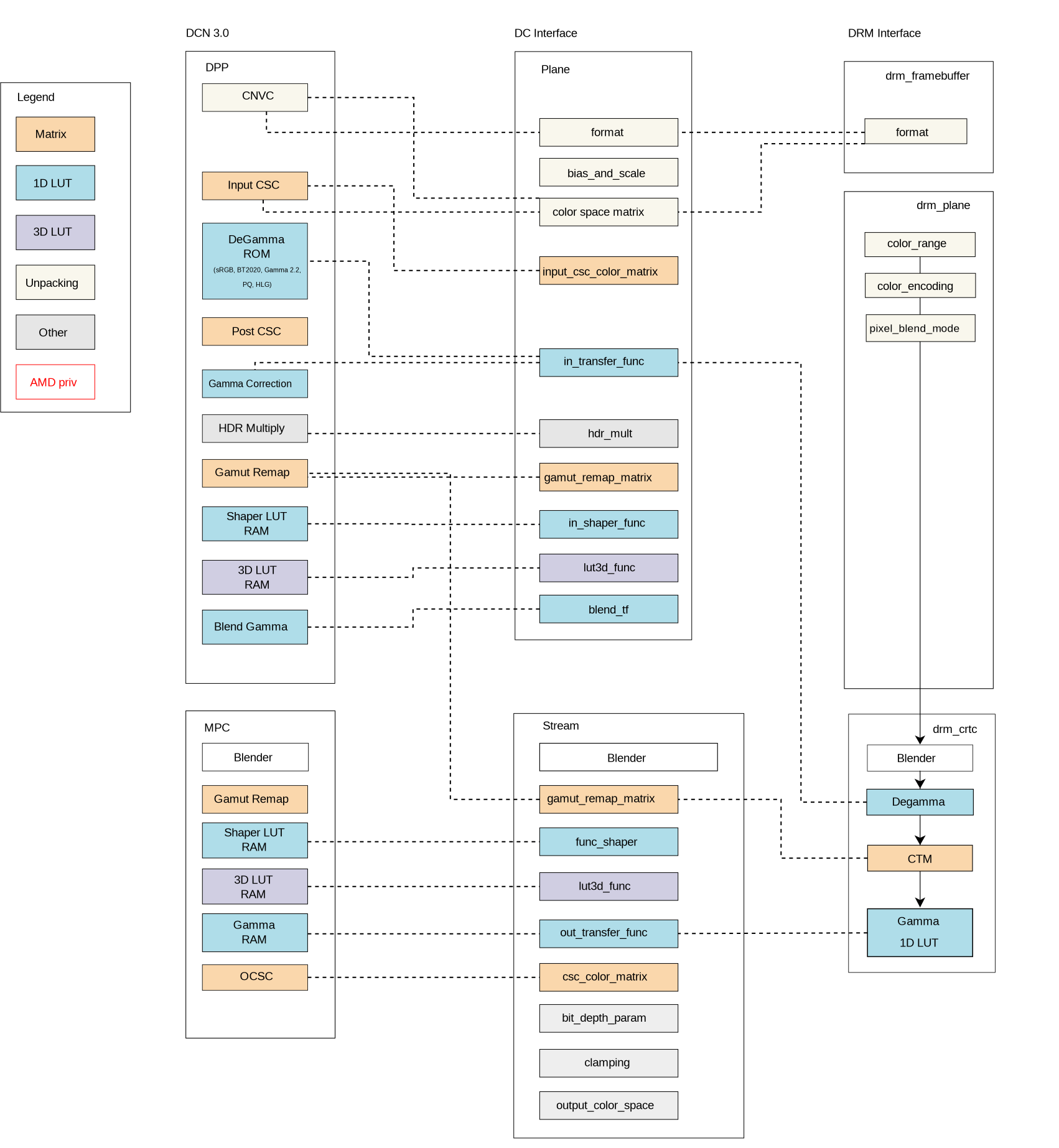
Linux Kernel, show me the colors ;D DRM color management interface only exposes a small set of post-blending color properties. Proposals to enhance the DRM color API from different vendors have landed the subsystem mailing list over the last few years. On one hand, we got some suggestions to extend DRM post-blending/CRTC color API: DRM CRTC 3D LUT for R-Car (2020 version); DRM CRTC 3D LUT for Intel (draft - 2020); DRM CRTC 3D LUT for AMD by Igalia (v2 - 2023); DRM CRTC 3D LUT for R-Car (v2 - 2023). On the other hand, some proposals to extend DRM pre-blending/plane API: DRM plane colors for Intel (v2 - 2021); DRM plane API for AMD (v3 - 2021); DRM plane 3D LUT for AMD - 2021. Finally, Simon Ser sent the latest proposal in May 2023: Plane color pipeline KMS uAPI, from discussions in the 2023 Display/HDR Hackfest, and it is still under evaluation by the Linux Graphics community. All previous proposals seek a generic solution for expanding the API, but many seem to have stalled due to the uncertainty of matching well the hardware capabilities of all vendors. Meanwhile, the use of AMD color capabilities on Linux remained limited by the DRM interface, as the DCN 3.0 family color caps and mapping diagram below shows the Linux/DRM color interface without driver-specific color properties [*]: Bearing in mind that we need to know the variety of color pipelines in the subsystem to be clear about a generic solution, we decided to approach the issue from a different perspective and worked on enabling a set of Driver-Specific Color Properties for AMD Display Drivers. As a result, I recently sent another round of the AMD driver-specific color mgmt API. For those who have been following the AMD driver-specific proposal since the beginning (see [RFC][V1]), the main new features of the latest version [v2] are the addition of pre-blending Color Transformation Matrix (plane CTM) and the differentiation of Pre-defined Transfer Functions (TF) supported by color blocks. For those who just got here, I will recap this work in two blog posts. This one describes the current status of the AMD display driver in the Linux kernel/DRM subsystem and what changes with the driver-specific properties. In the next post, we go deeper to describe the features of each color block and provide a better picture of what is available in terms of color management for Linux.

The Linux kernel color management API and AMD hardware color capabilities Before discussing colors in the Linux kernel with AMD hardware, consider accessing the Linux kernel documentation (version 6.5.0-rc5). In the AMD Display documentation, you will find my previous work documenting AMD hardware color capabilities and the Color Management Properties. It describes how AMD Display Manager (DM) intermediates requests between the AMD Display Core component (DC) and the Linux/DRM kernel interface for color management features. It also describes the relevant function to call the AMD color module in building curves for content space transformations. A subsection also describes hardware color capabilities and how they evolve between versions. This subsection, DC Color Capabilities between DCN generations, is a good starting point to understand what we have been doing on the kernel side to provide a broader color management API with AMD driver-specific properties.

Why do we need more kernel color properties on Linux? Blending is the process of combining multiple planes (framebuffers abstraction) according to their mode settings. Before blending, we can manage the colors of various planes separately; after blending, we have combined those planes in only one output per CRTC. Color conversions after blending would be enough in a single-plane scenario or when dealing with planes in the same color space on the kernel side. Still, it cannot help to handle the blending of multiple planes with different color spaces and luminance levels. With plane color management properties, userspace can get a more accurate representation of colors to deal with the diversity of color profiles of devices in the graphics chain, bring a wide color gamut (WCG), convert High-Dynamic-Range (HDR) content to Standard-Dynamic-Range (SDR) content (and vice-versa). With a GPU-accelerated display color management pipeline, we can use hardware blocks for color conversions and color mapping and support advanced color management. The current DRM color management API enables us to perform some color conversions after blending, but there is no interface to calibrate input space by planes. Note that here I m not considering some workarounds in the AMD display manager mapping of DRM CRTC de-gamma and DRM CRTC CTM property to pre-blending DC de-gamma and gamut remap block, respectively. So, in more detail, it only exposes three post-blending features:
  • DRM CRTC de-gamma: used to convert the framebuffer s colors to linear gamma;
  • DRM CRTC CTM: used for color space conversion;
  • DRM CRTC gamma: used to convert colors to the gamma space of the connected screen.

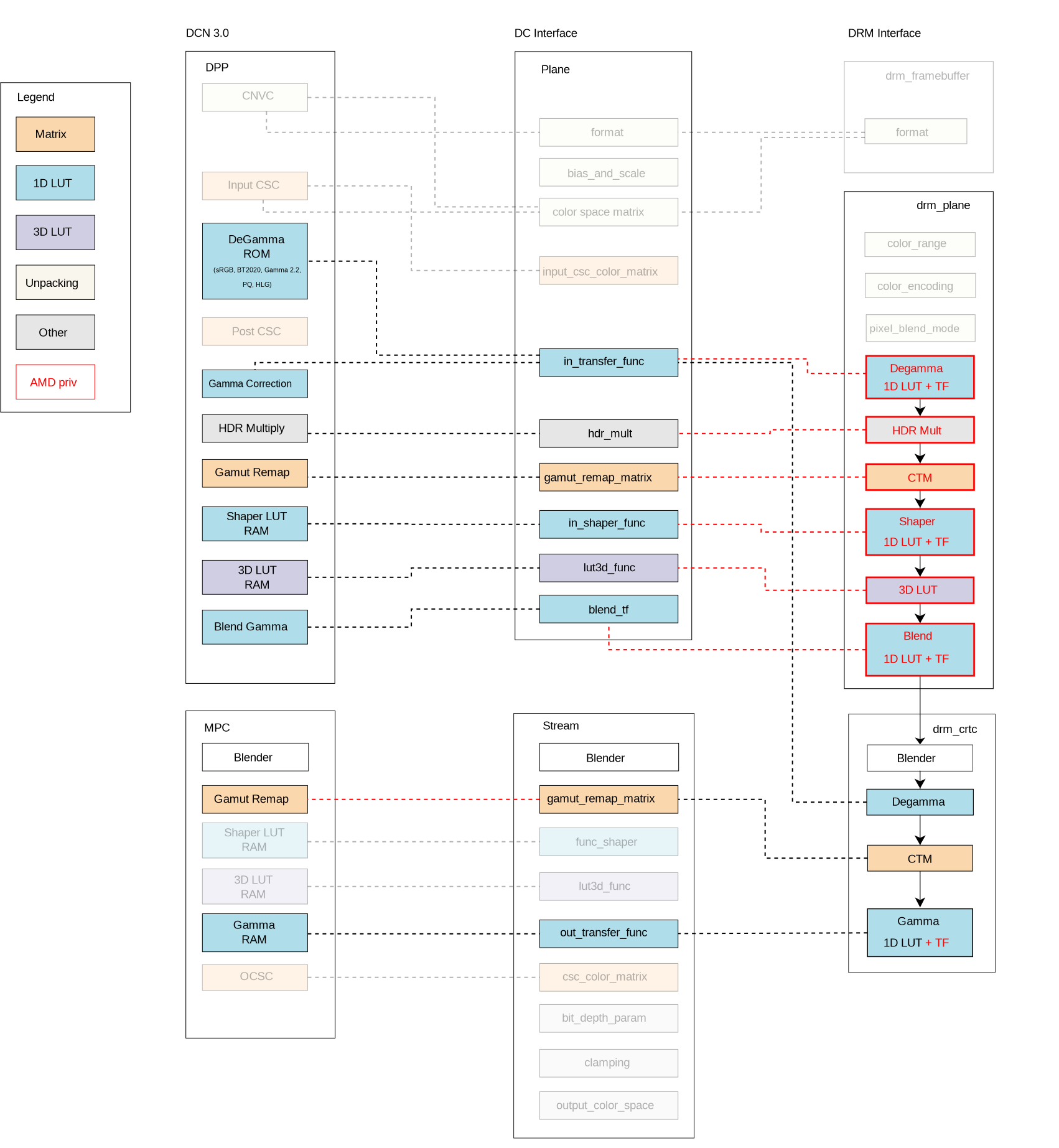
AMD driver-specific color management interface We can compare the Linux color management API with and without the driver-specific color properties. From now, we denote driver-specific properties with the AMD prefix and generic properties with the DRM prefix. For visual comparison, I bring the DCN 3.0 family color caps and mapping diagram closer and present it here again: Mixing AMD driver-specific color properties with DRM generic color properties, we have a broader Linux color management system with the following features exposed by properties in the plane and CRTC interface, as summarized by this updated diagram: The blocks highlighted by red lines are the new properties in the driver-specific interface developed by me (Igalia) and Joshua (Valve). The red dashed lines are new links between API and AMD driver components implemented by us to connect the Linux/DRM interface to AMD hardware blocks, mapping components accordingly. In short, we have the following color management properties exposed by the DRM/AMD display driver:
  • Pre-blending - AMD Display Pipe and Plane (DPP):
    • AMD plane de-gamma: 1D LUT and pre-defined transfer functions; used to linearize the input space of a plane;
    • AMD plane CTM: 3x4 matrix; used to convert plane color space;
    • AMD plane shaper: 1D LUT and pre-defined transfer functions; used to delinearize and/or normalize colors before applying 3D LUT;
    • AMD plane 3D LUT: 17x17x17 size with 12 bit-depth; three dimensional lookup table used for advanced color mapping;
    • AMD plane blend/out gamma: 1D LUT and pre-defined transfer functions; used to linearize back the color space after 3D LUT for blending.
  • Post-blending - AMD Multiple Pipe/Plane Combined (MPC):
    • DRM CRTC de-gamma: 1D LUT (can t be set together with plane de-gamma);
    • DRM CRTC CTM: 3x3 matrix (remapped to post-blending matrix);
    • DRM CRTC gamma: 1D LUT + AMD CRTC gamma TF; added to take advantage of driver pre-defined transfer functions;
Note: You can find more about AMD display blocks in the Display Core Next (DCN) - Linux kernel documentation, provided by Rodrigo Siqueira (Linux/AMD display developer) in a 2021-documentation series. In the next post, I ll revisit this topic, explaining display and color blocks in detail.

How did we get a large set of color features from AMD display hardware? So, looking at AMD hardware color capabilities in the first diagram, we can see no post-blending (MPC) de-gamma block in any hardware families. We can also see that the AMD display driver maps CRTC/post-blending CTM to pre-blending (DPP) gamut_remap, but there is post-blending (MPC) gamut_remap (DRM CTM) from newer hardware versions that include SteamDeck hardware. You can find more details about hardware versions in the Linux kernel documentation/AMDGPU Product Information. I needed to rework these two mappings mentioned above to provide pre-blending/plane de-gamma and CTM for SteamDeck. I changed the DC mapping to detach stream gamut remap matrixes from the DPP gamut remap block. That means mapping AMD plane CTM directly to DPP/pre-blending gamut remap block and DRM CRTC CTM to MPC/post-blending gamut remap block. In this sense, I also limited plane CTM properties to those hardware versions with MPC/post-blending gamut_remap capabilities since older versions cannot support this feature without clashes with DRM CRTC CTM. Unfortunately, I couldn t prevent conflict between AMD plane de-gamma and DRM plane de-gamma since post-blending de-gamma isn t available in any AMD hardware versions until now. The fact is that a post-blending de-gamma makes little sense in the AMD color pipeline, where plane blending works better in a linear space, and there are enough color blocks to linearize content before blending. To deal with this conflict, the driver now rejects atomic commits if users try to set both AMD plane de-gamma and DRM CRTC de-gamma simultaneously. Finally, we had no other clashes when enabling other AMD driver-specific color properties for our use case, Gamescope/SteamDeck. Our main work for the remaining properties was understanding the data flow of each property, the hardware capabilities and limitations, and how to shape the data for programming the registers - AMD color block capabilities (and limitations) are the topics of the next blog post. Besides that, we fixed some driver bugs along the way since it was the first Linux use case for most of the new color properties, and some behaviors are only exposed when exercising the engine. Take a look at the Gamescope/Steam Deck Color Pipeline[**], and see how Gamescope uses the new API to manage color space conversions and calibration (please click on the image for a better view): In the next blog post, I ll describe the implementation and technical details of each pre- and post-blending color block/property on the AMD display driver. * Thank Harry Wentland for helping with diagrams, color concepts and AMD capabilities. ** Thank Joshua Ashton for providing and explaining Gamescope/Steam Deck color pipeline. *** Thanks to the Linux Graphics community - explicitly Harry, Joshua, Pekka, Simon, Sebastian, Siqueira, Alex H. and Ville - to all the learning during this Linux DRM/AMD color journey. Also, Carlos and Tomas for organizing the 2023 Display/HDR Hackfest where we have a great and immersive opportunity to discuss Color & HDR on Linux.

Russ Allbery: Review: Some Desperate Glory

Review: Some Desperate Glory, by Emily Tesh
Publisher: Tordotcom
Copyright: 2023
ISBN: 1-250-83499-6
Format: Kindle
Pages: 438
Some Desperate Glory is a far-future space... opera? That's probably the right genre classification given the setting, but this book is much more intense and character-focused than most space opera. It is Emily Tesh's first novel, although she has two previous novellas that were published as books. The alien majo and their nearly all-powerful Wisdom have won the war by destroying Earth with an antimatter bomb. The remnants of humanity were absorbed into the sprawling majo civilization. Gaea Station is the lone exception: a marginally viable station deep in space, formed from a lifeless rocky planetoid and the coupled hulks of the last four human dreadnoughts. Gaea Station survives on military discipline, ruthless use of every available resource, and constant training, raising new generations of soldiers for the war that it refuses to let end. While Earth's children live, the enemy shall fear us. Kyr is a warbreed, one of a genetically engineered line of soldiers that, following an accident, Gaea Station has lost the ability to make except the old-fashioned way. Among the Sparrows, her mess group, she is the best at the simulated combat exercises they use for training. She may be the best of her age cohort except her twin Magnus. As this novel opens, she and the rest of the Sparrows are about to get their adult assignments. Kyr is absolutely focused on living up to her potential and the attention of her uncle Jole, the leader of the station. Kyr's future will look nothing like what she expects. This book was so good, and I despair of explaining why it was so good without unforgivable spoilers. I can tell you a few things about it, but be warned that I'll be reduced to helpless gestures and telling you to just go read it. It's been a very long time since I was this surprised by a novel, possibly since I read Code Name: Verity for the first time. Some Desperate Glory follows Kyr in close third-person throughout the book, which makes the start of this book daring. If you're getting a fascist vibe from the setup, you're not wrong, and this is intentional on Tesh's part. But Kyr is a true believer at the start of the book, so the first quarter has a protagonist who is sometimes nasty and cruel and who makes some frustratingly bad decisions. Stay with it, though; Tesh knows exactly what she's doing. This is a coming of age story, in a way. Kyr has a lot to learn and a lot to process, and Some Desperate Glory is about that process. But by the middle of part three, halfway through the book, I had absolutely no idea where Tesh was going with the story. She then pulled the rug out from under me, in the best way, at least twice more. Part five of this book is an absolute triumph, the payoff for everything that's happened over the course of the novel, and there is no way I could have predicted it in advance. It was deeply satisfying in that way where I felt like I learned some things along with the characters, and where the characters find a better ending than I could possibly have worked out myself. Tesh does use some world-building trickery, which is at its most complicated in part four. That was the one place where I can point to a few chapters where I thought the world-building got a bit too convenient in order to enable the plot. But it also allows for some truly incredible character work. I can't describe that in detail because it would be a major spoiler, but it's one of my favorite tropes in fiction and Tesh pulls it off beautifully. The character growth and interaction in this book is just so good: deep and complicated and nuanced and thoughtful in a way that revises reader impressions of earlier chapters. The other great thing about this book is that for a 400+ page novel, it moves right along. Both plot and character development is beautifully paced with only a few lulls. Tesh also doesn't belabor conversations. This is a book that provides just the right amount of context for the reader to fully understand what's going on, and then trusts the reader to be following along and moves straight to the next twist. That makes it propulsively readable. I had so much trouble putting this book down at any time during the second half. I can't give any specifics, again because of spoilers, but this is not just a character story. Some Desperate Glory has strong opinions on how to ethically approach the world, and those ethics are at the center of the plot. Unlike a lot of books with a moral stance, though, this novel shows the difficulty of the work of deriving that moral stance. I have rarely read a book that more perfectly captures the interior experience of changing one's mind with all of its emotional difficulty and internal resistance. Tesh provides all the payoff I was looking for as a reader, but she never makes it easy or gratuitous (with the arguable exception of one moment at the very end of the book that I think some people will dislike but that I personally needed). This is truly great stuff, probably the best science fiction novel that I've read in several years. Since I read it (I'm late on reviews again), I've pushed it on several other people, and I've not had a miss yet. The subject matter is pretty heavy, and this book also uses several tropes that I personally adore and am therefore incapable of being objective about, but with those caveats, this gets my highest possible recommendation. Some Desperate Glory is a complete story in one novel with a definite end, although I love these characters so much that I'd happily read their further adventures, even if those are thematically unnecessary. Content warnings: Uh, a lot. Genocide, suicide, sexual assault, racism, sexism, homophobia, misgendering, and torture, and I'm probably forgetting a few things. Tesh doesn't linger on these long, but most of them are on-screen. You may have to brace yourself for this one. Rating: 10 out of 10

16 August 2023

Sam Hartman: A First Exercise with AI Training

Taking a hands-on low-level approach to learning AI has been incredibly rewarding. I wanted to create an achievable task that would motivate me to learn the tools and get practical experience training and using large language models. Just at the point when I was starting to spin up GPU instances, Llama2 was released to the public. So I elected to start with that model. As I mentioned, I m interested in exploring how sex-positive AI can help human connection in positive ways. For that reason, I suspected that Llama2 might not produce good results without training: some of Meta s safety goals run counter to what I m trying to explore. I suspected that there might be more attention paid to safety in the chat variants of Llama2 rather than the text generation variants, and working against that might be challenging for a first project, so I started with Llama-2-13b as a base. Preparing a Dataset I elected to generate a fine tuning dataset using fiction. Long term, that might not be a good fit. But I ve always wanted to understand how an LLM s tone is adjusted how you get an LLM to speak in a different voice. So much of fine tuning focuses on examples where a given prompt produces a particular result. I wanted to understand how to bring in data that wasn t structured as prompts. The Huggingface course actually gives an example of how to adjust a model set up for masked language modeling trained on wikitext to be better at predicting the vocabulary of movie reviews. There though, doing sample breaks in the dataset at movie review boundaries makes sense. There s another example of training an LLM from scratch based on a corpus of python code. Between these two examples, I figured out what I needed. It was relatively simple in retrospect: tokenize the whole mess, and treat everything as output. That is, compute loss on all the tokens. Long term, using fiction as a way to adjust how the model responds is likely to be the wrong starting point. However, it maximized focus on aspects of training I did not understand and allowed me to satisfy my curiosity. Rangling the Model I decided to actually try and add additional training to the model directly rather than building an adapter and fine tuning a small number of parameters. Partially this was because I had enough on my mind without understanding how LoRA adapters work. Partially, I wanted to gain an appreciation for the infrastructure complexity of AI training. I have enough of a cloud background that I ought to be able to work on distributed training. (As it turned out, using BitsAndBytes 8-bit optimizer, I was just able to fit my task onto a single GPU). I wasn t even sure that I could make a measurable difference in Llama-2-13b running 890,000 training tokens through a couple of training epochs. As it turned out I had nothing to fear on that front. Getting everything to work was more tricky than I expected. I didn t have an appreciation for exactly how memory intensive training was. The Transformers documentation points out that with typical parameters for mixed-precision training, it takes 18 bytes per model parameter. Using bfloat16 training and an 8-bit optimizer was enough to get things to fit. Of course then I got to play with convergence. My initial optimizer parameters caused the model to diverge, and before I knew it, my model had turned to NAN, and would only output newlines. Oops. But looking back over the logs, watching what happened to the loss, and looking at the math in the optimizer to understand how I ended up getting something that rounded to a divide by zero gave me a much better intuition for what was going on. The results. This time around I didn t do anything in the way of quantitative analysis of what I achieved. Empirically I definitely changed the tone of the model. The base Llama-2 model tends to steer away from sexual situations. It s relatively easy to get it to talk about affection and sometimes attraction. Unsurprisingly, given the design constraints, it takes a bit to get it to wonder into sexual situations. But if you hit it hard enough with your prompt, it will go there, and the results are depressing. At least for prompts I used, it tended to view sex fairly negatively. It tended to be less coherent than with other prompts. One inference managed to pop out in the middle of some text that wasn t hanging together well, Chapter 7 - Rape. With my training, I did manage to achieve my goal of getting the model to use more positive language and emotional signaling when talking about sexual situations. More importantly, I gained a practical understanding of many ways training can go wrong. A lot of articles I ve been reading about training make more sense. I have better intuition for why you might want to do training a certain way, or why mechanisms for countering some problem will be important. Future Activities:

comment count unavailable comments

15 August 2023

Dirk Eddelbuettel: #41: Using r2u in Codespaces

Welcome to the 41th post in the $R^4 series. This post draws on joint experiments first started by Grant building on the lovely work done by Eitsupi as part of our Rocker Project. In short, r2u is an ideal match for Codespaces, a Microsoft/GitHub service to run code locally but in the cloud via browser or Visual Studio Code. This posts co-serves as the README.md in the .devcontainer directory as well as a vignette for r2u. So let us get into it. Starting from the r2u repository, the .devcontainer directory provides a small self-containted file devcontainer.json to launch an executable environment R using r2u. It is based on the example in Grant McDermott s codespaces-r2u repo and reuses its documentation. It is driven by the Rocker Project s Devcontainer Features repo creating a fully functioning R environment for cloud use in a few minutes. And thanks to r2u you can add easily to this environment by installing new R packages in a fast and failsafe way.

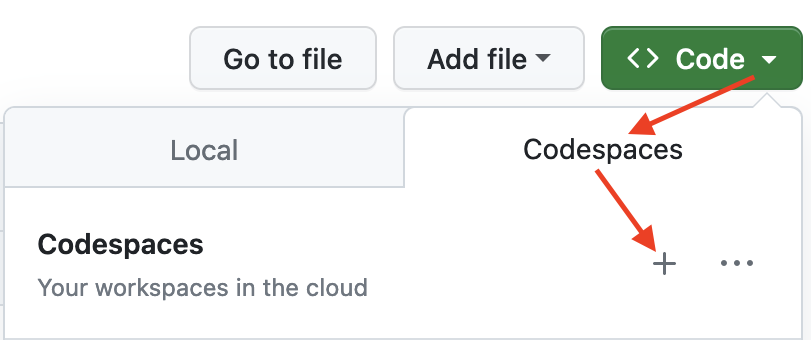
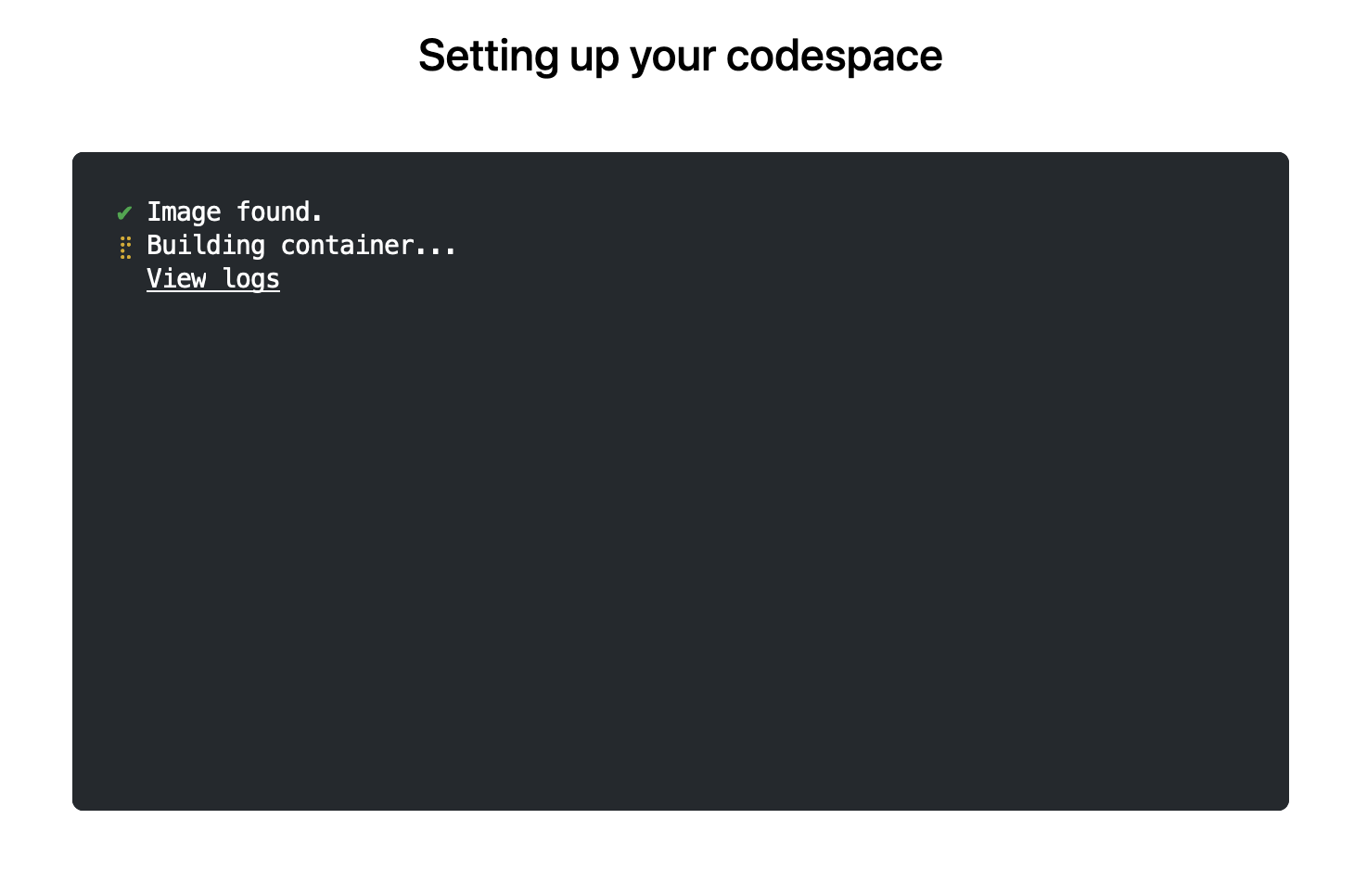
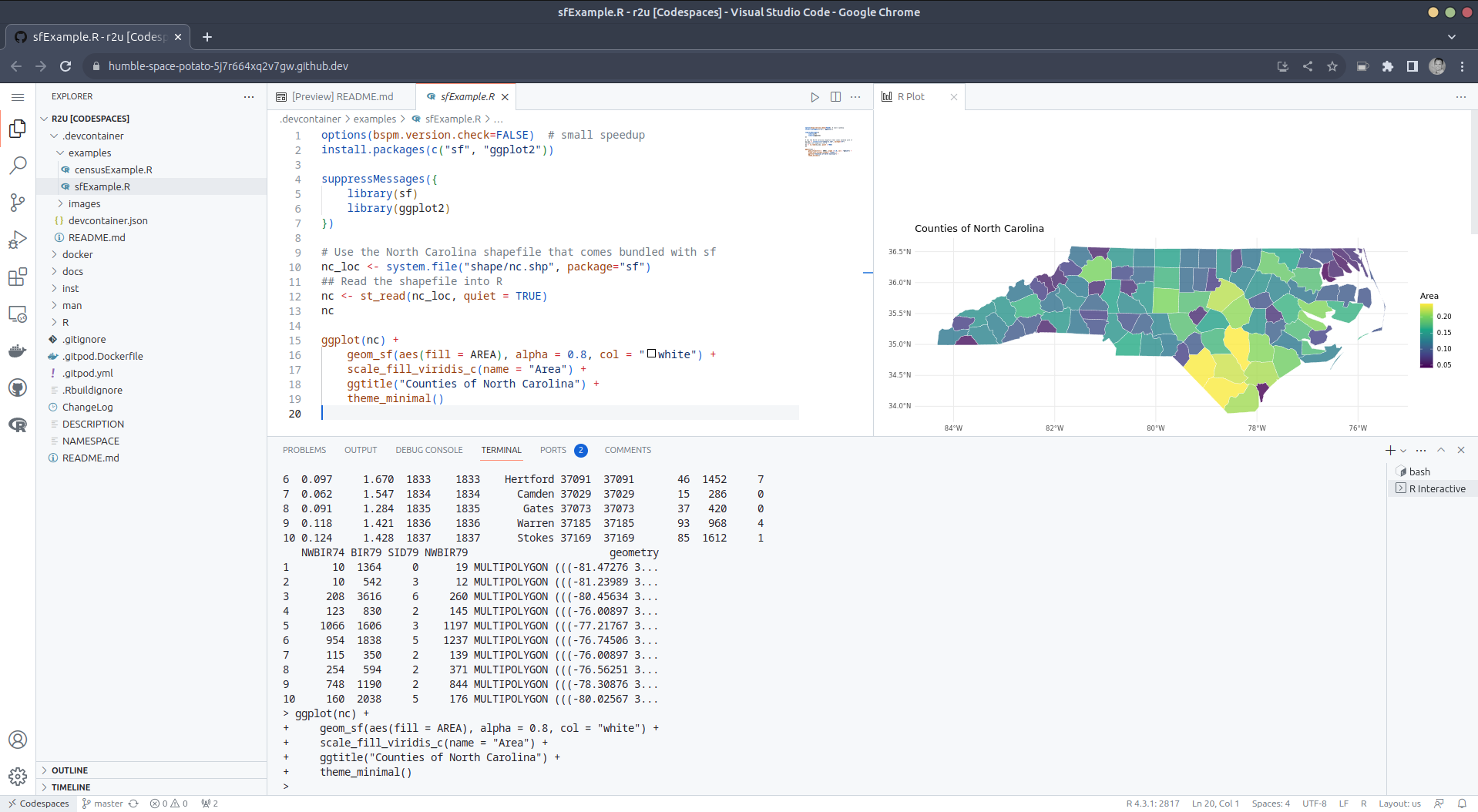
Try it out To get started, simply click on the green Code button at the top right. Then select the Codespaces tab and click the + symbol to start a new Codespace. The first time you do this, it will open up a new browser tab where your Codespace is being instantiated. This first-time instantiation will take a few minutes (feel free to click View logs to see how things are progressing) so please be patient. Once built, your Codespace will deploy almost immediately when you use it again in the future. After the VS Code editor opens up in your browser, feel free to open up the examples/sfExample.R file. It demonstrates how r2u enables us install packages and their system-dependencies with ease, here installing packages sf (including all its geospatial dependencies) and ggplot2 (including all its dependencies). You can run the code easily in the browser environment: Highlight or hover over line(s) and execute them by hitting Cmd+Return (Mac) / Ctrl+Return (Linux / Windows). (Both example screenshots reflect the initial codespaces-r2u repo as well as personal scratchspace one which we started with, both of course work here too.) Do not forget to close your Codespace once you have finished using it. Click the Codespaces tab at the very bottom left of your code editor / browser and select Close Current Codespace in the resulting pop-up box. You can restart it at any time, for example by going to https://github.com/codespaces and clicking on your instance.

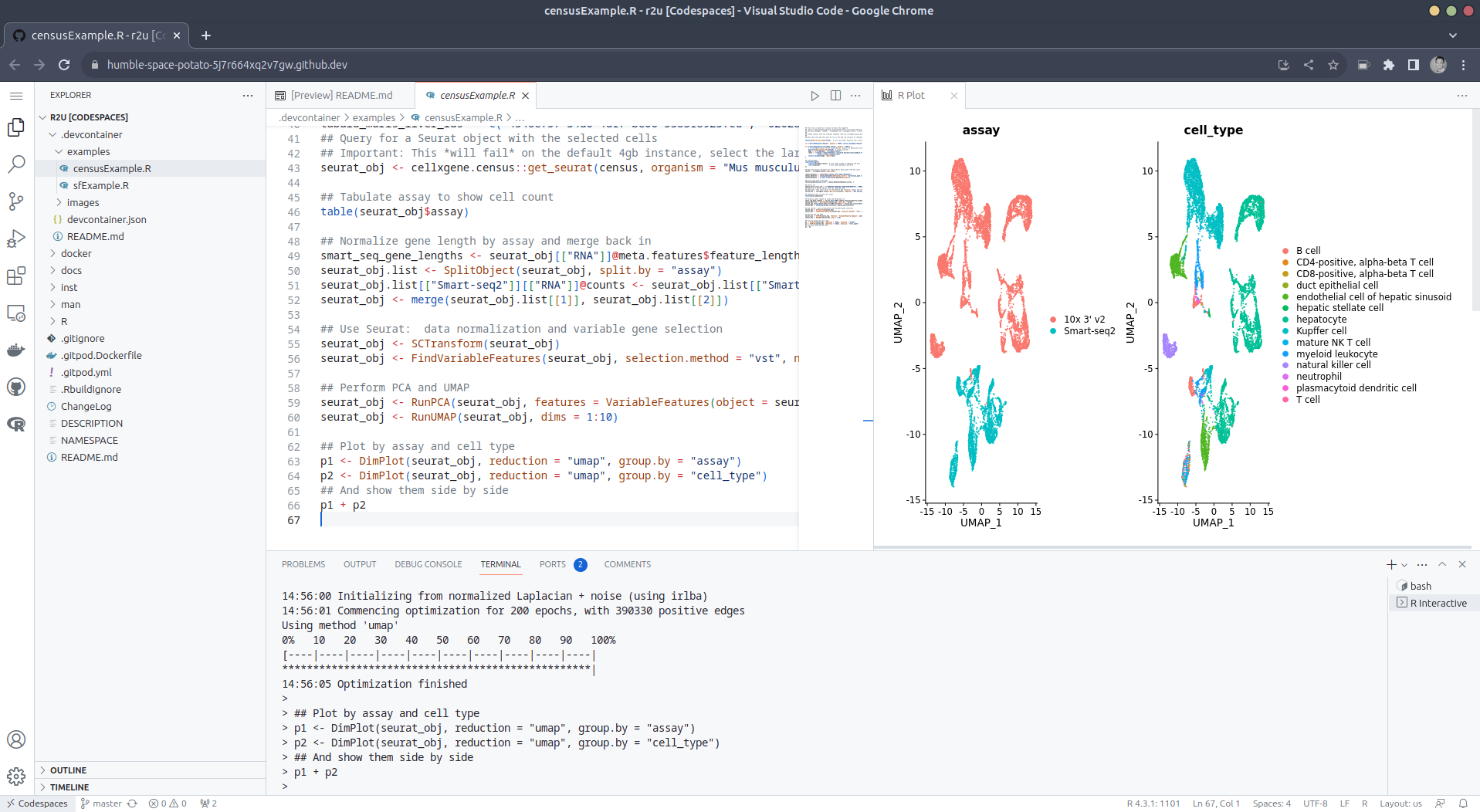
Extend r2u with r-universe r2u offers fast, easy, reliable access to all of CRAN via binaries for Ubuntu focal and jammy. When using the latter (as is the default), it can be combined with r-universe and its Ubuntu jammy binaries. We demontrates this in a second example file examples/censusExample.R which install both the cellxgene-census and tiledbsoma R packages as binaries from r-universe (along with about 100 dependencies), downloads single-cell data from Census and uses Seurat to create PCA and UMAP decomposition plots. Note that in order run this you have to change the Codespaces default instance from small (4gb ram) to large (16gb ram).

Local DevContainer build Codespaces are DevContainers running in the cloud (where DevContainers are themselves just Docker images running with some VS Code sugar on top). This gives you the very powerful ability to edit locally but run remotely in the hosted codespace. To test this setup locally, simply clone the repo and open it up in VS Code. You will need to have Docker installed and running on your system (see here). You will also need the Remote Development extension (you will probably be prompted to install it automatically if you do not have it yet). Select Reopen in Container when prompted. Otherwise, click the >< tab at the very bottom left of your VS Code editor and select this option. To shut down the container, simply click the same button and choose Reopen Folder Locally . You can always search for these commands via the command palette too (Cmd+Shift+p / Ctrl+Shift+p).

Use in Your Repo To add this ability of launching Codespaces in the browser (or editor) to a repo of yours, create a directory .devcontainers in your selected repo, and add the file .devcontainers/devcontainer.json. You can customize it by enabling other feature, or use the postCreateCommand field to install packages (while taking full advantage of r2u).

Acknowledgments There are a few key plumbing pieces that make everything work here. Thanks to:

Colophon More information about r2u is at its site, and we answered some question in issues, and at stackoverflow. More questions are always welcome! If you like this or other open-source work I do, you can now sponsor me at GitHub.

This post by Dirk Eddelbuettel originated on his Thinking inside the box blog. Please report excessive re-aggregation in third-party for-profit settings.

Originally posted 2023-08-13, minimally edited 2023-08-15 which changed the timestamo and URL.

13 August 2023

Dirk Eddelbuettel: #41: Using r2u in Codespaces

Welcome to the 41th post in the $R^4 series. This post draws on joint experiments first started by Grant building on the lovely work Eitsupi as part of our Rocker Project. In short, r2u is an ideal match for Codesspaces, a Microsoft/GitHub service to run code locally but in the cloud via browser or Visual Studio Code. This posts co-serves as the README.md in the .devcontainer directory as well as a vignette for r2u. So let us get into it. Starting from the r2u repository, the .devcontainer directory provides a small self-containted file devcontainer.json to launch an executable environment R using r2u. It is based on the example in Grant McDermott s codespaces-r2u repo and reuses its documentation. It is driven by the Rocker Project s Devcontainer Features repo creating a fully functioning R environment for cloud use in a few minutes. And thanks to r2u you can add easily to this environment by installing new R packages in a fast and failsafe way.

Try it out To get started, simply click on the green Code button at the top right. Then select the Codespaces tab and click the + symbol to start a new Codespace. The first time you do this, it will open up a new browser tab where your Codespace is being instantiated. This first-time instantiation will take a few minutes (feel free to click View logs to see how things are progressing) so please be patient. Once built, your Codespace will deploy almost immediately when you use it again in the future. After the VS Code editor opens up in your browser, feel free to open up the examples/sfExample.R file. It demonstrates how r2u enables us install packages and their system-dependencies with ease, here installing packages sf (including all its geospatial dependencies) and ggplot2 (including all its dependencies). You can run the code easily in the browser environment: Highlight or hover over line(s) and execute them by hitting Cmd+Return (Mac) / Ctrl+Return (Linux / Windows). (Both example screenshots reflect the initial codespaces-r2u repo as well as personal scratchspace one which we started with, both of course work here too.) Do not forget to close your Codespace once you have finished using it. Click the Codespaces tab at the very bottom left of your code editor / browser and select Close Current Codespace in the resulting pop-up box. You can restart it at any time, for example by going to https://github.com/codespaces and clicking on your instance.

Extend r2u with r-universe r2u offers fast, easy, reliable access to all of CRAN via binaries for Ubuntu focal and jammy. When using the latter (as is the default), it can be combined with r-universe and its Ubuntu jammy binaries. We demontrates this in a second example file examples/censusExample.R which install both the cellxgene-census and tiledbsoma R packages as binaries from r-universe (along with about 100 dependencies), downloads single-cell data from Census and uses Seurat to create PCA and UMAP decomposition plots. Note that in order run this you have to change the Codespaces default instance from small (4gb ram) to large (16gb ram).

Local DevContainer build Codespaces are DevContainers running in the cloud (where DevContainers are themselves just Docker images running with some VS Code sugar on top). This gives you the very powerful ability to edit locally but run remotely in the hosted codespace. To test this setup locally, simply clone the repo and open it up in VS Code. You will need to have Docker installed and running on your system (see here). You will also need the Remote Development extension (you will probably be prompted to install it automatically if you do not have it yet). Select Reopen in Container when prompted. Otherwise, click the >< tab at the very bottom left of your VS Code editor and select this option. To shut down the container, simply click the same button and choose Reopen Folder Locally . You can always search for these commands via the command palette too (Cmd+Shift+p / Ctrl+Shift+p).

Use in Your Repo To add this ability of launching Codespaces in the browser (or editor) to a repo of yours, create a directory .devcontainers in your selected repo, and add the file .devcontainers/devcontainer.json. You can customize it by enabling other feature, or use the postCreateCommand field to install packages (while taking full advantage of r2u).

Acknowledgments There are a few key plumbing pieces that make everything work here. Thanks to:

Colophon More information about r2u is at its site, and we answered some question in issues, and at stackoverflow. More questions are always welcome! If you like this or other open-source work I do, you can now sponsor me at GitHub.

This post by Dirk Eddelbuettel originated on his Thinking inside the box blog. Please report excessive re-aggregation in third-party for-profit settings.

9 August 2023

Antoine Beaupr : OpenPGP key transition

This is a short announcement to say that I have changed my main OpenPGP key. A signed statement is available with the cryptographic details but, in short, the reason is that I stopped using my old YubiKey NEO that I have worn on my keyring since 2015. I now have a YubiKey 5 which supports ED25519 which features much shorter keys and faster decryption. It allowed me to move all my secret subkeys on the key (including encryption keys) while retaining reasonable performance. I have written extensive documentation on how to do that OpenPGP key rotation and also YubiKey OpenPGP operations.

Warning on storing encryption keys on a YubiKey People wishing to move their private encryption keys to such a security token should be very careful as there are special precautions to take for disaster recovery. I am toying with the idea of writing an article specifically about disaster recovery for secrets and backups, dealing specifically with cases of death or disabilities.

Autocrypt changes One nice change is the impact on Autocrypt headers, which are considerably shorter. Before, the header didn't even fit on a single line in an email, it overflowed to five lines:
Autocrypt: addr=anarcat@torproject.org; prefer-encrypt=nopreference;
 keydata=xsFNBEogKJ4BEADHRk8dXcT3VmnEZQQdiAaNw8pmnoRG2QkoAvv42q9Ua+DRVe/yAEUd03EOXbMJl++YKWpVuzSFr7IlZ+/lJHOCqDeSsBD6LKBSx/7uH2EOIDizGwfZNF3u7X+gVBMy2V7rTClDJM1eT9QuLMfMakpZkIe2PpGE4g5zbGZixn9er+wEmzk2mt20RImMeLK3jyd6vPb1/Ph9+bTEuEXi6/WDxJ6+b5peWydKOdY1tSbkWZgdi+Bup72DLUGZATE3+Ju5+rFXtb/1/po5dZirhaSRZjZA6sQhyFM/ZhIj92mUM8JJrhkeAC0iJejn4SW8ps2NoPm0kAfVu6apgVACaNmFb4nBAb2k1KWru+UMQnV+VxDVdxhpV628Tn9+8oDg6c+dO3RCCmw+nUUPjeGU0k19S6fNIbNPRlElS31QGL4H0IazZqnE+kw6ojn4Q44h8u7iOfpeanVumtp0lJs6dE2nRw0EdAlt535iQbxHIOy2x5m9IdJ6q1wWFFQDskG+ybN2Qy7SZMQtjjOqM+CmdeAnQGVwxowSDPbHfFpYeCEb+Wzya337Jy9yJwkfa+V7e7Lkv9/OysEsV4hJrOh8YXu9a4qBWZvZHnIO7zRbz7cqVBKmdrL2iGqpEUv/x5onjNQwpjSVX5S+ZRBZTzah0w186IpXVxsU8dSk0yeQskblrwARAQABzSlBbnRvaW5lIEJlYXVwcsOpIDxhbmFyY2F0QHRvcnByb2plY3Qub3JnPsLBlAQTAQgAPgIbAwULCQgHAwUVCgkICwUWAgMBAAIeAQIXgBYhBI3JAc5kFGwEitUPu3khUlJ7dZIeBQJihnFIBQkacFLiAAoJEHkhUlJ7dZIeXNAP/RsX+27l9K5uGspEaMH6jabAFTQVWD8Ch1om9YvrBgfYtq2k/m4WlkMh9IpT89Ahmlf0eq+V1Vph4wwXBS5McK0dzoFuHXJa1WHThNMaexgHhqJOs
 S60bWyLH4QnGxNaOoQvuAXiCYV4amKl7hSuDVZEn/9etDgm/UhGn2KS3yg0XFsqI7V/3RopHiDT+k7+zpAKd3st2V74w6ht+EFp2Gj0sNTBoCdbmIkRhiLyH9S4B+0Z5dUCUEopGIKKOSbQwyD5jILXEi7VTZhN0CrwIcCuqNo7OXI6e8gJd8McymqK4JrVoCipJbLzyOLxZMxGz8Ki0b9O844/DTzwcYcg9I1qogCsGmZfgVze2XtGxY+9zwSpeCLeef6QOPQ0uxsEYSfVgS+onCesSRCgwAPmppPiva+UlGuIMun87gPpQpV2fqFg/V8zBxRvs6YTGcfcQjfMoBHmZTGb+jk1//QAgnXMO7fGG38YH7iQSSzkmodrH2s27ZKgUTHVxpBL85ptftuRqbR7MzIKXZsKdA88kjIKKXwMmez9L1VbJkM4k+1Kzc5KdVydwi+ujpNegF6ZU8KDNFiN9TbDOlRxK5R+AjwdS8ZOIa4nci77KbNF9OZuO3l/FZwiKp8IFJ1nK7uiKUjmCukL0od/6X2rJtAzJmO5Co93ZVrd5r48oqUvjklzzsBNBFmeC3oBCADEV28RKzbv3dEbOocOsJQWr1R0EHUcbS270CrQZfb9VCZWkFlQ/1ypqFFQSjmmUGbNX2CG5mivVsW6Vgm7gg8HEnVCqzL02BPY4OmylskYMFI5Bra2wRNNQBgjg39L9XU4866q3BQzJp3r0fLRVH8gHM54Jf0FVmTyHotR/Xiw5YavNy2qaQXesqqUv8HBIha0rFblbuYI/cFwOtJ47gu0QmgrU0ytDjlnmDNx4rfsNylwTIHS0Oc7Pezp7MzLmZxnTM9b5VMprAXnQr4rewXCOUKBSto+j4rD5/77DzXw96bbueNruaupb2Iy2OHXNGkB0vKFD3xHsXE2x75NBovtABEBAAHCwqwEGAEIACAWIQSNyQHOZBRsBIrVD7t5IVJSe3WSHgUCWZ4LegIbAgFACRB5IV
 JSe3WSHsB0IAQZAQgAHRYhBHsWQgTQlnI7AZY1qz6h3d2yYdl7BQJZngt6AAoJED6h3d2yYdl7CowH/Rp7GHEoPZTSUK8Ss7crwRmuAIDGBbSPkZbGmm4bOTaNs/gealc2tsVYpoMx7aYgqUW+t+84XciKHT+bjRv8uBnHescKZgDaomDuDKc2JVyx6samGFYuYPcGFReRcdmH0FOoPCn7bMW5mTPztV/wIA80LZD9kPKIXanfUyI3HLP0BPwZG4WTpKzJaalR1BNwu2oF6kEK0ymH3LfDiJ5Sr6emI2jrm4gH+/19ux/x+ST4tvm2PmH3BSQOPzgiqDiFd7RZoAIhmwr3FW4epsK9LtSxsi9gZ2vATBKO1oKtb6olW/keQT6uQCjqPSGojwzGRT2thEANH+5t6Vh0oDPZhrKUXRAAxHMBNHEaoo/M0sjZo+5OF3Ig1rMnI6XbKskLv6hu13cCymW0w/5E4XuYnyQ1cNC3pLvqDQbDx5mAPfBVHuqxJdRLQ3yDM/D2QIsxnkzQwi0FsJuni4vuJzWK/NHHDCvxMCh0YmSgbptUtgW8/niatd2Y6MbfRGxUHoctKtzqzivC8hKMTFrj4AbZhg/e9QVCsh5zSXtpWP0qFDJsxRMx0/432n9d4XUiy4U672r9Q09SsynB3QN6nTaCTWCIxGxjIb+8kJrRqTGwy/PElHX6kF0vQUWZNf2ITV1sd6LK/s/7sH+x4rzgUEHrsKr/qPvY3rUY/dQLd+owXesY83ANOu6oMWhSJnPMksbNa4tIKKbjmw3CFIOfoYHOWf3FtnydHNXoXfj4nBX8oSnkfhLILTJgf6JDFXfw6mTsv/jMzIfDs7PO1LK2oMK0+prSvSoM8bP9dmVEGIurzsTGjhTOBcb0zgyCmYVD3S48vZlTgHszAes1zwaCyt3/tOwrzU5JsRJVns+B/TUYaR/u3oIDMDygvE5ObWxXaFVnCC59r+zl0FazZ0ouyk2AYIR
 zHf+n1n98HCngRO4FRel2yzGDYO2rLPkXRm+NHCRvUA/i4zGkJs2AV0hsKK9/x8uMkBjHAdAheXhY+CsizGzsKjjfwvgqf84LwAzSDdZqLVE2yGTOwU0ESiArJwEQAJhtnC6pScWjzvvQ6rCTGAai6hrRiN6VLVVFLIMaMnlUp92EtgVSNpw6kANtRTpKXUB5fIPZVUrVdfEN06t96/6LE42tgifDAFyFTZY5FdHHri1GG/Cr39MpW2VqCDCtTTPVWHTUlU1ZG631BJ+9NB+ce58TmLr6wBTQrT+W367eRFBC54EsLNb7zQAspCn9pw1xf1XNHOGnrAQ4r9BXhOW5B8CzRd4nLRQwVgtw/c5M/bjemAOoq2WkwN+0mfJe4TSfHwFUozXuN274X+0Gr10fhp8xEDYuQM0qu6W3aDXMBBwIu0jTNudEELsTzhKUbqpsBc9WjwNMCZoCuSw/RTpFBV35mXbqQoQgbcU7uWZslLl9Wvv/C6rjXgd+GeX8SGBjTqq1ZkTv5UXLHTNQzPnbkNEExzqToi/QdSjFMIACnakeOSxc0ckfnsd9pfGv1PUyPyiwrHiqWFzBijzGIZEHxhNGFxAkXwTJR7Pd40a7RDxwbO6p/TSIIum41JtteehLHwTRDdQNMoyfLxuNLEtNYS0uR2jYI1EPQfCNWXCdT2ZK/l6GVP6jyB/olHBIOr+oVXqJh+48ki8cATPczhq3fUr7UivmguGwD67/4omZ4PCKtz1hNndnyYFS9QldEGo+AsB3AoUpVIA0XfQVkxD9IZr+Zu6aJ6nWq4M2bsoxABEBAAHCwXYEGAEIACACGwwWIQSNyQHOZBRsBIrVD7t5IVJSe3WSHgUCWPerZAAKCRB5IVJSe3WSHkIgEACTpxdn/FKrwH0/LDpZDTKWEWm4416l13RjhSt9CUhZ/Gm2GNfXcVTfoF/jKXXgjHcV1DHjfLUPmPVwMdqlf5ACOiFqIUM2ag/OEARh356w
 YG7YEobMjX0CThKe6AV2118XNzRBw/S2IO1LWnL5qaGYPZONUa9Pj0OaErdKIk/V1wge8Zoav2fQPautBcRLW5VA33PH1ggoqKQ4ES1hc9HC6SYKzTCGixu97mu/vjOa8DYgM+33TosLyNy+bCzw62zJkMf89X0tTSdaJSj5Op0SrRvfgjbC2YpJOnXxHr9qaXFbBZQhLjemZi6zRzUNeJ6A3Nzs+gIc4H7s/bYBtcd4ugPEhDeCGffdS3TppH9PnvRXfoa5zj5bsKFgjqjWolCyAmEvd15tXz5yNXtvrpgDhjF5ozPiNp/1EeWX4DxbH2i17drVu4fXwauFZ6lcsAcJxnvCA28RlQlmEQu/gFOx1axVXf6GIuXnQSjQN6qJbByUYrdc/cFCxPO2/lGuUxnufN9Tvb51Qh54laPgGLrlD2huQeSD9Sxa0MNUjNY0qLqaReT99Ygb2LPYGSLoFVx9iZz6sZNt07LqCx9qNgsJwsdmwYsNpMuFbc7nkWjtlEqzsXZHTvYN654p43S+hcAhmmOzQZcew6h71fAJLciiqsPBnCEdgCGFAWhZZdPkMA==
After the change, the entire key fits on a single line, neat!
Autocrypt: addr=anarcat@torproject.org; prefer-encrypt=nopreference;
 keydata=xjMEZHZPzhYJKwYBBAHaRw8BAQdAWdVzOFRW6FYVpeVaDo3sC4aJ2kUW4ukdEZ36UJLAHd7NKUFudG9pbmUgQmVhdXByw6kgPGFuYXJjYXRAdG9ycHJvamVjdC5vcmc+wpUEExYIAD4WIQS7ts1MmNdOE1inUqYCKTpvpOU0cwUCZHZgvwIbAwUJAeEzgAULCQgHAwUVCgkICwUWAgMBAAIeAQIXgAAKCRACKTpvpOU0c47SAPdEqfeHtFDx9UPhElZf7nSM69KyvPWXMocu9Kcu/sw1AQD5QkPzK5oxierims6/KUkIKDHdt8UcNp234V+UdD/ZB844BGR2UM4SCisGAQQBl1UBBQEBB0CYZha2IMY54WFXMG4S9/Smef54Pgon99LJ/hJ885p0ZAMBCAfCdwQYFggAIBYhBLu2zUyY104TWKdSpgIpOm+k5TRzBQJkdlDOAhsMAAoJEAIpOm+k5TRzBg0A+IbcsZhLx6FRIqBJCdfYMo7qovEo+vX0HZsUPRlq4HkBAIctCzmH3WyfOD/aUTeOF3tY+tIGUxxjQLGsNQZeGrQI
Note that I have implemented my own kind of ridiculous Autocrypt support for the Notmuch Emacs email client I use, see this elisp code. To import keys, I pipe the message into this script which is basically just:
sq autocrypt decode   gpg --import
... thanks to Sequoia best-of-class Autocrypt support.

Note on OpenPGP usage While some have claimed OpenPGP's death, I believe those are overstated. Maybe it's just me, but I still use OpenPGP for my password management, to authenticate users and messages, and it's the interface to my YubiKey for authenticating with SSH servers. I understand people feel that OpenPGP is possibly insecure, counter-intuitive and full of problems, but I think most of those problems should instead be attributed to its current flagship implementation, GnuPG. I have tried to work with GnuPG for years, and it keeps surprising me with evilness and oddities. I have high hopes that the Sequoia project can bring some sanity into this space, and I also hope that RFC4880bis can eventually get somewhere so we have a more solid specification with more robust crypto. It's kind of a shame that this has dragged on for so long, but Update: there's a separate draft called openpgp-crypto-refresh that might actually be adopted as the "OpenPGP RFC" soon! And it doesn't keep real work from happening in Sequoia and other implementations. Thunderbird rewrote their OpenPGP implementation with RNP (which was, granted, a bumpy road because it lost compatibility with GnuPG) and Sequoia now has a certificate store with trust management (but still no secret storage), preliminary OpenPGP card support and even a basic GnuPG compatibility layer. I'm also curious to try out the OpenPGP CA capabilities. So maybe it's just because I'm becoming an old fart that doesn't want to change tools, but so far I haven't seen a good incentive in switching away from OpenPGP, and haven't found a good set of tools that completely replace it. Maybe OpenSSH's keys and CA can eventually replace it, but I suspect they will end up rebuilding most of OpenPGP anyway, just more slowly. If they do, let's hope they avoid the mistakes our community has done in the past at least...

8 August 2023

Matthew Garrett: Updating Fedora the unsupported way

I dug out a computer running Fedora 28, which was released 2018-04-01 - over 5 years ago. Backing up the data and re-installing seemed tedious, but the current version of Fedora is 38, and while Fedora supports updates from N to N+2 that was still going to be 5 separate upgrades. That seemed tedious, so I figured I'd just try to do an update from 28 directly to 38. This is, obviously, extremely unsupported, but what could possibly go wrong?

Running sudo dnf system-upgrade download --releasever=38 didn't successfully resolve dependencies, but sudo dnf system-upgrade download --releasever=38 --allowerasing passed and dnf started downloading 6GB of packages. And then promptly failed, since I didn't have any of the relevant signing keys. So I downloaded the fedora-gpg-keys package from F38 by hand and tried to install it, and got a signature hdr data: BAD, no. of bytes(88084) out of range error. It turns out that rpm doesn't handle cases where the signature header is larger than a few K, and RPMs from modern versions of Fedora. The obvious fix would be to install a newer version of rpm, but that wouldn't be easy without upgrading the rest of the system as well - or, alternatively, downloading a bunch of build depends and building it. Given that I'm already doing all of this in the worst way possible, let's do something different.

The relevant code in the hdrblobRead function of rpm's lib/header.c is:

int32_t il_max = HEADER_TAGS_MAX;
int32_t dl_max = HEADER_DATA_MAX;

if (regionTag == RPMTAG_HEADERSIGNATURES)
il_max = 32;
dl_max = 8192;


which indicates that if the header in question is RPMTAG_HEADERSIGNATURES, it sets more restrictive limits on the size (no, I don't know why). So I installed rpm-libs-debuginfo, ran gdb against librpm.so.8, loaded the symbol file, and then did disassemble hdrblobRead. The relevant chunk ends up being:

0x000000000001bc81 <+81>: cmp $0x3e,%ebx
0x000000000001bc84 <+84>: mov $0xfffffff,%ecx
0x000000000001bc89 <+89>: mov $0x2000,%eax
0x000000000001bc8e <+94>: mov %r12,%rdi
0x000000000001bc91 <+97>: cmovne %ecx,%eax

which is basically "If ebx is not 0x3e, set eax to 0xffffffff - otherwise, set it to 0x2000". RPMTAG_HEADERSIGNATURES is 62, which is 0x3e, so I just opened librpm.so.8 in hexedit, went to byte 0x1bc81, and replaced 0x3e with 0xfe (an arbitrary invalid value). This has the effect of skipping the if (regionTag == RPMTAG_HEADERSIGNATURES) code and so using the default limits even if the header section in question is the signatures. And with that one byte modification, rpm from F28 would suddenly install the fedora-gpg-keys package from F38. Success!

But short-lived. dnf now believed packages had valid signatures, but sadly there were still issues. A bunch of packages in F38 had files that conflicted with packages in F28. These were largely Python 3 packages that conflicted with Python 2 packages from F28 - jumping this many releases meant that a bunch of explicit replaces and the like no longer existed. The easiest way to solve this was simply to uninstall python 2 before upgrading, and avoiding the entire transition. Another issue was that some data files had moved from libxcrypt-common to libxcrypt, and removing libxcrypt-common would remove libxcrypt and a bunch of important things that depended on it (like, for instance, systemd). So I built a fake empty package that provided libxcrypt-common and removed the actual package. Surely everything would work now?

Ha no. The final obstacle was that several packages depended on rpmlib(CaretInVersions), and building another fake package that provided that didn't work. I shouted into the void and Bill Nottingham answered - rpmlib dependencies are synthesised by rpm itself, indicating that it has the ability to handle extensions that specific packages are making use of. This made things harder, since the list is hard-coded in the binary. But since I'm already committing crimes against humanity with a hex editor, why not go further? Back to editing librpm.so.8 and finding the list of rpmlib() dependencies it provides. There were a bunch, but I couldn't really extend the list. What I could do is overwrite existing entries. I tried this a few times but (unsurprisingly) broke other things since packages depended on the feature I'd overwritten. Finally, I rewrote rpmlib(ExplicitPackageProvide) to rpmlib(CaretInVersions) (adding an extra '\0' at the end of it to deal with it being shorter than the original string) and apparently nothing I wanted to install depended on rpmlib(ExplicitPackageProvide) because dnf finished its transaction checks and prompted me to reboot to perform the update. So, I did.

And about an hour later, it rebooted and gave me a whole bunch of errors due to the fact that dbus never got started. A bit of digging revealed that I had no /etc/systemd/system/dbus.service, a symlink that was presumably introduced at some point between F28 and F38 but which didn't get automatically added in my case because well who knows. That was literally the only thing I needed to fix up after the upgrade, and on the next reboot I was presented with a gdm prompt and had a fully functional F38 machine.

You should not do this. I should not do this. This was a terrible idea. Any situation where you're binary patching your package manager to get it to let you do something is obviously a bad situation. And with hindsight performing 5 independent upgrades might have been faster. But that would have just involved me typing the same thing 5 times, while this way I learned something. And what I learned is "Terrible ideas sometimes work and so you should definitely act upon them rather than doing the sensible thing", so like I said, you should not do this in case you learn the same lesson.

comment count unavailable comments

6 August 2023

Sam Hartman: AI Tools

I wrote about how I m exploring the role of AI in human connection and intimacy. The first part of that journey has been all about learning the software and tools for approaching large language models. The biggest thing I wish I had known going in was not to focus on the traditional cloud providers. I was struggling until I found runpod.io. I kind of assumed that if you were willing to pay for it and had the money, you could go to Amazon on or google or whatever and get the compute resources you needed. Not so much. Google completely rejected my request to have the maximum number of GPUs I could run raised above a limit of 0. Go talk to your sales representative. And of course no sales representative was willing to waste their time on me. But I did eventually find some of the smaller AI-specific clouds. I intentionally wanted to run software myself. Everyone has various fine-tuning and training APIs as well as APIs for inference. I thought I d gain a much better understanding if I wrote my own code. That definitely ended up being true. I started by understanding PyTorch and the role of optimizers, gradient descent and what a model is. Then I focused on Transformers and that ecosystem, including Accelerate, tokenizers, generation and training. I m really impressed with the Hugging Face ecosystem. A lot of academic software is very purpose built and is hard to reuse and customize. But the hub strikes an amazing balance between providing abstractions for common interfaces like consuming a model or datasets without getting in the way of hacking on models or evolving the models. I had a great time, and after a number of false starts, succeeded in customizing Llama2 to explore some of the questions on my mind. I ll talk about what I accomplished and learned in the next post.

comment count unavailable comments

4 August 2023

John Goerzen: Try the Last Internet Kermit Server

$ grep kermit /etc/services
kermit          1649/tcp
What is this mysterious protocol? Who uses it and what is its story? This story is a winding one, beginning in 1981. Kermit is, to the best of my knowledge, the oldest actively-maintained software package with an original developer still participating. It is also a scripting language, an Internet server, a (scriptable!) SSH client, and a file transfer protocol. And my first use of it was talking to my HP-48GX calculator over a 9600bps serial link. Yes, that calculator had a Kermit server built in. But let s back up and talk about serial ports and Modems.

Serial Ports and Modems In my piece The PC & Internet Revolution in Rural America, I recently talked about getting a modem what an excitement it was to get one! I realize that many people today have never used a serial line or a modem, so let s briefly discuss. Before Ethernet and Wifi took off in a big way, in the 1990s-2000s, two computers would talk to each other over a serial line and a modem. By modern standards, these were slow; 300bps was a common early speed. They also (at least in the beginning) had no kind of error checking. Characters could be dropped or changed. Sometimes even those speeds were faster than the receiving device could handle. Some serial links were 7-bit, and wouldn t even pass all 7-bit characters; for instance, sending a Ctrl-S could lock up a remote until you sent Ctrl-Q. And computers back in the 1970s and 1980s weren t as uniform as they are now. They used different character sets, different line endings, and even had different notions of what a file is. Today s notion of a file as whatever set of binary bytes an application wants it to be was by no means universal; some systems treated a file as a set of fixed-length records, for instance. So there were a lot of challenges in reliably moving files between systems. Kermit was introduced to reliably move files between systems using serial lines, automatically working around the varieties of serial lines, detecting errors and retransmitting, managing transmit speeds, and adapting between architectures as appropriate. Quite a task! And perhaps this explains why it was supported on a calculator with a primitive CPU by today s standards. Serial communication, by the way, is still commonplace, though now it isn t prominent in everyone s home PC setup. It s used a lot in industrial equipment, avionics, embedded systems, and so forth. The key point about serial lines is that they aren t inherently multiplexed or packetized. Whereas an Ethernet network is designed to let many dozens of applications use it at once, a serial line typically runs only one (unless it is something like PPP, which is designed to do multiplexing over the serial line). So it become useful to be able to both log in to a machine and transfer files with it. That is, incidentally, still useful today.

Kermit and XModem/ZModem I wondered: why did we end up with two diverging sets of protocols, created at about the same time? The Kermit website has the answer: essentially, BBSs could assume 8-bit clean connections, so XModem and ZModem had much less complexity to worry about. Kermit, on the other hand, was highly flexible. Although ZModem came out a few years before Kermit had its performance optimizations, by about 1993 Kermit was on par or faster than ZModem.

Beyond serial ports As LANs and the Internet came to be popular, people started to use telnet (and later ssh) to connect to remote systems, rather than serial lines and modems. FTP was an early way to transfer files across the Internet, but it had its challenges. Kermit added telnet support, as well as later support for ssh (as a wrapper around the ssh command you already know). Now you could easily log in to a machine and exchange files with it without missing a beat. And so it was that the Internet Kermit Service Daemon (IKSD) came into existence. It allows a person to set up a Kermit server, which can authenticate against local accounts or present anonymous access akin to FTP. And so I established the quux.org Kermit Server, which runs the Unix IKSD (part of the Debian ckermit package).

Trying Out the quux.org Kermit Server There are more instructions on the quux.org Kermit Server page! You can connect to it using either telnet or the kermit program. I won t duplicate all of the information here, but here s what it looks like to connect:
$ kermit
C-Kermit 10.0 Beta.08, 15 Dec 2022, for Linux+SSL (64-bit)
 Copyright (C) 1985, 2022,
  Trustees of Columbia University in the City of New York.
  Open Source 3-clause BSD license since 2011.
Type ? or HELP for help.
(/tmp/t/) C-Kermit>iksd /user:anonymous kermit.quux.org
 DNS Lookup...  Trying 135.148.101.37...  Reverse DNS Lookup... (OK)
Connecting to host glockenspiel.complete.org:1649
 Escape character: Ctrl-\ (ASCII 28, FS): enabled
Type the escape character followed by C to get back,
or followed by ? to see other options.
----------------------------------------------------

 >>> Welcome to the Internet Kermit Service at kermit.quux.org <<<

To log in, use 'anonymous' as the username, and any non-empty password

Internet Kermit Service ready at Fri Aug  4 22:32:17 2023
C-Kermit 10.0 Beta.08, 15 Dec 2022
kermit

Enter e-mail address as Password: [redacted]

Anonymous login.

You are now connected to the quux kermit server.

Try commands like HELP, cd gopher, dir, and the like.  Use INTRO
for a nice introduction.

(~/) IKSD>
You can even recursively download the entire Kermit mirror: over 1GB of files!

Conclusions So, have fun. Enjoy this experience from the 1980s. And note that Kermit also makes a better ssh client than ssh in a lot of ways; see ideas on my Kermit page. This page also has a permanent home on my website, where it may be periodically updated.

Reproducible Builds: Reproducible Builds in July 2023

Welcome to the July 2023 report from the Reproducible Builds project. In our reports, we try to outline the most important things that we have been up to over the past month. As ever, if you are interested in contributing to the project, please visit the Contribute page on our website.
Marcel Fourn et al. presented at the IEEE Symposium on Security and Privacy in San Francisco, CA on The Importance and Challenges of Reproducible Builds for Software Supply Chain Security. As summarised in last month s report, the abstract of their paper begins:
The 2020 Solarwinds attack was a tipping point that caused a heightened awareness about the security of the software supply chain and in particular the large amount of trust placed in build systems. Reproducible Builds (R-Bs) provide a strong foundation to build defenses for arbitrary attacks against build systems by ensuring that given the same source code, build environment, and build instructions, bitwise-identical artifacts are created. (PDF)

Chris Lamb published an interview with Simon Butler, associate senior lecturer in the School of Informatics at the University of Sk vde, on the business adoption of Reproducible Builds. (This is actually the seventh instalment in a series featuring the projects, companies and individuals who support our project. We started this series by featuring the Civil Infrastructure Platform project, and followed this up with a post about the Ford Foundation as well as recent ones about ARDC, the Google Open Source Security Team (GOSST), Bootstrappable Builds, the F-Droid project and David A. Wheeler.) Vagrant Cascadian presented Breaking the Chains of Trusting Trust at FOSSY 2023.
Rahul Bajaj has been working with Roland Clobus on merging an overview of environment variations to our website:
I have identified 16 root causes for unreproducible builds in my empirical study, which I have linked to the corresponding documentation. The initial MR right now contains information about 10 root causes. For each root cause, I have provided a definition, a notable instance, and a workaround. However, I have only found workarounds for 5 out of the 10 root causes listed in this merge request. In the upcoming commits, I plan to add an additional 6 root causes. I kindly request you review the text for any necessary refinements, modifications, or corrections. Additionally, I would appreciate the help with documentation for the solutions/workarounds for the remaining root causes: Archive Metadata, Build ID, File System Ordering, File Permissions, and Snippet Encoding. Your input on the identified root causes for unreproducible builds would be greatly appreciated. [ ]

Just a reminder that our upcoming Reproducible Builds Summit is set to take place from October 31st November 2nd 2023 in Hamburg, Germany. Our summits are a unique gathering that brings together attendees from diverse projects, united by a shared vision of advancing the Reproducible Builds effort. During this enriching event, participants will have the opportunity to engage in discussions, establish connections and exchange ideas to drive progress in this vital field. If you re interested in joining us this year, please make sure to read the event page which has more details about the event and location.
There was more progress towards making the Go programming language ecosystem reproducible this month, including: In addition, kpcyrd posted to our mailing list to report that:
while packaging govulncheck for Arch Linux I noticed a checksum mismatch for a tar file I downloaded from go.googlesource.com. I used diffoscope to compare the .tar file I downloaded with the .tar file the build server downloaded, and noticed the timestamps are different.

In Debian, 20 reviews of Debian packages were added, 25 were updated and 25 were removed this month adding to our knowledge about identified issues. A number of issue types were updated, including marking ffile_prefix_map_passed_to_clang being fixed since Debian bullseye [ ] and adding a Debian bug tracker reference for the nondeterminism_added_by_pyqt5_pyrcc5 issue [ ]. In addition, Roland Clobus posted another detailed update of the status of reproducible Debian ISO images on our mailing list. In particular, Roland helpfully summarised that live images are looking good, and the number of (passing) automated tests is growing .
Bernhard M. Wiedemann published another monthly report about reproducibility within openSUSE.
F-Droid added 20 new reproducible apps in July, making 165 apps in total that are published with Reproducible Builds and using the upstream developer s signature. [ ]
The Sphinx documentation tool recently accepted a change to improve deterministic reproducibility of documentation. It s internal util.inspect.object_description attempts to sort collections, but this can fail. The change handles the failure case by using string-based object descriptions as a fallback deterministic sort ordering, as well as adding recursive object-description calls for list and tuple datatypes. As a result, documentation generated by Sphinx will be more likely to be automatically reproducible. Lastly in news, kpcyrd posted to our mailing list announcing a new repro-env tool:
My initial interest in reproducible builds was how do I distribute pre-compiled binaries on GitHub without people raising security concerns about them . I ve cycled back to this original problem about 5 years later and built a tool that is meant to address this. [ ]

Upstream patches The Reproducible Builds project detects, dissects and attempts to fix as many currently-unreproducible packages as possible. We endeavour to send all of our patches upstream where appropriate. This month, we wrote a large number of such patches, including:
In diffoscope development this month, versions 244, 245 and 246 were uploaded to Debian unstable by Chris Lamb, who also made the following changes:
  • Don t include the file size in image metadata. It is, at best, distracting, and it is already in the directory metadata. [ ]
  • Add compatibility with libarchive-5. [ ]
  • Mark that the test_dex::test_javap_14_differences test requires the procyon tool. [ ]
  • Initial work on DOS/MBR extraction. [ ]
  • Move to using assert_diff in the .ico and .jpeg tests. [ ]
  • Temporarily mark some Android-related as XFAIL due to Debian bugs #1040941 & #1040916. [ ]
  • Fix the test skipped reason generation in the case of a version outside of the required range. [ ]
  • Update copyright years. [ ][ ]
  • Fix try.diffoscope.org. [ ]
In addition, Gianfranco Costamagna added support for LLVM version 16. [ ]

Testing framework The Reproducible Builds project operates a comprehensive testing framework (available at tests.reproducible-builds.org) in order to check packages and other artifacts for reproducibility. In July, a number of changes were made by Holger Levsen:
  • General changes:
    • Upgrade Jenkins host to Debian bookworm now that Debian 12.1 is out. [ ][ ][ ][ ]
    • djm: improve UX when rebooting a node fails. [ ]
    • djm: reduce wait time between rebooting nodes. [ ]
  • Debian-related changes:
    • Various refactoring of the Debian scheduler. [ ][ ][ ]
    • Make Debian live builds more robust with respect to salsa.debian.org returning HTTP 502 errors. [ ][ ]
    • Use the legacy SCP protocol instead of the SFTP protocol when transfering Debian live builds. [ ][ ]
    • Speed up a number of database queries thanks, Myon! [ ][ ][ ][ ][ ]
    • Split create_meta_pkg_sets job into two (for Debian unstable and Debian testing) to half the job runtime to approximately 90 minutes. [ ][ ]
    • Split scheduler job into four separate jobs, one for each tested architecture. [ ][ ]
    • Treat more PostgreSQL errors as serious (for some jobs). [ ]
    • Re-enable automatic database documentation now that postgresql_autodoc is back in Debian bookworm. [ ]
    • Remove various hardcoding of Debian release names. [ ]
    • Drop some i386 special casing. [ ]
  • Other distributions:
    • Speed up Alpine SQL queries. [ ]
    • Adjust CSS layout for Arch Linux pages to match 3 and not 4 repos being tested. [ ]
    • Drop the community Arch Linux repo as it has now been merged into the extra repo. [ ]
    • Speed up a number of Arch-related database queries. [ ]
    • Try harder to properly cleanup after building OpenWrt packages. [ ]
    • Drop all kfreebsd-related tests now that it s officially dead. [ ]
  • System health:
    • Always ignore some well-known harmless orphan processes. [ ][ ][ ]
    • Detect another case of job failure due to Jenkins shutdown. [ ]
    • Show all non co-installable package sets on the status page. [ ]
    • Warn that some specific reboot nodes are currently false-positives. [ ]
  • Node health checks:
    • Run system and node health checks for Jenkins less frequently. [ ]
    • Try to restart any failed dpkg-db-backup [ ] and munin-node services [ ].
In addition, Vagrant Cascadian updated the paths in our automated to tests to use the same paths used by the official Debian build servers. [ ]

If you are interested in contributing to the Reproducible Builds project, please visit our Contribute page on our website. However, you can get in touch with us via:

Louis-Philippe V ronneau: pymonitair: Air Quality Monitoring Display with MicroPython

I've never been a fan of IoT devices for obvious reasons: not only do they tend to be excellent at being expensive vendor locked-in machines, but far too often, they also end up turning into e-waste after a short amount of time. Manufacturers can go out of business or simply decide to shut down the cloud servers for older models, and then you're stuck with a brick. Well, this all changes today, as I've built my first IoT device and I love it. Introducing pymonitair. What pymonitair is a MicroPython project that aims to display weather data from a home weather station (like the ones sold by AirGradient) on a small display. The source code was written for the Raspberry Pi Pico W, the Waveshare Pico OLED 1.3 display and the RevolvAir Revo 1 weather station, but can be adapted to other displays and stations easily, as I tried to keep the code as modular as possible. The general MicroPython code itself isn't specific to the Raspberry Pi Pico and shouldn't need to be modified for other boards. pymonitair features: Here's a demo of me scrolling through the different pages and (somewhat failing) to turn the screen on and off: Why? If you follow my blog, you'll know that my last entry was about building a set of tools to collect and graph data from a weather station my neighbor set up. Why on Earth would I need a separate device to show this data, when the website I've built works perfectly fine and is accessible on any computer or smartphone? Mostly alerts. When the air quality here dropped following forest fires, I found out keeping track of if I had to close my windows and bunker down was quite a hassle. Air quality would degrade during the day and I would only notice it hours later. With the pymonitair, I'll have a little screen flashing angrily at me whenever this happens. A simpler solution would probably have been to forgo hardware altogether and code some icinga2 alert to ping me over Signal whenever the air quality got bad. Hacking on pymonitair was mostly a way to learn to use MicroPython and familiarize myself with this type of embedded hardware device. I'll surely blog about this later this year, but I plan to use a very similar stack to mod my apartment's HVAC unit to stop pulling air from outside when an air quality sensor detects cigarette smoke (or bad air quality in general). Things I've learnt This project was super fun and taught me many things:

  1. PM1, PM2.5, PM10, Temperature, Humidity and Pressure
  2. Part of the screen will flash repeatedly
  3. I did look for other solutions to transfer files to the board, but none of them were actually maintained. I nearly finished packaging ampy before realising it was officially unmaintained and its main alternative, rshell, has had its last release in December 2021. When I caught myself seriously considering writing a script to transfer files over the serial link, I gave up and decided thonny was not that bad after all.

2 August 2023

Shirish Agarwal: Kaalkoot

Kaalkoot This post would be mature and would talk about death and other things. So if there are young kids or whatever kindly refrain from reading it. Just saw this series in 2 days. In a way the series encompasses all that which is wrong in India and partly the World perhaps. IMDB describes it as A police officer must deal with society s and his mother s pressure to marry, as well as frequent bullying and pressure from his superiors. But that hardly does justice to either the story or the script or the various ebbs and flows it takes. A very bit part of the series of the series is about patriarchy and the various forms it takes. It tells how we would use women and then throw them, many a times by willing relatives who want to save face . And it s so many ways and so many times that people do not even pay attention. I will not share the story as it needs to be experienced as well as the many paths the story takes as well as many paths it could have taken. What is remarkable about this series is that everyone is grey apart from the women who are victims in all of these. Even our hero, the protagonist uses it to take advantage of a woman. There are multiple stories and timelines that are just touched upon. For e.g. curing the gay and boasting he has cured many guys and now have their married with families. How many families suffered god only knows, both sexes dissatisfied  At the end of the series while a slightly progressive end is shown, in reality you are left wondering whether the decision taken by the protagonist and the woman having just no agency. The hero knowing he is superior to her because of her perceived weakness. A deep-rooted malaise that is difficult to break out of. His father too and the relationship the hero longs for to have with his father who is no more. He does share some of his feelings with his mum, which touches the cord of probably every child whose mother father left them early and all those things they wanted to talk or would have chatted out if they knew this would be the last conversation they will ever have with them. Couldn t even say sorry for all the wrongs and the pain we have given them. There are just too many layers in the webseries that I would need to see it a few times to be aware of. I could sense the undercurrents but sometimes you need to see such series or movies multiple times to understand them or it could simply be the case of me being just too thick. There are also poems and poems as we know may have multiple meanings and is or can be more contextual to the person reading it rather than the creator. At the end, while it does show a positive end, in reality I feel there is no redemption for us. I am talking about men. We are too proud, too haughty and too insecure. And if things don t go the way we want, it s the women who pay the price  I am not going to talk about any news either about Manipur or anywhere else because hate crimes have become normal. An RPF personnel plans, and goes from coach to coach to find Muslims and shoot them and then say only the tallest leaders in RW should be voted for. A mob then burns down Muslim s homes and businesses, all par for the course. The mentally unstable moniker taken right from the American far-right notebook.
The Americans have taken it much further than anyone else using open carry and stand your ground, laws to make blacks afraid and going further. I don t really wanna go down that route as it s a whole another pandora s box and what little I have read tells me it starts from the very beginning when the European settlers invaded America and took indigenous people s lands and giving it the moniker of Wild West . Just too much to deal with.

Mental Health But these spate of bad news, of murders, rapes and whatnot does take a toll on the mental health of people. Take this tweet as instance
I think the above tweet is an expression that is felt by many Indians, whatsoever their religion might be. Most of them unable to express it as many have responsibilities in which they are the only caretakers or the only earner in the family. So even though, we have huge inflation especially in foods and whatnot the daily struggle to put food on the table extinguishes everything else. And for those who may want to go through for whatever reasons, there is nothing like MAID in India. There was a good debate that I saw few months ago about it, and I think both the for and against miss a very crucial point. People have their own idea or imagination of what dignity in living as well as dignity of dying. I was seeing some videos of NHS doctors (UK) where many doctors couldn t do anything as their patients died as they couldn t pay bills for heating. Many of the patients wanted the doctors to end their suffering. The case against it is that people should reach out and have community services. While that is a great theory, practically it is difficult. Whether it is in dense populated area like Pune (population around 10 odd million) or the whole country of Japan which is heavily being depopulated, in both the extreme scenarios the access to mental health is and would be low. And even if there is someway that the Government, the community, business community etc. come altogether and solve it, it just shifts the problem. All the shit, our fears, our uncertainties, our doubts we unload on the medical health professional but where do they go to get rid of it. It s a vicious circular problem. I did read somewhere that mental health professionals are four times prone to suicide than other doctors. And all emergency care professionals like firefighters and whatnot are again 4 times more likely to commit suicide than the general population. How much those stats are true, have no clue as again most of such kinds of data is not collected by NCRB (National Crime Records Bureau) in India. In fact, NCRB often describes such deaths as accidental deaths as otherwise the person would be termed as loser or something else. Even in and after death, people are worried about labels. But that I guess is what s it all about. I do not know but do guess most of the 160 odd countries would have similar issues and most of them keep quiet about it. Till later

Next.

Previous.