Search Results: "rra"

20 June 2020

Dima Kogan: OpenCV C API transition. A rant.

I just went through a debugging exercise that was so ridiculous, I just had to write it up. Some of this probably should go into a bug report instead of a rant, but I'm tired. And clearly I don't care anymore. OK, so I'm doing computer vision work. OpenCV has been providing basic functions in this area, so I have been using them for a while. Just for really, really basic stuff, like projection. The C API was kinda weird, and their error handling is a bit ridiculous (if you give it arguments it doesn't like, it asserts!), but it has been working fine for a while. At some point (around OpenCV 3.0) somebody over there decided that they didn't like their C API, and that this was now a C++ library. Except the docs still documented the C API, and the website said it supported C, and the code wasn't actually removed. They just kinda stopped testing it and thinking about it. So it would mostly continue to work, except some poor saps would see weird failures; like this and this, for instance. OpenCV 3.2 was the last version where it was mostly possible to keep using the old C code, even when compiling without optimizations. So I was doing that for years. So now, in 2020, Debian is finally shipping a version of OpenCV that definitively does not work with the old code, so I had to do something. Over time I stopped using everything about OpenCV, except a few cvProjectPoints2() calls. So I decided to just write a small C++ shim to call the new version of that function, expose that with =extern "C"= to the rest of my world, and I'd be done. And normally I would be, but this is OpenCV we're talking about. I wrote the shim, and it didn't work. The code built and ran, but the results were wrong. After some pointless debugging, I boiled the problem down to this test program:
#include <opencv2/calib3d.hpp>
#include <stdio.h>
int main(void)
 
    double fx = 1000.0;
    double fy = 1000.0;
    double cx = 1000.0;
    double cy = 1000.0;
    double _camera_matrix[] =
          fx,  0, cx,
          0,  fy, cy,
          0,   0,  1  ;
    cv::Mat camera_matrix(3,3, CV_64FC1, _camera_matrix);
    double pp[3] =  1., 2., 10. ;
    double qq[2] =  444, 555 ;
    int N=1;
    cv::Mat object_points(N,3, CV_64FC1, pp);
    cv::Mat image_points (N,2, CV_64FC1, qq);
    // rvec,tvec
    double _zero3[3] =  ;
    cv::Mat zero3(1,3,CV_64FC1, _zero3);
    cv::projectPoints( object_points,
                       zero3,zero3,
                       camera_matrix,
                       cv::noArray(),
                       image_points,
                       cv::noArray(), 0.0);
    fprintf(stderr, "manually-projected no-distortion: %f %f\n",
            pp[0]/pp[2] * fx + cx,
            pp[1]/pp[2] * fy + cy);
    fprintf(stderr, "opencv says: %f %f\n", qq[0], qq[1]);
    return 0;
 
This is as trivial as it gets. I project one point through a pinhole camera, and print out the right answer (that I can easily compute, since this is trivial), and what OpenCV reports:
$ g++ -I/usr/include/opencv4 -o tst tst.cc -lopencv_calib3d -lopencv_core && ./tst
manually-projected no-distortion: 1100.000000 1200.000000
opencv says: 444.000000 555.000000
Well that's no good. The answer is wrong, but it looks like it didn't even write anything into the output array. Since this is supposed to be a thin shim to C code, I want this thing to be filling in C arrays, which is what I'm doing here:
double qq[2] =  444, 555 ;
int N=1;
cv::Mat image_points (N,2, CV_64FC1, qq);
This is how the C API has worked forever, and their C++ API works the same way, I thought. Nothing barfed, not at build time, or run time. Fine. So I went to figure this out. In the true spirit of C++, the new API is inscrutable. I'm passing in cv::Mat, but the API wants cv::InputArray for some arguments and cv::OutputArray for others. Clearly cv::Mat can be coerced into either of those types (and that's what you're supposed to do), but the details are not meant to be understood. You can read the snazzy C++-style documentation. Clicking on "OutputArray" in the doxygen gets you here. Then I guess you're supposed to click on "_OutputArray", and you get here. Understand what's going on now? Me neither. Stepping through the code revealed the problem. cv::projectPoints() looks like this:
void cv::projectPoints( InputArray _opoints,
                        InputArray _rvec,
                        InputArray _tvec,
                        InputArray _cameraMatrix,
                        InputArray _distCoeffs,
                        OutputArray _ipoints,
                        OutputArray _jacobian,
                        double aspectRatio )
 
    ....
    _ipoints.create(npoints, 1, CV_MAKETYPE(depth, 2), -1, true);
    ....
I.e. they're allocating a new data buffer for the output, and giving it back to me via the OutputArray object. This object already had a buffer, and that's where I was expecting the output to go. Instead it went to the brand-new buffer I didn't want. Issues: Well that's just super. I can call the C++ function, copy the data into the place it's supposed to go to, and then deallocate the extra buffer. Or I can pull out the meat of the function I want into my project, and then I can drop the OpenCV dependency entirely. Clearly that's the way to go. So I go poking back into their code to grab what I need, and here's what I see:
static void cvProjectPoints2Internal( const CvMat* objectPoints,
                  const CvMat* r_vec,
                  const CvMat* t_vec,
                  const CvMat* A,
                  const CvMat* distCoeffs,
                  CvMat* imagePoints, CvMat* dpdr CV_DEFAULT(NULL),
                  CvMat* dpdt CV_DEFAULT(NULL), CvMat* dpdf CV_DEFAULT(NULL),
                  CvMat* dpdc CV_DEFAULT(NULL), CvMat* dpdk CV_DEFAULT(NULL),
                  CvMat* dpdo CV_DEFAULT(NULL),
                  double aspectRatio CV_DEFAULT(0) )
 
...
 
Looks familiar? It should. Because this is the original C-API function they replaced. So in their quest to move to C++, they left the original code intact, C API and everything, un-exposed it so you couldn't call it anymore, and made a new, shitty C++ wrapper for people to call instead. CvMat is still there. I have no words. Yes, this is a massive library, and maybe other parts of it indeed did make some sort of non-token transition, but this thing is ridiculous. In the end, here's the function I ended up with (licensed as OpenCV; see the comment)
// The implementation of project_opencv is based on opencv. The sources have
// been heavily modified, but the opencv logic remains. This function is a
// cut-down cvProjectPoints2Internal() to keep only the functionality I want and
// to use my interfaces. Putting this here allows me to drop the C dependency on
// opencv. Which is a good thing, since opencv dropped their C API
//
// from opencv-4.2.0+dfsg/modules/calib3d/src/calibration.cpp
//
// Copyright (C) 2000-2008, Intel Corporation, all rights reserved.
// Copyright (C) 2009, Willow Garage Inc., all rights reserved.
// Third party copyrights are property of their respective owners.
//
// Redistribution and use in source and binary forms, with or without modification,
// are permitted provided that the following conditions are met:
//
//   * Redistribution's of source code must retain the above copyright notice,
//     this list of conditions and the following disclaimer.
//
//   * Redistribution's in binary form must reproduce the above copyright notice,
//     this list of conditions and the following disclaimer in the documentation
//     and/or other materials provided with the distribution.
//
//   * The name of the copyright holders may not be used to endorse or promote products
//     derived from this software without specific prior written permission.
//
// This software is provided by the copyright holders and contributors "as is" and
// any express or implied warranties, including, but not limited to, the implied
// warranties of merchantability and fitness for a particular purpose are disclaimed.
// In no event shall the Intel Corporation or contributors be liable for any direct,
// indirect, incidental, special, exemplary, or consequential damages
// (including, but not limited to, procurement of substitute goods or services;
// loss of use, data, or profits; or business interruption) however caused
// and on any theory of liability, whether in contract, strict liability,
// or tort (including negligence or otherwise) arising in any way out of
typedef union
 
    struct
     
        double x,y;
     ;
    double xy[2];
  point2_t;
typedef union
 
    struct
     
        double x,y,z;
     ;
    double xyz[3];
  point3_t;
void project_opencv( // outputs
                     point2_t* q,
                     point3_t* dq_dp,               // may be NULL
                     double* dq_dintrinsics_nocore, // may be NULL
                     // inputs
                     const point3_t* p,
                     int N,
                     const double* intrinsics,
                     int Nintrinsics)
 
    const double fx = intrinsics[0];
    const double fy = intrinsics[1];
    const double cx = intrinsics[2];
    const double cy = intrinsics[3];
    double k[12] =  ;
    for(int i=0; i<Nintrinsics-4; i++)
        k[i] = intrinsics[i+4];
    for( int i = 0; i < N; i++ )
     
        double z_recip = 1./p[i].z;
        double x = p[i].x * z_recip;
        double y = p[i].y * z_recip;
        double r2      = x*x + y*y;
        double r4      = r2*r2;
        double r6      = r4*r2;
        double a1      = 2*x*y;
        double a2      = r2 + 2*x*x;
        double a3      = r2 + 2*y*y;
        double cdist   = 1 + k[0]*r2 + k[1]*r4 + k[4]*r6;
        double icdist2 = 1./(1 + k[5]*r2 + k[6]*r4 + k[7]*r6);
        double xd      = x*cdist*icdist2 + k[2]*a1 + k[3]*a2 + k[8]*r2+k[9]*r4;
        double yd      = y*cdist*icdist2 + k[2]*a3 + k[3]*a1 + k[10]*r2+k[11]*r4;
        q[i].x = xd*fx + cx;
        q[i].y = yd*fy + cy;
        if( dq_dp )
         
            double dx_dp[] =   z_recip, 0,       -x*z_recip  ;
            double dy_dp[] =   0,       z_recip, -y*z_recip  ;
            for( int j = 0; j < 3; j++ )
             
                double dr2_dp = 2*x*dx_dp[j] + 2*y*dy_dp[j];
                double dcdist_dp = k[0]*dr2_dp + 2*k[1]*r2*dr2_dp + 3*k[4]*r4*dr2_dp;
                double dicdist2_dp = -icdist2*icdist2*(k[5]*dr2_dp + 2*k[6]*r2*dr2_dp + 3*k[7]*r4*dr2_dp);
                double da1_dp = 2*(x*dy_dp[j] + y*dx_dp[j]);
                double dmx_dp = (dx_dp[j]*cdist*icdist2 + x*dcdist_dp*icdist2 + x*cdist*dicdist2_dp +
                                k[2]*da1_dp + k[3]*(dr2_dp + 4*x*dx_dp[j]) + k[8]*dr2_dp + 2*r2*k[9]*dr2_dp);
                double dmy_dp = (dy_dp[j]*cdist*icdist2 + y*dcdist_dp*icdist2 + y*cdist*dicdist2_dp +
                                k[2]*(dr2_dp + 4*y*dy_dp[j]) + k[3]*da1_dp + k[10]*dr2_dp + 2*r2*k[11]*dr2_dp);
                dq_dp[i*2 + 0].xyz[j] = fx*dmx_dp;
                dq_dp[i*2 + 1].xyz[j] = fy*dmy_dp;
             
         
        if( dq_dintrinsics_nocore )
         
            dq_dintrinsics_nocore[(Nintrinsics-4)*(2*i + 0) + 0] = fx*x*icdist2*r2;
            dq_dintrinsics_nocore[(Nintrinsics-4)*(2*i + 1) + 0] = fy*(y*icdist2*r2);
            dq_dintrinsics_nocore[(Nintrinsics-4)*(2*i + 0) + 1] = fx*x*icdist2*r4;
            dq_dintrinsics_nocore[(Nintrinsics-4)*(2*i + 1) + 1] = fy*y*icdist2*r4;
            if( Nintrinsics-4 > 2 )
             
                dq_dintrinsics_nocore[(Nintrinsics-4)*(2*i + 0) + 2] = fx*a1;
                dq_dintrinsics_nocore[(Nintrinsics-4)*(2*i + 1) + 2] = fy*a3;
                dq_dintrinsics_nocore[(Nintrinsics-4)*(2*i + 0) + 3] = fx*a2;
                dq_dintrinsics_nocore[(Nintrinsics-4)*(2*i + 1) + 3] = fy*a1;
                if( Nintrinsics-4 > 4 )
                 
                    dq_dintrinsics_nocore[(Nintrinsics-4)*(2*i + 0) + 4] = fx*x*icdist2*r6;
                    dq_dintrinsics_nocore[(Nintrinsics-4)*(2*i + 1) + 4] = fy*y*icdist2*r6;
                    if( Nintrinsics-4 > 5 )
                     
                        dq_dintrinsics_nocore[(Nintrinsics-4)*(2*i + 0) + 5] = fx*x*cdist*(-icdist2)*icdist2*r2;
                        dq_dintrinsics_nocore[(Nintrinsics-4)*(2*i + 1) + 5] = fy*y*cdist*(-icdist2)*icdist2*r2;
                        dq_dintrinsics_nocore[(Nintrinsics-4)*(2*i + 0) + 6] = fx*x*cdist*(-icdist2)*icdist2*r4;
                        dq_dintrinsics_nocore[(Nintrinsics-4)*(2*i + 1) + 6] = fy*y*cdist*(-icdist2)*icdist2*r4;
                        dq_dintrinsics_nocore[(Nintrinsics-4)*(2*i + 0) + 7] = fx*x*cdist*(-icdist2)*icdist2*r6;
                        dq_dintrinsics_nocore[(Nintrinsics-4)*(2*i + 1) + 7] = fy*y*cdist*(-icdist2)*icdist2*r6;
                        if( Nintrinsics-4 > 8 )
                         
                            dq_dintrinsics_nocore[(Nintrinsics-4)*(2*i + 0) + 8] = fx*r2; //s1
                            dq_dintrinsics_nocore[(Nintrinsics-4)*(2*i + 1) + 8] = fy*0; //s1
                            dq_dintrinsics_nocore[(Nintrinsics-4)*(2*i + 0) + 9] = fx*r4; //s2
                            dq_dintrinsics_nocore[(Nintrinsics-4)*(2*i + 1) + 9] = fy*0; //s2
                            dq_dintrinsics_nocore[(Nintrinsics-4)*(2*i + 0) + 10] = fx*0;//s3
                            dq_dintrinsics_nocore[(Nintrinsics-4)*(2*i + 1) + 10] = fy*r2; //s3
                            dq_dintrinsics_nocore[(Nintrinsics-4)*(2*i + 0) + 11] = fx*0;//s4
                            dq_dintrinsics_nocore[(Nintrinsics-4)*(2*i + 1) + 11] = fy*r4; //s4


This does only the stuff I need: projection only (no geometric transformation), and gradients in respect to the point coordinates and distortions only. Gradients in respect to fxy and cxy are trivial, and I don't bother reporting them. So now I don't compile or link against OpenCV, my code builds and runs on Debian/sid and (surprisingly) it runs much faster than before. Apparently there was a lot of pointless overhead happening. Alright. Rant over.

19 June 2020

Russell Coker: Storage Trends

In considering storage trends for the consumer side I m looking at the current prices from MSY (where I usually buy computer parts). I know that other stores will have slightly different prices but they should be very similar as they all have low margins and wholesale prices are the main factor. Small Hard Drives Aren t Viable The cheapest hard drive that MSY sells is $68 for 500G of storage. The cheapest SSD is $49 for 120G and the second cheapest is $59 for 240G. SSD is cheaper at the low end and significantly faster. If someone needed about 500G of storage there s a 480G SSD for $97 which costs $29 more than a hard drive. With a modern PC if you have no hard drives you will notice that it s quieter. For anyone who s buying a new PC spending an extra $29 is definitely worthwhile for the performance, low power use, and silence. The cheapest 1TB disk is $69 and the cheapest 1TB SSD is $159. Saving $90 on the cost of a new PC probably isn t worth while. For 2TB of storage the cheapest options are Samsung NVMe for $339, Crucial SSD for $335, or a hard drive for $95. Some people would choose to save $244 by getting a hard drive instead of NVMe, but if you are getting a whole system then allocating $244 to NVMe instead of a faster CPU would probably give more benefits overall. Computer stores typically have small margins and computer parts tend to quickly either become cheaper or be obsoleted by better parts. So stores don t want to stock parts unless they will sell quickly. Disks smaller than 2TB probably aren t going to be profitable for stores for very long. The trend of SSD and NVMe becoming cheaper is going to make 2TB disks non-viable in the near future. NVMe vs SSD M.2 NVMe devices are at comparable prices to SATA SSDs. For some combinations of quality and capacity NVMe is about 50% more expensive and for some it s slightly cheaper (EG Intel 1TB NVMe being cheaper than Samsung EVO 1TB SSD). Last time I checked about half the motherboards on sale had a single M.2 socket so for a new workstation that doesn t need more than 2TB of storage (the largest NVMe that MSY sells) it wouldn t make sense to use anything other than NVMe. The benefit of NVMe is NOT throughput (even though NVMe devices can often sustain over 4GB/s), it s low latency. Workstations can t properly take advantage of this because RAM is so cheap ($198 for 32G of DDR4) that compiles etc mostly come from cache and because most filesystem writes on workstations aren t synchronous. For servers a large portion of writes are synchronous, for example a mail server can t acknowledge receiving mail until it knows that it s really on disk, so there s a lot of small writes that block server processes and the low latency of NVMe really improves performance. If you are doing a big compile on a workstation (the most common workstation task that uses a lot of disk IO) then the writes aren t synchronised to disk and if the system crashes you will just do all the compilation again. While NVMe doesn t give a lot of benefit over SSD for workstation use (I ve uses laptops with SSD and NVMe and not noticed a great difference) of course I still want better performance. ;) Last time I checked I couldn t easily buy a PCIe card that supported 2*NVMe cards, I m sure they are available somewhere but it would take longer to get and probably cost significantly more than twice as much. That means a RAID-1 of NVMe takes 2 PCIe slots if you don t have an M.2 socket on the motherboard. This was OK when I installed 2*NVMe devices on a server that had 18 disks and lots of spare PCIe slots. But for some systems PCIe slots are an issue. My home server has all PCIe slots used by a video card and Ethernet cards and the BIOS probably won t support booting from NVMe. It s a Dell server so I can t just replace the motherboard with one that has more PCIe slots and M.2 on the motherboard. As it s running nicely and doesn t need replacing any time soon I won t be using NVMe for home server stuff. Small Servers Most servers that I am responsible for have less than 2TB of storage. For my clients I now only recommend SSD storage for small servers and am recommending SSD for replacing any failed disks. My home server has 2*500G SSDs in a BTRFS RAID-1 for the root filesystem, and 3*4TB disks in a BTRFS RAID-1 for storing big files. I bought the SSDs when 500G SSDs were about $250 each and bought 2*4TB disks when they were about $350 each. Currently that server has about 3.3TB of space used and I could probably get it down to about 2.5TB if I deleted things I don t really need. If I was getting storage for that server now I d use 2*2TB SSDs and 3*1TB hard drives for the stuff that doesn t fit on SSDs (I have some spare 1TB disks that came with servers). If I didn t have spare hard drives I d get 3*2TB SSDs for that sort of server which would give 3TB of BTRFS RAID-1 storage. Last time I checked Dell servers had a card for supporting M.2 as an optional extra so Dells probably won t boot from NVMe without extra expense. Ars Technica has an informative article about WD selling SMR disks as NAS disks [1]. The Shingled Magnetic Recording technology allows greater storage density on a platter which leads to either larger capacity or cheaper disks but at the cost of lower write performance and apparently extremely bad latency in some situations. NAS disks are supposed to be low latency as the expectation is that they will be used in a RAID array and kicked out of the array if they have problems. There are reports of ZFS kicking SMR disks from RAID sets. I think this will end the use of hard drives for small servers. For a server you don t want to deal with this sort of thing, by definition when a server goes down multiple people will stop work (small server implies no clustering). Spending extra to get SSDs just to avoid the risk of unexpected SMR would be a good plan. Medium Servers The largest SSD and NVMe devices that are readily available are 2TB but 10TB disks are commodity items, there are reports of 20TB hard drives being available but I can t find anyone in Australia selling them. If you need to store dozens or hundreds of terabytes than hard drives have to be part of the mix at this time. There s no technical reason why SSDs larger than 10TB can t be made (the 2.5 SATA form factor has more than 5* the volume of a 2TB M.2 card) and it s likely that someone sells them outside the channels I buy from, but probably at a price higher than what my clients are willing to pay. If you want 100TB of affordable storage then a mid range server like the Dell PowerEdge T640 which can have up to 18*3.5 disks is good. One of my clients has a PowerEdge T630 with 18*3.5 disks in the 8TB-10TB range (we replace failed disks with the largest new commodity disks available, it used to have 6TB disks). ZFS version 0.8 introduced a Special VDEV Class which stores metadata and possibly small data blocks on faster media. So you could have some RAID-Z groups on hard drives for large storage and the metadata on a RAID-1 on NVMe for fast performance. For medium size arrays on hard drives having a find / operation take hours is not uncommon, for large arrays having it take days isn t that uncommon. So far it seems that ZFS is the only filesystem to have taken the obvious step of storing metadata on SSD/NVMe while bulk data is on cheap large disks. One problem with large arrays is that the vibration of disks can affect the performance and reliability of nearby disks. The ZFS server I run with 18 disks was originally setup with disks from smaller servers that never had ZFS checksum errors, but when disks from 2 small servers were put in one medium size server they started getting checksum errors presumably due to vibration. This alone is a sufficient reason for paying a premium for SSD storage. Currently the cost of 2TB of SSD or NVMe is between the prices of 6TB and 8TB hard drives, and the ratio of price/capacity for SSD and NVMe is improving dramatically while the increase in hard drive capacity is slow. 4TB SSDs are available for $895 compared to a 10TB hard drive for $549, so it s 4* more expensive on a price per TB. This is probably good for Windows systems, but for Linux systems where ZFS and special VDEVs is an option it s probably not worth considering. Most Linux user cases where 4TB SSDs would work well would be better served by smaller NVMe and 10TB disks running ZFS. I don t think that 4TB SSDs are at all popular at the moment (MSY doesn t stock them), but prices will come down and they will become common soon enough. Probably by the end of the year SSDs will halve in price and no hard drives less than 4TB will be viable. For rack mounted servers 2.5 disks have been popular for a long time. It s common for vendors to offer 2 versions of a rack mount server for 2.5 and 3.5 disks where the 2.5 version takes twice as many disks. If the issue is total storage in a server 4TB SSDs can give the same capacity as 8TB HDDs. SMR vs Regular Hard Drives Rumour has it that you can buy 20TB SMR disks, I haven t been able to find a reference to anyone who s selling them in Australia (please comment if you know who sells them and especially if you know the price). I expect that the ZFS developers will soon develop a work-around to solve the problems with SMR disks. Then arrays of 20TB SMR disks with NVMe for special VDEVs will be an interesting possibility for storage. I expect that SMR disks will be the majority of the hard drive market by 2023 if hard drives are still on the market. SSDs will be large enough and cheap enough that only SMR disks will offer enough capacity to be worth using. I think that it is a possibility that hard drives won t be manufactured in a few years. The volume of a 3.5 disk is significantly greater than that of 10 M.2 devices so current technology obviously allows 20TB of NVMe or SSD storage in the space of a 3.5 disk. If the price of 16TB NVMe and SSD devices comes down enough (to perhaps 3* the price of a 20TB hard drive) almost no-one would want the hard drive and it wouldn t be viable to manufacture them. It s not impossible that in a few years time 3D XPoint and similar fast NVM technologies occupy the first level of storage (the ZFS special VDEV , OS swap device, log device for database servers, etc) and NVMe occupies the level for bulk storage with no space left in the market for spinning media. Computer Cases For servers I expect that models supporting 3.5 storage devices will disappear. A 1RU server with 8*2.5 storage devices or a 2RU server with 16*2.5 storage devices will probably be of use to more people than a 1RU server with 4*3.5 or a 2RU server with 8*3.5 . My first IBM PC compatible system had a 5.25 hard drive, a 5.25 floppy drive, and a 3.5 floppy drive in 1988. My current PC is almost a similar size and has a DVD drive (that I almost never use) 5 other 5.25 drive bays that have never been used, and 5*3.5 drive bays that I have never used (I have only used 2.5 SSDs). It would make more sense to have PC cases designed around 2.5 and maybe 3.5 drives with no more than one 5.25 drive bay. The Intel NUC SFF PCs are going in the right direction. Many of them only have a single storage device but some of them have 2*M.2 sockets allowing RAID-1 of NVMe and some of them support ECC RAM so they could be used as small servers. A USB DVD drive costs $36, it doesn t make sense to have every PC designed around the size of an internal DVD drive that will probably only be used to install the OS when a $36 USB DVD drive can be used for every PC you own. The only reason I don t have a NUC for my personal workstation is that I get my workstations from e-waste. If I was going to pay for a PC then a NUC is the sort of thing I d pay to have on my desk.

17 June 2020

Russ Allbery: Review: Network Effect

Review: Network Effect, by Martha Wells
Series: Murderbot Diaries #5
Publisher: Tor
Copyright: May 2020
ISBN: 1-250-22984-7
Format: Kindle
Pages: 351
Network Effect is the first Murderbot novel, although the fifth story of the series. The previous stories, beginning with All Systems Red, were novellas. Under no circumstances should you start reading the series here. Network Effect builds significantly on the story arc that ended with Exit Strategy and resolves some important loose ends from Artificial Condition. It's meant to be read in series order. I believe this is the first time in my life that I've started reading a book on the night of its release. I was looking forward to this novel that much, and it does not disappoint. I'll try not to spoil the previous books too much in this review, but at this point it's a challenge. Just go read them. They're great. The big question I had about the first Murderbot novel was how would it change the plot dynamic of the series. All of the novellas followed roughly the same plot structure: Murderbot would encounter some humans who need help, somewhat grudgingly help them while pursuing its own agenda, snark heavily about human behavior in the process, once again prove its competence, and do a little bit of processing of its feelings and a lot of avoiding them. This formula works great at short length. Would Wells change it at novel length, or if not, would it get tedious or strained? The answer is that Wells added in quite a bit more emotional processing and relationship management to flesh out the core of the book and created a plot with more layers and complexity than the novella plots, and the whole construction works wonderfully. This is exactly the book I was hoping for when I heard there would be a Murderbot novel. If you like the series, you'll like this, and should feel free to read it now without reading the rest of the review.
Overse added, "Just remember you're not alone here." I never know what to say to that. I am actually alone in my head, and that's where 90 plus percent of my problems are.
Many of the loose ends in the novellas were tied up in the final one, Exit Strategy. The biggest one that wasn't, at least in my opinion, was ART, the research transport who helped Murderbot considerably in Artificial Condition and clearly was more than it appeared to be. That is exactly the loose end that Wells resolves here, to great effect. I liked the dynamic between ART and Murderbot before, but it's so much better with an audience to riff off of (and yet better still when there are two audiences, one who already knew Murderbot and one who already knew ART). I like ART almost as much as Murderbot, and that's saying a lot. The emotional loose end of the whole series has been how Murderbot will decide to interact with other humans. I think that's not quite resolved by the end of the novel, but we and Murderbot have both learned considerably more. The novellas, except for the first, are mostly solo missions even when Murderbot is protecting clients. This is something more complicated; the interpersonal dynamics hearken back to the first novella and then go much deeper, particularly in the story-justified flashbacks. Wells uses Murderbot's irritated avoidance to keep some emotional dynamics underplayed and indirect, letting the reader discover them at opportune moments, and this worked beautifully for me. And Murderbot's dynamic with Amena is just wonderful, mostly because of how smart, matter-of-fact, trusting, and perceptive Amena is. That's one place where the novel length helps: Wells has more room to expand the characterization of characters other than Murderbot, something that's usually limited in the novellas to a character or two. And these characters are great. Murderbot is clearly the center of the story, but the other characters aren't just furniture for it to react to. They have their own story arcs, they're thoughtful, they learn, and it's a delight to watch them slot Murderbot into various roles, change their minds, adjust, and occasionally surprise it in quite touching ways, all through Murderbot's eyes.
Thiago had said he felt like he should apologize and talk to me more about it. Ratthi had said, "I think you should let it go for a while, at least until we get ourselves out of this situation. SecUnit is a very private person, it doesn't like to discuss its feelings." This is why Ratthi is my friend.
I have some minor quibbles. The targetSomething naming convention Murderbot comes up with and then is stuck with because it develops too much momentum is entertaining but confusing. A few of the action sequences were just a little on the long side; I find the emotional processing much more interesting. There's also a subplot with a character with memory holes and confusion that I thought dragged on too long, mostly because I found the character intensely irritating for some reason. But these are just quibbles. Network Effect is on par with the best of the novellas that precede it, and that's a high bar indeed. In this series, Wells has merged the long-running science fiction thread of artificial intelligences and the humanity of robots with the sarcastic and introspective first-person narration of urban fantasy, gotten the internal sensation of emotional avoidance note-perfect without making it irritating (that's some deep magic right there), and added in some top-tier negotiation of friendship and relationships without losing the action and excitement of a great action movie. It's a truly impressive feat and the novel is the best installment so far. I will be stunned if Network Effect doesn't make most of the award lists next year. Followed by Fugitive Telemetry, due out in April of 2021. You can believe that I have already preordered it. Rating: 9 out of 10

16 June 2020

Ritesh Raj Sarraf: Kodi PS3 BD Remote

Setting up a Sony PS3 Blu-Ray Disc Remote Controller with Kodi TLDR; Since most of the articles on the internet were either obsolete or broken, I ve chosen to write these notes down in the form of a blog post so that it helps me now and in future, and hopefully others too.

Raspberry Pi All this time, I have been using the Raspberry Pi for my HTPC needs. The first RPi I acquired was in 2014 and I have been very very happy with the amount of support in the community and quality of the HTPC offering it has. I also appreciate the RPi s form factor and the power consumption limits. And then, to add more sugar to it, it uses a derivative of Debian, Raspbian, which was very familiar and feel good to me.

Raspberry Pi Issues So primarily, I use my RPi with Kodi. There are a bunch of other (daemon) services but the primary use case is HTPC only. RPi + Kodi has a very very annoying issue wherein it loses its audio pitch during video playback. The loss is so bad that the audio is barely audible. The workaround is to seek the video playback either way and then it comes back to its actual audio level, just to fade again in a while. My suspicion was that it may be a problem with Kodi. Or at least, Kodi would have a workaround in software. But unfortunately, I wasted a lot of time in dealing with my suspicion with no fruitful result. This started becoming a PITA over time. And it seems the issue is with the hardware itself because after I moved my setup to a regular laptop, the audio loss is gone.

Laptop with Kodi Since I had my old Lenovo Yoga 2 13 lying on all the time, it made sense to make some more use of it, using as the HTPC. This machine comes with a Micro-HDMI Out port, so it felt ideal for my High Definition video rendering needs. It comes stock with just Intel HD Video with good driver support in Linux, so it was quite quick and easy getting Kodi charged up and running on it. And as I mentioned above, the sound issues are not seen on this setup. Some added benefits are that I get to run stock Debian on this machine. And I must say a big THANK YOU to the Debian Multimedia Maintainers, who ve done a pretty good job maintaining Kodi under Debian.

HDMI CEC Only after I decommissioned my RPi, I came to notice how convenient the HDMI CEC functionality is. Turns out no standard laptops ship CEC functionality onto them. Even the case of my laptop, which has a Micro HDMI Out port, but still no CEC capabilities. As far as I know, the RPi came with the Pulse-Eight CEC module, so obvious first thought was to opt for a compatible external module of the same; but it comes with a nice price tag, me not willing to spend.

WiFi Remotes Kodi has very well implemented network interface for almost all its features. One could take the Yatse or Music Pump Kodi Remote Android applications that work very very well with Kodi. But wifi can be flaky some times. Especially, my experience with the Realtek network devices hasn t been very good. The driver support in Linux is okay but there are many firmware bugs to deal with. In my case, the machine will lose wifi signal/network every once in a while. And it turns out, for this machine, with this network device type, I m not the only one running into such problems. And to add to that, this is an UltraBook, which means it doesn t have an Ethernet port. So I ve had not much choice other than to live and suffer deal with it. The WiFi chip also provides the Bluetooth module, which so far I had not used much. From my /etc/modprobe.d/blacklist-memstick.conf, all relevant BT modules were added to the blacklist, all this time.
rrs@lenovo:~$ cat /etc/modprobe.d/blacklist-memstick.conf 
blacklist memstick
blacklist rtsx_usb_ms
# And bluetooth too
#blacklist btusb
#blacklist btrtl
#blacklist btbcm
#blacklist btintel
#blacklist bluetooth
21:21            
Also to keep in mind is that the driver for my card gives a very misleading kernel message, which is one of the many reasons for this blog post, so that I don t forget it a couple of months later. The missing firmware error message is okay to ignore, as per this upstream comment.
Jun 14 17:17:08 lenovo kernel: usbcore: registered new interface driver btusb
Jun 14 17:17:08 lenovo systemd[1]: Mounted /boot/efi.
Jun 14 17:17:08 lenovo kernel: Bluetooth: hci0: RTL: examining hci_ver=06 hci_rev=000b lmp_ver=06 lmp_subver=8723
Jun 14 17:17:08 lenovo kernel: Bluetooth: hci0: RTL: rom_version status=0 version=1
Jun 14 17:17:08 lenovo kernel: Bluetooth: hci0: RTL: loading rtl_bt/rtl8723b_fw.bin
Jun 14 17:17:08 lenovo kernel: bluetooth hci0: firmware: direct-loading firmware rtl_bt/rtl8723b_fw.bin
Jun 14 17:17:08 lenovo kernel: Bluetooth: hci0: RTL: loading rtl_bt/rtl8723b_config.bin
Jun 14 17:17:08 lenovo kernel: bluetooth hci0: firmware: failed to load rtl_bt/rtl8723b_config.bin (-2)
Jun 14 17:17:08 lenovo kernel: firmware_class: See https://wiki.debian.org/Firmware for information about missing firmware
Jun 14 17:17:08 lenovo kernel: bluetooth hci0: Direct firmware load for rtl_bt/rtl8723b_config.bin failed with error -2
Jun 14 17:17:08 lenovo kernel: Bluetooth: hci0: RTL: cfg_sz -2, total sz 22496
This device s network + bt are on the same chip.
01:00.0 Network controller: Realtek Semiconductor Co., Ltd. RTL8723BE PCIe Wireless Network Adapter
And then, when the btusb module is initialed (along with the misleading driver message), you ll get the following in your USB device listing
Bus 002 Device 005: ID 0bda:b728 Realtek Semiconductor Corp. Bluetooth Radio

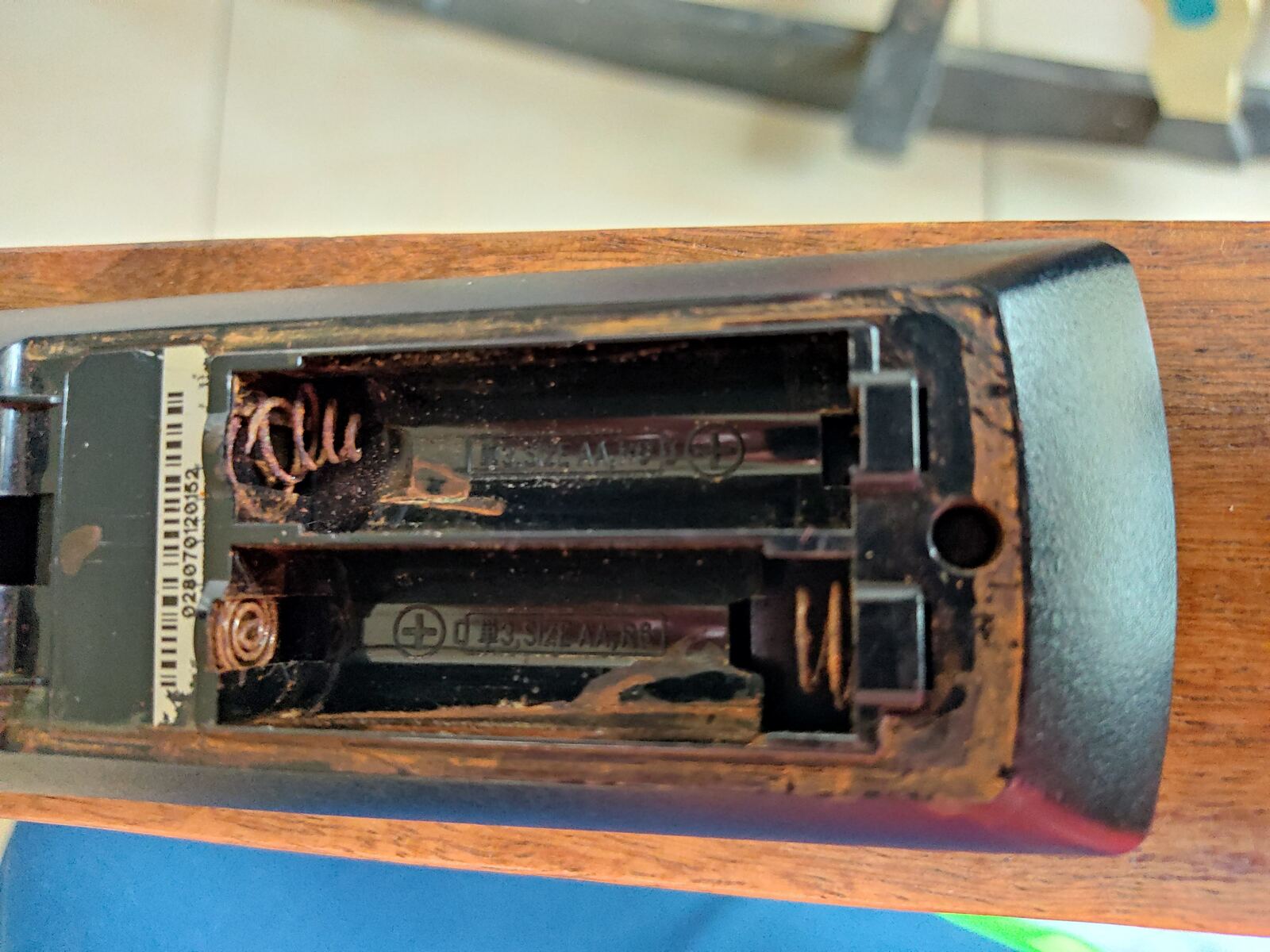
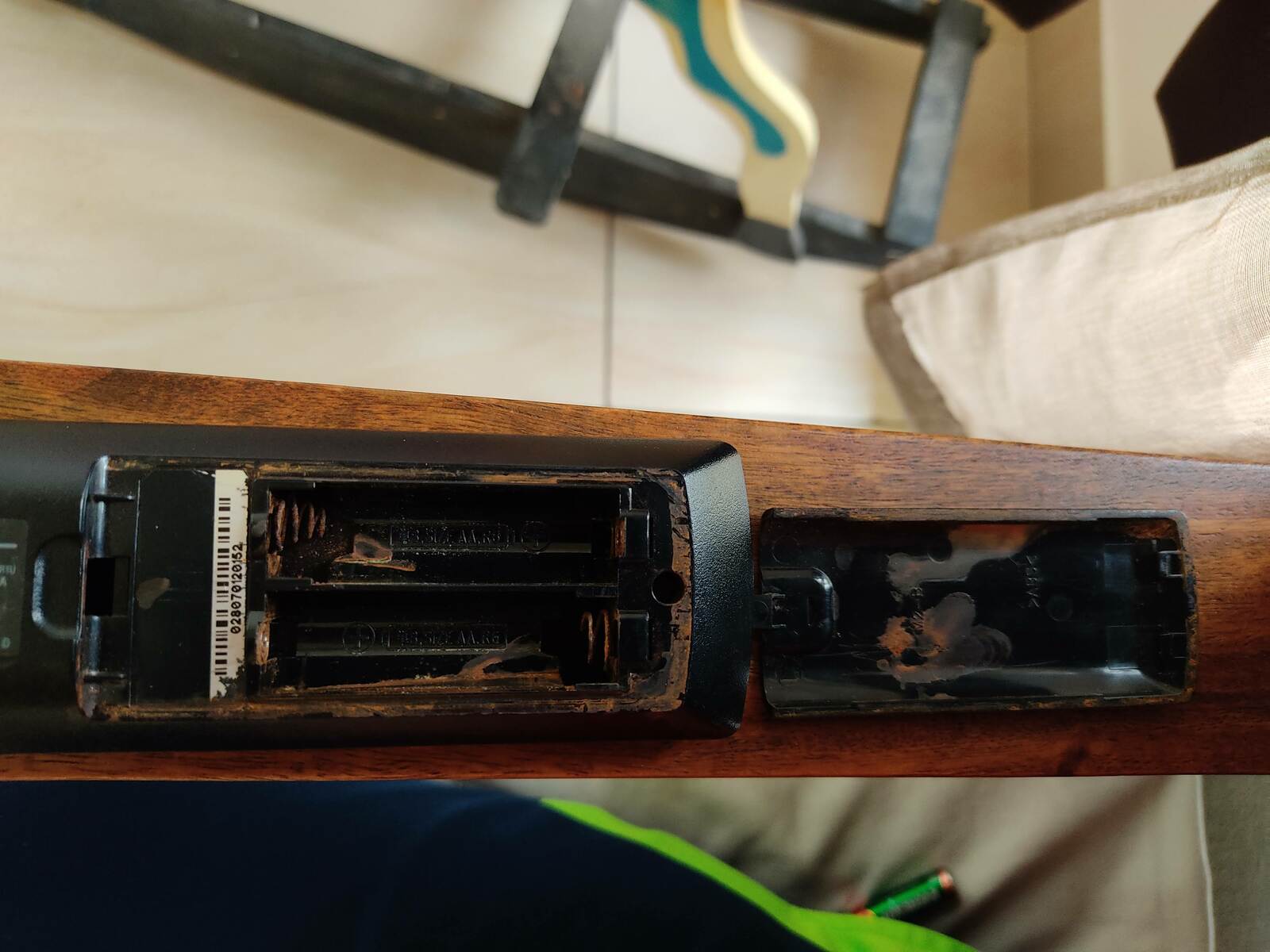
Sony PlayStation 3 BD Remote Almost 10 years ago, I bought the PS3 and many of its accessories. The remote has just been rotting in the shelf. It had rusted so bad that it is better described with these pics.
Rusted inside
Rusted inside
Rusted inside and cover
Rusted spring
Rusted spring
The rust was so much that the battery holding spring gave up. A little bit scrubbing and cleaning has gotten it working. I hope it lasts for some time before I find time to open it up and give it a full clean-up.

Pairing the BD Remote to laptop Honestly, with the condition of the hardware and software on both ends, I did not have much hopes of getting this to work. And in all the years on my computer usage, I hardly recollect much days when I ve made use of BT. Probably, because the full BT stack wasn t that well integrated in Linux, earlier. And I mostly used to disable them in hardware and software to save on battery. All yielded results from the internet talked about tools/scripts that were either not working, pointing to broken links etc. These days, bluez comes with a nice utility, bluetoothctl. It was a nice experience using it. First, start your bluetooth service and ensure that the device talks well with the kernel
rrs@lenovo:~$ systemctl status bluetooth                                                                                                          
  bluetooth.service - Bluetooth service                                                                                                           
     Loaded: loaded (/lib/systemd/system/bluetooth.service; enabled; vendor preset: enabled)                                                      
     Active: active (running) since Mon 2020-06-15 12:54:58 IST; 3s ago                                                                           
       Docs: man:bluetoothd(8)                                                                                                                    
   Main PID: 310197 (bluetoothd)                                                                                                                  
     Status: "Running"                                                                                                                            
      Tasks: 1 (limit: 9424)                                                                                                                      
     Memory: 1.3M                                                                                                                                 
     CGroup: /system.slice/bluetooth.service                                                                                                      
              310197 /usr/lib/bluetooth/bluetoothd                                                                                               
                                                                                                                                                  
Jun 15 12:54:58 lenovo systemd[1]: Starting Bluetooth service...                                                                                  
Jun 15 12:54:58 lenovo bluetoothd[310197]: Bluetooth daemon 5.50                                                                                  
Jun 15 12:54:58 lenovo systemd[1]: Started Bluetooth service.                                                                                     
Jun 15 12:54:58 lenovo bluetoothd[310197]: Starting SDP server                                                                                    
Jun 15 12:54:58 lenovo bluetoothd[310197]: Bluetooth management interface 1.15 initialized                                                        
Jun 15 12:54:58 lenovo bluetoothd[310197]: Sap driver initialization failed.                                                                      
Jun 15 12:54:58 lenovo bluetoothd[310197]: sap-server: Operation not permitted (1)                                                                
12:55                                                                                                                                       
Next, then is to discover and connect to your device
rrs@lenovo:~$ bluetoothctl 
Agent registered
[bluetooth]# devices
Device E6:3A:32:A4:31:8F MI Band 2
Device D4:B8:FF:43:AB:47 MI RC
Device 00:1E:3D:10:29:0F BD Remote Control
[CHG] Device 00:1E:3D:10:29:0F Connected: yes
[BD Remote Control]# info 00:1E:3D:10:29:0F
Device 00:1E:3D:10:29:0F (public)
        Name: BD Remote Control
        Alias: BD Remote Control
        Class: 0x0000250c
        Paired: no
        Trusted: yes
        Blocked: no
        Connected: yes
        LegacyPairing: no
        UUID: Human Interface Device... (00001124-0000-1000-8000-00805f9b34fb)
        UUID: PnP Information           (00001200-0000-1000-8000-00805f9b34fb)
        Modalias: usb:v054Cp0306d0100
[bluetooth]# 
In case of the Sony BD Remote, there s no need to pair. In fact, trying to pair fails. It prompts for the PIN code, but neither 0000 or 1234 are accepted. So, the working steps so far are to Trust the device and then Connect the device. For the sake of future use, I also populated /etc/bluetooth/input.conf based on suggestions on the internet. Note: The advertised keymappings in this config file do not work. Note: I m only using it for the power saving measures in instructing the BT connection to sleep after 3 minutes.
rrs@priyasi:/tmp$ cat input.conf 
# Configuration file for the input service
# This section contains options which are not specific to any
# particular interface
[General]
# Set idle timeout (in minutes) before the connection will
# be disconnect (defaults to 0 for no timeout)
IdleTimeout=3
# Enable HID protocol handling in userspace input profile
# Defaults to false (HIDP handled in HIDP kernel module)
#UserspaceHID=true
# Limit HID connections to bonded devices
# The HID Profile does not specify that devices must be bonded, however some
# platforms may want to make sure that input connections only come from bonded
# device connections. Several older mice have been known for not supporting
# pairing/encryption.
# Defaults to false to maximize device compatibility.
#ClassicBondedOnly=true
# LE upgrade security
# Enables upgrades of security automatically if required.
# Defaults to true to maximize device compatibility.
#LEAutoSecurity=true
#
#[00:1E:3D:10:29:0F]
[2c:33:7a:8e:d6:30]
[PS3 Remote Map]
# When the 'OverlayBuiltin' option is TRUE (the default), the keymap uses
# the built-in keymap as a starting point.  When FALSE, an empty keymap is
# the starting point.
#OverlayBuiltin = TRUE
#buttoncode = keypress    # Button label = action with default key mappings
#OverlayBuiltin = FALSE
0x16 = KEY_ESC            # EJECT = exit
0x64 = KEY_MINUS          # AUDIO = cycle audio tracks
0x65 = KEY_W              # ANGLE = cycle zoom mode
0x63 = KEY_T              # SUBTITLE = toggle subtitles
0x0f = KEY_DELETE         # CLEAR = delete key
0x28 = KEY_F8             # /TIME = toggle through sleep
0x00 = KEY_1              # NUM-1
0x01 = KEY_2              # NUM-2
0x02 = KEY_3              # NUM-3
0x03 = KEY_4              # NUM-4
0x04 = KEY_5              # NUM-5
0x05 = KEY_6              # NUM-6
0x06 = KEY_7              # NUM-7
0x07 = KEY_8              # NUM-8
0x08 = KEY_9              # NUM-9
0x09 = KEY_0              # NUM-0
0x81 = KEY_F2             # RED = red
0x82 = KEY_F3             # GREEN = green
0x80 = KEY_F4             # BLUE = blue
0x83 = KEY_F5             # YELLOW = yellow
0x70 = KEY_I              # DISPLAY = show information
0x1a = KEY_S              # TOP MENU = show guide
0x40 = KEY_M              # POP UP/MENU = menu
0x0e = KEY_ESC            # RETURN = back/escape/cancel
0x5c = KEY_R              # TRIANGLE/OPTIONS = cycle through recording options
0x5d = KEY_ESC            # CIRCLE/BACK = back/escape/cancel
0x5f = KEY_A              # SQUARE/VIEW = Adjust Playback timestretch
0x5e = KEY_ENTER          # CROSS = select
0x54 = KEY_UP             # UP = Up/Skip forward 10 minutes
0x56 = KEY_DOWN           # DOWN = Down/Skip back 10 minutes
0x57 = KEY_LEFT           # LEFT = Left/Skip back 5 seconds
0x55 = KEY_RIGHT          # RIGHT = Right/Skip forward 30 seconds
0x0b = KEY_ENTER          # ENTER = select
0x5a = KEY_F10            # L1 = volume down
0x58 = KEY_J              # L2 = decrease the play speed
0x51 = KEY_HOME           # L3 = commercial skip previous
0x5b = KEY_F11            # R1 = volume up
0x59 = KEY_U              # R2 = increase the play speed
0x52 = KEY_END            # R3 = commercial skip next
0x43 = KEY_F9             # PS button = mute
0x50 = KEY_M              # SELECT = menu (as per PS convention)
0x53 = KEY_ENTER          # START = select / Enter (matches terminology in mythwelcome)
0x30 = KEY_PAGEUP         # PREV = jump back (default 10 minutes)
0x76 = KEY_J              # INSTANT BACK (newer RCs only) = decrease the play speed
0x75 = KEY_U              # INSTANT FORWARD (newer RCs only) = increase the play speed
0x31 = KEY_PAGEDOWN       # NEXT = jump forward (default 10 minutes)
0x33 = KEY_COMMA          # SCAN BACK =  decrease scan forward speed / play
0x32 = KEY_P              # PLAY = play/pause
0x34 = KEY_DOT            # SCAN FORWARD decrease scan backard speed / increase playback speed; 3x, 5, 10, 20, 30, 60, 120, 180
0x60 = KEY_LEFT           # FRAMEBACK = Left/Skip back 5 seconds/rewind one frame
0x39 = KEY_P              # PAUSE = play/pause
0x38 = KEY_P              # STOP = play/pause
0x61 = KEY_RIGHT          # FRAMEFORWARD = Right/Skip forward 30 seconds/advance one frame
0xff = KEY_MAX
21:48                 
I have not spent much time finding out why not all the key presses work. Especially, given that most places on the internet mention these mappings. For me, some of the key scan codes aren t even reported. For keys like L1, L2, L3, R1, R2, R3, Next_Item, Prev_Item, they generate no codes in the kernel. If anyone has suggestions, ideas or fixes, I d appreciate if you can drop a comment or email me privately. But given my limited use to get a simple remote ready, to be usable with Kodi, I was apt with only some of the keys working.

Mapping the keys in Kodi With the limited number of keys detected, mapping those keys to what Kodi could use was the next step. Kodi has a very nice and easy to use module, Keymap Editor. It is very simple to use and map detected keys to functionalities you want. With it, I was able to get a functioning remote to use with my Kodi HTPC setup.

Update: Wed Jun 17 11:38:20 2020 One annoying problem that breaks the overall experience is the following bug on the driver side, that results in connections not being established instantly. Once the device goes into sleep mode, in random attempts, waking up and re-establishing a BT connection can be multi-poll affair. This can last from a couple of seconds to well over minute. Random suggestions on the internet mention disabling the autosuspend functionality for the device in the driver with btusb.enable_autosuspend=n, but that did not help in this case. Given that this device is enumberated over the USB Bus, it probably needs this feature applied to the whole USB tree of the device s chain. Something to investigate over the weekend.
Jun 16 20:41:23 lenovo kernel: Bluetooth: hci0: ACL packet for unknown connection handle 7
Jun 16 20:41:43 lenovo kernel: Bluetooth: hci0: ACL packet for unknown connection handle 8
Jun 16 20:41:59 lenovo kernel: Bluetooth: hci0: ACL packet for unknown connection handle 9
Jun 16 20:42:18 lenovo kernel: input: BD Remote Control as /devices/pci0000:00/0000:00:14.0/usb1/1-7/1-7:1.0/bluetooth/hci0/hci0:10/0005:054C:030>
Jun 16 20:42:18 lenovo kernel: sony 0005:054C:0306.0006: input,hidraw1: BLUETOOTH HID v1.00 Gamepad [BD Remote Control] on 2c:33:7a:8e:d6:30
Jun 16 20:51:59 lenovo kernel: input: BD Remote Control as /devices/pci0000:00/0000:00:14.0/usb1/1-7/1-7:1.0/bluetooth/hci0/hci0:11/0005:054C:030>
Jun 16 20:51:59 lenovo kernel: sony 0005:054C:0306.0007: input,hidraw1: BLUETOOTH HID v1.00 Gamepad [BD Remote Control] on 2c:33:7a:8e:d6:30
Jun 16 21:05:55 lenovo rtkit-daemon[1723]: Supervising 3 threads of 1 processes of 1 users.
Jun 16 21:05:55 lenovo rtkit-daemon[1723]: Successfully made thread 32747 of process 1646 owned by '1000' RT at priority 5.
Jun 16 21:05:55 lenovo rtkit-daemon[1723]: Supervising 4 threads of 1 processes of 1 users.
Jun 16 21:05:56 lenovo kernel: Bluetooth: hci0: ACL packet for unknown connection handle 12
Jun 16 21:06:12 lenovo kernel: Bluetooth: hci0: ACL packet for unknown connection handle 1
Jun 16 21:06:34 lenovo kernel: Bluetooth: hci0: ACL packet for unknown connection handle 2
Jun 16 21:06:59 lenovo kernel: input: BD Remote Control as /devices/pci0000:00/0000:00:14.0/usb1/1-7/1-7:1.0/bluetooth/hci0/hci0:3/0005:054C:0306>
Jun 16 21:06:59 lenovo kernel: sony 0005:054C:0306.0008: input,hidraw1: BLUETOOTH HID v1.00 Gamepad [BD Remote Control] on 2c:33:7a:8e:d6:30

Others There s a package, kodi-eventclients-ps3, which can be used to talk to the BD Remote. Unfortunately, it isn t up-to-date. When trying to make use of it, I ran into a couple of problems. First, the easy one is:
rrs@lenovo:~/ps3pair$ kodi-ps3remote localhost 9777
usr/share/pixmaps/kodi//bluetooth.png
Traceback (most recent call last):
  File "/usr/bin/kodi-ps3remote", line 220, in <module>
  File "/usr/bin/kodi-ps3remote", line 208, in main
    xbmc.connect(host, port)
    packet = PacketHELO(self.name, self.icon_type, self.icon_file)
  File "/usr/lib/python3/dist-packages/kodi/xbmcclient.py", line 285, in __init__
    with open(icon_file, 'rb') as f:
11:16         => 1  
This one was simple as it was just a broken path. The second issue with the tool is a leftover from python2 to python3 conversion.
rrs@lenovo:/etc/bluetooth$ kodi-ps3remote localhost
/usr/share/pixmaps/kodi//bluetooth.png
Searching for BD Remote Control
(Hold Start + Enter on remote to make it discoverable)
Redmi (E8:5A:8B:73:57:44) in range
Living Room TV (E4:DB:6D:24:23:E9) in range
Could not find BD Remote Control. Trying again...
Searching for BD Remote Control
(Hold Start + Enter on remote to make it discoverable)
Living Room TV (E4:DB:6D:24:23:E9) in range
Redmi (E8:5A:8B:73:57:44) in range
Could not find BD Remote Control. Trying again...
Searching for BD Remote Control
(Hold Start + Enter on remote to make it discoverable)
BD Remote Control (00:1E:3D:10:29:0F) in range
Found BD Remote Control with address 00:1E:3D:10:29:0F
Attempting to pair with remote
Remote Paired.
Traceback (most recent call last):
  File "/usr/bin/kodi-ps3remote", line 221, in <module>
    main()
  File "/usr/bin/kodi-ps3remote", line 212, in main
    if process_keys(remote, xbmc):
  File "/usr/bin/kodi-ps3remote", line 164, in process_keys
    keycode = data.encode("hex")[10:12]
AttributeError: 'bytes' object has no attribute 'encode'
11:24         => 1  
Fixing that too did not give me the desired result on using the BD Remote in the way I want. So eventually, I gave up and used Kodi s Keymap Editor instead.

Next Next in line, when I can manage to get some free time, is to improve the Kodi Video Scraper to have a fallback mode. Currently, for files where it cannot determine the content, it reject the file resulting in those files not showing up in your collection at all. A better approach would have been to have a fallback mode, that when the scraper cannot determine the content, it should fallback to using the filename scraper

14 June 2020

Steve Kemp: Writing a brainfuck compiler.

So last night I had the idea that it might be fun to write a Brainfuck compiler, to convert BF programs into assembly language, where they'd run nice and quickly. I figured I could allocate a day to do the work, and it would be a pleasant distraction on a Sunday afternoon. As it happened it only took me three hours from start to finish. There are only a few instructions involved in brainfuck: The Wikipedia link early shows how you can convert cleanly to a C implementation, so my first version just did that: The second step was just as simple: The following program produces the string "Hello World!" to the console:
++++++++[>++++[>++>+++>+++>+<<<<-]>+>+>->>+[<]<-]>>.>---.+++++++..+++.>>.<-.<.+++.------.--------.>>+.>++.
My C-compiler converted that to the program:
extern int putchar(int);
extern char getchar();
char array[30000];
int idx = 0;
int main (int arc, char *argv[])  
  array[idx]++;
  array[idx]++;
  array[idx]++;
  array[idx]++;
  array[idx]++;
  array[idx]++;
  array[idx]++;
  array[idx]++;
  while (array[idx])  
    idx++;
    array[idx]++;
    array[idx]++;
    array[idx]++;
    array[idx]++;
    while (array[idx])  
      idx++;
      array[idx]++;
      array[idx]++;
      idx++;
      array[idx]++;
      array[idx]++;
      array[idx]++;
    ..
    ..
The assembly language version is even longer:

global _start
section .text
_start:
  mov r8, stack
  add byte [r8], 8
label_loop_8:
  cmp byte [r8], 0
  je close_loop_8
  add r8, 1
  add byte [r8], 4
label_loop_14:
  cmp byte [r8], 0
  je close_loop_14
  add r8, 1
  add byte [r8], 2
  add r8, 1
  add byte [r8], 3
  add r8, 1
  add byte [r8], 3
  add r8, 1
  add byte [r8], 1
  sub r8, 4
  sub byte [r8], 1
  jmp label_loop_14
close_loop_14:
  add r8, 1
  add byte [r8], 1
  ..
  mov rax, 60
  mov rdi, 0
  syscall
section .bss
stack: resb 300000
Annoyingly the assembly language version ran slower than the C-version, which I was sneakily compiling with "gcc -O3 .." to ensure it was optimized. The first thing that I did was to convert it to fold adjacent instructions. Instead of generating separate increment instructions for ">>>" I instead started to generate "add xx, 3". That didn't help as much as I'd hoped, but it was still a big win. After that I made a minor tweak to the way that loops are handled to compare at the end of the loop as well as the start, and that shaved off a fraction of a second. As things stand I think I'm "done". It might be nice to convert the generated assembly language to something gcc can handle, to drop the dependency on nasm, but I don't feel a pressing need for that yet. Was a fun learning experience, and I think I'll come back to optimization later.

10 June 2020

Jonathan Dowland: template haskell

I've been meaning to write more about my PhD work for absolutely ages, but I've held myself back by wanting to try and keep a narrative running through the blog posts. That's not realistic for a number of reasons so I'm going to just write about different aspects of things without worrying about whether they make sense in the context of recent blog posts or not. Part of what I am doing at the moment is investigating Template Haskell to see whether it would usefully improve our system implementation. Before I write more about how it might apply to our system, I'll first write a bit about Template Haskell itself. Template Haskell (TH) is a meta-programming system: you write programs that are executed at compile time and can output code to be spliced into the parent program. The approach used by TH is really nice: you perform your meta-programming in real first-class Haskell, and it integrates really well with the main program. TH provides two pairs of special brackets. Oxford brackets surrounding any Haskell expression cause the whole expression to be replaced by the result of parsing the expression an expression tree which can be inspected and manipulated by the main program:
[  \x -> x + 1  ]
The expression data-type is a series of mutually-recursive data types that represent the complete Haskell grammar. The top-level is Exp, for expression, which has constructors for the different expression types. The above lambda expression is represented as
LamE [VarP x_1]
    (InfixE (Just (VarE x_1))
            (VarE GHC.Num.+)
            (Just (LitE (IntegerL 1))))
Such expressions can be pattern-matched against, constructed, deconstructed etc just like any other data type. The other bracket type performs the opposite operation: it takes an expression structure and splices it into code in the main program, to be compiled as normal:
 > 1 + $( litE (IntegerL 1) )
2
The two are often intermixed, sometimes nested to several levels. What follows is a typical beginner TH meta-program. The standard function fst operators on a 2-tuple and returns the first value. It cannot operate on a tuple of a different valence. However, a meta-program can generate a version of fst specialised for an n-tuple of any n:
genfst n = do
    xs <- replicateM n (newName "x")
    let ntup = tupP (map varP xs)
    [  \ $(ntup) ->  $(varE (head xs))  ]
Used like so
 > $(genfst 2) (1,2)
1
 > $(genfst 3) ('a','b','c')
'a'
 > :t $(genfst 10)
$(genfst 10) :: (a, b, c, d, e, f, g, h, i, j) -> a
That's a high-level gist of how you can use TH. I've skipped over a lot of detail, in particular an important aspect relating to scope and naming, which is key to the problem I am exploring at the moment. Oxford brackets and slice brackets do not operate directly on the simple Exp data-type, but upon an Exp within the Q Monad:
 > :t [  1  ]
[  1  ] :: ExpQ
ExpQ is a synonym for Q Exp. Eagle-eyed Haskellers will have noticed that genfst above was written in terms of some Monad. And you might also have noticed the case discrepancy between the constructor types VarE (Etc) and varE, tupP, varP used in that function definition. These are convenience functions that wrap the relevant constructor in Q. The point of the Q Monad is (I think) to handle name scoping, and avoid unintended name clashes. Look at the output of these simple expressions, passed through runQ:
 > runQ [  \x -> x  ]
LamE [VarP x_1] (VarE x_1)
 > runQ [  \x -> x  ]
LamE [VarP x_2] (VarE x_2)
Those x are not the same x in the context they are evaluated (a GHCi session). And that's the crux of the problem I am exploring. More in a later blog post!

6 June 2020

Thorsten Alteholz: My Debian Activities in May 2020

FTP master This month I accepted 211 packages and rejected only 9. The overall number of packages that got accepted was 228. Debian LTS This was my seventy-first month that I did some work for the Debian LTS initiative, started by Raphael Hertzog at Freexian. This month my all in all workload has been 17.25h. During that time I did LTS uploads of: I started to work on php5 as well but did not upload a fixed version yet. Last but not least I did some days of frontdesk duties. Debian ELTS This month was the twenty third ELTS month. During my small allocated time I uploaded: I also did some days of frontdesk duties. Other stuff I improved packaging of I sponsored uploads of On my Go challenge I uploaded:
golang-github-apparentlymart-go-versions, golang-github-hashicorp-go-slug, golang-github-mozillazg-go-httpheader, golang-github-hashicorp-terraform-json, golang-github-hashicorp-terraform-plugin-test, golang-github-sean pager, golang-github-sean seed, golang-github-timberio-go-datemath,

1 June 2020

Utkarsh Gupta: FOSS Activites in May 2020

Here s my (eighth) monthly update about the activities I ve done in the F/L/OSS world.

Debian
This month marks my 15 months of contributing to Debian. And 6th month as a DD! \o/ Whilst I love doing Debian stuff, I have started spending more time on the programming side now. And I hope to keep it this for some time now.
Of course, I ll keep doing the Debian stuff, but just lesser in amount. Anyway, the following are the things I did in May.

Uploads:

Other $things:
  • Hosted Ruby team meeting. Logs here.
  • Attended Debian Perl Sprints. Report here.
  • Sponsored git-repo-updater and mplcursors for Sudip.
  • Mentoring for newcomers.
  • FTP Trainee reviewing.
  • Moderation of -project mailing list.
  • Got selected for GSoC 20 for Debian!

Experimenting and improving Ruby libraries FTW!
I have been very heavily involved with the Debian Ruby team for over an year now.
Thanks to Antonio Terceiro (and GSoC), I ve started experimenting and taking more interest in upstream development and improvement of these libraries. This has the sole purpose of learning. It has gotten fun since I ve started doing Ruby.
And I hope it stays this way. This month, I opened some issues and proposed a few pull requests. They are:
  • Issue #802 against whenever for Ruby2.7 test failures.
  • Issue #8 against aggregate asking upstream for a release on rubygems.
  • Issue #104 against irb for asking more about Array.join("\n").
  • Issue #1391 against mail asking upstream to cut a new release.
  • Issue #1655 against rack reporting test failures in the CVE fix.
  • Issue #84 against ruby-dbus for help with Debian bug #836296.
  • Issue #85 against ruby-dbus asking if they still use rDoc for doc generation.
  • PR #9 against aggregate for dropping git from gemspec.
  • PR #804 against whenever for dropping git from gemspec.
  • Packaged ruby-cmath as it was split from Ruby2.7; cf: (#961213).

Debian LTS
Debian Long Term Support (LTS) is a project to extend the lifetime of all Debian stable releases to (at least) 5 years. Debian LTS is not handled by the Debian security team, but by a separate group of volunteers and companies interested in making it a success. This was my eighth month as a Debian LTS paid contributor. I was assigned 17.25 hours and worked on the following things:

CVE Fixes and Announcements:

Other LTS Work:
  • Triaged tika, freerdp, and apache2.
  • Mark CVE-2020-12105/openconnect as no-dsa not-affected for Jessie.
  • Mark CVE-2020-9489/tika as no-dsa ignored for Jessie.
  • Mark CVE-2020-11025/wordpres as not-affected for Jessie.
  • Add fix for Add fix for CVE-2019-18823/condor.
  • Requested CVE for bug#60251 against apache2.
  • Raised issue #947 against sympa reporting an incomplete patch for CVE-2020-10936.
  • Created the LTS Survey on the self-hosted LimeSurvey instance.
  • Attended the second LTS meeting. Logs here.
  • General discussion on LTS private and public mailing list.

Other(s)
Sometimes it gets hard to categorize work/things into a particular category.
That s why I am writing all of those things inside this category.
This includes two sub-categories and they are as follows.

Personal: This month I could get the following things done:
  • Wrote and published my first Ruby gem/library/tool on RubyGems!
    It s open-sourced and the repository is here.
    Bug reports and pull requests are welcomed!
  • Wrote a small Ruby script (available here) to install Ruby gems from Gemfile(.lock).
    Needed this when I hit a bug while using ruby-standalone, which Antonio fixed pretty quickly!
  • Had a coffee chat with John Coghlan!
    Tweet here.

Open Source: Again, this contains all the things that I couldn t categorize earlier.
Opened several issues and did a PR review:
  • Issue #15434 against phantomjs, asking to look into CVE-2019-17221. Still no action :/
  • Issue #947 against sympa, reporting an incomplete patch for CVE-2020-10936.
  • Issue #2102 against polybar, mentioning that the build is not reproducible.
  • Issue #5521 against libgit2, mentioning that the build is not reproducible.
  • Reviewed PR #5523 for polybar, which was a fix for the above issue.

Until next time.
:wq for today.

Paul Wise: FLOSS Activities May 2020

Focus This month I didn't have any particular focus. I just worked on issues in my info bubble.

Changes

Issues

Review

Administration
  • nsntrace: talk to upstream about collaborative maintenance
  • Debian: deploy changes, debug issue with GPS markers file generation, migrate bls/DUCK from alioth-archive to salsa
  • Debian website: ran map cron job, synced mirrors
  • Debian wiki: approve accounts, ping folks with bouncing email

Communication

Sponsors The apt-offline work and the libfile-libmagic-perl backports were sponsored. All other work was done on a volunteer basis.

29 May 2020

Gunnar Wolf: Heads up Online MiniDebConf is Online

I know most Debian people know about this already But in case you don t follow the usual Debian communications channels, this might interest you! Given most of the world is still under COVID-19 restrictions, and that we want to work on Debian, given there is no certainty as to what the future holds in store for us Our DPL fearless as they always are had the bold initiative to make this weekend into the first-ever miniDebConf Online (MDCO)! miniDebConf Online So, we are already halfway through DebCamp (which means, you can come and hang out with us in the debian.social DebCamp Jitsi lounge, where some impromptu presentations might happen (or not). Starting tomorrow morning (11AM UTC), we will have a quite interesting set of talks. I am reproducing the schedule here:

Saturday 2020.05.30
Time (UTC) Speaker Talk
11:00 - 11:10 MDCO team members Hello + Welcome
11:30 - 11:50 Wouter Verhelst Extrepo
12:00 - 12:45 JP Mengual Debian France, trust european organization
13:00 - 13:20 Arnaud Ferraris Bringing Debian to mobile phones, one package at a time
13:30 - 15:00 Lunch Break A chance for the teams to catch some air
15:00 - 15:45 JP Mengual The community team, United Nations Organizations of Debian?
16:00 - 16:45 Christoph Biedl Clevis and tang - overcoming the disk unlocking problem
17:00 - 17:45 Antonio Terceiro I m a programmer, how can I help Debian

Sunday 2020.05.31
Time (UTC) Speaker Talk
11:00 - 11:45 Andreas Tille The effect of Covid-19 on the Debian Med project
12:00 - 12:45 Paul Gevers BoF: running autopkgtest for your package
13:00 - 13:20 Ben Hutchings debplate: Build many binary packages with templates
13:30 - 15:00 Lunch break A chance for the teams to catch some air
15:00 - 15:45 Holger Levsen Reproducing bullseye in practice
16:00 - 16:45 Jonathan Carter Striving towards excellence
17:00 - 17:45 Delib* Organizing Peer-to-Peer Debian Facilitation Training
18:00 - 18:15 MDCO team members Closing
  • subject to confirmation

Timezone Remember this is an online event, meant for all of the world! Yes, the chosen times seem quite Europe-centric (but they are mostly a function of the times the talk submitters requested). Talks are 11:00 18:00UTC, which means, 06:00 13:00 Mexico (GMT-5), 20:00 03:00 Japan (GMT+9), 04:00 11:00 Western Canada/USA/Mexico (GMT-7) and the rest of the world, somewhere in between. (No, this was clearly not optimized for our dear usual beer team. Sorry! I guess we need you to be fully awake at beertime!)

[update] Connecting! Of course, I didn t make it clear at first how to connect to the Online miniDebConf, silly me!
  • The video streams are available at: https://video.debconf.org/
  • Suggested: tune in to the #minidebconf-online IRC channel in OFTC.
That should be it. Hope to see you there! (Stay home, stay safe )

Gunnar Wolf: Heads up Online MiniDebConf is Online

I know most Debian people know about this already But in case you don t follow the usual Debian communications channels, this might interest you! Given most of the world is still under COVID-19 restrictions, and that we want to work on Debian, given there is no certainty as to what the future holds in store for us Our DPL fearless as they always are had the bold initiative to make this weekend into the first-ever miniDebConf Online (MDCO)! miniDebConf Online So, we are already halfway through DebCamp (which means, you can come and hang out with us in the debian.social DebCamp Jitsi lounge, where some impromptu presentations might happen (or not). Starting tomorrow morning (11AM UTC), we will have a quite interesting set of talks. I am reproducing the schedule here:

Saturday 2020.05.30
Time (UTC) Speaker Talk
11:00 - 11:10 MDCO team members Hello + Welcome
11:30 - 11:50 Wouter Verhelst Extrepo
12:00 - 12:45 JP Mengual Debian France, trust european organization
13:00 - 13:20 Arnaud Ferraris Bringing Debian to mobile phones, one package at a time
13:30 - 15:00 Lunch Break A chance for the teams to catch some air
15:00 - 15:45 JP Mengual The community team, United Nations Organizations of Debian?
16:00 - 16:45 Christoph Biedl Clevis and tang - overcoming the disk unlocking problem
17:00 - 17:45 Antonio Terceiro I m a programmer, how can I help Debian

Sunday 2020.05.31
Time (UTC) Speaker Talk
11:00 - 11:45 Andreas Tille The effect of Covid-19 on the Debian Med project
12:00 - 12:45 Paul Gevers BoF: running autopkgtest for your package
13:00 - 13:20 Ben Hutchings debplate: Build many binary packages with templates
13:30 - 15:00 Lunch break A chance for the teams to catch some air
15:00 - 15:45 Holger Levsen Reproducing bullseye in practice
16:00 - 16:45 Jonathan Carter Striving towards excellence
17:00 - 17:45 Delib* Organizing Peer-to-Peer Debian Facilitation Training
18:00 - 18:15 MDCO team members Closing
  • subject to confirmation

Timezone Remember this is an online event, meant for all of the world! Yes, the chosen times seem quite Europe-centric (but they are mostly a function of the times the talk submitters requested). Talks are 11:00 18:00UTC, which means, 06:00 13:00 Mexico (GMT-5), 20:00 03:00 Japan (GMT+9), 04:00 11:00 Western Canada/USA/Mexico (GMT-7) and the rest of the world, somewhere in between. (No, this was clearly not optimized for our dear usual beer team. Sorry! I guess we need you to be fully awake at beertime!)

[update] Connecting! Of course, I didn t make it clear at first how to connect to the Online miniDebConf, silly me!
  • The video streams are available at: https://video.debconf.org/
  • Suggested: tune in to the #minidebconf-online IRC channel in OFTC.
That should be it. Hope to see you there! (Stay home, stay safe )

27 May 2020

Kees Cook: security things in Linux v5.5

Previously: v5.4. I got a bit behind on this blog post series! Let s get caught up. Here are a bunch of security things I found interesting in the Linux kernel v5.5 release: restrict perf_event_open() from LSM
Given the recurring flaws in the perf subsystem, there has been a strong desire to be able to entirely disable the interface. While the kernel.perf_event_paranoid sysctl knob has existed for a while, attempts to extend its control to block all perf_event_open() calls have failed in the past. Distribution kernels have carried the rejected sysctl patch for many years, but now Joel Fernandes has implemented a solution that was deemed acceptable: instead of extending the sysctl, add LSM hooks so that LSMs (e.g. SELinux, Apparmor, etc) can make these choices as part of their overall system policy. generic fast full refcount_t
Will Deacon took the recent refcount_t hardening work for both x86 and arm64 and distilled the implementations into a single architecture-agnostic C version. The result was almost as fast as the x86 assembly version, but it covered more cases (e.g. increment-from-zero), and is now available by default for all architectures. (There is no longer any Kconfig associated with refcount_t; the use of the primitive provides full coverage.) linker script cleanup for exception tables
When Rick Edgecombe presented his work on building Execute-Only memory under a hypervisor, he noted a region of memory that the kernel was attempting to read directly (instead of execute). He rearranged things for his x86-only patch series to work around the issue. Since I d just been working in this area, I realized the root cause of this problem was the location of the exception table (which is strictly a lookup table and is never executed) and built a fix for the issue and applied it to all architectures, since it turns out the exception tables for almost all architectures are just a data table. Hopefully this will help clear the path for more Execute-Only memory work on all architectures. In the process of this, I also updated the section fill bytes on x86 to be a trap (0xCC, int3), instead of a NOP instruction so functions would need to be targeted more precisely by attacks. KASLR for 32-bit PowerPC
Joining many other architectures, Jason Yan added kernel text base-address offset randomization (KASLR) to 32-bit PowerPC. seccomp for RISC-V
After a bit of long road, David Abdurachmanov has added seccomp support to the RISC-V architecture. The series uncovered some more corner cases in the seccomp self tests code, which is always nice since then we get to make it more robust for the future! seccomp USER_NOTIF continuation
When the seccomp SECCOMP_RET_USER_NOTIF interface was added, it seemed like it would only be used in very limited conditions, so the idea of needing to handle normal requests didn t seem very onerous. However, since then, it has become clear that the overhead of a monitor process needing to perform lots of normal open() calls on behalf of the monitored process started to look more and more slow and fragile. To deal with this, it became clear that there needed to be a way for the USER_NOTIF interface to indicate that seccomp should just continue as normal and allow the syscall without any special handling. Christian Brauner implemented SECCOMP_USER_NOTIF_FLAG_CONTINUE to get this done. It comes with a bit of a disclaimer due to the chance that monitors may use it in places where ToCToU is a risk, and for possible conflicts with SECCOMP_RET_TRACE. But overall, this is a net win for container monitoring tools. EFI_RNG_PROTOCOL for x86
Some EFI systems provide a Random Number Generator interface, which is useful for gaining some entropy in the kernel during very early boot. The arm64 boot stub has been using this for a while now, but Dominik Brodowski has now added support for x86 to do the same. This entropy is useful for kernel subsystems performing very earlier initialization whre random numbers are needed (like randomizing aspects of the SLUB memory allocator). FORTIFY_SOURCE for MIPS
As has been enabled on many other architectures, Dmitry Korotin got MIPS building with CONFIG_FORTIFY_SOURCE, so compile-time (and some run-time) buffer overflows during calls to the memcpy() and strcpy() families of functions will be detected. limit copy_ to,from _user() size to INT_MAX
As done for VFS, vsnprintf(), and strscpy(), I went ahead and limited the size of copy_to_user() and copy_from_user() calls to INT_MAX in order to catch any weird overflows in size calculations. Other things
Alexander Popov pointed out some more v5.5 features that I missed in this blog post. I m repeating them here, with some minor edits/clarifications. Thank you Alexander! Edit: added Alexander Popov s notes That s it for v5.5! Let me know if there s anything else that I should call out here. Next up: Linux v5.6.

2020, Kees Cook. This work is licensed under a Creative Commons Attribution-ShareAlike 3.0 License.
Creative Commons License

Russ Allbery: Review: Middlegame

Review: Middlegame, by Seanan McGuire
Publisher: Tor
Copyright: May 2019
ISBN: 1-250-19551-9
Format: Kindle
Pages: 528
Roger and Dodger are cuckoo children, alchemical constructs created by other alchemical constructs masquerading as humans. They are halves of the primal force of the universe, the Doctrine of Ethos (which is not what the Doctrine of Ethos is, but that is one of my lesser problems with this book), divided into language and math and kept separate to properly mature. In this case, separate means being adopted by families on opposite coasts of the United States, ignorant of each other's existence and closely monitored by agents Reed controls. None of that prevents Roger and Dodger from becoming each other's invisible friends at the age of seven, effortlessly communicating psychically even though they've never met. That could have been the start of an enjoyable story that hearkened back to an earlier age of science fiction: the secret science experiments discover that they have more power than their creators expected, form a clandestine alliance, and fight back against the people who are trying to control them. I have fond memories of Escape to Witch Mountain and would have happily read that book. Unfortunately, that isn't the story McGuire wanted to tell. The story she told involves ripping Roger and Dodger apart, breaking Dodger, and turning Roger into an abusive asshole. Whooboy, where to start. This book made me very angry, in a way that I would not have been if it didn't contain the bones of a much better novel. Four of them, to be precise: four other books that would have felt less gratuitously cruel and less apparently oblivious to just how bad Roger's behavior is. There are some things to like. One of them is that the structure of this book is clever. I can't tell you how it's clever because the structure doesn't become clear until more than halfway through and it completely changes the story in a way that would be a massive spoiler. But it's an interesting spin on an old idea, one that gave Roger and Dodger a type of agency in the story that has far-ranging implications. I enjoyed thinking about it. That leads me to another element I liked: Erin. She makes only fleeting appearances until well into the story, but I thought she competed with Dodger for being the best character of the book. The second of the better novels I saw in the bones of Middlegame was the same story told from Erin's perspective. I found myself guessing at her motives and paying close attention to hints that led to a story with a much different emotional tone. Viewing the ending of the book through her eyes instead of Roger and Dodger's puts it in a different, more complicated, and more thought-provoking light. Unfortunately, she's not McGuire's protagonist. She instead is one of the monsters of this book, which leads to my first, although not my strongest, complaint. It felt like McGuire was trying too hard to write horror, packing Middlegame with the visuals of horror movies without the underlying structure required to make them effective. I'm not a fan of horror personally, so to some extent I'm grateful that the horrific elements were ineffective, but it makes for some frustratingly bad writing. For example, one of the longest horror scenes in the book features Erin, and should be a defining moment for the character. Unfortunately, it's so heavy on visuals and so focused on what McGuire wants the reader to be thinking that it doesn't show any of the psychology underlying Erin's decisions. The camera is pointed the wrong way; all the interesting storytelling work, moral complexity, and world-building darkness is happening in the character we don't get to see. And, on top of that, McGuire overuses foreshadowing so much that it robs the scene of suspense and terror. Again, I'm partly grateful, since I don't read books for suspense and terror, but it means the scene does only a fraction of the work it could. This problem of trying too hard extends to the writing. McGuire has a bit of a tendency in all of her books to overdo the descriptions, but is usually saved by narrative momentum. Unfortunately, that's not true here, and her prose often seems overwrought. She also resorts to this style of description, which never fails to irritate me:
The thought has barely formed when a different shape looms over him, grinning widely enough to show every tooth in its head. They are even, white, and perfect, and yet he somehow can't stop himself from thinking there's something wrong with them, that they're mismatched, that this assortment of teeth was never meant to share a single jaw, a single terrible smile.
This isn't effective. This is telling the reader how they're supposed to feel about the thing you're describing, without doing the work of writing a description that makes them feel that way. (Also, you may see what I mean by overwrought.) That leads me to my next complaint: the villains. My problem is not so much with Leigh, who I thought was an adequate monster, if a bit single-note. There's some thought and depth behind her arguments with Reed, a few hints of her own motives that were more convincing for not being fully shown. The descriptions of how dangerous she is were reasonably effective. She's a good villain for this type of dark fantasy story where the world is dangerous and full of terrors (and reminded me of some of the villains from McGuire's October Daye series). Reed, though, is a storytelling train wreck. The Big Bad of the novel is the least interesting character in it. He is a stuffed tailcoat full of malicious incompetence who is only dangerous because the author proclaims him to be. It only adds insult to injury that he kills off a far more nuanced and creative villain before the novel starts, replacing her ambiguous goals with Snidely Whiplash mustache-twirling. The reader has to suffer through extended scenes focused on him as he brags, monologues, and obsesses over his eventual victory without an ounce of nuance or subtlety. Worse is the dynamic between him and Leigh, which is only one symptom of the problem with Middlegame that made me the most angry: the degree to this book oozes patriarchy. Every man in this book, including the supposed hero, orders around the women, who are forced in various ways to obey. This is the most obvious between Leigh and Reed, but it's the most toxic, if generally more subtle, between Roger and Dodger. Dodger is great. I had absolutely no trouble identifying with and rooting for her as a character. The nasty things that McGuire does to her over the course of the book (and wow does that never let up) made me like her more when she tenaciously refuses to give up. Dodger is the math component of the Doctrine of Ethos, and early in the book I thought McGuire handled that well, particularly given how difficult it is to write a preternatural genius. Towards the end of this book, her math sadly turns into a very non-mathematical magic (more on this in a moment), but her character holds all the way through. It felt like she carved her personality out of this story through sheer force of will and clung to it despite the plot. I wanted to rescue her from this novel and put her into a better book, such as the one in which her college friends (who are great; McGuire is very good at female friendships when she writes them) stage an intervention, kick a few people out of her life, and convince her to trust them. Unfortunately, Dodger is, by authorial fiat, half of a bound pair, and the other half of that pair is Roger, who is the sort of nice guy everyone likes and thinks is sweet and charming until he turns into an emotional trap door right when you need him the most and dumps you into the ocean to drown. And then somehow makes you do all the work of helping him feel better about his betrayal. The most egregious (and most patriarchal) thing Roger does in this book is late in the book and a fairly substantial spoiler, so I can't rant about that properly. But even before that, Roger keeps doing the the same damn emotional abandonment trick, and the book is heavily invested into justifying it and making excuses for him. Excuses that, I should note, are not made for Dodger; her failings are due to her mistakes and weaknesses, whereas Roger's are natural reactions to outside forces. I got very, very tired of this, and I'm upset by how little awareness the narrative voice showed for how dysfunctional and abusive this relationship is. The solution is always for Dodger to reunite with Roger; it's built into the structure of the story. I have a weakness for the soul-bound pair, in part from reading a lot of Mercedes Lackey at an impressionable age, but one of the dangerous pitfalls of the concept is that the characters then have to have an almost flawless relationship. If not, it can turn abusive very quickly, since the characters by definition cannot leave each other. It's essentially coercive, so as soon as the relationship shows a dark side, the author needs to be extremely careful. McGuire was not. There is an attempted partial patch, late in the book, for the patriarchal structure. One of the characters complains about it, and another says that the gender of the language and math pairs is random and went either way in other pairs. Given that both of the pairs that we meet in this story have the same male-dominant gender dynamic, what I took from this is that McGuire realized there was a problem but wasn't able to fix it. (I'm also reminded of David R. Henry's old line that it's never a good sign when the characters start complaining about the plot.) The structural problems are all the more frustrating because I think there were ways out of them. Roger is supposedly the embodiment of language, not that you'd be able to tell from most scenes in this novel. For reasons that I do not understand, McGuire expressed that as a love of words: lexicography, translation, and synonyms. This makes no sense to me. Those are some of the more structured and rules-based (and hence mathematical) parts of language. If Roger had instead been focused on stories collecting them, telling them, and understanding why and how they're told he would have had a clearer contrast with Dodger. More importantly, it would have solved the plot problem that McGuire solved with a nasty bit of patriarchy. So much could have been done with Dodger building a structure of math around Roger's story-based expansion of the possible, and it would have grounded Dodger's mathematics in something more interesting than symbolic magic. To me, it's such an obvious lost opportunity. I'm still upset about this book. McGuire does a lovely bit of world-building with Asphodel Baker, what little we see of her. I found the hidden alchemical war against her work by L. Frank Baum delightful, and enjoyed every excerpt from the fictional Over the Woodward Wall scattered throughout Middlegame. But a problem with inventing a fictional book to excerpt in a real novel is that the reader may decide that the fictional book sounds a lot better than the book they're reading, and start wishing they could just read that book instead. That was certainly the case for me. I'm sad that Over the Woodward Wall doesn't exist, and am mostly infuriated by Middlegame. Dodger and Erin deserved to live in a better book. Should you want to read this anyway (and I do know people who liked it), serious content warning for self-harm. Rating: 4 out of 10

26 May 2020

Christian Kastner: Curved Monitor

It's been two weeks since I purchased my first curved monitor. Switching away from a flat panel proved to be a novel and unusual experience so much, in fact, that within the first five minutes, I already wanted to return it. Nevertheless, I gave it a try, and I'm glad I did, because not only did I eventually get over the initially perceived issues, I'm now extremely satisfied with it.
Shifted Perspective My sole motivation for the switch was that I had become irritated (to a probably irrational degree) by reading and writing text in whatever window tile was on the left side of my desktop. Even though my previous monitor wasn't a particularly large one with 24", the shift in perspective on the far side of that window always made me feel as if I were reading something to the side of me, rather than in front of me even if I turned to face it directly. It was time to try out a curved monitor.
Process Purchasing something like a monitor is always a pain; there's just so much choice. I would have preferred something with an IPS panel, 4K resolution, and either a 27" or 32" size, and would compromise for a VA panel and WQHD resolution. On geizhals.at, an Austrian price comparison site, ~50 monitors satisfied those criteria. Further limiting the list to reputable brands and reasonable prices still left me with more than two dozen options. Without going into the details why (I was just glad to be done with it), I eventually settled for an MSI Optix MAG271CQR, a 27" WQHD monitor with a VA panel. Once the new monitor arrived, I removed the old monitor from my VESA desk mount, installed the new one, booted, and gave it a try. Within the first five minutes of use, I made three key observations:
  1. My shifted perspective issue on the sides was solved (great!), and
  2. I had gained quite a bit of screen real estate (great!), but
  3. Because of the curvature, the bottom task bar now looked bent (Oh Noes).
Now, point (3) might not sound like that big of an issue, but when you're willing to change your monitor just because vim looks kind of weird to you when it's window is on the left side of the desktop, then a bent-looking task bar is a deal-breaker. I decided that I had to return it. However, that meant: removing it, re-boxing it, shipping it back, etc. Tedious work. As it was already mounted and connected, a friend encouraged me to give it a day or two anyway, just in case. That turned out to be great advice. I would never have expected this, but I got over the bent-looking task bar issue pretty fast. The pleasure of a corrected perspective on either side (everything just looks "right" now) more than makes up for the bent-looking tar bar at the bottom; I don't even notice it anymore. And the added screen real estate is a bonus I hadn't planned for. The MAG271CQR targets the gaming demographic, and thus comes loaded with various features. My new favorite is "Reader Mode", which has an effect quite similar to "Night Mode" on mobile devices (reduced brightness, blue light filter). My eyes barely tire anymore, even after a long day's use. It also has a Picture-in-Picture mode for a second input which I haven't tried yet, but should come in handy for SBCs and the like.

Russ Allbery: Review: The Ten Thousand Doors of January

Review: The Ten Thousand Doors of January, by Alix E. Harrow
Publisher: Redhook
Copyright: September 2019
ISBN: 0-316-42198-7
Format: Kindle
Pages: 373
In 1901, at the age of seven, January found a Door. It was barely more than a frame in a ruined house in a field in Kentucky, but she wrote a story about opening it, and then did.
Once there was a brave and temeraryous (sp?) girl who found a Door. It was a magic Door that's why it has a capital D. She opened the Door.
The Door led to a bluff over the sea and above a city, a place very far from Kentucky, and she almost stayed, but she came back through the Door when her guardian, Mr. Locke, called. The adventure cost her a diary, several lectures, days of being locked in her room, and the remnants of her strained relationship with her father. When she went back, the frame of the Door was burned to the ground. That was the end of Doors for January for some time, and the continuation of a difficult childhood. She was cared for by her father's employer as a sort of exotic pet, dutifully attempting to obey, grateful for Mr. Locke's protection, and convinced that he was occasionally sneaking her presents through a box in the Pharaoh Room out of some hidden kindness. Her father appeared rarely, said little, and refused to take her with him. Three things helped: the grocery boy who smuggled her stories, an intimidating black woman sent by her father to replace her nurse, and her dog.
Once upon a time there was a good girl who met a bad dog, and they became the very best of friends. She and her dog were inseparable from that day forward.
I will give you a minor spoiler that I would have preferred to have had, since it would have saved me some unwarranted worry and some mental yelling at the author: The above story strains but holds. January's adventure truly starts the day before her seventeenth birthday, when she finds a book titled The Ten Thousand Doors in the box in the Pharaoh Room. As you may have guessed from the title, The Ten Thousand Doors of January is a portal fantasy, but it's the sort of portal fantasy that is more concerned with the portal itself than the world on the other side of it. (Hello to all of you out there who, like me, have vivid memories of the Wood between the Worlds.) It's a book about traveling and restlessness and the possibility of escape, about the ability to return home again, and about the sort of people who want to close those doors because the possibility of change created by people moving around freely threatens the world they have carefully constructed. Structurally, the central part of the book is told by interleaving chapters of January's tale with chapters from The Ten Thousand Doors. That book within a book starts with the framing of a scholarly treatment but quickly becomes a biography of a woman: Adelaide Lee Larson, a half-wild farm girl who met her true love at the threshold of a Door and then spent much of her life looking for him. I am not a very observant reader for plot details, particularly for books that I'm enjoying. I read books primarily for the emotional beats and the story structure, and often miss rather obvious story clues. (I'm hopeless at guessing the outcomes of mysteries.) Therefore, when I say that there are many things January is unaware of that are obvious to the reader, that's saying a lot. Even more clues were apparent when I skimmed the first chapter again, and a more observant reader would probably have seen them on the first read. Right down to Mr. Locke's name, Harrow is not very subtle about the moral shape of this world. That can make the early chapters of the book frustrating. January is being emotionally (and later physically) abused by the people who have power in her life, but she's very deeply trapped by false loyalty and lack of external context. Winning free of that is much of the story of the book, and at times it has the unpleasantness of watching someone make excuses for her abuser. At other times it has the unpleasantness of watching someone be abused. But this is the place where I thought the nested story structure worked marvelously. January escapes into the story of The Ten Thousand Doors at the worst moments of her life, and the reader escapes with her. Harrow uses the desire to switch scenes back to the more adventurous and positive story to construct and reinforce the emotional structure of the book. For me, it worked extremely well. It helps that the ending is glorious. The payoff is worth all the discomfort and tension-building in the first half of the book. Both The Ten Thousand Doors and the surrounding narrative reach deeply satisfying conclusions, ones that are entangled but separate in just the ways that they need to be. January's abilities, actions, and decisions at the end of the book were just the outcome that I needed but didn't entirely guess in advance. I could barely put down the last quarter of this story and loved every moment of the conclusion. This is the sort of book that can be hard to describe in a review because its merits don't rest on an original twist or easily-summarized idea. The elements here are all elements found in other books: portal fantasy, the importance of story-telling, coming of age, found family, irrepressible and indomitable characters, and the battle of the primal freedom of travel and discovery and belief against the structural forces that keep rulers in place. The merits of this book are in the small details: the way that January's stories are sparse and rare and sometimes breathtaking, the handling of tattoos, the construction of other worlds with a few deft strokes, and the way Harrow embraces the emotional divergence between January's life and Adelaide's to help the reader synchronize the emotional structure of their reading experience with January's.
She writes a door of blood and silver. The door opens just for her.
The Ten Thousand Doors of January is up against a very strong slate for both the Nebula and the Hugo this year, and I suspect it may be edged out by other books, although I wouldn't be unhappy if it won. (It probably has a better shot at the Nebula than the Hugo.) But I will be stunned if Harrow doesn't walk away with the Mythopoeic Award. This seems like exactly the type of book that award was created for. This is an excellent book, one of the best I've read so far this year. Highly recommended. Rating: 9 out of 10

25 May 2020

Bits from Debian: DebConf20 registration is open!

DebConf20 banner We are happy to announce that registration for DebConf20 is now open. The event will take place from August 23rd to 29th, 2020 at the University of Haifa, in Israel, and will be preceded by DebCamp, from August 16th to 22nd. Although the Covid-19 situation is still rather fluid, as of now, Israel seems to be on top of the situation. Days with less than 10 new diagnosed infections are becoming common and businesses and schools are slowly reopening. As such, we are hoping that, at least as far as regulations go, we will be able to hold an in-person conference. There is more (and up to date) information at the conference's FAQ. Which means, barring a second wave, that there is reason to hope that the conference can go forward. For that, we need your help. We need to know, assuming health regulations permit it, how many people intend to attend. This year probably more than ever before, prompt registration is very important to us. If after months of staying at home you feel that rubbing elbows with fellow Debian Developers is precisely the remedy that will salvage 2020, then we ask that you do register as soon as possible. Sadly, things are still not clear enough for us to make a final commitment to holding an in-person conference, but knowing how many people intend to attend will be a great help in making that decision. The deadline for deciding on postponing, cancelling or changing the format of the conference is June 8th. To register for DebConf20, please visit our website and log into the registration system and fill out the form. You can always edit or cancel your registration, but please note that the last day to confirm or cancel is July 26th, 2020 23:59:59 UTC. We cannot guarantee availability of accommodation, food and swag for unconfirmed registrations. We do suggest that attendees begin making travel arrangements as soon as possible, of course. Please bear in mind that most air carriers allow free cancellations and changes. Any questions about registrations should be addressed to registration@debconf.org. Bursary for travel, accomodation and meals In an effort to widen the diversity of DebConf attendees, the Debian Project allocates a part of the financial resources obtained through sponsorships to pay for bursaries (travel, accommodation, and/or meals) for participants who request this support when they register. As resources are limited, we will examine the requests and decide who will receive the bursaries. They will be destined: Giving a talk, organizing an event or helping during DebConf20 is taken into account when deciding upon your bursary, so please mention them in your bursary application. For more information about bursaries, please visit Applying for a Bursary to DebConf Attention: deadline to apply for bursaries using the registration form before May 31st, 2019 23:59:59 UTC. This deadline is necessary in order to the organisers to have some time to analyze the requests. To register for the Conference, either with or without a bursary request, please visit: https://debconf20.debconf.org/register Participation to DebConf20 is conditional to your respect of our Code of Conduct. We require you to read, understand and abide by this code. DebConf would not be possible without the generous support of all our sponsors, especially our Platinum Sponsor Lenovo and Gold Sponsors deepin and Matanel Foundation. DebConf20 is still accepting sponsors; if you are interested, or think you know of others who would be willing to help, please get in touch!

18 May 2020

Russell Coker: A Good Time to Upgrade PCs

PC hardware just keeps getting cheaper and faster. Now that so many people have been working from home the deficiencies of home PCs are becoming apparent. I ll give Australian prices and URLs in this post, but I think that similar prices will be available everywhere that people read my blog. From MSY (parts list PDF ) [1] 120G SATA SSDs are under $50 each. 120G is more than enough for a basic workstation, so you are looking at $42 or so for fast quiet storage or $84 or so for the same with RAID-1. Being quiet is a significant luxury feature and it s also useful if you are going to be in video conferences. For more serious storage NVMe starts at around $100 per unit, I think that $124 for a 500G Crucial NVMe is the best low end option (paying $95 for a 250G Kingston device doesn t seem like enough savings to be worth it). So that s $248 for 500G of very fast RAID-1 storage. There s a Samsung 2TB NVMe device for $349 which is good if you need more storage, it s interesting to note that this is significantly cheaper than the Samsung 2TB SSD which costs $455. I wonder if SATA SSD devices will go away in the future, it might end up being SATA for slow/cheap spinning media and M.2 NVMe for solid state storage. The SATA SSD devices are only good for use in older systems that don t have M.2 sockets on the motherboard. It seems that most new motherboards have one M.2 socket on the motherboard with NVMe support, and presumably support for booting from NVMe. But dual M.2 sockets is rare and the price difference is significantly greater than the cost of a PCIe M.2 card to support NVMe which is $14. So for NVMe RAID-1 it seems that the best option is a motherboard with a single NVMe socket (starting at $89 for a AM4 socket motherboard the current standard for AMD CPUs) and a PCIe M.2 card. One thing to note about NVMe is that different drivers are required. On Linux this means means building a new initrd before the migration (or afterwards when booted from a recovery image) and on Windows probably means a fresh install from special installation media with NVMe drivers. All the AM4 motherboards seem to have RADEON Vega graphics built in which is capable of 4K resolution at a stated refresh of around 24Hz. The ones that give detail about the interfaces say that they have HDMI 1.4 which means a maximum of 30Hz at 4K resolution if you have the color encoding that suits text (IE for use other than just video). I covered this issue in detail in my blog post about DisplayPort and 4K resolution [2]. So a basic AM4 motherboard won t give great 4K display support, but it will probably be good for a cheap start. $89 for motherboard, $124 for 500G NVMe, $344 for a Ryzen 5 3600 CPU (not the cheapest AM4 but in the middle range and good value for money), and $99 for 16G of RAM (DDR4 RAM is cheaper than DDR3 RAM) gives the core of a very decent system for $656 (assuming you have a working system to upgrade and peripherals to go with it). Currently Kogan has 4K resolution monitors starting at $329 [3]. They probably won t be the greatest monitors but my experience of a past cheap 4K monitor from Kogan was that it is quite OK. Samsung 4K monitors started at about $400 last time I could check (Kogan currently has no stock of them and doesn t display the price), I d pay an extra $70 for Samsung, but the Kogan branded product is probably good enough for most people. So you are looking at under $1000 for a new system with fast CPU, DDR4 RAM, NVMe storage, and a 4K monitor if you already have the case, PSU, keyboard, mouse, etc. It seems quite likely that the 4K video hardware on a cheap AM4 motherboard won t be that great for games and it will definitely be lacking for watching TV documentaries. Whether such deficiencies are worth spending money on a PCIe video card (starting at $50 for a low end card but costing significantly more for 3D gaming at 4K resolution) is a matter of opinion. I probably wouldn t have spent extra for a PCIe video card if I had 4K video on the motherboard. Not only does using built in video save money it means one less fan running (less background noise) and probably less electricity use too. My Plans I currently have a workstation with 2*500G SATA SSDs in a RAID-1 array, 16G of RAM, and a i5-2500 CPU (just under 1/4 the speed of the Ryzen 5 3600). If I had hard drives then I would definitely buy a new system right now. But as I have SSDs that work nicely (quiet and fast enough for most things) and almost all machines I personally use have SSDs (so I can t get a benefit from moving my current SSDs to another system) I would just get CPU, motherboard, and RAM. So the question is whether to spend $532 for more than 4* the CPU performance. At the moment I ll wait because I ll probably get a free system with DDR4 RAM in the near future, while it probably won t be as fast as a Ryzen 5 3600, it should be at least twice as fast as what I currently have.

16 May 2020

Russ Allbery: rra-c-util 8.2

This release of my general utility libraries and support code includes a large grab bag of fixes and improvements. portable/system.h now defines explicit_bzero in terms of memset if it is not available. The memset version is unlikely to have the same security properties since the compiler may optimize it away, but that allows me to use explicit_bzero to erase security data where it is available. For packages with Kerberos tests, generating a test krb5.conf file now works properly even if the system krb5.conf file does not set a default realm, and a krb5.conf file dropped into the test configuration directory now works properly. Thanks to Jeffrey Hutzelman for the latter fix. For packages with PAM modules, the ENTRY and EXIT logging macros can now be used like function calls, and portable/pam.h now defines PAM_MAX_RESP_SIZE if it isn't defined. Header ordering in some of the portability socket code has been restored to compatibility with a few ancient UNIX systems. This was accidentally broken by the clang-format reformatting. Thanks to Julien LIE for the fix. A few bugs in the test for SPDX license identifiers have been fixed. Finally, this release fixes warnings with Clang 10 and GCC 10. You can get the latest release from the rra-c-util distribution page.

12 May 2020

Daniel Silverstone: The Lars, Mark, and Daniel Club

Last night, Lars, Mark, and I discussed Jeremy Kun's The communicative value of using Git well post. While a lot of our discussion was spawned by the article, we did go off-piste a little, and I hope that my notes below will enlighten you all as to a bit of how we see revision control these days. It was remarkably pleasant to read an article where the comments section wasn't a cesspool of horror, so if this posting encourages you to go and read the article, don't stop when you reach the bottom -- the comments are good and useful too.
This was a fairly non-contentious article for us though each of us had points we wished to bring up and chat about it turned into a very convivial chat. We saw the main thrust of the article as being about using the metadata of revision control to communicate intent, process, and decision making. We agreed that it must be possible to do so effectively with Mercurial (thus deciding that the mention of it was simply a bit of clickbait / red herring) and indeed Mark figured that he was doing at least some of this kind of thing way back with CVS. We all discussed how knowing the fundamentals of Git's data model improved our ability to work wih the tool. Lars and I mentioned how jarring it has originally been to come to Git from revision control systems such as Bazaar (bzr) but how over time we came to appreciate Git for what it is. For Mark this was less painful because he came to Git early enough that there was little more than the fundamental data model, without much of the porcelain which now exists. One point which we all, though Mark in particular, felt was worth considering was that of distinguishing between published and unpublished changes. The article touches on it a little, but one of the benefits of the workflow which Jeremy espouses is that of using the revision control system as an integral part of the review pipeline. This is perhaps done very well with Git based workflows, but can be done with other VCSs. With respect to the points Jeremy makes regarding making commits which are good for reviewing, we had a general agreement that things were good and sensible, to a point, but that some things were missed out on. For example, I raised that commit messages often need to be more thorough than one-liners, but Jeremy's examples (perhaps through expedience for the article?) were all pretty trite one-liners which perhaps would have been entirely obvious from the commit content. Jeremy makes the point that large changes are hard to review, and Lars poined out that Greg Wilson did research in this area, and at least one article mentions 200 lines as a maximum size of a reviewable segment. I had a brief warble at this point about how reviewing needs to be able to consider the whole of the intended change (i.e. a diff from base to tip) not just individual commits, which is also missing from Jeremy's article, but that such a review does not need to necessarily be thorough and detailed since the commit-by-commit review remains necessary. I use that high level diff as a way to get a feel for the full shape of the intended change, a look at the end-game if you will, before I read the story of how someone got to it. As an aside at this point, I talked about how Jeremy included a 'style fixes' commit in his example, but I loathe seeing such things and would much rather it was either not in the series because it's unrelated to it; or else the style fixes were folded into the commits they were related to. We discussed how style rules, as well as commit-bisectability, and other rules which may exist for a codebase, the adherence to which would form part of the checks that a code reviewer may perform, are there to be held to when they help the project, and to be broken when they are in the way of good communication between humans. In this, Lars talked about how revision control histories provide high level valuable communication between developers. Communication between humans is fraught with error and the rules are not always clear on what will work and what won't, since this depends on the communicators, the context, etc. However whatever communication rules are in place should be followed. We often say that it takes two people to communicate information, but when you're writing commit messages or arranging your commit history, the second party is often nebulous "other" and so the code reviewer fulfils that role to concretise it for the purpose of communication. At this point, I wondered a little about what value there might be (if any) in maintaining the metachanges (pull request info, mailing list discussions, etc) for historical context of decision making. Mark suggested that this is useful for design decisions etc but not for the style/correctness discussions which often form a large section of review feedback. Maybe some of the metachange tracking is done automatically by the review causing the augmentation of the changes (e.g. by comments, or inclusion of design documentation changes) to explain why changes are made. We discussed how the "rebase always vs. rebase never" feeling flip-flopped in us for many years until, as an example, what finally won Lars over was that he wants the history of the project to tell the story, in the git commits, of how the software has changed and evolved in an intentional manner. Lars said that he doesn't care about the meanderings, but rather about a clear story which can be followed and understood. I described this as the switch from "the revision history is about what I did to achieve the goal" to being more "the revision history is how I would hope someone else would have done this". Mark further refined that to "The revision history of a project tells the story of how the project, as a whole, chose to perform its sequence of evolution." We discussed how project history must necessarily then contain issue tracking, mailing list discussions, wikis, etc. There are exist free software projects where part of their history is forever lost because, for example, the project moved from Sourceforge to Github, but made no effort (or was unable) to migrate issues or somesuch. Linkages between changes and the issues they relate to can easily be broken, though at least with mailing lists you can often rewrite URLs if you have something consistent like a Message-Id. We talked about how cover notes, pull request messages, etc. can thus also be lost to some extent. Is this an argument to always use merges whose message bodies contain those details, rather than always fast-forwarding? Or is it a reason to encapsulate all those discussions into git objects which can be forever associated with the changes in the DAG? We then diverted into discussion of CI, testing every commit, and the benefits and limitations of automated testing vs. manual testing; though I think that's a little too off-piste for even this summary. We also talked about how commit message audiences include software perhaps, with the recent movement toward conventional commits and how, with respect to commit messages for machine readability, it can become very complex/tricky to craft good commit messages once there are multiple disparate audiences. For projects the size of the Linux kernel this kind of thing would be nearly impossible, but for smaller projects, perhaps there's value. Finally, we all agreed that we liked the quote at the end of the article, and so I'd like to close out by repeating it for you all... Hal Abelson famously said:
Programs must be written for people to read, and only incidentally for machines to execute.
Jeremy agrees, as do we, and extends that to the metacommit information as well.

10 May 2020

Russell Coker: IT Asset Management

In my last full-time position I managed the asset tracking database for my employer. It was one of those things that someone needed to do, and it seemed that only way that someone wouldn t equate to no-one was for me to do it which was ok. We used Snipe IT [1] to track the assets. I don t have enough experience with asset tracking to say that Snipe is better or worse than average, but it basically did the job. Asset serial numbers are stored, you can have asset types that allow you to just add one more of the particular item, purchase dates are stored which makes warranty tracking easier, and every asset is associated with a person or listed as available. While I can t say that Snipe IT is better than other products I can say that it will do the job reasonably well. One problem that I didn t discover until way too late was the fact that the finance people weren t tracking serial numbers and that some assets in the database had the same asset IDs as the finance department and some had different ones. The best advice I can give to anyone who gets involved with asset tracking is to immediately chat to finance about how they track things, you need to know if the same asset IDs are used and if serial numbers are tracked by finance. I was pleased to discover that my colleagues were all honourable people as there was no apparent evaporation of valuable assets even though there was little ability to discover who might have been the last person to use some of the assets. One problem that I ve seen at many places is treating small items like keyboards and mice as assets . I think that anything that is worth less than 1 hour s pay at the minimum wage (the price of a typical PC keyboard or mouse) isn t worth tracking, treat it as a disposable item. If you hire a programmer who requests an unusually expensive keyboard or mouse (as some do) it still won t be a lot of money when compared to their salary. Some of the older keyboards and mice that companies have are nasty, months of people eating lunch over them leaves them greasy and sticky. I think that the best thing to do with the keyboards and mice is to give them away when people leave and when new people join the company buy new hardware for them. If a company can t spend $25 on a new keyboard and mouse for each new employee then they either have a massive problem of staff turnover or a lack of priority on morale.

Next.

Previous.