Search Results: "pm"

12 July 2023

Reproducible Builds: Reproducible Builds in June 2023

Welcome to the June 2023 report from the Reproducible Builds project In our reports, we outline the most important things that we have been up to over the past month. As always, if you are interested in contributing to the project, please visit our Contribute page on our website.

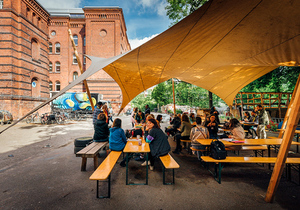

We are very happy to announce the upcoming Reproducible Builds Summit which set to take place from October 31st November 2nd 2023, in the vibrant city of Hamburg, Germany. Our summits are a unique gathering that brings together attendees from diverse projects, united by a shared vision of advancing the Reproducible Builds effort. During this enriching event, participants will have the opportunity to engage in discussions, establish connections and exchange ideas to drive progress in this vital field. Our aim is to create an inclusive space that fosters collaboration, innovation and problem-solving. We are thrilled to host the seventh edition of this exciting event, following the success of previous summits in various iconic locations around the world, including Venice, Marrakesh, Paris, Berlin and Athens. If you re interesting in joining us this year, please make sure to read the event page] which has more details about the event and location. (You may also be interested in attending PackagingCon 2023 held a few days before in Berlin.)
This month, Vagrant Cascadian will present at FOSSY 2023 on the topic of Breaking the Chains of Trusting Trust:
Corrupted build environments can deliver compromised cryptographically signed binaries. Several exploits in critical supply chains have been demonstrated in recent years, proving that this is not just theoretical. The most well secured build environments are still single points of failure when they fail. [ ] This talk will focus on the state of the art from several angles in related Free and Open Source Software projects, what works, current challenges and future plans for building trustworthy toolchains you do not need to trust.
Hosted by the Software Freedom Conservancy and taking place in Portland, Oregon, FOSSY aims to be a community-focused event: Whether you are a long time contributing member of a free software project, a recent graduate of a coding bootcamp or university, or just have an interest in the possibilities that free and open source software bring, FOSSY will have something for you . More information on the event is available on the FOSSY 2023 website, including the full programme schedule.
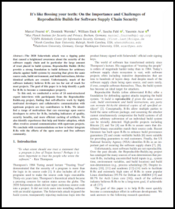
Marcel Fourn , Dominik Wermke, William Enck, Sascha Fahl and Yasemin Acar recently published an academic paper in the 44th IEEE Symposium on Security and Privacy titled It s like flossing your teeth: On the Importance and Challenges of Reproducible Builds for Software Supply Chain Security . The abstract reads as follows:
The 2020 Solarwinds attack was a tipping point that caused a heightened awareness about the security of the software supply chain and in particular the large amount of trust placed in build systems. Reproducible Builds (R-Bs) provide a strong foundation to build defenses for arbitrary attacks against build systems by ensuring that given the same source code, build environment, and build instructions, bitwise-identical artifacts are created.
However, in contrast to other papers that touch on some theoretical aspect of reproducible builds, the authors paper takes a different approach. Starting with the observation that much of the software industry believes R-Bs are too far out of reach for most projects and conjoining that with a goal of to help identify a path for R-Bs to become a commonplace property , the paper has a different methodology:
We conducted a series of 24 semi-structured expert interviews with participants from the Reproducible-Builds.org project, and iterated on our questions with the reproducible builds community. We identified a range of motivations that can encourage open source developers to strive for R-Bs, including indicators of quality, security benefits, and more efficient caching of artifacts. We identify experiences that help and hinder adoption, which heavily include communication with upstream projects. We conclude with recommendations on how to better integrate R-Bs with the efforts of the open source and free software community.
A PDF of the paper is now available, as is an entry on the CISPA Helmholtz Center for Information Security website and an entry under the TeamUSEC Human-Centered Security research group.
On our mailing list this month:
The antagonist is David Schwartz, who correctly says There are dozens of complex reasons why what seems to be the same sequence of operations might produce different end results, but goes on to say I totally disagree with your general viewpoint that compilers must provide for reproducability [sic]. Dwight Tovey and I (Larry Doolittle) argue for reproducible builds. I assert Any program especially a mission-critical program like a compiler that cannot reproduce a result at will is broken. Also it s commonplace to take a binary from the net, and check to see if it was trojaned by attempting to recreate it from source.

Lastly, there were a few changes to our website this month too, including Bernhard M. Wiedemann adding a simplified Rust example to our documentation about the SOURCE_DATE_EPOCH environment variable [ ], Chris Lamb made it easier to parse our summit announcement at a glance [ ], Mattia Rizzolo added the summit announcement at a glance [ ] itself [ ][ ][ ] and Rahul Bajaj added a taxonomy of variations in build environments [ ].

Distribution work 27 reviews of Debian packages were added, 40 were updated and 8 were removed this month adding to our knowledge about identified issues. A new randomness_in_documentation_generated_by_mkdocs toolchain issue was added by Chris Lamb [ ], and the deterministic flag on the paths_vary_due_to_usrmerge issue as we are not currently testing usrmerge issues [ ] issues.
Roland Clobus posted his 18th update of the status of reproducible Debian ISO images on our mailing list. Roland reported that all major desktops build reproducibly with bullseye, bookworm, trixie and sid , but he also mentioned amongst many changes that not only are the non-free images being built (and are reproducible) but that the live images are generated officially by Debian itself. [ ]
Jan-Benedict Glaw noticed a problem when building NetBSD for the VAX architecture. Noting that Reproducible builds [are] probably not as reproducible as we thought , Jan-Benedict goes on to describe that when two builds from different source directories won t produce the same result and adds various notes about sub-optimal handling of the CFLAGS environment variable. [ ]
F-Droid added 21 new reproducible apps in June, resulting in a new record of 145 reproducible apps in total. [ ]. (This page now sports missing data for March May 2023.) F-Droid contributors also reported an issue with broken resources in APKs making some builds unreproducible. [ ]
Bernhard M. Wiedemann published another monthly report about reproducibility within openSUSE

Upstream patches

Testing framework The Reproducible Builds project operates a comprehensive testing framework (available at tests.reproducible-builds.org) in order to check packages and other artifacts for reproducibility. In June, a number of changes were made by Holger Levsen, including:
  • Additions to a (relatively) new Documented Jenkins Maintenance (djm) script to automatically shrink a cache & save a backup of old data [ ], automatically split out previous months data from logfiles into specially-named files [ ], prevent concurrent remote logfile fetches by using a lock file [ ] and to add/remove various debugging statements [ ].
  • Updates to the automated system health checks to, for example, to correctly detect new kernel warnings due to a wording change [ ] and to explicitly observe which old/unused kernels should be removed [ ]. This was related to an improvement so that various kernel issues on Ubuntu-based nodes are automatically fixed. [ ]
Holger and Vagrant Cascadian updated all thirty-five hosts running Debian on the amd64, armhf, and i386 architectures to Debian bookworm, with the exception of the Jenkins host itself which will be upgraded after the release of Debian 12.1. In addition, Mattia Rizzolo updated the email configuration for the @reproducible-builds.org domain to correctly accept incoming mails from jenkins.debian.net [ ] as well as to set up DomainKeys Identified Mail (DKIM) signing [ ]. And working together with Holger, Mattia also updated the Jenkins configuration to start testing Debian trixie which resulted in stopped testing Debian buster. And, finally, Jan-Benedict Glaw contributed patches for improved NetBSD testing.

If you are interested in contributing to the Reproducible Builds project, please visit our Contribute page on our website. However, you can get in touch with us via:

Matt Brown: 2023 Mid Year Review

I m six months into my journey of building a business which means its time to reflect and review the goals I set for the year.
No further investment in co2mon.nz In March I made the decision to focus on completing the market research for co2mon.nz. The results of that research led to two key conclusions:
  1. Indoor air quality/ventilation is not a problem many people are actively thinking about or looking to spend money to improve.
  2. Even when introduced to the problem and educated about the need, most people are looking for a one-off expense or solution (e.g. the physical monitor) and are much less interested in a monitoring software service.
Based on that, it was clear that this is not an opportunity that I should continue pursuing and I ve put co2mon.nz into maintenance mode. I ve committed to maintaining the infrastructure to support existing customers, but I won t be investing time or energy in developing it further.

Discipline in selecting product opportunities The decision to stop investing more time into co2mon.nz was straightforward given the results of the research, but it was also painful given the time I ve already sunk into it. I hindsight it s clear that my enthusiasm to solve a problem with technology I enjoyed was my driving force rather than a deep understanding of the wants and needs of potential customers. I don t entirely regret trying my luck once - but it s not time efficient and I know that following that pattern again is not a sustainable or viable path to building a successful business. I ve decided to use the following list of questions to bring more discipline to how I evaluate product opportunities in future:
  1. Problem: Is this something that a sizeable number of people are struggling with AND are willing to spend money solving?
  2. Capability: Can I deliver a solution that solves the problem in a reliable and cost-effective way?
  3. Excitement: Am I excited and motivated to invest time in building the solution to this problem?
  4. Trust: Do I have the expertise and experience to be trusted to solve the problem by potential customers?
  5. Execution: Can I package, market and sell that solution in a profitable manner?
My plan is to answer these questions and then make an evaluation of the potential before I commit time to building any part of a product. As an example of how I think that will help, here s what I think the answer to those questions for ventilation monitoring would have been:
  1. Problem: No - as the market research eventually showed.
  2. Capability: Low - The part of the solution which customers primarily value (the hardware) is complex and outside of my core experience. The software I can easily deliver is not where the value is seen.
  3. Excitement: Yes - this was the primary driver of starting the project.
  4. Trust: Low - I m trusted to build software, but cannot claim any specific expertise in air quality and ventilation.
  5. Execution: Low confidence - These skills are not ones I ve exercised a lot in my career to date.
What these answers point to is that identifying the problem alone is not enough. I don t expect every question to have a perfect answer, but I want to hold myself to only pursuing opportunities where there s only one major area of doubt. In this case, even had the market research demonstrated a problem that many customers would pay to solve, there were still some big answers missing to the trust, capability and execution questions. Overall my conclusion is that co2mon.nz was not the ideal business to start my journey with given the number of open questions in the plan. I like to think that conclusion would also have been clear to me six months ago had I taken the time to go through this process then!

Prioritising areas of growth Applying those questions to my other product ideas results in a lot of I don t know yet answers to the problem and capability questions, further reinforcing the lesson that I need to spend more understanding if there is a problem with a viable business model attached in those areas before progressing any of those ideas. Beyond that lesson, a more interesting observation comes from the last question regarding execution. My answers to the first four questions vary between ideas, but my answers to this last question are always the same - I don t have a lot of confidence in my sales and marketing skills to sell a product. That s not a surprise. My career to date has been focused on software development and leadership, I don t have a lot of experience with sales and marketing. The opportunity to grow and develop those skills is actually a large part of my motivation for choosing the path of building my own business. But seeing that this is a common factor that will need significant investment regardless of which opportunity I pursue sends me a strong signal that I should focus on growth in this area as a priority. Following that logic through to the next step of what creating that focus would look like reveals a conflict: The nature of the mission I ve set for myself draws me to products in areas that are new to me, which means there s also a need to invest in building expertise in those areas. Again not a surprise, but the time and focus required to develop that expertise competes with time spent growing my sales and marketing skills. So I have a prioritisation problem. Solving it is going to require changing the type of product I m trying to build in the short term: I need to build a product that uses my existing expertise and strengths as much as possible, so that I can put the majority of my energy into growing the core business skills where my confidence is currently lacking. Trying to deliver meaningful improvements to a big problem in an area I don t have past experience in while also learning how to sell and market a product is biting off more than I chew right away.

Changing the goal posts With those lessons in hand I m making three changes to my 2023 Goals:
  1. Reducing the product development goal from several ideas to two. The first was co2mon.nz. The second will be drawn from my existing expertise - not one of the previously stated ideas that require me to develop expertise in a new area.
  2. Moving the consulting and product development goals to be alternatives - I expect I can achieve at most one of them this year.
  3. Reducing the publishing target for this site from at least once a week to once a month . I thought I d have more to say this year, but the words are coming very slowly to me.
Reducing scope and ambition is humbling, but that s reality. I hope it turns out to be a case of slow down and lay the foundations in order to then move faster. The good news is that I don t feel the need to make any changes to the vision, mission and strategy I m following - I think they re still the right destination and overall path for me even though the first six months has proven bumpy. I just need to be a bit more realistic on the short-term goals that will feed into them.

The next few months I m choosing to prioritise the product development goal. I m aiming to complete the market research/problem definition phase for a product opportunity I ve identified in the SRE/DevOps space (where my previous experience is) and make a decision on whether to start development by mid August. In making that decision I plan to gather the answers to my questions, and then diligently evaluate whether the opportunity is worth committing to or not. I will write more about this process in coming weeks. If I decide to proceed that gives me 2-3 months to get an MVP in the hands of customers and get concrete validation of whether the product has revenue and growth potential before the end of the year. Tight, but if things go well, and I don t take any further consulting work, there s a reasonable chance I can complete the revised goal successfully. In the event that I decide the product opportunity I m currently researching is not the right one to commit to, I will likely revert to focusing on my consulting goal in the remaining 2-3 months of the year rather than attempt a third product development iteration. Thanks for reading this far! As always, I d love your thoughts and feedback.

Appendix: Revised 2023 Goals Putting all that together, the ultimate outcome of this review (including updated progress scoring) looks like:
  1. Execute a series of successful consulting engagements, building a reputation for myself and leaving happy customers willing to provide testimonials that support a pipeline of future opportunities. Score: 3/10 - I focused entirely on co2mon.nz during April, May and June to the detriment of my pipeline of consulting work. This score is unlikely to improve given the above plan unless I decide not to commit to developing the idea I m currently investigating.
  2. Grow my product development skill set by taking two ideas (co2mon.nz, an SRE/DevOps focused product) to MVP stage with customer feedback received, and generate revenue and has growth potential from one of them. Score: 4/10 - I launched co2mon.nz and got feedback, I discovered it didn t solve a problem relevant to customers and therefore did not generate substantial revenue or growth potential. Idea number two is in still in progress.
  3. Develop and maintain a broad professional network.
    1. To build a professional relationship with at least 30 new people this year. Score: 6/10 - This is going well. On track for a 10/10 score.
    2. To publish a piece of writing on this site once a month and for many of those to generate interesting conversations and feedback. Score: 6/10 - 4 out of 6 months have featured a post meeting this goal so far.
    3. To support the growth of my local technical community by volunteering my experience and knowledge with others. Score: 5/10 - I ve given one talk and helped with SREcon23 APAC, but not as much other work in this area as I d like.

11 July 2023

Simon Josefsson: Coping with non-free software in Debian

A personal reflection on how I moved from my Debian home to find two new homes with Trisquel and Guix for my own ethical computing, and while doing so settled my dilemma about further Debian contributions. Debian s contributions to the free software community has been tremendous. Debian was one of the early distributions in the 1990 s that combined the GNU tools (compiler, linker, shell, editor, and a set of Unix tools) with the Linux kernel and published a free software operating system. Back then there were little guidance on how to publish free software binaries, let alone entire operating systems. There was a lack of established community processes and conflict resolution mechanisms, and lack of guiding principles to motivate the work. The community building efforts that came about in parallel with the technical work has resulted in a steady flow of releases over the years. From the work of Richard Stallman and the Free Software Foundation (FSF) during the 1980 s and early 1990 s, there was at the time already an established definition of free software. Inspired by free software definition, and a belief that a social contract helps to build a community and resolve conflicts, Debian s social contract (DSC) with the free software community was published in 1997. The DSC included the Debian Free Software Guidelines (DFSG), which directly led to the Open Source Definition.

Slackware 3.5" disksOne of my earlier Slackware install disk sets, kept for nostalgic reasons.

I was introduced to GNU/Linux through Slackware in the early 1990 s (oh boy those nights calculating XFree86 modeline s and debugging sendmail.cf) and primarily used RedHat Linux during ca 1995-2003. I switched to Debian during the Woody release cycles, when the original RedHat Linux was abandoned and Fedora launched. It was Debian s explicit community processes and infrastructure that attracted me. The slow nature of community processes also kept me using RedHat for so long: centralized and dogmatic decision processes often produce quick and effective outcomes, and in my opinion RedHat Linux was technically better than Debian ca 1995-2003. However the RedHat model was not sustainable, and resulted in the RedHat vs Fedora split. Debian catched up, and reached technical stability once its community processes had been grounded. I started participating in the Debian community around late 2006. My interpretation of Debian s social contract is that Debian should be a distribution of works licensed 100% under a free license. The Debian community has always been inclusive towards non-free software, creating the contrib/non-free section and permitting use of the bug tracker to help resolve issues with non-free works. This is all explained in the social contract. There has always been a clear boundary between free and non-free work, and there has been a commitment that the Debian system itself would be 100% free. The concern that RedHat Linux was not 100% free software was not critical to me at the time: I primarily (and happily) ran GNU tools on Solaris, IRIX, AIX, OS/2, Windows etc. Running GNU tools on RedHat Linux was an improvement, and I hadn t realized it was possible to get rid of all non-free software on my own primary machine. Debian realized that goal for me. I ve been a believer in that model ever since. I can use Solaris, macOS, Android etc knowing that I have the option of using a 100% free Debian. While the inclusive approach towards non-free software invite and deserve criticism (some argue that being inclusive to non-inclusive behavior is a bad idea), I believe that Debian s approach was a successful survival technique: by being inclusive to and a compromise between free and non-free communities, Debian has been able to stay relevant and contribute to both environments. If Debian had not served and contributed to the free community, I believe free software people would have stopped contributing. If Debian had rejected non-free works completely, I don t think the successful Ubuntu distribution would have been based on Debian. I wrote the majority of the text above back in September 2022, intending to post it as a way to argue for my proposal to maintain the status quo within Debian. I didn t post it because I felt I was saying the obvious, and that the obvious do not need to be repeated, and the rest of the post was just me going down memory lane. The Debian project has been a sustainable producer of a 100% free OS up until Debian 11 bullseye. In the resolution on non-free firmware the community decided to leave the model that had resulted in a 100% free Debian for so long. The goal of Debian is no longer to publish a 100% free operating system, instead this was added: The Debian official media may include firmware . Indeed the Debian 12 bookworm release has confirmed that this would not only be an optional possibility. The Debian community could have published a 100% free Debian, in parallel with the non-free Debian, and still be consistent with their newly adopted policy, but chose not to. The result is that Debian s policies are not consistent with their actions. It doesn t make sense to claim that Debian is 100% free when the Debian installer contains non-free software. Actions speaks louder than words, so I m left reading the policies as well-intended prose that is no longer used for guidance, but for the peace of mind for people living in ivory towers. And to attract funding, I suppose. So how to deal with this, on a personal level? I did not have an answer to that back in October 2022 after the vote. It wasn t clear to me that I would ever want to contribute to Debian under the new social contract that promoted non-free software. I went on vacation from any Debian work. Meanwhile Debian 12 bookworm was released, confirming my fears. I kept coming back to this text, and my only take-away was that it would be unethical for me to use Debian on my machines. Letting actions speak for themselves, I switched to PureOS on my main laptop during October, barely noticing any difference since it is based on Debian 11 bullseye. Back in December, I bought a new laptop and tried Trisquel and Guix on it, as they promise a migration path towards ppc64el that PureOS do not. While I pondered how to approach my modest Debian contributions, I set out to learn Trisquel and gained trust in it. I migrated one Debian machine after another to Trisquel, and started to use Guix on others. Migration was easy because Trisquel is based on Ubuntu which is based on Debian. Using Guix has its challenges, but I enjoy its coherant documented environment. All of my essential self-hosted servers (VM hosts, DNS, e-mail, WWW, Nextcloud, CI/CD builders, backup etc) uses Trisquel or Guix now. I ve migrated many GitLab CI/CD rules to use Trisquel instead of Debian, to have a more ethical computing base for software development and deployment. I wish there were official Guix docker images around. Time has passed, and when I now think about any Debian contributions, I m a little less muddled by my disappointment of the exclusion of a 100% free Debian. I realize that today I can use Debian in the same way that I use macOS, Android, RHEL or Ubuntu. And what prevents me from contributing to free software on those platforms? So I will make the occasional Debian contribution again, knowing that it will also indirectly improve Trisquel. To avoid having to install Debian, I need a development environment in Trisquel that allows me to build Debian packages. I have found a recipe for doing this: # System commands:
sudo apt-get install debhelper git-buildpackage debian-archive-keyring
sudo wget -O /usr/share/debootstrap/scripts/debian-common https://sources.debian.org/data/main/d/debootstrap/1.0.128%2Bnmu2/scripts/debian-common
sudo wget -O /usr/share/debootstrap/scripts/sid https://sources.debian.org/data/main/d/debootstrap/1.0.128%2Bnmu2/scripts/sid
# Run once to create build image:
DIST=sid git-pbuilder create --mirror http://deb.debian.org/debian/ --debootstrapopts "--exclude=usr-is-merged" --basepath /var/cache/pbuilder/base-sid.cow
# Run in a directory with debian/ to build a package:
gbp buildpackage --git-pbuilder --git-dist=sid
How to sustainably deliver a 100% free software binary distributions seems like an open question, and the challenges are not all that different compared to the 1990 s or early 2000 s. I m hoping Debian will come back to provide a 100% free platform, but my fear is that Debian will compromise even further on the free software ideals rather than the opposite. With similar arguments that were used to add the non-free firmware, Debian could compromise the free software spirit of the Linux boot process (e.g., non-free boot images signed by Debian) and media handling (e.g., web browsers and DRM), as Debian have already done with appstore-like functionality for non-free software (Python pip). To learn about other freedom issues in Debian packaging, browsing Trisquel s helper scripts may enlight you. Debian s setback and the recent setback for RHEL-derived distributions are sad, and it will be a challenge for these communities to find internally consistent coherency going forward. I wish them the best of luck, as Debian and RHEL are important for the wider free software eco-system. Let s see how the community around Trisquel, Guix and the other FSDG-distributions evolve in the future. The situation for free software today appears better than it was years ago regardless of Debian and RHEL s setbacks though, which is important to remember! I don t recall being able install a 100% free OS on a modern laptop and modern server as easily as I am able to do today. Happy Hacking! Addendum 22 July 2023: The original title of this post was Coping with non-free Debian, and there was a thread about it that included feedback on the title. I do agree that my initial title was confrontational, and I ve changed it to the more specific Coping with non-free software in Debian. I do appreciate all the fine free software that goes into Debian, and hope that this will continue and improve, although I have doubts given the opinions expressed by the majority of developers. For the philosophically inclined, it is interesting to think about what it means to say that a compilation of software is freely licensed. At what point does a compilation of software deserve the labels free vs non-free? Windows probably contains some software that is published as free software, let s say Windows is 1% free. Apple authors a lot of free software (as a tangent, Apple probably produce more free software than what Debian as an organization produces), and let s say macOS contains 20% free software. Solaris (or some still maintained derivative like OpenIndiana) is mostly freely licensed these days, isn t it? Let s say it is 80% free. Ubuntu and RHEL pushes that closer to let s say 95% free software. Debian used to be 100% but is now slightly less at maybe 99%. Trisquel and Guix are at 100%. At what point is it reasonable to call a compilation free? Does Debian deserve to be called freely licensed? Does macOS? Is it even possible to use these labels for compilations in any meaningful way? All numbers just taken from thin air. It isn t even clear how this can be measured (binary bytes? lines of code? CPU cycles? etc). The caveat about license review mistakes applies. I ignore Debian s own claims that Debian is 100% free software, which I believe is inconsistent and no longer true under any reasonable objective analysis. It was not true before the firmware vote since Debian ships with non-free blobs in the Linux kernel for example.

Matthew Garrett: Roots of Trust are difficult

The phrase "Root of Trust" turns up at various points in discussions about verified boot and measured boot, and to a first approximation nobody is able to give you a coherent explanation of what it means[1]. The Trusted Computing Group has a fairly wordy definition, but (a) it's a lot of words and (b) I don't like it, so instead I'm going to start by defining a root of trust as "A thing that has to be trustworthy for anything else on your computer to be trustworthy".

(An aside: when I say "trustworthy", it is very easy to interpret this in a cynical manner and assume that "trust" means "trusted by someone I do not necessarily trust to act in my best interest". I want to be absolutely clear that when I say "trustworthy" I mean "trusted by the owner of the computer", and that as far as I'm concerned selling devices that do not allow the owner to define what's trusted is an extremely bad thing in the general case)

Let's take an example. In verified boot, a cryptographic signature of a component is verified before it's allowed to boot. A straightforward implementation of a verified boot implementation has the firmware verify the signature on the bootloader or kernel before executing it. In this scenario, the firmware is the root of trust - it's the first thing that makes a determination about whether something should be allowed to run or not[2]. As long as the firmware behaves correctly, and as long as there aren't any vulnerabilities in our boot chain, we know that we booted an OS that was signed with a key we trust.

But what guarantees that the firmware behaves correctly? What if someone replaces our firmware with firmware that trusts different keys, or hot-patches the OS as it's booting it? We can't just ask the firmware whether it's trustworthy - trustworthy firmware will say yes, but the thing about malicious firmware is that it can just lie to us (either directly, or by modifying the OS components it boots to lie instead). This is probably not sufficiently trustworthy!

Ok, so let's have the firmware be verified before it's executed. On Intel this is "Boot Guard", on AMD this is "Platform Secure Boot", everywhere else it's just "Secure Boot". Code on the CPU (either in ROM or signed with a key controlled by the CPU vendor) verifies the firmware[3] before executing it. Now the CPU itself is the root of trust, and, well, that seems reasonable - we have to place trust in the CPU, otherwise we can't actually do computing. We can now say with a reasonable degree of confidence (again, in the absence of vulnerabilities) that we booted an OS that we trusted. Hurrah!

Except. How do we know that the CPU actually did that verification? CPUs are generally manufactured without verification being enabled - different system vendors use different signing keys, so those keys can't be installed in the CPU at CPU manufacture time, and vendors need to do code development without signing everything so you can't require that keys be installed before a CPU will work. So, out of the box, a new CPU will boot anything without doing verification[4], and development units will frequently have no verification.

As a device owner, how do you tell whether or not your CPU has this verification enabled? Well, you could ask the CPU, but if you're doing that on a device that booted a compromised OS then maybe it's just hotpatching your OS so when you do that you just get RET_TRUST_ME_BRO even if the CPU is desperately waving its arms around trying to warn you it's a trap. This is, unfortunately, a problem that's basically impossible to solve using verified boot alone - if any component in the chain fails to enforce verification, the trust you're placing in the chain is misplaced and you are going to have a bad day.

So how do we solve it? The answer is that we can't simply ask the OS, we need a mechanism to query the root of trust itself. There's a few ways to do that, but fundamentally they depend on the ability of the root of trust to provide proof of what happened. This requires that the root of trust be able to sign (or cause to be signed) an "attestation" of the system state, a cryptographically verifiable representation of the security-critical configuration and code. The most common form of this is called "measured boot" or "trusted boot", and involves generating a "measurement" of each boot component or configuration (generally a cryptographic hash of it), and storing that measurement somewhere. The important thing is that it must not be possible for the running OS (or any pre-OS component) to arbitrarily modify these measurements, since otherwise a compromised environment could simply go back and rewrite history. One frequently used solution to this is to segregate the storage of the measurements (and the attestation of them) into a separate hardware component that can't be directly manipulated by the OS, such as a Trusted Platform Module. Each part of the boot chain measures relevant security configuration and the next component before executing it and sends that measurement to the TPM, and later the TPM can provide a signed attestation of the measurements it was given. So, an SoC that implements verified boot should create a measurement telling us whether verification is enabled - and, critically, should also create a measurement if it isn't. This is important because failing to measure the disabled state leaves us with the same problem as before; someone can replace the mutable firmware code with code that creates a fake measurement asserting that verified boot was enabled, and if we trust that we're going to have a bad time.

(Of course, simply measuring the fact that verified boot was enabled isn't enough - what if someone replaces the CPU with one that has verified boot enabled, but trusts keys under their control? We also need to measure the keys that were used in order to ensure that the device trusted only the keys we expected, otherwise again we're going to have a bad time)

So, an effective root of trust needs to:

1) Create a measurement of its verified boot policy before running any mutable code
2) Include the trusted signing key in that measurement
3) Actually perform that verification before executing any mutable code

and from then on we're in the hands of the verified code actually being trustworthy, and it's probably written in C so that's almost certainly false, but let's not try to solve every problem today.

Does anything do this today? As far as I can tell, Intel's Boot Guard implementation does. Based on publicly available documentation I can't find any evidence that AMD's Platform Secure Boot does (it does the verification, but it doesn't measure the policy beforehand, so it seems spoofable), but I could be wrong there. I haven't found any general purpose non-x86 parts that do, but this is in the realm of things that SoC vendors seem to believe is some sort of value-add that can only be documented under NDAs, so please do prove me wrong. And then there are add-on solutions like Titan, where we delegate the initial measurement and validation to a separate piece of hardware that measures the firmware as the CPU reads it, rather than requiring that the CPU do it.

But, overall, the situation isn't great. On many platforms there's simply no way to prove that you booted the code you expected to boot. People have designed elaborate security implementations that can be bypassed in a number of ways.

[1] In this respect it is extremely similar to "Zero Trust"
[2] This is a bit of an oversimplification - once we get into dynamic roots of trust like Intel's TXT this story gets more complicated, but let's stick to the simple case today
[3] I'm kind of using "firmware" in an x86ish manner here, so for embedded devices just think of "firmware" as "the first code executed out of flash and signed by someone other than the SoC vendor"
[4] In the Intel case this isn't strictly true, since the keys are stored in the motherboard chipset rather than the CPU, and so taking a board with Boot Guard enabled and swapping out the CPU won't disable Boot Guard because the CPU reads the configuration from the chipset. But many mobile Intel parts have the chipset in the same package as the CPU, so in theory swapping out that entire package would disable Boot Guard. I am not good enough at soldering to demonstrate that.

comment count unavailable comments

9 July 2023

Vasudev Kamath: Using LUKS-Encrypted USB Stick with TPM2 Integration

I use a LUKS-encrypted USB stick to store my GPG and SSH keys, which acts as a backup and portable key setup when working on different laptops. One inconvenience with LUKS-encrypted USB sticks is that you need to enter the password every time you want to mount the device, either through a Window Manager like KDE or using the cryptsetup luksOpen command. Fortunately, many laptops nowadays come equipped with TPM2 modules, which can be utilized to automatically decrypt the device and subsequently mount it. In this post, we'll explore the usage of systemd-cryptenroll for this purpose, along with udev rules and a set of scripts to automate the mounting of the encrypted USB. First, ensure that your device has a TPM2 module. You can run the following command to check:

sudo journalctl -k --grep=tpm2
The output should resemble the following:
Jul 08 18:57:32 bhairava kernel: ACPI: SSDT 0x00000000BBEFC000 0003C6 (v02
LENOVO Tpm2Tabl 00001000 INTL 20160422) Jul 08 18:57:32 bhairava kernel:
ACPI: TPM2 0x00000000BBEFB000 000034 (v03 LENOVO TP-R0D 00000830
PTEC 00000002) Jul 08 18:57:32 bhairava kernel: ACPI: Reserving TPM2 table
memory at [mem 0xbbefb000-0xbbefb033]
You can also use the systemd-cryptenroll command to check for the availability of a TPM2 device on your laptop:
systemd-cryptenroll --tpm2-device=list
The output will be something like following:
blog git:(master) systemd-cryptenroll --tpm2-device=list
PATH        DEVICE      DRIVER
/dev/tpmrm0 MSFT0101:00 tpm_tis
   blog git:(master)
Next, ensure that you have connected your encrypted USB device. Note that systemd-cryptenroll only works with LUKS2 and not LUKS1. If your device is LUKS1-encrypted, you may encounter an error while enrolling the device, complaining about the LUKS2 superblock not found. To determine if your device uses a LUKS1 header or LUKS2, use the cryptsetup luksDump <device> command. If it is LUKS1, the header will begin with:
LUKS header information for /dev/sdb1
Version:        1
Cipher name:    aes
Cipher mode:    xts-plain64
Hash spec:      sha256
Payload offset: 4096
Converting from LUKS1 to LUKS2 is a simple process, but for safety, ensure that you backup the header using the cryptsetup luksHeaderBackup command. Once backed up, use the following command to convert the header to LUKS2:
sudo cryptsetup convert --type luks2 /dev/sdb1
After conversion, the header will look like this:
Version:        2
Epoch:          4
Metadata area:  16384 [bytes]
Keyslots area:  2064384 [bytes]
UUID:           000b2670-be4a-41b4-98eb-9adbd12a7616
Label:          (no label)
Subsystem:      (no subsystem)
Flags:          (no flags)
The next step is to enroll the new LUKS key for the encrypted device using systemd-cryptenroll. Run the following command:
sudo systemd-cryptenroll --tpm2-device=/dev/tpmrm0 --tpm2-pcrs="0+7" /dev/sdb1
This command will prompt you to provide the existing key to unseal the device. It will then add a new random key to the volume, allowing it to be unlocked in addition to the existing keys. Additionally, it will bind this new key to PCRs 0 and 7, representing the system firmware and Secure Boot state. If there is only one TPM device on the system, you can use --tpm2-device=auto to automatically select the device. To confirm that the new key has been enrolled, you can dump the LUKS configuration and look for a systemd-tpm2 token entry, as well as an additional entry in the Keyslots section. To test the setup, you can use the /usr/lib/systemd/systemd-cryptsetup command. Additionally, you can check if the device is unsealed by using lsblk:
sudo /usr/lib/systemd/systemd-cryptsetup attach GPG_USB "/dev/sdb1" - tpm2-device=auto
lsblk
The lsblk command should display the unsealed and mounted device, like this:
NAME        MAJ:MIN RM   SIZE RO TYPE  MOUNTPOINTS
sda           8:0    0 223.6G  0 disk
 sda1        8:1    0   976M  0 part  /boot/efi
 sda2        8:2    0 222.6G  0 part
   root    254:0    0 222.6G  0 crypt /
sdb           8:16   1   7.5G  0 disk
 sdb1        8:17   1   7.5G  0 part
   GPG_USB 254:1    0   7.5G  0 crypt /media/vasudev/GPG_USB
Auto Mounting the device Now that we have solved the initial problem of unsealing the USB device using TPM2 instead of manually entering the key, the next step is to automatically mount the device upon insertion and remove the mapping when the device is removed. This can be achieved using the following udev rules:
ACTION=="add", KERNEL=="sd*", ENV DEVTYPE =="partition", ENV ID_BUS =="usb", ENV SYSTEMD_WANTS ="mount-gpg-usb@$env DEVNAME .service"
ACTION=="remove", KERNEL=="sd*", ENV DEVTYPE =="partition", ENV ID_BUS =="usb", RUN+="/usr/local/bin/umount_enc_usb.sh '%E ID_FS_UUID '"
When a device is added, a systemd service is triggered to mount the device at a specific location. Initially, I used a script with the RUN directive, but it resulted in an exit code of 32. This might be due to systemd-cryptsetup taking some time to return, causing udev to time out. To address this, I opted to use a systemd service instead. For device removal, even though the physical device is no longer present, the mapping may still remain, causing issues upon reinsertion. To resolve this, I created a script to close the luks mapping upon device removal. Below are the systemd service and script files: mount_enc_usb.sh:
#!/bin/bash
set -x
if [[ "$#" -ne 1 ]]; then
    echo "$(basename $0) <device>"
    exit 1
fi
device_uuid="$(blkid --output udev $1   grep ID_FS_UUID=   cut -d= -f2)"
if [[ "$device_uuid" == 000b2670-be4a-41b4-98eb-9adbd12a7616 ]]; then
    # Found our device, let's trigger systemd-cryptsetup
    /usr/lib/systemd/systemd-cryptsetup attach GPG_USB "$1" - tpm2-device=auto
    [[ -d /media/vasudev/GPG_USB ]]   (mkdir -p /media/vasudev/GPG_USB/ && chown vasudev:vasudev /media/vasudev/GPG_USB)
    mount /dev/mapper/GPG_USB /media/vasudev/GPG_USB
else
    echo "Not the interested device. Ignoring."
    exit 0
fi
umount_enc_usb.sh:
#!/bin/bash
if [[ "$#" -ne 1 ]]; then
  echo "$(basename $0) <fsuuid>"
  exit 1
fi
if [[ "$1" == "000b2670-be4a-41b4-98eb-9adbd12a7616" ]]; then
  # Our device is removed, let's close the luks mapping
  [[ -e /dev/mapper/GPG_USB ]] && cryptsetup luksClose /dev/mapper/GPG_USB
else
  echo "Not our device."
  exit 0
fi
mount-gpg-usb@.service:
[Unit]
Description=Mount the encrypted USB device service
[Service]
Type=simple
ExecStart=/usr/local/bin/mount_enc_usb.sh
With this setup, plugging in the USB device will automatically unseal and mount it, and upon removal, the luks mapping will be closed.

Note

This can be even done for LUKS2 encrypted root disk but will need some tweaking in initramfs.

8 July 2023

Lisandro Dami n Nicanor P rez Meyer: Open question: Podman and user/group IDs

Here is an open question for Podman users: is there a (ideally simple) way to keep the user/group ID between the real system and the container? Let me be more verbose. I use Docker mostly in two "special" cases: Now in both setups I mount some system directory into the chroot, normally as $HOME. Using Docker I can do the right UID/GID mapping and any file I create inside the container will have my system's UID/GID. And that's the thing I so far could not do with Podman. So dear Podman user: is there any way to do this with Podman? If you know, please feel free to send a comment/email!

Russell Coker: Sandboxing Phone Apps

As a follow up to Wayland [1]: A difficult problem with Linux desktop systems (which includes phones and tablets) is restricting application access so that applications can t mess with each other s data or configuration but also allowing them to share data as needed. This has been mostly solved for Android but that involved giving up all legacy Linux apps. I think that we need to get phones capable of running a full desktop environment and having Android level security on phone apps and regular desktop apps. My interest in this is phones running Debian and derivatives such as PureOS. But everything I describe in this post should work equally well for all full featured Linux distributions for phones such as Arch, Gentoo, etc and phone based derivatives of those such as Manjaro. It may be slightly less applicable to distributions such as Alpine Linux and it s phone derivative PostmarketOS, I would appreciate comments from contributors to PostmarketOS or Alpine Linux about this. I ve investigated some of the ways of solving these problems. Many of the ways of doing this involves namespaces. The LWN articles about namespaces are a good background to some of these technologies [2]. The LCA keynote lecture Containers aka crazy user space fun by Jess Frazelle has a good summary of some of the technology [3]. One part that I found particularly interesting was the bit about recognising the container access needed at compile time. This can also be part of recognising bad application design at compile time, it s quite common for security systems to flag bad security design in programs. Firejail To sandbox applications you need to have some method of restricting what they do, this means some combination of namespaces and similar features. Here s an article on sandboxing with firejail [4]. Firejail uses namespaces, seccomp-bpf, and capabilities to restrict programs. It allows bind mounts if run as root and if not run as root it can restrict file access by name and access to networking, system calls, and other features. It has a convenient learning mode that generates policy for you, so if you have a certain restricted set of tasks that an application is to perform you can run it once and then force it to do only the same operations in future. I recommend that everyone who is still reading at this point try out firejail. Here s an example of what you can do:
# create a profile
firejail --build=xterm.profile xterm
# now this run can only do what the previous run did
firejail --profile=xterm.profile xterm
Note that firejail is SETUID root so can potentially reduce system security and it has had security issues in the past. In spite of that it can be good for allowing a trusted user to run programs with less access to the system. Also it is a good way to start learning about such things. I don t think it s a good solution for what I want to do. But I won t rule out the possibility of using it at some future time for special situations. Bubblewrap I tried out firejail with the browser Epiphany (Debian package epiphany-browser) on my Librem5, but that didn t work as Epiphany uses /usr/bin/bwrap (bubblewrap) for it s internal sandboxing (here is an informative blog post about the history of bubblewrap AKA xdg-app-helper which was developed as part of flatpak [5]). The Epiphany bubblewrap sandbox is similar to the situation with Chrome/Chromium which have internal sandboxing that s incompatible with firejail. The firejail man page notes that it s not compatible with Snap, Flatpack, and similar technologies. One issue this raises is that we can t have a namespace based sandboxing system applied to all desktop apps with no extra configuration as some desktop apps won t work with it. Bubblewrap requires setting kernel.unprivileged_userns_clone=1 to run as non-root (IE provide the normal and expected functionality) which potentially reduces system security. Here is an example of a past kernel bug that was exploitable by creating a user namespace with CAP_SYS_ADMIN [6]. But it s the default in recent Debian kernels which means that the issues have been reviewed and determined to be a reasonable trade-off and also means that many programs will use the feature and break if it s disabled. Here is an example of how to use Bubblewrap on Debian, after installing the bubblewrap run the following command. Note that the new-session option (to prevent injecting characters in the keyboard buffer with TIOCSTI) makes the session mostly unusable for a shell.
bwrap --ro-bind /usr /usr --symlink usr/lib64 /lib64 --symlink usr/lib /lib --proc /proc --dev /dev --unshare-pid --die-with-parent bash
Here is an example of using Bubblewrap to sandbox the game Warzone2100 running with Wayland/Vulkan graphics and Pulseaudio sound.
bwrap --bind $HOME/.local/share/warzone2100 $HOME/.local/share/warzone2100 --bind /run/user/$UID/pulse /run/user/$UID/pulse --bind /run/user/$UID/wayland-0 /run/user/$UID/wayland-0 --bind /run/user/$UID/wayland-0.lock /run/user/$UID/wayland-0.lock --ro-bind /usr /usr --symlink usr/bin /bin --symlink usr/lib64 /lib64 --symlink usr/lib /lib --proc /proc --dev /dev --unshare-pid --dev-bind /dev/dri /dev/dri --ro-bind $HOME/.pulse $HOME/.pulse --ro-bind $XAUTHORITY $XAUTHORITY --ro-bind /sys /sys --new-session --die-with-parent warzone2100
Here is an example of using Bubblewrap to sandbox the Debian bug reporting tool reportbug
bwrap --bind /tmp /tmp --ro-bind /etc /etc --ro-bind /usr /usr --ro-bind /var/lib/dpkg /var/lib/dpkg --symlink usr/sbin /sbin --symlink usr/bin /bin --symlink usr/lib64 /lib64 --symlink usr/lib /lib --symlink /usr/lib32 /lib32 --symlink /usr/libx32 /libx32 --proc /proc --dev /dev --die-with-parent --unshare-ipc --unshare-pid reportbug
Here is an example shell script to wrap the build process for Debian packages. This needs to run with unshare-user and specifying the UID as 0 because fakeroot doesn t work in the container, I haven t worked out why but doing it through the container is a better method anyway. This script shares read-write the parent of the current directory as the Debian build process creates packages and metadata files in the parent directory. This will prevent the automatic signing scripts which is a feature not a bug, so after building packages you have to sign the .changes file with debsign. One thing I just learned is that the Debian build system Sbuild can use chroots for building packages for similar benefits [7]. Some people believe that sbuild is the correct way of doing it regardless of the chroot issue. I think it s too heavy-weight for most of my Debian package building, but even if I had been convinced I d still share the information about how to use bwrap as Debian is about giving users choice.
#!/bin/bash
set -e
BUILDDIR=$(realpath $(pwd)/..)
exec bwrap --bind /tmp /tmp --bind $BUILDDIR $BUILDDIR --ro-bind /etc /etc --ro-bind /usr /usr --ro-bind /var/lib/dpkg /var/lib/dpkg --symlink usr/bin /bin --symlink usr/lib64 /lib64 --symlink usr/lib /lib --proc /proc --dev /dev --die-with-parent --unshare-user --unshare-ipc --unshare-net --unshare-pid --new-session --uid 0 --gid 0 $@
Here is an informative blog post about using Bubblewrap with Seccomp (BPF) [8]. In a future post I ll write about how to get this sort of thing going but I ll just leave the URL here for people who want to do it on their own. The source for the flatpak-run program is the only example I could find of using Seccomp with Bubblewrap [9]. A lot of that code is worth copying for application sandboxing, maybe the entire program. Unshare The unshare command from the util-linux package has a large portion of the Bubblewrap functionality. The things that it doesn t do like creating a new session can be done by other utilities. Here is an example of creating a container with unshare and then using cgroups with it [10]. systemd --user Recent distributions have systemd support for running a user session, the Arch Linux Wiki has a good description of how this works [11]. The units for a user are .service files stored in /usr/lib/systemd/user/ (distribution provided), ~/.local/share/systemd/user/ (user installed applications in debian a link to ~/.config/systemd/user/), ~/.config/systemd/user/ (for manual user config), and /etc/systemd/user/ (local sysadmin provided) Here are some example commands for manipulating this:
# show units running for the current user
systemctl --user
# show status of one unit
systemctl --user status kmail.service
# add an environment variable to the list for all user units
systemctl --user import-environment XAUTHORITY
# start a user unit
systemctl --user start kmail.service
# analyse security for all units for the current user
systemd-analyze --user security
# analyse security for one unit
systemd-analyze --user security kmail.service
Here is a test kmail.service file I wrote to see what could be done for kmail, I don t think that kmail is the app most needing to be restricted it is in more need of being protected from other apps but it still makes a good test case. This service file took it from the default risk score of 9.8 (UNSAFE) to 6.3 (MEDIUM) even though I was getting the error code=exited, status=218/CAPABILITIES when I tried anything that used capabilities (apparently due to systemd having some issue talking to the kernel).
[Unit]
Description=kmail
[Service]
ExecStart=/usr/bin/kmail
# can not limit capabilities (code=exited, status=218/CAPABILITIES)
#CapabilityBoundingSet=~CAP_SYS_TIME CAP_SYS_PACCT CAP_KILL CAP_WAKE_ALARM CAP_DAC_OVERRIDE CAP_DAC_READ_SEARCH CAP_FOWNER CAP_IPC_OWNER CAP_LINUX_IMMUTABLE CAP_IPC_LOCK CAP_SYS_MODULE CAP_SYS_TTY_CONFIG CAP_SYS_BOOT CAP_SYS_CHROOT CAP_BLOCK_SUSPEND CAP_LEASE CAP_MKNOD CAP_CHOWN CAP_FSETID CAP_SETFCAP CAP_SETGID CAP_SETUID CAP_SETPCAP CAP_SYS_RAWIO CAP_SYS_PTRACE CAP_SYS_NICE CAP_SYS_RESOURCE CAP_NET_ADMIN CAP_NET_BIND_SERVICE CAP_NET_BROADCAST CAP_NET_RAW CAP_SYS_ADMIN CAP_SYSLOG
# also 218 for ProtectKernelModules PrivateDevices ProtectKernelLogs ProtectClock
# MemoryDenyWriteExecute stops it displaying message content (bad)
# needs @resources and @mount to startup
# needs @privileged to display message content
SystemCallFilter=~@cpu-emulation @debug @raw-io @reboot @swap @obsolete
SystemCallArchitectures=native
UMask=077
NoNewPrivileges=true
ProtectControlGroups=true
PrivateMounts=false
RestrictNamespaces=~user pid net uts mnt cgroup ipc
RestrictSUIDSGID=true
ProtectHostname=true
LockPersonality=true
ProtectKernelTunables=true
RestrictAddressFamilies=~AF_PACKET
RestrictRealtime=true
ProtectSystem=strict
ProtectProc=invisible
PrivateUsers=true
[Install]
When I tried to use the TemporaryFileSystem=%h directive (to make the home directory a tmpfs the most basic step in restricting what a regular user application can do) I got the error (code=exited, status=226/NAMESPACE) . So I don t think the systemd user setup competes with bubblewrap for restricting user processes. But if anyone else can start where I left off and go further then that will be interesting. Systemd-run The following shell script runs firefox as a dynamic user via systemd-run, running this asks for the root password and any mechanism for allowing that sort of thing opens potential security holes. So at this time while it s an interesting feature I don t think it is suitable for running regular applications on a phone or Linux desktop.
#!/bin/bash
# systemd-run Firefox with DynamicUser and home directory.
#
# Run as a non-root user.
# Or, run as root and change $USER below.
SANDBOX_MINIMAL=(
    --property=DynamicUser=1
    --property=StateDirectory=openstreetmap
    # --property=RootDirectory=/debian_sid
)
SANDBOX_X11=(
    # Sharing Xorg always defeats security, regardless of any sandboxing tech,
    # but the config is almost ready for Wayland, and there's Xephyr.
#    --property=LoadCredential=.ICEauthority:/home/$USER/.ICEauthority
    --property=LoadCredential=.Xauthority:/home/$USER/.Xauthority
    --property=Environment=DISPLAY=:0
)
SANDBOX_FIREFOX=(
    # hardware-accelerated rendering
    --property=BindPaths=/dev/dri
    # webcam
    # --property=SupplementaryGroups=video
)
systemd-run  \
    "$ SANDBOX_MINIMAL[@] "  "$ SANDBOX_X11[@] " "$ SANDBOX_FIREFOX[@] " \
    bash -c '
        export XAUTHORITY="$CREDENTIALS_DIRECTORY"/.Xauthority
        export ICEAUTHORITY="$CREDENTIALS_DIRECTORY"/.ICEauthority
        export HOME="$STATE_DIRECTORY"/home
        firefox --no-remote about:blank
    '
Qubes OS Here is an interesting demo video of QubesOS [12] which shows how it uses multiple VMs to separate different uses. Here is an informative LCA presentation about Qubes which shows how it asks the user about communication between VMs and access to hardware [13]. I recommend that everyone who hasn t seen Qubes in operation watch the first video and everyone who isn t familiar with the computer science behind it watch the second video. Qubes appears to be a free software equivalent to NetTop as far as I can tell without ever being able to use NetTop. I don t think Qubes is a good match for my needs in general use and it definitely isn t a good option for phones (VMs use excessive CPU on phones). But it s methods for controlling access have some ideas that are worth copying. File Access XDG Desktop Portal One core issue for running sandboxed applications is to allow them to access files permitted by the user but no other files. There are two main parts to this problem, the easier one is to have each application have it s own private configuration directory which can be addressed by bind mounts, MAC systems, running each application under a different UID or GID, and many other ways. The hard part of file access is to allow the application to access random files that the user wishes. For example I want my email program, IM program, and web browser to be able to save files and also to be able to send arbitrary files via email, IM, and upload to web sites. But I don t want one of those programs to be able to access all the files from the others if it s compromised. So only giving programs access to arbitrary files when the user chooses such a file makes sense. There is a package xdg-desktop-portal which provides a dbus interface for opening files etc for a sandboxed application [14]. This portal has backends for KDE, GNOME, and Wayland among others which allow the user to choose which file or files the application may access. Chrome/Chromium is one well known program that uses the xdg-desktop-portal and does it s own sandboxing. To use xdg-desktop-portal an application must be modified to use that interface instead of opening files directly, so getting this going with all Internet facing applications will take some work. But the documentation notes that the portal API gives a consistent user interface for operations such as opening files so it can provide benefits even without a sandboxed environment. This technology was developed for Flatpak and is now also used for Snap. It also has a range of APIs for accessing other services [15]. Flatpak Flatpack is a system for distributing containerised versions of applications with some effort made to improve security. Their development of bubblewrap and xdg-desktop-portal is really good work. However the idea of having software packaged with all libraries it needs isn t a good one, here s a blog post covering some of the issues [16]. The web site flatkill.org has been registered to complain about some Flatpak problems [17]. They have some good points about the approach that Flatpak project developers have taken towards some issues. They also make some points about the people who package software not keeping up to date with security fixes and not determining a good security policy for their pak. But this doesn t preclude usefully using parts of the technology for real security benefits. If parts of Flatpak like Bubblewrap and xdg-portal are used with good security policies on programs that are well packaged for a distribution then these issues would be solved. The Flatpak app author s documentation about package requirements [18] has an overview of security features that is quite reasonable. If most paks follow that then it probably isn t too bad. I reviewed the manifests of a few of the recent paks and they seemed to have good settings. In the amount of time I was prepared to spend investigating this I couldn t find evidence to support the Flatkill claim about Flatpaks granting obviously inappropriate permissions. But the fact that the people who run Flathub decided to put a graph of installs over time on the main page for each pak while making the security settings only available by clicking the Manifest github link, clicking on a JSON or YAML file, and then searching for the right section in that shows where their priorities lie. The finish-args section of the Flatpak manifest (the section that describes the access to the system) seems reasonably capable and not difficult for users to specify as well as being in common use. It seems like it will be easy enough to take some code from Flatpak for converting the finish-args into Bubblewrap parameters and then use the manifest files from Flathub as a starting point for writing application security policy for Debian packages. Snap Snap is developed by Canonical and seems like their version of Flatpak with some Docker features for managing versions, the Getting Started document is worth reading [19]. They have Connections between different snaps and the system where a snap registers a plug that connects to a socket which can be exposed by the system (EG the camera socket) or another snap. The local admin can connect and disconnect them. The connections design reminds me of the Android security model with permitting access to various devices. The KDE Neon extension [20] has been written to add Snap support to KDE. Snap seems quite usable if you have an ecosystem of programs using it which Canonical has developed. But it has all the overheads of loopback mounts etc that you don t want on a mobile device and has the security issues of libraries included in snaps not being updated. A quick inspection of an Ubuntu 22.04 system I run (latest stable release) has Firefox 114.0.2-1 installed which includes libgcrypt.so.20.2.5 which is apparently libgcrypt 1.8.5 and there are CVEs relating to libgcrypt versions before 1.9.4 and 1.8.x versions before 1.8.8 which were published in 2021 and updated in 2022. Further investigation showed that libgcrypt came from the gnome-3-38-2004 snap (good that it doesn t require all shared objects to be in the same snap, but that it has old versions in dependencies). The gnome-3-38-2004 snap is the latest version so anyone using the Snap of Firefox seems to have no choice but to have what appears to be insecure libraries. The strict mode means that the Snap in question has no system access other than through interfaces [21]. SE Linux and Apparmor The Librem5 has Apparmor running by default. I looked into writing Apparmor policy to prevent Epiphany from accessing all files under the home directory, but that would be a lot of work. Also at least one person has given up on maintaining an Epiphany profile for Apparmor because it changes often and it s sandbox doesn t work well with Apparmor [22]. This was not a surprise to me at all, SE Linux policy has the same issues as Apparmor in this regard. The Ubuntu Security Team Application Confinement document [23] is worth reading. They have some good plans for using AppArmor as part of solving some of these problems. I plan to use SE Linux for that. Slightly Related Things One thing for the future is some sort of secure boot technology, the LCA lecture Becoming a tyrant: Implementing secure boot in embedded devices [24] has some ideas for the future. The Betrusted project seems really interesting, see Bunnie s lecture about how to create a phone size security device with custom OS [25]. The Betrusted project web page is worth reading too [26]. It would be ironic to have a phone as your main PC that is the same size as your security device, but that seems to be the logical solution to several computing problems. Whonix is a Linux distribution that has one VM for doing Tor stuff and another VM for all other programs which is only allowed to have network access via the Tor VM [27]. Xpra does for X programs what screen/tmux do for text mode programs [28]. It allows isolating X programs from each other in ways that are difficult to impossible with a regular X session. In an ideal situation we could probably get the benefits we need with just using Wayland, but if there are legacy apps that only have X support this could help. Conclusion I think that currently the best option for confining desktop apps is Bubblewrap on Wayland. Maybe with a modified version of Flatpak-run to run it and with app modifications to use the xdg-portal interfaces as much as possible. That should be efficient enough in storage space, storage IO performance, memory use, and CPU use to run on phones while giving some significant benefits. Things to investigate are how much code from Flatpak to use, how to most efficiently do the configuration (maybe the Flatpak way because it s known and seems effective), how to test this (and have regression tests), and what default settings to use. Also BPF is a big thing to investigate.

1 July 2023

Dirk Eddelbuettel: New Achievement Unlocked: Bugfix Patch into Stable Release Update

Last weekend was the bi-annual time to roll the main machine and server to the current Ubuntu release, now at 23.04. It must now have been fifteen or so years that I have used Ubuntu for my desktop / server (for reasons I may write about another time). And of course it all passed swimmingly as usual. [ And a small aside, if I may. Among all these upgrades, one of my favourite piece of tech trivia that may well be too little known remains the dedication of the PostgreSQL maintainers installing the new version, now PostgreSQL 15, seamlessly in parallel with the existing one, in my case PostgreSQL 14, keeping both running (!!) on two neighbouring ports (!!) so that there is no service disruption. So at some point, maybe this weekend, I will run the provided script to dump-and-restore to trigger the database migration at my convenience. Happy PostgreSQL on Debian/Ubuntu user since the late 1990s. It. Just. Works. ] [ Similarly, it is plainly amazeballs how apt orders and runs package updates to service to keep running for a maximum amount of time. This machine acts as e.g. a web server and it was up and running (as were other services) while thousands of package got updated/replaced. It is pretty amazing. Whereas on other platforms people still maintain the do not ever update anything we demonstrably offer the opposite here. Really not too shabby. ] This time, I had one small hickup. Emacs, now at version 28 bringing loads of niceties along, would not load. And the error soon lead to a post on the magit list where its indefatigable author Jonas Bernoulli suggested a rebuild (and hence re-compilation of the elisp files). Which I did, and which allowed a start of VM inside Emacs. So I was happy. But it allowed it only once for each VM package reinstall. Not good, and I remained curious. Some more digging lead to a breakthrough. A post and commit at the Fedora Project indicated that for just VM within Emacs, byte-compilation throws a spanner. Which one can work around by telling Emacs not to compile the files in the VM folder. So I applied that patch to the VM package in a local build et voil we have working VM. The world is clearly better when your email client of 25+ years just works. And feels snappier because everything under Emacs28 feels snappier! So I set this up properly and filed Debian Bug Report #1039105. To which Ian Jackson, the maintainer, replied a few days later nodding that he could reproduce. And that he concurred with the bug report, and was planning to update throughout. And lo and behold this morning s update reveals that this made into an update for the just-released Debian Bookworm. So yay. In all these years of Debian maintainership (somewhere between twentyfive and thirty) this may be my first bug report with patch going straight into a stable release. But of course, true and full credit goes of course to G ran Uddeborg for putting it up first for Fedora. Lovely how Open Source can work together. We really should do more, not less, of that. But I digress Anyway, in sum: If you try to use VM under the lovely Emacs 28, there is a fix, and if you use it with Debian Bookworm the fix should hit your mirrors soons. Ditto, methinks, for the next Ubuntu release. If you use it under Ubuntu now, the package is (elisp) text-only and can be safely installed on a derivative (which we do not enjoy in general but which is fine here). So enjoy! If you like this or other open-source work I do, you can now sponsor me at GitHub.
This post by Dirk Eddelbuettel originated on his Thinking inside the box blog. Please report excessive re-aggregation in third-party for-profit settings.

30 June 2023

Abhijith PA: Running Debian on my phone

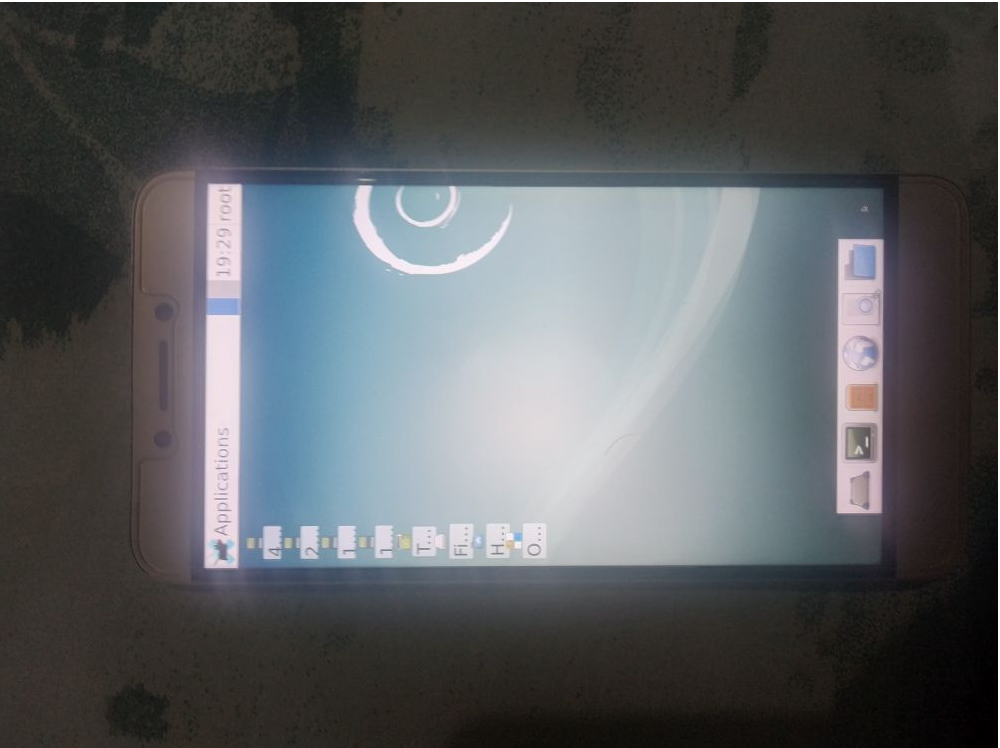
You might have already read my blog titled Running PostmarketOS on my phone . After running pmOS on phone, my mind kept talking run Debian . So I started preparing for that. At the moment no straight way tool exist in Debian like postmarketOS s pmbootstrap. Well I can compile what is already available, do debootstrap rootfs. But I don t know how to build the final image that can be flashed from recovery. One crooked idea I had is, extract the pmOS image, find the packages and its configurations. For eg: usbmodem package in postmarketos are configured to connect to host network when plugged. I deboostrap ed the rootfs, compared with postmarketos and installed extra packages and copied configuration. I repacked and compressed to new image. Then flashed with twrp. The phone was booting. So I connected the usb cable and run,
ssh abhijith@172.16.42.1
abhijith@172.16.42.1's password: 
Linux arm64 3.10.107-Cherry #1-postmarketOS SMP PREEMPT Sat Dec 18 13:08:52 UTC 2021 aarch64
The programs included with the Debian GNU/Linux system are free software;
the exact distribution terms for each program are described in the
individual files in /usr/share/doc/*/copyright.
Debian GNU/Linux comes with ABSOLUTELY NO WARRANTY, to the extent
permitted by applicable law.
abhijith@arm64:$ 
Yay!. I have a working Debian phone. I quickly installed lxde and that is working perfectly. debian-leeco

29 June 2023

Russ Allbery: Review: Semiosis

Review: Semiosis, by Sue Burke
Series: Semiosis #1
Publisher: Tor
Copyright: February 2018
ISBN: 0-7653-9137-6
Format: Kindle
Pages: 333
Semiosis is a first-contact science fiction novel and the first half of a duology. It was Sue Burke's first novel. In the 2060s, with the Earth plagued by environmental issues, a group of utopians decided to found a colony on another planet. Their goal is to live in harmony with an unspoiled nature. They wrote a suitably high-minded founding document, the Constitution of the Commonwealth of Pax, and set out in cold sleep on an interstellar voyage. 158 years later, they awoke in orbit around a planet with a highly-developed ecology, which they named Pax. Two pods and several colonists were lost on landing, but the rest remained determined to follow through with their plan. Not that they had many alternatives. Pax does not have cities or technological mammalian life, just as they hoped. It does, however, have intelligent life. This novel struggled to win me over for reasons that aren't the fault of Burke's writing. The first is that it is divided into seven parts, each telling the story of a different generation. Intellectually, I like this technique for telling an anthropological story that follows a human society over time. But emotionally, I am a character reader first and foremost, and I struggle with books where I can't follow the same character throughout. It makes the novel feel more like a fix-up of short stories, and I'm not much of a short story reader. Second, this is one of those stories where a human colony loses access to its technology and falls back to a primitive lifestyle. This is a concept I find viscerally unpleasant and very difficult to read about. I don't mind reading stories that start at the lower technological level and rediscover lost technology, but the process of going backwards, losing knowledge, surrounded by breaking technology that can never be repaired, is disturbing at a level that throws me out of the story. It doesn't help that the original colonists chose to embrace that reversion. Some of this wasn't intentional some vital equipment was destroyed when they landed but a lot of it was the plan from the start. They are the type of fanatics who embrace a one-way trip and cannibalizing the equipment used to make it in order to show their devotion to the cause. I spent the first part of the book thinking the founding colonists were unbelievably foolish, but then they started enforcing an even more restrictive way of life on their children and that tipped me over into considering them immoral. This was the sort of political movement that purged all religion and political philosophy other than their one true way so that they could raise "uncorrupted" children. Burke does recognize how deeply abusive this is. The second part of the book, which focuses on the children of the initial colonists, was both my favorite section and had my favorite protagonist, precisely because someone put words to the criticisms that I'd been thinking since the start of the book. The book started off on a bad foot with me, but if it had kept up the momentum of political revolution and rethinking provided by the second part, it might have won me over. That leads to the third problem, though, which is the first contact part of the story. (If you've heard anything about this series, you probably know what the alien intelligence is, and even if not you can probably guess, but I'll avoid spoilers anyway.) This is another case where the idea is great, but I often don't get along with it as a reader. I'm a starships and AIs and space habitats sort of SF reader by preference and tend to struggle with biological SF, even though I think it's great more of it is being written. In this case, mind-altering chemicals enter the picture early in the story, and while this makes perfect sense given the world-building, this is another one of my visceral dislikes. A closely related problem is that the primary alien character is, by human standards, a narcissistic asshole. This is for very good story and world-building reasons. I bought the explanation that Burke offers, I like the way this shows how there's no reason to believe humans have a superior form of intelligence, and I think Burke's speculations on the nature of that alien intelligence are fascinating. There are a lot of good reasons to think that alien morality would be wildly different from human morality. But, well, I'm still a human reading this book and I detested the alien, which is kind of a problem given how significant of a character it is. That's a lot baggage for a story to overcome. It says something about how well-thought-out the world-building is that it kept my attention anyway. Burke uses the generational structure very effectively. Events, preferences, or even whims early in the novel turn into rituals or traditions. Early characters take on outsized roles in history. The humans stick with the rather absurd constitution of Pax, but do so in a way that feels true to how humans reinterpret and stretch and layer meaning on top of wholly inadequate documents written in complete ignorance of the challenges that later generations will encounter. I would have been happier without the misery and sickness and messy physicality of this abusive colonization project, but watching generations of humans patch together a mostly functioning society was intellectually satisfying. The alien interactions were also solid, with the caveat that it's probably impossible to avoid a lot of anthropomorphizing. If I were going to sum up the theme of the novel in a sentence, it's that even humans who think they want to live in harmony with nature are carrying more arrogance about what that harmony would look like than they realize. In most respects the human colonists stumbled across the best-case scenario for them on this world, and it was still harder than anything they had imagined. Unfortunately, I thought the tail end of the book had the weakest plot. It fell back on a story that could have happened in a lot of first-contact novels, rather than the highly original negotiation over ecological niches that happened in the first half of the book. Out of eight viewpoint characters in this book, I only liked one of them (Sylvia). Tatiana and Lucille were okay, and I might have warmed to them if they'd had more time in the spotlight, but I felt like they kept making bad decisions. That's the main reason why I can't really recommend it; I read for characters, I didn't really like the characters, and it's hard for a book to recover from that. It made the story feel chilly and distant, more of an intellectual exercise than the sort of engrossing emotional experience I prefer. But, that said, this is solid SF speculation. If your preferred balance of ideas and characters is tilted more towards ideas than mine, and particularly if you like interesting aliens and don't mind the loss of technology setting, this may well be to your liking. Even with all of my complaints, I'm curious enough about the world that I am tempted to read the sequel, since its plot appears to involve more of the kind of SF elements I like. Followed by Interference. Content warning: Rape, and a whole lot of illness and death. Rating: 6 out of 10

27 June 2023

Wouter Verhelst: The future of the eID on RHEL

Since before I got involved in the eID back in 2014, we have provided official packages of the eID for Red Hat Enterprise Linux. Since RHEL itself requires a license, we did this, first, by using buildbot and mock on a Fedora VM to set up a CentOS chroot in which to build the RPM package. Later this was migrated to using GitLab CI and to using docker rather than VMs, in an effort to save some resources. Even later still, when Red Hat made CentOS no longer be a downstream of RHEL, we migrated from building in a CentOS chroot to building in a Rocky chroot, so that we could continue providing RHEL-compatible packages. Now, as it seems that Red Hat is determined to make that impossible too, I investigated switching to actually building inside a RHEL chroot rather than a derivative one. Let's just say that might be a challenge...
[root@b09b7eb7821d ~]# mock --dnf --isolation=simple --verbose -r rhel-9-x86_64 --rebuild eid-mw-5.1.11-0.v5.1.11.fc38.src.rpm --resultdir /root --define "revision v5.1.11"
ERROR: /etc/pki/entitlement is not a directory is subscription-manager installed?
Okay, so let's fix that.
[root@b09b7eb7821d ~]# dnf install -y subscription-manager
(...)
Complete!
[root@b09b7eb7821d ~]# mock --dnf --isolation=simple --verbose -r rhel-9-x86_64 --rebuild eid-mw-5.1.11-0.v5.1.11.fc38.src.rpm --resultdir /root --define "revision v5.1.11"
ERROR: No key found in /etc/pki/entitlement directory.  It means this machine is not subscribed.  Please use 
  1. subscription-manager register
  2. subscription-manager list --all --available (available pool IDs)
  3. subscription-manager attach --pool <POOL_ID>
If you don't have Red Hat subscription yet, consider getting subscription:
  https://access.redhat.com/solutions/253273
You can have a free developer subscription:
  https://developers.redhat.com/faq/
Okay... let's fix that too, then.
[root@b09b7eb7821d ~]# subscription-manager register
subscription-manager is disabled when running inside a container. Please refer to your host system for subscription management.
Wut.
[root@b09b7eb7821d ~]# exit
wouter@pc220518:~$ apt-cache search subscription-manager
wouter@pc220518:~$
As I thought, yes. Having to reinstall the docker host machine with Fedora just so I can build Red Hat chroots seems like a somewhat excessive requirement, which I don't think we'll be doing that any time soon. We'll see what the future brings, I guess.

Matt Brown: Designing a PCBA friendly CO2 monitor

co2mon.nz currently uses monitors based on Oliver Seiler s open source design which I am personally building. This post describes my exploration of how to achieve production of a CO2 monitor that could enable the growth of co2mon.nz.

Goals Primarily I want to design a CO2 monitor which allows the majority of the production process to be outsourced. In particular, the PCB should be able to be assembled in an automated fashion (PCBA). As a secondary goal, I d like to improve the aesthetics of the monitor while retaining the unique feature of displaying clear visual indication of the current ventilation level through coloured lights. Overall, I ll consider the project successfull if I can achieve a visually attractive CO2 monitor which takes me less than 10 minutes per monitor to assemble/box/ship and whose production cost has the potential to be lower than the current model.

PCB

Schematic The existing CO2 monitor design provides a solid foundation but relies upon the ESP32 Devkit board, which is intended for evaluation purposes and is not well suited to automated assembly. Replacing this devkit board with the underlying ESP32 module is the major change needed to enable PCBA production, which then also requires moving the supporting electronics from the devkit board directly onto the primary PCB. The basic ESP32 chipset used in the devkit boards is no longer available as a discrete module suitable for placement directly onto a PCB which means the board will also have to be updated to use a more modern variant of the ESP32 chipset which is in active production such as the ESP32-S3. The ESP32-S3-WROOM1-N4 module is a very close match to the original devkit and will be suitable for this project. In addition to the change of ESP module, I made the following other changes to the components in use:
  • Added an additional temperature/humidity sensor (SHT30). The current monitors take temperature/humidity measurements from the SCD40 chipset. These are primarily intended to help in the calculation of CO2 levels and rely on an offset being subtracted to account for the heat generated by the electronic components themselves. I ve found their accuracy to OK, but not perfect. SHT30 is a cheap part, so its addition to hopefully provide improved temperature/humidity measurement is an easy choice.
  • Swapped to USB-C instead of USB-B for the power connector. USB-C is much more common than USB-B and is also smaller and not as tall off the board which provides more flexibility in the case design.
With major components selected the key task is to draw the schematic diagram describing how they electrically connect to each other, which includes all the supporting electronics (e.g. resistors, capacitors, etc) needed. Schematic I started out trying to use the EasyEDA/OSHWLab ecosystem thinking the tight integration with JLCPCB s assembly services would be a benefit, but the web interface was too clunky and limiting and I quickly got frustrated. KiCad proved to be a much more pleasant and capable tool for the job. The reference design in the ESP32 datasheet (p28) and USB-C power supply examples from blnlabs were particularly helpful alongside the KiCad documentation and the example of the existing monitor in completing this step (click the image to enlarge).

Layout The next step is to physically lay out where each component from the schematic will sit on the PCB itself. Obviously this requires first determining the overall size, shape and outline of the board and needs to occur in iteration with the intended design of the overall monitor, including the case, to ensure components like switches and USB sockets line up correctly. In addition to the requirements around the look and function of the case, the components themselves also have considerations that must be taken into account, including:
  • For best WiFi reception, the ESP32 antenna should be at the top of the monitor and should not have PCB underneath it, or for a specified distance either side of it.
  • The SHT30 temperature sensor should be as far from any heat generating components (e.g. the ESP32, BME680 and SCD40 modules) as possible and also considering that any generated heat will rise, as low on the monitor as possible.
  • The sensors measuring the air (SCD40, BME680 and SHT30) must have good exposure to the air outside the case.
PCB Taking all of these factors into account I ended up with a square PCB containing a cutout in the top right so that the ESP32 antenna can sit within the overall square outline while still meeting its design requirements. The SCD40 and BME680 sit in the top left corner, near the edges for good airflow and far away from the SHT30 temperature sensor in the bottom left corner. The LEDs I placed in a horizontal row across the center of the board, the LCD in the bottom right, a push button on the right-hand side and the USB-C socket in the center at the bottom. Once the components are placed, the next big task is to route the traces (aka wires) between the components on the board such that all the required electrical connections are made without any unintended connections (aka shorts) being created. This is a fun constraint solving/optimisation challenge and takes on an almost artistic aspect with other PCB designers often having strong opinions on which layout is best. The majority of the traces and routing for this board were able to be placed on the top layer of the PCB, but I also made use of the back layer for a few traces to help avoid conflicts and deal with places where different traces needed to cross each other. It s easy to see how this step would be much more challenging and time consuming on a larger and more complex PCB design. The final touches were to add some debugging breakouts for the serial and JTAG ports on the ESP32-S3 and a logo and various other helpful text on the silkscreen layer that will be printed on the PCB so it looks nice.

Production For assembly of the PCB, I went with JLCPCB based out of China. The trickiest part of the process was component selection and ensuring that the parts I had planned in the schematic were available. JLCPCB in conjunction with lcsc.com provides a basic and extended part library. If you use only basic parts you get quicker and cheaper assembly, while using extended parts bumps your order into a longer process with a small fee charged for each component on the board. Initially I spent a lot of time selecting components (particularly LEDs and switches) that were in the basic library before realising that the ESP32 modules are only available in the extended library! I think the lesson is that unless you re building the most trivial PCB with only passive components you will almost certainly end up in the advanced assembly process anyway, so trying to stay within the basic parts library is not worth the time. Unfortunately the SCD40 sensor, the most crucial part of the monitor, is not stocked at all by JLCPCB/LCSC! To work around this JLCPCB will maintain a personal component library for you when you ship components to them to for use in future orders. Given the extra logistical time and hassle of having to do this, combined with having a number of SCD40 components already on hand I decided to have the boards assembled without this component populated for the initial prototype run. This also had the benefit of lowering the risk if something went wrong as the cost of the SCD40 is greater than the cost of the PCB and all the other components combined! I found the kicad-jlcpcb-tools plugin for KiCad invaluable for keeping track of what part from lcsc.com I was planning to use for each component and generating the necessary output files for JLCPCB. The plugin allows you to store these mappings in your actual schematic which is very handy. The search interface it provides is fairly clunky and I found it was often easier to search for the part I needed on lcsc.com and then just copy the part number across into the plugin s search box rather than trying to search by name or component type. The LCD screen is the remaining component which is not easily assembled onto the PCB directly, but as you ll see next, this actually turned out to be OK as integrating the screen directly into the case makes the final assembly process smoother. fabricated PCBs The final surprise in the assembly process was the concept of edge rails, additional PCB material that is needed on either side of the board to help with feeding it through the assembly machine in the correct position. These can be added automatically by JLCPCB and have to be snapped off after the completed boards are received. I hadn t heard about these before and I was a little worried that they d interfere or get in the way of either the antenna cut-out at the top of the board, or the switch on the right hand side as it overhangs the edge so it can sit flush with the case. In the end there was no issue with the edge rails. The switch was placed hanging over them without issue and snapping them off once the boards arrived was a trivial 30s job using a vice to hold the edge rail and then gently tipping the board over until it snapped off - the interface between the board and the rails while solid looking has obviously been scored or perforated in some way during the production process so the edge breaks cleanly and smoothly. Magic! The process was amazingly quick with the completed PCBs (picture above) arriving within 7 days of the order being placed and looking amazing.

Case

Design I mocked up a very simple prototype of the case in FreeCAD during the PCB design process to help position and align the placement of the screen, switch and USB socket on the PCB as all three of these components interface directly with the edges of the case. Initially this design was similar to the current monitor design where the PCB (with lights and screen attached) sits in the bottom of the case, which has walls containing grilles for airflow and then a separate transparent perspex is screwed onto the top to complete the enclosure. As part of the aesthetic improvements for the new monitor I wanted to move away from a transparent front panel to something opaque but still translucent enough to allow the colour of the lights to show through. Without a transparent front panel the LCD also needs to be mounted directly into the case itself. The first few prototype iterations followed the design of the original CO2 monitor with a flat front panel that attaches to the rest of the case containing the PCB, but the new requirement to also attach the LCD to the front panel proved to make this unworkable. To stay in place the LCD has to be pushed onto mounting poles containing a catch mechanism which requires a moderate amount of force and applying that force to the LCD board when it is already connected to the PCB is essentially impossible. case with lcd attached As a result I ended up completely flipping the design such that the front panel is a single piece of plastic that also encompasses the walls of the case and contains appropriate mounting stakes for both the screen and the main PCB. Getting to this design hugely simplified the assembly process. Starting with an empty case lying face down on a bench, the LCD screen is pushed onto the mounting poles and sits flush with the cover of the case - easily achieved without the main PCB yet in place. case with pcb in place Next, the main PCB is gently lowered into the case facing downwards and sits on the mounting pole in each corner with the pins for the LCD just protruding through the appropriate holes in the PCB ready to be quickly soldered into place (this took significant iteration and tuning of dimensions/positioning to achieve!). Finally, a back panel can be attached which holds the PCB in place and uses cantilever snap joints to click on to the rest of the case. Overall the design is a huge improvement over the previous case which required screws and spacers to position the PCB and cover relative to the rest of the case, with the spacers and screws being particularly fiddly to work with. The major concern I had with the new design was that the mount to attach the monitor to the wall has moved from being attached to the main case and components directly to needing to be on the removable back panel - if the clips holding this panel to the case fail the core part of the monitor will fall off the wall which would not be good. To guard against this I ve doubled the size and number of clips at the top of the case (which bears the weight) and the result seems very robust in my testing. To completely assemble a monitor, including the soldering step takes me about 2-3 minutes individually, and would be even quicker if working in batches.

Production Given the number of design/testing iterations required to fine tune the case I chose not to outsource case production for now and used my 3D printer to produce them. I ve successfully used JLCPCB s 3D printing service for the previous case design, so I m confident that getting sufficient cases printed from JLCPCB or another supplier will not be an issue now that the design is finalised. completed monitor I tried a variety of filament colours, but settled on a transparent filament which once combined in the necessary layers to form the case is not actually transparent like perspex is, but provides a nice translucent medium which achieves the goal of having the light colour visible without exposing all of the circuit board detail. There s room for future improvement in the positioning of the LEDs on the circuit board to provide a more even distribution of light across the case but overall I really like the way the completed monitor ends up looking.

Evaluation Building this monitor has been a really fun project, both in seeing something progress from an idea, to plans on a screen to a nice physical thing on my wall, but also in learning and developing a bunch of new skills in PCB design, assembly and 3D design. completed monitor The goal of having a CO2 monitor which I can outsource the vast majority of production of is as close to being met as I think is possible without undertaking the final proof of placing a large order. I ve satisfied myself that each step is feasible and that the final assembly process is quick, easy and well below the level of effort and time it was taking me to produce the original monitors. Cost wise it s also a huge win, primarily in terms of the time taken, but also in the raw components - currently the five prototypes I ordered and built are on par with the component cost of the original CO2 monitor, but this will drop further with larger orders due to price breaks and amortisation of the setup and shipping expenses across more monitors. This project has also given me a much better appreciation for how much I m only just scratching the surface of the potential complexities and challenges in producing a hardware product of this type. I m reasonably confident I could successfully produce a few hundred and maybe even a few thousand monitors using this approach, but it s also clear that getting beyond that point is and would be a whole further level of effort and learning. Hardware is hard work. That s not news to anyone, including me, but there is something to be said for experiencing the process first hand to make the reality of what s required real. The PCB and case designs are both shared and can be found at https://github.com/co2monnz/co2monitor-pcb and https://github.com/co2monnz/cad, feedback and suggestions welcome!

24 June 2023

Steve Kemp: Simple REPL for CP/M, in Z80 assembly

So my previous post documented a couple of simple "scripting languages" for small computers, allowing basic operations in a compact/terse fashion. I mentioned that I might be tempted to write something similar for CP/M, in Z80 assembly, and the result is here: To sum up it allows running programs like this:
0m 16k rP _ _ 
C3 03 EA 00 00 C3 06 DC 00 00 00 00 00 00 00 00
Numbers automatically get saved to the A-register, the accumulator. In addition to that there are three dedicated registers: So the program above: TLDR: Dump the first sixteen bytes of RAM, at address 0x0000, to the console. Though this program allows delays, RAM read/write, I/O port input and output, as well as loops it's both kinda fun, and kinda pointless. I guess you could spend hours flashing lights and having other similar fun. But only if you're like me! All told the code compiles down to about 800 bytes and uses less than ten bytes of RAM to store register-state. It could be smaller with some effort, but it was written a bit adhoc and I think I'm probably done now.

19 June 2023

Dirk Eddelbuettel: RcppArmadillo 0.12.4.1.0 on CRAN: New Upstream Bugfix

armadillo image Armadillo is a powerful and expressive C++ template library for linear algebra and scientific computing. It aims towards a good balance between speed and ease of use, has a syntax deliberately close to Matlab, and is useful for algorithm development directly in C++, or quick conversion of research code into production environments. RcppArmadillo integrates this library with the R environment and language and is widely used by (currently) 1079 other packages on CRAN, downloaded 29.6 million times (per the partial logs from the cloud mirrors of CRAN), and the CSDA paper) (preprint / vignette) by Conrad and myself has been cited 543 times according to Google Scholar. This release brings bugfix upstream release 12.4.1 made by Conrad at the end of last week. As usual, I prepared the usual release candidate, tested on the over 1000 reverse depends (which sadly takes a long time on old hardware), found no issues and sent it to CRAN. Where it got tested again and was by a stroke of bad luck upheld for two unrelated issue (one package fell over one of its other dependencies changing a data representation, another fell afoul of a tightened test on total test time) so this awaited the usual email handshake with the CRAN maintainers and the weekend got in the way. The release also contains a PR kindly provided by Mikael Jagan for an upcoming change in package Matrix. As a bugfix release, the set of changes is fairly small.

Changes in RcppArmadillo version 0.12.4.1.0 (2023-06-17)
  • Upgraded to Armadillo release 12.4.1 (Cortisol Profusion Redux)
    • fix bug in SpMat::shed_cols()
    • functions such as .is_finite() and find_nonfinite() will now emit a runtime warning when compiled in fast math mode; such compilation mode disables detection of non-finite values
  • Accommodate upcoming change in package Matrix (Mikael Jagan in #417 addressing #415)

Courtesy of my CRANberries, there is a diffstat report relative to previous release. More detailed information is on the RcppArmadillo page. Questions, comments etc should go to the rcpp-devel mailing list off the Rcpp R-Forge page. If you like this or other open-source work I do, you can sponsor me at GitHub.

This post by Dirk Eddelbuettel originated on his Thinking inside the box blog. Please report excessive re-aggregation in third-party for-profit settings.

16 June 2023

Lisandro Dami n Nicanor P rez Meyer: Qt 6 in Debian bullseye, take 2

Bookworm has been released and Bullseye is now old-stable. Non the less today I took the time to update the Qt 6 backports so they are as close as Bookworm as possible. Except security fixes are needed these ought to be the latest uploads of Qt 6 to bullseye-backports. Hope you enjoyed them, and thanks again The Qt Company and ICS for making this possible.

10 June 2023

Marco d'Itri: On having a track record in operating systems development

Now that Debian 12 has been released with proprietary firmwares on the official media, non-optional merged-/usr and systemd adopted by everybody, I want to take a moment to list, not without some pride, a few things that I was right about over the last 20 years: Accepting the obvious solution about firmwares took 18 years. My work on the merged-/usr transition started in 2014, and the first discussions about replacing sysvinit are from 2011. The general adoption of udev (and dynamic device names, and persistent network interface names...) took less time in comparison and no large-scale flame wars, since people could enable it at their own pace. But it required countless little debates in the Debian Bug Tracking System: I still remember the people insisting that they would never use this newfangled dynamic /dev/, or complaining about their beloved /dev/cdrom symbolic link and persistent network interface names. So follow me for more rants about inevitable technologies.

8 June 2023

Lisandro Dami n Nicanor P rez Meyer: Adventures in Debian's Qt land

Debian (I might as well say "we", this is the beauty of it) is about to release Debian 12 aka Bookworm. Let's take a quick look at what is new in Debian Qt land. Qt 5 Bookworm has Qt 5.15.8, which is nothing but great news. KDE will be switching to Qt 6 sooner than later and Qt 5 has been a fun ride, but Dmitry Shachnev and I needed a break, or at very least not handling two Qt versions. But in the end I need to be fair: you REALLY need to thank Dmitry for Qt 5. He has been the man power behind it in 99.5% of the cases. Qt 6 This will be the first Debian release to have official Qt 6 packages. NOTHING would have happened if it weren't for Patrick "Delta-One" Franz standing up to maintain it. BIG kudos to him! Well, there is a "little lie" in the paragraph above. Thanks to The Qt Company and ICS the current Qt 6 version, 6.4.2, is also available as Bullseye's backports. The Qt Company really also helped us here by providing us almost-to-be-released tarballs of Qt 6.4.2 so we were able to push them to unstable and do a transition in time for freeze, thanks a lot for that! So, what is the Qt 6 state? At the binary side all but OpenGL ES support should be there. Sadly this was discovered too late in the release process and we still might need help maintaining it (read the link to know why!). We are still not building the documentation. Properly building the whole documentation, as with Qt 5, would require all the Qt submodules' source code in one place, which we can't (easily?) do in Debian. So building the doc means hacking the build system and getting semi-linked documentation, much like with Qt 5. Now if you think you have an idea to solve this... we are happy to hear from you! Another great thing to know about Qt 6 is that, thanks to Helmut Grohne, pure Qt 6 applications should be able to cross compile. Applications using multi-arch enabled libraries ought to work too. Even more, many Qt submodules themselves should also cross compile! Not all of them, as we missed some patches in time, but hey, if you need to cross compile Qt, you surely can apply them yourselves! And finally tests, unit tests. In Qt 5 we had some of those, but none yet in Qt 6. This is one of the areas I would love to be able to put time... but time is scarce. The future? In my point of view the Debian 13 "Trixie" development cycle will see Qt 5 diminishing it's usage and Qt 6 becoming the major Qt version used, but from the Qt 4 experience I do not expect Qt 5 being dropped during this release cycle... let's see what the future brings us. Thanks! While I mentioned Dmitry and Patrick many more people helped us reach this place. I personally want to thank the people behind the KDE software, both upstream and, of course, the Debian maintainers. You should be thankful with them too, many hours of effort go into this. And thanks to you our dear users. We are normally overflowed with what we have in our hands and might not be up to the task sometimes, but hey, you are part of the reason we are doing this!

6 June 2023

Shirish Agarwal: Odisha Train Crash and Coverup, Demonetization 2.0 & NHFS-6 Survey

Just a few days back we came to know about the horrific Train Crash that happened in Odisha (Orissa). There are some things that are known and somethings that can be inferred by observance. Sadly, it seems the incident is going to be covered up  . Some of the facts that have not been contested in the public domain are that there were three lines. One loop line on which the Goods Train was standing and there was an up and a down line. So three lines were there. Apparently, the signalling system and the inter-locking system had issues as highlighted by an official about a month back. That letter, thankfully is in the public domain and I have downloaded it as well. It s a letter that goes to 4 pages. The RW is incensed that the letter got leaked and is in public domain. They are blaming everyone and espousing conspiracy theories rather than taking the minister to task. Incidentally, the Minister has three ministries that he currently holds. Ministry of Communication, Ministry of Electronics and Information Technology (MEIT), and Railways Ministry. Each Ministry in itself is important and has revenues of more than 6 lakh crore rupees. How he is able to do justice to all the three ministries is beyond me  The other thing is funds both for safety and relaying of tracks has been either not sanctioned or unutilized. In fact, CAG and the Railway Brass had shared how derailments have increased and unfulfilled vacancies but they were given no importance  In fact, not talking about safety in the recently held Chintan Shivir (brainstorming session) tells you how much the Govt. is serious about safety. In fact, most of the programme was on high speed rail which is a white elephant. I have shared a whitepaper done by RW in the U.S. that tells how high-speed rail doesn t make economic sense. And that is an economy that is 20 times + the Indian Economy. Even the Chinese are stopping with HSR as it doesn t make economic sense. Incidentally, Air Fares again went up 200% yesterday. Somebody shared in the region of 20k + for an Air ticket from their place to Bangalore  Coming back to the story itself. the Goods Train was on the loopline. Some say it was a little bit on the outer, some say otherwise, but it is established that it was on the loopline. This is standard behavior on and around Railway Stations around the world. Whether it was in the Inner or Outer doesn t make much of a difference with what happened next. The first train that collided with the goods train was the 12864 (SMVB-HWH) Yashwantpur Howrah Express and got derailed on to the next track where from the opposite direction 12841 (Shalimar- Bangalore) Coramandel Express was coming. Now they have said that around 300 people have died and that seems to be part of the cover-up. Both the trains are long trains, having between 23 odd coaches each. Even if you have reserved tickets you have 80 odd people in a coach and usually in most of these trains, it is at least double of that. Lot of money goes to TC and then above (Corruption). The Railway fares have gone up enormously but that s a question for perhaps another time  . So at the very least, we could be looking at more than 1000 people having died. The numbers are being under-reported so that nobody has to take responsibility. The Railways itself has told that it is unable to identify 80% of the people who have died. This means that 80% were unreserved ticket holders or a majority of them. There have been disturbing images as how bodies have been flung over on tractors and whatnot to be either buried or cremated without a thought. We are in peak summer season so bodies will start to rot within 24-48 hours  No arrangements made to cool the bodies and take some information and identifying marks or whatever. The whole thing being done in a very callous manner, not giving dignity to even those who have died for no fault of their own. The dissent note also tells that a cover-up is also in the picture. Apparently, India doesn t have nor does it feel to have a need for something like the NTSB that the U.S. used when it hauled both the plane manufacturer (Boeing) and the FAA when the 737 Max went down due to improper data collection and sharing of data with pilots. And with no accountability being fixed to Minister or any of the senior staff, a small junior staff person may be fired. Perhaps the same official that actually told them about the signal failures almost 3 months back  There were and are also some reports that some jugaadu /temporary fixes were applied to signalling and inter-locking just before this incident happened. I do not know nor confirm one way or the other if the above happened. I can however point out that if such a thing happened, then usually a traffic block is announced and all traffic on those lines are stopped. This has been the thing I know for decades. Traveling between Mumbai and Pune multiple times over the years am aware about traffic block. If some repair work was going on and it wasn t able to complete the work within the time-frame then that may well have contributed to the accident. There is also a bit muddying of the waters where it is being said that one of the trains was 4 hours late, which one is conflicting stories. On top of the whole thing, they have put the case to be investigated by CBI and hinting at sabotage. They also tried to paint a religious structure as mosque, later turned out to be a temple. The RW says done by Muslims as it was Friday not taking into account as shared before that most Railway maintenance works are usually done between Friday Monday. This is a practice followed not just in India but world over. There has been also move over a decade to remove wooden sleepers and have concrete sleepers. Unlike the wooden ones they do not expand and contract as much and their life is much more longer than the wooden ones. Funds had been marked (although lower than last few years) but not yet spent. As we know in case of any accident, it is when all the holes in cheese line up it happens. Fukushima is a great example of that, no sea wall even though Japan is no stranger to Tsunamis. External power at the same level as the plant. (10 meters above sea-level), no training for cascading failures scenarios which is what happened. The Days mini-series shares some but not all the faults that happened at Fukushima and the Govt. response to it. There is a difference though, the Japanese Prime Minister resigned on moral grounds. Here, nor the PM, nor the Minister would be resigning on moral grounds or otherwise :(. Zero accountability and that was partly a natural disaster, here it s man-made. In fact, both the Minister and the Prime Minister arrived with their entourages, did a PR blitzkrieg showing how concerned they are. Within 50 hours, the lines were cleared. The part-time Railway Minister shared that he knows the root cause and then few hours later has given the case to CBI. All are saying, wait for the inquiry report. To date, none of the accidents even in this Govt. has produced an investigation report. And even if it did, I am sure it will whitewash as it did in case of Adani as I had shared before in the previous blog post. Incidentally, it is reported that Adani paid off some of its debt, but when questioned as to where they got the money, complete silence on that part :(. As can be seen cover-up after cover-up  FWIW, the Coramandel Express is known as the Migrant train so has a huge number of passengers, the other one which was collided with is known as sick train as huge number of cancer patients use it to travel to Chennai and come back

Demonetization 2.0 Few days back, India announced demonetization 2.0. Surprised, don t be. Apparently, INR 2k/- is being used for corruption and Mr. Modi is unhappy about it. He actually didn t like the INR 2k/- note but was told that it was needed, who told him we are unaware to date. At that time the RBI Governor was Mr. Urjit Patel who didn t say about INR 2k/- he had said that INR 1k/- note redesigned would come in the market. That has yet to happen. What has happened is that just like INR 500/- and INR 1k/- note is concerned, RBI will no longer honor the INR 2k/- note. Obviously, this has made our neighbors angry, namely Nepal, Sri Lanka, Bhutan etc. who do some trading with us. 2 Deccan herald columns share the limelight on it. Apparently, India wants to be the world s currency reserve but doesn t want to play by the rules for everyone else. It was pointed out that both the U.S. and Singapore had retired their currencies but they will honor that promise even today. The Singapore example being a bit closer (as it s in Asia) is perhaps a bit more relevant than the U.S. one. Singapore retired the SGD $10,000 as of 2014 but even in 2022, it remains as legal tender. They also retired the SGD $1,000 in 2020 but still remains legal tender.

So let s have a fictitious example to illustrate what is meant by what Singapore has done. Let s say I go to Singapore, rent a flat, and find a $1000 note in that house somewhere. Both practically and theoretically, I could go down to any of the banks, get the amount transferred to my wallet, bank account etc. and nobody will question. Because they have promised the same. Interestingly, the Singapore Dollar has been pretty resilient against the USD for quite a number of years vis-a-vis other Asian currencies. Most of the INR 2k/- notes were also found and exchanged in Gujarat in just a few days (The PM and HM s state.). I am sure you are looking into the mental gymnastics that the RW indulge in :(. What is sadder that most of the people who try to defend can t make sense one way or the other and start to name-call and get personal as they have nothing else

Disability questions dropped in NHFS-6 Just came to know today that in the upcoming National Family Health Survey-6 disability questions are being dropped. Why is this important. To put it simply, if you don t have numbers, you won t and can t make policies for them. India is one of the worst countries to live if you are disabled. The easiest way to share to draw attention is most Railway platforms are not at level with people. Just as Mick Lynch shares in the UK, the same is pretty much true for India too. Meanwhile in Europe, they do make an effort to be level so even disabled people have some dignity. If your public transport is sorted, then people would want much more and you will be obligated to provide for them as they are citizens. Here, we have had many reports of women being sexually molested when being transferred from platform to coach irrespective of their age or whatnot  The main takeaway is if you do not have their voice, you won t make policies for them. They won t go away but you will make life hell for them. One thing to keep in mind that most people assume that most people are disabled from birth. This may or may not be true. For e.g. in the above triple Railways accidents, there are bound to be disabled people or newly disabled people who were healthy before the accident. The most common accident is road accidents, some involving pedestrians and vehicles or both, the easiest is Ministry of Road Transport data that says 4,00,000 people sustained injuries in 2021 alone in road mishaps. And this is in a country where even accidents are highly under-reported, for more than one reason. The biggest reason especially in 2 and 4 wheeler is the increased premium they would have to pay if in an accident, so they usually compromise with the other and pay off the Traffic Inspector. Sadly, I haven t read a new book, although there are a few books I m looking forward to have. People living in India and neighbors please be careful as more heat waves are expected. Till later.

5 June 2023

Reproducible Builds: Reproducible Builds in May 2023

Welcome to the May 2023 report from the Reproducible Builds project In our reports, we outline the most important things that we have been up to over the past month. As always, if you are interested in contributing to the project, please visit our Contribute page on our website.


Holger Levsen gave a talk at the 2023 edition of the Debian Reunion Hamburg, a semi-informal meetup of Debian-related people in northern Germany. The slides are available online.
In April, Holger Levsen gave a talk at foss-north 2023 titled Reproducible Builds, the first ten years. Last month, however, Holger s talk was covered in a round-up of the conference on the Free Software Foundation Europe (FSFE) blog.
Pronnoy Goswami, Saksham Gupta, Zhiyuan Li, Na Meng and Daphne Yao from Virginia Tech published a paper investigating the Reproducibility of NPM Packages. The abstract includes:
When using open-source NPM packages, most developers download prebuilt packages on npmjs.com instead of building those packages from available source, and implicitly trust the downloaded packages. However, it is unknown whether the blindly trusted prebuilt NPM packages are reproducible (i.e., whether there is always a verifiable path from source code to any published NPM package). [ ] We downloaded versions/releases of 226 most popularly used NPM packages and then built each version with the available source on GitHub. Next, we applied a differencing tool to compare the versions we built against versions downloaded from NPM, and further inspected any reported difference.
The paper reports that among the 3,390 versions of the 226 packages, only 2,087 versions are reproducible, and furthermore that multiple factors contribute to the non-reproducibility including flexible versioning information in package.json file and the divergent behaviors between distinct versions of tools used in the build process. The paper concludes with insights for future verifiable build procedures. Unfortunately, a PDF is not available publically yet, but a Digital Object Identifier (DOI) is available on the paper s IEEE page.
Elsewhere in academia, Betul Gokkaya, Leonardo Aniello and Basel Halak of the School of Electronics and Computer Science at the University of Southampton published a new paper containing a broad overview of attacks and comprehensive risk assessment for software supply chain security. Their paper, titled Software supply chain: review of attacks, risk assessment strategies and security controls, analyses the most common software supply-chain attacks by providing the latest trend of analyzed attack, and identifies the security risks for open-source and third-party software supply chains. Furthermore, their study introduces unique security controls to mitigate analyzed cyber-attacks and risks by linking them with real-life security incidence and attacks . (arXiv.org, PDF)
NixOS is now tracking two new reports at reproducible.nixos.org. Aside from the collection of build-time dependencies of the minimal and Gnome installation ISOs, this page now also contains reports that are restricted to the artifacts that make it into the image. The minimal ISO is currently reproducible except for Python 3.10, which hopefully will be resolved with the coming update to Python version 3.11.
On our rb-general mailing list this month: David A. Wheeler started a thread noting that the OSSGadget project s oss-reproducible tool was measuring something related to but not the same as reproducible builds. Initially they had adopted the term semantically reproducible build term for what it measured, which they defined as being if its build results can be either recreated exactly (a bit for bit reproducible build), or if the differences between the release package and a rebuilt package are not expected to produce functional differences in normal cases. This generated a significant number of replies, and several were concerned that people might confuse what they were measuring with reproducible builds . After discussion, the OSSGadget developers decided to switch to the term semantically equivalent for what they measured in order to reduce the risk of confusion. Vagrant Cascadian (vagrantc) posted an update about GCC, binutils, and Debian s build-essential set with some progress, some hope, and I daresay, some fears . Lastly, kpcyrd asked a question about building a reproducible Linux kernel package for Arch Linux (answered by Arnout Engelen). In the same, thread David A. Wheeler pointed out that the Linux Kernel documentation has a chapter about Reproducible kernel builds now as well.
In Debian this month, nine reviews of Debian packages were added, 20 were updated and 6 were removed this month, all adding to our knowledge about identified issues. In addition, Vagrant Cascadian added a link to the source code causing various ecbuild issues. [ ]
The F-Droid project updated its Inclusion How-To with a new section explaining why it considers reproducible builds to be best practice and hopes developers will support the team s efforts to make as many (new) apps reproducible as it reasonably can.
In diffoscope development this month, version 242 was uploaded to Debian unstable by Chris Lamb who also made the following changes: In addition, Mattia Rizzolo documented how to (re)-produce a binary blob in the code [ ] and Vagrant Cascadian updated the version of diffoscope in GNU Guix to 242 [ ].
reprotest is our tool for building the same source code twice in different environments and then checking the binaries produced by each build for any differences. This month, Holger Levsen uploaded versions 0.7.24 and 0.7.25 to Debian unstable which added support for Tox versions 3 and 4 with help from Vagrant Cascadian [ ][ ][ ]

Upstream patches The Reproducible Builds project detects, dissects and attempts to fix as many currently-unreproducible packages as possible. We endeavour to send all of our patches upstream where appropriate. This month, we wrote a large number of such patches, including: In addition, Jason A. Donenfeld filed a bug (now fixed in the latest alpha version) in the Android issue tracker to report that generateLocaleConfig in Android Gradle Plugin version 8.1.0 generates XML files using non-deterministic ordering, breaking reproducible builds. [ ]

Testing framework The Reproducible Builds project operates a comprehensive testing framework (available at tests.reproducible-builds.org) in order to check packages and other artifacts for reproducibility. In May, a number of changes were made by Holger Levsen:
  • Update the kernel configuration of arm64 nodes only put required modules in the initrd to save space in the /boot partition. [ ]
  • A huge number of changes to a new tool to document/track Jenkins node maintenance, including adding --fetch, --help, --no-future and --verbose options [ ][ ][ ][ ] as well as adding a suite of new actions, such as apt-upgrade, command, deploy-git, rmstamp, etc. [ ][ ][ ][ ] in addition a significant amount of refactoring [ ][ ][ ][ ].
  • Issue warnings if apt has updates to install. [ ]
  • Allow Jenkins to run apt get update in maintenance job. [ ]
  • Installed bind9-dnsutils on some Ubuntu 18.04 nodes. [ ][ ]
  • Fixed the Jenkins shell monitor to correctly deal with little-used directories. [ ]
  • Updated the node health check to warn when apt upgrades are available. [ ]
  • Performed some node maintenance. [ ]
In addition, Vagrant Cascadian added the nocheck, nopgo and nolto when building gcc-* and binutils packages [ ] as well as performed some node maintenance [ ][ ]. In addition, Roland Clobus updated the openQA configuration to specify longer timeouts and access to the developer mode [ ] and updated the URL used for reproducible Debian Live images [ ].

If you are interested in contributing to the Reproducible Builds project, please visit our Contribute page on our website. However, you can get in touch with us via:

2 June 2023

Jelmer Vernooij: Porting Python projects to Rust

I ve recently been working on porting some of my Python code to rust, both for performance reasons, and because of the strong typing in the language. As a fan of Haskell, I also just really enjoy using the language. Porting any large project to a new language can be a challenge. There is a temptation to do a rewrite from the ground-up in idiomatic rust and using all new fancy features of the language.
Porting in one go However, this is a bit of a trap:
  • It blocks other work. It can take a long time to finish the rewrite, during which time there is no good place to make other bug fixes/feature changes. If you make the change in the python branch, then you may also have to patch the in-progress rust fork.
  • No immediate return on investment. While the rewrite is happening, all of the investment in it is sunk costs.
  • Throughout the process, you can only run the tests for subsystems that have already been ported. It s common to find subtle bugs later in code ported early.
  • Understanding existing code, porting it and making it idiomatic rust all at the same time takes more time and post-facto debugging.
Iterative porting Instead, we ve found that it works much better to take an iterative approach. One of the hidden gems of rust is the excellent PyO3 crate, which allows creating python bindings for rust code in a way that is several times less verbose and less painful than C or SWIG. Because of rust s strong ownership model, it s also really hard to muck up e.g. reference counts when creating Python bindings for rust code. We port individual functions or classes to rust one at a time, starting with functionality that doesn t have dependencies on other python code and gradually working our way up the call stack. Each subsystem of the code is converted to two matching rust crates: one with a port of the code to pure rust, and one with python bindings for the rust code. Generally multiple python modules end up being a single pair of rust crates. The signature for the pure Rust code follow rust conventions, but the business logic is mostly ported as-is (just in rust syntax) and the signatures of the python bindings match that of the original python code. This then allows running the original python tests to verify that the code still behaves the same way. Changes can also immediately land on the main branch. A subsequent step is usually to refactor the rust code to be more idiomatic - all the while keeping the tests passing. There is also the potential to e.g. switch to using external rust crates (with perhaps subtly different behaviour), or drop functionality altogether. At some point, we will also port the tests from python to rust, and potentially drop the python bindings - once all the caller s have been converted to rust.
Example For example, imagine I have a Python module janitor/mail_filter.py with this function:
 1
 2
 3
 4
 5
 6
 7
 8
 9
10
11
12
13
14
15
16
def parse_plain_text_body(text):
   lines = text.splitlines()
   for i, line in enumerate(lines):
       if line == 'Reply to this email directly or view it on GitHub:':
           return lines[i + 1].split('#')[0]
       if (line == 'For more details, see:'
               and lines[i + 1].startswith('https://code.launchpad.net/')):
           return lines[i + 1]
       try:
           (field, value) = line.split(':', 1)
       except ValueError:
           continue
       if field.lower() == 'merge request url':
           return value.strip()
   return None
Porting this to rust naively (in a crate I ve called mailfilter ) it might look something like this:
 1
 2
 3
 4
 5
 6
 7
 8
 9
10
11
12
13
14
15
16
17
18
19
20
pub fn parse_plain_text_body(text: &str) -> Option<String>  
     let lines: Vec<&str> = text.lines().collect();
     for (i, line) in lines.iter().enumerate()  
         if line == &"Reply to this email directly or view it on GitHub:"  
             return Some(lines[i + 1].split('#').next().unwrap().to_string());
          
         if line == &"For more details, see:"
             && lines[i + 1].starts_with("https://code.launchpad.net/")
          
             return Some(lines[i + 1].to_string());
          
         if let Some((field, value)) = line.split_once(':')  
             if field.to_lowercase() == "merge request url"  
                 return Some(value.trim().to_string());


     None
  
Bindings are created in a crate called mailfilter-py, which looks like this:
 1
 2
 3
 4
 5
 6
 7
 8
 9
10
11
12
13
use pyo3::prelude::*;
 #[pyfunction]
 fn parse_plain_text_body(text: &str) -> Option<String>  
     janitor_mail_filter::parse_plain_text_body(text)
  
 #[pymodule]
 pub fn _mail_filter(py: Python, m: &PyModule) -> PyResult<()>  
     m.add_function(wrap_pyfunction!(parse_plain_text_body, m)?)?;
     Ok(())
  
The metadata for the crates is what you d expect. mailfilter-py uses PyO3 and depends on mailfilter.
 1
 2
 3
 4
 5
 6
 7
 8
 9
10
11
12
[package]
 name = "mailfilter-py"
 version = "0.0.0"
 authors = ["Jelmer Vernoo  <jelmer@jelmer.uk>"]
 edition = "2018"
 [lib]
 crate-type = ["cdylib"]
 [dependencies]
 janitor-mail-filter =   path = "../mailfilter"  
 pyo3 =   version = ">=0.14", features = ["extension-module"] 
I use python-setuptools-rust to get the python ecosystem to build the python bindings. Here is what setup.py looks like:
1
2
3
4
5
6
7
8
9
#!/usr/bin/python3
from setuptools import setup
from setuptools_rust import RustExtension, Binding
setup(
        rust_extensions=[RustExtension(
        "janitor._mailfilter", "crates/mailfilter-py/Cargo.toml",
        binding=Binding.PyO3)],
)
And of course, setuptools-rust needs to be listed as a setup requirement in pyproject.toml or setup.cfg. After that, we can replace the original python code with a simple import and verify that the tests still run:
1
from ._mailfilter import parse_plain_text_body
Of course, not all bindings are as simple as this. Iterators in particular are more complicated, as is code that has a loose idea of ownership in python. But I ve found that the time investment is usually well worth the ability to land changes on the development head early and often. I d be curious to hear if people have had success with other approaches to porting Python code to Rust. If you do, please leave a comment.

Next.

Previous.