Search Results: "phil"

19 December 2011

John Sullivan: Where Shall I Wander

Google Maps is now mapping the indoors. I saw an ad for this while passing through MSP yesterday (given how much time I spend on the Internet, it's strange and a little embarrassing to learn about new things on the Internet from airport billboards), since one of their initial targets is the infamous Mall of America.
Detailed floor plans automatically appear when you re viewing the map and zoomed in on a building where indoor map data is available. The familiar blue dot icon indicates your location within several meters, and when you move up or down a level in a building with multiple floors, the interface will automatically update to display which floor you re on. All this is achieved by using an approach similar to that of My Location for outdoor spaces, but fine tuned for indoors.
Thoughts about this: Title from John Ashbery

11 December 2011

Phil Hands: One Month

... since we got married -- a great month :-) wedding photo and one month until Gunde's expected to give birth to our first daughter. So exciting times ahead.

5 December 2011

Philipp Kern: New Debian buildd at Karlsruhe Institute of Technology

It took quite a lot of effort to persuade all decision makers to make this happen, but here it is: A new Debian buildd is being hosted at Karlsruhe Institute of Technology, to support the s390(x) ports. Its name is zemlinsky. So we've got some redundancy now and despite them being some sort of fringe architectures, they're looking pretty good. s390x is currently bootstrapped in the archive and it's progressing pretty quick. This new fast builder is one of the reasons why the slope is so steep.

Pointing people at the Debian Machine Usage Policies (DMUP) is pretty helpful to get a consent, with relation to network usage and acceptable use of the machines themselves. In this case the hardest part was drafting a user agreement that allows other non-university persons to log into the box, which is crucial to have it maintained by the Debian System Administrators.

Thanks to all the people at IPD Reussner, Steinbuch Centre for Computing and BelW who helped me getting this done.

Russell Coker: CyanogenMod and the Galaxy S

Thanks to some advice from Philipp Kern I have now got my Galaxy S running CyanogenMod 7.1.0 which is based on Android 2.3.7 [1]. CyanogenMod has lots of configuration options that seem to be lacking in the stock releases and also supports some advanced features such as OpenVPN and a command-line. I can t properly compare CyanogenMod to the stock Android as I ve only used versions 2.1 and 2.2 of the stock Android. Presumably some of the things that I like about CyanogenMod are in the stock Android 2.3.7 release. The process of updating a phone is difficult and has some risk. Fortunately Samsung provided Download mode in the BIOS to allow recovery. If you mess up the process of updating a Galaxy S and you can get Download mode by holding down volume-down, home, and then power buttons then you can almost certainly recover (so don t panic). The CyanogenMod people don t provide any documentation on upgrading from Android 2.2 (which is what Optus is still shipping AFAIK). So you will probably have some difficulty when upgrading a Galaxy S that you get in Australia (it seems that Optus is the only company shipping them in volume). As an aside if you want to buy a Gel Case for a Galaxy S in Australia then visit an Optus store. It seems that Optus is the only phone store that hasn t run out their Galaxy S accessories in favor of the Galaxy S2. I have previously written about the Galaxy S and Three Networking [2]. Now that I have the Galaxy S as my primary phone on the Virgin network all my data corruption problems are solved, the problem is entirely related to Three. With CyanogenMod there is an option to be able to toggle the LED Flash as a torch from the drop-down menu, this makes the lack of such a LED on the Galaxy S even more of an annoyance. I have also discovered that the Galaxy S apparently doesn t have a status LED! This makes it the only phone that I ve ever owned that has no clear way of informing me when the battery is charged! It s also really useful to have a flashing LED to indicate low battery when running a full screen app, and to have a flashing LED to indicate that email has been received. Someone should design a phone with multiple LEDs to indicate different things. I d like to have one LED to indicate charging status and another to indicate whether there is unread email or SMS. Whatever the cost of including a LED during manufacture it would have to be almost nothing compared to the ~$500 sale price of a phone. Wikipedia says The Samsung Galaxy S features a PowerVR graphics processor, yielding 20 million triangles per second, making it the fastest graphics processing unit in any smartphone at the time of release. Also, upon release, the Galaxy S was both the first Android phone to be certified for DivX HD, and at 9.9 mm was the thinnest smartphone available . I don t care about any of that, I want a phone with decent battery life, a LED Flash , and a status LED. The main benefit I get from the Galaxy S over the Xperia X10 is the greater storage. The Xperia X10 has a total of 1G of storage and only 465M of that is available for application install. My Galaxy S has 16G of internal storage of which 1.8G is available for phone apps and 13G is available for pictures and other mass storage. Having 1.8G for phone apps and internal phone storage used by such apps (which includes the offline IMAP cache) is a massive benefit, enough to outweigh the lack of a staus LED and a Flash LED. What I Really Want I d rather have a Samsung Galaxy Note. The Note has a LED flash, a 5.3 screen with 1280*800 resolution which is much better for running as a SSH client and also good for web browsing. I m not inclined to spend money on a phone now, so I ll probably use the Galaxy S until Virgin offers me a new phone or someone just gives me a new phone (I can always hope). One of the many nice features in the Galaxy Note is a built in stylus. When using my current phones for web browsing I sometimes find it difficult to have a touch registered to the desired part of the screen, this is a real problem with the Opera web browser which requires a long press to open a URL in a new tab.

30 November 2011

Philipp Kern: How to install Debian within z/VM with just x3270

If you want to copy debian-installer for System z onto a z/VM user's CMS disk, you don't need access to FTP (and hence the host's TCP/IP stack). You can just use x3270 and transfer files with it. For odd reasons I forgot about this, so let's document it here:

24 November 2011

Matt Brown: How I m voting in 2011

It s general election time again in New Zealand this year, with the added twist of an additional referendum on whether to keep MMP as our electoral system. If you re not interested in New Zealand politics, then you should definitely skip the rest of this post. I ve never understood why some people consider their voting choices a matter of national security, so when via Andrew McMillan, I saw a good rationale for why you should share your opinion I found my excuse to write this post. Party Vote
I ll be voting for National. I m philosophically much closer to National than Labour, particularly on economic and personal responsibility issues, but even if I wasn t the thought of having Phil Goff as Prime Minister would be enough to put me off voting Labour. His early career seems strong, but lately it s been one misstep and half-truth after another, the remainder of the Labour caucus and their likely support partners don t offer much reassurance either. If I was left-leaning and the mess that Labour is in wasn t enough to push me over to National this year then I d vote Greens and hope they saw the light and decided to partner with National. Electorate Vote
I live in Dublin, but you stay registered in the last electorate where you resided, which for me is Tamaki. I have no idea who the candidates there are, so I ll just be voting for the National candidate for the reasons above. MMP Referendum
I have no real objections to MMP and I think it s done a good job of increasing representation in our parliament. I like that parties can bring in some star players without them having to spend time in an electorate. I don t like the tendency towards unstable coalitions that our past MMP results have sometimes provided. Of the alternatives, STV is the only one that I think should be seriously considered, FPP and it s close cousin SM don t give the proportionality of MMP and PV just seems like a simplified version of STV with limited other benefit. If you re going to do preferential voting, you might as well do it properly and use STV. So, I ll vote for a change to STV, not because I m convinced that MMP is wrong, but because I think it doesn t hurt for the country to spend a bit more time and energy confirming that we have the right electoral system. If the referendum succeeds and we get another referendum between MMP and something other than STV in 2014, I ll vote to keep MMP. If we have a vote between MMP and STV in 2014 I m not yet sure how I d vote. STV is arguably an excellent system, but I worry that it s too complex for most voters to understand. PS. Just found this handy list of 10 positive reasons to vote for National, if you re still undecided and need a further nudge. Kiwiblog: 10 positive reasons to vote National

23 November 2011

Philipp Kern: Useful Firefox extensions (followup)

Since my last post about Firefox extensions I've enabled two other addons:

Through the comments I got pointed to Fox to Phone which enables you to send links from your browser directly to your Android phone with Chrome to Phone installed. Thanks for that.

Another useful extension that was recommended to me is LeechBlock. You give it a list of news sites you regularly frequent and it will make sure that you only spend a given time budget on them per day or that you only browse them in the evenings (or even a combination of both).

As I expected I did deactivate RequestPolicy again. That said, Facebook recently switched its certificates, so Certificate Patrol was unhappy. It's impressive and sad how many pages actually do cross-site requests to embed Facebook's buttons. If somebody would invent something less annoying to stop this mess, that would be great.

22 November 2011

Thorsten Glaser: Those small nice tools we all write

This is both a release announcement for the next installment of The MirBSD Korn Shell, mksh R40b, and a follow-up to Sune s article about small tools of various degrees of usefulness. I hope I don t need to say too much about the first part; mksh(1) is packaged in a gazillion of operating environments (dear Planet readers, that of course includes Debian, which occasionally gets a development snapshot; I ll wait uploading R40c until that two month fixed gcc bug will finally find its way into the packages for armel and armhf. Ah, we re getting Arch Linux (after years) to include mksh now. (Probably because they couldn t stand the teasing that Arch Hurd included it one day after having been told about its existence, wondering why it built without needing patches on Hurd ) MSYS is a supposedly supported target now, people are working on WinAPI and DJGPP in their spare time, and Cygwin and Debian packagers have deprecated pdksh in favour of mksh (thanks!). So, everything looking well on that front. I ve started a collection of shell snippets some time ago, where most of those small things of mine ends up. Even stuff I write at work we re an Open Source company and can generally publish under (currently) AGPLv3 or (if extending existing code) that code s licence. I chose git as SCM in that FusionForge instance so that people would hopefully use it and contribute to it without fear, as it s hosted on my current money source s servers. (Can just clone it.) Feel free to register and ask for membership, to extend it (only if your shell-fu is up to the task, KNOPPIX-style scripts would be a bad style(9) example as the primary goal of the project is to give good examples to people who learn shell coding by looking at other peoples code). Maybe you like my editor, too? At OpenRheinRuhr, the Atari people sure liked it as it uses WordStar like key combinations, standardised across a lot of platforms and vendors (DR DOS Editor, Turbo Pascal, Borland C++ for Windows, ) ObPromise: a posting to raise the level of ferrophility on the Planet aggregators this wlog reaches (got pix)

21 November 2011

Russell Coker: Galaxy S vs Xperia X10 and Android Network Access

Galaxy S Review I ve just been given an indefinite loan of a Samsung Galaxy S which is more useful than the Sony Ericsson Xperia X10 that I own. I think that the main benefit is that it runs Android 2.2 instead of Android 2.1 on the Xperia. 2.2 is what gives it USB tethering support without extra software (something I haven t tested yet but will use a lot if it works correctly) and Wifi AP support. Both phones are about the same size, the Galaxy S has slightly more RAM (reported as 304M vs 280M which doesn t really matter) and a lot more main storage (1.87G vs 465M usable after the OS is loaded). The main down-sides of the Galaxy S is that it lacks a flash . I m not aware of any phone camera having a proper flash, but the limited LED flash is useful for taking pictures at times and there are a variety of programs that can turn it on for use as a torch. Also I wonder whether the Samsung people actually test their phones in real use or whether they just build them to spec. When you read the specs it sounds nice to have a phone that s only 9.9mm thick (apart from the bulge at the bottom), but that makes it really difficult to hold. The Xperia X10 is 13mm thick and isn t as slick so you are much less likely to drop it. I sometimes wonder whether phone companies are designing their products to be broken so that they can sell replacements. Three Networking Sucks My parents use 3G broadband from Three as their only connection to the Internet, this is fast enough for viewing Youtube on occasion and generally works well for them. However whenever I try to transfer any data to their system which has integrity checks it turns out to be corrupted. About every megabyte of data transferred has a corrupt packet that has a matching checksum presumably it s a bug in Three s network. Because Three are desperate for customers they have given me a free 6 month subscription to a data SIM [1]. I ve been using that SIM with my Galaxy S and found the same data corruption problem and I ve reproduced it in many places around Melbourne so this isn t just one unreliable cell tower, it s something broken in the core of the Three network. The obvious solution to this is to use a VPN so the corrupt packets will be dropped. So I set up a PPTP VPN only to discover that it seems impossible to make the default route be via the VPN, there has been a bug report about this since 2009 the iPhone allows configuring whether Internet traffic should go via the VPN, it can t be that hard [2]. There is an option to use a proxy for web access, but when I tried that on Android 2.1 it only worked for the system web browser not for things like the Android Market. But there is no option for configuring a proxy for use when the VPN is active, so it doesn t seem likely that I could run a proxy on the VPN network and direct all traffic to it. Due to corruption on the Three network and the inability to get a VPN working correctly it seems that I can t use the Three SIM. Android isn t Really Free Software While Android implementations generally stick to the GPL and other free software licenses that are involved they seem to be a poor example of providing freedom to users. My Xperia X10 is running Android 2.1 because Sony-Ericsson has locked the boot loader so I can t install a newer kernel. They don t care enough to release a new version this is stupid of them because it means that I am much less likely to recommend their products. If Sony-Ericsson releases a newer Android release then it will be a total OS reinstall, unlike the way I can upgrade a Debian system an application at a time. I can t install new packages that replace system packages, so the Email and SMS programs that I ve installed sit along side the ones that came with the system. Periodically the unwanted SMS and Email programs show up. I can t make my Android phones perform basic networking tasks that I ve done on Linux systems since the early 90 s. Hiding the complexity from the newbies is OK, but they need to make the full capabilities of the system available to experts. It seems to me that Android effectively gives the majority of users no more freedom than the iPhone does. Even for the small minority of us who are technically capable of rooting phones and installing CyanogenMod etc it s often limited by technical measures and the amount of time required. Update: Philipp Kern pointed out that his Galaxy S has a front facing camera. I have checked my phone and discovered that it has one too. When I published this post I criticised the Galaxy S for not having a front facing camera for video-calls based on a misunderstanding of the Wikipedia page (which says that SOME models lack it) and not testing it. Thanks for the correction Philipp and sorry for publishing wrong data.

7 November 2011

Martín Ferrari: Oh, hai!

Ugh, in the last year and a half I've only posted once. With the move to Ireland, starting a new job, and then using too much Google+, I forgot about this blog thing. So, to start with something easy, I'll tell you about some films I watched recently. This weekend I had a marathon of films, after sometime without watching any, I watched two at home and two at my favourite cinema in Dublin: the IFI, which I recommend to anyone living here. First, on Friday, I watched Brazil, the 1985 classic from Terry Gilliam. It was a long overdue obligation to watch it, and some discussions with a friend about cinema made me finally do it. It was an amazing film. Among the many memorable scenes, and cinephile winks, I liked the one copying the famous Odessa steps sequence. The problems related to its US release reminded me a bit of the problems with the edition of Touch of evil, although in the case of Brazil, what the big studio did to the film was to butcher it. On Saturday I continued on the Gilliam streak and re-watched 12 Monkeys, which I had forgotten completely. Another great film, with a clearly bigger budget, it does not rely on the money but in the plot, art, and acting to be memorable. Also, I love the main theme, a tune from Astor Piazzolla called "Suite Punta del Este". Just after finishing the film, I read that some people from the local Couch Surfing group were meeting at the IFI to see one of the many features of the Polish film festival that took place this weekend. So I went and saw A short film about killing, a powerful and shocking movie about the death penalty. Considered by many to be one of the most horrifying depictions of a killing (two, in fact), it didn't shock me as much as some other films had done, maybe it was because of the cinema overdose... Anyway, it was another must-see. IMDB asserts that the Polish government suspended the death penalty in Poland for five years after the release of this film, but I could not find sources to confirm this. This morning I woke up pretty early, which is completely uncommon for me on a Sunday. So I decided to use the tickets offered by the IFI for a pre-screening that I had assumed I would not use, since I had to be in the cinema at 11! This time it was an Irish documentary about Bernadette Devlin, called Bernadette: Notes on a political journey. It was really interesting, even if I had never heard about this important figure of Ulster politics in the sixties. Sadly, because of my ignorance on the topic (and some northern accents that I have trouble understanding), I missed many parts of the film. In any case, it has increased my appetite to know more about the Troubles, which had started when I visited the Republican neighbourhood of Belfast, specially Falls road. Tags: Life, Planet Debian

3 November 2011

Philipp Kern: PAV on Linux on System z

There are various presentations that state the goodness of PAV on Linux. Most revolve around using multipath-tools to assemble a volume if you don't have HyperPAV. But it turns out that the DASD device driver does multipathing for them internally in current kernels (which includes the squeeze kernel).

So all you need to do is setting those alias devices online. When you do that the kernel will log that it detected a new device, but you'll find that it won't create any dasd* device nodes for them, nor will it list partitions. lsdasd will only show you "alias" without mentioning the base volume, but you can fetch that information easily from the uid sysfs entry.

1 November 2011

Philipp Kern: Useful Firefox extensions

Many people around me switched to Chrome or Chromium. I also used it for a bit, but I was a bit disappointed about the extensions available. To show why, here's a list of the extensions I've currently installed:
If Firefox on Android were quicker to start and faster overall, I might even use it there. But as-is it's not very useful. Sadly this also means that I can't use Firefox Sync on my phone and as I don't use Chrome on my desktop I also can't use Chrome to Phone. So I usually go and build a QR code on my laptop and read that with Android's Barcode Scanner.

Of course I'm actually using Iceweasel and I'm very grateful for Mike Hommey's efforts to track the release channel on mozilla.debian.net.

14 October 2011

Rudy Godoy: Dennis M. Ritchie aka dmr

Last weekend Dennis M. Ritchie, creator of the C Programming Language, the UNIX Operating System, The Plan 9 Operating System and many other key contributions to computing, passed away due an extended illness. I learned about it yesterday trough Rob Pike, former dmr s colleague and friend. I m writing this post to honor him and his legacy. While I ve seen people mourn his departure, I ve also noticed most technical people don t really understand why his work is important for today s computing, so I m here to give a refresh. Since I m good with visual tools (mindmaps) I ve made one to describe the extension of dmr s contribution to the world. You can get a glimpse of how this is important. The main topics are their key contributions, the sub-topics are the current technologies that were built upon dmr s work. Click on the image to see a larger resolution version.

The C Programming Language

You can name this a the mother of UNIX, UNIX-like and many programming languages that people use today. The focus on simplicity by giving just a small set of tools is where it s power resides. Most operating systems available, and in development, today are written in C. Most of the services that make the Internet work have been programmed in C. C also influenced other languages such as C++, Objective-C, even Python and Google s Go.
The UNIX operating system
Today s Internet rely in UNIX-like operating systems running crucial services such DNS, webservers, email servers, etc. Nothing of this could be possible without an Operating system that was built with the simplicity and design that it has. The vision/philosophy behind is where it s power resides. write programs that do one thing and do it well . The GNU Project, Linux, the *BSD where conceived on the idea of replicating such invention. Even Windows has some UNIX bits inside.
IPC
This is probably the less-known Dennis Ritchie s contribution. Today is crucial. Web 2.0 would not be able to be AJAXian if there was not IPC. IPC means Interprocess Communication, simply put: make two system processes exchange messages. This foundation was key for concepts such threads, RPC and others. Today s AJAX relies on the RPC concept, for instance.
So, either you are programming the next hot Web 2.0 or just writing a C program for playing with sockets remember there were giants on which shoulders you are standing now. Thank you Dennis, I have the book.
UNIX is very simple, it just needs a genius to understand its simplicity. -Dennis Ritchie

9 October 2011

Emanuele Rocca: A neat VLC extension to download subtitles

As somebody who often watches movies and TV shows I have the recurring problem of finding the right English subtitles for the video I am about to enjoy. Now, that is really a tedious thing to do. You go on a website such as opensubtitles.org and type the title of what you are looking for. Then you usually have to choose from a plethora of results, download the archive, unzip it, fire up VLC, go to Video Subtitles Track Open File, and finally open your subtitles file. And what you typically find out at that point is that the subtitles are completely out of sync with the audio, but rather than doing the whole process again you prefer to just sync them with a bit of VLC-fu. Which always takes longer than you thought, but hey. Now, what if there was an extremely simple way to just choose the subtitles for a given movie directly from VLC? The good news is that somebody wrote a beautiful VLC extension that does exactly that. He also wrote an introductory article about VLC extensions. Thank you, Jean-Philippe Andr . Installing the thing is as simple as downloading the subtitles extension and putting it in the VLC scripts folder. On Linux machines, the extensions folder can be found at ~/.local/share/vlc/lua/extensions/, on Windows APPDATA\VLC\lua\extensions. But seriously, don t use Windows. Once the extension is installed you can start watching a movie and then click View Subtitles to open the subtitles search interface. This is how it looks like: Now that the practical problem is solved, please take some time to look at the source code. VLC uses Lua as the language for writing extensions. I certainly cannot say that the web is full of resources about how to extend VLC using Lua, but the piece of code I wrote about in this post is certainly a good way to start hacking, and maybe scratch yet another itch.

4 October 2011

Philipp Kern: Call for testing: Upcoming Squeeze point release 6.0.3

There's a new call for testing for the next point release of Debian Squeeze. Please test the packages in squeeze-proposed-updates on some stable machines if possible, so that we don't screw up your production machines with bad updates in a week. The point release is scheduled for October 8th, i.e. next Saturday. Don't forget to copy the debian-release mailing list when you encounter regressions. Thanks for your efforts.

If you want to receive these notices by mail, please subscribe to the debian-stable-announce mailing list.

18 September 2011

Philipp Kern: python-gnucash, historic build stats

Two tiny bits:

2 September 2011

Asheesh Laroia: Debian bug squashing party at SIPB, MIT


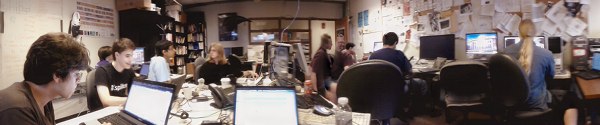
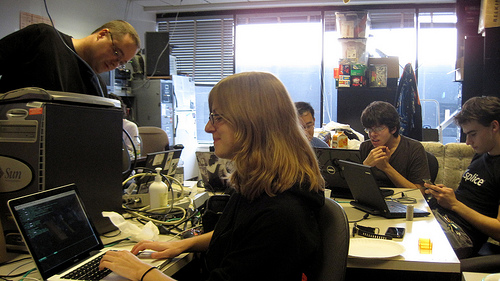
(Photo credit: Obey Arthur Liu; originally on Picasa, license.) Three weekends ago, I participated in a Debian bug squashing party. It was more fun than I had guessed! The event worked: we squashed bugs. Geoffrey Thomas (geofft) organized it as an event for MIT's student computing group, SIPB. In this post, I'll review the good parts and the bad. I'll conclude with beaming photos of my two mentees and talk about the bugs they fixed. So, the good:

The event was a success, but as always, there are some things that could have gone more smoothly. Here's that list: Still, it turned out well! I did three NMUs, corresponding to three patches submitted for release-critical bugs by my two mentees. Those mentees were: Jessica enjoying herself Jessica McKellar is a software engineer at Ksplice Oracle and a recent graduate of MIT's EECS program. She solved three release-critical bugs. This was her first direct contribution to Debian. In particular: Jessica has since gotten involved in the Twisted project's personal package archive. Toward the end of the sprint, she explained, "I like fixing bugs. I will totally come to the next bug squashing party." Noah grinning Noah Swartz is a recent graduate of Case Western Reserve University where he studied Mathematics and played Magic. He is an intern at the MIT Media Lab where he contributes to DoppelLab in Joe Paradiso's Responsive Environments group. This was definitely his first direct contribution to Debian. It was also one of the most intense command-line experiences he has had so far. Noah wasn't originally planning to come, but we were having lunch together before the hackathon, and I convinced him to join us. Noah fixed #625177, a fails-to-build-from-source (FTBFS) bug in nslint. The problem was that "-Wl" was instead written in all lowercase in the debian/rules file, as "-wl". Noah fixed that, making sure the package properly built in pbuilder, and then spent some quality time with lintian figuring out the right way to write a debian/changelog. That's a wrap! We'll hopefully have one again in a few months, and before that, I hope to write up a guide so that we run things even more smoothly next time.

31 August 2011

Axel Beckert: Useful but Unknown Unix Tools: How wdiff and colordiff help to choose the right Swiss Army Knife

In light of the fact that it seems possible to fit the plastic caps of a Debian branded Swiss Army Knife (Last orders today!) on an existing Swiss Army Knife (German written howto as PDF), I started to think about which Victorinox Cybertool would be the best fitting for me. And because the Victorinox comparison page doesn t really show diffs, just columns with floating text which are not very helpful for generating diffs in your head, I used command line tools for that purpose: wdiff Because the floating texts are not line- but just whitespace-based, the tool of choice is not diff but wdiff, a word-based diff. It encloses additions and removals in + + and [- -] blocks. (No, those aren t Japanese smileys although they look a lot like some. ^^). The easiest and clearest way is to copy and paste the texts from Victorinox comparison page into some text files and compare them with wdiff:
$ wdiff cybertool34.txt cybertool41.txt
+Schraubendreher 2.5mm,+ Pinzette, N hahle mit Nadel hr, +Holzs ge,+ Bit-Schl ssel( 5 mm Innensechskant f r die D-SUB Steckverbinder, 4 mm Innensechskant f r Bits, Bit Phillips 0, Bit Phillips 1, Bit-Schlitzschrauben 4 mm, Bit Phillips 2, Bit Hex 4 mm, Bit Torx 8, Bit Torx 10, Bit Torx 15 ), Kombizange( H lsenpresser, Drahtschneider ), Stech-Bohrahle, Kugelschreiber( auch zum DIP-Switch verstellen ), Mehrzweckhaken (Pakettr ger), +Metalls ge( Metallfeile, Nagelfeile, Nagelreiniger ),+ Dosen ffner( kleiner Schraubendreher ), Kleine Klinge, Grosse Klinge, Ring, inox, Mini-Schraubendreher, Kapselheber( Schraubendreher, Drahtabisolierer ), +Holzmeissel / Schaber,+ Bit-Halter, Stecknadel, inox, Schere, Korkenzieher, Zahnstocher
So this already extracted the information which are the seven tools which are in the Cybertool 41, but not in the Cybertool 34. Nevertheless the diff is still not easily recognizable on the first glance. There are several ways to help here. First wdiff has an option --no-common (the according short option is -3) which just shows added and removed words:
$ wdiff -3 cybertool34.txt cybertool41.txt
======================================================================
 +Schraubendreher 2.5mm,+ 
======================================================================
  +Holzs ge,+ 
======================================================================
  +Metalls ge( Metallfeile, Nagelfeile, Nagelreiniger ),+ 
======================================================================
  +Holzmeissel / Schaber,+ 
======================================================================
This is already way better to quickly recognize the actual differences. But if you still also want to see the common tools of the two knifes you need some visual help: One option is to use wdiff s --terminal (or short -t) option. Added words are then displayed inverse and removed words are shown underlined (background and foreground colors hardcoded as there is no invert colors style in CSS or HTML):

$ wdiff -t cybertool34.txt cybertool41.txt
Schraubendreher 2.5mm, Pinzette, N hahle mit Nadel hr, Holzs ge, Bit-Schl ssel( 5 mm Innensechskant f r die D-SUB Steckverbinder, 4 mm Innensechskant f r Bits, Bit Phillips 0, Bit Phillips 1, Bit-Schlitzschrauben 4 mm, Bit Phillips 2, Bit Hex 4 mm, Bit Torx 8, Bit Torx 10, Bit Torx 15 ), Kombizange( H lsenpresser, Drahtschneider ), Stech-Bohrahle, Kugelschreiber( auch zum DIP-Switch verstellen ), Mehrzweckhaken (Pakettr ger), Metalls ge( Metallfeile, Nagelfeile, Nagelreiniger ), Dosen ffner( kleiner Schraubendreher ), Kleine Klinge, Druckkugelschreiber, Grosse Klinge, Ring, inox, Mini-Schraubendreher, Kapselheber( Schraubendreher, Drahtabisolierer ), Holzmeissel / Schaber, Bit-Halter, Stecknadel, inox, Schere, Korkenzieher, Zahnstocher

But some still like to to use color instead of the contrast-rich inverse and the easily to oversee underlining. This is where colordiff comes into play: colordiff colordiff is like syntax highlighting for diffs on the command line. I works with classic and unified diffs as well as with wdiffs and debdiffs (the debdiff command is part of the devscripts package).
$ wdiff cybertool34.txt cybertool41.txt colordiff
+Schraubendreher 2.5mm,+ Pinzette, N hahle mit Nadel hr, +Holzs ge,+ Bit-Schl ssel( 5 mm Innensechskant f r die D-SUB Steckverbinder, 4 mm Innensechskant f r Bits, Bit Phillips 0, Bit Phillips 1, Bit-Schlitzschrauben 4 mm, Bit Phillips 2, Bit Hex 4 mm, Bit Torx 8, Bit Torx 10, Bit Torx 15 ), Kombizange( H lsenpresser, Drahtschneider ), Stech-Bohrahle, Kugelschreiber( auch zum DIP-Switch verstellen ), Mehrzweckhaken (Pakettr ger), +Metalls ge( Metallfeile, Nagelfeile, Nagelreiniger ),+ Dosen ffner( kleiner Schraubendreher ), Kleine Klinge, Grosse Klinge, Ring, inox, Mini-Schraubendreher, Kapselheber( Schraubendreher, Drahtabisolierer ), +Holzmeissel / Schaber,+ Bit-Halter, Stecknadel, inox, Schere, Korkenzieher, Zahnstocher
$ wdiff cybertool29.txt cybertool41.txt colordiff
+Schraubendreher 2.5mm,+ Pinzette, N hahle mit Nadel hr, +Holzs ge,+ Bit-Schl ssel( 5 mm Innensechskant f r die D-SUB Steckverbinder, 4 mm Innensechskant f r Bits, Bit Phillips 0, Bit Phillips 1, Bit-Schlitzschrauben 4 mm, Bit Phillips 2, Bit Hex 4 mm, Bit Torx 8, Bit Torx 10, Bit Torx 15 ), +Kombizange( H lsenpresser, Drahtschneider ),+ Stech-Bohrahle, +Kugelschreiber( auch zum DIP-Switch verstellen ), Mehrzweckhaken (Pakettr ger), Metalls ge( Metallfeile, Nagelfeile, Nagelreiniger ),+ Dosen ffner( kleiner Schraubendreher ), Kleine Klinge, [-Druckkugelschreiber,-] Grosse Klinge, Ring, inox, Mini-Schraubendreher, Kapselheber( Schraubendreher, Drahtabisolierer ), +Holzmeissel / Schaber,+ Bit-Halter, Stecknadel, inox, +Schere,+ Korkenzieher, Zahnstocher
(Coloured Screenshots done with ANSI HTML Adapter from the package aha.) Some, especially those who are used to git, are probably confused by the default choice of diff colors. This is easily fixable by writing the following into you ~/.colordiffrc:
newtext=green
oldtext=red
diffstuff=darkblue
cvsstuff=darkyellow
(See also /etc/colordiff for the defaults and hints.) colordiff has by the way two operating modes: So now let us compare the Cybertool 29 with Cybertool 34 in a normal diff (by using the texts from above and replacing all commata with newline characters) with git-like colors:
$ colordiff cybertool29-lines.txt cybertool34-lines.txt
12a13,14
> Kombizange( H lsenpresser
> Drahtschneider )
13a16,17
> Kugelschreiber( auch zum DIP-Switch verstellen )
> Mehrzweckhaken (Pakettr ger)
16d19
< Druckkugelschreiber
25a29
> Schere
Or as unifed diff with some context:
$ colordiff -u cybertool29-lines.txt cybertool34-lines.txt
--- cybertool29-lines.txt     2011-08-31 20:55:37.195546238 +0200
+++ cybertool34-lines.txt   2011-08-31 20:55:11.667710504 +0200
@@ -10,10 +10,13 @@
 Bit Torx 8
 Bit Torx 10
 Bit Torx 15 )
+Kombizange( H lsenpresser
+Drahtschneider )
 Stech-Bohrahle
+Kugelschreiber( auch zum DIP-Switch verstellen )
+Mehrzweckhaken (Pakettr ger)
 Dosen ffner( kleiner Schraubendreher )
 Kleine Klinge
-Druckkugelschreiber
 Grosse Klinge
 Ring
 inox
@@ -23,5 +26,6 @@
 Bit-Halter
 Stecknadel
 inox
+Schere
 Korkenzieher
 Zahnstocher
So if you want nicely colored diffs with Subversion like you re used to with git, you can use svn diff colordiff.

Russell Coker: Links August 2011

Alex Steffen gave an interesting TED talk summarising the ways that greater urban density can reduce energy use while increasing our quality of life [1]. Geoffrey West gave an interesting TED talk about the way animals, corporations, and cities scale [2]. The main factor is the way that various variables scale in proportion to size. On a logarithmic graph the growth of a city shows a steady increase in both positive factors such as wages and inventions and in negative factors such as crime as it grows larger. So it seems that we need to decrease the crime rate significantly to permit the growth of larger cities and therefore gain more efficiency. The Mankind Project (MKP) has a mission of redefining mature masculinity for the 21st Century [3]. They have some interesting ideas. Phillip Zimbardo gave a provocative TED talk about the demise of men [4]. He provided little evidence to support his claims though.

23 August 2011

Matthew Palmer: Oh HP, you Bucket of Fail

I recently got given a new printer, a HP LaserJet Professional 1 P1102w. It s fairly loudly touted on HP s website that this printer has Full support under Linux. And yet, it won t work with my Linux-based print server. Why? Because it uses a proprietary driver plugin, and that plugin is only available for x86 and amd64, and my print server is ARM-based. Well done, HP. You ve managed to revive the old all the world s a VAX philosophy, on an OS that is more than capable of running on practically anything. You got that for free. Why do you insist on screwing with it? As an added bonus, when I try to Ask a Question on the HPLIP website, to politely (ha!) inquire as to the possibility of an ARM binary, I get sent to Launchpad, which does nothing more than tell me that there is an Invalid OpenID transaction . That s the entire content of the page. Useful. Lies, damned lies, and a double helping of proprietary software fail. My day is complete.
  1. I use scarequotes around Professional because, as far as I can tell, this is just an entry-level personal laser printer. There is nothing particularly professional about it.

Next.

Previous.