Search Results: "mt"

10 July 2020

Iain R. Learmonth: Light OpenStreetMapping with GPS

Now that lockdown is lifting a bit in Scotland, I ve been going a bit further for exercise. One location I ve been to a few times is Tyrebagger Woods. In theory, I can walk here from my house via Brimmond Hill although I m not yet fit enough to do that in one go. Instead of following the main path, I took a detour along some route that looked like it wanted to be a path but it hadn t been maintained for a while. When I decided I d had enough of this, I looked for a way back to the main path but OpenStreetMap didn t seem to have the footpaths mapped out here yet. I ve done some OpenStreetMap surveying before so I thought I d take a look at improving this, and moving some of the tracks on the map closer to where they are in reality. In the past I ve used OSMTracker which was great, but now I m on iOS there doesn t seem to be anything that matches up. My new handheld radio, a Kenwood TH-D74 has the ability to record GPS logs so I thought I d give this a go. It records the logs to the SD card with one file per session. It s a very simple logger that records the NMEA strings as they are received. The only sentences I see in the file are GPGGA (Global Positioning System Fix Data) and GPRMC (Recommended Minimum Specific GPS/Transit Data). I tried to import this directly with JOSM but it seemed to throw an error and crash. I ve not investigated this, but I thought a way around could be to convert this to GPX format. This was easier than expected:
apt install gpsbabel
gpsbabel -i nmea -f "/sdcard/KENWOOD/TH-D74/GPS_LOG/25062020_165017.nme" \
                 -o gpx,gpxver=1.1 -F "/tmp/tyrebagger.gpx"
This imported into JOSM just fine and I was able to adjust some of the tracks to better fit where they actually are. I ll take the radio with me when I go in future and explore some of the other paths, to see if I can get the whole woods mapped out nicely. It is fun to just dive into the trees sometimes, along the paths that looks a little forgotten and overgrown, but also it s nice to be able to find your way out again when you get lost.

6 July 2020

Jonathan Dowland: Review: Roku Express

I don't generally write consumer reviews, here or elsewhere; but I have been so impressed by this one I wanted to mention it. For Holly's birthday this year, taking place under Lockdown, we decided to buy a year's subscription to "Disney+". Our current TV receiver (A Humax Freesat box) doesn't support it so I needed to find some other way to get it onto the TV. After a short bit of research, I bought the "Roku Express" streaming media player. This is the most basic streamer that Roku make, bottom of their range. For a little bit more money you can get a model which supports 4K (although my TV obviously doesn't: it, and the basic Roku, top out at 1080p) and a bit more gets you a "stick" form-factor and a Bluetooth remote (rather than line-of-sight IR). I paid 20 for the most basic model and it Just Works. The receiver is very small but sits comfortably next to my satellite receiver-box. I don't have any issues with line-of-sight for the IR remote (and I rely on a regular IR remote for the TV itself of course). It supports Disney+, but also all the other big name services, some of which we already use (Netflix, YouTube BBC iPlayer) and some of which we didn't, since it was too awkward to access them (Google Play, Amazon Prime Video). It has now largely displaced the FreeSat box for accessing streaming content because it works so well and everything is in one place. There's a phone App that remote-controls the box and works even better than the physical remote: it can offer a full phone-keyboard at times when you need to input text, and can mute the TV audio and put it out through headphones attached to the phone if you want. My aging Plasma TV suffers from burn-in from static pictures. If left paused for a duration the Roku goes to a screensaver that keeps the whole frame moving. The FreeSat doesn't do this. My Blu Ray player does, but (I think) it retains some static elements.

Reproducible Builds: Reproducible Builds in June 2020

Welcome to the June 2020 report from the Reproducible Builds project. In these reports we outline the most important things that we and the rest of the community have been up to over the past month.

What are reproducible builds? One of the original promises of open source software is that distributed peer review and transparency of process results in enhanced end-user security. But whilst anyone may inspect the source code of free and open source software for malicious flaws, almost all software today is distributed as pre-compiled binaries. This allows nefarious third-parties to compromise systems by injecting malicious code into seemingly secure software during the various compilation and distribution processes.

News The GitHub Security Lab published a long article on the discovery of a piece of malware designed to backdoor open source projects that used the build process and its resulting artifacts to spread itself. In the course of their analysis and investigation, the GitHub team uncovered 26 open source projects that were backdoored by this malware and were actively serving malicious code. (Full article) Carl Dong from Chaincode Labs uploaded a presentation on Bitcoin Build System Security and reproducible builds to YouTube: The app intended to trace infection chains of Covid-19 in Switzerland published information on how to perform a reproducible build. The Reproducible Builds project has received funding in the past from the Open Technology Fund (OTF) to reach specific technical goals, as well as to enable the project to meet in-person at our summits. The OTF has actually also assisted countless other organisations that promote transparent, civil society as well as those that provide tools to circumvent censorship and repressive surveillance. However, the OTF has now been threatened with closure. (More info) It was noticed that Reproducible Builds was mentioned in the book End-user Computer Security by Mark Fernandes (published by WikiBooks) in the section titled Detection of malware in software. Lastly, reproducible builds and other ideas around software supply chain were mentioned in a recent episode of the Ubuntu Podcast in a wider discussion about the Snap and application stores (at approx 16:00).

Distribution work In the ArchLinux distribution, a goal to remove .doctrees from installed files was created via Arch s TODO list mechanism. These .doctree files are caches generated by the Sphinx documentation generator when developing documentation so that Sphinx does not have to reparse all input files across runs. They should not be packaged, especially as they lead to the package being unreproducible as their pickled format contains unreproducible data. Jelle van der Waa and Eli Schwartz submitted various upstream patches to fix projects that install these by default. Dimitry Andric was able to determine why the reproducibility status of FreeBSD s base.txz depended on the number of CPU cores, attributing it to an optimisation made to the Clang C compiler [ ]. After further detailed discussion on the FreeBSD bug it was possible to get the binaries reproducible again [ ]. For the GNU Guix operating system, Vagrant Cascadian started a thread about collecting reproducibility metrics and Jan janneke Nieuwenhuizen posted that they had further reduced their bootstrap seed to 25% which is intended to reduce the amount of code to be audited to avoid potential compiler backdoors. In openSUSE, Bernhard M. Wiedemann published his monthly Reproducible Builds status update as well as made the following changes within the distribution itself:

Debian Holger Levsen filed three bugs (#961857, #961858 & #961859) against the reproducible-check tool that reports on the reproducible status of installed packages on a running Debian system. They were subsequently all fixed by Chris Lamb [ ][ ][ ]. Timo R hling filed a wishlist bug against the debhelper build tool impacting the reproducibility status of 100s of packages that use the CMake build system which led to a number of tests and next steps. [ ] Chris Lamb contributed to a conversation regarding the nondeterministic execution of order of Debian maintainer scripts that results in the arbitrary allocation of UNIX group IDs, referencing the Tails operating system s approach this [ ]. Vagrant Cascadian also added to a discussion regarding verification formats for reproducible builds. 47 reviews of Debian packages were added, 37 were updated and 69 were removed this month adding to our knowledge about identified issues. Chris Lamb identified and classified a new uids_gids_in_tarballs_generated_by_cmake_kde_package_app_templates issue [ ] and updated the paths_vary_due_to_usrmerge as deterministic issue, and Vagrant Cascadian updated the cmake_rpath_contains_build_path and gcc_captures_build_path issues. [ ][ ][ ]. Lastly, Debian Developer Bill Allombert started a mailing list thread regarding setting the -fdebug-prefix-map command-line argument via an environment variable and Holger Levsen also filed three bugs against the debrebuild Debian package rebuilder tool (#961861, #961862 & #961864).

Development On our website this month, Arnout Engelen added a link to our Mastodon account [ ] and moved the SOURCE_DATE_EPOCH git log example to another section [ ]. Chris Lamb also limited the number of news posts to avoid showing items from (for example) 2017 [ ]. strip-nondeterminism is our tool to remove specific non-deterministic results from a completed build. It is used automatically in most Debian package builds. This month, Mattia Rizzolo bumped the debhelper compatibility level to 13 [ ] and adjusted a related dependency to avoid potential circular dependency [ ].

Upstream work The Reproducible Builds project attempts to fix unreproducible packages and we try to to send all of our patches upstream. This month, we wrote a large number of such patches including: Bernhard M. Wiedemann also filed reports for frr (build fails on single-processor machines), ghc-yesod-static/git-annex (a filesystem ordering issue) and ooRexx (ASLR-related issue).

diffoscope diffoscope is our in-depth diff-on-steroids utility which helps us diagnose reproducibility issues in packages. It does not define reproducibility, but rather provides a helpful and human-readable guidance for packages that are not reproducible, rather than relying essentially-useless binary diffs. This month, Chris Lamb uploaded versions 147, 148 and 149 to Debian and made the following changes:
  • New features:
    • Add output from strings(1) to ELF binaries. (#148)
    • Dump PE32+ executables (such as EFI applications) using objdump(1). (#181)
    • Add support for Zsh shell completion. (#158)
  • Bug fixes:
    • Prevent a traceback when comparing PDF documents that did not contain metadata (ie. a PDF /Info stanza). (#150)
    • Fix compatibility with jsondiff version 1.2.0. (#159)
    • Fix an issue in GnuPG keybox file handling that left filenames in the diff. [ ]
    • Correct detection of JSON files due to missing call to File.recognizes that checks candidates against file(1). [ ]
  • Output improvements:
    • Use the CSS word-break property over manually adding U+200B zero-width spaces as these were making copy-pasting cumbersome. (!53)
    • Downgrade the tlsh warning message to an info level warning. (#29)
  • Logging improvements:
  • Testsuite improvements:
    • Update tests for file(1) version 5.39. (#179)
    • Drop accidentally-duplicated copy of the --diff-mask tests. [ ]
    • Don t mask an existing test. [ ]
  • Codebase improvements:
    • Replace obscure references to WF with Wagner-Fischer for clarity. [ ]
    • Use a semantic AbstractMissingType type instead of remembering to check for both types of missing files. [ ]
    • Add a comment regarding potential security issue in the .changes, .dsc and .buildinfo comparators. [ ]
    • Drop a large number of unused imports. [ ][ ][ ][ ][ ]
    • Make many code sections more Pythonic. [ ][ ][ ][ ]
    • Prevent some variable aliasing issues. [ ][ ][ ]
    • Use some tactical f-strings to tidy up code [ ][ ] and remove explicit u"unicode" strings [ ].
    • Refactor a large number of routines for clarity. [ ][ ][ ][ ]
trydiffoscope is the web-based version of diffoscope. This month, Chris Lamb also corrected the location for the celerybeat scheduler to ensure that the clean/tidy tasks are actually called which had caused an accidental resource exhaustion. (#12) In addition Jean-Romain Garnier made the following changes:
  • Fix the --new-file option when comparing directories by merging DirectoryContainer.compare and Container.compare. (#180)
  • Allow user to mask/filter diff output via --diff-mask=REGEX. (!51)
  • Make child pages open in new window in the --html-dir presenter format. [ ]
  • Improve the diffs in the --html-dir format. [ ][ ]
Lastly, Daniel Fullmer fixed the Coreboot filesystem comparator [ ] and Mattia Rizzolo prevented warnings from the tlsh fuzzy-matching library during tests [ ] and tweaked the build system to remove an unwanted .build directory [ ]. For the GNU Guix distribution Vagrant Cascadian updated the version of diffoscope to version 147 [ ] and later 148 [ ].

Testing framework We operate a large and many-featured Jenkins-based testing framework that powers tests.reproducible-builds.org. Amongst many other tasks, this tracks the status of our reproducibility efforts across many distributions as well as identifies any regressions that have been introduced. This month, Holger Levsen made the following changes:
  • Debian-related changes:
    • Prevent bogus failure emails from rsync2buildinfos.debian.net every night. [ ]
    • Merge a fix from David Bremner s database of .buildinfo files to include a fix regarding comparing source vs. binary package versions. [ ]
    • Only run the Debian package rebuilder job twice per day. [ ]
    • Increase bullseye scheduling. [ ]
  • System health status page:
    • Add a note displaying whether a node needs to be rebooted for a kernel upgrade. [ ]
    • Fix sorting order of failed jobs. [ ]
    • Expand footer to link to the related Jenkins job. [ ]
    • Add archlinux_html_pages, openwrt_rebuilder_today and openwrt_rebuilder_future to known broken jobs. [ ]
    • Add HTML <meta> header to refresh the page every 5 minutes. [ ]
    • Count the number of ignored jobs [ ], ignore permanently known broken jobs [ ] and jobs on known offline nodes [ ].
    • Only consider the known offline status from Git. [ ]
    • Various output improvements. [ ][ ]
  • Tools:
    • Switch URLs for the Grml Live Linux and PureOS package sets. [ ][ ]
    • Don t try to build a disorderfs Debian source package. [ ][ ][ ]
    • Stop building diffoscope as we are moving this to Salsa. [ ][ ]
    • Merge several is diffoscope up-to-date on every platform? test jobs into one [ ] and fail less noisily if the version in Debian cannot be determined [ ].
In addition: Marcus Hoffmann was added as a maintainer of the F-Droid reproducible checking components [ ], Jelle van der Waa updated the is diffoscope up-to-date in every platform check for Arch Linux and diffoscope [ ], Mattia Rizzolo backed up a copy of a remove script run on the Codethink-hosted jump server [ ] and Vagrant Cascadian temporarily disabled the fixfilepath on bullseye, to get better data about the ftbfs_due_to_f-file-prefix-map categorised issue. Lastly, the usual build node maintenance was performed by Holger Levsen [ ][ ], Mattia Rizzolo [ ] and Vagrant Cascadian [ ][ ][ ][ ][ ].

If you are interested in contributing to the Reproducible Builds project, please visit our Contribute page on our website. However, you can get in touch with us via:

This month s report was written by Bernhard M. Wiedemann, Chris Lamb, Eli Schwartz, Holger Levsen, Jelle van der Waa and Vagrant Cascadian. It was subsequently reviewed by a bunch of Reproducible Builds folks on IRC and the mailing list.

5 July 2020

Russell Coker: Debian S390X Emulation

I decided to setup some virtual machines for different architectures. One that I decided to try was S390X the latest 64bit version of the IBM mainframe. Here s how to do it, I tested on a host running Debian/Unstable but Buster should work in the same way. First you need to create a filesystem in an an image file with commands like the following:
truncate -s 4g /vmstore/s390x
mkfs.ext4 /vmstore/s390x
mount -o loop /vmstore/s390x /mnt/tmp
Then visit the Debian Netinst page [1] to download the S390X net install ISO. Then loopback mount it somewhere convenient like /mnt/tmp2. The package qemu-system-misc has the program for emulating a S390X system (among many others), the qemu-user-static package has the program for emulating S390X for a single program (IE a statically linked program or a chroot environment), you need this to run debootstrap. The following commands should be most of what you need.
# Install the basic packages you need
apt install qemu-system-misc qemu-user-static debootstrap
# List the support for different binary formats
update-binfmts --display
# qemu s390x needs exec stack to solve "Could not allocate dynamic translator buffer"
# so you probably need this on SE Linux systems
setsebool allow_execstack 1
# commands to do the main install
debootstrap --foreign --arch=s390x --no-check-gpg buster /mnt/tmp file:///mnt/tmp2
chroot /mnt/tmp /debootstrap/debootstrap --second-stage
# set the apt sources
cat << END > /mnt/tmp/etc/apt/sources.list
deb http://YOURLOCALMIRROR/pub/debian/ buster main
deb http://security.debian.org/ buster/updates main
END
# for minimal install do not want recommended packages
echo "APT::Install-Recommends False;" > /mnt/tmp/etc/apt/apt.conf
# update to latest packages
chroot /mnt/tmp apt update
chroot /mnt/tmp apt dist-upgrade
# install kernel, ssh, and build-essential
chroot /mnt/tmp apt install bash-completion locales linux-image-s390x man-db openssh-server build-essential
chroot /mnt/tmp dpkg-reconfigure locales
echo s390x > /mnt/tmp/etc/hostname
chroot /mnt/tmp passwd
# copy kernel and initrd
mkdir -p /boot/s390x
cp /mnt/tmp/boot/vmlinuz* /mnt/tmp/boot/initrd* /boot/s390x
# setup /etc/fstab
cat << END > /mnt/tmp/etc/fstab
/dev/vda / ext4 noatime 0 0
#/dev/vdb none swap defaults 0 0
END
# clean up
umount /mnt/tmp
umount /mnt/tmp2
# setcap binary for starting bridged networking
setcap cap_net_admin+ep /usr/lib/qemu/qemu-bridge-helper
# afterwards set the access on /etc/qemu/bridge.conf so it can only
# be read by the user/group permitted to start qemu/kvm
echo "allow all" > /etc/qemu/bridge.conf
Some of the above can be considered more as pseudo-code in shell script rather than an exact way of doing things. While you can copy and past all the above into a command line and have a reasonable chance of having it work I think it would be better to look at each command and decide whether it s right for you and whether you need to alter it slightly for your system. To run qemu as non-root you need to have a helper program with extra capabilities to setup bridged networking. I ve included that in the explanation because I think it s important to have all security options enabled. The -object rng-random,filename=/dev/urandom,id=rng0 -device virtio-rng-ccw,rng=rng0 part is to give entropy to the VM from the host, otherwise it will take ages to start sshd. Note that this is slightly but significantly different from the command used for other architectures (the ccw is the difference). I m not sure if noresume on the kernel command line is required, but it doesn t do any harm. The net.ifnames=0 stops systemd from renaming Ethernet devices. For the virtual networking the ccw again is a difference from other architectures. Here is a basic command to run a QEMU virtual S390X system. If all goes well it should give you a login: prompt on a curses based text display, you can then login as root and should be able to run dhclient eth0 and other similar commands to setup networking and allow ssh logins.
qemu-system-s390x -drive format=raw,file=/vmstore/s390x,if=virtio -object rng-random,filename=/dev/urandom,id=rng0 -device virtio-rng-ccw,rng=rng0 -nographic -m 1500 -smp 2 -kernel /boot/s390x/vmlinuz-4.19.0-9-s390x -initrd /boot/s390x/initrd.img-4.19.0-9-s390x -curses -append "net.ifnames=0 noresume root=/dev/vda ro" -device virtio-net-ccw,netdev=net0,mac=02:02:00:00:01:02 -netdev tap,id=net0,helper=/usr/lib/qemu/qemu-bridge-helper
Here is a slightly more complete QEMU command. It has 2 block devices, for root and swap. It has SE Linux enabled for the VM (SE Linux works nicely on S390X). I added the lockdown=confidentiality kernel security option even though it s not supported in 4.19 kernels, it doesn t do any harm and when I upgrade systems to newer kernels I won t have to remember to add it.
qemu-system-s390x -drive format=raw,file=/vmstore/s390x,if=virtio -drive format=raw,file=/vmswap/s390x,if=virtio -object rng-random,filename=/dev/urandom,id=rng0 -device virtio-rng-ccw,rng=rng0 -nographic -m 1500 -smp 2 -kernel /boot/s390x/vmlinuz-4.19.0-9-s390x -initrd /boot/s390x/initrd.img-4.19.0-9-s390x -curses -append "net.ifnames=0 noresume security=selinux root=/dev/vda ro lockdown=confidentiality" -device virtio-net-ccw,netdev=net0,mac=02:02:00:00:01:02 -netdev tap,id=net0,helper=/usr/lib/qemu/qemu-bridge-helper
Try It Out I ve got a S390X system online for a while, ssh root@s390x.coker.com.au with password SELINUX to try it out. PPC64 I ve tried running a PPC64 virtual machine, I did the same things to set it up and then tried launching it with the following result:
qemu-system-ppc64 -drive format=raw,file=/vmstore/ppc64,if=virtio -nographic -m 1024 -kernel /boot/ppc64/vmlinux-4.19.0-9-powerpc64le -initrd /boot/ppc64/initrd.img-4.19.0-9-powerpc64le -curses -append "root=/dev/vda ro"
Above is the minimal qemu command that I m using. Below is the result, it stops after the 4. from 4.19.0-9 . Note that I had originally tried with a more complete and usable set of options, but I trimmed it to the minimal needed to demonstrate the problem.
  Copyright (c) 2004, 2017 IBM Corporation All rights reserved.
  This program and the accompanying materials are made available
  under the terms of the BSD License available at
  http://www.opensource.org/licenses/bsd-license.php
Booting from memory...
Linux ppc64le
#1 SMP Debian 4.
The kernel is from the package linux-image-4.19.0-9-powerpc64le which is a dependency of the package linux-image-ppc64el in Debian/Buster. The program qemu-system-ppc64 is from version 5.0-5 of the qemu-system-ppc package. Any suggestions on what I should try next would be appreciated.

26 June 2020

Jonathan Dowland: Our Study

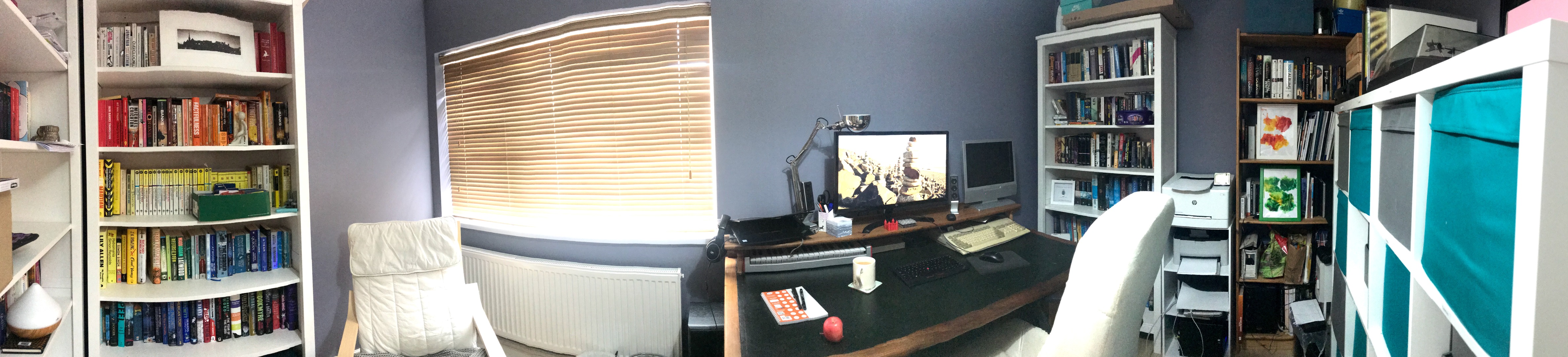
This is a fairly self-indulgent post, sorry! Encouraged by Evgeni, Michael and others, given I'm spending a lot more time at my desk in my home office, here's a picture of it:
Fisheye shot of my home office Fisheye shot of my home office
Near enough everything in the study is a work in progress. The KALLAX behind my desk is a recent addition (under duress) because we have nowhere else to put it. Sadly I can't see it going away any time soon. On the up-side, since Christmas I've had my record player and collection in and on top of it, so I can listen to records whilst working. The arm chair is a recent move from another room. It's a nice place to take some work calls, serving as a change of scene, and I hope to add a reading light sometime. The desk chair is some Ikea model I can't recall, which is sufficient, and just fits into the desk cavity. (I'm fairly sure my Aeron, inaccessible elsewhere, would not fit.) I've had this old mahogany, leather-topped desk since I was a teenager and it's a blessing and a curse. Mostly a blessing: It's a lovely big desk. The main drawback is it's very much not height adjustable. At the back is a custom made, full-width monitor stand/shelf, a recent gift produced to specification by my Dad, a retired carpenter. On the top: my work Thinkpad T470s laptop, geared more towards portable than powerful (my normal preference), although for the forseeable future it's going to remain in the exact same place; an Ikea desk lamp (I can't recall the model); a 27" 4K LG monitor, the cheapest such I could find when I bought it; an old LCD Analog TV, fantastic for vintage consoles and the like. Underneath: An Alesis Micron 2 octave analog-modelling synthesizer; various hubs and similar things; My Amiga 500. Like Evgeni, my normal keyboard is a ThinkPad Compact USB Keyboard with TrackPoint. I've been using different generations of these styles of keyboards for a long time now, initially because I loved the trackpoint pointer. I'm very curious about trying out mechanical keyboards, as I have very fond memories of my first IBM Model M buckled-spring keyboard, but I haven't dipped my toes into that money-trap just yet. The Thinkpad keyboard is rubber-dome, but it's a good one. Wedged between the right-hand bookcases are a stack of IT-related things: new printer; deprecated printer; old/spare/play laptops, docks and chargers; managed network switch; NAS.

10 June 2020

Jonathan Dowland: Template Haskell and Stream-processing programs

I've written about what Template Haskell is, and given an example of what it can be used for, it's time to explain why I was looking at it in the context of my PhD work. Encoding stream-processing programs StrIoT is an experimental distributed stream-processing system that myself and others are building in order to explore our research questions. A user of StrIoT writes a stream-processing program, using a set of 8 functional operators provided for the purpose. A simple example is
streamFn :: Stream Int -> Stream Int
streamFn = streamFilter (<15)
         . streamFilter (>5)
         . streamMap (*2)
Our system is distributed: we take a stream-processing program and partition it into sub-programs, which are distributed to and run on separate nodes (perhaps cloud instances, or embedded devices like Raspberry Pis etc.). In order to do that, we need to be able to manipulate the stream-processing program as data. We've initially opted for a graph data-structure, with the vertices in the graph defined as
data StreamVertex = StreamVertex
      vertexId   :: Int
    , operator   :: StreamOperator
    , parameters :: [String]
    , intype     :: String
    , outtype    :: String
      deriving (Eq,Show)
A stream-processing program encoded this way, equivalent to the first example
path [ StreamVertex 0 Map    ["(*2)"]  "Int" "Int"
     , StreamVertex 1 Filter ["(>5)"]  "Int" "Int"
     , StreamVertex 2 Filter ["(<15)"] "Int" "Int"
     ]
We can easily manipulate instances of such types, rewrite them, partition them and generate code from them. Unfortunately, this is quite a departure from the first simple code example from the perspective of a user writing their program. Template Haskell gives us the ability to manipulate code as a data structure, and also to inspect names to gather information about them (their type, etc.). I started looking at TH to see if we could build something where the user-supplied program was as close to that first case as possible. TH limitations There are two reasons that we can't easily manipulate a stream-processing definition written as in the first example. The following expressions are equivalent, in some sense, but are not equal, and so yield completely different expression trees when quasi-quoted:
[  streamFilter (<15) . streamFilter (>5) . streamMap (*2)  ]
  \s -> streamFilter (<15) (streamFilter (>5) (streamMap (*2) s))  ]
[  streamMap (*2) >>> streamFilter (>5) >>> streamFilter (<15)  ]
[  \s -> s & streamMap (*2) & streamFilter (>5) & streamFilter (<15)  ]
[  streamFn  ] -- a named expression, defined outside the quasi-quotes
In theory, reify can give you the definition of a function from its name, but in practice it doesn't, because this was never implemented. So at the very least we would need to insist that a user included the entirety of a stream-processing program within quasi-quotes, and not split it up into separate bits, with some bits defined outside the quotes and references within (as in the last case above). We would probably have to insist on a consistent approach for composing operators together, such as always use (.) and never >>>, &, etc. which is limiting. Incremental approach After a while ruminating on this, and before moving onto something else, I thought I'd try approaching it from the other side. Could I introduce some TH into the existing approach, and improve it? The first thing I've tried is to change the parameters field to TH's ExpQ, meaning the map instance example above would be
StreamVertex 0 Map [ [  (*2)  ] ] "Int" "Int"
I worked this through. It's an incremental improvement ease and clarity for the user writing a stream-processing program. It catches a class of programming bugs that would otherwise slip through: the expressions in the brackets have to be syntactically valid (although they aren't type checked). Some of the StrIoT internals are also much improved, particularly the logical operator. Here's an excerpt from a rewrite rule that involves composing code embedded in strings, dealing with all the escaping rules and hoping we've accounted for all possible incoming expression encodings:
let f' = "(let f = ("++f++"); p = ("++p++"); g = ("++g++") in\
         \ \\ (a,b) v -> (f a v, if p v a then g b v else b))"
    a' = "("++a++","++b++")"
    q' = "(let p = ("++p++"); q = ("++q++") in \\v (y,z) -> p v y && q v z)"
And the same section after, manipulating ExpQ types:
let f' = [  \ (a,b) v -> ($(f) a v, if $(p) v a then $(g) b v else b)  ]
    a' = [  ($(a), $(b))  ]
    q' = [  \v (y,z) -> $(p) v y && $(q) v z  ]
I think the code-generation part of StrIoT could be radically refactored to take advantage of this change but I have not made huge inroads into that. Next steps This is, probably, where I am going to stop. This work is very interesting to me but not the main thrust of my research. But incrementally improving the representation gave me some ideas of what I could try next: The type would have collapsed down to
data StreamVertex = StreamVertex
      vertexId   :: Int
    , opAndParams :: ExpQ
      deriving (Eq,Show)
Example instances might be
StreamVertex 0 [  streamMap (*2)  ]
StreamVertex 1 [  streamExpand  ]
StreamVertex 2 [  streamScan (\c _ -> c+1) 0  ]
The vertexId field is a bit of wart, but we require that due to the graph data structure that we are using. A change there could eliminate it, too. By this point we are not that far away from where we started, and certainly much closer to the "pure" function application in the very first example.

Jonathan Dowland: template haskell

I've been meaning to write more about my PhD work for absolutely ages, but I've held myself back by wanting to try and keep a narrative running through the blog posts. That's not realistic for a number of reasons so I'm going to just write about different aspects of things without worrying about whether they make sense in the context of recent blog posts or not. Part of what I am doing at the moment is investigating Template Haskell to see whether it would usefully improve our system implementation. Before I write more about how it might apply to our system, I'll first write a bit about Template Haskell itself. Template Haskell (TH) is a meta-programming system: you write programs that are executed at compile time and can output code to be spliced into the parent program. The approach used by TH is really nice: you perform your meta-programming in real first-class Haskell, and it integrates really well with the main program. TH provides two pairs of special brackets. Oxford brackets surrounding any Haskell expression cause the whole expression to be replaced by the result of parsing the expression an expression tree which can be inspected and manipulated by the main program:
[  \x -> x + 1  ]
The expression data-type is a series of mutually-recursive data types that represent the complete Haskell grammar. The top-level is Exp, for expression, which has constructors for the different expression types. The above lambda expression is represented as
LamE [VarP x_1]
    (InfixE (Just (VarE x_1))
            (VarE GHC.Num.+)
            (Just (LitE (IntegerL 1))))
Such expressions can be pattern-matched against, constructed, deconstructed etc just like any other data type. The other bracket type performs the opposite operation: it takes an expression structure and splices it into code in the main program, to be compiled as normal:
 > 1 + $( litE (IntegerL 1) )
2
The two are often intermixed, sometimes nested to several levels. What follows is a typical beginner TH meta-program. The standard function fst operators on a 2-tuple and returns the first value. It cannot operate on a tuple of a different valence. However, a meta-program can generate a version of fst specialised for an n-tuple of any n:
genfst n = do
    xs <- replicateM n (newName "x")
    let ntup = tupP (map varP xs)
    [  \ $(ntup) ->  $(varE (head xs))  ]
Used like so
 > $(genfst 2) (1,2)
1
 > $(genfst 3) ('a','b','c')
'a'
 > :t $(genfst 10)
$(genfst 10) :: (a, b, c, d, e, f, g, h, i, j) -> a
That's a high-level gist of how you can use TH. I've skipped over a lot of detail, in particular an important aspect relating to scope and naming, which is key to the problem I am exploring at the moment. Oxford brackets and slice brackets do not operate directly on the simple Exp data-type, but upon an Exp within the Q Monad:
 > :t [  1  ]
[  1  ] :: ExpQ
ExpQ is a synonym for Q Exp. Eagle-eyed Haskellers will have noticed that genfst above was written in terms of some Monad. And you might also have noticed the case discrepancy between the constructor types VarE (Etc) and varE, tupP, varP used in that function definition. These are convenience functions that wrap the relevant constructor in Q. The point of the Q Monad is (I think) to handle name scoping, and avoid unintended name clashes. Look at the output of these simple expressions, passed through runQ:
 > runQ [  \x -> x  ]
LamE [VarP x_1] (VarE x_1)
 > runQ [  \x -> x  ]
LamE [VarP x_2] (VarE x_2)
Those x are not the same x in the context they are evaluated (a GHCi session). And that's the crux of the problem I am exploring. More in a later blog post!

4 June 2020

Reproducible Builds: Reproducible Builds in May 2020

Welcome to the May 2020 report from the Reproducible Builds project. One of the original promises of open source software is that distributed peer review and transparency of process results in enhanced end-user security. Nonetheless, whilst anyone may inspect the source code of free and open source software for malicious flaws, almost all software today is distributed as pre-compiled binaries. This allows nefarious third-parties to compromise systems by injecting malicious code into seemingly secure software during the various compilation and distribution processes. In these reports we outline the most important things that we and the rest of the community have been up to over the past month.

News The Corona-Warn app that helps trace infection chains of SARS-CoV-2/COVID-19 in Germany had a feature request filed against it that it build reproducibly. A number of academics from Cornell University have published a paper titled Backstabber s Knife Collection which reviews various open source software supply chain attacks:
Recent years saw a number of supply chain attacks that leverage the increasing use of open source during software development, which is facilitated by dependency managers that automatically resolve, download and install hundreds of open source packages throughout the software life cycle.
In related news, the LineageOS Android distribution announced that a hacker had access to the infrastructure of their servers after exploiting an unpatched vulnerability. Marcin Jachymiak of the Sia decentralised cloud storage platform posted on their blog that their siac and siad utilities can now be built reproducibly:
This means that anyone can recreate the same binaries produced from our official release process. Now anyone can verify that the release binaries were created using the source code we say they were created from. No single person or computer needs to be trusted when producing the binaries now, which greatly reduces the attack surface for Sia users.
Synchronicity is a distributed build system for Rust build artifacts which have been published to crates.io. The goal of Synchronicity is to provide a distributed binary transparency system which is independent of any central operator. The Comparison of Linux distributions article on Wikipedia now features a Reproducible Builds column indicating whether distributions approach and progress towards achieving reproducible builds.

Distribution work In Debian this month: In Alpine Linux, an issue was filed and closed regarding the reproducibility of .apk packages. Allan McRae of the ArchLinux project posted their third Reproducible builds progress report to the arch-dev-public mailing list which includes the following call for help:
We also need help to investigate and fix the packages that fail to reproduce that we have not investigated as of yet.
In openSUSE, Bernhard M. Wiedemann published his monthly Reproducible Builds status update.

Software development

diffoscope Chris Lamb made the changes listed below to diffoscope, our in-depth and content-aware diff utility that can locate and diagnose reproducibility issues. He also prepared and uploaded versions 142, 143, 144, 145 and 146 to Debian, PyPI, etc.
  • Comparison improvements:
    • Improve fuzzy matching of JSON files as file now supports recognising JSON data. (#106)
    • Refactor .changes and .buildinfo handling to show all details (including the GnuPG header and footer components) even when referenced files are not present. (#122)
    • Use our BuildinfoFile comparator (etc.) regardless of whether the associated files (such as the orig.tar.gz and the .deb) are present. [ ]
    • Include GnuPG signature data when comparing .buildinfo, .changes, etc. [ ]
    • Add support for printing Android APK signatures via apksigner(1). (#121)
    • Identify iOS App Zip archive data as .zip files. (#116)
    • Add support for Apple Xcode .mobilepovision files. (#113)
  • Bug fixes:
    • Don t print a traceback if we pass a single, missing argument to diffoscope (eg. a JSON diff to re-load). [ ]
    • Correct differences typo in the ApkFile handler. (#127)
  • Output improvements:
    • Never emit the same id="foo" anchor reference twice in the HTML output, otherwise identically-named parts will not be able to linked to via a #foo anchor. (#120)
    • Never emit an empty id anchor either; it is not possible to link to #. [ ]
    • Don t pretty-print the output when using the --json presenter; it will usually be too complicated to be readable by the human anyway. [ ]
    • Use the SHA256 over MD5 hash when generating page names for the HTML directory-style presenter. (#124)
  • Reporting improvements:
    • Clarify the message when we truncate the number of lines to standard error [ ] and reduce the number of maximum lines printed to 25 as usually the error is obvious by then [ ].
    • Print the amount of free space that we have available in our temporary directory as a debugging message. [ ]
    • Clarify Command [ ] failed with exit code messages to remove duplicate exited with exit but also to note that diffoscope is interpreting this as an error. [ ]
    • Don t leak the full path of the temporary directory in Command [ ] exited with 1 messages. (#126)
    • Clarify the warning message when we cannot import the debian Python module. [ ]
    • Don t repeat stderr from if both commands emit the same output. [ ]
    • Clarify that an external command emits for both files, otherwise it can look like we are repeating itself when, in reality, it is being run twice. [ ]
  • Testsuite improvements:
    • Prevent apksigner test failures due to lack of binfmt_misc, eg. on Salsa CI and elsewhere. [ ]
    • Drop .travis.yml as we use Salsa instead. [ ]
  • Dockerfile improvements:
    • Add a .dockerignore file to whitelist files we actually need in our container. (#105)
    • Use ARG instead of ENV when setting up the DEBIAN_FRONTEND environment variable at runtime. (#103)
    • Run as a non-root user in container. (#102)
    • Install/remove the build-essential during build so we can install the recommended packages from Git. [ ]
  • Codebase improvements:
    • Bump the officially required version of Python from 3.5 to 3.6. (#117)
    • Drop the (default) shell=False keyword argument to subprocess.Popen so that the potentially-unsafe shell=True is more obvious. [ ]
    • Perform string normalisation in Black [ ] and include the Black output in the assertion failure too [ ].
    • Inline MissingFile s special handling of deb822 to prevent leaking through abstract layers. [ ][ ]
    • Allow a bare try/except block when cleaning up temporary files with respect to the flake8 quality assurance tool. [ ]
    • Rename in_dsc_path to dsc_in_same_dir to clarify the use of this variable. [ ]
    • Abstract out the duplicated parts of the debian_fallback class [ ] and add descriptions for the file types. [ ]
    • Various commenting and internal documentation improvements. [ ][ ]
    • Rename the Openssl command class to OpenSSLPKCS7 to accommodate other command names with this prefix. [ ]
  • Misc:
    • Rename the --debugger command-line argument to --pdb. [ ]
    • Normalise filesystem stat(2) birth times (ie. st_birthtime) in the same way we do with the stat(1) command s Access: and Change: times to fix a nondeterministic build failure in GNU Guix. (#74)
    • Ignore case when ordering our file format descriptions. [ ]
    • Drop, add and tidy various module imports. [ ][ ][ ][ ]
In addition:
  • Jean-Romain Garnier fixed a general issue where, for example, LibarchiveMember s has_same_content method was called regardless of the underlying type of file. [ ]
  • Daniel Fullmer fixed an issue where some filesystems could only be mounted read-only. (!49)
  • Emanuel Bronshtein provided a patch to prevent a build of the Docker image containing parts of the build s. (#123)
  • Mattia Rizzolo added an entry to debian/py3dist-overrides to ensure the rpm-python module is used in package dependencies (#89) and moved to using the new execute_after_* and execute_before_* Debhelper rules [ ].

Chris Lamb also performed a huge overhaul of diffoscope s website:
  • Add a completely new design. [ ][ ]
  • Dynamically generate our contributor list [ ] and supported file formats [ ] from the main Git repository.
  • Add a separate, canonical page for every new release. [ ][ ][ ]
  • Generate a latest release section and display that with the corresponding date on the homepage. [ ]
  • Add an RSS feed of our releases [ ][ ][ ][ ][ ] and add to Planet Debian [ ].
  • Use Jekyll s absolute_url and relative_url where possible [ ][ ] and move a number of configuration variables to _config.yml [ ][ ].

Upstream patches The Reproducible Builds project detects, dissects and attempts to fix as many currently-unreproducible packages as possible. We endeavour to send all of our patches upstream where appropriate. This month, we wrote a large number of such patches, including:

Other tools Elsewhere in our tooling: strip-nondeterminism is our tool to remove specific non-deterministic results from a completed build. In May, Chris Lamb uploaded version 1.8.1-1 to Debian unstable and Bernhard M. Wiedemann fixed an off-by-one error when parsing PNG image modification times. (#16) In disorderfs, our FUSE-based filesystem that deliberately introduces non-determinism into directory system calls in order to flush out reproducibility issues, Chris Lamb replaced the term dirents in place of directory entries in human-readable output/log messages [ ] and used the astyle source code formatter with the default settings to the main disorderfs.cpp source file [ ]. Holger Levsen bumped the debhelper-compat level to 13 in disorderfs [ ] and reprotest [ ], and for the GNU Guix distribution Vagrant Cascadian updated the versions of disorderfs to version 0.5.10 [ ] and diffoscope to version 145 [ ].

Project documentation & website
  • Carl Dong:
  • Chris Lamb:
    • Rename the Who page to Projects . [ ]
    • Ensure that Jekyll enters the _docs subdirectory to find the _docs/index.md file after an internal move. (#27)
    • Wrap ltmain.sh etc. in preformatted quotes. [ ]
    • Wrap the SOURCE_DATE_EPOCH Python examples onto more lines to prevent visual overflow on the page. [ ]
    • Correct a preferred spelling error. [ ]
  • Holger Levsen:
    • Sort our Academic publications page by publication year [ ] and add Trusting Trust and Fully Countering Trusting Trust through Diverse Double-Compiling [ ].
  • Juri Dispan:

Testing framework We operate a large and many-featured Jenkins-based testing framework that powers tests.reproducible-builds.org that, amongst many other tasks, tracks the status of our reproducibility efforts as well as identifies any regressions that have been introduced. Holger Levsen made the following changes:
  • System health status:
    • Improve page description. [ ]
    • Add more weight to proxy failures. [ ]
    • More verbose debug/failure messages. [ ][ ][ ]
    • Work around strangeness in the Bash shell let VARIABLE=0 exits with an error. [ ]
  • Debian:
    • Fail loudly if there are more than three .buildinfo files with the same name. [ ]
    • Fix a typo which prevented /usr merge variation on Debian unstable. [ ]
    • Temporarily ignore PHP s horde](https://www.horde.org/) packages in Debian bullseye. [ ]
    • Document how to reboot all nodes in parallel, working around molly-guard. [ ]
  • Further work on a Debian package rebuilder:
    • Workaround and document various issues in the debrebuild script. [ ][ ][ ][ ]
    • Improve output in the case of errors. [ ][ ][ ][ ]
    • Improve documentation and future goals [ ][ ][ ][ ], in particular documentiing two real world tests case for an impossible to recreate build environment [ ].
    • Find the right source package to rebuild. [ ]
    • Increase the frequency we run the script. [ ][ ][ ][ ]
    • Improve downloading and selection of the sources to build. [ ][ ][ ]
    • Improve version string handling.. [ ]
    • Handle build failures better. [ ]. [ ]. [ ]
    • Also consider architecture all .buildinfo files. [ ][ ]
In addition:
  • kpcyrd, for Alpine Linux, updated the alpine_schroot.sh script now that a patch for abuild had been released upstream. [ ]
  • Alexander Couzens of the OpenWrt project renamed the brcm47xx target to bcm47xx. [ ]
  • Mattia Rizzolo fixed the printing of the build environment during the second build [ ][ ][ ] and made a number of improvements to the script that deploys Jenkins across our infrastructure [ ][ ][ ].
Lastly, Vagrant Cascadian clarified in the documentation that you need to be user jenkins to run the blacklist command [ ] and the usual build node maintenance was performed was performed by Holger Levsen [ ][ ][ ], Mattia Rizzolo [ ][ ] and Vagrant Cascadian [ ][ ][ ].

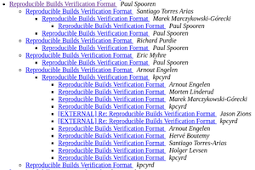
Mailing list: There were a number of discussions on our mailing list this month: Paul Spooren started a thread titled Reproducible Builds Verification Format which reopens the discussion around a schema for sharing the results from distributed rebuilders:
To make the results accessible, storable and create tools around them, they should all follow the same schema, a reproducible builds verification format. The format tries to be as generic as possible to cover all open source projects offering precompiled source code. It stores the rebuilder results of what is reproducible and what not.
Hans-Christoph Steiner of the Guardian Project also continued his previous discussion regarding making our website translatable. Lastly, Leo Wandersleb posted a detailed request for feedback on a question of supply chain security and other issues of software review; Leo is the founder of the Wallet Scrutiny project which aims to prove the security of Android Bitcoin Wallets:
Do you own your Bitcoins or do you trust that your app allows you to use your coins while they are actually controlled by them ? Do you have a backup? Do they have a copy they didn t tell you about? Did anybody check the wallet for deliberate backdoors or vulnerabilities? Could anybody check the wallet for those?
Elsewhere, Leo had posted instructions on his attempts to reproduce the binaries for the BlueWallet Bitcoin wallet for iOS and Android platforms.


If you are interested in contributing to the Reproducible Builds project, please visit our Contribute page on our website. However, you can get in touch with us via:

This month s report was written by Bernhard M. Wiedemann, Chris Lamb, Holger Levsen, Jelle van der Waa and Vagrant Cascadian. It was subsequently reviewed by a bunch of Reproducible Builds folks on IRC and the mailing list.

3 June 2020

Jonathan Dowland: using Template Haskell to generate boilerplate

Here's a practical example of applying Template Haskell to reduce the amount of boilerplate code that is otherwise required. I wrote the below after following this excellent blog post by Matt Parsons. This post will be much higher-level, read Matt's blog for the gorier details. Liquorice Liquorice is a toy project of mine from a few years ago that lets you draw 2D geometric structures similar to LOGO. Liquorice offers two interfaces: pure functions that operate on an explicit Context (the pen location: existing lines, etc.), and a second "stateful" interface where the input and output are handled in the background. I prefix the pure ones P. and the stateful ones S. in this blog post for clarity. The stateful interface can be much nicer to use for larger drawings. Compare example8b.hs, written in terms of the pure functions, and the stateful equivalent example8.hs. The majority of the stateful functions are "wrapped" versions of the pure functions. For example, the pure function P.step takes two numbers and moves the pen forward and sideways. Its type signature is
P.step :: Int -> Int -> Context -> Context
Here's the signature and implementation of the stateful equivalent:
S.step :: Int -> Int -> State Context ()
S.step x y = modify (P.step x y)
Writing these wrapped functions for the 29 pure functions is boilerplate that can be generated automatically with Template Haskell. Generating the wrapper functions Given the Name of a function to wrap, we construct an instance of FunD, the TH data-type representing a function definition. We use the base name of the incoming function as the name for the new one.
mkWrap fn = do
     
    let name = mkName (nameBase fn)
    return $ FunD name [ Clause (map VarP args) (NormalB rhs) [] ]
To determine how many arguments the wrapper function needs to accept, we need to determine the input function's arity. We use Template Haskell's reify function to get type information about the function, and derive the arity from that. Matt Parson's covers this exactly in his blog.
info    <- reify fn
let ty   = (\(VarI _ t _ ) -> t) info
let n    = arity ty - 1
args    <- replicateM n (newName "arg")
We can use the list "args" directly in the clause part of the function definition, as the data-type expects a list. For the right-hand side, we need to convert from a list of arguments to function application. That's a simple left-fold:
-- mkFnApp f [a,b,c] => ((f a) b) c => f a b c
mkFnApp = foldl (\e -> appE e . varE)
rhs     <- [  modify $(mkFnApp (varE fn) args) :: State Context ()  ]
We use TH's oxford brackets for the definition of rhs. This permits us to write real Haskell inside the brackets, and get an expression data-type outside them. Within we have a splice (the $( )), which does the opposite: the code is evaluated at compile time and generates an Exp that is then converted into the equivalent Haskell code and spliced into place. Finally, we need to apply the above to a list of Names. Sadly, we can't get at the list of exported names from a Module automatically. There is an open request for a TH extension for this. In the meantime, we export a list of the functions to wrap from the Pure module and operate on that
import Liquorice.Pure
wrapPureFunctions = mapM mkWrap pureFns
Finally, we 'call' wrapPureFunctions at the top level in our state module and Template Haskell splices all the function definitions into place. The final code ended up only around 30 lines of code, and saved about the same number of lines of boilerplate. But in doing this I noticed some missing functions, and it will pay dividends if more pure functions are added. Limitations The current implementation has one significant limitation: it cannot handle higher-order functions. An example of a pure higher-order function is place, which moves the pen, performs an operation, and then moves it back:
P.place :: Int -> Int -> (Context -> Context) -> Context -> Context
Wrapping this is not sufficient because the higher-order parameter has the pure function signature Context -> Context. If we wrapped it, the stateful version of the function would accept a pure function as the parameter, but you would expect it to accept another stateful function. To handle these, at a minimum we would need to detect the function arguments that have type Context -> Context and replace them with State Context (). The right-hand side of the wrapped function would also need to do more work to handle wrapping and unwrapping the parameter. I haven't spent much time thinking about it but I'm not sure that a general purpose wrapper would work for all higher-order functions. For the time being I've just re-implemented the half-dozen of them.

Olivier Berger: Automate the capture a full BigBlueButton conference replay, with bbb-downloader

BigBlueButton, aka BBB, is a webrtc conferencing solution, that among many features, allows to record a conference, for later replay. We have been working together with my colleague Fran ois Trahay, on a set of scripts (bbb-downloader) that will allow to easily (on Linux) download recordings of BBB conferences, for local backup, video editing, upload on video sharing platforms, etc. This is particularly useful in our distance learning contexts where students may have to catch up on a live session that was recorded. We have integrated a hackish solution to capture, as a single video, presentations that contained slide deck presentations. Let me explain why this was necessary. A nice feature of BBB is the fact that, to present a slides deck, you don t need to share your screen (as a video stream), but just have to upload your file, which is then auto-converted to images, that are sent to participants, in sync with your next/previous browsing of the slides. This is great for participants with low bandwidth, which can see the slides ( static images) instead of receiving a full screen video stream. But a side effect is that the recording of a class/conference that is done by BBB replays the slides just as it was done live : displaying images one after the other. While it is easy to retrieve the audio, webcams of participants, or screen sharings as video streams, directly available from the recordings replay app, it is thus not the same for the slides, which don t come as a video. Our script will perform a replay, using a Docker container which drives Selenium under the hood, to capture the full replay, as a single video, which then includes the slides and everything. You can see my demo of this process in the following video: bbb-downloader full capture demo. It takes long to replay, in real-time, the recordings, to perform this capture but it works. Kudos to elgalu/docker-selenium for the Docker env. Feel free to test it and profit, or to report issues in the Guthub issues of the repo: https://github.com/trahay/bbb-downloader/.

2 June 2020

Olivier Berger: Mixing NRELab s Antidote and Eclipse Che on the same k8s cluster

You may have heard of my search for Cloud solutions to run labs in an academic context, with a focus on free an open source solutions . You may read previous installments of this blog, or for a shorter, check the presentation I ve recorded last week. I ve become quite interested, in the latest month, in 2 projects: NRELab s Antidote and Eclipse Che. Antidote is the software that powers NRELabs, a labs platform for learning network automation, which runs on top of Kubernetes (k8s). The interesting thing is that for each learner, there can be a dedicated k8s namespace with multiple virtual nodes running on a separate network. This can be used in the context of virtual classes/labs where our students will perform network labs in parallel on the same cluster. Eclipse Che powers Eclipse on the Cloud , making available software development environments, for developers, on a Kubernetes Cloud. Developers typically work from a Web page instead of installing local development tools. Both projects seem quite complementary. For one, we both teach networks and software developments. So that would naturally appeal for many professors. Furthermore, Eclipse Che provides a few features that Antidote is lacking : authenticating users (with keycloak), and persisting their work in workspaces, between work sessions. Typically what we need in our academic context where students will work on the same labs during scheduled classes, week after week, during or off-hours. Thus it would be great to have more integration between the 2 environments. I intend to work on that front, but that takes time, as running stuff on Kubernetes isn t exactly trivial, at least when you re like me and want to use a vanilla kubernetes. I ve mainly relied on running k8s inside VMs using Vagrant and/or minikube so far. A first milestone I ve achieved is making sure that Antidote and Eclipse Che aren t incompatible. Antidote s selfmedicate script was actually running inside a Vagrant VM, where I had difficulties installing Eclipse Che (probably because of old software, or particular networking setup details). I ve overcome this hurdle, as I m now able to install both environments on a single Kubernetes VM (using my own Vagrant setup). Running Eclipse Che (alongsite Antidote) on a k8s Vagrant VM. This proves only that there s no show stopper there, but a lot of work remains. Stay tuned. Update: I ve finally managed to get it to work on the antidote-selfmedicate base too. See my branch at: https://github.com/olberger/antidote-selfmedicate/tree/che

Lisandro Dami n Nicanor P rez Meyer: Simplified Monitoring of Patients in Situations of Mass Hospitalization (MoSimPa) - Fighting COVID-19

I have been quite absent from Debian stuff lately, but this increased since COVID-19 hits us. In this blog post I'll try to sketch what I have been doing to help fight COVID-19 this last few months.

In the beginningWhen the pandemic reached Argentina the government started a quarantine. We engineers (like engineers around the world) started to think on how to put our abilities in order to help with the situation. Some worked toward providing more protection elements to medical staff, some towards increasing the number of ventilation machines at disposal. Another group of people started thinking on another ways of helping. In Bah a Blanca arised the idea of monitoring some variables remotely and in masse.

Simplified Monitoring of Patients in Situations of Mass Hospitalization (MoSimPa)

This is where the idea of remotely monitored devices came in, and MoSimPa (from the spanish of "monitoreo simplificado de pacientes en situaci n de internaci n masiva") started to get form. The idea is simple: oximetry (SpO2), heart rate and body temperature will be recorded and, instead of being shown in a display in the device itself, they will be transmitted and monitored in one or more places. In this way medical staff doesn't has to reach a patient constantly and monitoring could be done by medical staff for more patients at the same time. In place monitoring can also happen using a cellphone or tablet.

The devices do not have a screen of their own and almost no buttons, making them more cheap to build and thus more in line with the current economic reality of Argentina.


This is where the project Para Ayudar was created. The project aims to produce the aforementioned non-invasive device to be used in health institutions, hospitals, intra hospital transports and homes.

It is worth to note that the system is designed as a complementary measure for continuous monitoring of a pacient. Care should be taken to check that symptomps and overall patient status don't mean an inmediate life threat. In other words, it is NOT designed for ICUs.

All the above done with Free/Libre/Open Source software and hardware designs. Any manufacturing company can then use them for mass production.

The importance of early pneumonia detection


We were already working in MoSimPa when an NYTimes article caught or attention: "The Infection That s Silently Killing Coronavirus Patients". From the article:

A vast majority of Covid pneumonia patients I met had remarkably low oxygen saturations at triage seemingly incompatible with life but they were using their cellphones as we put them on monitors. Although breathing fast, they had relatively minimal apparent distress, despite dangerously low oxygen levels and terrible pneumonia on chest X-rays.

This greatly reinforced the idea we were on the right track.

The project from a technical standpoint


As the project is primarily designed for and by Argentinians the current system design and software documentation is written in spanish, but the source code (or at least most of it) is written in english. Should anyone need it in english please do not hesitate in asking me.

General system description

System schema

The system is comprised of the devices, a main machine acting as a server (in our case for small setups a Raspberry Pi) and the possibility of accessing data trough cell phones, tablets or other PCs in the network.

The hardware


As of today this is the only part in which I still can't provide schematics, but I'll update this blog post and technical doc with them as soon as I get my hands into them.

Again the design is due to be built in Argentina where getting our hands on hardware is not easy. Moreover it needs to be as cheap as possible, specially now that the Argentinian currency, the peso, is every day more depreciated. So we decided on using an ESP32 as the main microprocessor and a set of Maxim sensors devices. Again, more info when I have them at hand.

The software


Here we have many more components to describe. Firstly the ESP32 code is done with the Arduino SDK. This part of the stack will receive many updates soon, as soon as the first hardware prototypes are out.

For the rest of the stack I decided to go ahead with whatever is available in Debian stable. Why? Well, Raspbian provides a Debian stable-based image and I'm a Debian Developer, so things should go just natural for me in that front. Of course each component has its own packaging. I'm one of Debian's Qt maintainers then using Qt will also be quite natural for me. Plots? Qwt, of course. And with that I have most of my necessities fulfilled. I choose PostgreSql as database server and Mosquitto as MQTT broker.

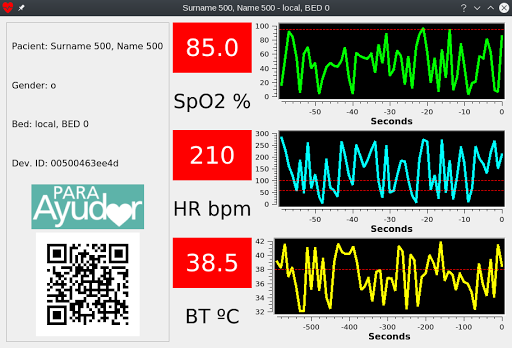
Between the database and MQTT is mosimpa-datakeeper. The piece of software from which medical staff monitor patients is unsurprisingly called mosimpa-monitor.

mosimpa-monitor
MoSimPa's monitor main screen

mosimpa-monitor plots
Plots of a patient's data


mosimpa-monitor-alarms-setup
Alarm thresholds setup


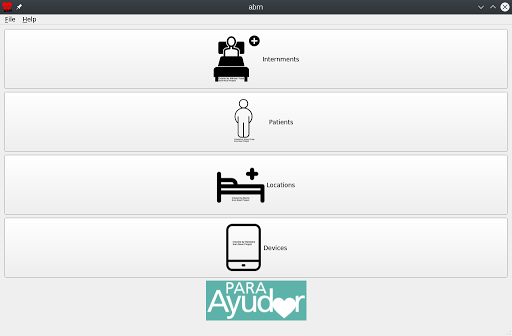
And for managing patients, devices, locations and internments (CRUD anyone?) there is currently a Qt-based application called mosimpa-abm.

mosimpa-abm
ABM main screen


mosimpa-abm-internments
ABM internments view

The idea is to replace it with a web service so it doesn't needs to be confined to the RPi or require installations in other machines. I considered using webassembly but I would have to also build PostgreSql in order to compile Qt's plugin.

Translations? Of course! As I have already mentioned the code is written in English. Qt allows to easily translate applications, so I keep a Spanish one as the code changes (and we are primarily targeting spanish-speaking people). But of course this also means it can be easily translated to whichever language is necessary.

Even if I am a packager I still have some stuff to fix from the packaging itself, like letting datakeeper run with its own user. I just haven't got to it yet.


Certifications


We are working towards getting the system certified by ANMAT, which is the Argentinian equivalent for EEUU's FDA.

Funding


While all the people involved are working ad-honorem funding is still required in order to buy materials, create the prototypes, etc. The project created payments links with Mercado Pago (in spanish and argentinian pesos) and other bank methods (PDF, also in spanish).

I repeat the links here with an aproximation to US$.

- 500 AR$ (less than 8 US$)
- 1000 AR$ (less than 15 US$)
- 2000 AR$ (less than 30 US$)
- 3000 AR$ (less than 45 US$)
- 5000 AR$ (less than 75 US$)

You can check the actual convertion rate in https://www.google.com/search?q=argentine+peso+to+us+dollars

The project was also presented at a funding call of argentinian Agencia de Promoci n de la Investigaci n, el Desarrollo Tecnol gico y la Innovaci n (Agencia I+D+i). 900+ projects where presented and 64 funded, MoSimPa between them.

Olivier Berger: Experimenting on distant labs and labs on the Cloud

I have delivered a speech last week about some ideas and experiments I have about the use of remote access and Cloud technologies for labs. I have collected the speech recording and stuff, in french, in another post. The presentation was in french originaly, so I ve quickly translated my slides and recorded an english version. I mention tools like Guacamole, MeshCentral, NRELab s Antidote, Eclipse Che and Labtainers, as well as k8s and Docker, as interesting tools that may allow us to continue teaching in labs while allowing more flexibility, distant learning, and hopefully improved quality. You can find the slides here: https://speakerdeck.com/oberger/experimenting-on-distant-labs-and-labs-on-the-cloud, and the recording is here: Experimenting on distant labs and labs on the Cloud.

31 May 2020

Chris Lamb: Free software activities in May 2020

Here is my monthly update covering what I have been doing in the free software world during May 2020 (previous month): In Lintian, the static analysis tool for Debian packages:
Reproducible builds One of the original promises of open source software is that distributed peer review and transparency of process results in enhanced end-user security. However, whilst anyone may inspect the source code of free and open source software for malicious flaws, almost all software today is distributed as pre-compiled binaries. This allows nefarious third-parties to compromise systems by injecting malicious code into ostensibly secure software during the various compilation and distribution processes. The motivation behind the Reproducible Builds effort is to ensure no flaws have been introduced during this compilation process by promising identical results are always generated from a given source, thus allowing multiple third-parties to come to a consensus on whether a build was compromised. The initiative is proud to be a member project of the Software Freedom Conservancy, a not-for-profit 501(c)(3) charity focused on ethical technology and user freedom. Conservancy acts as a corporate umbrella allowing projects to operate as non-profit initiatives without managing their own corporate structure. If you like the work of the Conservancy or the Reproducible Builds project, please consider becoming an official supporter.
Elsewhere in our tooling, I made the following changes to diffoscope, our in-depth and content-aware diff utility that can locate and diagnose reproducibility issues, including preparing and uploading versions 142, 143, 144, 145 and 146 to Debian: I also performed a huge overhaul of diffoscope's website:
Lastly, I made a large number of changes to the main Reproducible Builds website and documentation:
Debian LTS This month I contributed 17 hours to Debian Long Term Support (LTS) and 9 hours on its sister Extended LTS project. You can find out more about the two projects via the following video:
Debian I filed the following bug reports in Debian this month: I also filed a number of bugs against packages that are not compatible with Django 3.x, (organised around a single master bug) including django-taggit, sorl-thumbnail, django-simple-captcha, django-cas-server, django-cors-headers, python-django-csp, django-pipeline, python-django-jsonfield, python-django-contact-form, django-model-utils, django-fsm, django-modeltranslation, django-oauth-toolkit, libthumbor, python-django-extensions, python-django-imagekit, python-django-navtag, python-django-tagging, djangorestframework, django-haystack, django-taggit, django-simple-captcha, python-django-registration, python-django-pyscss, python-django-compressor, python-django-crispy-forms & python-django-mptt,
Lastly, I made the following uploads to Debian: I also sponsored an upload for adminer (4.7.7-1), also uploading it to buster-backports.

Jonathan Dowland: Golf Peaks

tricky tricky
This one was a bit of a surprise hit. Golf Peaks is a Golf-themed puzzle game. The objective is to get the golf ball into the hole, obviously, but how you do that is by choosing from a set of fixed moves (e.g., move one square; jump one square; etc.) and a direction. This works well with my eldest daughter. She takes one joy-con and I take the other. I typically am responsible for direction, and she hits 'A' to move the ball. We discuss which move to make, which has been a good test of her numeracy.

29 May 2020

Gunnar Wolf: Heads up Online MiniDebConf is Online

I know most Debian people know about this already But in case you don t follow the usual Debian communications channels, this might interest you! Given most of the world is still under COVID-19 restrictions, and that we want to work on Debian, given there is no certainty as to what the future holds in store for us Our DPL fearless as they always are had the bold initiative to make this weekend into the first-ever miniDebConf Online (MDCO)! miniDebConf Online So, we are already halfway through DebCamp (which means, you can come and hang out with us in the debian.social DebCamp Jitsi lounge, where some impromptu presentations might happen (or not). Starting tomorrow morning (11AM UTC), we will have a quite interesting set of talks. I am reproducing the schedule here:

Saturday 2020.05.30
Time (UTC) Speaker Talk
11:00 - 11:10 MDCO team members Hello + Welcome
11:30 - 11:50 Wouter Verhelst Extrepo
12:00 - 12:45 JP Mengual Debian France, trust european organization
13:00 - 13:20 Arnaud Ferraris Bringing Debian to mobile phones, one package at a time
13:30 - 15:00 Lunch Break A chance for the teams to catch some air
15:00 - 15:45 JP Mengual The community team, United Nations Organizations of Debian?
16:00 - 16:45 Christoph Biedl Clevis and tang - overcoming the disk unlocking problem
17:00 - 17:45 Antonio Terceiro I m a programmer, how can I help Debian

Sunday 2020.05.31
Time (UTC) Speaker Talk
11:00 - 11:45 Andreas Tille The effect of Covid-19 on the Debian Med project
12:00 - 12:45 Paul Gevers BoF: running autopkgtest for your package
13:00 - 13:20 Ben Hutchings debplate: Build many binary packages with templates
13:30 - 15:00 Lunch break A chance for the teams to catch some air
15:00 - 15:45 Holger Levsen Reproducing bullseye in practice
16:00 - 16:45 Jonathan Carter Striving towards excellence
17:00 - 17:45 Delib* Organizing Peer-to-Peer Debian Facilitation Training
18:00 - 18:15 MDCO team members Closing
  • subject to confirmation

Timezone Remember this is an online event, meant for all of the world! Yes, the chosen times seem quite Europe-centric (but they are mostly a function of the times the talk submitters requested). Talks are 11:00 18:00UTC, which means, 06:00 13:00 Mexico (GMT-5), 20:00 03:00 Japan (GMT+9), 04:00 11:00 Western Canada/USA/Mexico (GMT-7) and the rest of the world, somewhere in between. (No, this was clearly not optimized for our dear usual beer team. Sorry! I guess we need you to be fully awake at beertime!)

[update] Connecting! Of course, I didn t make it clear at first how to connect to the Online miniDebConf, silly me!
  • The video streams are available at: https://video.debconf.org/
  • Suggested: tune in to the #minidebconf-online IRC channel in OFTC.
That should be it. Hope to see you there! (Stay home, stay safe )

28 May 2020

Antoine Beaupr : Upgrading my home server uplink

For more than a few decades now (!), I've been running my own server. First it was just my old Pentium 1 squatting on university networks, but eventually grew into a real server somewhere at the dawn of the millenia. Apart from the university days, the server was mostly hosted over ADSL links, first a handful of megabits, up to the current 25 Mbps down, 6 Mbps up that the Bell Canada network seems to allow to its resellers (currently Teksavvy Internet, or TSI).

Why change? Obviously, this speed is showing its age, and especially in this age of Pandemia where everyone is on videoconferencing all the time. But it's also inconvenient when I need to upload large files on the network. I also host a variety of services on this network, and I always worry that any idiot can (rather trivially) DoS my server, so I often feel I should pack a little more punch at home (although I have no illusions about my capacity of resisting any sort of DoS attack at home of course). Also, the idea of having gigabit links at home brings back the idea of the original internet, that everyone on the internet is a "peer". "Client" and "servers" are just a technical distinction and everyone should be able to run a server.

Requirements So I'm shopping for a replacement. The requirements are:
  1. higher speed than 25/6, preferably 100mbps down, 30mbps up, or more. ideally 1gbps symmetric.
  2. static or near-static IP address: I run a DNS server with its IP in the glue records (although the latter could possibly be relaxed). ideally a /29 or more.
  3. all ports open: I run an SMTP server (incoming and outgoing) along with a webserver and other experiments. ideally, no firewall or policy should be blocking me from hosting stuff, unless there's an attack or security issue, obviously.
  4. clean IP address: the SMTP server needs to have a good reputation, so the IP address should not be in a "residential space" pool.
  5. IPv6 support: TSI offers IPv6 support, but it is buggy (I frequently have to restart the IPv6 interface on the router because the delegated block stops routing, and they haven't been able to figure out the problem). ideally, a /56.
  6. less than 100$/mth, ideally close to the current 60$/mth I pay.
(All amounts in $CAD.)

Contestants I wrote a similar message asking major ISPs in my city for those services, including business service if necessary: I have not contacted those providers:
  • Bell Canada: i have sworn, two decades ago, never to do business with that company ever again. They have a near-monopoly on almost all telcos in Canada and I want to give them as little money as possible.
  • Videotron: I know for a fact they do not allow servers on their network, and their IPv6 has been in beta for so long it has become somewhat of a joke now
I might have forgotten some, let me know if you're in the area and have a good recommendation. I'll update this post with findings as they come in. Keep in mind that I am in a major Canadian city, less than a kilometer from a major telco exchange site, so it's not like I'm in a rural community. This should just work.

TSI First answer from TSI was "we do not provide 30mbps upload on residential services", even though they seem to have that package on their website. They confirmed that they "don't have a option more than 10 mbps upload." TSI were the first to respond, within 24h.

Oricom They offer a 100/30 link for 65$ plus 25$ for a static IP. No IPv6 yet, unlikely to come soon. No services blocked, they have their own PoP within Videotron's datacenters so clients come out from their IP address space. I can confirm that the IP is fairly static from the office. Oricom were the second to respond, within 24h, but required a phone call instead of an email exchange. Responded within 6 hours after leaving a voicemail.

Ebox Ebox claims my neighborhood supports 400mbps down, but offered me a 100/30 package with 350Go bandwidth per month for 54.95$/mth or unlimited for 65$/mth. Many ports are blocked, which makes it impossible for me to use their service:
  • port 25 blocked incoming
  • port 25 filtered outgoing (only allowed to their servers)
  • port 53 blocked incoming (!)
No static IP addressing, shared dynamic space so no garantee on reputation. IPv6 only on DSL, so no high speed IPv6. Ebox took the longest to respond, about 48 hours.

Beanfield / Openface Even though they have a really interesting service (50$/mth for unlimited 1gbps), they are not in my building. I did try to contact them over chat, they told me to call, and I left a message. They responded saying they mostly offer business services for now, no residential in Montreal.

27 May 2020

Russ Allbery: Review: Middlegame

Review: Middlegame, by Seanan McGuire
Publisher: Tor
Copyright: May 2019
ISBN: 1-250-19551-9
Format: Kindle
Pages: 528
Roger and Dodger are cuckoo children, alchemical constructs created by other alchemical constructs masquerading as humans. They are halves of the primal force of the universe, the Doctrine of Ethos (which is not what the Doctrine of Ethos is, but that is one of my lesser problems with this book), divided into language and math and kept separate to properly mature. In this case, separate means being adopted by families on opposite coasts of the United States, ignorant of each other's existence and closely monitored by agents Reed controls. None of that prevents Roger and Dodger from becoming each other's invisible friends at the age of seven, effortlessly communicating psychically even though they've never met. That could have been the start of an enjoyable story that hearkened back to an earlier age of science fiction: the secret science experiments discover that they have more power than their creators expected, form a clandestine alliance, and fight back against the people who are trying to control them. I have fond memories of Escape to Witch Mountain and would have happily read that book. Unfortunately, that isn't the story McGuire wanted to tell. The story she told involves ripping Roger and Dodger apart, breaking Dodger, and turning Roger into an abusive asshole. Whooboy, where to start. This book made me very angry, in a way that I would not have been if it didn't contain the bones of a much better novel. Four of them, to be precise: four other books that would have felt less gratuitously cruel and less apparently oblivious to just how bad Roger's behavior is. There are some things to like. One of them is that the structure of this book is clever. I can't tell you how it's clever because the structure doesn't become clear until more than halfway through and it completely changes the story in a way that would be a massive spoiler. But it's an interesting spin on an old idea, one that gave Roger and Dodger a type of agency in the story that has far-ranging implications. I enjoyed thinking about it. That leads me to another element I liked: Erin. She makes only fleeting appearances until well into the story, but I thought she competed with Dodger for being the best character of the book. The second of the better novels I saw in the bones of Middlegame was the same story told from Erin's perspective. I found myself guessing at her motives and paying close attention to hints that led to a story with a much different emotional tone. Viewing the ending of the book through her eyes instead of Roger and Dodger's puts it in a different, more complicated, and more thought-provoking light. Unfortunately, she's not McGuire's protagonist. She instead is one of the monsters of this book, which leads to my first, although not my strongest, complaint. It felt like McGuire was trying too hard to write horror, packing Middlegame with the visuals of horror movies without the underlying structure required to make them effective. I'm not a fan of horror personally, so to some extent I'm grateful that the horrific elements were ineffective, but it makes for some frustratingly bad writing. For example, one of the longest horror scenes in the book features Erin, and should be a defining moment for the character. Unfortunately, it's so heavy on visuals and so focused on what McGuire wants the reader to be thinking that it doesn't show any of the psychology underlying Erin's decisions. The camera is pointed the wrong way; all the interesting storytelling work, moral complexity, and world-building darkness is happening in the character we don't get to see. And, on top of that, McGuire overuses foreshadowing so much that it robs the scene of suspense and terror. Again, I'm partly grateful, since I don't read books for suspense and terror, but it means the scene does only a fraction of the work it could. This problem of trying too hard extends to the writing. McGuire has a bit of a tendency in all of her books to overdo the descriptions, but is usually saved by narrative momentum. Unfortunately, that's not true here, and her prose often seems overwrought. She also resorts to this style of description, which never fails to irritate me:
The thought has barely formed when a different shape looms over him, grinning widely enough to show every tooth in its head. They are even, white, and perfect, and yet he somehow can't stop himself from thinking there's something wrong with them, that they're mismatched, that this assortment of teeth was never meant to share a single jaw, a single terrible smile.
This isn't effective. This is telling the reader how they're supposed to feel about the thing you're describing, without doing the work of writing a description that makes them feel that way. (Also, you may see what I mean by overwrought.) That leads me to my next complaint: the villains. My problem is not so much with Leigh, who I thought was an adequate monster, if a bit single-note. There's some thought and depth behind her arguments with Reed, a few hints of her own motives that were more convincing for not being fully shown. The descriptions of how dangerous she is were reasonably effective. She's a good villain for this type of dark fantasy story where the world is dangerous and full of terrors (and reminded me of some of the villains from McGuire's October Daye series). Reed, though, is a storytelling train wreck. The Big Bad of the novel is the least interesting character in it. He is a stuffed tailcoat full of malicious incompetence who is only dangerous because the author proclaims him to be. It only adds insult to injury that he kills off a far more nuanced and creative villain before the novel starts, replacing her ambiguous goals with Snidely Whiplash mustache-twirling. The reader has to suffer through extended scenes focused on him as he brags, monologues, and obsesses over his eventual victory without an ounce of nuance or subtlety. Worse is the dynamic between him and Leigh, which is only one symptom of the problem with Middlegame that made me the most angry: the degree to this book oozes patriarchy. Every man in this book, including the supposed hero, orders around the women, who are forced in various ways to obey. This is the most obvious between Leigh and Reed, but it's the most toxic, if generally more subtle, between Roger and Dodger. Dodger is great. I had absolutely no trouble identifying with and rooting for her as a character. The nasty things that McGuire does to her over the course of the book (and wow does that never let up) made me like her more when she tenaciously refuses to give up. Dodger is the math component of the Doctrine of Ethos, and early in the book I thought McGuire handled that well, particularly given how difficult it is to write a preternatural genius. Towards the end of this book, her math sadly turns into a very non-mathematical magic (more on this in a moment), but her character holds all the way through. It felt like she carved her personality out of this story through sheer force of will and clung to it despite the plot. I wanted to rescue her from this novel and put her into a better book, such as the one in which her college friends (who are great; McGuire is very good at female friendships when she writes them) stage an intervention, kick a few people out of her life, and convince her to trust them. Unfortunately, Dodger is, by authorial fiat, half of a bound pair, and the other half of that pair is Roger, who is the sort of nice guy everyone likes and thinks is sweet and charming until he turns into an emotional trap door right when you need him the most and dumps you into the ocean to drown. And then somehow makes you do all the work of helping him feel better about his betrayal. The most egregious (and most patriarchal) thing Roger does in this book is late in the book and a fairly substantial spoiler, so I can't rant about that properly. But even before that, Roger keeps doing the the same damn emotional abandonment trick, and the book is heavily invested into justifying it and making excuses for him. Excuses that, I should note, are not made for Dodger; her failings are due to her mistakes and weaknesses, whereas Roger's are natural reactions to outside forces. I got very, very tired of this, and I'm upset by how little awareness the narrative voice showed for how dysfunctional and abusive this relationship is. The solution is always for Dodger to reunite with Roger; it's built into the structure of the story. I have a weakness for the soul-bound pair, in part from reading a lot of Mercedes Lackey at an impressionable age, but one of the dangerous pitfalls of the concept is that the characters then have to have an almost flawless relationship. If not, it can turn abusive very quickly, since the characters by definition cannot leave each other. It's essentially coercive, so as soon as the relationship shows a dark side, the author needs to be extremely careful. McGuire was not. There is an attempted partial patch, late in the book, for the patriarchal structure. One of the characters complains about it, and another says that the gender of the language and math pairs is random and went either way in other pairs. Given that both of the pairs that we meet in this story have the same male-dominant gender dynamic, what I took from this is that McGuire realized there was a problem but wasn't able to fix it. (I'm also reminded of David R. Henry's old line that it's never a good sign when the characters start complaining about the plot.) The structural problems are all the more frustrating because I think there were ways out of them. Roger is supposedly the embodiment of language, not that you'd be able to tell from most scenes in this novel. For reasons that I do not understand, McGuire expressed that as a love of words: lexicography, translation, and synonyms. This makes no sense to me. Those are some of the more structured and rules-based (and hence mathematical) parts of language. If Roger had instead been focused on stories collecting them, telling them, and understanding why and how they're told he would have had a clearer contrast with Dodger. More importantly, it would have solved the plot problem that McGuire solved with a nasty bit of patriarchy. So much could have been done with Dodger building a structure of math around Roger's story-based expansion of the possible, and it would have grounded Dodger's mathematics in something more interesting than symbolic magic. To me, it's such an obvious lost opportunity. I'm still upset about this book. McGuire does a lovely bit of world-building with Asphodel Baker, what little we see of her. I found the hidden alchemical war against her work by L. Frank Baum delightful, and enjoyed every excerpt from the fictional Over the Woodward Wall scattered throughout Middlegame. But a problem with inventing a fictional book to excerpt in a real novel is that the reader may decide that the fictional book sounds a lot better than the book they're reading, and start wishing they could just read that book instead. That was certainly the case for me. I'm sad that Over the Woodward Wall doesn't exist, and am mostly infuriated by Middlegame. Dodger and Erin deserved to live in a better book. Should you want to read this anyway (and I do know people who liked it), serious content warning for self-harm. Rating: 4 out of 10

23 May 2020

Reproducible Builds (diffoscope): diffoscope 145 released

The diffoscope maintainers are pleased to announce the release of diffoscope version 145. This version includes the following changes:
[ Chris Lamb ]
* Improvements:
  - Add support for Apple Xcode mobile provisioning .mobilepovision files.
    (Closes: reproducible-builds/diffoscope#113)
  - Add support for printing the signatures via apksigner(1).
    (Closes: reproducible-builds/diffoscope#121)
  - Use SHA256 over MD5 when generating page names for the HTML directory
    presenter, validate checksums for files referenced in .changes files
    using SHA256 too, and move to using SHA256 in "Too much input for diff"
    output too. (Closes: reproducible-builds/diffoscope#124)
  - Don't leak the full path of the temporary directory in "Command [..]
    exited with 1".  (Closes: reproducible-builds/diffoscope#126)
  - Identify "iOS App Zip archive data" files as .zip files.
    (Closes: reproducible-builds/diffoscope#116)
* Bug fixes:
  - Correct "differences" typo in the ApkFile handler.
    (Closes: reproducible-builds/diffoscope#127)
* Reporting/output improvements:
  - Never emit the same id="foo" TML anchor reference twice, otherwise
    identically-named parts will not be able to linked to via "#foo".
    (Closes: reproducible-builds/diffoscope#120)
  - Never emit HTML with empty "id" anchor lements as it is not possible to
    link to "#" (vs "#foo"). We use "#top" as a fallback value so it will
    work for the top-level parent container.
  - Clarify the message when we cannot find the "debian" Python module.
  - Clarify "Command [..] failed with exit code" to remove duplicate "exited
    with exit" but also to note that diffoscope is interpreting this as an
    error.
  - Add descriptions for the 'fallback' Debian module file types.
  - Rename the --debugger command-line argument to --pdb.
* Testsuite improvements:
  - Prevent CI (and runtime) apksigner test failures due to lack of
    binfmt_misc on Salsa CI and elsewhere.
* Codebase improvements:
  - Initially add a pair of comments to tidy up a slightly abstraction level
    violating code in diffoscope.comparators.mising_file and the
    .dsc/.buildinfo file handling, but replace this later by by inlining
    MissingFile's special handling of deb822 to prevent leaking through
    abstraction layers in the first place.
  - Use a BuildinfoFile (etc.) regardless of whether the associated files
    such as the orig.tar.gz and the .deb are present, but don't treat them as
    actual containers. (Re: reproducible-builds/diffoscope#122)
  - Rename the "Openssl" command class to "OpenSSLPKCS7" to accommodate other
    commands with this prefix.
  - Wrap a docstring across multiple lines, drop an inline pprint import and
    comment the HTMLPrintContext class, etc.
[ Emanuel Bronshtein ]
* Avoid build-cache in building the released Docker image.
  (Closes: reproducible-builds/diffoscope#123)
[ Holger Levsen ]
* Wrap long lines in older changelog entries.
You find out more by visiting the project homepage.

Next.

Previous.