Meike Reichle: Back from the bookshop
 I am wondering ... when exactly did cookbooks stop being about cooking
and start being about cooks?
I am wondering ... when exactly did cookbooks stop being about cooking
and start being about cooks?
 I was viewing one of my most favorite speakers today, Lawrence Lessig, talk about copyright, giving a speech that is very similar to one that I have heard a few times online, but Lessig presents it so well that I end up watching it over and over again. This particular speech was given at TED. The nice thing about coming across a TED talk is that it is almost always enlightening in some way. Lessig's speech is enlightening enough, and it reminded me that I should watch something of his since he has switched to fighting corruption instead of copyright.Citizens of Germany have only three days left if they want to apply for
a new travel passport that does not include its owner's fingerprints. From
the 1st of November on German citizens who apply for a new travel passport
will have to provide their fingerprints so they can be included in the
passport's biometric section. Up until now, fingerprinting was a treatement
reserved for those user
reasonable suspicion of a crime.
A new travel passport can be applied for at any time, whether the old
one is expired or not. Your new passport will be valid for 10 years if you
are 26 or older, otherwise it will be valid for only five years. A new
passport costs 59,00 Euro respectively 37,50 Euro for those under 26
years.
I for one do not welcome this further erosion of privacy so I got myself
a new passport just in time. Guess I'll have to do a lot of travelling in
the next 10 years ...
 After 6 weeks of teaching and over 2 months in my new apartment, I am making a short escape from NYC to visit my mom and sister in PR. In my Impacts of Technology class, we just finished a week on large-scale and complex technological systems, with a focus on industrial farming. We read a few sections of Micahel Pollan’s fanstastic book, The Ominvore’s Dilemma, which combines the odd qualities of being seductively alluring (thanks to his exquisite writing) and repulsive (thanks to the content, well at least the part on factory animal “farming”). I can’t recommend it enough and look forward to reading the rest, when I find the (magical) time to do so.
Now that I am at the airport, I am struck at how little I know about this place, which is also a large and complex technological system and I bet revealing its technological and cultural innards would provide as fascinating (although not quite as gross) of a story as that of factory animal farming.
There are many questions I would love answered: How exactly is coordination secured and what are the toughest elements to airport coordination? Where are the lines of cooperation and those of competition between airlines? What factors and values go into the design of the airport? (I know that for one thing, in American airports, there rarely seems to be enough electrical jacks; I am now sitting under the telephones, the only place with jacks in terminal 8 at JFK, and the funny thing is that there are a row of 7 unused phones and only one jack and I am sure it would be more useful to have 1 pay phone and a row of 7 jacks, instead). What sorts of airport technologies have put people out of jobs? What technologies have created new job opportunities? What sorts of social hierarchies are there in airports? Like who runs the big show? Is it a CEO? Or is something more like a university provost? What is standardized by the FAA, and what elements are more flexible, and thus different airport to airport? Is there a sense of camaraderie among airport employees, or are loyalties built primarily among employees of one airline or among the classes of workers? Given that unions are quite strong among airport employees and from the top (pilots) down (food workers), what is the political culture of airports/employees like? (I remember once overhearing a group of machinist and ground crew talking about the ugly face of globalization and NAFTA over coffee and I was dumbfounded and pretty psyched too). Are airports one of the few last remaining places in th US that provides for decent job security? Why do so many of the ground crew have such athletic, bulging calves?
 Is it a result of the physical demands of the job? Or is it that the type of job ( outdoors with lots of heavy lifting), attract the athletic types? Do they have to pass certain physical standards as to pilots? Was there always first class seats? Or did that come about when flying became cheaper? Are employees trained to deal with irate passengers? In what ways do pilots bitch about the long waits/delays they also have to endure? What can they do when they are waiting, as we did for an hour last night, during the massive traffic jams that are especially noxious in NYC-area airports? Do pilots have any say in the way airports are run? Why do they consistently provide less chairs than are needed in lounges, even in new terminals, as the one I was in tonight? Do air traffic controllers ever meet face-to-face with pilots or do they largely have a virtual relationship? Are programmers who patch, improve, and build traffic control systems housed in the airports, or elsewhere?
Airports are not only fascinating for technological and sociological reasons but I reckon there is a lot of interesting psychological work that must happen in airports. I imagine that during those long, endless waits in the lounge, on the security lines, on the tarmac, people must often take the time to reflect, on where am I going, where am I coming from, and not in the literal sense but the metaphorical one. I know that I have spent many hours in airports letting my mind wander to places and thoughts in ways that don’t happen as easily or often elsewhere. And in many instances, I don’t think that this propensity to indulge in some reflective thinking, is a matter of time, that is waiting. For me at least, it is the fact that many times when I fly, I am moving between worlds.
While I have flown hundreds of times, I never have been shed of the sense of awe I feel about planes and their ability to shrink space and time so quickly. For me, it is less the act of flying itself (that feels boring, tiring, annoying, mostly because of the insane waits and delays and I never seem to get the right amount of sleep the night before) but the visceral contrast it brings. In the morning my life is of a particular tone and rhythm, currently situated in NYC and by evening, I am back at home in PR, surrounded by thick humidity and the loud sound of coquis. Once there, my as currently configured in NYC, has little direct bearing to those around me. Planes don’t just transport, they shift and convert your inner and outer world…
So, if anyone (who got this far) knows of a good social history of the airport, do tell. I would love to read it.
 grml-live ist ein Framework, mit dessen Hilfe man mit nur 1 Kommando eine auf grml/Debian basierende Linux Live-CD bauen kann. grml-live baut auf FAI (Fully Automatic Installation) auf und nutzt dessen klassenbasiertes Konzept:
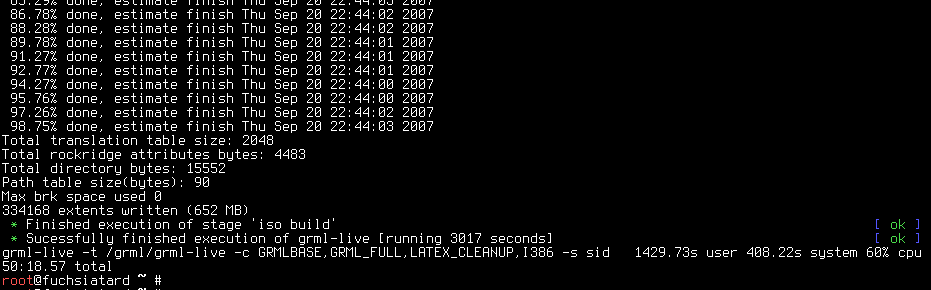 In diesem Beispiel habe ich gerade ein gro es grml-ISO gebaut. Dabei habe ich einfach nur den Debian-Mirror in /etc/grml/grml-live.conf auf meinen lokalen Mirror gedreht (um Traffic und Zeit zu sparen) und dann folgendes Kommando aufgerufen:
# grml-live -t /grml/grml-live -c GRMLBASE,GRML_FULL,LATEX_CLEANUP,I386 -s sidCa. 50 Minuten sp ter habe ich im Ordner grml_isos unter /grml/grml-live/ (-t …) ein fertiges grml-ISO. Dieses wurde auf Basis der Klassen (-c …) GRMLBASE (da steckt alles essenzielle drin), GRML_FULL (Software-Auswahl wie auf der offiziellen gro en grml), LATEX_CLEANUP (ein paar sehr gro e LaTeX-Verzeichnisse aufr umen) und I386 (x86-spezifische Pakete wie z.B. der Kernel) gebaut. Als Debian-Suite (-s) wurde sid (unstable) ausgew hlt. Und das war es auch schon. Ein kleinere grml-Version auf Basis von Debian/stable gef llig? Kein Problem, machen wir es doch einfach mal im Shared-Memory (superschnell und mit genug RAM und den Mountoptionen rw,suid,dev auch kein Problem):
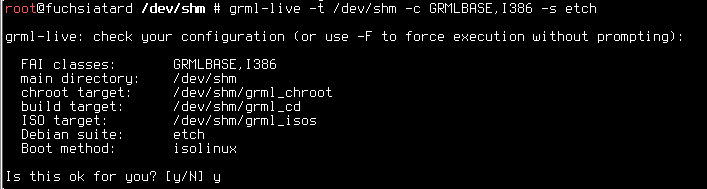 Ein ‘grml-live -t /dev/shm -c GRMLBASE,I386 -s etch’ und keine 5(!) Minuten sp ter hab ich dann mein 135MB kleines grml:
 Mit grml-live kann man sich somit seine pers nlich angepasste Linux Live-CD erstellen, ohne sich erst mit Remastering im Detail besch ftigen zu m ssen. Auch muss man dabei nicht zwingend Debian/unstable nehmen, sondern kann auch Debian/stable als Basis ausw hlen. Durch das Erstellen einer neuen Klasse oder das Anpassen einer existierenden kann man auch spezielle Software-W nsche ganz einfach erf llen.
Wird damit das offizielle grml-ISO etwa obsolet? Nein, auf keinen Fall. grml-live soll dem grml-Team als Buildsystem dienen (automatisierte Snapshots auf regelm iger Basis z.B. sind schon in Planung) und die langweilige Arbeit abnehmen, damit wir uns auf die wirklich wichtigen Sachen konzentrieren k nnen: Testen, Bugfixing, Implementieren von neuen Features, Arbeit am Kernel, Qualit tssicherung, Dokumentation,…
grml-live hat den Anspruch, auf jedem Debian-basierten System zu funktionieren und wer Interesse daran gefunden hat, kann sich das Debian-Pakete aus dem grml-Repository holen. Den Quellcode gibt es nat rlich auf unserer Mercurial-Webseite.
Wer jetzt noch Fragen hat oder mehr Details zu grml-live erfahren m chte, der m ge einfach auf die grml-live-Homepage schauen. Falls dort eine Frage noch nicht beantwortet sein sollte, jemand Feature-Requests, Bugreports oder Patches hat: meine Inbox freut sich ber Post!

 Lichtblick is an kostromanbieter in Germany, supposedly the biggest one.
 For the past weeks, I’ve been working on getting an SGI Origin200 system to run Debian.
Getting a working kernel for the machine took some time and lead to the discovery of 2 nasty bugs, which will be fixed in 2.6.23 thanks to Ralf Baechle (who found and fixed both bugs). There’s still some work left but the machine is in a usable state, except for a dead eth1 interface.
Now I’m having some fun with the bootloader, namely ARCLoad in this case. ARCLoad supports all the Linux-supported SGI MIPS machines, but couldn’t load 64bit kernels on machines equipped with a 32bit PROM; all Debian kernels for SGI MIPS machines have been 64bit for some time now, so that means ARCLoad was unusable with these machines (note that the Origin200 comes with a 64bit PROM, so this wasn’t a showstopper for this project).
Thankfully another bootloader, arcboot, is used for these machines and supports 64bit kernels. Stealing a snippet of code from arcboot I’ve now uploaded arcload 0.5-5 which fully covers our needs. The joy of free software.
I’ve also been working on getting the latest rEFIt version to build with GNU EFI, which means updating GNU EFI to efi110. Took some time, but everything built in the end. I haven’t tested the resulting rEFIt binary yet, waiting some feedback from GNU EFI uptream before doing so.
So how about this new etiquette: Conservation in everything except courtesy and generosity. Seems like that would be a refreshing change. We all need to just put one foot in front of the other to keep moving forward on conserving global resources. Even if it is slow or small, take that first step.I like that. Conservation, courtesy, and generosity should never go out of style...

git-hash-object that helps you creating a hash for a particular object (though it’s also trivial to do with sha1sum). For regular files, git-hash-object -t blob $filename is enough. For symbolic links, you have to read the link destination, and give it without a trailing character (be it the NULL character or a carriage return) to git-hash-object -t blob --stdin. For directories, you have to generate a tree “structure” by yourself and pass it to git-hash-object -t tree --stdin. I haven’t bothered looking at other file types.
The tree structure can be guessed by either looking at mktree.c or at the output of git-cat-file tree $sha1 where $sha1 is the SHA-1 hash for a tree object. It contains 3 informations for each node in the tree : the file mode, with the same format as what stat() returns, except for some reason, permissions are 000 for directories and symbolic links ; the file name ; and the SHA-1 hash. These informations are written with the following format : file mode in octal ascii and no padding zero (”%o”) followed by a space character, then the filename followed by a NULL character, and the binary form of the SHA-1 hash.
Nodes are sorted in a not-so-quite lexical order (take a look at base_name_compare in read-cache.c) and are not separated by any special character: the mode of a file just follows the SHA-1 hash of its predecessor.
With all this new knowledge, you should be able to write some code that would return the SHA-1 from an arbitrary directory. Okay, since you must be at least as lazy as I am, you can take the script I wrote.
Now, let’s take a look at a real life case : what commit is the latest nightly snapshot for the linux kernel from ? First, download the latest snapshot patch and its baseline, and extract the whole. Then, run my git-hash-tree.pl script with the directory containing the extracted kernel as an argument. It will return, after a while, the SHA-1 hash for the whole tree. During this long process, you also have plenty of time to git clone linus’s tree.
Once you’re all done, you can search for the commit corresponding to the tree hash (let’s call it $hash) with the following command :
git-rev-list --all while read h; do git-cat-file commit $h grep -q "^tree $hash" && echo $h && break; done
-gitn from the EXTRAVERSION variable in the Makefile.git diff only includes diff headers for removal of empty files, so if you apply the snapshot patch with the patch utility (and you can’t apply it with git-apply since you don’t have a .git directory), empty files that were marked as deleted will still be on your tree. It happens with the current snapshot patch (2.6.22-rc7-git6): it doesn’t remove include/asm-blackfin/macros.h.
Next.