Search Results: "eof"

5 July 2010

Marco Túlio Gontijo e Silva: Immix on GHC Summer of Code weekly report #8

My project. This post assumes that the reader has read my last post. This week I could get my focus on the project again, since most of my classes are already over. I ve investigated the segfault that was happening in GHC with +RTS -w -DS, and I noticed that the code in rts/sm/Sanity.c assumed that all objects in the allocated area of the block are being used.
    for (; bd != NULL; bd = bd->link)  
	p = bd->start;
	while (p < bd->free)  
	    nat size = checkClosure((StgClosure *)p);
	    /* This is the smallest size of closure that can live in the heap */
	    ASSERT( size >= MIN_PAYLOAD_SIZE + sizeofW(StgHeader) );
	    p += size;
	    /* skip over slop */
	    while (p < bd->free &&
		   (*p < 0x1000   !LOOKS_LIKE_INFO_PTR(*p)))   p++;  
	 
     
Since this is true for copy collection and mark compact, it was only with mark sweep that the error happened. The only way I could manage to make the segfault disappear by now was marking the swept blocks with a new flag, and avoid running this code in them. So I went back to my old problem with the allocation of memory in lines. I noticed that (one of) the problem(s) may be that the object that is allocated in the free line is not scavenged after the evacuation. When the object is allocated in a block, using the current allocation method, it will eventually be scavenged, because all blocks that were being used to allocation are scavenged. I m planning to implement a list of lines that need to be scavenged and code to scavenge the lines in this list, and the current line. It ll be very similar to the code that does this with blocks.

3 July 2010

Peter Eisentraut: Increasing the priority of Debian experimental

Many people run Debian testing or unstable or some mix thereof. This works pretty well for a development system or a general desktop system if you know a bit about what you're doing (note: nonetheless officially not recommended). Sometimes you throw packages from experimental into the mix, if you want to get the latest stuff that isn't yet fully integrated into the rest of Debian.

The default APT priority of the Debian experimental release is 1, which ensures that it is never automatically installed or upgraded. This is not always ideal, in my experience. Of course, you don't want a package from experimental to take precedence over a package from stable, testing, or unstable by default. But I think when you have in the past installed a package from experimental, you probably want to pull in upgrades to that package from experimental as well. Otherwise, you will end up with completely unmaintained packages on your system. That is because in practice many packages in experimental are not actually experimental or broken or unmaintained, but just an advance branch of some software that is just for some reason not ready to go down the unstable-testing-stable road.

To make this work better, I have set the priority of experimental to 101 in my /etc/apt/preferences:
Package: *
Pin: release experimental
Pin-Priority: 101
Now the following will happen: If you just apt-get install a package, it will come from whatever "normal" release you have in your sources.list, say stable or testing. You can override that using -t experimental as usual. If you install a package from experimental and later an upgrade is available in experimental, apt-get upgrade will install that automatically. Also, if an upgrade in a "normal" release appears that has a higher version number, that version will be installed.

Of course, caveats apply. Some software in experimental is really experimental and should only be installed under close supervision. If a package is available only in experimental, this setup will install it when you ask for the package, even if you might not have actually wanted it if you had known that it was in experimental. Figure it out yourself. :)

Similar considerations apply to backports. I use
Package: *
Pin: release a=lenny-backports
Pin-Priority: 102
On the system I have in mind here, the standard distribution is stable, testing is 101, and backports is 102, taking precedence over testing. Because for some architecture-independent packages you don't need backports, so you can pull them directly from testing that way.

In general, the APT priority business is relatively powerful and often a good alternative to, say, manually downloading packages from various distributions, installing them manually, forgetting where they came from, and never upgrading them.

25 June 2010

Matthew Garrett: In better news

The GNOME Foundation released their conference speaker guidelines today. This is an important step not just in helping speakers know what's acceptable, but also in helping audience members understand in advance what the community is likely to find objectionable and ensure that they can feel comfortable in raising concerns.

Of course, guidelines mean little without enforcement. My original draft of these suggested that event runners be able to stop presentations if they felt they were gratuitously in breach of the guidelines. Opinions on this were fairly strongly split, with several people concerned that this effectively allowed individuals to immediately shut down presentations with little oversight. That's a genuine concern, but it does seem to assume bad faith on the part of conference organisers in a way we've rarely (never?) seen. On the other hand, conferences in our field have endured presentations that have contained offensive material from start to finish. If an offended individual is in a minority then it's not easy for them to potentially challenge the audience by vocally expressing their unhappiness, and even standing up and leaving may be a difficult and obvious act.

But I don't set the behavioural standards of the community, and attempting to enforce standards that people don't agree with isn't going to fly. Some people are likely to feel that even the level of enforcement suggested is an unwelcome intrusion into free discussion of some topics, so I think this is a good compromise that is a great signal for our unwillingness to accept inappropriate presentations. With luck we'll see other communities enact similar guidelines and we can come to a broad consensus that covers the majority of our conferences.

11 June 2010

Petter Reinholdtsen: Automatic upgrade testing from Lenny to Squeeze

The last few days I have done some upgrade testing in Debian, to see if the upgrade from Lenny to Squeeze will go smoothly. A few bugs have been discovered and reported in the process (#585410 in nagios3-cgi, #584879 already fixed in enscript and #584861 in kdebase-workspace-data), and to get a more regular testing going on, I am working on a script to automate the test. The idea is to create a Lenny chroot and use tasksel to install a Gnome or KDE desktop installation inside the chroot before upgrading it. To ensure no services are started in the chroot, a policy-rc.d script is inserted. To make sure tasksel believe it is to install a desktop on a laptop, the tasksel tests are replaced in the chroot (only acceptable because this is a throw-away chroot). A naive upgrade from Lenny to Squeeze using aptitude dist-upgrade currently always fail because udev refuses to upgrade with the kernel in Lenny, so to avoid that problem the file /etc/udev/kernel-upgrade is created. The bug report #566000 make me suspect this problem do not trigger in a chroot, but I touch the file anyway to make sure the upgrade go well. Testing on virtual and real hardware have failed me because of udev so far, and creating this file do the trick in such settings anyway. This is a known issue and the current udev behaviour is intended by the udev maintainer because he lack the resources to rewrite udev to keep working with old kernels or something like that. I really wish the udev upstream would keep udev backwards compatible, to avoid such upgrade problem, but given that they fail to do so, I guess documenting the way out of this mess is the best option we got for Debian Squeeze. Anyway, back to the task at hand, testing upgrades. This test script, which I call upgrade-test for now, is doing the trick:
#!/bin/sh
set -ex
if [ "$1" ] ; then
    desktop=$1
else
    desktop=gnome
fi
from=lenny
to=squeeze
exec < /dev/null
unset LANG
mirror=http://ftp.skolelinux.org/debian
tmpdir=chroot-$from-upgrade-$to-$desktop
fuser -mv .
debootstrap $from $tmpdir $mirror
chroot $tmpdir aptitude update
cat > $tmpdir/usr/sbin/policy-rc.d <<EOF
#!/bin/sh
exit 101
EOF
chmod a+rx $tmpdir/usr/sbin/policy-rc.d
exit_cleanup()  
    umount $tmpdir/proc
 
mount -t proc proc $tmpdir/proc
# Make sure proc is unmounted also on failure
trap exit_cleanup EXIT INT
chroot $tmpdir aptitude -y install debconf-utils
# Make sure tasksel autoselection trigger.  It need the test scripts
# to return the correct answers.
echo tasksel tasksel/desktop multiselect $desktop   \
    chroot $tmpdir debconf-set-selections
# Include the desktop and laptop task
for test in desktop laptop ; do
    echo > $tmpdir/usr/lib/tasksel/tests/$test <<EOF
#!/bin/sh
exit 2
EOF
    chmod a+rx $tmpdir/usr/lib/tasksel/tests/$test
done
DEBIAN_FRONTEND=noninteractive
DEBIAN_PRIORITY=critical
export DEBIAN_FRONTEND DEBIAN_PRIORITY
chroot $tmpdir tasksel --new-install
echo deb $mirror $to main > $tmpdir/etc/apt/sources.list
chroot $tmpdir aptitude update
touch $tmpdir/etc/udev/kernel-upgrade
chroot $tmpdir aptitude -y dist-upgrade
fuser -mv
I suspect it would be useful to test upgrades with both apt-get and with aptitude, but I have not had time to look at how they behave differently so far. I hope to get a cron job running to do the test regularly and post the result on the web. The Gnome upgrade currently work, while the KDE upgrade fail because of the bug in kdebase-workspace-data I am not quite sure what kind of extract from the huge upgrade logs (KDE 167 KiB, Gnome 516 KiB) it make sense to include in this blog post, so I will refrain from trying. I can report that for Gnome, aptitude report 760 packages upgraded, 448 newly installed, 129 to remove and 1 not upgraded and 1024MB need to be downloaded while for KDE the same numbers are 702 packages upgraded, 507 newly installed, 193 to remove and 0 not upgraded and 1117MB need to be downloaded I am very happy to notice that the Gnome desktop + laptop upgrade is able to migrate to dependency based boot sequencing and parallel booting without a hitch. Was unsure if there were still bugs with packages failing to clean up their obsolete init.d script during upgrades, and no such problem seem to affect the Gnome desktop+laptop packages.

18 May 2010

Sam Hartman: Moonshot: Federated Authentication Beyond the Web

Recently, I ve been working on an exciting project with JaNet(UK) on a project to bring federated authentication to non-web applications. I ve worked on authentication projects a lot, although this is the first federation project I ve worked on. The big difference appears to be an emphasis on credential independence: the subject (person trying to authenticate) and service will not share a common credential type. Within their organization, the subject and their identity provider share a credential. Then, the federation has some credential mechanism such that the user s organization and the service share some (probably completely different) type of credential. The other emphasis is on providing personalization. For web applications, there are a lot of options to achieve this: Information Card, Open ID, SAML, and OAuth all provide solutions in this space. However there are not good options for non-web applications. If you out-source your mail and chat infrastructure but want to use your own chat client or IMAP client, then you will not get the same federation benefits you can get with the web. If you re using usernames and passwords and don t mind the potential problems with your out-sourcing provider being able to impersonate all your users, you can simply synchronize usernames and passwords. Within an enterprise, you can do better using Kerberos. JaNet(UK) runs the UK Access Federation, which is a SAML-based web single-sign-on federation. In order to better meet the needs of their customers they d like to expand this offering to non-web applications. This demand is apparently shared across the European academic community. I suspect there is also some demand in the US academic community and in enterprise situations. With the web, it turns out that you have a convenient platform for interactions with the identity provider: you can simply direct a web browser to the identity provider and need not specify the user interaction with the web browser at all. This is seen as a significant branding and usability advantage. With other environments, it becomes necessary to specify the interaction with the identity provider. Consider an automated client that wishes to examine a mail box and provide advanced mail sorting or aggregation. That automated client cannot directly use a web browser. OAuth solves this issue with an enrollment step that does typically involve a web browser that produces a consumer key and an authentication step that does not. However for non-web clients it seems like avoiding reliance on the browser authentication will be important. It turns out we already have widely used technologies that do this: the Extensible Authentication Protocol (EAP) mediates the interaction between a subject and identity provider for obtaining network access. It also turns out that we have fairly good technologies for abstract security services within non-web applications: thanks to Kerberos and Active Director, many application protocols and a fair number of applications support GSS-API. JaNet(UK) proposes to combine these technologies with SAML in order to produce a solution for federation beyond the web. I prepared a feasibility analysis of this proposal. At a technical level, the proposal is sound. There s a lot of standardization and implementation work, but there appears to be sufficient motivation to form the seeds of a standards activity and put together a proof-of-concept implementation. However, the big question is Will anyone use it? In particular, to be useful beyond fairly small communities, support from client vendors and application framework vendors will be needed. It s taken massive money and around 20 years to get Kerberos support to a point where it is effective within an enterprise. Moonshot can leverage that work to a large extent, but moonshot may also have greater usability and penetration goals. It s interesting that I m advocating EAP for application layer authentication. When I was a Security AD, I made a strong statement that EAP must only be used for network access. I ve been fairly consistent about that since then. I think there are two huge problems with using EAP for application authentication. The first is that EAP only authenticates the home realm; it does not authenticate what service you re going to. So you might try to connect to your e-mail and end up giving something access to your stored files and pictures instead. That is, EAP has a phishing exposure in the federated context. If the only thing you can get by using EAP is network access, that exposure is only moderate. However in a fully federated environment that is a huge exposure. Moonshot will address this problem by using EAP channel binding and by doing the necessary work to make that a viable solution. The second concern is that interoperability is reduced when you have multiple authentication approaches for the same problem. If EAP is going to be used for application authentication, we need to understand how it relates to the rest of the application authentication metasystem. Moonshot proposes such a relationship, addressing my objection. Moonshot is designed to work well with the objectives of the Identity Metasystem and its laws of identity. It uses a different technology, but does have an approach for dealing with claims-based identity and hopefully will have a user experience very similar to the identity metasystem. It uses a different underlying technology. However one of the main beliefs behind the identity metasystem is that is the user experience and universal interoperability that is important, not any specific technology. In its domain, the technologies Moonshot selects will be a better fit than a web services stack. It s strange not to be working on Kerberos; Moonshot uses some Kerberos technology, but its core is definitely not today s Kerberos. In some ways it is fun to be working on something new. There s one aspect of Kerberos I really miss: Moonshot has nothing like tickets. There s no place to remember state or exchange to directly involve the client in what the server learns. My analysis talks about ways to make Moonshot more like Kerberos; there are some potential advantages, but so far, the tradeoffs do not justify changes. We re hoping to have a bar BOF at IETF 77 and a BOF in the summer at IETF 78.

1 May 2010

Sean Finney: Nouveau, Gallium3D, and Compiz on Debian

update: 20100503: It's been brought to my attention that there might have been a regression in one of the libraries, mesa, maybe, so that master might not be as reliable a reference point for this guide. so, just in case, here are the commit hashes that were used from the different projects: for the non-git-savvy: git checkout -b mybranch <hash> we now return to your regular broadcasting... A week or two ago I figured it was about time that I took the plung and tried out the latest nouveau drivers from experimental on my laptop. Unfortunately, it meant bidding adieu to compiz (apart from the bling it does actually provide some pretty damned useful features). I thought I'd give it a shot at least for a while on principal, since I've always had to think of the nvidia drivers as a necessary evil, and their lack of proper xrandr support is really, really annoying. Since then I haven't noticed any problems, apart from the following message after every suspend/resume:
[  931.213239] Uhhuh. NMI received for unknown reason 80 on CPU 0.
[  931.213240] You have some hardware problem, likely on the PCI bus.
[  931.213242] Dazed and confused, but trying to continue

No idea what's causing it, but otherwise the system is stable and functional. If anyone knows what can be done about this, I'd appreciate hearing from you. My graphics card, by the way:
01:00.0 VGA compatible controller: nVidia Corporation G72M [Quadro NVS 110M/GeForce Go 7300] (rev a1)

In the time since then, the nouveau driver has made its way into unstable, and a lot of distros (ubuntu, fedora, ...) are even using it as the default driver. So before going any further with the 3d/compiz stuff, I highly recommend that you get the packaged version working first. This will not only make sure that the basic driver works, but it will also make recovery/rollback a lot easier. Since it's all packaged in the standard repositories, it's not much harder than installing a few packages and editing a few files... so come on give it a try :) Getting the 2d driver working in Debian sid Really, this is so easy it's hardly worth writing up, but i'm running with the -v flag this morning... Make sure you don't have any reference to nvidia in /etc/modules or other places that might cause it to be automatically loaded. Then remove the proprietary glx bindings, which would otherwise interfere with the nouveau driver.
sudo apt-get remove nvidia-glx

Next, you'll need to install a kernel that includes updated drm support. Normally this would require a kernel >= 2.6.33.1, but the debian kernel maintainers have graciously backported this code to the 2.6.32-4 kernel package. note this isn't the default kernel version in testing/unstable at the time of writing so you have to explicitly install it along with the nouveau driver.
sudo apt-get install linux-image-2.6.32-4-amd64 xserver-xorg-video-nouveau

If you are already running this kernel and using the proprietary nvidia drivers, via module-assistant or otherwise, you /might/ need to uninstall them first. On my system I left them installed in the old kernel version but did not install them on the new kernel version. Required xorg configuration I don't believe that nouveau is picked by default if available at the time of writing, so you have to have the following in your xorg.conf:
sudo sh -c "cat > /etc/X11/xorg.conf" << EOF
Section "Device"
    Identifier     "nVidia Corporation G72M [Quadro NVS 110M/GeForce Go 7300]"
    Driver         "nouveau"
EndSection
EOF

This was all I needed to do, apart from rebooting into the new kernel. For those who don't want to venture outside the packaging system, this is about as far as you can go for the time being. Though really, if you're bothering to read this far along, you're probably more interested in what comes next :) Getting 3d working (without voiding your distro warranty) So I thought I'd give the 3d-accelerated gallium a go. Their wiki page certainly makes one think twice, but at this point I was seriously fiending to get my bling back (well, the compiz scale plugin, anyway) and figured it wouldn't hurt too much to try. Via google and trawling around in various forums I found a number of how-to documents for getting Gallium3d on debian/ubuntu systems, but most of them recommended doing things in a way that wasn't easily reversible and that could totally hose your system in a not-so-hypothetical worst-case scenario. It's pretty hard to roll back a make install done into /usr, for example, and subsequent package upgrades can leave your system even worse off as they will probably clobber half of what you just did, leaving the other half totally broken. And if you have a laptop which requires the gui for networking (i.e. network-manager), then fixing/rolling-back the changes is not entirely trivial, since you'd likely have to re-download the various drm/mesa/xorg packages. So enter the tried and true unix utility stow (apt-get install stow, of course). stow is a utility that lets you install software into arbitrary folders, and then manage the system-wide installation of the software via a farm of symlinks pointing at the installed location. It's probably more well known among the sysadmin crowd than the desktop user crowd, but it's incredibly useful for the task at hand as it will let us easily install multiple copies of different software in a way that's very easy to update and/or roll-back. RTFM stow(1) for more information. So, on to the juicy stuff... Install needed software, remove problematic packages, setup, etc At least on my system, I had to remove libdrm-dev to keep things from accidentally linking against it instead of the updated version that we install later on below. There's probably a way to override this with CFLAGS but I figure this is simpler.
sudo apt-get remove libdrm-dev
sudo apt-get install stow build-essential xorg-dev git-core libtool mesa-common-dev automake autoconf 
mkdir ~/nouveau

Compile a linux-2.6.34 RC kernel
cd ~/nouveau
git clone git://git.kernel.org/pub/scm/linux/kernel/git/torvalds/linux-2.6.git
cd linux-2.6
git remote add -f nouveau git://anongit.freedesktop.org/nouveau/linux-2.6
git checkout -b nouveau-master nouveau/master
make menuconfig

Enable device drivers -> staging drivers -> nouveau. Make any other changes you might want to make (I just took defaults for everything else).
make deb-pkg

The linux-firmware-free debian package ships some of the same stuff from the generated linux-firmware-image package. I decided to opt for the upstream firmware, though I'm not sure that this is necessary:
sudo apt-get remove linux-firmware-free
sudo dpkg -i ~/nouveau/linux-image*.deb ~/nouveau/linux-firmware-image*.deb
sudo update-grub

Install a copy of dri2proto
cd ~/nouveau
git clone git://anongit.freedesktop.org/xorg/proto/dri2proto
cd dri2proto
./autogen.sh --prefix=/usr/local/stow/dri2proto-20100428
sudo mkdir -p /usr/local/stow/dri2proto-20100428
sudo make install
sudo stow -d /usr/local/stow dri2proto-20100428

Install a cutting-edge version of libdrm
cd ~/nouveau
git clone git://anongit.freedesktop.org/git/mesa/drm/
cd drm
./autogen.sh --prefix=/usr/local/stow/drm-20100428 --disable-intel --disable-radeon --enable-nouveau-experimental-api
make
sudo mkdir -p /usr/local/stow/drm-20100428
sudo make install
sudo stow  -d /usr/local/stow  drm-20100428

Likewise for mesa
cd ~/nouveau
git clone git://anongit.freedesktop.org/git/mesa/mesa
cd mesa
./autogen.sh --prefix=/usr/local/stow/mesa-20100428  --enable-debug --enable-glx-tls --disable-asm --with-dri-drivers= --enable-gallium-nouveau --disable-gallium-intel --disable-gallium-radeon --disable-gallium-svga --with-state-trackers=glx,dri --with-demos=xdemos,demos,trivial,tests
make
sudo mkdir -p /usr/local/stow/mesa-20100428 
sudo make install
sudo stow -d /usr/local/stow mesa-20100428

And now the xorg driver...
cd ~/nouveau
git clone git://anongit.freedesktop.org/git/nouveau/xf86-video-nouveau/
cd xf86-video-nouveau
./autogen.sh --prefix=/usr/local/stow/xf86-video-nouveau-20100428
make
sudo mkdir -p /usr/local/stow/xf86-video-nouveau-20100428
sudo make install
sudo stow -d /usr/local/stow xf86-video-nouveau-20100428

Configuration Configure xorg to look in alternate location for xorg modules and set up DRI
sudo sh -c "cat > /etc/X11/xorg.conf" << EOF
Section "Files"
    ModulePath "/usr/local/lib/xorg/modules,/usr/lib/xorg/modules"
EndSection
Section "ServerFlags"
    Option "GlxVisuals" "all"
Endsection
Section "Device"
    Identifier     "nVidia Corporation G72M [Quadro NVS 110M/GeForce Go 7300]"
    Driver         "nouveau"
EndSection
EOF

I've /heard/ that disabling TV out is a necessity on some cards, though I haven't seen this myself:
sudo sh -c "cat > /etc/modprobe.d/nouveau.conf" << EOF
# not entirely sure this is necessary, but heard it helped with vsync
options nouveau tv_disable=1
EOF

Finally, the one thing that can not be done in /usr/local is making the nouveau DRI driver available. From what I could tell the path that mesa uses to find the DRI libraries is hard-coded (corrections welcome). Since you won't already have this file (otherwise, why would you be following along here?), just drop in a symlink to the file in /usr/local:
sudo ln -s /usr/local/lib/dri/nouveau_dri.so /usr/lib/dri/

Finally, reboot, and hope for the best :) Riding the bleeding edge: how to upgrade later on Again, stow really shows its usefullness here. Using drm as an example case, upgrading an individual component would look something like:
cd ~/nouveau/drm
git clean -dfx
git pull
today= date +%Y%m%d 
./autogen.sh --prefix=/usr/local/stow/drm-$today --disable-intel --disable-radeon --enable-nouveau-experimental-api
make
sudo mkdir -p /usr/local/stow/drm-$today
sudo make install
sudo stow -d /usr/local/stow -D drm-20100428
sudo stow -d /usr/local/stow  drm-$today

Note how the old version is still installed, so you can switch components around pretty freely. Abort! Abort!: How to roll back changes In case your system becomes totally unusable, or you've decided that you just want to go back to the safe and cozy world of what's provided by the debian packages, simply do the following: Assuming that you're using the nouveau driver from unstable, this should be all that is necessary. Conclusion Overall impression I am very, very happy with the resulting setup. I was led to believe that this whole thing was much more unstable and unusable than it actually is! While there are certainly some glitches and missing features, I feel comfortable enough using it that I don't have plans to switch back. But if I find myself in a situation where I can't use the new setup, rolling back shouldn't be a problem either. I figure I'm happy with what I have now and it will only get better. What works, at least to a "kinda works" level. What still doesn't work Further reading, references Thanks A couple shoutouts to those who helped me with this on the way: Feedback / Corrections Unforunately, I've had to disable comments for the time being due to overwhelming quantities of spam. So please drop me a line via email or on IRC (seanius on oftc/freenode).

27 April 2010

Phil Hands: The rise of the Clan MacDebian

I've asked the weavers to start doing their job today, so with luck the tailors will still have time to make kilts ready to wear for DebConf10.If you've been wondering if you'd like some Debian Tartan, now's your chance. We've ordered a little over 16 yards more than we need, which will be enough to make about 2 extra kilts and a few ties (depending on exact details), so order early to avoid disappointment.Of course, kilts are not the only thing one can make out of tartan. The tailors make other things, but there's nothing stopping you from buying some cloth by the yard and being inventive (it costs about 25.00 GBP per yard). We'll also be making ties, so if you're interested in one of those, please add yourself to the relevant table on the wiki, and I'll get in touch with prices etc.Full details of this silliness are available on the wiki page -- send any questions to phil at hands dot comUpdate 16:00 UTC 27th: one 8-yard kilt snapped up already (numbers above updated)

12 April 2010

Chris Lawrence: epcp for R

I finally have packaged up a very rough port of my epcp routine from Stata to R as part of a package unimaginatively called cnlmisc; you can download it here. In addition to the diagnostics that the Stata routine provides, the glm method includes a bunch of R-square-like measures from various sources (including Greene and Long). The only part I m sure works at the moment is the epcp for glm objects (including survey s and Zelig s wrappers thereof); the others that are coded (for polr and VGAM) are probably half-working or totally broken, and some wrappers aren t there yet at all. The error bounds suggested by Herron aren t there either. The print routines need a lot of work too; eventually it will have a nice toLatex() wrapper as well. But it beats having it sit on my hard drive gathering dust; plus I may eventually get motivated to write a JSS piece or something based on it. epcp for Stata is still available at my site. For more information on the measure, see Michael C. Herron (1999), Postestimation Uncertainty in Limited Dependent Variable Models Political Analysis 8(1): 83 98 or Moshe Ben-Akiva and Steven Lerman (1985), Discrete Choice Analysis, MIT Press.

19 March 2010

MJ Ray: Co-ops at the North Somerset Initiative

On Wednesday, I went to a meeting of the Business Initiative for North Somerset for Cooperatives-SW (our regional cooperative cooperative). It was the first time anyone from the cooperative and mutual sector was present.
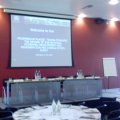
platform
Conference Bank of England The first speaker was Geoff Harding from the Bank of England, who talked through topics in their agents summary and related news. One interesting graph showed a steep rise in the percentage of household income being saved. Answers to questions suggested that more of that goes to mutuals and building societies, but they find it difficult to be competitive while the banks are keen to increase their balances. There was mention of employment hoarding businesses short-time working, redeploying or shutting down temporarily to keep trained workers under contract, rather than make them redundant and rehire later. People from both the Federation of Small Businesses and the Hoteliers Association made strong comments about the banks claiming to government that they are willing to lend, but still offering deeply unattractive depth-of-recession rates and terms. If the regional agents get details of such cases, they pass them to the central bank. South West Regional Development Agency The second main speaker was Ann O Driscoll, who covers business development for the West of England (what many people call CUBA Councils that Used to Be Avon). She introduced their four strategic priorities:-

  1. Low Carbon Economy apparenly our region has good wind, wave and solar experience. However, Vestas were mentioned and I know that when Vestas closed the UK s only wind turbine blade factories in August 2009, the RDAs were criticised for not acting against the subsidy-chasing, socially irresponsible conduct of Vestas and related companies continue to worry workers. If Vestas is one of the praised companies, I wonder whether we re attracting sustainable work to the region. On a related note, North Somerset Council and NS Enterprise Agency are organising a Climate Change forum on 1st April, but it s at Cadbury House Hotel, which is awkward to get to except by car: no footpath to the door, a mile-and-a-half walk along a busy road from a train station, bad roads for biking, wheelbending speedhumps on the drive, I can t remember if there is bicycle parking and its website doesn t say
  2. Successful Businesses SWRDA funds our rather poor Business Link service. Does someone in the South West have some good news about Business Link? If so, please leave a comment on this article.
  3. Prosperous Places intervention in areas like south Bristol or central Weston.
  4. United Approach co-ordinating with other regional groups.
The main activities introduced were: The questions were fascinating, except for mine. The best one was probably about the forthcoming election and the Conservatives pledge to shut down the RDAs and Business Links. The answer was that much of the work will still need to be done somehow, so it s more a question of who will do it, rather than what the name on the door says. So I don t think axing RDAs is going to achieve more than shuffling people between organisations. When allowed to ask a question, I got too excited and ranted a bit about how the Co-operative Group s co-operative enterprise hub is doing work that Business Link should have been funding, but the RDA doesn t understand social enterprise and treats it as a ghetto service. I ll try to take that up in a more coherent form later. Overview I think Cooperatives-SW were invited to the North Somerset Initiative largely because of pressure from software.coop for co-ops to be represented better in the Local Strategic Partnership, which has treated us badly. NSI holds one of the three business places on the partnership board, with the other two being held by NSEA and Bristol International Airport. I think it s a bit off that a private company and an enterprise agency are both represented by other groups and also have their own board seats while co-ops don t even have a collective seat, so that pressure for a representative organisation for co-operatives and mutuals to have a board place (in line with national government guidance) should continue, useful though the NSI meetings seem to be. The other thing which would really help is some funding for co-operative business development specialists to work in North Somerset at strategic tasks like this, instead of it being left to ordinary workers from other sectors. I don t know where that funding will come from and until then, I ll continue to try my best. We need to make sure that local strategy at least does no harm to the sector.

19 February 2010

Gunnar Wolf: Computer education parallelisms

I opened Slashdot's Looking back from the 1980s at computers in education article because I am quite convinced of the point some of the commenters argued before me, (and it's good to know others think as you do ;-) ) When I got close to computers, learning computing for children basically meant learning programming in a fun way. For years, my hobbies included Logo and BASIC. At age 7 (by 1983), typing TeX and using Emacs at the computer of the institute where my father worked, I started walking the path I took for my professional life. When I taught computing to high school students as my first paid job (which didn't last long, only a semester, as for an untrained 20 year old it is very hard to control a group of kids nearly his age), I tried to teach some basic BASIC programming (which was the best I knew then)... But no, both students and the school wanted me to focus on teaching MS Office applications. It seemed stupid for me 14 years ago, and it still seems stupid for me today. Anyway, on Slashdot, I came across this beautiful way to explain what computer education should mean:
"computing is no longer taught in schools (parents look quizzical), they are simply 'trained' (parents look like they vaguely get it). if this was sex instead of computing that was taught in schools, would you prefer that your kids have sex _education_ or sex _training_? (parents finally get it)".
By the way, if you are interested in reading a bit of paleofuturism, to feel the joy and excitement with which computer-aided education was seen 30 years ago, be sure to get the Classroom Computer News issue for September-October 1980, linked from the Slashdot article (and copied over here for your convenience, of course!)
AttachmentSize
Classroom Computer News vol. 1 no. 1, sep-oct 19803.54 MB

11 February 2010

Robert Collins: Using UEC instead of EC2


So, we wanted to move a Hudson CI server at Canonical from using chroots to VM s (for better isolation and security), and there is this great product Ubuntu Enterprise Cloud (UEC basically Eucalyptus). To do this I needed to make some changes to the Hudson EC2 plugin and thats where the fun starts. While I focus on getting Hudson up and running with UEC in this post, folk generally interested in the differences between UEC and EC2, or getting a single-machine UEC instance up for testing should also find this useful. Firstly, getting a test UEC instance installed was a little tricky I only had one machine to deploy it on, and this is an unusual configuration. Nicely though, it all worked, once a few initial bugs and misconfiguration items got fixed up. I wrote up the crux of the outcome on the Ubuntu community help wiki. See 1 Physical system . The particular trap to watch out for seems to be that this configuration is not well tested, so the installation scripts have a hard time getting it right. I haven t tried to make it play nice with Network Manager in the loop, but I m pretty sure that that can be done via interface aliasing or something similar. Secondly I needed to find out what was different between EC2 and UEC (Note that I was running on Karmic (Ubuntu 9.10) so things could be different in Lucid). I couldn t find a simple description of this, so this list may be incomplete:
  1. UEC runs an old version of the EC2 API. This is because it hasn t implemented everything in the new API versions yet.
  2. UEC defaults to port 8773, not port 80 (for both the EC2 and S3 API s)
  3. The EC2 and S3 API s are rooted differently: at AWS they are at /, for UEC they are at /services/Eucalyptus and /services/Walrus
  4. UEC doesn t supply a SSL API port as far as I can tell.
  5. DescribeImages has something wonky with it.
So the next step then is to modify the Hudson EC2 plugin to support these differences. Fortunately it is in Java, and the Java community has already updated the various libraries (jets3t and typica) to support UEC I just needed to write a UI for the differences and pass the info down the various code paths. Kohsuke has let me land this now even though it has an average UI (in rev 27366), and I m going to make the UI better now by consolidating all the little aspects into a couple of URL s. Folk comfortable with building their own .hpi can get this now by svn updating and rebuilding the ec2 plugin. We ve also filed another bug asking for a single API call to establish the endpoints, so that its even easier for users to set this up. Finally, and this isn t a UEC difference, I needed to modify the Hudson EC2 plugin to work with the ubuntu user rather than root, as Ubuntu AMI s ship with root disabled (as all Ubuntu installs do). I chose to have Hudson reenable root, rather than making everything work without root, because the current code paths assume they can scp things as root, so this was less disruptive. With all that done, its now possible to configure up a Hudson instance testing via UEC nodes. Here s how:
  1. Install UEC and make sure you can run up instances using euca-run-instances, ssh into them and that networking works for you. Make sure you have installed at least one image (EMI aka AMI) to run tests on. I used the vanilla in-store UEC Karmic images.
  2. Install Hudson and the EC2 plugin (you ll need to build your own until a new release (1.6) is made).
  3. Go to /configure and near the bottom click on Add a new cloud and choose Amazon EC2.
  4. Look in ~/.euca/eucarc, or in the zip file that the UEC admin web page lets you download, to get at your credentials. Fill in the Access Key and Secret Access key fields accordingly. You can put in the private key (UEC holds onto the public half) that you want to use, or (once the connection is fully setup) use the Generate Key button to have a dedicated Hudson key created. I like to use one that I can ssh into to look at a live node YMMV. (Or you could add a user and as many keys as you want in the init script more on that in a second).
  5. Click on Advanced, this will give you a bunch of details like EC2 Endpoint hostname . Fill these out.
  6. Sensible values for a default UEC install are: 8773 for both ports, /services/Eucalyptus and /services/Walrus for the base URLs, and SSL turned off. (Note that the online help tells you this as well).
  7. Set an instance cap, unless you truely have unlimited machines. E.g. 5, to run 5 VMs at a time.
  8. Click on Test Connection it should pretty much instantly say Success .
  9. Thats the Cloud itself configured, now we configure VM s that Hudson is willing to start. Click on Add right above the List of AMIs to be launched as slaves text.
  10. Fill out the AMI with your EMI e.g. emi-E027107D is the Ubuntu 9.10 image I used.
  11. for remote FS root, just put /hudson or something, unless you have a preseeded area (e.g. with a shared bzr repo or something) inside your image.
  12. For description describe the intent of the image e.g. DB test environment
  13. For the labels put one or more tags that you will use to tell test jobs they should run on this instance. They can be the same as labels on physical machines it will act as an overflow buffer. If no physical machines exist, a VM will be spawned when needed. For testing I put euca
  14. For the init script, its a little more complex. You need to configure up java so that hudson itself can run:
    cat >> /etc/apt/sources.list << EOF
    deb http://archive.ubuntu.com/ubuntu/ karmic multiverse
    deb http://archive.ubuntu.com/ubuntu/ karmic-updates multiverse
    deb http://archive.ubuntu.com/ubuntu/ karmic-security multiverse
    EOF
    export http_proxy=http://192.168.1.1:8080/
    export DEBIAN_FRONTEND=noninteractive
    apt-get update
    echo "buildd shared/accepted-sun-dlj-v1-1 boolean true"   debconf-set-selections
    apt-get install -y -f sun-java6-jre
    
    Note that I have included my local HTTP proxy there just remove that line if you don t have one.
  15. Click on Advanced, to get at the less-common options.
  16. For remote user, put ubuntu , and for root command prefix put sudo .
  17. For number of executors, you are essentially choosing the number of CPU s that the instance will request. E.g. putting 20 will ask for an extra-large high-cpu model machine when it deploys. This will then show up as 20 workers on the same machine.
  18. Click save :)
  19. Now, when you add a job a new option in the job configuration will appear tie this job to a node . Select one of the label(s) you put in for the AMI, and running the job will cause that instance to start up if its not already available.
Note that Hudson will try to use java from s3 if you don t install it, but that won t work right for a few reasons I ll be filing an issue in the Hudson tracker about it, as thats a bit of unusual structure in the existing code that I m happier leaving well enough alone :) .

Joachim Breitner: Diploma Thesis Finished

Earlier today, I went to a local copy shop and had my diploma thesis printed. This afternoon, I will hand it in. The title is Loop subgroups of Fr and the images of their stabilizer subgroups in GLr( ) and discusses a group-theoretical result. I assume that very few readers care about the content of the thesis, but maybe some are interested in a few assorted LaTeX hints. I m also publishing the full TeX source code, maybe someone can make use of it. Less chatty varioref I m using the varioref package, in conjunction with the cleveref package. This provides a command \vref fig:S3S4l which will expand to, for example, to Figure 1 on page 11 . But if the referenced figure is actually on the current page, the next page, the previous page or the facing page (in two-side layouts), it will say so: Figure 1 on this page. This is very nice, but I assume that the reader of my thesis is able to find Figure 1 when it is visible, i.e. on the current or facing page. One can remove the referencing texts with the commands \def\reftextfaceafter , \def\reftextfacebefore and \def\reftextcurrent . But because varioref puts a space between Figure 1 and this text, we will get a superfluous space even before punctuation. The remedy is the command \unskip, which removes this space again. So I use in my preamble:

\def\reftextfaceafter  \unskip %
\def\reftextfacebefore \unskip %
\def\reftextcurrent    \unskip %
Palatino and extra leading I chose the Palatino font for my thesis, using the mathpazo package. Various sources (such as the KOMA-Script manual) suggest to use 5% extra leading:
\linespread 1.05 
Counting figures independently from chapters I don t have too many figures and tables in my thesis, and I want them to be numbered simple 1, 2, ... By default, LaTeX would say 1.1, 1.2, 2.1, ... This can be fixed using the remreset package and these commands:
\makeatletter
\@removefromreset figure chapter 
\renewcommand \thefigure \arabic figure 
\@removefromreset table chapter 
\renewcommand \thetable \arabic table 
\makeatother
No widows and club lines LaTeX already avoids these, but I wanted to get rid of them completely. This can be done with:
% Disable single lines at the start of a paragraph (Schusterjungen)
\clubpenalty = 10000
% Disable single lines at the end of a paragraph (Hurenkinder)
\widowpenalty = 10000 \displaywidowpenalty = 1000
Struck table lines I had to typeset tables with some lines struck, and I could not find a ready command for that. I used the following definition, based on the code for \hline. Note that it probably does not adjust well to other font sizes and needs to be adjusted manually:
\makeatletter
\def\stline %
  \noalign \vskip-.7em\vskip-\arrayrulewidth\hrule \@height \arrayrulewidth\vskip.7em 
\makeatother
Title page in one-sided layout According to the KOMA manual, the title page as set by LaTeX is not meant to be the cover of a publication, and therefore has to be set with the margins of a right page i.e. a larger right margin and a smaller left margin. But when printing cheaply, one often just put a transparent sheet on top of the print, so the title page is the cover. You can convince KOMA that you are right by using
\KOMAoptions twoside=false 
\begin titlepage 
...
\end titlepage 
\KOMAoptions twoside=true 
Not flushing the page for chapter heads LaTeX would put the list of algorithms on a new right page. I found this a waste of paper for my few algorithms, and preferred to put the list right after the table of contents. You can override the LaTeX behavior using:
\tableofcontents
 
\let\cleardoublepage\relax  % book
\let\clearpage\relax  % report
\let\chapter\section
\listofalgorithms
 
This code also reduces the size of the heading to that of a section. The same trick also works with \chapter. Math in headings vs. PDF bookmarks LaTeX with the hyperref package creates nice PDF bookmarks from your chapter and section titles. Unfortunately, PDF bookmark names can only be plain strings, while the titles in the document might contain some math symbols. You can make both happy with \texorpdfstring:
\section Stabilizer subgroups in \texorpdfstring $\GL_r(\Z/2\Z)$ GL\_r(Z/2Z) 
Setting lines for the signature The diploma thesis contains a small note which I have to sign, saying that I created it on my own etc. Below that, I put two labeled lines for date and signature, using the tabbing environment:
\begin tabbing 
\rule 4cm .4pt \hspace 1cm  \= \rule 7cm .4pt  \\
Ort, Datum \> Unterschrift
\end tabbing 

24 December 2009

Clint Adams: Muppetry

I'm a notoriously late adopter of new technologies. Sure, if I think that something is potentially a good idea, I'll go for it, but for the most part, I assume that things are stupid. I refused to use the WWW for many years, thinking it was idiotic. Now I use the WWW. I find microblogging to be inane and narcissistic at best, but I have derived mild amusement from Shaq on Twitter. Microsoft Windows is something I thought would be ridiculously unsuccessful, because it didn't do anything I would find useful. The list goes on and on, and includes something known in the popular vernacular as configuration management . I've been hearing about BladeLogic and Opsware for quite some time, and idly wondering who the incompetent fools are that need something like this. Back in my day we could manage 100 servers with relative ease; no centralized authentication (because it was a running argument about whether NIS sucked more than NIS+ or vice-versa), no cfengine, no prebuilt server images or any of that jazz. If, for some reason, we needed to make the same change to all servers at once, or some subset thereof, we would just script it. So when one of my acquaintances started raving about Puppet, I assumed it was equally pointless. We'll call him Downs. Downs exhibits a pattern of behavior where he will rave about something for a few weeks, sometimes without having even tried it first, and then eventually become disillusioned with it and start ranting with the same fervor with which he had insisted that whatever fad of the week was the greatest thing ever. It came as no surprise to me when he fell out of love with Puppet and started raving about how much better Chef is. In case you're wondering, he still has not tried Chef to this day. Finally someone convinced me of the value of Puppet. I do not think it is the Way and the Light, but I do see a few situations wherein it makes sense to sacrifice efficiency, flexibility, sanity, and system resources to gain a way of building a near-identical machine from scratch. Now, beyond the flaws inherent to a solution like this, Puppet does have some annoying flaws which I find unnecessary, and which Downs ranted about back when I had absolutely no idea what he was talking about. I disregarded his alleged preference for Chef, but I have heard intelligent people extoll the virtues of Chef, and to a lesser extent Bcfg2. So I took a very brief look at each of those, and was pretty much horrified by what I found. If I need something Puppet-like in the very near future, I will probably be choosing Puppet. I have no intention of running Puppet on machines I manage all by myself though. For that eventuality I am NIHing something with what I consider a better design. The current code is published, but it does not do very much, and requires linking with libdpkg.a which does not exist in any package (but Guillem's working on that, I think). I have no idea whether or not I'll have the motivation to finish it all by myself, but it is Free Software. This post is intentionally weak on details, or deets as the kids call them.

2 December 2009

MJ Ray: As One Association Closes, Another Network Begins

The Association For Free Software (AFFS) seems to have been finally wound up last week. So long, AFFS was Richard Smedley s view of it. I actually left four years ago (when I wrote State of the AFFS site currently moving) but I was still a signatory for the bank, so I helped wind that up. So as one door closes, another opens. Today I m off to meet our co-op s newest member and also to see if we can reinvigorate the Principle Six business network. I ll post more about that in a few days, but if you ve any ideas about how Free and Open Source Software can help, I d love to read it in the blog comments.

29 November 2009

David Bremner: Remove invocation of sbuild

So this is in some sense a nadir for shell scripting. 2 lines that do something out of 111. Mostly cargo-culted from cowpoke by ron, but much less fancy. rsbuild foo.dsc should do the trick.
#!/bin/sh
# Start a remote sbuild process via ssh. Based on cowpoke from devscripts.
# Copyright (c) 2007-9 Ron  <ron@debian.org>
# Copyright (c) David Bremner 2009 <david@tethera.net>
#
# Distributed according to Version 2 or later of the GNU GPL.
BUILDD_HOST=sbuild-host
BUILDD_DIR=var/sbuild   #relative to home directory
BUILDD_USER=""
DEBBUILDOPTS="DEB_BUILD_OPTIONS=\"parallel=3\""
BUILDD_ARCH="$(dpkg-architecture -qDEB_BUILD_ARCH 2>/dev/null)"
BUILDD_DIST="default"
usage()
 
    cat 1>&2 <<EOF
rsbuild [options] package.dsc
  Uploads a Debian source package to a remote host and builds it using sbuild.
  The following options are supported:
   --arch="arch"         Specify the Debian architecture(s) to build for.
   --dist="dist"         Specify the Debian distribution(s) to build for.
   --buildd="host"       Specify the remote host to build on.
   --buildd-user="name"  Specify the remote user to build as.
  The current default configuration is:
   BUILDD_HOST = $BUILDD_HOST
   BUILDD_USER = $BUILDD_USER
   BUILDD_ARCH = $BUILDD_ARCH
   BUILDD_DIST = $BUILDD_DIST
  The expected remote paths are:
  BUILDD_DIR  = $BUILDD_DIR
  sbuild must be configured on the build host.  You must have ssh
  access to the build host as BUILDD_USER if that is set, else as the
  user executing cowpoke or a user specified in your ssh config for
  '$BUILDD_HOST'.  That user must be able to execute sbuild.
EOF
    exit $1
 
PROGNAME="$(basename $0)"
version ()
 
    echo \
"This is $PROGNAME, version 0.0.0
This code is copyright 2007-9 by Ron <ron@debian.org>, all rights reserved.
Copyright 2009 by David Bremner <david@tethera.net>, all rights reserved.

This program comes with ABSOLUTELY NO WARRANTY.
You are free to redistribute this code under the terms of the
GNU General Public License, version 2 or later"
    exit 0
 
for arg; do
    case "$arg" in
        --arch=*)
            BUILDD_ARCH="$ arg#*= "
            ;;
        --dist=*)
            BUILDD_DIST="$ arg#*= "
            ;;
        --buildd=*)
            BUILDD_HOST="$ arg#*= "
            ;;
        --buildd-user=*)
            BUILDD_USER="$ arg#*= "
            ;;
        --dpkg-opts=*)
            DEBBUILDOPTS="DEB_BUILD_OPTIONS=\"$ arg#*= \""
            ;;
        *.dsc)
            DSC="$arg"
            ;;
        --help)
            usage 0
            ;;
        --version)
            version
            ;;
        *)
            echo "ERROR: unrecognised option '$arg'"
            usage 1
            ;;
    esac
done
dcmd rsync --verbose --checksum $DSC $BUILDD_USER$BUILDD_HOST:$BUILDD_DIR
ssh -t  $BUILDD_HOST "cd $BUILDD_DIR && $DEBBUILDOPTS sbuild --arch=$BUILDD_ARCH --dist=$BUILDD_DIST $DSC"

23 November 2009

Vincent Sanders: Fitting Everything In

Recently I have been having issues fitting everything I want to do into the time available.

As my kids grow up they always seem to need to be taken someplace or picked up from an activity and that is on top of the daily school run. I recently worked out I spend over eight hours a week, a whole five hundred minutes, taking them to and fro.

Now do not get me wrong, I actually enjoy spending time with my children and we do talk and interact during these occasions but it is hardly a stimulating activity walking to school or being driven to a club.

Add to that my job and its traveling requirements and assuming I want to sleep, eat etc. and all of a sudden I discover I have about forty hours left in a week to share between my family and hobbies.

Anyone with kids knows they are a wonderful time sink :-) and of course the family home often needs something doing. All of a sudden I realize why I feel like I often end up having to trade sleep for my hobbies!

As I get older I find I still have the same number of ideas for projects but the realization that even if I find the time to start something I am unlikely to be able to devote the resources to finishing it. Being one of life's boring people who like to finish a project they start (ok at least make something useful) this means I tend not to start new things too often.

All of this has lead me to become very careful about how I spend my free time and on what. It means my personal involvement in software projects like Debian and the Linux kernel is nowhere near the level I might like. Similarly my music practice (or absolute lack thereof) causes my teacher to get snippy with me.

As you can imagine starting something like a blog when I do not have enough time for what I am already doing is something of a challenge for me and may indeed falter. However I shall give it a chance as I feel a need for public place to share all those small things which I would probably put on my personal website if I had time to work on it ;-)

9 November 2009

Martin Meredith: Things that make me angry

4 November 2009

Jon Dowland: ZFS de-duplication

Sun's Zetabyte File System (ZFS) has grown de-duplication support. De-duplication is where each block of storage is hashed and stored only once: if two (or more) files contain blocks which are identical, the common block will be saved only once, saving you disk space. This is very topical for me because I've been thinking a lot about backup solutions lately and de-duplication is a feature I'd rather like. backuppc does it; dar and rdiff-snapshot do not. git does it and I've been looking at backup systems built around that. The default settings in ZFS are to use the SHA256 algorithm for hashing and not to check for collisions. A collision would mean the newest write would skip over the block which was thought to be already stored, corrupting the file(s) referencing it. If this is a problem for people, the ZFS folks have implemented a (costly) 'verify' feature:
if this makes you uneasy, that's OK: ZFS provies a 'verify' option that performs a full comparison of every incoming block with any alleged duplicate to ensure that they really are the same
This will detect - and crucially handle - hash collisions. Jeff Bonwicks' advice is to use a low-complexity hashing algorithm in conjunction with 'verify', to offset the additional computational workload. There's no mention of how they resolve hash collisions. Presumably they use something like hash chains. The tradeoff involved there needs to be considered against the risk of collisions and cost of the chosen hash algorithm. I suspect most people will stick to the defaults, so this code won't get much use. It will be interesting to see some of the discussion and performance measurements that will inevitably come out once this becomes more widely available. For now, I'm quite tempted to take a peek at their source code.

25 October 2009

Sha Liu: create a mips 3 port for Debian : update 20091025


I wrote a final report for this project before the end of GSoC. Now I ve uploaded it to alioth. One can use the instructions in the last part of this report to re-build the system I had now. Also, I decide to upload the whole tar ball of this system to somewhere online. Since it is more than 600M, I m not sure it s ok or feasible to upload it to alioth too. SO WHAT I HAD NOW?
I didn t touch this project since the end of gsoc. The report I mentioned above list everything I d done before. To give a whole picture here, what I d done is:
*A mips3 clfs system working a Gdium and fuloong 2F. *Some build-essential packages of Debian built and installed on such a system SO WHAT TO DO NEXT?
What I need to do is :
1. Build all the build-essential packages of Debian and then using debootstrap(this may need further confirm from other experienced developers) to install it on fuloong or Gdium. 2. Build an apt repository to hold these .deb packages to enable the apt-get access from the debootstrap system.
3. Providing benchmark to measure performance of the old mips port of debian and the new system SO WHAT IS YOUR PLAN?
I have a internship and some lab work now. Basically, I only have spare time at Saturday and Sunday. I think many developers of free/open source project have the same situation with me and they have done so many great jobs. However, since I had underestimated the difficulty of my project in the past, I decided to make a "loose" for now so that I could finish it little by little. So my plan is:
* December 31st, 2009 : before this time, I ll finish the first target of todo list with quality.
* March 31st, 2010 : second target
* May 31st, 2010 : last
I agree with the point that free/open source projects have no end. So the process contains continuous improving. The plan is just a rough picture I can gave to others. This is the first update since the final evaluation of my gsoc project this year. Unfortunately, I failed at last. I ll keep my promise to finish this project. Plus, this project is not only mine; many people and communities hold high expectation from it and they really show their care by generously helping me with all kinds of support. So comparing to this, I really can t stop working on this project simply becauseof my personal emotion stuff.

20 October 2009

Benjamin Mako Hill: Updating the Ubuntu Code of Conduct

The Ubuntu Code of Conduct is one of the most surprisingly successful projects I've ever had the privilege of working on. On my first day working for the company that would become Canonical, I talked with Mark Shuttleworth about some ideas for community governance. Partially in reaction to some harsh behavior in other free software projects we'd worked on, Mark and I agreed that some sort of explicit standard for behavior in Ubuntu would be a good thing. Over lunch of what was my literally first day working on Ubuntu, I wrote a draft of code of conduct that was essentially the version that Ubuntu has used until today. Shuttleworth made a series of modification to my draft but I don't think either of us took it too seriously. We figured it would be easy to update it later. Over time, that code has become a central piece of the Ubuntu community. Every new Ubuntu member cryptographically signs the code. When conversation in any Ubuntu forums, channels, or lists becomes disrespectful, users almost instinctively remind each other of the code. Through this process, the code has become a sort of constitution of our community and a widely enforced standard. People treat the code as a reflection of what "ubuntu" --- both the concept and our project --- stands for. Over time, the original code has spawned a Leadership Code of Conduct (which I also worked to draft), and has been modified and employed by scores of free software projects and by many projects that have nothing to do with free software at all. This is all wonderful, but a side effect has been that updating the code has become a more a difficult process that we originally imagined. Despite it success, the code remains a text written in an afternoon in Mark's flat. At times, this fact shows. For example, the code contains some off-hand humor that now seems a little akward and the text was a bit too developer centric at points. And there was a lot that, quite simply, we would have done better if we had realized that the code would be so important. So this summer, Daniel Holbach and I spent another afternoon in Berlin discussing and crafting a new version of the code along with a detailed rationale document that describes all the things we'd changed and why. We believe that what we've created is fully in the spirit of the original code. We've made efforts to minimize the delta in terms of text as possible. Daniel and I realize that changing the code out from under our community is a dangerous game, and we've make exceptional efforts to make sure that the new code doesn't say anything substantively different than the old code --- but that it does say it better. So I'm thrilled that, after being posted since early June and after incorporating a series of revisions with members of the Ubuntu Community Council, the new draft was approved at a council meeting earlier today. Of course, we are continuing to think about how we might improve the text going forward. One important goal we've thrown around, for example, is the creation of a code that is no longer Ubuntu specific and that can be employed by a wide range of different groups and different free and open source software projects.

Next.

Previous.