Search Results: "edd"

1 October 2022

Scarlett Gately Moore: KDE is all about the apps!

Hello everyone. I am back to bringing KDE to your desktops in a variety of formats. I am always working on Debian packages, but now I will be working diligently to get these packages in Debian proper. Along with Debian packaging, I will be working on getting KDE into a variety of new packaging formats that are self contained packages of awesomeness. These formats are Snaps, Appimages and Flatpacks. I am starting with Snaps because I started the effort many years ago, but didn t have the time to keep them up. As such, they are in a sad state, so I am working hard with Jonathan and ppd to get them back in shape. Keep an eye out in your favorite store for shiny new apps from KDE! https://snapcraft.io/search?q=KDE https://www.appimagehub.com/find?search=KDE https://flathub.org/apps/search/KDE Our latest snap releases can be found here:

27 September 2022

Fran ois Marier: Upgrading from chan_sip to res_pjsip in Asterisk 18

After upgrading to Ubuntu Jammy and Asterisk 18.10, I saw the following messages in my logs:
WARNING[360166]: loader.c:2487 in load_modules: Module 'chan_sip' has been loaded but was deprecated in Asterisk version 17 and will be removed in Asterisk version 21.
WARNING[360174]: chan_sip.c:35468 in deprecation_notice: chan_sip has no official maintainer and is deprecated.  Migration to
WARNING[360174]: chan_sip.c:35469 in deprecation_notice: chan_pjsip is recommended.  See guides at the Asterisk Wiki:
WARNING[360174]: chan_sip.c:35470 in deprecation_notice: https://wiki.asterisk.org/wiki/display/AST/Migrating+from+chan_sip+to+res_pjsip
WARNING[360174]: chan_sip.c:35471 in deprecation_notice: https://wiki.asterisk.org/wiki/display/AST/Configuring+res_pjsip
and so I decided it was time to stop postponing the overdue migration of my working setup from chan_sip to res_pjsip. It turns out that it was not as painful as I expected, though the conversion script bundled with Asterisk didn't work for me out of the box.

Debugging Before you start, one very important thing to note is that the SIP debug information you used to see when running this in the asterisk console (asterisk -r):
sip set debug on
now lives behind this command:
pjsip set logger on

SIP phones The first thing I migrated was the config for my two SIP phones (Snom 300 and Snom D715). The original config for them in sip.conf was:
[2000]
; Snom 300
type=friend
qualify=yes
secret=password123
encryption=no
context=full
host=dynamic
nat=no
directmedia=no
mailbox=10@internal
vmexten=707
dtmfmode=rfc2833
call-limit=2
disallow=all
allow=g722
allow=ulaw
[2001]
; Snom D715
type=friend
qualify=yes
secret=password456
encryption=no
context=full
host=dynamic
nat=no
directmedia=yes
mailbox=10@internal
vmexten=707
dtmfmode=rfc2833
call-limit=2
disallow=all
allow=g722
allow=ulaw
and that became the following in pjsip.conf:
[transport-udp]
type = transport
protocol = udp
bind = 0.0.0.0
external_media_address = myasterisk.dyn.example.com
external_signaling_address = myasterisk.dyn.example.com
local_net = 192.168.0.0/255.255.0.0
[2000]
type = aor
max_contacts = 1
[2000]
type = auth
username = 2000
password = password123
[2000]
type = endpoint
context = full
dtmf_mode = rfc4733
disallow = all
allow = g722
allow = ulaw
direct_media = no
mailboxes = 10@internal
auth = 2000
outbound_auth = 2000
aors = 2000
[2001]
type = aor
max_contacts = 1
[2001]
type = auth
username = 2001
password = password456
[2001]
type = endpoint
context = full
dtmf_mode = rfc4733
disallow = all
allow = g722
allow = ulaw
direct_media = yes
mailboxes = 10@internal
auth = 2001
outbound_auth = 2001
aors = 2001
The different direct_media line between the two phones has to do with how they each connect to my Asterisk server and whether or not they have access to the Internet.

Internal calls For some reason, my internal calls (from one SIP phone to the other) didn't work when using "aliases". I fixed it by changing this blurb in extensions.conf from:
[speeddial]
exten => 1000,1,Dial(SIP/2000,20)
exten => 1001,1,Dial(SIP/2001,20)
to:
[speeddial]
exten => 1000,1,Dial($ PJSIP_DIAL_CONTACTS(2000) ,20)
exten => 1001,1,Dial($ PJSIP_DIAL_CONTACTS(2001) ,20)
I have not yet dug into what this changes or why it's necessary and so feel free to leave a comment if you know more here.

PSTN trunk Once I had the internal phones working, I moved to making and receiving phone calls over the PSTN, for which I use VoIP.ms with encryption. I had to change the following in my sip.conf:
[general]
register => tls://555123_myasterisk:password789@vancouver2.voip.ms
externhost=myasterisk.dyn.example.com
localnet=192.168.0.0/255.255.0.0
tcpenable=yes
tlsenable=yes
tlscertfile=/etc/asterisk/asterisk.cert
tlsprivatekey=/etc/asterisk/asterisk.key
tlscapath=/etc/ssl/certs/
[voipms]
type=peer
host=vancouver2.voip.ms
secret=password789
defaultuser=555123_myasterisk
context=from-voipms
disallow=all
allow=ulaw
allow=g729
insecure=port,invite
canreinvite=no
trustrpid=yes
sendrpid=yes
transport=tls
encryption=yes
to the following in pjsip.conf:
[transport-tls]
type = transport
protocol = tls
bind = 0.0.0.0
external_media_address = myasterisk.dyn.example.com
external_signaling_address = myasterisk.dyn.example.com
local_net = 192.168.0.0/255.255.0.0
cert_file = /etc/asterisk/asterisk.cert
priv_key_file = /etc/asterisk/asterisk.key
ca_list_path = /etc/ssl/certs/
method = tlsv1_2
[voipms]
type = registration
transport = transport-tls
outbound_auth = voipms
client_uri = sip:555123_myasterisk@vancouver2.voip.ms
server_uri = sip:vancouver2.voip.ms
[voipms]
type = auth
password = password789
username = 555123_myasterisk
[voipms]
type = aor
contact = sip:555123_myasterisk@vancouver2.voip.ms
[voipms]
type = identify
endpoint = voipms
match = vancouver2.voip.ms
[voipms]
type = endpoint
context = from-voipms
disallow = all
allow = ulaw
allow = g729
from_user = 555123_myasterisk
trust_id_inbound = yes
media_encryption = sdes
auth = voipms
outbound_auth = voipms
aors = voipms
rtp_symmetric = yes
rewrite_contact = yes
send_rpid = yes
timers = no
The TLS method line is needed since the default in Debian OpenSSL is too strict. The timers line is to prevent outbound calls from getting dropped after 15 minutes. Finally, I changed the Dial() lines in these extensions.conf blurbs from:
[from-voipms]
exten => 5551231000,1,Goto(2000,1)
exten => 2000,1,Dial(SIP/2000&SIP/2001,20)
exten => 2000,n,Goto(in2000-$ DIALSTATUS ,1)
exten => 2000,n,Hangup
exten => in2000-BUSY,1,VoiceMail(10@internal,su)
exten => in2000-BUSY,n,Hangup
exten => in2000-CONGESTION,1,VoiceMail(10@internal,su)
exten => in2000-CONGESTION,n,Hangup
exten => in2000-CHANUNAVAIL,1,VoiceMail(10@internal,su)
exten => in2000-CHANUNAVAIL,n,Hangup
exten => in2000-NOANSWER,1,VoiceMail(10@internal,su)
exten => in2000-NOANSWER,n,Hangup
exten => _in2000-.,1,Hangup(16)
[pstn-voipms]
exten => _1NXXNXXXXXX,1,Set(CALLERID(all)=Francois Marier <5551231000>)
exten => _1NXXNXXXXXX,n,Dial(SIP/voipms/$ EXTEN )
exten => _1NXXNXXXXXX,n,Hangup()
exten => _NXXNXXXXXX,1,Set(CALLERID(all)=Francois Marier <5551231000>)
exten => _NXXNXXXXXX,n,Dial(SIP/voipms/1$ EXTEN )
exten => _NXXNXXXXXX,n,Hangup()
exten => _011X.,1,Set(CALLERID(all)=Francois Marier <5551231000>)
exten => _011X.,n,Authenticate(1234)
exten => _011X.,n,Dial(SIP/voipms/$ EXTEN )
exten => _011X.,n,Hangup()
exten => _00X.,1,Set(CALLERID(all)=Francois Marier <5551231000>)
exten => _00X.,n,Authenticate(1234)
exten => _00X.,n,Dial(SIP/voipms/$ EXTEN )
exten => _00X.,n,Hangup()
to:
[from-voipms]
exten => 5551231000,1,Goto(2000,1)
exten => 2000,1,Dial(PJSIP/2000&PJSIP/2001,20)
exten => 2000,n,Goto(in2000-$ DIALSTATUS ,1)
exten => 2000,n,Hangup
exten => in2000-BUSY,1,VoiceMail(10@internal,su)
exten => in2000-BUSY,n,Hangup
exten => in2000-CONGESTION,1,VoiceMail(10@internal,su)
exten => in2000-CONGESTION,n,Hangup
exten => in2000-CHANUNAVAIL,1,VoiceMail(10@internal,su)
exten => in2000-CHANUNAVAIL,n,Hangup
exten => in2000-NOANSWER,1,VoiceMail(10@internal,su)
exten => in2000-NOANSWER,n,Hangup
exten => _in2000-.,1,Hangup(16)
[pstn-voipms]
exten => _1NXXNXXXXXX,1,Set(CALLERID(all)=Francois Marier <5551231000>)
exten => _1NXXNXXXXXX,n,Dial(PJSIP/$ EXTEN @voipms)
exten => _1NXXNXXXXXX,n,Hangup()
exten => _NXXNXXXXXX,1,Set(CALLERID(all)=Francois Marier <5551231000>)
exten => _NXXNXXXXXX,n,Dial(PJSIP/1$ EXTEN @voipms)
exten => _NXXNXXXXXX,n,Hangup()
exten => _011X.,1,Set(CALLERID(all)=Francois Marier <5551231000>)
exten => _011X.,n,Authenticate(1234)
exten => _011X.,n,Dial(PJSIP/$ EXTEN @voipms)
exten => _011X.,n,Hangup()
exten => _00X.,1,Set(CALLERID(all)=Francois Marier <5551231000>)
exten => _00X.,n,Authenticate(1234)
exten => _00X.,n,Dial(PJSIP/$ EXTEN @voipms)
exten => _00X.,n,Hangup()
Note that it's not just replacing SIP/ with PJSIP/, but it was also necessary to use a format supported by pjsip for the channel since SIP/trunkname/extension isn't supported by pjsip.

17 September 2022

James Valleroy: How I avoid sysadmin work

The server running this blog is a RockPro64 sitting in my living room. Besides WordPress (the blogging software), I run various other services on it: Most of these are for my personal use, and a few of them have pages for public viewing (linked at the top of this page). Despite running a server, I don t really consider myself to be a system administrator (or sysadmin for short). I generally try to avoid doing system administration work as much as possible. I think this is due to a number of reasons: These reasons might be surprising to some, but they also suggest that an alternative approach: So my approach is this: if I want to run an additional service, enhance an existing one, or fix a bug, I don t do those changes directly on my server. Instead, I will make (or suggest, or request) the change somewhere upstream of my server: So basically my system administration task turns into a software development task instead. And (in my opinion) there are much better tools available for this: source control systems such as git, test suites and Continuous Integration (CI) pipelines, and code review processes. These make it easier to keep track of and understand the changes, and reduce the possibility of making a catastrophic mistake. Besides this, there is one other major advantage to working upstream: the work is not just benefiting the server running in my home, but many others. Anyone who is using the same software or packages will also get the improvements or bug fixes. And likewise, I get to benefit from the work done by many other contributors. Some final notes about this approach:

11 September 2022

Dirk Eddelbuettel: RcppArmadillo 0.11.2.4.0 on CRAN: Bugfix and Deprecation

armadillo image Armadillo is a powerful and expressive C++ template library for linear algebra and scientific computing. It aims towards a good balance between speed and ease of use, has a syntax deliberately close to Matlab, and is useful for algorithm development directly in C++, or quick conversion of research code into production environments. RcppArmadillo integrates this library with the R environment and language and is widely used by (currently) 1016 packages other packages on CRAN, downloaded 26.2 million times (per the partial logs from the cloud mirrors of CRAN), and the CSDA paper (preprint / vignette) by Conrad and myself has been cited 493 times according to Google Scholar. This new release (made yesterday) brings three changes. First, it updates the release to the upstream 11.2.4 bugfix release made days ago by Conrad. Second, it contains support for the deprecation transition we are managing in issue #391. In short, the (convenient but non-standard) initialization via use of << has been deprecated upstream. Until all packages are updated, we override this in the RcppArmadillo but aim to become compliant . Out of the over 1000 packages, a mere 25 need small adjustments. I reached out email and PRs, and the response has been great. Eight packages are already updated on CRAN, and several others have already in integrated or merged the change. Lastly, Conrad pointed out that the fastLm() example and application can be written more concisely by using arma::dot(). The full set of changes (since the last CRAN release 0.11.2.3.1) follows.

Changes in RcppArmadillo version 0.11.2.4.0 (2022-09-09)
  • Upgraded to Armadillo release 11.2.4 (Classic Roast)
    • fix handling of std::move() involving matrices constructed with auxiliary memory
  • In the fastLm() examples, use arma::dot() to compute to the inner product (as proposed by Conrad), plus small edits
  • Support optional #define named RCPPARMADILLO_FORCE_DEPRECATE to suppress use of ARMA_IGNORE_DEPRECATED_MARKER permitting use and development under deprecation

Courtesy of my CRANberries, there is a diffstat report relative to previous release. More detailed information is on the RcppArmadillo page. Questions, comments etc should go to the rcpp-devel mailing list off the R-Forge page. If you like this or other open-source work I do, you can sponsor me at GitHub.

This post by Dirk Eddelbuettel originated on his Thinking inside the box blog. Please report excessive re-aggregation in third-party for-profit settings.

Russ Allbery: Review: Hogfather

Review: Hogfather, by Terry Pratchett
Series: Discworld #20
Publisher: Harper
Copyright: 1996
Printing: February 2014
ISBN: 0-06-227628-X
Format: Mass market
Pages: 402
Hogfather is the 20th Discworld novel and not a very good place to start. I recommend at least reading Soul Music first for a proper introduction to Susan, and you may want to start with Mort. When we last saw Susan, she was a student at the Quirm College for Young Ladies. Now she's a governess for two adorable youngsters, a job that includes telling them stories and dealing quite capably with monsters in the cellar. (She uses a poker.) It also includes answering questions like whether the Hogfather really exists or whether the presents just come from your parents.
"Look at it this way, then," she said, and took a deep mental breath. "Wherever people are obtuse and absurd... and wherever they have, by even the most generous standards, the attention span of a small chicken in a hurricane and the investigative ability of a one-legged cockroach... and wherever people are inanely credulous, pathetically attached to the certainties of the nursery and, in general, have as much grasp of the physical universe as an oyster has of mountaineering... yes, Twyla: there is a Hogfather.
Meanwhile, the Auditors, last seen meddling with Death in Reaper Man, approach the Assassin's Guild in Ankh-Morpork to hire the assassination of the Hogfather. This rather unusual assignment falls to Mister Teatime, an orphan who was taken in by the guild at an early age and trained to be an assassin. Teatime is a little unnerving, mostly because he enjoys being an assassin. Rather a lot. Hogfather has two major things to recommend it: it's a Death novel, and it features Susan, who is one of my favorite Discworld characters. It also has two major strikes against it, at least for me. The first is relatively minor but, for me, the most irritating. A bit of the way into the story, Pratchett introduces the Oh God of Hangovers fair, that's a good pun and then decides that's a good excuse for nausea and vomiting jokes. A lot of nausea and vomiting jokes. Look. I know a lot of people don't mind this. But I beg authors (and, even more so, filmmakers and cartoonists) to consider whether a joke that some of your audience might like is worth making other parts of your audience feel physically ill while trying to enjoy your work. It's not at all a pleasant experience, and while I handle it better in written form, it still knocks me out of the story and makes me want to skip over scenes with the obnoxious character who won't shut up about it. Thankfully this does stop by the end of the book, but there are several segments in the middle that were rather unpleasant. The second is that Pratchett tries to convince the reader of the mythical importance of the Santa Claus myth (for which Hogfather is an obvious stand-in, if with a Discworld twist), an effort for which I am a highly unsympathetic audience. I'm with Susan above, with an extra helping of deep dislike for telling children who trust you something that's literally untrue. Pratchett does try: he has Death makes a memorable and frequently-quoted point near the end of the book (transcribed below) that I don't entirely agree with but still respect. But still, the book is very invested in convincing Susan that people believing mythology is critically important to humanity, and I have so many problems with the literalness of "believing" and the use of trusting children for this purpose by adults who know better. There are few topics that bring out my grumpiness more than Santa Claus. Grumbling aside, though, I did enjoy this book anyway. Susan is always a delight, and I could read about her adventures as a governess for as long as Pratchett wanted to write them. Death is filling in for the Hogfather for most of the book, which is hilarious because he's far too good at it, in his painfully earnest and literal way, to be entirely safe. I was less fond of Albert's supporting role (who I am increasingly coming to dislike as a character), but the entire scene of Death as a mall Santa is brilliant. And Teatime is an effective, creepy villain, something that the Discworld series doesn't always deliver. The powers arrayed on Discworld are so strong that it can be hard to design a villain who effectively challenges them, but Teatime has a sociopathic Professor Moriarty energy with added creepiness that fills that role in this book satisfyingly. As is typical for Pratchett (at least for me), the plot was serviceable but not the highlight. Pratchett plays in some interesting ways with a child's view of the world, the Unseen University bumbles around as a side plot, and it comes together at the end in a way that makes sense, but the journey is the fun of the story. The conclusion felt a bit gratuitous, there mostly to wrap up the story than something that followed naturally from the previous plot. But it does feature one of the most quoted bits in Discworld:
"All right," said Susan. "I'm not stupid. You're saying humans need... fantasies to make life bearable." REALLY? AS IF IT WAS SOME KIND OF PINK PILL? NO. HUMANS NEED FANTASY TO BE HUMAN. TO BE THE PLACE WHERE THE FALLING ANGEL MEETS THE RISING APE. "Tooth fairies? Hogfathers? Little " YES. AS PRACTICE. YOU HAVE TO START OUT LEARNING TO BELIEVE THE LITTLE LIES. "So we can believe the big ones?" YES. JUSTICE. MERCY. DUTY. THAT SORT OF THING. "They're not the same at all!" YOU THINK SO? THEN TAKE THE UNIVERSE AND GRIND IT DOWN TO THE FINEST POWDER AND SIEVE IT THROUGH THE FINEST SIEVE AND THEN SHOW ME ONE ATOM OF JUSTICE, ONE MOLECULE OF MERCY. AND YET Death waved a hand. AND YET YOU ACT AS IF THERE IS SOME IDEAL ORDER IN THE WORLD, AS IF THERE IS SOME...SOME RIGHTNESS IN THE UNIVERSE BY WHICH IT MAY BE JUDGED. "Yes, but people have got to believe that, or what's the point " MY POINT EXACTLY.
Here's the thing, though: Susan is right. They're not the same sort of thing at all, and Pratchett doesn't present an argument that they are. Death's response is great, but it's also a non sequitur: it is true and correct but has nothing to do with Susan's argument. Justice is not a lie in the sense that Santa Claus is a lie: justice is something that humans can create, just like humans can create gift-giving or a tradition of imaginative story-telling. But this is not at all the same thing as encouraging children to believe in the literal existence of a fat man in red who comes down chimneys to deliver gifts by magic. And Death isn't even correct in Discworld! If one pays careful attention to the story, the consequences he's thinks would follow from the Auditors' attempt on the Hogfather not only don't happen, the exact opposite happens. This is the point of the Unseen University subplot, and it's also what happened in Reaper Man. The Auditors may be trying to kill mythology, but what the books show is that the real danger comes from the backlash. The force they're meddling with is far more powerful and persistent than they are. Death appears to be, by the stated events of the story, completely incorrect in his analysis of Discworld's metaphysics. Maybe Pratchett knows this? He did write a story that contradicts Death's analysis if one reads it carefully. But if so, this is not obvious from the text, or from Susan's reaction to Death's speech, which makes the metaphysics weirdly unsatisfying. So, overall, a mixed bag. Most of the book is very fun, but the metaphysics heavily rest on a pet peeve of mine, and I really could have done without the loving descriptions of the effects of hangovers. This is one of the more famous Discworld novels for the above quote, and on its own this is deserved (it's a great quote), but I think the logic is muddled and the story itself contradicts the implications. A rather odd reading experience. Followed by Jingo in publication order, and Thief of Time thematically. Rating: 7 out of 10

3 September 2022

Joachim Breitner: More recursive definitions

Haskell is a pure and lazy programming language, and the laziness allows us to write some algorithms very elegantly, by recursively referring to already calculated values. A typical example is the following definition of the Fibonacci numbers, as an infinite stream:

Elegant graph traversals A maybe more practical example is the following calculation of the transitive closure of a graph: We represent graphs as maps from vertex to their successors vertex, and define the resulting map sets recursively: The set of reachable vertices from a vertex v is v itself, plus those reachable by its successors vs, for which we query sets. And, despite this apparent self-referential recursion, it works!

Cyclic graphs ruin it all These tricks can be very impressive until someone tries to use it on a cyclic graph and the program just hangs until we abort it: At this point we are thrown back to implement a more pedestrian graph traversal, typically keeping explicit track of vertices that we have seen already: I have written that seen/todo recursion idiom so often in the past, I can almost write it blindly And indeed, this code handles cyclic graphs just fine:
ghci> transitive2 $ M.fromList [(1,[2,3]),(2,[1,3]),(3,[])]
fromList [(1,[1,2,3]),(2,[1,2,3]),(3,[3])]
But this is a bit anticlimactic Haskell is supposed to be a declarative language, and transitive1 declares my intent just fine!

We can have it all It seems there actually is a way to write essentially the code in transitive1, and still get the right result in all cases, and I have just published a possible implementation as rec-def. In the module Data.Recursive.Set we find an API that resembles that of Set, with a type RSet a, and in addition to conversion functions from and to sets, we find the two operations that we needed in transitive1: Let s try that: And indeed it works! Magic!
ghci> transitive2 $ M.fromList [(1,[3]),(2,[1,3]),(3,[])]
fromList [(1,[1,3]),(2,[1,2,3]),(3,[3])]
ghci> transitive2 $ M.fromList [(1,[2,3]),(2,[1,3]),(3,[])]
fromList [(1,[1,2,3]),(2,[1,2,3]),(3,[3])]
To show off some more, here are small examples:
ghci> let s = RS.insert 42 s in RS.get s
fromList [42]
ghci> : 
  let s1 = RS.insert 23 s2
      s2 = RS.insert 42 s1
  in RS.get s1
 : 
fromList [23,42]

How is that possible? Is it still Haskell? The internal workings of the RSet a type will be the topic of a future blog post; let me just briefly mention that it uses unsafe features under the hood, and just keeps applying the equations you gave until a fixed-point is reached. Because it starts with the empty set and all operations provided by Data.Recursive.Set are monotonous (e.g. no difference) it will eventually find the least fixed point. Despite the unsafe machinery under the hood, I claim that Data.Recursive.Set is itself nicely safe, and does not destroy Haskell s nice properties like purity, referential transparency and equational reasoning. If you disagree, I d like to hear about it (here, on Twitter, Reddit or Discourse)! There is a brief discussion at the end of the tutorial in Data.Recursive.Example.

More than sets The library also provides Data.Recursive.Bool for recursive equations with booleans (preferring False) and Data.Recursive.DualBool (preferring True), and some operations like member :: Ord a => a -> RSet a -> RBool can actually connect different types. I plan to add other data types (natural numbers, maps, Maybe, with suitable orders) as demand arises and as I come across nice small example use-cases for the documentation (e.g. finding shortest paths in a graph). I believe this idiom is practically useful in a wide range of applications (which of course all have some underlying graph structure but then almost everything in Computer Science is a graph). My original motivation was a program analysis. Imagine you want to find out from where in your program you can run into a division by zero. As long as your program does not have recursion, you can simply keep track of a boolean flag while you traverse the program, keeping track a mapping from function names to whether they can divide by zero all nice and elegant. But once you allow mutually recursive functions, things become tricky. Unless you use RBool! Simply use laziness, pass the analysis result down when analyzing the function s right-hand sides, and it just works!

1 September 2022

Paul Wise: FLOSS Activities August 2022

Focus This month I didn't have any particular focus. I just worked on issues in my info bubble.

Changes

Issues

Debugging
  • Did extensive debugging on a libpst issue but failed to figure out the cause of the issue. Seems to be related to a change to freopen in glibc that fixed compatibility with POSIX.

Review
  • FOSSjobs: approved postings
  • Spam: reported 5 Debian bug reports and 23 Debian mailing list posts
  • Debian packages: sponsored psi-notify (twice)
  • Debian wiki: RecentChanges for the month
  • Debian BTS usertags: changes for the month
  • Debian screenshots:
    • approved bible-kjv edb-debugger lifeograph links mu-editor unattended-upgrades
    • rejected apt-listchanges/apt-listdifferences (semi-related log file), steam-devices (package description), myspell-es/lighttpd (selfie), fraqtive (Windows), wireguard (logo), kde-telepathy-contact-list (mobile hacking app)

Administration
  • Debian BTS: unarchive/reopen/triage bugs for reintroduced packages orage, scap-security-guide, libdatetime-format-datemanip-perl
  • Debian IRC: disable anti-spam channel modes for some channels
  • Debian servers: investigate full filesystems
  • Debian wiki: unblock IP addresses, approve accounts, ping accounts with bouncing email

Communication
  • Respond to queries from Debian users and contributors on the mailing lists and IRC.

Sponsors The sptag, libpst, purple-discord, circuitbreaker work was sponsored. All other work was done on a volunteer basis.

28 August 2022

Dirk Eddelbuettel: littler 0.3.16 on CRAN: Package Updates

max-heap image The seventeenth release of littler as a CRAN package just landed, following in the now sixteen year history (!!) as a package started by Jeff in 2006, and joined by me a few weeks later. littler is the first command-line interface for R as it predates Rscript. It allows for piping as well for shebang scripting via #!, uses command-line arguments more consistently and still starts faster. It also always loaded the methods package which Rscript only started to do in recent years. littler lives on Linux and Unix, has its difficulties on macOS due to yet-another-braindeadedness there (who ever thought case-insensitive filesystems as a default were a good idea?) and simply does not exist on Windows (yet the build system could be extended see RInside for an existence proof, and volunteers are welcome!). See the FAQ vignette on how to add it to your PATH. A few examples are highlighted at the Github repo, as well as in the examples vignette. This release, the first since last December, further extends install2.r accept multiple repos options thanks to Tatsuya Shima, overhauls and substantially extends installBioc.r thanks to Pieter Moris, and includes a number of (generally smaller) changes I added (see below). The full change description follows.

Changes in littler version 0.3.16 (2022-08-28)
  • Changes in package
    • The configure code checks for two more headers
    • The RNG seeding matches the current version in R (Dirk)
  • Changes in examples
    • A cowu.r 'check Window UCRT' helper was added (Dirk)
    • A getPandoc.r downloader has been added (Dirk)
    • The -r option tp install2.r has been generalzed (Tatsuya Shima in #95)
    • The rcc.r code / package checker now has valgrind option (Dirk)
    • install2.r now installs to first element in .libPaths() by default (Dirk)
    • A very simple r2u.r help has been added (Dirk)
    • The installBioc.r has been generalized and extended similar to install2.r (Pieter Moris in #103)

My CRANberries service provides a comparison to the previous release. Full details for the littler release are provided as usual at the ChangeLog page, and also on the package docs website. The code is available via the GitHub repo, from tarballs and now of course also from its CRAN page and via install.packages("littler"). Binary packages are available directly in Debian as well as soon via Ubuntu binaries at CRAN thanks to the tireless Michael Rutter. Comments and suggestions are welcome at the GitHub repo. If you like this or other open-source work I do, you can now sponsor me at GitHub.

This post by Dirk Eddelbuettel originated on his Thinking inside the box blog. Please report excessive re-aggregation in third-party for-profit settings.

25 August 2022

Dirk Eddelbuettel: RApiSerialize 0.1.2 on CRAN: Small Bugfix

A new bug fix release 0.1.2 of RApiSerialize got onto CRAN earlier. It follows on the 0.1.1 release from earlier this month, and addresses a minor build issue where an error message, only in the case of missing long vector support, tried to use an i18n macro that is not supplied by the build. The RApiSerialize package is used by both my RcppRedis as well as by Travers excellent qs package. Neither one of us has a need to switch to format 3 yet so format 2 remains the default. But along with other standard updates to package internals, it was straightforward to offer the newer format so that is what we did.

Changes in version 0.1.2 (2022-08-25)
  • Correct an error() call (when missing long vector support) to not use i18n macro

Courtesy of my CRANberries, there is also a diffstat to the previous version. More details are at the RApiSerialize page; code, issue tickets etc at the GitHub repository. If you like this or other open-source work I do, you can now sponsor me at GitHub.

This post by Dirk Eddelbuettel originated on his Thinking inside the box blog. Please report excessive re-aggregation in third-party for-profit settings.

24 August 2022

Jonathan Dowland: Our Study, 2022

Two years ago I blogged a photo of my study. I'd been planning to revisit that for a while but I'd been somewhat embarrassed by the state of it, but I've finally decided to bite the bullet.
Fisheye shot of my home office, 2022 Fisheye shot of my home office, 2022
What's changed The supposedly-temporary 4x4 KALLAX has become a permanent feature. I managed to wedge it on the right-hand side far wall, next to the bookcase. They fit snugly together. Since I'd put my turntable on top, I've now dedicated the top row of four spaces to 12" records. (There's a close-up pic here). My hi-fi speakers used to be in odd places: they're now on my desktop. Also on my desktop: a camera, repurposed as a webcam, and a 90s old Creative Labs beige microphone; both to support video conferencing. The desktop is otherwise, largely unchanged. My Amiga 500 and Synthesiser had continued to live there until very recently when I had an accident with a pot of tea. I'm in two minds as to whether I'll bring them back: having the desk clear is quite nice. There's a lot of transient stuff and rubbish to sort out: the bookcase visible on the left, the big one behind my chair on the right (itself to get rid of); and the collection of stuff on the floor. Sadly, the study is the only room in our house where things like this can be collected prior to disposal: it's disruptive, but less so than if we stuffed them in a bedroom. You can't easily see the "temporary" storage unit for Printer(s) that used to be between bookcases on the right-hand wall. It's still there, situated behind my desk chair. I did finally get rid of the deprecated printer (and I plan to change the HP laser too, although that's a longer story). The NAS, I have recently moved to the bottom-right Kallax cube, and that seems to work well. There's really no other space in the Study for the printer. Also not pictured: a much improved ceiling light. What would I like to improve First and foremost, get rid of all the transient stuff! It's a simple matter of not putting the time in to sort it out If I manage that, I've been trying to think about how to best organise material relating to ongoing projects. Some time ago I salivated over this home office tour for an embedded developer. Jay has an interesting project tray system. I'm thinking of developing something like that, with trays or boxes I can store in the Kallax to my right. I'd love to put a comfortable reading chair, perhaps a wing-backed thing, and a reading light, over on the left-hand side near the window. And/or, a bench at a height enabling me to do the occasional bit of standing work, and/or to support the Alesis Micron (or a small digital Piano).

19 August 2022

Dirk Eddelbuettel: RcppArmadillo 0.11.2.3.1 on CRAN: Double Update

armadillo image Armadillo is a powerful and expressive C++ template library for linear algebra and scientific computing. It aims towards a good balance between speed and ease of use, has a syntax deliberately close to Matlab, and is useful for algorithm development directly in C++, or quick conversion of research code into production environments. RcppArmadillo integrates this library with the R environment and language and is widely used by (currently) 1005 packages other packages on CRAN (as celebrated in this blog post on passing 1000 packages from just four days ago), downloaded nearly 26 million times (per the partial logs from the cloud mirrors of CRAN), and the CSDA paper (preprint / vignette) by Conrad and myself has been cited 488 times according to Google Scholar. This release brings together two distinct changes. First, it updates the relese from upstream 11.2.0 (and CRAN 0.11.2.0.0 released a few weeks ago) to the now current 11.2.3 release by Conrard (given that more than four weeks have passed so that we do not surpass CRAN s desired cadence of releases no more than once a month ). The changeset includes a few small refinements (see below), it also includedes a deprecation for initialization for which I will need to reach out to a few packages for whom this triggers a deprecation warning. And speaking of deprecation, the other reason for this release is the desire by the Matrix package to phase out a few older conversions (or casts in C/C++ lingo) which we accomodated. The full set of changes (since the last CRAN release 0.11.2.0.0) follows.

Changes in RcppArmadillo version 0.11.2.3.1 (2022-08-16)
  • Accomodate upcoming Matrix 1.4-2 deprecation for conversion (Dirk in #387)
  • CRAN release with small upstream changes in Armadillo 11.2.1,2,3 made since the last CRAN release 0.11.2.0.0 (Dirk in #383, #384 and #386)
  • Undefine arma_deprecated warning as it affects a number of CRAN packages which will likely need a small transition

Changes in RcppArmadillo version 0.11.2.3.0 (2022-07-12) (GitHub Only)
  • Upgraded to Armadillo release 11.2.3 (Classic Roast)
    • fix Cube::insert_slices() to accept Cube::slice() as input

Changes in RcppArmadillo version 0.11.2.2.0 (2022-07-04) (GitHub Only)
  • Upgraded to Armadillo release 11.2.2 (Classic Roast)
    • fix incorrect and/or slow convergence in single-threaded versions of kmeans(), gmm_diag::learn(), gmm_full::learn()

Changes in RcppArmadillo version 0.11.2.1.0 (2022-06-28) (GitHub Only)
  • Upgraded to Armadillo release 11.2.1 (Classic Roast)
    • old style matrix initialisation via the << operator will now emit a compile-time deprecation warning
    • use of the old and inactive ARMA_DONT_PRINT_ERRORS option will now emit a compile-time deprecation warning
    • the option ARMA_WARN_LEVEL can be used instead

Courtesy of my CRANberries, there is a diffstat report relative to previous release. More detailed information is on the RcppArmadillo page. Questions, comments etc should go to the rcpp-devel mailing list off the R-Forge page. If you like this or other open-source work I do, you can sponsor me at GitHub.

This post by Dirk Eddelbuettel originated on his Thinking inside the box blog. Please report excessive re-aggregation in third-party for-profit settings.

14 August 2022

Dirk Eddelbuettel: RcppArmadillo used by 1001 CRAN Packages

It is with a mix of pride and joy, but also some genuine astonishment and amazement, that we can share that the counter of reverse dependencies at CRAN for our RcppArmadillo package for R just crossed 1000 packages [1]: Conrad actually posted this a few weeks ago, by my count we were then still a few packages shy. In any event, having crossed this marker this summer, either then or now, and after more than a dozen years of working on the package is a really nice moment. Google Scholar counts nearly 500 citations for our CSDA paper (also this vignette), and that ratio of nearly a citation for every two packages used is certainly impressive. We have had the pleasure of working with so many other researchers and scientists using RcppArmadillo. Its combination of performance (C++, after all, and heavily tuned) and ease-of-use (inspired by another popular flavour for matrix computing that is however mostly interpreted) makes for a powerful package, and we are delighted to see it used so widely. Working on this with Conrad has been excellent. The (upstream) package (now at this GitLab repo) has received numerous releases at a rate that is in fact so high that we now slow it down to not exceed a monthly cadence of uploads to CRAN. But the package should always be in release condition at its GitHub repo, and is frequently also installable in rc versions via the Rcpp drat repo. So with that, a big Thank You! to Conrad, to Romain for all the early work laying the package foundations, and to all the users of (Rcpp)Armadillo for helping us along with testing, suggestions, extensions, and bug reports. Keep em coming! If you like this or other open-source work I do, you can now sponsor me at GitHub. [1] The code snippet shows that we remove some possible duplicates in the count (mostly for the total of packages). This is a correction we use across packages for consistency. It does not have an effect for RcppArmadillo.

This post by Dirk Eddelbuettel originated on his Thinking inside the box blog. Please report excessive re-aggregation in third-party for-profit settings.

10 August 2022

Shirish Agarwal: Mum, Samsung Galaxy M-52

Mum I dunno from where to start. While I m not supposed to announce it, mum left this earth a month ago (thirteen days when I started to write this blog post) ago. I am still in part denial, part shock, and morose. Of all the seasons in a year, the rainy season used to be my favorite, now would I ever be able to look and feel other than the emptiness that this season has given me? In some senses, it is and was very ironic, when she became ill about last year, I had promised myself I would be by her side for 5-6 years, not go anywhere either Hillhacks or Debconf or any meetup and I was ok with that. Now that she s no more I have no clue why am I living. What is the purpose, the utility? When she was alive, the utility was understandable. We had an unspoken agreement, I would like after her, and she was supposed to look after me. A part of me self-blames as I am sure, I have done thousands of things wrong otherwise the deal was that she was going to be for another decade. But now that she has left not even halfway, I dunno what to do. I don t have someone to fight with anymore  It s mostly a robotic existence atm. I try to distract myself via movies, web series, the web, books, etc. whatever can take my mind off. From the day she died to date, I have a lower back pain which acts as a reminder. It s been a month, I eat, drink, and am surviving but still feel empty. I do things suggested by extended family but within there is no feeling, just emptiness :(. I have no clue if things will get better and even if I do want the change. I clearly have no idea, so let me share a little about what I know.

Samsung Galaxy M-52G Just a couple of days before she died, part of our extended family had come and she chose that opportunity to gift me Samsung Galaxy M-52G even though my birthday was 3 months away. Ironically, after I purchased it, the next day, one of the resellers of the phone cut the price from INR 28k to 20k. If a day more, I could have saved another 8k/- but what s done is done  To my mind, the phone is middling yet a solid phone. I had the phone drop accidentally at times but not a single scratch or anything like that. One can look at the specs in greater detail on fccd.io. Before the recent price drop, as I shared it was a mid-range phone so am gonna review it on that basis itself. One of the first things I did is to buy a plastic cover as well as a cover shield even though the original one is meant to work for a year or more. This was simply for added protection and it has served me to date. Even with the additional weight, I can easily use it with one hand. It only becomes problematic when using chatting apps. such as Whatsapp, Telegram, Quicksy and a few others where it comes with Samsung keyboard with the divided/split keyboard. The A.I. for guessing words and sentences are spot-on when you are doing it in English but if you try a mixture of Hinglish (Hindi and English) that becomes a bit of a nightmare. Tryng to each A.I; new words is something of a task. I wish there was an interface in which I could train the A.I. so it could be served for Hinglish words also. I do think it does, but it s too rudimentary as it is to be any useful at least where it is now.

WiFi Direct While my previous phone did use wifi direct but it that ancient android version wasn t wedded to Wifi Direct as this one is. You have essentially two ways to connect to any system outside. One is through Wi-Fi Direct and the more expensive way is through mobile data. One of the strange things I found quite a number of times, that Wifi would lose it pairings. Before we get into it, Wikipedia has a good explanation of what Wifi direct is all about. Apparently, either my phone or my modem loses the pairing, which of the two is the culprit, I really don t know. There are two apps from the Play Store that do help in figuring out what the issue is (although it is limited in what it gives out in info. but still good.) The first one is Wifi Signal Meter and the other one is WifiAnalyzer (open-source). I have found that pairing done through Wifi Signal Meter works better than through Google s own implementation which feels lacking. The whole universe of Android seems to be built on apps and games and many of these can be bought for money, but many of these can also be played using a combination of micro-transactions and ads. For many a game, you cannot play for more than 5 minutes before you either see an ad or wait for something like 2-3 hrs. before you attempt again. Hogwarts Mystery, for e.g., is an example of that. Another one would be Explore Lands . While Hogwarts Mystery is more towards the lore created by J.K.Rowling and you can really get into the thick of things if you know the lore, Explore lands is more into Exploration of areas. In both the games, you are basically looking to gain energy over a period of time, which requires either money or viewing ads or a combination of both Sadly most ads and even Google don t seem to have caught up that I m deaf so most ads do not have subtitles, so more often than not they are useless to me. I have found also that many games share screenshots or videos that have nothing to do with how the game is. So there is quite a bit of misleading going on. I did read that Android had been having issues with connecting with developers after their app. is in the Play Store. Most apps. ask and require a whole lot of permissions that aren t needed by that app.

F-Droid Think Pirate Praveen had introduced me to F-Droid and a whole lot of things have happened in F-Droid, lot more apps. games etc. the look of F-Droid has been pulled back. In fact, I found Neo Store to be a better skin to see F-Droid. I have yet to explore more of F-Droid before sharing any recommendations and spending some time on it. I do find that many of foss apps. do need to work on how we communicate with our users. For e.g. one app. that Praveen had shared with me recently was Quicksy. And while it is better, it uses a double negative while asking permission whether it should or not to use more of the phone s resources. It is an example of that sort of language that we need to be aware of and be better. I know this post is more on the mobile rather than the desktop but that is where I m living currently.

7 August 2022

Dirk Eddelbuettel: RApiSerialize 0.1.1 on CRAN: Updates

A new release 0.1.1 of RApiSerialize is now on CRAN. While this is the first release in seven years (!!), it brings mostly minor internal updates along with the option of using serialization format 3. The package is used by both my RcppRedis as well as by Travers excellent qs package. Neither one of us has a need to switch to format 3 yet so format 2 remains the default. But along with other standard updates to package internals, it was straightforward to offer the newer format so that is what we did.

Changes in version 0.1.1 (2022-08-07)
  • Updated CI use to r-ci
  • Expanded and updated both DESCRIPTION and README.md
  • Updated package internals to register compiled functions
  • Add support for serialization format 3, default remains 2
  • Minor synchronization with upstream

Courtesy of my CRANberries, there is also a diffstat to the previous version. More details are at the RApiSerialize page; code, issue tickets etc at the GitHub repository. If you like this or other open-source work I do, you can now sponsor me at GitHub.

This post by Dirk Eddelbuettel originated on his Thinking inside the box blog. Please report excessive re-aggregation in third-party for-profit settings.

6 August 2022

Dirk Eddelbuettel: RcppCCTZ 0.2.11 on CRAN: Updates

A new release 0.2.11 of RcppCCTZ is now on CRAN. RcppCCTZ uses Rcpp to bring CCTZ to R. CCTZ is a C++ library for translating between absolute and civil times using the rules of a time zone. In fact, it is two libraries. One for dealing with civil time: human-readable dates and times, and one for converting between between absolute and civil times via time zones. And while CCTZ is made by Google(rs), it is not an official Google product. The RcppCCTZ page has a few usage examples and details. This package was the first CRAN package to use CCTZ; by now four others packages include its sources too. Not ideal, but beyond our control. This version updates the include headers used in the interface API header thanks to a PR by Jing Lu, updates to upstream changes, and switched r-ci CI to r2u.

Changes in version 0.2.11 (2022-08-06)
  • More specific includes in RcppCCTZ_API.h (Jing Lu in #42 closing #41).
  • Synchronized with upstream CCTZ (Dirk in #43).
  • Switched r-ci to r2u use.

Courtesy of my CRANberries, there is also a diffstat to the previous version. More details are at the RcppCCTZ page; code, issue tickets etc at the GitHub repository. If you like this or other open-source work I do, you can now sponsor me at GitHub.

This post by Dirk Eddelbuettel originated on his Thinking inside the box blog. Please report excessive re-aggregation in third-party for-profit settings.

5 August 2022

Dirk Eddelbuettel: RcppXts 0.0.5 on CRAN: Routine Refreshment

A full eight and half years (!!) since its 0.0.4 release, version 0.0.5 of RcppXts is now on CRAN. The RcppXts package demonstrates how to access the export C API of xts which we contributed a looong time ago. This release contains an accumulated small set of updates made as the CRAN Policies evolved. We now register and use the shared library routines (updates in both src/init.c and NAMESPACE), turned on continuous integration, switched it from the now disgraces service to another, adopted our portable r-ci along with r2, added badges to the README.md, updated to https URLs, and made sure the methods package (from base R) was actually imported (something Rcpp has a need for at startup). That latter part now triggered a recent email from the CRAN maintainers which prompted this release. The NEWS entries follow.

Changes in version 0.0.5 (2022-08-05)
  • Depends on xts 0.9-6 now on CRAN
  • Exports (and documents) a number of additional functions
  • Switch CI use to r-ci and r2u
  • README.md, DESCRIPTION and NEWS.Rd were updated and expanded
  • NAMESPACE import of the shared library uses registration

Courtesy of my CRANberries, there is also a diffstat report for this release. A bit more information about the package is available here as well as at the GitHub repo. If you like this or other open-source work I do, you can now sponsor me at GitHub.

This post by Dirk Eddelbuettel originated on his Thinking inside the box blog. Please report excessive re-aggregation in third-party for-profit settings.

13 July 2022

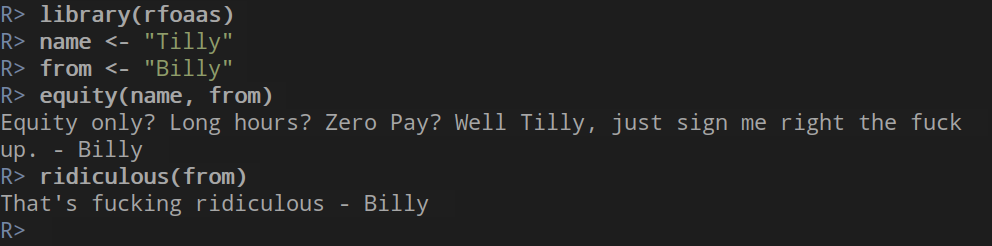
Dirk Eddelbuettel: rfoaas 2.3.2: New upstream accessors

rfoaas greed example FOAAS by now moved to version 2.3.2 in its repo. This releases 2.3.2 of rfoaas catches up, and brings the first release in about two and a half years. This 2.3.2 release of FOAAS brings us six new REST access points: absolutely(), dense(), dumbledore(), lowpoly(), understand(), and yeah(). Along with these new functions, documentation and tests were updated. My CRANberries service provides a diff to the previous CRAN release. Questions, comments etc should go to the GitHub issue tracker. More background information is on the project page as well as on the github repo If you like this or other open-source work I do, you can sponsor me at GitHub.

This post by Dirk Eddelbuettel originated on his Thinking inside the box blog. Please report excessive re-aggregation in third-party for-profit settings.

9 July 2022

Dirk Eddelbuettel: Rcpp 1.0.9 on CRAN: Regular Updates

rcpp logo The Rcpp team is please to announce the newest release 1.0.9 of Rcpp which hit CRAN late yesterday, and has been uploaded to Debian as well. Windows and macOS builds should appear at CRAN in the next few days, as will builds in different Linux distribution and of course at r2u. The release was prepared om July 2, but it took a few days to clear a handful of spurious errors as false positives with CRAN this can when the set of reverse dependencies is so large, and the CRAN team remains busy. This release continues with the six-months cycle started with release 1.0.5 in July 2020. (This time, CRAN had asked for an interim release to silence a C++ warning; we then needed a quick follow-up to tweak tests.) As a reminder, interim dev or rc releases should generally be available in the Rcpp drat repo. These rolling release tend to work just as well, and are also fully tested against all reverse-dependencies. Rcpp has become the most popular way of enhancing R with C or C++ code. Right now, around 2559 packages on CRAN depend on Rcpp for making analytical code go faster and further, along with 252 in BioConductor. On CRAN, 13.9% of all packages depend (directly) on CRAN, and 58.5% of all compiled packages do. From the cloud mirror of CRAN (which is but a subset of all CRAN downloads), Rcpp has been downloaded 61.5 million times. This release is incremental and extends Rcpp with a number of small improvements all detailed in the NEWS file as well as below. We want to highlight the external contributions: a precious list tag is cleared on removal, and a move constructor and assignment for strings has been added (thanks to Dean Scarff), and (thanks to Bill Denney and Marco Colombo) two minor errors are corrected in the vignette documentation. A big Thank You! to everybody who contributed pull request, opened or answered issues, or questions at StackOverflow or on the mailing list. The full list of details follows.

Changes in Rcpp hotfix release version 1.0.9 (2022-07-02)
  • Changes in Rcpp API:
    • Accomodate C++98 compilation by adjusting attributes.cpp (Dirk in #1193 fixing #1192)
    • Accomodate newest compilers replacing deprecated std::unary_function and std::binary_function with std::function (Dirk in #1202 fixing #1201 and CRAN request)
    • Upon removal from precious list, the tag is set to null (I aki in #1205 fixing #1203)
    • Move constructor and assignment for strings have been added (Dean Scarff in #1219).
  • Changes in Rcpp Documentation:
    • Adjust one overflowing column (Bill Denney in #1196 fixing #1195)
    • Correct a typo in the FAQ (Marco Colombo in #1217)
  • Changes in Rcpp Deployment:
    • Accomodate four digit version numbers in unit test (Dirk)
    • Do not run complete test suite to limit test time to CRAN preference (Dirk in #1206)
    • Small updates to the CI test containers have been made
    • Some of changes also applied to an interim release 1.0.8.3 made for CRAN on 2022-03-14.

Thanks to my CRANberries, you can also look at a diff to the previous release. Questions, comments etc should go to the rcpp-devel mailing list off the R-Forge page. Bugs reports are welcome at the GitHub issue tracker as well (where one can also search among open or closed issues); questions are also welcome under rcpp tag at StackOverflow which also allows searching among the (currently) 2886 previous questions. If you like this or other open-source work I do, you can sponsor me at GitHub.

This post by Dirk Eddelbuettel originated on his Thinking inside the box blog. Please report excessive re-aggregation in third-party for-profit settings.

1 July 2022

Paul Wise: FLOSS Activities June 2022

Focus This month I didn't have any particular focus. I just worked on issues in my info bubble.

Changes

Issues

Review
  • Spam: reported 5 Debian bug reports and 45 Debian mailing list posts
  • Debian wiki: RecentChanges for the month
  • Debian BTS usertags: changes for the month
  • Debian screenshots:

Administration
  • Debian wiki: unblock IP addresses, assist with account recovery, approve accounts

Communication

Sponsors The sptag work was sponsored. All other work was done on a volunteer basis.

29 June 2022

Aigars Mahinovs: Long travel in an electric car

Since the first week of April 2022 I have (finally!) changed my company car from a plug-in hybrid to a fully electic car. My new ride, for the next two years, is a BMW i4 M50 in Aventurine Red metallic. An ellegant car with very deep and memorable color, insanely powerful (544 hp/795 Nm), sub-4 second 0-100 km/h, large 84 kWh battery (80 kWh usable), charging up to 210 kW, top speed of 225 km/h and also very efficient (which came out best in this trip) with WLTP range of 510 km and EVDB real range of 435 km. The car also has performance tyres (Hankook Ventus S1 evo3 245/45R18 100Y XL in front and 255/45R18 103Y XL in rear all at recommended 2.5 bar) that have reduced efficiency. So I wanted to document and describe how was it for me to travel ~2000 km (one way) with this, electric, car from south of Germany to north of Latvia. I have done this trip many times before since I live in Germany now and travel back to my relatives in Latvia 1-2 times per year. This was the first time I made this trip in an electric car. And as this trip includes both travelling in Germany (where BEV infrastructure is best in the world) and across Eastern/Northen Europe, I believe that this can be interesting to a few people out there. Normally when I travelled this trip with a gasoline/diesel car I would normally drive for two days with an intermediate stop somewhere around Warsaw with about 12 hours of travel time in each day. This would normally include a couple bathroom stops in each day, at least one longer lunch stop and 3-4 refueling stops on top of that. Normally this would use at least 6 liters of fuel per 100 km on average with total usage of about 270 liters for the whole trip (or about 540 just in fuel costs, nowadays). My (personal) quirk is that both fuel and recharging of my (business) car inside Germany is actually paid by my employer, so it is useful for me to charge up (or fill up) at the last station in Gemany before driving on. The plan for this trip was made in a similar way as when travelling with a gasoline car: travelling as fast as possible on German Autobahn network to last chargin stop on the A4 near G rlitz, there charging up as much as reasonable and then travelling to a hotel in Warsaw, charging there overnight and travelling north towards Ionity chargers in Lithuania from where reaching the final target in north of Latvia should be possible. How did this plan meet the reality? Travelling inside Germany with an electric car was basically perfect. The most efficient way would involve driving fast and hard with top speed of even 180 km/h (where possible due to speed limits and traffic). BMW i4 is very efficient at high speeds with consumption maxing out at 28 kWh/100km when you actually drive at this speed all the time. In real situation in this trip we saw consumption of 20.8-22.2 kWh/100km in the first legs of the trip. The more traffic there is, the more speed limits and roadworks, the lower is the average speed and also the lower the consumption. With this kind of consumption we could comfortably drive 2 hours as fast as we could and then pick any fast charger along the route and in 26 minutes at a charger (50 kWh charged total) we'd be ready to drive for another 2 hours. This lines up very well with recommended rest stops for biological reasons (bathroom, water or coffee, a bit of movement to get blood circulating) and very close to what I had to do anyway with a gasoline car. With a gasoline car I had to refuel first, then park, then go to bathroom and so on. With an electric car I can do all of that while the car is charging and in the end the total time for a stop is very similar. Also not that there was a crazy heat wave going on and temperature outside was at about 34C minimum the whole day and hitting 40C at one point of the trip, so a lot of power was used for cooling. The car has a heat pump standard, but it still was working hard to keep us cool in the sun. The car was able to plan a charging route with all the charging stops required and had all the good options (like multiple intermediate stops) that many other cars (hi Tesla) and mobile apps (hi Google and Apple) do not have yet. There are a couple bugs with charging route and display of current route guidance, those are already fixed and will be delivered with over the air update with July 2022 update. Another good alterantive is the ABRP (A Better Route Planner) that was specifically designed for electric car routing along the best route for charging. Most phone apps (like Google Maps) have no idea about your specific electric car - it has no idea about the battery capacity, charging curve and is missing key live data as well - what is the current consumption and remaining energy in the battery. ABRP is different - it has data and profiles for almost all electric cars and can also be linked to live vehicle data, either via a OBD dongle or via a new Tronity cloud service. Tronity reads data from vehicle-specific cloud service, such as MyBMW service, saves it, tracks history and also re-transmits it to ABRP for live navigation planning. ABRP allows for options and settings that no car or app offers, for example, saying that you want to stop at a particular place for an hour or until battery is charged to 90%, or saying that you have specific charging cards and would only want to stop at chargers that support those. Both the car and the ABRP also support alternate routes even with multiple intermediate stops. In comparison, route planning by Google Maps or Apple Maps or Waze or even Tesla does not really come close. After charging up in the last German fast charger, a more interesting part of the trip started. In Poland the density of high performance chargers (HPC) is much lower than in Germany. There are many chargers (west of Warsaw), but vast majority of them are (relatively) slow 50kW chargers. And that is a difference between putting 50kWh into the car in 23-26 minutes or in 60 minutes. It does not seem too much, but the key bit here is that for 20 minutes there is easy to find stuff that should be done anyway, but after that you are done and you are just waiting for the car and if that takes 4 more minutes or 40 more minutes is a big, perceptual, difference. So using HPC is much, much preferable. So we put in the Ionity charger near Lodz as our intermediate target and the car suggested an intermediate stop at a Greenway charger by Katy Wroclawskie. The location is a bit weird - it has 4 charging stations with 150 kW each. The weird bits are that each station has two CCS connectors, but only one parking place (and the connectors share power, so if two cars were to connect, each would get half power). Also from the front of the location one can only see two stations, the otehr two are semi-hidden around a corner. We actually missed them on the way to Latvia and one person actually waited for the charger behind us for about 10 minutes. We only discovered the other two stations on the way back. With slower speeds in Poland the consumption goes down to 18 kWh/100km which translates to now up to 3 hours driving between stops. At the end of the first day we drove istarting from Ulm from 9:30 in the morning until about 23:00 in the evening with total distance of about 1100 km, 5 charging stops, starting with 92% battery, charging for 26 min (50 kWh), 33 min (57 kWh + lunch), 17 min (23 kWh), 12 min (17 kWh) and 13 min (37 kW). In the last two chargers you can see the difference between a good and fast 150 kW charger at high battery charge level and a really fast Ionity charger at low battery charge level, which makes charging faster still. Arriving to hotel with 23% of battery. Overnight the car charged from a Porsche Destination Charger to 87% (57 kWh). That was a bit less than I would expect from a full power 11kW charger, but good enough. Hotels should really install 11kW Type2 chargers for their guests, it is a really significant bonus that drives more clients to you. The road between Warsaw and Kaunas is the most difficult part of the trip for both driving itself and also for charging. For driving the problem is that there will be a new highway going from Warsaw to Lithuanian border, but it is actually not fully ready yet. So parts of the way one drives on the new, great and wide highway and parts of the way one drives on temporary roads or on old single lane undivided roads. And the most annoying part is navigating between parts as signs are not always clear and the maps are either too old or too new. Some maps do not have the new roads and others have on the roads that have not been actually build or opened to traffic yet. It's really easy to loose ones way and take a significant detour. As far as charging goes, basically there is only the slow 50 kW chargers between Warsaw and Kaunas (for now). We chose to charge on the last charger in Poland, by Suwalki Kaufland. That was not a good idea - there is only one 50 kW CCS and many people decide the same, so there can be a wait. We had to wait 17 minutes before we could charge for 30 more minutes just to get 18 kWh into the battery. Not the best use of time. On the way back we chose a different charger in Lomza where would have a relaxed dinner while the car was charging. That was far more relaxing and a better use of time. We also tried charging at an Orlen charger that was not recommended by our car and we found out why. Unlike all other chargers during our entire trip, this charger did not accept our universal BMW Charging RFID card. Instead it demanded that we download their own Orlen app and register there. The app is only available in some countries (and not in others) and on iPhone it is only available in Polish. That is a bad exception to the rule and a bad example. This is also how most charging works in USA. Here in Europe that is not normal. The normal is to use a charging card - either provided from the car maker or from another supplier (like PlugSufring or Maingau Energy). The providers then make roaming arrangements with all the charging networks, so the cards just work everywhere. In the end the user gets the prices and the bills from their card provider as a single monthly bill. This also saves all any credit card charges for the user. Having a clear, separate RFID card also means that one can easily choose how to pay for each charging session. For example, I have a corporate RFID card that my company pays for (for charging in Germany) and a private BMW Charging card that I am paying myself for (for charging abroad). Having the car itself authenticate direct with the charger (like Tesla does) removes the option to choose how to pay. Having each charge network have to use their own app or token bring too much chaos and takes too much setup. The optimum is having one card that works everywhere and having the option to have additional card or cards for specific purposes. Reaching Ionity chargers in Lithuania is again a breath of fresh air - 20-24 minutes to charge 50 kWh is as expected. One can charge on the first Ionity just enough to reach the next one and then on the second charger one can charge up enough to either reach the Ionity charger in Adazi or the final target in Latvia. There is a huge number of CSDD (Road Traffic and Safety Directorate) managed chargers all over Latvia, but they are 50 kW chargers. Good enough for local travel, but not great for long distance trips. BMW i4 charges at over 50 kW on a HPC even at over 90% battery state of charge (SoC). This means that it is always faster to charge up in a HPC than in a 50 kW charger, if that is at all possible. We also tested the CSDD chargers - they worked without any issues. One could pay with the BMW Charging RFID card, one could use the CSDD e-mobi app or token and one could also use Mobilly - an app that you can use in Latvia for everything from parking to public transport tickets or museums or car washes. We managed to reach our final destination near Aluksne with 17% range remaining after just 3 charging stops: 17+30 min (18 kWh), 24 min (48 kWh), 28 min (36 kWh). Last stop we charged to 90% which took a few extra minutes that would have been optimal. For travel around in Latvia we were charging at our target farmhouse from a normal 3 kW Schuko EU socket. That is very slow. We charged for 33 hours and went from 17% to 94%, so not really full. That was perfectly fine for our purposes. We easily reached Riga, drove to the sea and then back to Aluksne with 8% still in reserve and started charging again for the next trip. If it were required to drive around more and charge faster, we could have used the normal 3-phase 440V connection in the farmhouse to have a red CEE 16A plug installed (same as people use for welders). BMW i4 comes standard with a new BMW Flexible Fast Charger that has changable socket adapters. It comes by default with a Schucko connector in Europe, but for 90 one can buy an adapter for blue CEE plug (3.7 kW) or red CEE 16A or 32A plugs (11 kW). Some public charging stations in France actually use the blue CEE plugs instead of more common Type2 electric car charging stations. The CEE plugs are also common in camping parking places. On the way back the long distance BEV travel was already well understood and did not cause us any problem. From our destination we could easily reach the first Ionity in Lithuania, on the Panevezhis bypass road where in just 8 minutes we got 19 kWh and were ready to drive on to Kaunas, there a longer 32 minute stop before the charging desert of Suwalki Gap that gave us 52 kWh to 90%. That brought us to a shopping mall in Lomzha where we had some food and charged up 39 kWh in lazy 50 minutes. That was enough to bring us to our return hotel for the night - Hotel 500W in Strykow by Lodz that has a 50kW charger on site, while we were having late dinner and preparing for sleep, the car easily recharged to full (71 kWh in 95 minutes), so I just moved it from charger to a parking spot just before going to sleep. Really easy and well flowing day. Second day back went even better as we just needed an 18 minute stop at the same Katy Wroclawskie charger as before to get 22 kWh and that was enough to get back to Germany. After that we were again flying on the Autobahn and charging as needed, 15 min (31 kWh), 23 min (48 kWh) and 31 min (54 kWh + food). We started the day on about 9:40 and were home at 21:40 after driving just over 1000 km on that day. So less than 12 hours for 1000 km travelled, including all charging, bio stops, food and some traffic jams as well. Not bad. Now let's take a look at all the apps and data connections that a technically minded customer can have for their car. Architecturally the car is a network of computers by itself, but it is very secured and normally people do not have any direct access. However, once you log in into the car with your BMW account the car gets your profile info and preferences (seat settings, navigation favorites, ...) and the car then also can start sending information to the BMW backend about its status. This information is then available to the user over multiple different channels. There is no separate channel for each of those data flow. The data only goes once to the backend and then all other communication of apps happens with the backend. First of all the MyBMW app. This is the go-to for everything about the car - seeing its current status and location (when not driving), sending commands to the car (lock, unlock, flash lights, pre-condition, ...) and also monitor and control charging processes. You can also plan a route or destination in the app in advance and then just send it over to the car so it already knows where to drive to when you get to the car. This can also integrate with calendar entries, if you have locations for appointments, for example. This also shows full charging history and allows a very easy export of that data, here I exported all charging sessions from June and then trimmed it back to only sessions relevant to the trip and cut off some design elements to have the data more visible. So one can very easily see when and where we were charging, how much power we got at each spot and (if you set prices for locations) can even show costs. I've already mentioned the Tronity service and its ABRP integration, but it also saves the information that it gets from the car and gathers that data over time. It has nice aspects, like showing the driven routes on a map, having ways to do business trip accounting and having good calendar view. Sadly it does not correctly capture the data for charging sessions (the amounts are incorrect). Update: after talking to Tronity support, it looks like the bug was in the incorrect value for the usable battery capacity for my car. They will look into getting th eright values there by default, but as a workaround one can edit their car in their system (after at least one charging session) and directly set the expected battery capacity (usable) in the car properties on the Tronity web portal settings. One other fun way to see data from your BMW is using the BMW integration in Home Assistant. This brings the car as a device in your own smart home. You can read all the variables from the car current status (and Home Asisstant makes cute historical charts) and you can even see interesting trends, for example for remaining range shows much higher value in Latvia as its prediction is adapted to Latvian road speeds and during the trip it adapts to Polish and then to German road speeds and thus to higher consumption and thus lower maximum predicted remaining range. Having the car attached to the Home Assistant also allows you to attach the car to automations, both as data and event source (like detecting when car enters the "Home" zone) and also as target, so you could flash car lights or even unlock or lock it when certain conditions are met. So, what in the end was the most important thing - cost of the trip? In total we charged up 863 kWh, so that would normally cost one about 290 , which is close to half what this trip would have costed with a gasoline car. Out of that 279 kWh in Germany (paid by my employer) and 154 kWh in the farmhouse (paid by our wonderful relatives :D) so in the end the charging that I actually need to pay adds up to 430 kWh or about 150 . Typically, it took about 400 in fuel that I had to pay to get to Latvia and back. The difference is really nice! In the end I believe that there are three different ways of charging:
  • incidental charging - this is wast majority of charging in the normal day-to-day life. The car gets charged when and where it is convinient to do so along the way. If we go to a movie or a shop and there is a chance to leave the car at a charger, then it can charge up. Works really well, does not take extra time for charging from us.
  • fast charging - charging up at a HPC during optimal charging conditions - from relatively low level to no more than 70-80% while you are still doing all the normal things one would do in a quick stop in a long travel process: bio things, cleaning the windscreen, getting a coffee or a snack.
  • necessary charging - charging from a whatever charger is available just enough to be able to reach the next destination or the next fast charger.
The last category is the only one that is really annoying and should be avoided at all costs. Even by shifting your plans so that you find something else useful to do while necessary charging is happening and thus, at least partially, shifting it over to incidental charging category. Then you are no longer just waiting for the car, you are doing something else and the car magically is charged up again. And when one does that, then travelling with an electric car becomes no more annoying than travelling with a gasoline car. Having more breaks in a trip is a good thing and makes the trips actually easier and less stressfull - I was more relaxed during and after this trip than during previous trips. Having the car air conditioning always be on, even when stopped, was a godsend in the insane heat wave of 30C-38C that we were driving trough. Final stats: 4425 km driven in the trip. Average consumption: 18.7 kWh/100km. Time driving: 2 days and 3 hours. Car regened 152 kWh. Charging stations recharged 863 kWh. Questions? You can use this i4talk forum thread or this Twitter thread to ask them to me.

Next.

Previous.