Search Results: "ean"

24 December 2024

Russ Allbery: Review: Number Go Up

Review: Number Go Up, by Zeke Faux
Publisher: Crown Currency
Copyright: 2023
Printing: 2024
ISBN: 0-593-44382-9
Format: Kindle
Pages: 373
Number Go Up is a cross between a history and a first-person account of investigative journalism around the cryptocurrency bubble and subsequent collapse in 2022. The edition I read has an afterward from June 2024 that brings the story up to date with Sam Bankman-Fried's trial and a few other events. Zeke Faux is a reporter for Bloomberg News and a fellow of New America. Last year, I read Michael Lewis's Going Infinite, a somewhat-sympathetic book-length profile of Sam Bankman-Fried that made a lot of people angry. One of the common refrains at the time was that people should read Number Go Up instead, and since I'm happy to read more about the absurdities of the cryptocurrency world, I finally got around to reading the other big crypto book of 2023. This is a good book, with some caveats that I am about to explain at absurd length. If you want a skeptical history of the cryptocurrency bubble, you should read it. People who think that it's somehow in competition with Michael Lewis's book or who think the two books disagree (including Faux himself) have profoundly missed the point of Going Infinite. I agree with Matt Levine: Both of these books are worth your time if this is the sort of thing you like reading about. But (much) more on Faux's disagreements with Lewis later. The frame of Number Go Up is Faux's quixotic quest to prove that Tether is a fraud. To review this book, I therefore need to briefly explain what Tether is. This is only the first of many extended digressions. One natural way to buy cryptocurrency would be to follow the same pattern as a stock brokerage account. You would deposit some amount of money into the account (or connect the brokerage account to your bank account), and then exchange money for cryptocurrency or vice versa, using bank transfers to put money in or take it out. However, there are several problems with this. One is that swapping cryptocurrency for money is awkward and sometimes expensive. Another is that holding people's investment money for them is usually highly regulated, partly for customer safety but also to prevent money laundering. These are often called KYC laws (Know Your Customer), and the regulation-hostile world of cryptocurrency didn't want to comply with them. Tether is a stablecoin, which means that the company behind Tether attempts to guarantee that one Tether is always worth exactly one US dollar. It is not a speculative investment like Bitcoin; it's a cryptocurrency substitute for dollars. People exchange dollars for Tether to get their money into the system and then settle all of their subsequent trades in Tether, only converting the Tether back to dollars when they want to take their money out of cryptocurrency entirely. In essence, Tether functions like the cash reserve in a brokerage account: Your Tether holdings are supposedly guaranteed to be equivalent to US dollars, you can withdraw them at any time, and because you can do so, you don't bother, instead leaving your money in the reserve account while you contemplate what new coin you want to buy. As with a bank, this system rests on the assurance that one can always exchange one Tether for one US dollar. The instant people stop believing this is true, people will scramble to get their money out of Tether, creating the equivalent of a bank run. Since Tether is not a regulated bank or broker and has no deposit insurance or strong legal protections, the primary defense against a run on Tether is Tether's promise that they hold enough liquid assets to be able to hand out dollars to everyone who wants to redeem Tether. (A secondary defense that I wish Faux had mentioned is that Tether limits redemptions to registered accounts redeeming more than $100,000, which is a tiny fraction of the people who hold Tether, but for most purposes this doesn't matter because that promise is sufficient to maintain the peg with the dollar.) Faux's firmly-held belief throughout this book is that Tether is lying. He believes they do not have enough money to redeem all existing Tether coins, and that rather than backing every coin with very safe liquid assets, they are using the dollars deposited in the system to make illiquid and risky investments. Faux never finds the evidence that he's looking for, which makes this narrative choice feel strange. His theory was tested when there was a run on Tether following the collapse of the Terra stablecoin. Tether passed without apparent difficulty, redeeming $16B or about 20% of the outstanding Tether coins. This doesn't mean Faux is wrong; being able to redeem 20% of the outstanding tokens is very different from being able to redeem 100%, and Tether has been fined for lying about its reserves. But Tether is clearly more stable than Faux thought it was, which makes the main narrative of the book weirdly unsatisfying. If he admitted he might be wrong, I would give him credit for showing his work even if it didn't lead where he expected, but instead he pivots to focusing on Tether's role in money laundering without acknowledging that his original theory took a serious blow. In Faux's pursuit of Tether, he wanders through most of the other elements of the cryptocurrency bubble, and that's the strength of this book. Rather than write Number Go Up as a traditional history, Faux chooses to closely follow his own thought processes and curiosity. This has the advantage of giving Faux an easy and natural narrative, something that non-fiction books of this type can struggle with, and it lets Faux show how confusing and off-putting the cryptocurrency world is to an outsider. The best parts of this book were the parts unrelated to Tether. Faux provides an excellent summary of the Axie Infinity speculative bubble and even traveled to the Philippines to interview people who were directly affected. He then wandered through the bizarre world of NFTs, and his first-hand account of purchasing one (specifically a Mutant Ape) to get entrance to a party (which sounded like a miserable experience I would pay money to get out of) really drives home how sketchy and weird cryptocurrency-related software and markets can be. He also went to El Salvador to talk to people directly about the country's supposed embrace of Bitcoin, and there's no substitute for that type of reporting to show how exaggerated and dishonest the claims of cryptocurrency adoption are. The disadvantage of this personal focus on Faux himself is that it sometimes feels tedious or sensationalized. I was much less interested in his unsuccessful attempts to interview the founder of Tether than Faux was, and while the digression into forced labor compounds in Cambodia devoted to pig butchering scams was informative (and horrific), I think Faux leaned too heavily on an indirect link to Tether. His argument is that cryptocurrency enables a type of money laundering that is particularly well-suited to supporting scams, but both scams and this type of economic slavery existed before cryptocurrency and will exist afterwards. He did not make a very strong case that Tether was uniquely valuable as a money laundering service, as opposed to a currently useful tool that would be replaced with some other tool should it go away. This part of the book is essentially an argument that money laundering is bad because it enables crime, and sure, to an extent I agree. But if you're going to put this much emphasis on the evils of money laundering, I think you need to at least acknowledge that many people outside the United States do not want to give US government, which is often openly hostile to them, veto power over their financial transactions. Faux does not. The other big complaint I have with this book, and with a lot of other reporting on cryptocurrency, is that Faux is sloppy with the term "Ponzi scheme." This is going to sound like nit-picking, but I think this sloppiness matters because it may obscure an ongoing a shift in cryptocurrency markets. A Ponzi scheme is not any speculative bubble. It is a very specific type of fraud in which investors are promised improbably high returns at very low risk and with safe principal. These returns are paid out, not via investment in some underlying enterprise, but by taking the money from new investments and paying it to earlier investors. Ponzi schemes are doomed because satisfying their promises requires a constantly increasing flow of new investors. Since the population of the world is finite, all Ponzi schemes are mathematically guaranteed to eventually fail, often in a sudden death spiral of ever-increasing promises to lure new investors when the investment stream starts to dry up. There are some Ponzi schemes in cryptocurrency, but most practices that are called Ponzi schemes are not. For example, Faux calls Axie Infinity a Ponzi scheme, but it was missing the critical elements of promised safe returns and fraudulently paying returns from the investments of later investors. It was simply a speculative bubble that people bought into on the assumption that its price would increase, and like any speculative bubble those who sold before the peak made money at the expense of those who bought at the peak. The reason why this matters is that Ponzi schemes are a self-correcting problem. One can decry the damage caused when they collapse, but one can also feel the reassuring certainty that they will inevitably collapse and prove the skeptics correct. The same is not true of speculative assets in general. You may think that the lack of an underlying economic justification for prices means that a speculative bubble is guaranteed to collapse eventually, but in the famous words of Gary Schilling, "markets can remain irrational a lot longer than you and I can remain solvent." One of the people Faux interviews explains this distinction to him directly:
Rong explained that in a true Ponzi scheme, the organizer would have to handle the "fraud money." Instead, he gave the sneakers away and then only took a small cut of each trade. "The users are trading between each other. They are not going through me, right?" Rong said. Essentially, he was arguing that by downloading the Stepn app and walking to earn tokens, crypto bros were Ponzi'ing themselves.
Faux is openly contemptuous of this response, but it is technically correct. Stepn is not a Ponzi scheme; it's a speculative bubble. There are no guaranteed returns being paid out of later investments and no promise that your principal is safe. People are buying in at price that you may consider irrational, but Stepn never promised you would get your money back, let alone make a profit, and therefore it doesn't have the exponential progression of a Ponzi scheme. One can argue that this is a distinction without a moral difference, and personally I would agree, but it matters immensely if one is trying to analyze the future of cryptocurrencies. Schemes as transparently unstable as Stepn (which gives you coins for exercise and then tries to claim those coins have value through some vigorous hand-waving) are nearly as certain as Ponzi schemes to eventually collapse. But it's also possible to create a stable business around allowing large numbers of people to regularly lose money to small numbers of sophisticated players who are collecting all of the winnings. It's called a poker room at a casino, and no one thinks poker rooms are Ponzi schemes or are doomed to collapse, even though nearly everyone who plays poker will lose money. This is the part of the story that I think Faux largely missed, and which Michael Lewis highlights in Going Infinite. FTX was a legitimate business that made money (a lot of money) off of trading fees, in much the same way that a casino makes money off of poker rooms. Lots of people want to bet on cryptocurrencies, similar to how lots of people want to play poker. Some of those people will win; most of those people will lose. The casino doesn't care. Its profit comes from taking a little bit of each pot, regardless of who wins. Bankman-Fried also speculated with customer funds, and therefore FTX collapsed, but there is no inherent reason why the core exchange business cannot be stable if people continue to want to speculate in cryptocurrencies. Perhaps people will get tired of this method of gambling, but poker has been going strong for 200 years. It's also important to note that although trading fees are the most obvious way to be a profitable cryptocurrency casino, they're not the only way. Wall Street firms specialize in finding creative ways to take a cut of every financial transaction, and many of those methods are more sophisticated than fees. They are so good at this that buying and selling stock through trading apps like Robinhood is free. The money to run the brokerage platform comes from companies that are delighted to pay for the opportunity to handle stock trades by day traders with a phone app. This is not, as some conspiracy theories would have you believe, due to some sort of fraudulent price manipulation. It is because the average person with a Robinhood phone app is sufficiently unsophisticated that companies that have invested in complex financial modeling will make a steady profit taking the other side of their trades, mostly because of the spread (the difference between offered buy and sell prices). Faux is so caught up in looking for Ponzi schemes and fraud that I think he misses this aspect of cryptocurrency's transformation. Wall Street trading firms aren't piling into cryptocurrency because they want to do securities fraud. They're entering this market because there seems to be persistent demand for this form of gambling, cryptocurrency markets reward complex financial engineering, and running a legal casino is a profitable business model. Michael Lewis appears as a character in this book, and Faux portrays him quite negatively. The root of this animosity appears to stem from a cryptocurrency conference in the Bahamas that Faux attended. Lewis interviewed Bankman-Fried on stage, and, from Faux's account, his questions were fawning and he praised cryptocurrencies in ways that Faux is certain he knew were untrue. From that point on, Faux treats Lewis as an apologist for the cryptocurrency industry and for Sam Bankman-Fried specifically. I think this is a legitimate criticism of Lewis's methods of getting close to the people he wants to write about, but I think Faux also makes the common mistake of assuming Lewis is a muckraking reporter like himself. This has never been what Lewis is interested in. He writes about people he finds interesting and that he thinks a reader will also find interesting. One can legitimately accuse him of being credulous, but that's partly because he's not even trying to do the same thing Faux is doing. He's not trying to judge; he's trying to understand. This shows when it comes to the parts of this book about Sam Bankman-Fried. Faux's default assumption is that everyone involved in cryptocurrency is knowingly doing fraud, and a lot of his research is looking for evidence to support the conclusion he had already reached. I don't think there's anything inherently wrong with that approach: Faux is largely, although not entirely, correct, and this type of hostile journalism is incredibly valuable for society at large. Upton Sinclair didn't start writing The Jungle with an open mind about the meat-packing industry. But where Faux and Lewis disagree on Bankman-Fried's motivations and intentions, I think Lewis has the much stronger argument. Faux's position is that Bankman-Fried always intended to steal people's money through fraud, perhaps to fund his effective altruism donations, and his protestations that he made mistakes and misplaced funds are obvious lies. This is an appealing narrative if one is looking for a simple villain, but Faux's evidence in support of this is weak. He mostly argues through stereotype: Bankman-Fried was a physics major and a Jane Street trader and therefore could not possibly be the type of person to misplace large amounts of money or miscalculate risk. If he wants to understand how that could be possible, he could read Going Infinite? I find it completely credible that someone with what appears to be uncontrolled, severe ADHD could be adept at trading and calculating probabilities and yet also misplace millions of dollars of assets because he wasn't thinking about them and therefore they stopped existing. Lewis made a lot of people angry by being somewhat sympathetic to someone few people wanted to be sympathetic towards, but Faux (and many others) are also misrepresenting his position. Lewis agrees that Bankman-Fried intentionally intermingled customer funds with his hedge fund and agrees that he lied about doing this. His only contention is that Bankman-Fried didn't do this to steal the money; instead, he invested customer money in risky bets that he thought would pay off. In support of this, Lewis made a prediction that was widely scoffed at, namely that much less of FTX's money was missing than was claimed, and that likely most or all of it would be found. And, well, Lewis was basically correct? The FTX bankruptcy is now expected to recover considerably more than the amount of money owed to creditors. Faux argues that this is only because the bankruptcy clawed back assets and cryptocurrencies have gone up considerably since the FTX bankruptcy, and therefore that the lost money was just replaced by unexpected windfall profits on other investments, but I don't think this point is as strong as he thinks it is. Bankman-Fried lost money on some of what he did with customer funds, made money on other things, and if he'd been able to freeze withdrawals for the year that the bankruptcy froze them, it does appear most of the money would have been recoverable. This does not make what he did legal or morally right, but no one is arguing that, only that he didn't intentionally steal money for his own personal gain or for effective altruism donations. And on that point, I don't think Faux is giving Lewis's argument enough credit. I have a lot of complaints about this book because I know way too much about this topic than anyone should probably know. I think Faux missed the plot in a couple of places, and I wish someone would write a book about where cryptocurrency markets are currently going. (Matt Levine's Money Stuff newsletter is quite good, but it's about all sorts of things other than cryptocurrency and isn't designed to tell a coherent story.) But if you know less about cryptocurrency and just want to hear the details of the run-up to the 2022 bubble, this is a great book for that. Faux is writing for people who are already skeptical and is not going to convince people who are cryptocurrency true believers, but that's fine. The details are largely correct (and extensively footnoted) and will satisfy most people's curiosity. Lewis's Going Infinite is a better book, though. It's not the same type of book at all, and it will not give you the broader overview of the cryptocurrency world. But if you're curious about what was going through the head of someone at the center of all of this chaos, I think Lewis's analysis is much stronger than Faux's. I'm happy I read both books. Rating: 8 out of 10

23 December 2024

Russ Allbery: Dropping the git protocol

Ever since I started converting my free software repositories to Git and hosting them on git.eyrie.org, I've made them available via the Git network protocol (the one that uses git:// URLs). This protocol doesn't support TLS or any other form of integrity checking on the wire and has been gently deprecated for some time. Recent changes to git daemon broke the way I was managing permissions for my personal repositories, which meant that the git://git.eyrie.org/ URLs have been broken for several months. Since no one has complained or apparently noticed, this seems like a good excuse to drop support entirely and run one fewer service. All of my personal repositories will continue to be accessible via Git over HTTPS, which is now the standard for anonymous Git checkouts. If the prior URL was git://git.eyrie.org/area/package.git, the new URL is https://git.eyrie.org/git/area/package.git. I've updated my web pages accordingly. This protocol provides integrity protection on the wire and a moderate amount of authentication of my server via a Let's Encrypt certificate.

Russ Allbery: Review: The House That Walked Between Worlds

Review: The House That Walked Between Worlds, by Jenny Schwartz
Series: Uncertain Sanctuary #1
Publisher: Jenny Schwartz
Copyright: June 2020
Printing: September 2024
ASIN: B0DBX6GP8Z
Format: Kindle
Pages: 215
The House That Walked Between Worlds is the first book of a self-published trilogy of... hm. Space fantasy? Pure fantasy with a bit of science fiction thrown in for flavor? Something like that. I read it as part of the Uncertain Sanctuary omnibus, which is reflected in the sidebar metadata. Kira Aist is a doctor. She's also a witch and a direct descendant of Baba Yaga. Her Russian grandmother warned her to never use magic and never reveal who she was because people would hunt her and her family if she did. She broke the rule to try to save a child, her grandmother was right, and now multiple people are dead, including her parents. As the story opens, she's deep in the wilds of New Zealand in a valley with buried moa bones, summoning her House so that she can flee Earth. Kira's first surprise is that her House is not the small hut that she was expecting from childhood visits to Baba Yaga. It's larger. A lot larger: an obsidian castle with nine towers and legs that resemble dragons rather than the moas whose magic she drew on. Her magic apparently had a much different idea of what she needs than she did. Her second surprise is that her magical education is highly incomplete, and she is not the witch that she thought she was. Her ability to create a House means that she's a sorcerer, the top tier of magical power in a hierarchy about which she knows essentially nothing. Thankfully the House has a library, but Kira has a lot to learn about the universe and her place in it. I picked this up because the premise sounded a little like the Innkeeper novels, and since another novel in that series does not appear to be immediately forthcoming, I went looking elsewhere for my cozy sentient building fix. The House That Walked Between Worlds is nowhere near as well-written (or, frankly, coherent) as the Innkeeper books, but it did deliver some of the same vibes. You should know going in that there isn't much in the way of a plot. Schwartz invented an elaborate setting involving archetype worlds inhabited by classes of mythological creatures that in some mystical sense surround a central system called Qaysar. These archetype worlds spawn derived worlds, each of which seems to be its own dimension, although the details are a bit murky to me. The world Kira thinks of as Earth is just one of the universes branched off of an archetypal Earth, and is the only one of those branchings where the main population is human. The other Earth-derived worlds are populated by the Dinosaurians and the Neanderthals. Similarly, there is a Fae world that branches into Elves and Goblins, an Epic world that branches into Shifters, Trolls, and Kobolds, and so forth. Travel between these worlds is normally by slow World Walker Caravans, but Houses break the rules of interdimensional travel in ways that no one entirely understands. If your eyes are already starting to glaze over, be warned there's a lot of this. The House That Walked Between Worlds is infodumping mixed with vibes, and I think you have to enjoy the setting, or at least the sheer enthusiasm of Schwartz's presentation of it, to get along with this book. The rest of the story is essentially Kira picking up strays: first a dangerous-looking elf cyborg, then a juvenile giant cat (because of course there's a pet fantasy space cat; it's that sort of book), and then a charming martial artist who I'm fairly sure is up to no good. Kira is entirely out of her depth and acting on instinct, which luckily plays into stereotypes of sorcerers as mysterious and unpredictable. It also helps that her magic is roughly "anything she wants to happen, happens." This is, in other words, not a tightly-crafted story with coherent rules and a sense of risk and danger. It's a book that succeeds or fails almost entirely on how much you like the main characters and enjoy the world-building. Thankfully, I thought the characters were fun, if not (so far) all that deep. Kira deals with her trauma without being excessively angsty and leans into her new situation with a chaotic decisiveness that I found charming. The cyborg elf is taciturn and a bit inscrutable at first, but he grew on me, and thankfully this book does not go immediately to romance. Late in the book, Kira picks up a publicity expert, which was not at all the type of character that I was expecting and which I found delightful. Most importantly, the House was exactly what I was looking for: impish, protective, mysterious, inhuman, and absurdly overpowered. I adore cozy sentient building stories, so I'm an easy audience for this sort of thing, but I'm already eager to read more about the House. This is not great writing by any stretch, and you will be unsurprised that it's self-published. If you're expecting the polish and plot coherence of the Innkeeper stories, you'll be disappointed. But if you just want to spend some time with a giant sentient space-traveling mansion inhabited by unlikely misfits, and you don't mind large amounts of space fantasy infodumping, consider giving this a shot. I had fun with it and plan on reading the rest of the omnibus. Followed by House in Hiding. Rating: 6 out of 10

21 December 2024

Dirk Eddelbuettel: anytime 0.3.11 on CRAN: Maintenance

A follow-up release 0.3.11 to the recent 0.3.10 release release of the anytime package arrived on CRAN two days ago. The package is fairly feature-complete, and code and functionality remain mature and stable, of course. anytime is a very focused package aiming to do just one thing really well: to convert anything in integer, numeric, character, factor, ordered, input format to either POSIXct (when called as anytime) or Date objects (when called as anydate) and to do so without requiring a format string as well as accomodating different formats in one input vector. See the anytime page, or the GitHub repo for a few examples, and the beautiful documentation site for all documentation. This release simply skips one test file. CRAN labeled an error M1mac yet it did not reproduce on any of the other M1 macOS I can access (macbuilder, GitHub Actions) as this appeared related to a local setting of timezone values I could not reproduce anywwhere. So the only way to get rid of the fail is to not to run the test. Needless to say the upload process was a little tedious as I got the passive-aggressive not responding treatment on a first upload and the required email answer it lead to. Anyway, after a few days, and even more deep breaths, it is taken care of and now the package result standing is (at least currently) pristinely clean. The short list of changes follows.

Changes in anytime version 0.3.11 (2024-12-18)
  • Skip a test file

Courtesy of my CRANberries, there is also a diffstat report of changes relative to the previous release. The issue tracker tracker off the GitHub repo can be use for questions and comments. More information about the package is at the package page, the GitHub repo and the documentation site.

This post by Dirk Eddelbuettel originated on his Thinking inside the box blog. If you like this or other open-source work I do, you can now sponsor me at GitHub.

Joey Hess: aiming at December

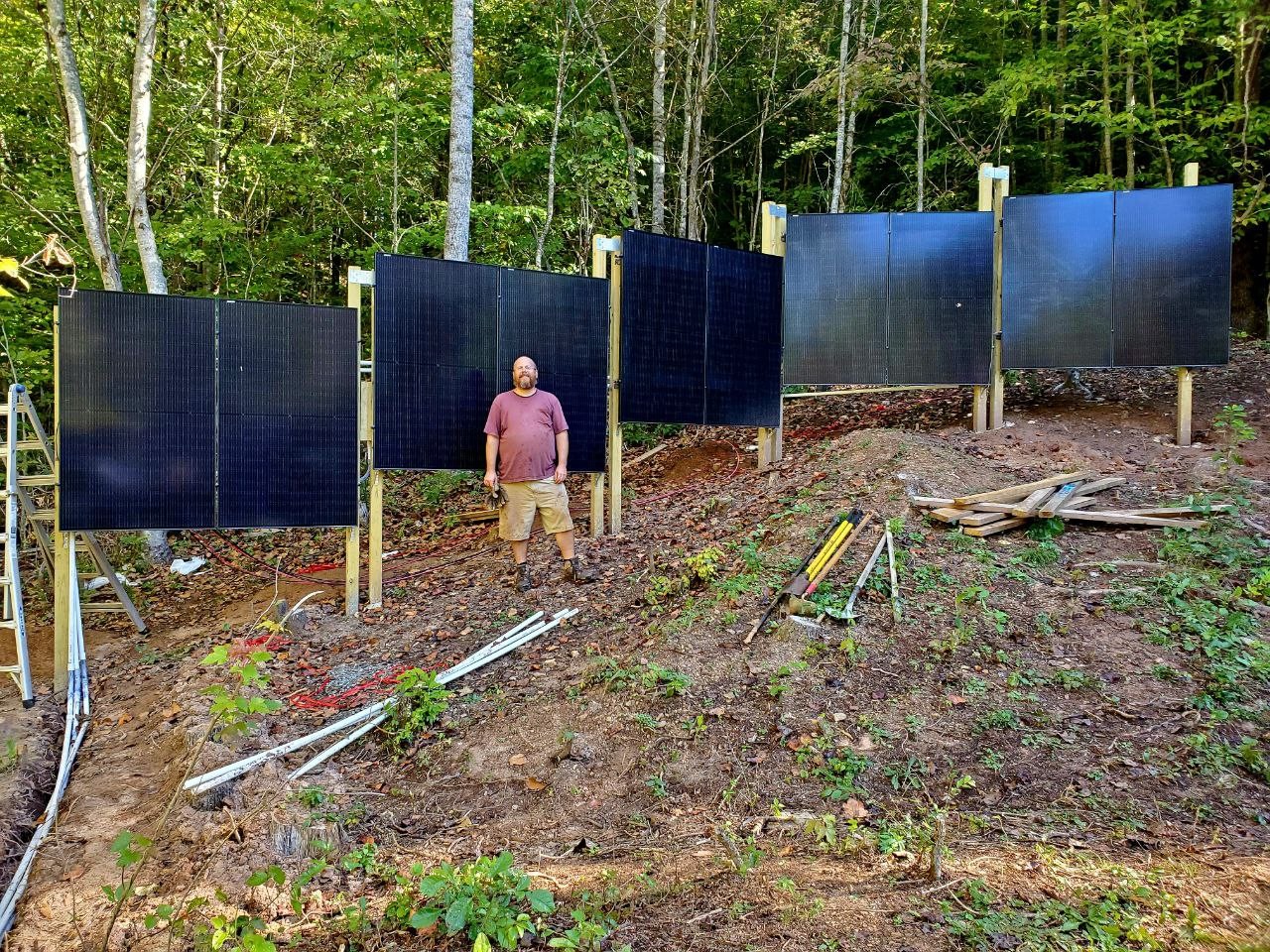
I have been working all year on a solar upgrade aimed at December. Now here it is, midwinter, and my electric car is charging on a cloudy day from my offgrid solar fence. I lived happily enough with 1 kilowatt of solar that I installed in 2017. Meanwhile, solar panel prices came down massively, incentives increased and everything came together: This was the year. In the spring I started clearing forest trees that were leaning over the house, making both a firebreak and a solar field. In June I picked up a pallet of panels in a box truck.
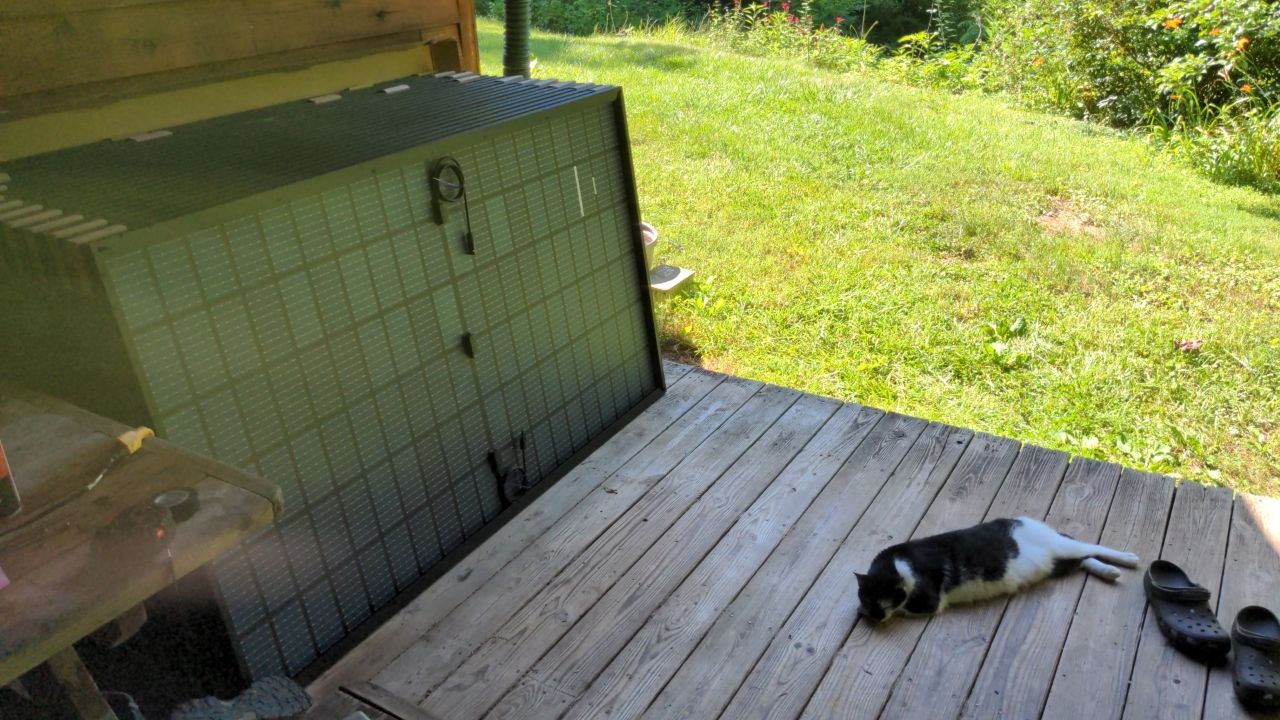
a porch with a a bunch of solar panels, stacked on edge leaning up against the wall. A black and white cat is sprawled in front of them.
In August I bought the EV and was able to charge it offgrid from my old solar system... a few miles per day on the most sunny days. In September and October I built a solar fence, of my own design.
Me standing in front of the solar fence, which is 10 panels long
For the past several weeks I have been installing additional solar panels on ballasted ground mounts full of gravel. At this point I'm half way through installing my 30 panel upgrade. The design goal of my 12 kilowatt system is to produce 1 kilowatt of power all day on a cloudy day in midwinter, which allows swapping between major loads (EV charger, hot water heater, etc) on a cloudy day and running everything on a sunny day. So the size of the battery bank doesn't matter much. Batteries are getting cheaper fast too, but they are a wear item, so it's better to oversize the solar system and minimize the battery. A lot of this is nonstandard and experimental. And that makes sense with the price of solar panels. It costs more to mount solar panels now than the panels are worth. And non-ideal panel orientation isn't a problem when the system is massively overpaneled. I'm hoping to finish up the install before the end of winter. I have more trees to clear, more ballasted ground mounts to install, and need to come up with something even more experimental for a half dozen or so panels. Using solar panels as mounts for solar panels? Hanging them from trees? Soon the wan light will fade, time to head off to the solstice party to enjoy the long night, and a bonfire.
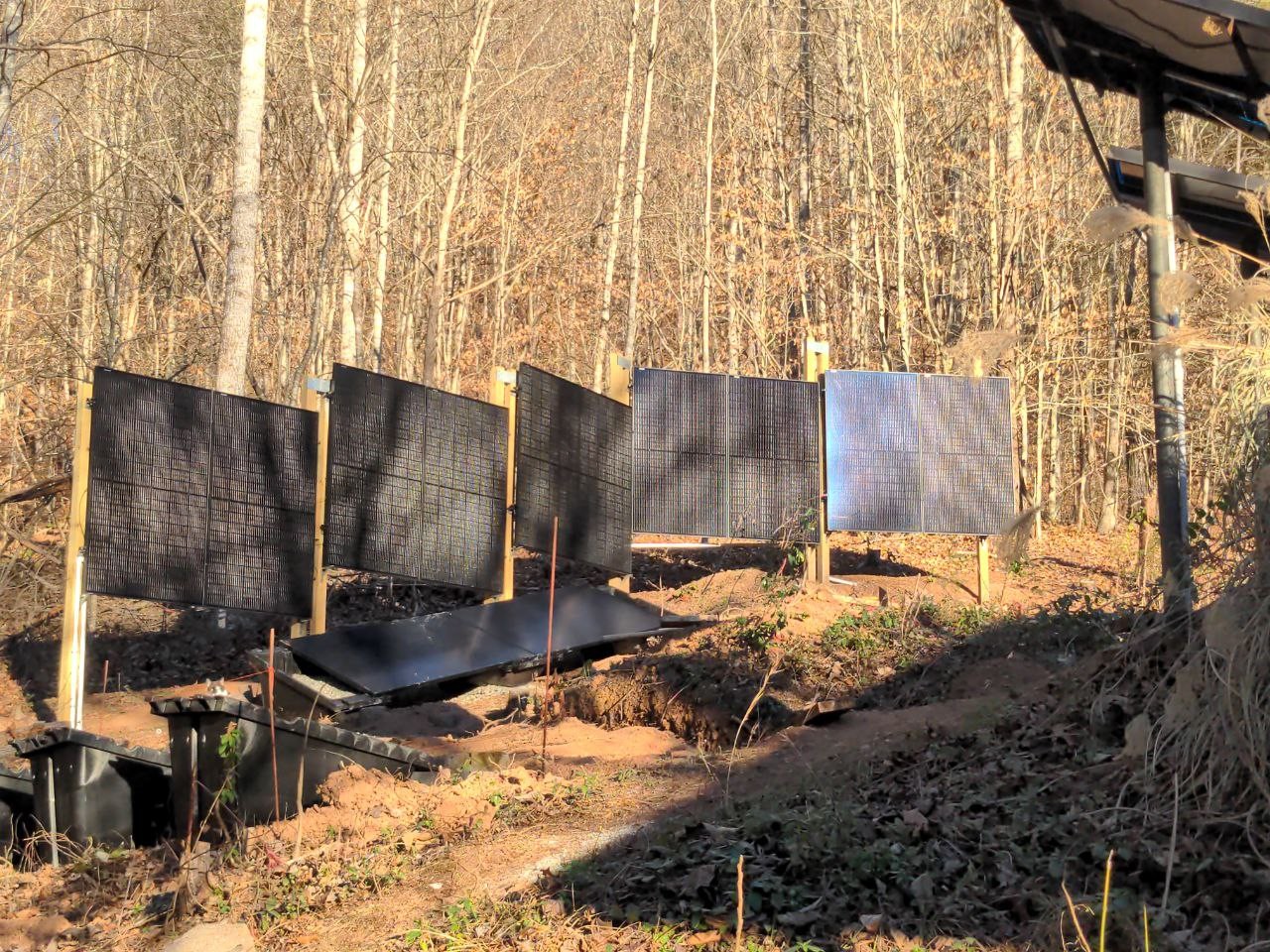
Solar fence with some ballasted ground mounts in front of it, late evening light. Old pole mounted solar panels in the foreground are from the 90's.

20 December 2024

Noah Meyerhans: Local Development VM Management

A coworker asked recently about how people use VMs locally for dev work, so I figured I d take a few minutes to write up a bit about what I do. There are many use cases for local virtual machines in software development and testing. They re self-contained, meaning you can make a mess of them without impacting your day-to-day computing environment. They can run different distributions, kernels, and even entirely different operating systems from the one you use regularly. Etc. They re also cheaper than cloud services and provide finer grained control over the resources. I figured I d share a little bit about how I manage different virtual machines in case anybody finds this useful. This is what works for me, but it won t necessarily work for you, or maybe you ve already got something better. I ve found it to be easy to work with, light weight, and is easy to evolve my needs change.

Use short-lived VMs Rather than keep a long-lived development VM around that you customize over time, I recommend automating the common customizations and provisioning new VMs regularly. If I m working on reproducing a bug or testing a change prior to submitting it upstream, I ll do this work in a VM and delete the VM when when I m done. When provisioning VMs this frequently, though, walking through the installation process for every new VM is tedious and a waste of time. Since most of my work is done in Debian, so I start with images generated daily by the cloud team. These images are available for multiple releases and architectures. The nocloud variant boots to a root prompt and can be useful directly, or the generic images can be used for cloud-init based customization.

Automating image preparation This makefile lets me do something like make image and get a new qcow2 image with the latest build of a given Debian release (sid by default, with others available by specifying DIST).
DATESTAMP=$(shell date +"%Y-%m-%d")
FLAVOR?=generic
ARCH?=$(shell dpkg --print-architecture)
DIST?=sid
RELEASE=$(DIST)
URL_PATH=https://cloud.debian.org/images/cloud/$(DIST)/daily/latest/
ifeq ($(DIST),trixie)
RELEASE=13
endif
ifeq ($(DIST),bookworm)
RELEASE=12
endif
ifeq ($(DIST),bullseye)
RELEASE=11
endif
debian-$(DIST)-$(FLAVOR)-$(ARCH)-daily.tar.xz:
curl --fail --connect-timeout 20 -LO \
$(URL_PATH)/debian-$(RELEASE)-$(FLAVOR)-$(ARCH)-daily.tar.xz
$(DIST)-$(FLAVOR)-$(DATESTAMP).qcow2: debian-$(RELEASE)-$(FLAVOR)-$(ARCH)-daily.tar.xz
tar xvf debian-$(RELEASE)-$(FLAVOR)-$(ARCH)-daily.tar.xz
qemu-img convert -O qcow2 disk.raw $@
rm -f disk.raw
qemu-img resize $@ 20g
qemu-img snapshot -c untouched $@
image: $(DIST)-$(FLAVOR)-$(DATESTAMP).qcow2
.PHONY: image

Customize the VM environment with cloud-init While the nocloud images can be useful, I typically find that I want to apply the same modifications to each new VM I launch, and they don t provide facilities for automating this. The generic images, on the other hand, run cloud-init by default. Using cloud-init, I can create my user account, point apt at local mirrors, install my preferred tools, ensure the root filesystem is resized to make full use of the backing storage, etc. The cloud-init configuration on the generic images will read from a local config drive, which can contain an ISO9660 (cdrom) filesystem image. This image can be generated from a subdirectory containing the various cloud-init input files using the following make syntax:
IMDS_FILES=$(shell find seedconfig -path '*/.git/*' \
-prune -o -type f -name '*.in.json' -print) \
seedconfig/openstack/latest/user_data
seed.iso: $(IMDS_FILES)
genisoimage -V config-2 -o $@ -J -R -m '*~' -m '.git' seedconfig
With the image in place, the VM can be created with
 qemu-system-x86_64 -machine q35,accel=kvm
-cpu host -m 4g -drive file=$ img ,index=0,if=virtio,media=disk
-drive file=seed.iso,media=cdrom,format=raw,index=2,if=virtio
-nic user -nographic
This invokes qemu with the root volume and ISO image attached as disks, uses an emulated q35 machine with the host s CPU and KVM acceleration, the userspace network stack, and a serial console. The first time the VM boots, cloud-init will apply the configuration from the cloud-config available in the ISO9660 filesystem.

Alternatives to cloud-init virt-customize is another tool accomplishing the same type of customization. I use cloud-init because it works directly with cloud providers in addition to local VM images. You could also use something like ansible.

Variations I have a variant of this that uses a bridged network, which I ll write more about later. The bridge is nice because it s more featureful, with full support for IPv6, etc, but it needs a bit more infrastructure in place. It also can be helpful to use 9p or virtfs to share filesystem state between the host the VM. I don t tend to rely on these, and will instead use rsync or TRAMP for moving files around. Containers are also useful, of course, and there are plenty of times when the full isolation of a VM is not worth the overhead.

19 December 2024

Benjamin Mako Hill: Being a bread torus

A concerned nutritional epidemiologist in Tokyo realizes that if you are what you eat, that means
It s a similar situation in Seoul, albeit with less oil and more confidence.

16 December 2024

Russ Allbery: Review: Finders

Review: Finders, by Melissa Scott
Series: Firstborn, Lastborn #1
Publisher: Candlemark & Gleam
Copyright: 2018
ISBN: 1-936460-87-4
Format: Kindle
Pages: 409
Finders is a far future science fiction novel with cyberpunk vibes. It is the first of a series, but the second (and, so far, only other) book of the series is a prequel. It stands alone reasonably well (more on that later). Cassilde Sam is a salvor. That means she specializes in exploring ancient wrecks and ruins left behind by the Ancients and salvaging materials that can be reused. The most important of those are what are called Ancestral elements: BLUE, which can hold programming; GOLD, which which reacts to BLUE instructions; RED, which produces actions or output; and GREEN, the rarest and most valuable, which powers everything else. Cassilde and her partner Dai Winter file claims on newly-discovered or incompletely salvaged Ancestor sites and then extract elemental material and anything else of value in their small salvage ship. Cassilde is also dying. She has Lightman's, an incurable degenerative disease that can only be treated with ever-increasing quantities of GREEN. It's hard to sleep, hard to get warm, hard to breathe, and eventually she'll run out of money to pay for the GREEN and she'll die. To push that day off into the future, she and Dai need work. The good news is that the wreckage of a new Ancestor sky palace was discovered in a long orbit and will create enough salvage work for every experienced salvor in the system. The bad news is that they're not qualified to bid on it. They need a scholar with a class-one license to bid on the best sections, and they haven't had a reliable scholar since their former partner and lover Summerland Ashe picked the opposite side in the Troubles and left the Fringe for the Entente, the more densely settled and connected portion of human space. But, unexpectedly and suspiciously, Ashe may be back and offering to work with them again. So, first, I love this setting. This is far from the first SF novel that is set in the aftermath of a general collapse of human civilization and revolving around discovering lost mysteries. Most examples of that genre are post-apocalyptic novels limited to Earth or the local solar system, but Kate Elliott's Unconquerable Sun comes immediately to mind. It's also not the first space archaeology series I've read; Kristine Kathyrn Rusch's story series starting with "Diving into the Wreck" also came to mind. But I don't recall the last time I've seen the author sell the setting so effectively. This is a world with starships and spaceports and clearly advanced technology, but it feels like a post-collapse society that's built on ruins. It's not just that technology runs on half-understood Ancestral elements and states fight over control of debris fields. It's also that the society repurposes Ancestral remnants in ways that both they and the reader know weren't originally intended, and that sometimes are more ingenious or efficient than how the Ancestors probably used them. There's a creative grittiness here that reminds me of good cyberpunk. It's not just good atmospheric writing, though. Scott makes a world-building decision that is going to sound trivial when I say it, but that has brilliant implications for the rest of the setting. There was not just one collapse; there were two. The Ancestor civilization, presumed to be the first human civilization, has passed into myth, quite literally when it comes to the stories around its downfall in the aftermath of a war against AIs. After the Ancestors came the Successors, who followed a similar salvage and rebuild approach and got as far as inventing their own warp drive technology that was based on but different than the Ancestor technology. Then they also collapsed, leaving their adapted technology and salvage operations layered over Ancestor sites. Cassilde's civilization is the third human starfaring civilization, and it is very specifically the third, neither the second nor one of dozens. This has so many small but effective implications that improve this story. A fall happened twice, so it feels like a pattern that makes Cassilde's civilization paranoid, but it happened for two very different reasons, so there is room to argue against it being a pattern. Salvage is harder because of the layering of Ancestor and Successor activity. Successors had their own way of controlling technology that is not accessible to Cassilde and her crew but is also not how the technology was intended to be used, which sends small ripples of interesting complexity through the background. And salvors are competing not only against each other but also against Successor salvage operations for which they have fragmentary records. It's a beautifully effective touch. Melissa Scott has been publishing science fiction for forty years, and it shows in this book. The protagonists are older characters: established professionals with resource problems but also social connections and an earned reputation, people who are trying to do a job and live their lives, not change the world. The writing is competent, deft, and atmospheric, with the confidence of long practice, but it also has the feel of an earlier era of science fiction. I mentioned the cyberpunk influence, which shows in the grittiness of the descriptions, the marginality of the characters in society, and the background theme of repurposing and reusing technology in unintended ways. This is the sort of book that feels solidly in the center of science fiction, without the genre mixing into either fantasy or romance that has become somewhat more common, and also without the dramatics of space opera (although the reader discovers that the stakes of this novel may be higher than anyone realized). And yet, so much of this book is about navigating a complicated romantic relationship, and that's where the story structure felt a bit odd. Cassilde, Dai, and Ashe were a polyamorous triad (polyamory also shows up in Scott's excellent Roads of Heaven series), and much of the first third of the book deals with the fracturing of trust with Ashe and their renegotiation of that relationship given his return. This is refreshingly written as the thoughtful interaction of three adults who take issues of trust seriously, but that also means it's much less dramatic than it sounds, and that means this book starts exceptionally slow. Scott is going somewhere, and the slow build became engrossing around the midpoint of the book, but I had to fight to stick with it at the start. About 80% of the way through this book, I had no idea how Scott was going to wrap things up in the pages remaining and was bracing myself for some sort of series cliffhanger. This is not what happens; the plot is not fully resolved in every detail, but it reaches a conclusion of sorts that does not mandate a sequel. I did think the end was a little bit unsatisfying, though, and I want another book that explores the implications of the ending. I think it would have to be a much different book, and the tonal shift might be stark. I've had this book on my to-read list for a while and kept putting it off because I wasn't sure I was in the mood for something precarious and gritty. This turned out to be an accurate worry: this is literally a book about salvaging the pieces of something full of wonders inextricably connected to dangers. You have to be in a cyberpunk sort of mood. But I've never read a bad Melissa Scott book, and this is no exception. The simplicity and ALL-CAPSNESS of the Ancestral elements grated a bit, but apart from that, the world-building is exceptional and well worth the trip. Recommended, although be warned that, if you're like me, it may not grab you from the first page. Followed by Fallen, but that book is a prequel that does not share any protagonists. Content notes: disability and degenerative illness in a universe where magical cures are possible, so be warned if that specific thematic combination is not what you're looking for. Rating: 7 out of 10

15 December 2024

Russell Coker: Hisense 65U80G 65 Inch 8K ULED Android TV (2021)

The Aim I just bought a Hisense 65U80G 65 Inch 8K ULED Android TV (2021 model) for $1,568 including delivery. I got that deal by googling refurbished 8K TVs and finding the cheapest one I could buy. Amazon and eBay didn t have any good prices on second hand 8K TVs and new ones start at $3,000 on special. I didn t assess how Hisense compares to other TVs, as far as I could determine there was only one model of 8K TV on sale in Australia in the price range I was prepared to pay. So I won t review how this TV compares to other models but how refurbished TVs compare to other display options. I bought this because the highest resolution monitor in my price range is 5120*2160 [1]. While I could get a 5128*2880 monitor for around $1,500 paying 3* the money for 33% more pixels is bad value for money. Getting 4* the pixels for under 3* the price is good value even when it s a TV with the lower display quality that involves. Before buying this TV I read this blog post by Daniel Lawrence about using an 8K TV as a primary monitor [2]. While he has an interesting setup with a 65 TV on a large desk it s not what I plan to do at this time. My Plans for Use I don t plan to make it a main monitor. While 5120*2160 isn t as good as I like on my desk it s bearable and the quality of the display is high. High resolution isn t needed for all tasks, for example I m writing this blog post on my laptop while watching a movie on the 8K TV. One thing I d like to do with the 8K TV when I get it working as a monitor is to share the screen for team programming projects. I don t have any specific plans other than team coding projects at the moment. But it will be interesting to experiment with it when I get it working. Technical Issues with High Resolution Monitors Hardware Needed A lot of the graphic hardware out there don t support resolutions higher than 5120*2880. It seems that most laptops don t support resolutions higher than that and higher resolutions than 4K are difficult. Only quite recent and high end video cards will do 8K. Apparently the RTX 2080 is one of the oldest ones that does and that s $400 on ebay. Strangely the GPU chipset spec pages don t list the maximum resolution and there s the additional complication that the other chips might not support the resolutions that the GPU itself can support. As an aside I don t use NVidia cards for regular workstations due to reliability problems. But they are good for ML work and for special purpose systems. Interface Versions To do 8K video it seems that you need HDMI 2.1 (or maybe 2.0 with 4:2:0 chroma subsampling) or DisplayPort 1.3 for 30Hz with 24bit color and 2.0 for higher refresh rates. But using a particular version of the interface doesn t require supporting all the resolutions that it might support. This TV has HDMI 2.1 inputs, I ve bought an adaptor cable that does DisplayPort 1.4 to HDMI 2.1 at 8K resolution. So I need a video card that does DisplayPort 1.4 or HDMI 2.1 output. That doesn t mean that the card will work, but it could work. It s a pity that no-one has made a USB-C video controller that has a basic frame-buffer supporting 8K and the minimal GPU capabilities. The consensus of opinion is that no games will run well at 8K at this time so anyone using 8K resolution doesn t need GPU power unless it s for ML stuff. I m thinking of making a system that can be used as a ML server and X/Wayland server so a GPU with a decent amount of RAM and compute power would be good. I m not particularly interested in spending $1,500+ to get a GPU that can drive a $1,568 TV. I m looking into getting a RTX A2000 with 12G of RAM which should be adequate for ML experiments and can handle 8K@60Hz output. I ve ordered a DisplayPort to HDMI converter cable so if I get a DisplayPort card it will work. Software Support When I first got started with 4K monitors I had significant problems in adjusting the UI to be usable. The support for scaling software is much better now than it was then and 8K 65 has a lower DPI than 4K 32 . So I hope this won t be an issue. Progress So Far My first Hisense 8K TV stopped working properly. It would change to a mostly white screen after being used for some time. The screen would change in ways that correlate to changes in what should appear, but not in a way that was usable. It was just a different pattern of white blobs when I changed to a menu view not anything that allowed using it. I presume that this was the problem that drove a need for refurbishment as when I first got the TV it was still signed in to Google accounts for YouTube and to NetFlix. Best Buy Electrical was good about providing a quick replacement, they took away the old TV and delivered a new one on the same visit and it s now working well. I ve obtained a NVidia card that can allegedly do 8K output and a combination of cables that might be able to carry an 8K signal. Now I just need to get the NVidia drivers to not cause a kernel panic to get things to work.

13 December 2024

Emanuele Rocca: Murder Mystery: GCC Builds Failing After sbuild Refactoring

This is the story of an investigation conducted by Jochen Sprickerhof, Helmut Grohne, and myself. It was true teamwork, and we would have not reached the bottom of the issue working individually. We think you will find it as interesting and fun as we did, so here is a brief writeup. A few of the steps mentioned here took several days, others just a few minutes. What is described as a natural progression of events did not always look very obvious at the moment at all.
Let us go through the Six Stages of Debugging together.

Stage 1: That cannot happen
Official Debian GCC builds start failing on multiple architectures in late November.
The build error happens on the build servers when running the testuite, but we know this cannot happen. GCC builds are not meant to fail in case of testsuite failures! Return codes are not making the build fail, make is being called with -k, it just cannot happen.
A lot of the GCC tests are always failing in fact, and an extensive log of the results is posted to the debian-gcc mailing list, but the packages always build fine regardless.
On the build daemons, build failures take several hours.

Stage 2: That does not happen on my machine
Building on my machine running Bookworm is just fine. The Build Daemons run Bookworm and use a Sid chroot for the build environment, just like I am. Same kernel.
The only obvious difference between my setup and the Debian buildds is that I am using sbuild 0.85.0 from bookworm, and the buildds have 0.86.3~bpo12+1 from bookworm-backports. Trying again with 0.86.3~bpo12+1, the build fails on my system too. The build daemons were updated to the bookworm-backports version of sbuild at some point in late November. Ha.

Stage 3: That should not happen
There are quite a few sbuild versions in between 0.85.0 and 0.86.3~bpo12+1, but looking at recent sbuild bugs shows that sbuild 0.86.0 was breaking "quite a number of packages". Indeed, with 0.86.0 the build still fails. Trying the version immediately before, 0.85.11, the build finishes correctly. This took more time than it sounds, one run including the tests takes several hours. We need a way to shorten this somehow.
The Debian packaging of GCC allows to specify which languages you may want to skip, and by default it builds Ada, Go, C, C++, D, Fortran, Objective C, Objective C++, M2, and Rust. When running the tests sequentially, the build logs stop roughly around the tests of a runtime library for D, libphobos. So can we still reproduce the failure by skipping everything except for D? With DEB_BUILD_OPTIONS=nolang=ada,go,c,c++,fortran,objc,obj-c++,m2,rust the build still fails, and it fails faster than before. Several minutes, not hours. This is progress, and time to file a bug. The report contains massive spoilers, so no link. :-)

Stage 4: Why does that happen?
Something is causing the build to end prematurely. It s not the OOM killer, and the kernel does not have anything useful to say in the logs. Can it be that the D language tests are sending signals to some process, and that is what s killing make ? We start tracing signals sent with bpftrace by writing the following script, signals.bt:
tracepoint:signal:signal_generate  
    printf("%s PID %d (%s) sent signal %d to PID %d\n", comm, pid, args->sig, args->pid);
 
And executing it with sudo bpftrace signals.bt.
The build takes its sweet time, and it fails. Looking at the trace output there s a suspicious process.exe terminating stuff.
process.exe (PID: 2868133) sent signal 15 to PID 711826
That looks interesting, but we have no clue what PID 711826 may be. Let s change the script a bit, and trace signals received as well.
tracepoint:signal:signal_generate  
    printf("PID %d (%s) sent signal %d to %d\n", pid, comm, args->sig, args->pid);
 
tracepoint:signal:signal_deliver  
    printf("PID %d (%s) received signal %d\n", pid, comm, args->sig);
 
The working version of sbuild was using dumb-init, whereas the new one features a little init in perl. We patch the current version of sbuild by making it use dumb-init instead, and trace two builds: one with the perl init, one with dumb-init.
Here are the signals observed when building with dumb-init.
PID 3590011 (process.exe) sent signal 2 to 3590014
PID 3590014 (sleep) received signal 9
PID 3590011 (process.exe) sent signal 15 to 3590063
PID 3590063 (std.process tem) received signal 9
PID 3590011 (process.exe) sent signal 9 to 3590065
PID 3590065 (std.process tem) received signal 9
And this is what happens with the new init in perl:
PID 3589274 (process.exe) sent signal 2 to 3589291
PID 3589291 (sleep) received signal 9
PID 3589274 (process.exe) sent signal 15 to 3589338
PID 3589338 (std.process tem) received signal 9
PID 3589274 (process.exe) sent signal 9 to 3589340
PID 3589340 (std.process tem) received signal 9
PID 3589274 (process.exe) sent signal 15 to 3589341
PID 3589274 (process.exe) sent signal 15 to 3589323
PID 3589274 (process.exe) sent signal 15 to 3589320
PID 3589274 (process.exe) sent signal 15 to 3589274
PID 3589274 (process.exe) received signal 9
PID 3589341 (sleep) received signal 9
PID 3589273 (sbuild-usernsex) sent signal 9 to 3589320
PID 3589273 (sbuild-usernsex) sent signal 9 to 3589323
There are a few additional SIGTERM being sent when using the perl init, that s helpful. At this point we are fairly convinced that process.exe is worth additional inspection. The source code of process.d shows something interesting:
1221 @system unittest
1222  
[...]
1247     auto pid = spawnProcess(["sleep", "10000"],
[...]
1260     // kill the spawned process with SIGINT
1261     // and send its return code
1262     spawn((shared Pid pid)  
1263         auto p = cast() pid;
1264         kill(p, SIGINT);
So yes, there s our sleep and the SIGINT (signal 2) right in the unit tests of process.d, just like we have observed in the bpftrace output.
Can we study the behavior of process.exe in isolation, separatedly from the build? Indeed we can. Let s take the executable from a failed build, and try running it under /usr/libexec/sbuild-usernsexec.
First, we prepare a chroot inside a suitable user namespace:
unshare --map-auto --setuid 0 --setgid 0 mkdir /tmp/rootfs
cd /tmp/rootfs
cat /home/ema/.cache/sbuild/unstable-arm64.tar   unshare --map-auto --setuid 0 --setgid 0 tar xf  -
unshare --map-auto --setuid 0 --setgid 0 mkdir /tmp/rootfs/whatever
unshare --map-auto --setuid 0 --setgid 0 cp process.exe /tmp/rootfs/
Now we can run process.exe on its own using the perl init, and trace signals at will:
/usr/libexec/sbuild-usernsexec --pivotroot --nonet u:0:100000:65536  g:0:100000:65536 /tmp/rootfs ema /whatever -- /process.exe
We can compare the behavior of the perl init vis-a-vis the one using dumb-init in milliseconds instead of minutes.

Stage 5: Oh, I see.
Why does process.exe send more SIGTERMs when using the perl init is now the big question. We have a simple reproducer, so this is where using strace becomes possible.
sudo strace --user ema --follow-forks -o sbuild-dumb-init.strace ./sbuild-usernsexec-dumb-init --pivotroot --nonet u:0:100000:65536  g:0:100000:65536 /tmp/dumbroot ema /whatever -- /process.exe
We start comparing the strace output of dumb-init with that of perl-init, looking in particular for different calls to kill.
Here is what process.exe does under dumb-init:
3593883 kill(-2, SIGTERM)               = -1 ESRCH (No such process)
No such process. Under perl-init instead:
3593777 kill(-2, SIGTERM <unfinished ...>
The process is there under perl-init!
That is a kill with negative pid. From the kill(2) man page:
If pid is less than -1, then sig is sent to every process in the process group whose ID is -pid.
It would have been very useful to see this kill with negative pid in the output of bpftrace, why didn t we? The tracepoint used, tracepoint:signal:signal_generate, shows when signals are actually being sent, and not the syscall being called. To confirm, one can trace tracepoint:syscalls:sys_enter_kill and see the negative PIDs, for example:
PID 312719 (bash) sent signal 2 to -312728
The obvious question at this point is: why is there no process group 2 when using dumb-init?

Stage 6: How did that ever work?
We know that process.exe sends a SIGTERM to every process in the process group with ID 2. To find out what this process group may be, we spawn a shell with dumb-init and observe under /proc PIDs 1, 16, and 17. With perl-init we have 1, 2, and 17. When running dumb-init, there are a few forks before launching the program, explaining the difference. Looking at /proc/2/cmdline we see that it s bash, ie. the program we are running under perl-init. When building a package, that is dpkg-buildpackage itself.
The test is accidentally killing its own process group.
Now where does this -2 come from in the test?
2363     // Special values for _processID.
2364     enum invalid = -1, terminated = -2;
Oh. -2 is used as a special value for PID, meaning "terminated". And there s a call to kill() later on:
2694     do   s = tryWait(pid);   while (!s.terminated);
[...]
2697     assertThrown!ProcessException(kill(pid));
What sets pid to terminated you ask?
Here is tryWait:
2568 auto tryWait(Pid pid) @safe
2569  
2570     import std.typecons : Tuple;
2571     assert(pid !is null, "Called tryWait on a null Pid.");
2572     auto code = pid.performWait(false);
And performWait:
2306         _processID = terminated;
The solution, dear reader, is not to kill.
PS: the bug report with spoilers for those interested is #1089007.

Freexian Collaborators: Monthly report about Debian Long Term Support, November 2024 (by Roberto C. S nchez)

Like each month, have a look at the work funded by Freexian s Debian LTS offering.

Debian LTS contributors In November, 20 contributors have been paid to work on Debian LTS, their reports are available:
  • Abhijith PA did 14.0h (out of 6.0h assigned and 8.0h from previous period).
  • Adrian Bunk did 53.0h (out of 15.0h assigned and 85.0h from previous period), thus carrying over 47.0h to the next month.
  • Andrej Shadura did 7.0h (out of 7.0h assigned).
  • Arturo Borrero Gonzalez did 1.0h (out of 10.0h assigned), thus carrying over 9.0h to the next month.
  • Bastien Roucari s did 20.0h (out of 20.0h assigned).
  • Ben Hutchings did 0.0h (out of 24.0h assigned), thus carrying over 24.0h to the next month.
  • Chris Lamb did 18.0h (out of 18.0h assigned).
  • Daniel Leidert did 17.0h (out of 26.0h assigned), thus carrying over 9.0h to the next month.
  • Emilio Pozuelo Monfort did 40.5h (out of 60.0h assigned), thus carrying over 19.5h to the next month.
  • Guilhem Moulin did 7.25h (out of 7.5h assigned and 12.5h from previous period), thus carrying over 12.75h to the next month.
  • Jochen Sprickerhof did 3.5h (out of 10.0h assigned), thus carrying over 6.5h to the next month.
  • Lee Garrett did 14.75h (out of 15.25h assigned and 44.75h from previous period), thus carrying over 45.25h to the next month.
  • Lucas Kanashiro did 10.0h (out of 54.0h assigned and 10.0h from previous period), thus carrying over 54.0h to the next month.
  • Markus Koschany did 20.0h (out of 40.0h assigned), thus carrying over 20.0h to the next month.
  • Roberto C. S nchez did 6.75h (out of 9.75h assigned and 14.25h from previous period), thus carrying over 17.25h to the next month.
  • Santiago Ruano Rinc n did 24.75h (out of 23.5h assigned and 1.5h from previous period), thus carrying over 0.25h to the next month.
  • Sean Whitton did 2.0h (out of 6.0h assigned), thus carrying over 4.0h to the next month.
  • Sylvain Beucler did 21.5h (out of 9.5h assigned and 50.5h from previous period), thus carrying over 38.5h to the next month.
  • Thorsten Alteholz did 11.0h (out of 11.0h assigned).
  • Tobias Frost did 12.0h (out of 10.5h assigned and 1.5h from previous period).

Evolution of the situation In November, we have released 38 DLAs. The LTS coordinators, Roberto and Santiago, delivered a talk at the Mini-DebConf event in Toulouse, France. The title of the talk was How LTS goes beyond LTS . The talk covered work done by the LTS Team during the past year. This included contributions related to individual packages in Debian (such as tomcat, jetty, radius, samba, apache2, ruby, and many others); improvements to tooling and documentation useful to the Debian project as a whole; and contributions to upstream work (apache2, freeimage, node-dompurify, samba, and more). Additionally, several contributors external to the LTS Team were highlighted for their contributions to LTS. Readers are encouraged to watch the video of the presentation for a more detailed review of various ways in which the LTS team has contributed more broadly to the Debian project and to the free software community during the past year. We wish to specifically thank Salvatore (of the Debian Security Team) for swiftly handling during November the updates of needrestart and libmodule-scandeps-perl, both of which involved arbitrary code execution vulnerabilities. We are happy to see increased involvement in LTS work by contributors from outside the formal LTS Team. The work of the LTS Team in November was otherwise unremarkable, encompassing the customary triage, development, testing, and release of numerous DLAs, along with some associated contributions to related packages in stable and unstable.

Thanks to our sponsors Sponsors that joined recently are in bold.

12 December 2024

Matthew Garrett: When should we require that firmware be free?

The distinction between hardware and software has historically been relatively easy to understand - hardware is the physical object that software runs on. This is made more complicated by the existence of programmable logic like FPGAs, but by and large things tend to fall into fairly neat categories if we're drawing that distinction.

Conversations usually become more complicated when we introduce firmware, but should they? According to Wikipedia, Firmware is software that provides low-level control of computing device hardware, and basically anything that's generally described as firmware certainly fits into the "software" side of the above hardware/software binary. From a software freedom perspective, this seems like something where the obvious answer to "Should this be free" is "yes", but it's worth thinking about why the answer is yes - the goal of free software isn't freedom for freedom's sake, but because the freedoms embodied in the Free Software Definition (and by proxy the DFSG) are grounded in real world practicalities.

How do these line up for firmware? Firmware can fit into two main classes - it can be something that's responsible for initialisation of the hardware (such as, historically, BIOS, which is involved in initialisation and boot and then largely irrelevant for runtime[1]) or it can be something that makes the hardware work at runtime (wifi card firmware being an obvious example). The role of free software in the latter case feels fairly intuitive, since the interface and functionality the hardware offers to the operating system is frequently largely defined by the firmware running on it. Your wifi chipset is, these days, largely a software defined radio, and what you can do with it is determined by what the firmware it's running allows you to do. Sometimes those restrictions may be required by law, but other times they're simply because the people writing the firmware aren't interested in supporting a feature - they may see no reason to allow raw radio packets to be provided to the OS, for instance. We also shouldn't ignore the fact that sufficiently complicated firmware exposed to untrusted input (as is the case in most wifi scenarios) may contain exploitable vulnerabilities allowing attackers to gain arbitrary code execution on the wifi chipset - and potentially use that as a way to gain control of the host OS (see this writeup for an example). Vendors being in a unique position to update that firmware means users may never receive security updates, leaving them with a choice between discarding hardware that otherwise works perfectly or leaving themselves vulnerable to known security issues.

But even the cases where firmware does nothing other than initialise the hardware cause problems. A lot of hardware has functionality controlled by registers that can be locked during the boot process. Vendor firmware may choose to disable (or, rather, never to enable) functionality that may be beneficial to a user, and then lock out the ability to reconfigure the hardware later. Without any ability to modify that firmware, the user lacks the freedom to choose what functionality their hardware makes available to them. Again, the ability to inspect this firmware and modify it has a distinct benefit to the user.

So, from a practical perspective, I think there's a strong argument that users would benefit from most (if not all) firmware being free software, and I don't think that's an especially controversial argument. So I think this is less of a philosophical discussion, and more of a strategic one - is spending time focused on ensuring firmware is free worthwhile, and if so what's an appropriate way of achieving this?

I think there's two consistent ways to view this. One is to view free firmware as desirable but not necessary. This approach basically argues that code that's running on hardware that isn't the main CPU would benefit from being free, in the same way that code running on a remote network service would benefit from being free, but that this is much less important than ensuring that all the code running in the context of the OS on the primary CPU is free. The maximalist position is not to compromise at all - all software on a system, whether it's running at boot or during runtime, and whether it's running on the primary CPU or any other component on the board, should be free.

Personally, I lean towards the former and think there's a reasonably coherent argument here. I think users would benefit from the ability to modify the code running on hardware that their OS talks to, in the same way that I think users would benefit from the ability to modify the code running on hardware the other side of a network link that their browser talks to. I also think that there's enough that remains to be done in terms of what's running on the host CPU that it's not worth having that fight yet. But I think the latter is absolutely intellectually consistent, and while I don't agree with it from a pragmatic perspective I think things would undeniably be better if we lived in that world.

This feels like a thing you'd expect the Free Software Foundation to have opinions on, and it does! There are two primarily relevant things - the Respects your Freedoms campaign focused on ensuring that certified hardware meets certain requirements (including around firmware), and the Free System Distribution Guidelines, which define a baseline for an OS to be considered free by the FSF (including requirements around firmware).

RYF requires that all software on a piece of hardware be free other than under one specific set of circumstances. If software runs on (a) a secondary processor and (b) within which software installation is not intended after the user obtains the product, then the software does not need to be free. (b) effectively means that the firmware has to be in ROM, since any runtime interface that allows the firmware to be loaded or updated is intended to allow software installation after the user obtains the product.

The Free System Distribution Guidelines require that all non-free firmware be removed from the OS before it can be considered free. The recommended mechanism to achieve this is via linux-libre, a project that produces tooling to remove anything that looks plausibly like a non-free firmware blob from the Linux source code, along with any incitement to the user to load firmware - including even removing suggestions to update CPU microcode in order to mitigate CPU vulnerabilities.

For hardware that requires non-free firmware to be loaded at runtime in order to work, linux-libre doesn't do anything to work around this - the hardware will simply not work. In this respect, linux-libre reduces the amount of non-free firmware running on a system in the same way that removing the hardware would. This presumably encourages users to purchase RYF compliant hardware.

But does that actually improve things? RYF doesn't require that a piece of hardware have no non-free firmware, it simply requires that any non-free firmware be hidden from the user. CPU microcode is an instructive example here. At the time of writing, every laptop listed here has an Intel CPU. Every Intel CPU has microcode in ROM, typically an early revision that is known to have many bugs. The expectation is that this microcode is updated in the field by either the firmware or the OS at boot time - the updated version is loaded into RAM on the CPU, and vanishes if power is cut. The combination of RYF and linux-libre doesn't reduce the amount of non-free code running inside the CPU, it just means that the user (a) is more likely to hit since-fixed bugs (including security ones!), and (b) has less guidance on how to avoid them.

As long as RYF permits hardware that makes use of non-free firmware I think it hurts more than it helps. In many cases users aren't guided away from non-free firmware - instead it's hidden away from them, leaving them less aware that their freedom is constrained. Linux-libre goes further, refusing to even inform the user that the non-free firmware that their hardware depends on can be upgraded to improve their security.

Out of sight shouldn't mean out of mind. If non-free firmware is a threat to user freedom then allowing it to exist in ROM doesn't do anything to solve that problem. And if it isn't a threat to user freedom, then what's the point of requiring linux-libre for a Linux distribution to be considered free by the FSF? We seem to have ended up in the worst case scenario, where nothing is being done to actually replace any of the non-free firmware running on people's systems and where users may even end up with a reduced awareness that the non-free firmware even exists.

[1] Yes yes SMM

comment count unavailable comments

11 December 2024

Divine Attah-Ohiemi: From Sisterly Wisdom to Debian Dreams: My Outreachy Journey

Discovering Open Source: How I Got Introduced
Hey there! I m Divine Attah-Ohiemi, a sophomore studying Computer Science. My journey into the world of open source was anything but grand. It all started with a simple question to my sister: How do people get jobs without experience? Her answer? Open source! I dove into this vibrant community, and it felt like discovering a hidden treasure chest filled with knowledge and opportunities. Choosing Debian: Why This Community?
Why Debian, you ask? Well, I applied to Outreachy twice, and both times, I chose Debian. It s not just my first operating system; it feels like home. The Debian community is incredibly welcoming, like a big family gathering where everyone supports each other. Whether I was updating my distro or poring over documentation, the care and consideration in this community were palpable. It reminded me of the warmth of homeschooling with relatives. Plus, knowing that Debian's name comes from its creator Ian and his wife Debra adds a personal touch that makes me feel even more honored to contribute to making the website better! Why I Applied to Outreachy: What Inspired Me
Outreachy is my golden ticket to the open source world! As a 19-year-old, I see this internship as a unique opportunity to gain invaluable experience while contributing to something meaningful. It s the perfect platform for me to learn, grow, and connect with like-minded individuals who share my passion for technology and community. I m excited for this journey and can t wait to see where it takes me!

10 December 2024

Russ Allbery: 2024 book haul

I haven't made one of these posts since... last year? Good lord. I've therefore already read and reviewed a lot of these books. Kemi Ashing-Giwa The Splinter in the Sky (sff)
Moniquill Blackgoose To Shape a Dragon's Breath (sff)
Ashley Herring Blake Delilah Green Doesn't Care (romance)
Ashley Herring Blake Astrid Parker Doesn't Fail (romance)
Ashley Herring Blake Iris Kelly Doesn't Date (romance)
Molly J. Bragg Scatter (sff)
Sarah Rees Breenan Long Live Evil (sff)
Michelle Browne And the Stars Will Sing (sff)
Steven Brust Lyorn (sff)
Miles Cameron Beyond the Fringe (sff)
Miles Cameron Deep Black (sff)
Haley Cass Those Who Wait (romance)
Sylvie Cathrall A Letter to the Luminous Deep (sff)
Ta-Nehisi Coates The Message (non-fiction)
Julie E. Czerneda To Each This World (sff)
Brigid Delaney Reasons Not to Worry (non-fiction)
Mar Delaney Moose Madness (sff)
Jerusalem Demsas On the Housing Crisis (non-fiction)
Michelle Diener Dark Horse (sff)
Michelle Diener Dark Deeds (sff)
Michelle Diener Dark Minds (sff)
Michelle Diener Dark Matters (sff)
Elaine Gallagher Unexploded Remnants (sff)
Bethany Jacobs These Burning Stars (sff)
Bethany Jacobs On Vicious Worlds (sff)
Micaiah Johnson Those Beyond the Wall (sff)
T. Kingfisher Paladin's Faith (sff)
T.J. Klune Somewhere Beyond the Sea (sff)
Mark Lawrence The Book That Wouldn't Burn (sff)
Mark Lawrence The Book That Broke the World (sff)
Mark Lawrence Overdue (sff)
Mark Lawrence Returns (sff collection)
Malinda Lo Last Night at the Telegraph Club (historical)
Jessie Mihalik Hunt the Stars (sff)
Samantha Mills The Wings Upon Her Back (sff)
Lyda Morehouse Welcome to Boy.net (sff)
Cal Newport Slow Productivity (non-fiction)
Naomi Novik Buried Deep and Other Stories (sff collection)
Claire O'Dell The Hound of Justice (sff)
Keanu Reeves & China Mi ville The Book of Elsewhere (sff)
Kit Rocha Beyond Temptation (sff)
Kit Rocha Beyond Jealousy (sff)
Kit Rocha Beyond Solitude (sff)
Kit Rocha Beyond Addiction (sff)
Kit Rocha Beyond Possession (sff)
Kit Rocha Beyond Innocence (sff)
Kit Rocha Beyond Ruin (sff)
Kit Rocha Beyond Ecstasy (sff)
Kit Rocha Beyond Surrender (sff)
Kit Rocha Consort of Fire (sff)
Geoff Ryman HIM (sff)
Melissa Scott Finders (sff)
Rob Wilkins Terry Pratchett: A Life with Footnotes (non-fiction)
Gabrielle Zevin Tomorrow, and Tomorrow, and Tomorrow (mainstream)
That's a lot of books, although I think I've already read maybe a third of them? Which is better than I usually do.

9 December 2024

Gunnar Wolf: Some tips for those who still administer Drupal7-based sites

A bit of history: Drupal at my workplace (and in Debian) My main day-to-day responsibility in my workplace is, and has been for 20 years, to take care of the network infrastructure for UNAM s Economics Research Institute. One of the most visible parts of this responsibility is to ensure we have a working Web presence, and that it caters for the needs of our academic community. I joined the Institute in January 2005. Back then, our designer pushed static versions of our webpage, completely built in her computer. This was standard practice at the time, and lasted through some redesigns, but I soon started advocating for the adoption of a Content Management System. After evaluating some alternatives, I recommended adopting Drupal. It took us quite a bit to do the change: even though I clearly recall starting work toward adopting it as early as 2006, according to the Internet Archive, we switched to a Drupal-backed site around June 2010. We started using it somewhere in the version 6 s lifecycle. As for my Debian work, by late 2012 I started getting involved in the maintenance of the drupal7 package, and by April 2013 I became its primary maintainer. I kept the drupal7 package up to date in Debian until 2018; the supported build methods for Drupal 8 are not compatible with Debian (mainly, bundling third-party libraries and updating them without coordination with the rest of the ecosystem), so towards the end of 2016, I announced I would not package Drupal 8 for Debian. By March 2016, we migrated our main page to Drupal 7. By then, we already had several other sites for our academics projects, but my narrative follows our main Web site. I did manage to migrate several Drupal 6 (D6) sites to Drupal 7 (D7); it was quite involved process, never transparent to the user, and we did have the backlash of long downtimes (or partial downtimes, with sites half-available only) with many of our users. For our main site, we took the opportunity to do a complete redesign and deployed a fully new site. You might note that March 2016 is after the release of D8 (November 2015). I don t recall many of the specifics for this decision, but if I m not mistaken, building the new site was a several months long process not only for the technical work of setting it up, but for the legwork of getting all of the needed information from the different areas that need to be represented in the Institute. Not only that: Drupal sites often include tens of contributed themes and modules; the technological shift the project underwent between its 7 and 8 releases was too deep, and modules took a long time (if at all many themes and modules were outright dumped) to become available for the new release. Naturally, the Drupal Foundation wanted to evolve and deprecate the old codebase. But the pain to migrate from D7 to D8 is too big, and many sites have remained under version 7 Eight years after D8 s release, almost 40% of Drupal installs are for version 7, and a similar proportion runs a currently-supported release (10 or 11). And while the Drupal Foundation made a great job at providing very-long-term support for D7, I understand the burden is becoming too much, so close to a year ago (and after pushing several times the D7, they finally announced support will finish this upcoming January 5.

Drupal 7 must go! I found the following usage graphs quite interesting: the usage statistics for all Drupal versions follows a very positive slope, peaking around 2014 during the best years of D7, and somewhat stagnating afterwards, staying since 2015 at the 25000 28000 sites mark (I m very tempted to copy the graphs, but builtwith s terms of use are very clear in not allowing it). There is a sharp drop in the last year I attribute it to the people that are leaving D7 for other technologies after its end-of-life announcement. This becomes clearer looking only at D7 s usage statistics: D7 peaks at 15000 installs in 2016 stays there for close to 5 years, and has a sharp drop to under 7500 sites in the span of one year. D8 has a more regular rise, peak and fall peaking at ~8500 between 2020 and 2021, and down to close to 2500 for some months already; D9 has a very brief peak of almost 9000 sites in 2023 and is now close to half of it. Currently, the Drupal king appears to be D10, still on a positive slope and with over 9000 sites. Drupal 11 is still just a blip in builtwith s radar, with 3 registered sites as of September 2024 :- After writing this last paragraph, I came across the statistics found in the Drupal webpage; the methodology for acquiring its data is completely different: while builtwith s methodology is their trade secret, you can read more about how Drupal s data is gathered (and agree or disagree with it , but at least you have a page detailing 12 years so far of reported data, producing the following graph (which can be shared under the CC BY-SA license ): Drupal usage statistics by version 2013 2024 This graph is disgregated into minor versions, and I don t want to come up with yet another graph for it but it supports (most of) the narrative I presented above although I do miss the recent drop builtwith reported in D7 s numbers!

And what about Backdrop? During the D8 release cycle, a group of Drupal developers were not happy with the depth of the architectural changes that were being adopted, particularly the transition to the Symfony PHP component framework, and forked the D7 codebase to create the Backdrop CMS, a modern version of Drupal, without dropping the known and tested architecture it had. The Backdrop developers keep working closely together with the Drupal community, and although its usage numbers are way smaller than Drupal s, seems to be sustainable and lively. Of course, as I presented their numbers in the previous section, you can see Backdrop s numbers in builtwith are way, way lower. I have found it to be a very warm and welcoming community, eager to receive new members. And, thanks to its contributed D2B Migrate module, I found it is quite easy to migrate a live site from Drupal 7 to Backdrop.

Migration by playbook! So Well, I m an academic. And (if it s not obvious to you after reading so far ), one of the things I must do in my job is to write. So I decided to write an article to invite my colleagues to consider Backdrop for their D7 sites in Cuadernos T cnicos Universitarios de la DGTIC, a young journal in our university for showcasing technical academical work. And now that my article got accepted and published, I m happy to share it with you of course, if you can read Spanish But anyway Given I have several sites to migrate, and that I m trying to get my colleagues to follow suite, I decided to automatize the migration by writing an Ansible playbook to do the heavy lifting. Of course, the playbook s users will probably need to tweak it a bit to their personal needs. I m also far from an Ansible expert, so I m sure there is ample room fo improvement in my style. But it works. Quite well, I must add.

But with this size of database I did stumble across a big pebble, though. I am working on the migration of one of my users sites, and found that its database is huge. I checked the mysqldump output, and it got me close to 3GB of data. And given the D2B_migrate is meant to work via a Web interface (my playbook works around it by using a client I wrote with Perl s WWW::Mechanize), I repeatedly stumbled with PHP s maximum POST size, maximum upload size, maximum memory size I asked for help in Backdrop s Zulip chat site, and my attention was taken off fixing PHP to something more obvious: Why is the database so large? So I took a quick look at the database (or rather: my first look was at the database server s filesystem usage). MariaDB stores each table as a separate file on disk, so I looked for the nine largest tables:
# ls -lhS head
total 3.8G
-rw-rw---- 1 mysql mysql 2.4G Dec 10 12:09 accesslog.ibd
-rw-rw---- 1 mysql mysql 224M Dec  2 16:43 search_index.ibd
-rw-rw---- 1 mysql mysql 220M Dec 10 12:09 watchdog.ibd
-rw-rw---- 1 mysql mysql 148M Dec  6 14:45 cache_field.ibd
-rw-rw---- 1 mysql mysql  92M Dec  9 05:08 aggregator_item.ibd
-rw-rw---- 1 mysql mysql  80M Dec 10 12:15 cache_path.ibd
-rw-rw---- 1 mysql mysql  72M Dec  2 16:39 search_dataset.ibd
-rw-rw---- 1 mysql mysql  68M Dec  2 13:16 field_revision_field_idea_principal_articulo.ibd
-rw-rw---- 1 mysql mysql  60M Dec  9 13:19 cache_menu.ibd
A single table, the access log, is over 2.4GB long. The three following tables are, cache tables. I can perfectly live without their data in our new site! But I don t want to touch the slightest bit of this site until I m satisfied with the migration process, so I found a way to exclude those tables in a non-destructive way: given D2B_migrate works with a mysqldump output, and given that mysqldump locks each table before starting to modify it and unlocks it after its job is done, I can just do the following:
$ perl -e '$output = 1; while (<>)   $output=0 if /^LOCK TABLES  (accesslog search_index watchdog cache_field cache_path) /; $output=1 if /^UNLOCK TABLES/; print if $output ' < /tmp/d7_backup.sql  > /tmp/d7_backup.eviscerated.sql; ls -hl /tmp/d7_backup.sql /tmp/d7_backup.eviscerated.sql
-rw-rw-r-- 1 gwolf gwolf 216M Dec 10 12:22 /tmp/d7_backup.eviscerated.sql
-rw------- 1 gwolf gwolf 2.1G Dec  6 18:14 /tmp/d7_backup.sql
Five seconds later, I m done! The database is now a tenth of its size, and D2B_migrate is happy to take it. And I m a big step closer to finishing my reliance on (this bit of) legacy code for my highly-visible sites

8 December 2024

Russ Allbery: Review: Why Buildings Fall Down

Review: Why Buildings Fall Down, by Matthys Levy & Mario Salvadori
Illustrator: Kevin Woest
Publisher: W.W. Norton
Copyright: 1992
Printing: 1994
ISBN: 0-393-31152-X
Format: Trade paperback
Pages: 314
Why Buildings Fall Down is a non-fiction survey of the causes of structure collapses, along with some related topics. It is a sequel of sorts to Why Buildings Stand Up by Mario Salvadori, which I have not read. Salvadori was, at the time of writing, Professor Emeritus of Architecture at Columbia University (he died in 1997). Levy is an award-winning architectural engineer, and both authors were principals at the structural engineering firm Weidlinger Associates. There is a revised and updated 2002 edition, but this review is of the original 1992 edition. This is one of those reviews that comes with a small snapshot of how my brain works. I got fascinated by the analysis of the collapse of Champlain Towers South in Surfside, Florida in 2021, thanks largely to a random YouTube series on the tiny channel of a structural engineer. Somewhere in there (I don't remember where, possibly from that channel, possibly not) I saw a recommendation for this book and grabbed a used copy in 2022 with the intent of reading it while my interest was piqued. The book arrived, I didn't read it right away, I got distracted by other things, and it migrated to my shelves and sat there until I picked it up on an "I haven't read nonfiction in a while" whim. Two years is a pretty short time frame for a book to sit on my shelf waiting for me to notice it again. The number of books that have been doing that for several decades is, uh, not small. Why Buildings Fall Down is a non-technical survey of structure failures. These are mostly buildings, but also include dams, bridges, and other structures. It's divided into 18 fairly short chapters, and the discussion of each disaster is brisk and to the point. Most of the structures discussed are relatively recent, but the authors talk about the Meidum Pyramid, the Parthenon (in the chapter on intentional destruction by humans), and the Pavia Civic Tower (in the chapter about building death from old age). If you are someone who has already been down the structural failure rabbit hole, you will find chapters on the expected disasters like the Tacoma Narrows Bridge collapse and the Hyatt Regency walkway collapse, but there are a lot of incidents here, including a short but interesting discussion of the Leaning Tower of Pisa in the chapter on problems caused by soil properties. What you're going to get, in other words, is a tour of ways in which structures can fail, which is precisely what was promised by the title. This wasn't quite what I was expecting, but now I'm not sure why I was expecting something different. There is no real unifying theme here; sometimes the failure was an oversight, sometimes it was a bad design, sometimes it was a last-minute change, and sometimes it was something unanticipated. There are a lot of factors involved in structure design and any of them can fail. The closest there is to a common pattern is a lack of redundancy and sufficient safety factors, but that lack of redundancy was generally not deliberate and therefore this is not a guide to preventing a collapse. The result is a book that feels a bit like a grab-bag of structural trivia that is individually interesting but only occasionally memorable. The writing style I suspect will be a matter of taste, but once I got used to it, I rather enjoyed it. In a co-written book, it's hard to separate the voices of the authors, but Salvadori wrote most of the chapter on the law in the first person and he's clearly a character. (That chapter is largely the story of two trials he testified in, which, from his account, involved him verbally fencing with lawyers who attempted to claim his degrees from the University of Rome didn't count as real degrees.) If this translates to his speaking style, I suspect he was a popular lecturer at Columbia. The explanations of the structural failures are concise and relatively clear, although even with Kevin Woest's diagrams, it's hard to capture the stresses and movement in a written description. (I've found from watching YouTube videos that animations, or even annotations drawn while someone is talking, help a lot.) The framing discussion, well, sometimes that is bombastic in a way that I found amusing:
But we, children of a different era, do not want our lives to be enclosed, to be shielded from the mystery. We are eager to participate in it, to gather with our brothers and sisters in a community of thought that will lift us above the mundane. We need to be together in sorrow and in joy. Thus we rarely build monolithic monuments. Instead, we build domes.
It helps that passages like this are always short and thus don't wear out their welcome. My favorite line in the whole book is a throwaway sentence in a discussion of building failures due to explosions:
With a similar approach, it can be estimated that the chance of an explosion like that at Forty-fifth Street was at most one in thirty million, and probably much less. But this is why life is dangerous and always ends in death.
Going hard, structural engineering book! It's often appealing to learn about things from their failures because the failures are inherently more dramatic and thus more interesting, but if you were hoping for an introduction to structural engineering, this is probably not the book you want. There is an excellent and surprisingly engaging appendix that covers the basics of structural analysis in 45 pages, but you would probably be better off with Why Buildings Stand Up or another architecture or structural engineering textbook (or maybe a video course). The problem with learning by failure case study is that all the case studies tend to blend together, despite the authors' engaging prose, and nearly every collapse introduces a new structural element with new properties and new failure modes and only the briefest of explanations. This book might make you a slightly more informed consumer of the news, but for most readers I suspect it will be a collection of forgettable trivia told in an occasionally entertaining style. I think the book I wanted to read was something that went deeper into the process of forensic engineering, not just the outcomes. It's interesting to know what the cause of a failure was, but I'm more interested in how one goes about investigating a failure. What is the process, how do you organize the investigation, and how does the legal system around engineering failures work? There are tidbits and asides here, but this book is primarily focused on the structural analysis and elides most of the work done to arrive at those conclusions. That said, I was entertained. Why Buildings Fall Down is a bit dated the opening chapter on airplanes hitting buildings reads much differently now than when it was written in 1992, and I'm sure it was updated in the 2002 edition but it succeeds in being clear without being soulless or sounding like a textbook. I appreciate an occasional rant about nuclear weapons in a book about architecture. I'm not sure I really recommend this, but I had a good time with it. Also, I'm now looking for opportunities to say "this is why life is dangerous and always ends in death," so there is that. Rating: 6 out of 10

5 December 2024

Reproducible Builds: Reproducible Builds in November 2024

Welcome to the November 2024 report from the Reproducible Builds project! Our monthly reports outline what we ve been up to over the past month and highlight items of news from elsewhere in the world of software supply-chain security where relevant. As ever, if you are interested in contributing to the Reproducible Builds project, please visit our Contribute page on our website. Table of contents:
  1. Reproducible Builds mourns the passing of Lunar
  2. Introducing reproduce.debian.net
  3. New landing page design
  4. SBOMs for Python packages
  5. Debian updates
  6. Reproducible builds by default in Maven 4
  7. PyPI now supports digital attestations
  8. Dependency Challenges in OSS Package Registries
  9. Zig programming language demonstrated reproducible
  10. Website updates
  11. Upstream patches
  12. Misc development news
  13. Reproducibility testing framework

Reproducible Builds mourns the passing of Lunar The Reproducible Builds community sadly announced it has lost its founding member, Lunar. J r my Bobbio aka Lunar passed away on Friday November 8th in palliative care in Rennes, France. Lunar was instrumental in starting the Reproducible Builds project in 2013 as a loose initiative within the Debian project. He was the author of our earliest status reports and many of our key tools in use today are based on his design. Lunar s creativity, insight and kindness were often noted. You can view our full tribute elsewhere on our website. He will be greatly missed.

Introducing reproduce.debian.net In happier news, this month saw the introduction of reproduce.debian.net. Announced at the recent Debian MiniDebConf in Toulouse, reproduce.debian.net is an instance of rebuilderd operated by the Reproducible Builds project. rebuilderd is our server designed monitor the official package repositories of Linux distributions and attempts to reproduce the observed results there. In November, reproduce.debian.net began rebuilding Debian unstable on the amd64 architecture, but throughout the MiniDebConf, it had attempted to rebuild 66% of the official archive. From this, it could be determined that it is currently possible to bit-for-bit reproduce and corroborate approximately 78% of the actual binaries distributed by Debian that is, using the .buildinfo files hosted by Debian itself. reproduce.debian.net also contains instructions how to setup one s own rebuilderd instance, and we very much invite everyone with a machine to spare to setup their own version and to share the results. Whilst rebuilderd is still in development, it has been used to reproduce Arch Linux since 2019. We are especially looking for installations targeting Debian architectures other than i386 and amd64.

New landing page design As part of a very productive partnership with the Sovereign Tech Fund and Neighbourhoodie, we are pleased to unveil our new homepage/landing page. We are very happy with our collaboration with both STF and Neighbourhoodie (including many changes not directly related to the website), and look forward to working with them in the future.

SBOMs for Python packages The Python Software Foundation has announced a new cross-functional project for SBOMs and Python packages . Seth Michael Larson writes that the project is specifically looking to solve these issues :
  • Enable Python users that require SBOM documents (likely due to regulations like CRA or SSDF) to self-serve using existing SBOM generation tools.
  • Solve the phantom dependency problem, where non-Python software is bundled in Python packages but not recorded in any metadata. This makes the job of software composition analysis (SCA) tools difficult or impossible.
  • Make the adoption work by relevant projects such as build backends, auditwheel-esque tools, as minimal as possible. Empower users who are interested in having better SBOM data for the Python projects they are using to be able to contribute engineering time towards that goal.
A GitHub repository for the initiative is available, and there are a number of queries, comments and remarks on Seth s Discourse forum post.

Debian updates There was significant development within Debian this month. Firstly, at the recent MiniDebConf in Toulouse, France, Holger Levsen gave a Debian-specific talk on rebuilding packages distributed from ftp.debian.org that is to say, how to reproduce the results from the official Debian build servers: Holger described the talk as follows:
For more than ten years, the Reproducible Builds project has worked towards reproducible builds of many projects, and for ten years now we have build Debian packages twice with maximal variations applied to see if they can be build reproducible still. Since about a month, we ve also been rebuilding trying to exactly match the builds being distributed via ftp.debian.org. This talk will describe the setup and the lessons learned so far, and why the results currently are what they are (spoiler: they are less than 30% reproducible), and what we can do to fix that.
The Debian Project Leader, Andreas Tille, was present at the talk and remarked later in his Bits from the DPL update that:
It might be unfair to single out a specific talk from Toulouse, but I d like to highlight the one on reproducible builds. Beyond its technical focus, the talk also addressed the recent loss of Lunar, whom we mourn deeply. It served as a tribute to Lunar s contributions and legacy. Personally, I ve encountered packages maintained by Lunar and bugs he had filed. I believe that taking over his packages and addressing the bugs he reported is a meaningful way to honor his memory and acknowledge the value of his work.
Holger s slides and video in .webm format are available.
Next, rebuilderd is the server to monitor package repositories of Linux distributions and attempt to reproduce the observed results. This month, version 0.21.0 released, most notably with improved support for binNMUs by Jochen Sprickerhof and updating the rebuilderd-debian.sh integration to the latest debrebuild version by Holger Levsen. There has also been significant work to get the rebuilderd package into the Debian archive, in particular, both rust-rebuilderd-common version 0.20.0-1 and rust-rust-lzma version 0.6.0-1 were packaged by kpcyrd and uploaded by Holger Levsen. Related to this, Holger Levsen submitted three additional issues against rebuilderd as well:
  • rebuildctl should be more verbose when encountering issues. [ ]
  • Please add an option to used randomised queues. [ ]
  • Scheduling and re-scheduling multiple packages at once. [ ]
and lastly, Jochen Sprickerhof submitted one an issue requested that rebuilderd downloads the source package in addition to the .buildinfo file [ ] and kpcyrd also submitted and fixed an issue surrounding dependencies and clarifying the license [ ]
Separate to this, back in 2018, Chris Lamb filed a bug report against the sphinx-gallery package as it generates unreproducible content in various ways. This month, however, Dmitry Shachnev finally closed the bug, listing the multiple sub-issues that were part of the problem and how they were resolved.
Elsewhere, Roland Clobus posted to our mailing list this month, asking for input on a bug in Debian s ca-certificates-java package. The issue is that the Java key management tools embed timestamps in its output, and this output ends up in the /etc/ssl/certs/java/cacerts file on the generated ISO images. A discussion resulted from Roland s post suggesting some short- and medium-term solutions to the problem.
Holger Levsen uploaded some packages with reproducibility-related changes:
Lastly, 12 reviews of Debian packages were added, 5 were updated and 21 were removed this month adding to our knowledge about identified issues in Debian.

Reproducible builds by default in Maven 4 On our mailing list this month, Herv Boutemy reported the latest release of Maven (4.0.0-beta-5) has reproducible builds enabled by default. In his mailing list post, Herv mentions that this story started during our Reproducible Builds summit in Hamburg , where he created the upstream issue that builds on a multi-year effort to have Maven builds configured for reproducibility.

PyPI now supports digital attestations Elsewhere in the Python ecosystem and as reported on LWN and elsewhere, the Python Package Index (PyPI) has announced that it has finalised support for PEP 740 ( Index support for digital attestations ). Trail of Bits, who performed much of the development work, has an in-depth blog post about the work and its adoption, as well as what is left undone:
One thing is notably missing from all of this work: downstream verification. [ ] This isn t an acceptable end state (cryptographic attestations have defensive properties only insofar as they re actually verified), so we re looking into ways to bring verification to individual installing clients. In particular, we re currently working on a plugin architecture for pip that will enable users to load verification logic directly into their pip install flows.
There was an in-depth discussion on LWN s announcement page, as well as on Hacker News.

Dependency Challenges in OSS Package Registries At BENEVOL, the Belgium-Netherlands Software Evolution workshop in Namur, Belgium, Tom Mens and Alexandre Decan presented their paper, An Overview and Catalogue of Dependency Challenges in Open Source Software Package Registries . The abstract of their paper is as follows:
While open-source software has enabled significant levels of reuse to speed up software development, it has also given rise to the dreadful dependency hell that all software practitioners face on a regular basis. This article provides a catalogue of dependency-related challenges that come with relying on OSS packages or libraries. The catalogue is based on the scientific literature on empirical research that has been conducted to understand, quantify and overcome these challenges. [ ]
A PDF of the paper is available online.

Zig programming language demonstrated reproducible Motiejus Jak ty posted an interesting and practical blog post on his successful attempt to reproduce the Zig programming language without using the pre-compiled binaries checked into the repository, and despite the circular dependency inherent in its bootstrapping process. As a summary, Motiejus concludes that:
I can now confidently say (and you can also check, you don t need to trust me) that there is nothing hiding in zig1.wasm [the checked-in binary] that hasn t been checked-in as a source file.
The full post is full of practical details, and includes a few open questions.

Website updates Notwithstanding the significant change to the landing page (screenshot above), there were an enormous number of changes made to our website this month. This included:
  • Alex Feyerke and Mariano Gim nez:
    • Dramatically overhaul the website s landing page with new benefit cards tailored to the expected visitors to our website and a reworking of the visual hierarchy and design. [ ][ ][ ][ ][ ][ ][ ][ ][ ][ ]
  • Bernhard M. Wiedemann:
    • Update the System images page to document the e2fsprogs approach. [ ]
  • Chris Lamb:
  • FC (Fay) Stegerman:
    • Replace more inline markdown with HTML on the Success stories page. [ ]
    • Add some links, fix some other links and correct some spelling errors on the Tools page. [ ]
  • Holger Levsen:
    • Add a historical presentation ( Reproducible builds everywhere eg. in Debian, OpenWrt and LEDE ) from October 2016. [ ]
    • Add jochensp and Oejet to the list of known contributors. [ ][ ]
  • Julia Kr ger:
  • Ninette Adhikari & hulkoba:
    • Add/rework the list of success stories into a new page that clearly shows milestones in Reproducible Builds. [ ][ ][ ][ ][ ][ ]
  • Philip Rinn:
    • Import 47 historical weekly reports. [ ]
  • hulkoba:
    • Add alt text to almost all images (!). [ ][ ]
    • Fix a number of links on the Talks . [ ][ ]
    • Avoid so-called ghost buttons by not using <button> elements as links, as the affordance of a <button> implies an action with (potentially) a side effect. [ ][ ]
    • Center the sponsor logos on the homepage. [ ]
    • Move publications and generate them instead from a data.yml file with an improved layout. [ ][ ]
    • Make a large number of small but impactful stylisting changes. [ ][ ][ ][ ]
    • Expand the Tools to include a number of missing tools, fix some styling issues and fix a number of stale/broken links. [ ][ ][ ][ ][ ][ ]

Upstream patches The Reproducible Builds project detects, dissects and attempts to fix as many currently-unreproducible packages as possible. We endeavour to send all of our patches upstream where appropriate. This month, we wrote a large number of such patches, including:

Misc development news

Reproducibility testing framework The Reproducible Builds project operates a comprehensive testing framework running primarily at tests.reproducible-builds.org in order to check packages and other artifacts for reproducibility. In November, a number of changes were made by Holger Levsen, including:
  • reproduce.debian.net-related changes:
    • Create and introduce a new reproduce.debian.net service and subdomain [ ]
    • Make a large number of documentation changes relevant to rebuilderd. [ ][ ][ ][ ][ ]
    • Explain a temporary workaround for a specific issue in rebuilderd. [ ]
    • Setup another rebuilderd instance on the o4 node and update installation documentation to match. [ ][ ]
    • Make a number of helpful/cosmetic changes to the interface, such as clarifying terms and adding links. [ ][ ][ ][ ][ ]
    • Deploy configuration to the /opt and /var directories. [ ][ ]
    • Add an infancy (or alpha ) disclaimer. [ ][ ]
    • Add more notes to the temporary rebuilderd documentation. [ ]
    • Commit an nginx configuration file for reproduce.debian.net s Stats page. [ ]
    • Commit a rebuilder-worker.conf configuration for the o5 node. [ ]
  • Debian-related changes:
    • Grant jspricke and jochensp access to the o5 node. [ ][ ]
    • Build the qemu package with the nocheck build flag. [ ]
  • Misc changes:
    • Adapt the update_jdn.sh script for new Debian trixie systems. [ ]
    • Stop installing the PostgreSQL database engine on the o4 and o5 nodes. [ ]
    • Prevent accidental reboots of the o4 node because of a long-running job owned by josch. [ ][ ]
In addition, Mattia Rizzolo addressed a number of issues with reproduce.debian.net [ ][ ][ ][ ]. And lastly, both Holger Levsen [ ][ ][ ][ ] and Vagrant Cascadian [ ][ ][ ][ ] performed node maintenance.
If you are interested in contributing to the Reproducible Builds project, please visit our Contribute page on our website. However, you can get in touch with us via:

3 December 2024

Russ Allbery: Review: Astrid Parker Doesn't Fail

Review: Astrid Parker Doesn't Fail, by Ashley Herring Blake
Series: Bright Falls #2
Publisher: Berkley Romance
Copyright: November 2022
ISBN: 0-593-33644-5
Format: Kindle
Pages: 365
Astrid Parker Doesn't Fail is a sapphic romance novel and a sequel to Delilah Green Doesn't Care. This is a romance style of sequel, which means that it spoils the previous book but involves a different set of protagonists, one of whom was a supporting character in the previous novel. I suppose the title is a minor spoiler for Delilah Green Doesn't Care, but not one that really matters. Astrid Parker's interior design business is in trouble. The small town of Bright Falls doesn't generate a lot of business, and there are limits to how many dentist office renovations that she's willing to do. The Everwood Inn is her big break: Pru Everwood has finally agreed to remodel and, even better, Innside America wants to feature the project. The show always works with local designers, and that means Astrid. National TV exposure is just what she needs to turn her business around and avoid an unpleasant confrontation with her domineering, perfectionist mother. Jordan Everwood is an out-of-work carpenter and professional fuck-up. Ever since she lost her wife, nothing has gone right either inside or outside of her head. Now her grandmother is renovating the favorite place of her childhood, and her novelist brother had the bright idea of bringing her to Bright Falls to help with the carpentry work. The remodel and the HGTV show are the last chance for the inn to stay in business and stay in the family, and Jordan is terrified that she's going to fuck that up too. And then she dumps coffee all over the expensive dress of a furious woman in a designer dress because she wasn't watching where she was going, and that woman turns out to be the designer of the Everwood Inn renovation. A design that Jordan absolutely loathes. The reader met Astrid in Delilah Green Doesn't Care (which you definitely want to read first). She's a bit better than she was there, but she's still uptight and unhappy and determined not to think too hard about why. When Jordan spills coffee down her favorite dress in their first encounter, shattering her fragile professional calm, it's not a meet-cute. Astrid is awful to her. Her subsequent regret, combined with immediately having to work with her and the degree to which she finds Jordan surprisingly attractive (surprising in part because Astrid thinks she's straight), slowly crack open Astrid's too-controlled life. This book was, once again, just compulsively readable. I read most of it the same day that I started it, staying up much too late, and then finished it the next day. It also once again made me laugh in delight at multiple points. I am a sucker for stories about someone learning how to become a better person, particularly when it involves a release of anxiety, and oh my does Blake ever deliver on that. Jordan's arc is more straightforward than Astrid's she just needs to get her confidence back but her backstory is a lot more complex than it first appears, including a morally ambiguous character who I would hate in person but who I admired as a deft and tricky bit of characterization. The characters from Delilah Green Doesn't Care of course play a significant role. Delilah in particular is just as much of a delight here as she was in the first book, and I enjoyed seeing the development of her relationship with her step-sister. But the new characters, both the HGTV film crew and the Everwoods, are also great. I think Blake has a real knack for memorable, distinct supporting characters that add a lot of depth to the main romance plot. I thought this book was substantially more sex-forward than Delilah Green Doesn't Care, with some lust at first or second sight, a bit more physical description of bodies, and an extended section in the middle of the book that's mostly about sex. If this is or is not your thing in romance novels, you may have a different reaction to this book than the previous one. There is, unfortunately, another third-act break-up, and this one annoyed me more than the one in Delilah Green Doesn't Care because it felt more unnecessary and openly self-destructive. The characters felt like they were headed towards a more sensible and less dramatic resolution, and then that plot twist caught me by surprise in an unpleasant way. After two books, I'm getting the sense that Blake has a preferred plot arc, at least in this series, and I wish she'd varied the story structure a bit more. Still, the third-act conflict was somewhat believable and the resolution was satisfying enough to salvage it. If it weren't for some sour feelings about the shape of that plot climax, I would have said that I liked this book even better than Delilah Green Doesn't Care, and that's a high bar. This series is great, and I will definitely be reading the third one. I'm going to be curious how that goes since it's about Iris, who so far has worked better for me as a supporting character than a protagonist. But Blake has delivered compulsively readable and thoroughly enjoyable books twice now, so I'm definitely here for the duration. If you like this sort of thing, I highly recommend this whole series. Followed by Iris Kelly Doesn't Date in the romance series sense, but as before this book is a complete story with a satisfying ending. Rating: 9 out of 10

2 December 2024

Bits from Debian: Bits from the DPL

This is bits from DPL for November. MiniDebConf Toulouse I had the pleasure of attending the MiniDebConf in Toulouse, which featured a range of engaging talks, complementing those from the recent MiniDebConf in Cambridge. Both events were preceded by a DebCamp, which provided a valuable opportunity for focused work and collaboration. DebCamp During these events, I participated in numerous technical discussions on topics such as maintaining long-neglected packages, team-based maintenance, FTP master policies, Debusine, and strategies for separating maintainer script dependencies from runtime dependencies, among others. I was also fortunate that members of the Publicity Team attended the MiniDebCamp, giving us the opportunity to meet in person and collaborate face-to-face. Independent of the ongoing lengthy discussion on the Debian Devel mailing list, I encountered the perspective that unifying Git workflows might be more critical than ensuring all packages are managed in Git. While I'm uncertain whether these two questions--adopting Git as a universal development tool and agreeing on a common workflow for its use--can be fully separated, I believe it's worth raising this topic for further consideration. Attracting newcomers In my own talk, I regret not leaving enough time for questions--my apologies for this. However, I want to revisit the sole question raised, which essentially asked: Is the documentation for newcomers sufficient to attract new contributors? My immediate response was that this question is best directed to new contributors themselves, as they are in the best position to identify gaps and suggest improvements that could make the documentation more helpful. That said, I'm personally convinced that our challenges extend beyond just documentation. I don't get the impression that newcomers are lining up to join Debian only to be deterred by inadequate documentation. The issue might be more about fostering interest and engagement in the first place. My personal impression is that we sometimes fail to convey that Debian is not just a product to download for free but also a technical challenge that warmly invites participation. Everyone who respects our Code of Conduct will find that Debian is a highly diverse community, where joining the project offers not only opportunities for technical contributions but also meaningful social interactions that can make the effort and time truly rewarding. In several of my previous talks (you can find them on my talks page just search for "team," and don't be deterred if you see "Debian Med" in the title; it's simply an example), I emphasized that the interaction between a mentor and a mentee often plays a far more significant role than the documentation the mentee has to read. The key to success has always been finding a way to spark the mentee's interest in a specific topic that resonates with their own passions. Bug of the Day In my presentation, I provided a brief overview of the Bug of the Day initiative, which was launched with the aim of demonstrating how to fix bugs as an entry point for learning about packaging. While the current level of interest from newcomers seems limited, the initiative has brought several additional benefits. I must admit that I'm learning quite a bit about Debian myself. I often compare it to exploring a house's cellar with a flashlight you uncover everything from hidden marvels to things you might prefer to discard. I've also come across traces of incredibly diligent people who have invested their spare time polishing these hidden treasures (what we call NMUs). The janitor, a service in Salsa that automatically updates packages, fits perfectly into this cellar metaphor, symbolizing the ongoing care and maintenance that keep everything in order. I hadn't realized the immense amount of silent work being done behind the scenes--thank you all so much for your invaluable QA efforts. Reproducible builds It might be unfair to single out a specific talk from Toulouse, but I'd like to highlight the one on reproducible builds. Beyond its technical focus, the talk also addressed the recent loss of Lunar, whom we mourn deeply. It served as a tribute to Lunar's contributions and legacy. Personally, I've encountered packages maintained by Lunar and bugs he had filed. I believe that taking over his packages and addressing the bugs he reported is a meaningful way to honor his memory and acknowledge the value of his work. Advent calendar bug squashing I d like to promote an idea originally introduced by Thorsten Alteholz, who in 2011 proposed a Bug Squashing Advent Calendar for the Debian Med team. (For those unfamiliar with the concept of an Advent Calendar, you can find an explanation on Wikipedia.) While the original version included a fun graphical element which we ve had to set aside due to time constraints (volunteers, anyone?) we ve kept the tradition alive by tackling one bug per day from December 1st to 24th each year. This initiative helps clean up issues that have accumulated over the year. Regardless of whether you celebrate the concept of Advent, I warmly recommend this approach as a form of continuous bug-squashing party for every team. Not only does it contribute to the release readiness of your team s packages, but it s also an enjoyable and bonding activity for team members. Best wishes for a cheerful and productive December
Andreas.

Russ Allbery: Review: Long Live Evil

Review: Long Live Evil, by Sarah Rees Brennan
Series: Time of Iron #1
Publisher: Orbit
Copyright: July 2024
ISBN: 0-316-56872-4
Format: Kindle
Pages: 433
Long Live Evil is a portal fantasy (or, arguably more precisely, a western take on an isekai villainess fantasy) and the first book of a series. If the author's name sounds familiar, it's possibly because of In Other Lands, which got a bunch of award nominations in 2018, She has also written a lot of other YA fantasy, but this is her first adult epic fantasy novel. Rae is in the hospital, dying of cancer. Everything about that experience, from the obvious to the collapse of her friendships, absolutely fucking sucks. One of the few bright points is her sister's favorite fantasy series, Time of Iron, which her sister started reading to her during chemo sessions. Rae mostly failed to pay attention until the end of the first book and the rise of the Emperor. She fell in love with the brooding, dangerous anti-hero and devoured the next two books. The first book was still a bit hazy, though, even with the help of a second dramatic reading after she was too sick to read on her own. This will be important later. After one of those reading sessions, Rae wakes up to a strange woman in her hospital room who offers her an option. Rather than die a miserable death that bankrupts her family, she can go through a door to Eyam, the world of Time of Iron, and become the character who suits her best. If she can steal the Flower of Life and Death from the imperial greenhouse on the one day a year that it blooms, she will wake up, cured. If not, she will die. Rae of course goes through, and wakes in the body of Lady Rahela, the Beauty Dipped in Blood, the evil stepsister. One of the villains, on the night before she is scheduled to be executed. Rae's initial panic slowly turns to a desperate glee. She knows all of these characters. She knows how the story will turn out. And she has a healthy body that's not racked with pain. Maybe she's not the heroine, but who cares, the villains are always more interesting anyway. If she's going to be cast as the villain, she's going to play it to the hilt. It's not like any of these characters are real. Stories in which the protagonists are the villains are not new (Nimona and Hench come to mind just among books I've reviewed), but they are having a moment. Assistant to the Villain by Hannah Nicole Maehrer came out last year, and this book and Django Wexler's How to Become the Dark Lord and Die Trying both came out this year. This batch of villain books all take different angles on the idea, but they lean heavily on humor. In Long Live Evil, that takes the form of Rae's giddy embrace of villainous scheming, flouncing, and blatant plot manipulation, along with her running commentary on the various characters and their in-story fates. The setup here is great. Rae is not only aware that she's in a story, she knows it's full of cliches and tropes. Some of them she loves, some of them she thinks are ridiculous, and she isn't shy about expressing both of those opinions. Rae is a naturally dramatic person, and it doesn't take her long to lean into the opportunities for making dramatic monologues and villainous quips, most of which involve modern language and pop culture references that the story characters find baffling and disconcerting. Unfortunately, the base Time of Iron story is, well, bad. It's absurd grimdark epic fantasy with paper-thin characters and angst as a central character trait. This is clearly intentional for both in-story and structural reasons. Rae enjoys it precisely because it's full of blood and battles and over-the-top brooding, malevolent anti-heroes, and Rae's sister likes the impossibly pure heroes who suffer horrible fates while refusing to compromise their ideals. Rae is also about to turn the story on its head and start smashing its structure to try to get herself into position to steal the Flower of Life and Death, and the story has to have a simple enough structure that it doesn't get horribly confusing once smashed. But the original story is such a grimdark parody, and so not my style of fantasy, that I struggled with it at the start of the book. This does get better eventually, as Rae introduces more and more complications and discovers some surprising things about the other characters. There are several delightful twists concerning the impossibly pure heroine of the original story that I will not spoil but that I thought retroactively made the story far more interesting. But that leads to the other problem: Rae is both not very good at scheming, and is flippant and dismissive of the characters around her. These are both realistic; Rae is a young woman with cancer, not some sort of genius mastermind, and her whole frame for interacting with the story is fandom discussions and arguments with her sister. Early in the book, it's rather funny. But as the characters around her start becoming more fleshed out and complex, Rae's inability to take them seriously starts to grate. The grand revelation to Rae that these people have their own independent existence comes so late in the book that it's arguably a spoiler, but it was painfully obvious to everyone except Rae for hundreds of pages before it got through Rae's skull. Those are my main complaints, but there was a lot about this book that I liked. The Cobra, who starts off as a minor villain in the story, is by far the best character of the book. He's not only more interesting than Rae, he makes everyone else in the book, including Rae, more interesting characters through their interactions. The twists around the putative heroine, Lady Rahela's stepsister, are a bit too long in coming but are an absolute delight. And Key, the palace guard that Rae befriends at the start of the story, is the one place where Rae's character dynamic unquestionably works. Key anchors a lot of Rae's scenes, giving them a sense of emotional heft that Rae herself would otherwise undermine. The narrator in this book does not stick with Rae. We also get viewpoint chapters from the Cobra, the Last Hope, and Emer, Lady Rahela's maid. The viewpoints from the Time of Iron characters can be a bit eye-roll-inducing at the start because of how deeply they follow the grimdark aesthetic of the original story, but by the middle of the book I was really enjoying the viewpoint shifts. This story benefited immensely from being seen from more angles than Rae's chaotic manipulation. By the end of the book, I was fully invested in the plot line following Cobra and the Last Hope, to the extent that I was a bit disappointed when the story would switch back to Rae. I'm not sure this was a great book, but it was fun. It's funny in places, but I ended up preferring the heartfelt parts to the funny parts. It is a fascinating merger of gleeful fandom chaos and rather heavy emotional portrayals of both inequality and the experience of terminal illness. Rees Brennan is a stage four cancer survivor and that really shows; there's a depth, nuance, and internal complexity to Rae's reactions to illness, health, and hope that feels very real. It is the kind of book that can give you emotional whiplash; sometimes it doesn't work, but sometimes it does. One major warning: this book ends on a ridiculous cliffhanger and does not in any sense resolve its main plot arc. I found this annoying, not so much because of the wait for the second volume, but because I thought this book was about the right length for the amount of time I wanted to spend in this world and wish Rees Brennan had found a way to wrap up the story in one book. Instead, it looks like there will be three books. I'm in for at least one more, since the story was steadily getting better towards the end of Long Live Evil, but I hope the narrative arc survives being stretched out across that many words. This one's hard to classify, since it's humorous fantasy on the cover and in the marketing, and that element is definitely present, but I thought the best parts of the book were when it finally started taking itself seriously. It's metafictional, trope-subverting portal fantasy full of intentional anachronisms that sometimes fall flat and sometimes work brilliantly. I thought the main appeal of it would be watching Rae embrace being a proper villain, but then the apparent side characters stole the show. Recommended, but you may have to be in just the right mood. Content notes: Cancer, terminal illness, resurrected corpses, wasting disease, lots of fantasy violence and gore, and a general grimdark aesthetic. Rating: 7 out of 10

Next.

Previous.