I have some concerns about Matrix (the protocol, not the movie that
came out recently, although I do have concerns about that as
well). I've been watching the project for a long time, and it seems
more a promising alternative to many protocols like IRC, XMPP, and
Signal.
This review may sound a bit negative, because it focuses on those
concerns. I am the operator of an IRC network and people keep asking
me to bridge it with Matrix. I have myself considered just giving up
on IRC and converting to Matrix. This space is a living document
exploring my research of that problem space. The TL;DR: is that no,
I'm not setting up a bridge just yet, and I'm still on IRC.
This article was written over the course of the last three months, but
I have been watching the Matrix project for years (my logs seem to say
2016 at least). The article is rather long. It will likely take you
half an hour to read, so copy this over to your ebook reader,
your tablet, or dead trees, and lean back and relax as I show you
around the Matrix. Or, alternatively, just jump to a section that
interest you, most likely the conclusion.
Introduction to Matrix
Matrix is an "open standard for interoperable, decentralised,
real-time communication over IP. It can be used to power Instant
Messaging, VoIP/WebRTC signalling, Internet of Things communication -
or anywhere you need a standard HTTP API for publishing and
subscribing to data whilst tracking the conversation history".
It's also (when compared with XMPP) "an eventually consistent
global JSON database with an HTTP API and pubsub semantics - whilst
XMPP can be thought of as a message passing protocol."
According to their FAQ, the project started in 2014, has about
20,000 servers, and millions of users. Matrix works over HTTPS but
over a special port: 8448.
Security and privacy
I have some concerns about the security promises of Matrix. It's
advertised as a "secure" with "E2E [end-to-end] encryption", but how
does it actually work?
Data retention defaults
One of my main concerns with Matrix is data retention, which is a key
part of security in a threat model where (for example) an hostile
state actor wants to surveil your communications and can seize your
devices.
On IRC, servers don't actually keep messages all that long: they pass
them along to other servers and clients as fast as they can, only keep
them in memory, and move on to the next message. There are no concerns
about data retention on messages (and their metadata) other than the
network layer. (I'm ignoring the issues with user registration, which
is a separate, if valid, concern.) Obviously, an hostile server
could log everything passing through it, but IRC federations are
normally tightly controlled. So, if you trust your IRC operators, you
should be fairly safe. Obviously, clients can (and often do, even if
OTR is configured!) log all messages, but this is generally not
the default. Irssi, for example, does not log by
default. IRC bouncers are more likely to log to disk, of course,
to be able to do what they do.
Compare this to Matrix: when you send a message to a Matrix
homeserver, that server first stores it in its internal SQL
database. Then it will transmit that message to all clients connected
to that server and room, and to all other servers that have clients
connected to that room. Those remote servers, in turn, will keep a
copy of that message and all its metadata in their own database, by
default forever. On encrypted rooms those messages are encrypted, but
not their metadata.
There is a mechanism to expire entries in Synapse, but it is not
enabled by default. So one should generally assume that a message
sent on Matrix is never expired.
GDPR in the federation
But even if that setting was enabled by default, how do you control
it? This is a fundamental problem of the federation: if any user is
allowed to join a room (which is the default), those user's servers
will log all content and metadata from that room. That includes
private, one-on-one conversations, since those are essentially rooms
as well.
In the context of the GDPR, this is really tricky: who is the
responsible party (known as the "data controller") here? It's
basically any yahoo who fires up a home server and joins a room.
In a federated network, one has to wonder whether GDPR enforcement is
even possible at all. But in Matrix in particular, if you want to
enforce your right to be forgotten in a given room, you would have to:
enumerate all the users that ever joined the room while you were
there
discover all their home servers
start a GDPR procedure against all those servers
I recognize this is a hard problem to solve while still keeping an
open ecosystem. But I believe that Matrix should have much stricter
defaults towards data retention than right now. Message expiry should
be enforced by default, for example. (Note that there are also
redaction policies that could be used to implement part of the GDPR
automatically, see the privacy policy discussion below on that.)
Also keep in mind that, in the brave new peer-to-peer world that
Matrix is heading towards, the boundary between server and client is
likely to be fuzzier, which would make applying the GDPR even more difficult.
Update: this comment links to this post (in german) which
apparently studied the question and concluded that Matrix is not
GDPR-compliant.
In fact, maybe Synapse should be designed so that there's no
configurable flag to turn off data retention. A bit like how most
system loggers in UNIX (e.g. syslog) come with a log retention system
that typically rotate logs after a few weeks or month. Historically,
this was designed to keep hard drives from filling up, but it also has
the added benefit of limiting the amount of personal information kept
on disk in this modern day. (Arguably, syslog doesn't rotate logs on
its own, but, say, Debian GNU/Linux, as an installed system, does have
log retention policies well defined for installed packages, and those
can be discussed. And "no expiry" is definitely a bug.
We currently use cookies to support our use of Google Analytics on
the Website and Service. Google Analytics collects information about
how you use the Website and Service.
[...]
This helps us to provide you with a good experience when you
browse our Website and use our Service and also allows us to improve
our Website and our Service.
When I asked Matrix people about why they were using Google Analytics,
they explained this was for development purposes and they were aiming
for velocity at the time, not privacy (paraphrasing here).
They also included a "free to snitch" clause:
If we are or believe that we are under a duty to disclose or share
your personal data, we will do so in order to comply with any legal
obligation, the instructions or requests of a governmental authority
or regulator, including those outside of the UK.
Those are really broad terms, above and beyond what is typically
expected legally.
Like the current retention policies, such user tracking and
... "liberal" collaboration practices with the state set a bad
precedent for other home servers.
Thankfully, since the above policy was published (2017), the GDPR was
"implemented" (2018) and it seems like both the Element.io
privacy policy and the Matrix.org privacy policy have been
somewhat improved since.
Notable points of the new privacy policies:
2.3.1.1: the "federation" section actually outlines that
"Federated homeservers and Matrix clients which respect the Matrix
protocol are expected to honour these controls and
redaction/erasure requests, but other federated homeservers are
outside of the span of control of Element, and we cannot guarantee
how this data will be processed"
2.6: users under the age of 16 should not use the
matrix.org service
2.10: Upcloud, Mythic Beast, Amazon, and CloudFlare possibly
have access to your data (it's nice to at least mention this in the
privacy policy: many providers don't even bother admitting to this
kind of delegation)
I'm not super happy with all the trackers they have on the Element
platform, but then again you don't have to use that service. Your
favorite homeserver (assuming you are not on Matrix.org) probably has
their own Element deployment, hopefully without all that garbage.
Overall, this is all a huge improvement over the previous privacy
policy, so hats off to the Matrix people for figuring out a reasonable
policy in such a tricky context. I particularly like this bit:
We will forget your copy of your data upon your request. We will
also forward your request to be forgotten onto federated
homeservers. However - these homeservers are outside our span of
control, so we cannot guarantee they will forget your data.
It's great they implemented those mechanisms and, after all, if
there's an hostile party in there, nothing can prevent them from using
screenshots to just exfiltrate your data away from the client side
anyways, even with services typically seen as more secure, like
Signal.
As an aside, I also appreciate that Matrix.org has a fairly decent
code of conduct, based on the TODO CoC which checks all the
boxes in the geekfeminism wiki.
Metadata handling
Overall, privacy protections in Matrix mostly concern message
contents, not metadata. In other words, who's talking with who, when
and from where is not well protected. Compared to a tool like Signal,
which goes through great lengths to anonymize that data with features
like private contact discovery, disappearing messages,
sealed senders, and private groups, Matrix is definitely
behind. (Note: there is an issue open about message lifetimes in
Element since 2020, but it's not at even at the MSC stage yet.)
This is a known issue (opened in 2019) in Synapse, but this is
not just an implementation issue, it's a flaw in the protocol
itself. Home servers keep join/leave of all rooms, which gives clear
text information about who is talking to. Synapse logs may also
contain privately identifiable information that home server admins
might not be aware of in the first place. Those log rotation policies
are separate from the server-level retention policy, which may be
confusing for a novice sysadmin.
Combine this with the federation: even if you trust your home server
to do the right thing, the second you join a public room with
third-party home servers, those ideas kind of get thrown out because
those servers can do whatever they want with that information. Again,
a problem that is hard to solve in any federation.
To be fair, IRC doesn't have a great story here either: any client
knows not only who's talking to who in a room, but also typically
their client IP address. Servers can (and often do) obfuscate
this, but often that obfuscation is trivial to reverse. Some servers
do provide "cloaks" (sometimes automatically), but that's kind of a
"slap-on" solution that actually moves the problem elsewhere: now the
server knows a little more about the user.
Overall, I would worry much more about a Matrix home server seizure
than a IRC or Signal server seizure. Signal does get subpoenas,
and they can only give out a tiny bit of information about their
users: their phone number, and their registration, and last connection
date. Matrix carries a lot more information in its database.
Amplification attacks on URL previews
I (still!) run an Icecast server and sometimes share links to it
on IRC which, obviously, also ends up on (more than one!) Matrix home
servers because some people connect to IRC using Matrix. This, in
turn, means that Matrix will connect to that URL to generate a link
preview.
I feel this outlines a security issue, especially because those
sockets would be kept open seemingly forever. I tried to warn the
Matrix security team but somehow, I don't think this issue was taken
very seriously. Here's the disclosure timeline:
the bug was publicly disclosed in September 2020, and not
considered a security issue until I notified them, and even then,
I had to insist
no clear disclosure policy timeline was proposed or seems
established in the project (there is a security disclosure
policy but it doesn't include any predefined timeline)
I wasn't informed of the disclosure
the actual solution is a size limit (10MB, already implemented), a
time limit (30 seconds, implemented in PR 11784), and a
content type allow list (HTML, "media" or JSON, implemented in PR
11936), and I'm not sure it's adequate
(pure vanity:) I did not make it to their Hall of fame
I'm not sure those solutions are adequate because they all seem to
assume a single home server will pull that one URL for a little while
then stop. But in a federated network, many (possibly thousands)
home servers may be connected in a single room at once. If an attacker
drops a link into such a room, all those servers would connect to
that link all at once. This is an amplification attack: a small
amount of traffic will generate a lot more traffic to a single
target. It doesn't matter there are size or time limits: the
amplification is what matters here.
It should also be noted that clients that generate link previews
have more amplification because they are more numerous than
servers. And of course, the default Matrix client (Element) does
generate link previews as well.
That said, this is possibly not a problem specific to Matrix: any
federated service that generates link previews may suffer from this.
I'm honestly not sure what the solution is here. Maybe moderation?
Maybe link previews are just evil? All I know is there was this weird
bug in my Icecast server and I tried to ring the bell about it, and it
feels it was swept under the rug. Somehow I feel this is bound to blow
up again in the future, even with the current mitigation.
Moderation
In Matrix like elsewhere, Moderation is a hard problem. There is a
detailed moderation guide and much of this problem space is
actively worked on in Matrix right now. A fundamental problem with
moderating a federated space is that a user banned from a room can
rejoin the room from another server. This is why spam is such a
problem in Email, and why IRC networks have stopped federating ages
ago (see the IRC history for that fascinating story).
The mjolnir bot
The mjolnir moderation bot is designed to help with some of those
things. It can kick and ban users, redact all of a user's message (as
opposed to one by one), all of this across multiple rooms. It can also
subscribe to a federated block list published by matrix.org to block
known abusers (users or servers). Bans are pretty flexible and
can operate at the user, room, or server level.
Matrix people suggest making the bot admin of your channels, because
you can't take back admin from a user once given.
The command-line tool
There's also a new command line tool designed to do things like:
System notify users (all users/users from a list, specific user)
delete sessions/devices not seen for X days
purge the remote media cache
select rooms with various criteria (external/local/empty/created by/encrypted/cleartext)
purge history of theses rooms
shutdown rooms
This tool and Mjolnir are based on the admin API built into
Synapse.
Rate limiting
Synapse has pretty good built-in rate-limiting which blocks
repeated login, registration, joining, or messaging attempts. It may
also end up throttling servers on the federation based on those
settings.
Fundamental federation problems
Because users joining a room may come from another server, room
moderators are at the mercy of the registration and moderation
policies of those servers. Matrix is like IRC's +R mode ("only
registered users can join") by default, except that anyone can
register their own homeserver, which makes this limited.
Server admins can block IP addresses and home servers, but those tools
are not easily available to room admins. There is an API
(m.room.server_acl in /devtools) but it is not reliable
(thanks Austin Huang for the clarification).
Matrix has the concept of guest accounts, but it is not used very
much, and virtually no client or homeserver supports it. This contrasts with the way
IRC works: by default, anyone can join an IRC network even without
authentication. Some channels require registration, but in general you
are free to join and look around (until you get blocked, of course).
I have seen anecdotal evidence (CW: Twitter, nitter link) that "moderating bridges is hell", and
I can imagine why. Moderation is already hard enough on one
federation, when you bridge a room with another network, you inherit
all the problems from that network but without the entire abuse
control tools from the original network's API...
Room admins
Matrix, in particular, has the problem that room administrators (which
have the power to redact messages, ban users, and promote other users)
are bound to their Matrix ID which is, in turn, bound to their home
servers. This implies that a home server administrators could (1)
impersonate a given user and (2) use that to hijack the room. So in
practice, the home server is the trust anchor for rooms, not the user
themselves.
That said, if server B administrator hijack user joe on server B,
they will hijack that room on that specific server. This will not
(necessarily) affect users on the other servers, as servers could
refuse parts of the updates or ban the compromised account (or
server).
It does seem like a major flaw that room credentials are bound to
Matrix identifiers, as opposed to the E2E encryption credentials. In
an encrypted room even with fully verified members, a compromised or
hostile home server can still take over the room by impersonating an
admin. That admin (or even a newly minted user) can then send events
or listen on the conversations.
This is even more frustrating when you consider that Matrix events are
actually signed and therefore have some authentication attached
to them, acting like some sort of Merkle tree (as it contains a link
to previous events). That signature, however, is made from the
homeserver PKI keys, not the client's E2E keys, which makes E2E feel
like it has been "bolted on" later.
Availability
While Matrix has a strong advantage over Signal in that it's
decentralized (so anyone can run their own homeserver,), I couldn't
find an easy way to run a "multi-primary" setup, or even a "redundant"
setup (even if with a single primary backend), short of going full-on
"replicate PostgreSQL and Redis data", which is not typically for the
faint of heart.
How this works in IRC
On IRC, it's quite easy to setup redundant nodes. All you need is:
a new machine (with it's own public address with an open port)
a shared secret (or certificate) between that machine and an
existing one on the network
a connect block on both servers
That's it: the node will join the network and people can connect to it
as usual and share the same user/namespace as the rest of the
network. The servers take care of synchronizing state: you do not need
to worry about replicating a database server.
(Now, experienced IRC people will know there's a catch here: IRC
doesn't have authentication built in, and relies on "services" which
are basically bots that authenticate users (I'm simplifying, don't
nitpick). If that service goes down, the network still works, but
then people can't authenticate, and they can start doing nasty things
like steal people's identity if they get knocked offline. But still:
basic functionality still works: you can talk in rooms and with users
that are on the reachable network.)
User identities
Matrix is more complicated. Each "home server" has its own identity
namespace: a specific user (say @anarcat:matrix.org) is bound to
that specific home server. If that server goes down, that user is
completely disconnected. They could register a new account elsewhere
and reconnect, but then they basically lose all their configuration:
contacts, joined channels are all lost.
(Also notice how the Matrix IDs don't look like a typical user address
like an email in XMPP. They at least did their homework and got the
allocation for the scheme.)
Rooms
Users talk to each other in "rooms", even in one-to-one
communications. (Rooms are also used for other things like "spaces",
they're basically used for everything, think "everything is a file"
kind of tool.) For rooms, home servers act more like IRC nodes in that
they keep a local state of the chat room and synchronize it with other
servers. Users can keep talking inside a room if the server that
originally hosts the room goes down. Rooms can have a local,
server-specific "alias" so that, say, #room:matrix.org is also
visible as #room:example.com on the example.com home server. Both
addresses refer to the same room underlying room.
(Finding this in the Element settings is not obvious though, because
that "alias" are actually called a "local address" there. So to create
such an alias (in Element), you need to go in the room settings'
"General" section, "Show more" in "Local address", then add the alias
name (e.g. foo), and then that room will be available on your
example.com homeserver as #foo:example.com.)
So a room doesn't belong to a server, it belongs to the federation,
and anyone can join the room from any serer (if the room is public, or
if invited otherwise). You can create a room on server A and when a
user from server B joins, the room will be replicated on server B as
well. If server A fails, server B will keep relaying traffic to
connected users and servers.
A room is therefore not fundamentally addressed with the above alias,
instead ,it has a internal Matrix ID, which basically a random
string. It has a server name attached to it, but that was made just to
avoid collisions. That can get a little confusing. For example, the
#fractal:gnome.org room is an alias on the gnome.org server, but
the room ID is !hwiGbsdSTZIwSRfybq:matrix.org. That's because the
room was created on matrix.org, but the preferred branding is
gnome.org now.
As an aside, rooms, by default, live forever, even after the last user
quits. There's an admin API to delete rooms and a tombstone
event to redirect to another one, but neither have a GUI yet. The
latter is part of MSC1501 ("Room version upgrades") which allows
a room admin to close a room, with a message and a pointer to another
room.
Spaces
Discovering rooms can be tricky: there is a per-server room
directory, but Matrix.org people are trying to deprecate it in favor
of "Spaces". Room directories were ripe for abuse: anyone can create a
room, so anyone can show up in there. It's possible to restrict who
can add aliases, but anyways directories were seen as too limited.
In contrast, a "Space" is basically a room that's an index of other
rooms (including other spaces), so existing moderation and
administration mechanism that work in rooms can (somewhat) work in
spaces as well. This enables a room directory that works across
federation, regardless on which server they were originally created.
New users can be added to a space or room automatically in
Synapse. (Existing users can be told about the space with a server
notice.) This gives admins a way to pre-populate a list of rooms on a
server, which is useful to build clusters of related home servers,
providing some sort of redundancy, at the room -- not user -- level.
Home servers
So while you can workaround a home server going down at the room
level, there's no such thing at the home server level, for user
identities. So if you want those identities to be stable in the long
term, you need to think about high availability. One limitation is
that the domain name (e.g. matrix.example.com) must never change in
the future, as renaming home servers is not supported.
The documentation used to say you could "run a hot spare" but that has
been removed. Last I heard, it was not possible to run a
high-availability setup where multiple, separate locations could
replace each other automatically. You can have high performance
setups where the load gets distributed among workers, but those
are based on a shared database (Redis and PostgreSQL) backend.
So my guess is it would be possible to create a "warm" spare server of
a matrix home server with regular PostgreSQL replication, but
that is not documented in the Synapse manual. This sort of setup
would also not be useful to deal with networking issues or denial of
service attacks, as you will not be able to spread the load over
multiple network locations easily. Redis and PostgreSQL heroes are
welcome to provide their multi-primary solution in the comments. In
the meantime, I'll just point out this is a solution that's handled
somewhat more gracefully in IRC, by having the possibility of
delegating the authentication layer.
Delegations
If you do not want to run a Matrix server yourself, it's possible to
delegate the entire thing to another server. There's a server
discovery API which uses the .well-known pattern (or SRV
records, but that's "not recommended" and a bit confusing) to
delegate that service to another server. Be warned that the server
still needs to be explicitly configured for your domain. You can't
just put:
"m.server": "matrix.org:443"
... on https://example.com/.well-known/matrix/server and start using
@you:example.com as a Matrix ID. That's because Matrix doesn't
support "virtual hosting" and you'd still be connecting to rooms and
people with your matrix.org identity, not example.com as you would
normally expect. This is also why you cannot rename your home
server.
The server discovery API is what allows servers to find each
other. Clients, on the other hand, use the client-server discovery
API: this is what allows a given client to find your home server
when you type your Matrix ID on login.
Performance
The high availability discussion brushed over the performance of
Matrix itself, but let's now dig into that.
Horizontal scalability
There were serious scalability issues of the main Matrix server,
Synapse, in the past. So the Matrix team has been working hard to
improve its design. Since Synapse 1.22 the home server can
horizontally scale to multiple workers (see this blog post for details)
which can make it easier to scale large servers.
Other implementations
There are other promising home servers implementations from a
performance standpoint (dendrite, Golang, entered beta in late
2020; conduit, Rust, beta; others), but none of those
are feature-complete so there's a trade-off to be made there. Synapse
is also adding a lot of feature fast, so it's an open question whether
the others will ever catch up. (I have heard that Dendrite might
actually surpass Synapse in features within a few years, which would
put Synapse in a more "LTS" situation.)
Latency
Matrix can feel slow sometimes. For example, joining the "Matrix HQ"
room in Element (from matrix.debian.social) takes a few minutes
and then fails. That is because the home server has to sync the
entire room state when you join the room. There was promising work on
this announced in the lengthy 2021 retrospective, and some of
that work landed (partial sync) in the 1.53 release already.
Other improvements coming include sliding sync, lazy loading
over federation, and fast room joins. So that's actually
something that could be fixed in the fairly short term.
But in general, communication in Matrix doesn't feel as "snappy" as on
IRC or even Signal. It's hard to quantify this without instrumenting a
full latency test bed (for example the tools I used in the terminal
emulators latency tests), but
even just typing in a web browser feels slower than typing in a xterm
or Emacs for me.
Even in conversations, I "feel" people don't immediately respond as
fast. In fact, this could be an interesting double-blind experiment to
make: have people guess whether they are talking to a person on
Matrix, XMPP, or IRC, for example. My theory would be that people
could notice that Matrix users are slower, if only because of the TCP
round-trip time each message has to take.
Matrix: "struggled to send and receive messages", joining a room
takes forever as it has to sync all history, "took 20-30 seconds
for my messages to be sent and another 20 seconds for further
responses"
XMPP: "worked in real-time, full encryption, with nearly zero
lag"
So that was interesting. I suspect IRC would have also fared better,
but that's just a feeling.
Other improvements to the transport layer include support for
websocket and the CoAP proxy work from 2019 (targeting
100bps links), but both seem stalled at the time of writing. The
Matrix people have also announced the pinecone p2p overlay
network which aims at solving large, internet-scale routing
problems. See also this talk at FOSDEM 2022.
Usability
Onboarding and workflow
The workflow for joining a room, when you use Element web, is not
great:
As you might have guessed by now, there is a specification to
solve this, but web browsers need to adopt it as well, so that's far
from actually being solved. At least browsers generally know about the
matrix: scheme, it's just not exactly clear what they should do with
it, especially when the handler is just another web page (e.g. Element
web).
In general, when compared with tools like Signal or WhatsApp, Matrix
doesn't fare so well in terms of user discovery. I probably have some
of my normal contacts that have a Matrix account as well, but there's
really no way to know. It's kind of creepy when Signal tells you
"this person is on Signal!" but it's also pretty cool that it works,
and they actually implemented it pretty well.
Registration is also less obvious: in Signal, the app confirms your
phone number automatically. It's friction-less and quick. In Matrix,
you need to learn about home servers, pick one, register (with a
password! aargh!), and then setup encryption keys (not default),
etc. It's a lot more friction.
And look, I understand: giving away your phone number is a huge
trade-off. I don't like it either. But it solves a real problem and
makes encryption accessible to a ton more people. Matrix does have
"identity servers" that can serve that purpose, but I don't feel
confident sharing my phone number there. It doesn't help that the
identity servers don't have private contact discovery: giving them
your phone number is a more serious security compromise than with
Signal.
There's a catch-22 here too: because no one feels like giving away
their phone numbers, no one does, and everyone assumes that stuff
doesn't work anyways. Like it or not, Signal forcing people to
divulge their phone number actually gives them critical mass that
means actually a lot of my relatives are on Signal and I don't have
to install crap like WhatsApp to talk with them.
5 minute clients evaluation
Throughout all my tests I evaluated a handful of Matrix clients,
mostly from Flathub because almost none of them are packaged in
Debian.
Right now I'm using Element, the flagship client from Matrix.org, in a
web browser window, with the PopUp Window extension. This makes
it look almost like a native app, and opens links in my main browser
window (instead of a new tab in that separate window), which is
nice. But I'm tired of buying memory to feed my web browser, so this
indirection has to stop. Furthermore, I'm often getting completely
logged off from Element, which means re-logging in, recovering my
security keys, and reconfiguring my settings. That is extremely
annoying.
Coming from Irssi, Element is really "GUI-y" (pronounced
"gooey"). Lots of clickety happening. To mark conversations as read,
in particular, I need to click-click-click on all the tabs that have
some activity. There's no "jump to latest message" or "mark all as
read" functionality as far as I could tell. In Irssi the former is
built-in (alt-a) and I made a custom /READ command for
the latter:
/ALIAS READ script exec \$_->activity(0) for Irssi::windows
And yes, that's a Perl script in my IRC client. I am not aware of any
Matrix client that does stuff like that, except maybe Weechat, if we
can call it a Matrix client, or Irssi itself, now that it has a
Matrix plugin (!).
As for other clients, I have looked through the Matrix Client
Matrix (confusing right?) to try to figure out which one to try,
and, even after selecting Linux as a filter, the chart is just too
wide to figure out anything. So I tried those, kind of randomly:
Fractal
Mirage
Nheko
Quaternion
Unfortunately, I lost my notes on those, I don't actually remember
which one did what. I still have a session open with Mirage, so I
guess that means it's the one I preferred, but I remember they were
also all very GUI-y.
Maybe I need to look at weechat-matrix or gomuks. At least Weechat
is scriptable so I could continue playing the power-user. Right now my
strategy with messaging (and that includes microblogging like Twitter
or Mastodon) is that everything goes through my IRC client, so Weechat
could actually fit well in there. Going with gomuks, on the other
hand, would mean running it in parallel with Irssi or ... ditching
IRC, which is a leap I'm not quite ready to take just yet.
Oh, and basically none of those clients (except Nheko and Element)
support VoIP, which is still kind of a second-class citizen in
Matrix. It does not support large multimedia rooms, for example:
Jitsi was used for FOSDEM instead of the native videoconferencing
system.
Bots
This falls a little aside the "usability" section, but I didn't know
where to put this... There's a few Matrix bots out there, and you are
likely going to be able to replace your existing bots with Matrix
bots. It's true that IRC has a long and impressive history with lots
of various bots doing various things, but given how young Matrix is,
there's still a good variety:
maubot: generic bot with tons of usual plugins like sed, dice,
karma, xkcd, echo, rss, reminder, translate, react, exec,
gitlab/github webhook receivers, weather, etc
opsdroid: framework to implement "chat ops" in Matrix,
connects with Matrix, GitHub, GitLab, Shell commands, Slack, etc
One thing I haven't found an equivalent for is Debian's
MeetBot. There's an archive bot but it doesn't have topics
or a meeting chair, or HTML logs.
Working on Matrix
As a developer, I find Matrix kind of intimidating. The specification
is huge. The official specification itself looks somewhat
digestable: it's only 6 APIs so that looks, at first, kind of
reasonable. But whenever you start asking complicated questions about
Matrix, you quickly fall into the Matrix Spec Change
specification (which, yes, is a separate specification). And there are
literally hundreds of MSCs flying around. It's hard to tell
what's been adopted and what hasn't, and even harder to figure out if
your specific client has implemented it.
(One trendy answer to this problem is to "rewrite it in rust": Matrix
are working on implementing a lot of those specifications in a
matrix-rust-sdk that's designed to take the implementation
details away from users.)
Just taking the latest weekly Matrix report, you find that
three new MSCs proposed, just last week! There's even a graph that
shows the number of MSCs is progressing steadily, at 600+ proposals
total, with the majority (300+) "new". I would guess the "merged" ones
are at about 150.
That's a lot of text which includes stuff like 3D worlds which,
frankly, I don't think you should be working on when you have such
important security and usability problems. (The internet as a whole,
arguably, doesn't fare much better. RFC600 is a really obscure
discussion about "INTERFACING AN ILLINOIS PLASMA TERMINAL TO THE
ARPANET". Maybe that's how many MSCs will end up as well, left
forgotten in the pits of history.)
And that's the thing: maybe the Matrix people have a different
objective than I have. They want to connect everything to everything,
and make Matrix a generic transport for all sorts of applications,
including virtual reality, collaborative editors, and so on.
I just want secure, simple messaging. Possibly with good file
transfers, and video calls. That it works with existing stuff is good,
and it should be federated to remove the "Signal point of
failure". So I'm a bit worried with the direction all those MSCs are
taking, especially when you consider that clients other than Element
are still struggling to keep up with basic features like end-to-end
encryption or room discovery, never mind voice or spaces...
Conclusion
Overall, Matrix is somehow in the space XMPP was a few years ago. It
has a ton of features, pretty good clients, and a large
community. It seems to have gained some of the momentum that XMPP has
lost. It may have the most potential to replace Signal if something
bad would happen to it (like, I don't know, getting banned or
going nuts with cryptocurrency)...
But it's really not there yet, and I don't see Matrix trying to get
there either, which is a bit worrisome.
Looking back at history
I'm also worried that we are repeating the errors of the past. The
history of federated services is really fascinating:. IRC, FTP, HTTP,
and SMTP were all created in the early days of the internet, and are
all still around (except, arguably, FTP, which was removed from major
browsers recently). All of them had to face serious challenges in
growing their federation.
IRC had numerous conflicts and forks, both at the technical level
but also at the political level. The history of IRC is really
something that anyone working on a federated system should study in
detail, because they are bound to make the same mistakes if they are
not familiar with it. The "short" version is:
1988: Finnish researcher publishes first IRC source code
1989: 40 servers worldwide, mostly universities
1990: EFnet ("eris-free network") fork which blocks the "open
relay", named Eris - followers of Eris form the A-net, which
promptly dissolves itself, with only EFnet remaining
1992: Undernet fork, which offered authentication ("services"),
routing improvements and timestamp-based channel synchronisation
1994: DALnet fork, from Undernet, again on a technical disagreement
1995: Freenode founded
1996: IRCnet forks from EFnet, following a flame war of historical
proportion, splitting the network between Europe and the Americas
1997: Quakenet founded
1999: (XMPP founded)
2001: 6 million users, OFTC founded
2002: DALnet peaks at 136,000 users
2003: IRC as a whole peaks at 10 million users, EFnet peaks at
141,000 users
2004: (Facebook founded), Undernet peaks at 159,000 users
2005: Quakenet peaks at 242,000 users, IRCnet peaks at 136,000
(Youtube founded)
2006: (Twitter founded)
2009: (WhatsApp, Pinterest founded)
2010: (TextSecure AKA Signal, Instagram founded)
2011: (Snapchat founded)
~2013: Freenode peaks at ~100,000 users
2016: IRCv3 standardisation effort started (TikTok founded)
2021: Freenode self-destructs, Libera chat founded
2022: Libera peaks at 50,000 users, OFTC peaks at 30,000 users
(The numbers were taken from the Wikipedia page and
Netsplit.de. Note that I also include other networks launch in
parenthesis for context.)
Pretty dramatic, don't you think? Eventually, somehow, IRC became
irrelevant for most people: few people are even aware of it now. With
less than a million users active, it's smaller than Mastodon, XMPP, or
Matrix at this point.1 If I were to venture a guess, I'd say that
infighting, lack of a standardization body, and a somewhat annoying
protocol meant the network could not grow. It's also possible that the
decentralised yet centralised structure of IRC networks limited their
reliability and growth.
But large social media companies have also taken over the space:
observe how IRC numbers peak around the time the wave of large social
media companies emerge, especially Facebook (2.9B users!!) and Twitter
(400M users).
Where the federated services are in history
Right now, Matrix, and Mastodon (and email!) are at the
"pre-EFnet" stage: anyone can join the federation. Mastodon has
started working on a global block list of fascist servers which is
interesting, but it's still an open federation. Right now, Matrix is
totally open, but matrix.org publishes a (federated) block list
of hostile servers (#matrix-org-coc-bl:matrix.org, yes, of course
it's a room).
Interestingly, Email is also in that stage, where there are block
lists of spammers, and it's a race between those blockers and
spammers. Large email providers, obviously, are getting closer to the
EFnet stage: you could consider they only accept email from themselves
or between themselves. It's getting increasingly hard to deliver mail
to Outlook and Gmail for example, partly because of bias against small
providers, but also because they are including more and more
machine-learning tools to sort through email and those systems are,
fundamentally, unknowable. It's not quite the same as splitting the
federation the way EFnet did, but the effect is similar.
HTTP has somehow managed to live in a parallel universe, as it's
technically still completely federated: anyone can start a web server
if they have a public IP address and anyone can connect to it. The
catch, of course, is how you find the darn thing. Which is how Google
became one of the most powerful corporations on earth, and how they
became the gatekeepers of human knowledge online.
I have only briefly mentioned XMPP here, and my XMPP fans will
undoubtedly comment on that, but I think it's somewhere in the middle
of all of this. It was co-opted by Facebook and Google, and
both corporations have abandoned it to its fate. I remember fondly the
days where I could do instant messaging with my contacts who had a
Gmail account. Those days are gone, and I don't talk to anyone over
Jabber anymore, unfortunately. And this is a threat that Matrix still
has to face.
It's also the threat Email is currently facing. On the one hand
corporations like Facebook want to completely destroy it and have
mostly succeeded: many people just have an email account to
register on things and talk to their friends over Instagram or
(lately) TikTok (which, I know, is not Facebook, but they started that
fire).
On the other hand, you have corporations like Microsoft and Google who
are still using and providing email services because, frankly, you
still do need email for stuff, just like fax is still around
but they are more and more isolated in their own silo. At this point,
it's only a matter of time they reach critical mass and just decide
that the risk of allowing external mail coming in is not worth the
cost. They'll simply flip the switch and work on an allow-list
principle. Then we'll have closed the loop and email will be
dead, just like IRC is "dead" now.
I wonder which path Matrix will take. Could it liberate us from these
vicious cycles?
Update: this generated some discussions on lobste.rs.
Notable omission from that list: Youtube, with its mind-boggling
2.6 billion users...
Those are not the kind of numbers you just "need to convince a
brother or sister" to grow the network...
What's in sid?
I wanted to check what version of libc was used in current Debian sid.
I am lazy and I used podman to check.
However I noticed that apt update is very slow for me, 20kB/s. Wondering if something is wrong.
Welcome to the May 2022 report from the Reproducible Builds project. In our reports we outline the most important things that we have been up to over the past month. As ever, if you are interested in contributing to the project, please visit our Contribute page on our website.
Repfix paper
Zhilei Ren, Shiwei Sun, Jifeng Xuan, Xiaochen Li, Zhide Zhou and He Jiang have published an academic paper titled Automated Patching for Unreproducible Builds:
[..] fixing unreproducible build issues poses a set of challenges [..], among which we consider the localization granularity and the historical knowledge utilization as the most significant ones. To tackle these challenges, we propose a novel approach [called] RepFix that combines tracing-based fine-grained localization with history-based patch generation mechanisms.
The paper (PDF, 3.5MB) uses the Debian mylvmbackup package as an example to show how RepFix can automatically generate patches to make software build reproducibly. As it happens, Reiner Herrmann submitted a patch for the mylvmbackup package which has remained unapplied by the Debian package maintainer for over seven years, thus this paper inadvertently underscores that achieving reproducible builds will require both technical and social solutions.
Python variables
Johannes Schauer discovered a fascinating bug where simply naming your Python variable _m led to unreproducible .pyc files. In particular, the types module in Python 3.10 requires the following patch to make it reproducible:
Simply renaming the dummy method from _m to _b was enough to workaround the problem. Johannes bug report first led to a number of improvements in diffoscope to aid in dissecting .pyc files, but upstream identified this as caused by an issue surrounding interned strings and is being tracked in CPython bug #78274.
New SPDX team to incorporate build metadata in Software Bill of Materials
SPDX, the open standard for Software Bill of Materials (SBOM), is continuously developed by a number of teams and committees. However, SPDX has welcomed a new addition; a team dedicated to enhancing metadata about software builds, complementing reproducible builds in creating a more secure software supply chain. The SPDX Builds Team has been working throughout May to define the universal primitives shared by all build systems, including the who, what, where and how of builds:
Who: the identity of the person or organisation that controls the build infrastructure.
What: the inputs and outputs of a given build, combining metadata about the build s configuration with an SBOM describing source code and dependencies.
Where: the software packages making up the build system, from build orchestration tools such as Woodpecker CI and Tekton to language-specific tools.
How: the invocation of a build, linking metadata of a build to the identity of the person or automation tool that initiated it.
The SPDX Builds Team expects to have a usable data model by September, ready for inclusion in the SPDX 3.0 standard. The team welcomes new contributors, inviting those interested in joining to introduce themselves on the SPDX-Tech mailing list.
Supply-chain security attacks
This was another bumper month for supply-chain attacks in package repositories. Early in the month, Lance R. Vick noticed that the maintainer of the NPM foreach package let their personal email domain expire, so they bought it and now controls foreach on NPM and the 36,826 projects that depend on it . Shortly afterwards, Drew DeVault published a related blog post titled When will we learn? that offers a brief timeline of major incidents in this area and, not uncontroversially, suggests that the correct way to ship packages is with your distribution s package manager .
Bootstrapping
Bootstrapping is a process for building software tools progressively from a primitive compiler tool and source language up to a full Linux development environment with GCC, etc. This is important given the amount of trust we put in existing compiler binaries. This month, a bootstrappable mini-kernel was announced. Called boot2now, it comprises a series of compilers in the form of bootable machine images.
Google s new Assured Open Source Software service
Google Cloud (the division responsible for the Google Compute Engine) announced a new Assured Open Source Software service. Noting the considerable 650% year-over-year increase in cyberattacks aimed at open source suppliers, the new service claims to enable enterprise and public sector users of open source software to easily incorporate the same OSS packages that Google uses into their own developer workflows . The announcement goes on to enumerate that packages curated by the new service would be:
Regularly scanned, analyzed, and fuzz-tested for vulnerabilities.
Have corresponding enriched metadata incorporating Container/Artifact Analysis data.
Are built with Cloud Build including evidence of verifiable SLSA-compliance
Are verifiably signed by Google.
Are distributed from an Artifact Registry secured and protected by Google.
A retrospective on the Rust programming language
Andrew bunnie Huang published a long blog post this month promising a critical retrospective on the Rust programming language. Amongst many acute observations about the evolution of the language s syntax (etc.), the post beings to critique the languages approach to supply chain security ( Rust Has A Limited View of Supply Chain Security ) and reproducibility ( You Can t Reproduce Someone Else s Rust Build ):
There s some bugs open with the Rust maintainers to address reproducible builds, but with the number of issues they have to deal with in the language, I am not optimistic that this problem will be resolved anytime soon. Assuming the only driver of the unreproducibility is the inclusion of OS paths in the binary, one fix to this would be to re-configure our build system to run in some sort of a chroot environment or a virtual machine that fixes the paths in a way that almost anyone else could reproduce. I say almost anyone else because this fix would be OS-dependent, so we d be able to get reproducible builds under, for example, Linux, but it would not help Windows users where chroot environments are not a thing.
Reproducible Builds IRC meeting
The minutes and logs from our May 2022 IRC meeting have been published. In case you missed this one, our next IRC meeting will take place on Tuesday 28th June at 15:00 UTC on #reproducible-builds on the OFTC network.
A new tool to improve supply-chain security in Arch Linux
kpcyrd published yet another interesting tool related to reproducibility. Writing about the tool in a recent blog post, kpcyrd mentions that although many PKGBUILDs provide authentication in the context of signed Git tags (i.e. the ability to verify the Git tag was signed by one of the two trusted keys ), they do not support pinning, ie. that upstream could create a new signed Git tag with an identical name, and arbitrarily change the source code without the [maintainer] noticing . Conversely, other PKGBUILDs support pinning but not authentication. The new tool, auth-tarball-from-git, fixes both problems, as nearly outlined in kpcyrd s original blog post.
diffoscopediffoscope is our in-depth and content-aware diff utility. Not only can it locate and diagnose reproducibility issues, it can provide human-readable diffs from many kinds of binary formats. This month, Chris Lamb prepared and uploaded versions 212, 213 and 214 to Debian unstable.
Chris also made the following changes:
New features:
Add support for extracting vmlinuz Linux kernel images. []
Support both python-argcomplete 1.x and 2.x. []
Strip sticky etc. from x.deb: sticky Debian binary package [ ]. []
Integrate test coverage with GitLab s concept of artifacts. [][][]
Bug fixes:
Don t mask differences in .zip or .jar central directory extra fields. []
Don t show a binary comparison of .zip or .jar files if we have observed at least one nested difference. []
Codebase improvements:
Substantially update comment for our calls to zipinfo and zipinfo -v. []
Use assert_diff in test_zip over calling get_data with a separate assert. []
Don t call re.compile and then call .sub on the result; just call re.sub directly. []
Clarify the comment around the difference between --usage and --help. []
Testsuite improvements:
Test --help and --usage. []
Test that --help includes the file formats. []
Vagrant Cascadian added an external tool reference xb-tool for GNU Guix [] as well as updated the diffoscope package in GNU Guix itself [][][].
Distribution work
In Debian, 41 reviews of Debian packages were added, 85 were updated and 13 were removed this month adding to our knowledge about identified issues. A number of issue types have been updated, including adding a new nondeterministic_ordering_in_deprecated_items_collected_by_doxygen toolchain issue [] as well as ones for mono_mastersummary_xml_files_inherit_filesystem_ordering [], extended_attributes_in_jar_file_created_without_manifest [] and apxs_captures_build_path [].
Vagrant Cascadian performed a rough check of the reproducibility of core package sets in GNU Guix, and in openSUSE, Bernhard M. Wiedemann posted his usual monthly reproducible builds status report.
Upstream patches
The Reproducible Builds project detects, dissects and attempts to fix as many currently-unreproducible packages as possible. We endeavour to send all of our patches upstream where appropriate. This month, we wrote a large number of such patches, including:
Testing framework
The Reproducible Builds project runs a significant testing framework at tests.reproducible-builds.org, to check packages and other artifacts for reproducibility. This month, the following changes were made:
Holger Levsen:
Add support for detecting running kernels that require attention. []
Temporarily configure a host to support performing Debian builds for packages that lack .buildinfo files. []
Update generated webpages to clarify wishes for feedback. []
Update copyright years on various scripts. []
Mattia Rizzolo:
Provide a facility so that Debian Live image generation can copy a file remotely. [][][][]
Roland Clobus:
Add initial support for testing generated images with OpenQA. []
And finally, as usual, node maintenance was also performed by Holger Levsen [][].
Contact
If you are interested in contributing to the Reproducible Builds project, please visit our Contribute page on our website. However, you can get in touch with us via:
Kleptopia is a nonfiction chronicle of international financial
corruption and money laundering told via a focus on the former Soviet
republic of Kazakhstan. The primary characters are a British banker named
Nigel Wilkins (at the start of the story, the head of compliance in the
London office of the Swiss bank BSI), a group of businessmen from
Kyrgyzstan and Uzbekistan called the Trio, and a Kazakh oligarch and later
political dissident named Mukhtar Ablyazov, although the story spreads
beyond them. It is partly a detailed example of what money laundering
looks like in practice: where the money comes from, who has it, what they
want to do with it, who they hire to move it, and what countries welcome
it. But it is more broadly about the use of politics for financial
plunder, and what stories we tell about the results.
The title of this book feels a bit like clickbait, and I was worried it
would be mostly opinion and policy discussion. It is the exact opposite.
Tom Burgis is an investigations correspondent at the Financial
Times, and this is a detailed piece of investigative journalism (backed
by a hundred pages of notes and detailed attributions). Burgis has a
clear viewpoint and expresses it when it seems relevant, but the vast
majority of this book is the sort of specific account of people, dates,
times, and events that one would expect from a full-length investigative
magazine piece, except maintained at book length.
Even aside from the subject matter, I love that writing like this exists.
It's often best in magazines, newspapers, and on-line articles for
timeliness, since book publishing is slow, but some subjects require the
length of a book. Burgis is the sort of reporter who travels the world to
meet with sources in person, and who, before publication, presents his
conclusions to everyone mentioned for their rebuttals (many of which are
summarized or quoted in detail in the notes so that the reader can draw
their own credibility conclusions). Whether or not one agrees with his
specific conclusions or emphasis, we need more of this sort of journalism
in the world.
I knew essentially nothing about Kazakhstan or its politics before reading
this book. I also had not appreciated the degree to which exploitation of
natural resources is the original source of the money for international
money laundering. In both Kazakhstan and Africa (a secondary setting for
this book), people get rich largely because of things dug or pumped out of
the ground. That money, predictably, does not go to the people doing the
hard work of digging and pumping, who work in appalling conditions and are
put down with violence if they try to force change. (In one chapter,
Burgis tells the harrowing and nightmarish story of Roza Tuletayeva, a
striker at the oil field in Zhanaozen.) It's gathered up by the already
rich and politically connected, who gained control of former state
facilities during the post-Soviet collapse and then maintained their power
with violence and corruption. And once they have money, they try to
convert it into holdings in European banks, London real estate, and
western corporations.
The primary thing I will remember from this book is the degree to which
oligarchs rely on being able to move between two systems. They make their
money in unstable or authoritarian countries with high degrees of
political corruption and violence, and are adept at navigating that world
(although sometimes it turns on them; more on that in a moment). But they
don't want to leave their money in that world. Someone else could betray
them, undermine them, or gain the ear of the local dictator. They rely
instead on western countries with strong property rights, stable financial
institutions, and vast legal systems devoted to protecting the wealth of
people who are already rich. In essence, they play both rule sets against
each other: make money through techniques that would be illegal in London,
and then move their money to London so that the British government and
legal system will protect it against others who are trying to do the same.
What they get out of this is obvious. What London gets out of it is
another theme of this book: it's a way for a lot of people to share the
wealth without doing any of the crimes. Money laundering is a very lossy
activity. Lots of money falls out of the cart along the way, where it is
happily scooped up by bankers, lawyers, accountants, public relations
consultants, and the rest of the vast machinery of theoretically
legitimate business. Everyone wins, except the people the money is being
stolen from in the first place. (And the planet; Burgis doesn't talk much
about the environment, but I found the image of one-way extraction of
irreplaceable natural resources haunting and disturbing.)
Donald Trump does make an appearance here, although not as significant of
one as I was expecting given the prominent appearance of Trump crony Felix
Sater. Trump is part of the machinery that allows oligarch money to
become legally-protected business investment, but it's also clear from
Burgis's telling that he is (at least among the money flows Burgis is
focused on) a second-tier player with delusions of grandeur. He's more
notable for his political acumen and ability to craft media stories than
his money-laundering skills.
The story-telling is a third theme of this book. The electorate of the
societies into which oligarchs try to move their money aren't fond of
crime, mob activity, political corruption, or authoritarian exploitation
of workers. If public opinion turns sufficiently strongly against
specific oligarchs, the normally friendly mechanisms of law and business
regulation may have to take action. The primary defense of laundered
money is hiding its origins sufficiently that it's too hard to investigate
or explain to a jury, but there are limits to how completely the money can
hide given that oligarchs still want to spend it. They need to tell a
story about how they are modernizing businessmen, aghast at the lingering
poor conditions of their home countries but working earnestly to slowly
improve them. And they need to defend those stories against people who
might try to draw a clearer link between them and criminal activity.
The competing stories between dissident oligarch Mukhtar Ablyazov and the
Kazakh government led by Nursultan Nazarbayev are a centerpiece of this
book. Ablyazov is in some sense a hero of the story, someone who
attempted to expose the corruption of Nazerbayev's government and was
jailed by Nazerbayev for corruption in retaliation. But Burgis makes
clear the tricky fact that Ablyazov likely is guilty of at least some (and
possibly a lot) of the money laundering of which he was accused. It's
a great illustration of the perils of simple good or bad labels when
trying to understand this world from the outside. All of these men are
playing similar games, and all of them are trying to tell stories where
they are heroes and their opponents are corrupt thieves. And yet, there
is not a moral equivalency. Ablyazov is not a good person, but what
Nazerbayev attempted to do to his family is appalling, far worse than
anything Ablyazov did, and the stories about Ablyazov that have prevailed
to date in British courts are not an attempt to reach the truth.
The major complaint that I have about Kleptopia is that this is a
highly complex story with a large number of characters, but Burgis doesn't
tell it in chronological order. He jumps forward and backward in time to
introduce new angles of the story, and I'm not sure that was the right
structural choice. Maybe a more linear story would have been even more
confusing, but I got lost in the chronology at several points. Be
prepared to put in some work as a reader in keeping the timeline straight.
I also have to warn that this is not in any way a hopeful book. Burgis
introduces Nigel Wilkins and his quixotic quest to expose the money
laundering activities of European banks early in the book. In a novel
that would set up a happy ending in which Wilkins brings down the edifice,
or at least substantial portions of it. We do not live in a novel, sadly.
Kleptopia is not purely depressing, but by and large the bad guys
win. This is not a history of corruption that we've exposed and overcome.
It's a chronicle of a problem that is getting worse, and that the US and
British governments are failing to address.
Burgis's publishers successfully defended a libel suit in British courts
brought by the Eurasian Natural Resources Corporation, the primary
corporate entity of the Trio who are the primary villains of this book.
I obviously haven't done my own independent research, but after reading
this book, including the thorough notes, this looks to me like the type of
libel suit that should serve as an advertisement for its target.
I can't say I enjoyed reading this, particularly at the end when the arc
becomes clear. Understanding how little governments and institutions care
about stopping money laundering is not a pleasant experience. But it's an
important book, well and vividly told (except for the chronology), and
grounded in solid investigative journalism. Recommended; I'm glad I read
it.
Rating: 7 out of 10
I received some feedback on the first part of interviews about the
internet with children that I d like to share publicly here. Thank you!
Your thoughts and experiences are important to me!
In the first interview round there was this French girl.
Asked what she would change if she could, the 9 year old girl
advocated for a global usage limit of the internet in order to protect
the human brain. Also, she said, her parents spend way too much time
on their phones and people should rather spend more time with their
children.
To this bit, one person reacted saying that they first laughed when
reading her proposal, but then felt extremely touched by it.
Another person reacted to the same bit of text:
That s just brilliant. We spend so much time worrying about how the
internet will affect children while overlooking how it has already
affected us as parents. It actively harms our relationship with our
children (keeping us distracted from their amazing life) and sets a bad
example for them.
Too often, when we worry about children, we should look at our own
behavior first. Until about that age (9-10+) at least, they are such a
direct reflection of us that it s frightening
Yet another person reacted to the fact that many of the interviewees in
the first round seemed to believe that the internet is immaterial,
located somewhere in the air, while being at the same time omnipresent:
It reminds me of one time about a dozen years ago, when i was still
working closely with one of the city high schools where i d just had
a terrible series of days, dealing with hardware failure, crappy service
followthrough by the school s ISP, and overheating in the server closet,
and had basically stayed overnight at the school and just managed to
get things back to mostly-functional before kids and teachers started
showing up again.
That afternoon, i d been asked by the teacher of a dystopian fiction
class to join them for a discussion of
Feed, which
they d just finished reading. i had read it the week before, and came
to class prepared for their questions. (the book is about a
near-future where kids have cybernetic implants and their society is
basically on a runaway communications overload; not a bad
Y[oung]A[dult] novel, really!)
The kids all knew me from around the school, but the teacher introduced
my appearance in class as one of the most Internet-connected people
and they wanted to ask me about whether i really thought the internet
would do this kind of thing to our culture, which i think was the
frame that the teacher had prepped them with. I asked them whether they
thought the book was really about the Internet, or whether it was about
mobile phones. Totally threw off the teacher s lesson plans, i think,
but we had a good discussion.
At one point, one of the kids asked me if there was some kind of crazy
disaster and all the humans died out, would the internet just keep
running? what would happen on it if we were all gone?
all of my labor even that grueling week was invisible to him!
The internet was an immaterial thing, or if not immaterial, a force of
nature, a thing that you accounted for the way you accounted for the
weather, or traffic jams. It didn t occur to him, even having just read
a book that asked questions about what hyperconnectivity does to a
culture (including grappling with issues of disparate access,
effective discrimination based on who has the latest hardware, etc), it
didn t occur to him that this shit all works to the extent that it does
because people make it go.
I felt lost trying to explain it to him, because where i wanted to get
to with the class discussion was about how we might decide collectively
to make it go somewhere else that our contributions to it, and our
labor to perpetuate it (or not) might actually help shape the future
that the network helps us slide into. but he didn t even see that human
decisions or labor played a role it in at all, let alone a potentially
directive role. We were really starting at square zero, which wasn t
his fault. Or the fault of his classmates that matter but maybe a
little bit of fault on the teacher, who i thought should have been
emphasizing this more but even the teacher clearly thought of the
internet as a thing being done to us not as something we might
actually drive one way or another. And she s not even wrong most
people don t have much control, just like most people can t control the
weather, even as our weather changes based on aggregate human activity.
I was quite impressed by seeing the internet perceived as a force of
nature, so we continued this discussion a bit:
that whole story happened before we started talking about the cloud ,
but the cloud really reinforces this idea, i think. not that anyone
actually thinks that the cloud is a literal cloud, but language shapes
minds in subtle ways.
(Bold emphasis in the texts are mine.)
Thanks :) I m happy and touched that these interviews prompted your
wonderful reactions, and I hope that there ll be more to come on this
topic. I m working on it!
On a Sunbeam is a web comic that was published in installments
between Fall 2016 and Spring 2017, and then later published in dead tree
form. I read the on-line version, which is still available for free from
its web site. It was nominated for an
Eisner Award and won a ton of other awards, including the Los Angeles
Times Book Prize.
Mia is a new high school graduate who has taken a job with a construction
crew that repairs old buildings (that are floating in space, but I'll get
to that in a moment). Alma, Elliot, and Charlotte have been together for
a long time; Jules is closer to Mia's age and has been with them for a
year. This is not the sort of job one commutes to: they live together on
a spaceship that travels to the job sites, share meals together, and are
more of an extended family than a group of coworkers. It's all a bit
intimidating for Mia, but Jules provides a very enthusiastic welcome and
some orientation.
The story of Mia's new job is interleaved with Mia's school experience
from five years earlier. As a new frosh at a boarding school, Mia is
obsessed with Lux, a school sport that involves building and piloting
ships through a maze to capture orbs. Sent to the principal's office on
the first day of school for sneaking into the Lux tower when she's
supposed to be at assembly, she meets Grace, a shy girl with sparkly shoes
and an unheard-of single room. Mia (a bit like Jules in the present
timeline) overcomes Grace's reticence by being persistently outgoing and
determinedly friendly, while trying to get on the Lux team and dealing
with the typical school problems of bullies and in-groups.
On a Sunbeam is science fiction in the sense that it seems to take
place in space and school kids build flying ships. It is not science
fiction in the sense of caring about technological extrapolation or making
any scientific sense whatsoever. The buildings that Mia and the crew
repair appear to be hanging in empty space, but there's gravity. No one
wears any protective clothing or air masks. The spaceships look (and
move) like giant tropical fish. If you need realism in your science
fiction graphical novels, it's probably best not to think of this as
science fiction at all, or even science fantasy despite the later
appearance of some apparently magical or divine elements.
That may sound surrealistic or dream-like, but On a Sunbeam isn't
that either. It's a story about human relationships, found family, and
diversity of personalities, all of which are realistically portrayed. The
characters find their world coherent, consistent, and predictable, even if
it sometimes makes no sense to the reader. On a Sunbeam is simply
set in its own universe, with internal logic but without explanation or
revealed rules.
I kind of liked this approach? It takes some getting used to, but it's an
excuse for some dramatic and beautiful backgrounds, and it's oddly freeing
to have unremarked train tracks in outer space. There's no way that an
explanation would have worked; if one were offered, my brain would have
tried to nitpick it to the detriment of the story. There's something
delightful about a setting that follows imaginary physical laws this
unapologetically and without showing the author's work.
I was, sadly, not as much of a fan of the art, although I am certain this
will be a matter of taste. Walden mixes simple story-telling panels with
sweeping vistas, free-floating domes, and strange, wild asteroids, but she
uses a very limited color palette. Most panels are only a few steps away
from monochrome, and the colors are chosen more for mood or orientation in
the story (Mia's school days are all blue, the Staircase is orange) than
for any consistent realism. There is often a lot of detail in the panels,
but I found it hard to appreciate because the coloring confused my eye.
I'm old enough to have been a comics reader during the revolution in
digital coloring and improved printing, and I loved the subsequent
dramatic improvement in vivid colors and shading. I know the coloring
style here is an intentional artistic choice, but to me it felt like a
throwback to the days of muddy printing on cheap paper.
I have a similar complaint about the lettering: On a Sunbeam is
either hand-lettered or closely simulates hand lettering, and I often
found the dialogue hard to read due to inconsistent intra- and interword
spacing or ambiguous letters. Here too I'm sure this was an artistic
choice, but as a reader I'd much prefer a readable comics font over hand
lettering.
The detail in the penciling is more to my liking. I had occasional
trouble telling some of the characters apart, but they're clearly drawn
and emotionally expressive. The scenery is wildly imaginative and often
gorgeous, which increased my frustration with the coloring. I would love
to see what some of these panels would have looked like after realistic
coloring with a full palette.
(It's worth noting again that I read the on-line version. It's possible
that the art was touched up for the print version and would have been more
to my liking.)
But enough about the art. The draw of On a Sunbeam for me is the
story. It's not very dramatic or event-filled at first, starting as two
stories of burgeoning friendships with a fairly young main character.
(They are closely linked, but it's not obvious how until well into the
story.) But it's the sort of story that I started reading, thought was
mildly interesting, and then kept reading just one more chapter until I
had somehow read the whole thing.
There are some interesting twists towards the end, but it's otherwise not
a very dramatic or surprising story. What it is instead is open-hearted,
quiet, charming, and deeper than it looks. The characters are wildly
different and can be abrasive, but they invest time and effort into
understanding each other and adjusting for each other's preferences.
Personal loss drives a lot of the plot, but the characters are also
allowed to mature and be happy without resolving every bad thing that
happened to them. These characters felt like people I would like and
would want to get to know (even if Jules would be overwhelming). I
enjoyed watching their lives.
This reminded me a bit of a Becky Chambers
novel, although it's less invested in being science fiction and sticks
strictly to humans. There's a similar feeling that the relationships are
the point of the story, and that nearly everyone is trying hard to be
good, with differing backgrounds and differing conceptions of good. All
of the characters are female or non-binary, which is left as entirely
unexplained as the rest of the setting. It's that sort of book.
I wouldn't say this is one of the best things I've ever read, but I found
it delightful and charming, and it certainly sucked me in and kept me
reading until the end. One also cannot argue with the price, although if
I hadn't already read it, I would be tempted to buy a paper copy to
support the author. This will not be to everyone's taste, and stay far
away if you are looking for realistic science fiction, but recommended if
you are in the mood for an understated queer character story full of
good-hearted people.
Rating: 7 out of 10
One month ago I started work on a new side project which is now up and running, and deserving on an introductory blog post: r2u. It was announced in two earlier tweets (first, second) which contained the two (wicked) demos below also found at the documentation site.
So what is this about? It brings full and completeCRAN installability to Ubuntu LTS, both the focal release 20.04 and the recent jammy release 22.04. It is unique in resolving all R and CRAN packages with the system package manager. So whenever you install something it is guaranteed to run as its dependencies are resolved and co-installed as needed. Equally important, no shared library will be updated or removed by the system as the possible dependency of the R package is known and declared. No other package management system for R does that as only apt on Debian or Ubuntu can and this project integrates all CRAN packages (plus 200+ BioConductor packages). It will work with any Ubuntu installation on laptop, desktop, server, cloud, container, or in WSL2 (but is limited to Intel/AMD chips, sorry Raspberry Pi or M1 laptop). It covers all of CRAN (or nearly 19k packages), all the BioConductor packages depended-upon (currently over 200), and only excludes less than a handful of CRAN packages that cannot be built.
Usage
Setup instructions approaches described concisely in the repo README.md and documentation site. It consists of just five (or fewer) simple steps, and scripts are provided too for focal (20.04) and jammy (22.04).
Demos
Check out these two demos (also at the r2u site):
Installing the full tidyverse in one command and 18 seconds
Installing brms and its depends in one command and 13 seconds (and show gitpod.io)
Integration via bspm
The r2u setup can be used directly with apt (or dpkg or any other frontend to the package management system). Once installed apt update; apt upgrade will take care of new packages. For this to work, all CRAN packages (and all BioConductor packages depended upon) are mapped to names like r-cran-rcpp and r-bioc-s4vectors: an r prefix, the repo, and the package name, all lower-cased. That works but thanks to the wonderful bspm package by I aki car we can do much better. It connects R s own install.packages() and update.packages() to apt. So we can just say (as the demos above show) install.packages("tidyverse") or install.packages("brms") and binaries are installed via apt which is fantastic and it connects R to the system package manager. The setup is really only two lines and described at the r2u site as part of the setup.
History and Motivation
Turning CRAN packages into .deb binaries is not a new idea. Albrecht Gebhardt was the first to realize this about twenty years ago (!!) and implemented it with a single Perl script. Next, Albrecht, Stefan Moeller, David Vernazobres and I built on top of this which is described in this useR! 2007 paper. A most excellent generalization and rewrite was provided by Charles Blundell in an superb Google Summer of Code contribution in 2008 which I mentored. Charles and I described it in this talk at useR! 2009. I ran that setup for a while afterwards, but it died via an internal database corruption in 2010 right when I tried to demo it at CRAN headquarters in Vienna. This peaked at, if memory serves, about 5k packages: all of CRAN at the time. Don Armstrong took it one step further in a full reimplemenation which, if I recall correctly, coverd all of CRAN and BioConductor for what may have been 8k or 9k packages. Don had a stronger system (with full RAID-5) but it also died in a crash and was never rebuilt even though he and I could have relied on Debian resources (as all these approaches focused on Debian). During that time, Michael Rutter created a variant that cleverly used an Ubuntu-only setup utilizing Launchpad. This repo is still going strong, used and relied-upon by many, and about 5k packages (per distribution) strong. At one point, a group consisting of Don, Michael, G bor Cs rdi and myself (as lead/PI) had financial support from the RConsortium ISC for a more general re-implementation , but that support was withdrawn when we did not have time to deliver.
We should also note other long-standing approaches. Detlef Steuer has been using the openSUSE Build Service to provide nearly all of CRAN for openSUSE for many years. I aki car built a similar system for Fedora described in this blog post. I aki and I also have a arXiv paper describing all this.
Details
Please see the the r2u site for all details on using r2u.
Acknowledgements
The help of everybody who has worked on this is greatly appreciated. So a huge Thank you! to Albrecht, David, Stefan, Charles, Don, Michael, Detlef, G bor, I aki and whoever I may have omitted. Similarly, thanks to everybody working on R, CRAN, Debian, or Ubuntu it all makes for a superb system. And another big Thank you! goes to my GitHub sponsors whose continued support is greatly appreciated.
The internet, it s that thing that acts up all the time, right?
As said in my first post, I abandoned the idea to interview children
younger than 9 years because it seems they are not necessarily aware
that they are using the internet. But it turns out that some do have
heard about the internet. My friend Anna, who has 9 younger siblings,
tried to win some of her brothers and sisters for an interview with me.
At the dinner table, this turned into a discussion and she sent me an
incredibly funny video where two of her brothers and sisters, aged 5 and
6, discuss with her about the internet. I won t share the video for
privacy reasons besides, the kids speak in the wondrous
dialect of Vorarlberg, a region in western Austria, close to the border
with Liechtenstein.
Here s a transcription of the dinner table discussion:
Anna: what is the internet?
both children: (shouting as if it was a game of who gets it first) photo! mobile! device! camera!
Anna: But one can have a camera without the internet
M.: Internet is the mobile phone charger! Mobile phone full!
J.: Internet is internet is
M.: I know! Internet is where you can charge something, the mobile phone and
Anna: You mean electricity?
M.: Yeah, that is the internet, electricity!
Anna: (laughs), Yes, the internet works a bit similarly, true.
J.: It s the electricity of the house!
Anna: The electricity of the house
(everyone is talking at the same time now.)
Anna: And what s WiFi?
M.: WiFi it s the TV!
Anna (laughs)
M.: WiFi is there so it doesn t act up!
Anna (laughs harder)
J. (repeats what M. just said): WiFi is there so it doesn t act up!
Anna: So that what doesn t act up?
M.: (moves her finger wildly drawing a small circle in the air) So that it doesn t spin!
Anna: Ah?
M.: When one wants to watch something on Youtube, well then that the thing doesn t spin like that!
Anna: Ahhh! so when you use Youtube, you need the internet, right?
J.: Yes, so that one can watch things.
I really like how the kids associate the internet with a thing that
works all the time, except for when it doesn t work. Then they notice:
The internet is acting up! Probably, when that happens, parents or
older siblings say: the internet is acting up or let me check why the
internet acts up again and maybe they get up from the sofa, switch a
home router on and off again, which creates this association with
electricity.
(Just for the sake of clarity for fellow multilingualist readers, the
kids used the German word spinnen , which I translated to acting up .
In French that would be d conner .)
WiFi for everyone!
I interviewed another of Anna s siblings, a 10 year old boy. He told me
that he does not really use the internet by himself yet, and does not
own any internet capable device. He watches when older family members
look up stuff on Google, or put on a video on Youtube, Netflix, or
Amazon he knew all these brand names though. In the living room,
there s Alexa, he told me, and he uses the internet by asking Alexa to
play music.
Then I say: Alexa, play this song!
Interestingly, he knew that, in order to listen to a CD, the internet
was not needed.
When asked how a drawing would look like that explains the internet, he
drew a scheme of the living room at home, with the TV, Alexa, and some
kind of WiFi dongle, maybe a repeater. (Unfortunately I did not manage to get his
drawing.)
If he could ask a wise and friendly dragon one thing about the internet
that he always wanted to know, he would ask How much internet can one
have and what are all the things one can do with the internet?
If he could change the internet for the better for everyone, he would
build a gigantic building which would provide the entire world with
WiFi.
Cut out the stupid stuff from the internet
His slightly older sister does own a laptop and a smartphone. She uses
the internet to watch movies, or series, to talk with her friends, or to
listen to music.
When asked how she would explain the internet to an alien, she said that
one can do a lot of things on the internet, but on the internet there
can be stupid things, but also good things, one can learn stuff on the
internet, for example how to do crochet.
Most importantly, she noticed that
one needs the internet nowadays.
Her drawing shows how she uses the internet: calls using WhatsApp,
watching movies online, and a laptop with open windows on the screen.
She would ask the dragon that can explain one thing she always wanted to know about
the internet:
What is the internet? How does it work at all? How does it function?
What she would change has to do with her earlier remark about stupid
things:
I would make it so that there are less stupid things. It would be good
to use the internet for better things, but not for useless things,
that one doesn t actually need.
When I asked her what she meant by stupid things , she replied:
Useless videos where one talks about nonsense. And one can also google
stupid things, for example how long will i be alive? and stuff like
that.
Patterns
From the interviews I made until now, there seems to be a cut between
then age where kids don t own a device and use the internet to watch
movies, series or listen to music and the age where they start owning a
device and then they start talking to their friends, and create accounts
on social media. This seems to happen roughly at ages 9-10.
I m still surprised at the amount of ideas that kids have, when asked
what they would change on the internet if they could. I m sure
there s more if one goes looking for it.
Thanks
Thanks to my friends who made all these interviews possible either by
allowing me to meet their children, or their younger siblings: Anna,
Christa, Aline, Cindy, and Martina.
Debian work
I have finally found how to make my fonts-creep2 package work on my Debian
machines. The solution was to not use the TTF file that contains the Bitmap
glyphs, but instead generate an OTB file, which is an OpenType format for
Bitmap fonts.
This means that I can close the fonts-creep ITP bug altogether and rely on
this fonts-creep2 package instead. Hopefully it will be reviewed and
uploaded soon by a certified Debian Developer.
This font is too small for daily usage, but imagine the quantity of data you
could display on an auxiliary screen with poor resolution (and poor pixel
density eventually).
Here is a meme I created for the occasion:
Checks out.
Rust work
I have obsoleted my most popular Rust crate, gladis.
Indeed, the GTK folks have managed to develop a similar solution named
CompositeTemplate, that is available in both gtk3-macros and gtk4-macros
crates. I did not investigate from how long this has been available before I
created this crate. Hopefully it did not exist before I developed it.
I have learnt a lot about Rust crates development with this crate, and managed
to put in place a semi-automated release flow that I will surely use in other
future crates.
See ya.
My first Rust crate: munin-plugin
Sooo, some time ago I had to rewrite a munin plugin from
Shell to Rust, due to the shell version going crazy after some runtime
and using up a CPU all for its own. Sure, it only did that on Systems
with Oracle Database installed, so that monster seems to be bad (who
would have guessed?), but somehow I had to fixup this plugin and
wasn t allowed to drop that wannabe-database.
A while later I wrote a plugin to graph Fibre Channel Host data, and
then Network interface statistics, all with a one-second resolution
for the graphs, to allow one to zoom in and see every spike. Not
have RRD round of the interesting parts.
As one can imagine, that turns out to be a lot of very similar code -
after all, most of the difference is in the graph config statements
and actual data gathering, but the rest of code is just the same.
As I already know there are more plugins (hello rsyslog statistics) I
have to (sometimes re-)write in Rust, I took some time and wrote me a
Rust library to make writing munin-plugins in Rust easier. Yay, my
first crate on crates.io (and
wrote lots of docs for it).
By now I made my 1 second resolution CPU load
plugin and the 1 second
resolution Network interface
plugin use this lib already. To
test less complicated plugins with the lib, I took the munin default
plugin load (Linux variant) and made a Rust version from it, but
mostly to see that something as simple as that is also easy to
implement: Munin load
I got some idea on how to provide a useful default implementation of
the fetch function, so one can write even less code, when using this
library.
It is my first library in Rust, so if you see something bad or missing
in there, feel free to open issues or pull requests.
Now, having done this, one thing missing: Someone to (re)write munin
itself in something that is actually fast Not munin-node, but
munin. Or maybe the RRD usage, but with a few hundred nodes in it,
with loads of graphs, we had to adjust munin code and change some
timeout or it would commit suicide regularly. And some other code
change for not always checking for a rename, or something like it. And
only run parts of the default cronjob once an hour, not on every
update run. And switch to fetching data over ssh (and munin-async on
the nodes). And rrdcached with loads of caching for the trillions of
files (currently amounts to ~800G of data).. And it still needs way
more CPU than it should. Soo, lots of possible optimizations hidden in
there. Though I bet a non-scripting language rewrite might gain the
most. (Except, of course, someone needs to do it :) )
This is the report for the Debian Clojure Team remote sprint
that took place on May 13-14th.
Looking at my previous blog entries, this was my first Debian sprint since
July 2020! Crazy how fast time flies...
Many thanks to those who participated, namely:
Rob Browning (rlb)
Elana Hashman (ehashman)
J r me Charaoui (lavamind)
Leandro Doctors (allentiak)
Louis-Philippe V ronneau (pollo)
Sadly, Utkarsh Gupta although having planned on participating ended up not
being able to and worked on DebConf Bursary paperwork instead.
rlb
Rob mostly worked on creating a dh-clojure tool to help make packaging
Clojure libraries easier.
At the moment, most of the packaging is done manually, by invoking build
tools by hand. Having a tool to automate many of the steps required to build
Clojure packages would go a long way in making them more uniform.
His work (although still very much a WIP) can be found here:
https://salsa.debian.org/rlb/dh-clojure/
ehashman
Elana:
Finished the Java Team VCS migration to the Clojure Team namespace.
lavamind
It was J r me's first time working on Clojure packages, and things went great!
During the sprint, he:
Joined the Clojure Team on salsa.
Identified missing dependencies to update puppetdb to the 7.x release.
Learned how to package Clojure libraries in Debian.
Packaged murphy-clojure, truss-clojure and encore-clojure and uploaded
them to NEW.
Began to package nippy-clojure.
allentiak
Leandro joined us on Saturday, since he couldn't get off work on Friday. He
mostly continued working on replacing our in-house scripts for
/usr/bin/clojure by upstream's, a task he had already started during GSoC
2021.
Sadly, none of us were familiar with Debian's mechanism for alternatives. If you
(yes you, dear reader) are familiar with it, I'm sure he would warmly welcome
feedback on his development branch.
pollo
As for me, I:
Fixed a classpath bug in core-async-clojure that was breaking other
libraries.
Added meaningful autopkgtests to core-async-clojure.
Uploaded new versions of tools-analyzer-clojure and
trapperkeeper-clojure with autopkgtests.
Updated pomegranate-clojure and nrepl-clojure to the latest upstream
version and revamped the way they were packaged.
Assisted lavamind with Clojure packaging.
Overall, it was quite a productive sprint!
Thanks to Debian for sponsoring our food during the sprint. It was nice to be
able to concentrate on fixing things instead of making food :)
Here's a bonus picture of the nice sushi platter I ended up getting for dinner
on Saturday night:
I'm not a fan of BTRFS. This page serves as a reminder of why,
but also a cheat sheet to figure out basic tasks in a BTRFS
environment because those are not obvious to me, even after
repeatedly having to deal with them.
Content warning: there might be mentions of ZFS.
Stability concerns
I'm worried about BTRFS stability, which has been historically
... changing. RAID-5 and RAID-6 are still marked unstable, for
example. It's kind of a lucky guess whether your current kernel will
behave properly with your planned workload. For example, in Linux
4.9, RAID-1 and RAID-10 were marked as "mostly OK" with a note that
says:
Needs to be able to create two copies always. Can get stuck in
irreversible read-only mode if only one copy can be made.
Even as of now, RAID-1 and RAID-10 has this note:
The simple redundancy RAID levels utilize different mirrors in a way
that does not achieve the maximum performance. The logic can be
improved so the reads will spread over the mirrors evenly or based
on device congestion.
Granted, that's not a stability concern anymore, just performance. A
reviewer of a draft of this article actually claimed that BTRFS only
reads from one of the drives, which hopefully is inaccurate, but goes
to show how confusing all this is.
There are other warnings in the Debian wiki that are quite
scary. Even the legendary Arch wiki has a warning on top of their
BTRFS page, still.
Even if those issues are now fixed, it can be hard to tell when they
were fixed. There is a changelog by feature but it explicitly
warns that it doesn't know "which kernel version it is considered
mature enough for production use", so it's also useless for this.
It would have been much better if BTRFS was released into the world
only when those bugs were being completely fixed. Or that, at least,
features were announced when they were stable, not just "we merged to
mainline, good luck". Even now, we get mixed messages even in the
official BTRFS documentation which says "The Btrfs code base is
stable" (main page) while at the same time clearly stating
unstable parts in the status page (currently RAID56).
There are much harsher BTRFS critics than me out there so I
will stop here, but let's just say that I feel a little uncomfortable
trusting server data with full RAID arrays to BTRFS. But surely, for a
workstation, things should just work smoothly... Right? Well, let's
see the snags I hit.
My BTRFS test setup
Before I go any further, I should probably clarify how I am testing
BTRFS in the first place.
The reason I tried BTRFS is that I was ... let's just say "strongly
encouraged" by the LWN editors to install Fedora for the
terminal emulators series.
That, in turn, meant the setup was done with BTRFS, because that was
somewhat the default in Fedora 27 (or did I want to experiment? I
don't remember, it's been too long already).
So Fedora was setup on my 1TB HDD and, with encryption, the partition
table looks like this:
NAME                   MAJ:MIN RM   SIZE RO TYPE  MOUNTPOINT
sda                      8:0    0 931,5G  0 disk
 sda1                   8:1    0   200M  0 part  /boot/efi
 sda2                   8:2    0     1G  0 part  /boot
 sda3                   8:3    0   7,8G  0 part
   fedora_swap        253:5    0   7.8G  0 crypt [SWAP]
 sda4                   8:4    0 922,5G  0 part
   fedora_crypt       253:4    0 922,5G  0 crypt /
(This might not entirely be accurate: I rebuilt this from the Debian
side of things.)
This is pretty straightforward, except for the swap partition:
normally, I just treat swap like any other logical volume and create
it in a logical volume. This is now just speculation, but I bet it was
setup this way because "swap" support was only added in BTRFS 5.0.
I fully expect BTRFS experts to yell at me now because this is an old
setup and BTRFS is so much better now, but that's exactly the point
here. That setup is not that old (2018? old? really?), and migrating
to a new partition scheme isn't exactly practical right now. But let's
move on to more practical considerations.
No builtin encryption
BTRFS aims at replacing the entire mdadm, LVM, and ext4
stack with a single entity, and adding new features like
deduplication, checksums and so on.
Yet there is one feature it is critically missing: encryption. See, my
typical stack is actually mdadm, LUKS, and then LVM and
ext4. This is convenient because I have only a single volume to
decrypt.
If I were to use BTRFS on servers, I'd need to have one LUKS volume
per-disk. For a simple RAID-1 array, that's not too bad: one extra
key. But for large RAID-10 arrays, this gets really unwieldy.
The obvious BTRFS alternative, ZFS, supports encryption out of
the box and mixes it above the disks so you only have one passphrase
to enter. The main downside of ZFS encryption is that it happens above
the "pool" level so you can typically see filesystem names (and
possibly snapshots, depending on how it is built), which is not the
case with a more traditional stack.
Subvolumes, filesystems, and devices
I find BTRFS's architecture to be utterly confusing. In the
traditional LVM stack (which is itself kind of confusing if you're new
to that stuff), you have those layers:
disks: let's say /dev/nvme0n1 and nvme1n1
RAID arrays with mdadm: let's say the above disks are joined in a
RAID-1 array in /dev/md1
volume groups or VG with LVM: the above RAID device (technically a
"physical volume" or PV) is assigned into a VG, let's call it
vg_tbbuild05 (multiple PVs can be added to a single VG which is
why there is that abstraction)
LVM logical volumes: out of that volume group actually "virtual
partitions" or "logical volumes" are created, that is where your
filesystem lives
filesystem, typically with ext4: that's your normal filesystem,
which treats the logical volume as just another block device
I stripped the other nvme1n1 disk because it's basically the same.
Now, if we look at my BTRFS-enabled workstation, which doesn't even
have RAID, we have the following:
disk: /dev/sda with, again, /dev/sda4 being where BTRFS lives
filesystem: fedora_crypt, which is, confusingly, kind of like a
volume group. it's where everything lives. i think.
subvolumes: home, root, /, etc. those are actually the things
that get mounted. you'd think you'd mount a filesystem, but no, you
mount a subvolume. that is backwards.
It looks something like this to lsblk:
NAME                   MAJ:MIN RM   SIZE RO TYPE  MOUNTPOINT
sda                      8:0    0 931,5G  0 disk
 sda1                   8:1    0   200M  0 part  /boot/efi
 sda2                   8:2    0     1G  0 part  /boot
 sda3                   8:3    0   7,8G  0 part  [SWAP]
 sda4                   8:4    0 922,5G  0 part
   fedora_crypt       253:4    0 922,5G  0 crypt /srv
Notice how we don't see all the BTRFS volumes here? Maybe it's because
I'm mounting this from the Debian side, but lsblk definitely gets
confused here. I frankly don't quite understand what's going on, even
after repeatedly looking around the rather dismal
documentation. But that's what I gather from the following
commands:
root@curie:/home/anarcat# btrfs filesystem show
Label: 'fedora'  uuid: 5abb9def-c725-44ef-a45e-d72657803f37
    Total devices 1 FS bytes used 883.29GiB
    devid    1 size 922.47GiB used 916.47GiB path /dev/mapper/fedora_crypt
root@curie:/home/anarcat# btrfs subvolume list /srv
ID 257 gen 108092 top level 5 path home
ID 258 gen 108094 top level 5 path root
ID 263 gen 108020 top level 258 path root/var/lib/machines
I only got to that point through trial and error. Notice how I use an
existing mountpoint to list the related subvolumes. If I try to use
the filesystem path, the one that's listed in filesystem show, I
fail:
root@curie:/home/anarcat# btrfs subvolume list /dev/mapper/fedora_crypt
ERROR: not a btrfs filesystem: /dev/mapper/fedora_crypt
ERROR: can't access '/dev/mapper/fedora_crypt'
Maybe I just need to use the label? Nope:
root@curie:/home/anarcat# btrfs subvolume list fedora
ERROR: cannot access 'fedora': No such file or directory
ERROR: can't access 'fedora'
This is really confusing. I don't even know if I understand this
right, and I've been staring at this all afternoon. Hopefully, the
lazyweb will correct me eventually.
(As an aside, why are they called "subvolumes"? If something is a
"sub" of "something else", that "something else" must exist
right? But no, BTRFS doesn't have "volumes", it only has
"subvolumes". Go figure. Presumably the filesystem still holds "files"
though, at least empirically it doesn't seem like it lost anything so
far.
In any case, at least I can refer to this section in the future, the
next time I fumble around the btrfs commandline, as I surely will. I
will possibly even update this section as I get better at it, or based
on my reader's judicious feedback.
Mounting BTRFS subvolumes
So how did I even get to that point? I have this in my /etc/fstab,
on the Debian side of things:
This thankfully ignores all the subvolume nonsense because it relies
on the UUID. mount tells me that's actually the "root" (? /?)
subvolume:
root@curie:/home/anarcat# mount   grep /srv
/dev/mapper/fedora_crypt on /srv type btrfs (rw,relatime,space_cache,subvolid=5,subvol=/)
Let's see if I can mount the other volumes I have on there. Remember
that subvolume list showed I had home, root, and
var/lib/machines. Let's try root:
mount -o subvol=root /dev/mapper/fedora_crypt /mnt
Interestingly, root is not the same as /, it's a different
subvolume! It seems to be the Fedora root (/, really) filesystem. No
idea what is happening here. I also have a home subvolume, let's
mount it too, for good measure:
mount -o subvol=home /dev/mapper/fedora_crypt /mnt/home
Note that lsblk doesn't notice those two new mountpoints, and that's
normal: it only lists block devices and subvolumes (rather
inconveniently, I'd say) do not show up as devices:
root@curie:/home/anarcat# lsblk
NAME                   MAJ:MIN RM   SIZE RO TYPE  MOUNTPOINT
sda                      8:0    0 931,5G  0 disk
 sda1                   8:1    0   200M  0 part
 sda2                   8:2    0     1G  0 part
 sda3                   8:3    0   7,8G  0 part
 sda4                   8:4    0 922,5G  0 part
   fedora_crypt       253:4    0 922,5G  0 crypt /srv
This is really, really confusing. Maybe I did something wrong in the
setup. Maybe it's because I'm mounting it from outside Fedora. Either
way, it just doesn't feel right.
No disk usage per volume
If you want to see what's taking up space in one of those subvolumes,
tough luck:
(Notice, in passing, that it looks like the same filesystem is mounted
in different places. In that sense, you'd expect /srv and /mnt
(and /mnt/home?!) to be exactly the same, but no: they are entirely
different directory structures, which I will not call "filesystems"
here because everyone's head will explode in sparks of confusion.)
Yes, disk space is shared (that's the Size and Avail columns,
makes sense). But nope, no cookie for you: they all have the same
Used columns, so you need to actually walk the entire filesystem to
figure out what each disk takes.
(For future reference, that's basically:
root@curie:/home/anarcat# time du -schx /mnt/home /mnt /srv
124M    /mnt/home
7.5G    /mnt
875G    /srv
883G    total
real    2m49.080s
user    0m3.664s
sys 0m19.013s
And yes, that was painfully slow.)
ZFS actually has some oddities in that regard, but at least it tells
me how much disk each volume (and snapshot) takes:
That's 56360 times faster, by the way.
But yes, that's not fair: those in the know will know there's a
different command to do what df does with BTRFS filesystems, the
btrfs filesystem usage command:
Almost as fast as ZFS's df! Good job. But wait. That doesn't actually
tell me usage per subvolume. Notice it's filesystem usage, not
subvolume usage, which unhelpfully refuses to exist. That command
only shows that one "filesystem" internal statistics that are pretty
opaque.. You can also appreciate that it's wasting 6GB of
"unallocated" disk space there: I probably did something Very Wrong
and should be punished by Hacker News. I also wonder why it has 1.68GB
of "metadata" used...
At this point, I just really want to throw that thing out of the
window and restart from scratch. I don't really feel like learning the
BTRFS internals, as they seem oblique and completely bizarre to me. It
feels a little like the state of PHP now: it's actually pretty solid,
but built upon so many layers of cruft that I still feel it corrupts
my brain every time I have to deal with it (needle or haystack first?
anyone?)...
Conclusion
I find BTRFS utterly confusing and I'm worried about its
reliability. I think a lot of work is needed on usability and
coherence before I even consider running this anywhere else than a
lab, and that's really too bad, because there are really nice features
in BTRFS that would greatly help my workflow. (I want to use
filesystem snapshots as high-performance, high frequency backups.)
So now I'm experimenting with OpenZFS. It's so much simpler, just
works, and it's rock solid. After this 8 minute read, I had a
good understanding of how ZFS worked. Here's the 30 seconds overview:
vdev: a RAID array
vpool: a volume group of vdevs
datasets: normal filesystems (or block device, if you want to use
another filesystem on top of ZFS)
There's also other special volumes like caches and logs that
you can (really easily, compared to LVM caching) use to tweak your
setup. You might also want to look at recordsize or ashift
to tweak the filesystem to fit better your workload (or deal with
drives lying about their sector size, I'm looking at you Samsung), but
that's it.
Running ZFS on Linux currently involves building kernel modules from
scratch on every host, which I think is pretty bad. But I was able to
setup a ZFS-only server using this excellent documentation
without too much problem.
I'm hoping some day the copyright issues are resolved and we can at
least ship binary packages, but the politics (e.g. convincing Debian
that is the right thing to do) and the logistics (e.g. DKMS
auto-builders? is that even a thing? how about signed DKMS packages?
fun-fun-fun!) seem really impractical. Who knows, maybe hell will
freeze over (again) and Oracle will fix the CDDL. I
personally think that we should just completely ignore this
problem (which wasn't even supposed to be a problem) and ship
binary packages directly, but I'm a pragmatic and do not always fit
well with the free software fundamentalists.
All of this to say that, short term, we don't have a reliable,
advanced filesystem/logical disk manager in Linux. And that's really
too bad.
Here s my (thirty-first) monthly but brief update about the activities I ve done in the F/L/OSS world.
Debian
This was my 40th month of actively contributing to Debian.
I became a DM in late March 2019 and a DD on Christmas 19! \o/
There s a bunch of things I did this month but mostly non-technical, now that DC22 is around the corner. Here are the things I did:
Debian Uploads
Helped Andrius w/ FTBFS for php-text-captcha, reported via #977403.
I fixed the samed in Ubuntu a couple of months ago and they copied over the patch here.
Other $things:
Volunteering for DC22 Content team.
Leading the Bursary team w/ Paulo.
Answering a bunch of questions of referees and attendees around bursary.
Ubuntu
This was my 15th month of actively contributing to Ubuntu.
Now that I joined Canonical to work on Ubuntu full-time, there s a bunch of things I do! \o/
I mostly worked on different things, I guess.
I was too lazy to maintain a list of things I worked on so there s
no concrete list atm. Maybe I ll get back to this section later or
will start to list stuff from the fall, as I was doing before. :D
Debian (E)LTS
Debian Long Term Support (LTS) is a project to extend the lifetime of all Debian stable releases to (at least) 5 years. Debian LTS is not handled by the Debian security team, but by a separate group of volunteers and companies interested in making it a success.
And Debian Extended LTS (ELTS) is its sister project, extending support to the Jessie release (+2 years after LTS support).
This was my thirty-first month as a Debian LTS and twentieth month as a Debian ELTS paid contributor.
I worked for 23.25 hours for LTS and 20.00 hours for ELTS.
LTS CVE Fixes and Announcements:
Issued DLA 2976-1, fixing CVE-2022-1271, for gzip.
For Debian 9 stretch, these problems have been fixed in version 1.6-5+deb9u1.
Issued DLA 2977-1, fixing CVE-2022-1271, for xz-utils.
For Debian 9 stretch, these problems have been fixed in version 5.2.2-1.2+deb9u1.
Working on src:tiff and src:mbedtls to fix the issues, still waiting for more issues to be reported, though.
Looking at src:mutt CVEs. Haven t had the time to complete but shall roll out next month.
ELTS CVE Fixes and Announcements:
Issued ELA 593-1, fixing CVE-2022-1271, for gzip.
For Debian 8 jessie, these problems have been fixed in version 1.6-4+deb8u1.
Issued ELA 594-1, fixing CVE-2022-1271, for xz-utils.
For Debian 8 jessie, these problems have been fixed in version 5.1.1alpha+20120614-2+deb8u1.
Working on src:tiff and src:beep to fix the issues, still waiting for more issues to be reported for src:tiff and src:beep is a bit of a PITA, though. :)
I don't particularly like it when people announce their personal
projects on their blog, but I'm making an exception for this one,
because it's a little special for me.
You see, I have just released Wallabako 1.4.0 (and a quick,
mostly irrelevant 1.4.1 hotfix) today. It's the first release of
that project in almost 3 years (the previous was 1.3.1, before
the pandemic).
The other reason I figured I would mention it is that I have almost
never talked about Wallabako on this blog at all, so many of my
readers probably don't even know I sometimes meddle with in
Golang which surprises even me sometimes.
What's Wallabako
Wallabako is a weird little program I designed to read articles
on my E-book reader. I use it to spend less time on the computer: I
save articles in a read-it-later app named Wallabag (hosted by a
generous friend), and then Wallabako connects to that app, downloads
an EPUB version of the book, and then I can read it on the device
directly.
When I'm done reading the book, Wallabako notices and sets the article
as read in Wallabag. I also set it to delete the book locally, but you
can actually configure to keep those books around forever if you feel
like it.
Wallabako supports syncing read status with the built-in Kobo
interface (called "Nickel"), Koreader and Plato. I happen to
use Koreader for everything nowadays, but it should work equally well
on the others.
Wallabako is actually setup to be started by udev when there's a
connection change detected by the kernel, which is kind of a gross
hack. It's clunky, but actually works and I thought for a while about
switching to something else, but it's really the easiest way to go,
and that requires the less interaction by the user.
Why I'm (still) using it
I wrote Wallabako because I read a lot of articles on the
internet. It's actually most of my readings. I read about 10 books a
year (which I don't think is much), but I probably read more in terms
of time and pages in Wallabag. I haven't actually made the math, but I
estimate I spend at least double the time reading articles than I
spend reading books.
If I wouldn't have Wallabag, I would have hundreds of tabs open in my
web browser all the time. So at least that problem is easily solved:
throw everything in Wallabag, sort and read later.
If I wouldn't have Wallabako however, I would be either spend that
time reading on the computer -- which I prefer to spend working on
free software or work -- or on my phone -- which is kind of better,
but really cramped.
I had stopped (and developing) Wallabako for a while, actually, Around
2019, I got tired of always read those technical articles (basically
work stuff!) at home. I realized I was just not "reading" (as in
books! fiction! fun stuff!) anymore, at least not as much as I
wanted.
So I tried to make this separation: the ebook reader is for cool book
stuff. The rest is work. But because I had the Wallabag Android app on
my phone and tablet, I could still read those articles there, which I
thought was pretty neat. But that meant that I was constantly looking
at my phone, which is something I'm generally trying to avoid, as it
sets a bad example for the kids (small and big) around me.
Then I realized there was one stray ebook reader lying around at
home. I had recently bought a Kobo Aura
HD to read books, and I like that
device. And it's going to stay locked down to reading books. But
there's still that old battered Kobo Glo HD reader lying around, and
I figured I could just borrow it to read Wallabag articles.
What is this new release
But oh boy that was a lot of work. Wallabako was kind of a mess: it
was using the deprecated go dep tool, which lost the battle with
go mod. Cross-compilation was broken for older devices, and I had
to implement support for Koreader.
go mod
So I had to learn go mod. I'm still not sure I got that part right:
LSP is yelling at me because it can't find the imports, and I'm
generally just "YOLO everythihng" every time I get anywhere close
to it. That's not the way to do Go, in general, and not how I like to
do it either.
But I guess that, given time, I'll figure it out and make it work for
me. It certainly works now. I think.
Cross compilation
The hard part was different. You see, Nickel uses SQLite to store
metadata about books, so Wallabako actually needs to tap into that
SQLite database to propagate read status. Originally, I just linked
against some sqlite3 library I found lying around. It's basically
a wrapper around the C-based SQLite and generally works fine. But that
means you actually link your Golang program against a C library. And
that's when things get a little nutty.
If you would just build Wallabag naively, it would fail when deployed
on the Kobo Glo HD. That's because the device runs a really old
kernel: the prehistoric Linux kobo 2.6.35.3-850-gbc67621+ #2049
PREEMPT Mon Jan 9 13:33:11 CST 2017 armv7l GNU/Linux. That was built
in 2017, but the kernel was actually released in 2010, a whole 5
years before the Glo HD was released, in 2015 which is kind of
outrageous. and yes, that is with the latest firmware release.
My bet is they just don't upgrade the kernel on those things, as the
Glo was probably bought around 2017...
In any case, the problem is we are cross-compiling here. And Golang is
pretty good about cross-compiling, but because we have C in there,
we're actually cross-compiling with "CGO" which is really just Golang
with a GCC backend. And that's much, much harder to figure out because
you need to pass down flags into GCC and so on. It was a nightmare.
That's until I found this outrageous "little" project called
modernc.org/sqlite. What that thing does (with a hefty does of
dependencies that would make any Debian developer recoil in horror) is
to transpile the SQLite C source code to Golang. You read that
right: it rewrites SQLite in Go. On the fly. It's nuts.
But it works. And you end up with a "pure go" program, and that thing
compiles much faster and runs fine on older kernel.
I still wasn't sure I wanted to just stick with that forever, so I
kept the old sqlite3 code around, behind a compile-time tag. At the
top of the nickel_modernc.go file, there's this magic string:
//+build !sqlite3
And at the top of nickel_sqlite3.go file, there's this magic string:
//+build sqlite3
So now, by default, the modernc file gets included, but if I pass
--tags sqlite3 to the Go compiler (to go install or whatever), it
will actually switch to the other implementation. Pretty neat stuff.
Koreader port
The last part was something I was hesitant in doing for a long time,
but that turned out to be pretty easy. I have basically switch to
using Koreader to read everything. Books, PDF, everything goes through
it. I really like that it stores its metadata in sidecar files: I
synchronize all my books with Syncthing which means I can carry
my read status, annotations and all that stuff without having to think
about it. (And yes, I installed Syncthing on my Kobo.)
The koreader.go port was less than 80 lines, and I could even
make a nice little test suite so that I don't have to redeploy
that thing to the ebook reader at every code iteration.
I had originally thought I should add some sort of graphical interface
in Koreader for Wallabako as well, and had requested that feature
upstream. Unfortunately (or fortunately?), they took my idea and
just ran with it. Some courageous soul actually wrote a full
Wallabag plugin for koreader, in Lua of course.
Compared to the Wallabako implementation however, the koreader plugin
is much slower, probably because it downloads articles serially
instead of concurrently. It is, however, much more usable as the user
is given a visible feedback of the various steps. I still had to
enable full debugging to diagnose a problem (which was that I
shouldn't have a trailing slash, and that some special characters
don't work in passwords). It's also better to write the config file
with a normal text editor, over SSH or with the Kobo mounted to your
computer instead of typing those really long strings over the kobo.
There's no sample config file which makes that harder but a
workaround is to save the configuration with dummy values and fix them
up after. Finally I also found the default setting ("Remotely delete
finished articles") really dangerous as it can basically lead to data
loss (Wallabag article being deleted!) for an unsuspecting user...
So basically, I started working on Wallabag again because the koreader
implementation of their Wallabag client was not up to spec for me. It
might be good enough for you, but I guess if you like Wallabako, you
should thank the koreader folks for their sloppy implementation, as
I'm now working again on Wallabako.
Ship a lot of fixes that have accumulated in the 3 years since the
last release.
Features:
add timestamp and git version to build artifacts
cleanup and improve debugging output
switch to pure go sqlite implementation, which helps
update all module dependencies
port to wallabago v6
support Plato library changes from 0.8.5+
support reading koreader progress/read status
Allow containerized builds, use gomod and avoid GOPATH hell
overhaul Dockerfile
switch to go mod
Documentation changes:
remove instability warning: this works well enough
README: replace branch name master by main in links
tweak mention of libreoffice to clarify concern
replace "kobo" references by "nickel" where appropriate
make a section about related projects
mention NickelMenu
quick review of the koreader implementation
Bugfixes:
handle errors in http request creation
Use OutputDir configuration instead of hardcoded wallabako paths
do not noisily fail if there's no entry for book in plato
regression: properly detect read status again after koreader (or
plato?) support was added
How do I use this?
This is amazing. I can't believe someone did something that
awesome. I want to cover you with gold and Tesla cars and fresh
water.
You're weird please stop. But if you want to use Wallabako, head over
to the README file which has installation instructions. It
basically uses a hack in Kobo e-readers that will happily overwrite
their root filesystem as soon as you drop this file named
KoboRoot.tgz in the .kobo directory of your e-reader.
Note that there is no uninstall procedure and it messes with the
reader's udev configuration (to trigger runs on wifi
connect). You'll also need to create a JSON configuration file
and configure a client in Wallabag.
And if you're looking for Wallabag hosting, Wallabag.it offers a
14-day free trial. You can also, obviously, host it yourself. Which is
not the case for Pocket, even years after Mozilla bought the
company. All this wouldn't actually be necessary if Pocket was
open-source because Nickel actually ships with a Pocket client.
Shame on you, Mozilla. But you still make an awesome browser, so keep
doing that.
Recently I've been getting much more interested in the "retro" computers of my youth, partly because I've been writing crazy code in Z80 assembly-language, and partly because I've been preparing to introduce our child to his first computer:
An actual 1982 ZX Spectrum, cassette deck and all.
No internet
No hi-rez graphics
Easily available BASIC
And as a nice bonus the keyboard is wipe-clean!
I've got a few books, books I've hoarded for 30+ years, but I'd love to collect some more. So here's my request:
If you have any books covering either the Z80 processor, or the ZX Spectrum, please consider dropping me an email.
I'd be happy to pay 5-10 each for any book I don't yet own, and I'd also be more than happy to cover the cost of postage to Finland.
I'd be particularly pleased to see anything from Melbourne House, and while low-level is best, the coding-books from Usbourne (The Mystery Of Silver Mountain, etc, etc) wouldn't go amiss either.
I suspect most people who have collected and kept these wouldn't want to part with them, but just in case ..
My first self-designed functional 3D print is a replacement
battery cover for a LED fake-candle that my daughter uses
as a night-light.
I measured the original cover (we have three of the candles)
using a newly-purchased micrometer and tried to re-create it
in OpenSCAD. I skipped the screw-hole that is for securing
the cover as we don't use that.
I sliced it using Cura and printed it using PETG on our
office 3D printer, a Ender 3. Print time was about an hour.
To my amazement, my first take fits snugly!
I've uploaded the OpenSCAD source here: batterycover.scad. It's covered
under the terms of Creative Commons Attribution-ShareAlike 4.0 International
(CC BY-SA 4.0).
This post was written in August 2021. Just as I was going to publish it, I received an email from BB stating that due to a railway strike in Germany my night train would be cancelled. Since the rest of the trip has already been booked well in advance, I had to take a plane to Charleroi and a bus to Brussels to catch my Eurostar. Ultimately, I ended up publishing it in April 2022, just as I m about to leave for a fully train-powered trip to the UK once again.
Before the pandemic started, I planned to use the last months of my then-expiring UK visa and go to England by train. I ve completed two train long journeys by that time already, to Brussels and to Belarus and Ukraine, but this would be something quite different, as I wanted to have multiple stops on my way, use night trains where it made sense, and to go through the Channel Tunnel.
The Channel Tunnel fascinated me since my childhood; I first read about it in the Soviet Science and Life magazine () when I was seven. I ve never had the chance to use it though, since to board any train going though it I d first need to get to France, Belgium or the Netherlands, making it significantly more expensive than the cheap 30 Ryanair flights to Stansted.
As the coronavirus spread across the world, all of my travel plans along with plans for a sabbatical had to be cancelled. During 2020, I only managed to go on two weekend trips to Prague and Budapest, followed by a two-weeks holiday on Crete (we returned just a couple of weeks before the infection numbers rose and lockdowns started). I do realise that a lot of people couldn t even have this much because the situation in their countries was much worse we were lucky to have had at least some travel.
Fast forward to August 2021, I m fully vaccinated, I once again have a UK visa for five years, and the UK finally recognises the EU vaccination passports yay! I can finally go to Devon to see my mother and sister again. By train, of course.
Compared to my original plan, this journey will be different: about the same or even more expensive than I originally planned, but shorter and with fewer stops on the way. My original plan would be to take multiple trains from Bratislava to France or Belgium and complete this segment of the trip in about three days, enjoying my stay in a couple of cities on the way. Instead, I m taking a direct NightJet from Vienna to Brussels, not stopping anywhere on the way.
Train route from Bratislava to Brussels
Since I was booking my trip just two weeks ahead, the price of the ticket is not that I hoped for, but much higher: 109 for the ticket itself and 60 for the berth (advance bookings could be about twice as cheap).
Next, to London! Eurostar is still on a very much reduced schedule, running one train only from Amsterdam through Brussels and Lille to London each day. This means, of course, higher ticket prices (I paid about 100 for the ticket) and longer waiting time in Brussels my sleeper arrives about 10 am, but the Eurostar train is scheduled to depart at 3 pm.
Train route from Brussels to London
The train makes a stop in Lille, which I initially suspected to be risky as at the time when I booked my tickets, as at the time France was on the amber plus list for the UK, requiring a quarantine upon arrival. However, Eurostar announced that they will assign travellers from Lille to a different carriage to avoid other passengers having to go to quarantine, but recently France was taken off the amber plus list.
The train fare system in the UK is something I don t quite understand, as sometimes split tickets are cheaper, sometimes they re expensive, sometimes prices for the same service at different times can be vastly different, off-peak tickets don t say what exactly off-peak means (very few people in the UK are asked were able to tell me when exactly off-peak hours are). Curiously, transfers between train stations using London Underground services can be included into railway tickets, but some last mile connection like Exeter to Honiton cannot (but this used to be possible). Both GWR.com and TrainLine refused to sell me a single ticket from London to Honiton through Exeter, insisting I split the ticket at Exeter St Davids or take the slower South Western train to Honiton via Salisbury and Yeovil. I ended up buying a 57 ticket from Paddington to Exeter St Davids with the first segment being the London Underground from St Pancras, and a separate 7.70 ticket to Honiton.
Change of trains in LondonChange of trains in Exeter
Date
Station
Arrival
Departure
Train
12.8
Bratislava-Petr alka
18:15
REX 7756
Wien Hbf
19:15
19:53
NJ 50490
13.8
Bruxelles-Midi
9:55
15:06
EST 9145
London St Pancras
16:03
16:34
TfL
London Paddington
16:49
17:04
GWR 59231
Exeter St Davids
19:19
19:25
SWR 52706
Honiton
19:54
Unfortunately, due to the price of the tickets, I m taking a 15 Ryanair flight back
Update after the journey
Since I flew to Charleroi instead of comfortably sleeping in a night train, I had to put up with inconveniences of airports, including cumbersome connections to the nearby cities. The only reasonable way of getting from Charleroi to Brussels is an overcrowded bus which takes almost an hour to arrive. I used to take this bus when I tried to save money on my way to FOSDEM, and I must admit it s not something I missed.
Boarding the Eurostar train went fine, my vaccination passport and Covid test wasn t really checked, just glanced at. The waiting room was a bit of a disappointment, with bars closed and vending machines broken. Since it was underground, I couldn t even see the trains until the very last moment when we were finally allowed on the platform. The train itself, while comfortable, disappointed me with the bistro carriage: standing only, instant coffee, poor selection of food and drinks. I m glad I bought some food at Carrefour at the Midi station!
When I arrived in Exeter, I soon found out why the system refused to sell me a through ticket: 6 minutes is not enough to change trains at Exeter St Davids! Or, it might have been if I took the right footbridge but I took the one which led into a very talkative (and slow!) lift. I ended up running to the train just as it closed the doors and departed, leaving me tin Exeter for an hour until. I used this chance and walked to Exeter Central, and had a pint in a conveniently located pub around the corner.
P.S. The maps in this and other posts were created using uMap; the map data come from OpenStreetMap. The train route visualisation was generated with help of the Raildar.fr OSRM instance.
Finally, TIL, what can all be the reason for systemd services to hang indefinitely. The internet is flooded with numerous reports on this topic but no clear answers. So no more uselessly marked workarounds like: systemctl daemon-reload and systemctl-daemon-reexec for this scenario.
The scene would be something along the lines of:
The snapper-timeline service is important to me and it not running for months is a complete failure. Disappointingly, commands like systemctl --failed do not report of this oddity. The overall system status is reported to be fine, which is completely incorrect.
Thankfully, a kind soul s comment gave the hint. The problem is that you could be having certain services in Activating status, which thus blocks all other services; quietly. So much for the unnecessary fun.
Looking further, in my case, it was:
That was it. I knew the systemd-timesyncd service, in the past, had given me enough headaches. And so was it this time, just quietly doing it all again.
rrs@priyasi:~$ systemctl status systemd-time-wait-sync.service
systemd-time-wait-sync.service - Wait Until Kernel Time Synchronized
Loaded: loaded (/lib/systemd/system/systemd-time-wait-sync.service; enabled; vendor preset>
Active: activating (start) since Fri 2022-04-22 13:14:25 IST; 1min 38s ago
Docs: man:systemd-time-wait-sync.service(8) Main PID: 11090(systemd-time-wa) Tasks: 1(limit: 37051) Memory: 836.0K
CPU: 7ms
CGroup: /system.slice/systemd-time-wait-sync.service
11090 /lib/systemd/systemd-time-wait-sync
Apr 22 13:14:25 priyasi systemd[1]: Starting Wait Until Kernel Time Synchronized...
Apr 22 13:14:25 priyasi systemd-time-wait-sync[11090]: adjtime state 5 status 40 time Fri 2022->
13:16 => 3
Dear LazyWeb, anybody knows of why the systemd-time-wait-sync service would hang indefinitely? I ve had identical setups on many machines, in the same network, where others don t exhibit this problem.
The TimeoutStartSec=infinity is definitely an attribute that shouldn t be shipped in any system services. There are use cases for it but that should be left for local admins to explicitly decide. Hanging for infinity is not a desired behavior for a system service.
In figuring all this out, today I learnt the handy systemctl list-jobs command, which will give the list of active running/blocked/waiting jobs.
 Engineers build systems. Good engineers always stress and focus efficiency of these systems.
Two recent examples of engineering thinking follow. One was in a video / podcast interview with Martin Thompson (who is a noted high-performance code expert) I came across recently. The overall focus of the hour-long interview is on managing software complexity . Around minute twenty-two, the conversation turns to feedback loops and systems, and a strong preference for simple and fast systems for more immediate feedback. An important topic indeed.
The second example connects to this and permeates many tweets and other writings by Erik Bernhardsson. He had an earlier 2017 post on Optimizing for iteration speed , as well as a 17 May 2022 tweet on minimizing feedback loop size, another 28 Mar 2022 tweet reply on shorter feedback loops, then a 14 Feb 2022 post on problems with slow feedback loops, as well as a 13 Jan 2022 post on a priority for tighter feedback loops, and lastly a 23 Jul 2021 post on fast feedback cycles. You get the idea: Erik really digs faster feedback loops. Nobody likes to wait: immediatecy wins each time.
A few years ago, I had touched on this topic with two posts on how to make (R) package compilation (and hence installation) faster. One idea (which I still use whenever I must compile) was in post #11 on caching compilation. Another idea was in post #13: make it faster by not doing it, in this case via binary installation which skip the need for compilation (and which is what I aim for with, say, CI dependencies). Several subsequent posts can be found by scrolling down the r^4 blog section: we stressed the use of the amazing Rutter PPA c2d4u for CRAN binaries (often via Rocker containers, the (post #28) promise of RSPM, and the (post #29) awesomeness of bspm. And then in the more recent post #34 from last December we got back to a topic which ties all these things together: Dependencies. We quoted Mies van der Rohe: Less is more. Especially when it comes to dependencies as these elongate the feedback loop and thereby delay feedback.
Our most recent post #37 on r2u connects these dots. Access to a complete set of CRAN binaries with full-dependency resolution accelerates use and installation. This of course also covers testing and continuous integration. Why wait minutes to recompile the same packages over and over when you can install the full Tidyverse in 18 seconds or the brms package and all it needs in 13 seconds as shown in the two gifs also on the r2u documentation site.
You can even power up the example setup of the second gif via this gitpod link giving you a full Ubuntu 22.04 session in your browser to try this: so go forth and install something from CRAN with ease! The benefit of a system such our r2u CRAN binaries is clear: faster feedback loops. This holds whether you work with few or many dependencies, tiny or tidy. Faster matters, and feedback can be had sooner.
And with the title of this post we now get a rallying cry to advocate for faster feedback systems: FFS .
 What's in sid?
I wanted to check what version of libc was used in current Debian sid.
I am lazy and I used podman to check.
However I noticed that apt update is very slow for me, 20kB/s. Wondering if something is wrong.

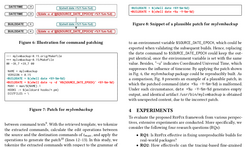




 I received some feedback on the first part of interviews about the
internet with children that I d like to share publicly here. Thank you!
Your thoughts and experiences are important to me!
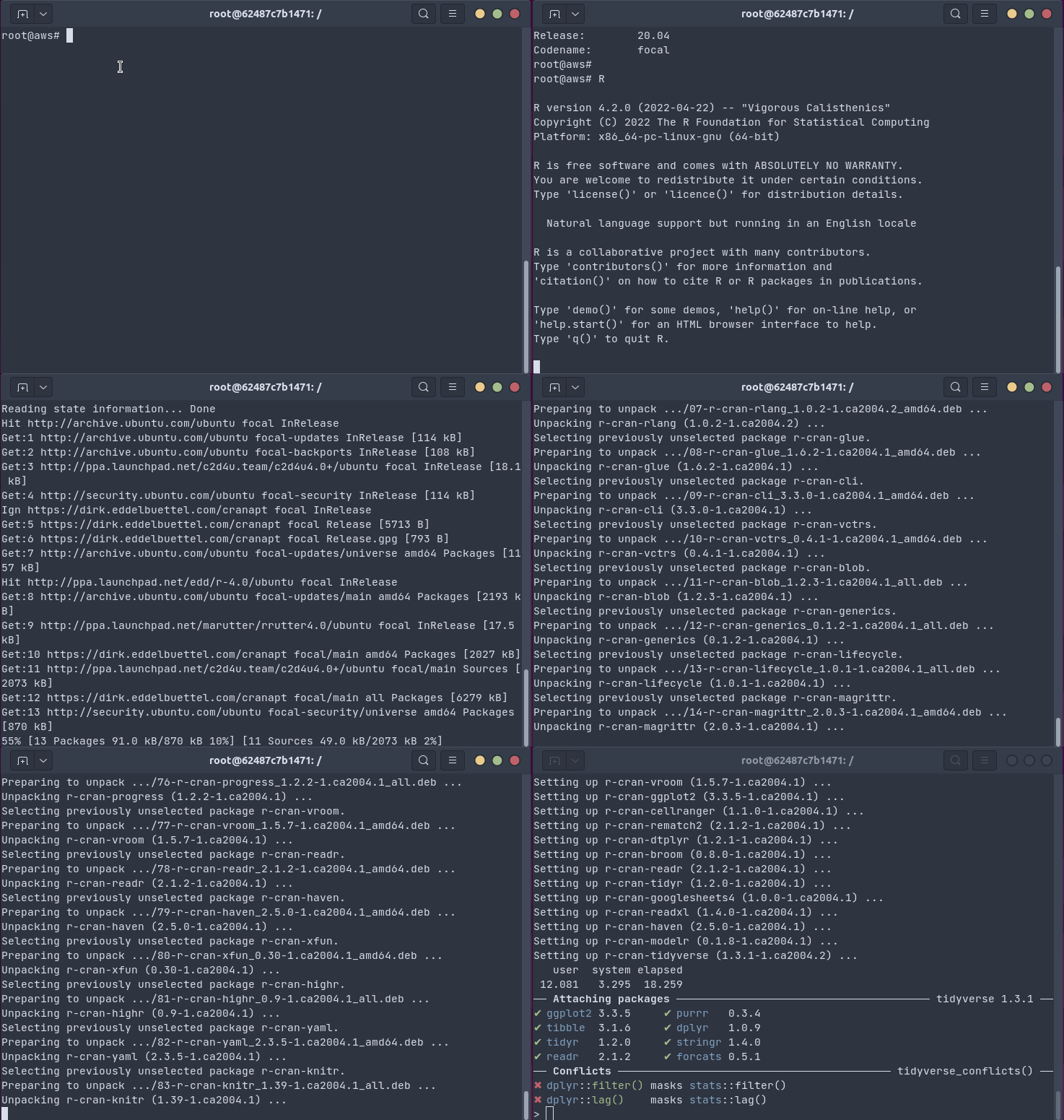
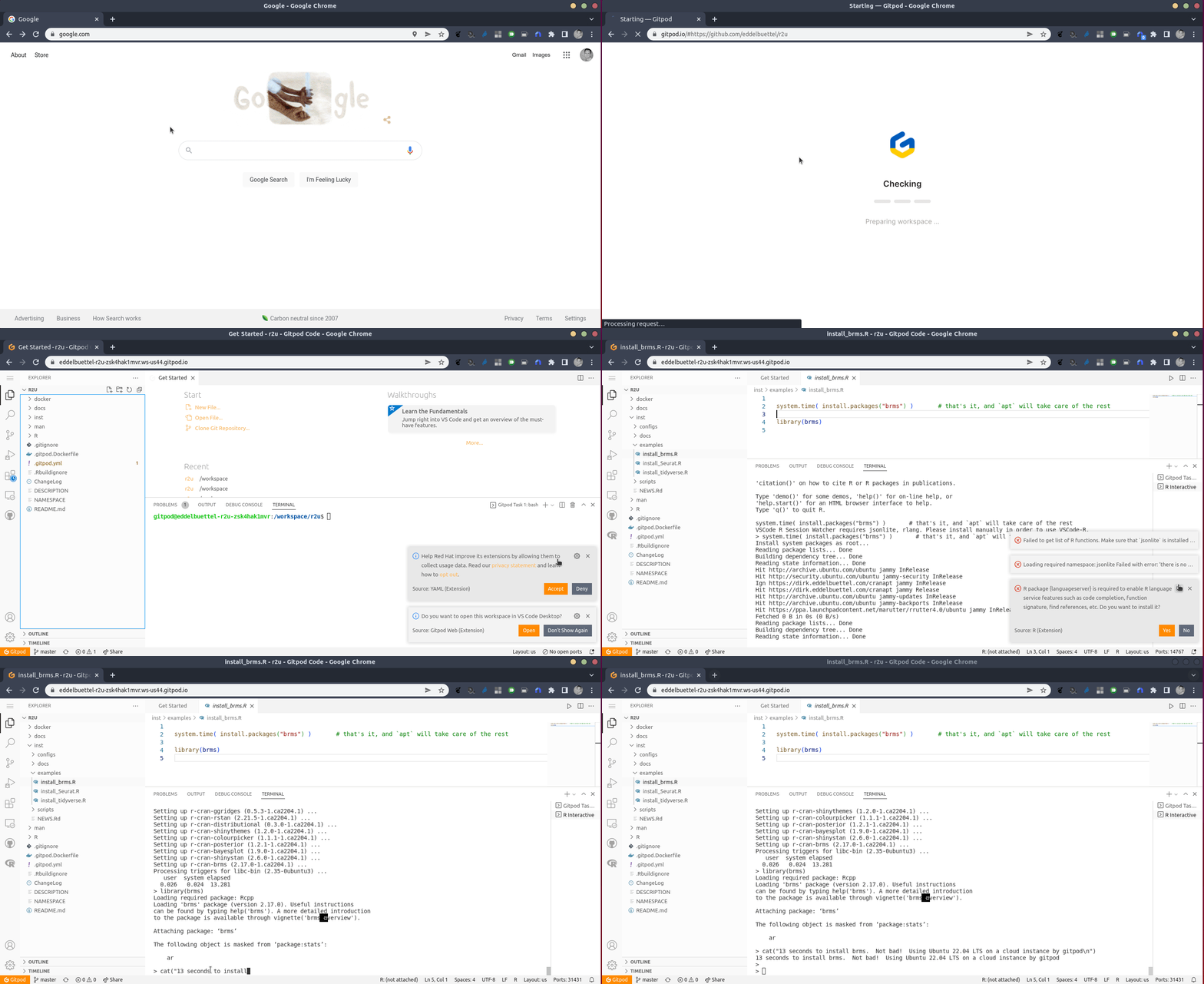
 Her drawing shows how she uses the internet: calls using WhatsApp,
watching movies online, and a laptop with open windows on the screen.
She would ask the dragon that can explain one thing she always wanted to know about
the internet:
 This means that I can
 Checks out.
 Indeed, the GTK folks have managed to develop a similar solution named
 This is the report for the



 Recently I've been getting much more interested in the "retro" computers of my youth, partly because I've been writing crazy code in Z80 assembly-language, and partly because I've been preparing to introduce our child to his first computer:


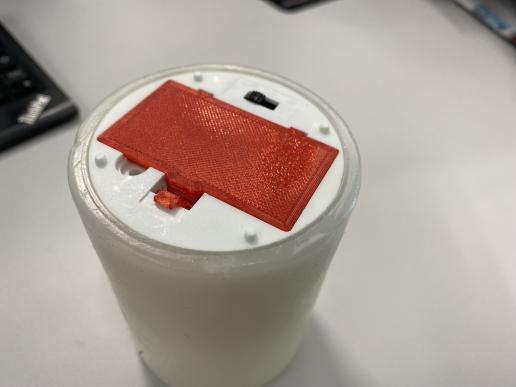
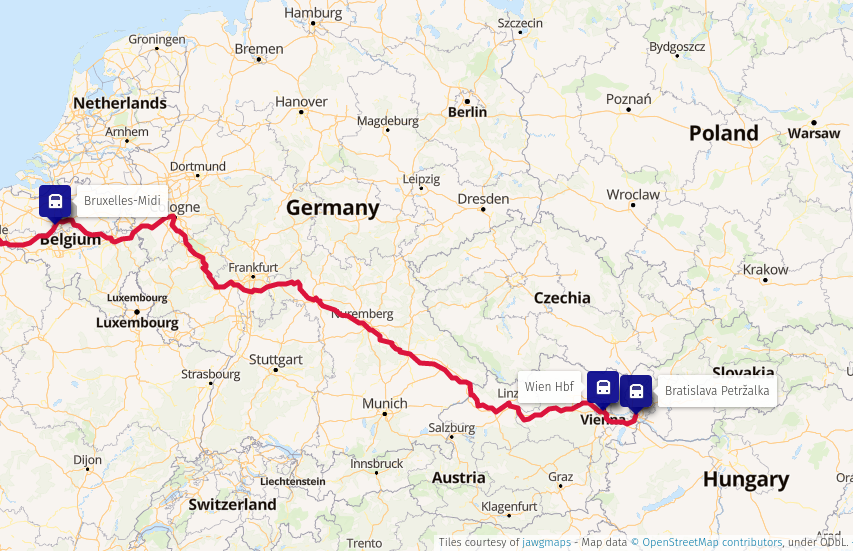 Train route from Bratislava to Brussels
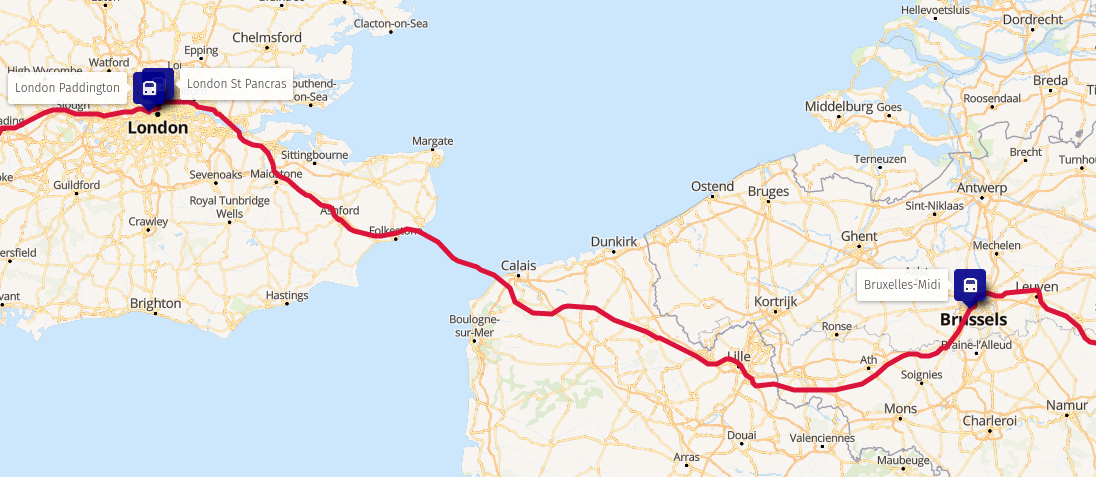 Train route from Brussels to London
 Change of trains in London
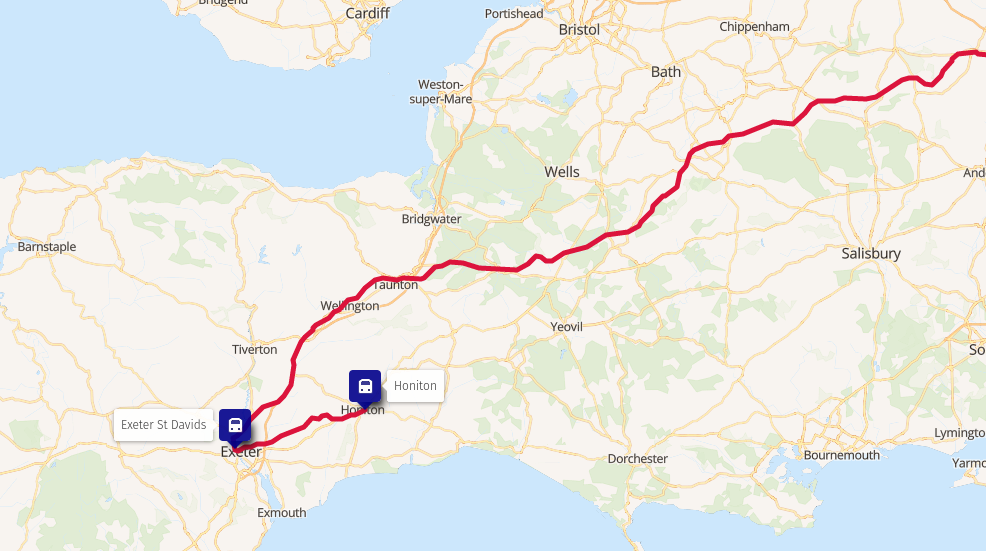 Change of trains in Exeter
 Finally, TIL, what can all be the reason for systemd services to hang indefinitely. The internet is flooded with numerous reports on this topic but no clear answers. So no more uselessly marked workarounds like: