Search Results: "ana"

2 January 2025

Colin Watson: Free software activity in December 2024

Most of my Debian contributions this month were sponsored by Freexian, as well as one direct donation via Liberapay (thanks!). OpenSSH I issued a bookworm update with a number of fixes that had accumulated over the last year, especially fixing GSS-API key exchange which was quite broken in bookworm. base-passwd A few months ago, the adduser maintainer started a discussion with me (as the base-passwd maintainer) and the shadow maintainer about bringing all three source packages under one team, since they often need to cooperate on things like user and group names. I agreed, but hadn t got round to doing anything about it until recently. I ve now officially moved it under team maintenance. debconf Gioele Barabucci has been working on eliminating duplicated code between debconf and cdebconf, ultimately with the goal of migrating to cdebconf (which I m not sure I m convinced of as a goal, but if we can make improvements to both packages as part of working towards it then there s no harm in that). I finally got round to reviewing and merging confmodule changes in each of debconf and cdebconf. This caused an installer regression due to a weirdness in cdebconf-udeb s packaging, which I fixed - sorry about that! I ve also been dealing with a few patch submissions that had been in my queue for a long time, but more on that next month if all goes well. CI issues I noticed and fixed a problem with Restrictions: needs-sudo in autopkgtest. I fixed broken aptly images in the Salsa CI pipeline. Python team Last month, I mentioned some progress on sorting out the multipart vs. python-multipart name conflict in Debian (#1085728), and said that I thought we d be able to finish it soon. I was right! We got it all done this month: The Python 3.13 transition continues, and last month we were able to add it to the supported Python versions in testing. (The next step will be to make it the default.) I fixed lots of problems in aid of this, including: Sphinx 8.0 removed some old intersphinx_mapping syntax which turned out to still be in use by many packages in Debian. The fixes for this were individually trivial, but there were a lot of them: I found that twisted 24.11.0 broke tests in buildbot and wokkel, and fixed those. I packaged python-flatdict, needed for a new upstream version of python-semantic-release. I tracked down a test failure in vdirsyncer (which I ve been using for some years, but had never previously needed to modify) and contributed a fix upstream. I fixed some packages to tolerate future versions of dh-python that will drop their dependency on python3-setuptools: I fixed django-cte to remove a build-dependency on the obsolete python3-nose package. I added Django 5.1 support to django-polymorphic. (There are a number of other packages that still need work here.) I fixed various other build/test failures: I upgraded these packages to new upstream versions: I updated the team s library style guide to remove material related to Python 2 and early versions of Python 3, which is no longer relevant to any current Python packaging work. Other Python upstream work I happened to notice a Twisted upstream issue requesting the removal of the deprecated twisted.internet.defer.returnValue, realized it was still used in many places in Debian, and went on a PR-filing spree informed by codesearch to try to reduce the future impact of such a change on Debian: Other small fixes Santiago Vila has been building the archive with make --shuffle (also see its author s explanation). I fixed associated bugs in cccc (contributed upstream), groff, and spectemu. I backported an upstream patch to putty to fix undefined behaviour that affected use of the small keypad . I removed groff s Recommends: libpaper1 (#1091375, #1091376), since it isn t currently all that useful and was getting in the way of a transition to libpaper2. I filed an upstream bug suggesting better integration in this area.

1 January 2025

Russ Allbery: 2024 Book Reading in Review

In 2024, I finished and reviewed 46 books, not counting another three books I've finished but not yet reviewed and which will therefore roll over to 2025. This is slightly fewer books than the last couple of years, but more books than 2021. Reading was particularly spotty this year, with much of the year's reading packed into late November and December. This was a year in which I figured out I was trying to do too much, but did not finish figuring out what to do about it. Reading and particularly reviewing reflected that, with long silent periods and then attempts to catch up. One of the goals for next year is to find a more sustainable balance for the hobbies in my life, including reading. My favorite books I read this year were Ashley Herring Blake's Bright Falls sapphic romance trilogy: Delilah Green Doesn't Care, Astrid Parker Doesn't Fail, and Iris Kelly Doesn't Date. These are not perfect books, but they made me laugh, made me cry, and were impossible to put down. My thanks to a video from BookTuber Georgia Marie for the recommendation. I Shall Wear Midnight was the best of the remaining Pratchett novels. It's the penultimate Tiffany Aching book and, in my opinion, the best. All of the elements of the previous books come together in snarky competence porn that was a delight to read. The best book I read last year was Mark Lawrence's The Book That Wouldn't Burn, which much to my surprise did not make a single award list for its publication year of 2023. It was a tour de force of world-building that surprised me multiple times. Unfortunately, the sequel was not as good and I fear the series may be heading in the wrong direction. I am attempting to stay hopeful about the upcoming third and concluding book. I didn't read much non-fiction this year, but the best of what I did read was Zeke Faux's Number Go Up about the cryptocurrency bubble. This book will not change anyone's mind, but it's a readable and entertaining summary of some of the more obvious cryptocurrency scams. I also had enough quibbles with it to write an extended review, which is a compliment of sorts. The Discworld read-through is done, so I may either start or return to another series re-read in 2025. I have a huge backlog of all sorts of books, though, so we will see how the year goes. As always, I have no specific numeric goals, just a hope that I can make time for regular and varied reading and maintain a rhythm with writing reviews. The full analysis includes some additional personal reading statistics, probably only of interest to me.

31 December 2024

Russ Allbery: Review: Metal from Heaven

Review: Metal from Heaven, by August Clarke
Publisher: Erewhon
Copyright: November 2024
ISBN: 1-64566-099-0
Format: Kindle
Pages: 443
Metal from Heaven is industrial-era secondary-world fantasy with a literary bent. It is a complete story in one book, and I would be very surprised by a sequel. Clarke previously wrote the Scapegracers young-adult trilogy, which got excellent reviews and a few award nominations, as H.A. Clarke. This is his first adult novel.
Know I adore you. Look out over the glow. The cities sundered, their machines inverted, mountains split and prairies blazing, that long foreseen Hereafter crowning fast. This calamity is a promise made to you. A prayer to you, and to your shadow which has become my second self, tucked behind my eye and growing in tandem with me, pressing outwards through the pupil, the smarter, truer, almost bursting reason for our wrath. Do not doubt me. Just look. Watch us rise as the sun comes up over the beauty. The future stains the bleakness so pink. When my violence subsides, we will have nothing, and be champions.
Marney Honeycutt is twelve years old, a factory worker, and lustertouched. She works in the Yann I. Chauncey Ichorite Foundry in Ignavia City, alongside her family and her best friend, shaping the magical metal ichorite into the valuable industrial products of a new age of commerce and industry. She is the oldest of the lustertouched, the children born to factory workers and poisoned by the metal. It has made her allergic, prone to fits at any contact with ichorite, but also able to exert a strange control over the metal if she's willing to pay the price of spasms and hallucinations for hours afterwards. As Metal from Heaven opens, the workers have declared a strike. Her older sister is the spokesperson, demanding shorter hours, safer working conditions, and an investigation into the health of the lustertouched children. Chauncey's response is to send enforcer snipers to kill the workers, including the entirety of her family.
The girl sang, "Unalone toward dawn we go, toward the glory of the new morning." An enforcer shot her in the belly, and when she did not fall, her head.
Marney survives, fleeing into the city, swearing an impossible personal revenge against Yann Chauncey. An act of charity gets her a ticket on a train into the countryside. The woman who bought her ticket is a bandit who is on the train to rob it. Marney's ability to control ichorite allows her to help the bandits in return, winning her a place with the Highwayman's Choir who have been preying on the shipments of the rich and powerful and then disappearing into the hills. The Choir's secret is that the agoraphobic and paranoid Baron of the Fingerbluffs is dead and has been for years. He was killed by his staff, Hereafterist idealists, who have turned his remote territory into an anarchist commune and haven for pirates and bandits. This becomes Marney's home and the Choir becomes her family, but she never forgets her oath of revenge or the childhood friend she left behind in the piles of bodies and to whom this story is narrated. First, Clarke's writing is absolutely gorgeous.
We scaled the viny mountain jags at Montrose Barony's legal edge, the place where land was and wasn't Ignavia, Royston, and Drustland alike. There was a border but it was diffuse and hallucinatory, even more so than most. On legal papers and state maps there were harsh lines that squashed topography and sanded down the mountains into even hills in planter's rows, but here among the jutting rocks and craggy heather, the ground was lineless.
The rhythm of it, the grasp of contrast and metaphor, the word choice! That climactic word "lineless," with its echo of limitless. So good. Second, this is the rarest of books: a political fantasy that takes class and religion seriously and uses them for more than plot drivers. This is not at all our world, and the technology level is somewhat ambiguous, but the parallels to the Gilded Age and Progressive Era are unmistakable. The Hereafterists that Marney joins are political anarchists, not in the sense of alternative governance structures and political theory sanitized for middle-class liberals, but in the sense of Emma Goldman and Peter Kropotkin. The society they have built in the Fingerbluffs is temporary, threatened, and contingent, but it is sincere and wildly popular among the people who already lived there. Even beyond politics, class is a tangible force in this book. Marney is a factory worker and the child of factory workers. She barely knows how to read and doesn't magically learn over the course of the book. She has friends who are clever in the sense rewarded by politics and nobility, who navigate bureaucracies and political nuance, but that is not Marney's world. When, towards the end of the book, she has to deal with a gathering of high-class women, the contrast is stark, and she navigates that gathering only by being entirely unexpected. Perhaps the best illustration of the subtlety of this is the terminology in the book for lesbian. Marney is a crawly, which is a slur thrown at people like her (and one of the rare fictional slurs that work exactly as the author intended) but is also simply what she calls herself. Whether or not it functions as a slur depends on context, and the context is never hard to understand. The high-class lesbians she meets later are Lunarists, and react to crawly as a vile and insulting word. They use language to separate themselves from both the insult and from the social class that uses it. Language is an indication of culture and manners and therefore of morality, unlike deeds, which admit endless justifications.
Conversation was fleeting. Perdita managed with whomever stood near her, chipper about every prettiness she saw, the flitting butterflies, the dappled light between the leaves, the lushness and the fragrance of untamed land, and her walking companions took turns sharing in her delight. It was infectious, how happy she was. She was going to slaughter millions. She was going to skip like this all the while.
The handling of religion is perhaps even better. Marney was raised a Tullian, which sits alongside two other fleshed-out fictional religions and sketches of several more. Tullians tend to be conservative and patriarchal, and Marney has a realistically complicated relationship with faith: sticking with some Tullian worship practices and gestures because they're part of who she is, feeling a kinship to other Tullians, discarding beliefs that don't fit her, and revising others. Every major religion has a Hereafterist spin or reinterpretation that upends or reverses the parts of the religion that were used to prop up the existing social order and brings it more in line with Hereafterist ideals. We see the Tullian Hereafterist variation in detail, and as someone who has studied a lot of methods of reinterpreting Christianity, I was impressed by how well Clarke invents both a belief system and its revisionist rewrite. This is exactly how religions work in human history, but one almost never sees this subtlety in fantasy novels. Marney's allergy to ichorite causes her internal dialogue to dissolve into hallucinatory synesthesia when she's manipulating or exposed to it. Since that's most of the book, substantial portions read like drug trips with growing body horror. I normally hate this type of narration, so it's a sign of just how good Clarke's writing is that I tolerated it and even enjoyed parts. It helps that the descriptions are irreverent and often surprising, full of unexpected metaphors and sudden turns. It's very hard not to quote paragraph after paragraph of this book. Clarke is also doing a lot with gender that I don't feel qualified to comment in detail on, but it would not surprise me to see this book in the Otherwise Award recommendation list. I can think of three significant male characters, all of whom are well-done, but every other major character is female by at least some gender definition. Within that group, though, is huge gender diversity of the complicated and personal type that doesn't force people into defined boxes. Marney's sexuality is similarly unclassified and sometimes surprising. My one complaint is that I thought the sex scenes (which, to warn, are often graphic) fell into the literary fiction trap of being described so closely and physically that it didn't feel like anyone involved was actually enjoying themselves. (This is almost certainly a matter of personal taste.) I had absolutely no idea how Clarke was going to end this book, and the last couple of chapters caught me by surprise. I'm still not sure what I think about the climax. It's not the ending that I wanted, but one of the merits of this book is that it never did what I thought I wanted and yet made me enjoy the journey anyway. It is, at least, a genre ending, not a literary ending: The reader gets a full explanation of what is going on, and the setting is not static the way that it so often is in literary fiction. The characters can change the world, for good or for ill. The story felt frustrating and incomplete when I first finished it, but I haven't stopped thinking about this book and I think I like the shape of it a bit more now. It was certainly unexpected, at least by me. Clarke names Dhalgren as one of their influences in the acknowledgments, and yes, Metal from Heaven is that kind of book. This is the first 2024 novel I've read that felt like the kind of book that should be on award shortlists. I'm not sure it was entirely successful, and there are parts of it that I didn't like or that weren't for me, but it's trying to do something different and challenging and uncomfortable, and I think it mostly worked. And the writing is so good.
She looked like a mythic princess from the old woodcuts, who ruled nature by force of goodness and faith and had no legal power.
Metal from Heaven is not going to be everyone's taste. If you do not like literary fantasy, there is a real chance that you will hate this. I am very glad that I read it, and also am going to take a significant break from difficult books before I tackle another one. But then I'm probably going to try the Scapegracers series, because Clarke is an author I want to follow. Content notes: Explicit sex, including sadomasochistic sex. Political violence, mostly by authorities. Murdered children, some body horror, and a lot of serious injuries and death. Rating: 8 out of 10

kpcyrd: 2024 wrapped

Dear blog. This post is inspired by an old friend of mine who has been writing these for the past few years. I meant to do this for a while now, but ended up not preparing anything, so this post is me writing it from memory. There s likely stuff I forgot, me being gentle with myself I ll probably just permit myself to complete this list the next couple of days. I hate bragging, I try to not depend on external validation as much as possible, and being the anarcho-communist anti-capitalist that I am, I try to be content with knowing I m doing good in the background . I don t think people owe me for the work I did, I don t expect anything in return, and it s my way of giving back to the community and the people around me. Consider us even. That being said, I: Thanks to everybody who has been part of my human experience, past or present. Especially those who ve been closest. cheers,
kpcyrd

24 December 2024

Russ Allbery: Review: Number Go Up

Review: Number Go Up, by Zeke Faux
Publisher: Crown Currency
Copyright: 2023
Printing: 2024
ISBN: 0-593-44382-9
Format: Kindle
Pages: 373
Number Go Up is a cross between a history and a first-person account of investigative journalism around the cryptocurrency bubble and subsequent collapse in 2022. The edition I read has an afterward from June 2024 that brings the story up to date with Sam Bankman-Fried's trial and a few other events. Zeke Faux is a reporter for Bloomberg News and a fellow of New America. Last year, I read Michael Lewis's Going Infinite, a somewhat-sympathetic book-length profile of Sam Bankman-Fried that made a lot of people angry. One of the common refrains at the time was that people should read Number Go Up instead, and since I'm happy to read more about the absurdities of the cryptocurrency world, I finally got around to reading the other big crypto book of 2023. This is a good book, with some caveats that I am about to explain at absurd length. If you want a skeptical history of the cryptocurrency bubble, you should read it. People who think that it's somehow in competition with Michael Lewis's book or who think the two books disagree (including Faux himself) have profoundly missed the point of Going Infinite. I agree with Matt Levine: Both of these books are worth your time if this is the sort of thing you like reading about. But (much) more on Faux's disagreements with Lewis later. The frame of Number Go Up is Faux's quixotic quest to prove that Tether is a fraud. To review this book, I therefore need to briefly explain what Tether is. This is only the first of many extended digressions. One natural way to buy cryptocurrency would be to follow the same pattern as a stock brokerage account. You would deposit some amount of money into the account (or connect the brokerage account to your bank account), and then exchange money for cryptocurrency or vice versa, using bank transfers to put money in or take it out. However, there are several problems with this. One is that swapping cryptocurrency for money is awkward and sometimes expensive. Another is that holding people's investment money for them is usually highly regulated, partly for customer safety but also to prevent money laundering. These are often called KYC laws (Know Your Customer), and the regulation-hostile world of cryptocurrency didn't want to comply with them. Tether is a stablecoin, which means that the company behind Tether attempts to guarantee that one Tether is always worth exactly one US dollar. It is not a speculative investment like Bitcoin; it's a cryptocurrency substitute for dollars. People exchange dollars for Tether to get their money into the system and then settle all of their subsequent trades in Tether, only converting the Tether back to dollars when they want to take their money out of cryptocurrency entirely. In essence, Tether functions like the cash reserve in a brokerage account: Your Tether holdings are supposedly guaranteed to be equivalent to US dollars, you can withdraw them at any time, and because you can do so, you don't bother, instead leaving your money in the reserve account while you contemplate what new coin you want to buy. As with a bank, this system rests on the assurance that one can always exchange one Tether for one US dollar. The instant people stop believing this is true, people will scramble to get their money out of Tether, creating the equivalent of a bank run. Since Tether is not a regulated bank or broker and has no deposit insurance or strong legal protections, the primary defense against a run on Tether is Tether's promise that they hold enough liquid assets to be able to hand out dollars to everyone who wants to redeem Tether. (A secondary defense that I wish Faux had mentioned is that Tether limits redemptions to registered accounts redeeming more than $100,000, which is a tiny fraction of the people who hold Tether, but for most purposes this doesn't matter because that promise is sufficient to maintain the peg with the dollar.) Faux's firmly-held belief throughout this book is that Tether is lying. He believes they do not have enough money to redeem all existing Tether coins, and that rather than backing every coin with very safe liquid assets, they are using the dollars deposited in the system to make illiquid and risky investments. Faux never finds the evidence that he's looking for, which makes this narrative choice feel strange. His theory was tested when there was a run on Tether following the collapse of the Terra stablecoin. Tether passed without apparent difficulty, redeeming $16B or about 20% of the outstanding Tether coins. This doesn't mean Faux is wrong; being able to redeem 20% of the outstanding tokens is very different from being able to redeem 100%, and Tether has been fined for lying about its reserves. But Tether is clearly more stable than Faux thought it was, which makes the main narrative of the book weirdly unsatisfying. If he admitted he might be wrong, I would give him credit for showing his work even if it didn't lead where he expected, but instead he pivots to focusing on Tether's role in money laundering without acknowledging that his original theory took a serious blow. In Faux's pursuit of Tether, he wanders through most of the other elements of the cryptocurrency bubble, and that's the strength of this book. Rather than write Number Go Up as a traditional history, Faux chooses to closely follow his own thought processes and curiosity. This has the advantage of giving Faux an easy and natural narrative, something that non-fiction books of this type can struggle with, and it lets Faux show how confusing and off-putting the cryptocurrency world is to an outsider. The best parts of this book were the parts unrelated to Tether. Faux provides an excellent summary of the Axie Infinity speculative bubble and even traveled to the Philippines to interview people who were directly affected. He then wandered through the bizarre world of NFTs, and his first-hand account of purchasing one (specifically a Mutant Ape) to get entrance to a party (which sounded like a miserable experience I would pay money to get out of) really drives home how sketchy and weird cryptocurrency-related software and markets can be. He also went to El Salvador to talk to people directly about the country's supposed embrace of Bitcoin, and there's no substitute for that type of reporting to show how exaggerated and dishonest the claims of cryptocurrency adoption are. The disadvantage of this personal focus on Faux himself is that it sometimes feels tedious or sensationalized. I was much less interested in his unsuccessful attempts to interview the founder of Tether than Faux was, and while the digression into forced labor compounds in Cambodia devoted to pig butchering scams was informative (and horrific), I think Faux leaned too heavily on an indirect link to Tether. His argument is that cryptocurrency enables a type of money laundering that is particularly well-suited to supporting scams, but both scams and this type of economic slavery existed before cryptocurrency and will exist afterwards. He did not make a very strong case that Tether was uniquely valuable as a money laundering service, as opposed to a currently useful tool that would be replaced with some other tool should it go away. This part of the book is essentially an argument that money laundering is bad because it enables crime, and sure, to an extent I agree. But if you're going to put this much emphasis on the evils of money laundering, I think you need to at least acknowledge that many people outside the United States do not want to give US government, which is often openly hostile to them, veto power over their financial transactions. Faux does not. The other big complaint I have with this book, and with a lot of other reporting on cryptocurrency, is that Faux is sloppy with the term "Ponzi scheme." This is going to sound like nit-picking, but I think this sloppiness matters because it may obscure an ongoing a shift in cryptocurrency markets. A Ponzi scheme is not any speculative bubble. It is a very specific type of fraud in which investors are promised improbably high returns at very low risk and with safe principal. These returns are paid out, not via investment in some underlying enterprise, but by taking the money from new investments and paying it to earlier investors. Ponzi schemes are doomed because satisfying their promises requires a constantly increasing flow of new investors. Since the population of the world is finite, all Ponzi schemes are mathematically guaranteed to eventually fail, often in a sudden death spiral of ever-increasing promises to lure new investors when the investment stream starts to dry up. There are some Ponzi schemes in cryptocurrency, but most practices that are called Ponzi schemes are not. For example, Faux calls Axie Infinity a Ponzi scheme, but it was missing the critical elements of promised safe returns and fraudulently paying returns from the investments of later investors. It was simply a speculative bubble that people bought into on the assumption that its price would increase, and like any speculative bubble those who sold before the peak made money at the expense of those who bought at the peak. The reason why this matters is that Ponzi schemes are a self-correcting problem. One can decry the damage caused when they collapse, but one can also feel the reassuring certainty that they will inevitably collapse and prove the skeptics correct. The same is not true of speculative assets in general. You may think that the lack of an underlying economic justification for prices means that a speculative bubble is guaranteed to collapse eventually, but in the famous words of Gary Schilling, "markets can remain irrational a lot longer than you and I can remain solvent." One of the people Faux interviews explains this distinction to him directly:
Rong explained that in a true Ponzi scheme, the organizer would have to handle the "fraud money." Instead, he gave the sneakers away and then only took a small cut of each trade. "The users are trading between each other. They are not going through me, right?" Rong said. Essentially, he was arguing that by downloading the Stepn app and walking to earn tokens, crypto bros were Ponzi'ing themselves.
Faux is openly contemptuous of this response, but it is technically correct. Stepn is not a Ponzi scheme; it's a speculative bubble. There are no guaranteed returns being paid out of later investments and no promise that your principal is safe. People are buying in at price that you may consider irrational, but Stepn never promised you would get your money back, let alone make a profit, and therefore it doesn't have the exponential progression of a Ponzi scheme. One can argue that this is a distinction without a moral difference, and personally I would agree, but it matters immensely if one is trying to analyze the future of cryptocurrencies. Schemes as transparently unstable as Stepn (which gives you coins for exercise and then tries to claim those coins have value through some vigorous hand-waving) are nearly as certain as Ponzi schemes to eventually collapse. But it's also possible to create a stable business around allowing large numbers of people to regularly lose money to small numbers of sophisticated players who are collecting all of the winnings. It's called a poker room at a casino, and no one thinks poker rooms are Ponzi schemes or are doomed to collapse, even though nearly everyone who plays poker will lose money. This is the part of the story that I think Faux largely missed, and which Michael Lewis highlights in Going Infinite. FTX was a legitimate business that made money (a lot of money) off of trading fees, in much the same way that a casino makes money off of poker rooms. Lots of people want to bet on cryptocurrencies, similar to how lots of people want to play poker. Some of those people will win; most of those people will lose. The casino doesn't care. Its profit comes from taking a little bit of each pot, regardless of who wins. Bankman-Fried also speculated with customer funds, and therefore FTX collapsed, but there is no inherent reason why the core exchange business cannot be stable if people continue to want to speculate in cryptocurrencies. Perhaps people will get tired of this method of gambling, but poker has been going strong for 200 years. It's also important to note that although trading fees are the most obvious way to be a profitable cryptocurrency casino, they're not the only way. Wall Street firms specialize in finding creative ways to take a cut of every financial transaction, and many of those methods are more sophisticated than fees. They are so good at this that buying and selling stock through trading apps like Robinhood is free. The money to run the brokerage platform comes from companies that are delighted to pay for the opportunity to handle stock trades by day traders with a phone app. This is not, as some conspiracy theories would have you believe, due to some sort of fraudulent price manipulation. It is because the average person with a Robinhood phone app is sufficiently unsophisticated that companies that have invested in complex financial modeling will make a steady profit taking the other side of their trades, mostly because of the spread (the difference between offered buy and sell prices). Faux is so caught up in looking for Ponzi schemes and fraud that I think he misses this aspect of cryptocurrency's transformation. Wall Street trading firms aren't piling into cryptocurrency because they want to do securities fraud. They're entering this market because there seems to be persistent demand for this form of gambling, cryptocurrency markets reward complex financial engineering, and running a legal casino is a profitable business model. Michael Lewis appears as a character in this book, and Faux portrays him quite negatively. The root of this animosity appears to stem from a cryptocurrency conference in the Bahamas that Faux attended. Lewis interviewed Bankman-Fried on stage, and, from Faux's account, his questions were fawning and he praised cryptocurrencies in ways that Faux is certain he knew were untrue. From that point on, Faux treats Lewis as an apologist for the cryptocurrency industry and for Sam Bankman-Fried specifically. I think this is a legitimate criticism of Lewis's methods of getting close to the people he wants to write about, but I think Faux also makes the common mistake of assuming Lewis is a muckraking reporter like himself. This has never been what Lewis is interested in. He writes about people he finds interesting and that he thinks a reader will also find interesting. One can legitimately accuse him of being credulous, but that's partly because he's not even trying to do the same thing Faux is doing. He's not trying to judge; he's trying to understand. This shows when it comes to the parts of this book about Sam Bankman-Fried. Faux's default assumption is that everyone involved in cryptocurrency is knowingly doing fraud, and a lot of his research is looking for evidence to support the conclusion he had already reached. I don't think there's anything inherently wrong with that approach: Faux is largely, although not entirely, correct, and this type of hostile journalism is incredibly valuable for society at large. Upton Sinclair didn't start writing The Jungle with an open mind about the meat-packing industry. But where Faux and Lewis disagree on Bankman-Fried's motivations and intentions, I think Lewis has the much stronger argument. Faux's position is that Bankman-Fried always intended to steal people's money through fraud, perhaps to fund his effective altruism donations, and his protestations that he made mistakes and misplaced funds are obvious lies. This is an appealing narrative if one is looking for a simple villain, but Faux's evidence in support of this is weak. He mostly argues through stereotype: Bankman-Fried was a physics major and a Jane Street trader and therefore could not possibly be the type of person to misplace large amounts of money or miscalculate risk. If he wants to understand how that could be possible, he could read Going Infinite? I find it completely credible that someone with what appears to be uncontrolled, severe ADHD could be adept at trading and calculating probabilities and yet also misplace millions of dollars of assets because he wasn't thinking about them and therefore they stopped existing. Lewis made a lot of people angry by being somewhat sympathetic to someone few people wanted to be sympathetic towards, but Faux (and many others) are also misrepresenting his position. Lewis agrees that Bankman-Fried intentionally intermingled customer funds with his hedge fund and agrees that he lied about doing this. His only contention is that Bankman-Fried didn't do this to steal the money; instead, he invested customer money in risky bets that he thought would pay off. In support of this, Lewis made a prediction that was widely scoffed at, namely that much less of FTX's money was missing than was claimed, and that likely most or all of it would be found. And, well, Lewis was basically correct? The FTX bankruptcy is now expected to recover considerably more than the amount of money owed to creditors. Faux argues that this is only because the bankruptcy clawed back assets and cryptocurrencies have gone up considerably since the FTX bankruptcy, and therefore that the lost money was just replaced by unexpected windfall profits on other investments, but I don't think this point is as strong as he thinks it is. Bankman-Fried lost money on some of what he did with customer funds, made money on other things, and if he'd been able to freeze withdrawals for the year that the bankruptcy froze them, it does appear most of the money would have been recoverable. This does not make what he did legal or morally right, but no one is arguing that, only that he didn't intentionally steal money for his own personal gain or for effective altruism donations. And on that point, I don't think Faux is giving Lewis's argument enough credit. I have a lot of complaints about this book because I know way too much about this topic than anyone should probably know. I think Faux missed the plot in a couple of places, and I wish someone would write a book about where cryptocurrency markets are currently going. (Matt Levine's Money Stuff newsletter is quite good, but it's about all sorts of things other than cryptocurrency and isn't designed to tell a coherent story.) But if you know less about cryptocurrency and just want to hear the details of the run-up to the 2022 bubble, this is a great book for that. Faux is writing for people who are already skeptical and is not going to convince people who are cryptocurrency true believers, but that's fine. The details are largely correct (and extensively footnoted) and will satisfy most people's curiosity. Lewis's Going Infinite is a better book, though. It's not the same type of book at all, and it will not give you the broader overview of the cryptocurrency world. But if you're curious about what was going through the head of someone at the center of all of this chaos, I think Lewis's analysis is much stronger than Faux's. I'm happy I read both books. Rating: 8 out of 10

23 December 2024

Russ Allbery: Dropping the git protocol

Ever since I started converting my free software repositories to Git and hosting them on git.eyrie.org, I've made them available via the Git network protocol (the one that uses git:// URLs). This protocol doesn't support TLS or any other form of integrity checking on the wire and has been gently deprecated for some time. Recent changes to git daemon broke the way I was managing permissions for my personal repositories, which meant that the git://git.eyrie.org/ URLs have been broken for several months. Since no one has complained or apparently noticed, this seems like a good excuse to drop support entirely and run one fewer service. All of my personal repositories will continue to be accessible via Git over HTTPS, which is now the standard for anonymous Git checkouts. If the prior URL was git://git.eyrie.org/area/package.git, the new URL is https://git.eyrie.org/git/area/package.git. I've updated my web pages accordingly. This protocol provides integrity protection on the wire and a moderate amount of authentication of my server via a Let's Encrypt certificate.

Sahil Dhiman: Debian Mirrors Hierarchy

After finding AlmaLinux mirror sync capacity at Tier 0 (or Tier 1, however you look at it) is around 140 Gbps, I wanted to find source and hierarchy in Debian mirroring systems. There are two main types of mirrors in Debian - Debian package mirrors (for package installs and updates) and Debian CD mirrors (for ISO and others medias). Let s talk about package mirrors (and it s hierarchy) first.

Package mirror hierarchy Trace file was a good starting point for checking upstream for a package mirror in Debian. It resides at <URL>/debian/project/trace/_traces and shows flow of data. Sample trace file from jing.rocks s mirror. It showed, canonical source for packages is ftp-master.debian.org. Checking via https://db.debian.org/machines.cgi, showed it s fasolo.d.o hosted at Brown University, US. This serves as Master Archive Server , making it a Tier 0 mirror. It s entry mentions that it has 1 Gbps shared LAN connectivity (dated information?) but it only has to push to 3 other machines/sites. Side note - .d.o is .debian.org As shown on https://mirror-master.debian.org/status/mirror-hierarchy.html, the three sites are:
  • syncproxy2.eu.debian.org ie smit.d.o hosted by University of Twente, Netherlands with 2x10 Gbps connectivity.
  • syncproxy4.eu.debian.org ie schmelzer.d.o hosted by Conova in Austria with 2x10 Gbps connectivity.
  • syncproxy2.wna.debian.org - https://db.debian.org/machines.cgi entry mentions it being hosted at UBC here, but IP seems to be pointing to OSUOSL IP range as of now. IIRC few months ago, syncproxy2.wna.d.o was made to point to other host due to some issue (?). mirror-osuosl.d.o seems to be serving as syncproxy2.wna.d.o now. Bandwidth isn t explicitly mentioned but from my experience seeing bandwidths which other free software projects hosted at OSUOSL have, it would be atleast 10 Gbps and maybe more for Debian.

                     syncproxy2.eu.d.o (NL) ---> to the world
                    /
ftp-master.d.o (US) -- syncproxy4.eu.d.o (AT)  --> to the world 
                    \
                     syncproxy2.wna.d.o (US) --> to the world
A visualation of flow of package from ftp-master.d.o
These form the Debian Tier 1 mirror network, as all the mirrors sync from them. So Debian has atleast 50 Gbps+ capacity at Tier 1. A normal Debian user might never directly interact with any of these 3 machines, but every Debian package they run/download/install flows through these machines. Though, I m unsure what wna stands for in syncproxy2.wna.d.o. NA probably is North America and W is west (coast)? If you know, do let me know. After Tier 1, there are a few more syncproxies (detailed below). There are atleast 45 mirrors at Tier 2, updates for which are directly pushed from the three Tier 1 sync proxies. Most country mirrors i.e. ftp..debian.org are at Tier 2 too (barring a few like ftp.au.d.o, ftp.nz.do etc). Coming back to Sync proxies at Tier 2:
  • syncproxy3.wna.debian.org - gretchaninov.d.o which is marked as syncproxy2 on db.d.o (information dated). It s hosted in University of British Columbia, Canada, where a lot of Debian infrastructure including Salsa is hosted.
  • syncproxy.eu.debian.org - Croatian Academic and Research Network managed machine. CNAME directs to debian.carnet.hr.
  • syncproxy.au.debian.org - mirror-anu.d.o hosted by Australian National University with 100Mbps connectivity. Closest sync proxy for all Australian mirrors.
  • syncproxy4.wna.debian.org - syncproxy-aws-wna-01.d.o hosted in AWS, in US (according to GeoIP). IPv6 only (CNAME to syncproxy-aws-wna-01.debian.org. which only has an AAAA record, no A record). A m6g.2xlarge instance which has speeds upto 10 Gbps.
Coming back to https://mirror-master.debian.org/status/mirror-hierarchy.html, one can see chain extend till Tier 6 like in case of this mirror in AU which should add some latency for the updates from being pushed at ftp-master.d.o to them. Ideally, which shouldn t be a problem as https://www.debian.org/mirror/ftpmirror#when mentions The main archive gets updated four times a day . In my case, I get my updates from NITC mirror, so my updates flows from US > US > TW > IN > me in IN. CDNs have to internally manage cache purging too unlike normal mirrors which directly serve static file. Both deb.debian.org (sponsored by Fastly) and cdn-aws.deb.debian.org (sponsored by Amazon Cloudfront) sync from following CDN backends: See deb.d.o trace file and cdn-aws.deb.d.o trace file. (Thanks to Philipp Kern for the heads up here.)

CD image mirrors Hierarchy Till now, I have only talked about Debian package mirrors. When you see /debian directory on various mirrors, they re usually for package install and updates. If you want to grab the latest (and greatest) Debian ISO, you go to Debian CD (as they re still called) mirror site. casulana.d.o is mentioned as CD builder site hosted by Bytemark while pettersson-ng.d.o is mentioned as CD publishing server hosted at Academic Computer Club in Ume , Sweden. Primary download site for Debian CD when you click download on debian.org homepage is https://cdimage.debian.org/debian-cd/ is hosted here as well. This essentially becomes Tier 0 mirror for Debian CD. All Debian CD mirrors are downstream to it.
pettersson-ng.d.o / cdimage.d.o (SE) ---> to the world
A visualation of flow of Debian CD from cdimage.d.o
Academic Computer Club s mirror setup uses a combination of multiple machines (called frontends and offloading servers) to load balance requests. Their document setup is a highly recommended read. Also, in that document, they mention , All machines are reachable via both IPv4 and IPv6 and connected with 10 or 25 gigabit Ethernet, external bandwidth available is 200 gigabit/s. For completeness sake, following mirror (or mirror systems) exists too for Debian: Debian heavily rely on various organizations to donate resources (hosting and hardware) to distribute and update Debian. Compiling above information made me thankful to all these organizations. Many thanks to DSA and mirror team as well for managing these stuffs. I relied heavily on https://db.debian.org/machines.cgi which seems to be manually updated, so things might have changed along the way. If anything looks amiss, feel free to ping.

Joey Hess: the twenty-fifth year of my free software career

I've been lucky to be able to spend twenty! five! years! developing free software and making a living on it, and this was a banner year for that career. To start with, there was the Distribits conference. There's a big ecosystem of tools and projects that are based on git-annex, especially in scientific data management, and this was the first conference focused on that. Basically every talk involved git-annex in some way. It's been a while since I was at a conference where my software was in the center like that -- reminded me of Debconf days. I gave a talk on how git-annex was probably basically feature complete. I have been very busy ever since adding new features to it, because in mapping out git-annex's feature set, I discovered new possibilities. Meeting people and getting a better feel for the shape of that ecosytem, both technically and funding wise, led to several big developments in funding later in the year. Going into the year, I had an ongoing source of funding from several projects at Dartmouth that use git-annex, but after 10 years, some of that was winding up. That all came together in my essentially writing a grant proposal to the OpenNeuro project at Stanford, to spend 6 months building out a whole constellation of features. The summer became a sprint to get it all done. Signficant amounts of very productive design work were done while swimming in the river. That was great. (Somehow in there, I ended up onstage at FOSSY in Portland, in a keynote panel on Open Source and AI. This required developing a nuanced understanding of the mess of the OSI's Open Source AI definition, but I was mostly on the panel as the unqualified guy.) Capping off the year, I have a new maintenance contract with Forschungszentrum J lich. This covers the typical daily grind kind of tasks, like bug triage, keeping on top of security, release preparation, and updating dependencies, which is the kind of thing I've never been able to find dedicated funding for before. A career in free software is a succession of hurdles. How to do something new and worthwhile? How to make any income while developing it at all? How to maintain your independant vision when working on it for hire? How to deal with burn-out? How to grow a project to be more than a one developer affair? And on and on. How does a free software project keep paying the bills once it's feature complete? Maybe I am starting to get a glimpse of an answer.

Thomas Lange: Happy Birthday FAI!

A Brief History of FAI, Which Began 25 Years Ago On Dec 21st, 1999 version 1.0 of FAI (Fully Automatic Installation) was announced. That was 25 years ago. Some months before, the computer science department of the University of Cologne bought a small HPC cluster with 16 nodes (each with dual CPU Pentium II 400Mhz, 256 MB RAM) and I was too lazy to install those nodes manually. That's why I started the FAI project. With FAI you can install computers in a few minutes from scratch to a machine with a custom configuration that is ready to go for their users. At that time Debian 2.1 aka slink was using kernel 2.0.36 and it was the first release using apt. Many things have happened since then. In the beginning we wrote the first technical report about FAI and a lot of documentation were added afterwards. I gave more than 45 talks about FAI all over the world. Over the past 25 years, there has been an average of more than one commit per day to the FAI software repository. Several top500.org HPC clusters were built using FAI and many companies are using FAI for their IT infrastructure or deploying Linux on their products using FAI. An overview of users can be found here. Some major milestones of FAI are listed in the blog post of the 20th anniversary. What Happended in the Last 5 Years? Currently, I'm preparing for the next FAI release and I still have ideas for new features. Thanks for all the feedback from you, which helped a lot in making FAI a successful project. About FAI FAI is a tool for unattended mass deployment of Linux. It's a system to install and configure Linux systems and software packages on computers as well as virtual machines, from small labs to large-scale infrastructures like clusters and cloud environments. You can take one or more virgin PC's, turn on the power, and after a few minutes, the systems are installed, and completely configured to your exact needs, without any interaction necessary.

22 December 2024

Russ Allbery: Review: Beyond the Fringe

Review: Beyond the Fringe, by Miles Cameron
Series: Arcana Imperii #1.5
Publisher: Gollancz
Copyright: 2023
ISBN: 1-3996-1537-8
Format: Kindle
Pages: 173
Beyond the Fringe is a military science fiction short story collection set in the same universe as Artifact Space. It is intended as a bridge between that novel and its sequel, Deep Black. Originally I picked this up for exactly the reason it was published: I was eagerly awaiting Deep Black and thought I'd pass the time with some filler short fiction. Then, somewhat predictably, I didn't get around to reading it until after Deep Black was already out. I still read this collection first, partly because I'm stubborn about reading things in publication order but mostly to remind myself of what was going on in Artifact Space before jumping into the sequel. My stubbornness was satisfied. My memory was not; there's little to no background information here, and I had to refresh my memory of the previous book anyway to figure out the connections between these stories and the novel. My own poor decisions aside, these stories are... fine, I guess? They're competent military SF short fiction, mostly more explicitly military than Artifact Space. All of them were reasonably engaging. None of them were that memorable or would have gotten me to read the series on their own. They're series filler, in other words, offering a bit of setup for the next novel but not much in the way of memorable writing or plot. If you really want more in this universe, this exists, but my guess (not having read Deep Black) is that it's entirely skippable. "Getting Even": A DHC paratrooper lands on New Shenzen, a planet that New Texas is trying to absorb into the empire it is attempting to build. He gets captured by one group of irregulars and then runs into another force with an odd way of counting battle objectives. I think this exists because Cameron wanted to tell a version of a World War II story he'd heard, but it's basically a vignette about a weird military unit with no real conclusion, and I am at a loss as to the point of the story. There isn't even much in the way of world-building. I'm probably missing something, but I thought it was a waste of time. (4) "Partners": The DHC send a planetary exobiologist to New Texas as a negotiator. New Texas is aggressively, abusively capitalist and is breaking DHC regulations on fair treatment of labor. Why send a planetary exobiologist is unclear (although probably ties into the theme of this collection that the reader slowly pieces together); maybe it's because he's originally from New Texas, but more likely it's because of his partner. Regardless, the New Texas government are exploitative assholes with delusions of grandeur, so the negotiations don't go very smoothly. This was my favorite story of the collection just because I enjoy people returning rudeness and arrogance to sender, but like a lot of stories in this collection it doesn't have much of an ending. I suspect it's mostly setup for Deep Black. (7) "Dead Reckoning": This is the direct fallout of the previous story and probably has the least characterization of this collection. It covers a few hours of a merchant ship having to make some fast decisions in a changing political situation. The story is framed around a veteran spacer and his new apprentice, although even that frame is mostly dropped once the action starts. It was suspenseful and enjoyable enough while I was reading it, but it's the sort of story that you forget entirely after it's over. (6) "Trade Craft": Back on a planet for this story, which follows an intelligence agent on a world near but not inside New Texas's area of influence. I thought this was one of the better stories of the collection even though it's mostly action. There are some good snippets of characterization, an interesting mix of characters, and some well-written tense scenes. Unfortunately, I did not enjoy the ending for reasons that would be spoilers. Otherwise, this was good but forgettable. (6) "One Hour": This is the first story with a protagonist outside of the DHC and its associates. It instead follows a PTX officer (PTX is a competing civilization that features in Artifact Space) who has suspicions about what his captain is planning and recruits his superior officer to help him do something about it. This is probably the best story in the collection, although I personally enjoyed "Partners" a smidgen more. Shunfu, the first astrogator who is recruited by the protagonist, is a thoroughly enjoyable character, and the story is tense and exciting all the way through. For series readers, it also adds some depth to events in Artifact Space (if the reader remembers them), and I suspect will lead directly into Deep Black. (7) "The Gifts of the Magi": A kid and his mother, struggling asteroid miners with ancient and malfunctioning equipment, stumble across a DHC ship lurking in the New Texas system for a secret mission. This is a stroke of luck for the miners, since the DHC is happy to treat the serious medical problems of the mother without charging unaffordable fees the way that the hyper-capitalist New Texas doctors would. It also gives the reader a view into DHC's covert monitoring of the activities of New Texas that all the stories in this collection have traced. As you can tell from the title, this is a Christmas story. The crew of the DHC ship is getting ready to celebrate Alliday, which they claim rolls all of the winter holidays into one. Just like every other effort to do this, no, it does not, it just subsumes them all into Christmas with some lip service to other related holidays. I am begging people to realize that other religions often do not have major holidays in December, and therefore you cannot include everyone by just declaring December to be religious holiday time and thinking that will cover it. There is the bones of an interesting story here. The covert mission setup has potential, the kid and his mother are charming if cliched, there's a bit of world-building around xenoglas (the magical alien material at the center of the larger series plot), and there's a lot of foreshadowing for Deep Black. Unfortunately, this is too obviously a side story and a setup story: none of this goes anywhere satisfying, and along the way the reader has to endure endless rather gratuitous Christmas references, such as the captain working on a Nutcracker ballet performance for the ship talent show. This isn't bad, exactly, but it rubbed me the wrong way. If you love Christmas stories, you may find it more agreeable. (5) Rating: 6 out of 10

20 December 2024

Noah Meyerhans: Local Development VM Management

A coworker asked recently about how people use VMs locally for dev work, so I figured I d take a few minutes to write up a bit about what I do. There are many use cases for local virtual machines in software development and testing. They re self-contained, meaning you can make a mess of them without impacting your day-to-day computing environment. They can run different distributions, kernels, and even entirely different operating systems from the one you use regularly. Etc. They re also cheaper than cloud services and provide finer grained control over the resources. I figured I d share a little bit about how I manage different virtual machines in case anybody finds this useful. This is what works for me, but it won t necessarily work for you, or maybe you ve already got something better. I ve found it to be easy to work with, light weight, and is easy to evolve my needs change.

Use short-lived VMs Rather than keep a long-lived development VM around that you customize over time, I recommend automating the common customizations and provisioning new VMs regularly. If I m working on reproducing a bug or testing a change prior to submitting it upstream, I ll do this work in a VM and delete the VM when when I m done. When provisioning VMs this frequently, though, walking through the installation process for every new VM is tedious and a waste of time. Since most of my work is done in Debian, so I start with images generated daily by the cloud team. These images are available for multiple releases and architectures. The nocloud variant boots to a root prompt and can be useful directly, or the generic images can be used for cloud-init based customization.

Automating image preparation This makefile lets me do something like make image and get a new qcow2 image with the latest build of a given Debian release (sid by default, with others available by specifying DIST).
DATESTAMP=$(shell date +"%Y-%m-%d")
FLAVOR?=generic
ARCH?=$(shell dpkg --print-architecture)
DIST?=sid
RELEASE=$(DIST)
URL_PATH=https://cloud.debian.org/images/cloud/$(DIST)/daily/latest/
ifeq ($(DIST),trixie)
RELEASE=13
endif
ifeq ($(DIST),bookworm)
RELEASE=12
endif
ifeq ($(DIST),bullseye)
RELEASE=11
endif
debian-$(DIST)-$(FLAVOR)-$(ARCH)-daily.tar.xz:
curl --fail --connect-timeout 20 -LO \
$(URL_PATH)/debian-$(RELEASE)-$(FLAVOR)-$(ARCH)-daily.tar.xz
$(DIST)-$(FLAVOR)-$(DATESTAMP).qcow2: debian-$(RELEASE)-$(FLAVOR)-$(ARCH)-daily.tar.xz
tar xvf debian-$(RELEASE)-$(FLAVOR)-$(ARCH)-daily.tar.xz
qemu-img convert -O qcow2 disk.raw $@
rm -f disk.raw
qemu-img resize $@ 20g
qemu-img snapshot -c untouched $@
image: $(DIST)-$(FLAVOR)-$(DATESTAMP).qcow2
.PHONY: image

Customize the VM environment with cloud-init While the nocloud images can be useful, I typically find that I want to apply the same modifications to each new VM I launch, and they don t provide facilities for automating this. The generic images, on the other hand, run cloud-init by default. Using cloud-init, I can create my user account, point apt at local mirrors, install my preferred tools, ensure the root filesystem is resized to make full use of the backing storage, etc. The cloud-init configuration on the generic images will read from a local config drive, which can contain an ISO9660 (cdrom) filesystem image. This image can be generated from a subdirectory containing the various cloud-init input files using the following make syntax:
IMDS_FILES=$(shell find seedconfig -path '*/.git/*' \
-prune -o -type f -name '*.in.json' -print) \
seedconfig/openstack/latest/user_data
seed.iso: $(IMDS_FILES)
genisoimage -V config-2 -o $@ -J -R -m '*~' -m '.git' seedconfig
With the image in place, the VM can be created with
 qemu-system-x86_64 -machine q35,accel=kvm
-cpu host -m 4g -drive file=$ img ,index=0,if=virtio,media=disk
-drive file=seed.iso,media=cdrom,format=raw,index=2,if=virtio
-nic user -nographic
This invokes qemu with the root volume and ISO image attached as disks, uses an emulated q35 machine with the host s CPU and KVM acceleration, the userspace network stack, and a serial console. The first time the VM boots, cloud-init will apply the configuration from the cloud-config available in the ISO9660 filesystem.

Alternatives to cloud-init virt-customize is another tool accomplishing the same type of customization. I use cloud-init because it works directly with cloud providers in addition to local VM images. You could also use something like ansible.

Variations I have a variant of this that uses a bridged network, which I ll write more about later. The bridge is nice because it s more featureful, with full support for IPv6, etc, but it needs a bit more infrastructure in place. It also can be helpful to use 9p or virtfs to share filesystem state between the host the VM. I don t tend to rely on these, and will instead use rsync or TRAMP for moving files around. Containers are also useful, of course, and there are plenty of times when the full isolation of a VM is not worth the overhead.

19 December 2024

Gregory Colpart: MiniDebConf Toulouse 2024

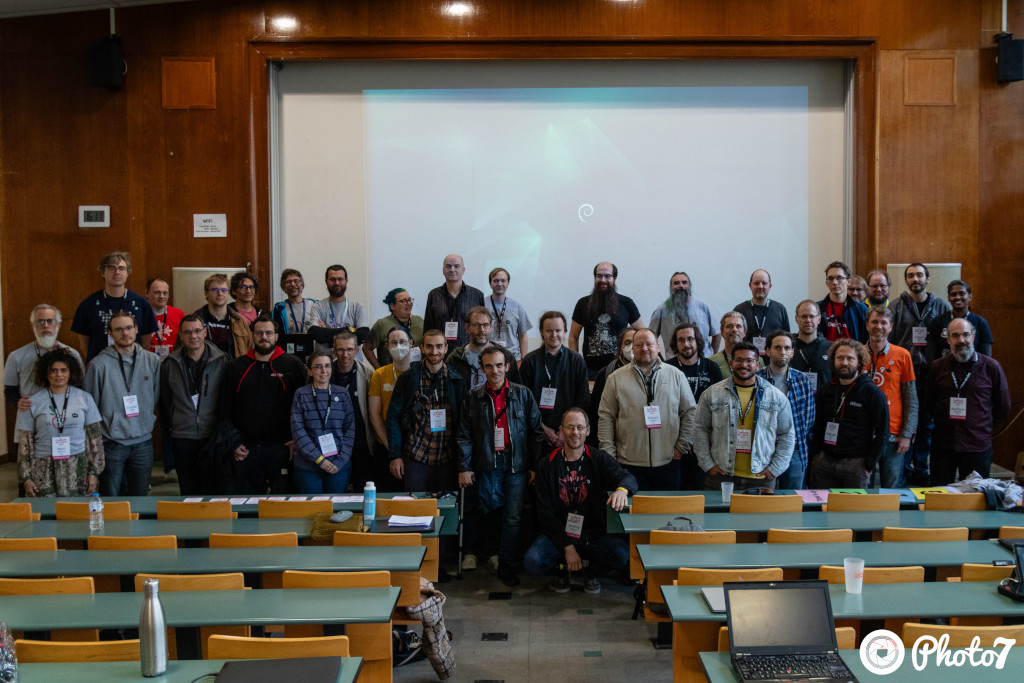
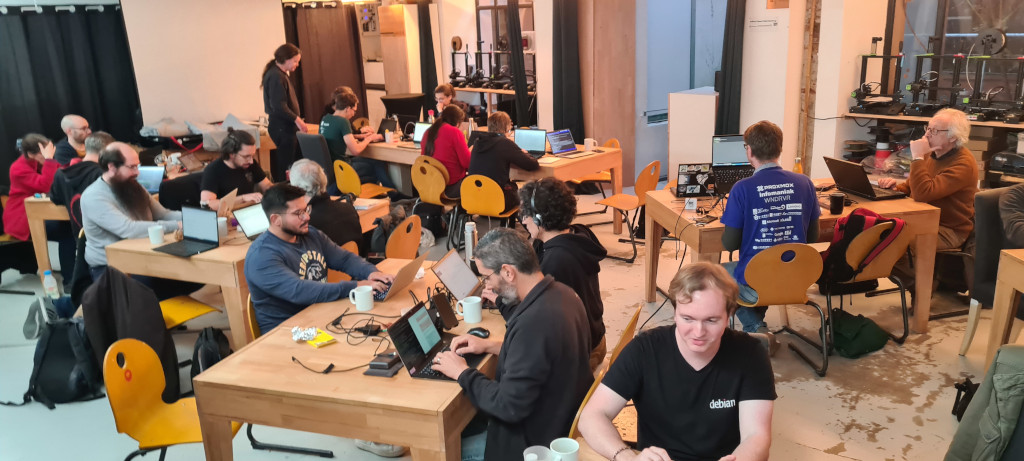
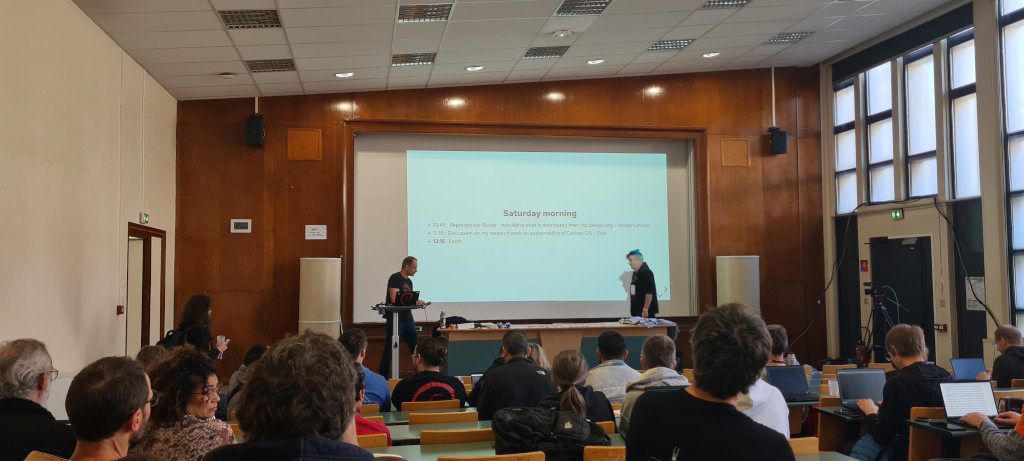
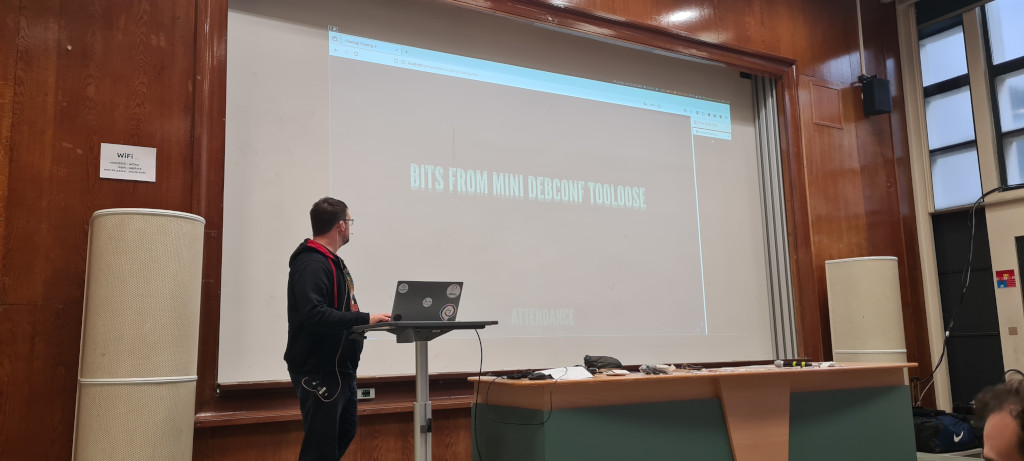
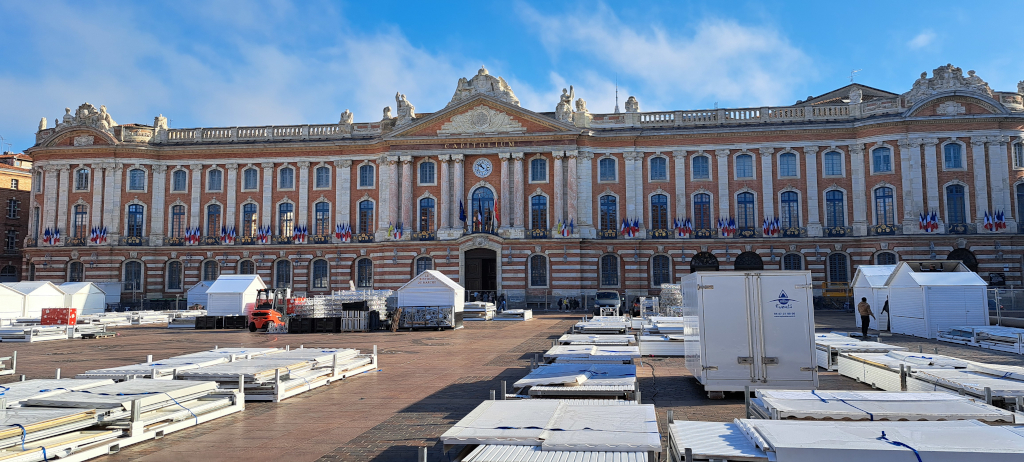
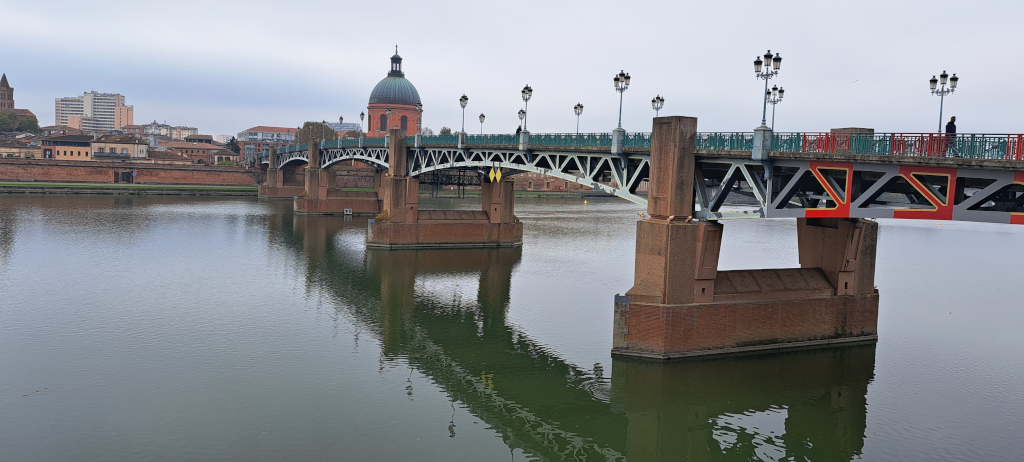
After the MiniDebConf Marseille 2019, COVID-19 made it impossible or difficult to organize new MiniDebConfs for a few years. With the gradual resumption of in-person events (like FOSDEM, DebConf, etc.), the idea emerged to host another MiniDebConf in France, but with a lighter organizational load. In 2023, we decided to reach out to the organizers of Capitole du Libre to repeat the experience of 2017: hosting a MiniDebConf alongside their annual event in Toulouse in November. However, our request came too late for 2023. After discussions with Capitole du Libre in November 2023 in Toulouse and again in February 2024 in Brussels, we confirmed that a MiniDebConf Toulouse would take place in November 2024! We then assembled a small organizing team and got to work: a Call for Papers in May 2024, adding a two-day MiniDebCamp, coordinating with the DebConf video team, securing sponsors, creating a logo, ordering T-shirts and stickers, planning the schedule, and managing registrations. Even with lighter logistics (conference rooms, badges, and catering during the weekend were handled by Capitole du Libre), there was still quite a bit of preparation to do. On Thursday, November 14, and Friday, November 15, 2024, about forty developers arrived from around the world (France, Spain, Italy, Switzerland, Germany, England, Brazil, Uruguay, India, Brest, Marseille ) to spend two days at the MiniDebCamp in the beautiful collaborative spaces of Artilect in Toulouse city center.
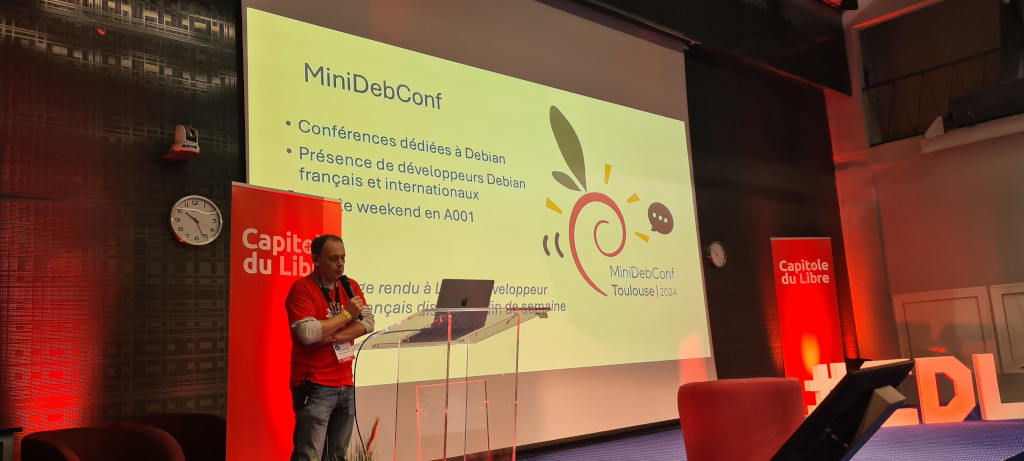
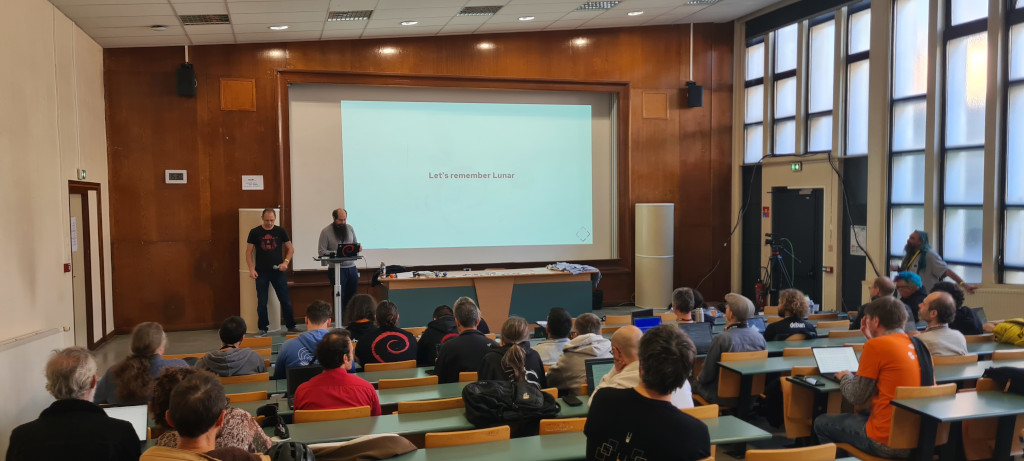
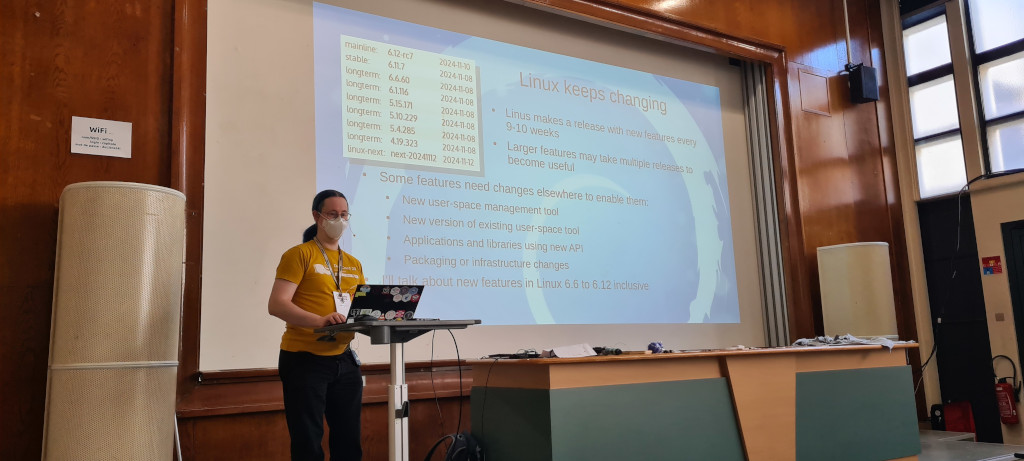
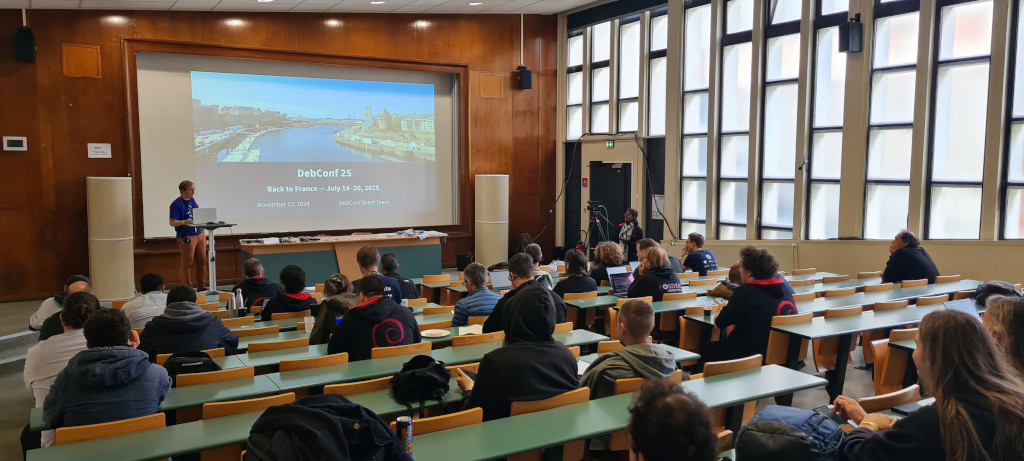
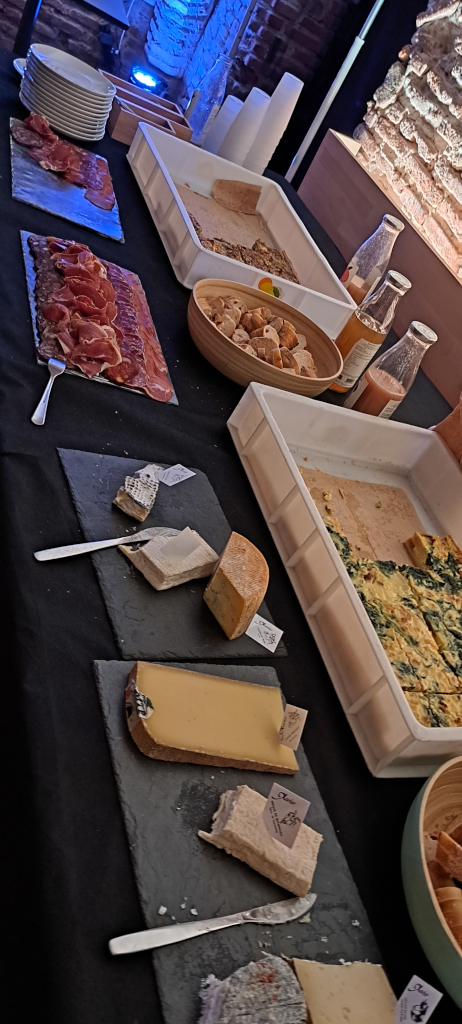
Then, on Saturday, November 16, and Sunday, November 17, 2024, the MiniDebConf took place at ENSEEIHT as part of the Capitole du Libre event. The conference kicked off on Saturday morning with an opening session by J r my Lecour, which included a tribute to Lunar (Nicolas Dandrimont). This was followed by Reproducible Builds Rebuilding What is Distributed from ftp.debian.org (Holger Levsen) and Discussion on My Research Work on Sustainability of Debian OS (Eda). After lunch at the Capitole du Libre food trucks, the intense afternoon schedule began: What s New in the Linux Kernel (and What s Missing in Debian) (Ben Hutchings), Linux Live Patching in Debian (Santiago Ruano Rinc n), Trixie on Mobile: Are We There Yet? (Arnaud Ferraris), PostgreSQL Container Groups, aka cgroups Down the Road (C dric Villemain), Upgrading a Thousand Debian Hosts in Less Than an Hour (J r my Lecour and myself), and Using Debusine to Automate Your QA (Stefano Rivera & co). Sunday marked the second day, starting with a presentation on DebConf 25 (Benjamin Somers), which will be held in Brest in July 2025. The morning continued with talks: How LTS Goes Beyond LTS (Santiago Ruano Rinc n & Roberto C. S nchez), Cross-Building (Helmut Grohne), and State of JavaScript (Bastien Roucari s). In the afternoon, there were Lightning Talks, PyPI Security: Past, Present & Future (Salvo LtWorf Tomaselli), and the classic Bits from DPL (Andreas Tille), before closing with the final session led by Pierre-Elliott B cue. All talks are available on video (a huge thanks to the amazing DebConf video team), and many thanks to our sponsors (Viridien, Freexian, Evolix, Collabora, and Data Bene). A big thank-you as well to the entire Capitole du Libre team for hosting and supporting us see you in Brest in July 2025! Articles about (or mentioning) MiniDebConf Toulouse:

13 December 2024

Freexian Collaborators: Monthly report about Debian Long Term Support, November 2024 (by Roberto C. S nchez)

Like each month, have a look at the work funded by Freexian s Debian LTS offering.

Debian LTS contributors In November, 20 contributors have been paid to work on Debian LTS, their reports are available:
  • Abhijith PA did 14.0h (out of 6.0h assigned and 8.0h from previous period).
  • Adrian Bunk did 53.0h (out of 15.0h assigned and 85.0h from previous period), thus carrying over 47.0h to the next month.
  • Andrej Shadura did 7.0h (out of 7.0h assigned).
  • Arturo Borrero Gonzalez did 1.0h (out of 10.0h assigned), thus carrying over 9.0h to the next month.
  • Bastien Roucari s did 20.0h (out of 20.0h assigned).
  • Ben Hutchings did 0.0h (out of 24.0h assigned), thus carrying over 24.0h to the next month.
  • Chris Lamb did 18.0h (out of 18.0h assigned).
  • Daniel Leidert did 17.0h (out of 26.0h assigned), thus carrying over 9.0h to the next month.
  • Emilio Pozuelo Monfort did 40.5h (out of 60.0h assigned), thus carrying over 19.5h to the next month.
  • Guilhem Moulin did 7.25h (out of 7.5h assigned and 12.5h from previous period), thus carrying over 12.75h to the next month.
  • Jochen Sprickerhof did 3.5h (out of 10.0h assigned), thus carrying over 6.5h to the next month.
  • Lee Garrett did 14.75h (out of 15.25h assigned and 44.75h from previous period), thus carrying over 45.25h to the next month.
  • Lucas Kanashiro did 10.0h (out of 54.0h assigned and 10.0h from previous period), thus carrying over 54.0h to the next month.
  • Markus Koschany did 20.0h (out of 40.0h assigned), thus carrying over 20.0h to the next month.
  • Roberto C. S nchez did 6.75h (out of 9.75h assigned and 14.25h from previous period), thus carrying over 17.25h to the next month.
  • Santiago Ruano Rinc n did 24.75h (out of 23.5h assigned and 1.5h from previous period), thus carrying over 0.25h to the next month.
  • Sean Whitton did 2.0h (out of 6.0h assigned), thus carrying over 4.0h to the next month.
  • Sylvain Beucler did 21.5h (out of 9.5h assigned and 50.5h from previous period), thus carrying over 38.5h to the next month.
  • Thorsten Alteholz did 11.0h (out of 11.0h assigned).
  • Tobias Frost did 12.0h (out of 10.5h assigned and 1.5h from previous period).

Evolution of the situation In November, we have released 38 DLAs. The LTS coordinators, Roberto and Santiago, delivered a talk at the Mini-DebConf event in Toulouse, France. The title of the talk was How LTS goes beyond LTS . The talk covered work done by the LTS Team during the past year. This included contributions related to individual packages in Debian (such as tomcat, jetty, radius, samba, apache2, ruby, and many others); improvements to tooling and documentation useful to the Debian project as a whole; and contributions to upstream work (apache2, freeimage, node-dompurify, samba, and more). Additionally, several contributors external to the LTS Team were highlighted for their contributions to LTS. Readers are encouraged to watch the video of the presentation for a more detailed review of various ways in which the LTS team has contributed more broadly to the Debian project and to the free software community during the past year. We wish to specifically thank Salvatore (of the Debian Security Team) for swiftly handling during November the updates of needrestart and libmodule-scandeps-perl, both of which involved arbitrary code execution vulnerabilities. We are happy to see increased involvement in LTS work by contributors from outside the formal LTS Team. The work of the LTS Team in November was otherwise unremarkable, encompassing the customary triage, development, testing, and release of numerous DLAs, along with some associated contributions to related packages in stable and unstable.

Thanks to our sponsors Sponsors that joined recently are in bold.

12 December 2024

Dirk Eddelbuettel: #44: r2u For ML and MLops Talk

Welcome to the 44th post in the $R^4 series. A few weeks ago, and following an informal call for talks by James Lamb, I had an opportunity to talk about r2u to the Chicago ML and MLops meetup groups. You can find the slides here. Over the last 2 1/2 years, r2u has become a widely-deployed mechanism in a number of settings, including (but not limited to) software testing via continuous integration, deployment on cloud servers besides of course to more standard use on local laptops or workstation. 30 million downloads illustrate this. My thesis for the talk was that this extends equally to ML(ops) where no surprises, no hickups automated deployments are key for large-scale model training, evaluation and of course production deployments. In this context, I introduce r2u while giving credit both to what came before it, the existing alternatives (or competitors for mindshare if one prefers that phrasing), and of course what lies underneath it. The central takeaway, I argue, is that r2u can and does take advantage of a unique situation in that we can join the package manager task for the underlying (operating) system and and the application domain, here R and its unique CRAN repository network. Other approaches can, and of course do, provide binaries, but by doing this outside the realm of the system package manager can only arrive at a lesser integration (and I show a common error arising in that case). So where r2u is feasible, it dominates the alternatives (while the alternatives may well provide deployment on more platforms which, even when less integrated, may be of greater importance for some). As always, it all depends. But the talk, and its slides, motivate and illustrate why we keep calling r2u by its slogan of r2u: Fast. Easy. Reliable. Pick All Three.

This post by Dirk Eddelbuettel originated on his Thinking inside the box blog. If you like this or other open-source work I do, you can now sponsor me at GitHub. Please report excessive re-aggregation in third-party for-profit settings.

9 December 2024

Gunnar Wolf: Some tips for those who still administer Drupal7-based sites

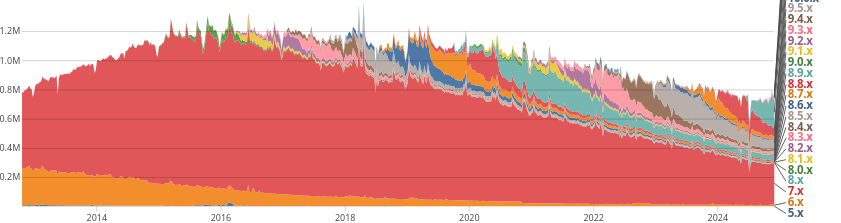
A bit of history: Drupal at my workplace (and in Debian) My main day-to-day responsibility in my workplace is, and has been for 20 years, to take care of the network infrastructure for UNAM s Economics Research Institute. One of the most visible parts of this responsibility is to ensure we have a working Web presence, and that it caters for the needs of our academic community. I joined the Institute in January 2005. Back then, our designer pushed static versions of our webpage, completely built in her computer. This was standard practice at the time, and lasted through some redesigns, but I soon started advocating for the adoption of a Content Management System. After evaluating some alternatives, I recommended adopting Drupal. It took us quite a bit to do the change: even though I clearly recall starting work toward adopting it as early as 2006, according to the Internet Archive, we switched to a Drupal-backed site around June 2010. We started using it somewhere in the version 6 s lifecycle. As for my Debian work, by late 2012 I started getting involved in the maintenance of the drupal7 package, and by April 2013 I became its primary maintainer. I kept the drupal7 package up to date in Debian until 2018; the supported build methods for Drupal 8 are not compatible with Debian (mainly, bundling third-party libraries and updating them without coordination with the rest of the ecosystem), so towards the end of 2016, I announced I would not package Drupal 8 for Debian. By March 2016, we migrated our main page to Drupal 7. By then, we already had several other sites for our academics projects, but my narrative follows our main Web site. I did manage to migrate several Drupal 6 (D6) sites to Drupal 7 (D7); it was quite involved process, never transparent to the user, and we did have the backlash of long downtimes (or partial downtimes, with sites half-available only) with many of our users. For our main site, we took the opportunity to do a complete redesign and deployed a fully new site. You might note that March 2016 is after the release of D8 (November 2015). I don t recall many of the specifics for this decision, but if I m not mistaken, building the new site was a several months long process not only for the technical work of setting it up, but for the legwork of getting all of the needed information from the different areas that need to be represented in the Institute. Not only that: Drupal sites often include tens of contributed themes and modules; the technological shift the project underwent between its 7 and 8 releases was too deep, and modules took a long time (if at all many themes and modules were outright dumped) to become available for the new release. Naturally, the Drupal Foundation wanted to evolve and deprecate the old codebase. But the pain to migrate from D7 to D8 is too big, and many sites have remained under version 7 Eight years after D8 s release, almost 40% of Drupal installs are for version 7, and a similar proportion runs a currently-supported release (10 or 11). And while the Drupal Foundation made a great job at providing very-long-term support for D7, I understand the burden is becoming too much, so close to a year ago (and after pushing several times the D7, they finally announced support will finish this upcoming January 5.

Drupal 7 must go! I found the following usage graphs quite interesting: the usage statistics for all Drupal versions follows a very positive slope, peaking around 2014 during the best years of D7, and somewhat stagnating afterwards, staying since 2015 at the 25000 28000 sites mark (I m very tempted to copy the graphs, but builtwith s terms of use are very clear in not allowing it). There is a sharp drop in the last year I attribute it to the people that are leaving D7 for other technologies after its end-of-life announcement. This becomes clearer looking only at D7 s usage statistics: D7 peaks at 15000 installs in 2016 stays there for close to 5 years, and has a sharp drop to under 7500 sites in the span of one year. D8 has a more regular rise, peak and fall peaking at ~8500 between 2020 and 2021, and down to close to 2500 for some months already; D9 has a very brief peak of almost 9000 sites in 2023 and is now close to half of it. Currently, the Drupal king appears to be D10, still on a positive slope and with over 9000 sites. Drupal 11 is still just a blip in builtwith s radar, with 3 registered sites as of September 2024 :- After writing this last paragraph, I came across the statistics found in the Drupal webpage; the methodology for acquiring its data is completely different: while builtwith s methodology is their trade secret, you can read more about how Drupal s data is gathered (and agree or disagree with it , but at least you have a page detailing 12 years so far of reported data, producing the following graph (which can be shared under the CC BY-SA license ): Drupal usage statistics by version 2013 2024 This graph is disgregated into minor versions, and I don t want to come up with yet another graph for it but it supports (most of) the narrative I presented above although I do miss the recent drop builtwith reported in D7 s numbers!

And what about Backdrop? During the D8 release cycle, a group of Drupal developers were not happy with the depth of the architectural changes that were being adopted, particularly the transition to the Symfony PHP component framework, and forked the D7 codebase to create the Backdrop CMS, a modern version of Drupal, without dropping the known and tested architecture it had. The Backdrop developers keep working closely together with the Drupal community, and although its usage numbers are way smaller than Drupal s, seems to be sustainable and lively. Of course, as I presented their numbers in the previous section, you can see Backdrop s numbers in builtwith are way, way lower. I have found it to be a very warm and welcoming community, eager to receive new members. And, thanks to its contributed D2B Migrate module, I found it is quite easy to migrate a live site from Drupal 7 to Backdrop.

Migration by playbook! So Well, I m an academic. And (if it s not obvious to you after reading so far ), one of the things I must do in my job is to write. So I decided to write an article to invite my colleagues to consider Backdrop for their D7 sites in Cuadernos T cnicos Universitarios de la DGTIC, a young journal in our university for showcasing technical academical work. And now that my article got accepted and published, I m happy to share it with you of course, if you can read Spanish But anyway Given I have several sites to migrate, and that I m trying to get my colleagues to follow suite, I decided to automatize the migration by writing an Ansible playbook to do the heavy lifting. Of course, the playbook s users will probably need to tweak it a bit to their personal needs. I m also far from an Ansible expert, so I m sure there is ample room fo improvement in my style. But it works. Quite well, I must add.

But with this size of database I did stumble across a big pebble, though. I am working on the migration of one of my users sites, and found that its database is huge. I checked the mysqldump output, and it got me close to 3GB of data. And given the D2B_migrate is meant to work via a Web interface (my playbook works around it by using a client I wrote with Perl s WWW::Mechanize), I repeatedly stumbled with PHP s maximum POST size, maximum upload size, maximum memory size I asked for help in Backdrop s Zulip chat site, and my attention was taken off fixing PHP to something more obvious: Why is the database so large? So I took a quick look at the database (or rather: my first look was at the database server s filesystem usage). MariaDB stores each table as a separate file on disk, so I looked for the nine largest tables:
# ls -lhS head
total 3.8G
-rw-rw---- 1 mysql mysql 2.4G Dec 10 12:09 accesslog.ibd
-rw-rw---- 1 mysql mysql 224M Dec  2 16:43 search_index.ibd
-rw-rw---- 1 mysql mysql 220M Dec 10 12:09 watchdog.ibd
-rw-rw---- 1 mysql mysql 148M Dec  6 14:45 cache_field.ibd
-rw-rw---- 1 mysql mysql  92M Dec  9 05:08 aggregator_item.ibd
-rw-rw---- 1 mysql mysql  80M Dec 10 12:15 cache_path.ibd
-rw-rw---- 1 mysql mysql  72M Dec  2 16:39 search_dataset.ibd
-rw-rw---- 1 mysql mysql  68M Dec  2 13:16 field_revision_field_idea_principal_articulo.ibd
-rw-rw---- 1 mysql mysql  60M Dec  9 13:19 cache_menu.ibd
A single table, the access log, is over 2.4GB long. The three following tables are, cache tables. I can perfectly live without their data in our new site! But I don t want to touch the slightest bit of this site until I m satisfied with the migration process, so I found a way to exclude those tables in a non-destructive way: given D2B_migrate works with a mysqldump output, and given that mysqldump locks each table before starting to modify it and unlocks it after its job is done, I can just do the following:
$ perl -e '$output = 1; while (<>)   $output=0 if /^LOCK TABLES  (accesslog search_index watchdog cache_field cache_path) /; $output=1 if /^UNLOCK TABLES/; print if $output ' < /tmp/d7_backup.sql  > /tmp/d7_backup.eviscerated.sql; ls -hl /tmp/d7_backup.sql /tmp/d7_backup.eviscerated.sql
-rw-rw-r-- 1 gwolf gwolf 216M Dec 10 12:22 /tmp/d7_backup.eviscerated.sql
-rw------- 1 gwolf gwolf 2.1G Dec  6 18:14 /tmp/d7_backup.sql
Five seconds later, I m done! The database is now a tenth of its size, and D2B_migrate is happy to take it. And I m a big step closer to finishing my reliance on (this bit of) legacy code for my highly-visible sites

Freexian Collaborators: Debian Contributions: OpenMPI transitions, cPython 3.12.7+ update uploads, Python 3.13 Transition, and more! (by Anupa Ann Joseph, Stefano Rivera)

Debian Contributions: 2024-11 Contributing to Debian is part of Freexian s mission. This article covers the latest achievements of Freexian and their collaborators. All of this is made possible by organizations subscribing to our Long Term Support contracts and consulting services.

Transition management, by Emilio Pozuelo Monfort Emilio has been helping finish the mpi-defaults switch to mpich on 32-bit architectures, and the openmpi transitions. This involves filing bugs for the reverse dependencies, doing NMUs, and requesting removals for outdated (Not Built from Source) binaries on 32-bit architectures where openmpi is no longer available. Those transitions got entangled with a few others, such as the petsc stack, and were blocking many packages from migrating to testing. These transitions were completed in early December.

cPython 3.12.7+ update uploads, by Stefano Rivera Python 3.12 had failed to build on mips64el, due to an obscure dh_strip failure. The mips64el porters never figured it out, but the missing build on mips64el was blocking migration to Debian testing. After waiting a month, enough changes had accumulated in the upstream 3.12 maintenance git branch that we could apply them in the hope of changing the output enough to avoid breaking dh_strip. This worked. Of course there were other things to deal with too. A test started failing due to a Debian-specific patch we carry for python3.x-minimal, and it needed to be reworked. And Stefano forgot to strip the trailing + from PY_VERSION, which confuses some python libraries. This always requires another patch when applying git updates from the maintenance branch. Stefano added a build-time check to catch this mistake in the future. Python 3.12.7 migrated.

Python 3.13 Transition, by Stefano Rivera and Colin Watson During November the Python 3.13-add transition started. This is the first stage of supporting a new version of Python in Debian archive (after preparatory work), adding it as a new supported but non-default version. All packages with compiled Python extensions need to be re-built to add support for the new version. We have covered the lead-up to this transition in the past. Due to preparation, many of the failures we hit were expected and we had patches waiting in the bug tracker. These could be NMUed to get the transition moving. Others had been known about but hadn t been worked on, yet. Some other packages ran into new issues, as we got further into the transition than we d been able to in preparation. The whole Debian Python team has been helping with this work. The rebuild stage of the 3.13-add transition is now over, but many packages need work before britney will let python3-defaults migrate to testing.

Limiting build concurrency based on available RAM, by Helmut Grohne In recent years, the concurrency of CPUs has been increasing as has the demand for RAM by linkers. What has not been increasing as quickly is the RAM supply in typical machines. As a result, we more frequently run into situations where the package builds exhaust memory when building at full concurrency. Helmut initiated a discussion about generalizing an approach to this in Debian packages. Researching existing code that limits concurrency as well as providing possible extensions to debhelper and dpkg to provide concurrency limits based on available system RAM. Thus far there is consensus on the need for a more general solution, but ideas are still being collected for the precise solution.

MiniDebConf Toulouse at Capitole du Libre The whole Freexian Collaborator team attended MiniDebConf Toulouse, part of the Capitole du Libre event. Several members of the team gave talks: Stefano and Anupa worked as part of the video team, streaming and recording the event s talks.

Miscellaneous contributions
  • Stefano looked into packaging the latest upstream python-falcon version in Debian, in support of the Python 3.13 transition. This appeared to break python-hug, which is sadly looking neglected upstream, and the best course of action is probably its removal from Debian.
  • Stefano uploaded videos from various 2024 Debian events to PeerTube and YouTube.
  • Stefano and Santiago visited the site for DebConf 2025 in Brest, after the MiniDebConf in Toulouse, to meet with the local team and scout out the venue. The on-going DebConf 25 organization work of last month also included handling the logo and artwork call for proposals.
  • Stefano helped the press team to edit a post for bits.debian.org on OpenStreetMap s migration to Debian.
  • Carles implemented multiple language support on po-debconf-manager and tested it using Portuguese-Brazilian during MiniDebConf Toulouse. The system was also tested and improved by reviewing more than 20 translations to Catalan, creating merge requests for those packages, and providing user support to new users. Additionally, Carles implemented better status transitions, configuration keys management and other small improvements.
  • Helmut sent 32 patches for cross build failures. The wireplumber one was an interactive collaboration with Dylan A ssi.
  • Helmut continued to monitor the /usr-move, sent a patch for lib64readline8 and continued several older patch conversations. lintian now reports some aliasing issues in unstable.
  • Helmut initiated a discussion on the semantics of *-for-host packages. More feedback is welcome.
  • Helmut improved the crossqa.debian.net infrastructure to fail running lintian less often in larger packages.
  • Helmut continued maintaining rebootstrap mostly dropping applied patches and continuing discussions of submitted patches.
  • Helmut prepared a non-maintainer upload of gzip for several long-standing bugs.
  • Colin came up with a plan for resolving the multipart vs. python-multipart name conflict, and began work on converting reverse-dependencies.
  • Colin upgraded 42 Python packages to new upstream versions. Some were complex: python-catalogue had some upstream version confusion, pydantic and rpds-py involved several Rust package upgrades as prerequisites, and python-urllib3 involved first packaging python-quart-trio and then vendoring an unpackaged test-dependency.
  • Colin contributed Incus support to needrestart upstream.
  • Lucas set up a machine to do a rebuild of all ruby reverse dependencies to check what will be broken by adding ruby 3.3 as an alternative interpreter. The tool used for this is mass-rebuild and the initial rebuilds have already started. The ruby interpreter maintainers are planning to experiment with debusine next time.
  • Lucas is organizing a Debian Ruby sprint towards the end of January in Paris. The plan of the team is to finish any missing bits of Ruby 3.3 transition at the time, try to push Rails 7 transition and fix RC bugs affecting the ruby ecosystem in Debian.
  • Anupa attended a Debian Publicity team meeting in-person during MiniDebCamp Toulouse.
  • Anupa moderated and posted in the Debian Administrator group in LinkedIn.

8 December 2024

Paulo Henrique de Lima Santana: Bits from MiniDebConf Toulouse 2024

Intro I always find it amazing the opportunities I have thanks to my contributions to the Debian Project. I am happy to receive this recognition through the help I receive with travel to attend events in other countries. This year, two MiniDebConfs were scheduled for the second half of the year in Europe: the traditional edition in Cambridge in UK and a new edition in Toulouse in France. After weighing the difficulties and advantages that I would have to attend one of them, I decided to choose Toulouse, mainly because it was cheaper and because it was in November, giving me more time to plan the trip. I contacted the current DPL Andreas Tille explaining my desire to attend the event and he kindly approved my request for Debian to pay for the tickets. Thanks again to Andreas! MiniDebConf Toulouse 2024 was held in November 16th and 17th (Saturday and Sunday) and took place in one of the rooms of a traditional Free Software event in the city named Capitole du Libre. Before MiniDebConf, the team organized a MiniDebCamp in November 14th and 15th at a coworking space. The whole experience promised to be incredible, and it was! From visiting a city in France for the first time, to attending a local Free Software event, and sharing four days with people from the Debian community from various countries.

Travel and the city My plan was to leave Belo Horizonte on Monday, pass through S o Paulo, and arrive in Toulouse on Tuesday night. I was going to spend the whole of Wednesday walking around the city and then participate in the MiniDebCamp on Thursday. But the flight that was supposed to leave S o Paulo in the early hours of Monday to Tuesday was cancelled due to a problem with the airplane and I had spent all Tuesday waiting. I was rebooked on another flight that left in the evening and arrived in Toulouse on Wednesday afternoon. Even though I was very tired from the trip, I still took advantage of the end of the day to walk around the city. But it was a shame to have lost an entire day of sightseeing. On Thursday I left early in the morning to walk around a little more before going to the MiniDebCamp venue. I walked around a lot and saw several tourist attractions. The city is really very beautiful, as they say, especially the houses and buildings made of pink bricks. I was impressed by the narrow and winding streets; at one point it seemed like I was walking through a maze. I arrived to a corner and there would be 5 streets crossing in different directions. The riverbank that runs through the city is very beautiful and people spend their evenings there just hanging out. There was a lot of history around there. I stayed in an airbnb 25 minutes walking from the coworking space and only 10 minutes from the event venue. It was a very spacious apartment that was much cheaper than a hotel. MiniDebConf Toulouse 2024

MiniDebConf Toulouse 2024

MiniDebCamp I arrived at the coworking space where the MiniDebCamp was being held and met up with several friends. I also met some new people, talked about the translation work we do in Brazil, and other topics. We already knew that the organization would pay for lunch for everyone during the two days of MiniDebCamp, and at a certain point they told us that we could go to the room (which was downstairs from the coworking space) to have lunch. They set up a table with quiches, breads, charcuterie and LOTS of cheese :-) There were several types of cheese and they were all very good. I just found it a little strange because I m not used to having cheese for lunch, but the experience was amazing anyway :-) MiniDebConf Toulouse 2024

MiniDebConf Toulouse 2024 In the evening, we went as a group to dinner at a restaurant in front of the Capitolium, the city s main tourist attraction. On the second day, in the morning, I walked around the city a bit more, then went to the coworking space and had another incredible cheese table for lunch.
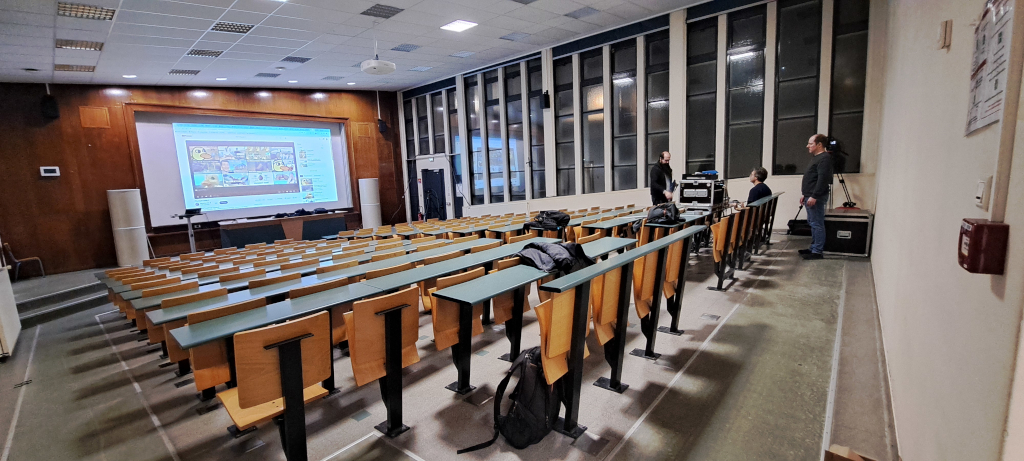
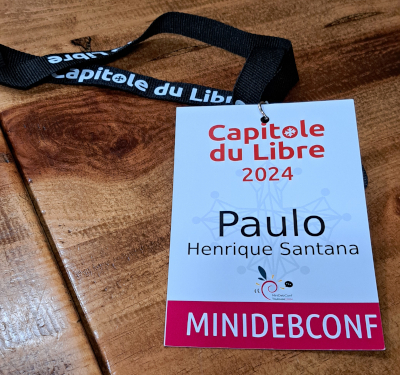
Video Team One of my ideas for going to Toulouse was to be able to help the video team in setting up the equipment for broadcasting and recording the talks. I wanted to follow this work from the beginning and learn some details, something I can t do before the DebConfs because I always arrive after the people have already set up the infrastructure. And later reproduce this work in the MiniDebConfs in Brazil, such as the one in Macei that is already scheduled for May 1-4, 2025. As I had agreed with the people from the video team that I would help set up the equipment, on Friday night we went to the University and stayed in the room working. I asked several questions about what they were doing, about the equipment, and I was able to clear up several doubts. Over the next two days I was handling one of the cameras during the talks. And on Sunday night I helped put everything away. Thanks to olasd, tumbleweed and ivodd for their guidance and patience. MiniDebConf Toulouse 2024

The event in general There was also a meeting with some members of the publicity team who were there with the DPL. We went to a cafeteria and talked mainly about areas that could be improved in the team. The talks at MiniDebConf were very good and the recordings are also available here. I ended up not watching any of the talks from the general schedule at Capitole du Libre because they were in French. It s always great to see free software events abroad to learn how they are done there and to bring some of those experiences to our events in Brazil. I hope that MiniDebConf in Toulouse will continue to take place every year, or that the French community will hold the next edition in another city and I will be able to join again :-) If everything goes well, in July next year I will return to France to join DebConf25 in Brest. MiniDebConf Toulouse 2024 More photos

Russ Allbery: Review: Why Buildings Fall Down

Review: Why Buildings Fall Down, by Matthys Levy & Mario Salvadori
Illustrator: Kevin Woest
Publisher: W.W. Norton
Copyright: 1992
Printing: 1994
ISBN: 0-393-31152-X
Format: Trade paperback
Pages: 314
Why Buildings Fall Down is a non-fiction survey of the causes of structure collapses, along with some related topics. It is a sequel of sorts to Why Buildings Stand Up by Mario Salvadori, which I have not read. Salvadori was, at the time of writing, Professor Emeritus of Architecture at Columbia University (he died in 1997). Levy is an award-winning architectural engineer, and both authors were principals at the structural engineering firm Weidlinger Associates. There is a revised and updated 2002 edition, but this review is of the original 1992 edition. This is one of those reviews that comes with a small snapshot of how my brain works. I got fascinated by the analysis of the collapse of Champlain Towers South in Surfside, Florida in 2021, thanks largely to a random YouTube series on the tiny channel of a structural engineer. Somewhere in there (I don't remember where, possibly from that channel, possibly not) I saw a recommendation for this book and grabbed a used copy in 2022 with the intent of reading it while my interest was piqued. The book arrived, I didn't read it right away, I got distracted by other things, and it migrated to my shelves and sat there until I picked it up on an "I haven't read nonfiction in a while" whim. Two years is a pretty short time frame for a book to sit on my shelf waiting for me to notice it again. The number of books that have been doing that for several decades is, uh, not small. Why Buildings Fall Down is a non-technical survey of structure failures. These are mostly buildings, but also include dams, bridges, and other structures. It's divided into 18 fairly short chapters, and the discussion of each disaster is brisk and to the point. Most of the structures discussed are relatively recent, but the authors talk about the Meidum Pyramid, the Parthenon (in the chapter on intentional destruction by humans), and the Pavia Civic Tower (in the chapter about building death from old age). If you are someone who has already been down the structural failure rabbit hole, you will find chapters on the expected disasters like the Tacoma Narrows Bridge collapse and the Hyatt Regency walkway collapse, but there are a lot of incidents here, including a short but interesting discussion of the Leaning Tower of Pisa in the chapter on problems caused by soil properties. What you're going to get, in other words, is a tour of ways in which structures can fail, which is precisely what was promised by the title. This wasn't quite what I was expecting, but now I'm not sure why I was expecting something different. There is no real unifying theme here; sometimes the failure was an oversight, sometimes it was a bad design, sometimes it was a last-minute change, and sometimes it was something unanticipated. There are a lot of factors involved in structure design and any of them can fail. The closest there is to a common pattern is a lack of redundancy and sufficient safety factors, but that lack of redundancy was generally not deliberate and therefore this is not a guide to preventing a collapse. The result is a book that feels a bit like a grab-bag of structural trivia that is individually interesting but only occasionally memorable. The writing style I suspect will be a matter of taste, but once I got used to it, I rather enjoyed it. In a co-written book, it's hard to separate the voices of the authors, but Salvadori wrote most of the chapter on the law in the first person and he's clearly a character. (That chapter is largely the story of two trials he testified in, which, from his account, involved him verbally fencing with lawyers who attempted to claim his degrees from the University of Rome didn't count as real degrees.) If this translates to his speaking style, I suspect he was a popular lecturer at Columbia. The explanations of the structural failures are concise and relatively clear, although even with Kevin Woest's diagrams, it's hard to capture the stresses and movement in a written description. (I've found from watching YouTube videos that animations, or even annotations drawn while someone is talking, help a lot.) The framing discussion, well, sometimes that is bombastic in a way that I found amusing:
But we, children of a different era, do not want our lives to be enclosed, to be shielded from the mystery. We are eager to participate in it, to gather with our brothers and sisters in a community of thought that will lift us above the mundane. We need to be together in sorrow and in joy. Thus we rarely build monolithic monuments. Instead, we build domes.
It helps that passages like this are always short and thus don't wear out their welcome. My favorite line in the whole book is a throwaway sentence in a discussion of building failures due to explosions:
With a similar approach, it can be estimated that the chance of an explosion like that at Forty-fifth Street was at most one in thirty million, and probably much less. But this is why life is dangerous and always ends in death.
Going hard, structural engineering book! It's often appealing to learn about things from their failures because the failures are inherently more dramatic and thus more interesting, but if you were hoping for an introduction to structural engineering, this is probably not the book you want. There is an excellent and surprisingly engaging appendix that covers the basics of structural analysis in 45 pages, but you would probably be better off with Why Buildings Stand Up or another architecture or structural engineering textbook (or maybe a video course). The problem with learning by failure case study is that all the case studies tend to blend together, despite the authors' engaging prose, and nearly every collapse introduces a new structural element with new properties and new failure modes and only the briefest of explanations. This book might make you a slightly more informed consumer of the news, but for most readers I suspect it will be a collection of forgettable trivia told in an occasionally entertaining style. I think the book I wanted to read was something that went deeper into the process of forensic engineering, not just the outcomes. It's interesting to know what the cause of a failure was, but I'm more interested in how one goes about investigating a failure. What is the process, how do you organize the investigation, and how does the legal system around engineering failures work? There are tidbits and asides here, but this book is primarily focused on the structural analysis and elides most of the work done to arrive at those conclusions. That said, I was entertained. Why Buildings Fall Down is a bit dated the opening chapter on airplanes hitting buildings reads much differently now than when it was written in 1992, and I'm sure it was updated in the 2002 edition but it succeeds in being clear without being soulless or sounding like a textbook. I appreciate an occasional rant about nuclear weapons in a book about architecture. I'm not sure I really recommend this, but I had a good time with it. Also, I'm now looking for opportunities to say "this is why life is dangerous and always ends in death," so there is that. Rating: 6 out of 10

7 December 2024

Dominique Dumont: New cme command to update Debian Standards-Version field

Hi While updating my Debian package, I often have to update a field from debian/control file. This field is named Standards-Version and it declares which version of Debian policy the package complies to. When updating this field, one must follow the upgrading checklist. That being said, I maintain a lot of similar package and I often have to update this Standards-Version field. This field can be updated manually with cme fix dpkg (see Managing Debian packages with cme). But this command may make other changes and does not commit the result. So I ve created a new update-standards-version cme script that: For instance:
$ cme run update-standards-version 
Reading package lists... Done
Building dependency tree... Done
Reading state information... Done
Connecting to api.ftp-master.debian.org to check 31 package versions. Please wait...
Got info from api.ftp-master.debian.org for 31 packages.
Warning in 'source Standards-Version': Current standards version is '4.7.0'. Please read https://www.debian.org/doc/debian-policy/upgrading-checklist.html for the changes that may be needed on your package
to upgrade it from standard version '4.6.2' to '4.7.0'.
Offending value: '4.6.2'
Changes applied to dpkg-control configuration:
- source Standards-Version: '4.6.2' -> '4.7.0'
[master 552862c1] control: declare compliance with Debian policy 4.7.0
 1 file changed, 1 insertion(+), 1 deletion(-)
Here s the generated commit. Note that the generated log mentions the new policy version:
$ git show
commit 552862c1f24479b1c0c8c35a6289557f65e8ff3b (HEAD -> master)
Author: Dominique Dumont <dod[at]debian.org>
Date:   Sat Dec 7 19:06:14 2024 +0100
    control: declare compliance with Debian policy 4.7.0
diff --git a/debian/control b/debian/control
index cdb41dc0..e888012e 100644
--- a/debian/control
+++ b/debian/control
@@ -48,7 +48,7 @@ Build-Depends-Indep: dh-sequence-bash-completion,
                      libtext-levenshtein-damerau-perl,
                      libyaml-tiny-perl,
                      po-debconf
-Standards-Version: 4.6.2
+Standards-Version: 4.7.0
 Vcs-Browser: https://salsa.debian.org/perl-team/modules/packages/libconfig-model-perl
 Vcs-Git: https://salsa.debian.org/perl-team/modules/packages/libconfig-model-perl.git
 Homepage: https://github.com/dod38fr/config-model/wiki
Notes: I hope this will be useful to all my fellow Debian developers to reduce the boring parts of packaging activities. All the best

6 December 2024

B lint R czey: Firebuild 0.8.3 is out with 100+ fixes and experimental macOS support!

The new Firebuild release contains plenty of small fixes and a few notable improvements.

Experimental macOS support The most frequently asked question from people getting to know Firebuild was if it worked on their Mac and the answer sadly used to be that well, it did, but only in a Linux VM. This was far from what they were looking for. Linux and macOS have common UNIX roots, but porting Firebuild to macOS included bigger challenges, like ensuring that dyld(1), macOS s dynamic loader initializes the preloaded interceptor library early enough to catch all interesting calls, and avoid using anything that uses malloc() or thread local variables which are not yet set up then. Preloading libraries on Linux is really easy, running LD_PRELOAD=my_lib.so ls just works if the library exports the symbols to be interposed, while macOS employs multiple lines of defense to prevent applications from using unknown libraries. Firebuild s guide for making DYLD_INSERT_LIBRARIES honored on Macs can be helpful with other projects as well that rely on injecting libraries. Since GitHub s Arm64 macOS runners don t allow intercepting binaries with arm64e ABI yet, Firebuild s Apple Silicon tests are run at Bitrise, who are proud to be first to provide the latest Xcode stacks and were also quick to make the needed changes to their infrastructure to support Firebuild (thanks!  ). Firebuild on macOS can already accelerate simple projects and rebuild itself with Xcode. Since Xcode introduces a lot of nondeterminism to the build, Firebuild can t shine in acceleration with Xcode yet, but can provide nice reports to show which part of the build is the most time consuming and how each sub-command is called. If you would like to try Firebuild on macOS please compile it from the GitHub repository for now. Precompiled binaries will be distributed on the Mac App Store and via CI providers. Contact us to get notified when those channels become available.

Dealing with the Epochalypse Glibc s API provides many functions with time parameters and some of those functions are intercepted by Firebuild. Time parameters used to be passed as 32-bit values on 32-bit systems, preventing them to accurately represent timestamps after year 2038, which is known as the Y2038 problem or the Epochalypse. To deal with the problem glibc 2.34 started providing new function symbol variants with 64-bit time parameters, e.g clock_gettime64() in addition to clock_gettime(). The new 64-bit variants are used when compiling consumers of the API with _TIME_BITS=64 defined. Processes intercepted by Firebuild may have been compiled with or without _TIME_BITS=64, thus libfirebuild now provides both variants on affected systems running glibc >= 34 to work safely with binaries using 64-bit and 32-bit time representation. Many Linux distributions already stopped supporting 32-bit architectures, but Debian and Ubuntu still supports armhf, for example, where the Y2038 problem still applies. Both Debian and Ubuntu performed a transition rebuilding every library (and their reverse dependencies) with -D_FILE_OFFSET_BITS=64 set where the libraries exported symbols that changed when switching to 64-bit time representation (thanks to Steve Langasek for driving this!) . Thanks to the transition most programs are ready for 2038, but interposer libraries are trickier to fix and if you maintain one it might be a good idea to check if it works well both 32-bit and 64-bit libraries. Faketime, for example is not fixed yet, see #1064555.

Select passed through environment variables with regular expressions Firebuild filters out most of the environment variables set when starting a build to make the build more reproducible and achieve higher cache hit rate. Extra environment variables to pass through can be specified on the command line one by one, but with many similarly named variables this may become hard to maintain. With regular expressions this just became easier:
firebuild -o 'env_vars.pass_through += "MY_VARS_.*"' my_build_command
If you are not interested in acceleration just would like to explore what the build does by generating a report you can simply pass all variables:
firebuild -r -o 'env_vars.pass_through += ".*"' my_build_command

Other highlights from the 0.8.3 release
  • Fixed and nicer report in Chrome and other WebKit based browsers
  • Support GLibc 2.39 by intercepting pidfd_spawn() and pidfd_spawnp()
  • Even faster Rust build acceleration
For all the changes please check out the release page on GitHub!  (This post is also published on The Firebuild blog.)

Next.

Previous.