Search Results: "agi"

13 January 2024

Freexian Collaborators: Debian Contributions: LXD/Incus backend bug, /usr-merge updates, gcc-for-host, and more! (by Utkarsh Gupta)

Contributing to Debian is part of Freexian s mission. This article covers the latest achievements of Freexian and their collaborators. All of this is made possible by organizations subscribing to our Long Term Support contracts and consulting services.

LXD/Incus backend bug in autopkgtest by Stefano Rivera While working on the Python 3.12 transition, Stefano repeatedly ran into a bug in autopkgtest when using LXD (or in the future Incus), that caused it to hang when running cython s multi-hour autopkgtests. After some head-banging, the bug turned out to be fairly straightforward: LXD didn t shut down on receiving a SIGTERM, so when a testsuite timed out, it would hang forever. A simple fix has been applied.

/usr-merge, by Helmut Grohne Thanks to Christian Hofstaedtler and others, the effort is moving into a community effort and the work funded by Freexian becomes more difficult to separate from non-funded work. In particular, since the community fully handled all issues around lost udev rules, dh_installudev now installs rules to /usr. The story around diversions took another detour. We learned that conflicts do not reliably prevent concurrent unpack and the reiterated mitigation for molly-guard triggered this. After a bit of back and forth and consultation with the developer mailing list, we concluded that avoiding the problematic behavior when using apt or an apt-based upgrader combined with a loss mitigation would be good enough. The involved packages bfh-container, molly-guard, progress-linux-container and systemd have since been uploaded to unstable and the matter seems finally solved except that it doesn t quite work with sysvinit yet. The same approach is now being proposed for the diversions of zutils for gzip. We thank involved maintainers for their timely cooperation.

gcc-for-host, by Helmut Grohne Since forever, it has been difficult to correctly express a toolchain build dependency. This can be seen in the Build-Depends of the linux source package for instance. While this has been solved for binutils a while back, the patches for gcc have been unfinished. With lots of constructive feedback from gcc package maintainer Matthias Klose, Helmut worked on finalizing and testing these patches. Patch stacks are now available for gcc-13 and gcc-14 and Matthias already included parts of them in test builds for Ubuntu noble. Finishing this work would enable us to resolve around 1000 cross build dependency satisfiability issues in unstable.

Miscellaneous contributions
  • Stefano continued work on the Python 3.12 transition, including uploads of cython, pycxx, numpy, python-greenlet, twisted, foolscap and dh-python.
  • Stefano reviewed and selected from a new round of DebConf 24 bids, as part of the DebConf Committee. Busan, South Korea was selected.
  • For debian-printing Thorsten uploaded hplip to unstable to fix a /usr-merge bug and cups to Bookworm to fix bugs related to printing in color.
  • Utkarsh helped newcomers in mentoring and reviewing their packaging; eg: golang-github-prometheus-community-pgbouncer-exporter.
  • Helmut sent patches for 42 cross build failures unrelated to the gcc-for-host work.
  • Helmut continues to maintain rebootstrap. In December, blt started depending on libjpeg and this poses a dependency loop. Ideally, Python would stop depending on blt. Also linux-libc-dev having become Multi-Arch: foreign poses non-trivial issues that are not fully resolved yet.
  • Enrico participated in /usr-merge discussions with Helmut.

11 January 2024

Reproducible Builds: Reproducible Builds in December 2023

Welcome to the December 2023 report from the Reproducible Builds project! In these reports we outline the most important things that we have been up to over the past month. As a rather rapid recap, whilst anyone may inspect the source code of free software for malicious flaws, almost all software is distributed to end users as pre-compiled binaries (more).

Reproducible Builds: Increasing the Integrity of Software Supply Chains awarded IEEE Software Best Paper award In February 2022, we announced in these reports that a paper written by Chris Lamb and Stefano Zacchiroli was now available in the March/April 2022 issue of IEEE Software. Titled Reproducible Builds: Increasing the Integrity of Software Supply Chains (PDF). This month, however, IEEE Software announced that this paper has won their Best Paper award for 2022.

Reproducibility to affect package migration policy in Debian In a post summarising the activities of the Debian Release Team at a recent in-person Debian event in Cambridge, UK, Paul Gevers announced a change to the way packages are migrated into the staging area for the next stable Debian release based on its reproducibility status:
The folks from the Reproducibility Project have come a long way since they started working on it 10 years ago, and we believe it s time for the next step in Debian. Several weeks ago, we enabled a migration policy in our migration software that checks for regression in reproducibility. At this moment, that is presented as just for info, but we intend to change that to delays in the not so distant future. We eventually want all packages to be reproducible. To stimulate maintainers to make their packages reproducible now, we ll soon start to apply a bounty [speedup] for reproducible builds, like we ve done with passing autopkgtests for years. We ll reduce the bounty for successful autopkgtests at that moment in time.

Speranza: Usable, privacy-friendly software signing Kelsey Merrill, Karen Sollins, Santiago Torres-Arias and Zachary Newman have developed a new system called Speranza, which is aimed at reassuring software consumers that the product they are getting has not been tampered with and is coming directly from a source they trust. A write-up on TechXplore.com goes into some more details:
What we have done, explains Sollins, is to develop, prove correct, and demonstrate the viability of an approach that allows the [software] maintainers to remain anonymous. Preserving anonymity is obviously important, given that almost everyone software developers included value their confidentiality. This new approach, Sollins adds, simultaneously allows [software] users to have confidence that the maintainers are, in fact, legitimate maintainers and, furthermore, that the code being downloaded is, in fact, the correct code of that maintainer. [ ]
The corresponding paper is published on the arXiv preprint server in various formats, and the announcement has also been covered in MIT News.

Nondeterministic Git bundles Paul Baecher published an interesting blog post on Reproducible git bundles. For those who are not familiar with them, Git bundles are used for the offline transfer of Git objects without an active server sitting on the other side of a network connection. Anyway, Paul wrote about writing a backup system for his entire system, but:
I noticed that a small but fixed subset of [Git] repositories are getting backed up despite having no changes made. That is odd because I would think that repeated bundling of the same repository state should create the exact same bundle. However [it] turns out that for some, repositories bundling is nondeterministic.
Paul goes on to to describe his solution, which involves forcing git to be single threaded makes the output deterministic . The article was also discussed on Hacker News.

Output from libxlst now deterministic libxslt is the XSLT C library developed for the GNOME project, where XSLT itself is an XML language to define transformations for XML files. This month, it was revealed that the result of the generate-id() XSLT function is now deterministic across multiple transformations, fixing many issues with reproducible builds. As the Git commit by Nick Wellnhofer describes:
Rework the generate-id() function to return deterministic values. We use
a simple incrementing counter and store ids in the 'psvi' member of
nodes which was freed up by previous commits. The presence of an id is
indicated by a new "source node" flag.
This fixes long-standing problems with reproducible builds, see
https://bugzilla.gnome.org/show_bug.cgi?id=751621
This also hardens security, as the old implementation leaked the
difference between a heap and a global pointer, see
https://bugs.chromium.org/p/chromium/issues/detail?id=1356211
The old implementation could also generate the same id for dynamically
created nodes which happened to reuse the same memory. Ids for namespace
nodes were completely broken. They now use the id of the parent element
together with the hex-encoded namespace prefix.

Community updates There were made a number of improvements to our website, including Chris Lamb fixing the generate-draft script to not blow up if the input files have been corrupted today or even in the past [ ], Holger Levsen updated the Hamburg 2023 summit to add a link to farewell post [ ] & to add a picture of a Post-It note. [ ], and Pol Dellaiera updated the paragraph about tar and the --clamp-mtime flag [ ]. On our mailing list this month, Bernhard M. Wiedemann posted an interesting summary on some of the reasons why packages are still not reproducible in 2023. diffoscope is our in-depth and content-aware diff utility that can locate and diagnose reproducibility issues. This month, Chris Lamb made a number of changes, including processing objdump symbol comment filter inputs as Python byte (and not str) instances [ ] and Vagrant Cascadian extended diffoscope support for GNU Guix [ ] and updated the version in that distribution to version 253 [ ].

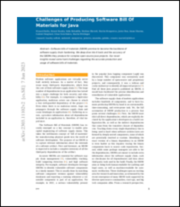
Challenges of Producing Software Bill Of Materials for Java Musard Balliu, Benoit Baudry, Sofia Bobadilla, Mathias Ekstedt, Martin Monperrus, Javier Ron, Aman Sharma, Gabriel Skoglund, C sar Soto-Valero and Martin Wittlinger (!) of the KTH Royal Institute of Technology in Sweden, have published an article in which they:
deep-dive into 6 tools and the accuracy of the SBOMs they produce for complex open-source Java projects. Our novel insights reveal some hard challenges regarding the accurate production and usage of software bills of materials.
The paper is available on arXiv.

Debian Non-Maintainer campaign As mentioned in previous reports, the Reproducible Builds team within Debian has been organising a series of online and offline sprints in order to clear the huge backlog of reproducible builds patches submitted by performing so-called NMUs (Non-Maintainer Uploads). During December, Vagrant Cascadian performed a number of such uploads, including: In addition, Holger Levsen performed three no-source-change NMUs in order to address the last packages without .buildinfo files in Debian trixie, specifically lorene (0.0.0~cvs20161116+dfsg-1.1), maria (1.3.5-4.2) and ruby-rinku (1.7.3-2.1).

Reproducibility testing framework The Reproducible Builds project operates a comprehensive testing framework (available at tests.reproducible-builds.org) in order to check packages and other artifacts for reproducibility. In December, a number of changes were made by Holger Levsen:
  • Debian-related changes:
    • Fix matching packages for the [R programming language](https://en.wikipedia.org/wiki/R_(programming_language). [ ][ ][ ]
    • Add a Certbot configuration for the Nginx web server. [ ]
    • Enable debugging for the create-meta-pkgs tool. [ ][ ]
  • Arch Linux-related changes
    • The asp has been deprecated by pkgctl; thanks to dvzrv for the pointer. [ ]
    • Disable the Arch Linux builders for now. [ ]
    • Stop referring to the /trunk branch / subdirectory. [ ]
    • Use --protocol https when cloning repositories using the pkgctl tool. [ ]
  • Misc changes:
    • Install the python3-setuptools and swig packages, which are now needed to build OpenWrt. [ ]
    • Install pkg-config needed to build Coreboot artifacts. [ ]
    • Detect failures due to an issue where the fakeroot tool is implicitly required but not automatically installed. [ ]
    • Detect failures due to rename of the vmlinuz file. [ ]
    • Improve the grammar of an error message. [ ]
    • Document that freebsd-jenkins.debian.net has been updated to FreeBSD 14.0. [ ]
In addition, node maintenance was performed by Holger Levsen [ ] and Vagrant Cascadian [ ].

Upstream patches The Reproducible Builds project detects, dissects and attempts to fix as many currently-unreproducible packages as possible. We endeavour to send all of our patches upstream where appropriate. This month, we wrote a large number of such patches, including:

If you are interested in contributing to the Reproducible Builds project, please visit our Contribute page on our website. However, you can get in touch with us via:

10 January 2024

Colin Watson: Going freelance

I ve mentioned this in a couple of other places, but I realized I never got round to posting about it on my own blog rather than on other people s services. How remiss of me. Anyway: after much soul-searching, I decided a few months ago that it was time for me to move on from Canonical and the Launchpad team there. Nearly 20 years is a long time to spend at any company, and although there are a bunch of people I ll miss, Launchpad is in a reasonable state where I can let other people have a turn. I m now in business for myself as a freelance developer! My new company is Columbiform, and I m focusing on Debian packaging and custom Python development. My services page has some self-promotion on the sorts of things I can do. My first gig, and the one that made it viable to make this jump, is at Freexian where I m helping with an exciting infrastructure project that we hope will start making Debian developers lives easier in the near future. This is likely to take up most of my time at least through to the end of 2024, but I may have some spare cycles. Drop me a line if you have something where you think I could be a good fit, and we can have a talk about it.

9 January 2024

Louis-Philippe V ronneau: 2023 A Musical Retrospective

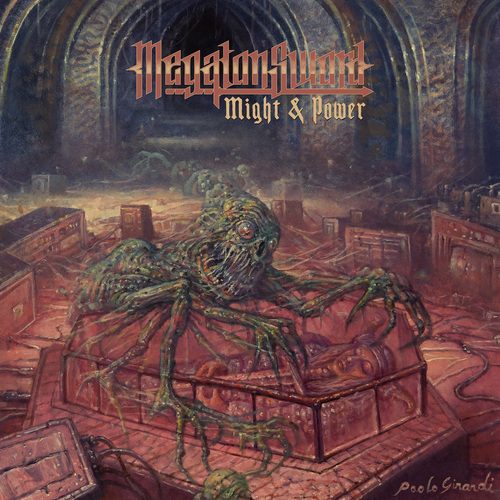
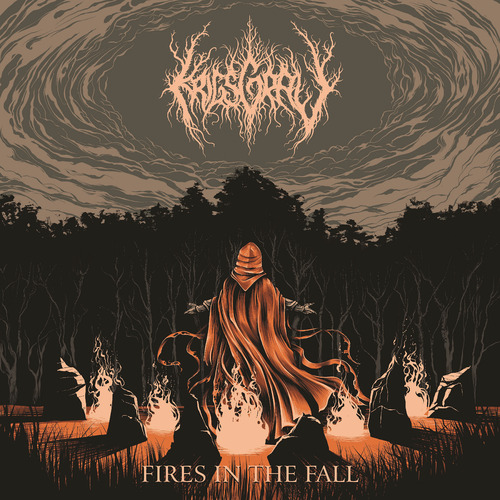
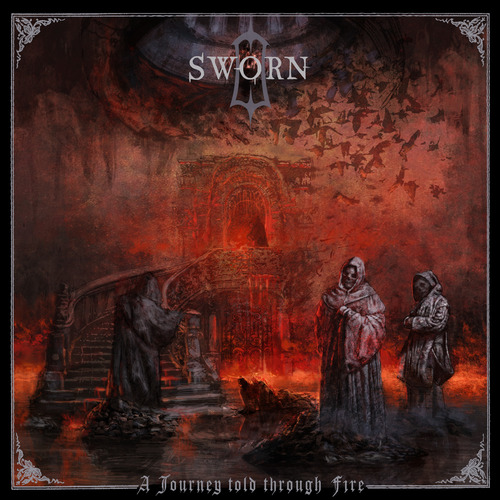
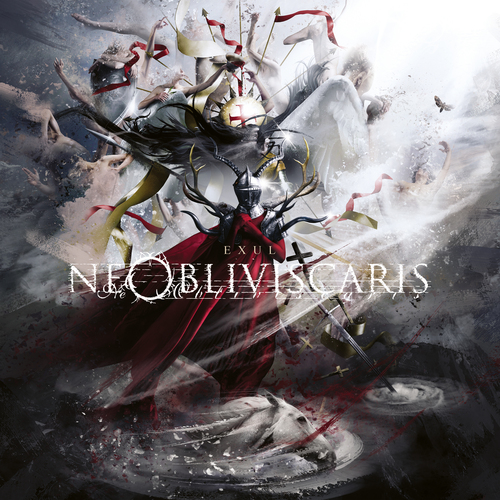
I ended 2022 with a musical retrospective and very much enjoyed writing that blog post. As such, I have decided to do the same for 2023! From now on, this will probably be an annual thing :) Albums In 2023, I added 73 new albums to my collection nearly 2 albums every three weeks! I listed them below in the order in which I acquired them. I purchased most of these albums when I could and borrowed the rest at libraries. If you want to browse though, I added links to the album covers pointing either to websites where you can buy them or to Discogs when digital copies weren't available. Once again this year, it seems that Punk (mostly O !) and Metal dominate my list, mostly fueled by Angry Metal Guy and the amazing Montr al Skinhead/Punk concert scene. Concerts A trend I started in 2022 was to go to as many concerts of artists I like as possible. I'm happy to report I went to around 80% more concerts in 2023 than in 2022! Looking back at my list, April was quite a busy month... Here are the concerts I went to in 2023: Although metalfinder continues to work as intended, I'm very glad to have discovered the Montr al underground scene has departed from Facebook/Instagram and adopted en masse Gancio, a FOSS community agenda that supports ActivityPub. Our local instance, askapunk.net is pretty much all I could ask for :) That's it for 2023!

8 January 2024

Russ Allbery: Review: The Faithless

Review: The Faithless, by C.L. Clark
Series: Magic of the Lost #2
Publisher: Orbit
Copyright: March 2023
ISBN: 0-316-54283-0
Format: Kindle
Pages: 527
The Faithless is the second book in a political fantasy series that seems likely to be a trilogy. It is a direct sequel to The Unbroken, which you should read first. As usual, Orbit made it unnecessarily hard to get re-immersed in the world by refusing to provide memory aids for readers who read books as they come out instead of only when the series is complete, but this is not the fault of Clark or the book and you've heard me rant about this before. The Unbroken was set in Qaz l (not-Algeria). The Faithless, as readers of the first book might guess from the title, is set in Balladaire (not-France). This is the palace intrigue book. Princess Luca is fighting for her throne against her uncle, the regent. Touraine is trying to represent her people. Whether and to what extent those interests are aligned is much of the meat of this book. Normally I enjoy palace intrigue novels for the competence porn: watching someone navigate a complex political situation with skill and cunning, or upend the entire system by building unlikely coalitions or using unexpected routes to power. If you are similar, be warned that this is not what you're going to get. Touraine is a fish out of water with no idea how to navigate the Balladairan court, and does not magically become an expert in the course of this novel. Luca has the knowledge, but she's unsure, conflicted, and largely out-maneuvered. That means you will have to brace for some painful scenes of some of the worst people apparently getting what they want. Despite that, I could not put this down. It was infuriating, frustrating, and a much slower burn than I prefer, but the layers of complex motivations that Clark builds up provided a different sort of payoff. Two books in, the shape of this series is becoming clearer. This series is about empire and colonialism, but with considerably more complexity than fantasy normally brings to that topic. Power does not loosen its grasp easily, and it has numerous tools for subtle punishment after apparent upstart victories. Righteous causes rarely call banners to your side; instead, they create opportunities for other people to maneuver to their own advantage. Touraine has some amount of power now, but it's far from obvious how to use it. Her life's training tells her that exercising power will only cause trouble, and her enemies are more than happy to reinforce that message at every opportunity. Most notable to me is Clark's bitingly honest portrayal of the supposed allies within the colonial power. It is clear that Luca is attempting to take the most ethical actions as she defines them, but it's remarkable how those efforts inevitably imply that Touraine should help Luca now in exchange for Luca's tenuous and less-defined possible future aid. This is not even a lie; it may be an accurate summary of Balladairan politics. And yet, somehow what Balladaire needs always matters more than the needs of their abused colony. Underscoring this, Clark introduces another faction in the form of a populist movement against the Balladairan monarchy. The details of that setup in another fantasy novel would make them allies of the Qaz l. Here, as is so often the case in real life, a substantial portion of the populists are even more xenophobic and racist than the nobility. There are no easy alliances. The trump card that Qaz l holds is magic. They have it, and (for reasons explored in The Unbroken) Balladaire needs it, although that is a position held by Luca's faction and not by her uncle. But even Luca wants to reduce that magic to a manageable technology, like any other element of the Balladairan state. She wants to understand it, harness it, and bring it under local control. Touraine, trained by Balladaire and facing Balladairan political problems, has the same tendency. The magic, at least in this book, refuses not in the flashy, rebellious way that it would in most fantasy, but in a frustrating and incomprehensible lack of predictable or convenient rules. I think this will feel like a plot device to some readers, and that is to some extent true, but I think I see glimmers of Clark setting up a conflict of world views that will play out in the third book. I think some people are going to bounce off this book. It's frustrating, enraging, at times melodramatic, and does not offer the cathartic payoff typically offered in fantasy novels of this type. Usually these are things I would be complaining about as well. And yet, I found it satisfyingly challenging, engrossing, and memorable. I spent a lot of the book yelling "just kill him already" at the characters, but I think one of Clark's points is that overcoming colonial relationships requires a lot more than just killing one evil man. The characters profoundly fail to execute some clever and victorious strategy. Instead, as in the first book, they muddle through, making the best choice that they can see in each moment, making lots of mistakes, and paying heavy prices. It's realistic in a way that has nothing to do with blood or violence or grittiness. (Although I did appreciate having the thin thread of Pruett's story and its highly satisfying conclusion.) This is also a slow-burn romance, and there too I think opinions will differ. Touraine and Luca keep circling back to the same arguments and the same frustrations, and there were times that this felt repetitive. It also adds a lot of personal drama to the politics in a way that occasionally made me dubious. But here too, I think Clark is partly using the romance to illustrate the deeper political points. Luca is often insufferable, cruel and ambitious in ways she doesn't realize, and only vaguely able to understand the Qaz l perspective; in short, she's the pragmatic centrist reformer. I am dubious that her ethics would lead her to anything other than endless compromise without Touraine to push her. To Luca's credit, she also realizes that and wants to be a better person, but struggles to have the courage to act on it. Touraine both does and does not want to manipulate her; she wants Luca's help (and more), but it's not clear Luca will give it under acceptable terms, or even understand how much she's demanding. It's that foundational conflict that turns the romance into a slow burn by pushing them apart. Apparently I have more patience for this type of on-again, off-again relationship than one based on artificial miscommunication. The more I noticed the political subtext, the more engaging I found the romance on the surface. I picked this up because I'd read several books about black characters written by white authors, and while there was nothing that wrong with those books, the politics felt a little too reductionist and simplified. I wanted a book that was going to force me out of comfortable political assumptions. The Faithless did exactly what I was looking for, and I am definitely here for the rest of the series. In that sense, recommended, although do not go into this book hoping for adroit court maneuvering and competence porn. Followed by The Sovereign, which does not yet have a release date. Content warnings: Child death, attempted cultural genocide. Rating: 7 out of 10

7 January 2024

Jonathan McDowell: Free Software Activities for 2023

This year was hard from a personal and work point of view, which impacted the amount of Free Software bits I ended up doing - even when I had the time I often wasn t in the right head space to make progress on things. However writing this annual recap up has been a useful exercise, as I achieved more than I realised. For previous years see 2019, 2020, 2021 + 2022.

Conferences The only Free Software related conference I made it to this year was DebConf23 in Kochi, India. Changes with projects at work meant I couldn t justify anything work related. This year I m planning to make it to FOSDEM, and haven t made a decision on DebConf24 yet.

Debian Most of my contributions to Free software continue to happen within Debian. I started the year working on retrogaming with Kodi on Debian. I got this to a much better state for bookworm, with it being possible to run the bsnes-mercury emulator under Kodi using RetroArch. There are a few other libretro backends available for RetroArch, but Kodi needs some extra controller mappings packaged up first. Plenty of uploads were involved, though some of this was aligning all the dependencies and generally cleaning things up in iterations. I continued to work on a few packages within the Debian Electronics Packaging Team. OpenOCD produced a new release in time for the bookworm release, so I uploaded 0.12.0-1. There were a few minor sigrok cleanups - sigrok 0.3, libsigrokdecode 0.5.3-4 + libsigrok 0.5.2-4 / 0.5.2-5. While I didn t manage to get the work completed I did some renaming of the ESP8266 related packages - gcc-xtensa-lx106 (which saw a 13 upload pre-bookworm) has become gcc-xtensa (with 14) and binutils-xtensa-lx106 has become binutils-xtensa (with 6). Binary packages remain the same, but this is intended to allow for the generation of ESP32 compiler toolchains from the same source. onak saw 0.6.3-1 uploaded to match the upstream release. I also uploaded libgpg-error 1.47-1 (though I can claim no credit for any of the work in preparing the package) to help move things forward on updating gnupg2 in Debian. I NMUed tpm2-pkcs11 1.9.0-0.1 to fix some minor issues pre-bookworm release; I use this package myself to store my SSH key within my laptop TPM, so I care about it being in a decent state. sg3-utils also saw a bit of love with 1.46-2 + 1.46-3 - I don t work in the storage space these days, but I m still listed as an uploaded and there was an RC bug around the library package naming that I was qualified to fix and test pre-bookworm. Related to my retroarch work I sponsored uploads of mgba for Ryan Tandy: 0.10.0+dfsg-1, 0.10.0+dfsg-2, 0.10.1+dfsg-1, 0.10.2+dfsg-1, mgba 0.10.1+dfsg-1+deb12u1. As part of the Data Protection Team I responded to various inbound queries to that team, both from project members and those external to the project. I continue to keep an eye on Debian New Members, even though I m mostly inactive as an application manager - we generally seem to have enough available recently. Mostly my involvement is via Front Desk activities, helping out with queries to the team alias, and contributing to internal discussions as well as our panel at DebConf23. Finally the 3 month rotation for Debian Keyring continues to operate smoothly. I dealt with 2023.03.24, 2023.06.26, 2023.06.29, 2023.09.10, 2023.09.24 + 2023.12.24.

Linux I had a few minor patches accepted to the kernel this year. A pair of safexcel cleanups (improved error logging for firmware load fail and cleanup on load failure) came out of upgrading the kernel running on my RB5009. The rest were related to my work on repurposing my C.H.I.P.. The AXP209 driver needed extended to support GPIO3 (with associated DT schema update). That allowed Bluetooth to be enabled. Adding the AXP209 internal temperature ADC as an iio-hwmon node means it can be tracked using the normal sensor monitoring framework. And finally I added the pinmux settings for mmc2, which I use to support an external microSD slot on my C.H.I.P.

Personal projects 2023 saw another minor release of onak, 0.6.3, which resulted in a corresponding Debian upload (0.6.3-1). It has a couple of bug fixes (including a particularly annoying, if minor, one around systemd socket activation that felt very satisfying to get to the bottom of), but I still lack the time to do any of the major changes I would like to. I wrote listadmin3 to allow easy manipulation of moderation queues for Mailman3. It s basic, but it s drastically improved my timeliness on dealing with held messages.

4 January 2024

Michael Ablassmeier: Migrating a system to Hetzner cloud using REAR and kexec

I needed to migrate an existing system to an Hetzner cloud VPS. While it is possible to attach KVM consoles and custom ISO images to dedicated servers, i didn t find any way to do so with regular cloud instances. For system migrations i usually use REAR, which has never failed me. (and also has saved my ass during recovery multiple times). It s an awesome utility! It s possible to do this using the Hetzner recovery console too, but using REAR is very convenient here, because it handles things like re-creating the partition layout and network settings automatically! The steps are:

Example To create a rescue image on the source system:
apt install rear
echo OUTPUT=ISO > /etc/rear/local.conf
rear mkrescue -v
[..]
Wrote ISO image: /var/lib/rear/output/rear-debian12.iso (185M)
My source system had a 128 GB disk, so i registered an instance on Hetzner cloud with greater disk size to make things easier: image Now copy the ISO image to the newly created instance and extract its data:
 apt install kexec-tools
 scp rear-debian12.iso root@49.13.193.226:/tmp/
 modprobe loop
 mount -o loop rear-debian12.iso /mnt/
 cp /mnt/isolinux/kernel /tmp/
 cp /mnt/isolinux/initrd.cgz /tmp/
Install kexec if not installed already:
 apt install kexec-tools
Note down the current gateway configuration, this is required later on to make the REAR recovery console reachable via SSH:
root@testme:~# ip route
default via 172.31.1.1 dev eth0
172.31.1.1 dev eth0 scope link
Reboot the running VPS instance into the REAR recovery image using somewhat the same kernel cmdline:
root@testme:~# cat /proc/cmdline
BOOT_IMAGE=/boot/vmlinuz-6.1.0-13-amd64 root=UUID=5174a81e-5897-47ca-8fe4-9cd19dc678c4 ro consoleblank=0 systemd.show_status=true console=tty1 console=ttyS0
kexec --initrd /tmp/initrd.cgz --command-line="consoleblank=0 systemd.show_status=true console=tty1 console=ttyS0" /tmp/kernel
Connection to 49.13.193.226 closed by remote host.
Connection to 49.13.193.226 closed
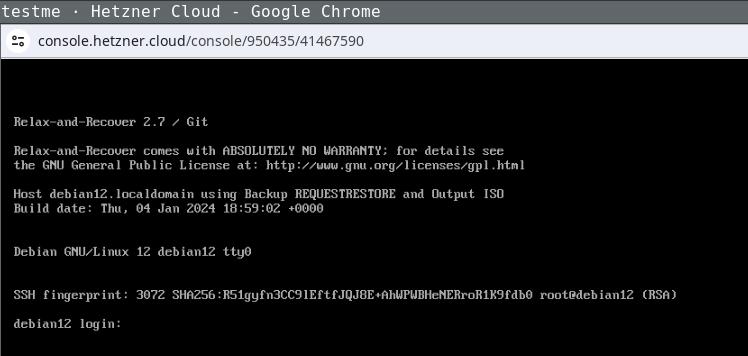
Now watch the system on the Console booting into the REAR system: image Login the recovery console (root without password) and fix its default route to make it reachable:
ip addr
[..]
2: enp1s0
..
$ ip route add 172.31.1.1 dev enp1s0
$ ip route add default via 172.31.1.1
ping 49.13.193.226
64 bytes from 49.13.193.226: icmp_seq=83 ttl=52 time=27.7 ms
The network configuration might differ, the source system in this example used DHCP, as the target does. If REAR detects changed static network configuration it guides you through the setup pretty nicely. Login via SSH (REAR will store your ssh public keys in the image) and start the recovery process, follow the steps as suggested by REAR:
ssh -l root 49.13.193.226
Welcome to Relax-and-Recover. Run "rear recover" to restore your system !
RESCUE debian12:~ # rear recover
Relax-and-Recover 2.7 / Git
Running rear recover (PID 673 date 2024-01-04 19:20:22)
Using log file: /var/log/rear/rear-debian12.log
Running workflow recover within the ReaR rescue/recovery system
Will do driver migration (recreating initramfs/initrd)
Comparing disks
Device vda does not exist (manual configuration needed)
Switching to manual disk layout configuration (GiB sizes rounded down to integer)
/dev/vda had size 137438953472 (128 GiB) but it does no longer exist
/dev/sda was not used on the original system and has now 163842097152 (152 GiB)
Original disk /dev/vda does not exist (with same size) in the target system
Using /dev/sda (the only available of the disks) for recreating /dev/vda
Current disk mapping table (source => target):
  /dev/vda => /dev/sda
Confirm or edit the disk mapping
1) Confirm disk mapping and continue 'rear recover'
[..]
User confirmed recreated disk layout
[..]
This step re-recreates your original disk layout and mounts it to /mnt/local/ (this example uses a pretty lame layout, but usually REAR will handle things like lvm/btrfs just nicely):
mount
/dev/sda3 on /mnt/local type ext4 (rw,relatime,errors=remount-ro)
/dev/sda1 on /mnt/local/boot type ext4 (rw,relatime)
Now clone your source systems data to /mnt/local/ with whatever utility you like to use and exit the recovery step. After confirming everything went well, REAR will setup the bootloader (and all other config details like fstab entries and adjusted network configuration) for you as required:
rear> exit
Did you restore the backup to /mnt/local ? Are you ready to continue recovery ? yes
User confirmed restored files
Updated initramfs with new drivers for this system.
Skip installing GRUB Legacy boot loader because GRUB 2 is installed (grub-probe or grub2-probe exist).
Installing GRUB2 boot loader...
Determining where to install GRUB2 (no GRUB2_INSTALL_DEVICES specified)
Found possible boot disk /dev/sda - installing GRUB2 there
Finished 'recover'. The target system is mounted at '/mnt/local'.
Exiting rear recover (PID 7103) and its descendant processes ...
Running exit tasks
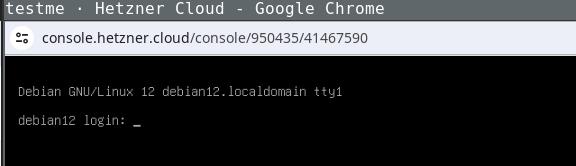
Now reboot the recovery console and watch it boot into your target systems configuration: image Being able to use this procedure for complete disaster recovery within Hetzner cloud VPS (using off-site backups) gives me a better feeling, too.

2 January 2024

Thomas Koch: Waiting for a STATE folder in the XDG basedir spec

Posted on February 18, 2014
The XDG Basedirectory specification proposes default homedir folders for the categories DATA (~/.local/share), CONFIG (~/.config) and CACHE (~/.cache). One category however is missing: STATE. This category has been requested several times but nothing happened. Examples for state data are: The missing STATE category is especially annoying if you re managing your dotfiles with a VCS (e.g. via VCSH) and you care to keep your homedir tidy. If you re as annoyed as me about the missing STATE category, please voice your opinion on the XDG mailing list. Of course it s a very long way until applications really use such a STATE directory. But without a common standard it will never happen.

31 December 2023

Petter Reinholdtsen: VLC bittorrent plugin still going strong, new upload 2.14-4

The other day I uploaded a new version of the VLC bittorrent plugin to Debian, version 2.14-4, to fix a few packaging issues. This plugin extend VLC allowing it to stream videos directly from a bittorrent source using both torrent files and magnet links, as easy as using a HTTP or local file source. I believe such protocol support is a vital feature in VLC, allowing efficient streaming from sources such at the 11 million movies in the Internet Archive. Bittorrent is one of the most efficient content distribution protocols on the Internet, without centralised control, and should be used more. The new version is now both in Debian Unstable and Testing, as well as Ubuntu. While looking after the package, I decided to ask the VLC upstream community if there was any hope to get Bittorrent support into the official VLC program, and was very happy to learn that someone is already working on it. I hope we can see some fruits of that labour next year, but do not hold my breath. In the mean time we can use the plugin, which is already installed by 0.23 percent of the Debian population according to popularity-contest. It could use a new upstream release, and I hope the upstream developer soon find time to polish it even more. It is worth noting that the plugin store the downloaded files in ~/Downloads/vlc-bittorrent/, which can quickly fill up the user home directory during use. Users of the plugin should keep an eye with disk usage when streaming a bittorrent source. As usual, if you use Bitcoin and want to show your support of my activities, please send Bitcoin donations to my address 15oWEoG9dUPovwmUL9KWAnYRtNJEkP1u1b.

30 December 2023

Russ Allbery: Review: The Hound of Justice

Review: The Hound of Justice, by Claire O'Dell
Series: Janet Watson Chronicles #2
Publisher: Harper Voyager
Copyright: July 2019
ISBN: 0-06-269938-5
Format: Kindle
Pages: 325
The Hound of Justice is a near-future thriller novel with Sherlock Holmes references. It is a direct sequel to A Study in Honor. This series is best read in order. Janet Watson is in a much better place than she was in the first book. She has proper physical therapy, a new arm, and a surgeon's job waiting for her as soon as she can master its features. A chance meeting due to an Inauguration Day terrorist attack may even develop into something more. She just needs to get back into the operating room and then she'll feel like her life is back on track. Sara Holmes, on the other hand, is restless, bored, and manic, rudely intruding on Watson's date. Then she disappears, upending Watson's living arrangements. She's on the trail of something. When mysterious destructible notes start appearing in Watson's books, it's clear that she wants help. The structure of this book didn't really work for me. The first third or so is a slice-of-life account of Watson's attempt to resume her career as a surgeon against a backdrop of ongoing depressing politics. This part sounds like the least interesting, but I was thoroughly engrossed. Watson is easy to care about, hospital politics are strangely interesting, and while the romance never quite clicked for me, it had potential. I was hoping for another book like A Study in Honor, where Watson's life and Holmes's investigations entwine and run in parallel. That was not to be. The middle third of the book pulls Watson away to Georgia and a complicated mix of family obligations and spy-novel machinations. If this had involved Sara's fae strangeness, verbal sparring, and odd tokens of appreciation, maybe it would have worked, but Sara Holmes is entirely off-camera. Watson is instead dealing with a minor supporting character from the first book, who drags her through disguises, vehicle changes, and border stops in a way that felt excessive and weirdly out of place. (Other reviews say that this character is the Mycroft Holmes equivalent; the first initial of Micha's name fits, but nothing else does so far as I can tell.) Then the last third of the novel turns into a heist. I like a heist novel as much as the next person, but a good heist story needs a team with chemistry and interplay, and I didn't know any of these people. There was way too little Sara Holmes, too much of Watson being out of her element in a rather generic way, and too many steps that Watson is led through without giving the reader a chance to enjoy the competence of the team. It felt jarring and disconnected, like Watson got pulled out of one story and dropped into an entirely different story without a proper groundwork. The Hound of Justice still has its moments. Watson is a great character and I'm still fully invested in her life. She was pulled into this mission because she's the person Holmes knows with the appropriate skills, and when she finally gets a chance to put those skills to use, it's quite satisfying. But, alas, the magic of A Study in Honor simply isn't here, in part because Sara Holmes is missing for most of the book and her replacements and stand-ins are nowhere near as intriguing. The villain's plan seems wildly impractical and highly likely to be detected, and although I can come up with some explanations to salvage it, those don't appear in the book. And, as in the first book, the villain seems very one-dimensional and simplistic. This is certainly not a villain worthy of Holmes. Fittingly, given the political movements O'Dell is commenting on, a lot of this book is about racial politics. O'Dell contrasts the microaggressions and more subtle dangers for Watson as a black woman in Washington, D.C., with the more explicit and active racism of the other places to which she travels over the course of the story. She's trying very hard to give the reader a feeling for what it's like to be black in the United States. I don't have any specific complaints about this, and I'm glad she's attempting it, but I came away from this book with a nagging feeling that Watson's reactions were a tiny bit off. It felt like a white person writing about racism rather than a black person writing about racism: nothing is entirely incorrect, but the emotional beats aren't quite where black authors would put them. I could be completely wrong about this, and am certainly much less qualified to comment than O'Dell is, but there were enough places that landed slightly wrong that I wanted to note it. I would still recommend A Study in Honor, but I'm not sure I can recommend this book. This is one of those series where the things that I enjoyed the most about the first book weren't what the author wanted to focus on in subsequent books. I would read more about the day-to-day of Watson's life, and I would certainly read more of Holmes and Watson sparring and circling and trying to understand each other. I'm less interested in somewhat generic thrillers with implausible plots and Sherlock Holmes references. At the moment, this is academic, since The Hound of Justice is the last book of the series so far. Rating: 6 out of 10

29 December 2023

Ulrike Uhlig: How do kids conceive the internet? - part 4

Read all parts of the series Part 1 // Part 2 // Part 3 // Part 4 I ve been wanting to write this post for over a year, but lacked energy and time. Before 2023 is coming to an end, I want to close this series and share some more insights with you and hopefully provide you with a smile here and there. For this round of interviews, four more kids around the ages of 8 to 13 were interviewed, 3 of them have a US background these 3 interviews were done by a friend who recorded these interviews for me, thank you! As opposed to the previous interviews, these four kids have parents who have a more technical professional background. And this seems to make a difference: even though none of these kids actually knew much better how the internet really works than the other kids that I interviewed, specifically in terms of physical infrastructures, they were much more confident in using the internet, they were able to more correctly name things they see on the internet, and they had partly radical ideas about what they would like to learn or what they would want to change about the internet! Looking at these results, I think it s safe to say that social reproduction is at work and that we need to improve education for kids who do not profit from this type of social and cultural wealth at home. But let s dive into the details.

The boy and the aliens (I ll be mostly transribing the interview, which was short, and which I find difficult to sum up because some of the questions are written in a way to encourage the kids to tell a story, and this particular kid had a thing going on with aliens.) He s a 13 year old boy living in the US. He has his own computer, which technically belongs to his school but can be used by him freely and he can also take it home. He s the first kid saying he s reading the news on the internet; he does not actually use social media, besides sometimes watching TikTok. When asked: Imagine that aliens land and come to you and say: We ve heard about this internet thing you all talk about, what is it? What do you tell them? he replied:
Well, I mean they re aliens, so I don t know if I wanna tell them much.
(Parents laughing in the background.) Let s assume they re friendly aliens.
Well, I would say you can look anything up and play different games. And there are alien games. But mostly the enemies are aliens which you might be a little offended by. And you can get work done, if you needed to spy on humans. There s cameras, you can film yourself, yeah. And you can text people and call people who are far away
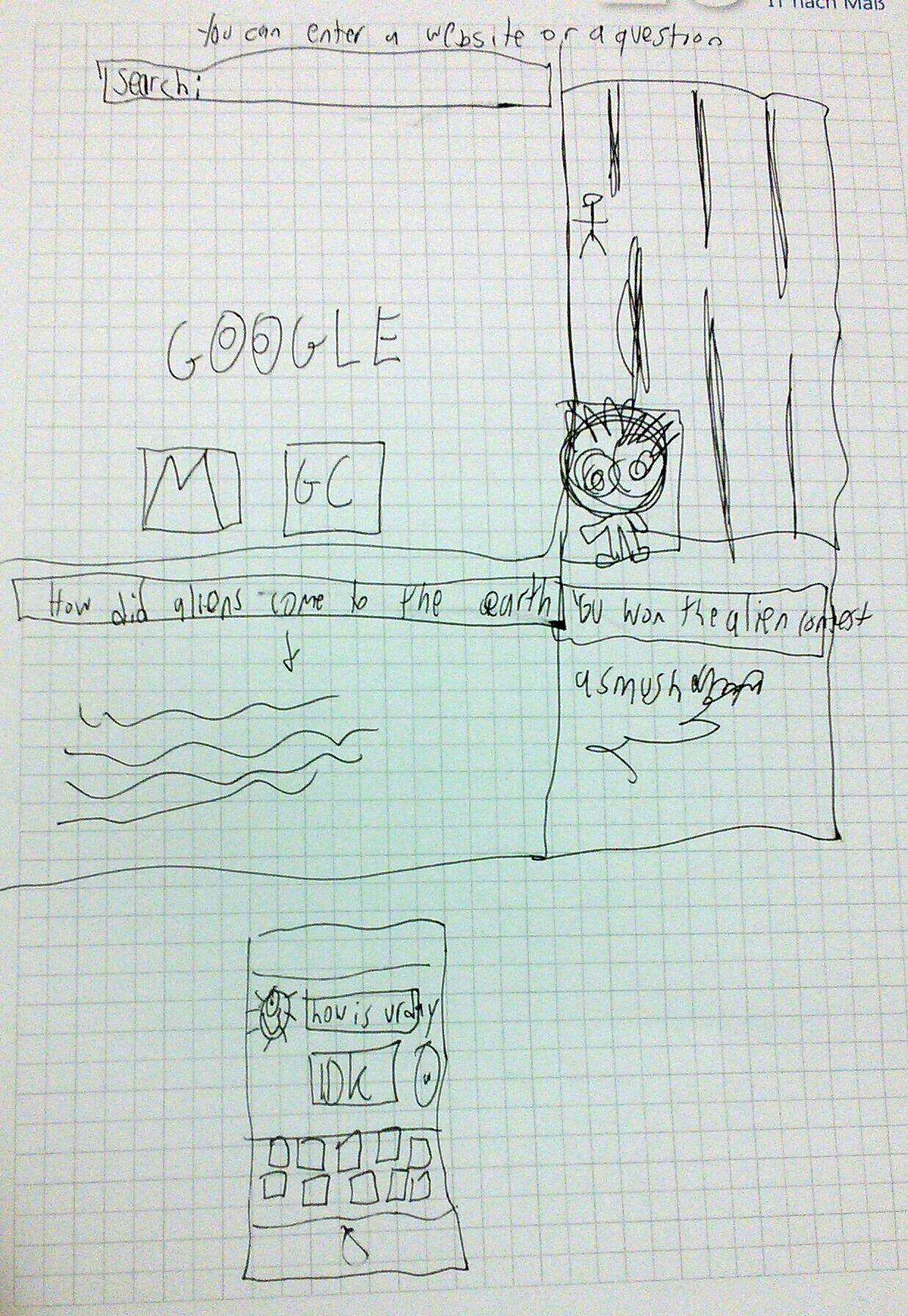
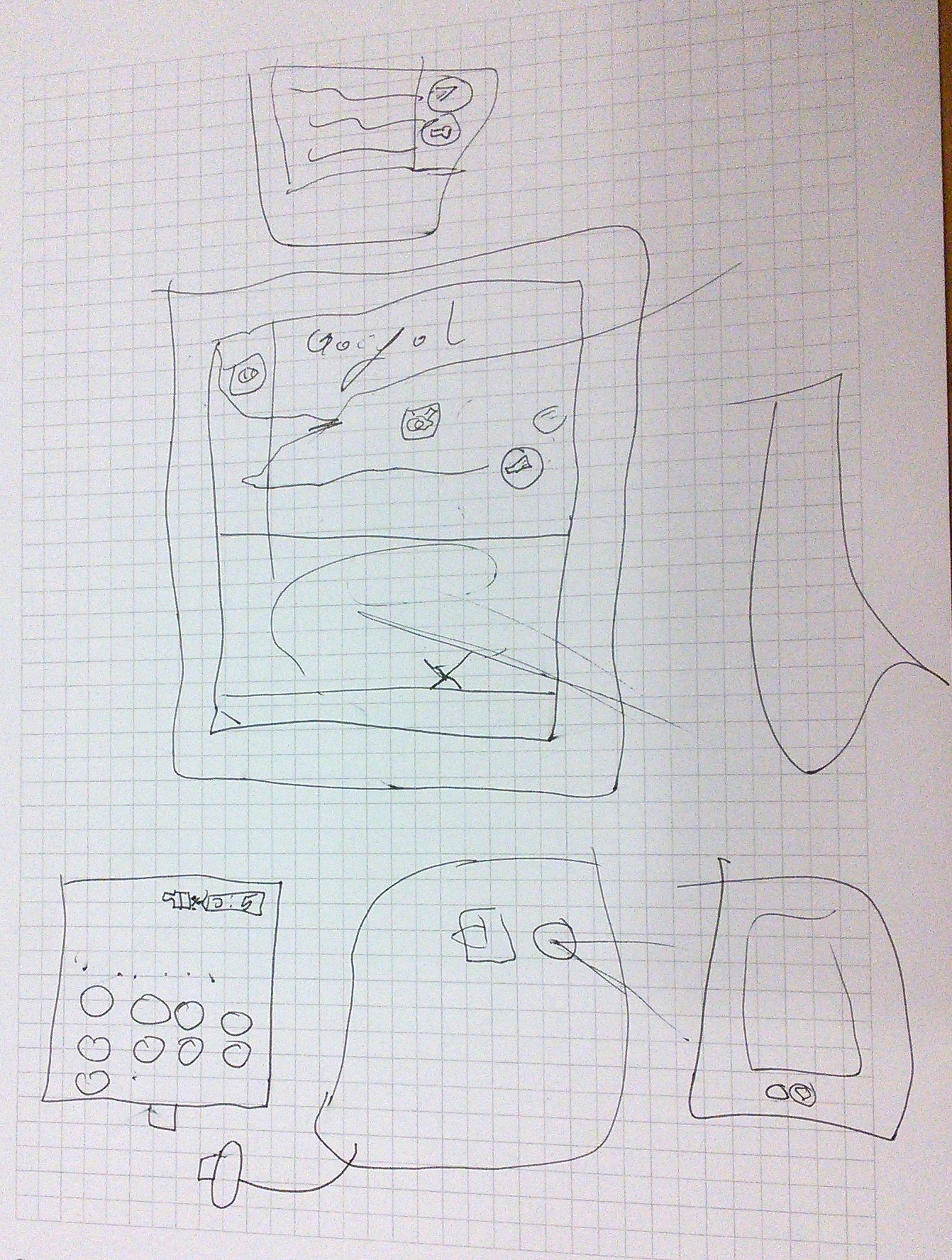
And what would be in a drawing that would explain the internet? Google, an alien using Twitch, Google search results, and the interface of an IM software on an iPhone drawn by a 13 year old boy And here s what he explains about his drawing:

First, I would draw what I see when you open a new tab, Google.

On the right side of the drawing we see something like Twitch.
I don t wanna offend the aliens, but you can film yourself playing a game, so here is the alien and he s playing a game.
And then you can ask questions like: How did aliens come to the Earth? And the answer will be here (below). And there ll be different websites that you can click on.
And you can also look up Who won the alien contest? And that would be Usmushgagu, and that guy won the alien contest.
Do you think the information about alien intergalactic football is already on the internet?
Yeah! That s how fast the internet is.
On the bottom of the drawing we see an iPhone and an instant messaging software.
There s also a device called an iPhone and with it you can text your friends. So here s the alien asking: How was ur day? and the friend might answer IDK [I don t know].
Imagine that a wise and friendly dragon could teach you one thing about the internet that you ve always wanted to know. What would you ask the dragon to teach you about?
Is there a way you don t have to pay for any channels or subscriptions and you can get through any firewall?
Imagine you could make the internet better for everyone. What would you do first?
Well you wouldn t have to pay for it [paywalls].
Can you describe what happens between your device and a website when you visit a website?
Well, it takes 0.025 seconds. [ ] It s connecting.
Wow, that s indeed fast! We were not able to obtain more details about what is that fast thing that s happening exactly

The software engineer s kid This kid identifies as neither boy nor girl, is 10 years old and lives in Germany. Their father works as a software engineer, or in the words of the child:
My dad knows everything.
The kid has a laptop and a mobile phone, both with parental control they don t think that the controlling is fair. This kid uses the internet foremostly for listening to music and watching prank channels on Youtube but also to work with Purple Mash (a teaching platform for the computing curriculum used at their school), finding 3d printing models (that they ask their father to print with them because they did not manage to use the printer by themselves yet). Interestingly, and very differently from the non-tech-parent kids, this kid insists on using Firefox and Signal - the latter is not only used by their dad to tell them to come downstairs for dinner, but also to call their grandmother. This kid also shops online, with the help of the father who does the actual shopping for them using money that the kid earned by reading books. If you would need to explain to an alien who has landed on Earth what the internet is, what would you tell them?
The internet is something where you search, for example, you can look for music. You can also watch videos from around the world, and you can program stuff.
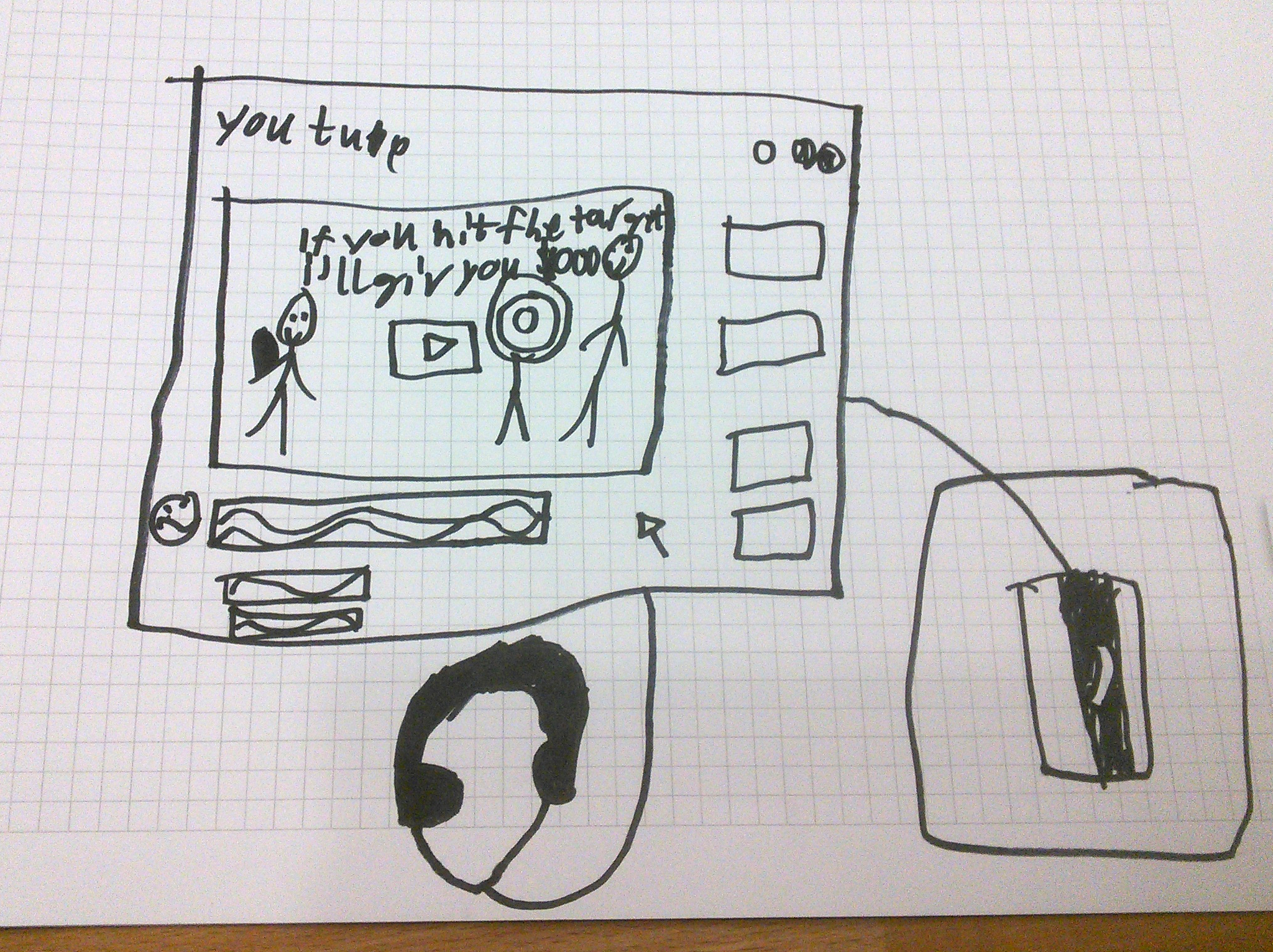
Like most of the kids interviewed, this kid uses the internet mostly for media consumption, but with the difference that they also engage with technology by way of programming using Purple Mash. drawing of the internet by a 10 year old showing a Youtube prank channel, an external device trackpad, and headphones In their drawing we see a Youtube prank channel on a screen, an external trackpad on the right (likely it s not a touch screen), and headphones. Notice how there is no keyboard, or maybe it s folded away. If you could ask a nice and friendly dragon anything you d like to learn about the internet, what would it be?
How do I shutdown my dad s computer forever?
And what is it that he would do to improve the internet for everyone? Contrary to the kid living in the US, they think that
It takes too much time to load stuff!
I wonder if this kid experiences the internet as being slow because they use the mobile network or because their connection somehow gets throttled as a way to control media consumption, or if the German internet infrastructure is just so much worse in certain regions If you could improve the internet for everyone, what would you do first? I d make a new Firefox app that loads the internet much faster.

The software engineer s daughter This girl is only 8 years old, she hates unicorns, and her dad is also a software engineer. She uses a smartphone, controlled by her parents. My impression of the interview is that at this age, kids slightly mix up the internet with the devices that they use to access the internet. drawing of the internet by an 8 year old girl, Showing Google and the interface to call and text someone In her drawing, we see again Google - it s clearly everywhere - and also the interfaces for calling and texting someone. To explain what the internet is, besides the fact that one can use it for calling and listening to music, she says:
[The internet] is something that you can [use to] see someone who is far away, so that you don t need to take time to get to them.
Now, that s a great explanation, the internet providing the possibility for communication over a distance :) If she could ask a friendly dragon something she always wanted to know, she d ask how to make her phone come alive:
that it can talk to you, that it can see you, that it can smile and has eyes. It s like a new family member, you can talk to it.
Sounds a bit like Siri, Alexa, or Furby, doesn t it? If you could improve the internet for everyone, what would you do first? She d have the phone be able to decide over her free time, her phone time. That would make the world better, not for the kids, but certainly for the parents.

The antifascist kid This German boy s dad has a background in electrotechnical engineering. He s 10 years old and he told me he s using the internet a lot for searching things for example about his passion: the firefighters. For him, the internet is:
An invisible world. A virtual world. But there s also the darknet.
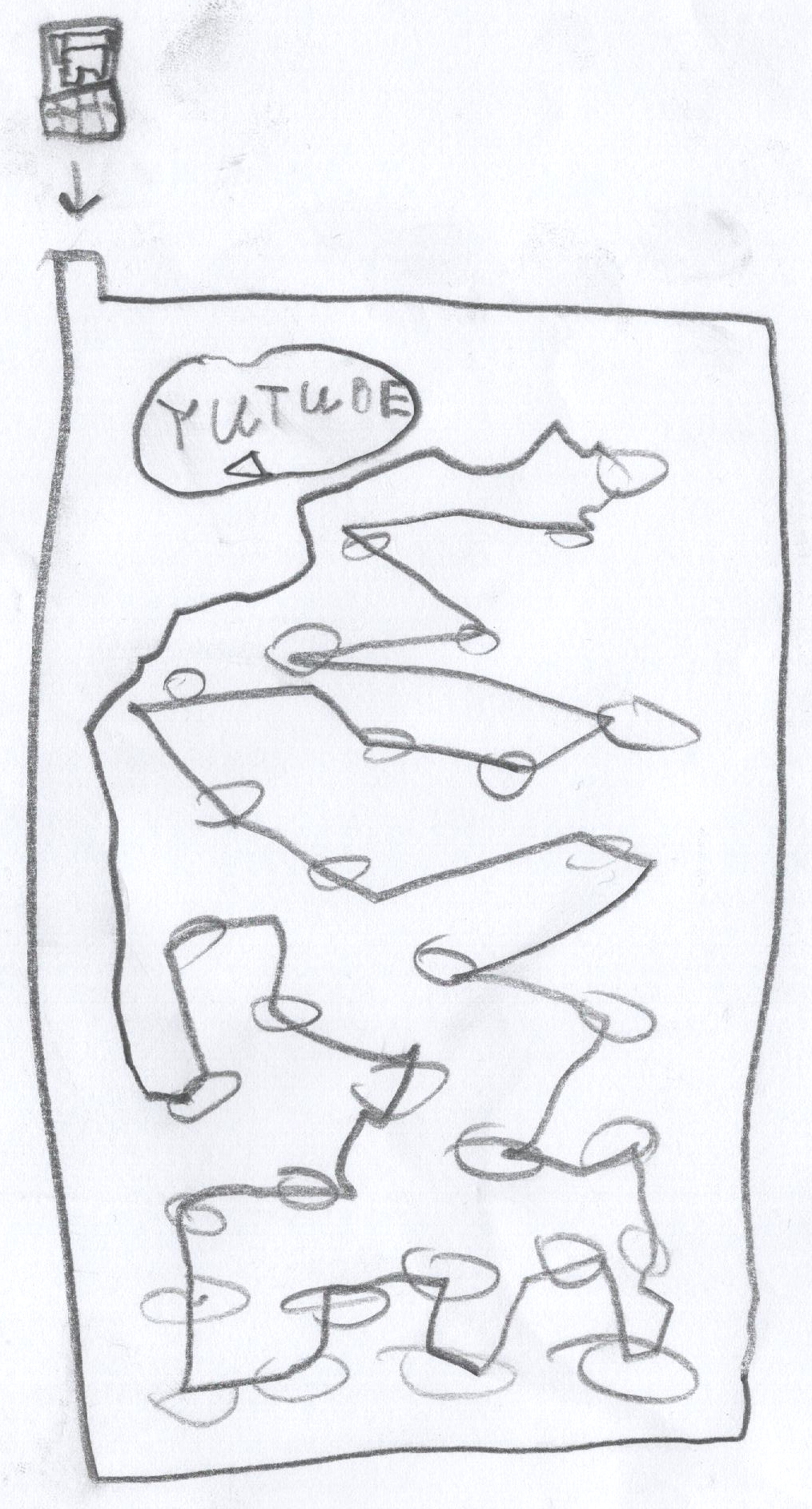
He told me he always watches that German show on public TV for kids that explains stuff: Checker Tobi. (In 2014, Checker Tobi actually produced an episode about the internet, which I d criticize for having only male characters, except for one female character: a secretary Google, a nice and friendly woman guiding the way through the huge library that s the internet ) This kid was the only one interviewed who managed to actually explain something about the internet, or rather about the hypertextual structure of the web. When I asked him to draw the internet, he made a drawing of a pin board. He explained:
Many items are attached to the pin board, and on the top left corner there s a computer, for example with Youtube and one can navigate like that between all the items, and start again from the beginning when done.
hypertext structure representing the internet drawn by a kid When I asked if he knew what actually happens between the device and a website he visits, he put forth the hypothesis of the existence of some kind of

Waves, internet waves - all this stuff somehow needs to be transmitted.
What he d like to learn:
How to get into the darknet? How do you become a Whitehat? I ve heard these words on the internet, the internet makes me clever.
And what would he change on the internet if he could?
I want that right wing extreme stuff is not accessible anymore, or at least, that it rains turds ( Kackw rste ) whenever people watch such stuff. Or that people are always told: This video is scum.
I suspect that his father has been talking with him about these things, and maybe these are also subjects he heard about when listening to punk music (he told me he does), or browsing Youtube.

Future projects To me this has been pretty insightful. I might share some more internet drawings by adults in the future, which I think are also really interesting, as they show very different things depending on the age of the person. I ve been using the information gathered to work on a children s book which I hope to be able to share with you next year.

Russ Allbery: Review: The Afterward

Review: The Afterward, by E.K. Johnston
Publisher: Dutton Books
Copyright: February 2019
Printing: 2020
ISBN: 0-7352-3190-7
Format: Kindle
Pages: 339
The Afterward is a standalone young adult high fantasy with a substantial romance component. The title is not misspelled. Sir Erris and her six companions, matching the number of the new gods, were successful in their quest for the godsgem. They defeated the Old God and destroyed Him forever, freeing King Dorrenta from his ensorcellment, and returned in triumph to Cadrium to live happily ever after. Or so the story goes. Sir Erris and three of the companions are knights. Another companion is the best mage in the kingdom. Kalanthe Ironheart, who distracted the Old God at a critical moment and allowed Sir Erris to strike, is only an apprentice due to her age, but surely will become a great knight. And then there is Olsa Rhetsdaughter, the lowborn thief, now somewhat mockingly called Thief of the Realm for all the good that does her. The reward was enough for her to buy her freedom from the Thief's Court. It was not enough to pay for food after that, or enough for her to change her profession, and the Thief's Court no longer has any incentive to give her easy (or survivable) assignments. Kalanthe is in a considerably better position, but she still needs a good marriage. Her reward paid off half of her debt, which broadens her options, but she's still a debt-knight, liable for the full cost of her training once she reaches the age of nineteen. She's mostly made her peace with the decisions she made given her family's modest means, but marriages of that type are usually for heirs, and Kalanthe is not looking forward to bearing a child. Or, for that matter, sleeping with a man. Olsa and Kalanthe fell in love during the Quest. Given Kalanthe's debt and the way it must be paid, and her iron-willed determination to keep vows, neither of them expected their relationship to survive the end of the Quest. Both of them wish that it had. The hook is that this novel picks up after the epic fantasy quest is over and everyone went home. This is not an entirely correct synopsis; chapters of The Afterward alternate between "After" and "Before" (and one chapter delightfully titled "More or less the exact moment of"), and by the end of the book we get much of the story of the Quest. It's not told from the perspective of the lead heroes, though; it's told by following Kalanthe and Olsa, who would be firmly relegated to supporting characters in a typical high fantasy. And it's largely told through the lens of their romance. This is not the best fantasy novel I've read, but I had a fun time with it. I am now curious about the intended audience and marketing, though. It was published by a YA imprint, and both the ages of the main characters and the general theme of late teenagers trying to chart a course in an adult world match that niche. But it's also clearly intended for readers who have read enough epic fantasy quests that they will both be amused by the homage and not care that the story elides a lot of the typical details. Anyone who read David Eddings at an impressionable age will enjoy the way Johnston pokes gentle fun at The Belgariad (this book is dedicated to David and Leigh Eddings), but surely the typical reader of YA fantasy these days isn't also reading Eddings. I'm therefore not quite sure who this book was for, but apparently that group included me. Johnston thankfully is not on board with the less savory parts of Eddings's writing, as you might have guessed from the sapphic romance. There is no obnoxious gender essentialism here, although there do appear to be gender roles that I never quite figured out. Knights are referred to as sir, but all of the knights in this story are women. Men still seem to run a lot of things (kingdoms, estates, mage colleges), but apart from the mage, everyone on the Quest was female, and there seems to be an expectation that women go out into the world and have adventures while men stay home. I'm not sure if there was an underlying system that escaped me, or if Johnston just mixed things up for the hell of it. (If the latter, I approve.) This book does suffer a bit from addressing some current-day representation issues without managing to fold them naturally into the story or setting. One of the Quest knights is transgender, something that's revealed in a awkward couple of paragraphs and then never mentioned again. Two of the characters have a painfully earnest conversation about the word "bisexual," complete with a strained attempt at in-universe etymology. Racial diversity (Olsa is black, and Kalanthe is also not white) seemed to be handled a bit better, although I am not the reader to notice if the discussions of hair maintenance were similarly awkward. This is way better than no representation and default-white characters, to be clear, but it felt a bit shoehorned in at times and could have used some more polish. These are quibbles, though. Olsa was the heart of the book for me, and is exactly the sort of character I like to read about. Kalanthe is pure stubborn paladin, but I liked her more and more as the story continued. She provides a good counterbalance to Olsa's natural chaos. I do wish Olsa had more opportunities to show her own competence (she's not a very good thief, she's just the thief that Sir Erris happened to know), but the climax of the story was satisfying. My main grumble is that I badly wanted to dwell on the happily-ever-after for at least another chapter, ideally two. Johnston was done with the story before I was. The writing was serviceable but not great and there are some bits that I don't think would stand up to a strong poke, but the characters carried the story for me. Recommended if you'd like some sapphic romance and lightweight class analysis complicating your Eddings-style quest fantasy. Rating: 7 out of 10

28 December 2023

Simon Josefsson: Validating debian/copyright: licenserecon

Recently I noticed a new tool called licenserecon written by Peter Blackman, and I helped get licenserecon into Debian. The purpose of licenserecon is to reconcile licenses from debian/copyright against the output from licensecheck, a tool written by Jonas Smedegaard. It assumes DEP5 copyright files. You run the tool in a directory that has a debian/ sub-directory, and its output when it notices mismatches (this is for resolv-wrapper):
# sudo apt install licenserecon
jas@kaka:~/dpkg/resolv-wrapper$ lrc
Parsing Source Tree ....
Running licensecheck ....
d/copyright       licensecheck
BSD-3-Clauses     BSD-3-clause     src/resolv_wrapper.c
BSD-3-Clauses     BSD-3-clause     tests/dns_srv.c
BSD-3-Clauses     BSD-3-clause     tests/test_dns_fake.c
BSD-3-Clauses     BSD-3-clause     tests/test_res_query_search.c
BSD-3-Clauses     BSD-3-clause     tests/torture.c
BSD-3-Clauses     BSD-3-clause     tests/torture.h
jas@kaka:~/dpkg/resolv-wrapper$ 
Noticing one-character typos like this may not bring satisfaction except to the most obsessive-compulsive among us, however the tool has the potential of discovering more serious mistakes. Using it manually once in a while may be useful, however I tend to forget QA steps that are not automated. Could we add this to the Salsa CI/CD pipeline? I recently proposed a merge request to add a wrap-and-sort job to the Salsa CI/CD pipeline (disabled by default) and learned how easy it was to extend it. I think licenserecon is still a bit rough on the edges, and I haven t been able to successfully use it on any but the simplest packages yet. I wouldn t want to suggest it is added to the normal Salsa CI/CD pipeline, even if disabled. If you maintain a Debian package on Salsa and wish to add a licenserecon job to your pipeline, I wrote licenserecon.yml for you. The simplest way to use licenserecon.yml is to replace recipes/debian.yml@salsa-ci-team/pipeline as the Salsa CI/CD configuration file setting with debian/salsa-ci.yml@debian/licenserecon. If you use a debian/salsa-ci.yml file you may put something like this in it instead:
---
include:
  - https://salsa.debian.org/salsa-ci-team/pipeline/raw/master/recipes/debian.yml
  - https://salsa.debian.org/debian/licenserecon/raw/main/debian/licenserecon.yml
Once you trigger the pipeline, this will result in a new job licenserecon that validates debian/copyright against licensecheck output on every build! I have added this to the libcpucycles package on Salsa and the pipeline contains a new job licenserecon whose output currently ends with:
$ cd $ WORKING_DIR /$ SOURCE_DIR 
$ lrc
Parsing Source Tree ....
Running licensecheck ....
No differences found
Cleaning up project directory and file based variables
If upstream releases a new version with files not matching our debian/copyright file, we will detect that on the next Salsa build job rather than months later when somebody happens to run the tools manually or there is some license conflict. Incidentally licenserecon is written in Pascal which brought back old memories with Turbo Pascal back in the MS-DOS days. Thanks Peter for licenserecon, and Jonas for licensecheck making this possible!

Russ Allbery: Review: Nettle & Bone

Review: Nettle & Bone, by T. Kingfisher
Publisher: Tor
Copyright: 2022
ISBN: 1-250-24403-X
Format: Kindle
Pages: 242
Nettle & Bone is a standalone fantasy novel with fairy tale vibes. T. Kingfisher is a pen name for Ursula Vernon. As the book opens, Marra is giving herself a blood infection by wiring together dog bones out of a charnel pit. This is the second of three impossible tasks that she was given by the dust-wife. Completing all three will give her the tools to kill a prince. I am a little cautious of which T. Kingfisher books I read since she sometimes writes fantasy and sometimes writes horror and I don't get along with horror. This one seemed a bit horrific in the marketing, so I held off on reading it despite the Hugo nomination. It turns out to be just on the safe side of my horror tolerance, with only a couple of parts that I read a bit quickly. One of those is the opening, which I am happy to report does not set the tone for the rest of the book. Marra starts the story in a wasteland full of disease, madmen, and cannibals (who, in typical Ursula Vernon fashion, turn out to be nicer than the judgmental assholes outside of the blistered land). She doesn't stay there long. By chapter two, the story moves on to flashbacks explaining how Marra ended up there, alternating with further (and less horrific) steps in her quest to kill the prince of the Northern Kingdom. Marra is a princess of a small, relatively poor coastal kingdom with a good harbor and acquisitive neighbors. Her mother, the queen, has protected the kingdom through arranged marriage of her daughters to the prince of the Northern Kingdom, who rules it in all but name given the mental deterioration of his father the king. Marra's eldest sister Damia was first, but she died suddenly and mysteriously in a fall. (If you're thinking about the way women are injured by "accident," you have the right idea.) Kania, the middle sister, is next to marry; she lives, but not without cost. Meanwhile, Marra is sent off to a convent to ensure that there are no complicating potential heirs, and to keep her on hand as a spare. I won't spoil the entire backstory, but you do learn it all. Marra is a typical Kingfisher protagonist: a woman who is way out of her depth who persists with stubbornness, curiosity, and innate decency because what else is there to do? She accumulates the typical group of misfits and oddballs common in Kingfisher's quest fantasies, characters that in the Chosen One male fantasy would be supporting characters at best. The bone-wife is a delight; her chicken is even better. There are fairy godmothers and a goblin market and a tooth extraction that was one of the creepiest things I've read without actually being horror. It is, in short, a Kingfisher fantasy novel, with a touch more horror than average but not enough to push it out of the fantasy genre. I think my favorite part of this book was not the main quest. It was the flashback scenes set in the convent, where Marra has the space (and the mentorship) to develop her sense of self.
"We're a mystery religion," said the abbess, when she'd had a bit more wine than usual, "for people who have too much work to do to bother with mysteries. So we simply get along as best we can. Occasionally someone has a vision, but [the goddess] doesn't seem to want anything much, and so we try to return the favor."
If you have read any other Kingfisher novels, much of this will be familiar: the speculative asides, the dogged determination, the slightly askew nature of the world, the vibes-based world-building that feels more like a fairy tale than a carefully constructed magic system, and the sense that the main characters (and nearly all of the supporting characters) are average people trying to play the hands they were dealt as ethically as they can. You will know that the tentative and woman-initiated romance is coming as soon as the party meets the paladin type who is almost always the romantic interest in one of these books. The emotional tone of the book is a bit predictable for regular readers, but Ursula Vernon's brain is such a delightful place to spend some time that I don't mind.
Marra had not managed to be pale and willowy and consumptive at any point in eighteen years of life and did not think she could achieve it before she died.
Nettle & Bone won the Hugo for Best Novel in 2023. I'm not sure why this specific T. Kingfisher novel won and not any of the half-dozen earlier novels she's written in a similar style, but sure, I have no objections. I'm glad one of them won; they're all worth reading and hopefully that will help more people discover this delightful style of fantasy that doesn't feel like what anyone else is doing. Recommended, although be prepared for a few more horror touches than normal and a rather grim first chapter. Content warnings: domestic abuse. The dog... lives? Is equally as alive at the end of the book as it was at the end of the first chapter? The dog does not die; I'll just leave it at that. (Neither does the chicken.) Rating: 8 out of 10

26 December 2023

Russ Allbery: Review: A Study in Honor

Review: A Study in Honor, by Claire O'Dell
Series: Janet Watson Chronicles #1
Publisher: Harper Voyager
Copyright: July 2018
ISBN: 0-06-269932-6
Format: Kindle
Pages: 295
A Study in Honor is a near-future science fiction novel by Claire O'Dell, a pen name for Beth Bernobich. You will see some assertions, including by the Lambda Literary Award judges, that it is a mystery novel. There is a mystery, but... well, more on that in a moment. Janet Watson was an Army surgeon in the Second US Civil War when New Confederacy troops overran the lines in Alton, Illinois. Watson lost her left arm to enemy fire. As this book opens, she is returning to Washington, D.C. with a medical discharge, PTSD, and a field replacement artificial arm scavenged from a dead soldier. It works, sort of, mostly, despite being mismatched to her arm and old in both technology and previous wear. It does not work well enough for her to resume her career as a surgeon. Watson's plan is to request a better artificial arm from the VA (the United States Department of Veterans Affairs, which among other things is responsible for the medical care of wounded veterans). That plan meets a wall of unyielding and uninterested bureaucracy. She has a pension, but it's barely enough for cheap lodging. A lifeline comes in the form of a chance encounter with a former assistant in the Army, who has a difficult friend looking to split the cost of an apartment. The name of that friend is Sara Holmes. At this point, you know what to expect. This is clearly one of the many respinnings of Arthur Conan Doyle. This time, the setting is in the future and Watson and Holmes are both black women, but the other elements of the setup are familiar: the immediate deduction that Watson came from the front, the shared rooms (2809 Q Street this time, sacrificing homage for the accuracy of a real address), Holmes's tendency to play an instrument (this time the piano), and even the title of this book, which is an obvious echo of the title of the first Holmes novel, A Study in Scarlet. Except that's not what you'll get. There are a lot of parallels and references here, but this is not a Holmes-style detective novel. First, it's only arguably a detective novel at all. There is a mystery, which starts with a patient Watson sees in her fallback job as a medical tech in the VA hospital and escalates to a physical attack, but that doesn't start until a third of the way into the book. It certainly is not solved through minute clues and leaps of deduction; instead, that part of the plot has the shape of a thriller rather than a classic mystery. There is a good argument that the thriller is the modern mystery novel, so I don't want to overstate my case, but I think someone who came to this book wanting a Doyle-style mystery would be disappointed. Second, the mystery is not the heart of this book. Watson is. She, like Doyle's Watson, is the first-person narrator, but she is far more present in the book. I have no idea how accurate O'Dell's portrayal of Watson's PTSD is, but it was certainly compelling and engrossing reading. Her fight for basic dignity and her rage at the surface respect and underlying disinterested hostility of the bureaucratic war machinery is what kept me turning the pages. The mystery plot is an outgrowth of that and felt more like a case study than the motivating thread of the plot. And third, Sara Holmes... well, I hesitate to say definitively that she's not Sherlock Holmes. There have been so many versions of Holmes over the years, even apart from the degree to which a black woman would necessarily not be like Doyle's character. But she did not remind me of Sherlock Holmes. She reminded me of a cross between James Bond and a high fae. This sounds like a criticism. It very much is not. I found this high elf spy character far more interesting than I have ever found Sherlock Holmes. But here again, if you came into this book hoping for a Holmes-style master detective, I fear you may be wrong-footed. The James Bond parts will be obvious when you get there and aren't the most interesting (and thankfully the misogyny is entirely absent). The part I found more fascinating is the way O'Dell sets Holmes apart by making her fae rather than insufferable. She projects effortless elegance, appears and disappears on a mysterious schedule of her own, thinks nothing of reading her roommate's diary, leaves meticulously arranged gifts, and even bargains with Watson for answers to precisely three questions. The reader does learn some mundane explanations for some of this behavior, but to be honest I found them somewhat of a letdown. Sara Holmes is at her best as a character when she tacks her own mysterious path through a rather grim world of exhausted war, penny-pinching bureaucracy, and despair, pursuing an unexplained agenda of her own while showing odd but unmistakable signs of friendship and care. This is not a romance, at least in this book. It is instead a slowly-developing friendship between two extremely different people, one that I thoroughly enjoyed. I do have a couple of caveats about this book. The first is that the future US in which it is set is almost pure Twitter doomcasting. Trump's election sparked a long slide into fascism, and when that was arrested by the election of a progressive candidate backed by a fragile coalition, Midwestern red states seceded to form the New Confederacy and start a second civil war that has dragged on for nearly eight years. It's a very specific mainstream liberal dystopian scenario that I've seen so many times it felt like a cliche even though I don't remember seeing it in a book before. This type of future projection of current fears is of course not new for science fiction; Cold War nuclear war novels are probably innumerable. But I had questions, such as how a sparsely-populated, largely non-industrial, and entirely landlocked set of breakaway states could maintain a war footing for eight years. Despite some hand-waving about covert support, those questions are not really answered here. The second problem is that the ending of this book kind of falls apart. The climax of the mystery investigation is unsatisfyingly straightforward, and the resulting revelation is a hoary cliche. Maybe I'm just complaining about the banality of evil, but if I'd been engrossed in this book for the thriller plot, I think I would have been annoyed. I wasn't, though; I was here for the characters, for Watson's PTSD and dogged determination, for Sara's strangeness, and particularly for the growing improbable friendship between two women with extremely different life experiences, emotions, and outlooks. That part was great, regardless of the ending. Do not pick this book up because you want a satisfying deductive mystery with bumbling police and a blizzard of apparently inconsequential clues. That is not at all what's happening here. But this was great on its own terms, and I will be reading the sequel shortly. Recommended, although if you are very online expect to do a bit of eye-rolling at the setting. Followed by The Hound of Justice, but the sequel is not required. This book reaches a satisfying conclusion of its own. Rating: 8 out of 10

25 December 2023

Russ Allbery: Review: The Blackwing War

Review: The Blackwing War, by K.B. Spangler
Series: Deep Witches #1
Publisher: A Girl and Her Fed Books
Copyright: March 2021
ISBN: blackwing-war
Format: Kindle
Pages: 284
The Blackwing War is the first book of a projected space opera series. I previously reviewed Stoneskin, which was intended as a prelude to this series. In theory you can start here, but I would read Stoneskin first. Tembi is a Witch, which means she can ask the Deep to do things for her. At the start of the book, those things mostly involve disarming bombs. The galaxy is in the middle of a genocidal war between the well-equipped and all-but-officially supported Sagittarius Armed Forces, also known as the Blackwings, and the Sabenta resistance movement. To settle the galaxy, humans fiddled with their genes to adapt themselves to otherwise-hostile planets. The Blackwings take exception, in the tradition of racist humans throughout history, and think it's time to purify human bloodlines again. Both sides are using bombs. The Deep is the brilliant idea of this series. It seems to exist everywhere simultaneously, it's alive, it adores teleporting things, and it's basically a giant cosmic puppy. Humans are nearly incomprehensible to the Deep, and it's nearly incomprehensible to humans, but it somehow picks out specific humans who can (sort of) understand it and whom it gets attached to and somehow makes immortal. These are the Witches, and they have turned the Deep into the logistical backbone of human civilization. Essentially all commerce and travel is now done through Deep teleportation, requested by a Witch and coordinated by Lancaster, the Witches' governing council. The exception is war. Lancaster is strictly neutral; it does not take sides, even in the face of an ongoing genocide, and it refuses to transport military ships, any type of weapons, or even war refugees. Domino, Lancaster's cynically manipulative leader, is determined to protect its special privileges and position at all costs. Tembi is one of the quasi-leaders of a resistance against that position, but even they are reluctant to ask the Deep to take sides in a war. To them, the Deep is a living magical creature that they are exploiting, and which also tends to be a bundle of nerves. Using it as a weapon feels like a step too far. That's how the situation lies at the start of this book when, after a successful bomb defusing, the Deep whisks Tembi away to watch an unknown weapon blow up a moon. A lot of this book consists of Tembi unraveling a couple of mysteries, starting with the apparent experimental bomb and then expanding to include the apparent drugging and disappearance of her former classmate. The low-grade war gets worse throughout, leaving Tembi torn between the justifications for Lancaster's neutrality and her strong sense of basic morality. The moments when Tembi gets angry enough or impatient enough to take action are the best parts, but a lot of this book is quite grim. Do not expect all to be resolved in a happy ending. There is some catharsis, but The Blackwing War is also clearly setup for a longer series. Tembi is a great character and the Deep is even better. I thoroughly enjoyed reading about both of them, and Tembi's relationship with the Deep is a delight. Usually I get frustrated by baffling incomprehensibility as a plot devices, but Spangler pulls it off as well as I've seen it done. But unfortunately, this book is firmly in the "gets worse before it will get better" part of the overall story arc, and the sequels have not yet appeared. The Blackwing War ends on a cliffhanger that portends huge changes for the characters and the setting, and if I had the next book to rush into, I wouldn't mind the grimness as much. As is, it was a somewhat depressing reading experience despite its charms, and despite a somewhat optimistic ending (that I doubt will truly resolve anything). I think the world-building elements were a touch predictable, and I wish Spangler wouldn't have her characters keep trying to justify Domino's creepy, abusive, and manipulative actions. But the characters are so much fun, and the idea of the Deep as a character is such a delight, that I am hooked on this series regardless. Recommended, although I will (hopefully) be able to recommend it more heartily once at least one sequel has been published. Content warnings: genocide, racism, violent death. Rating: 7 out of 10

23 December 2023

Russ Allbery: Review: Bookshops & Bonedust

Review: Bookshops & Bonedust, by Travis Baldree
Series: Legends & Lattes #2
Publisher: Tor
Copyright: 2023
ISBN: 1-250-88611-2
Format: Kindle
Pages: 337
Bookshops & Bonedust is a prequel to the cozy fantasy Legends & Lattes. You can read them in either order, although the epilogue of Bookshops & Bonedust spoils (somewhat guessable) plot developments in Legends & Lattes. Viv is a new member of the mercenary troop Rackam's Ravens and is still possessed of more enthusiasm than sense. As the story opens, she charges well ahead of her allies and nearly gets killed by a pike through the leg. She survives, but her leg needs time to heal and she is not up to the further pursuit of a necromancer. Rackam pays for a room and a doctor in the small seaside town of Murk and leaves her there to recuperate. The Ravens will pick her up when they come back through town, whenever that is. Viv is very quickly bored out of her skull. On a whim, and after some failures to find something else to occupy her, she tries a run-down local bookstore and promptly puts her foot through the boardwalk outside it. That's the start of an improbable friendship with the proprietor, a rattkin named Fern with a knack for book recommendations and a serious cash flow problem. Viv, being Viv, soon decides to make herself useful. The good side and bad side of this book are the same: it's essentially the same book as Legends & Lattes, but this time with a bookstore. There's a medieval sword and sorcery setting, a wide variety of humanoid species, a local business that needs love and attention (this time because it's failing instead of new), a lurking villain, an improbable store animal (this time a gryphlet that I found less interesting than the cat of the coffee shop), and a whole lot of found family. It turns out I was happy to read that story again, and there were some things I liked better in this version. I find bookstores more interesting than coffee shops, and although Viv and Fern go through a similar process of copying features of a modern bookstore, this felt less strained than watching Viv reinvent the precise equipment and menu of a modern coffee shop in a fantasy world. Also, Fern is an absolute delight, probably my favorite character in either of the books. I love the way that she uses book recommendations as a way of asking questions and guessing at answers about other people. As with the first book, Baldree's world-building is utterly unconcerned with trying to follow the faux-medieval conventions of either sword and sorcery or D&D-style role-playing games. On one hand, I like this; most of that so-called medievalism is nonsense anyway, and there's no reason why fantasy with D&D-style species diversity should be set in a medieval world. On the other hand, this world seems exactly like a US small town except the tavern also has rooms for rent, there are roving magical armies, and everyone fights with swords for some reason. It feels weirdly anachronistic, and I can't tell if that's because I've been brainwashed into thinking fantasy has to be medievaloid or if it's a true criticism of the book. I was reminded somewhat of reading Jack McDevitt's SF novels, which are supposedly set in the far future but are indistinguishable from 1980s suburbia except with flying cars. The other oddity with this book is that the reader of the series knows Viv isn't going to stay. This is the problem with writing a second iteration of this story as a prequel. I see why Baldree did it the story wouldn't have worked if Viv were already established but it casts a bit of a pall over the cheeriness of the story. Baldree to his credit confronts this directly, weaves it into the relationships, and salvages it a bit more in the epilogue, but it gave the story a sort of preemptive wistfulness that was at odds with how I wanted to read it. But, despite that, the strength of this book are the characters. Viv is a good person who helps where she can, which sounds like a simple thing but is so restful to read about. This book features her first meeting with the gnome Gallina, who is always a delight. There are delicious baked goods from a dwarf, a grumpy doctor, a grumpier city guard, and a whole cast of people who felt complicated and normal and essentially decent. I'm not sure the fantasy elements do anything for this book, or this series, other than marketing and the convenience of a few plot devices. Even though one character literally disappears into a satchel, it felt like Baldree could have written roughly the same story as a contemporary novel without a hint of genre. But that's not really a complaint, since the marketing works. I would not have read this series if it had been contemporary novels, and I thoroughly enjoyed it. It's a slice of life novel about kind and decent people for readers who are bored by contemporary settings and would rather read fantasy. Works for me. I'm hoping Baldree finds other stories, since I'm not sure I want to read this one several more times, but twice was not too much. If you liked Legends & Lattes and are thinking "how can I get more of that," here's the book for you. If you haven't read Legends & Lattes, I think I would recommend reading this one first. It does many of the same things, it's a bit more polished, and then you can read Viv's adventures in internal chronological order. Rating: 8 out of 10

22 December 2023

Russ Allbery: Review: Wintersmith

Review: Wintersmith, by Terry Pratchett
Series: Discworld #35
Publisher: Clarion Books
Copyright: 2006
Printing: 2007
ISBN: 0-06-089033-9
Format: Mass market
Pages: 450
Wintersmith is the 35th Discworld novel and the 3rd Tiffany Aching novel. You could probably start here, since understanding the backstory isn't vital for following the plot, but I'm not sure why you would. Tiffany is now training with Miss Treason, a 113-year-old witch who is quite different in her approach from Miss Level, Tiffany's mentor in A Hat Full of Sky. Miss Level was the unassuming and constantly helpful glue that held the neighborhood together. Miss Treason is the judge; her neighbors are scared of her and proud of being scared of her, since that means they have a proper witch who can see into their heads and sort out their problems. On the surface, they're quite different; part of the story of this book is Tiffany learning to see the similarities. First, though, Miss Treason rushes Tiffany to a strange midnight Morris Dance, without any explanation. The Morris Dance usually celebrates the coming of spring and is at the center of a village party, so Tiffany is quite confused by seeing it danced on a dark and windy night in late autumn. But there is a hole in the dance where the Fool normally is, and Tiffany can't keep herself from joining it. This proves to be a mistake. That space was left for someone very different from Tiffany, and now she's entangled herself in deep magic that she doesn't understand. This is another Pratchett novel where the main storyline didn't do much for me. All the trouble stems from Miss Treason being maddeningly opaque, and while she did warn Tiffany, she did so in that way that guarantees a protagonist of a middle-grade novel will ignore. The Wintersmith is a boring, one-note quasi-villain, and the plot mainly revolves around elemental powers being dumber than a sack of hammers. The one thing I will say about the main plot is that the magic Tiffany danced into is entangled with courtship and romance, Tiffany turns thirteen over the course of this book, and yet this is not weird and uncomfortable reading the way it would be in the hands of many other authors. Pratchett has a keen eye for the age range that he's targeting. The first awareness that there is such a thing as romance that might be relevant to oneself pairs nicely with the Wintersmith's utter confusion at how Tiffany's intrusion unbalanced his dance. This is a very specific age and experience that I think a lot of authors would shy away from, particularly with a female protagonist, and I thought Pratchett handled it adroitly. I personally found the Wintersmith's awkward courting tedious and annoying, but that's more about me than about the book. As with A Hat Full of Sky, though, everything other than the main plot was great. It is becoming obvious how much Tiffany and Granny Weatherwax have in common, and that Granny Weatherwax recognizes this and is training Tiffany herself. This is high-quality coming-of-age material, not in the traditional fantasy sense of chosen ones and map explorations, but in the sense of slowly-developing empathy and understanding of people who think differently than you do. Tiffany, like Granny Weatherwax, has very little patience with nonsense, and her irritation with stupidity is one of her best characteristics. But she's learning how to blunt it long enough to pay attention, and to understand how people she doesn't like can still be the right people for specific situations. I particularly loved how Granny carries on with a feud at the same time that Tiffany is learning to let go of one. It's not a contradiction or hypocrisy; it's a sign that Tiffany is entitled to her judgments and feelings, but has to learn how to keep them in their place and not let them take over. One of the great things about the Tiffany Aching books is that the villages are also characters. We don't see that much of the individual people, but one of the things Tiffany is learning is how to see the interpersonal dynamics and patterns of village life. Somehow the feelings of irritation and exasperation fade once you understand people's motives and see more sides to their character. There is a lot more Nanny Ogg in this book than there has been in the last few, and that reminded me of how much I love her character. She has a completely different approach than Granny Weatherwax, but it's just as effective in different ways. She's also the perfect witch to have around when you've stumbled into a stylized love story that you don't want to be a part of, and yet find oddly fascinating. It says something about the skill of Pratchett's characterization that I could enjoy a book this much while having no interest in the main plot. The Witches have always been great characters, but somehow they're even better when seen through Tiffany's perspective. Good stuff; if you liked any of the other Tiffany Aching books, you will like this as well. Followed by Making Money in publication order. The next Tiffany Aching novel is I Shall Wear Midnight. Rating: 8 out of 10

20 December 2023

Ulrike Uhlig: How volunteer work in F/LOSS exacerbates pre-existing lines of oppression, and what that has to do with low diversity

This is a post I wrote in June 2022, but did not publish back then. After first publishing it in December 2023, a perfectionist insecure part of me unpublished it again. After receiving positive feedback, i slightly amended and republish it now. In this post, I talk about unpaid work in F/LOSS, taking on the example of hackathons, and why, in my opinion, the expectation of volunteer work is hurting diversity. Disclaimer: I don t have all the answers, only some ideas and questions.

Previous findings In 2006, the Flosspols survey searched to explain the role of gender in free/libre/open source software (F/LOSS) communities because an earlier [study] revealed a significant discrepancy in the proportion of men to women. It showed that just about 1.5% of F/LOSS community members were female at that time, compared with 28% in proprietary software (which is also a low number). Their key findings were, to name just a few:
  • that F/LOSS rewards the producing code rather than the producing software. It thereby puts most emphasis on a particular skill set. Other activities such as interface design or documentation are understood as less technical and therefore less prestigious.
  • The reliance on long hours of intensive computing in writing successful code means that men, who in general assume that time outside of waged labour is theirs , are freer to participate than women, who normally still assume a disproportionate amount of domestic responsibilities. Female F/LOSS participants, however, seem to be able to allocate a disproportionate larger share of their leisure time for their F/LOSS activities. This gives an indication that women who are not able to spend as much time on voluntary activities have difficulties to integrate into the community.
We also know from the 2016 Debian survey, published in 2021, that a majority of Debian contributors are employed, rather than being contractors, and rather than being students. Also, 95.5% of respondents to that study were men between the ages of 30 and 49, highly educated, with the largest groups coming from Germany, France, USA, and the UK. The study found that only 20% of the respondents were being paid to work on Debian. Half of these 20% estimate that the amount of work on Debian they are being paid for corresponds to less than 20% of the work they do there. On the other side, there are 14% of those who are being paid for Debian work who declared that 80-100% of the work they do in Debian is remunerated.

So, if a majority of people is not paid, why do they work on F/LOSS? Or: What are the incentives of free software? In 2021, Louis-Philippe V ronneau aka Pollo, who is not only a Debian Developer but also an economist, published his thesis What are the incentive structures of free software (The actual thesis was written in French). One very interesting finding Pollo pointed out is this one:
Indeed, while we have proven that there is a strong and significative correlation between the income and the participation in a free/libre software project, it is not possible for us to pronounce ourselves about the causality of this link.
In the French original text:
En effet, si nous avons prouv qu il existe une corr lation forte et significative entre le salaire et la participation un projet libre, il ne nous est pas possible de nous prononcer sur la causalit de ce lien.
Said differently, it is certain that there is a relationship between income and F/LOSS contribution, but it s unclear whether working on free/libre software ultimately helps finding a well paid job, or if having a well paid job is the cause enabling work on free/libre software. I would like to scratch this question a bit further, mostly relying on my own observations, experiences, and discussions with F/LOSS contributors.

Volunteer work is unpaid work We often hear of hackathons, hack weeks, or hackfests. I ve been at some such events myself, Tails organized one, the IETF regularly organizes hackathons, and last week (June 2022!) I saw an invitation for a hack week with the Torproject. This type of event generally last several days. While the people who organize these events are being paid by the organizations they work for, participants on the other hand are generally joining on a volunteer basis. Who can we expect to show up at this type of event under these circumstances as participants? To answer this question, I collected some ideas:
  • people who have an employer sponsoring their work
  • people who have a funder/grant sponsoring their work
  • people who have a high income and can take time off easily (in that regard, remember the Gender Pay Gap, women often earn less for the same work than men)
  • people who rely on family wealth (living off an inheritance, living on rights payments from a famous grandparent - I m not making these situations up, there are actual people in such financially favorable situations )
  • people who don t need much money because they don t have to pay rent or pay low rent (besides house owners that category includes people who live in squats or have social welfare paying for their rent, people who live with parents or caretakers)
  • people who don t need to do care work (for children, elderly family members, pets. Remember that most care work is still done by women.)
  • students who have financial support or are in a situation in which they do not yet need to generate a lot of income
  • people who otherwise have free time at their disposal
So, who, in your opinion, fits these unwritten requirements? Looking at this list, it s pretty clear to me why we d mostly find white men from the Global North, generally with higher education in hackathons and F/LOSS development. ( Great, they re a culture fit! ) Yes, there will also always be some people of marginalized groups who will attend such events because they expect to network, to find an internship, to find a better job in the future, or to add their participation to their curriculum. To me, this rings a bunch of alarm bells.

Low diversity in F/LOSS projects a mirror of the distribution of wealth I believe that the lack of diversity in F/LOSS is first of all a mirror of the distribution of wealth on a larger level. And by wealth I m referring to financial wealth as much as to social wealth in the sense of Bourdieu: Families of highly educated parents socially reproducing privilege by allowing their kids to attend better schools, supporting and guiding them in their choices of study and work, providing them with relations to internships acting as springboards into well paid jobs and so on. That said, we should ask ourselves as well:

Do F/LOSS projects exacerbate existing lines of oppression by relying on unpaid work? Let s look again at the causality question of Pollo s research (in my words):
It is unclear whether working on free/libre software ultimately helps finding a well paid job, or if having a well paid job is the cause enabling work on free/libre software.
Maybe we need to imagine this cause-effect relationship over time: as a student, without children and lots of free time, hopefully some money from the state or the family, people can spend time on F/LOSS, collect experience, earn recognition - and later find a well-paid job and make unpaid F/LOSS contributions into a hobby, cementing their status in the community, while at the same time generating a sense of well-being from working on the common good. This is a quite common scenario. As the Flosspols study revealed however, boys often get their own computer at the age of 14, while girls get one only at the age of 20. (These numbers might be slightly different now, and possibly many people don t own an actual laptop or desktop computer anymore, instead they own mobile devices which are not exactly inciting them to look behind the surface, take apart, learn, appropriate technology.) In any case, the above scenario does not allow for people who join F/LOSS later in life, eg. changing careers, to find their place. I believe that F/LOSS projects cannot expect to have more women, people of color, people from working class backgrounds, people from outside of Germany, France, USA, UK, Australia, and Canada on board as long as volunteer work is the status quo and waged labour an earned privilege.

Wait, are you criticizing all these wonderful people who sacrifice their free time to work towards common good? No, that s definitely not my intention, I m glad that F/LOSS exists, and the F/LOSS ecosystem has always represented a small utopia to me that is worth cherishing and nurturing. However, I think we still need to talk more about the lack of diversity, and investigate it further.

Some types of work are never being paid Besides free work at hacking events, let me also underline that a lot of work in F/LOSS is not considered payable work (yes, that s an oxymoron!). Which F/LOSS project for example, has ever paid translators a decent fee? Which project has ever considered that doing the social glue work, often done by women in the projects, is work that should be paid for? Which F/LOSS projects pay the people who do their Debian packaging rather than relying on yet another already well-paid white man who can afford doing this work for free all the while holding up how great the F/LOSS ecosystem is? And how many people on opensourcedesign jobs are looking to get their logo or website done for free? (Isn t that heart icon appealing to your altruistic empathy?) In my experience even F/LOSS projects which are trying to do the right thing by paying everyone the same amount of money per hour run into issues when it turns out that not all hours are equal and that some types of work do not qualify for remuneration at all or that the rules for the clocking of work are not universally applied in the same way by everyone.

Not every interaction should have a monetary value, but Some of you want to keep working without being paid, because that feels a bit like communism within capitalism, it makes you feel good to contribute to the greater good while not having the system determine your value over money. I hear you. I ve been there (and sometimes still am). But as long as we live in this system, even though we didn t choose to and maybe even despise it - communism is not about working for free, it s about getting paid equally and adequately. We may not think about it while under the age of 40 or 45, but working without adequate financial compensation, even half of the time, will ultimately result in not being able to care for oneself when sick, when old. And while this may not be an issue for people who inherit wealth, or have an otherwise safe economical background, eg. an academic salary, it is a huge problem and barrier for many people coming out of the working or service classes. (Oh and please, don t repeat the neoliberal lie that everyone can achieve whatever they aim for, if they just tried hard enough. French research shows that (in France) one has only 30% chance to become a class defector , and change social class upwards. But I managed to get out and move up, so everyone can! - well, if you believe that I m afraid you might be experiencing survivor bias.)

Not all bodies are equally able We should also be aware that not all of us can work with the same amount of energy either. There is yet another category of people who are excluded by the expectation of volunteer work, either because the waged labour they do already eats all of their energy, or because their bodies are not disposed to do that much work, for example because of mental health issues - such as depression-, or because of physical disabilities.

When organizing events relying on volunteer work please think about these things. Yes, you can tell people that they should ask their employer to pay them for attending a hackathon - but, as I ve hopefully shown, that would not do it for many people, especially newcomers. Instead, you could propose a fund to make it possible that people who would not normally attend can attend. DebConf is a good example for having done this for many years.

Conclusively I would like to urge free software projects that have a budget and directly pay some people from it to map where they rely on volunteer work and how this hurts diversity in their project. How do you or your project exacerbate pre-existing lines of oppression by granting or not granting monetary value to certain types of work? What is it that you take for granted? As always, I m curious about your feedback!

Worth a read These ideas are far from being new. Ashe Dryden s well-researched post The ethics of unpaid labor and the OSS community dates back to 2013 and is as important as it was ten years ago.

Melissa Wen: The Rainbow Treasure Map Talk: Advanced color management on Linux with AMD/Steam Deck.

Last week marked a major milestone for me: the AMD driver-specific color management properties reached the upstream linux-next! And to celebrate, I m happy to share the slides notes from my 2023 XDC talk, The Rainbow Treasure Map along with the individual recording that just dropped last week on youtube talk about happy coincidences!

Steam Deck Rainbow: Treasure Map & Magic Frogs While I may be bubbly and chatty in everyday life, the stage isn t exactly my comfort zone (hallway talks are more my speed). But the journey of developing the AMD color management properties was so full of discoveries that I simply had to share the experience. Witnessing the fantastic work of Jeremy and Joshua bring it all to life on the Steam Deck OLED was like uncovering magical ingredients and whipping up something truly enchanting. For XDC 2023, we split our Rainbow journey into two talks. My focus, The Rainbow Treasure Map, explored the new color features we added to the Linux kernel driver, diving deep into the hardware capabilities of AMD/Steam Deck. Joshua then followed with The Rainbow Frogs and showed the breathtaking color magic released on Gamescope thanks to the power unlocked by the kernel driver s Steam Deck color properties.

Packing a Rainbow into 15 Minutes I had so much to tell, but a half-slot talk meant crafting a concise presentation. To squeeze everything into 15 minutes (and calm my pre-talk jitters a bit!), I drafted and practiced those slides and notes countless times. So grab your map, and let s embark on the Rainbow journey together! Slide 1: The Rainbow Treasure Map - Advanced Color Management on Linux with AMD/SteamDeck Intro: Hi, I m Melissa from Igalia and welcome to the Rainbow Treasure Map, a talk about advanced color management on Linux with AMD/SteamDeck. Slide 2: List useful links for this technical talk Useful links: First of all, if you are not used to the topic, you may find these links useful.
  1. XDC 2022 - I m not an AMD expert, but - Melissa Wen
  2. XDC 2022 - Is HDR Harder? - Harry Wentland
  3. XDC 2022 Lightning - HDR Workshop Summary - Harry Wentland
  4. Color management and HDR documentation for FOSS graphics - Pekka Paalanen et al.
  5. Cinematic Color - 2012 SIGGRAPH course notes - Jeremy Selan
  6. AMD Driver-specific Properties for Color Management on Linux (Part 1) - Melissa Wen
Slide 3: Why do we need advanced color management on Linux? Context: When we talk about colors in the graphics chain, we should keep in mind that we have a wide variety of source content colorimetry, a variety of output display devices and also the internal processing. Users expect consistent color reproduction across all these devices. The userspace can use GPU-accelerated color management to get it. But this also requires an interface with display kernel drivers that is currently missing from the DRM/KMS framework. Slide 4: Describe our work on AMD driver-specific color properties Since April, I ve been bothering the DRM community by sending patchsets from the work of me and Joshua to add driver-specific color properties to the AMD display driver. In parallel, discussions on defining a generic color management interface are still ongoing in the community. Moreover, we are still not clear about the diversity of color capabilities among hardware vendors. To bridge this gap, we defined a color pipeline for Gamescope that fits the latest versions of AMD hardware. It delivers advanced color management features for gamut mapping, HDR rendering, SDR on HDR, and HDR on SDR. Slide 5: Describe the AMD/SteamDeck - our hardware AMD/Steam Deck hardware: AMD frequently releases new GPU and APU generations. Each generation comes with a DCN version with display hardware improvements. Therefore, keep in mind that this work uses the AMD Steam Deck hardware and its kernel driver. The Steam Deck is an APU with a DCN3.01 display driver, a DCN3 family. It s important to have this information since newer AMD DCN drivers inherit implementations from previous families but aldo each generation of AMD hardware may introduce new color capabilities. Therefore I recommend you to familiarize yourself with the hardware you are working on. Slide 6: Diagram with the three layers of the AMD display driver on Linux The AMD display driver in the kernel space: It consists of three layers, (1) the DRM/KMS framework, (2) the AMD Display Manager, and (3) the AMD Display Core. We extended the color interface exposed to userspace by leveraging existing DRM resources and connecting them using driver-specific functions for color property management. Slide 7: Three-layers diagram highlighting AMD Display Manager, DM - the layer that connects DC and DRM Bridging DC color capabilities and the DRM API required significant changes in the color management of AMD Display Manager - the Linux-dependent part that connects the AMD DC interface to the DRM/KMS framework. Slide 8: Three-layers diagram highlighting AMD Display Core, DC - the shared code The AMD DC is the OS-agnostic layer. Its code is shared between platforms and DCN versions. Examining this part helps us understand the AMD color pipeline and hardware capabilities, since the machinery for hardware settings and resource management are already there. Slide 9: Diagram of the AMD Display Core Next architecture with main elements and data flow The newest architecture for AMD display hardware is the AMD Display Core Next. Slide 10: Diagram of the AMD Display Core Next where only DPP and MPC blocks are highlighted In this architecture, two blocks have the capability to manage colors:
  • Display Pipe and Plane (DPP) - for pre-blending adjustments;
  • Multiple Pipe/Plane Combined (MPC) - for post-blending color transformations.
Let s see what we have in the DRM API for pre-blending color management. Slide 11: Blank slide with no content only a title 'Pre-blending: DRM plane' DRM plane color properties: This is the DRM color management API before blending. Nothing! Except two basic DRM plane properties: color_encoding and color_range for the input colorspace conversion, that is not covered by this work. Slide 12: Diagram with color capabilities and structures in AMD DC layer without any DRM plane color interface (before blending), only the DRM CRTC color interface for post blending In case you re not familiar with AMD shared code, what we need to do is basically draw a map and navigate there! We have some DRM color properties after blending, but nothing before blending yet. But much of the hardware programming was already implemented in the AMD DC layer, thanks to the shared code. Slide 13: Previous Diagram with a rectangle to highlight the empty space in the DRM plane interface that will be filled by AMD plane properties Still both the DRM interface and its connection to the shared code were missing. That s when the search begins! Slide 14: Color Pipeline Diagram with the plane color interface filled by AMD plane properties but without connections to AMD DC resources AMD driver-specific color pipeline: Looking at the color capabilities of the hardware, we arrive at this initial set of properties. The path wasn t exactly like that. We had many iterations and discoveries until reached to this pipeline. Slide 15: Color Pipeline Diagram connecting AMD plane degamma properties, LUT and TF, to AMD DC resources The Plane Degamma is our first driver-specific property before blending. It s used to linearize the color space from encoded values to light linear values. Slide 16: Describe plane degamma properties and hardware capabilities We can use a pre-defined transfer function or a user lookup table (in short, LUT) to linearize the color space. Pre-defined transfer functions for plane degamma are hardcoded curves that go to a specific hardware block called DPP Degamma ROM. It supports the following transfer functions: sRGB EOTF, BT.709 inverse OETF, PQ EOTF, and pure power curves Gamma 2.2, Gamma 2.4 and Gamma 2.6. We also have a one-dimensional LUT. This 1D LUT has four thousand ninety six (4096) entries, the usual 1D LUT size in the DRM/KMS. It s an array of drm_color_lut that goes to the DPP Gamma Correction block. Slide 17: Color Pipeline Diagram connecting AMD plane CTM property to AMD DC resources We also have now a color transformation matrix (CTM) for color space conversion. Slide 18: Describe plane CTM property and hardware capabilities It s a 3x4 matrix of fixed points that goes to the DPP Gamut Remap Block. Both pre- and post-blending matrices were previously gone to the same color block. We worked on detaching them to clear both paths. Now each CTM goes on its own way. Slide 19: Color Pipeline Diagram connecting AMD plane HDR multiplier property to AMD DC resources Next, the HDR Multiplier. HDR Multiplier is a factor applied to the color values of an image to increase their overall brightness. Slide 20: Describe plane HDR mult property and hardware capabilities This is useful for converting images from a standard dynamic range (SDR) to a high dynamic range (HDR). As it can range beyond [0.0, 1.0] subsequent transforms need to use the PQ(HDR) transfer functions. Slide 21: Color Pipeline Diagram connecting AMD plane shaper properties, LUT and TF, to AMD DC resources And we need a 3D LUT. But 3D LUT has a limited number of entries in each dimension, so we want to use it in a colorspace that is optimized for human vision. It means in a non-linear space. To deliver it, userspace may need one 1D LUT before 3D LUT to delinearize content and another one after to linearize content again for blending. Slide 22: Describe plane shaper properties and hardware capabilities The pre-3D-LUT curve is called Shaper curve. Unlike Degamma TF, there are no hardcoded curves for shaper TF, but we can use the AMD color module in the driver to build the following shaper curves from pre-defined coefficients. The color module combines the TF and the user LUT values into the LUT that goes to the DPP Shaper RAM block. Slide 23: Color Pipeline Diagram connecting AMD plane 3D LUT property to AMD DC resources Finally, our rockstar, the 3D LUT. 3D LUT is perfect for complex color transformations and adjustments between color channels. Slide 24: Describe plane 3D LUT property and hardware capabilities 3D LUT is also more complex to manage and requires more computational resources, as a consequence, its number of entries is usually limited. To overcome this restriction, the array contains samples from the approximated function and values between samples are estimated by tetrahedral interpolation. AMD supports 17 and 9 as the size of a single-dimension. Blue is the outermost dimension, red the innermost. Slide 25: Color Pipeline Diagram connecting AMD plane blend properties, LUT and TF, to AMD DC resources As mentioned, we need a post-3D-LUT curve to linearize the color space before blending. This is done by Blend TF and LUT. Slide 26: Describe plane blend properties and hardware capabilities Similar to shaper TF, there are no hardcoded curves for Blend TF. The pre-defined curves are the same as the Degamma block, but calculated by the color module. The resulting LUT goes to the DPP Blend RAM block. Slide 27: Color Pipeline Diagram  with all AMD plane color properties connect to AMD DC resources and links showing the conflict between plane and CRTC degamma Now we have everything connected before blending. As a conflict between plane and CRTC Degamma was inevitable, our approach doesn t accept that both are set at the same time. Slide 28: Color Pipeline Diagram connecting AMD CRTC gamma TF property to AMD DC resources We also optimized the conversion of the framebuffer to wire encoding by adding support to pre-defined CRTC Gamma TF. Slide 29: Describe CRTC gamma TF property and hardware capabilities Again, there are no hardcoded curves and TF and LUT are combined by the AMD color module. The same types of shaper curves are supported. The resulting LUT goes to the MPC Gamma RAM block. Slide 30: Color Pipeline Diagram with all AMD driver-specific color properties connect to AMD DC resources Finally, we arrived in the final version of DRM/AMD driver-specific color management pipeline. With this knowledge, you re ready to better enjoy the rainbow treasure of AMD display hardware and the world of graphics computing. Slide 31: SteamDeck/Gamescope Color Pipeline Diagram with rectangles labeling each block of the pipeline with the related AMD color property With this work, Gamescope/Steam Deck embraces the color capabilities of the AMD GPU. We highlight here how we map the Gamescope color pipeline to each AMD color block. Slide 32: Final slide. Thank you! Future works: The search for the rainbow treasure is not over! The Linux DRM subsystem contains many hidden treasures from different vendors. We want more complex color transformations and adjustments available on Linux. We also want to expose all GPU color capabilities from all hardware vendors to the Linux userspace. Thanks Joshua and Harry for this joint work and the Linux DRI community for all feedback and reviews. The amazing part of this work comes in the next talk with Joshua and The Rainbow Frogs! Any questions?
References:
  1. Slides of the talk The Rainbow Treasure Map.
  2. Youtube video of the talk The Rainbow Treasure Map.
  3. Patch series for AMD driver-specific color management properties (upstream Linux 6.8v).
  4. SteamDeck/Gamescope color management pipeline
  5. XDC 2023 website.
  6. Igalia website.

Next.

Previous.