Unwinding Anxiety is a non-fiction self-help book about how to
reduce anxiety. The author is a board-certified psychiatrist specializing
in addiction and substance abuse, who has subsequently done clinical and
research (and commercial, more on that later) work in anxiety. His
previous book, The Craving Mind, was a pop science treatment of
addiction research. This book is more deliberately structured as a
self-help guide.
(The cover will assure you that he has an M.D. and a Ph.D. I don't include
honorifics and degrees in author listings as a small protest against the
weird social rules about which degrees count and which don't.)
There are a lot of self-help books out there about anxiety. There are a
lot fewer that say something relatively original. I think this is one of
the latter, but I certainly have not done a survey of the subgenre, and
it's possible the ideas here are only new to me. Brewer makes three basic
claims in this book, all of which I found personally useful:
Anxiety can be usefully analyzed as a habit. The rumination loop and
other related anxiety behaviors such as excessive analysis,
reassurance-seeking, and negative anticipation take the form of deeply
ingrained habits triggered by stimuli.
Raw willpower is not a useful way to break habits in general and
anxiety habits in particular. In order to displace the habit, you have
to retrain the part of your brain that runs habits on autopilot.
Attempting to override it with willful effort is exhausting and likely
to fail.
Habit loops in general, and anxiety loops in particular, can be
defused and replaced using mindfulness techniques.
This is not the way Brewer lays out the book. He goes to some effort to
lead the reader slowly through three techniques for handling anxiety (for
which he uses the metaphor of "gears," like for a bicycle or car) by
introducing them one at a time and encouraging the reader to become
thoroughly familiar with each one before moving on to the next. Since this
is a book review, I'm going to give you the whole argument at once so that
you know where this book is going. This may be less helpful in practice;
if you're trying to use this technique on your own anxiety, you may want
to read the book instead and not jump ahead.
Brewer's three gears are:
Identify your habit loops and recognize when they're happening. (This
part felt the most similar to traditional cognitive behavioral therapy
to me.)
Focus on how those habit loops make you feel. Rather than trying to
force the habit loop to stop, let it happen but pay very close
attention to the outcome and its effects on you.
Find and focus on a different reaction that provides better rewards
than the anxiety habit loop. Brewer suggests curiosity.
For me, the point where I thought "okay, you have my attention" is when
Brewer described the way many people, particularly people without anxiety,
tell people with anxiety to "just stop thinking about it" or "just do the
thing you're anxious about anyway and you'll see it will be fine" and then
described in detail why he believes that doesn't work. This is one of the
few discussions of anxiety I've read where the author goes out of his way
to stress that you cannot simply think your way out of anxiety and that
repeatedly trying to do so and failing is exhausting and demoralizing.
Everyone is different and I know some people find cognitive behavioral
therapy very helpful, but I find the constant effort to challenge
cognitive distortions more draining and demoralizing than useful. His
second gear, of not directly confronting the habit loop but instead
watching its effect and thinking about its outcome, feels so much more
approachable to me. Assuming, of course, it works.
Brewer's approach is essentially just mindfulness, although he mostly
avoids the (to me at least) somewhat off-putting typical introduction to
mindfulness via religious practice or general well-being and instead ties
it to a theorized model of how habits work in the human brain. His
contention is that habits, including anxiety, exist because at some point
they provided a reward that was sufficiently compelling to make the
habit-following part of your brain seek that reward. You were getting some
benefit (a sense of control, a sense of being prepared, temporary
reassurance, etc.) out of the anxiety reaction, which is why the anxiety
habit formed in the first place. Once that habit is in place, it can
continue without the reward. (Although in my experience there is probably
still some short-term reward.)
Rather than trying to force yourself to stop following the habit, Brewer
instead suggests letting the habit happen but then focusing (via
mindfulness) on how following the habit makes you feel, whether it
improves your sense of well-being or worsens it, and whether other actions
produce different feelings. The goal, in other words, is to undermine the
assumption of reward and to challenge any short-term reward with the
long-term discomfort that made you want to stop being anxious.
This avoids using your conscious brain to exert direct willpower, which is
exhausting and usually unsuccessful since the habit-following part of your
brain is stronger (for various evolutionary psychology reasons he explains
and that I found at least partly credible). Instead, you are using its
strengths of observation and classification. You pay close attention to
the ways in which the habit loop makes you feel bad, which in theory
provides feedback to the habit-following part of your brain that can
dislodge the habit. If the habit is recognized as no longer rewarding, it
will weaken.
Brewer's background is in addiction treatment, so he is predisposed to see
addiction in everything and one should probably be a bit cautious about
his enthusiasm. He claims a great deal of success with this approach in
clinical settings, mostly with addiction but also with anxiety, but this
is always hard to verify. (Few doctors who write self-help books
rigorously document their failures.) He apparently also has a company that
produces various phone apps that assist with this technique. I'm rather
cynical about anyone who talks about products their company has produced
in self-help books of this type, and I'm also rather cynical about anyone
who calls himself "Dr. Jud," but the book doesn't seem to be a sales pitch
and there's no direct information in it about how to get the apps.
For me, the first two parts of the book were the most useful and the
conception of anxiety reactions as habits made a surprising amount of
intuitive sense. I thought the third part of the book, where he tries to
describe a better in-the-moment reaction that you can try to build into a
more beneficial habit, to be the weakest. It's mostly stock mindfulness
advice that I've seen in other places, and you will be entirely
unsurprised to learn that Brewer meditates and has studied meditation. I
think it's clear that, for him, a feeling of curiosity works as an anxiety
replacement; I'm not sure that's universal and I'm not sure it works for
me.
That core idea that anxiety reactions are a type of addictive habit that
have outlived their useful rewards but continue because habits are hard to
change felt both useful and at least a little bit true, though. Your
mileage may, of course, vary, but I've been trying out various ideas from
this book since I first started reading it, and I think it's helping. If
any of this clicks with you and you're also prone to anxiety, it might be
worth a read.
One warning, though: Brewer's previous work on addiction includes binge
eating, and while it's not a primary focus, he uses several weight loss
and disordered eating examples and has a very traditional medical attitude
towards weight. I'm somewhat dubious of the addiction model of weight gain
in general, but more to the point, it's rather off-putting in a book
supposedly about anxiety. It's something I was able to skim over, but be
aware going in if you're likely to find this obnoxious.
I do think this book is a case of an addiction researcher seeing
everything through the lens of addiction, and I'm a little dubious this is
the right model for everyone's anxiety. But this is one of the good
reasons why there are a lot of books about anxiety: Different approaches
suit different people. This one made more sense to me than most; maybe you
are similar.
I can't really recommend or not recommend a book like this, since I think
so much will depend on whether you are one of the people for whom this
specific explanation will click, but I'm glad that I read it and I think
it's good to know that this model of anxiety exists.
Rating: 8 out of 10
Being persistent, sticking to a plan and showing up to work every day is generally valued highly across all cultures as virtuous behavior. It is obvious that anything of value and worth achieving is also not easy, but requires significant and recurring effort. Learning a new language, winning a sports competition or building a successful business are all typical scenarios where grit plays a central role above everything else. However, sometimes the virtue of tenacity can result in just a waste of energy.
The question is then: how does one recognize that true progress is being blocked by stubbornness and a pivot would be the correct decision, as opposed to being close to breakthrough where doing more of the same would actually be the right choice?
What is persistence actually?
To think clearly about this topic, one must first grasp the concept of grit and what it looks like in practice. Research by psychologist Angela Duckworth on grit shows that sustained effort in the face of setbacks separates high achievers from those who quit too soon. Entrepreneurs who iterated through dozens of failed prototypes or writers who revised manuscripts for years understand this truth. Persistence builds resilience, deep expertise, and the kind of compounding results that shortcuts cannot deliver. It also protects against the distraction of shiny new ideas that pull focus from what actually works.
Persistence is about:
Believing in an outcome and working towards it despite people around you not sharing the belief, and despite your own work and experiments not being successful.
Continuing to hold the belief and sticking to the decision despite other ideas, solutions and competing alternatives surfacing.
The more time passes, the firmer the conviction becomes. Time, money, and emotional energy invested in a failing direction create psychological pressure to continue (sunk-cost fallacy).
Simply following through on a plan or upholding a contract is not true persistence. Grit is a personal trait one can cultivate to actually become more energized to do something precisely because it turns out to be harder than expected.
Pivoting: a calculated choice
The opposite of being persistent is giving up. Pivoting is not about giving up, but about redirecting the energy and momentum towards a new goal. Pivoting requires coming to the realization that you were wrong, and going through the painful process of discovering a new truth.
Ideas tend to be abundant, and doing something new isn t hard as such. The hard part is to abandon a previously held belief and adopt a new one with equal conviction. To have that conviction you need to have data and metrics. This is also the key to how to decide between persisting vs pivoting at any moment in time.
Key metrics of success
Any decision is only as good as the information available at the time it was made. To be set up for success one needs to start by deciding on what the actual goal is, what one values and how progress is measured.
Key metrics are usually easiest to discover by working backwards from the goal. If you want to build an electric car, you might decide that the goal is to have a car that costs 30,000 euros and can drive 300 km on one charge. From that goal you can break down what the cost structure should be, what volume of production is needed to break even, what raw materials are needed and what the battery chemistry needs to achieve to meet the goal. That can further be broken down into a rate of progress. Suppose the plan requires battery energy density to reach 150 Wh/kg to be viable. If the state of the art starts at 100 Wh/kg and funding lasts a maximum of five years, the team needs at least an 8% improvement every year (1.08^5 100 Wh/kg 150 Wh/kg). This can then be used as a guideline. Sometimes progress is not steady, but happens in jumps. Even in those cases there should be a trajectory to benchmark the jumps against.
In an online business, the key metric could, for example, be one of these:
7- or 30-day retention rate: Do new users who try the service actually like it?
Weekly or monthly active users: Is usage trending up?
Feature adoption rate: In an existing service, how many users are using the new feature?
Product-Market Fit Score (from Sean Ellis test): Percentage of users who say they would be very disappointed if the product disappeared. Above 40% is a strong early indicator. A number below that (after multiple iterations) is a good data point to pivot.
Revenue run rate or burn rate: The most generic metric everything eventually boils down to. Healthy markets reward good products.
Weekly metrics are better than monthly, as they make the feedback loop faster and allow you to get validation quickly and do minor course corrections along the way. A complete pivot should, however, be based on long-term data, driven by the key metric and supported by additional data points.
Metrics are also needed because they can t be bribed or convinced to be anything other than what they are. Listening to other people is good, but just relying on the opinion of others is extremely dangerous because people are biased either for you or against you depending on whether they see you as a trusted leader or an outcast.
Key metrics are of course domain-specific and everyone needs to come up with their own. However, you must have some key metric. You can t have the excuse that what you are doing can t be measured. If you are part of a larger organization and you need to advocate for a difficult decision for example, to kill your darlings when facing a pivot you need to have the metrics to back up your views, and those metrics need to have been established way before as something the organization values, and not cherry-picked just for this one decision.
It does not matter if you are on a personal improvement journey, running a political campaign, inventing a new product, or growing a business you need to have some metric you can check at any given time to see if things are improving fast enough to predict success. Metrics can and should also be used in daily work to validate that you are on the correct path, and to optimize execution.
Famous examples of persistence and pivoting that led to breakthroughs
In all of the cases below it is of course in hindsight easy to say they made the right decision. However, take a minute to try to imagine yourself in their shoes at the time of the decision. What metrics might they have had available to support their decision? What would you have wanted to measure or find out if you were in the same situation?
Frustrated that his vacuum lost suction, James Dyson spent five years and built thousands of failed prototypes in a backyard shed. He remortgaged his home, lived on savings, and faced rejection from every major manufacturer who wanted to protect their bag-replacement business. The 5,127th prototype based on an idea from a sawmill with a cyclone finally worked. Launched in 1993, the Dyson DC01 became Britain s best-selling vacuum within two years.
As a single mother on welfare in the mid-1990s, J.K. Rowling finished her manuscript for Harry Potter and the Philosopher s Stone while battling depression and poverty. She hand-typed copies and mailed them to publishers. Twelve rejected it outright, with comments like children s books about magic don t sell. She nearly quit multiple times but kept revising and submitting. Bloomsbury finally accepted it after the CEO s eight-year-old daughter read the first chapter and demanded the rest. The series has since sold hundreds of millions of copies worldwide.
Founded in 1997 as a mail-order DVD rental service, Netflix added unlimited subscriptions in 1999 to compete with Blockbuster. By 2007, broadband growth and declining DVD sales signaled a shift. CEO Reed Hastings pivoted aggressively toward streaming, investing in bandwidth deals and original content while de-emphasizing physical media. The move faced skepticism, but eventually changed the whole culture of how entertainment is consumed.
YouTube launched in 2005 as a video-dating site. Founders offered money to women who uploaded dating videos, but almost no one did. Meanwhile, users uploaded random clips. The team recognized the mismatch and pivoted within months to a general-purpose video-sharing platform with easy uploading. Google bought it just 18 months later.
Instagram began in 2010 as Burbn, a location-based check-in app that let users post plans, earn points, and share photos. Co-founders Kevin Systrom and Mike Krieger quickly noticed users ignored most features and mainly used it for photo-sharing. They made the tough call: scrap everything else. Within weeks, they rebuilt the app around clean, simple photography with filters. The pivot launched as Instagram in October 2010. It gained 1 million users in two months and was acquired by Facebook just 18 months later.
Insanity or conviction?
English has several proverbs that warn against excessive persistence, such as banging your head against the wall . Insanity is commonly defined as Doing the same thing over and over again and expecting different results.
In Finland, the national identity is practically built on the concept of sisu . It means much more than just grit . The word is derived from the word for inside or guts and represents an unexplained, almost superhuman force that makes one stoically take action despite seemingly impossible odds and somehow succeed anyway. It became a defining national mythos during the Winter War (1939 1940), where a force 10 times larger than the Finnish army tried to invade the country but was stopped and Finland just barely managed to keep its independence. The word sisu transitioned from a character trait to a pillar of national survival.
I think Finns survived because the more you believe in persistence, the more likely you are to persist. I view persistence as a religion that requires faith, while pivoting is a science where you derive the truth from the numbers.
When in doubt, I would always choose persistence over pivoting. Perhaps it is because of my genetic tendency towards having sisu , but I would also rather keep on going a bit more and try one more time before giving up and pivoting in order to get more data, so that when I pivot, I know it is absolutely the right thing to do at that point.
Depending on the situation, the costs of postponing the pivot vary. Of course, if the main metric is the burn rate and a company is running out of money, a pivot must be done early enough that the remaining runway is enough to execute the pivot, and then some more.
In some situations a business idea might simply be ahead of its time. If that is the conviction and the key metrics support it, the best way to navigate the situation is to cut down on costs and wait for competitors to appear, help build general awareness, and then ramp up again to ride the wave. Remember that success does not come from grit alone there is always an element of timing and luck as well. But if you are not persistent and stop showing up every day, you won t be able to seize the opportunities if and when they arise.
Failure is the likely outcome you have to avoid it at any cost
One must also realize that most attempts end in failure. Failure is the baseline, and success is the exception. To reach a breakthrough, one must be stubbornly persistent. In particular, if you are a leader, you need to be so high in conviction that it almost becomes an aura that radiates to those around you.
Postponing the decision to pivot allows you to get a bit more data for the decision, so that once you pivot, you have full belief in the new direction. Once you pivot, there is no looking back, otherwise you will undermine morale and most certainly fail with the new thing as people will execute it with hesitation.
Failure is statistically always the more likely outcome. Most things end in failure and we never hear about them. If someone on your team does not believe in what you are doing, it is very easy for them to prove that something is a failure by spreading negativity, putting in less effort (perhaps unconsciously due to lack of conviction) and thus actually contributing to a self-fulfilling failure.
In most areas of life, ideas are cheap and the only thing that matters is execution. To be good at executing, you need to be good at making decisions. When drafting plans it is good to have alternatives and a lot of consideration. However, when execution starts, there is no room for doubt, otherwise the chances of success decrease.
Therefore, the best way of balancing persistence vs pivoting is to
plan well ahead,
establish the key metrics,
have thresholds established for what would trigger a pivot, and
do everything you can to move the metrics in the direction you want them to go.
Finally, if you decide to pivot, you must do so only with very high conviction, as you can t undo a pivot, and you should not be doing multiple pivots in a row either. If you are fully convinced yourself about the pivot, you will also be able to convince others about it, and carry the momentum.
Undeclared file conflicts, by Helmut Grohne
The duplication checker, the
Multi-Arch hinter, and the
/usr-move analyzer share significant
parts of their code. While the /usr-move transition is
complete, the other tools needed a
bit of love. Helmut added Python type annotations, slightly improved the
performance of the duplication website and shared more code between these tools.
Building upon this Helmut looked into file conflicts of various kinds such as
unrelated packages installing overlapping files, file type conflicts,
mismatching directory metadata and shared files of Multi-Arch: same packages
with varying content. Implementing reliable detection proved to be difficult due
to the amount of corner cases. So Helmut semi-manually
filedbugs.
In that process, it became apparent that binNMUs
do not reproduce SOURCE_DATE_EPOCH across architectures and therefore some
shared files embedding the build date would vary in content. Additionally, a
significant number of reports required further correspondence.
contributors.debian.org mini-sprint, by Enrico Zini
Enrico Zini met with Mattia Rizzolo to continue the work started at DebConf 25
on crediting contributions done via salsa, and to catch up with accumulated site
issues.
Building on the same kind of infrastructure used to notify tag2upload,
salsa.debian.org triggers a webping on pushes and merge
request activity, which causes a small JSON payload to be queued in a private
directory on contributors.debian.org.
We worked on processing, filtering and aggregating the files in the queue into a
private, staging database table. When configuring a
data source on the site, it is now
possible to configure automated submission of contributions from information in
the staging table. This makes it significantly simpler to credit contributors
for all teams that use Salsa as their code repository and coordination tool, as
the site can take care of the data mining for you.
See more details in the sprint report
posted to debian-devel-announce.
MiniDebConf Campinas, by Lucas Kanashiro, Santiago Ruano Rinc n and Antonio Terceiro
MiniDebConf Campinas was held between April 23rd and 25th, at the State
University of Campinas, and was preceded by a MiniDebcamp between April 20th
and 22nd. Freexian was Gold sponsor for the event, and Freexian collaborators
were active contributors to the conference success.
Lucas and Santiago delivered a talk about Debian LTS
during MiniDebConf Campinas 2026, where they described how the LTS project
benefits Debian users and developers, while strengthening Debian itself.
Lucas and Antonio delivered a talk about internship programs
in Debian during MiniDebConf Campinas 2026, with the goal of getting students
interested in working in and with Debian.
Lucas took part in the MiniDebConf Campinas content team, reviewing/accepting
talks and building the schedule.
Antonio led a session where he invited the audience to weigh in on current
controversies in Debian. The session presented playful elements as colored signs
to denote agree/disagree, and was not recorded, to help people feel more
comfortable about speaking up. He might be convinced to lead a similar session
at the next DebConf.
Antonio also organized a debate to discuss the consequences of new Brazilian
regulation for the protection of children and adolescents in digital spaces for
Debian and other free operating systems, but also for the free software
community in general. This session was very fruitful and will lead into further
actions, as one of the main outcomes was the realization that the free software
community must follow the discussion leading up to similar regulations more
closely to avoid being caught by surprise when they come into effect.
security-tracker performance, by Helmut Grohne and Emilio Pozuelo Monfort
Prompted by spontaneous influx of web requests on Freexian s security-tracker
back in February, we considered the options for managing that demand. One of our
mitigations was making it faster. To that end, Helmut sent
twoMRs
towards improving the situation. There are four notable improvements. The use of
Python s str.translate
generally speeds up rendering of larger templates.
Indexing
the CVE names avoids a costly sequential table scan.
Avoiding FFI calls while sorting
and reducing the queryset
speeds up the source package view. Emilio reviewed and deployed the changes on
to the Debian instance. Together these changes provide a twofold speedup on both
Freexian s and
Debian s instance on average.
dput-ng data loss bug, by Colin Watson
Ian Jackson (not affiliated with Freexian) reported that dput-ng could
lose data when using the local install
method, which could cause misleading results in tests of other packages; they
also filed an initial merge request
to fix it. Colin improved this to isolate its tests properly, and uploaded it.
Miscellaneous contributions
Lucas coordinated the src:valkey update to version 9 in unstable with a
potential co-maintainer.
Lucas provided a security update for src:valkey targeting trixie .
Thorsten did two uploads of foo2zjs, one to fix a bug and one to improve
packaging. As there have been several CVEs published for cups he also did an
upload of a new upstream version. Unfortunately this introduces a regression
and another upload was needed to take care of a crash. The patch for one CVE
also broke a test script, which is used by lots of printing packages in Debian.
As a result some autopkgtest runs failed. This could be fixed as well and the
only remaining issue that needs some more investigation is related to
cups-pdf. It is also worth mentioning that some issues related to the apparmor
configuration of cups could be resolved.
Helmut sent patches for 11 cross build failures.
Helmut sent a MR for enabling the new mainline YT6801 ethernet Linux driver
and it is now working fine with Debian s 7.x kernels.
Carles did further code developments for check-relations:
steps towards making it production ready when the initial round of reports are
analyzed. New show-package (information) command, improvements for
report_missing cases, added support for ignoring packages for specific
reasons, added unit tests, added CI. Used it to open 39 new bugs. Also followed
up different open bugs
Rapha l completed the French translation of Zulip for the
release of version 12.0.
Zulip is a nice 100% free software threaded communication platform for
distributed teams.
Stefano did routine uploads of python-pipx, python-mitogen,
platformdirs, python-authlib, python-discovery, distro-info-data,
python-virtualenv, python-certifi, python-wheel, pypy3.
Stefano uploaded distro-info-data updates to stable and oldstable proposed
updates, with the latest Ubuntu release.
Stefano took part in DebConf 26 preparation meetings.
Stefano prepared DebConf s online video streaming infrastructure for
MiniDebConf Campinas, and configured the
Debian reimbursement system to handle their travel bursary claims.
Stefano helped MiniDebConf Hamburg prepare their website for 2027.
Stefano did some sysadmin work on debian.social infrastructure.
Stefano reviewed Matthias python3.15 packaging and rebased his work on top
of it.
Antonio debugged a general slowness in salsa, caused by loss of IPv6
connectivity between the salsa host and the remote object storage in the cloud ,
which is a problem due to an open upstream bug in gitlab.
Santiago reviewed different changes to the Salsa CI pipeline, including the
new uscan test job,
prepared by Tha s Rebou as Araujo, and the final review to introduce
faketime testing, made by quila Macedo.
Santiago continued helping the DebConf 26 local team to prepare the conference.
Emilio updated libxpm to address a security issue.
Colin finished upgrading groff to 1.24.1; 1.24.0 and 1.24.1 were the first
upstream releases since 2023 and had extensive changes, so this took some time
to get right.
Colin released bookworm and trixie fixes for CVE-2026-3497
in openssh, and issued the corresponding BSA-130
for trixie-backports.
Colin upgraded openssh to 10.3p1.
Anupa worked on the accounting tasks for MiniDebConf Kanpur and prepared and
submitted a report to the fiscal host.
Activity summary
During the month of April, 21 contributors have been
paid to work on Debian LTS (links to individual
contributor reports are located below).
The team released 37 DLAs fixing 145 CVEs.
The team continued preparing security updates in its usual rhythm. Beyond the
updates targeting Debian 11 ( bullseye ), which is the current release under LTS,
the team also proposed updates for more recent releases (Debian 12 ( bookworm )
and Debian 13 ( trixie )), including Debian unstable.
We highlight several notable security updates here below.
Andrej Shadura prepared DLA 4525-1 for libyaml-syck-perl to fix a vulnerability related to a memory leak.
Andrej also prepared DLA 4551-1 for mbedtls to fix a leak of secrets.
Arnaud Rebillout prepared DLA 4532-1 for python3.9 to fix a use-after-free issue in several decompressors.
Arnaud also prepared DLA 4533-1 for systemd to fix multiple vulnerabilities, which might be also used to execute arbitrary code.
Bastien Roucari s prepared DLA 4529-1 for bind9 to fix a DNSSEC issues, which can cause the resolver to consume excessive CPU.
Bastien also prepared DLA 4539-1 for imagemagick to fix 21 vulnerabilities.
Emilio Pozuelo Monfort prepared DLA 4535-1 for openssh to fix a potentially execution of arbitrary code.
Jochen Sprickerhof prepared DLA 4524-1 for postgresql-13 to fix multiple vulnerabilities, which might be also used to execute arbitrary code.
Sylvain Beucler prepared DLA 4538-1 for perl to fix unauthorized access to data or arbitrary code execution.
Thorsten Alteholz prepared DLA 4545-1 for packagekit to fix a local privilege escalation.
Thorsten also prepared DLA 4544-1 for ntfs-3g to fix a local privilege escalation.
Tobias Frost prepared DLA 4521-1 for libpng1 to fix multiple vulnerabilities, which might be also used to execute arbitrary code.
Contributions from outside the LTS Team:
As usual, the thunderbird updates, released as DLA 4534-1 and DLA 4549-1, were prepared by its maintainer Christoph Goehre. This month 28 CVEs has been fixed. Thanks a lot for his continuous contributions. The DLAs have been sent by Emilio.
Thanks alot as well to Mathias Behrle for providing DLA 4543-1 for package simpleeval. The DLA has been sent by Santiago.
The LTS Team has also contributed with updates to the latest Debian releases:
Andreas Henriksson completed the upload of gvfs for trixie and bookworm
Ben Hutchings did uploads of several kernel packages to unstable and the corresponding backports repositories.
Sylvain took care of uploads of awstats to trixie and bookworm. He also did the same for 7zip-rar with an upload to bookworm-backports).
Some milestones in the lifecycle of two Debian releases are just around the corner. The support of Debian 12 will be handed over to the LTS team on June 11th 2026. After August 31st, support for Debian 11 will move from Debian LTS to ELTS managed by Freexian.
Welcome to our April 2026 report from the Reproducible Builds project!
Our reports outline what we ve been up to over the past month, highlighting items of news from elsewhere in the increasingly-important area of software supply-chain security. As ever, if you are interested in contributing to the Reproducible Builds project, please see the Contribute page on our website.
In this month s report, we cover:
For relay operators, this approach raises the security bar by enforcing better behaviors by design:
[ ]
Reproducibility. A system that doesn t change between reboots is easier to verify and, eventually, to reproduce and audit.
Furthermore, using a Trusted Platform Module (TPM), could allow for greater integrity in the future:
Transparency logs. Once you have a measured boot chain, you can publish it. A relay operator provides a recipe for a reproducible build; anyone can recompute the expected hash and verify it matches what the TPM reports. An append-only transparency log can make these attestations publicly auditable. The Tor community could run an independent monitor to track this across the relay fleet.
Civil Infrastructure Platform celebrates 10 years of supporting industrial grade Linux
Congratulations to the Civil Infrastructure Platform (CIP) for reaching their 10-year anniversary last month. CIP has been a supporter of Reproducible Builds for many years, and we have collaborated on a number of technical issues that overlap. As Chris Lamb mentions in CIP s press release:
The collaboration between the Reproducible Builds project and CIP highlights a critical shift in how we approach industrial software. Through verifiability, CIP ensures that the open source foundation of our critical infrastructure is not only sustainable but also demonstrably secure. This commitment to transparency is vital for the trust and resilience required by critical systems over decades of operation.
Reproducible Builds at LinuxFest NorthWest
Vagrant Cascadian and Chris Lamb hosted a table in the exposition hall at LinuxFest NorthWest 2026 this month in Bellingham, WA, USA, introducing many people to Reproducible Builds and answering questions both days of the conference.
In addition, Vagrant presented Beyond Trusting Open Source Software on Sunday afternoon, exploring the intersection of Free/Open Source Software, Reproducible Builds and Bootstrappable builds, and how they all reinforce each other. Vagrant s slides are available online, including source code to build them reproducibly.
Reproducibility issues in Rust binaries that embed random bytes
Reproducible Builds developer kpcyrdopened a ticket on the Rustsec issue tracker regarding binaries that deliberately inject random bytes into their binaries as a secret seed for a Hash Collision DoS mitigation.
As kpcyrd notes in his message, this causes issues for reproducibility, and because the relevant end-user binaries are mostly distributed pre-compiled through package managers, those binaries (and by extension the secret seed) are public knowledge . kpcyrd goes on to note:
This is somewhat unique to Rust because Python/JavaScript doesn t compile binaries, and Go (to my knowledge) is too restrictive during build for any library to pull something like this.
to ensure reproducibility, the pacman [package manager] keys have to be stripped from the image, meaning that pacman is not usable out of the box in this image. While waiting to find a suitable solution to this technical constraint, we are therefore providing this reproducible image under a dedicated tag as a first milestone. []
Patches
The Reproducible Builds project detects, dissects and attempts to fix as many currently-unreproducible packages as possible. We endeavour to send all of our patches upstream where applicable or possible. This month, we wrote a large number of such patches, including:
binutils (consider SOURCE_DATE_EPOCH when emitting static library archive header)
diffoscope development
diffoscope is our in-depth and content-aware diff utility that can locate and diagnose reproducibility issues. This month, Chris Lamb made a number of changes, including preparing and uploading versions, 316, 317 and 318 to Debian.
Chris Lamb:
Bump Standards-Version to 4.7.4. []
Correct ordering of python3-guestfs architecture restrictions. []
Limit python3-guestfs Build-Dependency to architectures that are not i386. []
Try to fix PYPI_ID_TOKEN debugging. []
Holger Levsen:
Add ppc64el to the list of python3-guestfs architecture whitelist. (Closes: #1132974). []
Documentation updates
Yet again, there were a number of improvements made to our website this month including:
Manuel Jacob:
Fix some minor wording issues on the Stable inputs page, and update information about the sorting behavior of GNU Make [].
On the Archives page, remove information about deterministic archives in historical Fedora versions [], add a note about .tar file portability [] and correct a section about .tar PAX headers [].
Timo Pohl posted our list inviting people to online group discussions with 4-6 participants each to talk about your perception of terms and
requirements for reproducibility. As Timo notes:
During our research of the existing literature, as well as my experience
at the Reproducible Builds Summit 2025 in Vienna,
we noticed that some of the terminology in the field is not used
consistently across different groups of people, and that the precise
meaning of some core terms like reproducibility of an artifact in
itself is not uniform.
As Timo mentions, the sessions will last roughly 90 minutes and will be rewarded with 50 per participant.
kpcyrd posted to the list asking for assistance with fixing an issue after updating the flake.lock file for their repro-env project.
The goal of the project is to assess whether
GitHub Actions can be reproduced.
Currently, it focuses on two types of Actions: JavaScript-based actions
and Docker-based actions (composite actions are
not considered). For JavaScript actions, the project rebuilds the
distributed files and compares them bit-by-bit with the repository
contents. For Docker actions, it rebuilds
images from the Dockerfile and checks for semantic equivalence, using
diffoci, across
builds.
Finally, if you are interested in contributing to the Reproducible Builds project, please visit our Contribute page on our website. However, you can get in touch with us via:
So I am using Debian on a System76 Arm64 (aarch64) workstation since 9 months, and I can say: everything works. It should be noted that I use very few proprietary software, so I rely mostly on Debian packages for what I am doing.
What I can say is basically all open source software which exists today, takes care to build on aarch64 or is available as a binary, either in the Debian archive, in a Flatpak or Snap, or in a Github Artefact. From 3D games, to Kubernetes tooling, practically everything open source is compiled for aarch64 Linux as well. Same thing for server software, every container image built is also proposing an aarch64 binary today.
I could also add a standard PCI Express Soundblaster sound card, and the kernel recognized it without issues.
The major downside I had was that Wayland is not working on my Nvidia GPU, whether with Nouveau or the proprietary drivers, thus I am using Gnome with X11.
Also on the proprietary side, I missed the Discourse client, but I am not using that much, and those video meetings tool which popped up in the COVID time are perfectly usable in the browser.
The situation is for me much better than in the 2000s when I used a Mac Mini (powerpc) with Debian, where the need for a Flash player at that time really limited the amount of online content I could access.
What do I get using aarch64 you ask ? The main reason for me was the curiosity to use a non x86 arch, and to have a 80 core / 128 GB RAM machine to do a Lab in a Box with OpenShift running on OpenStack, with Ceph and a bit of local LLM inference thrown in.
In the end I have enough labs at work, so that need disappeared, but I still enjoy having that amount of power in a rather quiet machine for a standard 80W consumption.
I mentor several people in Debian, and have been repeatedly asked to offer an opportunity to ask questions on a live call. I have now started a recurring video call for exactly that, which I call Mentoring Mondays, and it is open for anyone aspiring to contribute to Debian, one of the oldest and most widely used Linux distributions.
Mentoring Mondays have already been happening for the past few Mondays, and this week we had a record 20 people on the call. During the calls so far we have had a demo of updating a package for a new upstream release using gbp, and of how to create a Merge Request on Salsa for a new upstream version. There is clearly a need for this, so I am announcing this now also on my blog, just as I have publicly announced that I offer mentoring for aspiring Debian contributors.
What is Mentoring Mondays?
Mentoring Mondays is a recurring video call that lasts roughly 45 minutes with the agenda:
Weekly walk-through: demo of something in Debian packaging, explaining the what and why
Discussion on pros and cons to help participants develop their judgment
Questions & answers on Debian packaging, or open source contributing in general
This is ideal for you if you:
Have built a .deb package at least once and want to do it better
Are stuck on a specific Debian packaging bug and need guidance
Want to understand how Debian Developers actually work day-to-day
The call is mainly intended for those who want to contribute to Debian (or Debian derivatives, with Ubuntu being the most popular), but anyone can join to learn about things related to contributing to a Linux distribution. Please note that video chat uses Debian Social Jitsi. Joining the call requires authentication using a Salsa account, which anyone contributing to Debian should have anyway.
Calls are not recorded, so participants can chat freely, and are also encouraged to be on-camera for an enhanced sense of community.
Matrix channel and future meeting time announcements
Please join the Matrix channel #mentoringmondays:matrix.debian.social if you plan to attend Mentoring Mondays. All future meeting times will be announced there. It is also the channel to post questions about Debian packaging to be answered during the call.
The current meeting time is friendly to people in Europe, Asia and Australian time zones, and will repeat at the same time slot on:
May 11th, 2026 at 12:30 UTC
May 18th, 2026 at 12:30 UTC
May 25th, 2026 at 12:30 UTC
June 1st, 2026 at 12:30 UTC
June 8th, 2026 at 12:30 UTC
Starting in mid-June the meeting time will change to accommodate participation in different time zones.
Spread the word
Feel free to extend the invite to anyone you think might be interested in joining!
If you mention this on social media, please post using tag #mentoringmondays, or simply boost the existing posts on the social media of your preference: Mastodon, Lemmy, Reddit, Bluesky, LinkedIn, Farcaster, X.
Thanks
A big thanks to Jason Kregting for helping organize. I would also like to thank in advance all the Debian Developers who are able to join the call and be available to participate in discussions and help answer questions.
On the 7th of September 2025, my friend Dione and I had a day trip to Vienna the capital of Austria. We were attending a conference in Budapest, Hungary, which is 250 km from Vienna. So, it was a good opportunity to visit Vienna.
We took a morning train from Budapest to Vienna and got back to Budapest by night. However, booking these tickets turned out to be a bit complicated. There were many websites to book the train ticket Hungarian Railways, Austrian Railways, and third-party sites such as Omio. All these websites had different prices for the same ticket.
I booked the tickets from the Hungarian Railways website as it was the cheapest. The train from Budapest to Vienna was 13, operated by Eurocity. Also, I had to pay 2 for the seat reservation on top. The train from Vienna to Budapest operated by Railjet was 21, along with 2 extra for reservation again making it 23. The tickets for the two-way journey added up to 38.
The cost of these tickets varied depending on when one purchses them: the sooner you purchase, the lower the price. I bought my tickets 15 days ahead of the date of journey and paid just 38. In contrast, Dione booked just one day before her trip and paid around 100 for her tickets.
As for the seat reservation, long-distance trains in Europe usually require paying extra for the seat reservation. This ensures that you get your preferred seat, such as a window seat or an aisle seat. Nevertheless, you will get a seat on long-distance trains because they do not sell more tickets than there are seats. Therefore, you will get a seat without reservation as well. However, we reserved our seats so that we can sit together. This helped us more in the return part of the journey from Vienna to Budapest which was more crowded than the train we took from Budapest to Vienna in the morning.
On another note, reservation is mandatory on some trains in Europe, but ours wasn t one of them. In addition, people also use rail passes, so an extra charge is required on top for reserving the seats for pass holders. On the other hand, local trains do not require seat reservations in general.
Our train s scheduled departure was at 08:55 from the Budapest Kelenfold station. We reached the train station 40 minutes before the train s scheduled departure. The Kelenfold station had free Wi-Fi, which was handy because I didn t have a local SIM.
A departures board at Budapest Kelenfold station. Photo by Ravi Dwivedi, released under CC-BY-SA 4.0.
This is platform number 15 of Budapest Kelenfold station where we boarded our train. Photo by Ravi Dwivedi, released under CC-BY-SA 4.0.
Our train arrived on time. I tried to find our coach number but could not find the numbers written anywhere on the side of the coach. Luckily, we were helped by a fellow passenger who directed me to look at the doors, where the numbers were mentioned clearly!
Then we got into our compartment and took our respective seats. Our tickets were checked twice - once while the train was in Hungary and the other when in Austria. Showing the PDF of the train ticket on our mobile to the ticket inspector was good enough for the purpose. Austria and Hungary are a part of the open transit Schengen area, which means this was the extent of the border control checks we had to go through.
Interior of our Budapest to Vienna train. Photo by Ravi Dwivedi, released under CC-BY-SA 4.0.
The train also had free Wi-Fi, albeit with poor connection at times. There were no eatery options inside the train.
We deboarded at the Wien Hauptbahnhof station in Vienna. The journey was 250 km and took 2.5 hours, reaching Vienna at 11:25, which was the scheduled time.
This blue colored train was the one we took for our Budapest to Vienna journey. Photo by Ravi Dwivedi, released under CC-BY-SA 4.0.
An BB train standing at a platform of Vienna train station. BB is the national carrier of Austria. Photo by Ravi Dwivedi, released under CC-BY-SA 4.0.
Wien Hauptbahnhof train station. Photo by Ravi Dwivedi, released under CC-BY-SA 4.0.
At the station, we bought a 24-hour public transport pass from a ticket machine for 8. The pass includes unlimited access to all the public transport in Vienna for 24 hours. My pass was valid from the 7th of September at 11:34 to the 8th of September at 11:33. A single public transport ticket (from anywhere to anywhere) costs 2.4. A single ticket of 2.4 can be used once on any public transport in Vienna trams, metros, and buses.
Therefore, the pass is a good deal if you are going to take at least four public transport trips in a day. Unlike the public transport pass I got in Budapest, the pass in Vienna was anonymous and not tied to the rider s name.
My public transport pass in Vienna.
We wanted to visit the Sch nbrunn Palace. The palace was reachable by subway. In order to get to the subway station, we started by going outside the station. But it was not outside. So we came back inside the station building and realized that the subway was underground.
We took the subway and deboarded at the Sch nbrunn subway station the closest one to the palace. The ride was smooth; the train was pretty silent.
By the way, like Budapest, there were no AFC gates for boarding the subway in Vienna. The stations had ticket validators instead, where you are supposed to validate your tickets before getting into the subway.
Instead of AFC gates, Vienna has ticket validators as in the picture. You need to tap your ticket in the validator before boarding the subway. Photo by Ravi Dwivedi, released under CC-BY-SA 4.0.
These validators are in place to ensure that you use your ticket only once. Unlike AFC gates, which are present in metros of most of the countries I have been to, the ticket validators don t act as a physical barrier to enter the boarding area.
If you board the metro without validating your ticket, you will be facing hefty fines upon getting caught. I have heard that the fine is around 100. On the other hand, if you have a public transport pass like we did, then you don t need to validate it before boarding.
In addition, there were no annoying security checks either, unlike in Indian cities. In the Delhi metro, for example, you would need to scan your bags and pass through a security check before getting to the AFC gates.
Vienna subway. Photo by Ravi Dwivedi, released under CC-BY-SA 4.0.
Now back to the story, after alighting at the Sch nbrunn subway station, we walked to the Sch nbrunn Palace. One can roam around outside the palace and click pictures for free. To go inside, however, requires buying tickets. The tickets for the palace can be booked in advance on the internet. We didn t take the tickets in advance, as we decided to visit the palace at the last moment.
So we went to the ticket counter and found out that we needed to wait for 1 hour 40 minutes before going inside if we took the tickets at that moment. In addition, one ticket costs 44 (around 4000 Indian rupees). Since we had to return to Budapest in the evening and only had a few hours in the city, we decided not to go inside the palace. Instead, we clicked a few pictures outside the palace.
Sch nbrunn Palace. Photo by Ravi Dwivedi, released under CC-BY-SA 4.0.
The Sch nbrunn Palace is a UNESCO World Heritage Site and is a historically significant place. It servedas one of the residences of the powerful Habsburg dynasty. The palace looked so good that my friend Dione said, It seemed like the palace was built yesterday . This remark applied to other parts of Vienna we went to. For example, the subway stations also seemed like they were built yesterday.
A street near Sch nbrunn Palace. Photo by Ravi Dwivedi, released under CC-BY-SA 4.0.
Now, we wanted to go someplace to grab a bite. I asked my friend Urbec for suggestions on where to go. They suggested we visit the steps named Strudlhofstiege, which had the added benefit of being in a neighborhood with good bakeries and buildings.
So, we took the subway and deboarded at the Ro auer L nde station, followed by walking around a kilometer to reach the stairs.
Ro auer L nde subway station. Photo by Ravi Dwivedi, released under CC-BY-SA 4.0.
Platform of the Ro auer L nde subway station. Photo by Ravi Dwivedi, released under CC-BY-SA 4.0.
The The Strudlhofstiege steps. Photo by Ravi Dwivedi, released under CC-BY-SA 4.0.
On the way, we were also looking for a place to eat. Unfortunately, it was Sunday, and Vienna closes on Sunday. That means most of the shops including bakeries and caf s are closed. Only places like railway stations have shops open on Sundays.
By the way, walking around in the streets of Vienna was a treat. The streets were not crowded (as it was not exactly a touristy neighborhood) and had good pedestrian infrastructure, with clean streets and separate cycling tracks. The buildings were also beautiful.
A random street in Vienna.
Another street in Vienna.
After some walking, we found a restaurant open. I grabbed the menu to check the prices. A lady at the shop asked me what I was doing, and I told her that I was browsing the menu. She said that the menu was in German. I don t know how she knew that we didn t know German, but it seemed like a racist thing to be told.
We roamed around further and found a caf by the name of Blue Orange, where we ordered coffee and croissants. When we got our order, the waiter told us that they were having some issues, so they wouldn t charge us for the croissant if it wasn t good.
A picture of Blue Orange caf . Photo by Ravi Dwivedi, released under CC-BY-SA 4.0.
My friend and I took a bite, and both of us didn t like the croissant. After some time, the waiter came to us and asked whether the croissant was okay, to which we said no. Therefore, they didn t charge us for the croissant. This was the first time something like this happened to me. It felt like I was in a different world. I added a small tip at the end for this gesture, which I had to put in a jar at the counter.
The cappuccino I ordered was 4.50, while the espresso that Dione ordered was 3.60. The croissant would have been 3.60. I remember Paris having cheaper croissants!
Then when the waiter brought our drinks out, they automatically gave me the espresso and Dione the cappuccino. Dione found this funny because there is a stereotype in her country (Australia) that men drink strong black coffee, and women drink milky drinks like cappuccinos. She found it interesting that this stereotype seems to exist in Austrian culture too.
We hopped on a tram to reach the nearest subway station and went to the Wien Hauptbahnhof station to have something before we caught our return train to Budapest.
Trams in Vienna. Photo by Ravi Dwivedi, released under CC-BY-SA 4.0.
At the station, I had Esterhazyschnitten and Punschkrapfen (thanks, Urbec, for the suggestion). The lady at the shop warned me that punschkrapfen had alcohol in it, to which I said okay.
Esterhazyschnitten was a cake made of almonds, while punschkrapfen was a jam-filled sponge cake, soaked in rum. Esterhazyschnitten was my favorite out of the two. The punschkrapfen was too sweet for my taste.
Punschkrapfen. Photo by Ravi Dwivedi, released under CC-BY-SA 4.0.
Esterhazyschnitten. Photo by Ravi Dwivedi, released under CC-BY-SA 4.0.
While the station was well-built, there were a couple of things about the Wien Hauptbahnhof station that we didn t like. There were no seats inside the station, so we had to eat outside the building. Also, the toilets needed to be paid for. It costs 50 cents to use the toilets at this station.
The Vienna train station had departure boards all over the place. So, we went to the platform our train was to arrive on.
Departure boards in Vienna displaying information about the trains. Photo by Ravi Dwivedi, released under CC-BY-SA 4.0.
Platform and tracks at Wien Hauptbahnhof station. Photo by Ravi Dwivedi, released under CC-BY-SA 4.0.
When our train arrived, we had some difficulty locating our compartment. This train was operated by a different company (Railjet) than the one we took in the morning (Eurocity) from Budapest to Vienna, and we were able to locate the coach numbers using the digital board at the station. Each compartment had a digital board next to it on the station displaying the coach number. However, that wasn t the problem. Even after reading the coach numbers and trying to find ours, it didn t appear where we expected in the sequence.
When we were not able to find our coach for a while, we asked a ticket inspector of the train who was standing on the platform. He directed us towards the front side of the train. So we started running to the front side as we didn t know how long the train stops.
As we ran toward our coach, we found out that the engine of the back train was connected with the last compartment of the train at the front. At that point, we realized that the train was a combination of two trains. At a later station, the train on the back side parted ways and went towards Vienna Airport.
Interior of the train we took from Vienna to Budapest. Photo by Ravi Dwivedi, released under CC-BY-SA 4.0.
This is the train we took for our return journey from Vienna to Budapest. It is standing on a platform in Budapest Kelenfold station. Photo by Ravi Dwivedi, released under CC-BY-SA 4.0.
We had a smooth journey and reached Budapest a couple of hours later.
Vienna is a beautiful city; we enjoyed being there, and we would like to visit the city again!
That s it for now. Signing off. See you in the next one!
Credits: Thanks to Dione and Badri for proofreading.
The SpacemiT K1 is a rather
interesting RISC-V SoC, found for instance on boards like the Banana Pi
BPI-F3 board. It's one
of those platforms that looked promising on paper, but took a bit of time
before things really started to move upstream. Things have clearly accelerated
over the last few months.
Linux 7.0 brings, among other things PCIe support, making the board quite
capable as a development board. SD card,
CPU thermal sensor
and cpufreq
support are already in the pipe.
Unfortunately the situation is less advanced on the firmware side. There is
only very basic support
for the SpacemiT K1 in U-Boot for the second stage,
and initial SPL support has been
posted on the
mailing list, but has not yet been merged. In practice, this means you still
have to rely on the vendor U-Boot,
which is based on the rather old 2022.10 release.
On the other hand, OpenSBI
does have upstream support for the SpacemiT K1, however it is not compatible
with the vendor U-Boot, mostly due to device tree differences.
This can be addressed by applying a few patches to the vendor U-Boot, which I have
published in a git tree in the
k1-bl-v2.2.y-opensbi branch (technically this can also be handled on the
OpenSBI side, but I prefer using a vanilla upstream OpenSBI version). The first
two patches update the configuration to get closer to the upstream U-Boot
defaults, and to enable some configuration options for the Milk-V Jupiter board,
which stores its firmware in SPI NOR flash, instead of eMMC for the Banana Pi
BPI-F3. The following patches update the device tree by adding extra compatible
entries to several devices, as expected by the upstream kernel and OpenSBI
(thanks to Troy Mitchell for the hint about the UART change) and update the CPU
riscv,isa properties. Finally an additional patch adds the
SpacemiT P1 PMIC to the device
tree, which is required for the OpenSBI reboot patchset I recently
posted
(this is currently done only for the Banana Pi BPI-F3 and Milk-V Jupiter boards, but
extending it to other boards should be straightforward).
Building this U-Boot version is as simple as running this command in the source directory:
makek1_defconfig&&make
On a Banana Pi BPI-F3 board, the resulting U-Boot can be flashed with:
Building upstream OpenSBI is also fairly simple, and can be done by running this command in the source directory:
makePLATFORM=generic
On a Banana Pi BPI-F3 board, the resulting OpenSBI can be flashed with:
ddif=fw_dynamic.itbof=/dev/mmcblk0p2
Note that the vendor U-Boot version is patched to install OpenSBI in a separate
partition instead of embedding, as the upstream U-Boot does. While this works
well on the Banana Pi BPI-F3, the corresponding partition in the Milk-V Jupiter
SPI NOR flash is too small for the upstream OpenSBI version, and can't be
easily resized without breaking compatibility. To address this, the branch
k1-bl-v2.2.y-opensbi-embedded contains an additional patch (a bit hackish I
admit) to somehow restore the upstream approach. The build process remains
simple, first build OpenSBI with the following command:
makePLATFORM=generic
Then build U-Boot, specifying the patch to the just built OpenSBI firmware:
This combined U-Boot/OpenSBI can also be used on a Banana Pi BPI-F3, using the
same flashing procedure as above, while skipping the OpenSBI part (although
running it won't cause any issue, it will simply be unused).
All of this is admittedly a bit hackish, but enabling the use of upstream
OpenSBI is already one step forward. Hopefully, in a few months, we will be
able to rely entirely on upstream U-Boot.
The Genocidal Healer is the eighth book in James White's medical
science fiction series about the Sector General hospital. As with the rest
of the series, detailed memory of the previous books is not required and
the books could be read out of order if you didn't mind spoilers.
I read this as part of the Orb General Practice omnibus.
Surgeon-Captain Lioren is a Tarlan doctor who was in charge of the medical
response to a newly-discovered civilization. The aliens were suffering
from an apparently universal plague and an ongoing vicious war waged
entirely through hand-to-hand combat, putting them on the edge of
extinction. Lioren rushed the distribution of a possible cure against the
advice of the doctors working on developing it, with catastrophic results.
As The Genocidal Healer opens, Lioren is insisting on a
court-martial in the hope of receiving the sentence it believes it
deserves and was denied: death.
(It pronouns are the convention in the Sector General series for all alien
races and formal discussions, because even someone prone to bouts of
gender essentialism such as White understood the need for avoiding gender
assumptions in a science fiction medical context.)
Predictably, both Sector General and the Monitor Corps that technically
runs the hospital are flatly unwilling to execute Lioren. Instead, he is
assigned as a new apprentice in the psychology department under the
legendary O'Mara, where he is ordered to investigate the psychological
fitness of a senior doctor named Seldal. This leads him to talk to
Seldal's patients, which in turn leads to a challenging set of ethical
dilemmas.
The first five chapters (and more than sixty pages) are the story of
Lioren's trial and a recounting of the events on Cromsag. The series is
full of medical and cultural puzzles like this, and usually I like them,
but I thought this one was less successful. We know the vague (and
horrible) outline of the ending in advance, and the massive simplification
and artificial universality that is required to make this puzzle work is
particularly blatant. A universally infectious disease is more of a
fiction plot than a believable biological concept, and the number of
failures of communication, analysis, and misunderstanding that have to
line up to create White's predetermined outcome were a bit much for me.
Once the story gets past that and into Lioren's psychological work, the
novel improves. Lioren is guilt-ridden and irrational, but also rather
arrogant about his guilt and his concepts of professional responsibility
in a way that I think mostly worked. Most of the novel consists of Lioren
slowly discovering that people like him and enjoy talking to him, much to
his bafflement. In that, it has the gentle kindness and sense of universal
basic decency that is characteristic of this series. There are, of course,
medical puzzles to solve, although this time they are primarily
psychological in nature. Various characters from previous books make an
appearance, but White re-explains their background in sufficient detail
that you don't need to remember (or have read) those previous books.
There are a lot of similarities between this book and the previous one,
Code Blue Emergency. Both feature
nonhuman viewpoint protagonists and amusing descriptions of human facial
expressions from an alien perspective. Both feature protagonists with
overly rigid ethical structures that partly clash with the generally human
policies of Sector General. The Genocidal Healer is a bit more
subtle and nuanced, although a lot of Lioren's psychological evaluation
rests on an ethical difference that I found somewhat unbelievable. This
book, though, tackles a subject the previous book did not: religion. The
treatment isn't horrible, but I have some complaints.
My primary issue is that Lioren, who starts as an atheist, does extensive
research into religion to help a patient and then starts making statements
summarizing the religions beliefs of the majority of known species that
are just... Christianity. As someone raised Christian, I recognized it
immediately as the sort of abstracted Christianity that Christians claim
is universal while completely ignoring the opinions of the adherents of
any other religion.
Key components of this majority galactic religious pattern, according to
Lioren, include an omnipotent and omnibenevolent creator god, a religious
figure who preaches forgiveness and mercy and is persecuted, and emphasis
on redemption. This simply is not some abstract universal religion. This
is just Christianity in disguise. Even in religions that have some of
those elements in their traditions, they do not get the same emphasis and
are not handled the way that Lioren describes them. I therefore found
Lioren's extended discussions of religion rather annoying, since he kept
claiming as relatively universal principles beliefs that are not even held
by the majority of religious adherents on Earth, let alone a wildly
varying collection of alien races with entirely different biology and
societal constructions. It caused a lot of problems for my suspension of
disbelief, on top of the annoyance at this repetition of, frankly,
Christian propaganda.
Lioren goes, from that research, into theodicy (the problem of evil). The
interesting part of this is White's earnest portrayal of a doctor's
approach to societal problems: a desire to find workarounds and patches
and fixes for anything that makes people unhappy, whether medical or
social. It makes sense, given the horrible biologic hands that some of the
aliens in this series have been dealt, that they would question the idea
of a benevolent god, so this philosophical digression is justified in that
sense. But you might guess that a mid-list science fiction author is not
going to say something new about one of the oldest problems in
Christianity, and indeed he does not. Lioren arrives at the standard
handwaving about the unknowability of divine intent, which I found tedious
to read but at least not fatal to the plot.
White, thankfully, doesn't take the religious material too far. The
characters recognize how sensitive of an issue religion is in a hospital,
Lioren never adopts religion fully, and the resolution of the plot is as
much biological as philosophical. White is going somewhere with the
introduction of religion, and although some of the path there annoyed me,
I think the destination worked. White was from Northern Ireland, and
therefore well aware of the drawbacks of religion, and he abhorred
violence (hence Sector General as a setting), so the reader is in better
hands with him than with most authors who might attempt this plot.
I think I know a bit too much about religion to be the best audience for
this entry in the series, and I'm not sure the introductory five chapters
quite worked. But as with all of the other books in the series, this kept
me turning the pages and I'm glad I read it. The Genocidal Healer
probably isn't worth seeking out unless you're reading the whole series,
but if you're enjoying the rest of the series, you'll probably like this
too.
Followed by The Galactic Gourmet.
Rating: 6 out of 10
Over the past few weeks I ve been developing and using a personal command-line
tool called gwt (Git Worktree) to manage Git repositories using worktrees.
This article explains what the tool does, how it evolved, and how I used
GitHub Copilot CLI to develop it (in
fact the idea of building the script was also to test the tool).
The Problem: Managing Multiple BranchesI was working on a project with multiple active branches, including orphans; the
regular branches are for fixes or features, while the orphans are used to keep
copies of remote documents or store processed versions of those documents.
The project also uses a special orphan branch that contains the scripts and the
CI/CD configuration to store and process the external documents (it is on a
separate branch to avoid mixing its operation with the main project code).
The plan is trigger a pipeline against the special branch from remote projects
to create or update the doc branch for it in our git repository, retrieving
artifacts from the remote projects to get the files and put them on an orphan
branch (initially I added new commits after each update, but I changed the
system to use force pushes and keep only one commit, as the history is not
really needed).
The original documents have to be changed, so, after ingesting them, we run a
script that modifies them and adds or updates another branch with the processed
version; the contents of that branch are used by the main branch build process
(there we use git fetch and git archive to retrieve its contents).
When working on the scripts to manage the orphan branches I discovered the
worktree feature of git, a
functionality that allows me to keep multiple branches checked out in parallel
using a single .git folder, removing the need to use git switch and git
stash when changing between branches (until now I ve been a heavy user of those
commands).
Reading about it I found that a lot of people use worktrees with the help of a
wrapper script to simplify the management. After looking at one or two posts
and the related scripts I decided to create my own using a specific directory
structure to simplify things.
That s how I started to work on the gwt script; as I also wanted to test
copilot I decided to build it using its help (I have a pro license at work and
wanted to play with the cli version instead of integrated into an editor, as I
didn t want to learn a lot of new keyboard shortcuts).
The gwt Philosophy: Opinionated and Transparentgwt enforces a simple, filesystem-visible model:
Exactly one bare repository named bare.git (treated as an implementation
detail)
One worktree directory per branch where the directory name matches the
branch name
Single responsibility: gwt doesn t try to be a general git wrapper; it
only handles operations that map cleanly to this layout
The repository structure looks like this:
my-repo/
+-- bare.git/           # the Git repository (internal)
+-- main/               # worktree for branch "main"
+-- feature/api/        # worktree for branch "feature/api"
+-- fix/docs/           # worktree for branch "fix/docs"
+-- orphan-history/     # worktree for the "orphan-history" branch
The tool follows five core design principles:
Explicit over clever: Git commands are not hidden or reinterpreted
Transparent execution: Every operation is printed before it happens
Safe, preview-first operations: Destructive commands default to preview,
confirmation, then apply
Shell-agnostic core: The script never changes the caller s working
directory (shell wrappers handle that)
Opinionated but minimal: Only commands that fit the layout model are
included
Core CommandsThe script provides these essential commands:
gwt init <url> Clone a repository and set up the gwt layout
gwt convert <dir> Convert an existing Git checkout to the gwt layout
gwt add [--orphan] <branch> [<base>] Create a new worktree (optionally
orphaned)
gwt remove <branch> Remove a worktree and unregister it (asks the user to
remove the local branch too, useful when removing already merged branches)
gwt rename <old> <new> Rename a branch AND its worktree directory
gwt list List all worktrees
gwt default [<branch>] Get or set the default branch
gwt current Print the current worktree or branch name
Except init and convert all of the commands work inside a directory
structure that follows the gwt layout, which looks for the bare.git folder to
find the root folder of the structure.
As I don t want to hide which commands are really used by the wrapper, all git
and filesystem operations pass through a single run shell function that prints
each command before executing it. This gives complete visibility into what the
tool is doing.
Also, destructive operations (remove, rename) default to preview mode:
The user sees exactly what will happen, can verify it s correct, and only then
confirm execution.
Incremental Development with CopilotThe gwt script has grown from 597 lines in its original version (git-wt) to
1,111 lines when writing the first draft of this post.
This growth happened through incremental, test-driven development, with each
feature being refined based on real usage patterns.
What follows is a little history of the script evolution written with the help
of git log.
Initial versionFirst I wrote a design document and asked copilot to create the initial
version of the git-wt script with the original core commands.
I started to use the tool with a remote repostory (I made copies of the branches
in some cases to avoid missing work) and fixed bugs (trivial ones with neovim,
larger ones asking copilot to fix the issues for me, so I had less typing to
do).
First command updateOne of the first commands I had to enhance was rename:
as I normally use branches with / on their name and my tool checks out the
worktrees using the branch name as the path inside the gwt root folder
(i.e. a fix/rename branch creates the fix directory and checks the branch
inside the fix/rename folder) the rename command had to clean up the empty
parent directories
when renaming a worktree we move the folders and fix the references using the
worktree repair command to make things work locally, but the rename also
affects the remote branch reference, to avoid surprises the command unsets the
remote branch reference so it can be pushed again using the new name (of
course, the user is responsible of managing the old remote branch, as the
gwt can t guess what it should do with it).
Integration with the shellAs I use zsh with the Powerlevel10k
theme I asked copilot to help me add visual elements to the prompt when
working with gwt folders, something that I would have never tried without
help, as it would have required a lot of digging on my part on how to do it, as
I never looked into it.
The initial version of the code was on an independent file that I sourced from
my .zshrc file and it prints on the right part of the prompt
when we are inside a gwt folder (note that if the folder is a worktree we see
the existing git integration text right before it, so we have the previous
behavior and we see that it is a gwt friendly repo) and if we are on the root
folder or the bare.git folder we see gwt or bare
(I added the text because there are no git promts on those folders).
I also asked copilot to create zsh autocompletion functions (I only use
zsh, so I didn t add autocompletion for other shells). The good thing here is
that I wouldn t have done that manually, as it would have required some reading
to get it right, but the output of copilot worked and I can update things
using it or manually if I need to.
One thing I was missing from the script was the possibility of changing the
working directory easily, so I wrote a gwt wrapper function for zsh that
intercepts commands that require shell cooperation (changing the working
directory) and delegates everything else to the core script.
Currently the function supports the following enhanced commands:
cd [<branch>]: change into a worktree or the default one if missing
convert <dir>: convert a checkout, then cd into the initial worktree
add [--orphan] <branch> [<base>]: create a worktree, then cd into it on success
rename <old> <new>: rename a worktree, then cd into it if we were inside it
Note that the cd command will not work on other shells or if the user does not
load my wrapper, but the rest will still work without the working directory
changes.
Renaming the commandAs I felt that git-wt was a long name I renamed the tool to gwt, I could
have done it by hand, but using copilot I didn t have to review all files by
myself and it did it right (note that I have it configured to always ask me
before doing changes, as it sometimes tries to do something I don t want and I
like to check its changes as I have the files in git repos, I manually add
the files when I like the status and if the cli output is not clear I allow it
to apply it and check the effects with git diff so I can validate or revert
what was done).
The convert commandAfter playing with one repo I added the convert subcommand for migrating
existing checkouts, it seemed a simple task at first, but it took multiple
iterations to get it right, as I found multiple issues while testing (in fact I
did copies of the existing checkouts to be able to re-test each update, as some
of the iterations broke them).
The version of the function when this post was first edited had the following
comment explaining what it does:
# ---------------------------------------------------------------------------
# convert - convert an existing checkout into the gwt layout
# ---------------------------------------------------------------------------
#
# Must be run from the parent directory of <dir>.
#
# Steps:
#   1. Read branch from the checkout's HEAD
#   2. Rename <dir> to <dir>.wt.tmp (sibling, same filesystem)
#   3. Create <dir>/ as the new gwt root
#   4. Move <dir>.wt.tmp/.git to <dir>/bare.git; set core.bare = true
#   5. Fix fetch refspec (bare clone default maps refs directly, no remotes/)
#   6. Add a --no-checkout worktree so git wires up the metadata and
#      creates <dir>/<branch>/.git (the only file in that dir)
#   7. Move that .git file into the real working tree (<dir>.wt.tmp)
#   8. Remove the now-empty placeholder directory
#   9. Move the real working tree into place as <dir>/<branch>
#  10. Reset the index to HEAD so git status is clean
#      (--no-checkout leaves the index empty)
#  11. Create <dir>/.git -> bare.git symlink so plain git commands work
#      from the root without --git-dir
#
# The .git file ends up at the same absolute path git recorded in step 5,
# so no worktree repair is needed. Working tree files are never modified.
The .git link was added when I noticed that I could run commands that don t
need the checked out files on the root of the gwt structure, which is handy
sometimes (i.e. a git fetch or a git log, that shows the log of the branch
marked as default).
After playing with commands that used the bare.git folder I updated the init
and convert commands to keep the origin refs, ensuring that the remote
tracking works correctly.
Improving the add commandWhile playing with the tool on more repos I noticed that I also had to enhance
the add command to better handle worktree creation, depending on my needs.
Right now the tool supports the following use cases:
if the branch exists locally or on origin, it just checks it out.
if the branch does not exist, we create it using the given base branch or,
if no base is given, the current worktree (if we are in the root folder or
bare.git the command fails).
as I needed it for my project, I added a --orphan option to be able to
create orphan branches directly.
Moving to a single fileEventually I decided to make the tool self contained; I removed the design
document (I moved the content to comments on the top of the script and details
to comments on each function definition) and added a pair of commands to print
the code to source for the p10k and zsh integration (autocompletion &
functions), leaving everything in a single file.
Now my .zshrc file adds the following to source both things:
# After loading the p10k configuration
if type gwt >/dev/null 2>&1; then
  source <(gwt p10k)
fi
[...]
# After loading autocompletion
if type gwt >/dev/null 2>&1; then
  source <(gwt zsh)
fi
VersioningAs I modified the script I found interesting to use CalVer-based versioning (the
version variable has the format YYYY.mm.dd-r#) so I added a subcommand to show
its value or bump it using the current date and computing the right revision
number.
About the use of copilotAlthough I ve never been a fan of AI tools I have to admit that the copilot
CLI has been very useful for building the tool:
Rapid prototyping: Each commit represented a small feature or fix that I
could implement, test immediately in my actual workflow, and iterate on based
on the result
Edge case handling: Rather than trying to anticipate every scenario
upfront, I could ask Copilot how to handle edge cases as they appeared in real
usage
Script refinement: Questions like "how do I clean up empty directories
after a rename" or "how do I detect if I m inside a specific worktree" were
quickly answered with working code
Shell integration: The Zsh wrapper and completion system grew from simple
prototypes to sophisticated features, with each iteration informed by how I
actually used the tool
For example, the convert command started as a simple rename operation, but
evolved to also create a .git symlink and intelligently handle various
migration scenarios all because I used it repeatedly and refined the
implementation each time.
Self-Contained and Opinionatedgwt is deliberately opinionated:
Zsh & Powerlevel10k Integration: The tool includes built-in Zsh shell
integration, accessed via source <(gwt zsh) and supports adding a prompt
segment when using p10k, as described earlier.
Directory Structure: The bare.git directory name is non-negotiable. This
is how gwt discovers the repository root from any subdirectory, and how the
tool knows whether a directory is a gwt repository. The simplicity of this
marker means the discovery mechanism is foolproof and requires no
configuration.
No Configuration Files: gwt deliberately has no configuration. There are
no .gwtrc files or config directories. This makes it portable; the tool
works the same way everywhere, and repositories can be shared across systems
without synchronizing configuration.
From Script to SystemWhat started as a small helper script for managing worktrees has become a
complete system:
Core script (gwt): 1,111 lines of pure shell, no external dependencies
Shell integration: Zsh functions and completions
Prompt integration: Powerlevel10k segment
Documentation: Built-in help and design philosophy documentation
The script is self-contained, everything needed for the tool to work is in a
single file.
This makes it trivial to update (just replace the script) or audit
(no hidden dependencies).
Development with AI supportDeveloping gwt with copilot taught me some things:
Incremental refinement works well for small tools: Each iteration informed
the next, resulting in a tool that handles real use cases elegantly
Transparency is a feature: Making operations visible builds confidence and
is easier to debug
Opinionated tools can be powerful: By constraining the problem space (one
bare repo, one worktree per branch), the solution becomes simpler and more
robust
Shell integration matters: The same core commands are easier to use when
they can automatically change directories and provide completions
Real-world testing is essential: I wouldn t have discovered the need for
automatic directory cleanup or context-aware cd behavior without actually
using the tool daily
What was next?The tool is stable and handles my daily workflow well, so my guess is that I
would keep using it and fixing issues if or when I found them, but I do not plan
to include additional features unless I find a use case that justifies it (i.e.
I never added support for some of the worktree subcommands, as it is easier to
use the git versions if I ever needed them).
What really happenedWhile editing this post I discovered that I needed to add another command to it
and fixed a bug (see below).
With those changes and the inclusion of a license and copyright notice (just in
case I distribute it at some point) now the script is 1,217 lines long instead
of the 1,111 it had when I started to write this entry.
Submodule SupportWhen I converted this blog repository to the gwt format and tried to preview
the post using docker compose, it failed because the worktree I was on didn t
have the Git submodule initialized.
My blog theme is included on the repository as a submodule, and when I used
gwt to check out different branches in worktrees, the submodule was not
initialized in the new worktrees.
This led me to add new internal function and a gwt submodule command to
handle submodule initialization; the internal function is called from convert
and add (when converting a repo or adding a worktree) and the public command
is useful to update the submodules on existing branches.
Path Handling with Branch Names Containing SlashesThe second discovery was a bug in how the tool handled branch names containing
slashes (e.g., feature/new-api, docs/user-guide), the worktree directories
are created with the branch name as the path, so a branch like feature/new-api
would create two nested folders (feature and new-api inside it).
However, there was a mismatch in how the zsh wrapper function resolved
worktree paths (initially it used shell parameter expansion, i.e.
rel="$ cwd#"$REPO_ROOT"/ "), versus how the core script calculated them,
causing the cd command to fail or navigate to the wrong location when branch
names contained slashes.
The fix involved ensuring consistent path resolution throughout the script and
wrapper (now it uses a function that processes the git worktree list output),
so that gwt cd feature/new-api correctly navigates to the worktree directory
regardless of path depth.
Conclusiongwt is a tool that solves a real problem: managing multiple Git branches
simultaneously without context-switching overhead.
I m sure I m going to keep using it for my projects, as it simplifies some
workflows, although I ll also use switch and stash in some cases, but I like
the use of multiple worktrees in parallel.
In fact I converted this blog repository checkout to the gwt format to work on
a separate branch as it felt the right approach even if I m the only one using
the repo now, and it helped me improve the tool, as explained before.
Also, it was a good example of how to use AI tools like copilot to develop a
simple tool and keep it evolving while using it.
In any case, although I find the copilot useful and has saved me time, I don t
trust it to work without supervision, it worked well, but got stuck some times
and didn t do the things as I wanted in multiple occasions.
I also have an additional problem now I ve been reading about it, but I
don t really know which models to use or how the premium requests are computed
(I ve only been playing with it since last month and I ran out of requests the
last day of the month on purpose, just to see what happened it stops working
;).
On my work machine I ve been using a specific user account with a GitHub
Copilot Business subscription and I only used the Anthropic Claude Sonnet 4.6
model and with my personal account I configured the Anthropic Claude Haiku 4.5
model, but I ve only used that to create the initial draft of this post (I ended
up rewriting most of it manually anyway) and to review the final version (I m
not a native speaker and it was useful for finding typos and improving the style
in some parts).
I guess I ll try other models with copilot in the future and check other
command line tools like aider or
claude-code, but probably only using
free accounts unless I get a payed account at work, as I have with GitHub
Copilot.
To be fair, what I will love to be able to do is to use local models (aider can
do it), but the machines I have are not powerful enough. I tried to run a simple
test and it felt really slow, but when I have the time or the need I ll try
again, just in case.
In September 2025, I attended the LibreOffice Conference in Budapest, Hungary, on the 4th and the 5th, and a community meeting on the 3rd. Thanks to The Document Foundation (TDF) for sponsoring my travel and accommodation costs. The conference venue was Faculty of Informatics, E tv s Lor nd University (ELTE).
The conference was planned to be held from the 4th to the 6th, but the program for the 6th of September had to be canceled due to the venue being unavailable because of a marathon in Budapest. So, all the talks got squeezed into just two days, making the schedule a bit hectic.
The TDF had booked my room at the Corvin Hotel. It was a double bedroom with a window. The breakfast was included in the hotel booking. The hotel was walking distance from the conference venue. One could also take a tram from the hotel to reach the venue.
A shot of my room. Photo by Ravi Dwivedi, released under CC-BY-SA 4.0.
A tram in Budapest. Photo by Ravi Dwivedi, released under CC-BY-SA 4.0.
3rd of September
On the 3rd of September, we had a community meeting at the above-mentioned venue. I walked with my friend Dione to the venue. Upon reaching there, I noticed that the university had no boundaries and gates. This reminded me of the previous year s conference venue in Luxembourg, which also had no boundaries or gates.
In contrast, Indian universities and institutes typically have walls and gates serving as boundaries to separate them from the rest of the city. Many of these institutes also have security guards at the entrance, who may ask attendees to present proof of admission before allowing them inside. I was surprised to find that institutes in Europe, like the one where the conference was held, did not have such boundaries.
The building where the conference was held was red, which happened to be the same color as the building for the previous year s conference venue. I remember joking with Dione that the criteria for the conference venue might have been the color of the building.
The red building in the picture served as the conference venue. Photo by Ravi Dwivedi, released under CC-BY-SA 4.0.
During the community meeting, we shared ideas on how to spread the word about LibreOffice. The meeting lasted for a couple of hours.
After the community meeting, we went to the hotel for dinner sponsored by the TDF.
These Esterh zy cake bites were really yummy. Photo by Ravi Dwivedi, released under CC-BY-SA 4.0.
Raspberry Currant cake slices. Photo by Ravi Dwivedi, released under CC-BY-SA 4.0.
4th of September
On the first day of the conference, attendees were given swag bags containing a pad, sticky notes, a pen, a conference T-shirt, and a bottle.
Conference swag. Photo by Ravi Dwivedi, released under CC-BY-SA 4.0.
The talks started early in the morning with Eliane Domingos, Chairperson of TDF s Board of Directors, giving the inauguration talk. As always, I found Italo Vignoli s talk on the importance of document freedom interesting.
During the snack break, I noticed that there were three types of milk available for coffee: cow s milk, lactose-free milk, and almond milk. Almond milk is rare in India, but I have managed to get it, but I have never seen lactose-free milk in India.
Since I run fundraisers in my projects, such as Prav, I could relate to Lothar K. Becker s talk. He discussed the issue that certain implementations in LibreOffice require a budget that is too large for any single interested entity to fund independently. Furthermore, The Document Foundation (TDF) cannot legally receive funds from government entities. Therefore, there is no organization or entity to pool resources from all the interested entities to finance the implementation.
Lothar giving his presentation. Photo by Ravi Dwivedi, released under CC-BY-SA 4.0.
Another talk was by the Austrian Armed Forces on their migration to LibreOffice. I wanted to know why they migrated, and I found out that they did it for their digital sovereignty, and not for saving on the license costs. Another point presented in the talk was that LibreOffice is available on all the operating systems, while the Microsoft Office suite is not that widely available. The migration was systematic and was performed over a few years. They started working on it in 2021, and the migration was finished recently. In addition, it also required training their staff in using LibreOffice.
Presentation on migration to LibreOffice by Austrian Armed Forces. Photo by Ravi Dwivedi, released under CC-BY-SA 4.0.
The lunch was inside the university canteen. We were provided lunch coupons by the TDF. I got a vegan coupon with 4000 Ft written on it, which meant I could take lunch for up to 4000 Hungarian forints.
My lunch ticket for the conference. Photo by Ravi Dwivedi, released under CC-BY-SA 4.0.
The lunch I had on the first day. Photo by Ravi Dwivedi, released under CC-BY-SA 4.0.
During the evening, it was my turn for the presentation. I was done with preparing my slides ten days before my talk. I also got my slides reviewed by friends.
My talk was finished in 20 minutes, while I was given a 30-minute slot. This helped us catch up on the schedule. Furthermore, I made my talk interactive by asking questions and making sure that the audience was not asleep. During my talk, my friend Dione took my pictures with my camera.
My talk was on how free software projects could give users a say in freedom to modify the software. I illustrated this using the Prav project that I am a part of.
After the talks were over, we were treated to a conference dinner at Trofea Grill. It had a great selection of desserts, which helped me sample some Hungarian desserts. The sponge cake was especially good.
Desserts at Tofea Grill. Photo by Ravi Dwivedi, released under CC-BY-SA 4.0.
5th of September
The next day the 5th of September I went with Dione to the venue early in the morning, as her talk was the first one of the day. Her talk was titled Managing Tasks with Nextcloud Deck. Later that day, I also attended a talk on Collabora. At lunch, I found the egg white salad quite tasty.
Dione giving her presentation. Photo by Ravi Dwivedi, released under CC-BY-SA 4.0.
Egg white salad. Photo by Ravi Dwivedi, released under CC-BY-SA 4.0.
After the lunch break, we had the conference group photo. I had a Nikon camera, which we used to take the group photo. I requested a university student to take our group photo and also taught her how to operate the camera.
Group photo
By the evening, the conference ended, after which we went to a pub, which was again sponsored by TDF. I had beer, but that one really tasted bad, so I couldn t finish it. The only vegetarian option was goat cheeseburger, which my friend Manish and I opted for. The burger tasted awful. Apparently, I don t like goat cheese.
The next day I went sightseeing with Dione in Budapest. Stay tuned for our adventures!
Credits: Thanks to Dione and Richard for proofreading.
If you have recently installed a very up-to-date Linux distribution with a desktop environment, or upgraded your system on a rolling-release distribution, you might have noticed that your home directory has a new folder: Projects
Why?
With the recent 0.20 release of xdg-user-dirs we enabled the Projects directory by default. Support for this has already existed since 2007, but was never formally enabled. This closes a more than 11 year old bug report that asked for this feature.
The purpose of the Projects directory is to give applications a default location to place project files that do not cleanly belong into one of the existing categories (Documents, Music, Pictures, Videos). Examples of this are software engineering projects, scientific projects, 3D printing projects, CAD design or even things like video editing projects, where project files would end up in the Projects directory, with output video being more at home in Videos .
By enabling this by default, and subsequently in the coming months adding support to GLib, Flatpak, desktops and applications that want to make use of it, we hope to give applications that do operate in a project-centric manner with mixed media a better default storage location. As of now, those tools either default to the home directory, or will clutter the Documents folder, both of which is not ideal. It also gives users a default organization structure, hopefully leading to less clutter overall and better storage layouts.
This sucks, I don t like it!
As usual, you are in control and can modify your system s behavior. If you do not like the Projects folder, simply delete it! The xdg-user-dirs utility will not try to create it again, and instead adjust the default location for this directory to your home directory. If you want more control, you can influence exactly what goes where by editing your ~/.config/user-dirs.dirs configuration file.
If you are a system administrator or distribution vendor and want to set default locations for the default XDG directories, you can edit the /etc/xdg/user-dirs.defaults file to set global defaults that affect all users on the system (users can still adjust the settings however they like though).
What else is new?
Besides this change, the 0.20 release of xdg-user-dirs brings full support for the Meson build system (dropping Automake), translation updates, and some robustness improvements to its code. We also fixed the arbitrary code execution from unsanitized input bug that the Arch Linux Wiki mentions here for the xdg-user-dirs utility, by replacing the shell script with a C binary.
Thanks to everyone who contributed to this release!
Posted on April 18, 2026
Tags: madeof:atoms, craft:cooking
This post contains a bit of consumerism and is full of references to
commercial products, none of which caused me to receive any money nor
non-monetary compensation.
This post has also been written after eating in one meal the amount of
bread-like stuff that we usually have in more than 24 hours.
I ve been baking bread since a long time ago. I don t know exactly when,
but probably it was the early 2000s or so, and remained a regular-ish
thing until 2020, when it became an extremely regular thing, as in I
believe I bake bread on average every other day.
In the before times, I ve had a chance to bake pizza in a wood fired
oven a few times: a friend had one and would offer the house, my partner
would mind the fire, and I would get there with the dough and prepare
the pizza.
Now that we have moved to a new house, we don t have a good and
convenient place for a proper wood fired oven in masonry, but we can use
one of the portable ones, and having dealt with more urgent expenses, I
decided that just before the potential collapse of the global economy
was a good time as any to buy the oven I had been looking at since we
found this house.
I decided to get an Ooni Karu 2, having heard good things about the
brand, and since it looked like a good balance between size and
portability. I also didn t consider their gas fired ovens (nor did I buy
the gas burner) because I m trying to get rid of gas, not add stuff that
uses it, and I didn t get an electric one because I m not at all unhappy
with the bakery-style pizza we make in our regular oven, and I have to
admit we also wanted to play with fire1.
We also needed an outdoor table suitable to use the oven on and store
it. Here I looked for inspiration at the Ooni tables (and for cheaper
alternatives in the same style), but my mother who shares the outdoor
area with us wasn t happy with the idea of steel2.
And then I was browsing the modern viking shores, and found that there
was a new piece in the N MMAR series my mother likes (and of which we
already have some reclining chairs): a kitchen unit in wood with a steel
top.
At first I expected to just skip the back panel, since it would be in
the way when using the oven, but then I realized that it could probably
be assembled upside down, down from the top between the table legs, and
we decided to try that option.
This week everything had arrived, and we could try it.
Yesterday evening, after dinner (around 21, I think) I prepared the
dough with the flour I usually use for bakery-style pizza: Farina di
Grano Tenero Tipo 0 PANE (320 - 340 W);
since I wanted to make things easier for myself I only used 55%
hydration, so the recipe was:
1 kg flour
550 g water
2 g dry yeast
12 g salt
The next time I think I ll try with one of my other staples: Molino
Bogetto etichetta blu (260/280 W)
Then this morning we assembled the N MMAR , then I divided the dough in
eight balls, put them in a covered but not sealed container
3, well floured with rice flour and then we fired the oven
(as in: my partner did, I looked for a short while and then set the
table and stuff), using charcoal, because we already had some, and could
conveniently get more at the supermarket.
When the oven had reached temperatures in the orange range4 I
stretched the smallest ball out, working on my wooden peel, sprayed it
with water5, sprinkled it with coarse salt and put it in the
oven.
After 30 seconds I turned it around with the new metal peel, then again
after 30 seconds, and then I lost count of how many times I repeated
this6, but it was probably 2 or 3 minutes until it looked
good.
And it was good. The kind of pizza that is quite soft, especially near
the borders.
We ate it with fresh mozzarella and tomatoes, and then made another one
the same way, to finish the mozzarella.
This was supposed to be our lunch, but we decided to try one with some
leftover cooked radicchio, and that also worked quite nicely.
And finally, we decided we needed to try a more classical pizza, with
tomato sauce and cured meat, of which we forgot to take pictures.
Up to here we had eaten about half of the dough, and we were getting
full: I had prepared significantly more than what I expected to eat, to
be able to accidentally burn some, but also with the idea to bake
something else to be eaten later.
So I made two more focaccias with just water and salt, and then I tried
to cook some bread with what I expected to be residual heat.
Except that the oven was getting a bit too cold, so my partner added
some charcoal, and when I put the last two unflattened balls right at
the back of the oven where it was still warmer, that side carbonized.
After 5 minutes I moved them to the middle of the oven, and turned them,
and then after another turn and 5 more minutes they were ready. And
other than the burnt crust, they were pretty edible.
So, the thoughts after our first experience.
Everybody around the table (my SO, my mother and me) was quite happy
with the results, and they are different enough from the ones I could
get with the regular oven.
As I should have expected, it s much faster than a masonry oven, both in
getting to temperature and in cooling down: my plan for residual heat
bread cooking will have to be adjusted with experience.
We were able to get it hot enough, but not as hot as it s supposed to be
able to get: we suspect that using just charcoal may have influenced it,
and next week we ll try to get some wood, and try with a mix.
As for the recipe, dividing the dough in eight parts worked quite well:
maybe the pizzas are a bit on the smaller side, but since they come one
at a time it s more convenient to cut and share them, and maybe make a
couple more at the end.
Of course, I ll want to try different recipes, for different styles of
pizzas (including some almost-trademark-violating ones) and for other
types of flatbread.
I expect it won t be hard to find volunteers to help us with the
experiments. :D
any insinuation that there may have been considerations of
having a way to have freshly baked bread in case of a prolonged
blackout may or may not be based on reality.
But it wasn t the only or even the main reason.
come on! it s made of STEEL. how can it be not good? :D
IKEA 365+ 3.1 glass, the one that is 32 cm 21 cm 9
cm; it was just big enough for the amount of dough, and then I
covered it with a lid that is missing the seal.
why did they put a thermometer on it, and not add labels
with the actual temperature? WHY???
if you don t have dietary restrictions a bit of olive oil
would taste even better.
numbers above 2 are all basically the same, right?
The nineteenth release of the qlcal package
arrivied at CRAN just now, and
has already been built for r2u. This version
synchronises with QuantLib 1.42
released this week.
qlcal
delivers the calendaring parts of QuantLib. It is provided (for the R
package) as a set of included files, so the package is self-contained
and does not depend on an external QuantLib library (which can be
demanding to build). qlcal covers
over sixty country / market calendars and can compute holiday lists, its
complement (i.e. business day lists) and much more. Examples
are in the README at the repository, the package page,
and course at the CRAN package
page.
This releases updates to the 2025 holidays for China, Singapore, and
Taiwan.
The full details from NEWS.Rd follow.
Changes in version 0.1.1
(2026-04-15)
Synchronized with QuantLib 1.42 released two days ago
Calendar updates for China, Singapore, Taiwan
Courtesy of my CRANberries, there
is a diffstat report for this
release. See the project page
and package documentation for more details, and more examples.
Debusine projects in Google s Summer of Code
While Freexian initiated Debusine, and is investing a lot of resources in the
project, we manage it as a true free software project that can and should have a
broader community.
We always had documentation for new contributors
and we aim to be reactive with them when they interact via the issue tracker or
via merge requests. We decided to put those intentions under stress tests by
proposing five projects
for Google s Summer of Code as part of Debian s participation in that program.
Given that at least 11 candidates managed to get their merge request accepted in
the last 30 days (interacting with the development team is part of the
pre-requisites to apply to Google Summer of Code projects these days), the
contributing experience must not be too bad. If you want to try it out, we
maintain a list of quick fixes
that are accessible to newcomers. And as always, we welcome your
feedback!
Debian CI: incus backend and upgrade to Bootstrap 5, by Antonio Terceiro
debci 3.14 was released on March 4th, with a followup 3.14.1 release with
regression fixes a few days afterwards. Those releases were followed by new
development and maintenance work that will provide extra capabilities and
stability to the platform.
This month saw the initial version of an incus backend
land in Debian CI. The transition into the new backend will be done carefully so
as to not disrupt testing migration. Each package will be running jobs with
both the current lxc backend and with incus. Packages that have the same result
on both backends will be migrated over, and packages that exhibit different
results will be investigated further, resulting in bug reports and/or other
communication with the maintainers.
On the frontend side, the code has been ported to Bootstrap 5
over from the now ancient Bootstrap 3. This need has been
originally reported back in 2024
based on the lack of security support for Bootstrap 3. Beyond improving
maintainability, this upgrade also enables support for dark mode in debci,
which is still work in progress.
Both updates mentioned in this section will be available in a following debci
release.
Salsa CI maintenance by Santiago Ruano Rinc n et al.
Santiago reviewed some Salsa CI issues and reviewed associated merge requests.
For example, he investigated a regression (#545),
introduced by the move to sbuild,
on the use of extra repositories configured as .source files; and reviewed the
MR (!712)
that fixes it.
Also, there were conflicts with changes made in debci 3.14
and debci 3.14.1
(those updates are mentioned above), and different people have contributed to
fix the subsequent issues, in a long-term way. This includes Rapha l who
proposed MR !707
and who also suggested Antonio to merge the Salsa CI patches to avoid similar
errors in the future. This happened shortly after.
Those fixes finally required the unrelated MR !709,
which will prevent similar problems when building images.
To identify bugs related to the autopkgtest support in the backport suites as
early as possible, Santiago proposed MR !708.
Finally, Santiago, in collaboration with Emmanuel Arias also had exchanges with
GSoC candidates for the Salsa CI project,
including the contributions they have made as merge requests. It is important to
note that there are several very good candidates interested in participating.
Thanks a lot to them for their work so far!
Miscellaneous contributions
Rapha l reported a zim bug
affecting Debian Unstable users, which was already fixed in git apparently. He
could thus cherry-pick the fix and update the package
in Debian Unstable.
Carles submitted translation errors in the debian-installer Weblate.
Carles, using po-debconf-manager,
improved Catalan translations: reviewed and submitted 3 packages. Also improved
error handling when forking or submitting an MR if the fork already existed.
Carles kept improving check-relations:
code base related general improvements (added strict typing, enabled pre-commit).
Also added DebPorts support, virtual packages support and added commands for
reporting missing relations and importing bugs from bugs.debian.org.
Antonio handled miscellaneous Salsa support requests.
Stefano and Santiago continued to help with DebConf 26 preparations.
Stefano reviewed some contributions to debian-reimbursements and handled admin
for reimbursements.debian.net.
Stefano attended the Debian Technical Committee meeting.
Helmut sent 8 patches for cross build failures.
Building on the work of postmarketOS,
Helmut managed to cross build systemd for musl in rebootstrap and sent several
patches in the process.
Helmut reviewed several MRs of Johannes Schauer Marin Rodrigues expanding
support for DPKG_ROOT to support installing hurd.
Helmut incorporated a final round of feedback for the Multi-Arch documentation
in Debian policy, which finally made it into unstable
together with documentation of Build-Profiles.
In order to fix python-memray, Helmut
NMUed libunwind
generally disabling C++ exception support as being an incompatible duplication
of the gcc implementation. Unfortunately, that ended up breaking suricata on riscv64.
After another NMU,
python-memray finally migrated.
Thorsten uploaded new upstream versions of epson-inkjet-printer-escpr and
sane-airscan. He also fixed a packaging bug in printer-driver-oki. As of
systemd 260.1-1 the configuration of lpadmin has been added to the sysusers.d
configuration. All printing packages can now simply depend on the
systemd-sysusers package and don t have to take care of its creation in
maintainer scripts anymore.
In collaboration with Emmanuel Arias, Santiago had exchanges with GSoC
candidates and reviewed the proposals of the
Linux livepatching GSoC 2026 project.
Colin upgraded tango and pytango to new upstream releases and packaged
pybind11-stubgen (needed for pytango), thanks to a Freexian customer. Tests of
reproducible builds revealed that pybind11-stubgen didn t generate imports in a
stable order; this is now fixed upstream.
Lucas fixed CVE-2025-67733
and CVE-2026-21863
affecting src:valkey in unstable and testing. Also reviewed the same fixes
targeting stable proposed by Peter Wienemann.
Faidon worked with upstream and build-dep Debian maintainers on resolving
blockers in order to bring pyHanko into Debian, starting with the adoption of
python-pyhanko-certvalidator. pyHanko is a suite for signing and stamping PDF
files, and one of the few libraries that can be leveraged to sign PDFs with
eIDAS Qualified Electronic Signatures.
Anupa co-organized MiniDebConf Kanpur
and attended the event with many others from all across India. She handled the
accommodation arrangements along with the registration team members, worked on
the budget and expenses. She was also a speaker at the event.
Lucas helped with content review/schedule for the
MiniDebConf Campinas. Thanks Freexian for
being a Gold sponsor!
Lucas organized and took part in a one-day in-person sprint to work on
Ruby 3.4 transition. It was held in a coworking space in Brasilia - Brazil on
April 6th. There were 5 DDs and they fixed multiple packages FTBFSing against
Ruby 3.4 (coming to unstable soon hopefully). Lucas has been postponing a blog
post about this sprint since then :-)
The Shift in Software Consumption
Historically, I have been a "distribution-first" user. Sticking to tools
packaged within the Debian archives provides a layer of trust; maintainers
validate licenses, audit code, and ensure the entire dependency chain is
verified. However, the rapid pace of development in the Generative AI
space specifically with new tools like Gemini-CLI has made this traditional
approach difficult to sustain.
Many modern CLI tools are built within the npm or Python ecosystems. For
a distribution packager, these are a nightmare; packaging a single tool often
requires packaging a massive, shifting dependency chain. Consequently, I found
myself forced to use third-party binaries, bypassing the safety of the Debian
archive.
The Supply Chain Risk
Recent supply chain attacks affecting widely used packages like axios and
LiteLLM have made it clear: running unvetted binaries on a personal system
is a significant risk. These scripts often have full access to your $HOME
directory, SSH keys, and the system D-Bus.
After discussing these concerns with a colleague, I was inspired by his
approach using a Flatpak-style sandbox for even basic applications like Google
Chrome. I decided to build a generalized version of this using OpenCode and
Qwen 3.6 Fast (which was available for free use at the time) to create a
robust, transient sandbox utility.
The Solution: safe-run-binary
My script, safe-run-binary,
leverages systemd-run to execute binaries within an isolated scope. It
implements strict filesystem masking and resource control to ensure that even if
a dependency is compromised, the "blast radius" is contained.
Key Technical Features
1. Virtualized Home Directory (tmpfs)
Instead of exposing my real home directory, the script mounts a tmpfs
over $HOME. It then selectively creates and bind-mounts only the
necessary subdirectories (like .cache or .config) into a virtual
structure. This prevents the application from ever "seeing" sensitive files
like ~/.ssh or ~/.gnupg.
2. D-Bus Isolation via xdg-dbus-proxy
For GUI applications, providing raw access to the D-Bus is a security hole.
The script uses xdg-dbus-proxy to sit between the application and the
system bus. By using the --filter and --talk=org.freedesktop.portal.*
flags, the app can only communicate with necessary portals (like the file
picker) rather than sniffing the entire bus.
3. Linux Namespace Restrictions
The sandbox utilizes several systemd execution properties to harden the
process:
RestrictNamespaces=yes: For CLI tools, this prevents the app from
creating its own nested namespaces.
PrivateTmp=yes: Ensures a private /tmp space that isn't shared with
the host.
NoNewPrivileges=yes: Prevents the binary from gaining elevated
permissions through SUID/SGID bits.
4. GPU and Audio Passthrough
The script intelligently detects and binds Wayland, PipeWire, and NVIDIA/DRI
device nodes. This allows browsers like Firefox to run with full hardware
acceleration and audio support while remaining locked out of the rest of the
filesystem.
Usage
To run a CLI tool like Gemini-CLI with access only to a specific directory:
Conclusion
While it is not always possible to escape the need for third-party software, it
is possible to control the environment in which it operates. By leveraging
native Linux primitives like systemd and namespaces, high-grade isolation is
achievable.
PS: If you spot any issues or have suggestions for improving the script, feel free
to raise a PR on therepo.
At May First we have been carefully planning our
migration of about 1200 lists from mailman2 to mailman3 for almost six months
now. We did a lot of user communications, had several months of beta testing
with a handful of lists ported over, and everything was looking good. So we
kicked off the migration!
But, about 15% of the way through I started seeing sqlite lock errors. Wait,
what? I carefully re-configured mailman3 to use postgres, not sqlite. Well,
yes, but apparently that was for the database managing the email list
configuration, not the database powering the django web app, which,
incidentally, also includes hundresds of gigabytes of archives. In other words,
the one we really need in postgres, not sqlite.
Moving from sqlite to postgres
Well that sucks. We immediately stopped the migration to deal with this.
I noticed that the web is full of useful django instructions on how to migrate
your database from one database to antoher. However, if you read the fine
print, those convenient looking dumpdataloaddata workflows are designed
to move the table definitions and a small amount of data. In our case, even
after just 15% of our lists moved, our sqlite database was about 30GB.
I considered some of the hacks to manage memory and try to run this via django,
but eventually decided that pgloader was a more robust
option. This option also allowed me to more easily test things out on a copy of
our sqlite database (made while mailman was turned off). This way I could
migrate and re-migrate the sqlite database over and over without impacting our
live installation until I was satisfied it was all working.
My first decision was to opt out of pgloader s schema creation. I used django s
schema creation tool by:
Turning off mailman3 and mailman3-web and changing the mailman web
configuration to use the new postgresql database.
Running mailman-web migrate
Changing the mailman web configuration back to sqlite and starting
everything again.
Note: I tried just adding new database settings in the mailman web
configuration indexed to new - django has the ability to define different
databases by name, then you can run mailman-web migrate --database new. But,
during the migration, I caught django querying the sqlite database for some
migrations that required referencing existing fields (specifically hyperkitty s
0003_thread_starting_email). I didn t want any of these steps to touch the
live database so I opted for the cleaner approach.
Once I had a clean postgres schema, I dumped it so I could easily return to
this spot.
Next I started working on our pgloader load file. After a lot of trial and
error, I ended with:
The batch, prefetch, workers and concurreny settings are all there to ensure
memory doesn t blow up.
I also discovered that I had to make some changes to the schema before loading
data. Mostly truncating tables that the django migrate command populated to
avoid duplicate key errors:
And also, I had to change a column type. Apparently the mailman import process
allowed an attachment file name that exceeds the limit for postgres, but was
allowed into sqlite:
ALTER TABLE hyperkitty_attachment ALTER COLUMN name TYPE text
When pgloader runs, we still get a lot of warnings from pgloader, which wants
to cast columns differently than django does. These are harmless (I was able to
import the data without a problem).
And there are still a lot of warnings along the lines of:
2026-03-30T14:08:01.691990Z WARNING PostgreSQL warning: constraint hyperkitty_vote_email_id_73a50f4d_fk_hyperkitty_email_id of relation hyperkitty_vote does not exist, skipping
These are harmless as well. They appear because disable triggers disables
foreign key constraints. Without it, we wouldn t be able to load tables that
require values in tables that have not yet been populated.
After all the tweaking, the import of our 30GB sqlite database took about 40
minutes.
Final Steps
I think the reset sequences from pgloader should take care of this, but just in case:
And, just to ensure postgres is optimized, run this in the psql shell:
ANALYZE VERBOSE;
Last thoughts
I understand very well all the decisions the mailman3 devs made in designing
the next version of mailman, and if I was in the same place I may have made
them the same ones. For example, separating the code running the mailing list
from the code managing the archives and the web interface makes perfectly good
sense - many people might want to run just the mailing list part without a web
interface. And building the web interface in django makes a lot of sense as
well - why re-invent the wheel? I m sure a lot of time and effort was saved by
simply using the built in features you get for free with django.
But the unfortunate consequence of these decisions is that sys admins have a
much harder time. Almost everyone wants the email lists along with the web
interface and the archives. But nobody wants two different configuration files
with different syntaxes and logic, not to mention two different command lines
to use for maintenance and configuration with completely different APIs. Trying
to understand how to change a default template or set list defaults requires a
lot of research and usually you have to write a python script to do it.
I have finally come to the conclusion that mailman2 is designed for sys admins,
while mailman3 is designed for developers.
Despite these short comings, I am impressed with the community and their quick
and friendly responses to the questions of a confused sys admin. That might be
more valuable than anything else.
We seem to be entering an AI apocalypse of sorts, they aren t going to kill us or even take our jobs. What they are doing is destroying the Internet commons by filling it with rubbish. This isn t even real AI, just pattern matching and prediction systems, mostly LLMs.
The Problem
Scott Shambaugh s saga of being attacked and defamed by an OpenClaw AI bot is interesting and raises some disturbing possibilities for future online discussion [1]. Imagine what it would be like if everyone who was in any way notable for free software work had 100 such bots going after them.
Dania Dumas wrote an insightful blog post about why OpenClaw is impossible to secure and why it won t go away [2].
Bruce Schneier and Nathan E. Sanders wrote an insightful article about the AI generated text arms race [3] primarily concentrating on situations in which text that was assumed to be written by humans but was actually written in bulk by bots was performing a DOS attack on people who were reviewing it. There are many situations such as book publishing and publishing letters to the editor of newspapers where getting new material from unknown people is an important part of the job but where there are also people making low quality submissions that are almost a DOS attack at the best of times.
Currently the email spam problem continues to get worse and when LLM use increases it will get significantly worse. Email encryption isn t viable [4]. The PGP web of trust never really worked well as it s too difficult for most users.
The amount of AI generated content that s being recommended to users on platforms like YouTube and Facebook is steadily increasing and the amount of LLM generated commentary that purports to be from real people on Twitter and Facebook is also increasing. Here s an informative blog post by Erich Schubert about this [5].
Potential Solutions
Surrender?
One option and possibly the default option is to surrender to this and just let everything we built on the Internet over decades get destroyed. Whether to surrender is a decision that can be made on a per-service basis.
Twitter is pretty much useless anyway, I quit Twitter because Elon deliberately made it suck [6]. In my opinion this is not surrendering to what s being done there, I m just stopping wasting time on it and using better options. I used to have about 300 followers on Twitter and I don t think that many of them would ever choose to stop following me, so I presume that about 1/3 of the people following me have decided to totally quit Twitter and delete their accounts. I also presume that some of the remainder have done the same as me and just kept a mostly inactive account. If Elon suddenly stopped being a stupid asshole it probably wouldn t change anything as the value of the system was connections to others. Some people will consider my abandonment of Twitter as surrender and I accept that it s not an unreasonable opinion. I think that the possibly 100 Twitter followers of mine who deleted their accounts surrendered.
Facebook has been becoming a worse service, it s business model is becoming increasingly exploitative and it s interface is designed to be addictive. It s probably best avoided unless you really need it. The only good thing about Facebook at the moment is that Facebook Marketplace doesn t take a cut on sales and there are some really good deals on computers if you know what to look for. Unfortunately Facebook has a large number of users who are from marginalised communities and have no other alternatives for communication. It would be good to get them migrated to other platforms.
We could just give up on a lot of general communications services and have everyone accept that good content is drowned out by rubbish and have the Internet become divided between people who accept the rubbish and those who cease using large portions of the Internet environment to avoid it.
Using Non Commercial Services
Lemmy is a good FOSS federated alternative to Reddit which also covers some of the uses of Facebook. It needs more users to get critical mass but is still quite usable. A post that might get a dozen comments on Reddit may get 1 comment on Lemmy but that one comment will be a good one. Reddit doesn t appear to be attacked much by LLM generated content at least not yet. Even if the Reddit model proves to be resilient to LLM attack the Lemmy software can be used to replace some things that are done on Facebook,
Mastodon is a good FOSS federated replacement for Twitter, it has a decent user-base including some VIPs. While it is aimed at the Twitter use case it can also cover a significant part of the Facebook use case.
There are some other FOSS social media programs which could take over other parts of the commercial social media environment.
Generally commercially run Internet services will have a financial incentive to allow the problems to get worse so we need to rely on FOSS software, non-commercial implementations, and government services.
Web Search
For a long time Google has had a monopoly on web search, but now they default to including an AI Overview at the start of the results which is sometimes useful but also sometimes very wrong. You can use the search URL https://www.google.com/search?q=%s&udm=web to get google results without rubbish. But I presume that they will break that if it gets too popular.
Searxng is a AGPL licensed metasearch engine that aggregates results from other engines, here s the Searxng source [7] and here s a list of Searxng instances if you want to try one [8].
Even using meta search engines like Searxng won t help if the original data is overloaded with spam, but alleviating the problem is a good temporary measure.
Web of Trust for the Web?
I ve idly considered the possibility of having some sort of rating system for web pages that uses a web of trust so that you can securely use trust ratings of friends of friends etc. But given all the difficulties in using a web of trust for signing GPG key for software developers (the demographic that is most skilled at doing such things) it doesn t seem viable.
Should we surrender the idea of having a usable public web?
In the early days of the web (before Google) it was standard practice to rely on recommendations from other people or from trusted sites to find other sites, that could be considered to be an informal web of trust. We could go back to that sort of usage pattern if Google and many of the big sites get overwhelmed by LLM generated spam.
Wikipedia
I believe that Wikipedia will be at the front lines of this battle. It s model has always included anonymous contributions. Benjamin Mako Hill wrote an interesting blog post about research he did with Kaylea Champion into Wikipedia pages on taboo topics which have a larger portion of contributors choosing to be anonymous than non-taboo pages [9]. Wikipedia also has a long history of being abused for various reasons, one that I witnessed was someone putting false content into Wikipedia pages to immediately cite them in support of their facebook arguments. That sort of thing can be dealt with at human scale but a large scale attack by bots is a different problem to solve. Also with the recent developments in AI developing multiple web sites entirely populated for the purpose of supporting one fake entry in Wikipedia is plausible.
The upside of these attacks that I predict is that they will attract the attention of all the people who have skills related to developing counter-measures. While LLM bots are filling the inboxes of publishers with rubbish and messing up the stackoverflow comments section not a lot of people are bothered, but once the attacks on Wikipedia get serious everyone will take notice.
National AI
Bruce Schneier and Nathan E. Sanders wrote an interesting blog post about nationalised public AI [10]. While that won t directly address this issue it will get the right technology in the hands of people who can use it in the right way.
Conclusion
This is going to be a difficult problem to solve, more difficult than the email spam problem we have been unable to solve after 30 years of working on it.
This is also a very important problem, we are currently in an age where we have access to information that most people couldn t even dream of 30 years ago. We also have disinformation that combines some of the worst aspects of authoritarian regimes throughout history combined with the worst aspects of cult brainwashing. If we lose access to the information but the disinformation remains (or get worse) then the result will be terrible.
I don t have great ideas for solving this. I have outlined some small ideas to mitigate things and I hope that others can expand on them.
Please write comments with any good ideas you have, or even ideas that don t totally suck. A problem this difficult is not going to be solved in a blog comment, but a blog comment might point in the right direction.

 Being persistent, sticking to a plan and showing up to work every day is generally valued highly across all cultures as virtuous behavior. It is obvious that anything of value and worth achieving is also not easy, but requires significant and recurring effort. Learning a new language, winning a sports competition or building a successful business are all typical scenarios where grit plays a central role above everything else. However, sometimes the virtue of tenacity can result in just a waste of energy.
The question is then: how does one recognize that true progress is being blocked by stubbornness and a pivot would be the correct decision, as opposed to being close to breakthrough where doing more of the same would actually be the right choice?

 The Debian LTS Team, funded by



 I mentor several people in Debian, and have been repeatedly asked to offer an opportunity to ask questions on a live call. I have now started a recurring video call for exactly that, which I call Mentoring Mondays, and it is open for anyone aspiring to contribute to Debian, one of the oldest and most widely used Linux distributions.
Mentoring Mondays have already been happening for the past few Mondays, and this week we had a record 20 people on the call. During the calls so far we have had a demo of updating a package for a new upstream release using
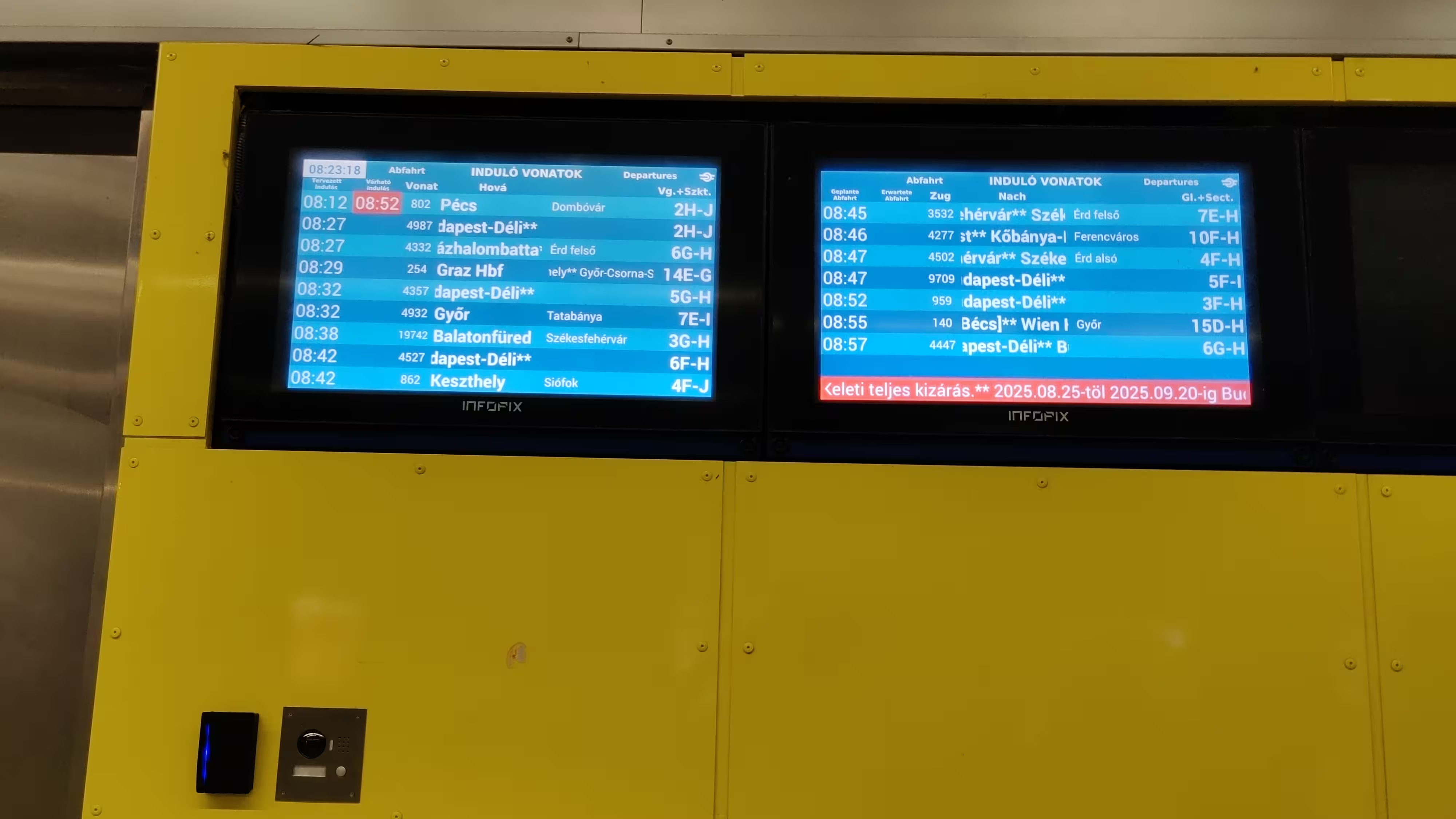 A departures board at Budapest Kelenfold station. Photo by Ravi Dwivedi, released under CC-BY-SA 4.0.
 This is platform number 15 of Budapest Kelenfold station where we boarded our train. Photo by Ravi Dwivedi, released under CC-BY-SA 4.0.
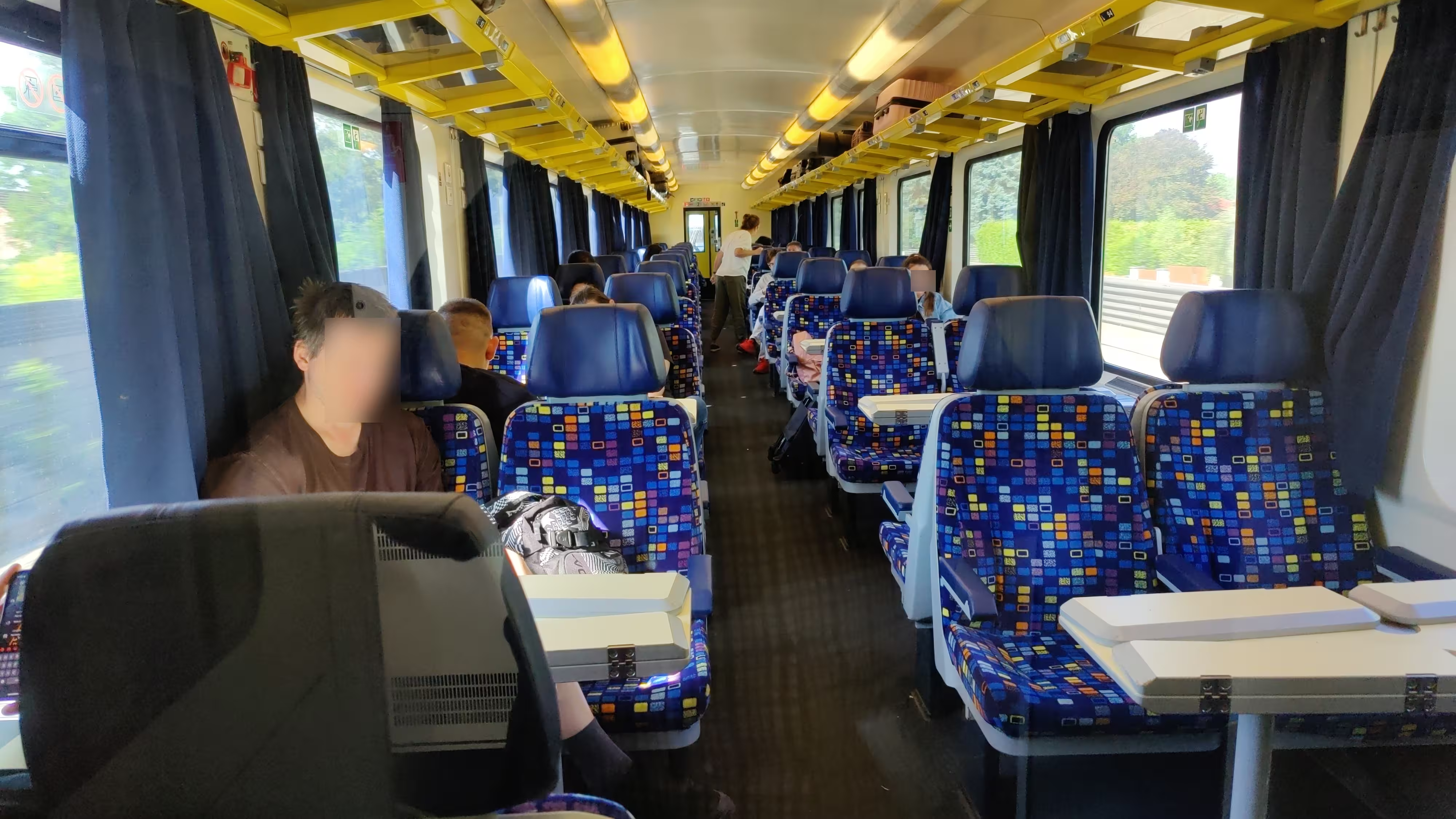 Interior of our Budapest to Vienna train. Photo by Ravi Dwivedi, released under CC-BY-SA 4.0.
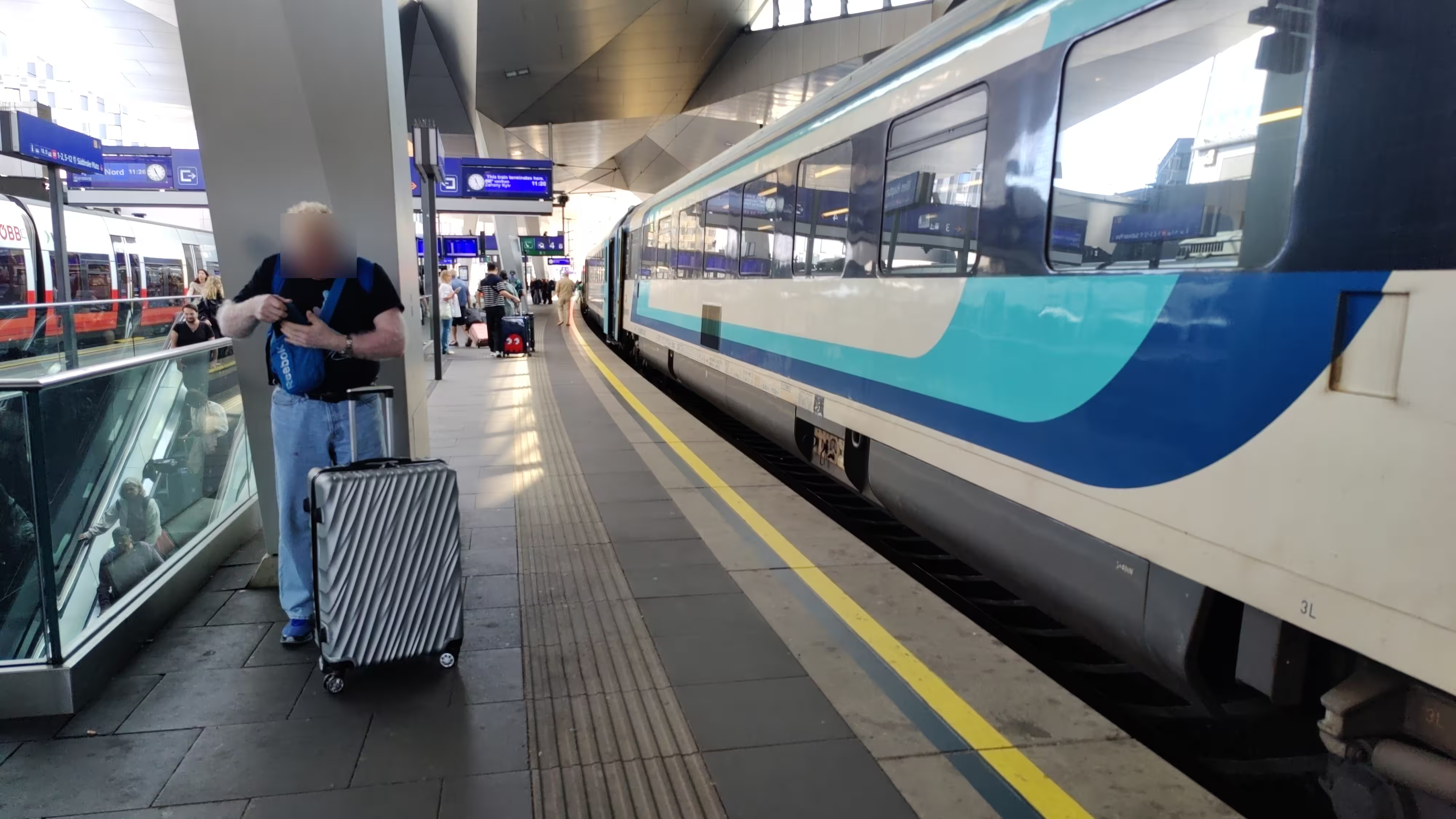 This blue colored train was the one we took for our Budapest to Vienna journey. Photo by Ravi Dwivedi, released under CC-BY-SA 4.0.
 An BB train standing at a platform of Vienna train station. BB is the national carrier of Austria. Photo by Ravi Dwivedi, released under CC-BY-SA 4.0.
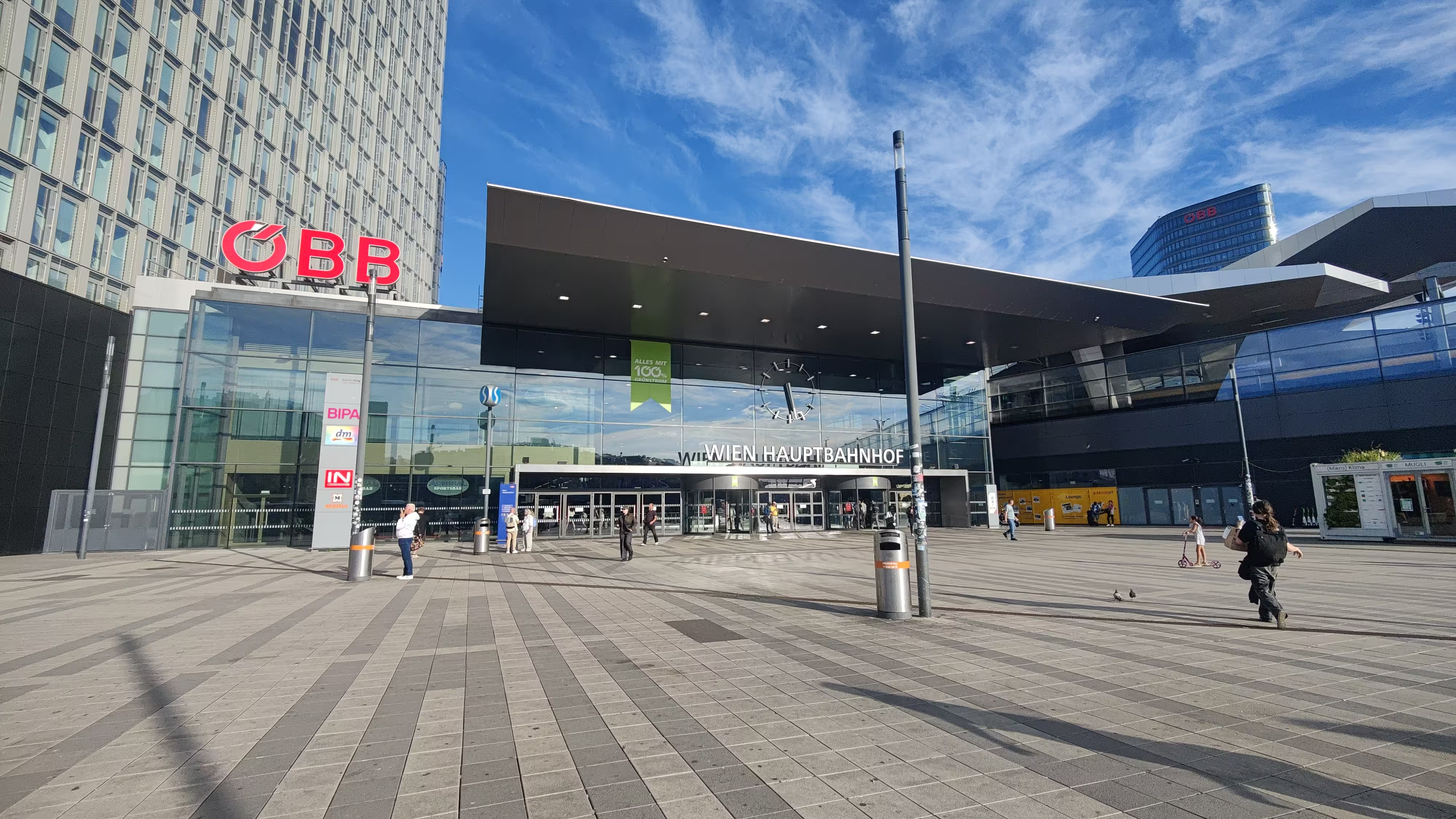 Wien Hauptbahnhof train station. Photo by Ravi Dwivedi, released under CC-BY-SA 4.0.
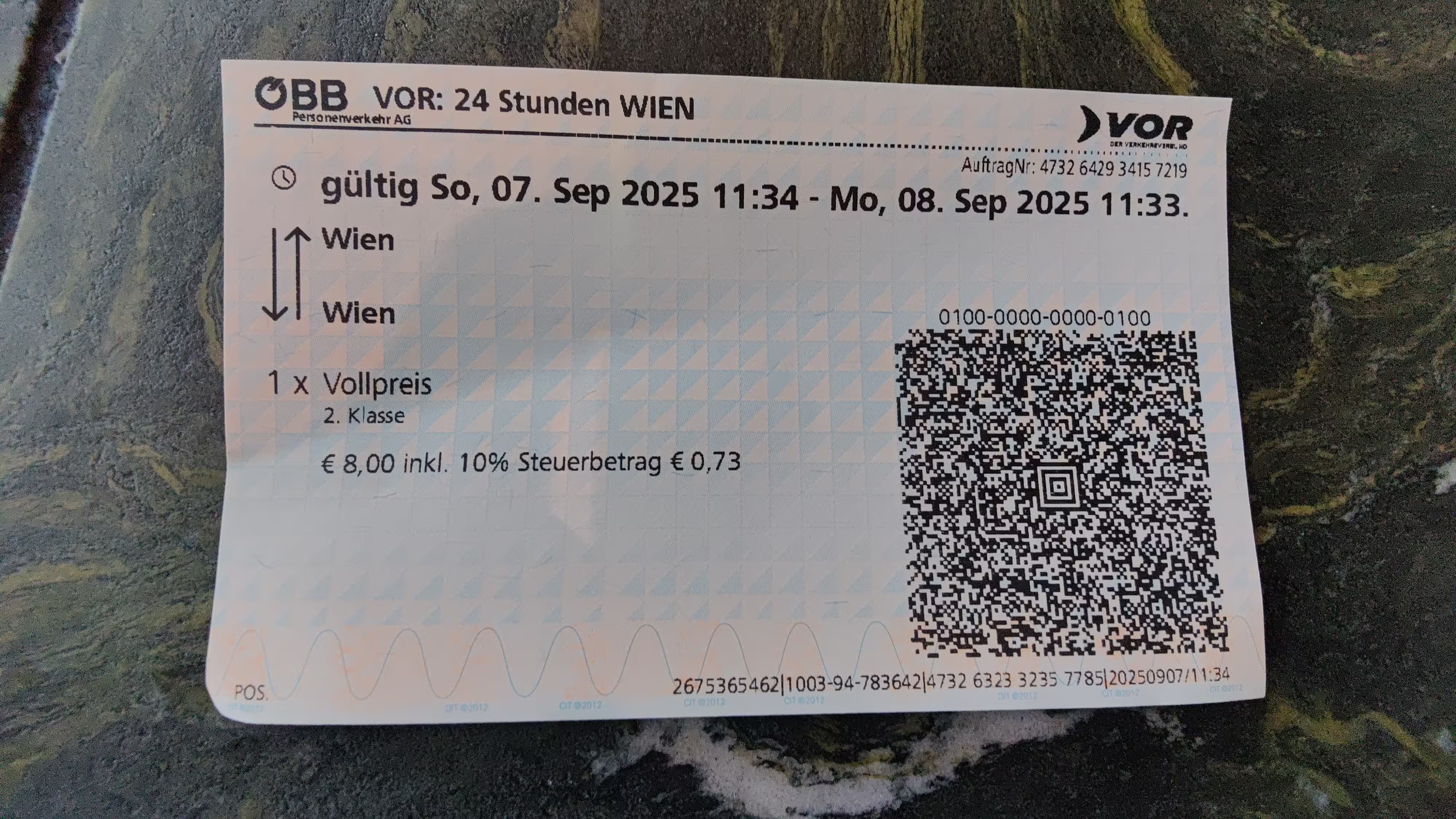 My public transport pass in Vienna.
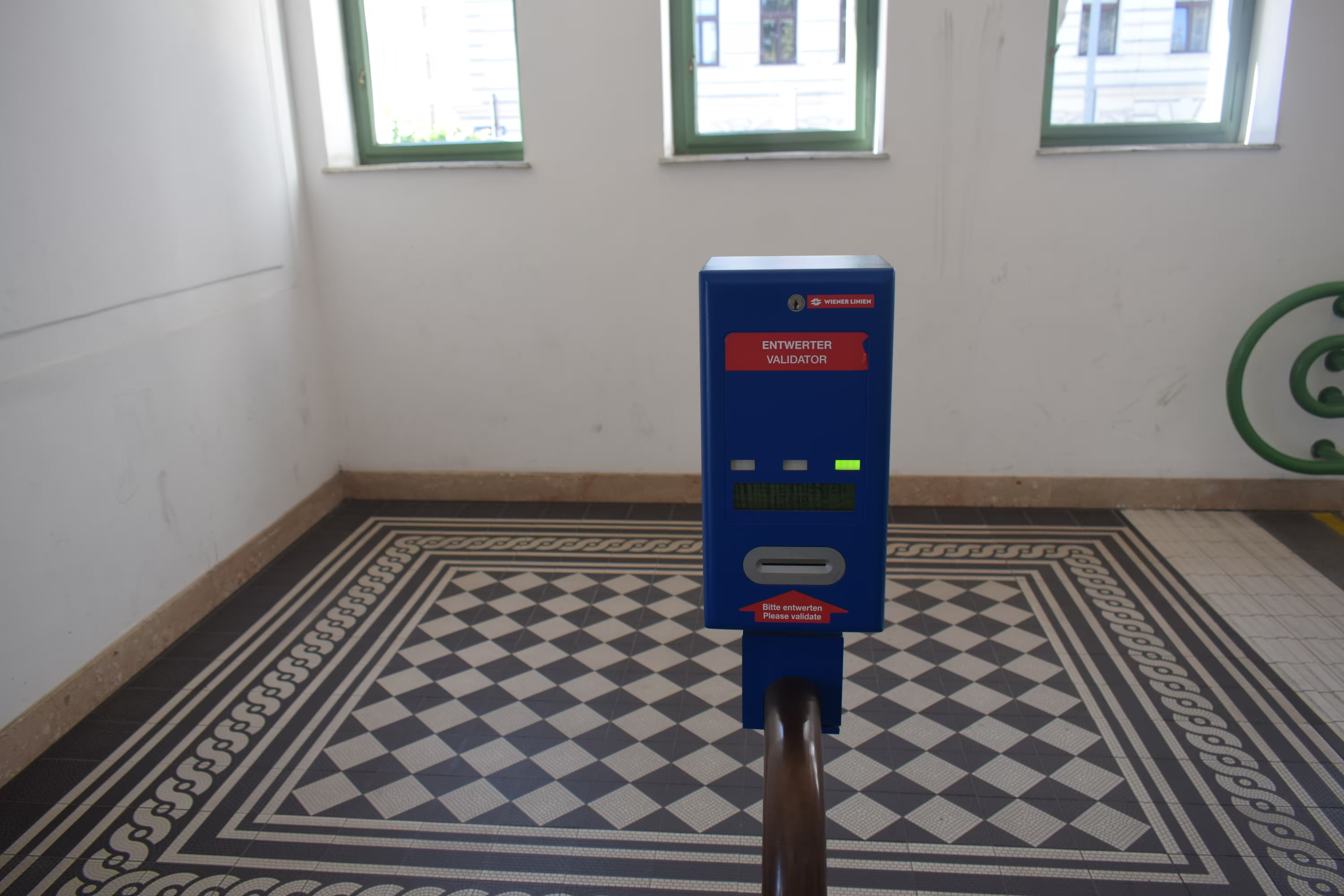 Instead of AFC gates, Vienna has ticket validators as in the picture. You need to tap your ticket in the validator before boarding the subway. Photo by Ravi Dwivedi, released under CC-BY-SA 4.0.
 Vienna subway. Photo by Ravi Dwivedi, released under CC-BY-SA 4.0.
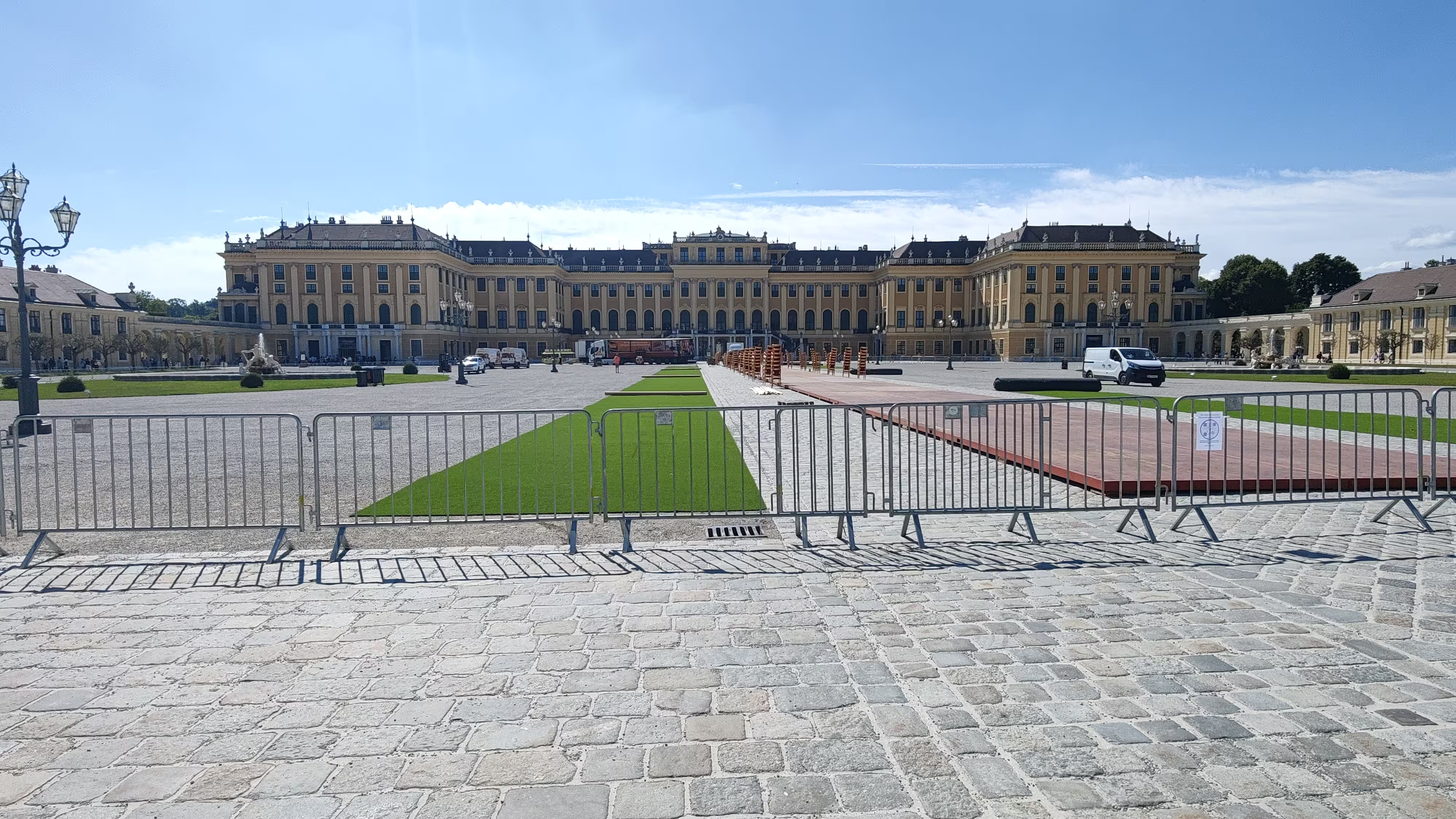 Sch nbrunn Palace. Photo by Ravi Dwivedi, released under CC-BY-SA 4.0.
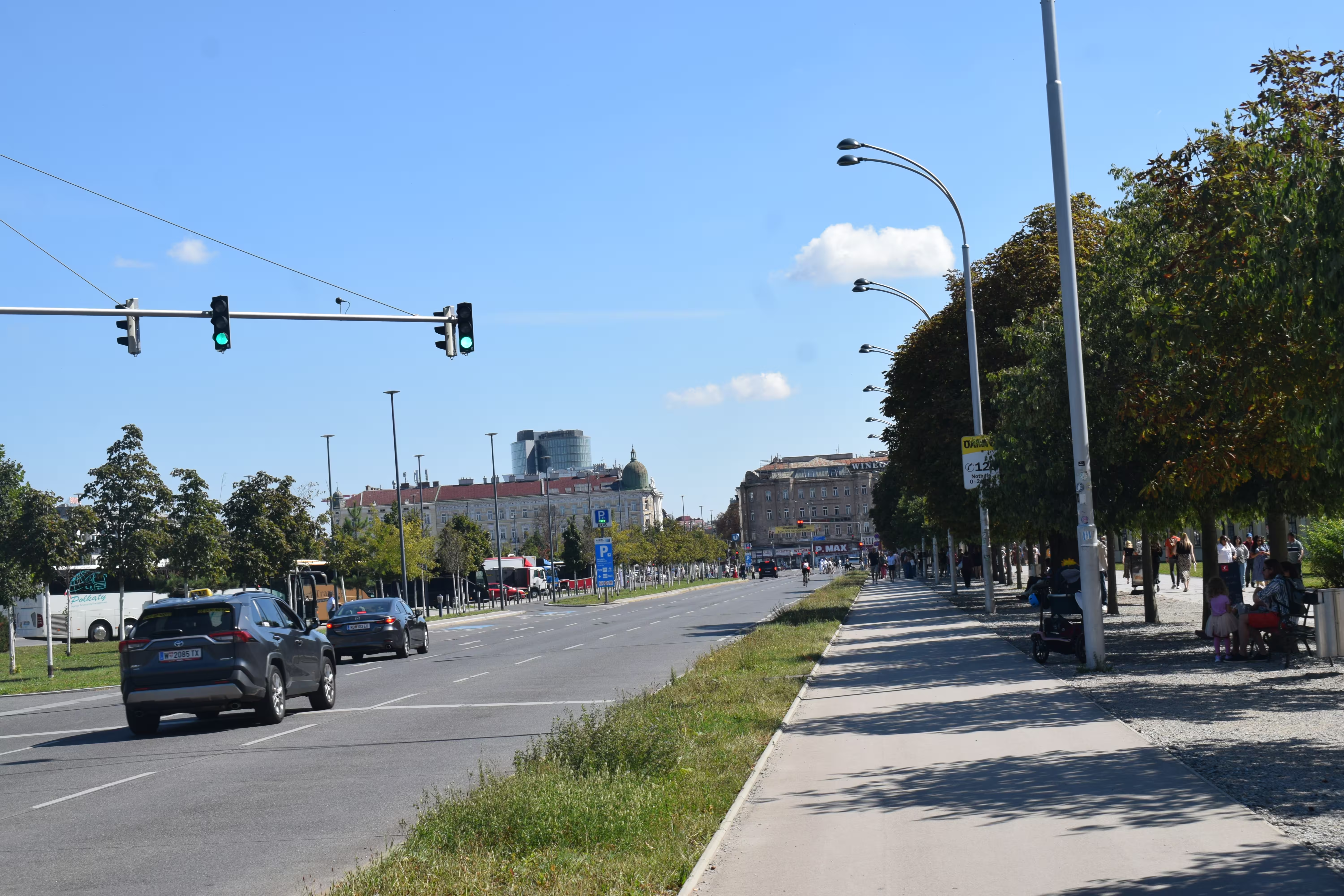 A street near Sch nbrunn Palace. Photo by Ravi Dwivedi, released under CC-BY-SA 4.0.
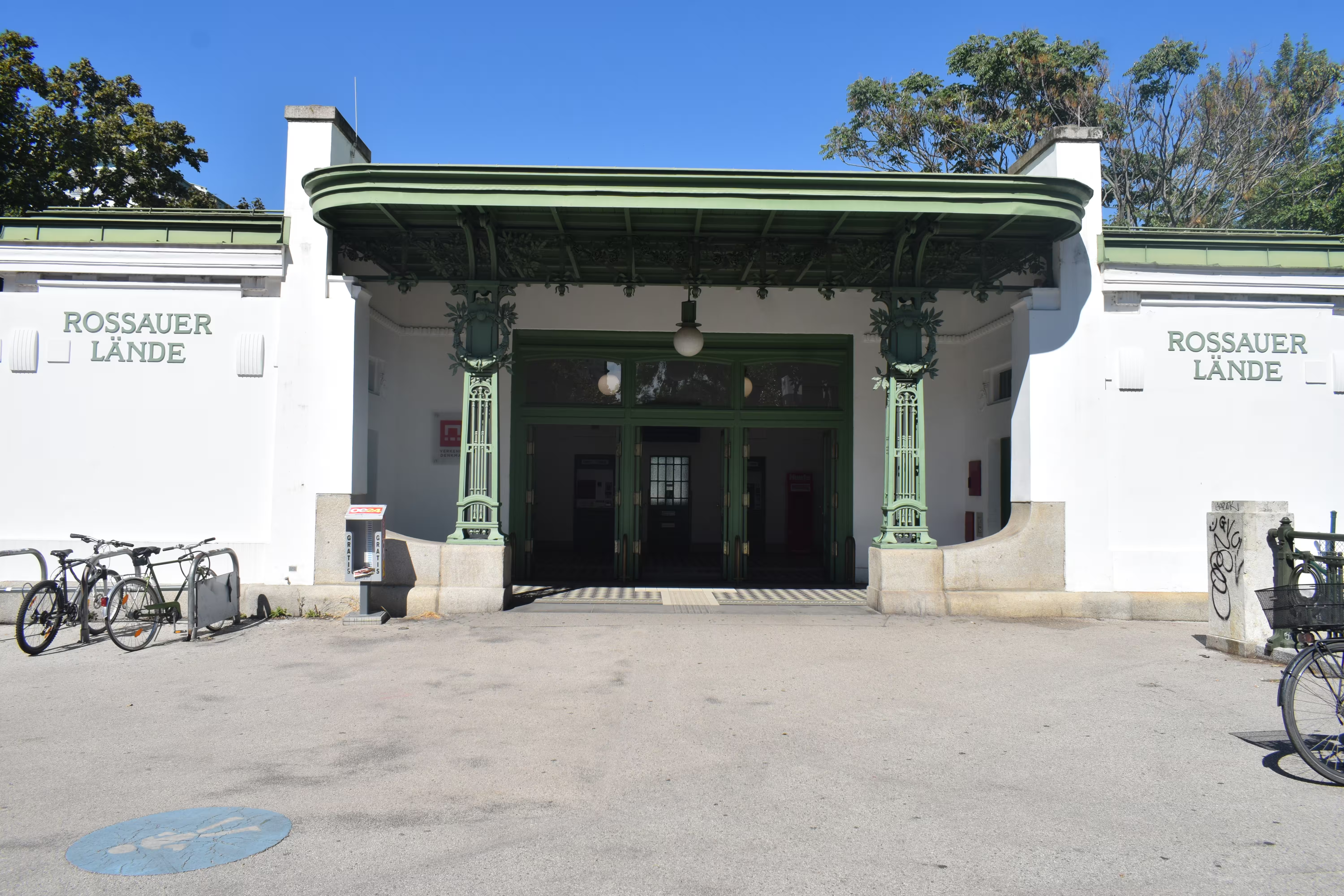 Ro auer L nde subway station. Photo by Ravi Dwivedi, released under CC-BY-SA 4.0.
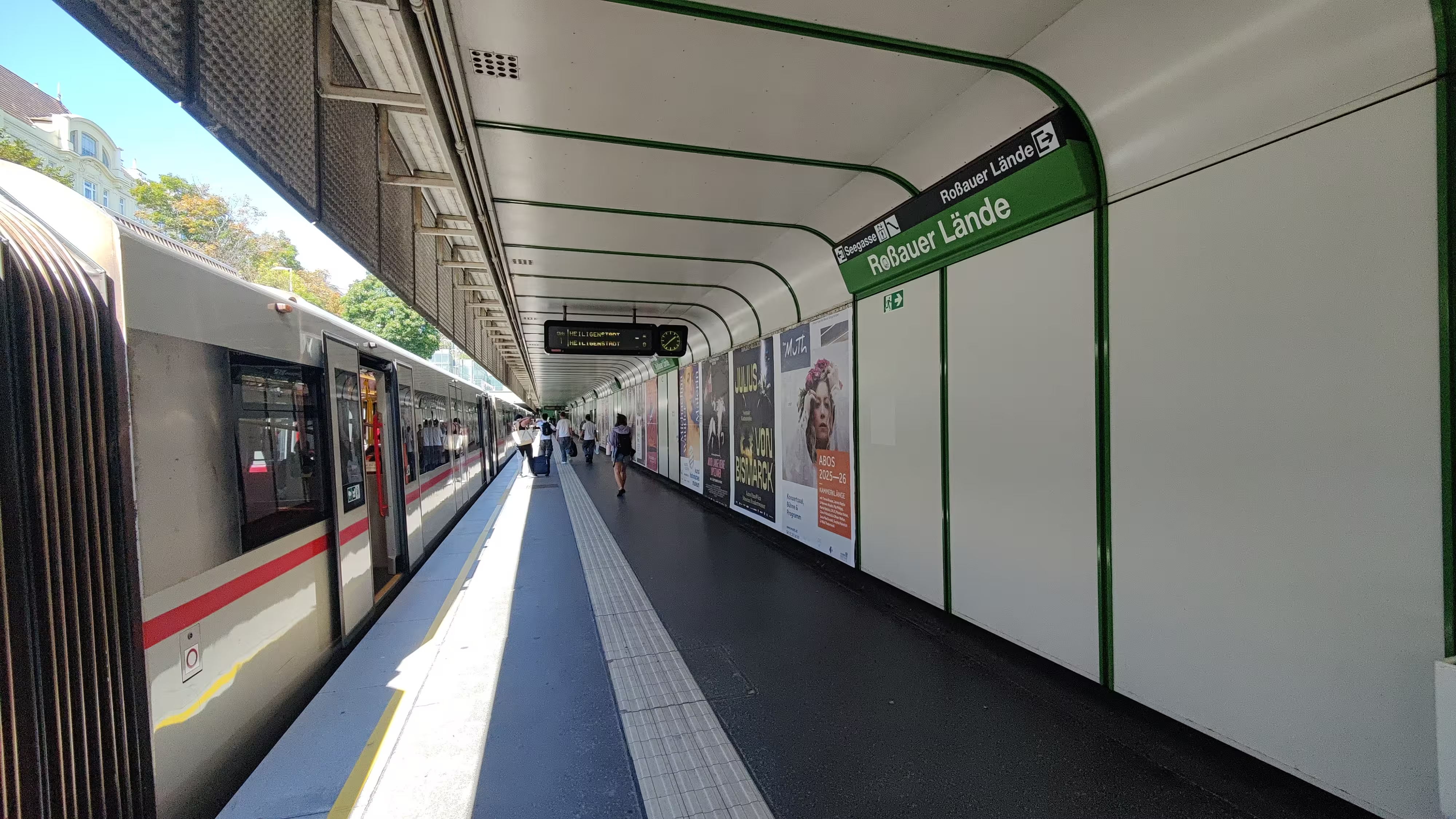 Platform of the Ro auer L nde subway station. Photo by Ravi Dwivedi, released under CC-BY-SA 4.0.
 The The Strudlhofstiege steps. Photo by Ravi Dwivedi, released under CC-BY-SA 4.0.
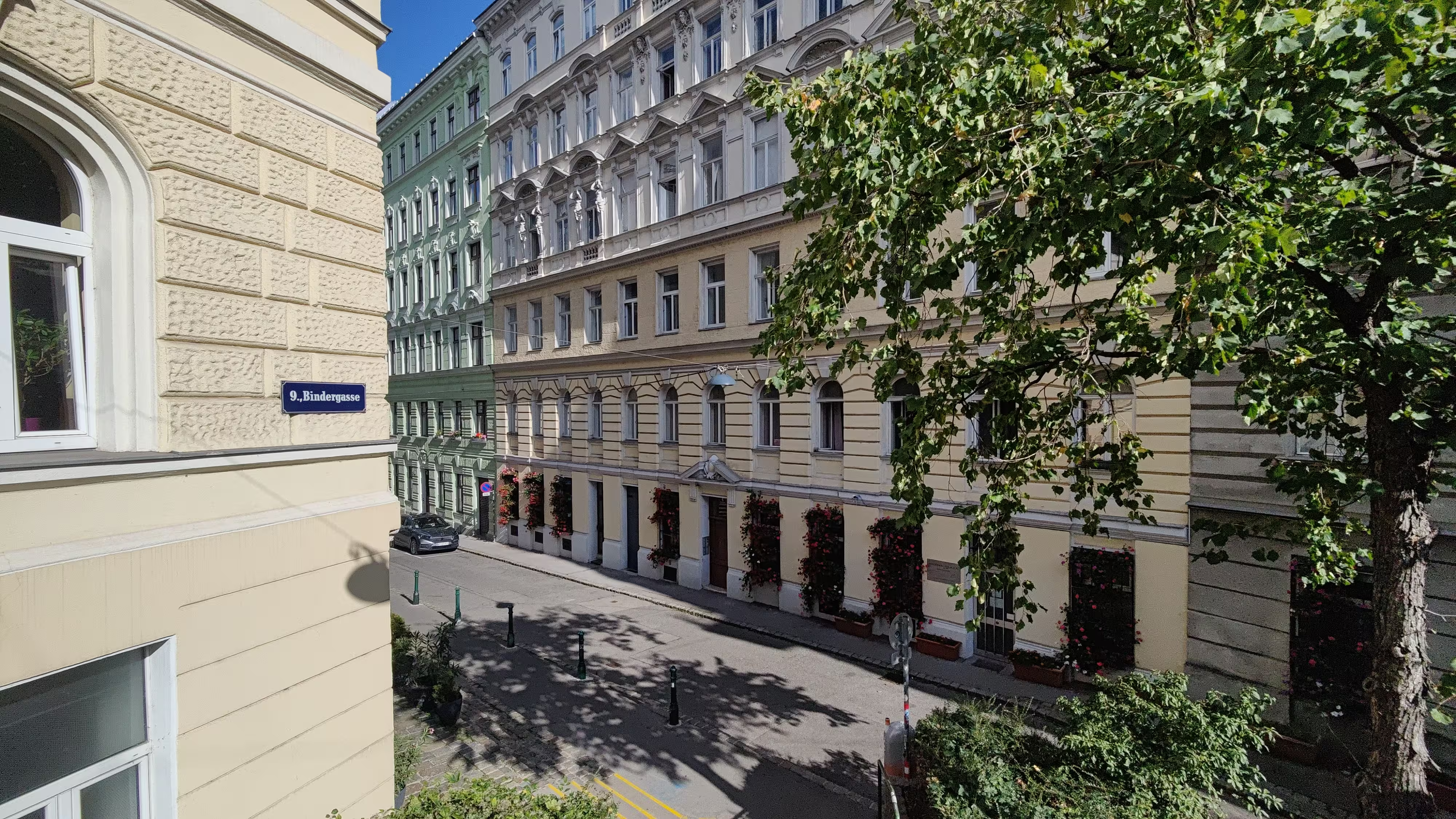 A random street in Vienna.
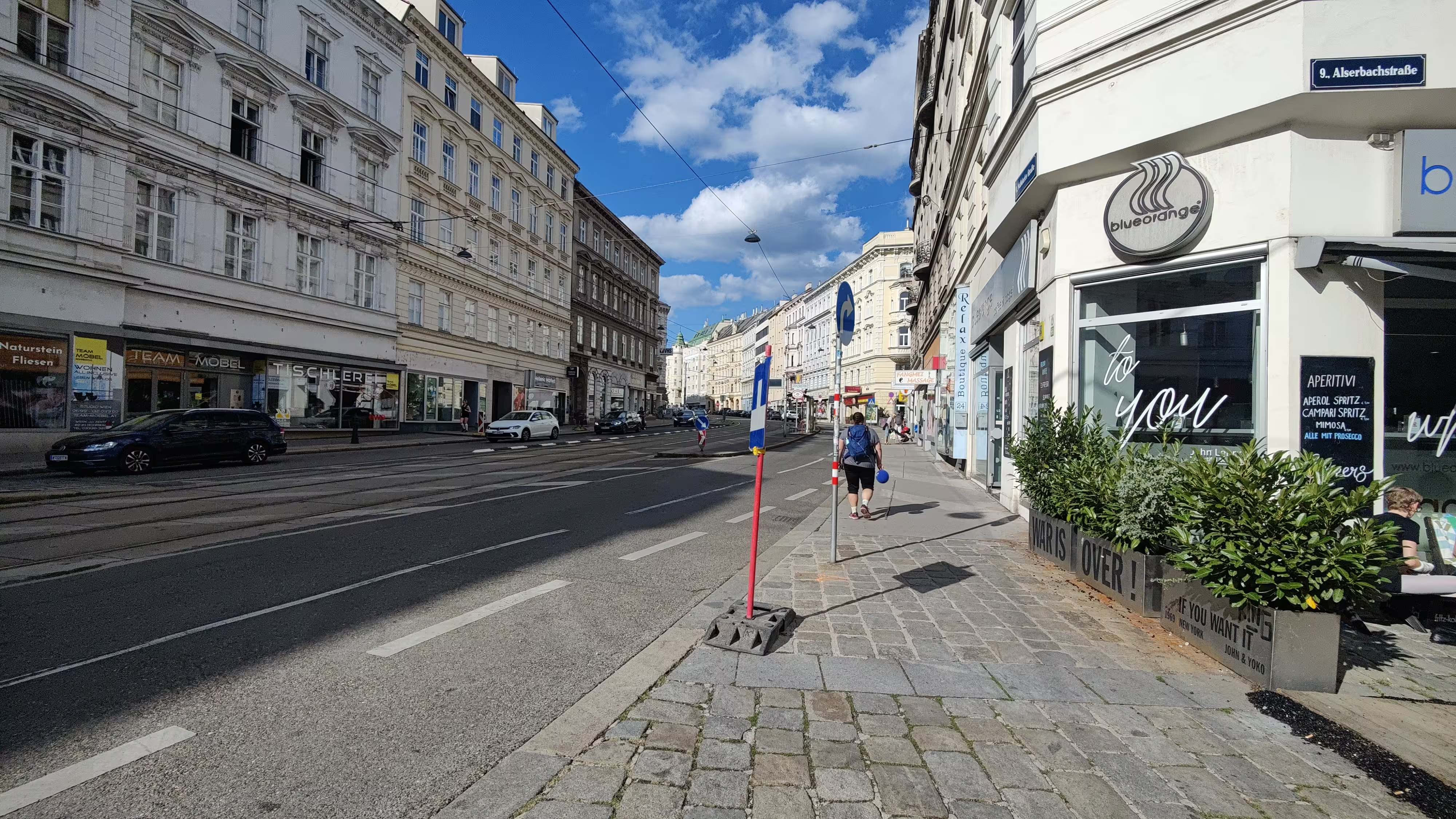 Another street in Vienna.
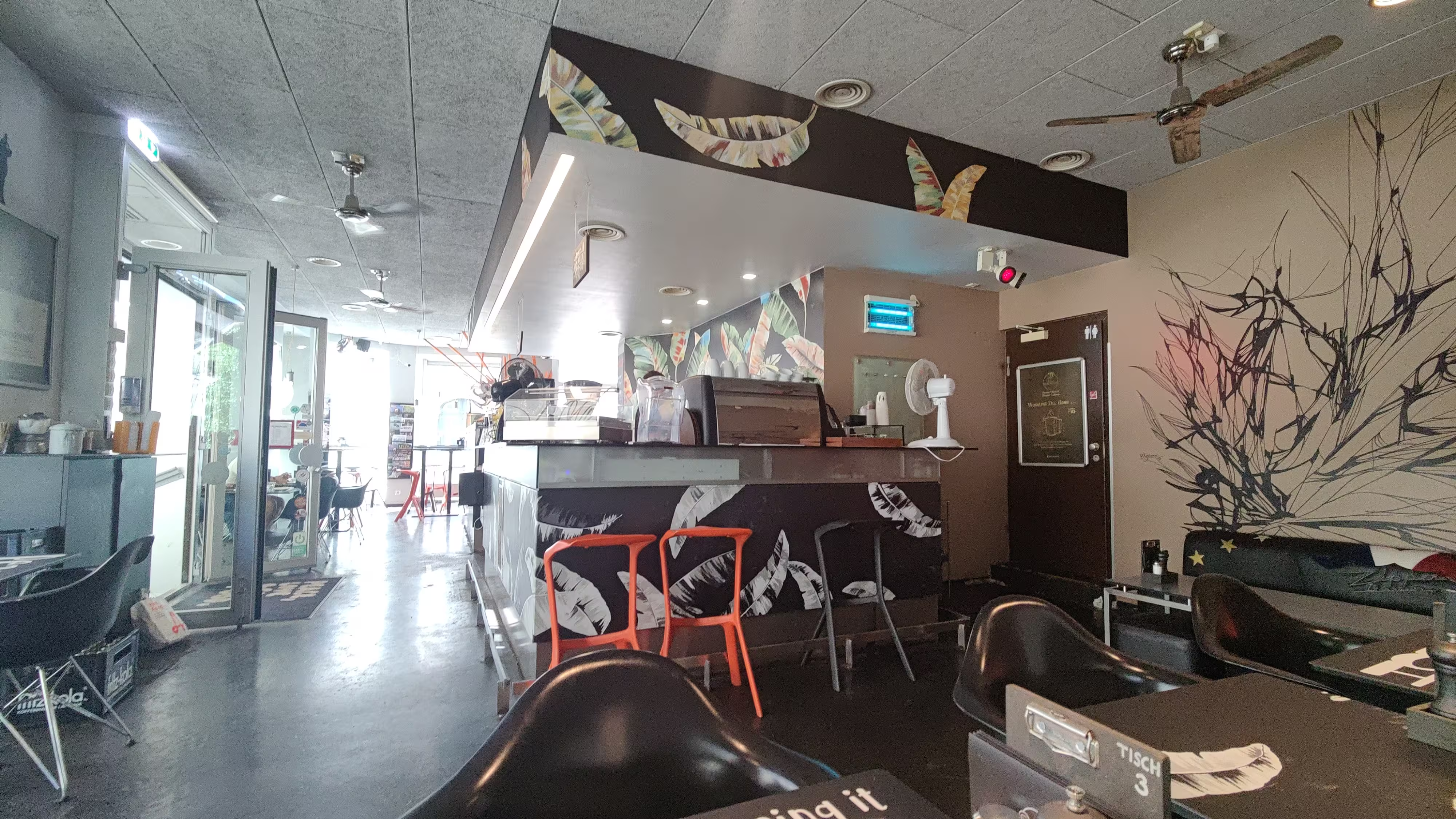 A picture of Blue Orange caf . Photo by Ravi Dwivedi, released under CC-BY-SA 4.0.
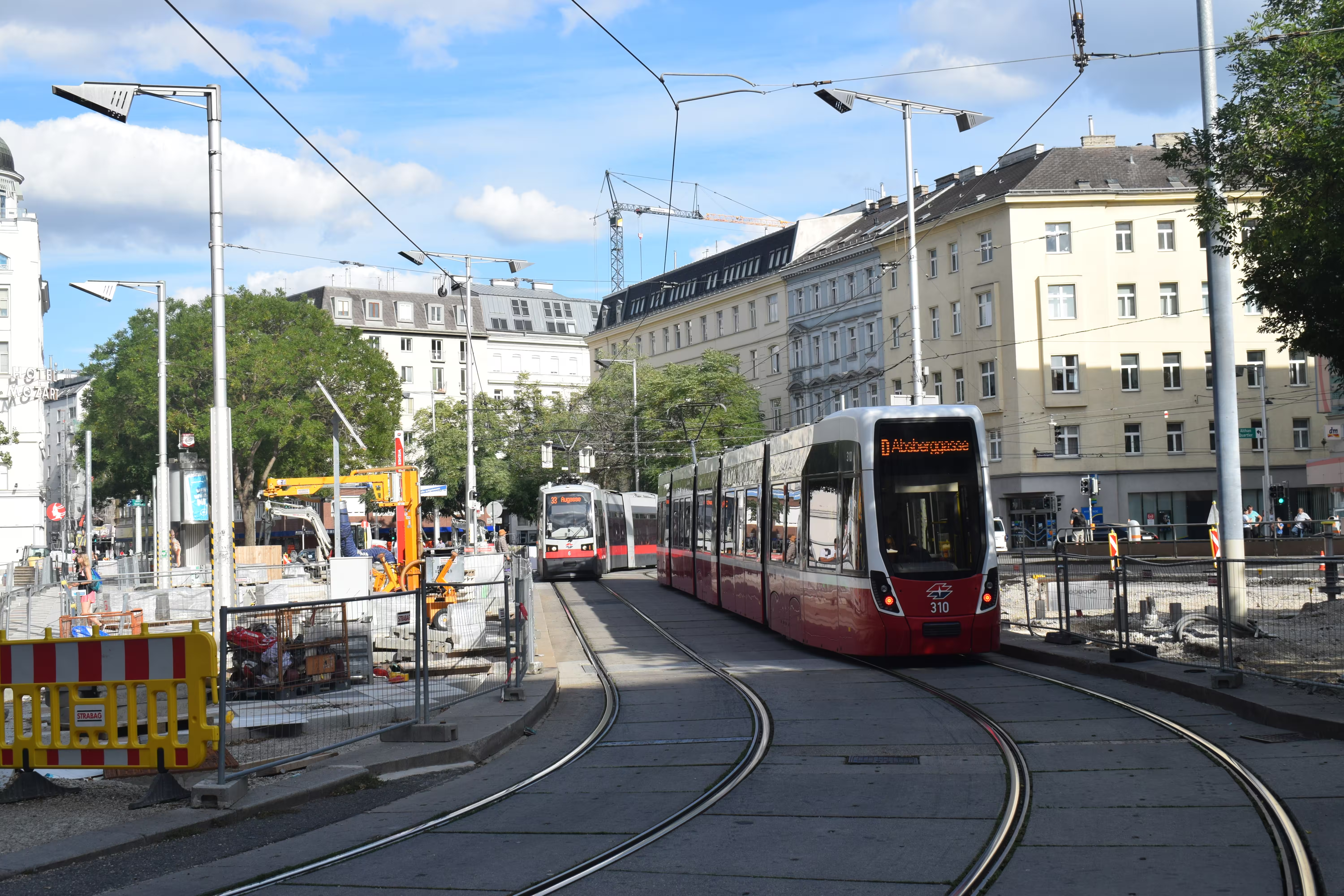 Trams in Vienna. Photo by Ravi Dwivedi, released under CC-BY-SA 4.0.
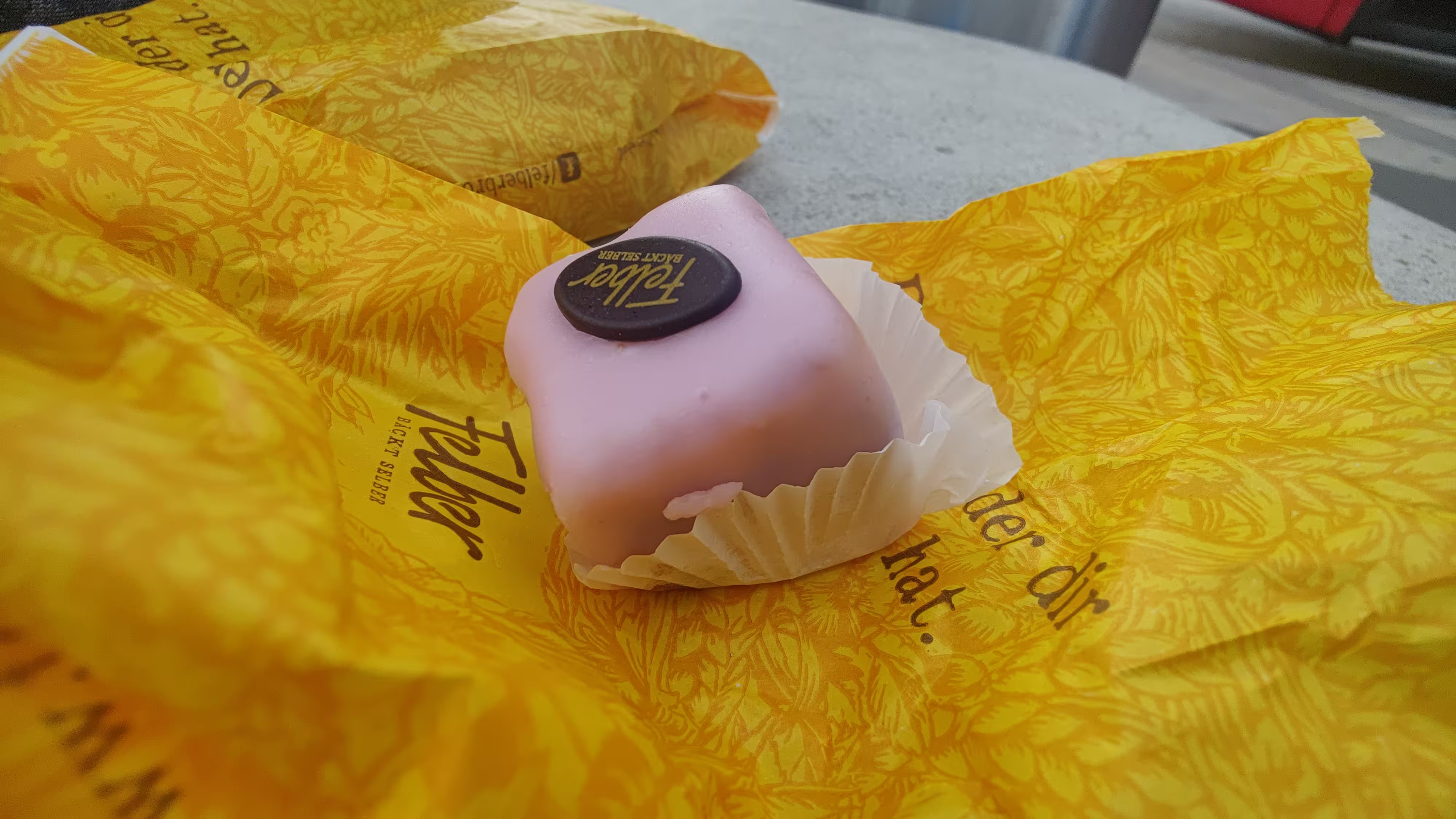 Punschkrapfen. Photo by Ravi Dwivedi, released under CC-BY-SA 4.0.
 Esterhazyschnitten. Photo by Ravi Dwivedi, released under CC-BY-SA 4.0.
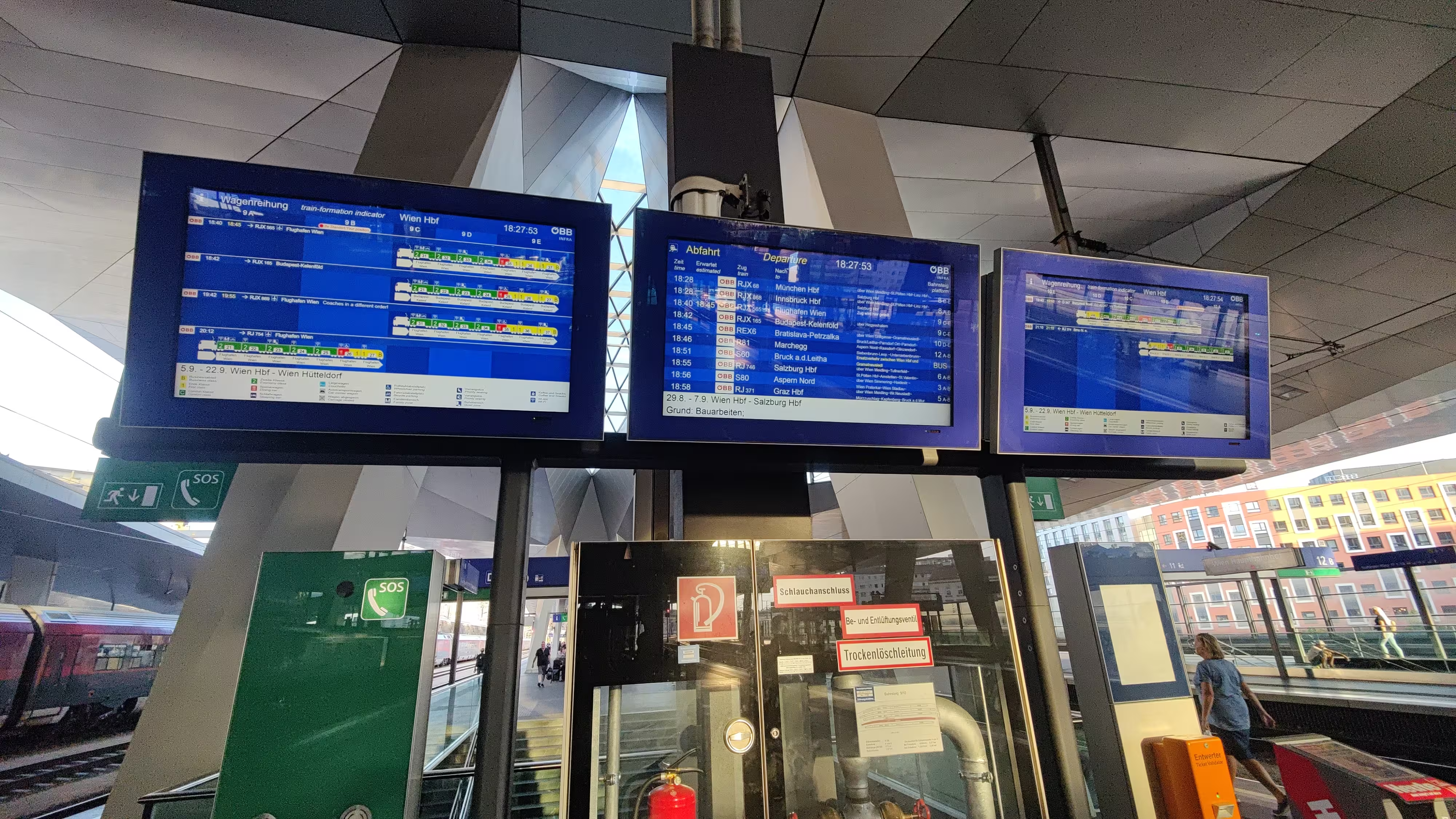 Departure boards in Vienna displaying information about the trains. Photo by Ravi Dwivedi, released under CC-BY-SA 4.0.
 Platform and tracks at Wien Hauptbahnhof station. Photo by Ravi Dwivedi, released under CC-BY-SA 4.0.
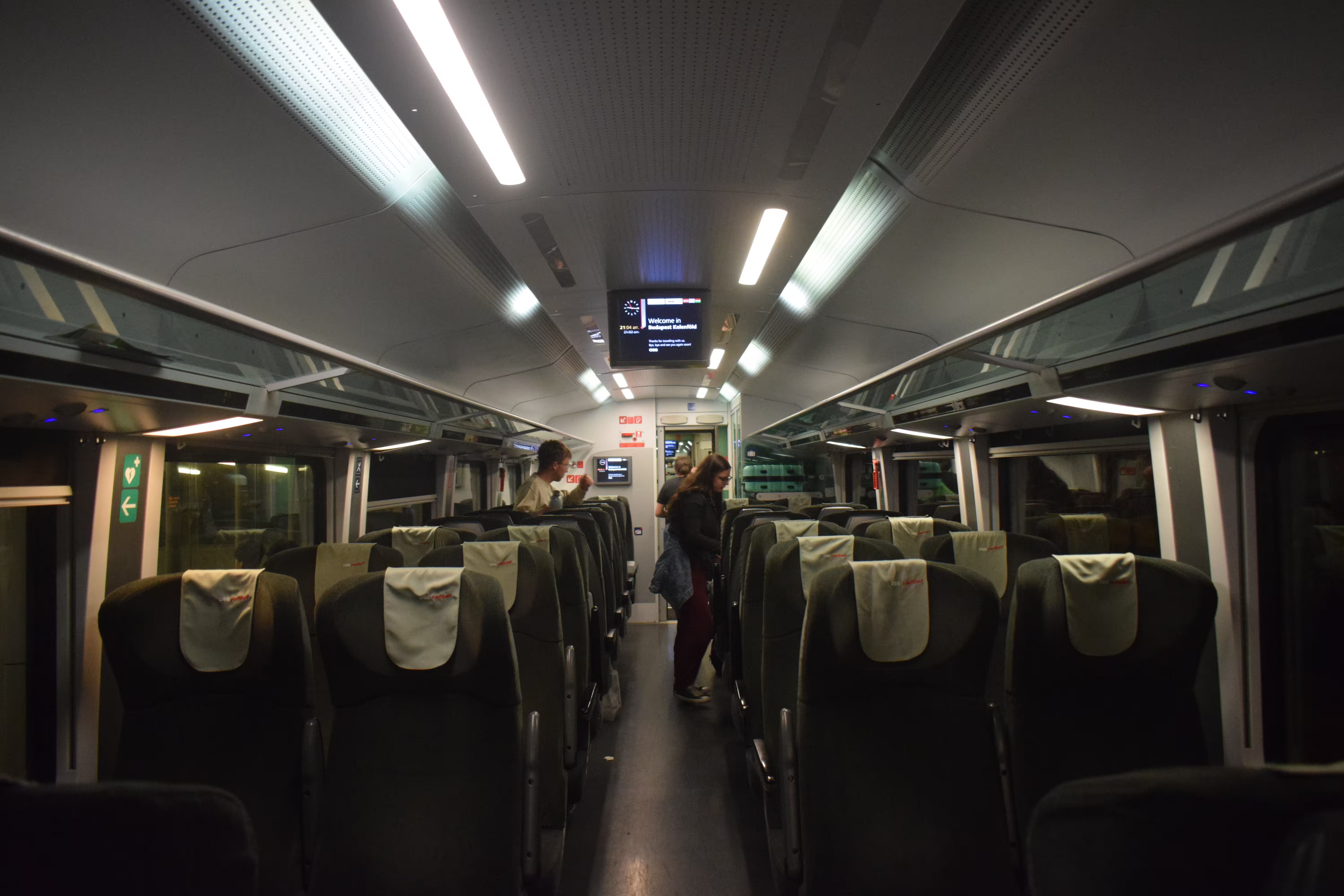 Interior of the train we took from Vienna to Budapest. Photo by Ravi Dwivedi, released under CC-BY-SA 4.0.
 This is the train we took for our return journey from Vienna to Budapest. It is standing on a platform in Budapest Kelenfold station. Photo by Ravi Dwivedi, released under CC-BY-SA 4.0.
 The

 A shot of my room. Photo by Ravi Dwivedi, released under CC-BY-SA 4.0.
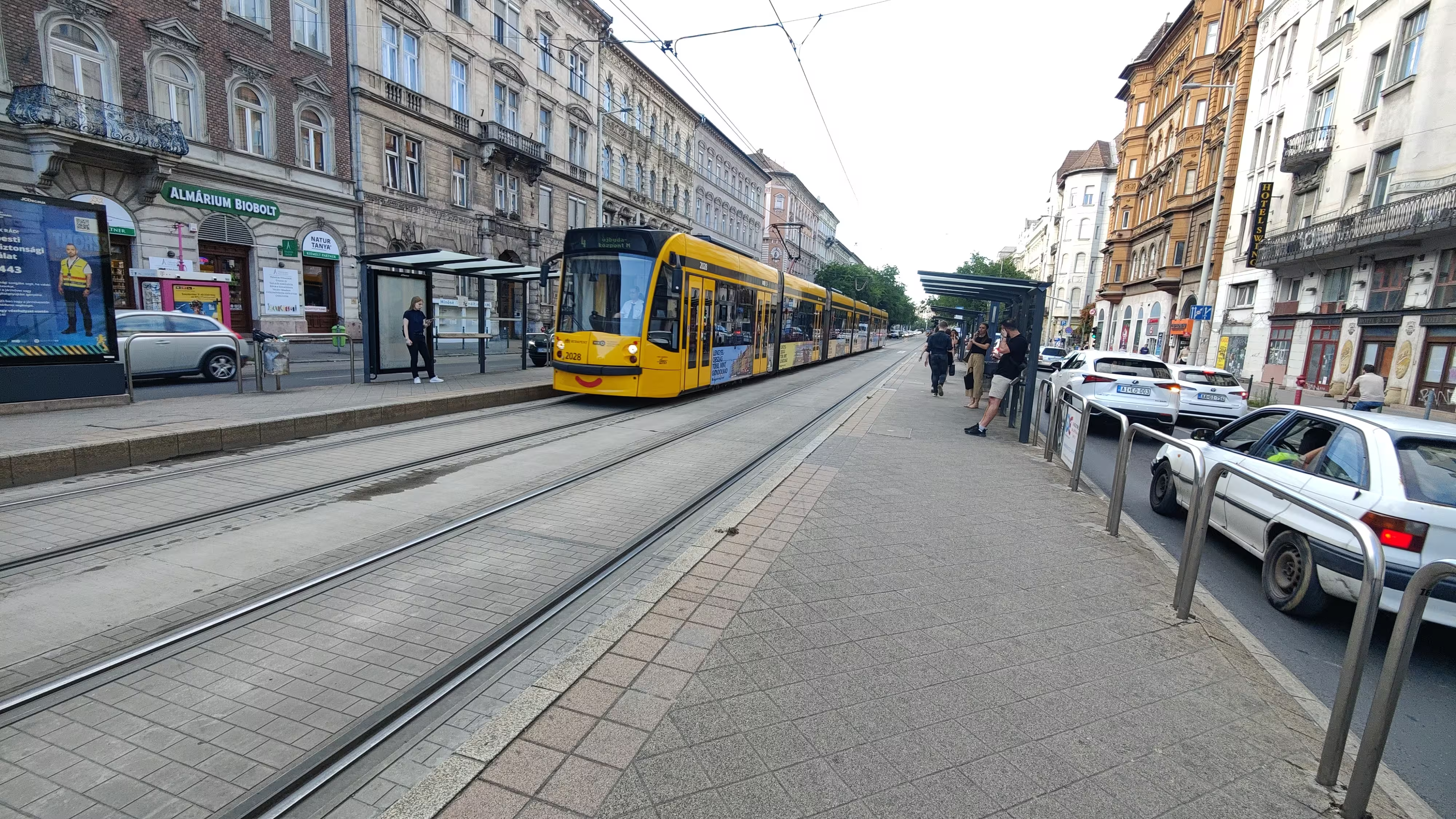 A tram in Budapest. Photo by Ravi Dwivedi, released under CC-BY-SA 4.0.
 The red building in the picture served as the conference venue. Photo by Ravi Dwivedi, released under CC-BY-SA 4.0.
 These Esterh zy cake bites were really yummy. Photo by Ravi Dwivedi, released under CC-BY-SA 4.0.
 Raspberry Currant cake slices. Photo by Ravi Dwivedi, released under CC-BY-SA 4.0.
 Conference swag. Photo by Ravi Dwivedi, released under CC-BY-SA 4.0.
 Lothar giving his presentation. Photo by Ravi Dwivedi, released under CC-BY-SA 4.0.
 Presentation on migration to LibreOffice by Austrian Armed Forces. Photo by Ravi Dwivedi, released under CC-BY-SA 4.0.
 My lunch ticket for the conference. Photo by Ravi Dwivedi, released under CC-BY-SA 4.0.
 The lunch I had on the first day. Photo by Ravi Dwivedi, released under CC-BY-SA 4.0.
 Desserts at Tofea Grill. Photo by Ravi Dwivedi, released under CC-BY-SA 4.0.
 Dione giving her presentation. Photo by Ravi Dwivedi, released under CC-BY-SA 4.0.
 Egg white salad. Photo by Ravi Dwivedi, released under CC-BY-SA 4.0.
 Group photo

 And it was good. The kind of pizza that is quite soft, especially near
the borders.
We ate it with fresh mozzarella and tomatoes, and then made another one
the same way, to finish the mozzarella.
 This was supposed to be our lunch, but we decided to try one with some
leftover cooked radicchio, and that also worked quite nicely.
And finally, we decided we needed to try a more classical pizza, with
tomato sauce and cured meat, of which we forgot to take pictures.
Up to here we had eaten about half of the dough, and we were getting
full: I had prepared significantly more than what I expected to eat, to
be able to accidentally burn some, but also with the idea to bake
something else to be eaten later.
So I made two more focaccias with just water and salt, and then I tried
to cook some bread with what I expected to be residual heat.
 Except that the oven was getting a bit too cold, so my partner added
some charcoal, and when I put the last two unflattened balls right at
the back of the oven where it was still warmer, that side carbonized.
After 5 minutes I moved them to the middle of the oven, and turned them,
and then after another turn and 5 more minutes they were ready. And
other than the burnt crust, they were pretty edible.
So, the thoughts after our first experience.
Everybody around the table (my SO, my mother and me) was quite happy
with the results, and they are different enough from the ones I could
get with the regular oven.
As I should have expected, it s much faster than a masonry oven, both in
getting to temperature and in cooling down: my plan for residual heat
bread cooking will have to be adjusted with experience.
We were able to get it hot enough, but not as hot as it s supposed to be
able to get: we suspect that using just charcoal may have influenced it,
and next week we ll try to get some wood, and try with a mix.
As for the recipe, dividing the dough in eight parts worked quite well:
maybe the pizzas are a bit on the smaller side, but since they come one
at a time it s more convenient to cut and share them, and maybe make a
couple more at the end.
Of course, I ll want to try different recipes, for different styles of
pizzas (including some almost-trademark-violating ones) and for other
types of flatbread.
I expect it won t be hard to find volunteers to help us with the
experiments. :D
 The nineteenth release of the
