Search Results: "willi"

17 September 2024

Russ Allbery: Review: The Book That Broke the World

Review: The Book That Broke the World, by Mark Lawrence
Series: Library Trilogy #2
Publisher: Ace
Copyright: 2024
ISBN: 0-593-43796-9
Format: Kindle
Pages: 366
The Book That Broke the World is high fantasy and a direct sequel to The Book That Wouldn't Burn. You should not start here. In a delightful break from normal practice, the author provides a useful summary of the previous volume at the start of this book to jog your memory. At the end of The Book That Wouldn't Burn, the characters were scattered and in various states of corporeality after some major revelations about the nature of the Library and the first appearance of the insectile Skeer. The Book That Wouldn't Burn picks up where it left off, and there is a lot more contact with the Skeer, but my guess that they would be the next viewpoint characters does not pan out. Instead, we get a new group and a new protagonist: Celcha, whose sees angels who come to visit her brother. I have complaints, but before I launch into those, I should say that I liked this book apart from the totally unnecessary cannibalism. (I'll get to that.) Livira is a bit sidelined, which is regrettable, but Celcha and her brother are interesting new characters, and both Arpix and Clovis, supporting characters in the first book, get some excellent character development. Similar to the first book, this is a puzzle box story full of world-building tidbits with intellectually-satisfying interactions. Lawrence elaborates and complicates his setting in ways that don't contradict earlier parts of the story but create more room and depth for the characters to be creative. I came away still invested in this world and eager to find out how Lawrence pulls the world-building and narrative threads together. The biggest drawback of this book is that it's not new. My thought after finishing the first book of the series was that if Lawrence had enough world-building ideas to fill three books to that same level of density, this had the potential of being one of my favorite fantasy series of all time. By the end of the second book, I concluded that this is not the case. Instead of showing us new twists and complications the way the first book did throughout, The Book That Broke the World mostly covers the same thematic ground from some new angles. It felt like Lawrence was worried the reader of the first book may not have understood the theme or the world-building, so he spent most of the second book nailing down anything that moved. I found that frustrating. One of the best parts of The Book That Wouldn't Burn was that Lawrence trusted the reader to keep up, which for me hit the glorious but rare sweet spot of pacing where I was figuring out the world at roughly the same pace as the characters. It surprised me in some very enjoyable ways. The Book That Broke the World did not surprise me. There are a few new things, which I enjoyed, and a few elaborations and developments of ideas, which I mostly enjoyed, but I saw the big plot twist coming at least fifty pages before it happened and found the aftermath more annoying than revelatory. It doesn't help that the plot rests on character misunderstandings, one of my least favorite tropes. One of the other disappointments of this book is that the characters stop using the Library as a library. The Library at the center of this series is a truly marvelous piece of world-building with numerous fascinating features that are unrelated to its contents, but Livira used it first and foremost as a repository of books. The first book was full of characters solving problems by finding a relevant book and reading it. In The Book That Broke the World, sadly, this is mostly gone. The Library is mostly reduced to a complicated Big Dumb Object setting. It's still a delightful bit of world-building, and we learn about a few new features, but I only remember two places where the actual books are important to the story. Even the book referenced in the title is mostly important as an artifact with properties unrelated to the words that it contains or to the act of reading it. I think this is a huge lost opportunity and something I hope Lawrence fixes in the last book of the trilogy. This book instead focuses on the politics around the existence of the Library itself. Here I'm cautiously optimistic, although a lot is going to depend on the third book. Lawrence has set up a three-sided argument between groups that I will uncharitably describe as the libertarian techbros, the "burn it all down" reactionaries, and the neoliberal centrist technocrats. All three of those positions suck, and Lawrence had better be setting the stage for Livira to find a different path. Her unwillingness to commit to any of those sides gives me hope, but bringing this plot to a satisfying conclusion is going to be tricky. I hope I like what Lawrence comes up with, but it feels far from certain. It doesn't help that he's started delivering some points with a sledgehammer, and that's where we get to the unnecessary cannibalism. Thankfully this is a fairly small part of the tail end of the book, but it was an unpleasant surprise that I did not want in this novel and that I don't think made the story any better. It's tempting to call the cannibalism gratuitous, but it does fit one of the main themes of this story, namely that humans are depressingly good at using any rule-based object in unexpected and nasty ways that are contrary to the best intentions of the designer. This is the fundamental challenge of the Library as a whole and the question that I suspect the third book will be devoted to addressing, so I understand why Lawrence wanted to emphasize his point. The reason why there is cannibalism here is directly related to a profound misunderstanding of the properties of the library, and I detected an echo of one of C.S. Lewis's arguments in The Last Battle about the nature of Hell. The problem, though, is that this is Satanic baby-killerism, to borrow a term from Fred Clark. There are numerous ways to show this type of perversion of well-intended systems, which I know because Lawrence used other ones in the first book that were more subtle but equally effective. One of the best parts of The Book That Wouldn't Burn is that there were few real villains. The conflict was structural, all sides had valid perspectives, and the ethical points of that story were made with some care and nuance. The problem with cannibalism as it's used here is not merely that it's gross and disgusting and off-putting to the reader, although it is all of those things. If I wanted to read horror, I would read horror novels. I don't appreciate surprise horror used for shock value in regular fantasy. But worse, it's an abandonment of moral nuance. The function of cannibalism in this story is like the function of Satanic baby-killers: it's to signal that these people are wholly and irredeemably evil. They are the Villains, they are Wrong, and they cease to be characters and become symbols of what the protagonists are fighting. This is destructive to the story because it's designed to provoke a visceral short-circuit in the reader and let the author get away with sloppy story-telling. If the author needs to use tactics like this to point out who is the villain, they have failed to set up their moral quandary properly. The worst part is that this was entirely unnecessary because Lawrence's story-telling wasn't sloppy and he set up his moral quandary just fine. No one was confused about the ethical point here. I as the reader was following without difficulty, and had appreciated the subtlety with which Lawrence posed the question. But apparently he thought he was too subtle and decided to come back to the point with a pile-driver. I think that seriously injured the story. The ethical argument here is much more engaging and thought-provoking when it's more finely balanced. That's a lot of complaints, mostly because this is a good book that I badly wanted to be a great book but which kept tripping over its own feet. A lot of trilogies have weak second books. Hopefully this is another example of the mid-story sag, and the finale will be worthy of the start of the story. But I have to admit the moral short-circuiting and the de-emphasis of the actual books in the library has me a bit nervous. I want a lot out of the third book, and I hope I'm not asking this author for too much. If you liked the first book, I think you'll like this one too, with the caveat that it's quite a bit darker and more violent in places, even apart from the surprise cannibalism. But if you've not started this series, you may want to wait for the third book to see if Lawrence can pull off the ending. Followed by The Book That Held Her Heart, currently scheduled for publication in April of 2025. Rating: 7 out of 10

7 September 2024

Sergio Durigan Junior: Chatting in the 21st century

Several people have been asking me to explain and/or write about my solution for chatting nowadays. I realize that the current scenario is much more complex than, say, 10 or 20 years ago. Back then, this post would probably be more about the IRC client I used than about different chatting technologies. I have also spent a non trivial amount of time setting things up the way I want, so I understand that it s about time to write about my setup not only because I think it can be helpful to others, but also because I would like to document things for myself.

The backbone: Matrix I chose to use Matrix as the place where I integrate everything. Despite there being some heavy (and justified) criticism on the protocol itself, it serves me well for what I need right now. Obviously, I don t like the fact that I have to provide Matrix and all of its accompanying bridges a VPS with 4GB of RAM and 3 vCPUs, but I think that that ship has sailed, unfortunately. In an ideal world, I would be using XMPP and dedicating only a fraction of the resources I m using today to have a full chat system. And since I have been running my personal XMPP server for more than a decade now, I did try to find a solution that would allow me to keep using it, but unfortunately the protocol became almost a hobbyist thing, so there s that.

A few disclaimers I self-host everything, including my Matrix server. Much of what I did won t work if you don t self-host Matrix, so keep that in mind. This won t be a post teaching you how to deploy the services. My intention is to describe what I use and for what purpose. Also, as much as I try to use Debian packages for everything I do, I opted to deploy all services using a community-maintained Ansible playbook which is very well written and organized: matrix-docker-ansible-deploy. Last but not least, as I said above, you will likely need a machine with a good amount of RAM, CPU and storage, especially if you deploy Synapse as your Matrix homeserver (which is what I recommend if you plan to use the bridges I ll mention). My current VPS has 4GB of RAM, 3 vCPUs and 80GB of storage (of which I m currently using approximately 55GB).

Problem #1: my Matrix client(s) There are a lot of clients that can talk the Matrix protocol, but most of them are either web clients or GUI programs. I live on the terminal, more specifically inside Emacs, so I settled for the amazing ement.el Emacs mode. It works surprisingly well, but unfortunately doesn t support end-to-end encryption out of the box; for that, you have to hook it up with pantalaimon. Unfortunately, the project seems abandoned and therefore I don t recommend you to use it. I don t use it myself. When I have to reply some E2E encrypted message from another user, I go to my web browser and use my self-hosted Element client. It s a nuisance, but one that I m willing to accept because of security concerns. If you re into web clients and don t want to use Element (because it is heavy), you can try Cinny. It s lightweight and supports a decent set of features. If you re a terminal lover but don t use Emacs, you may want to try gomuks or iamb.

Problem #2: IRC bridging There are basically two types of IRC bridges for Matrix:
  • The regular and most used matrix-appservice-irc. This bridge takes Matrix to IRC (think of IRC users with the [m] suffix appended to their nicknames), and is what the matrix.org and other big homeservers (including matrix.debian.social) use. It s a complex service which allows thousands of Matrix users to connect to IRC networks, but that unfortunately has complex problems and is only worth using if you intend to host a community server.
  • A bouncer-like bridge called Heisenbridge. This is what I use personally. It takes IRC to Matrix, which means that people on IRC will not know that you re using Matrix. This bridge is much simpler, and because it acts like a bouncer it s pretty much impossible for it to cause problems with the IRC network.
Due to the fact that I sometimes like to use other IRC clients, I still run a regular ZNC bouncer, and I use Heisenbridge to connect to my ZNC. This means that I can use, e.g., ERC inside Emacs and my Matrix bridge at the same time. But you don t necessarily need to run another bouncer; you can simply use Heisenbridge and connect directly to the IRC network(s) you want. A word of caution, though: unlike ZNC, Heisenbridge doesn t support per-user configuration when you use it in bouncer mode. This is the reason why you need to self-host it, and why it s not possible to offer the service to other users (they would have access to your IRC network configuration otherwise). It s also worth talking about logs. I find that keeping logs of everything that goes on IRC has saved me a bunch of times, and so I find it really important to continue doing that. Unfortunately, neither ement.el nor Element support logging things out of the box (at least not that I know). This is also one of the reasons why I still keep my ZNC around: I configure it to log everything.

Problem #3: Telegram I don t use Telegram myself, but unfortunately several people from the Debian community do, especially in Brazil. There is a whole Debian community on Telegram, and I wanted to be able to bridge our Debian Matrix channels to their Telegram counterparts. I am currently using mautrix-telegram for that, and it s working great. You need someone with a Telegram account to configure their credentials so that the bridge can connect to it, but afterwards it s really easy to bridge channels together.

Problem #4: GitLab webhooks Something else I wanted to be able to do was to receive notifications regarding new issues, merge requests and other activities from Salsa. For this, I m using maubot, which is awesome and has a huge list of plugins. I m using the gitlab one.

Final thoughts Overall, I m satisfied with the setup I have now. It has certainly taken some time and effort to find the right tool for each problem I needed to solve, and I still feel like there are some rough edges to soften (like the fact that my Emacs client doesn t support E2E encryption out of the box, or the whole logging situation), but otherwise things are working fine and I haven t had any big problems with the deployment. You do have to be much more careful about stuff (for example, when I installed an unrelated service that hijacked my Apache configuration and made Matrix s federation silently stop working), though. If you have more specific questions about any part of my setup, shoot me an email and I ll do my best to help. Happy chatting!

30 August 2024

Russ Allbery: Review: Thornhedge

Review: Thornhedge, by T. Kingfisher
Publisher: Tor
Copyright: 2023
ISBN: 1-250-24410-2
Format: Kindle
Pages: 116
Thornhedge is a fantasy novella by T. Kingfisher, the pen name that Ursula Vernon uses for her adult writing. It won the 2024 Hugo Award for best novella. No matter how much my brain wants to misspell the title, it is a story about a hedge, not a Neolithic earthwork.
The fairy was the greenish-tan color of mushroom stems and her skin bruised blue-black, like mushroom flesh. She had a broad, frog-like face and waterweed hair. She was neither beautiful nor made of malice, as many of the Fair Folk are said to be.
There is a princess asleep in a tower, surrounded by a wall of thorns. Toadling's job is to keep anyone from foolishly breaking in. At first, it was a constant struggle and all that she could manage, but with time, the flood of princes slowed to a trickle. A road was built and abandoned. People fled. There was a plague. With any luck, the tower was finally forgotten. Then a knight shows up. Not a very rich knight, nor a very successful knight. Just a polite and very persistent knight who wants to get into the tower that Toadling does not want him to get into. As you might have guessed, this is a Sleeping Beauty retelling. As you may have also guessed from the author, or from the cover text that says "not all curses should be broken," this version is a bit different. How and why it departs from the original is a surprise that slowly unfolds over the course of the story, in parallel to a delicate, cautious, and delightfully kind-hearted conversation between the knight and the fairy. If you have read a T. Kingfisher story before, particularly one of her fractured fairy tales, you know what to expect. Toadling is one of her typical well-meaning, earnest, slightly awkward protagonists who is just trying to do the right thing in a confusing world full of problems and dangers. She's constantly overwhelmed and yet she keeps going, because what else is there to do. Like a lot of Kingfisher's writing, it's a story about quiet courage from someone who doesn't consider herself courageous. One of the twists this time is that the knight is a character from a similar vein: doggedly unwilling to leave any problem alone, but equally determined to try to be kind. The two of them together make for a story with a gentle and rather melancholy tone. We do, eventually, learn the whole backstory of the tower, the wall of thorns, and Toadling. There is a god, a rather memorable one, who is frustratingly cryptic in the way that gods are. There are monsters who are more loving than most humans. There are humans who turn out to be surprisingly decent when it matters. And, like most of Kingfisher's writing, there is a constant awareness of how complicated the world is, how full it is of people who are just trying to get through each day, and how heavy of burdens people can shoulder when they don't see another way. This story pulled me right in. It is not horror, although there are a few odd bits like there always are in Kingfisher stories. Your largest risk as a reader is that it might make you cry if stories about earnest people doing their best in overwhelming situations hit you that way. My primary complaint is that there was nowhere near enough ending for me. After everything I learned about the characters, I wanted to spend some time with them outside of the bounds of the story. Kingfisher points the reader in a direction and then leaves the rest to your imagination, and I can see why she chose that story construction, but I wanted more catharsis than I got. That complaint aside, this is quintessential T. Kingfisher, and I am unsurprised that it won a Hugo. If you've read any of her other fractured fairy tales, or the 2023 Hugo winner for best novel, you know the sort of stories she tells, and you probably know whether you will like this. I am one of the people who like this. Rating: 8 out of 10

31 July 2024

Matthew Palmer: Health Industry Company Sues to Prevent Certificate Revocation

It s not often that a company is willing to make a sworn statement to a court about how its IT practices are incompatible with the needs of the Internet, but when they do it s popcorn time.

The Combatants In the red corner, weighing in at nah, I m not going to do that schtick. The plaintiff in the case is Alegeus Technologies, LLC, a Delaware Corporation that, according to their filings, is a leading provider of a business-tobusiness, white-label funding and payment platform for healthcare carriers and third-party administrators to administer consumer-directed employee benefit programs . Not being subject to the US bonkers health care system, I have only a passing familiarity with the sorts of things they do, but presumably it involves moving a lot of money around, which is sometimes important. The defendant is DigiCert, a CA which, based on analysis I ve done previously, is the second-largest issuer of WebPKI certificates by volume.

The History According to a recently opened Mozilla CA bug, DigiCert found an issue in their domain control validation workflow, that meant it may have been possible for a miscreant to have certificates issued to them that they weren t legitimately entitled to. Given that validating domain names is basically the YOU HAD ONE JOB! of a CA, this is a big deal. The CA/Browser Forum Baseline Requirements (BRs) (which all CAs are required to adhere to, by virtue of their being included in various browser and OS trust stores), say that revocation is required within 24 hours when [t]he CA obtains evidence that the validation of domain authorization or control for any Fully Qualified Domain Name or IP address in the Certificate should not be relied upon (section 4.9.1.1, point 5). DigiCert appears to have at least tried to do the right thing, by opening the above Mozilla bug giving some details of the problem, and notifying their customers that their certificates were going to be revoked. One may quibble about how fast they re doing it, but they re giving it a decent shot, at least. A complicating factor in all this is that, only a touch over a month ago, Google Chrome announced the removal of another CA, Entrust, from its own trust store program, citing a pattern of compliance failures, unmet improvement commitments, and the absence of tangible, measurable progress in response to publicly disclosed incident reports . Many of these compliance failures were failures to revoke certificates in a timely manner. One imagines that DigiCert would not like to gain a reputation for tardy revocation, particularly at the moment.

The Legal Action Now we come to Alegeus Technologies. They ve opened a civil case whose first action is to request the issuance of a Temporary Restraining Order (TRO) that prevents DigiCert from revoking certificates issued to Alegeus (which the court has issued). This is a big deal, because TROs are legal instruments that, if not obeyed, constitute contempt of court (or something similar) and courts do not like people who disregard their instructions. That means that, in the short term, those certificates aren t getting revoked, despite the requirement imposed by root stores on DigiCert that the certificates must be revoked. DigiCert is in a real rock / hard place situation here: revoke and get punished by the courts, or don t revoke and potentially (though almost certainly not, in the circumstances) face removal from trust stores (which would kill, or at least massively hurt, their business). The reasons that Alegeus gives for requesting the restraining order is that [t]o Reissue and Reinstall the Security Certificates, Alegeus must work with and coordinate with its Clients, who are required to take steps to rectify the certificates. Alegeus has hundreds of such Clients. Alegeus is generally required by contract to give its clients much longer than 24 hours notice before executing such a change regarding certification. In the filing, Alegeus does acknowledge that DigiCert is a voluntary member of the Certification Authority Browser Forum (CABF), which has bylaws stating that certificates with an issue in their domain validation must be revoked within 24 hours. This is a misstatement of the facts, though. It is the BRs, not the CABF bylaws, that require revocation, and the BRs apply to all CAs that wish to be included in browser and OS trust stores, not just those that are members of the CABF. In any event, given that Alegeus was aware that DigiCert is required to revoke certificates within 24 hours, one wonders why Alegeus went ahead and signed agreements with their customers that required a lengthy notice period before changing certificates. What complicates the situation is that there is apparently a Master Services Agreement (MSA) that states that it constitutes the entire agreement between the parties and that MSA doesn t mention certificate revocation anywhere relevant. That means that it s not quite so cut-and-dried that DigiCert does, in fact, have the right to revoke those certificates. I d expect a lot of update to your Master Services Agreement emails to be going out from DigiCert (and other CAs) in the near future to clarify this point. Not being a lawyer, I can t imagine which way this case might go, but there s one thing we can be sure of: some lawyers are going to able to afford that trip to a tropical paradise this year.

The Security Issues The requirement for revocation within 24 hours is an important security control in the WebPKI ecosystem. If a certificate is misissued to a malicious party, or is otherwise compromised, it needs to be marked as untrustworthy as soon as possible. While revocation is far from perfect, it is the best tool we have. In this court filing, Alegeus has claimed that they are unable to switch certificates with less than 24 hours notice (due to contractual SLAs ). This is a pretty big problem, because there are lots of reasons why a certificate might need to be switched out Very Quickly. As a practical example, someone with access to the private key for your SSL certificate might decide to use it in a blog post. Letting that sort of problem linger for an extended period of time might end up being a Pretty Big Problem of its own. An organisation that cannot respond within hours to a compromised certificate is playing chicken with their security.

The Takeaways Contractual obligations that require you to notify anyone else of a certificate (or private key) changing are bonkers, and completely antithetical to the needs of the WebPKI. If you have to have them, you re going to want to start transitioning to a private PKI, wherein you can do whatever you darn well please with revocation (or not). As these sorts of problems keep happening, trust stores (and hence CAs) are going to crack down on this sort of thing, so you may as well move sooner rather than later. If you are an organisation that uses WebPKI certificates, you ve got to be able to deal with any kind of certificate revocation event within hours, not days. This basically boils down to automated issuance and lifecycle management, because having someone manually request and install certificates is terrible on many levels. There isn t currently a completed standard for notifying subscribers if their certificates need premature renewal (say, due to needing to be revoked), but the ACME Renewal Information Extension is currently being developed to fill that need. Ask your CA if they re tracking this standards development, and when they intend to have the extension available for use. (Pro-tip: if they say we ll start doing development when the RFC is published , run for the hills; that s not how responsible organisations work on the Internet).

The Givings If you ve found this helpful, consider shouting me a refreshing beverage. Reading through legal filings is thirsty work!

12 July 2024

Russ Allbery: Review: The Splinter in the Sky

Review: The Splinter in the Sky, by Kemi Ashing-Giwa
Publisher: Saga Press
Copyright: July 2023
ISBN: 1-6680-0849-1
Format: Kindle
Pages: 372
The Splinter in the Sky is a stand-alone science fiction political thriller. It is Kemi Ashing-Giwa's first novel. Enitan is from Koriko, a vegetation-heavy moon colonized by the Vaalbaran empire. She lives in the Ijebu community with her sibling Xiang and has an on-again, off-again relationship with Ajana, the Vaalbaran-appointed governor. Xiang is studying to be an architect, which requires passing stringent entrance exams to be allowed to attend an ancillary imperial school intended for "primitives." Enitan works as a scribe and translator, one of the few Korikese allowed to use the sacred Orin language of Vaalbara. In her free time, she grows and processes tea. When Xiang mysteriously disappears while she's at work, Enitan goes to Ajana for help. Then Ajana dies, supposedly from suicide. The Vaalbaran government demands a local hostage while the death is investigated, someone who will be held as a diplomatic "guest" on the home world and executed if there is any local unrest. This hostage is supposed to be the child of the local headwoman, a concept that the Korikese do not have. Seeing a chance to search for Xiang, Enitan volunteers, heading into the heart of imperial power with nothing but desperate determination and a tea set. The empire doesn't stand a chance. Admittedly, a lot of the reason why the empire doesn't stand a chance is because the author is thoroughly on Enitan's side. Before she even arrives on Gondwana, Vaalbara's home world, Enitan is recruited as a spy by the other Gondwana power and Vaalbara's long-standing enemy. Her arrival in the Splinter, the floating arcology that serves as the center of Vaalbaran government, is followed by a startlingly meteoric rise in access. Some of this is explained by being a cultural curiosity for bored nobles, and some is explained by political factors Enitan is not yet aware of, but one can see the author's thumb resting on the scales. This was the sort of book that was great fun to read, but whose political implausibility provoked "wait, that didn't make sense" thoughts afterwards. I think one has to assume that the total population of Vaalbara is much less than first comes to mind when considering an interplanetary empire, which would help explain the odd lack of bureaucracy. Enitan is also living in, effectively, the palace complex, for reasonably well-explained political reasons, and that could grant her a surprising amount of access. But there are other things that are harder to explain away: the lack of surveillance, the relative lack of guards, and the odd political structure that's required for the plot to work. It's tricky to talk about this without spoilers, but the plot rests heavily on a conspiratorial view of how government power is wielded that I think strains plausibility. I'm not naive enough to think that the true power structure of a society matches the formal power structure, but I don't think they diverge as much as people think they do. It's one thing to say that the true power brokers of society can be largely unknown to the general population. In a repressive society with a weak media, that's believable. It's quite another matter for the people inside the palace to be in the dark about who is running what. I thought that was the biggest problem with this book. Its greatest feature is the characters, and particularly the character relationships. Enitan is an excellent protagonist: fascinating, sympathetic, determined, and daring in ways that make her success more believable. Early in the book, she forms an uneasy partnership that becomes the heart of the book, and I loved everything about that relationship. The politics of her situation might be a bit too simple, but the emotions were extremely well-done. This is a book about colonialism. Specifically, it's a book about cultural looting, appropriation, and racist superiority. The Vaalbarans consider Enitan barely better than an animal, and in her home they're merciless and repressive. Taken out of that context into their imperial capital, they see her as a harmless curiosity and novelty. Enitan exploits this in ways that are entirely believable. She is also driven to incandescent fury in ways that are entirely believable, and which she only rarely can allow herself to act on. Ashing-Giwa drives home the sheer uselessness of even the more sympathetic Vaalbarans more forthrightly than science fiction is usually willing to be. It's not a subtle point, but it is an accurate one. The first two thirds of this book had me thoroughly engrossed and unable to put it down. The last third unfortunately turns into a Pok mon hunt of antagonists, which I found less satisfying and somewhat less believable. I wish there had been more need for Enitan to build political alliances and go deeper into the social maneuverings of the first part of the book, rather than gaining some deus ex machina allies who trivially solve some otherwise-tricky plot problems. The setup is amazing; the resolution felt a bit like escaping a maze by blasting through the walls, which I don't think played to the strengths of the characters and relationships that Ashing-Giwa had constructed. The advantage of that approach is that we do get a satisfying resolution and a standalone novel. The central relationship of the book is unfortunately too much of a spoiler to talk about in a review, but I thought it was the best part of the story. This is a political thriller on the surface, but I think it's heart is an unexpected political alliance with a fascinatingly tricky balance of power. I was delighted that Ashing-Giwa never allows the tension in that relationship to collapse into one of the stock patterns it so easily could have become. The Splinter in the Sky reminded me a little of Arkady Martine's A Memory Called Empire. It's not as assured or as adroitly balanced as that book, and the characters are not quite as memorable, but that's a very high bar. The political point is even sharper, and it has some of the same appeal. I had so much fun reading this book. You may need to suspend your disbelief about some of the politics, and I wish the conclusion had been a bit less brute-force, but this is great stuff. Recommended when you're in the mood for a character story in the trappings of a political thriller. Rating: 8 out of 10

9 July 2024

Russ Allbery: Review: Raising Steam

Review: Raising Steam, by Terry Pratchett
Series: Discworld #40
Publisher: Anchor Books
Copyright: 2013
Printing: October 2014
ISBN: 0-8041-6920-9
Format: Trade paperback
Pages: 365
Raising Steam is the 40th Discworld novel and the third Moist von Lipwig novel, following Making Money. This is not a good place to start reading the series. Dick Simnel is a tinkerer from a line of tinkerers. He has been obsessed with mastering the power of steam since the age of ten, when his father died in a steam accident. That pursuit took him deeper into mathematics and precision, calculations and experiments, until he built Iron Girder: Discworld's first steam-powered locomotive. His early funding came from some convenient family pirate treasure, but turning his prototype into something more will require significantly more resources. That is how he ends up in the office of Harry King, Ankh-Morpork's sanitation magnate. Simnel's steam locomotive has the potential to solve some obvious logistical problems, such as getting fish from the docks of Quirm to the streets of Ankh-Morpork before it stops being vaguely edible. That's not what makes railways catch fire, however. As soon as Iron Girder is huffing and puffing its way around King's compound, it becomes the most popular attraction in the city. People stand in line for hours to ride it over and over again for reasons that they cannot entirely explain. There is something wild and uncontrollable going on. Vetinari is not sure he likes wild and uncontrollable, but he knows the lap into which such problems can be dumped: Moist von Lipwig, who is already getting bored with being a figurehead for the city's banking system. The setup for Raising Steam reminds me more of Moving Pictures than the other Moist von Lipwig novels. Simnel himself is a relentlessly practical engineer, but the trains themselves have tapped some sort of primal magic. Unlike Moving Pictures, Pratchett doesn't provide an explicit fantasy explanation involving intruding powers from another world. It might have been a more interesting book if he had. Instead, this book expects the reader to believe there is something inherently appealing and fascinating about trains, without providing much logic or underlying justification. I think some readers will be willing to go along with this, and others (myself included) will be left wishing the story had more world-building and fewer exclamation points. That's not the real problem with this book, though. Sadly, its true downfall is that Pratchett's writing ability had almost completely collapsed by the time he wrote it. As mentioned in my review of Snuff, we're now well into the period where Pratchett was suffering the effects of early-onset Alzheimer's. In that book, his health issues mostly affected the dialogue near the end of the novel. In this book, published two years later, it's pervasive and much worse. Here's a typical passage from early in the book:
It is said that a soft answer turneth away wrath, but this assertion has a lot to do with hope and was now turning out to be patently inaccurate, since even a well-spoken and thoughtful soft answer could actually drive the wrong kind of person into a state of fury if wrath was what they had in mind, and that was the state the elderly dwarf was now enjoying.
One of the best things about Discworld is Pratchett's ability to drop unexpected bits of wisdom in a sentence or two, or twist a verbal knife in an unexpected and surprising direction. Raising Steam still shows flashes of that ability, but it's buried in run-on sentences, drowned in cliches and repetition, and often left behind as the containing sentence meanders off into the weeds and sputters to a confused halt. The idea is still there; the delivery, sadly, is not. This is the first Discworld novel that I found mentally taxing to read. Sentences are often so overpacked that they require real effort to untangle, and the untangled meaning rarely feels worth the effort. The individual voice of the characters is almost gone. Vetinari's monologues, rather than being a rare event with dangerous layers, are frequent, rambling, and indecisive, often sounding like an entirely different character than the Vetinari we know. The constant repetition of the name any given character is speaking to was impossible for me to ignore. And the momentum of the story feels wrong; rather than constructing the events of the story in a way that sweeps the reader along, it felt like Pratchett was constantly pushing, trying to convince the reader that trains were the most exciting thing to ever happen to Discworld. The bones of a good story are here, including further development of dwarf politics from The Fifth Elephant and Thud! and the further fallout of the events of Snuff. There are also glimmers of Pratchett's typically sharp observations and turns of phrase that could have been unearthed and polished. But at the very least this book needed way more editing and a lot of rewriting. I suspect it could have dropped thirty pages just by tightening the dialogue and removing some of the repetition. I'm afraid I did not enjoy this. I am a bit of a hard sell for the magic fascination of trains I love trains, but my model railroad days are behind me and I'm now more interested in them as part of urban transportation policy. Previous Discworld books on technology and social systems did more of the work of drawing the reader in, providing character hooks and additional complexity, and building a firmer foundation than "trains are awesome." The main problem, though, was the quality of the writing, particularly when compared to the previous novels with the same characters. I dragged myself through this book out of a sense of completionism and obligation, and was relieved when I finished it. This is the first Discworld novel that I don't recommend. I think the only reason to read it is if you want to have read all of Discworld. Otherwise, consider stopping with Snuff and letting it be the send-off for the Ankh-Morpork characters. Followed by The Shepherd's Crown, a Tiffany Aching story and the last Discworld novel. Rating: 3 out of 10

8 July 2024

Russ Allbery: Review: Beyond Control

Review: Beyond Control, by Kit Rocha
Series: Beyond #2
Publisher: Kit Rocha
Copyright: December 2013
ASIN: B00GIA4GN8
Format: Kindle
Pages: 364
Beyond Control is science fiction erotica (dystopian erotic romance, per the marketing) and a direct sequel to Beyond Shame. These books shift protagonists with each volume and enough of the world background is explained that you could start here, but there are significant spoilers for the previous book. I read this book as part of the Beyond Series Bundle (Books 1-3), which is what the sidebar information is for. This is one of those reviews that I write because I'm stubborn about reviewing all the books I read, not because it's likely to be useful to anyone. There are also considerably more spoilers for the shape of the story than I normally include, so be warned. The Beyond series is erotica. Specifically, so far, consensual BDSM erotica with bisexuality but otherwise typical gender stereotypes. The authors (Kit Rocha is a pen name for Donna Herren and Bree Bridges) are women, so it's more female gaze than male gaze, but by erotica I don't mean romance with an above-average number of steamy scenes. I mean it felt like half the book by page count was descriptions of sex. This review is rather pointless because, one, I'm not going to review the sex that's the main point of the book, and two, I skimmed all the sex and read it for the story because I'm weird. Beyond Shame got me interested in these absurdly horny people and their post-apocalyptic survival struggles in the outskirts of a city run by a religious surveillance state, and I wanted to find out what happened next. Besides, this book promised to focus on my favorite character from the first novel, Lex, and I wanted to read more about her. Beyond Control uses a series pattern that I understand is common in romance but which is not often seen in SFF (my usual genre): each book focuses on a new couple adjacent to the previous couple, while the happily ever after of the previous couple plays out in the background. In this case, it also teases the protagonists of the next book. I can see why romance uses this structure: it's an excuse to provide satisfying interludes for the reader. In between Lex and Dallas's current relationship problems, one gets to enjoy how well everything worked out for Noelle and how much she's grown. In Beyond Shame, Lex was the sort-of partner of Dallas O'Kane, the leader of the street gang that is running Sector Four. (Picture a circle surrounding the rich-people-only city of Eden. That circle is divided into eight wedge-shaped sectors, which provide heavy industries, black-market pleasures, and slums for agricultural workers.) Dallas is an intensely possessive, personally charismatic semi-dictator who cultivates the image of a dangerous barbarian to everyone outside and most of the people inside Sector Four. Since he's supposed to be one of the good guys, this is more image than reality, but it's not entirely disconnected from reality. This book is about Lex and Dallas forming an actual relationship, instead of the fraught and complicated thing they had in the first book. I was hoping that this would involve Dallas becoming less of an asshole. It unfortunately does not, although some of what I attributed to malice may be adequately explained by stupidity. I'm not sure that's an improvement. Lex is great, just like she was in the first book. It's obvious by this point in the series that she does most of the emotional labor of keeping the gang running, and her support is central to Dallas's success. Like most of the people in this story, she has a nasty and abusive background that she's still dealing with in various ways. Dallas's possessiveness is intensely appealing to her, but she wants that possessiveness on different terms than Dallas may be willing to offer, or is even aware of. Lex was, I thought, exceptionally clear about what she wanted out of this relationship. Dallas thinks this is entirely about sex, and is, in general, dumber than a sack of hammers. That means fights. Also orgies, but, well, hopefully you knew what you were getting into if you picked up this book. I know, I know, it's erotica, that's the whole point, but these people have a truly absurd amount of sex. Eden puts birth control in the water supply, which is a neat way to simplify some of the in-story consequences of erotica. They must be putting aphrodisiacs in the water supply as well. There was a lot of sector politics in this book that I found way more interesting than it had any right to be. I really like most of these people, even Dallas when he manages to get his three brain cells connected for more than a few minutes. The events of the first book have a lot of significant fallout, Lex continues being a badass, the social dynamics between the women are very well-done (and pass the Bechdel test yet again even though this is mostly traditional-gender-role erotica), and if Dallas had managed to understand what he did wrong at a deeper-than-emotional level, I would have rather enjoyed the non-erotica story parts. Alas. I therefore wouldn't recommend this book even if I were willing to offer any recommendations about erotica (which I'm not). I was hoping it was going somewhere more rewarding than it did. But I still kind of want to read another one? I am weirdly fascinated with the lives of these people. The next book is about Six, who has the potential to turn into the sort of snarky, cynical character I love reading about. And it's not that hard to skim over the orgies. Maybe Dallas will get one additional brain cell per book? Followed by Beyond Pain. Rating: 5 out of 10

7 July 2024

Russ Allbery: Review: Welcome to Boy.Net

Review: Welcome to Boy.Net, by Lyda Morehouse
Series: Earth's Shadow #1
Publisher: Wizard's Tower Press
Copyright: April 2024
ISBN: 1-913892-71-9
Format: Kindle
Pages: 355
Welcome to Boy.Net is a science fiction novel with cyberpunk vibes, the first of a possible series. Earth is a largely abandoned wasteland. Humanity has survived in the rest of the solar system and spread from Earth's moon to the outer planets. Mars is the power in the inner system, obsessed with all things Earth and effectively run by the Earth Nations' Peacekeeping Force, the ENForcers. An ENForcer soldier is raised in a creche from an early age, implanted with cybernetic wetware and nanite enhancements, and extensively trained to be an elite fighting unit. As befits a proper military, every ENForcer is, of course, male. The ENForcers thought Lucia Del Toro was a good, obedient soldier. They also thought she was a man. They were wrong about those and many other things. After her role in an atrocity that named her the Scourge of New Shanghai, she went AWOL and stole her command ship. Now she and her partner/girlfriend Hawk, a computer hacker from Luna, make a living with bounty hunting jobs in the outer system. The ENForcers rarely cross the asteroid belt; the United Miners see to that. The appearance of an F-class ENForcer battle cruiser in Jupiter orbit is a very unpleasant surprise. Lucia and Hawk hope it has nothing to do with them. That hope is dashed when ENForcers turn up in the middle of their next job: a bounty to retrieve an AI eye. I first found Lyda Morehouse via her AngeLINK cyberpunk series, the last of which was published in 2011. Since then, she's been writing paranormal romance and urban fantasy as Tate Hallaway. This return to science fiction is an adventure with trickster hackers, throwback anime-based cowboy bars, tense confrontations with fascist thugs, and unexpected mutual aid, but its core is a cyberpunk look at the people who are unwilling or unable to follow the rules of social conformity. Gender conformity, specifically. Once you understand what this book is about, Welcome to Boy.Net is a great title, but I'm not sure it serves its purpose as a marketing tool. This is not the book that I would have expected from that title in isolation, and I'm a bit worried that people who would like it might pass it by. Inside the story, Boy.Net is the slang term for the cybernetic network that links all ENForcers. If this were the derogatory term used by people outside the ENForcers, I could see it, but it's what the ENForcers themselves call it. That left me with a few suspension of disbelief problems, since the sort of macho assholes who are this obsessed with male gender conformance usually consider "boys" to be derogatory and wouldn't call their military cybernetic network something that sounds that belittling, even as a joke. It would be named after some sort of Orwellian reference to freedom, or something related to violence, dominance, brutality, or some other "traditional male" virtue. But although this term didn't work for me as world-building, it's a beautiful touch thematically. What Morehouse is doing here is the sort of concretized metaphor that science fiction is so good at: an element of world-building that is both an analogy for something the reader is familiar with and is also a concrete piece of world background that follows believable rules and can be manipulated by the characters. Boy.Net is trying to reconnect to Lucia against her will. If it succeeds, it will treat the body modifications she's made as damage and try to reverse all of them, attempting to convert her back to the model of an ENForcer. But it is also a sharp metaphor for how gender roles are enforced in our world: a child assigned male is connected to a pervasive network of gender expectations and is programmed, shaped, and monitored to match the social role of a boy. Even if they reject those expectations, the gender role keeps trying to reconnect and convert them back. I really enjoyed Morehouse's handling of the gender dynamics. It's an important part of the plot, but it's not the only thing going on or the only thing the characters think about. Lucia is occasionally caught by surprise by well-described gender euphoria, but mostly gender is something other people keep trying to impose on her because they're obsessed with forcing social conformity. The rest of the book is a fun romp with a few memorable characters and a couple of great moments with unexpected allies. Hawk and Lucia have an imperfect but low drama relationship that features a great combination of insight and the occasional misunderstanding. It's the kind of believable human relationship that I don't see very much in science fiction, written with the comfortable assurance of an author with over a dozen books under her belt. Some of the supporting characters are also excellent, including a non-binary deaf hacker that I wish had been a bit more central to the story. This is not the greatest science fiction novel I've read, but it was entertaining throughout and kept me turning the pages. Recommended if you want some solar-system cyberpunk in your life. Welcome to Boy.Net reaches a conclusion of sorts, but there's an obvious hook for a sequel and a lot of room left for more stories. I hope enough people buy this book so that I can read it. Rating: 7 out of 10

1 July 2024

Russ Allbery: Review: Snuff

Review: Snuff, by Terry Pratchett
Series: Discworld #39
Publisher: Harper
Copyright: October 2011
Printing: January 2013
ISBN: 0-06-221886-7
Format: Mass market
Pages: 470
Snuff is the 39th Discworld novel and the 8th (and last) Watch novel. This is not a good place to start reading. Sam Vines has been talked, cajoled, and coerced into taking a vacation. Since he is now the Duke of Ankh, he has a country estate that he's never visited. Lady Sybil is insistent on remedying this, as is Vetinari. Both of them may have ulterior motives. They may also be colluding. It does not take long for Vimes to realize that something is amiss in the countryside. It's not that the servants are uncomfortable with him talking to them, the senior servants are annoyed that he talks to the wrong servants, and the maids turn to face the wall at the sight of him. Those are just the strange customs of the aristocracy, for which he has little understanding and even less patience. There's something else going on. The nobility is wary, the town blacksmith is angry about something more than disliking the nobles, and the bartender doesn't want to get involved. Vimes smells something suspicious. When he's framed for a murder, the suspicions seem justified. It takes some time before the reader learns what the local nobility are squirming about, so I won't spoil it. What I will say is that Snuff is Pratchett hammering away at one of his favorite targets: prejudice, cruelty, and treating people like things. Vimes, with his uncompromising morality, is one of the first to realize the depth of the problem. It takes most of the rest longer to come around, even Sybil. It's both painful, and painfully accurate, to contemplate how often recognition of other people's worth only comes once they do something that you recognize as valuable. This is one of the better-plotted Discworld novels. Vimes starts out with nothing but suspicions and stubbornness, and manages to turn Snuff into a mystery novel through dogged persistence. The story is one continuous plot arc with the normal Pratchett color (Young Sam's obsession with types of poo, for example) but without extended digressions. It also has considerably better villains than most Pratchett novels: layers of foot soldiers and plotters, each of which have to be dealt with in a suitable way. Even the concluding action sequences worked for me, which is not always a given in Discworld. The problem, unfortunately, is that the writing is getting a bit wobbly. Pratchett died of early-onset Alzheimer's in 2015, four years after this book was first published, and this is the first novel where I can see some early effects. It mostly shows up in the dialogue: it's just a bit flabby and a bit repetitive, and the characters, particularly towards the end of the book, start repeating the name of the person they're talking to every other line. Once I saw it, I couldn't unsee it, and it was annoying enough to rob a bit of enjoyment from the end of the book. That aside, though, this was a solid Discworld novel. Vimes testing his moral certainty against the world and forcing it into a more ethical shape is always rewarding, and here he takes more risks, with better justification, than in most of the Watch novels. We also find out that Vimes has a legacy from the events of Thud!, which has interesting implications that I wish Pratchett had more time to explore. I think the best part of this book is how it models the process of social change through archetypes: the campaigner who knew the right choice early on, the person who formed their opinion the first time they saw injustice, the person who gets there through a more explicit moral code, the ones who have to be pushed by someone who was a bit faster, the ones who have to be convinced but then work to convince others, and of course the person who is willing to take on the unfair and far-too-heavy burden of being exceptional enough that they can be used as a tool to force other people to acknowledge them as a person. And, since this is Discworld, Vetinari is lurking in the scenery pulling strings, balancing threats, navigating politics, and giving Vimes just enough leeway to try to change the world without abusing his power. I love that the amount of leeway Vimes gets depends on how egregious the offense is, and Vetinari calibrates this quite carefully without ever saying so openly. Recommended, and as much as I don't want to see this series end, this is not a bad entry for the Watch novels to end on. Followed in publication order by Raising Steam. Rating: 8 out of 10

27 June 2024

Russ Allbery: Review: Lyorn

Review: Lyorn, by Steven Brust
Series: Vlad Taltos #17
Publisher: Tor
Copyright: 2024
ISBN: 1-4668-8971-3
Format: Kindle
Pages: 274
Lyorn is the 17th Vlad Taltos book and a direct sequel to 2014's Hawk. (Yes, actual main story progress!) You do not want to start reading here; you would be hopelessly confused. When this series is complete, I want to re-read the entire thing from the beginning and pick up more of the bits I missed the first time. Vlad is not, in fact, free to see his friends and get entangled in imperial politics again as I thought after Hawk. Despite the successes of that story, there is one remaining small problem: incredibly powerful magic users still want to kill him. His immediate solution is to shelter in a theater, since Draegaran theaters are well-known for their excellent magical shielding. This works well enough at first, but the theater is rehearsing a play about Draegaran politics that is highly offensive to the Lyorn and the theater may be shut down because of it. Vlad's enemies are also willing to lean on his friends to find him and kill him. This series continues to be thoroughly enjoyable. Lyorn is "just" more of Vlad being Vlad, meddling in everyone's business and coming up with elaborate plans with too many moving parts that he somehow manages to pull off, but I'll happily read lots of books like that. Vlad is both anxious and grumpy, both of which give the plot some needed tension without being overwhelming. There are no truly major world-building revelations here (or, if there are, I missed them), but there's a lot of processing of what the reader learned in Tsalmoth. It's increasingly looking like the payoff from those revelations is going to be the series finale. This is the first Vlad book that contains solid confirmation of where the series as a whole is headed. Brust mentioned some time ago that the last book is titled The Last Contract, and Lyorn comes close to stating explicitly what that contract will be. I am sure that it will be more complicated than it appears now and there are misdirections yet to come, but I am excited to see where Brust takes this idea. Vlad has been insistently apolitical for much of the series, meddling in politics only when he has to or to help his friends and otherwise treating it as a system that he has to navigate and survive. That was the root of the conflict in Teckla, all the way back at the start of the series. This may be starting to change, and when Brust ties it together with the Jenoine, the Great Weapon Godslayer, and the rest of the world-building he's cued up, the results are going to be explosive. Two books left: Chreotha and The Last Contract. I can hardly wait. In every Vlad book, Brust plays some sort of structural game. This time, befitting the setting, it's a musical. The action is interspersed with quotes from a fictional history about the play the theater is putting on, a work called Song of the Presses about political censorship during the reign of a Lyorn emperor in the 14th cycle, thousands of years before the time of this book. This was, at times, nearly as interesting as the main plot. The chapters are also numbered like the acts and scenes of a play, although this I didn't notice as much since books often have that structure anyway. Since this is a musical, there are also songs. Specifically, each chapter is introduced by a parody of songs from various musicals in our world, rewritten so that they fit within Brust's fictional musical. Brust is also a musician and a filker, so these songs are actually good, or at least they amused me a great deal. I'm not much of a musical fan and I still could hear the tune playing when I read most of them. Lyorn is not so good that I would rave about it. It's one of those functional connective books of a series that advances the plot, tells a good story, and has some fun along the way. The guns on the mantelpiece of this world have not gone off yet, and Vlad is still maneuvering into position. But it's looking like we're going to get the conclusion, and it's going to be spectacular. If you have read this far, you will want to keep reading. Followed by Chreotha, which may be a bit of a wait because apparently Brust is going to write The Last Contract first to make sure he ties up loose ends properly. Rating: 7 out of 10

8 June 2024

Reproducible Builds: Reproducible Builds in May 2024

Welcome to the May 2024 report from the Reproducible Builds project! In these reports, we try to outline what we have been up to over the past month and highlight news items in software supply-chain security more broadly. As ever, if you are interested in contributing to the project, please visit our Contribute page on our website. Table of contents:
  1. A peek into build provenance for Homebrew
  2. Distribution news
  3. Mailing list news
  4. Miscellaneous news
  5. Two new academic papers
  6. diffoscope
  7. Website updates
  8. Upstream patches
  9. Reproducibility testing framework


A peek into build provenance for Homebrew Joe Sweeney and William Woodruff on the Trail of Bits blog wrote an extensive post about build provenance for Homebrew, the third-party package manager for MacOS. Their post details how each bottle (i.e. each release):
[ ] built by Homebrew will come with a cryptographically verifiable statement binding the bottle s content to the specific workflow and other build-time metadata that produced it. [ ] In effect, this injects greater transparency into the Homebrew build process, and diminishes the threat posed by a compromised or malicious insider by making it impossible to trick ordinary users into installing non-CI-built bottles.
The post also briefly touches on future work, including work on source provenance:
Homebrew s formulae already hash-pin their source artifacts, but we can go a step further and additionally assert that source artifacts are produced by the repository (or other signing identity) that s latent in their URL or otherwise embedded into the formula specification.

Distribution news In Debian this month, Johannes Schauer Marin Rodrigues (aka josch) noticed that the Debian binary package bash version 5.2.15-2+b3 was uploaded to the archive twice. Once to bookworm and once to sid but with differing content. This is problem for reproducible builds in Debian due its assumption that the package name, version and architecture triplet is unique. However, josch highlighted that
This example with bash is especially problematic since bash is Essential:yes, so there will now be a large portion of .buildinfo files where it is not possible to figure out with which of the two differing bash packages the sources were compiled.
In response to this, Holger Levsen performed an analysis of all .buildinfo files and found that this needs almost 1,500 binNMUs to fix the fallout from this bug. Elsewhere in Debian, Vagrant Cascadian posted about a Non-Maintainer Upload (NMU) sprint to take place during early June, and it was announced that there is now a #debian-snapshot IRC channel on OFTC to discuss the creation of a new source code archiving service to, perhaps, replace snapshot.debian.org. Lastly, 11 reviews of Debian packages were added, 15 were updated and 48 were removed this month adding to our extensive knowledge about identified issues. A number of issue types have been updated by Chris Lamb as well. [ ][ ]
Elsewhere in the world of distributions, deep within a larger announcement from Colin Percival about the release of version 14.1-BETA2, it was mentioned that the FreeBSD kernels are now built reproducibly.
In Fedora, however, the change proposal mentioned in our report for April 2024 was approved, so, per the ReproduciblePackageBuilds wiki page, the add-determinism tool is now running in new builds for Fedora 41 ( rawhide ). The add-determinism tool is a Rust program which, as its name suggests, adds determinism to files that are given as input by attempting to standardize metadata contained in binary or source files to ensure consistency and clamping to $SOURCE_DATE_EPOCH in all instances . This is essentially the Fedora version of Debian s strip-nondeterminism. However, strip-nondeterminism is written in Perl, and Fedora did not want to pull Perl in the buildroot for every package. The add-determinism tool eliminates many causes of non-determinism and work is ongoing to continue the scope of packages it can operate on.

Mailing list news On our mailing list this month, regular contributor kpcyrd wrote to the list with an update on their source code indexing project, whatsrc.org. The whatsrc.org project, which was launched last month in response to the XZ Utils backdoor, now contains and indexes almost 250,000 unique source code archives. In their post, kpcyrd gives an example of its intended purpose, noting that it shown that whilst there seems to be consensus about [the] source code for zsh 5.9 in various Linux distributions, it does not align with the contents of the zsh Git repository . Holger Levsen also posted to the list with a pre-announcement of sorts for the 2024 Reproducible Builds summit. In particular:
[Whilst] the dates and location are not fixed yet, however if you don help us with finding a suitable location soon, it is very likely that we ll meet again in Hamburg in the 2nd half of September 2024 [ ].
Lastly, Frederic-Emmanuel Picca wrote to the list asking for help understanding the non-reproducible status of the Debian silx package and received replies from both Vagrant Cascadian and Chris Lamb.

Miscellaneous news strip-nondeterminism is our tool to remove specific non-deterministic results from a completed build. This month strip-nondeterminism version 1.14.0-1 was uploaded to Debian unstable by Chris Lamb chiefly to incorporate a change from Alex Muntada to avoid a dependency on Sub::Override to perform monkey-patching and break circular dependencies related to debhelper [ ]. Elsewhere in our tooling, Jelle van der Waa modified reprotest because the pipes module will be removed in Python version 3.13 [ ].
It was also noticed that a new blog post by Daniel Stenberg detailing How to verify a Curl release mentions the SOURCE_DATE_EPOCH environment variable. This is because:
The [curl] release tools document also contains another key component: the exact time stamp at which the release was done using integer second resolution. In order to generate a correct tarball clone, you need to also generate the new version using the old version s timestamp. Because the modification date of all files in the produced tarball will be set to this timestamp.

Furthermore, Fay Stegerman filed a bug against the Signal messenger app for Android to report that their reproducible builds cannot, in fact, be reproduced. However, Fay is quick to note that she has:
found zero evidence of any kind of compromise. Some differences are yet unexplained but everything I found seems to be benign. I am disappointed that Reproducible Builds have been broken for months but I have zero reason to doubt Signal s security in any way.

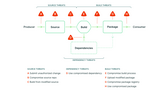
Lastly, it was observed that there was a concise and diagrammatic overview of supply chain threats on the SLSA website.

Two new academic papers Two new scholarly papers were published this month. Firstly, Mathieu Acher, Beno t Combemale, Georges Aaron Randrianaina and Jean-Marc J z quel of University of Rennes on Embracing Deep Variability For Reproducibility & Replicability. The authors describe their approach as follows:
In this short [vision] paper we delve into the application of software engineering techniques, specifically variability management, to systematically identify and explicit points of variability that may give rise to reproducibility issues (e.g., language, libraries, compiler, virtual machine, OS, environment variables, etc.). The primary objectives are: i) gaining insights into the variability layers and their possible interactions, ii) capturing and documenting configurations for the sake of reproducibility, and iii) exploring diverse configurations to replicate, and hence validate and ensure the robustness of results. By adopting these methodologies, we aim to address the complexities associated with reproducibility and replicability in modern software systems and environments, facilitating a more comprehensive and nuanced perspective on these critical aspects.
(A PDF of this article is available.)
Secondly, Ludovic Court s, Timothy Sample, Simon Tournier and Stefano Zacchiroli have collaborated to publish a paper on Source Code Archiving to the Rescue of Reproducible Deployment. Their paper was motivated because:
The ability to verify research results and to experiment with methodologies are core tenets of science. As research results are increasingly the outcome of computational processes, software plays a central role. GNU Guix is a software deployment tool that supports reproducible software deployment, making it a foundation for computational research workflows. To achieve reproducibility, we must first ensure the source code of software packages Guix deploys remains available.
(A PDF of this article is also available.)

diffoscope diffoscope is our in-depth and content-aware diff utility that can locate and diagnose reproducibility issues. This month, Chris Lamb made a number of changes such as uploading versions 266, 267, 268 and 269 to Debian, making the following changes:
  • New features:
    • Use xz --list to supplement output when comparing .xz archives; essential when metadata differs. (#1069329)
    • Include xz --verbose --verbose (ie. double) output. (#1069329)
    • Strip the first line from the xz --list output. [ ]
    • Only include xz --list --verbose output if the xz has no other differences. [ ]
    • Actually append the xz --list after the container differences, as it simplifies a lot. [ ]
  • Testing improvements:
    • Allow Debian testing to fail right now. [ ]
    • Drop apktool from Build-Depends; we can still test APK functionality via autopkgtests. (#1071410)
    • Add a versioned dependency for at least version 5.4.5 for the xz tests as they fail under (at least) version 5.2.8. (#374)
    • Fix tests for 7zip 24.05. [ ][ ]
    • Fix all tests after additon of xz --list. [ ][ ]
  • Misc:
    • Update copyright years. [ ]
In addition, James Addison fixed an issue where the HTML output showed only the first difference in a file, while the text output shows all differences [ ][ ][ ], Sergei Trofimovich amended the 7zip version test for older 7z versions that include the string [64] [ ][ ] and Vagrant Cascadian relaxed the versioned dependency to allow version 5.4.1 for the xz tests [ ] and proposed updates to guix for versions 267, 268 and pushed version 269 to Guix. Furthermore, Eli Schwartz updated the diffoscope.org website in order to explain how to install diffoscope on Gentoo [ ].

Website updates There were a number of improvements made to our website this month, including Chris Lamb making the print CSS stylesheet nicer [ ]. Fay Stegerman made a number of updates to the page about the SOURCE_DATE_EPOCH environment variable [ ][ ][ ] and Holger Levsen added some of their presentations to the Resources page. Furthermore, IOhannes zm lnig stipulated support for SOURCE_DATE_EPOCH in clang version 16.0.0+ [ ], Jan Zerebecki expanded the Formal definition page and fixed a number of typos on the Buy-in page [ ] and Simon Josefsson fixed the link to Trisquel GNU/Linux on the Projects page [ ].

Upstream patches This month, we wrote a number of patches to fix specific reproducibility issues, including:

Reproducibility testing framework The Reproducible Builds project operates a comprehensive testing framework running primarily at tests.reproducible-builds.org in order to check packages and other artifacts for reproducibility. In May, a number of changes were made by Holger Levsen:
  • Debian-related changes:
    • Enable the rebuilder-snapshot API on osuosl4. [ ]
    • Schedule the i386 architecture a bit more often. [ ]
    • Adapt cleanup_nodes.sh to the new way of running our build services. [ ]
    • Add 8 more workers for the i386 architecture. [ ]
    • Update configuration now that the infom07 and infom08 nodes have been reinstalled as real i386 systems. [ ]
    • Make diffoscope timeouts more visible on the #debian-reproducible-changes IRC channel. [ ]
    • Mark the cbxi4a-armhf node as down. [ ][ ]
    • Only install the hdmi2usb-mode-switch package only on Debian bookworm and earlier [ ] and only install the haskell-platform package on Debian bullseye [ ].
  • Misc:
    • Install the ntpdate utility as we need it later. [ ]
    • Document the progress on the i386 architecture nodes at Infomaniak. [ ]
    • Drop an outdated and unnoticed notice. [ ]
    • Add live_setup_schroot to the list of so-called zombie jobs. [ ]
In addition, Mattia Rizzolo reinstalled the infom07 and infom08 nodes [ ] and Vagrant Cascadian marked the cbxi4a node as online [ ].

If you are interested in contributing to the Reproducible Builds project, please visit our Contribute page on our website. However, you can get in touch with us via:

5 June 2024

Scarlett Gately Moore: Kubuntu, KDE, Debian: I am still here, in loving memory of my brother.

I am still here, busy as ever, I just haven t found the inspiration to blog. So soon after the loss of my son, I have lost my only brother a couple weeks ago. It has been a tough year for our family. Thank you everyone for you love and support during this difficult time. I will do my best in re-capping my work, there has been quite a bit as I am keeping busy with work so I don t dwell to much on the sadness. KDE Snaps: Trying to debug the unable to save files breakage in the latest Krita builds without luck. KisOpenGLCanvas
Renderer::reportFailedShaderCompilation\[0m: Shad
er Compilation Failure: "Failed to add vertex sh
ader source from file: matrix_transform.vert - Ca
use: "
I have implemented everything from https://snapcraft.io/docs/gpu-support , it has worked for years and now suddenly it just stopped. I have had to put it on hold for now, it is unpaid work and I simply don t have time. With the help of my GSOC student we are improving the Qt6 snap MR: https://invent.kde.org/neon/snap-packaging/kde-qt6-core-sdk/-/merge_requests/3 and many improvements on top of that. This exposed many issues with the kf6 snap and the linking to static libs. Those are being worked on now. Updated qt to 6.7.1 Qt6 apps in the works: okular, ark, gwenview, kwrited, elisa Kubuntu: So many SRu s for the Noble release, I will probably miss a few. https://bugs.launchpad.net/ubuntu/+source/ark/+bug/2068491 Ark cannot open 7-zip files. Sadly the patches were for qt6, waiting for a qt5 port upstream. https://bugs.launchpad.net/ubuntu/noble/+source/merkuro/+bug/2065063 Crash due to missing qml. Fix is in git, no upload rights. Requested sponsor. https://bugs.launchpad.net/ubuntu/+source/tellico/+bug/2065915 Several applications no longer work on architectures that are not amd64 due to hard coded paths. All fixed in git. Several uploaded to oracular, several sponsorship has been requested. Noble updates rejected despite SRU, going to retry. https://bugs.launchpad.net/ubuntu/+source/sddm/+bug/2066275 The dreaded black screen on second boot bug is fixed in git and oracular. Noble was rejected despite the SRU. Will retry. https://bugs.launchpad.net/ubuntu/+source/kubuntu-meta/+bug/2066028 Broken systray submenus. Fixed in git and oracular. Noble rejected despite SRU. Will retry. https://bugs.launchpad.net/ubuntu/+source/plasma-workspace/+bug/2067747 Long standing bug with plasma not loading with lightdm. Fixed in git and oracular. Noble rejected will retry. https://bugs.launchpad.net/ubuntu/+source/plasma-workspace/+bug/2067742 CVE-2024-36041Fixed in git and oracular, noble rejected, will retry. And many more I am applying for MOTU in hopes it will reduce all of my uploading issues. https://wiki.ubuntu.com/scarlettmoore/MOTUApplication Debian: kf6-knotifications and kapidox. Will jump into Plasma 6 next week ! Misc: Went to LinuxFest Northwest with Valorie! We had a great time and it was a huge success, we had many people stop by our booth.
As usual, if you like my work and want to see Plasma 6 in Kubuntu it all depends on you! Kubuntu will be out of funds soon and needs donations! Thank you for your consideration. https://kubuntu.org/donate/ Personal: Support for my grandson: https://www.gofundme.com/f/in-loving-memory-of-william-billy-dean-scalf

1 June 2024

Ian Jackson: What your vote is worth - a back of the envelope calculation

tl;dr: Your vote really counts! Each vote in a UK General Election is worth maybe 100,000 - to you and all your fellow citizens taken together. If you really care about the welfare of everyone affected by actions of the UK government, then it s worth that to you too. Introduction It seems a common perception that one vote, in amongst all those millions, doesn t really matter. So maybe it s not worth voting. But, voting is (largely) what determines what the government does - and the government is big. It s as big as all the people. If you are the kind of person who cares about what happens to everyone in your polity and indeed everyone its actions affect, then even your one vote is very important indeed. A method for back of the envelope calculation It would be nice to give a quantitative estimate. Many things in our society are measured in money, so let s try taking a stab at calculating the money value of your vote. The argument I m going to make is this: the government (by which I include the legislature), which is selected by our votes, decides how to spend the national budget. So, basically, I m going to divide the budget, by the electorate. UK Parliament UK Parliamentary elections decide not only the House of Commons, but, through that, the government. The upper house, the House of Lords, has very limited influence. So I think it s fair to regard the Parliamentary election as, simply, controlling that budget. Being lazy, I m going to use Wikipedia data. We have the size of the electorate, for 2019, 47.6 million. But your influence isn t shared with the whole electorate, only with the other people who also vote. Turnout in 2019 was 67.3%. The 2019 budget isn t listed but I ll just average the 2018 and March 2020 figures 842bn and 873bn, so 857 billion. (Strictly speaking I should add up the budgets for the period of the Parliament, but that seems like a lot of effort.) There s a discrepancy in the timescale we need to account for. Your vote influences the budgets for several years, depending how long it is until the next election. Taking Wikipedia s list of elections this century there ve been 7 in 24 years. So that s an average of about 3.4y. So, multiplying it through, we have ( 857b * (24 / 7)) / (47.6M * 67.3%), giving a guess at the value of your UK General Election vote: 92,000. European Parliament 2022 budget for the European Union (Wikipedia again) was 170.6 bn. The last election, in 2019, had a turnout of 198,352,638. Each EU Parliament lasts 5 years. The Parliament, however, shares responsibility for the budget with the European Council, which is controlled, ultimately, by national governments. We have to pick a numerical value for the Parliament s share of the influence. Over the past years the Parliament has gradually been more willing to exercise its powers in this area. I m going to arbitrarily call its share 50%. The calculation, then, is 170.6 bn * 5 * 50% / 198M, giving a guess at the value of your EU Parliamentary Election vote: 2150. This much smaller figure reflects simply that the EU doesn t spend very much money, for a polity of its size. (Those stories in the British press giving the impression that the EU is massively wasteful are, simply, lies.) The interaction of this calculation with the Council s share of the influence, and with national budgets, is a bit of a question, but given the much smaller amounts involved, it doesn t seem worth thinking about that too hard. Only if you care about other people as much as yourself! All of this is only true for you if you value and want to help everyone in your society. That includes immigrants, women, unemployed people, disabled people, people who are much poorer or richer than you, etc. If you think about it in purely personal terms, your vote is hardly worth anything - because while the effect of your vote, overall, is very large, that effect is shared by everyone in your polity. So if you only care about yourself, voting is a total waste of time. The more selfish and xenophobic and racist and so on you are - caring only about people like yourself - the less your vote is worth. This is why voting is rightly seen as a civic duty. I just spent 30 to courier my EP vote to Den Haag. That only makes sense because I m very willing to spend that 30 to try to improve the spending of the 2000 or so that s my share of the EU budget. This is a very rough analysis These calculations neglect a lot of very important things: politics isn t just about the allocation of resources. It s also about values, and bad politics can seriously harm people. Arguably many of those effects of your vote, are much more important than just how the budget is set and spent. It would be interesting to see an attempt at a similar analysis but for taking into account life and death questions like hate crime, traffic violence, healthcare, refugees welfare, and so on. I m not sure how to approach that. Maybe some real social scientists have done so? References welcome. Also, even on its own terms, this analysis is very rough and ready. We haven t modelled the ability of the government to change its tax rates; perhaps we should be multiplying GDP (or some other better measure) by 90% percentile total tax rate amongst countries like this one . The amount of influence that can be wielded by one vote is probably nonlinear in the size of the political faction, but IDK in which direction. In unfair voting systems like the UK s, some people s votes are worth much more than others. In a very marginal constituency, which is a target seat, your vote might be worth tens of millions. In a safe seat, it might only be worth a few thousand. And in practical terms you don t get to choose precisely the policies you want; you have to pick a party, which is sometimes very much a question of the lesser evil. So, there is much I haven t modelled. But the key point stands: Conclusion Although your vote is diluted by everyone else s votes, together, we control the government, which affects us all. So if you care about the whole of society, the big numbers in the divisor, and the numerator, cancel out. You can think of your vote as controlling one citizen s worth of government activity.
edited 2024-06-01 09:40 Z to fix a grammar botch


comment count unavailable comments

Russ Allbery: Review: I Shall Wear Midnight

Review: I Shall Wear Midnight, by Terry Pratchett
Series: Discworld #38
Publisher: Harper
Copyright: 2010
Printing: 2011
ISBN: 0-06-143306-3
Format: Trade paperback
Pages: 355
I Shall Wear Midnight is the 38th Discworld novel and the 4th Tiffany Aching novel. This is not a good place to start reading. Tiffany has finished her training and has returned to her home on the Chalk, taking up her duties as the local witch. There are a lot of those, because there's a lot that needs doing. In some cases, such as taking away the pain of the old Duke, they involve things that require magic and that only Tiffany can do. In many other cases, other people could pick up some of the work, but they lack Tiffany's sense of duty and willingness to pay attention. The people of the Chalk have always been a bit suspicious of witches, in part because the job was done for so long by Tiffany's grandmother and no one thought she was a witch. (She was a witch.) Of late, however, that suspicion seems to be getting worse. It comes to a head when Tiffany is accused of theft and worse by the old Duke's maid, a woman with very fixed ideas about the evils of witches. Tiffany has to sort out what's going on and clear herself, all while navigating her now-awkward relationship with the Duke's son Roland, his unimpressive fiancee, and his spectacularly annoying aunt. Ah, this is the stuff. This is exactly the Tiffany Aching novel that I have been hoping Pratchett would write. It's pure, snarky competence porn from start to finish.
"I'm a witch. It's what we do. When it's nobody else's business, it's my business."
One of the things that I adore about this series is how well Pratchett shows the different ways in which one can be a witch. Granny Weatherwax out-thinks everyone and nudges (or shoves) people in the right direction, but her natural tendency is to be icy and a bit frightening. Nanny Ogg is that person you can't help but talk to, who may seem happy-go-lucky and hedonistic but who can effortlessly change the mood of a room. And Tiffany is stubborn duty and blunt practicality, which fits the daughter of shepherds. In previous books, we've watched Tiffany as a student, learning the practicalities of being a witch. This is the book where she realizes how much she knows and how much easier the world is to navigate when she's in her own territory. There is a wonderful scene, late in this book, where Pratchett shows Nanny Ogg at her best, doing the kinds of things that only Nanny Ogg can do. Both Tiffany and the reader are in awe.
I should have learned this, she thought. I wanted to learn fire, and pain, but I should have learned people.
And it's true that Nanny Ogg can do things that Tiffany can't. But what makes this book so great is that it shows how Tiffany's personality and her training come together with her knowledge of the Chalk. She may not know people, in general, but she knows her neighbors and how they think. She doesn't manage them the way that Nanny Ogg would; she's better at solving different kinds of problems, in different ways. But they're the right ways, and the right problems, for her home. This is another Discworld novel with a forgettable villain that's more of a malevolent force of nature than a character in its own right. It's also another Discworld novel where Pratchett externalizes a human tendency into a malevolent force that can possess people. I have mixed feelings about this narrative approach. That externalization of evil into (in essence) demons has been repeatedly used to squirm out of responsibility and excuse atrocities, and it neatly avoids having to wrestle with the hard questions of prejudice and injustice and why apparently good people do awful things. I think some of those weaknesses persist even in Pratchett's hands, but I think what he was attempting with that approach in this book is to show how almost no one is immune to nastier ideas that spread through society. Rather than using the externalization of evil as an excuse, he's using it as a warning. With enough exposure to those ideas, they start sounding tempting and partly credible even to people who would never have embraced them earlier. Pratchett also does a good job capturing the way prejudice can start from thoughtless actions that have more to do with the specific circumstances of someone's life than any coherent strategy. Still, the one major complaint I have about this book is that the externalization of evil is an inaccurate portrayal of the world, and this catches up with Pratchett at the ending. Postulating an external malevolent force reduces evil to something that can be puzzled out and decisively defeated, thus resolving the problem. Sadly, this is not how humans actually work. I'll forgive that structural flaw, though, because the rest of this book is so good. It's rare that a plot twist in a Discworld novel surprises me twisty plots are not Pratchett's strength but this one did. I will not spoil the surprise, but one of the characters is not quite who they seem to be, and Tiffany's reactions once she figures that out are one of my favorite parts of this book. Pratchett is making a point about assumptions, observation, and the importance of being willing to change one's mind about someone when you know more, and I thought it was very well done. But, most of all, I enjoyed reading about Tiffany being calm, competent, determined, and capable. There's also a bit of an unexpected romance plot that's one of my favorite types: the person who notices that you're doing a lot of work and quietly steps in and starts helping while paying attention to what's needed and not taking over. And it's full of the sort of pithy moral wisdom that makes Discworld such a delight to read.
"There have been times, lately, when I dearly wished that I could change the past. Well, I can't, but I can change the present, so that when it becomes the past it will turn out to be a past worth having."
This was just what I wanted. Highly recommended. Followed by Snuff in publication order. The next (and last, sadly) Tiffany Aching book is The Shepherd's Crown. Rating: 9 out of 10

20 May 2024

Russell Coker: Respect and Children

I attended the school Yarra Valley Grammer (then Yarra Valley Anglican School which I will refer to as YV ) and completed year 12 in 1990. The school is currently in the news for a spreadsheet some boys made rating girls where unrapeable was one of the ratings. The school s PR team are now making claims like Respect for each other is in the DNA of this school . I d like to know when this DNA change allegedly occurred because respect definitely wasn t in the school DNA in 1990! Before I go any further I have to note that if the school threatens legal action against me for this post it will be clear evidence that they don t believe in respect. The actions of that school have wronged me, several of my friends, many people who aren t friends but who I wish they hadn t had to suffer and I hadn t had to witness it, and presumably countless others that I didn t witness. If they have any decency they would not consider legal action but I have learned that as an institution they have no decency so I have to note that they should read the Wikipedia page about the Streisand Effect [1] and keep it in mind before deciding on a course of action. I think it is possible to create a school where most kids enjoy being there and enjoy learning, where hardly any students find it a negative experience and almost no-one finds it traumatic. But it is not possible to do that with the way schools tend to be run. When I was at high school there was a general culture that minor sex crimes committed by boys against boys weren t a problem, this probably applied to all high schools. Things like ripping a boy s pants off (known as dakking ) were considered a big joke. If you accept that ripping the pants off an unwilling boy is a good thing (as was the case when I was at school) then that leads to thinking that describing girls as unrapeable is acceptable. The Wikipedia page for Pantsing [2] has a reference for this issue being raised as a serious problem by the British Secretary of State for Education and Skills Alan Johnson in 2007. So this has continued to be a widespread problem around the world. Has YV become better than other schools in dealing with it or is Dakking and Wedgies as well accepted now as it was when I attended? There is talk about schools preparing kids for the workforce, but grabbing someone s underpants without consent will result in instant dismissal from almost all employment. There should be more tolerance for making mistakes at school than at work, but they shouldn t tolerate what would be serious crimes in other contexts. For work environments there have been significant changes to what is accepted, so it doesn t seem unreasonable to expect that schools can have a similar change in culture. One would hope that spending 6 years wondering who s going to grab your underpants next would teach boys the importance of consent and some sympathy for victims of other forms of sexual assault. But that doesn t seem to happen, apparently it s often the opposite. When I was young Autism wasn t diagnosed for anyone who was capable of having a normal life. Teachers noticed that I wasn t like other kids, some were nice, but some encouraged other boys to attack me as a form of corporal punishment by proxy not a punishment for doing anything wrong (detentions were adequate for that) but for being different. The lesson kids will take from that sort of thing is that if you are in a position of power you can mistreat other people and get away with it. There was a girl in my year level at YV who would probably be diagnosed as Autistic by today s standards, the way I witnessed her being treated was considerably worse than what was described in the recent news reports but it is quite likely that worse things have been done recently which haven t made the news yet. If this issue is declared to be over after 4 boys were expelled then I ll count that as evidence of a cover-up. These things don t happen in a vacuum, there s a culture that permits and encourages it. The word respect has different meanings, it can mean treat a superior as the master or treat someone as a human being . The phrase if you treat me with respect I ll treat you with respect usually means if you treat me as the boss then I ll treat you as a human being . The distinction is very important when discussing respect in schools. If teachers are considered the ultimate bosses whose behaviour can never be questioned then many boys won t need much help from Andrew Tate in developing the belief that they should be the boss of girls in the same way. Do any schools have a process for having students review teachers? Does YV have an ombudsman to take reports of misbehaving teachers in the way that corporations typically have an ombudsman to take reports about bad managers? Any time you have people whose behaviour is beyond scrutiny or oversight you will inevitably have bad people apply for jobs, then bad things will happen and it will create a culture of bad behaviour. If teachers can treat kids badly then kids will treat other kids badly, and this generally ends with girls being treated badly by boys. My experience at YV was that kids barely had the status of people. It seemed that the school operated more as a caretaker of the property of parents than as an organisation that cares for people. The current YV website has a Whistleblower policy [3] that has only one occurrence of the word student and that is about issues that endanger the health or safety of students. Students are the people most vulnerable to reprisal for complaining and not being listed as an eligible whistleblower shows their status. The web site also has a flowchart for complaints and grievances [4] which doesn t describe any policy for a complaint to be initiated by a student. One would hope that parents would advocate for their children but that often isn t the case. When discussing the possibility of boys being bullied at school with parents I ve had them say things like my son wouldn t be so weak that he would be bullied , no boy will tell his parents about being bullied if that s their attitude! I imagine that there are similar but different issues of parents victim-blaming when their daughter is bullied (presumably substituting immoral for weak) but don t have direct knowledge of the topic. The experience of many kids is being disrespected by their parents, the school system, and often siblings too. A school can t solve all the world s problems but can ideally be a refuge for kids who have problems at home. When I was at school the culture in the country and the school was homophobic. One teacher when discussing issues such as how students could tell him if they had psychological problems and no-one else to talk to said some things like the Village People make really good music which was the only time any teacher said anything like It s OK to be gay (the Village People were the gayest pop group at the time). A lot of the bullying at school had a sexual component to it. In addition to the wedgies and dakking (which while not happening often was something you had to constantly be aware of) I routinely avoided PE classes where a shower was necessary because of a thug who hung around by the showers and looked hungrily at my penis, I don t know if he had a particular liking to mine or if he stared at everyone that way. Flashing and perving was quite common in change rooms. Presumably as such boy-boy sexual misbehaviour was so accepted that led to boys mistreating girls. I currently work for a company that is active in telling it s employees about the possibility of free psychological assistance. Any employee can phone a psychologist to discuss problems (whether or not they are work related) free of charge and without their manager or colleagues knowing. The company is billed and is only given a breakdown of the number of people who used the service and roughly what the issue was (work stress, family, friends, grief, etc). When something noteworthy happens employees are given reminders about this such as if you need help after seeing a homeless man try to steal a laptop from the office then feel free to call the assistance program . Do schools offer something similar? With the school fees paid to a school like YV they should be able to afford plenty of psychologist time. Every day I was at YV I saw something considerably worse than laptop theft, most days something was done to me. The problems with schools are part of larger problems with society. About half of the adults in Australia still support the Liberal party in spite of their support of Christian Porter, Cardinal Pell, and Bruce Lehrmann. It s not logical to expect such parents to discourage their sons from mistreating girls or to encourage their daughters to complain when they are mistreated. The Anglican church has recently changed it s policy to suggesting that victims of sexual abuse can contact the police instead of or in addition to the church, previously they had encouraged victims to only contact the church which facilitated cover-ups. One would hope that schools associated with the Anglican church have also changed their practices towards such things. I approve of the respect is in our DNA concept, it s like Google s former slogan of Don t be evil which is something that they can be bound to. Here s a list of questions that could be asked of schools (not just YV but all schools) by journalists when reporting on such things:
  1. Do you have a policy of not trying to silence past students who have been treated badly?
  2. Do you take all sexual assaults seriously including wedgies and dakking?
  3. Do you take all violence at school seriously? Even if there s no blood? Even if the victim says they don t want to make an issue of it?
  4. What are your procedures to deal with misbehaviour from teachers? Do the students all know how to file complaints? Do they know that they can file a complaint if they aren t the victim?
  5. Does the school have policies against homophobia and transphobia and are they enforced?
  6. Does the school offer free psychological assistance to students and staff who need it? NB This only applies to private schools like YV that have huge amounts of money, public schools can t afford that.
  7. Are serious incidents investigated by people who are independent of the school and who don t have a vested interest in keeping things quiet?
  8. Do you encourage students to seek external help from organisations like the ones on the resources list of the Grace Tame Foundation [5]? Having your own list of recommended external organisations would be good too.
Counter Arguments I ve had practice debating such things, here s some responses to common counter arguments. Conclusion I don t think that YV is necessarily worse than other schools, although I m sure that representatives of other private schools are now working to assure parents of students and prospective students that they are. I don t think that all the people who were employed as teachers there when I attended were bad people, some of them were nice people who were competent teachers. But a few good people can t turn around a bad system. I will note that when I attended all the sports teachers were decent people, it was the only department I could say such things about. But sports involves situations that can lead to a bad result, issues started at other times and places can lead to violence or harassment in PE classes regardless of how good the teachers are. Teachers who know that there are problems need to be able to raise issues with the administration. When a teacher quits teaching to join the clergy and another teacher describes it as a loss for the clergy but a gain for YV it raises the question of why the bad teacher in question couldn t have been encouraged to leave earlier. A significant portion of the population will do whatever is permitted. If you say no teacher would ever bully a student so we don t need to look out for that then some teacher will do exactly that. I hope that this will lead to changes both in YV and in other schools. But if they declare this issue as resolved after expelling 4 students then something similar or worse will happen again. At least now students know that when this sort of thing happens they can send evidence to journalists to get some action.

16 May 2024

John Goerzen: Review of Reputable, Functional, and Secure Email Service

I last reviewed email services in 2019. That review focused a lot of attention on privacy. At the time, I selected mailbox.org as my provider, and have been using them for these 5 years since. However, both their service and their support have gone significantly downhill since, so it is time for me to look at other options. Here I am focusing strongly on email. Some of the providers mentioned here provide other services (IM, video calls, groupware, etc.), and to the extent they do, I am ignoring them.

What Matters in 2024
I want to start off by acknowledging that what you need in email probably depends on your circumstances and the country in which you live. For me, I begin by naming that the largest threat most of us face isn t from state actors but from criminals: hackers, ransomware gangs, etc. It is important to take as many steps as possible to secure one s account against that. Privacy and security are both part of the mix. I still value privacy but I am acknowledging, as Migadu does, that Email as we know it and encryption are incompatible. Although some of these services strongly protect parts of the conversation, the reality is that most people will be emailing people using plain old email services which don t. For stronger security, something like Signal would be needed. (I wrote about Signal in 2021 also.) Interestingly, OpenPGP support seems to be something of a standard feature in the providers I reviewed by this point. All or almost all of them provide integration with browser-based encryption as well as server-side encryption if you prefer that. Although mailbox.org can automatically PGP-encrypt every message that arrives in plaintext, for general use, this is unwieldy; there isn t good tooling for searching mailboxes where every message is encrypted, etc. So I never enabled that feature at Mailbox. I still value security and privacy, but a pragmatic approach addresses the most pressing threats first.

My criteria
The basic requirements for an email service include:
  1. Ability to use my own domains
  2. Strong privacy policy
  3. Ability for me to use my own IMAP and SMTP clients on both desktop and mobile
  4. It must be extremely reliable
  5. It must not be free
  6. It must have excellent support for those rare occasions when it is needed
  7. Support for basic aliases
Why do I say it must not be free? Because if someone is providing a service with the quality I m talking about here, and not charging for it, it implies something is fishy: either they are unscrupulous, are financially unstable, or the product is something else like ads. I am not aware of any provider that matches the other criteria with a free account anyhow. These providers range from about $30 to $90 per year, so cheaper than a Netflix subscription. Immediately, this rules out several options:
  • Proton doesn t let me use my own clients on mobile (their bridge is desktop-only)
  • Tuta also doesn t let me use my own clients
  • Posteo doesn t let me use my own domain
  • mxroute.com lacks a strong privacy policy, and its policy has numerous causes for concern (for instance, If you repeatedly send email to invalid/unroutable recipients, they may be published on our GitHub )
I will have a bit more to say about a couple of these providers below. There are some additional criteria that are strongly desired but not absolutely required:
  1. Ability to set individual access passwords for every device/app
  2. Support for two-factor authentication (2FA/TFA/TOTP) for web-based access
  3. Support for basics in filtering: ability to filter on envelope recipient (so if I get BCC d, I can still filter), and ability to execute more than one action on filter match (eg, deliver to two folders, or deliver to a folder and forward to someone else)
IMAP and SMTP don t really support 2FA, so by setting individual passwords for every device, you can at least limit the blast radius and cut off a specific device if something is (or might be) compromised.

The candidates
I considered these providers: Startmail, Mailfence, Runbox, Fastmail, Kolab, Mailbox.org, and Migadu. I ll review each, and highlight the pricing of the plan I would most likely use. Each provider offers multiple plans; some may be more expensive and some may be cheaper than the one I reviewed. I included a link to each provider s full pricing information so you can compare for your needs. I set up trials with each of these (except Mailbox.org, with which I already had a paid account). It so happend that I had actual questions for support for each one, which gave me an opportunity to see how support responded. I did not fabricate questions, and would not have contacted support if I didn t have real ones. (This means that I asked different questions of each provider, because they were the REAL questions I had.) I ll jump to the spoiler right now: I eventually chose Migadu, with Fastmail and Mailfence as close seconds. I looked for providers myself, and also solicited recommendations in a Mastodon thread.

Mailbox.org
I begin with Mailbox, as it was my top choice in 2019 and the incumbent. Until this year, I had been quite happy with it. I had cause to reach their support less than once a year on average, and each time they replied the same day or next day. Now, however, they are failing on reliability and on support. Their spam filter has become overly aggressive. It has blocked quite a bit of legitimate mail. When contacting their support about a prior issue earlier this year, they initially took 4 days to reply, and then 6 days to reply after that. Ouch. They had me disable some spam settings. It didn t really help. I continue to lose mail. I don t know how much, because they block a lot of it before it even hits the spam folder. One of my friends texted to say mail was dropping. I raised a new ticket with mailbox, which took them 5 days to reply to. Their reply was unhelpful. As the Internet is not a static system, unforeseen events can always occur. Well yes, that s true, and I get it, false positives exist with email. But this was from an ISP s mail system with an address that had been established for years, and it was part of a larger pattern of rejecting quite a bit of legit mail. And every interaction with them recently hasn t resulted in them actually doing anything to resolve anything. It s just a paragraph or two of reply that does nothing and helps nothing. When I complained that it took 5 days to reply, they said We have not been able to reply sooner as we are currently experiencing a high volume of customer enquiries. Even though their SLA for my account is a not-great 48 business hour turnaround, they still missed it and their reason is we re busy. I finally asked what RBL had caught the blocked email, since when I checked, the sender wasn t on any RBL. Mailbox s reply: they only keep their logs for 7 days, so next time I should contact them within 7 days. Which, of course, I DID; it was them that kept delaying. Ugh! It s like they ve become a cable company. Even worse is how they have been blocking mail from GrapheneOS s discussion form. See their thread about it. In short, Graphene s mail server has a clean reputation and Mailbox has no problem with it. But because one of Graphene s IPv6 webservers has an IPv6 allocation of a size Mailbox doesn t like, they drop mail. It s ridiculous, and Mailbox was dismissive of this well-known and well-regarded Open Source project. So if the likes of GrapheneOS can t get good faith effort to deliver their mail, what chance does an individual like me have? I m sorry, but I m literally paying you to deliver email for me and provide good support. If you can t do either of those, you don t get to push that problem down onto me. Hire appropriate staff. On the technical side, they support aliases, my own clients, and have a reasonable privacy policy. Their 2FA support exists for the web interface (though weirdly not the support site), though it is somewhat weird. They do not support app passwords. A somewhat unique feature is the @secure.mailbox.org domain. If you try to receive mail at that address, mailbox.org will block it unless it uses TLS. Same for sending. This isn t E2EE, but it does at least require things not be in plaintext for the last hop to Mailbox. Verdict: not recommended due to poor reliability and support. Mailbox.Org summary:
  • Website: https://mailbox.org/en/
  • Reliability: iffy due to over-aggressive spam filtering
  • Support: Poor; takes 4-6 days for a reply and replies are unhelpful
  • Individual access passwords: No
  • 2FA: Yes, but with a PIN instead of a password as the other factor
  • Filtering: Full SIEVE feature set and GUI editor
  • Spam settings: greylisting on/off, reject some/all spam, etc. But they re insufficient to address Mailbox s overzealousness, which support says I cannot workaround within the interface.
  • Server storage location: Germany
  • Plan as reviewed: standard [pricing link]
    • Cost per year: EUR 30 (about $33)
    • Mail storage included: 10GB
    • Limits on send/receive volume: none
    • Aliases: 50 on your domain name, 25 on mailbox.org
    • Additional mailboxes: Available; each one at the same fee as the primary mailbox

Startmail
I really wanted to like Startmail. Its vault is an interesting idea and should contribute to the security and privacy of an account. They clearly care about privacy. It falls down in filtering. They have no way to filter on envelope recipient (BCC or similar). Their support confirmed this to me and that s a showstopper. Startmail support was also as slow as Mailbox, taking 5 days to respond to me. Two showstoppers right there. Verdict: Not recommended due to slow support responsiveness and weak filtering. Startmail summary:
  • Website: https://www.startmail.com/
  • Reliability: Seems to be fine
  • Support: Mediocre; Took 5 days for a reply, but the reply was helpful
  • Individual app access passwords: Yes
  • 2FA: Yes
  • Filtering: Poor; cannot filter on envelope recipient, and can t build filters with multiple actions
  • Spam settings: None
  • Server storage location: The Netherlands
  • Plan as reviewed: Custom domain (trial was Personal), [pricing link]
    • Cost per year: $70
    • Mail storage included: 20GB
    • Limits on send/receive volume: none
    • Aliases: unlimited, with lots of features: can set expiration, etc.
    • Additional mailboxes: not available

Kolab
Kolab Now is mainly positioned as a full groupware service, but they do have a email-only option which I investigated. There isn t much documentation about it compared to other providers, and also not much in the way of settings. You can turn greylisting on or off. And . that s it. It has a full suite of filtering options. They set an X-Envelope-To header which you can use with the arbitrary header match to do the right thing even for BCC situations. Filters can have multiple conditions and multiple actions. It is SIEVE-based and you can download your SIEVE definitions. If you enable 2FA, you disable IMAP and SMTP; not great. Verdict: Not an impressive enough email featureset to justify going with it. Kolab Now summary:
  • Website: https://kolabnow.com/
  • Reliability: Seems to be fine
  • Support: Fine responsiveness (next day)
  • Invidiaul app passwords: no
  • 2FA: Yes, but if you enable it, they disable IMAP and SMTP
  • Filtering: Excellent
  • Spam settings: Only greylisting on/off
  • Server storage location: Switzerland; they have lots of details on their setup
  • Plan as reviewed: Just email [pricing link]
    • Cost per year: CHF 60, about $66
    • Mail storage included: 5GB
    • Limitations on send/receive volume: None
    • Aliases: Yes. Not sure if there are limits.
    • Additional mailboxes: Yes if you set up a group account. Flexible pricing based on user count is not documented anywhere I could find.

Mailfence
Mailfence is another option, somewhat similar to Startmail but without the unique vault. I had some questions about filters, and support was quite responsive, responding in a couple of hours. Some of their copy on their website is a bit misleading, but support clarified when I asked them. They do not offer encryption at rest (like most of the entries here). Mailfence s filtering system is the kind I d like to see. It allows multiple conditions and multiple actions for each rule, and has some unique actions as well (notify by SMS or XMPP). Support says that Recipients matches envelope recipients. However, one ommission is that I can t match on arbitrary headers; only the canned list of headers they provide. They have only two spam settings:
  • spam filter on/off
  • whitelist
Given some recent complaints about their spam filter being overly aggressive, I find this lack of control somewhat concerning. (However, I discount complaints about people begging for more features in free accounts; free won t provide the kind of service I m looking for with any provider.) There are generally just very few settings for email as well. Verdict: Response and helpful support, filtering has the right structure but lacks arbitrary header match. Could be a good option. Mailfence summary:
  • Website: https://mailfence.com/
  • Reliability: Seems to be fine
  • Support: Excellent responsiveness and helpful replies (after some initial confusion about my question of greylisting)
  • Individual app access passwords: No. You can set a per-service password (eg, an IMAP password), but those will be shared with all devices speaking that protocol.
  • 2FA: Yes
  • Filtering: Good; only misses the ability to filter on arbitrary headers
  • Spam settings: Very few
  • Server storage location: Belgium
  • Plan as reviewed: Entry [pricing link]
    • Cost per year: $42
    • Mail storage included: 10GB, with a maximum of 50,000 messages
    • Limits on send/receive volume: none
    • Aliases: 50. Aliases can t be deleted once created (there may be an exeption to this for aliases on your own domain rather than mailfence.com)
    • Additional mailboxes: Their page on this is a bit confusing, and the pricing page lacks the information promised. It looks like you can pay the same $42/year for additional mailboxes, with a limit of up to 2 additional paid mailboxes and 2 additional free mailboxes tied to the account.

Runbox
This one came recommended in a Mastodon thread. I had some questions about it, and support response was fantastic I heard from two people that were co-founders of the company! Even within hours, on a weekend. Incredible! This kind of response was only surpassed by Migadu. I initially wrote to Runbox with questions about the incoming and outgoing message limits, which I hadn t seen elsewhere, as well as the bandwidth limit. They said the bandwidth limit is no longer enforced on paid accounts. The incoming and outgoing limits are enforced, and all email (even spam) counts towards the limit. Notably the outgoing limit is per recipient, so if you send 10 messages to your 50-recipient family group, that s the limit. However, they also indicated a willingness to reset the limit if something happens. Unfortunately, hitting the limit results in a hard bounce (SMTP 5xx) rather than a temporary failure (SMTP 4xx) so it can result in lost mail. This means I d be worried about some attack or other weirdness causing me to lose mail. Their filter is a pain point. Here are the challenges:
  • You can t directly match on a BCC recipient. Support advised to use a headers match, which will search for something anywhere in the headers. This works and is probably good enough since this data is in the Received: headers, but it is a little more imprecise.
  • They only have a contains , not an equals operator. So, for instance, a pattern searching for test@example.com would also match newtest@example.com . Support advised to put the email address in angle brackets to avoid this. That will work mostly. Angle brackets aren t always required in headers.
  • There is no way to have multiple actions on the filter (there is just no way to file an incoming message into two folders). This was the ultimate showstopper for me.
Support advised they are planning to upgrade the filter system in the future, but these are the limitations today. Verdict: A good option if you don t need much from the filtering system. Lots of privacy emphasis. Runbox summary:
  • Website: https://runbox.com/
  • Reliability: Seems to be fine, except returning 5xx codes if per-day limits are exceeded
  • Support: Excellent responsiveness and replies from founders
  • Individual app passwords: Yes
  • 2FA: Yes
  • Filtering: Poor
  • Spam settings: Very few
  • Server storage location: Norway
  • Plan as reviewed: Mini [pricing link]
    • Cost per year: $35
    • Mail storage included: 10GB
    • Limited on send/receive volume: Receive 5000 messages/day, Send 500 recipients/day
    • Aliases: 100 on runbox.com; unlimited on your own domain
    • Additional mailboxes: $15/yr each, also with 10GB non-shared storage per mailbox

Fastmail
Fastmail came recommended to me by a friend I ve known for decades. Here s the thing about Fastmail, compared to all the services listed above: It all just works. Everything. Filtering, spam prevention, it is all there, all feature-complete, and all just does the right thing as you d hope. Their filtering system has a canned dropdown for To/Cc/Bcc , it supports multiple conditions and multiple actions, and just does the right thing. (Delivering to multiple folders is a little cumbersome but possible.) It has a particularly strong feature set around administering multiple accounts, including things like whether users can prevent admins from reading their mail. The not-so-great part of the picture is around privacy. Fastmail is based in Australia, where the government has extensive power around spying on data, even to the point of forcing companies to add wiretap capabilities. Fastmail s privacy policy states user data may be held in Australia, USA, India, and Netherlands. By default, they share data with unidentified spam companies , though you can disable this in settings. On the other hand, they do make a good effort towards privacy. I contacted support with some questions and got back a helpful response in three hours. However, one of the questions was about in which countries my particular data would be stored, and the support response said they would have to get back to me on that. It s been several days and no word back. Verdict: A featureful option that just works , with a lot of features for managing family accounts and the like, but lacking in the privacy area. Fastmail summary:
  • Website: https://www.fastmail.com/
  • Reliability: Seems to be fine
  • Support: Good response time on most questions; dropped the ball on one tha trequired research
  • Individual app access passwords: Yes
  • 2FA: Yes
  • Filtering: Excellent
  • Spam settings: Can set filter aggressiveness, decide whether to share spam data with spam-fighting companies , configure how to handle backscatter spam, and evaluate the personal learning filter.
  • Server storage locations: Australia, USA, India, and The Netherlands. Legal jurisdiction is Australia.
  • Plan as reviewed: Individual [pricing link]
    • Cost per year: $60
    • Mail storage included: 50GB
    • Limits on send/receive volume: 300/hour
    • Aliases: Unlimited from what I can see
    • Additional mailboxes: No; requires a different plan for that

Migadu
Migadu was a service I d never heard of, but came recommended to me on Mastodon. I listed Migadu last because it is a class of its own compared to all the other options. Every other service is basically a webmail interface with a few extra settings tacked on. Migadu has a full-featured email admin console in addition. By that I mean you can:
  • View usage graphs (incoming, outgoing, storage) over time
  • Manage DNS (if you want Migadu to run your nameservers)
  • Manage multiple domains, and cross-domain relationships with mailboxes
  • View a limited set of logs
  • Configure accounts, reset their passwords if needed/authorized, etc.
  • Configure email address rewrite rules with wildcards and so forth
Basically, if you were the sort of person that ran your own mail servers back in the day, here is Migadu giving you most of that functionality. Effectively you have a web interface to do all the useful stuff, and they handle the boring and annoying bits. This is a really attractive model. Migadu support has been fantastic. They are quick to respond, and went above and beyond. I pointed out that their X-Envelope-To header, which is needed for filtering by BCC, wasn t being added on emails I sent myself. They replied 5 hours later indicating they had added the feature to add X-Envelope-To even for internal mails! Wow! I am impressed. With Migadu, you buy a pool of resources: storage space and incoming/outgoing traffic. What you do within that pool is up to you. You can set up users ( mailboxes ), aliases, domains, whatever you like. It all just shares the pool. You can restrict users further so that an individual user has access to only a subset of the pool resources. I was initially concerned about Migadu s daily send/receive message count limits, but in visiting with support and reading the documentation, what really comes out is that Migadu is a service with a personal touch. Hitting the incoming traffic limit will cause a SMTP temporary fail (4xx) response so you won t lose legit mail and support will work with you if it s a problem for legit uses. In other words, restrictions are soft and they are interpreted reasonably. One interesting thing about Migadu is that they do not offer accounts under their domain. That is, you MUST bring your own domain. That s pretty easy and cheap, of course. It also puts you in a position of power, because it is easy to migrate email from one provider to another if you own the domain. Filtering is done via SIEVE. There is a GUI editor which lets you accomplish most things, though it has an odd blind spot where you can t file a message into multiple folders. However, you can edit a SIEVE ruleset directly and you get the full SIEVE featureset, which is extensive (and does support filing a message into multiple folders). I note that the SIEVE :envelope match doesn t work, but Migadu adds an X-Envelope-To header which is just as good. I particularly love a company that tells you all the reasons you might not want to use them. Migadu s pro/con list is an honest drawbacks list (of course, their homepage highlights all the features!). Verdict: Fantastically powerful, excellent support, and good privacy. I chose this one. Migadu summary:
  • Website: https://migadu.com/
  • Reliability: Excellent
  • Support: Fantastic. Good response times and they added a feature (or fixed a bug?) a few hours after I requested it.
  • Individual access passwords: Yes. Create identities to support them.
  • 2FA: Yes, on both the admin interface and the webmail interface
  • Filtering: Excellent, based on SIEVE. GUI editor doesn t support multiple actions when filing into a folder, but full SIEVE functionality is exposed.
  • Spam settings:
    • On the domain level, filter aggressiveness, Greylisting on/off, black and white lists
    • On the mailbox level, filter aggressiveness, black and whitelists, action to take with spam; compatible with filters.
  • Server storage location: France; legal jurisdiction Switzerland
  • Plan as reviewed: mini [pricing link]
    • Cost per year: $90
    • Mail storage included: 30GB ( soft quota)
    • Limits on send/receive volume: 1000 messgaes in/day, 100 messages out/day ( soft quotas)
    • Aliases: Unlimited on an unlimited number of domains
    • Additional mailboxes: Unlimited and free; uses pooled quotas, but individual quotas can be set

Others
Here are a few others that I didn t think worthy of getting a trial:
  • mxroute was recommended by several. Lots of concerning things in their policy, such as:
    • if you repeatedly send mail to unroutable recipients, they may publish the addresses on Github
    • they will terminate your account if they think you are rude or want to contest a charge
    • they reserve the right to cancel your service at any time for any (or no) reason.
  • Proton keeps coming up, and I will not consider it so long as I am locked into their client on mobile.
  • Skiff comes up sometimes, but they were acquired by Notion.
  • Disroot comes up; this discussion highlights a number of reasons why I avoid them. Their Terms of Service (ToS) is inconsistent with a general-purpose email account (I guess for targeting nonprofits and activists, that could make sense). Particularly laughable is that they claim to be friends of Open Source, but then would take down your account if you upload copyrighted material. News flash: in order for an Open Source license to be meaningful, the underlying work is copyrighted. It is perfectly legal to upload copyrighted material when you wrote it or have the license to do so!

Conclusions
There are a lot of good options for email hosting today, and in particular I appreciate the excellent personal support from companies like Migadu and Runbox. Support small businesses!

12 May 2024

Freexian Collaborators: Debian Contributions: Salsa CI updates, OpenSSH option review, and more! (by Utkarsh Gupta)

Contributing to Debian is part of Freexian s mission. This article covers the latest achievements of Freexian and their collaborators. All of this is made possible by organizations subscribing to our Long Term Support contracts and consulting services. P.S. We ve completed over a year of writing these blogs. If you have any suggestions on how to make them better or what you d like us to cover, or any other opinions/reviews you might have, et al, please let us know by dropping an email to us. We d be happy to hear your thoughts. :)

Salsa CI updates & GSoC candidacy, by Santiago Ruano Rincon In the context of Google Summer of Code (GSoC), Santiago continued the mentoring work, following the applications of three of the candidates. This work started in March, but Aquila Macedo, Ahmed Siam and Piyush Raj continued in April to propose and review MRs. For example, Update CI pipeline to utilize specific blhc image per release and Remove references to buster-backports by Aquila, or the reviews the candidates made to Document the structure of the different components of the pipeline (see below). Unfortunately, the Salsa CI project didn t get any slot from the GSoC program in the end. Along with the Salsa CI related work, Santiago improved the documentation of Salsa CI, to make it easier for newcomers (as the GSoC candidates) or people willing to fork the project to understand its internals. Documentation is an aspect where a lot of improvements can be made.

OpenSSH option review, by Colin Watson In light of last month s xz-utils backdoor, Colin did an extensive review of some of the choices in Debian s OpenSSH packaging. Some work on this has already been done (removing uses of libsystemd and reducing tcp-wrappers linkage); the next step is likely to be to start work on the plan to split out GSS-API key exchange again.

Miscellaneous contributions
  • Utkarsh Gupta started to put together and kickstart the bursary team ahead of DebConf 24, to be held in Busan, South Korea.
  • Utkarsh Gupta reviewed some MRs and docs for the bursary team for the DC24 website.
  • Helmut Grohne sent patches for 19 cross build failures and submitted a gcc patch removing LIMITS_H_TEST upstream.
  • Helmut sent 8 bug reports with 3 patches related to the /usr-move.
  • Helmut diagnosed why /dev/stdout is not accessible in sbuild --mode=unshare.
  • Helmut diagnosed the time64-induced glibc FTBFS.
  • Helmut sent patches for fixing initramfs triggers on firmware removal.
  • Thorsten Alteholz uploaded foo2zjs and fixed two bugs, one related to /usr-merge. Likewise the upload of cups-filters (from the 1.x branch) fixed three bugs. In order to fix an RC bug in cpdb-backends-cups, which was updated to the 2.x branch, the new package libcupsfilters has been introduced. Last but not least an upload of hplip fixed one RC bug and an upload of gutenprint fixed two of them. All of these RC bugs were more or less related to the time_t transition.
  • Santiago continued to work in the DebConf organization tasks, including some for the DebConf 24 Content Team, and looking to build a local community for DebConf 25.
  • Stefano Rivera made a couple of uploads of dh-python to Debian, and a few other general package update uploads.
  • Stefano did some winding up of DebConf 23 finances, including closing bursary claims and recording the amounts spent on travel bursaries.
  • Stefano opened DebConf 24 registration, which always requires some last-minute work on the website.
  • Colin released man-db 2.12.1.
  • Colin fixed a regression in groff s PDF output.
  • In the Python team, Colin fixed build/autopkgtest failures in seven packages, and updated ten packages to new upstream versions.

9 May 2024

Thorsten Alteholz: My Debian Activities in April 2024

FTP master This month I accepted 386 and rejected 39 packages. The overall number of packages that got accepted was 386.

I also added lots of +moreinfo tags to some RM bugs. Is it that hard to check the reverse dependencies on your own? Debian LTS This was my hundred-eighteenth month that I did some work for the Debian LTS initiative, started by Raphael Hertzog at Freexian. During my allocated time I uploaded:

1 May 2024

Russ Allbery: Review: To Each This World

Review: To Each This World, by Julie E. Czerneda
Publisher: DAW
Copyright: November 2022
ISBN: 0-7564-1543-8
Format: Kindle
Pages: 676
To Each This World is a standalone science fiction novel. Henry m'Yama t'Nowak is the Arbiter of New Earth. This is somewhat akin to a president, but only in very specific ways. Henry's job is to deal with the Kmet. New Earth was settled by a slower-than-light colony ship from old Earth, our Earth. It is, so far as they know, the last of humanity in the universe. Origin Earth fell silent hundreds of years previous, before the colonists even landed. New Earth is now a carefully and thoughtfully managed world where humans survived, thrived, and at one point sent out six slower-than-light colony ships of its own. All were feared lost after a rushed launch due to a solar storm. As this story opens, a probe from one of those ships arrives. This is cause for rejoicing, but there are two small problems. The first is that the culture of New Earth has changed drastically since the days when they launched the Halcyon colony ships. New Earth is now part of the Duality, a new alliance with aliens painstakingly negotiated after their portal appeared in orbit. The Kmet were peaceful, eager to form an alliance and offer new technology, although they struggled with concepts such as individuality and insisted on interacting only with the Arbiter. Their technological gifts and the apparent loss of the Halcyon colony ships refocused New Earth on safety and caution. This unexpected message is a somewhat tricky political problem, a reminder of the path not taken. The other small problem is that the reaction of the Kmet to this message is... dramatic. This book has several problems, but the most serious is that it is simply too long. If you have read any other Czerneda novels, you know that she tends towards sprawling world-building, but usually there are enough twists and turns in the plot to keep the story moving while the protagonists slowly puzzle out the scientific mysteries. To Each This World is not sufficiently twisty for 676 pages. I think you could have cut half the novel without losing any major plot points. The interesting parts of this book, to me, were figuring out what's going on with the Kmet, some of the political tensions within the New Earth government, and understanding what Henry and Pilot Killian's story had to do with the apparently-unrelated but intriguing interludes following Beth Seeker in a strange place called Doublet. All that stuff is in here, but it's alongside a whole lot of Henry wrestling with lifeboat ethics in situations where he thinks he needs to lie to and manipulate people for their own good. We also get several extended tours of societies that, while vaguely interesting in a science fiction world-building way, have essentially nothing to do with the plot. We also get a whole lot of Henry's eagerly helpful AI polymorph Flip. I wanted to like this character, and I occasionally managed, but I felt like there was a constant mismatch between, in hindsight, how Czerneda meant for me to see Flip and what I thought she was signaling while I was reading. I wanted Flip to either be a fascinatingly weird companion or to be directly relevant to the plot, but instead there were hundreds of pages of unnerving creepiness mixed with obsequiousness and emotional neediness, all of which I think I read more into than Czerneda had intended. The overall experience was more exhausting than fun. The core of the plot is solid, and if you like SF novels built around world-building and scientific mysteries, there's a lot here to enjoy. I think Czerneda's Species Imperative series (starting with Survival) is a better execution of some of the same ideas, but I liked that series a lot and was willing to read another take on it. Czerneda is one of the SF writers who takes biology seriously and is willing to write very alien aliens, and that leads to a few satisfying twists. Also, Beth Seeker is a great character (I wish we'd seen more of her), and Killian, while a bit generic, is a serviceable protagonist when Czerneda needs someone to go poke things with a stick. Henry... I'm not sure what I think of Henry, and your enjoyment of this book may depend on how much you click with him. Henry is a diplomat and an extrovert. His greatest joy and talent is talking to people, navigating political situations, and negotiating. Science fiction is full of protagonists who should be this character, but they rarely are this character, probably because a lot of writers are introverts. I think Czerneda deserves real credit for making her charismatic politician sufficiently accurate that his thought processes occasionally felt alien. For me, Henry was easiest to appreciate when Killian was the viewpoint protagonist and I could look at him through someone else's eyes, but Henry's viewpoint mostly worked as well. There's a lot of competence porn enjoyment in watching him do his thing. The problem for me is that I thought several of his actions were unforgivably unethical, but no one in the book who matters seems to agree. I can see why he reached those unethical decisions, but they were profound violations of consent. He directly lies to people because he thinks telling the truth would be too risky and not get them to do what he wants them to do, and Czerneda sets up the story to imply that he might be right. This is not necessarily a bad choice in a novel, but the author has to do some work to bring me along, and Czerneda didn't do enough of that work. I kept wanting there to be some twist or sting or complication that forced Henry to come to terms with what he was doing, but it never happens. He has to pick between two moral principles that I consider rather finely balanced, if not tilted in the opposite direction that he does, and he treats one principle as inviolable and the other as mostly unimportant. The plans he makes on that basis work fine, and those on the other side of that decision are never heard from again. It left a bad taste in my mouth, particularly given how much of the book is built around Henry making tough, tricky decisions under pressure. I don't know about this book. I have a lot of mixed feelings. Parts of it I quite enjoyed. Parts of it I mostly enjoyed but wish were much less dragged out. Parts of it frustrated or bored me. It's one of those books where the more I thought about it after reading it, the more the parts I disliked annoyed me. If you like Czerneda's style of world-building and biology, and if you have more tolerance for Henry's decisions than I did, you may well like this, but read Species Imperative first. I should probably also warn that there is a lot of magical technology in this book that blatantly violates some core principles of physics. I have a high tolerance for that sort of thing, but if you don't, you're going to be grumbling. Rating: 6 out of 10

25 April 2024

Russ Allbery: Review: Nation

Review: Nation, by Terry Pratchett
Publisher: Harper
Copyright: 2008
Printing: 2009
ISBN: 0-06-143303-9
Format: Trade paperback
Pages: 369
Nation is a stand-alone young adult fantasy novel. It was published in the gap between Discworld novels Making Money and Unseen Academicals. Nation starts with a plague. The Russian influenza has ravaged Britain, including the royal family. The next in line to the throne is off on a remote island and must be retrieved and crowned as soon as possible, or an obscure provision in Magna Carta will cause no end of trouble. The Cutty Wren is sent on this mission, carrying the Gentlemen of Last Resort. Then comes the tsunami. In the midst of fire raining from the sky and a wave like no one has ever seen, Captain Roberts tied himself to the wheel of the Sweet Judy and steered it as best he could, straight into an island. The sole survivor of the shipwreck: one Ermintrude Fanshaw, daughter of the governor of some British island possessions. Oh, and a parrot. Mau was on the Boys' Island when the tsunami came, going through his rite of passage into manhood. He was to return to the Nation the next morning and receive his tattoos and his adult soul. He survived in a canoe. No one else in the Nation did. Terry Pratchett considered Nation to be his best book. It is not his best book, at least in my opinion; it's firmly below the top tier of Discworld novels, let alone Night Watch. It is, however, an interesting and enjoyable book that tackles gods and religion with a sledgehammer rather than a knife. It's also very, very dark and utterly depressing at the start, despite a few glimmers of Pratchett's humor. Mau is the main protagonist at first, and the book opens with everyone he cares about dying. This is the place where I thought Pratchett diverged the most from his Discworld style: in Discworld, I think most of that would have been off-screen, but here we follow Mau through the realization, the devastation, the disassociation, the burials at sea, the thoughts of suicide, and the complete upheaval of everything he thought he was or was about to become. I found the start of this book difficult to get through. The immediate transition into potentially tragic misunderstandings between Mau and Daphne (as Ermintrude names herself once there is no one to tell her not to) didn't help. As I got farther into the book, though, I warmed to it. The best parts early on are Daphne's baffled but scientific attempts to understand Mau's culture and her place in it. More survivors arrive, and they start to assemble a community, anchored in large part by Mau's stubborn determination to do what's right even though he's lost all of his moorings. That community eventually re-establishes contact with the rest of the world and the opening plot about the British monarchy, but not before Daphne has been changed profoundly by being part of it. I think Pratchett worked hard at keeping Mau's culture at the center of the story. It's notable that the community that reforms over the course of the book essentially follows the patterns of Mau's lost Nation and incorporates Daphne into it, rather than (as is so often the case) the other way around. The plot itself is fiercely anti-colonial in a way that mostly worked. Still, though, it's a quasi-Pacific-island culture written by a white British man, and I had some qualms. Pratchett quite rightfully makes it clear in the afterward that this is an alternate world and Mau's culture is not a real Pacific island culture. However, that also means that its starkly gender-essentialist nature was a free choice, rather than one based on some specific culture, and I found that choice somewhat off-putting. The religious rituals are all gendered, the dwelling places are gendered, and one's entire life course in Mau's world seems based on binary classification as a man or a woman. Based on Pratchett's other books, I assume this was more an unfortunate default than a deliberate choice, but it's still a choice he could have avoided. The end of this book wrestles directly with the relative worth of Mau's culture versus that of the British. I liked most of this, but the twists that Pratchett adds to avoid the colonialist results we saw in our world stumble partly into the trap of making Mau's culture valuable by British standards. (I'm being a bit vague here to avoid spoilers.) I think it is very hard to base this book on a different set of priorities and still bring the largely UK, US, and western European audience along, so I don't blame Pratchett for failing to do it, but I'm a bit sad that the world still revolved around a British axis. This felt quite similar to Discworld to me in its overall sensibilities, but with the roles of moral philosophy and humor reversed. Discworld novels usually start with some larger-than-life characters and an absurd plot, and then the moral philosophy sneaks up behind you when you're not looking and hits you over the head. Nation starts with the moral philosophy: Mau wrestles with his gods and the problem of evil in a way that reminded me of Job, except with a far different pantheon and rather less tolerance for divine excuses on the part of the protagonist. It's the humor, instead, that sneaks up on you and makes you laugh when the plot is a bit too much. But the mix arrives at much the same place: the absurd hand-in-hand with the profound, and all seen from an angle that makes it a bit easier to understand. I'm not sure I would recommend Nation as a good place to start with Pratchett. I felt like I benefited from having read a lot of Discworld to build up my willingness to trust where Pratchett was going. But it has the quality of writing of late Discworld without the (arguable) need to read 25 books to understand all of the backstory. Regardless, recommended, and you'll never hear Twinkle Twinkle Little Star in quite the same way again. Rating: 8 out of 10

Next.

Previous.