Search Results: "uwe"

22 June 2015

Lunar: Reproducible builds: week 8 in Stretch cycle

What happened about the reproducible builds effort this week: Toolchain fixes Andreas Henriksson has improved Johannes Schauer initial patch for pbuilder adding support for build profiles. Packages fixed The following 12 packages became reproducible due to changes in their build dependencies: collabtive, eric, file-rc, form-history-control, freehep-chartableconverter-plugin , jenkins-winstone, junit, librelaxng-datatype-java, libwildmagic, lightbeam, puppet-lint, tabble. The following packages became reproducible after getting fixed: Some uploads fixed some reproducibility issues but not all of them: Patches submitted which have not made their way to the archive yet: reproducible.debian.net Bugs with the ftbfs usertag are now visible on the bug graphs. This explain the recent spike. (h01ger) Andreas Beckmann suggested a way to test building packages using the funny paths that one can get when they contain the full Debian package version string. debbindiff development Lunar started an important refactoring introducing abstactions for containers and files in order to make file type identification more flexible, enabling fuzzy matching, and allowing parallel processing. Documentation update Ximin Luo detailed the proposal to standardize environment variables to pass a reference source date to tools that needs one (e.g. documentation generator). Package reviews 41 obsolete reviews have been removed, 168 added and 36 updated this week. Some more issues affecting packages failing to build from source have been identified. Meetings Minutes have been posted for Tuesday June 16th meeting. The next meeting is scheduled Tuesday June 23rd at 17:00 UTC. Presentations Lunar presented the project in French during Pas Sage en Seine in Paris. Video and slides are available.

20 June 2015

Lunar: Reproducible builds: week 5 in Stretch cycle

What happened about the reproducible builds effort for this week: Toolchain fixes Uploads that should help other packages: Patch submitted for toolchain issues: Some discussions have been started in Debian and with upstream: Packages fixed The following 8 packages became reproducible due to changes in their build dependencies: access-modifier-checker, apache-log4j2, jenkins-xstream, libsdl-perl, maven-shared-incremental, ruby-pygments.rb, ruby-wikicloth, uimaj. The following packages became reproducible after getting fixed: Some uploads fixed some reproducibility issues but not all of them: Patches submitted which did not make their way to the archive yet: Discussions that have been started: reproducible.debian.net Holger Levsen added two new package sets: pkg-javascript-devel and pkg-php-pear. The list of packages with and without notes are now sorted by age of the latest build. Mattia Rizzolo added support for email notifications so that maintainers can be warned when a package becomes unreproducible. Please ask Mattia or Holger or in the #debian-reproducible IRC channel if you want to be notified for your packages! strip-nondeterminism development Andrew Ayer fixed the gzip handler so that it skip adding a predetermined timestamp when there was none. Documentation update Lunar added documentation about mtimes of file extracted using unzip being timezone dependent. He also wrote a short example on how to test reproducibility. Stephen Kitt updated the documentation about timestamps in PE binaries. Documentation and scripts to perform weekly reports were published by Lunar. Package reviews 50 obsolete reviews have been removed, 51 added and 29 updated this week. Thanks Chris West and Mathieu Bridon amongst others. New identified issues: Misc. Lunar will be talking (in French) about reproducible builds at Pas Sage en Seine on June 19th, at 15:00 in Paris. Meeting will happen this Wednesday, 19:00 UTC.

15 June 2015

Lunar: Reproducible builds: week 7 in Stretch cycle

What happened about the reproducible builds effort for this week: Presentations On June 7th, Reiner Herrmann presented the project at the Gulaschprogrammiernacht 15 in Karlsruhe, Germany. Video and audio recordings in German are available, and so are the slides in English. Toolchain fixes Daniel Kahn Gillmor's report on help2man started a discussion with Brendan O'Dea and Ximin Luo about standardizing a common environment variable that would provide a replacement for an embedded build date. After various proposals and research by Ximin about date handling in several programming languages, the best solution seems to define SOURCE_DATE_EPOCH with a value suitable for gmtime(3).
  1. Martin Borgert wondered if Sphinx could be changed in a way that would avoid having to tweak debian/rules in packages using it to produce HTML documentation.
Daniel Kahn Gillmor opened a new report about icont producing unreproducible binaries. Packages fixed The following 32 packages became reproducible due to changes in their build dependencies: agda, alex, c2hs, clutter-1.0, colorediffs-extension, cpphs, darcs-monitor, dispmua, haskell-curl, haskell-glfw, haskell-glib, haskell-gluraw, haskell-glut, haskell-gnutls, haskell-gsasl, haskell-hfuse, haskell-hledger-interest, haskell-hslua, haskell-hsqml, haskell-hssyck, haskell-libxml-sax, haskell-openglraw, haskell-readline, haskell-terminfo, haskell-x11, jarjar-maven-plugin, kxml2, libcgi-struct-xs-perl, libobject-id-perl, maven-docck-plugin, parboiled, pegdown. The following packages became reproducible after getting fixed: Some uploads fixed some reproducibility issues but not all of them: Patches submitted which did not make their way to the archive yet: reproducible.debian.net A new variation to better notice when a package captures the environment has been introduced. (h01ger) The test on Debian packages works by building the package twice in a short time frame. But sometimes, a mirror push can happen between the first and the second build, resulting in a package built in a different build environment. This situation is now properly detected and will run a third build automatically. (h01ger) OpenWrt, the distribution specialized in embedded devices like small routers, is now being tested for reproducibility. The situation looks very good for their packages which seems mostly affected by timestamps in the tarball. System images will require more work on debbindiff to be better understood. (h01ger) debbindiff development Reiner Herrmann added support for decompling Java .class file and .ipk package files (used by OpenWrt). This is now available in version 22 released on 2015-06-14. Documentation update Stephen Kitt documented the new --insert-timestamp available since binutils-mingw-w64 version 6.2 available to insert a ready-made date in PE binaries built with mingw-w64. Package reviews 195 obsolete reviews have been removed, 65 added and 126 updated this week. New identified issues: Misc. Holger Levsen reported an issue with the locales-all package that Provides: locales but is actually missing some of the files provided by locales. Coreboot upstream has been quick to react after the announcement of the tests set up the week before. Patrick Georgi has fixed all issues in a couple of days and all Coreboot images are now reproducible (without a payload). SeaBIOS is one of the most frequently used payload on PC hardware and can now be made reproducible too. Paul Kocialkowski wrote to the mailing list asking for help on getting U-Boot tested for reproducibility. Lunar had a chat with maintainers of Open Build Service to better understand the difference between their system and what we are doing for Debian.

8 June 2015

Lunar: Reproducible builds: week 6 in Stretch cycle

What happened about the reproducible builds effort for this week: Presentations On May 26th,Holger Levsen presented reproducible builds in Debian at CCC Berlin for the Datengarten 52. The presentation was in German and the slides in English. Audio and video recordings are available. Toolchain fixes Niels Thykier fixed the experimental support for the automatic creation of debug packages in debhelper that being tested as part of the reproducible toolchain. Lunar added to the reproducible build version of dpkg the normalization of permissions for files in control.tar. The patch has also been submitted based on the main branch. Daniel Kahn Gillmor proposed a patch to add support for externally-supplying build date to help2man. This sparkled a discussion about agreeing on a common name for an environment variable to hold the date that should be used. It seems opinions are converging on using SOURCE_DATE_UTC which would hold a ISO-8601 formatted date in UTC) (e.g. 2015-06-05T01:08:20Z). Kudos to Daniel, Brendan O'Dea, Ximin Luo for pushing this forward. Lunar proposed a patch to Tar upstream adding a --clamp-mtime option as a generic solution for timestamp variations in tarballs which might also be useful for dpkg. The option changes the behavior of --mtime to only use the time specified if the file mtime is newer than the given time. So far, upstream is not convinced that it would make a worthwhile addition to Tar, though. Daniel Kahn Gillmor reached out to the libburnia project to ask for help on how to make ISO created with xorriso reproducible. We should reward Thomas Schmitt with a model upstream trophy as he went through a thorough analysis of possible sources of variations and ways to improve the situation. Most of what is missing with the current version in Debian is available in the latest upstream version, but libisoburn in Debian needs help. Daniel backported the missing option for version 1.3.2-1.1. akira submitted a new issue to Doxygen upstream regarding the timestamps added to the generated manpages. Packages fixed The following 49 packages became reproducible due to changes in their build dependencies: activemq-protobuf, bnfc, bridge-method-injector, commons-exec, console-data, djinn, github-backup, haskell-authenticate-oauth, haskell-authenticate, haskell-blaze-builder, haskell-blaze-textual, haskell-bloomfilter, haskell-brainfuck, haskell-hspec-discover, haskell-pretty-show, haskell-unlambda, haskell-x509-util, haskelldb-hdbc-odbc, haskelldb-hdbc-postgresql, haskelldb-hdbc-sqlite3, hasktags, hedgewars, hscolour, https-everywhere, java-comment-preprocessor, jffi, jgit, jnr-ffi, jnr-netdb, jsoup, lhs2tex, libcolor-calc-perl, libfile-changenotify-perl, libpdl-io-hdf5-perl, libsvn-notify-mirror-perl, localizer, maven-enforcer, pyotherside, python-xlrd, python-xstatic-angular-bootstrap, rt-extension-calendar, ruby-builder, ruby-em-hiredis, ruby-redcloth, shellcheck, sisu-plexus, tomcat-maven-plugin, v4l2loopback, vim-latexsuite. The following packages became reproducible after getting fixed: Some uploads fixed some reproducibility issues but not all of them: Patches submitted which did not make their way to the archive yet: Daniel Kahn Gilmor also started discussions for emacs24 and the unsorted lists in generated .el files, the recording of a PID number in lush, and the reproducibility of ISO images in grub2. reproducible.debian.net Notifications are now sent when the build environment for a package has changed between two builds. This is a first step before automatically building the package once more. (Holger Levsen) jenkins.debian.net was upgraded to Debian Jessie. (Holger Levsen) A new variation is now being tested: $PATH. The second build will be done with a /i/capture/the/path added. (Holger Levsen) Holger Levsen with the help of Alexander Couzens wrote extra job to test the reproducibility of coreboot. Thanks James McCoy for helping with certificate issues. Mattia Rizollo made some more internal improvements. strip-nondeterminism development Andrew Ayer released strip-nondeterminism/0.008-1. This new version fixes the gzip handler so that it now skip adding a predetermined timestamp when there was none. Holger Levsen sponsored the upload. Documentation update The pages about timestamps in manpages generated by Doxygen, GHC .hi files, and Jar files have been updated to reflect their status in upstream. Markus Koschany documented an easy way to prevent Doxygen to write timestamps in HTML output. Package reviews 83 obsolete reviews have been removed, 71 added and 48 updated this week. Meetings A meeting was held on 2015-06-03. Minutes and full logs are available. It was agreed to hold such a meeting every two weeks for the time being. The time of the next meeting should be announced soon.

17 May 2015

Lunar: Reproducible builds: week 3 in Stretch cycle

What happened about the reproducible builds effort for this week: Toolchain fixes Tomasz Buchert submitted a patch to fix the currently overzealous package-contains-timestamped-gzip warning. Daniel Kahn Gillmor identified #588746 as a source of unreproducibility for packages using python-support. Packages fixed The following 57 packages became reproducible due to changes in their build dependencies: antlr-maven-plugin, aspectj-maven-plugin, build-helper-maven-plugin, clirr-maven-plugin, clojure-maven-plugin, cobertura-maven-plugin, coinor-ipopt, disruptor, doxia-maven-plugin, exec-maven-plugin, gcc-arm-none-eabi, greekocr4gamera, haskell-swish, jarjar-maven-plugin, javacc-maven-plugin, jetty8, latexml, libcgi-application-perl, libnet-ssleay-perl, libtest-yaml-valid-perl, libwiki-toolkit-perl, libwww-csrf-perl, mate-menu, maven-antrun-extended-plugin, maven-antrun-plugin, maven-archiver, maven-bundle-plugin, maven-clean-plugin, maven-compiler-plugin, maven-ear-plugin, maven-install-plugin, maven-invoker-plugin, maven-jar-plugin, maven-javadoc-plugin, maven-processor-plugin, maven-project-info-reports-plugin, maven-replacer-plugin, maven-resources-plugin, maven-shade-plugin, maven-site-plugin, maven-source-plugin, maven-stapler-plugin, modello-maven-plugin1.4, modello-maven-plugin, munge-maven-plugin, ocaml-bitstring, ocr4gamera, plexus-maven-plugin, properties-maven-plugin, ruby-magic, ruby-mocha, sisu-maven-plugin, syncache, vdk2, wvstreams, xml-maven-plugin, xmlbeans-maven-plugin. The following packages became reproducible after getting fixed: Some uploads fixed some reproducibility issues but not all of them: Ben Hutchings also improved and merged several changes submitted by Lunar to linux. Currently untested because in contrib: reproducible.debian.net
Thanks to the reproducible-build team for running a buildd from hell. gregor herrmann
Mattia Rizzolo modified the script added last week to reschedule a package from Alioth, a reason can now be optionally specified. Holger Levsen splitted the package sets page so each set now has its own page. He also added new sets for Java packages, Haskell packages, Ruby packages, debian-installer packages, Go packages, and OCaml packages. Reiner Herrmann added locales-all to the set of packages installed in the build environment as its needed to properly identify variations due to the current locale. Holger Levsen improved the scheduling so new uploads get tested sooner. He also changed the .json output that is used by tracker.debian.org to lists FTBFS issues again but only for issues unrelated to the toolchain or our test setup. Amongst many other small fixes and additions, the graph colors should now be more friendly to red-colorblind people. The fix for pbuilder given in #677666 by Tim Landscheidt is now used. This fixed several FTBFS for OCaml packages. Work on rebuilding with different CPU has continued, a kvm-on-kvm build host has been set been set up for this purpose. debbindiff development Version 19 of debbindiff included a fix for a regression when handling info files. Version 20 fixes a bug when diffing files with many differences toward a last line with no newlines. It also now uses the proper encoding when writing the text output to a pipe, and detects info files better. Documentation update Thanks to Santiago Vila, the unneeded -depth option used with find when fixing mtimes has been removed from the examples. Package reviews 113 obsolete reviews have been removed this week while 77 has been added.

4 May 2015

Lunar: Reproducible builds: first week in Stretch cycle

Debian Jessie has been released on April 25th, 2015. This has opened the Stretch development cycle. Reactions to the idea of making Debian build reproducibly have been pretty enthusiastic. As the pace is now likely to be even faster, let's see if we can keep everyone up-to-date on the developments. Before the release of Jessie The story goes back a long way but a formal announcement to the project has only been sent in February 2015. Since then, too much work has happened to make a complete report, but to give some highlights: Lunar did a pretty improvised lightning talk during the Mini-DebConf in Lyon. This past week It seems changes were pilling behind the curtains given the amount of activity that happened in just one week. Toolchain fixes We also rebased the experimental version of debhelper twice to merge the latest set of changes. Lunar submitted a patch to add a -creation-date to genisoimage. Reiner Herrmann opened #783938 to request making -notimestamp the default behavior for javadoc. Juan Picca submitted a patch to add a --use-date flag to texi2html. Packages fixed The following packages became reproducible due to changes of their build dependencies: apport, batctl, cil, commons-math3, devscripts, disruptor, ehcache, ftphs, gtk2hs-buildtools, haskell-abstract-deque, haskell-abstract-par, haskell-acid-state, haskell-adjunctions, haskell-aeson, haskell-aeson-pretty, haskell-alut, haskell-ansi-terminal, haskell-async, haskell-attoparsec, haskell-augeas, haskell-auto-update, haskell-binary-conduit, haskell-hscurses, jsch, ledgersmb, libapache2-mod-auth-mellon, libarchive-tar-wrapper-perl, libbusiness-onlinepayment-payflowpro-perl, libcapture-tiny-perl, libchi-perl, libcommons-codec-java, libconfig-model-itself-perl, libconfig-model-tester-perl, libcpan-perl-releases-perl, libcrypt-unixcrypt-perl, libdatetime-timezone-perl, libdbd-firebird-perl, libdbix-class-resultset-recursiveupdate-perl, libdbix-profile-perl, libdevel-cover-perl, libdevel-ptkdb-perl, libfile-tail-perl, libfinance-quote-perl, libformat-human-bytes-perl, libgtk2-perl, libhibernate-validator-java, libimage-exiftool-perl, libjson-perl, liblinux-prctl-perl, liblog-any-perl, libmail-imapclient-perl, libmocked-perl, libmodule-build-xsutil-perl, libmodule-extractuse-perl, libmodule-signature-perl, libmoosex-simpleconfig-perl, libmoox-handlesvia-perl, libnet-frame-layer-ipv6-perl, libnet-openssh-perl, libnumber-format-perl, libobject-id-perl, libpackage-pkg-perl, libpdf-fdf-simple-perl, libpod-webserver-perl, libpoe-component-pubsub-perl, libregexp-grammars-perl, libreply-perl, libscalar-defer-perl, libsereal-encoder-perl, libspreadsheet-read-perl, libspring-java, libsql-abstract-more-perl, libsvn-class-perl, libtemplate-plugin-gravatar-perl, libterm-progressbar-perl, libterm-shellui-perl, libtest-dir-perl, libtest-log4perl-perl, libtext-context-eitherside-perl, libtime-warp-perl, libtree-simple-perl, libwww-shorten-simple-perl, libwx-perl-processstream-perl, libxml-filter-xslt-perl, libxml-writer-string-perl, libyaml-tiny-perl, mupen64plus-core, nmap, openssl, pkg-perl-tools, quodlibet, r-cran-rjags, r-cran-rjson, r-cran-sn, r-cran-statmod, ruby-nokogiri, sezpoz, skksearch, slurm-llnl, stellarium. The following packages became reproducible after getting fixed: Some uploads fixed some reproducibility issues but not all of them: Patches submitted which did not make their way to the archive yet: Improvements to reproducible.debian.net Mattia Rizzolo has been working on compressing logs using gzip to save disk space. The web server would uncompress them on-the-fly for clients which does not accept gzip content. Mattia Rizzolo worked on a new page listing various breakage: missing or bad debbindiff output, missing build logs, unavailable build dependencies. Holger Levsen added a new execution environment to run debbindiff using dependencies from testing. This is required for packages built with GHC as the compiler only understands interfaces built by the same version. debbindiff development Version 17 has been uploaded to unstable. It now supports comparing ISO9660 images, dictzip files and should compare identical files much faster. Documentation update Various small updates and fixes to the pages about PDF produced by LaTeX, DVI produced by LaTeX, static libraries, Javadoc, PE binaries, and Epydoc. Package reviews Known issues have been tagged when known to be deterministic as some might unfortunately not show up on every single build. For example, two new issues have been identified by building with one timezone in April and one in May. RD and help2man add current month and year to the documentation they are producing. 1162 packages have been removed and 774 have been added in the past week. Most of them are the work of proper automated investigation done by Chris West. Summer of code Finally, we learned that both akira and Dhole were accepted for this Google Summer of Code. Let's welcome them! They have until May 25th before coding officialy begins. Now is the good time to help them feel more comfortable by sharing all these little bits of knowledge on how Debian works.

9 January 2015

Uwe Hermann: My GPG key transition to a 4096-bit key

This is long overdue, so here goes:
-----BEGIN PGP SIGNED MESSAGE-----
Hash: SHA1,SHA512
I'm transitioning my GPG key from an old 1024D key to a new 4096R key.
The old key will continue to be valid for some time, but I prefer
all new correspondance to be encrypted to the new key, and will be making
all signatures going forward with the new key.
This transition document is signed with both keys to validate the transition.
If you have signed my old key, I would appreciate signatures on my new
key as well, provided that your signing policy permits that without
re-authenticating me.
Old key:
pub   1024D/0x5DD5685778D621B4 2000-03-07
      Key fingerprint = 0F3C 34D1 E4A3 8FC6 435C  01BA 5DD5 6857 78D6 21B4
New key:
pub   4096R/0x1D661A372FED8F94 2013-12-30
      Key fingerprint = 9A17 578F 8646 055C E19D  E309 1D66 1A37 2FED 8F94
-----BEGIN PGP SIGNATURE-----
Version: GnuPG v1
iEYEARECAAYFAlSwEaIACgkQXdVoV3jWIbQW5QCgoFHVU/D4fKSbvmGv3nNy3MAW
S2UAn075ztmxQ8Y9/22crbUug1sEjfh5iQIcBAEBCgAGBQJUsBGiAAoJEB1mGjcv
7Y+U9PgP/29jPvrNcdWsLI8YK9U6+JzS+TMXNyfp6CQXc8O/+zJwqvvxNpqY3rLM
5otRLIEJ2EVdiF8sCWTDGusS9NkMePzumR0AFAR0iltIkekO5O0HbHhK0sXJQv0s
EipDpFRO9k4/CBpJEy6Pkkxwd3ndtmwrL1/oKeVmM4E62PJd9ofMpQb/gMUsrA8u
F8xoOXY8Os82Rrd759PypSxNecjd6SYaVJTHgFbZ0QIMJkdKaufifzARdw+v5jwg
8Q11BhpYxvUSugZgiciKA6RjRK5bfRnT8VQPFd0zneilsIW13zz/jub9df/vtM5L
vY/6jHvXczYXSG8EGpHJQCD3KtQJPWZ0Nz9rAm4emEPmR2qav6KGARatYAm0RBqZ
Y81YUEuiWzGli6DH1m9SQe8bqM/J94vQAAX9VqUn2gz0Z0Ey25kVQE7NOGsbbGVS
vD/E74FSk1At9/RGpstrfEjsDKPRman2xk/oZe+08sRB22CJl40N4tZV9AkCJNom
HHGZKp+VEKaCEiLUIRjKTHt2HTThg39zmxl+OnoTSFYvloxrDJyi9SxZgCAmBhbD
7kLkaSDmdUj6CmoilGU+gd2zmQl2D+RHinYZBxOUf1vi1MDLWNcLIMgrz4mRXgzE
YKkG0newf9UbyJw42sXe2ukNQBIqBcL/DmAhG7V+r0RD7MQnMEYy
=09bN
-----END PGP SIGNATURE-----
The new key is available from keyservers, e.g. pgp.mit.edu or others. In other news: Yes, I've not been blogging much recently, will try to do updates more often. In the mean time, you can also refer to my Twitter account for random stuff or the new sigrok Twitter account for sigrok-related posts.

28 December 2014

Ian Donnelly: New Release and Farewell to Planet Debian

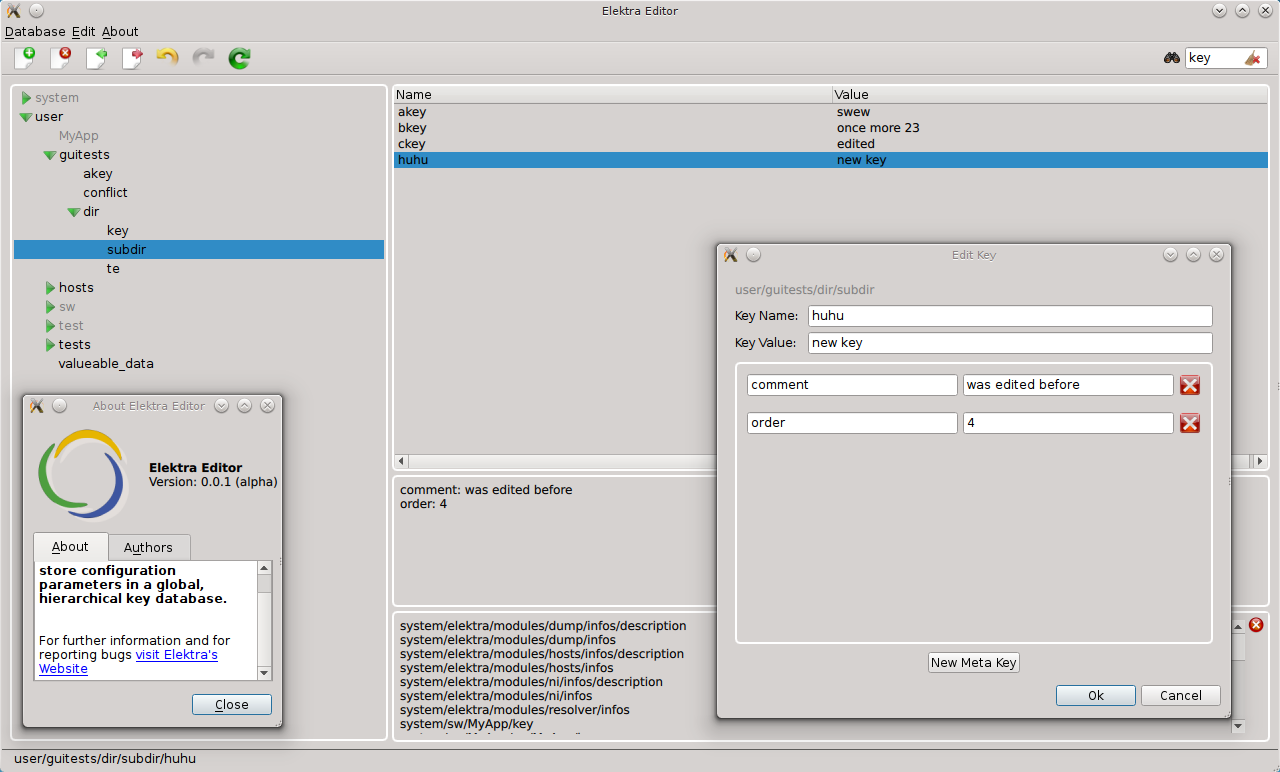
Hi Everyone, So first I want to say, that I appreciate all the interest in our project from the folks who read our posts at Planet Debian. This will be our last post there for now, I hope you enjoyed the posts about my Google Summer of Code project and other info about Elektra we posted there. To stay informed about Elektra s releases, please subscribe to this RSS feed. Today I want to thank you all and tell you about the latest exciting Elektra news, our newest release 0.8.10! This new release brings many exciting updates and features, since I didn t to a post for Elektra 0.8.9, this post will cover changes and additions from Elektra 0.8.8 to 0.8.10. First of all, there is now a new gui for KDB! A big thanks goes out to Raffael Pancheri for developing this GUI! Once included in your Elektra build, this gui can be run using the command kdb qt-gui. It is very important to note that the gui is in version 0.0.2, meaning it is an alpha project and shouldn t be considered stable yet! This GUI is a convenient tool that lets you mount, unmount, search, import and export configurations. We are very excited about this tool and we hope it makes Elektra more accessible to all users. Check out the screenshot below to see this new GUI in action:

A screenshot of the new qt-gui tool

A few other new features are that Felix added support for multi-line into the ini plugin. Users are able to turn this feature on or off for each configuration. Additionally, Kai-Uwe added support for Windows 7 to Elektra! The Windows 7 port relies on a new resolver called wresolver which is a simpler version of the regular resolver which is compatible with Windows. Additionally, there is a new Java binding, so now Elektra is compatible with applications and plugins written in Java! On top of these features, a new hosts plugin and a new rename plugin have been written. The new hosts in conjunction with improvements to the ini plugin allows for multiple styles of comments (because some ini dialects allow ; and # to be used to differentiate comments) to be used and preserved in configuration files. Additionally, this new hosts plugin is compatible with and differentiates between ipv4 and ipv6 entries. There have also been a huge number of under-the-hood improvements, changes, and fixes; there have been so many in-fact that I am going to list them: There are many more new changes that I could not mention here. Please keep up-to-date with Elektra news and releases by subscribing to this RSS feed and following our news page on GitHub. As always feel free to comment on our posts and I will get back to you as soon as possible. Again, thanks for reading our blog, enjoy the new release! Sincerely,
Ian S. Donnelly P.S. Happy New Year to everybody!

1 November 2014

Hideki Yamane: Meeting event with LibO people in Tokyo, Japan

We Tokyo Debian Study Meeting staff has held 119th (!) monthly meeting at SQUARE ENIX seminer room, Shinjuku, Tokyo (thanks to Takahide Nojima for arrangement) with Kanto LibreOffice Offline Meeting (thank Naruhiko Ogasawara) on 25th October.


Discussing about status for LibreOffice package in Debian and share each view for it as downstream and upstream. I hope LibO folks would investigate diff under debian/patches directory and pull some of it to upstream (it also will help Debian and other downstream distros).

And hands-on event for installation with debian-installer 8.0 bate2: find an issue with Acer laptop, probably it would be reported to BTS.


Next 120th meeting will be in 29th November at same place - people, see your there! :)

6 August 2014

Russell Coker: Booting GPT

I m installing new 4TB disks on an older Dell server, it s a PowerEdge T110 with a G6950 CPU so it s not really old, but it s a couple of generations behind the latest Dell servers. I tried to enable UEFI booting, but when I turned that option on the system locked up during the BIOS process (wouldn t boot from the CD or take keyboard input). So I had to make it boot with a BIOS compatible MBR and a GPT partition table. Number Start (sector) End (sector) Size Code Name
1 2048 4095 1024.0 KiB EF02 BIOS boot partition
2 4096 25169919 12.0 GiB FD00 Linux RAID
3 25169920 7814037134 3.6 TiB 8300 Linux filesystem After spending way to much time reading various web pages I discovered that the above partition table works. The 1MB partition is for GRUB code and needs to be enabled by a parted command such as the following: parted /dev/sda set 1 bios_grub on /dev/sda2 is a RAID-1 array used for the root filesystem. If I was installing a non-RAID system I d use the same partition table but with a type of 8300 instead of FD00. I have a RAID-1 array over sda2 and sdb2 for the root filesystem and sda3, sdb3, sdc3, sdd3, and sde3 are used for a RAID-Z array. I m reserving space for the root filesystem on all 5 disks because it seems like a good idea to use the same partition table and the 12G per disk that is unused on sdc, sdd, and sde isn t worth worrying about when dealing with 4TB disks.

10 June 2014

Dirk Eddelbuettel: Introducing RcppRedis

RcppRedis, another new package of mine, appeared on CRAN a few weeks ago just in time for our annual R/Finance conference. And as of today, we also have Windows binaries thanks to generous help from John Buonagurio who help building the required 32- and 64-bit libraries for Windows, and Uwe Ligges who now installed them for the CRAN and win-builder machiness. Binaries for release 0.1.1 should be available within a day. To describe the package, I also just set up a page about RcppRedis so rather than repeating everything here I invite you to follow the link. The ever-so-brief NEWS entry for the two first uploads follows.
Changes in version 0.1.1 (2014-06-09)
  • Now with Windows support thanks to the installation of builds of the hiredis library (created by John Buonagurio) at CRAN / win-builder (thanks to Uwe Ligges)
  • Added support for new command zcount
Changes in version 0.1.0 (2014-05-10)
  • Initial CRAN upload

This post by Dirk Eddelbuettel originated on his Thinking inside the box blog. Please report excessive re-aggregation in third-party for-profit settings.

28 April 2014

Evgeni Golov: Debian Bug Squashing Party Salzburg 2014

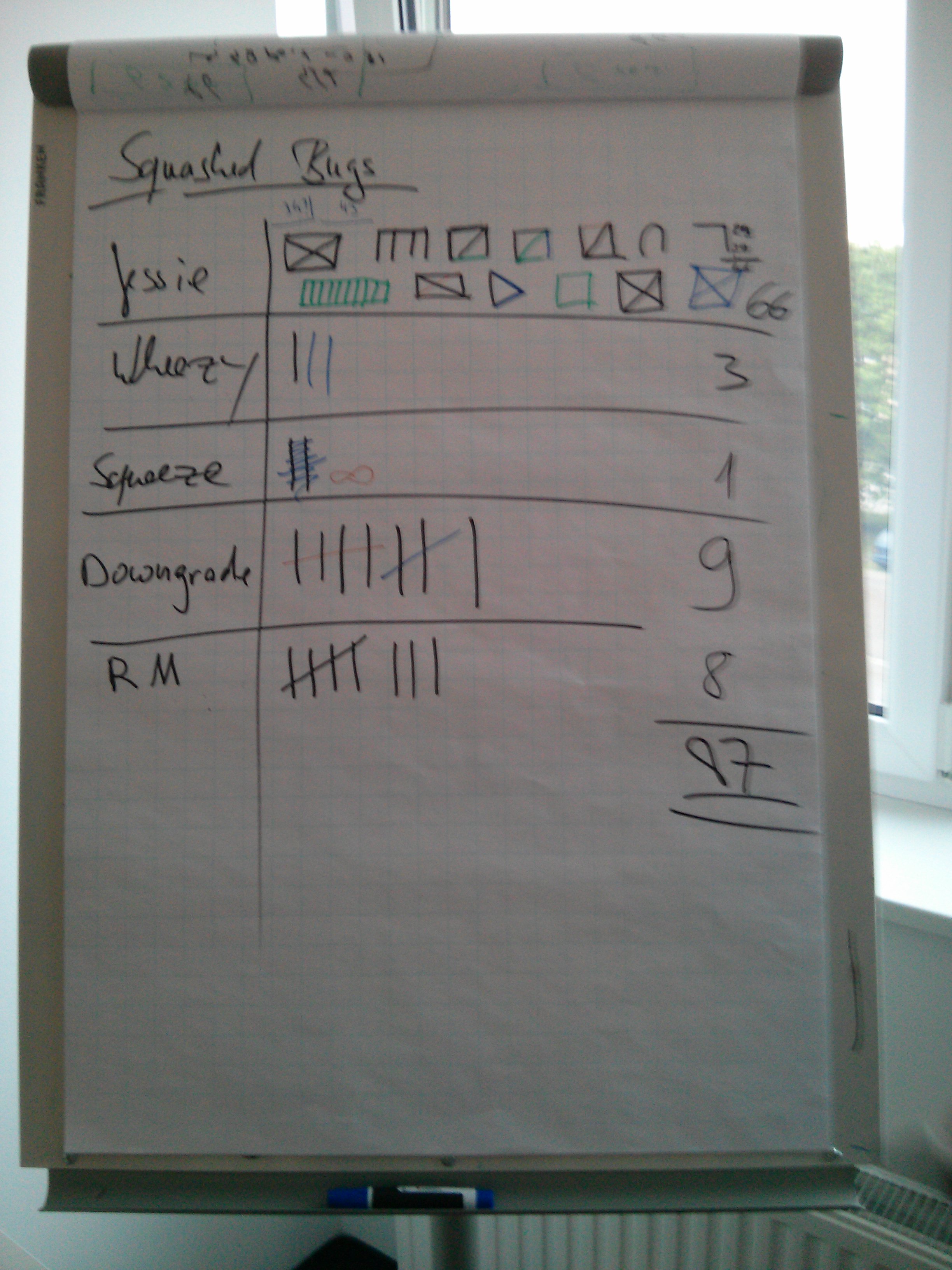
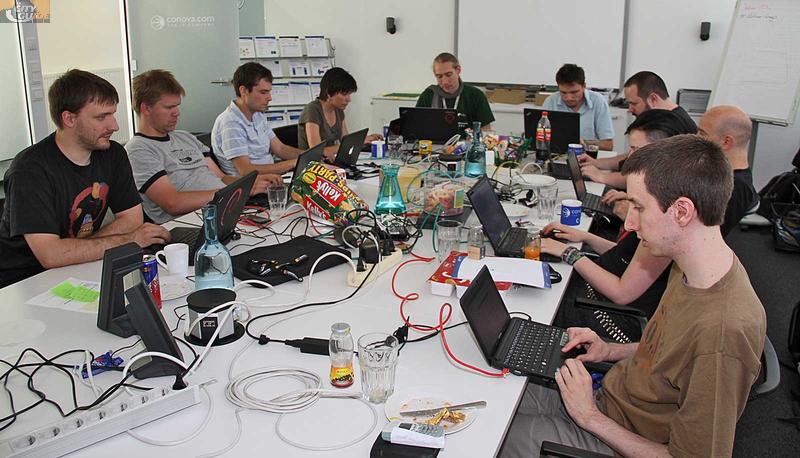
bsp2014_small This weekend, Bernd Zeimetz organized a BSP at the offices of conova in Salzburg, Austria. Three days of discussions, bugfixes, sparc removals and a lot of fun and laughter. We squashed a total of 87 bugs: 66 bugs affecting Jessie/Sid were closed, 9 downgraded and 8 closed via removals. As people tend to care about (old)stable, 3 bugs were fixed in Wheezy and one in Squeeze. These numbers might be not totaly correct, as were kinda creative at counting Marga promised a talk about an introduction to properly counting bugs using the Haus vom Nikolaus algorithm to the base of 7 . IMG_20140427_182902 Speaking of numbers, I touched the following bugs (not all RC): A couple of (non-free) pictures are available at Uwe s salzburg-cityguide.at. Thanks again to Bernd for organizing and conova and credativ for sponsoring!

7 September 2013

Uwe Hermann: Using mdadm to recover from a dead disk in a Linux RAID-1 array

2.5
Yes, it's that time of the year again. A disk in my desktop-replacement laptop with 2 disks and a RAID-1 has died. Time for recovery. This laptop has been running 24/7 for the last 3 years or such, so it's not too surprising that a disk dies. Surprisingly though, for the first time in a long series of dead disks, smartctl -a does indeed show errors for this disk. Here's a short snippet of those:
  $ smartctl -a /dev/sda
  [...]
  Error 1341 occurred at disk power-on lifetime: 17614 hours (733 days + 22 hours)
   When the command that caused the error occurred, the device was active or idle.
   After command completion occurred, registers were:
   ER ST SC SN CL CH DH
   -- -- -- -- -- -- --
   40 41 02 1f c0 9c 40  Error: UNC at LBA = 0x009cc01f = 10272799
   Commands leading to the command that caused the error were:
   CR FR SC SN CL CH DH DC   Powered_Up_Time  Command/Feature_Name
   -- -- -- -- -- -- -- --  ----------------  --------------------
   60 f8 08 20 c0 9c 40 00  41d+01:51:50.974  READ FPDMA QUEUED
   60 08 00 18 c0 9c 40 00  41d+01:51:50.972  READ FPDMA QUEUED
   ef 10 02 00 00 00 a0 00  41d+01:51:50.972  SET FEATURES [Reserved for Serial ATA]
   ec 00 00 00 00 00 a0 00  41d+01:51:50.971  IDENTIFY DEVICE
   ef 03 45 00 00 00 a0 00  41d+01:51:50.971  SET FEATURES [Set transfer mode]
  SMART Self-test log structure revision number 1
  Num  Test_Description    Status                  Remaining  LifeTime(hours)  LBA_of_first_error
  # 1  Short offline       Completed: read failure       90%     20511         156170102
  [...]
The status of the degraded RAID array looks like this:
  $ cat /proc/mdstat
  Personalities : [raid1] 
  md1 : active raid1 sdb7[1]
       409845696 blocks [2/1] [_U]
  md0 : active raid1 sda6[0] sdb6[1]
       291776 blocks [2/2] [UU]
The [_U] means that one of two disks has failed, it should normally be [UU]. There are two RAID-1s actually, a small md0 (sda6 + sdb6) for /boot and the main md1 (sda7 + sdb7) which holds the OS and my data. Apparently (at first at least), only sda7 was faulty and got kicked out of the array:
  $ dmesg   grep kick
  md: kicking non-fresh sda7 from array!
Anyway, so I ordered a replacement disk, removed the dead disk (I checked the serial number and brand before, so I don't accidentally remove the wrong one), inserted the new disk and rebooted. Note: In order for this to work you have to have (previously) installed the bootloader (usually GRUB) onto both disks, otherwise you won't be able to boot from either of them (which you'll want to do if one of them dies, of course). In my case, sda was now dead, so I put sdb into its place (physically, by using the other SATA connector/port) and the new replacement disk would become the new sdb. After the reboot, the new disk needs to be partitioned like the other RAID disk. This can be done easily by copying the partition layout of the "good" disk (now sda after the reboot) onto the empty disk (sdb):
  $ sfdisk -d /dev/sda   sfdisk /dev/sdb
Specifically, the RAID disks/partitions need to have the type/ID "fd" ("Linux raid autodetect"), check if that is the case. Then, you can add the new disk to the RAIDs:
  $ mdadm /dev/md0 --add /dev/sdb6
  $ mdadm /dev/md1 --add /dev/sdb7
After a few hours the RAID will be re-synced properly and all is good again. You can check the progress via:
  $ watch -n 1 cat /proc/mdstat
You should probably not reboot during the resync (though I'm not 100% sure if that would be an issue in practice; please leave a comment if you know). Also, don't forget to install GRUB on the new disk so you can still boot when the next disk dies:
  $ grub-mkdevicemap
  $ grub-install /dev/sdb
And it might be a good idea to use S.M.A.R.T. to check the new disk, just in case. I did a quick run for the new disk via:
  $ smartctl -t short /dev/sdb # Wait a few minutes after this.
  $ smartctl -a /dev/sdb
  [...]
  SMART Self-test log structure revision number 1
  Num  Test_Description    Status                  Remaining  LifeTime(hours)  LBA_of_first_error
  # 1  Short offline       Completed without error       00%        22         -
  [...]
Looks good. So far.

30 January 2013

Uwe Hermann: libsigrokdecode 0.1.1 released, more protocol decoders supported

sigrok logo Just a quick announce: We released libsigrokdecode 0.1.1 today, a new version of one of the shared libraries part of the open-source sigrok project (for signal acquisition/analysis of various test&measurement gear, like logic analyzers, scopes, multimeters, etc). I will update the Debian package soonish. As you probably know, in addition to the infrastructure for protocol decoding, this library also ships with a bunch of protocol decoders written in Python. Currently we support 29 different ones (in various states of "completeness", improvements are ongoing). This release adds support for the following new protocol decoders:
CAN probing Please check the announce on the sigrok blog and/or the NEWS file for the full list of changes and improvements. Happy hacking and decoding!

25 December 2012

Uwe Hermann: sigrok at the 29th Chaos Communication Congress (29c3)

29c3 logo Yup, it's been a while since my last blog post, but I'm not dead yet. Most of my spare time goes into sigrok development these days (open-source signal analysis suite for logic analyzers, oscilloscopes, multimeters, and lots more), but I'll try to revive my blog too. I have various microcontroller/embedded topics and devices I want to talk about in a small blog post series in the nearer future. But more on that later. Feel free to subscribe to the sigrok-devel mailing list, join us on IRC in #sigrok (Freenode) where most of the discussions take place, or follow our new sigrok blog (RSS) if you're interested in the ongoing sigrok developments. Anyway, for now just a quick announce: Same as last year, we will be at the Chaos Communication Congress (29c3), this time in Hamburg, Germany. The conference takes place from December 27th to 30th, 2012. We'll have a sigrok "assembly", likely in area 3b of the conference building, where we'll be hanging around, working on new sigrok features, new hardware drivers, new protocol decoders and various other things. We'll have lots of gear with us for demo and development purposes, including logic analyzers, oscilloscopes, MSOs, multimeters, and lots more. Bring your own device if you own models we don't yet support or know about. We'll be happy to have a look! Chat with us, give us your suggestions which features you'd like to see, which devices you want to be supported, which protocol decoders you'd like to have, or even help us write some drivers/decoders! Hope to see you there!

21 October 2012

Jon Dowland: Dropbox and drive letters

For long-winded reasons I'd rather not explain nor defend, my partner uses Dropbox for a large set of important files (~70G), which are stored on a removable drive. She is also a Windows user. Recently, by introducing a few new drives, I inadvertently changed the drive letter that is assigned to her portable device, which stopped Dropbox from working. Solving this properly is rather finicky so I thought I'd write down what I did. The end goal is to try and ensure that the portable drive always gets the same drive letter and that Dropbox is configured to use that drive letter, but before I can get that far I need to get Dropbox syncing again. It used to be F:, and I opted for U: going forward. Luckily the extra letters I'd introduced were all partitions on a separate hard drive from the OS, so I powered the machine down, unplugged the extra hard drive and booted back up. This freed up the stolen drive letters, but the portable drive did not re-inherit them. Running regedit as an administrative user and renaming keys in HKEY_LOCAL_MACHINE\SYSTEM\MountedDevices moved the USB drive back to the correct letter, but I suspected the extra hard drive would take precedence when it was back, so this was only an interim solution. With the portable drive back on F:, the Dropbox client was happy once again. However I needed to reconfigure the Dropbox client to use a different letter. I wasn't happy with the idea of altering the Dropbox client's configuration database under its feet, so I had to do everything "by the book". Luckily, the client supports the notion of moving your Dropbox folder. Combined with the command-prompt subst command (run as the local user rather than as an admin this time), I was able to clone the F: drive to a virtual U: drive, and then ask Dropbox to move the folder.
subst U: F:\
This was pretty awkward. F:\Dropbox and U:\Dropbox are in fact the same folder, so I needed to ask Dropbox to move it from F: to something other than U:. I opted for U:\tmp. The move took a long time (~2 hours). The proper solution is to try and get a stable drive letter for her device. This can be achieved using a tool called 'USB Drive letter Manager', or USBDLM. USBDLM is free for educational use, and my partner is a teacher, which is lucky. Once that's all sorted, reboot, insert portable device, ensure it's on the right drive letter, and move the Dropbox folder back down to U:. This time the move was near instantaneous.

3 September 2012

Martin Pitt: PyGObject 3.3.91 released

I just released PyGObject 3.3.91, for GNOME 3.5.91. The big new feature in this release (thanks to the release team for granting an exception) is Simon Feltman s new Signal helper class, which makes defining custom signals a whole lot simpler and more obvious. In the past, you had to do
 class C(GObject.GObject):
    __gsignals__ =  
        'my_signal': (GObject.SIGNAL_RUN_FIRST, GObject.TYPE_NONE,
                      (GObject.TYPE_INT,))
     
    def do_my_signal(self, arg):
        print("my_signal called with %i" % arg)
whereas now this looks like
class C(GObject.GObject):
    @GObject.Signal(arg_types=(int,))
    def my_signal(self, arg):
        print("my_signal called with %i" % arg)
or even more elegantly when using Python 3 and its new type annotations:
class C(GObject.GObject):
    @GObject.Signal
    def my_signal(self, arg:int):
        print("my_signal called with %i" % arg)
Check out the updated example and docstring for other ways how to use it. Overrides can now be in a directory different from the one that pygobject installs itself into. These overrides need to put this into their __init__.py at the top:
from pkgutil import extend_path
__path__ = extend_path(__path__, __name__)
and put themselves somewhere into the default PYTHONPATH. This should make it a lot easier for library packages to ship their own overrides for Python. This new version also comes with a couple of new overrides and bug fixes. See the detailled list of changes below. Thanks to all contributors!

23 July 2012

Jon Dowland: 6music

I recently discovered the excellent BBC 6 Music: a digital-only radio station so good I'm almost convinced to buy a DAB radio for this one station alone. In particular, Stuart Maconie and Mark Radcliffe, former Radio 2 exiles, hold an excellent afternoon slot. Stuart Maconie's late-night "Freak Zone" often has some really interesting stuff on it worth listening to, for example an entire episode dedicated to Brian Eno's "Obscure Records" label. Ubuweb recently put up the entire catalogue, by the way. @WhatsOn6Music is a twitter bot I follow which tweets songs as they are played. This works because most of the BBC's DJ consoles are wired up to last.fm. In recent times this bot has been broken a lot, so I got tired of it and made my own: @6musicbot. This one is powered by IFTTT so should not be plagued by whatever keeps breaking the other one: although it's also only as good as the last.fm feed powering it. Let me know if you find it useful, interesting or have any other feedback.

23 June 2012

Bernd Zeimetz: Report from the Bug Squashing Party in Salzburg

bsp_2012_salzburg photo from salzburg-cityguide.com, Copyright (C) Uwe Brandl

Participation and Results From June 15-17th we held a Debian BugSquashingParty in Salzburg, hosted and sponsored by conova communications GmbH. It was a fun and busy weekend, with 15-17 people from 5 countries being around, mainly working on RC bugs in Testing/Unstable. Gerfried Fuchs (rhonda) also worked on triaging the impact of RC bugs on the version in Squeeze, while Peter Palfrader (weasel) took care of Tor related things and Debian sysadmin work, including starting on the new bugs and udd hosts. Phillip Hug (hug) worked on the debian.ch infrastructure. Together with Miroslav Such from Red Hat Bernd Zeimetz (bzed) worked on the packaging of the necessary libraries and daemons to add (basic) Spacewalk client support to Debian. As soon as the packages passed NEW and #677871 was applied (thanks to the APT guys for working on that already), managing Debian clients with Spacewalk should work out of the box. Of course we also had a little keysigning party :)

Statistics
  • about 68 bugs in unstable/testing were triaged/patched/fixed or at least pinged
  • 54 bugs were tagged to show if they affect Squeeze, several other bugs were pinged to retrieve necessary information or to trigger an update in the next stable pointrelease.
  • 5 packages were introduced into Debian (still in NEW, though) - the Spacewalk client related packages and libapache2-mod-auth-memcookie.

Accomodation Thanks to Debian funds we were able to provide accomodation for four participants in the JUFA youth hostel in Salzburg. We had paid in advance for eight, but changing to rooms with a higher category for only 4 people would have been equally or more expensive.

Press/Media coverage Additionally to being mentioned in the calendars on ProLinux and similar pages, we had some press coverage by the local newspaper and online magazines:

Fun facts We consumed 2kg of Leberkas, a big plate of "Buchteln mit Vanillesosse", about 16000cm^2 of Pizza, about 80 litres of coke, juice, beer and wine and I guess we drank at least the same amount of water. We had coffee made of 1.5kg coffee beans and managed to empty the (formerly well filled) icemaker in the fridge. Also we had successful training sessions of a standard Debconf game (rules won't be explained here obviously). Maybe we even successfully spread the game to the employees of a commercial linux distribution ;)

2 May 2012

Uwe Hermann: sigrok - cross-platform, open-source logic analyzer software with protocol decoder support

sigrok logo I'm happy to finally announce an open-source (GNU GPL), cross-platform (Linux, Mac OS X, FreeBSD, Windows, ...) logic analyzer software package myself and Bert Vermeulen have been working on for quite a long time now: sigrok (it groks your signals). History I originally started working on an open-source logic analyzer software named "flosslogic" in 2010, because I grew tired of almost all devices having a proprietary and Windows-only software, often with limited features, limited input/output file formats, limited usability, limited protocol decoder support, and so on. Thus, the goal was to write a portable, GPL'd, software that can talk to many different logic analyzers via modules/plugins, supports many input/output formats, and many different protocol decoders. The advantage being, that every time we add a new driver for another logic analyzer it automatically supports all the input/output formats we already have, you can use all the protocol decoders we already wrote, etc. It also works the other way around: If someone writes a new protocol decoder or file format driver, it can automatically be used with any of the supported logic analyzers out of the box. Turns out Bert Vermeulen had been working on a similar software for a while too (due to exactly the same reasons, crappy Windows software, etc.) so it was only logical that we joined forces and worked on this together. We kept Bert's name for the software package ("sigrok"), set up a SourceForge project, mailing lists, IRC channel, wiki, etc. and started working. Overview, Features You can get the lastest sigrok source code from our main git repository:
  $ git clone git://sigrok.git.sourceforge.net/gitroot/sigrok/sigrok
Here's a short overview of sigrok and its features as of today. The software consists of the following components: We're happy to hear about other (maybe special-purpose) frontends you may want to write using libsigrok/libsigrokdecode as helper libs! Firmware Saleae Logic Some logic analyzer devices require firmware to be uploaded before they can be used. As always, firmware is a bit of a pain, but here's what we currently do: For non-free firmware we provide instructions how to extract it from the vendor software or from USB dumps, if possible. For distributable firmware we have a git repo where you can get it (thanks ASIX for allowing us to distribute the ASIX Sigma/Sigma2 firmware files!).
  $ git clone git://sigrok.git.sourceforge.net/gitroot/sigrok/sigrok-firmwares
Finally, for all Cypress FX2 based logic analyzers we have an open-source (GNU GPL) firmware named fx2lafw, started by myself, but most work (and finishing the firmware) was then done by Joel Holdsworth, thanks! The support list includes Saleae Logic, CWAV USBee SX, CWAV USBee AX, Robomotic Minilogic/BugLogic3, Braintechnology USB-LPS, and many others. Get the code from the fw2lafw git repository:
  $ git clone git://sigrok.git.sourceforge.net/gitroot/sigrok/fx2lafw
Example dumps We collect various captured logic analyzer signals / protocol dumps in the sigrok-dumps git repository:
  $ git clone git://sigrok.git.sourceforge.net/gitroot/sigrok/sigrok-dumps
They can be useful for testing the sigrok command-line application, the sigrok GUIs, or the protocol decoders. We're happy to include further contributed example data in our repository, please send us .sr files of any interesting data/protocol you may come across (even if sigrok doesn't yet have a protocol decoder for that protocol). See the Example dumps wiki page for details. Packages, distros, installers sigrok Windows installer I'm currently working on updated Debian packages for sigrok (will be apt-get install sigrok to get everything), and we're happy about further packaging efforts for other distros. We have preliminary Windows installer files (using NSIS), but the Windows code needs some more fixes and portability improvements before it's really usable. On Mac OS X you can use fink/Macports to install as usual, fancier .app installer files are being worked on. Future Apart from support for more logic analyzers, input/output formats, and protocol decoders, we have a number of other plans for the next few releases. This includes support for analog data, i.e. support for (USB) oscilloscopes, multimeters, spectrum analyzers, and such stuff. This will also require additional GUI support (which could take a while). Also, we want to improve/fix the Windows support, and test/port sigrok to other architectures we come across. Performance improvements for the protocol decoding as well as more features there are also planned. Contact Feel free to contact us on the sigrok-devel mailing list, or in the IRC channel #sigrok on Freenode. There's also an identi.ca group for sigrok. We're always happy about feedback, bug reports, suggestions for improving sigrok, and patches of course!

Next.

Previous.