Search Results: "undef"

12 February 2017

Shirish Agarwal: Density and accessibility

Around 2 decades back and a bit more I was introduced to computers. The top-line was 386DX which was mainly used as fat servers and some lucky institutions had the 386SX where IF we were lucky we could be able to play some games on it. I was pretty bad at Prince of Persia or most of the games of the era as most of the games depended on lightning reflexes which I didn t possess. Then 1997 happened and I was introduced to GNU/Linux but my love of/for games still continued even though I was bad at most of them. The only saving grace was turn-based RPG s (role-playing games) which didn t have permadeath, so you could plan your next move. Sometimes a wrong decision would lead to getting a place from where it was impossible to move further. As the decision was taken far far break which lead to the tangent, the only recourse was to replay the game which eventually lead to giving most of those kind of games. Then in/around 2000 Maxis came out with Sims. This was the time where I bought my first Pentium. I had never played a game which had you building stuff, designing stuff, no violence and the whole idea used to be about balancing priorities of trying to get new stuff, go to work, maintain relationships and still make sure you are eating, sleeping, have a good time. While I might have spent probably something close to 500 odd hours in the game or even more so, I spent the least amount of time in building the house. It used to be 4 4 when starting (you don t have much of in-game money and other stuff you wanted to buy as well) to 8 8 or at the very grand 12 12. It was only the first time I spent time trying to figure out where the bathroom should be, where the kitchen should, where the bedroom should be and after that I could do that blind-folded. The idea behind my house-design used to be simplicity, efficient (for my character). I used to see other people s grand creations of their houses and couldn t understand why they made such big houses. Now few days back, I saw few episodes of a game called Stranded Deep . The story, plot is simple. You, the player are going in a chartered plane and suddenly lightning strikes ( game trope as today s aircrafts are much better able to deal with lightning strikes) and our hero or heroine washes up on a beach with raft with the barest of possessions. Now the whole game is based upon him/her trying to survive, once you get the hang of the basic mechanics and you know what is to be done, you can do it. The only thing the game doesn t have is farming but as the game has unlimited procedural world, you just paddle or with boat motor go island hopping and take all that what you need. What was interesting to me was seeing a gamer putting so much time and passion in making a house. When I was looking at that video, I realized that maybe because I live in a dense environment, even the designs we make either of houses or anything else is more to try to get more and more people rather than making sure that people are happy which leads to my next sharing. Couple of days back, I read Virali Modi s account of how she was molested three times when trying to use Indian Railways. She made a petition on change.org While I do condemn the molestation as it s an affront against individual rights, freedom, liberty, free movement, dignity. Few of the root causes as pointed out by her, for instance the inability or non-preference to give differently-abled people the right to board first as well as awaiting to see that everybody s boarded properly before starting the train are the most minimum steps that Indian Railways could take without spending even a paise. The same could be told/shared about sensitizing people, although I have an idea of why does Indian Railway not employ women porters or women attendants for precisely this job. I accompanied a blind gentleman friend few times on Indian Railways and let me tell you, it was one of the most unpleasant experiences. The bogies which is given to them is similar or even less than what you see in unreserved compartments. The toilets were/are smelly, the gap between the station and the train was/is considerable for everybody from blind people, differently-abled people, elderly people as well. This is one of the causes of accidents which happen almost every day on Indian Railways. I also learnt that especially for blind people they are looking for a sort of low-frequency whistle/noise which tells them the disabled coupe/bogie/coach will come at a specific spot in the Station. In a platform which could have anything between 1500-2000 people navigating it wouldn t be easy. I don t know about other places but Indian Railway Stations need to learn a lot to make it a space for differently abled to navigate by themselves. Pune Station operates (originating or passing through) around 200 odd trains, with exceptions of all the specials and weekly trains that ply through, adding those would probably another 5-10 trains to the mix. Each train carries anywhere between 750-1000 odd people so roughly anywhere between 15-20 million pass through Pune Railway Station daily. Even if we take conservative estimates of around 5% of the public commuting from Pune, it would mean around 750,000 people travelling daily. Pune Railway Station has 6 stations and if I spread them equally it would come to around 100,000 people on one platform in 24 hours. Divide that equally by 24 hours and it comes to 4,160 people per hour. Now you take those figures and you see the Pune platforms are under severe pressure. I have normalized many figures. For instance, just like airports, even in railways, there are specific timings where more trains come and go. From morning 0500 hrs to late night 2300 hrs. there would be lot many trains, whereas the graveyard shifts would have windows where maintenance of tracks and personnel takes place. I dunno if people can comprehend 4000 odd people on the platform. Add to that you usually arrive at least an hour or two before a train departs even if you are a healthy person as Indian Railways has a habit of changing platforms of trains at the last minute. So if you a differently abled person with some luggage for a long-distance train, the problems just multiply. See drag accidents because of gap between railway bogies and platforms. The width of the entrance to the bogie is probably between 30-40 inches but the design is such that 5-10 inches are taken on each side. I remembered the last year, our current Prime Minister, Mr. Narendra Modi had launched Accessible Campaign with great fanfare and we didn t hear anything much after that. Unfortunately, the site itself has latency and accessibility issues, besides not giving any real advice even if a person wants to know what building norms should one follow if one wants to make an area accessible. This was easily seen by last year s audit in Delhi as well as other places. A couple of web-searches later, I landed up at a Canadian site to have some idea about the width of the wheelchair itself as well as additional room to manoeuvre. Unfortunately, the best or the most modern coaches/bogies that Indian Railways has to offer are the LHB Bogies/Coaches. Now while the Coaches/Bogies by themselves are a big improvement from the ICF Coaches which we still have and use, if you read the advice and directions shared on the Canadian site, the coaches are far from satisfactory for people who are wheel-chair bound. According to Government s own census records, 0.6% of the population have movement issues. Getting all the differently-abled people together, it comes between 2, 2.5% of the population which is quite a bit. If 2-3 people out of every 100 people are differently-abled then we need to figure out something for them.While I don t have any ideas as to how we could improve the surroundings, it is clear that we need the change. While I was thinking,dreaming,understanding some of the nuances inadvertently, my attention/memories shifted to my toilet experiences at both Mumbai and the Doha Airport. As had shared then, had been pleasantly surprised to see that both in Mumbai Airport as well as the Doha Airport, the toilets were pretty wide, a part of me was happy and a part of me was seeing the added space as wastefulness. With the understanding of needs of differently-abled people it started to make whole lot of sense. I don t remember if I had shared then or not. Although am left wondering where they go for loo in the aircraft. The regular toilets are a tight fit for obese people, I am guessing aircrafts have toilets for differently-abled people as well. Looking back at last year s conference, we had 2-3 differently-abled people. I am just guessing that it wouldn t have been a pleasant experience for them. For instance, where we were staying, at UCT it had stairs, no lifts so by default they probably were on ground-floor. Then where we were staying and where most of the talks were about a few hundred metres away and the shortest distance were by stairs, the round-about way was by road but had vehicles around so probably not safe that way as well. I am guessing they had to be dependant on other people to figure out things. There were so many places where there were stairs and no ramps and even if there were ramps they were probably a bit more than the 1:12 which is the advice given. I have heard that this year s venue is also a bit challenging in terms of accessibility for differently-abled people. I am clueless as to did differently-able find debconf16 in terms of accessibility or not ? A related query to that one, if a Debconf s final report mentions issues with accessibility, do the venues make any changes so that at some future date, differently-abled people would have a better time. I know of Indian institutions reluctance to change, to do expenditure, dunno how western countries do it. Any ideas, comments are welcome.
Filed under: Miscellenous Tagged: #386, #accessibility, #air-travel, #Computers, #differently-abled, #Railways, gaming

11 February 2017

Niels Thykier: On making Britney smarter

Updating Britney often makes our life easier. Like: Concretely, transitions have become a lot easier. When I joined the release team in the summer 2011, about the worst thing that could happen was discovering that two transitions had become entangled. You would have to wait for everything to be ready to migrate at the same time and then you usually also had to tell Britney what had to migrate together. Today, Britney will often (but not always) de-tangle the transitions on her own and very often figure out how to migrate packages without help. The latter is in fact very visible if you know where to look. Behold, the number of manual easy and hint -hints by RT members per year[2]:
Year   Total   easy   hint
-----+-------+------+-----
2005     53      30    23 
2006    146      74    72
2007     70      40    30
2008    113      68    45
2009    229     171    58
2010    252     159    93
2011    255     118   137
2012     29      21     8
2013     36      30     6
2014     20      20     0
2015     25      17     8
2016     16      11     5
2017      1       1     0
As can be seen, the number of manual hints drop by factor of ~8.8 between 2011 and 2012. Now, I have not actually done a proper statistical test of the data, but I have a hunch that drop was significant (see also [3] for a very short data discussion). In conclusion: Smooth-updates (which was enabled late in 2011) have been a tremendous success.  [1] A very surprising side-effect of that commit was that the ( original ) auto-hinter could now solve a complicated haskell transition. Turns out that it works a lot better, when you give correct information!  [2] As extracted by the following script and then manually massaged into an ASCII table. Tweak the in-line regex to see different hints.
respighi.d.o$ cd "/home/release/britney/hints" && perl -E '
    my (%years, %hints);
    while(<>)   
        chomp;
        if (m/^\#\s*(\d 4 )(?:-?\d 2 -?\d 2 );/ or m/^\#\s*(?:\d+-\d+-\d+\s*[;:]?\s*)?done\s*[;:]?\s*(\d 4 )(?:-?\d 2 -?\d 2 )/)  
             $year = $1; next;
          
         if (m/^((?:easy hint) .*)/)  
             my $hint = $1; $years $year ++ if defined($year) and not $hints $hint ++;
             next;
          
         if (m/^\s*$/)   $year = undef; next;  
     ;
    for my $year (sort(keys(%years)))   
        my $count = $years $year ;
        print "$year: $count\n"
     ' * OLD/jessie/* OLD/wheezy/* OLD/Lenny/* OLD/*
[3] I should probably mention for good measure that extraction is ignoring all hints where it cannot figure out what year it was from or if it is a duplicate. Notable it is omitting about 100 easy/hint-hints from OLD/Lenny (compared to a grep -c), which I think accounts for the low numbers from 2007 (among other). Furthermore, hints files are not rotated based on year or age, nor am I sure we still have all complete hints files from all members.
Filed under: Debian, Release-Team

2 February 2017

Paul Wise: FLOSS Activities January 2017

Changes

Issues

Review

Administration
  • Debian: reboot 1 non-responsive VM, redirect 2 users to support channels, redirect 1 contributor to xkb upstream, redirect 1 potential contributor, redirect 1 bug reporter to mirror team, ping 7 folks about restarting processes with upgraded libs, manually restart the sectracker process due to upgraded libs, restart the package tracker process due to upgraded libs, investigate failures connecting to the XMPP service, investigate /dev/shm issue on abel.d.o, clean up after rename of the fedmsg group.
  • Debian mentors: lintian/security updates & reboot
  • Debian packages: deploy 2 contributions to the live server
  • Debian wiki: unblacklist 1 IP address, whitelist 10 email addresses, disable 18 accounts with bouncing email, update email for 2 accounts with bouncing email, reported 1 Debian member as MIA, redirect 1 user to support channels, add 4 domains to the whitelist.
  • Reproducible builds: rescheduled Debian pyxplot:amd64/unstable for themill.
  • Openmoko: security updates & reboots.

Debian derivatives
  • Send the annual activity ping mail.
  • Happy new year messages on IRC, forward to the list.
  • Note that SerbianLinux does not provide source packages.
  • Expand URL shortener on SerbianLinux page.
  • Invite PelicanHPC, Netrunner, DietPi, Hamara Linux (on IRC), BitKey to the census.
  • Add research publications link to the census template
  • Fix Symbiosis sources.list
  • Enquired about SalentOS downtime
  • Fixed and removed some 404 BlankOn links (blog, English homepage)
  • Fixed changes to AstraLinux sources.list
  • Welcome Netrunner to the census

Sponsors I renewed my support of Software Freedom Conservancy. The openchange 1:2.2-6+deb8u1 upload was sponsored by my employer. All other work was done on a volunteer basis.

1 February 2017

Wouter Verhelst: Resetting a Raspberry Pi to default using Ansible

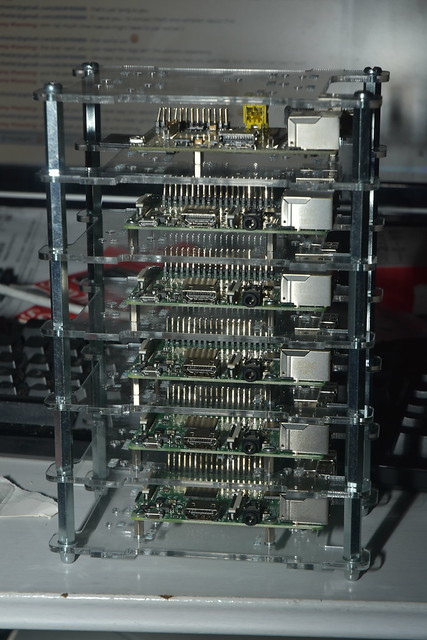
I got myself a bunch of Raspberry Pi 3s a short while ago: Stack of Raspberry Pis ...the idea being that I can use those to run a few experiments on. After the experiment, I would need to be able to somehow remove the stuff that I put on them again. The most obvious way to do that is to reimage them after every experiment; but the one downside of the multi-pi cases that I've put them in is that removing the micro-SD cards from the Pis without removing them from the case, while possible, is somewhat fiddly. That, plus the fact that I cared more about price than about speed when I got the micro-SD cards makes "image all the cards of these Raspberry Pis" something I don't want to do every day. So I needed a different way to reset them to a clean state, and I decided to use ansible to get it done. It required a bit of experimentation, but eventually I came up with this:
---
- name: install package-list fact
  hosts: all
  remote_user: root
  tasks:
  - name: install libjson-perl
    apt:
      pkg: libjson-perl
      state: latest
  - name: create ansible directory
    file:
      path: /etc/ansible
      state: directory
  - name: create facts directory
    file:
      path: /etc/ansible/facts.d
      state: directory
  - name: copy fact into ansible facts directory
    copy:
      dest: /etc/ansible/facts.d/allowclean.fact
      src: allowclean.fact
      mode: 0755
- name: remove extra stuff
  hosts: pis
  remote_user: root
  tasks:
  - apt: pkg=  item   state=absent purge=yes
    with_items: "  ansible_local.allowclean.cleanable_packages  "
- name: remove package facts
  hosts: pis
  remote_user: root
  tasks:
  - file:
      path: /etc/ansible/facts.d
      state: absent
  - apt:
      pkg: libjson-perl
      state: absent
      autoremove: yes
      purge: yes
This ansible playbook has three plays. The first play installs a custom ansible fact (written in perl) that emits a json file which defines cleanable_packages as a list of packages to remove. The second uses that fact to actually remove those packages; and the third removes the fact (and the libjson-perl library we used to produce the JSON). Which means, really, that all the hard work is done inside the allowclean.fact file. That looks like this:
#!/usr/bin/perl
use strict;
use warnings;
use JSON;
open PACKAGES, "dpkg -l ";
my @packages;
my %whitelist = (
    ...
);
while(<PACKAGES>)  
    next unless /^ii\s+(\S+)/;
    my $pack = $1;
    next if(exists($whitelist $pack ));
    if($pack =~ /(.*):armhf/)  
        $pack = $1;
     
    push @packages, $1;
 
my %hash;
$hash cleanable_packages  = \@packages;
print to_json(\%hash);
Basically, we create a whitelist, and compare the output of dpkg -l against that whitelist. If a certain package is in the whitelist, then we don't add it to our "packages" list; if it isn't, we do. The whitelist is just a list of package => 1 tuples. We just need the hash keys and don't care about the data, really; I could equally well have made it package => undef, I suppose, but whatever. Creating the whitelist is not that hard. I did it by setting up one raspberry pi to the minimum that I wanted, running
dpkg -l awk '/^ii/ print "\t\""$2"\" => 1," ' > packagelist
and then adding the contents of that packagelist file in place of the ... in the above perl script. Now whenever we apply the ansible playbook above, all packages (except for those in the whitelist) are removed from the system. Doing the same for things like users and files is left as an exercise to the reader. Side note: ... is a valid perl construct. You can write it, and the compiler won't complain. You can't run it, though.

4 January 2017

Rapha&#235;l Hertzog: My Free Software Activities in December 2016

My monthly report covers a large part of what I have been doing in the free software world. I write it for my donors (thanks to them!) but also for the wider Debian community because it can give ideas to newcomers and it s one of the best ways to find volunteers to work with me on projects that matter to me. Debian LTS I was allocated 10 hours to work on security updates for Debian 7 Wheezy. During this time I did the following: Misc packaging With the strong freeze approaching, I had some customer requests to push packages into Debian and/or to fix packages that were in danger of being removed from stretch. While trying to bring back uwsgi into testing I filed #847095 (libmongoclient-dev: Should not conflict with transitional mongodb-dev) and #847207 (uwsgi: FTBFS on multiple architectures with undefined references to uwsgi_* symbols) and interacted on some of the RC bugs that were keeping the package out of testing. I also worked on a few new packages (lua-trink-cjson, lua-inotify, lua-sandbox-extensions) that enhance hindsight in some use cases and sponsored a rozofs update in experimental to fix a file conflict with inn2 (#846571). Misc Debian work Debian Live. I released two live-build updates. The second update added more options to customize the grub configuration (we use it in Kali to override the theme and add more menu entries) both for EFI boot and normal boot. Misc bugreports. #846569 on libsnmp-dev to accomodate the libssl transition (I noticed the package was not maintained, I asked for new maintainers on debian-devel). #847168 on devscripts for debuild that started failing when lintian was failing (unexpected regression). #847318 on lintian to not emit spurious errors for kali packages (which was annoying with the debuild regression above). #847436 for an upgrade problem I got with tryton-server. #847223 on firefoxdriver as it was still depending on iceweasel instead of firefox. Sponsorship. I sponsored a new version of asciidoc (#831965) and of ssldump 0.9b3-6 (for libssl transition). I also uploaded a new version of mutter to fix #846898 (it was ready in SVN already). Distro Tracker Not much happening, I fixed #814315 by switching a few remaining URLs to https. I merged patches from efkin to fix the functional test suite (#814315), that was a really useful contribution! The same contributer started to tackle another ticket (#824912) about adding an API to retrieve action items. This is a larger project and needs some thoughts. I still have to respond to him on his latest patches (after two rounds already). Misc stuff I updated the letsencrypt-sh salt formula for version 0.3.0 and added the possibility to customize the hook script to reload the webserver. The @planetdebian twitter account is no longer working since twitterfeed.com closed doors and the replacement (dlvr.it) is unhappy about the RSS feed of planet.debian.org. I filed bug #848123 against planet-venus since it does not preserve the isPermalink attribute in the guid tag Thanks See you next month for a new summary of my activities.

No comment Liked this article? Click here. My blog is Flattr-enabled.

30 December 2016

Chris Lamb: My favourite books of 2016

Whilst I managed to read almost sixty books in 2016 here are ten of my favourites in no particular order. Disappointments this year include Stewart Lee's Content Provider (nothing like his stand-up), Christopher Hitchens' And Yet (his best essays are already published) and Heinlein's Stranger in a Strange Land (great exposition, bizarre conclusion). The worst book I finished, by far, was Mark Edward's Follow You Home.



https://images-eu.ssl-images-amazon.com/images/P/B010EAQLV2.01._PC__.jpg Animal QC Gary Bell, QC Subtitled My Preposterous Life, this rags-to-riches story about a working-class boy turned eminent lawyer would be highly readable as a dry and factual account but I am compelled to include it here for its extremely entertaining style of writing. Full of unsurprising quotes that take one unaware: would you really expect a now-Queen's Counsel to "heartily suggest that if you find yourself suffering from dysentery in foreign climes you do not medicate it with lobster thermidor and a bottle of Ecuadorian red?" A real good yarn.
https://images-eu.ssl-images-amazon.com/images/P/B0196HJ6OS.01._PC__.jpg So You've Been Publically Shamed Jon Ronson The author was initially recommended to me by Brad but I believe I started out with the wrong book. In fact, I even had my doubts about this one, prematurely judging from the title that it was merely cashing-in on a fairly recent internet phenomenon like his more recent shallow take on Trump and the alt-Right but in the end I read Publically Shamed thrice in quick succession. I would particularly endorse the audiobook version: Ronson's deadpan drawl suits his writing perfectly.
https://images-eu.ssl-images-amazon.com/images/P/B00IX49OS4.01._PC__.jpg The Obstacle is the Way Ryan Holiday Whilst everyone else appears to be obligated to include Ryan's recent Ego is the Enemy in their Best of 2016 lists I was actually taken by his earlier "introduction by stealth" to stoic philosophy. Certainly not your typical self-help book, this is "a manual to turn to in troubling times". Returning to this work at least three times over the year even splashing out on the audiobook at some point I feel like I learned a great deal, although it is now difficult to pinpoint exactly what. Perhaps another read in 2017 is thus in order
https://images-eu.ssl-images-amazon.com/images/P/071563335X.01._PC__.jpg Layer Cake J.J. Connolly To judge a book in comparison to the film is to do both a disservice, but reading the book of Layer Cake really underscored just how well the film played to the strengths of that medium. All of the aspects that would not have worked had been carefully excised from the screenplay, ironically leaving more rewarding "layers" for readers attempting the book. A parallel adaption here might be No Country for Old Men - I would love to read (or write) a comparative essay between these two adaptions although McCarthy's novel is certainly the superior source material.
https://images-eu.ssl-images-amazon.com/images/P/B00G1SRB6Q.01._PC__.jpg Lying Sam Harris I've absorbed a lot of Sam Harris's uvre this year in the form of his books but moreover via his compelling podcast. I'm especially fond of Waking Up on spirituality without religion and would rank that as my favourite work of his. Lying is a comparatively short read, more of a long essay in fact, where he argues that we can radically simplify our lives by merely telling the truth in situations where others invariably lie. Whilst it would take a brave soul to adopt his approach his case is superlatively well-argued and a delight to read.
https://images-eu.ssl-images-amazon.com/images/P/0140442103.01._PC__.jpg Letters from a Stoic Seneca

Great pleasure is to be found not only in keeping up an old and established friendship but also in beginning and building up a new one. Reading this in a beautifully svelte hardback, I tackled a randomly-chosen letter per day rather than attempting to read it cover-to-cover. Breaking with a life-long tradition, I even decided to highlight sections in pen so I could return to them at ease. I hope it's not too hackneyed to claim I gained a lot from "building up" a relationship with this book. Alas, it is one of those books that is too easy to recommend given that it might make one appear wise and learned, but if you find yourself in a slump, either in life or in your reading habits, it certainly has my approval.


https://images-eu.ssl-images-amazon.com/images/P/B00BHD3TIE.01._PC__.jpg Solo: A James Bond Novel William Boyd I must have read all of the canonical Fleming novels as a teenager and Solo really rewards anyone who has done so. It would certainly punish anyone expecting a Goldeneye or at least be a little too foreign to be enjoyed. Indeed, its really a pastiche of these originals, both in terms of the time period, general tone (Bond is more somber; more vulnerable) and in various obsessions of Fleming's writing, such as the overly-detailed description of the gambling and dining tables. In this universe, 007's restaurant expenses probably contributed signifcantly to the downfall of the British Empire, let alone his waistline. Bond flicking through a ornithological book at one point was a cute touch
https://images-eu.ssl-images-amazon.com/images/P/B019MMUA8S.01._PC__.jpg The Subtle Art of Not Giving A F*ck Mark Manson Certainly a wildcard to include here and not without its problems, The Subtle Art is a curious manifesto on how to approach life. Whilst Manson expouses an age-old philosophy of grounding yourself and ignoring the accumulation of flatscreen TVs, etc. he manages to do so in a fresh and provocative "21st-centry gonzo" style. Highly entertaining, at one point the author posits an alternative superhero ("Disappointment Panda") that dishes out unsolicited and uncomfortable truths to strangers before simply walking away: "You know, if you make more money, that s not going to make your kids love you," or: "What you consider friendship is really just your constant attempts to impress people." Ouch.
https://images-eu.ssl-images-amazon.com/images/P/B004ZLS5RK.01._PC__.jpg The Fourth Protocol Frederick Forsyth I have a crystal-clear memory from my childhood of watching a single scene from a film in the dead of night: Pierce Brosnan sets a nuclear device to detonate after he can get away but a double-crossing accomplice surreptitiously brings the timetable forward in order that the bomb also disposes of him Anyway, at some point whilst reading The Fourth Protocol it dawned on me that this was that book. I might thus be giving the book more credit due to this highly satisfying connection but I think it stands alone as a superlative political page-turner and is still approachable outside the machinations of the Cold War.
https://images-eu.ssl-images-amazon.com/images/P/B003IDMUSG.01._PC__.jpg The Partner John Grisham After indulging in a bit too much non-fiction and an aborted attempt at The Ministry of Fear, I turned to a few so-called lower-brow writers such as Jeffrey Archer, etc. However, it was The Partner that turned out to be a real page-turner for somewhat undefinable reasons. Alas, it appears the rest of the author's output is unfortunately in the same vein (laywers, etc.) so I am hesitant to immediately begin others but judging from various lists online I am glad I approached this one first.
https://images-eu.ssl-images-amazon.com/images/P/B00D3J2QKC.01._PC__.jpg Shogun: The First Novel of the Asian saga James Clavell Despite its length, I simply couldn't resist returning to Shogun this year although it did fatigue me to the point that I have still yet to commence on its sequel, Tai-Pan. Like any good musical composition, one is always rewarded by returning to a book and I took great delight in uncovering more symbolism throughout (such as noticing that one of the first words Blackthorne learns in Japanese is "truth") but also really savouring the tragic arcs that run throughout the novel, some beautiful phrases ("The day seemed to lose its warmth ") and its wistful themes of inevitability and karma.

30 November 2016

Chris Lamb: Free software activities in November 2016

Here is my monthly update covering what I have been doing in the free software world (previous month):
Reproducible builds

Whilst anyone can inspect the source code of free software for malicious flaws, most software is distributed pre-compiled to end users. The motivation behind the Reproducible Builds effort is to permit verification that no flaws have been introduced either maliciously or accidentally during this compilation process by promising identical results are always generated from a given source, thus allowing multiple third-parties to come to a consensus on whether a build was compromised.

This month:

My work in the Reproducible Builds project was also covered in our weekly reports. (#80, #81, #82 #83.

Toolchain issues I submitted the following patches to fix reproducibility-related toolchain issues with Debian:

strip-nondeterminism

strip-nondeterminism is our tool to remove specific non-deterministic results from a completed build.


jenkins.debian.net

jenkins.debian.net runs our comprehensive testing framework.

  • buildinfo.debian.net has moved to SSL. (ac3b9e7)
  • Submit signing keys to keyservers after generation. (bdee6ff)
  • Various cosmetic changes, including
    • Prefer if X not in Y over if not X in Y. (bc23884)
    • No need for a dictionary; let's just use a set. (bf3fb6c)
    • Avoid DRY violation by using a for loop. (4125ec5)

I also submitted 9 patches to fix specific reproducibility issues in apktool, cairo-5c, lava-dispatcher, lava-server, node-rimraf, perlbrew, qsynth, tunnelx & zp.

Debian

Debian LTS This month I have been paid to work 11 hours on Debian Long Term Support (LTS). In that time I did the following:
  • "Frontdesk" duties, triaging CVEs, etc.
  • Issued DLA 697-1 for bsdiff fixing an arbitrary write vulnerability.
  • Issued DLA 705-1 for python-imaging correcting a number of memory overflow issues.
  • Issued DLA 713-1 for sniffit where a buffer overflow allowed a specially-crafted configuration file to provide a root shell.
  • Issued DLA 723-1 for libsoap-lite-perl preventing a Billion Laughs XML expansion attack.
  • Issued DLA 724-1 for mcabber fixing a roster push attack.

Uploads
  • redis:
    • 3.2.5-2 Tighten permissions of /var/ lib,log /redis. (#842987)
    • 3.2.5-3 & 3.2.5-4 Improve autopkgtest tests and install upstream's MANIFESTO and README.md documentation.
  • gunicorn (19.6.0-9) Adding autopkgtest tests.
  • libfiu:
    • 0.94-1 Add autopkgtest tests.
    • 0.95-1, 0.95-2 & 0.95-3 New upstream release and improve autopkgtest coverage.
  • python-django (1.10.3-1) New upstream release.
  • aptfs (0.8-3, 0.8-4 & 0.8-5) Adding and subsequently improving the autopkgtext tests.


I performed the following QA uploads:


Finally, I also made the following non-maintainer uploads:
  • libident (0.22-3.1) Move from obsolete Source-Version substvar to binary:Version. (#833195)
  • libpcl1 (1.6-1.1) Move from obsolete Source-Version substvar to binary:Version. (#833196)
  • pygopherd (2.0.18.4+nmu1) Move from obsolete Source-Version substvar to $ source:Version . (#833202)


RC bugs


I also filed 59 FTBFS bugs against arc-gui-clients, asyncpg, blhc, civicrm, d-feet, dpdk, fbpanel, freeciv, freeplane, gant, golang-github-googleapis-gax-go, golang-github-googleapis-proto-client-go, haskell-cabal-install, haskell-fail, haskell-monadcatchio-transformers, hg-git, htsjdk, hyperscan, jasperreports, json-simple, keystone, koji, libapache-mod-musicindex, libcoap, libdr-tarantool-perl, libmath-bigint-gmp-perl, libpng1.6, link-grammar, lua-sql, mediatomb, mitmproxy, ncrack, net-tools, node-dateformat, node-fuzzaldrin-plus, node-nopt, open-infrastructure-system-images, open-infrastructure-system-images, photofloat, ppp, ptlib, python-mpop, python-mysqldb, python-passlib, python-protobix, python-ttystatus, redland, ros-message-generation, ruby-ethon, ruby-nokogiri, salt-formula-ceilometer, spykeviewer, sssd, suil, torus-trooper, trash-cli, twisted-web2, uftp & wide-dhcpv6.

FTP Team

As a Debian FTP assistant I ACCEPTed 70 packages: bbqsql, coz-profiler, cross-toolchain-base, cross-toolchain-base-ports, dgit-test-dummy, django-anymail, django-hstore, django-html-sanitizer, django-impersonate, django-wkhtmltopdf, gcc-6-cross, gcc-defaults, gnome-shell-extension-dashtodock, golang-defaults, golang-github-btcsuite-fastsha256, golang-github-dnephin-cobra, golang-github-docker-go-events, golang-github-gogits-cron, golang-github-opencontainers-image-spec, haskell-debian, kpmcore, libdancer-logger-syslog-perl, libmoox-buildargs-perl, libmoox-role-cloneset-perl, libreoffice, linux-firmware-raspi3, linux-latest, node-babel-runtime, node-big.js, node-buffer-shims, node-charm, node-cliui, node-core-js, node-cpr, node-difflet, node-doctrine, node-duplexer2, node-emojis-list, node-eslint-plugin-flowtype, node-everything.js, node-execa, node-grunt-contrib-coffee, node-grunt-contrib-concat, node-jquery-textcomplete, node-js-tokens, node-json5, node-jsonfile, node-marked-man, node-os-locale, node-sparkles, node-tap-parser, node-time-stamp, node-wrap-ansi, ooniprobe, policycoreutils, pybind11, pygresql, pysynphot, python-axolotl, python-drizzle, python-geoip2, python-mockupdb, python-pyforge, python-sentinels, python-waiting, pythonmagick, r-cran-isocodes, ruby-unicode-display-width, suricata & voctomix-outcasts. I additionally filed 4 RC bugs against packages that had incomplete debian/copyright files against node-cliui, node-core-js, node-cpr & node-grunt-contrib-concat.

21 October 2016

Dirk Eddelbuettel: anytime 0.0.4: New features and fixes

A brand-new release of anytime is now on CRAN following the three earlier releases since mid-September. anytime aims to convert anything in integer, numeric, character, factor, ordered, ... format to POSIXct (or Date) objects -- and does so without requiring a format string. See the anytime page for a few examples. With release 0.0.4, we add two nice new features. First, NA, NaN and Inf are now simply skipped (similar to what the corresponding Base R functions do). Second, we now also accept large numeric values so that, _e.g., anytime(as.numeric(Sys.time()) also works, effectively adding another input type. We also have squashed an issue reported by the 'undefined behaviour' sanitizer, and the widened the test for when we try to deploy the gettz package get missing timezone information. A quick example of the new features:
anydate(c(NA, NaN, Inf, as.numeric(as.POSIXct("2016-09-01 10:11:12"))))
[1] NA           NA           NA           "2016-09-01"
The NEWS file summarises the release:

Changes in anytime version 0.0.4 (2016-10-20)
  • Before converting via lexical_cast, assign to atomic type via template logic to avoid an UBSAN issue (PR #15 closing issue #14)
  • More robust initialization and timezone information gathering.
  • More robust processing of non-finite input also coping with non-finite values such as NA, NaN and Inf which all return NA
  • Allow numeric POSIXt representation on input, also creating proper POSIXct (or, if requested, Date)

Courtesy of CRANberries, there is a comparison to the previous release. More information is on the anytime page. For questions or comments use the issue tracker off the GitHub repo.

This post by Dirk Eddelbuettel originated on his Thinking inside the box blog. Please report excessive re-aggregation in third-party for-profit settings.

31 August 2016

Chris Lamb: Free software activities in August 2016

Here is my monthly update covering what I have been doing in the free software world (previously):

Reproducible builds

Whilst anyone can inspect the source code of free software for malicious flaws, most Linux distributions provide binary (or "compiled") packages to end users. The motivation behind the Reproducible Builds effort is to allow verification that no flaws have been introduced either maliciously and accidentally during this compilation process by promising identical binary packages are always generated from a given source.

Diffoscope diffoscope is our "diff on steroids" that will not only recursively unpack archives but will transform binary formats into human-readable forms in order to compare them:
  • Added a command-line interface to the try.diffoscope.org web service.
  • Added a JSON comparator.
  • In the HTML output, highlight lines when hovering to make it easier to visually track.
  • Ensure that we pass str types to our Difference class, otherwise we can't be sure we can render them later.
  • Testsuite improvements:
    • Generate test coverage reports.
    • Add tests for Haskell and GitIndex comparators.
    • Completely refactored all of the comparator tests, extracting out commonly-used routines.
    • Confirm rendering of text and HTML presenters when checking non-existing files.
    • Dropped a squashfs test as it was simply too unreliable and/or has too many requirements to satisfy.
  • A large number of miscellaneous cleanups, including:
    • Reworking the comparator setup/preference internals by dynamically importing classes via a single list.
    • Split exceptions out into dedicated diffoscope.exc module.
    • Tidying the PROVIDERS dict in diffoscope/__init__.py.
    • Use html.escape over xml.sax.saxutils.escape, cgi.escape, etc.
    • Removing hard-coding of manual page targets names in debian/rules.
    • Specify all string format arguments as logging function parameters, not using interpolation.
    • Tidying imports, correcting indentation levels and drop unnecessary whitespace.

disorderfs disorderfs is our FUSE filesystem that deliberately introduces nondeterminism in system calls such as readdir(3).
  • Added a testsuite to prevent regressions. (f124965)
  • Added a --sort-dirents=yes no option for forcing deterministic ordering. (2aae325)

Other
  • Improved strip-nondeterminism, our tool to remove specific nondeterministic information after a build:
    • Match more styles of Java .properties files.
    • Remove hyphen from "non-determinism" and "non-deterministic" throughout package for consistency.
  • Improvements to our testing infrastucture:
    • Improve the top-level navigation so that we can always get back to "home" of a package.
    • Give expandable elements cursor: pointer CSS styling to highlight they are clickable.
    • Drop various trailing underlined whitespaces after links.
    • Explicitly log that build was successful or not.
    • Various code-quality improvements, including prefering str.format over concatentation.
  • Miscellaneous updates to our filter-packages internal tool:
    • Add --random=N and --url options.
    • Add support for --show=comments.
    • Correct ordering so that --show-version runs after --filter-ftbfs.
    • Rename --show-ftbfs to --filter-ftbfs and --show-version to --show=version.
  • Created a proof-of-concept reproducible-utils package to contain commonly-used snippets aimed at developers wishing to make their packages reproducible.


I also submitted 92 patches to fix specific reproducibility issues in advi, amora-server, apt-cacher-ng, ara, argyll, audiotools, bam, bedtools, binutils-m68hc1x, botan1.10, broccoli, congress, cookiecutter, dacs, dapl, dateutils, ddd, dicom3tools, dispcalgui, dnssec-trigger, echoping, eekboek, emacspeak, eyed3, fdroidserver, flashrom, fntsample, forkstat, gkrellm, gkrellm, gnunet-gtk, handbrake, hardinfo, ircd-irc2, ircd-ircu, jack-audio-connection-kit, jpy, kxmlgui, libbson, libdc0, libdevel-cover-perl, libfm, libpam-ldap, libquvi, librep, lilyterm, mozvoikko, mp4h, mp4v2, myghty, n2n, nagios-nrpe, nikwi, nmh, nsnake, openhackware, pd-pdstring, phpab, phpdox, phpldapadmin, pixelmed-codec, pleiades, pybit, pygtksourceview, pyicu, python-attrs, python-gflags, quvi, radare2, rc, rest2web, roaraudio, rt-extension-customfieldsonupdate, ruby-compass, ruby-pg, sheepdog, tf5, ttf-tiresias, ttf-tiresias, tuxpaint, tuxpaint-config, twitter-bootstrap3, udpcast, uhub, valknut, varnish, vips, vit, wims, winswitch, wmweather+ & xshisen.

Debian GNU/Linux
Debian LTS

This month I have been paid to work 15 hours on Debian Long Term Support (LTS). In that time I did the following:
  • "Frontdesk" duties, triaging CVEs, etc.
  • Authored the patch & issued DLA 596-1 for extplorer, a web-based file manager, fixing an archive traversal exploit.
  • Issued DLA 598-1 for suckless-tools, fixing a segmentation fault in the slock screen locking tool.
  • Issued DLA 599-1 for cracklib2, a pro-active password checker library, fixing a stack-based buffer overflow when parsing large GECOS fields.
  • Improved the find-work internal tool adding optional colour highlighting and migrating it to Python 3.
  • Wrote an lts-missing-uploads tool to find mistakes where there was no correponding package in the archive after an announcement.
  • Added optional colour highlighting to the lts-cve-triage tool.

Uploads
  • redis 2:3.2.3-1 New upstream release, move to the DEP-5 debian/copyright format, ensure that we are running as root in LSB initscripts and add a README.Source regarding our local copies of redis.conf and sentinel.conf.
  • python-django:
    • 1:1.10-1 New upstream release.
    • 1:1.10-2 Fix test failures due to mishandled upstream translation updates.

  • gunicorn:
    • 19.6.0-2 Reload logrotate in the postrotate action to avoid processes writing to the old files and move to DEP-5 debian/copyright format.
    • 19.6.0-3 Drop our /usr/sbin/gunicorn ,3 -debian and related Debian-specific machinery to be more like upstream.
    • 19.6.0-4 Drop "template" systemd .service files and point towards examples and documentation instead.

  • adminer:
    • 4.2.5-1 Take over package maintenance, completely overhauling the packaging with a new upstream version, move to virtual-mysql-server to support MariaDB, updating package names of dependencies and fix the outdated Apache configuration.
    • 4.2.5-2 Correct the php5 package names.


FTP Team As a Debian FTP assistant I ACCEPTed 90 packages: android-platform-external-jsilver, android-platform-frameworks-data-binding, camlpdf, consolation, dfwinreg, diffoscope, django-restricted-resource, django-testproject, django-testscenarios, gitlab-ci-multi-runner, gnome-shell-extension-taskbar, golang-github-flynn-archive-go-shlex, golang-github-jamesclonk-vultr, golang-github-weppos-dnsimple-go, golang-golang-x-time, google-android-ndk-installer, haskell-expiring-cache-map, haskell-hclip, haskell-hdbc-session, haskell-microlens-ghc, haskell-names-th, haskell-persistable-record, haskell-should-not-typecheck, haskell-soap, haskell-soap-tls, haskell-th-reify-compat, haskell-with-location, haskell-wreq, kbtin, libclipboard-perl, libgtk3-simplelist-perl, libjs-jquery-selectize.js, liblemon, libplack-middleware-header-perl, libreoffice, libreswan, libtest-deep-json-perl, libtest-timer-perl, linux, linux-signed, live-tasks, llvm-toolchain-3.8, llvm-toolchain-snapshot, lua-luv, lua-torch-image, lua-torch-nn, magic-wormhole, mini-buildd, ncbi-vdb, node-ast-util, node-es6-module-transpiler, node-es6-promise, node-inline-source-map, node-number-is-nan, node-object-assign, nvidia-graphics-drivers, openhft-chronicle-bytes, openhft-chronicle-core, openhft-chronicle-network, openhft-chronicle-threads, openhft-chronicle-wire, pycodestyle, python-aptly, python-atomicwrites, python-click-log, python-django-casclient, python-git-os-job, python-hypothesis, python-nosehtmloutput, python-overpy, python-parsel, python-prov, python-py, python-schema, python-tackerclient, python-tornado, pyvo, r-cran-cairo, r-cran-mi, r-cran-rcppgsl, r-cran-sem, ruby-curses, ruby-fog-rackspace, ruby-mixlib-archive, ruby-tzinfo-data, salt-formula-swift, scapy3k, self-destructing-cookies, trollius-redis & websploit.

23 August 2016

Reproducible builds folks: Reproducible Builds: week 69 in Stretch cycle

What happened in the Reproducible Builds effort between Sunday August 14 and Saturday August 20 2016: Fasten your seatbelts Important note: we enabled build path variation for unstable now, so your package(s) might become unreproducible, while previously it was said to be reproducible given a specific build path it probably still is reproducible but read on for the details below in the tests.reproducible-builds.org section! As said many times: this is still research and we are working to make it reality. Media coverage Daniel Stender blogged about python packaging and explained some caveats regarding reproducible builds. Toolchain developments Thomas Schmitt uploaded xorriso which now obeys SOURCE_DATE_EPOCH. As stated in its man pages:
ENVIRONMENT
[...]
SOURCE_DATE_EPOCH  belongs to the specs of reproducible-builds.org.  It
is supposed to be either undefined or to contain a decimal number which
tells the seconds since january 1st 1970. If it contains a number, then
it is used as time value to set the  default  of  --modification-date=,
--gpt_disk_guid,  and  --set_all_file_dates.  Startup files and program
options can override the effect of SOURCE_DATE_EPOCH.
Packages reviewed and fixed, and bugs filed The following packages have become reproducible after being fixed: The following updated packages appear to be reproducible now, for reasons we were not able to figure out. (Relevant changelogs did not mention reproducible builds.) The following 2 packages were not changed, but have become reproducible due to changes in their build-dependencies: tagsoup tclx8.4. Some uploads have addressed some reproducibility issues, but not all of them: Patches submitted that have not made their way to the archive yet: Bug tracker house keeping: Reviews of unreproducible packages 55 package reviews have been added, 161 have been updated and 136 have been removed in this week, adding to our knowledge about identified issues. 2 issue types have been updated: Weekly QA work FTBFS bugs have been reported by: diffoscope development Chris Lamb, Holger Levsen and Mattia Rizzolo worked on diffoscope this week. Improvements were made to SquashFS and JSON comparison, the https://try.diffoscope.org/ web service, documentation, packaging, and general code quality. diffoscope 57, 58, and 59 were uploaded to unstable by Chris Lamb. Versions 57 and 58 were both broken, so Holger set up a job on jenkins.debian.net to test diffoscope on each git commit. He also wrote a CONTRIBUTING document to help prevent this from happening in future. From these efforts, we were also able to learn that diffoscope is now reproducible even when built across multiple architectures:
< h01ger>   https://tests.reproducible-builds.org/debian/rb-pkg/unstable/amd64/diffoscope.html shows these packages were built on amd64:
< h01ger>    bd21db708fe91c01ba1c9cb35b9d41a7c9b0db2b 62288 diffoscope_59_all.deb
< h01ger>    366200bf2841136a4c8f8c30bdc87057d59a4cdd 20146 trydiffoscope_59_all.deb
< h01ger>   and on i386:
< h01ger>    bd21db708fe91c01ba1c9cb35b9d41a7c9b0db2b 62288 diffoscope_59_all.deb
< h01ger>    366200bf2841136a4c8f8c30bdc87057d59a4cdd 20146 trydiffoscope_59_all.deb
< h01ger>   and on armhf:
< h01ger>    bd21db708fe91c01ba1c9cb35b9d41a7c9b0db2b 62288 diffoscope_59_all.deb
< h01ger>    366200bf2841136a4c8f8c30bdc87057d59a4cdd 20146 trydiffoscope_59_all.deb
And those also match the binaries uploaded by Chris in his diffoscope 59 binary upload to ftp.debian.org, yay! Eating our own dogfood and enjoying it! tests.reproducible-builds.org Debian related: The last change probably will have an impact you will see: your package might become unreproducible in unstable and this will be shown on tracker.debian.org, while it will still be reproducible in testing. We've done this, because we think reproducible builds are possible with arbitrary build paths. But: we don't think those are a realistic goal for stretch, where we still recommend to use .buildinfo to record the build patch and then do rebuilds using that path. We are doing this, because besides doing theoretical groundwork we also have a practical goal: enable users to independently verify builds. And if they only can do this with a fixed path, so be it. For now :) To be clear: for Stretch we recommend that reproducible builds are done in the same build path as the "original" build. Finally, and just for our future references, when we enabled build path variation on Saturday, August 20th 2016, the numbers for unstable were:
suite all reproducible unreproducible ftbfs depwait not for this arch blacklisted
unstable/amd64 24693 21794 (88.2%) 1753 (7.1%) 972 (3.9%) 65 (0.2%) 95 (0.3%) 10 (0.0%)
unstable/i386 24693 21182 (85.7%) 2349 (9.5%) 972 (3.9%) 76 (0.3%) 103 (0.4%) 10 (0.0%)
unstable/armhf 24693 20889 (84.6%) 2050 (8.3%) 1126 (4.5%) 199 (0.8%) 296 (1.1%) 129 (0.5%)
Misc. Ximin Luo updated our git setup scripts to make it easier for people to write proper descriptions for our repositories. This week's edition was written by Ximin Luo and Holger Levsen and reviewed by a bunch of Reproducible Builds folks on IRC.

24 July 2016

Gregor Herrmann: RC bugs 2016/01-29

seems I've neglected both my blog & my RC bug fixing activities in the last months. anyway, since I still keep track of RC bugs I worked on, I thought I might as well publish the list:

26 June 2016

Clint Adams: A local script for local people

This isn't actually answering the question, but it's close. It's also horrible, so whoever adopts Enrico's script should also completely rewrite this or burn it along with the stack of pizza boxes and the grand piano. Input:
#!/bin/zsh
set -e
PATHS=$(tempfile)
NEWKEYS=$(tempfile)
NEWKEYRING=$(tempfile)
FARTHEST_TEN=$(tempfile)
trap "rm -f $ PATHS  $ NEWKEYS  $ NEWKEYRING  $ FARTHEST_TEN " EXIT
keyring=$ 1:-ksp-dc16.gpg 
myfpr=$ 2:-2100A32C46F895AF3A08783AF6D3495BB0AE9A02 
#keyserver=$ 3:-http://pool.sks-keyservers.net:11371/ 
# this doesn't handle hokey fetch failures
#(for fpr in $(hkt list --keyring $ keyring  --output-format JSON   jq '.[].publickey.fpr')
#do
#  hokey fetch --keyserver "$ keyserver " --validation-method MatchPrimaryKeyFingerprint "$ (Q)fpr "
#done) >$ NEWKEYS 
#
#gpg2 --no-default-keyring --keyring $ NEWKEYRING  --import $ NEWKEYS 
cp "$ keyring " "$ NEWKEYRING "
gpg2 --no-default-keyring --keyring $ NEWKEYRING  --refresh
hkt findpaths --keyring $ NEWKEYRING  '' '' '' > $ PATHS 
id=$(awk -F, "/$ myfpr )\$/  sub(/\(/,BLANKY,\$1);print \$1; " $ PATHS )
grep -e ",\[$ id ," -e ",$ id \]" $ PATHS    sort -n   tail -n 10 > $ FARTHEST_TEN 
targetids=($ (f)"$ $((sed 's/^.*\[//;s/,.*$//;' $ FARTHEST_TEN ; sed 's/\])$//;s/.*,//;' $ FARTHEST_TEN )   sort -n -u   grep -v "^$ id $") " )
targetfprs=($(for i in $ targetids ; do awk -F, "/\($ i ,[^[]/  sub(/\)/,BLANKY,\$2); print \$2 " $ PATHS ; done))
gpg2 --no-default-keyring --keyring $ NEWKEYRING  --list-keys $ targetfprs 
Output:
pub   rsa4096/0x664F1238AA8F138A 2015-07-14 [SC]
      Key fingerprint = 3575 0B8F B6EF 95FF 16B8  EBC0 664F 1238 AA8F 138A
uid                   [ unknown] Daniel Lange <dl.ml1@usrlocal.de>
sub   rsa4096/0x03BEE1C11DB1954B 2015-07-14 [E]
pub   rsa4096/0xDF23DA3396978EB3 2014-09-05 [SC]
      Key fingerprint = BBBC 58B4 5994 CF9C CC56  BCDA DF23 DA33 9697 8EB3
uid                   [  undef ] Michael Meskes <michael@fam-meskes.de>
uid                   [  undef ] Michael Meskes <meskes@postgresql.org>
uid                   [  undef ] Michael Meskes <michael.meskes@credativ.com>
uid                   [  undef ] Michael Meskes <meskes@debian.org>
sub   rsa4096/0x85C3AFFECF0BF9B5 2014-09-05 [E]
sub   rsa4096/0x35D857C0BBCB3B25 2014-11-04 [S]
pub   rsa4096/0x1E953E27D4311E58 2009-07-12 [SC]
      Key fingerprint = C2FE 4BD2 71C1 39B8 6C53  3E46 1E95 3E27 D431 1E58
uid                   [  undef ] Chris Lamb <chris@chris-lamb.co.uk>
uid                   [  undef ] Chris Lamb <lamby@gnu.org>
uid                   [  undef ] Chris Lamb <lamby@debian.org>
sub   rsa4096/0x72B3DBA98575B3F2 2009-07-12 [E]
pub   rsa4096/0xDF6D76C44D696F6B 2014-08-15 [SC] [expires: 2017-06-03]
      Key fingerprint = 1A6F 3E63 9A44 67E8 C347  6525 DF6D 76C4 4D69 6F6B
uid                   [ unknown] Sven Bartscher <sven.bartscher@weltraumschlangen.de>
uid                   [ unknown] Sven Bartscher <svenbartscher@yahoo.de>
uid                   [ unknown] Sven Bartscher <kritzefitz@debian.org>
sub   rsa4096/0x9E83B071ED764C3A 2014-08-15 [E]
sub   rsa4096/0xAEB25323217028C2 2016-06-14 [S]
pub   rsa4096/0x83E33BD7D4DD4CA1 2015-11-12 [SC] [expires: 2017-11-11]
      Key fingerprint = 0B5A 33B8 A26D 6010 9C50  9C6C 83E3 3BD7 D4DD 4CA1
uid                   [ unknown] Jerome Charaoui <jerome@riseup.net>
sub   rsa4096/0x6614611FBD6366E7 2015-11-12 [E]
sub   rsa4096/0xDB17405204ECB364 2015-11-12 [A] [expires: 2017-11-11]
pub   rsa4096/0xF823A2729883C97C 2014-08-26 [SC]
      Key fingerprint = 8ED6 C3F8 BAC9 DB7F C130  A870 F823 A272 9883 C97C
uid                   [ unknown] Lucas Kanashiro <kanashiro@debian.org>
uid                   [ unknown] Lucas Kanashiro <kanashiro.duarte@gmail.com>
sub   rsa4096/0xEE6E5D1A9C2F5EA6 2014-08-26 [E]
pub   rsa4096/0x2EC0FFB3B7301B1F 2014-08-29 [SC] [expires: 2017-04-06]
      Key fingerprint = 76A2 8E42 C981 1D91 E88F  BA5E 2EC0 FFB3 B730 1B1F
uid                   [ unknown] Niko Tyni <ntyni@debian.org>
uid                   [ unknown] Niko Tyni <ntyni@cc.helsinki.fi>
uid                   [ unknown] Niko Tyni <ntyni@iki.fi>
sub   rsa4096/0x129086C411868FD0 2014-08-29 [E] [expires: 2017-04-06]
pub   rsa4096/0xAA761F51CC10C92A 2016-06-20 [SC] [expires: 2018-06-20]
      Key fingerprint = C9DE 2EA8 93EE 4C86 BE73  973A AA76 1F51 CC10 C92A
uid                   [ unknown] Roger Shimizu <rogershimizu@gmail.com>
sub   rsa4096/0x2C2EE1D5DBE7B292 2016-06-20 [E] [expires: 2018-06-20]
sub   rsa4096/0x05C7FD79DD03C4BB 2016-06-20 [S] [expires: 2016-09-18]
Note that this completely neglects potential victims who are unconnected within the KSP set.

2 May 2016

Michal &#268;iha&#345;: Weekly phpMyAdmin contributions 2016-W17

Last week was quite split into many smaller tasks - working on our libraries (both SQL parser and motranslator got new releases with bug fixes), fixing bugs for upcoming 4.6.1 and working on documentation. From the libraries side, probably most visible is release of motranslator 1.0, just to claim it's now stable enough. Let's see if somebody else will pick it up as well or it will stay only for our use. Most time was however spent on our documentation. We've agreed to move wiki from our server to GitHub wiki and reduce content available on the wiki. So far it's really mixture of user documentation, notes and developer documentation. The final shape should be that wiki will contain only developer documentation and all end user documentation will go to our documentation. So far I've gone through about half of user docs pages, deleted duplicated ones and moved content to our documentation. It is most visible on the user guide which now contains way more information and hopefully it will get more complete in near future. Handled issues:

Filed under: English phpMyAdmin 0 comments

26 April 2016

Michal &#268;iha&#345;: Weekly phpMyAdmin contributions 2016-W16

Last week was again focused on bug fixing due to increased amount of received bug reports on 4.6.0 release. Fortunately most of the annoying bugs are already fixed in git and will be soon released as 4.6.1. Another bigger task which was started last week was wiki migration. So far we've been using own wiki running MediaWiki and we're migrating it to GitHub wiki. The wiki on GitHub is way simpler, but it seems as better choice for us. During the migration all user documentation will be merged into our documentation, so that it's all in one place and wiki will be targeted on developers. Handled issues:

Filed under: English phpMyAdmin 2 comments

10 April 2016

Vincent Bernat: Testing network software with pytest and Linux namespaces

Started in 2008, lldpd is an implementation of IEEE 802.1AB-2005 (aka LLDP) written in C. While it contains some unit tests, like many other network-related software at the time, the coverage of those is pretty poor: they are hard to write because the code is written in an imperative style and tighly coupled with the system. It would require extensive mocking1. While a rewrite (complete or iterative) would help to make the code more test-friendly, it would be quite an effort and it will likely introduce operational bugs along the way. To get better test coverage, the major features of lldpd are now verified through integration tests. Those tests leverage Linux network namespaces to setup a lightweight and isolated environment for each test. They run through pytest, a powerful testing tool.

pytest in a nutshell pytest is a Python testing tool whose primary use is to write tests for Python applications but is versatile enough for other creative usages. It is bundled with three killer features:
  • you can directly use the assert keyword,
  • you can inject fixtures in any test function, and
  • you can parametrize tests.

Assertions With unittest, the unit testing framework included with Python, and many similar frameworks, unit tests have to be encapsulated into a class and use the provided assertion methods. For example:
class testArithmetics(unittest.TestCase):
    def test_addition(self):
        self.assertEqual(1 + 3, 4)
The equivalent with pytest is simpler and more readable:
def test_addition():
    assert 1 + 3 == 4
pytest will analyze the AST and display useful error messages in case of failure. For further information, see Benjamin Peterson s article.

Fixtures A fixture is the set of actions performed in order to prepare the system to run some tests. With classic frameworks, you can only define one fixture for a set of tests:
class testInVM(unittest.TestCase):
    def setUp(self):
        self.vm = VM('Test-VM')
        self.vm.start()
        self.ssh = SSHClient()
        self.ssh.connect(self.vm.public_ip)
    def tearDown(self):
        self.ssh.close()
        self.vm.destroy()
    def test_hello(self):
        stdin, stdout, stderr = self.ssh.exec_command("echo hello")
        stdin.close()
        self.assertEqual(stderr.read(), b"")
        self.assertEqual(stdout.read(), b"hello\n")
In the example above, we want to test various commands on a remote VM. The fixture launches a new VM and configure an SSH connection. However, if the SSH connection cannot be established, the fixture will fail and the tearDown() method won t be invoked. The VM will be left running. Instead, with pytest, we could do this:
@pytest.yield_fixture
def vm():
    r = VM('Test-VM')
    r.start()
    yield r
    r.destroy()
@pytest.yield_fixture
def ssh(vm):
    ssh = SSHClient()
    ssh.connect(vm.public_ip)
    yield ssh
    ssh.close()
def test_hello(ssh):
    stdin, stdout, stderr = ssh.exec_command("echo hello")
    stdin.close()
    stderr.read() == b""
    stdout.read() == b"hello\n"
The first fixture will provide a freshly booted VM. The second one will setup an SSH connection to the VM provided as an argument. Fixtures are used through dependency injection: just give their names in the signature of the test functions and fixtures that need them. Each fixture only handle the lifetime of one entity. Whatever a dependent test function or fixture succeeds or fails, the VM will always be finally destroyed.

Parameters If you want to run the same test several times with a varying parameter, you can dynamically create test functions or use one test function with a loop. With pytest, you can parametrize test functions and fixtures:
@pytest.mark.parametrize("n1, n2, expected", [
    (1, 3, 4),
    (8, 20, 28),
    (-4, 0, -4)])
def test_addition(n1, n2, expected):
    assert n1 + n2 == expected

Testing lldpd The general plan for to test a feature in lldpd is the following:
  1. Setup two namespaces.
  2. Create a virtual link between them.
  3. Spawn a lldpd process in each namespace.
  4. Test the feature in one namespace.
  5. Check with lldpcli we get the expected result in the other.
Here is a typical test using the most interesting features of pytest:
@pytest.mark.skipif('LLDP-MED' not in pytest.config.lldpd.features,
                    reason="LLDP-MED not supported")
@pytest.mark.parametrize("classe, expected", [
    (1, "Generic Endpoint (Class I)"),
    (2, "Media Endpoint (Class II)"),
    (3, "Communication Device Endpoint (Class III)"),
    (4, "Network Connectivity Device")])
def test_med_devicetype(lldpd, lldpcli, namespaces, links,
                        classe, expected):
    links(namespaces(1), namespaces(2))
    with namespaces(1):
        lldpd("-r")
    with namespaces(2):
        lldpd("-M", str(classe))
    with namespaces(1):
        out = lldpcli("-f", "keyvalue", "show", "neighbors", "details")
        assert out['lldp.eth0.lldp-med.device-type'] == expected
First, the test will be executed only if lldpd was compiled with LLDP-MED support. Second, the test is parametrized. We will execute four distinct tests, one for each role that lldpd should be able to take as an LLDP-MED-enabled endpoint. The signature of the test has four parameters that are not covered by the parametrize() decorator: lldpd, lldpcli, namespaces and links. They are fixtures. A lot of magic happen in those to keep the actual tests short:
  • lldpd is a factory to spawn an instance of lldpd. When called, it will setup the current namespace (setting up the chroot, creating the user and group for privilege separation, replacing some files to be distribution-agnostic, ), then call lldpd with the additional parameters provided. The output is recorded and added to the test report in case of failure. The module also contains the creation of the pytest.config.lldpd object that is used to record the features supported by lldpd and skip non-matching tests. You can read fixtures/programs.py for more details.
  • lldpcli is also a factory, but it spawns instances of lldpcli, the client to query lldpd. Moreover, it will parse the output in a dictionary to reduce boilerplate.
  • namespaces is one of the most interesting pieces. It is a factory for Linux namespaces. It will spawn a new namespace or refer to an existing one. It is possible to switch from one namespace to another (with with) as they are contexts. Behind the scene, the factory maintains the appropriate file descriptors for each namespace and switch to them with setns(). Once the test is done, everything is wipped out as the file descriptors are garbage collected. You can read fixtures/namespaces.py for more details. It is quite reusable in other projects2.
  • links contains helpers to handle network interfaces: creation of virtual ethernet link between namespaces, creation of bridges, bonds and VLAN, etc. It relies on the pyroute2 module. You can read fixtures/network.py for more details.
You can see an example of a test run on the Travis build for 0.9.2. Since each test is correctly isolated, it s possible to run parallel tests with pytest -n 10 --boxed. To catch even more bugs, both the address sanitizer (ASAN) and the undefined behavior sanitizer (UBSAN) are enabled. In case of a problem, notably a memory leak, the faulty program will exit with a non-zero exit code and the associated test will fail.

  1. A project like cwrap would definitely help. However, it lacks support for Netlink and raw sockets that are essential in lldpd operations.
  2. There are three main limitations in the use of namespaces with this fixture. First, when creating a user namespace, only root is mapped to the current user. With lldpd, we have two users (root and _lldpd). Therefore, the tests have to run as root. The second limitation is with the PID namespace. It s not possible for a process to switch from one PID namespace to another. When you call setns() on a PID namespace, only children of the current process will be in the new PID namespace. The PID namespace is convenient to ensure everyone gets killed once the tests are terminated but you must keep in mind that /proc must be mounted in children only. The third limitation is that, for some namespaces (PID and user), all threads of a process must be part of the same namespace. Therefore, don t use threads in tests. Use multiprocessing module instead.

4 March 2016

Antonio Terceiro: Debian Ruby Sprint 2016 - day 4: Steady Progress, Deferred Spring Cleaning, and Capital Sins

As the day 4 of the Debian Ruby team sprint in Curitiba unfolded, we have now fixed a total of more than 70 build failure bugs, managed to almost finish the Ruby 2.3 transition to be good to migrate into testing, and bootstrapped some documentation that will help new contributors get up to speed with Ruby packaging faster. We have also requested the removal of several packages that are either severely outdated, abandoned upstream, beyond repair, utterly wrong, or in some cases, all of the above. The full list of work items finished yesterday is: We also managed to flirt with 2 capital sins. For those who care about these things, which I don t (but I still care about you), I guess 2 out of 7 still means we are good? :-) I few people that I will not name complained that they hadn t had enough steak on the previous night, so we set out to visit a traditional all-you-can-eat Brazilian steakhouse ( churrascaria ). I made a reservation at Jardins Grill and there you have gluttony. I am pretty sure that not enough steak wasn t an issue last night. You can see how happy, despite being full to almost the point of being sick, everyone was. A disjunct set of people, who I will also not name, were very disappointed to find out that the ruby-tinder package has absolutely nothing to do with Tinder but were still very active on the later. Maybe Friday night we will have to split the group into a lust-free family party and a Tinder party.

16 February 2016

Michal &#268;iha&#345;: Weekly phpMyAdmin contributions 2016-W06

As we're getting closer to release of new major release (4.6.0), the focus moves to the bug fixing. Most of the fixed issues came from our error reporting server, which collects error reports from the installations. Vast majority if bugs were affecting older releases as well, so these were fixed for upcoming 4.5.5 as well. Besides bugfixing there was also some cleanups in the master branch - shared code for processing sprites and covering it by tests and removed caching of MySQL server information as that didn't bring any speed improvements and lead to cache consistency issues. All handled issues:

Filed under: English phpMyAdmin 0 comments

2 February 2016

Sune Vuorela: Compilers and error messages

So. I typo ed up some template code the other day. And once again I learned the importance of using several c++ compilers. Here is a very reduced version of my code:
#include <utility>
template <typename T> auto foo(const T& t) -> decltype(x.first)

return t.first;

int main()

foo(std::make_pair(1,2));
return 0;
And let s start with the compiler I was testing with first. MSVC (2013 and 2015)
main.cpp(8): error C2672: foo : no matching overloaded function found
main.cpp(8): error C2893: Failed to specialize function template unknown-type foo(const T &)
It is not completely clear from that error message what s going on, so let s try some other compilers: GCC (4.9-5.3)
2 : error: x was not declared in this scope
template <typename T> auto foo(const T& t) -> decltype(x.first)
That s pretty clear. More compilers: Clang (3.3-3.7)
2 : error: use of undeclared identifier x
template <typename T> auto foo(const T& t) -> decltype(x.first)
ICC (13)
example.cpp(2): error: identifier x is undefined
template <typename T> auto foo(const T& t) -> decltype(x.first)
(Yes. I mistyped the variable name used for decltype. Replacing the x with t makes it build). Thanks to http://gcc.godbolt.org/ and http://webcompiler.cloudapp.net/ for testing with various compilers.

22 December 2015

Michal &#268;iha&#345;: Weekly phpMyAdmin contributions

Again one week has passed and there has been some progress on phpMyAdmin. This week the focus was on code cleanup and issue fixing. I've identified several pieces of dead code and removed that from our code base (the biggest removal being no longer used PMA_String class). The codebase is quite old and sometimes it's not easy to identify code which is not really being used, as it still might be referenced from some locations, but without actually invoking it. On the issue fixing side, I'm really happy from improving user experience with fields marked as binary - so far phpMyAdmin has displayed them as hexadecimal dump in all cases. Now it will display them as text as long as the content is valid utf-8. Bugs fixed: PS: I will most likely skip report next week due to Christmas.

Filed under: English phpMyAdmin 0 comments

13 December 2015

Gregor Herrmann: RC bugs 2015/38-50

it looks like this autumn was not my best blogging time: this is the first posting in 3 months. anyway, I wanted to give a quick overview about my work on RC bugs. again nothing exciting, mostly just trying to fix the ones popping up in the pkg-perl team.

Next.

Previous.