I m finishing typing up this blog entry hours before my last 13 hour leg back home, after I spent 2 weeks in Busan, South Korea for DebCamp24 and DebCamp24. I had a rough year and decided to take it easy this DebConf. So this is the first DebConf in a long time where I didn t give any talks. I mostly caught up on a bit of packaging, worked on DebConf video stuff, attended a few BoFs and talked to people. Overall it was a very good DebConf, which also turned out to be more productive than I expeced it would.
In the welcome session on the first day of DebConf, Nicolas Dandrimont mentioned that a benefit of DebConf is that it provides a sort of caffeine for your Debian motivation. I could certainly feel that affect swell as the days went past, and it s nice to be excited about some ideas again that would otherwise be fading.
Recovering DPL
It s a bit of a gear shift being DPL for 4 years, and DebConf Committee for nearly 5 years before that, and then being at DebConf while some issue arise (as it always does during a conference). At first I jump into high alert mode, but then I have to remind myself it s not your problem anymore and let others deal with it.
It was nice spending a little in-person time with Andreas Tille, our new DPL, we did some more handover and discussed some current issues. I still have a few dozen emails in my DPL inbox that I need to collate and forward to Andreas, I hope to finish all that up by the end of August.
During the Bits from the DPL talk, the usual question came up whether Andreas will consider running for DPL again, to which he just responded in a slide Maybe . I think it s a good idea for a DPL to do at least two terms if it all works out for everyone, since it takes a while to get up to speed on everything.
Also, having been DPL for four years, I have a lot to say about it, and I think there s a lot we can fix in the role, or at least discuss it. If I had the bandwidth for it I would have scheduled a BoF for it, but I ll very likely do that for the next DebConf instead!
Video team
I set up the standby loop for the video streaming setup. We call it loopy, it s a bunch of OBS scenes that provide announcements, shows sponsors, the schedule and some social content. I wrote about it back in 2020, but it s evolved quite a bit since then, so I m probably due to write another blog post with a bunch of updates on it. I hope to organise a video team sprint in Cape Town in the first half of next year, so I ll summarize everything before then.
It would ve been great if we could have some displays in social areas that could show talks, the loop and other content, but we were just too pressed for time for that. This year s DebConf had a very compressed timeline, and there was just too much that had to be done and that had to be figured out on the last minute. This put quite a lot of strain on the organisers, but I was glad to see how, for the most part, most attendees were very sympathetic to some rough edges (but I digress ).
I added more of the OBS machine setup to the videoteam s ansible repository, so as of now it just needs an ansible setup and the OBS data and it s good to go. The loopy data is already in the videoteam git repository, so I could probably just add a git pull and create some symlinks in ansible and then that machine can be installed from 0% to 100% by just installing via debian-installer with our ansible hooks.
This DebConf I volunteered quite a bit for actual video roles during the conference, something I didn t have much time for in recent DebConfs, and it s been fun, especially in a session or two where nearly none of the other volunteers showed up. Sometimes chaos is just fun :-)
Baekyongee is the university mascot, who s visible throughout the university. So of course we included this four legged whale creature on the loop too!
Packaging
I was hoping to do more packaging during DebCamp, but at least it was a non-zero amount:
Uploaded gdisk 1.0.10-2 to unstable (previously tested effects of adding dh-sequence-movetousr) (Closes: #1073679).
Worked a bit on bcachefs-tools (updating git to 1.9.4), but has a build failure that I need to look into (we might need a newer bindgen) update: I m probably going to ROM this package soon, it doesn t seem suitable for packaging in Debian.
Calamares: Tested a fix for encrypted installs, and uploaded it.
Calamares: Uploaded (3.3.8-1) to backports (at the time of writing it s still in backports-NEW).
Pixelorama 1.0 I did some initial packaging for Pixelorama back when we did the MiniDebConf Gaming Edition, but it had a few stoppers back then. Version 1.0 seems to fix all of that, but it depends on Godot 4.2 and we re still on the 3 series in Debian, so I ll upload this once Godot 4.2 hits at least experimental. Godot software/games is otherwise quite easy to run, it s basically just source code / data that is installed and then run via godot-runner (godot3-runner package in Debian).
BoFs
Python Team BoF
Link to the etherpad / pad archive link and video can be found on the talk page: https://debconf24.debconf.org/talks/31-python-bof/
The session ended up being extended to a second part, since all the issues didn t fit into the first session.
I was distracted by too many thing during the Python 3.12 transition (to the point where I thought that 3.11 was still new in Debian), so it was very useful listening to the retrospective of that transition.
There was a discussion whether Python 3.13 could still make it to testing in time for freeze, and it seems that there is consensus that it can, although, likely with new experimental features like disabling the global interpreter lock and the just in time compiler disabled.
I learned for the first time about the dead batteries project, PEP-0594, which removes ancient modules that have mostly been superseded, from the Python standard library.
There was some talk about the process for changing team policy, and a policy discussion on whether we should require autopkgtests as a SHOULD or a MUST for migration to testing. As with many things, the devil is in the details and in my opinion you could go either way and achieve a similar result (the original MUST proposal allowed exceptions which imho made it the same as the SHOULD proposal).
There s an idea to do some ongoing remote sprints, like having co-ordinated days for bug squashing / working on stuff together. This is a nice idea and probably a good way to energise the team and also to gain some interest from potential newcomers.
Louis-Philipe V ronneau was added as a new team admin and there was some discussion on various Sphinx issues and which Lintian tags might be needed for Python 3.13. If you want to know more, you probably have to watch the videos / read the notes :)
Debian.net BoF
Link to the etherpad / pad archive link can be found on the talk page: https://debconf24.debconf.org/talks/37-debiannet-team-bof
Debian Developers can set up services on subdomains on debian.net, but a big problem we ve had before was that developers were on their own for hosting those services. This meant that they either hosted it on their DSL/fiber connection at home, paid for the hosting themselves, or hosted it at different services which became an accounting nightmare to claim back the used funds. So, a few of us started the debian.net hosting project (sometimes we just call it debian.net, this is probably a bit of a bug) so that Debian has accounts with cloud providers, and as admins we can create instances there that gets billed directly to Debian.
We had an initial rush of services, but requests have slowed down since (not really a bad thing, we don t want lots of spurious requests). Last year we did a census, to check which of the instances were still used, whether they received system updates and to ask whether they are performing backups. It went well and some issues were found along the way, so we ll be doing that again.
We also gained two potential volunteers to help run things, which is great.
Debian Social BoF
Link to the etherpad / pad archive link can be found on the talk page: https://debconf24.debconf.org/talks/34-debiansocial-bof
We discussed the services we run, you can view the current state of things at: https://wiki.debian.org/Teams/DebianSocial
Pleroma has shown some cracks over the last year or so, and there are some forks that seem promising. At the same time, it might be worth while considering Mastodon too. So we ll do some comparison of features and maintenance and find a way forward. At the time when Pleroma was installed, it was way ahead in terms of moderation features.
Pixelfed is doing well and chugging along nicely, we should probably promote it more.
Peertube is working well, although we learned that we still don t have all the recent DebConf videos on there. A bunch of other issues should be fixed once we move it to a new machine that we plan to set up.
We re removing writefreely and plume. Nice concepts, but it didn t get much traction yet, and no one who signed up for these actually used it, which is fine, some experimentation with services is good and sometimes they prove to be very popular and other times not.
The WordPress multisite instance has some mild use, otherwise haven t had any issues.
Matrix ended up to be much, much bigger than we thought, both in usage and in its requirements. It s very stateful and remembers discussions for as long as you let it, so it s Postgres database is continuously expanding, this will also be a lot easier to manage once we have this on the new host.
Jitsi is also quite popular, but it could probably be on jitsi.debian.net instead (we created this on debian.social during the initial height of COVID-19 where we didn t have the debian.net hosting yet), although in practice it doesn t really matter where it lives.
Most of our current challenges will be solved by moving everything to a new big machine that has a few public IPs available for some VMs, so we ll be doing that shortly.
Debian Foundation Discussion BoF
This was some brainstorming about the future structure of Debian, and what steps might be needed to get there. It s way too big a problem to take on in a BoF, but we made some progress in figuring out some smaller pieces of the larger puzzle. The DPL is going to get in touch with some legal advisors and our trusted organisations so that we can aim to formalise our relationships a bit more by the time it s DebConf again.
I also introduced my intention to join the Debian Partners delegation. When I was DPL, I enjoyed talking with external organisations who wanted to help Debian, but helping external organisations help Debian turned out to be too much additional load on the usual DPL roles, so I m pursuing this with the Debian Partners team, more on that some other time.
This session wasn t recorded, but if you feel like you missed something, don t worry, all intentions will be communicated and discussed with project members before anything moves forward. There was a strong agreement in the room though that we should push forward on this, and not reach another DebConf where we didn t make progress on formalising Debian s structure more.
Social
Conference Dinner
Conference Dinner Photo from Santiago
The conference dinner took place in the university gymnasium. I hope not many people do sports there in the summer, because it got HOT. There was also some interesting observations on the thermodynamics of the attempted cooling solutions, which was amusing. On the plus side, the food was great, the company was good, and the speeches were kept to a minimum, so it was a great conference dinner, even though it was probably cut a bit short due to the heat.
Cheese and Wine
Cheese and Wine happened on 1 August, which happens to be the date I became a DD at DebConf17 in Montr al seven years before, so this was a nice accidental celebration of my Debiversary :)
Since I m running out of time, I ll add some more photos to this post some time after publishing it :P
Group Photo
As per DebConf tradition, Aigars took the group photo. You can find the high resolution version on Debian s GitLab instance.
Debian annual conference Debconf 24, Busan, South Korea Photography: Aigars Mahinovs aigarius@debian.org License: CC-BYv3+ or GPLv2+
Talking
Ah yes, talking to people is a big part of DebConf, but I didn t keep track of it very well.
I mostly listened to Alper a bit about his ideas for his talk about debian installer.
I talked to Rhonda a bit about ActivityPub and MQTT and whether they could be useful for publicising Debian activity.
Listened to Gunnar and Julian have a discussion about GPG and APT which was interesting.
We had the usual continuous keysigning party. Besides it s intended function, this is always a good ice breaker and a way to for shy people to meet other shy people.
and many other fly-by discussions.
Stuff that didn t happen this DebConf
loo.py A simple Python script that could eventually replace the obs-advanced-scene-switcher sequencer in OBS. It would also be extremely useful if we d ever replace OBS for loopy. I was hoping to have some time to hack on this, and try to recreate the current loopy in loo.py, but didn t have the time.
toetally This year videoteam had to scramble to get a bunch of resistors to assemble some tally light. Even when assembled, they were a bit troublesome. It would ve been nice to hack on toetally and get something ready for testing, but it mostly relies on having something like a rasbperry pi zero with an attached screen in order to work on further. I ll try to have something ready for the next mini conf though.
extrepo on debian live I think we should have extrepo installed by default on desktop systems, I meant to start a discussion on this, but perhaps it s just time I go ahead and do it and announce it.
Live stream to peertube server It would ve been nice to live stream DebConf to PeerTube, but the dependency tree to get this going got a bit too huge. Following our plans discussed in the Debian Social BoF, we should have this safely ready before the next MiniDebConf and should be able to test it there.
Desktop Egg there was this idea to get a stand-in theme for Debian testing/unstable until the artwork for the next release is finalized (Debian bug: #1038660), I have an idea that I meant to implement months ago, but too many things got in the way. It s based on Juliette Taka s Homeworld theme, and basically transforms the homeworld into an egg. Get it? Something that hasn t hatched yet? I also only recently noticed that we never used the actualhomeworld graphics (featuring the world image) in the final bullseye release. lol.
So, another DebConf and another new plush animal. Last but not least, thanks to PKNU for being such a generous and fantastic host to us! See you again at DebConf25 in Brest, France next year!
My Debian contributions this month were all
sponsored by Freexian.
You can also support my work directly via
Liberapay.
OpenSSH
At the start of the month, I uploaded a quick fix (via Salvatore Bonaccorso)
for a regression from
CVE-2006-5051,
found by
Qualys;
this was because I expected it to take me a bit longer to merge OpenSSH
9.8, which had the full fix.
This turned out to be a good guess: it took me until the last day of the
month to get the merge done. OpenSSH 9.8 included some substantial changes
to split the server into a listener binary and a per-session binary, which
required some corresponding changes in the GSS-API key exchange patch. At
this point I was very grateful for the GSS-API integration
test
contributed by Andreas Hasenack a little while ago, because otherwise I
might very easily not have noticed my mistake: this patch adds some entries
to the key exchange algorithm proposal, and on the server side I d
accidentally moved that to after the point where the proposal is sent to the
client, which of course meant it didn t work at all. Even with a failing
test, it took me quite a while to spot the problem, involving a lot of
staring at strace output and comparing debug logs between versions.
There are still some regressions to sort out, including a problem with
socket activation, and problems in
libssh2 and
Twisted due to DSA now
being disabled at compile-time.
Speaking of DSA, I wrote a release
note
for this change, which is now merged.
GCC 14 regressions
I fixed a number of build failures with GCC 14, mostly in my older packages:
grub (legacy),
imaptool,
kali,
knews, and
vigor.
autopkgtest
I contributed a change to allow maintaining Incus container and VM images
in
parallel.
I use both of these regularly (containers are faster, but some tests need
full machine isolation), and the build tools previously didn t handle that
very well.
I now have a script that just does this regularly to keep my images up to
date (although for now I m running this with PATH pointing to autopkgtest
from git, since my change hasn t been released yet):
Python team
I fixed dnsdiag s uninstallability in unstable, and contributed the fix
upstream.
I reverted python-tenacity to an earlier version due to regressions in a
number of OpenStack packages, including
octavia and
ironic. (This seems to be due to
#486 upstream.)
I fixed a build failure in
python3-simpletal due to Python 3.12 removing the old imp module.
I added non-superficial autopkgtests to a number of packages, including
httmock, py-macaroon-bakery, python-libnacl, six, and storm.
I switched a number of packages to build using PEP
517 rather than calling setup.py
directly, including alembic, constantly, hyperlink, isort, khard,
python-cpuinfo, and python3-onelogin-saml2. (Much of this was by working
through the
missing-prerequisite-for-pyproject-backend
Lintian tag, but there s still lots to do.)
I upgraded frozenlist, ipykernel, isort, langtable, python-exceptiongroup,
python-launchpadlib, python-typeguard, pyupgrade, sqlparse, storm, and
uncertainties to new upstream versions. In the process, I added myself to
Uploaders for isort, since the previous primary uploader has
retired.
Other odds and ends
I applied a suggestion by Chris Hofstaedtler to create /etc/subuid and
/etc/subgid in base-passwd, since the
login package is no longer essential.
I fixed a wireless-tools regression due
to iproute2 dropping its (/usr)/sbin/ip compatibility symlink.
I applied a suggestion by Petter Reinholdtsen to add AppStream
metainfo to pcmciautils.
Learned a few things about xdg and mimetype registration in the last week that
could be helpful to have condensed in a single place.
No Need to Ship a Mailcap Mime File
If you already ship a .desktop file (that is what ends up in /usr/share/applications/)
which has a MimeType declared, there is no need to also ship a mailcap file (that
is what ends up in /usr/lib/mime/packages/). Some triggers will do the conversion work
for you. See also Debian Policy 4.9.
Reverse DNS Naming Convention for .desktop Files
Seems to be a closely guarded secret, maybe mainly known inside the Gnome world,
but it's in the
spec. Also not very widely known inside Debian if I look at my local
system as not very representative sample.
Your hicolor Theme App Icon can be a Mime Type Icon as Well
In case you didn't know the hicolor icon theme is the default fallback theme.
Many of us already install application icons e.g. in
/usr/share/icons/hicolor/48x48/apps/ which is used in conjunction with the
Icon field in the .desktop file to locate the application icon.
Now the next step, and there it seems quite of few us miss out, is to create
a symlink to also provide a mime type icon, so it's displayed in
graphical file managers for the application data files. The schema here is simple:
Take the MimeType e.g. application/x-vymand replace the / with a - and use
that as file name in e.g. /usr/share/icons/hicolor/48x48/mimetypes/.
In the vym case that is /usr/share/icons/hicolor/48x48/mimetypes/application-x-vym.png.
If you have one use a scalable .svg file instead of .png.
This seems to be an area where Debian lacks a bit of tooling to automatically
convert application icons to all the different sizes and install it in all the
appropriate places. What is already there is a trigger to run gtk-update-icon-cache
when you install new icons into one of the icon theme folder so they're picked up.
No Priority or Order in .desktop Files
Likely something that hapens on all my fresh installations: Libreoffice is installed
and xdg-open starts to open pdf files with Libreoffice instead of evince. Now I've to
figure out again to run xdg-mime default org.gnome.Evince.desktop application/pdf to
change that (at least for my user). Background here is that the desktop file spec
explicitly mandates "Priority for applications is handled external to the .desktop files.". That's why we got in addition to all of that mimeapps.list files.
And now, after running the xdg-mime command from above, we've a ~/.config/mimeapps.list defining
Debian as whole seems to be not very keen on shipping something like a sensible
default mimeapps.list outside of desktop environment specific ones. A quick search
gave me just
While it's a bit anoying to run into that pdf vs Libreoffice thing every now and then,
it's maybe better to not have long controversial threads about default pdf viewer,
like the ones we already had about the default MTA choices.
And while we're at it: everyone using Libreoffice should give a virtual hug to rene@ for
taming that beast since 2010 and OpenOffice.org before.
We re excited to announce the details of our upcoming 2024 Linux Display Next
Hackfest in the beautiful city of A Coru a, Spain!
This year s hackfest will be hosted by Igalia and will take place from May 14th
to 16th. It will be a gathering of minds from a diverse range of companies and
open source projects, all coming together to share, learn, and collaborate
outside the traditional conference format.
Who s Joining the Fun?
We re excited to welcome participants from various backgrounds, including:
GPU hardware vendors;
Linux distributions;
Linux desktop environments and compositors;
Color experts, researchers and enthusiasts;
This diverse mix of backgrounds are represented by developers from several
companies working on the Linux display stack: AMD, Arm, BlueSystems, Bootlin,
Collabora, Google, GravityXR, Igalia, Intel, LittleCMS, Qualcomm, Raspberry Pi,
RedHat, SUSE, and System76. It ll ensure a dynamic exchange of perspectives and
foster collaboration across the Linux Display community.
Please take a look at the
list of participants
for more info.
What s on the Agenda?
The beauty of the hackfest is that the agenda is driven by participants! As
this is a hybrid event, we decided to improve the experience for remote
participants by creating a dedicated space for them to propose topics and some
introductory talks in advance. From those inputs, we defined a schedule that
reflects the collective interests of the group, but is still open for
amendments and new proposals. Find the schedule details in the official event
webpage.
Expect discussions on:
KMS Color/HDR
Proposal with new DRM object type:
Brief presentation of GPU-vendor features;
Status update of plane color management pipeline per vendor on Linux;
HDR/Color Use-cases:
HDR gainmap images and how should we think about HDR;
Google/ChromeOS GFX view about HDR/per-plane color management, VKMS and lessons learned;
Post-blending Color Pipeline.
Color/HDR testing/CI
VKMS status update;
Chamelium boards, video capture.
Wayland protocols
color-management protocol status update;
color-representation and video playback.
Display control
HDR signalling status update;
backlight status update;
EDID and DDC/CI.
Strategy for video and gaming use-cases
Multi-plane support in compositors
Underlay, overlay, or mixed strategy for video and gaming use-cases;
KMS Plane UAPI to simplify the plane arrangement problem;
Shared plane arrangement algorithm desired.
HDR video and hardware overlay
Frame timing and VRR
Frame timing:
Limitations of uAPI;
Current user space solutions;
Brainstorm better uAPI;
Cursor/overlay plane updates with VRR;
KMS commit and buffer-readiness deadlines;
Power Saving vs Color/Latency
ABM (adaptive backlight management);
PSR1 latencies;
Power optimization vs color accuracy/latency requirements.
Content-Adaptive Scaling & Sharpening
Content-Adaptive Scalers on display hardware;
New drm_colorop for content adaptive scaling;
Proprietary algorithms.
Display Mux
Laptop muxes for switching of the embedded panel between the integrated GPU and the discrete GPU;
Seamless/atomic hand-off between drivers on Linux desktops.
Issues around async uAPI usage and async-call handling.
In-person, but also geographically-distributed event
This year Linux Display Next hackfest is a hybrid event, hosted onsite at the
Igalia offices and available for remote attendance. In-person participants will
find an environment for networking and brainstorming in our inspiring and
collaborative office space. Additionally, A Coru a itself is a gem waiting to
be explored, with stunning beaches, good food, and historical sites.
Semi-structured structure: how the 2024 Linux Display Next Hackfest will work
Agenda: Participants proposed the topics and talks for discussing in
sessions.
Interactive Sessions: Discussions, workshops, introductory talks and
brainstorming sessions lasting around 1h30. There is always a starting point
for discussions and new ideas will emerge in real time.
Immersive experience: We will have coffee-breaks between sessions and
lunch time at the office for all in-person participants. Lunches and
coffee-breaks are sponsored by Igalia. This will keep us sharing knowledge and
in continuous interaction.
Spaces for all group sizes: In-person participants will find different
room sizes that match various group sizes at Igalia HQ. Besides that, there
will be some devices for showcasing and real-time demonstrations.
Social Activities: building connections beyond the sessions
To make the most of your time in A Coru a, we ll be organizing some social activities:
First-day Dinner: In-person participants will enjoy a Galician dinner on
Tuesday, after a first day of intensive discussions in the hackfest.
Getting to know a little of A Coru a: Finding out a little about A Coru a
and current local habits.
On Thursday afternoon, we will close the 2024 Linux Display Next hackfest
with a guided tour of the Museum of Galicia s favorite beer brand, Estrella
Galicia. The guided tour covers the eight sectors of the museum and ends with
beer pouring and tasting. After this experience, a transfer bus will take us to
the Maria Pita square.
At Maria Pita square we will see the charm of some historical landmarks of
A Coru a, explore the casual and vibrant style of the city center and taste
local foods while chatting with friends.
Sponsorship
Igalia sponsors lunches and coffee-breaks on hackfest days, Tuesday s dinner,
and the social event on Thursday afternoon for in-person participants.
We can t wait to welcome hackfest attendees to A Coru a! Stay tuned for further
details and outcomes of this unconventional and unique experience.
Had a need for a mindmapping application and found
view your mind in the archive.
Works but the version is a bit rusty. Sadly my Debian packaging
skills are a bit rusty as well, especially when it comes to bigger
GUI applications.
Thus I spent a good chunk of yesterday afternoon to rip out cdbs
and package the last
source release on github
which is right now 2.9.22 (the release branch already has 2.9.27, still
sorting that out).
Git repository
and a amd64 build of the current
state.
It still deserves some additional love, e.g. creating a -common
package for arch indep content.
Proposed a few changes upstream:
Also pinged pollux@ who uploaded vym up to 2019 if he'd be fine if I pick
it up. If someone else is interested, I'm also fine to put it up on salsa
in the general "Debian" group for shared maintenance. I guess I will use
it in the future, but time is still a scarce resource for all of us.
To Each This World is a standalone science fiction novel.
Henry m'Yama t'Nowak is the Arbiter of New Earth. This is somewhat akin
to a president, but only in very specific ways. Henry's job is to deal
with the Kmet.
New Earth was settled by a slower-than-light colony ship from old Earth,
our Earth. It is, so far as they know, the last of humanity in the
universe. Origin Earth fell silent hundreds of years previous, before the
colonists even landed. New Earth is now a carefully and thoughtfully
managed world where humans survived, thrived, and at one point sent out
six slower-than-light colony ships of its own. All were feared lost after
a rushed launch due to a solar storm.
As this story opens, a probe from one of those ships arrives.
This is cause for rejoicing, but there are two small problems. The first
is that the culture of New Earth has changed drastically since the days
when they launched the Halcyon colony ships. New Earth is now part of the
Duality, a new alliance with aliens painstakingly negotiated after their
portal appeared in orbit. The Kmet were peaceful, eager to form an
alliance and offer new technology, although they struggled with concepts
such as individuality and insisted on interacting only with the Arbiter.
Their technological gifts and the apparent loss of the Halcyon colony
ships refocused New Earth on safety and caution. This unexpected message
is a somewhat tricky political problem, a reminder of the path not taken.
The other small problem is that the reaction of the Kmet to this message
is... dramatic.
This book has several problems, but the most serious is that it is simply
too long. If you have read any other Czerneda novels, you know that she
tends towards sprawling world-building, but usually there are enough
twists and turns in the plot to keep the story moving while the
protagonists slowly puzzle out the scientific mysteries. To Each
This World is not sufficiently twisty for 676 pages. I think you could
have cut half the novel without losing any major plot points.
The interesting parts of this book, to me, were figuring out what's going
on with the Kmet, some of the political tensions within the New Earth
government, and understanding what Henry and Pilot Killian's story had to
do with the apparently-unrelated but intriguing interludes following Beth
Seeker in a strange place called Doublet. All that stuff is in here, but
it's alongside a whole lot of Henry wrestling with lifeboat ethics in
situations where he thinks he needs to lie to and manipulate people for
their own good. We also get several extended tours of societies that,
while vaguely interesting in a science fiction world-building way, have
essentially nothing to do with the plot.
We also get a whole lot of Henry's eagerly helpful AI polymorph Flip. I
wanted to like this character, and I occasionally managed, but I felt like
there was a constant mismatch between, in hindsight, how Czerneda meant
for me to see Flip and what I thought she was signaling while I was
reading. I wanted Flip to either be a fascinatingly weird companion or to
be directly relevant to the plot, but instead there were hundreds of pages
of unnerving creepiness mixed with obsequiousness and emotional neediness,
all of which I think I read more into than Czerneda had intended. The
overall experience was more exhausting than fun.
The core of the plot is solid, and if you like SF novels built around
world-building and scientific mysteries, there's a lot here to enjoy. I
think Czerneda's Species Imperative series (starting with
Survival) is a better execution of some
of the same ideas, but I liked that series a lot and was willing to read
another take on it. Czerneda is one of the SF writers who takes biology
seriously and is willing to write very alien aliens, and that leads to a
few satisfying twists. Also, Beth Seeker is a great character (I wish
we'd seen more of her), and Killian, while a bit generic, is a serviceable
protagonist when Czerneda needs someone to go poke things with a stick.
Henry... I'm not sure what I think of Henry, and your enjoyment of this
book may depend on how much you click with him.
Henry is a diplomat and an extrovert. His greatest joy and talent is
talking to people, navigating political situations, and negotiating.
Science fiction is full of protagonists who should be this
character, but they rarely are this character, probably because a
lot of writers are introverts. I think Czerneda deserves real credit for
making her charismatic politician sufficiently accurate that his thought
processes occasionally felt alien. For me, Henry was easiest to
appreciate when Killian was the viewpoint protagonist and I could look at
him through someone else's eyes, but Henry's viewpoint mostly worked as
well. There's a lot of competence porn enjoyment in watching him do his
thing.
The problem for me is that I thought several of his actions were
unforgivably unethical, but no one in the book who matters seems to agree.
I can see why he reached those unethical decisions, but they were profound
violations of consent. He directly lies to people because he thinks
telling the truth would be too risky and not get them to do what he wants
them to do, and Czerneda sets up the story to imply that he might be
right.
This is not necessarily a bad choice in a novel, but the author has to do
some work to bring me along, and Czerneda didn't do enough of that work.
I kept wanting there to be some twist or sting or complication that forced
Henry to come to terms with what he was doing, but it never happens. He
has to pick between two moral principles that I consider rather finely
balanced, if not tilted in the opposite direction that he does, and he
treats one principle as inviolable and the other as mostly unimportant.
The plans he makes on that basis work fine, and those on the other side of
that decision are never heard from again. It left a bad taste in my
mouth, particularly given how much of the book is built around Henry
making tough, tricky decisions under pressure.
I don't know about this book. I have a lot of mixed feelings. Parts of
it I quite enjoyed. Parts of it I mostly enjoyed but wish were much less
dragged out. Parts of it frustrated or bored me. It's one of those books
where the more I thought about it after reading it, the more the parts I
disliked annoyed me.
If you like Czerneda's style of world-building and biology, and if you
have more tolerance for Henry's decisions than I did, you may well like
this, but read Species Imperative first. I should probably also warn that
there is a lot of magical technology in this book that blatantly violates
some core principles of physics. I have a high tolerance for that sort of
thing, but if you don't, you're going to be grumbling.
Rating: 6 out of 10
Time really flies when you are really busy you have fun! Our Montr al
Debian User Group met on Sunday March 31st and I only just found the time to
write our report :)
This time around, 9 of us we met at EfficiOS's offices1 to
chat, hang out and work on Debian and other stuff!
Here is what we did:
pollo:
did some clerical work for the DebConf videoteam
tried to book a plane ticket for DC24
triaged #1067620 (dependency problem with whipper)
Pictures
Here are pictures of the event. Well, one picture (thanks Tassia!) of the event
itself and another one of the crisp Italian lager I drank at the bar after the
event :)
Maintainers, amongst other things, of the great LTTng.
Welcome to the March 2024 report from the Reproducible Builds project! In our reports, we attempt to outline what we have been up to over the past month, as well as mentioning some of the important things happening more generally in software supply-chain security. As ever, if you are interested in contributing to the project, please visit our Contribute page on our website.
Table of contents:
Arch Linux minimal container userland now 100% reproducible
In remarkable news, Reproducible builds developer kpcyrd reported that that the Arch Linux minimal container userland is now 100% reproducible after work by developers dvzv and Foxboron on the one remaining package. This represents a real world , widely-used Linux distribution being reproducible.
Their post, which kpcyrd suffixed with the question now what? , continues on to outline some potential next steps, including validating whether the container image itself could be reproduced bit-for-bit. The post, which was itself a followup for an Arch Linux update earlier in the month, generated a significant number of replies.
Validating Debian s build infrastructure after the XZ backdoor
From our mailing list this month, Vagrant Cascadian wrote about being asked about trying to perform concrete reproducibility checks for recent Debian security updates, in an attempt to gain some confidence about Debian s build infrastructure given that they performed builds in environments running the high-profile XZ vulnerability.
Vagrant reports (with some caveats):
So far, I have not found any reproducibility issues; everything I tested I was able to get to build bit-for-bit identical with what is in the
Debian archive.
That is to say, reproducibility testing permitted Vagrant and Debian to claim with some confidence that builds performed when this vulnerable version of XZ was installed were not interfered with.
Functional package managers (FPMs) and reproducible builds (R-B) are technologies and methodologies that are conceptually very different from the traditional software deployment model, and that have promising properties for software supply chain security. This thesis aims to evaluate the impact of FPMs and R-B on the security of the software supply chain and propose improvements to the FPM model to further improve trust in the open source supply chain. PDF
Julien s paper poses a number of research questions on how the model of distributions such as GNU Guix and NixOS can be leveraged to further improve the safety of the software supply chain , etc.
Software and source code identification with GNU Guix and reproducible builds
In a long line of commendably detailed blog posts, Ludovic Court s, Maxim Cournoyer, Jan Nieuwenhuizen and Simon Tournier have together published two interesting posts on the GNU Guix blog this month. In early March, Ludovic Court s, Maxim Cournoyer, Jan Nieuwenhuizen and Simon Tournier wrote about software and source code identification and how that might be performed using Guix, rhetorically posing the questions: What does it take to identify software ? How can we tell what software is running on a machine to determine, for example, what security vulnerabilities might affect it?
Later in the month, Ludovic Court s wrote a solo post describing adventures on the quest for long-term reproducible deployment. Ludovic s post touches on GNU Guix s aim to support time travel , the ability to reliably (and reproducibly) revert to an earlier point in time, employing the iconic image of Harold Lloyd hanging off the clock in Safety Last! (1925) to poetically illustrate both the slapstick nature of current modern technology and the gymnastics required to navigate hazards of our own making.
Two new Rust-based tools for post-processing determinism
Zbigniew J drzejewski-Szmek announced add-determinism, a work-in-progress reimplementation of the Reproducible Builds project s own strip-nondeterminism tool in the Rust programming language, intended to be used as a post-processor in RPM-based distributions such as Fedora
In addition, Yossi Kreinin published a blog post titled refix: fast, debuggable, reproducible builds that describes a tool that post-processes binaries in such a way that they are still debuggable with gdb, etc.. Yossi post details the motivation and techniques behind the (fast) performance of the tool.
Distribution work
In Debian this month, since the testing framework no longer varies the build path, James Addison performed a bulk downgrade of the bug severity for issues filed with a level of normal to a new level of wishlist. In addition, 28 reviews of Debian packages were added, 38 were updated and 23 were removed this month adding to ever-growing knowledge about identified issues. As part of this effort, a number of issue types were updated, including Chris Lamb adding a new ocaml_include_directories toolchain issue [] and James Addison adding a new filesystem_order_in_java_jar_manifest_mf_include_resource issue [] and updating the random_uuid_in_notebooks_generated_by_nbsphinx to reference a relevant discussion thread [].
In addition, Roland Clobus posted his 24th status update of reproducible Debian ISO images. Roland highlights that the images for Debian unstable often cannot be generated due to changes in that distribution related to the 64-bit time_t transition.
Lastly, Bernhard M. Wiedemann posted another monthly update for his reproducibility work in openSUSE.
Mailing list highlights
Elsewhere on our mailing list this month:
Website updates
There were made a number of improvements to our website this month, including:
Pol Dellaiera noticed the frequent need to correctly cite the website itself in academic work. To facilitate easier citation across multiple formats, Pol contributed a Citation File Format (CIF) file. As a result, an export in BibTeX format is now available in the Academic Publications section. Pol encourages community contributions to further refine the CITATION.cff file. Pol also added an substantial new section to the buy in page documenting the role of Software Bill of Materials (SBOMs) and ephemeral development environments. [][]
Bernhard M. Wiedemann added a new commandments page to the documentation [][] and fixed some incorrect YAML elsewhere on the site [].
Chris Lamb add three recent academic papers to the publications page of the website. []
Mattia Rizzolo and Holger Levsen collaborated to add Infomaniak as a sponsor of amd64 virtual machines. [][][]
Roland Clobus updated the stable outputs page, dropping version numbers from Python documentation pages [] and noting that Python s set data structure is also affected by the PYTHONHASHSEED functionality. []
Delta chat clients now reproducible
Delta Chat, an open source messaging application that can work over email, announced this month that the Rust-based core library underlying Delta chat application is now reproducible.
diffoscopediffoscope is our in-depth and content-aware diff utility that can locate and diagnose reproducibility issues. This month, Chris Lamb made a number of changes such as uploading versions 259, 260 and 261 to Debian and made the following additional changes:
New features:
Add support for the zipdetails tool from the Perl distribution. Thanks to Fay Stegerman and Larry Doolittle et al. for the pointer and thread about this tool. []
Bug fixes:
Don t identify Redis database dumps as GNU R database files based simply on their filename. []
Add a missing call to File.recognizes so we actually perform the filename check for GNU R data files. []
Don t crash if we encounter an .rdb file without an equivalent .rdx file. (#1066991)
Correctly check for 7z being available and not lz4 when testing 7z. []
Prevent a traceback when comparing a contentful .pyc file with an empty one. []
Testsuite improvements:
Fix .epub tests after supporting the new zipdetails tool. []
Don t use parenthesis within test skipping messages, as PyTest adds its own parenthesis. []
Factor out Python version checking in test_zip.py. []
Skip some Zip-related tests under Python 3.10.14, as a potential regression may have been backported to the 3.10.x series. []
Actually test 7z support in the test_7z set of tests, not the lz4 functionality. (Closes: reproducible-builds/diffoscope#359). []
In addition, Fay Stegerman updated diffoscope s monkey patch for supporting the unusual Mozilla ZIP file format after Python s zipfile module changed to detect potentially insecure overlapping entries within .zip files. (#362)
Chris Lamb also updated the trydiffoscope command line client, dropping a build-dependency on the deprecated python3-distutils package to fix Debian bug #1065988 [], taking a moment to also refresh the packaging to the latest Debian standards []. Finally, Vagrant Cascadian submitted an update for diffoscope version 260 in GNU Guix. []
Upstream patches
This month, we wrote a large number of patches, including:
I don t have the hardware to test this firmware, but the build produces the same hashes for the firmware so it s safe to say that the firmware should keep working.
Reproducibility testing framework
The Reproducible Builds project operates a comprehensive testing framework running primarily at tests.reproducible-builds.org in order to check packages and other artifacts for reproducibility.
In March, an enormous number of changes were made by Holger Levsen:
Initial work to clean up a messy NetBSD-related script. [][]
Roland Clobus:
Show the installer log if the installer fails to build. []
Avoid the minus character (i.e. -) in a variable in order to allow for tags in openQA. []
Update the schedule of Debian live image builds. []
Vagrant Cascadian:
Maintenance on the virt* nodes is completed so bring them back online. []
Use the fully qualified domain name in configuration. []
Node maintenance was also performed by Holger Levsen, Mattia Rizzolo [][] and Vagrant Cascadian [][][][]
If you are interested in contributing to the Reproducible Builds project, please visit our Contribute page on our website. However, you can get in touch with us via:
I recently came a cross a x509 P(rivate)KI Root Certificate which had
a pathLen constrain set on the (self signed) Root Certificate.
Since that is not commonly seen I looked a bit around to get a
better understanding about how the pathLen basic constrain
should be used.
Primary source is
RFC 5280 section 4.2.1.9
The pathLenConstraint field is meaningful only if the cA boolean is
asserted and the key usage extension, if present, asserts the
keyCertSign bit (Section 4.2.1.3). In this case, it gives the
maximum number of non-self-issued intermediate certificates that may
follow this certificate in a valid certification path
Since the Root is always self-issued it doesn't count towards the limit,
and since it's the last certificate (or the first depending on how you count)
in a chain, it's pretty much pointless to configure a pathLen constrain
directly on a Root Certificate.
Another relevant resource are the
Baseline Requirements of the CA/Browser
Forum (currently v2.0.2).
Section 7.1.2.1.4 "Root CA Basic Constraints" describes it
as NOT RECOMMENDED for a Root CA.
Last but not least there is the awesome
x509 Limbo project
which has a
section for validating pathLen constrains.
Since the RFC 5280 based assumption is that self signed certs do not
count, they do not check a case with such a constrain on the Root itself, and what
the implementations do about it. So the assumption right now is that they
properly ignore it.
Summary: It's pointless to set the pathLen constrain on the Root Certificate, so just
don't do it.
Two months into my new gig and it s going
great! Tracking my time has taken a bit of
getting used to, but having something that amounts to a queryable database
of everything I ve done has also allowed some helpful introspection.
Freexian sponsors up
to 20% of my time on Debian tasks of my choice. In fact I ve been spending
the bulk of my time on
debusine which is itself
intended to accelerate work on Debian, but more details on that later.
While I contribute to Freexian s
summaries now, I ve
also decided to start writing monthly posts about my free software activity
as many others do, to get into some more detail.
January 2024
I added Incus
support
to autopkgtest. Incus is a system
container and virtual machine manager, forked from Canonical s
LXD. I switched my laptop over to it
and then quickly found that it was inconvenient not to be able to run
Debian package test suites using
autopkgtest, so I tweaked
autopkgtest s existing LXD integration to support using either LXD or Incus.
I discovered Perl::Critic and
used it to tidy up some poor practices in several of my packages,
including debconf. Perl used to be my language of choice but I ve been
mostly using Python for over a decade now, so I m not as fluent as I used
to be and some mechanical assistance with spotting common errors is
helpful; besides, I m generally a big fan of applying static analysis to
everything possible in the hope of reducing bug density. Of course, this
did result in a couple of regressions
(1,
2),
but at least we caught them fairly quickly.
I did some overdue debconf maintenance, mainly around tidying up error
message handling in several places (1,
2,
3).
I did some routine maintenance to move several of my upstream projects to
a new Gnulib stable
branch.
debmirror includes a useful
summary
of how big a Debian mirror is, but it hadn t been updated since 2010 and
the script to do so had bitrotted quite badly. I fixed
that
and added a recurring task for myself to refresh this every six months.
February 2024
Some time back I added AppArmor and seccomp confinement to man-db. This
was mainly motivated by a desire to support manual pages in
snaps (which
is still open several
years later ), but since reading manual pages involves a non-trivial
text processing toolchain mostly written in
C++, I thought it was reasonable to
assume that some day it might have a vulnerability even though its track
record has been good; so man now restricts the system calls that
groff can execute and the parts of the file system that it can access.
I stand by this, but it did cause some problems that have needed a
succession of small fixes over the years. This month I issued
DLA-3731-1,
backporting some of those fixes to buster.
I spent some time chasing a console-setup build
failure following the removal of
kFreeBSD support, which was uploaded by mistake. I suggested a set of
fixes
for this, but the author of the change to remove kFreeBSD support decided
to take a different approach (fair enough), so I ve abandoned this.
A Freexian collaborator had a problem with automating installations
involving changes to /etc/ssh/sshd_config. This turned out to be
resolvable without any changes, but in the process of investigating I
noticed that my dodgy arrangements to avoid
ucf prompts in certain cases
had bitrotted slightly, which meant that some people might be prompted
unnecessarily. I fixed this and arranged for it not to happen
again.
I backported a python-channels-redis
fix to bookworm. I wasn t the first
person to run into this, but I rediscovered it while working on debusine
and it was confusing enough that it seemed worth fixing in stable.
I dug into a very confusing cluster of celery build failures
(1,
2,
3), and tracked the hardest bit down
to a Python 3.12
regression, now fixed
in unstable thanks to Stefano Rivera. Getting celery back into testing
is blocked on the 64-bit time_t
transition for now, but
once that s out of the way it should flow smoothly again.
Igalia is preparing the 2024 Linux Display Next Hackfest and we are thrilled to
announce that this year s hackfest will take place from May 14th to 16th at our
HQ in A Coru a, Spain.
This unconference-style event aims to bring together the most relevant players
in the Linux display community to tackle current challenges and chart the
future of the display stack.
Key goals for the hackfest include:
Releasing the power of collaboration: We ll work to remove bottlenecks
and pave the way for smoother, more performant displays.
Problem-solving powerhouse: Brainstorming sessions and collaborative
coding will target issues like HDR, color management, variable refresh rates,
and more.
Building on past commitments: Let s solidify the progress made in recent
years and push the boundaries even further.
The hackfest fosters an intimate and focused environment to brainstorm, hack,
and design solutions alongside fellow display experts. Participants will dive
into discussions, tinker with code, and contribute to shaping the future of the
Linux display stack.
More details are available on the official website.
Stay tuned! Keep an eye out for more information, mark your calendars and start
prepping your hacking gear.
for x in $(gh api graphql --paginate -f query='query($endCursor:String)   organization(login:"myorg")
    repositories(first: 100, after: $endCursor, isArchived:false)
        pageInfo
            hasNextPage
            endCursor

        nodes
            name


     ' --jq '.data.organization.repositories.nodes[].name'); do
    secrets=$(gh secret list --json name --jq '.[].name' -R "myorg/$ x "   tr '\n' ',')
    if ! [ -z "$ secrets " ]; then
        echo "$ x ,$ secrets "
    fi
done
Requests a list of all not archived repositories in a GitHub org and queries
repository secrets. If we find some we output the repo name and the
secrets in a comma separated list. Not real CSV, but good enough for further
processing. I've to admit it's kinda beautiful what you can do with the
gh cli by now. Sadly it seems the secrets are not yet available via GraphQL
(or I missed it in the docs), so I just use the gh cli to do the REST calls.
Posted on January 2, 2024
Tags: madeof:atoms
One of the knitting projects I m working on is a big bottom-up
triangular shawl in less-than-fingering weight yarn (NM 1/15): it feels
like a cloud should by all rights feel, and I have good expectations out
of it, but it s taking forever and a day.
And then one day last spring I started thinking in the general direction
of top-down shawls, and decided I couldn t wait until I had finished the
first one to see if I could design one.
For my first attempt I used an odd ball of 50% wool 50% plastic I had in
my stash and worked it on 12 mm tree trunks, and I quickly made
something between a scarf and a shawl that got some use during the
summer thunderstorms when temperatures got a bit lower, but not really
cold. I was happy with the shape, not with the exact position of the
increases, but I had ideas for improvements, so I just had to try
another time.
Digging through the stash I found four balls of Drops Alpaca in two
shades of grey: I had bought it with the intent to test its durability
in somewhat more demanding situations (such as gloves or even socks),
but then the LYS1 no longer carries it, so I might as well use it for
something a bit more one-off (and when I received the yarn it felt so
soft that doing something for the upper body looked like a better idea
anyway).
I decided to start working in garter stitch with the darker colour, then
some garter stitch in the lighter shade and to finish with yo / k2t
lace, to make the shawl sort of fade out.
The first half was worked relatively slowly through the summer, and then
when I reached the colour change I suddenly picked up working on it and
it was finished in a couple of weeks.
looks denser in a nice way, but the the lace border is scrunched up.
Then I had doubts on whether I wanted to block it, since I liked the
soft feel, but I decided to try it anyway: it didn t lose the feel, and
the look is definitely better, even if it was my first attempt at
blocking a shawl and I wasn t that good at it.
I m glad that I did it, however, as it s still soft and warm, but now
also looks nicer.
The pattern is of course online as #FreeSoftWear on my fiber craft
patterns website.
at least local to somebody: I can t get to a proper yarn
shop by foot, so I ve bought this yarn online from one that I could
in theory reach on a day trip, but it has not happened yet.
Preparing for Python 3.12 by Stefano Rivera
Stefano uploaded a few packages in preparation for Python 3.12, including
pycxx and cython. Cython has a major new version (Cython 3), adding support
for 3.12, but also bringing changes that many packages in Debian aren t ready
to build with, yet. Stefano uploaded it to Debian experimental and did
an archive rebuild of affected packages, and some analysis of the result.
Matthias Klose has since filed bugs for all of these issues.
debian-printing, by Thorsten Alteholz
This month Thorsten invested some of the previously obtained money to build
his own printlab. At the moment it only consists of a dedicated computer with
an USB printer attached. Due to its 64GB RAM and an SSD, building of
debian-printing packages is much faster now. Over time other printers will be
added and understanding bugs should be a lot easier now.
Also Thorsten again adopted two packages, namely mink and ink, and moved them
to the debian-printing team.
Merged-/usr transition by Helmut Grohne, et al
The dumat analysis tool has been
improved in quite some aspects. Beyond fixing false negative diagnostics, it
now recognizes protective diversions used for mitigating Multi-Arch: same
file loss. It was found that the proposed
mitigation for ineffective diversions does
not work as expected. Trying to fix it up resulted in more problems, some of
which remain unsolved as of this writing.
Initial work on moving shared libraries in the essential set has been done.
Meanwhile, the wider Debian community worked on fixing all known
Multi-Arch: same file loss scenarios. This work is now being driven by
Christian Hofstaedler and during the Mini DebConf in Cambridge, Chris Boot,
tienne Mollier, Miguel Landaeta, Samuel Henrique, and Utkarsh Gupta sent
the other half of the necessary patches.
Miscellaneous contributions
Stefano merged patches to support loong64 and hurd-amd64 in re2.
For the Cambridge mini-conf, Stefano
added a web player
to the DebConf video streaming frontend, as the Cambridge miniconf didn t
have its own website to host the player.
Rapha l helped the upstream developers of hamster-time-tracker to prepare a
new upstream release (the first in multiple years) and packaged that new
release in Debian unstable.
Enrico joined Hemut in brainstorming some /usr-merge solutions.
Thorsten took care of RM-bugs to remove no longer needed packages from the
Debian archive and closed about 50 of them.
Helmut ported the feature of mounting a
fuse connection via /dev/fd/N from fuse3 to fuse2.
Helmut sent a number of patches simplifying unprivileged use of piuparts.
Roberto worked with Helmut to prepare the Shorewall package for the ongoing
/usr-move transition.
Utkarsh also helped with the ongoing /usr-merge work by preparing patches
for gitlab, libnfc, and net-tools.
Utkarsh, along with Helmut, brainstormed on fixing
#961138, as this affects the whole archive
and all the suites and not just R packages. Utkarsh intends to follow up on
the bug in December.
Santiago organized a MiniDebConf in Uruguay. In total, nine people attended,
including most of DDs in the surrounding area. Here s a
nicely written blog by Gunnar Wolf.
Santiago also worked on some issues on Salsa CI, fixed with some merge
requests: #462,
#463,
and #466.
I haven't done one of these in quite a while, long enough that I've
already read and reviewed many of these books.
John Joseph Adams (ed.) The Far Reaches (sff anthology)
Poul Anderson The Shield of Time (sff)
Catherine Asaro The Phoenix Code (sff)
Catherine Asaro The Veiled Web (sff)
Travis Baldree Bookshops & Bonedust (sff)
Sue Burke Semiosis (sff)
Jacqueline Carey Cassiel's Servant (sff)
Rob Copeland The Fund (nonfiction)
Mar Delaney Wolf Country (sff)
J.S. Dewes The Last Watch (sff)
J.S. Dewes The Exiled Fleet (sff)
Mike Duncan Hero of Two Worlds (nonfiction)
Mike Duncan The Storm Before the Storm (nonfiction)
Kate Elliott King's Dragon (sff)
Zeke Faux Number Go Up (nonfiction)
Nicola Griffith Menewood (sff)
S.L. Huang The Water Outlaws (sff)
Alaya Dawn Johnson The Library of Broken Worlds (sff)
T. Kingfisher Thornhedge (sff)
Naomi Kritzer Liberty's Daughter (sff)
Ann Leckie Translation State (sff)
Michael Lewis Going Infinite (nonfiction)
Jenna Moran Magical Bears in the Context of Contemporary Political
Theory (sff collection)
Ari North Love and Gravity (graphic novel)
Ciel Pierlot Bluebird (sff)
Terry Pratchett A Hat Full of Sky (sff)
Terry Pratchett Going Postal (sff)
Terry Pratchett Thud! (sff)
Terry Pratchett Wintersmith (sff)
Terry Pratchett Making Money (sff)
Terry Pratchett Unseen Academicals (sff)
Terry Pratchett I Shall Wear Midnight (sff)
Terry Pratchett Snuff (sff)
Terry Pratchett Raising Steam (sff)
Terry Pratchett The Shepherd's Crown (sff)
Aaron A. Reed 50 Years of Text Games (nonfiction)
Dashka Slater Accountable (nonfiction)
Rory Stewart The Marches (nonfiction)
Emily Tesh Silver in the Wood (sff)
Emily Tesh Drowned Country (sff)
Valerie Vales Chilling Effect (sff)
Martha Wells System Collapse (sff)
Martha Wells Witch King (sff)
I stick to some very archaic workflows, e.g. to connect
to some corp VPN I just run sudo vpnc-connect
and later on sudo vpnc-disconnect. In the past that also
managed to restore my resolv.conf, currently it doesn't.
According to a colleague that's also the case for Ubuntu.
Taking a step back, the sane way would be to use the
NetworkManager vpnc plugin, but that does not work with
this specific case because we use uncool VPN tech which
requires the Enable weak authentication setting for vpnc.
There is a feature request open for that one at
https://gitlab.gnome.org/GNOME/NetworkManager-vpnc/-/issues/11
Taking another step back I thought that it shouldn't be that
hard to add some checkbox, a boolean and render out another
config flag or line in a config file. Not as intuitive as I
thought this mix of XML and C. So let's quickly look elsewhere.
What happens is that the backup files in /var/run/vpnc/ are
created by the vpnc-scripts script called vpnc-script, but not
moved back, because it adds some pid as a suffix and the pid is
not the final pid of the vpnc process. Basically it can not find
the backup when it tries to restore it. So I decided to replace the
pid guessing code with a suffix made up of the gateway IP and the
tun interface name. No idea if that is stable in all circumstance
(someone with a vpn name DNS RR?) or several connections to different
gateways. But good enough for myself, so here is my patch:
vpnc-scripts [master]$ cat debian/patches/replace-pid-detection
Index: vpnc-scripts/vpnc-script
===================================================================
--- vpnc-scripts.orig/vpnc-script
+++ vpnc-scripts/vpnc-script
@@ -91,21 +91,15 @@ OS=" uname -s "
 HOOKS_DIR=/etc/vpnc
-# Use the PID of the controlling process (vpnc or OpenConnect) to
-# uniquely identify this VPN connection. Normally, the parent process
-# is a shell, and the grandparent's PID is the relevant one.
-# OpenConnect v9.0+ provides VPNPID, so we don't need to determine it.
-if [ -z "$VPNPID" ]; then
-    VPNPID=$PPID
-    PCMD= ps -c -o cmd= -p $PPID
-    case "$PCMD" in
-        *sh) VPNPID= ps -o ppid= -p $PPID  ;;
-    esac
+# This whole script is called twice via vpnc-connect. On the first run
+# the variables are empty. Catch that and move on when they're there.
+if [ -n "$VPNGATEWAY" ]; then
+    BACKUPID="$ VPNGATEWAY _$ TUNDEV "
+    DEFAULT_ROUTE_FILE=/var/run/vpnc/defaultroute.$ BACKUPID
+    DEFAULT_ROUTE_FILE_IPV6=/var/run/vpnc/defaultroute_ipv6.$ BACKUPID
+    RESOLV_CONF_BACKUP=/var/run/vpnc/resolv.conf-backup.$ BACKUPID
 fi
-DEFAULT_ROUTE_FILE=/var/run/vpnc/defaultroute.$ VPNPID
-DEFAULT_ROUTE_FILE_IPV6=/var/run/vpnc/defaultroute_ipv6.$ VPNPID
-RESOLV_CONF_BACKUP=/var/run/vpnc/resolv.conf-backup.$ VPNPID
 SCRIPTNAME= basename $0
 # some systems, eg. Darwin & FreeBSD, prune /var/run on boot
Or rolled into a debian package at https://sven.stormbind.net/debian/vpnc-scripts/
The colleague decided to stick to NetworkManager, moved the vpnc binary aside and
added a wrapper which invokes vpnc with --enable-weak-authentication. The beauty is,
all of this will break on updates, so at some point someone has to
understand GTK4 to fix the NetworkManager plugin for good.
The Cassini Division is the third book in the Fall Revolution
series and a fairly direct sequel (albeit with different protagonists) to
The Stone Canal. This is not a good
place to start the series.
It's impossible to talk about the plot of this book without discussing the
future history of this series, which arguably includes some spoilers for
The Star Fraction and The Stone
Canal. I don't think the direction of history matters that much in
enjoying the previous books, but read the first two books of the series
before this review if you want to avoid all spoilers.
When the Outwarders uploaded themselves and went fast, they did a lot of
strange things: an interstellar probe contrary to all known laws of
physics, the disassembly of Ganymede, and the Malley Mile, which plays a
significant role in The Stone Canal. They also crashed the Earth.
This was not entirely their fault. There were a lot of politics,
religious fundamentalism, and plagues in play as well. But the storm of
viruses broadcast from their transformed Jupiter shut down essentially all
computing equipment on Earth, which set off much of the chaos. The
results were catastrophic, and also politically transformative. Now, the
Solar Union is a nearly unified anarchosocialist society, with only
scattered enclaves of non-cooperators left outside that structure.
Ellen May Ngewthu is a leader of the Cassini Division, the bulwark that
stands between humans and the Outwarders. The Division ruthlessly
destroys any remnant or probe that dares rise out of Jupiter's atmosphere,
ensuring that the Outwarders, whatever they have become after untold
generations of fast evolution, stay isolated to the one planet they have
absorbed. The Division is very good at what they do. But there is a
potential gap in that line of defense: there are fast folk in storage at
the other end of the Malley Mile, on New Mars, and who knows what the
deranged capitalists there will do or what forces they might unleash.
The one person who knows a path through the Malley Mile isn't talking, so
Ellen goes in search of the next best thing: the non-cooperator scientist
Isambard Kingdom Malley.
I am now thoroughly annoyed at how politics are handled in this series,
and much less confused by the frequency with which MacLeod won Prometheus
Awards from the Libertarian Futurist Society. Some of this is my own
fault for having too high of hopes for political SF, but nothing in this
series so far has convinced me that MacLeod is seriously engaging with
political systems. Instead, the world-building to date makes the classic
libertarian mistake of thinking societies will happily abandon stability
and predictability in favor of their strange definition of freedom.
The Solar Union is based on what Ellen calls the true knowledge, which is
worth quoting in full so that you know what kind of politics we're talking
about:
Life is a process of breaking down and using other matter, and if need
be, other life. Therefore, life is aggression, and successful life is
successful aggression. Life is the scum of matter, and people are the
scum of life. There is nothing but matter, forces, space and time,
which together make power. Nothing matters, except what matters to
you. Might makes right, and power makes freedom. You are free to do
whatever is in your power, and if you want to survive and thrive you
had better do whatever is in your interests. If your interests
conflict with those of others, let the others pit their power against
yours, everyone for theirselves. If your interests coincide with
those of others, let them work together with you, and against the
rest. We are what we eat, and we eat everything.
All that you really value, and the goodness and truth and beauty of
life, have their roots in this apparently barren soil.
This is the true knowledge.
We had founded our idealism on the most nihilistic implications of
science, our socialism on crass self-interest, our peace on our
capacity for mutual destruction, and our liberty on determinism. We
had replaced morality with convention, bravery with safety, frugality
with plenty, philosophy with science, stoicism with anaesthetics and
piety with immortality. The universal acid of the true knowledge had
burned away a world of words, and exposed a universe of things.
Things we could use.
This is certainly something that some people will believe, particularly
cynical college students who love political theory, feeling smarter than
other people, and calling their pet theories things like "the true
knowledge." It is not even remotely believable as the governing
philosophy of a solar confederation. The point of government for the
average person in human society is to create and enforce predictable
mutual rules that one can use as a basis for planning and habits, allowing
you to not think about politics all the time. People who adore
thinking about politics have great difficulty understanding how important
it is to everyone else to have ignorable government.
Constantly testing your power against other coalitions is a sport, not a
governing philosophy. Given the implication that this testing is through
violence or the threat of violence, it beggars belief that any large
number of people would tolerate that type of instability for an extended
period of time.
Ellen is fully committed to the true knowledge. MacLeod likely is not; I
don't think this represents the philosophy of the author. But the primary
political conflict in this novel famous for being political science
fiction is between the above variation of anarchy and an anarchocapitalist
society, neither of which are believable as stable political systems for
large numbers of people. This is a bit like seeking out a series because
you were told it was about a great clash of European monarchies and
discovering it was about a fight between
Liberland and
Sealand. It
becomes hard to take the rest of the book seriously.
I do realize that one point of political science fiction is to play with
strange political ideas, similar to how science fiction plays with
often-implausible science ideas. But those ideas need some contact with
human nature. If you're going to tell me that the key to clawing society
back from a world-wide catastrophic descent into chaos is to discard
literally every social system used to create predictability and order, you
had better be describing aliens, because that's not how humans work.
The rest of the book is better. I am untangling a lot of backstory for
the above synopsis, which in the book comes in dribs and drabs, but
piecing that together is good fun. The plot is far more straightforward
than the previous two books in the series: there is a clear enemy, a clear
goal, and Ellen goes from point A to point B in a comprehensible way with
enough twists to keep it interesting. The core moral conflict of the book
is that Ellen is an anti-AI fanatic to the point that she considers anyone
other than non-uploaded humans to be an existential threat. MacLeod gives
the reader both reasons to believe Ellen is right and reasons to believe
she's wrong, which maintains an interesting moral tension.
One thing that MacLeod is very good at is what Bob Shaw called "wee thinky
bits." I think my favorite in this book is the computer technology used
by the Cassini Division, who have spent a century in close combat with
inimical AI capable of infecting any digital computer system with tailored
viruses. As a result, their computers are mechanical non-Von-Neumann
machines, but mechanical with all the technology of a highly-advanced 24th
century civilization with nanometer-scale manufacturing technology. It's
a great mental image and a lot of fun to think about.
This is the only science fiction novel that I can think of that has a
hard-takeoff singularity that nonetheless is successfully resisted and
fought to a stand-still by unmodified humanity. Most writers who were
interested in the singularity idea treated it as either a near-total
transformation leaving only remnants or as something that had to be
stopped before it started. MacLeod realizes that there's no reason to
believe a post-singularity form of life would be either uniform in intent
or free from its own baffling sudden collapses and reversals, which can be
exploited by humans. It makes for a much better story.
The sociology of this book is difficult to swallow, but the
characterization is significantly better than the previous books of the
series and the plot is much tighter. I was too annoyed by the political
science to fully enjoy it, but that may be partly the fault of my
expectations coming in. If you like chewy, idea-filled science fiction
with a lot of unexplained world-building that you have to puzzle out as
you go, you may enjoy this, although unfortunately I think you need to
read at least The Stone Canal first. The ending was a bit
unsatisfying, but even that includes some neat science fiction ideas.
Followed by The Sky Road, although I understand it is not a
straightforward sequel.
Rating: 6 out of 10
We are glad to announce the upcoming Reproducible Builds Summit, set to take place from October 31st to November 2nd, 2023, in the vibrant city of Hamburg, Germany.
This year, we are thrilled to host the seventh edition of this exciting event following the success of previous summits in various iconic locations around the world, including Venice (2022), Marrakesh (2019), Paris (2018), Berlin (2017), Berlin (2016) Athens (2015).
If you re excited about joining us this year, please make sure to read the event page which has more details about the event and location. As in previous years, we will be sending invitations to all those who attended our previous summit events or expressed interest to do so. However also without receiving such a personal invitation please do email the organizers and we will find a way to accommodate you.
About the event
The Reproducible Builds Summit is a unique gathering that brings together attendees from diverse projects, united by a shared vision of advancing the Reproducible Builds effort. During this enriching event, participants will have the opportunity to engage in discussions, establish connections and exchange ideas to drive progress in this vital field. Our aim is to create an inclusive space that fosters collaboration, innovation and problem-solving.
With your help, we will bring this space (and several other inside areas) into life:
The outside area at dock-europe (source: dock-europe.net)
Schedule
Although the exact content of the meeting will be shaped by the participants, the main goals will include:
Update & exchange about the status of reproducible builds in various projects.
Improve collaboration both between and inside projects.
Expand the scope and reach of reproducible builds to more projects.
Work together and hack on solutions.
Establish space for more strategic and long-term thinking than is possible in virtual channels.
Brainstorm designs on tools enabling users to get the most benefits from reproducible builds.
Discuss how reproducible builds will be usable and meaningful to users and developers alike.
Logs and minutes will be published after the meeting.
Registration instructions
Please reach out if you d like to participate in hopefully interesting, inspiring and intense technical sessions about reproducible builds and beyond!
We look forward to what we anticipate to be an extraordinary event!
Always amusing to see some more or less famous
open source tools on stage or in movies. Lately
we watched THE ME
(german only) which is mixing live playing of actors and pre
recorded video material. In one of the early video sequences a
fictional console interface is displayed, claiming to be running
on a Macbook, and htop
is used to look for a suspicious process.
Just a few days back we came to know about the horrific Train Crash that happened in Odisha (Orissa). There are some things that are known and somethings that can be inferred by observance. Sadly, it seems the incident is going to be covered up . Some of the facts that have not been contested in the public domain are that there were three lines. One loop line on which the Goods Train was standing and there was an up and a down line. So three lines were there. Apparently, the signalling system and the inter-locking system had issues as highlighted by an official about a month back. That letter, thankfully is in the public domain and I have downloaded it as well. It s a letter that goes to 4 pages. The RW is incensed that the letter got leaked and is in public domain. They are blaming everyone and espousing conspiracy theories rather than taking the minister to task. Incidentally, the Minister has three ministries that he currently holds. Ministry of Communication, Ministry of Electronics and Information Technology (MEIT), and Railways Ministry. Each Ministry in itself is important and has revenues of more than 6 lakh crore rupees. How he is able to do justice to all the three ministries is beyond me
The other thing is funds both for safety and relaying of tracks has been either not sanctioned or unutilized. In fact, CAG and the Railway Brass had shared how derailments have increased and unfulfilled vacancies but they were given no importance In fact, not talking about safety in the recently held Chintan Shivir (brainstorming session) tells you how much the Govt. is serious about safety. In fact, most of the programme was on high speed rail which is a white elephant. I have shared a whitepaper done by RW in the U.S. that tells how high-speed rail doesn t make economic sense. And that is an economy that is 20 times + the Indian Economy. Even the Chinese are stopping with HSR as it doesn t make economic sense.
Incidentally, Air Fares again went up 200% yesterday. Somebody shared in the region of 20k + for an Air ticket from their place to Bangalore
Coming back to the story itself. the Goods Train was on the loopline. Some say it was a little bit on the outer, some say otherwise, but it is established that it was on the loopline. This is standard behavior on and around Railway Stations around the world. Whether it was in the Inner or Outer doesn t make much of a difference with what happened next. The first train that collided with the goods train was the 12864 (SMVB-HWH) Yashwantpur Howrah Express and got derailed on to the next track where from the opposite direction 12841 (Shalimar- Bangalore) Coramandel Express was coming. Now they have said that around 300 people have died and that seems to be part of the cover-up. Both the trains are long trains, having between 23 odd coaches each. Even if you have reserved tickets you have 80 odd people in a coach and usually in most of these trains, it is at least double of that. Lot of money goes to TC and then above (Corruption). The Railway fares have gone up enormously but that s a question for perhaps another time . So at the very least, we could be looking at more than 1000 people having died. The numbers are being under-reported so that nobody has to take responsibility. The Railways itself has told that it is unable to identify 80% of the people who have died. This means that 80% were unreserved ticket holders or a majority of them. There have been disturbing images as how bodies have been flung over on tractors and whatnot to be either buried or cremated without a thought. We are in peak summer season so bodies will start to rot within 24-48 hours No arrangements made to cool the bodies and take some information and identifying marks or whatever. The whole thing being done in a very callous manner, not giving dignity to even those who have died for no fault of their own. The dissent note also tells that a cover-up is also in the picture. Apparently, India doesn t have nor does it feel to have a need for something like the NTSB that the U.S. used when it hauled both the plane manufacturer (Boeing) and the FAA when the 737 Max went down due to improper data collection and sharing of data with pilots. And with no accountability being fixed to Minister or any of the senior staff, a small junior staff person may be fired. Perhaps the same official that actually told them about the signal failures almost 3 months back
There were and are also some reports that some jugaadu /temporary fixes were applied to signalling and inter-locking just before this incident happened. I do not know nor confirm one way or the other if the above happened. I can however point out that if such a thing happened, then usually a traffic block is announced and all traffic on those lines are stopped. This has been the thing I know for decades. Traveling between Mumbai and Pune multiple times over the years am aware about traffic block. If some repair work was going on and it wasn t able to complete the work within the time-frame then that may well have contributed to the accident. There is also a bit muddying of the waters where it is being said that one of the trains was 4 hours late, which one is conflicting stories.
On top of the whole thing, they have put the case to be investigated by CBI and hinting at sabotage. They also tried to paint a religious structure as mosque, later turned out to be a temple. The RW says done by Muslims as it was Friday not taking into account as shared before that most Railway maintenance works are usually done between Friday Monday. This is a practice followed not just in India but world over.
There has been also move over a decade to remove wooden sleepers and have concrete sleepers. Unlike the wooden ones they do not expand and contract as much and their life is much more longer than the wooden ones. Funds had been marked (although lower than last few years) but not yet spent. As we know in case of any accident, it is when all the holes in cheese line up it happens. Fukushima is a great example of that, no sea wall even though Japan is no stranger to Tsunamis. External power at the same level as the plant. (10 meters above sea-level), no training for cascading failures scenarios which is what happened. The Days mini-series shares some but not all the faults that happened at Fukushima and the Govt. response to it. There is a difference though, the Japanese Prime Minister resigned on moral grounds. Here, nor the PM, nor the Minister would be resigning on moral grounds or otherwise :(. Zero accountability and that was partly a natural disaster, here it s man-made. In fact, both the Minister and the Prime Minister arrived with their entourages, did a PR blitzkrieg showing how concerned they are. Within 50 hours, the lines were cleared. The part-time Railway Minister shared that he knows the root cause and then few hours later has given the case to CBI. All are saying, wait for the inquiry report. To date, none of the accidents even in this Govt. has produced an investigation report. And even if it did, I am sure it will whitewash as it did in case of Adani as I had shared before in the previous blog post. Incidentally, it is reported that Adani paid off some of its debt, but when questioned as to where they got the money, complete silence on that part :(. As can be seen cover-up after cover-up
FWIW, the Coramandel Express is known as the Migrant train so has a huge number of passengers, the other one which was collided with is known as sick train as huge number of cancer patients use it to travel to Chennai and come back
Demonetization 2.0
Few days back, India announced demonetization 2.0. Surprised, don t be. Apparently, INR 2k/- is being used for corruption and Mr. Modi is unhappy about it. He actually didn t like the INR 2k/- note but was told that it was needed, who told him we are unaware to date. At that time the RBI Governor was Mr. Urjit Patel who didn t say about INR 2k/- he had said that INR 1k/- note redesigned would come in the market. That has yet to happen. What has happened is that just like INR 500/- and INR 1k/- note is concerned, RBI will no longer honor the INR 2k/- note. Obviously, this has made our neighbors angry, namely Nepal, Sri Lanka, Bhutan etc. who do some trading with us. 2 Deccan heraldcolumns share the limelight on it. Apparently, India wants to be the world s currency reserve but doesn t want to play by the rules for everyone else. It was pointed out that both the U.S. and Singapore had retired their currencies but they will honor that promise even today. The Singapore example being a bit closer (as it s in Asia) is perhaps a bit more relevant than the U.S. one. Singapore retired the SGD $10,000 as of 2014 but even in 2022, it remains as legal tender. They also retired the SGD $1,000 in 2020 but still remains legal tender.
So let s have a fictitious example to illustrate what is meant by what Singapore has done. Let s say I go to Singapore, rent a flat, and find a $1000 note in that house somewhere. Both practically and theoretically, I could go down to any of the banks, get the amount transferred to my wallet, bank account etc. and nobody will question. Because they have promised the same. Interestingly, the Singapore Dollar has been pretty resilient against the USD for quite a number of years vis-a-vis other Asian currencies.
Most of the INR 2k/- notes were also found and exchanged in Gujarat in just a few days (The PM and HM s state.). I am sure you are looking into the mental gymnastics that the RW indulge in :(. What is sadder that most of the people who try to defend can t make sense one way or the other and start to name-call and get personal as they have nothing else
Disability questions dropped in NHFS-6
Just came to know today that in the upcoming National Family Health Survey-6 disability questions are being dropped. Why is this important. To put it simply, if you don t have numbers, you won t and can t make policies for them. India is one of the worst countries to live if you are disabled. The easiest way to share to draw attention is most Railway platforms are not at level with people. Just as Mick Lynch shares in the UK, the same is pretty much true for India too. Meanwhile in Europe, they do make an effort to be level so even disabled people have some dignity. If your public transport is sorted, then people would want much more and you will be obligated to provide for them as they are citizens. Here, we have had many reports of women being sexually molested when being transferred from platform to coach irrespective of their age or whatnot The main takeaway is if you do not have their voice, you won t make policies for them. They won t go away but you will make life hell for them. One thing to keep in mind that most people assume that most people are disabled from birth. This may or may not be true. For e.g. in the above triple Railways accidents, there are bound to be disabled people or newly disabled people who were healthy before the accident. The most common accident is road accidents, some involving pedestrians and vehicles or both, the easiest is Ministry of Road Transport data that says 4,00,000 people sustained injuries in 2021 alone in road mishaps. And this is in a country where even accidents are highly under-reported, for more than one reason. The biggest reason especially in 2 and 4 wheeler is the increased premium they would have to pay if in an accident, so they usually compromise with the other and pay off the Traffic Inspector.
Sadly, I haven t read a new book, although there are a few books I m looking forward to have. People living in India and neighbors please be careful as more heat waves are expected. Till later.
 I m finishing typing up this blog entry hours before my last 13 hour leg back home, after I spent 2 weeks in Busan, South Korea for DebCamp24 and DebCamp24. I had a rough year and decided to take it easy this DebConf. So this is the first DebConf in a long time where I didn t give any talks. I mostly caught up on a bit of packaging, worked on DebConf video stuff, attended a few BoFs and talked to people. Overall it was a very good DebConf, which also turned out to be more productive than I expeced it would.
In the welcome session on the first day of DebConf, Nicolas Dandrimont mentioned that a benefit of DebConf is that it provides a sort of caffeine for your Debian motivation. I could certainly feel that affect swell as the days went past, and it s nice to be excited about some ideas again that would otherwise be fading.

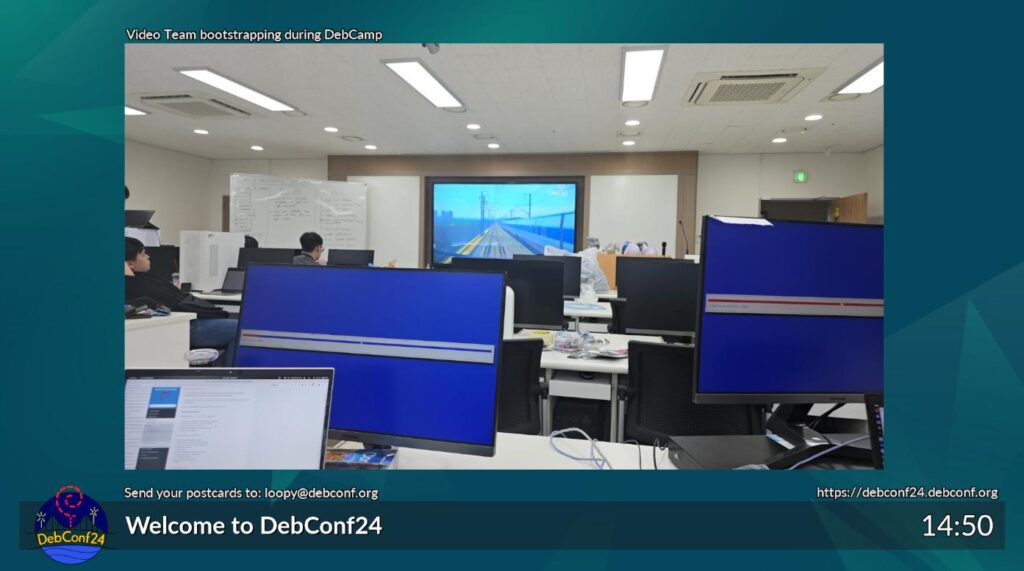

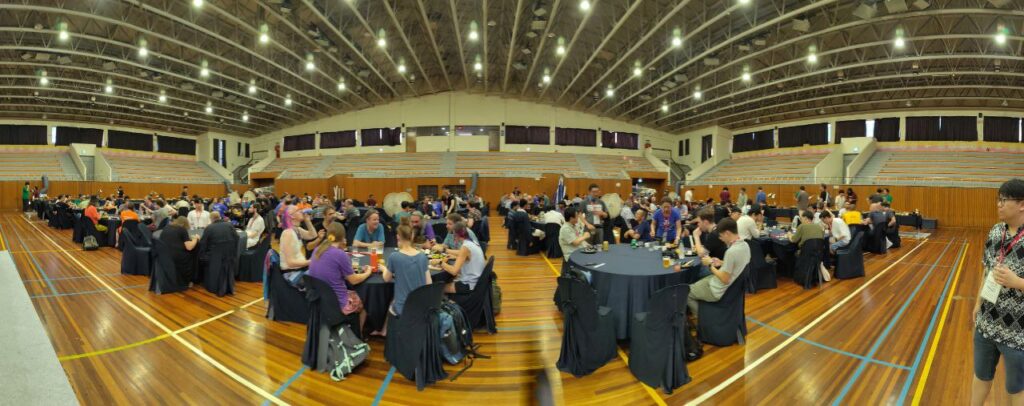 Conference Dinner Photo from Santiago
 Debian annual conference Debconf 24, Busan, South Korea

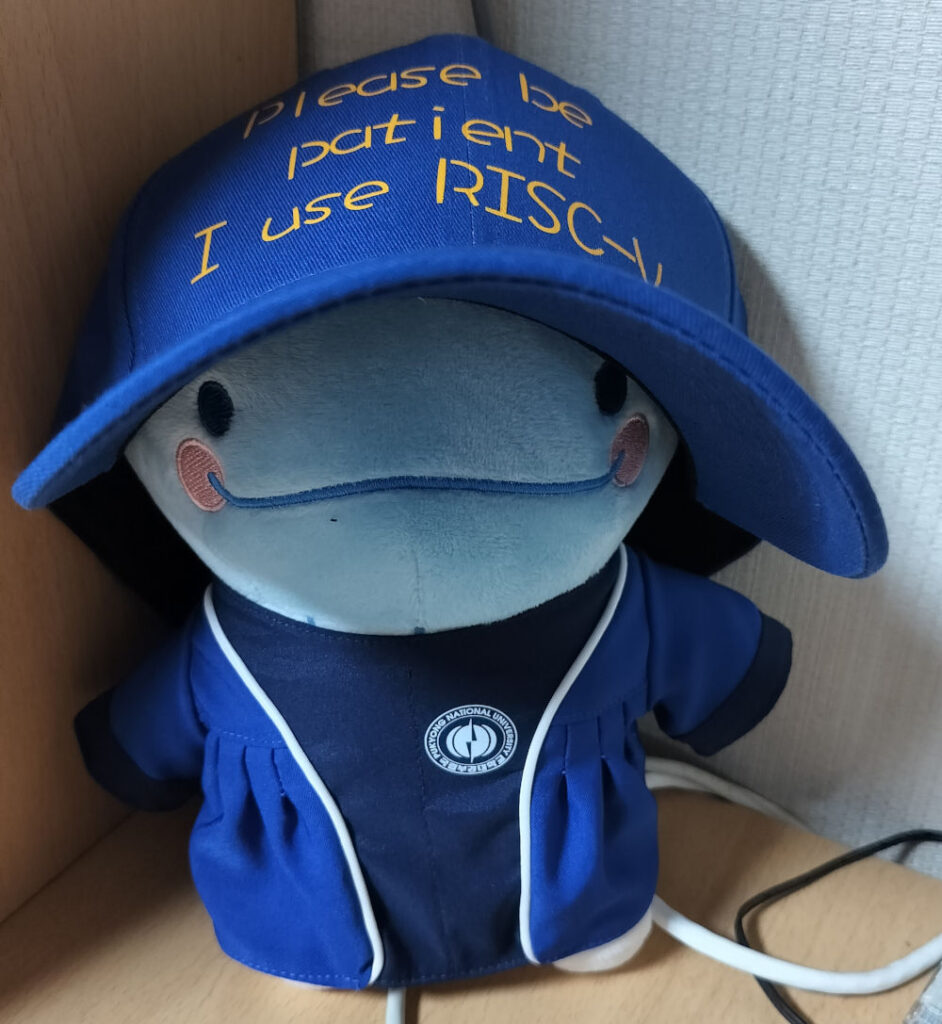
 Debian annual conference Debconf 24, Busan, South Korea
 My Debian contributions this month were all
 And while we're at it: everyone using Libreoffice should give a virtual hug to rene@ for
taming that beast since 2010 and OpenOffice.org before.
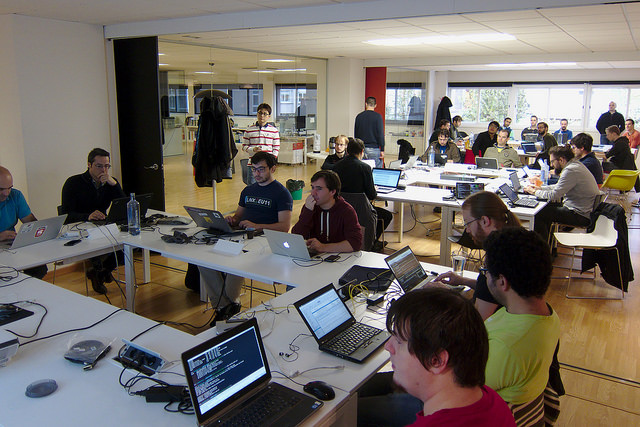
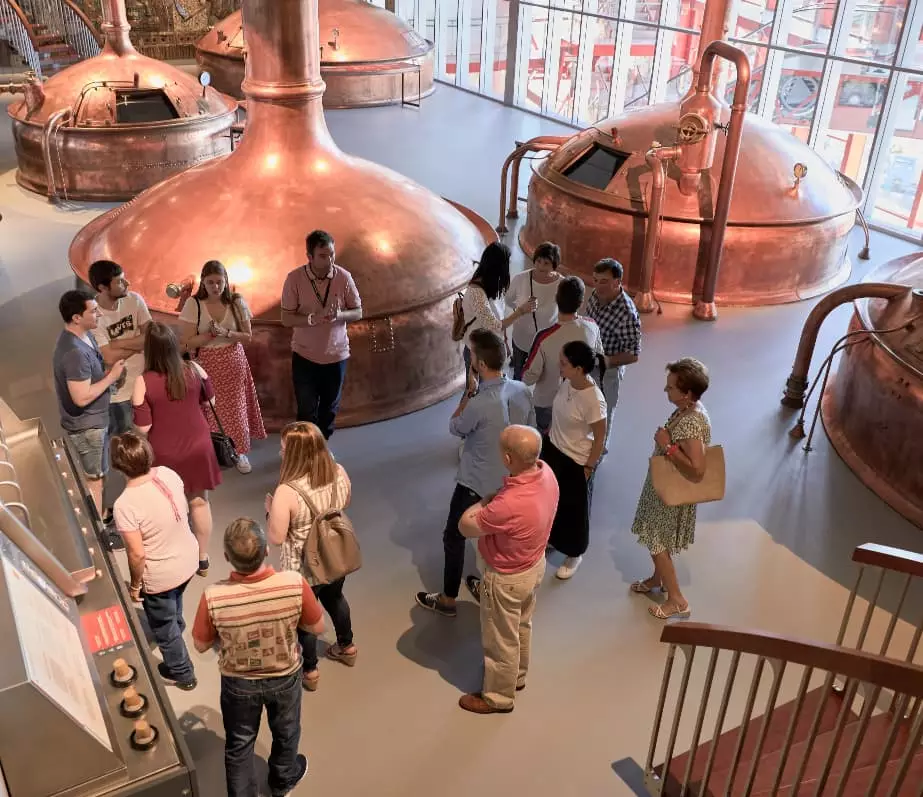
 We can t wait to welcome hackfest attendees to A Coru a! Stay tuned for further
details and outcomes of this unconventional and unique experience.
 Time really flies when
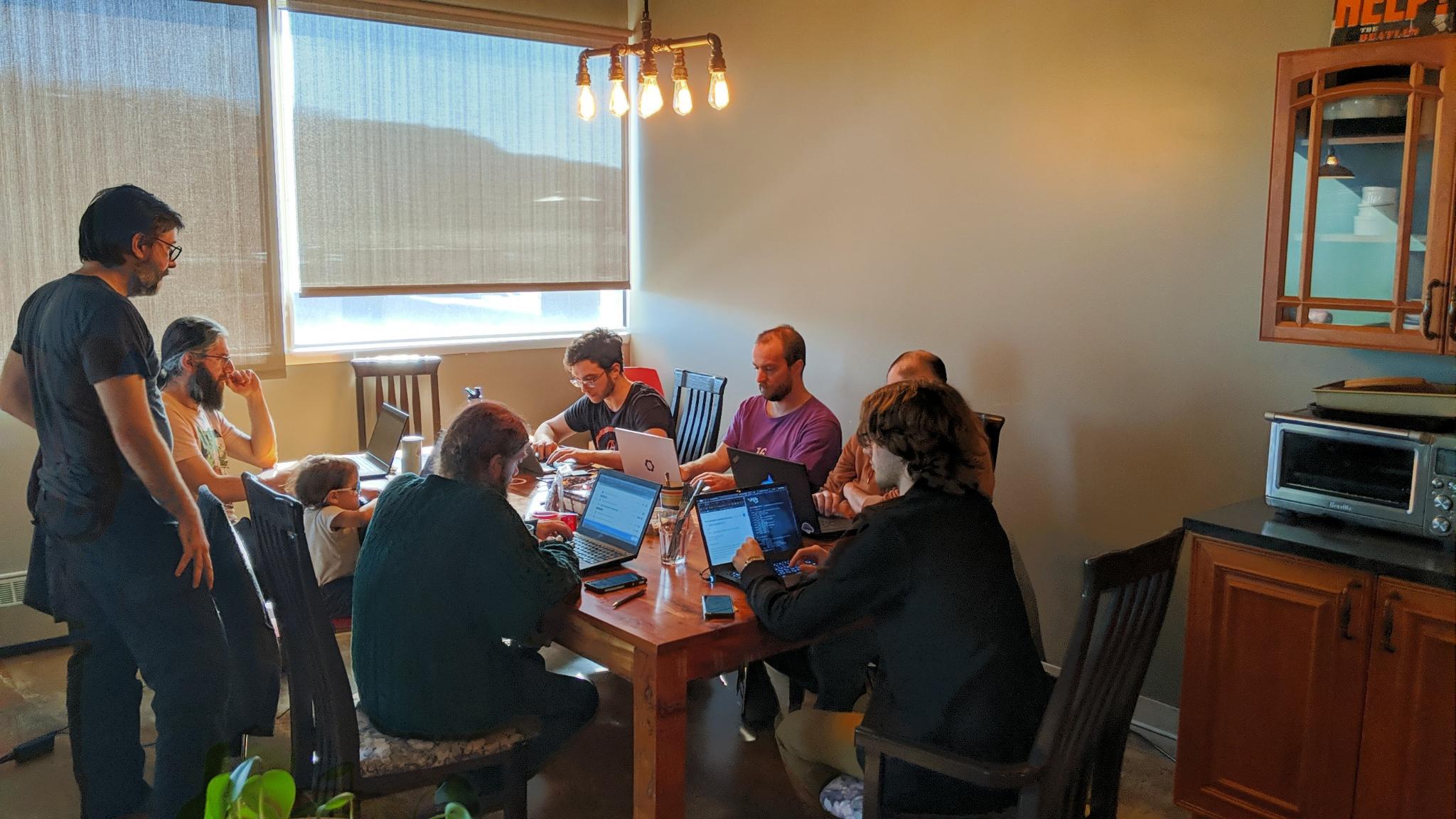
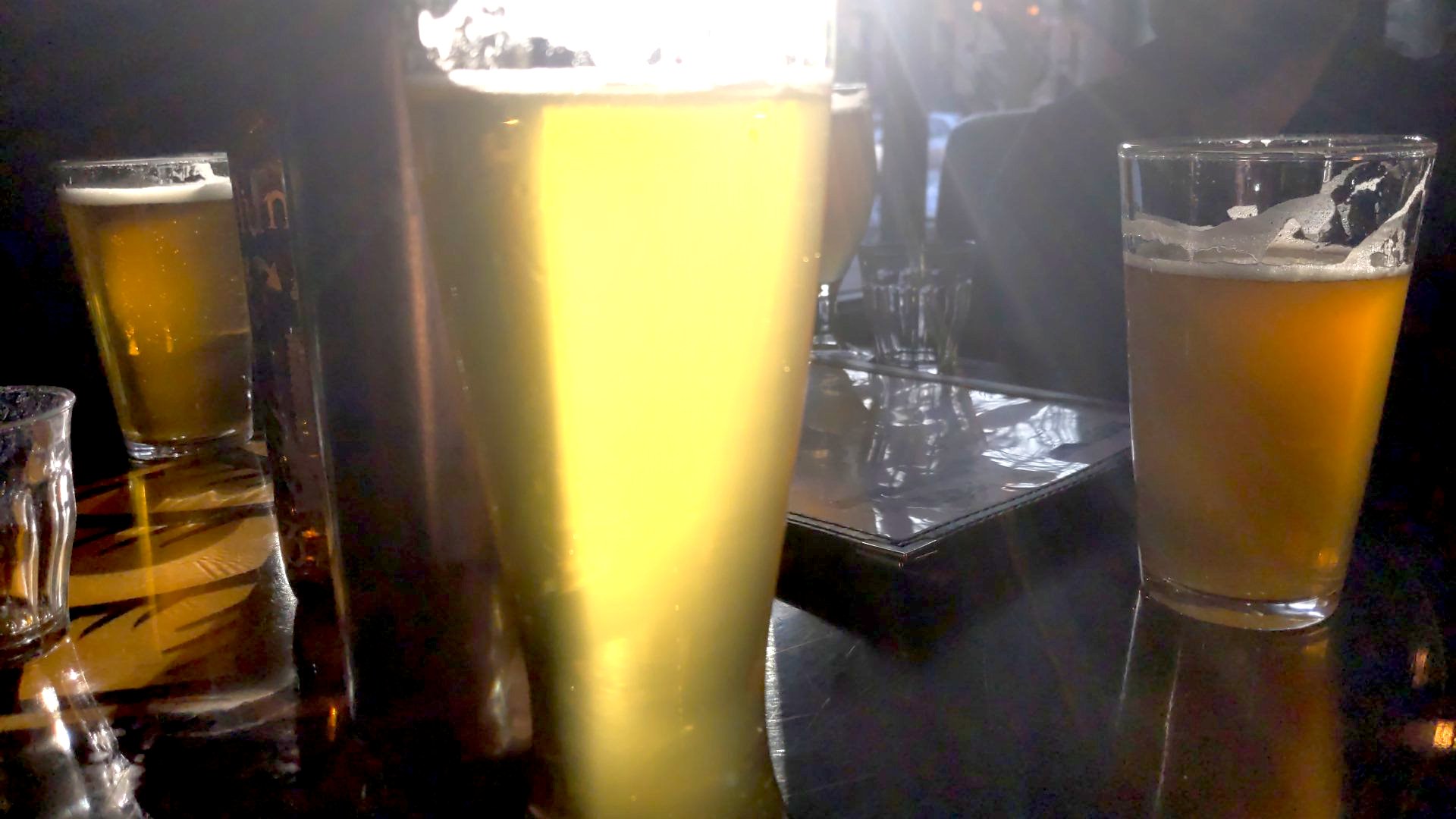









 This unconference-style event aims to bring together the most relevant players
in the Linux display community to tackle current challenges and chart the
future of the display stack.
Key goals for the hackfest include:
 One of the knitting projects I m working on is a big bottom-up
triangular shawl in less-than-fingering weight yarn (NM 1/15): it feels
like a cloud should by all rights feel, and I have good expectations out
of it, but it s taking forever and a day.
And then one day last spring I started thinking in the general direction
of top-down shawls, and decided I couldn t wait until I had finished the
first one to see if I could design one.
For my first attempt I used an odd ball of 50% wool 50% plastic I had in
my stash and worked it on 12 mm tree trunks, and I quickly made
something between a scarf and a shawl that got some use during the
summer thunderstorms when temperatures got a bit lower, but not really
cold. I was happy with the shape, not with the exact position of the
increases, but I had ideas for improvements, so I just had to try
another time.
Digging through the stash I found four balls of Drops Alpaca in two
shades of grey: I had bought it with the intent to test its durability
in somewhat more demanding situations (such as gloves or even socks),
but then the LYS

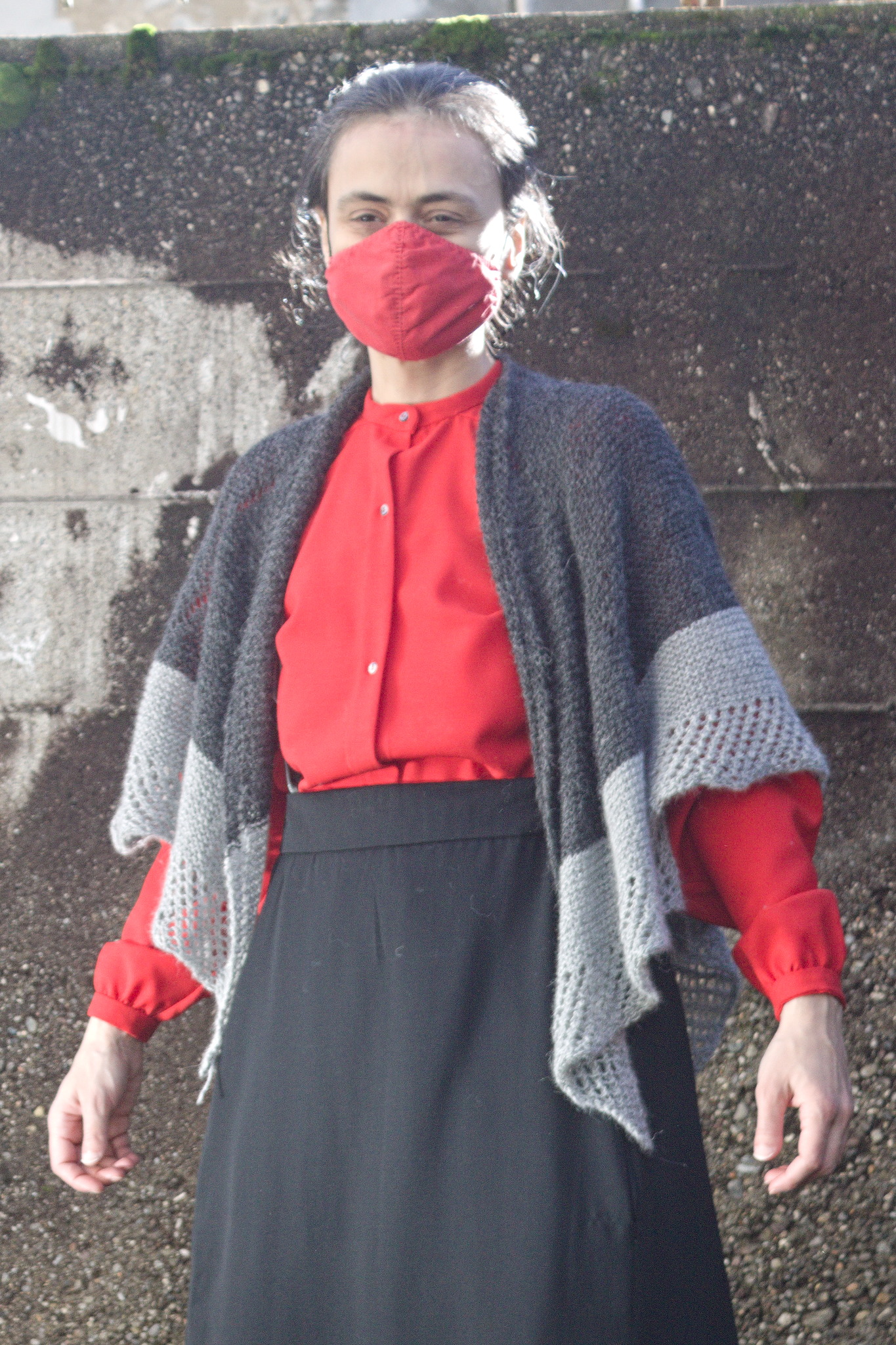 I m glad that I did it, however, as it s still soft and warm, but now
also looks nicer.
The pattern is of course online as #FreeSoftWear on


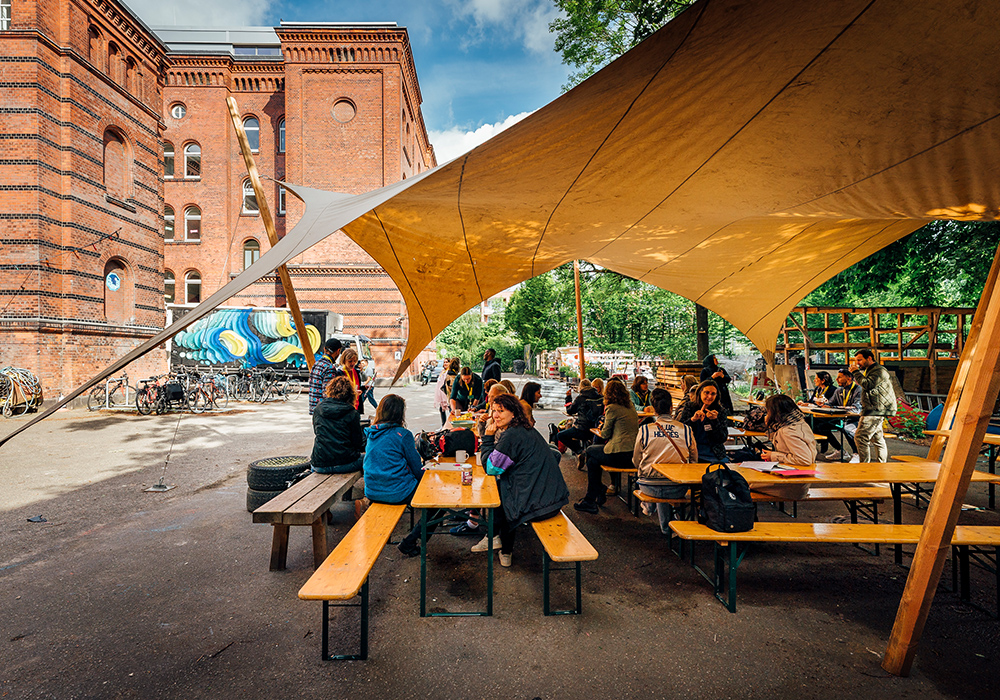
 Just a few days back we came to know about the horrific Train Crash that happened in Odisha (Orissa). There are some things that are known and somethings that can be inferred by observance. Sadly, it seems the incident is going to be covered up
 . Some of the facts that have not been contested in the public domain are that there were three lines. One loop line on which the Goods Train was standing and there was an up and a down line. So three lines were there. Apparently, the signalling system and the inter-locking system had issues as highlighted by an official about a month