Vincent Bernat: Managing infrastructure with Terraform, CDKTF, and NixOS
A few years ago, I downsized my personal infrastructure. Until 2018, there were
a dozen containers running on a single Hetzner server.1 I migrated
my emails to Fastmail and my DNS zones to Gandi. It left me with only my
blog to self-host. As of today, my low-scale infrastructure is composed of 4
virtual machines running NixOS on Hetzner Cloud and Vultr, a handful
of DNS zones on Gandi and Route 53, and a couple of Cloudfront
distributions. It is managed by CDK for Terraform (CDKTF), while NixOS
deployments are handled by NixOps.
In this article, I provide a brief introduction to Terraform, CDKTF, and the
Nix ecosystem. I also explain how to use Nix to access these tools within
your shell, so you can quickly start using them.
CDKTF: infrastructure as code
Terraform is an infrastructure-as-code tool. You can define your
infrastructure by declaring resources with the HCL language. This language
has some additional features like loops to declare several resources from a
list, built-in functions you can call in expressions, and string templates.
Terraform relies on a large set of providers to manage resources.
Managing servers
Here is a short example using the Hetzner Cloud provider to spawn a virtual
machine:
variable "hcloud_token"
  sensitive = true

provider "hcloud"
  token = var.hcloud_token

resource "hcloud_server" "web03"
  name = "web03"
  server_type = "cpx11"
  image = "debian-11"
  datacenter = "nbg1-dc3"

resource "hcloud_rdns" "rdns4-web03"
  server_id = hcloud_server.web03.id
  ip_address = hcloud_server.web03.ipv4_address
  dns_ptr = "web03.luffy.cx"

resource "hcloud_rdns" "rdns6-web03"
  server_id = hcloud_server.web03.id
  ip_address = hcloud_server.web03.ipv6_address
  dns_ptr = "web03.luffy.cx"
HCL expressiveness is quite limited and I find a general-purpose language more
convenient to describe all the resources. This is where CDK for Terraform
comes in: you can manage your infrastructure using your preferred programming
language, including TypeScript, Go, and Python. Here is the previous example
using CDKTF and TypeScript:
import   App, TerraformStack, Fn   from "cdktf";
import   HcloudProvider   from "./.gen/providers/hcloud/provider";
import * as hcloud from "./.gen/providers/hcloud";
class MyStack extends TerraformStack
  constructor(scope: Construct, name: string)
    super(scope, name);
    const hcloudToken = new TerraformVariable(this, "hcloudToken",
      type: "string",
      sensitive: true,
     );
    const hcloudProvider = new HcloudProvider(this, "hcloud",
      token: hcloudToken.value,
     );
    const web03 = new hcloud.server.Server(this, "web03",
      name: "web03",
      serverType: "cpx11",
      image: "debian-11",
      datacenter: "nbg1-dc3",
      provider: hcloudProvider,
     );
    new hcloud.rdns.Rdns(this, "rdns4-web03",
      serverId: Fn.tonumber(web03.id),
      ipAddress: web03.ipv4Address,
      dnsPtr: "web03.luffy.cx",
      provider: hcloudProvider,
     );
    new hcloud.rdns.Rdns(this, "rdns6-web03",
      serverId: Fn.tonumber(web03.id),
      ipAddress: web03.ipv6Address,
      dnsPtr: "web03.luffy.cx",
      provider: hcloudProvider,
     );


const app = new App();
new MyStack(app, "cdktf-take1");
app.synth();
Running cdktf synth generates a configuration file for Terraform, terraform
plan previews the changes, and terraform apply applies them. Now that you
have a general-purpose language, you can use functions.
Managing DNS records
While using CDKTF for 4 web servers may seem a tad overkill, this is quite
different when it comes to managing a few DNS zones. With DNSControl, which
is using JavaScript as a domain-specific language, I was able to define the
bernat.ch zone with this snippet of code:
D("bernat.ch", REG_NONE, DnsProvider(DNS_BIND, 0), DnsProvider(DNS_GANDI),
  DefaultTTL('2h'),
  FastMailMX('bernat.ch',  subdomains: ['vincent'] ),
  WebServers('@'),
  WebServers('vincent');
This generated 38 records. With CDKTF, I use:
new Route53Zone(this, "bernat.ch", providers.aws)
  .sign(dnsCMK)
  .registrar(providers.gandiVB)
  .www("@", servers)
  .www("vincent", servers)
  .www("media", servers)
  .fastmailMX(["vincent"]);
All the magic is in the code that I did not show you. You can check the
dns.ts file in the cdktf-take1 repository to see how it works. Here is a
quick explanation:
Route53Zone() creates a new zone hosted by Route 53,sign() signs the zone with the provided master key,registrar() registers the zone to the registrar of the domain and sets up DNSSEC,www() creates A and AAAA records for the provided name pointing to the web servers,fastmailMX() creates the MX records and other support records to direct emails to Fastmail.
Here is the content of the fastmailMX() function. It generates a few records
and returns the current zone for chaining:
fastmailMX(subdomains?: string[])
  (subdomains ?? [])
    .concat(["@", "*"])
    .forEach((subdomain) =>
      this.MX(subdomain, [
        "10 in1-smtp.messagingengine.com.",
        "20 in2-smtp.messagingengine.com.",
      ])
    );
  this.TXT("@", "v=spf1 include:spf.messagingengine.com ~all");
  ["mesmtp", "fm1", "fm2", "fm3"].forEach((dk) =>
    this.CNAME( $ dk ._domainkey ,  $ dk .$ this.name .dkim.fmhosted.com. )
  );
  this.TXT("_dmarc", "v=DMARC1; p=none; sp=none");
  return this;
I encourage you to browse the repository if you need more
information.
About Pulumi
My first tentative around Terraform was to use Pulumi. You can find this
attempt on GitHub. This is quite similar to what I currently do
with CDKTF. The main difference is that I am using Python instead of TypeScript
because I was not familiar with TypeScript at the time.2
Pulumi predates CDKTF and it uses a slightly different approach. CDKTF
generates a Terraform configuration (in JSON format instead of HCL), delegating
planning, state management, and deployment to Terraform. It is therefore bound
to the limitations of what can be expressed by Terraform, notably when you
need to transform data obtained from one resource to another.3
Pulumi needs specific providers for each resource. Many Pulumi providers are
thin wrappers encapsulating Terraform providers.
While Pulumi provides a good user experience, I switched to CDKTF because
writing providers for Pulumi is a chore. CDKTF does not require such a step.
Outside the big players (AWS, Azure and Google Cloud), the existence, quality,
and freshness of the Pulumi providers are inconsistent. Most providers rely on
a Terraform provider and they may lag a few versions behind, miss a few
resources, or have a few bugs of their own.
When a provider does not exist, you can write one with the help of the
pulumi-terraform-bridge library. The Pulumi project provides a
boilerplate for this purpose. I had a bad experience with it when writing
providers for Gandi and Vultr: the
Makefile automatically installs Pulumi using a curl sh
pattern and does not work with /bin/sh. There is a lack of
interest for community-based contributions4 or even for providers for
smaller players.
NixOS & NixOps
Nix is a functional, purely-functional programming language.
Nix is also the name of the package manager that is built on top of
the Nix language. It allows users to declaratively install packages.
nixpkgs is a repository of packages. You can install Nix on
top of a regular Linux distribution. If you want more details, a good resource
is the official website, and notably the learn section. There is a steep learning curve, but the reward is tremendous.
NixOS: declarative Linux distribution
NixOS is a Linux distribution built on top of the Nix package manager.
Here is a configuration snippet to add some packages:
environment.systemPackages = with pkgs;
  [
    bat
    htop
    liboping
    mg
    mtr
    ncdu
    tmux
  ];
It is possible to alter an existing derivation5 to use a different version, enable a
specific feature, or apply a patch. Here is how I enable and configure Nginx
to disable the stream module, add the Brotli compression module, and add the
IP address anonymizer module. Moreover, instead of using OpenSSL 3, I keep
using OpenSSL 1.1.6
services.nginx =
  enable = true;
  package = (pkgs.nginxStable.override
    withStream = false;
    modules = with pkgs.nginxModules; [
      brotli
      ipscrub
    ];
    openssl = pkgs.openssl_1_1;
   );
If you need to add some patches, it is also possible. Here are the patches I
added in 2019 to circumvent the DoS vulnerabilities in Nginx
until they were fixed in NixOS:7
services.nginx.package = pkgs.nginxStable.overrideAttrs (old:
  patches = oldAttrs.patches ++ [
    # HTTP/2: reject zero length headers with PROTOCOL_ERROR.
    (pkgs.fetchpatch
      url = https://github.com/nginx/nginx/commit/dbdd[ ].patch;
      sha256 = "a48190[ ]";
     )
    # HTTP/2: limited number of DATA frames.
    (pkgs.fetchpatch
      url = https://github.com/nginx/nginx/commit/94c5[ ].patch;
      sha256 = "af591a[ ]";
     )
    #  HTTP/2: limited number of PRIORITY frames.
    (pkgs.fetchpatch
      url = https://github.com/nginx/nginx/commit/39bb[ ].patch;
      sha256 = "1ad8fe[ ]";
     )
  ];
 );
If you are interested, have a look at my relatively small configuration:
common.nix contains the configuration to be applied to any host
(SSH, users, common software packages), web.nix contains the
configuration for the web servers, isso.nix runs Isso into a
systemd container.
NixOps: NixOS deployment tool
On a single node, NixOS configuration is in the /etc/nixos/configuration.nix
file. After modifying it, you have to run nixos-rebuild switch. Nix fetches
all possible dependencies from the binary cache and builds the remaining
packages. It creates a new entry in the boot loader menu and activates the new
configuration.
To manage several nodes, there exists several options, including NixOps,
deploy-rs, Colmena, and morph. I do not know all of them, but from
my point of view, the differences are not that important. It is also possible to
build such a tool yourself as Nix provides the most important building blocks:
nix build and nix copy. NixOps is one of the first tools available but I
encourage you to explore the alternatives.
NixOps configuration is written in Nix. Here is a simplified configuration
to deploy znc01.luffy.cx, web01.luffy.cx, and web02.luffy.cx, with the
help of the server and web functions:
let
  server = hardware: name: imports:
    deployment.targetHost = "$ name .luffy.cx";
    networking.hostName = name;
    networking.domain = "luffy.cx";
    imports = [ (./hardware/. + "/$ hardware .nix") ] ++ imports;
   ;
  web = hardware: idx: imports:
    server hardware "web$ lib.fixedWidthNumber 2 idx " ([ ./web.nix ] ++ imports);
in
  network.description = "Luffy infrastructure";
  network.enableRollback = true;
  defaults = import ./common.nix;
  znc01 = server "exoscale" [ ./znc.nix ];
  web01 = web "hetzner" 1 [ ./isso.nix ];
  web02 = web "hetzner" 2 [];
Tying everything together with Nix
The Nix ecosystem is a unified solution to the various problems around
software and configuration management. A very interesting feature is the
declarative and reproducible developer environments. This is similar to
Python virtual environments, except it is not language-specific.
Brief introduction to Nix flakes
I am using flakes, a new Nix feature improving reproducibility by pinning
all dependencies and making the build hermetic. While the feature is marked as
experimental,8 it is widely used and you may see flake.nix and
flake.lock at the root of some repositories.
As a short example, here is the flake.nix content shipped with Snimpy, an
interactive SNMP tool for Python relying on libsmi, a C library:
  inputs =
    nixpkgs.url = "nixpkgs";
    flake-utils.url = "github:numtide/flake-utils";
   ;
  outputs =   self, ...  @inputs:
    inputs.flake-utils.lib.eachDefaultSystem (system:
      let
        pkgs = inputs.nixpkgs.legacyPackages."$ system ";
      in

        # nix build
        packages.default = pkgs.python3Packages.buildPythonPackage
          name = "snimpy";
          src = self;
          preConfigure = ''echo "1.0.0-0-000000000000" > version.txt'';
          checkPhase = "pytest";
          checkInputs = with pkgs.python3Packages; [ pytest mock coverage ];
          propagatedBuildInputs = with pkgs.python3Packages; [ cffi pysnmp ipython ];
          buildInputs = [ pkgs.libsmi ];
         ;
        # nix run + nix shell
        apps.default =
          type = "app";
          program = "$ self.packages."$ system ".default /bin/snimpy";
         ;
        # nix develop
        devShells.default = pkgs.mkShell
          name = "snimpy-dev";
          buildInputs = [
            self.packages."$ system ".default.inputDerivation
            pkgs.python3Packages.ipython
          ];
         ;
       );
If you have Nix installed on your system:
nix run github:vincentbernat/snimpy runs Snimpy,nix shell github:vincentbernat/snimpy provides a shell with Snimpy ready-to-use,nix build github:vincentbernat/snimpy builds the Python package, tests included, andnix develop . provides a shell to hack around Snimpy when run from a fresh checkout.9
For more information about Nix flakes, have a look at the tutorial from
Tweag.
Nix and CDKTF
At the root of the repository I use for CDKTF, there is a
flake.nix file to set up a shell with Terraform and
CDKTF installed and with the appropriate environment variables to automate my
infrastructure.
Terraform is already packaged in nixpkgs. However, I need to apply a patch
on top of the Gandi provider. Not a problem with Nix!
terraform = pkgs.terraform.withPlugins (p: [
  p.aws
  p.hcloud
  p.vultr
  (p.gandi.overrideAttrs
    (old:
      src = pkgs.fetchFromGitHub
        owner = "vincentbernat";
        repo = "terraform-provider-gandi";
        rev = "feature/livedns-key";
        hash = "sha256-V16BIjo5/rloQ1xTQrdd0snoq1OPuDh3fQNW7kiv/kQ=";
       ;
     ))
]);
CDKTF is written in TypeScript. I have a
package.json file with all the dependencies
needed, including the ones to use TypeScript as the language to define
infrastructure:
  "name": "cdktf-take1",
  "version": "1.0.0",
  "main": "main.js",
  "types": "main.ts",
  "private": true,
  "dependencies":
    "@types/node": "^14.18.30",
    "cdktf": "^0.13.3",
    "cdktf-cli": "^0.13.3",
    "constructs": "^10.1.151",
    "eslint": "^8.27.0",
    "prettier": "^2.7.1",
    "ts-node": "^10.9.1",
    "typescript": "^3.9.10",
    "typescript-language-server": "^2.1.0"
I use Yarn to get a yarn.lock file that can be
used directly to declare a derivation containing all the dependencies:
nodeEnv = pkgs.mkYarnModules
  pname = "cdktf-take1-js-modules";
  version = "1.0.0";
  packageJSON = ./package.json;
  yarnLock = ./yarn.lock;
 ;
The next step is to generate the CDKTF providers from the Terraform providers
and turn them into a derivation:
cdktfProviders = pkgs.stdenvNoCC.mkDerivation
  name = "cdktf-providers";
  nativeBuildInputs = [
    pkgs.nodejs
    terraform
  ];
  src = nix-filter
    root = ./.;
    include = [ ./cdktf.json ./tsconfig.json ];
   ;
  buildPhase = ''
    export HOME=$(mktemp -d)
    export CHECKPOINT_DISABLE=1
    export DISABLE_VERSION_CHECK=1
    export PATH=$ nodeEnv /node_modules/.bin:$PATH
    ln -nsf $ nodeEnv /node_modules node_modules
    # Build all providers we have in terraform
    for provider in $(cd $ terraform /libexec/terraform-providers; echo */*/*/*); do
      version=''$ provider##*/
      provider=''$ provider%/*
      echo "Build $provider@$version"
      cdktf provider add --force-local $provider@$version   cat
    done
    echo "Compile TS   JS"
    tsc
  '';
  installPhase = ''
    mv .gen $out
    ln -nsf $ nodeEnv /node_modules $out/node_modules
  '';
 ;
Finally, we can define the development environment:
devShells.default = pkgs.mkShell
  name = "cdktf-take1";
  buildInputs = [
    pkgs.nodejs
    pkgs.yarn
    terraform
  ];
  shellHook = ''
    # No telemetry
    export CHECKPOINT_DISABLE=1
    # No autoinstall of plugins
    export CDKTF_DISABLE_PLUGIN_CACHE_ENV=1
    # Do not check version
    export DISABLE_VERSION_CHECK=1
    # Access to node modules
    export PATH=$PWD/node_modules/.bin:$PATH
    ln -nsf $ nodeEnv /node_modules node_modules
    ln -nsf $ cdktfProviders  .gen
    # Credentials
    for p in \
      njf.nznmba.pbz/Nqzvavfgengbe \
      urgmare.pbz/ivaprag@oreang.pu \
      ihyge.pbz/ihyge@ivaprag.oreang.pu; do
        eval $(pass show $(echo $p   tr 'A-Za-z' 'N-ZA-Mn-za-m')   grep '^export')
    done
    eval $(pass show personal/cdktf/secrets   grep '^export')
    export TF_VAR_hcloudToken="$HCLOUD_TOKEN"
    export TF_VAR_vultrApiKey="$VULTR_API_KEY"
    unset VULTR_API_KEY HCLOUD_TOKEN
  '';
 ;
The derivations listed in buildInputs are available in the provided shell.
The content of shellHook is sourced when starting the shell. It sets up some
symbolic links to make the JavaScript environment built at an earlier step
available, as well as the generated CDKTF providers. It also exports all the
credentials.10
I am also using direnv with an .envrc to
automatically load the development environment. This also enables the
environment to be available from inside Emacs, notably when using lsp-mode
to get TypeScript completions. Without direnv, nix develop . can activate
the environment.
I use the following commands to deploy the infrastructure:11
$ cdktf synth
$ cd cdktf.out/stacks/cdktf-take1
$ terraform plan --out plan
$ terraform apply plan
$ terraform output -json > ~-automation/nixops-take1/cdktf.json
The last command generates a JSON file containing various data to complete the
deployment with NixOps.
NixOps
The JSON file exported by Terraform contains the list of servers with various
attributes:
  "hardware": "hetzner",
  "ipv4Address": "5.161.44.145",
  "ipv6Address": "2a01:4ff:f0:b91::1",
  "name": "web05.luffy.cx",
  "tags": [
    "web",
    "continent:NA",
    "continent:SA"
  ]
In network.nix, this list is imported and
transformed into an attribute set describing the servers. A simplified version
looks like this:
let
  lib = inputs.nixpkgs.lib;
  shortName = name: builtins.elemAt (lib.splitString "." name) 0;
  domainName = name: lib.concatStringsSep "." (builtins.tail (lib.splitString "." name));
  server = hardware: name: imports:
    networking =
      hostName = shortName name;
      domain = domainName name;
     ;
    deployment.targetHost = name;
    imports = [ (./hardware/. + "/$ hardware .nix") ] ++ imports;
   ;
  cdktf-servers-json = (lib.importJSON ./cdktf.json).servers.value;
  cdktf-servers = map
    (s:
      let
        tags-maybe-import = map (t: ./. + "/$ t .nix") s.tags;
        tags-import = builtins.filter (t: builtins.pathExists t) tags-maybe-import;
      in

        name = shortName s.name;
        value = server s.hardware s.name tags-import;
       )
    cdktf-servers-json;
in

  // [ ]
  // builtins.listToAttrs cdktf-servers
For web05, this expands to:
web05 =
  networking =
    hostName = "web05";
    domainName = "luffy.cx";
   ;
  deployment.targetHost = "web05.luffy.cx";
  imports = [ ./hardware/hetzner.nix ./web.nix ];
 ;
As for CDKTF, at the root of the repository I use for NixOps,
there is a flake.nix file to set up a shell with
NixOps configured. Because NixOps do not support rollouts, I usually use the
following commands to deploy on a single server:12
$ nix flake update
$ nixops deploy --include=web04
$ ./tests web04.luffy.cx
If the tests are OK, I deploy the remaining nodes gradually with the following
command:
$ (set -e; for h in web 03..06 ; do nixops deploy --include=$h; done)
nixops deploy rolls out all servers in parallel and therefore could cause a
short outage where all Nginx are down at the same time.
This post has been a work-in-progress for the past three years, with the content
being updated and refined as I experimented with different solutions. There is
still much to explore13 but I feel there is enough content to publish now.
-
It was an AMD Athlon 64 X2 5600+ with 2 GB of RAM and 2 400 GB disks
with software RAID. I was paying something around 59 per month for it.
While it was a good deal in 2008, by 2018 it was no longer cost-effective.
It was running on Debian Wheezy with Linux-VServer for isolation, both
of which were outdated in 2018.
-
I also did not use Python because Poetry support in Nix was a bit
broken around the time I started hacking around CDKTF.
-
Pulumi can apply arbitrary functions with the
apply()
method on an output. It makes it easy to transform data that are not known
during the planning stage. Terraform has functions to
serve a similar purpose, but they are more limited.
-
The two mentioned pull requests are not merged yet. The second one is
superseded by PR #61, submitted two months later, which
enforces the use of
/bin/bash. I also submitted PR #56,
which was merged 4 months later and quickly reverted without
an explanation.
-
You may consider packages and derivations to be synonyms in the
Nix ecosystem.
-
OpenSSL 3 has outstanding performance regressions.
-
NixOS can be a bit slow to integrate patches since they need to
rebuild parts of the binary cache before releasing the fixes. In this
specific case, they were fast: the vulnerability and patches were released
on August 13th 2019 and available in NixOS on August 15th. As a
comparison, Debian only released the fixed version on August 22nd, which is unusually late.
-
Because flakes are experimental, many documentations do not
use them and it is an additional aspect to learn.
-
It is possible to replace
. with github:vincentbernat/snimpy,
like in the other commands, but having Snimpy dependencies without
Snimpy source code is less interesting.
-
I am using pass as a password manager. The password names are
only obfuscated to avoid spam.
-
The
cdktf command can wrap the terraform commands, but I
prefer to use them directly as they are more flexible.
-
If the change is risky, I disable the server with CDKTF. This
removes it from the web service DNS records.
-
I would like to replace NixOps with an alternative handling
progressive rollouts and checks. I am also considering switching to
Nomad or Kubernetes to deploy workloads.
variable "hcloud_token" sensitive = true provider "hcloud" token = var.hcloud_token resource "hcloud_server" "web03" name = "web03" server_type = "cpx11" image = "debian-11" datacenter = "nbg1-dc3" resource "hcloud_rdns" "rdns4-web03" server_id = hcloud_server.web03.id ip_address = hcloud_server.web03.ipv4_address dns_ptr = "web03.luffy.cx" resource "hcloud_rdns" "rdns6-web03" server_id = hcloud_server.web03.id ip_address = hcloud_server.web03.ipv6_address dns_ptr = "web03.luffy.cx"
import App, TerraformStack, Fn from "cdktf"; import HcloudProvider from "./.gen/providers/hcloud/provider"; import * as hcloud from "./.gen/providers/hcloud"; class MyStack extends TerraformStack constructor(scope: Construct, name: string) super(scope, name); const hcloudToken = new TerraformVariable(this, "hcloudToken", type: "string", sensitive: true, ); const hcloudProvider = new HcloudProvider(this, "hcloud", token: hcloudToken.value, ); const web03 = new hcloud.server.Server(this, "web03", name: "web03", serverType: "cpx11", image: "debian-11", datacenter: "nbg1-dc3", provider: hcloudProvider, ); new hcloud.rdns.Rdns(this, "rdns4-web03", serverId: Fn.tonumber(web03.id), ipAddress: web03.ipv4Address, dnsPtr: "web03.luffy.cx", provider: hcloudProvider, ); new hcloud.rdns.Rdns(this, "rdns6-web03", serverId: Fn.tonumber(web03.id), ipAddress: web03.ipv6Address, dnsPtr: "web03.luffy.cx", provider: hcloudProvider, ); const app = new App(); new MyStack(app, "cdktf-take1"); app.synth();
cdktf synth generates a configuration file for Terraform, terraform
plan previews the changes, and terraform apply applies them. Now that you
have a general-purpose language, you can use functions.
Managing DNS records
While using CDKTF for 4 web servers may seem a tad overkill, this is quite
different when it comes to managing a few DNS zones. With DNSControl, which
is using JavaScript as a domain-specific language, I was able to define the
bernat.ch zone with this snippet of code:
D("bernat.ch", REG_NONE, DnsProvider(DNS_BIND, 0), DnsProvider(DNS_GANDI),
DefaultTTL('2h'),
FastMailMX('bernat.ch', subdomains: ['vincent'] ),
WebServers('@'),
WebServers('vincent');
This generated 38 records. With CDKTF, I use:
new Route53Zone(this, "bernat.ch", providers.aws)
.sign(dnsCMK)
.registrar(providers.gandiVB)
.www("@", servers)
.www("vincent", servers)
.www("media", servers)
.fastmailMX(["vincent"]);
All the magic is in the code that I did not show you. You can check the
dns.ts file in the cdktf-take1 repository to see how it works. Here is a
quick explanation:
Route53Zone() creates a new zone hosted by Route 53,sign() signs the zone with the provided master key,registrar() registers the zone to the registrar of the domain and sets up DNSSEC,www() creates A and AAAA records for the provided name pointing to the web servers,fastmailMX() creates the MX records and other support records to direct emails to Fastmail.
Here is the content of the fastmailMX() function. It generates a few records
and returns the current zone for chaining:
fastmailMX(subdomains?: string[])
(subdomains ?? [])
.concat(["@", "*"])
.forEach((subdomain) =>
this.MX(subdomain, [
"10 in1-smtp.messagingengine.com.",
"20 in2-smtp.messagingengine.com.",
])
);
this.TXT("@", "v=spf1 include:spf.messagingengine.com ~all");
["mesmtp", "fm1", "fm2", "fm3"].forEach((dk) =>
this.CNAME( $ dk ._domainkey , $ dk .$ this.name .dkim.fmhosted.com. )
);
this.TXT("_dmarc", "v=DMARC1; p=none; sp=none");
return this;
I encourage you to browse the repository if you need more
information.
About Pulumi
My first tentative around Terraform was to use Pulumi. You can find this
attempt on GitHub. This is quite similar to what I currently do
with CDKTF. The main difference is that I am using Python instead of TypeScript
because I was not familiar with TypeScript at the time.2
Pulumi predates CDKTF and it uses a slightly different approach. CDKTF
generates a Terraform configuration (in JSON format instead of HCL), delegating
planning, state management, and deployment to Terraform. It is therefore bound
to the limitations of what can be expressed by Terraform, notably when you
need to transform data obtained from one resource to another.3
Pulumi needs specific providers for each resource. Many Pulumi providers are
thin wrappers encapsulating Terraform providers.
While Pulumi provides a good user experience, I switched to CDKTF because
writing providers for Pulumi is a chore. CDKTF does not require such a step.
Outside the big players (AWS, Azure and Google Cloud), the existence, quality,
and freshness of the Pulumi providers are inconsistent. Most providers rely on
a Terraform provider and they may lag a few versions behind, miss a few
resources, or have a few bugs of their own.
When a provider does not exist, you can write one with the help of the
pulumi-terraform-bridge library. The Pulumi project provides a
boilerplate for this purpose. I had a bad experience with it when writing
providers for Gandi and Vultr: the
Makefile automatically installs Pulumi using a curl sh
pattern and does not work with /bin/sh. There is a lack of
interest for community-based contributions4 or even for providers for
smaller players.
NixOS & NixOps
Nix is a functional, purely-functional programming language.
Nix is also the name of the package manager that is built on top of
the Nix language. It allows users to declaratively install packages.
nixpkgs is a repository of packages. You can install Nix on
top of a regular Linux distribution. If you want more details, a good resource
is the official website, and notably the learn section. There is a steep learning curve, but the reward is tremendous.
NixOS: declarative Linux distribution
NixOS is a Linux distribution built on top of the Nix package manager.
Here is a configuration snippet to add some packages:
environment.systemPackages = with pkgs;
[
bat
htop
liboping
mg
mtr
ncdu
tmux
];
It is possible to alter an existing derivation5 to use a different version, enable a
specific feature, or apply a patch. Here is how I enable and configure Nginx
to disable the stream module, add the Brotli compression module, and add the
IP address anonymizer module. Moreover, instead of using OpenSSL 3, I keep
using OpenSSL 1.1.6
services.nginx =
enable = true;
package = (pkgs.nginxStable.override
withStream = false;
modules = with pkgs.nginxModules; [
brotli
ipscrub
];
openssl = pkgs.openssl_1_1;
);
If you need to add some patches, it is also possible. Here are the patches I
added in 2019 to circumvent the DoS vulnerabilities in Nginx
until they were fixed in NixOS:7
services.nginx.package = pkgs.nginxStable.overrideAttrs (old:
patches = oldAttrs.patches ++ [
# HTTP/2: reject zero length headers with PROTOCOL_ERROR.
(pkgs.fetchpatch
url = https://github.com/nginx/nginx/commit/dbdd[ ].patch;
sha256 = "a48190[ ]";
)
# HTTP/2: limited number of DATA frames.
(pkgs.fetchpatch
url = https://github.com/nginx/nginx/commit/94c5[ ].patch;
sha256 = "af591a[ ]";
)
# HTTP/2: limited number of PRIORITY frames.
(pkgs.fetchpatch
url = https://github.com/nginx/nginx/commit/39bb[ ].patch;
sha256 = "1ad8fe[ ]";
)
];
);
If you are interested, have a look at my relatively small configuration:
common.nix contains the configuration to be applied to any host
(SSH, users, common software packages), web.nix contains the
configuration for the web servers, isso.nix runs Isso into a
systemd container.
NixOps: NixOS deployment tool
On a single node, NixOS configuration is in the /etc/nixos/configuration.nix
file. After modifying it, you have to run nixos-rebuild switch. Nix fetches
all possible dependencies from the binary cache and builds the remaining
packages. It creates a new entry in the boot loader menu and activates the new
configuration.
To manage several nodes, there exists several options, including NixOps,
deploy-rs, Colmena, and morph. I do not know all of them, but from
my point of view, the differences are not that important. It is also possible to
build such a tool yourself as Nix provides the most important building blocks:
nix build and nix copy. NixOps is one of the first tools available but I
encourage you to explore the alternatives.
NixOps configuration is written in Nix. Here is a simplified configuration
to deploy znc01.luffy.cx, web01.luffy.cx, and web02.luffy.cx, with the
help of the server and web functions:
let
server = hardware: name: imports:
deployment.targetHost = "$ name .luffy.cx";
networking.hostName = name;
networking.domain = "luffy.cx";
imports = [ (./hardware/. + "/$ hardware .nix") ] ++ imports;
;
web = hardware: idx: imports:
server hardware "web$ lib.fixedWidthNumber 2 idx " ([ ./web.nix ] ++ imports);
in
network.description = "Luffy infrastructure";
network.enableRollback = true;
defaults = import ./common.nix;
znc01 = server "exoscale" [ ./znc.nix ];
web01 = web "hetzner" 1 [ ./isso.nix ];
web02 = web "hetzner" 2 [];
Tying everything together with Nix
The Nix ecosystem is a unified solution to the various problems around
software and configuration management. A very interesting feature is the
declarative and reproducible developer environments. This is similar to
Python virtual environments, except it is not language-specific.
Brief introduction to Nix flakes
I am using flakes, a new Nix feature improving reproducibility by pinning
all dependencies and making the build hermetic. While the feature is marked as
experimental,8 it is widely used and you may see flake.nix and
flake.lock at the root of some repositories.
As a short example, here is the flake.nix content shipped with Snimpy, an
interactive SNMP tool for Python relying on libsmi, a C library:
inputs =
nixpkgs.url = "nixpkgs";
flake-utils.url = "github:numtide/flake-utils";
;
outputs = self, ... @inputs:
inputs.flake-utils.lib.eachDefaultSystem (system:
let
pkgs = inputs.nixpkgs.legacyPackages."$ system ";
in
# nix build
packages.default = pkgs.python3Packages.buildPythonPackage
name = "snimpy";
src = self;
preConfigure = ''echo "1.0.0-0-000000000000" > version.txt'';
checkPhase = "pytest";
checkInputs = with pkgs.python3Packages; [ pytest mock coverage ];
propagatedBuildInputs = with pkgs.python3Packages; [ cffi pysnmp ipython ];
buildInputs = [ pkgs.libsmi ];
;
# nix run + nix shell
apps.default =
type = "app";
program = "$ self.packages."$ system ".default /bin/snimpy";
;
# nix develop
devShells.default = pkgs.mkShell
name = "snimpy-dev";
buildInputs = [
self.packages."$ system ".default.inputDerivation
pkgs.python3Packages.ipython
];
;
);
If you have Nix installed on your system:
nix run github:vincentbernat/snimpy runs Snimpy,nix shell github:vincentbernat/snimpy provides a shell with Snimpy ready-to-use,nix build github:vincentbernat/snimpy builds the Python package, tests included, andnix develop . provides a shell to hack around Snimpy when run from a fresh checkout.9
For more information about Nix flakes, have a look at the tutorial from
Tweag.
Nix and CDKTF
At the root of the repository I use for CDKTF, there is a
flake.nix file to set up a shell with Terraform and
CDKTF installed and with the appropriate environment variables to automate my
infrastructure.
Terraform is already packaged in nixpkgs. However, I need to apply a patch
on top of the Gandi provider. Not a problem with Nix!
terraform = pkgs.terraform.withPlugins (p: [
p.aws
p.hcloud
p.vultr
(p.gandi.overrideAttrs
(old:
src = pkgs.fetchFromGitHub
owner = "vincentbernat";
repo = "terraform-provider-gandi";
rev = "feature/livedns-key";
hash = "sha256-V16BIjo5/rloQ1xTQrdd0snoq1OPuDh3fQNW7kiv/kQ=";
;
))
]);
CDKTF is written in TypeScript. I have a
package.json file with all the dependencies
needed, including the ones to use TypeScript as the language to define
infrastructure:
"name": "cdktf-take1",
"version": "1.0.0",
"main": "main.js",
"types": "main.ts",
"private": true,
"dependencies":
"@types/node": "^14.18.30",
"cdktf": "^0.13.3",
"cdktf-cli": "^0.13.3",
"constructs": "^10.1.151",
"eslint": "^8.27.0",
"prettier": "^2.7.1",
"ts-node": "^10.9.1",
"typescript": "^3.9.10",
"typescript-language-server": "^2.1.0"
I use Yarn to get a yarn.lock file that can be
used directly to declare a derivation containing all the dependencies:
nodeEnv = pkgs.mkYarnModules
pname = "cdktf-take1-js-modules";
version = "1.0.0";
packageJSON = ./package.json;
yarnLock = ./yarn.lock;
;
The next step is to generate the CDKTF providers from the Terraform providers
and turn them into a derivation:
cdktfProviders = pkgs.stdenvNoCC.mkDerivation
name = "cdktf-providers";
nativeBuildInputs = [
pkgs.nodejs
terraform
];
src = nix-filter
root = ./.;
include = [ ./cdktf.json ./tsconfig.json ];
;
buildPhase = ''
export HOME=$(mktemp -d)
export CHECKPOINT_DISABLE=1
export DISABLE_VERSION_CHECK=1
export PATH=$ nodeEnv /node_modules/.bin:$PATH
ln -nsf $ nodeEnv /node_modules node_modules
# Build all providers we have in terraform
for provider in $(cd $ terraform /libexec/terraform-providers; echo */*/*/*); do
version=''$ provider##*/
provider=''$ provider%/*
echo "Build $provider@$version"
cdktf provider add --force-local $provider@$version cat
done
echo "Compile TS JS"
tsc
'';
installPhase = ''
mv .gen $out
ln -nsf $ nodeEnv /node_modules $out/node_modules
'';
;
Finally, we can define the development environment:
devShells.default = pkgs.mkShell
name = "cdktf-take1";
buildInputs = [
pkgs.nodejs
pkgs.yarn
terraform
];
shellHook = ''
# No telemetry
export CHECKPOINT_DISABLE=1
# No autoinstall of plugins
export CDKTF_DISABLE_PLUGIN_CACHE_ENV=1
# Do not check version
export DISABLE_VERSION_CHECK=1
# Access to node modules
export PATH=$PWD/node_modules/.bin:$PATH
ln -nsf $ nodeEnv /node_modules node_modules
ln -nsf $ cdktfProviders .gen
# Credentials
for p in \
njf.nznmba.pbz/Nqzvavfgengbe \
urgmare.pbz/ivaprag@oreang.pu \
ihyge.pbz/ihyge@ivaprag.oreang.pu; do
eval $(pass show $(echo $p tr 'A-Za-z' 'N-ZA-Mn-za-m') grep '^export')
done
eval $(pass show personal/cdktf/secrets grep '^export')
export TF_VAR_hcloudToken="$HCLOUD_TOKEN"
export TF_VAR_vultrApiKey="$VULTR_API_KEY"
unset VULTR_API_KEY HCLOUD_TOKEN
'';
;
The derivations listed in buildInputs are available in the provided shell.
The content of shellHook is sourced when starting the shell. It sets up some
symbolic links to make the JavaScript environment built at an earlier step
available, as well as the generated CDKTF providers. It also exports all the
credentials.10
I am also using direnv with an .envrc to
automatically load the development environment. This also enables the
environment to be available from inside Emacs, notably when using lsp-mode
to get TypeScript completions. Without direnv, nix develop . can activate
the environment.
I use the following commands to deploy the infrastructure:11
$ cdktf synth
$ cd cdktf.out/stacks/cdktf-take1
$ terraform plan --out plan
$ terraform apply plan
$ terraform output -json > ~-automation/nixops-take1/cdktf.json
The last command generates a JSON file containing various data to complete the
deployment with NixOps.
NixOps
The JSON file exported by Terraform contains the list of servers with various
attributes:
"hardware": "hetzner",
"ipv4Address": "5.161.44.145",
"ipv6Address": "2a01:4ff:f0:b91::1",
"name": "web05.luffy.cx",
"tags": [
"web",
"continent:NA",
"continent:SA"
]
In network.nix, this list is imported and
transformed into an attribute set describing the servers. A simplified version
looks like this:
let
lib = inputs.nixpkgs.lib;
shortName = name: builtins.elemAt (lib.splitString "." name) 0;
domainName = name: lib.concatStringsSep "." (builtins.tail (lib.splitString "." name));
server = hardware: name: imports:
networking =
hostName = shortName name;
domain = domainName name;
;
deployment.targetHost = name;
imports = [ (./hardware/. + "/$ hardware .nix") ] ++ imports;
;
cdktf-servers-json = (lib.importJSON ./cdktf.json).servers.value;
cdktf-servers = map
(s:
let
tags-maybe-import = map (t: ./. + "/$ t .nix") s.tags;
tags-import = builtins.filter (t: builtins.pathExists t) tags-maybe-import;
in
name = shortName s.name;
value = server s.hardware s.name tags-import;
)
cdktf-servers-json;
in
// [ ]
// builtins.listToAttrs cdktf-servers
For web05, this expands to:
web05 =
networking =
hostName = "web05";
domainName = "luffy.cx";
;
deployment.targetHost = "web05.luffy.cx";
imports = [ ./hardware/hetzner.nix ./web.nix ];
;
As for CDKTF, at the root of the repository I use for NixOps,
there is a flake.nix file to set up a shell with
NixOps configured. Because NixOps do not support rollouts, I usually use the
following commands to deploy on a single server:12
$ nix flake update
$ nixops deploy --include=web04
$ ./tests web04.luffy.cx
If the tests are OK, I deploy the remaining nodes gradually with the following
command:
$ (set -e; for h in web 03..06 ; do nixops deploy --include=$h; done)
nixops deploy rolls out all servers in parallel and therefore could cause a
short outage where all Nginx are down at the same time.
This post has been a work-in-progress for the past three years, with the content
being updated and refined as I experimented with different solutions. There is
still much to explore13 but I feel there is enough content to publish now.
-
It was an AMD Athlon 64 X2 5600+ with 2 GB of RAM and 2 400 GB disks
with software RAID. I was paying something around 59 per month for it.
While it was a good deal in 2008, by 2018 it was no longer cost-effective.
It was running on Debian Wheezy with Linux-VServer for isolation, both
of which were outdated in 2018.
-
I also did not use Python because Poetry support in Nix was a bit
broken around the time I started hacking around CDKTF.
-
Pulumi can apply arbitrary functions with the
apply()
method on an output. It makes it easy to transform data that are not known
during the planning stage. Terraform has functions to
serve a similar purpose, but they are more limited.
-
The two mentioned pull requests are not merged yet. The second one is
superseded by PR #61, submitted two months later, which
enforces the use of
/bin/bash. I also submitted PR #56,
which was merged 4 months later and quickly reverted without
an explanation.
-
You may consider packages and derivations to be synonyms in the
Nix ecosystem.
-
OpenSSL 3 has outstanding performance regressions.
-
NixOS can be a bit slow to integrate patches since they need to
rebuild parts of the binary cache before releasing the fixes. In this
specific case, they were fast: the vulnerability and patches were released
on August 13th 2019 and available in NixOS on August 15th. As a
comparison, Debian only released the fixed version on August 22nd, which is unusually late.
-
Because flakes are experimental, many documentations do not
use them and it is an additional aspect to learn.
-
It is possible to replace
. with github:vincentbernat/snimpy,
like in the other commands, but having Snimpy dependencies without
Snimpy source code is less interesting.
-
I am using pass as a password manager. The password names are
only obfuscated to avoid spam.
-
The
cdktf command can wrap the terraform commands, but I
prefer to use them directly as they are more flexible.
-
If the change is risky, I disable the server with CDKTF. This
removes it from the web service DNS records.
-
I would like to replace NixOps with an alternative handling
progressive rollouts and checks. I am also considering switching to
Nomad or Kubernetes to deploy workloads.
D("bernat.ch", REG_NONE, DnsProvider(DNS_BIND, 0), DnsProvider(DNS_GANDI), DefaultTTL('2h'), FastMailMX('bernat.ch', subdomains: ['vincent'] ), WebServers('@'), WebServers('vincent');
new Route53Zone(this, "bernat.ch", providers.aws) .sign(dnsCMK) .registrar(providers.gandiVB) .www("@", servers) .www("vincent", servers) .www("media", servers) .fastmailMX(["vincent"]);
Route53Zone() creates a new zone hosted by Route 53,sign() signs the zone with the provided master key,registrar() registers the zone to the registrar of the domain and sets up DNSSEC,www() creates A and AAAA records for the provided name pointing to the web servers,fastmailMX() creates the MX records and other support records to direct emails to Fastmail.fastmailMX(subdomains?: string[]) (subdomains ?? []) .concat(["@", "*"]) .forEach((subdomain) => this.MX(subdomain, [ "10 in1-smtp.messagingengine.com.", "20 in2-smtp.messagingengine.com.", ]) ); this.TXT("@", "v=spf1 include:spf.messagingengine.com ~all"); ["mesmtp", "fm1", "fm2", "fm3"].forEach((dk) => this.CNAME( $ dk ._domainkey , $ dk .$ this.name .dkim.fmhosted.com. ) ); this.TXT("_dmarc", "v=DMARC1; p=none; sp=none"); return this;
Makefile automatically installs Pulumi using a curl sh
pattern and does not work with /bin/sh. There is a lack of
interest for community-based contributions4 or even for providers for
smaller players.
NixOS & NixOps
Nix is a functional, purely-functional programming language.
Nix is also the name of the package manager that is built on top of
the Nix language. It allows users to declaratively install packages.
nixpkgs is a repository of packages. You can install Nix on
top of a regular Linux distribution. If you want more details, a good resource
is the official website, and notably the learn section. There is a steep learning curve, but the reward is tremendous.
NixOS: declarative Linux distribution
NixOS is a Linux distribution built on top of the Nix package manager.
Here is a configuration snippet to add some packages:
environment.systemPackages = with pkgs;
[
bat
htop
liboping
mg
mtr
ncdu
tmux
];
It is possible to alter an existing derivation5 to use a different version, enable a
specific feature, or apply a patch. Here is how I enable and configure Nginx
to disable the stream module, add the Brotli compression module, and add the
IP address anonymizer module. Moreover, instead of using OpenSSL 3, I keep
using OpenSSL 1.1.6
services.nginx =
enable = true;
package = (pkgs.nginxStable.override
withStream = false;
modules = with pkgs.nginxModules; [
brotli
ipscrub
];
openssl = pkgs.openssl_1_1;
);
If you need to add some patches, it is also possible. Here are the patches I
added in 2019 to circumvent the DoS vulnerabilities in Nginx
until they were fixed in NixOS:7
services.nginx.package = pkgs.nginxStable.overrideAttrs (old:
patches = oldAttrs.patches ++ [
# HTTP/2: reject zero length headers with PROTOCOL_ERROR.
(pkgs.fetchpatch
url = https://github.com/nginx/nginx/commit/dbdd[ ].patch;
sha256 = "a48190[ ]";
)
# HTTP/2: limited number of DATA frames.
(pkgs.fetchpatch
url = https://github.com/nginx/nginx/commit/94c5[ ].patch;
sha256 = "af591a[ ]";
)
# HTTP/2: limited number of PRIORITY frames.
(pkgs.fetchpatch
url = https://github.com/nginx/nginx/commit/39bb[ ].patch;
sha256 = "1ad8fe[ ]";
)
];
);
If you are interested, have a look at my relatively small configuration:
common.nix contains the configuration to be applied to any host
(SSH, users, common software packages), web.nix contains the
configuration for the web servers, isso.nix runs Isso into a
systemd container.
NixOps: NixOS deployment tool
On a single node, NixOS configuration is in the /etc/nixos/configuration.nix
file. After modifying it, you have to run nixos-rebuild switch. Nix fetches
all possible dependencies from the binary cache and builds the remaining
packages. It creates a new entry in the boot loader menu and activates the new
configuration.
To manage several nodes, there exists several options, including NixOps,
deploy-rs, Colmena, and morph. I do not know all of them, but from
my point of view, the differences are not that important. It is also possible to
build such a tool yourself as Nix provides the most important building blocks:
nix build and nix copy. NixOps is one of the first tools available but I
encourage you to explore the alternatives.
NixOps configuration is written in Nix. Here is a simplified configuration
to deploy znc01.luffy.cx, web01.luffy.cx, and web02.luffy.cx, with the
help of the server and web functions:
let
server = hardware: name: imports:
deployment.targetHost = "$ name .luffy.cx";
networking.hostName = name;
networking.domain = "luffy.cx";
imports = [ (./hardware/. + "/$ hardware .nix") ] ++ imports;
;
web = hardware: idx: imports:
server hardware "web$ lib.fixedWidthNumber 2 idx " ([ ./web.nix ] ++ imports);
in
network.description = "Luffy infrastructure";
network.enableRollback = true;
defaults = import ./common.nix;
znc01 = server "exoscale" [ ./znc.nix ];
web01 = web "hetzner" 1 [ ./isso.nix ];
web02 = web "hetzner" 2 [];
Tying everything together with Nix
The Nix ecosystem is a unified solution to the various problems around
software and configuration management. A very interesting feature is the
declarative and reproducible developer environments. This is similar to
Python virtual environments, except it is not language-specific.
Brief introduction to Nix flakes
I am using flakes, a new Nix feature improving reproducibility by pinning
all dependencies and making the build hermetic. While the feature is marked as
experimental,8 it is widely used and you may see flake.nix and
flake.lock at the root of some repositories.
As a short example, here is the flake.nix content shipped with Snimpy, an
interactive SNMP tool for Python relying on libsmi, a C library:
inputs =
nixpkgs.url = "nixpkgs";
flake-utils.url = "github:numtide/flake-utils";
;
outputs = self, ... @inputs:
inputs.flake-utils.lib.eachDefaultSystem (system:
let
pkgs = inputs.nixpkgs.legacyPackages."$ system ";
in
# nix build
packages.default = pkgs.python3Packages.buildPythonPackage
name = "snimpy";
src = self;
preConfigure = ''echo "1.0.0-0-000000000000" > version.txt'';
checkPhase = "pytest";
checkInputs = with pkgs.python3Packages; [ pytest mock coverage ];
propagatedBuildInputs = with pkgs.python3Packages; [ cffi pysnmp ipython ];
buildInputs = [ pkgs.libsmi ];
;
# nix run + nix shell
apps.default =
type = "app";
program = "$ self.packages."$ system ".default /bin/snimpy";
;
# nix develop
devShells.default = pkgs.mkShell
name = "snimpy-dev";
buildInputs = [
self.packages."$ system ".default.inputDerivation
pkgs.python3Packages.ipython
];
;
);
If you have Nix installed on your system:
nix run github:vincentbernat/snimpy runs Snimpy,nix shell github:vincentbernat/snimpy provides a shell with Snimpy ready-to-use,nix build github:vincentbernat/snimpy builds the Python package, tests included, andnix develop . provides a shell to hack around Snimpy when run from a fresh checkout.9
For more information about Nix flakes, have a look at the tutorial from
Tweag.
Nix and CDKTF
At the root of the repository I use for CDKTF, there is a
flake.nix file to set up a shell with Terraform and
CDKTF installed and with the appropriate environment variables to automate my
infrastructure.
Terraform is already packaged in nixpkgs. However, I need to apply a patch
on top of the Gandi provider. Not a problem with Nix!
terraform = pkgs.terraform.withPlugins (p: [
p.aws
p.hcloud
p.vultr
(p.gandi.overrideAttrs
(old:
src = pkgs.fetchFromGitHub
owner = "vincentbernat";
repo = "terraform-provider-gandi";
rev = "feature/livedns-key";
hash = "sha256-V16BIjo5/rloQ1xTQrdd0snoq1OPuDh3fQNW7kiv/kQ=";
;
))
]);
CDKTF is written in TypeScript. I have a
package.json file with all the dependencies
needed, including the ones to use TypeScript as the language to define
infrastructure:
"name": "cdktf-take1",
"version": "1.0.0",
"main": "main.js",
"types": "main.ts",
"private": true,
"dependencies":
"@types/node": "^14.18.30",
"cdktf": "^0.13.3",
"cdktf-cli": "^0.13.3",
"constructs": "^10.1.151",
"eslint": "^8.27.0",
"prettier": "^2.7.1",
"ts-node": "^10.9.1",
"typescript": "^3.9.10",
"typescript-language-server": "^2.1.0"
I use Yarn to get a yarn.lock file that can be
used directly to declare a derivation containing all the dependencies:
nodeEnv = pkgs.mkYarnModules
pname = "cdktf-take1-js-modules";
version = "1.0.0";
packageJSON = ./package.json;
yarnLock = ./yarn.lock;
;
The next step is to generate the CDKTF providers from the Terraform providers
and turn them into a derivation:
cdktfProviders = pkgs.stdenvNoCC.mkDerivation
name = "cdktf-providers";
nativeBuildInputs = [
pkgs.nodejs
terraform
];
src = nix-filter
root = ./.;
include = [ ./cdktf.json ./tsconfig.json ];
;
buildPhase = ''
export HOME=$(mktemp -d)
export CHECKPOINT_DISABLE=1
export DISABLE_VERSION_CHECK=1
export PATH=$ nodeEnv /node_modules/.bin:$PATH
ln -nsf $ nodeEnv /node_modules node_modules
# Build all providers we have in terraform
for provider in $(cd $ terraform /libexec/terraform-providers; echo */*/*/*); do
version=''$ provider##*/
provider=''$ provider%/*
echo "Build $provider@$version"
cdktf provider add --force-local $provider@$version cat
done
echo "Compile TS JS"
tsc
'';
installPhase = ''
mv .gen $out
ln -nsf $ nodeEnv /node_modules $out/node_modules
'';
;
Finally, we can define the development environment:
devShells.default = pkgs.mkShell
name = "cdktf-take1";
buildInputs = [
pkgs.nodejs
pkgs.yarn
terraform
];
shellHook = ''
# No telemetry
export CHECKPOINT_DISABLE=1
# No autoinstall of plugins
export CDKTF_DISABLE_PLUGIN_CACHE_ENV=1
# Do not check version
export DISABLE_VERSION_CHECK=1
# Access to node modules
export PATH=$PWD/node_modules/.bin:$PATH
ln -nsf $ nodeEnv /node_modules node_modules
ln -nsf $ cdktfProviders .gen
# Credentials
for p in \
njf.nznmba.pbz/Nqzvavfgengbe \
urgmare.pbz/ivaprag@oreang.pu \
ihyge.pbz/ihyge@ivaprag.oreang.pu; do
eval $(pass show $(echo $p tr 'A-Za-z' 'N-ZA-Mn-za-m') grep '^export')
done
eval $(pass show personal/cdktf/secrets grep '^export')
export TF_VAR_hcloudToken="$HCLOUD_TOKEN"
export TF_VAR_vultrApiKey="$VULTR_API_KEY"
unset VULTR_API_KEY HCLOUD_TOKEN
'';
;
The derivations listed in buildInputs are available in the provided shell.
The content of shellHook is sourced when starting the shell. It sets up some
symbolic links to make the JavaScript environment built at an earlier step
available, as well as the generated CDKTF providers. It also exports all the
credentials.10
I am also using direnv with an .envrc to
automatically load the development environment. This also enables the
environment to be available from inside Emacs, notably when using lsp-mode
to get TypeScript completions. Without direnv, nix develop . can activate
the environment.
I use the following commands to deploy the infrastructure:11
$ cdktf synth
$ cd cdktf.out/stacks/cdktf-take1
$ terraform plan --out plan
$ terraform apply plan
$ terraform output -json > ~-automation/nixops-take1/cdktf.json
The last command generates a JSON file containing various data to complete the
deployment with NixOps.
NixOps
The JSON file exported by Terraform contains the list of servers with various
attributes:
"hardware": "hetzner",
"ipv4Address": "5.161.44.145",
"ipv6Address": "2a01:4ff:f0:b91::1",
"name": "web05.luffy.cx",
"tags": [
"web",
"continent:NA",
"continent:SA"
]
In network.nix, this list is imported and
transformed into an attribute set describing the servers. A simplified version
looks like this:
let
lib = inputs.nixpkgs.lib;
shortName = name: builtins.elemAt (lib.splitString "." name) 0;
domainName = name: lib.concatStringsSep "." (builtins.tail (lib.splitString "." name));
server = hardware: name: imports:
networking =
hostName = shortName name;
domain = domainName name;
;
deployment.targetHost = name;
imports = [ (./hardware/. + "/$ hardware .nix") ] ++ imports;
;
cdktf-servers-json = (lib.importJSON ./cdktf.json).servers.value;
cdktf-servers = map
(s:
let
tags-maybe-import = map (t: ./. + "/$ t .nix") s.tags;
tags-import = builtins.filter (t: builtins.pathExists t) tags-maybe-import;
in
name = shortName s.name;
value = server s.hardware s.name tags-import;
)
cdktf-servers-json;
in
// [ ]
// builtins.listToAttrs cdktf-servers
For web05, this expands to:
web05 =
networking =
hostName = "web05";
domainName = "luffy.cx";
;
deployment.targetHost = "web05.luffy.cx";
imports = [ ./hardware/hetzner.nix ./web.nix ];
;
As for CDKTF, at the root of the repository I use for NixOps,
there is a flake.nix file to set up a shell with
NixOps configured. Because NixOps do not support rollouts, I usually use the
following commands to deploy on a single server:12
$ nix flake update
$ nixops deploy --include=web04
$ ./tests web04.luffy.cx
If the tests are OK, I deploy the remaining nodes gradually with the following
command:
$ (set -e; for h in web 03..06 ; do nixops deploy --include=$h; done)
nixops deploy rolls out all servers in parallel and therefore could cause a
short outage where all Nginx are down at the same time.
This post has been a work-in-progress for the past three years, with the content
being updated and refined as I experimented with different solutions. There is
still much to explore13 but I feel there is enough content to publish now.
-
It was an AMD Athlon 64 X2 5600+ with 2 GB of RAM and 2 400 GB disks
with software RAID. I was paying something around 59 per month for it.
While it was a good deal in 2008, by 2018 it was no longer cost-effective.
It was running on Debian Wheezy with Linux-VServer for isolation, both
of which were outdated in 2018.
-
I also did not use Python because Poetry support in Nix was a bit
broken around the time I started hacking around CDKTF.
-
Pulumi can apply arbitrary functions with the
apply()
method on an output. It makes it easy to transform data that are not known
during the planning stage. Terraform has functions to
serve a similar purpose, but they are more limited.
-
The two mentioned pull requests are not merged yet. The second one is
superseded by PR #61, submitted two months later, which
enforces the use of
/bin/bash. I also submitted PR #56,
which was merged 4 months later and quickly reverted without
an explanation.
-
You may consider packages and derivations to be synonyms in the
Nix ecosystem.
-
OpenSSL 3 has outstanding performance regressions.
-
NixOS can be a bit slow to integrate patches since they need to
rebuild parts of the binary cache before releasing the fixes. In this
specific case, they were fast: the vulnerability and patches were released
on August 13th 2019 and available in NixOS on August 15th. As a
comparison, Debian only released the fixed version on August 22nd, which is unusually late.
-
Because flakes are experimental, many documentations do not
use them and it is an additional aspect to learn.
-
It is possible to replace
. with github:vincentbernat/snimpy,
like in the other commands, but having Snimpy dependencies without
Snimpy source code is less interesting.
-
I am using pass as a password manager. The password names are
only obfuscated to avoid spam.
-
The
cdktf command can wrap the terraform commands, but I
prefer to use them directly as they are more flexible.
-
If the change is risky, I disable the server with CDKTF. This
removes it from the web service DNS records.
-
I would like to replace NixOps with an alternative handling
progressive rollouts and checks. I am also considering switching to
Nomad or Kubernetes to deploy workloads.
environment.systemPackages = with pkgs; [ bat htop liboping mg mtr ncdu tmux ];
services.nginx = enable = true; package = (pkgs.nginxStable.override withStream = false; modules = with pkgs.nginxModules; [ brotli ipscrub ]; openssl = pkgs.openssl_1_1; );
services.nginx.package = pkgs.nginxStable.overrideAttrs (old: patches = oldAttrs.patches ++ [ # HTTP/2: reject zero length headers with PROTOCOL_ERROR. (pkgs.fetchpatch url = https://github.com/nginx/nginx/commit/dbdd[ ].patch; sha256 = "a48190[ ]"; ) # HTTP/2: limited number of DATA frames. (pkgs.fetchpatch url = https://github.com/nginx/nginx/commit/94c5[ ].patch; sha256 = "af591a[ ]"; ) # HTTP/2: limited number of PRIORITY frames. (pkgs.fetchpatch url = https://github.com/nginx/nginx/commit/39bb[ ].patch; sha256 = "1ad8fe[ ]"; ) ]; );
common.nix contains the configuration to be applied to any host
(SSH, users, common software packages), web.nix contains the
configuration for the web servers, isso.nix runs Isso into a
systemd container.
NixOps: NixOS deployment tool
On a single node, NixOS configuration is in the /etc/nixos/configuration.nix
file. After modifying it, you have to run nixos-rebuild switch. Nix fetches
all possible dependencies from the binary cache and builds the remaining
packages. It creates a new entry in the boot loader menu and activates the new
configuration.
To manage several nodes, there exists several options, including NixOps,
deploy-rs, Colmena, and morph. I do not know all of them, but from
my point of view, the differences are not that important. It is also possible to
build such a tool yourself as Nix provides the most important building blocks:
nix build and nix copy. NixOps is one of the first tools available but I
encourage you to explore the alternatives.
NixOps configuration is written in Nix. Here is a simplified configuration
to deploy znc01.luffy.cx, web01.luffy.cx, and web02.luffy.cx, with the
help of the server and web functions:
let
server = hardware: name: imports:
deployment.targetHost = "$ name .luffy.cx";
networking.hostName = name;
networking.domain = "luffy.cx";
imports = [ (./hardware/. + "/$ hardware .nix") ] ++ imports;
;
web = hardware: idx: imports:
server hardware "web$ lib.fixedWidthNumber 2 idx " ([ ./web.nix ] ++ imports);
in
network.description = "Luffy infrastructure";
network.enableRollback = true;
defaults = import ./common.nix;
znc01 = server "exoscale" [ ./znc.nix ];
web01 = web "hetzner" 1 [ ./isso.nix ];
web02 = web "hetzner" 2 [];
Tying everything together with Nix
The Nix ecosystem is a unified solution to the various problems around
software and configuration management. A very interesting feature is the
declarative and reproducible developer environments. This is similar to
Python virtual environments, except it is not language-specific.
Brief introduction to Nix flakes
I am using flakes, a new Nix feature improving reproducibility by pinning
all dependencies and making the build hermetic. While the feature is marked as
experimental,8 it is widely used and you may see flake.nix and
flake.lock at the root of some repositories.
As a short example, here is the flake.nix content shipped with Snimpy, an
interactive SNMP tool for Python relying on libsmi, a C library:
inputs =
nixpkgs.url = "nixpkgs";
flake-utils.url = "github:numtide/flake-utils";
;
outputs = self, ... @inputs:
inputs.flake-utils.lib.eachDefaultSystem (system:
let
pkgs = inputs.nixpkgs.legacyPackages."$ system ";
in
# nix build
packages.default = pkgs.python3Packages.buildPythonPackage
name = "snimpy";
src = self;
preConfigure = ''echo "1.0.0-0-000000000000" > version.txt'';
checkPhase = "pytest";
checkInputs = with pkgs.python3Packages; [ pytest mock coverage ];
propagatedBuildInputs = with pkgs.python3Packages; [ cffi pysnmp ipython ];
buildInputs = [ pkgs.libsmi ];
;
# nix run + nix shell
apps.default =
type = "app";
program = "$ self.packages."$ system ".default /bin/snimpy";
;
# nix develop
devShells.default = pkgs.mkShell
name = "snimpy-dev";
buildInputs = [
self.packages."$ system ".default.inputDerivation
pkgs.python3Packages.ipython
];
;
);
If you have Nix installed on your system:
nix run github:vincentbernat/snimpy runs Snimpy,nix shell github:vincentbernat/snimpy provides a shell with Snimpy ready-to-use,nix build github:vincentbernat/snimpy builds the Python package, tests included, andnix develop . provides a shell to hack around Snimpy when run from a fresh checkout.9
For more information about Nix flakes, have a look at the tutorial from
Tweag.
Nix and CDKTF
At the root of the repository I use for CDKTF, there is a
flake.nix file to set up a shell with Terraform and
CDKTF installed and with the appropriate environment variables to automate my
infrastructure.
Terraform is already packaged in nixpkgs. However, I need to apply a patch
on top of the Gandi provider. Not a problem with Nix!
terraform = pkgs.terraform.withPlugins (p: [
p.aws
p.hcloud
p.vultr
(p.gandi.overrideAttrs
(old:
src = pkgs.fetchFromGitHub
owner = "vincentbernat";
repo = "terraform-provider-gandi";
rev = "feature/livedns-key";
hash = "sha256-V16BIjo5/rloQ1xTQrdd0snoq1OPuDh3fQNW7kiv/kQ=";
;
))
]);
CDKTF is written in TypeScript. I have a
package.json file with all the dependencies
needed, including the ones to use TypeScript as the language to define
infrastructure:
"name": "cdktf-take1",
"version": "1.0.0",
"main": "main.js",
"types": "main.ts",
"private": true,
"dependencies":
"@types/node": "^14.18.30",
"cdktf": "^0.13.3",
"cdktf-cli": "^0.13.3",
"constructs": "^10.1.151",
"eslint": "^8.27.0",
"prettier": "^2.7.1",
"ts-node": "^10.9.1",
"typescript": "^3.9.10",
"typescript-language-server": "^2.1.0"
I use Yarn to get a yarn.lock file that can be
used directly to declare a derivation containing all the dependencies:
nodeEnv = pkgs.mkYarnModules
pname = "cdktf-take1-js-modules";
version = "1.0.0";
packageJSON = ./package.json;
yarnLock = ./yarn.lock;
;
The next step is to generate the CDKTF providers from the Terraform providers
and turn them into a derivation:
cdktfProviders = pkgs.stdenvNoCC.mkDerivation
name = "cdktf-providers";
nativeBuildInputs = [
pkgs.nodejs
terraform
];
src = nix-filter
root = ./.;
include = [ ./cdktf.json ./tsconfig.json ];
;
buildPhase = ''
export HOME=$(mktemp -d)
export CHECKPOINT_DISABLE=1
export DISABLE_VERSION_CHECK=1
export PATH=$ nodeEnv /node_modules/.bin:$PATH
ln -nsf $ nodeEnv /node_modules node_modules
# Build all providers we have in terraform
for provider in $(cd $ terraform /libexec/terraform-providers; echo */*/*/*); do
version=''$ provider##*/
provider=''$ provider%/*
echo "Build $provider@$version"
cdktf provider add --force-local $provider@$version cat
done
echo "Compile TS JS"
tsc
'';
installPhase = ''
mv .gen $out
ln -nsf $ nodeEnv /node_modules $out/node_modules
'';
;
Finally, we can define the development environment:
devShells.default = pkgs.mkShell
name = "cdktf-take1";
buildInputs = [
pkgs.nodejs
pkgs.yarn
terraform
];
shellHook = ''
# No telemetry
export CHECKPOINT_DISABLE=1
# No autoinstall of plugins
export CDKTF_DISABLE_PLUGIN_CACHE_ENV=1
# Do not check version
export DISABLE_VERSION_CHECK=1
# Access to node modules
export PATH=$PWD/node_modules/.bin:$PATH
ln -nsf $ nodeEnv /node_modules node_modules
ln -nsf $ cdktfProviders .gen
# Credentials
for p in \
njf.nznmba.pbz/Nqzvavfgengbe \
urgmare.pbz/ivaprag@oreang.pu \
ihyge.pbz/ihyge@ivaprag.oreang.pu; do
eval $(pass show $(echo $p tr 'A-Za-z' 'N-ZA-Mn-za-m') grep '^export')
done
eval $(pass show personal/cdktf/secrets grep '^export')
export TF_VAR_hcloudToken="$HCLOUD_TOKEN"
export TF_VAR_vultrApiKey="$VULTR_API_KEY"
unset VULTR_API_KEY HCLOUD_TOKEN
'';
;
The derivations listed in buildInputs are available in the provided shell.
The content of shellHook is sourced when starting the shell. It sets up some
symbolic links to make the JavaScript environment built at an earlier step
available, as well as the generated CDKTF providers. It also exports all the
credentials.10
I am also using direnv with an .envrc to
automatically load the development environment. This also enables the
environment to be available from inside Emacs, notably when using lsp-mode
to get TypeScript completions. Without direnv, nix develop . can activate
the environment.
I use the following commands to deploy the infrastructure:11
$ cdktf synth
$ cd cdktf.out/stacks/cdktf-take1
$ terraform plan --out plan
$ terraform apply plan
$ terraform output -json > ~-automation/nixops-take1/cdktf.json
The last command generates a JSON file containing various data to complete the
deployment with NixOps.
NixOps
The JSON file exported by Terraform contains the list of servers with various
attributes:
"hardware": "hetzner",
"ipv4Address": "5.161.44.145",
"ipv6Address": "2a01:4ff:f0:b91::1",
"name": "web05.luffy.cx",
"tags": [
"web",
"continent:NA",
"continent:SA"
]
In network.nix, this list is imported and
transformed into an attribute set describing the servers. A simplified version
looks like this:
let
lib = inputs.nixpkgs.lib;
shortName = name: builtins.elemAt (lib.splitString "." name) 0;
domainName = name: lib.concatStringsSep "." (builtins.tail (lib.splitString "." name));
server = hardware: name: imports:
networking =
hostName = shortName name;
domain = domainName name;
;
deployment.targetHost = name;
imports = [ (./hardware/. + "/$ hardware .nix") ] ++ imports;
;
cdktf-servers-json = (lib.importJSON ./cdktf.json).servers.value;
cdktf-servers = map
(s:
let
tags-maybe-import = map (t: ./. + "/$ t .nix") s.tags;
tags-import = builtins.filter (t: builtins.pathExists t) tags-maybe-import;
in
name = shortName s.name;
value = server s.hardware s.name tags-import;
)
cdktf-servers-json;
in
// [ ]
// builtins.listToAttrs cdktf-servers
For web05, this expands to:
web05 =
networking =
hostName = "web05";
domainName = "luffy.cx";
;
deployment.targetHost = "web05.luffy.cx";
imports = [ ./hardware/hetzner.nix ./web.nix ];
;
As for CDKTF, at the root of the repository I use for NixOps,
there is a flake.nix file to set up a shell with
NixOps configured. Because NixOps do not support rollouts, I usually use the
following commands to deploy on a single server:12
$ nix flake update
$ nixops deploy --include=web04
$ ./tests web04.luffy.cx
If the tests are OK, I deploy the remaining nodes gradually with the following
command:
$ (set -e; for h in web 03..06 ; do nixops deploy --include=$h; done)
nixops deploy rolls out all servers in parallel and therefore could cause a
short outage where all Nginx are down at the same time.
This post has been a work-in-progress for the past three years, with the content
being updated and refined as I experimented with different solutions. There is
still much to explore13 but I feel there is enough content to publish now.
-
It was an AMD Athlon 64 X2 5600+ with 2 GB of RAM and 2 400 GB disks
with software RAID. I was paying something around 59 per month for it.
While it was a good deal in 2008, by 2018 it was no longer cost-effective.
It was running on Debian Wheezy with Linux-VServer for isolation, both
of which were outdated in 2018.
-
I also did not use Python because Poetry support in Nix was a bit
broken around the time I started hacking around CDKTF.
-
Pulumi can apply arbitrary functions with the
apply()
method on an output. It makes it easy to transform data that are not known
during the planning stage. Terraform has functions to
serve a similar purpose, but they are more limited.
-
The two mentioned pull requests are not merged yet. The second one is
superseded by PR #61, submitted two months later, which
enforces the use of
/bin/bash. I also submitted PR #56,
which was merged 4 months later and quickly reverted without
an explanation.
-
You may consider packages and derivations to be synonyms in the
Nix ecosystem.
-
OpenSSL 3 has outstanding performance regressions.
-
NixOS can be a bit slow to integrate patches since they need to
rebuild parts of the binary cache before releasing the fixes. In this
specific case, they were fast: the vulnerability and patches were released
on August 13th 2019 and available in NixOS on August 15th. As a
comparison, Debian only released the fixed version on August 22nd, which is unusually late.
-
Because flakes are experimental, many documentations do not
use them and it is an additional aspect to learn.
-
It is possible to replace
. with github:vincentbernat/snimpy,
like in the other commands, but having Snimpy dependencies without
Snimpy source code is less interesting.
-
I am using pass as a password manager. The password names are
only obfuscated to avoid spam.
-
The
cdktf command can wrap the terraform commands, but I
prefer to use them directly as they are more flexible.
-
If the change is risky, I disable the server with CDKTF. This
removes it from the web service DNS records.
-
I would like to replace NixOps with an alternative handling
progressive rollouts and checks. I am also considering switching to
Nomad or Kubernetes to deploy workloads.
let server = hardware: name: imports: deployment.targetHost = "$ name .luffy.cx"; networking.hostName = name; networking.domain = "luffy.cx"; imports = [ (./hardware/. + "/$ hardware .nix") ] ++ imports; ; web = hardware: idx: imports: server hardware "web$ lib.fixedWidthNumber 2 idx " ([ ./web.nix ] ++ imports); in network.description = "Luffy infrastructure"; network.enableRollback = true; defaults = import ./common.nix; znc01 = server "exoscale" [ ./znc.nix ]; web01 = web "hetzner" 1 [ ./isso.nix ]; web02 = web "hetzner" 2 [];
Brief introduction to Nix flakes
I am using flakes, a new Nix feature improving reproducibility by pinning
all dependencies and making the build hermetic. While the feature is marked as
experimental,8 it is widely used and you may see flake.nix and
flake.lock at the root of some repositories.
As a short example, here is the flake.nix content shipped with Snimpy, an
interactive SNMP tool for Python relying on libsmi, a C library:
inputs =
nixpkgs.url = "nixpkgs";
flake-utils.url = "github:numtide/flake-utils";
;
outputs = self, ... @inputs:
inputs.flake-utils.lib.eachDefaultSystem (system:
let
pkgs = inputs.nixpkgs.legacyPackages."$ system ";
in
# nix build
packages.default = pkgs.python3Packages.buildPythonPackage
name = "snimpy";
src = self;
preConfigure = ''echo "1.0.0-0-000000000000" > version.txt'';
checkPhase = "pytest";
checkInputs = with pkgs.python3Packages; [ pytest mock coverage ];
propagatedBuildInputs = with pkgs.python3Packages; [ cffi pysnmp ipython ];
buildInputs = [ pkgs.libsmi ];
;
# nix run + nix shell
apps.default =
type = "app";
program = "$ self.packages."$ system ".default /bin/snimpy";
;
# nix develop
devShells.default = pkgs.mkShell
name = "snimpy-dev";
buildInputs = [
self.packages."$ system ".default.inputDerivation
pkgs.python3Packages.ipython
];
;
);
If you have Nix installed on your system:
nix run github:vincentbernat/snimpy runs Snimpy,nix shell github:vincentbernat/snimpy provides a shell with Snimpy ready-to-use,nix build github:vincentbernat/snimpy builds the Python package, tests included, andnix develop . provides a shell to hack around Snimpy when run from a fresh checkout.9
For more information about Nix flakes, have a look at the tutorial from
Tweag.
Nix and CDKTF
At the root of the repository I use for CDKTF, there is a
flake.nix file to set up a shell with Terraform and
CDKTF installed and with the appropriate environment variables to automate my
infrastructure.
Terraform is already packaged in nixpkgs. However, I need to apply a patch
on top of the Gandi provider. Not a problem with Nix!
terraform = pkgs.terraform.withPlugins (p: [
p.aws
p.hcloud
p.vultr
(p.gandi.overrideAttrs
(old:
src = pkgs.fetchFromGitHub
owner = "vincentbernat";
repo = "terraform-provider-gandi";
rev = "feature/livedns-key";
hash = "sha256-V16BIjo5/rloQ1xTQrdd0snoq1OPuDh3fQNW7kiv/kQ=";
;
))
]);
CDKTF is written in TypeScript. I have a
package.json file with all the dependencies
needed, including the ones to use TypeScript as the language to define
infrastructure:
"name": "cdktf-take1",
"version": "1.0.0",
"main": "main.js",
"types": "main.ts",
"private": true,
"dependencies":
"@types/node": "^14.18.30",
"cdktf": "^0.13.3",
"cdktf-cli": "^0.13.3",
"constructs": "^10.1.151",
"eslint": "^8.27.0",
"prettier": "^2.7.1",
"ts-node": "^10.9.1",
"typescript": "^3.9.10",
"typescript-language-server": "^2.1.0"
I use Yarn to get a yarn.lock file that can be
used directly to declare a derivation containing all the dependencies:
nodeEnv = pkgs.mkYarnModules
pname = "cdktf-take1-js-modules";
version = "1.0.0";
packageJSON = ./package.json;
yarnLock = ./yarn.lock;
;
The next step is to generate the CDKTF providers from the Terraform providers
and turn them into a derivation:
cdktfProviders = pkgs.stdenvNoCC.mkDerivation
name = "cdktf-providers";
nativeBuildInputs = [
pkgs.nodejs
terraform
];
src = nix-filter
root = ./.;
include = [ ./cdktf.json ./tsconfig.json ];
;
buildPhase = ''
export HOME=$(mktemp -d)
export CHECKPOINT_DISABLE=1
export DISABLE_VERSION_CHECK=1
export PATH=$ nodeEnv /node_modules/.bin:$PATH
ln -nsf $ nodeEnv /node_modules node_modules
# Build all providers we have in terraform
for provider in $(cd $ terraform /libexec/terraform-providers; echo */*/*/*); do
version=''$ provider##*/
provider=''$ provider%/*
echo "Build $provider@$version"
cdktf provider add --force-local $provider@$version cat
done
echo "Compile TS JS"
tsc
'';
installPhase = ''
mv .gen $out
ln -nsf $ nodeEnv /node_modules $out/node_modules
'';
;
Finally, we can define the development environment:
devShells.default = pkgs.mkShell
name = "cdktf-take1";
buildInputs = [
pkgs.nodejs
pkgs.yarn
terraform
];
shellHook = ''
# No telemetry
export CHECKPOINT_DISABLE=1
# No autoinstall of plugins
export CDKTF_DISABLE_PLUGIN_CACHE_ENV=1
# Do not check version
export DISABLE_VERSION_CHECK=1
# Access to node modules
export PATH=$PWD/node_modules/.bin:$PATH
ln -nsf $ nodeEnv /node_modules node_modules
ln -nsf $ cdktfProviders .gen
# Credentials
for p in \
njf.nznmba.pbz/Nqzvavfgengbe \
urgmare.pbz/ivaprag@oreang.pu \
ihyge.pbz/ihyge@ivaprag.oreang.pu; do
eval $(pass show $(echo $p tr 'A-Za-z' 'N-ZA-Mn-za-m') grep '^export')
done
eval $(pass show personal/cdktf/secrets grep '^export')
export TF_VAR_hcloudToken="$HCLOUD_TOKEN"
export TF_VAR_vultrApiKey="$VULTR_API_KEY"
unset VULTR_API_KEY HCLOUD_TOKEN
'';
;
The derivations listed in buildInputs are available in the provided shell.
The content of shellHook is sourced when starting the shell. It sets up some
symbolic links to make the JavaScript environment built at an earlier step
available, as well as the generated CDKTF providers. It also exports all the
credentials.10
I am also using direnv with an .envrc to
automatically load the development environment. This also enables the
environment to be available from inside Emacs, notably when using lsp-mode
to get TypeScript completions. Without direnv, nix develop . can activate
the environment.
I use the following commands to deploy the infrastructure:11
$ cdktf synth
$ cd cdktf.out/stacks/cdktf-take1
$ terraform plan --out plan
$ terraform apply plan
$ terraform output -json > ~-automation/nixops-take1/cdktf.json
The last command generates a JSON file containing various data to complete the
deployment with NixOps.
NixOps
The JSON file exported by Terraform contains the list of servers with various
attributes:
"hardware": "hetzner",
"ipv4Address": "5.161.44.145",
"ipv6Address": "2a01:4ff:f0:b91::1",
"name": "web05.luffy.cx",
"tags": [
"web",
"continent:NA",
"continent:SA"
]
In network.nix, this list is imported and
transformed into an attribute set describing the servers. A simplified version
looks like this:
let
lib = inputs.nixpkgs.lib;
shortName = name: builtins.elemAt (lib.splitString "." name) 0;
domainName = name: lib.concatStringsSep "." (builtins.tail (lib.splitString "." name));
server = hardware: name: imports:
networking =
hostName = shortName name;
domain = domainName name;
;
deployment.targetHost = name;
imports = [ (./hardware/. + "/$ hardware .nix") ] ++ imports;
;
cdktf-servers-json = (lib.importJSON ./cdktf.json).servers.value;
cdktf-servers = map
(s:
let
tags-maybe-import = map (t: ./. + "/$ t .nix") s.tags;
tags-import = builtins.filter (t: builtins.pathExists t) tags-maybe-import;
in
name = shortName s.name;
value = server s.hardware s.name tags-import;
)
cdktf-servers-json;
in
// [ ]
// builtins.listToAttrs cdktf-servers
For web05, this expands to:
web05 =
networking =
hostName = "web05";
domainName = "luffy.cx";
;
deployment.targetHost = "web05.luffy.cx";
imports = [ ./hardware/hetzner.nix ./web.nix ];
;
As for CDKTF, at the root of the repository I use for NixOps,
there is a flake.nix file to set up a shell with
NixOps configured. Because NixOps do not support rollouts, I usually use the
following commands to deploy on a single server:12
$ nix flake update
$ nixops deploy --include=web04
$ ./tests web04.luffy.cx
If the tests are OK, I deploy the remaining nodes gradually with the following
command:
$ (set -e; for h in web 03..06 ; do nixops deploy --include=$h; done)
nixops deploy rolls out all servers in parallel and therefore could cause a
short outage where all Nginx are down at the same time.
This post has been a work-in-progress for the past three years, with the content
being updated and refined as I experimented with different solutions. There is
still much to explore13 but I feel there is enough content to publish now.
-
It was an AMD Athlon 64 X2 5600+ with 2 GB of RAM and 2 400 GB disks
with software RAID. I was paying something around 59 per month for it.
While it was a good deal in 2008, by 2018 it was no longer cost-effective.
It was running on Debian Wheezy with Linux-VServer for isolation, both
of which were outdated in 2018.
-
I also did not use Python because Poetry support in Nix was a bit
broken around the time I started hacking around CDKTF.
-
Pulumi can apply arbitrary functions with the
apply()
method on an output. It makes it easy to transform data that are not known
during the planning stage. Terraform has functions to
serve a similar purpose, but they are more limited.
-
The two mentioned pull requests are not merged yet. The second one is
superseded by PR #61, submitted two months later, which
enforces the use of
/bin/bash. I also submitted PR #56,
which was merged 4 months later and quickly reverted without
an explanation.
-
You may consider packages and derivations to be synonyms in the
Nix ecosystem.
-
OpenSSL 3 has outstanding performance regressions.
-
NixOS can be a bit slow to integrate patches since they need to
rebuild parts of the binary cache before releasing the fixes. In this
specific case, they were fast: the vulnerability and patches were released
on August 13th 2019 and available in NixOS on August 15th. As a
comparison, Debian only released the fixed version on August 22nd, which is unusually late.
-
Because flakes are experimental, many documentations do not
use them and it is an additional aspect to learn.
-
It is possible to replace
. with github:vincentbernat/snimpy,
like in the other commands, but having Snimpy dependencies without
Snimpy source code is less interesting.
-
I am using pass as a password manager. The password names are
only obfuscated to avoid spam.
-
The
cdktf command can wrap the terraform commands, but I
prefer to use them directly as they are more flexible.
-
If the change is risky, I disable the server with CDKTF. This
removes it from the web service DNS records.
-
I would like to replace NixOps with an alternative handling
progressive rollouts and checks. I am also considering switching to
Nomad or Kubernetes to deploy workloads.
inputs = nixpkgs.url = "nixpkgs"; flake-utils.url = "github:numtide/flake-utils"; ; outputs = self, ... @inputs: inputs.flake-utils.lib.eachDefaultSystem (system: let pkgs = inputs.nixpkgs.legacyPackages."$ system "; in # nix build packages.default = pkgs.python3Packages.buildPythonPackage name = "snimpy"; src = self; preConfigure = ''echo "1.0.0-0-000000000000" > version.txt''; checkPhase = "pytest"; checkInputs = with pkgs.python3Packages; [ pytest mock coverage ]; propagatedBuildInputs = with pkgs.python3Packages; [ cffi pysnmp ipython ]; buildInputs = [ pkgs.libsmi ]; ; # nix run + nix shell apps.default = type = "app"; program = "$ self.packages."$ system ".default /bin/snimpy"; ; # nix develop devShells.default = pkgs.mkShell name = "snimpy-dev"; buildInputs = [ self.packages."$ system ".default.inputDerivation pkgs.python3Packages.ipython ]; ; );
nix run github:vincentbernat/snimpy runs Snimpy,nix shell github:vincentbernat/snimpy provides a shell with Snimpy ready-to-use,nix build github:vincentbernat/snimpy builds the Python package, tests included, andnix develop . provides a shell to hack around Snimpy when run from a fresh checkout.9flake.nix file to set up a shell with Terraform and
CDKTF installed and with the appropriate environment variables to automate my
infrastructure.
Terraform is already packaged in nixpkgs. However, I need to apply a patch
on top of the Gandi provider. Not a problem with Nix!
terraform = pkgs.terraform.withPlugins (p: [ p.aws p.hcloud p.vultr (p.gandi.overrideAttrs (old: src = pkgs.fetchFromGitHub owner = "vincentbernat"; repo = "terraform-provider-gandi"; rev = "feature/livedns-key"; hash = "sha256-V16BIjo5/rloQ1xTQrdd0snoq1OPuDh3fQNW7kiv/kQ="; ; )) ]);
package.json file with all the dependencies
needed, including the ones to use TypeScript as the language to define
infrastructure:
"name": "cdktf-take1", "version": "1.0.0", "main": "main.js", "types": "main.ts", "private": true, "dependencies": "@types/node": "^14.18.30", "cdktf": "^0.13.3", "cdktf-cli": "^0.13.3", "constructs": "^10.1.151", "eslint": "^8.27.0", "prettier": "^2.7.1", "ts-node": "^10.9.1", "typescript": "^3.9.10", "typescript-language-server": "^2.1.0"
yarn.lock file that can be
used directly to declare a derivation containing all the dependencies:
nodeEnv = pkgs.mkYarnModules pname = "cdktf-take1-js-modules"; version = "1.0.0"; packageJSON = ./package.json; yarnLock = ./yarn.lock; ;
cdktfProviders = pkgs.stdenvNoCC.mkDerivation name = "cdktf-providers"; nativeBuildInputs = [ pkgs.nodejs terraform ]; src = nix-filter root = ./.; include = [ ./cdktf.json ./tsconfig.json ]; ; buildPhase = '' export HOME=$(mktemp -d) export CHECKPOINT_DISABLE=1 export DISABLE_VERSION_CHECK=1 export PATH=$ nodeEnv /node_modules/.bin:$PATH ln -nsf $ nodeEnv /node_modules node_modules # Build all providers we have in terraform for provider in $(cd $ terraform /libexec/terraform-providers; echo */*/*/*); do version=''$ provider##*/ provider=''$ provider%/* echo "Build $provider@$version" cdktf provider add --force-local $provider@$version cat done echo "Compile TS JS" tsc ''; installPhase = '' mv .gen $out ln -nsf $ nodeEnv /node_modules $out/node_modules ''; ;
devShells.default = pkgs.mkShell name = "cdktf-take1"; buildInputs = [ pkgs.nodejs pkgs.yarn terraform ]; shellHook = '' # No telemetry export CHECKPOINT_DISABLE=1 # No autoinstall of plugins export CDKTF_DISABLE_PLUGIN_CACHE_ENV=1 # Do not check version export DISABLE_VERSION_CHECK=1 # Access to node modules export PATH=$PWD/node_modules/.bin:$PATH ln -nsf $ nodeEnv /node_modules node_modules ln -nsf $ cdktfProviders .gen # Credentials for p in \ njf.nznmba.pbz/Nqzvavfgengbe \ urgmare.pbz/ivaprag@oreang.pu \ ihyge.pbz/ihyge@ivaprag.oreang.pu; do eval $(pass show $(echo $p tr 'A-Za-z' 'N-ZA-Mn-za-m') grep '^export') done eval $(pass show personal/cdktf/secrets grep '^export') export TF_VAR_hcloudToken="$HCLOUD_TOKEN" export TF_VAR_vultrApiKey="$VULTR_API_KEY" unset VULTR_API_KEY HCLOUD_TOKEN ''; ;
buildInputs are available in the provided shell.
The content of shellHook is sourced when starting the shell. It sets up some
symbolic links to make the JavaScript environment built at an earlier step
available, as well as the generated CDKTF providers. It also exports all the
credentials.10
I am also using direnv with an .envrc to
automatically load the development environment. This also enables the
environment to be available from inside Emacs, notably when using lsp-mode
to get TypeScript completions. Without direnv, nix develop . can activate
the environment.
I use the following commands to deploy the infrastructure:11
$ cdktf synth $ cd cdktf.out/stacks/cdktf-take1 $ terraform plan --out plan $ terraform apply plan $ terraform output -json > ~-automation/nixops-take1/cdktf.json
NixOps
The JSON file exported by Terraform contains the list of servers with various
attributes:
"hardware": "hetzner",
"ipv4Address": "5.161.44.145",
"ipv6Address": "2a01:4ff:f0:b91::1",
"name": "web05.luffy.cx",
"tags": [
"web",
"continent:NA",
"continent:SA"
]
In network.nix, this list is imported and
transformed into an attribute set describing the servers. A simplified version
looks like this:
let
lib = inputs.nixpkgs.lib;
shortName = name: builtins.elemAt (lib.splitString "." name) 0;
domainName = name: lib.concatStringsSep "." (builtins.tail (lib.splitString "." name));
server = hardware: name: imports:
networking =
hostName = shortName name;
domain = domainName name;
;
deployment.targetHost = name;
imports = [ (./hardware/. + "/$ hardware .nix") ] ++ imports;
;
cdktf-servers-json = (lib.importJSON ./cdktf.json).servers.value;
cdktf-servers = map
(s:
let
tags-maybe-import = map (t: ./. + "/$ t .nix") s.tags;
tags-import = builtins.filter (t: builtins.pathExists t) tags-maybe-import;
in
name = shortName s.name;
value = server s.hardware s.name tags-import;
)
cdktf-servers-json;
in
// [ ]
// builtins.listToAttrs cdktf-servers
For web05, this expands to:
web05 =
networking =
hostName = "web05";
domainName = "luffy.cx";
;
deployment.targetHost = "web05.luffy.cx";
imports = [ ./hardware/hetzner.nix ./web.nix ];
;
As for CDKTF, at the root of the repository I use for NixOps,
there is a flake.nix file to set up a shell with
NixOps configured. Because NixOps do not support rollouts, I usually use the
following commands to deploy on a single server:12
$ nix flake update
$ nixops deploy --include=web04
$ ./tests web04.luffy.cx
If the tests are OK, I deploy the remaining nodes gradually with the following
command:
$ (set -e; for h in web 03..06 ; do nixops deploy --include=$h; done)
nixops deploy rolls out all servers in parallel and therefore could cause a
short outage where all Nginx are down at the same time.
This post has been a work-in-progress for the past three years, with the content
being updated and refined as I experimented with different solutions. There is
still much to explore13 but I feel there is enough content to publish now.
-
It was an AMD Athlon 64 X2 5600+ with 2 GB of RAM and 2 400 GB disks
with software RAID. I was paying something around 59 per month for it.
While it was a good deal in 2008, by 2018 it was no longer cost-effective.
It was running on Debian Wheezy with Linux-VServer for isolation, both
of which were outdated in 2018.
-
I also did not use Python because Poetry support in Nix was a bit
broken around the time I started hacking around CDKTF.
-
Pulumi can apply arbitrary functions with the
apply()
method on an output. It makes it easy to transform data that are not known
during the planning stage. Terraform has functions to
serve a similar purpose, but they are more limited.
-
The two mentioned pull requests are not merged yet. The second one is
superseded by PR #61, submitted two months later, which
enforces the use of
/bin/bash. I also submitted PR #56,
which was merged 4 months later and quickly reverted without
an explanation.
-
You may consider packages and derivations to be synonyms in the
Nix ecosystem.
-
OpenSSL 3 has outstanding performance regressions.
-
NixOS can be a bit slow to integrate patches since they need to
rebuild parts of the binary cache before releasing the fixes. In this
specific case, they were fast: the vulnerability and patches were released
on August 13th 2019 and available in NixOS on August 15th. As a
comparison, Debian only released the fixed version on August 22nd, which is unusually late.
-
Because flakes are experimental, many documentations do not
use them and it is an additional aspect to learn.
-
It is possible to replace
. with github:vincentbernat/snimpy,
like in the other commands, but having Snimpy dependencies without
Snimpy source code is less interesting.
-
I am using pass as a password manager. The password names are
only obfuscated to avoid spam.
-
The
cdktf command can wrap the terraform commands, but I
prefer to use them directly as they are more flexible.
-
If the change is risky, I disable the server with CDKTF. This
removes it from the web service DNS records.
-
I would like to replace NixOps with an alternative handling
progressive rollouts and checks. I am also considering switching to
Nomad or Kubernetes to deploy workloads.
"hardware": "hetzner", "ipv4Address": "5.161.44.145", "ipv6Address": "2a01:4ff:f0:b91::1", "name": "web05.luffy.cx", "tags": [ "web", "continent:NA", "continent:SA" ]
let lib = inputs.nixpkgs.lib; shortName = name: builtins.elemAt (lib.splitString "." name) 0; domainName = name: lib.concatStringsSep "." (builtins.tail (lib.splitString "." name)); server = hardware: name: imports: networking = hostName = shortName name; domain = domainName name; ; deployment.targetHost = name; imports = [ (./hardware/. + "/$ hardware .nix") ] ++ imports; ; cdktf-servers-json = (lib.importJSON ./cdktf.json).servers.value; cdktf-servers = map (s: let tags-maybe-import = map (t: ./. + "/$ t .nix") s.tags; tags-import = builtins.filter (t: builtins.pathExists t) tags-maybe-import; in name = shortName s.name; value = server s.hardware s.name tags-import; ) cdktf-servers-json; in // [ ] // builtins.listToAttrs cdktf-servers
web05 = networking = hostName = "web05"; domainName = "luffy.cx"; ; deployment.targetHost = "web05.luffy.cx"; imports = [ ./hardware/hetzner.nix ./web.nix ]; ;
$ nix flake update $ nixops deploy --include=web04 $ ./tests web04.luffy.cx
$ (set -e; for h in web 03..06 ; do nixops deploy --include=$h; done)
- It was an AMD Athlon 64 X2 5600+ with 2 GB of RAM and 2 400 GB disks with software RAID. I was paying something around 59 per month for it. While it was a good deal in 2008, by 2018 it was no longer cost-effective. It was running on Debian Wheezy with Linux-VServer for isolation, both of which were outdated in 2018.
- I also did not use Python because Poetry support in Nix was a bit broken around the time I started hacking around CDKTF.
-
Pulumi can apply arbitrary functions with the
apply()method on an output. It makes it easy to transform data that are not known during the planning stage. Terraform has functions to serve a similar purpose, but they are more limited. -
The two mentioned pull requests are not merged yet. The second one is
superseded by PR #61, submitted two months later, which
enforces the use of
/bin/bash. I also submitted PR #56, which was merged 4 months later and quickly reverted without an explanation. - You may consider packages and derivations to be synonyms in the Nix ecosystem.
- OpenSSL 3 has outstanding performance regressions.
- NixOS can be a bit slow to integrate patches since they need to rebuild parts of the binary cache before releasing the fixes. In this specific case, they were fast: the vulnerability and patches were released on August 13th 2019 and available in NixOS on August 15th. As a comparison, Debian only released the fixed version on August 22nd, which is unusually late.
- Because flakes are experimental, many documentations do not use them and it is an additional aspect to learn.
-
It is possible to replace
.withgithub:vincentbernat/snimpy, like in the other commands, but having Snimpy dependencies without Snimpy source code is less interesting. - I am using pass as a password manager. The password names are only obfuscated to avoid spam.
-
The
cdktfcommand can wrap theterraformcommands, but I prefer to use them directly as they are more flexible. - If the change is risky, I disable the server with CDKTF. This removes it from the web service DNS records.
- I would like to replace NixOps with an alternative handling progressive rollouts and checks. I am also considering switching to Nomad or Kubernetes to deploy workloads.
 Holger Levsen: Welcome, David, thanks for taking the time to talk with us today. First, could you briefly tell me about yourself?
David: Sure! I m David A. Wheeler and
I work for the

 De 2 a 4 de novembro de 2022 aconteceu a 19 edi o do
 V rias pessoas visitaram o estande e aquelas mais iniciantes (principalmente
estudantes) que n o conheciam o Debian, perguntavam do que se tratava o nosso
grupo e a gente explicava v rios conceitos como o que Software Livre,
distribui o GNU/Linux e o Debian propriamente dito. Tamb m recebemos pessoas
da comunidade de Software Livre brasileira e de outros pa ses da Am rica Latina
que j utilizavam uma distribui o GNU/Linux e claro, muitas pessoas que j
utilizavam Debian. Tivemos algumas visitas especiais como do Jon maddog Hall,
do Desenvolvedor Debian Emeritus Ot vio Salvador, do Desenvolvedor Debian
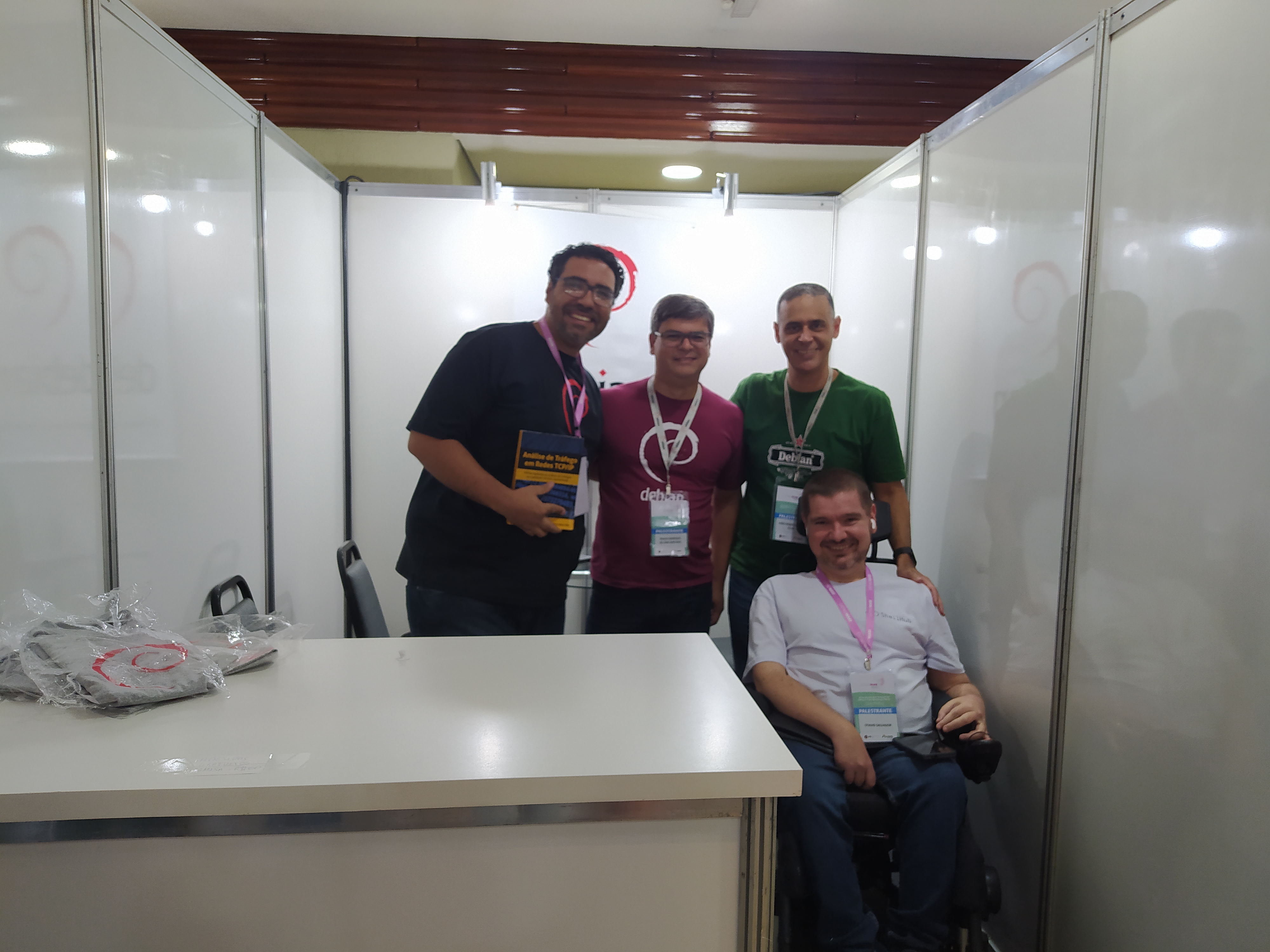 Foto da esquerda pra direita: Leonardo, Paulo, Eriberto e Ot vio.
 Foto da esquerda pra direita: Paulo, Fabian (Argentina) e Leonardo.
Al m de conversarmos bastante, distribu mos adesivos do Debian que foram
produzidos alguns meses atr s com o patroc nio do Debian para serem distribu dos
na DebConf22(e que haviam sobrado), e vendemos v rias

 Tamb m tivemos 3 palestras inseridas na programa o oficial do Latinoware.
 Foto Paulo na palestra.
Agradecemos a organiza o do Latinoware por receber mais uma vez a comunidade
Debian e gentilmente ceder os espa os para a nossa participa o, e parabenizamos
a todas as pessoas envolvidas na organiza o pelo sucesso desse importante
evento para a nossa comunidade. Esperamos estar presentes novamente em 2023.
Agracemos tamb m ao Jonathan Carter por aprovar o suporte financeiro do Debian
para a nossa participa o no Latinoware.
 V rias pessoas visitaram o estande e aquelas mais iniciantes (principalmente
estudantes) que n o conheciam o Debian, perguntavam do que se tratava o nosso
grupo e a gente explicava v rios conceitos como o que Software Livre,
distribui o GNU/Linux e o Debian propriamente dito. Tamb m recebemos pessoas
da comunidade de Software Livre brasileira e de outros pa ses da Am rica Latina
que j utilizavam uma distribui o GNU/Linux e claro, muitas pessoas que j
utilizavam Debian. Tivemos algumas visitas especiais como do Jon maddog Hall,
do Desenvolvedor Debian Emeritus Ot vio Salvador, do Desenvolvedor Debian
 Foto da esquerda pra direita: Leonardo, Paulo, Eriberto e Ot vio.
 Foto da esquerda pra direita: Paulo, Fabian (Argentina) e Leonardo.
Al m de conversarmos bastante, distribu mos adesivos do Debian que foram
produzidos alguns meses atr s com o patroc nio do Debian para serem distribu dos
na DebConf22(e que haviam sobrado), e vendemos v rias

 Tamb m tivemos 3 palestras inseridas na programa o oficial do Latinoware.
 Foto Paulo na palestra.
Agradecemos a organiza o do Latinoware por receber mais uma vez a comunidade
Debian e gentilmente ceder os espa os para a nossa participa o, e parabenizamos
a todas as pessoas envolvidas na organiza o pelo sucesso desse importante
evento para a nossa comunidade. Esperamos estar presentes novamente em 2023.
Agracemos tamb m ao Jonathan Carter por aprovar o suporte financeiro do Debian
para a nossa participa o no Latinoware.
 I ve released man-db 2.11.0
(

 . This is somewhat from a Republican perspective. That is also the reason they are much anti-science.
 After
 Personally, as a photographer, I am very happy they used stock images from
 Now for next year ... find an editor that knows how to spell photographers, please. And consider Scribus. And make Adobe publish their apps for Linux. Thank you.