Search Results: "msp"

9 January 2012

Steve McIntyre: Armhf buildds and status in Debian

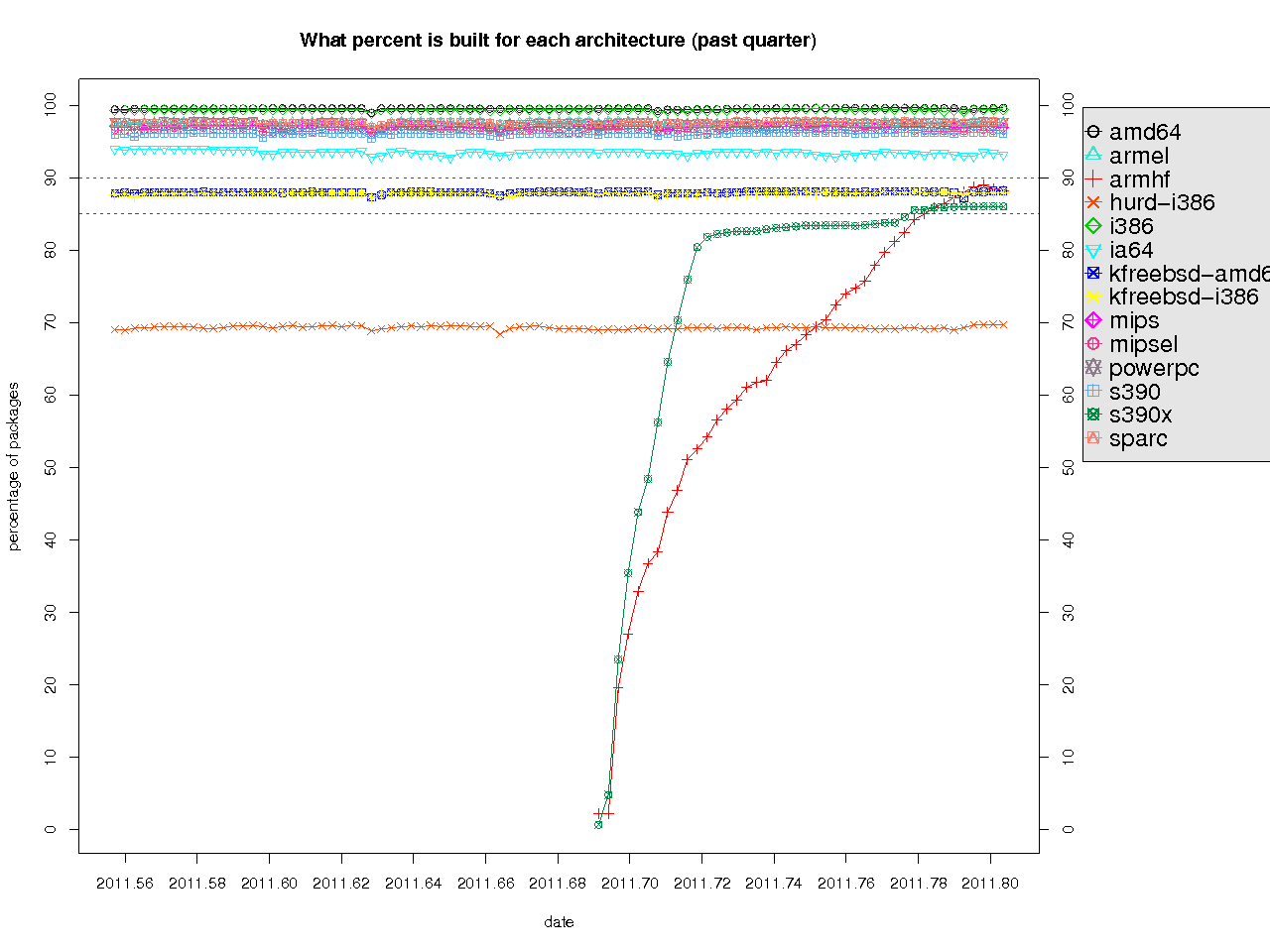
Current status Back in September, I wrote about the machines that I set up to help bootstrap the new armhf port in Debian. Basing on Konstantinos' huge efforts in bringing up the new "architecture" in debian-ports, we started importing armhf into the main Debian archive on the 24th of November. Since then, those builders have been churning away night and day to build the huge collection of software that makes up the Debian archive. The current state can be seen on the armhf buildd status page, and there's a nice graph showing how quickly we've managed to run from 0 to over 90% of the archive here. (Click on the image for a larger version, or visit https://buildd.debian.org/stats/ for other versions. We overtook hurd-i386 quickly and are now ahead of the kfreebsd-* architectures. armhf bootstrap graph We've recently brought 3 more similar build machines online (hildegard, howells and hummel), again sponsored by the nice folks at Linaro but now hosted at the York NeuroImaging Centre at the University of York. This gives us both more build horsepower to keep up with building more different bits of Debian (experimental, updates etc.) and more redundancy in case of problems. We now have the vast majority of the archive built, and now a number of us are concentrating on fixing the remaining issues: language bootstraps and bugs. Also, on the 7th of January we were just added into testing, the next step on our path for inclusion as a Debian release architecture. Setting up the machines A lot of people have been asking me about the physical setup I showed in my last blog about these machines, so here's more details for those who are interested. Mount the 6 boards into the mini-rack, connect up the Molex power connectors to each board, attach ethernet cables and turn it all on! Each board comes with a micro-SD card containing uboot and an Ubuntu installation. I've configured uboot to boot off the hard drive directly, but leaving configuration available to use the Ubuntu on the micro-SD as a simple rescue system should the need arise. The Quickstart boards are not ideal physically for two reasons: the lack of SATA power, plus you need to push a power button on each board to boot it - they don't boot automatically the moment power is applied. However, they're quite inexpensive little machines and have done a great job of building the Debian archive so far! The ideal machines for us would also include more RAM at this point. CPU on these is adequate, but the larger C++ packages (yay webkit!) use a huge amount of memory at link time. Linking in swap is not the best thing, performance-wise... :-( UPDATE 2012-01-12: Ian tells me that the newer Quickstart-R boards apparently have a different power controller; these now boot up straight away without needing you to push a button. That sounds useful.

19 December 2011

John Sullivan: Where Shall I Wander

Google Maps is now mapping the indoors. I saw an ad for this while passing through MSP yesterday (given how much time I spend on the Internet, it's strange and a little embarrassing to learn about new things on the Internet from airport billboards), since one of their initial targets is the infamous Mall of America.
Detailed floor plans automatically appear when you re viewing the map and zoomed in on a building where indoor map data is available. The familiar blue dot icon indicates your location within several meters, and when you move up or down a level in a building with multiple floors, the interface will automatically update to display which floor you re on. All this is achieved by using an approach similar to that of My Location for outdoor spaces, but fine tuned for indoors.
Thoughts about this: Title from John Ashbery

18 August 2011

Thorsten Glaser: How not to create DEB files

Once upon a time, there was Deb and Ian. That was about exactly 18 years ago. We don t talk about the 0.939000 format any more, but they eventually settled on:

	$ ar rc pkg_1.0_all.deb debian-binary control.tar.gz data.tar.gz
	$ hexdump -C pkg_1.0_all.deb   head
	00000000  21 3c 61 72 63 68 3e 0a  64 65 62 69 61 6e 2d 62   !<arch>.debian-b 
	00000010  69 6e 61 72 79 20 20 20  31 33 31 33 36 38 33 35   inary   13136835 
	00000020  32 39 20 20 31 30 30 36  20 20 32 30 30 20 20 20   29  1006  200    
	00000030  31 30 30 36 34 34 20 20  34 20 20 20 20 20 20 20   100644  4        
	00000040  20 20 60 0a 32 2e 30 0a  63 6f 6e 74 72 6f 6c 2e      .2.0.control. 
	00000050  74 61 72 2e 67 7a 20 20  31 33 31 33 36 38 33 35   tar.gz  13136835 
	00000060  32 39 20 20 31 30 30 36  20 20 32 30 30 20 20 20   29  1006  200    
	00000070  31 30 30 36 34 34 20 20  31 33 39 31 20 20 20 20   100644  1391     
	00000080  20 20 60 0a 1f 8b 08 00  00 00 00 00 00 03 ed 59      ............Y 
	00000090  eb 6f db 36 10 f7 d7 f0  af b8 3a 5e 9b 74 b1 f5   .o.6......:^.t.. 
 

By then, systems were a.out(5), and everything was good. (Of course, if you look at the mtimes, you ll notice I faked this. But it s really equivalent to the real thing.

But oh horror! GNU binutils, not always everyone s friend, switched from using BSD style Unix Archiver libraries in ar(1) to SYSV style libraries on elf(5) systems:

	$ ar rc on-elf debian-binary control.tar.gz data.tar.gz
	$ hexdump -C on-elf   head
	00000000  21 3c 61 72 63 68 3e 0a  64 65 62 69 61 6e 2d 62   !<arch>.debian-b 
	00000010  69 6e 61 72 79 2f 20 20  31 33 31 33 36 38 33 35   inary/  13136835 
	00000020  32 39 20 20 31 30 30 36  20 20 32 30 30 20 20 20   29  1006  200    
	00000030  31 30 30 36 34 34 20 20  34 20 20 20 20 20 20 20   100644  4        
	00000040  20 20 60 0a 32 2e 30 0a  63 6f 6e 74 72 6f 6c 2e      .2.0.control. 
	00000050  74 61 72 2e 67 7a 2f 20  31 33 31 33 36 38 33 35   tar.gz/ 13136835 
	00000060  32 39 20 20 31 30 30 36  20 20 32 30 30 20 20 20   29  1006  200    
	00000070  31 30 30 36 34 34 20 20  31 33 39 31 20 20 20 20   100644  1391     
	00000080  20 20 60 0a 1f 8b 08 00  00 00 00 00 00 03 ed 59      ............Y 
	00000090  eb 6f db 36 10 f7 d7 f0  af b8 3a 5e 9b 74 b1 f5   .o.6......:^.t.. 
 

Can you spot the difference?

Of course, ELF is what you want , so there is little choice. Unix Archiver libraries are system dependent, and no format has ever been normed, but DEB files use it as format so what is one to do?

	$ GNUTARGET=a.out-i386-linux ar rc with-aout \
	> debian-binary control.tar.gz data.tar.gz
	$ md5sum pkg_1.0_all.deb with-aout on-elf
	248f78d42f8ca8f2a3560f9800b2bf01  pkg_1.0_all.deb
	248f78d42f8ca8f2a3560f9800b2bf01  with-aout
	09eca70c9b11b6b55bbadcab5c3201fb  on-elf
 

OK, and what do I do on my Debian/m68k system?

ar(1) uses bfd, and GNU binutils can not only forcibly set the target emulation but also show them:

debian_m68k$ ar -h 2>&1 grep '^ar: supported targets'
ar: supported targets: elf32-m68k a.out-m68k-linux elf32-little elf32-big plugin srec symbolsrec verilog tekhex binary ihex trad-core
debian_i386$ ar -h 2>&1 grep '^ar: supported targets'
ar: supported targets: elf32-i386 a.out-i386-linux pei-i386 elf32-little elf32-big elf64-x86-64 elf32-x86-64 pei-x86-64 elf64-l1om elf64-k1om elf64-little elf64-big plugin srec symbolsrec verilog tekhex binary ihex trad-core
debian_i386$ ar -h 2>&1 grep '^ar: supported targets' # binutils-multiarch
ar: supported targets: elf32-i386 a.out-i386-linux pei-i386 elf32-little elf32-big elf64-alpha ecoff-littlealpha elf64-little elf64-big elf32-littlearm elf32-bigarm elf32-hppa-linux elf32-hppa elf64-x86-64 elf32-x86-64 elf64-l1om elf64-k1om elf64-ia64-little elf64-ia64-big pei-ia64 elf32-m68k a.out-m68k-linux coff-m68k versados ieee a.out-zero-big elf32-tradbigmips elf32-tradlittlemips ecoff-bigmips ecoff-littlemips elf32-ntradbigmips elf64-tradbigmips elf32-ntradlittlemips elf64-tradlittlemips elf32-powerpc aixcoff-rs6000 elf32-powerpcle ppcboot elf64-powerpc elf64-powerpcle aixcoff64-rs6000 aix5coff64-rs6000 elf32-s390 elf64-s390 elf32-shbig-linux elf32-sh-linux elf32-sh64-linux elf32-sh64big-linux elf64-sh64-linux elf64-sh64big-linux elf32-sparc a.out-sparc-linux elf64-sparc a.out-sunos-big pei-x86-64 elf32-m32r-linux elf32-m32rle-linux elf32-spu plugin srec symbolsrec verilog tekhex binary ihex trad-core
mirbsd_i386$ ar -h 2>&1 grep '^ar: supported targets'
ar: supported targets: elf32-i386 coff-a29k-big a.out.adobe aix5coff64-rs6000 a.out-zero-big a.out-mips-little epoc-pe-arm-big epoc-pe-arm-little epoc-pei-arm-big epoc-pei-arm-little coff-arm-big coff-arm-little a.out-arm-netbsd pe-arm-big pe-arm-little pei-arm-big pei-arm-little b.out.big b.out.little efi-app-ia32 efi-app-ia64 elf32-avr elf32-big elf32-bigarc elf32-bigarm elf32-bigarm-symbian elf32-bigarm-vxworks elf32-bigmips elf32-cr16c elf32-cris elf32-crx elf32-d10v elf32-d30v elf32-dlx elf32-fr30 elf32-frv elf32-frvfdpic elf32-h8300 elf32-hppa-linux elf32-hppa-netbsd elf32-hppa elf32-i370 elf32-i386-freebsd elf32-i386-vxworks elf32-i860-little elf32-i860 elf32-i960 elf32-ia64-hpux-big elf32-ip2k elf32-iq2000 elf32-little elf32-littlearc elf32-littlearm elf32-littlearm-symbian elf32-littlearm-vxworks elf32-littlemips elf32-m32r elf32-m32rle elf32-m32r-linux elf32-m32rle-linux elf32-m68hc11 elf32-m68hc12 elf32-m68k elf32-m88k elf32-mcore-big elf32-mcore-little elf32-mn10200 elf32-mn10300 elf32-msp430 elf32-nbigmips elf32-nlittlemips elf32-ntradbigmips elf32-ntradlittlemips elf32-openrisc elf32-or32 elf32-pj elf32-pjl elf32-powerpc elf32-powerpc-vxworks elf32-powerpcle elf32-s390 elf32-sh elf32-shbig-linux elf32-shl elf32-shl-symbian elf32-sh-linux elf32-shl-nbsd elf32-sh-nbsd elf32-sh64 elf32-sh64l elf32-sh64l-nbsd elf32-sh64-nbsd elf32-sh64-linux elf32-sh64big-linux elf32-sparc elf32-tradbigmips elf32-tradlittlemips elf32-us-cris elf32-v850 elf32-vax elf32-xstormy16 elf32-xtensa-be elf32-xtensa-le elf64-alpha-freebsd elf64-alpha elf64-big elf64-bigmips elf64-hppa-linux elf64-hppa elf64-ia64-big elf64-ia64-hpux-big elf64-ia64-little elf64-little elf64-littlemips elf64-mmix elf64-powerpc elf64-powerpcle elf64-s390 elf64-sh64 elf64-sh64l elf64-sh64l-nbsd elf64-sh64-nbsd elf64-sh64-linux elf64-sh64big-linux elf64-sparc elf64-tradbigmips elf64-tradlittlemips elf64-x86-64 mmo pe-powerpc pei-powerpc pe-powerpcle pei-powerpcle a.out-cris demo64 ecoff-bigmips ecoff-biglittlemips ecoff-littlemips ecoff-littlealpha coff-go32 coff-go32-exe coff-h8300 coff-h8500 a.out-hp300hpux a.out-i386 a.out-i386-bsd coff-i386 a.out-i386-freebsd a.out-i386-lynx coff-i386-lynx msdos a.out-i386-netbsd i386os9k pe-i386 pei-i386 coff-i860 coff-Intel-big coff-Intel-little ieee coff-m68k coff-m68k-un a.out-m68k-lynx coff-m68k-lynx a.out-m68k-netbsd coff-m68k-sysv coff-m88kbcs a.out-m88k-mach3 a.out-m88k-openbsd mach-o-be mach-o-le mach-o-fat coff-maxq pe-mcore-big pe-mcore-little pei-mcore-big pei-mcore-little pe-mips pei-mips a.out-newsos3 nlm32-alpha nlm32-i386 nlm32-powerpc nlm32-sparc coff-or32-big a.out-pc532-mach a.out-ns32k-netbsd a.out-pdp11 pef pef-xlib ppcboot aixcoff64-rs6000 aixcoff-rs6000 coff-sh-small coff-sh coff-shl-small coff-shl pe-shl pei-shl coff-sparc a.out-sparc-little a.out-sparc-linux a.out-sparc-lynx coff-sparc-lynx a.out-sparc-netbsd a.out-sunos-big sym a.out-tic30 coff-tic30 coff0-beh-c54x coff0-c54x coff1-beh-c54x coff1-c54x coff2-beh-c54x coff2-c54x coff-tic80 a.out-vax-bsd a.out-vax-netbsd a.out-vax1k-netbsd versados vms-alpha vms-vax coff-w65 coff-we32k coff-z8k elf32-am33lin elf32-ms1 srec symbolsrec tekhex binary ihex netbsd-core

Wow. While binutils share no single supported working target, they can be built multiarch, or (on MirBSD) with --enable-targets=all --enable-64-bit-bfd. Doesn t help if you want to stay portable: GNUTARGET=srec is common on all Debian (sid) binutils versions (single or multiarch), but errors out on older binutils. The a.out-* targets are not common. Sure, you could hack around things, but this is tedious. If you follow things or know me a little, you might already have guessed that I wouldn t let that stand.

pax(1) to the rescue. On MirBSD, we use paxtar, which has cpio(1) and tar(1) front-ends and supports multiple formats (4 cpio and 2 tar variants) and has already been extended a lot and is lovingly called paxmirabilis (mirabilos peace in Latin) it has options to anonymise archives: set uid and gid to zero, set mtime to zero, (for ustar) only write the numeric uid and gid to the archive, (for cpio formats) serialise inodes and device information, write content of hardlinked files only once (breaks partial extraction but saves a lot of space, e.g. 2 MiB off the Grml initrd.gz). And, recently, the ability to append a trailing slash to pathnames of ustar members which are directories (GNU tar does it and I thought some Debian utilities check for it). So why not (the -M dist and fakeroot set the uid/gid to 0)

	$ find debian-binary control.tar.gz data.tar.gz   \
	> mircpio -oHar -Mdist >with-mircpio
	$ mirpax -w -M dist -f with-mirpax -x ar \
	> debian-binary control.tar.gz data.tar.gz
	$ mirtar -M dist -A -cf with-mirtar \
	> debian-binary control.tar.gz data.tar.gz
	$ GNUTARGET=a.out-i386-linux fakeroot ar rc with-aout-ar \
	> debian-binary control.tar.gz data.tar.gz
	$ md5sum with-*
	a466e2fd57cdee141fe585a43245548f  with-aout-ar
	a466e2fd57cdee141fe585a43245548f  with-mircpio
	a466e2fd57cdee141fe585a43245548f  with-mirpax
	a466e2fd57cdee141fe585a43245548f  with-mirtar
 

Voil . I got it, and even appending is possible. It supports the BSD format with special focus on DEB files, and deals with long filenames, but not symbol or filename tables (used by ranlib(1) or strange formats, respectively, but since we don t create *.a files to use with some native linker/binder/loader, we don t need that anyway).

On extraction (oh, and listing!) it deals with SYSV style filenames as well.

	$ mirtar tvf on-elf
	-rw-r--r--  1 tg       tg          4 Aug 18 16:05 debian-binary
	-rw-r--r--  1 tg       tg       1391 Aug 18 16:05 control.tar.gz
	-rw-r--r--  1 tg       tg      18135 Aug 18 16:05 data.tar.gz
	$ mirtar tvf with-aout
	-rw-r--r--  1 tg       tg          4 Aug 18 16:05 debian-binary
	-rw-r--r--  1 tg       tg       1391 Aug 18 16:05 control.tar.gz
	-rw-r--r--  1 tg       tg      18135 Aug 18 16:05 data.tar.gz
 

One of the real benefits is that you can use the front-ends interchangably for example, mirtar tzf foo.cpio.gz would work (which GNU tar can t do), and mircpio s ustar implementation, unlike GNU cpio s, is not horribly broken. Of course, there are some drawbacks: it s not GNU tar or GNU cpio, so there are absolutely zero --long-options. Some of their features are missing (but tar s -O is implemented now), so it s no replacement (but very well usable alongside it). The format called pax, committee-designed to replace ustar, isn t yet supported ironically, but that s on the TODO.

So, what do you think?

	tg@frozenfish:~/Debs/dists/sid/wtf/Pkgs/mircpio $ ll *.deb
	-rw-r--r-- 2 tg freewrt 78140 Aug 17 11:04 mircpio_20110817-0wtf2_amd64.deb
	-rw-r--r-- 3 tg freewrt 72262 Aug 17 11:00 mircpio_20110817-0wtf2_i386.deb
	-rw-r--r-- 1 tg freewrt 67446 Aug 17 18:21 mircpio_20110817-0wtf2_m68k.deb
 

Should I upload this to Debian proper? As for the licence: 3-clause UCB (and 2-clause BSD, which is a subset of it), so no problem. I m asking because the other package which I had been using for a long time and not uploaded, jupp, got uploaded recently (during DebConf) on user input (people wondered why it did not yet exist in Debian proper). I guess the old saying if it s not in Debian, it doesn t exist holds true in many parts of the OSS world. It s up to date wrt. standards btw, and lintian-clean save for two pedantic-class warnings (no upstream changelog file, no homepage link) which aren t fulfillable (could link this wlog entry as homepage). If you know Alioth you re familiar with the software formerly known as SourceForge, formerly known as GForge, currently known as FusionForge. My employer both uses it and contributes to it, we run an adapted (mostly themed, prototyping new functions that often end up in FusionForge itself, and backporting functions from FF to our production codebase ) version.

I ve backported the extratabs plugin to appease project managers and other non-technical people while we move our codebase to FF 5.1, and I did so on an installed version of the plugin rather than the source because the latter was tightly integrated with rather heavy packaging style changes.

	[ ]
	dh_builddeb
	# create fusionforge-plugin-extratabs binary package
	toplev=$$(pwd); cd plugins/fusionforge-plugin-extratabs; \
	p=$$(print -r -- $$(sed -n '/^Package: /s///p' C/control   head -1)); \
	v=$$(print -r -- $$(sed -n '/^Version: /s///p' C/control   head -1)); \
	a=$$(print -r -- $$(sed -n '/^Architecture: /s///p' C/control   head -1)); \
	d=$$ p _$$ v _$$ a .deb; \
	rm -f $$toplev/../$$d control.tar.gz data.tar.gz; \
	(cd control; find .   fgrep -v /.svn   sort   \
	    mircpio -oC512 -Hustar -M0x0B -Mgslash)   gzip -n9 >control.tar.gz; \
	(cd data; find .   fgrep -v /.svn   sort   \
	    mircpio -oC512 -Hustar -M0x0B -Mgslash)   gzip -n9 >data.tar.gz; \
	mirtar -M dist -Acf $$toplev/../$$d debian-binary cont*gz dat*gz; \
	rm -f control.tar.gz data.tar.gz; \
	cd $$toplev; dpkg-distaddfile $$d non-free/devel optional
 

The hardest part of extending debian/rules with that was to get the autobuild and dpkg-distaddfile call right. This works, even though I d call it a temporary kludge. (No need to tell me I should have used && I know. And I only shell out to mksh(1) because the inner part was already there from before, when I still used ar(1). This was slightly edited for the wlog.) In the meanwhile, apt-extracttemplates can deal with SYSV style filenames in DEB files on Debian sid, but not on Kubuntu hardy, which some people are using as Desktop OS still

11 March 2011

Eddy Petri&#537;or: HOWTO: Making Windows usable and avoiding accidental sending of mails in Microsoft Outlook

I've changed jobs recently and after 5 years of not having to work with a Windows system I am having all sorts of adaptation-to-Windows problems at the new job.

First I just had to have the usual X-mouse behaviour and so I installed True X-Mouse Gizmo for Windows. This provides focus under mouse, middle click paste after select (not perfect, but it works), right click to push to bottom the window.

Second I had to have a virtual desktop, so I installed Microsoft's Virtual Desktop Manager from the PowerToys page. I tried another virtual desktop manager before using MSVDM, but I found it too clumsy so I switched to MSVDM which I knew from way back when I used Windows the last time. Good, now I can have my applications organised the way I am used to.

UPDATE:
I gave up on MSVDM in favour of Virtual Dimension since I wasn't able to send a particular window to the intended desktop unless I had in the taskbar all apps visible (Shared Desktop option). I might try other suggestions (Virtual Dimension does not have a way to send a window directly to a specific desktop, but just to the neighbours of the current one.)


Third, I had to make Caps Lock work as Ctrl. I just can't go back to an inferior setup. I found information on this page and ended up at this page from where I got a zip file with various registry keys which allow the deactivation of caps, or turning it into another Ctrl.

Fourth, I am used to write with diacritics in Romanian with the secondary layout of the standard (SR 13392:2004), so I rushed to Cristian Secar 's page for the keyboard driver since on XP the Romanian layout is retarded (some history in which some arbitrary German guy decided y and z had to be switched on Romanian keyboards and some other similarly weird stuff). Since the installation, my keyboard behaves according to this layout:
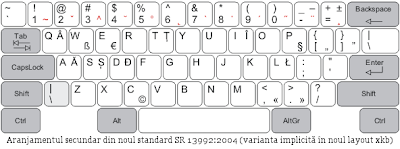


Things started to look well, but I soon was reminded that Outlook is an idiotic mailer since it doesn't require a confirmation on send, not even if you didn't set a subject. And this is problematic since sending the mail is done via Alt+S, so if the current layer is NOT Romanian, when I want to type (s with a comma below), a fairly common character in Romanian words, you end up looking like an idiot on the recipient side since they receive an incomplete mail. Remember, no confirmation AND no default spell checking before send. Yay!

At my second such accidental mail sending (of which the last two were sent to the same person), I decided to see if this can't be fixed. I initially looked for changing the short cut, but I couldn't find it (I might be inept at finding things in Windows, remember, I haven't touched Windows systems in the last 5 years) but I found another workaround and decided it's good enough to share with other people that might hit the problem.

Just setup a delay rule following these steps.
1. Go to Tools....Rules Wizard
2. Click 'New' Rule
3. Select "Check messages after sending"
4. Click Next on "Which conditions you want to Check?" dialog.
5. Press yes to "This Rule will be applied to every message" message box
6. In the "What do you want to do with message?" dialog, Select "Defer delivery by a number of minutes"
7. Select your favourite number of minutes.... I usually select 2 mins.
8. Select Finish. and close the Rules Wizard.

Now everytime you send an email it will sit in your outbox
for specified number of minutes. If you ever wanted to change it, delete it etc, You have sufficient time to do it :)


I used 3 minutes for the delay. At least now I can prevent looking retarded in front of people... more than necessary :D .


Oh, and Windows' clock display is retarded. It shows, by default, the hour and minutes, but there's no way to change that in a sane way. If you want the date, you must hover over the clock and it shows it, but the day of week is missing. Great job! You can see that information, too, but you have to drag the toolbar to be 2 or even 3 rows high (here it requires 2, but I've seen people saying they needed 3) to get that information, too. Great! One has to choose between wasting desktop real estate and having access to useful information. Or you could install an independent application for the clock... retarded. I am not making this shit up.

I hope this helped.

28 February 2011

Jonathan McDowell: Notes on moving to America

I've been out here for 6 months now. At the point in time I was coming out I was pointed at Andrew Pollock's On bootstrapping oneself in the US. I figure some extra data may be useful for anyone considering the same. I moved from the UK rather than Australia. Banking I sorted out my US banking long before I ever moved here; in fact I kicked the process off shortly after I accepted the move offer. Matthew had recommended the HSBC approach, so I did that. This meant when I arrived I had a credit card, debit card and check book. They also allow me to do really easy online transfers between my US and UK accounts. Mobile phone My mobile phone was something else that was dealt with before the move. I bought a Simple Mobile SIM off eBay. I thought I'd end up moving to a contract once I had a credit record here, but actually the $60/month unlimited tariff seems to be fairly reasonable. Their customer service leaves a lot to be desired, but I've sadly come to expect that from phone companies. I've got a Google Voice account which is the number I've been giving out, so it's easily for me to switch providers (or redirect things to a VOIP setup for when I'm back in the UK, but I've got a writeup to do for that at a later point in time). Finding somewhere to live One of my concerns was that it would be hard to find somewhere to live at short notice without any credit history or SSN. This turned out to be ill founded. Both of the managed apartment complexes I looked at were ok with the fact I'd just moved to the country and seemed used to such a setup. The place I went with is privately leased and was a bit more wary, but after a conversation with my US manager (who'd managed me even when I was in the UK) it was fine. Social Security Number AKA existing as an entity as far as the US is concern. I was told to wait at least 10 working days after entry before even applying for this, or I wouldn't be in the system and it could cause delays. I did so and the card turned up within about a week (I had been told up to 2 weeks). Which was good, because work were having problems figuring out how to pay me without one. You do seem to need the SSN for everything. The only times I can remember needing my National Insurance number in the UK is for new jobs and my E111 application. Driving licence I haven't ended up buying a car here; I pretty much don't need one most of the time and I've signed up to ZipCar for easy short term rentals - they're happy to take a UK licence for sign up. However I figured getting a licence here was a good idea in case I did decide to get a car, and even just for ID (I kept having to point people at the DOB on my UK licence - everywhere here seems to card). Applying for a licence ideally relies an SSN, so I did so a few days after I'd got that. I did the car + motorbike written tests and got my learner's permit. I applied for the car theory test the same day, but the first available slot was about 6 weeks later. During this period I did the CMSP basic RiderCourse, which meant that when I passed the car test I was also fully entitled to ride a motorbike here. Other useful notes As I live in the Bay Area I got myself a ClipperCard - it's like Oyster except without the clever discounts. Works on more agencies though and helps avoid having to sort out change. For broadband I went with Sonic.net - I'm in their ADSL2 coverage area so I'm getting a reasonable 17Mb/s connection. The other options were AT&T ADSL (slower) or Comcast cable (evil). I've had zero problems with Sonic; It Just Works. Also I sort of ended up with a trial run thanks to DebConf10 being in New York. Due to the way timings worked out this took place only a few weeks before my move to SF was scheduled. My banking and phone were already in place by this point, so it allowed me to check both were working ok. They were, and I didn't really expect them not to be, but it was a nice safety net to have for the move proper. Overall the main issue I had was that a lot of things were dependant on other things; get the SSN, get a learner's permit, apply for the practical test, wait for the licence to actually turn up etc. It probably took over 3 months for everything to actually happen and come through in the post. I can tell when I actually started to exist in the system because Capital One being junk mailing me about whether I want a credit card with them...

15 August 2010

Tim Retout: SmoothWall Express on Debian

SmoothWall Express is a GNU/Linux distribution geared towards firewalling, with an installer, a web interface, and some common software like squid that can be useful when running a small business router. It is theoretically the basis for the corporate products of SmoothWall Ltd., who happen to employ me; but all opinions here are my own, and I'm not speaking for them. Unfortunately, the SmoothWall Express kernel is somewhat "stable", which leads to problems installing the distro on modern hardware. There is a new version of Express in the works, but I'm afraid SmoothWall Ltd. currently has a bit of a "code dump" mentality with respect to delivering updates to their community, because they don't recall seeing any significant contributions from outsiders. At DebConf I created proof-of-concept Debian packages of two components of Express 3.0: the swe3 web interface, and the smoothd daemon which executes privileged commands. Currently these can show a basic web interface; some of the less complicated bits will even run, and I can shut down my laptop using the "shutdown" button via smoothd. (Note that I still need to add boring stuff like debian/copyright files, but I plan to release these as soon as I can.) In the near future, hopefully I can implement some of the more important features (like, er, firewalling), and add some other components like the traffic shaping and IM filtering daemon. I'm working towards a demonstration Debian Pure Blend that can show off some of the advantages of working with a third-party distribution as a base. If anyone would like to help me... send me patches. :) I expect I'll be blogging my progress occasionally.

17 January 2010

Olivier Berger: Some news of our efforts around OSLC-CM and future plans

OSLC-CM V1 is a proposed standard for REST APIs of bugtrackers, and in our seek for more interoperability in the bugtracker space, we ve been very interested in it. OSLC-CM is quite young and only so far implemented in proprietary tools (although elaborated in an open way) on the server side, and as we believe in FLOSS, we ve started trying to implement basics of server side plugins for a few bugtrackers.
In addition to a demo server that s simulating the behaviour of a bugtracker, we have started implementing a Mantis plugin and FusionForge and Codendi trackers add-ons (all PHP and based on Zend framework, see this project on picoforge). All are very basic, but we hope they will be the basis for future OSLC-CM compatible servers in these tools. At the same time we ve been experimenting with the code already published in Mylyn to support OSLC-CM on the client side. Not everything is public yet in Mylyn, as the elements that have been developped for some connectors of Tasktop to the proprietary tools are being ported to the open source code of Mylyn.
We have thus been able to use the Junit tests classes of Mylyn and tweak them in a way to connect to an instance of the demo server for Mantis (including handling some Basic auth), and be able to retrieve the first bugs descriptions :-) Now that this works, we ll try and add some Java code (maybe reusing Mylyn client libs) to doc4 (being developped as part of Helios) in order to start linking doc4 and Mantis so that this can be used in the Helios platform. This may involve mixing code of XWiki and Mylyn hmmm well, we ll see. Next steps may be also to try and implement a connector in Python that might be used in tools like bts-link. Then whichever Python or Java client libraries we have, will allow us to use them inside FetchBugs4.me to connect and harvest bugs of OSLC-CM compliant bugtrackers eventually. Lots of interesting developments ahead. Stay tuned.

3 November 2009

Daniel Leidert: Toshiba Tecra A10 (PTSB5E) - Part I

I recently got a Toshiba Tecra A10-1HU laptop. This is a series describing my experiences with this hardware using Debian Sid. This one comes without any operating system. So I got a recent testing-netinstall CD-image and ran the installer procedure (in expert mode). Everything went fine and I ended with a shiny Squeeze and kernel 2.6.30. Because I use Sid as my usual system, my first action was a dist-upgrade to Sid. This is what lspci -nn tells:
00:00.0 Host bridge [0600]: Intel Corporation Mobile 4 Series Chipset Memory Controller Hub [8086:2a40] (rev 07)
00:02.0 VGA compatible controller [0300]: Intel Corporation Mobile 4 Series Chipset Integrated Graphics Controller [8086:2a42] (rev 07)
00:02.1 Display controller [0380]: Intel Corporation Mobile 4 Series Chipset Integrated Graphics Controller [8086:2a43] (rev 07)
00:03.0 Communication controller [0780]: Intel Corporation Mobile 4 Series Chipset MEI Controller [8086:2a44] (rev 07)
00:19.0 Ethernet controller [0200]: Intel Corporation 82567LM Gigabit Network Connection [8086:10f5] (rev 03)
00:1a.0 USB Controller [0c03]: Intel Corporation 82801I (ICH9 Family) USB UHCI Controller #4 [8086:2937] (rev 03)
00:1a.1 USB Controller [0c03]: Intel Corporation 82801I (ICH9 Family) USB UHCI Controller #5 [8086:2938] (rev 03)
00:1a.2 USB Controller [0c03]: Intel Corporation 82801I (ICH9 Family) USB UHCI Controller #6 [8086:2939] (rev 03)
00:1a.7 USB Controller [0c03]: Intel Corporation 82801I (ICH9 Family) USB2 EHCI Controller #2 [8086:293c] (rev 03)
00:1b.0 Audio device [0403]: Intel Corporation 82801I (ICH9 Family) HD Audio Controller [8086:293e] (rev 03)
00:1c.0 PCI bridge [0604]: Intel Corporation 82801I (ICH9 Family) PCI Express Port 1 [8086:2940] (rev 03)
00:1c.1 PCI bridge [0604]: Intel Corporation 82801I (ICH9 Family) PCI Express Port 2 [8086:2942] (rev 03)
00:1c.2 PCI bridge [0604]: Intel Corporation 82801I (ICH9 Family) PCI Express Port 3 [8086:2944] (rev 03)
00:1d.0 USB Controller [0c03]: Intel Corporation 82801I (ICH9 Family) USB UHCI Controller #1 [8086:2934] (rev 03)
00:1d.1 USB Controller [0c03]: Intel Corporation 82801I (ICH9 Family) USB UHCI Controller #2 [8086:2935] (rev 03)
00:1d.2 USB Controller [0c03]: Intel Corporation 82801I (ICH9 Family) USB UHCI Controller #3 [8086:2936] (rev 03)
00:1d.7 USB Controller [0c03]: Intel Corporation 82801I (ICH9 Family) USB2 EHCI Controller #1 [8086:293a] (rev 03)
00:1e.0 PCI bridge [0604]: Intel Corporation 82801 Mobile PCI Bridge [8086:2448] (rev 93)
00:1f.0 ISA bridge [0601]: Intel Corporation ICH9M-E LPC Interface Controller [8086:2917] (rev 03)
00:1f.2 SATA controller [0106]: Intel Corporation ICH9M/M-E SATA AHCI Controller [8086:2929] (rev 03)
01:00.0 Network controller [0280]: Intel Corporation Wireless WiFi Link 5100 [8086:4232]
05:0b.0 CardBus bridge [0607]: Ricoh Co Ltd RL5c476 II [1180:0476] (rev ba)
05:0b.1 FireWire (IEEE 1394) [0c00]: Ricoh Co Ltd R5C832 IEEE 1394 Controller [1180:0832] (rev 04)
05:0b.2 SD Host controller [0805]: Ricoh Co Ltd R5C822 SD/SDIO/MMC/MS/MSPro Host Adapter [1180:0822] (rev 21)
05:0b.3 System peripheral [0880]: Ricoh Co Ltd R5C843 MMC Host Controller [1180:0843] (rev ff)
05:0b.4 System peripheral [0880]: Ricoh Co Ltd R5C592 Memory Stick Bus Host Adapter [1180:0592] (rev 11)
05:0b.5 System peripheral [0880]: Ricoh Co Ltd xD-Picture Card Controller [1180:0852] (rev 11)
Things that worked out-of-the-box: Display/Graphics (Intel GMA 4500M HD) The integrated graphics chipset, an Intel GMA 4500M HD, works with the xserver-xorg-video-intel package and the default X.org configuration. No custom /etc/X11/xorg.conf is necessary. The (IMHO non-reflecting?) display runs at 1280 800 at 60 Hz. Cable network device The integrated Intel 82567LM Gigabit Network device works with the e1000e kernel module. No customization was necessary. Touchpad/Trackpoint The notebook comes with the so called Toshiba Dual Pointing Device a touchpad (+2 buttons) and a trackpoint (+2 buttons). Both worked without customization. Energy savings/Suspend/Resume apmd and acpid handle this. No problems yet. Suspend/Resume works. I did not yet test (and I m not sure if I should) hibernate and uswsusp. Webcam The webcam is a CNA7157 model or at least detected as such. The video4linux modules handle it and the cheese application produces pictures. Volume-control wheel It works. Module and package information will follow as soon as I figure them out. Things that needed customization WLAN (Intel WiFi Link 5100) The notebook comes with an Intel WiFi Link 5100 device. It does not work out-of-the-box. Following this article, I ve installed the firmware-iwlwifi package and loaded the iwlagn module. Sound (Intel) For the sound device to work the snd_hda_intel module is necessary. Further the following lines must be added to /etc/modprobe.d/alsa-base.conf
# not sure about the first line, start adding the second only
options snd-cmipci mpu_port=0x330 fm_port=0x388
options snd-hda-intel index=0 model=toshiba position_fix=1
Unsure/Not yet working Temperature sensor After installing the sensors-applet I got two identical temperature displays. I m not sure what they show. Anybody an idea how to examine this? Modem The notebook comes with an internal modem device:
00:03.0 Communication controller [0780]: Intel Corporation Mobile 4 Series Chipset MEI Controller [8086:2a44] (rev 07)
From what I read I need hsfmodem or the sl-modem packages. Unfortunately the latest version is not available for amd64 from the archive, although it seems to have been built. Untested I did not yet test Summit This what lspci -k -nn tells about the used kernel modules:
00:00.0 Host bridge [0600]: Intel Corporation Mobile 4 Series Chipset Memory Controller Hub [8086:2a40] (rev 07)
	Subsystem: Toshiba America Info Systems Device [1179:0001]
	Kernel driver in use: agpgart-intel
00:02.0 VGA compatible controller [0300]: Intel Corporation Mobile 4 Series Chipset Integrated Graphics Controller [8086:2a42] (rev 07)
	Subsystem: Toshiba America Info Systems Device [1179:0004]
00:02.1 Display controller [0380]: Intel Corporation Mobile 4 Series Chipset Integrated Graphics Controller [8086:2a43] (rev 07)
	Subsystem: Toshiba America Info Systems Device [1179:0004]
00:03.0 Communication controller [0780]: Intel Corporation Mobile 4 Series Chipset MEI Controller [8086:2a44] (rev 07)
	Subsystem: Toshiba America Info Systems Device [1179:0001]
00:19.0 Ethernet controller [0200]: Intel Corporation 82567LM Gigabit Network Connection [8086:10f5] (rev 03)
	Subsystem: Toshiba America Info Systems Device [1179:0001]
	Kernel driver in use: e1000e
00:1a.0 USB Controller [0c03]: Intel Corporation 82801I (ICH9 Family) USB UHCI Controller #4 [8086:2937] (rev 03)
	Subsystem: Toshiba America Info Systems Device [1179:0001]
	Kernel driver in use: uhci_hcd
00:1a.1 USB Controller [0c03]: Intel Corporation 82801I (ICH9 Family) USB UHCI Controller #5 [8086:2938] (rev 03)
	Subsystem: Toshiba America Info Systems Device [1179:0001]
	Kernel driver in use: uhci_hcd
00:1a.2 USB Controller [0c03]: Intel Corporation 82801I (ICH9 Family) USB UHCI Controller #6 [8086:2939] (rev 03)
	Subsystem: Toshiba America Info Systems Device [1179:0001]
	Kernel driver in use: uhci_hcd
00:1a.7 USB Controller [0c03]: Intel Corporation 82801I (ICH9 Family) USB2 EHCI Controller #2 [8086:293c] (rev 03)
	Subsystem: Toshiba America Info Systems Device [1179:0001]
	Kernel driver in use: ehci_hcd
00:1b.0 Audio device [0403]: Intel Corporation 82801I (ICH9 Family) HD Audio Controller [8086:293e] (rev 03)
	Subsystem: Toshiba America Info Systems Device [1179:0001]
	Kernel driver in use: HDA Intel
00:1c.0 PCI bridge [0604]: Intel Corporation 82801I (ICH9 Family) PCI Express Port 1 [8086:2940] (rev 03)
	Kernel driver in use: pcieport-driver
00:1c.1 PCI bridge [0604]: Intel Corporation 82801I (ICH9 Family) PCI Express Port 2 [8086:2942] (rev 03)
	Kernel driver in use: pcieport-driver
00:1c.2 PCI bridge [0604]: Intel Corporation 82801I (ICH9 Family) PCI Express Port 3 [8086:2944] (rev 03)
	Kernel driver in use: pcieport-driver
00:1d.0 USB Controller [0c03]: Intel Corporation 82801I (ICH9 Family) USB UHCI Controller #1 [8086:2934] (rev 03)
	Subsystem: Toshiba America Info Systems Device [1179:0001]
	Kernel driver in use: uhci_hcd
00:1d.1 USB Controller [0c03]: Intel Corporation 82801I (ICH9 Family) USB UHCI Controller #2 [8086:2935] (rev 03)
	Subsystem: Toshiba America Info Systems Device [1179:0001]
	Kernel driver in use: uhci_hcd
00:1d.2 USB Controller [0c03]: Intel Corporation 82801I (ICH9 Family) USB UHCI Controller #3 [8086:2936] (rev 03)
	Subsystem: Toshiba America Info Systems Device [1179:0001]
	Kernel driver in use: uhci_hcd
00:1d.7 USB Controller [0c03]: Intel Corporation 82801I (ICH9 Family) USB2 EHCI Controller #1 [8086:293a] (rev 03)
	Subsystem: Toshiba America Info Systems Device [1179:0001]
	Kernel driver in use: ehci_hcd
00:1e.0 PCI bridge [0604]: Intel Corporation 82801 Mobile PCI Bridge [8086:2448] (rev 93)
00:1f.0 ISA bridge [0601]: Intel Corporation ICH9M-E LPC Interface Controller [8086:2917] (rev 03)
	Subsystem: Toshiba America Info Systems Device [1179:0001]
00:1f.2 SATA controller [0106]: Intel Corporation ICH9M/M-E SATA AHCI Controller [8086:2929] (rev 03)
	Subsystem: Toshiba America Info Systems Device [1179:0001]
	Kernel driver in use: ahci
01:00.0 Network controller [0280]: Intel Corporation Wireless WiFi Link 5100 [8086:4232]
	Subsystem: Intel Corporation Device [8086:1201]
	Kernel driver in use: iwlagn
05:0b.0 CardBus bridge [0607]: Ricoh Co Ltd RL5c476 II [1180:0476] (rev ba)
	Subsystem: Toshiba America Info Systems Device [1179:0001]
	Kernel driver in use: yenta_cardbus
05:0b.1 FireWire (IEEE 1394) [0c00]: Ricoh Co Ltd R5C832 IEEE 1394 Controller [1180:0832] (rev 04)
	Subsystem: Toshiba America Info Systems Device [1179:0001]
	Kernel driver in use: firewire_ohci
05:0b.2 SD Host controller [0805]: Ricoh Co Ltd R5C822 SD/SDIO/MMC/MS/MSPro Host Adapter [1180:0822] (rev 21)
	Subsystem: Toshiba America Info Systems Device [1179:0001]
	Kernel driver in use: sdhci-pci
05:0b.3 System peripheral [0880]: Ricoh Co Ltd R5C843 MMC Host Controller [1180:0843] (rev ff)
	Kernel driver in use: ricoh-mmc
05:0b.4 System peripheral [0880]: Ricoh Co Ltd R5C592 Memory Stick Bus Host Adapter [1180:0592] (rev 11)
	Subsystem: Toshiba America Info Systems Device [1179:0001]
05:0b.5 System peripheral [0880]: Ricoh Co Ltd xD-Picture Card Controller [1180:0852] (rev 11)
	Subsystem: Toshiba America Info Systems Device [1179:0001]

7 October 2009

Jon Dowland: vimspell

I've been suffering a really annoying bug in VIM recently: when repeating an action that introduced space characters to the buffer (that is, single-byte 0x20 ASCII-compatible space characters), the action would insert Unicode non-breaking space characters instead (0xc2ac). I've finally tracked this down to an old vimspell plugin. Version 1.100 / released 14-Sep-2005 causes this in conjunction with the Debian vim-gnome package, version 2:7.2.245-2 (and perhaps others). The solution for me is to just remove the vimspell plugin: the upstream author recommends that users of VIM versions 7 and upwards use the built-in spell checker instead anyway.

25 February 2009

Lior Kaplan: Microsoft adapts slowly to the netbook wave


Quoting Microsoft Reports Second-Quarter Results :
Client revenue declined 8% as a result of PC market weakness and a continued shift to lower priced netbooks.
Sounds like Microsoft unwillingness to sell XP instead of Vista has a very big effect on it. The adaptaion to the new situation might come after the release on Windows 7. Let s just wait and see Also read Ballmer: Linux Bigger Competitor than Apple, and the follow ups made about the slide presented there. Posted in Proprietary software

9 February 2009

Biella Coleman: Electric Sun

Welcome, Congress, to our generation s electric sun. Earlier, I had posted the Wikileaks link to these congressional reports with comments of my own but I thought I would pen down a few thoughts as I finally electronically leafed through some of them. These reports remind me a little bit of another set of reports that are publicly available, which are the Congressional Quarterly reports, which are an excellent resource for research. They are a bit dry but provide a wealth of information and perhaps more important, citations to law cases, journalist articles, and academic pieces (everything that journalistic pieces, in other words, do not do). It does 1/2 the research for you, as I like to think. The few reports I have scanned from the leaks remind me, in fact, of the CQ reports, in content, style and tone. And while I thought CQ reports published on a wide range of topics, these semi-private reports are far more extensive in terms of topics and far more specific as well:
CRS: Humane Treatment of Farm Animals: Overview and Issues, December 10, 2008
CRS: FDA s Authority to Ensure That Drugs Prescribed to Children Are Safe and Effective, December 2, 2008
CRS: African American Members of the United States Congress: 1870-2008, December 4, 2008
CRS: The Pigford Case: USDA Settlement of a Discrimination Suit by Black Farmers, January 13, 2009
CRS: Selected Legal and Policy Issues Related to Coalbed Methane Development, March 9, 2004
I look forward to hearing/learning more about how they are used (I can t imagine that each report is read by many) and why exactly they were hidden away as they don t seem to be the type of information that should be kept classified.

Biella Coleman: Electric Sun

Welcome, Congress, to our generation s electric sun. Earlier, I had posted the Wikileaks link to these congressional reports with comments of my own but I thought I would pen down a few thoughts as I finally electronically leafed through some of them. These reports remind me a little bit of another set of reports that are publicly available, which are the Congressional Quarterly reports, which are an excellent resource for research. They are a bit dry but provide a wealth of information and perhaps more important, citations to law cases, journalist articles, and academic pieces (everything that journalistic pieces, in other words, do not do). It does 1/2 the research for you, as I like to think. The few reports I have scanned from the leaks remind me, in fact, of the CQ reports, in content, style and tone. And while I thought CQ reports published on a wide range of topics, these semi-private reports are far more extensive in terms of topics and far more specific as well:
CRS: Humane Treatment of Farm Animals: Overview and Issues, December 10, 2008
CRS: FDA s Authority to Ensure That Drugs Prescribed to Children Are Safe and Effective, December 2, 2008
CRS: African American Members of the United States Congress: 1870-2008, December 4, 2008
CRS: The Pigford Case: USDA Settlement of a Discrimination Suit by Black Farmers, January 13, 2009
CRS: Selected Legal and Policy Issues Related to Coalbed Methane Development, March 9, 2004
I look forward to hearing/learning more about how they are used (I can t imagine that each report is read by many) and why exactly they were hidden away as they don t seem to be the type of information that should be kept classified.

31 December 2008

Steve Kemp: Named after a hot dog, you poor man, you poor, poor man.

I've updated the blogspam site a little. Now: Still has a sucky site / layout... ObFilm: Ghostbusters II

16 December 2008

Rapha&#235;l Hertzog: Dell Latitude E4300 with Debian

So I replaced my Latitude D410 with a shiny new Latitude E4300 (Intel Core 2 Duo SP9400 2.4 Ghz with 4 Gb RAM). Here are some notes about this laptop that might be interesting for others. SSD disk I now use an SSD drive for my main disk (Dell Ultra Performance SSD, it s the second generation of Samsung SSD) and I m satisfied with that choice, I can boot (an unmodified Debian desktop install) from the SSD in less than 30 seconds while the same system booting from a traditional hard-disk takes more than 45 seconds. X server The Intel GM45 graphic card is not auto-recognized by Xorg 7.3 (or rather by xserver-xorg-video-intel 2.3.2 which is in lenny) so you end up with the vesa driver by default. It s possible to force the usage of the intel driver by adding a Driver intel line in the device section of xorg.conf but I have opted to use Xorg 7.4 (available in experimental). With this version, I can successfully use the DVI output in the associated dock and I have working suspend/resume. It does create some interesting problems however since that version of the xserver relies on HAL to detect the keyboard layout and doesn t use the Keyboard section of xorg.conf. You have to create /etc/hal/fdi/policy/10-keymap.fdi by using /usr/share/hal/fdi/policy/10osvendor/10-keymap.fdi as template and reload HAL then restart X. Wifi support The Intel 5100 Wifi chipset requires Linux 2.6.27 at least for the new iwlagn driver. This driver also needs a new firmware (the iwlwifi-5000 one) that is not yet integrated in the non-free package firmware-iwlwifi (see #497717). Sound support It works ok with alsa and the version integrated in linux 2.6.27 but it still has some rough edges when used in combination with the dock. Using the output jack connector on the dock doesn t stop the output in the integrated loudspeakers and the volume on that connector is so low that you could think that it doesn t work at all if you don t pay attention. Using the microphone works fine. For reference, if you play in the mixer, Front mic means the microphone connected on the dock while Mic means the one connected on the laptop. Each Analog loopback X option goes pairwise with the corresponding Input source X setting. In order for the recording to work, I have to set Digital Input Source to Analog Input , Digital must be activated and Input source 1 defines the default input used for the recording. Bluetooth support Contrary to the previous laptop, Dell offered no choice on the bluetooth chipset, they only propose the Dell 365 Bluetooth Card so I took it but it doesn t seem to work out of the box. In fact I can t even see it with lspci or lsusb so I wonder if they did something wrong during the assembly. Googling on the topic didn t gave me any good result, let me a comment if you know how to get this working. Update: so apparently the bluetooth component is there (ID 0a5c:4500 Broadcom Corp.), it just appears as an USB hub so it s somewhat difficult to guess that it s effectively a bluetooth card. Freezes, in particular with an amd64 installation I first installed the system in 64 bits mode (amd64 architecture) but I had very regular freezes of the system (I couldn t finish a single kernel compilation for example). Since I switched to an i386 installation, the system is more stable but I still get an occasional freeze every other day. It might be that a more recent kernel fixes this or maybe it will be fixed with a future Dell Bios update we ll see, but it s my biggest complaint with this laptop so far. Links Lucas Nussbaum bought the same laptop, you might want to read his remarks as well. More details Load the full article only if you want to see the lspci and lsusb output on this laptop.


rhertzog@rivendell:~$ lspci -nnk
00:00.0 Host bridge [0600]: Intel Corporation Mobile 4 Series Chipset Memory Controller Hub [8086:2a40] (rev 07)
Kernel driver in use: agpgart-intel
Kernel modules: intel-agp
00:02.0 VGA compatible controller [0300]: Intel Corporation Mobile 4 Series Chipset Integrated Graphics Controller [8086:2a42] (rev 07)
00:02.1 Display controller [0380]: Intel Corporation Mobile 4 Series Chipset Integrated Graphics Controller [8086:2a43] (rev 07)
00:19.0 Ethernet controller [0200]: Intel Corporation 82567LM Gigabit Network Connection [8086:10f5] (rev 03)
Kernel driver in use: e1000e
Kernel modules: e1000e
00:1a.0 USB Controller [0c03]: Intel Corporation 82801I (ICH9 Family) USB UHCI Controller #4 [8086:2937] (rev 03)
Kernel driver in use: uhci_hcd
Kernel modules: uhci-hcd
00:1a.1 USB Controller [0c03]: Intel Corporation 82801I (ICH9 Family) USB UHCI Controller #5 [8086:2938] (rev 03)
Kernel driver in use: uhci_hcd
Kernel modules: uhci-hcd
00:1a.2 USB Controller [0c03]: Intel Corporation 82801I (ICH9 Family) USB UHCI Controller #6 [8086:2939] (rev 03)
Kernel driver in use: uhci_hcd
Kernel modules: uhci-hcd
00:1a.7 USB Controller [0c03]: Intel Corporation 82801I (ICH9 Family) USB2 EHCI Controller #2 [8086:293c] (rev 03)
Kernel driver in use: ehci_hcd
Kernel modules: ehci-hcd
00:1b.0 Audio device [0403]: Intel Corporation 82801I (ICH9 Family) HD Audio Controller [8086:293e] (rev 03)
Kernel driver in use: HDA Intel
Kernel modules: snd-hda-intel
00:1c.0 PCI bridge [0604]: Intel Corporation 82801I (ICH9 Family) PCI Express Port 1 [8086:2940] (rev 03)
Kernel driver in use: pcieport-driver
Kernel modules: shpchp
00:1c.1 PCI bridge [0604]: Intel Corporation 82801I (ICH9 Family) PCI Express Port 2 [8086:2942] (rev 03)
Kernel driver in use: pcieport-driver
Kernel modules: shpchp
00:1c.3 PCI bridge [0604]: Intel Corporation 82801I (ICH9 Family) PCI Express Port 4 [8086:2946] (rev 03)
Kernel driver in use: pcieport-driver
Kernel modules: shpchp
00:1d.0 USB Controller [0c03]: Intel Corporation 82801I (ICH9 Family) USB UHCI Controller #1 [8086:2934] (rev 03)
Kernel driver in use: uhci_hcd
Kernel modules: uhci-hcd
00:1d.1 USB Controller [0c03]: Intel Corporation 82801I (ICH9 Family) USB UHCI Controller #2 [8086:2935] (rev 03)
Kernel driver in use: uhci_hcd
Kernel modules: uhci-hcd
00:1d.2 USB Controller [0c03]: Intel Corporation 82801I (ICH9 Family) USB UHCI Controller #3 [8086:2936] (rev 03)
Kernel driver in use: uhci_hcd
Kernel modules: uhci-hcd
00:1d.7 USB Controller [0c03]: Intel Corporation 82801I (ICH9 Family) USB2 EHCI Controller #1 [8086:293a] (rev 03)
Kernel driver in use: ehci_hcd
Kernel modules: ehci-hcd
00:1e.0 PCI bridge [0604]: Intel Corporation 82801 Mobile PCI Bridge [8086:2448] (rev 93)
00:1f.0 ISA bridge [0601]: Intel Corporation ICH9M-E LPC Interface Controller [8086:2917] (rev 03)
00:1f.2 RAID bus controller [0104]: Intel Corporation Mobile 82801 SATA RAID Controller [8086:282a] (rev 03)
Kernel driver in use: ahci
Kernel modules: ahci
00:1f.3 SMBus [0c05]: Intel Corporation 82801I (ICH9 Family) SMBus Controller [8086:2930] (rev 03)
Kernel driver in use: i801_smbus
Kernel modules: i2c-i801
02:01.0 FireWire (IEEE 1394) [0c00]: Ricoh Co Ltd R5C832 IEEE 1394 Controller [1180:0832] (rev 05)
Kernel driver in use: firewire_ohci
Kernel modules: firewire-ohci
02:01.1 SD Host controller [0805]: Ricoh Co Ltd R5C822 SD/SDIO/MMC/MS/MSPro Host Adapter [1180:0822] (rev 22)
02:01.2 System peripheral [0880]: Ricoh Co Ltd R5C843 MMC Host Controller [1180:0843] (rev 12)
0c:00.0 Network controller [0280]: Intel Corporation Wireless WiFi Link 5100 [8086:4232]
Kernel driver in use: iwlagn
Kernel modules: iwlagn
$ lsusb
Bus 008 Device 001: ID 1d6b:0002 Linux Foundation 2.0 root hub
Bus 007 Device 001: ID 1d6b:0001 Linux Foundation 1.1 root hub
Bus 006 Device 001: ID 1d6b:0001 Linux Foundation 1.1 root hub
Bus 004 Device 019: ID 046d:c03d Logitech, Inc. M-BT69a Pilot Optical Mouse
Bus 004 Device 018: ID 0424:2228 Standard Microsystems Corp. 9-in-2 Card Reader
Bus 004 Device 017: ID 0424:2602 Standard Microsystems Corp.
Bus 004 Device 016: ID 0424:2502 Standard Microsystems Corp.
Bus 004 Device 007: ID 045e:00dd Microsoft Corp.
Bus 004 Device 006: ID 0c45:63fe Microdia
Bus 004 Device 004: ID 413c:2513 Dell Computer Corp.
Bus 004 Device 003: ID 413c:2513 Dell Computer Corp.
Bus 004 Device 001: ID 1d6b:0002 Linux Foundation 2.0 root hub
Bus 002 Device 001: ID 1d6b:0001 Linux Foundation 1.1 root hub
Bus 001 Device 005: ID 413c:8162 Dell Computer Corp.
Bus 001 Device 004: ID 413c:8161 Dell Computer Corp.
Bus 001 Device 003: ID 0a5c:4500 Broadcom Corp.
Bus 001 Device 001: ID 1d6b:0001 Linux Foundation 1.1 root hub
Bus 003 Device 002: ID 0a5c:5800 Broadcom Corp.
Bus 003 Device 001: ID 1d6b:0001 Linux Foundation 1.1 root hub
Bus 005 Device 001: ID 1d6b:0001 Linux Foundation 1.1 root hub
Partagez cet article / Share This

12 October 2008

Russell Coker: EC2 Security

One thing that concerns me about using any online service is the security. When that service is a virtual server running in another country the risks are greater than average. I’m currently investigating the Amazon EC2 service for some clients, and naturally I’m concerned about the security. Firstly they appear to have implemented a good range of Xen based security mechanisms, their documentation is worth reading by anyone who plans to run a Xen server for multiple users [1]. I think it would be a good thing if other providers would follow their example in documenting the ways that they protect their customers. Next they seem to have done a good job at securing the access to the service. You use public key encryption for all requests to the service and they generate the keypair. While later in this article I identify some areas that could be improved, I want to make it known that overall I think that EC2 is a good service and it seems generally better than average in every way. But it’s a high profile service which deserves a good deal of scrutiny and I’ve found some things that need to be improved. The first problem is when it comes to downloading anything of importance (kernel modules for use in a machine image, utility programs for managing AMIs, etc). All downloads are done via http (not https) and the files are not signed in any way. This is an obvious risk that anyone who controls a router could compromise EC2 instances by causing people to download hostile versions of the tools. The solution to this is to use https for the downloads AND to use GPG to sign the files, https is the most user-friendly way of authenticating the files (although it could be argued that anyone who lacks the skill needed to use GPG will never run a secure server anyway) and GPG allows end to end encryption and would allow me to verify files that a client is using if the signature was downloaded at the same time. More likely problems start when it comes to the machine images that they provide. They have images of Fedora Core 4, Fedora Core 6, and Fedora 8 available. Fedora releases are maintained until one month after the release of two subsequent versions [6], so Fedora 8 will end support one month after the release of Fedora 10 (which will be quite soon) and Fedora Core 6 and Fedora Core 4 have been out of support for a long time. I expect that someone who wanted to 0wn some servers that are well connected could get a list of exploits that work on FC4 or FC6 and try them out on machines running on EC2. While it is theoretically possible for Amazon staff to patch the FC4 images for all security holes that are discovered, it would be a lot of work, and it wouldn’t apply to all the repositories of FC4 software. So making FC4 usable as a secure base for an online service really isn’t a viable option. Amazon’s page on “Tips for Securing Your EC2 Instance” [3] mostly covers setting up ssh, I wonder whether anyone who needs advice on setting up ssh can ever hope to run a secure server on the net. It does have some useful information on managing the EC2 firewall that will be of general interest. One of the services that Amazon offers is to have “shared images” where any Amazon customer can share an image with the world. Amazon has a document about AMI security issues [4], but it seems to only be useful against clueless security mistakes by the person who creates an image not malice. If a hostile party creates a machine image you can expect that you won’t discover the problem by looking for open ports and checking for strange processes. The Amazon web page says “you should treat shared AMIs as you would any foreign code that you might consider deploying in your own data center and perform the appropriate due diligence“, the difference of course is that most foreign code that you might consider deploying comes from companies and is shipped in shrink-wrap packaging. I don’t count the high quality free software available in a typical Linux distribution in the same category as this “foreign code”. While some companies have accidentally shipped viruses on installation media in the past it has been quite rare. But I expect hostile AMIs on EC2 to be considerably more common. Amazon recommends that people know the source of the AMIs that they use. Of course there is a simple way of encouraging this, Amazon could refrain from providing a global directory of AMIs without descriptions (the output of “ec2dim -x all“) and instead force customers to subscribe to channels containing AMIs that have not been approved by Amazon staff (the images that purport to be from Oracle and Red Hat could easily have their sources verified and be listed as trusted images if they are what they appear to be). There seems to be no way of properly tracking the identity of the person who created a machine image within the Amazon service. The ec2dim command only gives an ID number for the creator (and there seems to be no API tool to get information on a user based on their ID). The web interface gives a name and an Amazon account name. The next issue is that of the kernel. Amazon notes that they include “vmsplice root exploit patch” in the 2.6.18 kernel image that they supply [2], however there have been a number of other Linux kernel security problems found since then and plenty of security issues for 2.6.18 were patched before the vmsplice bug was discovered - were they patched as well? The file date stamp on the kernel image and modules files of 20th Feb 2008 indicates that there are a few kernel security issues which are not patched in the Amazon kernel. To fix this the obvious solution is to use a modern distribution image. Of course without knowing what other patches they include (they mention a patch for better network performance) this is going to be difficult. It seems that we need some distribution packages of kernels designed for EC2, they would incorporate the Amazon patches and the Amazon configuration as well as all the latest security updates. I’ve started looking at the Amazon EC2 kernel image to see what I should incorporate from it to make a Debian kernel image. It would be good if we could get such a package included in an update to Debian/Lenny. Also Red Hat is partnering with Amazon to offer RHEL on EC2 [5], I’m sure that they provide good kernels as part of that service - but as the costs for RHEL on EC2 more than double the cost of the cheapest EC2 instance I expect that only the customers that need the the larger instances all the time will use it. The source for the RHEL kernels will of course be good for CentOS (binaries produced from such sources may be in CentOS already, I haven’t checked). This is not an exhaustive list of security issues related to EC2, I may end up writing a series of posts about this.

25 July 2008

Jordi Mallach: GNOME-Mud 0.11

GNOME-Mud 0.11 was released yesterday. This was probably something unexpected to those who follow the mailing list, as it's the first release in over three years. Back in 2006, Les Harris started contributing to the project and started a major rewrite of the program. Things looked very promising, with the program being ported to newer GNOME technologies and standards and being basically rewritten from ground up. However, Les got hit by Real Life and being the project's only real hacker, development basically stopped for nearly two years. On June, I was tempted to remove my irssi subscription to #gnome-mud; all I did was idling or telling people who popped by that nothing was being done and that wouldn't change unless someone rolled up their sleeves and finished up the nearly ready 0.11 release. A few days after considering declaring GNOME-Mud dead, Les joined IRC after more than a year of no contact, recovered his GNOME account password and started to commit the missing bits at an awesome pace. A few weeks later, 0.11 was done, with even more features than originally planned (support for more advanced MUD protocols like MSP or ZMP, for example) and I finally found the time to make a tarball and publish it. Les has lots of plans for the next release, and I hope my old wish of seeing GNOME-Mud becoming a MUD client that is comparable to the classic zMud will soon be a lot closer. The foundation set by this release certainly will make it easier to accomplish. As always, if you want to contribute, we'll be happy to help you out on #gnome-mud at GIMPnet, or in gnome-mud-list@gnome.org.

26 June 2008

Russell Coker: Kernel Security vs Uptime

For best system security you want to apply kernel security patches ASAP. For an attacker gaining root access to a machine is often a two step process, the first step is to exploit a weakness in a non-root daemon or take over a user account, the second step is to compromise the kernel to gain root access. So even if a machine is not used for providing public shell access or any other task which involves giving user access to potential hostile people, having the kernel be secure is an important part of system security. One thing that gets little consideration is the overall effect of applying security updates on overall uptime. Over the last year there have been 14 security related updates (I count a silent data loss along with security issues) to the main Debian Etch kernel package. Of those 14, it seems that if you don’t use DCCP, NAT for CIFS or SNMP, IA64, the dialout group, then you will only need to patch for issues 2, 3 (for SMP machines), 4, 5, 7 (sound drivers get loaded on all machines by default), 9, 10, 11, 12, 13, and 14. This means 11 reboots a year for SMP machines and 10 a year for uni-processor machines. If a reboot takes three minutes (which is an optimistic assumption) then that would be 30 or 33 minutes of downtime a year due to kernel upgrades. In terms of uptime we talk about the number of “nines”, where the ideal is generally regarded as “five nines” or 99.999% uptime. 33 minutes of downtime a year for kernel upgrades means that you get 99.993% uptime (which is “four nines”). If a reboot takes six minutes (which is not uncommon for servers) then it’s 99.987% uptime (”thee nines”). While it doesn’t seem likely to affect the number of “nines” you get, not using SMP has the potential to avoid future security issues. So it seems that when using a Xen (or other virtualisation technology) assigning only one CPU to the DomUs that don’t need any more could improve uptime for them. For Xen Dom0’s which don’t have local users or daemons, don’t use DCCP, NAT for CIFS or SNMP, wireless, CIFS, JFFS2, PPPoE, bluetooth, H.323 or SCTP connection tracking, then only issue 11 applies. However for “five nines” you need to have 5 minutes of downtime a year or less. It seems unlikely that a busy Xen server can be rebooted in 5 minutes as all the DomUs need to have their memory saved to disk (writing out the data to disk and reading it back in after a reboot will probably take at least a couple of minutes) or they need to be shutdown and booted again after the Dom0 is rebooted (which is a good procedure if the security fix affects both Dom0 and DomU use), and such shutdowns and reboots of DomU’s will take a lot of time. Based on the past year, it seems that a system running as a basic server might get “four nines” if configured for a fast boot (it’s surprising that no-one seems to be talking about recent improvements to the speed of booting as high-availability features) and if the boot is slower then you are looking at “three nines”. For a Xen server unless you have some sort of cluster it seems that “five nines” is unattainable due to reboot times if there is one issue a year, but “four nines” should be easy to get. Now while the 14 issues over the last year for the kernel seems likely to be a pattern that will continue, the one issue which affects Xen may not be representative (small numbers are not statistically significant). I feel confident in predicting a need for between 5 and 20 kernel updates next year due to kernel security issues, but I would not be prepared to bet on whether the number of issues affecting Xen will be 0, 1, or 4 (it seems unlikely that there would be 5 or more). I will write a future post about some strategies for mitigating these issues. Here is my summary of the Debian kernel linux-image-2.6.18-6-686 (Etch kernel) security updates according to it’s changelog, they are not in chronological order, it’s the order of the changelog file:


  1. 05 Jun 2008: CVE-2008-2358 for DCCP and CVE-2008-1673 for ASN.1 (NAT for CIFS and SNMP).

  2. 23 May 2008: CVE-2008-2136 memory leak in IPv6 over IPv4 tunnels, CVE-2007-6712 timer related bugs, CVE-2008-1615 ptrace on AMD64 architecture, and CVE-2008-2137 “Validate address ranges regardless of MAP_FIXED”.

  3. 07 May 2008: CVE-2008-1669 SMP race

  4. 11 Apr 2008: CVE-2007-6694 PPC only, CVE-2008-0007 Add VM_DONTEXPAND to vm_flags in drivers that register a fault handler but do not bounds check the offset argument, CVE-2008-1294 prevent user escape from RLIMIT_CPU, and CVE-2008-1375 fix dnotify race.

  5. 10 Feb 2008: CVE-2008-0010 and CVE-2008-0600 Fix missing access check in vmsplice.

  6. 25 Jan 2008: Not a security issue, but silent data loss on IA64.

  7. 22 Jan 2008: CVE-2007-6151 ISDN memory overrun, CVE-2008-0001 something related to checking the access to a directory, CVE-2007-2878 FAT filesystem related, CVE-2007-4571 ALSA bug that allows user to read kernel memory.

  8. 17 Sep 2007: Fix minor DOS attack for slightly privileged users (EG members of dialout group).

  9. 18 Dec 2007: CVE-2007-6063 overflows in ISDN subsystem, CVE-2007-6206 core dumping over an existing file can get the wrong ownership (should be possible to use kernel.core_pattern to work around this [1]), CVE-2007-5966 timer issue, CVE-2006-6058 Minix fs DOS attack via corrupted fs, and CVE-2007-6417 tmpfs memory leak.

  10. 29 Nov 2007: CVE-2007-3104 local kernel DOS attack (Oops), CVE-2007-4997 malicious frame on wireless interface crashes system, CVE-2007-5500 potential system hang, and CVE-2007-5904 CIFS overflows from server sending corrupt data.

  11. 02 Oct 2007: CVE-2007-4573 Xen 64bit with 32bit DomU, CVE-2006-5755 Xen, CVE-2007-4133 memory management DOS, and CVE-2007-5093 DOS when unplugging a webcam that is in use.

  12. 25 Sep 2007: CVE-2007-3731 ptrace causing Oops, CVE-2007-3739 memory management Oops, CVE-2007-3740 CIFS not honoring umask, CVE-2007-4573 ptrace of 32bit process on AMD64 bug, and CVE-2007-4849 JFFS2 (flash media) filesystem bug.

  13. 27 Aug 2007: CVE-2007-2172 IPv4 memory related issue (local DOS or compromise?), CVE-2007-2875 local user can read kernel memory if cpuset filesystem is mounted, CVE-2007-3105 buffer overflow in random number generator, CVE-2007-3843 CIFS, and CVE-2007-4308 AAC RAID.

  14. 11 Aug 2007: CVE-2007-1353 bluetooth, CVE-2007-3513 usblcd, CVE-2007-2525 PPPoE, CVE-2007-3642 H.323 connection tracking, CVE-2007-2172 IPv4 local exploit, CVE-2007-2453 slightly less random numbers, CVE-2007-2876 SCTP connection tracking, CVE-2007-3851 i965 batch buffer usage, and CVE-2007-3848 potential privilege escalation.

2 April 2008

Russell Coker: Trust and My SE Linux Play Machine

Currently my SE Linux Play Machine [1] is running as a Xen DomU. So if someone cracks it they would also have to crack Xen to get access to directly change things on the hardware (EG modifying the boot process). As documented in my last post [2] a user of my Play Machine recently managed to change my password. Of course this was just two days after the vmsplice() kernel security flaw had been discovered [3]. Of course any machine that offers shell access to remote users (or the ability to run CGI-BIN scripts or other programs that users can upload) is immediately vulnerable to such exploits and while SE Linux has blocked local kernel exploits in the past [4] there will always be the possibility of kernel exploits that SE Linux can’t block or which can be re-written to work in a way that is not stopped by the SE Linux policy. So it’s best to assume that SE Linux systems are vulnerable to kernel exploits. At the time that the vmsplice() exploit was announced there was a claim that it could be used to de-stabilise a Xen Dom0 when run within a DomU. It’s best to assume that any attack which can make some software perform in an unexpected manner can also be used to successfully attack it. So at the time I was working on the assumption that the Dom0 could have been exploited. Therefore I reinstalled the entire machine, I firstly installed a new Dom0 (on which I decided to run Debian/Unstable) and then I made a fresh install of Etch for the Play Machine. There is a possibility that an attacker could compromise the hardware (changing the BIOS or other similar attacks), but this seems unlikely - I doubt that someone would go to such effort to attach hardware that I use for demonstrating SE Linux and for SE Linux development (it has no data which is secret). If someone attacks my Play Machine they would have to first get root on the DomU in question and then crack Xen to get access to the hardware. Then the machine is on a separate Ethernet segment which has less access to my internal network than the general Internet does (so they would not gain any real benefit). One thing an attacker can do is launch a DOS attack on my machine. One summer a Play Machine overheated and died, I suspect that the extra heat produced by a DOS attack contributed to that problem. But losing a low-end machine I bought second-hand is not a big deal. When discussing the machine there are two common comments I get. One is a suggestion that I am putting myself at risk, I think that the risk of visiting random web sites is significantly greater. Another is a challenge to put the machine on my internal network if I really trust SE Linux, as noted I have made mistakes in the past and there have been Linux kernel bugs - but apart from that it’s always best to have multiple layers of protection.

19 February 2008

Jeff Licquia: Its Not Like You Care About Your Documents

Recently, as part of the many antitrust/anti-competition legal actions they’re suffering under, Microsoft released specifications for the old Office binary file formats. As expected, they’re big and complex. Joel Spolsky (a former member of the Excel team) had some thoughts on their size and complexity:
With a little bit of digging, I ll show you how those file formats got so unbelievably complicated, why it doesn t reflect bad programming on Microsoft s part, and what you can do to work around it.
The digging turns up reasons that make some sense: the limitations of older computers, feature creep, a complete lack of attention to the future. But it’s hard to see some of these reasons as “why it doesn’t reflect bad programming on Microsoft’s part”. Carelessness is common, sure, but we don’t call it a virtue because everybody does it. And these are problems that should have been on someone’s radar at Microsoft. It’s one thing for a grunt programmer to hack a feature to meet a deadline; it’s another for the management to simply go along with it, or to not order a rethink when the problems come to light. When you read about hacks like the following, everything sounds nice and reasonable, until you remember what the end result is: that Microsoft Excel doesn’t have a standard format for storing and manipulating dates!
There are two kinds of Excel worksheets: those where the epoch for dates is 1/1/1900 (with a leap-year bug deliberately created for 1-2-3 compatibility that is too boring to describe here), and those where the epoch for dates is 1/1/1904. Excel supports both because the first version of Excel, for the Mac, just used that operating system s epoch because that was easy, but Excel for Windows had to be able to import 1-2-3 files, which used 1/1/1900 for the epoch. It s enough to bring you to tears. At no point in history did a programmer ever not do the right thing, but there you have it.
It may not have been the wrong decision, in the sense that it enabled them to ship, and shipping is everything in some circles. But as a design decision, how can anyone defend such inconsistency? Business information technology was able to move forward in the early ’90s because older document formats like 1-2-3 and WordPerfect were simple enough to import easily into Microsoft Office. Today, when we talk about moving to open-source suites like OpenOffice or online systems like Google Docs, detractors left and right cite the pain of document conversion as a reason to hold back. But if Joel is right about the old binary formats, the pain of transition is like the pain of changing your oil: you can pay now, or you can pay a lot more later. Even Microsoft is having trouble opening its own files from long ago, with “long ago” being a period measured in years, not decades. Maybe you didn’t write anything a decade ago you’d care to read again today; maybe you can’t imagine any of your stuff being worth reading a decade from now. Do you want to take that chance? Thankfully, I was a geek, and kept most of my documents in plain text. Today, I take care to save important documents in formats and encodings designed for the long haul, like Unicode, ODF, and PDF. It helps that I avoid Microsoft software like the plague. (If you think they’ve changed since the bad old days, just surf the web in Firefox on Linux sometime, and see how many badly-rendered pages look much better when you switch their text encoding from Unicode to “Windows-1252″.) If you have a lot of Office documents, even if you’re happy with Office, you might consider whether you care about opening those documents ten years from now, and whether you’d rather take the time to future-proof them while you still can.

10 February 2008

William Pitcock: A busy night turns into another busy day

Serious business involving the vmsplice() exploit: The kernel is fixed, hopefully Debian security team will have a fix for production use soon. In the meantime, waldi has provided unofficial fixed images. Thanks! They are confirmed to be working. These images are for etch. Lenny and sid are still vulnerable, but I suspect this will be fixed soon. If you are using these images in virtual machines, be aware that you will need to install the modules into each one or they may have problems later. GNOME is broken on Debian/kFreeBSD: All of this exploit nonsense made me consider installing Debian/kFreeBSD on one of my machines to see if it was worth using as a desktop system. Sadly, it doesn’t work for me right now. I guess I’ll try back in a couple of months. Also, it’d be nice if a new install CD was released with the proper /etc/apt/sources.list (ftp.gnuab.org -> ftp-debian-ports.org).
Next.

Previous.