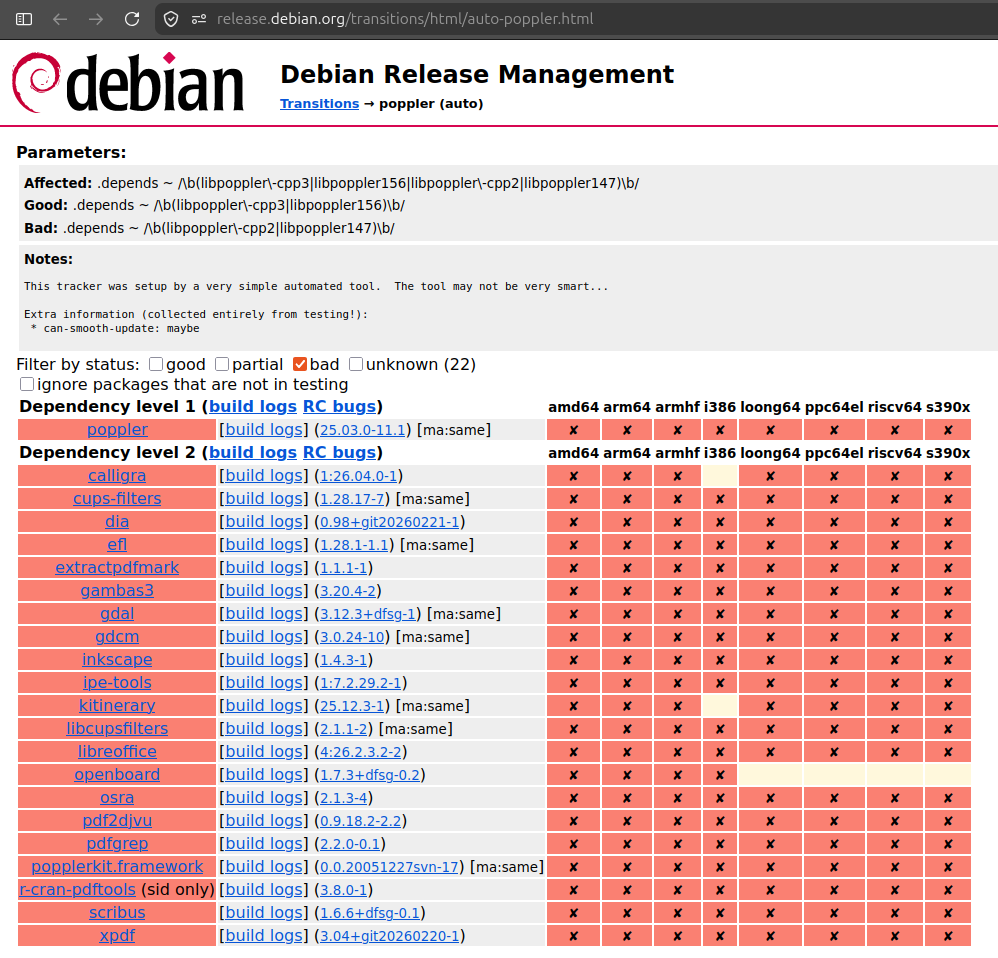
Greg KH gave a great lecture for Kernel Recipies 2026 about the use of LLMs to find and fix bugs in kernel code [1]. I recommend that everyone watch this and I also think it s important to note that hardly any of the lecture is really specific to kernel coding, it s just that the Linux kernel is one of the highest profile large free software projects so it gets more attention than most projects in both good and bad ways.
One side note that Greg made at 20:30 is about the natural tendency to anthromorphise the entity sending bug reports, I think this deserves much wider appreciation. For the case of patches to source code the human sending the patch will have dedicated some time and effort to writing it, if it s their first patch then they will have probably checked it a lot and maybe sought advice from people they regard as skilled. If they have a history of sending patches for the project they will probably do fewer checks but the quality of their work would be higher. In every case there s some minimum level of quality that you can expect from a human who has gone to the effort of finding a bug and writing code to try and fix it.
This doesn t mean that all code written by humans is good, I have written code that s objectively bad on many occasions and I have also written code that s good for my scenario but bad for others. For example the first patch I sent to the Linux kernel made all possible configuration settings of an ISA NE2000 network card be detected by the kernel (a clear benefit when using hardware I had available) but was rejected by Linus because it would break some ISA SCSI cards. So while being unsuitable for inclusion in the main kernel source tree the patch wasn t bad for everyone and the change was clear and easy to check. I had of course checked the code many times before submitting it because I didn t want to waste Linus time on rubbish code.
When you receive something produced by a human you will consider that the work was done by someone who spent some effort on it and did it for a reason. It may be misguided or even hostile in some rare cases but it is definitely worth some consideration. If you think of the output of LLMs in the same way you will give them much more consideration than they deserve. I think that the output of a LLM should not be given any more consideration than the first hit from a web search engine, it might be good but it might also be ridiculously wrong. I think in many ways LLM output should be treated with less trust than the first result from a web search because LLMs are designed to be convincing as an answer to your question unlike the cases where a web page has the wrong answer and it s more obviously wrong.
This is going to become more of an issue as LLMs give responses that are more human-like. Early LLMs would refuse to advise on crimes. Currently ChatGPT will deflect for example when asking about advice for writing a crime novel it recommends to have the action of finding an employee to bribe happen outside the plot and concentrate on interactions within the group. One recent model I tried gave a human style conversation about how it felt uncomfortable about discussing such things in a similar manner to a law abiding person being coerced into helping with a criminal plan.
I expect that the attempts to appear human will increase and that this will become more of a problem. Possibly to the extent that we need to use something like the GPG web of trust to determine who is human.
A few days ago, a colleague reached out to me, asking if I could help draft a
resolution on digital autonomy and free software for the upcoming renewal of
our collective bargaining agreement. Although she's very politicised and
generally a great individual, she is not a techie and we never really talked
about these issues before.
This took me by surprise. I should have been rejoicing; no, I should have been
the one who brought up this topic in our union. Wasn't I the technical expert
on these issues? But alas, my first reaction when she came to me was to snicker
and tell myself: "That's cute, but nothing's ever gonna change, Big Tech is too
strong and our governments don't give a damn."
How sad and cynical is that? That's not the person I want to be.
Something in the Quebecois political landscape has shifted in the last few
years with regards to tech. More and more "regular" people seem to be talking
about the importance of digital autonomy, how government services shouldn't
rely on Big Tech and how we should be using FOSS on hardware we actually
control.
A few years ago, I would have been at the vanguard of this change. I would have
been part of the creation of Donn es souveraines Qu bec. Heck, they are
organising a whole conference next week and I'm not even going. How did
this happen to me?
I first fell for Free Software for its political ideals: Knowledge Should Be
Free, Cooperation Is More Efficient Than Competition, Centralisation Should Be
Avoided When Possible, etc. I still believe in all of this, but somehow, after
years of fighting for change in the tech world, I have retreated into technical
work. I maintain Debian packages as a hobby and to scratch my own itch. I run
services for myself and a few friends. I organise Debian User Group meetings.
To be clear, I haven't generally given up. I'm very politically active in my
union and at work, I'm a good member of my housing cooperative and I'm still
fighting against the industrialisation of natural spaces in my
neighborhood. But when it comes time to defend freedom in the tech
world, lately, I've just been shrugging and accepting I should use Microsoft
Teams like every one else does. I want this to change and to do so, I need to
free some time.
Lintian
Two years ago, I added myself to Lintian's Uploaders list. Up until
then1, I enjoyed fixing little issues here and there and liked creating
new tags to help out the Python Team, where most of my Debian time was spent.
Lintian was badly in need of a new maintainer and as I felt it was an important
project, I decided to step in. 37 releases and about 160 closed bugs
later2, I'm done.
To be honest, I haven't had much fun maintaining Lintian lately. Bugs keep
piling on the BTS, so much so I have mostly been ignoring them for the past few
months. In fact, most of the actual work triaging, writing code and fixing bug
has been done by Nilesh Patra for a while now.
All this to say, if you care about Lintian, you should consider adding yourself
to the Uploaders list, as I'm out and Nilesh can't do all the work by himself.
He's a great person to work with and since I don't want to suddenly leave him
all alone, I'll be sticking around for a few more weeks in the hope someone
else will volunteer to help out. A smooth transition with a new co-maintainer
would really be nice!
If you're interested, don't hesitate to reach out to me on IRC or by email.
My first technical commit to Lintian was nearly 7 years
ago! Crazy how time flies.
The diffoscope maintainers are pleased to announce the release of diffoscope
version 333. This version includes the following changes:
[ Johannes Schauer Marin Rodrigues ]
* Add support for showing differences in POSIX.1-2001 PAX headers within .tar
files.
[ Chris Lamb ]
* Re-order various parts of the tar comparator to make it easier to
progressively delve into its functionality.
* Reflect that the use of the "case-match" language feature requires at least
Python 3.10+. This can be worked around if it causes problems - let us know.
* Update various copyright years.
This is a copy of an email I sent at work. I'm not sure I
should be making noise about this here, feedback welcome.
This is your bi-yearly reminder that time is changing soon! October 25th
in Europe, November 1st in North America. Less people in Canada are
changing this year, with BC, Alberta, Manitoba and Northwest
Territories getting rid of DST.
What's happening?
Some places in the world implement what is called Daylight saving time
or DST:
https://en.wikipedia.org/wiki/Daylight_saving_time
Normally, you shouldn't have to do anything: computers automatically
change time following local rules, assuming they are correctly
configured, provided recent updates have been applied in the case of a
recent change in said rules (because yes, this happens, and happened
this year, and yes, you need to upgrade your software!).
Of course, appliances like your microwave oven will likely not change
time and will need to adjusted unless they are so-called "smart", in
which case they are part of the skynet botnet and should be destroyed.
If your clock is flashing "0:00" or "12:00", you have no action to take
to adapt to this change, lucky you.
If you haven't changed time in six months, congratulations, your clock
will be accurate again!
In any case, you should still consider DST because it might affect some
of your meeting schedules, particularly if you set up a new meeting
schedule in the last 6 months and forgot to consider this change.
If your location does not have DST
Properly scheduled meetings affecting multiple time zones are set in UTC
time, which does not change. So if your location does not observer
time changes, your (local!) meeting time will not change.
But be aware that some other folks attending your meeting might have
the DST bug and their meeting times will change.
Be kind to those poor souls which might be missing meetings by a full
hour because time flies backwards for them.
If you do observe DST
If you are affected by daylight savings, your local meeting times
will change for UTC meetings. Normally, your meeting times are
scheduled to take this into account and the new hours should be
reasonable.
But now is a good time to verify that. Take a look at your schedule for
the next couple of weeks and reschedule meetings before the daylight
saving come up to avoid too much disruption. You have only a couple of
weeks to do so right now.
When do times change, how, and and where?
As regular readers will remember, the rule of thumb is:
Spring forward, fall backwards.
That is, during the season of Spring, the clocks move forward, and
during the Fall (like right now), they move backwards. That is in the
northern hemisphere, but then the southern hemisphere is often saner and
doesn't switch anyways.
So time will move backwards which means an extra hour of sleep. Unless
you have children or bad sleep, in which case your body doesn't care
about what the clock says and will wake up one hour earlier than what it
should.
And of course, this doesn't happen everywhere at once, so let's see when
it happens where.
Europe
The dance starts in Europe.
The change happens on the last Sunday in October at 01:00 UTC (not local
time!), that is October 25th. If you are in the central European
timezone, also known as Amsterdam, Berlin, or Paris time depending on
your national affiliation, that essentially means that at 2:59 local the
clocks will fall back to 2:00 instead of going to 3:00.
Concretely, set your watch back one hour before going to bed, go to bed
at the normal time, and enjoy an extra hour of sleep or leisure.
If you have kids, you might want to start getting them to bed slightly
earlier every day for a week before the change so they take time getting
used to the change. If you have trouble sleeping in the morning, find
your inner child and do that to yourself as well.
USA / Canada
Then it's the US[1] and Canada[2] joining the dance, on the First Sunday in
November at 02:00 local (not UTC!), that is, I believe, November 1st
2026.
This means that, at 1:59, the clocks will flip to 1:00, instead of 2:00.
Concretely, do like the Europeans and tweak your clock before going to
bed.
That is a little less than four weeks from now.
[1] except Arizona (except the Navajo nation), US territories, and
Hawaii
[2] except Yukon, Saskatchewan, (newly) British Columbia, (newly)
Alberta, (newly) Northwest Territories, (newly) Manitoba, one island in
Nunavut (Southampton Island), one town in Ontario (Atikokan) and small
parts of Quebec (Le Golfe-du-Saint-Laurent)
Other places with DST
This time again, I must apologize to the people of Cuba, Lebanon,
Israel, Palestine, Egypt, Chile, Australia, and New Zealand, as you fine
folks all have your own DST rules that are omitted here for brevity. I
rely on this page from Wikipedia to be updated by time nerds accurately
for this message, and it should provide you with a rough idea of what's
coming:
https://en.wikipedia.org/wiki/Daylight_saving_time_by_country
In general, changes also happen in October, but either on different
times or different days, except in the south hemisphere, where they
might happen in September (oops, sorry NZ folks, I'm late!).
Places without DST
Everyone else, enjoy, you're on the right side of history, and we thank
you for the good example you give us.
Changes since last time
There's been lots of changes since last time:
British Columbia moved to permanent -07 on 2026-03-09, that is it
will not change to normal time in November
Alberta moved to permanent -06 on 2026-06-18, similar to BC above.
Canada s Northwest Territories moved to permanent -06 on 2026-08-21,
matching Alberta.
Manitoba moves to permanent -05 on 2026-10-31.
Morocco moves to permanent +00 on 2026-09-20.
Moldova has used EU transition times since 2022, but the tz database
only noticed in 2026
This is my interpretation of the changes announced on the tzdata mailing
list here:
https://lists.iana.org/hyperkitty/list/tz-announce@iana.org/latest
If the eastward trend continues, Canada should adopt country-wide "no
daylight savings" rules by 2027, although there's actually no sign of
the other provinces (Ontario, Qu bec and so on) currently running bills
to change those rules just yet. Poor Canadians like me confused about
time in their countries can refer to this section of Wikipedia for
details:
https://en.wikipedia.org/wiki/Daylight_saving_time_in_Canada#By_province_and_territory
... and particularly the image featured there:
https://commons.wikimedia.org/wiki/File:Canada_time_zone_map-en.svg
It also seems like the US government might finally adopt a permanent
daylight saving change bill in 2026, as the "Sunshine protection act"
pass the house in July:
https://en.wikipedia.org/wiki/Sunshine_Protection_Act
True to form, this was associated with absolutely ridiculous pressure
from Donald Trump against republicans (his own party!) objecting to the
change:
On July 14, 2026, the House passed a Sunshine Protection Act bill
backed by President Trump. Nevertheless, the bill was opposed in the
Senate by Republicans, including Senator Cotton. In response, on
October 3, 2026, Trump shared a post on Truth Social urging Cotton to
approve the bill, where he revealed Cotton's personal cellphone number
and called on people to call him.
https://www.theguardian.com/us-news/2026/oct/03/trump-tom-cotton-daylight-saving-time
Given that the last time the US did a major change to the daylight
savings policy (in 2005), Canada followed suit to stay in sync, it's
quite possible Trump's mad dash might actually finish getting rid of DST
in North America:
https://en.wikipedia.org/wiki/Energy_Policy_Act_of_2005#Change_to_daylight_saving_time
Debian LTS/ELTS
This was my hundred-forty-seventh month that I did some work for the Debian LTS initiative, started by Raphael Hertzog at Freexian.
During my allocated time I uploaded or worked on:
[DLA 4804-1] libsmpp34 security update to fix one CVE in Bookworm related to an out of bound read.
[#1149107] trixie-pu of libsmpp34 has been created and wait for review by the release team.
[DLA 4805-1] mkvtoolnix security update to fix one CVE in Bookworm related to a heap buffer overflow.
[DLA 4806-1] pgextwlist security update to fix one CVE in Bookworm related to substituting extension schemas or owners matching [ $ \].
[ELA-1837-1] mkvtoolnix gimp security update to fix one CVE in Bullseye to a heap buffer overflow.
[osmo-iuh] upload to fix a CVE related to a reachable assertion in Sid.
Besides doing these uploads, the month was filled with unscheduled meetings, discussions and explanations, all basically around the role of FD.
During my week of FD duties, I had to become familiar with new tools. As there are several things that FD has to do over and over again, I tried to automate this a bit. My experiments went well and I think this can be used to make FD duties less repetitive.
I also continued my work on cups and hplip and I am confident that I can do uploads in October.
Last but not least I spend some time on security-master to assist others (especially the kernel team) with uploads to Bookworm and Bullseye.
In case you need to get a complete clone of the security-tracker, using the option deepen n might be of help. Unfortunately in case you choosed n too high and some kind of error appears, something gets into a mess and you need to start almost from the beginning (some objects are still present and are used again). If you want to run a script, a value of 10 might be a good choice. You don t have to deepen back to the beginning. At some point in time you can just unshallow and get the whole rest. Afterwards doing a git gc is highly recommended.
Debian Printing
This month I uploaded a new upstream version or a bugfix version of:
hplip to unstable, to fix an expired certificate and some bugs.
Debian Lomiri
Unfortunately this month my work did not make any progress.
Nevertheless, in case of any work done, this would have been generously funded by Fre(i)e Software GmbH!
Debian Astro
Unfortunately I had no time to work in this category this month.
Debian IoT
Unfortunately I had no time to work in this category this month.
Debian Mobcom
This month I uploaded a new upstream version or a bugfix version of:
The Problem
I want to use a FOSS phone running Debian as my daily driver and not use a non-free OS on my phone. GrapheneOS [1] is a FOSS rebuild of Android, it s a great project and I commend them for what they are doing. But I want a system where I have access to all the bits and where I can ssh in to it and manage it in the same way as all other Linux systems. Android is free software but it s a closed design and the phones are expected to be appliances not full peers on the network. The Android native terminal emulator (AKA Linux development environment) is a nice feature, a VM with a default of 1GB of RAM but it s still separate from the main OS.
KDE Connect [2] is a system for KDE talking to phones, it is a great project and allows convenient interaction between a Linux PC and a phone. But in addition to that I d like the option to ssh to my phone to send an SMS or have one sent from a cron job. I blogged about using the basic functions of Kdeconnect from the command-line [3].
I have had ongoing issues with the battery not lasting long enough on the PinePhonePro (PPP) and the Librem 5 (L5) which makes them unusable for my purposes. For a phone running Droidian I can have an open ssh session (with keep-alive packets) running overnight on Wifi without any problems while for the PPP or L5 an hour of reading an ebook (the least demanding use of a phone) will use most of the battery.
I sent my FuriPhone back for warranty repair and it s been almost a month with no follow up, so I need to have another option.
The Aim
The aim of this post is to develop a rough design for a battery case for either a L5 or a PPP, I have both phones and they are both capable of doing what I want apart from battery life. Also designing a case that basically works for both phones and has two variations of the CAD file for 3D printing is good to allow collaboration with people who use either phone. Protecting the phone from damage when dropped is also a core feature.
I investigated commercial options. There are some reports of cases for other phones working, someone reported a PPP working well with a battery case for a Samsung S20 Ultra. The OtterBox uniVERSE Case for Samsung Galaxy XCover Pro is reported to fit the PPP so probably battery cases for the XCover Pro will also work. There are also universal power cases which have spring clips to fit a wide range of phone sizes, but they are much larger than other options and probably increase the risk of damage if the phone is dropped.
At this stage I m planning out the rough specs of a case that can be 3D printed to protect a phone while being easy to change the cells. The process of changing cells should be quick, easy, and not risk breaking anything. The hardware required should be affordable ($100AU plus some 3D printing seems reasonable) and should not require significant skills to assemble. After recent experiments with Thinkpad repair I ve determined that I am not good at electronics by today s standards so I plan to avoid anything difficult in that regard.
Battery Options
There are phone cases with batteries built in for the more common phones. A quick search on AliExpress turned up options for recent Pixel phones. They aren t as common as they used to be as Android phones and iPhones generally have good battery life nowadays. Of course there aren t such options for less common phones like the L5 and PPP.
It is cheap and easy to buy a portable battery for charging phones, but that s a separate bulky device and unless the connector is inside a protective case it leaves the phone vulnerable to catastrophic damage if dropped.
So can a suitable battery case be designed and 3D printed?
Cheap Batteries
According to Wikipedia the 18650 LiIon cell is the most commonly used LiIon battery, that is 18mm in diameter and 65mm in length. For a phone case thinner batteries would be more convenient but economies of scale make the 18650 cheap to buy new and commonly available on the second hand market. The current prices on AliExpress (in Australian dollars) are about $8 per cell when buying 10 at a time. Most of the cells on AliExpress don t have wires attached so they can be swapped in a carrier the way AA batteries are used, but the cells are symmetrical (no bump for positive) so the user has to take care of polarity. Chargers are around $22 for a 4 cell charger or $52 for a 12 cell charger.
I ve seen prices as low as $1 per cell on the second hand market, I haven t investigated the amount of usable capacity in such cells. Probably the prices for chargers I ve found aren t the best available but they are good enough to start the design. 10 cells and a 4 cell charger is about $100. That s about 130Wh while a 74Wh USB-C battery pack costs about $50. So the price per Wh is OK.
I have read about an attempt to do this for the L5 with two of the batteries designed for the L5 in a case attached to it, so you have 3*L5 batteries. It s an interesting approach but those batteries have poor value for money when compared to 18650 ($29US for 4500mAh compared to $8 for 3500mAh) and they also don t ship them outside the US at this time. The 18650 batteries are available everywhere cheaply and have multiple uses.
How They Fit
According to my measurements the PPP is 76mm wide and the L5 is 73mm wide. That s wide enough for 3*18mm or 4*18mm cells side by side arranged parallel to the long side of the phone or one 65mm long cell going across the phone with the necessary spring and wires.
The L5 is about 151mm long and the PPP is about 5mm longer. So that means that for just the cells we could have 2 cells in a row in parallel to the long side of the phone giving a 2*3 or 2*4 array or we could have a row of 8 cells parallel to the short side of the phone.
A quick search for controllers for a battery of LiIon cells that outputs USB-PD turned up one of the smaller ones as 40*28mm, here is the AliExpress page [4]. So that means we could have a maximum of about 4 cells and the controller while leaving space for the camera. Looking at other similar items it seems that most of them take a large portion of the 73mm width available and take a bit less than 30mm height. The price range for DC-DC voltage converters ranges from about $3 to $20, the one I linked to is currently $8.
The mass of 18650 cells is around 45g so 4 of them would be about 180g before counting the weight of the case and electronics. A L5 weighs 262g and a PPP weighs 220g so 180g of battery will make a significant difference, not an impossible difference but holding a PPP while reading an ebook is already annoying. Maybe the case could be designed to be easier to hold, a loop of wool attached to the top could be used to suspend the phone from one finger while the rest of the hand just keeps it steady.
In a default configuration the L5 has a 4500mAh 3.8V battery and the PPP has a 3000mAh 3.8V battery. The 18650 cells have up to 4000mAh with 3500mAh being common. So 4 such cells could multiply the battery life of a PPP by a factor of 5 or a L5 by 4. That would not be enough to last for a whole day without charging so they need to be easy to swap.
A 3 cell battery seems like a good option, 135g of batteries so the project overall wouldn t even double the weight of the phone with battery case. As it doesn t seem possible to put in enough cells to last a day of reasonable use (running a web browser, checking email, reading wikipedia, and having some IM systems checking for notifications) there doesn t seem to be a benefit in trying to stuff the maximum number of cells in. Going to 4 or 5 cells doesn t provide much benefit over 3 while increasing the weight and making the design more difficult. The modules for DC Voltage conversion often have configuration for the number of cells to be used so it wouldn t be difficult to print a new case and reconfigure the Voltage converter.
Design
A case needs to provide protection as well as hold the batteries. The lack of cases for the L5 and PPP is a problem even without the extra weight of a battery pack increasing the kinetic energy of falling phone. Ideally a drop from 1M on to concrete would not cause any damage to the phone, destruction of the case is OK as it would be 3D printed and can be rebuilt easily.
I think that a case where the phone slides in from the top would be best. To change cells one would slide the phone out and the cells would be immediately accessible with no divider between the phone and the cells. Sliding the phone in would hold the cells against the back of the case and as there is a gap of about 3mm on each side of the PPP between the display area and the edge of the phone there s plenty of space for the case to wrap around it at the sides and bottom. At the top there would have to be some sort of plastic clip. The PPP only has buttons on the top right so the case can be snug on all sides apart from the top right. The L5 has switches at the top left and buttons at the top right so whatever clips on to the top would really need some strength to cover the fall flat on face case.
The USB C plug would need to be held in place well enough to allow the phone to easily slide on to it but also be weak enough that it would move if a drop forced the phone out of the case.
Thingiverse has a design for a L5 case [5] (with several derivatives) and a design for a PPP case [6]. Those cases could be used as starting points and then changed to store batteries and the voltage change circuit board. I have just learned that it s possible to use rubberised material in a 3D printer which is apparently what those designs are for. If a case was printed with rubberised material the top could just stick in place after being pushed in.
Potential for Excessive Excitement
Having an exploding device in your pocket would be the exciting in a bad way. My initial idea was to have multiple 18650 cells in series. The problem is that if the cells have different capacity levels then one can run out before the rest and get to a deep discharge state which at a minimum causes damage to the cell.
One way of minimising risk is to have only a single cell in use at one time, here is a converter for a single cell to 5V [7]. It is possible to run multiple cells in parallel by simply wiring them together, but it s recommended to make sure that the voltage difference between cells is less than 0.2V to avoid high current when connecting.
The arrangement of cells is often referred to as nS or nP to refer to n cells in series or parallel. Aliexpress has a range of 1S to 6S devices. Some of the 2S devices have a connector for the mid point which permits separate voltage monitoring for both cells but there doesn t seem to be anything equivalent for 3S or more. They also don t appear to have anything to specifically manage 2P or 3P arrangements at the moment (they had a 3P board on sale when I looked into this last year).
Conclusion
This is a bigger project than I expected when I first started investigating it. I ve played with FreeCAD which seems OK but will take a lot of learning and practice. Then I need to do more investigation into the DC-DC converters to find one that works well and is unlikely to start a fire.
I will look into other phone options as well and keep chasing Furilabs people about my phone replacement.
I ve tested the DBUS interfaces for Kdeconnect (the system for connecting a KDE desktop to a phone or another computer). Unlike most DBUS interfaces it has a significant tree of interfaces so the busctl command to get the tree is important. Here s the useful things I discovered:
# list basic interfaces for kdeconnect
qdbus6 org.kde.kdeconnect.daemon /modules/kdeconnect
# get tree of interfaces for kdeconnect
busctl --user tree org.kde.kdeconnect.daemon
# get list of devices
qdbus6 --literal org.kde.kdeconnect.daemon /modules/kdeconnect org.kde.kdeconnect.daemon.deviceNames
# list interfaces for a device (DEVID is a hex string from the above command)
qdbus6 org.kde.kdeconnect.daemon /modules/kdeconnect/devices/$DEVID
# get battery charge
qdbus6 org.kde.kdeconnect.daemon /modules/kdeconnect/devices/$DEVID/battery org.kde.kdeconnect.device.battery.charge
Sending an SMS apparently requires using the QVariantList type which is more pain than I wanted so I tried the kdeconnect-cli command. Here s a quick summary of how to use it:
# list devices
kdeconnect-cli -l
# send a SMS
kdeconnect-cli -d $DEVID --send-sms "the message" --destination $NUMBER
# find device (ring)
kdeconnect-cli --ring -d $DEVID
# send a notification message
kdeconnect-cli --ping-msg "this is the message" -d $DEVID
# unlock and lock screen (only works on Debian devices for me not Android devices)
kdeconnect-cli --unlock -d $DEVID
kdeconnect-cli --lock -d $DEVID
There doesn t seem to be support for making phone calls via kdeconnect which is a significant omission. It s a very common situation to want to call a number that s listed on a web site or in some other data source that s easier to access on a PC than on a phone. The clipboard could be used but that s needless pain.
Related posts:
Nheko DBUS Nheko is my current favourite client for the Matrix IM...
Moving Between Devices I previously wrote about the possibility of transferring work between...
dbus error Strange dbus error from the KDE power monitoring tool...
With 26.10 in Feature Freeze, wore my Release team hat to:
Review and approve a bunch of Feature Freeze Exceptions, including the Go 1.27 transition, Qt 6.11.2, rust-coreutils 0.12.0, devscripts 2.6.12, kdump-tools moving to dracut, and a few GCE packages.
Point linux-entra-sso to the SRU team, as it didn t need an FFe at all, and milestone a couple of bugs for 26.10.
Continued to push for infrastructure improvements:
Made ubuntu-cdimage more resilient to Launchpad hiccups (MP).
Taught generate-freeze-block in ubuntu-archive-tools a couple of new options (--skip-update and --series) and better error handling (MP).
Bumped the arm64 generic non-cloud image to 4.5G in livecd-rootfs and uploaded it as 26.10.16; also sponsored the follow-up 26.10.17 for Chlo .
Reviewed quite a lot of MPs - britney hints, meta-release, ubuntu-release-tools, ubuntu-archive-tools, ubuntu-cdimage, livecd-rootfs, ubuntu-seeds, and so on.
Did Archive Admin, DMB, and Release team duties as usual.
Debian (E)LTS
This month I have worked 33.5 hours
on Debian Long Term Support (LTS)
and on its sister Extended LTS
project and did the following things:
(A quick note that I did quite a lot of the work during my work as Frontdesk that went on till 4th Oct, so 33.50 hours include the work I did till 4th October 2026.)
Released Security Updates
node-lodash: Prototype pollution in _.unset and _.omit (plus a bypass of the initial fix for it), and code injection via the imports option of _.template.
This is the bookworm follow-up to DLA 4663-1 that I carried over from July. The update had been sitting prepared and tested on debusine, so once the upstream discussion wrapped up, it went straight out. It also carries an extra patch to the lodash-cli dependency map - without it, the regenerated lodash.template module throws assignWith is not defined at runtime, which node-gulp-util s autopkgtest caught.
libpng1.6: Use-after-free of zlib input in png_read_end() after incomplete zTXt, iTXt, or iCCP decompression, which could result in denial of service.
I picked this one up whilst on front desk; the upstream fix that went into trixie via DSA 6537-1 applied to 1.6.39 as-is.
Work in Progress
libpng1.6: The same CVE-2026-46675.
[ELTS]: Claimed in ela-needed; the same upstream fix applies to all three ELTS suites, so this should go out shortly.
Other Activities
[E/LTS] Did my front-desk week from 28-09 to 04-10.
Over the week I did roughly:
Triage of 524 unique CVEs across 192 source packages and all four suites. And 1 automated ELTS end-of-life sweep.
Additional data is now part of the front-desk job too, so 75 commits record it for 179 CVEs across 71 packages.
Newly queued 22 source packages - 13 in dla-needed (apache2, chromium, firefox-esr, libnet-idn-encode-perl, libpng1.6, node-shell-quote, nvidia-graphics-drivers, openssl, pcre2, php-mongodb, php8.2, social-auth-core, and wpa) and 16 in ela-needed (apache2, firefox-esr, gegl, lemonldap-ng, libnet-idn-encode-perl, libpng1.6, libwebsockets, nsd, nvidia-graphics-drivers, pcre2, php7.0, php7.3, php7.4, rar, unrar-nonfree, and wpa), 7 of them in both. Also widened 3 ELTS entries to bullseye - antiword, ocaml, and openvswitch.
Most of the interesting work was again in the <not-affected> verdicts: 217 of 263 (83%, across 57 packages) rest on showing that the vulnerable code or feature isn t in the source we ship. Another 17 cover incomplete upstream fixes that we either never shipped or shipped with the follow-up already in (expat, libxml2, node-tar, and pyjwt). 15 come from bundled components we don t ship - node-ajv again, which uses uri-js and not fast-uri, and nvidia-open, which doesn t ship the NGX updater. And 13 are vendor- or platform-specific - openssh s CVE-2026-55654 lives only in a Red Hat GSSAPI patch, and the netdata and PHP ones only affect Windows.
Did 4 rounds of newly supported bullseye packages (33 packages overall), plus libmail-mboxparser-perl for buster - 34 in all. The existing CVE data mostly held up; the real finds were discovery gaps. One interesting gotcha: sid renamed stunnel4 to stunnel, and two new CVEs were associated only with the new name, so they never showed up for trixie, bookworm, or any ELTS suite. I also sorted the 180 Triage needed entries (57 packages) from elts-eol by where each was already handled, and triaged for ELTS the 100 that trixie or bookworm had already decided; the rest come next. And I imported 79 package-level lines for the older source names ELTS still ships (tomcat8, php7.0/7.3/7.4, netty-3.9, openssl1.0, python2.7/3.5/3.7, and pypy).
Caught some inconsistencies in released advisories: DLA 4801-1 (swift) was missing a CVE, ELA 1831-1 (redis) listed the wrong one, and DLA 4808-1 (network-manager-l2tp) listed CVE-2026-75883 - an ID that was renamed and then reassigned to an unrelated ppp issue. I fixed all three in the tracker s advisory lists.
Made the Security team and the uploaders aware of regressions from our own updates:
libde265: the CVE-2026-49337 fix in DLA 4789-1/ELA 1828-1 (and DSA 6413-1) misses upstream s follow-up commit.
libxml2 CVE-2026-76781 and policykit-1 CVE-2026-85498 were introduced by our own back-ports; the policykit-1 one is harmless.
expat: the CVE-2025-59375 backport in DLA 4807-1 is compiled out, because XML_GE is never defined.
xen: DLA 4818-1 s XSA-491 fix makes XSA-510 reachable.
gegl: the CVE-2026-2049/2050 back-port in ELA 1650-1 rejects valid RLE .hdr files.
log4cxx: DLA 4322-1 broke UTF-8 in JSONLayout output. That one is functional, not security.
Helped correct a set of triages and let the Debian Security team know:
ruby-json CVE-2026-71847: the vulnerable code was never in a released Debian version.
openssh CVE-2026-55654: only affects a Red Hat-specific GSSAPI patch.
three libxml2 issues that don t affect trixie either.
the stunnel4 rename above.
trixie <no-dsa> lines on jsch, node-qs, and ruby-loofah, where trixie s version doesn t have the vulnerable feature at all.
Independently found a security issue in rclone and reported it privately upstream through a GitHub security advisory. Upstream already had a report for the same issue, so they folded mine into the existing advisory and credited me as a co-reporter.
Also found some bugs in the additional-data tooling, e.g. cve-ad --package P --severity tbd wipes the CVE-level severity, and the schema doesn t validate package-level entries at all.
[E/LTS] Monitored discussions on mailing lists, IRC, and all the documentation updates.
netip.Addr features an Unmap()
method returning the unwrapped IPv4 contained in an IPv4-mapped IPv6
address: from ::ffff:203.0.113.10 or ::ffff:cb00:710a, it returns
203.0.113.10.1 There is no Map() or To6() method for the reverse
direction. Such a method is trivial to implement, but Go maintainers have
rejected it on the grounds that users should write
netip.AddrFrom16(ip.As16()) and let the compiler optimize it.2 Today,
this pattern is eight times slower than a native method. How can we teach the
compiler to optimize this sequence?
The alternatives
Let s explore three ways to implement the map semantics for netip.Addr. My
favorite is to add it to the Go standard library. Go maintainers prefer a small
external helper chaining netip.AddrFrom16() and netip.Addr.As16(), hoping
the compiler eventually optimizes it. The unsafe package
opens a third path, with the same performance as the first solution.
Modifying the Go standard library
Internally, netip.Addr stores any IP address as a
128-bit value with an extra field z to encode the family and the zone:
typeAddrstructaddruint128zunique.Handle[addrDetail]typeaddrDetailstructisV6bool// IPv4 is false, IPv6 is true.zoneV6string// != "" only if IsV6 is true.var(z0unique.Handle[addrDetail]z4=unique.Make(addrDetail )z6noz=unique.Make(addrDetailisV6:true ))
AddrFrom4() encodes an IPv4 address as an
IPv4-mapped IPv6 address and sets z to the unique value z4:
// AddrFrom4 returns the address of the IPv4 address given by the bytes in addr.funcAddrFrom4(addr[4]byte)AddrreturnAddraddr:uint1280,0xffff00000000uint64(addr[0])<<24uint64(addr[1])<<16uint64(addr[2])<<8uint64(addr[3]) ,z:z4,
Unmap() turns an IPv4-mapped IPv6 address into an
IPv4 address by setting the z field to z4:
Implementing the reverse direction inside the Go standard library is trivial: we
set the z field to z6noz if the address is IPv4.
// To6 maps an IPv4 address to an IPv4-mapped IPv6 address. It returns an// IPv6 address unmodified.func(ipAddr)To6()Addrifip.Is4()ip.z=z6nozreturnip
As a helper
We can t access the z field from outside the net/netip package. Instead, we
build a small helper around the netip.AddrFrom16(ip.As16()) pattern:
// AddrTo6 maps an IPv4 address to an IPv4-mapped IPv6 address. It returns an// IPv6 address unmodified.funcAddrTo6(ipnetip.Addr)netip.Addrifip.Is4()ip=netip.AddrFrom16(ip.As16())returnip
As an unsafe function
Another solution uses the unsafe package to alter the Addr struct through
a proxy with the same memory layout:3
// addrProxy has the same memory layout as netip.Addr.typeaddrProxystructaddr[2]uint64// netip.uint128zunsafe.Pointer// unique.Handle[netip.addrDetail]var(anyIPv6=netip.IPv6Unspecified()netipZ6noz=(*addrProxy)(unsafe.Pointer(&anyIPv6)).z)// AddrTo6 maps an IPv4 address to an IPv4-mapped IPv6 address. It returns an// IPv6 address unmodified.funcAddrTo6(ipnetip.Addr)netip.Addrif!ip.Is4()returnip(*addrProxy)(unsafe.Pointer(&ip)).z=netipZ6nozreturnip
Benchmarks
On my computer, with Go 1.27.1, the standard library solution costs 0.88 ns per
operation, while the solution favored by Go maintainers costs 7.14 ns. The
unsafe solution matches the performance of the first one.
Assembly code
Let s check the assembly code the compiler generates for each solution.4
The one built into the standard library looks like this:5
// AX = input.addr.hi, BX = input.addr.lo, CX = input.zCMPQnet/netip z4(SB),CX; check "z" if this is an IPv4 addressJNEend; if not, stop hereMOVQnet/netip z6noz(SB),CX; CX = netip.z6nozend:RET// return value = Addr hi: AX, lo: BX, z: CX
Go s assembly language is not a direct representation of the underlying
machine language: it operates on a semi-abstract instruction set derived from
Plan 9 s assembler. It has four pseudo-registers: FP (frame pointer
for function arguments), PC (program counter), SB (static base pointer for
global symbols), and SP (stack pointer). It also has architecture-specific
registers like AX, CX, DX, BX, SI, DI, and R8 to R15.
Instructions storing data use their last argument as the destination.
Instructions can carry an explicit size suffix: MOVB moves a byte, MOVW 16
bits, MOVL 32 bits, and MOVQ 64 bits. In the example above, the first
instruction compares the 64-bit value z4 with the CX register.
The unsafe solution looks almost the same:
// AX = input.addr.hi, BX = input.addr.lo, CX = input.zCMPQnet/netip z4(SB),CX; check "z" if this is an IPv4 addressJNEend; if not, stop hereMOVQnetipZ6noz(SB),CX; CX = netip.z6nozend:RET// return value = Addr hi: AX, lo: BX, z: CX
The helper solution has far more instructions. To understand why, let s look at
the code for As16() and
AddrFrom16(). They are short enough for the compiler
to inline them.
We can already guess the pattern to optimize: the code packs the IP address into
an array, copies it, then unpacks it. If we inline the Go code by hand, we get:
Unfortunately, as of Go 1.26.8, the compiler is not smart enough to do the same:
// AX = input.addr.hi, BX = input.addr.lo, CX = input.z; Push the stack (32 bytes):; 0(SP) addr netip.uint128; 16(SP) a16 [16]bytePUSHQBPMOVQSP,BPSUBQ$32,SPCMPQnet/netip z4(SB),CX; check "z" if this is an IPv4 addressJNEend; if not, stop here; Pack: byteorder.BEPutUint64(a16[:8], input.addr.hi); byteorder.BEPutUint64(a16[8:], input.addr.lo)MOVBEQAX,net/netip a16+16(SP)MOVBEQBX,net/netip a16+24(SP); addr = a16, 16 bytes at once through the vector register X0MOVUPSnet/netip a16+16(SP),X0MOVUPSX0,net/netip addr(SP); CX = netip.z6nozMOVQnet/netip z6noz(SB),CX; Unpack: output.addr.hi = byteorder.BEUint64(addr[:8]); output.addr.lo = byteorder.BEUint64(addr[8:])MOVBEQnet/netip addr(SP),AXMOVBEQnet/netip addr+8(SP),BXend:ADDQ$32,SPPOPQBPRET// return value = Addr hi: AX, lo: BX, z: CX
The compiler does a decent job on the byte shuffling: the eight byte stores of
BEPutUint64() become a single MOVBEQ, which stores a register byte-swapped.
The eight byte loads of BEUint64() become a single MOVBEQ the other way
round.6 Three groups of instructions remain: a pack, a copy, and an
unpack.
Hacking the Go compiler
The Go compiler has several phases:
The compiler converts the syntax tree and its types into its own intermediate
representation (IR). This process, called noding, goes through
a serialization format named unified IR.
This phase runs two steps: order of evaluation decomposes complex
statements into simpler ones, and desugaring transforms higher-level Go
constructs, like switch or channels, into more primitive instructions or
calls to the runtime.
The compiler rewrites the SSA form into machine-specific variants,
allocates registers, and applies more optimization passes. At the end, the
assembler turns the generated instructions into machine code.
The hammer
My first idea is to replace occurrences of netip.AddrFrom16(ip.As16()) with
netip.Addr addr: ip.addr, z: netip.z6noz as early as possible, during the
noding process. Before that, the type checking phase prevents
us from accessing unexported struct fields.
Go 1.27 introduced a convenient debug option to dump the IR of a function at
interesting points during compilation:
$ GOTOOLCHAIN=go1.27.1GOAMD64=v3gobuild-a-gcflags="-d=astdump=AddrTo6Safe".
Writing text ast output for AddrTo6Safe to AddrTo6Safe.astWriting html ast output for AddrTo6Safe to AddrTo6Safe.htmlWriting html syntax output for AddrTo6Safe to AddrTo6Safe.syntax.html
In the HTML file, the first column shows the IR as it comes out of noding:
In the body of the if statement, we spot the calls to the method
netip.Addr.As16() and to the function netip.AddrFrom16(). Our goal is to
patch them with a struct literal:
In noder s reader.go, the expr() method builds the IR tree for
an expression. At the end of the exprCall case, we add a call to a
rewriteAddrFrom16As16() function. It takes the current node and returns the
struct literal on success, or nil if the rewrite is not possible. First, we
check that we have the expected pattern: a call to the netip.AddrFrom16()
function with a call to the netip.Addr.As16() method as its only argument:
Have a look at the complete patch.7 We can test it
with the following commands:
$ cdsrc
$ ./make.bash
Building Go cmd/dist using /usr/lib/go-1.27. (go1.27.1 linux/amd64)Building Go toolchain1 and bootstrap cmd/go (go_bootstrap) using /usr/lib/go-1.27.Building Go toolchain2 using go_bootstrap and Go toolchain1.Building Go toolchain3 and commands using go_bootstrap and Go toolchain2.Checking command staleness for linux/amd64.---Installed Go for linux/amd64 in /home/bernat/code/free/goInstalled commands in /home/bernat/code/free/go/bin*** You need to add /home/bernat/code/free/go/bin to your PATH.$ exportPATH=$PWD/../bin:$PATH$ goversion
go version go1.28-devel_9834516e20 Sat Sep 12 08:23:11 2026 -0700 linux/amd64$ gotestnet/netip/...
ok net/netip 0.224s$ cd../../go-netip-addrto6
$ gotest.
ok github.com/vincentbernat/go-netip-addrto6 0.062s
The generated code for the helper is now the shortest possible version!
// AX = input.addr.hi, BX = input.addr.lo, CX = input.zCMPQnet/netip z4(SB),CX; check "z" if this is an IPv4 addressJNEend; if not, stop hereMOVQnet/netip z6noz(SB),CX; CX = netip.z6nozend:RET// return value = Addr hi: AX, lo: BX, z: CX
Go maintainers are unlikely to accept this change. It relies on the internal
structure of net/netip.Addr. It s an ugly hack in the noder, whose job is to
faithfully translate the type-checked AST into the IR. And it s harder to
maintain than adding a To6() method.
The screwdriver
The right place for such an optimization is the generic SSA phase. One of
the last machine-independent passes is memcombine. With the appropriate debug
flag, the compiler dumps the SSA form after this pass:8
The result of the memcombine pass follows the same structure as the assembly
code for AddrTo6Safe()we looked at earlier: two stores,
one move, and two loads we would like to optimize away.
Each line features a value identifier (v442), an operation with its type
(Bswap64 <uint64>), and its arguments (v490).9 Values are the basic
building blocks of SSA and are defined exactly once. Square brackets enclose
integer parameters ([8]) and curly braces contain auxiliary arguments
( netip.addr ). Operations writing to memory produce a new memory state. Every
memory operation takes the current state as its last argument, which keeps them
in order.
To simplify this code, we could apply three rewriting rules:
The first one adds a shortcut when loading through a move: (Load (OffPtr
[o] p) (Move p src mem)) => (Load (OffPtr [o] src) mem). This matches v174
with its arguments v415 and v286 and creates a new value v600:
The second one simplifies a load following a store: (Load p (Store p x
_)) => x. The load is forwarded: the stored value replaces it and no memory
access remains. It matches v174. It notices that v600 and v173 are the
same address and replaces v174 with a copy of v442:
To optimize it away, we also apply three rewriting rules:
The first one also adds a shortcut when loading through a move, but
without an offset: (Load p (Move p src mem)) => (Load src mem). This rewrites v416
to use arguments from v286:
The second rule forwards a value stored one step earlier, skipping over a
store to another address: (Load p (Store q _ (Store p x _))) => x. This
matches v416: x is v542, p is v22 (&a16), q is v173
(&a16[8]), and p and q do not overlap for uint64.
In practice
Most of these rules already exist in generic.rules. They use
conditions to validate their context: ssa.IsSamePtr() for the same address,
ssa.Disjoint() for addresses that do not overlap. The rule forwarding a stored
value to a load already exists with three variants looking through several other
stores. Here are the two we need:
There is no generic rule to cancel two byte swaps, but the AMD64 lowering
pass includes this rule:
(BSWAP(Q L)(BSWAP(Q L)p))=>p
After switching to Go s development branch and adding the missing
rule, the generated assembly code is worse than with Go 1.26.8,
even though our additional rule slightly improves the situation at the end:
// AX = input.addr.hi, BX = input.addr.lo, CX = input.z; Push the stack (16 bytes):; 0(SP) a16 [16]bytePUSHQBPMOVQSP,BPSUBQ$16,SPCMPQnet/netip z4(SB),CX; check "z" if this is an IPv4 addressJNEend; if not, stop here; The four forwarded bytes: the low half of input.addr.lo is taken apart and; put back together in registersMOVQBX,DX; DX = input.addr.loSHRQ$24,BX; BX = input.addr.lo >> 24MOVQDX,SI; SI = input.addr.loSHRQ$16,DX; DX = input.addr.lo >> 16MOVQSI,DI; DI = input.addr.lo, kept for the packSHRQ$8,SI; SI = input.addr.lo >> 8MOVBLZXDIB,R8; R8 = byte(input.addr.lo)MOVBLZXSIB,SI; SI = byte(input.addr.lo >> 8)SHLQ$8,SIORQR8,SI; SI = two low bytes of input.addr.loMOVBLZXDL,DX; DX = byte(input.addr.lo >> 16)SHLQ$16,DXORQSI,DXMOVBLZXBL,BX; BX = byte(input.addr.lo >> 24)SHLQ$24,BXORQDX,BX; BX = input.addr.lo & 0xffffffff; Pack: byteorder.BEPutUint64(a16[:8], input.addr.hi); byteorder.BEPutUint64(a16[8:], input.addr.lo)MOVBEQAX,net/netip a16(SP)MOVBEQDI,net/netip a16+8(SP); The four other bytes of input.addr.lo, read one by one from a16MOVBLZXnet/netip a16+11(SP),DX; a16[11]SHLQ$32,DXORQDX,BXMOVBLZXnet/netip a16+10(SP),DX; a16[10]SHLQ$40,DXORQDX,BXMOVBLZXnet/netip a16+9(SP),DX; a16[9]SHLQ$48,DXORQDX,BXMOVBLZXnet/netip a16+8(SP),DX; a16[8]SHLQ$56,DX; output.z = netip.z6nozMOVQnet/netip z6noz(SB),CX; output.addr.hi = byteorder.BEUint64(a16[:8])MOVBEQnet/netip a16(SP),AX; output.addr.lo assembled from the previous stepsORQDX,BXend:LEAVEQRET// return value = Addr hi: AX, lo: BX, z: CX
The rule loading through a move, added in Go 1.27, introduced this regression.
Out of order
Let s not give up now! In reality, the rewriting rules run before memcombine,
notably in the late opt pass. At this point, the inlined versions of
BEPutUint64() and BEUint64() still expand to sixteen byte stores and sixteen
byte loads, matching their source code:
funcBEUint64(b[]byte)uint64_=b[7]// bounds check hint to compiler; see golang.org/issue/14808returnuint64(b[7])uint64(b[6])<<8uint64(b[5])<<16uint64(b[4])<<24uint64(b[3])<<32uint64(b[2])<<40uint64(b[1])<<48uint64(b[0])<<56
Let s follow two bytes of output.addr.lo: addr[15] and addr[11]. Here is
a simplified SSA form before late opt:
The first rule loads through the move: (Load (OffPtr [o] p) (Move p src mem))
=> (Load (OffPtr [o] src) mem). It matches both loads, which now read a16
with the memory state before the copy:
The second rule shortcuts a load following a store: (Load p (Store p x _)) =>
x. It matches v435, as v282 stores a16[15]. It does not match v481:
v235 stores a16[11] four stores earlier in the chain, while the variants of
this rule look through three stores at most.
The same happens to the other bytes: the rule forwards the four bytes stored
last, a16[12] to a16[15]. The twelve other loads now read a16 instead of
addr.
BEUint64() becomes a chain of Or64, each one adding a byte shifted into
place. memcombine is a pass written in Go, not a set of rewrite
rules. It starts from the last Or64 of the chain and collects up to eight
terms. If each term is a byte load, extended to 64 bits and shifted, and if the
eight loads read consecutive addresses from the same pointer with the same
memory state, it replaces the whole chain with a single 64-bit load and a byte
swap. Otherwise, it tries again with four, then two terms, and from each
intermediate Or64. Here is the loop checking each term in a simplified version
of combineLoads():
From v520, four of the eight terms are forwarded bytes, not loads from memory,
and memcombine can t combine them. It doesn t merge the four remaining loads
either, as they sit on top of the forwarded bytes.
Back in order
In summary, the rewriting rules run too early to be effective. A quick
workaround exists: run an earlier round of memcombine before late opt. After
this change, the generated code for the helper is back to the
shortest possible version:
// AX = input.addr.hi, BX = input.addr.lo, CX = input.zCMPQnet/netip z4(SB),CX; check "z" if this is an IPv4 addressJNEend; if not, stop hereMOVQnet/netip z6noz(SB),CX; CX = netip.z6nozend:RET// return value = Addr hi: AX, lo: BX, z: CX
Next steps
I think Go maintainers would reject this change because of the additional
memcombine pass. Instead, I plan to publish this blog post and bring up the
subject again as a follow-up to issue #54365. Either the sheer complexity and
the Go 1.27 regression convince the maintainers that adding a To6() method is
simpler and more efficient, or they advise me on how to move forward. Either
way, digging into this subject taught me a lot about the Go compiler!
IPv4-mapped IPv6 addresses let you handle only IPv6 addresses in your code
and keep conversions at a few well-defined boundaries. I use them in
Akvorado.
This is not strictly equivalent. The zero value becomes :: while it would
make more sense to leave it untouched.
To avoid catastrophic bugs when netip.Addr s layout changes, you must add
tests to detect it. This is more dangerous if you put this code in a
package. Either ask users to run the tests themselves, or detect the change
at run time and panic. Hiding this optimization behind a build tag would
make users aware of this potential trap.
I produced the assembly code with GOTOOLCHAIN=go1.26.8 GOAMD64=v3 ./go-asm
'\.asm' from the companion repository, then edited it a bit to keep this
article from turning into an endless rabbit hole. Due to an unfortunate
sequence of events, we switch between versions: Go 1.27 introduced a
regression that blurs the point of this article.
The function is short enough for the compiler to inline it, so the assembly
code may vary depending on the surrounding code.
MOVBEQ requires GOAMD64=v3, matching the x86-64-v3
microarchitecture from 2013. Otherwise, the compiler translates
BEPutUint64() to BSWAPQ+MOVQ and BEUint64() to MOVQ+BSWAPQ.
When the call is used as a statement, a struct literal alone is invalid. The
patch then turns it into _ = netip.Addr .
The compiler can also write an HTML file with the result of each pass:
$ GOSSAFUNC=AddrTo6Safe\> GOTOOLCHAIN=go1.26.8\> GOAMD64=v3gobuild-a.
dumped SSA for AddrTo6Safe,1 to ./ssa.html
Source line numbers in parentheses follow value identifiers, but I removed
them from the examples. The SSA form also features branches, but we don t
need them to understand our optimizations.
netip.Addr features an Unmap()
method returning the unwrapped IPv4 contained in an IPv4-mapped IPv6
address: from ::ffff:203.0.113.10 or ::ffff:cb00:710a, it returns
203.0.113.10.1 There is no Map() or To6() method for the reverse
direction. Such a method is trivial to implement, but Go maintainers have
rejected it on the grounds that users should write
netip.AddrFrom16(ip.As16()) and let the compiler optimize it.2 Today,
this pattern is eight times slower than a native method. How can we teach the
compiler to optimize this sequence?
The alternatives
Let's explore three ways to implement the map semantics for netip.Addr. My
favorite is to add it to the Go standard library. Go maintainers prefer a small
external helper chaining netip.AddrFrom16() and netip.Addr.As16(), hoping
the compiler eventually optimizes it. The unsafe package
opens a third path, with the same performance as the first solution.
Modifying the Go standard library
Internally, netip.Addr stores any IP address as a
128-bit value with an extra field z to encode the family and the zone:
typeAddrstructaddruint128zunique.Handle[addrDetail]typeaddrDetailstructisV6bool// IPv4 is false, IPv6 is true.zoneV6string// != "" only if IsV6 is true.var(z0unique.Handle[addrDetail]z4=unique.Make(addrDetail )z6noz=unique.Make(addrDetailisV6:true ))
AddrFrom4() encodes an IPv4 address as an
IPv4-mapped IPv6 address and sets z to the unique value z4:
// AddrFrom4 returns the address of the IPv4 address given by the bytes in addr.funcAddrFrom4(addr[4]byte)AddrreturnAddraddr:uint1280,0xffff00000000uint64(addr[0])<<24uint64(addr[1])<<16uint64(addr[2])<<8uint64(addr[3]) ,z:z4,
Unmap() turns an IPv4-mapped IPv6 address into an
IPv4 address by setting the z field to z4:
Implementing the reverse direction inside the Go standard library is trivial: we
set the z field to z6noz if the address is IPv4.
// To6 maps an IPv4 address to an IPv4-mapped IPv6 address. It returns an// IPv6 address unmodified.func(ipAddr)To6()Addrifip.Is4()ip.z=z6nozreturnip
Update (2026-10)
Instead of patching Go, we can use the -overlay flag of go
build to hijack any package, including the standard library. In our case,
it can add To6() to net/netip. Yet it is
cumbersome:3 the flag expects a JSON file mapping absolute
paths in GOROOT to replacement files, and you need to add it to every go
command.
As a helper
We can't access the z field from outside the net/netip package. Instead, we
build a small helper around the netip.AddrFrom16(ip.As16()) pattern:
// AddrTo6 maps an IPv4 address to an IPv4-mapped IPv6 address. It returns an// IPv6 address unmodified.funcAddrTo6(ipnetip.Addr)netip.Addrifip.Is4()ip=netip.AddrFrom16(ip.As16())returnip
As an unsafe function
Another solution uses the unsafe package to alter the Addr struct through
a proxy with the same memory layout:4
// addrProxy has the same memory layout as netip.Addr.typeaddrProxystructaddr[2]uint64// netip.uint128zunsafe.Pointer// unique.Handle[netip.addrDetail]var(anyIPv6=netip.IPv6Unspecified()netipZ6noz=(*addrProxy)(unsafe.Pointer(&anyIPv6)).z)// AddrTo6 maps an IPv4 address to an IPv4-mapped IPv6 address. It returns an// IPv6 address unmodified.funcAddrTo6(ipnetip.Addr)netip.Addrif!ip.Is4()returnip(*addrProxy)(unsafe.Pointer(&ip)).z=netipZ6nozreturnip
Benchmarks
On my computer, with Go 1.27.1, the standard library solution costs 0.88 ns per
operation, while the solution favored by Go maintainers costs 7.14 ns. The
unsafe solution matches the performance of the first one.
Assembly code
Let's check the assembly code the compiler generates for each solution.5
The one built into the standard library looks like this:6
// AX = input.addr.hi, BX = input.addr.lo, CX = input.zCMPQnet/netip z4(SB),CX; check "z" if this is an IPv4 addressJNEend; if not, stop hereMOVQnet/netip z6noz(SB),CX; CX = netip.z6nozend:RET// return value = Addr hi: AX, lo: BX, z: CX
Go's assembly language is not a direct representation of the underlying
machine language: it operates on a semi-abstract instruction set derived from
Plan 9's assembler. It has four pseudo-registers: FP (frame pointer
for function arguments), PC (program counter), SB (static base pointer for
global symbols), and SP (stack pointer). It also has architecture-specific
registers like AX, CX, DX, BX, SI, DI, and R8 to R15.
Instructions storing data use their last argument as the destination.
Instructions can carry an explicit size suffix: MOVB moves a byte, MOVW 16
bits, MOVL 32 bits, and MOVQ 64 bits. In the example above, the first
instruction compares the 64-bit value z4 with the CX register.
The unsafe solution looks almost the same:
// AX = input.addr.hi, BX = input.addr.lo, CX = input.zCMPQnet/netip z4(SB),CX; check "z" if this is an IPv4 addressJNEend; if not, stop hereMOVQnetipZ6noz(SB),CX; CX = netip.z6nozend:RET// return value = Addr hi: AX, lo: BX, z: CX
The helper solution has far more instructions. To understand why, let's look at
the code for As16() and
AddrFrom16(). They are short enough for the compiler
to inline them.
We can already guess the pattern to optimize: the code packs the IP address into
an array, copies it, then unpacks it. If we inline the Go code by hand, we get:
Unfortunately, as of Go 1.26.8, the compiler is not smart enough to do the same:
// AX = input.addr.hi, BX = input.addr.lo, CX = input.z; Push the stack (32 bytes):; 0(SP) addr netip.uint128; 16(SP) a16 [16]bytePUSHQBPMOVQSP,BPSUBQ$32,SPCMPQnet/netip z4(SB),CX; check "z" if this is an IPv4 addressJNEend; if not, stop here; Pack: byteorder.BEPutUint64(a16[:8], input.addr.hi); byteorder.BEPutUint64(a16[8:], input.addr.lo)MOVBEQAX,net/netip a16+16(SP)MOVBEQBX,net/netip a16+24(SP); addr = a16, 16 bytes at once through the vector register X0MOVUPSnet/netip a16+16(SP),X0MOVUPSX0,net/netip addr(SP); CX = netip.z6nozMOVQnet/netip z6noz(SB),CX; Unpack: output.addr.hi = byteorder.BEUint64(addr[:8]); output.addr.lo = byteorder.BEUint64(addr[8:])MOVBEQnet/netip addr(SP),AXMOVBEQnet/netip addr+8(SP),BXend:ADDQ$32,SPPOPQBPRET// return value = Addr hi: AX, lo: BX, z: CX
The compiler does a decent job on the byte shuffling: the eight byte stores of
BEPutUint64() become a single MOVBEQ, which stores a register byte-swapped.
The eight byte loads of BEUint64() become a single MOVBEQ the other way
round.7 Three groups of instructions remain: a pack, a copy, and an
unpack.
Hacking the Go compiler
The Go compiler has several phases:
The compiler converts the syntax tree and its types into its own intermediate
representation (IR). This process, called "noding," goes through
a serialization format named unified IR.
This phase runs two steps: order of evaluation decomposes complex
statements into simpler ones, and desugaring transforms higher-level Go
constructs, like switch or channels, into more primitive instructions or
calls to the runtime.
The compiler rewrites the SSA form into machine-specific variants,
allocates registers, and applies more optimization passes. At the end, the
assembler turns the generated instructions into machine code.
The hammer
My first idea is to replace occurrences of netip.AddrFrom16(ip.As16()) with
netip.Addr addr: ip.addr, z: netip.z6noz as early as possible, during the
"noding" process. Before that, the type checking phase prevents
us from accessing unexported struct fields.
Go 1.27 introduced a convenient debug option to dump the IR of a function at
interesting points during compilation:
$ GOTOOLCHAIN=go1.27.1GOAMD64=v3gobuild-a-gcflags="-d=astdump=AddrTo6Safe".
Writing text ast output for AddrTo6Safe to AddrTo6Safe.astWriting html ast output for AddrTo6Safe to AddrTo6Safe.htmlWriting html syntax output for AddrTo6Safe to AddrTo6Safe.syntax.html
In the HTML file, the first column shows the IR as it comes out of noding:
In the body of the if statement, we spot the calls to the method
netip.Addr.As16() and to the function netip.AddrFrom16(). Our goal is to
patch them with a struct literal:
In noder's reader.go, the expr() method builds the IR tree for
an expression. At the end of the exprCall case, we add a call to a
rewriteAddrFrom16As16() function. It takes the current node and returns the
struct literal on success, or nil if the rewrite is not possible. First, we
check that we have the expected pattern: a call to the netip.AddrFrom16()
function with a call to the netip.Addr.As16() method as its only argument:
Have a look at the complete patch.8 We can test it
with the following commands:
$ cdsrc
$ ./make.bash
Building Go cmd/dist using /usr/lib/go-1.27. (go1.27.1 linux/amd64)Building Go toolchain1 and bootstrap cmd/go (go_bootstrap) using /usr/lib/go-1.27.Building Go toolchain2 using go_bootstrap and Go toolchain1.Building Go toolchain3 and commands using go_bootstrap and Go toolchain2.Checking command staleness for linux/amd64.---Installed Go for linux/amd64 in /home/bernat/code/free/goInstalled commands in /home/bernat/code/free/go/bin*** You need to add /home/bernat/code/free/go/bin to your PATH.$ exportPATH=$PWD/../bin:$PATH$ goversion
go version go1.28-devel_9834516e20 Sat Sep 12 08:23:11 2026 -0700 linux/amd64$ gotestnet/netip/...
ok net/netip 0.224s$ cd../../go-netip-addrto6
$ gotest.
ok github.com/vincentbernat/go-netip-addrto6 0.062s
The generated code for the helper is now the shortest possible version!
// AX = input.addr.hi, BX = input.addr.lo, CX = input.zCMPQnet/netip z4(SB),CX; check "z" if this is an IPv4 addressJNEend; if not, stop hereMOVQnet/netip z6noz(SB),CX; CX = netip.z6nozend:RET// return value = Addr hi: AX, lo: BX, z: CX
Go maintainers are unlikely to accept this change. It relies on the internal
structure of net/netip.Addr. It's an ugly hack in the noder, whose job is to
faithfully translate the type-checked AST into the IR. And it's harder to
maintain than adding a To6() method.
The screwdriver
The right place for such an optimization is the generic SSA phase. One of
the last machine-independent passes is memcombine. With the appropriate debug
flag, the compiler dumps the SSA form after this pass:9
The result of the memcombine pass follows the same structure as the assembly
code for AddrTo6Safe()we looked at earlier: two stores,
one move, and two loads we would like to optimize away.
Each line features a value identifier (v442), an operation with its type
(Bswap64 <uint64>), and its arguments (v490).10 Values are the basic
building blocks of SSA and are defined exactly once. Square brackets enclose
integer parameters ([8]) and curly braces contain auxiliary arguments
( netip.addr ). Operations writing to memory produce a new memory state. Every
memory operation takes the current state as its last argument, which keeps them
in order.
To simplify this code, we could apply three rewriting rules:
The first one adds a shortcut when loading through a move: (Load (OffPtr
[o] p) (Move p src mem)) => (Load (OffPtr [o] src) mem). This matches v174
with its arguments v415 and v286 and creates a new value v600:
The second one simplifies a load following a store: (Load p (Store p x
_)) => x. The load is forwarded: the stored value replaces it and no memory
access remains. It matches v174. It notices that v600 and v173 are the
same address and replaces v174 with a copy of v442:
To optimize it away, we also apply three rewriting rules:
The first one also adds a shortcut when loading through a move, but
without an offset: (Load p (Move p src mem)) => (Load src mem). This rewrites v416
to use arguments from v286:
The second rule forwards a value stored one step earlier, skipping over a
store to another address: (Load p (Store q _ (Store p x _))) => x. This
matches v416: x is v542, p is v22 (&a16), q is v173
(&a16[8]), and p and q do not overlap for uint64.
In practice
Most of these rules already exist in generic.rules. They use
conditions to validate their context: ssa.IsSamePtr() for the same address,
ssa.Disjoint() for addresses that do not overlap. The rule forwarding a stored
value to a load already exists with three variants looking through several other
stores. Here are the two we need:
There is no generic rule to cancel two byte swaps, but the AMD64 lowering
pass includes this rule:
(BSWAP(Q L)(BSWAP(Q L)p))=>p
After switching to Go's development branch and adding the missing
rule, the generated assembly code is worse than with Go 1.26.8,
even though our additional rule slightly improves the situation at the end:
// AX = input.addr.hi, BX = input.addr.lo, CX = input.z; Push the stack (16 bytes):; 0(SP) a16 [16]bytePUSHQBPMOVQSP,BPSUBQ$16,SPCMPQnet/netip z4(SB),CX; check "z" if this is an IPv4 addressJNEend; if not, stop here; The four forwarded bytes: the low half of input.addr.lo is taken apart and; put back together in registersMOVQBX,DX; DX = input.addr.loSHRQ$24,BX; BX = input.addr.lo >> 24MOVQDX,SI; SI = input.addr.loSHRQ$16,DX; DX = input.addr.lo >> 16MOVQSI,DI; DI = input.addr.lo, kept for the packSHRQ$8,SI; SI = input.addr.lo >> 8MOVBLZXDIB,R8; R8 = byte(input.addr.lo)MOVBLZXSIB,SI; SI = byte(input.addr.lo >> 8)SHLQ$8,SIORQR8,SI; SI = two low bytes of input.addr.loMOVBLZXDL,DX; DX = byte(input.addr.lo >> 16)SHLQ$16,DXORQSI,DXMOVBLZXBL,BX; BX = byte(input.addr.lo >> 24)SHLQ$24,BXORQDX,BX; BX = input.addr.lo & 0xffffffff; Pack: byteorder.BEPutUint64(a16[:8], input.addr.hi); byteorder.BEPutUint64(a16[8:], input.addr.lo)MOVBEQAX,net/netip a16(SP)MOVBEQDI,net/netip a16+8(SP); The four other bytes of input.addr.lo, read one by one from a16MOVBLZXnet/netip a16+11(SP),DX; a16[11]SHLQ$32,DXORQDX,BXMOVBLZXnet/netip a16+10(SP),DX; a16[10]SHLQ$40,DXORQDX,BXMOVBLZXnet/netip a16+9(SP),DX; a16[9]SHLQ$48,DXORQDX,BXMOVBLZXnet/netip a16+8(SP),DX; a16[8]SHLQ$56,DX; output.z = netip.z6nozMOVQnet/netip z6noz(SB),CX; output.addr.hi = byteorder.BEUint64(a16[:8])MOVBEQnet/netip a16(SP),AX; output.addr.lo assembled from the previous stepsORQDX,BXend:LEAVEQRET// return value = Addr hi: AX, lo: BX, z: CX
The rule loading through a move, added in Go 1.27, introduced this regression.
Out of order
Let's not give up now! In reality, the rewriting rules run before memcombine,
notably in the late opt pass. At this point, the inlined versions of
BEPutUint64() and BEUint64() still expand to sixteen byte stores and sixteen
byte loads, matching their source code:
funcBEUint64(b[]byte)uint64_=b[7]// bounds check hint to compiler; see golang.org/issue/14808returnuint64(b[7])uint64(b[6])<<8uint64(b[5])<<16uint64(b[4])<<24uint64(b[3])<<32uint64(b[2])<<40uint64(b[1])<<48uint64(b[0])<<56
Let's follow two bytes of output.addr.lo: addr[15] and addr[11]. Here is
a simplified SSA form before late opt:
The first rule loads through the move: (Load (OffPtr [o] p) (Move p src mem))
=> (Load (OffPtr [o] src) mem). It matches both loads, which now read a16
with the memory state before the copy:
The second rule shortcuts a load following a store: (Load p (Store p x _)) =>
x. It matches v435, as v282 stores a16[15]. It does not match v481:
v235 stores a16[11] four stores earlier in the chain, while the variants of
this rule look through three stores at most.
The same happens to the other bytes: the rule forwards the four bytes stored
last, a16[12] to a16[15]. The twelve other loads now read a16 instead of
addr.
BEUint64() becomes a chain of Or64, each one adding a byte shifted into
place. memcombine is a pass written in Go, not a set of rewrite
rules. It starts from the last Or64 of the chain and collects up to eight
terms. If each term is a byte load, extended to 64 bits and shifted, and if the
eight loads read consecutive addresses from the same pointer with the same
memory state, it replaces the whole chain with a single 64-bit load and a byte
swap. Otherwise, it tries again with four, then two terms, and from each
intermediate Or64. Here is the loop checking each term in a simplified version
of combineLoads():
From v520, four of the eight terms are forwarded bytes, not loads from memory,
and memcombine can't combine them. It doesn't merge the four remaining loads
either, as they sit on top of the forwarded bytes.
Back in order
In summary, the rewriting rules run too early to be effective. A quick
workaround exists: run an earlier round of memcombine before late opt. After
this change, the generated code for the helper is back to the
shortest possible version:
// AX = input.addr.hi, BX = input.addr.lo, CX = input.zCMPQnet/netip z4(SB),CX; check "z" if this is an IPv4 addressJNEend; if not, stop hereMOVQnet/netip z6noz(SB),CX; CX = netip.z6nozend:RET// return value = Addr hi: AX, lo: BX, z: CX
Next steps
I think Go maintainers would reject this change because of the additional
memcombine pass. Instead, I plan to publish this blog post and bring up the
subject again as a follow-up to issue #54365. Either the sheer complexity and
the Go 1.27 regression convince the maintainers that adding a To6() method is
simpler and more efficient, or they advise me on how to move forward. Either
way, digging into this subject taught me a lot about the Go compiler!
Update (2026-10)
I opened issue #81994 to propose Addr.To6(). Give it a if you want
it in Go!
IPv4-mapped IPv6 addresses let you handle only IPv6 addresses in your code
and keep conversions at a few well-defined boundaries. I use them in
Akvorado.
This is not strictly equivalent. The zero value becomes :: while it would
make more sense to leave it untouched.
I suppose Go maintainers keep it inconvenient on purpose: they don't want
random packages to patch the standard library or other packages.
To avoid catastrophic bugs when netip.Addr's layout changes, you must add
tests to detect it. This is more dangerous if you put this code in a
package. Either ask users to run the tests themselves, or detect the change
at run time and panic. Hiding this optimization behind a build tag would
make users aware of this potential trap.
I produced the assembly code with GOTOOLCHAIN=go1.26.8 GOAMD64=v3 ./go-asm
'\.asm' from the companion repository, then edited it a bit to keep this
article from turning into an endless rabbit hole. Due to an unfortunate
sequence of events, we switch between versions: Go 1.27 introduced a
regression that blurs the point of this article.
The function is short enough for the compiler to inline it, so the assembly
code may vary depending on the surrounding code.
MOVBEQ requires GOAMD64=v3, matching the x86-64-v3
microarchitecture from 2013. Otherwise, the compiler translates
BEPutUint64() to BSWAPQ+MOVQ and BEUint64() to MOVQ+BSWAPQ.
When the call is used as a statement, a struct literal alone is invalid. The
patch then turns it into _ = netip.Addr .
The compiler can also write an HTML file with the result of each pass:
$ GOSSAFUNC=AddrTo6Safe\> GOTOOLCHAIN=go1.26.8\> GOAMD64=v3gobuild-a.
dumped SSA for AddrTo6Safe,1 to ./ssa.html
Source line numbers in parentheses follow value identifiers, but I removed
them from the examples. The SSA form also features branches, but we don't
need them to understand our optimizations.
A week ago, release
0.0.5 of the RcppFastAD package
went to CRAN, and we
noted that it provided a stop-gap measure against a gnarly segfault
with g++-16 under heavier optimization / inlining. We are
happy to now announce that a new and fixed version 0.0.6 of RcppFastAD is now
on CRAN, and has been built for
r2u as well as at r-universe.
RcppFastAD
wraps the FastAD
header-only C++ library by James which provides a C++
implementation of both forward and reverse mode of automatic
differentiation. It offers an easy-to-use header library that is both
lightweight and performant. With a little of bit of Rcpp glue, it is also easy to use from R
in simple C++ applications.
This release takes advantage of some large-language model inference
access I now get via Debian. The Deepseek v4 flash-0731 model, driven in
a container via the pi.dev harness, took just about no time finding a
small workaround for the issue described
last week where we could see segfaults under heavier optimization
and inlining. The fix was to prohibit inlining the local
bind() reimplementation. We have also sent this upstream as
a patch. It is nice to have an option of querying something a little
more powerful than the local models I experimented with before. We
suppress more compiler warnings in local builds via another option, and
did some standard maintenance.
The NEWS file for this release follows.
Changes in version 0.0.6
(2026-10-01)
The expression-template view rebinding is protected against
g++ -O3 (which led to wrong Eigen::Map
dimensions, an Eigen::Map resize assertion, and a
segfault.
The bind() helpers are marked non-inline and are
also protected from operating on a nullptr.
Both items co-written with DeepSeek V4 Flash, and have been sent
upstream in a PR.
Suppress another compiler warning when local build
detected.
There has been no change since the release of macOS Sonoma in 2023. The
version of my CCID driver included in macOS
is still 1.5.1.
Apple Open Source
The Open Source components included in macOS can be found at
<https://opensource.apple.com/releases/>
The Open Source components for Golden Gate 27.0 are not yet available.
The SmartcardCCID software is available at
https://github.com/apple-oss-distributions/SmartcardCCID. The git
history shows that the code has not been modified since September 2024.
New readers supported since release 1.5.1
Since the release 1.5.1 of my CCID driver in November 2022, many new readers
have been added. The latest version is 1.8.4 (released in September
2026).
Due to SIP (System Integrity Protection,
https://support.apple.com/guide/security/secb7ea06b49/web) it is
difficult to update the configuration of the installed CCID driver
(version 1.5.1).
If you have one of the 96 readers listed above, and the Apple driver is
not working for you, installing an updated version of my CCID driver is
the only option.
Apple CCID driver
The Apple CCID driver is used by default.
If you want or need to use my CCID driver instead, simply follow follow the
instructions at
Apple's own CCID driver in Sonoma.
Known bugs
The page listing the bugs I found in macOS Sonoma can be found under
macOS Sonoma and smart cards: known bugs.
Apple has not informed me that any of these bugs have been fixed in
Golden Gate (or Tahoe). I therefore assume that the bugs are still
present.
I have just verified that the issue involving SCardControl()
(macOS Sonoma bug: SCardControl() (part 2)) is still present. Its
behaviour is slightly different now though, so I assume Apple has
changed some of the code. If you have a pinpad reader and want to use
the Secure PIN Entry feature, you should switch to using my CCID driver.
Conclusion
As I mentioned in my article about macOS Tahoe, if you encounter any
issues with your smart card on macOS Golden Gate, I recommend switching
from the Apple driver to my CCID driver and checking again.
This article appears in a Communications of the ACM series devoted to
showcasing relevant examples where federal funding of academic research
resulted in widely impacting, clearly identifiable technological advances
that have visibly improved or at least changed life far beyond the
technological arena.
The road is far from trivial from the first parallel computing
technologies built completely for research, to a phase that was
preeminently directed at gaming, to the current graphics processing units
(GPUs) that are basically massively parallel supercomputers used for large
language model (LLM) training and inference and other artificial
intelligence (AI) tasks and the authors do a good job outlining it in just
a few pages. The article is written in a clearly divulgatory way, staying
as clear of technical language as possible.
The authors present three main enabling technologies for current GPU
technologies: parallel computing, parallel graphics systems, and stream
processing.
Coming from a technical formation myself, although clearly better grounded
in the software side of computer engineering than the electronics side, the
most interesting nugget of information I took is that parallel computing
was born due to the fact that transistor switching consumes very little
energy, whereas communication along wires consumes much more. Thus, the
more simultaneous operations can be carried out on-chip at once, the less
power will be dissipated as heat (and the less time that will be lost due
to data stores and loads).
Graphics systems are a natural match for parallel systems, as rendering
realistic images basically requires repeating the same blocks of
instructions to a large array of items. Early GPU implementations were
built on fixed-function graphics pipelines. However, by the turn of the
century, when nVidia spun off the research labs at Stanford and started
marketing their product, introducing along the way the GPU term, they
enabled it to implement the full OpenGL graphics pipeline on a single chip.
Stream processing is the arrangement of in-chip electronics so that they
can better exploit producer-consumer locality between stages in order to
achieve greater arithmetic intensity (this is, a greater
computation-to-bandwidth ratio), reducing the total number of memory
accesses.
The authors explain in broad terms the described technologies and how they
fit together, as well as how the technology was transferred from the
universities to the companies behind today s top trending technologies.
The article is engaging and easy to read. As a technologist, I did miss
more details dates when specific advances were made, how some of the
advances led to future inventions, and so on but I also understand the
series is written for outsiders. And, as such, this work very well explains
how trillion-dollar technologies are often the result of decades of funding
research ideas.
I've always known that the browser uses the Domain Name Resolution (DNS) system to convert domain names like aezign.com.au into raw IP addresses, but have never actually understood how it works, outside of making sure my network config uses 1.1.1.1 or 8.8.8.8 instead of the crappy one the ISP provides. In this article, I set out to understand what nameservers do, and how they help anything that uses the internet find the right records.
DNS in a nutshellA well-used analogy is a phonebook; when you have someone's name and need to find their phone number, you look through the phonebook. Overall, DNS does the same thing: when you enter an address like example.com, your browser will contact a DNS server (the "phonebook") to determine its IP addresses. On Linux (or MacOS) systems, you can use dig on the command line to perform a DNS lookup and see what this looks like:
$ dig example.com
; <<>> DiG 9.20.29-1-Debian <<>> example.com
;; global options: +cmd
;; Got answer:
;; ->>HEADER<<- opcode: QUERY, status: NOERROR, id: 42782
;; flags: qr rd ra; QUERY: 1, ANSWER: 2, AUTHORITY: 0, ADDITIONAL: 1
;; OPT PSEUDOSECTION:
; EDNS: version: 0, flags:; udp: 1232
;; QUESTION SECTION:
;example.com. IN A
;; ANSWER SECTION:
example.com. 221 IN A 104.20.23.154
example.com. 221 IN A 172.66.147.243
;; Query time: 20 msec
;; SERVER: 1.1.1.1#53(1.1.1.1) (UDP)
;; WHEN: Sun Sep 27 21:07:50 AWST 2026
;; MSG SIZE rcvd: 72
Here, you can see the DNS server being used is 1.1.1.1 (Cloudflare's DNS server), and that it found the IPs 104.20.23.154 and 172.66.147.243 associated with the domain name example.com. Your browser will then contact these IP addresses directly to load the website you are trying to open.
Configuring DNS serversYou can configure DNS servers through your operating system's network settings, and for some applications such as Firefox, with the application itself. If you don't manually set a DNS server, your computer will use the ones provided by your modem. If those are not configured, the default defined by the modem manufacturer or your ISP will be used.The most well-used and reliable DNS servers you can use are Cloudflare's (1.1.1.1 and 1.0.0.1) and Google's (8.8.8.8 and 8.8.4.4). Having more than one DNS server means that if the first one in the list doesn't work or doesn't find the matching IPs for a domain name, it will move to the next one in the list, a backup DNS server.DNS servers must be configured as IP addresses. If your computer tried to use a DNS server at a domain name, then where would your computer find the IP address for that domain name? It wouldn't be able to, as this is the exact gap that DNS servers fulfill.
RecordsDNS is not used only to find IPs for a domain, but a whole host of other things. Collectively they are referred to as "records" (or "DNS records"). Each record is associated to a domain (e.g. example.com) or a subdomain (e.g. bar.example.com, foo.bar.example.com) Here are some of the most common and important types:
A - Map to an IPv4 address (e.g. 104.20.23.154).This is the fundamental function of DNS: to map from a domain name to a server's IP address. Multiple A records leads to load balancing, where browsers will randomly select one of the returned IP addresses such that traffic is evenly split between them.
AAAA - Map to an IPv6 address (e.g. 2606:4700:10::6814:179a).This serves the same purpose as A records but for IPv6. Multiple AAAA records results in the same load balancing behaviour. All modern websites should have both an A record for legacy compatibility, and an AAAA record to future-proof for the gradual shift towards IPv6 addresses.
CNAME - Alias to another domain name (e.g. example.com).DNS servers will recursively lookup records for the aliased domain name until they reach an IP address (in an A or AAAA record).
MX - Specify a Mail Exchange server (e.g. mail.example.com).This record tells email SMTP servers where to direct emails to. For instance, the MX record for aezign.com.au is mail.aezign.au; this directs SMTP servers like Gmail and Outlook to send emails to the mailserver running at mail.aezign.au. This also allows specifying a priority field, so that you can define multiple MX records (such as a main and a backup) and consumers will try to connect to the listed mailservers from lowest priority to highest.
TXT - Store arbitrary text dataThis is most commonly used for site verification (for instance, to link your website to Google Search Console) and for email security measures like DKIM, DMARC, and SPF.
NS - Specify the nameservers for a domain (e.g. zeus.ns.cloudflare.com).These authoritative nameservers are responsible for providing all the other record types when needed.
dig lets you query each of these. For instance, to list the MX records against aezign.com.au:
Here you can see there is only one mailserver configured for aezign.com.au, which is mail.aezign.au, and it has a priority of 10.If you compare this against something like gmail.com:
You can see that gmail.com has several mailservers configured as redundancies due to the Gmail's sheer scale. gmail-smtp-in.l.google.com has the highest priority of 5, so SMTP servers will attempt to contact that mailserver first, followed by alt1.gmail-smtp-in.l.google.com and so on.
NameserversNow there needs to be somewhere for DNS records against a domain name to be defined, right? This is where nameservers come in.Nameservers are DNS servers that answer queries about the domains they are authoritative for i.e. the domains they are in charge of. For example, the authoritative nameservers for example.com are hera.ns.cloudflare.com and elliott.ns.cloudflare.com, which means Cloudflare's nameservers are the source of truth when looking up DNS records for example.com. You can check this with dig:
Nameservers are configured with your domain name's registrar. The nameserver you set dictates where your remaining DNS records will live. For example.com, this means you would configure all your records on Cloudflare's dashboard, since they are responsible for the domain's DNS records.
Recursive resolutionThe DNS servers that our computers use follow a recursive resolution process behind-the-scenes to find the authoritative nameservers for a domain, followed by the records you are querying.
Finding the root nameserversDue to the recursive nature of the resolution process, there needs to be a starting point: the root (.) nameservers. The resolver uses a fixed list of root nameservers called root hints issued by IANA (named.root), to locate and contact the root nameservers. Resolvers will have this provided to them initially, and can dynamically update it themselves by querying one of the root nameservers for the root NS records to obtain a fresh list. For instance, we can query 198.41.0.4 (a.root-servers.net) to obtain a new list of root nameservers:
$ dig @198.41.0.4 NS .
; <<>> DiG 9.20.29-1-Debian <<>> @198.41.0.4 NS .
; (1 server found)
;; global options: +cmd
;; Got answer:
;; ->>HEADER<<- opcode: QUERY, status: NOERROR, id: 43677
;; flags: qr aa rd; QUERY: 1, ANSWER: 13, AUTHORITY: 0, ADDITIONAL: 27
;; WARNING: recursion requested but not available
;; OPT PSEUDOSECTION:
; EDNS: version: 0, flags:; udp: 4096
;; QUESTION SECTION:
;. IN NS
;; ANSWER SECTION:
. 518400 IN NS l.root-servers.net.
. 518400 IN NS j.root-servers.net.
. 518400 IN NS f.root-servers.net.
. 518400 IN NS h.root-servers.net.
. 518400 IN NS d.root-servers.net.
. 518400 IN NS b.root-servers.net.
. 518400 IN NS k.root-servers.net.
. 518400 IN NS i.root-servers.net.
. 518400 IN NS m.root-servers.net.
. 518400 IN NS e.root-servers.net.
. 518400 IN NS g.root-servers.net.
. 518400 IN NS c.root-servers.net.
. 518400 IN NS a.root-servers.net.
;; ADDITIONAL SECTION:
l.root-servers.net. 518400 IN A 199.7.83.42
l.root-servers.net. 518400 IN AAAA 2001:500:9f::42
j.root-servers.net. 518400 IN A 192.58.128.30
j.root-servers.net. 518400 IN AAAA 2001:503:c27::2:30
f.root-servers.net. 518400 IN A 192.5.5.241
f.root-servers.net. 518400 IN AAAA 2001:500:2f::f
h.root-servers.net. 518400 IN A 198.97.190.53
h.root-servers.net. 518400 IN AAAA 2001:500:1::53
d.root-servers.net. 518400 IN A 199.7.91.13
d.root-servers.net. 518400 IN AAAA 2001:500:2d::d
b.root-servers.net. 518400 IN A 170.247.170.2
b.root-servers.net. 518400 IN AAAA 2801:1b8:10::b
k.root-servers.net. 518400 IN A 193.0.14.129
k.root-servers.net. 518400 IN AAAA 2001:7fd::1
i.root-servers.net. 518400 IN A 192.36.148.17
i.root-servers.net. 518400 IN AAAA 2001:7fe::53
m.root-servers.net. 518400 IN A 202.12.27.33
m.root-servers.net. 518400 IN AAAA 2001:dc3::35
e.root-servers.net. 518400 IN A 192.203.230.10
e.root-servers.net. 518400 IN AAAA 2001:500:a8::e
g.root-servers.net. 518400 IN A 192.112.36.4
g.root-servers.net. 518400 IN AAAA 2001:500:12::d0d
c.root-servers.net. 518400 IN A 192.33.4.12
c.root-servers.net. 518400 IN AAAA 2001:500:2::c
a.root-servers.net. 518400 IN A 198.41.0.4
a.root-servers.net. 518400 IN AAAA 2001:503:ba3e::2:30
;; Query time: 476 msec
;; SERVER: 198.41.0.4#53(198.41.0.4) (UDP)
;; WHEN: Mon Sep 28 00:01:08 AWST 2026
;; MSG SIZE rcvd: 811
Querying the root nameserversFor example.com, the first step is to query the root (.) nameservers to find the nameservers for the .com top-level domain (TLD). Using a.root-servers.net again:
$ dig @198.41.0.4 NS com
; <<>> DiG 9.20.29-1-Debian <<>> @198.41.0.4 NS com
; (1 server found)
;; global options: +cmd
;; Got answer:
;; ->>HEADER<<- opcode: QUERY, status: NOERROR, id: 22528
;; flags: qr rd; QUERY: 1, ANSWER: 0, AUTHORITY: 13, ADDITIONAL: 27
;; WARNING: recursion requested but not available
;; OPT PSEUDOSECTION:
; EDNS: version: 0, flags:; udp: 4096
;; QUESTION SECTION:
;com. IN NS
;; AUTHORITY SECTION:
com. 172800 IN NS l.gtld-servers.net.
com. 172800 IN NS j.gtld-servers.net.
com. 172800 IN NS h.gtld-servers.net.
com. 172800 IN NS d.gtld-servers.net.
com. 172800 IN NS b.gtld-servers.net.
com. 172800 IN NS f.gtld-servers.net.
com. 172800 IN NS k.gtld-servers.net.
com. 172800 IN NS m.gtld-servers.net.
com. 172800 IN NS i.gtld-servers.net.
com. 172800 IN NS g.gtld-servers.net.
com. 172800 IN NS a.gtld-servers.net.
com. 172800 IN NS c.gtld-servers.net.
com. 172800 IN NS e.gtld-servers.net.
;; ADDITIONAL SECTION:
l.gtld-servers.net. 172800 IN A 192.41.162.30
l.gtld-servers.net. 172800 IN AAAA 2001:500:d937::30
j.gtld-servers.net. 172800 IN A 192.48.79.30
j.gtld-servers.net. 172800 IN AAAA 2001:502:7094::30
h.gtld-servers.net. 172800 IN A 192.54.112.30
h.gtld-servers.net. 172800 IN AAAA 2001:502:8cc::30
d.gtld-servers.net. 172800 IN A 192.31.80.30
d.gtld-servers.net. 172800 IN AAAA 2001:500:856e::30
b.gtld-servers.net. 172800 IN A 192.33.14.30
b.gtld-servers.net. 172800 IN AAAA 2001:503:231d::2:30
f.gtld-servers.net. 172800 IN A 192.35.51.30
f.gtld-servers.net. 172800 IN AAAA 2001:503:d414::30
k.gtld-servers.net. 172800 IN A 192.52.178.30
k.gtld-servers.net. 172800 IN AAAA 2001:503:d2d::30
m.gtld-servers.net. 172800 IN A 192.55.83.30
m.gtld-servers.net. 172800 IN AAAA 2001:501:b1f9::30
i.gtld-servers.net. 172800 IN A 192.43.172.30
i.gtld-servers.net. 172800 IN AAAA 2001:503:39c1::30
g.gtld-servers.net. 172800 IN A 192.42.93.30
g.gtld-servers.net. 172800 IN AAAA 2001:503:eea3::30
a.gtld-servers.net. 172800 IN A 192.5.6.30
a.gtld-servers.net. 172800 IN AAAA 2001:503:a83e::2:30
c.gtld-servers.net. 172800 IN A 192.26.92.30
c.gtld-servers.net. 172800 IN AAAA 2001:503:83eb::30
e.gtld-servers.net. 172800 IN A 192.12.94.30
e.gtld-servers.net. 172800 IN AAAA 2001:502:1ca1::30
;; Query time: 772 msec
;; SERVER: 198.41.0.4#53(198.41.0.4) (UDP)
;; WHEN: Mon Sep 28 00:09:25 AWST 2026
;; MSG SIZE rcvd: 828
Querying the TLD nameserversNow the resolver has .com nameservers and their IPs. We can use one of these, such as 192.5.6.30 (a.gtld-servers.net) to find the nameservers for example.com:
$ dig @192.5.6.30 NS example.com
; <<>> DiG 9.20.29-1-Debian <<>> @192.5.6.30 NS example.com
; (1 server found)
;; global options: +cmd
;; Got answer:
;; ->>HEADER<<- opcode: QUERY, status: NOERROR, id: 37419
;; flags: qr rd; QUERY: 1, ANSWER: 0, AUTHORITY: 2, ADDITIONAL: 13
;; WARNING: recursion requested but not available
;; OPT PSEUDOSECTION:
; EDNS: version: 0, flags:; udp: 4096
;; QUESTION SECTION:
;example.com. IN NS
;; AUTHORITY SECTION:
example.com. 172800 IN NS hera.ns.cloudflare.com.
example.com. 172800 IN NS elliott.ns.cloudflare.com.
;; ADDITIONAL SECTION:
hera.ns.cloudflare.com. 172800 IN A 108.162.192.162
hera.ns.cloudflare.com. 172800 IN A 172.64.32.162
hera.ns.cloudflare.com. 172800 IN A 173.245.58.162
hera.ns.cloudflare.com. 172800 IN AAAA 2606:4700:50::adf5:3aa2
hera.ns.cloudflare.com. 172800 IN AAAA 2803:f800:50::6ca2:c0a2
hera.ns.cloudflare.com. 172800 IN AAAA 2a06:98c1:50::ac40:20a2
elliott.ns.cloudflare.com. 172800 IN A 108.162.195.228
elliott.ns.cloudflare.com. 172800 IN A 162.159.44.228
elliott.ns.cloudflare.com. 172800 IN A 172.64.35.228
elliott.ns.cloudflare.com. 172800 IN AAAA 2606:4700:58::a29f:2ce4
elliott.ns.cloudflare.com. 172800 IN AAAA 2803:f800:50::6ca2:c3e4
elliott.ns.cloudflare.com. 172800 IN AAAA 2a06:98c1:50::ac40:23e4
;; Query time: 80 msec
;; SERVER: 192.5.6.30#53(192.5.6.30) (UDP)
;; WHEN: Mon Sep 28 00:12:19 AWST 2026
;; MSG SIZE rcvd: 359
Finding the domain's nameserverThe response tells the resolver that the nameservers for example.com are hera.ns.cloudflare.com and elliott.ns.cloudflare.com. Now since these Cloudflare nameservers are also .com domains and Cloudflare is so commonly used, the .com nameserver provides optional sibling glue records as defined in RFC 9471 to prevent further roundtrips and optimize the process.If we ignore the sibling glue records provided, the resolver would have to ask the .com nameservers for the nameservers for cloudflare.com:
$ dig @192.5.6.30 NS cloudflare.com
; <<>> DiG 9.20.29-1-Debian <<>> @192.5.6.30 NS cloudflare.com
; (1 server found)
;; global options: +cmd
;; Got answer:
;; ->>HEADER<<- opcode: QUERY, status: NOERROR, id: 40307
;; flags: qr rd; QUERY: 1, ANSWER: 0, AUTHORITY: 5, ADDITIONAL: 21
;; WARNING: recursion requested but not available
;; OPT PSEUDOSECTION:
; EDNS: version: 0, flags:; udp: 4096
;; QUESTION SECTION:
;cloudflare.com. IN NS
;; AUTHORITY SECTION:
cloudflare.com. 172800 IN NS ns3.cloudflare.com.
cloudflare.com. 172800 IN NS ns5.cloudflare.com.
cloudflare.com. 172800 IN NS ns4.cloudflare.com.
cloudflare.com. 172800 IN NS ns6.cloudflare.com.
cloudflare.com. 172800 IN NS ns7.cloudflare.com.
;; ADDITIONAL SECTION:
ns3.cloudflare.com. 172800 IN A 162.159.0.33
ns3.cloudflare.com. 172800 IN A 162.159.7.226
ns3.cloudflare.com. 172800 IN AAAA 2400:cb00:2049:1::a29f:21
ns3.cloudflare.com. 172800 IN AAAA 2400:cb00:2049:1::a29f:7e2
ns5.cloudflare.com. 172800 IN A 162.159.2.9
ns5.cloudflare.com. 172800 IN A 162.159.9.55
ns5.cloudflare.com. 172800 IN AAAA 2400:cb00:2049:1::a29f:209
ns5.cloudflare.com. 172800 IN AAAA 2400:cb00:2049:1::a29f:937
ns4.cloudflare.com. 172800 IN A 162.159.1.33
ns4.cloudflare.com. 172800 IN A 162.159.8.55
ns4.cloudflare.com. 172800 IN AAAA 2400:cb00:2049:1::a29f:121
ns4.cloudflare.com. 172800 IN AAAA 2400:cb00:2049:1::a29f:837
ns6.cloudflare.com. 172800 IN A 162.159.3.11
ns6.cloudflare.com. 172800 IN A 162.159.5.6
ns6.cloudflare.com. 172800 IN AAAA 2400:cb00:2049:1::a29f:30b
ns6.cloudflare.com. 172800 IN AAAA 2400:cb00:2049:1::a29f:506
ns7.cloudflare.com. 172800 IN A 162.159.4.8
ns7.cloudflare.com. 172800 IN A 162.159.6.6
ns7.cloudflare.com. 172800 IN AAAA 2400:cb00:2049:1::a29f:408
ns7.cloudflare.com. 172800 IN AAAA 2400:cb00:2049:1::a29f:606
;; Query time: 163 msec
;; SERVER: 192.5.6.30#53(192.5.6.30) (UDP)
;; WHEN: Mon Sep 28 00:26:53 AWST 2026
;; MSG SIZE rcvd: 573
Here, the .com nameserver provides in-domain glue records for cloudflare.com's nameservers. Without these, there would be a circular dependency, since the nameserver named is a subdomain of the domain being queried for. This is because nameservers are always defined by name, which means that in order to actually contact the nameserver, your computer needs to obtain its IP address with another DNS lookup.Next, we'd use one of these nameservers, say ns3.cloudflare.com, to obtain the IP for hera.ns.cloudflare.com:
$ dig @162.159.0.33 hera.ns.cloudflare.com
; <<>> DiG 9.20.29-1-Debian <<>> @162.159.0.33 hera.ns.cloudflare.com
; (1 server found)
;; global options: +cmd
;; Got answer:
;; ->>HEADER<<- opcode: QUERY, status: NOERROR, id: 16801
;; flags: qr aa rd; QUERY: 1, ANSWER: 3, AUTHORITY: 0, ADDITIONAL: 1
;; WARNING: recursion requested but not available
;; OPT PSEUDOSECTION:
; EDNS: version: 0, flags:; udp: 1232
;; QUESTION SECTION:
;hera.ns.cloudflare.com. IN A
;; ANSWER SECTION:
hera.ns.cloudflare.com. 86353 IN A 108.162.192.162
hera.ns.cloudflare.com. 86353 IN A 173.245.58.162
hera.ns.cloudflare.com. 86353 IN A 172.64.32.162
;; Query time: 123 msec
;; SERVER: 162.159.0.33#53(162.159.0.33) (UDP)
;; WHEN: Mon Sep 28 01:11:37 AWST 2026
;; MSG SIZE rcvd: 99
Querying the domain's authoritative nameserverNow we've reached the authoritative nameserver for example.com! The last thing to do is to fetch the A record for example.com to obtain its server's IP address:
$ dig @108.162.192.162 example.com
; <<>> DiG 9.20.29-1-Debian <<>> @108.162.192.162 example.com
; (1 server found)
;; global options: +cmd
;; Got answer:
;; ->>HEADER<<- opcode: QUERY, status: NOERROR, id: 43082
;; flags: qr aa rd; QUERY: 1, ANSWER: 2, AUTHORITY: 0, ADDITIONAL: 1
;; WARNING: recursion requested but not available
;; OPT PSEUDOSECTION:
; EDNS: version: 0, flags:; udp: 1232
;; QUESTION SECTION:
;example.com. IN A
;; ANSWER SECTION:
example.com. 300 IN A 104.20.23.154
example.com. 300 IN A 172.66.147.243
;; Query time: 123 msec
;; SERVER: 108.162.192.162#53(108.162.192.162) (UDP)
;; WHEN: Mon Sep 28 01:13:47 AWST 2026
;; MSG SIZE rcvd: 72
At last, we've determined that the IP addresses of the servers behind example.com are 104.20.23.154 and 172.66.147.243. This matches our earlier lookup directly against your computer's configured DNS server.The DNS servers your computer uses encapsulate this recursive resolution process behind the scenes, so that your computer only needs to make one round trip, and the servers can use their much faster data center connections and caching to optimize the process and make the query as fast as possible.
Checking DNS recordsTo check a website's records, the first thing to do is to ensure the domain name is pointed at the correct nameserver. For instance, aezign.com.au is supposed to use Cloudflare, since that is where all the DNS records have been set up. We can verify this using dig, (or alternatively with online tools like dnschecker.org):
If this is not set correctly, the DNS records you configure will not work, as resolvers will be fetching records from somewhere else. In most cases, you can update this in your domain registrar's settings. This is especially common for new domain names, which default to the registrar's nameservers; unless you plan to use their built-in DNS management, you'll need to point them to your chosen provider.Now we can check that the DNS records configured match those your DNS server returns. For aezign.com.au, these are the MX and TXT records configured on Cloudflare. The MX record and some TXT records configured for aezign.com.au on Cloudflare's dashboard.We can check these using dig, and using the +short option to show only the content of the records.
As we can see, this matches, which means that the nameservers for aezign.com.au are correct and the DNS records are what we intend them to be.Note that if you've recently changed the nameserver or DNS records for your domain, it can take anywhere between 10 seconds and 24 hours for the changes to take effect and propagate across the different DNS servers globally. Tools like dnschecker.org can check your records on different DNS servers worldwide to see if they're reflecting your changes. The reason for this is caching: DNS servers like 1.1.1.1 will cache results so it doesn't have to do the full resolution process every time, and uses the Time-To-Live (TTL) you configure in your DNS records as a guideline for caching duration.
The Domain Name System (DNS) is a fundamental piece of technology behind the modern internet. Thanks to its introduction in 1983, you're able to enter domain names like aezign.com.au instead of raw IP addresses in your browser's address bar and when sending emails. This article explains what it is, how it works, and how you can inspect your own website's DNS and ensure it is set up correctly.
DNS in a nutshellA well-used analogy is a phonebook; when you have someone's name and need to find their phone number, you look through the phonebook. Overall, DNS does the same thing: when you enter an address like example.com, your browser will contact a DNS server (the "phonebook") to determine its IP addresses. On Linux (or MacOS) systems, you can use dig on the command line to perform a DNS lookup and see what this looks like:
$ dig example.com
; <<>> DiG 9.20.29-1-Debian <<>> example.com
;; global options: +cmd
;; Got answer:
;; ->>HEADER<<- opcode: QUERY, status: NOERROR, id: 42782
;; flags: qr rd ra; QUERY: 1, ANSWER: 2, AUTHORITY: 0, ADDITIONAL: 1
;; OPT PSEUDOSECTION:
; EDNS: version: 0, flags:; udp: 1232
;; QUESTION SECTION:
;example.com. IN A
;; ANSWER SECTION:
example.com. 221 IN A 104.20.23.154
example.com. 221 IN A 172.66.147.243
;; Query time: 20 msec
;; SERVER: 1.1.1.1#53(1.1.1.1) (UDP)
;; WHEN: Sun Sep 27 21:07:50 AWST 2026
;; MSG SIZE rcvd: 72
Here, you can see the DNS server being used is 1.1.1.1 (Cloudflare's DNS server), and that it found the IPs 104.20.23.154 and 172.66.147.243 associated with the domain name example.com. Your browser will then contact these IP addresses directly to load the website you are trying to open.
Configuring DNS serversYou can configure DNS servers through your operating system's network settings, and for some applications such as Firefox, with the application itself. If you don't manually set a DNS server, your computer will use the ones provided by your modem. If those are not configured, the default defined by the modem manufacturer or your ISP will be used.The most well-used and reliable DNS servers you can use are Cloudflare's (1.1.1.1 and 1.0.0.1) and Google's (8.8.8.8 and 8.8.4.4). Having more than one DNS server means that if the first one in the list doesn't work or doesn't find the matching IPs for a domain name, it will move to the next one in the list, a backup DNS server.DNS servers must be configured as IP addresses. If your computer tried to use a DNS server at a domain name, then where would your computer find the IP address for that domain name? It wouldn't be able to, as this is the exact gap that DNS servers fulfill.
RecordsDNS is not used only to find IPs for a domain, but a whole host of other things. Collectively they are referred to as "records" (or "DNS records"). Each record is associated to a domain (e.g. example.com) or a subdomain (e.g. bar.example.com, foo.bar.example.com) Here are some of the most common and important types:
A - Map to an IPv4 address (e.g. 104.20.23.154).This is the fundamental function of DNS: to map from a domain name to a server's IP address. Multiple A records leads to load balancing, where browsers will randomly select one of the returned IP addresses such that traffic is evenly split between them.
AAAA - Map to an IPv6 address (e.g. 2606:4700:10::6814:179a).This serves the same purpose as A records but for IPv6. Multiple AAAA records results in the same load balancing behaviour. All modern websites should have both an A record for legacy compatibility, and an AAAA record to future-proof for the gradual shift towards IPv6 addresses.
CNAME - Alias to another domain name (e.g. example.com).DNS servers will recursively lookup records for the aliased domain name until they reach an IP address (in an A or AAAA record).
MX - Specify a Mail Exchange server (e.g. mail.example.com).This record tells email SMTP servers where to direct emails to. For instance, the MX record for aezign.com.au is mail.aezign.au; this directs SMTP servers like Gmail and Outlook to send emails to the mailserver running at mail.aezign.au. This also allows specifying a priority field, so that you can define multiple MX records (such as a main and a backup) and consumers will try to connect to the listed mailservers from lowest priority to highest.
TXT - Store arbitrary text dataThis is most commonly used for site verification (for instance, to link your website to Google Search Console) and for email security measures like DKIM, DMARC, and SPF.
NS - Specify the nameservers for a domain (e.g. zeus.ns.cloudflare.com).These authoritative nameservers are responsible for providing all the other record types when needed.
dig lets you query each of these. For instance, to list the MX records against aezign.com.au:
Here you can see there is only one mailserver configured for aezign.com.au, which is mail.aezign.au, and it has a priority of 10.If you compare this against something like gmail.com:
You can see that gmail.com has several mailservers configured as redundancies due to the Gmail's sheer scale. gmail-smtp-in.l.google.com has the highest priority of 5, so SMTP servers will attempt to contact that mailserver first, followed by alt1.gmail-smtp-in.l.google.com and so on.
NameserversNow there needs to be somewhere for DNS records against a domain name to be defined, right? This is where nameservers come in.Nameservers are DNS servers that answer queries about the domains they are authoritative for i.e. the domains they are in charge of. For example, the authoritative nameservers for example.com are hera.ns.cloudflare.com and elliott.ns.cloudflare.com, which means Cloudflare's nameservers are the source of truth when looking up DNS records for example.com. You can check this with dig:
Nameservers are configured with your domain name's registrar. The nameserver you set dictates where your remaining DNS records will live. For example.com, this means you would configure all your records on Cloudflare's dashboard, since they are responsible for the domain's DNS records.
Recursive resolutionThe DNS servers that our computers use follow a recursive resolution process behind-the-scenes to find the authoritative nameservers for a domain, followed by the records you are querying.
Finding the root nameserversDue to the recursive nature of the resolution process, there needs to be a starting point: the root (.) nameservers. The resolver uses a fixed list of root nameservers called root hints issued by IANA (named.root), to locate and contact the root nameservers. Resolvers will have this provided to them initially, and can dynamically update it themselves by querying one of the root nameservers for the root NS records to obtain a fresh list. For instance, we can query 198.41.0.4 (a.root-servers.net) to obtain a new list of root nameservers:
$ dig @198.41.0.4 NS .
; <<>> DiG 9.20.29-1-Debian <<>> @198.41.0.4 NS .
; (1 server found)
;; global options: +cmd
;; Got answer:
;; ->>HEADER<<- opcode: QUERY, status: NOERROR, id: 43677
;; flags: qr aa rd; QUERY: 1, ANSWER: 13, AUTHORITY: 0, ADDITIONAL: 27
;; WARNING: recursion requested but not available
;; OPT PSEUDOSECTION:
; EDNS: version: 0, flags:; udp: 4096
;; QUESTION SECTION:
;. IN NS
;; ANSWER SECTION:
. 518400 IN NS l.root-servers.net.
. 518400 IN NS j.root-servers.net.
. 518400 IN NS f.root-servers.net.
. 518400 IN NS h.root-servers.net.
. 518400 IN NS d.root-servers.net.
. 518400 IN NS b.root-servers.net.
. 518400 IN NS k.root-servers.net.
. 518400 IN NS i.root-servers.net.
. 518400 IN NS m.root-servers.net.
. 518400 IN NS e.root-servers.net.
. 518400 IN NS g.root-servers.net.
. 518400 IN NS c.root-servers.net.
. 518400 IN NS a.root-servers.net.
;; ADDITIONAL SECTION:
l.root-servers.net. 518400 IN A 199.7.83.42
l.root-servers.net. 518400 IN AAAA 2001:500:9f::42
j.root-servers.net. 518400 IN A 192.58.128.30
j.root-servers.net. 518400 IN AAAA 2001:503:c27::2:30
f.root-servers.net. 518400 IN A 192.5.5.241
f.root-servers.net. 518400 IN AAAA 2001:500:2f::f
h.root-servers.net. 518400 IN A 198.97.190.53
h.root-servers.net. 518400 IN AAAA 2001:500:1::53
d.root-servers.net. 518400 IN A 199.7.91.13
d.root-servers.net. 518400 IN AAAA 2001:500:2d::d
b.root-servers.net. 518400 IN A 170.247.170.2
b.root-servers.net. 518400 IN AAAA 2801:1b8:10::b
k.root-servers.net. 518400 IN A 193.0.14.129
k.root-servers.net. 518400 IN AAAA 2001:7fd::1
i.root-servers.net. 518400 IN A 192.36.148.17
i.root-servers.net. 518400 IN AAAA 2001:7fe::53
m.root-servers.net. 518400 IN A 202.12.27.33
m.root-servers.net. 518400 IN AAAA 2001:dc3::35
e.root-servers.net. 518400 IN A 192.203.230.10
e.root-servers.net. 518400 IN AAAA 2001:500:a8::e
g.root-servers.net. 518400 IN A 192.112.36.4
g.root-servers.net. 518400 IN AAAA 2001:500:12::d0d
c.root-servers.net. 518400 IN A 192.33.4.12
c.root-servers.net. 518400 IN AAAA 2001:500:2::c
a.root-servers.net. 518400 IN A 198.41.0.4
a.root-servers.net. 518400 IN AAAA 2001:503:ba3e::2:30
;; Query time: 476 msec
;; SERVER: 198.41.0.4#53(198.41.0.4) (UDP)
;; WHEN: Mon Sep 28 00:01:08 AWST 2026
;; MSG SIZE rcvd: 811
Querying the root nameserversFor example.com, the first step is to query the root (.) nameservers to find the nameservers for the .com top-level domain (TLD). Using a.root-servers.net again:
$ dig @198.41.0.4 NS com
; <<>> DiG 9.20.29-1-Debian <<>> @198.41.0.4 NS com
; (1 server found)
;; global options: +cmd
;; Got answer:
;; ->>HEADER<<- opcode: QUERY, status: NOERROR, id: 22528
;; flags: qr rd; QUERY: 1, ANSWER: 0, AUTHORITY: 13, ADDITIONAL: 27
;; WARNING: recursion requested but not available
;; OPT PSEUDOSECTION:
; EDNS: version: 0, flags:; udp: 4096
;; QUESTION SECTION:
;com. IN NS
;; AUTHORITY SECTION:
com. 172800 IN NS l.gtld-servers.net.
com. 172800 IN NS j.gtld-servers.net.
com. 172800 IN NS h.gtld-servers.net.
com. 172800 IN NS d.gtld-servers.net.
com. 172800 IN NS b.gtld-servers.net.
com. 172800 IN NS f.gtld-servers.net.
com. 172800 IN NS k.gtld-servers.net.
com. 172800 IN NS m.gtld-servers.net.
com. 172800 IN NS i.gtld-servers.net.
com. 172800 IN NS g.gtld-servers.net.
com. 172800 IN NS a.gtld-servers.net.
com. 172800 IN NS c.gtld-servers.net.
com. 172800 IN NS e.gtld-servers.net.
;; ADDITIONAL SECTION:
l.gtld-servers.net. 172800 IN A 192.41.162.30
l.gtld-servers.net. 172800 IN AAAA 2001:500:d937::30
j.gtld-servers.net. 172800 IN A 192.48.79.30
j.gtld-servers.net. 172800 IN AAAA 2001:502:7094::30
h.gtld-servers.net. 172800 IN A 192.54.112.30
h.gtld-servers.net. 172800 IN AAAA 2001:502:8cc::30
d.gtld-servers.net. 172800 IN A 192.31.80.30
d.gtld-servers.net. 172800 IN AAAA 2001:500:856e::30
b.gtld-servers.net. 172800 IN A 192.33.14.30
b.gtld-servers.net. 172800 IN AAAA 2001:503:231d::2:30
f.gtld-servers.net. 172800 IN A 192.35.51.30
f.gtld-servers.net. 172800 IN AAAA 2001:503:d414::30
k.gtld-servers.net. 172800 IN A 192.52.178.30
k.gtld-servers.net. 172800 IN AAAA 2001:503:d2d::30
m.gtld-servers.net. 172800 IN A 192.55.83.30
m.gtld-servers.net. 172800 IN AAAA 2001:501:b1f9::30
i.gtld-servers.net. 172800 IN A 192.43.172.30
i.gtld-servers.net. 172800 IN AAAA 2001:503:39c1::30
g.gtld-servers.net. 172800 IN A 192.42.93.30
g.gtld-servers.net. 172800 IN AAAA 2001:503:eea3::30
a.gtld-servers.net. 172800 IN A 192.5.6.30
a.gtld-servers.net. 172800 IN AAAA 2001:503:a83e::2:30
c.gtld-servers.net. 172800 IN A 192.26.92.30
c.gtld-servers.net. 172800 IN AAAA 2001:503:83eb::30
e.gtld-servers.net. 172800 IN A 192.12.94.30
e.gtld-servers.net. 172800 IN AAAA 2001:502:1ca1::30
;; Query time: 772 msec
;; SERVER: 198.41.0.4#53(198.41.0.4) (UDP)
;; WHEN: Mon Sep 28 00:09:25 AWST 2026
;; MSG SIZE rcvd: 828
Querying the TLD nameserversNow the resolver has .com nameservers and their IPs. We can use one of these, such as 192.5.6.30 (a.gtld-servers.net) to find the nameservers for example.com:
$ dig @192.5.6.30 NS example.com
; <<>> DiG 9.20.29-1-Debian <<>> @192.5.6.30 NS example.com
; (1 server found)
;; global options: +cmd
;; Got answer:
;; ->>HEADER<<- opcode: QUERY, status: NOERROR, id: 37419
;; flags: qr rd; QUERY: 1, ANSWER: 0, AUTHORITY: 2, ADDITIONAL: 13
;; WARNING: recursion requested but not available
;; OPT PSEUDOSECTION:
; EDNS: version: 0, flags:; udp: 4096
;; QUESTION SECTION:
;example.com. IN NS
;; AUTHORITY SECTION:
example.com. 172800 IN NS hera.ns.cloudflare.com.
example.com. 172800 IN NS elliott.ns.cloudflare.com.
;; ADDITIONAL SECTION:
hera.ns.cloudflare.com. 172800 IN A 108.162.192.162
hera.ns.cloudflare.com. 172800 IN A 172.64.32.162
hera.ns.cloudflare.com. 172800 IN A 173.245.58.162
hera.ns.cloudflare.com. 172800 IN AAAA 2606:4700:50::adf5:3aa2
hera.ns.cloudflare.com. 172800 IN AAAA 2803:f800:50::6ca2:c0a2
hera.ns.cloudflare.com. 172800 IN AAAA 2a06:98c1:50::ac40:20a2
elliott.ns.cloudflare.com. 172800 IN A 108.162.195.228
elliott.ns.cloudflare.com. 172800 IN A 162.159.44.228
elliott.ns.cloudflare.com. 172800 IN A 172.64.35.228
elliott.ns.cloudflare.com. 172800 IN AAAA 2606:4700:58::a29f:2ce4
elliott.ns.cloudflare.com. 172800 IN AAAA 2803:f800:50::6ca2:c3e4
elliott.ns.cloudflare.com. 172800 IN AAAA 2a06:98c1:50::ac40:23e4
;; Query time: 80 msec
;; SERVER: 192.5.6.30#53(192.5.6.30) (UDP)
;; WHEN: Mon Sep 28 00:12:19 AWST 2026
;; MSG SIZE rcvd: 359
Finding the domain's nameserverThe response tells the resolver that the nameservers for example.com are hera.ns.cloudflare.com and elliott.ns.cloudflare.com. Now since these Cloudflare nameservers are also .com domains and Cloudflare is so commonly used, the .com nameserver provides optional sibling glue records as defined in RFC 9471 to prevent further roundtrips and optimize the process.If we ignore the sibling glue records provided, the resolver would have to ask the .com nameservers for the nameservers for cloudflare.com:
$ dig @192.5.6.30 NS cloudflare.com
; <<>> DiG 9.20.29-1-Debian <<>> @192.5.6.30 NS cloudflare.com
; (1 server found)
;; global options: +cmd
;; Got answer:
;; ->>HEADER<<- opcode: QUERY, status: NOERROR, id: 40307
;; flags: qr rd; QUERY: 1, ANSWER: 0, AUTHORITY: 5, ADDITIONAL: 21
;; WARNING: recursion requested but not available
;; OPT PSEUDOSECTION:
; EDNS: version: 0, flags:; udp: 4096
;; QUESTION SECTION:
;cloudflare.com. IN NS
;; AUTHORITY SECTION:
cloudflare.com. 172800 IN NS ns3.cloudflare.com.
cloudflare.com. 172800 IN NS ns5.cloudflare.com.
cloudflare.com. 172800 IN NS ns4.cloudflare.com.
cloudflare.com. 172800 IN NS ns6.cloudflare.com.
cloudflare.com. 172800 IN NS ns7.cloudflare.com.
;; ADDITIONAL SECTION:
ns3.cloudflare.com. 172800 IN A 162.159.0.33
ns3.cloudflare.com. 172800 IN A 162.159.7.226
ns3.cloudflare.com. 172800 IN AAAA 2400:cb00:2049:1::a29f:21
ns3.cloudflare.com. 172800 IN AAAA 2400:cb00:2049:1::a29f:7e2
ns5.cloudflare.com. 172800 IN A 162.159.2.9
ns5.cloudflare.com. 172800 IN A 162.159.9.55
ns5.cloudflare.com. 172800 IN AAAA 2400:cb00:2049:1::a29f:209
ns5.cloudflare.com. 172800 IN AAAA 2400:cb00:2049:1::a29f:937
ns4.cloudflare.com. 172800 IN A 162.159.1.33
ns4.cloudflare.com. 172800 IN A 162.159.8.55
ns4.cloudflare.com. 172800 IN AAAA 2400:cb00:2049:1::a29f:121
ns4.cloudflare.com. 172800 IN AAAA 2400:cb00:2049:1::a29f:837
ns6.cloudflare.com. 172800 IN A 162.159.3.11
ns6.cloudflare.com. 172800 IN A 162.159.5.6
ns6.cloudflare.com. 172800 IN AAAA 2400:cb00:2049:1::a29f:30b
ns6.cloudflare.com. 172800 IN AAAA 2400:cb00:2049:1::a29f:506
ns7.cloudflare.com. 172800 IN A 162.159.4.8
ns7.cloudflare.com. 172800 IN A 162.159.6.6
ns7.cloudflare.com. 172800 IN AAAA 2400:cb00:2049:1::a29f:408
ns7.cloudflare.com. 172800 IN AAAA 2400:cb00:2049:1::a29f:606
;; Query time: 163 msec
;; SERVER: 192.5.6.30#53(192.5.6.30) (UDP)
;; WHEN: Mon Sep 28 00:26:53 AWST 2026
;; MSG SIZE rcvd: 573
Here, the .com nameserver provides in-domain glue records for cloudflare.com's nameservers. Without these, there would be a circular dependency, since the nameserver named is a subdomain of the domain being queried for. This is because nameservers are always defined by name, which means that in order to actually contact the nameserver, your computer needs to obtain its IP address with another DNS lookup.Next, we'd use one of these nameservers, say ns3.cloudflare.com, to obtain the IP for hera.ns.cloudflare.com:
$ dig @162.159.0.33 hera.ns.cloudflare.com
; <<>> DiG 9.20.29-1-Debian <<>> @162.159.0.33 hera.ns.cloudflare.com
; (1 server found)
;; global options: +cmd
;; Got answer:
;; ->>HEADER<<- opcode: QUERY, status: NOERROR, id: 16801
;; flags: qr aa rd; QUERY: 1, ANSWER: 3, AUTHORITY: 0, ADDITIONAL: 1
;; WARNING: recursion requested but not available
;; OPT PSEUDOSECTION:
; EDNS: version: 0, flags:; udp: 1232
;; QUESTION SECTION:
;hera.ns.cloudflare.com. IN A
;; ANSWER SECTION:
hera.ns.cloudflare.com. 86353 IN A 108.162.192.162
hera.ns.cloudflare.com. 86353 IN A 173.245.58.162
hera.ns.cloudflare.com. 86353 IN A 172.64.32.162
;; Query time: 123 msec
;; SERVER: 162.159.0.33#53(162.159.0.33) (UDP)
;; WHEN: Mon Sep 28 01:11:37 AWST 2026
;; MSG SIZE rcvd: 99
Querying the domain's authoritative nameserverNow we've reached the authoritative nameserver for example.com! The last thing to do is to fetch the A record for example.com to obtain its server's IP address:
$ dig @108.162.192.162 example.com
; <<>> DiG 9.20.29-1-Debian <<>> @108.162.192.162 example.com
; (1 server found)
;; global options: +cmd
;; Got answer:
;; ->>HEADER<<- opcode: QUERY, status: NOERROR, id: 43082
;; flags: qr aa rd; QUERY: 1, ANSWER: 2, AUTHORITY: 0, ADDITIONAL: 1
;; WARNING: recursion requested but not available
;; OPT PSEUDOSECTION:
; EDNS: version: 0, flags:; udp: 1232
;; QUESTION SECTION:
;example.com. IN A
;; ANSWER SECTION:
example.com. 300 IN A 104.20.23.154
example.com. 300 IN A 172.66.147.243
;; Query time: 123 msec
;; SERVER: 108.162.192.162#53(108.162.192.162) (UDP)
;; WHEN: Mon Sep 28 01:13:47 AWST 2026
;; MSG SIZE rcvd: 72
At last, we've determined that the IP addresses of the servers behind example.com are 104.20.23.154 and 172.66.147.243. This matches our earlier lookup directly against your computer's configured DNS server.The DNS servers your computer uses employ this recursive resolution technique behind the scenes, so that your computer only needs to make one round trip, and the servers can use their much faster data center connections and caching to optimize the process and make the query as fast as possible.
Verify your DNS recordsTo check your website's records, the first thing you'll want to do is ensure your domain name is pointed at the correct nameserver. For instance, aezign.com.au is supposed to use Cloudflare, since that is where all the DNS records have been set up. We can verify this using dig, (or alternatively with online tools like dnschecker.org):
If this is not set correctly, the DNS records you configure will not work, as resolvers will be fetching records from somewhere else. In most cases, you can update this in your domain registrar's settings. This is especially common for new domain names, which default to the registrar's nameservers; unless you plan to use their built-in DNS management, you'll need to point them to your chosen provider.Now we can check that the DNS records you've configured match those your DNS server returns. For aezign.com.au, these are the MX and TXT records configured on Cloudflare. The MX record and some TXT records configured for aezign.com.au on Cloudflare's dashboard.We can check these using dig, and using the +short option to show only the content of the records.
As we can see, this matches, which means that the nameservers for aezign.com.au are correct and the DNS records are what we intend them to be.Note that if you've recently changed the nameserver or DNS records for your domain, it can take anywhere between 10 seconds and 24 hours for the changes to take effect and propagate across the different DNS servers worldwide. Tools like dnschecker.org can check your records on different DNS servers worldwide to see if they're reflecting your changes. The reason for this is caching: DNS servers like 1.1.1.1 will cache results so it doesn't have to do the full resolution process every time, and uses the Time-To-Live (TTL) you configure in your DNS records as a guideline for caching duration.
One of the primary design principles for Linus Torvalds when creating Git is that it should be a distributed system, capable of working with multiple remotes. However, most people seem to use Git with just one remote, typically having GitHub or GitLab as the only origin.
Version control systems before Git relied on a centralized model. For example in Subversion or CVS you could only sync with one single remote server, which was considered the primary host of the source code. Git however is not just a VCS, but a DVCS, for distributed version control system. If you currently use Git with just one single remote as if it was a centralized version control system, now is the time to change that and learn how to add multiple remotes, and configure more flexible git pull and git push rules.
The first concept to grasp is that Git can have multiple remotes. For example, after running a basic clone command such as git clone https://github.com/ottok/debcraft.git you would end up with a single remote origin pointing to GitHub:
You can push and pull from these individually, or from all at once:
$ git pull --all
Fetching github
Fetching gitlab
Already up to date.
$ git pull --all
Fetching github
Fetching gitlab
Already up to date.
When you review the git history, note the labels gitlab/main and github/main which tell which commit the branch main points to on various remotes. In this case they are all in sync and point to the same 5d1815c:
$ git log --oneline
5d1815c (HEAD -> main, gitlab/main, github/main) Bump Debhelper version from 13 to 14
ca518a7 Temporarily disable automatic copyright year bumping due to frequent bugs
d6e201e Exclude .pm from codespell to decrease false positives (Closes: #1140488)
708ee35 Exclude debian/copyright from codespell due to frequent false positives
When pushing, you can choose what remote to push to. For example, if I am working on branch dev and I only want to push it to GitLab to trigger a CI run there, I can run git push gitlab dev. You can also configure a default remote by running once git push --set-upstream gitlab dev and thereafter simply run git push and it will automatically push the branch dev only to that remote.
A related setting is remote.pushDefault, which tells git which remote to push to when a branch does not define one of its own, and it applies to every branch that lacks a [branch] section in .git/config. Setting it once is what lets a repository have a per-branch pull remote, like the debcraft example below, and still have a single, predictable git push target. To see which remote git will use for each of your branches, run git branch -vv, and to refresh the remote-tracking branches of all remotes at once, run git fetch --all --prune.
If you want to have multiple remotes, but automatically push and pull to all of them at once, you configure one single remote to have multiple URLs with git remote set-url --add. Since git prints one line per push URL, git remote -v then shows the same remote several times, once for each URL it pushes to.
As an illustration, in my actual local Debcraft development project I have all these configured:
$ git remote -v
github-pull-requests git@github.com:ottok/debcraft.git (fetch)
github-pull-requests git@github.com:ottok/debcraft.git (push)
gitlab-merge-requests git@gitlab.com:ottok/debcraft.git (fetch)
gitlab-merge-requests git@gitlab.com:ottok/debcraft.git (push)
origin git@salsa.debian.org:debian/debcraft.git (fetch)
origin git@salsa.debian.org:debian/debcraft.git (push)
origin git@gitlab.com:ottok/debcraft.git (push)
origin git@github.com:ottok/debcraft.git (push)
otto git@salsa.debian.org:otto/debcraft.git (fetch)
otto git@salsa.debian.org:otto/debcraft.git (push)
otto git@gitlab.com:ottok/debcraft.git (push)
otto git@github.com:ottok/debcraft.git (push)
otto git@git.sr.ht:~ottok/debcraft (push)
otto ssh://git@codeberg.org/ottok/Debcraft.git (push)
salsa-merge-requests git@salsa.debian.org:debian/debcraft.git (fetch)
salsa-merge-requests git@salsa.debian.org:debian/debcraft.git (push)
The settings can also be viewed directly in the config file:
Use cases for distributed version control
The most obvious use case for any distributed system is improved availability. In this example, the salsa.debian.org is often overloaded/unavailable, so pushing to GitLab and GitHub as well allows collaborators to use them to fetch git commits if the primary code hosting site is unresponsive. Once it comes back online again, the next git push/pull will automatically bring it up to the same content as what backup hosts had.
The second main benefit is that having the code live on multiple code forges allows collaborators to use their own favorite host. Debcraft itself is a great example of this, as collaborators who don t have a Salsa account can - and have - submitted Merge Requests on GitLab.com and Pull Requests on GitHub.com.
A third use case is code hosting migrations. If you for example want to gradually phase out GitHub.com and replace it with something else, you could configure git to pull from the old location and push to both, ensuring that other collaborators can start using the new code hosting location without disruptions to those who have not yet updated their remotes or done a fresh git clone from the new location.
Automating setting up a project on multiple code forges
While I don t push all projects I work on to all Salsa/GitLab/GitHub, I do set up multiple remotes for enough git projects that I have this script to automate configuring a git repository that is cloned from Salsa to also push to GitLab and GitHub. It accepts the repository whether it was cloned over SSH or HTTPS, and it adds the push URLs and then pushes the current branch, all branches, and tags for you:
#!/bin/bash
# Add GitLab and GitHub push URLs to an existing git remote, so that a plain
# "git push" writes the same commits to all three code forges.
#
# Usage: ./git-multipush-salsa.sh
#
# Environment:
# SALSA_REMOTE remote to turn into a mirror, default origin
# SALSA_USER your Salsa user, only used to detect that the source
# remote is somebody else's project
# GITLAB_USER your GitLab user, default ottok
# GITHUB_USER your GitHub user, default ottok
# PROTOCOL ssh (default) or https, for the push URLs
set -euo pipefail
SCRIPT=$(basename "$0")
SALSA_REMOTE=$ SALSA_REMOTE:-origin
SALSA_USER=$ SALSA_USER:-otto
GITLAB_USER=$ GITLAB_USER:-ottok
GITHUB_USER=$ GITHUB_USER:-ottok
PROTOCOL=$ PROTOCOL:-ssh
die() echo "$SCRIPT: $*" >&2; exit 1;
# A failing command leaves the push URLs half configured behind, so say how
# to get back to where we started
fail()
echo "$SCRIPT: '$*' failed, the push URLs may already have been added" >&2
echo " git config --unset-all remote.$ SALSA_REMOTE .pushurl" >&2
echo " git remote set-url --add --push $ SALSA_REMOTE $ SALSA_URL " >&2
exit 1
git rev-parse --git-dir > /dev/null 2>&1 die "not inside a git repository"
git remote grep -qx "$SALSA_REMOTE" die "no remote named '$SALSA_REMOTE'"
# Example: git@salsa.debian.org:otto/salsa-ci-pipeline.git
SALSA_URL=$(git remote get-url "$SALSA_REMOTE")
# The source remote may use any of the URL forms salsa.debian.org accepts,
# for example git@salsa.debian.org:otto/salsa-ci-pipeline.git or
# https://salsa.debian.org/otto/salsa-ci-pipeline.git
case "$SALSA_URL" in
git@salsa.debian.org:*) SALSA_PATH=$ SALSA_URL#git@salsa.debian.org: ;;
ssh://git@salsa.debian.org/*) SALSA_PATH=$ SALSA_URL#ssh://git@salsa.debian.org/ ;;
https://salsa.debian.org/*) SALSA_PATH=$ SALSA_URL#https://salsa.debian.org/ ;;
http://salsa.debian.org/*) SALSA_PATH=$ SALSA_URL#http://salsa.debian.org/ ;;
*) die "unexpected source URL '$SALSA_URL', expected a salsa.debian.org URL" ;;
esac
SALSA_PATH=$ SALSA_PATH%/
SALSA_PATH=$ SALSA_PATH%.git
SOURCE_USER=$ SALSA_PATH%%/*
PROJECT=$ SALSA_PATH##*/
# Write the push URLs in one and the same protocol, no matter how the
# repository happens to have been cloned
if [ "$PROTOCOL" = "https" ]
then
SALSA_URL="https://salsa.debian.org/$ SALSA_PATH .git"
GITLAB_URL="https://gitlab.com/$ GITLAB_USER /$ PROJECT .git"
GITHUB_URL="https://github.com/$ GITHUB_USER /$ PROJECT .git"
else
SALSA_URL="git@salsa.debian.org:$ SALSA_PATH .git"
GITLAB_URL="git@gitlab.com:$ GITLAB_USER /$ PROJECT .git"
GITHUB_URL="git@github.com:$ GITHUB_USER /$ PROJECT .git"
fi
# Mirroring somebody else's project is fine, but it is usually not what you
# want: you most likely want to mirror your own fork instead
if [ "$SOURCE_USER" != "$SALSA_USER" ]
then
echo "Note: $SALSA_REMOTE points to $SOURCE_USER's project, not your own."
echo "To mirror your own fork, run this with SALSA_REMOTE set to its name."
echo
fi
# Bail out instead of adding the same push URLs twice
EXISTING=$(git remote get-url --push --all "$SALSA_REMOTE")
if [ "$(printf '%s\n' "$EXISTING" wc -l)" -gt 1 ]
then
die "remote '$SALSA_REMOTE' already has multiple push URLs:
$EXISTING"
fi
echo "Mirroring $SALSA_URL to $GITLAB_URL and $GITHUB_URL"
git remote set-url --add --push "$SALSA_REMOTE" "$SALSA_URL"
git remote set-url --add --push "$SALSA_REMOTE" "$GITLAB_URL"
git remote set-url --add --push "$SALSA_REMOTE" "$GITHUB_URL"
# Push the branch you have checked out first, and never with --force: the
# first branch a GitLab or GitHub project receives becomes its default branch,
# the one you then protect
DEFAULT_BRANCH=$(git symbolic-ref --short HEAD) die "not on a branch, check out a branch first"
git push -u "$SALSA_REMOTE" "$DEFAULT_BRANCH"
git push "$SALSA_REMOTE" --all
git push "$SALSA_REMOTE" --tags
# The push above creates the GitLab and GitHub projects, but GitLab projects
# are private by default, so make the new mirror public with glab if installed.
if command -v glab > /dev/null
then
echo "Make the GitLab project public and describe it as a mirror:"
glab api -X PUT "projects/$ GITLAB_USER %2F$ PROJECT " \
-f visibility=public \
-f description="Mirror of $ SALSA_URL " \
-f notification_email=disabled
else
echo "Install glab to do the same automatically, or visit"
echo "https://gitlab.com/$ GITLAB_USER /$ PROJECT /edit to make the project public"
fi
echo "To undo, drop all push URLs and add back only the original one:"
echo " git config --unset-all remote.$ SALSA_REMOTE .pushurl"
echo " git remote set-url --add --push $ SALSA_REMOTE $ SALSA_URL "
If you prefer not to install glab, the last part simply reduces to visiting the GitLab project settings once and ticking the project public, and it is also worth setting a description like Mirror of https://salsa.debian.org/debian/debcraft and disabling notification email there, as nobody wants a mirror sending out a flood of emails every time you push.
There are a few caveats worth knowing about before mirroring everything everywhere. Every push to a remote with multiple push URLs writes to all of them, so a project with continuous integration configured on three forges will run its CI three times and cost you roughly three times as much. If one of the push URLs fails, say because the host is momentarily unreachable, git prints the error and stops there, leaving the remotes listed after the failing one without the new commits. Simply re-run the push once the host is reachable again; the remotes that did get the commits will just respond with Everything up-to-date. And you should never force-push to only one of the remotes, as that leaves the mirrors permanently out of sync with your local repository.
Avoid pulling too much
Related to multiple remotes, you should also be aware that git allows one to configure which branches to pull. By default a git clone will track all branches from the remote and pull everything, which in a typical open source project will bring in a lot of temporary development branches in vain.
Thus it is better to run git clone with the --single-branch and --branch parameters to fetch only the branch that matters, which in most cases is the main branch. That can be accomplished with:
git clone --single-branch --branch main https://github.com/ottok/debcraft.git
If a repository was already cloned, it can be configured to track only one branch with:
For additional details about any of the tips in this post I recommend reading the git man pages.
Now go and spread your code around
Distributing your code over multiple code forges costs you almost nothing in configuration, and in return you get availability, a choice of host for your collaborators, and freedom to migrate without a big bang. Add the push URLs to the remotes you already have, push once, and you are done.
The rest of the git fundamentals are covered in my other posts. If your commits are not yet polished, start with what makes a good git commit message and git commit messages by example. If you work on Debian packaging, Git-based collaboration in Debian explains why the Salsa merge request workflow is built the way it is, and Salsa merge request best practices covers the review process itself.
Welcome to post 60 in the R4 series.
bubblewrap is
a great tool and very suitable for using with an agent harness. It is a
very compelling and lightweight alternative to using a full-blown docker container as it offers
low-level unprivileged sandboxing on Linux hosts.
In a nutshell, bubblewrap can turn
everything off (see unshare-all below) and allow access
only to selected services and directories (as shown below). This makes
it a very useful tool be used on a main workstation as it can provide a
lower-risk deployment quite easily while taking advantage of the already
installed software stack. I continue to get a lot of value out of docker, especially as r2u makes installing R
package dependencies so trivial. Its slogan easy, fast, reliable: pick
all three clearly holds for r2u. But sometimes bubblewrap is
compelling, for example to launch opencode (documented for example at the
debian-inference
site).
When using R we need add more
directories to the example to provide /etc/alternatives
which is governing inter alia the LAPACK / BLAS resolution on
Debian / Ubuntu systems; this is now on debian-inference
site but wasn t when I first tried it a few days ago ;-) as well as
/etc/R for config files and possibly
~/.R/Makevars for compiler settings. With that my current
wrapper is
Launched that way we can have agents use R to check packages sources,
builds, and triage for bugs. this works equally well with local models
served via ollama (and with that a
quick shoutout to packages.lingfish.net for
providing an apt service for ollama) as it does with the various
cloud-based offerings. So harness away with R!
A library transition can affect
many packages in Debian. I added a way for Salsa CI to rebuild the ones that
depend on the changing library, so maintainers can test the transition before
it reaches unstable.
The need for this became clear during a proposed
Poppler transition. Poppler is a library
for rendering PDFs. The reverse-dependency job I had added to Salsa CI queued
100 of 115 candidate rebuilds, even though only about 21 were relevant.
The problem was documented in issue
#571.
Before this change, ratt used every binary package produced by Poppler to
decide what to rebuild. That also picked up packages unrelated to the library
transition. The tracker listed the old and new library package names, so I used
them to focus the selection.
The Poppler transition tracker identifies the old and new runtime library package names.
I added -transition_affected to
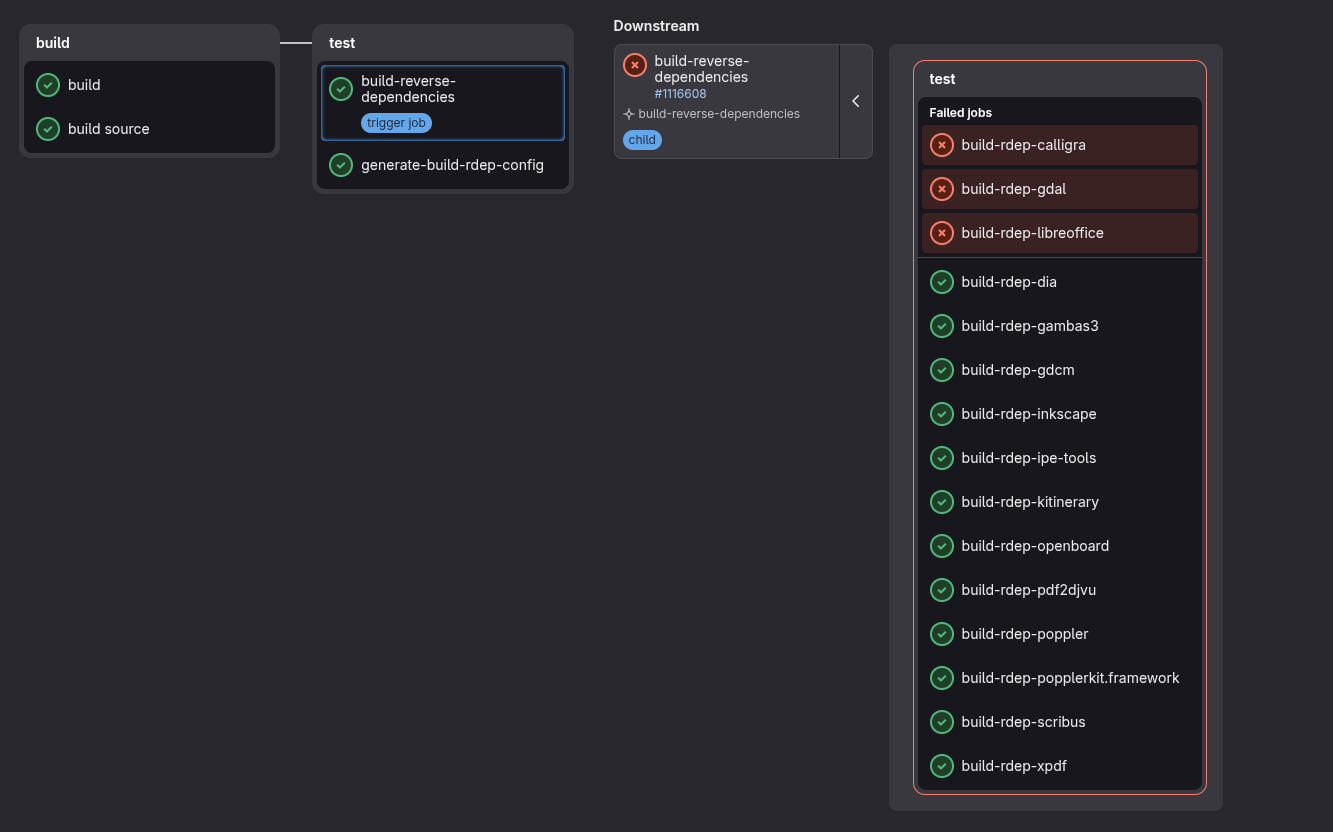
ratt to implement this selection. The
option performs the scan against the selected archive indexes and injects
locally built .deb files into each source rebuild. It expects a regex of
dependency package names, not a complete Ben expression, so the tracker s
Affected expression must be adapted first.
I then integrated the mode into Salsa
CI.
Maintainers can enable transition-aware
rebuilds
by setting SALSA_CI_BUILD_REVERSE_DEPENDENCIES_TRANSITION_AFFECTED_REGEX. If
the variable is unset, the pipeline keeps the existing selection.
A Poppler test showing the selected rebuild jobs. Three jobs reached the CI timeout, they were not confirmed package regressions.
I also changed ratt to cover
packages targeting
experimental. By default, it
resolves and rebuilds reverse dependencies from unstable while still injecting
the locally built .deb files. This lets a maintainer test a transition staged
in experimental against packages currently in unstable.
Together, these changes help maintainers focus CI on packages relevant to a
library transition and review rebuild results before the new library reaches
unstable.
Ode to the Half-Broken is a standalone post-apocalyptic (sort of)
science fiction novel.
As this novel opens, the unnamed first-person protagonist is waking up in
a bathtub in an abandoned building. They are covered in electromagnets and
missing one leg.
Waking up involved a secure reboot from a protected core kernel, so it is
immediately obvious that the protagonist is a robot. That also explains
the electromagnets, which interfere with their ability to control their
body. Or they would, if the protagonist didn't have long-dormant combat
routines available to deploy EM shielding and free themselves from the
bathtub. There are no immediate answers to why someone embedded a virus in
the data attached to a scientific paper on ants, an act so precisely
targeted that it had to be personal. Or what happened to their leg.
"There are a number of electromagnets in the next room," I say. I
point. "Behind that wall with all the holes in it."
"Those are big holes. And fresh, too," the dog says. "I wonder what
made them."
"Electromagnets experiencing sudden velocity."
The dog gives another of its short barks, and I am more convinced now
it is laughing, though I was not attempting to be funny.
Ode to the Half-Broken has a classic science fiction beginning:
in medias res in a future science fiction version of Earth where
nothing is immediately explained, leaving the reader to work out the date
and the setting. Helping us out is the protagonist, who is neither chatty
nor very sociable with other characters but keeps up an analytical
monologue about the world as they narrate events.
We are some decades into a grim future. The United States has largely
collapsed. Large parts of New York City are dangerous to humans due to
disease and radiation. Neither of those hazards bother the large number of
sentient robots; their scarcity, and therefore economy, is instead based
on power. Robots that control solar power stations act as low-level mob
bosses, trading power for information or labor.
Our protagonist doesn't want to care about any of this. They retreated
from the world long ago for a solitary life in the former New York
Botanical Gardens studying ants. But they need a new leg and the best
robot repair person nearby is a human woman outside of the city, so they
reluctantly head in that direction, accompanied somewhat surprisingly by a
cyborg dog.
The typical science fiction apocalypse is caused by something specific.
Classically, that event is a nuclear war, but writers found various
alternatives before, during, and after the Cold War era:
alien invasions,
meteor
showers, plagues,
sea level rise, and peak oil and general environmental collapse, among many others. Less
common is a post-apocalyptic novel where the collapse comes from multiple
overlapping crises and accumulating failures, from a general failure to
meet what Adam Tooze and others call
polycrisis. The first
time I encountered that style of post-apocalyptic story was in Octavia
Butler's Parable of the Sower. It was
one of the choices that made (and still makes) that book feel so
chillingly realistic.
The world background in Ode to the Half-Broken is shaped by that
sort of polycrisis collapse. There is no one reason why New York City is a
dangerous, irradiated ruin and society has collapsed into isolated and
sometimes warring factions. It is not runaway artificial intelligence, or
at least not directly; sentient robots were a late-stage innovation of the
collapsing US civilization and a tool and accelerator of its many wars,
but they were not the cause and may be a critical ingredient in building
some functional replacement. Instead, society fell apart because we failed
to address any of the growing problems and then turned on each other in
the resulting ruins. The reader gets an idiosyncratic view of that
collapse in flashback chapters intermixed with the main narrative of the
initially unnamed robot protagonist, flashbacks told from the perspective
of the man who invented the key component for robot sentience. As you
would expect, those two narratives are linked. The reader will not
discover how they are linked until late in the story.
This book could have been extremely depressing. It is not, which says a
great deal about Palmer's skill in telling it. The clinical distance of
the protagonist in the early chapters helps considerably: They have
rejected involvement in this world and therefore can describe it in
detached, factual terms, aided by the tendency of most robots in this
story to be slightly more precise, logical, and verbose than the human
characters. But as the protagonist's clinical distance fades, as it must
to allow the story's emotional stakes to rise, Palmer fills this book with
moments of beauty and hope. A former nuclear submarine that has become the
mind of a subway car is a key early ally. A collective has turned the
Hudson Bridge into a thriving if chaotic community. Self-regulating
enclaves of humans and robots are working together to try to build a
livable world. Robots oversee pollinator swarms that are attempting to
restore plant life, for no reason other than that they like order and
stability and see this as a way of restoring both. This is a grim,
post-apocalyptic world that does not dwell on either the grimness or the
apocalypse. It is instead full of small moments of hope, collaboration,
and personal connection.
This is a story with villains, danger, pain, and risk. Despite the similar
keywords and cover aesthetics, it bears little resemblance to Becky
Chambers's philosophical Monk and Robot series.
It is not, in any definition of the term, cozy; it's a post-apocalyptic
adventure story about a robot and a dog making their way through a ruined
civilization and fighting people who are trying to build something even
worse on the rubble. But it's also charming and oddly happy. There are
strong found-family vibes in the way that a party coalesces around the
protagonist and eventually gives them a name, there is the quiet happiness
of seeing a grumpy misanthrope slowly come out of their protective shell,
and the rail mechs are an absolute delight.
Like a lot of stories of happy small-group anarchism, I didn't entirely
believe the politics and have some qualms about the realism of the ending,
although perhaps I should strive to be as optimistic as Palmer writes. The
somewhat dry and fussily precise first-person narration will also not be
to everyone's taste; it worked for me by the end of the book, but it took
a bit of reading to get used to it. But those quibbles aside, this was
quietly lovely. It's a satisfying science fiction adventure story in a
world with disturbing parallels to the one we're living in, but which uses
those parallels to focus on small-scale collective efforts to build
something better. And all the small details of the world-building are
delightful: the different tiers of robots and their odd behaviors, the
machine sense of purpose, even the mix of suspicion and generosity. The
plot has large-scale implications, but it was the human-level details that
charmed me.
I still want another Fergus novel, but this was
a highly successful foray outside of that series. Palmer has won two Hugos
for her novellas, so I can't really say she's overlooked, but her novels
aren't getting anywhere near the attention they deserve. Highly
recommended.
There is plenty of world-building room here for a sequel, but Ode to
the Half-Broken reaches a satisfying standalone conclusion. So far as I
know, no sequel is currently planned.
Rating: 8 out of 10