Search Results: "mika"

1 March 2014

Michael Prokop: Jenkins on-demand slave selection through labels

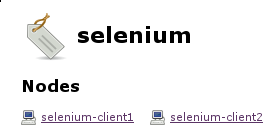
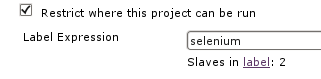
Problem description: One of my customers had a problem with their Selenium tests in the Jenkins continuous integration system. While Perl s Test::WebDriver still worked just fine the Selenium tests using Ruby s selenium-webdriver suddenly reported failures. The problem was caused by Debian wheezy s upgrade of the Iceweasel web browser. Debian originally shipped Iceweasel version 17.0.10esr-1~deb7u1 in wheezy, but during a security-update version 24.3.0esr-1~deb7u1 was brought in through the wheezy-security channel. Because the selenium tests are used in an automated fashion in a quite large and long-running build pipeline we immediately rolled back to Iceweasel version 17.0.10esr-1~deb7u1 so everything can continue as expected. Of course we wanted to get the new Iceweasel version up and running, but we didn t want to break the existing workflow while working on it. This is where on-demand slave selection through labels comes in. Basics: As soon as you re using Jenkins slaves you can instruct Jenkins to run a specific project on a particular (slave) node. By attaching labels to your slaves you can also use a label instead of a specific node name, providing more flexibility and scalability (to e.g. avoid problems if a specific node is down or you want to scale to more systems). Then Jenkins decides which of the nodes providing the according label should be considered for job execution. In the following screenshot a job uses the selenium label to restrict its execution to the slaves providing selenium and currently there are two nodes available providing this label: TIP 1: Visiting $JENKINS_SERVER/label/$label/ provides a list of slaves that provide that given $label (as well as list of projects that use $label in their configuration), like:

TIP 2: Execute the following script on $JENKINS_SERVER/script to get a list of available labels of your Jenkins system:
import hudson.model.*
labels = Hudson.instance.getLabels()
labels.each  label -> println label.name  
Solution: In the according customer setup we re using the swarm plugin (with automated Debian deployment through Grml s netscript boot option, grml-debootstrap + Puppet) to automatically connect our Jenkins slaves to Jenkins master without any manual intervention. The swarm plugin allows you to define the labels through the -labels command line option. By using the NodeLabel Parameter plugin we can configure additional parameters in Jenkins jobs: node and label . The label parameter allows us to execute the jobs on the nodes providing the requested label: This is what we can use to gradually upgrade from the old Iceweasel version to the new one by keeping a given set of slaves at the old Iceweasel version while we re upgrading other nodes to the new Iceweasel version (same for the selenium-server version which we want to also control). We can include the version number of the Iceweasel and selenium-server packages inside the labels we announce through the swarm slaves, with something like:
if [ -r /etc/init.d/selenium-server ] ; then
  FLAGS="selenium"
  ICEWEASEL_VERSION="$(dpkg-query --show --showformat='$ Version ' iceweasel)"
  if [ -n "$ICEWEASEL_VERSION" ] ; then
    ICEWEASEL_FLAG="iceweasel-$ ICEWEASEL_VERSION%%.* "
    EXTRA_FLAGS="$EXTRA_FLAGS $ICEWEASEL_FLAG"
  fi
  SELENIUM_VERSION="$(dpkg-query --show --showformat='$ Version ' selenium-server)"
  if [ -n "$SELENIUM_VERSION" ] ; then
    SELENIUM_FLAG="selenium-$ SELENIUM_VERSION%-* "
    EXTRA_FLAGS="$EXTRA_FLAGS $SELENIUM_FLAG"
  fi
fi
Then by using -labels $FLAGS EXTRA_FLAGS in the swarm invocation script we end up with labels like selenium iceweasel-24 selenium-2.40.0 for the slaves providing the Iceweasel v24 and selenium v2.40.0 Debian packages and selenium iceweasel-17 selenium-2.40.0 for the slaves providing Iceweasel v17 and selenium v2.40.0. This is perfect for our needs, because instead of using the selenium label (which is still there) we can configure the selenium jobs that should continue to work as usual to default to the slaves with the iceweasel-17 label now. The development related jobs though can use label iceweasel-24 and fail as often as needed without interrupting the build pipeline used for production. To illustrate this here we have slave selenium-client2 providing Iceweasel v17 with selenium-server v2.40. When triggering the production selenium job it will get executed on selenium-client2, because that s the slave providing the requested labels: Whereas the development selenium job can point to the slaves providing Iceweasel v24, so it will be executed on slave selenium-client1 here: This setup allowed us to work on the selenium Ruby tests while not conflicting with any production build pipeline. By the time I m writing about this setup we ve already finished the migration to support Iceweasel v24 and the infrastructure is ready for further Iceweasel and selenium-server upgrades.

28 February 2014

Michael Prokop: Full-Crypto setup with GRUB2

Update on 2014-03-03: quoting Colin Watson from the comments:
Note that this is spelled GRUB_ENABLE_CRYPTODISK=y in GRUB 2.02 betas (matching the 2.00 documentation though not the implementation; not sure why Andrey chose to go with the docs).
Since several people asked me how to get such a setup and it s poorly documented (as in: I found it in the GRUB sources) I decided to blog about this. When using GRUB >=2.00-22 (as of February 2014 available in Debian/jessie and Debian/unstable) it s possible to boot from a full-crypto setup (this doesn t mean it s recommended, but it worked fine in my test setups so far). This means not even an unencrypted /boot partition is needed. Before executing the grub-install commands execute those steps (inside the system/chroot of course, adjust GRUB_PRELOAD_MODULES for your setup as needed, I ve used it in a setup with SW-RAID/LVM):
# echo GRUB_CRYPTODISK_ENABLE=y >> /etc/default/grub
# echo 'GRUB_PRELOAD_MODULES="lvm cryptodisk mdraid1x"' >> /etc/default/grub
This will result in the following dialog before getting to GRUB s bootsplash:

Michael Prokop: State of the art Debian/wheezy deployments with GRUB and LVM/SW-RAID/Crypto

Moving from Lilo to GRUB, using LVM as default, etc throughout the last years it was time to evaluate how well LVM works without a separate boot partition, possibly also on top of Software RAID. Big disks are asking for partitioning with GPT, just UEFI isn t my default yet, so I m still defaulting to Legacy BIOS for Debian/wheezy (I expect this to change for Debian/jessie and according hardware approaching at my customers). So what we have and want in this demonstration setup: System used for installation:
root@grml ~ # grml-version
grml64-full 2013.09 Release Codename Hefeknuddler [2013-09-27]
Partition setup:
root@grml ~ # parted /dev/sda
GNU Parted 2.3
Using /dev/sda
Welcome to GNU Parted! Type 'help' to view a list of commands.
(parted) mklabel gpt
(parted) mkpart primary 2048s 4095s
(parted) set 1 bios_grub on
(parted) name 1 "BIOS Boot Partition"
(parted) mkpart primary 4096s 100%
(parted) set 2 raid on
(parted) name 2 "SW-RAID / Linux"
(parted) quit
Information: You may need to update /etc/fstab.
Clone partition layout from sda to all the other disks:
root@grml ~ # for f in  b,c,d  ; sgdisk -R=/dev/sd$f /dev/sda
The operation has completed successfully.
Make sure each disk has its unique UUID:
root@grml ~ # for f in  b,c,d  ; sgdisk -G /dev/sd$f
The operation has completed successfully.
SW-RAID setup:
root@grml ~ # mdadm --create /dev/md0 --verbose --level=raid5 --raid-devices=4 /dev/sd a,b,c,d 2
mdadm: layout defaults to left-symmetric
mdadm: chunk size defaults to 512K
mdadm: size set to 1465004544K
mdadm: Defaulting to version 1.2 metadata
mdadm: array /dev/md0 started.
root@grml ~ #
SW-RAID speedup (system dependent, YMMV):
root@grml ~ # cat /sys/block/md0/md/stripe_cache_size
256
root@grml ~ # echo 16384 > /sys/block/md0/md/stripe_cache_size # 16MB
root@grml ~ # blockdev --getra /dev/md0
6144
root@grml ~ # blockdev --setra 65536 /dev/md0 # 32 MB
root@grml ~ # sysctl dev.raid.speed_limit_max
dev.raid.speed_limit_max = 200000
root@grml ~ # sysctl -w dev.raid.speed_limit_max=9999999999
dev.raid.speed_limit_max = 9999999999
root@grml ~ # sysctl dev.raid.speed_limit_min
dev.raid.speed_limit_min = 1000
root@grml ~ # sysctl -w dev.raid.speed_limit_min=100000
dev.raid.speed_limit_min = 100000
LVM setup:
root@grml ~ # pvcreate /dev/md0
  Physical volume "/dev/md0" successfully created
root@grml ~ # vgcreate homesrv /dev/md0
  Volume group "homesrv" successfully created
root@grml ~ # lvcreate -n rootfs -L4G homesrv
  Logical volume "rootfs" created
root@grml ~ # lvcreate -n bootfs -L1G homesrv
  Logical volume "bootfs" created
Check partition setup + alignment:
root@grml ~ # parted -s /dev/sda print
Model: ATA WDC WD15EADS-00P (scsi)
Disk /dev/sda: 1500GB
Sector size (logical/physical): 512B/512B
Partition Table: gpt
Number  Start   End     Size    File system  Name                 Flags
 1      1049kB  2097kB  1049kB               BIOS Boot Partition  bios_grub
 2      2097kB  1500GB  1500GB               SW-RAID / Linux      raid
root@grml ~ # parted -s /dev/sda unit s print
Model: ATA WDC WD15EADS-00P (scsi)
Disk /dev/sda: 2930277168s
Sector size (logical/physical): 512B/512B
Partition Table: gpt
Number  Start  End          Size         File system  Name                 Flags
 1      2048s  4095s        2048s                     BIOS Boot Partition  bios_grub
 2      4096s  2930276351s  2930272256s               SW-RAID / Linux      raid
root@grml ~ # gdisk -l /dev/sda
GPT fdisk (gdisk) version 0.8.5
Partition table scan:
  MBR: protective
  BSD: not present
  APM: not present
  GPT: present
Found valid GPT with protective MBR; using GPT.
Disk /dev/sda: 2930277168 sectors, 1.4 TiB
Logical sector size: 512 bytes
Disk identifier (GUID): 212E463A-A4E3-428B-B7E5-8D5785141564
Partition table holds up to 128 entries
First usable sector is 34, last usable sector is 2930277134
Partitions will be aligned on 2048-sector boundaries
Total free space is 2797 sectors (1.4 MiB)
Number  Start (sector)    End (sector)  Size       Code  Name
   1            2048            4095   1024.0 KiB  EF02  BIOS Boot Partition
   2            4096      2930276351   1.4 TiB     FD00  SW-RAID / Linux
root@grml ~ # mdadm -E /dev/sda2
/dev/sda3:
          Magic : a92b4efc
        Version : 1.2
    Feature Map : 0x0
     Array UUID : 7ed3b741:0774d529:d5a71c1f:cf942f0a
           Name : grml:0  (local to host grml)
  Creation Time : Fri Jan 31 15:26:12 2014
     Raid Level : raid5
   Raid Devices : 4
 Avail Dev Size : 2928060416 (1396.21 GiB 1499.17 GB)
     Array Size : 4392089088 (4188.62 GiB 4497.50 GB)
  Used Dev Size : 2928059392 (1396.21 GiB 1499.17 GB)
    Data Offset : 262144 sectors
   Super Offset : 8 sectors
          State : clean
    Device UUID : c1e4213b:81822fd1:260df456:2c9926fb
    Update Time : Mon Feb  3 09:41:48 2014
       Checksum : b8af8f6 - correct
         Events : 72
         Layout : left-symmetric
     chunk size : 512k
   Device Role : Active device 0
   Array State : AAAA ('A' == active, '.' == missing)
root@grml ~ # pvs -o +pe_start
  PV         VG      Fmt  Attr PSize PFree 1st PE
  /dev/md0   homesrv lvm2 a--  4.09t 4.09t   1.50m
root@grml ~ # pvs --units s -o +pe_start
  PV         VG      Fmt  Attr PSize       PFree       1st PE
  /dev/md0   homesrv lvm2 a--  8784175104S 8773689344S   3072S
root@grml ~ # pvs -o +pe_start
  PV         VG      Fmt  Attr PSize PFree 1st PE
  /dev/md0   homesrv lvm2 a--  4.09t 4.09t   1.50m
root@grml ~ # pvs --units s -o +pe_start
  PV         VG      Fmt  Attr PSize       PFree       1st PE
  /dev/md0   homesrv lvm2 a--  8784175104S 8773689344S   3072S
root@grml ~ # vgs -o +pe_start
  VG      #PV #LV #SN Attr   VSize VFree 1st PE
  homesrv   1   2   0 wz--n- 4.09t 4.09t   1.50m
root@grml ~ # vgs --units s -o +pe_start
  VG      #PV #LV #SN Attr   VSize       VFree       1st PE
  homesrv   1   2   0 wz--n- 8784175104S 8773689344S   3072S
Cryptsetup:
root@grml ~ # echo cryptsetup >> /etc/debootstrap/packages
root@grml ~ # cryptsetup luksFormat -c aes-xts-plain64 -s 256 /dev/mapper/homesrv-rootfs
WARNING!
========
This will overwrite data on /dev/mapper/homesrv-rootfs irrevocably.
Are you sure? (Type uppercase yes): YES
Enter passphrase:
Verify passphrase:
root@grml ~ # cryptsetup luksOpen /dev/mapper/homesrv-rootfs cryptorootfs
Enter passphrase for /dev/mapper/homesrv-rootfs:
Filesystems:
root@grml ~ # mkfs.ext4 /dev/mapper/cryptorootfs
mke2fs 1.42.8 (20-Jun-2013)
Filesystem label=
OS type: Linux
Block size=4096 (log=2)
Fragment size=4096 (log=2)
Stride=128 blocks, Stripe width=384 blocks
262144 inodes, 1048192 blocks
52409 blocks (5.00%) reserved for the super user
First data block=0
Maximum filesystem blocks=1073741824
32 block groups
32768 blocks per group, 32768 fragments per group
8192 inodes per group
Superblock backups stored on blocks:
        32768, 98304, 163840, 229376, 294912, 819200, 884736
Allocating group tables: done
Writing inode tables: done
Creating journal (16384 blocks): done
Writing superblocks and filesystem accounting information: done
root@grml ~ # mkfs.ext4 /dev/mapper/homesrv-bootfs
mke2fs 1.42.8 (20-Jun-2013)
Filesystem label=
OS type: Linux
Block size=4096 (log=2)
Fragment size=4096 (log=2)
Stride=128 blocks, Stripe width=384 blocks
65536 inodes, 262144 blocks
13107 blocks (5.00%) reserved for the super user
First data block=0
Maximum filesystem blocks=268435456
8 block groups
32768 blocks per group, 32768 fragments per group
8192 inodes per group
Superblock backups stored on blocks:
        32768, 98304, 163840, 229376
Allocating group tables: done
Writing inode tables: done
Creating journal (8192 blocks): done
Writing superblocks and filesystem accounting information: done
Install Debian/wheezy:
root@grml ~ # mount /dev/mapper/cryptorootfs /media
root@grml ~ # mkdir /media/boot
root@grml ~ # mount /dev/mapper/homesrv-bootfs /media/boot
root@grml ~ # grml-debootstrap --target /media --password YOUR_PASSWORD --hostname YOUR_HOSTNAME
 * grml-debootstrap [0.57] - Please recheck configuration before execution:
   Target:          /media
   Install grub:    no
   Using release:   wheezy
   Using hostname:  YOUR_HOSTNAME
   Using mirror:    http://http.debian.net/debian
   Using arch:      amd64
   Important! Continuing will delete all data from /media!
 * Is this ok for you? [y/N] y
[...]
Enable grml-rescueboot (to have easy access to rescue ISO via GRUB):
root@grml ~ # mkdir /media/boot/grml
root@grml ~ # wget -O /media/boot/grml/grml64-full_$(date +%Y.%m.%d).iso http://daily.grml.org/grml64-full_testing/latest/grml64-full_testing_latest.iso
root@grml ~ # grml-chroot /media apt-get -y install grml-rescueboot
[NOTE: We're installing a daily ISO for grml-rescueboot here because the 2013.09 Grml release doesn't work for this LVM/SW-RAID setup while newer ISOs are working fine already. The upcoming Grml stable release is supposed to work just fine, so you will be able to choose http://download.grml.org/grml64-full_2014.XX.iso by then. :)] Install GRUB on all disks and adjust crypttab, fstab + initramfs:
root@grml ~ # grml-chroot /media /bin/bash
(grml)root@grml:/# for f in  a,b,c,d  ; do grub-install /dev/sd$f ; done
(grml)root@grml:/# update-grub
(grml)root@grml:/# echo "cryptorootfs /dev/mapper/homesrv-rootfs none luks" > /etc/crypttab
(grml)root@grml:/# echo "/dev/mapper/cryptorootfs / auto defaults,errors=remount-ro 0   1" > /etc/fstab
(grml)root@grml:/# echo "/dev/mapper/homesrv-bootfs /boot auto defaults 0 0" >> /etc/fstab
(grml)root@grml:/# update-initramfs -k all -u
(grml)root@grml:/# exit
Clean unmounted/removal for reboot:
root@grml ~ # umount /media/boot
root@grml ~ # umount /media/
root@grml ~ # cryptsetup luksClose cryptorootfs
root@grml ~ # dmsetup remove homesrv-bootfs
root@grml ~ # dmsetup remove homesrv-rootfs
NOTE: On a previous hardware installation I had to install GRUB 2.00-22 from Debian/unstable to get GRUB working.
Some metadata from different mdadm and LVM experiments seems to have been left and confused GRUB 1.99-27+deb7u2 from Debian/wheezy (I wasn t able to reproduce this issue in my VM demo/test setup).
Just in cause you might experience the following error message, try GRUB >=2.00-22:
  # grub-install --recheck /dev/sda
  error: unknown LVM metadata header.
  error: unknown LVM metadata header.
  /usr/sbin/grub-probe: error: cannot find a GRUB drive for /dev/mapper/cryptorootfs.  Check your device.map.
  Auto-detection of a filesystem of /dev/mapper/cryptorootfs failed.
  Try with --recheck.
  If the problem persists please report this together with the output of "/usr/sbin/grub-probe --device-map="/boot/grub/device.map"
  --target=fs -v /boot/grub" to <bug-grub@gnu.org>
27 January 2014

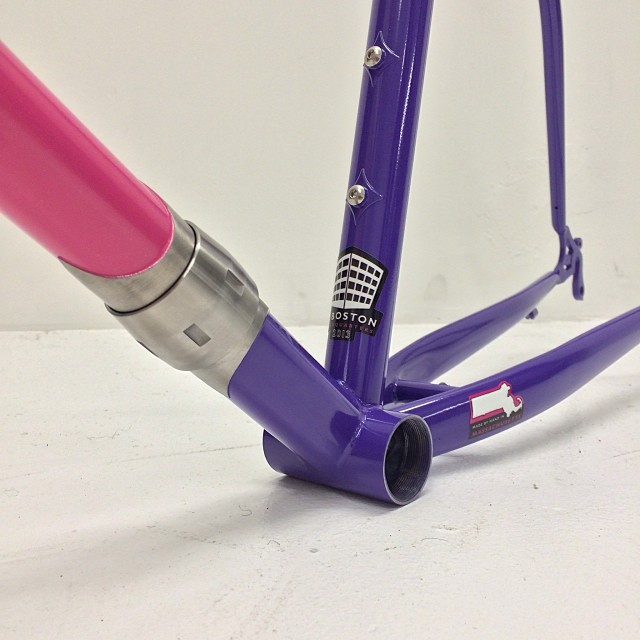
Benjamin Mako Hill: My Geekhouse Bike Frame

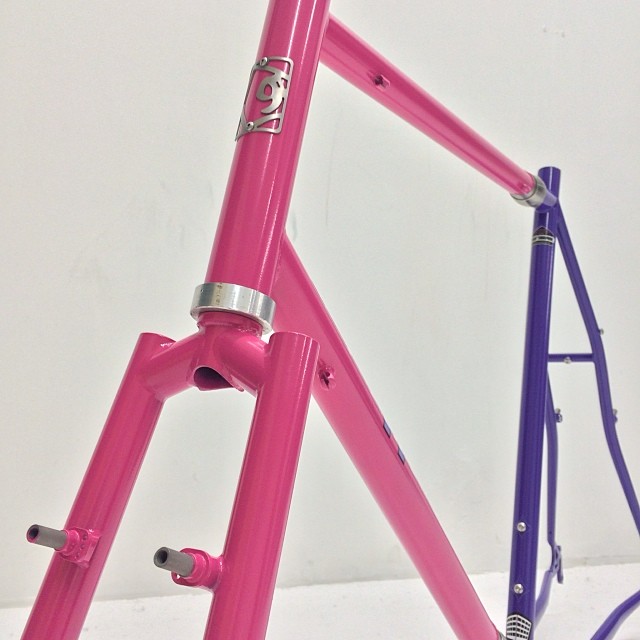
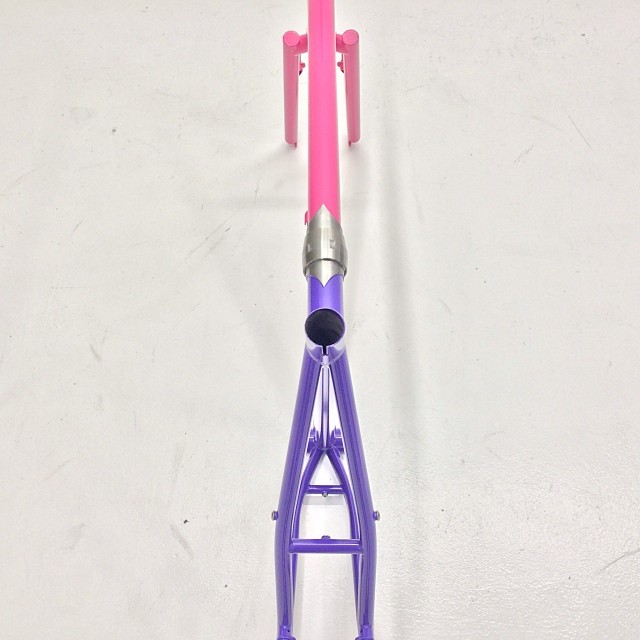
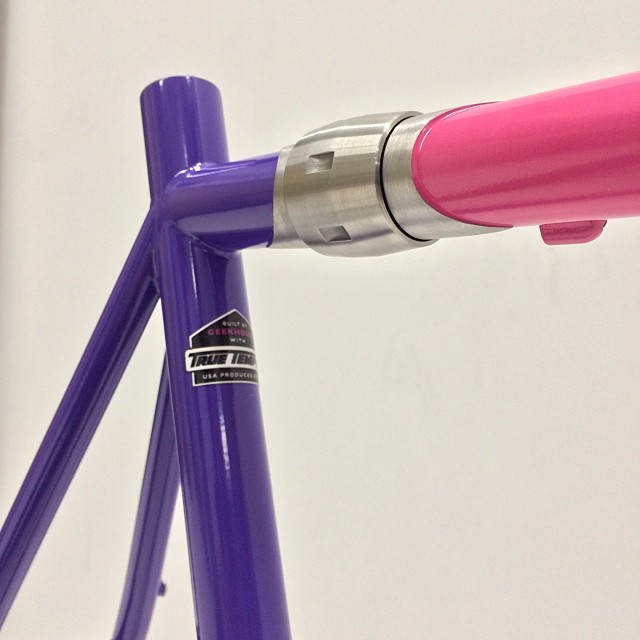
In 2011, Mika and I bought in big at the Boston Red Bones party s charity raffle supporting MassBike and NEMBA and came out huge. I won $500 off a custom frame at Geekouse Bikes. For years, Mika and I have been planning to do the Tour d Afrique route (Capetown to Cairo), unsupported, on bike. People that do this type of ride sometimes use an expedition touring frame. I worked with Marty Walsh at Geekhouse to design a bike based on this idea. The concept was a rugged steel touring frame, built for my body and comfortable over long distances, with two quirks:
  1. It s designed for 26 inch mountain bike wheels and mountain bike components to ensure that the bike is repairable with parts from the kinds of cheap mountain bikes that can be found almost everywhere in the world.
  2. It includes S&S torque couplers that let me split the frame in half to travel with the bike as standard luggage.
As our pan-Africa trip kept getting pushed back, so did the need for the bike. Last week, I finally picked up the finished bike from Marty s shop in Boston. It is gorgeous. I absolutely love it. Picture of Geekhouse frame (1)Picture of Geekhouse frame (2)Picture of Geekhouse frame (4) Picture of Geekhouse frame (3) I m looking forward to building up the bicycle over the next couple months and I ll post more pictures when it s finished. I am blown away by Marty s craftsmanship and attention to detail. I am psyched that his donation made this bike possible and that I was able to get the frame while helping cycling in Massachusetts!

5 November 2013

Benjamin Mako Hill: Settling in Seattle

Seattle from the airI defended my dissertation three months ago. Since then, it feels like everything has changed. I ve moved from Somerville to Seattle, moved from MIT to the University of Washington, and gone from being a graduate student to a professor. Mika and I have moved out of a multi-apartment cooperative into into a small apartment we re calling Extraordinary Least Squares. We ve gone from a broad and deep social network to (almost) starting from scratch in a new city. As things settle and I develop a little extra bandwidth, I am trying to take time to get connected to my community. If you re in Seattle and know me, drop me a line! If you re in Seattle but don t know me yet, do the same so we can fix that!

10 May 2013

Michael Prokop: How to get grub-reboot working

So while testing Proxmox VE 3.0 RC1 I had the need to reboot the system into a kernel version different than the one being the default in the bootloader GRUB. lilo -R worked fine in the past, but with GRUB it s not as trivial on the first sight to get its equivalent. I remembered to have had problems with grub-reboot in the past already, or to quote a friend of mine: has grub-reboot worked ever? Well yes, grub-reboot works but only once you re aware of the fact that you need to manually edit /etc/default/grub. :( It s actually documented at wiki.debian.org/GrubReboot, but not in the man page/info document of grub-reboot itself (great idea to provide a separate wiki page for this issue but not consider editing the official documentation instead, not). So here you go:
# grep GRUB_DEFAULT /etc/default/grub 
GRUB_DEFAULT=0
# sed -i 's/^GRUB_DEFAULT.*/GRUB_DEFAULT=saved/' /etc/default/grub
# grep GRUB_DEFAULT /etc/default/grub 
GRUB_DEFAULT=saved
# update-grub
[...]
# grep '^menuentry' /boot/grub/grub.cfg
menuentry 'Debian GNU/Linux, with Linux 3.2.0-4-amd64' --class debian --class gnu-linux --class gnu --class os  
menuentry 'Debian GNU/Linux, with Linux 3.2.0-4-amd64 (recovery mode)' --class debian --class gnu-linux --class gnu --class os  
menuentry 'Debian GNU/Linux, with Linux 2.6.32-20-pve' --class debian --class gnu-linux --class gnu --class os  
menuentry 'Debian GNU/Linux, with Linux 2.6.32-20-pve (recovery mode)' --class debian --class gnu-linux --class gnu --class os  
menuentry 'Debian GNU/Linux, with Linux 2.6.32-5-amd64' --class debian --class gnu-linux --class gnu --class os  
menuentry 'Debian GNU/Linux, with Linux 2.6.32-5-amd64 (recovery mode)' --class debian --class gnu-linux --class gnu --class os  
# grub-reboot 2  # to boot the third entry, the command writes to /boot/grub/grubenv
# reboot
FTR: Filed as #707695.

2 May 2013

Axel Beckert: New web browsers in Wheezy

Since there is so much nice new stuff in Debian Wheezy, I have to split up my contributions to Mika s #newinwheezy game on Planet Debian. Here s the next bunch, this time web browsers:
Dillo Screenshot
dillo
The FLTK-based lightweight GUI web browser Dillo comes with its own rendering engine (no JavaScript, incomplete CSS support) was already in Debian before, but was removed before the release of Debian Squeeze, because Dillo 2 relied on FLTK 2.x which had an unclear license situation back then and never made it into Debian. In the meanwhile Dillo 3 relies on FLTK 1.3 as FLTK upstream abandoned the 2.0 branch and continued development on the 1.3 branch. So I brought Dillo back into Debian with its 3.0.x release.

Netsurf Screenshot
netsurf
The RiscOS-originating lightweight GUI web browser Netsurf was already in Debian, too, but didn t make it into Debian Squeeze as it needed the Lemon parser generator (part of the SQLite source) to build back then and a change in Lemon caused Netsurf to no more build properly in the wrong moment. Netsurf supports CSS 2.1, but has no JavaScript support either. I d consider its rendering engine more complete than Dillo s.

XXXTerm Screenshot
surf and xxxterm
Surf and XXXTerm are both simple and minimalistic webkit-based browsers. Surf is easy to embed in other applications and XXXTerm features vi-like keybindings for heavy keyboard users.
To be continued ;-)

Axel Beckert: New SSH-related stuff in Wheezy

Mika had the nice idea of doing a #newinwheezy game on Planet Debian, so let s join: There are (at least) two new SSH related tools new in Debian Wheezy:
mosh
is the mobile shell , an UDP based remote shell terminal which works better than SSH in case of lag, packet loss or other forms of bad connection. I wrote about mosh in more detail about a year ago. mosh is also available for Debian Squeeze via squeeze-backports.
sshuttle
is somewhere between port-forwarding and VPN. It allows forward arbitrary TCP connections over an SSH connection without the need to configure individual port forwardings. It does not need root access on the server-side either. I wrote about sshuttle in more detail about a year ago.
To be continued ;-)

Michael Prokop: The #newinwheezy game: Grml packages in Debian/wheezy

Following up on the #newinwheezy game: Debian/wheezy is the first Debian release which ships packages from the Grml system. Grml became an official Debian Derivative and I m very happy that three major projects of Grml found their official way into Debian: As the description states grml2usb is interesting for getting Grml onto a USB device when the dd(1) approach ( dd if=grml.iso of=/dev/sdX ) just isn t flexible enough. grml-debootstrap provides a decent way to install Debian systems from the command line. As its author I might be biased but I ve to mention that it s working so nice that it is in use at several of my customers for automated roll-outs without any worries at all, and I got reports from other companies that they are very happy users of it as well. Finally the grml-rescueboot packages provides a very simple and nice way to boot a rescue system from within GRUB (short version: throw a Grml ISO to /boot/grml/, run update-grub and be done). PS: Thanks everyone for joining the #newinwheezy game over at planet.debian.org. :)

29 April 2013

Richard Hartmann: #newinwheezy

There's a #newinwheezy game which basically presents a few of the 4451 new source packages in Debian/wheezy to a wider audience. My own entry is, obviously, vcsh. Quoth the manpage
vcsh - manage config files in $HOME via fake bare git repositories

You can also consult the (somewhat outdated) readme or just clone it. In related news, I have been asked to hold my "Gitify your life" talk at LinuxTag 2013. This talk can be found here. While the text on that page is in German, all slides will be in English and I will happily use either language based on what the audience prefers.

Michael Prokop: The #newinwheezy game: new forensic packages in Debian/wheezy

Debian/wheezy includes a bunch of packages for people interested in digital forensics. The packages maintained within the Debian Forensics team which are shipped with the upcoming Debian/wheezy stable release for the first time in a Debian release are: Join the #newinwheezy game and present packages which are new in Debian/wheezy.

18 February 2013

Michael Prokop: ldmtool: accessing Microsoft Windows dynamic disks from Linux

Linux is a great platform for dealing with all kinds of different file systems, partition tables etc. But one of the few annoying situations when working in IT forensics are Microsoft Windows dynamic disks, AKA LDM (Logical Disk Manager). Thanks to libldm s ldmtool this is no longer true. A short demonstration from a real-life IT forensics investigation (actual IDs/data randomized for obvious reasons):
# ldmtool
ldm> scan /dev/sdc*
[
  "1bad5bbc-a4b5-42e1-8823-001014b00003"
]
ldm> show diskgroup 1bad5bbc-a4b5-42e1-8823-001014b00003
 
  "name" : "FOOBAR-Dg0",
  "guid" : "1bad5bbc-a4b5-42e1-8823-001014b00003",
  "volumes" : [
    "Volume1"
  ],
  "disks" : [
    "Disk1",
    "Disk2"
  ]
 
ldm> show volume 1bad5bbc-a4b5-42e1-8823-001014b00003 Volume1
 
  "name" : "Volume1",
  "type" : "striped",
  "size" : 3907039232,
  "chunk-size" : 128,
  "hint" : "D:",
  "partitions" : [
    "Disk1-01",
    "Disk2-01"
  ]
 
ldm> show partition 1bad5bbc-a4b5-42e1-8823-001014b00003 Disk1-01
 
  "name" : "Disk1-01",
  "start" : 1985,
  "size" : 1953519616,
  "disk" : "Disk1"
 
ldm> create all
Unable to create volume Volume1 in disk group 1bad5bbc-a4b5-42e1-8823-001014b00003: Disk Disk2 required by striped volume Volume1 is missing
[
]
ldm> scan /dev/sdd*
[
  "1bad5bbc-a4b5-42e1-8823-001014b00003"
]
ldm> create all
[
  "ldm_vol_FOOBAR-Dg0_Volume1"
]
ldm>
The just created device mapper device then can be handled as usual:
# dmsetup ls   grep ldm
ldm_vol_FOOBAR-Dg0_Volume1        (254:4)
# mount /dev/mapper/ldm_vol_FOOBAR-Dg0_Volume1 /mnt/whatever
ldmtool just hit Debian unstable (and I intend to ship the tool with the upcoming version of Grml-Forensic).

6 February 2013

Aigars Mahinovs: Pensijas prognoze 18.43

Update: I apologise for spamming all the nice people on Planet Debian with this unrelated post in foreign language it got mis-tagged and (although I tried classifying it correctly and removing it from the separate Debian-only RSS feed going to the Debian Planet) Planet software just keeps it around until admins get a spare moment to remove it manually. The basic idea of the post is that there is a e-government service by the Latvian government that provides any citizen a way to check what their pension would be, but it is kinda useless, because it calculates what you pension would be if you decided to retire right now. So in the post below I provide a few simple steps on how to estimate what the real pension could be (in todays currency values) if a person kept paying into the system at the same rate until the normal retirement age. Latvija.lv ir r ks savas n kotnes pensijas prognoz anai, ta u tas ir, maigi izsakoties, bezj dz gs tiem, kas nepl no iet pensij tuv k gada laik . tri apskatoties atteic gos likumus un noteikumus es nonacu pie lietder g kas metodes. Vispirms m s varam dro i ignor t pensiju indeks ciju un visas ar to saist t s pensiju kapit la p rr in anas vai iemaksu palielin anos ir skaidrs, ka gadiem ejot uz priek u b s kaut k ds infl cijas procents, kura d palielin sies algas, palielin sies iemaksas pensiju kapit l un tiks p rr in tas vis das izmaksas, ta u t pati infl cija tie i ietekm s ar to cik v rt gs b s katrs gala pensijas lats taj br d , kad pensija tiks sa emta, l dz ar to infl cijas efekts tiek neitraliz ts, ja m s v rt jam gala ciparu br a cenu kontekst t.i. ja gal san ks, ka pensija b s 400Ls, tad to vai tas ir daudz vai maz j dom br a cen s, nevis m inot izdom t k das b cenas p c 30 gadiem. To visu emot v r pensijas apr ins stipri vienk r ojas:
  1. Pa emam atskaiti no t Latvija.lv pakalpojuma. Tas mums dos uz o br di uzkr to pensijas kapit lu (U) un aptuvenu ciparu par to k ds ir kapit la ikgad jais piaugums (P)
  2. Apr inam cik v l gadi ir paliku i l dz pension an s vecumam (t) t.i. l dz 62 gadiem. Es pat r in tos ar to, ka ap to laiku m r a vecums jau b s 65.
  3. Sar inam to cik b s aptuvenais pensijas kapit ls pension anas vecuma, ja m s turpinam iemaksas k tagad K = U + ( P * t )
  4. Apr inam k da san k ikm ne a pensija no da pensijas kapit la Pensija = K / G / 12, kur G ir emts no pension an s vecumam atbilsto s rindi as MK noteikumos, piem ram 62 gadiem tas ir 18.43
Piez me: G ir statisti u apr in ta prognoze par to cik vid ji gadus Latvijas iedz vot ji nodz vo ja vi i ir sasniegu i attiec go pension an s vecumu, t.i. t ir prognoze par to cik gadus vid ji jums b s tas prieks baud t pensiju. Ja rezult ts san k par k mazs, tad j em v r , ka summa neiek auj dividendes no 2 un 3 pensijas l me a, kas p ris gadu desmitu laik var b t t ri iespaid gs. Da as prognozes ir t das, ka 2ais un 3ais pensijas l menis kop var tu dod v l aptuveni t du pa u pensiju kl t k 1ais l menis. Ta u tas ir stipri atkar gs no fondu tirgus ilglaic gas dinamikas. Man to visu apr inot san k ap 400 Ls pensijas prognoze. Ja piepild s paredz jumi par 2o un 3o pensijas l meni, tad, ja es iedom jos sevi tagad k pension ru ar 600-800 Ls pensiju zin nav ne vainas. :)

24 January 2013

Benjamin Mako Hill: Aaron Swartz

I moved to Boston in 2005 at the same time that Aaron Swartz did and we were introduced by a mutual friend. Aaron was one of my first friends in Boston and we became close. When Aaron moved to San Francisco, I moved into his apartment in Somerville where he kept a room for a year or so. Mika and I still live there. His old posters remain on our walls and his old books remain on our shelves. Aaron s brothers Ben and Noah both lived with us and remain close friends. I have spent hours (days?) reading and thinking about Aaron over the last two weeks. It has been disorienting but beautiful to read the descriptions of, and commentaries on, Aaron s life. Although I suspect I may never feel ready, there are several things I want to say about Aaron s death, about Aaron s work, and about what Aaron means to me. 1. Aaron s Death The reaction to Aaron s death has been overwhelming and inspirational. At some point in the near future I plan to join some of the important campaigns already being waged in his name. There are many attempts to understand why Aaron died and many attempts to prevent it from happening to others in the future. Unfortunately, I am familiar with the process of soul-searching and second-guessing that happens when a friend commits suicide. I m sure that every one of his friends has asked themselves, as I have, What could I have done differently? I don t know the answer, but I do know this: Aaron was facing the real risk of losing half his life to prison. But even if one believed that he was only facing the likely loss of ten percent or even one percent of his life I wish that we all, and I wish that I in particular, had reacted with the passion, time, anger, activity, and volume proportional to how we have reacted in the last two weeks when he lost the whole thing. 2. Aaron s Work Of course, Aaron and I worked on related projects and I followed his work. And despite all the incredible things that have been said about Aaron, I feel that Aaron s work was more focused, more ambitious, more transformative, more innovative, and more reckless (in a positive sense) than the outpour online suggests. Although discussion of Aaron has focused his successes, achievements, and victories, the work that inspired me most was not the projects that were most popular or successful. Much of Aaron s work was deeply, and as it turned out overly, ambitious. His best projects were self-conscious attempts to transform knowledge production, organization, and dissemination. Although he moved from project to project, his work was consistently focused on bringing semantic-web concepts and technologies to peer production, to the movement for free culture, and to progressive political activism and on the meta-politics necessary to remove barriers to this work. For example, Aaron created an online collaborative encyclopedia project called the TheInfoNetwork (TIN) several years before Wikipedia was started. I talked to Aaron at length about that project for a research project I am working on. Aaron s work was years ahead of its time; in 2000, TIN embraced more of the Wikimedia Foundation s current goals and principles than Wikipedia did when it was launched. While Wikipedia sought to create a free reference work online, Aaron s effort sought to find out what a reference work online could look like. It turned out to be too ambitious, perhaps, but it taught many, including myself, an enormous amount in that process. When I met Aaron, he was in the process starting a company, Infogami, that was trying to chase many of TIN s goals. Infogami was conceived of as a wiki aware of the structure of data. The model was both simple and profound. Years later, Wikimedia Deutschland s WikiData project is beginning to bring some of these ideas to the mainstream. Infogami merged with Reddit as equal halves of a company with a shared technological foundation based on some of Aaron s other work. But when Reddit took off, Infogami was rarely mentioned, even by Aaron. I think that is too bad. Reddit got traction because it made the most popular stuff more visible; Reddit is popular, fundamentally, because popular things are popular. But popular is not necessary positive. For that reason, Reddit never struck me as either surprising or transformative. But what started as Aaron s half the company, on the other hand, aimed to create a powerful form of democratized information production and dissemination. And although Infogami didn t take off, the ideas and code behind the project found life at the heart of Open Library and will continue to influence and inspire countless other projects. I believe that Infogami s lessons and legacy will undergird a generation of transformative peer production technologies in a way that the Reddit website important as it is will not. 3. What Aaron Means to Me A lot of what has been written about Aaron speaks to his intelligence, his curiosity, his generosity, his ethics and his drive. Although I recognize all these qualities in the Aaron I knew, I ve felt alienated by how abstract some of the discussion of Aaron has been my memories are of particularities.
I remember the time Aaron was hospitalized and I spent two hours on the phone going through my bookshelves arguing with him about the virtues of the books in my library as we tried to decide which books I would bring him. I remember Aaron confronting Peter Singer intellectual founder of the modern animal rights movement at the Boston Vegetarian Food Festival to ask if humans had a moral obligation to stop animals from killing each other. I lurked behind, embarrassed about the question but curious to hear the answer. (Singer sighed and said yes sort of and complemented Aaron on the enormous Marxist commentary he was carrying.) I remember 1-800-INTERNET.com. I remember talking with Aaron about whether being wealthy could be ethical. I argued it could not but Aaron argued uncharacteristically I thought that it could. Aaron told Mika she should slap him if he ever became wealthy. The very next day, it was announced that his company had been acquired and that Aaron was a millionaire. I remember the standing bets I had with Aaron and how he would email me every time news reports favored his claims (but never when they did not). And I remember that I won t hear from him again.
Aaron was a friend and inspiration. I miss him deeply and I am very sad.

8 January 2013

Michael Prokop: Event: OSDC 2013

I ll be speaker at the Open Source Data Center Conference 2013 in Nuremberg/Germany on 17th and 18th April, talking about Continuous Integration/Delivery in the data-center. I was speaking at OSDC back in 2009 and very much enjoyed the conference so I m totally looking forward to OSDC 2013, hope to see you there!

14 December 2012

Benjamin Mako Hill: Heading West

University of Washington Quad in Cherry Blossom Season This week, I accepted a job on the faculty of at the University of Washington Department of Communication. I've arranged for a post-doc during the 2013-2014 academic year which I will spend at UW as an Acting Assistant Professor. I'll start the tenure-track Assistant Professor position in September 2014. The hire is part of a "big data" push across UW. I will be setting up a lab and research projects, as well as easing into a teaching program, over the next couple years. I'm not going to try to list all the great people in the department, but UW Communication has an incredible faculty with a strong background in studying the effect of communication technology on society, looking at political communication, enagement, and collective action, and tracing out the implications of new communication technologies in addition to very strong work in other areas. Years ago, I nearly joined the department as a graduate student. I am unbelievably happy that their faculty has invited me to join as a colleague. Outside of my new department, the University of Washington has a superb group of folks working across the school on issues of quantitative and computational social science, human-computer interaction, and computer-supported cooperative work. They are hiring a whole bunch of folks, across the university, who specialize in data-driven social science. I already have a bunch of relationships with UW faculty and students and am looking forward to expanding and deepening those. On a personal level, Mika and I are also very excited to return to Seattle. I grew up in the city and I've missed it, deeply, since I left now nearly half my lifetime ago! It will be wonderful to be much closer to many of my family members. But I know that I will miss the community of friends and colleagues that I've built in Boston over the last 7+ years just as deeply. I'm going to miss the intellectual resources, and the intellectual community, that folks in Cambridge get to take for granted. That said, I plan to maintain affiliations and collaborations with folks at Harvard and MIT and will have resources that let me spend time in Boston doing that. If you are curious what I'm going to be up to and what the future is likely to hold in terms of my research you should check the material I've put online as part of the job market this year. I've posted just about everything on my academic website. This includes a little four page research statement which describes the work I've done and the directions I've been thinking about taking it. The academic job market is challenging and confusing. But it's given me a lot of opportunity to reflect, at length, on both the substance of my research and the academy and its structures and processes. I've got a list of blog topics queued up based on that thinking. I'll be posting them here on my blog over the next few months.

27 August 2012

Michael Prokop: jenkins-debian-glue: Continuous Integration for Debian and Ubuntu made easy

jenkins-debian-glue is an open source project of mine which recently celebrated its first birthday and it s time to finally write about it. jenkins-debian-glue allows you to build Debian and Ubuntu packages directly from the Jenkins continuous integration system. It retrieves package sources from a version control repository, adjusts debian/changelog (handle version number + mention changes that took place) and builds according source and binary packages out of it. Its lintitan integration provides Q/A reports about the resulting source and binary Debian packages. It started as a small pet project of mine to get integration of Debian packaging inside Jenkins. I mainly had the needs for the Grml project in mind and starting with Grml 2011.12 every release (including also all the daily builds) was built using Jenkins since then. It turned out that my project would also be a perfect match for one of my customers, Sipwise GmbH. In December 2011 the sip:provider 2.4 was the first stable release that was built 100% through Jenkins and featuring jenkins-debian-glue. Thanks to special needs and the open source friendliness of Sipwise I could invest further time into the project. Recently the project got even some further drive thanks to interest by some fellow Debian Developers, most notably are the icinga, nagios-plugins, packages and the PostgreSQL in Debian Hackathon. Now if you re also interested in it: there s an automated deployment procedure available for your service to get started with the whole jenkins-debian-glue and Jenkins stack in less than 10 minutes, working just fine on Debian as well as Ubuntu. For further details please head over to jenkins-debian-glue.org or check out this 6:36min screencast (safe for work, no audio :) ): <iframe allowfullscreen="allowfullscreen" frameborder="0" height="315" src="http://www.youtube.com/embed/9asp2ZvH90A?autohide=1&amp;showinfo=0" width="560"></iframe> This embedded video doesn t work for you? Try heading over to YouTube.

Christoph Berg: PostgreSQL in Debian Hackathon

Almost a year has passed since my talk at pgconf.eu 2011 in Amsterdam on Connecting the Debian and PostgreSQL worlds, and unfortunately little has happened on that front, mostly due to my limited spare time between family and job. pgapt.debian.net is up and running, but got few updates and is lagging behind on PostgreSQL releases. Luckily, we got the project moving. Dimitri Fontaine and Magnus Hagander suggested to do a face-to-face meeting, so we got together at my house for two days last week and discussed ideas, repository layouts, build scripts, and whatnot to get all of us aligned for pushing the project ahead. My employer sponsored my time off work for that. We almost finished moving the repository to postgresql.org infrastructure, barring some questions of how to hook the repository into the existing mirror infrastructure; this should get resolved this week. The build server running Jenkins is still located on my laptop, but moving this to a proper host will also happen really soon now. We are using Mika Prokop's jenkins-debian-glue scripts for driving the package build from Jenkins. The big plus point about Jenkins is that it makes executing jobs on different distributions and architectures in parallel much easier than a bunch of homemade shell scripts could get us with reasonable effort. Here's a list of random points we discussed: We really aim at using unmodified packages from Debian as much as possible, and in fact this project doesn't mean to replace Debian's PostgreSQL packaging work, but to extend it beyond the number of server versions (and Debian and Ubuntu versions covered) supported. The people behind the Debian and Ubuntu packages, and this repository are mostly the same, so we will claim that "our" packages will be the same quality as the "original" ones. Big thanks go to Martin Pitt for maintaining the postgresql-common testsuite that really covers every aspect of running PostgreSQL servers on Debian/Ubuntu systems. Stay tuned for updates! :)

5 April 2012

Benjamin Mako Hill: OH Man!

Since installing a whiteboard in our kitchen, conversations at the Acetarium have been moving in new and interesting directions. For example, Mika and I recently noticed that, when rotated correctly, the skeletal formula for 2,3-dimethyl-2-butanol looks pretty friendly! /copyrighteous/images/2,3-dimethyl-2-butanol-clean.png

6 March 2012

Russell Coker: SE Linux Status in Debian 2012-03

I have just finished updating the user-space SE Linux code in Debian/Unstable to the version released on 2012-02-16. There were some changes to the build system from upstream which combined with the new Debian multi-arch support involved a fair bit of work for me. While I was at it I converted more of them to the new Quilt format to make it easier to send patches upstream. In the past I have been a bit slack about sending patches upstream, my aim for the next upstream release of user-space is to have at least half of my patches included upstream this will make things easier for everyone. Recently Mika Pfl ger and Laurent Bigonville have started work on Debian SE Linux, they have done some good work converting the refpolicy source (which is used to build selinux-policy-default) to Quilt. Now it will be a lot easier to send policy patches upstream and porting them to newer versions of the upstream refpolicy. Now the next significant thing that I want to do is to get systemd working correctly with SE Linux. But first I have to get it working correctly wit cryptsetup. Related posts:
  1. SE Linux Status in Debian 2011-10 Debian/Unstable Development deb http://www.coker.com.au wheezy selinux The above APT sources.list...
  2. SE Linux Status in Debian 2012-01 Since my last SE Linux in Debian status report [1]...
  3. Debian SE Linux Status At the moment I ve got more time to work on...

Next.

Previous.