Search Results: "johns"

4 July 2012

Johannes Schauer: enumerating elementary circuits of a directed_graph

For my GSoC project this year I need to be able to enumerate all elementary circuits of a directed graph. My code is written in Ocaml but neither the ocamlgraph library nor graph libraries for other languages seem to implement a well tested algorithm for this task. In lack of such a well tested solution to the problem, I decided to implement a couple of different algorithms. Since it is unlikely that different algorithms yield the same wrong result, I can be certain enough that each individual algorithm is working correctly in case they all agree on a single solution. As a result I wrote a testsuite, containing an unholy mixture of Python, Ocaml, D and Java code which implements algorithms by D. B. Johnson, R. Tarjan, K. A. Hawick and H. A. James.

Algorithm by R. Tarjan The earliest algorithm that I included was published by R. Tarjan in 1973.
Enumeration of the elementary circuits of a directed graph
R. Tarjan, SIAM Journal on Computing, 2 (1973), pp. 211-216
http://dx.doi.org/10.1137/0202017
I implemented the pseudocode given in the paper using Python. The git repository can be found here: https://github.com/josch/cycles_tarjan

Algorithm by D. B. Johnson The algorithm by D. B. Johnson from 1975 improves on Tarjan's algorithm by its complexity.
Finding all the elementary circuits of a directed graph.
D. B. Johnson, SIAM Journal on Computing 4, no. 1, 77-84, 1975.
http://dx.doi.org/10.1137/0204007
In the worst case, Tarjan's algorithm has a time complexity of O(n e(c+1)) whereas Johnson's algorithm supposedly manages to stay in O((n+e)(c+1)) where n is the number of vertices, e is the number of edges and c is the number of cycles in the graph. I found two implementations of Johnson's algorithm. One was done by Frank Meyer and can be downloaded as a zip archive. The other was done by Pietro Abate and the code can be found in a blog entry which also points to a git repository. The implementation by Frank Meyer seemed to work flawlessly. I only had to add code so that a graph could be given via commandline. The git repository of my additions can be found here: https://github.com/josch/cycles_johnson_meyer Pietro Abate implemented an iterative and a functional version of Johnson's algorithm. It turned out that both yielded incorrect results as some cycles were missing from the output. A fixed version can be found in this git repository: https://github.com/josch/cycles_johnson_abate

Algorithm by K. A. Hawick and H. A. James The algorithm by K. A. Hawick and H. A. James from 2008 improves further on Johnson's algorithm and does away with its limitations.
Enumerating Circuits and Loops in Graphs with Self-Arcs and Multiple-Arcs.
Hawick and H.A. James, In Proceedings of FCS. 2008, 14-20
www.massey.ac.nz/~kahawick/cstn/013/cstn-013.pdf
In contrast to Johnson's algorithm, the algorithm by K. A. Hawick and H. A. James is able to handle graphs containing edges that start and end at the same vertex as well as multiple edges connecting the same two vertices. I do not need this functionality but add the code as additional verification. The paper posts extensive code snippets written in the D programming language. A full, working version with all pieces connected together can be found here: https://github.com/josch/cycles_hawick_james The algorithm was verified using example output given in the paper. The project README states how to reproduce it.

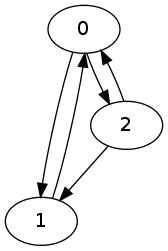
Input format All four codebases have been modified to produce executables that take the same commandline arguments which describes the graphs to investigate. The first argument is the number of vertices of the graph. Subsequent arguments are ordered pairs of comma separated vertices that make up the directed edges of the graph. Lets look at the following graph as an example: cycle example The DOT source for this graph is:
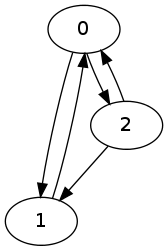
digraph G  
  0;
  1;
  2;
  0 -> 1;
  0 -> 2;
  1 -> 0;
  2 -> 0;
  2 -> 1;
   
To generate the list of elementary circuits using Tarjan's algorithm for the graph above, use:
$ python cycles.py 3 0,1 0,2 1,0 2,0 2,1
0 1
0 2
0 2 1
The commandline arguments are the exact same for the other three methods and yield the same result in the same order. If the DOT graph is in a format as simple as above, the following sed construct can be used to generate the commandline argument that represents the graph:
$ echo  sed -n -e '/^\s*[0-9]\+;$/p' graph.dot   wc -l   sed -n -e 's/^\s*\([0-9]\) -> \([0-9]\);$/\1,\2/p' graph.dot 

Testsuite As all four codebases take the same input format and have the same output format, it is now trivial to write a testsuite that compares the individual output of each algorithm for the same input and checks for differences. The code of the testsuite is available via this git repository: https://github.com/josch/cycle_test The other four repositories exist as submodules of the testsuite repository.
$ git clone git://github.com/josch/cycle_test.git
$ cd cycle_test
$ git submodule update --init
A testrun is done via calling:
$ ./test.sh 11
The argument to the shell script is an integer denoting the maximum number N of vertices for which graphs will be generated. The script will compile the Ocaml, Java and D sourcecode of the submodules as well as an ocaml script called rand_graph.ml which generates random graphs from v = 1..N vertices where N is given as a commandline argument. For each number of vertices n, e = 1..M number of edges are chosen where M is maximum number of edges given the number of vertices. For every combination of number of vertices v and number of edges e, a graph is randomly generated using Pack.Digraph.Rand.graph from the ocamlgraph library. Each of those generated graphs is checked for cycles and written to a file graph-v-e.dot if the graph contains a cycle. test.sh then loops over all generated dot files. It uses the above sed expression to convert each dot file to a commandline argument for each of the algorithms. The outputs of each algorithm are then compared with each other and only if they do not differ, does the loop continue. Otherwise the script returns with an exit code. The tested algorithms are the Python implementation of Tarjan's algorithm, the iterative and functional Ocaml implementation as well as the Java implementation of Johnson's algorithm and the D implementation of the algorithm by Hawick and James.

Future developments Running the testsuite with a maximum of 12 vertices takes about 33 minutes on a 2.53GHz Core2Duo and produces graphs with as much as 1.1 million cycles. It seems that all five implementations agree on the output for all 504 generated graphs that were used as input. If there should be another implementation of an algorithm that enumerates all elementary circuits of a directed graph, I would like to add it. There are some more papers that I would like to read but I lack access to epubs.siam.org and ieeexplore.ieee.org and would have to buy them. Benchmarks seem a bit pointless as not only the algorithms are very different from each other (and there are many ways to tweak each of them) but also the programming languages differ. Though for the curious kind, it follows the time each algorithm takes to enumerate all cycles for all generated graphs up to 11 vertices.
algorithmtime (s)
Johnson, Abate, Ocaml, iterative137
Johnson, Abate, Ocaml, functional139
Tarjan, Python153
Hawick, D175
Johnson, Meyer, Java357
The iterative Ocaml code performs as well as the functional one. In practice, the iterative code should probably be preferred as the functional code is not tail recursive. On the other hand it is also unlikely that cycles ever grow big enough to make a difference in the used stack space. The Python implementation executes surprisingly fast, given that Tarjan's algorithm is supposedly inferior to Johnson's and given that Python is interpreted but the Python implementation is also the most simple one with the least amount of required datastructures. The D code potentially suffers from the bigger datastructures and other bookkeeping that is required to support multi and self arcs. The java code implements a whole graph library which might explain some of its slowness.

2 July 2012

Johannes Schauer: port bootstrap build-ordering tool report 3

A copy of this post is sent to soc-coordination@lists.alioth.debian.org as well as to debian-bootstrap@lists.mister-muffin.de.

Diary

June 18 Pietro suggests a faster way to generate installation sets for a list of packages. In my case, I need an installation set for every source package in the archive to find out how often a binary package is needed to build a source package. As a result, the speed is doubled in contrast to the original approach.

June 19
  • adapt code to work with new dose release 3.0
  • remove unneeded parts of code
  • add different possibilities to find amount of source packages that need a binary package
  • add code to get multiple installation sets using Depsolver_int.solve

June 20
  • add ~global_constraints:false to Depsolver.listcheck, Depsolver.trim and Depsolver.edos_install calls
  • adapt output graph to limited xdot capabilities

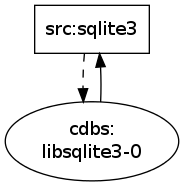
June 21 I formulate an email to the list, reporting of dependency graphs of debhelper, cdbs, pkg-config and libgtk2.0-dev. My current technique gets an installation set for a source package, removes all those that are already installable and adds the others as a dependency of that source package. This dependency will include an installation set of that binary as well minus all packages that are already available. The problem with that approach are dependency cycles created by long dependency chains. Example: src:A needs B needs C needs A. B and C would both be added as a dependency of src:A. B as well as C would also include their installation set which in both cases includes A. So now there are two cycles: src:A->B->A and src:A->C->A. For a real life example, look at the following situation of cdbs and src:sqlite3. cdbs old situation It is created because src:sqlite3 needs cdbs needs python-scour needs python needs python2.7 needs libsqlite3-0. Therfor libsqlite3-0 is in the installation set of cdbs, python-scour, python and python2.7. This creates five cycles in the graph even though there is only one. It would be better to reduce the dependencies added to src:sqlite3 to its direct dependency which is cdbs. Package dependencies are disjunctions from which the solver chooses one or the other to build an installation set. To solve the problem above I would need to know which disjunction the solver chose and then only add the direct dependency of a package to the dependency graph.
  • improve build_compile_rounds performance
  • big overhaul of menu structure
  • fix subgraph extraction code

June 22
  • do not create a universe if not needed - use hashtables instead
  • for sorting packages, generating difference of package sets and otherwise comparing packages, always use CudfAdd.compare
  • as a custom list membership function, use List.exists instead of trying List.find
  • more speedup for build_compile_rounds
  • the number of source packages that can be built does NOT include the cross built packages
  • print closure members in graph
  • refactor code and move common functions to bootstrapCommon.ml
  • add breakcycles.ml for future code to break cycles using staged build dependencies
  • use more extlib functionality
  • extended package list input format

June 23 After several emails with Pietro I learn about syntactic dependency graphs. To document my progress and prove my efforts I committed the code as commit 6684c13. But this code was soon found out to be unecessary so it will be removed later and just serves as documentation.

June 24 I came up with another (better?) solution to get the chosen disjunctions. It simply uses the calculated installation set to decide for each disjunction which one was taken by the solver. I reported that important step and the open questions involved with it in an email to the list. The problem always was, that an installation set can easily contain more than one package of a disjunction. In this case it is not clear which branch was chosen by the solver. I found, that in Ubuntu Natty there are only 6 such packages and for each of them the situation can be solved. It can be solved because in all of those cases it is that either one package of a disjunction provides the other or that both packages depend upon each other, which means that both have to be included.

June 27
  • use installation set to flatten build dependencies of source packages
  • refactor code and move common functions to bootstrapCommon.ml

June 25 I have to have an algorithm that finds all circuits in a given graph. This is necessary so that:
  1. cycles can be enumerated for huge dependency graphs where cycles are hard to see
  2. cycles can be enumerated to find a cycle that can be broken using staged build dependencies
It seems that Johnson's algorithm is the best way to do this complexity wise and Pietro already blogged about the problem together with an implementation of the algorithm in ocaml. Unfortunately it turns out that his code doesnt implement the algorithm correctly and hence misses out on some cycles. The fix seems not to be too trivial so I'm still investigating it.

June 28
  • add crosseverything.ml to obtain a list of source packages that, if cross compiled, would make the whole archive available

Results While the first week was productive as usual, I had to work some time on a University project during the second week as well as attend a family meeting. I will catch up with the lost time over the course of the next week.

dose3 Using dose 3.0 (which fixes a bug about essential packages) the output of the algorithms is now likely less wrong then before.

performance Performance was improved in the generation of installation sets as well as in the code that tries out how many packages can be built in multiple rounds. This was achieved by more caching, less unnecessary operations in looping constructs, replacing lists with hashtables, not creating universes where not necessary.

user interface The main program, basenocycles.ml now has a much better menu structure.

input format The programs take two package file inputs. The list of source packages that has to be cross built for a minimal build system and the list of source packages that was chosen to be cross compiled in addition to that. Both files list one source package per line and now allow comments.

refactoring As more and more scripts are added, more and more functionality is moved to bootstrapCommon.ml which makes each script much cleaner.

what to test for cross building As discussed in the "Future" section of the last report, I now automated the process of finding out which packages, if they were cross compiled, would make the whole archive available because they break all cycles and allow native compilation of the rest. The outcome: to build 3333 out of 3339 packages in natty natively, at most 186 source packages must be cross compiled. The other six cannot be compiled because of version mismatches in the Natty Sources.bz2 and Packages.bz2. The code can be run from crosseverything.ml.

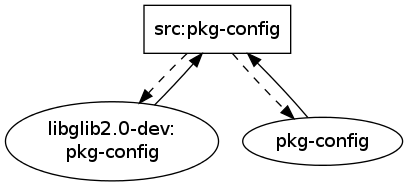
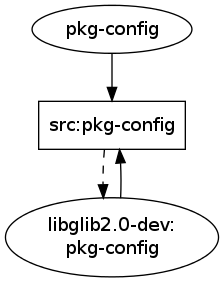
limit source dependencies to direct dependencies Reducing the dependencies of source packages from their full installation set to their direct dependencies by finding out which disjunction of their dependency list were taken, greatly simplifies the dependency graphs. The dependency graph created for libgtk2.0-dev could be reduced from 491 to 247 vertices for a depth of three. For cdbs it is now clearly visible that cdbs depends on libsqlite3-0 which builds from src:sqlite3 which depends on cdbs. Before: cdbs old situation After: cdbs new situation For pkg-config the graph also has been reduced to the one single cycle that matters: src:pkg-config needs libglib2.0-dev which depends on pkg-config which builds from src:pkg-config. Before: pkg-config old situation After: pkg-config old situation

Future I will prepare content for wookey's debconf talk on crossbuilding and bootstrapping. As this will include directions how to use the current code, I will kill two birds with one stone and write some proper documentation for my current source. The following two lists will be displayed after a dependency graph is calculated and reduced to its scc:
  • those source packages that have the least build dependencies not fulfilled. Those might be candidates for easy staged build dependencies. Since the source package is part of the scc, it will definitely be involved in some cycle somewhere.
  • those binary packages that most source packages depend upon. Those could be candidates for cross compilation as it might be easier to cross compile the source package than using staged build dependencies.
Patrick managed to cross build packages with sbuild now. So the list of packages that crosseverything.ml produces can now be checked efficiently for cross buildability. With this list, potentially more cycles can be broken out of the box. A feature will be added that allows the user to remove all packages from a dependency graph that can be cross compiled without any additional effort. Version mismatches between source and binary packages in Sources.bz2 and Packages.bz2 respectively in Ubuntu make the scripts fail and/or produce wrong results. Debian (even Sid) doesnt have this problem so I should find out where to report this problem to Ubuntu. I need to write a working version of Johnson's algorithm because much functionality depends upon it. I have the option to improve Pietro's version or write one from scratch. Writing one from scratch might be easier as I have Pietro's code as template as well as a Java implementation of Johnson's algorithm which seems to work. The following functionalities need working cycle enumeration:
  • given source packages with staged build dependencies, an enumeration of cycles is needed to find out which cycles can be broken by building packages staged. It makes less sense to blindly build a package stage and then check if this makes more packages available.
  • display cycles of a dependency graph to the user. After obtaining all cycles in the graph it makes sense to sort them by their length. The user would then investigate the situation of the smallest cycles first. This makes sense because breaking small cycles can potentially break bigger cycles. Since in the end, all cycles have to be eliminated anyway, it makes sense for the user to first tackle the small ones.
  • display the feedback arc set to the user. The packages in the feedback arc set might be very good candidates for reduced build dependencies or cross compilation.

4 June 2012

John Sullivan: To nook

My curiosity was definitely nookd by this story. While this doesn't seem to have been an act of censorship or anything nefarious by Barnes and Noble itself, this does point to just how terrifying ebooks can be if we aren't careful. In the future, when we are dealing with the entirety of human knowledge, we better be careful with the find and replace function. And we better make sure we control our computer systems so that other people can't nook us without our permission. See also: As someone who read War and Peace in paper form, much of it in bed, I definitely empathized with this:
Some weeks ago I decided that I wanted to read Tolstoy's War and Peace. Lou Ann loaned me her copy. At more than 1100 pages, reading it in bed required as much strength as balancing a box of bricks in my hands. In my senior years I have developed arthritis in my thumbs, which made the effort not only difficult, but painful.

9 April 2012

John Sullivan: Photos from Belgium

I put up (with almost no filtration) the photos I took while visiting Brussels for FOSDEM in February. Most are from the Atomium.

5 March 2012

John Sullivan: Plus One

In mailing list discussions, I've noticed that the practice of replying "+1" to messages with which one agrees has become very widespread. I think this is interesting for a lot of reasons, such as what it shows about habits picked up in communicating via social network sites that grew out of e-mail percolating back to e-mail. We seem to have really grown to like this idea of "voting" for people's messages, and if there's no "Like" or "+1" button on their message, we'll make our own. (Likewise, apparently a person's name is no longer sufficient to indicate that one is addressing them in an e-mail -- am I right, @dear_reader?) The problem for me is that I have my venerable awesome e-mail client Gnus set to hide quoted text in messages by default with (add-hook 'gnus-article-prepare-hook (lambda () (gnus-article-hide-citation 1))), and it thinks that "+" is the start of a quoted line -- so it hides the "+1". While there's a certain poetic justice to that, it confuses me because it makes the message look empty, and someone could do something like "+1 I'm pregnant too", causing me to miss some very important news. The fix for this is to change the regexp pattern Gnus uses to decide if a line is a message quote or not. gnus-message-cite-prefix-regexp is built using message-cite-prefix-regexp, so I changed the value of the latter, removing the literal "+". I also found while investigating this that I already configure that variable in order to add "#>" which someone sometime during my 9 years of using Gnus must have used. The net result is (setq message-cite-prefix-regexp "\\([ ]*[-_.#[:word:]]+>+\\ [ ]*[]> ]\\)+"). (Note that some of those whitespace characters are tabs, which probably won't display properly here, but you can compare to the default value to see what I actually changed). +1?

18 February 2012

Asheesh Laroia: Help a BSD developer bike across the US, and give hope to cancer communities

<style type="text/css"> @import "/pub/special-css/venk.css"; </style>
'Cancer' is a cluster of diseases, a betrayal by the majesty and power of the development program that constructed and heals us.
Support Venkatesh's bike ride, and alleviate the toll of cancer.
My friend Venkatesh, pictured above, is going to bike four thousand miles, all the way across the continental US, from Baltimore to Portland. He's doing it to raise money for the Ulman Cancer Fund for Young Adults. I'm writing this because I want you to donate money to his cause. He's a DragonFly BSD developer, loves bikes, and your donation could make a big difference. I first met Venkatesh through the Johns Hopkins computer club, an ACM chapter. I was the head of the club, and he had just started his career at Hopkins. He was looking for advice on running Brickwiki, the LEGO encyclopedia. Quickly, I became his friend; in that time, I've learned the following things about him. In the years since I graduated from Hopkins, I've been impressed by Venkatesh's ongoing curiosity and contributions to open source projects like DragonFly. I'm honored to have this chance to help him bike across the country for a good cause. Here is a quick word about the 4K for cancer effort:
Since 2002, groups of college students have undertaken a 70 day, 4000+ mile summer bike ride across the United States with the goal of offering hope, inspiration and support to cancer communities along the way. This past summer was our 10th year of cycling across the country as 76 volunteers rode along three different routes: Baltimore to San Francisco, Baltimore to Portland, and Baltimore to Seattle. Our riders raised a combined $476,000 to support organizations and individuals in the fight against cancer.
His fundraising goal is $5,000. Anything from $5 to $500 is a donation to an organization that helps young adult cancer surviers and their families get access to information and support resources. Can you help?

18 January 2012

John Sullivan: Sent to the ACLU today

I was on the brink of mindlessly clicking through the ACLU action center as usual to send an email opposing SOPA. But then I read their boilerplate text, and ended up cancelling the letter to my rep and instead sending this quick note to the ACLU:
Your SOPA suggested letter text supports current copyright law, and also backhandedly supports PIPA (the Senate version of the bill). This is far too weak of a position. As a donor, I ask you to take a stronger position that current copyright law unjustly restricts free speech, and that no further enforcement measures should be instituted until that fundamental problem is addressed. At least take on BOTH of these bills strongly. Most of the significant Internet is blacked out today to oppose both bills -- why would you cede so much ground to copyright maximalists? We have the support to oppose and defeat both bills.
For reference, here was their text:
While I believe it's important to protect copyrighted material online, the language of the Stop Online Piracy Act (SOPA) is flawed and will lead to the blocking of lawful content. Unlike the Senate version of the bill, SOPA eliminates the concept of sites 'dedicated to infringing activity' and enables law enforcement to target all sites that contain some infringing content -- no matter how trivial. The potential for impact on non-infringing content is much greater under SOPA than under other versions of this bill. Sites with user-generated content, like YouTube, Twitter, and Facebook, would be especially vulnerable, as one small piece of infringing content could lead to blocking the entire site. Even though proposed changes would narrow the amount of lawful content impacted, the changes don't go far enough. It is still likely that search engines will end up blocking access to perfectly legal online content. Congress should focus not just on the goal of protecting copyright owners, but also protecting the speech rights of consumers and providers who are reading and producing wholly non-infringing content. Congress must eliminate the collateral damage to protected non-infringing content. Only in that way will Congress truly achieve its goal of protecting authors while respecting the constitutional right to free speech.
Maybe I'm overreacting, but I dislike it when good organizations take weak positions unnecessarily. Usually this is not a problem with the ACLU, for me. It doesn't help that I keep seeing this meme everywhere in the anti-SOPA/PIPA conversation: "I agree we need to do something about piracy, but not this..." I don't think we need to do anything to fix violations of an extraordinarily unjust law until the law itself is fixed. I don't find that to be a very radical position.

15 January 2012

John Sullivan: At FOSDEM in February

I will be helping to represent the FSF at FOSDEM next month in Brussels. I'm speaking in the Legal Issues Devroom on Saturday 2012-02-04. The presentation is called "Is copyleft being framed?":
This short talk will address the following questions, to inspire discussion and contemplation about how we frame descriptions of the state of licensing in free software.
  • Numbers are increasingly being cited to show that the use of copyleft licenses, specifically the GPL, is declining. What do these numbers actually show, who is propagating them, and why? What do or might other numbers show?
  • Is the "percentage of free software projects which use copyleft licenses" a useful way to judge the success of copyleft? Does an increase in the percentage of projects using non-copyleft permissive licenses indicate a failure of copyleft?
  • As a small related case study, what role have the licensing terms of popular mobile application stores played in this debate, and how have those terms changed the frame of the discussion?
Let me know if you'll be there too!

19 December 2011

John Sullivan: Where Shall I Wander

Google Maps is now mapping the indoors. I saw an ad for this while passing through MSP yesterday (given how much time I spend on the Internet, it's strange and a little embarrassing to learn about new things on the Internet from airport billboards), since one of their initial targets is the infamous Mall of America.
Detailed floor plans automatically appear when you re viewing the map and zoomed in on a building where indoor map data is available. The familiar blue dot icon indicates your location within several meters, and when you move up or down a level in a building with multiple floors, the interface will automatically update to display which floor you re on. All this is achieved by using an approach similar to that of My Location for outdoor spaces, but fine tuned for indoors.
Thoughts about this: Title from John Ashbery

30 November 2011

Russell Coker: Links November 2011

Forbes has an interesting article about crowd-sourcing by criminals and law enforcement [1]. Ulissescastr0 made a Youtube video showing how to install SE Linux on Debian/Etch [2]. Probably no-one is using Etch nowadays so this video is outdated, but it s a good way of teaching people. It would be good if someone made a similar video showing how to do SE Linux things on Squeeze. I discovered the above SE Linux video through Explow which provides a neat interface to multiple searches and information sources [3]. I don t think I will be using Explow much in future as I could get the same result through Google video search. They also have a news portal but there are other sites for that. But it does seem that Explow would be useful for newbies. Eric Michael Johnson wrote an interesting article about the inherent bias in Psychological research based in the US [4]. People who live in urban environments think differently in some ways to people who live in different environments or who have different lifestyles. Therefore generalising from university students in the US to the entire human race is likely to get incorrect results. This is something to consider the next time you are tempted to generalise to the wider population from your own friends, colleagues, etc. The Daily Kos has a scary article about the TSA having a woman detained for reciting part of the US constitution [5]. The US will remain on my list of countries to avoid for the forseeable future. Vorlon has written an informative article about the use of hardening options when building Debian packages [6]. It s now even easier to do this, so every package that simultaneously deals with data of differing levels of integrity or sensitivity should be built this way. Bunker Roy gave an interesting TED talk about his Barefoot College that teaches useful skills to people in rural parts of India who don t have a traditional school education [7]. His talk really shows up some of the arrogance in the people who run traditional education. Justin Hall-Tipping gave an interesting TED talk about ways of solving the world energy problems [8]. He started with explaining the problems and why they need to be urgently solved and then described in detail some of the research that his group has done to solve the problems. This includes flexible photo-voltaic cells, infra-red vision to save on lighting, and a way of using carbon nano-tubes to control the thermal properties of windows.

8 July 2011

Julien Blache: Farewell, Space Shuttle Program

Well, today was the day and I ve just watched the last ever Space Shuttle launch. Let s just say there s something very, very wrong with this world and leave it at that. Hats off to all the men and women who dedicated their lives or part thereof to these magnificent birds over the past 30+ years, from the original design studies back in the days to the transition & retirement operations that will last for a year still. We ll most probably never get to see any other machine pushing boundaries like the Shuttle has done, and this is a gigantic loss for us all. One day people will realize If you aren t familiar with the challenges faced by the Shuttle, with the advances in science and countless engineering disciplines brought by Shuttle and more generally with Shuttle and facts about the Shuttle, go read Wings in Orbit; a book by the people who built and operated the Space Shuttle, available freely in PDF format from NASA. Did you know that the Space Shuttle Main Engines (SSME, RS-25) are the most powerful, most efficient engines ever built? They were designed 40 years ago. I won t make a list, but this is true of a number of other components. What the hell have we been doing all these years?

16 May 2011

John Sullivan: Send bricks to Nintendo

Brick Nintendo before they brick you! Connectivity can be a force for autonomy and freedom, or it can be used for control and subjugation. The Nintendo 3DS is an example of the latter. Okay, yeah, I just said a cute video game console is a threat to personal freedom. Hear me out. If you haven't read the highlights of Nintendo's Terms of Service for the 3DS yet, you should do that. On one hand, it's "just" a games console. On the other hand, it's a computer, marketed to children, which monitors your location (based on proximity to wifi access points), uploads your photos and messages to Nintendo's servers (giving them a license to re-use that information in various ways), and tracks your activity. Now that's entertainment. If you wanted your Nintendo computer to stop doing those things, you could try to install some 3rd-party "homebrew" software on it. Except then, according to the Terms, Nintendo would "brick" your device render it inoperable, when the modified software is detected. Would you accept Ford disabling your car because you had a mechanic friend fix a problem using some aftermarket parts? Microsoft breaking your computer hardware because you installed Firefox? The ability to stop your electronics from spying on you is an important freedom to defend, even if you don't ever plan on purchasing a Nintendo device. Such terms, and the Digital Restrictions Management software that enforces them, are a problem in all areas of digital life. It's the same fundamental strategy as Apple controlling what you can install on the iPhone or iPad, or Sony sending police officers to a programmer's house because he showed other people how to modify their own computers to make them able to run non-Sony-approved software. If we don't set a strong precedent against this behavior, it will become more prevalent. If we lose the ability to install what we like on our computers, then we lose the ability to use those computers in any way that isn't pre-approved by a corporation. We lose it not only because we ourselves can't install some software maybe we hate changing anything on our computers at all but because the people who write the software we rely on lose that freedom, which ends up impacting even the most non-technical of computer users. Companies like to portray anyone arguing for this freedom as criminals just wanting to illegally copy software. But that's obviously not true -- a person who follows all laws, even the most absurd, might still want to install something to stop Nintendo from receiving copies of her photos or reporting on her location. Companies use the threat of illegal copying to justify massive infringements on real personal freedoms. People often say, "well, just don't buy it then". I agree don't buy it. But don't think this is merely a consumer issue. Terms like Nintendo's are backed by the force of criminal law the Digital Millennium Copyright Act in the US for example which can put you in jail for helping people to modify their own computers. So this is more than a mere preference issue, it's also one of law and ethics. It's not a free market when one side has coercive state resources in play to prop up its arbitrary business model. To help send this message, I just donated to send 5 bricks to Nintendo. I hope you'll send one or five too. The campaign has a goal of sending 200 bricks by the end of today (Monday, May 16th). Nintendo clearly wants to get into the brick-making business, so surely they'll appreciate the extra inventory. (Disclosure: While I do work for the Free Software Foundation and am paid partly to run the Defective by Design campaign, I really did donate, and support this campaign personally.)

30 April 2011

Thomas Girard: ACE+TAO Debian packaging moved to git

We recently converted Debian ACE+TAO package repository from Subversion to git. This was a long and interesting process; I learned a lot on git in the course. I had been using git for a while for other packages: BOUML, dwarves and GNU Smalltalk. But I did not really get it. A preliminary study led by Pau[1] showed that out of the following three tools: the last one was giving results that look better.
The conversion svn-all-fast-export requires physical access to the repo, so the Alioth SVN repo was copied on my machine svn-pkg-ace/ before running the tool:
svn-all-fast-export --identity-map authors.txt --rules pkg-ace.rules svn-pkg-ace
Here's the content of the pkg-ace.rules configuration file that was used:
create repository pkg-ace
end repository
match /trunk/
  repository pkg-ace
  branch master
end match
match /(branches tags)/([^/]+)/
  repository pkg-ace
  branch \2
end match
The author mapping file authors.txt being:
markos = Konstantinos Margaritis <email-hidden>
mbrudka-guest = Marek Brudka <email-hidden>
pgquiles-guest = Pau Garcia i Quiles <email-hidden>
tgg = Thomas Girard <email-hidden>
tgg-guest = Thomas Girard <email-hidden>
The tool sample configuration file merged-branches-tags.rules recommends to post-process tags, which are just a branch in SVN. That's why the configuration file above treats branches as tags. The conversion was indeed fast: less than 1 minute.
Post-conversion observations Invoking gitk --all in the converted repo revealed different kind of issues:
  • svn tags as branches: http://thomas.g.girard.free.fr/ACE/tags-as-branches.png Branches are marked with green rectangles, and tags with yellow arrows. What we have here (expected given our configuration of the tool) are branches (e.g. 5.4.7-5) corresponding to tags, and tags matching the SVN tagging commit (e.g. backups/5.4.7-5@224). We'll review and fix this.

  • merged code that did not appear as such: http://thomas.g.girard.free.fr/ACE/missing-merge-metadata.png Branches that were not merged using svn merge look like they were not merged at all.

  • commits with wrong author: http://thomas.g.girard.free.fr/ACE/wrong-author.png Before being in SVN, the repository was stored in CVS. When it was imported into SVN, no special attention was given to the commit author. Hence I got credited for changes I did not write.
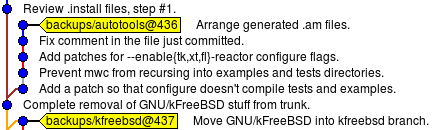
  • obsolete branches: http://thomas.g.girard.free.fr/ACE/obsolete-branches.png The tool leaves all branches, including removed ones (with tag on their end) so that you can decide what to do with them.

  • missing merges: http://thomas.g.girard.free.fr/ACE/missing-merge.png The branch 5.4.7-12 was never merged into the trunk!

Learning git Based on observations above, I realized my limited knowledge won't do to complete the conversion and clean the repository. There are tons of documentation on git out there, and you can find a lot of links from the git documentation page. Here's the one I've used:
The Git Object Model It's described with pictures here. You really need to understand this if you haven't already. Once you do, you understand that git is built bottom-up: the plumbing then the porcelain. If you can't find the tool you need, it's easy to write it.
git fast-import The Migrating to Git chapter explains how you can use the git fast-import tool to manually import anything into git. I've used it to create tags with dates in the past, slightly changing the Custom Importer example in the book:
#!/usr/bin/env ruby
#
# retag.rb
#
# Small script to create an annotated tag, specifying commiter as well as
# date, and tag comment.
#
# Based on Scott Chacon "Custom Importer" example.
#
# Arguments:
#  $1 -- tag name
#  $2 -- sha-1 revision to tag
#  $3 -- committer in the form First Last <email>
#  $4 -- date to use in the form YYYY/MM/DD_HH:MM:SS

def help
  puts "Usage: retag <tag> <sha1sum> <committer> <date> <comment>"
  puts "Creates a annotated tag with name <tag> for commit <sha1sum>, using "
  puts "given <committer>, <date> and <comment>"
  puts "The output should be piped to git fast-import"
end
def to_date(datetime)
  (date, time) = datetime.split('_')
  (year, month, day) = date.split('/')
  (hour, minute, second) = time.split(':')
  return Time.local(year, month, day, hour, minute, second).to_i
end
def generate_tag(tag, sha1hash, committer, date, message)
  puts "tag # tag "
  puts "from # sha1hash "
  puts "tagger # committer  # date  +0000"
  print "data # message.size \n# message "
end
if ARGV.length != 5
  help
  exit 1
else
  (tag, sha1sum, committer, date, message) = ARGV
  generate_tag(tag, sha1sum, committer, to_date(date), message)
end
graft points (graft means greffe in French) Because of missing svn:mergeinfo some changes appear unmerged. To fix this there are graft points: they override git idea of parents of a commit. To create a graft point, assuming 6a6d48814d0746fa4c9f6869bd8d5c3bc3af8242 is the commit you want to change, currently with a single parent 898ad49b61d4d8d5dc4072351037e2c8ade1ab68, but containing changes from commit 11cf74d4aa996ffed7c07157fe0780ec2224c73e:
me@mymachine$ echo 6a6d48814d0746fa4c9f6869bd8d5c3bc3af8242 11cf74d4aa996ffed7c07157fe0780ec2224c73e 898ad49b61d4d8d5dc4072351037e2c8ade1ab68 >> .git/info/grafts
git filter-branch git filter-branch allows you to completely rewrite history of a git branch, changing or dropping commits while traversing the branch. As an additional benefit, this tool use graft points and make them permanent. In other words: after running git filter-branch you can remove .git/info/grafts file. I've used it to rewrite author of a given set of commits, using a hack on top of Chris Johnsen script:
#!/bin/sh

br="HEAD"
TARG_NAME="Raphael Bossek"
TARG_EMAIL="hidden"
export TARG_NAME TARG_EMAIL
filt='
    if test "$GIT_COMMIT" = 546db1966133737930350a098057c4d563b1acdf -o \
            "$GIT_COMMIT" = 23419dde50662852cfbd2edde9468beb29a9ddcc; then
        if test -n "$TARG_EMAIL"; then
            GIT_AUTHOR_EMAIL="$TARG_EMAIL"
            export GIT_AUTHOR_EMAIL
        else
            unset GIT_AUTHOR_EMAIL
        fi
        if test -n "$TARG_NAME"; then
            GIT_AUTHOR_NAME="$TARG_NAME"
            export GIT_AUTHOR_NAME
        else
            unset GIT_AUTHOR_NAME
        fi
    fi
'
git filter-branch $force --tag-name-filter cat --env-filter "$filt" -- $br
(Script edited here; there were much more commits written by Raphael.)

Important

It's important to realize that the whole selected branch history is rewritten, so all objects id will change. You should not do this if you already published your repository.

The --tag-name-filter cat argument ensures our tags are copied during the traversal; otherwise they would be untouched, and hence not available in the new history.

Hint

Once git filter-branch completes you get a new history, as well as a new original ref to ease comparison. It is highly recommended to check the result of the rewrite before removing original. To shrink the repo after this, git clone the rewritten repo with file:// syntax -- git-filter-branch says it all.

Cleaning up the repo To recap, here's how the ACE+TAO git repo was changed after conversion:
  1. Add graft points where needed.

  2. Clean tags and branches. Using git tag -d, git branch -d and the Ruby script above it was possible to recreate tags. During this I was also able to add missing tags, and remove some SVN errors I did -- like committing in a branch created under tags/.

  3. Remove obsolete branches.

  4. Merge missing pieces. There were just two missing debian/changelog entries. I did this before git filter-branch because I did not find a way to use the tool correctly with multiple heads.

  5. Fix commit author where needed. Using the shell script above Raphael is now correctly credited for his work.

That's it. The ACE+TAO git repository for Debian packages is alive at http://git.debian.org/?p=pkg-ace/pkg-ace.git;a=summary.
[1]http://lists.alioth.debian.org/pipermail/pkg-ace-devel/2011-March/002421.html
[2]available in Debian as svn-all-fast-export

6 April 2011

Gerfried Fuchs: The Canterbury Project

The Background If you weren't online last Friday you probably have missed the big news announcement on the various community distribution websites. The main pages of them got replaced by a placeholder announcing the birth of The Canterbury Project. People started to wonder whether it is an April fool's prank or for real. This blog post is meant to shine a bit more light on it and address one comment received about it. If you go to the news item on the Debian site you'll get your answer about that it indeed was an April fool's prank. The idea for doing something in coordination with other distributions came to me when I thought about last year's (or was it already two year's ago?) prank that the various web cartoon sites pulled: they replaced their main page with the page of another cartoonist. My original idea was actually along that lines. So I started to dig up website contacts from different distributions, I was aiming at the big names in the community distribution sector. Given that my time is pretty limited these days with renovating the house we plan to live in soonish I knew I had to let in others in within Debian. I though didn't want to involve too many people, for several reasons: it should be a surprise to as many as possible, but more importantly, I didn't want to shy away other distributions by an overwhelming Debian involvement. That's also part of the reason why I didn't contact many Debian based distributions. So first contacts where made, a dedicated IRC channel used for coordination, and people involved joined in. Then the thing happened which the Free Software community is so well known for: additional ideas came in, two people independently addressed me whether it wouldn't be better that instead of a circle replacement of the frontpage, why not display the same page on all of them. And one of them added that a corresponding news item might make sense. So there we were, having to think about text to put into two things: the news item and the replacement page itself. At this stage Alexander threw in a project name with a background that was adopted. Francesca started with an idea for the news item, I started to put quotes in and asked for ones from the other involved people that fit their distribution well. Klaas came up with a template for the replacement page that we tweaked. Fortunately we ended up being five distributions and the colors of the banner did match the distribution ones rather well (except for one, we had to tweak the color of one banner). The Credits We were all set, and actually everything went fine. And it definitely caught the attention. This blog post goes out in thanks to the following people: I hopefully haven't forgotten anyone. There surely were some more people involved in the other distributions, and I guess the named people weren't aware of all the ones involved inside Debian. Feel free to drop missing names in the comments. Addressing Feedback Finally, let me address one concern raised: someone claimed that the real joke with this prank was that we would consider collaboration to be a joke. Actually, the total opposite is the case here. That it was possible to pull it off should be proof enough that Collaboration Across Borders actually is possible. And the background information put into the news section of the replacement site is real. Also, my personal quote in the news item was meant dead honest. I do believe that DEX has a limited point of view and only tackles part of the problem. Unfortunately, for such efforts to really come to life it takes people with a really long breath and dedication to it. Efforts like the VCS-PKG and the Freedesktop Games effort are more or less stalled. Even though a lot of people do believe in stronger collaboration to be a good thing, the basis is not working out too well. I'm in the fortunate position that for some of the packages I maintain there is exchange between packagers from different distributions to avoid common troubles. If it can't be done in the big it should at least be tried in the small. I want to specifically highlight again one part of the updates in the replacement page: the CrossDistro track at this year's FOSDEM. This one was more than fruitful, on several levels. From what I've heard a lot of discussion happened besides the talks too, and connections got established. It doesn't sound unlikely like this might be done again next year. So again, thanks for enjoying this April fool's prank, thanks to everyone who helped to deliver it, and especially a lot of thanks to the people who this might have got thinking of possibilities to improve on the collaboration front!

/debian permanent link Comments: 8 Flattr this

23 March 2011

John Sullivan: Oh yes I did

7 March 2011

John Sullivan: New job

Today was my first day as the new executive director at the Free Software Foundation. I'm really excited about the opportunity to do more at the FSF -- but also sad that I won't have the pleasure of working with Peter Brown any more, as he is moving on to more challenges. Peter's been an amazing mentor and boss to me in the eight years I've been with the FSF, and it's not going to be the same without him. Along with the change in job positions, I have relocated from Seattle back to Boston. This continues to be my personal space, not an official FSF channel -- but this is big personal news for me so I wanted to share :).

21 February 2011

Stefano Zacchiroli: Squeeze, Debian, and the FSF

Short version: Dear FSF, thanks for your appreciation of Debian Squeeze achievements in getting rid of non-free firmware blobs. We still disagree on the overall freeness assessment of Debian, but I'm positive that steps like this one can further future collaboration, in the interest of both projects. Long version follows.
Historically, the relationships among Debian and the FSF have gone through mixed fortune (and that's quite an euphemism). On the one hand, Debian is committed to 100% Free Software, is an open project explicitly inspired by "the spirit of GNU", has been sponsored by FSF in its infancy, and properly calls itself "GNU/Linux" (or even "GNU/kFreeBSD"). On the other hand, Debian is the project who considers the GNU FDL license to be only conditionally free and which is not considered to be an entirely Free system according to FSF.
So much for the history corner. As a long time member of the Debian Project, as well as an FSF(E) fellow, I've always felt a bit sad about this state of affairs. Not because the two projects should have aligned goals; they clearly focus on different aspects of the quest for a Free (Software) world. Not even because they should agree on how to build a Free distribution: history has shown that FSF technical positions do not always get along with Debian's more "pragmatic" style, as embodied by point 5 of the Social Contract. Rather, my sadness is rooted in the belief that not getting along have encouraged duplication of efforts which could have been easily avoided (e.g. multiple distributions concurrently freeing up kernels). Furthermore, I'm more and more convinced that Debian nowadays enjoys a rather privileged position among Free Software vendors. Indeed, even though GNU/Linux distributions have reached a popularity we didn't dare to imagine 15 years ago or so, most distributions are under the direct or indirect control of commercial vendors. Those commercial vendors play a very important role in the promotion of Free Software. For instance, they are structured in ways that enable them to seal OEM deals with hardware manufacturers to sell computers with GNU/Linux pre-installed. Commercial vendors, by their own nature, are also in general better at marketing than non-commercial vendors. On the flip side however, commercial vendors are not yet relevant enough to drive proprietary drivers out of the market and, as a consequence, cannot yet afford not to support hardware which need such proprietary bits to work. Among mainstream GNU/Linux distributions[1] Debian is one of the very few vendors if not the only one that is both very relevant and, thanks to its independence, can afford taking Free Software's side: no commercial urgency can force Debian to negotiate on that. That is quite an asset to be used in the promotion of Free Software, especially to a public that is interested in and willing to understand what Free Software really is about. Such an "aware" public is on the rise as of lately, together with the general awareness increase of risks entailed by living a digital life, when that life is not under our control (think, as an example, at how often the "Facebook privacy debate" has hit mainstream medias in the last year). The "aware" public is the natural target of both Debian and the FSF. Dividing it would not serve well the cause of Free Software. With all that in mind, last August I took the chance of being on the "right" side of the Atlantic Ocean for DebConf10, to discuss possible venues of collaboration among Debian and the FSF. I sat down and discussed at length with John Sullivan, who I happen to know for his Debian involvement, in his capacities of FSF representative and operations manager. We discussed various topics, with the intention of bringing them up to the respective communities[2]. Then, inevitably, we ended up talking about the overall freeness of Debian and his exclusion from FSF listing of Free systems. (FSF is of course entitled to such judgements, pretty much as Debian is entitled to its own judgements on FSF licenses. Nevertheless those judgements contribute to dividing our public and might lead to wasteful duplication of efforts, where Free Software could better be served by collaboration.) The main ground for exclusion from that list used to be the compromises Debian has made in the past about non-free firmware blobs. But, as I pointed out back in August, those compromises would have been gone starting with Squeeze, making that argument moot. Today 6 months later I'm delighted to cheer at FSF's decision to publicly recognize the achievements Debian has delivered with Squeeze.
Thanks! It's a nice gesture that I've very much appreciated. I'm confident steps like this one will help future collaboration if, on both sides, we will be able to spot actual venues for collaboration. Needlessly to say, I still disagree with the overall FSF assessment of Debian non-freeness. Apparently, it still stands on the basis that Debian also provides a repository of nonfree software [ ] [which] is not part of the Debian system. [ ] but users would be hard-pressed to make a distinction and that people can readily learn about software available through it by browsing Debian's online package database. I respect the principle of non advertising non-free software and I even agree that it is a good principle. But unfortunately it's also a very blurry principle on which, in my opinion, Debian actually scores very well. No non-free software is offered to users by Debian; it's just for users that really want to have non-free software (or need to, in order to run a Free OS on their computers), that Debian tries to stay out of their way. For the "aware" public discussed above, I think it's much better to draw the line where software freedom ends and use that line to explain what does crossing it entails, than locking them up pretending non-free software do not exist. But fair enough: for the time being, I guess, we will need to agree to disagree on this one. Getting a little bit closer in the occasion of the Squeeze release is still an important step forward. It's up to each of us now to seek out initiatives which attract the interest of both projects and that can benefit from synergies.
[1] Sorry, I've no decent definition of "mainstream distribution" to offer, besides folklore and well-established distribution review sites. (Heck, I don't even have a decent definition of "well-established distribution review site" to offer!).
[2] which hasn't happened yet, due to the proverbial amount of available spare time.

14 February 2011

Clint Adams: Itamae, itamae

C: Heyward's - Johnson C. C: Rosedale's - downtown O: Gates - 3205 Main
Servicio mesa (21.00) $8.00
Bebidas (21.00) $8.00
Copa salentein (21.00) $27.00
Provoleta (21.00) $24.00
Asado de tira (21.00) $45.00

31 January 2011

John Sullivan: Churchill Club Panel Discussion on Software Patents

My FSF colleague Brett Smith and I will be making the case against software patents on a panel at the Churchill Club in Mountain View, CA, the evening of February 16th. Hope to see End Software Patents supporters in the audience! More information: Churchill Club Panel Discussion on Software Patents Free Software Foundation working together for free software

16 January 2011

John Sullivan: Vegan dinner tonight

I made smoky grilled tofu (based on the recipe in Veganomicon) on a bed of collard greens and maple-glazed roasted beets and carrots. Bigger pictures are here.

Next.

Previous.