Search Results: "jan"

19 December 2025

Otto Kek l inen: Backtesting trailing stop-loss strategies with Python and market data

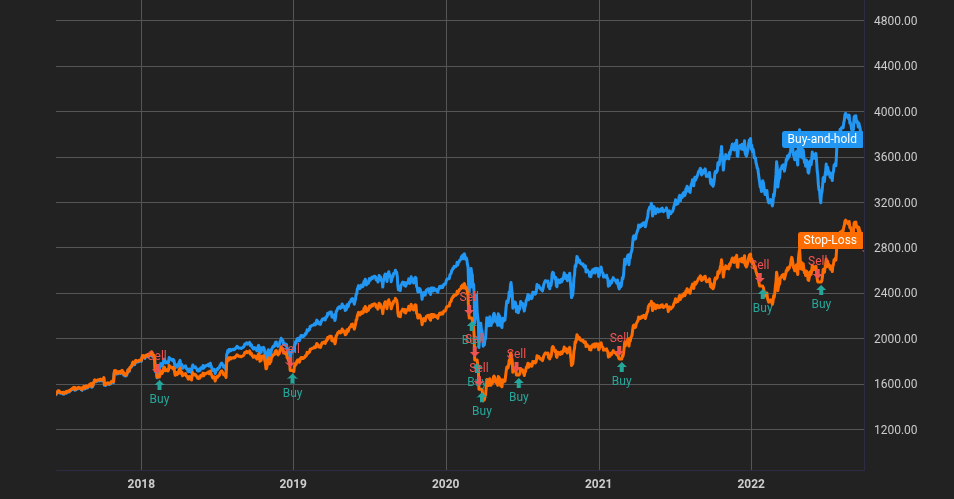
Featured image of post Backtesting trailing stop-loss strategies with Python and market dataIn January 2024 I wrote about the insanity of the Magnificent Seven dominating the MSCI World Index, and I wondered how long the number can continue to go up? It has continued to surge upward at an accelerating pace, which makes me worry that a crash is likely closer. As a software professional, I decided to analyze whether using stop-loss orders could reliably automate avoiding deep drawdowns. As everyone with some savings in the stock market (hopefully) knows, the stock market eventually experiences crashes. It is just a matter of when and how deep the crash will be. Staying on the sidelines for years is not a good investment strategy, as inflation will erode the value of your savings. Assuming the current true inflation rate is around 7%, a restaurant dinner that costs 20 euros today will cost 24.50 euros in three years. Savings of 1000 euros today would drop in purchasing power from 50 dinners to only 40 dinners in three years. Hence, if you intend to retain the value of your hard-earned savings, they need to be invested in something that grows in value. Most people try to beat inflation by buying shares in stable companies, directly or via broad market ETFs. These historically grow faster than inflation during normal years, but likely drop in value during recessions.

What is a trailing stop-loss order? What if you could buy stocks to benefit from their value increasing without having to worry about a potential crash? All modern online stock brokers have a feature called stop-loss, where you can enter a price at which your stocks automatically get sold if they drop down to that price. A trailing stop-loss order is similar, but instead of a fixed price, you enter a margin (e.g. 10%). If the stock price rises, the stop-loss price will trail upwards by that margin. For example, if you buy a share at 100 euros and it has risen to 110 euros, you can set a 10% trailing stop-loss order which automatically sells it if the price drops 10% from the peak of 110 euros, at 99 euros. Thus, no matter what happens, you only lost 1 euro. And if the stock price continues to rise to 150 euros, the trailing stop-loss would automatically readjust to 150 euros minus 10%, which is 135 euros (150-15=135). If the price dropped to 135 euros, you would lock in a gain of 35 euros, which is not the peak price of 150 euros, but still better than whatever the price fell down to as a result of a large crash. In the simple case above, it obviously makes sense in theory, but it might not make sense in practice. Prices constantly oscillate, so you don t want a margin that is too small, otherwise you exit too early. Conversely, having a large margin may result in too large a drawdown before exiting. If markets crash rapidly, it might be that nobody buys your stocks at the stop-loss price, and shares have to be sold at an even lower price. Also, what will you do once the position is sold? The reason you invested in the stock market was to avoid holding cash, so would you buy the same stock back when the crash bottoms? But how will you know when the bottom has been reached?

Backtesting stock market strategies with Python, YFinance, Pandas and Lightweight Charts I am not a professional investor, and nobody should take investment advice from me. However, I know what backtesting is and how to leverage open source software. So, I wrote a Python script to test if the trading strategy of using trailing stop-loss orders with specific margin values would have worked for a particular stock. First you need to have data. YFinance is a handy Python library that can be used to download the historic price data for any stock ticker on Yahoo.com. Then you need to manipulate the data. Pandas is the Python data analysis library with advanced data structures for working with relational or labeled data. Finally, to visualize the results, I used Lightweight Charts, which is a fast, interactive library for rendering financial charts, allowing you to plot the stock price, the trailing stop-loss line, and the points where trades would have occurred. I really like how the zoom is implemented in Lightweight Charts, which makes drilling into the data points feel effortless. The full solution is not polished enough to be published for others to use, but you can piece together your own by reusing some of the key snippets. To avoid re-downloading the same data repeatedly, I implemented a small caching wrapper that saves the data locally (as Parquet files):
python
CACHE_DIR.mkdir(parents=True, exist_ok=True)
end_date = datetime.today().strftime("%Y-%m-%d")
cache_file = CACHE_DIR / f" TICKER - START_DATE -- end_date .parquet"

if cache_file.is_file():
 dataframe = pandas.read_parquet(cache_file)
 print(f"Loaded price data from cache:  cache_file ")
else:
 dataframe = yfinance.download(
 TICKER,
 start=START_DATE,
 end=end_date,
 progress=False,
 auto_adjust=False
 )

 dataframe.to_parquet(cache_file)
 print(f"Fetched new price data from Yahoo Finance and cached to:  cache_file ")
The dataframe is a Pandas object with a powerful API. For example, to print a snippet from the beginning and the end of the dataframe to see what the data looks like, you can use:
python
print("First 5 rows of the raw data:")
print(df.head())
print("Last 5 rows of the raw data:")
print(df.tail())
Example output:
First 5 rows of the raw data
Price Adj Close Close High Low Open Volume
Ticker BNP.PA BNP.PA BNP.PA BNP.PA BNP.PA BNP.PA
Date
2014-01-02 29.956285 55.540001 56.910000 55.349998 56.700001 316552
2014-01-03 30.031801 55.680000 55.990002 55.290001 55.580002 210044
2014-01-06 30.080338 55.770000 56.230000 55.529999 55.560001 185142
2014-01-07 30.943321 57.369999 57.619999 55.790001 55.880001 370397
2014-01-08 31.385597 58.189999 59.209999 57.750000 57.790001 489940
Last 5 rows of the raw data
Price Adj Close Close High Low Open Volume
Ticker BNP.PA BNP.PA BNP.PA BNP.PA BNP.PA BNP.PA
Date
2025-12-11 78.669998 78.669998 78.919998 76.900002 76.919998 357918
2025-12-12 78.089996 78.089996 80.269997 78.089996 79.470001 280477
2025-12-15 79.080002 79.080002 79.449997 78.559998 78.559998 233852
2025-12-16 78.860001 78.860001 79.980003 78.809998 79.430000 283057
2025-12-17 80.080002 80.080002 80.150002 79.080002 79.199997 262818
Adding new columns to the dataframe is easy. For example, I used a custom function to calculate the Relative Strength Index (RSI). To add a new column RSI with a value for every row based on the price from that row, only one line of code is needed, without custom loops:
python
df["RSI"] = compute_rsi(df["price"], period=14)
After manipulating the data, the series can be converted into an array structure and printed as JSON into a placeholder in an HTML template:
python
 baseline_series = [
  "time": ts, "value": val 
 for ts, val in df_plot[["timestamp", BASELINE_LABEL]].itertuples(index=False)
 ]

 baseline_json = json.dumps(baseline_series)
 template = jinja2.Template("template.html")
 rendered_html = template.render(
 title=title,
 heading=heading,
 description=description_html,
 ...
 baseline_json=baseline_json,
 ...
 )

 with open("report.html", "w", encoding="utf-8") as f:
 f.write(rendered_html)
 print("Report generated!")
In the HTML template, the marker variable in Jinja syntax gets replaced with the actual JSON:
html
<!DOCTYPE html>
<html lang="en">
<head>
 <meta charset="UTF-8">
 <title>  title  </title>
 ...
</head>
<body>
 <h1>  heading  </h1>
 <div id="chart"></div>
 <script>
 // Ensure the DOM is ready before we initialise the chart
 document.addEventListener('DOMContentLoaded', () =>  
 // Parse the JSON data passed from Python
 const baselineData =   baseline_json   safe  ;
 const strategyData =   strategy_json   safe  ;
 const markersData =   markers_json   safe  ;

 // Create the chart
 const chart = LightweightCharts.createChart(document.getElementById('chart'),  
 width: document.getElementById('chart').clientWidth,
 height: 500,
 layout:  
 background:   color: "#222"  ,
 textColor: "#ccc"
  ,
 grid:  
 vertLines:   color: "#555"  ,
 horzLines:   color: "#555"  
  
  );

 // Add baseline series
 const baselineSeries = chart.addLineSeries( 
 title: '  baseline_label  ',
 lastValueVisible: false,
 priceLineVisible: false,
 priceLineWidth: 1
  );
 baselineSeries.setData(baselineData);

 baselineSeries.priceScale().applyOptions( 
 entireTextOnly: true
  );

 // Add strategy series
 const strategySeries = chart.addLineSeries( 
 title: '  strategy_label  ',
 lastValueVisible: false,
 priceLineVisible: false,
 color: '#FF6D00'
  );
 strategySeries.setData(strategyData);

 // Add buy/sell markers to the strategy series
 strategySeries.setMarkers(markersData);

 // Fit the chart to show the full data range (full zoom)
 chart.timeScale().fitContent();
  )
 </script>
</body>
</html>
There are also Python libraries built specifically for backtesting investment strategies, such as Backtrader and Zipline, but they do not seem to be actively maintained, and probably have too many features and complexity compared to what I needed for doing this simple test. The screenshot below shows an example of backtesting a strategy on the Waste Management Inc stock from January 2015 to December 2025. The baseline Buy and hold scenario is shown as the blue line and it fully tracks the stock price, while the orange line shows how the strategy would have performed, with markers for the sells and buys along the way. Backtest run example
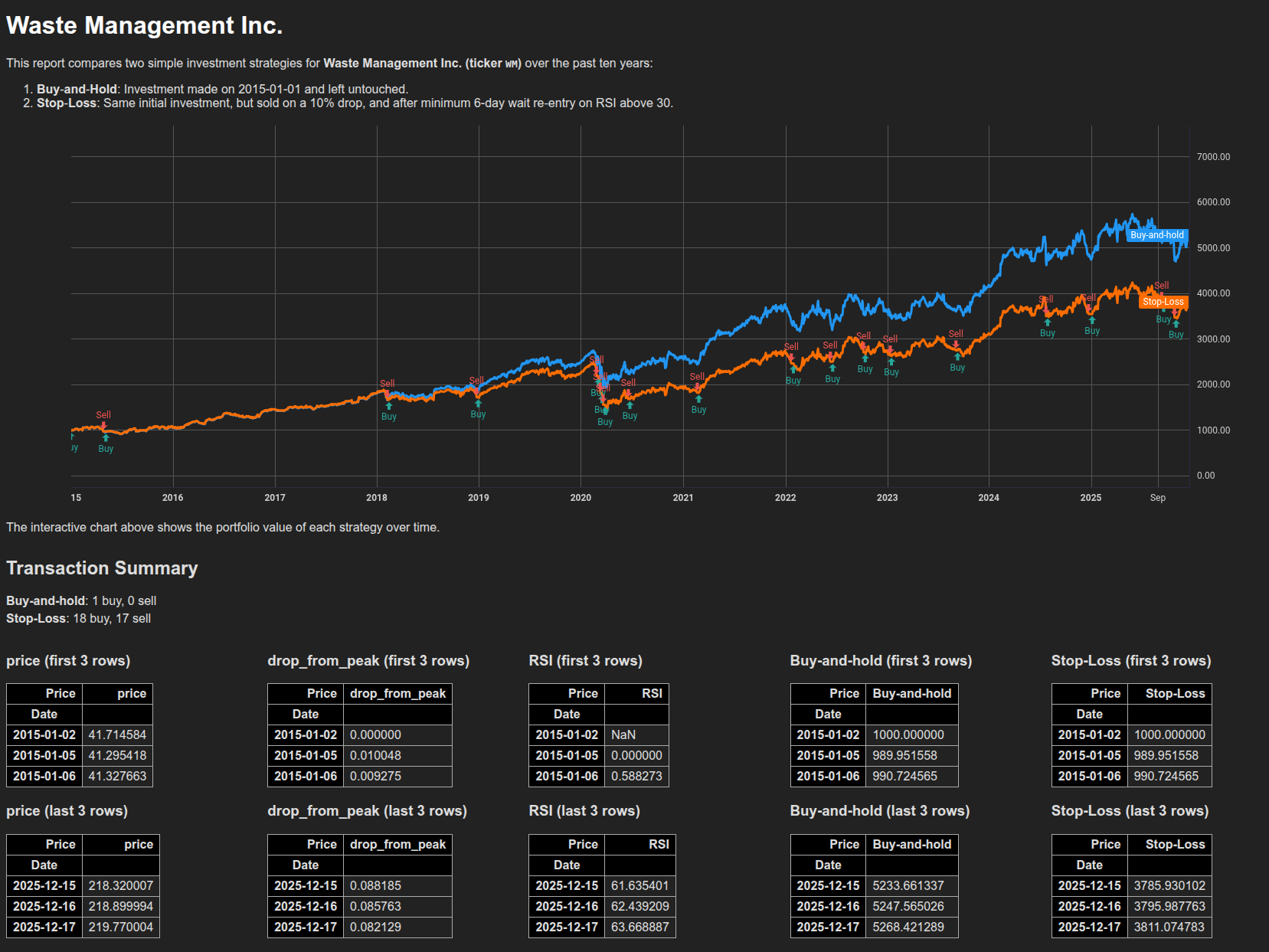
Results I experimented with multiple strategies and tested them with various parameters, but I don t think I found a strategy that was consistently and clearly better than just buy-and-hold. It basically boils down to the fact that I was not able to find any way to calculate when the crash has bottomed based on historical data. You can only know in hindsight that the price has stopped dropping and is on a steady path to recovery, but at that point it is already too late to buy in. In my testing, most strategies underperformed buy-and-hold because they sold when the crash started, but bought back after it recovered at a slightly higher price. In particular when using narrow margins and selling on a 3-6% drawdown the strategy performed very badly, as those small dips tend to recover in a few days. Essentially, the strategy was repeating the pattern of selling 100 stocks at a 6% discount, then being able to buy back only 94 shares the next day, then again selling 94 shares at a 6% discount, and only being able to buy back maybe 90 shares after recovery, and so forth, never catching up to the buy-and-hold. The strategy worked better in large market crashes as they tended to last longer, and there were higher chances of buying back the shares while the price was still low. For example, in the 2020 crash selling at a 20% drawdown was a good strategy, as the stock I tested dropped nearly 50% and remained low for several weeks; thus, the strategy bought back the stocks while the price was still low and had not yet started to climb significantly. But that was just a lucky incident, as the delta between the trailing stop-loss margin of 20% and total crash of 50% was large enough. If the crash had been only 25%, the strategy would have missed the rebound and ended up buying back the stocks at a slightly higher price. Also, note that the simulation assumes that the trade itself is too small to affect the price formation. We should keep in mind that in reality, if many people have stop-loss orders in place, a large price drop would trigger all of them, creating a flood of sell orders, which in turn would affect the price and drive it lower even faster and deeper. Luckily, it seems that stop-loss orders are generally not a good strategy, and we don t need to fear that too many people will be using them.

Conclusion Even though using a trailing stop-loss strategy does not seem to help in getting consistently higher returns based on my backtesting, I would still say it is useful in protecting from the downside of stock investing. It can act as a kind of insurance policy to considerably decrease the chances of losing big while increasing the chances of losing a little bit. If you are risk-averse, which I think I probably am, this tradeoff can make sense. I d rather miss out on an initial 50% loss and an overall 3% gain on recovery than have to sit through weeks or months with a 50% loss before the price recovers to prior levels. Most notably, the trailing stop-loss strategy works best if used only once. If it is repeated multiple times, the small losses in gains will compound into big losses overall. Thus, I think I might actually put this automation in place at least on the stocks in my portfolio that have had the highest gains. If they keep going up, I will ride along, but once the crash happens, I will be out of those particular stocks permanently. Do you have a favorite open source investment tool or are you aware of any strategy that actually works? Comment below!

12 December 2025

Freexian Collaborators: Debian Contributions: Updates about DebConf Video Team Sprint, rebootstrap, SBOM tooling in Debian and more! (by Anupa Ann Joseph)

Debian Contributions: 2025-11 Contributing to Debian is part of Freexian s mission. This article covers the latest achievements of Freexian and their collaborators. All of this is made possible by organizations subscribing to our Long Term Support contracts and consulting services.

DebConf Video Team Sprint The DebConf Video Team records, streams, and publishes talks from DebConf and many miniDebConfs. A lot of the infrastructure development happens during setup for these events, but we also try to organize a sprint once a year to work on infrastructure, when there isn t a DebConf about to happen. Stefano attended the sprint in Herefordshire this year and wrote up a report.

rebootstrap, by Helmut Grohne A number of jobs were stuck in architecture-specific failures. gcc-15 and dpkg still disagree about whether PIE is enabled occasionally and big endian mipsen needed fixes in systemd. Beyond this regular uploads of libxml2 and gcc-15 required fixes and rebasing of pending patches. Earlier, Loongson used rebootstrap to create the initial package set for loong64 and Miao Wang now submitted their changes. Therefore, there is now initial support for suites other than unstable and use with derivatives.

Building the support for Software Bill Of Materials tooling in Debian, by Santiago Ruano Rinc n Vendors of Debian-based products may/should be paying attention to the evolution of different jurisdictions (such as the CRA or updates on CISA s Minimum Elements for a Software Bill of Materials) that require to make available Software Bill of Materials (SBOM) of their products. It is important then to have tools in Debian to make it easier to produce such SBOMs. In this context, Santiago continued the work on packaging libraries related to SBOMs. This includes the packaging of the SPDX python library (python-spdx-tools), and its dependencies rdflib and mkdocs-include-markdown-plugin. System Package Data Exchange (SPDX), defined by ISO/IEC 5962:2021, is an open standard capable of representing systems with software components as SBOMs and other data and security references. SPDX and CycloneDX (whose python library python3-cyclonedx-lib was packaged by prior efforts this year), encompass the two main SBOM standards available today.

Miscellaneous contributions
  • Carles improved po-debconf-manager: added checking status of bug reports automatically via python-debianbts; changed some command line options naming or output based on user feedback; finished refactoring user interaction to rich; codebase is now flake8-compliant; added type safety with mypy.
  • Carles, using po-debconf-manager, created 19 bug reports for translations where the merge requests were pending; reviewed and created merge requests for 4 packages.
  • Carles planned a second version of the tool that detects packages that Recommends or Suggests packages which are not in Debian. He is taking ideas from dumat.
  • Carles submitted a pull request to python-unidiff2 (adapted from the original pull request to python-unidiff). He also started preparing a qnetload update.
  • Stefano did miscellaneous python package updates: mkdocs-macros-plugin, python-confuse, python-pip, python-mitogen.
  • Stefano reviewed a beets upload for a new maintainer who is taking it over.
  • Stefano handled some debian.net infrastructure requests.
  • Stefano updated debian.social infrastructure for the trixie point release.
  • The update broke jitsi.debian.social, Stefano put some time into debugging it and eventually enlisted upstream assistance, who solved the problem!
  • Stefano worked on some patches for Python that help Debian:
    • GH-139914: The main HP PA-RISC support patch for 3.14.
    • GH-141930: We observed an unhelpful error when failing to write a .pyc file during package installation. We may have fixed the problem, and at least made the error better.
    • GH-141011: Ignore missing ifunc support on HP PA-RISC.
  • Stefano spun up a website for hamburg2026.mini.debconf.org.
  • Rapha l reviewed a merge request updating tracker.debian.org to rely on bootstrap
    version 5.
  • Emilio coordinated various transitions.
  • Helmut sent patches for 26 cross build failures.
  • Helmut officially handed over the cleanup of the /usr-move transition.
  • Helmut monitored the transition moving libcrypt-dev out of build-essential and bumped the remaining bugs to rc-severity in coordination with the release team.
  • Helmut updated the Build-Profiles patch for debian-policy incorporating feedback from Sean Whitton with a lot of help from Nattie Mayer-Hutchings and Freexian colleagues.
  • Helmut discovered that the way mmdebstrap deals with start-stop-daemon may result in broken output and sent a patch.
  • As a result of armel being removed from sid , but not from forky , the multiarch hinter broke. Helmut fixed it.
  • Helmut uploaded debvm accepting a patch from Luca Boccassi to fix it for newer
    systemd.
  • Colin began preparing for the second stage of the OpenSSH GSS-API key exchange package split.
  • Colin caught and fixed a devscripts regression due to it breaking part of Debusine.
  • Colin packaged django-pgtransaction and backported it to trixie , since it looks useful for Debusine.
  • Thorsten uploaded the packages lprng, cpdb-backend-cups, cpdb-libs and ippsample to fix some RC bugs as well as other bugs that accumulated over time. He also uploaded cups-filters to all Debian releases to fix three CVEs.

4 December 2025

Colin Watson: Free software activity in November 2025

My Debian contributions this month were all sponsored by Freexian. I had a bit less time than usual, because Freexian collaborators gathered in Marseille this month for our yearly sprint, doing some planning for next year. You can also support my work directly via Liberapay or GitHub Sponsors. OpenSSH I began preparing for the second stage of the GSS-API key exchange package split (some details have changed since that message). It seems that we ll need to wait until Ubuntu 26.04 LTS has been released, but that s close enough that it s worth making sure we re ready. This month I just did some packaging cleanups that would otherwise have been annoying to copy, such as removing support for direct upgrades from pre-bookworm. I m considering some other package rearrangements to make the split easier to manage, but haven t made any decisions here yet. This also led me to start on a long-overdue bug triage pass, mainly consisting of applying usertags to lots of our open bugs to sort them by which program they apply to, and also closing a few that have been fixed, since some bugs will eventually need to be reassigned to GSS-API packages and it would be helpful to make them easier to find. At the time of writing, about 30% of the bug list remains to be categorized this way. Python packaging I upgraded these packages to new upstream versions: I packaged django-pgtransaction and backported it to trixie, since we plan to use it in Debusine; and I adopted python-certifi for the Python team. I fixed or helped to fix several other build/test failures: I fixed a couple of other bugs: Other bits and pieces Code reviews

3 December 2025

Reproducible Builds: Reproducible Builds in November 2025

Welcome to the report for November 2025 from the Reproducible Builds project! These monthly reports outline what we ve been up to over the past month, highlighting items of news from elsewhere in the increasingly-important area of software supply-chain security. As always, if you are interested in contributing to the Reproducible Builds project, please see the Contribute page on our website. In this report:

  1. 10 years of Reproducible Build at SeaGL
  2. Distribution work
  3. Tool development
  4. Website updates
  5. Miscellaneous news
  6. Software Supply Chain Security of Web3
  7. Upstream patches

10 years of Reproducible Builds at SeaGL 2025 On Friday 8th November, Chris Lamb gave a talk called 10 years of Reproducible Builds at SeaGL in Seattle, WA. Founded in 2013, SeaGL is a free, grassroots technical summit dedicated to spreading awareness and knowledge about free source software, hardware and culture. Chris talk:
[ ] introduces the concept of reproducible builds, its technical underpinnings and its potentially transformative impact on software security and transparency. It is aimed at developers, security professionals and policy-makers who are concerned with enhancing trust and accountability in our software. It also provides a history of the Reproducible Builds project, which is approximately ten years old. How are we getting on? What have we got left to do? Aren t all the builds reproducible now?

Distribution work In Debian this month, Jochen Sprickerhof created a merge request to replace the use of reprotest in Debian s Salsa Continuous Integration (CI) pipeline with debrebuild. Jochen cites the advantages as being threefold: firstly, that only one extra build needed ; it uses the same sbuild and ccache tooling as the normal build ; and works for any Debian release . The merge request was merged by Emmanuel Arias and is now active. kpcyrd posted to our mailing list announcing the initial release of repro-threshold, which implements an APT transport that defines a threshold of at least X of my N trusted rebuilders need to confirm they reproduced the binary before installing Debian packages. Configuration can be done through a config file, or through a curses-like user interface. Holger then merged two commits by Jochen Sprickerhof in order to address a fakeroot-related reproducibility issue in the debian-installer, and J rg Jaspert deployed a patch by Ivo De Decker for a bug originally filed by Holger in February 2025 related to some Debian packages not being archived on snapshot.debian.org. Elsewhere, Roland Clobus performed some analysis on the live Debian trixie images, which he determined were not reproducible. However, in a follow-up post, Roland happily reports that the issues have been handled. In addition, 145 reviews of Debian packages were added, 12 were updated and 15 were removed this month adding to our knowledge about identified issues. Lastly, Jochen Sprickerhof filed a bug announcing their intention to binary NMU a very large number of the R programming language after a reproducibility-related toolchain bug was fixed.
Bernhard M. Wiedemann posted another openSUSE monthly update for their work there.
Julien Malka and Arnout Engelen launched the new hash collection server for NixOS. Aside from improved reporting to help focus reproducible builds efforts within NixOS, it collects build hashes as individually-signed attestations from independent builders, laying the groundwork for further tooling.

Tool development diffoscope version 307 was uploaded to Debian unstable (as well as version 309). These changes included further attempts to automatically attempt to deploy to PyPI by liaising with the PyPI developers/maintainers (with this experimental feature). [ ][ ][ ] In addition, reprotest versions 0.7.31 and 0.7.32 were uploaded to Debian unstable by Holger Levsen, who also made the following changes:
  • Do not vary the architecture personality if the kernel is not varied. (Thanks to Ra l Cumplido). [ ]
  • Drop the debian/watch file, as Lintian now flags this as error for native Debian packages. [ ][ ]
  • Bump Standards-Version to 4.7.2, with no changes needed. [ ]
  • Drop the Rules-Requires-Root header as it is no longer required.. [ ]
In addition, however, Vagrant Cascadian fixed a build failure by removing some extra whitespace from an older changelog entry. [ ]

Website updates Once again, there were a number of improvements made to our website this month including:

Miscellaneous news

Software Supply Chain Security of Web3 Via our mailing list, Martin Monperrus let us know about their recently-published page on the Software Supply Chain Security of Web3. The abstract of their paper is as follows:
Web3 applications, built on blockchain technology, manage billions of dollars in digital assets through decentralized applications (dApps) and smart contracts. These systems rely on complex, software supply chains that introduce significant security vulnerabilities. This paper examines the software supply chain security challenges unique to the Web3 ecosystem, where traditional Web2 software supply chain problems intersect with the immutable and high-stakes nature of blockchain technology. We analyze the threat landscape and propose mitigation strategies to strengthen the security posture of Web3 systems.
Their paper lists reproducible builds as one of the mitigating strategies. A PDF of the full text is available to download.

Upstream patches The Reproducible Builds project detects, dissects and attempts to fix as many currently-unreproducible packages as possible. We endeavour to send all of our patches upstream where appropriate. This month, we wrote a large number of such patches, including:

Finally, if you are interested in contributing to the Reproducible Builds project, please visit our Contribute page on our website. However, you can get in touch with us via:

25 November 2025

Freexian Collaborators: How we implemented a dark mode in Debusine (by Enrico Zini)

Having learnt that Bootstrap supports color modes, we decided to implement an option for users to enable dark mode in Debusine. By default, the color mode is selected depending on the user browser preferences. If explicitly selected, we use a cookie to store the theme selection so that a user can choose different color modes in different browsers. The work is in merge request !2401 and minimizes JavaScript dependencies like we do in other parts of debusine.

A view to select the theme First is a simple view to configure the selected theme and store it in a cookie. If auto is selected, then the cookie is deleted to delegate theme selection to JavaScript:
class ThemeSelectionView(View):
    """Select and save the current theme."""

    def post(
        self, request: HttpRequest, *args: Any, **kwargs: Any  # noqa: U100
    ) -> HttpResponse:
        """Set the selected theme."""
        value = request.POST.get("theme", "auto")
        next_url = request.POST.get("next", None)
        if next_url is None:
            next_url = reverse("homepage:homepage")
        response = HttpResponseRedirect(next_url)
        if value == "auto":
            response.delete_cookie("theme")
        else:
            response.set_cookie(
                "theme", value, httponly=False, max_age=dt.timedelta(days=3650)
            )
        return response
The main base view of Debusine reads the value from the cookie and makes it available to the templates:
      def get_context_data(self, **kwargs: Any) -> dict[str, Any]:
          ctx = super().get_context_data(**kwargs)
          ctx["theme"] = self.request.COOKIES.get("theme", None)
          # ...
          return ctx
The base template will use this value to set data-bs-theme on the main <html> element, and that s all that is needed to select the color mode in Bootstrap:
<html lang="en" % if theme %  data-bs-theme="  theme  " % endif % >
The view uses HTTP POST as it changes state, so theme selection happens in a form:
<form id="footer-theme" class="col-auto" method="post"
      action=" % url "theme-selection" % ">
     % csrf_token % 
    <input type="hidden" name="next" value="  request.get_full_path  ">
    Theme:
    <button type="submit" name="theme" value="dark">dark</button>
     
    <button type="submit" name="theme" value="light">light</button>
     
    <button type="submit" name="theme" value="auto">auto</button>
</form>
Since we added the theme selection buttons in the footer, we use CSS to render the buttons in the same way as the rest of the footer links. Bootstrap has a set of CSS variables that can be used to easily in sync with the site theme, and they are especially useful now that the theme is configurable:
footer button  
    background: none;
    border: none;
    margin: 0;
    padding: 0;
    color: var(--bs-link-color);
 

Theme autoselection Bootstrap would support theme autoselection via browser preferences, but that requires rebuilding its Sass sources. Alternatively, one can use JavaScript:
 % if not theme % 
    <script blocking="render">
    (function()  
        let theme = window.matchMedia('(prefers-color-scheme: dark)').matches ? 'dark' : 'light';
        let [html] = document.getElementsByTagName("html");
        html.setAttribute("data-bs-theme", theme);
     )();
    </script>
 % endif % 
This reads the color scheme preferences and sets the data-bs-theme attribute on <html>. The script is provided inline as it needs to use blocking="render" to avoid flashing a light background at the beginning of page load until the attribute is set. Given that this is a render-blocking snippet, as an extra optimization it is not added to the page if a theme has been set.

Bootstrap CSS fixes We were making use of the bootstrap btn-light class in navbars to highlight elements on hover, and that doesn t work well with theme selection. Lacking a button class that does the right thing across themes, we came up with a new CSS class that uses variables to define a button with hover highlight that works preserving the underlying color:
:root[data-bs-theme=light]  
    --debusine-hover-layer: rgb(0 0 0 / 20%);
    --debusine-hover-color-multiplier: 0.8;
    --debusine-disabled-color-multiplier: 1.5;
 
:root[data-bs-theme=dark]  
    --debusine-hover-layer: rgb(255 255 255 / 20%);
    --debusine-hover-color-multiplier: 1.2;
    --debusine-disabled-color-multiplier: 0.5;
 

/* Button that preserves the underlying color scheme */
.btn-debusine  
  --bs-btn-hover-color: rgb(from var(--bs-btn-color) calc(r * var(--debusine-hover-color-multiplier)) calc(g * var(--debusine-hover-color-multiplier)) calc(b * var(--debusine-hover-color-multiplier)));
  --bs-btn-hover-bg: var(--debusine-hover-layer);
  --bs-btn-disabled-color: rgb(from var(--bs-btn-color) calc(r * var(--debusine-disabled-color-multiplier)) calc(g * var(--debusine-disabled-color-multiplier)) calc(b * var(--debusine-disabled-color-multiplier)));
  --bs-btn-disabled-bg: var(--bs-btn-bg);
  --bs-btn-disabled-border-color: var(--bs-btn-border-color);
 

Dark mode! This was a nice integration exercise with many little tricks, like how to read color scheme preferences from the browser, render form buttons as links, use bootstrap variables, prevent a flashing background, handle cookies in Django. And Debusine now has a dark mode!

9 November 2025

Colin Watson: Free software activity in October 2025

About 95% of my Debian contributions this month were sponsored by Freexian. You can also support my work directly via Liberapay or GitHub Sponsors. OpenSSH OpenSSH upstream released 10.1p1 this month, so I upgraded to that. In the process, I reverted a Debian patch that changed IP quality-of-service defaults, which made sense at the time but has since been reworked upstream anyway, so it makes sense to find out whether we still have similar problems. So far I haven t heard anything bad in this area. 10.1p1 caused a regression in the ssh-agent-filter package s tests, which I bisected and chased up with upstream. 10.1p1 also had a few other user-visible regressions (#1117574, #1117594, #1117638, #1117720); I upgraded to 10.2p1 which fixed some of these, and contributed some upstream debugging help to clear up the rest. While I was there, I also fixed ssh-session-cleanup: fails due to wrong $ssh_session_pattern in our packaging. Finally, I got all this into trixie-backports, which I intend to keep up to date throughout the forky development cycle. Python packaging For some time, ansible-core has had occasional autopkgtest failures that usually go away before anyone has a chance to look into them properly. I ran into these via openssh recently and decided to track them down. It turns out that they only happened when the libpython3.13-stdlib package had different versions in testing and unstable, because an integration test setup script made a change that would be reverted if that package was ever upgraded in the testbed, and one of the integration tests accidentally failed to disable system apt sources comprehensively enough while testing the behaviour of the ansible.builtin.apt module. I fixed this in Debian and contributed the relevant part upstream. We ve started working on enabling Python 3.14 as a supported version in Debian. I fixed or helped to fix a number of packages for this: I upgraded these packages to new upstream versions: I packaged python-blockbuster and python-pytokens, needed as new dependencies of various other packages. Santiago Vila filed a batch of bugs about packages that fail to build when using the nocheck build profile, and I fixed several of these (generally just a matter of adjusting build-dependencies): I helped out with the scikit-learn 1.7 transition: I fixed or helped to fix several other build/test failures: I fixed some other bugs: I investigated a python-py build failure, which turned out to have been fixed in Python 3.13.9. I adopted zope.hookable and zope.location for the Python team. Following an IRC question, I ported linux-gpib-user to pybuild-plugin-pyproject, and added tests to make sure the resulting binary package layout is correct. Rust packaging Another Pydantic upgrade meant I had to upgrade a corresponding stack of Rust packages to new upstream versions: I also upgraded rust-archery and rust-rpds. Other bits and pieces I fixed a few bugs in other packages I maintain: I investigated a malware report against tini, which I think we can prove to be a false positive (at least under the reasonable assumption that there isn t malware hiding in libgcc or glibc). Yay for reproducible builds! I noticed and fixed a small UI deficiency in debbugs, making the checkboxes under Misc options on package pages easier to hit. This is merged but we haven t yet deployed it. I notced and fixed a typo in the Being kind to porters section of the Debian Developer s Reference. Code reviews

6 November 2025

Jonathan Dowland: inert media, or the explotation of attention

It occurred to me recently that one of the attractions of vinyl, or more generally physical media, could be that it's inert, safe: the music is a groove cut into some plastic. That's it. The record can't do anything unexpected to you1: it just contains music.
Safe. Safe.
There's so much exploitation of attention, and so much of what we interact with in a computing context (social media) etc has been weaponised against us, that having something some matter-of-fact is a relief. I know that sometimes, I prefer to put a record on than to dial up the very same album from any number of (ostensibly more convenient) digital sources, partly because I don't need to spend any of my attention spoons to do so, I can save them for the task at hand. The same is perhaps not true for audio CDs. That might depend on your own relationship with them, of course. For me they're inexorably tied up with computing and a certain amount of faff (ripping, encoding, metadata). And long dead it might be (hopefully), but I can still remember Sony's CD rootkit scandal: CDs could be a trojan horse. Beware!

  1. I'm sure there are ingenious exceptions.

5 November 2025

Reproducible Builds: Reproducible Builds in October 2025

Welcome to the October 2025 report from the Reproducible Builds project! Welcome to the very latest report from the Reproducible Builds project. Our monthly reports outline what we ve been up to over the past month, and highlight items of news from elsewhere in the increasingly-important area of software supply-chain security. As ever, if you are interested in contributing to the Reproducible Builds project, please see the Contribute page on our website. In this report:

  1. Farewell from the Reproducible Builds Summit 2025
  2. Google s Play Store breaks reproducible builds for Signal
  3. Mailing list updates
  4. The Original Sin of Computing that no one can fix
  5. Reproducible Builds at the Transparency.dev summit
  6. Supply Chain Security for Go
  7. Three new academic papers published
  8. Distribution work
  9. Upstream patches
  10. Website updates
  11. Tool development

Farewell from the Reproducible Builds Summit 2025 Thank you to everyone who joined us at the Reproducible Builds Summit in Vienna, Austria! We were thrilled to host the eighth edition of this exciting event, following the success of previous summits in various iconic locations around the world, including Venice, Marrakesh, Paris, Berlin, Hamburg and Athens. During this event, participants had the opportunity to engage in discussions, establish connections and exchange ideas to drive progress in this vital field. Our aim was to create an inclusive space that fosters collaboration, innovation and problem-solving. The agenda of the three main days is available online however, some working sessions may still lack notes at time of publication. One tangible outcome of the summit is that Johannes Starosta finished their rebuilderd tutorial, which is now available online and Johannes is actively seeking feedback.

Google s Play Store breaks reproducible builds for Signal On the issue tracker for the popular Signal messenger app, developer Greyson Parrelli reports that updates to the Google Play store have, in effect, broken reproducible builds:
The most recent issues have to do with changes to the APKs that are made by the Play Store. Specifically, they add some attributes to some .xml files around languages are resources, which is not unexpected because of how the whole bundle system works. This is trickier to resolve, because unlike current expected differences (like signing information), we can t just exclude a whole file from the comparison. We have to take a more nuanced look at the diff. I ve been hesitant to do that because it ll complicate our currently-very-readable comparison script, but I don t think there s any other reasonable option here.
The full thread with additional context is available on GitHub.

Mailing list updates On our mailing list this month:
  • kpcyrd forwarded a fascinating tidbit regarding so-called ninja and samurai build ordering, that uses data structures in which the pointer values returned from malloc are used to determine some order of execution.
  • Arnout Engelen, Justin Cappos, Ludovic Court s and kpcyrd continued a conversation started in September regarding the Minimum Elements for a Software Bill of Materials . (Full thread)
  • Felix Moessbauer of Siemens posted to the list reporting that he had recently stumbled upon a couple of Debian source packages on the snapshot mirrors that are listed multiple times (same name and version), but each time with a different checksum . The thread, which Felix titled, Debian: what precisely identifies a source package is about precisely that what can be axiomatically relied upon by consumers of the Debian archives, as well as indicating an issue where we can t exactly say which packages were used during build time (even when having the .buildinfo files).
  • Luca DiMaio posted to the list announcing the release of xfsprogs 6.17.0 which specifically includes a commit that implements the functionality to populate a newly created XFS filesystem directly from an existing directory structure which makes it easier to create populated filesystems without having to mount them [and thus is] particularly useful for reproducible builds . Luca asked the list how they might contribute to the docs of the System images page.

The Original Sin of Computing that no one can fix Popular YouTuber @laurewired published a video this month with an engaging take on the Trusting Trust problem. Titled The Original Sin of Computing that no one can fix, the video touches on David A. Wheeler s Diverse Double-Compiling dissertation. GNU developer Janneke Nieuwenhuizen followed-up with an email (additionally sent to our mailing list) as well, underscoring that GNU Mes s current solution [to this issue] uses ancient softwares in its bootstrap path, such as gcc-2.95.3 and glibc-2.2.5 . (According to Colby Russell, the GNU Mes bootstrapping sequence is shown at 18m54s in the video.)

Reproducible Builds at the Transparency.dev summit Holger Levsen gave a talk at this year s Transparency.dev summit in Gothenburg, Sweden, outlining the achievements of the Reproducible Builds project in the last 12 years, covering both upstream developments as well as some distribution-specific details. As mentioned on the talk s page, Holger s presentation concluded with an outlook into the future and an invitation to collaborate to bring transparency logs into Reproducible Builds projects . The slides of the talk are available, although a video has yet to be released. Nevertheless, as a result of the discussions at Transparency.dev there is a new page on the Debian wiki with the aim of describing a potential transparency log setup for Debian.

Supply Chain Security for Go Andrew Ayer has setup a new service at sourcespotter.com that aims to monitor the supply chain security for Go releases. It consists of four separate trackers:
  1. A tool to verify that the Go Module Mirror and Checksum Database is behaving honestly and has not presented inconsistent information to clients.
  2. A module monitor that records every module version served by the Go Module Mirror and Checksum Database, allowing you to monitor for unexpected versions of your modules.
  3. A tool to verifies that the Go toolchains published in the Go Module Mirror can be reproduced from source code, making it difficult to hide backdoors in the binaries downloaded by the go command.
  4. A telemetry config tracker that tracks the names of telemetry counters uploaded by the Go toolchain, to ensure that Go telemetry is not violating users privacy.
As the homepage of the service mentions, the trackers are free software and do not rely on Google infrastructure.

Three new academic papers published Julien Malka of the Institut Polytechnique de Paris published an exciting paper this month on How NixOS could have detected the XZ supply-chain attack for the benefit of all thanks to reproducible-builds. Julien outlines his paper as follows:
In March 2024, a sophisticated backdoor was discovered in xz, a core compression library in Linux distributions, covertly inserted over three years by a malicious maintainer, Jia Tan. The attack, which enabled remote code execution via ssh, was only uncovered by chance when Andres Freund investigated a minor performance issue. This incident highlights the vulnerability of the open-source supply chain and the effort attackers are willing to invest in gaining trust and access. In this article, I analyze the backdoor s mechanics and explore how bitwise build reproducibility could have helped detect it.
A PDF of the paper is available online.
Iy n M ndez Veiga and Esther H nggi (of the Lucerne University of Applied Sciences and Arts and ETH Zurich) published a paper this month on the topic of Reproducible Builds for Quantum Computing. The abstract of their paper mentions the following:
Although quantum computing is a rapidly evolving field of research, it can already benefit from adopting reproducible builds. This paper aims to bridge the gap between the quantum computing and reproducible builds communities. We propose a generalization of the definition of reproducible builds in the quantum setting, motivated by two threat models: one targeting the confidentiality of end users data during circuit preparation and submission to a quantum computer, and another compromising the integrity of quantum computation results. This work presents three examples that show how classical information can be hidden in transpiled quantum circuits, and two cases illustrating how even minimal modifications to these circuits can lead to incorrect quantum computation results.
A full PDF of their paper is available.
Congratulations to Georg Kofler who submitted their Master s thesis for the Johannes Kepler University of Linz, Austria on the topic of Reproducible builds of E2EE-messengers for Android using Nix hermetic builds:
The thesis focuses on providing a reproducible build process for two open-source E2EE messaging applications: Signal and Wire. The motivation to ensure reproducibility and thereby the integrity of E2EE messaging applications stems from their central role as essential tools for modern digital privacy. These applications provide confidentiality for private and sensitive communications, and their compromise could undermine encryption mechanisms, potentially leaking sensitive data to third parties.
A full PDF of their thesis is available online.
Shawkot Hossain of Aalto University, Finland has also submitted their Master s thesis on the The Role of SBOM in Modern Development with a focus on the extant tooling:
Currently, there are numerous solutions and techniques available in the market to tackle supply chain security, and all claim to be the best solution. This thesis delves deeper by implementing those solutions and evaluates them for better understanding. Some of the tools that this thesis implemented are Syft, Trivy, Grype, FOSSA, dependency-check, and Gemnasium. Software dependencies are generated in a Software Bill of Materials (SBOM) format by using these open-source tools, and the corresponding results have been analyzed. Among these tools, Syft and Trivy outperform others as they provide relevant and accurate information on software dependencies.
A PDF of the thesis is also available.

Distribution work Michael Plura published an interesting article on Heise.de on the topic of Trust is good, reproducibility is better:
In the wake of growing supply chain attacks, the FreeBSD developers are relying on a transparent build concept in the form of Zero-Trust Builds. The approach builds on the established Reproducible Builds, where binary files can be rebuilt bit-for-bit from the published source code. While reproducible builds primarily ensure verifiability, the zero-trust model goes a step further and removes trust from the build process itself. No single server, maintainer, or compiler can be considered more than potentially trustworthy.
The article mentions that this goal has now been achieved with a slight delay and can be used in the current development branch for FreeBSD 15 .
In Debian this month, 7 reviews of Debian packages were added, 5 were updated and 11 were removed this month adding to our knowledge about identified issues. For the Debian CI tests Holger fixed #786644 and set nocheck in DEB_BUILD_OPTIONS for the 2nd build..
Lastly, Bernhard M. Wiedemann posted another openSUSE monthly update for their work there.

Upstream patches The Reproducible Builds project detects, dissects and attempts to fix as many currently-unreproducible packages as possible. We endeavour to send all of our patches upstream where appropriate. This month, we wrote a large number of such patches, including:

Website updates Once again, there were a number of improvements made to our website this month including: In addition, a number of contributors added a series of notes from our recent summit to the website, including Alexander Couzens [ ], Robin Candau [ ][ ][ ][ ][ ][ ][ ][ ][ ] and kpcyrd [ ].

Tool development diffoscope version 307 was uploaded to Debian unstable by Chris Lamb, who made a number of changes including fixing compatibility with LLVM version 21 [ ], an attempt to automatically attempt to deploy to PyPI by liaising with the PyPI developers/maintainers (with this experimental feature). [ ] In addition, Vagrant Cascadian updated diffoscope in GNU Guix to version 307.

Finally, if you are interested in contributing to the Reproducible Builds project, please visit our Contribute page on our website. However, you can get in touch with us via:

20 October 2025

Birger Schacht: A plea for <dialog>

A couple of weeks ago there was an article on the Freexian blog about Using JavaScript in Debusine without depending on JavaScript. It describes how JavaScript is used in the Debusine Django app, namely for progressive enhancement rather than core functionality . This is an approach I also follow when implementing web interfaces and I think developments in web technologies and standardization in recent years have made this a lot easier. One of the examples described in the post, the Bootstrap toast messages, was something that I implemented myself recently, in a similar but slightly different way. In the main app I develop for my day job we also use the Bootstrap framework. I have also used it for different personal projects (for example the GSOC project I did for Debian in 2018, was also a Django app that used Bootstrap). Bootstrap is still primarily a CSS framework, but it also comes with a JavaScript library for some functionality. Previous versions of Bootstrap depended on jQuery, but since version 5 of Bootstrap, you don t need jQuery anymore. In my experience, two of the more commonly used JavaScript utilities of Bootstrap are modals (also called lightbox or popup, they are elements that are displayed above the main content of a website) and toasts (also called alerts, they are little notification windows that often disappear after a timeout). The thing is, Bootstrap 5 was released in 2021 and a lot has happened since then regarding web technologies. I believe that both these UI components can nowadays be implemented using standard HTML5 elements. An eye opening talk I watched was Stop using JS for that from last years JSConf(!). In this talk the speaker argues that the Rule of least power is one of the core principles of web development, which means we should use HTML over CSS and CSS over JavaScript. And the speaker also presents some CSS rules and HTML elements that added recently and that help to make that happen, one of them being the dialog element:
The <dialog> HTML element represents a modal or non-modal dialog box or other interactive component, such as a dismissible alert, inspector, or subwindow. The Dialog element at MDN
The baseline for this element is widely available :
This feature is well established and works across many devices and browser versions. It s been available across browsers since March 2022. The Dialog element at MDN
This means there is an HTML element that does what a modal Bootstrap does! Once I had watched that talk I removed all my Bootstrap modals and replaced them with HTML <dialog> elements (JavaScript is still needed to .show() and .close() the elements, though, but those are two methods instead of a full library). This meant not only that I replaced code that depended on an external library, I m now also a lot more flexible regarding the styling of the elements. When I started implementing notifications for our app, my first approach was to use Bootstrap toasts, similar to how it is implemented in Debusine. But looking at the amount of HTML code I had to write for a simple toast message, I thought that it might be possible to also implement toasts with the <dialog> element. I mean, basically it is the same, only the styling is a bit different. So what I did was that I added a #snackbar area to the DOM of the app. This would be the container for the toast messages. All the toast messages are simply <dialog> elements with the open attribute, which means that they are visible right away when the page loads.
<div id="snackbar">
   % for message in messages % 
    <dialog class="mytoast alert alert-  message.tags  " role="alert" open>
        message  
    </dialog>
   % endfor % 
</div>
This looks a lot simpler than the Bootstrap toasts would have. To make the <dialog> elements a little bit more fancy, I added some CSS to make them fade in and out:
.mytoast  
    z-index: 1;
    animation: fadein 0.5s, fadeout 0.5s 2.6s;
 
@keyframes fadein  
    from  
        opacity: 0;
     
    to  
        opacity: 1;
     
 
@keyframes fadeout  
    from  
        opacity: 1;
     
    to  
        opacity: 0;
     
 
To close a <dialog> element once it has faded away, I had to add one JavaScript event listener:
window.addEventListener('load', () =>  
    document.querySelectorAll(".mytoast").forEach((element) =>  
        element.addEventListener('animationend', function(e)  
            e.animationName == "fadeout" && element.close();
         );
     );
 );
(If one would want to use the same HTML code for both script and noscript users, then the CSS should probably adapted: it fades away and if there is no JavaScript to close the element, it stays visible after the animation is over. A solution would for example be to use a close button and for noscript users simply let it stay visible - this is also what happens with the noscript messages in Debusine). So there are many new elements in HTML and a lot of new features of CSS. It makes sense to sometimes ask ourselves if instead of the solutions we know (or what a web search / some AI shows us as the most common solution) there might be some newer solution that was not there when the first choice was created. Using standardized solutions instead of custom libraries makes the software more maintainable. In web development I also prefer standardized elements over a third party library because they have usually better accessibility and UX. In How Functional Programming Shaped (and Twisted) Frontend Development the author writes:
Consider the humble modal dialog. The web has <dialog>, a native element with built-in functionality: it manages focus trapping, handles Escape key dismissal, provides a backdrop, controls scroll-locking on the body, and integrates with the accessibility tree. It exists in the DOM but remains hidden until opened. No JavaScript mounting required. [ ] you ve trained developers to not even look for native solutions. The platform becomes invisible. When someone asks how do I build a modal? , the answer is install a library or here s my custom hook, never use <dialog>. Ahmad Alfy

13 October 2025

Freexian Collaborators: Monthly report about Debian Long Term Support, September 2025 (by Roberto C. S nchez)

Like each month, have a look at the work funded by Freexian s Debian LTS offering.
Debian LTS contributors In September, 20 contributors have been paid to work on Debian LTS, their reports are available:
  • Abhijith PA did 10.0h (out of 10.0h assigned and 4.0h from previous period), thus carrying over 4.0h to the next month.
  • Andreas Henriksson did 1.0h (out of 0.0h assigned and 20.0h from previous period), thus carrying over 19.0h to the next month.
  • Bastien Roucari s did 20.0h (out of 20.0h assigned).
  • Ben Hutchings did 20.0h (out of 21.0h assigned), thus carrying over 1.0h to the next month.
  • Carlos Henrique Lima Melara did 10.0h (out of 12.0h assigned), thus carrying over 2.0h to the next month.
  • Chris Lamb did 18.0h (out of 18.0h assigned).
  • Daniel Leidert did 21.0h (out of 21.0h assigned).
  • Emilio Pozuelo Monfort did 39.75h (out of 40.0h assigned), thus carrying over 0.25h to the next month.
  • Guilhem Moulin did 15.0h (out of 15.0h assigned).
  • Jochen Sprickerhof did 12.0h (out of 9.25h assigned and 11.75h from previous period), thus carrying over 9.0h to the next month.
  • Lee Garrett did 13.5h (out of 21.0h assigned), thus carrying over 7.5h to the next month.
  • Lucas Kanashiro did 8.0h (out of 20.0h assigned), thus carrying over 12.0h to the next month.
  • Markus Koschany did 15.0h (out of 3.25h assigned and 17.75h from previous period), thus carrying over 6.0h to the next month.
  • Paride Legovini did 6.0h (out of 8.0h assigned), thus carrying over 2.0h to the next month.
  • Roberto C. S nchez did 7.25h (out of 7.75h assigned and 13.25h from previous period), thus carrying over 13.75h to the next month.
  • Santiago Ruano Rinc n did 13.25h (out of 13.5h assigned and 1.5h from previous period), thus carrying over 1.75h to the next month.
  • Sylvain Beucler did 17.0h (out of 7.75h assigned and 13.25h from previous period), thus carrying over 4.0h to the next month.
  • Thorsten Alteholz did 21.0h (out of 21.0h assigned).
  • Tobias Frost did 5.0h (out of 0.0h assigned and 8.0h from previous period), thus carrying over 3.0h to the next month.
  • Utkarsh Gupta did 16.5h (out of 14.25h assigned and 6.75h from previous period), thus carrying over 4.5h to the next month.

Evolution of the situation In September, we released 38 DLAs.
  • Notable security updates:
    • modsecurity-apache prepared by Adrian Bunk, fixes a cross-site scripting vulnerability
    • cups, prepared by Thorsten Alteholz, fixes authentication bypass and denial of service vulnerabilities
    • jetty9, prepared by Adrian Bunk, fixes the MadeYouReset vulnerability (a recent, well-known denial of service vulnerability)
    • python-django, prepared by Chris Lamb, fixes a SQL injection vulnerability
    • firefox-esr and thunderbird, prepared by Emilio Pozuelo Monfort, were updated from the 128.x ESR series to the 140.x ESR series, fixing a number of vulnerabilities as well
  • Notable non-security updates:
    • wireless-regdb prepared by Ben Hutchings, updates information reflecting changes to radio regulations in many countries
There was one package update contributed by a Debian Developer outside of the LTS Team: an update of node-tar-fs, prepared by Xavier Guimard (a member of the Node packaging team). Finally, LTS Team members also contributed updates of the following packages:
  • libxslt (to stable and oldstable), prepared by Guilhem Moulin, to address a regression introduced in a previous security update
  • libphp-adodb (to stable and oldstable), prepared by Abhijith PA
  • cups (to stable and oldstable), prepared by Thorsten Alteholz
  • u-boot (to oldstable), prepared by Daniel Leidert and Jochen Sprickerhof
  • libcommongs-lang3-java (to stable and oldstable), prepared by Daniel Leidert
  • python-internetarchive (to oldstable), prepared by Daniel Leidert
One other notable contribution by a member of the LTS Team is that Sylvain Beucler proposed a fix upstream for CVE-2025-2760 in gimp2. Upstream no longer supports gimp2, but it is still present in Debian LTS, and so proposing this fix upstream is of benefit to other distros which may still be supporting the older gimp2 packages.

Thanks to our sponsors Sponsors that joined recently are in bold.

8 October 2025

Colin Watson: Free software activity in September 2025

About 90% of my Debian contributions this month were sponsored by Freexian. You can also support my work directly via Liberapay or GitHub Sponsors. Some months I feel like I m pedalling furiously just to keep everything in a roughly working state. This was one of those months. Python team I upgraded these packages to new upstream versions: I had to spend a fair bit of time this month chasing down build/test regressions in various packages due to some other upgrades, particularly to pydantic, python-pytest-asyncio, and rust-pyo3: After some upstream discussion I requested removal of pydantic-compat, since it was more trouble than it was worth to keep it working with the latest pydantic version. I filed dh-python: pybuild-plugin-pyproject doesn t know about headers and added it to Python/PybuildPluginPyproject, and converted some packages to pybuild-plugin-pyproject: I updated dh-python to suppress generated dependencies that would be satisfied by python3 >= 3.11. pkg_resources is deprecated. In most cases replacing it is a relatively simple matter of porting to importlib.resources, but packages that used its old namespace package support need more complicated work to port them to implicit namespace packages. We had quite a few bugs about this on zope.* packages, but fortunately upstream did the hard part of this recently. I went round and cleaned up most of the remaining loose ends, with some help from Alexandre Detiste. Some of these aren t completely done yet as they re awaiting new upstream releases: This work also caused a couple of build regressions, which I fixed: I fixed jupyter-client so that its autopkgtests would work in Debusine. I fixed waitress to build with the nocheck profile. I fixed several other build/test failures: I fixed some other bugs: Code reviews Other bits and pieces I fixed several CMake 4 build failures: I got CI for debbugs passing (!22, !23). I fixed a build failure with GCC 15 in trn4. I filed a release-notes bug about the tzdata reorganization in the trixie cycle. I filed and fixed a git-dpm regression with bash 5.3. I upgraded libfilter-perl to a new upstream version. I optimized some code in ubuntu-dev-tools that made O(1) HTTP requests when it could instead make O(n).

1 October 2025

Birger Schacht: Status update, September 2025

Regarding Debian packaging this was a rather quiet month. I uploaded version 1.24.0-1 of foot and version 2.8.0-1 of git-quick-stats. I took the opportunity and started migrating my packages to the new version 5 watch file format, which I think is much more readable than the previous format. I also uploaded version 0.1.1-1 of libscfg to NEW. libscfg is a C implementation of the scfg configuration file format and it is a dependency of recent version of kanshi. kanshi is a tool similar to autorandr which allows you define output profiles and kanshi switches to the correct output profile on hotplug events. Once libscfg is in unstable I can finally update kanshi to the latest version. A lot of time this month in finalizing a redesign of the output rendering of carl. carl is a small rust program I wrote that provides a calendar view similar to cal, but it comes with colors and ical file integration. That means that you can not only display a simple calendar, but also colorize/highlight dates based on various attributes or based on events on that day. In the initial versions of carl the output rendering was simply hardcoded into the app.
Screenshot of carl
This was a bit cumbersome to maintain and not configurable for users. I am using templating languages on a daily basis, so I decided I would reimplement the output generation of carl to use templates. I chose the minijinja Rust library which is based on the syntax and behavior of the Jinja2 template engine for Python . There are others out there, like tera, but minijinja seems to be more active in development currently. I worked on this implementation on and off for the last year and finally had the time to finish it up and write some additional tests for the outputs. It is easier to maintain templates than Rust code that uses write!() to format the output. I also implemented a configuration option for users to override the templates. Additional to the output refactoring I also fixed couple of bugs and finally released v0.4.0 of carl. In my dayjob I released version 0.53 of apis-core-rdf which contains the place lookup field which I implemented in August. A couple of weeks later we released version 0.54 which comes with a middleware to show pass on messages from the Django messages framework via response header to HTMX to trigger message popups. This implementation is based on the blog post Using the Django messages framework with HTMX. Version 0.55 was the last release in September. It contained preparations for refactoring the import logic as well as a couple of UX improvements.

12 September 2025

Freexian Collaborators: Using JavaScript in Debusine without depending on JavaScript (by Enrico Zini)

Debusine is a tool designed for Debian developers and Operating System developers in general. This posts describes our approach to the use of JavaScript, and some practical designs we came up with to integrate it with Django with minimal effort.

Debusine web UI and JavaScript Debusine currently has 3 user interfaces: a client on the command line, a RESTful API, and a Django-based Web UI. Debusine s web UI is a tool to interact with the system, and we want to spend most of our efforts in creating a system that works and works well, rather than chasing the latest and hippest of the frontend frameworks for the web. Also, Debian as a community has an aversion to having parts of the JavaScript ecosystem in the critical path of its core infrastructure, and in our professional experience this aversion is not at all unreasonable. This leads to having some interesting requirements for the web UI, that (rather surprisingly, one would think) one doesn t usually find advertised in many projects:
  • Straightforward to create and maintain.
  • Well integrated with Django.
  • Easy to package in Debian, with as little vendoring as possible, which helps mitigate supply chain attacks
  • Usable without JavaScript whenever possible, for progressive enhancement rather than core functionality.
The idea is to avoid growing the technical complexity and requirements of the web UI, both server-side and client-side, for functionality that is not needed for this kind of project, with tools that do not fit well in our ecosystem. Also, to limit the complexity of the JavaScript portions that we do develop, we choose to limit our JavaScript browser supports to the main browser versions packaged in Debian Stable, plus recent oldstable. This makes JavaScript easier to write and maintain, and it also makes it less needed, as modern HTML plus modern CSS interfaces can go a long way with less scripting interventions. We recently encoded JavaScript practices and tradeoffs in a JavaScript Practices chapter of Debusine s documentation.

How we use JavaScript From the start we built the UI using Bootstrap, which helps in having responsive layouts that can also work on mobile devices. When we started having large select fields, we introduced Select2 to make interaction more efficient, and which degrades gracefully to working HTML. Both Bootstrap and Select2 are packaged in Debian. Form validation is done server-side by Django, and we do not reimplement it client-side in JavaScript, as we prefer the extra round trip through a form submission to the risk of mismatches between the two validations. In those cases where a UI task is not at all possible without JavaScript, we can make its support mandatory as long as the same goal can be otherwise achieved using the debusine client command.

Django messages as Bootstrap toasts Django has a Messages framework that allows different parts of a view to push messages to the user, and it is useful to signal things like a successful form submission, or warnings on unexpected conditions. Django messages integrate well with Bootstrap toasts, which use a recognisable notification language, are nicely dismissible and do not invade the rest of the page layout. Since toasts require JavaScript to work, we added graceful degradation. to Bootstrap alerts Doing so was surprisingly simple: we handle the toasts as usual, and also render the plain alerts inside a <noscript> tag. This is precisely the intended usage of the <noscript> tag, and it works perfectly: toasts are displayed by JavaScript when it s available, or rendered as alerts when not. The resulting Django template is something like this:
<div aria-live="polite" aria-atomic="true" class="position-relative">
    <div class="toast-container position-absolute top-0 end-0 p-3">
     % for message in messages % 
        <div class="toast" role="alert" aria-live="assertive" aria-atomic="true">
            <div class="toast-header">
                <strong class="me-auto">  message.level_tag capfirst  </strong>
                <button type="button"
                        class="btn-close"
                        data-bs-dismiss="toast"
                        aria-label="Close"></button>
            </div>
            <div class="toast-body">  message  </div>
        </div>
     % endfor % 
    </div>
</div>
<!--   -->
 % if messages % 
<noscript>
     % for message in messages % 
        <div class="alert alert-primary" role="alert">
              message  
        </div>
     % endfor % 
</noscript>
 % endif % 
We have a webpage to test the result.

JavaScript incremental improvement of formsets Debusine is built around workspaces, which are, among other things, containers for resources. Workspaces can inherit from other workspaces, which act as fallback lookups for resources. This allows, for example, to maintain an experimental package to be built on Debian Unstable, without the need to copy the whole Debian Unstable workspace. A workspace can inherit from multiple others, which are looked up in order. When adding UI to configure workspace inheritance, we faced the issue that plain HTML forms do not have a convenient way to perform data entry of an ordered list. We initially built the data entry around Django formsets, which support ordering using an extra integer input field to enter the ordering position. This works, and it s good as a fallback, but we wanted something more appropriate, like dragging and dropping items to reorder them, as the main method of interaction. Our final approach renders the plain formset inside a <noscript> tag, and the JavaScript widget inside a display: none element, which is later shown by JavaScript code. As the workspace inheritance is edited, JavaScript serializes its state into <form type='hidden'> fields that match the structure used by the formset, so that when the form is submitted, the view performs validation and updates the server state as usual without any extra maintenance burden. Serializing state as hidden form fields looks a bit vintage, but it is an effective way of preserving the established data entry protocol between the server and the browser, allowing us to do incremental improvement of the UI while minimizing the maintenance effort.

More to come Debusine is now gaining significant adoption and is still under active development, with new features like personal archives coming soon. This will likely mean more user stories for the UI, so this is a design space that we are going to explore again and again in the coming future. Meanwhile, you can try out Debusine on debusine.debian.net, and follow its development on salsa.debian.org!

11 September 2025

Freexian Collaborators: Debian Contributions: Preparing for setup.py install deprecation, Salsa CI, Debian 13 "trixie" release and more! (by Anupa Ann Joseph)

Debian Contributions: 2025-08 Contributing to Debian is part of Freexian s mission. This article covers the latest achievements of Freexian and their collaborators. All of this is made possible by organizations subscribing to our Long Term Support contracts and consulting services.

Preparing for setup.py install deprecation, by Colin Watson setuptools upstream will be removing the setup.py install command on 31 October. While this may not trickle down immediately into Debian, it does mean that in the near future nearly all Python packages will have to use pybuild-plugin-pyproject (though they don t necessarily have to use pyproject.toml; this is just a question of how the packaging runs the build system). Some of the Python team talked about this a bit at DebConf, and Colin volunteered to write up some notes on cases where this isn t straightforward. This page will likely grow as the team works on this problem.

Salsa CI, by Santiago Ruano Rinc n Santiago fixed some pending issues in the MR that moves the pipeline to sbuild+unshare, and after several months, Santiago was able to mark the MR as ready. Part of the recent fixes include handling external repositories, honoring the RELEASE autodetection from d/changelog (thanks to Ahmed Siam for spotting the main reason of the issue), and fixing a regression about the apt resolver for *-backports releases. Santiago is currently waiting for a final review and approval from other members of the Salsa CI team, and being able to merge it. Thanks to all the folks who have helped testing the changes or provided feedback so far. If you want to test the current MR, you need to include the following pipeline definition in your project s CI config file:
---
include:
  - https://salsa.debian.org/santiago/pipeline/raw/sbuild-unshare-02-salsa-ci/salsa-ci.yml
  - https://salsa.debian.org/santiago/pipeline/raw/sbuild-unshare-02-salsa-ci/pipeline-jobs.yml
As a reminder, this MR will make the Salsa CI pipeline build the packages more similar to how it s built by the Debian official builders. This will also save some resources, since the default pipeline will have one stage less (the provisioning) stage, and will make it possible for more projects to be built on salsa.debian.org (including large projects and those from the OCaml ecosystem), etc. See the different issues being fixed in the MR description.

Debian 13 trixie release, by Emilio Pozuelo Monfort On August 9th, Debian 13 trixie was released, building on two years worth of updates and bug fixes from hundreds of developers. Emilio helped coordinate the release, communicating with several teams involved in the process.

DebConf 26 Site Visit, by Stefano Rivera Stefano visited Santa Fe, Argentina, the site for DebConf 26 next year. The aim of the visit was to help build a local team and see the conference venue first-hand. Stefano and Nattie represented the DebConf Committee. The local team organized Debian meetups in Buenos Aires and Santa Fe, where Stefano presented a talk on Debian and DebConf. Venues were scouted and the team met with the university management and local authorities.

Miscellaneous contributions
  • Rapha l updated tracker.debian.org after the trixie release to add the new forky release in the set of monitored distributions. He also reviewed and deployed the work of Scott Talbert showing open merge requests from salsa in the action needed panel.
  • Rapha l reviewed some DEP-3 changes to modernize the embedded examples in light of the broad git adoption.
  • Rapha l configured new workflows on debusine.debian.net to upload to trixie and trixie-security, and officially announced the service on debian-devel-announce, inviting Debian developers to try the service for their next upload to unstable.
  • Carles created a merge request for django-compressor upstream to fix an error when concurrent node processing happened. This will allow removing a workaround added in openstack-dashboard and avoid the same bug in other projects that use django-compressor.
  • Carles prepared a system to detect packages that Recommends packages which don t exist in unstable. Processed (either reported or ignored due to mis-detected problems or temporary problems) 16% of the reports. Will continue next month.
  • Carles got familiar and gave feedback for the freedict-wikdict package. Planned contributions with the maintainer to improve the package.
  • Helmut responded to queries related to /usr-move.
  • Helmut adapted crossqa.d.n to the release of trixie .
  • Helmut diagnosed sufficient failures in rebootstrap to make it work with gcc-15.
  • Helmut fixed the CI pipeline of debvm.
  • Helmut sent patches for 19 cross build problems.
  • Faidon discovered that the Multi-Arch hinter would emit confusing hints about :any annotations. Helmut identified the root cause to be the handling of virtual packages and fixed it.
  • Enrico took some dust off python-debiancontributors and prototyped a receiving end for salsa webpings, to start followup work to contributors.debian.org discussions at DebConf25.
  • Colin upgraded about 70 Python packages to new upstream versions, which is around 10% of the backlog; this included a complicated Pydantic upgrade in collaboration with the Rust team.
  • Colin fixed a bug in debbugs that caused incoming emails to bugs.debian.org with certain header contents to go missing.
  • Thorsten uploaded sane-airscan, which was already in experimental, to unstable.
  • Thorsten created a script to automate the upload of new upstream versions of foomatic-db. The database contains information about printers and regularly gets an update. Now it is possible to keep the package more up to date in Debian.
  • Stefano prepared updates to almost all of his packages that had new versions waiting to upload to unstable. (beautifulsoup4, hatch-vcs, mkdocs-macros-plugin, pypy3, python-authlib, python-cffi, python-mitogen, python-pip, python-pipx, python-progress, python-truststore, python-virtualenv, re2, snowball, soupsieve).
  • Stefano uploaded two new python3.13 point releases to unstable.
  • Stefano updated distro-info-data in stable releases, to document the trixie release and expected EoL dates.
  • Stefano did some debian.social sysadmin work (keeping up quotas with growing databases and filesystems).
  • Stefano supported the Debian treasurers in processing some of the DebConf 25 reimbursements.
  • Lucas uploaded ruby3.4 to experimental. It was already approved by FTP masters.
  • Lucas uploaded ruby-defaults to experimental to add support for ruby3.4. It will allow us to start triggering test rebuilds and catch any FTBFS with ruby3.4.
  • Lucas did some administrative work for Google Summer of Code (GSoC) and replied to some queries from mentors and students.
  • Anupa helped to organize release parties for Debian 13 and Debian Day events.
  • Anupa did the live coverage for the Debian 13 release and prepared the Bits post for the release announcement and 32nd Debian Day as part of the Debian Publicity team.
  • Anupa attended a Debian Day event organized by FOSS club SSET as a speaker.

3 September 2025

Colin Watson: Free software activity in August 2025

About 95% of my Debian contributions this month were sponsored by Freexian. You can also support my work directly via Liberapay or GitHub Sponsors. Python team forky is open! As a result I m starting to think about the upcoming Python 3.14. At some point we ll doubtless do a full test rebuild, but in advance of that I concluded that one of the most useful things I could do would be to work on our very long list of packages with new upstream versions. Of course there s no real chance of this ever becoming empty since upstream maintainers aren t going to stop work for that long, but there are a lot of packages there where we re quite a long way out of date, and many of those include fixes that we ll need for 3.14, either directly or by fixing interactions with new versions of other packages that in turn will need to be fixed. We can backport changes when we need to, but more often than not the most efficient way to do things is just to keep up to date. So, I upgraded these packages to new upstream versions (deep breath): That s only about 10% of the backlog, but of course others are working on this too. If we can keep this up for a while then it should help. I packaged pytest-run-parallel, pytest-unmagic (still in NEW), and python-forbiddenfruit (still in NEW), all needed as new dependencies of various other packages. setuptools upstream will be removing the setup.py install command on 31 October. While this may not trickle down immediately into Debian, it does mean that in the near future nearly all Python packages will have to use pybuild-plugin-pyproject (note that this does not mean that they necessarily have to use pyproject.toml; this is just a question of how the packaging runs the build system). We talked about this a bit at DebConf, and I said that I d noticed a number of packages where this isn t straightforward and promised to write up some notes. I wrote the Python/PybuildPluginPyproject wiki page for this; I expect to add more bits and pieces to it as I find them. On that note, I converted several packages to pybuild-plugin-pyproject: I fixed several build/test failures: I fixed some other bugs: I reviewed Debian defaults: nftables as banaction and systemd as backend, but it looked as though nothing actually needed to be changed so we closed this with no action. Rust team Upgrading Pydantic was complicated, and required a rust-pyo3 transition (which Jelmer Vernoo started and Peter Michael Green has mostly been driving, thankfully), packaging rust-malloc-size-of (including an upstream portability fix), and upgrading several packages to new upstream versions: bugs.debian.org I fixed bugs.debian.org: misspelled checkbox id uselessmesages , as well as a bug that caused incoming emails with certain header contents to go missing. OpenSSH I fixed openssh-server: refuses further connections after having handled PerSourceMaxStartups connections with a cherry-pick from upstream. Other bits and pieces I upgraded libfido2 to a new upstream version. I fixed mimalloc: FTBFS on armhf: cc1: error: -mfloat-abi=hard : selected architecture lacks an FPU, which was blocking changes to pendulum in the Python team. I also spent some time helping to investigate libmimalloc3: Illegal instruction Running mtxrun generate, though that bug is still open. I fixed various autopkgtest bugs in gssproxy, prompted by #1007 in Debusine. Since my old team is decommissioning Bazaar/Breezy code hosting in Launchpad (the end of an era, which I have distinctly mixed feelings about), I converted Storm to git.

1 September 2025

Birger Schacht: Status update, August 2025

Due to the freeze I did not do that many uploads in the last few months, so there were various new releases I packaged once Trixie was released. Regarding the release of Debian 13, Trixie, I wrote a small summary of the changes in my packages. I uploaded an unreleased version of cage to experimental, to prepare for the transition to wlroots-0.19. Both sway and labwc already had packages in experimental that depended on the new wlroots version. When the transition happened, I uploaded the cage version to unstable, as well as labwc 0.9.1 and sway 1.11. I updated Most of the packages I uploaded using git-debpush, some of them could not be uploaded this way due to upstream using git submodules (this is 1107219). I also created 1112040 - git-debpush: should also say which tag it created and 1111504 - git-debpush: pristine-tar check warns about pristine-tar data thats not present (which is already fixed). I uploaded wayback 0.2 to NEW, where it is waiting for review, (ITP). In my dayjob I added extended the place lookup form of apis-core-rdf to allow searching places and selecting them on a map using leaflet and the nominatim API. Another issue I worked on was about highlighting those inputs of our generic list filter that are used to filter the results. I released a couple of bugfix releases for the v0.50 release, then v0.51 and two bugfix releases and then v0.52 and another couple of bugfix releases. v0.53 will land in a couple of days. I also released v0.6.2 of apis-highlighter-ng, which is sort of a plugin for apis-core-rdf, that allows to highlight parts of a text and link them to whatever Django object (in our case relations).

Russ Allbery: Review: Regenesis

Review: Regenesis, by C.J. Cherryh
Series: Cyteen #2
Publisher: DAW
Copyright: January 2009
ISBN: 0-7564-0592-0
Format: Mass market
Pages: 682
The main text below is an edited version of my original review of Regensis written on 2012-12-21. Additional comments from my re-read are after the original review. Regenesis is a direct sequel to Cyteen, picking up very shortly after the end of that book and featuring all of the same characters. It would be absolutely pointless to read this book without first reading Cyteen; all of the emotional resonance and world-building that make Regensis work are done there, and you will almost certainly know whether you want to read it after reading the first book. Besides, Cyteen is one of the best SF novels ever written and not the novel to skip. Because this is such a direct sequel, it's impossible to provide a good description of Regenesis without spoiling at least characters and general plot developments from Cyteen. So stop reading here if you've not yet read the previous book. I've had this book for a while, and re-read Cyteen in anticipation of reading it, but I've been nervous about it. One of the best parts of Cyteen is that Cherryh didn't belabor the ending, and I wasn't sure what part of the plot could be reasonably extended. Making me more nervous was the back-cover text that framed the novel as an investigation of who actually killed the first Ari, a question that was fairly firmly in the past by the end of Cyteen and that neither I nor the characters had much interest in answering. Cyteen was also a magical blend of sympathetic characters, taut tension, complex plotting, and wonderful catharsis, the sort of lightning in a bottle that can rarely be caught twice. I need not have worried. If someone had told me that Regenesis was another 700 pages of my favorite section of Cyteen, I would have been dubious. But that's exactly what it is. And the characters only care about Ari's murderer because it comes up, fairly late in the novel, as a clue in another problem. Ari and Justin are back in the safe laboratory environment of Reseune, safe now that politics are not trying to kill or control them. Yanni has taken over administration. There is a general truce, and even some deeper agreement. Everyone can take a breath and relax, albeit with the presence of Justin's father Jordan as an ongoing irritant. But broader Union politics are not stable: there is an election in progress for the Defense councilor that may break the tenuous majority in favor of Reseune and the Science Directorate, and Yanni is working out a compromise to gain more support by turning a terraforming project loose on a remote world. As the election and the politics heat up, interpersonal relationships abruptly deteriorate, tensions with Jordan sharply worsen, and there may be moles in Reseune's iron-clad security. Navigating the crisis while keeping her chosen family safe will once again tax all of Ari's abilities. The third section of Cyteen, where Ari finally has the tools to take fate into her own hands and starts playing everyone off against each other, is one of my favorite sections of any book. If it was yours as well, Regenesis is another 700 pages of exactly that. As an extension and revisiting, it does lose a bit of immediacy and surprise from the original. Regenesis is also less concerned with the larger questions of azi society, the nature of thought and personality, loyalty and authority, and the best model for the development of human civilization. It's more of a political thriller. But it's a political thriller that recaptures much of the drama and tension of Cyteen and is full of exceptionally smart and paranoid people thinking through all angles of a problem, working fast on their feet, and successfully navigating tricky and treacherous political landscapes. And, like Cyteen but unlike others of Cherryh's novels I've read, it's a novel about empowerment, about seizing control of one's surroundings and effectively using all of the capability and leverage at one's fingertips. That gives it a catharsis that's almost as good as Cyteen. It's also, like its predecessor, a surprisingly authoritarian novel. I think it's in that, more than anything else in these books, that one sees the impact of the azi. Regenesis makes it clear that the story is set, not in a typical society, but inside a sort of corporation, with an essentially hierarchical governance structure. There are other SF novels set within corporations (Solitaire comes to mind), but normally they follow peons or at best mid-level personnel or field agents, or otherwise take the viewpoint of the employees or the exploited. When they follow the corporate leaders, the focus usually isn't down inside the organization, but out into the world, with the corporation as silent resources on which the protagonist can draw. Regenesis is instead about the leadership. It's about decisions about the future of humanity that characters feel they can make undemocratically (in part because they or their predecessors have effectively engineered the opinions of the democratic population), but it's also about how one manages and secures a top-down organization. Reseune is, as in the previous novel, a paranoid's suspicions come true; everyone is out to get everyone else, or at least might be, and the level of omnipresent security and threat forces a close parsing of alliances and motivations that elevates loyalty to the greatest virtue. In Cyteen, we had long enough with Ari to see the basic shape of her personality and her slight divergences from her predecessor, but her actions are mostly driven by necessity. Regenesis gives us more of a picture of what she's like when her actions aren't forced, and here I think Cherryh manages a masterpiece of subtle characterization. Ari has diverged substantially from her predecessor without always realizing, and those divergences are firmly grounded in the differences she found or created between her life and the first Ari's. She has friends, confidents, and a community, which combined with past trauma has made her fiercely, powerfully protective. It's that protective instinct that weaves the plot together. So many of the events of Cyteen and Regenesis are driven by people's varying reactions to trauma. If you, like me, loved the last third of Cyteen, read this, because Regenesis is more of exactly that. Cherryh finds new politics, new challenges, and a new and original plot within the same world and with the same characters, but it has the same feel of maneuvering, analysis, and decisive action. You will, as with Cyteen have to be comfortable with pages of internal monologue from people thinking through all sides of a problem. If you didn't like that in the previous book, avoid this one; if you loved it, here's the sequel you didn't know you were waiting for. Original rating: 9 out of 10

Some additional thoughts after re-reading Regenesis in 2025: Cyteen mostly held up to a re-reading and I had fond memories of Regenesis and hoped that it would as well. Unfortunately, it did not. I think I can see the shape of what I enjoyed the first time I read it, but I apparently was in precisely the right mood for this specific type of political power fantasy. I did at least say that you have to be comfortable with pages of internal monologue, but on re-reading, there was considerably more of that than I remembered and it was quite repetitive. Ari spends most of the book chasing her tail, going over and around and beside the same theories that she'd already considered and worrying over the nuances of every position. The last time around, I clearly enjoyed that; this time, I found it exhausting and not very well-written. The political maneuvering is not that deep; Ari just shows every minutia of her analysis. Regenesis also has more about the big questions of how to design a society and the role of the azi than I had remembered, but I'm not sure those discussions reach any satisfying conclusions. The book puts a great deal of effort into trying to convince the reader that Ari is capable of designing sociological structures that will shape Union society for generations to come through, mostly, manipulation of azi programming (deep sets is the term used in the book). I didn't find this entirely convincing the first time around, and I was even less convinced in this re-read. Human societies are a wicked problem, and I don't find Cherryh's computer projections any more convincing than Asimov's psychohistory. Related, I am surprised, in retrospect, that the authoritarian underpinnings of this book didn't bother me more on my first read. They were blatantly obvious on the second read. This felt like something Cherryh put into these books intentionally, and I think it's left intentionally ambiguous whether the reader is supposed to agree with Ari's goals and decisions, but I was much less in the mood on this re-read to read about Ari making blatantly authoritarian decisions about the future of society simply because she's smart and thinks she, unlike others, is acting ethically. I say this even though I like Ari and mostly enjoyed spending time in her head. But there is a deep fantasy of being able to reprogram society at play here that looks a lot nastier from the perspective of 2025 than apparently it did to me in 2012. Florian and Catlin are still my favorite characters in the series, though. I find it oddly satisfying to read about truly competent bodyguards, although like all of the azi they sit in an (I think intentionally) disturbing space of ambiguity between androids and human slaves. The somewhat too frank sexuality from Cyteen is still present in Regenesis, but I found it a bit less off-putting, mostly because everyone is older. The authoritarian bent is stronger, since Regenesis is the story of Ari consolidating power rather than the underdog power struggle of Cyteen, and I had less tolerance for it on this re-read. The main problem with this book on re-read was that I bogged down about halfway through and found excuses to do other things rather than finish it. On the first read, I was apparently in precisely the right mood to read about Ari building a fortified home for all of her friends; this time, it felt like endless logistics and musings on interior decorating that didn't advance the plot. Similarly, Justin and Grant's slow absorption into Ari's orbit felt like a satisfying slow burn friendship in my previous reading and this time felt touchy and repetitive. I was one of the few avid defenders of Regenesis the first time I read it, and sadly I've joined the general reaction on a re-read: This is not a very good book. It's too long, chases its own tail a bit too much, introduces a lot more authoritarianism and doesn't question it as directly as I wanted, and gets even deeper into Cherryh's invented pseudo-psychology than Cyteen. I have a high tolerance for the endless discussions of azi deep sets and human flux thinking, and even I got bored this time through. On re-read, this book was nowhere near as good as I thought it was originally, and I would only recommend it to people who loved Cyteen and who really wanted a continuation of Ari's story, even if it is flabby and not as well-written. I have normally been keeping the rating of my first read of books, but I went back and lowered this one by two points to ensure it didn't show as high on my list of recommendations.

Re-read rating: 6 out of 10

12 August 2025

Freexian Collaborators: Debian Contributions: DebConf 25, OpenSSH upgrades, Cross compilation collaboration and more! (by Anupa Ann Joseph)

Debian Contributions: 2025-07 Contributing to Debian is part of Freexian s mission. This article covers the latest achievements of Freexian and their collaborators. All of this is made possible by organizations subscribing to our Long Term Support contracts and consulting services.

DebConf 25, by Stefano Rivera and Santiago Ruano Rinc n In July, DebConf 25 was held in Brest, France. Freexian was a gold sponsor and most of the Freexian team attended the event. Many fruitful discussions were had amongst our team and within the Debian community. DebConf itself was organized by a local team in Brest, that included Santiago (who now lives in Uruguay). Stefano was also deeply involved in the organization, as a DebConf committee member, core video team, and the lead developer for the conference website. Running the conference took an enormous amount of work, consuming all of Stefano and Santiago s time for most of July. Lucas Kanashiro was active in the DebConf content team, reviewing talks and scheduling them. There were many last-minute changes to make during the event. Anupa Ann Joseph was part of the Debian publicity team doing live coverage of DebConf 25 and was part of the DebConf 25 content team reviewing the talks. She also assisted the local team to procure the lanyards. Recorded sessions presented by Freexian collaborators, often alongside other friends in Debian, included:

OpenSSH upgrades, by Colin Watson Towards the end of a release cycle, people tend to do more upgrade testing, and this sometimes results in interesting problems. Manfred Stock reported No new SSH connections possible during large part of upgrade to Debian Trixie , which would have affected many people upgrading from Debian 12 (bookworm), with potentially severe consequences for people upgrading remote systems. In fact, there were two independent problems that each led to much the same symptom:
  • As part of hardening the OpenSSH server, OpenSSH 9.8 split the monolithic sshd listener process into two pieces: a minimal network listener (still called sshd), and an sshd-session process dealing with each individual session. Before this change, when sshd received an incoming connection, it forked and re-executed itself with some special parameters to deal with it; after this change, it forks and executes sshd-session instead, and sshd no longer accepts the parameters it used to accept for this.

    Debian package upgrades happen (roughly) in two phases: first we unpack the new files onto disk, and then we run some configuration steps which usually include things like restarting services. Normally this is fine, because the old service keeps on working until it s restarted. In this case, unpacking the new files onto disk immediately stopped new SSH connections from working: the old sshd received the connection and tried to hand it off to a freshly-executed copy of the new sshd binary on disk, which no longer supports this. This wasn t much of a problem when upgrading OpenSSH on its own or with a small number of other packages, but in release upgrades it left a large gap when you can t SSH to the system any more, and if anything fails in that interval then you could be in trouble.

    After trying a couple of other approaches, Colin landed on the idea of having the openssh-server package divert /usr/sbin/sshd to /usr/sbin/sshd.session-split before the unpack step of an upgrade from before 9.8, then removing the diversion and moving the new file into place once it s ready to restart the service. This reduces the period when new connections fail to a minimum.
  • Most OpenSSH processes, including sshd, check for a compatible version of the OpenSSL library when they start up. This check used to be very picky, among other things requiring both the major and minor part of the version number to match. OpenSSL 3 has a better versioning policy, and so OpenSSH 9.4p1 relaxed this check.

    Unfortunately, bookworm shipped with OpenSSH 9.2p1, so as soon as you unpacked the new OpenSSL library during an upgrade, sshd stopped working. This couldn t be fixed by a change in trixie; we needed to change bookworm in advance of the upgrade so that it would tolerate newer versions of OpenSSL, and time was tight if we wanted this to be available before the release of Debian 13.

    Fortunately, there s a stable-updates mechanism for exactly this sort of thing, and the stable release managers kindly accepted Colin s proposal to fix this there.
The net result is that if you apply updates to bookworm (including stable-updates / bookworm-updates, which is enabled by default) before starting the upgrade to trixie, everything should be fine.

Cross compilation collaboration, by Helmut Grohne Supporting cross building in Debian packages touches lots of areas of the archive and quite some of these matters reside in shared responsibility between different teams. Hence, DebConf was an ideal opportunity to settle long-standing issues. The cross building bof sparked lively discussions as a significant fraction of developers employ cross builds to get their work done. In the trixie release, about two thirds of the packages can satisfy their cross Build-Depends and about half of the packages actually can be cross built.

Miscellaneous contributions
  • Rapha l Hertzog updated tracker.debian.org to remove references to Debian 10 which was moved to archive.debian.org, and had many fruitful discussions related to Debusine during DebConf 25.
  • Carles Pina prepared some data, questions and information for the DebConf 25 l10n and i18n BoF.
  • Carles Pina demoed and discussed possible next steps for po-debconf-manager with different teams in DebConf 25. He also reviewed Catalan translations and sent them to the packages.
  • Carles Pina started investigating a django-compressor bug: reproduced the bug consistently and prepared a PR for django-compressor upstream (likely more details next month). Looked at packaging frictionless-py.
  • Stefano Rivera triaged Python CVEs against pypy3.
  • Stefano prepared an upload of a new upstream release of pypy3 to Debian experimental (due to the freeze).
  • Stefano uploaded python3.14 RC1 to Debian experimental.
  • Thorsten Alteholz uploaded a new upstream version of sane-airscan to experimental. He also started to work on a new upstream version of hplip.
  • Colin backported fixes for CVE-2025-50181 and CVE-2025-50182 in python-urllib3, and fixed several other release-critical or important bugs in Python team packages.
  • Lucas uploaded ruby3.4 to experimental as a starting point for the ruby-defaults transition that will happen after Trixie release.
  • Lucas coordinated with the Release team the fix of the remaining RC bugs involving ruby packages, and got them all fixed.
  • Lucas, as part of the Debian Ruby team, kicked off discussions to improve internal process/tooling.
  • Lucas, as part of the Debian Outreach team, engaged in multiple discussions around internship programs we run and also what else we could do to improve outreach in the Debian project.
  • Lucas joined the Local groups BoF during DebConf 25 and shared all the good experiences from the Brazilian community and committed to help to document everything to try to support other groups.
  • Helmut spent significant time with Samuel Thibault on improving architecture cross bootstrap for hurd-any mostly reviewing Samuel s patches. He proposed a patch for improving bash s detection of its pipesize and a change to dpkg-shlibdeps to improve behavior for building cross toolchains.
  • Helmut reiterated the multiarch policy proposal with a lot of help from Nattie Mayer-Hutchings, Rhonda D Vine and Stuart Prescott.
  • Helmut finished his work on the process based unschroot prototype that was the main feature of his talk (see above).
  • Helmut analyzed a multiarch-related glibc upgrade failure induced by a /usr-move mitigation of systemd and sent a patch and regression fix both of which reached trixie in time. Thanks to Aurelien Jarno and the release team for their timely cooperation.
  • Helmut resurrected an earlier discussion about changing the semantics of Architecture: all packages in a multiarch context in order to improve the long-standing interpreter problem. With help from Tollef Fog Heen better semantics were discovered and agreement was reached with Guillem Jover and Julian Andres Klode to consider this change. The idea is to record a concrete architecture for every Architecture: all package in the dpkg database and enable choosing it as non-native.
  • Helmut implemented type hints for piuparts.
  • Helmut reviewed and improved a patch set of Jochen Sprickerhof for debvm.
  • Anupa was involved in discussions with the Debian Women team during DebConf 25.
  • Anupa started working for the trixie release coverage and started coordinating release parties.
  • Emilio helped coordinate the release of Debian 13 trixie.

6 August 2025

Colin Watson: Free software activity in July 2025

About 90% of my Debian contributions this month were sponsored by Freexian. You can also support my work directly via Liberapay or GitHub Sponsors. DebConf I attended DebConf for the first time in 11 years (my last one was DebConf 14 in Portland). It was great! For once I had a conference where I had a fairly light load of things I absolutely had to do, so I was able to spend time catching up with old friends, making some new friends, and doing some volunteering - a bit of Front Desk, and quite a lot of video team work where I got to play with sound desks and such. Apparently one of the BoFs ( birds of a feather , i.e. relatively open discussion sessions) where I was talkmeister managed to break the automatic video cutting system by starting and ending precisely on time, to the second, which I m told has never happened before. I ll take that. I gave a talk about Debusine, along with helping Enrico run a Debusine BoF. We still need to process some of the feedback from this, but are generally pretty thrilled about the reception. My personal highlight was getting a shout-out in a talk from CERN (in the slide starting at 32:55). Other highlights for me included a Python team BoF, Ian s tag2upload talk and some very useful follow-up discussions, a session on archive-wide testing, a somewhat brain-melting whiteboard session about the multiarch interpreter problem , several useful discussions about salsa.debian.org, Matthew s talk on how Wikimedia automates their Debian package builds, and many others. I hope I can start attending regularly again! OpenSSH Towards the end of a release cycle, people tend to do more upgrade testing, and this sometimes results in interesting problems. Manfred Stock reported No new SSH connections possible during large part of upgrade to Debian Trixie , and after a little testing in a container I confirmed that this was a reproducible problem that would have affected many people upgrading from Debian 12 (bookworm), with potentially severe consequences for people upgrading remote systems. In fact, there were two independent problems that each led to much the same symptom: The net result is that if you apply updates to bookworm (including stable-updates / bookworm-updates, which is enabled by default) before starting the upgrade to trixie, everything should be fine. Many thanks to Manfred for reporting this with just enough time to spare that we were able to fix it before Debian 13 is released in a few days! debmirror I did my twice-yearly refresh of debmirror s mirror_size documentation, and applied a patch from Christoph Goehre to improve mirroring of installer files. madison-lite I proposed renaming this project along with the rmadison tool in devscripts, although I m not yet sure what a good replacement name would be. Python team I upgraded python-expandvars, python-typing-extensions (in experimental), and webtest to new upstream versions. I backported fixes for some security vulnerabilities to unstable: I fixed or helped to fix a number of release-critical bugs: I fixed some other bugs, mostly Severity: important: I reinstated python3-mastodon s build-dependency on and recommendation of python3-blurhash, now that the latter has been fixed to use the correct upstream source.

5 August 2025

Ravi Dwivedi: Tricked by a website while applying for Vietnam visa

In December 2024, Badri and I went to Vietnam. In this post, I ll document our experiences with the visa process of Vietnam. Vietnam requires an e-visa to enter the country. The official online portal for the e-visa application is evisa.xuatnhapcanh.gov.vn/. However, I submitted my visa application on the website vietnamvisa.govt.vn. It was only after submitting my application and making the payment that I realized that it s not the official e-visa website. The realization came from the tagline mentioned in the top left corner of the website - the best way to obtain a Vietnam visa. I was a bit upset that I got tricked by that website. I should have checked the top level domains of Vietnam s government websites. Anyways, it is pretty easy to confuse govt.vn with gov.vn. I also paid double the amount of the official visa fee. However, I wasn t asked to provide a flight reservation or hotel bookings - documents which are usually asked for most of the visas. But they did ask me for a photo. I was not even sure whether the website was legit or not. Badri learnt from my experience and applied through the official Vietnam government website. During the process, he had to provide a hotel booking as well as enter the hotel address into the submission form. Additionally, the official website asked to provide the exact points of entry to and exit from the country, which the non-official website did not ask for. On the other hand, he had to pay only 25 USD versus my 54 USD. It turned out that the website I registered on was also legit, as they informed me a week later that my visa has been approved, along with a copy of my visa. Further, I was not barred from entering and found to be holding a fake visa. It appears that the main scam is not about the visa being fake, but rather that you will be charged more than if you apply through the official website. I would still recommend you (the readers) to submit your visa application only through the official website and not on any of the other such websites. Our visa was valid for a month (my visa was valid from the 4th of December 2024 to the 4th of January 2025). We also had a nice time in Vietnam. Stay tuned for my Vietnam travel posts! Credits to Badri for proofreading and writing his part of the experience.

Next.

Previous.

