Search Results: "jam"

20 April 2025

Russ Allbery: Review: Up the Down Staircase

Review: Up the Down Staircase, by Bel Kaufman
Publisher: Vintage Books
Copyright: 1964, 1991, 2019
Printing: 2019
ISBN: 0-525-56566-3
Format: Kindle
Pages: 360
Up the Down Staircase is a novel (in an unconventional format, which I'll describe in a moment) about the experiences of a new teacher in a fictional New York City high school. It was a massive best-seller in the 1960s, including a 1967 movie, but seems to have dropped out of the public discussion. I read it from the library sometime in the late 1980s or early 1990s and have thought about it periodically ever since. It was Bel Kaufman's first novel. Sylvia Barrett is a new graduate with a master's degree in English, where she specialized in Chaucer. As Up the Down Staircase opens, it is her first day as an English teacher in Calvin Coolidge High School. As she says in a letter to a college friend:
What I really had in mind was to do a little teaching. "And gladly wolde he lerne, and gladly teche" like Chaucer's Clerke of Oxenford. I had come eager to share all I know and feel; to imbue the young with a love for their language and literature; to instruct and to inspire. What happened in real life (when I had asked why they were taking English, a boy said: "To help us in real life") was something else again, and even if I could describe it, you would think I am exaggerating.
She instead encounters chaos and bureaucracy, broken windows and mindless regulations, a librarian who is so protective of her books that she doesn't let any students touch them, a school guidance counselor who thinks she's Freud, and a principal whose sole interaction with the school is to occasionally float through on a cushion of cliches, dispensing utterly useless wisdom only to vanish again.
I want to take this opportunity to extend a warm welcome to all faculty and staff, and the sincere hope that you have returned from a healthful and fruitful summer vacation with renewed vim and vigor, ready to gird your loins and tackle the many important and vital tasks that lie ahead undaunted. Thank you for your help and cooperation in the past and future. Maxwell E. Clarke
Principal
In practice, the school is run by James J. McHare, Clarke's administrative assistant, who signs his messages JJ McH, Adm. Asst. and who Sylvia immediately starts calling Admiral Ass. McHare is a micro-managing control freak who spends the book desperately attempting to impose order over school procedures, the teachers, and the students, with very little success. The title of the book comes from one of his detention slips:
Please admit bearer to class Detained by me for going Up the Down staircase and subsequent insolence. JJ McH
The conceit of this book is that, except for the first and last chapters, it consists only of memos, letters, notes, circulars, and other paper detritus, often said to come from Sylvia's wastepaper basket. Sylvia serves as the first-person narrator through her long letters to her college friend, and through shorter but more frequent exchanges via intraschool memo with Beatrice Schachter, another English teacher at the same school, but much of the book lies outside her narration. The reader has to piece together what's happening from the discarded paper of a dysfunctional institution. Amid the bureaucratic and personal communications, there are frequent chapters with notes from the students, usually from the suggestion box that Sylvia establishes early in the book. These start as chaotic glimpses of often-misspelled wariness or open hostility, but over the course of Up the Down Staircase, some of the students become characters with fragmentary but still visible story arcs. This remains confusing throughout the novel there are too many students to keep them entirely straight, and several of them use pseudonyms for the suggestion box but it's the sort of confusion that feels like an intentional authorial choice. It mirrors the difficulty a teacher has in piecing together and remembering the stories of individual students in overstuffed classrooms, even if (like Sylvia and unlike several of her colleagues) the teacher is trying to pay attention. At the start, Up the Down Staircase reads as mostly-disconnected humor. There is a strong "kids say the darnedest things" vibe, which didn't entirely work for me, but the send-up of chaotic bureaucracy is both more sophisticated and more entertaining. It has the "laugh so that you don't cry" absurdity of a system with insufficient resources, entirely absent management, and colleagues who have let their quirks take over their personalities. Sylvia alternates between incredulity and stubbornness, and I think this book is at its best when it shows the small acts of practical defiance that one uses to carve out space and coherence from mismanaged bureaucracy. But this book is not just a collection of humorous anecdotes about teaching high school. Sylvia is sincere in her desire to teach, which crystallizes around, but is not limited to, a quixotic attempt to reach one delinquent that everyone else in the school has written off. She slowly finds her footing, she has a few breakthroughs in reaching her students, and the book slowly turns into an earnest portrayal of an attempt to make the system work despite its obvious unfitness for purpose. This part of the book is hard to review. Parts of it worked brilliantly; I could feel myself both adjusting my expectations alongside Sylvia to something less idealistic and also celebrating the rare breakthrough with her. Parts of it were weirdly uncomfortable in ways that I'm not sure I enjoyed. That includes Sylvia's climactic conversation with the boy she's been trying to reach, which was weirdly charged and ambiguous in a way that felt like the author's reach exceeding their grasp. One thing that didn't help my enjoyment is Sylvia's relationship with Paul Barringer, another of the English teachers and a frustrated novelist and poet. Everyone who works at the school has found their own way to cope with the stress and chaos, and many of the ways that seem humorous turn out to have a deeper logic and even heroism. Paul's, however, is to retreat into indifference and alcohol. He is a believable character who works with Kaufman's themes, but he's also entirely unlikable. I never understood why Sylvia tolerated that creepy asshole, let alone kept having lunch with him. It is clear from the plot of the book that Kaufman at least partially understands Paul's deficiencies, but that did not help me enjoy reading about him. This is a great example of a book that tried to do something unusual and risky and didn't entirely pull it off. I like books that take a risk, and sometimes Up the Down Staircase is very funny or suddenly insightful in a way that I'm not sure Kaufman could have reached with a more traditional novel. It takes a hard look at what it means to try to make a system work when it's clearly broken and you can't change it, and the way all of the characters arrive at different answers that are much deeper than their initial impressions was subtle and effective. It's the sort of book that sticks in your head, as shown by the fact I bought it on a whim to re-read some 35 years after I first read it. But it's not consistently great. Some parts of it drag, the characters are frustratingly hard to keep track of, and the emotional climax points are odd and unsatisfying, at least to me. I'm not sure whether to recommend it or not, but it's certainly unusual. I'm glad I read it again, but I probably won't re-read it for another 35 years, at least. If you are considering getting this book, be aware that it has a lot of drawings and several hand-written letters. The publisher of the edition I read did a reasonably good job formatting this for an ebook, but some of the pages, particularly the hand-written letters, were extremely hard to read on a Kindle. Consider paper, or at least reading on a tablet or computer screen, if you don't want to have to puzzle over low-resolution images. The 1991 trade paperback had a new introduction by the author, reproduced in the edition I read as an afterward (which is a better choice than an introduction). It is a long and fascinating essay from Kaufman about her experience with the reaction to this book, culminating in a passionate plea for supporting public schools and public school teachers. Kaufman's personal account adds a lot of depth to the story; I highly recommend it. Content note: Self-harm, plus several scenes that are closely adjacent to student-teacher relationships. Kaufman deals frankly with the problems of mostly-poor high school kids, including sexuality, so be warned that this is not the humorous romp that it might appear on first glance. A couple of the scenes made me uncomfortable; there isn't anything explicit, but the emotional overtones can be pretty disturbing. Rating: 7 out of 10

11 April 2025

Reproducible Builds: Reproducible Builds in March 2025

Welcome to the third report in 2025 from the Reproducible Builds project. Our monthly reports outline what we ve been up to over the past month, and highlight items of news from elsewhere in the increasingly-important area of software supply-chain security. As usual, however, if you are interested in contributing to the Reproducible Builds project, please visit our Contribute page on our website. Table of contents:
  1. Debian bookworm live images now fully reproducible from their binary packages
  2. How NixOS and reproducible builds could have detected the xz backdoor
  3. LWN: Fedora change aims for 99% package reproducibility
  4. Python adopts PEP standard for specifying package dependencies
  5. OSS Rebuild real-time validation and tooling improvements
  6. SimpleX Chat server components now reproducible
  7. Three new scholarly papers
  8. Distribution roundup
  9. An overview of Supply Chain Attacks on Linux distributions
  10. diffoscope & strip-nondeterminism
  11. Website updates
  12. Reproducibility testing framework
  13. Upstream patches

Debian bookworm live images now fully reproducible from their binary packages Roland Clobus announced on our mailing list this month that all the major desktop variants (ie. Gnome, KDE, etc.) can be reproducibly created for Debian bullseye, bookworm and trixie from their (pre-compiled) binary packages. Building reproducible Debian live images does not require building from reproducible source code, but this is still a remarkable achievement. Some large proportion of the binary packages that comprise these live images can (and were) built reproducibly, but live image generation works at a higher level. (By contrast, full or end-to-end reproducibility of a bootable OS image will, in time, require both the compile-the-packages the build-the-bootable-image stages to be reproducible.) Nevertheless, in response, Roland s announcement generated significant congratulations as well as some discussion regarding the finer points of the terms employed: a full outline of the replies can be found here. The news was also picked up by Linux Weekly News (LWN) as well as to Hacker News.

How NixOS and reproducible builds could have detected the xz backdoor Julien Malka aka luj published an in-depth blog post this month with the highly-stimulating title How NixOS and reproducible builds could have detected the xz backdoor for the benefit of all . Starting with an dive into the relevant technical details of the XZ Utils backdoor, Julien s article goes on to describe how we might avoid the xz catastrophe in the future by building software from trusted sources and building trust into untrusted release tarballs by way of comparing sources and leveraging bitwise reproducibility, i.e. applying the practices of Reproducible Builds. The article generated significant discussion on Hacker News as well as on Linux Weekly News (LWN).

LWN: Fedora change aims for 99% package reproducibility Linux Weekly News (LWN) contributor Joe Brockmeier has published a detailed round-up on how Fedora change aims for 99% package reproducibility. The article opens by mentioning that although Debian has been working toward reproducible builds for more than a decade , the Fedora project has now:
progressed far enough that the project is now considering a change proposal for the Fedora 43 development cycle, expected to be released in October, with a goal of making 99% of Fedora s package builds reproducible. So far, reaction to the proposal seems favorable and focused primarily on how to achieve the goal with minimal pain for packagers rather than whether to attempt it.
The Change Proposal itself is worth reading:
Over the last few releases, we [Fedora] changed our build infrastructure to make package builds reproducible. This is enough to reach 90%. The remaining issues need to be fixed in individual packages. After this Change, package builds are expected to be reproducible. Bugs will be filed against packages when an irreproducibility is detected. The goal is to have no fewer than 99% of package builds reproducible.
Further discussion can be found on the Fedora mailing list as well as on Fedora s Discourse instance.

Python adopts PEP standard for specifying package dependencies Python developer Brett Cannon reported on Fosstodon that PEP 751 was recently accepted. This design document has the purpose of describing a file format to record Python dependencies for installation reproducibility . As the abstract of the proposal writes:
This PEP proposes a new file format for specifying dependencies to enable reproducible installation in a Python environment. The format is designed to be human-readable and machine-generated. Installers consuming the file should be able to calculate what to install without the need for dependency resolution at install-time.
The PEP, which itself supersedes PEP 665, mentions that there are at least five well-known solutions to this problem in the community .

OSS Rebuild real-time validation and tooling improvements OSS Rebuild aims to automate rebuilding upstream language packages (e.g. from PyPI, crates.io, npm registries) and publish signed attestations and build definitions for public use. OSS Rebuild is now attempting rebuilds as packages are published, shortening the time to validating rebuilds and publishing attestations. Aman Sharma contributed classifiers and fixes for common sources of non-determinism in JAR packages. Improvements were also made to some of the core tools in the project:
  • timewarp for simulating the registry responses from sometime in the past.
  • proxy for transparent interception and logging of network activity.
  • and stabilize, yet another nondeterminism fixer.

SimpleX Chat server components now reproducible SimpleX Chat is a privacy-oriented decentralised messaging platform that eliminates user identifiers and metadata, offers end-to-end encryption and has a unique approach to decentralised identity. Starting from version 6.3, however, Simplex has implemented reproducible builds for its server components. This advancement allows anyone to verify that the binaries distributed by SimpleX match the source code, improving transparency and trustworthiness.

Three new scholarly papers Aman Sharma of the KTH Royal Institute of Technology of Stockholm, Sweden published a paper on Build and Runtime Integrity for Java (PDF). The paper s abstract notes that Software Supply Chain attacks are increasingly threatening the security of software systems and goes on to compare build- and run-time integrity:
Build-time integrity ensures that the software artifact creation process, from source code to compiled binaries, remains untampered. Runtime integrity, on the other hand, guarantees that the executing application loads and runs only trusted code, preventing dynamic injection of malicious components.
Aman s paper explores solutions to safeguard Java applications and proposes some novel techniques to detect malicious code injection. A full PDF of the paper is available.
In addition, Hamed Okhravi and Nathan Burow of Massachusetts Institute of Technology (MIT) Lincoln Laboratory along with Fred B. Schneider of Cornell University published a paper in the most recent edition of IEEE Security & Privacy on Software Bill of Materials as a Proactive Defense:
The recently mandated software bill of materials (SBOM) is intended to help mitigate software supply-chain risk. We discuss extensions that would enable an SBOM to serve as a basis for making trust assessments thus also serving as a proactive defense.
A full PDF of the paper is available.
Lastly, congratulations to Giacomo Benedetti of the University of Genoa for publishing their PhD thesis. Titled Improving Transparency, Trust, and Automation in the Software Supply Chain, Giacomo s thesis:
addresses three critical aspects of the software supply chain to enhance security: transparency, trust, and automation. First, it investigates transparency as a mechanism to empower developers with accurate and complete insights into the software components integrated into their applications. To this end, the thesis introduces SUNSET and PIP-SBOM, leveraging modeling and SBOMs (Software Bill of Materials) as foundational tools for transparency and security. Second, it examines software trust, focusing on the effectiveness of reproducible builds in major ecosystems and proposing solutions to bolster their adoption. Finally, it emphasizes the role of automation in modern software management, particularly in ensuring user safety and application reliability. This includes developing a tool for automated security testing of GitHub Actions and analyzing the permission models of prominent platforms like GitHub, GitLab, and BitBucket.

Distribution roundup In Debian this month:
The IzzyOnDroid Android APK repository reached another milestone in March, crossing the 40% coverage mark specifically, more than 42% of the apps in the repository is now reproducible Thanks to funding by NLnet/Mobifree, the project was also to put more time into their tooling. For instance, developers can now run easily their own verification builder in less than 5 minutes . This currently supports Debian-based systems, but support for RPM-based systems is incoming. Future work in the pipeline, including documentation, guidelines and helpers for debugging.
Fedora developer Zbigniew J drzejewski-Szmek announced a work-in-progress script called fedora-repro-build which attempts to reproduce an existing package within a Koji build environment. Although the project s README file lists a number of fields will always or almost always vary (and there are a non-zero list of other known issues), this is an excellent first step towards full Fedora reproducibility (see above for more information).
Lastly, in openSUSE news, Bernhard M. Wiedemann posted another monthly update for his work there.

An overview of Supply Chain Attacks on Linux distributions Fenrisk, a cybersecurity risk-management company, has published a lengthy overview of Supply Chain Attacks on Linux distributions. Authored by Maxime Rinaudo, the article asks:
[What] would it take to compromise an entire Linux distribution directly through their public infrastructure? Is it possible to perform such a compromise as simple security researchers with no available resources but time?

diffoscope & strip-nondeterminism diffoscope is our in-depth and content-aware diff utility that can locate and diagnose reproducibility issues. This month, Chris Lamb made the following changes, including preparing and uploading versions 290, 291, 292 and 293 and 293 to Debian:
  • Bug fixes:
    • file(1) version 5.46 now returns XHTML document for .xhtml files such as those found nested within our .epub tests. [ ]
    • Also consider .aar files as APK files, at least for the sake of diffoscope. [ ]
    • Require the new, upcoming, version of file(1) and update our quine-related testcase. [ ]
  • Codebase improvements:
    • Ensure all calls to our_check_output in the ELF comparator have the potential CalledProcessError exception caught. [ ][ ]
    • Correct an import masking issue. [ ]
    • Add a missing subprocess import. [ ]
    • Reformat openssl.py. [ ]
    • Update copyright years. [ ][ ][ ]
In addition, Ivan Trubach contributed a change to ignore the st_size metadata entry for directories as it is essentially arbitrary and introduces unnecessary or even spurious changes. [ ]

Website updates Once again, there were a number of improvements made to our website this month, including:

Reproducibility testing framework The Reproducible Builds project operates a comprehensive testing framework running primarily at tests.reproducible-builds.org in order to check packages and other artifacts for reproducibility. In March, a number of changes were made by Holger Levsen, including:
  • reproduce.debian.net-related:
    • Add links to two related bugs about buildinfos.debian.net. [ ]
    • Add an extra sync to the database backup. [ ]
    • Overhaul description of what the service is about. [ ][ ][ ][ ][ ][ ]
    • Improve the documentation to indicate that need to fix syncronisation pipes. [ ][ ]
    • Improve the statistics page by breaking down output by architecture. [ ]
    • Add a copyright statement. [ ]
    • Add a space after the package name so one can search for specific packages more easily. [ ]
    • Add a script to work around/implement a missing feature of debrebuild. [ ]
  • Misc:
    • Run debian-repro-status at the end of the chroot-install tests. [ ][ ]
    • Document that we have unused diskspace at Ionos. [ ]
In addition:
  • James Addison made a number of changes to the reproduce.debian.net homepage. [ ][ ].
  • Jochen Sprickerhof updated the statistics generation to catch No space left on device issues. [ ]
  • Mattia Rizzolo added a better command to stop the builders [ ] and fixed the reStructuredText syntax in the README.infrastructure file. [ ]
And finally, node maintenance was performed by Holger Levsen [ ][ ][ ] and Mattia Rizzolo [ ][ ].

Upstream patches The Reproducible Builds project detects, dissects and attempts to fix as many currently-unreproducible packages as possible. We endeavour to send all of our patches upstream where appropriate. This month, we wrote a large number of such patches, including:
Finally, if you are interested in contributing to the Reproducible Builds project, please visit our Contribute page on our website. However, you can get in touch with us via:

21 March 2025

Jamie McClelland: AI's Actual Impact

Two years after OpenAI launched ChatGPT 3.5, humanity is not on the cusp of extinction and Elon Musk seems more responsible for job loss than any AI agent. However, ask any web administrator and you will learn that large language models are having a significant impact on the world wide web (or, for a less technical account, see Forbes articles on bots). At May First, a membership organization that has been supporting thousands of web site for over 20 years, we have never seen anything like this before.

Now what? So, no, unfortunately, your web site is not suddenly getting really popular. And, you are blessed with a whole new set of strategic decisions. Fortunately, May First has undergone a major infrastructure transition, resulting in centralized logging of all web sites and a fleet of web proxy servers that intercept all web traffic. Centralized logging means we can analyze traffic and identify bots more easily, and a web proxy fleet allows us to more easily implement rules across all web sites. However, even with all of our latest changes and hours upon hours of work to keep out the bots, our members are facing some hard decisions about maintaining an open web. One member of May First provides Google translations of their web site to every language available. But wow, that is now a disaster because instead of having every bot under the sun scrapping all 843 (a made up number) pieces of unique content on their site, the same bots are scraping 843 * (number of available languages) pieces of content on their site. Should they stop providing this translation service in order to ensure people can access their site in the site s primary language? Should web sites turn off their search features that include drop down options of categories to prevent bots from systematically refreshing the search page with every possible combination of search terms? Do we need to alter our calendar software to avoid providing endless links into the future (ok, that is an easy one)?

What s next? Something has to change.
  • Lock down web 2.0. Web 2.0 brought us wonderful dynamic web sites, which Drupal and WordPress and many other pieces of amazing software have supported for over a decade. This is the software that is getting bogged down by bots. Maybe we need to figure out a way to lock down the dynamic aspects of this software to logged in users and provide static content for everyone else?
  • Paywalls and accounts everywhere. There s always been an amazing non-financial reward to providing a web site with high quality movement oriented content for free. It populates the search engines, provides links to inspiring and useful content in moments of crises, and can galvanize movements. But these moments of triumph happen between long periods of hard labor that now seems to mostly feed capitalist AI scumbags. If we add a new set of expenses and labor to keep the sites running for this purpose, how sustainable is that? Will our treasure of free movement content have to move behind paywalls or logins? If we provide logins, will that keep the bots out or just create a small hurdle for them to automate the account creation process? What happens when we can t search for this kind of content via search engines?
  • Cutting deals. What if our movement content providers are forced to cut deals with the AI entrepreneurs to allow the paying scumbags to fund the content creation. Eww. Enough said.
  • Bot detection. Maybe we just need to get better at bot detection? This will surely be an arms race, but would have some good benefits. Bots have also been filling out our forms and populating our databases with spam, testing credit cards against our donation pages, conducting denial of service attacks and all kinds of other irritating acts of vandalism. If we were better at stopping bots automatically it would have a lot of benefits. But what impact would it have on our web sites and the experience of using them? What about good bots (RSS feed readers, payment processors, web hooks, uptime detectors)? Will we cut the legs off any developer trying to automate something?
I m not really sure where this is going, but it seems that the world wide web is about to head in a new direction.

20 March 2025

C.J. Collier: Installing a desktop environment on the HP Omen

dmidecode grep -A8 ^System Information tells me that the Manufacturer is HP and Product Name is OMEN Transcend Gaming Laptop 14-fb0xxx I m provisioning a new piece of hardware for my eng consultant and it s proving more difficult than I expected. I must admit guilt for some of this difficulty. Instead of installing using the debian installer on my keychain, I dd d the pv block device of the 16 inch 2023 version onto the partition set aside from it. I then rebooted into rescue mode and cleaned up the grub config, corrected the EFI boot partition s path in /etc/fstab, ran the grub installer from the rescue menu, and rebooted. On the initial boot of the system, X or Wayland or whatever is supposed to be talking to this vast array of GPU hardware in this device, it s unable to do more than create a black screen on vt1. It s easy enough to switch to vt2 and get a shell on the installed system. So I m doing that and investigating what s changed in Trixie. It seems like it s pretty significant. Did they just throw out Keith Packard s and Behdad Esfahbod s work on font rendering? I don t understand what s happening in this effort to abstract to a simpler interface. I ll probably end up reading more about it. In an effort to have Debian re-configure the system for Desktop use, I have uninstalled as many packages as I could find that were in the display and human interface category, or were firmware/drivers for devices not present in this Laptop s SoC. Some commands I used to clear these packages and re-install connamon follow:
 
dpkg -S /etc/X11
dpkg -S /usr/lib/firmware
apt-get purge $(dpkg -l   grep -i \
  -e gnome -e gtk -e x11-common -e xfonts- -e libvdpau -e dbus-user-session -e gpg-agent \
  -e bluez -e colord -e cups -e fonts -e drm -e xf86 -e mesa -e nouveau -e cinnamon \
  -e avahi -e gdk -e pixel -e desktop -e libreoffice -e x11 -e wayland -e xorg \
  -e firmware-nvidia-graphics -e firmware-amd-graphics -e firmware-mediatek -e firmware-realtek \
    awk ' print $2 ')
apt-get autoremove
apt-get purge $(dpkg -l   grep '^r'   awk ' print $2 ')
tasksel install cinnamon-desktop
 
And then I rebooted. When it came back up, I was greeted with a login prompt, and Trixie looks to be fully functional on this device, including the attached wifi radio, tethering to my android, and the thunderbolt-attached Marvell SFP+ enclosure. I m also installing libvirt and fetched the DVD iso material for Debian, Ubuntu and Rocky in case we have a need of building VMs during the development process. These are the platforms that I target at work with gcp Dataproc, so I m pretty good at performing maintenance operation on them at this point.

17 March 2025

James Valleroy: What s New for FreedomBox in Debian 13 trixie

FreedomBox is a Debian blend that makes it easier to run your own server. Approximately every two years, there is a new stable release of Debian. This year s release will be called Debian 13 "trixie". This post will provide an overview of changes between FreedomBox 23.6 (the version that shipped in Debian 12 "bookworm") and 25.5 (the latest release). Note: Debian 13 "trixie" is not yet released, so things may still change, be added or removed, before the official release. General Diagnostics Name Services Networks Privacy Users and Groups Deluge Ejabberd Feather Wiki GitWeb GNOME ikiwiki Kiwix Matrix Synapse MediaWiki MiniDLNA Miniflux Nextcloud OpenVPN Postfix/Dovecot Shadowsocks Server SOGo TiddlyWiki Tor Proxy Transmission Conclusion Over the past two years, FreedomBox has been increasing the number of features and applications available to its users. We have also focused on improving the reliability of the system, detecting unexpected situations, and providing means to return to a known good state. With these improvements, FreedomBox has become a good solution for people with limited time or energy to set up and start running a personal server, at home or in the cloud. Looking forward, we would like to focus on making more powerful hardware available with FreedomBox pre-installed and ready to be used. This hardware would also support larger storage devices, making it suitable as a NAS or media server. We are also very interested in exploring new features such as atomic updates, which will further enhance the reliability of the system.

5 March 2025

Reproducible Builds: Reproducible Builds in February 2025

Welcome to the second report in 2025 from the Reproducible Builds project. Our monthly reports outline what we ve been up to over the past month, and highlight items of news from elsewhere in the increasingly-important area of software supply-chain security. As usual, however, if you are interested in contributing to the Reproducible Builds project, please visit our Contribute page on our website. Table of contents:
  1. Reproducible Builds at FOSDEM 2025
  2. Reproducible Builds at PyCascades 2025
  3. Does Functional Package Management Enable Reproducible Builds at Scale?
  4. reproduce.debian.net updates
  5. Upstream patches
  6. Distribution work
  7. diffoscope & strip-nondeterminism
  8. Website updates
  9. Reproducibility testing framework

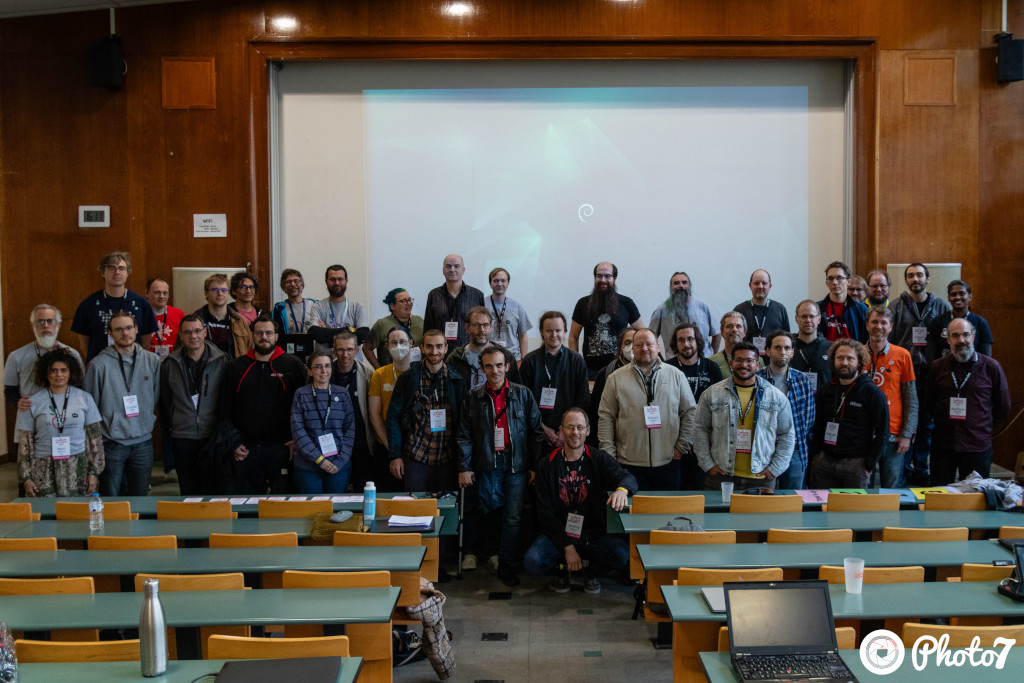
Reproducible Builds at FOSDEM 2025 Similar to last year s event, there was considerable activity regarding Reproducible Builds at FOSDEM 2025, held on on 1st and 2nd February this year in Brussels, Belgium. We count at least four talks related to reproducible builds. (You can also read our news report from last year s event in which Holger Levsen presented in the main track.)
Jelle van der Waa, Holger Levsen and kpcyrd presented in the Distributions track on A Tale of several distros joining forces for a common goal. In this talk, three developers from two different Linux distributions (Arch Linux and Debian), discuss this goal which is, of course, reproducible builds. The presenters discuss both what is shared and different between the two efforts, touching on the history and future challenges alike. The slides of this talk are available to view, as is the full video (30m02s). The talk was also discussed on Hacker News.
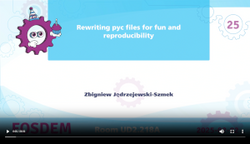
Zbigniew J drzejewski-Szmek presented in the ever-popular Python track a on Rewriting .pyc files for fun and reproducibility, i.e. the bytecode files generated by Python in order to speed up module imports: It s been known for a while that those are not reproducible: on different architectures, the bytecode for exactly the same sources ends up slightly different. The slides of this talk are available, as is the full video (28m32s).
In the Nix and NixOS track, Julien Malka presented on the Saturday asking How reproducible is NixOS: We know that the NixOS ISO image is very close to be perfectly reproducible thanks to reproducible.nixos.org, but there doesn t exist any monitoring of Nixpkgs as a whole. In this talk I ll present the findings of a project that evaluated the reproducibility of Nixpkgs as a whole by mass rebuilding packages from revisions between 2017 and 2023 and comparing the results with the NixOS cache. Unfortunately, no video of the talk is available, but there is a blog and article on the results.
Lastly, Simon Tournier presented in the Open Research track on the confluence of GNU Guix and Software Heritage: Source Code Archiving to the Rescue of Reproducible Deployment. Simon s talk describes design and implementation we came up and reports on the archival coverage for package source code with data collected over five years. It opens to some remaining challenges toward a better open and reproducible research. The slides for the talk are available, as is the full video (23m17s).

Reproducible Builds at PyCascades 2025 Vagrant Cascadian presented at this year s PyCascades conference which was held on February 8th and 9th February in Portland, OR, USA. PyCascades is a regional instance of PyCon held in the Pacific Northwest. Vagrant s talk, entitled Re-Py-Ducible Builds caught the audience s attention with the following abstract:
Crank your Python best practices up to 11 with Reproducible Builds! This talk will explore Reproducible Builds by highlighting issues identified in Python projects, from the simple to the seemingly inscrutable. Reproducible Builds is basically the crazy idea that when you build something, and you build it again, you get the exact same thing or even more important, if someone else builds it, they get the exact same thing too.
More info is available on the talk s page.

Does Functional Package Management Enable Reproducible Builds at Scale? On our mailing list last month, Julien Malka, Stefano Zacchiroli and Th o Zimmermann of T l com Paris in-house research laboratory, the Information Processing and Communications Laboratory (LTCI) announced that they had published an article asking the question: Does Functional Package Management Enable Reproducible Builds at Scale? (PDF). This month, however, Ludovic Court s followed up to the original announcement on our mailing list mentioning, amongst other things, the Guix Data Service and how that it shows the reproducibility of GNU Guix over time, as described in a GNU Guix blog back in March 2024.

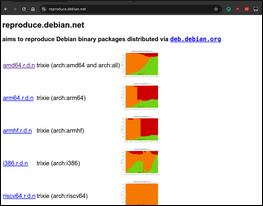
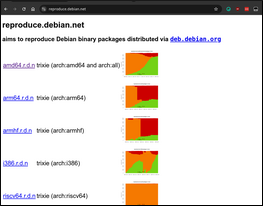
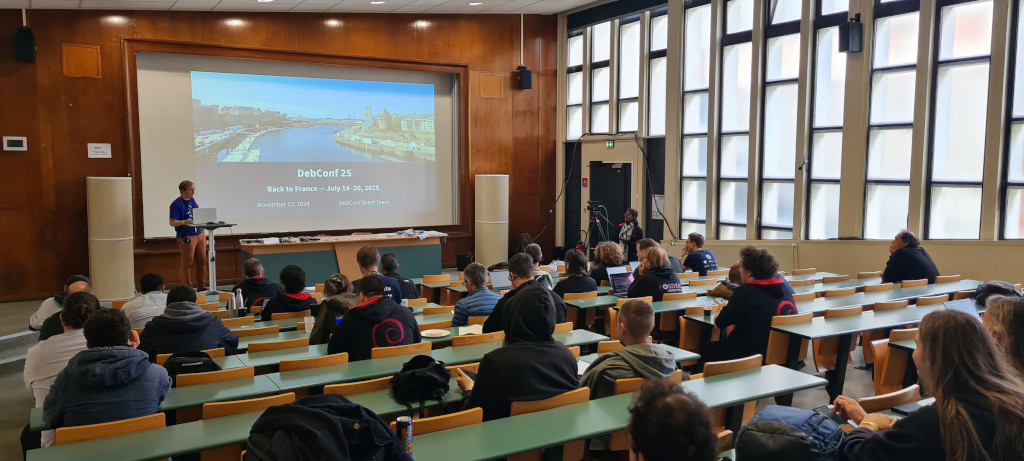
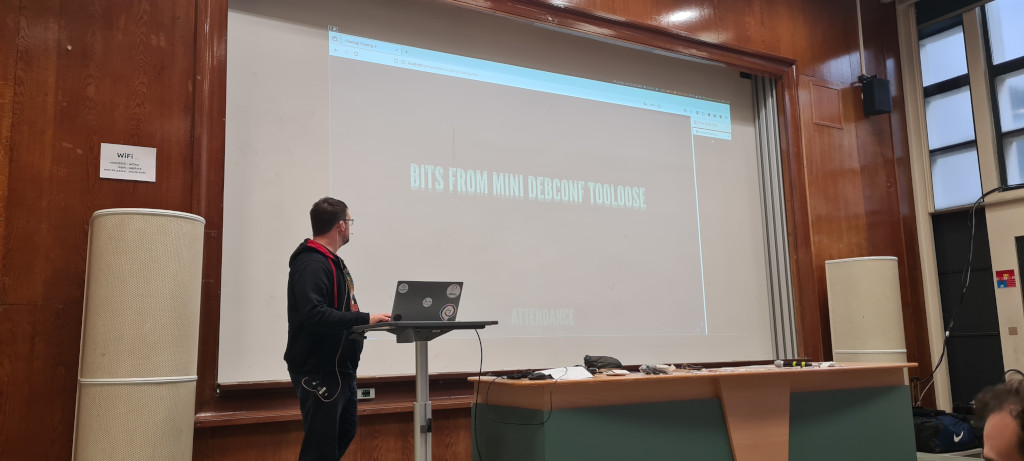
reproduce.debian.net updates The last few months have seen the introduction of reproduce.debian.net. Announced first at the recent Debian MiniDebConf in Toulouse, reproduce.debian.net is an instance of rebuilderd operated by the Reproducible Builds project. Powering this work is rebuilderd, our server which monitors the official package repositories of Linux distributions and attempt to reproduce the observed results there. This month, however, Holger Levsen:
  • Split packages that are not specific to any architecture away from amd64.reproducible.debian.net service into a new all.reproducible.debian.net page.
  • Increased the number of riscv64 nodes to a total of 4, and added a new amd64 node added thanks to our (now 10-year sponsor), IONOS.
  • Discovered an issue in the Debian build service where some new incoming build-dependencies do not end up historically archived.
  • Uploaded the devscripts package, incorporating changes from Jochen Sprickerhof to the debrebuild script specifically to fix the handling the Rules-Requires-Root header in Debian source packages.
  • Uploaded a number of Rust dependencies of rebuilderd (rust-libbz2-rs-sys, rust-actix-web, rust-actix-server, rust-actix-http, rust-actix-server, rust-actix-http, rust-actix-web-codegen and rust-time-tz) after they were prepared by kpcyrd :
Jochen Sprickerhof also updated the sbuild package to:
  • Obey requests from the user/developer for a different temporary directory.
  • Use the root/superuser for some values of Rules-Requires-Root.
  • Don t pass --root-owner-group to old versions of dpkg.
and additionally requested that many Debian packages are rebuilt by the build servers in order to work around bugs found on reproduce.debian.net. [ ][[ ][ ]
Lastly, kpcyrd has also worked towards getting rebuilderd packaged in NixOS, and Jelle van der Waa picked up the existing pull request for Fedora support within in rebuilderd and made it work with the existing Koji rebuilderd script. The server is being packaged for Fedora in an unofficial copr repository and in the official repositories after all the dependencies are packaged.

Upstream patches The Reproducible Builds project detects, dissects and attempts to fix as many currently-unreproducible packages as possible. We endeavour to send all of our patches upstream where appropriate. This month, we wrote a large number of such patches, including:

Distribution work There as been the usual work in various distributions this month, such as: In Debian, 17 reviews of Debian packages were added, 6 were updated and 8 were removed this month adding to our knowledge about identified issues.
Fedora developers Davide Cavalca and Zbigniew J drzejewski-Szmek gave a talk on Reproducible Builds in Fedora (PDF), touching on SRPM-specific issues as well as the current status and future plans.
Thanks to an investment from the Sovereign Tech Agency, the FreeBSD project s work on unprivileged and reproducible builds continued this month. Notable fixes include:
The Yocto Project has been struggling to upgrade to the latest Go and Rust releases due to reproducibility problems in the newer versions. Hongxu Jia tracked down the issue with Go which meant that the project could upgrade from the 1.22 series to 1.24, with the fix being submitted upstream for review (see above). For Rust, however, the project was significantly behind, but has made recent progress after finally identifying the blocking reproducibility issues. At time of writing, the project is at Rust version 1.82, with patches under review for 1.83 and 1.84 and fixes being discussed with the Rust developers. The project hopes to improve the tests for reproducibility in the Rust project itself in order to try and avoid future regressions. Yocto continues to maintain its ability to binary reproduce all of the recipes in OpenEmbedded-Core, regardless of the build host distribution or the current build path.
Finally, Douglas DeMaio published an article on the openSUSE blog on announcing that the Reproducible-openSUSE (RBOS) Project Hits [Significant] Milestone. In particular:
The Reproducible-openSUSE (RBOS) project, which is a proof-of-concept fork of openSUSE, has reached a significant milestone after demonstrating a usable Linux distribution can be built with 100% bit-identical packages.
This news was also announced on our mailing list by Bernhard M. Wiedemann, who also published another report for openSUSE as well.

diffoscope & strip-nondeterminism diffoscope is our in-depth and content-aware diff utility that can locate and diagnose reproducibility issues. This month, Chris Lamb made the following changes, including preparing and uploading versions 288 and 289 to Debian:
  • Add asar to DIFFOSCOPE_FAIL_TESTS_ON_MISSING_TOOLS in order to address Debian bug #1095057) [ ]
  • Catch a CalledProcessError when calling html2text. [ ]
  • Update the minimal Black version. [ ]
Additionally, Vagrant Cascadian updated diffoscope in GNU Guix to version 287 [ ][ ] and 288 [ ][ ] as well as submitted a patch to update to 289 [ ]. Vagrant also fixed an issue that was breaking reprotest on Guix [ ][ ]. strip-nondeterminism is our sister tool to remove specific non-deterministic results from a completed build. This month version 1.14.1-2 was uploaded to Debian unstable by Holger Levsen.

Website updates There were a large number of improvements made to our website this month, including:

Reproducibility testing framework The Reproducible Builds project operates a comprehensive testing framework running primarily at tests.reproducible-builds.org in order to check packages and other artifacts for reproducibility. In January, a number of changes were made by Holger Levsen, including:
  • reproduce.debian.net-related:
    • Add a helper script to manually schedule packages. [ ][ ][ ][ ][ ]
    • Fix a link in the website footer. [ ]
    • Strip the emojis from package names on the manual rebuilder in order to ease copy-and-paste. [ ]
    • On the various statistics pages, provide the number of affected source packages [ ][ ] as well as provide various totals [ ][ ].
    • Fix graph labels for the various architectures [ ][ ] and make them clickable too [ ][ ][ ].
    • Break the displayed HTML in blocks of 256 packages in order to address rendering issues. [ ][ ]
    • Add monitoring jobs for riscv64 archicture nodes and integrate them elsewhere in our infrastructure. [ ][ ]
    • Add riscv64 architecture nodes. [ ][ ][ ][ ][ ]
    • Update much of the documentation. [ ][ ][ ]
    • Make a number of improvements to the layout and style. [ ][ ][ ][ ][ ][ ][ ]
    • Remove direct links to JSON and database backups. [ ]
    • Drop a Blues Brothers reference from frontpage. [ ]
  • Debian-related:
    • Deal with /boot/vmlinuz* being called vmlinux* on the riscv64 architecture. [ ]
    • Add a new ionos17 node. [ ][ ][ ][ ][ ]
    • Install debian-repro-status on all Debian trixie and unstable jobs. [ ]
  • FreeBSD-related:
    • Switch to run latest branch of FreeBSD. [ ]
  • Misc:
    • Fix /etc/cron.d and /etc/logrotate.d permissions for Jenkins nodes. [ ]
    • Add support for riscv64 architecture nodes. [ ][ ]
    • Grant Jochen Sprickerhof access to the o4 node. [ ]
    • Disable the janitor-setup-worker. [ ][ ]
In addition:
  • kpcyrd fixed the /all/api/ API endpoints on reproduce.debian.net by altering the nginx configuration. [ ]
  • James Addison updated reproduce.debian.net to display the so-called bad reasons hyperlink inline [ ] and merged the Categorized issues links into the Reproduced builds column [ ].
  • Jochen Sprickerhof also made some reproduce.debian.net-related changes, adding support for detecting a bug in the mmdebstrap package [ ] as well as updating some documentation [ ].
  • Roland Clobus continued their work on reproducible live images for Debian, making changes related to new clustering of jobs in openQA. [ ]
And finally, both Holger Levsen [ ][ ][ ] and Vagrant Cascadian performed significant node maintenance. [ ][ ][ ][ ][ ]
If you are interested in contributing to the Reproducible Builds project, please visit our Contribute page on our website. However, you can get in touch with us via:

19 February 2025

Scarlett Gately Moore: KDE Snaps are broken, sorry lights out for now

All core22 KDE snaps are broken. There is not an easy fix. We have used kde-neon repos since inception and haven t had issues until now. libEGL fatal: DRI driver not from this Mesa build ( 23.2.1-1ubuntu3.1~22.04.3 vs 23.2.1-1ubuntu3.1~22.04.2 )
Apparently Jammy had a mesa update? Option 1: Rebuild our entire stack without neon repos ( fails due to dependencies not in Jammy, would require tracking down all of these and build from source ) Option 2: Finish the transition to core24 ( This is an enormous task and will take some time still ) Either option will take more time and effort than I have. I need to be job hunting as I have run out of resources to pay my bills. My internet/phone will be cut off in days. I am beyond stressed out and getting snippy with folks, for that I apologize. If someone wants to sponsor the above work then please donate to https://gofund.me/fe30793b otherwise I am stepping away to rethink life and my defunct career. I am truly sorry everyone. New core24 Snaps:
Arianna Epub viewer
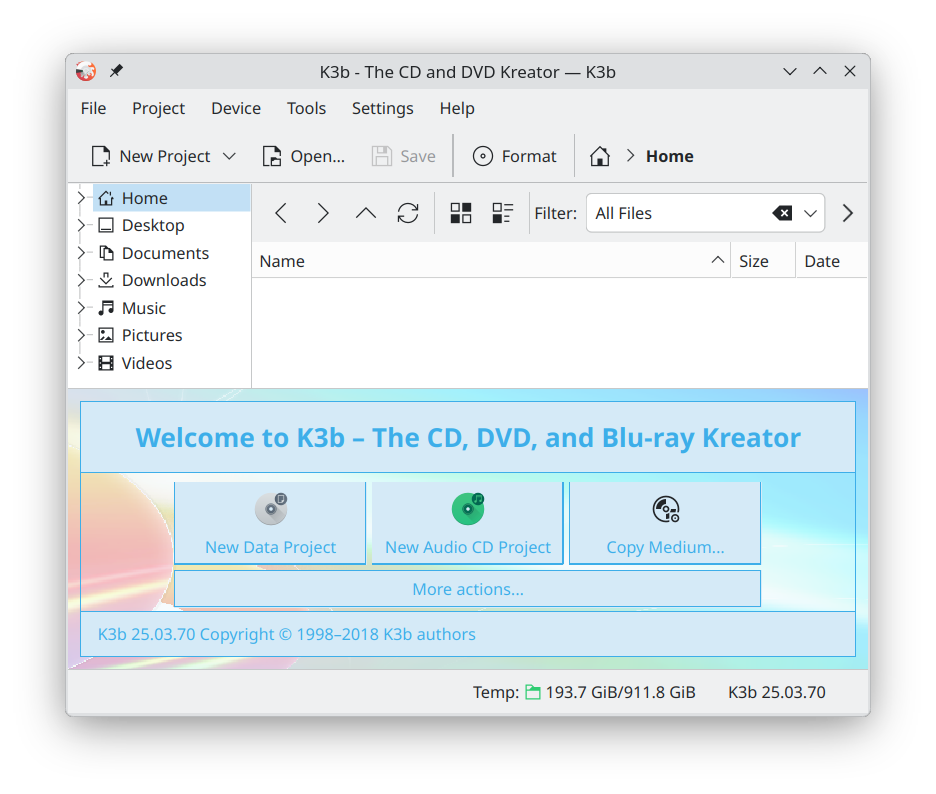
k3b Disc burner Snapcraft: Fixes for the qt5 kde-neon extension https://github.com/canonical/snapcraft/pull/5261

5 February 2025

Reproducible Builds: Reproducible Builds in January 2025

Welcome to the first report in 2025 from the Reproducible Builds project! Our monthly reports outline what we ve been up to over the past month and highlight items of news from elsewhere in the world of software supply-chain security when relevant. As usual, though, if you are interested in contributing to the Reproducible Builds project, please visit our Contribute page on our website. Table of contents:
  1. reproduce.debian.net
  2. Two new academic papers
  3. Distribution work
  4. On our mailing list
  5. Upstream patches
  6. diffoscope
  7. Website updates
  8. Reproducibility testing framework

reproduce.debian.net The last few months saw the introduction of reproduce.debian.net. Announced at the recent Debian MiniDebConf in Toulouse, reproduce.debian.net is an instance of rebuilderd operated by the Reproducible Builds project. Powering that is rebuilderd, our server designed monitor the official package repositories of Linux distributions and attempt to reproduce the observed results there. This month, however, we are pleased to announce that in addition to the existing amd64.reproduce.debian.net and i386.reproduce.debian.net architecture-specific pages, we now build for a three more architectures (for a total of five) arm64 armhf and riscv64.

Two new academic papers Giacomo Benedetti, Oreofe Solarin, Courtney Miller, Greg Tystahl, William Enck, Christian K stner, Alexandros Kapravelos, Alessio Merlo and Luca Verderame published an interesting article recently. Titled An Empirical Study on Reproducible Packaging in Open-Source Ecosystem, the abstract outlines its optimistic findings:
[We] identified that with relatively straightforward infrastructure configuration and patching of build tools, we can achieve very high rates of reproducible builds in all studied ecosystems. We conclude that if the ecosystems adopt our suggestions, the build process of published packages can be independently confirmed for nearly all packages without individual developer actions, and doing so will prevent significant future software supply chain attacks.
The entire PDF is available online to view.
In addition, Julien Malka, Stefano Zacchiroli and Th o Zimmermann of T l com Paris in-house research laboratory, the Information Processing and Communications Laboratory (LTCI) published an article asking the question: Does Functional Package Management Enable Reproducible Builds at Scale?. Answering strongly in the affirmative, the article s abstract reads as follows:
In this work, we perform the first large-scale study of bitwise reproducibility, in the context of the Nix functional package manager, rebuilding 709,816 packages from historical snapshots of the nixpkgs repository[. We] obtain very high bitwise reproducibility rates, between 69 and 91% with an upward trend, and even higher rebuildability rates, over 99%. We investigate unreproducibility causes, showing that about 15% of failures are due to embedded build dates. We release a novel dataset with all build statuses, logs, as well as full diffoscopes: recursive diffs of where unreproducible build artifacts differ.
As above, the entire PDF of the article is available to view online.

Distribution work There as been the usual work in various distributions this month, such as:
  • 10+ reviews of Debian packages were added, 11 were updated and 10 were removed this month adding to our knowledge about identified issues. A number of issue types were updated also.
  • The FreeBSD Foundation announced that a planned project to deliver zero-trust builds has begun in January 2025 . Supported by the Sovereign Tech Agency, this project is centered on the various build processes, and that the primary goal of this work is to enable the entire release process to run without requiring root access, and that build artifacts build reproducibly that is, that a third party can build bit-for-bit identical artifacts. The full announcement can be found online, which includes an estimated schedule and other details.

On our mailing list On our mailing list this month:
  • Following-up to a substantial amount of previous work pertaining the Sphinx documentation generator, James Addison asked a question pertaining to the relationship between SOURCE_DATE_EPOCH environment variable and testing that generated a number of replies.
  • Adithya Balakumar of Toshiba asked a question about whether it is possible to make ext4 filesystem images reproducible. Adithya s issue is that even the smallest amount of post-processing of the filesystem results in the modification of the Last mount and Last write timestamps.
  • James Addison also investigated an interesting issue surrounding our disorderfs filesystem. In particular:
    FUSE (Filesystem in USErspace) filesystems such as disorderfs do not delete files from the underlying filesystem when they are deleted from the overlay. This can cause seemingly straightforward tests for example, cases that expect directory contents to be empty after deletion is requested for all files listed within them to fail.

Upstream patches The Reproducible Builds project detects, dissects and attempts to fix as many currently-unreproducible packages as possible. We endeavour to send all of our patches upstream where appropriate. This month, we wrote a large number of such patches, including:

diffoscope diffoscope is our in-depth and content-aware diff utility that can locate and diagnose reproducibility issues. This month, Chris Lamb made the following changes, including preparing and uploading versions 285, 286 and 287 to Debian:
  • Security fixes:
    • Validate the --css command-line argument to prevent a potential Cross-site scripting (XSS) attack. Thanks to Daniel Schmidt from SRLabs for the report. [ ]
    • Prevent XML entity expansion attacks. Thanks to Florian Wilkens from SRLabs for the report.. [ ][ ]
    • Print a warning if we have disabled XML comparisons due to a potentially vulnerable version of pyexpat. [ ]
  • Bug fixes:
    • Correctly identify changes to only the line-endings of files; don t mark them as Ordering differences only. [ ]
    • When passing files on the command line, don t call specialize( ) before we ve checked that the files are identical or not. [ ]
    • Do not exit with a traceback if paths are inaccessible, either directly, via symbolic links or within a directory. [ ]
    • Don t cause a traceback if cbfstool extraction failed.. [ ]
    • Use the surrogateescape mechanism to avoid a UnicodeDecodeError and crash when any decoding zipinfo output that is not UTF-8 compliant. [ ]
  • Testsuite improvements:
    • Don t mangle newlines when opening test fixtures; we want them untouched. [ ]
    • Move to assert_diff in test_text.py. [ ]
  • Misc improvements:
    • Drop unused subprocess imports. [ ][ ]
    • Drop an unused function in iso9600.py. [ ]
    • Inline a call and check of Config().force_details; no need for an additional variable in this particular method. [ ]
    • Remove an unnecessary return value from the Difference.check_for_ordering_differences method. [ ]
    • Remove unused logging facility from a few comparators. [ ]
    • Update copyright years. [ ][ ]
In addition, fridtjof added support for the ASAR .tar-like archive format. [ ][ ][ ][ ] and lastly, Vagrant Cascadian updated diffoscope in GNU Guix to version 285 [ ][ ] and 286 [ ][ ].
strip-nondeterminism is our sister tool to remove specific non-deterministic results from a completed build. This month version 1.14.1-1 was uploaded to Debian unstable by Chris Lamb, making the following the changes:
  • Clarify the --verbose and non --verbose output of bin/strip-nondeterminism so we don t imply we are normalizing files that we are not. [ ]
  • Bump Standards-Version to 4.7.0. [ ]

Website updates There were a large number of improvements made to our website this month, including:

Reproducibility testing framework The Reproducible Builds project operates a comprehensive testing framework running primarily at tests.reproducible-builds.org in order to check packages and other artifacts for reproducibility. In January, a number of changes were made by Holger Levsen, including:
  • reproduce.debian.net-related:
    • Add support for rebuilding the armhf architecture. [ ][ ]
    • Add support for rebuilding the arm64 architecture. [ ][ ][ ][ ]
    • Add support for rebuilding the riscv64 architecture. [ ][ ]
    • Move the i386 builder to the osuosl5 node. [ ][ ][ ][ ]
    • Don t run our rebuilders on a public port. [ ][ ]
    • Add database backups on all builders and add links. [ ][ ]
    • Rework and dramatically improve the statistics collection and generation. [ ][ ][ ][ ][ ][ ]
    • Add contact info to the main page [ ], thumbnails [ ] as well as the new, missing architectures. [ ]
    • Move the amd64 worker to the osuosl4 and node. [ ]
    • Run the underlying debrebuild script under nice. [ ]
    • Try to use TMPDIR when calling debrebuild. [ ][ ]
  • buildinfos.debian.net-related:
    • Stop creating buildinfo-pool_$ suite _$ arch .list files. [ ]
    • Temporarily disable automatic updates of pool links. [ ]
  • FreeBSD-related:
    • Fix the sudoers to actually permit builds. [ ]
    • Disable debug output for FreeBSD rebuilding jobs. [ ]
    • Upgrade to FreeBSD 14.2 [ ] and document that bmake was installed on the underlying FreeBSD virtual machine image [ ].
  • Misc:
    • Update the real year to 2025. [ ]
    • Don t try to install a Debian bookworm kernel from backports on the infom08 node which is running Debian trixie. [ ]
    • Don t warn about system updates for systems running Debian testing. [ ]
    • Fix a typo in the ZOMBIES definition. [ ][ ]
In addition:
  • Ed Maste modified the FreeBSD build system to the clean the object directory before commencing a build. [ ]
  • Gioele Barabucci updated the rebuilder stats to first add a category for network errors [ ] as well as to categorise failures without a diffoscope log [ ].
  • Jessica Clarke also made some FreeBSD-related changes, including:
    • Ensuring we clean up the object directory for second build as well. [ ][ ]
    • Updating the sudoers for the relevant rm -rf command. [ ]
    • Update the cleanup_tmpdirs method to to match other removals. [ ]
  • Jochen Sprickerhof:
  • Roland Clobus:
    • Update the reproducible_debstrap job to call Debian s debootstrap with the full path [ ] and to use eatmydata as well [ ][ ].
    • Make some changes to deduce the CPU load in the debian_live_build job. [ ]
Lastly, both Holger Levsen [ ] and Vagrant Cascadian [ ] performed some node maintenance.
If you are interested in contributing to the Reproducible Builds project, please visit our Contribute page on our website. However, you can get in touch with us via:

31 January 2025

Gunnar Wolf: ChatGPT is bullshit

This post is an unpublished review for ChatGPT is bullshit
As people around the world understand how LLMs behave, more and more people wonder as to why these models hallucinate, and what can be done about to reduce it. This provocatively named article by Michael Townsen Hicks, James Humphries and Joe Slater bring is an excellent primer to better understanding how LLMs work and what to expect from them. As humans carrying out our relations using our language as the main tool, we are easily at awe with the apparent ease with which ChatGPT (the first widely available, and to this day probably the best known, LLM-based automated chatbot) simulates human-like understanding and how it helps us to easily carry out even daunting data aggregation tasks. It is common that people ask ChatGPT for an answer and, if it gets part of the answer wrong, they justify it by stating that it s just a hallucination. Townsen et al. invite us to switch from that characterization to a more correct one: LLMs are bullshitting. This term is formally presented by Frankfurt [1]. To Bullshit is not the same as to lie, because lying requires to know (and want to cover) the truth. A bullshitter not necessarily knows the truth, they just have to provide a compelling description, regardless of what is really aligned with truth. After introducing Frankfurt s ideas, the authors explain the fundamental ideas behind LLM-based chatbots such as ChatGPT; a Generative Pre-trained Transformer (GPT) s have as their only goal to produce human-like text, and it is carried out mainly by presenting output that matches the input s high-dimensional abstract vector representation, and probabilistically outputs the next token (word) iteratively with the text produced so far. Clearly, a GPT s ask is not to seek truth or to convey useful information they are built to provide a normal-seeming response to the prompts provided by their user. Core data are not queried to find optimal solutions for the user s requests, but are generated on the requested topic, attempting to mimic the style of document set it was trained with. Erroneous data emitted by a LLM is, thus, not equiparable with what a person could hallucinate with, but appears because the model has no understanding of truth; in a way, this is very fitting with the current state of the world, a time often termed as the age of post-truth [2]. Requesting an LLM to provide truth in its answers is basically impossible, given the difference between intelligence and consciousness: Following Harari s definitions [3], LLM systems, or any AI-based system, can be seen as intelligent, as they have the ability to attain goals in various, flexible ways, but they cannot be seen as conscious, as they have no ability to experience subjectivity. This is, the LLM is, by definition, bullshitting its way towards an answer: their goal is to provide an answer, not to interpret the world in a trustworthy way. The authors close their article with a plea for literature on the topic to adopt the more correct bullshit term instead of the vacuous, anthropomorphizing hallucination . Of course, being the word already loaded with a negative meaning, it is an unlikely request. This is a great article that mixes together Computer Science and Philosophy, and can shed some light on a topic that is hard to grasp for many users. [1] Frankfurt, Harry (2005). On Bullshit. Princeton University Press. [2] Zoglauer, Thomas (2023). Constructed truths: truth and knowledge in a post-truth world. Springer. [3] Harari, Yuval Noah (2023. Nexus: A Brief History of Information Networks From the Stone Age to AI. Random House.

17 January 2025

C.J. Collier: Security concerns regarding OpenSSH mac sha1 in Debian

What is HMAC? HMAC stands for Hash-Based Message Authentication Code. It s a specific way to use a cryptographic hash function (like SHA-1, SHA-256, etc.) along with a secret key to produce a unique fingerprint of some data. This fingerprint allows someone else with the same key to verify that the data hasn t been tampered with. How HMAC Works Keyed Hashing: The core idea is to incorporate the secret key into the hashing process. This is done in a specific way to prevent clever attacks that might try to bypass the security.
Inner and Outer Hashing: HMAC uses two rounds of hashing. First, the message and a modified version of the key are hashed together. Then, the result of that hash, along with another modified version of the key, are hashed again. This two-step process adds an extra layer of protection. HMAC in OpenSSH OpenSSH uses HMAC to ensure the integrity of messages sent back and forth during an SSH session. This prevents an attacker from subtly modifying data in transit. HMAC-SHA1 with OpenSSH: Is it Weak? SHA-1 itself is considered cryptographically broken. This means that with enough computing power, it s possible to find collisions (two different messages that produce the same hash). However, HMAC-SHA1 is generally still considered secure for most purposes. This is because exploiting weaknesses in SHA-1 to break HMAC-SHA1 is much more difficult than just finding collisions in SHA-1. Should you use it? While HMAC-SHA1 might still be okay for now, it s best practice to move to stronger alternatives like HMAC-SHA256 or HMAC-SHA512. OpenSSH supports these, and they provide a greater margin of safety against future attacks. In Summary HMAC is a powerful tool for ensuring data integrity. Even though SHA-1 has weaknesses, HMAC-SHA1 in OpenSSH is likely still safe for most users. However, to be on the safe side and prepare for the future, switching to HMAC-SHA256 or HMAC-SHA512 is recommended. Following are instructions for creating dataproc clusters with sha1 mac support removed: I can appreciate an excess of caution, and I can offer you some code to produce Dataproc instances which do not allow HMAC authentication using sha1. Place code similar to this in a startup script or an initialization action that you reference when creating a cluster with gcloud dataproc clusters create:
#!/bin/bash
# remove mac specification from sshd configuration
sed -i -e 's/^macs.*$//' /etc/ssh/sshd_config
# place a new mac specification at the end of the service configuration
ssh -Q mac   perl -e \
  '@mac=grep  chomp; ! /sha1/  ; print("macs ", join(",",@mac), $/)' >> /etc/ssh/sshd_config
# reload the new ssh service configuration
systemctl reload ssh.service
If this code is hosted on GCS, you can refer to it with
--initialization-actions=CLOUD_STORAGE_URI,[...]
or
--metadata startup-script-url=CLOUD_STORAGE_URI,[...]

9 January 2025

Reproducible Builds: Reproducible Builds in December 2024

Welcome to the December 2024 report from the Reproducible Builds project! Our monthly reports outline what we ve been up to over the past month and highlight items of news from elsewhere in the world of software supply-chain security when relevant. As ever, however, if you are interested in contributing to the Reproducible Builds project, please visit our Contribute page on our website. Table of contents:
  1. reproduce.debian.net
  2. debian-repro-status
  3. On our mailing list
  4. Enhancing the Security of Software Supply Chains
  5. diffoscope
  6. Supply-chain attack in the Solana ecosystem
  7. Website updates
  8. Debian changes
  9. Other development news
  10. Upstream patches
  11. Reproducibility testing framework

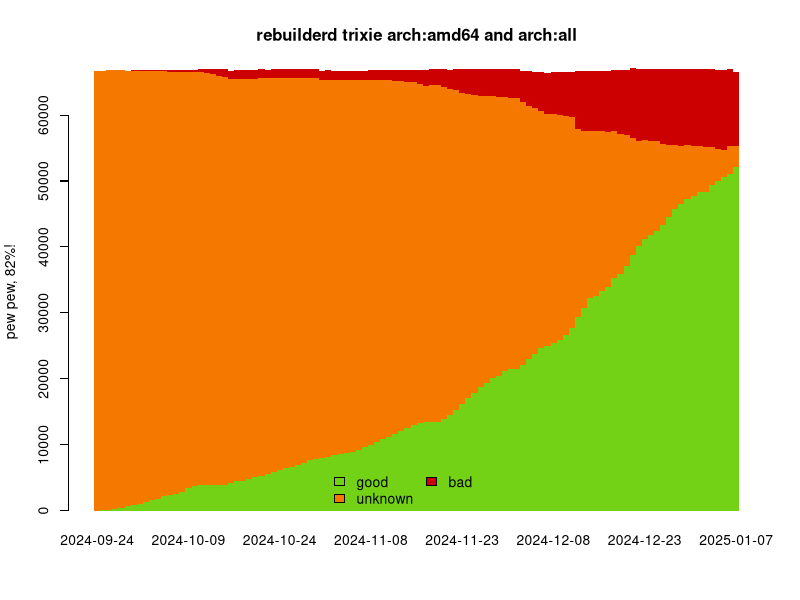
reproduce.debian.net Last month saw the introduction of reproduce.debian.net. Announced at the recent Debian MiniDebConf in Toulouse, reproduce.debian.net is an instance of rebuilderd operated by the Reproducible Builds project. rebuilderd is our server designed monitor the official package repositories of Linux distributions and attempts to reproduce the observed results there. This month, however, we are pleased to announce that not only does the service now produce graphs, the reproduce.debian.net homepage itself has become a start page of sorts, and the amd64.reproduce.debian.net and i386.reproduce.debian.net pages have emerged. The first of these rebuilds the amd64 architecture, naturally, but it also is building Debian packages that are marked with the no architecture label, all. The second builder is, however, only rebuilding the i386 architecture. Both of these services were also switched to reproduce the Debian trixie distribution instead of unstable, which started with 43% of the archive rebuild with 79.3% reproduced successfully. This is very much a work in progress, and we ll start reproducing Debian unstable soon. Our i386 hosts are very kindly sponsored by Infomaniak whilst the amd64 node is sponsored by OSUOSL thank you! Indeed, we are looking for more workers for more Debian architectures; please contact us if you are able to help.

debian-repro-status Reproducible builds developer kpcyrd has published a client program for reproduce.debian.net (see above) that queries the status of the locally installed packages and rates the system with a percentage score. This tool works analogously to arch-repro-status for the Arch Linux Reproducible Builds setup. The tool was packaged for Debian and is currently available in Debian trixie: it can be installed with apt install debian-repro-status.

On our mailing list On our mailing list this month:
  • Bernhard M. Wiedemann wrote a detailed post on his long journey towards a bit-reproducible Emacs package. In his interesting message, Bernhard goes into depth about the tools that they used and the lower-level technical details of, for instance, compatibility with the version for glibc within openSUSE.
  • Shivanand Kunijadar posed a question pertaining to the reproducibility issues with encrypted images. Shivanand explains that they must use a random IV for encryption with AES CBC. The resulting artifact is not reproducible due to the random IV used. The message resulted in a handful of replies, hopefully helpful!
  • User Danilo posted an in interesting question related to their attempts in trying to achieve reproducible builds for Threema Desktop 2.0. The question resulted in a number of replies attempting to find the right combination of compiler and linker flags (for example).
  • Longstanding contributor David A. Wheeler wrote to our list announcing the release of the Census III of Free and Open Source Software: Application Libraries report written by Frank Nagle, Kate Powell, Richie Zitomer and David himself. As David writes in his message, the report attempts to answer the question what is the most popular Free and Open Source Software (FOSS)? .
  • Lastly, kpcyrd followed-up to a post from September 2024 which mentioned their desire for someone to implement a hashset of allowed module hashes that is generated during the kernel build and then embedded in the kernel image , thus enabling a deterministic and reproducible build. However, they are now reporting that somebody implemented the hash-based allow list feature and submitted it to the Linux kernel mailing list . Like kpcyrd, we hope it gets merged.

Enhancing the Security of Software Supply Chains: Methods and Practices Mehdi Keshani of the Delft University of Technology in the Netherlands has published their thesis on Enhancing the Security of Software Supply Chains: Methods and Practices . Their introductory summary first begins with an outline of software supply chains and the importance of the Maven ecosystem before outlining the issues that it faces that threaten its security and effectiveness . To address these:
First, we propose an automated approach for library reproducibility to enhance library security during the deployment phase. We then develop a scalable call graph generation technique to support various use cases, such as method-level vulnerability analysis and change impact analysis, which help mitigate security challenges within the ecosystem. Utilizing the generated call graphs, we explore the impact of libraries on their users. Finally, through empirical research and mining techniques, we investigate the current state of the Maven ecosystem, identify harmful practices, and propose recommendations to address them.
A PDF of Mehdi s entire thesis is available to download.

diffoscope diffoscope is our in-depth and content-aware diff utility that can locate and diagnose reproducibility issues. This month, Chris Lamb made the following changes, including preparing and uploading versions 283 and 284 to Debian:
  • Update copyright years. [ ]
  • Update tests to support file 5.46. [ ][ ]
  • Simplify tests_quines.py::test_ differences,differences_deb to simply use assert_diff and not mangle the test fixture. [ ]

Supply-chain attack in the Solana ecosystem A significant supply-chain attack impacted Solana, an ecosystem for decentralised applications running on a blockchain. Hackers targeted the @solana/web3.js JavaScript library and embedded malicious code that extracted private keys and drained funds from cryptocurrency wallets. According to some reports, about $160,000 worth of assets were stolen, not including SOL tokens and other crypto assets.

Website updates Similar to last month, there was a large number of changes made to our website this month, including:
  • Chris Lamb:
    • Make the landing page hero look nicer when the vertical height component of the viewport is restricted, not just the horizontal width.
    • Rename the Buy-in page to Why Reproducible Builds? [ ]
    • Removing the top black border. [ ][ ]
  • Holger Levsen:
  • hulkoba:
    • Remove the sidebar-type layout and move to a static navigation element. [ ][ ][ ][ ]
    • Create and merge a new Success stories page, which highlights the success stories of Reproducible Builds, showcasing real-world examples of projects shipping with verifiable, reproducible builds. These stories aim to enhance the technical resilience of the initiative by encouraging community involvement and inspiring new contributions. . [ ]
    • Further changes to the homepage. [ ]
    • Remove the translation icon from the navigation bar. [ ]
    • Remove unused CSS styles pertaining to the sidebar. [ ]
    • Add sponsors to the global footer. [ ]
    • Add extra space on large screens on the Who page. [ ]
    • Hide the side navigation on small screens on the Documentation pages. [ ]

Debian changes There were a significant number of reproducibility-related changes within Debian this month, including:
  • Santiago Vila uploaded version 0.11+nmu4 of the dh-buildinfo package. In this release, the dh_buildinfo becomes a no-op ie. it no longer does anything beyond warning the developer that the dh-buildinfo package is now obsolete. In his upload, Santiago wrote that We still want packages to drop their [dependency] on dh-buildinfo, but now they will immediately benefit from this change after a simple rebuild.
  • Holger Levsen filed Debian bug #1091550 requesting a rebuild of a number of packages that were built with a very old version of dpkg.
  • Fay Stegerman contributed to an extensive thread on the debian-devel development mailing list on the topic of Supporting alternative zlib implementations . In particular, Fay wrote about her results experimenting whether zlib-ng produces identical results or not.
  • kpcyrd uploaded a new rust-rebuilderd-worker, rust-derp, rust-in-toto and debian-repro-status to Debian, which passed successfully through the so-called NEW queue.
  • Gioele Barabucci filed a number of bugs against the debrebuild component/script of the devscripts package, including:
    • #1089087: Address a spurious extra subdirectory in the build path.
    • #1089201: Extra zero bytes added to .dynstr when rebuilding CMake projects.
    • #1089088: Some binNMUs have a 1-second offset in some timestamps.
  • Gioele Barabucci also filed a bug against the dh-r package to report that the Recommends and Suggests fields are missing from rebuilt R packages. At the time of writing, this bug has no patch and needs some help to make over 350 binary packages reproducible.
  • Lastly, 8 reviews of Debian packages were added, 11 were updated and 11 were removed this month adding to our knowledge about identified issues.

Other development news In other ecosystem and distribution news:
  • Lastly, in openSUSE, Bernhard M. Wiedemann published another report for the distribution. There, Bernhard reports about the success of building R-B-OS , a partial fork of openSUSE with only 100% bit-reproducible packages. This effort was sponsored by the NLNet NGI0 initiative.

Upstream patches The Reproducible Builds project detects, dissects and attempts to fix as many currently-unreproducible packages as possible. We endeavour to send all of our patches upstream where appropriate. This month, we wrote a large number of such patches, including:

Reproducibility testing framework The Reproducible Builds project operates a comprehensive testing framework running primarily at tests.reproducible-builds.org in order to check packages and other artifacts for reproducibility. In November, a number of changes were made by Holger Levsen, including:
  • reproduce.debian.net-related:
    • Add a new i386.reproduce.debian.net rebuilder. [ ][ ][ ][ ][ ][ ]
    • Make a number of updates to the documentation. [ ][ ][ ][ ][ ]
    • Run i386.reproduce.debian.net run on a public port to allow external workers. [ ]
    • Add a link to the /api/v0/pkgs/list endpoint. [ ]
    • Add support for a statistics page. [ ][ ][ ][ ][ ][ ]
    • Limit build logs to 20 MiB and diffoscope output to 10 MiB. [ ]
    • Improve the frontpage. [ ][ ]
    • Explain that we re testing arch:any and arch:all on the amd64 architecture, but only arch:any on i386. [ ]
  • Misc:
    • Remove code for testing Arch Linux, which has moved to reproduce.archlinux.org. [ ][ ]
    • Don t install dstat on Jenkins nodes anymore as its been removed from Debian trixie. [ ]
    • Prepare the infom08-i386 node to become another rebuilder. [ ]
    • Add debug date output for benchmarking the reproducible_pool_buildinfos.sh script. [ ]
    • Install installation-birthday everywhere. [ ]
    • Temporarily disable automatic updates of pool links on buildinfos.debian.net. [ ]
    • Install Recommends by default on Jenkins nodes. [ ]
    • Rename rebuilder_stats.py to rebuilderd_stats.py. [ ]
    • r.d.n/stats: minor formatting changes. [ ]
    • Install files under /etc/cron.d/ with the correct permissions. [ ]
and Jochen Sprickerhof made the following changes: Lastly, Gioele Barabucci also classified packages affected by 1-second offset issue filed as Debian bug #1089088 [ ][ ][ ][ ], Chris Hofstaedtler updated the URL for Grml s dpkg.selections file [ ], Roland Clobus updated the Jenkins log parser to parse warnings from diffoscope [ ] and Mattia Rizzolo banned a number of bots and crawlers from the service [ ][ ].
If you are interested in contributing to the Reproducible Builds project, please visit our Contribute page on our website. However, you can get in touch with us via:

2 January 2025

Colin Watson: Free software activity in December 2024

Most of my Debian contributions this month were sponsored by Freexian, as well as one direct donation via Liberapay (thanks!). OpenSSH I issued a bookworm update with a number of fixes that had accumulated over the last year, especially fixing GSS-API key exchange which was quite broken in bookworm. base-passwd A few months ago, the adduser maintainer started a discussion with me (as the base-passwd maintainer) and the shadow maintainer about bringing all three source packages under one team, since they often need to cooperate on things like user and group names. I agreed, but hadn t got round to doing anything about it until recently. I ve now officially moved it under team maintenance. debconf Gioele Barabucci has been working on eliminating duplicated code between debconf and cdebconf, ultimately with the goal of migrating to cdebconf (which I m not sure I m convinced of as a goal, but if we can make improvements to both packages as part of working towards it then there s no harm in that). I finally got round to reviewing and merging confmodule changes in each of debconf and cdebconf. This caused an installer regression due to a weirdness in cdebconf-udeb s packaging, which I fixed - sorry about that! I ve also been dealing with a few patch submissions that had been in my queue for a long time, but more on that next month if all goes well. CI issues I noticed and fixed a problem with Restrictions: needs-sudo in autopkgtest. I fixed broken aptly images in the Salsa CI pipeline. Python team Last month, I mentioned some progress on sorting out the multipart vs. python-multipart name conflict in Debian (#1085728), and said that I thought we d be able to finish it soon. I was right! We got it all done this month: The Python 3.13 transition continues, and last month we were able to add it to the supported Python versions in testing. (The next step will be to make it the default.) I fixed lots of problems in aid of this, including: Sphinx 8.0 removed some old intersphinx_mapping syntax which turned out to still be in use by many packages in Debian. The fixes for this were individually trivial, but there were a lot of them: I found that twisted 24.11.0 broke tests in buildbot and wokkel, and fixed those. I packaged python-flatdict, needed for a new upstream version of python-semantic-release. I tracked down a test failure in vdirsyncer (which I ve been using for some years, but had never previously needed to modify) and contributed a fix upstream. I fixed some packages to tolerate future versions of dh-python that will drop their dependency on python3-setuptools: I fixed django-cte to remove a build-dependency on the obsolete python3-nose package. I added Django 5.1 support to django-polymorphic. (There are a number of other packages that still need work here.) I fixed various other build/test failures: I upgraded these packages to new upstream versions: I updated the team s library style guide to remove material related to Python 2 and early versions of Python 3, which is no longer relevant to any current Python packaging work. Other Python upstream work I happened to notice a Twisted upstream issue requesting the removal of the deprecated twisted.internet.defer.returnValue, realized it was still used in many places in Debian, and went on a PR-filing spree informed by codesearch to try to reduce the future impact of such a change on Debian: Other small fixes Santiago Vila has been building the archive with make --shuffle (also see its author s explanation). I fixed associated bugs in cccc (contributed upstream), groff, and spectemu. I backported an upstream patch to putty to fix undefined behaviour that affected use of the small keypad . I removed groff s Recommends: libpaper1 (#1091375, #1091376), since it isn t currently all that useful and was getting in the way of a transition to libpaper2. I filed an upstream bug suggesting better integration in this area.

31 December 2024

Chris Lamb: Favourites of 2024

Here are my favourite books and movies that I read and watched throughout 2024. It wasn't quite the stellar year for books as previous years: few of those books that make you want to recommend and/or buy them for all your friends. In subconscious compensation, perhaps, I reread a few classics (e.g. True Grit, Solaris), and I'm almost finished my second read of War and Peace.

Books

Elif Batuman: Either/Or (2022) Stella Gibbons: Cold Comfort Farm (1932) Michel Faber: Under The Skin (2000) Wallace Stegner: Crossing to Safety (1987) Gustave Flaubert: Madame Bovary (1857) Rachel Cusk: Outline (2014) Sara Gran: The Book of the Most Precious Substance (2022) Anonymous: The Railway Traveller s Handy Book (1862) Natalie Hodges: Uncommon Measure: A Journey Through Music, Performance, and the Science of Time (2022)Gary K. Wolf: Who Censored Roger Rabbit? (1981)

Films Recent releases

Seen at a 2023 festival. Disappointments this year included Blitz (Steve McQueen), Love Lies Bleeding (Rose Glass), The Room Next Door (Pedro Almod var) and Emilia P rez (Jacques Audiard), whilst the worst new film this year was likely The Substance (Coralie Fargeat), followed by Megalopolis (Francis Ford Coppola), Unfrosted (Jerry Seinfeld) and Joker: Folie Deux (Todd Phillips).
Older releases ie. Films released before 2023, and not including rewatches from previous years. Distinctly unenjoyable watches included The Island of Dr. Moreau (John Frankenheimer, 1996), Southland Tales (Richard Kelly, 2006), Any Given Sunday (Oliver Stone, 1999) & The Hairdresser s Husband (Patrice Leconte, 19990). On the other hand, unforgettable cinema experiences this year included big-screen rewatches of Solaris (Andrei Tarkovsky, 1972), Blade Runner (Ridley Scott, 1982), Apocalypse Now (Francis Ford Coppola, 1979) and Die Hard (John McTiernan, 1988).

29 December 2024

Russ Allbery: Review: The Last Hour Between Worlds

Review: The Last Hour Between Worlds, by Melissa Caruso
Series: The Echo Archives #1
Publisher: Orbit
Copyright: November 2024
ISBN: 0-316-30364-X
Format: Kindle
Pages: 388
The Last Hour Between Worlds is urban, somewhat political high fantasy with strong fae vibes. It is the first book of a series, but it stands alone quite well. Kembral Thorne is a Hound, a member of the guild that serves as guards, investigators, and protectors. Kembral's specialty is Echo retrieval: rescues of people and animals who have fallen through a weak spot in reality into one of the strange, dangerous, and malleable layers called Echoes. Kem once rescued a dog from six layers down, an almost unheard-of feat. Kem is also a new single mother, which means her past two months have been spent in a sleep-deprived haze revolving exclusively around her much-beloved infant. Dona Marjorie Swift's year-turning party is the first time she's been out without Emmi since she gave birth, and she's only there because her sister took the child and practically shoved her out the door. Now, she's desperately trying to remember how to be social and normal, which is not made easier by the unexpected presence of Rika at the party. Rika Nonesuch is not a Hound. She's a Cat, a member of the guild of thieves and occasional assassins. They are the nemesis of the Hounds, but in a stylized and formalized way in which certain courtesies are expected. (The politics of this don't really make sense; you just have to go with it.) Kem has complicated feelings about Rika's grace, banter, and intoxicating perfume, feelings that she thought might be reciprocated until Rika drugged her during an apparent date and left her buried under a pile of garbage. She was not expecting Rika to be at this party and is definitely not ready to have a conversation with her. This emotional turmoil is rudely interrupted by the death of nearly everyone at the party via an Echo poison, the appearance of a dark figure driving a black sword into someone, and the descent of the entire party into an Echo. This was one of those books that kept getting better the farther into the book I read. I was a bit leery at first because the publisher's blurb made it sound more like horror than I prefer, but this is more the disturbing strangeness of fae creatures than the sort of gruesomeness, disgust, or body horror that I find off-putting. Most importantly, the point of this book is not to torture the characters or scare the reader. It's instead structured a bit like a murder mystery, but one whose resolution requires working out obscure fantasy rules and hidden political agendas. One of the currencies in the world of Echos is blood, but another is emotion, revelation, and the stories that bring both, and Caruso focuses the story more on that aspect than on horrifying imagery.
Rika frowned. "Resolve it? How?" "I have no idea." I couldn't keep my frustration from leaking through. "Might be that we have to delve deep into our own hearts to confront the unhealed wounds we've carried with us in secret. Might be that we have to say their names backward, or just close our eyes and they'll go away. Echoes never make any damned sense." Rika made a face. "We'd better not have to confront our unhealed wounds, or I'm leaving you to die."
All of The Last Hour Between Worlds is told in the first person from Kem's perspective, but Rika is the best character in this book. Kem is a rather straightforward, dogged, stubborn protector; Rika is complicated, selfish, conflicted, and considerably more dynamic. The first obvious twist in her background I spotted so long before Kem found out that it was a bit frustrating, but there were multiple satisfying twists after that. As advertised in the blurb, there's a sapphic romance angle here, but it's the sort that comes from a complicated friendship and a lot of mutual respect rather than love at first sight. Some of their relationship conflict is driven by misunderstanding, but the misunderstanding happens before the novel begins, which means the reader doesn't have to sit through the bit where one yells at the characters for being stupid. It helps that the characters have something concrete to do, and that driving plot problem is multi-layered and satisfying. Each time the party falls through a layer of reality, it's mostly reset to the start of the book, but the word "mostly" is hiding a lot of subtlety. Given the clock at the start of each chapter and the blurb (if one read it), the reader can make a good guess that the plot problem will not be fully resolved until the characters fall quite deep into the Echoes, but the story never felt repetitive the way that some time loop stories can. As the characters gain more understanding, the problems change, the players change, and they have to make several excursions into the surrounding world. This is the sort of fantasy that feels a bit like science fiction. You're thrown into a world with a different culture and different rules that are foreign to the reader and natural to the characters. Part of the fun of reading is figuring out the rules, history, and backstory while watching the characters try to solve the puzzles they're faced with. The writing is good but not great. Characterization was good enough for a story primarily focused on action and puzzle-solving, but it was a bit lacking in subtlety. I think Caruso's strengths showed most in the world design, particularly the magic system and the rules followed by the Echo creatures. The excursions outside of the somewhat-protected house struck a balance between eeriness and comprehensibility that reminded me of T. Kingfisher or Sandman. The human politics were unfortunately less successful and rested on some tired centrist cliches. Thankfully, this was not the main point of the story. I should also warn that there is a lot of talk about babies. Kem's entire identity at the start of the novel, to the point of incessant monologue, is "new mother." This is not a perspective we get very often in fantasy, and Kem eventually finds a steadier balance between her bond with her daughter and the other parts of her life. I think some readers will feel very seen. But Caruso leans hard into maternal bonding. So hard. If you don't want to read about someone who is deliriously obsessed with their new child, you may want to skip this one. Right after I finished this book, I thought it was amazing. Now that I've had a few days to think about it, the lack of subtlety and the facile human politics brought it down a notch. I'm a science fiction reader at heart, so I loved the slow revelation of mechanics; the reader starts the story by knowing that Kem can "blink step" but not knowing what that means, and by the end of the story one not only knows but has opinions about its limitations, political implications, and interactions with other forms of magic. The Echo worlds are treated similarly, and this type of world-building is my jam. But the cost is that the human characters, particularly the supporting cast, don't get the same focus and therefore are a bit straightforward and obvious. The subplot with Dona Vandelle was particularly annoying. Ah well. Kem and Rika's relationship did work, and it's the center of the book. If you like fantasy mechanics but are a bit leery of fae stories because they feel too symbolic or arbitrary, give this a try. It's the most satisfyingly constructed fae story that I've read in a long time. It's not great literary fiction, but it's also not trying to be; it's a puzzle adventure, and a well-executed one. Recommended, and I will definitely be reading the sequel. Content notes: Lots of violent death and other physical damage, creepy dream worlds with implied but not explicit horror, and rather a lot of blood. Followed by The Last Soul Among Wolves, not yet published at the time I wrote this review. Rating: 8 out of 10

21 December 2024

Benjamin Mako Hill: Thug Life

My current playlist is this diorama of Lulu the Piggy channeling Tupac Shakur in a toy vending machine in the basement of New World Mall in Flushing Chinatown.

19 December 2024

Gregory Colpart: MiniDebConf Toulouse 2024

After the MiniDebConf Marseille 2019, COVID-19 made it impossible or difficult to organize new MiniDebConfs for a few years. With the gradual resumption of in-person events (like FOSDEM, DebConf, etc.), the idea emerged to host another MiniDebConf in France, but with a lighter organizational load. In 2023, we decided to reach out to the organizers of Capitole du Libre to repeat the experience of 2017: hosting a MiniDebConf alongside their annual event in Toulouse in November. However, our request came too late for 2023. After discussions with Capitole du Libre in November 2023 in Toulouse and again in February 2024 in Brussels, we confirmed that a MiniDebConf Toulouse would take place in November 2024! We then assembled a small organizing team and got to work: a Call for Papers in May 2024, adding a two-day MiniDebCamp, coordinating with the DebConf video team, securing sponsors, creating a logo, ordering T-shirts and stickers, planning the schedule, and managing registrations. Even with lighter logistics (conference rooms, badges, and catering during the weekend were handled by Capitole du Libre), there was still quite a bit of preparation to do. On Thursday, November 14, and Friday, November 15, 2024, about forty developers arrived from around the world (France, Spain, Italy, Switzerland, Germany, England, Brazil, Uruguay, India, Brest, Marseille ) to spend two days at the MiniDebCamp in the beautiful collaborative spaces of Artilect in Toulouse city center.
Then, on Saturday, November 16, and Sunday, November 17, 2024, the MiniDebConf took place at ENSEEIHT as part of the Capitole du Libre event. The conference kicked off on Saturday morning with an opening session by J r my Lecour, which included a tribute to Lunar (Nicolas Dandrimont). This was followed by Reproducible Builds Rebuilding What is Distributed from ftp.debian.org (Holger Levsen) and Discussion on My Research Work on Sustainability of Debian OS (Eda). After lunch at the Capitole du Libre food trucks, the intense afternoon schedule began: What s New in the Linux Kernel (and What s Missing in Debian) (Ben Hutchings), Linux Live Patching in Debian (Santiago Ruano Rinc n), Trixie on Mobile: Are We There Yet? (Arnaud Ferraris), PostgreSQL Container Groups, aka cgroups Down the Road (C dric Villemain), Upgrading a Thousand Debian Hosts in Less Than an Hour (J r my Lecour and myself), and Using Debusine to Automate Your QA (Stefano Rivera & co). Sunday marked the second day, starting with a presentation on DebConf 25 (Benjamin Somers), which will be held in Brest in July 2025. The morning continued with talks: How LTS Goes Beyond LTS (Santiago Ruano Rinc n & Roberto C. S nchez), Cross-Building (Helmut Grohne), and State of JavaScript (Bastien Roucari s). In the afternoon, there were Lightning Talks, PyPI Security: Past, Present & Future (Salvo LtWorf Tomaselli), and the classic Bits from DPL (Andreas Tille), before closing with the final session led by Pierre-Elliott B cue. All talks are available on video (a huge thanks to the amazing DebConf video team), and many thanks to our sponsors (Viridien, Freexian, Evolix, Collabora, and Data Bene). A big thank-you as well to the entire Capitole du Libre team for hosting and supporting us see you in Brest in July 2025! Articles about (or mentioning) MiniDebConf Toulouse:

Benjamin Mako Hill: Being a bread torus

A concerned nutritional epidemiologist in Tokyo realizes that if you are what you eat, that means
It s a similar situation in Seoul, albeit with less oil and more confidence.

12 December 2024

Dirk Eddelbuettel: #44: r2u For ML and MLops Talk

Welcome to the 44th post in the $R^4 series. A few weeks ago, and following an informal call for talks by James Lamb, I had an opportunity to talk about r2u to the Chicago ML and MLops meetup groups. You can find the slides here. Over the last 2 1/2 years, r2u has become a widely-deployed mechanism in a number of settings, including (but not limited to) software testing via continuous integration, deployment on cloud servers besides of course to more standard use on local laptops or workstation. 30 million downloads illustrate this. My thesis for the talk was that this extends equally to ML(ops) where no surprises, no hickups automated deployments are key for large-scale model training, evaluation and of course production deployments. In this context, I introduce r2u while giving credit both to what came before it, the existing alternatives (or competitors for mindshare if one prefers that phrasing), and of course what lies underneath it. The central takeaway, I argue, is that r2u can and does take advantage of a unique situation in that we can join the package manager task for the underlying (operating) system and and the application domain, here R and its unique CRAN repository network. Other approaches can, and of course do, provide binaries, but by doing this outside the realm of the system package manager can only arrive at a lesser integration (and I show a common error arising in that case). So where r2u is feasible, it dominates the alternatives (while the alternatives may well provide deployment on more platforms which, even when less integrated, may be of greater importance for some). As always, it all depends. But the talk, and its slides, motivate and illustrate why we keep calling r2u by its slogan of r2u: Fast. Easy. Reliable. Pick All Three.

This post by Dirk Eddelbuettel originated on his Thinking inside the box blog. If you like this or other open-source work I do, you can now sponsor me at GitHub. Please report excessive re-aggregation in third-party for-profit settings.

5 December 2024

Reproducible Builds: Reproducible Builds in November 2024

Welcome to the November 2024 report from the Reproducible Builds project! Our monthly reports outline what we ve been up to over the past month and highlight items of news from elsewhere in the world of software supply-chain security where relevant. As ever, if you are interested in contributing to the Reproducible Builds project, please visit our Contribute page on our website. Table of contents:
  1. Reproducible Builds mourns the passing of Lunar
  2. Introducing reproduce.debian.net
  3. New landing page design
  4. SBOMs for Python packages
  5. Debian updates
  6. Reproducible builds by default in Maven 4
  7. PyPI now supports digital attestations
  8. Dependency Challenges in OSS Package Registries
  9. Zig programming language demonstrated reproducible
  10. Website updates
  11. Upstream patches
  12. Misc development news
  13. Reproducibility testing framework

Reproducible Builds mourns the passing of Lunar The Reproducible Builds community sadly announced it has lost its founding member, Lunar. J r my Bobbio aka Lunar passed away on Friday November 8th in palliative care in Rennes, France. Lunar was instrumental in starting the Reproducible Builds project in 2013 as a loose initiative within the Debian project. He was the author of our earliest status reports and many of our key tools in use today are based on his design. Lunar s creativity, insight and kindness were often noted. You can view our full tribute elsewhere on our website. He will be greatly missed.

Introducing reproduce.debian.net In happier news, this month saw the introduction of reproduce.debian.net. Announced at the recent Debian MiniDebConf in Toulouse, reproduce.debian.net is an instance of rebuilderd operated by the Reproducible Builds project. rebuilderd is our server designed monitor the official package repositories of Linux distributions and attempts to reproduce the observed results there. In November, reproduce.debian.net began rebuilding Debian unstable on the amd64 architecture, but throughout the MiniDebConf, it had attempted to rebuild 66% of the official archive. From this, it could be determined that it is currently possible to bit-for-bit reproduce and corroborate approximately 78% of the actual binaries distributed by Debian that is, using the .buildinfo files hosted by Debian itself. reproduce.debian.net also contains instructions how to setup one s own rebuilderd instance, and we very much invite everyone with a machine to spare to setup their own version and to share the results. Whilst rebuilderd is still in development, it has been used to reproduce Arch Linux since 2019. We are especially looking for installations targeting Debian architectures other than i386 and amd64.

New landing page design As part of a very productive partnership with the Sovereign Tech Fund and Neighbourhoodie, we are pleased to unveil our new homepage/landing page. We are very happy with our collaboration with both STF and Neighbourhoodie (including many changes not directly related to the website), and look forward to working with them in the future.

SBOMs for Python packages The Python Software Foundation has announced a new cross-functional project for SBOMs and Python packages . Seth Michael Larson writes that the project is specifically looking to solve these issues :
  • Enable Python users that require SBOM documents (likely due to regulations like CRA or SSDF) to self-serve using existing SBOM generation tools.
  • Solve the phantom dependency problem, where non-Python software is bundled in Python packages but not recorded in any metadata. This makes the job of software composition analysis (SCA) tools difficult or impossible.
  • Make the adoption work by relevant projects such as build backends, auditwheel-esque tools, as minimal as possible. Empower users who are interested in having better SBOM data for the Python projects they are using to be able to contribute engineering time towards that goal.
A GitHub repository for the initiative is available, and there are a number of queries, comments and remarks on Seth s Discourse forum post.

Debian updates There was significant development within Debian this month. Firstly, at the recent MiniDebConf in Toulouse, France, Holger Levsen gave a Debian-specific talk on rebuilding packages distributed from ftp.debian.org that is to say, how to reproduce the results from the official Debian build servers: Holger described the talk as follows:
For more than ten years, the Reproducible Builds project has worked towards reproducible builds of many projects, and for ten years now we have build Debian packages twice with maximal variations applied to see if they can be build reproducible still. Since about a month, we ve also been rebuilding trying to exactly match the builds being distributed via ftp.debian.org. This talk will describe the setup and the lessons learned so far, and why the results currently are what they are (spoiler: they are less than 30% reproducible), and what we can do to fix that.
The Debian Project Leader, Andreas Tille, was present at the talk and remarked later in his Bits from the DPL update that:
It might be unfair to single out a specific talk from Toulouse, but I d like to highlight the one on reproducible builds. Beyond its technical focus, the talk also addressed the recent loss of Lunar, whom we mourn deeply. It served as a tribute to Lunar s contributions and legacy. Personally, I ve encountered packages maintained by Lunar and bugs he had filed. I believe that taking over his packages and addressing the bugs he reported is a meaningful way to honor his memory and acknowledge the value of his work.
Holger s slides and video in .webm format are available.
Next, rebuilderd is the server to monitor package repositories of Linux distributions and attempt to reproduce the observed results. This month, version 0.21.0 released, most notably with improved support for binNMUs by Jochen Sprickerhof and updating the rebuilderd-debian.sh integration to the latest debrebuild version by Holger Levsen. There has also been significant work to get the rebuilderd package into the Debian archive, in particular, both rust-rebuilderd-common version 0.20.0-1 and rust-rust-lzma version 0.6.0-1 were packaged by kpcyrd and uploaded by Holger Levsen. Related to this, Holger Levsen submitted three additional issues against rebuilderd as well:
  • rebuildctl should be more verbose when encountering issues. [ ]
  • Please add an option to used randomised queues. [ ]
  • Scheduling and re-scheduling multiple packages at once. [ ]
and lastly, Jochen Sprickerhof submitted one an issue requested that rebuilderd downloads the source package in addition to the .buildinfo file [ ] and kpcyrd also submitted and fixed an issue surrounding dependencies and clarifying the license [ ]
Separate to this, back in 2018, Chris Lamb filed a bug report against the sphinx-gallery package as it generates unreproducible content in various ways. This month, however, Dmitry Shachnev finally closed the bug, listing the multiple sub-issues that were part of the problem and how they were resolved.
Elsewhere, Roland Clobus posted to our mailing list this month, asking for input on a bug in Debian s ca-certificates-java package. The issue is that the Java key management tools embed timestamps in its output, and this output ends up in the /etc/ssl/certs/java/cacerts file on the generated ISO images. A discussion resulted from Roland s post suggesting some short- and medium-term solutions to the problem.
Holger Levsen uploaded some packages with reproducibility-related changes:
Lastly, 12 reviews of Debian packages were added, 5 were updated and 21 were removed this month adding to our knowledge about identified issues in Debian.

Reproducible builds by default in Maven 4 On our mailing list this month, Herv Boutemy reported the latest release of Maven (4.0.0-beta-5) has reproducible builds enabled by default. In his mailing list post, Herv mentions that this story started during our Reproducible Builds summit in Hamburg , where he created the upstream issue that builds on a multi-year effort to have Maven builds configured for reproducibility.

PyPI now supports digital attestations Elsewhere in the Python ecosystem and as reported on LWN and elsewhere, the Python Package Index (PyPI) has announced that it has finalised support for PEP 740 ( Index support for digital attestations ). Trail of Bits, who performed much of the development work, has an in-depth blog post about the work and its adoption, as well as what is left undone:
One thing is notably missing from all of this work: downstream verification. [ ] This isn t an acceptable end state (cryptographic attestations have defensive properties only insofar as they re actually verified), so we re looking into ways to bring verification to individual installing clients. In particular, we re currently working on a plugin architecture for pip that will enable users to load verification logic directly into their pip install flows.
There was an in-depth discussion on LWN s announcement page, as well as on Hacker News.

Dependency Challenges in OSS Package Registries At BENEVOL, the Belgium-Netherlands Software Evolution workshop in Namur, Belgium, Tom Mens and Alexandre Decan presented their paper, An Overview and Catalogue of Dependency Challenges in Open Source Software Package Registries . The abstract of their paper is as follows:
While open-source software has enabled significant levels of reuse to speed up software development, it has also given rise to the dreadful dependency hell that all software practitioners face on a regular basis. This article provides a catalogue of dependency-related challenges that come with relying on OSS packages or libraries. The catalogue is based on the scientific literature on empirical research that has been conducted to understand, quantify and overcome these challenges. [ ]
A PDF of the paper is available online.

Zig programming language demonstrated reproducible Motiejus Jak ty posted an interesting and practical blog post on his successful attempt to reproduce the Zig programming language without using the pre-compiled binaries checked into the repository, and despite the circular dependency inherent in its bootstrapping process. As a summary, Motiejus concludes that:
I can now confidently say (and you can also check, you don t need to trust me) that there is nothing hiding in zig1.wasm [the checked-in binary] that hasn t been checked-in as a source file.
The full post is full of practical details, and includes a few open questions.

Website updates Notwithstanding the significant change to the landing page (screenshot above), there were an enormous number of changes made to our website this month. This included:
  • Alex Feyerke and Mariano Gim nez:
    • Dramatically overhaul the website s landing page with new benefit cards tailored to the expected visitors to our website and a reworking of the visual hierarchy and design. [ ][ ][ ][ ][ ][ ][ ][ ][ ][ ]
  • Bernhard M. Wiedemann:
    • Update the System images page to document the e2fsprogs approach. [ ]
  • Chris Lamb:
  • FC (Fay) Stegerman:
    • Replace more inline markdown with HTML on the Success stories page. [ ]
    • Add some links, fix some other links and correct some spelling errors on the Tools page. [ ]
  • Holger Levsen:
    • Add a historical presentation ( Reproducible builds everywhere eg. in Debian, OpenWrt and LEDE ) from October 2016. [ ]
    • Add jochensp and Oejet to the list of known contributors. [ ][ ]
  • Julia Kr ger:
  • Ninette Adhikari & hulkoba:
    • Add/rework the list of success stories into a new page that clearly shows milestones in Reproducible Builds. [ ][ ][ ][ ][ ][ ]
  • Philip Rinn:
    • Import 47 historical weekly reports. [ ]
  • hulkoba:
    • Add alt text to almost all images (!). [ ][ ]
    • Fix a number of links on the Talks . [ ][ ]
    • Avoid so-called ghost buttons by not using <button> elements as links, as the affordance of a <button> implies an action with (potentially) a side effect. [ ][ ]
    • Center the sponsor logos on the homepage. [ ]
    • Move publications and generate them instead from a data.yml file with an improved layout. [ ][ ]
    • Make a large number of small but impactful stylisting changes. [ ][ ][ ][ ]
    • Expand the Tools to include a number of missing tools, fix some styling issues and fix a number of stale/broken links. [ ][ ][ ][ ][ ][ ]

Upstream patches The Reproducible Builds project detects, dissects and attempts to fix as many currently-unreproducible packages as possible. We endeavour to send all of our patches upstream where appropriate. This month, we wrote a large number of such patches, including:

Misc development news

Reproducibility testing framework The Reproducible Builds project operates a comprehensive testing framework running primarily at tests.reproducible-builds.org in order to check packages and other artifacts for reproducibility. In November, a number of changes were made by Holger Levsen, including:
  • reproduce.debian.net-related changes:
    • Create and introduce a new reproduce.debian.net service and subdomain [ ]
    • Make a large number of documentation changes relevant to rebuilderd. [ ][ ][ ][ ][ ]
    • Explain a temporary workaround for a specific issue in rebuilderd. [ ]
    • Setup another rebuilderd instance on the o4 node and update installation documentation to match. [ ][ ]
    • Make a number of helpful/cosmetic changes to the interface, such as clarifying terms and adding links. [ ][ ][ ][ ][ ]
    • Deploy configuration to the /opt and /var directories. [ ][ ]
    • Add an infancy (or alpha ) disclaimer. [ ][ ]
    • Add more notes to the temporary rebuilderd documentation. [ ]
    • Commit an nginx configuration file for reproduce.debian.net s Stats page. [ ]
    • Commit a rebuilder-worker.conf configuration for the o5 node. [ ]
  • Debian-related changes:
    • Grant jspricke and jochensp access to the o5 node. [ ][ ]
    • Build the qemu package with the nocheck build flag. [ ]
  • Misc changes:
    • Adapt the update_jdn.sh script for new Debian trixie systems. [ ]
    • Stop installing the PostgreSQL database engine on the o4 and o5 nodes. [ ]
    • Prevent accidental reboots of the o4 node because of a long-running job owned by josch. [ ][ ]
In addition, Mattia Rizzolo addressed a number of issues with reproduce.debian.net [ ][ ][ ][ ]. And lastly, both Holger Levsen [ ][ ][ ][ ] and Vagrant Cascadian [ ][ ][ ][ ] performed node maintenance.
If you are interested in contributing to the Reproducible Builds project, please visit our Contribute page on our website. However, you can get in touch with us via:

18 November 2024

C.J. Collier: Managing HPE SAS Controllers

Notes to self. And anyone else who might find them useful. Following are some ssacli commands which I use infrequently enough that they fall out of cache. This may repeat information in other blogs, but since I search my posts first when commands slip my mind, I thought I d include them here, too. hpacucli is the wrong command. Use ssacli instead.
$ KR='/usr/share/keyrings/hpe.gpg'
$ for fingerprint in \
  882F7199B20F94BD7E3E690EFADD8D64B1275EA3 \
  57446EFDE098E5C934B69C7DC208ADDE26C2B797 \
  476DADAC9E647EE27453F2A3B070680A5CE2D476 ; do \
    curl "https://keyserver.ubuntu.com/pks/lookup?op=get&search=0x$ fingerprint " \
        gpg --no-default-keyring --keyring "$ KR " --import ; \
  done
$ gpg --list-keys --no-default-keyring --keyring "$ KR " 
/usr/share/keyrings/hpe.gpg
---------------------------
pub   rsa2048 2012-12-04 [SC] [expired: 2022-12-02]
      476DADAC9E647EE27453F2A3B070680A5CE2D476
uid           [ expired] Hewlett-Packard Company RSA (HP Codesigning Service)
pub   rsa2048 2014-11-19 [SC] [expired: 2024-11-16]
      882F7199B20F94BD7E3E690EFADD8D64B1275EA3
uid           [ expired] Hewlett-Packard Company RSA (HP Codesigning Service) - 1
pub   rsa2048 2015-12-10 [SCEA] [expires: 2025-12-07]
      57446EFDE098E5C934B69C7DC208ADDE26C2B797
uid           [ unknown] Hewlett Packard Enterprise Company RSA-2048-25 
$ echo "deb [signed-by=$ KR ] http://downloads.linux.hpe.com/SDR/repo/mcp bookworm/current non-free" \
    sudo dd of=/etc/apt/sources.list.d status=none
$ sudo apt-get update
$ sudo apt-get install -y -qq ssacli > /dev/null 2>&1
$ sudo ssacli ctrl all show status
HPE Smart Array P408i-p SR Gen10 in Slot 3
   Controller Status: OK
   Cache Status: OK
   Battery/Capacitor Status: OK
$ sudo ssacli ctrl all show detail
HPE Smart Array P408i-p SR Gen10 in Slot 3
   Bus Interface: PCI
   Slot: 3
   Serial Number: PFJHD0ARCCR1QM
   RAID 6 Status: Enabled
   Controller Status: OK
   Hardware Revision: B
   Firmware Version: 2.65
   Firmware Supports Online Firmware Activation: True
   Driver Supports Online Firmware Activation: True
   Rebuild Priority: High
   Expand Priority: Medium
   Surface Scan Delay: 3 secs
   Surface Scan Mode: Idle
   Parallel Surface Scan Supported: Yes
   Current Parallel Surface Scan Count: 1
   Max Parallel Surface Scan Count: 16
   Queue Depth: Automatic
   Monitor and Performance Delay: 60  min
   Elevator Sort: Enabled
   Degraded Performance Optimization: Disabled
   Inconsistency Repair Policy: Disabled
   Write Cache Bypass Threshold Size: 1040 KiB
   Wait for Cache Room: Disabled
   Surface Analysis Inconsistency Notification: Disabled
   Post Prompt Timeout: 15 secs
   Cache Board Present: True
   Cache Status: OK
   Cache Ratio: 10% Read / 90% Write
   Configured Drive Write Cache Policy: Disable
   Unconfigured Drive Write Cache Policy: Default
   Total Cache Size: 2.0
   Total Cache Memory Available: 1.8
   Battery Backed Cache Size: 1.8
   No-Battery Write Cache: Disabled
   SSD Caching RAID5 WriteBack Enabled: True
   SSD Caching Version: 2
   Cache Backup Power Source: Batteries
   Battery/Capacitor Count: 1
   Battery/Capacitor Status: OK
   SATA NCQ Supported: True
   Spare Activation Mode: Activate on physical drive failure (default)
   Controller Temperature (C): 53
   Cache Module Temperature (C): 43
   Capacitor Temperature  (C): 40
   Number of Ports: 2 Internal only
   Encryption: Not Set
   Express Local Encryption: False
   Driver Name: smartpqi
   Driver Version: Linux 2.1.18-045
   PCI Address (Domain:Bus:Device.Function): 0000:11:00.0
   Negotiated PCIe Data Rate: PCIe 3.0 x8 (7880 MB/s)
   Controller Mode: Mixed
   Port Max Phy Rate Limiting Supported: False
   Latency Scheduler Setting: Disabled
   Current Power Mode: MaxPerformance
   Survival Mode: Enabled
   Host Serial Number: 2M20040D1Q
   Sanitize Erase Supported: True
   Sanitize Lock: None
   Sensor ID: 0
      Location: Capacitor
      Current Value (C): 40
      Max Value Since Power On: 42
   Sensor ID: 1
      Location: ASIC
      Current Value (C): 53
      Max Value Since Power On: 55
   Sensor ID: 2
      Location: Unknown
      Current Value (C): 43
      Max Value Since Power On: 45
   Sensor ID: 3
      Location: Cache
      Current Value (C): 43
      Max Value Since Power On: 44
   Primary Boot Volume: None
   Secondary Boot Volume: None
$ sudo ssacli ctrl all show config
HPE Smart Array P408i-p SR Gen10 in Slot 3  (sn: PFJHD0ARCCR1QM)
   Internal Drive Cage at Port 1I, Box 2, OK
   Internal Drive Cage at Port 2I, Box 2, OK
   Port Name: 1I (Mixed)
   Port Name: 2I (Mixed)
   Array A (SAS, Unused Space: 0  MB)
      logicaldrive 1 (1.64 TB, RAID 6, OK)
      physicaldrive 1I:2:1 (port 1I:box 2:bay 1, SAS HDD, 300 GB, OK)
      physicaldrive 1I:2:2 (port 1I:box 2:bay 2, SAS HDD, 1.2 TB, OK)
      physicaldrive 1I:2:3 (port 1I:box 2:bay 3, SAS HDD, 300 GB, OK)
      physicaldrive 1I:2:4 (port 1I:box 2:bay 4, SAS HDD, 1.2 TB, OK)
      physicaldrive 2I:2:5 (port 2I:box 2:bay 5, SAS HDD, 300 GB, OK)
      physicaldrive 2I:2:6 (port 2I:box 2:bay 6, SAS HDD, 300 GB, OK)
      physicaldrive 2I:2:7 (port 2I:box 2:bay 7, SAS HDD, 1.2 TB, OK)
      physicaldrive 2I:2:8 (port 2I:box 2:bay 8, SAS HDD, 1.2 TB, OK)
   SEP (Vendor ID HPE, Model Smart Adapter) 379  (WWID: 51402EC013705E88, Port: Unknown)
$ sudo ssacli ctrl slot=3 pd 2I:2:7 show detail
HPE Smart Array P408i-p SR Gen10 in Slot 3
   Array A
      physicaldrive 2I:2:7
         Port: 2I
         Box: 2
         Bay: 7
         Status: OK
         Drive Type: Data Drive
         Interface Type: SAS
         Size: 1.2 TB
         Drive exposed to OS: False
         Logical/Physical Block Size: 512/512
         Rotational Speed: 10000
         Firmware Revision: U850
         Serial Number: KZGN1BDE
         WWID: 5000CCA01D247239
         Model: HGST    HUC101212CSS600
         Current Temperature (C): 46
         Maximum Temperature (C): 51
         PHY Count: 2
         PHY Transfer Rate: 6.0Gbps, Unknown
         PHY Physical Link Rate: 6.0Gbps, Unknown
         PHY Maximum Link Rate: 6.0Gbps, 6.0Gbps
         Drive Authentication Status: OK
         Carrier Application Version: 11
         Carrier Bootloader Version: 6
         Sanitize Erase Supported: False
         Shingled Magnetic Recording Support: None
         Drive Unique ID: 5000CCA01D247238
2024-12-09 update I was experiencing a disk failure or predictive failure when I walked into my office this afternoon. I checked this blog post and found the command I used to check the status of the sas array.
cjac@server0:~$ sudo ssacli ctrl all show config
HPE Smart Array P408i-p SR Gen10 in Slot 3  (sn: PFJHD0ARCCR1QM)
   Internal Drive Cage at Port 1I, Box 2, OK
   Internal Drive Cage at Port 2I, Box 2, OK
   Port Name: 1I (Mixed)
   Port Name: 2I (Mixed)
   Array A (SAS, Unused Space: 0  MB)
      logicaldrive 1 (1.64 TB, RAID 6, OK)
      physicaldrive 1I:2:1 (port 1I:box 2:bay 1, SAS HDD, 300 GB, OK)
      physicaldrive 1I:2:2 (port 1I:box 2:bay 2, SAS HDD, 1.2 TB, Predictive Failure)
      physicaldrive 1I:2:3 (port 1I:box 2:bay 3, SAS HDD, 300 GB, OK)
      physicaldrive 1I:2:4 (port 1I:box 2:bay 4, SAS HDD, 1.2 TB, OK)
      physicaldrive 2I:2:5 (port 2I:box 2:bay 5, SAS HDD, 300 GB, OK)
      physicaldrive 2I:2:6 (port 2I:box 2:bay 6, SAS HDD, 300 GB, OK)
      physicaldrive 2I:2:7 (port 2I:box 2:bay 7, SAS HDD, 1.2 TB, OK)
      physicaldrive 2I:2:8 (port 2I:box 2:bay 8, SAS HDD, 300 GB, OK)
   SEP (Vendor ID HPE, Model Smart Adapter) 379  (WWID: 51402EC013705E88, Port: Unknown)
At this point I engaged the under-study to have the flashing disk replaced
cjac@server0:~$ sudo ssacli ctrl all show config
[sudo] password for cjac: 
HPE Smart Array P408i-p SR Gen10 in Slot 3  (sn: PFJHD0ARCCR1QM)
   Internal Drive Cage at Port 1I, Box 2, OK
   Internal Drive Cage at Port 2I, Box 2, OK
   Port Name: 1I (Mixed)
   Port Name: 2I (Mixed)
   Array A (SAS, Unused Space: 0  MB)
      logicaldrive 1 (1.64 TB, RAID 6, Recovering, 56.43% complete)
      physicaldrive 1I:2:1 (port 1I:box 2:bay 1, SAS HDD, 300 GB, OK)
      physicaldrive 1I:2:2 (port 1I:box 2:bay 2, SAS HDD, 300 GB, Rebuilding)
      physicaldrive 1I:2:3 (port 1I:box 2:bay 3, SAS HDD, 300 GB, OK)
      physicaldrive 1I:2:4 (port 1I:box 2:bay 4, SAS HDD, 1.2 TB, OK)
      physicaldrive 2I:2:5 (port 2I:box 2:bay 5, SAS HDD, 300 GB, OK)
      physicaldrive 2I:2:6 (port 2I:box 2:bay 6, SAS HDD, 300 GB, OK)
      physicaldrive 2I:2:7 (port 2I:box 2:bay 7, SAS HDD, 1.2 TB, OK)
      physicaldrive 2I:2:8 (port 2I:box 2:bay 8, SAS HDD, 300 GB, OK)
   SEP (Vendor ID HPE, Model Smart Adapter) 379  (WWID: 51402EC013705E88, Port: Unknown)
In the next and future output, I will elide duplicate lines
cjac@server0:~$ date ; sudo ssacli ctrl all show config
Mon Dec  9 07:36:44 PM PST 2024 ... logicaldrive 1 (1.64 TB, RAID 6, Recovering, 66.85% complete)...
Mon Dec  9 07:39:25 PM PST 2024 ... logicaldrive 1 (1.64 TB, RAID 6, Recovering, 68.97% complete) ...
cjac@server0:~$ date ; sudo ssacli ctrl all show config   grep Recovering
Mon Dec  9 07:43:05 PM PST 2024 ... logicaldrive 1 (1.64 TB, RAID 6, Recovering, 71.85% complete)
Mon Dec  9 07:43:57 PM PST 2024 ... logicaldrive 1 (1.64 TB, RAID 6, Recovering, 72.55% complete)
cjac@server0:~$ sleep 5m ; date ; sudo ssacli ctrl all show config   grep Recovering
Mon Dec  9 07:49:43 PM PST 2024 ... logicaldrive 1 (1.64 TB, RAID 6, Recovering, 77.00% complete)
cjac@server0:~$ date ; sudo ssacli ctrl all show config   grep -e 1I:2:2 -e logicaldrive
Mon Dec  9 11:36:14 PM PST 2024 ... logicaldrive 1 (1.64 TB, RAID 6, OK)
physicaldrive 1I:2:2 (port 1I:box 2:bay 2, SAS HDD, 300 GB, OK)

Next.

Previous.