Search Results: "hug"

31 August 2025

Russell Coker: Links August 2025

Dimitri John Ledkov wrote an informative blog post about self encrypting disks and UEFI with Linux [1]. This Coffeezilla video highlights an interesting scam, run a broker for day traders and don t execute trades, just be the counterparty for every trade and rely on day traders losing [2]. First Sight is a Dust SciFi short film that s worthy of Black Mirror [3]. Apple published an interesting article about the operation of the Secure Enclave in iPhone, Mac, and all other significant Apple hardware [4]. Reese Waters made an amusing video about a conservative catfight that s going on, nice to see horrible people attacking each other [5]. Chengyuan Ma wrote an informative summary of the history of the Great Firewall of China [6]. The V2Ray proxy has a nice feature set! Interesting article about the JP Morgan Workplace Activity Data Utility (WADU) AI spyware system [7]. Corporate work is going to become even more horrible. Veritasium has a great video about the history of vulcanised rubber and the potential for significant problems if rubber leaf blight spreads to other countries [8]. Jalopnik has an interesting article about how Reagan killed the safest car ever built [9]. David Brin wrote an interesting article Tolkien Enemy of Progress about fiction that justifies autocratic rule [10].

21 August 2025

Matthew Palmer: Progress on my open source funding experiment

When I recently announced that I was starting an open source crowd-funding experiment, I wasn t sure what would happen. Perhaps there d be radio silence, or a huge out-pouring of interest from people who wanted to see more open source code in the world. What s happened so far has been interesting. I chose to focus on action-validator because it s got a number of open feature requests, and it solves a common problem that people have. The thing is, I ve developed and released a lot of open source over the multiple decades I ve been noodling around with computers. Much of that has been of use to many people, the overwhelming majority of whom I will never, ever meet, hear from, or even know that I ve helped them out. One person, however, I do know about a generous soul named Andy, who (as far as I know) doesn t use action-validator, but who does use another tool I wrote some years ago: lvmsync. It s somewhat niche, essentially rsync for LVM-backed block devices , so I m slightly surprised that it s my most-starred repository, at nearly 400(!) stars. Andy is one of the people who finds it useful, and he was kind enough to reach out and offer a contribution in thanks for lvmsync existing. In the spirit of my open source code-fund, I applied Andy s contribution to the general pool, and as a result have just released action-validator v0.8.0, which supports a new --rootdir command-line option, fixing action-validator issue #54. Everyone who uses --rootdir in their action-validator runs has Andy to thank, and I thank him too. This is, of course, still early days in my experiment. You can be like Andy, and make the open source world a better place, by contributing to my code-fund, and you can get your name up in lights, too. Whether you re an action-validator user, have gotten utility from any of the other things I ve written, or just want to see more open source code in the world, your contribution is greatly appreciated.

16 August 2025

Bits from Debian: Debian turns 32!

Alt 32th Debian Day by Daniel Lenharo On August 16, 1993, Ian Murdock announced the Debian Project to the world. Three decades (and a bit) later, Debian is still going strong, built by a worldwide community of developers, contributors, and users who believe in a free, universal operating system. Over the years, Debian has powered servers, desktops, tiny embedded devices, and huge supercomputers. We have gathered at DebConfs, squashed countless bugs, shared late-night hacking sessions, and helped keep millions of systems secure. Debian Day is a great excuse to get together, whether it is a local meetup, an online event, a bug squashing party, a team sprint or just coffee with fellow Debianites. Check out the Debian Day wiki to see if there is a celebration near you or to add your own. Here is to 32 years of collaboration, code, and community, and to all the amazing people who make Debian what it is. Happy Debian Day!

3 August 2025

Ben Hutchings: FOSS activity in July 2025

In July I attended DebCamp and DebConf in Brest, France. I very much enjoyed the opportunity to reconnect with other Debian contributors in person. I had a number of interesting and fruitful conversations there, besides the formally organised BoFs and talks. I also gave my own talk on What s new in the Linux kernel (and what s missing in Debian). Here s the usual categorisation of activity:

2 August 2025

Russell Coker: Server CPU Sockets

I am always looking for ways of increasing the compute power I have at a reasonable price. I am very happy with my HP z840 dual CPU workstation [1] that I m using as a server and my HP z640 single CPU workstation [2]. Both of them were available second hand at quite reasonable prices and could be cheaply upgraded to faster CPUs. But if I can get something a lot faster for a reasonable price then I ll definitely get it. Socket LGA2011-v3 The home server and home workstation I currently use have socket LGA2011-v3 [3] which supports the E5-2699A v4 CPU which gives a rating of 26,939 according to Passmark [4]. That Passmark score is quite decent, you can get CPUs using DDR4 RAM that go up to almost double that but it s a reasonable speed and it works in systems that are readily available at low prices. The z640 is regularly on sale for less than $400AU and the z840 is occasionally below $600. The Dell PowerEdge T430 is an ok dual-CPU tower server using the same socket. One thing that s not well known is that is it limited to something like 135W per CPU when run with two CPUs. So it will work correctly with a single E5-2697A v4 with 145W TDP (I ve tested that) but will refuse to boot with two of them. In my test system I tried replacing the 495W PSUs with 750W PSUs and it made no difference, the motherboard has the limit. With only a single CPU you only get 8/12 DIMM sockets and not all PCIe slots work. There are many second hand T430s on sale with only a single CPU presumably because the T330 sucks. My T430 works fine with a pair of E5-2683 v4 CPUs. The Dell PowerEdge T630 also takes the same CPUs but supports higher TDP than the T430. They also support 18*3.5 disks or 32*2.5 but they are noisy. I wouldn t buy one for home use. AMD There are some nice AMD CPUs manufactured around the same time and AMD has done a better job of making multiple CPUs that fit the same socket. The reason I don t generally use AMD CPUs is that they are used in a minority of the server grade systems so as I want ECC RAM and other server features I generally can t find AMD systems at a reasonable price on ebay etc. There are people who really want second hand server grade systems with AMD CPUs and outbid me. This is probably a region dependent issue, maybe if I was buying in the US I could get some nice workstations with AMD CPUs at low prices. Socket LGA1151 Socket LGA1151 [5] is used in the Dell PowerEdge T330. It only supports 2 memory channels and 4 DIMMs compared to the 4 channels and 8 DIMMs in LGA2011, and it also has a limit of 64G total RAM for most systems and 128G for some systems. By today s standards even 128G is a real limit for server use, DDR4 RDIMMs are about $1/GB and when spending $600+ on system and CPU upgrade you wouldn t want to spend less than $130 on RAM. The CPUs with decent performance for that socket like the i9-9900K aren t supported by the T330 (possibly they don t support ECC RAM). The CPUs that Dell supports perform very poorly. I suspect that Dell deliberately nerfed the T330 to drive sales of the T430. The Lenovo P330 uses socket LGA1151-2 but has the same issues of taking slow CPUs in addition to using UDIMMs which are significantly more expensive on the second hand market. Socket LGA2066 The next Intel socket after LGA2011-v3 is LGA2066 [6]. That is in The Dell Precision 5820 and HP Z4 G4. It takes an i9-10980XE for 32,404 on Passmark or a W-2295 for 30,906. The variant of the Dell 5820 that supports the i9 CPUs doesn t seem to support ECC RAM so it s not a proper workstation. The single thread performance difference between the W-2295 and the E5-2699A v4 is 2640 to 2055, a 28% increase for the W-2295. There are High Frequency Optimized cpus for socket LGA2011-v3 but they all deliver less than 2,300 on the Passmark single-thread tests which is much less than what you can get from socket LGA2066. The W-2295 costs $1000 on ebay and the E5-2699A v4 is readily available for under $400 and a few months ago I got a matched pair for a bit over $400. Note that getting a matched pair of Intel CPUs is a major pain [7]. Comparing sockets LGA2011-v3 and LGA2066 for a single-CPU system is a $300 system (HP x640) + $400 CPU (E5-2699A v4) vs $500 system (Dell Precision 5820) + $1000 CPU (W-2295), so more than twice the price for a 30% performance benefit on some tasks. The LGA2011-v3 and USB-C both launched in 2014 so LGA2011-v3 systems don t have USB-C sockets, a $20 USB-C PCIe card doesn t change the economics. Socket LGA3647 Socket LGA3647 [8] is used in the Dell PowerEdge T440. It supports 6 channels of DDR4 RAM which is a very nice feature for bigger systems. According to one Dell web page the best CPU Dell officially supports for this is the Xeon Gold 5120 which gives performance only slightly better than the E5-2683 v4 which has a low enough TDP that a T430 can run two of them. But according to another Dell web page they support 16 core CPUs which means performance better than a T430 but less than a HP z840. The T440 doesn t seem like a great system, if I got one cheap I could find a use for it but I wouldn t pay the prices that they go for on ebay. The Dell PowerEdge T640 has the same socket and is described as supporting up to 28 core CPUs. But I anticipate that it would be as loud as the T630 and it s also expensive. This socket is also used in the HP Z6 G4 which takes a W-3265 or Xeon Gold 6258R CPU for the high end options. The HP Z6 G4 systems on ebay are all above $1500 and the Xeon Gold 6258R is also over $1000 so while the Xeon Gold 6258R in a Z6 G4 will give 50% better performance on multithreaded operations than the systems I currently have it s costing almost 3* as much. It has 6 DIMM sockets which is a nice improvement over the 4 in the z640. The Z6 G4 takes a maximum of 768G of RAM with the optional extra CPU board (which is very expensive both new and on ebay) compared to my z840 which has 512G and half it s DIMM slots empty. The HP Z8 G4 has the same socket and takes up to 3TB of RAM if used with CPUs that support it (most CPUs only support 768G and you need a M variant to support more). The higher performance CPUs supported in the Z6 G4 and Z8 G4 don t have enough entries in the Passmark database to be accurate, but going from 22 cores in the E5-2699A v4 to 28 in the Xeon Platinum 8180 when using the same RAM technology doesn t seem like a huge benefit. The Z6 and Z8 G4 systems run DDR4 RAM at up to 2666 speed while the z640 and z840 only to 2400, a 10% increase in RAM speed is nice but not a huge difference. I don t think that any socket LGA3647 systems will ever be ones I want to buy. They don t offer much over LGA2011-v3 but are in newer and fancier systems that will go for significantly higher prices. DDR5 I think that DDR5 systems will be my next step up in tower server and workstation performance after the socket LGA2011-v3 systems. I don t think anything less will offer me enough of a benefit to justify a change. I also don t think that they will be in the price range I am willing to pay until well after DDR6 is released, some people are hoping for DDR6 to be released late this year but next year seems more likely. So maybe in 2027 there will be some nice DDR5 systems going cheap. CPU Benchmark Results Here are the benchmark results of CPUs I mentioned in this post according to passmark.com [9]. I didn t reference results of CPUs that only had 1 or 2 results posted as they aren t likely to be accurate.
CPU Single Thread Multi Thread TDP
E5-2683 v4 1,713 17,591 120W
Xeon Gold 5120 1,755 18,251 105W
i9-9900K 2,919 18,152 95W
E5-2697A v4 2,106 21,610 145W
E5-2699A v4 2,055 26,939 145W
W-3265 2,572 30,105 205W
W-2295 2,642 30,924 165W
i9-10980XE 2,662 32,397 165W
Xeon Gold 6258R 2,080 40,252 205W

31 July 2025

Matthew Garrett: Secure boot certificate rollover is real but probably won't hurt you

LWN wrote an article which opens with the assertion "Linux users who have Secure Boot enabled on their systems knowingly or unknowingly rely on a key from Microsoft that is set to expire in September". This is, depending on interpretation, either misleading or just plain wrong, but also there's not a good source of truth here, so.

First, how does secure boot signing work? Every system that supports UEFI secure boot ships with a set of trusted certificates in a database called "db". Any binary signed with a chain of certificates that chains to a root in db is trusted, unless either the binary (via hash) or an intermediate certificate is added to "dbx", a separate database of things whose trust has been revoked[1]. But, in general, the firmware doesn't care about the intermediate or the number of intermediates or whatever - as long as there's a valid chain back to a certificate that's in db, it's going to be happy.

That's the conceptual version. What about the real world one? Most x86 systems that implement UEFI secure boot have at least two root certificates in db - one called "Microsoft Windows Production PCA 2011", and one called "Microsoft Corporation UEFI CA 2011". The former is the root of a chain used to sign the Windows bootloader, and the latter is the root used to sign, well, everything else.

What is "everything else"? For people in the Linux ecosystem, the most obvious thing is the Shim bootloader that's used to bridge between the Microsoft root of trust and a given Linux distribution's root of trust[2]. But that's not the only third party code executed in the UEFI environment. Graphics cards, network cards, RAID and iSCSI cards and so on all tend to have their own unique initialisation process, and need board-specific drivers. Even if you added support for everything on the market to your system firmware, a system built last year wouldn't know how to drive a graphics card released this year. Cards need to provide their own drivers, and these drivers are stored in flash on the card so they can be updated. But since UEFI doesn't have any sandboxing environment, those drivers could do pretty much anything they wanted to. Someone could compromise the UEFI secure boot chain by just plugging in a card with a malicious driver on it, and have that hotpatch the bootloader and introduce a backdoor into your kernel.

This is avoided by enforcing secure boot for these drivers as well. Every plug-in card that carries its own driver has it signed by Microsoft, and up until now that's been a certificate chain going back to the same "Microsoft Corporation UEFI CA 2011" certificate used in signing Shim. This is important for reasons we'll get to.

The "Microsoft Windows Production PCA 2011" certificate expires in October 2026, and the "Microsoft Corporation UEFI CA 2011" one in June 2026. These dates are not that far in the future! Most of you have probably at some point tried to visit a website and got an error message telling you that the site's certificate had expired and that it's no longer trusted, and so it's natural to assume that the outcome of time's arrow marching past those expiry dates would be that systems will stop booting. Thankfully, that's not what's going to happen.

First up: if you grab a copy of the Shim currently shipped in Fedora and extract the certificates from it, you'll learn it's not directly signed with the "Microsoft Corporation UEFI CA 2011" certificate. Instead, it's signed with a "Microsoft Windows UEFI Driver Publisher" certificate that chains to the "Microsoft Corporation UEFI CA 2011" certificate. That's not unusual, intermediates are commonly used and rotated. But if we look more closely at that certificate, we learn that it was issued in 2023 and expired in 2024. Older versions of Shim were signed with older intermediates. A very large number of Linux systems are already booting certificates that have expired, and yet things keep working. Why?

Let's talk about time. In the ways we care about in this discussion, time is a social construct rather than a meaningful reality. There's no way for a computer to observe the state of the universe and know what time it is - it needs to be told. It has no idea whether that time is accurate or an elaborate fiction, and so it can't with any degree of certainty declare that a certificate is valid from an external frame of reference. The failure modes of getting this wrong are also extremely bad! If a system has a GPU that relies on an option ROM, and if you stop trusting the option ROM because either its certificate has genuinely expired or because your clock is wrong, you can't display any graphical output[3] and the user can't fix the clock and, well, crap.

The upshot is that nobody actually enforces these expiry dates - here's the reference code that disables it. In a year's time we'll have gone past the expiration date for "Microsoft Windows UEFI Driver Publisher" and everything will still be working, and a few months later "Microsoft Windows Production PCA 2011" will also expire and systems will keep booting Windows despite being signed with a now-expired certificate. This isn't a Y2K scenario where everything keeps working because people have done a huge amount of work - it's a situation where everything keeps working even if nobody does any work.

So, uh, what's the story here? Why is there any engineering effort going on at all? What's all this talk of new certificates? Why are there sensationalist pieces about how Linux is going to stop working on old computers or new computers or maybe all computers?

Microsoft will shortly start signing things with a new certificate that chains to a new root, and most systems don't trust that new root. System vendors are supplying updates[4] to their systems to add the new root to the set of trusted keys, and Microsoft has supplied a fallback that can be applied to all systems even without vendor support[5]. If something is signed purely with the new certificate then it won't boot on something that only trusts the old certificate (which shouldn't be a realistic scenario due to the above), but if something is signed purely with the old certificate then it won't boot on something that only trusts the new certificate.

How meaningful a risk is this? We don't have an explicit statement from Microsoft as yet as to what's going to happen here, but we expect that there'll be at least a period of time where Microsoft signs binaries with both the old and the new certificate, and in that case those objects should work just fine on both old and new computers. The problem arises if Microsoft stops signing things with the old certificate, at which point new releases will stop booting on systems that don't trust the new key (which, again, shouldn't happen). But even if that does turn out to be a problem, nothing is going to force Linux distributions to stop using existing Shims signed with the old certificate, and having a Shim signed with an old certificate does nothing to stop distributions signing new versions of grub and kernels. In an ideal world we have no reason to ever update Shim[6] and so we just keep on shipping one signed with two certs.

If there's a point in the future where Microsoft only signs with the new key, and if we were to somehow end up in a world where systems only trust the old key and not the new key[7], then those systems wouldn't boot with new graphics cards, wouldn't be able to run new versions of Windows, wouldn't be able to run any Linux distros that ship with a Shim signed only with the new certificate. That would be bad, but we have a mechanism to avoid it. On the other hand, systems that only trust the new certificate and not the old one would refuse to boot older Linux, wouldn't support old graphics cards, and also wouldn't boot old versions of Windows. Nobody wants that, and for the foreseeable future we're going to see new systems continue trusting the old certificate and old systems have updates that add the new certificate, and everything will just continue working exactly as it does now.

Conclusion: Outside some corner cases, the worst case is you might need to boot an old Linux to update your trusted keys to be able to install a new Linux, and no computer currently running Linux will break in any way whatsoever.

[1] (there's also a separate revocation mechanism called SBAT which I wrote about here, but it's not relevant in this scenario)

[2] Microsoft won't sign GPLed code for reasons I think are unreasonable, so having them sign grub was a non-starter, but also the point of Shim was to allow distributions to have something that doesn't change often and be able to sign their own bootloaders and kernels and so on without having to have Microsoft involved, which means grub and the kernel can be updated without having to ask Microsoft to sign anything and updates can be pushed without any additional delays

[3] It's been a long time since graphics cards booted directly into a state that provided any well-defined programming interface. Even back in 90s, cards didn't present VGA-compatible registers until card-specific code had been executed (hence DEC Alphas having an x86 emulator in their firmware to run the driver on the card). No driver? No video output.

[4] There's a UEFI-defined mechanism for updating the keys that doesn't require a full firmware update, and it'll work on all devices that use the same keys rather than being per-device

[5] Using the generic update without a vendor-specific update means it wouldn't be possible to issue further updates for the next key rollover, or any additional revocation updates, but I'm hoping to be retired by then and I hope all these computers will also be retired by then

[6] I said this in 2012 and it turned out to be wrong then so it's probably wrong now sorry, but at least SBAT means we can revoke vulnerable grubs without having to revoke Shim

[7] Which shouldn't happen! There's an update to add the new key that should work on all PCs, but there's always the chance of firmware bugs

comment count unavailable comments

26 July 2025

Bits from Debian: DebConf25 closes in Brest and DebConf26 announced

DebConf25 group photo - click to enlarge On Saturday 19 July 2025, the annual Debian Developers and Contributors Conference came to a close. Over 443 attendees representing 50 countries from around the world came together for a combined 169 events (including some which took place during the DebCamp) including more than 50 Talks, 39 Short Talks, 5 Discussions, 59 Birds of a Feather sessions ("BoF" informal meeting between developers and users), 10 workshops, and activities in support of furthering our distribution and free software, learning from our mentors and peers, building our community, and having a bit of fun. The conference was preceded by the annual DebCamp hacking session held 7 through 13 July where Debian Developers and Contributors convened to focus on their individual Debian-related projects or work in team sprints geared toward in-person collaboration in developing Debian. This year, a session was dedicated to prepare the BoF "Dealing with Dormant Packages: Ensuring Debian's High Standards"; another, at the initiative of our DPL, to prepare suggestions for the BoF Package Acceptance in Debian: Challenges and Opportunities"; and an afternoon around Salsa-CI. As has been the case for several years, a special effort has been made to welcome newcomers and help them become familiar with Debian and DebConf by organizing a sprint "New Contributors Onboarding" every day of Debcamp, followed more informally by mentorship during DebConf. The actual Debian Developers Conference started on Monday 14 July 2025. In addition to the traditional "Bits from the DPL" talk, the continuous key-signing party, lightning talks, and the announcement of next year's DebConf26, there were several update sessions shared by internal projects and teams. Many of the hosted discussion sessions were presented by our technical core teams with the usual and useful "Meet the Technical Committee", the "What's New in the Linux Kernel" session, and a set of BoFs about Debian packaging policy and Debian infrastructure. Thus, more than a quarter of the discussions dealt with this theme, including talks about our tools and Debian's archive processes. Internationalization and Localization have been the subject of several talks. The Python, Perl, Ruby, Go, and Rust programming language teams also shared updates on their work and efforts. Several talks have covered Debian Blends and Debian-derived distributions and other talks addressed the issue of Debian and AI. More than 17 BoFs and talks about community, diversity, and local outreach highlighted the work of various teams involved in not just the technical but also the social aspect of our community; four women who have made contributions to Debian through their artwork in recent years presented their work. The one-day session "DebConf 2025 Academic Track!", organized in collaboration with the IRISA laboratory was the first session welcoming fellow academics at DebConf, bringing together around ten presentations. The schedule was updated each day with planned and ad hoc activities introduced by attendees over the course of the conference. Several traditional activities took place: a job fair, a poetry performance, the traditional Cheese and Wine party (this year with cider as well), the Group Photos, and the Day Trips. For those who were not able to attend, most of the talks and sessions were broadcasted live and recorded; currently the videos are made available through this link. Almost all of the sessions facilitated remote participation via IRC and Matrix messaging apps or online collaborative text documents which allowed remote attendees to "be in the room" to ask questions or share comments with the speaker or assembled audience. DebConf25 saw over 441 T-shirts, 3 day trips, and up to 315 meals planned per day. All of these events, activities, conversations, and streams coupled with our love, interest, and participation in Debian and F/OSS certainly made this conference an overall success both here in Brest, France and online around the world. The DebConf25 website will remain active for archival purposes and will continue to offer links to the presentations and videos of talks and events. Next year, DebConf26 will be held in Santa Fe, Argentina, likely in July. As tradition follows before the next DebConf the local organizers in Argentina will start the conference activities with DebCamp with a particular focus on individual and team work towards improving the distribution. DebConf is committed to a safe and welcome environment for all participants. See the web page about the Code of Conduct on the DebConf25 website for more details on this. Debian thanks the commitment of numerous sponsors to support DebConf25, particularly our Platinum Sponsors: AMD, EDF, Infomaniak, Proxmox, and Viridien. We also wish to thank our Video and Infrastructure teams, the DebConf25 and DebConf committees, our host nation of France, and each and every person who helped contribute to this event and to Debian overall. Thank you all for your work in helping Debian continue to be "The Universal Operating System". See you next year! About Debian The Debian Project was founded in 1993 by Ian Murdock to be a truly free community project. Since then the project has grown to be one of the largest and most influential Open Source projects. Thousands of volunteers from all over the world work together to create and maintain Debian software. Available in 70 languages, and supporting a huge range of computer types, Debian calls itself the universal operating system. About DebConf DebConf is the Debian Project's developer conference. In addition to a full schedule of technical, social and policy talks, DebConf provides an opportunity for developers, contributors and other interested people to meet in person and work together more closely. It has taken place annually since 2000 in locations as varied as Scotland, Bosnia and Herzegovina, India, Korea. More information about DebConf is available from https://debconf.org/. About AMD The AMD ROCm platform includes programming models, tools, compilers, libraries, and runtimes for AI and HPC solution development on AMD GPUs. Debian is an officially supported platform for AMD ROCm and a growing number of components are now included directly in the Debian distribution. For more than 55 years AMD has driven innovation in high-performance computing, graphics and visualization technologies. AMD is deeply committed to supporting and contributing to open-source projects, foundations, and open-standards organizations, taking pride in fostering innovation and collaboration within the open-source community. About EDF EDF is a leading global utility company focused on low-carbon power generation. The group uses advanced engineering and scientific computing tools to drive innovation and efficiency in its operations, especially in nuclear power plant design and safety assessment. Since 2003, the EDF Group has been using Debian as its main scientific computing environment. Debian's focus on stability and reproducibility ensures that EDF's calculations and simulations produce consistent and accurate results. About Infomaniak Infomaniak is Switzerland's leading developer of Web technologies. With operations all over Europe and based exclusively in Switzerland, the company designs and manages its own data centers powered by 100% renewable energy, and develops all its solutions locally, without outsourcing. With millions of users and the trust of public and private organizations across Europe - such as RTBF, the United Nations, central banks, over 3,000 radio and TV stations, as well as numerous cities and security bodies - Infomaniak stands for sovereign, sustainable and independent digital technology. The company offers a complete suite of collaborative tools, cloud hosting, streaming, marketing and events solutions, while being owned by its employees and self-financed exclusively by its customers. About Proxmox Proxmox develops powerful, yet easy-to-use Open Source server software. The product portfolio from Proxmox, including server virtualization, backup, and email security, helps companies of any size, sector, or industry to simplify their IT infrastructures. The Proxmox solutions are built on Debian, we are happy that they give back to the community by sponsoring DebConf25. About Viridien Viridien is an advanced technology, digital and Earth data company that pushes the boundaries of science for a more prosperous and sustainable future. Viridien has been using Debian-based systems to power most of its HPC infrastructure and its cloud platform since 2009 and currently employs two active Debian Project Members. Contact Information For further information, please visit the DebConf25 web page at https://debconf25.debconf.org/ or send mail to press@debian.org.

17 July 2025

Gunnar Wolf: About our proof-of-concept LLM tool for navigating Debian's manpages

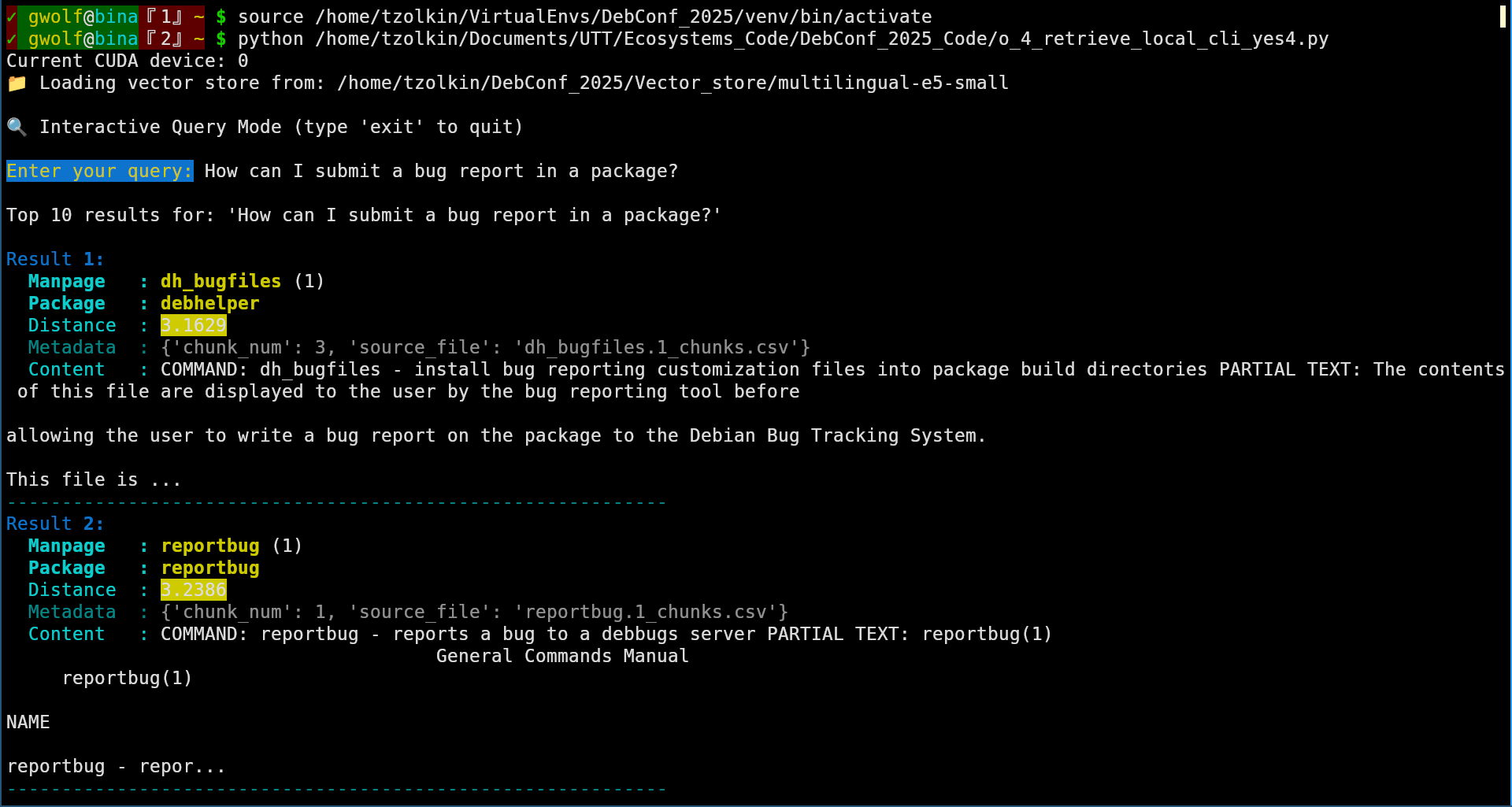
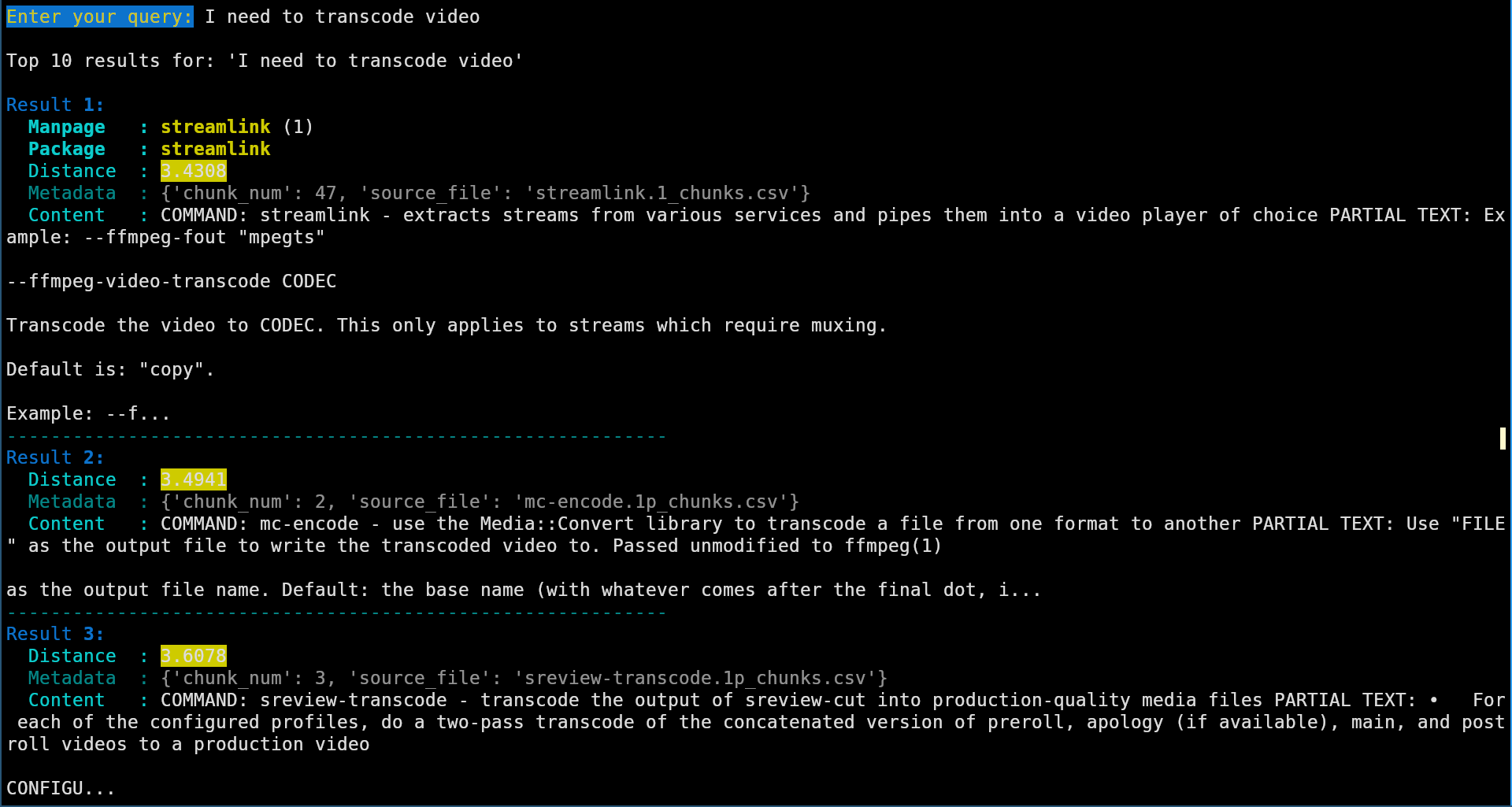
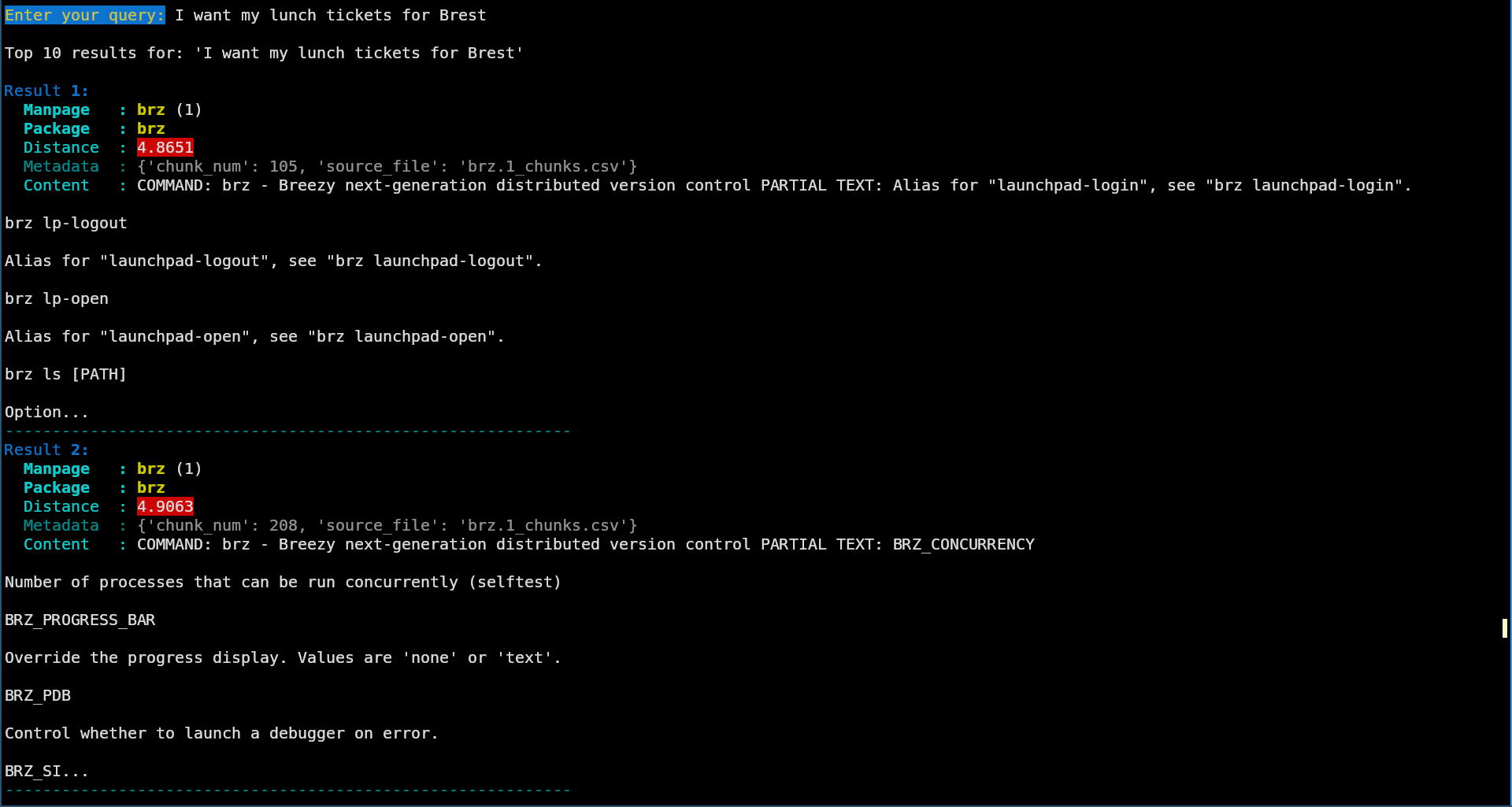
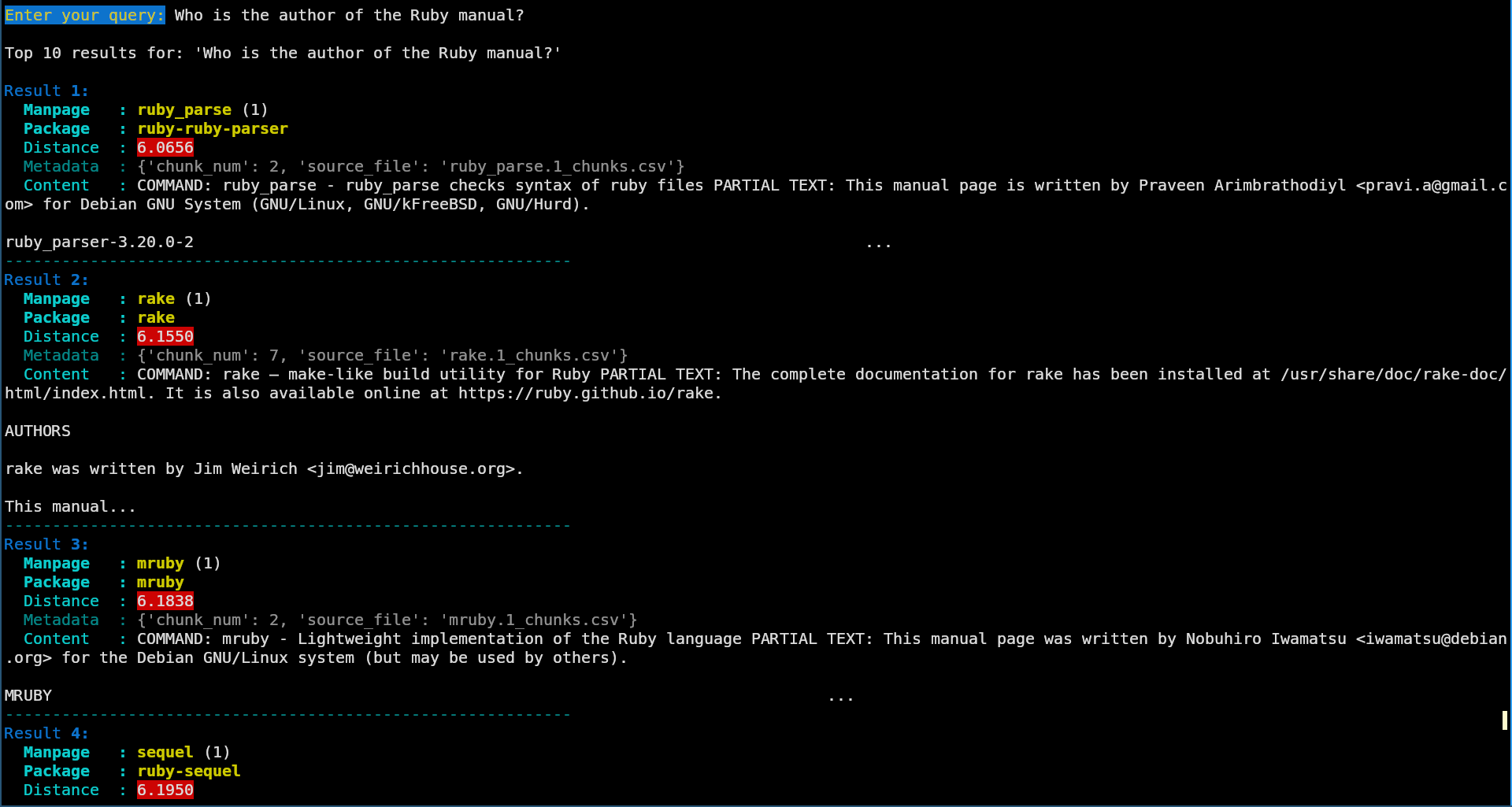
So, for the first year, this year s DebConf had the DebConf Academic Track , that is, content for a one-day-long set of short sessions, for which of them there was a written article presenting the content often with a very academic format, but not necessarily. I hope that for future DebConfs we will continue to hold this track, and that we can help bridge the gap: to get people that are not usually from the academic / universitary prepare content that will be formally expressed and included in a long-lasting, indexed book of proceedings. We did have (informal) proceedings in many of the early DebConfs, and I m very happy to regain that, but with 20 years of better practices. Anyway, of course, I took the opportunity to join this experiment, and together with my Mexican colleague Tzolkin Gardu o who is finishing her PhD here in France (or should I say, second to her, as she is the true leading author of our work). And here you can see the paper we submitted to the DebConf Academic Track, which will be published soon: A retrieval-augmented-generation pipeline to help users query system-provided documentation The corresponding source code is all available at Tzolkin s repository in GitHub. So, what is it about, in shorter words and layman terms? Debian has lots of documentation, but lacks in discoverability. We targetted our venerable manpages: It is well known that manpages are relevant, well-organized documentation describing how to use each of the binaries we ship in Debian. Eric Raymond wrote in his well-known essay The Art of Unix Programming (2003) that the Unix cultural style is telegraphic but complete. It does not hold you by the hand, but it usualy points in the right direction. Our original intent was to digest all of the information in our manpages, but we narrowed it to only the first section of the manual due to the limitations of the hardware a good friend lent us to play with LLMs. We took four different base, redistributable (although, yes, non-DFSG-free) Large Language Models downloaded from HuggingFace (T5-small, MiniLM-L6-v2, BGE-small-en and Multilingual-e5-small), and trained them with the 34579 pages found inside /usr/share/man/man1 of all of the existing Debian packages. We did some interesting fine-tuning (for further details, please refer to the paper itself or to our GitHub repository. The idea is to present an interactive tool that udnerstand natural language queries, and answers with the specific manpage to which they better relate (I d like to say they answer best , but Tzolkin has repeatedly tried to correct my understanding of the resulting vectorial distances). I had prepared some images to present as interaction examples, but I ll wrap up this post with something even better So, this is what you would get with the following queries: We were happy to present like this. During DebCamp, however, I was able to devote some time to translating my client into a Web-accessible system. Do note that it s a bit brittle, and might break now and then. But you are welcome to play with it! Play with the Web interface for our RAG for Debian manuals! I find it worth sharing that, while we used quite a bit of GPU for the training (not too much a couple of nights on an old-although-powerful nVidia 1070 card lent to us by the Felipe Esquivel Fund for Science and Cultural Support), all querying takes place in the CPU, and I usually get between 0.1 and 0.3 seconds per query. My server s architecture is far from rock-solid, and it can break now and then but at least it should respawn upon failure And it should at least be available there for a couple of weeks into August. Anyway, this has been a very interesting journey getting my toes wet in the waters of LLM, and while current results are a bit crude, I think this can be made into an interesting tool for Debian exploration.

7 July 2025

Sahil Dhiman: Let's Talk About AI

Recently, Seth Godin wrote Productivity, AI and pushback:
Typesetters did not like the laser printer. Wedding photographers still hate the iphone. And some musicians are outraged that AI is now making mediocre pop music.
In the article, Seth connected how AI is increasing productivity and how anything that improves productivity always wins. Nowadays, large language models (LLMs) have become synonymous with AI, while AI is a broader field. AI has brought a shift in how things are done. Use cases might vary, but it s helping in ways like quickly summarizing huge knowledge bases to answer questions or, in my case, helping understand the contextual meaning of complex word (or sentence) usage in language and literature in both English and Hindi, which was sometimes not easy to comprehend with simple web search results. Even if you or I don t really like AI in everything , we can t deny the fact that AI is here to stay. This doesn t take away from the fact that AI needs to become ethical, regulated, and environmentally sustainable.

3 July 2025

Russell Coker: The Fuss About AI

There are many negative articles about AI (which is not about actual Artificial Intelligence also known as AGI ). Which I think are mostly overblown and often ridiculous. Resource Usage Complaints about resource usage are common, training Llama 3.1 could apparently produce as much pollution as 10,000 round trips by car between Los Angeles and New York City . That s not great but when you compare to the actual number of people doing such drives in the US and the number of people taking commercial flights on that route it doesn t seem like such a big deal. Apparently commercial passenger jets cause CO2 emissions per passenger about equal to a car with 2 people. Why is it relevant whether pollution comes from running servers, driving cars, or steel mills? Why not just tax polluters for the damage they do and let the market sort it out? People in the US make a big deal about not being communist, so why not have a capitalist solution, make it more expensive to do undesirable things and let the market sort it out? ML systems are a less bad use of compute resources than Bitcoin, at least ML systems give some useful results while Bitcoin has nothing good going for it. The Dot-Com Comparison People often complain about the apparent impossibility of AI companies doing what investors think they will do. But this isn t anything new, that all happened before with the dot com boom . I m not the first person to make this comparison, The Daily WTF (a high quality site about IT mistakes) has an interesting article making this comparison [1]. But my conclusions are quite different. The result of that was a lot of Internet companies going bankrupt, the investors in those companies losing money, and other companies then bought up their assets and made profitable companies. The cheap Internet we now have was built on the hardware from bankrupt companies which was sold for far less than the manufacture price. That allowed it to scale up from modem speeds to ADSL without the users paying enough to cover the purchase of the infrastructure. In the early 2000s I worked for two major Dutch ISPs that went bankrupt (not my fault) and one of them continued operations in the identical manner after having the stock price go to zero (I didn t get to witness what happened with the other one). As far as I m aware random Dutch citizens and residents didn t suffer from this and employees just got jobs elsewhere. There are good things being done with ML systems and when companies like OpenAI go bankrupt other companies will buy the hardware and do good things. NVidia isn t ever going to have the future sales that would justify a market capitalisation of almost 4 Trillion US dollars. This market cap can support paying for new research and purchasing rights to patented technology in a similar way to the high stock price of Google supported buying YouTube, DoubleClick, and Motorola Mobility which are the keys to Google s profits now. The Real Upsides of ML Until recently I worked for a company that used ML systems to analyse drivers for signs of fatigue, distraction, or other inappropriate things (smoking which is illegal in China, using a mobile phone, etc). That work was directly aimed at saving human lives with a significant secondary aim of saving wear on vehicles (in the mining industry drowsy drivers damage truck tires and that s a huge business expense). There are many applications of ML in medical research such as recognising cancer cells in tissue samples. There are many less important uses for ML systems, such as recognising different types of pastries to correctly bill bakery customers technology that was apparently repurposed for recognising cancer cells. The ability to recognise objects in photos is useful. It can be used for people who want to learn about random objects they see and could be used for helping young children learn about their environment. It also has some potential for assistance for visually impaired people, it wouldn t be good for safety critical systems (don t cross a road because a ML system says there are no cars coming) but could be useful for identifying objects (is this a lemon or a lime). The Humane AI pin had some real potential to do good things but there wasn t a suitable business model [2], I think that someone will develop similar technology in a useful way eventually. Even without trying to do what the Humane AI Pin attempted, there are many ways for ML based systems to assist phone and PC use. ML systems allow analysing large quantities of data and giving information that may be correct. When used by a human who knows how to recognise good answers this can be an efficient way of solving problems. I personally have solved many computer problems with the help of LLM systems while skipping over many results that were obviously wrong to me. I believe that any expert in any field that is covered in the LLM input data could find some benefits from getting suggestions from an LLM. It won t necessarily allow them to solve problems that they couldn t solve without it but it can provide them with a set of obviously wrong answers mixed in with some useful tips about where to look for the right answers. Jobs and Politics Noema Magazine has an insightful article about how AI can allow different models of work which can enlarge the middle class [3]. I don t think it s reasonable to expect ML systems to make as much impact on society as the industrial revolution, and the agricultural revolutions which took society from more than 90% farm workers to less than 5%. That doesn t mean everything will be fine but it is something that can seem OK after the changes have happened. I m not saying apart from the death and destruction everything will be good , the death and destruction are optional. Improvements in manufacturing and farming didn t have to involve poverty and death for many people, improvements to agriculture didn t have to involve overcrowding and death from disease. This was an issue of political decisions that were made. The Real Problems of ML Political decisions that are being made now have the aim of making the rich even richer and leaving more people in poverty and in many cases dying due to being unable to afford healthcare. The ML systems that aim to facilitate such things haven t been as successful as evil people have hoped but it will happen and we need appropriate legislation if we aren t going to have revolutions. There are documented cases of suicide being inspired by Chat GPT systems [4]. There have been people inspired towards murder by ChatGPT systems but AFAIK no-one has actually succeeded in such a crime yet. There are serious issues that need to be addressed with the technology and with legal constraints about how people may use it. It s interesting to consider the possible uses of ChatGPT systems for providing suggestions to a psychologist, maybe ChatGPT systems could be used to alleviate mental health problems. The cases of LLM systems being used for cheating on assignments etc isn t a real issue. People have been cheating on assignments since organised education was invented. There is a real problem of ML systems based on biased input data that issue decisions that are the average of the bigotry of the people who provided input. That isn t going to be worse than the current situation of bigoted humans making decisions based on hate and preconceptions but it will be more insidious. It is possible to search for that so for example a bank could test it s mortgage approval ML system by changing one factor at a time (name, gender, age, address, etc) and see if it changes the answer. If it turns out that the ML system is biased on names then the input data could have names removed. If it turns out to be biased about address then there could be weights put in to oppose that. For a long time there has been excessive trust in computers. Computers aren t magic they just do maths really fast and implement choices based on the work of programmers who have all the failings of other humans. Excessive trust in a rule based system is less risky than excessive trust in a ML system where no-one really knows why it makes the decisions it makes. Self driving cars kill people, this is the truth that Tesla stock holders don t want people to know. Companies that try to automate everything with AI are going to be in for some nasty surprises. Getting computers to do everything that humans do in any job is going to be a large portion of an actual intelligent computer which if it is achieved will raise an entirely different set of problems. I ve previously blogged about ML Security [5]. I don t think this will be any worse than all the other computer security problems in the long term, although it will be more insidious. How Will It Go? Companies spending billions of dollars without firm plans for how to make money are going to go bankrupt no matter what business they are in. Companies like Google and Microsoft can waste some billions of dollars on AI Chat systems and still keep going as successful businesses. Companies like OpenAI that do nothing other than such chat systems won t go well. But their assets can be used by new companies when sold at less than 10% the purchase price. Companies like NVidia that have high stock prices based on the supposed ongoing growth in use of their hardware will have their stock prices crash. But the new technology they develop will be used by other people for other purposes. If hospitals can get cheap diagnostic ML systems because of unreasonable investment into AI then that could be a win for humanity. Companies that bet their entire business on AI even when it s not necessarily their core business (as Tesla has done with self driving) will have their stock price crash dramatically at a minimum and have the possibility of bankruptcy. Having Tesla go bankrupt is definitely better than having people try to use them as self driving cars.

1 July 2025

Guido G nther: Free Software Activities June 2025

Another short status update of what happened on my side last month. Phosh 0.48.0 is out with nice improvements, phosh.mobi e.V. is alive, helped a bit to get cellbroadcastd out, osk bugfixes and some more: See below for details on the above and more: phosh phoc phosh-mobile-settings stevia (formerly phosh-osk-stub) phosh-osk-data phosh-vala-plugins pfs xdg-desktop-portal-phosh xdg-desktop-portal phosh-debs meta-phosh feedbackd feedbackd-device-themes gmobile GNOME clocks Debian Mobian ModemManager libmbim libqmi mobile-broadband-provider-info Cellbroadcastd iio-sensor-proxy twenty-twenty-hugo gotosocial Reviews This is not code by me but reviews on other peoples code. The list is (as usual) slightly incomplete. Thanks for the contributions! Help Development If you want to support my work see donations. Comments? Join the Fediverse thread

24 June 2025

Matthew Garrett: Why is there no consistent single signon API flow?

Single signon is a pretty vital part of modern enterprise security. You have users who need access to a bewildering array of services, and you want to be able to avoid the fallout of one of those services being compromised and your users having to change their passwords everywhere (because they're clearly going to be using the same password everywhere), or you want to be able to enforce some reasonable MFA policy without needing to configure it in 300 different places, or you want to be able to disable all user access in one place when someone leaves the company, or, well, all of the above. There's any number of providers for this, ranging from it being integrated with a more general app service platform (eg, Microsoft or Google) or a third party vendor (Okta, Ping, any number of bizarre companies). And, in general, they'll offer a straightforward mechanism to either issue OIDC tokens or manage SAML login flows, requiring users present whatever set of authentication mechanisms you've configured.

This is largely optimised for web authentication, which doesn't seem like a huge deal - if I'm logging into Workday then being bounced to another site for auth seems entirely reasonable. The problem is when you're trying to gate access to a non-web app, at which point consistency in login flow is usually achieved by spawning a browser and somehow managing submitting the result back to the remote server. And this makes some degree of sense - browsers are where webauthn token support tends to live, and it also ensures the user always has the same experience.

But it works poorly for CLI-based setups. There's basically two options - you can use the device code authorisation flow, where you perform authentication on what is nominally a separate machine to the one requesting it (but in this case is actually the same) and as a result end up with a straightforward mechanism to have your users socially engineered into giving Johnny Badman a valid auth token despite webauthn nominally being unphisable (as described years ago), or you reduce that risk somewhat by spawning a local server and POSTing the token back to it - which works locally but doesn't work well if you're dealing with trying to auth on a remote device. The user experience for both scenarios sucks, and it reduces a bunch of the worthwhile security properties that modern MFA supposedly gives us.

There's a third approach, which is in some ways the obviously good approach and in other ways is obviously a screaming nightmare. All the browser is doing is sending a bunch of requests to a remote service and handling the response locally. Why don't we just do the same? Okta, for instance, has an API for auth. We just need to submit the username and password to that and see what answer comes back. This is great until you enable any kind of MFA, at which point the additional authz step is something that's only supported via the browser. And basically everyone else is the same.

Of course, when we say "That's only supported via the browser", the browser is still just running some code of some form and we can figure out what it's doing and do the same. Which is how you end up scraping constants out of Javascript embedded in the API response in order to submit that data back in the appropriate way. This is all possible but it's incredibly annoying and fragile - the contract with the identity provider is that a browser is pointed at a URL, not that any of the internal implementation remains consistent.

I've done this. I've implemented code to scrape an identity provider's auth responses to extract the webauthn challenges and feed those to a local security token without using a browser. I've also written support for forwarding those challenges over the SSH agent protocol to make this work with remote systems that aren't running a GUI. This week I'm working on doing the same again, because every identity provider does all of this differently.

There's no fundamental reason all of this needs to be custom. It could be a straightforward "POST username and password, receive list of UUIDs describing MFA mechanisms, define how those MFA mechanisms work". That even gives space for custom auth factors (I'm looking at you, Okta Fastpass). But instead I'm left scraping JSON blobs out of Javascript and hoping nobody renames a field, even though I only care about extremely standard MFA mechanisms that shouldn't differ across different identity providers.

Someone, please, write a spec for this. Please don't make it be me.

comment count unavailable comments

21 June 2025

Ravi Dwivedi: Getting Brunei visa

In December 2024, my friend Badri and I were planning a trip to Southeast Asia. At this point, we were planning to visit Singapore, Malaysia and Vietnam. My Singapore visa had already been approved, and Malaysia was visa-free for us. For Vietnam, we had to apply for an e-visa online. We considered adding Brunei to our itinerary. I saw some videos of the Brunei visa process and got the impression that we needed to go to the Brunei embassy in Kuching, Malaysia in person. However, when I happened to search for Brunei on Organic Maps1, I stumbled upon the Brunei Embassy in Delhi. It seemed to be somewhere in Hauz Khas. As I was going to Delhi to collect my Singapore visa the next day, I figured I d also visit the Brunei Embassy to get information about the visa process. The next day I went to the location displayed by Organic Maps. It was next to the embassy of Madagascar, and a sign on the road divider confirmed that I was at the right place. That said, it actually looked like someone s apartment. I entered and asked for directions to the Brunei embassy, but the people inside did not seem to understand my query. After some back and forth, I realized that the embassy wasn t there. I now searched for the Brunei embassy on the Internet, and this time I got an address in Vasant Vihar. It seemed like the embassy had been moved from Hauz Khas to Vasant Vihar. Going by the timings mentioned on the web page, the embassy was closing in an hour. I took a Metro from Hauz Khas to Vasant Vihar. After deboarding at the Vasant Vihar metro station, I took an auto to reach the embassy. The address listed on the webpage got me into the correct block. However, the embassy was still nowhere to be seen. I asked around, but security guards in that area pointed me to the Burundi embassy instead. After some more looking around, I did end up finding the embassy. I spoke to the security guards at the gate and told them that I would like to know the visa process. They dialled a number and asked that person to tell me the visa process. I spoke to a lady on the phone. She listed the documents required for the visa process and mentioned that the timings for visa application were from 9 o clock to 11 o clock in the morning. She also informed me that the visa fees was 1000. I also asked about the process Badri, who lives far away in Tamil Nadu and cannot report at the embassy physically. She told me that I can submit a visa application on his behalf, along with an authorization letter. Having found the embassy in Delhi was a huge relief. The other plan - going to Kuching, Malaysia - was a bit uncertain, and we didn t know how much time it would take. Getting our passport submitted at an embassy in a foreign country was also not ideal. A few days later, Badri sent me all the documents required for his visa. I went to the embassy and submitted both the applications. The lady who collected our visa submissions asked me for our flight reservations from Delhi to Brunei, whereas ours were (keeping with our itinerary) from Kuala Lampur. She said that she might contact me later if it was required. For reference, here is the list of documents we submitted - I then asked about the procedure to collect the passports and visa results. Usually, embassies will tell you that they will contact you when they have decided on your applications. However, here I was informed that if they don t contact me within 5 days, I can come and collect our passports and visa result between 13:30-14:30 hours on the fifth day. That was strange :) I did visit the embassy to collect our visa results on the fifth day. However, the lady scolded me for not bringing the receipt she gave me. I was afraid that I might have to go all the way back home and bring the receipt to get our passports. The travel date was close, and it would take some time for Badri to receive his passport via courier as well. Fortunately, she gave me our passports (with the visa attached) and asked me to share a scanned copy of the receipt via email after I get home. We were elated that our visas were approved. Now we could focus on booking our flights. If you are going to Brunei, remember to fill their arrival card from the website within 48 hours of your arrival! Thanks to Badri and Contrapunctus for reviewing the draft before publishing the article.

  1. Nowadays, I prefer using Comaps instead of Organic Maps and recommend you do the same. Organic Maps had some issues with its governance and the community issues weren t being addressed.

18 June 2025

Sergio Durigan Junior: GCC, glibc, stack unwinding and relocations A war story

I ve been meaning to write a post about this bug for a while, so here it is (before I forget the details!). First, I d like to thank a few people: I ll probably forget some details because it s been more than a week (and life at $DAYJOB moves fast), but we ll see.

The background story Wolfi OS takes security seriously, and one of the things we have is a package which sets the hardening compiler flags for C/C++ according to the best practices recommended by OpenSSF. At the time of this writing, these flags are (in GCC s spec file parlance):
*self_spec:
+ % !O:% !O1:% !O2:% !O3:% !O0:% !Os:% !0fast:% !0g:% !0z:-O2  -fhardened -Wno-error=hardened -Wno-hardened % !fdelete-null-pointer-checks:-fno-delete-null-pointer-checks  -fno-strict-overflow -fno-strict-aliasing % !fomit-frame-pointer:-fno-omit-frame-pointer  -mno-omit-leaf-frame-pointer
*link:
+ --as-needed -O1 --sort-common -z noexecstack -z relro -z now
The important part for our bug is the usage of -z now and -fno-strict-aliasing. As I was saying, these flags are set for almost every build, but sometimes things don t work as they should and we need to disable them. Unfortunately, one of these problematic cases has been glibc. There was an attempt to enable hardening while building glibc, but that introduced a strange breakage to several of our packages and had to be reverted. Things stayed pretty much the same until a few weeks ago, when I started working on one of my roadmap items: figure out why hardening glibc wasn t working, and get it to work as much as possible.

Reproducing the bug I started off by trying to reproduce the problem. It s important to mention this because I often see young engineers forgetting to check if the problem is even valid anymore. I don t blame them; the anxiety to get the bug fixed can be really blinding. Fortunately, I already had one simple test to trigger the failure. All I had to do was install the py3-matplotlib package and then invoke:
$ python3 -c 'import matplotlib'
This would result in an abortion with a coredump. I followed the steps above, and readily saw the problem manifesting again. OK, first step is done; I wasn t getting out easily from this one.

Initial debug The next step is to actually try to debug the failure. In an ideal world you get lucky and are able to spot what s wrong after just a few minutes. Or even better: you also can devise a patch to fix the bug and contribute it to upstream. I installed GDB, and then ran the py3-matplotlib command inside it. When the abortion happened, I issued a backtrace command inside GDB to see where exactly things had gone wrong. I got a stack trace similar to the following:
#0  0x00007c43afe9972c in __pthread_kill_implementation () from /lib/libc.so.6
#1  0x00007c43afe3d8be in raise () from /lib/libc.so.6
#2  0x00007c43afe2531f in abort () from /lib/libc.so.6
#3  0x00007c43af84f79d in uw_init_context_1[cold] () from /usr/lib/libgcc_s.so.1
#4  0x00007c43af86d4d8 in _Unwind_RaiseException () from /usr/lib/libgcc_s.so.1
#5  0x00007c43acac9014 in __cxxabiv1::__cxa_throw (obj=0x5b7d7f52fab0, tinfo=0x7c429b6fd218 <typeinfo for pybind11::attribute_error>, dest=0x7c429b5f7f70 <pybind11::reference_cast_error::~reference_cast_error() [clone .lto_priv.0]>)
    at ../../../../libstdc++-v3/libsupc++/eh_throw.cc:93
#6  0x00007c429b5ec3a7 in ft2font__getattr__(std::__cxx11::basic_string<char, std::char_traits<char>, std::allocator<char> >) [clone .lto_priv.0] [clone .cold] () from /usr/lib/python3.13/site-packages/matplotlib/ft2font.cpython-313-x86_64-linux-gnu.so
#7  0x00007c429b62f086 in pybind11::cpp_function::initialize<pybind11::object (*&)(std::__cxx11::basic_string<char, std::char_traits<char>, std::allocator<char> >), pybind11::object, std::__cxx11::basic_string<char, std::char_traits<char>, std::allocator<char> >, pybind11::name, pybind11::scope, pybind11::sibling>(pybind11::object (*&)(std::__cxx11::basic_string<char, std::char_traits<char>, std::allocator<char> >), pybind11::object (*)(std::__cxx11::basic_string<char, std::char_traits<char>, std::allocator<char> >), pybind11::name const&, pybind11::scope const&, pybind11::sibling const&):: lambda(pybind11::detail::function_call&)#1 ::_FUN(pybind11::detail::function_call&) [clone .lto_priv.0] ()
   from /usr/lib/python3.13/site-packages/matplotlib/ft2font.cpython-313-x86_64-linux-gnu.so
#8  0x00007c429b603886 in pybind11::cpp_function::dispatcher(_object*, _object*, _object*) () from /usr/lib/python3.13/site-packages/matplotlib/ft2font.cpython-313-x86_64-linux-gnu.so
...
Huh. Initially this didn t provide me with much information. There was something strange seeing the abort function being called right after _Unwind_RaiseException, but at the time I didn t pay much attention to it. OK, time to expand our horizons a little. Remember when I said that several of our packages would crash with a hardened glibc? I decided to look for another problematic package so that I could make it crash and get its stack trace. My thinking here is that maybe if I can compare both traces, something will come up. I happened to find an old discussion where Dann Frazier mentioned that Emacs was also crashing for him. He and I share the Emacs passion, and I totally agreed with him when he said that Emacs crashing is priority -1! (I m paraphrasing). I installed Emacs, ran it, and voil : the crash happened again. OK, that was good. When I ran Emacs inside GDB and asked for a backtrace, here s what I got:
#0  0x00007eede329972c in __pthread_kill_implementation () from /lib/libc.so.6
#1  0x00007eede323d8be in raise () from /lib/libc.so.6
#2  0x00007eede322531f in abort () from /lib/libc.so.6
#3  0x00007eede262879d in uw_init_context_1[cold] () from /usr/lib/libgcc_s.so.1
#4  0x00007eede2646e7c in _Unwind_Backtrace () from /usr/lib/libgcc_s.so.1
#5  0x00007eede3327b11 in backtrace () from /lib/libc.so.6
#6  0x000059535963a8a1 in emacs_backtrace ()
#7  0x000059535956499a in main ()
Ah, this backtrace is much simpler to follow. Nice. Hmmm. Now the crash is happening inside _Unwind_Backtrace. A pattern emerges! This must have something to do with stack unwinding (or so I thought keep reading to discover the whole truth). You see, the backtrace function (yes, it s a function) and C++ s exception handling mechanism use similar techniques to do their jobs, and it pretty much boils down to unwinding frames from the stack. I looked into Emacs source code, specifically the emacs_backtrace function, but could not find anything strange over there. This bug was probably not going to be an easy fix

The quest for a minimal reproducer Being able to easily reproduce the bug is awesome and really helps with debugging, but even better is being able to have a minimal reproducer for the problem. You see, py3-matplotlib is a huge package and pulls in a bunch of extra dependencies, so it s not easy to ask other people to just install this big package plus these other dependencies, and then run this command , especially if we have to file an upstream bug and talk to people who may not even run the distribution we re using. So I set up to try and come up with a smaller recipe to reproduce the issue, ideally something that s not tied to a specific package from the distribution. Having all the information gathered from the initial debug session, especially the Emacs backtrace, I thought that I could write a very simple program that just invoked the backtrace function from glibc in order to trigger the code path that leads to _Unwind_Backtrace. Here s what I wrote:
#include <execinfo.h>

int
main(int argc, char *argv[])
 
  void *a[4096];
  backtrace (a, 100);
  return 0;
 
After compiling it, I determined that yes, the problem did happen with this small program as well. There was only a small nuisance: the manifestation of the bug was not deterministic, so I had to execute the program a few times until it crashed. But that s much better than what I had before, and a small price to pay. Having a minimal reproducer pretty much allows us to switch our focus to what really matters. I wouldn t need to dive into Emacs or Python s source code anymore. At the time, I was sure this was a glibc bug. But then something else happened.

GCC 15 I had to stop my investigation efforts because something more important came up: it was time to upload GCC 15 to Wolfi. I spent a couple of weeks working on this (it involved rebuilding the whole archive, filing hundreds of FTBFS bugs, patching some programs, etc.), and by the end of it the transition went smooth. When the GCC 15 upload was finally done, I switched my focus back to the glibc hardening problem. The first thing I did was to yes, reproduce the bug again. It had been a few weeks since I had touched the package, after all. So I built a hardened glibc with the latest GCC and the bug did not happen anymore! Fortunately, the very first thing I thought was this must be GCC , so I rebuilt the hardened glibc with GCC 14, and the bug was there again. Huh, unexpected but very interesting.

Diving into glibc and libgcc At this point, I was ready to start some serious debugging. And then I got a message on Signal. It was one of those moments where two minds think alike: Gabriel decided to check how I was doing, and I was thinking about him because this involved glibc, and Gabriel contributed to the project for many years. I explained what I was doing, and he promptly offered to help. Yes, there are more people who love low level debugging! We spent several hours going through disassembles of certain functions (because we didn t have any debug information in the beginning), trying to make sense of what we were seeing. There was some heavy GDB involved; unfortunately I completely lost the session s history because it was done inside a container running inside an ephemeral VM. But we learned a lot. For example:
  • It was hard to actually understand the full stack trace leading to uw_init_context_1[cold]. _Unwind_Backtrace obviously didn t call it (it called uw_init_context_1, but what was that [cold] doing?). We had to investigate the disassemble of uw_init_context_1 in order to determined where uw_init_context_1[cold] was being called.
  • The [cold] suffix is a GCC function attribute that can be used to tell the compiler that the function is unlikely to be reached. When I read that, my mind immediately jumped to this must be an assertion , so I went to the source code and found the spot.
  • We were able to determine that the return code of uw_frame_state_for was 5, which means _URC_END_OF_STACK. That s why the assertion was triggering.
After finding these facts without debug information, I decided to bite the bullet and recompiled GCC 14 with -O0 -g3, so that we could debug what uw_frame_state_for was doing. After banging our heads a bit more, we found that fde is NULL at this excerpt:
// ...
  fde = _Unwind_Find_FDE (context->ra + _Unwind_IsSignalFrame (context) - 1,
                          &context->bases);
  if (fde == NULL)
     
#ifdef MD_FALLBACK_FRAME_STATE_FOR
      /* Couldn't find frame unwind info for this function.  Try a
         target-specific fallback mechanism.  This will necessarily
         not provide a personality routine or LSDA.  */
      return MD_FALLBACK_FRAME_STATE_FOR (context, fs);
#else
      return _URC_END_OF_STACK;
#endif
     
// ...
We re debugging on amd64, which means that MD_FALLBACK_FRAME_STATE_FOR is defined and therefore is called. But that s not really important for our case here, because we had established before that _Unwind_Find_FDE would never return NULL when using a non-hardened glibc (or a glibc compiled with GCC 15). So we decided to look into what _Unwind_Find_FDE did. The function is complex because it deals with .eh_frame , but we were able to pinpoint the exact location where find_fde_tail (one of the functions called by _Unwind_Find_FDE) is returning NULL:
if (pc < table[0].initial_loc + data_base)
  return NULL;
We looked at the addresses of pc and table[0].initial_loc + data_base, and found that the former fell within libgcc s text section, which the latter fell within /lib/ld-linux-x86-64.so.2 text. At this point, we were already too tired to continue. I decided to keep looking at the problem later and see if I could get any further.

Bisecting GCC The next day, I woke up determined to find what changed in GCC 15 that caused the bug to disappear. Unless you know GCC s internals like they are your own home (which I definitely don t), the best way to do that is to git bisect the commits between GCC 14 and 15. I spent a few days running the bisect. It took me more time than I d have liked to find the right range of commits to pass git bisect (because of how branches and tags are done in GCC s repository), and I also had to write some helper scripts that:
  • Modified the gcc.yaml package definition to make it build with the commit being bisected.
  • Built glibc using the GCC that was just built.
  • Ran tests inside a docker container (with the recently built glibc installed) to determine whether the bug was present.
At the end, I had a commit to point to:
commit 99b1daae18c095d6c94d32efb77442838e11cbfb
Author: Richard Biener <rguenther@suse.de>
Date:   Fri May 3 14:04:41 2024 +0200
    tree-optimization/114589 - remove profile based sink heuristics
Makes sense, right?! No? Well, it didn t for me either. Even after reading what was changed in the code and the upstream bug fixed by the commit, I was still clueless as to why this change fixed the problem (I say fixed because it may very well be an unintended consequence of the change, and some other problem might have been introduced).

Upstream takes over After obtaining the commit that possibly fixed the bug, while talking to Dann and explaining what I did, he suggested that I should file an upstream bug and check with them. Great idea, of course. I filed the following upstream bug: https://gcc.gnu.org/bugzilla/show_bug.cgi?id=120653 It s a bit long, very dense and complex, but ultimately upstream was able to find the real problem and have a patch accepted in just two days. Nothing like knowing the code base. The initial bug became: https://sourceware.org/bugzilla/show_bug.cgi?id=33088 In the end, the problem was indeed in how the linker defines __ehdr_start, which, according to the code (from elf/dl-support.c):
if (_dl_phdr == NULL)
   
    /* Starting from binutils-2.23, the linker will define the
       magic symbol __ehdr_start to point to our own ELF header
       if it is visible in a segment that also includes the phdrs.
       So we can set up _dl_phdr and _dl_phnum even without any
       information from auxv.  */


    extern const ElfW(Ehdr) __ehdr_start attribute_hidden;
    assert (__ehdr_start.e_phentsize == sizeof *GL(dl_phdr));
    _dl_phdr = (const void *) &__ehdr_start + __ehdr_start.e_phoff;
    _dl_phnum = __ehdr_start.e_phnum;
   
But the following definition is the problematic one (from elf/rtld.c):
extern const ElfW(Ehdr) __ehdr_start attribute_hidden;
This symbol (along with its counterpart, __ehdr_end) was being run-time relocated when it shouldn t be. The fix that was pushed added optimization barriers to prevent the compiler from doing the relocations. I don t claim to fully understand what was done here, and Jakub s analysis is a thing to behold, but in the end I was able to confirm that the patch fixed the bug. And in the end, it was indeed a glibc bug.

Conclusion This was an awesome bug to investigate. It s one of those that deserve a blog post, even though some of the final details of the fix flew over my head. I d like to start blogging more about these sort of bugs, because I ve encountered my fair share of them throughout my career. And it was great being able to do some debugging with another person, exchange ideas, learn things together, and ultimately share that deep satisfaction when we find why a crash is happening. I have at least one more bug in my TODO list to write about (another one with glibc, but this time I was able to get to the end of it and come up with a patch). Stay tunned. P.S.: After having published the post I realized that I forgot to explain why the -z now and -fno-strict-aliasing flags were important. -z now is the flag that I determined to be the root cause of the breakage. If I compiled glibc with every hardening flag except -z now, everything worked. So initially I thought that the problem had to do with how ld.so was resolving symbols at runtime. As it turns out, this ended up being more a symptom than the real cause of the bug. As for -fno-strict-aliasing, a Gentoo developer who commented on the GCC bug above mentioned that this OpenSSF bug had a good point against using this flag for hardening. I still have to do a deep dive on what was discussed in the issue, but this is certainly something to take into consideration. There s this very good write-up about strict aliasing in general if you re interested in understanding it better.

16 June 2025

Paul Tagliamonte: The Promised LAN

The Internet has changed a lot in the last 40+ years. Fads have come and gone. Network protocols have been designed, deployed, adopted, and abandoned. Industries have come and gone. The types of people on the internet have changed a lot. The number of people on the internet has changed a lot, creating an information medium unlike anything ever seen before in human history. There s a lot of good things about the Internet as of 2025, but there s also an inescapable hole in what it used to be, for me. I miss being able to throw a site up to send around to friends to play with without worrying about hordes of AI-feeding HTML combine harvesters DoS-ing my website, costing me thousands in network transfer for the privilege. I miss being able to put a lightly authenticated game server up and not worry too much at night wondering if that process is now mining bitcoin. I miss being able to run a server in my home closet. Decades of cat and mouse games have rendered running a mail server nearly impossible. Those who are brave enough to try are met with weekslong stretches of delivery failures and countless hours yelling ineffectually into a pipe that leads from the cheerful lobby of some disinterested corporation directly into a void somewhere 4 layers below ground level. I miss the spirit of curiosity, exploration, and trying new things. I miss building things for fun without having to worry about being too successful, after which security offices start demanding my supplier paperwork in triplicate as heartfelt thanks from their engineering teams. I miss communities that are run because it is important to them, not for ad revenue. I miss community operated spaces and having more than four websites that are all full of nothing except screenshots of each other. Every other page I find myself on now has an AI generated click-bait title, shared for rage-clicks all brought-to-you-by-our-sponsors completely covered wall-to-wall with popup modals, telling me how much they respect my privacy, with the real content hidden at the bottom bracketed by deceptive ads served by companies that definitely know which new coffee shop I went to last month. This is wrong, and those who have seen what was know it. I can t keep doing it. I m not doing it any more. I reject the notion that this is as it needs to be. It is wrong. The hole left in what the Internet used to be must be filled. I will fill it.

What comes before part b? Throughout the 2000s, some of my favorite memories were from LAN parties at my friends places. Dragging your setup somewhere, long nights playing games, goofing off, even building software all night to get something working being able to do something fiercely technical in the context of a uniquely social activity. It wasn t really much about the games or the projects it was an excuse to spend time together, just hanging out. A huge reason I learned so much in college was that campus was a non-stop LAN party we could freely stand up servers, talk between dorms on the LAN, and hit my dorm room computer from the lab. Things could go from individual to social in the matter of seconds. The Internet used to work this way my dorm had public IPs handed out by DHCP, and my workstation could serve traffic from anywhere on the internet. I haven t been back to campus in a few years, but I d be surprised if this were still the case. In December of 2021, three of us got together and connected our houses together in what we now call The Promised LAN. The idea is simple fill the hole we feel is gone from our lives. Build our own always-on 24/7 nonstop LAN party. Build a space that is intrinsically social, even though we re doing technical things. We can freely host insecure game servers or one-off side projects without worrying about what someone will do with it. Over the years, it s evolved very slowly we haven t pulled any all-nighters. Our mantra has become old growth , building each layer carefully. As of May 2025, the LAN is now 19 friends running around 25 network segments. Those 25 networks are connected to 3 backbone nodes, exchanging routes and IP traffic for the LAN. We refer to the set of backbone operators as The Bureau of LAN Management . Combined decades of operating critical infrastructure has driven The Bureau to make a set of well-understood, boring, predictable, interoperable and easily debuggable decisions to make this all happen. Nothing here is exotic or even technically interesting.

Applications of trusting trust The hardest part, however, is rejecting the idea that anything outside our own LAN is untrustworthy nearly irreversible damage inflicted on us by the Internet. We have solved this by not solving it. We strictly control membership the absolute hard minimum for joining the LAN requires 10 years of friendship with at least one member of the Bureau, with another 10 years of friendship planned. Members of the LAN can veto new members even if all other criteria is met. Even with those strict rules, there s no shortage of friends that meet the qualifications but we are not equipped to take that many folks on. It s hard to join -both socially and technically. Doing something malicious on the LAN requires a lot of highly technical effort upfront, and it would endanger a decade of friendship. We have relied on those human, social, interpersonal bonds to bring us all together. It s worked for the last 4 years, and it should continue working until we think of something better. We assume roommates, partners, kids, and visitors all have access to The Promised LAN. If they re let into our friends' network, there is a level of trust that works transitively for us I trust them to be on mine. This LAN is not for security , rather, the network border is a social one. Benign hacking in the original sense of misusing systems to do fun and interesting things is encouraged. Robust ACLs and firewalls on the LAN are, by definition, an interpersonal not technical failure. We all trust every other network operator to run their segment in a way that aligns with our collective values and norms. Over the last 4 years, we ve grown our own culture and fads around half of the people on the LAN have thermal receipt printers with open access, for printing out quips or jokes on each other s counters. It s incredible how much network transport and a trusting culture gets you there s a 3-node IRC network, exotic hardware to gawk at, radios galore, a NAS storage swap, LAN only email, and even a SIP phone network of redphones .

DIY We do not wish to, nor will we, rebuild the internet. We do not wish to, nor will we, scale this. We will never be friends with enough people, as hard as we may try. Participation hinges on us all having fun. As a result, membership will never be open, and we will never have enough connected LANs to deal with the technical and social problems that start to happen with scale. This is a feature, not a bug. This is a call for you to do the same. Build your own LAN. Connect it with friends homes. Remember what is missing from your life, and fill it in. Use software you know how to operate and get it running. Build slowly. Build your community. Do it with joy. Remember how we got here. Rebuild a community space that doesn t need to be mediated by faceless corporations and ad revenue. Build something sustainable that brings you joy. Rebuild something you use daily. Bring back what we re missing.

6 June 2025

Reproducible Builds: Reproducible Builds in May 2025

Welcome to our 5th report from the Reproducible Builds project in 2025! Our monthly reports outline what we ve been up to over the past month, and highlight items of news from elsewhere in the increasingly-important area of software supply-chain security. If you are interested in contributing to the Reproducible Builds project, please do visit the Contribute page on our website. In this report:
  1. Security audit of Reproducible Builds tools published
  2. When good pseudorandom numbers go bad
  3. Academic articles
  4. Distribution work
  5. diffoscope and disorderfs
  6. Website updates
  7. Reproducibility testing framework
  8. Upstream patches

Security audit of Reproducible Builds tools published The Open Technology Fund s (OTF) security partner Security Research Labs recently an conducted audit of some specific parts of tools developed by Reproducible Builds. This form of security audit, sometimes called a whitebox audit, is a form testing in which auditors have complete knowledge of the item being tested. They auditors assessed the various codebases for resilience against hacking, with key areas including differential report formats in diffoscope, common client web attacks, command injection, privilege management, hidden modifications in the build process and attack vectors that might enable denials of service. The audit focused on three core Reproducible Builds tools: diffoscope, a Python application that unpacks archives of files and directories and transforms their binary formats into human-readable form in order to compare them; strip-nondeterminism, a Perl program that improves reproducibility by stripping out non-deterministic information such as timestamps or other elements introduced during packaging; and reprotest, a Python application that builds source code multiple times in various environments in order to to test reproducibility. OTF s announcement contains more of an overview of the audit, and the full 24-page report is available in PDF form as well.

When good pseudorandom numbers go bad Danielle Navarro published an interesting and amusing article on their blog on When good pseudorandom numbers go bad. Danielle sets the stage as follows:
[Colleagues] approached me to talk about a reproducibility issue they d been having with some R code. They d been running simulations that rely on generating samples from a multivariate normal distribution, and despite doing the prudent thing and using set.seed() to control the state of the random number generator (RNG), the results were not computationally reproducible. The same code, executed on different machines, would produce different random numbers. The numbers weren t just a little bit different in the way that we ve all wearily learned to expect when you try to force computers to do mathematics. They were painfully, brutally, catastrophically, irreproducible different. Somewhere, somehow, something broke.
Thanks to David Wheeler for posting about this article on our mailing list

Academic articles There were two scholarly articles published this month that related to reproducibility: Daniel Hugenroth and Alastair R. Beresford of the University of Cambridge in the United Kingdom and Mario Lins and Ren Mayrhofer of Johannes Kepler University in Linz, Austria published an article titled Attestable builds: compiling verifiable binaries on untrusted systems using trusted execution environments. In their paper, they:
present attestable builds, a new paradigm to provide strong source-to-binary correspondence in software artifacts. We tackle the challenge of opaque build pipelines that disconnect the trust between source code, which can be understood and audited, and the final binary artifact, which is difficult to inspect. Our system uses modern trusted execution environments (TEEs) and sandboxed build containers to provide strong guarantees that a given artifact was correctly built from a specific source code snapshot. As such it complements existing approaches like reproducible builds which typically require time-intensive modifications to existing build configurations and dependencies, and require independent parties to continuously build and verify artifacts.
The authors compare attestable builds with reproducible builds by noting an attestable build requires only minimal changes to an existing project, and offers nearly instantaneous verification of the correspondence between a given binary and the source code and build pipeline used to construct it , and proceed by determining that t he overhead (42 seconds start-up latency and 14% increase in build duration) is small in comparison to the overall build time.
Timo Pohl, Pavel Nov k, Marc Ohm and Michael Meier have published a paper called Towards Reproducibility for Software Packages in Scripting Language Ecosystems. The authors note that past research into Reproducible Builds has focused primarily on compiled languages and their ecosystems, with a further emphasis on Linux distribution packages:
However, the popular scripting language ecosystems potentially face unique issues given the systematic difference in distributed artifacts. This Systemization of Knowledge (SoK) [paper] provides an overview of existing research, aiming to highlight future directions, as well as chances to transfer existing knowledge from compiled language ecosystems. To that end, we work out key aspects in current research, systematize identified challenges for software reproducibility, and map them between the ecosystems.
Ultimately, the three authors find that the literature is sparse , focusing on few individual problems and ecosystems, and therefore identify space for more critical research.

Distribution work In Debian this month:
Hans-Christoph Steiner of the F-Droid catalogue of open source applications for the Android platform published a blog post on Making reproducible builds visible. Noting that Reproducible builds are essential in order to have trustworthy software , Hans also mentions that F-Droid has been delivering reproducible builds since 2015 . However:
There is now a Reproducibility Status link for each app on f-droid.org, listed on every app s page. Our verification server shows or based on its build results, where means our rebuilder reproduced the same APK file and means it did not. The IzzyOnDroid repository has developed a more elaborate system of badges which displays a for each rebuilder. Additionally, there is a sketch of a five-level graph to represent some aspects about which processes were run.
Hans compares the approach with projects such as Arch Linux and Debian that provide developer-facing tools to give feedback about reproducible builds, but do not display information about reproducible builds in the user-facing interfaces like the package management GUIs.
Arnout Engelen of the NixOS project has been working on reproducing the minimal installation ISO image. This month, Arnout has successfully reproduced the build of the minimal image for the 25.05 release without relying on the binary cache. Work on also reproducing the graphical installer image is ongoing.
In openSUSE news, Bernhard M. Wiedemann posted another monthly update for their work there.
Lastly in Fedora news, Jelle van der Waa opened issues tracking reproducible issues in Haskell documentation, Qt6 recording the host kernel and R packages recording the current date. The R packages can be made reproducible with packaging changes in Fedora.

diffoscope & disorderfs diffoscope is our in-depth and content-aware diff utility that can locate and diagnose reproducibility issues. This month, Chris Lamb made the following changes, including preparing and uploading versions 295, 296 and 297 to Debian:
  • Don t rely on zipdetails --walk argument being available, and only add that argument on newer versions after we test for that. [ ]
  • Review and merge support for NuGet packages from Omair Majid. [ ]
  • Update copyright years. [ ]
  • Merge support for an lzma comparator from Will Hollywood. [ ][ ]
Chris also merged an impressive changeset from Siva Mahadevan to make disorderfs more portable, especially on FreeBSD. disorderfs is our FUSE-based filesystem that deliberately introduces non-determinism into directory system calls in order to flush out reproducibility issues [ ]. This was then uploaded to Debian as version 0.6.0-1. Lastly, Vagrant Cascadian updated diffoscope in GNU Guix to version 296 [ ][ ] and 297 [ ][ ], and disorderfs to version 0.6.0 [ ][ ].

Website updates Once again, there were a number of improvements made to our website this month including:

Reproducibility testing framework The Reproducible Builds project operates a comprehensive testing framework running primarily at tests.reproducible-builds.org in order to check packages and other artifacts for reproducibility. However, Holger Levsen posted to our mailing list this month in order to bring a wider awareness to funding issues faced by the Oregon State University (OSU) Open Source Lab (OSL). As mentioned on OSL s public post, recent changes in university funding makes our current funding model no longer sustainable [and that] unless we secure $250,000 in committed funds, the OSL will shut down later this year . As Holger notes in his post to our mailing list, the Reproducible Builds project relies on hardware nodes hosted there. Nevertheless, Lance Albertson of OSL posted an update to the funding situation later in the month with broadly positive news.
Separate to this, there were various changes to the Jenkins setup this month, which is used as the backend driver of for both tests.reproducible-builds.org and reproduce.debian.net, including:
  • Migrating the central jenkins.debian.net server AMD Opteron to Intel Haswell CPUs. Thanks to IONOS for hosting this server since 2012.
  • After testing it for almost ten years, the i386 architecture has been dropped from tests.reproducible-builds.org. This is because that, with the upcoming release of Debian trixie, i386 is no longer supported as a regular architecture there will be no official kernel and no Debian installer for i386 systems. As a result, a large number of nodes hosted by Infomaniak have been retooled from i386 to amd64.
  • Another node, ionos17-amd64.debian.net, which is used for verifying packages for all.reproduce.debian.net (hosted by IONOS) has had its memory increased from 40 to 64GB, and the number of cores doubled to 32 as well. In addition, two nodes generously hosted by OSUOSL have had their memory doubled to 16GB.
  • Lastly, we have been granted access to more riscv64 architecture boards, so now we have seven such nodes, all with 16GB memory and 4 cores that are verifying packages for riscv64.reproduce.debian.net. Many thanks to PLCT Lab, ISCAS for providing those.

Outside of this, a number of smaller changes were also made by Holger Levsen:
  • reproduce.debian.net-related:
    • Only use two workers for the ppc64el architecture due to RAM size. [ ]
    • Monitor nginx_request and nginx_status with the Munin monitoring system. [ ][ ]
    • Detect various variants of network and memory errors. [ ][ ][ ][ ]
    • Add a prominent link to reproducible-builds.org. [ ]
    • Add a rebuilderd-cache-cleanup.service and run it daily via timer. [ ][ ][ ][ ][ ]
    • Be more verbose what sources are being downloaded. [ ]
    • Correctly deal with packages with an epoch in their version [ ] and deal with binNMUs versions with an epoch as well [ ][ ].
    • Document how to reschedule all other errors on all archs. [ ]
    • Misc documentation improvements. [ ][ ][ ][ ]
    • Include the $HOSTNAME variable in the rebuilderd logfiles. [ ]
    • Install the equivs package on all worker nodes. [ ][ ]
  • Jenkins nodes:
    • Permit the sudo tool to fix up permission issues. [ ][ ]
    • Document how to manage diskspace with OpenStack. [ ]
    • Ignore a number of spurious monitoring errors on riscv64, FreeBSD, etc.. [ ][ ][ ][ ]
    • Install ntpsec-ntpdate (instead of ntpdate) as the former is available on Debian trixie and bookworm. [ ][ ]
    • Use the same SSH ControlPath for all nodes. [ ]
    • Make sure the munin user uses the same SSH config as the jenkins user. [ ]
  • tests.reproducible-builds.org-related:
    • Disable testing of the i386 architecture. [ ][ ][ ][ ][ ]
    • Document the current disk usage. [ ][ ]
    • Address some image placement now that we only test three architectures. [ ]
    • Keep track of build performance. [ ]
  • Misc:
    • Fix a (harmless) typo in the multiarch_versionskew script. [ ]
In addition, Jochen Sprickerhof made a series of changes related to reproduce.debian.net:
  • Add out of memory detection to the statistics page. [ ]
  • Reverse the sorting order on the statistics page. [ ][ ][ ][ ]
  • Improve the spacing between statistics groups. [ ]
  • Update a (hard-coded) line number in error message detection pertaining to a debrebuild line number. [ ]
  • Support Debian unstable in the rebuilder-debian.sh script. [ ] ]
  • Rely on rebuildctl to sync only arch-specific packages. [ ][ ]

Upstream patches The Reproducible Builds project detects, dissects and attempts to fix as many currently-unreproducible packages as possible. This month, we wrote a large number of such patches, including:

Finally, if you are interested in contributing to the Reproducible Builds project, please visit our Contribute page on our website. However, you can get in touch with us via:

31 May 2025

Antoine Beaupr : Traffic meter per ASN without logs

Have you ever found yourself in the situation where you had no or anonymized logs and still wanted to figure out where your traffic was coming from? Or you have multiple upstreams and are looking to see if you can save fees by getting into peering agreements with some other party? Or your site is getting heavy load but you can't pinpoint it on a single IP and you suspect some amoral corporation is training their degenerate AI on your content with a bot army? (You might be getting onto something there.) If that rings a bell, read on.

TL;DR: ... or just skip the cruft and install asncounter:
pip install asncounter
Also available in Debian 14 or later, or possibly in Debian 13 backports (soon to be released) if people are interested:
apt install asncounter
Then count whoever is hitting your network with:
awk ' print $2 ' /var/log/apache2/*access*.log   asncounter
or:
tail -F /var/log/apache2/*access*.log   awk ' print $2 '   asncounter
or:
tcpdump -q -n   asncounter --input-format=tcpdump --repl
or:
tcpdump -q -i eth0 -n -Q in "tcp and tcp[tcpflags] & tcp-syn != 0 and (port 80 or port 443)"   asncounter --input-format=tcpdump --repl
Read on for why this matters, and why I wrote yet another weird tool (almost) from scratch.

Background and manual work This is a tool I've been dreaming of for a long, long time. Back in 2006, at Koumbit a colleague had setup TAS ("Traffic Accounting System", " " in Russian, apparently), a collection of Perl script that would do per-IP accounting. It was pretty cool: it would count bytes per IP addresses and, from that, you could do analysis. But the project died, and it was kind of bespoke. Fast forward twenty years, and I find myself fighting off bots at the Tor Project (the irony...), with our GitLab suffering pretty bad slowdowns (see issue tpo/tpa/team#41677 for the latest public issue, the juicier one is confidential, unfortunately). (We did have some issues caused by overloads in CI, as we host, after all, a fork of Firefox, which is a massive repository, but the applications team did sustained, awesome work to fix issues on that side, again and again (see tpo/applications/tor-browser#43121 for the latest, and tpo/applications/tor-browser#43121 for some pretty impressive correlation work, I work with really skilled people). But those issues, I believe were fixed.) So I had the feeling it was our turn to get hammered by the AI bots. But how do we tell? I could tell something was hammering at the costly /commit/ and (especially costly) /blame/ endpoint. So at first, I pulled out the trusted awk, sort uniq -c sort -n tail pipeline I am sure others have worked out before:
awk ' print $1 ' /var/log/nginx/*.log   sort   uniq -c   sort -n   tail -10
For people new to this, that pulls the first field out of web server log files, sort the list, counts the number of unique entries, and sorts that so that the most common entries (or IPs) show up first, then show the top 10. That, other words, answers the question of "which IP address visits this web server the most?" Based on this, I found a couple of IP addresses that looked like Alibaba. I had already addressed an abuse complaint to them (tpo/tpa/team#42152) but never got a response, so I just blocked their entire network blocks, rather violently:
for cidr in 47.240.0.0/14 47.246.0.0/16 47.244.0.0/15 47.235.0.0/16 47.236.0.0/14; do 
  iptables-legacy -I INPUT -s $cidr -j REJECT
done
That made Ali Baba and his forty thieves (specifically their AL-3 network go away, but our load was still high, and I was still seeing various IPs crawling the costly endpoints. And this time, it was hard to tell who they were: you'll notice all the Alibaba IPs are inside the same 47.0.0.0/8 prefix. Although it's not a /8 itself, it's all inside the same prefix, so it's visually easy to pick it apart, especially for a brain like mine who's stared too long at logs flowing by too fast for their own mental health. What I had then was different, and I was tired of doing the stupid thing I had been doing for decades at this point. I had recently stumbled upon pyasn recently (in January, according to my notes) and somehow found it again, and thought "I bet I could write a quick script that loops over IPs and counts IPs per ASN". (Obviously, there are lots of other tools out there for that kind of monitoring. Argos, for example, presumably does this, but it's a kind of a huge stack. You can also get into netflows, but there's serious privacy implications with those. There are also lots of per-IP counters like promacct, but that doesn't scale. Or maybe someone already had solved this problem and I just wasted a week of my life, who knows. Someone will let me know, I hope, either way.)

ASNs and networks A quick aside, for people not familiar with how the internet works. People that know about ASNs, BGP announcements and so on can skip. The internet is the network of networks. It's made of multiple networks that talk to each other. The way this works is there is a Border Gateway Protocol (BGP), a relatively simple TCP-based protocol, that the edge routers of those networks used to announce each other what network they manage. Each of those network is called an Autonomous System (AS) and has an AS number (ASN) to uniquely identify it. Just like IP addresses, ASNs are allocated by IANA and local registries, they're pretty cheap and useful if you like running your own routers, get one. When you have an ASN, you'll use it to, say, announce to your BGP neighbors "I have 198.51.100.0/24" over here and the others might say "okay, and I have 216.90.108.31/19 over here, and I know of this other ASN over there that has 192.0.2.1/24 too! And gradually, those announcements flood the entire network, and you end up with each BGP having a routing table of the global internet, with a map of which network block, or "prefix" is announced by which ASN. It's how the internet works, and it's a useful thing to know, because it's what, ultimately, makes an organisation responsible for an IP address. There are "looking glass" tools like the one provided by routeviews.org which allow you to effectively run "trace routes" (but not the same as traceroute, which actively sends probes from your location), type an IP address in that form to fiddle with it. You will end up with an "AS path", the way to get from the looking glass to the announced network. But I digress, and that's kind of out of scope. Point is, internet is made of networks, networks are autonomous systems (AS) and they have numbers (ASNs), and they announced IP prefixes (or "network blocks") that ultimately tells you who is responsible for traffic on the internet.

Introducing asncounter So my goal was to get from "lots of IP addresses" to "list of ASNs", possibly also the list of prefixes (because why not). Turns out pyasn makes that really easy. I managed to build a prototype in probably less than an hour, just look at the first version, it's 44 lines (sloccount) of Python, and it works, provided you have already downloaded the required datafiles from routeviews.org. (Obviously, the latest version is longer at close to 1000 lines, but it downloads the data files automatically, and has many more features). The way the first prototype (and later versions too, mostly) worked is that you feed it a list of IP addresses on standard input, it looks up the ASN and prefix associated with the IP, and increments a counter for those, then print the result. That showed me something like this:
root@gitlab-02:~/anarcat-scripts# tcpdump -q -i eth0 -n -Q in "(udp or tcp)"   ./asncounter.py --tcpdump                                                                                                                                                                          
tcpdump: verbose output suppressed, use -v[v]... for full protocol decode                                                                
listening on eth0, link-type EN10MB (Ethernet), snapshot length 262144 bytes                                                             
INFO: collecting IPs from stdin, using datfile ipasn_20250523.1600.dat.gz                                                                
INFO: loading datfile /root/.cache/pyasn/ipasn_20250523.1600.dat.gz...                                                                   
INFO: loading /root/.cache/pyasn/asnames.json                       
ASN     count   AS               
136907  7811    HWCLOUDS-AS-AP HUAWEI CLOUDS, HK                                                                                         
[----]  359     [REDACTED]
[----]  313     [REDACTED]
8075    254     MICROSOFT-CORP-MSN-AS-BLOCK, US
[---]   164     [REDACTED]
[----]  136     [REDACTED]
24940   114     HETZNER-AS, DE  
[----]  98      [REDACTED]
14618   82      AMAZON-AES, US                                                                                                           
[----]  79      [REDACTED]
prefix  count                                         
166.108.192.0/20        1294                                                                                                             
188.239.32.0/20 1056                                          
166.108.224.0/20        970                    
111.119.192.0/20        951              
124.243.128.0/18        667                                         
94.74.80.0/20   651                                                 
111.119.224.0/20        622                                         
111.119.240.0/20        566           
111.119.208.0/20        538                                         
[REDACTED]  313           
Even without ratios and a total count (which will come later), it was quite clear that Huawei was doing something big on the server. At that point, it was responsible for a quarter to half of the traffic on our GitLab server or about 5-10 queries per second. But just looking at the logs, or per IP hit counts, it was really hard to tell. That traffic is really well distributed. If you look more closely at the output above, you'll notice I redacted a couple of entries except major providers, for privacy reasons. But you'll also notice almost nothing is redacted in the prefix list, why? Because all of those networks are Huawei! Their announcements are kind of bonkers: they have hundreds of such prefixes. Now, clever people in the know will say "of course they do, it's an hyperscaler; just ASN14618 (AMAZON-AES) there is way more announcements, they have 1416 prefixes!" Yes, of course, but they are not generating half of my traffic (at least, not yet). But even then: this also applies to Amazon! This way of counting traffic is way more useful for large scale operations like this, because you group by organisation instead of by server or individual endpoint. And, ultimately, this is why asncounter matters: it allows you to group your traffic by organisation, the place you can actually negotiate with. Now, of course, that assumes those are entities you can talk with. I have written to both Alibaba and Huawei, and have yet to receive a response. I assume I never will. In their defence, I wrote in English, perhaps I should have made the effort of translating my message in Chinese, but then again English is the Lingua Franca of the Internet, and I doubt that's actually the issue.

The Huawei and Facebook blocks Another aside, because this is my blog and I am not looking for a Pullitzer here. So I blocked Huawei from our GitLab server (and before you tear your shirt open: only our GitLab server, everything else is still accessible to them, including our email server to respond to my complaint). I did so 24h after emailing them, and after examining their user agent (UA) headers. Boy that was fun. In a sample of 268 requests I analyzed, they churned out 246 different UAs. At first glance, they looked legit, like:
Mozilla/5.0 (Macintosh; Intel Mac OS X 10_15_7) AppleWebKit/537.36 (KHTML, like Gecko) Chrome/131.0.0.0 Safari/537.36
Safari on a Mac, so far so good. But when you start digging, you notice some strange things, like here's Safari running on Linux:
Mozilla/5.0 (X11; U; Linux i686; en-US) AppleWebKit/534.3 (KHTML, like Gecko) Chrome/6.0.457.0 Safari/534.3
Was Safari ported to Linux? I guess that's.. possible? But here is Safari running on a 15 year old Ubuntu release (10.10):
Mozilla/5.0 (X11; Linux i686) AppleWebKit/534.24 (KHTML, like Gecko) Ubuntu/10.10 Chromium/12.0.702.0 Chrome/12.0.702.0 Safari/534.24
Speaking of old, here's Safari again, but this time running on Windows NT 5.1, AKA Windows XP, released 2001, EOL since 2019:
Mozilla/5.0 (Windows; U; Windows NT 5.1; en-CA) AppleWebKit/534.13 (KHTML like Gecko) Chrome/9.0.597.98 Safari/534.13
Really? Here's Firefox 3.6, released 14 years ago, there were quite a lot of those:
Mozilla/5.0 (Windows; U; Windows NT 6.1; lt; rv:1.9.2) Gecko/20100115 Firefox/3.6
I remember running those old Firefox releases, those were the days. But to me, those look like entirely fake UAs, deliberately rotated to make it look like legitimate traffic. In comparison, Facebook seemed a bit more legit, in the sense that they don't fake it. most hits are from:
meta-externalagent/1.1 (+https://developers.facebook.com/docs/sharing/webmasters/crawler)
which, according their documentation:
crawls the web for use cases such as training AI models or improving products by indexing content directly
From what I could tell, it was even respecting our rather liberal robots.txt rules, in that it wasn't crawling the sprawling /blame/ or /commit/ endpoints, explicitly forbidden by robots.txt. So I've blocked the Facebook bot in robots.txt and, amazingly, it just went away. Good job Facebook, as much as I think you've given the empire to neo-nazis, cause depression and genocide, you know how to run a crawler, thanks. Huawei was blocked at the web server level, with a friendly 429 status code telling people to contact us (over email) if they need help. And they don't care: they're still hammering the server, from what I can tell, but then again, I didn't block the entire ASN just yet, just the blocks I found crawling the server over a couple hours.

A full asncounter run So what does a day in asncounter look like? Well, you start with a problem, say you're getting too much traffic and want to see where it's from. First you need to sample it. Typically, you'd do that with tcpdump or tailing a log file:
tail -F /var/log/apache2/*access*.log   awk ' print $2 '   asncounter
If you have lots of traffic or care about your users' privacy, you're not going to log IP addresses, so tcpdump is likely a good option instead:
tcpdump -q -n   asncounter --input-format=tcpdump --repl
If you really get a lot of traffic, you might want to get a subset of that to avoid overwhelming asncounter, it's not fast enough to do multiple gigabit/second, I bet, so here's only incoming SYN IPv4 packets:
tcpdump -q -n -Q in "tcp and tcp[tcpflags] & tcp-syn != 0 and (port 80 or port 443)"   asncounter --input-format=tcpdump --repl
In any case, at this point you're staring at a process, just sitting there. If you passed the --repl or --manhole arguments, you're lucky: you have a Python shell inside the program. Otherwise, send SIGHUP to the thing to have it dump the nice tables out:
pkill -HUP asncounter
Here's an example run:
> awk ' print $2 ' /var/log/apache2/*access*.log   asncounter
INFO: using datfile ipasn_20250527.1600.dat.gz
INFO: collecting addresses from <stdin>
INFO: loading datfile /home/anarcat/.cache/pyasn/ipasn_20250527.1600.dat.gz...
INFO: finished reading data
INFO: loading /home/anarcat/.cache/pyasn/asnames.json
count   percent ASN AS
12779   69.33   66496   SAMPLE, CA
3361    18.23   None    None
366 1.99    66497   EXAMPLE, FR
337 1.83    16276   OVH, FR
321 1.74    8075    MICROSOFT-CORP-MSN-AS-BLOCK, US
309 1.68    14061   DIGITALOCEAN-ASN, US
128 0.69    16509   AMAZON-02, US
77  0.42    48090   DMZHOST, GB
56  0.3 136907  HWCLOUDS-AS-AP HUAWEI CLOUDS, HK
53  0.29    17621   CNCGROUP-SH China Unicom Shanghai network, CN
total: 18433
count   percent prefix  ASN AS
12779   69.33   192.0.2.0/24    66496   SAMPLE, CA
3361    18.23   None        
298 1.62    178.128.208.0/20    14061   DIGITALOCEAN-ASN, US
289 1.57    51.222.0.0/16   16276   OVH, FR
272 1.48    2001:DB8::/48   66497   EXAMPLE, FR
235 1.27    172.160.0.0/11  8075    MICROSOFT-CORP-MSN-AS-BLOCK, US
94  0.51    2001:DB8:1::/48 66497   EXAMPLE, FR
72  0.39    47.128.0.0/14   16509   AMAZON-02, US
69  0.37    93.123.109.0/24 48090   DMZHOST, GB
53  0.29    27.115.124.0/24 17621   CNCGROUP-SH China Unicom Shanghai network, CN
Those numbers are actually from my home network, not GitLab. Over there, the battle still rages on, but at least the vampire bots are banging their heads against the solid Nginx wall instead of eating the fragile heart of GitLab. We had a significant improvement in latency thanks to the Facebook and Huawei blocks... Here are the "workhorse request duration stats" for various time ranges, 20h after the block:
range mean max stdev
20h 449ms 958ms 39ms
7d 1.78s 5m 14.9s
30d 2.08s 3.86m 8.86s
6m 901ms 27.3s 2.43s
We went from two seconds mean to 500ms! And look at that standard deviation! 39ms! It was ten seconds before! I doubt we'll keep it that way very long but for now, it feels like I won a battle, and I didn't even have to setup anubis or go-away, although I suspect that will unfortunately come. Note that asncounter also supports exporting Prometheus metrics, but you should be careful with this, as it can lead to cardinal explosion, especially if you track by prefix (which can be disabled with --no-prefixes . Folks interested in more details should read the fine manual for more examples, usage, and discussion. It shows, among other things, how to effectively block lots of networks from Nginx, aggregate multiple prefixes, block entire ASNs, and more! So there you have it: I now have the tool I wish I had 20 years ago. Hopefully it will stay useful for another 20 years, although I'm not sure we'll have still have internet in 20 years. I welcome constructive feedback, "oh no you rewrote X", Grafana dashboards, bug reports, pull requests, and "hell yeah" comments. Hacker News, let it rip, I know you can give me another juicy quote for my blog. This work was done as part of my paid work for the Tor Project, currently in a fundraising drive, give us money if you like what you read.

25 May 2025

Valhalla's Things: Honeycomb shirt

Posted on May 25, 2025
Tags: madeof:atoms, craft:sewing, FreeSoftWear, GNU Terry Pratchett
A woman wearing a purplish blue shirt with very wide sleeves, gathered at the cuffs and shoulder with honeycombing, and also a rectangle of honeycombing in the front between the neckline and just above the bust. The shirt is gathered at the waist with a wide belt, and an almost lilac towel hangs from the belt. After cartridge pleating, the next fabric manipulation technique I wanted to try was smocking, of the honeycombing variety, on a shirt. My current go-to pattern for shirts is the 1880 menswear one I have on my website: I love the fact that most of the fabric is still cut as big rectangles, but the shaped yoke and armscyes make it significantly more comfortable than the earlier style where most of the shaping at the neck was done with gathers into a straight collar. A woman wearing a shirt in the same fabric; this one has a slit in the front, is gathered into a tall rectangular collar and has dropped shoulders because it's cut from plain rectangles. The sleeves are still huge, and gathered into tall cuffs. It is worn belted (with the same wide white elastic belt used in the previous picture) and the woman is wearing a matching fabric mask, because the picture has been taken in 2021. In my stash I had a cut of purple-blue hopefully cotton [#cotton] I had bought for a cheap price and used for my first attempt at an historically accurate pirate / vampire shirt that has now become by official summer vaccine jab / blood test shirt (because it has the long sleeves I need, but they are pretty easy to roll up to give access to my arm. That shirt tends to get out of the washing machine pretty wearable even without ironing, which made me think it could be a good fabric for something that may be somewhat hard to iron (but also made me suspicious about the actual composition of the fabric, even if it feels nice enough even when worn in the summer). A piece of fabric with many rows of honeycombing laid on top of the collar and yoke of the shirt; a metal snap peeks from behind the piece of honeycombed fabric.  There are still basting lines for the armscyes. Of course I wanted some honeycombing on the front, but I was afraid that the slit in the middle of it would interfere with the honeycombing and gape, so I decided to have the shirt open in an horizontal line at the yoke. I added instructions to the pattern page for how I changed the opening in the front, basically it involved finishing the front edge of the yoke, and sewing the honeycombed yoke to a piece of tape with snaps. Another change from the pattern is that I used plain rectangles for the sleeves, and a square gusset, rather than the new style tapered sleeve , because I wanted to have more fabric to gather at the wrist. I did the side and sleeve seams with a hem + whipstitch method rather than a felled seam, which may have helped, but the sleeves went into the fitted armscyes with no issue. I think that if (yeah, right. when) I ll make another sleeve in this style I ll sew it into the side seam starting 2-3 cm lower than the place I ve marked on the pattern for the original sleeve. The back of the unbelted shirt: it has a fitted yoke, and then it is quite wide and unfitted, with the fabric gathered into the yoke with a row of honeycombing and some pleating on top. I also used a row of honeycombing on the back and two on the upper part of the sleeves, instead of the gathering, and of course some rows to gather the cuffs. The honeycombing on the back was a bit too far away from the edge, so it s a bit of an odd combination of honeycombing and pleating that I don t hate, but don t love either. It s on the back, so I don t mind. On the sleeves I ve done the honeycombing closer to the edge and I ve decided to sew the sleeve as if it was a cartridge pleated sleeve, and that worked better. Because circumstances are still making access to my sewing machine more of a hassle than I d want it to be, this was completely sewn by hand, and at a bit more than a month I have to admit that near the end it felt like it had been taken forever. I m not sure whether it was the actual sewing being slow, some interruptions that happened when I had little time to work on it, or the fact that I ve just gone through a time when my brain kept throwing new projects at me, and I kept thinking of how to make those. Thanks brain. Even when on a hurry to finish it, however, it was still enjoyable sewing, and I think I ll want to do more honeycombing in the future. The same woman with arms wide to show the big sleeves and the shirt unbelted to show that it is pretty wide also from the front, below the yoke and the honeycombing. The back can be seen as about 10 cm longer than the front. Anyway, it s done! And it s going straight into my daily garment rotation, because the weather is getting hot, and that means it s definitely shirt time.



19 May 2025

Melissa Wen: A Look at the Latest Linux KMS Color API Developments on AMD and Intel

This week, I reviewed the last available version of the Linux KMS Color API. Specifically, I explored the proposed API by Harry Wentland and Alex Hung (AMD), their implementation for the AMD display driver and tracked the parallel efforts of Uma Shankar and Chaitanya Kumar Borah (Intel) in bringing this plane color management to life. With this API in place, compositors will be able to provide better HDR support and advanced color management for Linux users. To get a hands-on feel for the API s potential, I developed a fork of drm_info compatible with the new color properties. This allowed me to visualize the display hardware color management capabilities being exposed. If you re curious and want to peek behind the curtain, you can find my exploratory work on the drm_info/kms_color branch. The README there will guide you through the simple compilation and installation process. Note: You will need to update libdrm to match the proposed API. You can find an updated version in my personal repository here. To avoid potential conflicts with your official libdrm installation, you can compile and install it in a local directory. Then, use the following command: export LD_LIBRARY_PATH="/usr/local/lib/" In this post, I invite you to familiarize yourself with the new API that is about to be released. You can start doing as I did below: just deploy a custom kernel with the necessary patches and visualize the interface with the help of drm_info. Or, better yet, if you are a userspace developer, you can start developing user cases by experimenting with it. The more eyes the better.

KMS Color API on AMD The great news is that AMD s driver implementation for plane color operations is being developed right alongside their Linux KMS Color API proposal, so it s easy to apply to your kernel branch and check it out. You can find details of their progress in the AMD s series. I just needed to compile a custom kernel with this series applied, intentionally leaving out the AMD_PRIVATE_COLOR flag. The AMD_PRIVATE_COLOR flag guards driver-specific color plane properties, which experimentally expose hardware capabilities while we don t have the generic KMS plane color management interface available. If you don t know or don t remember the details of AMD driver specific color properties, you can learn more about this work in my blog posts [1] [2] [3]. As driver-specific color properties and KMS colorops are redundant, the driver only advertises one of them, as you can see in AMD workaround patch 24. So, with the custom kernel image ready, I installed it on a system powered by AMD DCN3 hardware (i.e. my Steam Deck). Using my custom drm_info, I could clearly see the Plane Color Pipeline with eight color operations as below:
 "COLOR_PIPELINE" (atomic): enum  Bypass, Color Pipeline 258  = Bypass
     Bypass
     Color Pipeline 258
         Color Operation 258
             "TYPE" (immutable): enum  1D Curve, 1D LUT, 3x4 Matrix, Multiplier, 3D LUT  = 1D Curve
             "BYPASS" (atomic): range [0, 1] = 1
             "CURVE_1D_TYPE" (atomic): enum  sRGB EOTF, PQ 125 EOTF, BT.2020 Inverse OETF  = sRGB EOTF
         Color Operation 263
             "TYPE" (immutable): enum  1D Curve, 1D LUT, 3x4 Matrix, Multiplier, 3D LUT  = Multiplier
             "BYPASS" (atomic): range [0, 1] = 1
             "MULTIPLIER" (atomic): range [0, UINT64_MAX] = 0
         Color Operation 268
             "TYPE" (immutable): enum  1D Curve, 1D LUT, 3x4 Matrix, Multiplier, 3D LUT  = 3x4 Matrix
             "BYPASS" (atomic): range [0, 1] = 1
             "DATA" (atomic): blob = 0
         Color Operation 273
             "TYPE" (immutable): enum  1D Curve, 1D LUT, 3x4 Matrix, Multiplier, 3D LUT  = 1D Curve
             "BYPASS" (atomic): range [0, 1] = 1
             "CURVE_1D_TYPE" (atomic): enum  sRGB Inverse EOTF, PQ 125 Inverse EOTF, BT.2020 OETF  = sRGB Inverse EOTF
         Color Operation 278
             "TYPE" (immutable): enum  1D Curve, 1D LUT, 3x4 Matrix, Multiplier, 3D LUT  = 1D LUT
             "BYPASS" (atomic): range [0, 1] = 1
             "SIZE" (atomic, immutable): range [0, UINT32_MAX] = 4096
             "LUT1D_INTERPOLATION" (immutable): enum  Linear  = Linear
             "DATA" (atomic): blob = 0
         Color Operation 285
             "TYPE" (immutable): enum  1D Curve, 1D LUT, 3x4 Matrix, Multiplier, 3D LUT  = 3D LUT
             "BYPASS" (atomic): range [0, 1] = 1
             "SIZE" (atomic, immutable): range [0, UINT32_MAX] = 17
             "LUT3D_INTERPOLATION" (immutable): enum  Tetrahedral  = Tetrahedral
             "DATA" (atomic): blob = 0
         Color Operation 292
             "TYPE" (immutable): enum  1D Curve, 1D LUT, 3x4 Matrix, Multiplier, 3D LUT  = 1D Curve
             "BYPASS" (atomic): range [0, 1] = 1
             "CURVE_1D_TYPE" (atomic): enum  sRGB EOTF, PQ 125 EOTF, BT.2020 Inverse OETF  = sRGB EOTF
         Color Operation 297
             "TYPE" (immutable): enum  1D Curve, 1D LUT, 3x4 Matrix, Multiplier, 3D LUT  = 1D LUT
             "BYPASS" (atomic): range [0, 1] = 1
             "SIZE" (atomic, immutable): range [0, UINT32_MAX] = 4096
             "LUT1D_INTERPOLATION" (immutable): enum  Linear  = Linear
             "DATA" (atomic): blob = 0
Note that Gamescope is currently using AMD driver-specific color properties implemented by me, Autumn Ashton and Harry Wentland. It doesn t use this KMS Color API, and therefore COLOR_PIPELINE is set to Bypass. Once the API is accepted upstream, all users of the driver-specific API (including Gamescope) should switch to the KMS generic API, as this will be the official plane color management interface of the Linux kernel.

KMS Color API on Intel On the Intel side, the driver implementation available upstream was built upon an earlier iteration of the API. This meant I had to apply a few tweaks to bring it in line with the latest specifications. You can explore their latest work here. For a more simplified handling, combining the V9 of the Linux Color API, Intel s contributions, and my necessary adjustments, check out my dedicated branch. I then compiled a kernel from this integrated branch and deployed it on a system featuring Intel TigerLake GT2 graphics. Running my custom drm_info revealed a Plane Color Pipeline with three color operations as follows:
 "COLOR_PIPELINE" (atomic): enum  Bypass, Color Pipeline 480  = Bypass
     Bypass
     Color Pipeline 480
         Color Operation 480
             "TYPE" (immutable): enum  1D Curve, 1D LUT, 3x4 Matrix, 1D LUT Mult Seg, 3x3 Matrix, Multiplier, 3D LUT  = 1D LUT Mult Seg
             "BYPASS" (atomic): range [0, 1] = 1
             "HW_CAPS" (atomic, immutable): blob = 484
             "DATA" (atomic): blob = 0
         Color Operation 487
             "TYPE" (immutable): enum  1D Curve, 1D LUT, 3x4 Matrix, 1D LUT Mult Seg, 3x3 Matrix, Multiplier, 3D LUT  = 3x3 Matrix
             "BYPASS" (atomic): range [0, 1] = 1
             "DATA" (atomic): blob = 0
         Color Operation 492
             "TYPE" (immutable): enum  1D Curve, 1D LUT, 3x4 Matrix, 1D LUT Mult Seg, 3x3 Matrix, Multiplier, 3D LUT  = 1D LUT Mult Seg
             "BYPASS" (atomic): range [0, 1] = 1
             "HW_CAPS" (atomic, immutable): blob = 496
             "DATA" (atomic): blob = 0
Observe that Intel s approach introduces additional properties like HW_CAPS at the color operation level, along with two new color operation types: 1D LUT with Multiple Segments and 3x3 Matrix. It s important to remember that this implementation is based on an earlier stage of the KMS Color API and is awaiting review.

A Shout-Out to Those Who Made This Happen I m impressed by the solid implementation and clear direction of the V9 of the KMS Color API. It aligns with the many insightful discussions we ve had over the past years. A huge thank you to Harry Wentland and Alex Hung for their dedication in bringing this to fruition! Beyond their efforts, I deeply appreciate Uma and Chaitanya s commitment to updating Intel s driver implementation to align with the freshest version of the KMS Color API. The collaborative spirit of the AMD and Intel developers in sharing their color pipeline work upstream is invaluable. We re now gaining a much clearer picture of the color capabilities embedded in modern display hardware, all thanks to their hard work, comprehensive documentation, and engaging discussions. Finally, thanks all the userspace developers, color science experts, and kernel developers from various vendors who actively participate in the upstream discussions, meetings, workshops, each iteration of this API and the crucial code review process. I m happy to be part of the final stages of this long kernel journey, but I know that when it comes to colors, one step is completed for new challenges to be unlocked. Looking forward to meeting you in this year Linux Display Next hackfest, organized by AMD in Toronto, to further discuss HDR, advanced color management, and other display trends.

9 May 2025

Abhijith PA: Bug squashing party, Kochi

Last weekend, 4 people (3 DDs and 1 soon to be, hopefully in coming months) sit together for a Bug squashing party in Kochi. We fixed lot of things including my broken autopkgtest setup. BSP-Kochi It all began from a discussion in #debian-in of not having any BSPs in the past in India. Then twisted in to hosting a BSP by me. I fixed the dates to 3rd & 4th May to get packages migrate naturally to testing with NMUs before the hard freeze on 15th May. Finding a venue was a huge challenge. Unlike other places, we have very limited options on hackerspaces. We also had some company spaces (if we asked), but we may have to follow their office timings and finding accommodation near by was also a challenge. Later we decided to go with a rental apartment where could hack all night and sleep. We booked a very bare minimal apartment for 3 nights and 3 days. I updated wiki page and sent announcement. Not even Wi-Fi was there in the apartment, so we setup everything by ourselves (DebConf style :p ). I short listed some newbie bugs, just in case if newcomers joined the party. But it was only we 4 people and Kathara who joined remotely. We started from May 2nd night, stacked our cabin with snacks, instant noodles and drinks. Arranged beds, tables and started hacking and having discussions. My autopkgtest-lxc setup was broken. I think its related to #1017753, which got fixed magically and now I started using autopkgtest-podman. stack I learned On last day, we went to a nice restaurant and had food. There was a church festival nearby, so we were able to watch wonderful procession and fireworks at night. food All in all we managed to touch 46 bugs of which 35 is now fixed/done and 11 is open, some of this get status done when it reaches testing. It was a fun and productive weekend. More importantly we had fun.
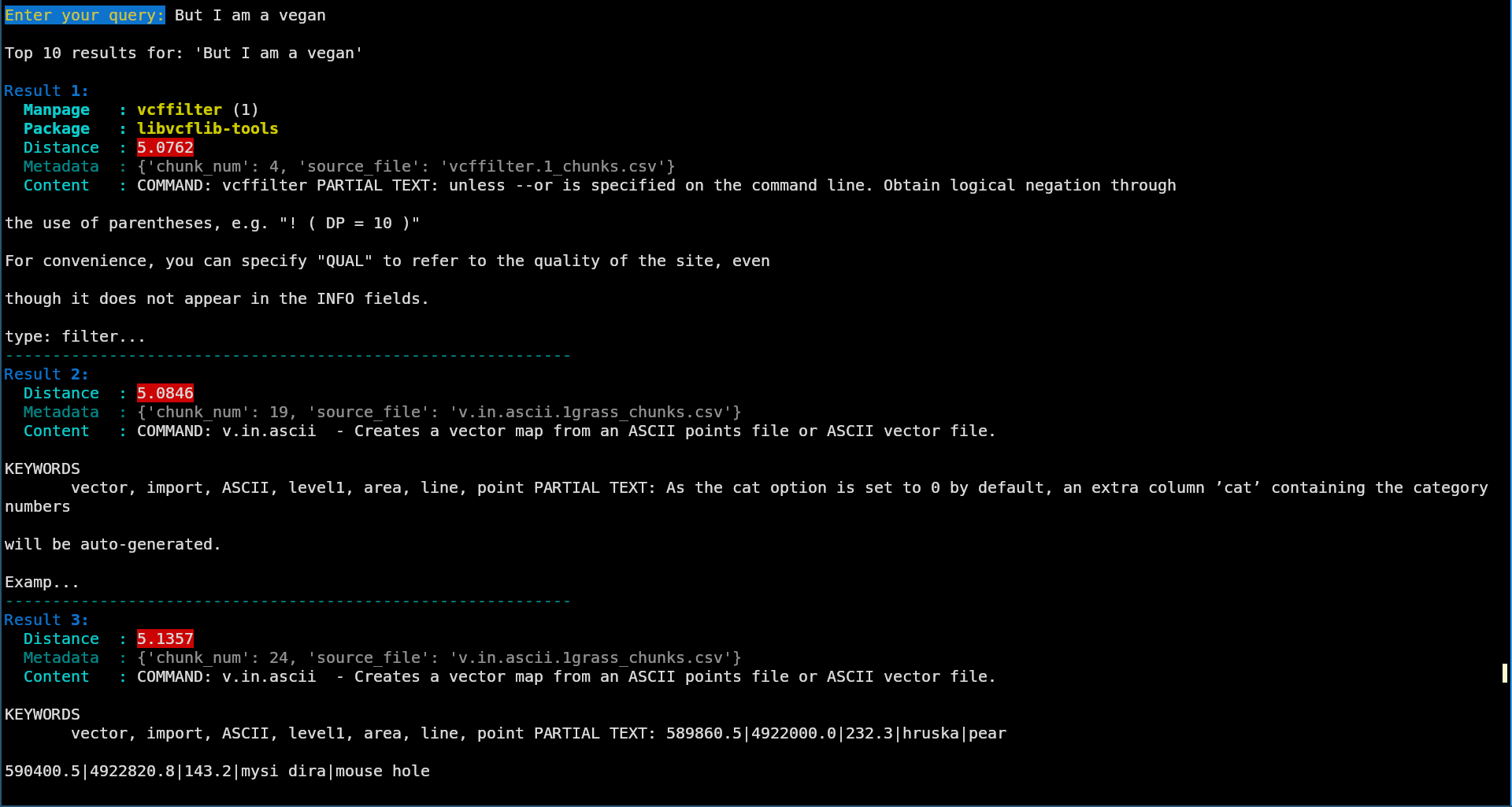
Next.

Previous.